
Cat breed profile
Devon Rex Cat Price in India, Health Tests and Full Breed Guide
What a Devon Rex actually costs in India, why published prices differ by three and a half times, the COLQ myopathy this breed gave to the Sphynx, the blood-type figure that kills kittens, and the seven visible tells that separate a Devon Rex from a Cornish Rex.
Quick answer
The Devon Rex cat price in India runs Rs 35,000 to Rs 1,20,000 in 2026, with published Indian sources disagreeing by three and a half times. Three facts should change the decision and no ranking page carries them. The breed's hereditary myopathy is a COLQ mutation with a definitive DNA test, 41 percent of Devon Rex carry blood type B, the highest of any Rex breed, and the Devon curl is a different gene from the Cornish Rex curl.
This guide is general information for Indian pet owners and is not a diagnosis. Always consult a registered veterinarian near you before acting on anything you read here, and treat any sudden change in your cat's condition as urgent.
Devon Rex at a glance
What a Devon Rex actually is
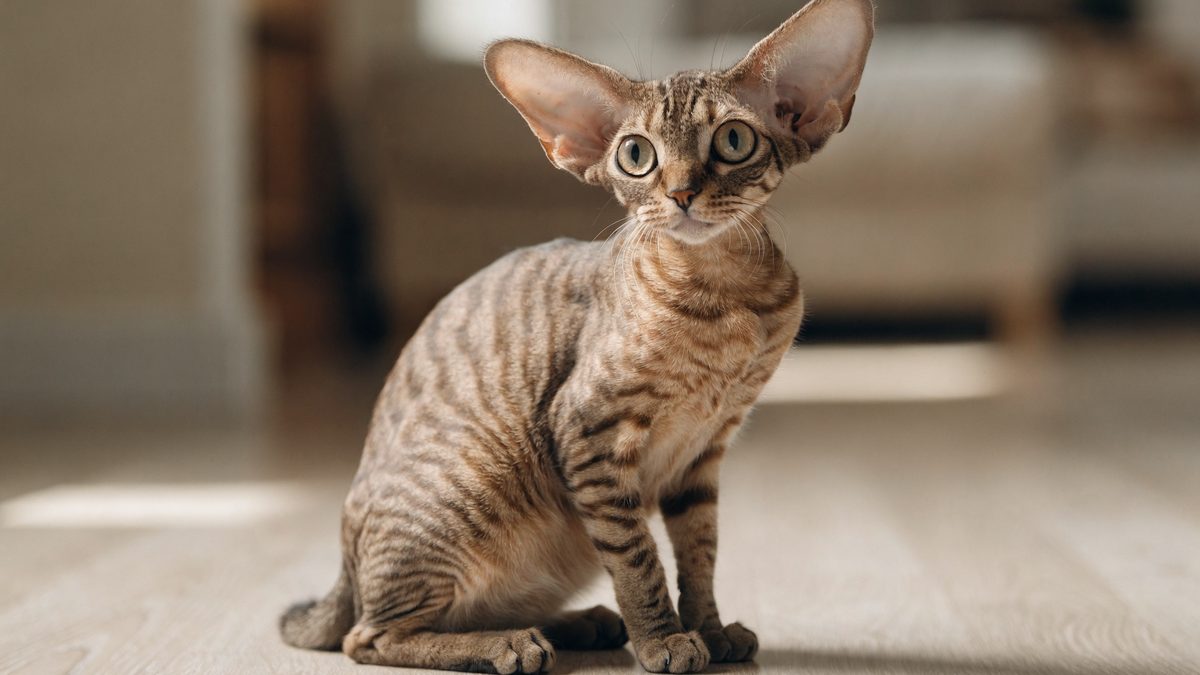
A Devon Rex is a medium-sized, medium-fine-boned domestic cat carrying a short, soft, wavy coat produced by a recessive variant of the KRT71 keratin gene, with huge low-set ears, a short muzzle, prominent cheekbones and large oval eyes that together create the elfin look the registries describe Gandolfi B, Outerbridge CA, Beresford LG. It is not a small Cornish Rex and it is not a coated Sphynx. It is a separate mutation with its own history, its own gene and its own health file.
Start with the coat, because it is the whole breed. A cat's coat carries three hair types, guard hair, awn hair and down hair, and the guard hair is the coarsest and forms the outer layer. The Devon Rex has all three types, but its guard hair is very sparse, very short and rexed, which is what produces the open, billowing wave and the looser curl. The CFA standard describes the coat as soft, fine, full-bodied and rexed, meaning it appears to be without guard hairs, and requires a rippled wave effect to be apparent when you smooth the coat with your hand. Waviness alone carries 10 of the 100 points in the CFA point score, with density and texture carrying 10 each, so a third of the entire standard is coat.
The whiskers tell you the same story. The Devon's whiskers and eyebrows are short and crinkled like the coat, and Hill's describes them plainly as fragile and generally broken. A Devon Rex with stubby, snapped-off whiskers is normal. A Devon Rex with long, straight, intact whiskers is either not a Devon Rex or is a straight-coated variant from an outcross litter.
Size, weight and what the breed standard rewards
TICA calls the Devon a medium-sized cat and gives females 5 to 7 lb and males 7 to 9 lb, roughly 2.3 to 3.2 kg and 3.2 to 4.1 kg. GCCF gives a single range of 6 to 9 lb with males heavier. TICA's standard allows Devon males to be up to 25 percent larger than females without penalty, provided proportion is maintained. In practical terms you are buying a cat that will settle between 2.5 kg and 4 kg, which is smaller than most Indian buyers expect from the photographs, because the enormous ears make the head read as large.
The head is a modified wedge delineated by three distinct convex curves, the outer edge of the ear lobes, the cheekbones and the whisker pads. The ears are strikingly large and set very low, wide at the base, so that the outside base of the ear extends beyond the line of the wedge. The body is hard and muscular with hind legs somewhat longer than the front, which is why a Devon looks like it is standing on tiptoe The Governing Council of the Cat Fancy.
| Fault level | What it covers |
|---|---|
| Penalise | Long or narrow heads, heads tapering in a V, flared ears, round heads or heads that look mixed-breed, extremely short muzzle, misaligned bite, small or high-set ears, short or bare tail, straight coat, bare patches |
| Disqualify | Extensive baldness, excessively long or shaggy coat, long hair on the tail, kinked or abnormal tail, incorrect number of toes, crossed eyes, weak hind legs, any evidence of illness or poor health |
Read that disqualification list closely, because two entries on it are health warnings dressed as show rules. Weak hind legs is the visible sign of the breed's hereditary myopathy, covered in the health section. Extensive baldness is what a Devon Rex looks like when it carries the Sphynx allele or when its coat has been damaged.
Kirlee, the tin mine and the mating that split two breeds
The Devon Rex descends from one cat. Every Devon Rex alive traces to a single curly kitten named Kirlee, born in Buckfastleigh, Devon, England, to a stray tortoiseshell and white female sheltered by Miss Beryl Cox near an abandoned tin mine, and sired by a curly-coated feral tom that lived in the mine The Governing Council of the Cat Fancy The Cat Fanciers' Association. The sources disagree on the date and Bonbeno prints both rather than picking one.
| Source | Date given | Detail |
|---|---|---|
| GCCF | 15 July 1959 | Black Smoke, the only curly-coated kitten in the litter, sire unknown but assumed to be the tin mine tom |
| TICA | 1960 | Litter born to a tortie and white stray adopted by Miss Beryl Cox, sired by the feral tom |
| CFA | 1960 | Miss Cox was living in Buckfastleigh near the abandoned tin mine and gave shelter to the feral tortoiseshell and white female |
The important date is not 1959 or 1960. It is 1961. Kirlee was bought by the judge and breeder Brian Sterling-Webb on the assumption that Devon and Cornwall being adjoining counties, he carried the same mutation as the Cornish Rex. He was mated to two Cornish Rex variant queens and produced normal-coated kittens, which raised the suspicion. Then in 1961 he was mated to a full Cornish Rex queen, Broughton Purly Queen, and that litter came out entirely straight-coated. Two recessive curls that produce straight kittens when crossed are, by definition, not the same recessive. The Cornish mutation was designated Gene 1 and the Devon mutation Gene 2, and the two breeds were developed independently from that point.
Genetics caught up with the breeders half a century later and confirmed them. The Devon curl is the re allele of KRT71, a complex sequence alteration causing a splice variation, and every Devon Rex tested was homozygous for it. The Cornish curl is a four-base-pair deletion, c.250_253_delTTTG, in exon 5 of LPAR6 on chromosome A1, which introduces a premature stop codon. Different gene, different chromosome, different mechanism.
Recognition, registration and the outcross clock
GCCF recognised the Devon Rex in 1967 and the breed reached the United States in 1968. ACFA was the first North American registry to accept it as a separate breed, in 1972. CFA held out, registering all curly cats as one Rex breed until 1979, granted the Devon Rex provisional status in 1981, and finally advanced it to championship in 1983 The Governing Council of the Cat Fancy.
The gene pool problem that started with one cat has never fully gone away, and the registry's rules show it. CFA still permits outcrossing to the American Shorthair or the British Shorthair, and has set a closing date: kittens born on or after 1 May 2028 may have only Devon Rex parents. Because the rex allele is a simple recessive, every first-generation outcross kitten is straight-coated and on average only half of the second generation is straight, which makes outcrossing slow, expensive work for a breeder.
Despite that narrow start, the breed sells. CFA reports that having ranked in its top ten breeds for several years, the Devon Rex has recently been named the most popular of all shorthaired breeds on its registration statistics. That popularity has not reached India. Supertails lists the breed's Indian availability as very rare, and the fact that page one of the target search returns a book, a craft marketplace and a Pinterest pin tells you the same thing.
If a seller cannot tell you which gene their cat carries, they are not a Devon Rex breeder. The Devon curl is KRT71 re, the Cornish curl is an LPAR6 deletion, and a $47 DNA test at UC Davis will settle it in writing.
Devon Rex cat price in India
The published Devon Rex cat price in India runs from Rs 35,000 to Rs 1,20,000 in 2026, a spread of roughly three and a half times across three Indian sources that all claim to describe the same breed in the same country Happy Pet, Devon Rex Cat Breed Guide. No source publishes a city-level figure, none names a cattery, and the top-ranking result for this exact query carries no price at all. Treat every number below as a published claim, not a quote.
Here is the full set, printed as each source printed it. Bonbeno does not average these figures, because averaging a 35,000 and a 1,20,000 produces a number no seller has ever asked and no buyer has ever paid.
| Source | Published price | What the figure covers |
|---|---|---|
| VetScan (India) | Rs 35,000 to Rs 55,000 | Devon Rex entry in a 20-breed Indian roundup, listed with a 12 to 15 year lifespan |
| Supertails (India) | Rs 40,000 and up | Open-ended band in a 40-breed Indian climate guide, availability marked very rare |
| Happy Pet (India) | Rs 60,000 to Rs 1,20,000 | Cost of buying panel on an India-facing Devon Rex breed page |
| Catster (US) | $300 to $600 adoption, $1,800 to $5,000 breeder | US 2026 price guide separating shelter and breeder routes |
| A-Z Animals (US) | $1,800 to $3,000 | US purchase cost, with retired breeding cats offered lower |
| Petful (US) | $1,200 to $3,000, up to $5,000 | US kitten guide, pet quality at the low end and show or pedigree lines higher |
Bonbeno does not convert the dollar figures into rupees, and you should be suspicious of any page that does. An exchange-rate conversion implies the two markets are the same market with a currency in between. They are not. In the United States the Devon Rex is a top-ten CFA breed with an established breeder network. In India it is listed as very rare and the search results for its own price query return a paperback, an Etsy market page and a Pinterest pin. The constraint on the Indian price is not the rupee. It is that almost nobody is breeding them here.
Why the Indian figures disagree by three and a half times
Four things drive the spread, and only the first two are legitimate.
- Import versus local litter. A Devon Rex sourced from an overseas cattery carries airfare, an export pedigree, health certification and quarantine paperwork on top of the kitten. A kitten from a rare local litter carries none of that. Nothing in the published Indian ranges tells you which one you are being quoted, which is why the bands do not overlap.
- Tested versus untested parents. A breeder who has run the congenital myasthenic syndrome DNA test, blood-typed both parents and had the queen and stud echoed by a cardiologist has spent real money before the kittens exist. UC Davis charges $47 per DNA test per animal Veterinary Genetics Laboratory, and that is before the echocardiogram, which is the expensive item. A kitten from that programme should cost more, and the buyer should be shown the certificates.
- Coat quality mistaken for pedigree quality. GCCF notes that Devon coats range from a tousled mop of curls to a thin, suede-like coat, that some cats have almost bare patches, and that the coat only looks its best at full maturity from 18 months onward. Kittens moult at around three months and the coat then develops over the following six months or so. A seller charging a premium for a spectacular kitten curl is charging for something that may not survive the moult.
- Breed substitution. This is the one that costs Indian buyers the most. A curly-coated kitten in India can be a Devon Rex, a Cornish Rex, a Selkirk Rex or a curly-coated cat of no fixed breed, and the three registry breeds carry different genes on different chromosomes. Nothing on page one of the Indian search results teaches a buyer to tell them apart.
How unreliable is Indian pricing for a rare Rex? Look at the sibling breed
The cleanest evidence that Indian Rex pricing is guesswork is what happens to the Cornish Rex, the breed Devon buyers most often cross-shop. Supertails puts the Cornish Rex at Rs 40,000 to Rs 80,000. Happy Pet puts the same breed at Rs 1,50,000 to Rs 4,00,000. That is a fivefold disagreement on a breed that is, if anything, slightly more available than the Devon. When two Indian pet publishers differ by five times on the same rare breed in the same year, the honest conclusion is that neither is reporting transactions. They are reporting estimates.
The number one result in India for 'devon rex cat price in india' is a kitten-for-sale listing on a dog-selling domain that quotes no price in any currency. The number four result is a homeopathy retailer whose Devon Rex page lists supplement prices from Rs 141 to Rs 468 and no cat price at all. The only genuine Indian band on page one is six bullet points inside a 20-breed roundup. If you searched this query and came away with no clear figure, that is the search result working as designed, not you missing something.
What the price should buy you
Set the number aside and price the paperwork instead. A Devon Rex kitten in India is expensive by any measure, so make the money do work. At the top of the published Indian band, Rs 1,20,000, you should be handed all of the following before any money changes hands.
- Registration papers naming the kitten, both parents and the registry, from CFA, TICA, GCCF or an equivalent body.
- A coat genotype on paper. The UC Davis Sphynx and Devon Rex Coats test reports DR/DR for a true curly Devon, and it will also flag an HR/DR cat that will not breed true.
- A congenital myasthenic syndrome result for both parents, reported as Normal, Carrier or Affected.
- Blood types for both parents, which is the single most neglected document in Indian pedigree cat sales and the one most likely to kill a litter.
- A cardiology echocardiogram report for the parents, dated, from a veterinarian who does echoes, not a stethoscope note.
- A vaccination and deworming record with dates and product names, and a written health guarantee.
If a seller cannot produce those six items, the correct Devon Rex cat price in India for that kitten is nothing, because you are not being sold a Devon Rex, you are being sold a curly cat and a story. Bonbeno does not broker kitten sales and does not recommend individual breeders. The figures above are reported from published sources and are not offers.
Monthly cost of owning a Devon Rex in India
Budget Rs 3,800 to Rs 10,700 a month for a premium pedigree cat in India on the only published Indian breakdown, against Rs 1,465 to Rs 2,975 for a budget breed, with metro cities running 20 to 30 percent above Tier 2. The one India-facing Devon Rex page that publishes a figure puts average monthly expenses at Rs 2,800 and monthly food at Rs 1,500 to Rs 2,000. Those two sources are not measuring the same thing, and the gap between them is where Indian Devon owners get caught.
The published Indian monthly cost tables were written for cats in general. Three Devon Rex line items sit outside them, and all three are recurring rather than one-off.
| Monthly expense | Budget breeds | Premium breeds |
|---|---|---|
| Food | Rs 800 to 1,500 | Rs 2,000 to 5,000 |
| Cat litter | Rs 300 to 600 | Rs 600 to 1,200 |
| Grooming | Minimal | Rs 500 to 2,000 |
| Annual vaccination, amortised | Rs 125 to 250 | Rs 125 to 250 |
| Vet checkup, amortised | Rs 40 to 125 | Rs 80 to 250 |
| Toys and accessories | Rs 200 to 500 | Rs 500 to 2,000 |
| Total estimate | Rs 1,465 to 2,975 | Rs 3,805 to 10,700 |
Those are pan-India averages for 2026, and Bengaluru, Mumbai and Delhi run 20 to 30 percent higher than Tier 2 cities. Now add the three Devon-specific items.
Devon-specific cost one: the skin and ear regime
This is the recurring cost nobody quotes you. In the only study of the breed's skin flora, Malassezia pachydermatis was isolated from 26 of 30 Devon Rex cats sampled, and in the seborrhoeic cats the frequency and population size of the yeast in the axillae, left groin and claw fold significantly exceeded those in the healthy Devons and in healthy domestic shorthaired controls. A follow-up study reported that the level of cutaneous Malassezia carriage in the Sphynx was similar to that already reported in the Devon Rex. In plain terms, a greasy Devon is a normal Devon until it becomes a yeasty one, and in Indian humidity the line moves.
TICA adds that the large ears tend to collect oily buildup and should be cleaned when they look dirty, and that claws should be trimmed weekly. Happy Pet's India-facing schedule puts nail trims at every three to four weeks. Budget for a veterinary-grade ear cleaner, a mild cat shampoo and cotton pads as a standing monthly line, not an occasional purchase. Do not buy a human anti-dandruff shampoo because it says it treats yeast.
Devon-specific cost two: cooling, and the electricity behind it
Happy Pet gives the Devon Rex an ideal temperature range of 18 to 24 degrees Celsius. India spent large parts of May 2026 above 45 degrees across Delhi, Rajasthan, Punjab, Haryana, Uttar Pradesh, Madhya Pradesh, Vidarbha, Chhattisgarh, Bihar and Telangana, with 47.6 degrees recorded at Banda in Uttar Pradesh on 21 May. The gap between 24 and 47.6 is not closed by a fan. The climate section below argues that the Devon copes better than a double-coated breed, and that is true, but coping is not the same as free. Whatever you already spend cooling one room in summer is part of this cat's cost.
Devon-specific cost three: the tests, and when to run them
The genetic testing bill is front-loaded and small relative to the kitten. UC Davis charges $47 per DNA test per animal, and the tests relevant to this breed are the Sphynx and Devon Rex Coats test and the PRA rdAc test for the CEP290 variant, for which the Devon Rex is explicitly listed as a breed appropriate for testing Veterinary Genetics Laboratory. Congenital myasthenic syndrome is tested separately, and Langford Vets in the UK reports it as Normal, Carrier or Affected. A buyer does not normally pay for these, because a breeder should already have run them on the parents. A buyer of an untested kitten pays for them twice, once in the test and once in the risk.
The recurring veterinary schedule is not breed-specific and is worth stating plainly because Indian cat owners under-use it. The 2021 AAHA and AAFP feline life stage guidelines recommend a minimum of annual examinations for all cats, rising in frequency as needed, with senior cats seen at least every six months and more often with chronic conditions. The same guidelines define the life stages as kitten from birth to one year, young adult from one to six, mature adult from seven to ten, and senior above ten.
| Line item | Monthly, indicative | Source basis |
|---|---|---|
| Premium-breed base (food, litter, vaccination and vet amortised, toys) | Rs 3,805 to 10,700 | Published Indian premium-breed table |
| India-facing Devon Rex average expense panel | Rs 2,800 | Single India-facing Devon Rex breed page |
| Skin, ear and claw regime | No published Indian figure exists | Regime derived from breed skin-flora study and registry guidance The International Cat Association |
| Cooling one room from March to October | No published Indian figure exists | Breed's stated ideal range is 18 to 24 C |
| One-time DNA panel if the breeder did not test | $47 per test per animal | UC Davis published test pricing |
No source publishes an Indian price for a feline echocardiogram, a Malassezia culture or a course of itraconazole, so this page does not invent one. Ring two veterinary practices in your city before you commit to the breed and get those three quotes in writing. If a cardiologist echo is not available where you live, that is a reason to reconsider the breed, not a detail to sort out later.
One more line that is not money. Devons should not be left alone for long periods, because bored Devons become destructive The Governing Council of the Cat Fancy, and GCCF states directly that they fare best in a home with other cats, ideally other Devon Rex. If you work long hours, the honest cost of this breed includes a second cat.
Can a Devon Rex handle the Indian climate
A Devon Rex handles Indian heat better than any long-coated or double-coated breed, and the two Indian publishers that rate breeds for climate both mark it favourably, Supertails rating it Good and Heads Up For Tails calling it suitable for the Indian climate Heads Up For Tails. That is the right answer to the wrong question. The Devon's specific risk in India is not that it overheats passively. It is that the breed actively seeks out heat, and in an Indian May its own instinct points the wrong way.
Take the thermal facts in order. The Devon coat is short, wavy and carries very little guard hair and little undercoat The Cat Fanciers' Association. TICA and GCCF both explain what that produces, and their wording is nearly identical. A Devon feels warm to the touch, like a soft hot water bottle, because it has the same body temperature as any other cat but its coat does not provide as much insulation, so the warmth reaches your hand instead of being trapped The Governing Council of the Cat Fancy.
Insulation works in both directions. Thin insulation lets a cat shed body heat faster in still, shaded air, which is why the breed's heat tolerance is genuinely better than a Persian's or a Maine Coon's. Thin insulation also lets environmental heat in faster when the cat is sitting in direct sun on a 44 degree afternoon. The same physics that makes a Devon comfortable in a cooled room makes it vulnerable on a west-facing windowsill in Nagpur.
The instinct problem, stated plainly
Both registries describe the behaviour in the same words. Devons love heat and will be found basking in windows or seeking other sources of warmth such as the top of the television The Governing Council of the Cat Fancy. Hill's advises owners to provide areas of warmth in winter. Every one of those statements was written for a British or North American home.
In India the same instinct is a hazard for about five months of the year. A cat that reliably chooses the warmest surface in the room is a cat that will choose the sunlit patch of floor at 2pm in May. Happy Pet's India-facing panel gives the breed an ideal temperature range of 18 to 24 degrees Celsius. On 21 May 2026 the highest temperature recorded anywhere in India was 47.6 degrees at Banda, Uttar Pradesh, and Delhi's Safdarjung station reached 43.6 degrees with many parts of the city almost touching 45. Maximum temperatures frequently exceeded 45 degrees across ten states and union territories that month.
Delhi recorded its warmest May night in almost 14 years on the morning of 25 May 2026, with a minimum temperature of 32.4 degrees Celsius, and the risk is worse in closed, poorly ventilated spaces that trap hot air indoors for hours. A cat sleeps 12 to 16 hours a day. If your flat never drops below 32 degrees overnight, your Devon never gets the recovery window that makes a hot afternoon survivable.
City by city, where the risk changes shape
| Climate type | Cities | The dominant Devon Rex risk |
|---|---|---|
| Dry extreme heat | Delhi NCR, Jaipur, Nagpur, Ahmedabad, Lucknow | Direct-sun basking and warm nights. Block west-facing windowsills from March to October and cool one room |
| Hot and humid coastal | Mumbai, Chennai, Kochi, Kolkata | Skin. Humidity plus a naturally oily coat is the combination that pushes Malassezia carriage toward seborrhoea |
| Milder plateau | Bengaluru, Pune, Hyderabad | The easiest Indian cities for this breed. The 18 to 24 C target is reachable for much of the year without heavy cooling |
| Monsoon months, everywhere | All of the above, June to September | Damp bedding and unclean ears. Large ears collect oily buildup and need cleaning when they look dirty |
What actually works in an Indian home
- Give the cat a cool default. One room with a fan or air conditioner, a tile or stone floor left uncovered, and a shaded resting spot the cat can reach without your help.
- Remove the tempting hot spots. Close curtains on sun-facing windows during peak hours and keep the cat off the top of the fridge, the modem and the television, which are exactly the surfaces the registries say Devons choose.
- Watch water, not weather. Place the water bowl at least three feet away from any food, because a strong food smell reduces how much cats drink, and consider a filtered fountain.
- Treat greasiness in the monsoon as a medical sign. Malassezia pachydermatis was isolated from 26 of 30 Devon Rex cats studied, and yeast counts in seborrhoeic Devons significantly exceeded those in healthy Devons and in healthy shorthaired controls. Greasy plus itchy plus smelly means a vet visit, not a bath.
- Do not bathe on a schedule. The Devon coat is fragile enough that grooming can break the fur off completely. Bathe only when necessary, using a cat-safe shampoo.
Put the breed in its real position among imported cats. The Devon Rex is one of the more heat-tolerant pedigree options available in India, alongside the Cornish Rex and ahead of every long-coated breed, and Supertails marks both Rex breeds Good on climate while marking the Ragdoll, Maine Coon, Norwegian Forest Cat and Siberian as poor and needing air conditioning. That is a real advantage and it is worth stating clearly. It is also a relative advantage, not an absolute one. The hardy cat for Indian conditions remains the Indian shorthair, which has lived through this heat and humidity for thousands of years without climate control VetScan, 20 Best Cat Breeds in India.
Rate the Devon Rex a 4 out of 5 on heat tolerance among pedigree cats and a 3 out of 5 against a desi cat. The coat is not the problem. The behaviour is, and behaviour you can manage with curtains, a cool room and a habit of checking where the cat has chosen to sleep at 3pm.
Temperament, household fit and the second-cat rule
A Devon Rex is an intensely people-oriented, playful, physically busy cat that treats your attention as a resource and objects when it runs out. CFA describes the breed as part court jester and part soulmate, learning its own name, following its people through the house and settling next to them in bed. That is the selling point and it is also the warning, because a cat built to be with you all day does badly in a flat that is empty from nine to seven.
The registries are unusually specific about behaviour here, and the specifics are what you should plan around.
- They follow, they do not observe. Devons are interested in everything but prefer to share the investigation with you, so expect company regardless of what you are doing, including a shoulder perch while you cook and a lap while you read.
- They are powerful jumpers. Expect to find them on top of doors and in places you assumed were out of reach.
- They are talkative without being loud. The conversation is soft chirps, trills and peeps along with contented purrs, not the Siamese yowl. GCCF says they are not particularly talkative but chirp when they need you to look at something.
- They greet strangers. Every guest is a potential new friend who must be made welcome, which suits an Indian household with regular visitors, domestic help and extended family better than a reserved breed would.
- They are safe with children and other animals. CFA reports that Devons get along very well with children, tolerating dress-up and tea-party games with equanimity, and readily accept dogs or other animals as companions, playmates or pillows. TICA calls the breed a perfect choice for families with children, other cats and cat-friendly dogs.
- They eat with enthusiasm and poor judgement. Devons have a robust appetite and some have exotic tastes, with fruit and vegetables as appealing as chicken or fish. CFA's breed article adds that most would prefer to steal or beg tidbits from the table.
The second-cat rule
GCCF puts it in one sentence that most breed pages skip. Devons fare best in a home with other cats, ideally other Devon Rex, and if there are children too, even better. TICA is blunter about the failure mode: these busy little pixies thrive on company and should not be left alone for long periods, because they can become destructive if they get bored.
Treat that as a purchase condition, not a nice-to-have. If your household is empty for eight to ten hours on weekdays, a single Devon Rex is the wrong cat and a pair is the honest version of the same decision. That doubles the food, litter and veterinary line in the monthly cost table, and it is better to know that before you buy than after your sofa arms and window nets have been rearranged.
Who should buy a Devon Rex
| Good fit | Poor fit |
|---|---|
| Someone at home most of the day, or a household where somebody usually is | A single professional out of the flat ten hours a day with no second cat |
| A family with children who want an interactive, affectionate cat that tolerates handling | A buyer who wants an ornamental, independent cat that keeps to itself |
| A home that already has a friendly cat or a cat-friendly dog | A home with a nervous resident cat that resents intrusion |
| An owner willing to socialise a kitten to visitors, doorbells, pressure cookers and festival noise | An owner who plans to keep a curly cat as a display animal for photographs |
| An owner who can commit to a cooled room from March to October | An owner with no cooling and a top-floor west-facing flat |
What Indian buyers get wrong about the personality
The common mistake is reading the word pixie as decorative. CFA's own article calls the breed a cross between a cat, a dog, a monkey and Dennis the Menace, describes them running to meet you at the door to tell you in no uncertain terms how much you were missed, and notes that they are driven to be with people from the moment they toddle out of the kitten box at around three weeks of age. This is a dog-shaped cat personality inside a 3 kg body.
The second mistake is assuming that a friendly breed needs no socialisation. It still does, so socialise the kitten deliberately in its first four months. A Devon kitten that meets six or seven types of person, the vacuum cleaner, a carrier and a car in that window becomes a cat you can take to a vet. A Devon kitten that meets only its owners becomes a friendly cat that panics at a clinic, which is a serious problem in a breed that needs an annual cardiac and skin check.
Secure your window nets and balcony grilles before the kitten arrives, not after. A cat that habitually perches on top of doors and explores every high surface belongs to the category of cat that falls from a high-rise balcony. This applies to every cat in an Indian apartment and it applies more to this one.
Litter training, handling and enrichment for a Devon Rex
Train three things with a Devon Rex, in this order: the litter box, being handled, and being left alone. The litter box is the easy one and most kittens arrive already using it. Handling is the one that decides whether this cat gets the ear cleaning, claw trims and annual cardiac scan it needs. Being alone is the one this breed resists hardest, because TICA states plainly that Devons should not be left alone for long periods and become destructive when bored.
Litter training, and the arithmetic most Indian homes get wrong
To litter train a Devon Rex, provide more boxes than cats and put them in different places. The AAHA and AAFP feline guidelines give the rule of thumb as one litter box for each cat plus one additional box, or one box for each social group plus one if you know the number of social groups, sited in different, easily accessible locations throughout the house, particularly in multi-cat households. One Devon in a 2BHK therefore needs two boxes, not one. A pair needs three.
When a trained cat stops using the box, the cause is usually mechanical rather than behavioural. The same guidelines list the reasons as the litter substrate offered, litter box cleaning and environmental hygiene, box style such as covered or electronic, box size, location preferences, illness, or stress in the home including conflict between housemate cats. Work down that list before you conclude the cat is being difficult, and rule out illness first.
- Count the boxes. Cats plus one, in separate rooms.
- Uncover them. A covered box in an Indian summer holds heat and smell, and both push a cat elsewhere.
- Keep the substrate constant. Change litter brand only when you must, and mix the new into the old over a week.
- Scoop twice daily. Hygiene is on the guideline list of causes, and humidity makes it worse.
- Move the box away from food and water. Cats will not eliminate where they eat, and the water bowl should already sit at least three feet from food for a separate reason.
Handling training, which for this breed is medical
Devon Rex care has more contact points than most breeds. Claws should be trimmed weekly, with an India-facing schedule of every three to four weeks to prevent overgrowth. The large ears collect oily buildup and need cleaning whenever they look dirty. Teeth should be brushed regularly with a vet-approved pet toothpaste, and an Indian breed page lists dental problems first among common Devon Rex complaints. Add an annual veterinary examination as a minimum for every cat and, for this breed, a cardiac scan.
None of that happens on an unhandled cat. Build the tolerance in the first four months while the kitten is still curious rather than opinionated.
| Skill | Start by | How to build it |
|---|---|---|
| Paw handling and claw trims | Week 10 | Touch one paw, release, reward. Trim one claw a day for a week before attempting a full set |
| Ear handling | Week 10 | Lift the ear flap, look, reward. Introduce the cleaner only once the lift is boring |
| Toothbrushing | Week 12 | Finger, then gauze, then a soft brush with pet toothpaste. Never human toothpaste |
| Carrier | Week 9 | Leave the carrier open and fed in all week. The carrier must never mean only the vet |
| Being examined on a table | Week 12 | Two minutes on a towel on a table, chest and belly touched, then released |
| Being brushed with a cloth, not a brush | Week 10 | The coat is fragile and grooming can break the fur off completely, so use a soft cloth |
Enrichment, and why this breed needs it more than most
TICA describes Devons as very intelligent and moderately active, good at amusing themselves, fond of learning tricks, and says many will fetch a toy for you to throw, with puzzle and interactive toys keeping them occupied when alone. Use that. A Devon Rex trains readily by the same method you would use on a dog, which is short sessions, one behaviour at a time and food as the reward, and this is a breed with a robust appetite to work with.
- Two interactive play sessions a day, ten to fifteen minutes each, using a wand toy that the cat can catch and kill at the end. A hunt that never ends in a catch frustrates rather than satisfies.
- One puzzle feeder for at least one meal a day, which slows a greedy eater and occupies a cat that is alone.
- Vertical space, not floor space. These are powerful jumpers that will find the high ground with or without your permission.
- A rotation, not a pile. Put half the toys away and swap them weekly.
- Trick training as enrichment. Sit, target a hand, come to a name and go into the carrier are four behaviours a Devon can learn, and the last one has real veterinary value.
Realistic timelines
Litter use is usually established on arrival at 12 to 14 weeks and reliable within a week in a new home. Name recognition and coming when called takes two to four weeks of paired feeding in this breed, because CFA notes Devons learn to respond to their names. Calm claw trims take six to eight weeks of daily short handling. Toothbrushing takes the longest, often two to three months, and the guidelines note that if an adult cat will not allow routine tooth-brushing a dental diet may be beneficial instead.
You cannot train a Devon Rex to be comfortable alone all day. Enrichment reduces the damage, it does not remove the need. The solution to a lonely Devon is a second cat, which GCCF states directly, not a better puzzle toy.
How much exercise a Devon Rex actually needs
Give a Devon Rex two structured interactive play sessions a day of 10 to 15 minutes each, plus climbing height it can use whenever it likes. That is less than a Bengal and considerably more than a British Shorthair. The registries themselves are not consistent on the level, and printing both versions is more useful than picking one.
TICA's activity panel calls Devons very intelligent and moderately active, good at amusing themselves, and responsive to puzzle and interactive toys when alone. TICA's personality section, on the same page, calls them intelligent, mischievous and highly active, very playful, wanting to be involved in everything, and powerful jumpers for whom no spot goes unexplored. GCCF uses the second description almost word for word.
Both are true, and the resolution is about supervision rather than energy. A Devon left to itself is moderately active. A Devon with a person in the room is highly active, because its activity is social. That is the practical difference between this breed and an independently athletic breed, and it decides how you plan the day.
The daily requirement, written as a schedule
| Time | Activity | Why here |
|---|---|---|
| Early morning, before 8am | 10 to 15 minutes of wand play ending in a catch | Coolest usable window of the Indian day for six months of the year |
| Mid-morning | Puzzle feeder with part of the meal | Occupies the cat while the household is busy |
| Afternoon | Rest in the cooled room, no forced play | The breed seeks warm spots, so the afternoon is for supervision rather than exercise |
| Evening, after sunset | 10 to 15 minutes of climbing, fetch or trick training | Devons learn tricks and many will fetch a toy for you to throw |
| Any time | Free access to a tall scratching post and shelves | Provide a tall scratching pole to serve the natural scratching instinct |
What happens without it
Two things, and neither is subtle. The first is destruction. TICA states that Devons work well in an active household because they thrive on company but should not be left alone for long periods, as they can become destructive if they get bored. The second is weight. Happy Pet's India-facing panel lists obesity among the common Devon Rex health issues, and TICA notes that some Devons really love to eat and need strict feeding limits while others self-regulate well. The guidelines score a body condition of 6 or 7 out of 9 as overweight and 8 or above as obese, and put the published prevalence of obesity in cats at anywhere from 1.8 to 40 percent. Being overweight predisposes cats to diabetes mellitus, lameness, non-allergic skin disease, urethral obstruction and, in one study, more oral disease.
A Devon Rex that suddenly cannot keep up is a clinical case until proven otherwise. The breed's hereditary myopathy presents as appendicular and axial muscle weakness with fatigability on exercise, and in the affected cat described in the causal study, short play sequences were followed by stride shortening and limb tremors, with a dog-begging posture and marked dorsal protrusion of the scapulae. If your young Devon stops mid-play, bobs its head, or holds its neck low and folded down, book a veterinary appointment rather than assuming it has grown out of playing.
Set the expectation correctly against the breeds Indian buyers cross-shop. A Devon Rex needs more daily interaction than a British Shorthair or a Persian and less hard hunting output than a Bengal. What it needs most is not a volume of exercise at all, it is company while exercising, and that is the requirement most Indian buyers underestimate.
Grooming a Devon Rex in Indian humidity, and the one tool you must not use
Never brush a Devon Rex. Hill's states it without qualification: the Devon should never be brushed because her fur is too fragile, the coat is fragile and even grooming can cause the fur to break off completely, and being rubbed gently with a cloth will keep her nicely groomed. GCCF gives the same instruction more gently, saying to groom gently so you do not break the delicate hairs, and that in many cases brushing your hand over the coat is all it needs.
That single rule separates a correctly kept Devon from a patchy one, and it is the rule most often broken in India because the standard advice for every other pedigree cat is to brush weekly. One India-facing Devon page still recommends weekly brushing. Follow the registries and the manufacturer instead, and use a soft cloth or a bare hand.
The weekly routine, in five minutes
- Wipe the coat with a soft, slightly damp cloth. Front to back, once over. This lifts loose hair and surface oil without stressing the wavy coat.
- Check the ears and clean only when they look dirty. Large ears tend to collect oily buildup. Use a veterinary ear cleaner and cotton pads, never a cotton bud pushed into the canal.
- Trim the claws. TICA says weekly; the India-facing schedule says every three to four weeks to prevent overgrowth. Take the more frequent figure and do a few claws at a time.
- Brush the teeth with a vet-approved pet toothpaste, because dental problems head the list on the Indian breed pages.
- Run your hands over the skin. You are checking for greasiness, scale, spots, thinning patches and heat. This is the weekly examination that catches the breed's real problems early.
Shedding, moulting and the coat that disappears
Contrary to popular opinion, Devon Rex do shed just like all other cats, and the structure of the coat simply makes the shedding less obtrusive than in some other breeds The Governing Council of the Cat Fancy. TICA adds the detail that if a Devon has a favourite sleeping spot you will eventually see a fine coating of lint there. Low shedding, not no shedding.
Then there is the moult, which alarms new owners every year. Kittens may moult at around three months, with the coat developing and coming in over the following six months or so. When a Devon moults, the coat often breaks off so that no curl is apparent until the new coat grows back The Governing Council of the Cat Fancy. A partially bald, straight-looking Devon in moult is normal. GCCF notes that the coat looks its best at full maturity, from 18 months of age onward. Do not judge an adult coat on a six-month-old kitten, and do not pay a premium for a kitten curl that has not yet been tested by a moult.
CFA grades this precisely. Bare patches are a fault in kittens and a serious fault in adults, but down on the underparts of the body should not be misinterpreted as bareness, and sparse hair on the temples in front of the ears is not a fault at all. Extensive baldness is an outright disqualification. A Devon with thin belly fuzz is correct. A Devon that is largely bald is not a Devon Rex you should be buying.
Greasy skin in Indian humidity, and the sampling trap
The Devon Rex carries yeast on its skin as a matter of course. In the definitive study of the breed, skin and anal mucosal carriage was investigated in 21 healthy and 9 seborrhoeic Devon Rex cats, and Malassezia pachydermatis was isolated from 26 of those 30 animals. Lipid-dependent Malassezia, identified as M. slooffiae, was recovered from the claw folds of 5 healthy and 3 seborrhoeic Devons. In the seborrhoeic group, the frequency of isolation and population sizes of M. pachydermatis in the axillae, left groin and claw fold significantly exceeded those in the healthy Devons, and both Devon groups exceeded healthy domestic shorthaired controls.
The follow-up study on Sphynx cats found the Sphynx carriage level similar to that already reported in the Devon Rex, and drew a clinical conclusion that matters to you at the vet's table. The poor recovery of Malassezia from the ears in both Sphynx and Devon Rex has implications for dermatological sampling in these breeds. In the Sphynx study none of the 32 cats yielded Malassezia from the ears at all.
A clean ear swab does not rule out Malassezia in a Devon Rex. The yeast concentrates in the armpits, the groins and the claw folds, and it is poorly recovered from the ears Ahman SE, Bergstrom KE. Cutaneous carriage…. If your greasy, itchy Devon has had one negative ear cytology and been sent home, ask for the axillae, groin and claw folds to be sampled.
There is a second skin condition worth naming because it is slow to be diagnosed. Feline maculopapular cutaneous mastocytosis, historically called urticaria pigmentosa, was reviewed in 13 cats drawn from 14 years of a referral dermatology practice, and the affected animals were 9 Sphynx, 2 Devon Rex and 2 Sphynx or Devon Rex crossbreeds. Females were over-represented at 9 of 13, and the median duration of clinical signs before diagnosis was 8 months, with variable response to antihistamines, steroids and ciclosporin. Eight months of undiagnosed itchy, spotted skin through an Indian summer and monsoon is the outcome to avoid.
Are Devon Rex cats hypoallergenic, answered from the allergy literature
No. All cats produce Fel d 1 regardless of breed, age, hair length, sex, housing or body weight, and there are no allergen-free or hypoallergenic cats. TICA says the breed-level version of this directly: there is a perception that the Devon Rex is hypoallergenic, however they do produce allergens like every other cat, and some people with allergies tolerate Devons while others do not, depending on their personal allergies. GCCF repeats it almost word for word.
The reason breed claims fail is the size of the individual variation. One study observed an 80-fold difference in salivary Fel d 1 between the lowest and highest producing cats in a group of 64, and up to a 76-fold difference between the lowest and highest levels within individual cats over time. A spread that large within a single cat across the year swamps any average difference between two breeds. So when an Indian guide lists the Devon Rex among breeds that produce lower amounts of allergen alongside the Russian Blue, Siberian, Bengal, Balinese and Cornish Rex, and then adds that you should spend time with the individual cat because responses vary widely, the second half of that sentence is doing all the work.
Bathing does not solve it either. Immersion bathing does lower allergen levels on the cat's hair, but the effect is transient and allergen levels return to baseline within 24 hours of the bath. You cannot bathe a Devon Rex daily anyway, because the coat is fragile and the India-facing guidance is to bathe only when necessary with a cat-friendly shampoo Hill's Pet Nutrition.
TICA gives the only method with any value, and it is a test, not a purchase. If you are allergic and considering a Devon, arrange to spend time in the company of one, wait at least 24 hours to see whether a reaction develops, and ideally visit more than once. Do that before money changes hands, not after.
Devon Rex health issues, lifespan and the four tests that matter
Four health issues decide whether a Devon Rex purchase goes well, and only one of them appears on the Indian pages. They are congenital myasthenic syndrome, which has a definitive DNA test; blood type B incompatibility, which kills kittens and is invisible without a blood test; patellar luxation, for which the breed is documented but not quantified; and hypertrophic cardiomyopathy, where the screening that actually applies is not the one Indian sellers usually offer. TICA's own summary is that the Devon Rex is considered an overall healthy breed, but that all Devons should be genetically tested for all available genetic markers including Devon myopathy, and that parents should be scanned for HCM. Screen both parents before you buy, because you cannot screen a kitten backwards.
Lifespan, and why no primary-care figure exists for this breed
The published life expectancy for the Devon Rex ranges from 9 to 17 years depending on who you read, which is a wider band than any responsible page should present as a single number.
| Source | Figure | Type of source |
|---|---|---|
| TICA | 14 to 17+ years | Registry breed panel |
| GCCF | 12 to 16 years | Registry breed profile |
| VetScan (India) | 12 to 15 years | Indian breed roundup |
| Supertails (India) | 10 to 15 years | Indian climate and price guide |
| Heads Up For Tails (India) | 9 to 15 years | Indian breed listing |
Every one of those is a breed-profile estimate, not a measurement. The only large primary-care measurement of cat lifespan is the UK VetCompass life table study, which modelled 7,936 confirmed deaths in cats under primary veterinary care in 2019 and produced a life expectancy at age 0 of 11.74 years for UK companion cats overall. That study analysed 12 breeds with 15 or more deaths, running from the Burmese at 14.42 years and the Birman at 14.39 down to the Bengal at 8.51 and the Sphynx at 6.68 years. The Devon Rex is not in that table. There were not enough recorded Devon Rex deaths in the dataset to model one.
No veterinary-records study has ever published a life expectancy for the Devon Rex. Anyone quoting you 14 to 17 years is quoting a registry breed panel, and anyone quoting 9 to 15 is quoting an Indian breed listing. Both are estimates. The Devon Rex may well outlive the Sphynx comfortably given how much more coat and how much less skin disease it carries, but Bonbeno will not print a number that nobody has measured.
1. Congenital myasthenic syndrome, the disease this breed gave to the Sphynx
The Devon Rex hereditary myopathy is a congenital myasthenic syndrome caused by a homozygous c.1190G>A missense variant in exon 15 of the COLQ gene, producing a C397Y substitution and a loss of acetylcholinesterase clustering at the neuromuscular junction. It is autosomal recessive, it maps to feline chromosome C2, and segregation in the study pedigree was 100 percent consistent with recessive inheritance. Bonbeno's Sphynx page already establishes this variant. What that page states from the Sphynx side, this page states from the origin side.
The direction of travel matters, and the study is explicit about it. Genotyping a panel of 333 cats from 14 breeds failed to find a single carrier outside the Sphynx and the Devon Rex, and none of the 22 Siamese and Oriental, 20 Persian and Exotic, or 20 British Shorthair and Longhair cats carried it. The authors concluded that the mutation was present at the beginning of the Devon Rex breed and spread into the Sphynx through the outcrosses performed during the 1970s to 1990s, and proposed renaming the disease the congenital myasthenic syndrome of Devon Rex and Sphynx cats. In other words, this is a Devon Rex founder mutation that the Sphynx inherited, not the other way round.
A second, independent study confirmed the association and gave the number an Indian buyer needs. Eighteen affected cats were identified by genotyping, including cats from the original 1993 clinical descriptions, and eight Devon Rex plus one Sphynx unconnected to the study were identified as carriers, suggesting an allele frequency of roughly 2.0 percent in the Devon Rex, with over 350 tested cats from other breeds carrying no copy of the variant. Alpha-dystroglycan expression, which is associated with COLQ anchorage at the motor end-plate, is deficient in affected cats.
| Result | Copies of the variant | What it means |
|---|---|---|
| Normal | 0 | The cat does not carry the known mutation causing the disease |
| Carrier | 1 | The cat will not have the disease but may pass the mutation to its offspring |
| Affected | 2 | The cat will develop congenital myasthenic syndrome |
Because it is recessive, two healthy-looking parents can produce an affected kitten. That is the entire argument for testing rather than trusting appearance. International Cat Care lists Devon Rex myopathy among the common and important inherited disorders in cats and holds that traits compromising health or welfare should not be continued through further breeding, and adds two procedural points worth insisting on: a vet should collect the sample so that identity can be verified, and the result should be linked to a permanent identification such as an internationally recognised microchip number.
In the first description, six related Devon Rex cats showed a slow progressive congenital muscle disease with prominent ventroflexion of the head and neck, head bobbing, protrusion of the scapulae, megaoesophagus and pharyngeal weakness, while peripheral nerves, spinal cord and brain were grossly and histologically normal. The affected cat described in the causal study showed a dorsal protrusion of the scapulae at rest and while walking, a dog-begging posture after short play sequences, stride shortening and limb tremors after exercise, and the breeder reported difficulty taking and swallowing food with occasional choking episodes while eating. The condition was previously called spasticity, myopathy or muscular dystrophy of the Sphynx and Devon Rex.
Go back to that 1993 case series, because it contains the single most important sentence written about this breed and no Indian page quotes it. Six closely related Devon Rex cats with a congenital muscle disease were followed over three years. Signs became evident between 3 and 23 weeks of age and then usually progressed slowly or remained static, plasma creatine kinase and aspartate aminotransferase were not elevated, and histology showed a primary myopathy with neither nerve nor spinal cord involvement. Then the outcome: four of the six cats died suddenly of laryngospasm after obstruction of the pharynx or larynx with food. The later genetic work restates it the same way, noting that cats generally succumb to the disease by food-related asphyxiation or aspiration pneumonia referable to bulbar weakness.
The disease also has a muscle-biology fingerprint that explains why it was misnamed for so long. Affected Sphynx and Devon Rex cats show a slowly progressive myopathy with the clinical and histological hallmarks of muscular dystrophy and no involvement of peripheral nerves or the central nervous system, with reduced expression of alpha-dystroglycan while beta-dystroglycan, the sarcoglycans and dystrophin are expressed normally, and no causative mutation in the dystroglycan gene itself. That is why the condition was filed under muscular dystrophy for years before the COLQ variant was found.
Two practical consequences follow. First, blood tests will not find this disease, because the muscle enzymes are normal. A vet who runs a panel, sees clean creatine kinase and reassures you has not ruled anything out. Second, the killer is a meal, not the weakness itself. An affected cat needs a feeding plan from the day it is diagnosed, and an owner who has been told the cat merely tires easily is not being told the risk.
2. Blood type B, the risk no Indian page mentions
The Devon Rex carries the highest published frequency of blood type B of any Rex breed. In the reference table used by veterinary reviewers of feline blood typing, the Devon Rex is 59 percent type A and 41 percent type B, against 67 and 33 percent for the Cornish Rex and 83 and 17 percent for the Sphynx.
| Breed | Type A % | Type B % |
|---|---|---|
| Devon Rex | 59 | 41 |
| Turkish Angora | 54 | 46 |
| British Shorthair | 64 | 36 |
| Cornish Rex | 67 | 33 |
| Exotic Shorthair | 73 | 27 |
| Sphynx | 83 | 17 |
| Persian | 86 | 14 |
| Maine Coon | 97 | 3 |
| Siamese | 100 | 0 |
| American Shorthair | 100 | 0 |
The reason this matters is feline neonatal isoerythrolysis. It results from mating a type B queen with a type A or AB tom, and although it is rare overall, the associated mortality rate is high. The feline placenta is endotheliochorial and allows only 5 to 10 percent of maternal antibodies through, so kittens receive maternal immunoglobulin by suckling colostrum in the first days of life, and a type A or AB kitten born to a type B mother takes in anti-A antibodies the moment it starts suckling. In a UK survey of kitten mortality from birth to 16 weeks, the majority of deaths in the perinatal period, under one day of age, were due to neonatal isoerythrolysis, and the condition is believed to be a major cause of fading kitten syndrome. Breeds such as the British Shorthair, Devon Rex, Persian, Abyssinian, Turkish Angora and Turkish Van present type B frequencies between 10 and 60 percent, so random mating in these breeds carries a great risk.
CFA says the same thing from inside the breed. Genetic testing is essential for Devon breeders because of the high incidence of blood type B in the gene pool, and if an A male is bred to a B female, parental blood type incompatibilities can result in the death of the kittens unless they are initially hand-raised. CFA's breed article adds that all breeding Devons are now blood typed, and that where such a mating occurs the kittens are hand fed every two hours until the gut closes internally and they can handle the antibodies on their own.
Ask for the blood type of both parents in writing. If the seller does not know what you are asking, they have not run the test, which means roughly two in five of their queens are type B and no precautions were taken. That is also the most likely explanation for a breeder who has lost kittens in the first 48 hours and calls it fading kitten syndrome.
3. Hypertrophic cardiomyopathy, and the wrong test being sold
Every Indian Devon Rex page lists hypertrophic cardiomyopathy, and the US price guides devote a subheading to it. TICA recommends that parents be scanned for HCM. All of that is reasonable. What is not reasonable is a DNA certificate.
The ACVIM consensus statement lists the pedigree breeds believed to be at increased risk of HCM as the Maine Coon, Ragdoll, British Shorthair, Persian, Bengal, Sphynx, Norwegian Forest cat and Birman, and notes that comprehensive prevalence data are lacking for pedigree cats. The Devon Rex is not on that list. Only two mutations have been identified in cats, both in the myosin binding protein C gene, and the statement is explicit that genetic testing for the A31P and R820W MYBPC3 mutations in non-Maine Coon or non-Ragdoll cats is not recommended, because those two mutations are almost completely specific to the Maine Coon and the Ragdoll.
So the screening that applies to a Devon Rex is an echocardiogram performed by a veterinary cardiology specialist, repeated during the breeding years, not a mail-order DNA panel. Two auscultation facts are useful when you are standing in a clinic. A parasternal systolic murmur has been reported in up to 80 percent of cats with subclinical HCM against 30 to 45 percent of healthy cats without it, and many affected cats have no auscultatory abnormality at all, which is why further investigation is recommended whenever a murmur is detected in any cat.
Keep the background rate in mind so that neither you nor the seller over-reads a normal finding. In the CatScan study of 780 apparently healthy cats in rehoming centres, the prevalence of hypertrophic cardiomyopathy was 14.7 percent with a 95 percent confidence interval of 12.3 to 17.4 percent, the prevalence of heart murmurs was 40.8 percent of which 70.4 percent were considered functional, and the positive predictive value of a murmur for indicating HCM ranged from 17.9 to 42.6 percent while the negative predictive value ranged from 90.2 to 100 percent. Male sex, increasing age, increased body condition score and a murmur of grade 3 out of 6 or louder were the factors associated with an HCM diagnosis. Read that as three instructions: a murmur in your Devon is more likely to be functional than not, the absence of a murmur is reassuring but not proof, and keeping the cat lean is one of the few cardiac levers you actually control.
4. Patellar luxation, documented but not quantified
GCCF states that luxating patella, where the kneecap dislocates or moves out of its normal location, appears more common in the Devon Rex. International Cat Care lists patellar luxation among the inherited disorders it tracks, and the India-facing Devon page lists it among common health issues. That is three independent sources agreeing the breed is predisposed.
None of them gives a prevalence, and Bonbeno will not manufacture one. The largest prospective orthopaedic screening study of pedigree cats recruited 107 cats and found medial patellar luxation in 32.7 percent and hip dysplasia in 46.7 percent, but its cohort was 85 Maine Coon, 13 Norwegian Forest, 5 Burmilla, 3 Siberian and 1 Oriental Shorthair, without a single Devon Rex. Those percentages describe Maine Coons, not Devons, and any page that transplants them onto this breed is inventing data.
5. Progressive retinal atrophy, the test Indian sellers never mention
The Devon Rex appears on the list of breeds appropriate for testing for the CEP290 rdAc form of progressive retinal atrophy, alongside the Abyssinian, Bengal, Cornish Rex, Ragdoll, Siamese and Somali among others. It is autosomal recessive. Affected cats have normal vision at birth, degeneration is first detected at about seven months of age, and vision loss progresses slowly and variably, with most cats becoming blind at about three to five years. There is no treatment. UC Davis lists the PRA rdAc test on its Devon Rex breed page alongside PKD1, the coat colour panel and the Sphynx and Devon Rex Coats test Veterinary Genetics Laboratory.
The everyday complaints
Beyond the inherited list, the conditions that fill an Indian Devon Rex consulting room are ordinary. The India-facing breed pages list upper respiratory infections, dental problems, obesity and gastrointestinal issues, and the Indian retailer page leads with dental problems, skin conditions and gastrointestinal issues. Weight is the one you control directly, since some Devons love to eat and need strict feeding limits, and a body condition score of 6 or 7 out of 9 is already overweight.
| Item | Test type | Whose job |
|---|---|---|
| Congenital myasthenic syndrome, COLQ c.1190G>A | DNA, reported Normal / Carrier / Affected | Breeder, both parents, before mating Abitbol M, Hitte C, Bosse P |
| Blood type A or B | Blood test | Breeder, both parents, before mating |
| Coat genotype, KRT71 | DNA, N / HR / DR | Breeder, and any buyer verifying the breed |
| Hypertrophic cardiomyopathy | Echocardiogram by a cardiology specialist, not a DNA test | Breeder for parents, owner annually from middle age The International Cat Association |
| Patellar luxation | Orthopaedic examination of both stifles | Vet, at the kitten check and at annual visits |
| PRA rdAc, CEP290 | DNA | Breeder, both parents |
| Body condition score | Physical scoring at every visit | Owner and vet, every visit |
This guide is general information and is not a diagnosis. Take any sudden weakness, head bobbing, difficulty swallowing, laboured breathing or collapse in a Devon Rex to a veterinarian the same day.
Feeding a Devon Rex in India
Feed a Devon Rex kitten three times a day until six months of age, then twice a day, and measure the portions rather than free-feeding. This is a breed with a documented appetite problem. CFA describes Devons as having a robust appetite with some showing exotic tastes, where fruit and vegetables may be as appealing as chicken or fish, and adds that they are hearty eaters who would mostly prefer to steal or beg tidbits from the table The Cat Fanciers' Association.
TICA splits the breed into two feeding personalities and the split is useful. Some Devons really love to eat and need strict feeding limits, while others are very good at self-regulating, and many are snackers who prefer kibble available rather than limited wet food. Work out which one you have in the first two months and manage accordingly. A self-regulating Devon can have a measured daily ration left out. A greedy Devon cannot, and free-feeding one is how an Indian Devon Rex arrives at the vet at 5 kg.
| Stage | Meals per day | Notes |
|---|---|---|
| 3 to 5 weeks | Weaning begins | Kittens can be weaned onto commercially balanced kitten foods starting at 3 to 5 weeks of age |
| 8 weeks to 6 months | 3 | Kitten formula, measured. Kittens need feeding three times a day until they are six months |
| 6 months to 1 year | 2 | After six months, twice a day is optimal |
| 1 to 6 years, young adult | 2 | Adjust the amount to maintain ideal body condition, not to a bag chart |
| 7 to 10 years, mature adult | 2 | Add an annual blood panel to the routine |
| Over 10 years, senior | 2, or smaller and more often | Veterinary examination at least every six months |
Body condition is the only feeding metric that matters
Forget grams for a moment and score the cat. The guidelines instruct that the amount fed should be adjusted to maintain or encourage ideal body condition and that a body condition score should be documented by the veterinarian at every visit, with 6 or 7 out of 9 counted as overweight and 8 or above as obese. The published prevalence of obesity in cats ranges from 1.8 to 40 percent across studies, and being overweight predisposes cats to diabetes mellitus, lameness presumed related to osteoarthritis and soft tissue injury, non-allergic skin disease, urethral obstruction and, in one study, an increase in oral disease.
Non-allergic skin disease deserves a second look in this breed specifically, because the Devon Rex already carries Malassezia pachydermatis on the skin of most individuals. An overweight Devon has more skin folds, more trapped moisture and, in an Indian monsoon, a better environment for the yeast it already has.
Water, and the three-foot rule
Give fresh, clean water daily, and place the water bowl at least three feet away from any food, because cats' noses are sensitive and an overwhelming smell of food can make them drink less. A filtered drinking fountain works in place of a bowl. In an Indian summer this is not a refinement. A cat that drinks less in a 43 degree flat is a cat heading toward urinary trouble, and urethral obstruction is already on the list of conditions that excess weight predisposes to.
What to buy in India, and what to budget
Indian sources put monthly food for a Devon Rex at Rs 1,500 to Rs 2,000, within a wider premium-breed food band of Rs 2,000 to Rs 5,000 a month. Choose a complete, life-stage-appropriate commercial cat food that states it is formulated to a recognised nutritional standard, and keep the diet stable. Frequent brand changes are a common cause of the gastrointestinal upsets that Indian breed pages already list among Devon Rex complaints Happy Pet, Devon Rex Cat Breed Guide.
- Do not feed from the Indian table. CFA is explicit that most Devons would prefer to steal or beg tidbits from the table. An Indian table carries onion, garlic, chilli and dairy in almost every dish, none of which belongs in a cat. Decide the rule on day one, because a Devon will test it every day.
- Do not give cow's milk. It is the most common well-meant mistake in Indian cat households and it produces diarrhoea, not calcium.
- Use a puzzle feeder for at least one meal if the cat is a snacker or a beggar. It slows intake and doubles as enrichment.
- Weigh the cat monthly on a kitchen scale. A 200 g gain on a 3 kg cat is nearly 7 percent of body weight, and you will not see it under a curly coat.
- Keep a dental diet in mind. If an adult Devon will not accept toothbrushing, a dental diet may be beneficial, and dental disease heads the Indian complaint lists for this breed.
Megaoesophagus and pharyngeal weakness are part of the clinical picture of the breed's congenital myasthenic syndrome, alongside difficulty taking and swallowing food and occasional choking while eating Abitbol M, Hitte C, Bosse P. A cat with that diagnosis needs a feeding plan designed by its veterinarian, usually involving posture and food consistency. Do not manage it from a breed page, including this one.
Devon Rex kitten timeline, month by month through the first year
A Devon Rex kitten timeline has three milestones that no other breed shares, and every Indian buyer should know them before the panic sets in. The coat moults at around three months and may vanish entirely for a while. It regrows over the following six months and only looks its best at 18 months The Governing Council of the Cat Fancy. And retinal degeneration, if the rdAc variant is present, first becomes detectable at about seven months.
| Age | What happens | What you do |
|---|---|---|
| 3 to 5 weeks | Weaning onto commercially balanced kitten food begins. Devon kittens are driven to be with people from the moment they toddle out of the kitten box at around three weeks | Breeder's job. Ask to see the kittens with the queen at this age |
| 8 to 9 weeks | First vaccinations and deworming under way. Personality already visible | Do not take a kitten home yet. Confirm the parents' CMS results and blood types in writing The Cat Fanciers' Association |
| 10 to 12 weeks | Ready to leave the breeder in most programmes. Kitten still coated | Start paw, ear and carrier handling immediately. Set up two litter boxes before arrival |
| 12 to 16 weeks | Rabies vaccination window in the standard Indian schedule | Complete the vaccination course. Microchip and register the identification |
| Around 3 months | The moult. The coat often breaks off so no curl is apparent until the new coat grows back | Do nothing to the coat. Do not brush, do not bathe, do not buy supplements |
| 3 to 9 months | The adult coat develops and comes in over about six months | Weekly cloth wipe and weekly claw trim Hill's Pet Nutrition |
| Around 7 months | If the cat carries two copies of the rdAc variant, retinal degeneration first becomes detectable, though vision loss is slow | Mention the breed's PRA status at the six-month vet visit |
| 6 months | Switch from three meals a day to two | Start monthly weight checks and a body condition score at every vet visit |
| 6 to 9 months | Neutering window in most Indian practices | Discuss timing with your vet. Sterilisation, claw care, identification and disaster preparedness are the standard initial-consultation topics |
| 9 to 12 months | Appetite peaks and the greedy-versus-self-regulating split becomes obvious | Move to measured portions if the cat is a grazer that never stops |
| 12 months | End of the kitten life stage; the cat becomes a young adult | First adult annual examination. Ask for a stifle check and a cardiac auscultation Luis Fuentes V, Abbott J, Chetboul V |
| 18 months | The coat reaches full maturity and looks its best from here | This is when you can finally judge the coat you bought |
The three questions Indian owners ask in the first year
My kitten has gone bald in patches. Is it ringworm? It may be, and a vet should look. But a Devon Rex at around three months moulting its kitten coat, with the curl temporarily absent and the coat regrowing over the next six months, is the textbook description of normal in this breed. The differentiator is inflammation. A normal moult leaves quiet skin. Ringworm and yeast do not.
Its whiskers keep breaking. That is the breed. Devon whiskers and eyebrows are short and crinkled like the coat, and Hill's records that Devons generally have broken whiskers because the whiskers are fragile.
It is warm to the touch. Does it have a fever? Take a temperature if you are worried, but the breed feels warm as a matter of physics. Devons have the same body temperature as other cats, and because their coat does not provide as much insulation, they feel warmer to your hand and are often described as soft hot water bottles.
What to watch for, and when to stop waiting
The congenital myasthenic syndrome is congenital, and the original description records a slow progressive muscle disease rather than a sudden collapse. That slowness is the danger, because owners normalise it month by month. Set yourself hard triggers instead.
- Ventroflexion of the head and neck, meaning the kitten holds its chin tucked toward its chest and cannot lift its head normally.
- Head bobbing at rest or during movement.
- Scapulae standing up above the line of the back at rest and while walking.
- Stopping after short play, then sitting in a dog-begging position with the front legs propped on something.
- Stride shortening or limb tremors after exercise.
- Difficulty taking or swallowing food, or choking while eating, which points at megaoesophagus and pharyngeal weakness.
A DNA test settles the question, because the disease is caused by a single recessive variant and the result comes back Normal, Carrier or Affected Abitbol M, Hitte C, Bosse P. Testing a symptomatic kitten is cheaper than a month of guessing, and it also tells the breeder something they need to know about both parents.
One Indian scheduling note. Try to bring a Devon Rex kitten home outside the peak of summer and outside the heaviest weeks of the monsoon. A settling kitten in a flat that does not drop below 32 degrees at night is doing two hard things at once, and a damp monsoon arrival is the worst possible start for a breed whose skin already carries Malassezia on most individuals.
Devon Rex vs Cornish Rex vs Sphynx, compared properly
The Devon Rex and the Cornish Rex are not variants of one curly cat. They carry different mutations in different genes on different chromosomes, and a 1961 test mating proved it before anyone could sequence anything Gandolfi B, Outerbridge CA, Beresford LG Gandolfi B, Alhaddad H, Affolter VK. The Sphynx sits closer to the Devon than the Cornish does, sharing both the KRT71 gene and a founder disease mutation Abitbol M, Hitte C, Bosse P. Get these three straight before you shortlist, because Indian sellers routinely do not.
The genetics, in one table
| Breed | Gene and variant | Relationship to the others |
|---|---|---|
| Devon Rex | KRT71, the recessive re allele, a complex sequence alteration causing a splice variation. All Devon Rex tested were homozygous for it | Shares the gene with the Sphynx. Unrelated to the Cornish curl |
| Sphynx | KRT71, the recessive hr allele, a SNP altering a splice site. Most Sphynx are homozygous hr or compound heterozygotes carrying the Devon re allele | Same gene as the Devon. The suggested allelic series is KRT71 normal, then hr, then re |
| Cornish Rex | LPAR6, a four-base-pair deletion c.250_253_delTTTG in exon 5 on chromosome A1, causing a premature stop codon. Fixed in the breed, absent in all straight-haired cats tested, and also segregating in the German Rex | A completely separate mutation in a separate gene. Not interchangeable with the Devon curl |
A fourth curly breed makes the point sharper still. The Selkirk Rex is defined by an autosomal dominant woolly rexoid hair abnormality with tightly curled hair shafts, associated with a different splice variant in the same KRT71 gene. Dominant, not recessive. That single word changes what a mating produces, which is why lumping every curly cat into one category is not a harmless simplification for a buyer.
The breeders discovered this the hard way. Kirlee was bought on the assumption that Devon and Cornwall being neighbouring counties, he carried the Cornish mutation. He was mated to two Cornish Rex variant queens and produced normal-coated kittens, and then in 1961 he was mated to the full Cornish Rex queen Broughton Purly Queen and produced a litter of entirely normal-coated kittens. Two different recessives cannot mask each other, and straight kittens from two curly parents was the proof. The Cornish line became Gene 1 and the Devon line Gene 2 The Cat Fanciers' Association. UC Davis now sells the confirmation as a $47 test that reports N, HR or DR.
How a buyer tells a Devon Rex from a Cornish Rex without a DNA test
CFA's own breed article sets out the physical differences, and the checklist below is drawn from it directly. Use it on the kitten in front of you.
| Feature | Devon Rex | Cornish Rex |
|---|---|---|
| Guard hair | Present but very sparse, short and rexed, giving a more open, billowing wave and a looser curl | Absent. A short coat with no guard hair at all |
| Wave pattern | Looser, more open, denser texture | Tight marcel waves, compared to a washboard in appearance |
| Head shape | Shorter and squarer, with a definite whisker pinch | Narrower at the nose |
| Profile | A definite stop, a change of direction below the eyes | A straight Roman nose |
| Ear placement | Set lower on the head and extending out to the side | Positioned higher and sitting more atop the head |
| Body | Fuller bodied, broad chest, no arch and no tuck-up, a slight bulldog stance | Thin and svelte with an arched back and a greyhound tuck-up |
| Whiskers | Short, curly and brittle. Both breeds share this | Short, curly and brittle. Foreshortened and curled |
If you learn only one of those, learn the profile. A pronounced stop below the eyes and a whisker pinch reads Devon. A straight Roman nose reads Cornish. The ears reinforce it, because Devon ears sit low enough that the outside base extends beyond the line of the head wedge.
The head-to-head that decides most Indian shortlists
| Breed | Published Indian price | Registry life expectancy | Type B blood | The deciding difference |
|---|---|---|---|---|
| Devon Rex | Rs 35,000 to 1,20,000 Happy Pet, Devon Rex Cat Breed Guide | 14 to 17+ years | 41% | The curly coat with the longest registry-quoted life expectancy of the three Rex-type breeds, and a DNA-testable myopathy |
| Cornish Rex | Rs 40,000 to 80,000, or Rs 1,50,000 to 4,00,000 | 9 to 13+ years | 33% | No guard hair at all, so it feels the cold more often, and a markedly shorter registry-quoted lifespan |
| Sphynx | Highest of the three in India | 6.68 years in UK primary care, the shortest of 12 breeds studied | 17% | Shares the Devon's gene and its myopathy, but with far heavier skin care and the only measured lifespan of the three |
| British Shorthair | Rs 35,000 to 60,000, widely available | 9.58 years in UK primary care | 36% | Calm and undemanding rather than interactive, and an ACVIM-listed HCM risk breed |
| Persian | Rs 15,000 to 35,000 | 10.93 years in UK primary care | 14% | A flat face and a long double coat, which is the worst combination for Indian heat |
What the Devon shares with the Sphynx and what it does not
Read Bonbeno's Sphynx page alongside this one, because the two breeds overlap in three specific places and diverge sharply in a fourth.
- Shared: the coat gene. Both curls sit in KRT71, with the Sphynx hairless allele dominant to the Devon curly allele, so an HR/DR cat is hairless but will not breed true.
- Shared: the myopathy. The same COLQ c.1190G>A founder mutation causes congenital myasthenic syndrome in both breeds and in no other breed tested Gandolfi B, Grahn RA, Creighton EK.
- Shared: the skin flora. Malassezia carriage in the Sphynx was reported as similar to that already recorded in the Devon Rex, and both breeds recover yeast poorly from the ears. The skin disease that hits both, feline maculopapular cutaneous mastocytosis, was found in 9 Sphynx, 2 Devon Rex and 2 crossbreeds in the only case series.
- Not shared: cardiac risk classification. The ACVIM consensus lists the Sphynx among the breeds believed to be at increased risk of hypertrophic cardiomyopathy. The Devon Rex is not on that list.
- Not shared: measured lifespan. The Sphynx has one, 6.68 years at age zero in UK primary care. The Devon Rex has none, because it did not reach the threshold of recorded deaths in that study.
Want a curly cat with a coat that still does some work in a cold month, a breed that is not on the ACVIM cardiac risk list, and a hereditary disease you can rule out with a single DNA test? That is the Devon Rex. Want the same personality with no coat, more skin management and a much shorter measured lifespan? That is the Sphynx. Want a tighter marcel curl on a slimmer, colder-feeling cat with a shorter registry lifespan? That is the Cornish Rex.
Ten mistakes Indian Devon Rex owners actually make
Ten mistakes account for almost every avoidable problem in an Indian Devon Rex household, and eight of them happen before the cat arrives. They are listed in the order they usually occur, from the seller's front door to the vet's table.
- Buying a curly kitten without a coat genotype. A curly cat in India can be a Devon Rex, a Cornish Rex, a Selkirk Rex or a curly cat of no fixed breed, and the registry breeds carry different genes on different chromosomes. The UC Davis coat test reports DR/DR for a true Devon and costs $47. Buying a Rs 1,20,000 kitten without it is buying a curl on trust.
- Not asking for the congenital myasthenic syndrome result on both parents. The disease is recessive, so two healthy parents can produce an affected kitten, and the published carrier allele frequency in the Devon Rex is around 2.0 percent Abitbol M, Hitte C, Bosse P. The result is a simple Normal, Carrier or Affected. There is no excuse for a breeder not to have it.
- Skipping the parents' blood types. The Devon Rex carries 41 percent type B, the highest of any Rex breed, and an untyped A tom bred to an untyped B queen produces kittens that die in the first days from neonatal isoerythrolysis Silvestre-Ferreira AC. Ask for both types in writing. If the seller has never heard of it, walk.
- Accepting an HCM DNA certificate as cardiac screening. The A31P and R820W MYBPC3 tests are almost completely specific to the Maine Coon and the Ragdoll, and the ACVIM consensus states that testing non-Maine Coon and non-Ragdoll cats for them is not recommended. What a Devon Rex needs is an echocardiogram on the parents. A DNA clearance for a mutation this breed does not carry is a piece of paper, not a screen.
- Brushing the coat. Hill's says the Devon should never be brushed because the fur is too fragile, that even grooming can cause the fur to break off completely, and that a gentle rub with a cloth is the correct method. GCCF says groom gently so you do not break the delicate hairs. Every Indian owner who has been handed a standard cat grooming routine is being told to damage this coat.
- Panicking at the three-month moult. When a Devon moults, the coat often breaks off so that no curl is apparent until the new coat grows back, and kittens routinely go through this at around three months with the adult coat coming in over the following six months. The correct response is nothing. No supplements, no shampoos, no forum remedies. Quiet skin plus a missing curl equals a normal moult.
- Treating a greasy Devon as a hygiene problem. Malassezia pachydermatis was isolated from 26 of 30 Devon Rex cats sampled, and in seborrhoeic Devons the yeast counts in the axillae, groin and claw folds significantly exceeded those in healthy Devons and in shorthaired controls. Greasy plus itchy plus smelly is a veterinary appointment. It is not a case for more baths, and bathing this coat should be done only when necessary anyway.
- Letting the vet rule out yeast on an ear swab alone. Both Sphynx and Devon Rex recover Malassezia poorly from the ears, which the authors flag as having clinical implications for dermatological sampling in these breeds. Ask for the armpits, groin and claw folds to be sampled too.
- Trusting the cat's own choice of sleeping spot in May. Devons love heat and will be found basking in windows or on top of the television, while their stated ideal range is 18 to 24 degrees Celsius. India ran above 45 degrees across ten states in May 2026. Close the curtains and move the cat.
- Buying one Devon Rex for an empty flat. GCCF says the breed fares best in a home with other cats, ideally other Devon Rex, and TICA warns that Devons should not be left alone for long periods because they become destructive when bored. If nobody is home all day, the honest options are two cats or a different breed.
Buying this breed for allergy reasons. All cats produce Fel d 1 regardless of breed, age, hair length, sex, housing or body weight, and there are no hypoallergenic cats. TICA and GCCF both state that Devons produce allergens like every other cat and that tolerance varies by individual person The Governing Council of the Cat Fancy. Spend time with an adult Devon, wait at least 24 hours, and visit more than once before you decide.
Adopting a Devon Rex in India, and how to verify a seller
You can adopt a Devon Rex, but almost certainly not in India. Abroad, the adoption route is real and cheap: Catster puts adoption at $300 to $600 against $1,800 to $5,000 from a breeder, Petful records adoption fees of $75 to $400, and A-Z Animals notes that breeders sometimes offer retired breeding cats at a lower cost. India has no comparable Devon Rex rescue network, because Supertails lists the breed's Indian availability as very rare and you cannot rescue a breed that barely exists locally.
That leaves three honest routes, and Bonbeno recommends them in this order.
- Adopt an Indian shorthair instead. The desi cat has lived through India's heat, humidity and dust for thousands of years without climate control, carries a short coat and a naturally varied gene pool, and is the best-adapted cat available in this country. Adoption fees are minimal and robust health means lower vet bills. If what attracted you to the Devon Rex was an interactive, people-oriented cat rather than a curly coat, a desi cat delivers most of that for a fraction of the money and none of the founder-mutation risk.
- Take a rehomed adult Devon Rex. Adults do come up when owners emigrate, when a breeder retires a queen, or when a household's circumstances change. An adult has the advantage that its coat is already mature, and GCCF notes that the coat only looks its best from 18 months onward. Ask the same health questions you would ask a breeder, plus why the cat is being rehomed.
- Buy from a breeder, having verified everything below. This is the expensive route and the one most Indian buyers take by default. Make it earn its price.
The verification checklist
Work through this in order and stop at the first failure. A seller who cannot pass step three is not selling you a Devon Rex, whatever the kitten looks like.
| Step | What to ask for | What a failure looks like |
|---|---|---|
| 1. Registry | Registration papers naming the kitten, both parents and the registry The International Cat Association | A photograph of a certificate, a promise that papers will follow, or a registry you cannot find online |
| 2. Which gene | The breed's coat variant named, KRT71 rather than LPAR6, ideally with a DR/DR test result Gandolfi B, Alhaddad H, Affolter VK | A seller who says all Rex cats are the same, or who cannot say which Rex breed this is |
| 3. Myopathy | A congenital myasthenic syndrome result for both parents, Normal, Carrier or Affected | Never heard of it, or a claim that the breed does not carry it |
| 4. Blood type | Blood type of both parents Silvestre-Ferreira AC | No answer, or an admission that kittens have been lost in the first days |
| 5. Heart | A dated echocardiogram report on the parents from a veterinarian who performs echoes The International Cat Association | A DNA certificate for the Maine Coon or Ragdoll mutations |
| 6. Knees | Confirmation that both stifles were examined, given the breed's documented patellar luxation predisposition International Cat Care | A blank look |
| 7. See the mother | The queen, at home, with the litter | Meeting at a neutral location, a courier handover, or a mother who is unavailable |
| 8. Age at handover | Not before 12 weeks, with vaccinations recorded | An eight-week kitten offered at a discount |
| 9. Identification | A microchip, with the DNA results linked to it | No permanent identification |
On step nine, International Cat Care's position is worth quoting because it is stricter than anything an Indian seller will volunteer. Whenever genetic tests are run on cats for the selection of breeding stock, the result should be linked to a permanent identification such as an internationally recognised microchip number, and a vet should collect the blood sample or cheek swab so the identity can be verified and recorded on the submission form and the result. A DNA result on a piece of paper with no cat attached to it proves nothing.
Where to look, and where not to
Both major registries run breeder directories, and TICA states that its website is the only place to find TICA member breeders who have signed the TICA Code of Ethics. CFA maintains its own find-a-breeder listing for the breed. Bonbeno does not recommend individual breeders or catteries, does not link to kitten listings and does not broker sales.
Treat these as disqualifying. No price stated until you message privately. Multiple rare breeds available from one seller at once. Delivery offered to any city. Kittens described only by colour and cuteness with no parent information. A curly kitten photographed alone, never with its mother. And the biggest one, a seller who cannot tell a Devon Rex from a Cornish Rex when the two breeds were separated by a documented test mating in 1961.
If you decide to adopt rather than buy, say so early and say so locally. Indian shelters rarely hold pedigree cats, but they do hold thousands of shorthairs that suit this climate better than any imported breed, and the honest ending to a Devon Rex research session is often a desi cat and a much smaller bill Supertails, Cat Breeds In India.
Devon Rex questions Indian buyers actually ask
How much does a Devon Rex cat cost?
Published Indian figures run from Rs 35,000 to Rs 1,20,000 in 2026. VetScan gives Rs 35,000 to Rs 55,000, Supertails gives Rs 40,000 and up while marking the breed very rare in India, and Happy Pet gives Rs 60,000 to Rs 1,20,000. No source publishes a city-level price and none names a cattery, so treat all three as estimates rather than transactions.
How Much Does a Devon Rex Cat Cost per Month?
The only published Indian breakdown puts a premium pedigree cat at Rs 3,805 to Rs 10,700 a month against Rs 1,465 to Rs 2,975 for a budget breed, with Bengaluru, Mumbai and Delhi running 20 to 30 percent above Tier 2 cities. The one India-facing Devon Rex page gives average monthly expenses of Rs 2,800 with food at Rs 1,500 to Rs 2,000. Add ear cleaner, cat shampoo and the electricity to cool one room.
Are Devon Rex Cats Hypoallergenic?
No. All cats produce Fel d 1 regardless of breed, age, hair length, sex, housing or body weight, and there are no allergen-free or hypoallergenic cats. TICA states directly that Devons produce allergens like every other cat and that some allergic people tolerate them while others do not. One study found an 80-fold difference in salivary Fel d 1 between the lowest and highest producing cats in a group of 64, which is far larger than any breed average.
What is the difference between a Devon Rex and a Cornish Rex?
Different genes on different chromosomes. The Devon curl is the recessive re allele of KRT71 and the Cornish curl is a four-base-pair deletion in LPAR6 on chromosome A1. Visually, the Devon has a shorter squarer head with a whisker pinch and a definite stop below the eyes, low-set ears extending sideways, a broad chest with no arch or tuck-up, and a looser more open wave. The Cornish has a straight Roman profile, higher ears, an arched greyhound body and tight marcel waves.
Do Devon Rex cats shed?
Yes. Contrary to popular opinion, Devon Rex shed just like all other cats, and the structure of the coat simply makes the shedding less obtrusive than in other breeds. TICA notes that if a Devon has a favourite sleeping spot, you will eventually find a fine coating of lint there. Low shedding is not no shedding.
How long do Devon Rex cats live?
Published figures range from 9 to 17 years, with TICA quoting 14 to 17+ years, GCCF quoting 12 to 16 and Indian guides quoting 9 to 15. All of those are breed-profile estimates. The UK VetCompass life table study, which modelled 7,936 confirmed deaths and reported life expectancies for 12 breeds, did not include the Devon Rex because there were too few recorded deaths, so no veterinary-records figure exists for this breed.
What is Devon Rex myopathy?
It is a congenital myasthenic syndrome caused by a homozygous c.1190G>A missense variant in exon 15 of the COLQ gene, producing a C397Y substitution that impairs acetylcholinesterase clustering at the neuromuscular junction. It is autosomal recessive, so two healthy parents can produce an affected kitten. A DNA test reports Normal, Carrier or Affected, and the founder mutation is shared only with the Sphynx.
How serious is Devon Rex myopathy?
Serious. In the original series of six closely related affected cats, signs appeared between 3 and 23 weeks of age and then usually progressed slowly or stayed static, but four of the six died suddenly of laryngospasm after obstruction of the pharynx or larynx with food. Creatine kinase and aspartate aminotransferase were not elevated, so routine blood tests do not detect the disease.
Why does blood type matter when buying a Devon Rex?
Because 41 percent of Devon Rex are blood type B, the highest published figure of any Rex breed, against 33 percent for the Cornish Rex and 17 percent for the Sphynx. Mating a type B queen to a type A or AB tom produces feline neonatal isoerythrolysis, in which type A kittens take anti-A antibodies in through the colostrum. It is rare overall but the mortality rate is high, and it is a leading cause of perinatal kitten death.
Should I ask for an HCM DNA test on a Devon Rex?
No. The ACVIM consensus statement says genetic testing for the A31P and R820W MYBPC3 mutations in non-Maine Coon or non-Ragdoll cats is not recommended, because those two mutations are almost completely specific to those breeds, and the Devon Rex is not on the list of breeds believed to be at increased HCM risk. Ask instead for a dated echocardiogram on both parents from a veterinarian who performs echoes.
Do Devon Rex cats need to be brushed?
No, and brushing damages the coat. Hill's states the Devon should never be brushed because her fur is too fragile, that even grooming can cause the fur to break off completely, and that gently rubbing with a cloth keeps her nicely groomed. GCCF says to groom gently so you do not break the delicate hairs, and that brushing your hand over the coat is often all it needs.
Why is my Devon Rex kitten losing its curl?
It is almost certainly the normal moult. Kittens may moult at around three months, and when a Devon moults the coat often breaks off so that no curl is apparent until the new coat grows back over the following six months or so. GCCF notes the coat only looks its best at full maturity from 18 months onward. If the skin is inflamed, scaly or greasy rather than quiet, see a vet instead of waiting.
What vaccinations does a Devon Rex kitten need?
The same core vaccines as any cat. WSAVA guidance is to begin core vaccination at 6 to 8 weeks of age and repeat every 2 to 4 weeks until 16 weeks of age or older, with a booster at either 26 weeks or 12 months, after which core vaccines are given no more often than every three years for a low-risk cat. Rabies is core where the disease is endemic, given as a single dose from as early as 12 weeks with revaccination a year later.
Is a Devon Rex suitable for the Indian climate?
Better than most imported breeds and worse than a desi cat. Supertails rates the breed Good on climate fit and Heads Up For Tails calls it suitable for the Indian climate, and the thin coat sheds heat faster than a double coat. The risk is behavioural, because Devons actively seek warm spots while their stated ideal range is 18 to 24 C, so you need one cooled room and closed curtains from March to October.
Is the Devon Rex a good first cat?
Only if somebody is home most of the day. Devons are outstanding with children, visitors, other cats and cat-friendly dogs, which makes them easy in a busy household. They should not be left alone for long periods and become destructive when bored, and GCCF says they fare best with other cats, ideally other Devon Rex, so a single Devon in an empty weekday flat is a poor first cat.
Are Devon Rex expensive cats?
In India, yes by any measure, and the published bands do not agree with each other. Indian figures run from Rs 35,000 to Rs 1,20,000, with Supertails publishing an open-ended Rs 40,000 and up, and the constraint on the price is not the rupee but that almost nobody is breeding the cat here. An imported kitten carries airfare, an export pedigree, health certification and quarantine paperwork on top of the kitten, and a kitten from tested parents, with the myasthenic syndrome DNA test, blood typing and a cardiologist's echo on both, should cost more and come with certificates. Price the paperwork rather than the number.
Are Devon Rex cats good pets?
Yes, for a home where somebody is in most of the day. CFA describes the breed as part court jester and part soulmate, a cat that learns its own name, follows its people through the house and settles next to them in bed, and GCCF says Devons fare best in a home with other cats and children. The failure mode is the same trait inverted: TICA warns these busy little pixies should not be left alone for long periods because they become destructive when bored, so a flat that is empty from nine to seven is the wrong home, and the honest cost of the breed for a working household includes a second cat.
Is Devon Rex rare?
In India, very. Supertails lists the breed's Indian availability as very rare, and page one of the Indian price search returns a paperback, a craft marketplace page and a Pinterest pin rather than breeders. In the United States it is the opposite: CFA reports the Devon Rex has ranked in its top ten breeds for several years and was recently named the most popular of all shorthaired breeds on its registration statistics. The breed also descends from a single founding cat, and CFA still permits outcrossing to the American and British Shorthair until kittens born on or after 1 May 2028.
Compare with similar breeds
Devon Rex sits in 1 Bonbeno group. Each one compares it directly against the breeds it is genuinely an alternative to, on the same figures.