
Breed profile
LaPerm Cat: A Dominant Curl Nobody Has Mapped, and What That Means
A dominant curl from an Oregon farm colony, recognised by five registries and mapped by nobody.
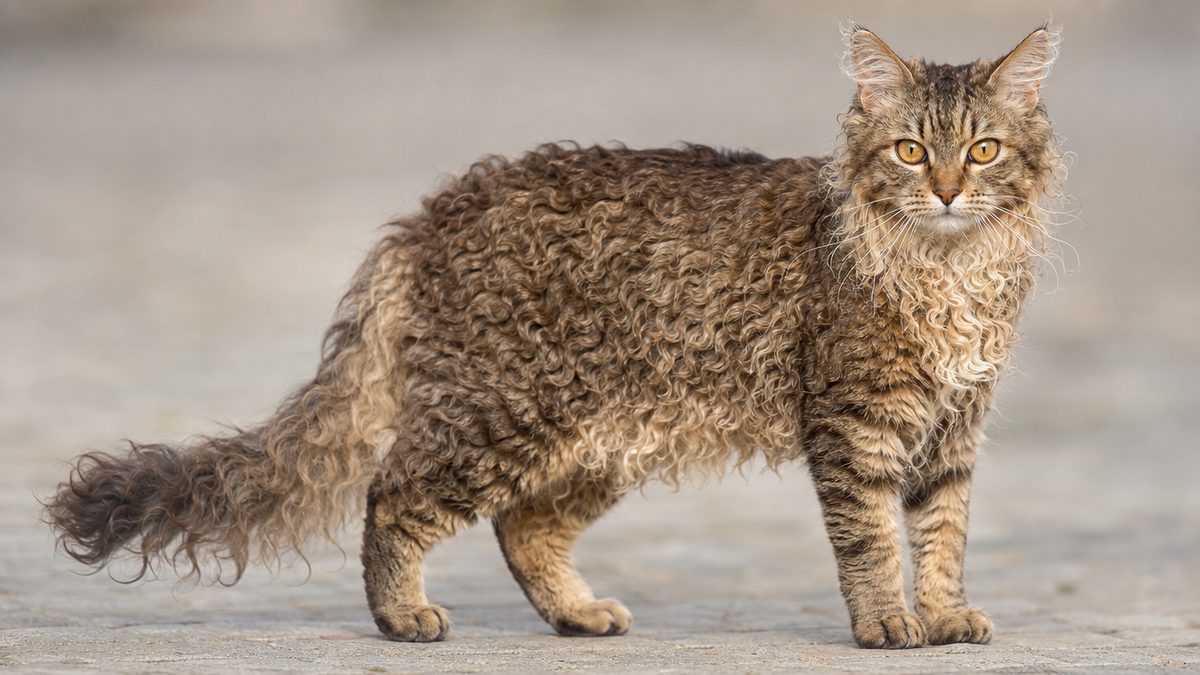
Quick answer
The laperm cat is a curly-coated breed in long and short haired varieties whose coat comes from an autosomal dominant mutation that has never been mapped to a gene. There is no OMIA record, no published paper naming the breed and no commercial DNA test for the curl. Five registries recognise it, France issued four pedigrees in 2024, and India has no breeder, no listing and no price.
This page reports what registries, studbooks and the veterinary literature say about the LaPerm, and it is careful to say where they say nothing. It is not veterinary advice and it cannot assess your cat. The breed has no published disease study of its own, so nothing here should be read as reassurance about an individual animal. If your cat is losing coat, developing bald patches or behaving differently, see a registered veterinary practitioner in person rather than matching symptoms to a breed page.
LaPerm at a glance
What a LaPerm cat is, and what its coat actually does
A LaPerm is a medium-sized cat with a loose, bouncy curly coat that stands away from the body, produced by an autosomal dominant mutation that arose on an Oregon farm in 1982. It comes in long and short haired varieties, and both can appear in one litter.
The coat texture is the breed's entire point and every registry describes it the same way. GCCF's standard calls for a coat that is loose and bouncy, light and airy enough to part with a breath, springy, neither silky nor excessively harsh, and free of matting, with the longest and tightest curls on the neck, ruff and base of the ears. FIFe adds that the ruff and ear bases carry all the hair layers.
TICA supplies the structural detail that separates this coat from the rex coats. All three hair types, guard, awn and down, are present in a LaPerm, and the texture comes from the shape of the curls and the mixture of those types. That is a real difference: the Cornish Rex coat has no guard hairs at all, and the Lykoi's undercoat is almost absent.
Wikipedia's description, which is what most Indian readers meet first, gets the geography of the curl right: the tightest curls sit on the throat and at the base of the ears. GCCF's own breed index adds the practical summary an Indian buyer wants, describing the coat as soft, light and springy and the cat as clever, inquisitive and extrovert.
How the curls feel, described by people who handle them
The UK breed club puts the comparison better than any standard. Stroking a Devon or Cornish Rex can be like stroking a piece of rippled silk, while the LaPerm has a textured coat more like stroking lambswool. TICA says mohair and calls the look a gypsy shag. The ear furnishings curl too, and the longer hair on the backs of the ears has been described as like angel's wings.
The whiskers, which are the breed's diagnostic feature
Look at the whiskers before you look at the curls. TICA states that LaPerm cats are the only rex breed with whiskers that are long and flexible, while the Devon Rex, Cornish Rex and Selkirk Rex are all born with brittle whiskers that often break off short. FIFe's standard requires long flexible whiskers that may be curled, wavy or straight, and permits short or broken whiskers only in kittens. GCCF lists short whiskers as a fault, again with an allowance for kittens.
The breed history, from one kitten
The breed history starts with a single animal. A rexed kitten named Curly was born in 1982 on Linda and Dick Koehl's cherry farm in The Dalles, Oregon, in the traditional lands of the Wishram people. For roughly the first ten years there was no breeding programme at all; the working cat colony simply interbred.
Curly's first litter produced five male cats, all with curly coats, and as those males matured and mated the farm's queens the dominant gene spread through the whole colony. Both coat lengths appeared in time and both were taken into the breed. TICA records that the name reflects the founder's Native American connection with the Chinook tribe, who used the French definite article when coining new words, and that Linda Koehl thought the coat looked like a loose perm.
TICA says a brown tabby named Speedy produced a litter of six on 1 March 1982 including a long, skinny, hairless kitten whose tabby pattern showed in the skin like a tattoo, and that a sparse curly coat appeared only at six weeks. The UK breed club's narrative says Curly was a shorthaired tabby born with a rather sparse coat that grew in soft and wavy. The same club then refers to kittens 'like Curly who are born bald', contradicting its own paragraph. Nobody can resolve this from a photograph, because the club records that no photos of Curly survive.
Coat genetics: a dominant curl that nobody has mapped
The LaPerm's curl is inherited as an autosomal dominant trait and has never been traced to a gene. That is the central fact about this breed and no page currently ranking for it says so. Three of the four other curly cat breeds have a named gene, a chromosome and a test you can buy.
Start with what is established. GCCF's Standard of Points opens the LaPerm entry by stating that the breed results from a naturally occurring dominant genetic mutation producing both long and shorthaired curly-coated cats. The breed club describes how that dominance behaved in practice, spreading through an entire farm colony from one female's five curly sons. Dominance is not in doubt.
Now what is absent.
| Breed | OMIA phene | Gene | Year mapped | Buyable DNA test |
|---|---|---|---|---|
| Devon Rex | OMIA:001581-9685 | KRT71 | 2010 | Yes, with the Sphynx |
| Sphynx | OMIA:001583-9685 | KRT71 | 2010 | Yes, with the Devon |
| Cornish and German Rex | OMIA:001684-9685 | LPAR6 | 2013 | Yes, Cornish Rex Coat |
| Selkirk Rex | OMIA:001712-9685 | KRT71 | 2013 | Yes, Selkirk Rex Coat |
| Ural Rex | OMIA:002273-9685 | LIPH | 2020 | Not at UC Davis |
| Lykoi | OMIA:002229-9685 | HR | 2020 | Not at UC Davis |
| LaPerm | No record exists | Unknown | Never | None anywhere |
Three independent instruments, all returning nothing
OMIA's Felis catus table carries 473 phene records, including a 1956 entry for Curly coat with the symbol r and no gene attached, plus named entries for the Devon, Selkirk, Ural, Cornish, German and Oregon rexes. The LaPerm appears nowhere in it.
PubMed returns zero records for the breed name. Searching LaPerm returned 0 with the warning that the quoted phrase was not found, and LaPerm restricted to title and abstract also returned 0. Searching 'La Perm cat' as three words returned 2 records only because the engine split the phrase and matched an unrelated supplementary concept. The in-session controls were sane: 1,109 records for Labrador retriever in title or abstract and 61 for Felis catus hip dysplasia.
The University of California Davis Veterinary Genetics Laboratory, which sells more feline coat tests than anyone, lists a Cornish Rex Coat test, a Selkirk Rex Coat test and a combined Sphynx and Devon Rex Coats test, and no LaPerm test. France's national studbook asks a breeding LaPerm for a pyruvate kinase deficiency result and nothing about the coat, because there is nothing to ask for.
Both would be reasonable guesses and neither is supported. The 2010 KRT71 study sequenced that gene in randomly bred and pedigreed cats with different pelage mutations including hairless varieties, and states that no other causative mutations were identified for eight further rexoid and hairless cat phenotypes. It does not name which eight. Reasoning from that to the LaPerm would be guessing at a paper's unpublished breed list.
The nearest comparison, and why it is the interesting one
The Selkirk Rex is the other dominant curly cat, and it shows what a mapped answer looks like. Nine curly Selkirk against 29 controls gave a significant association on chromosome B4 with a shared haplotype of roughly 600 Kb, and direct sequencing of four candidate genes found a splice site variant in KRT71. That study was published in 2013. The LaPerm was recognised for championship competition by CFA in 2008, five years earlier, and still has no equivalent.
One breed-club claim is worth flagging as a claim. The LaPerm Cat Club states that, unlike the Selkirk Rex, there are no differences between homozygous and heterozygous LaPerms. That is an observation from breeding practice, not a published finding, and without a genetic testing route there is no way for an owner to check which their cat is.
Five registries, and the two things they disagree about
The LaPerm holds full championship status in CFA, TICA, FIFe, the GCCF and the WCF, which is more than most rare breeds achieve. What no page reports is that those registries disagree about which family the breed belongs to and about how its coat behaves through the year.
CFA's registration rules give the ladder with dates. Registration became effective on 5 February 2000, Provisional on 1 May 2005 and Championship on 1 May 2008, with breed codes 65 for the longhair and 66 for the shorthair. In the UK the LaPerm Cat Club, established in 2004, ran its twelfth GCCF-licensed championship show on 6 June 2026, scheduling Imperial Grand Champion and Imperial Grand Premier classes, which are the top of the GCCF title ladder.
| Registry | Status | Code | Files the breed with |
|---|---|---|---|
| CFA | Championship, effective 1 May 2008 | 65 LH, 66 SH | Shorthair breed councils |
| TICA | Championship, two separate index entries | n/a | LaPerm and LaPerm Shorthair |
| GCCF | Recognised, full title classes | LPL and LPS | Section 4 Group B, with the rexes |
| FIFe | Fully recognised since 2015 | LPL and LPS | Category 2, with the semi-longhairs |
| WCF | Recognised | LPL and LPS | Longhair and shorthair lists |
| LOOF | Registered, PKDef required to breed | n/a | Laperm P.C. and Laperm P.L. |
TICA's index treats the two coat lengths as separate championship breeds, listing LaPerm and LaPerm Shorthair as distinct entries among its 73 recognised breeds. CFA does the reverse and gives one breed two codes, 65 for the longhair and 66 for the shorthair, with a rule that there is no separate code series for a shorthair carrying longhair.
Disagreement one: is it a rex at all
GCCF puts the LaPerm in Section 4 Group B alongside the Cornish Rex, Devon Rex, Lykoi and Sphynx, and its UK breed advisory committee sits inside the Joint Rex Breed Advisory Committee with the Scottish Rex Cat Club, the Rex Cat Association and the Rex Cat Club LaPerm Cat Club (UK), All About LaPerms. FIFe puts it in Category 2, the semi-longhair group that holds the Maine Coon, Norwegian Forest Cat and Turkish Angora, and not in Category 4 where its own Cornish Rex, Devon Rex, German Rex and Sphynx standards sit Federation Internationale Feline, Breeds.
GCCF's own text then undercuts its own filing. Its standard states that the LaPerm's coat texture will be distinctly different to that of any other rex mutation, and TICA says the same in almost the same words. So one registry files it with the rexes while telling you it is unlike them, and another files it away from them entirely.
Disagreement two: does the coat follow the seasons
FIFe's standard is explicit that it does not. Characteristic for the breed is the non-seasonal moulting, which can be general or partial, leaving the cat with temporarily sparse coat or bald patches. TICA describes the opposite pattern: in summer the coats are lighter with some loss of undercoat and on the neck for coolness, and in winter a mature longhair will have a full ruff and plumed tail. GCCF sits between them, saying only that the coat may vary in length and fullness according to season and maturity.
If the moult is non-seasonal, a bald patch in October is normal and a breeder who promises otherwise is overselling. If it is seasonal, the same patch is a reason to look further. Three registries have published three positions, none has published data, and an owner in Chennai cannot tell which applies to their cat. Ask a breeder which model they follow, and ask what they have observed rather than what they have read.
There is a third, quieter split. TICA's own page gives adult weights of 6 to 9 pounds for females and 7 to 12 for males in its summary panel, then 6 to 8 for females and 8 to 10 for males in its traits section. One page, two answers, and no way to know which the committee intended.
When Linda Koehl first took her farm cats to a CFA show, two judges gave the encouragement that turned a colony into a breed, and the breed club names them as Dennis Ganoe and Kim Everett. CFA's declared-candidates list for breed council secretary, updated on 31 July 2026, names the LaPerm's candidate as Dennis Ganoe of Portland, Oregon. Two independent documents, three decades apart, and the same person still holding the breed together.
That continuity is checkable rather than charming. The breed club names the two CFA judges who backed Linda Koehl in the 1990s, and CFA's own 2026 list of declared breed council candidates files the LaPerm under one of them.
LaPerm price in India, and the page that invents shops
There is no LaPerm price in india, because no Indian breeder, cattery or classified listing for the breed could be found. What ranks instead is a handmade-goods marketplace and a generated local-directory page, and both are worth taking apart because both look convincing.
Google's top Indian result for the breed's price query is an Etsy market page titled 'Buy Laperm Cat Online In India', served with og:locale en_IN, whose own description offers 'exclusive, customized and handmade products';. The rupee figures Google surfaces from it, from Rs 1,274 to Rs 3,199, buy prints and craft items. They are not cat prices and nothing on the page claims they are.
The Justdial page, examined line by line
The second Indian result is stranger and more instructive. Justdial publishes 'Top Pet Shops For Laperm Cat in Lanka, Varanasi' under its own category number, and it reads like a local shopping guide. Read the listing rather than the headline and four things fall out.
- Six businesses are listed, and not one of them carries a LaPerm category. Their own listed categories are Pet Shops, Pet Shops For Cat, Pet Shops For Persian Cat, Pet Persian Cat Wholesalers, Pet Shops For Dog and Dog Kennel Dealers.
- Four of the six are not in Varanasi. They are in Bhubaneshwar, Dehradun, Ludhiana and Delhi, and none of the six is in Lanka.
- Four further shops are then recommended in the page's prose, named Pet Haven, Furry Friends, Whisker World and Cat Corner. None of those four names appears in the listing above it.
- One meta description on a LaPerm cat page advertises 'Pet Shops For Labrador Dog'.
It is a template crossing a service term with a breed name and a locality, published whether or not any matching business exists. Taken at face value it says a Varanasi neighbourhood has specialist LaPerm shops. Read properly it is the single clearest available evidence that nobody in India sells this breed, because a directory built to find sellers found none and generated four.
One Indian retailer says the breed is popular here
An Indian pet retailer's article, '50 Popular Cat Breeds In India', places the LaPerm at number 28. Set that against France's national studbook, which issued four LaPerm Longhair pedigrees in the whole of 2024 and carries no LaPerm Shorthair row at all in the same table. A breed registering four cats a year in a country with a large organised cat fancy is not a popular breed in India, and a listicle position is not a measurement.
The rarity, measured
Across twenty years from 2003 to 2022 the LOOF issued 15 LaPerm Longhair pedigrees and 8 LaPerm Shorthair, 23 in total. Over the same twenty years it issued 135 European Shorthair pedigrees and 43,214 Chartreux. The LaPerm is rare enough in France to be rarer than the European Shorthair, which is the breed this site has previously used as its benchmark for a register standing almost empty.
Overseas prices circulate at roughly USD 600 to 1,500 from a breeder and USD 75 to 150 to adopt. Bonbeno publishes no rupee conversion of those figures, because converting a foreign price and printing it in rupees is how an invented Indian price enters circulation.
Monthly cost of ownership in India
The cost of ownership for a LaPerm in India is the cost of any indoor single-coated cat, and it is lower on grooming than most curly breeds because the coat resists matting. Purchase price cannot be estimated. Recurring care can, from published Indian rate cards.
Vetic, a chain reachable from its Mumbai page with 15 clinics listed, publishes cat vaccination prices openly: a kitten course across days 60, 90 and 120 from Rs 3,999 against a list price of Rs 5,065, an adult annual booster from Rs 1,899 against Rs 1,908, anti-rabies from Rs 699 and CRP from Rs 1,249. Those are one chain's promotional floors on one city page, so treat them as a floor rather than a market average.
| Item | Published price | Frequency |
|---|---|---|
| Kitten vaccination course, 3 visits | From Rs 3,999 (list Rs 5,065) | First year only |
| Adult annual booster | From Rs 1,899 (list Rs 1,908) | Yearly |
| Anti-rabies, single | From Rs 699 | Yearly |
| CRP combination, single | From Rs 1,249 | Yearly |
| Professional bath | Page headline reads 'starts under 500' | Occasional at most |
| Comb with revolving teeth | One-off purchase | Replaces a grooming subscription |
Grooming is where this breed saves you money. TICA describes light combing with a metal comb with rolling teeth as removing dead coat in a matter of minutes, and states that bathing and brushing are not necessary because the cat is meant to look a little untidy. Vetic advertises grooming across 13 Delhi clinics with a page headline of prices starting under Rs 500, and a LaPerm needs almost none of that catalogue.
The monthly cost line most owners get wrong
Budget for food and litter, not for salon visits. A cat that is combed for two minutes a week by its owner has no recurring grooming bill at all, and the equipment is a single comb. What the budget should carry instead is the annual booster, because that is the only recurring veterinary cost with a published Indian price.
Two costs that do not apply
Delhi's municipal pet registration scheme covers dogs, so no cat licence fee applies there. And rule 7(16) of the Prevention of Cruelty to Animals (Pet Shop) Rules, 2018 requires that every puppy be micro-chipped and that only micro-chipped puppies be sold, which leaves kittens outside the requirement entirely. Microchipping a cat remains a sensible choice; Indian law does not compel it.
Can a LaPerm handle the Indian climate
A LaPerm carries a light single coat with little undercoat, which is a better starting point for Indian heat than a Persian's or a Maine Coon's. No study has measured this breed's heat tolerance, so what follows is coat structure, measured climate and Indian law rather than a claim about the animal.
The coat is described by every registry as loose, airy and standing away from the body, with minimal undercoat, and GCCF lists a thick, heavy coat as a fault rather than a virtue. Air moving through a coat is how a cat sheds heat by convection, so a coat you can part with a breath is not the worst thing to own in Chennai.
The homeland, and a grid cell that got it wrong
The LaPerm comes from The Dalles, Oregon, in the Columbia River Gorge. Querying NASA POWER at that exact latitude and longitude returns an annual mean of 8.42 C, a July mean of 18.26 C and 78.45 percent annual humidity, and it returns a grid-cell elevation of 658.90 m. The town itself sits at roughly 33 m on the river.
NASA POWER reports a grid cell, not a point, and The Dalles sits in a narrow gorge below a high plateau, so the cell averages the plateau. At the standard lapse rate of about 6.5 C per 1,000 m, a cell 626 m too high runs roughly 4.1 C too cold. Corrected, the homeland is nearer 12.5 C annual and about 22.4 C in July. Both numbers are published here, the raw and the corrected, and the corrected one is an estimate and labelled as one. Every Indian cell in the table below is within 83 m of its town, so those figures need no correction.
| Place | Annual mean | Hottest month | Annual RH | Cell vs real elevation |
|---|---|---|---|---|
| The Dalles, Oregon (raw cell) | 8.42 C | 18.26 C (Jul) | 78.5% | 659 m vs ~33 m, +626 m |
| The Dalles, lapse-rate corrected estimate | about 12.5 C | about 22.4 C (Jul) | not corrected | estimate, labelled as one |
| Delhi | 25.60 C | 35.88 C (Jun) | 45.6% | 206 m vs ~216 m, -10 m |
| Kolkata | 25.81 C | 31.53 C (May) | 73.9% | 7 m vs ~9 m, -2 m |
| Mumbai | 26.77 C | 31.19 C (May) | 67.4% | 97 m vs ~14 m, +83 m |
| Chennai | 27.95 C | 31.51 C (May) | 72.4% | 49 m vs ~6 m, +43 m |
| Pune | 23.86 C | 28.93 C (Apr) | 66.8% | 636 m vs ~560 m, +76 m |
| Bengaluru | 23.74 C | 28.37 C (Apr) | 67.9% | 842 m vs ~920 m, -78 m |
Humidity is not the problem people assume
The reflex worry about an American breed in India is the damp. It does not apply here. The Dalles cell returns 78.45 percent annual relative humidity and Portland, 130 km downriver, returns 81.42 percent. Chennai reads 72.39, Kolkata 73.93 and Mumbai 67.39. The founding climate is humider across the year than any of them. What India adds is heat, and Delhi's June mean of 35.88 C is about 13.5 C above the corrected homeland July figure.
Heat tolerance, and what nobody has established
No published study measures heat tolerance in this breed, so Bonbeno rates it from coat structure and says so. What can be said with confidence is that the LaPerm's coat is single, light and low in undercoat, which is the right structure for a hot climate, and that the breed should be kept indoor in an Indian city for the same reasons any pedigree cat should be.
Indian law makes the uncertainty someone's problem. Rule 6(5) of the Prevention of Cruelty to Animals (Pet Shop) Rules, 2018 requires the temperature where animals are housed for sale to be comfortable, notes that this may vary from breed to breed, and makes it incumbent upon the shop owner to familiarise himself with the requirements of the breeds he intends to deal in. For a breed with no thermoregulation data, that duty cannot be discharged from evidence.
Temperament and household fit
The LaPerm temperament is bold, curious and physically demonstrative. Every registry and the breed club describe the same animal: a cat that follows you, asks to be picked up, and stays kittenish into adulthood.
TICA describes a cat that loves to be involved in everything its family is doing, follows people around the house and taps their legs as they pass to get attention, and that will ride on shoulders or reach a paw out to pat your face. The UK breed club is blunter: ignore a LaPerm's demand to be picked up and it may take matters into its own paws and leap into your arms.
Who this cat suits
It suits a busy household and it suits people who want to be followed. TICA notes explicitly that LaPerms love companionship and should not be left alone often without a companion, either a cat of similar activity level or a cat-friendly dog. It also names the breed as a good match for children, for disabled owners and for people who live alone.
- Suits a home with people in it most of the day, or a second animal.
- Suits a family with children, on the account both TICA and the breed club give.
- Struggles alone in an empty flat for ten hours, which TICA warns against by name.
- Struggles as a decorative cat, because this one is affectionate in the demanding sense.
TICA adds a detail worth knowing before you buy: the LaPerm is not generally vocal, but seems to understand human moods and react accordingly. A quiet cat that wants contact is a different proposition from a Siamese, and Indian buyers cross-shopping the two should know which they are choosing.
Three registries and a breed club describe the same personality in similar words, which is reassuring but not independent: breed descriptions are written by the people who breed the cats. There is no published behavioural research on the LaPerm. Read these as the fancy's consensus rather than as measurement.
Training a LaPerm, and what it resists
Train a LaPerm with short reward-based sessions and expect it to work out the puzzle faster than you meant it to. TICA calls it a clever inquisitive cat that thinks about how to get what it wants and uses its paws to reach out and take it.
The paw is the training handle. A cat that already reaches out to pat faces and tap legs will learn a targeting behaviour in days, and targeting is the foundation of carrier training, scale training and cooperative grooming. Use food or a toy, keep sessions to a few minutes, and stop while the cat still wants more.
The two habits worth building in year one
- Teach the cat to accept a comb, because the coat needs a comb with revolving teeth and an unwilling cat makes that a fight for fifteen years.
- Teach carrier entry as a game, because an imported or unusual breed will see more veterinary visits than an Indian shorthair, if only for paperwork.
- Weigh the cat on a home scale monthly and pair it with food, so weight monitoring never needs restraint.
- Trim nails every two weeks from kittenhood, which TICA recommends by name.
What the breed resists
It resists being ignored and it resists a dull room. TICA recommends toy mice, ping pong balls and a tall cat tree so the cat can climb and supervise, which is a specific and cheap prescription that any Indian flat can meet. Nothing about the curl changes trainability, and no published work suggests the coat mutation affects behaviour at all.
By six months your LaPerm should walk into a carrier for food and stand still to be combed for sixty seconds. Those two skills cover almost every handling problem an owner of a rare breed will meet in India, where a vet may never have seen the breed before and will need the cat to cooperate.
Daily exercise and what happens without it
Give a LaPerm two or three structured play sessions a day and vertical space to patrol. TICA states flatly that the LaPerm is not a couch potato and that it remains active and playful throughout its life, which is a commitment rather than a selling point.
The requirement is behavioural. Nothing published suggests the curl changes energy needs, so a LaPerm needs what any alert, curious, medium-sized cat needs. What differs from a placid breed is that this one will invent its own entertainment if you do not supply it, and it has been described by both TICA and the breed club as a cat that thinks about how to get things.
- Provide a tall cat tree, which TICA recommends specifically so the cat can supervise the room.
- Rotate toys weekly so the hunting sequence stays worth finishing.
- Play twice daily, with the longer session before your bedtime to shift night activity.
- Pair the cat with a companion if the flat is empty during working hours.
Timing play around Indian heat
Move play to early morning and late evening through the hot months, and note that the hot month is not the same everywhere in India. Delhi peaks in June at a mean of 35.88 C, Chennai, Mumbai and Kolkata peak in May, and Pune and Bengaluru peak in April at 28.93 C and 28.37 C. A national rule of thumb about May gets two of six cities wrong.
A LaPerm that suddenly stops playing deserves a vet visit, not an explanation. So does one that develops a bald patch you have not seen before, even though FIFe calls a non-seasonal moult characteristic of the breed, because the same standard makes bald patches in a mature cat a fault. Assume nothing from a breed description that three registries have written three ways.
Grooming a curly coat in Indian humidity
Groom a LaPerm with a metal comb whose teeth revolve, for a couple of minutes a week, and leave the rest alone. The breed club and TICA independently name the same tool and the same reason: an ordinary comb drags the curls straight.
The UK breed club describes the light single coat as low-maintenance and says it is best kept in condition with a revolving toothed comb which can move through the fur without pulling the curls straight. TICA says light combing using a metal comb with rolling teeth removes any dead coat and keeps the coat in excellent condition in a matter of minutes. Two documents, two organisations, one tool.
The coat does not mat easily because there is little undercoat and the curl holds loose hair against the body rather than dropping it on the floor. GCCF requires that the coat be free of matting and lists a thick heavy coat as a fault, so a LaPerm that mats is a LaPerm that has drifted from its own standard.
Bathing, drying and the monsoon
Bathe rarely and dry deliberately. TICA advises bathing and towel drying, states that blowdrying is unnecessary because it will make the coat frizz, and suggests that once the coat is totally dry you can emphasise the curl by spritzing it with a fine mist of plain water. That routine assumes air that dries a cat in an hour.
Indian monsoon air does not. Kolkata sits at 87 to 89 percent relative humidity from July to September, Mumbai and Pune at 89 to 91 percent, and Bengaluru at 79 to 81 percent from August to October. A towel-dried cat in that air stays damp for a long time.
- Comb for two minutes weekly with a revolving-toothed comb, never a slicker brush.
- Bathe only when the coat is genuinely dirty, not on a schedule.
- Towel thoroughly, then finish with a fan on low rather than a hot dryer.
- Mist the dry coat with plain water to bring the curl back, as TICA advises.
- Check the skin under the curls monthly, because a curly coat hides what a flat coat shows.
Shedding, and the allergy claim
The LaPerm does shed, and it sheds into its own coat rather than onto your sofa, which is why owners describe it as low shedding. Indian and international pages take the next step and call the breed hypoallergenic, and that step is not supported. The major cat allergen, Fel d 1, is a salivary and sebaceous protein rather than a function of hair volume.
The feline literature on breed-level allergen differences is one paper deep. It sequenced the two Fel d 1 genes in Siberian cats, a breed said by some breeders to be low-allergen, found variants that could in principle matter, and concluded that further investigation was needed to establish whether they reduce allergen synthesis at all. No such work exists for the LaPerm. Anyone selling one as hypoallergenic in India is selling an assumption.
Health, lifespan and what has never been measured
No breed-specific disease has been published for the LaPerm, and no lifespan has been measured for it either. Those are two separate absences and both matter, because the first is often reported as proof of health and the second as a 12 to 15 year figure.
TICA states that as a relatively new breed there are no breed-specific diseases associated with the LaPerm, and recommends that breeders conduct DNA tests on all allowed domestic outcrosses before introducing them to the breed pool. The UK breed club says the natural origins of the LaPerm have given rise to a healthy breed with no known problems. Both statements are about the absence of reports, not about the presence of studies.
The one screen a studbook actually requires
France requires more than reassurance. The LOOF's qualification grid asks both Laperm P.C. and Laperm P.L. for a pyruvate kinase deficiency result, N/N or N/PKLR, at every one of its three levels. Pyruvate kinase deficiency is an inherited haemolytic anaemia with a commercial test, and it is the only condition any registry names for this breed.
That grid is a two-sided instrument and worth reading as one. On the same grid the Sphynx row is blank at every level, and five rex breeds carry named tests: Californian, Cornish, German, Devon and Selkirk. So a LaPerm requirement is a choice the French studbook made, not a formality applied to everyone.
Life expectancy, and where 12 to 15 years comes from
TICA gives 12 to 15 years and mentions cats reaching 20. No study underlies that. The largest dataset in existence, covering 7,936 confirmed cat deaths under primary veterinary care in the UK in 2019, builds life tables only for the 12 breeds with 15 or more deaths, and the word LaPerm appears zero times in the paper.
| Breed | Life expectancy at age 0 | Deaths recorded |
|---|---|---|
| Burmese | 14.42 years | 45 |
| Birman | 14.39 years | 38 |
| Crossbred | 11.89 years | 7,117 |
| All UK cats | 11.74 years | 7,936 |
| Siamese | 11.69 years | 88 |
| Persian | 10.93 years | 80 |
| Norwegian Forest Cat | 9.95 years | 15, the lowest included |
| Sphynx | 6.68 years | 18 |
| LaPerm | Not calculated | Below the 15-death threshold |
The LaPerm is missing from that table for a stated reason: fewer than 15 deaths in the cohort. That is a statement about how few LaPerms exist in the UK, not about how long they live. Any page giving you a LaPerm life expectancy to one decimal place has made it up.
What the study does establish, for every cat
Three findings from it apply to a LaPerm as much as to any cat. Entire cats carried 4.29 times the odds of dying before three years compared with neutered cats. Purebred cats carried 1.83 times the odds of crossbred cats. Non-ideal body weight was significantly associated with a shortened lifespan. Neutering and weight are within an owner's control; ancestry is not.
Feeding a LaPerm in India
Feed a LaPerm a complete life-stage food with fresh water and controlled portions, and weigh it monthly. No published research exists on nutrition in this breed, so the useful evidence is about weight rather than about curls.
TICA notes that while metabolism slows after neutering, it is rare for a LaPerm to overeat because the cat has so many other interests, and recommends continuing whatever the breeder was feeding to avoid stomach upsets. That is sensible transition advice and it is not a claim about nutritional requirements.
The strongest relevant evidence is the UK life-table finding that non-ideal body weight is significantly associated with a shortened lifespan, alongside being entire and being purebred. Weight is the lever an owner can actually pull.
- Feed a complete kitten diet to twelve months, then an adult maintenance diet.
- Weigh the cat monthly and write it down, because a curly coat hides body condition better than a flat one.
- Split the ration between a bowl and a puzzle feeder, which suits an inquisitive cat.
- Place the water bowl at least three feet from the food, which TICA suggests for cats that drink too little.
Availability in India
Complete cat foods are widely stocked across Indian metros and online, so a LaPerm presents no sourcing problem that any other pedigree cat does not. What matters is that the food is complete and the portion matches a monthly weight record, not the brand on the bag.
Supplements sold to improve curl or shine have no published evidence in this breed, because there is no published research on this breed at all. Discuss any supplement with your veterinarian rather than with a retailer, and be sceptical of any product whose marketing names the LaPerm specifically.
Kitten care month by month, and a coat that takes three years
A LaPerm kitten does not look like a small LaPerm. TICA states that kittens are born with short fur, that longhairs in particular go through changes before getting gradually longer and curlier, and that the full coat does not come in until three years of age.
Weeks 0 to 8, at the breeder
Indian law sets the floor even for a breed India does not produce. The Prevention of Cruelty to Animals (Pet Shop) Rules, 2018 define an un-weaned animal to include kittens and pups below eight weeks, and rule 7(15) prohibits any pet shop selling un-weaned or underage animals. Its Second Schedule paragraph 2, headed FOR CATS, further requires elevated resting surfaces, matting, clean play toys and that cats be kept in a room not shared with inimical species such as dogs.
Months 2 to 6, vaccination and the first coat change
Vaccinate on a clinic schedule. Vetic's published kitten course runs CRP at day 60, anti-rabies plus CRP at day 90 and CRP plus anti-rabies at day 120, from Rs 3,999. Expect the coat to look wrong through this period; FIFe permits a sparse coat in kittens and GCCF allows for short whiskers in them The Governing Council of the Cat Fancy.
Months 6 to 36, the long wait
FIFe's standard states that the breed needs two to three years to fully develop and mature. GCCF adds that the coat matures up to three years of age and that younger cats may have a crisper coat texture. A shorthaired-looking eight-month-old can become a plumed longhair, and judging a kitten's adult coat is not possible.
| Age | What happens | What you do |
|---|---|---|
| Birth | Born curly, straight or occasionally bald | Nothing. Ask the breeder which, and for the pedigree code |
| 8 weeks | Legal minimum age for sale in India | Refuse any kitten offered earlier |
| Day 60 to 120 | CRP and anti-rabies course | Book all three visits, from Rs 3,999 |
| 3 to 6 months | Coat looks thin, whiskers may be short | Both are permitted in kittens. Do not treat as illness |
| 6 to 12 months | Adult activity level arrives | Cat tree, toy rotation, twice-daily play |
| 2 to 3 years | Coat finally matures | Judge the adult coat only now |
Ask whether the kitten was born curly, straight or bald, and ask for it in writing. CFA's own registration rules use the codes BC, BS and BB for exactly this, and the UK breed club records that breeders put those initials into registered names. Kloshe BB White Paw and Kloshe BC Dragonfly are real registered cats whose names carry the answer.
LaPerm against the curly cats buyers cross-shop
Buyers comparing a LaPerm are comparing four or five curly breeds that look similar and are genetically unrelated. The single most useful thing to know is that a DNA test sold for one of them says nothing about the others, and that no test exists for this one.
| Breed | Gene | Inheritance | Whiskers | Coat layers |
|---|---|---|---|---|
| LaPerm | Unknown | Dominant | Long, flexible, curled | Guard, awn and down all present |
| Selkirk Rex | KRT71, chromosome B4 | Dominant | Brittle, often broken | Dense and woolly |
| Cornish Rex | LPAR6, chromosome A1 | Recessive | Brittle, often broken | No guard hairs |
| German Rex | LPAR6, same deletion | Recessive | Brittle, often broken | No guard hairs |
| Devon Rex | KRT71 | Recessive | Brittle, often broken | Sparse, fragile |
| Lykoi | HR, chromosome B1 | Recessive | Whole or broken | Undercoat almost absent |
The Cornish and German Rex share one four-base-pair deletion, c.250_253delTTTG in exon 5 of LPAR6, fixed in the Cornish and segregating in the German, which is why one coat test cannot separate them. The Devon Rex and Sphynx sit on KRT71 in an allelic series where the hairless allele is dominant to the Devon curly allele. The Selkirk carries a third KRT71 variant, dominant, on chromosome B4. The Lykoi sits on HR, with six published variants.
The LaPerm against the Selkirk, which is the real comparison
Both are dominant curly cats and that is where the similarity stops. The Selkirk's coat is dense and woolly and its homozygotes differ visibly from its heterozygotes; the LaPerm's coat is loose and airy and its breed club states that homozygous and heterozygous LaPerms do not differ. The Selkirk was mapped in 2013. The LaPerm has not been mapped at all.
The straight coat variant, which only this breed produces routinely
Because the curl is dominant and most LaPerms are heterozygous, straight-coated LaPerms appear in ordinary litters and are recognised. CFA allows them to be registered for breeding purposes only. FIFe recognises straighthair long and shorthair varieties under the EMS code 84, gives them no certificate, and permits them for breeding. GCCF withholds the certificate for a straight coat. No other breed on this table routinely produces a recognised, registerable, unshowable variant of itself.
Look at the whiskers. TICA's own point of difference is that the LaPerm is the only rex-type breed whose whiskers are long and flexible, while the Devon, Cornish and Selkirk are born with brittle whiskers that break off short. A curly cat with long curled whiskers and curly ear furnishings is a LaPerm candidate; one with stubby broken whiskers is not.
Mistakes Indian buyers actually make with this breed
The commonest LaPerm mistakes in India all come from trusting a page that treats the breed as settled. It is not. Its gene is unknown, its registries disagree with each other, and the Indian pages that rank for it are generated rather than researched.
Mistake one: assuming the curl can be DNA tested
It cannot. Verify any breeder's genetic claim by asking which laboratory runs the test and which variant it detects. UC Davis, which sells coat tests for the Cornish, Devon, Sphynx and Selkirk, sells none for the LaPerm, because there is no published variant to detect. A breeder offering a LaPerm coat test is offering something that does not exist. What can legitimately be tested is pyruvate kinase deficiency, which France requires.
Mistake two: taking one registry's word as the breed's
Three registries publish three positions on how this coat behaves. FIFe calls the moult non-seasonal and says it can leave bald patches; TICA describes a seasonal coat that lightens in summer; GCCF says only that the coat varies with season and maturity The International Cat Association The Governing Council of the Cat Fancy. They also disagree on whether the breed belongs with the rexes at all. An Indian buyer reading one page will not know the question is open.
Mistake three: believing an Indian listicle over a studbook
An Indian retailer's article places the LaPerm at number 28 among fifty popular cat breeds in India. France's national studbook issued four LaPerm pedigrees in 2024 and none of the shorthair variety. Popularity in a listicle is an editorial decision. A pedigree count is a measurement, and it is the one that tells you whether you can actually buy the cat.
Mistake four: reading a generated directory as a market
Justdial's 'Top Pet Shops For Laperm Cat in Lanka, Varanasi' lists six businesses, none of which carries a LaPerm category, four of which are in other cities, and then recommends four more shops by name that appear nowhere on the page. That is not a market. It is a template, and treating it as evidence of Indian supply is how a buyer ends up paying a deposit to somebody who has never seen the breed.
Mistake five: expecting a curly kitten
Straight-coated kittens are normal, recognised and registerable, and an unprepared buyer treats them as a defect or a swindle. Ask before the litter is born what the sire and dam produced last time, and ask for the BC, BS or BB code on the registration.
Ask which registry issued the pedigree and under which code. Ask whether the kitten was born curly, straight or bald. Ask for the parents' PKDef results. Ask which of the three registry positions on moulting the breeder has actually observed in their own cats. A serious breeder anywhere in the world can answer all four.
Adoption and responsible sourcing
Adopt an Indian cat if what you want is a companion, because the LaPerm cannot honestly be sourced here. France, with a large organised cat fancy, registered four in 2024. India registered none, and has no breeder Bonbeno could find.
Indian shelters and municipal facilities rehome cats continuously and a rescued shorthair will be every bit as affectionate as a pedigree. The evidence supports that as more than sentiment. In the UK life tables, crossbred cats reached 11.89 years at age zero and purebred cats carried 1.83 times the odds of dying before three years.
If you still want this specific breed
There is no lawful route to import a LaPerm into India for breeding or trade, and the only individual route is as a personal pet with the correct paperwork. Anyone offering to source one commercially should be asked to show that paperwork first.
- Ask which registry issued the pedigree, and confirm that registry holds the breed under the code it prints.
- Ask for the PKDef result on both parents, which is the only breed screen any studbook requires.
- Ask whether the kitten was born curly, straight or bald.
- Screen the seller's claims against this page, and treat any offer of a LaPerm coat DNA test as a red flag.
- Refuse any kitten under eight weeks, which Indian law treats as un-weaned.
What outcrossing means for anyone breeding this cat
The LaPerm is unusual among pedigree cats in how open its gene pool remains. CFA has extended its domestic outcross cutoff three times, from 2015 to 2020 in February 2014, to 2025 in February 2020 and to 2035 in February 2025. In the UK the permitted pedigree outcrosses include the Somali and Abyssinian, the Asian group, the Tonkinese and the Ocicat, and breeders outcross to non-pedigree domestic cats as the closest stock to the original farm colony.
A breed still admitting domestic outcrosses in 2035 is a breed protecting its own genetic diversity rather than closing a studbook around a handful of founders. That is the opposite of what most rare pedigree cats do, and it is the single strongest health argument anyone can make for the LaPerm today.
Bonbeno does not recommend breeders, link kitten listings or quote a live price as an offer. If a LaPerm is the cat you want, learn the genetics on this page first, and buy nothing from a seller who cannot name a registry and a code.
LaPerm cat questions Indian readers actually ask
Do LaPerm cats have health problems?
No breed-specific disease has been published for the LaPerm, and that is a different statement from the breed being proved healthy. TICA states there are no breed-specific diseases associated with it, and the UK breed club describes a healthy breed with no known problems. France's studbook nonetheless requires a pyruvate kinase deficiency result from any LaPerm used for breeding, at every qualification level.
What is special about a LaPerm cat?
Its curl is dominant, it comes in long and short coats from the same litter, and nobody has found the gene. Three of the four other curly cat breeds have a named gene, a chromosome and a DNA test you can buy. The LaPerm has an OMIA record count of zero, a PubMed record count of zero and no commercial coat test anywhere.
Are LaPerm cats expensive?
There is no Indian price to be expensive or cheap, because Bonbeno found no Indian breeder and no Indian listing for the breed. Google's top Indian result for the query is an Etsy page whose own description offers 'exclusive, customized and handmade products'. Judge any rupee figure by asking whether it buys an animal or a poster.
What is the average lifespan of a LaPerm cat?
No measured average exists. TICA gives 12 to 15 years and mentions cats reaching 20, which is a breeder estimate rather than a study. The largest UK dataset, covering 7,936 confirmed deaths, publishes life tables only for the 12 breeds with 15 or more deaths, and the word LaPerm appears zero times in it. UK cats overall reached 11.74 years.
Is the LaPerm a rex breed?
It depends which registry you ask, and they genuinely disagree. GCCF files the LaPerm in Section 4 Group B alongside the Cornish Rex, Devon Rex, Lykoi and Sphynx. FIFe files it in Category 2 with the Maine Coon, Norwegian Forest and Turkish Angora, not with the rexes in Category 4. GCCF's own standard says the coat texture is distinctly different from that of any other rex mutation.
Why do some LaPerm kittens have straight coats?
Because the curl is dominant and most LaPerms carry one copy. A heterozygous cat passes the straight allele half the time, so straight-coated LaPerm variants appear in ordinary litters. CFA allows them to be registered for breeding purposes only, and gives them their own pedigree codes: BC for born curly, BS for born straight and BB for bald.
Do LaPerm cats go bald?
Some do, and their own registries disagree about whether that is normal. FIFe's standard calls non-seasonal moulting characteristic of the breed and says it can leave a cat with temporarily sparse coat or bald patches, then makes bald patches in a mature cat a fault precluding the certificate. GCCF simply lists bare patches as a fault. TICA describes a seasonal coat instead.
Are LaPerm cats hypoallergenic?
No cat breed has been shown to be. Indian and international pages call the LaPerm hypoallergenic on the basis that it sheds little, but the major cat allergen Fel d 1 is a salivary and sebaceous protein rather than a function of hair volume. The one PubMed record pairing Fel d 1 with a breed is about Siberians and concludes that further investigation is needed.
How do you groom a LaPerm coat in Indian humidity?
Comb briefly with a metal comb whose teeth revolve, so it moves through the curl without pulling it straight, and bathe only when needed. TICA advises towel drying rather than blowdrying, because a dryer makes the coat frizz, and suggests misting the dry coat with plain water to bring the curl back. In a humid Indian monsoon the towel stage takes longer, so allow for it.
Can I import a LaPerm into India?
Only as your own pet with correct paperwork, never to breed or trade. If one were offered for sale here, the Prevention of Cruelty to Animals (Pet Shop) Rules, 2018 would apply, and rule 6(5) makes it the seller's own duty to learn the temperature requirements of the breed being dealt in. Ask a seller to show a pedigree from CFA, TICA, FIFe, the GCCF or the LOOF before anything else.
Compare with similar breeds
LaPerm sits in 1 Bonbeno group. Each one compares it directly against the breeds it is genuinely an alternative to, on the same figures.