
Breed profile
Oriental Longhair in India: One Cat, Six Registry Answers
A svelte green-eyed longhaired cat that five registries file five different ways, was called the British Angora until 2002, and carries a lethal familial condition with no test.
Quick answer
No Oriental Longhair cat price in India could be sourced on 9 September 2026. India's leading cat-price guide lists 16 breeds and mentions neither the Oriental Longhair nor the Oriental Shorthair nor the Balinese, while the two Indian sites that price other cats return a 404 and a soft 404. Six registries also disagree about whether this is a breed at all.
This page reports published research on amyloidosis in Siamese and Oriental cats, a lethal condition with a heritability estimate of 0.56 for which there is no reliable genetic test and no treatment beyond supportive care. It is reference material, not a diagnosis and not a treatment plan. Consult your nearby vet, a registered veterinarian who can examine your own animal, before acting on anything here, and take unexplained lethargy, jaundice or abdominal distension in a young Oriental cat to a clinic the same day.
Oriental Longhair at a glance
What an Oriental Longhair is
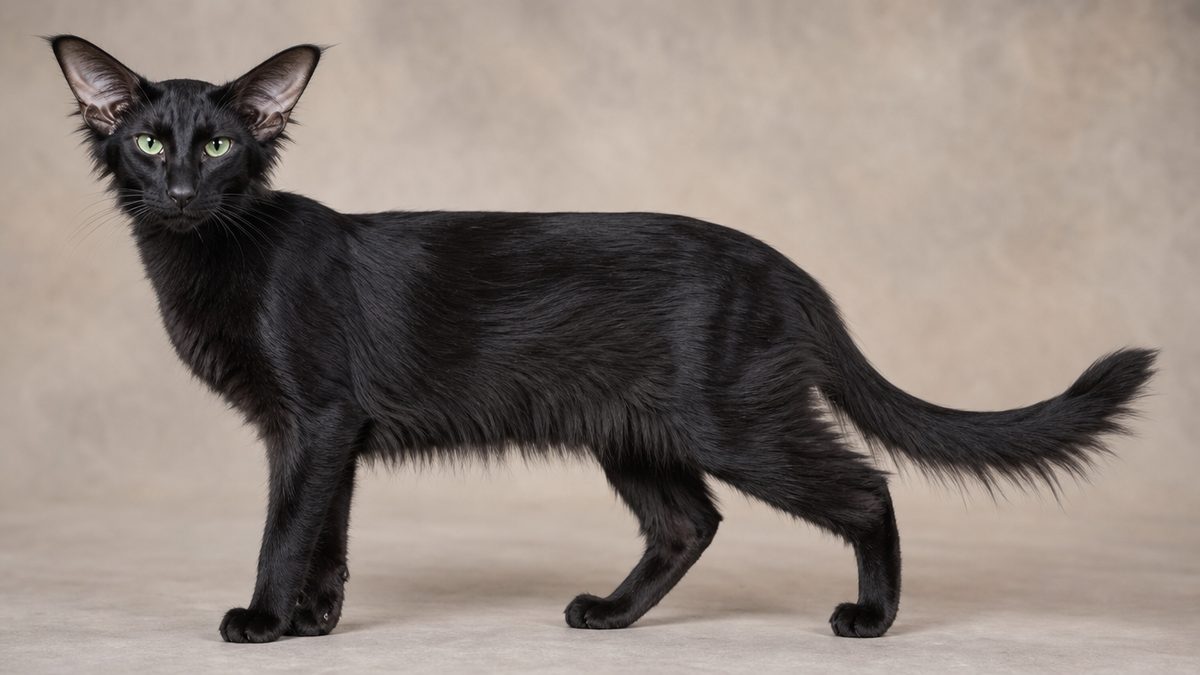
The Oriental Longhair is a medium-sized, svelte, green-eyed cat of Siamese type carrying a semi-long silky coat with no undercoat, in every colour except the pointed pattern.
Three registries describe the same animal in almost the same words, which is unusual enough to be worth quoting. The GCCF asks for a beautifully balanced animal with head and ears carried on a slender neck and a long svelte body supported on fine legs and feet, with a long slender tail, a coat of medium length fine and silky in texture, and an alert intelligent expression. The World Cat Federation asks for a medium-sized elegant cat, slender and muscular, with an elongated lithe body whose rib cage and shoulders are no wider than the hips.
The head is the identifier. It is long and well proportioned, wide between the ears and narrowing in perfectly straight lines to a fine muzzle, forming a balanced triangle with no break or pinch at the whiskers, and in profile the nose is straight and free from any stop or dip with the chin tip lining up with the nose tip in the same vertical plane. Ears are large and wide at the base with their setting continuing the lines of the wedge, and cats are penalised equally for ears set too high or too low.
The coat, which is the whole reason this cat is easy to keep in India
The coat length is medium long, fine and silky in texture without a woolly undercoat, glossy and free of knots, with a plume-like tail and possibly tufted ears. The clause that matters most reads that the coat should lie flat along the body, and that by smoothing back the coat it is possible to study the lines of the body. A semi-long coat you can see the cat through is a very different proposition from a Persian's.
The other two registries agree. The World Cat Federation says the coat is of medium length and glossy, has a silky texture and no undercoat, with the tail furnished like a plume. The French studbook goes furthest, saying the fur is semi-long, fine, silky and lying flat on the body, and that there is neither undercoat nor ruff.
The GCCF allows a tendency to frill around the chin, neck, underside and tail, which disguises the underlying bone structure. The French studbook says flatly that there is no ruff. Both are current, both are official, and a cat with a modest neck frill would be correct under one and questioned under the other. Publish the disagreement rather than picking a side.
Colour, and the one pattern that is excluded
The GCCF gives the colours and patterns of the Oriental Shorthairs with the addition of the green-eyed and odd-eyed Whites, and requires green eyes in all colours except blue-eyed and odd-eyed whites, where the eye may be clear bright vivid blue or one green and one blue with no flecks of contrasting colour. The World Cat Federation recognises all colours and patterns without pointed, also bicolour, and requires an intense green eye colour, excluding the certificate for more yellow than green pigmentation.
The breed club's own list is the most readable version. Self colours run black, blue, chocolate, lilac, cinnamon, caramel, fawn, red, cream and apricot, plus tortoiseshell, smoke, shaded or tipped, tabby and white, with green the preferred eye colour except in the whites. CFA counts the whole group at over 600 possible combinations of colour, pattern and coat length.
Coat colour is therefore the one place where this breed is not a Siamese, and it is worth being precise about how the standards score it. The GCCF gives coat colour and pattern 20 points and coat length, texture and condition another 20, out of a colour and coat half worth 50 against a type half worth 50. Half the cat is its coat colour and coat length, which is a fair description of a breed whose registries count more than 600 combinations between them.
Size is modest and slow to arrive. TICA gives adult females at about 5 to 8 pounds and males at 8 to 12, and notes that kittens mature slowly and do not fully develop until 18 to 24 months. The GCCF adds that Oriental Longhairs do not normally achieve full coat until they are mature, and that allowance should be made for shorter coats in kittens.
Six registries, six answers about what this cat actually is
No breed in this cluster is filed six different ways by six bodies, and this one is, which is the single most useful thing a buyer can know before looking at a pedigree.
State registry recognition per body rather than as one global claim. On this breed that is not a caution, it is the entire story, because the six bodies do not merely differ on whether they hold the cat. They differ on whether it is a breed.
Two instruments make that checkable rather than a matter of reading breed pages. The CFA runs one breed council per recognised breed, and its 2026 candidate list carries a single council named Oriental in the shorthair block with no separate Oriental Longhair council, which is exactly what a merged breed with two coat divisions looks like on a ballot. FIFe's breeds index, parsed on the three-letter EMS codes, gives OLH its own row in Category 4 beside OSH, SIA and BAL, which is what a separately coded breed looks like. Same cat, two registries, two different filing decisions, both visible in a list rather than in prose.
| Registry | Structural position | The document that settles it |
|---|---|---|
| CFA | A coat-length DIVISION of a merged breed called Oriental, since 1988 | The breed page, which records that in 1988 Oriental Longhairs were accepted and the name of the breed became simply Oriental |
| TICA | A BREED inside the Siamese Breed Group with the Oriental Shorthair, Siamese and Balinese | The breed page, which states all group members share the same physical standard except coat length and colour |
| GCCF | A SEPARATE BREED with its own standard, Section 6 Group A | Standard of Points, June 2026, page 277, marked Updated Council October 2025 |
| FIFe | A SEPARATE EMS CODE, OLH, in Category 4 | The breeds index and the 2024 breeding statistics, which give it rank 38 with 51 registrations |
| LOOF | NOT A BREED. The Mandarin, filed with the Balinese under the Siamese and Oriental standard | The Balinais et Mandarin record, which defines the Mandarin as a fully coloured Balinese with green eyes |
| WCF | Recognised, but coded two different ways in its own documents | EMS table row 95 gives OLH; the breed standard PDF is headed Oriental Longhair/Mandarin (OSL) |
The practical consequence is immediate. A CFA pedigree will say Oriental, not Oriental Longhair, because the registry merged the name in 1988. A French pedigree will say Mandarin. A GCCF pedigree will say Oriental Longhair. All three describe the same cat, and a buyer who expects one word and sees another has not been misled.
The World Cat Federation contradicting itself
The WCF's EMS code table gives row 95 as Oriental Longhair (Mandarin), code OLH, recognised by all. Its own breed standard document for the same cat, actualised 1 January 2023, is headed Oriental Longhair/Mandarin (OSL). Two codes, one body, two current documents. This site has recorded the same body doing the same thing to the Don Sphynx, coding it DSX in one row and DSP in another, so treat any WCF code as belonging to the document you actually read.
How rare, in the one count that exists
FIFe registered 51 Oriental Longhairs in 2024, rank 38 of the 54 codes in a table whose registration counts sum exactly to the printed total of 96,075. Inside Category 4 that is 0.4 percent of 13,724 registrations, against 1,694 Oriental Shorthairs at rank 13, 929 Siamese at rank 17 and 51 Balinese at rank 39.
Read that against the Oriental Shorthair figure and the finding sharpens. The same cat with a short coat is registered thirty-three times more often. The rarity here is a coat length rather than a breed, which is exactly what the CFA's merger implies and what the French studbook's filing says outright.
This breed was called the British Angora until British cat fanciers renamed it Oriental Longhair in 2002, in order to avoid confusion with the Turkish Angora. That is why the string Angora appears zero times across the 723,034 characters of the GCCF's June 2026 Standard of Points, while Turkish Vankedisi appears twelve times as an in-document control. The GCCF has two Turkish breeds and neither is an Angora, and it has an Angora that is no longer called one.
Where this cat came from, and the five names it has worn
The Oriental group was built in post-war Britain from Siamese stock, and the longhaired version has carried five different names in four countries.
TICA gives the origin plainly. Orientals are a man-made breed that originated in the 1950s in England, and after the Second World War the number of breeders and breeding cats was reduced, so some of the remaining breeders became creative as they rebuilt their programmes. CFA puts the same development in Europe in the 1950s, with chestnut, lavender and white solids recognised first by the GCCF and other colours appearing in the 1960s and 1970s as breeders in the United States began developing them.
The American chronology is precise. The first Oriental breed club, Oriental Shorthairs International, brought breeders together to work toward CFA recognition; Oriental Shorthairs were accepted for registration in 1974 and achieved championship status in 1977; and in 1988 Oriental Longhairs were accepted and the name of the breed became simply Oriental, with the two coat lengths shown in separate divisions.
| Name | Used by | Note |
|---|---|---|
| Oriental Longhair | GCCF, FIFe, TICA, WCF EMS table | The current British name, adopted in 2002 |
| British Angora | Britain, until 2002 | Renamed to avoid confusion with the Turkish Angora |
| Mandarin | LOOF, and the WCF standard title | Filed with the Balinese in France |
| Javanese | Some fanciers and older Australian standards | Not used by any of the six bodies checked here |
| Foreign Longhair | Some fanciers | Recorded by Wikipedia among the other names |
Wikipedia states directly that there is no globally recognised naming convention for this cat. That is unusual and it is worth knowing before searching a registry database, because a search for one name will not surface the others.
The Balinese confusion, which is a different cat
The French studbook's definition is the cleanest in any language. The Mandarin, it says, is neither more nor less than a longhaired Oriental, that is a fully coloured Balinese with green eyes. In other words, the Balinese is the pointed longhaired Siamese and the Mandarin is the non-pointed one, and the difference is the same colour rule that separates the Siamese from the Oriental Shorthair one coat length down.
The Balinese's own name has a story worth knowing because it explains why nobody names these cats after where they come from. The French studbook records that long-haired kittens appeared regularly in Siamese litters and that a longhaired Siamese was registered by an American club as early as 1928, but breeders, fearing accusations of mismatings, placed those kittens quickly or worse; and that in the 1950s Marion Dorsey in California and Helen Smith in New York took an interest, with Helen Smith naming the new variety Balinese after the grace of the dancers of Bali because she found the term longhaired Siamese inadequate. None of the names in this breed's history describes an origin. All of them describe an idea.
Oriental Longhair cat price in India, and an absence that covers the whole group
No Oriental Longhair cat price in India could be sourced, and the same is true of the Oriental Shorthair and the Balinese, which makes this a group-level absence rather than a rarity effect.
Start with the guide that lists sixteen breeds. India's leading cat-price guide, dated 25 March 2026, written by a named author and reviewed by a named veterinarian, contains the strings Oriental, Balinese and Javanese exactly zero times across its 50,834 extracted characters. Siamese appears nine times with a band of Rs 15,000 to Rs 40,000, and Turkish Angora once at Rs 20,000 to Rs 1,50,000.
| Source | Oriental Longhair | Oriental Shorthair | Siamese |
|---|---|---|---|
| supertails.com, 16-breed guide | Zero mentions | Zero mentions | Rs 15,000 to Rs 40,000 |
| happypet.care | HTTP 404, 404 Page Not Found | HTTP 404, 404 Page Not Found | Not checked on this page |
| poodles.in | HTTP 200, title Cat Breed Not Found | Not checked on this page | Not checked on this page |
That is a controlled absence rather than a failed search. happypet.care serves priced pages for the Korat, the Tonkinese, the Turkish Van, the Persian and the Bengal at the same path shape, and returns 404 for both Oriental coat lengths. poodles.in serves priced pages for the Tonkinese, the Persian and the Korat and returns a shell titled Cat Breed Not Found for this one.
poodles.in returns HTTP 200 with the page title Cat Breed Not Found and a 958-character shell for this breed, exactly as it does for the Turkish Van, the Peterbald and the Ragamuffin. Four breeds, one soft 404, and a crawler recording status codes would count four Indian price pages that do not exist. Read the title, never the status.
What the search results actually contain
The organic set for both working query shapes is international pet-content publishing plus TICA and a United Kingdom breed club, with no Indian page anywhere Oriental Cat Association The Spruce Pets, Oriental Longhair Cat…. The one commercially framed result is a United Kingdom breeder marketplace that also serves generated pages for the Korat, the Tonkinese and the Peterbald.
So this page publishes no Oriental Longhair price in India. That is the honest answer, and it is a group-level answer: no Oriental of either coat length and no Balinese has a published Indian price either. A pedigreed cat is expensive wherever one is genuinely sold, and converting a foreign figure into rupees would be the only way to produce an Indian number, which this site does not do.
There is one adjacent Indian figure worth knowing, and it belongs to the parent breed rather than this one. The Siamese, which is the same body type one coat length and one colour rule away, carries a published Indian band of Rs 15,000 to Rs 40,000. A reader who wants this cat's temperament in India can act on that; a reader who wants this exact coat cannot.
The monthly cost of ownership in India
An Oriental Longhair is one of the cheapest pedigree cats to keep in India, because a semi-long coat with no undercoat needs no salon and a 5 to 12 pound cat eats little.
There is no grooming line, no chronic-medication line and no size premium on food. What there is instead is a health question with no test, which costs nothing month to month and matters enormously once.
| Item | Price | Source and scope |
|---|---|---|
| Kitten course, three visits | From Rs 3,999, against a struck-through Rs 5,065 | One national clinic chain's national page, 11 cities |
| Adult annual booster, CRP plus anti-rabies | From Rs 1,899, against Rs 1,908 | Same chain, same page |
| Anti-rabies alone | From Rs 699 | Same chain |
| CRP alone (Tricat or Feligen) | From Rs 1,249 | Same chain |
| Anti-rabies, Chennai municipal clinics | Free | Greater Chennai Corporation, six named pet clinics |
| Pet licence, Chennai | Rs 50 | Greater Chennai Corporation, 9,115 issued in 2024 |
| Professional grooming | Not required | A coat with no undercoat needs a comb, not a salon |
The vaccination figures are promotional floors from one chain rather than a market average, and that chain has been observed quoting different course prices on different city pages on the same day. Re-check the page for your own city before budgeting from it.
The spread that matters more than any single figure
Greater Chennai Corporation runs six veterinary pet clinics that provide all treatment and anti-rabies vaccination free of cost, and issues a pet licence for Rs 50, of which it issued 9,115 during 2024. A private chain charges from Rs 699 for the same anti-rabies dose. The vaccine is identical; the delivery model is the price.
- Budget Rs 4,000 for the first-year kitten course, then about Rs 1,900 a year for boosters at private-chain floors.
- Budget nothing for professional grooming, because the French studbook says this coat needs almost none.
- Budget for a second cat if the household is out all day, which TICA effectively recommends for this breed.
- Budget for a liver and kidney panel at the annual check from about a year old, which is the only monitoring available for the condition that matters.
- Budget for neutering once, which is the single largest evidenced survival intervention for any cat.
One population figure belongs in every Indian cat budget. Entire cats carried 4.29 times the odds of death before three years compared with neutered cats, with a confidence interval of 3.72 to 4.95, across the whole UK cat population under primary veterinary care. Neutering costs less than one year of the private vaccination route.
Heat tolerance: a longhaired cat that behaves like a shorthair
The Oriental Longhair suits Indian heat far better than its coat length suggests, because three separate standards specify no undercoat and a coat that lies flat enough to see the body through.
The heat argument for a longhaired cat usually goes badly. This one does not, and the reason is written into every standard that describes the breed rather than being an owner's impression.
- Medium long, fine and silky in texture without a woolly undercoat, from the British standard, which also withholds certificates for a coat that is woolly or coarse.
- Of medium length and glossy, with a silky texture and no undercoat, from the World Cat Federation standard.
- Semi-long, fine, silky and lying flat on the body, with neither undercoat nor ruff, from the French studbook.
- Lying flat along the body so that smoothing back the coat allows the lines of the body to be studied, from the British standard again.
- Needing almost no grooming despite the semi-long fur, from the French studbook.
Those five clauses come from three independent bodies and they agree World Cat Federation breed standard Livre Officiel des Origines Felines. An undercoat is what traps a still layer of warm air against the skin, and this breed does not have one.
| Place | Cell elevation | Annual mean T2M | Annual mean RH2M | Hottest month | Coolest month |
|---|---|---|---|---|---|
| Bangkok, Thailand (Siamese homeland) | 4.48 m | 27.85 C | 74.45 percent | April, 30.73 C | December, 24.95 C |
| Chennai | 48.95 m | 27.95 C | 72.39 percent | May, 31.51 C | January, 24.09 C |
| Mumbai | 97.15 m | 26.77 C | 67.39 percent | May, 31.19 C | January, 23.19 C |
| Kolkata | 7.35 m | 25.81 C | 73.93 percent | May, 31.53 C | January, 17.31 C |
| Bengaluru | 841.72 m | 23.74 C | 67.94 percent | April, 28.37 C | December, 20.22 C |
| Pune | 635.99 m | 23.86 C | 66.80 percent | April, 28.93 C | December, 19.62 C |
| Delhi | 206.37 m | 25.60 C | 45.56 percent | June, 35.88 C | January, 13.61 C |
Chennai's annual mean of 27.95 degrees C sits within 0.1 degrees of Bangkok's 27.85, at almost the same humidity. The Siamese line behind this cat comes from that climate, and while the breed itself was built in post-war England, the body type and the coat structure came with it Cat Fanciers' Association.
Nor is humid air the problem a reader might expect. Bangkok runs 74.45 percent annual relative humidity against Chennai's 72.39 and Kolkata's 73.93, so the ancestral climate is marginally more humid than the two Indian cities most people worry about. What strains any cat in an Indian summer is heat combined with humid air rather than the humidity by itself, and a flat-lying coat with no undercoat handles that combination about as well as a semi-long coat can.
A reader choosing between an Oriental Shorthair and an Oriental Longhair for an Indian home has less to weigh than they think. Both carry the same body, and the longhair's extra coat has no undercoat behind it, so the practical difference in an Indian summer is small World Cat Federation breed standard. Compare that with the Ragamuffin in this same cluster, whose plush coat carries a dense undercoat, and the difference between two semi-long coats becomes obvious.
- Provide shaded floor space and airflow rather than heavy air conditioning, since this coat sheds heat reasonably well.
- Provide plenty of water in wide shallow bowls away from the food, which matters in any Indian summer.
- Provide vertical space, because TICA warns that no cupboard or high shelf is safe from these high-jumping cats.
- Provide a warm bed for a north Indian winter, where Delhi averages 13.61 degrees C in January and this coat has no undercoat to help.
- Provide indoor life, which suits a demanding, people-focused breed and avoids Indian traffic entirely.
Temperament and household fit
The Oriental Longhair is the most demanding companion cat in this cluster of six, and TICA tells prospective owners not to buy one as an only cat.
TICA is unusually blunt for a registry. It describes very lively, elegant and colourful cats that are wonderful for those interested in an interactive pet and devoted companion, with extremely loving temperaments that bond closely with families and people of all ages including children, cat-friendly dogs and other cats, and that thrive on attention and affection and are often found beside their humans.
Then it says the part that decides the purchase. Oriental Longhairs are talkative cats that enjoy talking with their family, they demand a lot of attention, and they tend to get into mischief if left alone for long periods; in general, an Oriental Longhair does not do well as an only cat. It closes with the sentence a buyer should read twice: these are not cats for people who want to live a quiet life, have undisturbed knick-knacks, and a cat content to sit still and look pretty.
One observational claim from the French studbook worth knowing
The French studbook records something no other source in this research mentions. It says the Balinese and the Mandarin are active, affectionate and chatty without the volcanic, even excessive temperament of the Siamese and the Oriental, their shorthaired cousins, and adds that nobody knows why, but within a single litter the longhaired kittens will have a calmer character than the shorthaired ones.
That is an observation from a national studbook rather than a measured finding, and it is offered here as one. It is also directly useful to a buyer choosing between the two coat lengths, and no ranking page mentions it.
- Choose an Oriental Longhair if somebody is home most of the day, or plan on two cats from the start.
- Choose one if you want conversation, since both registries describe a genuinely talkative cat.
- Choose a different breed if a quiet household is a requirement, because TICA says so in its own words.
- Choose deliberately on activity, since TICA describes cats built like runners or dancers that remain kitten-like all their lives.
- Choose confidently in a busy household, because TICA reports they hold their own against much larger cats and dogs and often rule the roost.
One further practical note. TICA reports that these cats love everyone at a party, happily jumping from lap to lap, purring and asking for pets, and that they are good with kids, other cats, dogs, and lots of activity and commotion. For an Indian household with an extended family and frequent visitors, that is a genuine strength rather than a caveat.
Training an Oriental Longhair, and what it resists
To train an Oriental Longhair, treat it as an athlete, because its own registry says these cats excel at feline agility and are very receptive to training.
TICA is specific and it is unusual for a cat registry to be this direct. Oriental Longhairs are long, lean natural athletes built like runners or dancers; many of them are fetchers, returning a favourite toy tirelessly, while others amuse themselves for hours with an empty cardboard box; they do not grow out of their love of play, remaining kitten-like all their lives; cat trees, teaser toys and games of fetch keep them on their toes; and they excel at the feline sport Agility and are very receptive to training.
That is a training brief written by the registry. The useful implication is that this is one of the few cats where structured training is worth the effort rather than a novelty.
- Start with fetch, because TICA reports many of these cats already do it and will return a toy tirelessly.
- Add target training second, using a stick and a treat, which is the foundation of every agility behaviour.
- Add carrier training third, in short sessions with the door open, months before a vet visit needs it.
- Add a simple obstacle course fourth if the household has space, since the breed is named as excelling at feline agility.
- Add handling tolerance last, teaching the cat to accept being turned over and examined, which matters for the health section below.
What this breed resists
Boredom and solitude, in that order. TICA's warning that these cats get into mischief if left alone for long periods is not about disobedience, it is about an athletic intelligent animal with nothing to do. Management beats correction: rotate toys, feed part of the ration from a puzzle, and give the cat a job.
Teach this cat to accept abdominal palpation without a fight. The condition that matters most in this breed group deposits amyloid mostly in the liver and kidneys, and diagnosis in life is by liver biopsy or kidney biopsy Oriental Cat Association. A cat that a vet can examine calmly at a routine visit is a cat whose enlarged liver is found early rather than at post mortem.
Daily exercise for a cat that never stops being a kitten
An Oriental Longhair needs real daily activity into old age, because its own registry says these cats do not grow out of their love of play.
TICA's description does the work here. Like the entire Siamese breed group, Oriental Longhairs are lively, intelligent, sociable cats who love to play, they do not grow out of it and remain kitten-like all their lives, and no cupboard or high shelf is safe from these inquisitive high-jumping cats.
That last clause is furniture advice as much as exercise advice. A cat that will reach the top of a cupboard will reach it whether or not you have provided a route, and the route you provide is the one that does not involve your crockery.
- Provide two or three interactive sessions a day, using wand toys and throwable toys rather than laser pointers.
- Provide a tall cat tree with a route to the highest point you are willing to concede.
- Provide an empty cardboard box regularly, which TICA names as entertainment in its own right.
- Provide puzzle feeders on working days, which convert part of the ration into activity.
- Provide a second cat if the household is out all day, which is the registry's own recommendation for this breed.
Move interactive sessions to early morning and after sunset from March to June across the plains. Ambient tolerance is good for this coat, but exertion at a Delhi June mean of 35.88 degrees C or a Chennai May mean of 31.51 is a different matter. In Bengaluru or Pune, both peaking below 29, ordinary timing is fine.
There is no published Oriental Longhair exercise requirement and this page does not invent one, because there is no published anything under this breed name: a PubMed search returns zero records for it. What is published applies to all cats: lifespan fell by 0.02 years for every 100 g of deviation from the median adult bodyweight within a cat's breed and sex group. On a 5 to 12 pound cat, that makes 100 g a meaningful amount.
Grooming a semi-long coat with no undercoat
Grooming an Oriental Longhair takes a weekly comb at most, because the French studbook says that despite the semi-long fur this cat needs almost no grooming at all.
The claim sounds too convenient until you read the coat clauses. The GCCF requires medium long, fine and silky fur without a woolly undercoat, glossy and free of knots, lying flat along the body. The World Cat Federation requires medium length, glossy, silky and no undercoat. The French studbook says semi-long, fine, silky, lying flat, with neither undercoat nor ruff, and concludes that the Balinese and the Mandarin need almost no grooming.
Mats form where an undercoat tangles against a topcoat. Remove the undercoat from the equation and the matting problem largely disappears, which is why a semi-long Oriental is a far easier coat than a Persian's or a Ragamuffin's.
| Task | Frequency | Indian cost |
|---|---|---|
| Comb through with a fine comb | Weekly | One comb, once |
| Check the tail plume and breeches | Weekly | Free |
| Nail trim | Every three to four weeks | Free at home |
| Ear check | Weekly during the monsoon | Free |
| Tooth brushing | Two or three times a week | One brush and feline paste |
| Professional grooming | Not required | Rs 0 in a normal year |
The GCCF withholds certificates for a coat that is woolly or coarse in texture, and the whole point of the standard is a coat fine enough to see the cat through. A clipped semi-long coat regrows coarser and unevenly, removes the sun barrier over the skin, and solves nothing that a fan would not solve better. There is no heat argument for clipping a coat that has no undercoat.
The allergy claim, closed off
A coat that sheds less visibly attracts the hypoallergenic claim, and the claim is unsupported for every breed. The 2024 review of the field states that to date there is no scientific evidence for a hypoallergenic cat breed, that even hairless Sphynx cats produce Fel d 1, and concludes that molecular analyses of dander from different breeds show high individual variation in allergen levels but provide no scientific evidence for the concept. A silky flat-lying coat makes a home easier to keep clean, and that is all.
Health: one lethal condition, a heritability figure, and no test at all
Amyloidosis is the condition that matters in Siamese and Oriental cats, it kills between one and seven years of age, it has a heritability estimate of 0.56, and there is no reliable genetic or non-invasive test for it.
Begin with the search, because the breed name itself returns nothing. Oriental Longhair[tiab] returns zero PubMed records, with a clean unrewritten query translation and controls of 126 for Labrador retriever hip dysplasia in the same session. Oriental Shorthair[tiab] returns 14 records, and amyloidosis combined with Siamese or Oriental returns 11.
So the literature exists, it is filed under the shorthaired name, and the question is whether it applies here. On this breed the answer is unusually clear, because the registries themselves treat the two coat lengths as one population: the CFA merged them into a single breed in 1988, TICA places them in one breed group sharing one physical standard, and the French studbook files the longhair under the Siamese and Oriental standard document. The United Kingdom breed club for the breed group publishes the amyloidosis article on the same site as its Oriental Longhair page Oriental Cat Association.
What amyloidosis actually is, in the breed club's own words
Amyloidosis is a serious condition caused by deposits of an abnormal protein, called amyloid, in tissues and organs throughout the body, and the deposition disrupts organ function, leading to organ failure or death. Amyloid can be deposited in any organ, although the liver and kidney are most commonly affected, and it may also be deposited in joints and nerve tissue, causing neurological damage.
The club states that the disease is believed to be caused at least in part by an inherited genetic abnormality whose precise mode of inheritance is as yet unknown, that this has been well described in Abyssinian cats, and that other breeds such as the Siamese, Oriental and Balinese are similarly affected.
| Question | Published finding | Source |
|---|---|---|
| How heritable is it | 0.56 plus or minus 0.09, from pedigree analysis of 17 affected cats | Struck 2020, Veterinary Journal |
| What is the mode of inheritance | A mixed Mendelian and polygenic model fitted best; all other models were rejected | Struck 2020 |
| Which organs | Systemic, mostly liver and thyroid gland, confirmed by Congo red with birefringence | Struck 2020 |
| What does necropsy show | Pale, fragile and enlarged livers with capsular ruptures and parenchymal haemorrhages, and sanguineous abdominal effusions | Struck 2020 |
| Any genetic markers | Eight associated SNPs on FCA A1, D1, D2 and D3, in regions containing 55 genes including SAA1 | Esders 2023, Genes |
| At what age | One to seven years in both papers; the breed club says one to five | Struck 2020, Esders 2023, breed club |
Note the disagreement in the last row and do not average it. Both peer-reviewed papers give an age range of one to seven years Esders SL, Hulskotter K, Schreiner T, while the breed club's article says affected cats typically develop symptoms between one and five. Two years is a material difference to an owner deciding when to stop worrying, and the honest answer is that the published range is wider than the club leaflet's.
The breed club states that formal diagnosis is usually made post mortem, or sometimes in life by liver or kidney biopsy, that there is as yet no reliable non-invasive or genetic test available, and that there is no known treatment other than supportive care. It adds the reason this matters for breeding: affected cats in breeding programmes may not develop any evidence themselves until after they have transmitted their genes, sometimes two or more generations later. So there is no certificate to ask for. What you can ask for is what happened to the grandparents, and a breeder who cannot tell you has not been keeping the records that matter. Consult your nearby vet about liver and kidney monitoring for a cat of this breed group.
What else the literature contains, which is very little
The fourteen Oriental Shorthair records are mostly single case reports across unrelated conditions, including a dilated cardiomyopathy phenotype described in a ten-week-old kitten in 2025 PubMed searches run 9 September 2026…. That is what a small breed literature looks like: individual cases rather than prevalence studies, and no basis for a breed-level risk figure on anything other than amyloidosis.
White cats, deafness and a figure this page will not borrow
The GCCF recognises blue-eyed, odd-eyed and green-eyed whites in this breed. The largest study of congenital sensorineural deafness in client-owned purebred kittens tested 132 solid white kittens by brainstem auditory evoked response, found deafness only in solid white cats at 30.3 percent overall, and found kittens with at least one blue iris 3.2 times more likely to be affected. The eight breeds it reported were the Turkish Vankedisi, Maine Coon, Norwegian Forest, British Shorthair, Devon Rex, Persian, Russian and Sphynx, and the Oriental Longhair was not among them.
So no breed-specific figure exists and this page invents none. The practical advice survives anyway: ask for a hearing test on any solid white kitten of any breed, and ask before you pay rather than after.
Lifespan
No breed-specific life table exists. Teng 2024 reports 12 breed rows and the string Oriental appears zero times in its full text, so this breed is not among the 12 that reached the threshold of 15 or more deaths. TICA states 10 plus years, adding that members of the Siamese Breed Group can reach an above-average life expectancy with some living 20 plus years. The Siamese, one coat length and one colour rule away, does have a measured row at 11.69 years with a 95 percent confidence interval of 10.56 to 12.82 on 88 deaths.
Feeding an Oriental Longhair in India
Feed an Oriental Longhair a measured ration on a small-cat scale, because a 5 to 12 pound athlete has little margin and there is no breed-specific guidance to lean on.
There is no published nutritional requirement for this breed, which follows from there being no published anything under its name. What exists is the general finding that lifespan fell by 0.02 years for every 100 g of deviation from the median adult bodyweight within a cat's breed and sex group, and this is a small cat where 100 g is a large proportion.
The coat helps here in a way it does not on other breeds. Because the standard requires a coat that lies flat enough for the lines of the body to be studied by smoothing it back, an owner can actually see this cat's outline. Body condition scoring is genuinely easy on an Oriental Longhair and genuinely hard on a Ragamuffin, and that is worth using.
- Weigh the cat monthly on a kitchen scale in its carrier, subtract the carrier, and record the number.
- Look at the outline weekly with the coat smoothed back, which the standard says is possible on this breed.
- Measure every meal rather than free-feeding, since a small athletic cat burns unevenly across the week.
- Include wet food daily, which raises water intake in a hot climate and supports kidney health in a breed group where the kidneys matter.
- Ask your vet for a body condition score and a liver and kidney panel at the annual visit from about a year old.
Cats eat less and drink more in heat, and both are normal. Between March and June watch water intake rather than appetite, and move the larger meal to the evening. For this breed group there is a second reason to keep water intake high, since the kidney is one of the two organs amyloid most commonly affects.
There is no Indian feeding guidance for this breed because there are no Indian pages for it at all poodles.in, which publishes Indian price…. This page does not fill that gap with an invented daily calorie figure, because a number produced for a breed nobody has studied would be exactly the kind of confident fabrication this site exists to avoid.
Kitten timeline: month by month, and the coat that arrives late
An Oriental Longhair kitten follows the ordinary vaccination schedule and then keeps changing for two years, because neither the body nor the coat is finished at twelve months.
| Age | What is happening | What to do |
|---|---|---|
| 0 to 8 weeks | With the mother and litter; colour visible, coat length not yet | Nothing. A kitten should not leave its mother in this window |
| 2 months | Homecoming at the earliest; first vaccination visit | Start the kitten course, from Rs 3,999 for three visits at one national chain |
| 2 to 3 months | Hearing can be tested reliably | Ask for a hearing test on any solid white kitten before money changes hands |
| 4 months | Third vaccine visit including anti-rabies | Complete the course; begin carrier and handling training in short sessions |
| 5 to 9 months | Play drive at its peak; the athlete emerges | Two or three interactive sessions daily; consider a second cat now rather than later |
| 6 to 9 months | Sexual maturity approaches | Discuss neutering, the largest evidenced survival intervention for any cat |
| 9 to 12 months | Frame lengthens; coat still short of full | Switch to adult feeding on veterinary advice; start the monthly weigh-in |
| 12 months | First adult health check | Ask for a baseline liver and kidney panel and keep the result |
| 12 to 24 months | Full development arrives; the coat finally fills | Judge the coat against an adult standard only after two years |
Two of those rows are specific to this breed. The coat row exists because the GCCF states that Oriental Longhairs do not normally achieve full coat until they are mature and that allowance should be made for shorter coats in kittens, and TICA puts full development at 18 to 24 months. The liver and kidney row exists because amyloidosis presents from one year of age and there is no test that predicts it Oriental Cat Association.
There is no genetic or non-invasive test for the condition that matters in this breed group. So the questions are historical rather than laboratory. Ask what the sire and dam are still alive at, ask what their parents died of and at what age, and ask whether any cat in the line has had a liver biopsy or a post mortem. A breeder who has kept those records can answer in a sentence; one who cannot has not been looking for the only signal available.
Neutering deserves its own line rather than a footnote. Entire cats carried 4.29 times the odds of death before three years compared with neutered cats, with a confidence interval of 3.72 to 4.95, across the whole UK cat population under primary veterinary care. Discuss timing with your vet and treat it as a health decision.
Oriental Longhair against the rest of its own breed group
The Siamese group is four cats separated by two rules, coat length and whether the colour is pointed, and only one of the four is available in India.
This is the cleanest comparison table on this site, because the four breeds differ by exactly two variables and the registries say so. TICA states that all members of the group have the same physical standard except for coat length and colour.
| Breed | Coat length | Pointed | Eye colour | FIFe registrations 2024 | Indian price published |
|---|---|---|---|---|---|
| Siamese | Short | Yes | Blue | 929, rank 17 | Rs 15,000 to Rs 40,000 |
| Oriental Shorthair | Short | No | Green | 1,694, rank 13 | Not listed |
| Balinese | Semi-long | Yes | Blue | 51, rank 39 | Not listed |
| Oriental Longhair (Mandarin) | Semi-long | No | Green | 51, rank 38 | Not listed |
Read the last two rows together and the French studbook's definition falls out of the table by itself. The Mandarin is the non-pointed Balinese, exactly as LOOF says: neither more nor less than a longhaired Oriental, that is a fully coloured Balinese with green eyes.
The registration numbers, which are the surprise
The two semi-long members are almost exactly as rare as each other, at 51 registrations apiece in 2024 and adjacent ranks of 38 and 39. The two shorthaired members are a different order of magnitude, at 929 and 1,694. So the coat length costs roughly a factor of twenty in availability, and the colour rule costs almost nothing.
The honest availability answer
One of the four has a published Indian price: the Siamese, at Rs 15,000 to Rs 40,000 in a guide covering sixteen breeds. None of the other three appears anywhere in the Indian market this research could reach happypet.care, which publishes Indian breed… poodles.in, which publishes Indian price….
For an Indian reader that produces a clear recommendation rather than a hedge. If what appeals is the body type, the athleticism, the conversation and the closeness, the Siamese delivers all four and can actually be obtained. If what appeals specifically is the green eyes and the non-pointed colour of an Oriental Shorthair, or the plume tail of the longhair, that is an import question rather than a purchase question. The Balinese sits in the same position.
What gets written wrong about this breed
Five errors recur, and most of them come from treating one cat's five names as five different animals.
- Searching one name and concluding the breed is unrecognised, when five names are in current use across six registries.
- Confusing the Oriental Longhair with the Balinese, when the difference is the pointed pattern and the eye colour.
- Confusing it with the Turkish Angora, which is exactly why British fanciers renamed it in 2002.
- Assuming a semi-long coat means a grooming problem, when three standards specify no undercoat.
- Assuming the Oriental Shorthair's health literature does not apply, when four registries treat the two coat lengths as one population.
The naming mistake, in detail
A reader who searches Oriental Longhair on the CFA site will find a breed called Oriental, because the two coat lengths were merged under that name in 1988. A reader who searches it on the French studbook will find nothing, because the cat is filed as the Mandarin alongside the Balinese. A reader who searches Angora on the GCCF's Standard of Points will find zero occurrences in 723,034 characters, because the British Angora became the Oriental Longhair in 2002 Wikipedia, Oriental Longhair. Lists…. Three searches, three apparent absences, one cat.
This site's standing rule is never to transfer a finding between breeds. The reason it does not apply here is that four of the six registries do not treat these as two breeds: the CFA merged them, TICA places them in one breed group with one physical standard, the French studbook files the longhair under the Siamese and Oriental standard document, and the United Kingdom breed club publishes one amyloidosis article covering its breeds The International Cat Association Livre Officiel des Origines Felines Oriental Cat Association. The amyloidosis papers name Siamese and Oriental cats rather than a coat length Esders SL, Hulskotter K, Schreiner T. That is a documented shared population rather than an inference from resemblance.
One thing Indian buyers get right
Indian readers ask about heat first, and on this breed the instinct is correct and the answer is unusually good. Three independent standards specify a coat with no undercoat, the British one adds that you should be able to study the lines of the body by smoothing the coat back, and the ancestral Siamese climate at Bangkok is within 0.1 degrees of Chennai's annual mean World Cat Federation breed standard NASA POWER climatology API, 2001 to 2020. This is a semi-longhaired cat that an Indian coastal city genuinely suits.
Adoption, import and the honest recommendation
No Indian breeder, listing or price page exists for any Oriental, so the two real routes are adoption or a lawful personal import, and the Siamese is the obtainable alternative.
This page will not send a reader to a breeder. It can set out the routes and it can name the cat that is actually available in India with the same body, the same temperament and a published price.
The import route, in the government's own words
Import of live animals including cats is restricted in India and permitted only with an authorisation from the DGFT, using ITC(HS) code 01061900 for pet animals. Applications go to an Exim Facilitation Committee that meets once a month, and import is allowed only through the airports and seaports of Delhi, Mumbai, Chennai, Hyderabad, Bengaluru and Kolkata and, since October 2024, Kochi airport, with quarantine at the port where required Department of Animal Husbandry…. Import without authorisation is allowed for people shifting residence permanently to India under the customs baggage rules. The full route, which covers cats too, is set out in how to import a dog to India.
- Adopt an Indian shorthair from a local shelter, which costs least, helps most and is already adapted to the climate.
- Adopt two rather than one if the household is out during the day, since this breed's registry advises against a single cat.
- Verify which of the five names the pedigree uses and which register issued it, because no two bodies file this cat the same way.
- Verify the family history for liver and kidney disease, since amyloidosis has no test and history is the only signal.
- Verify a hearing test on any solid white kitten, which is cheap before purchase and impossible to undo after.
What an Indian shelter cat gives you instead
A pet licence in Chennai costs Rs 50, the Corporation issued 9,115 of them in 2024, and its six municipal pet clinics provide all treatment and anti-rabies vaccination free of cost. A private kitten course starts at Rs 3,999 and an annual booster at Rs 1,899. An adopted Indian cat can be fully vaccinated and licensed for less than one private vaccine package.
The evidence points the same way. Crossbred cats lived 1.27 years longer than purebred cats on average, and purebred cats had 1.83 times the odds of dying before three years, across the whole UK cat population under primary veterinary care. Those are population figures rather than a verdict on any individual animal, and they are the only figures anyone has.
If what you want is a talkative, athletic, closely bonded cat that suits Indian heat and needs almost no grooming, the Siamese is the same animal in a short coat with a published Indian price of Rs 15,000 to Rs 40,000 and a measured life expectancy of 11.69 years Teng KT, Brodbelt DC, Church DB. If you specifically want the semi-long coat and the green eyes, plan a lawful personal import through one of the seven named ports, work out which of the five names your chosen register uses, and ask about liver and kidney history in the line rather than for a certificate that does not exist Oriental Cat Association Department of Animal Husbandry….
Readers who arrive here from the Turkish Angora are usually chasing the name this breed gave up in 2002, and readers who arrive from the Tonkinese or the Balinese are usually tracing the Siamese line through its derivatives. All three roads end at the same Indian question, which is whether the cat you can obtain here is a better answer than the cat you cannot.
Oriental Longhair questions people actually ask
How much is an Oriental Longhair cat?
No Indian price could be sourced on 9 September 2026, and the absence covers the whole Oriental group rather than this one cat. India's leading cat-price guide runs a 16-breed table in which the strings Oriental, Balinese and Javanese each appear zero times, while Siamese appears nine times at Rs 15,000 to Rs 40,000. Both Indian publishers that price other cat breeds return a 404 or a page titled Cat Breed Not Found for this breed and for the Oriental Shorthair.
Is the Oriental Longhair the same as the Javanese or the Mandarin?
They are names for the same type of cat and no naming convention is global. Wikipedia lists British Angora, Javanese, Foreign Longhair and Mandarin as other names, and states there is no globally recognised convention. The French studbook uses Mandarin and files it with the Balinese, defining it as neither more nor less than a longhaired Oriental, that is a fully coloured Balinese with green eyes. The World Cat Federation splits the difference, calling it Oriental Longhair/Mandarin.
Why was the Oriental Longhair called the British Angora?
Because that was its name in Britain until 2002. Wikipedia records that it was formerly known as the British Angora before being renamed by British cat fanciers in order to avoid confusion with the Turkish Angora, a completely unrelated breed from a different country. The consequence is visible in the current standard: across 723,034 characters of the GCCF's June 2026 Standard of Points the string Angora appears zero times, because the British Angora was renamed and the Turkish Angora is not a GCCF breed.
Which registries recognise the Oriental Longhair?
All the major ones, and no two organise it the same way. The GCCF holds it as a separate breed at page 277 with a standard updated in October 2025, FIFe holds it as EMS code OLH in Category 4, TICA holds it as a breed within the Siamese Breed Group, the CFA merged it into the Oriental in 1988 and shows the two coat lengths in separate divisions, and the French studbook does not hold it as a breed at all but as the Mandarin filed with the Balinese. The World Cat Federation lists it as recognised by all.
Are oriental cats rare?
FIFe registered 51 Oriental Longhairs in 2024, ranking the breed 38th of the 54 codes in its own statistics, whose registration counts sum exactly to the printed total of 96,075. Within FIFe Category 4 that is 0.4 percent of 13,724 registrations, against 1,694 Oriental Shorthairs at rank 13 and 929 Siamese at rank 17. So the coat length is the rare part: the same cat with a short coat is registered thirty-three times more often.
What health problems do Oriental Longhair cats have?
One serious condition dominates and it has no test. Amyloidosis in Siamese and Oriental cats is a lethal condition in which abnormal protein deposits accumulate systemically, mostly in the liver and thyroid, with clinical signs usually appearing between one and seven years of age. Pedigree analysis of 17 affected cats gave a heritability of 0.56, and a genome-wide association study found eight associated SNPs including one near SAA1. The breed club states plainly that there is no reliable non-invasive or genetic test and no treatment other than supportive care.
Do Oriental Longhairs need a lot of grooming?
Almost none, which surprises people who see the coat length. The GCCF describes a coat that is medium long, fine and silky without a woolly undercoat, lying flat along the body so that smoothing it back reveals the lines of the body. The World Cat Federation standard says the same, medium length, glossy, silky, no undercoat. The French studbook goes furthest, saying that despite their semi-long fur the Balinese and the Mandarin need almost no grooming at all.
Are Oriental Longhairs vocal?
Very, and their own registry warns about it in the same breath as recommending a second cat. TICA describes talkative cats that enjoy talking with their family, demand a lot of attention, and tend to get into mischief if left alone for long periods, and adds that an Oriental Longhair does not do well as an only cat. It also says plainly that these are not cats for people who want a quiet life, undisturbed ornaments and a cat content to sit still and look pretty.
How long do Oriental Longhair cats live?
No breed-specific life table exists. Teng 2024 reports 12 breed rows and neither the Oriental Longhair nor any Oriental appears in the full text at all, so the breed is not among the 12 that reached the threshold of 15 or more deaths. TICA states 10 plus years and says members of the Siamese Breed Group can reach an above-average life expectancy with some living 20 plus years. The Siamese does have a measured row, at 11.69 years with a 95 percent confidence interval of 10.56 to 12.82 on 88 deaths.
Are white Oriental Longhairs deaf?
No breed-specific figure exists, and this page will not borrow one. The GCCF recognises blue-eyed, odd-eyed and green-eyed whites in this breed. The largest study of congenital sensorineural deafness in client-owned purebred kittens tested 132 solid white kittens across eight breeds and found deafness only in solid white cats, with those carrying at least one blue iris 3.2 times more likely to be affected, but the Oriental Longhair was not one of the eight breeds. Ask for a hearing test on any solid white kitten.
Are Oriental Longhairs hypoallergenic?
No. A silky coat with no undercoat sheds less visibly than a plush one and that is the whole of the effect. The 2024 review of the field states that to date there is no scientific evidence for a hypoallergenic cat breed, that even hairless Sphynx cats produce Fel d 1, and concludes that molecular analyses of dander from different breeds show high individual variation in allergen levels but provide no scientific evidence for the concept.
Can an Oriental Longhair live in India?
Better than most longhaired cats, because the coat has no undercoat. The GCCF and the World Cat Federation both specify a medium-long, fine, silky coat with no woolly undercoat, which behaves far more like a shorthair in heat than like a Persian. The ancestral climate helps too, since the Siamese line comes from Bangkok, whose annual mean of 27.85 degrees C is within 0.1 degrees of Chennai's. The obstacle is availability rather than climate.
Can you buy an Oriental Longhair in India?
No Indian breeder, listing or price page could be verified on 9 September 2026, and the whole Oriental group is missing from the Indian market rather than just this coat length. The lawful route into the country is a personal pet import under a DGFT authorisation using ITC(HS) code 01061900, considered by a committee that meets monthly, and allowed only through the airports and seaports of Delhi, Mumbai, Chennai, Hyderabad, Bengaluru and Kolkata and, since October 2024, Kochi airport. That is a relocation route rather than a purchase route.
Is there an Oriental Longhair cat?
Yes, although six registries file it six different ways. The GCCF holds it as a separate breed with a standard updated in October 2025, FIFe holds it as EMS code OLH in Category 4, TICA holds it as a breed within the Siamese Breed Group, the CFA merged it into the Oriental in 1988 and shows the two coat lengths as divisions, the French studbook holds it not as a breed but as the Mandarin filed with the Balinese, and the World Cat Federation lists it as recognised by all while coding it OLH in one document and OSL in another.
Why are oriental cats so expensive?
In India there is no price to be expensive, because no Oriental of either coat length and no Balinese has a published Indian price, and the country's leading 16-breed cat-price guide mentions none of them. What the registries document is scarcity. FIFe registered 51 Oriental Longhairs in 2024, rank 38 of 54 codes and 0.4 percent of its Category 4, against 1,694 Oriental Shorthairs and 929 Siamese. A pedigreed cat is expensive wherever one is genuinely sold, and Bonbeno will not convert a foreign figure into rupees.
Compare with similar breeds
Oriental Longhair sits in 1 Bonbeno group. Each one compares it directly against the breeds it is genuinely an alternative to, on the same figures.