
Breed profile
Peterbald in India: A Hairless Cat With No Indian Page
A Russian hairless breed built from a Donskoy and an Oriental Shorthair in 1994, carrying a dominant hair-losing allele whose causal gene nobody has found.
Quick answer
No Peterbald cat price in India could be sourced on 9 September 2026. The two Indian sites that publish price pages for the Korat, the Tonkinese, the Persian and the Turkish Van have no Peterbald page at all, one returning HTTP 404 and the other a soft 404 titled Cat Breed Not Found. India's leading cat-price guide carries the Sphynx and not this breed.
This page reports what the veterinary genetics databases and the small clinical literature actually say about the Peterbald, including that the gene behind its hairlessness has not been identified and that the Canadian Sphynx gene has been formally excluded. It is reference material, not a diagnosis and not a treatment plan. Consult your nearby vet, a registered veterinarian who can examine your own animal, before acting on anything here, and take any skin lesion on a hairless cat to a clinic rather than treating it at home.
Peterbald at a glance
What a Peterbald is
The Peterbald is an Oriental-built cat that loses its hair, created in St Petersburg in 1994 by crossing a Don Sphynx with an Oriental Shorthair.
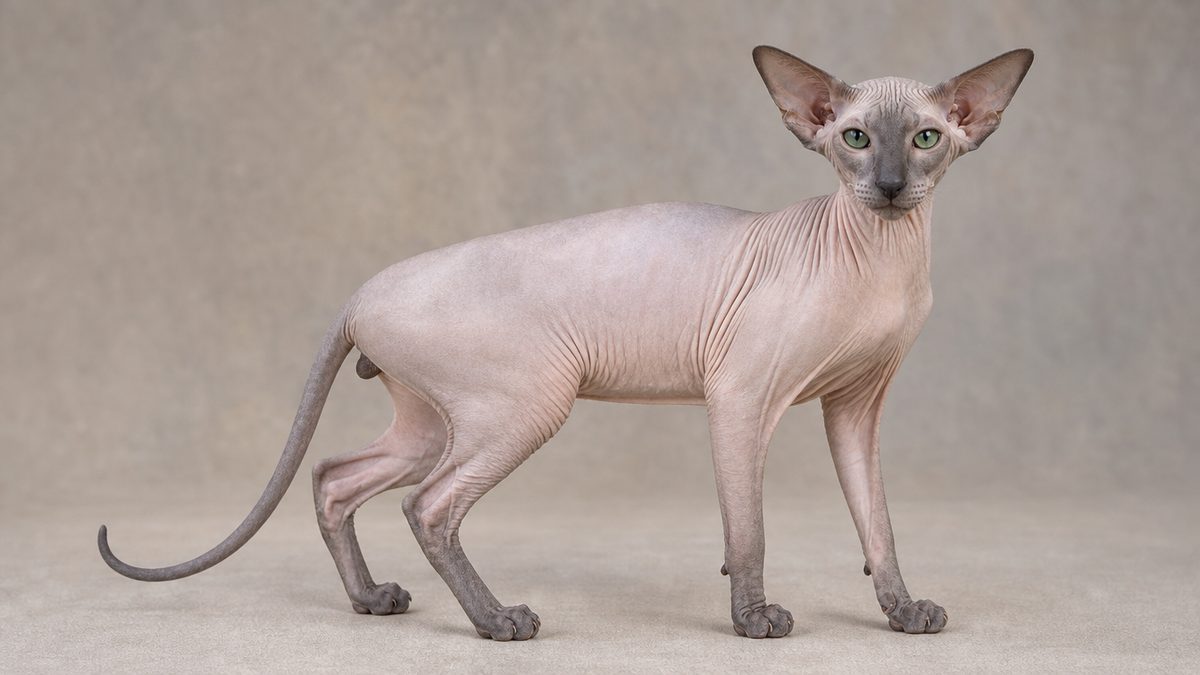
Start with the body, because it is what separates this breed from every other hairless cat. The French studbook gives the gabarit as oriental and describes a very elegant cat, slender and muscular, with a head that is triangular seen from the front, large ears wide at the base that continue the triangle, a profile line straight from the top of the skull to the tip of the nose, almond eyes set at a slant, a long slender neck, a tubular firm body, long high legs with fine but dense bone, and a long fine whip-like tail. TICA describes the same animal as sturdy, long and lean.
In other words, this is an Oriental Shorthair without hair, not a Sphynx. Anyone identifying the breed by nakedness alone will confuse two cats that share nothing but a missing coat.
The coat type, which is not fixed at birth
The most useful practical fact about this breed is that the coat is a moving target. Kittens can be born bald, flocked, velour, brush or with a straight normal coat, and those born with hair, other than the straight-coats, can lose it over time. TICA states it directly: the coat a Peterbald is born with does not represent its forever fur, and hair texture can be either lost or gained during the first two years.
The French studbook recognises three named varieties rather than five states. The nus are bare and elastic-skinned with a touch that evokes rubber; the velours carry a very short down, sometimes barely visible, like chamois leather; and the brush coat is short, curly and hard. TICA gave the brush coat championship status effective May 2008, which is a registry deciding that a Peterbald with hair is still a Peterbald.
The breed began with one mating and the sources cannot agree on how to spell either parent. Wikipedia gives a Don Sphynx male named Afinogen Myth and an Oriental Shorthair female World Champion named Radma von Jagerhov, mated by Russian felinologist Olga S. Mironova. TICA's breed standard section renders the same pair as Radma Vom Jagerhof and Afinoguen Myth, and its history section a few paragraphs later as Radma Von Jagerhof and Afinguen Myth. Four spellings of two cats, two of them on the same page, is a fair measure of how thin the documentary trail behind this breed is.
The dates are firmer. The first two litters produced four kittens, Mandarin, Muscat, Nezhenka and Nocturne iz Murino, which became the foundation stock; a first standard was written in 1996 by the Russian Selectional Feline Federation; and the breed is named after Peter the Great, the founding tsar of St Petersburg Livre Officiel des Origines Felines. The Donskoy itself was found and selected at Rostov-on-Don at the end of the 1980s, with the first unusually coated cat reported in Russia in about 1988.
TICA gives adult females at 5 to 7 pounds and males at 7 to 10, a medium-sized cat, with a life expectancy of 12 to 15 plus years, and lists the breed in all colours as well as pointed.
Registry recognition, checked one body at a time
Four registries hold the Peterbald and two of the largest English-language ones do not, which is the cleanest recognition split in this cluster.
State registry recognition per body rather than as one global claim, because on this breed the split is real and it is checkable in both directions.
| Registry | Status | The document that settles it |
|---|---|---|
| TICA | Held; brush coat accepted for championship effective May 2008 | The breed page, read through a 27 July 2026 Internet Archive capture |
| FIFe | Recognised, EMS code PEB, Category 4 | The breeds index and the 2024 breeding statistics, which give it rank 30 with 118 registrations |
| LOOF | Championnat oui, with three permitted matings | The French studbook breed record |
| WCF | Recognised, code PBD | Row 295 of the WCF EMS code table |
| CFA | Not held | Absent from all 44 breed councils and from the miscellaneous and provisional block on the 2026 ballot |
| GCCF | Not held | The string Peterbald appears zero times in 723,034 characters of the June 2026 Standard of Points |
Both absences were tested rather than assumed. The CFA runs one breed council per recognised breed, its 2026 candidate list names 12 longhair and 32 shorthair councils plus a separate block of committee chairs for miscellaneous and provisional breeds holding exactly one entry, and the Peterbald is on none of those lists while the Sphynx and the Oriental both are. The GCCF's Standard of Points holds a full Sphynx standard in Section 4 Group B from page 198 and mentions the Sphynx nine times as an in-document control, while Peterbald, Don Sphynx and Ukrainian each return zero.
FIFe files this breed as PEB and the World Cat Federation files it as PBD World Cat Federation, EMS code table. The same table also gives the Don Sphynx as DSX in its breed row while its coat-code row 375, shorthair, is annotated only DSP and PBD, using a different Don Sphynx code within one document. Read codes from the document you are actually citing rather than from the last one you read.
The register is open, and the door it closed is the interesting one
LOOF permits three matings: Peterbald to Peterbald, Peterbald to Siamois and Peterbald to Oriental. That is an unusually open register for a breed this young. What it no longer permits is the mating that created the breed. The studbook records that matings with the Donskoy were progressively prohibited, leaving only the Siamese and the Oriental.
That decision has a genetic consequence worth carrying into the health section. Every Peterbald alive descends from Donskoy hairlessness, but the population has been bred away from the Donskoy for a generation, toward Oriental type. So the breed is Oriental in build and Donskoy in coat, and the two halves came from different places and are maintained separately.
On rarity, FIFe registered 118 Peterbalds in 2024 at rank 30 of 54, in a table whose registration counts sum exactly to its printed total of 96,075. Inside Category 4 that is 0.9 percent of 13,724, against the Sphynx at 1,956 and the Don Sphynx at 159. The registration count places it as a functioning but genuinely rare breed, and well behind the hairless cat most people have heard of.
The hairlessness gene, and the mistake almost every article makes
Nobody has identified the gene that makes a Peterbald hairless, and the gene that makes a Sphynx hairless has been formally excluded as the cause.
This is the finding that decides the page, and it is checkable in one document. The international veterinary genetics database files Peterbald and Donskoy hairlessness as its own phene, OMIA:001866-9685, Hypotrichosis, Don Sphynx, also known as Donskoy and Russian hairless. That entry carries no associated gene, no variant table, and exactly two references.
What it does carry is two statements. Inheritance is recorded as autosomal incompletely dominant, from a 2000 Russian study of Russian hairless cats Zhigachev AI, Vladimirova MV. And under molecular basis it reads that, in contrast to the situation with Canadian Sphynx cats whose hairlessness is due to a mutation in KRT71, a 2013 study ruled out mutations in KRT71 as being causal for the hairlessness of Don Sphynx cats Dierks C, Lehner S, Philipp U.
| Phene | Breed | Gene | Year mapped | Inheritance |
|---|---|---|---|---|
| Hypotrichosis, with whiskers short and curled | Sphynx | KRT71 | 2010 | Recessive, in the allelic series KRT71(+) over KRT71(hr) over KRT71(re) |
| Hypotrichosis, HR-related | Lykoi | HR | 2020 | Loss of function, compound heterozygote in the sequenced cat |
| Hypotrichosis, with thymic aplasia | Birman | FOXN1 | 2015 | Recorded in the database |
| Hypotrichosis, Don Sphynx | Donskoy and Peterbald | None recorded | Not mapped | Autosomal incompletely dominant |
Read the last row against the first. Three of the four have a gene and a mapping year. The one this breed depends on has neither, and its own entry says the obvious candidate was tested and excluded Online Mendelian Inheritance in Animals.
The Lykoi row is worth a sentence of its own, because it shows what a solved case looks like. Whole-genome sequencing of a single Lykoi against a reference panel identified two loss-of-function variants in the cat homologue of the Hairless gene in a compound heterozygote, and four further loss-of-function variants were then found across founder lineages from Canada, France and the United States. That is a gene, a mechanism and a set of variants, published in 2020 for a breed accepted by TICA only in 2017. The Peterbald has been recognised for longer and has none of it.
Any article that explains Peterbald hairlessness by describing KRT71, follicular dysplasia, abnormal hair shafts or the Devon Rex allelic series is describing the Sphynx and attaching it to a different breed. The genetics database's Sphynx entry does describe exactly those things, including deficits in Henle's and Huxley's layers of the inner root sheath and small curved follicles, and none of it has been shown to apply here. A mechanism is not transferable between breeds just because the outward result looks similar.
The registries themselves say the gene is unknown
TICA does not overclaim, and its honesty is worth quoting. Its breed description records that the cats have been described as having a dominant gene for hairlessness, or a dominant gene for hair loss, or a dominant gene for an altered and diminished coat, and says all of this is true and may be found in these cats. It then records that many questions were raised and not yet answered as to whether it is one gene or many, and states that these issues are still not decided while genetic studies are underway.
That is a registry telling readers the same thing the genetics database does. Wikipedia's summary, that Peterbalds have an Oriental build with a dominant hair-losing gene inherited from the Don Sphynx, is accurate as far as it goes and stops exactly where the evidence stops.
One Donskoy finding that must not be carried across
A 2020 study identified a homozygous HPS5 splice-site variant behind the pink-eye oculocutaneous albinism phenotype that Donskoy breeders describe, with autosomal recessive inheritance. It is tempting to attach that to the Peterbald, because the Peterbald is Donskoy-derived. The paper itself forbids it: genotyping of 170 cats from 19 breeds failed to identify a single carrier in non-Donskoy cats. So this is a Donskoy finding, and it stays one until somebody tests Peterbalds and publishes the result.
Peterbald cat price in India, and the cleanest absence in this cluster
No Peterbald cat price in India could be sourced, and the evidence for that is stronger than an empty search result because the pages that ought to carry it exist and do not.
Two Indian publishers print a cost of buying for cat breeds, and both have been used elsewhere on this site with the appropriate warnings about their template rows. Neither has a Peterbald page.
| Source | Peterbald | Same publisher, other breeds |
|---|---|---|
| happypet.care | HTTP 404, title 404 Page Not Found | Serves Korat, Tonkinese, Turkish Van, Persian and Bengal pages with prices |
| poodles.in | HTTP 200 with title Cat Breed Not Found, a 958-character shell | Serves Tonkinese, Persian and Korat price pages |
| supertails.com | Zero mentions of Peterbald, Donskoy or hairless in 50,834 characters | 16-breed price table including Sphynx at Rs 50,000 to Rs 1,50,000 |
That is a controlled absence rather than a failed search. The same publishers serve the same page shape for other breeds, so the missing page is a publisher gap poodles.in, which publishes Indian price…. And the guide that lists sixteen breeds carries the other hairless cat, the Sphynx, while never using the word hairless anywhere in its text.
poodles.in returns HTTP 200 for a breed it does not have, with the page title Cat Breed Not Found. A crawler recording status codes would count an Indian Peterbald price page that does not exist, and an answer engine summarising that URL could generate a price for it. Read the title, not the status. The same shell is returned for the Turkish Van.
What the search results actually contain
The organic set for the Indian commercial query is Wikipedia, TICA and international pet-content publishing, with one Indian retail brand appearing at position nine and no Indian price page anywhere The International Cat Association. Two of those pages are useful in their own right: the DNA-testing company Wisdom Panel publishes a Peterbald breed page and lists no Peterbald-specific genetic test on it, which is consistent with the unmapped gene above, and The Spruce Pets covers care and health with no rupee figure at all.
The engine itself was not reading the query. Bing India returned byte-identical ten-result sets and the identical count of About 4,580 results for peterbald cat, peterbald price in india and peterbald kitten india, which is the query-insensitivity signature this site documents. The results are on-topic Peterbald pages, so they are usable as leads, and they are evidence about nothing at all regarding India.
So this page publishes no Peterbald price in India. A pedigreed hairless cat is expensive wherever one is genuinely sold, and converting a foreign figure into rupees would be the only way to produce an Indian number, which this site does not do.
The monthly cost of ownership in India, with one line no other cat has
A Peterbald costs about what any small indoor cat costs to keep in India, plus a skin-care line that a coated cat does not need at all.
Grooming a coated cat costs nothing in India because a comb is a one-off purchase. Grooming a hairless cat costs something every week, because the job is washing rather than combing, and the French studbook puts the frequency at once a week.
| Item | Price | Source and scope |
|---|---|---|
| Kitten course, three visits | From Rs 3,999, against a struck-through Rs 5,065 | One national clinic chain's national page, 11 cities |
| Adult annual booster, CRP plus anti-rabies | From Rs 1,899, against Rs 1,908 | Same chain, same page |
| Anti-rabies alone | From Rs 699 | Same chain |
| CRP alone (Tricat or Feligen) | From Rs 1,249 | Same chain |
| Anti-rabies, Chennai municipal clinics | Free | Greater Chennai Corporation, six named pet clinics |
| Pet licence, Chennai | Rs 50 | Greater Chennai Corporation, 9,115 issued in 2024 |
| Weekly bathing supplies | A recurring household line rather than a quoted price | Required by the studbook's own weekly bath guidance |
The vaccination figures are promotional floors from one chain rather than a market average, and that chain has been observed quoting different course prices on different city pages on the same day. Re-check the page for your own city before you budget from it.
The delivery-model spread, which applies to every Indian cat
Greater Chennai Corporation runs six veterinary pet clinics that provide all treatment and anti-rabies vaccination free of cost, and issues a pet licence for Rs 50, of which it issued 9,115 during 2024. A private chain charges from Rs 699 for the same anti-rabies dose. The vaccine is identical; the delivery model is the price.
- Budget Rs 4,000 for the first-year kitten course, then about Rs 1,900 a year for boosters at private-chain floors.
- Budget for a mild feline shampoo and towels as a standing monthly line, because the bath is weekly rather than occasional.
- Budget for slightly more food than a coated cat of the same size, since TICA reports a higher metabolism in hairless cats.
- Budget for soft bedding and warm sleeping places, which a cat with no coat will seek out even in an Indian winter.
- Budget for neutering once, which is the single largest evidenced survival intervention for any cat.
One population figure belongs in every Indian cat budget. Entire cats carried 4.29 times the odds of death before three years compared with neutered cats, with a confidence interval of 3.72 to 4.95, across the whole UK cat population under primary veterinary care. Neutering costs less than one year of the private vaccination route.
Heat tolerance: the temperature is easy and the sun is not
A Peterbald handles Indian ambient heat better than most imported cats and Indian sunlight worse than any of them, and the two facts need separating.
The homeland numbers are startling. St Petersburg, where the breed was created, returns an annual mean of 4.41 degrees C at 88.87 percent relative humidity, with a July mean of 18.31 and a January mean of minus 9.12, from a model cell sitting at 36.38 m against a real elevation near 3 m. Rostov-on-Don, where the Donskoy was found, runs an annual mean of 10.89 with a July mean of 25.50.
| Place | Cell elevation | Annual mean T2M | Annual mean RH2M | Hottest month | Coolest month |
|---|---|---|---|---|---|
| St Petersburg, Russia | 36.38 m | 4.41 C | 88.87 percent | July, 18.31 C | January, -9.12 C |
| Rostov-on-Don, Russia | 54.99 m | 10.89 C | 70.61 percent | July, 25.50 C | January, -3.26 C |
| Chennai | 48.95 m | 27.95 C | 72.39 percent | May, 31.51 C | January, 24.09 C |
| Mumbai | 97.15 m | 26.77 C | 67.39 percent | May, 31.19 C | January, 23.19 C |
| Kolkata | 7.35 m | 25.81 C | 73.93 percent | May, 31.53 C | January, 17.31 C |
| Bengaluru | 841.72 m | 23.74 C | 67.94 percent | April, 28.37 C | December, 20.22 C |
| Delhi | 206.37 m | 25.60 C | 45.56 percent | June, 35.88 C | January, 13.61 C |
Chennai's annual mean sits 23.54 degrees above St Petersburg's. On paper that looks fatal, and for a coated northern breed it would be. For this one it is not, because the missing coat cuts both ways. The genetics database's note on the Sphynx puts the principle plainly, saying that absence of hair impedes thermoregulation by reducing insulation and makes such cats sensitive to temperature extremes. Insulation works in both directions, so a hairless cat is less protected from cold and less trapped by heat.
A cat with no coat has no ultraviolet barrier over its skin. India delivers far more solar radiation than either Russian city in the table, and a Peterbald lying in an Indian window is doing something a Peterbald in St Petersburg cannot. Keep this breed strictly indoors, keep it away from unscreened sunny windows, and have any new lump, scaly patch or persistent redness examined rather than watched. Consult your nearby vet about sun-related skin change in a hairless cat rather than treating it at home.
- Provide sun protection as a routine, meaning screened windows and no unsupervised balcony access.
- Provide a warm bed and a soft blanket, because a hairless cat seeks warmth even in a tropical city.
- Provide ordinary room temperature rather than aggressive air conditioning, since the cat cannot fluff up a coat in response.
- Provide humidity awareness rather than fear, because St Petersburg runs 88.87 percent relative humidity and this breed evolved in damp air.
- Provide daily skin checks, which take thirty seconds and are the whole of preventive care for this breed.
One comparison closes this section. The Peterbald's ancestral climate is more humid than any Indian city in that table, at 88.87 percent against Chennai's 72.39 and Delhi's 45.56. Humidity is not the shock for this breed. Heat combined with sunlight on bare skin is, and that is a management problem rather than a reason not to keep the cat.
Temperament and household fit
The Peterbald is one of the most demanding companion cats there is, and its own French studbook opens by telling calm households to walk on by.
LOOF does not hedge. It says the Peterbald combines the extrovert character of the Donskoy with the possessive temperament of the Siamese and the Oriental, calls the result dynamite, and tells anyone who wants a calm quiet cat to pass on by, because this one will never leave you in peace: talkative, clingy, hyperactive. It then adds that what is a nuisance to some is a pleasure to others, and that people who love the Peterbald find every other breed bland except the Siamese and the Oriental.
TICA describes the same animal in warmer language, calling the breed friendly and fun, an excellent choice for those looking for a cat that enjoys company and attention, often compared to dogs for loyalty, and so sociable that it loves playing host to guests. Both descriptions are of a cat that is always present.
- Choose a Peterbald if somebody is home most of the day, because both registries describe a cat that wants constant company.
- Choose a Peterbald if you want an interactive cat rather than an ornamental one.
- Choose a different breed if a quiet home is a requirement, since both registries describe a vocal cat.
- Choose a different breed if nobody will do a daily skin check and a weekly bath.
- Choose deliberately about a second cat, since TICA reports Peterbalds get along well with other animals including cats.
With children and other pets
TICA reports that Peterbalds get along well with other animals including cats, with children and even with visitors. That is a broader tolerance than most breeds in this cluster get credited with, and it fits a cat selected from two sociable Oriental parents.
The caution with children is physical rather than behavioural. A cat with no coat has no padding over its skin, and rough handling that a coated cat shrugs off leaves marks on this one. Older children who understand that are fine; a toddler who grabs is not.
One more piece of registry language is worth carrying, because it is unusual for a cat. TICA describes a highly athletic, smart and active breed that tends to move quickly, travels well and settles down quickly once played out, and that is equally happy curling up on a lap or crawling under the covers at bedtime. Under the covers is not a metaphor for this breed; it is where a cat with no coat goes.
Training a Peterbald, and what it resists
To train a Peterbald, use the bath, because the one skill this breed genuinely needs is tolerance of being washed.
Most cat training is optional. For this breed one piece is not, and it should start in the first month at home. The French studbook says naked Peterbalds need a bath once a week and calls it a pure formality because they love being stroked under warm water. That is true of a cat that learned it as a kitten and false of one that met its first bath at a year old.
- Start with warm-water handling in the first week, using a damp cloth rather than a full bath, paired with food.
- Add a shallow warm bath second, a few centimetres deep, ending before the cat objects rather than after.
- Add towel drying third, which is the part most cats dislike more than the water itself.
- Add fetch and puzzle toys fourth, because TICA describes a cat that plays fetch for endless amounts of time.
- Add carrier training last, in short sessions with the door open, months before a vet visit needs it.
TICA reports that Peterbalds are highly intelligent, love to be challenged and play fetch for endless amounts of time. That is the lever for everything else, because a cat that will chase and return a toy will also tolerate handling for a reward.
What this breed resists
Being excluded. LOOF's description of a clingy, hyperactive, talkative cat that will never leave you in peace is a description of an animal that experiences a closed door as a problem to solve. Management works better than correction, and a second cat works better than either if the household is out during the day.
Teach this cat to be turned over and examined. A hairless breed's entire preventive-health routine is looking at the skin, and a cat that accepts a thirty-second belly-and-armpit check every evening is a cat whose owner will find a problem in week one rather than month three. The one published clinical series naming this breed reports lesions that lasted between 1.2 and 56 months, which is a range that rewards early attention.
Daily exercise for a fast, athletic indoor cat
A Peterbald needs two or three interactive sessions a day and will ask for them, because both registries describe a cat that moves quickly and thinks constantly.
TICA describes a highly athletic, smart and active breed that tends to move quickly, and that settles down quickly once it has been played out. That last clause is the useful one for a flat: this is not a cat that runs all day, it is a cat that runs hard and then sleeps, and the sleeping half depends on the running half happening.
LOOF's hyperactif is the same observation without the diplomacy. An under-exercised Peterbald is a cat that will find something to do at three in the morning.
- Provide two or three interactive sessions a day, using wand toys and throwable toys rather than laser pointers.
- Provide vertical space, because an Oriental-built cat is a climber by construction.
- Provide puzzle feeders on working days, which turn part of the ration into activity.
- Provide a warm resting place at the end of each session, since a hairless cat cools quickly after exertion.
- Provide company, ideally feline, if the household is out for a full working day.
Keep play out of direct sunlight at any time of year, not just in summer, because the ultraviolet exposure matters more than the temperature for this breed. Beyond that, ordinary Indian caution applies: move sessions to early morning and after sunset from March to June, when Delhi averages 35.88 degrees C in June and Chennai 31.51 in May.
No published Peterbald exercise requirement exists and this page does not invent one. What is published is the direction of travel on weight: lifespan fell by 0.02 years for every 100 g of deviation from the median adult bodyweight within a cat's breed and sex group. For a 5 to 10 pound cat, 100 g is a meaningful fraction, so weigh monthly.
Grooming a cat with no coat, which is more work rather than less
Skin care replaces coat care in a Peterbald, and it is a weekly bath plus a daily look rather than an occasional comb.
The counterintuitive fact about hairless breeds is that they are high-maintenance, and two independent sources say why. The French studbook records that like their Donskoy ancestor some naked Peterbalds can sweat a great deal and therefore need a bath once a week. The genetics database records that hairless cats carry more cutaneous Malassezia yeast than domestic shorthairs, and are prone to greasiness of the skin, attributed to their near-hairlessness.
A coat normally wicks skin oils away along the hair shafts. Without one, the oil sits on the skin and collects dust, which in an Indian city is not a small amount of dust.
| Task | Frequency | Indian cost |
|---|---|---|
| Warm bath with a mild feline shampoo | Weekly | A recurring supplies line rather than a salon visit |
| Full skin check, including armpits and belly | Daily, thirty seconds | Free |
| Ear cleaning | Weekly, more in the monsoon | Cotton pads and a vet-approved cleaner |
| Nail trim | Every three to four weeks | Free at home |
| Tooth brushing | Two or three times a week | One brush and feline paste |
| Professional grooming | Not required | Rs 0 |
The single published clinical series naming this breed describes figurate erythema, ring-shaped or serpentine red plaques with scaling trailing the expanding edge, in 11 Eastern European hairless cats of which one was a Peterbald. Onset was under 12 months in eight of them, lesions lasted from 1.2 to 56 months, and clinical remission was not achieved with diet changes or medical interventions, although most cats improved spontaneously and partially. Dermatophytosis was ruled out by special stains or fungal culture in eight cats, which is exactly the work a home remedy cannot do.
The claim to leave alone
A hairless cat sheds nothing visible, and that is where the allergy claim comes from. TICA closes it off on its own page, stating in its Did You Know block that hairless Peterbalds are not all hypoallergenic, that being bald or nearly bald does not mean you will avoid a reaction, and that allergies can originate in saliva, coat or dander. The 2024 review of the field puts it beyond argument: to date there is no scientific evidence for a hypoallergenic cat breed, and even hairless Sphynx cats produce Fel d 1.
That is a registry and a peer-reviewed review agreeing against the most profitable claim anyone could make about this breed. Believe them both.
Health: almost nothing has been measured, and that is the finding
Exactly two peer-reviewed records name the Peterbald, and no breed-specific DNA test exists because the gene behind its defining trait has never been found.
A PubMed search of Peterbald[tiab] on 9 September 2026 returned exactly two records, with a clean unrewritten query translation, alongside controls of 126 for Labrador retriever hip dysplasia and 69 for Sphynx[tiab] in the same session. The instrument was working and the literature is genuinely that small.
The one clinical paper that names the breed
Eleven client-owned hairless cats from Baltic sea-bordering countries were reported with figurate erythema, a group of dermatoses producing circular or serpiginous red skin lesions. Of the eleven, seven were Donskoys, one was a Peterbald, one a Ukrainian Levkoy and two presumed Canadian Sphynxes; all but one were male; and onset was before twelve months of age in eight cats.
The details matter for an owner. Lesions were erythematous plaques in linear, serpiginous, annular, gyrate or ring configurations, predominating on the trunk and limbs, with scaling often trailing the edge of the expanding erythema, and the cats were otherwise asymptomatic or only mildly itchy. Lesions lasted between 1.2 and 56 months, clinical remission was not achieved with diet changes or medical interventions, and spontaneous partial or complete improvement occurred in most cats. The authors describe this as the first report of the condition in sphynx-type cats from Eastern Europe.
One Peterbald among eleven cats is not a breed prevalence and this page does not present it as one. What it establishes is that a distinctive ring-shaped rash exists in hairless Eastern European breeds, that it can look alarming and last for years, that it is not dermatophytosis when properly tested, and that it may improve on its own. Take a ring-shaped lesion on a hairless cat to a vet for stains and culture rather than assuming ringworm.
What is not known, stated as an absence
- No causal gene for the hairlessness, so no DNA test to ask a breeder for.
- No breed-specific prevalence figure for any condition, because no cohort study has included the breed by name.
- No breed row in the largest UK feline life-table study, so no median lifespan and no confidence interval.
- No published skin-disease prevalence, only a single case series in which one of eleven cats was a Peterbald.
- No Indian veterinary data of any kind, because the breed does not appear in the Indian market at all.
That list is the honest health section for this breed, and it is more useful than a borrowed one would be. The genetics database entry for the phene carries two references, one from 2000 and one from 2013, and no variant table. A DNA-testing company publishes a Peterbald breed page and offers no Peterbald-specific test on it.
The lifespan question, and a figure this page will not borrow
No breed-specific life table exists. Teng 2024 reports 12 breed rows and the Peterbald is not among the 12 breeds that reached the threshold of 15 or more deaths, so it carries no median from that work. TICA states 12 to 15 plus years, which is a registry claim.
One figure in that study invites misuse and should be handled carefully. The Sphynx sits last in Table 6 with a life expectancy at age zero of 6.68 years on 18 deaths, the shortest in the table. It is tempting to read that across to any hairless cat. It should not be read across here, because the two breeds carry different genes, have different body types and were selected in different countries, and because the study measured Sphynxes rather than hairless cats as a class Online Mendelian Inheritance in Animals. What the Sphynx figure legitimately supports is asking a breeder hard questions about longevity in their own lines.
Finally, one Donskoy finding that stays a Donskoy finding. The HPS5 splice-site variant behind the Donskoy pink-eye phenotype was not found in any of 170 cats from 19 other breeds, so it is not a Peterbald screening question until somebody publishes Peterbald genotypes.
Feeding a Peterbald in India
Feed a Peterbald slightly more than a coated cat of the same size, because the registry reports a higher metabolism, and measure it, because the cat is small enough for a small error to matter.
TICA states that due to their lack of fur Peterbalds have a higher metabolism than cats with full coats, requiring that they consume more food than their coated counterparts. That is a registry claim rather than a measured energy requirement, and this page reports it as one, but it is consistent with basic physics: an animal with no insulation loses heat faster and burns more energy holding its temperature.
The counterweight is size. TICA gives females 5 to 7 pounds and males 7 to 10, so this is a small cat, and a 100 g swing is a larger proportion of its body than it would be for a Maine Coon. The largest UK life-table study found lifespan falling by 0.02 years for every 100 g of deviation from the median adult bodyweight within a cat's breed and sex group.
- Weigh the cat monthly on a kitchen scale in its carrier, subtract the carrier, and record the number.
- Measure every meal rather than free-feeding, since a small cat hides a large proportional gain.
- Feed slightly above the label for the weight if body condition falls, on veterinary advice rather than by guesswork.
- Include wet food daily, which raises water intake in a hot climate.
- Ask your vet to body-condition-score the cat at every visit, because there is no coat to hide behind and the score is unusually easy to read.
Body condition scoring is normally the hardest thing for an owner to judge, because fur disguises both thinness and fat. On a hairless cat you can see the ribs, the waist and the abdominal tuck directly. Use that. A weekly look at the outline, while the cat is being bathed anyway, is a better weight-management tool than any coated breed's owner has.
There is no Indian feeding guidance for this breed, because there are no Indian pages for it at all poodles.in, which publishes Indian price…. That is not a gap this page fills with a number, because a daily calorie figure invented for a breed nobody has studied would be exactly the kind of confident fabrication this site exists to avoid.
Kitten timeline: month by month through the first year
A Peterbald kitten's first year has one checkpoint no other cat has, which is that its coat may still be changing at the end of it.
| Age | What is happening | What to do |
|---|---|---|
| 0 to 8 weeks | With the mother and litter; the birth coat state is visible | Nothing. A kitten should not leave its mother in this window |
| 2 months | Homecoming at the earliest; first vaccination visit | Start the kitten course, from Rs 3,999 for three visits at one national chain |
| 2 to 3 months | Skin routine should begin now, not later | Introduce warm damp-cloth handling, then a shallow warm bath, paired with food |
| 3 to 4 months | Third vaccine visit including anti-rabies | Complete the course; begin the daily thirty-second skin check as a habit |
| 4 to 12 months | The window in which the reported skin condition presented in eight of eleven cats | Photograph any ring-shaped lesion and take it to a vet for stains and culture |
| 6 to 9 months | Sexual maturity approaches | Discuss neutering, the largest evidenced survival intervention for any cat |
| 9 to 12 months | Frame fills out; monthly weighing matters on a small cat | Switch to adult feeding on veterinary advice; keep weighing |
| 12 to 24 months | Coat texture may still be lost or gained | Expect change and do not treat it as illness unless the skin itself changes |
| Beyond 24 months | Adult coat state settled | Annual health check; continue the weekly bath and the daily look |
Two of those rows are specific to this breed. The coat row exists because TICA states that the coat a Peterbald is born with does not represent its forever fur and that texture can be lost or gained during the first two years. The skin row exists because the one published case series naming the breed reports onset before twelve months in eight of eleven cats.
There is no Peterbald genetic test to request, because the causal gene has never been identified. So the questions are behavioural and historical instead. Ask what coat state each kitten in the litter was born in. Ask whether any kitten in a previous litter developed persistent skin lesions before its first birthday. Ask what the parents' coat states are now against what they were at birth. A breeder who has watched their own lines can answer all three; one who cannot has not been looking.
Neutering deserves its own line. Entire cats carried 4.29 times the odds of death before three years compared with neutered cats, with a confidence interval of 3.72 to 4.95, across the whole UK cat population under primary veterinary care. Discuss timing with your vet and treat it as a health decision.
Peterbald against the other hairless and Oriental cats
The Peterbald is compared to the Sphynx on coat and to the Oriental Shorthair on body, and it is genuinely closer to the Oriental.
Two comparisons matter and they run in different directions. On coat the reference point is the Sphynx, and the comparison is misleading because the genetics are different. On body the reference point is the Oriental Shorthair, and the comparison is exact, because that is literally where the body came from.
| Breed | Coat gene | Inheritance | FIFe registrations 2024 | In India's leading guide |
|---|---|---|---|---|
| Peterbald | Unmapped; KRT71 excluded | Autosomal incompletely dominant | 118, rank 30 | Not listed |
| Don Sphynx (Donskoy) | Unmapped; same phene record | Autosomal incompletely dominant | 159, rank 28 | Not listed |
| Sphynx | KRT71 | Recessive | 1,956, rank 12 | Rs 50,000 to Rs 1,50,000 |
| Lykoi | HR | Loss of function | 59, rank 36 | Not listed |
| Oriental Shorthair | Normal coat | Not applicable | 1,694, rank 13 | Not listed |
Read the first three rows together and the point is clear. The Peterbald and the Donskoy share one phene record and one inheritance pattern; the Sphynx has a different gene and the opposite inheritance Online Mendelian Inheritance in Animals. A dominant allele and a recessive one behave completely differently in a breeding programme, which is why the distinction is not academic.
The comparison an Indian buyer will actually face
Only one hairless cat has an Indian price attached to it, and it is not this one. India's leading cat-price guide carries the Sphynx at Rs 50,000 to Rs 1,50,000 and does not mention the Peterbald, the Donskoy or the word hairless anywhere. So a reader who wants a hairless cat in India is being offered the Sphynx, and should know that it is a different breed with a different gene, a different body type and, in the one study that measured it, the shortest life expectancy of any breed in the table.
A reader who wants the Peterbald's body rather than its skin has an easier route through the Oriental Shorthair, which is the same build with a coat and 1,694 FIFe registrations against 118. A reader interested in the founding half of the pedigree should read the Donskoy, which shares the phene record and carries the one genetic finding this page refuses to transfer.
What gets written wrong about this breed
Five errors recur, and the first is made by almost every article that tries to explain the breed's defining feature.
- Explaining Peterbald hairlessness with Sphynx genetics, when the Sphynx gene has been formally excluded as the cause.
- Calling the breed a Russian Sphynx, which merges an Oriental-built cat with a completely different body type.
- Assuming a bald kitten stays bald or a brush kitten stays brush, when the coat can change for two years.
- Calling a hairless cat low-maintenance, when the routine is a weekly bath and a daily skin check.
- Applying the Donskoy albinism variant, which was found in no cat of any other breed among 170 tested.
The genetics mistake, stated precisely
The veterinary genetics database records the Don Sphynx phene, which is the one this breed carries, with no associated gene and with a note that a 2013 study ruled out KRT71 as causal Dierks C, Lehner S, Philipp U. The KRT71 story, with its allelic hierarchy, its abnormal hair shafts and its follicular dysplasia, belongs to the Sphynx entry. Any page that tells the second story about the first breed has transferred a mechanism between two animals the literature has explicitly separated, and this site treats that as the most expensive error a breed page can make.
poodles.in returns HTTP 200 with the title Cat Breed Not Found for this breed. A summariser that reads status codes rather than titles could treat that URL as an Indian Peterbald price page and generate a plausible band for it. There is no Indian price for this breed, and any number presented as one should be traced to the page it came from before it is believed.
One thing worth getting right about the name
The Peterbald is a recognised breed by four bodies and unrecognised by two, and that is not a scandal. The CFA and the GCCF simply do not hold it The Governing Council of the Cat Fancy. What matters commercially is that an Indian seller offering CFA or GCCF paperwork for a Peterbald is offering something that does not exist, and that is a check any buyer can run in one minute against the documents cited here.
Adoption, import and the honest recommendation
No Indian Peterbald breeder, listing or price page exists, so the two real routes are adoption of an ordinary cat or a lawful personal import.
This page will not send a reader to a breeder. It can set out the routes, and it can say plainly that this is the hardest breed in this cluster to obtain in India.
The import route, in the government's own words
Import of live animals including cats is restricted in India and permitted only with an authorisation from the DGFT, using ITC(HS) code 01061900 for pet animals. Applications go to an Exim Facilitation Committee that meets once a month, and import is allowed only through the airports and seaports of Delhi, Mumbai, Chennai, Hyderabad, Bengaluru and Kolkata and, since October 2024, Kochi airport, with quarantine at the port where required Department of Animal Husbandry…. Import without authorisation is allowed for people shifting residence permanently to India under the customs baggage rules. The full route, which covers cats too, is set out in how to import a dog to India.
- Adopt an Indian shorthair from a local shelter, which costs least and helps most.
- Verify the register on any pedigree offered, because CFA and GCCF papers cannot exist for this breed.
- Verify the coat state at birth of every kitten in the litter, since the adult coat is not predictable from the kitten.
- Verify what skin disease the breeder has seen in their own lines, because there is no DNA test to substitute for that answer.
- Verify that the household can commit to a weekly bath and a daily skin check before anything else.
What an Indian shelter cat gives you instead
A pet licence in Chennai costs Rs 50, the Corporation issued 9,115 of them in 2024, and its six municipal pet clinics provide all treatment and anti-rabies vaccination free of cost. A private kitten course starts at Rs 3,999 and an annual booster at Rs 1,899. An adopted Indian cat can be fully vaccinated and licensed for less than one private vaccine package, and its skin already has a coat over it.
The evidence points the same way. Crossbred cats lived 1.27 years longer than purebred cats on average, and purebred cats had 1.83 times the odds of dying before three years, across the whole UK cat population under primary veterinary care. Those are population figures rather than a verdict on any individual animal.
If what appeals is an intensely sociable, athletic, elegant, talkative cat, an Indian shelter can supply the temperament and a coat with it. If you specifically want a Peterbald, accept that there is no Indian supply, plan a lawful personal import through one of the seven named ports, budget for weekly bathing and strict sun management, and ask the breeder the three questions above rather than asking for a DNA certificate that does not exist Online Mendelian Inheritance in Animals Livre Officiel des Origines Felines Department of Animal Husbandry….
Readers who arrive here from the Sphynx are usually comparing hairless cats and should read the genetics section above before assuming the two are interchangeable. Readers who arrive from the Siamese or the Oriental Longhair are usually tracing the Oriental line, which is the half of this breed that is easy to obtain.
Peterbald questions people actually ask
What is the Peterbald cat price in India?
No Indian price could be sourced on 9 September 2026, and the absence is unusually well evidenced. The two Indian publishers that print a cost of buying for the Korat, the Tonkinese, the Turkish Van and the Persian have no Peterbald page at all, one returning HTTP 404 and the other a page titled Cat Breed Not Found. India's leading cat-price guide lists 16 breeds including the Sphynx at Rs 50,000 to Rs 1,50,000, and never uses the words Peterbald, Donskoy or hairless.
What is the difference between a Peterbald and a Sphynx?
Two different genes and two different body types, which is why the comparison matters more than it looks. The Canadian Sphynx's hairlessness is caused by a mutation in KRT71 and is recessive. The Peterbald inherits a hair-losing allele from the Don Sphynx that is autosomal incompletely dominant, and a 2013 study formally eliminated KRT71 as its cause. In build, a Peterbald is an Oriental cat, long, tubular and fine-boned, while a Sphynx is rounder and heavier.
Are Peterbald cats hypoallergenic?
No, and TICA says so on its own breed page. Its Did You Know block states that hairless Peterbalds are not all hypoallergenic, that being bald or nearly bald does not mean you will avoid a reaction, and that allergies can originate in saliva, coat or dander. The 2024 review of the whole field is blunter still, stating that to date there is no scientific evidence for a hypoallergenic cat breed and that even hairless Sphynx cats produce Fel d 1.
Are all Peterbalds hairless?
No, and a Peterbald's coat is not fixed at birth. The breed is described in coat states running from completely bald through flocked, velour and brush to a straight normal coat, and TICA notes that the coat a Peterbald is born with does not represent its forever fur, because texture can be lost or gained during the first two years. The French studbook recognises three named varieties, nus, velours and brush.
Which registries recognise the Peterbald?
Several do and two large ones do not. FIFe holds it as EMS code PEB in Category 4, TICA holds it and gave the brush coat championship status effective May 2008, LOOF holds it at championship level, and the WCF lists it as PBD recognised by seven bodies. The CFA appears nowhere: the breed is absent from all 44 CFA breed councils and from the miscellaneous and provisional block. The GCCF does not hold it either, with the string Peterbald appearing zero times in its 723,034-character Standard of Points.
How rare is the Peterbald?
FIFe registered 118 Peterbalds in 2024, ranking the breed 30th of the 54 codes in its own statistics, whose counts sum exactly to the printed total of 96,075. That places it above the Don Sphynx at 159 in rank terms but far below the Sphynx at 1,956. Within FIFe Category 4 it accounts for 0.9 percent of 13,724 registrations. In peer-reviewed literature it is rarer still, with exactly two PubMed records naming the breed.
Do Peterbald cats need baths?
Yes, and the French studbook is specific about why. It records that like their Donskoy ancestor some naked Peterbalds can sweat a great deal, and that they therefore need a bath once a week, which it calls a pure formality because they love being stroked under warm water. The genetics database adds a second reason, noting that hairless cats carry more cutaneous Malassezia yeast than domestic shorthairs. Skin care replaces coat care in this breed.
What health problems do Peterbald cats have?
The honest answer is that almost nothing has been measured. Exactly two PubMed records name the breed, and the clinical one is a case series of figurate erythema in 11 Eastern European sphynx-type cats of which one was a Peterbald. The oculocutaneous albinism variant described in the Donskoy is explicitly not a Peterbald finding, because genotyping 170 cats from 19 breeds found no carrier outside the Donskoy. No breed-specific DNA test exists.
How long do Peterbald cats live?
No breed-specific life table exists. Teng 2024 reports 12 breed rows and the Peterbald is not among the 12 breeds that reached the threshold of 15 or more deaths, so it carries no median from that work. TICA states 12 to 15 plus years, which is a registry claim rather than a measured figure. Note that the one hairless breed that does appear in that study, the Sphynx, has the shortest life expectancy in the table at 6.68 years on 18 deaths, and this page does not transfer that figure to a different breed with a different gene.
Can a Peterbald live in India?
The temperature is the easy part and the sun is not. A cat with no coat has no insulation in either direction, so ambient Indian heat is far less of a problem for it than for a Siberian, and the homeland is 23.54 degrees C colder than Chennai on the annual mean. What replaces the heat problem is ultraviolet exposure on unprotected skin, which means a strictly indoor life, no sunny window without a screen, and a vet check on any new lump or patch.
Who created the Peterbald?
Russian felinologist Olga S. Mironova, in St Petersburg in 1994, by mating a Don Sphynx male named Afinogen Myth to an Oriental Shorthair female World Champion named Radma von Jagerhov. The first two litters produced four kittens, Mandarin, Muscat, Nezhenka and Nocturne iz Murino, which became the foundation stock. A first standard was written in 1996 by the Russian Selectional Feline Federation, and the breed is named after Peter the Great, the founding tsar of St Petersburg.
How much does a Peterbald cat cost?
No Indian figure exists and this page will not convert a foreign one. The two Indian publishers that print a cost of buying for the Korat, Tonkinese, Turkish Van and Persian have no Peterbald page at all, one returning HTTP 404 and the other a shell titled Cat Breed Not Found. India's leading cat-price guide lists 16 breeds including the Sphynx at Rs 50,000 to Rs 1,50,000 and never mentions the Peterbald, the Donskoy or the word hairless.
Do Peterbald cats like toys?
Yes, and TICA singles out one game in particular. It describes a highly athletic, smart and active breed that loves to be challenged and will play fetch for endless amounts of time, while being equally happy curling up on an owner's lap or crawling under the covers at bedtime. The French studbook describes the same energy less diplomatically, calling the breed hyperactive. Puzzle toys and throwable toys both work; a cat this quick will find its own entertainment otherwise.
Can I sell a Peterbald kitten?
Bonbeno does not advise on selling animals and does not broker sales, so the useful answer is about what a buyer will ask you for. There is no Peterbald DNA test to supply, because the gene behind the breed's hairlessness has never been identified and the Canadian Sphynx gene was formally excluded in 2013. What a careful buyer should ask instead is the coat state each kitten was born in, whether the coat has changed, and whether any kitten in a previous litter developed persistent skin lesions before its first birthday.
Does Peterbald come with official documents?
Only from a registry that actually holds the breed, and two large ones do not. TICA, FIFe, LOOF and the WCF all recognise the Peterbald, so a pedigree from any of those is real. The CFA does not hold the breed, which is checkable against its 2026 breed council list where the Peterbald appears on none of the 44 councils, and the GCCF does not either, with the string Peterbald appearing zero times in its 723,034-character Standard of Points. Paperwork offered from either of those two bodies cannot be genuine.
Can you import a Peterbald into India?
Only as a personal pet under an authorisation. Import of live animals including cats is restricted in India and permitted only with a DGFT authorisation using ITC(HS) code 01061900, considered by an Exim Facilitation Committee that meets monthly, and allowed only through the airports and seaports of Delhi, Mumbai, Chennai, Hyderabad, Bengaluru and Kolkata and, since October 2024, Kochi airport, with quarantine at the port where required. That is a relocation route rather than a purchase route, and no Indian seller of this breed could be verified.
Compare with similar breeds
Peterbald sits in 1 Bonbeno group. Each one compares it directly against the breeds it is genuinely an alternative to, on the same figures.