
Breed profile
Singapura Cat in India: Contested Origins and Real Costs
The world's smallest pedigreed cat, from a homeland that barely has any, with the lowest genetic diversity ever measured in a cat breed and an origin story its own registry has had to defend.
Quick answer
No Singapura cat price in India exists, because no Indian seller lists the breed. Every page ranking for the Indian query quotes US dollars, at 1,200 to 2,500 for a pet-quality kitten and up to 4,000 for show lines. FIFe registered 35 Singapuras worldwide in 2024, ranking the breed 44th of 54, and Singapore itself has no active local breeders.
This page reports what the registries, the veterinary and genetics literature and Singapore's own national newspaper say about the Singapura, including where they contradict each other. The breed has no life table and no disease study of its own, so nothing here is reassurance about an individual animal. It is general information, not a diagnosis. Consult your nearby veterinarian in person before acting on anything here, and treat pale gums, lethargy or any sudden change in appetite as urgent.
Singapura at a glance
What the Singapura actually is
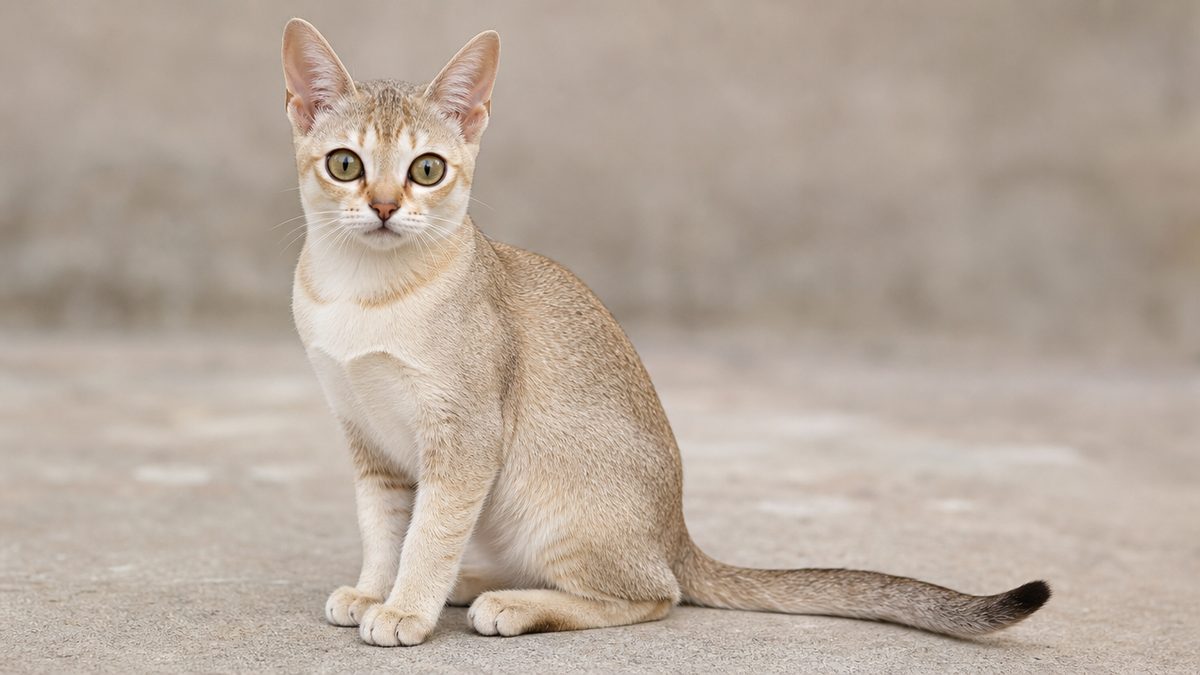
The Singapura is a small ticked shorthair cat of foreign type in a single colour, golden ivory ticked with sepia brown, with unusually large deep-cupped ears and very large eyes. It is also the only breed on this site whose own registry has published a defence of where it came from.
Start with the coat, because there is only one. The GCCF requires the body colour to be an old or golden ivory with a soft warm effect, ticked with sepia brown, with each hair carrying at least two bands of sepia ticking separated by light bands, light next to the skin and a dark tip. Muzzle, chest, stomach and inner legs must be an unticked light ivory. There is no second colour, no pattern variant and no silver.
The head, and the two features that carry the breed
The standard asks for a rounded skull narrowing to a definite whisker break, a medium short broad muzzle with a blunt nose, and in profile a slight stop just below eye level. Ears are large, wide open at the base and deep cupped. Eyes are large, set at least an eye width apart, held wide open, with a dark outline desirable, and the eye colour must be hazel, green or yellow only. Head and ears together carry 25 of the 100 points and eyes another 10, so more than a third of the judging is above the neck.
Size, where the sources genuinely disagree
This is the breed's most-repeated claim and the sources do not line up. Royal Canin's Indian breed page states "3.75kg at their largest, the Singapura is the smallest recognised breed of cat";. The GCCF's own Standard of Points opens with "The Singapura is an alert, healthy, medium-sized cat of foreign type";, and its public breeds index gives 5 to 8 lb, roughly 2.3 to 3.6 kg. One registry calls the breed medium-sized while a major manufacturer calls it the smallest recognised breed, and both are published.
| Feature | Singapura | Abyssinian | Burmese | Ocicat |
|---|---|---|---|---|
| Colours accepted | One, golden ivory ticked with sepia brown | Several | Several | Twelve |
| Coat | Short, fine, silky, close-lying | Short, fine, resilient | Short, satin-like | Short, satiny |
| Adult eye colour | Hazel, green or yellow only | Gold or green | Yellow to gold | Any except blue |
| FIFe code and recognition | SIN, Rec. 2014 | ABY, recognised since 1949 | BUR | OCI, Rec. 1992 |
| FIFe registrations in 2024 | 35, rank 44 of 54 | 848, rank 18 | 1,515, rank 14 | 177, rank 26 |
| Observed heterozygosity in the 2008 survey | 0.34, the lowest measured | Not the lowest | Also among the lowest | Not in the survey |
One colour, hazel or green or yellow eyes, deep-cupped ears and a blunt-tipped tail. If a cat offered as a Singapura is silver, or blue-eyed, or has a whippy pointed tail, it is not one. The single-colour rule makes this one of the easiest pedigree cats to rule out by eye.
Coat genetics and the diversity problem underneath them
The Singapura's coat genetics are simple ticked-tabby genetics: every hair banded, no pattern on the body, sepia on ivory. Its population genetics are the opposite of simple, and they are the most important thing on this page.
The visible mechanism is the same agouti banding the Abyssinian carries. The GCCF requires at least two bands of sepia ticking per hair, separated by light bands, light next to the skin and dark at the tip, with the muzzle, chest, stomach and inner legs left unticked. Barring is permitted on the inner front legs and back knees only, and barring on the outer front leg is a fault. A faint incomplete necklace is allowable; a complete one is not.
The heterozygosity finding, and what the authors actually wrote
A 2008 survey genotyped 22 cat breeds and worldwide random-bred populations using microsatellite markers. The Singapura's row in its Table 1 reads: 24 cats, inbreeding coefficient 0.12, observed heterozygosity 0.34, expected heterozygosity 0.38, average allelic richness 1.98, average alleles per locus 2.82, allele range 1 to 5. The breed average across the study was 0.51 observed heterozygosity and 2.74 allelic richness. Both of the Singapura's diversity figures are the lowest values in the table, and its allele range tops out at 5 against 12 for the Japanese Bobtail and the Siberian.
The authors did not leave the reader to infer the consequence. They wrote that "the Burmese and Singapura breeds have the lowest heterozygosity and the highest FIS of any breed, reflecting the most intense inbreeding", and concluded that "Burmese and Singapura breeders should be concerned about genetic diversity";.
| Population | Cats | Inbreeding coefficient | Observed heterozygosity | Allelic richness |
|---|---|---|---|---|
| Singapura | 24 | 0.12 | 0.34 | 1.98 |
| Burmese | 25 | 0.22 | 0.40 | 2.51 |
| Sokoke | 14 | 0.07 | 0.41 | 2.14 |
| Havana Brown | 11 | 0.13 | 0.41 | 2.28 |
| Egyptian Mau | 19 | 0.23 | 0.49 | 2.86 |
| Breed average across 22 breeds | 25 | 0.12 | 0.51 | 2.74 |
| Siberian, the most diverse breed | 19 | 0.05 | 0.69 | 3.45 |
The heterozygosity half is fully supported: 0.34 for the Singapura and 0.40 for the Burmese are the two lowest observed heterozygosity values in Table 1. The inbreeding-coefficient half is not. Table 1 gives the Singapura an FIS of 0.12, which is exactly the breed average, while the Egyptian Mau is 0.23, the Burmese 0.22 and the Persian 0.19. Reading the paper's Discussion alone would leave you with a claim its own table contradicts for this breed. The finding that survives, and it is the important one, is that the Singapura has the least genetic diversity of any cat breed measured in that study.
Why the rule that protects the breed also traps it
The CFA classifies the Singapura as a natural breed, and its own article states plainly that "as such, no outcrosses are allowed";. That rule exists to protect the breed's identity, and it also means the population cannot outcross its way out of the diversity problem the 2008 survey measured. The two facts belong on the same page, and nowhere else are they printed together.
In the same 2008 survey's twenty-cluster analysis, four pairs of breeds could not be separated statistically, and one of the four pairs was Singapura and Burmese. The authors note that all four pairs could be distinguished when analysed independently of the other breeds, so this is not proof of identity. It does mean that when a genetics paper looked at 22 breeds at once, the Singapura's closest genetic neighbour was the Burmese, which is one of the two breeds the origin dispute is about.
Registry recognition, and the origin dispute inside it
Registry recognition of the Singapura is complete at every major body, and the interesting part is not whether the breed is recognised but what its own registry has had to publish about where it came from.
The CFA accepted the Singapura for registration in 1982 and granted championship status in 1988, and it runs an active Singapura breed council today. TICA lists it among the 73 breeds it recognises. The GCCF carries a Standard of Points entry at page 179 in Section 4 Group A. FIFe recognised it much later: its standard prints "SIN Rec. 2014" on its own face, thirty-two years after CFA accepted the breed.
What the CFA itself publishes about the origin
The CFA's own 2006 article on the breed opens its history section with the sentence "There has been much controversy concerning the origin of the Singapura", and states that "it has been insinuated that the breed was a hybrid, created using Burmese and Abyssinians";. Its account is that Hal Meadow, a geophysicist working overseas, sent cats from Singapore to Tommy Meadow in the United States on a company ship in 1971; that the couple arrived in Singapore in 1974 with five cats including a blue Burmese, a spayed sable Burmese and three ticked cats that were grandchildren of the earlier Singapore cats; and that they returned to the United States in 1975 with five brown ticked cats and one brown cat.
The same article records that in 1980 a female found in Singapore's SPCA, Chiko, was imported by a Singapura breeder, and that this "legitimized the fact that cats who fit the Singapura's description did exist in the streets of Singapore";. It then records the hearing: "In October 1990, the question of the Singapura's origin was brought before the CFA Board by a CFA Singapura breed club. The CFA Board found no probable cause for wrongdoing and took no action."
The same CFA article goes on to say that "the controversy over the origin of the breed seems to continue within CFA even today", and that the claim the cats were created in Texas using Burmese and Abyssinian stock "has even been expressed by CFA Judges, while describing the Singapura to exhibitors". A registry publishing that about its own judges is unusual, and it is the strongest evidence available that the question is live rather than closed.
What Singapore's own newspaper published in 2026
The Straits Times ran a piece on 28 June 2026 headed "The Singapura cat's contested origins". It states that the drain-cat story "was largely invented, and the cat is, genetically speaking, more American than Singaporean", records that Harold and Tommy Meadow were American breeders of Abyssinians and Burmese cats who moved to Singapore in 1974, and reports that Tommy Meadow later claimed she discovered three kittens abandoned in a local storm drain. The article also notes that only one Singapura was competing at a Singapore show, and that the country has no active local breeders.
| Point | CFA's own 2006 article | The Straits Times, June 2026 |
|---|---|---|
| Where the founding cats came from | Sent from Singapore by Hal Meadow in 1971 | The discovery story was largely invented |
| What the Meadows bred | Not characterised | American breeders of Abyssinians and Burmese |
| The 1990 hearing | No probable cause found, no action taken | Not the article's focus |
| Whether the dispute is settled | Says the controversy continues inside CFA | Calls the cat genetically more American than Singaporean |
| Cats named | Pusse, Ticle, Tes, George, Gladys | Tess, Pusse and Tickle |
Bonbeno does not adjudicate between a registry and a national newspaper. What this page does is put both on one screen with their dates, and add the one piece of independent evidence neither of them cites: the 2008 genetics survey in which the Singapura's closest neighbour among 22 breeds was the Burmese.
How rare the breed actually is, in registry numbers
FIFe's own Breeding Statistics 2024 covers 96,075 registered kittens across 54 breeds. The Singapura ranks 44th with 35 registrations, marked as having fallen in rank, against 23,775 for the Maine Coon at the top. France's studbook registered 24 in 2023 and 20 in 2024, and 621 across the twenty years to 2022 with a peak of 46 in 2016. Wikipedia records the same FIFe ranking as 0.04 percent of registered kittens, which is the unrounded version of the 0.0 percent the PDF prints.
Singapura cat price in India, and why the question has no local answer
No Singapura cat price in India exists. Every page ranking for the Indian query quotes US dollars, the Indian-domain results are either general cat-price guides that omit the breed or sellers listing other breeds, and the country the cat is named after has no active breeders either.
We pulled the Indian results on 8 September 2026 with gl=IN and hl=en and read the pages. Here is what is actually there.
| Rank | Domain | What it is | Singapura price given |
|---|---|---|---|
| 1 | supertails.com | Indian all-breeds cat price guide | None. The breed is not mentioned |
| 2 | petful.com | US price guide | 1,200 to 2,500 US dollars, up to 4,000 show |
| 3 | quora.com | US answer thread | Well over 1,000 US dollars |
| 4 | besttopets.com | Indian all-breeds price listicle | None found for this breed |
| 5 | cats.com | US breed profile | 1,500 to 2,000 US dollars |
| 6 | hepper.com | US price guide | 1,200 to 2,000 US dollars, 75 to 150 to adopt |
| 7 | khankittens.com | Indian seller, listing Persian, British Shorthair, Ragdoll and Maine Coon | Not this breed |
| 8 | qualitykitten.in | Indian seller, Persians from Rs 15,000 | Not this breed |
| 9 | royalcanin.com/in | Royal Canin's Indian breed page | No price at all |
| 10 | singapuracats.org | A US breeder's own kitten page | A single breeder's asking price |
Two Indian sellers rank on this query and neither lists the breed. Royal Canin has an Indian-domain page for the Singapura that carries breed information and no price. India's largest cat-price guide, titled Cat Price in India 2026: All Breeds, mentions the Persian 22 times and the Singapura zero times.
What the overseas figures actually are
Petful gives 1,200 to 2,500 US dollars for a pet-quality kitten from a reputable breeder, with premier show lines reaching 4,000. Hepper gives 1,200 to 2,000 from a breeder and 75 to 150 for adoption. Those two overlap at the bottom and diverge at the top, which is the ordinary spread of guide pages rather than a market signal.
It would take one line of arithmetic, and that line would be fabrication. A converted figure describes an American market with a documented wait list, not an Indian one with no listings at all. This site has repeatedly caught Indian pages and AI answers stating that no local price exists and then printing a rupee band in the next sentence. Bonbeno publishes no rupee price for this breed, because none has been observed.
The rarity is not an Indian problem, it is a global one
FIFe's own Breeding Statistics 2024 covers 96,075 registered kittens across 54 breeds and puts the Singapura 44th with 35 registrations for the whole year, marked as having fallen in rank. France's studbook registered 20 in 2024 against 24 in 2023. And Singapore's own newspaper reports that the breed averages around 2.3 kittens per litter, which it describes as the lowest of any registered breed, and that the country has no active local breeders so prospective owners must go overseas.
Put those together and the Indian absence stops being surprising. A breed producing 35 registered kittens a year worldwide, from litters averaging 2.3, with no breeders in its own namesake country, is not going to have an Indian retail market.
Cost of ownership in India, from published rate cards
The cost of ownership for a small short-coated cat in India is built from litter, food, vaccination, parasite control and occasional boarding, with the grooming line close to zero. Every figure below comes from a named Indian rate card read live, because no Singapura-specific Indian cost exists to quote.
| Line | Published figure | Source and scope |
|---|---|---|
| Kitten vaccination course, three visits | From Rs 3,999, list price Rs 5,065 | Vetic, Mumbai clinic page |
| Adult annual booster, CRP plus anti-rabies | From Rs 1,899, list price Rs 1,908 | Vetic, Mumbai clinic page |
| Anti-rabies, single | Rs 699 | Vetic |
| CRP (Tricat or Feligen), single | Rs 1,249 | Vetic |
| Bath and blow dry, 60 minutes | From Rs 934, list price Rs 1,099 | Vetic, Delhi, dogs and cats |
| Cat boarding, overnight to 24 hours | Rs 649, food and litter excluded | PawSpace, Bengaluru |
| Cat boarding, daycare to 10 hours | Rs 599 | PawSpace, Bengaluru |
| Pet animal licence | Rs 50 | Greater Chennai Corporation |
PawSpace also notes that festive-season rates run 25 to 30 percent higher, which an annual average would hide.
The small-cat advantage, and where it stops
A cat that Royal Canin India puts at 3.75 kg at its largest eats less than a 6 kg cat, uses less litter and costs less to board. It also needs almost no professional grooming: the GCCF rates the coat low maintenance and describes it as short, fine, silky and close-lying. Against that, veterinary costs do not scale down with body weight, and consultation, imaging and anaesthesia are priced per visit rather than per kilogram.
Neither food nor litter has a published national Indian rate this page could quote honestly, and neither does any cat page that claims one. Price both in your own city.
The cheapest life-extending decision
Neuter on your vet's schedule. In UK primary-care data, entire cats had 4.29 times the odds (95% CI 3.72 to 4.95) of dying before three years of age compared with neutered cats, and among cats dying after nine months, neutered cats lived 1.07 years longer on average. Those findings are not breed-specific, which is exactly why they apply to a breed with no literature of its own.
Greater Chennai Corporation licenses pet animals generally at Rs 50, issued 9,115 licences during 2024, and runs municipal pet clinics that provide all treatment and anti-rabies vaccination free of cost. Delhi's scheme registers pet dogs only, so a Delhi cat owner has no equivalent. Check your own corporation before assuming private clinic rates are the only option.
Heat tolerance in India, and the one homeland that matches
The Singapura is, on the climate data, the best-suited breed in this batch to an Indian coastal city, and it is the only one whose stated homeland sits within half a degree of Chennai's peak wet-bulb load. The caveat is that the homeland itself is disputed.
We queried NASA POWER by explicit coordinates for Singapore and for Indian cities, echoing the cell elevation each time.
| Place | Cell elevation | Annual T2M | Annual RH2M | Hottest month | Peak wet bulb |
|---|---|---|---|---|---|
| Singapore | 25.80 m | 27.05 C | 84.60 percent | May, 28.08 C | 25.68 C in May |
| Chennai | 48.95 m | 27.95 C | 72.39 percent | May, 31.51 C | 26.11 C in May |
| Kolkata | 7.35 m | 25.81 C | 73.93 percent | May, 31.53 C | 27.09 C in June |
| Mumbai | 97.15 m | 26.77 C | 67.39 percent | May, 31.19 C | 25.77 C in June |
| Bengaluru | 841.72 m | 23.74 C | 67.94 percent | April, 28.37 C | 21.86 C in May |
| Delhi | 206.37 m | 25.60 C | 45.56 percent | June, 35.88 C | 26.50 C in July |
Read the Singapore row against Chennai. The peak wet-bulb loads are 25.68 and 26.11 degrees C, a gap of 0.43 degrees, and Singapore is the more humid place by twelve percentage points. What Singapore does not have is a hot season: its annual range runs from 25.94 degrees C in January to 28.08 in May, a spread of 2.14 degrees, against Chennai's 24.09 to 31.51, a spread of 7.42.
A cat is adapted to where its ancestors lived, and this breed's ancestry is exactly what is disputed. If the CFA's account is right and the founding cats came from Singapore's streets, then the climate match above is a real advantage. If the Straits Times is right that the cat is genetically more American than Singaporean, the tropical match is a coincidence of naming rather than of biology. What is not disputed is the coat: short, fine, silky and close-lying, which is a good coat for Indian heat whatever its provenance.
Practical rules by city
- Treat Chennai, Kolkata, Mumbai, Hyderabad and Ahmedabad as the hot-season cities from March to June, and Delhi from April to July.
- Rank your own city rather than assuming: hottest-month means run Ahmedabad 35.06 C in May, Hyderabad 33.30 C in May and Pune 28.93 C in April.
- Give the cat a tiled floor to lie on, because conduction beats a fan for any cat and especially a small one.
- Keep two water sources away from food bowls and refresh them twice daily in the hot months.
- Watch the monsoon rather than the summer in coastal Tamil Nadu and Maharashtra, since a small cat in a damp unventilated room is at more risk from skin problems than from heat.
Bengaluru remains the easiest Indian metro for any pedigree cat, at a peak wet-bulb load of 21.86 degrees C, nearly four degrees below Singapore's. On the coat alone this is a heat-tolerant cat by the standards of the pedigree breeds sold in India, which is a genuinely unusual thing for this site to be able to write. Indian law also puts the temperature question on the seller: rule 6(5) of the Prevention of Cruelty to Animals (Pet Shop) Rules, 2018 requires the temperature where pet animals are housed to be comfortable, says it varies from breed to breed, and places the onus on the shop owner to know the requirements of the breeds he deals in.
Temperament, and what a small extroverted cat needs
The Singapura is curious, extroverted, people-oriented and soft-voiced, and every published description converges on the same picture: a small cat that insists on being involved in whatever you are doing.
Royal Canin's Indian breed page describes "a curious, extroverted, playful but non-destructive little cat, that insists on helping you with everything you do";. The GCCF's breeds index rates the breed extrovert and intelligent. The CFA's own article describes cats "very tuned-in to the people around them" who "insist on being in the middle of everything", and notes that the delicate look and angelic face "can be deceiving";.
That last phrase is the useful one. Buyers choose this breed on its appearance, which reads as fragile and quiet, and get a busy cat that follows people around. Neither the look nor the size predicts the behaviour.
Who this suits in India
- Flat dwellers, since a cat Royal Canin India puts at 3.75 kg at its largest needs less floor area than most breeds.
- Households where somebody is usually home, because a people-oriented cat alone all day is a bored cat.
- Owners in Chennai, Mumbai or Kolkata, where the coat and the climate genuinely match.
- People who want a quiet cat, since a soft gentle voice is one of the breed's consistently reported traits.
Who should choose something else
- Families with toddlers, because a 3 kg cat is easy to injure by accident rather than by intent.
- Anyone wanting a placid ornamental cat, since this one will be on the kitchen counter.
- Buyers who cannot wait, given that even in Singapore prospective owners face overseas wait lists.
- Anyone unwilling to think about the genetic diversity finding, which is a real consideration rather than a technicality.
The GCCF's standard opens by calling the Singapura "an alert, healthy, medium-sized cat of foreign type", not a fragile one, and asks for a body that is lithe and muscular with a mid section that is firm rather than tucked. Treat it as a normal cat that happens to be small, not as an ornament.
Training a Singapura, and the one thing worth teaching first
To train a Singapura, use its curiosity: this is a cat that involves itself in everything anyway, so the training problem is directing that attention rather than creating it. Start with carrier acceptance, because a small cat in an Indian summer needs to reach a clinic fast.
The registries describe a cat that is intelligent, extroverted and insists on helping. In practice that means a Singapura will investigate any new object you put down, which is the opposite of the shy-breed problem and makes early handling straightforward.
The curriculum, in order
- Handle paws, ears and mouth from eight weeks, ten seconds at a time, always ending in food.
- Leave the carrier out permanently and feed inside it, so it never becomes a vet-only object.
- Teach a name response early, since a small cat that hides is genuinely hard to find in a flat.
- Introduce the brush as an object to investigate before it touches the coat.
- Add a weighing routine, because on a 3 kg cat a 300 g change is ten percent of body weight.
That last point is not a training tip so much as a habit, and it matters more here than on any other page in this batch. A 300 g gain on a Maine Coon is noise. On a Singapura it is significant, and the UK data attaches 0.02 years of lifespan to every 100 g of deviation from the breed and sex median.
What this breed resists
It resists being excluded. A Singapura shut out of a room will sit at the door and comment, and owners who read that as neediness rather than as a social breed doing what social breeds do tend to escalate. It does not resist handling, harnesses or new objects, which makes it one of the easier cats to prepare for veterinary care.
A heat-stressed or unwell cat needs to reach a clinic quickly, and a cat that fights the carrier loses minutes at exactly the wrong moment. This is cheap, takes three weeks, and is the single highest-value thing you can teach in the first three months.
Daily exercise for a small busy cat
Give a Singapura two short play sessions a day and some vertical space, and the breed does the rest itself. Its exercise problem is not motivation, it is opportunity, because a small flat with nothing to climb bores an active cat quickly.
The breed is described consistently as playful, active and non-destructive, which is an unusual combination and a genuine selling point for a flat. A cat that plays hard but does not shred furniture is worth more in an Indian rental than in most homes.
What a session looks like
- Run two wand sessions a day of ten to fifteen minutes, each ending with a catch and a food reward.
- Add a shelf or a cat tree, since a light cat uses vertical space more readily than a heavy one.
- Feed at least one meal from a puzzle feeder, which converts appetite into activity.
- Move both sessions to early morning and after dark from March to June.
Weight is the reason to bother. A cat this small has very little margin, and the UK primary-care result on body-weight deviance applies in both directions, so an underweight Singapura is not safer than an overweight one. Weigh monthly on a kitchen scale rather than judging by eye.
A second cat is a reasonable strategy for a people-oriented breed in a household that is out at work, but read the genetic diversity section first if the second cat is also going to be a Singapura from the same lines.
Grooming, which is close to nothing
Groom a Singapura once a week with a rubber brush or a grooming mitt and the job is done. The GCCF asks for a short, fine, silky and close-lying coat and rates the grooming requirement low.
The standard's coat line is a single sentence: "Short, fine, silky and close-lying. Allowance for longer coat in kittens";. There is no undercoat to mat, no ruff, no britches and no seasonal blowout of the kind a semi-longhair produces. The GCCF's public index rates the breed low maintenance.
| Task | Frequency | If you outsource it |
|---|---|---|
| Rubber brush or grooming mitt | Weekly | Not sold separately |
| Bath | Rarely, only when genuinely soiled | From Rs 934 for 60 minutes, Vetic Delhi |
| Nail trim | Every two weeks | Included in a full groom |
| Ear check | Weekly | Not sold separately |
| Tooth brushing | Weekly | Not sold separately |
| Parasite control | On a veterinary schedule | Product cost, ask your vet |
What actually needs attention on this coat
Skin rather than hair. A short fine coat gives limited protection against sun on a balcony and against the tick and flea load an Indian ground-floor flat carries, and a 3 kg cat has a smaller margin for a parasite burden than a 6 kg one. Parasite control on a veterinary schedule is the real grooming budget for this breed.
The two products sit side by side on Indian shelves. An Italian veterinary teaching hospital reported four cases of feline permethrin intoxication in which the cause, every time, was an owner applying a canine permethrin spot-on to a cat; the cats needed intravenous lipid emulsion and sedation to recover. Dose is weight-related, so a 3 kg cat is at the sharp end of that error. Read the species on the box before you pay.
Health issues, screening and life expectancy
The Singapura has no life table and no breed-specific disease study of its own. What it does have is a measured population-genetics problem, a documented very small litter size, and an inherited anaemia that belongs to the breeds it is descended from or alleged to be descended from.
Life expectancy, where nothing has been measured
The UK VetCompass feline life tables, built on 7,936 confirmed deaths in 2019, modelled only the 12 breeds that reached 15 or more deaths, crossbred included, and the Singapura is not among them. The GCCF's own breeds index publishes 9 to 15 years for the breed. That is a registry estimate rather than a life table, and this page keeps the two labelled apart rather than presenting one as the other.
What the UK data does supply is general and still worth having. Crossbred cats reached a life expectancy at age 0 of 11.89 years (95% CI 11.75 to 12.03) across 7,117 deaths, purebred cats 10.41 years (9.99 to 10.83) across 819, and purebred cats carried 1.83 times the odds of dying before three years of age.
The genetic diversity finding is the health finding
For most breeds, population genetics is a breeder's concern rather than an owner's. For this one it is the health section, because there is nothing else measured to put in it. The 2008 survey placed the Singapura's observed heterozygosity at 0.34 and its allelic richness at 1.98, both the lowest of 22 breeds, with an allele range of 1 to 5 against 1 to 12 for the most diverse breeds. The authors' own recommendation was that Singapura breeders should be concerned about genetic diversity.
The CFA's classification of the Singapura as a natural breed, under which no outcrosses are allowed, is what makes that structural. A closed register on the least diverse cat population measured is a design decision with consequences, and it is the one thing a prospective owner should read before paying a premium.
Low heterozygosity raises the probability that any recessive disease allele present in the founders becomes common, and it reduces the population's capacity to breed away from a problem once one appears. It does not by itself mean an individual cat is unhealthy, and no study has reported an elevated disease rate in this breed. Say it that way rather than either dismissing it or overstating it, and ask a breeder what their own line's inbreeding coefficient is.
Litter size, and why it matters to a buyer
Singapore's national newspaper reports the breed averaging around 2.3 kittens per litter, describing it as the lowest of any registered breed. That is a supply fact and a welfare fact at once. It explains the wait lists, it explains why 35 kittens were registered with FIFe in a whole year, and small litters in a closed population are one of the ways a gene pool narrows further.
The inherited disease worth asking about
Erythrocyte pyruvate kinase deficiency is an autosomal recessive glycolytic enzyme disorder causing haemolytic anaemia, and the causative feline mutation was originally identified in Abyssinian and Somali cats. Unlike affected dogs and humans, deficient cats show an intermittent rather than chronic anaemia, and bilirubin gall bladder stones with post-hepatic obstruction are also characteristic. A Japanese survey found the mutant allele frequency high enough in Abyssinians and Somalis to warrant control measures.
The Singapura was not one of the four breeds in that Japanese survey, so no Singapura allele frequency exists to quote and this page does not invent one. The reason to raise it at all is that the Abyssinian is one of the two breeds named in this breed's origin dispute, so a buyer has a specific and answerable question to put to a breeder: has this line been tested, and what was the result.
- Ask for the parents' pyruvate kinase deficiency test results, and accept not tested as an answer rather than pressing for a reassurance nobody can give.
- Ask what the line's inbreeding coefficient is, which a serious breeder in a closed register will know.
- Weigh the cat monthly, because on a 3 kg animal small changes are large proportions.
- Neuter on schedule, since that is the one intervention with a measured effect in the general feline data.
- Consult your nearby vet about which screening tests are actually available in your city before assuming a panel exists.
Feeding a very small cat in India
Feed a Singapura measured meals twice a day and weigh both the food and the cat, because on an animal Royal Canin India puts at 3.75 kg at its largest, an error that would be trivial on a big breed is a tenth of its body weight.
The arithmetic is the whole point. A 500 g gain on a 3 kg cat is a sixth of its starting weight. The UK primary-care result gives 0.02 years of lifespan lost per 100 g of deviation, in either direction, from the median adult body weight within the breed and sex strata, and on a small cat that deviation accumulates quickly.
Water, and why it still matters here
- Place at least two water sources, each at least three feet from any food bowl.
- Refresh water twice a day from March to June, because warm stale water is refused.
- Lead with wet food where the budget allows, since it is the largest single lever on total water intake.
- Watch litter clump size, which is the observable proxy for how much a cat is actually drinking.
| Stage | Approach | What to watch |
|---|---|---|
| 8 to 16 weeks | Four small meals a day, kitten formulation | Weekly weight gain, and stool quality after any change |
| 4 to 12 months | Three meals, then two, still on kitten food | The adult ticked coat coming through and colour deepening |
| 1 to 7 years | Two measured meals, weighed rather than scooped | Monthly weight, since a 300 g change is ten percent of the cat |
| 7 years and older | Two meals, senior formulation on veterinary advice | Drinking volume, appetite change and any tray-behaviour change |
A kitchen scale costs less than one vaccination and removes the guesswork that scoops introduce. Weigh the daily ration once a week, divide it into meals, and weigh the cat monthly. On a breed this small it is the most useful thing in the house.
The Singapura kitten timeline, month by month
Plan a Singapura kitten timeline around four fixed points: the eight-week legal floor for sale in India, the vaccination course, the coat and colour development that takes longer than most buyers expect, and the neutering decision before the first birthday.
Indian law sets the first date. The Prevention of Cruelty to Animals (Pet Shop) Rules, 2018 define an un-weaned animal to include "kittens and pups below eight weeks", and rule 7(15) states that no pet shop shall sell un-weaned or underage animals.
| Age | What happens | Cost anchor |
|---|---|---|
| Under 8 weeks | Not legally saleable in India. Stay with the queen | None |
| 8 to 10 weeks | Home, first vet check, carrier left out as furniture | Kitten vaccination course from Rs 3,999 for three visits |
| 10 to 16 weeks | Vaccination course completed, handling and weighing routine established | Included in the course above |
| 4 to 12 months | Ticking and body colour develop slowly; the standard allows for both | None |
| 5 to 8 months | Neutering window, discussed with your own vet | Clinic dependent, ask for a written quote |
| 8 to 12 months | Adult feeding routine set, weighed rations | Kitchen scale, one-off |
| 12 months | First adult annual booster, baseline adult weight recorded | Adult annual from Rs 1,899 |
The development the standard itself allows for
The GCCF makes three separate allowances for immaturity in this breed: a longer coat in kittens, undeveloped ticking in kittens, and slow development of body colour in adolescents, plus an allowance for a more slender body shape in adolescent cats. A Singapura kitten therefore does not look like the adult photograph for the better part of a year, and a seller pressing you to judge a twelve-week kitten on its ticking is asking you to assess something the register says is not yet there.
What to write down in the first year
- The registry that issued the pedigree papers, copied from the certificate rather than remembered.
- Every vaccination date and product name, from the certificate.
- Monthly weight, which on a small cat is the single most informative number you will collect.
- Whether the parents were tested for pyruvate kinase deficiency, and what the result was.
Rule 7(16) of the Pet Shop Rules, 2018 requires that every puppy be micro-chipped by a veterinary practitioner and that only micro-chipped puppies be sold. It says puppies, not kittens, so a kitten falls outside it. Microchipping a very small cat in an Indian city is still worth doing, but it is your choice rather than the shop's legal obligation.
Singapura against the cats an Indian buyer can actually get
The honest comparison is not Singapura against Abyssinian on looks. It is Singapura against the cats that exist in India, because for almost every Indian reader one of the others is the answer.
| Singapura | Abyssinian | Burmese | Indian domestic shorthair | |
|---|---|---|---|---|
| FIFe registrations in 2024 | 35, rank 44 of 54 | 848, rank 18 | 1,515, rank 14 | Not registered |
| Observed heterozygosity, 2008 survey | 0.34, lowest of 22 breeds | 0.45 | 0.40 | Random-bred average 0.65 |
| UK life expectancy at age 0 | No row | No row | 14.42 years (12.91 to 15.93), 45 deaths | 11.89 years (11.75 to 12.03), 7,117 deaths |
| Coat | Short, fine, silky, one colour | Short, fine, resilient | Short, satin-like | Usually short |
| Listed by Indian sellers | No | Occasionally | Occasionally | Adoption |
| Published Indian price | None found | Occasionally quoted | Occasionally quoted | Adoption, usually free |
The Burmese row is the one worth reading twice, and not only because of the origin dispute. In the UK life tables the Burmese has the longest measured life expectancy of any breed modelled, 14.42 years at age 0 from 45 deaths, ahead of the Birman at 14.39 and well ahead of crossbreds at 11.89. The breed the Singapura could not be genetically separated from in a twenty-cluster analysis is the longest-lived cat in the study.
Singapura against Abyssinian
Both are ticked, both are foreign type, both trace to the same Asian founding stock. The Abyssinian is more available, more genetically diverse in the 2008 survey at 0.45 observed heterozygosity, and registered 848 kittens with FIFe in 2024 against the Singapura's 35 Lipinski MJ, Froenicke L, Baysac KC. The Singapura is smaller, comes in one colour, and carries a documented supply problem. If the appeal is the ticked coat rather than the size, the Abyssinian is the practical choice.
Singapura against the cat outside your building
In the UK life tables, crossbred cats reached 11.89 years at age 0 across 7,117 deaths, against 10.41 years for purebred cats and 1.83 times the odds of dying before three. An Indian domestic shorthair carries the random-bred heterozygosity of 0.65 that the 2008 survey measured, against this breed's 0.34. On genetic diversity, availability and measured survival, the street cat wins every column. On looks, it does not, and that is a legitimate reason to want something else.
This is not a page arguing that the Singapura is a bad cat. It is a page pointing out that a breed producing 35 registered kittens a year worldwide, with the least genetic diversity ever measured in a cat and no Indian presence, is a project rather than a purchase. If you want that project and can verify a breeder abroad, go in with the numbers. If you want a cat, the numbers point elsewhere.
Mistakes Indian buyers make with this breed
Five mistakes account for almost everything that goes wrong here, and four of them happen before any cat changes hands.
1. Believing an Indian Singapura listing without a registry
No Indian seller lists this breed at any price, and the two Indian sellers ranking on the query list Persians, British Shorthairs, Ragdolls and Maine Coons instead. If someone offers you a Singapura in India, the first question is which register issued the pedigree papers, and the second is whether that register's own breed list contains the name. CFA, TICA, FIFe and the GCCF all do.
2. Converting a US price into rupees
Overseas guides quote 1,200 to 2,500 US dollars, up to 4,000 for show lines. Turning that into a rupee band invents an Indian market. Any page or AI answer that says no local price is available and then prints a rupee range in the next sentence has done exactly that, and the number describes nothing.
3. Buying a small ticked cat and calling it a Singapura
The breed comes in one colour only, golden ivory ticked with sepia brown, with hazel, green or yellow eyes and a blunt-tipped tail. A small brown ticked cat is a small brown ticked cat, and Indian street cats include plenty of them. That is not an insult to either animal; it is the difference between a cat and a certificate.
4. Ignoring the genetic diversity finding because it sounds technical
It is the most important published fact about this breed. Observed heterozygosity 0.34 and allelic richness 1.98, both the lowest of 22 breeds measured, with the authors recommending that breeders be concerned. Combined with a closed register in which no outcrosses are allowed, that is a structural feature rather than a passing statistic.
5. Taking the origin story from whichever source you read first
The CFA's own article and Singapore's national newspaper give incompatible accounts, and the CFA's article itself says the controversy continues inside CFA The Straits Times. There is no version of this history that everyone accepts. A seller who tells you the drain-cat story as settled fact has either not read the registry's own page or is not telling you about it.
Every guide page ranking in India for this query is written for an American buyer with an American price, an American wait list and an American vet. None of them mentions India once. Read the currency before you read the number, and check whether the page has any idea where you are.
Adoption, import and how to proceed honestly
Adopt, and if you are genuinely set on this breed, understand that the only lawful route into India is personal pet import under the baggage rule. There is no Indian purchase route to verify, which makes the adoption section the practical one on this page.
Start with what adoption offers. A purebred Singapura in an Indian shelter would be extraordinary. A small brown ticked Indian shorthair with the same short coat, the same heat tolerance, the random-bred heterozygosity of 0.65 measured in the 2008 survey and a longer measured life expectancy is not extraordinary at all.
The import route, stated precisely
India's Animal Quarantine and Certification Service publishes the conditions under the baggage rule, Customs Circular No. 15/2013 of 8 April 2013.
- Dogs and cats are permitted up to two in number under this route.
- The owner must show proof of two years of continuous stay abroad and proof of transferring residence to India.
- For accompanied baggage the owner's ticket is required; for unaccompanied baggage, a passport copy with the immigration stamp within one month of arrival.
- The cat needs an official country-of-origin health certificate naming freedom from rabies, distemper, feline enteritis, feline panleukopenia and leptospirosis.
- Rabies vaccination must have been given more than one month, but within 12 months, before actual embarkation.
- The owner's name on the health certificate must match the name on the ticket.
That is a route for someone moving home with a cat they already own, not a route for ordering a kitten. Singapore's own newspaper reports that even there, prospective owners must go overseas and navigate wait lists, health certifications and import procedures that can take months.
If someone does offer you a Singapura in India
- Ask which register issued the pedigree papers and open that register's own breed list before paying.
- Ask to see the queen with the litter. Rule 7(3) of the Pet Shop Rules means a pet shop may not display a mother caring for un-weaned young for sale at all.
- Ask the litter date in writing, since kittens below eight weeks are un-weaned under rule 2(1)(p)(ii) and cannot lawfully be sold.
- Ask about the line's inbreeding coefficient and pyruvate kinase deficiency testing, and treat a confident nothing to worry about as an answer in itself.
- Ask what the litter size was, because 2.3 is the reported breed average and a much larger litter is worth a question.
The Singapura is a genuinely distinctive small cat with a real standard, four registry recognitions and a fascinating, unresolved history. It is also a breed with 35 registered kittens worldwide in a year, the lowest measured genetic diversity of any cat, a closed register, and no presence in India whatsoever. For an Indian reader the practical answers are an Abyssinian if you want the ticked coat, a Burmese if you want the type and the longest measured life expectancy in the UK data, and an Indian shorthair if you want a cat.
Singapura questions people actually ask in India
Is Singapura cat rare?
Yes, and the registries publish the numbers. FIFe registered 35 Singapura kittens worldwide in 2024, ranking the breed 44th out of 54, against 23,775 Maine Coons. France's studbook registered 20 in 2024. Singapore's own national newspaper reports there are no active local breeders left in the country the breed is named after.
Why is it called Singapura cat?
Singapura is the Malay name for Singapore, and the Singapore Cat Club chose it when the cats were recognised there as a provisional breed. The breed is also known locally as Kucinta, the love cat. Whether the founding cats actually came from Singapore is disputed, which is the subject of a whole section on this page.
What is the average price of a Singapura cat?
There is no Indian average, because no Indian seller lists the breed. Overseas guides give 1,200 to 2,500 US dollars for a pet-quality kitten from a breeder, 1,200 to 2,000 in one guide, up to 4,000 for premier show lines, and 75 to 150 for adoption. Converting any of those into rupees would invent a market that does not exist.
What is the friendliest cat ever?
Google injects this question into Indian cat searches regardless of the breed, and no measured ranking of feline friendliness exists to answer it. What is measurable for the Singapura is narrower: FIFe registered 35 in 2024, and the registries describe a curious, extroverted, soft-voiced cat that insists on being involved in whatever you are doing.
Did the Singapura really come from Singapore's drains?
The registry and the country disagree. The CFA's own published history says cats were sent from Singapore in 1971 and that a 1980 SPCA import legitimised the type's presence on Singapore's streets. Singapore's Straits Times reported in June 2026 that the story was largely invented and that the cat is genetically more American than Singaporean.
Is the Singapura an inbred breed?
By the only published measurement, more than any other cat breed tested. A 22-breed genetics survey put the Singapura's observed heterozygosity at 0.34 across 24 cats, the lowest in the study, with 1.98 alleles per locus against a breed average of 2.74, and the authors wrote that Burmese and Singapura breeders should be concerned about genetic diversity.
Is the Singapura really the smallest cat breed?
The sources do not agree on the wording. Royal Canin India says 3.75 kg at their largest and calls it the smallest recognised breed, the GCCF's own standard describes an alert, healthy, medium-sized cat of foreign type, and its breeds index gives 5 to 8 lb. Smallest and medium-sized are both published by registries, which is worth knowing before you buy on size.
How does a Singapura cope with Indian heat?
Better than any other breed in this batch on the climate data, with one caveat. Singapore's peak wet-bulb load is 25.68 degrees C in May against Chennai's 26.11, a gap of 0.43 degrees, and the coat is short, fine and silky. The caveat is that the breed was developed in the United States, so the tropical adaptation argument rests on the contested origin story.
Can I import a Singapura into India?
Only under the personal pet baggage route. India's Animal Quarantine and Certification Service permits dogs and cats up to two in number for an owner who can prove two years of continuous stay abroad and a transfer of residence, with a country-of-origin health certificate and rabies vaccination given more than one month and within 12 months before travel.
How long do Singapura cats live?
No measured figure exists. The UK feline life tables modelled only the 12 breeds reaching 15 or more deaths and the Singapura is not among them. The GCCF's own breeds index publishes 9 to 15 years as an estimate, which is a registry's estimate rather than a life table, and this page keeps the two labelled apart.
Compare with similar breeds
Singapura sits in 1 Bonbeno group. Each one compares it directly against the breeds it is genuinely an alternative to, on the same figures.