
Breed profile
Chantilly-Tiffany in India: One Registry, No Living Cats
A North American semi-longhair that began twice, was renamed in 1992 to stop a clash with a British breed, and ran out of breeding cats around 2015 while one registry still carries its name twice.
Quick answer
No chantilly tiffany cat price in India exists on 9 September 2026, because the breed is effectively extinct as a breeding population with no intact cats and no breeders anywhere. India's most-read cat pricing guide never names it across 206,421 characters, while naming the Persian 22 times on the same page. One registry of six still lists the name, and TICA lists it twice, as Chantilly and as Tiffany, in the class it heads as Registration Only.
This page reports what the published record does and does not contain about a cat breed with no measured health data at all. It is reference material, not a diagnosis and not a treatment plan. No figure here should be used to decide whether an animal needs care. Consult your nearby vet, a registered veterinarian who can examine your own cat, before acting on anything you read here, and treat any sudden change in your cat's condition as urgent.
Chantilly-Tiffany at a glance
What a Chantilly-Tiffany actually is
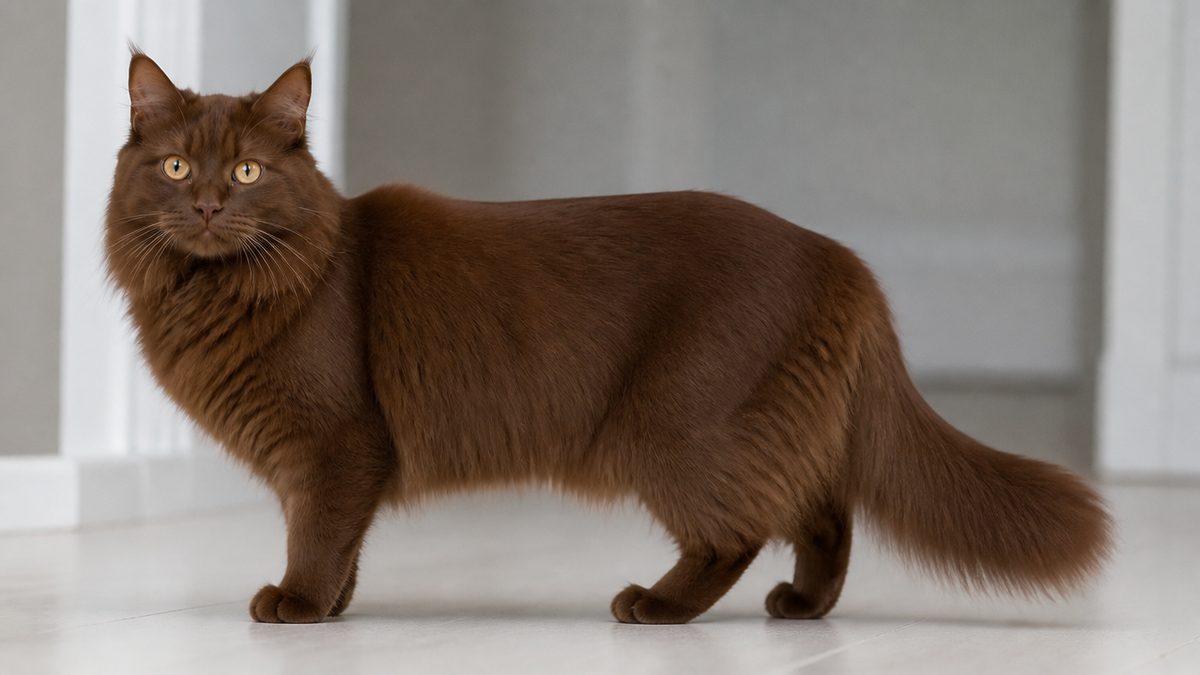
A Chantilly-Tiffany is a North American semi-longhair cat, medium in every dimension, bred in chocolate and a handful of other eumelanistic colours, with a plumed tail, a neck ruff and golden eyes. It is not a longhaired Burmese, it is not the British Tiffanie, and as of the last published account there are no intact cats and no breeders left anywhere in the world.
The breed standard describes a semi-foreign cat, neither cobby like a Persian nor svelte like an Oriental. Females weigh 6 to 8 pounds and males 8 to 10 pounds, which is 2.7 to 3.6 kg and 3.6 to 4.5 kg. Hill's Pet Nutrition describes the same animal as moderate looking with no extremes, with a head that is a broad modified wedge with high cheekbones and a coat that should be soft and silky.
Colour is where this cat is unusual, and it is also the single most useful identification test. Only eumelanin-based colours were ever admitted. Chocolate is the original and best known, with cinnamon, blue, lilac and fawn arriving later through outcrossing, in solid, mackerel tabby and spotted patterns. White markings, silver, and any pointed pattern were all excluded.
The colour that rules a cat out
Black is disqualifying evidence, not a variation. Black is dominant to chocolate and cinnamon and was never present in the breed at all, so a fluffy black cat cannot be a Chantilly whatever its shape. Pointed cats identified as Chantillies are likewise wrong, and are usually closer to the mink-variant Balinese type. A great many Indian and international listings for black semi-longhaired cats carry this name, and every one of them is misidentified.
Three different cats currently answer to a version of this name, and the registries do not agree on which is which. TICA's own Registration Rules list Chantilly and Tiffany as two separate entries in the same category. The World Cat Federation's cross-registry table carries a row reading Burmese Longhair (Tiffany), code TIF, recognised by the New Zealand and South African registries, and a separate Asian Longhair row, code ALH. And the British Tiffanie is a fourth thing again, a semi-longhaired member of the Asian group descended from the Burmese and the Chinchilla Persian. This page is about the North American cat only.
Temperament, in the accounts that survive, is the reason people wanted the breed. It is described as loyal, closely bonded and not overly demanding, with a soft-voiced conversation that the standard itself singles out as distinctive. Hill's records the same, affectionate with a sweet temperament and strongly oriented to people.
Which registries hold the Chantilly-Tiffany, one by one
One registry of six still carries this cat on its books, and it carries it twice under two names in its lowest class. TICA lists both Chantilly and Tiffany in Category VI, the Experimental or Developing class that its own rules head as those breeds advanced to Registration Only. The CFA, the GCCF, FIFe, LOOF and the WCF hold nothing under either name.
Registry recognition is worth reading carefully here, because a Registration Only listing is not a championship breed and does not imply an active population. TICA's rule 37.7.2 states plainly that no requirements for championship have been defined for Category VI, and rule 37.7.1 permits outcrosses to cats of unknown or unregistered parentage with no limitations or restrictions on the breeding programme. That is the loosest class the association operates.
Read the registry's public breed index and its rulebook as two different instruments, because they disagree. TICA's own Find a Breed navigation runs from Abyssinian to Turkish Van and carries no Chantilly, no Tiffany and no Tiffanie entry at all, while listing Burmilla and Burmilla Longhair, four Minuet divisions and two Highlander divisions. A buyer who checks only the shop window sees an absence; the rulebook shows a Registration Only entry behind it. Both readings are true, and only together do they tell you what a pedigree for this cat would actually be worth.
| Registry | Position | Document and date |
|---|---|---|
| TICA | Category VI, Experimental (Developing), Registration Only. Listed twice, as Chantilly and as Tiffany | Registration Rules Version B, 22 November 2024, Standing Rule 307.7 |
| TICA standards | No standard. Chantilly and Tiffan both return zero occurrences | Standards of all TICA breeds, 59 pages, May 2025 capture |
| CFA | No breed council, and not in the Miscellaneous or Provisional block, which holds only the Khao Manee | Declared Candidates for Breed Council Secretary, modified 31 July 2026 |
| GCCF | Absent from the recognised list, from all three graded unrecognised lists, and from the other recognised breeds known of paragraph | Unrecognised Breeds, modified 23 September 2025; Standard of Points June 2026, Chantilly returns zero |
| FIFe | Absent from the 52-breed EMS list | Breeds index parsed on the EMS code, read 9 September 2026 |
| LOOF | No breed group and no pedigrees issued | Nombre de chats, pedigrees issued in 2025 |
| WCF | Absent from the 198-row EMS map. A separate row reads Burmese Longhair (Tiffany), TIF, at NZCF and SACC | WCF EMS code table, full table pulled 9 September 2026 |
Why the GCCF absence is the loudest one
The GCCF publishes a considered verdict on breeds it does not recognise, which makes its silence unusual. Its Unrecognised Breeds page grades roughly thirty breeds green, amber or red, names the body that does recognise each, and adds a closing paragraph listing seven further breeds it knows of, among them the Brazilian Shorthair The Governing Council of the Cat Fancy. The Chantilly appears in none of those lists. A body that took the trouble to grade the Keetso and the Marguerite has no position on this cat at all.
TICA's own history with the breed is the most instructive part of the record, because it moved three times. TICA recognised the Tiffany in the Burmese section in 1979, rescinded that recognition in 1992 after establishing that the cat was not related to the Burmese, and reinstated it as a new breed in February 1994. A registry class is a dated event rather than a permanent label, and this breed proves it better than most.
How the breed happened, and how it stopped
The Chantilly-Tiffany began twice, in New York in 1967 and again in Canada in 1973, from cats of unknown ancestry that happened to be semi-longhaired, chocolate and golden-eyed. It ended after 2015, when the last known stud was put to sleep and his daughter was later spayed because there was nothing left to breed her to.
Wave one, the New York cats
In 1967 Jennie Robinson of New York bought two golden-eyed semi-foreign longhaired chocolate cats from a pet shop in White Plains, part of an estate sale. Thomas was 12 to 18 months old and Shirley about 6 months. In May 1969 they produced six semi-longhaired chocolate kittens with pinkish paw pads, which is exactly what a Burmese litter would not look like. The American Cat Association registered the family as Sable Foreign-Longhairs, and roughly 60 kittens followed over seven years.
The Burmese confusion started next. A Florida Burmese breeder, Sigyn Lund, bought the remaining cats and named them Tiffany. Because their origin had not been publicised, buyers assumed they came from her Burmese, and for a while they were advertised as Longhaired Burmese. They were not. Burmese kittens are born with lighter coats and dark paw pads, and Chantilly kittens are born dark with pink paw pads, and no Burmese blood was ever admitted to the American breed.
Wave two, and the 1992 rename
A second unrelated founder appeared in Canada in 1973, when a pregnant longhaired semi-foreign chocolate gold-eyed cat of unknown ancestry turned up at a farm and produced kittens that copied her exactly. Canadian breeders used her descendants to rebuild the breed, outcrossing to Havana Browns, Nebelungs, Somalis and European-type Angoras, which is where cinnamon, blue, lilac and fawn entered.
The name changed in 1992 for a reason worth stating plainly. Canadian breeders had to rename their cats because Britain already had a breed called the Tiffanie, and the name Foreign Longhair by then belonged to semi-longhaired Oriental cats. Chantilly/Tiffany was the compromise, keeping the original name inside the new one. Every subsequent confusion between the two cats descends from that collision.
Wave three, and the fire
The last American programme was Amorino Cattery in Carterville, Illinois, founded in 2001. Its stud Hershey Nugget sired the whole first generation. A lilac female, Lilas Nuage, died giving birth to her last litter, and both kittens died with her. A blue female, Cadeautje, was born with a heart murmur and died of a heart attack after several litters. In 2012 fire destroyed the cattery and its archives; Nugget was rescued but had lung damage severe enough that he was put to sleep. In 2014 his son died of insulin-dependent diabetes.
Whether to call the breed extinct is a fair question and the answer depends on what you mean. No wild or feral population ever existed, so extinct in the biological sense does not apply. As a closed breeding population it is extinct in every practical sense, because a breed with no intact animals cannot produce another generation. Wikipedia's article settles on the past tense and this page follows it, while noting that TICA has not removed the names from its books.
Two further catteries, one in Norway and one in Nova Scotia, held too few cats to continue. The last known male, Frosty, was put to sleep with cancer in 2015. His daughter, a registered lilac Chantilly out of a Nebelung mother, was spayed because there were no cats to breed her to. As of the last published account there are no intact Chantilly cats anywhere and no Chantilly breeders, and the idea that Chantilly cats or Chantilly mixes are sitting in shelters is described by the same source as fallacious. Wikipedia's article is written in the past tense throughout for the same reason.
Chantilly-Tiffany cat price in India, and why there is not one
No Chantilly-Tiffany cat price in India exists, and no Indian seller could supply the cat even if one did. India's most-read cat pricing guide does not name the breed anywhere in 206,421 characters, while naming the Persian 22 times, the Siamese 9 times and the Munchkin 7 times on the same page. That is a controlled absence rather than a gap in our searching.
The reason is not Indian at all. The breed has no intact cats and no breeders anywhere in the world, so there is no supply chain to reach India in the first place. Import would in any case run through the Directorate General of Foreign Trade's restricted route, where live cats sit under ITC(HS) code 01061900 and anything outside the personal pet baggage route goes to the Exim Facilitation Committee.
| Figure | Where it comes from | What it is worth in India |
|---|---|---|
| 300 to 800 US dollars | Cats.com, restated by Google India's generated answer on 9 September 2026 Google India result pages for the queries… | A historic North American asking price for a breed with no living breeding stock. Converting it into rupees would invent an Indian price that has never been paid |
| 500 to 1,200 pounds | Quoted for the British Tiffanie, a different cat | Belongs on the Tiffanie page, not this one |
| Rs 30,000 to Rs 60,000 | Supertails' 2026 table, for the Munchkin | The nearest thing to a comparison an Indian buyer has, and it is a different breed entirely |
| Rs 0 to Rs 2,000 | Supertails' 2026 table, for the Indian Domestic or Desi cat | The realistic price of the semi-longhaired cat an Indian buyer will actually be offered under this name |
Ask for the colour and the paw pads before you ask the price. A black cat is not a Chantilly, because black was never in the breed and is dominant to the chocolate that defined it. A pointed or masked cat is not a Chantilly either. If the seller cannot name a registry, a pedigree number and a living breeder, you are being offered a domestic longhair with a rare-breed markup on it. That is the honest description, and a domestic longhair is a perfectly good cat at Rs 0 to Rs 2,000.
The same misuse has a documented history overseas, which is worth knowing before you pay a premium. A Canadian operation trading as King of Siam sold blue-eyed masked cats bred from Balinese lines under the Chantilly name from three locations, until the last American breeder investigated the registries and issued a public buyer-beware notice in 2013. Chantillies are never masked and never blue-eyed.
What a semi-longhaired cat actually costs to keep in India
Budget roughly Rs 3,000 to Rs 8,000 a month for a medium semi-longhaired cat in an Indian metro, and treat the first year as the expensive one. The monthly cost figures below are real and sourced for a cat of this size and coat, and they apply whatever the animal in front of you turns out to be.
Vaccination is the one cost with a published rate card. Vetic, a chain with clinics across eleven Indian cities, prices a kitten course of three visits at days 60, 90 and 120 from Rs 3,999 against a struck-through list price of Rs 5,065, an adult annual booster from Rs 1,899, anti-rabies alone at Rs 699 and a feline CRP at Rs 1,249. Record which city page a Vetic figure came from, because the chain quotes different course prices on different city pages on the same day.
- Licence, Rs 50 in Chennai. The Greater Chennai Corporation's page calls it a Pet Animal Licence for keeping pet animals, although the section heading above it reads Licensing of Pet Dogs, and it issued 9,115 in 2024, so ask the Corporation whether your cat needs one.
- Free municipal veterinary care in Chennai. The Corporation's pet clinics in Tamil Nadu provide all treatment and anti-rabies vaccination free of cost, which is a better fact for an Indian owner than any private rate card.
- Check your own municipality before assuming a fee. The rupee amounts differ by city, and the statutory cat instrument is the central Pet Shop Rules, 2018, read here from the Karnataka animal husbandry department's copy, rather than the dog rules most Indian pages quote.
- Microchipping, Rs 1,250. A Chennai clinic's own transacted price. The wider Rs 1,500 to Rs 2,500 range on the same site is a converted US figure and is not used here.
- No statutory microchip duty for a kitten. Rule 7(16) of the Pet Shop Rules, 2018 makes microchipping mandatory for puppies only, so kittens fall outside it.
Grooming is the cost that changes with the coat. A semi-longhair with a ruff and a plumed tail needs more brushing than a shorthair but far less than a Persian, and in most Indian homes an owner who brushes twice weekly will never pay for a professional groom at all. Where a monsoon mat does form, a clip is cheaper and kinder than a bath and blow-dry.
For a medium cat in Delhi, Mumbai, Bengaluru or Chennai, a first year that includes the kitten vaccination course at Rs 3,999, a rabies shot at Rs 699, a microchip at Rs 1,250 and a Chennai licence at Rs 50 comes to about Rs 6,000 before food and litter SKS Veterinary Hospital, Chennai Greater Chennai Corporation. Everything after that is food, litter, parasite control and one annual booster at Rs 1,899. Nothing about a semi-longhair coat changes those numbers much.
Heat tolerance and the Indian climate
A semi-longhaired cat with no woolly undercoat handles Indian heat far better than its coat length suggests, and the Chantilly's coat is described as full and silky rather than dense and double. Humidity is not the problem; heat combined with humidity is.
Coat structure decides heat tolerance, not coat length, and coat colour has nothing to do with it either. A cat carrying a heavy insulating underlayer traps warm air against the skin and cannot shed it; a single silky semi-long coat behaves much more like a shorthair. The breed's own standard emphasises a silky semi-long coat with a contrasting neck ruff and ear streamers rather than the dense double coat of a northern breed.
What actually goes wrong in an Indian summer
Three things, in order of how often they happen. Mats form where the coat is longest and the cat grooms least, which for a ruffed semi-longhair means the collar, the britches and the tail base. Skin infections follow a wet coat that never fully dries in monsoon humidity. And heat stress in a closed flat in May is a housing problem rather than a coat problem, because a cat with no shaded floor and no water cannot regulate whatever its fur is doing.
Indian law puts the obligation in writing for anyone selling a cat. Rule 6(5) of the Pet Shop Rules, 2018 places the temperature duty on the establishment breed by breed rather than setting one number for all animals, and rule 7(1) requires a species-suitable environment. A shop keeping a semi-longhaired cat in an unventilated Indian summer is in breach of its own licence conditions.
- Give the cat a cool floor, not a cool room. Tile or stone in the shade beats an air-conditioned bedroom the cat cannot enter when you are out.
- Brush before the monsoon, not during it. A coat combed out in April mats far less in July.
- Dry the ruff and britches completely after any bath. A damp ruff in Chennai or Mumbai humidity is where skin trouble starts.
- Watch water intake in April and May. Place the bowl at least three feet from the food, because cats drink less when they can smell food.
Temperament, household fit and who should not look for one
The Chantilly-Tiffany was described as loyal, closely bonded and quietly conversational, a cat that follows one person around rather than working a room. Nobody should be looking for one to buy, because there are none, so the practical question is which living cat gives you that temperament instead.
The standard singled out the voice. A soft-voiced conversation is written into the description as distinctive, which puts this cat at the opposite end of the range from the Siamese and Oriental group. Hill's records the same picture, affectionate with a sweet temperament and very oriented toward people.
Household fit followed from that. A cat that attaches hard to its people does badly with long empty days and does well in a home where somebody is usually there. Indian apartment life suits that pattern, provided the cat gets company rather than only space.
Anyone who wants a documented pedigree should stop here. There is no registry that will issue one for a living cat of this breed, because TICA's Category VI is a Registration Only class with no championship requirements defined and no active population behind it. Anyone who wants the look and the temperament has better options that exist, and the comparison section below names them.
Training a semi-longhair to accept the comb
Train the grooming, not the tricks. For a ruffed semi-longhaired cat in an Indian climate, the single training job that matters is teaching the animal to accept a steel comb through the ruff, the britches and the tail base without a fight, and the window for that is the first sixteen weeks.
- Start with the cat fed and sleepy. A kitten that associates the comb with a full stomach stops treating it as an ambush.
- Comb one region per session for the first fortnight. Shoulders on Monday, flank on Tuesday, tail base on Wednesday, and never chase a knot on day one.
- Finish before the cat asks you to. Ten good seconds repeated daily beats two minutes that end badly.
- Handle the paws every session. A cat that lets you hold a foot is a cat whose claws you can clip at home for nothing.
- Reward with food, not with release. Releasing a struggling cat teaches it that struggling works.
Litter training rarely needs work in a cat of this size and build. What does need thought is tray placement in an Indian flat, because a tray beside a kitchen or a bathroom drain will be avoided in the monsoon when the smell rises. Two trays in different rooms solve most of what looks like a behaviour problem.
Leash and carrier work is worth the effort for a different reason. A cat that will walk into a carrier calmly is a cat you can take to a vet in a Chennai afternoon without adding heat stress to whatever is already wrong.
How much exercise this cat actually needs
Budget 20 to 40 minutes of interactive play a day, split into two or three short sessions. A medium semi-foreign cat of 2.7 to 4.5 kg is neither a couch potato nor an athlete, and the breed's own accounts describe a companion rather than a working animal.
Play in the cool hours. In a Delhi May or a Chennai April the sensible windows are early morning and after dark, and a cat pushed to chase a wand at two in the afternoon in an unairconditioned flat is being asked to overheat. The same applies in Hyderabad, Pune, Kolkata and Ahmedabad, where the afternoon peak arrives at a different month but does the same thing to a cat.
- Wand toys along the floor, then up. Horizontal running first, then two or three vertical jumps, then stop.
- One climbing route per room. A shelf, a chair back and a window ledge give more exercise than any single cat tree.
- Food puzzles for the middle of the day. They work when you are at the office and the cat is not.
- Ten minutes before your own bedtime. A cat played out at 10 pm does not wake the household at 4 am.
Weight is the reason this section is not optional. A cat of this build carrying an extra 500 g is carrying between 11 and 19 percent of its body weight, and in Indian flats where cats are fed free-choice dry food all day that is easy to reach without anyone noticing.
Grooming a semi-longhair coat in Indian humidity
Comb twice a week with a steel comb, and comb the ruff, the britches and the tail base every time. Those three regions are where a semi-longhaired cat cannot reach itself, and they are where every mat in an Indian monsoon starts.
The coat is full and silky with a contrasting neck ruff and ear streamers, and the tail is plumed. That is a lot of hair in three places and very little on the shoulders, which is why a whole-body brush that ignores the ruff misses the problem entirely.
The monsoon routine
Between June and September, add a dry-off step and drop the bath. Overseas breed-club grooming advice routinely tells owners to towel a cat and let it air dry, which is written for a temperate climate and does not transfer to Mumbai or Kochi. A ruff that stays damp for hours in 90 percent humidity is a skin infection waiting to happen. Towel, then comb, then let the cat finish somewhere with moving air.
- A steel comb with close and wide teeth, not a slicker brush, because a slicker rides over the top of a forming mat.
- Clip a mat out rather than bathing it out. A blunt-nosed scissor and a comb held between the mat and the skin is safer than any detangling spray.
- Check behind the ears and between the front legs weekly. These two spots are missed more often than any other.
- Nails every two to three weeks. A cat with long nails hooks its own coat and creates the mats you are trying to prevent.
Professional grooming in India runs from about Rs 934 for a bath at a chain clinic in Delhi, but for a cat of this coat type the honest answer is that regular home combing removes the need for it almost entirely.
Health, life expectancy and what nobody has measured
No published health data exists for the Chantilly-Tiffany. PubMed returns zero records for Chantilly[tiab] AND cat[tiab] with a clean query translation, in a session where the control Persian[tiab] AND cat[tiab] returned 322. The breed is also not among the 12 breeds that reached the death threshold in the largest UK feline life-table study.
That absence is real rather than an artefact, and it is worth saying what it does and does not mean. It does not mean the cat was healthy. It means nobody with a veterinary dataset ever had enough of these cats to report on, which for a breed whose whole recorded population runs to a few hundred animals across fifty years is exactly what you would expect.
What the life-expectancy study can and cannot tell you
Teng and colleagues built UK life tables from 7,936 confirmed deaths in cats under primary veterinary care in 2019. Their Table 6 reports 12 breed rows and no more, because the methods grouped breeds with fewer than 15 deaths into a category called other. The 12 death counts sum to 7,825, leaving 111 deaths in that grouped remainder, which is the arithmetic check that the table is complete as printed. The Chantilly-Tiffany is not among the 12 breeds that reached the threshold. It is not absent from the study, and it is not proved rare by the study either; it is simply inside the 111.
| Group | Life expectancy at age 0, years | Observed lifespan range, years | Deaths |
|---|---|---|---|
| All crossbred cats | 11.89 (11.75 to 12.03) | 0.00 to 26.69 | 7,117 |
| Birman | 14.39 (12.87 to 15.91) | 0.94 to 22.25 | 38 |
| Persian | 10.93 (9.63 to 12.23) | 0.01 to 21.68 | 80 |
| Maine Coon | 9.71 (8.42 to 11.00) | 0.03 to 21.61 | 69 |
| Sphynx | 6.68 (4.53 to 8.83) | 0.13 to 14.67 | 18 |
The four deaths the breed record does document
The last cattery's own account names causes rather than rates, and a reader deserves both halves. A lilac female died giving birth to her final litter and both kittens died with her. A blue female was born with a heart murmur and died of a heart attack after several litters. A male died of insulin-dependent diabetes in 2014, and the breed's last stud was put to sleep with severe lung damage after the 2012 cattery fire. Four animals is an anecdote, not a prevalence, and it would be dishonest to present it as a breed risk. It is also the entire clinical record that exists.
Nothing on this page is a diagnosis or a treatment plan. If a semi-longhaired cat in your home stops grooming its lower back, starts eliminating beside the tray rather than in it, or becomes reluctant to jump onto a surface it used to reach, book an appointment this week rather than watching it. Those three signs are the quiet ones that owners routinely reinterpret as a cat calming down, and a 2025 review puts osteoarthritis at well over a quarter of the feline population with detection rates that remain low. Consult your nearby vet, a registered veterinarian who can examine your own animal.
Feeding a medium semi-longhair in India
Feed a complete commercial diet appropriate to the life stage, split into measured meals rather than a permanently full bowl, and adjust to body condition rather than to the label. A 2.7 to 4.5 kg cat has very little margin for error on portion size.
- Kitten to twelve months, three to four small meals a day. Growth demand is highest in the first six months.
- Adult, two measured meals. Weigh the food once with a kitchen scale so you know what your scoop actually holds.
- Wet food every day if you can afford it. In Indian summers the water in wet food matters as much as the protein.
- Treats under ten percent of daily calories. On a cat this size that is a very small number of treats.
- Fresh water at least three feet from the food bowl. Cats drink less when they can smell food nearby.
Body condition beats any published feeding chart. You should feel the ribs easily under a thin fat cover and see a waist from above. For a cat that is going to carry a full ruff, checking by hand matters more than usual, because coat hides a rising weight for months.
One caution applies to any semi-longhaired cat sold under this name, whatever its real ancestry. A repeated urinary sign deserves a veterinary examination rather than a course of antibiotics and a shrug, and a cat that strains to urinate or passes blood needs to be seen the same day.
Kitten timeline, month by month through the first year
The first year of a semi-longhaired cat in India has four decision points, and three of them are fixed by law or by the vaccination calendar rather than by the breed. Work to the calendar below whatever the animal turns out to be.
- Weeks 0 to 8, do not take the kitten. The Pet Shop Rules, 2018 treat kittens below eight weeks as un-weaned and rule 7(15) bars their sale outright.
- Week 8 to 9, home and settle. One room, one tray, one hiding place, and no visitors for the first three days.
- Day 60, first vaccination. Vetic's kitten course runs three visits at days 60, 90 and 120 from Rs 3,999.
- Weeks 9 to 16, the comb window. Everything you teach about handling in this month you will not have to fight about for the next fifteen years.
- Day 90 and day 120, visits two and three. Add anti-rabies at Rs 699 when your vet advises it.
- Month 4 to 5, microchip and licence. Rs 1,250 at a Chennai clinic, Rs 50 for the Corporation licence.
- Month 5 to 7, neuter. Sex and neuter status are better evidenced influences on allergen output than breed ever was.
- Month 8 to 12, coat change. A semi-longhair's adult ruff and britches arrive late, and this is when a twice-weekly comb becomes non-negotiable.
- Month 12, first annual booster. From Rs 1,899.
One extra job belongs to anyone who was sold this cat under a breed name. Ask for the pedigree and the issuing registry in writing during the first week, while a refund is still a live conversation. There is no registry issuing pedigrees for living cats of this breed, so a document produced in response to that request tells you something useful either way.
Chantilly-Tiffany versus the cats you can actually buy
Four living breeds deliver parts of what the Chantilly offered, and none delivers all of it. The comparison below is the practical output of this page, because the breed itself cannot be bought.
| Breed | What it shares | What differs | Registry position |
|---|---|---|---|
| Tiffanie | Semi-longhair coat, Burmese-group temperament, the same first syllable | A completely separate British breed from the Asian group, descended from the Burmese and the Chinchilla Persian, and it exists | GCCF-recognised as the Asian Longhair, with 20 registered in 2025 against 30 in 2024 |
| Somali | Plumed tail, neck ruff, ticked warm colour, one of the Chantilly's own outcross breeds | Ticked agouti rather than solid chocolate, and a far busier cat | Held by every major registry, code SOM |
| Nebelung | Coat length and texture, ear set, another declared Chantilly outcross | Blue only, green eyes, reserved rather than clingy | WCF, TICA, GCCF and LOOF |
| Havana Brown | The deep chocolate colour, and the third declared outcross | Shorthaired, and a different head entirely | WCF, TICA, GCCF as the Suffolk, LOOF as HAV |
| Burmilla | Silver-shaded coat, Asian-group build, the parent of the Tiffanie | Shorthaired, and silver rather than chocolate | Recognised by all bodies on the WCF map, code BMS |
If you wanted the chocolate colour, buy a Havana Brown and accept a short coat. If you wanted the plumed semi-longhair look, buy a Somali. If you wanted the temperament and the semi-long coat together and you are in a country that has them, the Tiffanie is the closest living animal, and it is a different breed with a confusingly similar name rather than a substitute.
Mistakes Indian buyers make with this name
Five mistakes account for almost every bad outcome attached to this breed name in India, and four of them are identification errors rather than care errors.
- Buying a black semi-longhair as a Chantilly. Black was never in the breed and is dominant to the chocolate that defined it.
- Treating the Tiffanie and the Chantilly-Tiffany as one cat. They are two breeds from two continents, and the 1992 rename happened precisely because of that clash.
- Reading a TICA listing as recognition. Category VI is the Registration Only class, with no championship requirements defined at all.
- Converting a dollar price into rupees. The 300 to 800 dollar band is a historic North American figure for a breed with no living breeding stock.
- Believing the hypoallergenic claim. There is no scientific evidence for a hypoallergenic cat breed.
The questions Indian searchers actually type confirm the pattern. Of the three People Also Ask questions Google India returned for this breed on 9 September 2026, one asks whether the cats still exist, one asks how to tell whether a given cat is one, and one asks whether they are hypoallergenic. Two of the three are identification problems and the third is a marketing claim, which is a fair summary of what goes wrong with this name.
A sixth mistake belongs to anyone doing their own research rather than buying. Do not treat Google's generated answers as a source on this breed. Asked about the Tiffanie, Google India's answer on 9 September 2026 returned an account of the North American Chantilly-Tiffany instead, complete with the 2015 extinction date, on a result page whose organic listings were all about the British cat. The engine is conflating exactly the two cats this page separates.
Adoption, and the honest sourcing answer
Adopt a domestic longhair. That is not a consolation prize on this page; it is the only route that exists, because there are no intact Chantilly cats and no Chantilly breeders anywhere, and the published account is explicit that the idea of Chantilly cats or Chantilly mixes sitting in shelters is fallacious.
Indian shelters and street rescues carry semi-longhaired cats in every coat colour, and a chocolate or brown semi-longhair with a ruff and a plumed tail is not rare among them. What such a cat will not have is a pedigree, and on this breed nobody has one. Adoption is therefore not the fallback on this page, it is the whole answer.
- Ask any seller to name the registry and produce the number, then verify it. No body issues pedigrees for living cats of this breed, so a document that appears in response is worth checking against the issuing register rather than filing.
- Compare what you are being shown against a domestic longhair, honestly. An imported pedigree cat is not what is on offer here, and the comparison a buyer needs is with the free semi-longhaired cats already in Indian shelters.
- Check the age before anything else. Sale below eight weeks is prohibited outright.
- Use the municipal route where it exists. Chennai licenses pet animals at Rs 50 and treats and vaccinates them free at its own clinics.
- Do not import. Live cats are a Restricted import under ITC(HS) 01061900, and there is no lawful supply of this breed to import from.
Bonbeno does not broker cats and does not recommend breeders. The useful thing this page can do is tell you what the name means, what it does not mean, and which living cat gives you what you came looking for.
Chantilly-Tiffany questions Indian buyers actually ask
Do Chantilly Tiffany cats still exist?
No living Chantilly-Tiffany breeding cats are known. The last stud was put to sleep with cancer in 2015 and his daughter, a registered lilac female out of a Nebelung mother, was spayed because there was nothing to breed her to, leaving no intact cats and no breeders anywhere. TICA still carries the names Chantilly and Tiffany on its Registration Only list, which is a book entry rather than a living population.
How do I tell if my cat is a Chantilly Tiffany?
Start with colour, because it rules cats out fastest. A black cat is not a Chantilly, since black is dominant to the chocolate that defined the breed and was never present in it. A pointed, masked or blue-eyed cat is not one either. Only eumelanistic colours were admitted, chocolate first, then cinnamon, blue, lilac and fawn, with golden to amber eyes, a neck ruff and a plumed tail. Without a pedigree from an active breeder, and none exist, the honest description is domestic longhair.
Are Chantilly Tiffany cats hypoallergenic?
No, and no cat breed is. A 2024 review in Allergologie Select states in its full text that to date there is no scientific evidence for a hypoallergenic cat breed, and that even hairless Sphynx cats produce Fel d 1. Its conclusion adds that molecular analyses of dander across breeds show high individual variation but provide no evidence for the concept at all. Sex and neuter status are better evidenced than breed, since unneutered males average more Fel d 1 than females.
What is the difference between a Chantilly-Tiffany and a Tiffanie?
They are two unrelated breeds from two continents. The Chantilly-Tiffany is North American, began in New York in 1967 from cats of unknown ancestry, and was never bred to the Burmese. The Tiffanie is British, appeared in the mid-1980s as a side effect of the Burmilla programme crossing Burmese with Chinchilla Persian, and is now registered as the Asian Longhair. Canadian breeders renamed their cats Chantilly/Tiffany in 1992 specifically to end the clash with the British name.
Is the Chantilly-Tiffany a longhaired Burmese?
No. The breed has never been bred to the Burmese and carries no Burmese blood, and the confusion arose only because an early breeder also bred Burmese cats and the chocolate colour looked similar. The physical test is the newborn litter: Burmese kittens are born with lighter coats and dark paw pads, while Chantilly kittens are born dark with pink paw pads.
Which registries recognise the Chantilly-Tiffany?
One of six checked. TICA lists both Chantilly and Tiffany in Category VI, its Experimental or Developing class headed as those breeds advanced to Registration Only, where no championship requirements have been defined. The CFA has no breed council for it, the GCCF does not list it even among breeds it declines to recognise, FIFe's 52-breed EMS list omits it, LOOF issued no pedigrees for it in 2025 and the WCF's 198-row EMS map has no row for it.
What is a Chantilly-Tiffany cat price in India?
There is no Indian price, because there is no Indian supply and no global supply either. India's most-read cat pricing guide runs to 206,421 characters and never names the breed, while naming the Persian 22 times and the Munchkin 7 times on the same page. Any rupee figure you are quoted for this name is either a converted foreign figure or a domestic longhair with a rare-breed markup.
How long do Chantilly-Tiffany cats live?
No measured life expectancy exists for this breed. It is not among the 12 breeds that reached the 15-death threshold in the largest UK feline life-table study, so it sits inside the grouped other category that accounts for 111 of that study's 7,936 confirmed deaths. For reference from the same table, crossbred cats reached 11.89 years at age 0 and Persians 10.93 years.
Can I import a Chantilly-Tiffany cat into India?
No, for two separate reasons. Live cats are a Restricted import in India under ITC(HS) code 01061900, with anything outside the personal pet baggage route referred to the Exim Facilitation Committee. More decisively, there is no lawful source to import from, because no breeder anywhere holds intact cats of this breed.
Is a Chantilly-Tiffany good for an Indian apartment?
The type would have suited one well. It was a medium semi-foreign cat of 2.7 to 4.5 kg with a silky semi-long coat rather than a dense double coat, described as quietly conversational and closely bonded to its people, which is a good match for a flat where somebody is usually home. Since the breed no longer exists, the living cats that fit that description best are the Tiffanie, the Somali and the Nebelung.
Why was the Chantilly renamed from Tiffany?
Two names were already taken. Britain had recognised the Tiffanie in 1986 out of the Burmilla programme, and the name Foreign Longhair had by then passed to semi-longhaired Oriental cats. Canadian breeders rebuilding the North American breed in 1992 therefore adopted Chantilly/Tiffany, keeping the original name inside the new one.
Do black long-haired cats count as Chantilly-Tiffany?
No. Black is dominant to chocolate and cinnamon and was never present in the breed at all, so a fluffy black cat cannot be a Chantilly whatever its shape or temperament. This is the single most common misidentification attached to the name, and it is also the easiest one to settle without a pedigree.
Compare with similar breeds
Chantilly-Tiffany sits in 1 Bonbeno group. Each one compares it directly against the breeds it is genuinely an alternative to, on the same figures.