
Breed profile
Nebelung Cat in India: No Market, One Studbook, and Real Costs
A rare blue longhair with no Indian market, no FIFe code and no CFA breed council. What the numbers actually show, and what a grey longhaired cat in India usually is.
Quick answer
No Nebelung cat price in India exists, because no Indian seller lists the breed. Every page ranking for the Indian query quotes US dollars, and the only rupee figures on that results page belong to a paperback about the breed. France's national studbook, the best rarity instrument available, registered 23 Nebelung pedigrees in 2024 against 24,160 Maine Coons.
This page reports what the registries, the French studbook and the veterinary literature say about the Nebelung, and it says plainly where they say nothing. The breed has no life table and no disease study of its own, so nothing here is reassurance about an individual cat. It is general information, not a diagnosis. Consult your nearby vet in person before acting on anything here, and treat sudden changes in breathing, urination or appetite as urgent.
Nebelung at a glance
What the Nebelung actually is
The Nebelung is a semi-longhair blue cat of foreign type, built to look like the longhaired blue cats imported to Britain from Russia in the nineteenth century, and created in the United States in the 1980s from two ordinary domestic kittens. It is not an ancient Russian breed, and it is not a fluffy Russian Blue that turned up by accident.
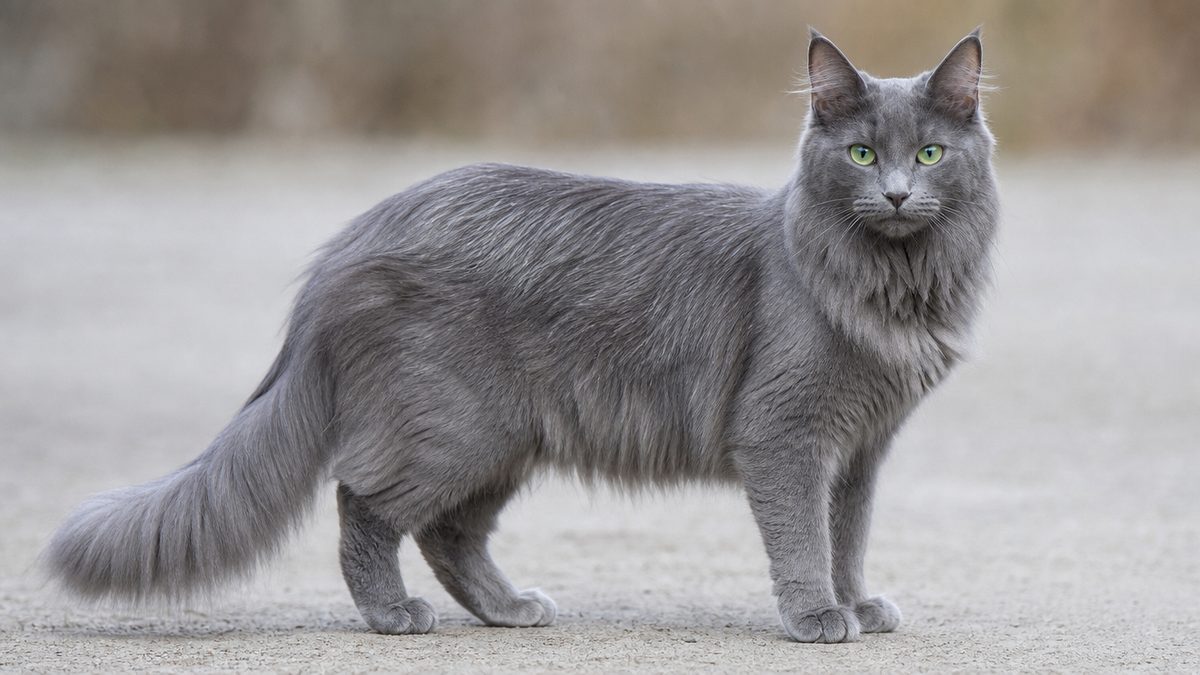
Take the body first, because it is what separates this cat from every other blue longhair. The GCCF standard asks for a long, elegant body of foreign type, medium to large, firm, lithe and muscular but not coarse, on long slender legs with neat rounded paws and generous tufting between the toes. That is the opposite of the cobby, short-legged British Longhair. TICA describes the same animal as long, sturdy and well muscled, with ears large in proportion to the head.
The head, and the two things that must not be there
The GCCF describes a modified wedge with width at eye level, a flat plane between the ears, high broad cheekbones, and a profile in which the forehead runs straight to the upper edge of the eye and then falls in a curve so shallow it looks virtually straight. The standard is unusually explicit about faults: "There must be no stop, break or nose bump, nor should the nose be completely straight from the point of the angle to the nose tip";. So both a Persian-style break and a perfectly ruler-straight profile are wrong.
The eyes are the second identifier. They are rather large, almond shaped, set wide apart, and the eye colour in adults should be green, as vivid as possible, with yellow acceptable only in kittens. Green eyes on an adult are therefore not a bonus feature, they are the standard, and an adult blue longhair with gold eyes is not a Nebelung whatever a listing says.
Size, from the register rather than from a seller
The GCCF gives an overall weight range of 4.5 to 6 kg for an adult male and 3.5 to 5 kg for an adult female. TICA calls it simply a medium-sized cat and leaves its adult female and adult male weight fields empty on the breed page. Where a registry declines to publish a number, this page does not fill it in.
| Feature | Nebelung | Russian Blue | British Longhair | Chartreux |
|---|---|---|---|---|
| Body type | Foreign, long and elegant | Foreign, long and elegant | Cobby, low on legs | Robust and semi-cobby |
| Coat | Semi-longhair, silky, silver-tipped | Short, dense, silver-tipped | Semi-longhair, dense and plush | Short and woolly |
| Adult eye colour | Green, as vivid as possible | Green | Copper, orange or deep gold | Copper to gold |
| Held by FIFe | No | Yes, code RUS | Yes, code BLH | Yes, code CHA |
| LOOF pedigrees in 2024 | 23 | 279 | 1,372 | 1,348 |
Eye colour separates the Nebelung from the British Longhair at a glance, and coat length separates it from the Russian Blue. A grey semi-longhaired cat with copper eyes is not a Nebelung. A grey cat with green eyes and a short coat is a Russian Blue. Neither identification needs a pedigree, a test or an expert.
Coat genetics, and why the Nebelung keeps reappearing
The Nebelung's coat genetics are the ordinary feline long-hair genetics, and that is precisely why the breed exists twice over. Long hair sits in FGF5 and is recessive, so two shorthaired blue parents carrying one copy each can produce a blue semi-longhair kitten with no outside ancestry at all.
Two independent 2007 papers mapped it. Kehler and colleagues sequenced FGF5 in 26 registered breeds and found four separate mutations that disrupt the FGF5 protein, with paired mutant alleles segregating with the long coat as an autosomal recessive. Drögemüller and colleagues independently reported a missense mutation at c.194C>A homozygous in long-haired cats and confirmed perfect co-segregation with hair length in two pedigrees.
The Nebelung was never genotyped in either paper
Kehler's sample covered 12 short-haired breeds and 12 long-haired breeds. The Russian Blue is in it, at n=3, carrying no mutant FGF5 allele and phenotypically short. The Nebelung is not in the study at all, and nor is it in Drögemüller's list of breeds carrying c.194C>A. So the Nebelung's own long-hair allele has never been published, and this page does not name one.
What the history says instead is consistent with plain recessive inheritance appearing twice on two continents. TICA's own account is that Siegfried, born in 1984, was the single blue longhair kitten in a litter from a black domestic shorthair called Elsa, and that Brunhilde followed five months later in a second litter. Wikipedia adds that in the early 1990s longhaired kittens began appearing in Russia from Russian Blue parents, confirming the recessive long-hair gene was already present in that population.
TICA says Siegfried's father was "a longhair resembling a black Angora". Wikipedia says the foundation kittens were born to a black domestic shorthair, Elsa, and "a blue domestic longhair male". Black and blue are different colours, and in a breed whose whole point is the blue coat the difference is not trivial. Both accounts are published, neither cites a pedigree document, and this page prints both rather than choosing.
How the outcross rule works
Breeders designated the Russian Blue as the permitted outcross for the new breed, which kept the gene pool open and let foundation cats keep entering. When the Russian cat fancy expanded in the late 1980s and a redevelopment of the Russian Blue brought in foundation cats, some of those carried the long-hair gene, and they became a new source of Nebelung bloodlines. Wikipedia records that the Russian Blue remains a permitted outcross in most registries.
- Long hair is recessive, so two Nebelungs cannot produce a shorthaired kitten.
- A Russian Blue can carry the long-hair allele invisibly, which is how the breed arose in two places independently.
- No published study has genotyped FGF5 in the Nebelung, so no test result is quoted here.
- Coat colour genetics are separate: the blue is dilute black, and the silver tipping sits on top of it.
Registry recognition, and the two registries that do not hold it
Registry recognition of the Nebelung is genuinely partial, and an Indian buyer offered pedigree papers should know which bodies can issue them. TICA, the GCCF, WCF and LOOF hold the breed. FIFe and the CFA do not.
TICA is the breed's home register. Cora Cobb of Nebelheim applied for New Breed status in 1987, advised by the TICA geneticist Dr Solveig Pflueger, and TICA recognised the Nebelung for championship competition in 1997. It is one of the 73 breeds TICA currently recognises.
The GCCF writes a full Standard of Points entry for the Nebelung (NEB) at page 64 of its June 2026 edition, showing in Section 2 Group B alongside the Norwegian Forest Cat, the Somali and the Turkish Van. Its public breeds index lists the Nebelung with a weekly grooming rating.
FIFe and CFA both stop at the Russian Blue
FIFe's breed index holds RUS Russian Blue as a fully recognised category 4 breed and carries no Nebelung entry anywhere, including in the preliminary list, which contains only the Bombay and the Lykoi. A second FIFe document confirms it from the other direction: the registry's Breeding Statistics 2024 lists every breed it registered that year, 54 of them across 96,075 kittens, and there is no Nebelung line. The Russian Blue sits at rank 10 with 2,370 registrations. An index absence and a registration-table absence in the same registry, in two documents written for different purposes, is about as clean as a negative gets. The CFA's own enumeration of every breed council, plus its Miscellaneous and Provisional committee chairs, lists a Russian Blue breed council and no Nebelung. Those are two of the world's largest registries, and neither offers a route.
| Registry | Status | Evidence used |
|---|---|---|
| TICA | Championship since 1997, New Breed applied for in 1987 | TICA breed page and the 73-breed index |
| GCCF | Recognised, own Standard of Points entry at page 64 | GCCF Standard of Points, June 2026 |
| LOOF | Held under a combined RUSSIAN and NEBELUNG record, id 45 | LOOF breed index |
| WCF | Listed among the breed standards on the breed's encyclopedia entry | Wikipedia's standards list, not read at source |
| FIFe | Absent from both the recognised and the preliminary lists | FIFe breeds index |
| CFA | Absent. No breed council, no breed page, no Miscellaneous entry | CFA Breed Council Declared Candidates |
The row that needs a caveat is WCF. Wikipedia lists TICA, WCF, ACF, ACFA/CAA, GCCF and LOOF standards for the breed, and this page has not opened the WCF document itself, so that row reports what the encyclopedia says rather than what the registry says. Bonbeno marks the difference rather than passing one off as the other.
The rarity signal inside TICA's own page
TICA runs a breed committee for each of its breeds. At the foot of the Nebelung page, under the heading "Nebelung Breed Committee (0)", the page reads "No Committee";. For comparison, the same site's British Shorthair page lists a committee of seven named members. A championship breed with no committee at its own home registry is a stronger rarity signal than any adjective.
If someone in India offers a Nebelung with papers, ask which body issued them. TICA, the GCCF and LOOF can. FIFe and the CFA cannot, because neither holds the breed, so a paper claiming FIFe or CFA registration for a Nebelung is describing something that does not exist. That single question separates a real pedigree from a printed certificate.
Nebelung cat price in India, and why there is not one
No Nebelung cat price in India exists, and saying so is the most useful thing this page can do. We pulled the Indian results for the query on 8 September 2026 and read the pages. Not one of them is an Indian seller, and the only rupee figures on the whole results page belong to a book.
| Rank | Domain | What it is | Currency quoted |
|---|---|---|---|
| 1 | a-z-animals.com | US price article | US dollars |
| 2 | quora.com | US answer thread | US dollars |
| 3 | amazon.in | A paperback owner's manual about the breed | Rupees, for a book |
| 4 | cats.com | US breed profile | US dollars |
| 5 | facebook.com | A page offering cats, prices unstated | None |
| 6 | flipkart.com | The same paperback | Rupees, for a book |
| 7 | petful.com | US price article | US dollars |
| 8 | reddit.com | A thread asking whether a stray is a Nebelung | None |
| 9 | catster.com | US breed profile | US dollars |
| 10 | supertails.com | An Indian all-breeds cat price guide | Rupees, for other breeds |
That table is the finding. Two of the ten Indian-domain results sell a paperback with an ISBN, and they rank because the query contains the words "price" and "India" and the listing pages carry both. The merchandise trap is usually a print or a mug; here it is an owner's manual, and it is the only thing on the page with a rupee attached to it.
What the overseas pages actually quote
Petful gives a breeder kitten at 600 to 1,200 US dollars, adoption at 50 to 150, a first year near 1,500 to 2,800 and ongoing care of 80 to 160 US dollars a month. A-Z Animals, which ranks first in India for the Indian query, runs the same US framing across six headings on purchase cost, vet bills, food, supplies and insurance. Petful even carries a heading called "Regional and Country Price Variation", and the word India appears zero times underneath it.
It would take one line to turn 600 to 1,200 US dollars into a rupee band, and that line would be fabrication. A converted figure describes an American market, not an Indian one, and this site has repeatedly caught Indian pages and AI answers publishing exactly that conversion as though it were a local observation. Bonbeno publishes no rupee price for this breed, because none has been observed.
The Indian evidence for the absence, rather than an empty search
An absence has to be earned. Three separate checks point the same way.
- India's largest pet retailer publishes a guide titled Cat Price in India 2026: All Breeds. It mentions the Persian 22 times and the Nebelung zero times.
- No Indian classified, cattery or marketplace appeared in the top ten for the Indian query, while the same instrument returned four Indian sellers for the British Longhair in the same session.
- The lawful route into the country is personal pet import rather than purchase, which is a legal fact rather than a market observation.
On the third point, India's Animal Quarantine and Certification Service publishes the conditions: under the baggage rule, Customs Circular No. 15/2013 of 8 April 2013, an owner may import dogs and cats up to two in number, on proof of two years of continuous stay abroad and of transferring residence to India, with an official country-of-origin health certificate naming freedom from rabies, distemper, feline enteritis, feline panleukopenia and leptospirosis, and rabies vaccination given more than one month and within 12 months before embarkation. That is a route for someone moving home with their cat, not a route for buying one.
What a grey longhaired cat offered in India usually is
Most grey semi-longhaired cats are grey semi-longhaired cats. A Reddit thread on the breed's own subreddit, surfaced by Google on this query, makes the point that stray cats are overwhelmingly domestic longhairs rather than members of specific breeds. Use the two free checks from the overview: adult eye colour must be green, and the body must be long and elegant rather than cobby. If either fails, the cat is something else, and that is not a criticism of the cat.
Cost of ownership in India, from published rate cards
The honest cost of ownership for a semi-longhair cat in India is built from litter, food, parasite control, grooming, an annual vaccination and occasional boarding. Every figure below comes from a named Indian rate card read live, because no Nebelung-specific Indian cost exists to quote.
| Line | Published figure | Source and scope |
|---|---|---|
| Kitten vaccination course, three visits | From Rs 3,999, list price Rs 5,065 | Vetic, Mumbai clinic page |
| Adult annual booster, CRP plus anti-rabies | From Rs 1,899, list price Rs 1,908 | Vetic, Mumbai clinic page |
| Anti-rabies, single | Rs 699 | Vetic |
| CRP (Tricat or Feligen), single | Rs 1,249 | Vetic |
| Grooming bath and blow dry, 60 minutes | From Rs 934, list price Rs 1,099 | Vetic, Delhi, dogs and cats |
| Grooming haircut, 120 minutes | From Rs 1,359, list price Rs 1,599 | Vetic, Delhi |
| Cat boarding, overnight to 24 hours | Rs 649, food and litter excluded | PawSpace, Bengaluru |
| Cat boarding, daycare to 10 hours | Rs 599 | PawSpace, Bengaluru |
| Pet animal licence | Rs 50 | Greater Chennai Corporation |
PawSpace also states that festive-season rates run 25 to 30 percent higher, which is the kind of detail a budget built from an annual average misses entirely.
The two lines that dominate, and why no honest national figure exists
Litter and food are the recurring costs that actually decide a cat budget in India, and neither has a national published rate this page could quote without inventing one. What can be said is structural: a cat with a semi-longhair coat tracks more litter and needs more frequent tray changes than a shorthaired cat of the same weight, and a shy cat that hides during a tray change makes the job harder rather than easier. Price both in your own city before committing.
The cheapest life-extending decision on this page
Neuter on your vet's schedule. In UK primary-care data, entire cats had 4.29 times the odds (95% CI 3.72 to 4.95) of dying before three years of age compared with neutered cats, and among cats that died after nine months, neutered cats lived 1.07 years longer on average. That result has nothing to do with the breed, which is exactly why it applies here where breed-specific data does not exist.
Greater Chennai Corporation licenses pet animals generally at Rs 50, issued 9,115 licences during 2024, and runs pet clinics that provide all treatment and anti-rabies vaccination free of cost. Delhi's municipal scheme registers pet dogs only, so a Delhi cat owner has no equivalent. Check what your own corporation actually offers before assuming private clinic rates are the only option.
Heat tolerance in India, worked from latitude and longitude
Heat tolerance is the Nebelung's hard limit in India, and the case is about temperature rather than damp. We queried NASA POWER by explicit coordinates for Denver, where the breed was made, for Moscow, where its outcross parent breed comes from, and for Kolkata, echoing the cell elevation each time.
The result contradicts the intuition most Indian buyers arrive with. Moscow's annual mean relative humidity is 87.53 percent against Kolkata's 73.93 percent. Moscow is the damper place by a wide margin. What Moscow is not is hot: its annual mean temperature is 4.28 degrees C against Kolkata's 25.81.
| Place | Cell elevation | Annual T2M | Annual RH2M | Hottest month | Peak wet bulb |
|---|---|---|---|---|---|
| Denver, Colorado | 2,094.96 m | 9.06 C | 49.29 percent | July, 22.33 C | 14.93 C in July |
| Moscow | 184.06 m | 4.28 C | 87.53 percent | July, 18.98 C | 16.58 C in July |
| Kolkata | 7.35 m | 25.81 C | 73.93 percent | May, 31.53 C | 27.09 C in June |
| Chennai | 48.95 m | 27.95 C | 72.39 percent | May, 31.51 C | 26.11 C in May |
| Bengaluru | 841.72 m | 23.74 C | 67.94 percent | April, 28.37 C | 21.86 C in May |
NASA POWER returns a grid cell, not a point. The Denver cell reports an elevation of 2,094.96 m against Denver's real elevation of roughly 1,609 m, an overstatement of about 486 m. At the usual lapse rate of 6.5 degrees C per 1,000 m that makes the cell around 3 degrees C cooler than the city underneath it, so read Denver's row as a floor rather than a reading. The Moscow cell (184.06 m against roughly 156 m) and the Kolkata cell (7.35 m against roughly 9 m) are both accurate, and the Indian plains cells are reliable throughout.
Even with that correction, the gap is the story. Peak wet-bulb load in Kolkata is 27.09 degrees C in June against Moscow's 16.58 in July, a difference of 10.51 degrees, and against Denver's 14.93. Wet bulb is the measure of how hard evaporative cooling has to work, and a dense semi-longhair double coat is exactly what makes that work harder.
What the standard itself concedes about seasons
The GCCF Nebelung standard tells judges that "the length of coat and density of undercoat can vary with the seasons and a shorter, less dense coat should not be penalised in the summer";. A written seasonal allowance inside a British breed standard is a fair measure of how much this coat moves with climate. In Indian heat that movement is larger, and a Nebelung shedding heavily from March onward is behaving normally rather than being ill.
Practical rules by city
- Treat this as an indoor cat with a cool retreat room in Chennai, Kolkata, Mumbai, Hyderabad and Ahmedabad from March to June, and in Delhi from April to July.
- Use tiled floor rather than a fan, because conduction cools a lying cat better than moving air moves a semi-longhair coat.
- Move play to early morning and after dark, since a shy cat will not ask for a cooler slot.
- Never shave the coat, which removes the barrier against radiant heat and leaves untanned skin exposed.
- Bengaluru is the outlier metro, with a peak wet-bulb load of 21.86 degrees C, more than five degrees below Kolkata's.
Indian law puts the temperature question on the seller as well as on the owner. Rule 6(5) of the Prevention of Cruelty to Animals (Pet Shop) Rules, 2018 requires the temperature where pet animals are displayed or housed to be comfortable, notes that it varies from breed to breed, and places the onus on the pet shop owner to familiarise himself with the requirements of the breeds he deals in.
Temperament, and the standard that tells judges how to handle it
The Nebelung is shy with strangers, devoted to its own household, and slow to settle. That is not a personality quirk reported by owners; it is written into the breed standard as a handling instruction for judges, which is unusual and worth taking seriously.
The GCCF's Nebelung entry opens its General Type Standard by describing the coat and then adds: "Shy in temperament, Nebelung need quiet, gentle handling. It is better to stand them on the table to assess their type and coat";. A breed standard that instructs a judge to change technique because of temperament is telling you something concrete about the cat in your flat.
TICA says the same in longer form. The breed is devoted to family members but often shy with strangers and young children, kittens need time to adjust and should be allowed to advance at their own pace, and it is not unusual for them to hide when visitors are in the house. It also notes they dislike change and do best in a quiet, stable environment.
Who this suits in India
- Single people and quiet couples in a flat, because TICA states the breed is well suited to apartment living and can be left alone without incident.
- Households with a predictable routine, since this breed dislikes change more than most.
- Owners in Bengaluru or a hill climate, where the coat is not fighting the weather.
- Anyone willing to let a new cat hide for a week without taking it personally.
Who should choose something else
- Families with young children, which TICA names explicitly as a group the breed is often shy around.
- Households with heavy footfall, frequent guests or shared accommodation.
- Anyone who wants a cat that greets visitors, since this one will be under the bed.
- Buyers who want a cat now, because the honest Indian answer is that there is nothing to buy.
TICA describes a cat that follows its own family from room to room, cuddles into a lap once settled, and is playful and affectionate with the people it knows. The reserve is aimed at strangers, not at you. The mistake is reading the first fortnight as rejection and escalating handling, which is exactly what the GCCF standard warns a judge not to do.
Training a shy cat, and what it resists
To train a Nebelung, change the environment before you change the cat: give it height, give it hiding places, and let it come to you. What it resists is being approached, cornered or hurried, and every handling routine has to be built around that.
TICA notes that Nebelungs are especially fond of retrieving, jumping and climbing to high places, where they can study people and situations before making up their mind about whether to get involved. That is the training lever. A cat with a high perch overlooking the room joins in sooner than a cat with nowhere to observe from.
The handling curriculum, in order
- Give the kitten one small room and two hiding places before it gets the run of the flat.
- Sit on the floor and ignore it. A shy cat approaches a still person and avoids a reaching one.
- Pair every handling attempt with food, ending before the cat disengages rather than after.
- Introduce the comb as an object to sniff, then comb one area, then stop.
- Add the carrier as furniture, feed inside it, and close the door for a few seconds at a time.
Retrieving is the shortcut most owners miss. A breed that likes to fetch will exercise itself into a game rather than being chased into one, and a game the cat starts is one a shy cat will actually finish.
What this breed genuinely resists
It resists strangers, sudden change and being lifted out of a hiding place. It does not resist learning. The failure mode in Indian households is a well-meaning family that takes turns trying to hold the new kitten in the first week, which teaches exactly the wrong lesson to a cat the standard describes as shy.
A heat-stressed or unwell cat needs to reach a clinic quickly, and a shy cat that fights the carrier loses minutes at the worst moment. Leave the carrier out permanently, feed in it, and never use it only for vet trips. This costs nothing and is the single most useful thing to train in the first three months.
Daily exercise for an indoor Nebelung
Give a Nebelung two short play sessions a day and one high vantage point, and it will do the rest itself. This is a playful breed rather than a lazy one, but it plays in private, so an owner who never sees it play often assumes it does not need the sessions.
TICA's description is specific: despite the gentle, quiet, somewhat shy nature, Nebelungs love to play, and are especially fond of retrieving, jumping and climbing. It also says they are capable of entertaining themselves during the day, which is what makes the breed workable for people who are out at work.
The weight argument still applies. TICA warns that Nebelungs can be fussy about food but, once they find something they like, can easily become overweight. The cost of that is measurable: in UK primary care, lifespan decreased by 0.02 years for every 100 g of deviation, in either direction, from the median adult body weight within the breed and sex strata.
What a session looks like
- Run the session before a meal so the hunt sequence finishes in food.
- Use a wand toy and let the cat catch it, because a shy cat that never catches anything stops playing.
- Add fetch if the cat offers it, since this breed is one of the few that reliably will.
- Move both sessions to early morning and after dark from March to June, when the flat is coolest.
Vertical space matters more here than for a cobby breed. A tall perch with a view of the door does two jobs at once, giving the cat exercise and giving a shy animal the observation post the registry describes it wanting.
Grooming a silky semi-longhair coat in Indian humidity
Comb a Nebelung regularly rather than daily, because the coat is silky rather than woolly and tangles less readily than a plush one. The exception is the moult, which in Indian heat starts earlier, runs longer and is heavier than any British schedule assumes.
TICA's instruction is that the coat is medium in length but dense, so regular combing is a must to prevent tangles and mats. The GCCF describes the same coat from the other end: semi-long, with a fine undercoat covered by thicker guard hairs, dense but soft and silky to the touch, with a ruff more developed in males, breeches and ear tufts desirable, and tufted toes.
The detail that changes an Indian routine
The GCCF standard says outright that "the length of coat and density of undercoat can vary with the seasons and a shorter, less dense coat should not be penalised in the summer", and adds that adult coats may take up to two years to fully develop. Two things follow for an Indian owner. The coat you groom at eight months is not the coat you will groom at two years, and a summer coat that looks thin is correct rather than a problem.
| Task | Frequency | If you outsource it |
|---|---|---|
| Comb through with a wide-toothed metal comb | Two or three times a week, daily in the moult | Not sold separately |
| Check the ruff, breeches and armpits | Weekly | Included in a full groom |
| Bath and full dry | Every 8 to 10 weeks, more in the monsoon | From Rs 934 for 60 minutes, Vetic Delhi |
| Sanitary and paw trim | Every 8 to 12 weeks | From Rs 1,359 for a 120 minute haircut, Vetic Delhi |
| Nail trim | Every two weeks | Included in a full groom |
| Eye corners wiped with a damp cloth | As needed, separate cloth area per eye | Not sold separately |
| Ear check | Weekly | Not sold separately |
TICA gives one grooming instruction worth repeating exactly because owners get it wrong: wipe the corners of the eyes with a soft damp cloth and use a separate area of the cloth for each eye, so an infection in one eye is not carried into the other.
Overseas grooming guides routinely say to towel a cat and let it air dry, and that instruction assumes a dry climate. In a monsoon month at 80 to 87 percent relative humidity a dense semi-longhair coat holds water at the skin for hours. Dry the cat properly after every bath, and if you cannot dry it, postpone the bath.
Health issues, screening and life expectancy
The Nebelung has no disease study and no life table of its own. What exists instead is a 2025 Russian Blue genetics paper that specifically tested Nebelungs and found the variant absent, and a general feline dataset that applies to any cat. This section reports both and invents nothing in between.
Life expectancy, and why no breed figure exists
The UK VetCompass feline life tables, built on 7,936 confirmed deaths in 2019, modelled only the 12 breeds that reached 15 or more deaths, crossbred included. The Nebelung is not among them, and the study's Russian cats row is footnoted as covering Russian Blue and Russian unspecified rather than the Nebelung. So no measured life expectancy exists for this breed, and this page does not borrow the Russian Blue's.
Three unmeasured estimates circulate in its place, and they do not agree. Google's knowledge panel for the breed says 15 to 18 years, TICA's own fact panel says 11 to 16 plus, and TICA's body text says it is not uncommon for them to reach eighteen. Publishing the disagreement is more honest than picking the flattering one.
| Group | Life expectancy at age 0 | 95 percent CI | Deaths |
|---|---|---|---|
| Crossbred | 11.89 years | 11.75 to 12.03 | 7,117 |
| All cats | 11.74 years | 11.61 to 11.87 | 7,936 total deaths in the study |
| Purebred | 10.41 years | 9.99 to 10.83 | 819 |
| Russian cats, meaning Russian Blue and Russian unspecified | 9.65 years | 7.20 to 12.10 | 19 |
| Nebelung | No row. Below the 15-death inclusion threshold or not recorded | Not applicable | Not applicable |
The one breed-specific genetic result that exists, and it is a negative
In 2025 a Belgian and Spanish team described five young adult Russian Blue cats from two related families presenting with progressively worsening REM sleep behaviour disorder, frequently with urinary loss, three of them also suffering urinary retention with overflow incontinence, and two showing bilateral mydriasis with absent pupillary light reflexes. Treatment attempts were unsatisfactory and four cats were euthanised. Whole genome sequencing found a 23 base-pair deletion in exon 1 of FAM8A1 segregating recessively, at an allele frequency of 1.5 percent across 68 West-European Russian Blues.
The Nebelung part of that result matters. The authors screened 276 cats belonging to 32 other breeds, "including the closely related Nebelung breed", and the variant was not present in any of them. That is a tested negative rather than an untested silence, which is a genuinely different thing. The paper does not report how many Nebelungs were in that panel, so this page does not claim the breed is clear, only that it was looked at and nothing was found.
There is no Nebelung DNA panel to request, because no Nebelung-specific variant has been published. What is worth asking for is the parents' echocardiogram status, because hypertrophic cardiomyopathy is the commonest feline heart disease in every breed, and, for any line with recent Russian Blue outcrossing, whether the FAM8A1 test now available for Russian Blues has been run on the Russian Blue side. Consult your nearby vet about what screening is available in your city rather than assuming a test exists.
The general risks that apply because they apply to every cat
- Entire cats carried 4.29 times the odds of dying before three years of age compared with neutered cats, so neuter on schedule.
- A non-ideal body weight was significantly linked to a decreased lifespan, in both directions, so weigh rather than eyeball a coated cat.
- Purebred cats overall reached 10.41 years against 11.89 for crossbreds and had 1.83 times the odds of early death.
- Male cats lived 1.20 years less than females on average among cats dying after nine months.
Every one of those comes from the same UK dataset and none of them is breed-specific. For a breed with no literature, general findings honestly labelled are worth more than a breed-specific claim nobody can support.
Feeding a fussy cat that gains weight quietly
Feed a Nebelung measured meals on a schedule and expect fussiness before you expect greed. TICA's warning is specific and unusual: this breed is sometimes fussy about food, and once it finds something it likes it can easily become overweight.
That combination is harder to manage than plain greed. A fussy cat trains its household into topping up the bowl with whatever it accepted last, and free feeding follows by accident rather than by decision. The fix is to fix the ration first and the flavour second.
Water is the Indian variable
TICA's own tip is worth quoting because it is concrete: place the water bowl at least three feet away from any food, because cats' noses are sensitive and an overwhelming smell of food may cause them to drink less, and consider a filtered drinking fountain instead of a bowl. In an Indian summer, water intake is the single most useful thing an owner can influence.
- Weigh the daily ration once a week rather than scooping, since a coated cat hides weight change from the eye.
- Keep at least two water sources, both away from food, and refresh twice a day from March to June.
- Lead with wet food where the budget allows, because it is the largest single lever on total water intake.
- Take treats out of the daily ration rather than adding them on top.
| Stage | Approach | What to watch |
|---|---|---|
| 8 to 16 weeks | Four small meals a day, kitten formulation | Weekly weight gain, and stool quality after any change |
| 4 to 12 months | Three meals, then two, still on kitten food | The first coat change, which raises grooming rather than calories |
| 1 to 7 years | Two measured meals, no free feeding | Body condition score at every vet visit, not weight alone |
| 7 years and older | Two meals, senior formulation on veterinary advice | Drinking volume, appetite change and any tray-behaviour change |
A semi-longhair coat is an excellent disguise for a gaining cat, and the UK data attaches 0.02 years of lifespan to every 100 g of deviation from the breed and sex median. A kitchen scale and a monthly weight are cheaper and more reliable than judging a coated cat by eye.
The Nebelung kitten timeline, month by month
Plan a Nebelung kitten timeline around five fixed points: the eight-week legal floor for sale, the birth-weight check in the first days, the vaccination course, the settling-in period this shy breed genuinely needs, and the neutering decision before the first birthday.
Indian law sets the first date. The Prevention of Cruelty to Animals (Pet Shop) Rules, 2018 define an un-weaned animal to include "kittens and pups below eight weeks", and rule 7(15) states that no pet shop shall sell un-weaned or underage animals.
The birth-weight numbers, from the only study that names this breed
A French study of 5,596 live-born kittens from 15 breeds, 1,507 litters and 194 catteries analysed Russian Blue and Nebelung as one group, and published birth-weight alarm thresholds for it. Mean birth weight for the group was 92.7 g. The low-birth-weight threshold was 86 g, which is 92.8 percent of the group mean, and the very-low threshold was 60 g, taken from the species level.
The reason those thresholds matter is the mortality attached to them. Across the whole study, mortality over the first two months was 4.5 percent for normal-birth-weight kittens (203 of 4,486), 16.5 percent for low-birth-weight kittens (166 of 1,004) and 50.9 percent for very-low-birth-weight kittens (54 of 106). A kitten weighed at birth is a kitten whose risk is known.
| Age | What happens | Cost anchor |
|---|---|---|
| Day 0 | Weigh the kitten. Under 86 g is the low-birth-weight alarm for this breed group, under 60 g the very-low alarm | None |
| Under 8 weeks | Not legally saleable in India. Stay with the queen | None |
| 8 to 10 weeks | Home, one small room, two hiding places, no forced handling | Kitten vaccination course from Rs 3,999 for three visits |
| 10 to 16 weeks | Vaccination course completed, carrier training, first comb sessions | Included in the course above |
| 4 to 12 months | Coat begins its long change; the adult coat takes up to two years | First professional groom, bath from Rs 934 |
| 5 to 8 months | Neutering window, discussed with your own vet | Clinic dependent, ask for a written quote |
| 12 months | First adult annual booster, baseline adult weight recorded | Adult annual from Rs 1,899 |
The season nobody plans for
The same French study found that kittens born in summer had a higher mortality rate than those born in spring, 9.7 percent (95% CI 8.4 to 11.2) against 5.9 percent (4.9 to 7.0), p = 0.015. That is a French summer, not an Indian one, and this page will not pretend the figure transfers. What it does establish is that ambient heat around birth is a measured variable rather than an intuition, which is a reason to ask an Indian breeder when the litter was born.
Rule 7(16) of the Pet Shop Rules, 2018 requires that every puppy be micro-chipped by a veterinary practitioner and that only micro-chipped puppies be sold. It says puppies, not kittens, so a kitten falls outside that requirement. Rule 7(17)'s written exercise plan is likewise for pups over sixteen weeks. Microchipping a cat in an Indian city is still sensible, but it is your choice, not the shop's legal obligation.
Nebelung against the cats an Indian buyer can actually get
The useful comparison here is not Nebelung against Russian Blue. It is Nebelung against the cats that exist in India, because the honest recommendation for almost every Indian reader is one of the others.
| Nebelung | Russian Blue | British Longhair | Indian domestic shorthair | |
|---|---|---|---|---|
| LOOF pedigrees, 2024 | 23 | 279 | 1,372 | Not registered |
| Held by FIFe | No | Yes | Yes | Not applicable |
| Held by CFA | No | Yes | No | Not applicable |
| UK life expectancy at age 0 | No row | 9.65 years inside the Russian cats row, 19 deaths | 9.58 years inside the British cats row, 194 deaths | 11.89 years, 7,117 deaths, coded crossbred |
| Coat | Semi-longhair, silky | Short, dense | Semi-longhair, plush | Usually short |
| Listed by Indian sellers | No | Occasionally | Yes, by four sellers | Adoption |
| Published Indian price | None found | Quoted by some sellers | Rs 15,000 to Rs 1,30,000, disputed | Adoption, usually free |
Read the last two rows together. The one column with no Indian price is also the one with no Indian listings, and that is a consistent picture rather than a gap in our research.
Nebelung against Russian Blue
This is the comparison the registries themselves keep collapsing. LOOF files them under one record, a 2023 birth-weight study analysed them as a single group, and the Russian Blue is the designated outcross. The differences that survive are coat length, grooming load and availability. The difference that matters most in India is the third: a Russian Blue is occasionally listed here, and a Nebelung is not.
One health difference is now real and it runs the other way from what buyers expect. The FAM8A1 sleep-disorder variant is a Russian Blue finding at 1.5 percent allele frequency, and it was specifically absent from the Nebelungs screened. That does not make the Nebelung the healthier cat, because absence in an unstated number of screened animals is not the same as a clean breed. It does mean the one published test in this family belongs to the shorthaired sibling.
Nebelung against the cat outside your building
In the UK life tables, crossbred cats reached 11.89 years at age 0 across 7,117 deaths, against 10.41 years for purebred cats and 1.83 times the odds of dying before three. An Indian domestic shorthair needs no import route, no grooming budget and no cool room. If the reason for wanting a Nebelung is the misty silver-tipped blue coat, that is a legitimate aesthetic reason. If the reason is health, the evidence points the other way.
Every page ranking for the Indian query compares the Nebelung to other rare Western breeds by price. None compares it to the option an Indian reader actually has. That omission is not an accident of research; it is what happens when a page written for an American market is served to an Indian query.
Mistakes Indian buyers make with this breed
Five mistakes account for almost everything that goes wrong here, and four of them happen before any cat changes hands.
1. Believing a grey longhaired cat is a Nebelung
Most are not. The two free checks are adult eye colour, which the standard requires to be green and as vivid as possible, and body type, which must be long and elegant rather than cobby. A grey semi-longhair with copper eyes and short legs is a different cat, and calling it a Nebelung does not change what it is or what it needs.
2. Paying for papers from a registry that does not hold the breed
FIFe and the CFA do not recognise the Nebelung. A certificate claiming either is describing a registration that cannot exist. Ask which body issued the pedigree papers, then open that body's own breed list before money moves. TICA, the GCCF and LOOF pass that test; two of the largest registries in the world do not.
3. Converting a US price into rupees
US pages quote 600 to 1,200 dollars, and it is one line of arithmetic to turn that into a rupee band. Doing so invents an Indian market that does not exist. Any Indian page or AI answer that states no local price is available and then prints a rupee range in the next sentence has performed that conversion, and the number is not an observation of anything.
4. Treating a shy cat as a broken one
The GCCF standard tells judges to handle this breed gently and stand it on the table rather than lifting it, and TICA says kittens should be allowed to advance at their own pace. Indian households often meet a new kitten with a fortnight of enthusiastic handling from several people, which is the exact opposite of what both registries advise.
5. Assuming a hypoallergenic cat
The claim follows this breed around online and it is not supported. The veterinary dermatology literature names the belief that certain dog and cat breeds are hypoallergenic because of their coat type as one of the misconceptions that persist in the public domain. Cat allergy is driven by Fel d 1, which is not a function of hair length, so no coat type makes a cat safe for an allergic household.
Two of the ten Indian results for this query sell a paperback about the breed, and they carry the only rupee figures on the page. A price scraper, an AI summary or a hurried reader can take that number as the breed's Indian price. Before quoting any rupee figure for an animal, confirm the listing is for a live animal rather than a book, a poster or a mug.
Adoption, import and how to proceed honestly
Adopt, and if you are genuinely set on this breed, understand that the only lawful route into India is personal pet import under the baggage rule. There is no Indian purchase route to verify, which makes this the rare page where the adoption section is the practical one.
Start with what adoption actually offers. Indian shelters carry semi-longhaired grey cats, and the UK life tables give crossbred cats a life expectancy at age 0 of 11.89 years against 10.41 for purebreds. A grey longhaired rescue is not a Nebelung and this page will not pretend otherwise, but for most of the reasons people give for wanting one, it is the better animal.
The import route, stated precisely
India's Animal Quarantine and Certification Service publishes the conditions for importing a pet under the baggage rule, Customs Circular No. 15/2013 dated 8 April 2013. The material points are these.
- Dogs and cats are permitted up to two in number under this route.
- The owner must show proof of two years of continuous stay abroad and proof of transferring residence to India.
- For accompanied baggage the owner's ticket is required; for unaccompanied baggage, a passport copy with the immigration stamp within one month of arrival.
- The cat needs an official country-of-origin health certificate naming freedom from rabies, distemper, feline enteritis, feline panleukopenia and leptospirosis.
- Rabies vaccination must have been given more than one month, but within 12 months, before actual embarkation, and be certified on the health certificate.
- The owner's name on the health certificate must match the name on the ticket.
That is a route for a person moving home with a cat they already own. It is not a route for ordering a kitten, and anyone offering to import one on your behalf is describing a different and more complicated legal path than this one.
If someone does offer you a Nebelung in India
- Ask which register issued the pedigree papers and check that register's own breed list, since FIFe and CFA cannot have issued them.
- Ask to see the queen with the litter, which rule 7(3) of the Pet Shop Rules means a pet shop may not display for sale at all.
- Ask the litter date in writing, since kittens below eight weeks are un-weaned under rule 2(1)(p)(ii) and cannot lawfully be sold.
- Ask for the parents' eye colour in adult photographs, because green eyes are the standard and gold eyes are not.
- Walk away from any seller who cannot answer the first question.
For almost every Indian reader, the answer to this page is a Russian Blue if you want the type and can find one, a British Longhair if you want the coat, and an Indian domestic shorthair if you want the cat most likely to live longest in your climate. The Nebelung is a genuinely interesting breed with a real standard and a real register behind it. It is also, in India, not for sale.
Nebelung questions people actually ask in India
How rare is a Nebelung cat?
Rare enough to be counted in dozens. France's national studbook, which publishes a live per-breed pedigree count, registered 23 Nebelungs in 2024 against 45 in 2023, and 435 across the twenty years to 2022. TICA's own Nebelung page prints a breed committee of zero members. Neither FIFe nor the CFA holds the breed at all.
Are Nebelung cats expensive?
Outside India, yes: US pages quote 600 to 1,200 US dollars for a breeder kitten and 50 to 150 to adopt. Inside India the question does not arise, because no Indian seller lists the breed and the only rupee figures on the Indian results page are for a paperback about Nebelungs.
What two breeds make a Nebelung?
None, and that is the interesting part. The foundation pair, Siegfried in 1984 and Brunhilde in 1985, were blue longhaired kittens born to ordinary domestic cats, not to two pedigree breeds. The Russian Blue was designated afterwards as the permitted outcross, which is why the Nebelung is often called the long-haired Russian Blue.
What is the top 1 expensive cat?
Google injects this question into Indian cat searches regardless of the breed, and it has no sourced answer. Published lists of the world's most expensive cats trace back to press repetition rather than to any transaction record, so Bonbeno does not print a ranking. What is checkable is that no Indian price exists for the Nebelung at all.
What is the real Nebelung cat price in India?
There is no Nebelung cat price in India, and no page ranking for the query gives one. The first result quotes US dollars, the third and sixth results are book listings on Amazon.in and Flipkart, and India's largest cat-price guide, titled All Breeds, mentions the Nebelung zero times while mentioning the Persian 22 times.
Is the Nebelung just a long-haired Russian Blue?
Genetically that is close to the truth, and the registries treat it both ways. The Russian Blue is the designated outcross, France's studbook files both under one RUSSIAN and NEBELUNG record, and a 2023 birth-weight study analysed them as a single Russian Blue and Nebelung group. TICA and the GCCF nonetheless hold the Nebelung as a separate breed with its own standard.
Do Nebelungs get the Russian Blue sleep disorder?
No evidence says they do. A 2025 study found a recessive FAM8A1 variant causing REM sleep behaviour disorder, urinary retention and mydriasis in Russian Blue cats, at an allele frequency of 1.5 percent in 68 West-European Russian Blues. The same study screened 276 cats from 32 other breeds including the Nebelung and did not find the variant in any of them.
Are Nebelung cats hypoallergenic?
No. The belief that particular cat breeds are hypoallergenic because of their coat type is named in the veterinary dermatology literature as a persisting public misconception. Cat allergy is driven by Fel d 1, a protein in saliva and skin secretions rather than a property of hair length, so a semi-longhair blue coat changes nothing about it.
Can I import a Nebelung into India?
Only under the personal pet baggage route, and only if you qualify. India's Animal Quarantine and Certification Service permits dogs and cats up to two in number for an owner who can prove two years of continuous stay abroad and a transfer of residence to India, with a country-of-origin health certificate and rabies vaccination given more than one month and within 12 months before travel.
How long do Nebelung cats live?
Nobody has measured it. The UK feline life tables modelled only the 12 breeds reaching 15 or more deaths and the Nebelung is not among them. Three unmeasured estimates circulate instead: Google's knowledge panel says 15 to 18 years, TICA's own fact panel says 11 to 16 plus, and TICA's body text says eighteen years is not uncommon.
Compare with similar breeds
Nebelung sits in 1 Bonbeno group. Each one compares it directly against the breeds it is genuinely an alternative to, on the same figures.