
Breed profile
Siberian Cat in India: The Allergy Claim, Tested
A heavy triple-coated Russian forest cat sold in India to allergy sufferers, on evidence that comes to four fur samples from 1999 and four sequenced cats from 2017.
Quick answer
The Siberian cat price in India runs from Rs 32,287 on a live Mohali listing to Rs 1,00,000 at the top of Supertails' published band. Indian sellers market the breed to allergy sufferers, but the evidence behind that is one 1999 test of four fur samples and one 2017 study that sequenced four cats and measured three.
This page reports what registries, published studies and Indian sellers say about the Siberian, including the evidence behind the breed's allergy claim and two conditions described in the veterinary literature. None of it is a diagnosis and none of it is a treatment plan. Allergy is a medical condition and a cat is not a treatment for it. Talk to your own doctor about your allergy and consult your nearby vet about your cat before acting on anything here.
Siberian at a glance
What a Siberian cat is
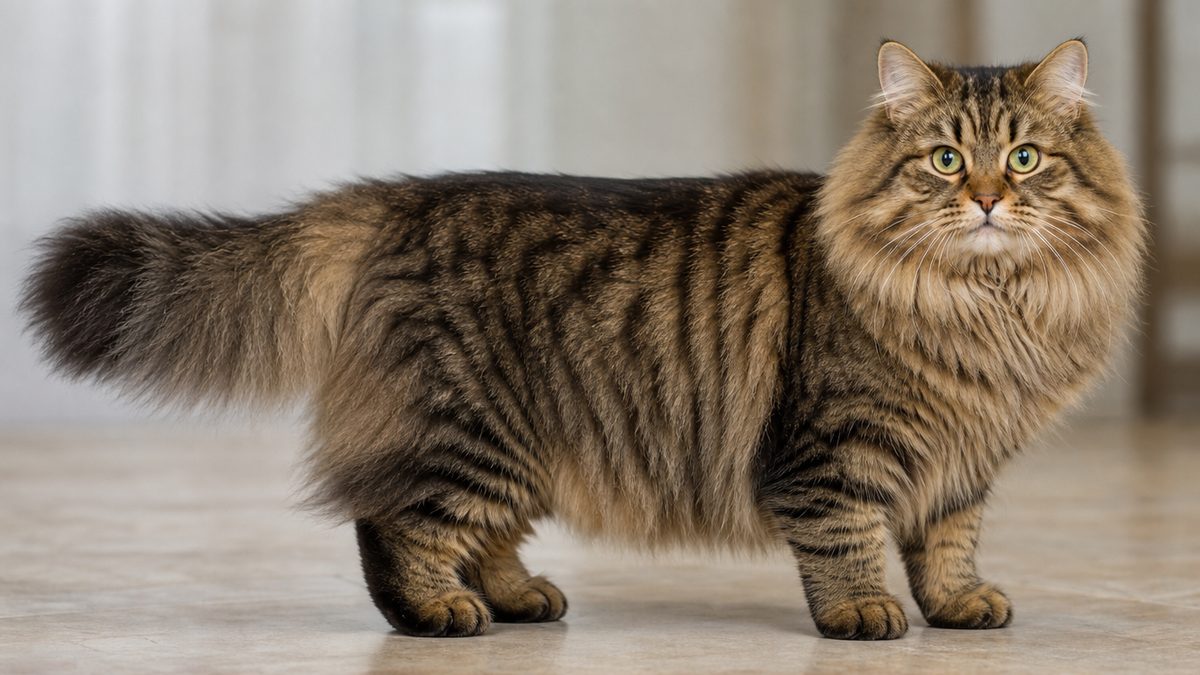
The Siberian is a large, slow-maturing semi-longhair cat from Russia, built around a dense water-repellent triple coat, and it is the breed most often sold to people who think they cannot live with a cat.
Two things define this animal and they pull in opposite directions for an Indian buyer. The coat is the first. CFA describes a powerful, muscular cat with a thick triple coat and calls that coat the breed's most distinctive feature. TICA describes the same structure seasonally: a thick, full, triple coat in winter that would have protected the cat from the elements in native Russia, shed in summer for a shorter, less dense coat. The second is the allergy claim, which has no equivalent standing in evidence and gets its own section below.
Size, and how slowly it arrives
A mature male measures 12 to 18 pounds, roughly 5.4 to 8.2 kg, and a female 8 to 12 pounds, roughly 3.6 to 5.4 kg. What matters more than the number is the timetable. CFA calls the Siberian one of the slowest-maturing cat breeds, with most cats reaching full size at three years; TICA puts full maturity at about five. Two registries, two figures, and both are on the record. Budget for a cat that is still filling out at an age when a Siamese has been an adult for four years.
Read the breed standard before you read a seller's description. The WCF breed standard for the Siberian runs to a scale of points weighted 35 for body, 30 for head, 25 for coat texture, 5 for coat colour and pattern and 5 for condition, which tells you what a judge is actually paying attention to. The GCCF publishes its own in a 315-page Standard of Points, where the Siberian sits in Section 2 Group C alongside the Maine Coon The Governing Council of the Cat Fancy.
The head is a broad modified wedge with gently rounded contours, low-set broad cheekbones, a rounded muzzle and a slightly curved profile. The WCF standard disqualifies a head that is clearly square, round or triangular, a deep stop, a totally straight profile, hocking of the back legs, and a pointed cat with any eye colour other than blue. Those are the lines a judge looks for, and they are the lines an honest photograph has to respect.
The coat, described properly
The WCF standard is the most precise description available and it is worth reading closely, because it explains the heat problem better than any adjective. The coat is of medium length. The very dense undercoat is shorter than the top coat, soft but resilient, sitting under a coarser, firm top coat. The dense, loosely falling top coat is water-repellent, has a firm structure and is glossy, and it covers the back, the flanks and the top of the tail completely. The under parts of the body and the back of the hind legs carry only undercoat. The coat is particularly long on the neck, the chest, the trousers and the tail, and it is prone to seasonal length changes.
Read that as engineering rather than description. A dense undercoat under a water-repellent top coat is a system for trapping a still layer of warm air against the skin and keeping meltwater out of it. In Novosibirsk in January, where the monthly mean measures minus 20.04 degrees, that is the difference between living and not. In Chennai in May it is a jacket the cat cannot take off.
Colour, and one code that exists for this breed alone
The WCF standard recognises all colours and patterns except chocolate and cinnamon and their dilutions, lilac and fawn, in any combination, and it does not recognise the Tonkinese or Burmese factor. Any amount of white is permitted. One colour code is worth knowing because it belongs to this breed and to no other: in the WCF's own EMS table, the modifier u, sunshine, is annotated *only for SIB*.
That is not a piece of registry trivia. The sunshine phenotype was mapped in this breed. A genome-wide association study of Siberian cats identified a homozygous CORIN c.2383C>T missense variant, predicted to change an arginine to a cysteine at position 795, segregating recessively with the sunshine tabby; hair observation showed golden hairs carrying a large yellow band instead of the short subapical one usually seen in agouti hair. The same variant turned up in three Kurilian Bobtails and two ToyBobs in the 99 Lives dataset, and genotyping 106 cats from 13 other breeds found no carriers.
The Siberian is unusual among rare-ish pedigree cats in having a real, current research literature about its coat. A 2026 review in Genes synthesises the genetics of Siberian colour and pattern and, more usefully for a buyer, documents that the major feline registries disagree with each other on how several of those traits are named and whether they are accepted at all, singling out basic colours, ticked patterns, colourpoint recognition, silver and golden variants and the definitions of white spotting categories. A separate study analysed white spotting across two large pedigree databases, 23,905 Siberians in PawPeds and 21,650 in Felis Polonia, and found the standard one-copy-versus-two-copies model of white spotting does not hold.
The practical consequence for an Indian buyer is small but real. If a seller tells you a colour is rare and prices it accordingly, the colour may not be recognised by the registry whose pedigree you are being shown. Ask which registry, then ask to see that registry's standard.
The hypoallergenic claim, and the 1999 test behind it
The Siberian is sold as a low-allergen cat on the strength of one 1999 test of four fur samples, and the laboratory that produced those numbers said in writing that they do not support the claim.
This is the reason the page exists, so it is worth being precise rather than reassuring. Nothing below says a Siberian cannot suit an allergic household. It says the published evidence is far thinner than the marketing, that the strongest measured effects in cats are not about breed at all, and that an Indian buyer paying a premium for a hypoallergenic cat is paying for something nobody has demonstrated.
What Fel d 1 is
Fel d 1 is a secretoglobin produced mainly in the sebaceous, anal and salivary glands, transferred to the coat by grooming, and it is the major cat allergen: Fel d 1-specific IgE is found in roughly 80 percent of cat-allergic patients, and one review puts IgE prevalence above 90 percent Hilger C, Janssen-Weets B. It is a tetramer of about 35 to 40 kDa, and each subunit has two polypeptide chains encoded by two separate genes, Ch1 and Ch2. Every claim about a low-allergen cat is, in the end, a claim about those two genes or about how much protein the animal puts on its coat.
The 1999 test, in full
The origin of the whole story is a single set of four fur samples analysed by INDOOR Biotechnologies of Charlottesville, Virginia. The company's own statement, archived in 2008, gives the results in micrograms per gram of sample.
| Sample | Cat | Fel d 1 (micrograms per gram) |
|---|---|---|
| 1 | Male neutered, mixed breed | 62,813 |
| 2 | Male neutered, Siberian | 2,001 |
| 3 | Female neutered, Abyssinian | 385 |
| 4 | Female neutered, Siberian | 206 |
Read the laboratory's own commentary next to that table, because it is the part nobody quotes. INDOOR Biotechnologies states that it did not carry out research on the samples and was not responsible for collecting them or validating the results; that the company would not provide recommendations on pet ownership based on results provided under those circumstances; and, in terms, that *the results do not provide convincing scientific data that Siberian cats are hypoallergenic and it is unfortunate that they have been widely disseminated on the web and used by breeders of Siberian cats to promote the breed*.
It goes further. The levels found in the Siberian samples, 200 to 2,000 micrograms per gram, are described by the laboratory as high and as indicating that these cats produce significant amounts of allergen. Part of the confusion, it says, is that the mixed-breed result is exceptionally high for reasons that were unclear and were not investigated. The samples were disposed of and cannot be retested. And it closes with the point that settles the genetic version of the claim: Fel d 1 is conserved in big cat species, so it seems unlikely that the gene is lacking in strains of domestic cats.
Compare those numbers with a published measurement. Carayol and colleagues shaved ten intact male cats under anaesthesia and measured fur Fel d 1 at a mean of 63.6 plus or minus 34 micrograms per gram on the face and 29.6 plus or minus 13.6 on the chest. The two Siberian samples in the 1999 test, 2,001 and 206 micrograms per gram, are therefore about 31 times and about 3 times that facial mean. The collection methods are not comparable, and this page says so plainly: Carayol shaved defined sites on anaesthetised intact males, while the 1999 samples were client-collected hair from neutered cats of unstated body site and unstated mass. But taken at face value, the samples used to sell the breed as low-allergen sit above the level a peer-reviewed study measured on ordinary cats.
Where Wikipedia gets it wrong, and it is ranking second
Wikipedia's Siberian cat article holds position 2 on the Indian result set for this query and its Fur allergen levels section carries two errors worth naming. It renders the mixed-breed figure as *62.813* micrograms, with a decimal point, where the archived laboratory statement prints 62,813 with a thousands separator: a factor of one thousand. And it describes that value as roughly 60 times higher than any published professional study, citing Carayol 2000, a paper whose own reported mean is 63.6 micrograms per gram. Against 63.6, the figure 62,813 is about 988 times higher, not 60. To be fair to the article, it does say clearly that there is no scientific evidence and that the claim comes from breeders and pet owners, which is more than most Indian pages manage.
What the peer-reviewed evidence actually says
One peer-reviewed paper has ever looked at Fel d 1 in Siberian cats specifically, it sequenced four of them and had three saliva samples measured by an outside laboratory, and it recommended further work rather than reaching a conclusion.
The one peer-reviewed Siberian paper, and its sample size
Searching PubMed for the exact phrase Fel d 1 in title or abstract returns 543 records; adding siberian returns exactly one. That paper is Sartore and colleagues, 2017, and it is a sequencing study rather than a measurement study. Blood was taken from 39 cats, 4 Siberian and 35 non-Siberian. Amplicons from four Siberians and five non-Siberians went to next-generation sequencing, and for the Ch1 gene the data from one Siberian and one non-Siberian were discarded for low read counts.
Three Siberian cats had saliva Fel d 1 concentrations measured, and the paper is explicit that this was done by a private laboratory in Charlottesville rather than by the authors. The three values were 2.19, 1.66 and 0.48 micrograms per millilitre. Two Siberians were above 1.5, and the one that fell below 0.5 was the single cat carrying two missense mutations, p.A13S in Ch1 exon 1 and p.N85S in Ch2. There was no measured control group.
The paper found 45 mutations in Ch1 and 93 in Ch2 in Siberians against the reference sequences, of which 13 in Ch1 and 8 in Ch2 were seen in Siberians only, and 11 of the Ch1 ones and 7 of the Ch2 ones sit in introns. A six-nucleotide deletion removing two serines was present in all the Siberians, and here is the detail that matters: it was also shared with some but not all of the short-haired cats, so it is not a Siberian marker.
The authors' own framing is the fairest summary available. They describe the Siberian as a breed *supposed to be low level allergenic, according to some breeders' statements*, and they conclude that further analyses are recommended to assess whether the identified mutations are responsible for reduced allergen synthesis. Nine years on, this page could find no follow-up that did so.
What the wider literature does support
Three things are better evidenced than the breed claim, and an allergic buyer should weigh them first. The first is sex. Bath washes from 21 cats found Fel d 1 concentrations significantly lower in females than in males, with males secreting variants that bound antibody more strongly. The second is neutering: a population-based study of household dust found that of cat hair length, sex, reproductive status and time spent indoors, the only characteristic associated with Fel d 1 levels in the home was whether the cat had been neutered or spayed. The third is simply how many cats you have, since allergen levels in that study rose with the number of cats in the house.
And the gene itself is variable in a way that undercuts any breed-level generalisation. A 2024 comparative analysis aligned Fel d 1 sequences from 276 domestic and exotic cats and found more than 100 unique, dissimilar substitutions across the family Felidae, with 41 percent of the amino-acid residues encoded by CH1 and 58 percent of those encoded by CH2 variable. If the protein varies that much between individual animals, a label on a pedigree is a poor predictor of what any one cat will put on your sofa.
A 2024 review of hypoallergenic animals in Allergologie Select puts it in one sentence: *To date, there is no scientific evidence for a hypoallergenic cat breed, even hairless Sphynx cats produce Fel d 1.* Its conclusion is that molecular analyses of animal dander from different breeds show high individual variation in allergen levels but do not provide any scientific evidence for the concept of hypoallergenic cats, dogs or horses. The same review records what happened to the first company that sold a selectively bred hypoallergenic cat: its claims were never supported by scientific evidence and it ceased trading. If you want the hairless comparison on this site, the Sphynx page covers it.
What this means if you are allergic and Indian
Do three things before money changes hands. Get tested, so you know whether you react to Fel d 1 or to something else entirely, because a cat is not a treatment for an allergy and this page is not medical advice. Spend real time with the specific adult cat you are buying from, not with the breed, since the individual variation is the part the evidence actually supports. And if a seller quotes you a premium for a hypoallergenic cat, ask for the measurement, the laboratory and the date. The honest answer is that nobody has one.
Registry recognition, checked body by body
All six registries this site checks hold the Siberian, and they disagree about two things: when it was recognised, and whether the colourpoint Siberian is a separate breed.
Recognition is worth stating per registry rather than as one global claim, because the pedigree you are shown in India will come from one of these bodies and their rules are not the same.
| Registry | Status | Code or section | What the document says |
|---|---|---|---|
| CFA | Championship | Longhair breed council | Accepted for registration in 2000, Championship status in 2007 |
| TICA | Championship | Siberian, with a seven-member breed committee | Entered the New Breed programme in 1992, granted Championship in 1996 |
| FIFe | Recognised | SIB, Category 2 | 4,420 kittens registered in 2024, rank 4 of 54 |
| GCCF | Recognised | Section 2, Group C, with the Maine Coon | Grand and Imperial titles available in the group |
| WCF | Recognised | SIB, Category 2 Semilonghair | Filed as Siberian Cat / Neva Masquerade, recognised by all bodies |
| LOOF | Recognised | Siberien | Records official recognition by the international bodies in 1997 |
The dates do not agree, and that is real
TICA gave the Siberian Championship in 1996. CFA did not accept the breed for registration until 2000 and did not grant Championship until 2007. LOOF records recognition by the international bodies in 1997. Eleven years separate the earliest and the latest of those, which is a useful reminder that a claim of long-standing recognition means nothing until you ask which body granted it and when.
The origin story is consistent across the two American registries and carries real names. The first breeding Siberians reached the United States in 1990, imported by Elizabeth Terrell for her Starpoint cattery. TICA's history adds the detail: three cats, Ofelia, Naina and Kaliostro, and before that the Kotofei Cat Club in Moscow writing the first standard around two cats, Mars, a blue lynx point and white, and Roman, a brown tabby and white, with twelve Siberians entered at the 1989 All Union Cat Show.
The colourpoint disagreement, stated as a disagreement
A colourpoint Siberian is called a Neva Masquerade, and the registries split on whether it is a breed. The WCF standard settles its own position in a single sentence: *The Neva Masquerade is a colourpoint variety of the Siberian cat and not a separate breed*. FIFe takes the opposite view and registers NEM as a distinct breed alongside SIB, listing them separately in its breeds index and counting them separately in its statistics Federation Internationale Feline. CFA lumps, showing the breed in traditional and colourpointed colours under one name, and LOOF holds a single Siberien record with no separate Neva entry.
Neither position is wrong and this page does not pick one. What it does say is that the split has a number attached: in 2024 FIFe registered 4,420 SIB and 2,977 NEM, so on FIFe's own accounting the colourpoint form is 40 percent of the combined total. If you buy a pointed Siberian in India on a WCF or CFA pedigree you have bought a Siberian; on a FIFe pedigree you have bought a Neva Masquerade. Same cat, two answers.
How rare is it, really
FIFe's 2024 breeding statistics are the best single rarity instrument available for cats, and the Siberian does well in them. The table ranks 54 codes whose registrations sum exactly to the printed total of 96,075, which is a check this page ran before quoting it. Siberians sit at rank 4 with 4,420 kittens, behind the Maine Coon at 23,775, the British Shorthair at 16,278 and the Ragdoll at 15,052, and ahead of the Devon Rex and the Norwegian Forest Cat Federation Internationale Feline. Within FIFe's Category 2 the Siberian is 12.4 percent of registrations and rising, against the Maine Coon at 66.8 percent and falling.
TICA's website served a Cloudflare browser challenge to every request made in this session. Six different user-agent strings were tried, including an empty one, and all six returned an identical HTTP 403 page reading *Just a moment* with the challenge-platform markers in it, so this is a browser-integrity check rather than a filter on any particular user agent. TICA content on this page therefore comes from Internet Archive captures with their dates recorded: the breed page from 29 July 2026 and the breeds index from 28 August 2026 The International Cat Association. Registry membership drifts in weeks, so treat those two dates as the currency of the TICA rows above.
One further check is worth naming, because absence is a claim. CFA publishes an index of declared candidates for every breed council plus the committee chairs for its Miscellaneous and Provisional breeds, and the Siberian appears there under Longhair Breeds with a named breed council secretary, which is what full CFA status looks like from the outside.
Siberian cat price in India, and why the sources disagree by three times
The Siberian cat price in India runs from Rs 32,287 on a live Mohali listing to Rs 1,00,000 at the top of the most-read published band, and no Indian source explains what the gap buys.
Unlike most of the rare breeds on this site, the Siberian genuinely is sold in India. It appeared on five of the six Indian commerce pages this page opened, against controls that appeared on all six, so the market is real and the figures below are observations rather than estimates.
| Source | Figure | What it actually is |
|---|---|---|
| Supertails | Rs 40,000 to Rs 1,00,000 | A published band in a breed price table, position 1 for cat price in india |
| Nearby Pets India | Rs 32,287 | A live listing, Mohali, advertised at 55 to 65 days old |
| Puppiezo | Rs 65,499 | A live listing, 8 weeks, Delhi NCR |
| Puppiezo | Rs 69,999 | A live listing, 12 weeks, Delhi NCR |
| MyKitten | No figure published | Lists the Siberian among ten brokered breeds with no price |
| World Blaze | No figure published | Names the breed only in an allergy FAQ |
The spread between the lowest live listing and the top of the published band is 3.1 times. That is wider than the spread on most Indian cat breeds and nobody accounts for it, so treat any single number you are quoted as a fact about the seller rather than about the breed Puppiezo, Buy Purebred Kittens and Cats….
Run the division tests before you trust a round band
This site tests every Indian price for the signature of a foreign figure converted into rupees, because that fabrication is common on Indian breed pages. Supertails' Rs 40,000 and Rs 1,00,000 do not divide cleanly at 84.38, giving 474.05 and 1,185.11, and do not divide cleanly at 74, giving 540.54 and 1,351.35. They do divide exactly at a flat 80, giving USD 500 and USD 1,250.
A match at 80 proves very little on its own, because 1,000 divided by 80 is 12.5, so any rupee figure ending in three zeros divides cleanly at 80 by construction. What makes this one worth mentioning is that the quotients, 500 and 1,250, are prices a real shop would print. Treat it as a flag rather than a finding, and note that the three live listings behave differently: Rs 32,287, Rs 65,499 and Rs 69,999 divide to 382.64, 776.24 and 829.57 at 84.38 and to nothing round at 80 or 74. Those are rupee-native charm prices, set in India, not converted from anywhere.
The age on the listings is the thing to check first
One Indian listing advertises Siberian kittens at 55 to 65 days old. Eight weeks is 56 days. The Prevention of Cruelty to Animals (Pet Shop) Rules 2018, notified as G.S.R. 844(E) on 6 September 2018, define an un-weaned animal at rule 2(1)(p)(ii) to include *kittens and pups below eight weeks*, and rule 7(15) provides that no pet shop shall sell un-weaned or underage animals or birds. A kitten advertised at 55 days sits one day below that line, and the second Puppiezo listing at 8 weeks sits exactly on it.
That is not a reason to accuse anyone of anything, and this page does not. It is a reason to ask for the kitten's date of birth in writing and to decline collection before the eighth week has passed. A cat you will keep for fifteen years is not worth rushing by seven days.
What the price is supposed to be paying for
CFA's own explanation is the most useful one on the record and it is worth quoting because it is checkable: Siberian breeders are typically scrupulous about genetic testing and choose breeding pairs with care to maintain diversity and minimise hereditary issues including hypertrophic cardiomyopathy and polycystic kidney disease, and *because of the cost of preventive testing, Siberians may be more expensive than some other breeds*.
So the question to put to an Indian seller is narrow and answerable. Which tests were run, on which parent, by which laboratory, and can you see the certificates. A Rs 70,000 kitten whose parents carry no screening results is not a premium Siberian; it is an ordinary kitten with a premium price. If nobody can produce paperwork, the Persian Cat page on this site shows what India's default pedigree cat costs by comparison.
One Indian marketing line worth reading twice
Supertails' table names the ideal buyer for a Siberian as *Allergy-prone Parents*, and its body copy says the breed produces lower levels of the Fel d 1 allergen protein while adding that no cat is fully hypoallergenic. World Blaze's FAQ says there are no truly hypoallergenic cat breeds but names the Balinese, Siberian and Russian Blue as producing fewer allergens. A third Indian marketplace attaches a Hypoallergenic badge directly to its Siberian kitten listing. All three are hedged to different degrees, and none cites a measurement.
Two more Indian sources are worth recording for what they do not say. MyKitten lists the Siberian among the ten breeds it brokers and publishes no price at all, and the highest-ranking international guide on the Indian result set, The Spruce Pets, covers the breed in depth without a single rupee figure. An Indian buyer therefore has three numbers to work with, and this page prints all three.
What a Siberian costs to keep in India each year
Budget roughly Rs 55,000 to Rs 95,000 a year for a Siberian in an Indian metro, and the cost of ownership line that separates this breed from a shorthair is cooling, not food.
The purchase price is the smallest number in this section. Everything below is a published Indian figure, re-checked on 9 September 2026, and the arithmetic is shown so you can redo it with your own city's rates.
There is no single monthly cost for a cat in India, and any page printing one has averaged away the two things that actually vary: your city's electricity tariff and whether you groom the cat yourself. What follows is built from published rates so you can rebuild it with your own.
| Item | Published figure | Source |
|---|---|---|
| Kitten vaccination course, three visits | From Rs 3,999, list price Rs 5,065 | Vetic |
| Adult annual booster | From Rs 1,899 | Vetic |
| Anti-rabies, single dose | Rs 699 | Vetic |
| CRP (Tricat or Feligen) | Rs 1,249 | Vetic |
| Pet licence, Chennai | Rs 50 for pet animals generally | Greater Chennai Corporation |
| Boarding, 24 hours, Bengaluru | Rs 899 | PawSpace |
| Daycare to 10 hours, Bengaluru | Rs 799 | PawSpace |
Two of those deserve a note. The Vetic figures are promotional floors from one clinic chain rather than a market average, and the same chain quotes different course prices on different city pages on the same day, so record which city page your figure came from. And the Chennai licence is genuinely cheap: the Greater Chennai Corporation charges Rs 50 for pet animals generally, and its six corporation pet clinics provide treatment and anti-rabies vaccination free of cost, which is a better fact for a Chennai reader than any private rate card.
The line no shorthair owner pays
Air conditioning is the Siberian-specific cost and it is not small. A cat with a dense undercoat under a water-repellent top coat cannot shed heat the way a short single-coated cat can, and in Delhi, Chennai, Mumbai or Kolkata that means running cooling through the hot months rather than through a heatwave. This page does not publish an electricity figure, because tariffs vary by state and slab and any single number would be invented. What it does say is that you should price it in your own city before buying, not after.
Grooming, which is a real line item here
A triple coat in Indian humidity mats, and a matted Siberian is a clipping job rather than a brushing job. Budget for either the tools and the time or for a groomer. CFA's own guidance is that Siberian coats vary enormously, with some cats needing weekly sessions to prevent mats and others going for weeks without one, and the recommended routine is to handle the underside, tail and britches several times a week feeling for mats before they set.
An honest annual range
Adding vaccination, deworming, food, litter, grooming and one routine vet visit, a Siberian in an Indian metro lands between roughly Rs 55,000 and Rs 95,000 a year, with the width of that range driven almost entirely by whether you groom the cat yourself and how much you run the air conditioning. Boarding at Rs 899 a night adds Rs 6,293 for a week away. None of this includes a cardiac scan, which is discussed in the health section and which you should price separately.
If you board a heat-sensitive cat in Bengaluru between March and May, ask the facility what happens to its air conditioning during a load-shedding cut and whether it has generator backup. For a Siberian that is not a comfort question.
Heat tolerance: the coldest-adapted cat on this site meets the Indian summer
The Siberian is the worst heat match of any cat Bonbeno has profiled, and the measurement that shows it is not humidity but the gap between a 19.46 degree homeland summer and a 41.66 degree Delhi June.
Every figure below was pulled from NASA POWER by explicit latitude and longitude, with the cell elevation echoed and checked against the real elevation of the place, because the model returns a grid cell rather than a point and gets mountains badly wrong. All nine points used here are plains or coastal cities and every cell landed within 83 m of the real elevation, so the cells describe the towns.
| Place | Annual mean (C) | Hottest month | Mean daily max, hottest month (C) | Annual mean RH (%) | Peak wet bulb (C) |
|---|---|---|---|---|---|
| Novosibirsk | 0.82 | July, 19.46 | 24.02 | 81.31 | 15.71 |
| St Petersburg | 4.35 | July, 18.31 | 21.25 | 88.91 | 15.98 |
| Moscow | 4.21 | July, 18.98 | 22.35 | 87.57 | 16.58 |
| Delhi | 25.57 | June, 35.88 | 41.66 | 45.51 | 26.50 |
| Chennai | 27.94 | May, 31.51 | 36.02 | 72.39 | 26.11 |
| Kolkata | 25.80 | May, 31.53 | 37.43 | 73.84 | 27.09 |
| Mumbai | 26.77 | May, 31.19 | 38.17 | 67.28 | 25.77 |
| Pune | 23.86 | April, 28.93 | 38.56 | 66.68 | 22.97 |
| Bengaluru | 23.74 | April, 28.37 | 36.31 | 67.84 | 21.86 |
The humidity argument is the wrong argument
Indian pages routinely warn that Indian humidity will destroy a northern coat. Run the numbers and it collapses. St Petersburg's annual mean relative humidity measures 88.91 percent and Moscow's 87.57, against Chennai at 72.39, Kolkata at 73.84 and Delhi at 45.51. The breed's homeland is markedly wetter than every Indian city on this list. Damp air is not the problem.
Heat is, and heat combined with moisture is worse than either alone. The right measure for that is wet bulb, and the gap is stark: Kolkata peaks at 27.09 degrees in June against St Petersburg's 15.98 in July, a difference of 11.11 degrees in the variable that actually determines whether an animal can shed heat by evaporation. Bengaluru at 21.86 and Pune at 22.97 are the mildest points in India on that measure, which is why they are the two cities where this breed is least unreasonable.
City by city, for a heat-sensitive semi-longhair
- Bengaluru: the best Indian city for this breed. Peak wet bulb 21.86 degrees, hottest month April at a 28.37 degree mean, coolest month December rather than January. Still needs indoor cooling in April.
- Pune: close behind. Peak wet bulb 22.97 degrees, hottest month April at 28.93. The April mean daily maximum of 38.56 degrees is the number to plan around.
- Mumbai: workable indoors, punishing outdoors. Peak wet bulb 25.77 degrees in June, with 90 percent monthly relative humidity in July and August.
- Chennai: hot and humid together for eight months. Peak wet bulb 26.11 degrees in May and no month below a 24.09 degree mean.
- Kolkata: the highest wet bulb of the six at 27.09 degrees, offset by a genuine cool season with a 17.31 degree January.
- Delhi: the widest swing. A 13.61 degree January the cat will enjoy and a June mean daily maximum of 41.66 degrees it will not.
The top coat is water-repellent and the undercoat is dense, and the pair works as insulation in both directions. Clipping it removes the sun barrier along with the trapped air, exposes skin that has never seen direct sun, and does not regrow reliably in a double-coated breed. Cool the room, not the cat. Where matting has already set, a groomer removing mats is a different operation from a full shave-down, and it is the one to ask for.
There is one honest counterweight to all of this. The Siberian's coat is described by both registries as varying with the season, thicker in the colder months and shorter and less dense in summer. A cat living year-round in a cooled Indian flat receives a blunted seasonal signal, so expect the moult to spread across the year rather than arriving twice, and expect a slightly lighter coat than the same cat would carry in Novosibirsk. That helps at the margin. It does not turn a triple-coated forest cat into a heat-tolerant one, and this page rates its heat tolerance 1 out of 5 for that reason.
Temperament and household fit
A Siberian is a sociable, physically confident cat that follows people between rooms, gets on with children and dogs, and does not fill the house with noise.
Both registries describe the same animal, which is unusual and worth noting. TICA calls the breed lively yet highly affectionate, playful, happy to chase a feather toy but equally happy to follow family members around, and adds that although they love attention they are not needy and will wait patiently for their turn. CFA's version is that Siberians are sociable, curious and easygoing cats who want to be near their owners and to know what is going on, and it quotes owners describing them as 90 percent placid and 10 percent mischief.
What the sociability costs you
The trait that makes this a good family cat is the same one that makes it a poor fit for an empty flat. CFA says Siberians become very attuned to their owners' moods and are often sought as emotional support animals. A cat wired that way notices absence. If your household is out twelve hours a day, plan for a second cat or plan for a different breed.
Noise, which matters in an Indian apartment
This is a quiet breed. CFA describes them as quiet cats that tend to prefer loud purrs to other forms of feline communication, and TICA notes a wonderful depth to the purr and a chirping greeting sound The International Cat Association. For a flat with shared walls that is a genuine advantage over an Oriental Shorthair or a Siamese, both of which are built to be heard.
Children, dogs and other cats
TICA calls the Siberian a good candidate for a therapy cat and says they get along well with dogs and other animals and can be wonderful companions for children. CFA agrees on all three counts. Neither registry is a neutral party, so treat that as the breed's design intent rather than a guarantee about the individual kitten in front of you, and meet the mother before you commit.
Ask how many litters the queen has had and how the kittens are raised, then ask what happens between weeks four and twelve. A cat this social is made in that window. A kitten raised in a cage in a shop and sold at 55 days has missed most of it, whatever the pedigree says.
Training a Siberian, and what it resists
Train a Siberian by giving it a problem to solve, because the breed's defining mental trait is problem solving and the thing it resists is boredom rather than instruction.
TICA's description is unusually concrete for a registry: Siberians use their intelligence to work out how to open a door to reach the people they adore, how to get to the cat food for an extra meal, and how to recover a favourite toy hidden out of reach. CFA adds that they take a keen interest in their surroundings and love to investigate cabinets, cupboards and suitcases, and that they quickly learn the meaning of the word no, although they may translate it as okay to do when nobody is looking.
What works
- Start clicker and target training at eight to twelve weeks, in sessions of two or three minutes, before the kitten outweighs your patience.
- Feed part of the daily ration from puzzle feeders rather than a bowl, which converts the problem-solving drive into something that tires the cat.
- Teach a recall to a specific sound, because a cat that follows you between rooms is already half trained to come.
- Build a carrier habit early, leaving the carrier open with bedding in it, since a 7 kg adult you have to wrestle into a box is a different animal from a 7 kg adult that walks in.
- Reward with food rather than with attention, so that training does not compete with the affection this breed already gives freely.
What it resists
Two things. The first is repetition without payoff: a cat that has solved a puzzle stops engaging with it, so rotate rather than repeat. The second is restraint. Grooming a triple coat requires a cat that tolerates being handled on the belly, the britches and the tail, which are exactly the places cats least like to be held. Build that tolerance in the kitten stage or you will be paying a groomer to sedate an adult.
Litter training and the Indian flat
Siberians litter train easily and the breed adds no special difficulty. What the coat adds is mess: long britches and a bushy tail catch litter and, in a humid Indian summer, catch worse. Use a covered tray with a high entry, keep the britches trimmed short with blunt-tipped scissors, and comb the tail after every soft stool rather than waiting for a mat to set.
Daily exercise, and why it has to be vertical
Give a Siberian two structured play sessions a day plus climbing height, because the breed's power is in the hindquarters and a flat floor plan wastes it.
TICA describes a strong, powerfully built cat with strong hindquarters that help it jump exceptionally high, and notes that the hind legs are slightly longer than the front legs, which is where the lift comes from. That is not decorative. A cat built to launch will launch, and in a flat without a legitimate high place it will pick your bookshelf.
The daily requirement
- Two wand sessions of ten to fifteen minutes, timed for early morning and after dark, which are the cooler hours in most Indian cities.
- One vertical route the cat can climb without touching furniture, ideally reaching above human head height.
- One elevated resting place per cat in the household, which is also what the Second Schedule of the Pet Shop Rules requires shops to provide for cats.
- Puzzle feeding for at least one meal a day, replacing free-choice bowl feeding.
- A scratching post tall enough for a fully stretched adult, which for this breed means well over a metre.
Timing exercise around Indian heat
A heat-sensitive cat should not be encouraged into hard play during the hottest part of an Indian afternoon. In Delhi the June mean daily maximum measures 41.66 degrees and in Pune the April figure measures 38.56. Move play to the cool ends of the day, and stop a session the moment the cat starts open-mouth breathing, which in cats is not the ordinary panting it is in dogs and should be treated as a reason to cool the animal and call your nearby vet.
A breed that takes three to five years to finish growing is a breed whose joints are still developing well past the age at which most cats are fully adult The International Cat Association. Keep jumps down and landings soft through the first two years, and given that a Czech survey found grade 3 hip dysplasia in Siberians, that is worth doing rather than assuming.
Grooming a triple coat in Indian humidity
Comb a Siberian two or three times a week with a steel comb, daily through the moult, and work the britches, belly and tail first because that is where mats form.
TICA's instruction is that the thick triple coat should be combed or brushed a couple of times a week to prevent tangles or mats, that it sheds seasonally in spring and autumn when more frequent grooming is needed, and that a bath is rarely necessary, which it notes is fortunate because the coat is highly water-resistant. That last point is the one Indian owners get wrong most often.
Why bathing this breed is harder than it looks
A water-repellent top coat resists wetting, which means a bath that looks finished has often only wetted the outer layer. Water trapped against a dense undercoat in a humid Indian summer is how you get a hot spot rather than a clean cat. If you bathe, dry to the skin with a forced-air dryer on cool, section by section, and comb while drying. If you cannot commit to that, do not bathe.
The routine that actually prevents mats
CFA's guidance is the most practical published: handle the cat's underside, tail and britches several times a week, feeling for mats and tangles, because that is where they develop. If you find clumps, pull them apart gently with your fingers or pick them apart with the edge of a steel-toothed comb, then comb through the coat to remove the remainder. The order matters, since a slicker brush run over the top of a mat leaves the mat and tidies the surface.
| When | What | Why it is on this list |
|---|---|---|
| Two or three times a week | Steel comb through britches, belly, tail base and ruff | The four sites where mats start |
| Weekly | Full-body comb, then a slicker only after the comb passes cleanly | A slicker alone hides mats rather than removing them |
| Daily in moult | Comb plus a moulting comb or rubber curry | Undercoat shed indoors is what triggers household allergen spread |
| Fortnightly | Nails, ears, teeth | Standard, and easier to keep up on a cat trained young |
| Monsoon months | Check skin under the ruff and at the tail base after any soaking | Trapped moisture under a dense undercoat is the local risk |
| Never | A full shave-down to cool the cat | Removes the sun barrier, and double coats regrow unreliably |
The allergy connection people miss
Grooming is where the allergen actually moves. Fel d 1 is produced by sebaceous, anal and salivary glands and reaches the coat through the cat's own grooming, so shed undercoat is the vehicle that carries it around a flat. Combing outdoors, or over a bin, removes allergen-laden hair before it becomes household dust. That is a more evidenced intervention than choosing a breed: household Fel d 1 levels track the presence and number of cats rather than their coat length.
Grooming costs, if you outsource
If you pay someone else, price it before you buy the cat, because a semi-longhair in a humid city is a recurring appointment rather than an occasional one. Published Indian salon rates for cats are thinner than for dogs, and this page will not invent one. What it will say is that de-matting is charged by time and that a coat allowed to felt costs several times what maintenance would have.
Health risks and screening
Screen a Siberian for hypertrophic cardiomyopathy and polycystic kidney disease, because those are the two conditions both registries name, and treat everything beyond them as thin evidence rather than settled fact.
Consult your nearby vet before acting on anything in this section. Nothing here is a diagnosis, and the studies below were done on cats in the United Kingdom, the Czech Republic, Italy and the United States rather than in India.
What the registries name
CFA states that Siberian breeders choose breeding pairs with care to minimise hereditary issues found in this breed, and names hypertrophic cardiomyopathy, polycystic kidney disease and several other recessive conditions. TICA is shorter and says the breed is generally healthy but should be checked for hypertrophic cardiomyopathy. Neither publishes a prevalence figure for the breed, and this page will not supply one, because no Siberian-specific prevalence study was found.
The one Siberian-specific disease paper
A 2020 case series in the Journal of Veterinary Internal Medicine describes a juvenile-onset motor polyneuropathy in a family of 13 closely related Siberian cats, 4 clinically affected and 9 unaffected. Onset was between 4 and 10 months. All four affected cats showed progressive or waxing and waning neuromuscular weakness with normal sensory function, all four returned to normal neurological function within one to four weeks, and all four relapsed, three of them once and one three times.
In the single cat that had electrodiagnostic testing, motor nerve conduction velocity was normal but compound muscle action potential amplitude was reduced, with multicentric spontaneous activity and polyphasia; muscle and nerve biopsy showed mild atrophy consistent with recent denervation, endoneurial and perineurial oedema and mild mononuclear infiltration. Pedigree analysis suggested autosomal recessive inheritance, and the authors state plainly that neither a genetically complex or polygenic condition nor an acquired inflammatory polyneuropathy could be ruled out.
Four affected cats in one related family is a description, not a prevalence. It tells an Indian owner what to recognise and when: a Siberian between four and ten months that becomes weak in the hind limbs, recovers over one to four weeks, and then does it again. It does not tell you how likely that is, and any page that turns this paper into a percentage has invented the percentage.
Hips, and a figure worth its caveat
A prospective Czech study radiographed 107 pedigree cats at least ten months old and found hip dysplasia in 46.7 percent of them, bilateral in 78 percent of affected cats, mostly grade 1 or 2, with 6.1 percent of hip joints showing severe grade 3 changes in Maine Coon and Siberian cats specifically. Patellar luxation was present in 32.7 percent, bilateral in 91.4 percent, and lumbosacral transitional vertebrae in 7.5 percent. The authors recommend screening pedigree cats for hip dysplasia before breeding.
The caveat matters as much as the number. These were cats recruited at a university small animal clinic, not a random population, and the 46.7 percent is across all pedigree breeds in the sample rather than a Siberian figure. What is Siberian-specific is the sentence naming the breed among those showing grade 3 hips. Ask an Indian breeder whether the parents have been radiographed, and expect the answer to be no.
Lifespan, blood results and the Indian risks
No breed-specific lifespan figure exists for the Siberian in the largest UK life-table study, because the breed did not reach that paper's 15-death reporting threshold.
Lifespan, and an absence stated properly
TICA's breed page gives 11 to 18 years or more, and that is the only breed figure on offer. The largest recent life-table study of cats, covering 7,936 confirmed deaths under primary veterinary care in the United Kingdom, reported life expectancy at age 0 of 11.74 years for cats overall, 11.89 years for crossbreds and 10.41 years for purebreds. Its Table 6 lists only 12 breeds, because breeds with fewer than 15 deaths were grouped into other, and the Siberian is not among the 12 breeds that reached that threshold.
Two of Teng's twelve rows are footnoted merges, and one of them is *Russian cats*, defined as Russian Blue plus Russian unspecified, at 9.65 years on 19 deaths. A Siberian is not a Russian Blue and would not belong in that row on breed grounds. But VetCompass records the breed as the practice entered it, so a Siberian typed into a British clinic record as *Russian* would land there. This page therefore says the Siberian did not reach the reporting threshold, and does not claim it was absent from the underlying data.
Two figures from the same study do apply to a Siberian in India, because they are not breed-specific. Entire cats had 4.29 times the odds of dying before three years compared with neutered cats, and purebred cats had 1.83 times the odds compared with crossbreds. Neutering is the single strongest lever an owner controls.
Blood results: use breed reference intervals
A study of haematological and biochemical reference intervals in four breeds found that Norwegian Forest and Siberian cats run low beta-2-globulin and gamma-globulin concentrations relative to published intervals, and concluded that breed-specific intervals should be used for those analytes. If an Indian laboratory flags a low globulin fraction on a healthy Siberian, that finding is worth showing your vet before anyone starts investigating.
The Indian risks that are not about the breed
Tick-borne disease is a real and under-discussed load on Indian cats and dogs. A Kerala study of 120 animals tested at veterinary clinics found Babesia in 80 of them, 66.7 percent, with a pre-monsoon peak from March to May. That figure is a clinic caseload rather than a population prevalence, and it is about dogs, so do not read it as a Siberian statistic. Read it as a reason to keep a long-coated cat on a vet-prescribed parasite protocol, and to comb the ruff and britches where ticks are hardest to see.
Feeding a slow-maturing large cat in India
Feed a Siberian as a kitten for far longer than you would feed a shorthair, because the breed is still growing at three to five years, and keep it lean because weight is the one dietary factor with a measured link to lifespan.
The feeding question for this breed is not what to buy but for how long. CFA calls the Siberian one of the slowest-maturing cat breeds, most reaching full size at three years, and TICA puts full maturity at about five The International Cat Association. A growth diet withdrawn at twelve months on a general rule of thumb is withdrawn early for this cat. Ask your vet when to switch, using body condition rather than a birthday.
The one number that matters
Keep the cat lean. The UK life-table study found that body weight deviance from the breed and sex mean was associated with lifespan, with an estimate of minus 0.02 years per 100 g of deviance in cats that died after nine months of age. On a 6 kg cat, a kilogram of excess weight is ten times that unit. Weigh monthly on a kitchen scale, record it, and act on a trend rather than on a single reading.
Practical feeding in Indian conditions
- Split the daily ration across three or four small meals, which suits a cat that solves problems and gets bored.
- Deliver at least one meal through a puzzle feeder rather than a bowl.
- Keep water in more than one place, and away from the food, because cats drink poorly next to food.
- Store dry food in an airtight container out of the heat, since Indian summer storage is what turns good kibble stale.
- Feed wet food within twenty minutes in a hot kitchen and discard the rest rather than leaving it down.
Coat and diet
A dense double or triple coat is expensive to grow, and the visible consequence of a poor diet in this breed is a dull, dry top coat that loses its water-repellent quality and mats faster. There is no Siberian-specific feeding study, so this page will not quote a protein percentage as though there were one. What it will say is that the coat is the first place a marginal diet shows, and that a sudden change in coat texture is a reason to see your nearby vet rather than to buy a supplement.
One thing not to buy on this page's account
Anti-Fel d 1 egg-antibody diets exist and are marketed for allergic households. A 2025 review describes dietary supplementation with chicken egg-derived IgY antibodies specific to Fel d 1 as neutralising the allergen in saliva and reducing its transfer to the fur, with clinical studies showing a decrease in nasal symptoms among allergic individuals. That is a real line of work, but it is a food intervention rather than a breed property, and it applies to any cat. It is not a reason to pay a Siberian premium.
Kitten timeline: month by month through the first year
Plan a Siberian's first year around three things that are specific to this breed: a coat that starts needing work before it looks like it does, a legal floor on collection age, and growth that is nowhere near finished at twelve months.
| Age | What is happening | What you do |
|---|---|---|
| Before 8 weeks | The kitten is legally un-weaned under the Pet Shop Rules 2018 | Do not collect. Ask for the date of birth in writing |
| 8 to 9 weeks | Collection window opens; first vaccinations due | Start the kitten course, from Rs 3,999 at one national chain |
| 9 to 12 weeks | Socialisation window still open | Handle belly, britches and tail daily. Introduce the comb before the coat needs it |
| 3 to 4 months | Second and third vaccinations, deworming | Introduce the carrier as furniture, not as transport |
| 4 to 10 months | The window in which juvenile motor polyneuropathy was described | Learn the signs: hind-limb weakness with normal sensation, recovering over weeks |
| 5 to 6 months | Neutering conversation | Discuss timing with your vet. Entire cats carry 4.29 times the odds of early death |
| 6 to 9 months | First real coat change | Move to daily combing during the moult. Do not bathe to speed it up |
| 10 to 12 months | Radiographic screening becomes possible | Ask about hips: the Czech study recruited cats at least ten months old |
| 12 months | Adult in name only | Do not switch off growth nutrition on the calendar. Use body condition |
| Year 2 to year 5 | Still filling out | Annual boosters from Rs 1,899. Keep jumps down and landings soft |
Vaccinate on your vet's schedule rather than on a shop's, and start the course only once the kitten is legally old enough to have left its mother.
The three dates that are legally or clinically fixed
Eight weeks is the collection floor, because rule 2(1)(p)(ii) of the Pet Shop Rules 2018 defines kittens below eight weeks as un-weaned and rule 7(15) bars their sale. Four to ten months is the described onset window for the juvenile polyneuropathy. Ten months is the earliest age at which the Czech hip study recruited cats, which is a reasonable proxy for when radiographic screening becomes meaningful.
Microchipping is mandatory for puppies sold through Indian pet shops under rule 7(16), which requires every puppy to be micro-chipped and every shop to keep a functional reader on the premises. The rule says puppy, so kittens fall outside it. Chip your Siberian anyway. It is a large, valuable, indoor-adapted cat in a country with no statutory feline chipping requirement, and a chip is the only thing that gets it back.
Siberian against the breeds Indian buyers actually cross-shop
An Indian buyer choosing a Siberian is usually choosing between it, a Maine Coon, a Norwegian Forest Cat, a Persian and a Russian Blue, and the deciding variables are heat, coat work and whether the allergy claim is doing the selling.
| Breed | Coat | Heat tolerance | FIFe 2024 kittens | Indian price seen | Sold on an allergy claim |
|---|---|---|---|---|---|
| Siberian | Dense triple, semi-longhair | 1 of 5 | 4,420 | Rs 32,287 to Rs 1,00,000 | Yes, on four fur samples |
| Maine Coon | Heavy semi-longhair | 1 of 5 | 23,775 | Rs 40,000 to Rs 1,00,000 | No |
| Norwegian Forest Cat | Double, water-shedding | 1 of 5 | 4,105 | Not found on Indian pages checked | No |
| Persian | Long, fine, high-maintenance | 2 of 5 | 1,981 | Rs 12,000 to Rs 50,000 | No |
| Russian Blue | Dense short double | 3 of 5 | 2,370 | Listed live in India | Yes, in the same Indian FAQ |
| Bengal | Short, close-lying | 4 of 5 | 3,559 | Rs 30,000 to Rs 80,000 | No |
Against the Maine Coon
These two are the same decision in India: a very large, heavily coated cat in a hot country. The Maine Coon is 5.4 times more numerous in FIFe registrations, which means more breeders, more competition on price and more chance of finding parents with screening results. The GCCF puts them in the same group, Section 2 Group C, which is a fair statement of how similar the judging problem is. Choose the Siberian if you want the smaller, rounder head and the quieter voice; do not choose it expecting a cooler cat.
Against the Norwegian Forest Cat
The Norwegian Forest Cat is the closest match on coat function and the closest on FIFe numbers, at 4,105 kittens in 2024 against the Siberian's 4,420. Neither appeared with an Indian price on the pages checked for the Norwegian, while the Siberian appeared on five of six. In practice that makes the Siberian the more available of the two here, which is a poor reason to pick a cat and a real constraint on the choice.
Against the Russian Blue
This is the comparison the allergy claim should actually turn on. The same Indian FAQ that names the Siberian as producing fewer allergens also names the Russian Blue and the Balinese. The Russian Blue is a dense short double coat rather than a triple semi-longhair, which means far less grooming, far less shed undercoat to carry allergen around a flat, and a much better heat profile. If the allergy claim is what is selling you a Siberian, and the evidence for it is what this page has shown it to be, the shorter-coated option deserves a look first.
Against a domestic Indian cat
Say this plainly because no ranking page does. Purebred cats in the UK life-table study had 1.83 times the odds of dying before three years compared with crossbreds, and crossbreds lived 11.89 years against 10.41 for purebreds. An Indian domestic shorthair costs between nothing and Rs 2,000, is adapted to the climate, and outlives the average pedigree. That is not an argument against buying a Siberian. It is the honest benchmark the Siberian has to justify itself against.
What Indian owners get wrong with this breed
The seven mistakes below are specific to keeping a Siberian in India, and the first two account for most of the trouble.
- Buying the cat as an allergy solution. The evidence is one 1999 test of four fur samples and one 2017 paper that measured three cats, and the laboratory behind the 1999 numbers said in writing that they do not support the claim. Get yourself tested, meet the individual adult cat, and treat the breed label as no guarantee at all.
- Shaving the cat in summer. A triple coat is insulation in both directions and a sun barrier. Clipping removes both, exposes skin that has never seen direct sun, and regrows unpredictably in a double-coated breed. Cool the room instead.
- Brushing the top and calling it grooming. Mats form at the britches, belly, tail base and ruff, under the surface. A slicker over the top tidies the coat and leaves the mat. Comb first, brush second.
- Bathing without drying to the skin. The top coat is water-repellent, so a bath that looks finished has often only wetted the outer layer, and trapped moisture against a dense undercoat in a humid Indian summer is a skin problem waiting to happen.
- Collecting the kitten before eight weeks. Indian listings advertise kittens from 55 days. The Pet Shop Rules 2018 define kittens below eight weeks as un-weaned and bar their sale, and eight weeks is 56 days.
- Switching off kitten nutrition at twelve months. This breed is still growing at three years by CFA's account and five by TICA's. Use body condition and your vet's advice, not the calendar.
- Paying a premium without asking what it bought. CFA itself says the price reflects the cost of preventive testing. Ask which tests, on which parent, by which laboratory, and ask to see the certificates.
A buyer who reads TICA's own Siberian page will find the sentence *They are considered a hypo-allergenic cat breed due to far less reduced levels of Fel d 1 protein sequence in their genes compared to other breeds*. Read it slowly. *Far less reduced levels* is a double negative that literally means higher, and levels of a protein sequence in genes conflates how much protein a cat sheds with what its DNA spells. The world's largest cat registry is publishing a health-adjacent claim, with no citation, in a sentence that does not parse. If you were misled, that is where it started.
Adoption, verification and the honest recommendation
Adopt first, and if you buy, verify five things in writing before any money moves.
Siberians reach Indian rescue occasionally, usually as surrenders when a household discovers what a triple coat costs in a hot city. Supertails names CUPA in Bengaluru and Friendicoes in Delhi as starting points for adopting a cat in India, and its own advice is that an Indian domestic cat is the most low-maintenance and resilient choice. If you have set your heart on the breed, ask local rescues to flag semi-longhair surrenders rather than searching for the breed name.
The five things to verify before you buy
- Date of birth in writing, and refuse collection before day 56.
- Which registry the pedigree is from, because a pointed kitten is a Siberian to CFA and WCF and a Neva Masquerade to FIFe.
- Screening certificates for both parents, naming the test, the laboratory and the date. Hypertrophic cardiomyopathy and polycystic kidney disease are the two CFA names.
- Vaccination and deworming records showing what was given, when, and by which registered veterinary practitioner.
- Whether the seller makes an allergy claim in writing. If they do, ask for the measurement behind it. Nobody has one.
What the law gives you as a buyer
The Prevention of Cruelty to Animals (Pet Shop) Rules 2018 are the instrument that applies to a cat bought from an Indian shop, not the dog breeding rules that Indian pages usually cite. Rule 6(5) makes temperature the shop's responsibility and says explicitly that comfortable temperature varies from breed to breed and that it is incumbent on the owner to familiarise himself with the requirements of the breeds he deals in. For a Siberian in a Chennai pet shop that clause has teeth. The Second Schedule paragraph 2, headed FOR CATS, requires a solid floor, elevated resting surfaces, matting, play toys, litter-box area excluded from the space calculation, and that cats or kittens are kept in a room not shared with inimical species such as dogs.
Look for those things when you visit. A shop that keeps kittens beside dogs is not complying with the Second Schedule, and a shop that cannot tell you its cat room temperature is not complying with rule 6(5).
The honest recommendation
Buy a Siberian if you want a large, quiet, sociable, slow-growing cat, you live in Bengaluru or Pune or you are committed to cooling a flat in a hotter city, and you enjoy grooming. Do not buy one because you were told it is hypoallergenic. That single sentence is the whole reason this page runs to the length it does, and it is the one thing every page currently ranking for this query gets wrong.
Three gaps are worth naming rather than papering over. No People Also Ask box could be captured on the day this page was built. A rendered Google India result on 18 September 2026 did carry one, 4 questions, and the FAQ below answers 4 of them verbatim. No Siberian-specific prevalence figure exists for hypertrophic cardiomyopathy or polycystic kidney disease in any source we opened. And no published Indian salon rate card for long-coated cats was found, so this page gives no grooming price.
Siberian cat questions Indian buyers actually ask
Are Siberian cats really hypoallergenic?
No cat breed is hypoallergenic and the Siberian is not an exception. The published evidence is one 1999 test of four client-submitted fur samples and one 2017 paper that sequenced four Siberians and had three saliva samples measured. The laboratory that ran the 1999 test said in writing that its results do not provide convincing scientific data that Siberian cats are hypoallergenic.
How much does a Siberian cat cost in India?
Indian sources disagree by a factor of three. Supertails publishes Rs 40,000 to Rs 1,00,000, a live Mohali listing asks Rs 32,287, and two Delhi NCR listings ask Rs 65,499 and Rs 69,999. Nobody publishes what the difference buys, which is why this page prints all four figures rather than an average.
Can a Siberian cat live in India's heat?
It can be kept in India, but only with cooling you are committed to paying for. The breed's homeland peaks at a July mean of 19.46 degrees in Novosibirsk, while Delhi's June mean daily maximum measures 41.66 degrees. The coat is built to trap air, which is exactly the wrong property in that heat.
What is the difference between a Siberian and a Neva Masquerade?
The Neva Masquerade is the colourpoint Siberian, and the registries disagree about whether it is a separate breed. The WCF standard states plainly that it is a colourpoint variety of the Siberian and not a separate breed, while FIFe registers NEM and SIB as two separate breeds and counted 2,977 and 4,420 kittens under them in 2024.
How long do Siberian cats live?
TICA's own breed page gives 11 to 18 years or more, and no better figure exists for this breed. The largest UK life-table study covered 7,936 confirmed deaths and reported only 12 breeds, because breeds with fewer than 15 deaths were grouped into other. The Siberian did not reach that threshold.
Do Siberian cats shed a lot?
Yes, and seasonally. Both TICA and CFA describe a thick full triple coat in winter that is shed for a shorter, less dense summer coat. In an Indian flat with air conditioning the seasonal trigger is blunted, so expect shedding to be spread through the year rather than concentrated in two moults.
Which registries recognise the Siberian?
All six this site checks. CFA accepted the breed for registration in 2000 and gave Championship in 2007, TICA gave Championship in 1996, FIFe registers it as SIB, the GCCF gives it a standard in Section 2 Group C beside the Maine Coon, the WCF holds it as SIB, and LOOF lists it as the Siberien.
What health problems do Siberian cats have?
CFA names hypertrophic cardiomyopathy, polycystic kidney disease and several other recessive conditions, and TICA says the breed should be checked for hypertrophic cardiomyopathy. Published Siberian-specific work is thinner: one paper describes a juvenile-onset motor polyneuropathy in a family of 13 related cats, and a Czech survey found severe hip dysplasia in the breed.
Is a female Siberian better for an allergy sufferer than a male?
The sex effect is better evidenced than the breed effect, which is the honest way to put it. Bath washes from 21 cats found Fel d 1 significantly lower in females than males, and a study of household dust found neutering status was the only cat characteristic associated with allergen levels in the home.
Should I buy a Siberian kitten advertised at 55 days old?
No. The Prevention of Cruelty to Animals (Pet Shop) Rules 2018 define an un-weaned animal to include kittens below eight weeks, and rule 7(15) bars a pet shop from selling un-weaned or underage animals. Fifty-five days is 56 days short of nothing: eight weeks is 56 days, so a 55-day kitten is under the line.
How expensive is a Siberian cat?
In India, between about Rs 32,000 and Rs 1,00,000 depending on whose figure you trust, and the spread is the point. Supertails publishes Rs 40,000 to Rs 1,00,000, a live Mohali listing asks Rs 32,287, and two Delhi NCR listings ask Rs 65,499 and Rs 69,999, and nobody publishes what the difference buys. The Supertails band also divides exactly at a flat 80 into USD 500 and USD 1,250, which is the signature of a foreign figure converted into rupees rather than an Indian market observation. Add the running cost of a triple coat in Indian humidity, where a matted Siberian is a clipping job rather than a brushing job.
Is a Siberian cat a good pet?
Yes, on temperament, and both registries describe the same animal. TICA calls the breed lively yet highly affectionate, playful, happy to chase a feather toy but equally happy to follow family members around, and adds that although they love attention they are not needy and will wait patiently for their turn; CFA calls them sociable, curious and easygoing, and quotes owners describing them as 90 percent placid and 10 percent mischief. The three things an Indian owner must plan for are heat, since a coat built to trap air is the wrong property under a Delhi June, seasonal shedding of a triple coat, and grooming that needs the cat to tolerate handling on the belly, britches and tail.
What is so special about Siberian cats?
The coat, the build, and a claim that does not hold up. CFA calls the thick triple coat the breed's most distinctive feature, and TICA describes it as a full winter coat that would have protected the cat from the elements in native Russia, shed for a shorter summer coat. The cat is large, slow-maturing, taking three to five years to finish growing, and built with slightly longer hind legs that let it jump exceptionally high. What it is most often sold on, being hypoallergenic, rests on a 1999 test of four client-submitted fur samples whose own laboratory said the results do not provide convincing scientific data, and a 2024 review finds no scientific evidence for any hypoallergenic cat breed.
Compare with similar breeds
Siberian sits in 1 Bonbeno group. Each one compares it directly against the breeds it is genuinely an alternative to, on the same figures.