
Breed profile
Mekong Bobtail: One Registry, Two Mutations, No Study
The only breed standard this cat has anywhere requires two things at once: a tail nobody has genotyped, and a tyrosinase allele with an entire neuroscience literature behind it. Two page-one results give opposite health verdicts and neither cites a thing.
Quick answer
The mekong bobtail is a pointed short-tailed cat from the Mekong basin, developed as a breed in Russia and recognised by one registry, the World Cat Federation, since August 2004. Its tail carries at least three vertebrae and must not exceed a quarter of the body length. No study has ever genotyped the breed, so what causes its short tail is unknown.
This page reports published veterinary and genetic literature, and reports honestly that none of it studies this breed. Nothing here is veterinary advice and nothing here can diagnose your cat. An absence of published health problems is not evidence of health, and the two most-read pages on this breed give opposite verdicts without citing anything. Any cat with an altered gait, a painful tail base, straining to urinate or defecate, involuntary eye movement, or reduced sensation at the hindquarters needs a registered veterinary practitioner the same day.
Mekong Bobtail at a glance
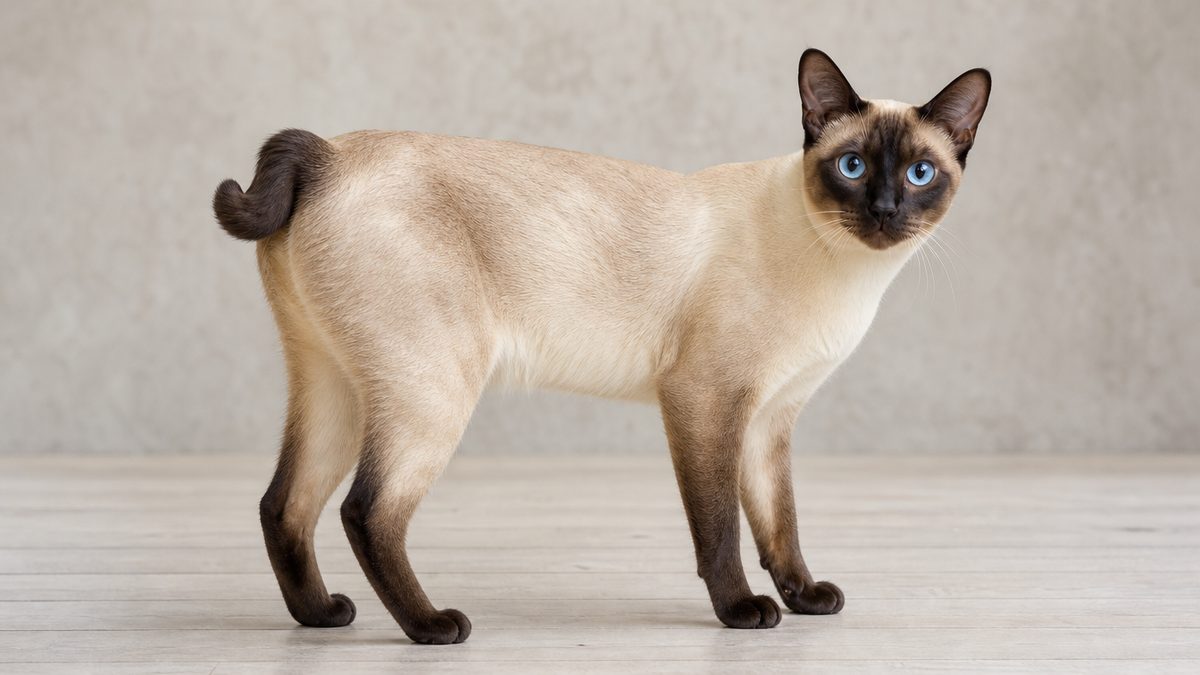
What the Mekong Bobtail is, from the only standard it has
The Mekong Bobtail is a pointed short-tailed cat from the Mekong basin, developed as a breed in Russia and recognised by exactly one registry. The World Cat Federation admitted it in August 2004 and renamed it from Thai Bobtail at the same moment, and its standard is the only document in the world that says what this cat should be.
Start with the standard, because everything else on the internet about this breed is downstream of it and most of it has drifted. The WCF standard for MBT, dated 01.01.2010, was downloaded and extracted directly rather than read through a fetch tool's summary.
| Feature | What the standard requires |
|---|---|
| Body | Rectangular, medium-sized and muscular, yet slender and elegant. Back almost straight, rump slightly higher than the shoulders |
| Legs and paws | Slender, medium length. Paws oval |
| Tail | Kinks and curves in various combinations, starting at the base. At least 3 vertebrae, and not longer than a quarter of the body length |
| Head | Gently rounded contours, top of head slightly flat, curved profile with a gentle break below the level of the eyes, Roman nose |
| Muzzle and chin | Chin firm, muzzle pronounced, fine and oval |
| Ears | Large, broad at the base, slightly rounded tips, high set, opening pointing slightly to the sides |
| Eyes | Large, oval, set almost straight. Colour an intense blue |
| Coat | Short, glossy, close lying, silky yet crisp texture, minimal undercoat |
| Colour | Siamese points, all pointed colours, no white |
| Scale of points | Body 20, Tail 25, Head 15, Ears 5, Eyes 15, Coat and points 15, Condition 5 |
Two requirements in one document, and both are mutations
Read the tail row and the colour row together and the interesting thing about this breed appears. The standard requires a short tail whose genetic cause has never been identified in this population, and it requires the Siamese pointed pattern, whose genetic cause was identified twenty years ago as a tyrosinase mutation and has an entire neuroscience literature attached to it. No page ranking for this breed connects the second requirement to anything.
The tail is also where the points are. Twenty-five of a hundred, more than the head, more than the eyes, more than the coat. That tells you what the breed exists to preserve, and it is the same weighting the WCF Manx standard gives to taillessness.
Where the name comes from
The breed was called the Thai Bobtail until 2004. WCF recognition in August of that year came with the rename to Mekong Bobtail, after the Mekong river, specifically to distinguish these cats from the Thai and the Siamese, which are separate registered breeds with full-length tails. That is a naming decision worth knowing, because the older name is still in circulation and a PubMed search under Thai Bobtail returns zero exactly as the new name does.
WCF's own EMS map carries both. THA is the Thai, a full-tailed pointed breed recognised by WCF, FIFe, TICA, GCCF and LOOF. MBT is the Mekong Bobtail, recognised by WCF alone. The two are separate rows, separate codes and separate cats, and the older literature calling this breed a Thai Bobtail sits right on top of that collision. Read the code, not the name.
Bonbeno's overview of cat breeds with mutations sets out how few feline structural mutations have actually been identified. This breed is unusual on that page for carrying two required traits at once, one of them mapped and one of them blank.
Registry recognition: one yes, three nos and one amber
One registry in the world holds a Mekong Bobtail standard. WCF recognised the breed in August 2004; TICA, CFA and FIFe hold nothing at any class; and GCCF places it at Amber status with the note that genetic and veterinary information would be required before acceptance.
The widely repeated claim that this breed is experimental at TICA and CFA is wrong, and it matters because experimental implies a process under way. Each check below reads the registry's own enumeration with a control breed found in the same document.
| Registry | Document read | Mekong Bobtail | In-document control |
|---|---|---|---|
| WCF | EMS Code map, all 198 rows via the table's data endpoint | RECOGNISED. Row 94, code MBT, recognised-by column reads WCF alone | KBS reads WCF, FIFe, TICA, LOOF |
| WCF | Breed standard MBT, update 01.01.2010 | A full standard exists, 1 page, extracted with pypdf | KBS, JBT, MAN and KAS standards retrieved the same way |
| CFA | Color Prefix Chart, the codes for every registered breed | Absent. Mekong 0 occurrences | Manx 120, Japanese Bobtail 82 |
| CFA | Breed Council Declared Candidates, incl. Miscellaneous and Provisional | Absent. Mekong 0 occurrences | Manx, Japanese Bobtail, American Bobtail, Toybob present |
| TICA | Browse All Breeds, the full A to Z at every class | Absent. No entry of any kind | Six bobtail entries, plus Toybob and Thai |
| FIFe | Breeds register, parsed on the EMS three-letter code | Absent. Mekong 0 occurrences | MAN, CYM, JBS, KBS, KBL, SIA |
| GCCF | Unrecognised Breeds, Amber table | AMBER. Recognising body WCF, potential section 4 | American Bobtail, Japanese Bobtail and Toybob also Amber |
What GCCF's Amber grade actually says
GCCF's Amber grade is defined on the page itself: breeds that may not be recognised are those based on a physical anomaly that may cause problems to some breed members, and/or could be detrimental to welfare, and it is for the applicant to produce evidence of little or no deleterious impact. The Mekong Bobtail's row reads, in full: recognising body WCF, potential section 4, Genetics Committee comment "Genetic and veterinary info would be required. Acceptance would depend on favourable reports", what this means for the owner "Ensures low risk of spinal, bladder and/or bowel problems", alternative breed Manx and Kurilean Bobtail.
That is a national registry saying, in writing, that it will not admit this breed until somebody does the genetics. It is the most useful sentence written about the Mekong Bobtail anywhere, and it is the closest thing the breed has to a research agenda.
The claim that the ranking pages get wrong
Catster states that while the breed is recognised by the World Cat Federation, it is still classed as experimental by both TICA and CFA, and that breeders are working with those associations toward full recognition in the USA. Both halves fail against the registries' own documents. TICA's Browse All Breeds enumerates every breed it holds at every class, from Championship down through Advanced New Breed and Preliminary New Breed, and there is no Mekong Bobtail row. CFA's Color Prefix Chart and its Breed Council Declared Candidates page, which includes the Miscellaneous and Provisional blocks, both contain the word Mekong zero times The Cat Fanciers' Association. Breed….
Catster writes the World Cat Federation's abbreviation as WFA three separate times, including in a heading reading "They were only accepted into the WFA in 2004". WCF is the abbreviation, and the page's own single listed source is a wcf.info URL that no longer serves the standard. A page that has not looked closely enough to copy the registry's initials correctly is not a page that has read the registry's documents.
For readers comparing this against a bobtail with four registries behind it, Bonbeno's Kurilian Bobtail page walks the same five checks and gets four yeses.
Tail genetics: the breed is untested, but its home region is not
No study has ever genotyped a Mekong Bobtail. What has been studied is the population it came from, and Xu 2016 sequenced the T-box gene in 40 cats from southern China, found none of the four Manx mutations, and closed by naming Southeast Asia as the sampling gap that still has to be filled.
This is the section that separates this page from the ten ranking above it, and it needs two statements kept apart. The breed has no genetics. The region has some. Confusing the two is how a hypothesis becomes a fact on a breed page.
What is definitely absent
Buckingham 2013 identified the Manx mutations from buccal swabs and phenotype data on 196 cats across five short-tailed breeds: 136 Manx, 21 American Bobtail, 14 Japanese Bobtail, 15 Pixie-Bob and 10 Kurilian Bobtail. Read in full, the paper contains Manx 73 times and Kurilian 12 times, and contains Mekong, Thai and Thailand zero times. Xu 2016 is the same story: Mekong, Thai and Thailand zero, Southeast Asia eight. Lyons 2016 likewise carries none of the three.
PubMed returns zero records under "Mekong Bobtail", "Mekong Bobtail"[tiab], "Mekong bobtails", "Mekong Bobtail cat", "Thai Bobtail" and "Thai Bobtail"[tiab], with the quoted phrases flagged as not found in the index. Controls in the same session returned 126 for Labrador retriever hip dysplasia and 6 for "Japanese Bobtail"[tiab], so the instrument worked. The tailless gene behind the Manx has never been looked for in this breed, and neither has HES7.
What the region does say, and it is more than nothing
Xu 2016 is the closest thing this breed has to a genetics paper, and its opening sentence is about the Mekong Bobtail's homeland without naming it. Cats with shortened and kinked tails were first recorded in the Malayan archipelago by Charles Darwin in 1868 and remain common today in Southeast and East Asia. Four of its findings bear directly on this cat.
- The Manx mutations are absent from Asian short-tailed cats. All coding exons of T-box were amplified and sequenced in 20 kinked-tailed and 20 wild-type cats from southern China. None of the four frameshift mutations known to cause taillessness in the Manx (c.998delT, c.998_1014dup17delGCC, c.1169delC and c.1199delC) was detected, confirming that the European and Asian short-tailed cats have different genetic bases.
- HES7 c.5T>C explains a large share of them. The variant, giving p.V2A in a somite segmentation gene, was mapped to a 5.6 Mb region of chromosome E1 and validated in 245 unrelated cats, correlating with Chinese short-tailed feral cats and with the Japanese Bobtail alike.
- HES7 homozygotes are viable, and not only in a breed. Feral cats heterozygous or homozygous for p.V2A appear normal and experience no apparent health hazards in urban or rural environments, and all cats in the extreme kink category were homozygous.
- Roughly one third of Chinese kinked-tailed cats carry neither known variant. Twenty such cats had the full coding regions of both genes sequenced and nothing was found, which is why the paper concludes there are at least three independent short-tail events in cat evolutionary history.
The paper's closing sentence is the one to read twice: further studies with extended sampling from Southeast Asia and China will be necessary to elucidate the genetic causes, origins and prevalence of the multiple kinked-tailed mutations in Asian domestic cats. The Mekong basin is Southeast Asia. This breed is drawn from precisely the population that sentence says has not been sampled.
The two hypotheses, labelled as hypotheses
The Mekong Bobtail is a candidate for HES7, because its neighbours in southern China carry that variant and because a kinked rather than truncated tail is what HES7 produces. It is equally a candidate for the unidentified third locus, for exactly the same geographic reason. Both are reasonable. Neither is a finding, and this page will not print either as one. Nobody has drawn blood from a Mekong Bobtail and run a sequencer over it.
The Manx's specific mechanism has been directly looked for in Asian short-tailed cats and not found. Xu 2016 sequenced every coding exon of T-box in 40 southern Chinese cats and detected none of the four Manx frameshift mutations, and stated that the European and Asian short-tail bases are different. That is not a test of this breed, and it must not be reported as one. But it is a real, primary-source reason to expect that a Mekong Bobtail's short tail is not the Manx's short tail, and it is more than the Kurilian Bobtail's own literature offered before its ten cats were sequenced.
One correction to a sibling page on this site
Bonbeno's Kurilian Bobtail page reports the exon 9 missense variant p.T360M as a loose thread nobody has followed up in the twelve years since Buckingham 2013, and that is not quite right. Xu 2016 did follow it up, in a different population. It detected p.T360M among four T-box SNPs in southern Chinese cats and states plainly that although the variant occurs at a conserved site, it represents a common variant within the cat population in southern China and is not associated with the target locus (p = 1.00). The Kurilian-specific question stays open, because Xu's cats were Chinese and two of Buckingham's three p.T360M carriers were Kurilians. But the variant has been tested, and in the population this breed comes from it is common and carries no association with a short tail.
The colourpoint pattern: the one mutation in this breed that IS mapped
The Mekong Bobtail's blue eyes and dark points are a tyrosinase mutation, and the WCF standard makes it compulsory. Lyons 2005 identified the pointed allele as a TYR exon 2 substitution changing glycine to arginine at position 302, and found every pointed cat tested homozygous for it.
This is the part of the breed nobody writing about it has looked up, and it is the half with real science behind it. A standard that requires Siamese points in all pointed colours without white, and eyes of an intense blue, is a standard that requires a specific genotype at a specific locus.
What the allele is
Lyons 2005 analysed over 200 cats representing 12 breeds plus randomly bred cats. The SNP associated with the pointed phenotype is an exon 2 G to A transition changing glycine to arginine, written G302R. The Burmese allele is a separate exon 1 G to T transversion, G227W. Every cat with the pointed or Burmese phenotype was homozygous for the corresponding mutation, and because the same mutations turn up in different breeds with the same phenotype they are likely identical by descent rather than repeated events.
Imes 2006 completed the series a year later, establishing TYR as the colour locus in cats with alleles running, dominant to recessive, C full colour, then c(b) burmese, then c(s) siamese, then c albino. So a Mekong Bobtail is c(s)/c(s) by definition of its own standard. There is no such thing as a pointed cat that is not.
Why the pattern is temperature sensitive, and what that means in Chennai
The pointed pattern exists because the mutated tyrosinase is temperature sensitive: it makes pigment at the cooler extremities and not on the warm torso. That is not folklore, it is the mechanism the allele is named for, and Lyons 2005 describes the Burmese allele as the less temperature-sensitive of the two.
The practical consequence for an Indian reader is small but real and no page mentions it. A pointed cat living permanently in Chennai, where the coolest month averages 24.09 degrees C, will carry lighter points than the same cat in Delhi, where January averages 13.61. Points also darken with age and with anything that cools a patch of skin, which is why a shaved surgical site on a pointed cat regrows dark. None of that is a health matter; it is a reason not to panic when a kitten's coat colour changes.
The eye claim, traced to a real mechanism
Zooplus tells Indian readers that certain hereditary diseases are particularly common in this breed, naming ocular ailments like nystagmus and watery eyes, and cites nothing. The claim is unsourced as printed and should not be repeated as a breed finding. It is also not baseless, and the honest thing to do is say where it comes from.
In albinism of all species, perturbed melanin biosynthesis in the eye leads to foveal hypoplasia, retinal ganglion cell misrouting and, consequently, altered binocular vision. Ray Guillery's characterisation of exactly those visual pathway anomalies in the Siamese cat, in what Mason describes as this temperature-sensitive mutation of tyrosinase, opened the whole field of albino visual-pathway research. A PubMed search for "Siamese cat"[tiab] with nystagmus or strabismus returns 11 records against a passing control.
The eye question in this breed belongs to the coat allele, not to the tail. Any pointed cat carries the c(s) tyrosinase genotype and whatever visual-pathway consequences follow from it, whether it is a Siamese, a Birman, a Ragdoll, a Himalayan or a Mekong Bobtail. Attaching nystagmus to the bobtail, as the ranking pages implicitly do by listing it under a bobtail breed's health section, points a buyer at the wrong end of the cat. Ask about the eyes because the cat is pointed. Ask about the hindquarters because the cat is short-tailed. They are two separate questions with two separate mechanisms.
Bonbeno's Siamese page covers the same allele in the breed where it was first described.
History: the same cats as the Siamese, minus one breeder decision
The Mekong Bobtail and the Siamese come from one founder population, the pointed cats of Siam, and split on a single aesthetic choice. British breeders from 1870 straightened the tail kinks out because they thought them ugly. The Russian line kept them.
That one sentence reframes the breed, and it is sourced rather than romantic. What follows is the documented sequence, with the disagreements left visible.
| Date | Event | Source and status |
|---|---|---|
| Late 18th century | Peter Pallas describes colourpoint cats at Insar in the Penza Governorate, comparing the coat to mink fur | A Russian sighting a century before the royal gift, and it complicates the standard origin story |
| 1868 | Charles Darwin records shortened and kinked tails in the Malayan archipelago | Quoted in the opening line of Xu 2016 |
| 1870 | The King of Siam gives two cats to a British Embassy official; they found the Siamese in Britain | Breeders straighten the tail kinks out over subsequent generations |
| 1897 | King Rama V, Chulalongkorn, visits Nicholas II and gives him about 200 palace cats | Most of them kinked-tailed. Wikipedia dates this loosely to the 19th century; the state visit dates it exactly |
| 1960 | Olga Mironova buys a stumpy-tailed pointed cat at Leningrad's Kondratyevsky Market for a month's salary | Her own account. She calls it what would today be a Thai Bobtail |
| Late 1980s | Professional cat breeding begins in the USSR and the surviving short-tailed line is noticed | Cats from other Southeast Asian countries were added to the programme |
| December 1994 | O. S. Mironova writes the breed standard | The same felinologist as the 1960 market purchase |
| August 2004 | WCF recognises the breed and renames it from Thai Bobtail to Mekong Bobtail | To distinguish it from the Thai and the Siamese |
The disagreement worth publishing
The popular account has these cats arriving in Russia with Chulalongkorn's gift of 200 palace cats. The Russian account records Peter Pallas describing pointed cats in a provincial Russian settlement a full century earlier, and admits it cannot explain how they got there, guessing at trading caravans. Both accounts are in print, they cannot both be the origin, and Bonbeno reports the conflict rather than choosing. Note that the earlier sighting describes the colourpoint pattern rather than the tail, so it may be evidence about the coat and not about the bobtail at all.
Why the split matters more than either date
Siam did not export its cats for a long time, keeping them in palaces and Buddhist temples. When they finally left, they left twice, in two directions, and were treated differently at each destination. In Britain from 1870 selective breeding produced the wedge-headed Siamese and the round-headed Thai, and the kinks were bred out because breeders thought them ugly. In Russia nobody removed them, and when Soviet felinology got organised in the late 1980s a short-tailed branch of the same stock was still there to be described.
So the Mekong Bobtail is not a distant relative of the Siamese that happens to look similar. It is the same founder population with one trait left in. That is why the WCF standard reads like a Siamese standard in its colour section and nothing like one in its tail section, and it is why the WCF files the breed's standard under its Siamese group.
Two stories explain the kink and both are folklore, not history. In one, Siamese princesses hung their bracelets on the cats' tails while bathing and the tails bent under the weight of the metal. In the other, the cats hunted fish and the long tail got in the way, so evolution removed it. The Russian source that reports them says felinologists tell the first one half-jokingly, and offers the second as another account rather than as fact. Neither is a mechanism and neither should be repeated without that hedge.
Five short-tailed cats, and where this one actually sits
Against the four other short-tailed cats an Indian buyer will meet, the Mekong Bobtail sits second from the bottom on evidence and second from the top on climate. It has a standard nobody else's blank-genetics cousin has, and it has a direct regional exclusion of the Manx mutations that the Kurilian took ten sequenced cats to earn.
Every row below comes from a primary document or a paper read in full, and the two blank columns are blank for different reasons.
| Measure | Mekong Bobtail | Korean Bobtail | Kurilian Bobtail | Japanese Bobtail | Manx |
|---|---|---|---|---|---|
| Gene identified | None. Never studied | None. Never studied | None. T excluded, HES7 untested | HES7 c.5T>C p.V2A | T, encoding Brachyury, four alleles |
| Tested for T in the breed | Never | Never | Yes. 10 cats, all exons | Yes. 14 cats, nothing found | Yes. Four mutant alleles found |
| Manx mutations excluded regionally | Yes. 40 southern Chinese cats, none of the four found | No such study | Not applicable | Yes, same study | Not applicable |
| Tested for HES7 | Never | Never | Never | Yes. 12 of 12 homozygous | Not applicable |
| Homozygotes found alive | Never tested | Never tested | Never tested | 12 of 12, plus feral homozygotes | None among 82 short-tailed cats |
| Homozygote outcome | Unknown | Unknown | Unknown | Viable, extreme kink | Presumed embryonic lethal |
| Radiographic study | None exists | None exists | None exists | Whole vertebral column, published | Multiple, from 1969 |
| Tail defined by the standard | 3+ caudal vertebrae, under a quarter of body length | No standard exists | 3 to 8 cm with a pom-pom | Under 8 cm with a pom-pom | Rumpy, rumpy riser, stumpy to 3-4 cm |
| Points awarded for the tail of 100 | 25 | No standard exists | 30 | 20 | 25 |
| Registries recognising it | 1 of 5, WCF | 0 of 5 | 4 of 5 | 5 of 5 | 5 of 5 |
| Coat pattern required | Siamese points, no white | None specified | Points explicitly refused | Points explicitly refused | Any colour, any white |
| Homeland annual mean, measured for this page | 27.85 C, Bangkok | 11.27 C, Seoul | Not pulled here | Not pulled here | Not pulled here |
The row that separates this breed from the Kurilian
Look at the regional-exclusion row. The Kurilian Bobtail's reassurance was earned the hard way: Buckingham 2013 sequenced ten Kurilians across exons 8 and 9 and then all remaining exons of T, and concluded that no evidence was found that mutations in T underlie short-tailed phenotypes in the Japanese Bobtail and the Kurilian Bobtail. That is an exclusion in the breed.
The Mekong Bobtail has something weaker but not nothing. Xu 2016 sequenced every coding exon of T-box in 40 cats from southern China, detected none of the four Manx frameshift mutations, and concluded that the European and Asian short-tail genetic bases are different. That is an exclusion in the region, and it covers the founder population without covering the breed. A careful buyer should treat it as one step short of the Kurilian's position and two steps ahead of the Korean Bobtail's, which has neither.
The row nobody else has: the coat pattern
This is the only one of the five whose standard requires a colour mutation as well as a tail one. The Kurilian and Japanese Bobtail standards both explicitly refuse the pointed pattern, the Manx standard permits every colour, and the Mekong Bobtail standard permits nothing else. So this cat carries two required mutations, one mapped and one blank, and every health discussion of it that treats the tail as the only variable is looking at half the animal.
What a buyer should do with the table
- Take the regional exclusion as real but partial. The Manx mutations are absent from Asian short-tailed cats; that is not the same as absent from this breed.
- Do not borrow the Japanese Bobtail's reassurance. Twelve homozygous cats and a radiographic study belong to that breed and to HES7, and nobody has tested either here.
- Ask two health questions, not one. Hindquarters because it is short-tailed, eyes because it is pointed.
- Palpate the tail base and watch the cat walk, because with no test available that is the whole screening programme.
- Read the neighbours. Manx, Japanese Bobtail and Cymric show what settled answers look like.
Health issues and lifespan: two page-one results, two opposite answers
No published health survey of the Mekong Bobtail exists, and the two most-read pages on the breed contradict each other outright. Catster records no known minor or serious conditions; Zooplus lists six problems and tells readers not to buy one. Neither cites anything.
Put the two side by side, because a reader cannot act on both and nobody else has pointed out that they disagree.
| Question | Catster says | Zooplus says |
|---|---|---|
| Overall verdict | A healthy breed | Prone to numerous health problems |
| Minor conditions | None known | Watery eyes, nystagmus |
| Serious conditions | None known | Mammary tumours and other cancers, urinary and digestive disease |
| Spinal risk from the tail | Not raised | Experts consider spinal problems possible; Manx taillessness described as torture breeding |
| Should you buy one | Rare and desirable, expect a waiting list | Best not to purchase due to severe health limitations |
| Lifespan | 15 to 18 years | Around 15 to 18 years |
| Sources cited for any of it | One dead WCF URL | None |
The one thing they agree on is also the one thing that can be checked
Both print a lifespan of 15 to 18 years, and that figure sits above the entire UK feline life table. Teng 2024 covers VetCompass primary-care records and gives life expectancy at age 0 as 11.74 years for all cats, 11.89 for crossbred and 10.41 for purebred. Its longest-lived of the 12 breeds with 15 or more recorded deaths is the Burmese at 14.42 years, with an upper 95 percent confidence bound of 15.93. So the bottom of the range these pages print is above the point estimate for the longest-lived breed in the study, and the top of it is above every confidence bound in the table. The word Bobtail appears zero times in the whole paper, so no bobtail has a row at all.
What can honestly be said about risk
Three separate things, kept separate, because conflating them is what produced the contradiction above.
- The tail risk is unquantified. No radiographic study, no health survey, no genotyping. GCCF's Amber note says exactly this in registry language: genetic and veterinary information would be required, and acceptance would depend on favourable reports.
- The Manx pattern has not been shown here and has been excluded regionally. Roughly 20 percent of short-tailed Manx carry an additional congenital anomaly clustered at the sacrum, and about 90 percent of those are in rumpies. Xu 2016 found none of the four Manx mutations in 40 southern Chinese cats. That is reassuring without being a clearance.
- The eye question is real and belongs to the coat. The pointed allele the standard mandates is a tyrosinase mutation, and albino-series tyrosinase mutations are associated with foveal hypoplasia, retinal ganglion cell misrouting and altered binocular vision across species. Any pointed cat carries that, Mekong Bobtail or not.
What to screen for, and what a vet can actually do
- Watch the gait on a hard floor. A bunny-hopping hind-limb action or a short stiff stride at eight to twelve weeks is a pre-purchase question, not a post-purchase one.
- Monitor toileting from the first week. Straining, dribbling or faecal incontinence in a kitten is neurological until proved otherwise.
- Palpate the tail base monthly. Articulation without pain is what the standard describes; resistance or flinching is a finding.
- Ask a vet to look at the eyes properly once. Involuntary side-to-side eye movement and a convergent squint are both worth documenting at the first visit so a change can be spotted later.
- Neuter on your vet's timing. Entire cats carry 4.29 times the odds of death before three years and purebred cats 1.83 times the odds of crossbred.
Catster's "None known" is not a health finding; it is an empty database field with a confident label, and the page itself half-admits it by saying the absence is potentially in part due to the breed's rareness. Zooplus's six named conditions are not a health finding either, because no study is cited and none exists. The honest verdict is that nobody has measured this breed, that the registry most willing to say so has said so in writing, and that a buyer should price that uncertainty rather than pick whichever page reassures them.
Mekong Bobtail price in india: none, and the biggest rupee figure is jewellery
No Indian seller offers a Mekong Bobtail. A commercial listing search that returned five Indian live-animal marketplaces for the Labrador control returned, for this breed, a 14 carat gold necklace at Rs 13,895, a paperback at Rs 719 and a phone case.
Say it first: there is no Mekong Bobtail price in india. What follows is the evidence, including the shape of the false positives, because the false positives are what a reader will actually meet.
The three biggest Indian cat lists do not carry it
Supertails publishes a 40-breed guide to cat breeds for the Indian climate; read from raw markup, Mekong appears zero times across all 40, against Manx 10, Bobtail 4, Siamese 35 and Persian 56 as in-document controls. The same publisher's all-breed Indian price guide returns Mekong 0 and Bobtail 0 against Persian 52. Heads Up For Tails' 50 popular cat breeds in India returns Mekong 0 against Bobtail 4.
What the commercial search actually returns
The Labrador control passed in the same session, returning Mr n Mrs Pet with city-by-city price tables, Supertails, Petsworld, Tradeindia and Marshalls Petzone, all offering live animals. Against that instrument the Mekong Bobtail query returned this:
| Result | What is actually for sale | Figure shown |
|---|---|---|
| Etsy India | A 14 carat gold Mekong Bobtail Longhair necklace | Rs 13,895, reduced from Rs 19,849 |
| Amazon.in | A paperback, "Mekong Bobtail Cat is my valentine" | Rs 719 |
| eBay | A phone case for a Google Pixel | Listed in dollars |
| A cattery post from 2017 offering a chocolate-point male, worldwide delivery | No price shown, not India | |
| PetGlobals Zurich and Milan | The breed appears only in the site's dropdown; the listings underneath are British Shorthairs | USD 400, a different breed |
| cats.com | An editorial roundup quoting USD 300 to 1,000 | Not an Indian figure and not converted here |
| Indian live-animal listings | None found | None |
The highest rupee figure attached to this breed anywhere in the Indian market is Rs 13,895, and it is a necklace. That is the merchandise trap at its most convincing, because 13,895 is exactly the sort of number a mid-market pedigree kitten might cost, and nothing in the search result says the product is jewellery until you open it.
Two more shapes of false positive to recognise
The PetGlobals pages are listing shells. Mekong Bobtail appears in a long breed dropdown alongside Minuet, Munchkin and everything else the site's database knows about, and the actual advertisements underneath are British Shorthair kittens at USD 400. A scraper reads that page as a Mekong Bobtail listing. So, often, does a reader.
The cats.com roundup gives a USD 300 to 1,000 band. That is a real editorial figure for a foreign market and Bonbeno will not divide it by any exchange rate to manufacture an Indian price. A rupee figure produced that way is arithmetic wearing a citation, and this site has caught answer engines doing exactly that on other breeds.
What an Indian buyer is really looking at
Acquiring one means importing a cat from Russia or eastern Europe, with the cost of the kitten, an international flight, an export pedigree from a WCF-affiliated club, rabies titre testing, and quarantine formalities on arrival. Nobody publishes an all-in figure for that and Bonbeno will not invent one. Even the Indian pet brand that ranks for this term, GoofyTails, carries a full breed page for the Mekong Bobtail with no rupee figure and no mention of India in its breed copy.
Ask for the WCF registration number and the issuing club, then ask which country the pedigree was issued in, because WCF affiliation is what makes the paper mean anything. Ask to see both parents' pointed colour and their tails. And be clear about what you are buying: a pointed cat with a short kinked tail, from a breed no registry outside WCF holds, with no published genetics of its own. If the seller cannot produce a WCF pedigree, they are selling you a pointed cat with a short tail, which India can supply far more cheaply.
One last framing point, because rarity and price are not the same thing. A breed can be genuinely scarce without being expensive where it is bred, and this one is bred mainly in Russia and eastern Europe rather than in a market that prices for export. What makes a Mekong Bobtail costly for an Indian buyer is the journey and the paperwork, not the cat. It is also worth noticing how the breed appears in general-audience roundups: a bobtail explainer that gives the American Bobtail, Japanese Bobtail, Highlander, Pixie-bob, Kurilian Bobtail, Mekong Bobtail, Toybob, Manx and Cymric their own sections lists this one beside eight breeds that hold between one and five registries each, and FIFe's own register, which does hold the Kurilian under its Kurilean spelling and the Siamese under SIA, holds nothing for this breed at all. Scarcity in the registries is not the same as scarcity in the world, and neither is a price.
Heat tolerance: the one cat breed on this site from a hotter place than India
The Mekong Bobtail's founder population comes from Bangkok at an annual mean of 27.85 degrees C and Phnom Penh at 28.28, both warmer than Chennai. It is the rare imported cat breed whose homeland is hotter than the Indian city you plan to keep it in, and the constraint that survives is the monsoon wet bulb, not the heat.
Every other short-tailed cat on this site comes from somewhere cold, and the honest climate section usually explains why an Indian summer is a problem. This one is different, and it is different in the reader's favour.
The climatology below was pulled from NASA POWER by explicit latitude and longitude, with the returned grid-cell elevation echoed and checked against each place's real elevation, because a cell standing on the wrong hill gives a confidently wrong answer. Bangkok's cell reads 4.48 m against a real 5 m and Phnom Penh's 9.54 m against 12 m, both accurate. Nakhon Phanom's cell reads 326.53 m against about 140 m, an overshoot of 187 m, so its figures run slightly cold and are marked as such.
| Place | Annual mean air temp | Hottest month mean | Coolest month mean | Annual relative humidity |
|---|---|---|---|---|
| Phnom Penh, Cambodia | 28.28 C | 31.28 C (Apr) | 26.74 C (Dec) | 73.31 percent |
| Bangkok, Thailand | 27.85 C | 30.73 C (Apr) | 24.95 C (Dec) | 74.45 percent |
| Vientiane, Laos | 25.95 C | 30.48 C (Apr) | 20.66 C (Dec) | 71.47 percent |
| Chennai | 27.95 C | 31.51 C (May) | 24.09 C (Jan) | 72.39 percent |
| Mumbai | 26.77 C | 31.19 C (May) | 23.19 C (Jan) | 67.39 percent |
| Hyderabad | 26.10 C | 33.30 C (May) | 20.76 C (Dec) | 60.30 percent |
| Kolkata | 25.81 C | 31.53 C (May) | 17.31 C (Jan) | 73.93 percent |
| Delhi | 25.60 C | 35.88 C (Jun) | 13.61 C (Jan) | 45.56 percent |
| Pune | 23.86 C | 28.93 C (Apr) | 19.62 C (Dec) | 66.80 percent |
| Bengaluru | 23.74 C | 28.37 C (Apr) | 20.22 C (Dec) | 67.94 percent |
Read the annual column, then read the hottest column
On the annual mean, Phnom Penh and Bangkok sit at the top of that table, above Chennai and well above Delhi, Kolkata, Pune and Bengaluru. A cat whose founder population lives at 28 degrees C year round is genuinely heat-tolerant by the standards of this site, where most breeds come from northern Europe or the Russian far east.
The hottest-month column tells a different story and it is the one that matters between March and June. Delhi peaks at 35.88 degrees C in June and Hyderabad at 33.30 in May, and both are above anything the Mekong basin produces, where the April peak tops out at 31.28. So the breed is adapted to sustained warmth rather than to a north Indian heat spike, and Delhi's summer is a genuinely new experience for it.
The monsoon wet bulb is the real constraint
Heat plus humidity is what a cat actually has to shed, and on that measure India is harder than the homeland. Peak wet-bulb temperature runs 25.99 degrees C in Bangkok in May, 25.79 in Phnom Penh in May and 24.96 in Vientiane in June. In India it runs 27.09 in Kolkata in June, 26.50 in Delhi in July, 26.11 in Chennai in May and 25.77 in Mumbai in June. Kolkata and Delhi both exceed the homeland peak. Bengaluru at 21.86 and Pune at 22.97 are comfortably below it.
So the ranking is not the one you would guess. This cat is better suited to Chennai and Mumbai than almost any pedigree cat sold in India, is entirely at home in Bengaluru and Pune, and meets something genuinely unfamiliar in a Delhi June and a Kolkata monsoon.
What to actually do
- Do not over-manage the heat. This is not a Siberian. Shade, airflow and water are enough in most Indian cities most of the year.
- Watch the Delhi and Kolkata peak weeks. June and July are the window where an air-conditioned room in the afternoon is worth having.
- Give water in more than one place. Two or three shallow bowls away from the food, refreshed twice daily.
- Keep the coat on. A short close-lying coat with minimal undercoat is already the easiest coat in the Indian summer, and shaving removes the sun barrier.
- Expect the points to lighten. A pointed cat kept warm year round carries paler points, because the pigment enzyme is temperature sensitive. That is the allele working, not a health problem.
The reflex that Indian humidity will finish an imported cat is usually a reasoning error rather than a data one. Bangkok runs 74.45 percent annual relative humidity, above Chennai at 72.39, Bengaluru at 67.94 and Delhi at 45.56. Humidity by itself is not the shock for a Southeast Asian breed. What is unfamiliar is the north Indian dry-heat spike, which is a different problem with a different answer.
Cost of ownership in India, once the cat is here
Budget roughly Rs 2,500 to Rs 4,500 a month for an adult short-coated cat in an Indian metro, plus a first-year veterinary block of about Rs 5,000 to Rs 7,000. Those are care costs, published and sourceable, and they are the only Indian rupee figures this breed honestly generates.
There is no purchase price to report, so this is where the Indian numbers live. Everything below was read from the provider's own page, and none of it divides cleanly at 84.38, 80 or 74, so none of it is a dollar figure wearing a rupee sign.
| Item | Published figure | Source |
|---|---|---|
| Kitten vaccination course, 3 visits | from Rs 3,999 (list Rs 5,065) | Vetic clinic price list |
| Adult annual booster | from Rs 1,899 | Vetic clinic price list |
| Anti-rabies, single | Rs 699 | Vetic clinic price list |
| CRP test | Rs 1,249 | Vetic clinic price list |
| Consultation | Rs 500 to Rs 1,000 | One data point, two sites publishing identically |
| Bathing | from Rs 934 | Vetic Delhi grooming list |
| Boarding, overnight to 24 hours | Rs 899 | PawSpace Bengaluru |
| Daycare, to 10 hours | Rs 799 | PawSpace Bengaluru |
| Pet animal licence, Chennai | Rs 50 | Greater Chennai Corporation |
Treat the consultation figure as a single data point rather than two independent ones. VOSD and a large general insurer publish byte-identical ranges for both consultation and core vaccination, so one has copied the other, and exact agreement between unrelated organisations is evidence against independence rather than for it.
Two India facts worth more than the price list
Greater Chennai Corporation licenses pet animals generally at Rs 50, issued 9,115 licences in 2024, and runs six municipal veterinary clinics that provide treatment and anti-rabies vaccination free of cost. For a Chennai owner that removes the largest recurring line above. And a scope point Indian pages routinely get wrong: MCD Delhi's Rs 500 pet registration covers dogs only, so a Delhi cat owner should not budget for it.
The monthly figure is arithmetic, not a quote
A 3.6 to 4.5 kg adult on a mid-market dry and wet mix runs roughly Rs 1,400 to Rs 2,400 a month at Indian retail, litter adds Rs 500 to Rs 900, and parasite control amortises to a few hundred rupees. Adding a share of the annual veterinary block gives the Rs 2,500 to Rs 4,500 band. Grooming is at the cheap end of the scale for this cat, because a short close-lying coat with minimal undercoat needs no salon work at all; the published Delhi rate of Rs 1,869 for a complete bath and styling is money a Mekong Bobtail owner does not have to spend.
Boarding is the line that moves most between cities and is worth pricing before a trip. PawSpace in Bengaluru publishes Rs 599 for up to four hours, Rs 799 for daycare to ten hours and Rs 899 for an overnight stay. Note the local wrinkle that Bengaluru boarding operators publish warnings about generator backup for air conditioning during the March to May load-shedding season, which matters more for a summer trip than the nightly rate does.
Indian breed sites print a single monthly cost figure for each breed, and those tables are assembled from a small set of preset line items reused across unrelated breeds of very different sizes. The same total turns up against a Pug and a wire terrier, and against a Maine Coon and a Chartreux. If a number matches your cat exactly, that is a coincidence. Recompute the food line from grams per day and the shelf price in front of you.
Temperament and household fit: loud, clever and permanently present
Expect a vocal, demanding, dog-like cat that follows you room to room and objects loudly to being ignored. Every page ranking for this breed agrees on that, and it is consistent with its Siamese descent, which is the one temperament claim here with a plausible basis.
Temperament descriptions for a breed with maybe a few hundred registered cats worldwide are observations by breeders rather than survey data, and this page treats them as such. What raises confidence is that the trait cluster is the Siamese one, and the two populations share founders.
What the ranking pages consistently report
A noisy meow and a habit of demanding attention when hungry or bored. Following owners around the house and watching them work. Strong attachment to people rather than to places. Dislike of being left alone all day. High intelligence and quick response to training Zooplus magazine. Mekong Bobtail GW2RU. Why the Mekong Bobtail has only…. One Russian account adds that the short tail leaves the hind legs more developed and the cat better at vertical jumps, which is an unsourced causal claim and is reported here as one rather than repeated as fact.
Who this cat suits in an Indian household
- Households with someone home most days. This is the deciding factor, ahead of flat size, climate or anything else.
- Owners who want a conversation. A vocal cat is charming to some people and intolerable to others, and it does not change with age.
- Families with children old enough to let a cat leave. The pages agree it is confident with children, and confidence is not consent.
- Multi-pet homes. It is reported to do well with other cats and with dogs, given short controlled introductions.
- Anyone who will actually play twice a day. An intelligent cat with nothing to do finds something to do, and you will not like it.
Who should look elsewhere
If you are out twelve hours a day, choose a different cat or take two. If you live in a shared flat with thin walls and light-sleeping neighbours, take the vocal warning seriously. And if what you actually want is the look, an ordinary Indian pointed domestic cat gives you the same affectionate temperament and the same blue eyes without an import, and Bonbeno's Siamese page covers the closest widely available relative.
Catster states that this breed's rear claws do not retract. That is a striking anatomical claim, it appears in no registry document, and the WCF standard says nothing about claws in any of its ten sections. If it is true it would change how you manage furniture and nail trims, so it is worth asking a breeder or a vet who has handled the breed rather than taking it from a page that also gets the registry's initials wrong.
One practical consequence of that trait cluster is worth stating on its own. Socialise a kitten of this breed deliberately and early, because a confident, people-oriented cat that has met visitors, traffic noise and a carrier before sixteen weeks becomes an easy adult, while the same genetics without that work produce a loud cat that hides from strangers and shouts about it. A fourth page-one result structures its whole entry around Character, Appearance, Conditions which affect this breed, a Weird Fact and History, and like the other three it issues its character verdict without naming a single observation behind it.
Training: an easy cat to teach, and one specific thing to teach it
Train this breed with short reward-based sessions and it will learn quickly, because intelligence and food motivation are the two traits every account agrees on. The one session that matters most is teaching it to accept a monthly tail-base and eye check.
Cats train well and this one is reported to train unusually well, with fetch and trick work coming up repeatedly in breeder accounts. Use that. The method is standard positive reinforcement and the order below is what works in an Indian flat.
The order to teach things in
- Litter box first. One box per cat plus one, unscented clumping litter three to four centimetres deep, away from the food and away from the washing machine.
- Carrier association in week one. Leave it open with a blanket inside and feed treats in it. A cat that loads calmly saves you an emergency later.
- Target touch. A chopstick with a dab of paste on the end, one nose touch, one reward, thirty seconds twice a day.
- Name recall. Say the name, reward immediately, only ever for good things. Never use it to summon the cat to a nail trim.
- Handling tolerance. Touch a paw, reward. Touch an ear, reward. Then palpate the tail base and reward, and hold the head still for two seconds and reward.
Why the handling session is the important one here
This breed carries two things a vet will want to look at and neither has a test you can buy. Screen the tail base by hand every month, feeling for articulation rather than a rigid stub and noting any flinch. And get the cat used to having its head held still and its eyes looked at, because involuntary eye movement and a convergent squint are best documented once at a first veterinary visit so that any later change is visible against a baseline. A cat that treats both as a boring two-second routine gives you real information for a decade.
What this cat will resist
Repetition without payoff, sessions over about three minutes, and restraint of any kind. Punishment produces avoidance of the person rather than of the behaviour, and with a vocal breed it produces a louder cat. Scratching furniture is a missing scratching post rather than a training failure; a vertical sisal post beside the sofa fixes most of it within a fortnight in an Indian flat.
Teach the cat to stay off the kitchen platform before the first monsoon rather than after. Indian kitchens run open shelves and a clever, food-motivated cat follows the smell of drying fish and setting curd within days. A covered feeding routine, a tall cat tree in the next room and a consistent lift-and-place beats any deterrent spray, and it is far easier to establish in the first three months than to unpick in an adult.
Daily exercise: an athletic cat that wants height and a job
Give this breed two or three structured play sessions a day of ten to fifteen minutes each, plus climbing height it can use unsupervised. It is reported as one of the more active pointed cats, and boredom shows up as noise before it shows up as anything else.
Exercise for a cat is bursts rather than distance. A healthy adult wants short intense chase-and-pounce sequences that end in a catch, and then it wants to sleep. Fifteen minutes of properly structured wand play beats an hour of a laser dot that never lets the cat win.
The daily pattern that works in a flat
- Two wand sessions, morning and evening. Move the toy like prey, away from the cat and around corners, never toward it.
- Always finish on a catch. A session with no ending leaves an active cat wound up rather than satisfied.
- Feed after the evening session. Hunt, catch, eat, groom, sleep is the sequence the animal is built for, and using it settles the night.
- Give one tall vertical run. A cat tree above head height or a cleared shelf ladder is the single best flat modification for a muscular, athletic cat.
- Scatter-feed part of the ration. Five portions hidden around the room turns dinner into twenty minutes of work.
What happens without it
An under-exercised indoor cat gains weight quietly, and weight is the thing you can actually control. Monitor body condition monthly by feel rather than by the scale: you should feel the ribs under a thin fat layer with light pressure and see a waist from above. On a playful, vocal breed the first sign of under-stimulation is usually noise at three in the morning, followed by over-grooming and ankle-biting, and all three respond to more structured play far more reliably than to any deterrent.
Heat changes the schedule less here than for most breeds
For most imported cats an Indian April means moving all play to dawn and dusk. This breed's founder population lives at an annual mean of 27.85 degrees C in Bangkok and 28.28 in Phnom Penh, both above every Indian city except by a narrow margin, so sustained warmth is normal to it. Delhi is the exception worth planning around, peaking at 35.88 degrees C in June, which is 4.6 degrees above anything the Mekong basin produces. In Delhi, Hyderabad and Kolkata drop the middle of the day in the peak weeks. In Bengaluru, Pune, Mumbai and Chennai an afternoon session is usually fine.
Open-mouth breathing is the line in every city. Panting is not normal in cats, it is not a hot-day quirk, and it is a same-day veterinary matter regardless of what the breed is adapted to.
Grooming: the easiest coat on any short-tailed cat, in Indian humidity
Brush this coat once a week and twice a week through the pre-monsoon moult, and that is essentially the whole job. The WCF standard describes a short, glossy, close-lying coat of silky yet crisp texture with minimal undercoat, which is the lowest-maintenance combination a cat can have in an Indian summer.
Compare that with its neighbours before you decide this is trivial. The Kurilian Bobtail standard asks for a well developed top coat and a pom-pom tail whose fur is longer than the body coat, and the Japanese Bobtail the same. The Manx standard asks for a dense soft undercoat under a firm top coat. The Mekong Bobtail standard asks for minimal undercoat and nothing else. That single word is the difference between a fifteen-minute weekly job and a five-minute one.
The weekly routine
- Brush once weekly with a rubber curry or a soft grooming mitt. Five minutes with the lie of the coat, finished with a damp hand to lift loose hair.
- Double it from February to May. The pre-monsoon moult is heavier in Indian metros than most owners expect, and brushed hair is hair that does not become a hairball.
- Trim nails every three to four weeks. Front only for an indoor cat, tips only, well clear of the quick.
- Check ears weekly, clean only when dirty. Over-cleaning causes more Indian ear trouble than under-cleaning.
- Wipe the eyes only if there is discharge, with a clean damp cotton pad per eye, outward from the inner corner, and never the same pad twice.
Bathing, and the monsoon rule overseas advice gets wrong
A healthy indoor cat with this coat almost never needs a bath. Where one is needed after a spill or a skin treatment, the Indian constraint is drying rather than washing. Overseas guidance routinely says to towel the animal and let it air dry, which is correct in a temperate climate and wrong in an Indian monsoon, where a damp coat in a damp room holds moisture against the skin for hours. Towel thoroughly, finish with a cool-setting dryer at a distance the cat tolerates, and keep it in a dry room until the coat is genuinely dry. Published Delhi salon rates run from Rs 934 for bathing, and the styling tier is money this coat does not need.
What the coat will do that surprises people
The points darken and lighten. The pointed pattern is a temperature-sensitive tyrosinase mutation, so pigment forms on the cooler extremities and not on the warm torso. Three consequences follow that are cosmetic and not medical. Kittens are born almost white and colour up over weeks. A cat kept permanently warm, as in a Chennai flat where the coolest month averages 24.09 degrees C, carries paler points than the same cat would in a Delhi January at 13.61. And a patch shaved for surgery regrows dark, because the skin there was cooler while the fur was off. None of that is a fault and none of it needs treating.
This comes up every April and it is wrong every April, and on a pointed cat it is wrong twice. The coat insulates in both directions and shields the skin from ultraviolet, so shaving exposes pale skin to burn without lowering core temperature meaningfully. On this breed it will also grow back a different colour. Cool the room and the cat instead: shade, airflow, more water bowls, and a tile or marble floor to stretch out on.
Feeding in India, by life stage
Feed a growth-formulated kitten food four times a day to four months, three times to six months, then twice daily on an adult complete food with wet food carrying part of the water intake. An adult of 3.6 to 4.5 kg eats roughly Rs 1,400 to Rs 2,400 of food a month at Indian retail.
Cats are obligate carnivores and the biggest practical trap in the Indian market is a vegetarian household defaulting the cat onto a vegetarian diet. Taurine, arachidonic acid and preformed vitamin A are not optional for a cat and no plant-based ration supplies them without synthetic supplementation. Feed a complete cat food, not a household diet.
The life-stage schedule
| Age | Meals per day | What to feed | What to watch |
|---|---|---|---|
| 8 to 16 weeks | 4 | Kitten complete, wet and dry mixed | Weekly weight gain and a formed stool. Points are still colouring up |
| 4 to 6 months | 3 | Kitten complete | Appetite dips around teething at 4 to 5 months |
| 6 to 12 months | 2 to 3 | Kitten complete to 12 months | Post-neuter appetite rise; cut the ration, not the meals |
| 1 to 7 years | 2 | Adult complete, at least a third wet by weight | Body condition monthly by feel, not by the scale |
| 7 years and over | 2 | Adult or senior complete | Water intake, weight loss and annual bloodwork |
Water is the Indian-specific issue, even for a tropical breed
Cats evolved to take most of their water from prey and drink poorly by choice, and an Indian summer widens that gap regardless of where the breed came from. Wet food is the most reliable fix, and a third to a half of the ration by weight as wet is a practical target. Two or three shallow bowls placed away from the food and refilled twice daily do more than one large bowl refilled once. A fountain helps some cats and is ignored by others, so test before you invest.
Appetite is loud in this breed, and that is a trap
Every account of this cat describes a vocal animal that demands food. That makes free-feeding tempting and makes post-neuter weight gain very easy. Energy requirement drops by roughly a quarter to a third after neutering and appetite does not, so cut the ration at the time of the surgery rather than three months later when the waist has gone. Keep the same number of meals so the cat does not feel short-changed, and reweigh monthly for the first six months.
A monthly food cost is arithmetic from grams per day and a shelf price, not a quoted number. Indian breed pages print per-breed monthly totals that are assembled from a small set of preset line items reused across unrelated breeds, so a figure that matches your cat exactly is a coincidence rather than a measurement. Weigh the food for a week and multiply.
The kitten timeline, month by month through the first year
Plan the first year in four blocks: socialisation to sixteen weeks, the vaccination course to about five months, neutering and the growth plateau to nine months, and a settled adult routine by twelve. For this breed add a monthly tail-base check and one properly documented eye examination.
The plan below is what to do with any kitten in an Indian home, plus two additions specific to a cat that is both short-tailed and pointed.
| Age | What happens | What you do |
|---|---|---|
| 8 to 12 weeks | Home, socialisation window still open, points still colouring | Vaccination course begins, from Rs 3,999 for three visits. Handle daily. Introduce carrier, clippers, tail-base check |
| 12 to 16 weeks | Socialisation window closes | Meet visitors, hear the pressure cooker, ride in the carrier. This fortnight sets the adult cat |
| 4 to 5 months | Teething, appetite dips | Soften food if needed. Ask the vet to document eye position and any nystagmus at this visit |
| 5 to 7 months | Sexual maturity approaches, and a vocal breed gets louder | Book the neuter. Entire cats carry 4.29 times the odds of death before three years |
| 7 to 9 months | Growth plateau, energy peak | Cut the ration post-neuter. Two structured play sessions daily, non-negotiable |
| 9 to 12 months | Adult body, adult coat, adult routine | Switch to adult food at twelve months. Set the annual booster date, from Rs 1,899 |
The monthly short-tail check
Once a month, on a day you will remember, do three things and write down what you found. Watch the kitten walk away from you across a hard floor and note whether the hind limbs move independently or hop together. Check the litter box for a normal urine puddle and a formed stool, because urinary and faecal problems are how sacral defects present in cats. Then run a thumb from the sacrum out along the tail and feel for articulation, resistance or flinching.
That routine exists because there is nothing else. No DNA test, no screening scheme, no radiographic baseline for the breed. Buckingham 2013 found roughly 20 percent of short-tailed Manx carrying an additional congenital anomaly clustered where the spinal cord ends, and Xu 2016's regional exclusion makes that pattern less likely here without ruling it out. A two-minute monthly check is a proportionate response to that.
The one-off eye baseline
Ask the veterinarian at the four to five month visit to note eye position, any convergent squint and any involuntary side-to-side movement, and to write it in the record. The pointed allele carries documented visual-pathway consequences across species, most affected cats compensate without any clinical problem, and the whole value of the note is that a change three years from now becomes visible against it.
The sixteen-week socialisation deadline and the neuter booking. Everything else in the table can slip a fortnight without much cost. Those two cannot: the socialisation window closes whether or not you used it, and neutering is the single intervention in the cat literature with a measured effect on early death.
Mistakes Indian buyers make with this breed
The commonest mistake is picking whichever page-one health verdict is more comfortable. The rest follow: taking a lifespan above the whole UK life table at face value, believing the breed is under way at TICA and CFA, and asking one health question when the standard mandates two mutations.
Each item below is observable on a page currently ranking in India for this term, and each is checkable against a document.
1. Choosing between two unsourced health verdicts
Catster prints Minor Conditions: None known and Serious Conditions: None known. Zooplus names nystagmus, watery eyes, mammary tumours, other cancers, urinary and digestive disease and heads its buying section "Best not to purchase due to severe health limitations";. A reader who takes either at face value has taken an uncited claim as a finding. The correct move is to take neither and to note that GCCF, the only body to have looked at this formally, says genetic and veterinary information would be required.
2. Believing a 15 to 18 year lifespan
Two ranking pages print it and no study supports it. Teng 2024's longest-lived of 12 breeds is the Burmese at 14.42 years, with an upper 95 percent confidence bound of 15.93, and the all-cat figure is 11.74. A quoted range whose floor exceeds the best point estimate in the largest study in the field is a number somebody made up, not a number somebody measured.
3. Believing the breed is in progress at TICA and CFA
It is not, and both registries publish the lists that show it. TICA's Browse All Breeds enumerates every breed at every class including the new-breed tiers, and there is no Mekong Bobtail row. CFA's Color Prefix Chart and its Breed Council Declared Candidates page both contain the word Mekong zero times The Cat Fanciers' Association. Breed…. The claim of experimental status at both is a page-one error that costs a buyer nothing directly, but it makes a one-registry breed sound like a four-registry one.
4. Asking about the tail and forgetting the coat
This is the technical mistake and it is the one this page exists to fix. The standard requires two mutations: a short tail of unknown cause, and the tyrosinase c(s) allele that produces the Siamese points and the intense blue eyes Lyons LA, Imes DL, Rah HC. The eye claim floating around the ranking pages belongs to the second, not the first. Verify both at the first veterinary visit and treat them as separate questions with separate answers.
5. Assuming the neighbours' genetics apply
Three short-tailed cat breeds have three different answers and they must not be traded between. The Japanese Bobtail's reassurance rests on HES7 and 12 homozygous cats. The Manx's warning rests on four T-gene alleles and a lethal homozygote. The Kurilian has an in-breed exclusion of T and no HES7 test at all. None of those is a Mekong Bobtail result. The one real transferable finding is Xu 2016's regional exclusion of the Manx mutations in southern Chinese cats, and even that covers the region rather than the breed.
6. Paying an Indian pedigree price for an unverifiable paper
A WCF pedigree issues from a WCF-affiliated club, almost certainly outside India. If a seller in an Indian city offers a Mekong Bobtail with local paperwork and no WCF registration number, what is being sold is a pointed cat with a short tail, and India can supply that far more cheaply than any import.
Open tica.org's Browse All Breeds and read the M entries. Open cfa.org's Color Prefix Chart and search for Mekong. Open the GCCF Unrecognised Breeds page and find the Amber table. Open wcf.de's MBT standard PDF and read the tail and colour sections. Four tabs, five minutes, and between them they answer every registry and standard question on this page. Any seller or answer engine that tells you otherwise has not opened them.
Adoption and responsible sourcing in India
Adopt a pointed short-tailed Indian cat instead. India has plenty of colourpoint street and shelter cats and plenty of short-tailed ones, the combination turns up regularly, and it costs nothing. If you import anyway, insist on a WCF pedigree and use the Pet Shop Rules 2018 as your ground with any Indian seller.
This is where the honest verdict becomes practical rather than disappointing. What appeals about this breed is a compact pointed cat with blue eyes, a short kinked tail and a loud opinion. Two of those three are common in Indian cats and the third is not rare either.
Where to look
- City shelters and municipal facilities. Greater Chennai Corporation runs six veterinary clinics providing treatment and anti-rabies vaccination free of cost, and licenses pet animals at Rs 50.
- Independent rescues and foster networks. Most Indian metros run volunteer networks through Instagram and WhatsApp rather than websites.
- Ask specifically for a pointed kitten with a short tail. Both traits turn up in Indian street populations and rescuers see them often enough that it is a reasonable request.
- Veterinary clinic noticeboards. Clinics meet abandoned litters first and usually know a foster.
- Adopt in pairs if you are out all day, because the temperament this breed is prized for is also the temperament that suffers most from being left alone.
The law that applies to cats in India
For cats the instrument is the Prevention of Cruelty to Animals (Pet Shop) Rules, 2018, not the Dog Breeding and Marketing Rules 2017 that Indian pet pages routinely cite by mistake. Provisions worth knowing before you walk into a shop: rule 2(1)(p)(ii) treats kittens and pups below eight weeks as un-weaned; rule 6(5) puts the onus on the shop to maintain a suitable temperature breed by breed; rule 7(1) requires a species-suitable environment; rule 7(14) prohibits the sale of mutilated animals; and rule 7(15) prohibits the sale of un-weaned or underage animals. Second Schedule paragraph 2, headed FOR CATS, carries the cat-specific housing rules.
One citable absence is worth knowing. Rule 7(16) makes micro-chipping mandatory for puppies only, so kittens fall outside it. A microchip is therefore a choice rather than a legal requirement, and for an imported cat with an overseas pedigree it is a choice worth making.
If you import anyway
- Insist on the WCF registration number and the issuing club. WCF affiliation is the only thing that makes the paper mean anything for this breed.
- See both parents, their points and their tails, on video if you cannot travel. The standard permits no white, so white markings on a parent are a question.
- Refuse any kitten under eight weeks. The Pet Shop Rules treat it as un-weaned and it is bad for the cat regardless of the paperwork.
- Budget the whole journey, not the kitten. Flight, export pedigree, rabies titre and quarantine formalities are the majority of the cost and nobody publishes a total.
- Book an Indian vet check within 48 hours of arrival, and have the gait, the tail base and the eyes documented that day.
The Mekong Bobtail is a real breed with a real standard and a genuinely interesting history, and it is also the least-studied cat with a standard that Bonbeno has written up. One registry holds it. No study has genotyped it. Its own home region has been named in print as the sampling gap that still needs filling. And the one mutation it definitely carries is in the coat rather than the tail, which is the opposite of what every page ranking for it implies. If that combination sounds like a reason to be careful rather than a reason to pay a premium, that is the correct reading.
Mekong Bobtail questions people actually ask
Are Mekong Bobtail cats rare?
Yes, and the registry position shows how rare. One registry in the world holds a Mekong Bobtail standard, the World Cat Federation, which recognised it in August 2004. TICA's full A to Z has no entry in any class, CFA's breed-code chart and candidate list carry the word Mekong zero times, FIFe's register carries none, and GCCF holds it at Amber pending genetic and veterinary information.
Are Mekong Bobtails healthy cats?
Nobody has measured it, and the two most-read pages on the breed give opposite answers. Catster lists Minor Conditions: None known and Serious Conditions: None known. Zooplus, ranking on the same page, names nystagmus, mammary tumours, urinary and digestive disease and advises readers not to buy one. Neither cites a source, and no published health survey of the breed exists.
How much is a Mekong Bobtail cat?
There is no Indian price, because no Indian seller offers the cat. Mekong appears zero times across a 40-breed Indian cat guide, zero times in an all-breed Indian price guide and zero times in a 50-breed Indian list. The highest rupee figure attached to the breed anywhere in India is Rs 13,895, and it is a 14 carat gold necklace on Etsy.
Do bobtail cats make good pets?
The registered ones do, and the answer depends entirely on which bobtail. The Japanese Bobtail has an identified gene, viable homozygotes and a published radiographic study finding no morbidity linked to its kinks. The Manx has a gene that is embryonically lethal when homozygous and about 20 percent of short-tailed cats carrying a further anomaly. The Mekong Bobtail has neither result, because nobody has studied it.
What is the Mekong Bobtail price in india?
No Mekong Bobtail price in india exists and Bonbeno will not convert a foreign figure into rupees to manufacture one. A commercial listing search run with a Labrador control that returned five Indian live-animal marketplaces returned, for this breed, a gold necklace, a paperback book, a phone case and two European classified pages whose Mekong entry is only a dropdown option.
What gene causes the Mekong Bobtail's short tail?
Unknown. No study has genotyped a single Mekong Bobtail. Mekong, Thai and Thailand appear zero times in Buckingham 2013, which found the Manx mutations, and zero times in Xu 2016, which found the Japanese Bobtail's HES7 variant. PubMed returns zero records under every quoted form of the name including Thai Bobtail.
Is the Mekong Bobtail related to the Siamese?
Closely, and the split is documented. Both descend from the pointed cats of Siam. Two cats given to a British Embassy official in 1870 founded the Siamese in Britain, where breeders deliberately straightened the tail kinks out because they thought them ugly. The Russian line kept them, and that line became the Mekong Bobtail.
Why does the Mekong Bobtail have blue eyes?
Because the breed standard requires the Siamese pointed pattern, and that pattern is a tyrosinase mutation. Lyons 2005 identified the pointed allele as a TYR exon 2 substitution changing glycine to arginine at position 302, and found every pointed cat tested homozygous for it. The intense blue eye colour and the dark points are the same mutation, and it is temperature sensitive.
Do Mekong Bobtails have eye problems?
The claim circulating is unsourced, but it has a real mechanism behind it and the mechanism is the coat, not the tail. In albinism of all species, perturbed melanin biosynthesis in the eye leads to foveal hypoplasia, retinal ganglion cell misrouting and altered binocular vision, and the Siamese cat's temperature-sensitive tyrosinase mutation is the classic model for it. A standard that mandates points mandates that genotype.
How long does a Mekong Bobtail live?
No study reports a figure for the breed, and the 15 to 18 years two ranking pages print sits above the entire UK feline life table. Teng 2024 gives 11.74 years for all cats, 11.89 for crossbred and 10.41 for purebred, and its longest-lived of 12 breeds is the Burmese at 14.42 years with an upper confidence bound of 15.93.
Can a Mekong Bobtail cope with the Indian climate?
Better than almost any other cat breed on this site. Its founder population comes from Bangkok at an annual mean of 27.85 degrees C and Phnom Penh at 28.28, both warmer than Chennai at 27.95 and well above Delhi at 25.60. Kolkata's June wet bulb of 27.09 still exceeds Bangkok's peak, so manage the monsoon, not the heat.
Is the Mekong Bobtail recognised by TICA or CFA?
No, and the widely repeated claim that it is experimental at both is wrong. TICA's own Browse All Breeds lists every breed it holds at any class, including Preliminary and Advanced New Breed entries, and there is no Mekong Bobtail row. CFA's Color Prefix Chart and its Breed Council Declared Candidates page both contain the word Mekong zero times.
Compare with similar breeds
Mekong Bobtail sits in 4 Bonbeno groups. Each one compares it directly against the breeds it is genuinely an alternative to, on the same figures.