
Dog breed profile
Belgian Shepherd (Malinois) in India: Price, Heat Risk and Full Breed Guide
What a Belgian Malinois costs in India, why the Malinois is one of four varieties of the Belgian Shepherd rather than a breed of its own, what the heat stroke evidence actually says, and how its joints compare with the German Shepherd's.
Quick answer
The Belgian Malinois price in India runs Rs 26,700 to Rs 1,50,000 in 2026, with published sources disagreeing by more than Rs 1,20,000. The Malinois is one of four varieties of the Belgian Shepherd, not a separate breed under the FCI rules the Kennel Club of India follows. Bonbeno rates it 2 of 5 for heat tolerance: it carried the highest heat stroke odds ratio of any breed in the largest series reporting them, and it needs over two hours of exercise daily.
This guide is general information for Indian pet owners and is not a diagnosis. Always consult a registered veterinarian near you before acting on anything you read here, and treat any sudden change in your dog's condition as urgent.
Belgian Malinois at a glance
What a Belgian Shepherd is, and where the Malinois fits
The Belgian Shepherd is one breed with four varieties, and the Belgian Malinois is the short-coated, fawn one. That single sentence settles most of the confusion in the Indian market, because Indian sellers, Indian buyers and Indian search all use the word Malinois as though it were a breed of its own, while the registry that the Kennel Club of India belongs to does not.
The Federation Cynologique Internationale publishes the breed as FCI-Standard No. 15, Chien de Berger Belge, and states directly that coat length, direction, appearance and colour are the criteria used for distinguishing between the four varieties of the breed: the Groenendael, the Tervueren, the Malinois and the Laekenois. The four are judged separately and each can win a CAC or CACIB, so they compete apart while remaining one breed on paper. The Kennel Club of India is an FCI member national canine organisation, which is why its studbook statistics are published on the FCI's own site. A KCI-registered Malinois in Pune is therefore registered as a variety of the Belgian Shepherd, not as a separate breed.
The American Kennel Club does it the other way. The AKC registers Belgian Malinois, Belgian Sheepdog, Belgian Tervuren and Belgian Laekenois as four separate breeds, and describes the Laekenois as one of four native dogs of Belgium alongside its three brethren. The American Belgian Malinois Club, which is the AKC parent club, is blunt about the history: the Malinois is the short-coated variety of the Belgian Shepherd Dog, and in the United States it has been shown as a separate breed since 1959.
| Registry | Treats it as | What that means for you |
|---|---|---|
| FCI, Standard No. 15 | One breed, four varieties | The Kennel Club of India follows FCI nomenclature, so this is the Indian position |
| Kennel Club of India | FCI member national organisation | KCI papers describe a variety of the Belgian Shepherd |
| American Kennel Club | Four separate breeds | US pedigrees and US breed pages will say Belgian Malinois only |
| American Belgian Malinois Club | Short-coated variety, shown separately since 1959 | The parent club still calls it a variety |
| Royal Kennel Club, UK | Separate registration entries per variety | Malinois parents can still produce Tervueren puppies in one litter |
That last row is the detail that proves the point. The Royal Kennel Club gives the Malinois its own breed page in the Pastoral group, and then notes in its breeding rules that Belgian Shepherd (Malinois) parents may produce one or more Belgian Shepherd (Tervueren) puppies in a litter, which cannot be registered online and must be flagged by post. Two coats, one gene pool. The Royal Kennel Club's own summary of the breed calls it a versatile herding and armed services dog with four distinct coat types.
What the four varieties actually look like
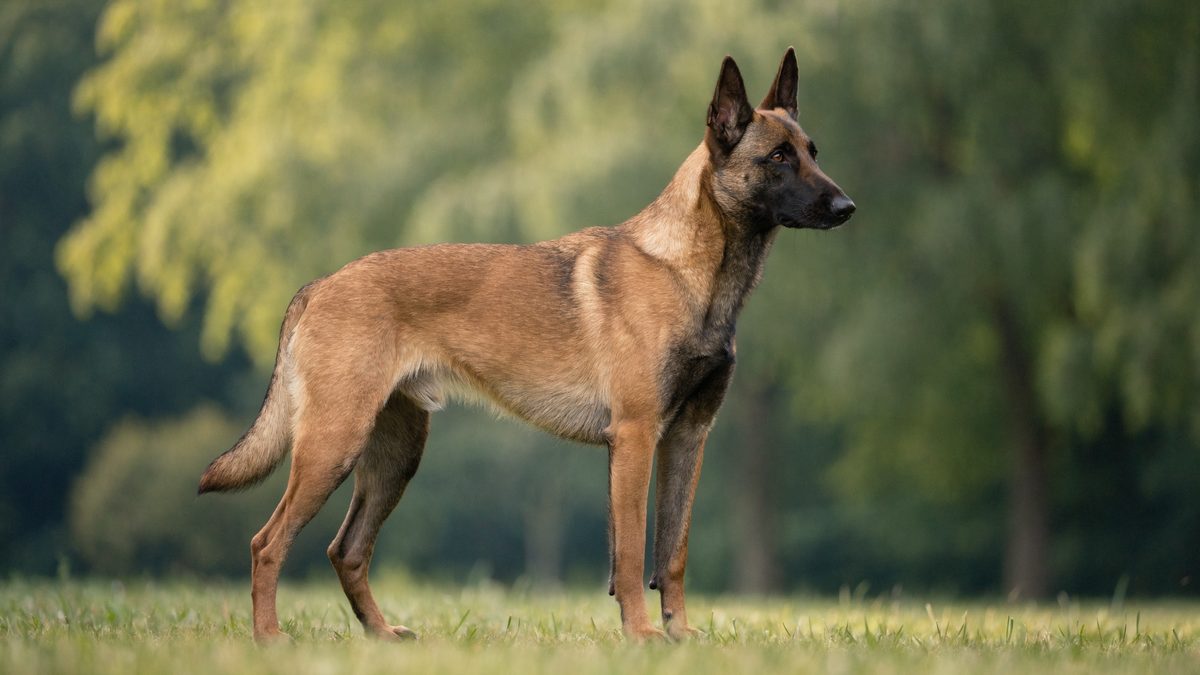
- Malinois. Short hair, very short on the head, outer ears and lower legs, with a ruff at the neck. Fawn with black overlay and a black mask, and no other colour permitted.
- Tervueren. Long hair. Fawn with black overlay or grey with black overlay, with a black mask, and the fawn is preferred.
- Groenendael. Long hair. Uniform black only.
- Laekenois. Rough, dry, tousled hair about 6 cm long over the body. Fawn with traces of black overlay, mainly on the muzzle and tail. It is the rarest of the four.
The names are geographic. The first breed club formed in Brussels in 1891, and Professor Adolphe Reul of the Cureghem veterinary school examined 117 examples of the breed and classified the varieties by the area of Belgium each came from. The FCI dates the breed's official birth to between 1891 and 1897, records the Cureghem gathering on 15 November 1891, and notes the first detailed standard on 3 April 1892 with one breed and three coat varieties allowed. The Laekenois takes its name from the Chateau of Laeken, a royal residence whose occupant, Queen Marie Henriette, favoured that variety.
The Malinois in numbers, and where the standards disagree
Two registries publish size figures for the same dog and they do not match, particularly on weight. Bonbeno prints both rather than averaging them, because the gap is large enough to change what you think a correct adult should look like.
| Measure | FCI Standard No. 15 | AKC Belgian Malinois standard |
|---|---|---|
| Male height | 62 cm ideal, 60 to 66 cm allowed | 24 to 26 in, roughly 61 to 66 cm |
| Female height | 58 cm ideal, 56 to 62 cm allowed | 22 to 24 in, roughly 56 to 61 cm |
| Male weight | About 25 to 30 kg | 60 to 80 lb, roughly 27 to 36 kg |
| Female weight | About 20 to 25 kg | 40 to 60 lb, roughly 18 to 27 kg |
| Body proportion | Fits into a square | Length equals height, silhouette approximates a square |
Heights agree closely American Kennel Club. Weights do not. The top of the AKC male range is 36 kg against the FCI's 30 kg American Kennel Club, a six kilogram spread on a dog whose standard demands bone that is solid but not heavy and muscle that is dry and strong. If a seller in India shows you a 38 kg male and calls him a large Malinois, he is outside both standards. Indian listings add their own numbers, one quoting 24 to 29 kg and another 29 to 34 kg for males Tradeindia, Belgian Malinois Breed Dog, which tells you the market is not working from any single standard at all.
Black belgian malinois price in india is a live Google India related search, and one B2B listing for the breed prints Colour: Black on its own specification table while its description text says fawn. Under FCI-Standard No. 15 the Malinois is fawn with black overlay and a black mask, and any colour outside the described varieties is a disqualifying fault. A uniformly black long-coated Belgian Shepherd is a Groenendael. A black short-coated dog sold to you as a Malinois is either mislabelled or not what the seller says it is.
Two other points in the standard matter for anyone who is really cross-shopping this dog against a German Shepherd. The Belgian Shepherd is built to fit into a square, with the upper line of back and loins straight and the croup only very slightly sloping. The AKC standard says the same thing in movement terms: the topline remains firm and level, parallel to the line of motion. That level topline is the quickest way to tell a Malinois from a German Shepherd across a room. India's own official description of the breed, in the CRPF's draft buying specification for breeding stock, requires a body that is lean and muscular with a back that must be straight without any apparent defect, and a body that should be square. If the dog in front of you has a visibly sloped, roached rear end, you are looking at a different breed or a crossbred.
Temperament is written into the standard as tightly as structure is. The FCI calls the Belgian Shepherd watchful and active, bursting with energy, with a confident nature showing no fear or aggressiveness, and then makes aggressive or timid specimens a disqualifying fault. The AKC standard repeats it: displays of fear or aggression are to be severely penalised. This matters in India, where the breed is being marketed on exactly the trait its own standard disqualifies.
Belgian Malinois price in India
A Belgian Malinois puppy is quoted between Rs 26,700 and Rs 1,50,000 in India in 2026, depending entirely on which page you read. The published sources disagree by more than Rs 1,20,000 for the same breed, and not one of them shows its working. Bonbeno prints all four bands side by side so you can see the spread instead of a single confident number.
Every figure below was read off the page that publishes it, on 16 August 2026. Three of the four sellers also broker puppy sales, which is a commercial interest in the number and is disclosed here because none of them discloses it.
| Source | Published range | Detail given |
|---|---|---|
| Mr n Mrs Pet | Rs 70,000 to Rs 1,50,000+ | Basic Rs 70,000 to Rs 90,000, KCI registered Rs 90,000 to Rs 1,20,000, champion bloodline Rs 1,20,000 to Rs 1,50,000 |
| Marshalls Petzone | Rs 73,000 to Rs 75,000 | One flat band for all of India, no tiers |
| Supertails dog price list | Rs 30,000 to Rs 1,00,000 | Listed as Malinois (Belgian), size Large, popularity 2 of 5 |
| Nearby Pets India, Mumbai Suburban | Starting at Rs 26,700 | City-level listing with a 7-day health guarantee and doorstep delivery |
| Puppiezo | Not published | States only that prices depend on pedigree, breed and location |
Read the table properly and two things jump out. The floor and the ceiling are more than five times apart, which is not a market with a consensus price. And the two pages that give the most granular tiers are the two that most want to sell you a puppy today.
The Malinois costs three to four times a German Shepherd from the same seller
The cleanest comparison available is a single seller pricing both breeds on the same site on the same day. Marshalls Petzone quotes the Belgian Malinois at Rs 73,000 to Rs 75,000 and the German Shepherd at Rs 18,000 to Rs 25,000. Supertails puts the Malinois at Rs 30,000 to Rs 1,00,000 and the German Shepherd at Rs 20,000 to Rs 75,000. Bonbeno's own published German Shepherd guide records an India-wide band of Rs 18,000 to Rs 2,00,000 for that breed, so the two overlap at the top but the Malinois floor sits far higher.
The reason is supply, not merit. Supertails rates the Malinois 2 of 5 for popularity against 5 of 5 for the German Shepherd, the Labrador Retriever and the Golden Retriever. Fewer litters, more demand created by military footage, and a price that reflects scarcity. You are paying a rarity premium on a working dog, not buying a better-bred one.
What KCI registration does and does not buy you
KCI registration documents parentage and nothing else. The Kennel Club of India registered 32,219 puppies with its studbook in 2025 against 53,890 in 2020 and a peak of 88,261 in 2021, so registration volume has fallen sharply while the pet market has not. One ranking page states the position correctly and it is worth repeating: what KCI registration does not guarantee is freedom from genetic disease, and buyers of large breeds should ask for hip scores separately.
The premium attached to the KCI tier is real money. One seller prices a KCI-registered Malinois at Rs 90,000 to Rs 1,20,000 against Rs 70,000 to Rs 90,000 for a basic pet-quality dog, a jump of roughly Rs 20,000 to Rs 30,000 for a certificate that says who the parents were. Screening paperwork costs the breeder more and is worth more to you. Insist on both.
Checking the paperwork is easy and almost nobody does it. The Kennel Club of India publishes its own forms openly, including litter registration, single dog registration, transfer of ownership and the annual return, along with a revised tariff sheet. Ask which form the litter was registered on and ask for the transfer of ownership to be completed in your name, not left pending. On India's oldest breeder directory, listings for this breed routinely advertise KCI certificates, import lines and champion sires, with sellers in Chennai, Coimbatore, Coorg, Hyderabad, Bangalore, Delhi and Walajabad. Advertising a certificate and producing one are different acts.
Working line claims, and how to price them
The phrase working line is doing heavy lifting in Indian listings and almost never carries evidence. A genuine working pedigree has documentation you can inspect. India's own state buyers demand exactly that. The CRPF's draft qualitative requirements for Belgian Shepherd (Malinois) breeding stock require registration with the Kennel Club of India or an FCI member, or with KNPV, Schutzhund, IPO or IGP for imported dogs, plus a microchip and a pedigree covering the last three generations. If a seller quotes you a working-line premium and cannot produce a titled ancestor or a screening record, the premium is a story.
Under the Prevention of Cruelty to Animals (Dog Breeding and Marketing) Rules 2017, no breeder may carry on breeding or sale without a certificate of registration from the State Animal Welfare Board, and that certificate must be prominently displayed at the establishment. Pups under eight weeks of age must not be sold, every pup must be micro-chipped before sale, and the breeder must give the purchaser written details of feeding, vaccination and deworming dates plus the name and address of the attending veterinary practitioner. The rules also require the breeder to screen prospective purchasers to ascertain their potential to take proper care of the breed, especially if it is a large one, and to meet its grooming, socializing, spatial and veterinary needs. A seller who asks you nothing about your home is not following the rules for this breed.
One more oddity from the search results. A Government e-Marketplace listing for a police puppy of Belgian Shepherd (Malinois) type sits inside the top ten Google India results for this query. Bonbeno could not load that page to verify anything on it, so no figure from it appears anywhere on this page. It is recorded in the competitor list and nowhere else.
Bonbeno does not broker puppy sales, does not publish breeder listings and does not take a commission on any figure above. These are reported prices from third parties, printed together so the disagreement is visible.
Monthly cost of keeping a Belgian Malinois in India
Budget Rs 8,000 to Rs 14,000 a month for a large working dog in India, and treat professional training as a line item rather than an optional extra. The two published Indian monthly cost figures for this breed differ by a factor of two, and the lower one comes from a page whose own text is a copy-paste template.
The most detailed Indian cost breakdown by dog size puts a large breed at Rs 8,000 to Rs 14,000 a month and a first-year total, including purchase, vaccinations, food, training and supplies, at Rs 80,000 to Rs 2,00,000. A page that sells Malinois puppies says monthly expenses for this breed run Rs 3,000 to Rs 7,000, and then adds the sentence that Belgian Malinoiss typically cost less to maintain than Standard ones, which is template text left over from another breed. Bonbeno reports both and does not average them.
| Line item | Large breed, monthly |
|---|---|
| Dry or wet food | Rs 4,000 to Rs 6,000 |
| Routine vet visits | Rs 1,000 to Rs 2,000 |
| Vaccinations | Rs 1,800 a year |
| Grooming | Rs 500 to Rs 1,200 |
| Training, over six months | Rs 3,000 to Rs 8,000 |
| Treats and toys | Rs 600 to Rs 1,200 |
| Flea control and deworming | Rs 500 to Rs 800 |
| Monthly total | Rs 8,000 to Rs 14,000 |
Those figures are for a generic large breed. Four Malinois-specific costs sit outside that table and none of the ranking pages price them.
- Professional training, not a six-month course. The parent club says the Malinois is generally not a dog for the novice owner, is extremely trainable, and does not do well with poor or insufficient training. Budget for an experienced trainer across the first two years, not a puppy class and done.
- Cooling through eight months of the year. A dog that cannot be walked between roughly 9 am and 7 pm for a large part of the Indian year needs indoor space that stays usable. Fans, cross-ventilation or air conditioning are a running electricity cost, not a one-off purchase.
- Secure containment. This is an athletic dog that clears obstacles for sport. Gate height, balcony grilles and a front door your dog cannot bolt through are real spending.
- Replacement of destroyed property. An under-exercised working dog chews. Budget for it honestly in the first eighteen months rather than being surprised.
What Bonbeno cannot tell you
No published Indian dataset gives breed-specific running costs for the Belgian Malinois. There is no Indian veterinary insurance claims series broken out by breed, no shelter intake data by breed, and no survey of Indian Malinois owners. Every monthly figure on every page ranking for this query, including the two quoted above, is an estimate made by a retailer. Treat them as order-of-magnitude guidance and price your own city, your own vet and your own trainer before you commit.
At the middle of the published range, a Malinois bought for Rs 90,000 will cost roughly Rs 11,000 a month to keep. Over a conservative ten-year life that is about Rs 13,20,000 in running costs against Rs 90,000 to acquire. The purchase price is under 7 percent of what you will actually spend. Deciding this breed is affordable because you can find the deposit is the wrong calculation.
Climate suitability: why heat tolerance is rated 2 of 5
The Belgian Malinois carried an odds ratio of 24 for heat stroke in the largest referral series that reports breed odds, the highest of any breed in that study, and 63 percent of those cases were exertional rather than environmental. The risk does not come from the coat. It comes from a dog that will keep working past the point where its own body tells it to stop, which is precisely the wrong trait to bring into an Indian summer.
Bruchim and colleagues reviewed 54 dogs presented to the Hebrew University Veterinary Teaching Hospital with heat stroke between 1999 and 2004, in a country with a hot, dry summer that resembles north-western India more than it resembles Belgium. The findings are specific and they are uncomfortable reading for anyone buying this breed in Chennai or Nagpur.
| Group | Share of cases | Odds ratio | 95% confidence interval |
|---|---|---|---|
| Belgian Malinois | 15% | 24 | 8.2 to 64.5 |
| Golden and Labrador Retrievers | 21% | 2.08 | 0.95 to 4.2 |
| Brachycephalic breeds | 25% | 1.7 | 0.81 to 3.21 |
| Small breeds under 8 kg | 2% | 0.08 | 0.002 to 0.48 |
Read the confidence intervals, not just the point estimates. The Malinois interval runs from 8.2 to 64.5 and never touches 1, so the effect is statistically solid even in a small sample. The retriever and brachycephalic intervals both cross 1, meaning those groups were over-represented but not significantly so in this particular study. The breed most Indian owners worry about, the flat-faced dog, was not the breed most at risk here. The athletic one was.
The mechanism is drive, not coat
In that series, 63 percent of cases were exertional heat stroke and 37 percent were environmental. Exertional means the dog overheated while working or playing, not while shut in a car or a hot room. This is the whole problem with the Malinois in India. Purina India's own guidance sorts heat risk by anatomy, naming short-faced breeds such as Boxers, Bulldogs, Pugs and Pekingese, and heavy-coated dogs such as Huskies and Newfoundlands, as the ones at particular risk. A short-coated, lean, medium-sized dog fails to trip any of those flags. The rubric that most Indian consumer advice uses would file the Malinois as low risk, and the evidence says the opposite.
Purina India does list the factors that actually apply to this breed, further down the same page: intense exercise, excessive humidity, obesity and lack of acclimatisation, with the warning that a dog can develop heat stroke in as little as 30 minutes of vigorous exercise in hot weather. Thirty minutes is one enthusiastic fetch session.
What the largest population study can and cannot tell you
Hall and colleagues examined the clinical records of 905,543 UK dogs under primary veterinary care in 2016 and identified 395 confirmed heat-related illness events, an incidence of 0.04 percent with an event fatality rate of 14.18 percent. That study reported breed odds ratios against the Labrador Retriever, with the Chow Chow at 16.61, the Bulldog at 13.95, the Greyhound at 4.26, the Golden Retriever at 2.65 and the German Shepherd Dog at 0.92, which was not significant. The Belgian Malinois does not appear in that table at all. There were too few of them in the UK population to meet the study's threshold for a named breed category, so they were folded into other purebred. Hall's own text records the Malinois risk by citing the Israeli work rather than by measuring it.
Bonbeno states this plainly rather than dressing it up. The strongest quantified heat-stroke risk figure for this breed comes from a 54-dog referral series, which is a small sample from one hospital. The largest population study of heat-related illness in dogs could not produce a Malinois estimate at all. No Indian dataset exists. What you have is one strong, statistically significant signal from a hot country, a plausible mechanism, and no contradicting evidence. That is enough to plan around. It is not enough to call settled.
The Indian problem is the night, not just the afternoon
Standard advice tells you to exercise a dog in the early morning and the late evening. Indian summers break that advice. In May 2026 the India Meteorological Department issued heatwave warnings for Punjab, Haryana, Uttar Pradesh, Madhya Pradesh, Rajasthan and the Vidarbha, Central Maharashtra and Marathwada regions, with maximum temperatures forecast to reach 45 degrees Celsius and Delhi-NCR sitting at 42 to 44. Crucially, it also issued a warm night warning with an orange alert for western Rajasthan and western Uttar Pradesh. A warm night is a night that does not cool down. It removes your evening window.
| Where you are | The binding constraint | What it means in practice |
|---|---|---|
| Delhi NCR, Jaipur, Lucknow, Chandigarh | 42 to 45 C days, warm-night alerts in peak weeks | Dry heat, but the night window closes during heatwaves. Plan indoor work for four to six weeks a year |
| Mumbai, Chennai, Kochi, Kolkata | Humidity, which blocks evaporative cooling | Lower peak temperatures, worse effective heat load. The dog cools poorly even at 33 C |
| Nagpur, Bhopal, Vidarbha, Marathwada | Severe heatwave orange alerts | The harshest combination in the country for this breed |
| Bhubaneswar, coastal Andhra Pradesh | Hot and humid conditions flagged together | Short sessions only, and watch for panting that does not settle |
| Bengaluru, Pune, Hyderabad | Moderate, with a hot March to May | The most workable Indian cities for a Malinois, and still not easy |
How to cool a Malinois, and the 90-minute rule
Learn the emergency protocol before you need it. A rectal temperature of 40.5 degrees Celsius or above is the threshold Purina India flags, alongside severe panting, difficulty breathing, heavy salivation, vomiting, diarrhoea, blood in the urine, nose bleeds and eventual collapse. To cool the dog, move it out of the heat, spray or sponge cool but not cold water so it reaches the skin on the belly and inside the legs, use a fan, and stop at 39.4 degrees to avoid overshooting into hypothermia. Never plunge a hot dog into an ice bath, because that prevents the core temperature coming down.
In the Israeli series, overall mortality was 50 percent, and delayed admission beyond 90 minutes was a statistically significant risk factor for death, alongside seizures, obesity, hypoglycaemia below 47 mg/dL and a creatinine above 1.5 mg/dL at 24 hours. Disseminated intravascular coagulation was diagnosed in 28 of the 54 dogs and acute renal failure in 18, and both predicted death. Know which clinic near you is open at 2 pm on a Sunday in May, and know how long it takes to get there, before you buy this breed.
Bonbeno rates the Belgian Malinois 2 of 5 for heat tolerance. It is not a 1, because the short coat and lean build genuinely shed heat better than a Siberian Husky's double coat does. It is not higher, because the coat is not the risk. The dog's own willingness to keep going is.
Temperament and household fit
Correct Belgian Malinois temperament runs from bold and friendly to reserved and aloof with strangers, and never into fear or aggression. What makes the breed hard in a home is not hostility. It is intensity, low impulse control and a total intolerance of being left alone.
Start with what the registries require, because Indian marketing has drifted a long way from it. The FCI describes a watchful, active dog bursting with energy and always ready to leap into action, with a lively temperament and a confident nature showing no fear or aggressiveness, and then lists aggressive or timid specimens among the disqualifying faults. The AKC standard says the correct dog is alert, intelligent, inquisitive and confident, showing neither fear nor aggression, and that displays of either are to be severely penalised. The parent club adds the distinction that matters most: aloofness is very different from a fearful or aggressive temperament, which is always incorrect, and a dog that snaps, growls, backs away or bolts is displaying undesirable behaviour that should never be rewarded.
The peer-reviewed evidence, and the claim it does not support
Indian coverage of this breed leans on a Finnish cognition study. The Times of India reported that scientists at the University of Helsinki studied more than 1,000 dogs across 13 breeds and that, ranked on three traits, the Malinois came first with 35 points out of a maximum of 39. That ranking came from a newspaper, not from the paper. The published study, by Junttila and colleagues in Scientific Reports, found significant breed differences in five of seven cognitive tests and reports something rather different about the Malinois.
- Best in class at reading people. The Kelpie and the Malinois had the highest scores in the gesture tests, which measure how well a dog follows human communicative signals.
- Among the worst at impulse control. In the cylinder test, which measures inhibitory control, the Malinois and the German Shepherd were some of the lowest-scoring breeds, while the Border Collie and Australian Shepherd were among the highest.
- Most likely to solve it alone. The two breeds most likely to be completely independent during the unsolvable task, spending zero percent of their time on human-directed behaviour, were the German Shepherd and the Malinois.
- No difference at all on memory or reasoning. The study found no significant breed differences for short-term memory or logical reasoning.
Read together, that is a dog which is superbly tuned to its handler and poor at stopping itself. For a police handler working the dog daily, that combination is the point. In a flat in Andheri with an owner who is out for eleven hours, low inhibitory control is not a talent. It is the reason the sofa is gone.
One caveat that the paper raises itself and that no Indian page repeats. Police dogs made up 45 percent of the Malinois sample, and when the authors removed them, the proportion of completely impulsive, fully independent Malinois in the unsolvable task fell from 14.6 percent to 7.7 percent and the breed difference on that measure stopped being significant. Training history shapes the picture. It does not erase it, because scores on the other measures barely moved.
Even the Indian Army found this breed difficult once
The strongest evidence that the Malinois is not an easy dog comes from the organisation Indians most associate with it. An Indian Army spokesperson, quoted in the Times of India, said the breed was first deployed in 1999, phased out because of its aggressive nature, and reintroduced into the Indian Army only in 2019. A professional handler corps with veterinary support, purpose-built kennels and full-time trainers took the dog out of service for two decades and then brought it back with a different programme. That is the benchmark against which a first-time owner in a two-bedroom flat should measure themselves.
The forces that do use it use it heavily. A CRPF officer told the same paper that 90 percent of dogs in the CRPF are Belgian Malinois, that these dogs detected roughly 250 improvised explosive devices over nine to ten years, and that the force has not purchased a German Shepherd in a decade. Working suitability and pet suitability are different questions, and the Indian market keeps answering the second with evidence for the first.
Who should not buy a Belgian Malinois
The parent club gives the clearest test, and it is not subtle. If you often work extended hours, must travel frequently, or have other activities that often keep you away from your dog, then this is definitely not the breed for you. It also says the Malinois is generally not a dog for the novice dog owner, because while it is extremely trainable, it does not do well with poor or insufficient training.
- A first dog. Skip it. Come back after you have raised something easier for ten years.
- An apartment with no ground-floor access. The Royal Kennel Club specifies a large house and a large garden for this breed. An Indian apartment with a lift and a shared park is the opposite of that.
- A household out of the house all day. Separation is the single most reliable way to create problem behaviour in this breed.
- A family buying a guard dog on the strength of a video. The dog you saw was handled by a professional and worked daily. Aggression is a disqualifying fault in the standard, not a feature you are purchasing.
- A home with toddlers and no second adult. The club rates the breed good with children, particularly if raised with them, and then warns that this is a relatively large, very active, very quick-to-respond dog that should never be left unsupervised with very small or unruly children.
An experienced owner with a real activity to share, a house with secure outdoor space, a working-hours pattern that keeps someone home, and access to a trainer who has handled the breed before. Malinois excel at obedience, tracking, agility, flyball, herding, search and rescue, and are described by professional trainers as having high play drive, which means everything is a game to them. Give the dog a sport and it thrives. Give it a balcony and it does not.
One structural quirk worth knowing before you bring one home. The FCI notes that because of its exuberant character and its desire to guard and protect, the Belgian Shepherd has a definite tendency to move in circles. Combine that with a herding breed's high prey drive, which the AKC warns leads to chasing children, vehicles and other animals unless redirected into acceptable activities, and you have a dog that circles and chases moving things in a country full of two-wheelers and street cricket. That is a management problem from day one, not a fault in the dog.
Training a Belgian Malinois
To train a Belgian Malinois, use reward-based methods from the first week, open the socialisation window before twelve weeks of age, and plan on daily structured work for at least two years. India's own police handlers run this breed on rewards alone, and the parent club warns that harsh corrections combined with poor technique are how owners get into trouble with it.
The Indo-Tibetan Border Police trains Belgian Malinois at its Panchkula centre on a stated doctrine of only rewards, no punishment. If the dog performs well it receives a reward, and if it does not, the reward is taken away. The dog gets the message without being punished for failing the task. A notice board at the same centre reads: train yourself before you attempt to train a dog. If the force that deploys these dogs on operations does not need aversives, neither do you.
The parent club explains why the breed punishes bad handling so quickly. First-time Malinois owners are often amazed at how quickly these dogs learn and how sensitive they are to corrections, and those same traits get them into trouble when an owner fails to take the time to train properly or combines harsh corrections with poor training techniques. A sensitive, fast-learning dog learns the wrong lesson just as fast as the right one.
The socialisation window closes early, and it is the highest-value work you will do
The American Veterinary Society of Animal Behavior states that the first three months is the most important socialisation period in a puppy's life, and that puppies should receive socialisation before they are fully vaccinated, treating it as the standard of care rather than an optional extra. Enrolling in puppy classes prior to three months of age is recommended as a way to improve training, strengthen the human-animal bond and socialise puppies in an environment where illness risk is minimised. Each puppy should be vaccinated to date and free of disease and parasites before joining a class, and classes should be held on surfaces that can be cleaned rather than at dog parks or heavily trafficked areas of unknown vaccination status.
That last point is the practical one for India, where community dog density is high and parvovirus is endemic in many cities. The answer is a clean indoor class, not zero socialisation. A Malinois that misses this window becomes a suspicious, reactive adult, and the standard treats a timid dog as a disqualifying fault for good reason.
The AVSAB statement recommends scheduling time for puppies to play alone with favourite toys such as stuffed food toys, or to nap in safe places such as crates or puppy pens, because this teaches puppies to amuse themselves and may help prevent problems of over-attachment to owners. Continuing to offer a wide variety of experiences through the first year also helps prevent separation-related behaviour. With a breed the parent club says is wrong for anyone frequently away from home, deliberate alone-time practice from week nine is not optional.
Train impulse control explicitly, because the breed does not bring much
The Junttila study found the Malinois among the lowest-scoring breeds on the cylinder test of inhibitory control. That is a training brief, not a verdict. Build stop-and-wait behaviour into everything: a settle on a mat, a wait at doorways, a release word before food, an interrupted game that resumes on cue. The same study found the Malinois among the best breeds at following human gestures, so the raw material for handler focus is there. You are not fighting the dog. You are supplying the brake it was not selected for.
| Age | What you work on | What good looks like |
|---|---|---|
| 8 to 12 weeks | Socialisation to people, surfaces, traffic noise, indoor puppy class, crate and alone-time | Confident, curious, recovers quickly from novelty |
| 3 to 6 months | Name response, recall on a long line, loose-lead walking, settle on a mat, handling for vet exams | Comes back at 10 metres, can lie down for 5 minutes with you in the room |
| 6 to 12 months | Impulse control drills, structured games, adolescent recall rebuild, first scentwork or tracking | Recall survives distraction, chasing is interruptible |
| 12 to 24 months | Sport or job selection, off-lead reliability in known spaces, real endurance work | The dog has an outlet it looks forward to on a schedule |
| 2 years onward | Maintenance, new skills, seasonal load management | The dog is calm indoors because it is satisfied, not because it is tired |
Protection sport, and what Indian law says about the line you must not cross
Protection work is a legitimate professional discipline. The Malinois competes in Schutzhund and other protection sports, alongside obedience, tracking, agility, flyball, herding and search and rescue, and the internationally recognised titles named in India's own government buying specification, KNPV, Schutzhund, IPO and IGP, are protection-sport qualifications. If that is what you want to do with your dog, work with a qualified club or a trainer with verifiable credentials in that sport. Bonbeno does not publish protection-training instructions and will not, because bite work taught badly produces a dangerous dog and an injured owner.
Section 11 of the Prevention of Cruelty to Animals Act 1960 makes it an offence, where done solely with a view to providing entertainment, to incite any animal to fight or bait any other animal, and a separate offence to organise, keep, use or act in the management of any place for animal fighting, or to permit or offer any place to be so used, or to receive money for admission to such a place. The same section makes it an offence for an owner to neglect to exercise, or cause to be exercised reasonably, any dog habitually chained up or kept in close confinement. Both matter for this breed. Anyone offering to make your Malinois fight is proposing a crime, and anyone keeping one permanently chained on a terrace is committing one.
What the breed resists is dullness and absence. It does not resist you. Repetitive drilling with no reward, days with no work and long stretches alone will produce a Malinois that invents its own job, and the job it invents will be one you do not want. The FCI's phrase for the dog, always on the move and seemingly tireless, is a warning as much as a compliment.
How much daily exercise a Belgian Malinois actually needs
The Royal Kennel Club puts the Belgian Shepherd Dog (Malinois) at more than two hours of exercise per day, in a large house with a large garden. Indian ranking pages say one to two hours. The registry figure is the one to plan around, and in most Indian cities you have to fit it into two narrow windows at either end of the day.
| Source | Requirement stated | Living space stated |
|---|---|---|
| Royal Kennel Club | More than 2 hours per day | Large house, large garden |
| Puppiezo, India | 1 to 2 hours daily | Medium to large |
| American Kennel Club | No hour figure. Daily walks are not enough | Not a dog who can be left in the backyard |
| American Belgian Malinois Club | No hour figure. High play drive, everything is a game | Wrong breed if you are often away |
The AKC's phrasing is the most useful of the four because it refuses to give you a number to tick off. Highly intelligent, athletic and muscular, the Malinois needs to be actively engaged with its owner both mentally and physically. This is not a dog who can be left in the backyard, and daily walking is not enough either. Two hours of lead walking around a Gurugram sector does not satisfy this breed. Two hours that includes tracking, retrieving with rules, a training session and a real run does.
The Indian day, worked out honestly
Run the arithmetic. You need more than two hours. For roughly four to six months of the year across most of northern and central India, the usable outdoor window is before about 7 am and after about 8 pm, because daytime maxima sit at 42 to 45 degrees Celsius during heatwave spells. During a warm-night orange alert, which the IMD issued for western Rajasthan and western Uttar Pradesh in May 2026, the evening window shrinks too. That leaves you doing 75 minutes at dawn and 60 minutes late at night, every day, in the heat season, for the life of the dog.
- Before 7 am. The long session. Running, a proper off-lead space if you have one, tracking work laid the night before.
- Midday. Indoors and low-arousal. Food puzzles, a chew, a short shaping session on a mat. No fetch.
- After 8 pm. The second session, plus obedience and impulse-control work while the pavement has cooled.
- Through the day. Two or three five-minute training bursts. Short and frequent beats one long block for a dog this reactive to handler attention.
In the Israeli heat stroke series, 63 percent of cases were exertional rather than environmental, and Purina India warns that a dog can develop heat stroke in as little as 30 minutes of vigorous exercise in hot weather. A Malinois will not self-limit. It will bring the ball back until it collapses, because bringing the ball back is the most interesting thing that has happened all day. In summer, replace high-arousal repetitive retrieving with scentwork, which loads the brain without loading the thermoregulatory system.
What happens if you do not do this
The AKC states the failure mode plainly: problems set in when this people-oriented dog is underemployed and neglected. In practice that means destroyed furniture, barking that your neighbours will complain about, escape attempts, and redirected chasing of children, vehicles and other animals, which the AKC names as the specific expression of an unmanaged herding prey drive.
There is also a legal floor in India that owners of this breed should know. Section 11 of the Prevention of Cruelty to Animals Act 1960 makes it an offence for an owner to neglect to exercise, or cause to be exercised reasonably, any dog habitually chained up or kept in close confinement. Keeping a working dog on a short chain on a terrace because it is too hot to walk it is not a workaround. It is the thing the statute names.
Good outlets for this breed in Indian conditions
- Scentwork and tracking. Low heat load, high mental load, and the breed is bred for it. The best single answer to an Indian summer.
- Agility and flyball, where clubs exist. The Malinois excels at both.
- Herding, obedience and rally, all listed among the activities the breed is built for.
- Cycling or running with you, but only in the cool windows. The AKC names Malinois as great running, hiking and biking companions, which is true in Belgium and conditional in Bhopal.
- Structured tug with a clear start and stop. It burns energy and it teaches the release cue that low inhibitory control makes essential.
Grooming a short coat in Indian humidity
Brush a Belgian Malinois once or twice a week with a bristle brush, bathe it only when it is actually dirty, and never have it trimmed or shaved. The AKC standard states the position directly: the Belgian Malinois is a natural breed and there is no need for excessive grooming.
The coat is short, straight and hard enough to be weather resistant, with a dense undercoat, very short on the head, ears and lower legs, and slightly longer around the neck where it forms a collarette and on the tail and backs of the thighs. The FCI adds that in all four varieties the hair must always be dense, close-fitting and of good texture, with the woolly undercoat forming an excellent protective covering. India's own state buying specification describes the target coat as dense, short, flat, straight, shiny and healthy, which is a usable visual checklist when you are looking at a puppy.
The page currently sitting first in Google India for this query tells buyers that Belgian Malinois have dense, curly coats that need trimming every four to six weeks to prevent matting. That is false for this breed. A wavy coat is listed as a fault in the Malinois under FCI-Standard No. 15, hair that is too long, silky or wiry is a fault under the AKC standard, and there is nothing on a correct Malinois to trim American Kennel Club. If a groomer in India offers you a four-to-six-week trimming schedule for a Malinois, they are selling you a service the dog does not need and a haircut that will damage the coat.
It is a double coat, even though it does not look like one
This is the point most owners miss. The undercoat is not optional equipment. Lack of undercoat is a disqualifying fault in all four varieties under the FCI standard, and insufficient undercoat is a fault. The AKC standard likewise faults a coat without enough undercoat to form a double coat. A Malinois that looks smooth from three metres away is carrying a woolly layer underneath, which is why it sheds far more than its outline suggests and why shaving it in summer removes insulation that works in both directions.
Published Indian descriptions disagree on how much it sheds, and the disagreement is worth seeing. The Royal Kennel Club rates grooming at more than once a week, coat length medium, and sheds yes. An Indian retail listing calls the same dog a light shedder with a soft, shorthaired coat that is easy to groom. Bonbeno's reading is that both are describing something real. The guard hairs are short, so the hair is less visible on your floor than a Golden Retriever's, and the undercoat still comes out in quantity twice a year and works itself into upholstery.
A workable routine for Indian conditions
- Brush twice a week with a bristle brush, and daily during the two seasonal coat drops. Bathing is required only when genuinely necessary.
- Dry the dog properly after monsoon walks. A dense undercoat that stays damp in 85 percent humidity is how hot spots and bacterial skin infections start. Towel to the skin, not just the surface.
- Check ears weekly. The AKC recommends checking ears regularly for signs of infection and brushing teeth frequently for this breed. Erect ears drain better than drop ears, which helps, but Indian humidity does not.
- Run a tick check after every outdoor session from the monsoon through winter, working through the ruff at the neck and the backs of the thighs where the hair is longest.
- Trim nails on a schedule. Strong, fast-growing nails should be trimmed regularly with a clipper or grinder to avoid overgrowth, splitting and cracking, which the AKC advises across the Belgian varieties.
Colour does not change the routine. A correct Malinois is rich fawn to mahogany with black-tipped hairs giving an overlay, a pronounced black mask that takes in the lips and eyelids, and black-appearing ears, with white permitted only as toe tips and a small spot on the breastbone. Nobody needs to do anything to the coat to produce that. If a seller is describing colour maintenance, they are describing a different dog.
Health risks, screening and lifespan
The Belgian Malinois has a genuinely good orthopaedic record, and it beats the German Shepherd on every joint measure the Orthopedic Foundation for Animals publishes. Set against that, the two serious health issues attached to the name Belgian Shepherd, idiopathic epilepsy and stomach cancer, come from the long-haired varieties rather than from the Malinois, and repeating them as Malinois risks is a mistake almost every page makes.
The orthopaedic comparison with the German Shepherd, which is real and checkable
This is the strongest health argument for the breed and no Indian page publishes it. OFA maintains cumulative breed statistics from submitted evaluations, with the breed name printed on each row, and the Belgian Malinois sits far down the risk ranking on hips and elbows while the German Shepherd Dog sits near the top.
| Breed | Hips evaluated | Dysplastic % | Elbows evaluated | Abnormal % | Eyes evaluated | Abnormal % |
|---|---|---|---|---|---|---|
| German Shepherd Dog | 146,632 | 20.4 | 68,106 | 18.7 | 2,738 | 7.6 |
| Belgian Malinois | 6,820 | 5.0 | 5,512 | 8.8 | 2,696 | 3.0 |
| Belgian Laekenois | 201 | 4.5 | 192 | 18.2 | 191 | 5.2 |
| Belgian Tervuren | 7,984 | 3.2 | 5,270 | 5.8 | 5,197 | 5.2 |
| Belgian Sheepdog (Groenendael) | 5,235 | 3.1 | 2,969 | 6.4 | 2,565 | 5.0 |
| Labrador Retriever, for scale | 324,584 | 11.3 | not compared here | not compared here | not compared here | not compared here |
A hip dysplasia rate of 5.0 percent across 6,820 evaluated Belgian Malinois against 20.4 percent across 146,632 German Shepherd Dogs is a four-fold difference on very large samples. On elbow dysplasia the gap is 8.8 percent against 18.7 percent. Bonbeno's published German Shepherd guide records Swiss screening data showing German Shepherd hip dysplasia falling from 46.2 percent in 1995 to 1999 down to 18.0 percent in 2010 to 2016, which lines up closely with the OFA figure above and tells you the German Shepherd number is genuine rather than an artefact of one database.
Degenerative myelopathy shows the same pattern. Of 18,122 German Shepherd Dogs tested for the SOD1 variant, 56.1 percent were clear, 29.1 percent were carriers and 14.8 percent were at risk. Of 309 Belgian Malinois tested, 87.1 percent were clear, 10.0 percent were carriers and 2.9 percent were at risk. Bonbeno's German Shepherd page reports a SOD1 risk-allele frequency of 0.38 in a UK referral population, which is consistent with the OFA proportion.
OFA data comes from voluntary submissions, so owners who already suspect a problem are less likely to send films in, and every breed's true rate is worse than its published rate. That bias applies to both breeds here, which is why Bonbeno treats the comparison as sound and the absolute levels as optimistic. The Malinois sample is also far smaller, 6,820 hip evaluations against 146,632, so the German Shepherd figure is the more precisely measured of the two.
Other OFA readings for the Malinois are unremarkable in the good sense. Patella evaluations came back 100 percent normal across 268 dogs, thyroid 89.8 percent normal across 236, and advanced cardiac 87.6 percent normal with 4.5 percent abnormal across 89 dogs. Those cardiac and thyroid samples are small enough that Bonbeno would not lean on them.
Epilepsy belongs to the long-haired varieties, not the Malinois
The Belgian Shepherd is one of the most intensively studied breeds in the whole field of canine epilepsy, with ten separate studies behind it, and the International Veterinary Epilepsy Task Force records those studies as concerning mainly the Groenendael and Tervueren variants. The figures are serious.
- Prevalence 9.5 percent, from interviews with 516 owners of Danish Kennel Club registered Belgian Shepherds over a ten-year period, identifying 49 dogs with idiopathic epilepsy.
- Mean age at first seizure 3.3 years, with 39 percent of affected dogs not having their first seizure until after four years of age.
- Seizure type: focal in 25 percent, focal evolving into generalisation in 53 percent, primary generalised in 18 percent.
- Median survival from seizure onset 2.5 years among deceased dogs, with a remission proportion of 13.7 percent.
- Heritability estimated at 0.77 in a 1997 US study, and prevalence of 33 percent inside one selected Danish family of 199 individuals, which shows how much line breeding concentrates the risk.
Inheritance of seizures in this breed was first suggested in 1968, in Tervueren Shepherd dogs. Bonbeno's position is that these are the best epilepsy data available for the Belgian Shepherd as a breed, that they are drawn overwhelmingly from the long-haired varieties, and that they should not be quoted at an Indian buyer as a Malinois-specific risk. Whether the Malinois shares the risk at the same rate is not established either way, and the honest answer is that nobody has measured it.
For scale, the prevalence of epilepsy across purebred dogs generally is estimated at 0.5 to 1 percent, and in some breeds family clusters push the incidence as high as 20 percent. A breed-level figure of 9.5 percent is therefore roughly ten times the ordinary purebred baseline Seppala EH, Koskinen LLE, Gullov CH.
Seppala and colleagues collected 159 epilepsy cases and 148 controls across Finland, Denmark and the USA, ran a genome-wide association study, and found a non-synonymous ADAM23 variant strongly associated with the disease, with homozygosity for a two-SNP haplotype in that gene conferring the highest risk at an odds ratio of 7.4. The authors then say plainly that their data suggests the ADAM23 variant is a polymorphism rather than the causative mutation, and that a targeted re-sequencing study was initiated to find the real one. In other words, a risk marker exists and a diagnostic test does not. Any Indian seller offering an epilepsy-clear DNA certificate for a Belgian Shepherd is selling something the science has not produced.
Stomach cancer, and a rare case of a study saying which variety
Gastric carcinoma is the clearest example of variety-specific risk in this breed. Analysing 19,715 histologically verified tumours in the Norwegian Canine Cancer Register between 1998 and 2009, Seim-Wikse and colleagues found 31 gastric carcinomas, a proportion of 0.16 percent, with a median age at diagnosis of 10 years and significantly higher odds in males. The proportional morbidity ratios were Tervuren 56.1, Bouvier des Flandres 36.5, Groenendael 34.5, Collie 26.1, Standard Poodle 7.6 and Norwegian Elkhound 6.1. A ratio of 56 means the Tervuren was 56 times more likely than the average breed in that register to be diagnosed with the disease.
The paper then does the thing that almost no source does. It notes that Belgian shepherd dogs are bred as four separate types, that even though the four are closely related there are no reports of increased risk of gastric carcinoma in the Malinois or the Laekenois, and that it is unknown whether this reflects those two being less frequent or a genuinely different prevalence between the types. That is uncertainty stated properly, and Bonbeno passes it on unchanged.
Anaesthesia, where the caution is real and the evidence is anecdotal
The Belgian breed community has warned about anaesthesia for decades, and the most-cited article on the subject is unusually honest about its own evidence base. Written by Libbye Miller DVM, it states that while there is no definitive proof that Belgians as a breed are more sensitive to anaesthesia, there is certainly enough anecdotal evidence to be very cautious. The proposed mechanism is body composition: Belgians tend to be lean, active dogs with little body fat, which may make them susceptible to relative overdoses if the anaesthetic is given strictly by body weight or given too quickly. The practical advice from the same source is to ask your vet to treat Belgians much like sighthounds.
The same veterinary author reports that Belgians seem particularly sensitive to acepromazine, that this drug generates more calls than any other, and that some Belgians given only a small dose with their preanaesthetic medication have been unable to stand 18 hours later and required intravenous fluids. Acepromazine also lowers the seizure threshold and should not be used in epileptic patients. Bonbeno reports this as breed-community experience rather than trial evidence, because that is what it is. Tell your vet your dog is a Belgian Shepherd, ask them to dose for lean body mass, and ask what their premedication plan is. That is a two-minute conversation with a large downside if you skip it.
Lifespan, where the sources are all over the place
| Source | Life expectancy stated |
|---|---|
| American Kennel Club | 14 to 16 years |
| American Belgian Malinois Club | 10 to 12 years on average |
| Royal Kennel Club | Over 10 years |
| Puppiezo, India | 12 to 14 years |
| Tradeindia listing | 12 to 14 years |
A four-to-six year gap between the registry and its own parent club is not a rounding difference. The AKC says 14 to 16 years and the American Belgian Malinois Club, which is the AKC parent club for the breed, says 10 to 12. Bonbeno cannot resolve that, and neither can the largest available dataset. The McMillan longevity study covered 584,734 UK dogs including 284,734 deceased, and reported median survival of 12.5 years overall, 12.7 years for purebreds and 11.9 years for large breeds, but does not publish a headline Belgian Shepherd figure in its main text. Plan for the large-breed median of about 12 years and treat 15 as a bonus.
The screening panel to demand, and India's own version of it
The national breed club recommendations via the AKC are a hip evaluation, an elbow evaluation and an ophthalmologist evaluation. The Royal Kennel Club lists hip testing under the BVA/KC Hip Dysplasia Scheme, elbow testing under the BVA/KC Elbow Dysplasia Scheme and eye testing under the BVA/KC/ISDS Eye Scheme as best practice for this breed. The parent club adds that evaluation is available through OFA, Ontario Veterinary College and PennHIP, and that all breeding stock should pass an eye exam.
India has its own version, written by the state, and it is free to copy. The CRPF's draft qualitative requirements for Belgian Shepherd (Malinois) breeding stock require that dogs be free from genetic diseases including hip dysplasia, elbow dysplasia and progressive retinal atrophy, and that the seller supply health and treatment records including a complete blood profile, biochemistry, liver and kidney function tests, and radiographs of hip, elbow and chest. If the Central Reserve Police Force will not buy a Malinois without those films, a family in Pune should not either. Note also that no Malinois-specific prevalence figure for progressive retinal atrophy appears in any source Bonbeno opened. The best proxy is the OFA eye database, where 3.0 percent of 2,696 evaluated Belgian Malinois showed any observable inherited eye abnormality, the lowest rate of the four Belgian varieties.
Feeding a Belgian Malinois in India
Feed a Belgian Malinois to the lean end of its standard weight, because in India a fat Malinois is a heat casualty waiting for a hot afternoon. Obesity was a statistically significant risk factor for death in the Israeli heat stroke series, and Purina India lists it among the factors that raise heat stroke risk in the first place.
The breed standard describes the target physique better than any feeding chart does. The FCI asks for dry, strong muscle on bone that is solid but not heavy. The AKC standard asks for a dog that is neither spindly nor leggy, nor cumbersome and bulky, with bone moderate in proportion to height and muscle that is dry and strong. India's own buying specification uses two words: lean and muscular. If you can see the last two ribs faintly when the dog turns, you are close. If the topline has gone soft and the waist has disappeared, you are feeding too much for the work you are doing.
Target weights, and which standard to feed toward in India
| Sex | FCI Standard No. 15 | AKC standard |
|---|---|---|
| Male | About 25 to 30 kg | 60 to 80 lb, roughly 27 to 36 kg |
| Female | About 20 to 25 kg | 40 to 60 lb, roughly 18 to 27 kg |
The two registries disagree by up to six kilograms at the top of the male range American Kennel Club. In an Indian climate, feed toward the FCI figures. A 28 kg male carrying dry muscle sheds heat better and stresses joints less than a 35 kg male carrying the same frame plus condition, and there is no Indian activity that rewards the extra mass.
What it costs and what the law requires
Published Indian budgets put food for a large breed dog at Rs 4,000 to Rs 6,000 a month, inside an all-in monthly total of Rs 8,000 to Rs 14,000. That is the single largest recurring line and it is the one people underestimate for a dog that actually works.
India also sets a legal floor for how animals in breeding establishments are fed, and it is a reasonable minimum standard for a home too. Under the Dog Breeding and Marketing Rules 2017, dogs must be supplied with an adequate quantity of wholesome food at intervals of not more than eight hours, suitable for the species and age and sufficient to maintain a reasonable level of nutrition, served in a safe receptacle, together with an adequate supply of fresh, clean drinking water available at all times. Water availability is not a nicety for this breed in an Indian summer. Purina India's first prevention step for heat stroke is keeping the dog hydrated with plenty of shade and fresh water, and taking water and a towel whenever the dog travels with you.
- Split the daily ration across at least two meals, which also satisfies the eight-hour interval the rules describe.
- Move the main meal away from the exercise window. Your hardest session is at dawn in summer, so do not send the dog out on a full stomach.
- Keep water in more than one room. A dog that has been working will drink more than you expect, and the towel-and-water habit is the same one that prevents heat emergencies.
- Weigh the dog monthly, not by eye. Any Indian clinic will do this free, and a two kilogram drift is invisible until it is not.
- Get baseline bloodwork. India's state buyers require a complete blood profile, biochemistry, and liver and kidney function tests on the dogs they purchase. That is a sensible annual panel for a privately owned working dog too.
No published study gives a breed-specific incidence of gastric dilatation and volvulus, commonly called bloat, in the Belgian Malinois, and none of the sources on this page reports one. Deep-chested large breeds are generally considered at risk, but Bonbeno will not attach a number to this breed that nobody has measured. Ask your own vet about bloat signs and after-hours access, and treat any unproductive retching with a distended abdomen as an emergency.
One correction worth making because a ranking page repeats it. Growth in a large working breed should be steady rather than fast, and the correct adult is described by the standard as balanced and moderately boned rather than large. Buyers in India are frequently sold the idea that a bigger Malinois is a better one. Every standard on this page says the opposite.
Belgian Malinois puppy: the first year, month by month
The first year of a Belgian Malinois decides most of what the adult will be, and the highest-value window closes at twelve weeks. Work backwards from that: the socialisation you do before three months matters more than anything you do in months four to twelve, and Indian law says the puppy cannot legally reach you before eight weeks anyway.
Under the Dog Breeding and Marketing Rules 2017, pups less than eight weeks in age must not be sold, every pup must be micro-chipped before sale, and the breeder must furnish you in writing with details of feeding, dates of inoculations and deworming, and the name and address of the veterinary practitioner attending the litter. Ask to see the establishment's certificate of registration from the State Animal Welfare Board, which the rules require to be prominently displayed. If the seller cannot produce all four, walk away and keep your money.
- Weeks 8 to 12, the window that matters. The American Veterinary Society of Animal Behavior calls the first three months the most important socialisation period in a puppy's life and says socialisation should happen before the puppy is fully vaccinated, in settings where illness risk is controlled. Book an indoor puppy class rather than a park. Introduce traffic noise, lift doors, tiled floors, umbrellas, autorickshaws, children at a distance, and the vet clinic waiting room with no procedure attached. Start crate and alone-time practice now, using stuffed food toys and naps in a safe space, which the AVSAB recommends specifically to prevent over-attachment.
- Months 3 to 4, the first heat lesson. If this falls between March and June, your puppy's first experience of exercise is going to be a 6 am one. Establish that pattern now rather than fighting it later, and learn the heat stroke signs before you need them: severe panting, difficulty breathing, heavy salivation, vomiting, a temperature of 40.5 degrees Celsius or above.
- Months 4 to 6, teeth and impulse. Chewing peaks. Redirect rather than punish, because the parent club warns that harsh corrections combined with poor technique are exactly how owners of this breed create problems. Begin deliberate impulse-control work, since the breed scores among the lowest on inhibitory control in the Junttila study.
- Months 6 to 9, the difficult phase. The parent club says some Malinois puppies go through temporary emotional phases in the first year and may act silly, out of control, overly exuberant, fidgety or suspicious, and that a well-bred and well-socialised Malinois will quickly outgrow these behaviours. Keep socialising rather than withdrawing. Recall will get worse before it gets better.
- Months 9 to 12, load it up. Adult exercise for this breed is more than two hours a day, and you build toward that rather than starting there. Pick a sport. Scentwork, tracking, agility, obedience and herding are all on the parent club's list of what the breed excels at, and scentwork is the one that works through an Indian summer.
- Month 12 onward, the screening year. Hip and elbow radiographs are the paperwork that makes a dog breedable and tells you what you actually bought. India's state buyers purchase Belgian Shepherd (Malinois) breeding stock only between two and four years of age and demand radiographs of hip, elbow and chest at that point. Plan yours for the second birthday.
What a clean first year does not rule out
Two things. First, epilepsy in this breed typically arrives long after puppyhood. In the Danish data the mean age at first seizure was 3.3 years, and 39 percent of affected dogs did not have a first seizure until after four years of age. A healthy yearling tells you nothing about that risk. Second, gastric carcinoma in the long-haired varieties had a median age at diagnosis of 10 years. Breed-related disease in the Belgian Shepherd is largely a middle-age story, which is one more reason to treat the purchase as a twelve-year commitment rather than a twelve-month one.
Attendance at puppy socialisation classes has been studied in relation to whether dogs stay in their homes, and the AVSAB cites that association directly when it argues for early classes. For a breed whose commonest failure mode is being rehomed at eighteen months by an owner who could not keep up, the cheapest insurance you can buy is eight weeks of structured class before the puppy turns three months old.
Belgian Malinois vs German Shepherd, and vs the other three varieties
The German Shepherd comparison is the one every Indian buyer is actually making, and the Malinois wins it decisively on joints and loses it on almost everything to do with living in a normal Indian home. Here is the head-to-head with the numbers attached.
| What you are comparing | Belgian Malinois | German Shepherd Dog |
|---|---|---|
| Puppy price, same seller | Rs 73,000 to Rs 75,000 | Rs 18,000 to Rs 25,000 |
| Puppy price, price-list source | Rs 30,000 to Rs 1,00,000 | Rs 20,000 to Rs 75,000 |
| Popularity rating in India | 2 of 5 | 5 of 5 |
| Hips dysplastic, OFA | 5.0% of 6,820 | 20.4% of 146,632 |
| Elbows abnormal, OFA | 8.8% of 5,512 | 18.7% of 68,106 |
| Eyes abnormal, OFA | 3.0% of 2,696 | 7.6% of 2,738 |
| Degenerative myelopathy at risk, OFA | 2.9% of 309 tested | 14.8% of 18,122 tested |
| Topline in the standard | Straight back, croup only very slightly sloping | Sloped rear, the visual signature of the show line |
| Body proportion | Fits into a square | Longer than tall |
| Coat | Short, straight, dense undercoat | Longer double coat, heavier year-round shedding |
| Daily exercise | More than 2 hours | One to two hours plus mental work |
| Vet and trainer familiarity in India | Thin. Few Indian trainers have handled the breed | Deep. Almost every Indian vet and trainer knows it |
Four of those rows are the reason to consider a Malinois at all. A four-fold lower hip dysplasia rate, a two-fold lower elbow rate, half the eye abnormality rate and a fifth of the degenerative myelopathy risk, all measured on the same voluntary database with the same submission bias, is not marketing. If you were choosing purely on orthopaedic odds, the Malinois is clearly the better-built dog.
The last row is the reason most Indian families should still not buy one. A German Shepherd in Coimbatore can be treated by any clinic and trained by anyone with a board outside their gate. A Malinois needs a vet who will dose anaesthetic for lean body mass and a trainer who understands a high-drive working dog. Neither is easy to find outside the metros.
A CRPF officer says 90 percent of the force's dogs are now Belgian Malinois and that it has not purchased a German Shepherd in ten years. That is a procurement decision about detection work, endurance and parachute-capable deployment, made by an organisation with full-time handlers, dedicated kennels and a veterinary corps. The same paper records that the Indian Army first deployed the breed in 1999, phased it out because of its aggressive nature, and only reintroduced it in 2019. Read both facts together before treating force adoption as a consumer recommendation.
The four varieties compared
If what appeals to you is the Belgian Shepherd rather than specifically the Malinois, the other three varieties are the same dog in a different coat, with meaningfully different published health profiles.
| Variety | Coat and colour | OFA hips dysplastic | Variety-specific findings |
|---|---|---|---|
| Malinois | Short, fawn with black overlay and black mask | 5.0% of 6,820 | No reports of increased gastric carcinoma risk |
| Tervueren | Long, fawn or grey with black overlay and black mask | 3.2% of 7,984 | Gastric carcinoma PMR 56.1, the highest of any breed in the Norwegian register. Epilepsy studies centre on this variety |
| Groenendael | Long, uniform black only | 3.1% of 5,235 | Gastric carcinoma PMR 34.5. Epilepsy prevalence 9.5% in Danish data |
| Laekenois | Rough, about 6 cm, fawn with traces of black overlay | 4.5% of 201 | The rarest of the four. No reports of increased gastric carcinoma risk |
The trade-off is clean. The long-haired varieties have marginally better hips and carry the two documented breed-level disease risks. The Malinois has slightly worse hips than the Tervueren and Groenendael, materially worse elbows at 8.8 percent against 5.8 and 6.4 percent, and is the variety the published cancer study explicitly does not implicate. All four need the same exercise, the same training investment and the same heat management. None of the three long-haired varieties is realistically available in India.
The comparison nobody markets
Against an Indian Pariah Dog, the Malinois loses on every dimension that matters for a first-time Indian owner: acquisition cost, heat adaptation, vet familiarity, availability and the fact that adopting one is free. Bonbeno says this on every imported-breed page because it keeps being true. If what you want is a smart, alert, athletic dog that will guard the house and live comfortably at 43 degrees, the answer was never a Belgian working breed.
Mistakes Indian Belgian Malinois owners actually make
Eleven mistakes account for almost every Belgian Malinois that goes wrong in India, and nine of them are made before the puppy comes home. Each one below is matched to the source that contradicts it.
- Buying the dog off military footage. The imagery is real and the inference is wrong. The Indian Army first deployed the breed in 1999, phased it out because of its aggressive nature, and only reintroduced it in 2019. An institution with full-time handlers found this dog hard enough to stop using for twenty years.
- Treating the short coat as heat protection. Indian consumer guidance sorts heat risk by coat, naming flat-faced and heavy-coated breeds, which files a short-coated Malinois as safe. The Israeli series put the breed at an odds ratio of 24 for heat stroke, the highest of any group in that study, with 63 percent of cases exertional rather than environmental. The risk is drive, not fur.
- Reading intelligence as easiness. The peer-reviewed cognition study places the Malinois among the highest-scoring breeds on following human gestures and among the lowest on inhibitory control in the cylinder test. A dog that reads you perfectly and cannot stop itself is not a low-maintenance pet.
- Booking a coat trim. The page ranking first in India tells buyers the breed has dense curly coats needing trimming every four to six weeks. The AKC standard says the Belgian Malinois is a natural breed with no need for excessive grooming, and a wavy coat is a fault Federation Cynologique Internationale. There is nothing to cut.
- Paying for a black Malinois or an oversized one. Under FCI-Standard No. 15 the Malinois is fawn with black overlay and a black mask, any other colour is a disqualifying fault, and size outside the limits is also disqualifying. Both are actively sold in India, and one B2B listing even prints Colour: Black on its own spec sheet.
- Skipping socialisation because of disease risk. The AVSAB position is that socialisation before full vaccination should be the standard of care, delivered in controlled indoor settings on cleanable surfaces rather than at parks of unknown vaccination status. Waiting until sixteen weeks in India is how you end up with a suspicious adult, and the standard makes a timid dog a disqualifying fault.
- Using harsh corrections on a sensitive dog. The parent club warns that Malinois are strikingly sensitive to corrections and that owners get into trouble by combining harsh corrections with poor training techniques. India's own ITBP handlers train the breed on a stated doctrine of only rewards, no punishment.
- Treating KCI papers as a health certificate. Registration documents parentage. One ranking page states the position correctly: what KCI registration does not guarantee is freedom from genetic disease, and buyers of large breeds should ask for hip scores separately. Verify hips, elbows and eyes, which are precisely the three the national breed club recommends.
- Chaining or confining the dog because it is too hot to walk. Section 11 of the Prevention of Cruelty to Animals Act 1960 makes it an offence for an owner to neglect to exercise, or cause to be exercised reasonably, any dog habitually chained up or kept in close confinement. Heat is a scheduling problem, not an exemption.
- Not telling the vet it is a Belgian before anaesthesia. The breed-community caution is that Belgians should be treated much like sighthounds because they are lean with little body fat and may be susceptible to relative overdose if dosed strictly by body weight, with acepromazine flagged as the specific problem drug. The evidence is anecdotal rather than trial-based, and the conversation still costs you two minutes.
- Buying from a seller who asks you nothing. The Dog Breeding and Marketing Rules 2017 require breeders to screen prospective purchasers to ascertain their potential to take proper care of the breed, especially if it is a large one, and to meet its grooming, socializing, spatial and veterinary needs. A seller who takes a deposit over WhatsApp without a single question about your home is not complying, and is not the kind of source a dog like this should come from.
Idiopathic epilepsy in the Belgian Shepherd has a mean age at first seizure of 3.3 years, and 39 percent of affected dogs in the Danish data had their first seizure only after four years of age. Gastric carcinoma in the long-haired varieties had a median age at diagnosis of 10 years. Buying a healthy-looking yearling from a seller with no screening records does not mean you dodged anything. It means the bill has not arrived.
One mistake sits underneath all the others. The Belgian Malinois is being bought in India as a status object and an image of security, and it is one of the least suitable breeds available here for a typical pet home. That is not a moral judgement. It is the arithmetic of more than two hours of exercise a day against a country where the outdoor day closes for eight hours in summer, a breed whose parent club says it is the wrong dog for anyone frequently away from home, and an owner base with almost no access to trainers who have handled one.
Adoption, rehoming and how to buy responsibly
Adopt if you can, and if you buy, buy against the checklist the Indian state uses for its own dogs. There is no Belgian Malinois rescue in India that Bonbeno could find, no published breed-wise shelter intake data anywhere in the country, and a market that moves puppies the way it moves appliances.
What breed rescue looks like where it exists
The United States has a dedicated Belgian Malinois rescue, and its own description of where its dogs come from is the most useful thing written about this breed anywhere. Rescue Malinois arrive from shelters, animal control, or owners who can no longer keep them, through divorce, moving, death or illness. Each dog gets a medical examination, heartworm testing, vaccination and spaying or neutering, and then a foster home evaluates its temperament and compatibility with children, cats and other dogs before it is considered ready for placement.
American Belgian Malinois Rescue tells police officers, trainers and search-and-rescue groups approaching it for young dogs that most of its rescued dogs are not suitable for those jobs, and that some of them are dogs that have been rejected by police departments due to their inability to do the job. It adds that most do not have the temperament needed to work day after day with a police officer, while the majority will make fantastic family pets. The breed's own rescue is saying that most Malinois are not the dog in the video. If you are buying one because of what you saw a working dog do, the odds are you are not buying that dog.
What Bonbeno cannot tell you about India
India publishes no breed-wise shelter intake or surrender statistics. There is no national database, no equivalent of a kennel club rehoming register, and no study of what happens to imported working breeds in Indian cities. Bonbeno therefore cannot tell you how many Belgian Malinois are surrendered in India each year, and neither can anybody else. Any page that gives you a number for that is inventing it.
What can be verified is the direction of travel. The Kennel Club of India registered 88,261 puppies in 2021 and 32,219 in 2025, a fall of roughly 63 percent in four years, while the pet market has visibly grown. Registered breeding is shrinking as a share of the trade. The dogs are still being produced.
How Belgian Malinois are actually sold in India
Three things Bonbeno observed directly while researching this page, all from the sellers' own pages.
- Listed as livestock. One Belgian Malinois listing sits in the Livestock category of a B2B marketplace, alongside Murrah buffalo and Osmanabadi goats, posted by a Pune trading company whose other products include industrial rubber seals and a stainless steel dog cage, with a stated supply ability of as per requirement per month and a delivery time of ten to twenty business days.
- Sold with a replacement guarantee. One retailer's tier comparison chart offers a one to two week replacement guarantee, explaining that if your pet perishes because of a health concern confirmed by a licensed vet within the guarantee period, it will offer a replacement.
- Moved on a part-payment courier model. Another seller's own site notices describe a 25 percent advance against 65 percent paid upfront by the seller, puppies driven to doorsteps, buyers switching phones off, and at least one buyer refusing the puppy on arrival. That is a verbatim account, from the seller, of how this trade actually operates.
None of that is illegal on its face. One thing Bonbeno found is closer to the line. On India's long-running breeder directory, one Belgian Malinois listing states that the puppies are 45 days old at the time of advertisement and have completed a first round of deworming and vaccination. Forty-five days is roughly six and a half weeks. The Dog Breeding and Marketing Rules 2017 state that pups less than eight weeks in age are not to be sold. Another listing on the same page offers to send puppies to most locations ten days after the first vaccine. Several listings on that page also carry renewal dates that expired years ago, in 2020, 2022, 2023 and 2024, and are still displayed, so treat any Indian directory listing as a starting point for a phone call rather than as current stock.
All of it should change how you think about the deposit you are about to send.
The buying checklist, taken from India's own specification
The CRPF's draft qualitative requirements for Belgian Shepherd (Malinois) stock are a free, government-written buying template, and a private buyer can lift most of it directly.
- Pedigree covering the last three generations, inspected rather than described, with a requirement that the dog not be inbred.
- Registration with the Kennel Club of India or an FCI member, or KNPV, Schutzhund, IPO or IGP papers for an imported dog, plus a microchip.
- Freedom from hip dysplasia, elbow dysplasia and progressive retinal atrophy, evidenced by radiographs of hip, elbow and chest and a full health record including blood profile, biochemistry and liver and kidney function.
- Vaccination certificates against distemper, parainfluenza, parvovirus, leptospirosis, hepatitis and rabies, with per-dog detail supplied by the seller.
- Conformation checked against the standard: sable fawn to mahogany with black-tipped hairs, a melanistic black mask, erect triangular ears, a lean and muscular body, a back that must be straight without any apparent defect, and a square outline.
Add the two things the law requires and the specification does not. The breeder must hold and prominently display a certificate of registered status from the State Animal Welfare Board, obtained after an inspection by a team including a veterinary practitioner, with a separate certificate for every establishment used. And the breeder must screen you, keep track of every pup produced and sold, and obtain information on the progress and state of health of dogs they have sold at least once each year. A breeder who wants to know how your dog is doing in year three is the breeder you want.
The adoption route in India
You will not find a Belgian Malinois in an Indian shelter often, and when one appears it will usually be an adolescent surrendered by an owner who could not keep up. If that dog comes with an honest temperament assessment, it is a far better bet than a puppy from an unscreened litter, because you know what you are getting. Ask the shelter what the dog has done for exercise, what it does when left alone, and how it behaves around children and other dogs, which are the three things breed rescue evaluates before placement.
If the appeal is a smart, alert, athletic, short-coated dog that guards the house, the Indian Pariah Dog does all of that, costs nothing to adopt, and evolved in the climate you actually live in. Read the Bonbeno guides to the Indian Pariah Dog and the German Shepherd before you commit to a Belgian working breed. Choosing not to buy a Malinois is a legitimate outcome of reading this page, and for most Indian households it is the right one.
If you have read everything above and still want this dog, and you can genuinely provide more than two hours a day, a house with secure space, a household that is not empty for eleven hours, summer scheduling around a 42 to 45 degree day and a trainer who knows the breed, then you are the person this dog was bred for. Buy against the checklist, screen the parents, and enjoy one of the best-built working dogs on earth.
Belgian Malinois in India: common questions
Are Belgian Malinois available in India?
Yes. Belgian Malinois puppies are advertised across India, with breeder listings on the country's oldest dog directory coming from Chennai, Coimbatore, Coorg, Hyderabad, Bangalore, Delhi and Walajabad, and retail sellers offering delivery to Bangalore, Hyderabad, Chennai, Pune, Mumbai and Jaipur. Availability is far thinner than for the German Shepherd, which is why the price is higher.
How much will a Belgian Malinois cost?
Published Indian figures run from about Rs 26,700 at the low end to Rs 1,50,000 and above at the top, and the sources disagree by more than Rs 1,20,000. One seller quotes Rs 70,000 to Rs 1,50,000 in three tiers, another a flat Rs 73,000 to Rs 75,000, and a price list Rs 30,000 to Rs 1,00,000. Budget a further Rs 8,000 to Rs 14,000 every month.
Are Belgian Malinois a good family dog?
Rarely, in a typical Indian home. The breed's own parent club says the Malinois is generally not a dog for the novice owner and is definitely not the breed for you if you often work extended hours or travel frequently. It rates well with children raised alongside it, but it is large, very active and very quick to respond, and it needs more than two hours of exercise daily.
Which dog is 20 crore price in India?
No verifiable Rs 20 crore dog sale appears in any source Bonbeno opened for this page, and no registry, government listing or newspaper report substantiates that figure. Headline prices of that kind circulate on social media without documentation. The highest verified Belgian Malinois figure Bonbeno found in India is Rs 1,50,000 and above from a retail seller's own published tier table.
Is a Belgian Malinois the same as a Belgian Shepherd?
The Belgian Malinois is one of four varieties of the Belgian Shepherd. FCI Standard No. 15 treats the Groenendael, Tervueren, Malinois and Laekenois as one breed distinguished by coat, and the Kennel Club of India follows FCI nomenclature. The American Kennel Club instead registers all four as separate breeds, which is why US and Indian paperwork read differently.
Can a Belgian Malinois survive an Indian summer?
It can live here, but it carries real heat risk that the short coat hides. In a 54-case Israeli heat stroke series the Belgian Malinois had an odds ratio of 24, the highest of any group in the study, and 63 percent of cases were exertional rather than environmental. Bonbeno rates the breed 2 of 5 for heat tolerance and treats summer scheduling as non-negotiable.
Is a Belgian Malinois healthier than a German Shepherd?
On joints, clearly yes. OFA data shows 5.0 percent dysplastic hips across 6,820 evaluated Belgian Malinois against 20.4 percent across 146,632 German Shepherd Dogs, 8.8 percent abnormal elbows against 18.7 percent, and 2.9 percent at risk for degenerative myelopathy against 14.8 percent. Both figures come from the same voluntary database with the same reporting bias, so the comparison holds.
How much exercise does a Belgian Malinois need every day?
More than two hours a day, according to the Royal Kennel Club, in a large house with a large garden. Indian pages that say one to two hours are understating it. The American Kennel Club adds that this is not a dog who can be left in the backyard and that daily walks alone are not enough, so the requirement is mental work as well as distance.
Do Belgian Malinois need coat trimming or professional grooming?
No. The AKC standard states that the Belgian Malinois is a natural breed and there is no need for excessive grooming, and a wavy or curly coat is a fault rather than a breed feature. Brush once or twice a week, bathe only when the dog is dirty, and never shave it, because the short outer coat sits over a dense undercoat.
Is a Belgian Malinois suitable for an apartment in India?
Almost never. The Royal Kennel Club specifies a large house and a large garden for this breed, and its exercise requirement exceeds two hours a day at a time of year when Indian outdoor hours collapse. Keeping a working dog confined because it is too hot to walk it also runs into Section 11 of the Prevention of Cruelty to Animals Act 1960.
What health tests should a Belgian Malinois puppy's parents have?
Hip evaluation, elbow evaluation and an ophthalmologist evaluation, which are the three the national breed club recommends. India's own state buyers go further and require freedom from hip dysplasia, elbow dysplasia and progressive retinal atrophy, evidenced by radiographs of hip, elbow and chest plus a blood profile and liver and kidney function tests.
Are black Belgian Malinois real?
No. Under FCI Standard No. 15 the Malinois is fawn with a black overlay and a black mask, and any colour outside those described for the variety is a disqualifying fault. A uniformly black long-coated Belgian Shepherd is a Groenendael. A black short-coated dog sold in India as a Malinois is mislabelled, and at least one B2B listing prints Colour: Black on its own specification table.
Compare with similar breeds
Belgian Shepherd sits in 3 Bonbeno groups. Each one compares it directly against the breeds it is genuinely an alternative to, on the same figures.