
Dog breed profile
Staffordshire Bull Terrier Price in India: The Staffy, Verified
What a Staffordshire Bull Terrier costs in India, why published prices differ by ten times, the two DNA tests a buyer can demand, and why the breed joined a brachycephalic airway screening programme in April 2026.
Quick answer
The Staffordshire Bull Terrier price in India runs from Rs 35,000 to more than Rs 8,00,000 in 2026, because the two pages ranking for this query disagree by roughly ten times. The Staffy is a 13 to 17 kg English terrier, much smaller than the American breeds it is confused with, named on no Indian prohibited list, and carrying two inherited diseases you can test away completely before you pay.
This guide is general information for Indian pet owners and is not a diagnosis. Always consult a registered veterinarian near you before acting on anything you read here, and treat any sudden change in your dog's condition as urgent.
Staffordshire Bull Terrier at a glance
What a Staffordshire Bull Terrier actually is
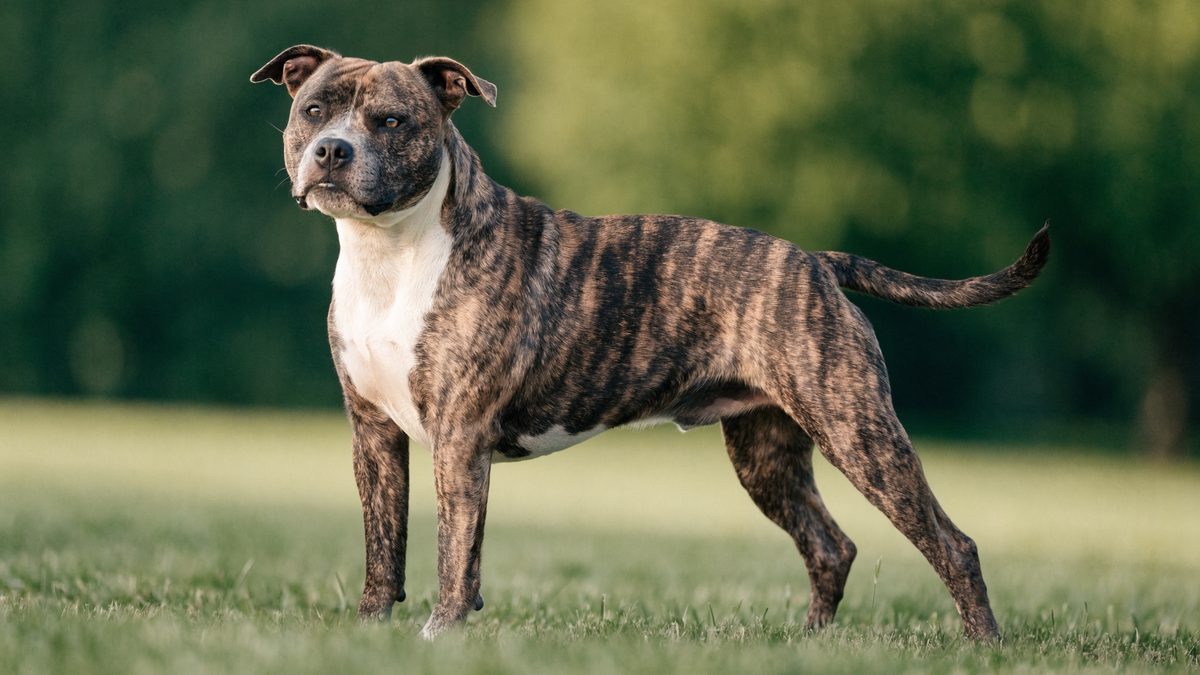
The Staffordshire Bull Terrier is a small, smooth coated English terrier standing 36 to 41 cm at the withers and weighing 13 to 17 kg in dogs, recognised by the Kennel Club in 1935 and shown in the Terrier Group. Start there, because almost every mistake Indian buyers make with this breed starts with thinking it is something bigger. A Staffy is roughly the weight of a Beagle with the build of a bodybuilder, and it is a genuinely different animal from the two American breeds it gets confused with.
Read the breed standard first, because it is short and it is unusually direct. The Kennel Club describes a smooth coated, well balanced dog of great strength for his size, muscular, active and agile. Under characteristics it says the breed is traditionally of indomitable courage and tenacity, highly intelligent and affectionate especially with children. Under temperament it gives three words: bold, fearless and totally reliable.
The AKC standard, approved on 8 July 2025 and effective from 30 September 2025, sets the same size and adds the club's own summary of character. It describes a dog that draws from its past history a character of indomitable courage, high intelligence and tenacity, coupled with affection for its friends and children in particular, off-duty quietness and trustworthy stability. The AKC's own breed page puts it more plainly, saying that at 14 to 16 inches Staffords do not stand particularly tall, but at 24 to 38 pounds they pour a gallon of dog into a quart-size container.
This is the detail no Indian page carries, and it matters. The Kennel Club of India is affiliated to the Federation Cynologique Internationale, a fact recorded in the Madras High Court's own judgment. So the standard applying to a KCI-registered Staffordshire Bull Terrier here is FCI-Standard No. 76, which places the breed in Group 3 Terriers, Section 3 Bull type Terriers, without working trial, and reproduces the British wording on courage, tenacity, intelligence and affection especially with children. Its disqualifying faults section then lists two things: aggressive or overly shy dogs, and any dog clearly showing physical or behavioural abnormalities. It adds that only functionally and clinically healthy dogs with breed typical conformation should be used for breeding. Under the standard that governs this breed in India, an aggressive Staffy is not a good specimen of the breed. It is a disqualified one.
The three standards agree on size to within half a centimetre, which is unusual and useful. FCI No. 76 gives 14 to 16 inches (35.5 to 40.5 cm) with dogs at 28 to 38 lb (12.7 to 17 kg) and bitches at 24 to 34 lb (11 to 15.4 kg). The Kennel Club gives 36 to 41 cm with the same weights. The AKC gives 14 to 16 inches with the same weights. In the United States the breed's parent club is the Staffordshire Bull Terrier Club of America, founded in 1974 and the authorised AKC arbiter of the standard there American Kennel Club.
| Attribute | Dogs | Bitches |
|---|---|---|
| Height at withers | 36 to 41 cm (14 to 16 in) | 36 to 41 cm (14 to 16 in) |
| Weight | 13 to 17 kg (28 to 38 lb) | 11 to 15.4 kg (24.25 to 34 lb) |
| Coat | Smooth, short and close | Smooth, short and close |
| Ears | Rose or half pricked, not large or heavy | Rose or half pricked, not large or heavy |
| Muzzle to skull ratio | Minimum 1 part muzzle to 2 parts skull | Minimum 1 part muzzle to 2 parts skull |
| Tail | Medium length, low set, carried rather low | Medium length, low set, carried rather low |
| Accepted colours | White, red, fawn, black, blue, any shade of brindle, each with or without white | Same |
| Unacceptable | Black and tan, liver, full drop or pricked ears | Same |
Two lines in that table do real work later on this page. Full drop or pricked ears are highly undesirable under the Kennel Club standard and a serious fault under the AKC standard, which means the correct Staffy ear is a natural rose or half-pricked ear and there is no cropped-ear tradition in this breed at all. And the head is specified as short and deep through with a broad skull, a distinct stop, and a short foreface with a minimum ratio of 1 part muzzle to 2 parts skull. That ratio is the reason this breed now appears in brachycephalic airway research, which the health section covers properly.
Where the breed came from, without the romance
The Staffordshire Bull Terrier was developed as a fighting dog in nineteenth century England, and no honest page starts anywhere else. VetCompass researchers describe the breed as originating in Birmingham and Staffordshire by cross-breeding the bulldog and English terrier, and record that the Kennel Club first recognised it in 1935. The AKC traces the line back through the old Bulldog, itself used in bear and bull baiting from the mid-sixteenth century, crossed with British terriers to produce the first bull and terriers. Dogs India, the oldest Indian breed reference still online, says the same thing in one sentence, describing a cross between well-muscled bull baiters and agile terriers bred for ratting and dog-fighting.
The Kennel Club's own history notes the breed shares ancestry with the Bull Terrier developed in the 1860s by James Hinks, and that devotees of the original cross stayed with their preferred type when Hinks bred on toward a different head shape. The name comes from the Black Country of Staffordshire and the northern parts of Birmingham, and the breed is still traditionally shown in a broad leather collar with brass emblems carrying the Staffordshire Knot. The first club show ran in August 1935 at Cradley Heath in the West Midlands with 60 dogs and bitches entered, and the first two champions, a bitch called Lady Eve and a dog called Gentleman Jim, took their titles in 1939.
Under section 11 of the Prevention of Cruelty to Animals Act, 1960 it is an offence, solely with a view to providing entertainment, to incite any animal to fight or bait any other animal, and to organise, keep, use or act in the management of any place for animal fighting or for baiting any animal, or to permit or offer any place to be so used, or to receive money for admission to such a place. Given what this breed was originally bred for, that belongs here in plain words rather than in a footnote. Bonbeno publishes nothing on bite work, protection training, conditioning a dog for confrontation, or any practice that produces aggression. The penalties in the section itself are a fine of not less than ten rupees and up to fifty rupees for a first offence, and for a second or subsequent offence within three years a fine of twenty-five to one hundred rupees, or imprisonment up to three months, or both. Those figures have never been revised and they are a widely criticised level of deterrence.
It is a pit bull type dog, and it is not an American Pit Bull Terrier
The word pitbull in India covers a type rather than a breed, and the Staffordshire Bull Terrier is one of the three breeds that type is usually taken to include, alongside the American Pit Bull Terrier and the American Staffordshire Terrier. Bonbeno set that out in full on the Pitbull Price in India page and deliberately keeps no generic Pit bull entry on this site for the same reason. What matters here is the size gap, and it is large.
| Breed | Male height | Male weight | Source |
|---|---|---|---|
| Staffordshire Bull Terrier | 14 to 16 in | 28 to 38 lb (13 to 17 kg) | Kennel Club and AKC standards American Kennel Club |
| American Pit Bull Terrier | 18 to 21 in | 35 to 60 lb | Reported on Bonbeno's APBT profile |
| American Bully, Standard | 17 to 20 in | Not specified by height class | Reported on Bonbeno's American Bully profile |
| American Bully, XL | Over 20 to 23 in | Not specified by height class | Reported on Bonbeno's American Bully profile |
A 15 kg Staffy against a 25 kg pit bull is not a rounding difference. It changes the physical management problem, the food bill, the strength required to hold a lead, and the damage a bite does. It also changes the legal position, because Indian municipal prohibition lists name specific breeds and the Staffordshire Bull Terrier is not on either of the two that matter. The [adoption](#adoption) section gives the exact jurisdictions, dates and lists.
The breed answers to several short names and Indian sellers use them interchangeably. Staffy is the common British contraction and the one the VetCompass literature itself uses as a keyword. Stafford is what the AKC and most American breeders use. SBT is the abbreviation in health-testing paperwork. None of them means American Staffordshire Terrier, which is a separate, larger, AKC-registered breed. Two of the ten results on the Indian search page for this query are actually American Staffordshire Terrier listings, so the confusion is already priced into the market.
One more standard detail is worth banking now, because it comes back in the price section. The AKC standard disqualifies both black and tan and liver colour, and states directly that the merle pattern does not exist genetically in the breed and shall be disqualified. The AKC breed page repeats it in the plainest terms available: a Stafford with a merle coat is not a purebred dog. The Kennel Club has refused to register merle puppies in this breed since 5 January 2010 and refuses to register any puppy from a merle to merle mating whelped on or after 1 January 2013, citing impaired vision and hearing.
Staffordshire Bull Terrier price in India, and why sources disagree by ten times
The published Staffordshire Bull Terrier price in India runs from Rs 35,000 to more than Rs 8,00,000, and the two pages ranking highest for this query disagree with each other by roughly a factor of ten. That gap is not a rounding error and it is not explained by quality tiers. It is the single most useful fact on this page for a buyer, because it means no published Indian price for this breed can be treated as a market rate.
Bonbeno read both pages in full and put their numbers side by side. Neither acknowledges the other exists, and both sell puppies.
| Source | Headline range | Pet or basic quality | KCI registered | Champion bloodline |
|---|---|---|---|---|
| Puppiezo | Rs 35,000 to Rs 45,000 or more | Not broken out | Not broken out | Not broken out |
| Mr n Mrs Pet | Rs 3,50,000 to Rs 8,00,000+ | Rs 3,50,000 to Rs 4,50,000 | Rs 4,50,000 to Rs 6,50,000 | Rs 6,50,000 to Rs 8,00,000 |
| Ratio between the two floors | 10 times | 10 times | Not comparable | Not comparable |
Read the bottom row again. The cheapest published Staffy in India costs Rs 35,000 and the cheapest tier on the other ranking page costs Rs 3,50,000. One of those numbers is wrong, or the two pages are describing completely different transactions, and neither page gives you any way to tell which. Bonbeno prints both rather than averaging them into a figure neither source supports.
Rs 3,50,000 to Rs 8,00,000 would make the Staffordshire Bull Terrier one of the most expensive dogs sold in India, above the published bands for the American Pit Bull Terrier and in the territory of the imported XL bully market. Nothing about the breed supports that. It is a small, common, Kennel Club recognised terrier that was the second most frequently seen purebred in the general UK dog population under primary veterinary care, and whose Kennel Club registrations fell 52.4 percent from 8,663 in 2010 to 4,124 in 2016 before stabilising. This is not a rare dog. Treat a quote in lakhs as a claim to be verified against paperwork, not as evidence of quality.
The city table that is not a city table
Mr n Mrs Pet publishes a city-wise price table covering Hyderabad, Bangalore, Delhi, Chennai, Lucknow, Mumbai, Jaipur and Pune, and every single city carries the identical range of Rs 3,50,000 to Rs 8,00,000. A table where all eight rows hold the same value is not a survey of city prices. It is one number repeated eight times for search coverage, and it should be read that way.
Bonbeno found no published Indian source that gives genuinely different city figures for this breed. That is worth saying plainly. No reliable city-level price data for the Staffordshire Bull Terrier exists in India, and any page that presents one is either repeating a single national figure or estimating.
What a price for this breed is actually tracking
- Availability, not quality. Mr n Mrs Pet lists seven Staffordshire Bull Terrier puppies across the whole of India against 549 Siberian Huskies, 487 Golden Retrievers and 454 Labrador Retrievers on the same platform. Thin supply is the most plausible driver of a high quote, and thin supply is not a health guarantee.
- Registration status. A Kennel Club of India registered puppy is quoted at Rs 4,50,000 to Rs 6,50,000 against Rs 3,50,000 to Rs 4,50,000 unregistered on the same page. Registration documents pedigree. It records no health screening at all, and the [health](#health) section lists the five tests that actually matter.
- Colour. Accepted colours under the breed standard are white, red, fawn, black, blue and any shade of brindle, each with or without white. No colour carries a health or quality premium. Black and tan, liver and merle are outside the standard, and the AKC states that merle does not exist genetically in the breed.
- Who is publishing the number. Both detailed sources broker puppy sales. That is a commercial interest in the figure, disclosed here because neither page discloses it itself.
- Tier packaging. Puppiezo sells Silver, Gold and Platinum tiers that differ on after-sale support duration, delivery, a starter kit and a replacement guarantee rather than on the dog. A tier chart is a service bundle. Read it as one.
One ranking page offers a replacement guarantee of one to two weeks depending on tier, under which a puppy that dies of a covered health condition is replaced. Read what that implies about expected outcomes. Under the Prevention of Cruelty to Animals (Dog Breeding and Marketing) Rules, 2017, every pup sold must be micro-chipped with a complete record of treatment and vaccination maintained, the breeder must furnish the purchaser in writing with feeding details, inoculation and de-worming dates and the attending veterinary practitioner's name and address, and the breeder must screen prospective purchasers. A seller offering a replacement instead of that documentation has the transaction backwards.
The corrections a buyer needs before paying
Three claims made on the pages ranking for this query are wrong against the breed's own standard, and each one costs money.
| Claim as published | What the standard says |
|---|---|
| Staffordshire Bull Terriers have dense, curly coats that need trimming every 4 to 6 weeks | The coat is smooth, short and close, and the AKC standard says it is not to be trimmed or de-whiskered American Kennel Club. Paying for a six-weekly trim on this breed is paying for nothing |
| Basic quality dogs are best for property guarding and family protection | No kennel club standard for this breed describes a guarding role. The Kennel Club characteristics are courage, tenacity, high intelligence and affection especially with children |
| The breed is nicknamed the nanny dog | Neither the Kennel Club nor the AKC standard uses that phrase American Kennel Club. The AKC breed page instead warns that Staffords are not good candidates for dog parks nor for multiple male dog homes |
The nanny dog line matters most, because it is the one that changes how a household supervises a small child. The [temperament](#temperament) section handles it properly, with the one large controlled study of this breed and its limits.
Where two published sources disagree, Bonbeno prints both and names the gap. We do not average conflicting figures, we do not pick the convenient one, and we do not broker puppy sales or publish breeder listings. Every price on this page is reported from a third party so you can see the disagreement yourself and price it into your own decision.
The practical instruction is short. Do not negotiate on the number. Negotiate on the paperwork, because a Rs 45,000 puppy with both parents' hip scores, elbow scores, eye examinations and two DNA test certificates is a better buy than a Rs 4,00,000 puppy with a pedigree sheet and nothing else.
Monthly cost of keeping a Staffy in India
One published Indian figure exists for the monthly cost of keeping a Staffordshire Bull Terrier, and it is Rs 5,000 to Rs 10,000 covering food, grooming, veterinary visits and routine care. That is a single unsourced estimate from a page that sells puppies, with no sample size and no collection date. Bonbeno reports it as that and nothing more, because inventing a second column would be worse than admitting the data does not exist.
What can be said with confidence is the shape of the bill, because the shape follows from the dog. A Staffy is a short-coated, muscular 13 to 17 kg terrier. That produces a specific cost profile in India, and it differs from the large imported breeds in three ways that matter.
- Food is the cost of a medium dog, not a large one. At the top of the standard a male Staffy weighs 17 kg. Against a 25 kg pit bull type dog or a 27 kg husky, that is a materially smaller daily ration for the whole of the dog's life.
- Grooming is close to zero. The AKC describes occasional baths and weekly brushings with a horsehair mitt or hound glove as the whole routine. The Kennel Club sets grooming at once a week. There is no professional trim, no coat blow, no de-shedding appointment. Any Indian quote for a six-weekly trim on this breed is a quote for a service the breed does not need.
- Cooling is a fan-and-timing problem, not an air-conditioning problem. Bonbeno rates this breed 3 of 5 for heat tolerance, which is neither the husky's 1 nor an indie dog's 5. The [climate](#climate) section explains why the AKC still calls the breed heat intolerant despite the short coat.
- Skin and parasite prevention is the line that is genuinely higher. Staffies have significantly increased odds of atopic dermatitis at 1.88 against other dogs, and 7.11 times the odds of juvenile-onset demodicosis against crossbreeds. In Indian conditions, budget for this rather than discovering it.
- Screening the parents is a one-off cost paid by the breeder, not by you. The five screenings OFA lists for this breed are hip, elbow, an eye examination, an L2HGA DNA test and a hereditary cataract DNA test. Their cost belongs in the purchase price. Ask what it was.
When Bonbeno publishes cost figures we state the sample size, the cities covered and the collection date. We are running a verified owner cost survey across eight Indian metros and will publish those three things alongside the numbers when it is complete. Until then the honest position on this breed is that exactly one published Indian monthly figure exists, it is unsourced, and the page publishing it sells the dogs. Every other page you will find quoting a Staffy monthly cost in India is copying it.
The first-year items most guides leave out
Four costs land in the first year and none of them appear in a monthly average. A microchip is not optional and it is not yours to arrange, because under the 2017 Rules each pup sold must already be micro-chipped with a complete record of treatment and vaccination maintained, and the receipt of sale must record the microchip number. If the puppy arrives without one, the sale did not comply.
Year-round external parasite control is the second, and it is the Indian line item that no British or American Staffy guide contains. A survey of 525 dogs across four Indian sites found potential tick vectors on 278 of them, which is 53 percent, and 261 dogs, or 49.7 percent, infected with one or more canine tick-borne pathogen. That is roughly one dog in two. Budget the prevention as a fixed monthly cost rather than a seasonal one.
Neutering and the full puppy vaccination course are the third and fourth, and both are city-dependent enough that Bonbeno will not publish a rupee figure it cannot source. Ask two clinics near you before you buy the dog, not after.
Indian climate: heat tolerance rated 3 of 5, and why the short coat misleads you
Bonbeno rates the Staffordshire Bull Terrier 3 of 5 for heat tolerance, and the American Kennel Club states the position more bluntly than any Indian page does: the breed can be heat-intolerant and should absolutely never be overworked in warm or humid weather. That sentence sits oddly next to a short coat and a 15 kg body, which is exactly why Indian buyers get this wrong. The coat is not the risk here. The face and the effort level are.
Start with what the standard Indian consumer rubric would tell you. Purina India sorts heat-stroke risk by anatomy, naming short-faced breeds such as Boxers, Bulldogs, Pugs and Pekingese, and heavy-coated dogs such as Huskies and Newfoundlands, as the ones at particular risk. The Staffordshire Bull Terrier appears in neither list. Read literally, that rubric files the Staffy as low risk. The breed's own kennel club says otherwise, and the reason is a piece of research published in February 2026 that no page ranking for this query has caught up with.
The April 2026 change: the Staffy is now a BOAS screening breed
In April 2026 the Orthopedic Foundation for Animals added the Staffordshire Bull Terrier to the list of breeds eligible for examination and certification under the Respiratory Function Grading Scheme, the brachycephalic airway screening programme devised by the Royal Kennel Club and the University of Cambridge. The scheme grades Brachycephalic Obstructive Airway Syndrome from 0 to 3 using a stethoscope before and after a brisk three-minute walk, and its published clinical signs include, in the scheme's own words, exercise and heat intolerance.
The research behind that decision is the useful part. Tomlinson and colleagues assessed 898 dogs across fourteen brachycephalic breeds between September 2021 and April 2024, and the Staffordshire Bull Terrier was the largest single breed sample in the study at 120 dogs. The paper explains why a Staffy counts as brachycephalic at all: brachycephaly describes the whole skull, and a dog with a relatively wide skull compared with its length, such as the Staffordshire Bull Terrier, is brachycephalic under the cephalic index definition even without an extremely flat face.
| Finding | Result for the Staffordshire Bull Terrier |
|---|---|
| Risk group assigned | Mild risk, alongside the Cavalier King Charles Spaniel, Chihuahua, Boxer, Affenpinscher and Pomeranian |
| Share graded 0 | At least 50 percent of the breed sample |
| Share clinically unaffected (Grade 0 or 1) | At least 75 percent |
| Against Pugs, French Bulldogs and Bulldogs | Significantly greater proportion of Grade 0 dogs, p at or below 0.005 against all three |
| Mean craniofacial ratio | 0.38 in Grade 0 dogs against 0.36 in Grade 1 to 3 dogs, p = 0.06, approaching significance |
| Nostril stenosis | None or very few dogs with moderate stenosis, and no severe stenosis recorded in the breed |
| Tail length | Shorter tails significantly associated with BOAS within the breed, adjusted p = 0.004 |
| Neck girth ratio | Proportionately thicker necks more likely to be affected, p = 0.007 before adjustment |
Put that in context. The paper treats a craniofacial ratio below 0.3 as extremely brachycephalic and 0.3 to 0.5 as moderately brachycephalic. A Staffy sits around 0.36 to 0.38, which is at the safe end of the moderate band, and the Kennel Club standard's requirement of a minimum ratio of 1 part muzzle to 2 parts skull is the show-ring expression of the same measurement. The breed is not a Pug and the evidence says so directly.
A finding from a breed-club and show population could easily overstate or understate a problem, so Bonbeno checked it against a different dataset entirely. In the VetCompass comparison of 1,304 Staffordshire Bull Terriers against 21,029 other dogs under UK primary veterinary care, Staffies had significantly reduced odds of upper respiratory tract disorder at 0.49, with a 95 percent confidence interval of 0.32 to 0.75 and p = 0.001. Two independent methods agree. The Staffordshire Bull Terrier has a shortened muzzle and belongs in a BOAS screening programme, and it does not carry the airway disease burden that the Bulldog and French Bulldog pages on this site document. Both statements are true and Bonbeno publishes both.
So where does the Indian heat risk actually come from
It comes from exercise, and there is a precise, breed-specific number for it. A VetCompass study reviewed 905,543 UK dogs under primary veterinary care in 2016 and identified 1,259 heat-related illness events from 1,222 dogs, then sorted them by what triggered them. Exertional heat-related illness was the predominant trigger at 74.2 percent of the 879 events where a cause was recorded, followed by environmental at 12.9 percent and vehicular confinement at 5.2 percent. Then it modelled which breeds carried higher odds of each type, against the Labrador Retriever.
| Trigger | Odds ratio | 95% confidence interval | p value | Significant |
|---|---|---|---|---|
| Exertional, 74.2 percent of events with a recorded trigger | 1.56 | 1.09 to 2.22 | 0.015 | Yes |
| Environmental | 0.88 | 0.33 to 2.36 | 0.798 | No |
| Vehicular confinement | 0.58 | 0.05 to 6.39 | 0.655 | No |
Read those three rows together, because they are the most useful thing on this page for an Indian summer. The Staffordshire Bull Terrier carries significantly greater odds of heat illness brought on by exercise, and no measurable elevation for heat illness brought on by the environment or by being shut in a car. The authors flag the breed specifically, noting that six of the seven breeds with greater odds of exertional heat illness had previously been identified as higher risk for heat illness generally, whereas the Staffordshire Bull Terrier appears to have greater odds specifically for the exertional form.
A breed at environmental risk needs a cooler room. A breed at exertional risk needs a shorter game. The Staffy is the second kind. Purina India puts the same mechanism in owner terms, listing intense exercise among the factors that raise heat-stroke risk and warning that a dog can develop heat stroke in as little as 30 minutes of vigorous exercise in hot weather. Cornell's Riney Canine Health Center defines heatstroke as occurring from exposure to hot or humid environments or from overly strenuous exercise, and lists avoiding strenuous exercise in hot and humid weather first among its prevention measures. Bonbeno's Belgian Shepherd page reached the same conclusion from the other direction, that drive rather than coat predicts exertional heat illness. The Staffordshire Bull Terrier is now the measured, named case of it.
The second is body condition. Obese pets overheat two to three times faster than lean ones, and higher body condition score was one of only three factors significantly correlated with BOAS across the whole fourteen-breed study population. Those are the same intervention. The third is humidity, which blocks the evaporative cooling that panting depends on, so that a 35 C day at 90 percent humidity is more dangerous than a 42 C day at 20 percent humidity.
The Kennel Club standard puts a male Staffordshire Bull Terrier at 13 to 17 kg and a bitch at 11 to 15.4 kg. The median adult bodyweight of 1,304 Staffies under UK primary veterinary care was 20.20 kg, with an interquartile range of 17.68 to 22.86 kg and a top of the range at 31.00 kg. The typical pet Staffy is heavier than the top of the male standard, and half of them are heavier than 20 kg. In an Indian summer that single fact does more damage than the muzzle does, because it drives both heat retention and airway load at once.
The Indian operating rules
| Ambient temperature | Risk level | What to do |
|---|---|---|
| Below 28 C | Low | Normal activity with shade and water |
| 28 to 35 C | Moderate | Shorten the walk to 15 to 20 minutes, early morning and late evening only |
| 35 to 42 C | High | Outdoor activity contraindicated. Asphalt reaches 60 C and above |
| Above 42 C | Extreme | Heat stroke possible within 10 to 15 minutes outdoors. Indoor temperatures without cooling can be fatal |
- Walk before 7 am or after 8 pm from April to September, and keep it to 15 to 20 minutes even inside those windows.
- Do the seven-second pavement test before every summer walk. If you cannot hold the back of your hand on the pavement for seven seconds, it will burn paw pads within about 30 seconds.
- Run fans or air conditioning continuously above 32 C indoors, which is the threshold at which indoor temperature becomes dangerous for a dog at rest.
- Stop the game before the dog does. This breed will keep going past the point of sense, which is the specific reason the AKC warns against overworking it in heat.
- Never confine the dog to a balcony above 30 C. Concrete balconies are heat traps with no shade and no airflow.
- Plan for power cuts, because load shedding peaks exactly when cooling demand peaks.
Purina India flags a rectal temperature of 40.5 C or above alongside severe panting, difficulty breathing, heavy salivation, vomiting, diarrhoea, blood in the urine, nose bleeds and eventual collapse. Cornell adds confusion, seizures and bloody diarrhoea, and notes that dogs surviving one episode are at greater risk of another. To cool the dog, move it out of the heat and spray or sponge cool but not cold water so it reaches the skin on the belly and inside the legs, use a fan, and stop at 39.4 C to avoid overshooting into hypothermia. Never plunge a hot dog into an ice bath, because peripheral vasoconstriction traps heat in the core Purina India, Heat Stroke in Dogs. Then go to a clinic regardless of how well the dog looks, because delayed organ damage can appear 12 to 72 hours later.
Know what the stakes are before you need to. A retrospective study of 54 dogs treated for heat stroke at the Hebrew University Veterinary Teaching Hospital in Israel, a country whose summers resemble north-western India more than they resemble Britain, found an overall mortality rate of 50 percent, with exertional heat stroke accounting for 63 percent of cases and environmental for 37 percent. Delayed admission beyond 90 minutes was a statistically significant risk factor for death at p = 0.032, alongside seizures at p = 0.02 and obesity at p = 0.04. Disseminated intravascular coagulation was diagnosed in 28 of the 54 dogs and acute renal failure in 18, and both predicted death. Find out now which clinic near you is open at 2 pm on a Sunday in May, and how long it takes to reach.
Bengaluru, Pune and the hill stations are the easiest Indian postings for this breed. Chennai, Kochi, Mumbai and coastal Andhra Pradesh are the hardest, and there the constraint is humidity rather than the thermometer. Delhi and the northern plains give you a genuinely usable winter and a brutal April to June. None of those makes the breed unkeepable. All of them make the timing of exercise a rule rather than a preference.
Temperament, household fit, and the evidence on aggression
The Staffordshire Bull Terrier is described in both its governing breed standards as courageous, tenacious, highly intelligent and affectionate especially with children, and the Kennel Club sums up its temperament in three words: bold, fearless and totally reliable. That is a genuinely warm assessment written by the people who define the breed. It sits alongside a documented fighting history and a specific, published warning about other dogs, and an honest page has to carry both without flinching in either direction.
The two standards agree on what the breed is with people. The AKC standard describes a modern dog that draws from its past a character of indomitable courage, high intelligence and tenacity, coupled with affection for its friends and children in particular, its off-duty quietness and trustworthy stability, making it a foremost all-purpose dog. The Kennel Club records that the breed's intelligence and affinity with children are noted in the breed standard itself, and calls it a wonderful family pet despite its rough and ready beginnings.
The two standards are equally clear about the constraint, and it is not about people. The AKC breed page states that the old fighting instinct still lies within, that it is vital Stafford pups are raised with enrichment protocols and socialised with other dogs to learn good canine manners, and that Staffords are not good candidates for dog parks, nor for multiple male dog homes. Its training guidance adds that the breed was originally bred to fight other dogs, that most have retained a strong prey drive, and that owners should watch for escalation in enthusiastic play, especially after maturity.
Every source above treats them separately, and so should you. Dogs India, writing for an Indian audience, calls this a Jekyll and Hyde character: friendly, loving of the family and even of strangers, but with a strong reaction to other dogs, adding that selective breeding has reduced that tendency. What follows for an Indian owner is a management instruction rather than a character judgement. Plan for a dog that is easy with people and that you do not test around unfamiliar dogs, and remember that free-roaming street dogs make that harder here than in the countries where these standards were written.
The one large controlled study, and what it found
Here is the number that no page ranking for this query publishes. A VetCompass study at the Royal Veterinary College compared 1,304 Staffordshire Bull Terriers with 21,029 other dogs under UK primary veterinary care and set out to test the hypothesis that Staffies would show higher odds of aggression. After accounting for confounding, it found no significant difference in the odds of aggression, with an odds ratio of 1.09, a 95 percent confidence interval of 0.75 to 1.58 and p = 0.644.
The same study found the odds of being diagnosed with at least one disorder did not significantly differ either, at 0.90 with a confidence interval of 0.80 to 1.02 and p = 0.102, and concluded that from the relative number of predispositions to protections identified there is no evidence Staffordshire Bull Terriers have higher overall health problems than other dogs.
Aggression recorded in a primary-care clinical record is aggression a veterinary surgeon saw or was told about. It is not a measure of aggression in the population, it captures nothing that never reached a clinic, and it cannot speak to bite severity. The authors do not hide the contrary evidence either. The same paper notes that a genetic basis for aggression in Staffordshire Bull Terriers has been described, that a survey of UK veterinarians classified the breed with high aggression, that Staffies were over-represented as the aggressor in dog-to-dog conflict in Germany, and that a textbook review listed the breed as predisposed to 20 disorders including aggression, while observing that those studies varied widely in design, date, location and comparator group. Bonbeno prints the disagreement rather than the convenient half of it.
What the study does establish is narrower and still valuable. The assumption of elevated breed aggression did not survive contact with a large, method-controlled dataset. That is the correct weight to give it: not proof the breed is safe, and not nothing.
Where the evidence points the other way, and how to read it
Bonbeno is not going to present a one-sided literature. The American Veterinary Medical Association's review of breed and bite risk contains a summary table of serious dog bite injury studies, and one row names this breed directly: a study of 436 UK hospital records covering 2001 to 2011 identified the Staffordshire Bull Terrier as the top breed, ahead of the Jack Russell Terrier. The underlying paper is a retrospective series of dog bites to the head and neck in children in the UK, published in Clinical Otolaryngology in 2013. That finding is real and it belongs on this page.
Read it against the caveat the AVMA itself attaches two paragraphs earlier. Any estimate of breed-based risk must take into account the prevalence of the breed in the population at the time and place of the biting events, because increased popularity is sometimes followed by increases in bite reports. The Staffordshire Bull Terrier was, over exactly that period, the second most common purebred dog in the general UK dog population under primary veterinary care. A breed that common will head a UK hospital series without carrying any elevated risk per dog. The study counted bites. It did not divide by the number of Staffies in Britain.
Three things are true at once and this page publishes all three. A UK hospital series over eleven years put the Staffordshire Bull Terrier at the top of its breed table. A method-controlled comparison of 1,304 Staffies against 21,029 other dogs found no significant difference in the odds of aggression. And the breed was, through that whole period, one of the two commonest purebreds in the country the hospital data came from. The AVMA's own conclusion is that breed is a poor sole predictor of aggressiveness, quoting the behavioural finding that substantial within-breed variation makes it inappropriate to predict a given dog's propensity for aggressive behaviour based solely on its breed. What follows for a buyer is not that the breed is safe or dangerous. It is that supervision, socialisation, neutering status and household integration are the variables that move, and breed is the one that does not.
Why India has no bite data at all
No Indian dataset breaks dog bites down by breed. Bonbeno's Pitbull Price in India page sets out the government's own national dog-bite totals tabled in the Lok Sabha and shows that the annexures contain no breed breakdown of any kind, alongside the shelter-identification research showing that visual breed identification of pit bull type dogs is unreliable enough that one in three dogs with no pit bull heritage DNA still gets the label. Both findings apply here. Anyone who tells you what share of Indian bites involve Staffies is making it up, and the identification problem means the figure would be wrong even if someone tried to measure it.
That cuts both ways for this breed, and it is worth saying so. The same misidentification that inflates pit bull bite counts also means a Staffy in India may be recorded as a pitbull by a shelter, a housing society or a hospital note. The [adoption](#adoption) section explains why getting the breed written down, from a registry, matters more here than it does in Britain.
The nanny dog claim, answered properly
One ranking page calls the Staffordshire Bull Terrier the nanny dog and says it is famously gentle and patient around kids. Neither the Kennel Club standard nor the AKC standard uses that phrase American Kennel Club. What the standards actually say is that the breed is affectionate especially with children, which is a real and well-documented trait and is why the breed has the reputation it has in Britain. The gap between those two statements is the gap between a fond description and a childcare recommendation.
The honest version is that a stocky, powerful, enthusiastic 15 to 20 kg dog with a documented dog-directed instinct is a physics problem around a toddler before it is a temperament problem, and that the breed's own kennel club warns about escalation in enthusiastic play after maturity. Supervise. Not because the breed is dangerous, but because no dog of any breed should be left unsupervised with a small child, and because this one is stronger than it looks.
Household fit, stated plainly
- Good fit. An adult household or a family with school-age children, in a flat or a small house, with someone home for a reasonable part of the day and an agreed set of rules about the front door and the lift.
- Also a good fit. Indian apartment living, which is unusual for a bull breed. The Kennel Club classifies the Staffordshire Bull Terrier as a small breed needing a small house and a small or medium garden, in town or country. This is not a dog that needs acreage.
- Poor fit. A household that wants a guard dog, a home with an existing same-sex dog, or an owner who plans to use dog parks as the exercise plan.
- Watch item. Multi-dog households. Treat same-sex pairings as a deliberate decision with professional input rather than an assumption.
- Do not buy it for protection. No standard for this breed describes a guarding role, and the Kennel Club's characteristics are courage, tenacity, intelligence and affection. A page selling this dog as a property guard is selling you the wrong animal.
OFA runs an owner-completed health survey for this breed. Asked to describe their dog's temperament, respondents chose confident for 308 dogs (83 percent), curious for 152 (41 percent), protective for 50 (13 percent), reserved for 39 (10 percent), timid for 6 (2 percent) and very shy for 2 (1 percent). OFA states plainly that respondents are self-selected, that there is no verification of responses and no duplicate checking. Read it as what committed owners say about their own dogs, which is useful and is not a population estimate.
Training a Staffordshire Bull Terrier
Train a Staffordshire Bull Terrier with clear, consistent, positive methods from the first week, and never with harsh ones. The AKC describes a dog that is intelligent, learns easily, responds quickly and has an ardent desire to please, then adds the line most owners miss: despite their tough outward appearance and sometimes stoic disposition, they can be quite sensitive and do not respond well to harsh training methods. This is a trainable breed with a thin skin, which is a much easier combination than most Indian buyers expect.
Bonbeno rates trainability 4 of 5 for this breed, higher than for any other bull breed on this site. The reason is in the standard, which credits high intelligence, and in the AKC's own description of a dog that easily complies with the requests of its owners American Kennel Club. A Staffy is not an independent working dog negotiating with you. It wants the job.
The one thing that does need managing
Other dogs. The AKC is direct about it: the breed was originally bred to fight other dogs, most have retained a strong prey drive, and owners should watch for escalation in enthusiastic play, especially after maturity. Read the phrase escalation in enthusiastic play carefully, because it describes the actual failure mode. The problem is rarely a dog that starts a fight from a standing position. It is a dog that is having a wonderful time and does not know where the line is.
The instruction that follows is to socialise early, widely and deliberately, and to keep doing it. The AKC says it is vital that Stafford pups are raised with enrichment protocols and socialised with other dogs to learn good canine manners. In an Indian city that means controlled, calm exposure to lifts, traffic, building watchmen, other people's dogs on lead and the free-roaming dogs on your own street, booked into the cool hours the same way walks are.
The AKC states without qualification that Staffords are not good candidates for dog parks, nor for multiple male dog homes. Off-lead free mixing with unknown dogs is not a training goal for this breed and no amount of work makes it one. The correct plan is structured, one-to-one introductions with known dogs, on lead, in neutral space, with an adult who can physically manage 15 to 20 kg of enthusiasm.
Realistic timelines
| Skill | Start | Realistic outcome |
|---|---|---|
| Name response | Week 1 home | Reliable indoors in 2 to 3 weeks |
| Sit, down, settle | Week 1 home | 3 to 6 weeks |
| Toilet training | Week 1 home | 3 to 5 months |
| Loose-lead walking | Month 2 | 4 to 8 months, and worth investing in because of the pulling strength |
| Calm greeting of people | Month 2 | Ongoing. Over-enthusiasm rather than suspicion is the problem to solve |
| Reliable recall in a fenced space | Month 2 | 6 to 12 months |
| Calm around unknown dogs | Month 2 | Manage permanently. Do not treat as a graduation |
| Running beside a bicycle or jogger | After 18 months | The AKC sets 18 months so growth plate closure can complete, and only when the weather is not humid or too warm |
That last row is the one Indian owners break most often, and it breaks two things at once. A Staffy running beside a bike at nine months is loading immature joints in a breed that already carries 21.9 percent elbow dysplasia on the OFA register, and doing it in Indian heat adds the exertional risk the [climate](#climate) section describes.
Give the brain a job
Owners of this breed compete in real numbers, which tells you something about what the dog can do. Among respondents to the OFA breed health survey, 48 named agility trials as a primary interest, 43 named obedience trials, 36 named rally obedience, 36 named therapy, assistance or service work, 22 named weight pull, 20 named flyball, 15 named tracking and 11 named dock diving. None of that requires a competition career in India. It tells you that fifteen minutes of scent work, a puzzle feeder or a trick session substitutes well for a walk you cannot take at 2 pm in May.
Book the training into the cool hours from the first week, so the routine is already correct before the summer makes it compulsory. A puppy that learns its walk happens at 6.30 am in November does not have to relearn anything in April. This is the single cheapest thing an Indian owner of this breed can do, and almost nobody does it.
How much exercise a Staffy actually needs
The Kennel Club puts the Staffordshire Bull Terrier's requirement at up to one hour per day, which is the lowest figure of any bull breed Bonbeno has profiled. That is genuinely good news for an Indian apartment household, and it comes with a condition the same sources are emphatic about: the hour has to fit inside the cool windows, and the intensity has to stop before the dog wants it to.
Indian sources publish a higher energy reading than the Kennel Club's hour, which is worth printing rather than smoothing over.
| Source | What it states |
|---|---|
| The Kennel Club | Up to 1 hour per day. Size small, ideal home a small house, small or medium garden |
| American Kennel Club | Regular exercise to stay mentally and physically fit. A Stafford in good condition can keep up with an athletic owner, and usually settles straight down indoors afterwards |
| Puppiezo, India | Energy level high. Active play and daily walks. Ideal space, house |
| Mr n Mrs Pet, India | Energetic but manageable, balanced energy, adapts well to apartment life with the proper routine |
| Royal Canin India | Size category medium, needs a lot of exercise, garden not essential, makes a great family dog |
Two of those four disagree on something basic. The Kennel Club classifies the Staffordshire Bull Terrier as small and sets exercise at up to one hour a day. Royal Canin India classifies it as medium and says it needs a lot of exercise, while sourcing its key facts from the FCI. Bonbeno prints both. The point of agreement is more useful than the disagreement anyway, because Royal Canin India is explicit that a garden is not essential for this breed, which is the fact an apartment buyer in Mumbai or Bengaluru actually needs.
Bonbeno treats the Kennel Club hour as the floor and the AKC's description as the ceiling, and the useful reading is that both can be true. The requirement is modest in duration and high in intensity, which is precisely the profile that gets a dog into trouble in Indian heat. An hour of ambling is safe. Twenty minutes of hard fetch at 34 C is not, because Purina India warns that heat stroke can develop in as little as 30 minutes of vigorous exercise in hot weather.
Section 11(1)(g) of the Prevention of Cruelty to Animals Act, 1960 makes it an offence if an owner neglects to exercise or cause to be exercised reasonably any dog habitually chained up or kept in close confinement, and section 11(1)(f) makes it an offence to keep any animal chained or tethered on an unreasonably short or unreasonably heavy chain for an unreasonable time. The 2017 breeding rules require, separately, that a fenced area for adequate exercise or provision for exercising the dog on a leash exists. Almost no Indian breed page mentions this. A Staffy left on a chain on a terrace is not a training failure, it is a statutory one.
How to spend the hour in an Indian city
- Two shorter outings beat one long one, split before 7 am and after 8 pm from April to September.
- Use a harness and a fixed lead rather than a retractable one. This is a low, strong, forward-driving dog and the pulling strength is out of proportion to the size.
- Do the intensity work in the cool months. December to February in most of India is when a Staffy can genuinely run, and the AKC's structured suggestions of ball work, a hike or running beside a bicycle belong there rather than in May.
- Substitute mental work when the outdoors closes. Fifteen minutes of scent work or a puzzle feeder tires this breed usefully and runs in a fan-cooled room.
- Watch the stiffness signal. Staffies carry significantly increased odds of stiffness at 1.76 against other dogs, with a confidence interval of 1.02 to 3.05. A dog that is slow to rise after exercise needs a veterinary opinion rather than a longer walk.
- Never exercise the dog on hot asphalt. Grass runs 10 to 15 C cooler than asphalt in the same sun, so route the walk accordingly.
What happens without the hour is predictable and it is not aggression. It is a bored, muscular young dog that chews, digs, barks at the door and escalates play with whoever is nearest. That is an unemployed terrier, and the fix is the schedule rather than a correction.
Grooming a short coat, and the skin problem India adds
Groom a Staffordshire Bull Terrier once a week with a horsehair mitt or hound glove and bathe it occasionally, and that is the entire coat routine American Kennel Club. The coat is smooth, short and close to the skin, and the AKC standard specifies that it is not to be trimmed or de-whiskered. The grooming bill for this breed should be close to nothing. The skin bill, in Indian conditions, is where the money actually goes.
Deal with the misinformation first, because it is on a page ranking third for this query. One Indian selling page states that Staffordshire Bull Terriers have dense, curly coats needing trimming every four to six weeks to prevent matting. That describes a different animal. Both governing standards specify a smooth, short, close coat, and the AKC standard forbids trimming it American Kennel Club. A six-weekly trim on a Staffy is a bill for a service the breed does not need, and the same page then sells grooming.
- Brush weekly with a rubber mitt or hound glove, which lifts dead hair and distributes skin oils. The breed does shed, so weekly is a floor rather than a maximum.
- Bathe occasionally, not routinely. The AKC's whole bathing instruction is occasional baths. Over-bathing a dog already predisposed to atopic dermatitis works against you.
- Dry the skin folds and the face after a monsoon walk. A short coat dries fast, but the wrinkling around the muzzle and the tight skin at the neck hold moisture.
- Check the ears weekly. Rose ears sit folded and Indian humidity is the reason to look rather than wait.
- Keep nails short. A heavy, low, forward-driving dog on long nails loads its toes badly.
- Run year-round tick prevention. Potential tick vectors were found on 278 of 525 dogs sampled across four Indian sites, which is 53 percent.
The skin numbers, which are the real story
Two large UK studies put hard figures on this breed's skin, and both matter more in India than they do in Britain because the parasite and humidity load here is higher.
| Finding | Figure | Source |
|---|---|---|
| Atopic dermatitis, odds against other dogs | 1.88 (95% CI 1.24 to 2.84, p = 0.003) | VetCompass, 1,304 Staffies |
| Skin mass, odds against other dogs | 1.80 (95% CI 1.43 to 2.45, p < 0.001), prevalence 3.76 percent | VetCompass |
| Skin disorder at grouped level | 1.18 (95% CI 1.00 to 1.39, p = 0.044) | VetCompass |
| Juvenile-onset demodicosis, dogs under 2 years | Odds ratio 7.11 (95% CI 5.65 to 8.93, p < 0.001) against crossbreeds | VetCompass, 126,423 dogs |
| Breed prevalence of juvenile demodicosis | 2.14 percent (95% CI 1.89 to 2.51), 191 cases in 8,937 Staffies | VetCompass |
| Adult-onset demodicosis, dogs over 4 years | Odds ratio 1.15 (95% CI 0.41 to 3.21, p = 0.785), not significant | VetCompass |
That contrast between 7.11 and 1.15 is the most practically useful thing in the demodicosis literature for a Staffy owner. The breed had the second highest odds of juvenile-onset demodectic mange of any breed studied, behind only the British bulldog at 11.26, and Staffies accounted for 191 of the 613 juvenile cases in a population of 126,423 dogs, which is 31.2 percent of all cases. In dogs over four years old the breed showed no significant elevation at all. Juvenile-onset demodicosis is roughly ten times more common than the adult-onset form overall. So watch a Staffy puppy's skin closely and stop worrying disproportionately about it in a settled six-year-old.
Owners report the same pattern from the other side. Among the 62 respondents to the OFA breed health survey who reported a skin disorder, 26 named seasonal allergies, 23 named demodectic mange, 16 named atopic dermatitis and 12 named food or medicine allergies. OFA notes that the survey is self-selected and unverified, so treat it as corroboration of the pattern rather than as a rate.
Itching, recurrent ear inflammation, licked paws and hair loss around the face and elbows in an Indian Staffy have at least four plausible causes that look similar: atopic dermatitis, juvenile demodicosis, a secondary bacterial infection and a tick-borne disease. A survey of 525 Indian dogs found 261, or 49.7 percent, infected with one or more canine tick-borne pathogen, and 39 percent of infected dogs carried more than one. Do not self-diagnose and do not buy a shampoo off a recommendation. A skin scrape and a veterinary examination separate these cheaply, and getting it wrong in the first year is how a treatable puppy problem becomes a chronic one.
Health issues, screening and lifespan
The Staffordshire Bull Terrier carries two inherited diseases with breed-specific DNA tests, the best hips of the four bull breeds on the OFA register, worse elbows than two of them, and a formal CHIC health programme that the American Pit Bull Terrier does not have. Those four facts together are the most useful thing an Indian buyer can know, because every one of them turns into a document you can ask to see before money changes hands.
The two DNA tests, which are the whole point
Two conditions in this breed have a definitive genetic test, both are autosomal recessive, and both are on the Kennel Club's Best Practice list and OFA's CHIC requirement list for the breed Orthopedic Foundation for Animals. A puppy whose parents are both DNA clear cannot be affected by either. That is a rare degree of certainty in pedigree dog buying and almost no Indian purchaser asks for it.
| Condition | What it does | When signs appear | Inheritance |
|---|---|---|---|
| L-2-hydroxyglutaric aciduria (L-2-HGA) | A neurometabolic disorder of the central nervous system, marked by elevated L-2-hydroxyglutaric acid in urine, plasma and cerebrospinal fluid. Effects include epileptic seizures, a wobbly gait, tremors, muscle stiffness after exercise or excitement, and altered behaviour | Usually between 6 months and 1 year, though they can appear later | Autosomal recessive. A carrier shows no signs |
| Hereditary cataract (HC-HSF4) | A mutation in the HSF4 gene causing bilateral cataract in the Staffordshire Bull Terrier, Boston Terrier and French Bulldog. Blinding if left untreated | Diagnosable as early as 8 to 12 weeks but not congenital. Obvious cataracts between 9 and 15 months, with progression and maturity between 2 and 4 years | Autosomal recessive |
OFA's register shows how much of the breed has actually been tested, and the results are reassuring on both counts. Of 545 Staffordshire Bull Terriers tested for L-2-HGA, 544 were clear and one was a carrier. Of 533 tested for hereditary cataract, 532 were clear and one was a carrier. Read that correctly. It is not evidence that untested lines are clean. It is evidence that the DNA test works and that responsible breeders have driven both mutations to the margins, which is exactly why demanding the certificate is worth doing.
The top disorder predisposition found in the largest study of this breed is seizure disorder, at an odds ratio of 2.06 against other dogs with a 95 percent confidence interval of 1.24 to 3.40 and p = 0.005. The second-listed predisposition after skin conditions is stiffness, at 1.76. The presenting signs of L-2-HGA are epileptic seizures and muscle stiffness following exercise or excitement. The study did not attribute its seizure signal to L-2-HGA and Bonbeno does not claim it did. What the overlap justifies is a practical instruction: a young Staffy with seizures, tremors or exercise-induced stiffness should be assessed for L-2-HGA rather than managed as idiopathic epilepsy by default, and that conversation is easier if you already hold the parents' DNA results.
Hips and elbows, against the other three bull breeds
Bonbeno read the OFA breed statistics for all four breeds directly, taking each breed code from OFA's own selector and confirming the breed name printed on the returned page before recording a single number. The result corrects the assumption that Indian buyers bring to this category.
| Measure | Staffordshire Bull Terrier | American Pit Bull Terrier | American Staffordshire Terrier | American Bully |
|---|---|---|---|---|
| Hips evaluated | 1,484 | 1,184 | 4,298 | 912 |
| Hips dysplastic | 16.1 percent | 22.2 percent | 25.7 percent | 43.9 percent |
| Hips rated Excellent | 5.5 percent | 9.0 percent | 4.0 percent | 3.9 percent |
| Severe hip dysplasia | 0.1 percent, 1 dog | 0.3 percent | 0.6 percent | 1.4 percent |
| Elbows evaluated | 933 | 582 | 1,609 | 849 |
| Elbows dysplastic | 21.9 percent | 17.2 percent | 18.3 percent | 38.6 percent |
| OFA elbow rank | 18th | 29th | 26th | 4th |
| Part of the CHIC programme | Yes, five screenings | No Orthopedic Foundation for Animals | Yes | Yes |
Two findings there are worth stating explicitly because no other page publishes them. The Staffordshire Bull Terrier has the lowest hip dysplasia rate of the four, at 16.1 percent against 43.9 percent for the American Bully. And its elbows are worse than the American Pit Bull Terrier's and the American Staffordshire Terrier's, at 21.9 percent dysplastic and an OFA elbow rank of 18th, where a lower rank number means a worse position among all breeds Orthopedic Foundation for Animals Orthopedic Foundation for Animals. Bonbeno's American Bully page established the comparison for the other three. The Staffy is the best of the four on hips and the middle of the four on elbows, and the elbow figure is the one to ask a breeder about.
Dogs on the OFA register are dogs whose owners chose to screen them, which usually means breeding stock from people who care. That biases the figures optimistically in every breed, so the honest use of the table above is comparison between breeds rather than an estimate of prevalence in any of them. The counterweight in this case is the sample size: at 1,484 hips and 933 elbows, the Staffordshire Bull Terrier is better evidenced than the American Bully and the American Pit Bull Terrier Orthopedic Foundation for Animals.
What the breed is unusually protected against
This is the part almost no breed page ever covers, and it is genuinely good news. The VetCompass study identified five disorders the Staffordshire Bull Terrier is significantly protected against, and the strongest of them is one Indian buyers of small dogs worry about constantly.
| Disorder | Odds ratio against other dogs | 95% confidence interval |
|---|---|---|
| Patellar luxation | 0.15 | 0.04 to 0.61, p = 0.008 |
| Retained deciduous tooth | 0.19 | 0.05 to 0.75, p = 0.018 |
| Heart murmur | 0.33 | 0.18 to 0.60, p < 0.001 |
| Periodontal disease | 0.41 | 0.32 to 0.51, p < 0.001 |
| Anal sac impaction | 0.53 | 0.38 to 0.75, p < 0.001 |
Patellar luxation at 0.15 means roughly seven times lower odds than dogs that are not Staffies, at a breed prevalence of 0.15 percent, and the authors suggest the breed could serve as a model for reducing the condition in higher-risk breeds such as the Bichon and the Bulldog. OFA's register agrees independently: 459 of 462 Staffordshire Bull Terriers tested had normal patellae, which is 99.4 percent. The grouped-level protections are equally real, with reduced odds of dental disorder at 0.45, heart disease at 0.33 and upper respiratory tract disorder at 0.49.
Every screening OFA publishes for this breed
| Screening | Dogs tested | Normal or clear | Abnormal |
|---|---|---|---|
| Eyes | 1,521 | 97.1 percent | 2.9 percent |
| Hips | 1,484 | 82.1 percent | 16.1 percent dysplastic |
| Elbows | 933 | 77.9 percent | 21.9 percent dysplastic |
| L-2-hydroxyglutaric aciduria | 545 | 99.8 percent | 1 carrier |
| Hereditary cataract | 533 | 99.8 percent | 1 carrier |
| Patella | 462 | 99.4 percent | 0.6 percent |
| Degenerative myelopathy | 392 | 96.9 percent clear | 2.3 percent affected, 0.8 percent carrier |
| Basic cardiac | 261 | 100 percent | None recorded |
| Congenital cardiac | 247 | 99.6 percent | None recorded |
| Advanced cardiac | 131 | 99.2 percent | 0.8 percent |
Lifespan, where the sources disagree by three years
| Source | Figure | What it measures |
|---|---|---|
| Published median longevity cited in the VetCompass paper | 10.7 to 12.8 years | Recorded deaths in earlier UK studies |
| American Kennel Club | 12 to 15 years | Breed-club expectation |
| The Kennel Club | Over 12 years | Breed-club expectation |
| Mr n Mrs Pet and Puppiezo, India Puppiezo, Staffordshire Bull Terrier… | 12 to 14 years | Unsourced editorial estimate |
The measured figures sit below the club expectations, which is the normal pattern and not a scandal. UK longevity work covering 584,734 dogs across 155 breeds sets the methodological standard here, and its central point is that lifespan varies substantially by breed, body size and cephalic index rather than being a single number per dog. No Indian lifespan data exists for this breed at all, and Bonbeno says so rather than filling the gap. Owners answering the OFA survey reported deaths at 11 to 13 years for 25 dogs and over 14 years for 21 dogs, against 3 dogs dying between 2 and 5 years, in a self-selected sample OFA itself flags as unverified.
This is a robust breed. In the largest controlled comparison available, the odds of a Staffordshire Bull Terrier being diagnosed with at least one disorder did not significantly differ from other dogs, at 0.90 with a confidence interval of 0.80 to 1.02 and p = 0.102, and the authors concluded there is no evidence Staffies have higher overall health problems than non-Staffies. The breed carries four significant predispositions and five significant protections out of 36 disorders studied. In India the practical risk profile shifts toward skin, ticks and heat rather than inherited disease, and the two things you control are the paperwork you demand before buying and the body condition you maintain afterwards.
One further note on genetic management. The Kennel Club lists prioritising genetic diversity as the single Good Practice item for this breed, ahead of the DNA tests, and places the Staffordshire Bull Terrier in Breed Watch Category 2, meaning there are points of concern for judges to watch. Carriers of either recessive condition should be bred to clear dogs rather than removed from the gene pool, which is standard practice and preserves diversity while producing no affected puppies The Kennel Club, DNA test for Hereditary….
Feeding a Staffordshire Bull Terrier in India
Feed a Staffordshire Bull Terrier to keep it lean, because the median pet Staffy is already heavier than the top of its own breed standard and body weight in this breed drives three separate risks at once. The AKC's feeding guidance is short and the important half of it is a warning: some dogs of this breed are prone to getting overweight, so watch calorie consumption and weight level.
Put the two numbers next to each other. The Kennel Club standard puts a male Staffy at 13 to 17 kg and a bitch at 11 to 15.4 kg. The median adult bodyweight of 1,304 Staffies under UK primary veterinary care was 20.20 kg, with an interquartile range of 17.68 to 22.86 kg. The typical pet Staffy is above the standard, and more than a quarter of them are above 22.86 kg.
Carrying extra weight on a Staffy costs you in three directions simultaneously. It raises heat risk, because obese dogs overheat two to three times faster than lean ones. It raises airway risk, because higher body condition score was one of only three factors significantly correlated with BOAS across the 898-dog brachycephalic study, and was significant in the univariate analysis for the Staffordshire Bull Terrier specifically at p = 0.03 before adjustment. And it loads elbows that already show 21.9 percent dysplasia on the OFA register. One intervention, three problems.
Body condition beats any chart
- Score body condition weekly by hand. Ribs should be easy to feel under light pressure with a visible waist from above. Feed to the dog in front of you, not to a number printed on a bag.
- Weigh the dog monthly and write it down. On a 15 kg animal a 2 kg gain is 13 percent of bodyweight and is invisible to the eye until it is well established.
- Split the daily ration across two meals and time them away from the hottest part of the day.
- Cut treats before you cut meals. The AKC notes treats are an important training aid but too many cause obesity, so choose a low-calorie option.
- Keep multiple water stations refreshed two to three times a day, because water heats up fast in an Indian flat and dehydration raises heat stroke risk sharply.
- Set any diet with a registered veterinarian who has examined the dog, whether it is commercial kibble, home-cooked or raw.
Food and the skin question
Food allergy comes up constantly with this breed in India, usually as the first explanation an owner reaches for when a Staffy starts scratching. Handle it in the right order. The breed's measured predisposition is to atopic dermatitis at an odds ratio of 1.88, which is environmental allergy rather than dietary, and to juvenile-onset demodicosis at 7.11 in dogs under two O'Neill DG, Turgoose E, Church DB. Among owners reporting a skin disorder in the OFA survey, 26 named seasonal allergies and 12 named food or medicine allergies.
So an elimination diet is a reasonable step after a skin scrape has excluded demodicosis and a veterinary examination has looked at the environment, not before. Switching food first costs weeks and treats the least likely cause.
Feeding quantities depend on the individual dog's age, weight, body condition and activity level, and change with the season in India as activity drops through the summer. Set them with a registered veterinarian who has examined your dog and review them each March. Bonbeno reviews Indian pet food brands separately and tests products first-hand before publishing a verdict. See our testing method for what a Bonbeno food review does and does not claim.
Staffordshire Bull Terrier puppy: the first eighteen months
A Staffordshire Bull Terrier puppy's first eighteen months in India are organised around four dated checkpoints rather than one: the eight-week legal floor on sale, the socialisation window, the twelve-month eye examination, and the eighteen-month growth-plate line. Two breed-specific disease windows sit inside them, and knowing where they fall is what separates an owner who catches something early from one who does not.
Bring a Staffy puppy home between October and December if you have any choice. That puts the socialisation window and house training in the cool months, and it means the first Indian summer arrives when the puppy is six to eight months old and already settled into a routine of walking before 7 am and after 8 pm. A puppy under six months has immature thermoregulation and is in an elevated risk category on its own, before anything about the breed is counted.
- 8 to 12 weeks. Home, name, toilet routine, handling, crate. No pup under eight weeks may lawfully be sold to you, and every pup sold must already be micro-chipped with a complete record of treatment and vaccination maintained. Hereditary cataract can be diagnosed as early as 8 to 12 weeks in this breed, so a puppy eye check now is worth asking for even if the parents tested clear. Start managed socialisation immediately, not after the last vaccine.
- 3 to 4 months. Teething, so mouthing peaks, and this is where a strong-jawed puppy needs redirection rather than correction. Introduce the harness and the lead. Begin calm, structured meetings with known adult dogs, because the breed's dog-directed management starts here rather than at maturity.
- 4 to 6 months. Vaccination course completes. Watch the skin closely: juvenile-onset demodicosis carries an odds ratio of 7.11 in this breed against crossbreeds and a breed prevalence of 2.14 percent in dogs under two, so any patchy hair loss gets a skin scrape rather than a shampoo.
- 6 to 12 months. The L-2-HGA window opens. Clinical signs usually appear between 6 months and 1 year, and they are epileptic seizures, a wobbly gait, tremors, muscle stiffness after exercise or excitement, and altered behaviour. If you hold the parents' clear certificates this is a window you can stop worrying about. If you do not, this is the window in which you will find out.
- 9 to 15 months. Obvious hereditary cataracts appear in this window in affected dogs, progressing to maturity between 2 and 4 years. Adolescence also lands here, and so does the first serious test of the front door and the lift.
- 12 months. Book the ACVO eye examination, which OFA's CHIC programme for this breed sets at once the dog is 12 months old, with results registered with OFA.
- 18 months. The AKC sets 18 months as the earliest age for running beside a bicycle or a jogger, so that growth plate closure can complete, and only when the weather is not humid or too warm. This is also the minimum age at which the 2017 Rules permit a dog of either sex to be bred, with a veterinary certificate of health issued at least ten days beforehand.
The first summer
Set the plan up before the puppy's first April rather than during it. Fans or air conditioning working above 32 C indoors, a cool floor surface the puppy can choose, curtains blocking direct sun through the middle of the day, water stations refreshed two to three times daily, and a written fallback for power cuts. Then hold the walk times. A Staffy puppy that learns its outings happen at 6.30 am and 8.30 pm will keep that habit for the rest of its life.
Place the back of your hand on the pavement for seven seconds before every summer walk. Asphalt reaches 60 C and above in direct sun and causes third-degree paw burns within about 30 seconds, while grass runs 10 to 15 C cooler in the same sun. This costs nothing and it is the most common preventable injury an Indian puppy of any breed picks up in its first summer.
Staffordshire Bull Terrier compared: the bull breeds, and the dog India already has
Compare the Staffordshire Bull Terrier against the other three bull breeds before you compare it against anything else, because in the Indian market these four are sold under overlapping names and the differences that matter are size, screening and legal status. The Staffy is the smallest of the four, the oldest, the only one with a Kennel Club standard dating to 1935, and the only one named on no Indian prohibition list.
Read the bottom three rows carefully. The Staffordshire Bull Terrier is named on none of the three Indian lists, and the American Pit Bull Terrier is named on all three The Indian Express, 11 breeds banned The Times of India. A buyer in Gurugram or Chandigarh who accepts a puppy described loosely as a pitbull, or a Staffy, with no registration paper naming the breed, has no way to establish which animal they own if the question is ever asked. Chandigarh's list also contains Bull Terrier, which is a separate breed and not a Staffordshire Bull Terrier, and the central circular's list contained a bare entry reading Terriers which would, read literally, cover the Yorkshire Terrier. Get the breed written down, from a registry, before money changes hands.
Where the Staffy genuinely wins against its own type
Three things, and they are not small. It is roughly 40 percent lighter than an American Pit Bull Terrier at the top of the range, which changes lead management, food cost and the physical demand on an adult handler. It has the best hips of the four, at 16.1 percent dysplastic against 43.9 percent for the American Bully Orthopedic Foundation for Animals. And it has two definitive DNA tests plus a five-item CHIC screening list, where the American Pit Bull Terrier has no CHIC programme at all.
Where it does not win is elbows, where 21.9 percent dysplastic is worse than both American terrier breeds Orthopedic Foundation for Animals. Bonbeno prints that rather than leaving it out of a comparison the breed otherwise leads.
Against the dog that suits India by default
The comparison nobody in this market makes is against the Indian Pariah Dog, and for a small, short-coated, people-friendly family dog in an Indian city it is the honest one.
| Factor | Staffordshire Bull Terrier | Indian Pariah Dog |
|---|---|---|
| Origin | Black Country of Staffordshire and northern Birmingham, nineteenth century | Indian subcontinent, native landrace |
| Size | Small, 14 to 16 in, 13 to 17 kg | Medium, lighter build |
| Heat tolerance, Bonbeno rating | 3 of 5 | 5 of 5 |
| Daily exercise | Up to 1 hour | Moderate, roughly an hour |
| Grooming | Once a week, no trimming American Kennel Club | Minimal |
| Purchase cost | Rs 35,000 to Rs 8,00,000 across published sources Mr n Mrs Pet, Staffordshire Bull Terrier… | Usually free to adopt |
| Inherited disease with a DNA test | Two, both testable before purchase | None documented at breed level |
| Suitability for dog parks | Not recommended | Generally social with other dogs |
| Named on any Indian prohibited list | No The Hindu, Karnataka High Court quashes… The Indian Express, 11 breeds banned The Times of India | No |
The Indian Pariah Dog is a landrace rather than a registered breed with a kennel-club standard, and no breed-level epidemiology exists for it in the way it does for the Staffordshire Bull Terrier. Its column here is observational and drawn from Bonbeno's own breed profile rather than from a registry or an insurance dataset. We flag that asymmetry rather than presenting both columns as equally evidenced.
The Staffy's genuine advantage over the indie is predictability. You know the adult size within two inches, you know the coat, you know the two inherited diseases and you can test for both before you pay Orthopedic Foundation for Animals. The indie's advantage is that it is already adapted to the climate, costs nothing to acquire, and appears on no prohibited list anywhere in the country. If what you want is a small, sturdy, affectionate, low-grooming family dog for an Indian flat, both answers are defensible and only one of them requires a Rs 35,000 to Rs 8,00,000 decision.
Mistakes Indian Staffordshire Bull Terrier owners actually make
The failure modes for this breed in India are specific, documented and mostly cheap to avoid. They are ranked below by how much damage they do rather than by how often they are discussed, and the first three all come from being sold the wrong story about the dog.
- Buying it as a guard dog. One Indian selling page recommends basic-quality Staffies for property guarding and family protection. No governing standard for this breed describes a guarding role. The Kennel Club's stated characteristics are courage, tenacity, high intelligence and affection especially with children. Buying a friendly, powerful terrier and trying to make it suspicious of people is how dogs and households both get hurt.
- Treating 'nanny dog' as a supervision policy. Neither standard uses the phrase. The breed's affinity with children is real and is in the standard, and it is not a reason to leave a 20 kg dog unsupervised with a toddler, particularly when the breed's own kennel club warns about escalation in enthusiastic play after maturity.
- Letting the dog get heavy. The median pet Staffy already weighs 20.20 kg against a male standard of 13 to 17 kg The Kennel Club, Breed Standard…. Extra weight raises heat risk, airway risk and elbow load simultaneously Tomlinson F, Liu N-C, Sargan DR Orthopedic Foundation for Animals. This is the most consequential day-to-day decision an Indian owner makes.
- Using dog parks as the exercise plan. The AKC states without qualification that Staffords are not good candidates for dog parks nor for multiple male dog homes. Free mixing with unknown dogs is not a training goal for this breed.
- Not asking for the two DNA certificates. L-2-HGA and hereditary cataract both have definitive tests, both are on OFA's CHIC requirement list for this breed, and a puppy from two clear parents cannot be affected by either The Kennel Club, DNA test… The Kennel Club, DNA test for Hereditary…. Almost no Indian buyer asks. It is the single highest-value question available.
- Paying for grooming the breed does not need. A page ranking third for this query sells a four to six weekly trim on the basis that the coat is dense and curly. The coat is smooth, short and close, and the AKC standard says it is not to be trimmed American Kennel Club.
- Paying a premium for a merle Staffy. The AKC states that the merle pattern does not exist genetically in the breed and disqualifies it, and its breed page says plainly that a Stafford with a merle coat is not a purebred dog. The Kennel Club has refused to register merle puppies in this breed since 5 January 2010. A rare-colour premium here is a premium for a dog that is not the breed.
- Accepting a cropped-ear puppy. The correct Staffy ear is a natural rose or half-pricked ear, and full drop or pricked ears are a serious fault. Separately, Second Schedule Part II para 6(8) of the 2017 Rules forbids tail docking, ear cropping and any other mutilation of a pup, and forbids any change of appearance by artificial means. Walk away from a cropped puppy whatever the seller tells you.
- Running the dog beside a bicycle before 18 months. The AKC sets 18 months so growth plate closure can complete, and adds the condition that the weather must not be humid or too warm. Doing it at nine months loads immature joints in a breed carrying 21.9 percent elbow dysplasia on the OFA register.
- Switching food first when the skin flares. The breed's measured predispositions are atopic dermatitis at 1.88 and juvenile demodicosis at 7.11 in dogs under two, neither of which is dietary. A skin scrape costs less than three months of trial diets.
- Confining the dog without exercise. Neglecting to reasonably exercise a dog habitually chained up or kept in close confinement is an offence under section 11(1)(g) of the Prevention of Cruelty to Animals Act, 1960. A Staffy on a terrace chain in an Indian summer is both a welfare failure and a statutory one.
- Assuming the pitbull rules apply, or that they do not. The Staffordshire Bull Terrier is named on none of the three Indian lists that matter, and the American Pit Bull Terrier is named on all three The Times of India. Owners get this wrong in both directions, and the only fix is documentation naming the breed.
The single most expensive error with this breed in India is buying on the price rather than on the paperwork. Published Indian prices run from Rs 35,000 to more than Rs 8,00,000 for the same dog Mr n Mrs Pet, Staffordshire Bull Terrier…, and nothing in that range tells you whether the parents were screened. Two hip evaluations, two elbow evaluations, two eye examinations and four DNA certificates are the difference between a healthy twelve years and a problem you find out about at eight months. That documentation costs the breeder a fixed amount and costs you nothing to ask for.
Legal status in India, adoption and buying responsibly
The legal status of the Staffordshire Bull Terrier in India is simpler than for the American breeds it gets confused with, and the short answer is that the breed is named on no Indian prohibition list. There is no nationwide ban, and unlike the American Pit Bull Terrier the Staffy does not appear on either of the two municipal lists that genuinely bite. Bonbeno set the full legal record out on the Pitbull Price in India page and reports it consistently here.
The legal record, in order
| Date | What happened | Does it name the Staffordshire Bull Terrier |
|---|---|---|
| 11 November 2011 | The Veterinary Council of India issued a notice to the Kennel Club of India directing veterinarians to stop tail docking and ear cropping, on advice from the Chairman of the Animal Welfare Board of India | No. It concerned procedures, not breeds |
| 8 February 2013 | The Madras High Court, Justice D. Hariparanthaman, quashed that notice in W.P. No. 1750 of 2012 on jurisdiction, holding that the Board can only advise and that only the Central Government may make rules under section 38 of the Act | No |
| 23 May 2017 | The Central Government notified the Prevention of Cruelty to Animals (Dog Breeding and Marketing) Rules, 2017 under section 38, filling exactly the gap the Madras High Court identified. Second Schedule Part II para 6(8) forbids tail docking, ear cropping and any other mutilation of a pup | No. It applies to every breed |
| 12 March 2024 | A central circular directed states to stop issuing licences for the sale, breeding or keeping of named dangerous breeds. The Hindu reports 23 named breeds, opening with Pitbull Terrier and including American Staffordshire Terrier, Rottweiler and a bare entry reading Terriers. The Indian Express reports the Delhi proceedings as concerning 24 breeds | No. American Staffordshire Terrier is a different breed |
| 10 April 2024 | The Karnataka High Court, Justice M. Nagaprasanna, quashed the circular on a petition by King Solomon David and Mardona Jones of Bengaluru, holding that none of the stakeholders were heard and that the circular travels beyond what is found in the ABC Rules | Not applicable |
| 16 April 2024 | The Delhi High Court, a division bench of Acting Chief Justice Manmohan and Justice Manmeet Pritam Singh Arora, set the circular aside, noting the Centre's submission that no private body was heard, and directed a public notice in a national newspaper inviting written objections within two weeks | Not applicable |
Bonbeno prints both the 23 and the 24 figure rather than picking one, because the two national newspapers reporting the same circular give different counts and neither is obviously wrong. What is not in dispute is that the circular was quashed by one High Court and set aside by another within five weeks.
Where a prohibition genuinely does apply, and the Staffy is not on it
| Jurisdiction | From | Breeds prohibited | Staffordshire Bull Terrier named |
|---|---|---|---|
| Gurugram | 15 November 2022 | Eleven breeds: American Pit-bull Terriers, Dogo Argentino, Rottweiller, Neapolitan Mastiff, Boerboel, Presa Canario, Wolf Dog, Bandog, American Bulldog, Fila Brasileiro and Cane Corso | No |
| Chandigarh | Pet and Community Dog Bylaws, 2025 | Seven breeds: American Bulldog, American Pitbull, Pitbull Terrier, Bull Terrier, Cane Corso, Dogo Argentino and Rottweiler | No. Bull Terrier is a separate breed |
Not restricted nationally. There is no central prohibition on owning, breeding, selling or importing a Staffordshire Bull Terrier in India. The 12 March 2024 circular did not name the breed, and it was quashed and set aside in any case. Not restricted in Gurugram or Chandigarh either, because the breed appears on neither list. Still in force everywhere. Municipal registration and licence fees, vaccination requirements, leashing rules, and housing society pet policies, which operate independently of central and state law. Chandigarh, for instance, requires registration of every pet dog at Rs 500 with a Rs 50 renewal every five years. Still open. Local lists are made by municipal corporations and consumer forums, they are not uniform across India, and they can change. Bonbeno reports the position as at its research date. This is not legal advice, and you should verify the current rules with your own municipal corporation before you buy.
Where the Staffy is restricted, and what the evidence from there shows
India does not restrict this breed, and one country a lot of Indian buyers have heard of does. Article 5 of Ireland's Control of Dogs Regulations, 1998 names the Staffordshire Bull Terrier, alongside the American Pit Bull Terrier, Bull Mastiff, Doberman Pinscher, English Bull Terrier, German Shepherd, Japanese Akita, Japanese Tosa, Rhodesian Ridgeback, Rottweiler and Bandog type, and applies to every strain or cross of each. Since 1 February 1999 no person may have one of those dogs in an Irish public place unless it is securely muzzled and led by a sufficiently strong chain or leash not exceeding two metres by a person over sixteen who is capable of controlling it.
That regime has been studied, and the result is worth an Indian reader's attention before anyone here proposes copying it. A survey-based comparison of 140 Irish dog bite incidents, 100 involving non-legislated breeds and 40 involving legislated ones, found no significant difference between the two groups in the medical treatment required following the bite, or in the type of bite inflicted. What did differ was perception and reporting. Legislated breeds were significantly more likely to be perceived as aggressive rather than fearful as the trigger for biting at p = 0.003, and non-legislated breed bites were significantly more likely to go unreported to the authorities both before the bite at p = 0.009 and after it at p = 0.032.
Breed-specific rules change what gets reported more reliably than they change what gets bitten. The AVMA reaches the same place, stating that it has not been demonstrated that introducing a breed-specific ban will reduce the rate or severity of bite injuries in the community, while active enforcement of dog control ordinances is a strategy known to decrease bite incidents. India's own record supports the point in a different way: the central circular of 12 March 2024 named a bare category reading Terriers and a breed name, Pitbull Terrier, that no registry anywhere registers, and it survived five weeks. The Staffordshire Bull Terrier's freedom from Indian restriction is therefore worth nothing as a safety claim. It is a fact about lists, and lists change.
Adopting a Staffordshire Bull Terrier in India
Adopt rather than buy if the breed is what you want and an adult is available, because adoption removes the two largest unknowns in a puppy purchase, which are adult temperament and early health history. In this breed that second point is unusually valuable, because both DNA-testable conditions declare themselves early. An adult Staffy past three years old with no seizures, no gait abnormality and clear eyes has effectively self-tested for L-2-HGA and hereditary cataract The Kennel Club, DNA test for Hereditary…, and juvenile demodicosis is behind it too.
India publishes no breed-wise shelter intake or rehoming data, so the number of Staffordshire Bull Terriers in Indian rescue is genuinely unknown and Bonbeno will not invent a figure. There is a second problem specific to this type. As Bonbeno's Pitbull Price in India page documents, visual identification of pit bull type dogs by trained shelter staff is unreliable enough that one in three dogs with no pit bull heritage DNA is still labelled pit bull-type by at least one assessor. A dog on an Indian kennel card marked Staffy mix may not be one, and a Staffy may be marked as something else. Judge the individual dog in front of you rather than the word on the card.
- Ask why the dog was surrendered. Exercise, an incident with another dog, and a move to a building with a pet policy are the three usual answers, and each tells you something specific about whether your household is different.
- Ask for a full behavioural history with other dogs, because dog-directed management is the defining requirement in this breed and you need a known baseline before the dog meets your building.
- Get an independent veterinary examination with attention to skin, eyes, gait and elbows, given the documented risks.
- Ask the dog's age against the L-2-HGA window, since signs usually appear between 6 months and 1 year. A settled five-year-old is a very different risk from a nine-month-old of unknown parentage.
- Budget the same running cost as for a puppy. Adoption changes the purchase price and nothing about food, prevention, training or the electricity bill.
If you buy, verify these seven things
- The breeder's certificate of registration from the State Board. No breeder may carry on breeding or house dogs for breeding and sale without one, and it must be prominently displayed at the establishment. Ask to see it on the premises rather than as a photograph.
- Both parents' L-2-HGA DNA results. This is the highest-value document available for the breed, and a puppy from two clear parents cannot be affected.
- Both parents' hereditary cataract DNA results, on the same logic.
- Both parents' hip and elbow evaluations and an eye examination. OFA's CHIC list for this breed requires a hip evaluation by OFA or PennHIP, an OFA elbow evaluation, and an ACVO eye examination from 12 months of age. Ask for the numbers and check them against the registry yourself.
- The puppy's age and microchip. No pup less than eight weeks in age may be sold, each pup sold must be micro-chipped, and the sale receipt must record the microchip number along with the purchaser's name, address and phone number.
- The pre-mating veterinary certificates. Only healthy mature dogs of either sex that have reached their eighteenth month may be bred, certified healthy by a veterinary practitioner at least ten days before mating, and no bitch may produce more than five litters in her lifetime or litters in two consecutive breeding seasons. Ask for the dam's litter history.
- A veterinary health certificate and natural ears and tail. Second Schedule Part II para 6(8) forbids tail docking, ear cropping and any change of appearance by artificial means, and Second Schedule Part II para 6(9) prohibits breeding to create new breeds of dogs or unusual looks. That last clause is worth knowing if anyone offers you an oversized or XL Staffy.
The Staffordshire Bull Terrier is one of the more workable imported breeds for an Indian flat. It is small, it needs up to an hour of exercise a day, it takes a week's grooming in a few minutes, it has the best hips of the four bull breeds, it carries two conditions you can test away entirely, and it is on no prohibited list in this country Orthopedic Foundation for Animals. What it is not is a guard dog, a dog park dog, a dog to leave with a toddler unsupervised, or a dog to run in the afternoon heat. If you already own one, nothing on this page argues for giving the dog up. It is a specification for keeping it well, and the five things that matter most are a lean body condition, the cool-hour walking routine, lifelong management around other dogs, year-round tick and skin prevention, and paperwork you can produce on demand.
Bonbeno does not sell animals and does not broker puppy sales. If you want a small, short-coated, sturdy, people-friendly dog that suits Indian conditions by default, the Indian Pariah Dog fits that description and is free or near-free to adopt. Our editorial standards explain how these pages are sourced and reviewed.
Staffordshire Bull Terrier questions Indian buyers actually ask
What is the average price of a Staffordshire Bull Terrier in India?
No reliable average exists. The two pages ranking highest for this query publish Rs 35,000 to Rs 45,000 and Rs 3,50,000 to Rs 8,00,000 respectively for the same breed, a gap of roughly ten times, and both of them sell puppies. Bonbeno prints both figures rather than averaging them into a number neither source supports.
Is a Staffordshire Bull Terrier banned in India?
No. The breed is named on no Indian prohibition list. The central circular of 12 March 2024 did not name it and was quashed by the Karnataka High Court on 10 April 2024 and set aside by the Delhi High Court on 16 April 2024. Neither the Gurugram eleven-breed list nor the Chandigarh 2025 seven-breed list names it.
Is a Staffy the same as a pitbull?
No, though the Staffordshire Bull Terrier is one of the breeds the word pitbull is used to cover. It is a distinct, much older, Kennel Club recognised breed standing 14 to 16 inches and weighing 13 to 17 kg, against 18 to 21 inches for an American Pit Bull Terrier. The legal position differs too, because the American breed is named on two Indian municipal lists and the Staffy is on neither.
Can a Staffordshire Bull Terrier live in an Indian apartment?
Yes, better than most bull breeds. The Kennel Club classifies the Staffordshire Bull Terrier as a small breed whose ideal home is a small house with a small or medium garden, in town or country, needing up to one hour of exercise per day. Bonbeno rates apartment suitability 4 of 5 for this breed.
How much does it cost to maintain a Staffordshire Bull Terrier in India monthly?
One published Indian figure exists, Rs 5,000 to Rs 10,000 a month covering food, grooming, veterinary visits and routine care, and it carries no sample size, no collection date and no method. The page publishing it sells the dogs. Treat it as one estimate rather than a market rate, and budget separately for year-round tick prevention.
Do Staffordshire Bull Terrier require professional grooming?
No. The coat is smooth, short and close, and the AKC standard states it is not to be trimmed or de-whiskered. The Kennel Club sets grooming at once a week and the AKC describes occasional baths plus weekly brushing with a horsehair mitt. Any Indian quote for a four to six weekly trim on this breed is for a service the breed does not need.
Are Staffordshire Bull Terriers good with children?
The breed standards say the Staffy is affectionate especially with children, and the Kennel Club notes that its affinity with children is written into the standard itself. That reputation is real. It is not a licence to leave a 20 kg dog unsupervised with a toddler, and the AKC separately warns owners to watch for escalation in enthusiastic play after maturity.
What health problems do Staffordshire Bull Terriers have?
Four significant predispositions were found in the largest controlled study of the breed: seizure disorder at odds of 2.06, atopic dermatitis at 1.88, skin mass at 1.80 and stiffness at 1.76. Two further conditions, L-2-hydroxyglutaric aciduria and hereditary cataract, have breed-specific DNA tests. On the OFA register 16.1 percent of hips and 21.9 percent of elbows were dysplastic.
What DNA tests should a Staffordshire Bull Terrier breeder have done?
Two, and both are on OFA's CHIC requirement list for the breed. L-2-hydroxyglutaric aciduria and hereditary cataract are each autosomal recessive, which means a puppy from two clear parents cannot be affected. On the OFA register 544 of 545 dogs tested clear for L-2-HGA and 532 of 533 tested clear for hereditary cataract.
How long do Staffordshire Bull Terriers live?
Published figures disagree by about three years. Measured median longevity cited in the VetCompass literature is 10.7 to 12.8 years, the AKC quotes 12 to 15 years and the Kennel Club quotes over 12 years, while Indian selling pages quote 12 to 14. No Indian lifespan data exists for this breed at all.
Can a Staffy handle Indian heat?
With scheduling, yes, and Bonbeno rates heat tolerance 3 of 5. The AKC states the breed can be heat intolerant and should absolutely never be overworked in warm or humid weather, despite the short coat. Walk before 7 am and after 8 pm from April to September, keep the dog lean, and stop the game before the dog wants to.
Can Staffies get aggressive?
The one large controlled study found no significant difference in the odds of aggression between 1,304 Staffordshire Bull Terriers and 21,029 other dogs, at an odds ratio of 1.09 with a confidence interval of 0.75 to 1.58. That measures aggression seen in a veterinary clinic, not in the population. The same paper records contrary earlier evidence, and the AKC warns the breed is unsuited to dog parks and multiple male dog homes.
Should I buy or adopt a Staffordshire Bull Terrier?
Adopt an adult if one is available, because both of this breed's DNA-testable diseases declare themselves early. An adult past three years with no seizures, no gait abnormality and clear eyes has effectively self-tested for L-2-HGA and hereditary cataract, and juvenile demodicosis is behind it too. If you buy, demand both parents' DNA certificates before you pay.
What are the disadvantages of Staffordshire Bull Terriers?
Four documented ones. First, other dogs: the AKC states the old fighting instinct still lies within, that most Staffords retain a strong prey drive, and that they are not good candidates for dog parks or multiple male dog homes. Second, heat: the AKC says the breed can be heat intolerant and should never be overworked in warm or humid weather. Third, health: the largest controlled study found predispositions to seizure disorder at odds of 2.06, atopic dermatitis at 1.88, skin mass at 1.80 and stiffness at 1.76, and 21.9 percent of OFA-screened elbows were dysplastic. Fourth, in India, misidentification as a pitbull by a shelter, housing society or hospital note.
Do Staffies make good family dogs?
Yes, for an adult household or a family with school-age children in a flat or small house, with someone home for part of the day. Both breed standards describe a dog that is courageous, tenacious, highly intelligent and affectionate especially with children, and the Kennel Club sums the temperament up as bold, fearless and totally reliable. It is a poor fit for anyone wanting a guard dog, a home with an existing same-sex dog, or an owner planning to use dog parks for exercise, and a stocky 13 to 17 kg dog is a physics problem around a toddler, so supervise.
Is a Staffy stronger than a pitbull?
No, by size. The Staffordshire Bull Terrier stands 14 to 16 inches and weighs 13 to 17 kg under the Kennel Club standard, against 18 to 21 inches and 35 to 60 pounds for an American Pit Bull Terrier, which makes the Staffy roughly 40 percent lighter at the top of the range and changes lead management, food cost and the physical demand on an adult handler. It is still a stocky, powerful dog that is stronger than it looks, and the two breeds are legally distinct in India: the American breed is named on three Indian lists and the Staffy on none.
Compare with similar breeds
Staffordshire Bull Terrier sits in 4 Bonbeno groups. Each one compares it directly against the breeds it is genuinely an alternative to, on the same figures.