
Breed profile
Campeiro Bulldog: The Complete India Guide
A 35 to 45 kg Brazilian cattle bulldog, FCI-recognised on a provisional basis since August 2025, with a muzzle its own standard measures at a quarter of the skull.
Quick answer
The Campeiro Bulldog is a Brazilian cattle bulldog that the FCI recognised on a provisional basis on 6 August 2025 as standard 374. It is athletic for a bulldog, but its own standard calls the muzzle short and about a quarter of the skull, which is brachycephalic territory, so heat tolerance is limited. No Indian price, breeder or registry route exists.
This page is editorial reference, not veterinary advice. The Campeiro Bulldog has almost no published health data, so nothing here can substitute for examining an individual dog. Consult a registered veterinarian before acting on any health, feeding, breeding or exercise decision, and seek emergency veterinary care immediately if a dog shows laboured breathing, collapse or a rectal temperature above 40 degrees Celsius.
Campeiro Bulldog at a glance
What the Campeiro Bulldog is, and what FCI-374 actually says
The Campeiro Bulldog is a medium-sized Brazilian bulldog, 51 to 58 cm at the withers for males, bred in the south of the country to find, catch and hold stray cattle, and recognised by the Federation Cynologique Internationale on a provisional basis on 6 August 2025 as standard number 374 in Group 2, Molossian type.
Read the standard itself and the breed comes into focus fast. FCI-Standard N 374 describes a medium-sized, shorthaired dog, with imposing appearance, compact and robust, with a powerful and broad constitution, indicating strength and agility, with a slightly rectangular body in which the females are slightly longer than the males. The document names your breed on its own face: it is headed "FCI-Standard N 374, BULDOGUE CAMPEIRO (Brazilian Campeiro Bulldog)" and dated 25.08.2025, with the official valid standard published 06.08.2025.
The size numbers are short and they matter, because almost every page you will read gets them wrong. The standard gives height at the withers of 51 to 58 cm for males and 49 to 56 cm for females, and under Weight it says only "The individual should look strong and robust". There is no kilogram figure in the FCI standard at all. The superseded Brazilian text, CBKC standard NR08 of 28.01.2022, gives exactly the same two height ranges and the same non-answer on weight.
Its job description reads as a working dog that no longer works. FCI-374 lists the utilization as a livestock guarding dog, watchdog and companion dog, and its historical summary records that the breed helped locate, capture and drive stray cattle in field and native forest, and was "also used in old slaughterhouses to contain animals for slaughter". The CBKC's own 2022 text put it more bluntly, listing the utilization as "Work with cattle, guard and company";.
Appearance, in the standard's own words
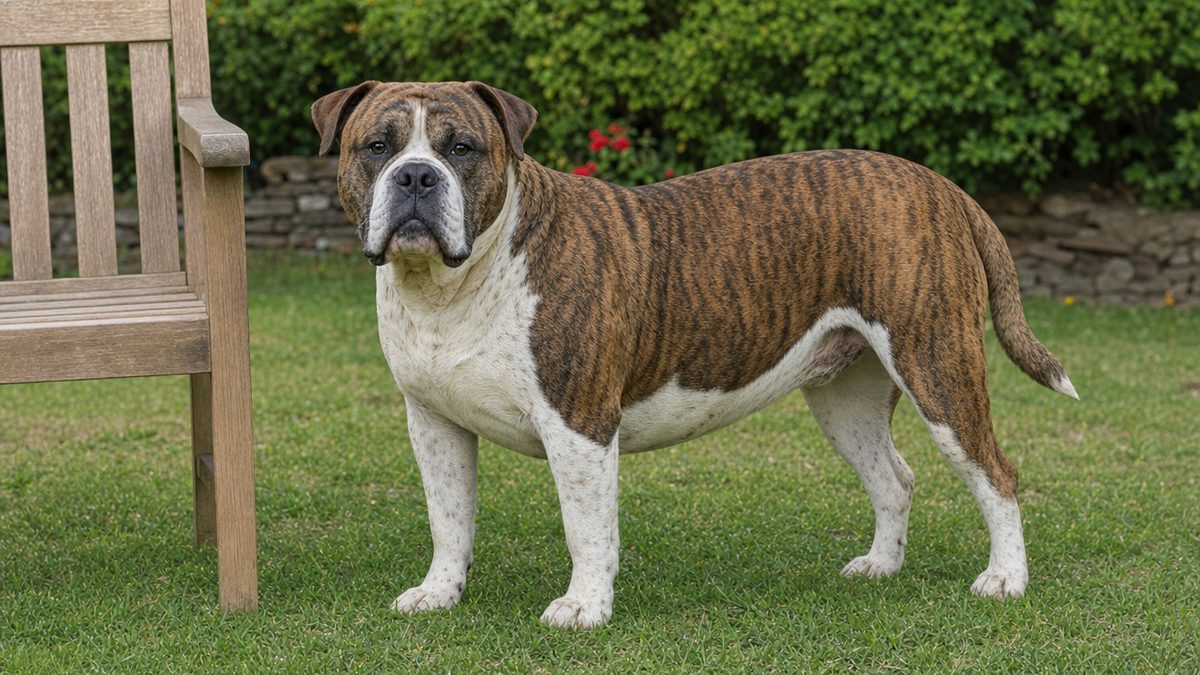
Six features define the look, and five of them are head features. The skull is rather broad and slightly rounded with a well defined stop; the muzzle is short, approximately one quarter of the length of the skull, broad below the eyes with parallel sides and as square as possible from above; the lower jaw advances beyond the upper and rises slightly at the tip to form a mild to moderate undershot bite; the ears are small, high-set, wide apart, pendant and triangular, with natural rose ears also accepted; and the cheeks are prominent from strong facial muscle. The neck carries a dewlap that must not be excessive, and the tail is naturally short, not straight, thick at the root and carried low.
Coat is the simplest part of the dog. Hair is short, smooth and of medium texture, and all colours are allowed except merle, which is a disqualifying fault. Brindle, fawn, red, white, black and combinations of those are what you actually see in photographs of Brazilian dogs.
| Item | What the standard says |
|---|---|
| FCI number | 374, Group 2, Section 2.1 Molossian type, Mastiff type, without working trial |
| Height, males | 51 to 58 cm at the withers |
| Height, females | 49 to 56 cm at the withers |
| Weight | No figure given. The dog must look strong and robust |
| Muzzle | Short, approximately 1/4 of the length of the skull |
| Bite | Mild to moderate undershot. Any bite other than undershot is a disqualifying fault |
| Tail | Naturally short, low set. Taillessness is a disqualifying fault |
| Colour | All colours except merle |
| Recognition | Provisional, 6 August 2025 |
One line in the disqualifying faults deserves reading twice, because no other bulldog standard in Group 2 carries it. FCI-374 disqualifies respiratory distress outright. The English Bulldog standard, FCI-149, only says that "Dogs showing respiratory distress highly undesirable" and disqualifies nothing except aggression, shyness and clear physical or behavioural abnormality. That single clause is the strongest evidence on this page that the Campeiro was written as a functional dog, and it is worth more than any adjective a breeder uses.
Two standards, three years apart: what the FCI changed when it took the breed on
The FCI rewrote nine substantive clauses when it published standard 374 in August 2025, and the most consequential edit changed how the muzzle is measured, from a fixed skull to muzzle ratio of 4:1 in the Brazilian text to a head to muzzle range of 4:1 to 3:1 in the international one.
Two documents exist and both are readable. The Confederacao Brasileira de Cinofilia published standard NR08 dated 28.01.2022, in English, headed BULDOGUE CAMPEIRO (Campeiro Bulldog). That PDF is no longer served from the CBKC's own standards directory and we found it published instead by a working breeder in the United States, which is worth knowing if you go looking for it. The FCI published standard 374 dated 25.08.2025, also in English, which is the official authentic language for this breed. Setting them side by side is something no ranking page has done, and it changes what you should believe about the dog.
The nine changes that matter
| Clause | CBKC 2022 | FCI 2025 |
|---|---|---|
| Muzzle proportion | Skull / muzzle ratio of 4:1 | Length of head / length of muzzle ratio: minimum of 4:1, maximum 3:1 |
| Leg length | Not specified | Length of legs from ground to elbow is 50% of height at withers |
| Utilization | Work with cattle, guard and company | A livestock guarding dog, watchdog and companion dog |
| Temperament wording | A strong fighting spirit and companionship | A brave spirit and companionship |
| Nose colours | Black, blue, brown, red and isabella | Black, blue or brown |
| Underline | Slightly tucked up when viewed in profile | Neither pendulous nor too tucked up |
| Undershot limits | Excessive undershot is a serious fault, no measurement given | Severe fault from more than 1 cm to 2 cm, disqualifying above 2 cm |
| Respiratory distress | Not mentioned | Disqualifying fault |
| Taillessness | Not mentioned | Disqualifying fault |
Take the muzzle line first, because it is the one this whole page turns on. The Brazilian text was unambiguous: under Important Proportions it printed Skull / muzzle ratio of 4:1, which means the muzzle is one quarter of the skull. The FCI text replaced that with Length of head / length of muzzle ratio: minimum of 4:1, maximum 3:1, which means the muzzle is one quarter to one third of the whole head. Those are different measurements with different denominators, and the second is the more permissive of the two.
Then notice what the FCI did not change. Both documents still say, under Facial Region, Muzzle: Short, approximately 1/4 of the length of the skull Federation Cynologique Internationale. So the 2025 standard now contains two statements of the same proportion that do not agree with each other, one measured against the skull and one against the whole head. The 2022 standard did not have that problem, because both of its statements used the skull.
Muzzle length relative to cranial length is the exact quantity that predicts brachycephalic obstructive airway syndrome in dogs, and the two readings of FCI-374 land on opposite sides of the risk curve. Read against the skull, the muzzle is one quarter, a craniofacial ratio of 0.25. Read against the whole head at the loosest permitted end, it is one third of the head, a craniofacial ratio of 0.50. The next section works through what each of those numbers means.
Three other edits point the same way, towards welfare. The FCI added Respiratory distress as an outright disqualifying fault, added a measured ceiling on the undershot bite at 2 cm, and made taillessness disqualifying so that a docked or tailless dog cannot be shown. Against that, it deleted red and isabella from the permitted nose pigments, which the Brazilian text allowed, and it softened the temperament wording twice, turning "a strong fighting spirit" into "a brave spirit"; Federation Cynologique Internationale.
One consequence for anyone reading a third-party standard. The International Olde English Bulldogge Association publishes what it calls "the IOEBA's official Campeiro Bulldog breed standard", and its text is the superseded CBKC version, not the current FCI one: it still permits red and isabella noses, still asks for a tucked-up underline, and carries no disqualification for respiratory distress at all. If you are handed a Campeiro Bulldog standard by a club outside Brazil, check which of the two you are holding.
The muzzle question: what is measured, what is only claimed
No Campeiro Bulldog has ever had its craniofacial ratio published, so the only honest way to place this breed on the brachycephaly scale is to take the ratio its own standard prints and read it against the one large study that measured muzzles and airway disease together.
Start with the measurement that the science uses. Packer and colleagues measured 700 dogs of 97 breeds and defined the craniofacial ratio as muzzle length divided by cranial length, where muzzle length runs from the tip of the nose to the stop, and cranial length runs from the stop over the curve of the skull to the occipital protuberance. That is the same geometry the Campeiro standard describes when it says the muzzle is a quarter of the skull, which is why the two can be compared at all.
Now put the standard's numbers on that scale. The Brazilian text gives a skull to muzzle ratio of 4:1, which is a craniofacial ratio of 0.25. The FCI text's Facial Region says the same thing, approximately one quarter of the skull, while its Important Proportions gives a head to muzzle range of 4:1 to 3:1, which converts to a craniofacial ratio between 0.33 and 0.50. So the standard's own words place this dog somewhere between 0.25 and 0.50, depending on which of its three statements you read.
Where 0.25 actually sits
Packer published median craniofacial ratios by breed, and they make the comparison concrete rather than rhetorical. The Pug measured 0.08, the Pekingese 0.12, the Boston Terrier 0.14, the French Bulldog 0.19, the Shih Tzu 0.20, the English Bulldog 0.22, the Boxer 0.31, the Dogue de Bordeaux 0.36 and the Staffordshire Bull Terrier 0.50. A craniofacial ratio of 0.25 does not sit between the English Bulldog and a normal-headed dog. It sits three hundredths above the English Bulldog and six hundredths below the Boxer.
| Breed | Median craniofacial ratio | How it was obtained |
|---|---|---|
| Pug | 0.08 | Measured, 32 dogs |
| Pekingese | 0.12 | Measured, 3 dogs |
| Boston Terrier | 0.14 | Measured, 6 dogs |
| French Bulldog | 0.19 | Measured, 13 dogs |
| Shih Tzu | 0.20 | Measured, 13 dogs |
| English Bulldog | 0.22 | Measured, 16 dogs |
| Campeiro Bulldog | 0.25 to 0.50 | NOT measured. Derived from the standard's own wording |
| Boxer | 0.31 | Measured, 13 dogs |
| Chihuahua | 0.34 | Measured, 5 dogs |
| Dogue de Bordeaux | 0.36 | Measured, 6 dogs |
| Cavalier King Charles Spaniel | 0.39 | Measured, 26 dogs |
| Staffordshire Bull Terrier | 0.50 | Measured, 16 dogs |
Every other figure in the table comes from a dog that stood still while somebody ran a tape from its nose to its stop. The Campeiro Bulldog row is arithmetic done on a paragraph. We have found no published craniofacial ratio, no skull morphometry and no computed-tomography airway study for this breed anywhere. Treat 0.25 to 0.50 as what the standard permits, not as what Brazilian dogs measure.
The threshold that matters is 0.5, and it is not arbitrary. Packer set brachycephalic at a craniofacial ratio below 0.5 because that was the longest relative muzzle observed in any affected dog in study 1, a Staffordshire Bull Terrier at 0.49; no dog with a ratio of 0.5 or longer was affected by brachycephalic obstructive airway syndrome. Read at its most generous, the Campeiro standard sits exactly on that boundary. Read the way the Brazilian text wrote it, it sits deep inside the at-risk range.
The claim on the other side is stated most plainly in Brazil, and it is worth quoting because it is exactly what a buyer will be told. Portal iG's Canal do Pet writes that, unlike other bulldogs such as the French and the English, the Campeiro is very hardy and does not have problems with its breathing. That sentence carries no citation, no measurement and no study, and the same article was published in March 2023 when it also stated the breed was not yet recognised by the FCI.
So the fair statement about this breed is narrower than either side of the argument makes it. The Campeiro Bulldog is not an extreme brachycephalic in the way a Pug or a French Bulldog is, and it is not a mesocephalic working dog either. It is a moderate brachycephalic whose standard is written to keep it moderate, and whose actual conformation nobody has measured.
What a craniofacial ratio of 0.25 predicts, and the two other risk factors the standard selects for
At a craniofacial ratio of 0.2 the modelled probability of brachycephalic obstructive airway syndrome was 0.31 in one population and 0.32 in a second, and more than half of all dogs measured below 0.20 were affected, so a Campeiro Bulldog built to the tighter reading of its standard is not far outside that band.
Packer's model gives numbers you can hold onto. For a dog of unspecified breed with a 20 cm neck girth, the predicted probability of being affected was 0.69 at a craniofacial ratio of 0.1 and 0.31 at 0.2 in study 1, and 0.68 and 0.32 respectively in study 2, two separate populations arriving at almost identical answers. Over 80 percent of dogs with a ratio below 0.1 were affected, and more than half of those below 0.20.
The curve is steep and it is not linear. That matters here more than it does for a Pug, because the Campeiro sits on the part of the curve where a few millimetres of muzzle change the answer a lot. A breeder who drifts from 0.30 towards 0.25 is not making a small cosmetic change, and the standard's disqualification of respiratory distress is the one clause that pushes back.
The neck, which nobody talks about
Two morphometric factors were significant in Packer's models and only two: shorter craniofacial ratio and greater absolute neck girth. Body condition score, nares ratio and the presence of a nasal fold were not significant in the final model. Now read the Campeiro standard again. It asks for a neck that is strong, of moderate length, very muscular, with loose skin forming a dewlap, and it makes "neck without dewlap" a fault. The Brazilian text went further and specified a neck circumference approximately equal to that of the skull.
Compare that with the measured breeds. The English Bulldog's median neck girth in Packer's sample was 42.2 cm and the Dogue de Bordeaux's 55.5 cm, against 20.0 cm for a Chihuahua. A 40 kg Campeiro Bulldog bred to a broad skull and a mandatory dewlap will sit at the heavy end of that range. So the breed standard actively selects for one of the two risk factors, and constrains the other only loosely.
The third factor is the one you control
Weight relative to the breed mean is a separate, measurable risk. In 905,543 UK dogs, animals whose adult bodyweight was at or above the mean for their breed and sex had 1.42 times the odds of heat-related illness, with a 95 percent confidence interval of 1.12 to 1.80. That is not obesity as a category; it is simply being on the heavy side of your own breed. For an Indian owner, it is the single cheapest intervention available, because it costs nothing and needs no equipment.
Ask for a video of the dog trotting for three minutes in warm weather, with sound. The Continental Bulldog standard makes the test explicit: that breed disqualifies breathing noises in action or when standing still, and requires that even at a fast trot or gallop the dog breathes noiselessly. FCI-374 sets a lower bar, disqualifying only respiratory distress, so a Campeiro that snores, snorts or stertors under exertion is still showable. Judge the dog by the Continental Bulldog's test, not by its own.
One honest caveat closes this. Everything above is inference from conformation to disease, drawn from studies that did not contain a single Campeiro Bulldog. Packer's affected breeds were twelve, and none of them was Brazilian. Nobody has measured this breed's airways, and until somebody does, the strongest statement anyone can make is that its standard permits a conformation the literature associates with risk, and disqualifies the endpoint of that risk.
The reconstruction: one man, one bitch bought in 1977, and a drive across Rio Grande do Sul
Ralf Schein Bender bought his first female in 1977 and then drove across Rio Grande do Sul gathering the last surviving working bulldogs to breed together, and the Confederacao Brasileira de Cinofilia recognised the result as a breed in 2001.
The founding account comes from Brazilian sources, and the two best are newspaper interviews with the man himself rather than English retellings. G1, the Globo news site, interviewed Bender at Expointer in Esteio in August 2013 and reported that he bought his first female in 1977 and travelled through Rio Grande do Sul looking for more bulldogs to breed. In his own words: "Comecei a resgatar os que ainda existiam, cruzar entre si e desenvolver a raca", which is to say he began rescuing the ones that still existed, crossing them with one another and developing the breed.
Folha de S.Paulo profiled the same programme three months earlier, in May 2013, and adds the biographical detail. It names him Ralf Schein Bender, then 58, a gaucho, and describes him as the man responsible for the rescue of the Buldogue Campeiro, a breed recognised in 2001 by the CBKC. His reason for starting was proximity: "Morava perto de abatedouros e gostava de ver os cachorros trabalharem", he lived near slaughterhouses and liked watching the dogs work.
How the foundation stock was actually gathered
Four things about the method are on the record and worth stating plainly. Bender did not start from a written pedigree, because there was none: the dogs, he told G1, were "um cachorro que nao tinha registro, ninguem podia cria-lo de forma organizada";, a dog with no registration that nobody could breed in an organised way. He collected survivors from rural properties across one state rather than importing anything. He kept his own records, and when the CBKC was sceptical he used them: "Primeiro eles ficaram com o pe atras, diziam que nao era uma raca. Mas eu tinha tudo catalogado e mostrei a eles o trabalho";. And he claims the entire national population descends from that work, telling G1 that all the dogs bred across Brazil "tem um pe no Sul", have a foot in the South.
The Portuguese Wikipedia article adds one name and one place that the newspapers do not. It records his kennel as Caodominio, in Taquara, Rio Grande do Sul, and gives the older popular names for the dog as Burdogas or Bordogas before the breed was formalised. Folha uses the same word, describing the dogs as "conhecidos popularmente como bordogas";.
One English page names four founder dogs as icons of the breed, Luma, Alfredo, Rambo and Sarrago, and says the programme later crossed to pure-bred English Bulldogs for new blood. That page is a blog on a US supplement retailer's site, it misspells the breeder's name as Mr Ralf Schein, and it carries no source. We could not corroborate either the dog names or the English Bulldog outcross in any Brazilian source, so treat both as unverified. The Portuguese Wikipedia does record a separate outcross claim, that the fashionable blue coat entered the breed from the American Olde English Bulldogge.
One disagreement in the record is worth publishing rather than smoothing over, because four different centuries are in circulation. Folha dates the ancestral bulldogs' arrival in Brazil to the end of the 19th century; Portal iG's Canal do Pet says the 18th century; the Portuguese Wikipedia says European immigration during the early 19th and mid 20th centuries; and Google's own AI Overview on the India results page currently says the 16th and 17th centuries. The FCI standard refuses to date it at all, saying only that the breed has its genesis through bulldogs brought to Brazil by European immigrants. Nobody has produced a document, so nobody should be quoting a century.
The work this breed was kept for, and the welfare question that ended it
The Campeiro Bulldog's traditional job was to seize and hold cattle and pigs, including inside slaughterhouses, and Brazilian sanitary regulation ended that use in the 1970s, which is the event that nearly took the breed with it.
The FCI standard describes the work without euphemism, and it is unusual for a breed standard to be this specific about a mouth. It says the breed should have "the lower jaw projected beyond the upper just enough for the dog to hold the ox";, and a broad and strong muzzle, not too short or too long, "to make possible to grab an ox regardless of its size and weight". The Brazilian text of 2022 carries the same two sentences. The undershot bite is not decoration; it is a grip specification.
The Brazilian press describes what that looked like. Bender told G1 that if an angry ox escaped, the dog "ia la e abocanhava pelo nariz";, went in and seized it by the nose. Folha reports the dogs were used on farms and in abattoirs to help handle cattle and, in more extreme cases, to knock down and subdue oxen. The Portuguese Wikipedia adds that they could drag pigs by the ears to the point of slaughter and could subdue a wary ox of up to 400 kg on their own, sourcing that to a 2005 Brazilian magazine article.
Why it stopped
All three Brazilian sources agree on the cause and the decade. G1 records that "a Saude Publica proibiu";, public health banned it, and that the ban was imposed by the Vigilancia Sanitaria. Folha attributes the near-disappearance of the bordogas in the 1970s to laws that prohibited the use of dogs in slaughterhouses. The Portuguese Wikipedia says the same, naming new sanitary measures for abattoirs and their more effective enforcement. We were not able to locate the 1970s instrument itself and we are not going to name a rule number we have not read.
What can be checked is the position today. Brazil's current humane-slaughter regulation, Portaria SDA 365 of 16 July 2021, governs pre-slaughter handling, and its Article 25 requires that loading, unloading and driving of animals use instruments that do not cause unnecessary injury, pain or agitation, listing flags, rattles, handling boards and compressed air as the examples; paragraph 1 prohibits pointed instruments and whips. Dogs appear nowhere in the permitted list. In fact the word for dogs does not appear anywhere in the regulation at all, which we checked by extracting the full text and searching it.
Brazilian pet media does not soften it either, which matters because the softening usually happens in English. Portal iG's Canal do Pet calls the slaughterhouse role "um lado cruel";, a cruel side among the activities assigned to this dog, and says it came to be badly regarded and then regulated by the sanitary authorities. The same article adds a detail the breed's admirers rarely mention: many of these dogs died in the fights with the cattle, which it describes as a kind of natural selection that left the physically most suitable animals behind.
Two things are true at once and both belong on the page. Seizing a live 400 kg animal by the nose is not a practice anybody now defends, and Brazil regulated it out of its slaughterhouses roughly fifty years ago. The dogs alive today do not do that work: G1 states plainly that the Campeiro Bulldog is no longer used for cattle restraint and is now a domestic animal kept for company and property guarding. A buyer is not buying a catch dog. They are buying an animal whose jaw, neck and temperament were shaped by that job.
The residue of the work is what an Indian owner will actually meet. A dog selected for centuries to close its jaws on something large and not let go has a bite that is a management problem rather than an aggression problem, and the standard still asks for canines well developed for gripping, and well spaced apart. Teach a reliable release cue from the first week, use tug toys with rules rather than banning them, and never play games that reward hanging on.
Who registers this breed now, and what provisional recognition actually buys you
The FCI accepted the Campeiro Bulldog on a provisional basis on 6 August 2025, which makes it one of four Brazilian breeds with an FCI number, but provisional breeds cannot compete for the CACIB, and no Indian registry lists it at all.
Read the FCI's own record and the dates are unambiguous. The nomenclature entry for BULDOGUE CAMPEIRO (374) gives the date of acceptance on a provisional basis as 6 August 2025, the date of publication of the official valid standard as 6 August 2025, English as the official authentic language, and breed status as "Recognized on a provisional basis". The English standard was published on 25 August 2025, the French and Spanish on 26 September 2025, and as of this writing the German translation has not been published at all.
Provisional recognition is not the same as full recognition, and the FCI spells out the difference. Breeds on the provisional register are not eligible for the CACIB until they are recognised on a definitive basis, although they can compete for FCI titles at the World Dog Show and the Section Shows, and their pedigrees must carry the FCI logo. The Campeiro Bulldog is the fifth-newest entry on that register, behind four breeds added on 11 February 2026.
The Brazilian position, before and after
The CBKC has moved the breed between two of its own lists, and the move is visible. Buldogue Campeiro now appears in the CBKC's Racas Brasileiras index under Group 2 with the entry "Padrao FCI N 374 - 10/07/2025", alongside Fila Brasileiro (225), Terrier Brasileiro (341) and Rastreador Brasileiro (275). It no longer appears on the CBKC's Group 11 list of breeds recognised only by the CBKC, which still holds Buldogue Serrano, Dogue Brasileiro, Monster Bull, Ovelheiro Gaucho, Pastor da Mantiqueira, Veadeiro Nacional and Veadeiro Pampeano. The breed also appears in the CBKC's full breed index, between Braco Italiano and Buldogue Frances. So Brazil now has four FCI breeds instead of three, and this is the fourth.
The scale of the registry that produced it is worth knowing. The CBKC registered 79,755 puppies in 2025 and has registered 3,915,969 pure-bred dogs since its studbook was created, down from a peak of 159,787 puppies in 2016. The CBKC does not publish a per-breed count for the Campeiro Bulldog, and we could not find one anywhere, so no honest population figure for this breed exists in the way the Terrier Brasileiro's 24,101-dog studbook does.
| Registry | Status | Scale of the registry |
|---|---|---|
| FCI | Provisional since 6 August 2025, standard 374, Group 2 Section 2.1. Not eligible for the CACIB | Global federation, standard published in English, French and Spanish |
| CBKC, Brazil | Listed under Group 2 as Padrao FCI N 374, dated 10/07/2025. Previously a CBKC-only breed | 79,755 puppies registered in 2025, 3,915,969 since inception |
| AKC, United States | No breed page. akc.org/dog-breeds/campeiro-bulldog/ returns HTTP 404, while the same URL pattern serves a live Foundation Stock Service page for the Brazilian Terrier | Control passed on the same site in the same session |
| Kennel Club of India | No listing, no breed club, no published standard found | 32,219 puppies registered in 2025, 1,425,001 since inception, 80 member clubs |
| IOEBA, United States | Publishes its own Campeiro Bulldog standard, which reproduces the superseded CBKC text | Private registry, not FCI-affiliated |
India has no route, and the numbers show why one is unlikely to appear. The Kennel Club of India registered 32,219 puppies in 2025 across 80 member clubs, down from 88,261 in 2021, and it held exactly two CACIB all-breed shows that year. Even if a Campeiro Bulldog reached India tomorrow with an FCI pedigree, it could not compete for the CACIB at either of them, because provisional breeds are excluded. There is no Indian breed club to petition, and no KCI standard to register against.
The United States has no route either, and we checked that with a control rather than assuming it. The URL akc.org/dog-breeds/campeiro-bulldog/ returns HTTP 404 with the AKC's own "Page not found" template, while the identical URL pattern for the Brazilian Terrier returns HTTP 200 and a complete breed page carrying a Foundation Stock Service link. So the absence is real and not an artefact of a broken fetch. What does exist in the United States is the IOEBA's private standard, which is a club document and not a registry recognition.
Campeiro Bulldog price in India: there is no price, and here is the proof
No published price exists for a Campeiro Bulldog in India, no Indian listing site sells one, and the only Indian page about the breed sells dog food rather than dogs, so any figure you are quoted is invented rather than sourced.
Start with what a real Indian price page looks like, so the absence means something. Mr n Mrs Pet publishes a Labrador Retriever page with a city-by-city table for eight cities, Hyderabad, Bangalore, Delhi, Chennai, Lucknow, Mumbai, Jaipur and Pune, each showing INR 30,000 to INR 1,20,000, and it breaks the range into basic quality at INR 30,000 to 60,000, KCI registered at INR 60,000 to 90,000 and champion bloodline at INR 90,000 to 1,20,000. That is what an Indian market looks like when one exists.
The same site has no Campeiro Bulldog page at all. Requesting mrnmrspet.com/dogs/campeiro-bulldog-puppies-for-sale redirects to the site's 404 page, which is titled "404 Page Not Found" and carries a noindex tag. The control and the test ran in the same session on the same host, so the absence is a fact about the site rather than about our connection.
What the Indian search results actually contain
Three things, and none of them is a dog for sale. The first is Justdial's Pet Shops For Campeiro Bulldog category, which we treat separately in the next section because it is the most instructive. The second is Etsy's India storefront, which returns Campeiro Bulldog merchandise, meaning prints and stickers rather than animals. The third is GoofyTails, an Indian pet-supplies retailer whose Campeiro Bulldog page is a content article with no price, no litter and no availability, attached to a product grid that returns "Showing -1 Results"; and the message "We're sorry. There are no results for ''".
Indian pages routinely publish a US dollar price converted at a single rate and presented as a rupee price. This site has now caught three separate rates: 84.38, 74.00 and a flat 80.00. If a seller quotes you a Campeiro Bulldog price, divide it by 84.38, by 74 and by 80 and see whether any of the three gives a round dollar figure. Divide Rs 98,999 too, because that exact number is a house charm price on one Indian listing site attached to whichever puppy is in stock, not a breed price for anything. We found no rupee figure for this breed to test, which is the finding.
The one Indian-facing size claim does not survive checking either. GoofyTails publishes 53 to 60 cm and 35 to 45 kg for males and 48 to 58 cm and 30 to 40 kg for females. The FCI standard gives 51 to 58 cm and 49 to 56 cm and prints no weight at all, and the CBKC standard gives the same two heights and the same absence of weight. So the Indian page's male upper bound is 2 cm above the standard, its female lower bound is 1 cm below it, and both of its weight ranges come from somewhere neither registry has published.
| Source | Height, males | Height, females | Weight, males | Weight, females |
|---|---|---|---|---|
| FCI-Standard N 374, 2025 | 51-58 cm | 49-56 cm | Not stated | Not stated |
| CBKC standard NR08, 2022 | 51-58 cm | 49-56 cm | Not stated | Not stated |
| English Wikipedia | 50-56 cm | 48-54 cm | 36-42 kg | 31-37 kg |
| Portuguese Wikipedia | around 53 cm | around 51 cm | 35-45 kg | 30-40 kg |
| GoofyTails, India | 53-60 cm | 48-58 cm | 35-45 kg | 30-40 kg |
| IOEBA, United States | 20-23 in (51-58 cm) | 19-22 in (48-56 cm) | Not stated | Not stated |
| Natural Dog Company | Not stated | Not stated | 70-90 lb (32-41 kg) | Not stated |
Read that table as a warning about sourcing, not about the dog. Only the two standards and the IOEBA agree, and the IOEBA is simply the Brazilian text converted to inches. Every kilogram figure in circulation traces back to somewhere neither registry has printed, and Google's AI Overview for this query on the India results page is currently reproducing the English Wikipedia numbers as though they were the CBKC's.
What the Indian listings are really selling, and how to check it in two clicks
Justdial runs a Pet Shops For Campeiro Bulldog category in city after city under the identical numeric id nct-13798632, filled with ordinary pet shops that list no such breed, under an article whose recommendations are named Pet Shop A, Pet Shop B, Pet Shop C and Pet Shop D.
The category id is the tell, and you can verify it yourself in about ten seconds. The same id, nct-13798632, serves Delhi, Kolkata, Vadodara, Meerut, Vellore, Hapur, Srinagar, Sagar and Gorakhpur, including a Hindi-language version of the Gorakhpur page. A category that exists identically in every Indian city, including cities where nobody has ever seen the breed, is a programmatically generated page rather than a market.
Look at who is actually listed. The Delhi page's top results are Pupp Shup in Surajmal Vihar, City Paws in Noida Sector 45, Barking Lot Pet Boarding in Gurgaon Sector 58, Jaws N Paws Pet Shoppe on Lodhi Road and Happy Puppies Pets in Gurgaon Sector 94. Their own listed categories, printed in the comparison table at the foot of the page, are Pet Shops, Pet Shops For Dog, Dog Trainers, Pet Clinics, Veterinary Clinics, Pet Grooming Services, Dog Food Retailers and Pet Shops For Labrador Dog. Not one of the five carries a Campeiro Bulldog category.
Exactly one business on that page does. Doog Salle, in Titawi, Muzaffarnagar, with a single rating, lists two categories: Pet Shops For Indian Bully Dog and Pet Shops For Campeiro Bulldog. A neighbouring listing, Chauhan Kennel in Roorkee, carries Pet Shops For CA Me Mallorqui Dog and Pet Shops For Bolognese Dog. That is what an auto-generated long tail looks like from the seller's side: a small kennel tagged into a dozen exotic breed categories it does not stock.
The article below the listings is machine-written and does not hide it. Under the heading "Top Pet Shops For Campeiro Bulldog in Delhi" it recommends four businesses called Pet Shop A, Pet Shop B, Pet Shop C and Pet Shop D, describing each one's strengths in detail. If a page recommending Campeiro Bulldog specialists cannot name a single one, that is your answer on Indian availability.
One more detail from the same page is worth a laugh and a lesson. The comparison table lists the website of the top-ranked Delhi pet shop as www.royalcanin.com, which is a pet-food manufacturer rather than that business. Directory data of this quality should not be the basis of a decision about a 40 kg guarding dog.
A two-click test for any rare-breed listing in India
- Read the URL. If the breed name sits in front of a numeric category id, open the same id in a different city. An identical page means a template, not a market.
- Open the listed businesses. Check whether the breed appears in that business's own categories rather than only in the page heading.
- Search the page for placeholder text. Names like Pet Shop A, or a stray footnote marker with no reference, mean the copy was generated.
- Ask for the pedigree number and the issuing registry. A Campeiro Bulldog with papers has an FCI-logo pedigree from the CBKC and a standard-374 breed line.
- Divide any rupee figure by 84.38, 74 and 80, and reject Rs 98,999 outright.
- Ask which port the dog entered India through. Only six are lawful, and a seller who cannot answer has not imported anything.
Applied here, the test returns the same answer every time. There is no Indian Campeiro Bulldog market, there is no Indian price, and the pages that appear to offer one are selling grooming, boarding, dog food and stickers. An Indian buyer who is offered a Campeiro Bulldog puppy is almost certainly being offered something else, most likely an American Bulldog cross or a locally bred bull-type dog.
The only lawful way this dog reaches India, read from the trade notice itself
A Campeiro Bulldog can enter India only as one person's own pet with a valid pet book in the importer's name, and DGFT Trade Notice 22/2022-23 states that any application made for trading or breeding purposes shall be duly rejected.
Dogs are a Restricted import, not a free one. Under ITC (HS) code 01061900, Mammals: Other, the import policy is Restricted, subject to Policy Condition 6 of that chapter. Policy Condition 7 then limits import of dogs to three purposes only: a pet dog with a valid pet book and relevant records in the name of the importer; dogs imported by research and development organisations with the recommendation of the CPCSEA; and dogs for internal security by the Defence and Police forces.
Policy Condition 8 closes the commercial door explicitly. It states that import of commercial dogs for breeding or any other commercial activities other than the purposes mentioned above is not permitted, and paragraph 6 of the trade notice repeats that any applications for trading or breeding purposes, or applications made on behalf of another person or entity, shall be duly rejected.
What a genuine private import looks like
- Transfer of residence route, which allows up to two pets as passenger baggage without a DGFT authorisation, but only for a person transferring residence to India after two years of continuous stay abroad
- DGFT import authorisation, required if the stay abroad was under two years, if the pet is not travelling as passenger baggage, or if more than two pets are involved
- Application filed as ANF-2M against the importer's own IEC, or against the permanent IEC number IIHIE0153E for personal, non-trade imports
- Documents comprising the vaccination book or pet passport or pet book, a certificate for emotional support, and the pet's passport
- An advance No Objection Certificate from the Regional or Quarantine Officer of the arrival port, obtained seven days before travel and relaxable to three
- Entry through one of seven ports only, the airports and seaports of Delhi, Mumbai, Chennai, Hyderabad, Bengaluru and Kolkata and, since October 2024, Kochi airport
Every item on that list is verbatim from the notice, including the two-month lead time DGFT itself advises pet owners to allow before the travel date. Read together with the registry position, the two facts settle the question of Indian supply. There is no lawful commercial import route for this breed, and there is no domestic breeding population to import from, because no Indian registry recognises it and no Indian breed club exists.
One kind of Campeiro Bulldog can legitimately live in India: a dog already owned abroad by a person who then moves to India, brings it under transfer of residence with a valid pet book in their own name, and clears quarantine at one of the seven ports. That is a returning family's dog, not a purchase. Anyone selling you an imported Campeiro Bulldog puppy is describing a transaction DGFT says shall be duly rejected. The full route is set out in how to import a dog to India.
One more constraint applies specifically because the breed is new to the FCI. A dog imported with papers would carry a CBKC pedigree bearing the FCI logo, which is mandatory for provisionally recognised breeds. Ask to see it, ask for standard number 374 on the breed line, and check the issuing body is the Confederacao Brasileira de Cinofilia rather than a private American registry, because IOEBA papers are not FCI papers.
What a 40 kg brachycephalic dog costs to keep in India, bounded honestly
No published Indian monthly cost figure exists for this breed, so price the seven lines that actually scale with a 40 kg short-muzzled body rather than trusting a tidy number, and treat cooling and tick prevention as fixed costs rather than optional ones.
Start by admitting what is not known. The Campeiro Bulldog has no Indian price, no Indian cost estimate and no Indian owner survey, because the only Indian page about it publishes no figures at all and the site that publishes an eight-city table for Labradors has no page for this breed. Any monthly rupee figure you are shown for a Campeiro Bulldog in India was written by somebody who has never costed one.
Four cost lines scale directly with bodyweight and three do not. Food, therapeutic drug doses, anaesthetic drug doses and parasite preventives are portioned or dosed per kilogram, so a 40 kg dog costs roughly three and a half times a 12 kg dog on each. Vaccination, consultation fees and microchipping cost the same regardless of size. Anyone quoting a monthly figure only slightly above a Labrador's has not priced the first group.
| Cost line | Scales with weight? | What makes this breed different |
|---|---|---|
| Complete adult food | Yes, directly | Portion for a 35 to 45 kg dog and hold body condition at 4 or 5 on the nine-point WSAVA scale |
| Large-breed puppy food, months 2 to 14 | Yes, and rising monthly | Growth rate is one of the few modifiable inputs into orthopaedic disease in a heavy bull-type dog |
| Monthly tick preventive | Yes, dosed by weight | Tick infestation raised the odds of Ehrlichia canis infection in a 442-dog Andhra Pradesh study, and dogs with tick-control history had lower odds |
| Cooling, March to October | No, but hours rise steeply | Driven by a brachycephalic odds ratio of 2.10 for heat-related illness, not by comfort |
| Annual vaccination and consultation | No | Same as any dog; the size premium sits in everything else |
| Airway assessment before purchase or breeding | Yes, sedation dosed by weight | The standard disqualifies respiratory distress, so document breathing under exertion rather than at rest |
| Skin fold and eye care | No | Skin fold dermatitis carried an odds ratio of 38.12 in English Bulldogs, and the Campeiro has fewer folds but is not fold-free |
| Emergency surgical reserve | Yes | Heat-related collapse and airway surgery are the two events most likely to arrive as one large bill |
The three lines Indian owners most often leave out
Cooling is a running cost, not a purchase. The mechanism is in the numbers: brachycephalic dogs had 2.10 times the odds of heat-related illness compared with mesocephalic dogs in 905,543 UK dogs, interval 1.68 to 2.64. In an Indian summer that translates into eight months of fans, cooling mats, air conditioning hours or a genuinely shaded indoor space, and it is not a line you can defer.
Tick prevention is a monthly commitment with published local evidence behind it. A cross-sectional study of 442 clinically suspected dogs presented at 90 veterinary dispensaries across Andhra Pradesh found Ehrlichia canis in 37 dogs by microscopy, 8.37 percent, and in 51 dogs by PCR, 11.54 percent. Both fractions divide out correctly, and the same analysis found that dogs with a history of tick-control measures had significantly lower odds of infection. A monthly preventive is cheaper than a course of doxycycline and a transfusion.
Weight control is free and it is the highest-value line on the list. Dogs at or above the mean adult bodyweight for their own breed and sex carried 1.42 times the odds of heat-related illness, interval 1.12 to 1.80. Score body condition monthly against the nine-point WSAVA chart and aim for 4 or 5 out of 9, where the ribs are easily felt and the waist is visible from above.
Indian food, medication and veterinary prices vary more by city and brand than by breed, and inventing a tidy band for a dog nobody in India owns would be worse than useless. Price the eight lines above with your own vet and your own retailer. The one number we will commit to is that cooling and tick prevention are not optional for this dog in this country.
Heat tolerance: the origin climate is 10.67 degrees cooler than Chennai
The Campeiro Bulldog rates 2 out of 5 for heat tolerance, because the place it was rebuilt runs an annual mean of 17.28 degrees Celsius and because the breed sits in a skull-shape category carrying 2.10 times the odds of heat-related illness.
We queried NASA POWER by explicit latitude and longitude rather than by place name, so no wrong city can be served by accident, and the API echoed the coordinates back. Taquara in Rio Grande do Sul, where Ralf Schein Bender's kennel is recorded, was requested at 29.6503 south, 50.7803 west and returned longitude -50.78, latitude -29.65, elevation 521.05 metres. Lages in Santa Catarina, in the highland cattle country of the same region, was requested at 27.8161 south, 50.3264 west and returned longitude -50.326, latitude -27.816, elevation 948.02 metres.
The headline comparison is larger than most readers expect. Taquara's annual mean is 17.28 degrees Celsius, against 27.95 in Chennai, a gap of 10.67 degrees. This is a southern-hemisphere temperate climate at 500 metres, not a tropical one. Its hottest month, January, averages 21.84 degrees, and its coldest, July, averages 12.24 degrees.
| Place | Annual mean | Hottest month, mean | Coolest month, mean | Peak wet-bulb |
|---|---|---|---|---|
| Lages, Santa Catarina (27.816 S, 50.326 W, 948 m) | 15.95 C | January, 20.32 C | July, 10.94 C | 18.78 C |
| Taquara, Rio Grande do Sul (29.65 S, 50.78 W, 521 m) | 17.28 C | January, 21.84 C | July, 12.24 C | 19.99 C |
| Bengaluru | 23.74 C | April, 28.37 C | December, 20.22 C | 22.66 C |
| Pune | 23.86 C | April, 28.93 C | December, 19.62 C | 23.56 C |
| Delhi | 25.60 C | June, 35.88 C | January, 13.61 C | 27.74 C |
| Kolkata | 25.81 C | May, 31.53 C | January, 17.31 C | 27.86 C |
| Hyderabad | 26.10 C | May, 33.30 C | December, 20.76 C | 24.44 C |
| Mumbai | 26.77 C | May, 31.19 C | January, 23.19 C | 26.55 C |
| Ahmedabad | 27.57 C | May, 35.06 C | January, 19.93 C | 27.62 C |
| Chennai | 27.95 C | May, 31.51 C | January, 24.09 C | 27.36 C |
Read the two ends of that table together and the argument makes itself. Bengaluru's coolest month, December, averages 20.22 degrees, which is within two degrees of Taquara's hottest month. Chennai's coolest month, January at 24.09 degrees, is 2.25 degrees warmer than the hottest month this breed's home region ever averages. Mumbai's coolest month, at 23.19 degrees, is warmer than a Rio Grande do Sul summer.
The humidity argument, made the right way round
Owners assume a Brazilian dog is built for humidity, and the assumption is half right in a way that misleads. Taquara runs 79.9 to 85.7 percent relative humidity every month of the year, with an annual mean of 82.77 percent, and Lages runs 82.3 to 88.1 percent. Southern Brazil is not a dry place. Mumbai peaks at 90.4 percent in August, Pune at 90.8 percent in August, and Kolkata at 89.3 percent in September. In isolation, monsoon humidity is no worse than the breed's homeland.
The difference is the temperature the humidity sits on. Taquara's 81 percent in January arrives at a mean of 21.84 degrees, so its peak monthly wet-bulb temperature is 19.99 degrees. Chennai's peak wet-bulb is 27.36 degrees, Kolkata's 27.86 and Delhi's 27.74. Evaporative cooling, which is the whole mechanism a panting dog relies on, degrades as wet-bulb rises, and a short-muzzled dog has less evaporative surface to work with than a long-muzzled one. So the honest statement is that this breed is not humidity-intolerant, it is intolerant of Indian humidity at Indian temperatures, which is a difference of about eight degrees of wet-bulb.
A PubMed search for heatstroke AND dogs AND India returned exactly one record, and its title shows it is a review of climatic heat events in animal models generally rather than a canine clinical series. The control run in the same session, Ehrlichia canis AND India AND dogs AND prevalence, returned 32 records including a 442-dog Andhra Pradesh study, so the search was working. There is no published Indian canine heat-illness epidemiology, which is why every heat figure on this page comes from the United Kingdom and should be read as a floor rather than a ceiling for Indian conditions.
The summer routine that keeps an Indian Campeiro Bulldog alive
Exercise is the trigger to manage, not the parked car, because exertional heat illness accounted for the large majority of UK cases and a short-muzzled 40 kg dog reaches its limit far sooner than its owner expects.
The UK evidence puts the danger in the right place. In 905,543 dogs under primary veterinary care, 40 percent of the 395 heat-related illness events recorded in 2016 occurred in July, the month of that year's heatwave, and the annual incidence risk was 0.04 percent with an event fatality rate of 14.18 percent. The authors also explain the size mechanism in one sentence worth memorising: smaller dogs have a high heat-storage to radiative-surface-area ratio that results in more rapid heat loss compared with larger dogs, meaning they can exercise for longer before overheating.
City by city, when this dog can be outside
| City | Annual mean | Hardest months | Practical guidance |
|---|---|---|---|
| Bengaluru | 23.74 C | March and April | The least unreasonable Indian city for this dog. Two walks before 7 am and after 7 pm, shade at midday |
| Pune | 23.86 C | April and May | Similar to Bengaluru in the dry season, harder in the August humidity peak of 90.8 percent |
| Delhi | 25.60 C | May, June and July | Indoors from 10 am to 6 pm from April to July. June averages 35.88 C and July's wet-bulb peaks at 27.74 C |
| Kolkata | 25.81 C | April to September | Peak wet-bulb of 27.86 C is the highest of any city here. Air conditioning, not fans, in that window |
| Hyderabad | 26.10 C | April and May | May averages 33.30 C. Restrict to dawn and late night for those two months |
| Mumbai | 26.77 C | May, then June to September | Coolest month still averages 23.19 C, warmer than a Rio Grande do Sul summer. No true recovery season |
| Ahmedabad | 27.57 C | April to June | May averages 35.06 C. This is the hardest dry-heat posting in the table |
| Chennai | 27.95 C | March to October | Coolest month averages 24.09 C, above Taquara's hottest. Indoors and cooled for most of the year |
The seven rules
- Walk before sunrise and after full dark from March to October, and test the pavement with the back of your hand for five seconds before you go
- Cap exertion by breathing, not by distance. Stop the moment the dog's mouth goes wide and square and the tongue broadens and cups
- Carry water on every walk over ten minutes and offer it before the dog asks
- Cool with room-temperature water on the belly, groin, armpits and paws, never with ice, and move air across the wet dog
- Never muzzle a short-muzzled dog in warm weather with anything that restricts a wide-open mouth
- Keep body condition at 4 or 5 on the nine-point WSAVA scale, because being at or above the breed mean weight carried 1.42 times the odds of heat illness
- Treat any collapse, laboured breathing or a rectal temperature above 40 degrees Celsius as an emergency and go to a vet
Two of those rules carry published weight rather than folklore. The weight rule comes from the 1.42 odds ratio and its 1.12 to 1.80 interval, and the body-condition target comes from the WSAVA nine-point chart, where 4 and 5 describe a dog whose ribs are easily palpable with minimal fat cover and whose waist is visible from above.
Stenotic nares are a major conformational risk factor for brachycephalic airway disease, although on their own they do not establish a clinical diagnosis, which needs a history and a physical examination. Look at your dog's nostrils in good light at rest. Open nostrils are visibly triangular slits with a clear opening; severely stenotic ones are near-closed lines. The FCI standard makes slightly open nostrils a severe fault in this breed, so a Campeiro with pinched nostrils is both a welfare problem and a breeding fault.
Temperament and household fit, including the dog-aggression claim and where it came from
The standard describes a calm, vigilant, quiet guardian that is very docile and easily adaptable, and the widely repeated claim that the breed is aggressive to other dogs traces to a single sentence by one Brazilian hobby breeder about one dog in 2013.
Read the standard first, because it is unusually explicit for a guarding breed. FCI-374 calls the temperament versatile, with guardian characteristics, standing out for fidelity to its owner, tenacity and courage, and describes it as vigilant, calm and persevering, then adds three phrases most bull-breed standards do not contain: very docile, easily adaptable, controllable without being shy, barks little and is calm. The Brazilian text of 2022 said the same, with "very docile with children" in place of "very docile";.
Now follow the dog-aggression claim back. English Wikipedia states flatly that "The breed is known to be aggressive to other dogs" and cites one source for it, a reference labelled Truda. That reference is the G1 article by Felipe Truda, and what the article actually contains is a remark from Deivis Albers, a plastic surgeon who had been breeding the dogs since 2009: "Ele e ciumento com o dono. Se chegar outro cao perto, ele vai querer brigar";, he is jealous of his owner, and if another dog comes close he will want to fight.
That is the entire evidential basis for a claim now reproduced across the English-language internet as a breed characteristic. The same G1 article records Albers saying the dog is docile with visitors, gets on with children and is "incapaz de morder uma crianca", incapable of biting a child. Wikipedia carried the first half forward and left the second. We are not saying the breed has no dog-directed aggression; we are saying nobody has measured it, and a single owner quotation is not a finding.
Two independent enthusiast sources do describe dog-directed aggression, which is worth recording even though neither cites anything. MolosserDogs calls the breed "fairly dog-aggressive"; while also calling it cautious but friendly with people and a lovely family dog, and the same page's prose contains a stray footnote marker with no reference behind it, which is a reliable sign of generated copy. So the honest position is that the claim is plausible for a bull-type guarding breed and unevidenced for this one.
Who this dog suits, and who it does not
- Suits a household with ground-floor access, a shaded yard and somebody home during the day
- Suits an owner who has handled a 40 kg dog before and can physically manage one that decides not to move
- Suits a family that wants a quiet guard rather than a barker, because the standard specifically asks for a dog that barks little
- Does not suit a first-time owner, a top-floor apartment with a lift, or a household that leaves the dog alone eight hours a day
- Does not suit a home with an existing same-sex adult dog until the two have been introduced slowly on neutral ground
- Does not suit anyone who wants a running or trekking partner, because the muzzle sets the ceiling on sustained exertion
Living conditions decide whether any of this works. This is a guard dog by design and by registry classification, listed by the FCI as a livestock guarding dog and watchdog, and apartment living puts a territorial 40 kg animal within earshot of a stranger every few minutes. A ground-floor home with a gated yard is not a luxury for this breed; it is the difference between a calm dog and a dog on permanent duty.
The jealousy point is the practical one for Indian homes. Whether or not it generalises, a dog selected to stay beside one person and see off intruders will guard that person's proximity, and Indian flats and gated-community lawns put dogs in each other's space constantly. Manage it structurally: feed separately, gate the resting area, and do introductions on walks rather than in the living room.
Training a dog bred to grip and hold, and the two cues that are not optional
Train a Campeiro Bulldog for release and recall before anything else, because the breed was selected for a jaw that closes on a large animal and does not let go, and the standard still specifies canines developed for gripping.
The standard tells you what you are working with. It asks for strong teeth, with canines well developed for gripping, and well spaced apart, jaws that are broad, massive and square, and a lower jaw that advances beyond the upper. It also asks for a temperament that is firm and controlled so as "to always obey the commands of its owner";, a sentence both the Brazilian and the FCI texts carry. Obedience is written into the breed description, which is a useful thing to hold a breeder to.
Brazilian owners describe a biddable dog rather than a difficult one. G1's interviewee called the breed "um cachorro apaixonado pelo dono";, a dog in love with its owner, with a reliable and balanced temperament. The FCI standard's own wording, controllable without being shy, points the same way. Nothing in the record suggests a handler-aggressive or hard-to-motivate dog.
The two cues to build first
- Release, taught on a tug toy from week nine and generalised to food, bedding and stolen objects before month six
- Recall away from a moving stimulus, taught on a long line from month three and never tested off-line in an unfenced Indian street
- Settle on a mat, because a guarding dog needs a default that is not patrolling
- Loose-lead walking finished before the dog passes 25 kg, since a 40 kg adult that pulls is a two-person job
- Quiet on cue, rewarded with silence rather than punished with noise
- Handling tolerance for ears, feet, mouth and skin folds, which makes every future vet visit cheaper
Timing matters more than method in India, because of the heat. Train indoors in the middle of the day and outdoors only in the dawn and dusk windows the climate section sets out, and keep sessions to five or ten minutes. A short-muzzled dog that is panting hard is not learning, it is thermoregulating, and pushing a session in a Chennai afternoon buys you an overheated dog and a poisoned association with training.
Socialisation, and the Indian version of it
The window closes early and Indian streets are the syllabus. Socialise the puppy deliberately rather than hoping it happens, because a breed the standard calls controllable without being shy only stays that way if it meets the world early. Between eight and sixteen weeks, plan deliberate, positive, short exposures to the things this dog will meet for the next twelve years: two-wheelers, autorickshaws, street dogs seen at a distance, cattle, monkeys where relevant, doorbells, delivery riders, house help, festival crowds and firecrackers. A guarding breed that has not met a delivery rider by four months will decide what a delivery rider means on its own.
Do not use correction-based handling on a dog whose reflex under pressure is to grip. Two things follow from the standard's own description of the jaw. First, aversive handling around the mouth is exactly the wrong place to create conflict. Second, the breed's stated obedience is a selected trait, so if you are having to fight a Campeiro Bulldog to get compliance, either the dog is unwell, the session is too long, or it is too hot to be working.
One legal note belongs here rather than in the health section, because it changes what a breeder may show you. Indian law prohibits tail docking, ear cropping, de-barking, de-clawing, branding, dyeing and any other mutilation or change of appearance by artificial means, in the Second Schedule Part II paragraph 6(8) of the Prevention of Cruelty to Animals (Dog Breeding and Marketing) Rules 2017. This breed's tail is naturally short, and taillessness is a disqualifying fault in the standard, so a docked stump on an Indian Campeiro Bulldog is both illegal and a show disqualification.
Daily exercise requirement, and why the muzzle sets the ceiling
Give a Campeiro Bulldog two moderate sessions a day totalling roughly 45 to 60 minutes, split across the cool ends of the day, and let breathing rather than a stopwatch decide when a session ends.
The dog's build says it can do more than an English Bulldog and less than a working herder. FCI-374 requires length of legs from ground to elbow equal to 50 percent of the height at withers, a body length to height ratio of 11:10, a balanced free gait with good ground coverage, and it makes very heavy or difficult movement with short steps a severe fault. Those are the specifications of a dog meant to cover ground on a farm, and they are the strongest structural argument that the breed is genuinely athletic.
The airway is the counterweight, and the counterweight wins in India. Exertion is the trigger for heat-related illness far more often than a hot car, and in the UK dataset dogs over 10 kg carried significantly higher odds than the lightest group at every weight band. A dog whose muzzle is a quarter to a third of its head has less evaporative surface than a dog whose muzzle is half. So the ceiling on this breed's exercise is not fitness, it is thermoregulation.
| Session | Duration | When | What it is for |
|---|---|---|---|
| Morning walk | 25 to 30 minutes | Before sunrise, March to October | Aerobic base and toileting |
| Evening walk | 20 to 30 minutes | After full dark in summer, dusk in winter | Second aerobic block and sniffing time |
| Indoor scent game | 10 minutes | Middle of the day | Mental load without heat load |
| Structured tug with release rules | 5 minutes, three times a week | Indoors, cool | Channels the grip drive into something you control |
| Long slow lead walk | 45 to 60 minutes, once a week | Coolest morning of the week | Endurance without speed |
| Swimming, if genuinely available and supervised | 10 to 15 minutes | Cool part of the day | Low-impact conditioning, never unsupervised for a heavy short-muzzled dog |
What under-exercise looks like in a flat
Three behaviours show up first and all three are misread as stubbornness. A bored guarding dog patrols, moving between windows and doors on a loop; it escalates its response to corridor noise, going from a look to a bark to a lunge over weeks; and it starts chewing load-bearing objects, meaning furniture legs and door frames rather than toys. None of those is a training failure on its own. All three are a dog with a job and nothing to do.
The Indian fix is mental load, because physical load is capped by the weather for eight months of the year. Feed at least one meal a day from a snuffle mat or a scattered floor search, hide three items and send the dog to find them, and teach a long down while the family eats. Sniffing tires a dog disproportionately for the heat it generates, which is exactly the trade a brachycephalic dog in Chennai needs.
A dog cannot ask for the vehicle to slow down, and a short-muzzled dog will keep going past the point where it can shed the heat it is making. The UK data recorded exertional heat-related illness as the dominant presentation and an event fatality rate of 14.18 percent across all severities. Set the pace to the dog's breathing, on foot, or do not set it at all.
Grooming a short coat in Indian humidity: five minutes of brushing, and everything else
The coat takes five minutes a week with a rubber curry, and the real grooming work on this breed is the dewlap, the lip fold, the ear and the tick check, all of which get harder in an Indian monsoon.
The coat itself is the easiest part of the dog. The standard calls for hair that is short, smooth, of medium texture, neither soft nor wiry to the touch, with skin tight to the body except at the dewlap. There is no undercoat requirement, no clipping, no stripping and no seasonal blowout to manage. A rubber curry once or twice a week lifts dead hair and gives you an excuse to run your hands over the whole dog.
Never shave it. A short single coat is the dog's own shading layer, and removing it exposes skin to direct sun without buying meaningful cooling, because a dog sheds almost no heat through its skin. The evaporative mechanism runs through the mouth and nose, which is precisely the part of this dog that is already shortened.
The folds, which are where the work is
This breed has fewer folds than an English Bulldog and it is not fold-free. FCI-374 requires a head "without excess wrinkles or loose skin"; and a dewlap that "should not be excessive", while making a neck without a dewlap a fault, so a modest fold at the throat is correct rather than a defect. It also asks for thick pendulous lips that do not exceed the lower jaw line by more than 50 percent of the muzzle depth, which is a lip fold that traps saliva.
The comparison that sets the stakes comes from the English Bulldog. In a VetCompass study of 2,662 English Bulldogs against 22,039 other dogs, skin fold dermatitis carried an odds ratio of 38.12, with a 95 percent confidence interval of 26.86 to 54.10, the single highest odds ratio in the whole analysis. The Campeiro's standard deliberately asks for less skin than that, which is the point of the breed, but a dewlap in 90 percent August humidity in Mumbai still needs drying.
| Task | Normal frequency | June to September, coastal and eastern India |
|---|---|---|
| Rubber curry over the whole body | Twice a week, five minutes | Same, plus a check for damp patches under the dewlap |
| Dry the dewlap and throat fold | After baths and swims | Daily, with a soft dry cloth, because 89 to 90 percent humidity means nothing air-dries |
| Wipe the lip fold | Twice a week | Daily if the dog drools, and after every meal |
| Ear check and dry | Weekly | After every bath and every rain walk. Never bathe without plugging or drying the ears |
| Tick sweep, ears, groin, between toes, under collar | Weekly | Twice weekly. Tick infestation raised the odds of Ehrlichia canis infection in Andhra Pradesh dogs |
| Nail trim | Every three to four weeks | Same |
| Bath | Every four to six weeks or when dirty | Only when there is time and airflow to dry the folds fully afterwards |
Care guidance written for temperate countries routinely says to towel a dog off and let it air dry. That is fine at 15 degrees and 60 percent humidity. It is wrong in an Indian monsoon, where relative humidity reaches 90.4 percent in Mumbai in August, 90.8 percent in Pune in August and 89.3 percent in Kolkata in September. Nothing air-dries in that. Dry the ears and every fold by hand, every time.
One tick-control note is worth the ink. The Andhra Pradesh study of 442 clinically suspected dogs found that dogs with a history of tick-control measures had significantly lower odds of Ehrlichia canis infection, while dogs with tick infestation had significantly higher odds. On a short-coated dog you can see and feel ticks easily, which makes the weekly sweep genuinely effective rather than theatre.
Health risks and life expectancy: what is known, and it is very little
One peer-reviewed paper in the world names this breed, a single case report of a brain tumour in one 7.5-year-old male, and no lifespan study, no screening scheme and no prevalence figure for any condition exists, so every health claim you read about the Campeiro Bulldog is inference rather than measurement.
Here is the entire published literature. Silveira and colleagues at the Universidade Federal do Rio Grande do Sul reported encephalic meningioangiomatosis coexisting with a high-grade undefined glioma in a 7.5-year-old male Brazilian Campeiro Bulldog that died after a convulsive crisis and cardiorespiratory arrest, with the diagnosis confirmed at necropsy by histology and immunohistochemistry. The authors describe it as the first reported case of encephalic meningioangiomatosis with a high-grade glioma in a dog.
That is one dog. A single case report of a rare tumour combination is not evidence of a breed predisposition, and the paper does not claim it is. It is worth reading for one reason only: it tells you the breed exists in the Brazilian veterinary literature at all, and that it comes from the state where the reconstruction happened.
The registers hold nothing, and we proved the search works
The Orthopedic Foundation for Animals' complete disease-statistics dump was retrieved and searched case-insensitively. CAMPEIRO returns zero rows, BULDOGUE returns zero and BRAZILIAN returns zero, across every OFA database from hips to thyroid to BAER hearing. The controls run in the same dump returned LABRADOR 109 times, BULLDOG 170 and BULLMASTIFF 64, so the search was working and the absence is real. The only Brazilian breed present anywhere in the dump is the Fila Brasileiro, with 742 hip evaluations and 228 elbow evaluations.
PubMed was checked the same way, and the query translation was read rather than the result count trusted. Searching "Buldogue Campeiro" returns 30 records because PubMed silently collapses the query to Campeiro as a single all-fields term, and every one of those 30 is noise: a mouse-brain peptidomics paper, radionuclide theranostics, a gaited-horse ultrasound study, all matching an author surname. Searching "Campeiro Bulldog" returns exactly one record, and opening it confirms it is the meningioangiomatosis case report. Two control terms run in the same session returned sensibly, Fila Brasileiro at 7 records and brachycephalic obstructive airway syndrome at 278 including the Packer study, so the database was answering properly.
| Question | Status | Evidence |
|---|---|---|
| Life expectancy | No study exists | 10 to 12 years appears on Portuguese Wikipedia and on the Indian retail page, both uncited |
| Hip dysplasia prevalence | No figure exists | Zero OFA rows. Portuguese Wikipedia says some dogs show severe dysplasia, sourced to nothing |
| Elbow dysplasia prevalence | No figure exists | Zero OFA rows |
| Brachycephalic airway disease | Never measured in this breed | Inferred from the standard's muzzle ratio against Packer's craniofacial-ratio model |
| Eye disease | No figure exists | Zero OFA rows. The standard disqualifies blue and porcelain eyes and makes ectropion a severe fault |
| Genetic disease | None identified | No breed-specific mutation has been published |
| Cancer | One case report | Meningioangiomatosis with high-grade glioma in one 7.5-year-old male |
| Breed health survey | None exists | No CBKC, FCI or club survey found |
First, that the breed is rustic and generally healthy: this appears on MolosserDogs with no data behind it. Second, that hip dysplasia occurs and severe cases are often asymptomatic: this is on Portuguese Wikipedia, sourced to a URL that today returns the Neapolitan Mastiff standard padrao-raca_219.pdf on cbkc.org. Third, that it has fewer respiratory problems than other brachycephalic bulldogs: this is on the Indian retail page with no citation. None of the three is supported by a study.
What the English Bulldog's records predict for this breed, and where the prediction stops
The English Bulldog is the closest breed with real data, and its disorder profile splits cleanly into problems the Campeiro standard has deliberately engineered away and problems it has kept, which is the most useful health map available until somebody studies the breed directly.
The comparison set is large and recent. VetCompass compared 2,662 English Bulldogs against 22,039 dogs that are not English Bulldogs, drawn from 905,544 dogs under UK veterinary care in 2016, and found the Bulldogs had 2.04 times the odds of being diagnosed with at least one disorder, interval 1.85 to 2.25. English Bulldogs had increased odds for 24 of 43 specific disorders and reduced odds for 6.
| Disorder | Odds ratio | 95% CI | Does the Campeiro standard share the driver? |
|---|---|---|---|
| Skin fold dermatitis | 38.12 | 26.86 to 54.10 | Partly. Head must be without excess wrinkles, but a dewlap is required |
| Prolapsed nictitating membrane gland | 26.79 | 18.61 to 38.58 | Unknown. The standard prefers lower eyelids in contact with the eyeball |
| Mandibular prognathism | 24.32 | 13.59 to 43.53 | Yes, entirely. Any bite other than undershot is a disqualifying fault |
| Congenital disorder, grouped | 7.55 | 5.29 to 10.76 | Unknown, no data |
| Tail disorder, grouped | 6.01 | 3.91 to 9.24 | Possibly. The tail is naturally short and not straight |
| Lower respiratory tract disorder, grouped | 5.50 | 4.11 to 7.35 | Partly. Muzzle is short but respiratory distress is disqualifying |
| Periodontal disease | 0.23 | 0.18 to 0.30 | Protective in the Bulldog, and the Campeiro asks for a complete bite |
| Dental disorder, grouped | 0.25 | 0.20 to 0.31 | Likely shared, for the same reason |
The prognathism row is the one to sit with. Mandibular prognathism, which is the undershot jaw, is recorded as a disorder in the English Bulldog at 24.32 times the odds of other dogs. The Campeiro Bulldog's standard does not merely tolerate that conformation, it requires it and disqualifies any bite that is not undershot. Whatever else the breed has moderated, it has not moderated this.
Life expectancy, and why we publish none for this breed
The best available lifespan data covers 584,734 UK dogs including 284,734 deceased, across 155 breeds. It gives the English Bulldog a median lifespan of 9.8 years with a hazard ratio of 1.8, the French Bulldog 9.8 years with a hazard ratio of 2.2, and the Neapolitan Mastiff 9.3 years. It also finds an interaction between skull shape and size: compared with the longest-living small dolichocephalic breeds at a median of 13.3 years, brachycephalic medium breeds reached a median of 9.4 years and brachycephalic large breeds 10.7 years.
The Campeiro Bulldog appears in none of that, because it is not a UK breed and 155 breeds did not include it. The 10 to 12 years quoted on Portuguese Wikipedia and on the Indian retail page has no study behind it in either place. This page therefore publishes no life expectancy for the Campeiro Bulldog, and notes only that a medium-to-large brachycephalic breed in a comparable dataset sat between 9.4 and 10.7 years.
Two things make the English Bulldog a poor proxy in the other direction. It weighed a mean of 25.55 kg in the VetCompass sample against a Campeiro that is likely 35 to 45 kg, and its standard sets no numerical limit on muzzle shortness while the Campeiro's sets both a floor and a ceiling and disqualifies breathing failure Federation Cynologique Internationale. Use the Bulldog data to know what to screen for, not to predict how often you will find it.
Indian health pressures, and the clause where this breed's standard collides with Indian law
Indian breeding law lists undershot jaw among the genetic defects a breeder must test for, while this breed's standard disqualifies any bite that is not undershot, so anyone breeding Campeiro Bulldogs in India is required to test for a trait the standard demands.
Read the clause itself before deciding what it means. Second Schedule Part III paragraph 8(10) of the Prevention of Cruelty to Animals (Dog Breeding and Marketing) Rules 2017 states that dogs "shall have been tested for genetic defects, including hip dysplasia, progressive retinal atrophy, night blindness, hypothyroidism, entropion, ectropion, overshot, undershot jaw (when incisors do not touch or mesh), wry mouth, two or more missing teeth, unilateral cryptorchid or full cryptorchid males";. That is paragraph 8 of Part III, headed Veterinary care, and not Rule 8, which is a separate provision headed Conditions for sale.
Now put the standard beside it. FCI-374 requires the lower jaw to advance beyond the upper to form a mild to moderate undershot, makes any bite other than undershot a disqualifying fault, makes excessive undershot from more than 1 cm to 2 cm a severe fault and undershot above 2 cm disqualifying. The two documents are not in outright conflict, because the Rules require testing rather than prohibiting the trait, but an Indian breeder of this breed is in the odd position of documenting as a genetic defect the exact feature the breed exists for.
Three other items in the same clause land on this breed. Ectropion is a severe fault in FCI-374, which penalises drooping lower eyelids that expose a large portion of the conjunctiva. Wry mouth is a disqualifying fault in the standard and a listed defect in the Rules. And two or more missing teeth is a listed defect, while the standard disqualifies missing canines or incisors and more than two missing molars. On those three the standard and Indian law agree.
The other rules an Indian Campeiro breeder would have to satisfy
- Rule 8(1)(a): pups less than eight weeks in age are not sold
- Rule 8(1)(b): dogs over six months are not sold without first being sterilised, unless sold to another licensed breeder
- Rule 8(1)(e): each pup sold is micro-chipped, with a complete record of treatment and vaccination maintained
- Second Schedule Part II para 6(3): in-breeding and incest breeding are prohibited, with in-breeding defined as mating between relatives of the second to fourth grade within the first four generations
- Second Schedule Part II para 6(8): tail docking, ear cropping, de-barking, de-clawing, branding, dyeing and any other mutilation or change of appearance by artificial means is strictly forbidden
- Second Schedule Part II para 6(9): breeding to create new breeds of dogs or unusual looks is strictly prohibited
- Second Schedule Part II para 6(4) to 6(7): one litter a year, no more than five litters in a lifetime, no mating after eight years of age, and no male used before eighteen months
Portuguese Wikipedia records that the fashionable blue coat entered the Campeiro Bulldog through the American Olde English Bulldogge, and warns that chasing it concentrates foreign blood and raises health concerns. In India that programme runs straight into Second Schedule Part II paragraph 6(9), which prohibits breeding to create unusual looks. The FCI standard, for its part, permits a blue nose but deleted the red and isabella pigments the Brazilian text had allowed Confederacao Brasileira de Cinofilia.
The everyday Indian risks are the ordinary ones, and they are well evidenced locally. Tick-borne disease is the first: Ehrlichia canis was found by PCR in 51 of 442 clinically suspected dogs, 11.54 percent, across 90 veterinary dispensaries in Andhra Pradesh, with tick infestation raising the odds and a history of tick control lowering them. Heat is the second, and it has no Indian denominator at all. Skin and ear infection in the monsoon is the third, driven by 89 to 91 percent August humidity on the west coast and in the east.
Feeding a 40 kg short-muzzled dog in India, by life stage
Feed to body condition rather than to a chart, split the daily ration across two or three meals, and hold a Campeiro Bulldog at 4 or 5 on the nine-point WSAVA scale, because being at or above the mean weight for your breed carried 1.42 times the odds of heat-related illness.
The target is a number you can see and feel, not one on a bag. On the WSAVA nine-point chart, a dog at 4 or 5 out of 9 has ribs that are easily palpable with minimal fat covering, a waist that is easily noted from above and an abdominal tuck visible from the side. Score the dog on the first of every month, write it down, and adjust the ration by ten percent when the score moves.
The reason to be strict is measurable rather than aesthetic. Dogs at or above the mean adult bodyweight for their own breed and sex carried 1.42 times the odds of heat-related illness, interval 1.12 to 1.80, in 905,543 UK dogs. For a brachycephalic dog in an Indian summer, that is a risk multiplier stacked on top of the 2.10 skull-shape multiplier, and it is the only one of the two you can change.
| Stage | Meals a day | What matters most |
|---|---|---|
| Weeks 8 to 16 | 4 | Large-breed puppy formula. Never free-feed. Growth rate is the modifiable input into orthopaedic disease |
| Months 4 to 8 | 3 | Body condition check monthly. Ribs must stay easy to feel through the fastest growth |
| Months 8 to 14 | 2 or 3 | Transition to adult food once growth plateaus, guided by your vet rather than by a birthday |
| Adult, 14 months to 7 years | 2 | Hold 4 to 5 out of 9. Weigh at the clinic every three months |
| Senior, 7 years and up | 2, smaller | Watch for weight creep as exercise falls and for slower eating, which can flag dental or airway change |
Three feeding rules specific to a short muzzle
- Raise the bowl only if your vet advises it for this dog, and never as a routine, because bowl height is contested rather than settled
- Feed at the cool ends of the day, since a dog that has just eaten and then pants hard is working two systems at once
- Slow the eating with a puzzle bowl or a scattered floor feed, because a short-muzzled dog that gulps swallows a lot of air
Indian availability is the easy part of this breed. A 35 to 45 kg dog eats a large-breed adult food, and every mainstream brand sold in India makes one; there is no breed-specific formulation for a Campeiro Bulldog and nobody should sell you one. What is worth buying is a kitchen scale for portioning and a set of slow-feeder bowls, both of which cost less than one month of overfeeding.
A dewlap holds water and a pendulous lip drips it, so a Campeiro Bulldog will wet its own chest and the floor at every drink. That is normal and it is not a reason to restrict water. Put the bowl on a washable mat, refill it at least twice a day in summer, and carry water on every walk longer than ten minutes. Dry the dewlap afterwards during the monsoon, because 90 percent humidity means a wet fold stays wet.
Month by month through the first year in an Indian household
Plan the first year around three fixed points: the socialisation window closing at sixteen weeks, the legal minimum sale age of eight weeks, and the growth curve that takes a Campeiro Bulldog puppy from roughly 4 kg to somewhere near 35 kg in twelve months.
Two dates are set by law rather than by preference. Indian law prohibits selling pups less than eight weeks in age, in Rule 8(1)(a) of the 2017 Rules, and requires that each pup sold is micro-chipped with a complete record of treatment and vaccination maintained, in Rule 8(1)(e). The Rules also require that pups be vaccinated starting at seven to eight weeks, usually completed by eighteen weeks, in Second Schedule Part III paragraph 8(9).
| Age | What happens | What you do about it |
|---|---|---|
| 8 to 10 weeks | Puppy arrives. Vaccination course starting | Four meals a day. Begin release-cue games on a soft tug. Fold and ear handling from day one |
| 10 to 14 weeks | Socialisation window wide open | Short positive exposures to two-wheelers, autos, lifts, delivery riders, house help, doorbells. Carry the puppy where vaccination is incomplete |
| 14 to 16 weeks | Window closing | Finish the exposure list. Introduce a crate or gated area as a resting default |
| 4 to 6 months | Fast growth, teething, first heat season | Three meals. Loose-lead work finished before 25 kg. No stairs marathons, no jumping from height |
| 6 to 8 months | Adolescence, guarding behaviour appears | Recall on a long line only. Reward calm at the gate rather than correcting the bark |
| 8 to 10 months | Growth slowing, first Indian summer for a spring puppy | Move all exercise to dawn and after dark. Score body condition monthly |
| 10 to 12 months | Approaching adult frame | Transition to adult food on vet advice. Baseline airway observation on video under exertion |
| 12 to 14 months | Adult | Two meals. Settle the year-round routine and the summer routine separately |
The airway baseline nobody records and everybody should
Film the dog once every three months, for three minutes, trotting on lead in warm weather, with the sound on. You are building a record of what normal breathing looks like for this dog so that a change is obvious. Stenotic nares are a recognised conformational risk factor, though on their own they do not establish a diagnosis, which needs a full history and physical examination. A video series is what turns a vague worry into something a vet can act on.
Watch the nostrils at the same intervals. FCI-374 makes slightly open nostrils a severe fault and requires a nose that is broad and well pigmented with well-opened nostrils, so a puppy whose nostrils are narrowing as the face develops is drifting away from its own standard as well as towards a clinical problem.
Keep the puppy lean and let it grow slowly. You cannot change the hips it was born with, but growth rate is one of the few inputs you control, and there is no OFA hip data for this breed to tell you what the baseline risk is. Feed a large-breed puppy formula, portion it by weight, and resist the Indian family habit of a lean puppy looking underfed.
Campeiro Bulldog against the bull breeds an Indian buyer can actually get
The comparison that matters is not Campeiro against English Bulldog, because you cannot buy a Campeiro in India, but Campeiro against the four bull-type dogs that are available here, and against the one other bulldog standard written to the same welfare intent.
Two of these breeds are FCI standards you can read yourself, and the differences are precise rather than impressionistic. The English Bulldog, FCI-149, is classified for "Dissuasion and Companion Dog", weighs 25 kg for males and 23 kg for females, and its only muzzle constraint is that the distance from the inner corner of the eye to the tip of the nose should not be less than the distance from the nose to the edge of the underlip. It disqualifies nothing except aggression, shyness and clear abnormality.
The Continental Bulldog, FCI-369, is the closest thing to a control group for the Campeiro, because it is a bulldog deliberately rebuilt for function in the same era. It weighs 30 kg for males and 25 kg for females, stands 42 to 50 cm, and its muzzle is 1:3 of the overall head length with a tolerance to 1:4. Its standard requires that "even at a fast trot or galop he should breathe noiselessly", and it disqualifies breathing noises in action or when standing still, undershot over 15 mm, and a nose-ridge to head-length ratio below one quarter.
| Clause | Campeiro Bulldog, FCI-374 | Continental Bulldog, FCI-369 | English Bulldog, FCI-149 |
|---|---|---|---|
| Height, males | 51 to 58 cm | 42 to 50 cm | Not stated |
| Weight, males | Not stated | 30 kg | 25 kg |
| Muzzle proportion | 1/4 of the skull, or 1/4 to 1/3 of the head | 1/3 of the head, tolerance 1/4 | No skull ratio given |
| Undershot allowed | Mild to moderate. Severe fault above 1 cm, disqualifying above 2 cm | 1 to 5 mm, tolerance 10 mm. Disqualifying above 15 mm | Lower jaw slightly projecting, no measurement |
| Breathing | Respiratory distress is a disqualifying fault | Breathing noises in action or at rest are a disqualifying fault | Respiratory distress highly undesirable, not disqualifying |
| Utilization | Livestock guarding dog, watchdog, companion | Companion dog, family dog | Dissuasion and companion dog |
| Tail | Naturally short. Taillessness disqualifying | Reaches the hocks. No tail is disqualifying | Short, low set. Lack of tail undesirable |
| Recognition | Provisional since 6 August 2025 | Provisional since 30 March 2022 | Fully recognised |
Read the undershot row across and the ranking is clear. The Continental Bulldog disqualifies at 15 mm; the Campeiro Bulldog disqualifies at 20 mm and only calls 10 to 20 mm a severe fault Federation Cynologique Internationale. The English Bulldog sets no number at all. On the breathing row the order is the same: the Continental disqualifies audible breathing, the Campeiro disqualifies distress, and the English Bulldog disqualifies nothing.
The four bull-type breeds an Indian buyer can actually find
| Breed | Available in India? | Skull shape | OFA hips, percent dysplastic |
|---|---|---|---|
| Campeiro Bulldog | No. No listing, no registry, no lawful commercial import | Brachycephalic by its own standard | No OFA rows at all |
| English Bulldog | Yes, widely | Brachycephalic, measured median CFR 0.22 | 70.8 of 1,656 evaluations |
| American Bulldog | Yes | Brachycephalic-leaning | 34.7 of 2,504 evaluations |
| Boxer | Yes, widely | Brachycephalic, measured median CFR 0.31 | 12.7 of 7,713 evaluations |
| Bullmastiff | Yes | Brachycephalic | 25.7 of 7,569 evaluations |
| Fila Brasileiro | Rare, but the only other Brazilian molossoid with FCI status | Mesocephalic | 37.9 of 742 evaluations |
That table is where the practical advice lives. Every hip figure in it comes from the OFA statistics tables, read with the column headers rather than by position, and the Campeiro row is empty because the breed does not appear in any OFA database. If what appeals to you about the Campeiro Bulldog is a bulldog that can actually move and breathe, the Boxer at a measured craniofacial ratio of 0.31 and 12.7 percent OFA hip dysplasia is the version of that dog you can lawfully buy in India today.
Ten mistakes Indian buyers make with this breed
Nine of the ten mistakes below are made before the dog arrives, which is unusual, and it happens because almost every published claim about the Campeiro Bulldog in English is either unsourced or traceable to a document that no longer says what it is cited for.
- Believing the breed is available in India. It is not. There is no KCI listing, no Indian breed club, no Indian price page and no lawful commercial import route.
- Trusting the weights. Neither the FCI standard nor the CBKC standard contains a single kilogram figure for this breed, and every weight in circulation comes from somewhere else.
- Reading athletic as non-brachycephalic. The standard's own words are Muzzle: Short, approximately 1/4 of the length of the skull.
- Assuming a Brazilian dog suits Indian heat. Taquara in Rio Grande do Sul runs an annual mean of 17.28 degrees Celsius, 10.67 degrees cooler than Chennai.
- Skipping cooling because the coat is short. Coat length is not the mechanism; the muzzle is.
- Shaving the coat in summer, which removes the dog's own shading layer and buys no cooling.
- Exercising by distance instead of by breathing, which is how exertional heat illness happens.
- Letting the dog reach or exceed the mean weight for its size, which carried 1.42 times the odds of heat-related illness.
- Accepting a docked tail, which is prohibited under Indian law and disqualifying under the standard.
- Buying an imported puppy from anyone, because DGFT states that applications for trading or breeding purposes shall be duly rejected.
The three that cost the most
Mistake three is the expensive one, because it decides what kind of dog you think you are getting. Every ranking page describes an athletic bulldog with a functional muzzle, and the FCI's own historical summary supports that reading, saying the breed has a broad and strong muzzle, not too short or too long. Then the Facial Region of the very same document says the muzzle is short and approximately a quarter of the skull. The standard is arguing with itself, and a buyer who reads only the first half plans for the wrong dog.
Mistake four is the one an Indian buyer is most likely to make on instinct. Brazil is not a single climate, and this breed comes from the temperate south at 500 metres, not from the Amazon: Taquara's hottest month averages 21.84 degrees and Lages's averages 20.32. Bengaluru's coolest month is 20.22 degrees. The breed's homeland in high summer is about as warm as Bengaluru in December.
Mistake eight is the cheapest to fix and the most often ignored. Being at or above the mean adult bodyweight for your own breed and sex carried 1.42 times the odds of heat-related illness, interval 1.12 to 1.80. A monthly body-condition score against the WSAVA nine-point chart costs nothing and removes a measurable risk multiplier.
Both Wikipedia articles cite a CBKC PDF as the source of this breed's height and weight. Opening that URL today returns a complete, correctly formatted breed standard, so nothing looks broken. It is the MASTINO NAPOLETANO standard, FCI number 197, country of origin Italy, with heights of 65 to 75 cm and weights of 60 to 70 kg. HTTP 200 is not evidence that you have the right document. Always read the breed name printed inside the file.
Adoption and responsible sourcing: what to do instead
No Campeiro Bulldog rescue exists anywhere, in India or outside it, so the honest advice is to adopt the bull-type dogs India already has in shelters and to treat any Indian Campeiro Bulldog offer as a mislabelled animal until proven otherwise.
Start with the supply position, because it decides everything else. There is no Indian registry listing, no Indian breed club, no Indian price page and no lawful commercial import route for this breed. There is also no breed-specific rescue in Brazil or elsewhere that we could find. A breed for which Google reported about 179 results on the India page does not have a rescue network.
What Indian shelters actually hold, and why it is the better answer
Indian shelters and municipal pounds are full of bull-type and mastiff-type dogs surrendered by owners who bought a guarding breed for a flat. Those dogs are typically American Bulldog crosses, Pitbull-type dogs, Boxer crosses and large indigenous crosses, and every one of them offers what a buyer says they want from a Campeiro Bulldog: a substantial, loyal, territorially aware dog. They also come with an advantage no imported puppy has, which is a known adult size, a known temperament and a known health history.
- Ask the shelter to let you meet the dog three times before deciding, once alone and twice with the household
- Ask for the intake reason in writing, because a surrender for guarding behaviour tells you what to train for
- Ask for a full body-condition score and a tick and haemoparasite check, given that Ehrlichia canis was found by PCR in 11.54 percent of clinically suspected Andhra Pradesh dogs
- Ask whether the dog has been sterilised, since Indian law requires sterilisation before sale for dogs over six months except between licensed breeders
- Ask to see the dog trot for three minutes in warm weather and listen to it breathe, whatever the breed label says
- Ask for a two-week foster-to-adopt period, and use it in the hottest part of the day rather than the coolest
If you are outside India and buying from a real Brazilian breeder
Four checks, in order. Ask for the CBKC pedigree carrying the FCI logo, which is mandatory for provisionally recognised breeds. Confirm the breed line reads standard 374 rather than a private registry's number. Ask which of the standard's disqualifying faults the breeder screens for, and specifically whether any dog in the line has ever been excused for respiratory distress. And ask for the sire's and dam's undershot measurement in millimetres, because the standard sets 10 mm and 20 mm as the two thresholds.
Three things, in order of likelihood. An American Bulldog or American Bulldog cross sold under a rarer name. A locally bred bull-type dog with no pedigree at all. Or nothing, because the listing is an auto-generated category page whose recommendations are named Pet Shop A through Pet Shop D. Ask for the pedigree number, the issuing registry and the port of entry, and the conversation will end quickly.
One closing note on what this page is for. Bonbeno reports published prices as editorial content, does not broker sales and does not recommend breeders. If you have read this far because you wanted a Campeiro Bulldog, the useful takeaway is not that the breed is bad, because it is not: it is a genuinely interesting reform bulldog with a welfare-forward standard and a real working history. The takeaway is that it does not exist in India, and that the dog you would actually be buying here is something else.
Campeiro Bulldog questions Indian buyers actually ask
What is a Campeiro Bulldog?
The Campeiro Bulldog, or Buldogue Campeiro, is a medium-sized Brazilian bulldog of 51 to 58 cm at the withers, developed in the south of Brazil to find, catch and hold stray cattle, and recognised by the FCI on a provisional basis on 6 August 2025 as standard number 374 in Group 2, Molossian type.
What is the rarest bulldog breed?
No registry publishes the per-breed counts you would need to rank bulldog rarity, so nobody can answer this honestly with a number. What can be said is that the Campeiro Bulldog is scarce enough that Google reported about 179 results for its name on the India results page, that neither the FCI nor the CBKC publishes a registration count for it, and that it is one of only 20 breeds on the FCI provisional register.
What is the most expensive bulldog breed?
We found no verifiable published ranking of bulldog prices, in India or anywhere else, and this page will not invent one. For the Campeiro Bulldog specifically there is no published Indian price at all: the largest Indian listing site returns a 404 for the breed while publishing an eight-city table for Labradors, so any rupee figure you are quoted has no source behind it.
Is the Campeiro Bulldog brachycephalic?
Yes, by its own standard, although moderately so. FCI-374 says the muzzle is short and approximately one quarter of the length of the skull, which is a craniofacial ratio of about 0.25, and the research threshold for brachycephaly is a ratio below 0.5. That places it between the English Bulldog at a measured median of 0.22 and the Boxer at 0.31.
How much does a Campeiro Bulldog cost in India?
There is no Indian price, because there is no Indian market. No Indian listing site sells the breed, no Indian breeder advertises it, the Kennel Club of India does not recognise it, and DGFT Trade Notice 22/2022-23 states that import applications made for trading or breeding purposes shall be duly rejected. Any quoted figure is invented.
How long does a Campeiro Bulldog live?
No lifespan study exists for this breed and this page publishes no figure. The 10 to 12 years quoted on Portuguese Wikipedia and on the one Indian retail page is uncited in both places. For scale, a UK dataset of 584,734 dogs gave brachycephalic medium breeds a median of 9.4 years and brachycephalic large breeds 10.7 years.
Can a Campeiro Bulldog handle Indian heat?
Less well than its athletic reputation suggests. Its home region of Rio Grande do Sul runs an annual mean of 17.28 degrees Celsius at Taquara, which is 10.67 degrees cooler than Chennai, and brachycephalic dogs carried 2.10 times the odds of heat-related illness in a study of 905,543 UK dogs. Plan for dawn and dusk exercise and eight months of cooling.
Is the Campeiro Bulldog recognised by the FCI?
Yes, on a provisional basis since 6 August 2025, as standard number 374 with English as the official authentic language. Provisional recognition means the breed can compete for FCI titles but is not eligible for the CACIB, and its pedigrees must carry the FCI logo. Full recognition has not been granted.
How much does a Campeiro Bulldog weigh?
Neither breed standard says. Both the FCI standard of 2025 and the CBKC standard of 2022 give heights but state only that the individual should look strong and robust, with no kilogram figure at all. The 36 to 42 kg on English Wikipedia and the 35 to 45 kg on other pages come from somewhere neither registry has published.
Are Campeiro Bulldogs aggressive?
The standard describes a calm, vigilant, very docile and easily adaptable dog that barks little, and disqualifies aggression outright. The claim that the breed is aggressive to other dogs traces to a single 2013 newspaper quotation from one Brazilian owner about his own jealous dog, which is not evidence of a breed trait either way.
What health problems does the Campeiro Bulldog have?
Nobody knows, and that is the honest answer. The breed has zero rows in every OFA database, one peer-reviewed paper naming it, which is a single brain-tumour case report, and no breed health survey anywhere. Every health claim you will read about it, good or bad, is inference from other breeds rather than measurement of this one.
Can I import a Campeiro Bulldog into India?
Only as your own pet, and only in narrow circumstances. Dogs are a Restricted import under ITC (HS) 01061900, permitted for a pet dog with a valid pet book in the importer's name, for CPCSEA-recommended research, or for Defence and Police use. Entry is limited to seven ports and commercial breeding imports are not permitted.
Is the Campeiro Bulldog good for apartments?
No. It is a territorial guarding breed of roughly 40 kg that the FCI classifies as a livestock guarding dog and watchdog, and an Indian flat presents it with a stranger to assess every few minutes. A ground-floor home with a shaded, gated yard is the realistic minimum, and even then the summer routine has to be built around the heat.
What is the difference between the Campeiro Bulldog and the English Bulldog?
Size, jaw limits and welfare clauses. The Campeiro stands 51 to 58 cm against an English Bulldog of 25 kg with no stated height, sets a measured ceiling on the undershot bite at 2 cm where the English standard sets none, and disqualifies respiratory distress outright where FCI-149 calls it only highly undesirable.
Compare with similar breeds
Campeiro Bulldog sits in 1 Bonbeno group. Each one compares it directly against the breeds it is genuinely an alternative to, on the same figures.