
Breed profile
Serrano Bulldog: A National Breed With a Compulsory Bite Test
A stocky Brazilian highland cattle bulldog with a full national standard from the CBKC, a compulsory working trial, a written bite test, and no FCI number at all.
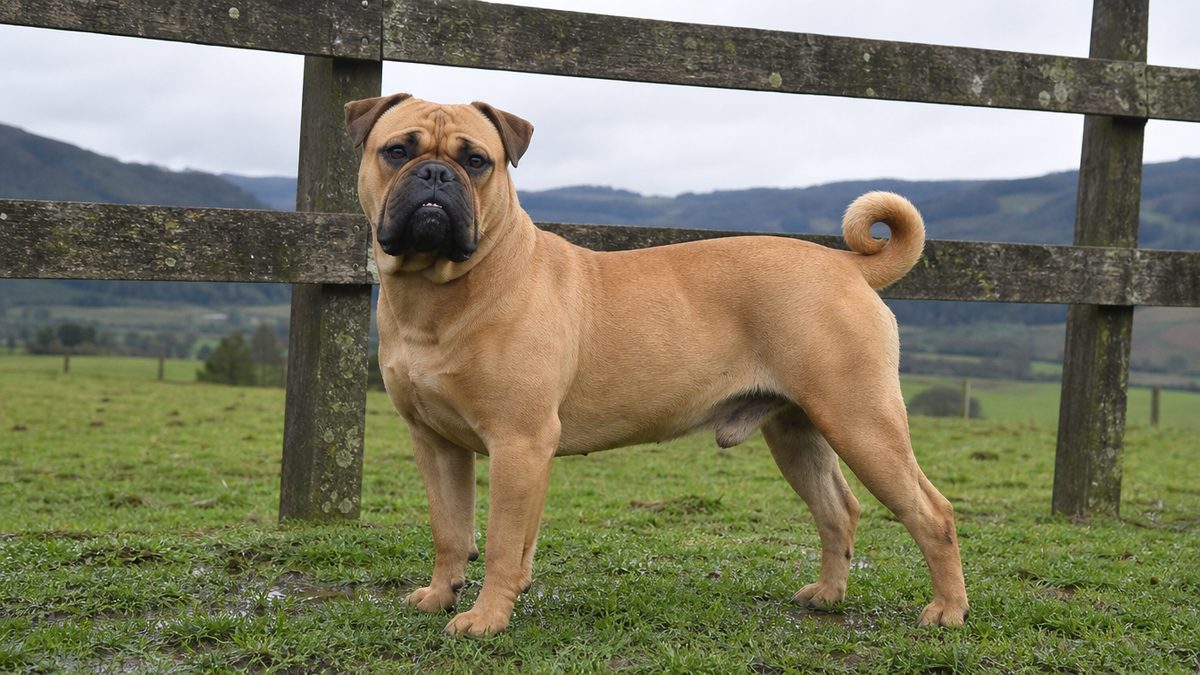
Quick answer
The Serrano Bulldog is a Brazilian cattle-working bulldog with a full national breed standard and no international recognition. The Confederacao Brasileira de Cinofilia publishes it as standard NR11, dated 12 August 2009, and files it in Grupo 11, which that body labels Racas Nao Reconhecidas pela FCI. It carries a compulsory working trial and a written bite test. Males stand 50 to 56 cm and weigh 31 to 40 kg. There is no Serrano Bulldog price in India, because no Indian supply exists.
This page reports one national breed standard, registry documents, Indian legal texts and published Indian veterinary literature. No breed-specific health study, screening scheme or lifespan figure exists for this breed, and this page publishes none. Nothing here is a diagnosis or a treatment plan for any individual animal. Consult your nearby vet about any dog you are offered under this name, and have a veterinarian examine it in person before you act on anything written here.
Serrano Bulldog at a glance
What the Serrano Bulldog is
The Serrano Bulldog is a Brazilian cattle-working and guarding bulldog from the southern highlands, standing 50 to 56 cm at the withers in males and weighing 31 to 40 kg, published by the Confederacao Brasileira de Cinofilia as national standard NR11 on 12 August 2009 and updated on 23 March 2015.
Its Brazilian name is Buldogue Serrano, and the name is a place description rather than a family name. *Serrano* is the Portuguese word for someone from hill country, which English Wikipedia glosses as a synonym of hillside or mountain used adjectivally. English sources also call it the Brazilian Mountain Bulldog or the Mountaineer Bulldog.
The utilisation clause in the standard is the most concrete on this site and it describes the dog completely in two lines. The breed is for submission of cattle, guarding and companionship, and it is a dog of great versatility that must have the capacity to bring down an ox, but be agile and low enough to pass beneath the fences of cattle pens.
Every proportion in the standard follows from having to hold an ox and then get under a fence. The body must be about EIGHTEEN PERCENT longer than the dog is tall. Chest depth must be about 55 percent of the height at the withers. The head must be about 35 percent of body length. The result is a low, long, wide, heavy animal at 40 kg on a frame barely half a metre tall, which is a very different silhouette from the tall square molossoids Indian buyers usually picture when they hear the word bulldog.
It is a bulldog that is not brachycephalic, and that is deliberate
The head is broad with powerful masseters, a deep stop and visible brow ridges, and the standard insists it must be neither heavy nor light, because a functional head can be neither fragile nor exaggeratedly heavy. The muzzle is about one third of total head length with a skull to muzzle ratio of 2:1, straight and relatively broad.
The bite is prognata, slightly undershot, with the lower jaw passing the upper but without exaggerated prognathism. So this is a shortened muzzle rather than a flat face, and the difference is not cosmetic in India. Brachycephalic skull shape carried 2.10 times the odds of heat-related illness in the largest UK study, confidence interval 1.68 to 2.64, while dolichocephalic dogs were not significantly different from mesocephalic ones.
A standard that names another breed as the thing to avoid
One clause is worth quoting because almost no standard does this. Describing the upper arm, NR11 asks for a well-muscled limb but not with exaggeratedly defined or developed muscles, like the current Alapaha Bulldog. A national standard naming a living foreign breed as its example of over-type is a registry drawing a line against the bully-type drift that has reshaped several bulldog breeds.
The same restraint runs through the rest of the document. The skin must show no loose skin anywhere on the body, with only minimal facial wrinkles permitted, lips must be short and adherent and never long or pendulous, and the coat is smooth, short and of medium texture. Colour is the one place the standard relaxes completely: any colour or variation of colours is accepted.
The tail is the breed's oddity. NR11 asks for a tail in corkscrew or curled form, with medium insertion, and adds that dogs born with long tails must not be penalised, in which case the tail should be carried straight and low. That clause has a consequence in India, and it is dealt with in the grooming section rather than here.
Recognition status, and why breed in formation is the wrong verdict
The Serrano Bulldog is a fully recognised national breed in Brazil and holds no international recognition of any kind. Both halves are documented, and the second is documented by the same body that grants the first, which is unusually clean.
Bonbeno's two-condition test asks whether a breed has a written standard and a register that keeps its pedigrees generation to generation. Both conditions are met here, by one body. The CBKC publishes a complete six-page standard with a named author, a named technical originator and two signing officers, and it holds the breed in a register category it maintains for exactly this purpose.
| Register | What it holds | Serrano Bulldog | In-document control |
|---|---|---|---|
| CBKC Grupo 11 | 19 breeds, labelled Racas reconhecidas so pela CBKC | PRESENT, standard NR11 | Boerboel, American Bully, Ovelheiro Gaucho all present |
| CBKC Brazilian breeds, FCI tiers | 4 breeds with real FCI numbers | Absent from the FCI tiers | Fila Brasileiro 225, Rastreador Brasileiro 275, Terrier Brasileiro 341, Buldogue Campeiro 374 |
| FCI Group 2, definitive | 53 breeds | Absent | Bulldog 149, Bullmastiff 157, Mastiff 264, Fila Brasileiro 225, Cane Corso 343 all present |
| FCI provisional register | 20 breeds | Absent | Buldogue Campeiro 374 present, admitted 6 August 2025 |
This site normally has to work hard to tell a national filing apart from an FCI grant, because national bodies print FCI group names for breeds the FCI has never held. The CBKC removes the ambiguity itself. For its four FCI breeds it prints a real number, as in Padrao FCI No 275. For every one of its nineteen Grupo 11 breeds it prints the same label with the NUMBER FIELD EMPTY. The standard document says the same thing in words: CLASSIFICACAO CBKC, Grupo 11, Racas Nao Reconhecidas pela FCI. A body that labels its own non-FCI group honestly is the positive control for this whole class of trap.
Why this is not a breed in formation
It would be easy, and wrong, to file this breed in the intermediate category this site keeps for populations that have a standard and a private register but no national instrument admitting them. That verdict fits a breed still being assembled. It does not fit this one.
Three features rule it out. The standard is complete rather than a project, carrying full proportions, a fault list, notes on testicles and behavioural abnormality, and a temperament protocol. It is dated and revised, published in 2009 and updated in 2015, which is what a maintained document looks like. And the breed sits inside the national kennel club of an FCI member country, in a category that body maintains alongside its FCI breeds rather than below them.
So the accurate verdict is the plain one. Nationally recognised in Brazil, not recognised internationally. That is a real status with a real register behind it, and it is the same status the CBKC gives the Boerboel and the American Bully, both of which sit in Grupo 11 beside it.
The sibling that took the other road
Brazil has a second cattle bulldog and it went the international route. The Buldogue Campeiro holds FCI provisional number 374, and it appears in the FCI's 20-entry provisional register with a provisional recognition date of 6 August 2025. The CBKC's own standard PDF for that breed is headed St. FCI No 374 / 10.08.2025, and the CBKC's list index gives a third date again, 10/07/2025 Confederacao Brasileira de Cinofilia.
Three dates from two bodies for one grant is worth printing rather than resolving, and it is a small caution about taking any single registry date as settled. What is not in doubt is the difference in tier: one Brazilian cattle bulldog now carries an FCI number and the other does not.
History, and a claimed Azorean ancestor
The Serrano Bulldog's documented history is short, because its own national standard contains no history section at all. What exists instead is a named originator inside the standard and one detailed Portuguese account tracing the breed to an extinct Azorean dog.
Start with what the standard itself supplies, because it is more than most. NR11 names Ivanor Oliviecki as the breed's *Idealizador e Responsavel Tecnico*, its originator and technical lead, records Pedro Pessoa Ribeiro Dantas as the person who drafted the document, and gives the revision to Claudio Nazaretian Rossi. A breed with a named originator on its own standard is a modern, deliberately assembled breed rather than an anonymous landrace.
English Wikipedia adds nothing here, and that is itself worth recording. Its article has three prose sections, Name, Temperament and See also, and no history section whatever. So the English-language account of where this dog came from does not exist.
The one detailed origin account, and who is making it
The fullest account comes from an unexpected direction. A private Portuguese project working to reconstruct the extinct Cao de Fila da Terceira publishes a long history page arguing that Azorean emigration to southern Brazil carried a bull-type dog with a twisted tail into Santa Catarina and Rio Grande do Sul, where it survived as the *burdoga* until the 1970s and gave rise to two Brazilian breeds, the Bulldog Campeiro and the Bulldogue Serrano, which it calls direct descendants of the twisted-tail line.
That page also records the reconstruction of the burdoga on the Brazilian side. It names the breeder Ralph Schein Bender, who bought his first female in 1977 and travelled Rio Grande do Sul looking for surviving dogs, crossing them among themselves and with the English Bulldog. It gives the reason the type nearly vanished, which is that using dogs to restrain cattle was prohibited by Brazilian public-health authorities, after which the dogs lost their job and became scarce.
It is a private project's own history page, written by people with a stake in an Azorean origin story, and it should be read that way. Two things nonetheless support it. The corkscrew tail the Serrano standard asks for is the same trait the Azorean dog was named for, rabo torto meaning twisted tail. And the only other page in this breed's Indian search results that discusses its origins at all makes the same Fila da Terceira claim independently. This page therefore reports the account, names who is making it, and claims nothing more.
What the standard's own dates establish
The checkable history is the paperwork. The official valid standard was published on 12 August 2009, the document was updated on 23 March 2015, and the CBKC's list index carries the same 2009 date Confederacao Brasileira de Cinofilia. So the breed has held a maintained national standard for more than fifteen years, which is longer than several breeds that now carry FCI numbers.
Everything earlier than 2009 is unverified in registry terms. There is no studbook opening date on the document, no founder count, no census and no population figure anywhere this page could reach, and it publishes none.
The compulsory working trial, printed inside the standard
The Serrano Bulldog's national standard carries a compulsory working trial, PROVA DE TRABALHO Obrigatoria, and a written two-stage temperament test that no English-language page reproduces. It is the most distinctive thing about the breed and the single fact an Indian reader most needs.
Most breed standards either omit a working trial or mark it optional. This one makes it obligatory and then prints the protocol, which runs as the final section of the six-page document under the heading TESTE DE TEMPERAMENTO PARA A RACA, the temperament test for the breed.
- Stage one, the handler leads the dog on a lead and the dog must allow strangers to approach within the lead's radius without attempting to attack, remaining indifferent or friendly toward them.
- The handler may refuse the approach of anyone who has already acted as a helper, or who takes a hostile attitude, which stops the test being gamed in either direction.
- Stage two, a helper wearing a sleeve or equivalent protection provokes the dog, which must react without any retreat and bite the sleeve firmly while the helper applies psychological pressure.
- After at least ten seconds the handler orders the release, and the dog must let go within four seconds. Releasing before the command fails, and failing to release within four seconds of it also fails.
- The helper then drops the sleeve and the dog must focus on the helper rather than on the sleeve, so a dog that fixates on the equipment or loses attention on the person fails.
The pass conditions are stricter than the exercise. A dog is considered apto, suitable, only when it has been approved by two different judges on two distinct occasions with a minimum interval of thirty days between them. That rules out a single good day.
The protocol prohibits the use of check or prong collars of any untriggered type during the test, and requires dogs to present in adequate conditions of hygiene and health. A national standard writing equipment restrictions into its own bite test is a registry regulating how the trait is demonstrated, not merely whether it exists. It is worth knowing that this exists before deciding what the breed is, because a page that reports only the temperament sentence gives a much softer impression than the document does.
What that means for anyone considering the breed outside Brazil
It means the breed is defined by trained protection behaviour, not merely by a guarding reputation. The standard's temperament clause and its test agree: the dog must be docile and gentle with the people of the house and a balanced guardian, must not show gratuitous aggression to people or dogs, must show extreme submission to discipline before its owner, and must be fearless when provoked or under command.
Read the last three words carefully. Under command is a training state, and a dog selected across generations for a fast, clean, commanded bite and an equally fast release is an animal that requires a handler who can supply both halves. Fearful dogs are disqualified outright by the same standard, so there is no soft end of the breed to select from.
Serrano Bulldog price in India
There is no Serrano Bulldog price in India. The Indian search for the breed returns one Indian host, a pet retailer's editorial page with nothing for sale behind it, and no classifieds, kennel or importer anywhere in the result set.
The Google India pull for serrano bulldog dog returned About 182 results, led by English Wikipedia, an Indian pet retailer's breed article, two overseas breed encyclopedias, two pet-products sites reproducing the same Wikipedia sentence, a Gulf veterinary clinic's library page, a hobbyist molosser site, a stock-photo listing and a video. That is a content set, not a market.
The 182 figure proves nothing on its own, and this site has corrected pages that argued from result counts. A printed count moves by tens of percent on a fixed query inside a single session. What evidences an absent Indian market here is composition, and specifically duplication: two of the ten results reproduce the same Wikipedia lead sentence verbatim, and a third is a stock-photo page claiming 88,297 images of a breed almost nobody photographs, which is a search-term match rather than a photograph count.
What any rupee figure would actually be
If a figure appears, work through it in this order before believing a digit of it. The Brazilian currency trap matters more here than on most pages, because this is a Brazilian breed and its home-market listings are written in reais.
- Check the symbol first, because R$ is the Brazilian real and is one character from Rs, and Brazilian formatting uses a full stop for thousands, so R$ 2.000 is two thousand reais rather than two.
- Divide the rupee figure by 84.38, then by 80, then by 74, and read the quotient for plausibility rather than only for cleanness.
- Check the host country, since the same Rs abbreviation carries the Pakistani rupee on South Asian listings.
- Confirm the listing is for a live animal of this breed and not a template page that exists identically for every breed on that site.
- Ask the seller to name the register, which for this breed is the CBKC and its standard NR11, with no FCI number available at all.
Point five is the useful screen. Because this breed has no FCI number, any seller anywhere claiming an FCI pedigree for a Serrano Bulldog is describing a document that cannot exist. That is a rare, clean test, and it costs nothing to apply.
The import position, read from the instrument rather than from an AI answer
India treats live dogs as a restricted import and the channel that exists is a personal pet import for an owner relocating with the animal rather than a commercial one for breeding or sale. Separately, the Department of Animal Husbandry and Dairying letter of 12 March 2024, reproduced in full inside the customs instruction of 14 March 2024, names 24 comma-separated categories. The Goa Legislative Assembly reproduced the same list independently on 7 August 2024.
This breed is not named in it. But a bulldog page cannot stop there, because that list contains four undefined category words, Terriers, Mastiffs (boerbulls), Wolf dogs and Canario, and this site has already had to correct pages that cleared breeds those bare words plainly reached. The honest position is that Mastiffs is a category word capable of reaching a molossoid, and that a 40 kg cattle-holding bulldog is closer to that word than a scent hound is, even though no reproduction of the list names it.
In this breed's own Indian result set, a Google AI Overview stated in the PRESENT TENSE that the central government banned 23 specific aggressive or fighting breeds, naming Pitbull Terriers, Rottweilers and American Bulldogs. That circular was quashed by the Karnataka High Court on 10 April 2024 and set aside by the Delhi High Court that month, and the Union has since told the courts it has lost its effect entirely. The instrument was never an Act, a rule or a notification; it was a D.O. letter from a Joint Secretary reproduced in a customs instruction. Read the list from that instruction rather than from a court's recital, because a judicial reproduction of it is abridged and drops the undefined category words.
Cost of ownership in India for a 40 kg working dog
A 40 kg short-coated guarding dog has a knowable Indian running cost even when the breed has no Indian price. Anti-rabies vaccination starts at Rs 699 and the 9-in-1 at Rs 899 at one national clinic chain, both read live on 9 September 2026.
Every figure below was opened at the vendor's own page on 9 September 2026 and is quoted with the vendor named. Retail prices move and municipal fees rarely do, so treat the first group as a snapshot and the second as stable.
| Item | Rupees | Source and scope |
|---|---|---|
| Anti-rabies vaccination | From Rs 699 | Vetic clinic chain, national price page |
| 9-in-1 DHPPiL vaccination | From Rs 899 | Vetic, same page |
| Canine corona vaccination | From Rs 899 | Vetic, same page |
| Full-body bath and blow dry | From Rs 934 | Vetic grooming Delhi, listed against Rs 1,099 |
| Haircut package, 120 minutes | From Rs 1,359 | Vetic grooming Delhi, not needed for this coat |
| Boarding, up to 4 hours | Rs 599 | PawSpace, Bengaluru home boarding |
| Boarding, daycare to 10 hours | Rs 799 | PawSpace, Bengaluru |
| Boarding, overnight to 24 hours | Rs 899 | PawSpace, festive rates 25 to 30 percent higher, food extra |
| Pet dog registration, Delhi | Rs 500 | MCD portal, renewal Rs 500, late fee Rs 100 per month |
| Pet animal licence, Chennai | Rs 50 | Greater Chennai Corporation, 9,115 issued in 2024 |
| Microchipping, one Chennai clinic | Rs 1,250 | SKS Veterinary Hospital's own transacted rate |
No monthly food total and no lifetime cost appear here. A monthly figure is arithmetic performed on a bag price and a feeding guide rather than a price anybody quotes, and a lifetime figure needs a life expectancy this breed does not have in any study. What can be said is the shape of the commitment: one Indian sanctuary's cost guide frames it as a ten to fifteen year financial commitment beginning at acquisition, and contrasts about Rs 80,000 for a breeder puppy with about Rs 500 to adopt.
The costs that a heavy guarding dog moves
Parasite control is dosed by weight, so a 40 kg dog sits above the common 15 to 30 kg presentation of the usual combined monthly product and needs the band above it. Deworming runs at one tablet per 10 kg, so this dog takes four where a small breed takes one.
Boarding is the line that surprises people. A 40 kg guarding breed with a bite title in its national standard is refused by more Indian operators than any other category of dog, and the ones that accept it charge the same card while asking far more questions. PawSpace's Bengaluru rates run Rs 599 hourly to Rs 899 overnight, with festive rates 25 to 30 percent higher and food charged separately.
Grooming is the cheapest thing about the breed and the Rs 1,359 haircut package is simply not a line item, because the coat is short, smooth and of medium texture with no loose skin to manage Confederacao Brasileira de Cinofilia. Put that saving into training instead, which is where this breed's real budget sits.
Registration, which is not optional for a guarding breed
Delhi charges Rs 500 for a new pet dog registration and the same to renew, with a Rs 100 per month late fee after a one-month grace period tied to the expiry of the anti-rabies vaccination certificate. Greater Chennai Corporation charges Rs 50 and issued 9,115 pet animal licences during 2024, and its municipal pet clinics provide all treatment and anti-rabies vaccination free of cost.
Microchipping at one Chennai clinic's own transacted rate is Rs 1,250. For any large guarding dog in India, a registration certificate and a chip are the documents that turn an incident into a manageable problem rather than an unmanageable one, and the total cost of ownership of both is under Rs 2,000.
Heat tolerance and the Indian climate
The Serrano Bulldog comes from cool, very wet highland country, and India is the wrong climate for it. Lages in Santa Catarina runs an annual mean of 15.95 C at 84.84 percent relative humidity with a peak wet bulb of 18.31 C, against 26.11 C in Chennai and 27.09 C in Kolkata.
The name told you this before the data did. Serrano means hill country, and the breed's home is the Serra Gaucha and the Santa Catarina highlands, sitting near 900 to 1,000 m. The figures below come from NASA POWER's 2001 to 2020 climatology, queried by explicit latitude and longitude with the model's own cell elevation echoed back and checked.
That check matters here, because highland points are exactly where this model fails. It did not fail on these. Lages returned 948.02 m against a real 916 m, Vacaria 947.24 m against 971 m and Curitiba 905.85 m against 934 m, all within about 32 m, so these are genuine highland cells rather than flattened terrain.
| Place | Annual mean C | Annual RH % | Hottest month | Peak wet bulb C |
|---|---|---|---|---|
| Lages, Santa Catarina | 15.95 | 84.84 | January, 20.32 | 18.31 (January) |
| Vacaria, Rio Grande do Sul | 15.62 | 84.73 | January, 20.01 | 18.01 (January) |
| Curitiba, Parana | 17.87 | 82.81 | February, 21.44 | 19.31 (February) |
| Bengaluru | 23.74 | 67.94 | April, 28.37 | 21.86 (May) |
| Pune | 23.86 | 66.80 | April, 28.93 | 22.97 (June) |
| Hyderabad | 26.10 | 60.30 | May, 33.30 | 23.35 (June) |
| Nagpur | 26.91 | 55.84 | May, 36.73 | 25.41 (June) |
| Mumbai | 26.77 | 67.39 | May, 31.19 | 25.77 (June) |
| Chennai | 27.95 | 72.39 | May, 31.51 | 26.11 (May) |
| Delhi | 25.60 | 45.56 | June, 35.88 | 26.50 (July) |
| Kolkata | 25.81 | 73.93 | May, 31.53 | 27.09 (June) |
Lages runs 84.84 percent annual relative humidity and Vacaria 84.73. Both are HIGHER than Kolkata's 73.93, Chennai's 72.39 and Mumbai's 67.39. So the reflex claim that Indian humidity will finish this breed is backwards: it comes from a wetter place than any Indian city here. What it has never met is heat. Its hottest month averages 20.32 C, which is COOLER than Bengaluru's coolest month at 20.22 C by a fifth of a degree. Frame the risk as wet-bulb load, which combines both, and the gap to Chennai is about 7.8 degrees.
Three features that make the gap worse than the number
The wet-bulb gap alone understates the problem, because three things about this dog compound it. It is heavy for its height, at up to 40 kg on a 56 cm frame, and dogs at or above their breed and sex mean bodyweight carried 1.42 times the odds of heat-related illness, confidence interval 1.12 to 1.80 Confederacao Brasileira de Cinofilia.
It has a shortened muzzle, at about one third of head length. That is not brachycephaly, and the standard's insistence on a functional head is genuinely protective, but it is a shorter airway than a mesocephalic dog carries. For scale, brachycephalic skull shape carried 2.10 times the odds in the same study, confidence interval 1.68 to 2.64.
And it is a working breed with a compulsory trial, so the activity that defines it is exactly the activity that causes the injury. Of 879 heat-illness events with a recorded trigger, 652, or 74.2 percent, were exertional, and of the 551 exertional events where the exercise was specified, 372, or 67.5 percent, followed an ordinary walk.
Get the Indian months right, because this site has corrected pages that did not. Bengaluru peaks in April and is coolest in December. Pune peaks in April and is coolest in December. Delhi peaks in June. Chennai, Mumbai and Kolkata genuinely do peak in May. Note also that the Brazilian points peak in January and February, the southern summer, which is the opposite half of the year from an Indian one.
Temperament and who should not buy one
The Serrano Bulldog's standard describes a dog that is docile and gentle with the people of the house and a balanced, attentive, versatile guardian, showing no gratuitous aggression to people or dogs but fearless when provoked or under command.
That clause is more precise than it looks and it is worth taking apart. It asks for four separate things at once: household gentleness, guardian balance, extreme courage, and submission to discipline before its owner. A dog that has three of those and not the fourth is not this breed, and the standard's disqualification of fearful dogs closes the low end of the range.
The dog must be fearless WHEN PROVOKED OR UNDER COMMAND. That is a conditional, and a breed whose standard makes courage conditional on a command is a breed defined by handler control. Combined with a compulsory working trial and a written bite-and-release test, it describes an animal whose behaviour is a trained system rather than a personality. Anyone who wants the appearance without that system is buying the wrong dog, and in India, where formal protection training is thinly available outside a few cities, that mismatch is the likeliest failure.
Who this breed would actually suit
A fenced rural or peri-urban property, an owner who has raised and titled a working guarding breed before, access to a competent decoy or protection club, and a household prepared to manage a 40 kg dog around visitors for a decade. Every trait rating for household fit on this page is 1 out of 5, and none of that is a judgement about the dog's character.
English secondary sources broadly agree with the standard, which is reassuring because so little else about this breed is consistent. One breed encyclopedia reproduces the CBKC utilisation clause and describes a dog for guarding and especially for working with cattle, and another warns that the breed is suspicious of strangers and of strange dogs. That is the same animal the standard describes, in softer words.
Socialisation, and the honest limit on the advice
Socialise hard and early on the general large-guarding-breed timetable, with daily neutral exposure to strangers, traffic, other dogs and Indian street noise from eight weeks. What this page will not do is invent a breed-specific developmental schedule, because no published behavioural data exists for this breed at all and the standard is a description of the adult rather than a plan for the puppy.
One thing the standard does supply is a benchmark you can borrow. Its first test stage asks the adult dog to remain indifferent or friendly while strangers approach within the length of the lead. That is a reasonable target to socialise toward from the first month, whether or not the dog will ever be tested.
Training a breed whose standard includes a bite test
To train a Serrano Bulldog, treat the release as the primary skill rather than the bite, because the breed's own standard fails a dog that will not let go within four seconds of the command. Trainability is rated 3 out of 5 here, inferred from the standard rather than measured.
The standard hands you the syllabus, which is unusual and useful. It requires a dog that bites firmly under pressure without retreating, holds at least ten seconds, releases within four seconds of a command, and then re-focuses on the person rather than the dropped sleeve. Every one of those is a trainable behaviour and the last two are where dogs fail.
- Build the out and the recall before anything resembling protection work, because the standard's own failure conditions are release failures rather than bite failures.
- Teach neutrality to approaching strangers on a lead from the first month, which is the test's own stage one.
- Work with a competent club or decoy rather than alone, since amateur bite work on a 40 kg guarding dog creates the problem it is meant to manage.
- Proof handler control in real settings, because a dog fearless under command is only safe where the command lands.
- Book a professional assessment before the dog reaches adult weight rather than after.
Part IV of the Second Schedule to the Prevention of Cruelty to Animals (Dog Breeding and Marketing) Rules 2017 requires separate housing for a vicious or aggressive dog and FORBIDS the use of sedation to control behaviour. For a guarding breed that is the clause to know, because it closes the shortcut some Indian owners reach for when a large dog becomes difficult. The management has to be actual management, which for this breed means training, containment and supervision rather than chemistry.
Where Indian law and this standard genuinely collide
One collision is real and no other page states it. Second Schedule Part III paragraph 8(10) of the 2017 Rules lists the genetic defects a breeding dog must have been tested for, and that list expressly includes undershot jaw when the incisors do not touch or mesh. This breed's standard requires a prognathous, slightly undershot bite.
So an Indian breeder working to this standard would be selecting for a trait the gazette names as a defect to screen against. That is a statable fact about two documents rather than an accusation, and the honest handling is to say it plainly, note that the clause's opening word including makes its list illustrative rather than closed, and leave enforcement as a separate question from what the text says.
Daily exercise requirement
The Serrano Bulldog needs real daily work rather than a stroll, and in India that work has to happen in a narrow window at either end of the day. Exercise need is rated 3 out of 5, lower than a hound's because this is a short heavy animal rather than an endurance runner.
The standard's picture is of power and agility rather than stamina. It asks for a solid, massive, stocky dog that nonetheless gives an impression of great agility, with long muscles that denote that agility, and it requires obligatory but moderate angulation at the hock. A dog built to hold an ox and duck under a fence is explosive, not enduring.
| City | Hot-season window | What to cut | The number behind it |
|---|---|---|---|
| Bengaluru | Before 7 am and after 6.30 pm | The April afternoon | Peak wet bulb 21.86 C, 3.6 C above the homeland |
| Pune | Before 7 am and after 6.30 pm | The April afternoon | Peak wet bulb 22.97 C, 4.7 C above the homeland |
| Hyderabad | Before 6.30 am only | All afternoon and evening, April to June | Peak wet bulb 23.35 C, May mean 33.30 C |
| Mumbai | Before 6.30 am | All evening work in June and July | Peak wet bulb 25.77 C in June |
| Nagpur | Before 6 am only | Everything else, April to June | May mean 36.73 C, the hottest here |
| Chennai | Before 6 am only | All evening work in May | Peak wet bulb 26.11 C, 7.8 C above the homeland |
| Delhi | Before 6 am, and after 9.30 pm in dry heat | Midday and afternoon, April to July | June mean 35.88 C, peak wet bulb 26.50 C |
| Kolkata | Before 6 am only | All work once monsoon humidity sets in | Peak wet bulb 27.09 C, 8.8 C above the homeland |
There is no Indian city on that table where this breed's homeland conditions are met, which is the difference between it and a heat-adapted breed. Bengaluru is the least bad option at 3.6 degrees of wet bulb above the homeland, and even there the dog is working outside anything its population has experienced.
Second Schedule Part IV paragraph 21(1) of the 2017 Rules bars keeping certain dogs in outdoor facilities without the attending veterinary practitioner's WRITTEN approval, naming among them dogs not accustomed to local temperatures and breeds that cannot tolerate the temperatures prevalent in the region, such as long-haired breeds in high temperature locations. This is a short-coated breed, so the long-haired illustration does not catch it. The category above it does, on any honest reading, for a dog whose hottest month averages 20.32 C being kennelled outdoors in Chennai. Get the written approval, and treat enforcement as a separate question from what the text says.
The failure mode without work is predictable for a guarding breed and it is not benign. An under-worked 40 kg guardian becomes reactive at boundaries, which in an Indian residential setting means the gate, the delivery rider and the neighbour's dog. Give it a job and the problem largely does not arise.
Grooming, and the tail clause India settles
To groom a Serrano Bulldog, run a rubber mitt over it weekly and check the face and ears, because the standard permits only minimal facial wrinkles and no loose skin anywhere. Grooming load is rated 1 out of 5, and this breed carries none of the fold-care burden of a European bulldog.
The coat is smooth, of medium texture, neither very soft nor very hard, and short. Any colour is permitted, so there is no colour-linked care to think about. A weekly rubber curry mitt, nails every three to four weeks, and a bath only when the dog is actually dirty covers the whole job.
The skin clause is the one that saves an Indian owner real trouble. The standard states that the dog must not present loose skin on any part of the body, admitting only minimal wrinkles on the face. That single line removes the deep facial folds that make several bulldog breeds a daily hygiene project in a humid climate, and it is one of the clearest signs that this standard was written for a working dog.
Two things need attention between June and September. The small semi-drop ears the standard asks for still trap moisture, so dry them actively after every bath rather than letting them air dry, which is sound advice in a temperate country and poor advice in an Indian monsoon. And a short-muzzled heavy dog in a humid month needs its breathing watched during exercise rather than only its coat. Consult your nearby vet at the first sign of noisy breathing at rest, which is not something to normalise in any short-faced breed.
The tail clause, and the one place this standard meets Indian law head on
The tail section is the most consequential sentence in the document for an Indian reader. NR11 asks for a tail in corkscrew or curled form, and then adds that dogs whose tails are born long should not be penalised, in which case the tail should be presented straight and low-carried, caso nao sejam operadas, that is, if they have not been operated on.
That last clause contemplates surgical alteration of the tail as a thing that happens to dogs of this breed. In India it is prohibited outright. Second Schedule Part II paragraph 6(8) states that there shall be no tail docking, ear cropping, de-barking, de-clawing, branding, dyeing, injecting substances to enhance visual appeal, performing a surgery or procedure to camouflage or hide any defect or infirmity or any other kind of mutilation of any body part of the pup, and that any change of appearance by artificial means is strictly forbidden.
Read together, the two documents produce a clean rule for anyone in India. A naturally corkscrew tail is what the breed was born with and is fine. A naturally long tail carried straight and low is explicitly not a fault under the breed's own standard, so there is no breed-standard reason to alter it. And an altered tail on an Indian-bred dog is caught twice by paragraph 6(8), once as docking and again as a procedure to hide a perceived defect. Verify the tail is natural rather than assuming it, and treat a docked Serrano in India as a legal problem as well as a welfare one.
The same reasoning covers ears. The standard asks for small, semi-drop or drop, thin-skinned, high-set ears and nowhere mentions cropping. Any cropped molossoid presented in India has been altered in a way the Rules prohibit outright.
Health problems, life span and three registries that hold nothing
No health data exists for the Serrano Bulldog, and each absence below was tested with a control that passed rather than assumed. There is no screening scheme, no OFA row, no lifespan study and no published literature under any name form.
The orthopaedic registry first, because a 40 kg working dog's hips are the obvious question. OFA's complete disease-statistics dump was retrieved through a rendering proxy and saved to disk as 2,232,076 characters, then searched rather than read. SERRANO, CAMPEIRO and BULDOGUE all return zero, while BULLDOG returns 170, LABRADOR 109 and BEAGLE 61 on the same file.
OFA publishes a breed only once it has 100 hip evaluations, or 50 for its other databases. So the correct phrasing is that this breed has no row in OFA's published statistics tables, not that it is absent from the OFA database. For a Brazilian national breed with no American population, no American orthopaedic registry would ever hold it, and that says nothing about its hips in either direction. Note also that the OFA page still prints Searching Database, Please wait even while the tables are fully present, so that string is not evidence a search failed.
The longevity table is the same story. The largest UK study's breed list, parsed namespace-aware from the OOXML for this page, carries 345 rows, and Serrano, Campeiro and Buldogue all return zero across every column, while the Bulldog and the French Bulldog are both present and both flagged Brachycephalic as in-document controls. So there is no life expectancy figure for this breed and this page publishes none.
The literature, searched properly and genuinely empty
PubMed returns nothing under any name form, and the searches were run the way this project requires. "Buldogue Serrano"[tiab], "Serrano Bulldog"[tiab] and "Bulldogue Serrano"[tiab] each return 0 with PubMed's own quotedphrasesnotfound warning, so unquoted retries were run rather than reporting a phrase zero: Serrano[tiab] AND dog[tiab] returns 0 and the bare Buldogue[tiab] returns 0.
Controls in the same session came back sane, which is what makes the zero worth reporting: Labrador Retriever with hip dysplasia returned 126, Bulldog with Brazil returned 5 and Brasileiro with dog returned 4. The instrument works and the literature does not exist.
"Fila Brasileiro"[tiab] also returns 0, and that breed has held FCI number 225 for decades and appears in OFA's tables with 228 hip evaluations. So a PubMed zero is not a measure of a breed's standing, only of whether anyone has published a clinical paper naming it. For Brazilian breeds specifically, the answer is usually no regardless of recognition, and a page that reads this breed's zero as a mark against it has drawn the wrong conclusion.
The inherited risk to ask about anyway
Ask about hip dysplasia and about the bite, because Indian law makes both questions a breeder should already have answered. Second Schedule Part III paragraph 8(10) of the 2017 Rules lists the genetic defects a breeding dog must have been tested for, and it names hip dysplasia first and undershot jaw when the incisors do not touch or mesh among them.
For this breed the second item is the awkward one, because the standard requires the trait. That collision is set out in the training section, and the practical version here is simple: a breeder who can produce hip scores and who understands why the bite question is being asked is a better prospect than one who cannot.
What a dog of this type would actually meet in India
The health risks worth planning for are Indian rather than inherited, and for a heavy short-muzzled dog they are heat first, then ticks, then ears. Two 2026 molecular studies map the tick-borne picture across West Bengal and southern India Venugopal V, Deepa PM, Muhasin Asaf VN.
Neither study concerns this breed and both are cited for the setting rather than for a prevalence attributed to the dog. Between them they establish that canine haemoprotozoa are widespread across two very different Indian regions, which justifies a year-round tick-borne disease plan rather than a monsoon-only one.
- Cover for ticks every month of the year, using a product dosed for a dog above 30 kg.
- Deworm on a veterinarian's schedule at one tablet per 10 kg, which is four for a 40 kg dog.
- Screen for tick-borne disease at the first sign of lethargy, pale gums or fever rather than treating empirically.
- Watch the breathing during and after exercise from March onward, because a shortened muzzle on a heavy dog is the combination that fails first.
- Vaccinate on the core schedule, with anti-rabies from Rs 699 and the 9-in-1 from Rs 899 at a national chain.
This page reports one national breed standard, registry documents, Indian legal texts and published Indian veterinary literature. It contains no health data for this breed because none exists anywhere. Nothing here is a diagnosis or a treatment plan for any individual animal, and no figure on this page should be used to decide whether a dog needs seeing. Consult your nearby vet about any dog you are offered under this name, and have a veterinarian examine it in person before you act on a single line written here.
The heat numbers this breed's owner should actually memorise
Three figures from one study cover most of what matters. Heat-related illness had an event fatality rate of 14.18 percent, confidence interval 11.08 to 17.96, so roughly one dog in seven that develops it dies. Brachycephalic skull shape carried 2.10 times the odds, confidence interval 1.68 to 2.64. And 74.2 percent of triggered events were exertional.
This breed is not brachycephalic, and its standard's insistence on a functional muzzle is what keeps it out of that band. But it is short-muzzled, heavy and working, and the honest reading is that it sits closer to the raised-risk end than a mesocephalic dog of the same weight. Compare the extreme case for scale: the European Bulldog carried an odds ratio of 13.95, confidence interval 8.01 to 24.29, against the Labrador Retriever. That is what this standard's restraint is protecting against.
Feeding a heavy working bulldog in India
To feed a Serrano Bulldog, work from the bag's guide against the dog's actual weight and expect the ration to move with the season. Males run 31 to 40 kg and females 25 to 35 kg, a fifteen-kilogram spread across the breed, so a single figure would mislead more than it helped.
This page publishes no monthly rupee food figure. A monthly total is arithmetic performed on a bag price and a feeding guide rather than a price a vendor quotes, and for a breed whose adult weight spans fifteen kilograms the calculation needs a denominator the buyer does not yet have.
- Feed two measured meals a day by weight rather than by scoop, because a deep-chested heavy dog on one large meal is a bloat risk.
- Weigh the dog monthly and record it, since a stocky frame hides two kilograms without changing shape.
- Assess body condition by hand weekly, targeting 4 or 5 out of 9, with ribs felt under light pressure and no fat cover.
- Withhold food and heavy water for an hour either side of work, on the same bloat reasoning.
- Cut the ration in April and May, when the exercise window shrinks and the calorie need falls with it.
Dogs at or above their breed and sex mean bodyweight carried 1.42 times the odds of heat-related illness, confidence interval 1.12 to 1.80. For a breed whose standard already asks for a solid, massive, stocky animal, the temptation to let a dog run heavy is real and the cost in an Indian summer is measurable. The usable version of that finding is a hand-assessed body condition score rather than a scale reading, because this breed's correct weight varies by fifteen kilograms across individuals.
Growth needs the same restraint as any heavy breed, so feed to a slow steady curve rather than to the top of the bag's range and do not add calcium on top of a complete food. A veterinarian should set the target curve, because a puppy that could finish anywhere between 25 and 40 kg cannot be grown to a table.
Month by month through the first year
A guarding puppy's first year in India runs on three tracks at once: neutrality to strangers before size arrives, growth without haste, and municipal compliance. For this breed the first track is the one its own standard tests.
| Age | Priority | The Indian specific |
|---|---|---|
| Before 8 weeks | Do not take the puppy | Rule 8(1)(a) of the 2017 Rules prohibits the sale of pups under eight weeks outright |
| 8 to 12 weeks | Core vaccination, neutrality to strangers | 9-in-1 from Rs 899; start the standard's own stage-one behaviour now, strangers approaching on a lead |
| 12 to 16 weeks | Anti-rabies, municipal registration | Anti-rabies from Rs 699; Delhi registration Rs 500, Chennai licence Rs 50 |
| 4 to 6 months | The out and the recall, daily | Move all sessions before 7 am from March onward |
| 6 to 9 months | Adolescent boundary guarding appears | Professional assessment now, before the dog reaches 30 kg |
| 9 to 12 months | Microchip, boarding trial, year-round parasite plan | Microchipping about Rs 1,250 at one Chennai clinic; four deworming tablets at 40 kg |
The eight-week line is a Rule rather than a Second Schedule paragraph, and the distinction matters if you ever quote it to a seller. Rule 8(1)(a) is the sale-conditions provision and it prohibits selling pups under eight weeks. Walk away from any litter offered earlier, whatever the breed and whatever the story.
Registration belongs in the first four months rather than the second year. Delhi ties its renewal grace period to the expiry of the anti-rabies certificate and charges Rs 100 per month late after it, so the two dates are one schedule. Chennai's Rs 50 licence is cheap enough that deferring it makes no sense.
For this breed, year one is a neutrality project. The standard's own first test stage asks an adult dog to let strangers approach within a lead's length while remaining indifferent or friendly, and that behaviour is built between eight weeks and six months or it is built painfully later. A Serrano-type dog that reaches twelve months without it, in an Indian residential setting full of unannounced visitors, delivery riders and free-roaming dogs, is a management problem for a decade.
Head to head against the bulldogs an Indian buyer would cross-shop
Anyone drawn to this breed is choosing between a dog they cannot get and several they can, and the differences that matter in India are heat risk and recognition rather than looks.
| Breed | Registry status | Heat-illness odds ratio vs Labrador | Obtainable in India |
|---|---|---|---|
| Serrano Bulldog | CBKC Grupo 11, no FCI number | Not modelled; short-muzzled, not brachycephalic | No Indian supply |
| Campeiro Bulldog | FCI 374, provisional since 2025 | Not modelled | No Indian supply |
| Bulldog | FCI 149, definitive, Group 2 | 13.95 (8.01 to 24.29) | Yes, widely sold in India |
| French Bulldog | FCI 101, definitive, Group 9 | 6.49 (3.62 to 11.63) | Yes, widely sold in India |
| Dogue de Bordeaux | FCI 116, definitive, Group 2 | 5.31 (1.99 to 14.21) | Yes, present in India |
| Fila Brasileiro | FCI 225, definitive, Group 2 | Not modelled | Named on the quashed 2024 list |
| Cane Corso | FCI 343, definitive, Group 2 | Not modelled | Yes, present in India |
| Any brachycephalic skull | n/a | 2.10 (1.68 to 2.64) on skull shape alone | n/a |
The middle column is the argument. Two of the bulldogs an Indian buyer can actually walk out with today carry the highest and third-highest breed odds ratios for heat-related illness in the largest study of the problem, at 13.95 and 6.49 against the Labrador as base. This breed was never modelled, and nothing here claims a figure for it, but its standard's insistence on a functional muzzle is a deliberate move away from the trait that drives those numbers.
The Buldogue Campeiro and the Buldogue Serrano are two southern Brazilian cattle bulldogs from the same tradition, and one Portuguese source traces both to the same twisted-tail Azorean line. In 2025 one of them obtained an FCI provisional number, 374, and the other did not. Nothing about the dogs decided that. What decided it was which national club pursued an international file, which is the same lesson the Terceira Mastiff teaches from the losing side of the ledger.
For a reader who came here wanting a working molossoid in India rather than this specific dog, the Cane Corso has an FCI standard, an Indian presence and veterinary familiarity, the Campeiro Bulldog is the closer relative on paper, and the Rajapalayam is the large Indian guarding breed adapted to the climate it will live in. The Bulldog is the one to think hardest about, because its odds ratio is the number this whole page is arguing around.
Mistakes people make with this breed
The commonest mistake is treating an English-language summary as a source, because for this breed the English-language summary rests on a citation that resolves to a different dog entirely.
- Trusting the Wikipedia citation, whose linked standard serves the Rottweiler rather than this breed.
- Reading the breed as brachycephalic, when its standard requires a muzzle one third of head length and warns against exaggeration.
- Assuming a CBKC breed has an FCI pedigree available, when the CBKC prints the FCI number field empty for every Grupo 11 breed.
- Accepting a docked tail as breed type, when the standard says a naturally long tail is not a fault and Indian law prohibits docking.
- Buying the appearance without the training system, when the standard's own definition of the breed includes a two-judge bite and release test.
The citation failure, checked link by link
English Wikipedia's Serrano Bulldog article carries three different CBKC file numbers for one standard, and all three were fetched for this page. The infobox standard link, `padrao-raca_293.pdf`, returns HTTP 404. Reference 1, `padrao-raca_220.pdf`, which is the sole source cited for every height, weight, coat, colour and temperament claim in the article, returns HTTP 200 and serves a nine-page ROTTWEILER standard. Only a bare unlinked URL in the article body, `padrao-raca_12.pdf`, reaches the real document.
Wikipedia's heights and weights match the real standard exactly at 50 to 56 cm and 31 to 40 kg for males. So somebody read the correct document and cited the wrong file, which is a different failure from inventing data and needs saying differently. What it means practically is that every downstream page repeating those figures is repeating a correct number from a source that cannot be checked, and a reader who does check lands on a Rottweiler. This site has now recorded the same CBKC file-number defect three times on three Brazilian breeds.
The duplication that tells you how thin the coverage is
Two of the ten organic results in this breed's Indian search reproduce the same Wikipedia lead sentence verbatim, one on a pet-products site and one on a Gulf veterinary clinic's library page. When a fifth of a breed's page-one coverage is one sentence copied twice, the register and the standard are not merely better sources than the ranking set, they are the only ones.
Adoption and responsible sourcing
Adopt in India rather than pursuing this breed, because no lawful commercial route brings it here, no Indian breeder holds it, and the climate is wrong by about eight degrees of wet bulb. If the appeal is a solid, muscular, confident guarding dog, that animal is already in Indian shelters.
Be clear about what an Indian offer under this name can be. It can be a mislabelled bulldog-type dog of another kind, a dog genuinely imported by a relocating owner under the personal pet route, or a listing for an animal nobody has. No Indian selling host appeared anywhere in this breed's search results, and the only Indian page in the set is editorial.
If somebody does offer you one, work down this list
- Ask which register the pedigree sits on, and expect the CBKC and standard NR11. Any claim of an FCI pedigree is a claim about a document that does not exist for this breed.
- Ask whether the parents passed the compulsory working trial, since the standard makes it obligatory and names the two-judge, thirty-day pass condition.
- Check the tail is natural, since docking is prohibited by paragraph 6(8) and the standard itself does not penalise a naturally long tail.
- Check the ears are natural, since cropping falls under the same clause.
- Check the skin, because the standard permits no loose skin anywhere and only minimal facial wrinkles, so a heavily wrinkled dog is not to type.
- Refuse any pup under eight weeks outright, which Rule 8(1)(a) prohibits.
- Have a veterinarian examine the animal before money changes hands, and treat a refusal as the answer.
Point two is the one nobody thinks to ask and it is the sharpest screen available. A breed whose national standard makes a working trial obligatory produces breeders who either can talk about it in detail or cannot, and the difference tells you which kind of programme you are dealing with.
The adoption route that works here
Adopt a large short-coated Indian dog. Every metro named on this page has rescues placing 25 to 40 kg dogs with the presence and trainability people want from a guarding breed, at a fraction of the cost, with a climate fit this breed does not have and none of the legal complexity. One Indian cost guide puts the gap at around Rs 80,000 for a breeder puppy against about Rs 500 to adopt, before either dog has cost a rupee to keep.
Greater Chennai Corporation's municipal pet clinics provide all treatment and anti-rabies vaccination free of cost, which makes an adopted dog's first year materially cheaper in that city than anywhere else on this page. Register the dog and microchip it at about Rs 1,250 at one Chennai clinic's own transacted rate, and the running cost becomes a known quantity rather than a guess.
The Serrano Bulldog is the clearest example on this site of a breed that is genuinely, fully recognised and genuinely, completely invisible. It has a dated national standard with a named originator, a compulsory working trial, a written bite protocol and a register in an FCI member country, and it has zero rows in every international dataset, zero papers in PubMed, and one English encyclopedia entry whose citation serves a Rottweiler. Recognition and visibility are different things, and a reader who takes only that away from this page has taken the right thing.
Serrano Bulldog questions people actually ask
Is a French Bulldog allowed in India?
Yes, and so is every other breed, because no Indian law in force today bans owning, breeding or selling any dog. The March 2024 circular that listed 24 categories was quashed by the Karnataka High Court on 10 April 2024 and set aside by the Delhi High Court that month. Be careful with search results here: a Google AI Overview in this breed's own result set still states in the present tense that the government has banned 23 breeds.
Is a Bulldog a good family dog?
That depends entirely on which bulldog, and the gap between them is enormous. The European Bulldog carries 13.95 times the odds of heat-related illness against a Labrador in the largest UK study, which in India is a decisive fact. The Serrano Bulldog is a different animal: a working cattle dog whose standard requires a functional muzzle and a compulsory bite test, and it is unsuitable for most families for the opposite reason.
What is the rarest Bulldog?
Among bulldogs with a real national standard behind them, this is a strong candidate. The Serrano Bulldog appears in no FCI list, holds no FCI number, has zero rows in OFA's full statistics dump, zero rows in the largest UK longevity study's 345-breed table and zero PubMed records under every name form tested. Its sibling the Campeiro Bulldog is rarer in some senses and better recognised, holding FCI provisional number 374 since 2025.
What is the no. 1 lazy dog?
Not this one, and the question deserves a real answer rather than a list. The Serrano Bulldog's national standard describes a solid, massive, stocky dog that must nonetheless give an impression of great agility, and its utilisation clause requires an animal able to bring down an ox and to pass under a cattle fence. Any bulldog-type dog that reads as lazy in India is often a dog struggling with heat rather than a dog resting.
Is the Serrano Bulldog recognised?
Yes nationally and no internationally, and the distinction is the whole answer. The Confederacao Brasileira de Cinofilia publishes a full standard for it, NR11 of 12 August 2009 updated in March 2015, and files it in Grupo 11, which that body itself labels Racas Nao Reconhecidas pela FCI. It appears in neither the FCI's 53-breed Group 2 definitive index nor its 20-entry provisional register.
What is the Serrano Bulldog price in India?
There is none. No Indian breeder, importer, kennel or classifieds listing carries this breed, and the only Indian host in its search results is a pet retailer's editorial page with nothing for sale behind it. India also treats live dogs as a restricted import with no commercial channel for breeding or sale, so there is no lawful route to create a price.
How big is a Serrano Bulldog?
Males stand 50 to 56 cm at the withers and weigh 31 to 40 kg, females 48 to 53 cm and 25 to 35 kg. The proportions matter more than the numbers: the standard requires a body about 18 percent longer than the dog is tall and a chest depth of about 55 percent of the height at the withers, which produces a low, wide, heavy animal rather than a tall one.
Does the Serrano Bulldog have a flat face?
No, and its standard actively prevents one. The muzzle must be about one third of total head length with a skull to muzzle ratio of 2:1, straight and relatively broad, and only slightly undershot without exaggerated prognathism. That is a shortened but functional muzzle, which matters in India because brachycephalic skull shape carried 2.10 times the odds of heat-related illness in the largest UK study.
Can a Serrano Bulldog live in India?
Poorly, on the climate evidence. Its homeland at Lages in Santa Catarina runs an annual mean of 15.95 C with a peak wet bulb of 18.31 C, against 26.11 C in Chennai and 27.09 C in Kolkata, a gap of about eight degrees. Bengaluru at 21.86 C and Pune at 22.97 C are the least bad Indian options and both are still well above anything this population has met. Consult your nearby vet before importing any dog into that gap.
What is the Serrano Bulldog temperament test?
It is a written two-stage protocol inside the breed's own national standard. The dog must let strangers approach on a lead without attacking, then face a helper with a sleeve applying psychological pressure, bite firmly without retreating, release within four seconds of the command after holding at least ten seconds, and then re-focus on the helper rather than the dropped sleeve. Approval needs two different judges on two occasions at least thirty days apart.
How long does a Serrano Bulldog live?
No life expectancy figure exists for this breed and this page publishes none. It returns zero rows in the largest UK longevity study's 345-breed table, which does include the Bulldog and the French Bulldog as controls, and zero rows in OFA's statistics dump. Any lifespan quoted for this breed elsewhere has been borrowed from another bulldog or invented.
What is the difference between the Serrano Bulldog and the Campeiro Bulldog?
Recognition is the sharpest difference. The Campeiro Bulldog holds FCI provisional number 374, granted in 2025, and appears in the FCI's provisional register; the Serrano holds no FCI number and sits in the CBKC's national-only Grupo 11. One Portuguese source describes both as descendants of the same twisted-tail Azorean line brought to southern Brazil by emigrants.
Is the Serrano Bulldog dangerous?
It is a guarding breed with a formal bite test in its standard, which is a statement about training and management rather than about danger. The same standard requires a dog that shows no gratuitous aggression to people or other dogs, demands extreme submission to its owner, and disqualifies fearful dogs outright. In India, Part IV of the 2017 Rules requires separate housing for a vicious or aggressive dog and forbids sedation to control behaviour.
Where does the Serrano Bulldog come from?
It comes from the highlands of southern Brazil, in the states of Santa Catarina and Rio Grande do Sul, and its name says so: serrano is the Portuguese word for someone from hill country. Its national standard gives the country of origin simply as Brasil. One Portuguese source traces both southern Brazilian bulldogs to Azorean dogs carried over by nineteenth-century emigration.
Compare with similar breeds
Serrano Bulldog sits in 1 Bonbeno group. Each one compares it directly against the breeds it is genuinely an alternative to, on the same figures.