
Dog breed profile
Cane Corso in India: Price, Lifespan and Full Breed Guide
What a Cane Corso really costs in India, why two peer-reviewed studies put its lifespan four years below what every Indian page claims, what the 2024 breed circular does and does not still mean, and why its hips are 2.6 times the all-breed rate.
Quick answer
The Cane Corso price in India runs Rs 15,000 to Rs 3,00,000 in 2026, with seven published sources disagreeing by a factor of six. Bonbeno rates heat tolerance 2 of 5. The breed is legal nationwide but banned in Chandigarh, is 37.2 percent dysplastic on hips against an all-breed 14.2 percent, and has a median lifespan of 8.1 years, not the 10 to 12 Indian pages print.
This guide is general information for Indian pet owners and is not a diagnosis. Always consult a registered veterinarian near you before acting on anything you read here, and treat any sudden change in your dog's condition as urgent.
Cane Corso at a glance
What a Cane Corso actually is
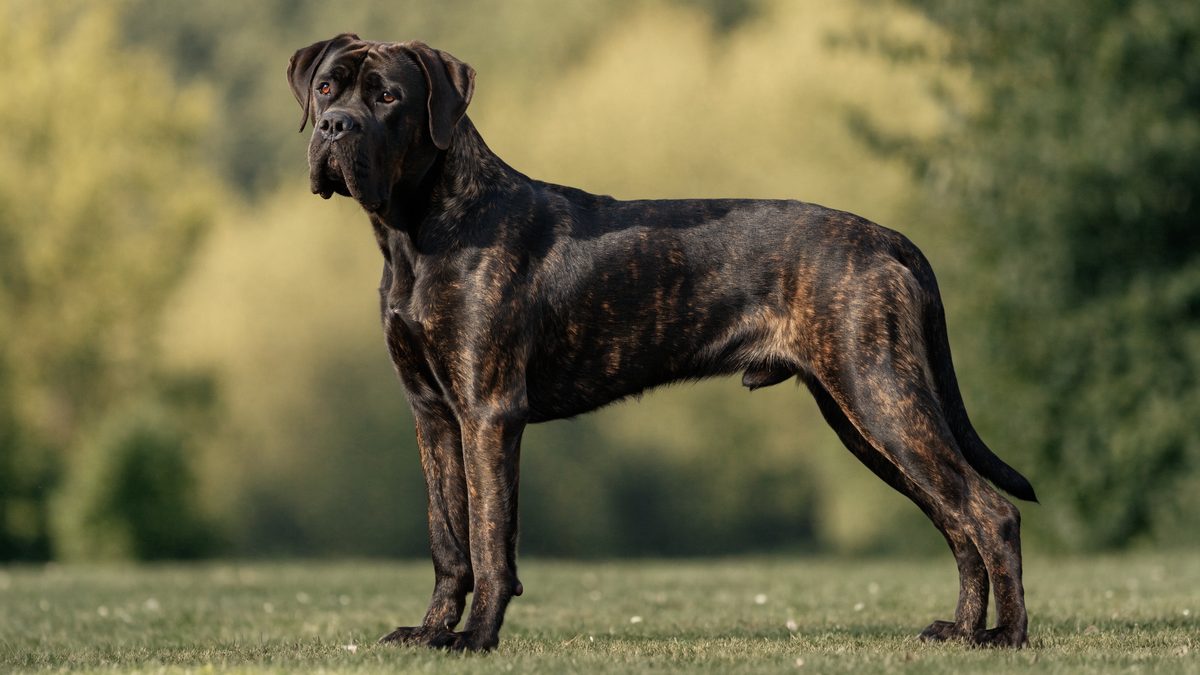
The Cane Corso is a medium to large Italian molossoid guarding dog, 64 to 68 cm at the withers and 45 to 50 kg in males, with a short, dense, shiny coat and a broad square muzzle roughly half the length of its skull. Its name comes from the Latin cohors, meaning protector or guardian of the farmyard, and its direct ancestor is the old Roman Molossian.
Two kennel clubs publish a breed standard for this dog, and Indian buyers need to know which one applies to them. The Federation Cynologique Internationale governs FCI-Standard No. 343, Cane Corso Italiano, whose current valid text was published on 25 September 2023. The American Kennel Club publishes its own Official Standard of the Cane Corso, approved 20 October 2009 and effective 30 June 2010. The Kennel Club of India is a full member of the FCI. A KCI-registered Cane Corso in India is therefore judged against the Italian standard, not the American one, and on two points those two documents flatly contradict each other.
| Point | FCI Standard No. 343, valid from 25.09.2023 | AKC standard, effective 30.06.2010 |
|---|---|---|
| Ears | "Triangular, drooping, of medium size... Ears are un-cropped" | "May be cropped or uncropped. If cropped, it is in an equilateral triangle"; |
| Tail | "Natural. Set on fairly high; very broad at the root" | "It is docked at the fourth vertebrae" |
| Height, males | 64 to 68 cm, tolerance 2 cm either way | 25 to 27.5 inches, roughly 63.5 to 70 cm |
| Weight, males | 45 to 50 kg, stated explicitly | "Proportionate to height." No figure given |
| Aggression | "Aggressive or overly shy dogs" is a disqualifying fault | "Docile and affectionate to his owner, loving with children and family"; |
That table is the most useful thing on this page for anyone buying a pedigree dog in India, and no ranking page prints it. If a breeder tells you a cropped Cane Corso is "to standard", ask which standard. Under the one that governs a Kennel Club of India dog, cropped ears are a departure from the written text, not a conformity to it Federation Cynologique Internationale.
Appearance, in the standard's own words
The coat is short, shiny and very dense with a slight undercoat of vitreous texture. The AKC describes it as short, stiff, shiny, adherent and dense with a light undercoat that becomes thicker in cold weather. This is a short-coated dog and it does not blow coat the way an Arctic breed does, which matters for grooming in India and is discussed properly further down.
Permitted colours under the FCI are black, lead-grey, slate-grey, light grey, light fawn, dark fawn, stag red, dark wheat, black brindle and grey brindle. In fawn and brindle dogs the black or grey mask must not extend beyond the line of the eyes. A small white patch on the chest, on the tips of the toes and on the bridge of the nose is acceptable. Anything else, including large white patches, is a disqualifying fault. There is no white Cane Corso and no blue-eyed Cane Corso in either standard. Google India's own related-search block shows people searching "White cane corso price in india", and the AKC lists blue eyes as an outright disqualification.
The head is large and typically molossoid, broad at the zygomatic arches, with the width of the skull equal to its length. The muzzle is strong and square, noticeably shorter than the skull at a ratio of roughly one to two, and as broad as it is long. Hold that ratio in mind. It is the single physical fact that decides how this dog copes with an Indian May, and the climate section returns to it.
The body is rectangular, about 11 percent longer than tall, with lean and powerful muscular development, a straight and firm back, and cat feet. The bite is slightly undershot by no more than 5 mm; an overshot mouth disqualifies.
What the standard says the temperament is
The FCI gives the working description in one line: "Guardian of property, family and livestock; extremely agile and responsive", historically used for herding cattle and hunting big game. The AKC calls the breed intelligent and easily trained, noble and majestic, and docile and affectionate to his owner.
Under FCI-Standard No. 343, "Aggressive or overly shy dogs" is listed as a disqualifying fault, alongside any dog clearly showing physical or behavioural abnormalities. A Cane Corso that behaves aggressively in the ring is not an especially good specimen of the breed. It is excluded from it. Indian sellers who market this dog on menace are selling against the written standard they invoke when they price the puppy, and Bonbeno thinks buyers should know that.
History supports the same reading. The breed was scattered across Italy and latterly concentrated in Apulia and the adjacent regions of southern Italy, where it worked as a farm guard dog, a cattle drover and a big-game hunter. It is a utility dog, classified by the FCI in Group 2, Section 2.1, Molossian and Mastiff type, with a working trial. It was not developed to fight other dogs, and Indian law is unambiguous that inciting any animal to fight is an offence under section 11 of the Prevention of Cruelty to Animals Act, 1960.
One more thing worth knowing before you look at prices. Indian sellers frequently market this breed as the "King Corso" or "Cane Corso Mastiff";. Neither term appears in either breed standard American Kennel Club. They are marketing labels, and a puppy sold under them commands no recognised premium from any registry.
Cane Corso price in India, compared across seven sources
The published Cane Corso price in india runs from Rs 15,000 to Rs 3,00,000 in 2026. That is not a market range, it is a measure of how little the sources agree. Bonbeno opened all seven pages currently ranking for this query and put their numbers side by side, and the cheapest published floor is one sixth of the dearest.
No ranking page compares its own figure against any other. Here they are together.
| Source | Headline range | Pet or unregistered | KCI or champion tier | Sells dogs or products? |
|---|---|---|---|---|
| Supertails | Rs 60,000 to Rs 3,00,000 | Rs 60,000 to Rs 80,000 | Rs 90,000 to Rs 1,50,000 (KCI); Rs 2,00,000 to Rs 3,00,000 (import) | Sells pet products |
| Mr n Mrs Pet | Rs 90,000 to Rs 1,80,000+ | Rs 90,000 to Rs 1,20,000 | Rs 1,20,000 to Rs 1,40,000 (KCI); Rs 1,40,000 to Rs 1,80,000 (champion) | Sells puppies |
| Cudlycomfy | Rs 65,000 to Rs 2,50,000 | Rs 65,000 to Rs 1,20,000 | Rs 1,50,000 to Rs 2,50,000+ | No, ad-supported blog |
| The Dog Farm | Rs 80,000 to Rs 2,00,000 | Not broken out | Not broken out | Sells puppies, is a breeder |
| GoodPaws, breed guide | Rs 40,000 to Rs 1,30,000 | Rs 40,000 to Rs 70,000 (Indian-bred) | Rs 80,000 to Rs 1,30,000 (European import) | Sells puppies |
| GoodPaws, sale page | Rs 70,000 to Rs 2,20,000 | Rs 70,000 to Rs 95,000 | Rs 1,50,000 to Rs 2,20,000 (KCI, European champion) | Sells puppies |
| HankPets | Rs 15,000 to Rs 1,00,000 | Not broken out | Not broken out | Sells pet supplies |
Three things fall out of that table, and all three are worth more to a buyer than any single number in it.
- The floor varies by a factor of six. HankPets publishes Rs 15,000 as the bottom of the range. Mr n Mrs Pet publishes Rs 90,000. These are pages describing the same breed in the same country in the same year.
- One publisher disagrees with itself by Rs 90,000. GoodPaws runs a breed guide topping out at Rs 1,30,000 and a puppies-for-sale page topping out at Rs 2,20,000 GoodPaws, Buy Cane Corso Puppies and Dogs…. Same site, same breed, same season.
- Five of the seven have a commercial interest in the number. Four sell puppies and one sells pet supplies. None of them discloses it next to the price. Bonbeno discloses it here because they do not.
The city tables, and why one of them is not a city table
Only two sources publish a city breakdown, and they are not equally useful. Supertails gives genuinely different figures per city across three quality tiers.
| City | Basic, non-KCI | KCI registered | Show or import quality |
|---|---|---|---|
| Delhi NCR | Rs 70,000 to Rs 90,000 | Rs 1,00,000 to Rs 1,60,000 | Rs 2,20,000 to Rs 3,00,000 |
| Mumbai | Rs 70,000 to Rs 85,000 | Rs 1,00,000 to Rs 1,50,000 | Rs 2,00,000 to Rs 2,80,000 |
| Bengaluru | Rs 65,000 to Rs 85,000 | Rs 95,000 to Rs 1,50,000 | Rs 2,00,000 to Rs 2,60,000 |
| Hyderabad | Rs 60,000 to Rs 80,000 | Rs 90,000 to Rs 1,40,000 | Rs 1,80,000 to Rs 2,50,000 |
| Chennai | Rs 60,000 to Rs 80,000 | Rs 85,000 to Rs 1,40,000 | Rs 1,80,000 to Rs 2,50,000 |
| Pune | Rs 60,000 to Rs 75,000 | Rs 85,000 to Rs 1,30,000 | Rs 1,80,000 to Rs 2,40,000 |
| Kolkata | Rs 55,000 to Rs 75,000 | Rs 80,000 to Rs 1,20,000 | Rs 1,60,000 to Rs 2,20,000 |
| Tier 2 cities | Rs 40,000 to Rs 65,000 | Rs 70,000 to Rs 1,10,000 | Rare, sourced from metros |
Mr n Mrs Pet also publishes a table headed "Cane Corso Puppy Price in India" with eight cities in it. Six of those eight cities carry the identical figure of INR 90,000 to INR 1,80,000, and the other two, Bangalore and Chennai, carry INR 75,000 to INR 1,80,000. A table in which six of eight rows are the same number is not a city breakdown. It is one national range formatted as eight rows, and it should not be read as local market data.
Neither table can be cross-checked against the other, because their tiers do not line up and their totals do not either. Bonbeno prints both and averages neither.
What the price is actually tracking
- Registration. Supertails puts KCI registration at Rs 20,000 to Rs 40,000 of the purchase price, and states litter registration at Rs 1,200 to Rs 2,500 and individual puppy registration at Rs 2,000 to Rs 3,500. Registration documents pedigree. It is not a health certificate, and it does not mean anybody screened the parents' hips.
- Import bloodline. GoodPaws prices Indian-bred puppies at Rs 40,000 to Rs 70,000 and European import lines at Rs 80,000 to Rs 1,30,000, naming Italian and Serbian bloodlines as the most sought after. That is a doubling for provenance, not for any measured health outcome.
- Colour. Google India's related searches show buyers looking specifically for blue, black and white Cane Corsos. The FCI standard treats every permitted colour equally and disqualifies large white patches outright. A colour premium buys you nothing the standard recognises.
- Training already done. The Dog Farm prices on "bloodline, pedigree, and training level". That one is at least a real cost, because professional obedience work on this breed is quoted separately at Rs 50,000 to Rs 80,000.
The cheapest listings are the ones to worry about
One classified ranking on page one of Google India for this query offers a "Healthy 55 days Male Cane Corso puppy" at Rs 30,000, solid black, with a seven-day written health guarantee and free hand-delivery anywhere in India. The Prevention of Cruelty to Animals (Dog Breeding and Marketing) Rules, 2017 require that "pups less than eight weeks in age are not sold";. Eight weeks is 56 days. The advertised puppy is 55. Bonbeno is not accusing anyone of an offence, and we have not seen the animal. We are pointing out that the age stated in the advertisement itself falls below the age the Rules permit, and that a buyer should treat that as the first thing to check rather than the last.
The same Rules require that a breeder holds a certificate of registration from the State Board before carrying on any breeding activity, that only dogs in good health that have been given their medical inoculations are sold, and that housing provides protection from the extremes of weather conditions with proper ventilation. Ask to see the State Board registration. In India that single question separates more sellers than any price band does.
Bonbeno does not broker puppy sales, does not publish breeder listings and does not accept payment for placement. Every figure above is reported from a third party so you can see the disagreement yourself and price the uncertainty into your own decision.
Monthly cost of keeping a Cane Corso in India
Published monthly cost estimates for a Cane Corso in India run from Rs 3,000 to Rs 18,000. The lowest figure in that spread comes from the source with the strongest commercial reason to make ownership look cheap, and it is less than half of what every other source says.
Four ranking pages publish a recurring monthly figure. Read them together and the pattern is hard to miss.
| Source | Monthly cost published | What the source sells |
|---|---|---|
| Mr n Mrs Pet | Rs 3,000 to Rs 7,000 | Puppies |
| Supertails | Rs 8,000 to Rs 15,000 | Pet products |
| The Dog Farm | Rs 9,000 to Rs 15,000 | Puppies, is a breeder |
| GoodPaws | Rs 8,000 to Rs 18,000 | Puppies |
Three sources cluster between roughly Rs 8,000 and Rs 18,000. One sits at Rs 3,000 to Rs 7,000 and adds that Cane Corsos "typically cost less to maintain than Standard ones". That same page describes the breed as having "dense, curly coats that need trimming every 4-6 weeks";, which contradicts both breed standards, each of which describes a short, dense, adherent coat American Kennel Club. When a page gets the coat wrong, treat its costing with equal caution.
Where the money actually goes each month
Food is the largest recurring line and it scales with the dog. Supertails puts an adult Cane Corso at 400 to 600 grams of quality kibble a day, premium large-breed dry food at Rs 300 to Rs 700 per kg, and the resulting monthly food bill at Rs 5,000 to Rs 8,000. GoodPaws quotes 3 to 5 cups daily at Rs 6,000 to Rs 12,000 a month. The Dog Farm quotes Rs 6,000 to Rs 10,000. Three independent sources landing in the same band is the most reliable single number on this page.
| Line | Published range | Source |
|---|---|---|
| Food | Rs 5,000 to Rs 12,000 | Supertails, Cane Corso Price in India 2026 GoodPaws, Cane Corso Dog Breed |
| Grooming, professional | Rs 800 to Rs 1,800 | The Dog Farm, Buy Cane Corso Puppies… Supertails, Cane Corso Price in India 2026 |
| Vet and routine health care | Rs 1,500 to Rs 3,000 | The Dog Farm, Buy Cane Corso Puppies… |
| Flea and tick prevention | Rs 400 to Rs 1,000 | Supertails, Cane Corso Price in India 2026 |
| Joint supplements | Rs 1,200 to Rs 2,500 | Supertails, Cane Corso Price in India 2026 |
| Summer cooling | Rs 3,000 to Rs 7,000 | Supertails, Cane Corso Price in India 2026 |
| Training maintenance | Rs 1,500 to Rs 3,000 | Supertails, Cane Corso Price in India 2026 |
Note the summer cooling line. Supertails costs it at Rs 3,000 to Rs 7,000 a month and calls air conditioning or consistent shade from 10 am to 4 pm essential in all Indian metros. No other ranking page carries a cooling line at all. On a nine-year life that single item is between roughly Rs 1.3 lakh and Rs 3.1 lakh of electricity, assuming six hot months a year, which is Bonbeno's arithmetic on Supertails' figure rather than a published total.
Year one is the expensive one
Supertails is the only source publishing a full first-year build-up, and it totals Rs 1,60,000 to Rs 3,10,000 including the puppy. The largest single line in it is not the dog. It is professional training at Rs 50,000 to Rs 1,50,000. Vaccination across the four-series plus rabies is Rs 3,500 to Rs 5,000, deworming Rs 1,500 to Rs 2,500, orthopaedic screening Rs 5,000 to Rs 12,000, and an emergency buffer of Rs 10,000 to Rs 40,000.
The number nobody computes correctly
Cudlycomfy states a lifetime ownership cost of Rs 12 lakh to Rs 20 lakh "over a lifetime of 10-12 years";. The lifespan input in that calculation is wrong. The largest study of dog longevity ever run in the UK, covering 584,734 dogs, puts the Cane Corso at a median 8.1 years, and the only breed-specific longevity study puts it at 9.29 years. Neither is 10 to 12.
Take the mid-range monthly figure of Rs 8,000 to Rs 15,000 that three sources agree on GoodPaws, Cane Corso Dog Breed and run it across the two sourced median lifespans rather than the marketing one. At a median 8.1 years the recurring cost is roughly Rs 7.8 lakh to Rs 14.6 lakh. At 9.29 years it is roughly Rs 8.9 lakh to Rs 16.7 lakh. This is Bonbeno's arithmetic on other people's published inputs, not a figure any source prints. The honest version is worse than the marketing version in the way that matters: you spend less in total only because the dog does not live as long.
Either way, the recurring cost is between eight and eighteen times the purchase price. The puppy is the cheapest part of a Cane Corso. If the Rs 90,000 is a stretch, the Rs 8,000 a month for the next nine years is not affordable, and that is the calculation to make before you contact anybody.
The costs that only appear if something goes wrong
These are not monthly. They are the reason the emergency buffer exists, and on this breed several of them are likelier than average for reasons the health section sets out.
| Event | Published cost |
|---|---|
| Hip dysplasia surgery | Rs 60,000 to Rs 1,50,000 |
| Joint replacement, per joint | Rs 1,20,000 to Rs 2,00,000+ |
| Bloat, emergency surgery | Rs 50,000 to Rs 1,20,000 |
| Heat stroke, emergency vet | Rs 15,000 to Rs 40,000 |
| Entropion, surgical correction | Rs 8,000 to Rs 15,000 |
| Elbow dysplasia surgery | Rs 35,000 to Rs 80,000 |
| Hip and elbow screening X-ray | Rs 5,000 to Rs 8,000 |
One further line most Indian buyers do not budget for. Supertails reports that many standard policies exclude large protection breeds and that specialist pet liability cover runs Rs 8,000 to Rs 15,000 or more a year, with some housing societies requiring it. Verify what your society demands in writing before you buy, not after.
Heat tolerance: Bonbeno rates this breed 2 of 5
The Cane Corso's short coat is a real advantage in Indian heat, and it is also the least important variable. Bonbeno rates heat tolerance 2 of 5 because the two factors that the largest heat-related-illness study actually measured, bodyweight and skull length, both point the wrong way for this breed, and its coat does not offset either.
One ranking page makes the coat argument explicitly. GoodPaws states that "the Cane Corso's short, dense, stiff coat is one of its genuine practical advantages for India", that it is "significantly more heat-practical than GSD, Rottweiler, or most large guardian breeds", and lists as a pro that it is the "most climate-practical large guardian breed for India";. The first half of that is true. The conclusion does not follow, and here is why.
What the evidence measures
The largest study of heat-related illness in dogs examined 905,543 dogs under UK primary veterinary care and identified 395 heat-related illness events in 2016. Its headline finding is the one to sit with: the event fatality rate was 14.18 percent (95% CI 11.08 to 17.96). Roughly one dog in seven that develops heat-related illness dies of it.
The study's two strongest morphological risk factors are the two that describe this breed.
| Risk factor measured | Effect found | Cane Corso per the breed standard |
|---|---|---|
| Bodyweight over 50 kg | 3.42 times the odds of heat-related illness versus dogs under 10 kg (95% CI 1.54 to 7.57) | Males 45 to 50 kg, females 40 to 45 kg. A standard-sized male sits at the boundary of the highest-risk band, and an overweight one is past it |
| Shortened skull | Brachycephalic dogs had 2.10 times the odds versus mesocephalic (95% CI 1.68 to 2.64) | Muzzle "noticeably shorter than the skull, ratio muzzle : skull approximately 1 : 2";; muzzle reaches about one third of total head length |
| Age 12 years and over | Greatest odds by age group, OR 1.75 versus dogs under 2 | Largely academic here. Median lifespan is 8.1 to 9.29 years Korec E, Chalupa O, Hancl M, Korcova J, so most never reach the high-risk age band |
| Coat | Not among the study's headline morphological risk factors | Short, dense, adherent, slight undercoat |
The Cane Corso does not appear by name in the heat-related-illness risk tables, and this page does not pretend otherwise. That study ran on UK primary-care records, where the breed is uncommon, and its authors flag that wide confidence intervals follow from small breed sample sizes; the Chow Chow's headline OR of 16.61 carries exactly that caveat. No study has measured heat-related illness in Cane Corsos, in India or anywhere else. What Bonbeno is saying is narrower and defensible: the two morphological variables the study did measure, weight above 50 kg and a shortened muzzle, both describe this breed as its own standard defines it. Coat length was not one of them. Arguing from coat alone answers a question nobody measured.
The Indian risk factors on top
Purina India lists the conditions that turn heat into an emergency: lack of water, an enclosed space, excessive humidity, obesity, intense exercise, old age, cardiovascular or respiratory disease, and lack of acclimatisation. Four of those are ordinary features of keeping a 50 kg guarding dog in an Indian metro flat, and humidity is the one Indian owners consistently underrate. A dog cools by evaporating water from its respiratory tract. In Mumbai or Chennai in June, the air is already close to saturated, so panting moves less heat than the same panting would move in Delhi in May at the same temperature.
Purina India also names the numbers to act on. A body temperature of 40.5 C or above is the emergency threshold, and active cooling should stop at 39.4 C to avoid overshooting into hypothermia. Symptoms to watch for are severe panting, difficulty breathing, heavy salivating, vomiting, diarrhoea, blood in the urine, nosebleeds, and collapse.
What this means day to day
- Walk before 7 am and after 8 pm from March to October in every plains city. Supertails puts the danger window at 10 am to 4 pm and treats shade or air conditioning across it as essential in all Indian metros.
- Cool a dog that is overheating with room-temperature water over the neck, chest and paws, move it into airflow, and get to a vet. Do not use ice, and stop active cooling at 39.4 C.
- Keep the dog lean. Obesity is on Purina India's own risk list, and it independently raises orthopaedic load on a breed that is 37.2 percent dysplastic on hips.
- Do not exercise hard in heat, ever. Intense exercise is a listed risk factor, and protection or bite-work sessions scheduled at a trainer's convenience rather than the weather's are a common Indian failure.
- Budget for the electricity. Cooling is costed at Rs 3,000 to Rs 7,000 a month. A Cane Corso in Jaipur or Nagpur without reliable summer cooling is a welfare problem, not a hardy dog.
City by city, the honest summary is that no Indian plains city is easy for this dog in summer, and the coastal cities are harder than their thermometers suggest because of humidity. Bengaluru and Pune are the most manageable of the metros. Delhi NCR, Jaipur, Ahmedabad and Nagpur are the hardest on temperature. Mumbai, Chennai and Kolkata are the hardest on humidity. Cudlycomfy notes a full-grown Cane Corso can weigh up to 50 kilograms; that mass is the problem in all of them.
One claim Bonbeno will not repeat without a source. Supertails states that "black coats absorb heat" and treats it as a Cane Corso-specific risk. It is physically plausible and the breed is frequently solid black, but no study Bonbeno could find has measured coat-colour effects on heat-related illness in dogs. Treat it as a reasonable precaution rather than an established finding.
Temperament, and the gap between the standard and the sales pitch
The breed standard describes a docile, affectionate, easily trained guardian that is disqualified from the ring for aggression. Indian marketing describes a protection weapon that requires an owner who understands dominance. Those are two different dogs, and only one of them is written down in a document any registry will honour.
Start with the primary texts, because they are short and unambiguous. The FCI gives the temperament as "Guardian of property, family and livestock; extremely agile and responsive";. The AKC expands it: "Intelligent, he is easily trained. Noble, majestic and powerful his, presence is impressive. He is docile and affectionate to his owner, loving with children and family";. Under the FCI, "Aggressive or overly shy dogs" is a disqualifying fault.
Now the ranking pages. Supertails calls the breed "naturally suspicious of strangers" and adds "this is a feature, not a bug", says handlers must "understand dominance dynamics", and prices protection training at Rs 50,000 to Rs 2,00,000. GoodPaws rates friendliness with strangers 2 of 5 and guard ability 5 of 5, and calls the breed "not aggressive, they are serious";. Mr n Mrs Pet leads with "Protective Instincts" and describes "natural guardians, alert and dependable";.
Some of that is fair. The breed is reserved with strangers and it was bred to guard. The part worth challenging is the leap from breed to individual.
What the genetics actually says about breed and behaviour
The largest study to test the link between breed and behaviour surveyed 18,385 dogs and sequenced the genomes of 2,155, and its central finding is blunt: breed explains just 9 percent of behavioural variation in individuals, and breed is not a reliable predictor of individual behaviour. In every breed represented by 25 or more dogs, the majority of individuals scored within one standard deviation of the whole-cohort mean.
That finding cuts in both directions, and Bonbeno applies it consistently rather than selectively.
- Against the sales pitch. You cannot buy guarding behaviour by buying a breed. Nine percent is not a guarantee of anything. A Cane Corso puppy bought as a security product may grow into a nervous, noise-sensitive dog that guards nothing, and the buyer has still committed to nine years and Rs 8 lakh.
- Against the breed ban. The same 9 percent is why a list of 24 breeds is a poor instrument of public safety. The Karnataka High Court reached the same destination by a different route, holding that the Central government had no power to impose a blanket breed ban by circular.
- Against the buyer's own optimism. It equally means a well-bred, well-socialised Cane Corso is not guaranteed to be safe because the pedigree says so. Individual temperament, early socialise-and-expose work, and training do the work that breed does not.
Who this breed genuinely suits
Every ranking page agrees on one thing and it happens to be correct. GoodPaws: "Not recommended, one of the most demanding guardian breeds" for first owners. Supertails: "5+ years of large-breed experience" before ownership. Cudlycomfy: "not ideal for first-time dog owners";. HankPets: "not the best breed for first-time dog owners, as they can be stubborn and independent";.
| Situation | Bonbeno's read |
|---|---|
| First dog of any kind | No. Unanimous across every source, and the consequences of getting a 50 kg guarding dog wrong are not recoverable by trying harder later |
| Apartment without private outdoor space | No. Supertails specifies 200 to 300 sq ft of dedicated outdoor space with 1.5 to 1.8 m fencing; GoodPaws marks apartments "not suitable";; Mr n Mrs Pet says "not ideal"; |
| Family with children under 5 | No. Supertails says not suitable under 5 and supervised from 5 to 12. The standard calls the breed loving with children, but a 45 kg dog knocks a toddler over without any intent at all |
| Experienced large-breed owner, house with a yard | Yes, if the heat plan, the training budget and the housing-society position are all settled in advance |
| Buying primarily for security | Reconsider. Breed explains 9 percent of behaviour, and Supertails itself notes a single dog is only cheaper than a security system if nothing goes wrong |
| Buying as a status symbol | No. Supertails is unusually direct here and correct: "completely unsuitable for... anyone treating them as a status symbol"; |
The line this page will not cross
Bonbeno publishes no guidance on producing aggression, sharpening a guarding response, or preparing any dog for confrontation with another animal. Section 11 of the Prevention of Cruelty to Animals Act, 1960 makes it an offence to incite any animal to fight or bait any other animal. The same section covers mutilating any animal. The expert committee whose recommendations produced the 2024 central circular was acting in part on public concern about illegal dog fighting. If a seller offers you a Cane Corso on its fighting or attack potential, that is the moment to walk away, and the FCI standard agrees with you: aggression disqualifies.
The practical version of good temperament work on this breed is unglamorous. Expose the puppy to traffic, lifts, delivery riders, cattle, other dogs, children, umbrellas and the doorbell during the socialisation window described in the puppy section below. Reward calm. Do not reward barking at the gate, however useful it feels the first time. A Cane Corso that has decided on its own what counts as a threat is a dog whose judgement you are now stuck with for eight or nine years.
Training a Cane Corso, and what it costs in India
To train a Cane Corso successfully in India, budget Rs 50,000 to Rs 80,000 for foundation obedience before the dog is a year old, and treat loose-lead walking and a reliable recall as the two skills that matter more than every trick combined. The AKC standard calls the breed "easily trained";. It is trainable. It is not forgiving of being trained late.
Every Indian source agrees training is compulsory rather than optional on this breed, and their price quotes cluster tightly enough to be useful. Supertails prices basic obedience over four to six weeks at Rs 50,000 to Rs 80,000, intermediate work at Rs 80,000 to Rs 1,20,000, and ongoing maintenance at Rs 1,500 to Rs 3,000 a month. Cudlycomfy puts training programmes at Rs 15,000 to Rs 50,000 depending on the level of discipline required. The Dog Farm quotes Rs 2,000 to Rs 5,000 a month initially. That is a wide spread and it reflects a real difference between group classes and a private behaviourist, not a disagreement about whether training is needed.
The four things to get right, in order
- Loose-lead walking, from week nine. A 45 kg dog that pulls is not a training problem, it is a physical one. You will not out-muscle it at eighteen months, so teach it at nine weeks when the dog weighs eight kilos and the lesson is cheap.
- Recall, on a long line, forever. Reliable off-lead recall in an Indian public space with street dogs, cattle and traffic is a high bar for any guarding breed. Train it, then keep using a long line anyway.
- Settle and place. A guarding dog that can be sent to a mat when the doorbell rings is the single most useful behaviour you can install for apartment or gated-community life.
- Handling tolerance. This breed needs its ears, eyes, feet and mouth handled without protest, because entropion and ectropion checks and hip screening are part of its life. Start on day one.
Where Bonbeno departs from the ranking pages
Two framings on the ranking set deserve pushback.
The first is dominance. Supertails says handlers must "understand dominance dynamics";. The genetics do not support treating a breed as a behavioural type in the first place: breed explains just 9 percent of behavioural variation in individuals and is not a reliable predictor of individual behaviour. Train the dog in front of you. A confident Cane Corso and an anxious one need different plans, and the pedigree will not tell you which you bought.
The second is protection work. Supertails prices protection training at Rs 50,000 to Rs 2,00,000 and describes bite work and bite inhibition. Bonbeno's position is narrow and firm.
This page will not tell you how to sharpen a guarding response, and it will not link anyone who does. Section 11 of the Prevention of Cruelty to Animals Act, 1960 makes it an offence to incite any animal to fight or bait any other animal. Separately, the FCI standard that governs a Kennel Club of India dog lists aggression as a disqualifying fault. If you want a dog that deters, the deterrent is a 45 kg dog standing at your gate looking like a 45 kg dog. That works without any bite training at all, and it carries none of the liability. Supertails, which sells the training, is candid about the downside: under-trained dogs of this breed are "genuine liability risks" and many standard insurance policies exclude them.
Realistic timelines
| Age | Realistic target |
|---|---|
| 8 to 16 weeks | Name response, sit, hand feeding, crate comfort, lead introduction, and above all exposure. This is the window the whole adult dog is built in |
| 4 to 6 months | Loose-lead walking at a walking pace, settle on a mat, tolerating ear and foot handling, meeting 100 different people and surfaces |
| 6 to 12 months | Foundation obedience with a professional. Recall on a long line. Adolescent testing begins and previously solid behaviours will wobble |
| 12 to 18 months | Consolidation. Hip and elbow screening at 12 months or later Orthopedic Foundation for Animals. Avoid high-impact work and jumping until at least 18 months |
| 18 months onward | Physically mature. Maintenance rather than construction. If the foundation is missing, this is where owners discover it, and it is an expensive place to find out |
One Indian-specific point. If you live anywhere the breed is restricted, you may be legally required to muzzle the dog in public, so muzzle conditioning belongs in the training plan from puppyhood rather than being introduced under pressure later. Owners of already-registered restricted breeds in Chandigarh must ensure their dogs are "muzzled at all times during walking and leashed with equipment strong enough to keep them under control", and the bye-laws advise training through trainers registered with the Municipal Corporation. A dog that has been taught to enjoy a basket muzzle over weeks wears one happily. A dog that meets one for the first time at two years old does not.
Finally, the honest caveat on heat. Train early morning and late evening, and keep sessions short in summer. Intense exercise is a listed heat stroke risk factor, and a trainer who schedules an hour of work at 2 pm in May is making a decision about your dog's safety that you should overrule.
How much exercise a Cane Corso needs, and when you can give it
An adult Cane Corso needs 60 to 90 minutes of exercise a day, split across two or three sessions. Three independent Indian sources give exactly that figure and they are right The Dog Farm, Buy Cane Corso Puppies… GoodPaws, Buy Cane Corso Puppies and Dogs…. The Indian complication is not the amount. It is that for six months of the year the only safe hours to deliver it are before 7 am and after 8 pm.
This is the rare number on which the ranking set converges. Supertails: "Minimum 60-90 minutes daily for adults (split into 2-3 sessions)", and "NOT a couch potato breed despite moderate energy". The Dog Farm: "Minimum of 60-90 minutes daily including walks, running, and agility play". GoodPaws: "Cane Corsos need 60-90 minutes of vigorous exercise daily", adding that mental stimulation matters as much as the physical work. When four commercially motivated sources all land on the same figure, it is usually because the figure is real.
The Indian scheduling problem
Here is the arithmetic nobody prints. You need 60 to 90 minutes a day. Supertails puts the unsafe window at 10 am to 4 pm across all Indian metros. Purina India lists intense exercise among the conditions that produce heat stroke, alongside excessive humidity and lack of acclimatisation. And the largest heat study puts dogs over 50 kg at 3.42 times the odds of heat-related illness, with a 14.18 percent event fatality rate.
So the honest daily plan from March to October in any plains city is two sessions, one starting before 7 am and one after 8 pm, with the middle of the day written off entirely. If your working hours do not allow that, this is the wrong breed for your life, not a problem to solve with willpower. More Indian Cane Corsos are failed by a commute than by a lack of affection.
What the exercise should be
- Steady walking on a loose lead, which is the bulk of it. This is a trotting breed by design; the FCI names the extended trot as the preferred gait.
- Sniffing time, unhurried. Twenty minutes of nose work tires a guarding dog more than twenty minutes of running and generates no joint load or heat.
- Scent games and training drills indoors during summer afternoons. GoodPaws is right that mental stimulation is as important as physical exercise for this breed.
- Controlled play, not repetitive fetch on hard ground. Supertails advises avoiding high-impact play and jumping until 18 months or older, which matters on a breed that is 37.2 percent dysplastic on hips.
- No forced running beside a bicycle or vehicle, at any age, in any season.
Supertails recommends that puppies up to 18 months get shorter but more frequent sessions, around 20 minutes three or four times a day, specifically to avoid joint stress. Growth-plate damage in a giant-breed puppy is permanent and it is the owner's decision, not the dog's. A Cane Corso puppy will happily do far more than is good for it, and a puppy that seems tireless at seven months is not evidence that the joints are coping.
What happens without it
Supertails states the consequences plainly and they match what any behaviourist will tell you: inadequate exercise leads to destructive behaviour, anxiety and weight gain. The weight gain is the one that compounds. Obesity appears on Purina India's heat stroke risk list, and Supertails reports that overweight dogs of this breed face substantially higher dysplasia risk. An under-exercised Cane Corso in an Indian summer is simultaneously more likely to overheat, more likely to develop joint disease and more likely to wreck the house, and all three arrive together.
One last note on space. Exercise is not a substitute for room. Supertails specifies 200 to 300 sq ft of dedicated outdoor space with secure fencing at 1.5 to 1.8 m, and GoodPaws marks apartments outright "not suitable";. A 90-minute walk does not convert a two-bedroom flat into an appropriate home for this dog.
Grooming a short coat in Indian humidity, and the ear cropping question
To groom a Cane Corso you need a rubber curry brush, ten minutes a week, and a routine for checking ears, skin folds and eyes. The coat is short, shiny, very dense and adherent with a slight undercoat. It does not need trimming, clipping or stripping, and any groomer who proposes those has not read a breed standard.
Mr n Mrs Pet tells Indian buyers that "Cane Corso have dense, curly coats that need trimming every 4-6 weeks to prevent matting";. This is wrong. The FCI standard describes hair that is "Short, shiny, very dense with a slight undercoat of vitreous texture"; the AKC describes a coat that is "short, stiff, shiny, adherent and dense";. Semi-long, smooth or fringed hair is a disqualifying fault under the FCI. A Cane Corso cannot mat, because it has no coat length to mat with. Do not pay for a trimming schedule this dog does not need.
Costed properly, grooming is the cheapest line in Cane Corso ownership. Supertails puts home supplies at roughly Rs 400 to Rs 1,400 a month and professional sessions at Rs 1,000 to Rs 1,800 every eight to ten weeks. The Dog Farm quotes Rs 800 to Rs 1,500 a month. For most Indian owners a weekly ten-minute brush at home and a bath when the dog is actually dirty is the whole programme.
What Indian humidity actually changes
The coat is easy. The parts that are not coat are where humid Indian conditions cause trouble.
- Ears. The FCI requires triangular, drooping ears of medium size. A hanging ear over a warm, moist canal is the classic setup for otitis. Supertails costs an ear infection episode at Rs 2,000 to Rs 6,000 and attributes the risk to heat and humidity trapping moisture under floppy ears. Check and dry the ears weekly, and after every swim or bath.
- Facial skin and lips. The upper lips hang moderately and form an inverted U. GoodPaws is right that Corsos drool and that the muzzle folds need monitoring for moisture buildup. Wipe and dry, do not let it stay damp.
- Eyes. This is the breed's real weak point and it is covered in full in the health section. Ectropion is the most common presumed-inherited eye disorder recorded in the breed in its country of origin, at 36.6 percent of all such disorders in Cane Corsos examined. An everted lower lid collects dust, and Indian dust is not gentle.
- Skin. Demodectic mange is on the breed club's own list of common concerns. Supertails costs a treatment course at Rs 3,000 to Rs 8,000.
The Cane Corso Association of America lists Demodex mange among common breed concerns. The largest UK study of the disease, covering 455,553 dogs, found a one-year period prevalence of 0.17 percent overall, 0.48 percent in dogs under two and 0.05 percent in dogs over four, making juvenile-onset roughly ten times commoner than adult-onset, with a median age at first diagnosis of seven months. The Cane Corso is not named anywhere in that study. The only molossoid breed in its risk tables is the Dogue de Bordeaux, at 5.92 times the odds of juvenile-onset demodicosis versus crossbred dogs. Bonbeno will not transfer that figure to the Cane Corso. What you can take from it is the age pattern: if this is going to happen, it will most likely show before the dog is a year old.
Ear cropping: what applies to you in India
This belongs in a grooming section because in India it is sold as an appearance choice. It is a surgical amputation, and the position is clearer than most Indian pages suggest.
Start with the standard that governs your dog. The Kennel Club of India is a full FCI member, and FCI-Standard No. 343 states plainly that "Ears are un-cropped" and that the tail is "Natural". The AKC standard, which does not govern a KCI dog, permits cropping and specifies docking at the fourth vertebra. One ranking page tells Indian readers the ears "are often cropped to stand upright" and the tail "is usually docked", without mentioning Indian law or either standard.
| Date | What happened |
|---|---|
| 11 November 2011 | The Veterinary Council of India issued notice F.No.8-20/2008-VCI/4094 against cosmetic tail docking and ear cropping |
| 8 February 2013 | In a writ petition brought by the Kennel Club of India, the Madras High Court quashed that notice, holding that only the Central Government has rule-making power under section 38 of the PCA Act to regulate such procedures. "For all these reasons, the impugned order is quashed and the writ petition is allowed"; |
| 2017 | The Central Government exercised exactly that power. The PCA (Dog Breeding and Marketing) Rules, 2017 provide that "There shall be no tail docking, ear cropping de-barking, de-clawing, branding, dyeing... or any other kind of mutilation of any body part of the pup and any change of appearance by artificial means is strictly forbidden"; |
| Standing law | Section 11 of the PCA Act, 1960 makes it an offence to mutilate any animal |
Read in sequence, the 2013 judgment did not bless cropping. It said the wrong body had banned it. The right body then banned it in 2017, in terms that name ear cropping explicitly and apply to breeders and sellers. A breeder offering you a cropped Cane Corso puppy in India is offering you something the Dog Breeding and Marketing Rules forbid them to do, and a dog that departs from the standard its own registry applies.
The evidence on cropping itself
The American Veterinary Medical Association "opposes ear cropping and tail docking of dogs when done for cosmetic or nontherapeutic purposes" and "encourages the elimination of ear cropping and tail docking from breed standards";. The British Veterinary Association is blunter, calling ear cropping "a painful and illegal mutilation" that involves "cutting off part of the ear flap, often without anaesthesia or pain relief";. Its 2024 literature review is franker still: "Well-controlled studies addressing the animal welfare implications of cropping dogs' ears do not exist", and "There are no substantiated benefits associated with ear cropping for the dogs";. Cropping is performed at six to twelve weeks of age, and in larger breeds the ears are then taped or splinted for days to months, during which the dog may be isolated from other dogs. The review names the actual motive without embarrassment: cropping "produces an alert expression in dogs used for security or guard work";.
A study of public perception put the same dog in front of participants in modified and natural form. Modified dogs "were perceived as being more aggressive, more dominant, less playful and less attractive than natural dogs";, and owners of modified dogs "are perceived as being more aggressive, more narcissistic, less playful, less talkative and less warm" than owners of natural dogs. The study also found that 42 percent of participants could not correctly explain why cropped and docked dogs had short ears and tails, with most assuming it was genetic. In a country that spent 2024 arguing about whether this breed is ferocious, cropping your Cane Corso makes every stranger, neighbour and housing-society committee read it as more dangerous than it is. It works against you.
Bonbeno's position is simple and we apply it to our own illustrations. This site does not publish images of cropped ears or docked tails on breeds it criticises the practice in. Every Cane Corso image here shows natural drop ears and an undocked tail, because that is the dog the standard describes.
Health: the short lifespan, the hips, and the eyes nobody screens
The most important health fact about the Cane Corso is its life expectancy, and every Indian page currently ranking gets it wrong. The two studies that exist put the median at 8.1 years and 9.29 years Korec E, Chalupa O, Hancl M, Korcova J. Indian pages say 10 to 12 Cudlycomfy, Cane Corso Dog Price in India…, 9 to 12 and 9 to 11, and not one of them names a source.
Lifespan: two studies, and they disagree
Bonbeno does not average conflicting figures, so here are both.
| Study | Median lifespan | Method and size | What it is good for |
|---|---|---|---|
| McMillan et al. 2024, Scientific Reports | 8.1 years, hazard ratio 2.4 (2.0 to 3.0) | 584,734 UK dogs, 284,734 deceased, from veterinary and registry records | Far the larger dataset, and the only one with a comparison group. Its purebred median is 12.7 years |
| Korec et al. 2017, Open Veterinary Journal | 9.29 years (IQR 6.98 to 11.12) | 232 dogs from kennels and owners in 25 countries, by questionnaire | The only breed-specific study, and the only source for coat-colour differences |
| Ranking Indian pages Cudlycomfy, Cane Corso Dog Price in India… GoodPaws, Cane Corso Dog Breed Mr n Mrs Pet, Cane Corso Puppies For Sale… | 9 to 12 years | No method stated, no source cited, no sample | Nothing |
The McMillan finding deserves its own sentence, because it is the single most consequential number on this page. Out of every breed the study measured, the Cane Corso is among the ten most at risk of early death, listed alongside the Caucasian Shepherd Dog at 5.4 years, the Presa Canario at 7.7, the Mastiff at 9.0 and the Neapolitan Mastiff at 9.3. A hazard ratio of 2.4 means roughly two and a half times the risk of death at any given point compared with the reference. Against a purebred median of 12.7 years, buying this breed costs you around four and a half years of dog.
Korec's questionnaire study is smaller and self-reported, and its own colour findings should be read with that in mind: black brindle 10.30 years (n=35), brindle 10.13 (n=38), grey brindle 9.84 (n=26), fawn 9.01 (n=27), black 9.00 (n=62), grey 9.00 (n=31) and other colours 8.09 (n=13). Female dogs at 9.33 years did not significantly outlive males at 9.25. Do not choose a puppy by coat colour on the strength of a 232-dog owner survey.
Hip and elbow dysplasia: the numbers Indian pages will not print
The Orthopedic Foundation for Animals publishes screening results by breed alongside an all-breed total, which makes this the cleanest comparison available anywhere.
| Screen | Cane Corso | All breeds | Cane Corso rank |
|---|---|---|---|
| Hips, evaluated | 3,860 | 1,711,498 | - |
| Hips, normal | 60.9 percent | 84.3 percent | - |
| Hips, dysplastic | 37.2 percent | 14.2 percent | 20th worst |
| Hips, severe | 2.5 percent | 0.8 percent | - |
| Elbows, evaluated | 3,094 | 649,315 | - |
| Elbows, dysplastic | 21.1 percent | 12.0 percent | 20th worst |
| Patellar luxation, abnormal | 0.5 percent | 3.5 percent | 145th |
| Thyroid, autoimmune thyroiditis | 7.2 percent abnormal | - | 24th |
The Cane Corso is 2.6 times the all-breed rate for hip dysplasia and 1.76 times the all-breed rate for elbow dysplasia Orthopedic Foundation for Animals. It ranks twentieth worst of every breed OFA lists on both, and the OFA rankings run worst-first. Supertails asserts 30 to 35 percent from no source at all and happens to land close; the real published figure is 37.2 percent and it is the only one you should quote.
There is one piece of good news buried in the trend line. Hip dysplasia among OFA-evaluated Cane Corsos has fallen from 48.8 percent for dogs born 1991 to 1995 to 35.8 percent for dogs born 2021 onward. Selection works, slowly. That is precisely why buying from parents with published hip and elbow scores matters more on this breed than on almost any other.
OFA numbers come from voluntarily submitted screening of dogs that breeders chose to X-ray. That biases the sample in two opposing directions: owners of obviously sound dogs may not bother, and owners of obviously bad hips may not submit. Treat 37.2 percent as the best available figure rather than a population prevalence. The peer-reviewed alternative does not help here: a 2017 analysis of the complete OFA database covering 1,056,852 hip and 275,129 elbow records included only the 60 breeds with more than 1,000 hip and 500 elbow evaluations, and the Cane Corso did not meet the threshold and does not appear in it. For scale, the worst hip figure among those 60 breeds was the Newfoundland at 24.8 percent, and the worst elbow figure was the Chow Chow at 48.6 percent.
The eyes, and the screening gap nobody has noticed
This is the section Bonbeno most wants Indian buyers to read, because it contains an actual contradiction inside the breed's own health scheme.
The Cane Corso has a documented eye problem in its country of origin. An Italian study examined 605 dogs of three large breeds and found that 57.7 percent of Cane Corsos were affected by at least one presumed inherited eye disorder, at 2.5 times the odds of the Maremma Sheepdog (95% CI 1.7 to 3.6). The single commonest such disorder in the breed was ectropion, at 36.6 percent of all presumed inherited eye disorders recorded in Cane Corsos. A 2025 UK study of 2,250,417 dogs separately names the Cane Corso among the breeds reported with high odds ratios for ectropion, alongside the Neapolitan Mastiff, Saint Bernard and English Bulldog.
Now compare that with what the breed's health scheme requires. The CHIC programme for the Cane Corso requires hips, elbows, cardiac, patella and two DNA tests. An eye examination is listed as optional, and the Cane Corso Association of America's own testing page lists the same six required screens and does not include eyes. Predictably, only 457 Cane Corsos have an OFA eye result at all, against 3,860 hip results, and those 457 come back 97.2 percent normal.
OFA says 2.8 percent of screened Cane Corsos are abnormal on eyes. The Italian study says 57.7 percent were affected. Both are correct and they are measuring different dogs. OFA eye results come from breeders voluntarily presenting breeding stock they expect to pass, on a screen their own scheme marks optional. The Italian figure comes from dogs presented for ophthalmic examination between 1992 and 2012, a referral population weighted toward animals with something wrong. The truth sits between them and nobody has measured it. What a buyer should take away is narrower and still actionable: eyes are the screen most likely to be missing from your puppy's paperwork, and ectropion is the thing to look for. Ask anyway.
Practically, ectropion is an outward-rolling lower lid and entropion an inward-rolling one that puts lashes against the cornea. In the UK data 18.20 percent of entropion cases went to surgery against 3.93 percent of ectropion cases, and Indian surgical correction is costed at Rs 8,000 to Rs 15,000. The severe form, macroblepharon or "diamond eye", was recorded in 9.60 percent of ectropion cases. The breed club also lists cherry eye and distichiasis.
Idiopathic epilepsy: serious, and badly evidenced
The Cane Corso Association of America lists idiopathic epilepsy among common breed concerns and asks owners of affected dogs to submit samples to the Canine Epilepsy Project Cane Corso Association of America. That request tells you how thin the data is.
What exists is a single conference abstract, and Bonbeno flags its status rather than dressing it up. Researchers collected 25 epileptic Cane Corsos and reported that the breed "displayed severe epilepsy with very homogenous presentation appearing during teenage (median 17.5 months) with no sex predisposition", that all dogs had generalised seizures and 91 percent had systematic clusters, that 30 percent were euthanised or died from status epilepticus before three years of age, and that in 54 percent seizure frequency did not decrease with anticonvulsants. Seventeen of the dogs were related and the pedigree analysis favoured recessive autosomal transmission. The same abstract records that "To date, no descriptions have been reported in molossoid breeds like Cane Corso and Dogue de Bordeaux";.
The epilepsy figures above come from a questionnaire-recruited case series with no denominator, published as a conference abstract rather than a peer-reviewed paper. They describe how bad epilepsy is in the Cane Corsos that had it. They say nothing about how many Cane Corsos get it, and no prevalence study of epilepsy in this breed exists. For scale only, the one-year period prevalence of having at least one seizure across 455,553 UK dogs was 0.82 percent, and the Cane Corso was not among the breeds analysed. Anyone quoting a Cane Corso epilepsy percentage is making it up.
Bloat, and the one preventable risk factor
Gastric dilatation-volvulus is on the breed club's list, every ranking page names it The Dog Farm, Buy Cane Corso Puppies… HankPets, Is the Cane Corso Right for You?…, and Indian emergency surgery is costed at Rs 50,000 to Rs 1,20,000.
The Purdue studies remain the reference. Across eleven large and giant breeds, incidence was 23 cases per 1,000 dog-years at risk in large breeds and 26 in giant breeds, with a cumulative incidence of 5.7 percent, and 28.6 percent of affected dogs died. The follow-up study found the significant risk factors to be increasing age, having a first-degree relative with a history of the condition, faster eating speed, and a raised feeding bowl.
Approximately 20 percent of bloat cases in large breeds and 52 percent in giant breeds were attributed to having a raised feeding bowl. Raised feeders are widely sold in India as a large-breed accessory and widely recommended for posture. On this evidence they are the single most avoidable risk factor for the condition most likely to kill your dog suddenly. Feed from floor level, feed two or three smaller meals rather than one large one, and do not exercise around mealtimes.
Three honesty notes, because this is where Indian pages overstate what is known. First, the Cane Corso was not one of the eleven Purdue breeds, so those incidence figures are the closest available proxy rather than breed data. Second, the widely repeated claim that a deep narrow chest predicts bloat rests largely on a single study of 155 Irish Setters, which found that dogs with the deepest thorax relative to width carried an odds ratio of 8.45 against the shallowest, with a 95 percent confidence interval running from 1.44 to 49.57. An interval that wide tells you the effect is probably real and its size is essentially unmeasured. Third, on prophylactic gastropexy, lifetime bloat risk across studied breeds ranged from 3.9 percent in Rottweilers to 36.7 percent in Great Danes, and the procedure was found cost-effective where lifetime risk reached about 34 percent. No such figure exists for the Cane Corso, so treat gastropexy as a judgement call to discuss with your vet rather than a settled recommendation.
The two DNA tests specific to this breed
These are worth knowing because Indian buyers are rarely told they exist, and because they are cheap certainties in a field of estimates.
- Dental Skeletal Retinal Anomaly (DSRA). A CHIC-required DNA test for the breed. Of 469 Cane Corsos tested, 89.6 percent were clear, 7.0 percent were carriers and 3.4 percent were affected. This registry is essentially Cane Corso-only, which is why the breed ranks first on it.
- Neuronal Ceroid Lipofuscinosis (NCL-1). Also CHIC-required. All 263 Cane Corsos tested came back 100 percent clear, which is what a working DNA screening programme looks like after a few generations.
| Screen | Status | Why it matters here |
|---|---|---|
| Hip evaluation, OFA or PennHIP | CHIC required | 37.2 percent dysplastic against 14.2 percent all-breed Orthopedic Foundation for Animals |
| Elbow evaluation | CHIC required | 21.1 percent against 12.0 percent all-breed Orthopedic Foundation for Animals |
| Cardiac exam | CHIC required | Advanced cardiac shows 2.4 percent abnormal, better than the all-breed 5.4 percent |
| Patellar luxation | CHIC required | Low burden at 0.5 percent, but cheap to confirm |
| NCL-1 DNA | CHIC required | A definitive yes or no, unlike everything above it |
| DSRA DNA | CHIC required | 7.0 percent carrier rate means two untested parents is a real gamble |
| Eye examination | Optional under CHIC Cane Corso Association of America | Ask for it anyway. 57.7 percent of examined Italian Cane Corsos had a presumed inherited eye disorder, most commonly ectropion |
| Thyroid | Optional under CHIC | 7.2 percent abnormal, ranking 24th worst |
Very few Indian breeders will produce this paperwork. That is the point of asking. A breeder who can show OFA or PennHIP numbers for both parents is in a different category from one who cannot, and the gap between a Rs 60,000 puppy and a Rs 1,50,000 one should be that paperwork rather than a coat colour.
Feeding a Cane Corso in India
Feed an adult Cane Corso 400 to 600 grams of quality large-breed dry food a day, split across two or three meals, from a bowl on the floor. That is Rs 5,000 to Rs 12,000 a month in India in 2026 across three independent sources The Dog Farm, Buy Cane Corso Puppies…, and the way you feed matters more on this breed than what you feed.
The published quantities disagree, and one source disagrees with itself. Supertails says an adult needs "400-600 grams of high-quality kibble daily" in one place and "2-3 cups daily (split into 2 meals)" in another; those are not the same amount, since two to three cups of large-breed kibble is roughly 240 to 360 grams. GoodPaws says 3 to 5 cups. The Dog Farm says 3 to 4 cups. Weigh the food rather than scooping it, and adjust against body condition rather than against any published figure.
Body condition is the only measurement that matters
You should be able to feel the ribs easily under a thin layer of fat without pressing, see a waist from above, and see an abdominal tuck from the side. That is the target for the whole of this dog's life, and on a Cane Corso it is not cosmetic.
- Obesity is a listed heat stroke risk factor by Purina India, on a breed already carrying the weight-related risk described in the climate section.
- Extra weight loads joints that are already the problem. This breed is 37.2 percent dysplastic on hips against an all-breed 14.2 percent Orthopedic Foundation for Animals, and Supertails reports overweight dogs of the breed facing substantially higher dysplasia risk.
- Cane Corsos overeat given the chance. Supertails notes they will consume beyond satiation with unlimited access, leading to obesity by five or six. Measure every meal.
How to feed, which matters more than what
Bowl on the floor. Roughly 20 percent of bloat cases in large breeds and 52 percent in giant breeds were attributed to a raised feeding bowl. Two or three smaller meals, not one large one. Slow the eating down with a slow-feeder bowl, because faster eating speed was a significant risk factor. No exercise around mealtimes. Also ask the breeder whether any first-degree relative has had gastric dilatation-volvulus, because family history was one of the four significant factors identified.
Life stages
| Stage | Approach |
|---|---|
| 8 weeks to 4 months | Large-breed puppy formula, four meals a day. Controlled growth is the goal, not maximum growth. Supertails is explicit that proper puppyhood nutrition prevents developmental orthopaedic issues |
| 4 to 12 months | Three meals a day. Keep the puppy visibly lean. A fat giant-breed puppy is a hip problem being assembled in real time |
| 12 months | Transition to adult large-breed formula. Book hip and elbow screening from 12 months onward Orthopedic Foundation for Animals |
| Adult, 1 to 6 years | 400 to 600 g daily across two or three meals, adjusted to body condition. Joint supplements are costed at Rs 1,200 to Rs 2,500 a month |
| 6 years onward | This breed is already at or past its median lifespan of 8.1 to 9.29 years Korec E, Chalupa O, Hancl M, Korcova J. Reduce calories as activity falls and have the vet review weight at every visit |
What is actually available in India, and what it costs
Supertails publishes the most detailed Indian pricing, and the tiers are real. Budget large-breed brands including Drools Pro Giant Adult and Pedigree Giant Bites run roughly Rs 2,400 to Rs 3,300 a month; mid-range including Royal Canin Giant Adult, Purina Pro Plan Giant Breed and Hill's Science Diet run Rs 3,500 to Rs 5,600; imported options including Acana and Orijen run Rs 5,500 to Rs 7,000. Premium large-breed dry food is quoted at Rs 300 to Rs 700 per kg.
Bonbeno sells no food and recommends no brand. The useful generalisation is that a large-breed or giant-breed formulation matters more than the brand tier, because calcium and energy density in a growing giant-breed puppy are the variables with orthopaedic consequences. Ask your vet to pick the formulation, then buy whatever you can reliably get in your city, because switching food abruptly because a brand went out of stock is its own problem.
Water intake rises sharply in Indian summers and lack of water is on Purina India's heat stroke risk list. A 45 kg dog drinks a lot. Keep multiple large bowls, refill them through the day rather than once in the morning, and check them in the afternoon rather than assuming. If you feed dry food exclusively in a hot city, that water bowl is doing more work than any supplement you can buy.
The first year, month by month
The first year of a Cane Corso decides most of what the adult dog will be, and the two months that matter most are the two before you take it home. Nothing you do at eighteen months substitutes for the socialisation window, and nothing you do at four years substitutes for growth-plate protection at eight months.
The PCA (Dog Breeding and Marketing) Rules, 2017 require that "pups less than eight weeks in age are not sold";. Eight weeks is 56 days. A page-one Indian classified for this breed currently advertises a 55-day-old Cane Corso puppy. A puppy taken from its litter early loses the bite-inhibition and dog-to-dog signalling it can only learn from its mother and siblings, and on a breed that will weigh 45 kg that is not a small loss. Refuse any puppy under eight weeks, and ask to see the litter with the mother present.
| Age | What is happening | What you do |
|---|---|---|
| 0 to 8 weeks | With the breeder. Bite inhibition and dog social signalling are being learned from the litter | Do not take the puppy. Visit, meet the mother, ask for the parents' hip, elbow, cardiac, patella, NCL-1 and DSRA results Cane Corso Association of America |
| 8 to 12 weeks | Homecoming. The socialisation window is open and closing. Vaccination series under way, complete by about 16 weeks | Expose the puppy to as much of India as you safely can: lifts, autos, traffic noise, delivery riders, cattle, umbrellas, children, tiled and metal floors. Carry the puppy where the ground is not yet safe. Start lead work and crate comfort now, at eight kilos |
| 3 to 4 months | Rapid growth begins. Teething. Four meals a day | Vaccination and deworming rounds complete; Supertails costs the four-series plus rabies at Rs 3,500 to Rs 5,000 and deworming at Rs 1,500 to Rs 2,500. Microchip and municipal register the dog. Handling practice on ears, feet, mouth and eyes daily |
| 4 to 6 months | The puppy is now heavy enough that bad lead manners start to hurt. Three meals a day | Loose-lead walking must be solid before the dog outweighs the handler's grip. Book foundation obedience. In summer, all outdoor work before 7 am and after 8 pm Purina India, Heat Stroke in Dogs |
| 6 to 9 months | Adolescence. Previously reliable behaviours fall apart. Guarding behaviour may first appear at the gate or door | Hold the line without escalating. Reward calm at the gate rather than barking. This is the window in which Indian owners accidentally train the guarding response they later cannot switch off |
| 9 to 12 months | Growth slows. Adult food transition at 12 months. Epilepsy, where it occurs in this breed, has a reported median onset of 17.5 months, so it is usually still ahead | Book hip and elbow screening from 12 months, costed at Rs 5,000 to Rs 12,000 Orthopedic Foundation for Animals. Keep the puppy lean. Continue avoiding high-impact play and jumping until at least 18 months |
| 12 to 18 months | Physical maturity approaching. Males finishing at 45 to 50 kg, females 40 to 45 kg | Consolidate training rather than adding to it. Discuss neutering timing with your vet against the orthopaedic evidence rather than a default age. Muzzle-condition the dog if you live anywhere the breed is restricted |
The three things Indian owners most often get wrong in year one
- Over-exercising the puppy. A Cane Corso puppy will do far more than its joints should. Supertails recommends roughly 20 minutes three or four times daily up to 18 months specifically to limit joint stress. On a breed at 37.2 percent hip dysplasia, this is not fussiness.
- Skipping socialisation because of heat or vaccination status. Both are real constraints and neither is a reason to keep a puppy indoors for three months. Socialise in the cool hours, carry the puppy where needed, and invite the world to your house instead.
- Buying at 55 days because the puppy was available. The Rules set eight weeks for a reason, and the advertisement quoting a younger age is telling you something about the seller.
One realistic note on cost timing. Supertails puts the whole first year at Rs 1,60,000 to Rs 3,10,000 including the puppy, with professional training the largest single line at Rs 50,000 to Rs 1,50,000. Year one is roughly double any subsequent year. If the budget only covers the purchase, the first year is where that becomes visible, and it becomes visible at exactly the age when skipping training does the most damage.
Cane Corso vs the breeds Indian buyers cross-shop
Indian buyers comparing a Cane Corso are usually also looking at a Rottweiler, a German Shepherd or a Doberman, and every ranking page compares them on price and temperament. Compare them on how long they live instead, and the picture changes completely.
Supertails publishes the standard comparison, and it is a fair summary of how the Indian market prices these dogs.
| Breed | KCI puppy price | Monthly cost | First-year total |
|---|---|---|---|
| Cane Corso | Rs 1,00,000 to Rs 1,40,000 | Rs 8,500 to Rs 14,000 | Rs 1,60,000 to Rs 3,10,000 |
| German Shepherd | Rs 90,000 to Rs 1,35,000 | Rs 7,500 to Rs 13,000 | Rs 1,50,000 to Rs 2,90,000 |
| Rottweiler | Rs 80,000 to Rs 1,30,000 | Rs 7,500 to Rs 12,500 | Rs 1,45,000 to Rs 2,80,000 |
| Doberman Pinscher | Rs 85,000 to Rs 1,25,000 | Rs 6,500 to Rs 11,000 | Rs 1,20,000 to Rs 2,50,000 |
| Boxer | Rs 75,000 to Rs 1,15,000 | Rs 6,000 to Rs 10,500 | Rs 1,05,000 to Rs 2,35,000 |
| Labrador Retriever | Rs 60,000 to Rs 95,000 | Rs 5,500 to Rs 9,000 | Rs 90,000 to Rs 1,90,000 |
On price the Cane Corso is the dearest of the group and not by much. On lifespan the gap is not close at all.
The comparison nobody publishes
One study measured 584,734 UK dogs and ranked breeds by risk of early death. These are its figures, all from the same dataset and the same method, so they can be compared with each other directly.
| Breed or group | Median lifespan | Hazard ratio |
|---|---|---|
| All pure breeds | 12.7 years | reference |
| All crossbreds | 12.0 years | 1.1 |
| Bulldog | 9.8 years | 1.8 |
| French Bulldog | 9.8 years | 2.2 |
| Neapolitan Mastiff | 9.3 years | 1.8 |
| Saint Bernard | 9.3 years | 1.7 |
| Mastiff | 9.0 years | 2.3 |
| Cane Corso | 8.1 years | 2.4 |
| Presa Canario | 7.7 years | 3.0 |
| Caucasian Shepherd Dog | 5.4 years | 2.4 |
The Cane Corso is shorter-lived than every other molossoid in that list except two, and 4.6 years short of the purebred median. That is the comparison to make before the price comparison. A Rs 40,000 saving on a Doberman is trivial next to four years of dog, and no Indian page currently ranking mentions any of this.
They were not among the breeds the study singled out as most at risk of early death, which is the list Bonbeno quoted above verbatim. Rather than pull their figures from a different study with a different method and present them in the same column, this page leaves them out. Mixing datasets to complete a table is how the misinformation on the rest of this SERP gets made.
On joints, against a different dataset
Hip and elbow data comes from a separate source and a separate period, so it gets its own table and its own caveat. A peer-reviewed analysis of the complete OFA database from 1970 to 2015, covering 1,056,852 hip and 275,129 elbow records, reported these rates for breeds Indian buyers cross-shop.
| Breed | Hip dysplasia | Elbow dysplasia |
|---|---|---|
| Bullmastiff | 24.0 percent | 14.2 percent |
| Rottweiler | 20.1 percent | 38.1 percent |
| Chow Chow | 19.2 percent | 48.6 percent |
| German Shepherd Dog | 18.9 percent | 17.8 percent |
| Mastiff | 18.6 percent | 13.1 percent |
| Boxer | not among the highest | 0.7 percent, among the lowest |
That analysis included only the 60 breeds with more than 1,000 hip and 500 elbow evaluations, and the Cane Corso did not meet the threshold. Its live OFA figures of 37.2 percent on hips and 21.1 percent on elbows come from a different cut of the same registry, retrieved in August 2026 Orthopedic Foundation for Animals. The two are not strictly comparable and Bonbeno will not put them in one column. What is safe to say is this: the highest hip figure among all 60 breeds in the peer-reviewed analysis was the Newfoundland at 24.8 percent, and the Cane Corso's current OFA figure of 37.2 percent sits well above it. Whichever dataset you prefer, this breed's hips are a serious problem.
Legal position, compared
| Breed | Named in the 12 March 2024 central circular? | Banned by Chandigarh bye-laws 2025? |
|---|---|---|
| Cane Corso | Yes | Yes |
| Rottweiler | Yes | Yes |
| Dogo Argentino | Yes | Yes |
| American Bulldog | Yes | Yes |
| German Shepherd Dog | No The Hindu, Karnataka High Court quashes… | No NDTV, American Pitbull |
| Doberman Pinscher | No The Hindu, Karnataka High Court quashes… | No NDTV, American Pitbull |
| Labrador Retriever | No The Hindu, Karnataka High Court quashes… | No NDTV, American Pitbull |
The central circular was quashed and set aside and is not in force The Indian Express. The Chandigarh bye-laws are. If your decision is between a Cane Corso and a Doberman and you live in a city that may follow Chandigarh, that column is a real difference between them.
The comparison Bonbeno would actually make
If what you want is a dog that copes with Indian heat, lives a long time and costs little to acquire, none of the breeds above is the answer and the honest recommendation is a native Indian dog. The Indian Pariah Dog is heat-adapted, widely available through shelters at no purchase cost, and does not carry a 37.2 percent hip dysplasia burden. If what you want is specifically an Italian molossoid guarding dog and you have the house, the hours, the budget and the summer cooling, the Cane Corso is a magnificent animal. Just buy it with the 8.1-year figure in front of you, not the 10-to-12 that the market prints.
Mistakes Indian Cane Corso owners actually make
Twelve mistakes account for most of what goes wrong with this breed in India, and eleven of them are made before the dog is eighteen months old. Each one below is a correction against something a currently ranking page tells Indian buyers.
- Planning for a 10 to 12 year dog. Every ranking page says 9 to 12 years and none cites a source Cudlycomfy, Cane Corso Dog Price in India… GoodPaws, Cane Corso Dog Breed Mr n Mrs Pet, Cane Corso Puppies For Sale…. The evidence says a median of 8.1 years or 9.29 years. Owners who budgeted for twelve years get four fewer, and they get the veterinary bills concentrated at the end of a shorter life.
- Trusting one published price. The seven ranking sources span Rs 15,000 to Rs 3,00,000 and one contradicts itself by Rs 90,000 Supertails, Cane Corso Price in India 2026 GoodPaws, Cane Corso Dog Breed GoodPaws, Buy Cane Corso Puppies and Dogs…. Read three before you negotiate.
- Using a raised feeding bowl. Sold everywhere in India as a large-breed accessory. Roughly 20 percent of bloat cases in large breeds and 52 percent in giant breeds were attributed to raised bowls. Put it on the floor.
- Cropping the ears. The FCI standard that governs a Kennel Club of India dog requires uncropped ears and a natural tail, the 2017 Rules forbid it outright, there are no substantiated benefits, and cropped dogs are perceived as more aggressive and their owners as more narcissistic. It costs money to make your dog worse off in every measurable way.
- Believing the short coat solves the heat. One ranking page calls this the "most climate-practical large guardian breed for India". The measured risk factors are bodyweight over 50 kg at 3.42 times the odds and a shortened skull at 2.10 times, and this breed has both. Coat was not among them.
- Exercising in the wrong hours. Intense exercise is a listed heat stroke risk factor and the event fatality rate for heat-related illness is 14.18 percent. Before 7 am and after 8 pm, March to October, without exceptions for a trainer's schedule.
- Over-exercising the puppy. Roughly 20 minutes three or four times a day up to 18 months, with no high-impact play or jumping. On a breed running 37.2 percent hip dysplasia, the joints you protect at eight months are the ones the dog walks on at six years.
- Skipping the eye exam because CHIC calls it optional. It is optional, and 57.7 percent of Cane Corsos examined in Italy had a presumed inherited eye disorder, most commonly ectropion. Ask for it regardless of what the scheme requires.
- Buying a puppy under eight weeks. The Rules require eight weeks minimum and a page-one Indian classified currently advertises a 55-day-old. Count the days.
- Assuming no rules apply because there is no national ban. Correct on the national position, wrong everywhere it matters. Chandigarh has banned the breed outright under bye-laws notified in 2025, and municipal registration, leashing, sterilisation and housing-society policy vary locally.
- Buying for protection, then economising on training. Supertails, which sells the training, says it plainly: under-trained dogs of this breed are "genuine liability risks". And breed explains only 9 percent of behavioural variation, so the protection you think you bought with the pedigree is not in the pedigree.
- Paying a groomer to trim the coat. One ranking page tells Indian buyers this breed has "dense, curly coats that need trimming every 4-6 weeks";. Both standards describe a short, dense, adherent coat and the FCI disqualifies semi-long hair American Kennel Club. You are being sold a service the dog does not need.
Bonbeno will not list "failing to establish dominance" among the mistakes, although several ranking pages frame the breed that way. Breed accounts for 9 percent of behavioural variation between individual dogs and is not a reliable predictor of individual behaviour. Train the animal in front of you against what it actually does. A Cane Corso that guards too readily and a Cane Corso that is frightened of the lift both exist, they need opposite plans, and neither is a dominance problem.
The pattern behind all twelve is the same. Indian pages about this breed are written to sell something, and the errors all point in the direction of the sale: the dog lives longer than it does, the coat handles the heat better than it does, the monthly cost is lower than it is, and the paperwork matters less than it does. Check every number on this page against its source, and check every number on theirs against nothing, because there is nothing to check it against.
Is it legal, where to adopt, and how to verify a breeder
The Cane Corso is legal to own across India in 2026 and no nationwide ban is in force. The 12 March 2024 central circular that listed it among 24 so-called ferocious breeds was quashed by the Karnataka High Court on 10 April 2024 and set aside by the Delhi High Court on 16 April 2024 The Indian Express. What is in force is local, and in at least one Indian city this breed is banned outright.
What happened in 2024, in order
On 12 March 2024 Dr O P Chaudhary, Joint Secretary in the Union Ministry of Fisheries, Animal Husbandry and Dairying, wrote to the chief secretaries of all states and union territories directing them to ensure that no licences or permissions were issued for the sale, breeding or keeping of dog breeds "dangerous for human life";. The recommendations came from an expert committee formed under the chairmanship of the Animal Husbandry Commissioner. The list of banned breeds it proposed named the Pitbull Terrier, Tosa Inu, American Staffordshire Terrier, Fila Brasileiro, Dogo Argentino, American Bulldog, Boerboel, Kangal, Central Asian Shepherd Dog, Caucasian Shepherd Dog, South Russian Shepherd Dog, Tornjak, Sarplaninac, Japanese Tosa and Akita, Mastiffs, Rottweiler, Terriers, Rhodesian Ridgeback, Wolf Dogs, Canario, Akbash, Moscow Guard, Cane Corso, and every dog of the type commonly known as Ban Dog.
| Date | Court | Outcome |
|---|---|---|
| 19 March 2024 | High Court of Karnataka, Justice M. Nagaprasanna | Stayed the circular, but only in Karnataka, until the Deputy Solicitor General produced "those documents that went into decision making of the impugned circular". The petitioners had claimed the expert committee consulted no stakeholder before deciding |
| 21 March 2024 | Calcutta High Court, and Delhi High Court, Justice Subramonium Prasad | The Calcutta High Court ordered a partial stay two days after Karnataka; the Delhi bench sought the Centre's response to a plea challenging the circular |
| 31 March 2024 | Kerala High Court | Stayed the operation of the notification "except with regard to prohibition on import and selling of the dogs of the breeds specified therein", relying on the interim orders already granted by the Karnataka and Calcutta High Courts |
| 10 April 2024 | High Court of Karnataka, Justice M. Nagaprasanna | Quashed the circular on a petition by King Solomon David and Mardona Jones. Held that the Central government "could not have imposed a blanket ban on dog breeds through a circular in the absence of any such power available under the provisions of the Prevention of Cruelty to Animals Act, 1960 or the Animal Birth Control (ABC) Rules", that "none of the stakeholders were heard", that "the composition of the committee was not in consonance with the rules framed under the PCA Act", and that "the circular travels beyond what is found in the ABC Rules"; |
| 16 April 2024 | High Court of Delhi, Acting Chief Justice Manmohan and Justice Manmeet Pritam Singh Arora | Set aside the circular, recording the Centre's submission that "other than Government bodies, no private body was heard before the impugned circular was issued" and its counsel's statement that he had "no objection" to it being set aside. Directed a public notice in a national newspaper inviting written objections to any fresh notification |
Two details usually left out. The Karnataka High Court expressly preserved the government's liberty to re-impose a ban after amending the rules, provided it hears all the stakeholders, meaning the organisations certifying dog breeds rather than every individual pet owner. And the Delhi High Court clarified that it had "neither commented upon nor dealt with the judgment of the Karnataka High Court", leaving the parties' rights open. This position could change if the Centre repeats the exercise properly. Bonbeno reports the law as at its research date and this is not legal advice.
The count dispute is a punctuation artefact, and the instrument settles it. CBIC Instruction 05/2024-Customs of 14 March 2024 reproduces the Department's letter in full, and its list prints 24 comma-separated entries, which is where the Delhi High Court's "twenty-four" comes from The Indian Express. Press reports say 23 because they fold the closing Bandog clause in, and 25 appears where Japanese Tosa and Akita is split into two. It makes no difference to the Cane Corso, which is named outright on every reading.
What is actually in force where you live
The national position is permissive. The local position is not, and Chandigarh is the case to watch.
The Municipal Corporation of Chandigarh notified The Municipal Corporation Chandigarh Pet and Community Dogs Bye-Laws, 2025 in October 2025, banning a set of breeds within its jurisdiction that includes the Cane Corso. Reports differ on whether the list runs to six or seven breeds, because one outlet counts "American Pitbull" and "Pitbull Terrier" as separate entries The Times of India. The Cane Corso appears in both versions.
- New registrations refused. "The banned dog breeds will not be registered after due notification of these by-laws".
- A 45-day buffer for existing owners to register dogs already held, after which breeding, keeping or harbouring a banned breed attracts penalties "including immediate seizure of the dog(s) by authorised authorities";.
- Muzzling and leashing at all times during walking for owners of already-registered dogs of these breeds.
- Dog numbers capped by plot size, from one dog in a five-marla house up to four in a one-kanal house.
- Breeders, pet shop owners, trainers and groomers must register with the civic body.
Nothing stops another municipal corporation doing the same. Before you buy, ask your municipal body and your housing society in writing whether this breed is permitted, and keep the reply.
How to verify a breeder in India
The single most useful question is the one almost nobody asks. Ask to see the breeder's certificate of registration from the State Animal Welfare Board. The PCA (Dog Breeding and Marketing) Rules, 2017 provide that "No breeder shall carry on or continue any breeding activity or own or house dogs for breeding and sale of dogs and pups, unless the breeder has obtained a certificate of registration... from the State Board";.
| Ask for | What the answer tells you |
|---|---|
| State Board certificate of registration | Whether the breeder is operating lawfully at all |
| The puppy's date of birth | Whether it is at least eight weeks, which the Rules require. Count the days rather than accepting "about two months" |
| Both parents' OFA or PennHIP hip and elbow results | The single highest-value document on this breed, at 37.2 percent hips and 21.1 percent elbows against all-breed 14.2 and 12.0 Orthopedic Foundation for Animals |
| NCL-1 and DSRA DNA results for both parents | Both are CHIC-required for this breed and give definite answers. DSRA carrier rate among tested dogs is 7.0 percent Cane Corso Association of America |
| An ophthalmologist's eye report | Optional under CHIC and the one most likely to be missing, against 57.7 percent of examined Italian Cane Corsos showing a presumed inherited eye disorder |
| Vaccination and deworming record, and a health certificate from a registered vet | The Rules require that "only dogs in good health, that have been provided the medical inoculations, are sold"; |
| To meet the mother, with the litter, at the premises | Housing must give "protection from the extremes of weather conditions, proper ventilation and appropriate space";. You cannot assess that over WhatsApp |
| Whether any close relative has had bloat | Family history was one of four significant risk factors for gastric dilatation-volvulus |
Several Indian marketplaces offer pan-India doorstep delivery of puppies by air, road or rail, and one classified offers "free hand-delivery" of a 55-day-old Cane Corso. If you never see the mother, the litter or the premises, you cannot screen for any of the things in the table above, and you have no way to know the housing conditions the Rules require. To their credit, one marketplace states "No courier deliveries. Ever." and insists on in-person handover. That is the standard to hold everyone to.
The adoption route
You can adopt a Cane Corso in India, and adoption is a real route here rather than a footnote at the end of a sales page. Adult dogs of large guarding breeds are surrendered for predictable reasons this page has already described: the owner moved to a flat, the housing society objected, the summer was harder than expected, the dog reached adolescence and the training had not been done, or a municipal bye-law changed.
- Start with breed-specific and large-dog rescues and with the municipal shelters in your city. There is no national Cane Corso rescue network in India, so this is city-by-city work.
- An adult is not a worse bet than a puppy on this breed. You can see the adult temperament rather than guessing at it, which matters when breed explains only 9 percent of behavioural variation. You can also have hips and elbows radiographed before you commit, which no puppy buyer can do.
- Expect no paperwork. A rescued dog will usually arrive with no pedigree, no screening history and an estimated age. Budget for a full verified veterinary workup on arrival, including an eye examination.
- Ask about the surrender reason honestly, and about any bite history. A shelter that will not discuss it is not a shelter to work with.
India publishes no breed-wise shelter or surrender data, so nobody can tell you how many Cane Corsos are relinquished here each year, or what fraction of those bought are still with their first owner at five. Bonbeno searched for such a dataset and found none. Any page quoting an Indian abandonment rate for this breed is quoting a number that does not exist. The absence is itself worth knowing, because it means the market for this dog operates with no feedback loop at all between how many are sold and how many end up needing rescue.
Whichever route you take, register the dog with your municipal corporation, keep vaccination records current, and confirm your housing society's position in writing. Those three things are in force everywhere in India regardless of what any central circular does next Supertails, Cane Corso Price in India 2026.
Cane Corso questions Indians actually search
Does Cane Corso is legal in India?
Yes. The Cane Corso is legal to own across India in 2026 and no nationwide ban is in force. The 12 March 2024 central circular that named it among 24 ferocious breeds was quashed by the Karnataka High Court on 10 April 2024 and set aside by the Delhi High Court on 16 April 2024. Local rules still apply, and the Municipal Corporation of Chandigarh has banned the breed within its own jurisdiction under bye-laws notified in 2025.
What is the price of Cane Corso in India?
Published prices run from Rs 15,000 to Rs 3,00,000 in 2026, and the seven ranking sources disagree by a factor of six at the bottom of the range. The most detailed source puts non-KCI puppies at Rs 60,000 to Rs 80,000, KCI-registered at Rs 90,000 to Rs 1,50,000, and imported or champion bloodlines at Rs 2,00,000 to Rs 3,00,000. Bonbeno reports these figures and does not broker sales.
Which dog costs 20 crore?
Bonbeno found no verifiable record of any dog selling for Rs 20 crore, and treats the figure as unsourced internet folklore rather than a documented sale. The highest claim that appears on a page ranking for this query is that Tibetan Mastiffs have sold for prices exceeding Rs 1 crore, and even that is stated without a source. No Cane Corso has ever approached these numbers anywhere.
Which dog costs 50 crore?
None that Bonbeno can verify. As with the Rs 20 crore version of this question, no documented sale at that price exists in any source we could open, and the figures circulate without provenance. If you are searching this because you want to know what a genuinely expensive dog costs in India, the honest answer for the Cane Corso is Rs 2,00,000 to Rs 3,00,000 at the champion or imported tier.
How long does a Cane Corso live?
Shorter than Indian pages say. The largest study of dog longevity ever run, covering 584,734 UK dogs, puts the Cane Corso median at 8.1 years with a hazard ratio of 2.4, making it one of the ten breeds most at risk of early death. A separate 232-dog breed study puts the median at 9.29 years. Every ranking Indian page says 9 to 12 years and none cites a source. Plan for eight or nine years, not twelve.
Is ear cropping legal in India for Cane Corsos?
No. The Prevention of Cruelty to Animals (Dog Breeding and Marketing) Rules, 2017 state that there shall be no tail docking or ear cropping or any other mutilation of any body part of a pup, and that any change of appearance by artificial means is strictly forbidden. Separately, the FCI standard that governs a Kennel Club of India dog requires uncropped ears and a natural tail, so a cropped Cane Corso departs from the standard rather than conforming to it.
Can a Cane Corso survive Indian summers without air conditioning?
Not safely in most plains cities. Dogs over 50 kg carry 3.42 times the odds of heat-related illness and shortened-skull dogs 2.10 times, and this breed has both features by its own standard. The event fatality rate for heat-related illness is 14.18 percent. Cooling is costed at Rs 3,000 to Rs 7,000 a month in India, and the short coat does not substitute for it.
How much does it cost to keep a Cane Corso per month in India?
Three independent sources put it at Rs 8,000 to Rs 18,000 a month, covering food, grooming, vet care, parasite prevention, joint supplements and summer cooling. One puppy-selling site quotes Rs 3,000 to Rs 7,000, which is less than half of what everybody else says. Across a median lifespan of 8.1 to 9.29 years, the recurring cost is roughly Rs 8 lakh to Rs 17 lakh, which is many times the purchase price.
Do Cane Corsos get hip dysplasia?
Yes, at more than two and a half times the all-breed rate. Of 3,860 Cane Corsos evaluated by the Orthopedic Foundation for Animals, 37.2 percent were dysplastic against an all-breed figure of 14.2 percent, and the breed ranks twentieth worst of every breed listed. Elbows are 21.1 percent against an all-breed 12.0 percent. Ask any breeder for both parents' hip and elbow results before anything else.
Is a Cane Corso a good family dog?
For the right family, yes. The AKC standard describes a dog that is docile and affectionate to his owner and loving with children and family, and the FCI disqualifies aggressive dogs from the breed. But every source agrees it is unsuitable for first-time owners, and one recommends against families with children under five because a 45 kg dog knocks a toddler over without any intent at all.
Is Cane Corso suitable for first-time dog owners?
No, and this is the one point on which every ranking Indian source agrees. One recommends five or more years of large-breed experience first, another calls it one of the most demanding guardian breeds and marks it not recommended for first owners, and a third says it is not ideal for first-time dog owners. A 45 to 50 kg guarding dog whose training went wrong is not a problem you can fix later by trying harder.
Can a Cane Corso live in an apartment in India?
No. One source specifies 200 to 300 sq ft of dedicated outdoor space with 1.5 to 1.8 m secure fencing, another marks apartments outright not suitable, and a third calls them not ideal. A 60 to 90 minute daily walk does not convert a flat into an appropriate home for a 45 kg guarding dog, and many Indian housing societies have their own restrictions on large guarding breeds regardless of municipal law.
What health tests should a Cane Corso breeder show me?
Six screens are required under the CHIC programme for this breed: hip evaluation, elbow evaluation, cardiac exam, patellar luxation, and DNA tests for Neuronal Ceroid Lipofuscinosis and Dental Skeletal Retinal Anomaly. Ask for an eye examination too, even though the scheme lists it as optional, because 57.7 percent of Cane Corsos examined in Italy had a presumed inherited eye disorder, most commonly ectropion.
Why do Cane Corso prices in India vary so much?
Because nobody audits any of the published figures and five of the seven sources sell puppies or pet products. Prices track registration status, imported bloodline, coat colour and training already done, but only registration and training are real costs. Colour premiums buy nothing the breed standard recognises, since the FCI treats every permitted colour equally and disqualifies large white patches outright.
Compare with similar breeds
Cane Corso sits in 3 Bonbeno groups. Each one compares it directly against the breeds it is genuinely an alternative to, on the same figures.