
Dog breed profile
Dogo Cubano: The Extinct Cuban Dog Bred to Hunt People
Colonial Cuba bred a dog to track and hold human beings, then sold it to Jamaica, to France and to the United States. This page sets out what the archival record documents, what it does not, and where the modern breed pages start inventing.
Quick answer
The dogo cubano is an extinct Cuban dog, and the documented core of what it was bred for is hunting escaped enslaved people in colonial Cuba. Colonial Jamaica bought a hundred of them in 1795, Cuban breeders sold hundreds more to French forces in 1803, and the United States army bought three for the Second Seminole War. No kennel club ever recognised it, no breed standard exists, and nobody in India or anywhere else can acquire one.
This guide is general information for Indian pet owners and is not a diagnosis. No veterinary literature exists for the Dogo Cubano itself, so nothing here is a health profile for any living animal. Where health data appears it belongs to living mastiff-type breeds and is labelled as such. Consult a registered veterinarian who has examined your dog before acting on anything you read here.
Trait ratings, and what a rating can honestly mean for an extinct dog
What the Dogo Cubano was, and why this page is history rather than a buying guide
The Dogo Cubano was a heavy mastiff-type dog of colonial Cuba, and the documented core of what it was bred for is tracking and holding escaped enslaved people. It is extinct, no kennel club ever recognised it, and nobody in India or anywhere else can acquire one.
Start with the plain statement, because every ranking page buries it. English Wikipedia's own summary says the variety was introduced in Cuba to capture runaway slaves, the Spanish word being cimarrones, and that after the abolition of slavery the dogs merged with other groups and lost their separate identity. Spanish Wikipedia says the same thing and adds cattle work and dog fighting to the list. That is the breed. Everything else on this page is either evidence for it, a correction to it, or a warning about what has been invented around it.
The name itself is a problem worth flagging in the first paragraph. The peer-reviewed history that both Wikipedias cite for this animal never uses the words dogo cubano. Across the whole 40-page article the term appears zero times; the authors write Cuban bloodhound, Cuban dogs and Spanish chasseurs throughout. So the search term you typed is a modern kennel-world label attached retrospectively to a group of dogs that the historical record names differently.
What it is called, and by whom
| Name | Used by | What it implies |
|---|---|---|
| Cuban bloodhound | The peer-reviewed history, and 19th-century English writers | A scenting tracker, which David Hancock argues is inaccurate for a mastiff type |
| Cuban mastiff, Mastin cubano | Victorian British writers, and modern Spanish sources | A mastiff type, which is what the physical descriptions support |
| Dogo Cubano, Cuban dogge | Modern breed databases and both Wikipedias | A dogo, meaning a gripping or catch dog of Iberian type |
| Spanish chasseurs' dogs | Jamaican colonial papers of 1795 and 1796 | The dogs and their handlers as one imported unit |
David Hancock, writing on the Victorian sources, makes the point directly. Quoting W. C. L. Martin's The History of the Dog of 1845, he notes that Martin "hesitate[d] not to regard them as mastiffs rather than hounds", and adds that it was clearly not accurate to describe these dogs as bloodhounds, a type renowned for being lacking in savagery. William Youatt's The Dog of 1854 makes a second point that matters for anyone treating this as a Cuban breed: "The mastiff from Cuba requires some mention... He was not a native of Cuba, but imported into the country";.
Why Bonbeno is publishing this at all
This page exists because the pages currently ranking for the term in India are wrong in ways that are cheap to check. Ten organic results were read on 27 August 2026 and six of them carry at least one claim that a primary document contradicts, including a bodyweight that is physically impossible, a date of origin off by more than a century, and a set of forty behavioural ratings for an animal nobody has observed.
Two of the ten ranking pages could not be read at all, and both failures are recorded rather than papered over. MyDogBreeds returned HTTP 403 with a CAPTCHA page titled Verify You Are Human, so nothing was taken from it. Doglime returned its navigation and its own meta description but not its article body, so its content is uncited here except for the description it publishes about itself. A separate Firecrawl web search for the same term with the location set to India returned a partly different result set, which is recorded in the SERP block alongside the Bing one.
It also exists because of what happens next. Answer engines assemble their summaries from exactly that ranking set, so an Indian reader asking a chatbot about this dog today is being handed a database row, not a record. Where a figure on this page cannot be traced to a document, it is not published, and where two documents disagree, both are printed.
This is history and source criticism. It is not an admiring profile, and it is not a recommendation. The breed was made for a purpose no reader of this page would want carried out, and treating that purpose as a fun fact about a rare dog is the failure mode this page is written against.
What it was actually bred for, stated plainly
This dog was bred and trained to find, corner and hold human beings who had escaped enslavement, and the training method is described in the historical record rather than inferred from it.
The euphemism to avoid is hunting. Modern breed pages describe the dogo cubano as a hunting dog, a guard dog, a cattle dog or a fighting dog, and every one of those descriptions is either secondary or wrong. The purpose the archival record documents, repeatedly and across four colonial jurisdictions, is the pursuit of people.
The Jamaican governor's own words settle what the dogs were understood to be for at the point of purchase. Alexander Lindsay, sixth Earl of Balcarres, writing to Henry Dundas on 29 December 1795, said he had sent representatives "to Cuba in order to procure a number of large dogs of the bloodhound breed which are used to hunt down runaway negroes". That is the buyer describing the product in a dispatch to the Secretary of State for War, not an abolitionist characterising it afterwards.
The training method, as observers described it
Travellers to nineteenth-century Cuba recorded a specific conditioning routine, and the historians reproduce it. One traveller observed that Cuban trainers forced black men to abuse the dogs daily by whipping them while the dogs were chained to the ground, and simultaneously incited the dogs to bite the men in reprisal. When the dogs had acquired what the observer called "a perfect hatred of [their] tormentor", the black trainer ran to the woods and dared the dogs to chase him.
The same account concludes that the observer assumed significant violence came to a human victim, and that this social conditioning was a common business among Cubans whose livelihood derived from catching enslaved people and selling the dogs that did it. That is the mechanism. The aggression was not a temperament the breed happened to have; it was manufactured, deliberately, against a specific group of people, as a commercial service.
How the dogs were used in the field
In pursuit, the Cuban handlers managed two to three hounds each, and those were often preceded by faster scenting dogs whose job was to find the trail. The hounds then formed a circle around the target and waited for the handler's command. That is a capture protocol, designed to deliver a living person, and it explains why a gripping mastiff type rather than a running hound was the animal of choice.
It did not always work as designed. A Jamaican colonial source quoted in the same study says that if not properly trained, most of these dogs could "kill the object they pursue: they fly at the throat, or other part of a man, and never quit their hold, till they are cut in two";. Of the hundred dogs shipped to Jamaica, the record says only thirty-six were actually well trained.
The evidence from the people it was used against
The record is not only the colonists'. Juan Francisco Manzano, a Cuban poet who had been enslaved and whose autobiography was translated by Richard Robert Madden and published in London in 1840, described surviving an attack: "Scarcely had I run a mile... when two dogs that were following us, fell upon me; one taking hold of the left side of my face pierced it through";. Manzano's account is the reason this page does not describe the animal's grip as impressive.
The same study records the British consul-general in Havana noting that every night some enslaved people were locked in a barracoon guarded by dogs and armed men, so the dogs were an instrument of routine confinement as well as of pursuit.
Several ranking pages compress all of this into the phrase used for hunting. That phrasing is not shorter, it is false, and it is the specific edit that turns an instrument of colonial violence into a rare-breed curiosity. Bonbeno states the purpose in the words the sources use.
The export trade, with dates, numbers and prices
Cuba exported these dogs as a commercial and military product on at least three documented occasions between 1795 and 1840, and each transaction carries a date, a destination and a count.
The reason this dog matters historically is that it was traded across imperial borders. Britain, France and the United States all bought Cuban dogs to use against black populations, and the dates are recorded in state papers rather than in kennel-club lore.
| Date | Buyer | Count | Purpose recorded at the time |
|---|---|---|---|
| 1795 | Colonial Jamaica, under Governor Balcarres | One hundred purchased in Havana, arriving December that year | Suppressing the Trelawny maroon revolt |
| 1803 | French forces in Saint-Domingue | Hundreds, sold by Cuban breeders | The final independence struggle of the Haitian Revolution |
| 1835 to 1842 | The United States army, in the Second Seminole War | Three, at USD 151.72 each | Officially Seminole suppression, though contemporaries doubted it |
| By 1841 | Private buyers in the Mississippi valley | Not recorded | Slave catching, possibly introduced separately from Florida |
Jamaica, 1795, and the arithmetic that cross-checks
In early 1795 roughly six hundred legally free Trelawny maroons in Jamaica launched a revolt after prolonged provocation from the colonists. Balcarres sent emissaries to Havana to purchase a hundred of the animals. The Spanish authorities were reluctant to send too many in case of uprisings in Cuba itself, exacted a high price, and sent skilled handlers with the dogs to make them effective.
Two independent sources agree on the count, which is worth noting because so little else about this breed does. W. C. L. Martin's The History of the Dog of 1845 says "A hundred of these sagacious but savage dogs were sent, in 1795, from the Havanna to Jamaica, to extinguish the Maroon war... they were accompanied by forty Spanish chasseurs";. Divide one hundred dogs by forty handlers and you get two and a half dogs each, which is exactly the two to three hounds per handler the archival study reports from the Jamaican records. Two sources written 175 years apart reconcile on the ratio.
The demonstration staged for British officers when the dogs landed in December 1795 is the one physical description of the animals in action that survives. Forty unmuzzled dogs advanced on leashes through gunfire, were undeterred, and attacked the guns themselves, biting chunks out of the wooden stocks. All of them came from Bejucal in Cuba.
Saint-Domingue, 1803
In 1803, during the final independence struggle of the Haitian Revolution, Cuban breeders again sold hundreds of hounds to the French to use against the black revolutionaries. Canine squads tracked rebels through the forests, and having a black prisoner descended into the arena became slang for his having been devoured by dogs. The French lost anyway, and Haiti declared independence in 1804.
Florida, and the only recorded price
The first recorded sale of Cuban dogs into the United States came with the Second Seminole War of 1835 to 1842, when the US military purchased three such dogs at USD 151.72 each. That figure is the only per-animal price for this breed anywhere in the record, and it is a US government procurement price from the 1830s, not a market rate. It is also the reason the price section of this page can say something specific rather than nothing.
The Florida deployment failed on its own terms. The dogs could not track efficiently in swamp, a difficulty enslaved people were also aware of and exploited, and some observers argued the Seminoles simply smelled different from the people the dogs had been conditioned against. Northern opinion recorded that the American flag "was disgraced with the importation of blood-hounds";.
A dog that three empires bought for the same job in fifty years was a specialised product with a working reputation. It is also why the type dissolved so completely: when the job ended, the product had no other market.
Appearance: four period descriptions that do not agree
Four contemporary descriptions of this dog survive, and they disagree on its ears, its height and its colour, so this page prints all four rather than averaging them into a breed standard that never existed.
No breed standard was ever written for this animal, which means every number on every modern page is derived from Victorian prose rather than from a measured specification. Read the prose and the modern consensus falls apart.
| Source and date | Ears | Height | Coat and colour | Head |
|---|---|---|---|---|
| Robert Dallas, The History of the Maroons, 1803 | Erect, usually cropped at the points | Size of a very large hound | Coat much harder than that of most dogs | Nose more pointed, widening towards the after-part of the jaw |
| Jardine and Smith, The Natural History of Dogs, 1839 to 1840 | Medium-sized, partly pendulous | Between a bulldog and a mastiff in size | Rusty wolf-colour with black face, lips and legs | Broad and flat, muzzle short, broad and abruptly truncated, lips deeply pendulous |
| W. C. L. Martin, The History of the Dog, 1845 | Comparatively small, but pendant | About two feet at the shoulder, meaning 61 cm | Tawny, with black about the muzzle | Muzzle shorter and jaws thicker than a hound, not so truncate as a bulldog |
| Hutchinson's Dog Encyclopaedia, 1934, on a pair at London Zoo about 1832 | Drop ears | Not stated | Short close coat | Broad head, short muzzle, heavily developed lips, not unlike a 16th century British Mastiff |
The ear question, and why it matters in India
Dallas in 1803 describes ears that are erect and "usually cropped at the points"; Tyler D. Parry and Charlton W. Yingling. Every later description gives a natural drop or pendant ear. Spanish Wikipedia splits the difference and says the ears fell close to the head but were occasionally, though not typically, cropped.
The reconciliation is probably that Dallas was describing working dogs after the knife rather than the breed's natural ear. That reading matters for an Indian reader for a specific legal reason. Ear cropping is prohibited outright in India under the Second Schedule Part II paragraph 6(8) of the Prevention of Cruelty to Animals (Dog Breeding and Marketing) Rules, 2017, which forbids tail docking, ear cropping, de-barking, de-clawing and any change of appearance by artificial means. So the single most-quoted physical description of this dog describes a mutilation that is illegal here, and any image showing this breed with cropped ears is showing an Indian reader something the law forbids.
The height figure the modern pages agree on has no source
Build is the one area where the sources are consistent and the modern pages are not wrong, only vague. Martin in 1845 writes that "the limbs are remarkably powerful, and the general contour is compact, indicating both activity and strength", and that the chest is very broad. Spanish Wikipedia adds that the head was relatively square and the dog possessed massive musculature, and that the very broad muzzle gave it an immensely powerful bite. A compact, broad-chested, heavily muscular animal is what all four accounts describe, and it is the only physical claim on which they do not contradict each other.
Modern breed databases print 20 to 22 inches, meaning 51 to 56 cm, and print it identically across sites Dogell, 'Dogo Cubano vs Kumaon Mastiff…. None cites a measurement. Martin in 1845, who was looking at the dogs, says about two feet at the shoulder, which is 61 cm. Spanish Wikipedia explains where the 20 to 22 inch figure comes from: it is an inference, that the breed stood between the Old English Bulldog and the English Mastiff, therefore it must have been 20 to 22 inches. An inference repeated across nine sites is still an inference.
Colour is the one thing three sources nearly agree on
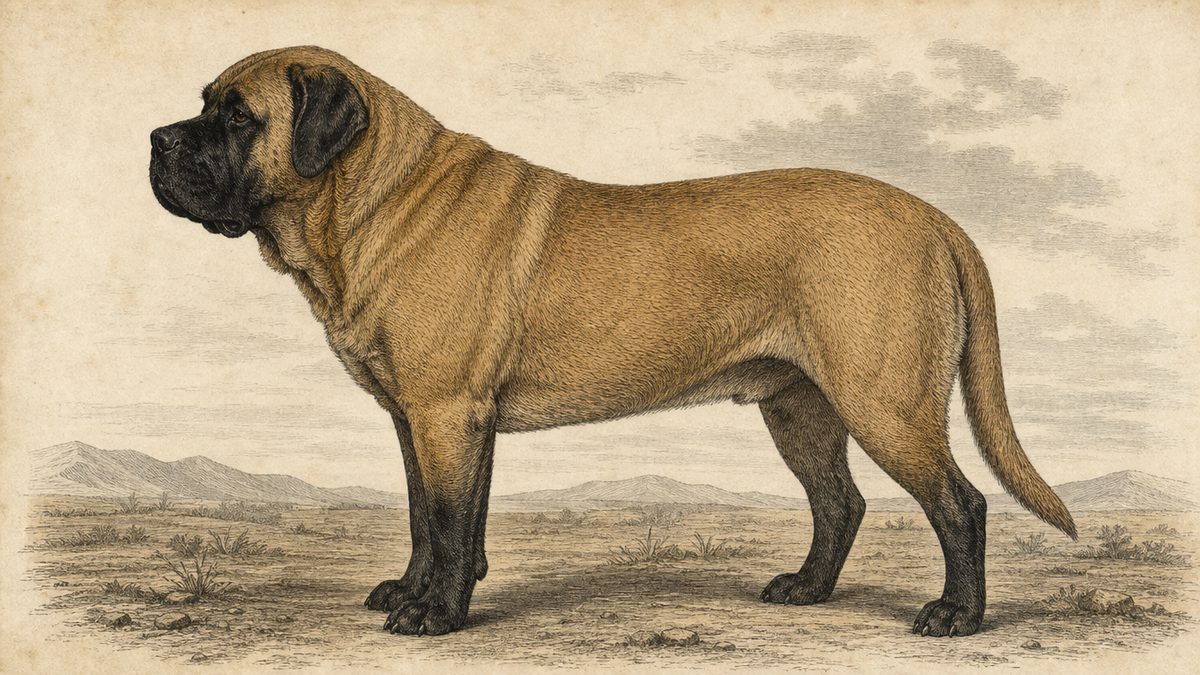
Jardine and Smith give a rusty wolf-colour with black face, lips and legs Biodiversity Heritage Library bibliographic…. Martin gives tawny with black about the muzzle. Hancock notes that Spanish colonial attack dogs generally were described with a dark nose and a dark area around the eyes, the distinctive mask of so many mastiff breeds. Three independent descriptions converge on a fawn to rusty body with a black mask, which is why the illustration on this page is drawn that way and why any white dog offered as a dogo cubano is being confused with the Dogo Argentino.
The image most often used for this breed online is a plate captioned Cuban Mastiff by John Henry Walsh, writing as Stonehenge, in 1859. When a breed's entire visual record is a handful of Victorian engravings, treat any confident modern description of its appearance with care.
When it went extinct, and why the aggregators invent the date
The breed disappeared as a distinct type during the second half of the nineteenth century, and the reason no page can give you a date is that no source records one, which is exactly where the invention starts.
Extinction dates are the softest part of any extinct-breed page, and this one proves it. Four ranking sources give four incompatible accounts, and none of them cites anything.
| Source | When it says the breed ended | Mechanism given | Citation offered |
|---|---|---|---|
| English Wikipedia | No date. After the abolition of slavery | Merged with other groups, losing their separate identity | None for this sentence |
| Spanish Wikipedia | End of the 19th century | Abolition plus loss of genetic purity through crossing | None |
| Dog Breed Info Center | By the 1900s they were never seen again | Demand collapsed when slavery was abolished in the 1880s | None |
| Petlur | Nearly extinct after the Cuban Revolution, then revived | Revolution, then revival, now gaining popularity abroad | None, and it contradicts the same page's header |
What the peer-reviewed source says about extinction: nothing
The one scholarly work both Wikipedias cite for this animal contains the word extinct zero times across its full text. It is a history of the use of dogs in Atlantic slavery, not a breed history, and it makes no claim about when this type stopped existing. So the extinction narrative on every ranking page rests on no cited source at all, which is why the accounts diverge so freely.
The dates that can be fixed
What can be dated is the demand, not the dog. Cuba stopped participating in the Atlantic slave trade in 1867, chattel ownership of human beings remained legal on the island until 1880, and slavery was abolished by Spanish royal decree on 7 October 1886. The commercial purpose of a specialist slave-hunting dog therefore ended over a twenty-year window closing in 1886, and Parry and Yingling note in passing that slavery persisted into the 1880s in Cuba.
So the defensible sentence is that the breed lost its reason to exist between 1867 and 1886 and had disappeared as a recognisable type by the end of the century. It is not that the last one died in 1900. Nobody recorded a last one, because nobody was keeping a register.
Extinction by absorption, not by dying out
Both Wikipedias describe the same mechanism, and it is the one that fits an unregistered working population. English Wikipedia says the dogs merged with other groups and lost their separate identity. Spanish Wikipedia calls it the loss of genetic purity through crossing with other dogs. Parry and Yingling record the same process happening in the American South while the trade was still live: trackers interbred Cuban breeds with suitable local dogs, and the pure Cuban bloodhound remained a benchmark of quality precisely because most working dogs were no longer it.
That is absorption rather than extinction in the biological sense. A landrace with no studbook, no closed registry and no fanciers does not die out, it dilutes, and at some point nobody uses the name any more. Petlur's claim that the breed has since been revived and is gaining popularity in other countries has no support anywhere and sits in a document whose own header says Extinct.
Say the demand ended with Cuban abolition, dated to the royal decree of 7 October 1886, that the type had gone as a distinct population by the end of the nineteenth century, and that no source records a specific last animal. That is the whole of what is known, and it is more useful than a confident wrong date.
The descendant claims, checked against the descendants' own registers
Two encyclopedias name two different modern descendants for this breed, neither cites anything, and the FCI standard for the breed one of them names does not mention Cuba at all.
English Wikipedia's infobox carries a single line under Notes: the Rhodesian Ridgeback is the only standardized descendant. That claim now appears across the ranking set and in AI summaries. It is checkable in one document, and it does not survive the check.
What the Rhodesian Ridgeback's own standard says
FCI-Standard No 146 for the Rhodesian Ridgeback, published in its current valid form on 15 May 2025 and supplied by the Kennel Union of Southern Africa and the Zimbabwe Kennel Club, carries a Brief Historical Summary. It reads that the breed is presently the only registered breed indigenous to southern Africa, and that its forbears can be traced to the Cape Colony of southern Africa where they crossed with the early pioneers' dogs and the semi-domesticated, ridged, Hottentot hunting dogs. The word Cuba does not appear in the standard. Neither does bloodhound, mastiff or dogo.
The standard also places the breed in Group 6, Scenthounds and related breeds, Section 3, not in Group 2 where the mastiff types sit. A breed whose recognising body classifies it as a scenthound relative, and whose official history names Khoikhoi hunting dogs and colonists' dogs, is not obviously the standardised descendant of a Cuban gripping mastiff.
Wikipedia's own next sentence undercuts its own infobox
The Rhodesian Ridgeback article states the Dogo Cubano claim and then, in the very next sentence, says that genetic analysis places the Rhodesian Ridgeback and the Great Dane in the same clade, which implies the Dane's major contribution. The study it cites for that is Parker and colleagues in Cell Reports in 2017, a genuine paper that built a cladogram of 161 domestic dog breeds and grouped them into 23 clades. So the same article gives a cited genetic finding pointing at a German mastiff and an uncited historical assertion pointing at a Cuban one, and only the first has a study under it.
The other descendant claim, from the other Wikipedia
Spanish Wikipedia tells a different story entirely. It says that although no pure Dogo cubanos remain, the dogs used in Cuban fighting pits descend from crosses between Pit Bulls, the Perro de pelea cordobes, the Dogo argentino and the few pure Dogo cubanos still present in the early twentieth century, and that the modern descendant is much larger and stronger than the original and resembles the American Pit Bull Terrier. No source is offered for any part of that.
Two things are wrong with it on its face. The Cordoba fighting dog was itself an Argentine type that was absorbed into the Dogo Argentino from the mid-1920s, so naming both as separate contributors to a Cuban pit population is doubtful. And a claim that pit dogs in Cuba today carry measurable Dogo Cubano ancestry is a genetic claim, testable by exactly the kind of study Parker and colleagues ran, and no such study exists.
| Claim | Where it appears | Cited to | Verdict on checking |
|---|---|---|---|
| Rhodesian Ridgeback is the only standardised descendant | English Wikipedia infobox | Nothing | Not supported. FCI-Standard 146 names Cape Colony and Khoikhoi dogs and never mentions Cuba |
| Modern Cuban pit dogs descend partly from it | Spanish Wikipedia body | Nothing | Untested. No genetic study of Cuban pit populations exists |
| Rhodesian Ridgeback shares a clade with the Great Dane | English Wikipedia, Ridgeback article | Parker et al. 2017, Cell Reports | The paper is real and does build breed clades from genomic data |
The defensible statement is that no living breed has been shown by genetic evidence to descend from the Dogo Cubano, and that the two descendant claims in circulation contradict each other and cite nothing. An absence of descendants honestly reported is worth more than a confident lineage nobody can check.
Breed recognition: no register has ever held this dog, and Cuba is inside the FCI
No kennel club anywhere has ever recognised the Dogo Cubano, and the finding that matters is not that it is missing from the FCI but that Cuba is an FCI member with no Group 2 breed of its own.
Recognition questions on extinct breeds are usually trivial, so the useful version asks a harder question. Not is this breed in the register, but would the register have held it if anyone had wanted it there. On that test the answer is checkable and interesting.
The FCI check, with its control
The Federation Cynologique Internationale's Group 2 nomenclature, covering Pinscher and Schnauzer, Molossoid and Swiss Mountain and Cattledogs, was read in full on 27 August 2026. Its Section 2.1, Mastiff type, lists breeds under twelve countries of origin: Argentina, Brazil, China, Denmark, France, Germany, Great Britain, Italy, Japan, Portugal, Spain and Uruguay. Cuba is not one of them, and no Cuban breed appears anywhere in the group.
The control was run in the same session and passed. The Dogo Argentino sits in that list at standard number 292 with a validity date of 10 November 2011, and its standard document opens correctly. So the register does hold Latin American mastiff types, the query works, and the Cuban absence is a finding rather than a broken instrument.
Cuba is a member, which makes the absence sharper
The FCI's own members and contract partners register lists CUBA under The Americas and Caribbean, in the same column as Argentina, Brazil and Uruguay, whose mastiff breeds are all in Group 2. India appears on the same register under Asia, Africa and Oceania, represented by the Kennel Club of India in Chennai. So Cuba has had a route into the international nomenclature available to it and has never put a mastiff type through it.
That is not surprising once you know what the dog was for. Reviving a breed requires people willing to be publicly associated with it, and the documented purpose of this one makes that unlikely. Compare the Cimarron Uruguayo, a working farm and boar dog from a neighbouring island economy, which reached full FCI recognition as standard 353 with a validity date of 16 June 2022. The route exists and is being used. Nobody has used it for this.
| Register | Status of the Dogo Cubano | Control run in the same session | Control result |
|---|---|---|---|
| FCI Group 2 nomenclature | Absent. No Cuban breed in the group at all | Dogo Argentino, standard 292 | Present, validity date 10 November 2011 |
| FCI members register | Cuba is a member, so the door was open | India | Present, represented by the Kennel Club of India |
| American Kennel Club | Not recognised, per the breed databases themselves | Not applicable | The AKC does not register extinct types |
| Kennel Club of India | No route. The KCI registers against FCI nomenclature | Not applicable | A breed absent from the FCI cannot be registered through it |
What that means for a pedigree offered in India
There is no register anywhere that can issue a Dogo Cubano pedigree, so any document presented as one is either for a different breed or is not genuine. The Kennel Club of India registers dogs against FCI nomenclature as India's FCI member body, which means a breed absent from the FCI has no Indian registration route either. That is the practical end of the recognition question.
No kennel club has ever recognised the Dogo Cubano, no breed standard has ever been written for it, and no register can issue papers for it. Cuba's FCI membership is what makes that absence meaningful rather than merely technical.
Dogo Cubano price in India: there is none, and here is how that was proved
There is no dogo cubano price in India, because there is no dogo cubano, and the absence was proved with a control search rather than assumed from an empty result.
Say it first, because every page that ranks for this term buries it or invents around it. No Indian seller lists this breed, no Indian price band exists, and any figure you are shown for it has been generated rather than observed.
The search, and the control that makes it evidence
A commercial-intent search for this breed was run from India on 27 August 2026, using the query pattern that reliably surfaces Indian puppy listings. It returned zero puppy listings and zero prices. What it returned instead was an Amazon.in book, a Facebook history post, a Quora thread about dog breeds without the letters H and S, an Etsy silhouette pack, and a rehoming site's breed dropdown.
That zero is only worth something with a control, and the control was run in the same tool in the same session. The identical query shape for the Dogo Argentino returned a live Indian market immediately: a national listing site quoting Rs 50,000 to Rs 1,20,000 with a per-city price table for Hyderabad, Bangalore, Delhi, Chennai, Lucknow, Mumbai, Jaipur and Pune, plus a kennel site and a regional buyers' group. A second control on Bing India for a common breed returned about 47,500 results and ten genuine Indian pages. The instrument works. The zero is real.
| What was returned | What it actually is | Price attached |
|---|---|---|
| Amazon.in paperback, 44 pages | A milestone photo-challenge workbook offering socialization, agility and training milestones, published 23 September 2019, imported and packed by a Delhi bookseller | Listed as currently unavailable |
| An Indian rehoming site | A breed name inside a dropdown menu, with no animal attached | None |
| An Etsy India digital download | A 655-breed silhouette pack listing Dogo Cubano beside Dogo Guaternalteco and Dogo Sandesco, both misspelt | A price for the graphics file |
| A dog-breed comparison page | A scorecard against an Indian breed, with Price Range printed as Unavailable | None |
| Puppy listings | Zero | None |
What the control search returned, so the zero has a scale beside it
The control matters twice over. It proves the search works, and it shows an Indian reader what a real market for a comparable dog looks like, which is the yardstick the missing price should be read against.
| Tier as the seller describes it | Published Indian price band |
|---|---|
| Basic quality | Rs 50,000 to Rs 80,000 |
| KCI registered | Rs 80,000 to Rs 1,00,000 |
| Champion bloodline | Rs 1,00,000 to Rs 1,20,000 |
| Dogo Cubano, any tier | No listing, no price, no animal |
The middle row is the one that closes this section. A KCI registration premium of roughly Rs 20,000 exists because the Kennel Club of India can issue papers for that breed against FCI nomenclature. No such premium can exist here, because no register in the world can issue a paper with this breed's name on it.
The only price this breed ever had
One per-animal price for this dog exists anywhere in the record, and it is a government procurement figure. During the Second Seminole War the United States military purchased three Cuban dogs at USD 151.72 each. That is 1830s money paid by an army, not a market rate, and it is the only number on this page that is a price for the animal rather than for a book about it.
It is worth stating what that figure was not. It was not a pet price, there was no pet market for this dog, and the reason the trade record contains military and colonial purchases rather than retail prices is that this was a working-service animal sold to states.
Why nobody has fabricated an Indian price here, and why that is unusual
Indian rare-breed pages usually do invent a rupee band, and Bonbeno has caught the mechanism repeatedly on other breeds, where a set of Indian prices divides cleanly by a single dollar exchange rate and turns out to be an American price list run through a converter. That did not happen here, for a simple reason: the ranking pages for this breed print Unavailable in the price field rather than a number Petlur, 'Dogo Cubano Dog Breed Info, Size.
That is the one thing the ranking set gets right, and it is worth crediting. Petlur prints Price (Avg.) Unavailable, and Dogell prints Price Range Unavailable against the Kumaon Mastiff's USD 1,000 to 2,500 Dogell, 'Dogo Cubano vs Kumaon Mastiff…. The fabrication on this breed has gone into the temperament and health fields instead of the price field.
Treat it as proof the page is generated. There is no supply, so there is no price, and a specific rupee figure for an animal nobody has bred since the nineteenth century can only have been made up.
Cost of ownership: what can honestly be costed for a dog nobody keeps
No cost of ownership can be calculated for this breed, and the published figures that exist refute themselves on their own arithmetic, so this section costs the nearest living equivalent instead and labels it as such.
A monthly cost figure requires an animal, a bodyweight and a market. This breed supplies none of the three. What the ranking pages supply instead is a set of numbers that do not survive division.
The published costs, checked with a calculator
Petlur's cost block gives a daily cost of USD 50 to 100 and a monthly cost of USD 200 to 400 for the same animal. Multiply the low end of the daily figure by thirty and you get USD 1,500 a month, which is nearly four times the top of the page's own monthly range. Those two rows cannot both be true, and neither is attached to a source.
The same page's activity block is internally inconsistent in the same way. It gives a recommended walk mileage of 20 miles per week alongside 30 minutes of activity per day, and an activity level of Low. Twenty miles a week is about 2.9 miles a day, which in thirty minutes requires a sustained 5.8 miles per hour, a running pace, for a giant mastiff the same page rates as low-activity. Every one of those fields was populated independently by a template, which is why none of them agrees with its neighbour.
What a 45 kg mastiff type actually costs in India, as a labelled substitute
The figures below are not this breed's costs. They are the recurring cost structure of keeping a large short-coated mastiff type in an Indian metro, offered so that a reader who arrived here through a rare-breed search understands the real order of magnitude before looking at a living breed.
| Cost head | What drives it | Note |
|---|---|---|
| Food | Bodyweight. A 45 kg dog eats roughly three times what a 15 kg dog eats | The single largest recurring line for any giant breed |
| Veterinary preventive care | Vaccination, deworming and year-round tick and flea control | Tick-borne disease pressure is a documented year-round problem in India |
| Cooling | Fans, air conditioning or a cooled room through the pre-monsoon months | On a heavy short-coated dog this is a health cost, not a comfort cost |
| Emergency surgical reserve | Gastric dilatation-volvulus risk rises with chest depth and with age in large and giant breeds | A reserve, not a monthly cost, and the reason large-breed owners need one |
| Containment and equipment | Collar, lead and secure fencing sized for a 45 kg dog | Scales with the dog, not with the breed name |
The bloat line is the one worth taking seriously. Glickman and colleagues, studying non-dietary risk factors for gastric dilatation-volvulus in large and giant breed dogs, established the risk structure that every deep-chested breed page rests on. It is not a Dogo Cubano finding and this page does not present it as one, but any reader moving from this page to a living mastiff type needs to have read it.
The honest bottom line
Bonbeno publishes no monthly cost figure for this breed. There is no animal to feed, no Indian veterinary caseload to price against, and no owner to survey. Where a page prints a number in this situation, the number came from a template. Where this page prints nothing, that is the finding.
If you arrived here costing out a big guarding dog for an Indian home, cost a living one. The Bullmastiff and the Dogo Argentino guides carry real Indian figures with sources attached.
Indian law on the things this dog was made to do
Indian law reaches three separate parts of this breed's history, and reading the clauses rather than paraphrasing them changes what you can honestly say about each.
This breed cannot be owned in India because it does not exist. What can be discussed is what Indian law says about the practices the breed embodied, because those practices did not end with it.
Animal fighting, and the clause most pages get wrong
Both Wikipedias list dog fighting among this breed's uses Wikipedia, 'Dogo cubano', Spanish edition. In India, section 11(1)(m)(ii) of the Prevention of Cruelty to Animals Act, 1960 makes it an offence if a person incites any animal to fight or bait any other animal, under a chapeau covering acts done solely with a view to providing entertainment. Section 11(1)(n) separately covers a person who organises, keeps, uses or acts in the management of any place for animal fighting Section 11 in The Prevention of Cruelty….
Two details are routinely dropped. Section 31 makes clauses (l), (n) and (o) cognizable, which means the venue offence is cognizable and the inciting offence is not, so writing that dog fighting is a cognizable offence in India is too loose. And the penalties under section 11(1) are tiny: a first offence attracts a fine of Rs 10 to Rs 50, and a second within three years attracts Rs 25 to Rs 100, or up to three months, or both. A page that says fighting is illegal without saying what the penalty is leaves a false impression of deterrence.
The date matters too. Neither fighting provision existed in the 1960 Act as passed; both took their current form through section 10 of Act 26 of 1982, with effect from 30 July 1982. Citing them as PCA Act 1960 remains correct, because an Act is cited by its year of enactment, but any claim about when this conduct became an offence in India dates to 1982.
Ear cropping, which the 1803 description records
The oldest description of this dog says its ears were usually cropped at the points. In India that procedure is prohibited outright. Second Schedule Part II paragraph 6(8) of the Prevention of Cruelty to Animals (Dog Breeding and Marketing) Rules, 2017 states that there shall be no tail docking, ear cropping, de-barking, de-clawing, branding, dyeing, injecting substances to enhance visual appeal, performing a surgery or procedure to camouflage or hide any defect or infirmity or any other kind of mutilation of any body part of the pup, and that any change of appearance by artificial means is strictly forbidden.
That is a Second Schedule paragraph, not a Rule. Writing it as Rule 6(8) misdirects any reader who looks it up, because the Rules' own Rule 6 is a different provision headed Requirements to be met by breeders and establishments, which is what gives the Schedule its force.
Breeding for aggression, and the clause that reaches it
The training method described in nineteenth-century Cuba, conditioning dogs to hate a specific group of people, has no direct modern analogue in the 2017 Rules. What the Rules do reach is deliberate breeding for novelty. Second Schedule Part II paragraph 6(9) is a single sentence: breeding to create new breeds of dogs or unusual looks shall be strictly prohibited.
Paragraph 6(3) is the other one worth knowing, because it prohibits two named mating techniques, in-breeding, defined as breeding between relatives of the 2nd to 4th grade in straight or side line within the first four generations, and incest breeding, meaning mating between parents and children or between brother and sister. Any attempt to recreate an extinct type from a handful of animals runs straight into that clause, which is a useful thing to know before anyone announces a Dogo Cubano revival project in India.
Import, which closes the question
Even if a population existed, it could not lawfully be brought here to breed. Dogs sit under ITC (HS) 01061900 as a Restricted import, entry is permitted only for a pet dog with a valid pet book in the importer's own name, for research organisations with a CPCSEA recommendation, or for Defence and Police use, and applications for trading or breeding purposes shall be duly rejected.
Three of the four provisions above are Second Schedule paragraphs rather than Rules, and one is a section of the parent Act as amended in 1982. Bonbeno names which is which, because a reader who goes looking for Rule 6(8) in the 2017 Rules will not find it.
Indian climate: Havana never gets as hot as Delhi, and the gap is 11.6 degrees
A dog shaped by the climate of Havana would meet nothing like an Indian summer, because Havana's hottest month tops out 11.6 degrees Celsius below Delhi's and 5.5 below Chennai's, measured at both places by explicit coordinates.
This is the one argument on the page that is genuinely Bonbeno's rather than borrowed, so it is built on data queried by latitude and longitude rather than by a place name, because a place-name lookup can silently serve another city's document.
NASA POWER's climatology was queried on 27 August 2026 for five points, and every response echoed back the coordinates it had answered for, which is the check that makes the comparison safe.
| Place | Coordinates queried | Hottest monthly mean maximum | Month | Annual mean temperature | Annual mean relative humidity |
|---|---|---|---|---|---|
| Havana, Cuba | 23.1136 N, 82.3666 W | 37.2 C | July and August | 26.3 C | 72.1 percent |
| Chennai | 13.0827 N, 80.2707 E | 42.7 C | May | 27.9 C | 72.4 percent |
| Mumbai | 19.0760 N, 72.8777 E | 44.9 C | April and May | 26.8 C | 67.4 percent |
| Nagpur | 21.1458 N, 79.0882 E | 48.4 C | May | 26.9 C | 55.8 percent |
| Delhi | 28.6139 N, 77.2090 E | 48.8 C | June | 25.6 C | 45.6 percent |
The humidity trap: Chennai is Havana with 5.5 degrees added
The most useful row is Chennai, because its annual mean relative humidity of 72.4 percent is within half a percentage point of Havana's 72.1 percent. Humidity is what blocks evaporative cooling from panting, so on that axis the two cities are the same. The difference is the ceiling: Chennai's hottest month runs 42.7 C against Havana's 37.2 C, and a dog that has no evaporative headroom to begin with meets 5.5 degrees more heat load.
Delhi and Nagpur are a different problem again. Both exceed 48 C in their hottest month, which is 11 degrees above anything Cuba produces, though both are drier, so panting works better there. Mumbai combines a 44.9 C ceiling with an August humidity that reaches 90.4 percent, which is the worst combination in the table for a heavy short-coated dog.
What the heat-illness evidence actually says
The largest study of heat-related illness in dogs reviewed the de-identified records of 905,543 dogs under primary veterinary care in the United Kingdom in 2016 and identified 1,259 heat-related illness events from 1,222 dogs. Of the 879 events with a recorded trigger, 652, or 74.2 percent, were exertional, 113 were environmental and 46 were vehicular confinement.
Read that carefully, because it is the finding most often quoted wrongly. Exertion, not weather alone, is the dominant trigger. The same study reports that brachycephalic dogs had greater odds of all three types of heat-related illness compared with dogs of other skull shapes. The Dogo Cubano is described by Jardine and Smith as having a muzzle that was short, broad and abruptly truncated Biodiversity Heritage Library bibliographic…, which puts it toward that end of the skull-shape range, but the breed was obviously not in a 2016 UK caseload and no odds ratio from that study applies to it. This page claims the transferable mechanism only.
The India Meteorological Department thresholds, for context
The heatwave thresholds Indian readers live under are published by the India Meteorological Department and summarised by WHO India. Those are the days on which a heavy short-coated dog with a shortened muzzle should not be walked at all, and they occur every year across the plains, which is the practical difference between an Indian summer and a Caribbean one.
Because the ranking pages answer the climate question anyway. Petlur prints Prefers warm weather and Dogell prints the same, with no measurement behind either Dogell, 'Dogo Cubano vs Kumaon Mastiff…. Warm weather in Havana tops out at 37.2 C. Warm weather in Nagpur tops out at 48.4 C. The phrase is doing no work.
Temperament: what the record describes, and the forty ratings that were invented
The temperament record for this breed describes a manufactured aggression toward a specific group of people, and everything beyond that on the ranking pages is a database field with no observation behind it.
The honest account of this dog's temperament is short, because the sources describe behaviour under training rather than a companion animal's disposition. Read it as a record of what people did to dogs, not as a personality profile.
What contemporaries actually recorded
Three behavioural observations survive with dates attached. Dallas in 1803 notes that the dog's coat and whole structure must be hard, because "the severe beatings he undergoes in training would kill any other species of dog"; Wikipedia, 'Dogo Cubano', English edition. A Jamaican source of 1796 records that if not properly trained most of these dogs would kill the person they pursued, flying at the throat and never releasing their hold. And the 1804 account in The Sportsman's Cabinet describes muzzled dogs with heavy rattling chains "ferociously making at every object" and dragging their handlers, who could hardly restrain them.
Set against that, W. C. L. Martin in 1845 wrote that in their disposition they were "faithful and attached, and, unless irritated, very gentle", made excellent guard-dogs, and would attack both the bull and the bear with determined resolution. The two pictures are not contradictory. They describe the same animal on either side of a training regime designed to produce a specific hatred.
Spanish Wikipedia goes further than the period sources and states flatly that the breed was extremely aggressive toward anyone it did not know, though it adds that most dogs were trained to subdue with the least violence possible in order to avoid seriously injuring valuable enslaved people. That second clause is the one worth pausing on, because it says out loud what the whole apparatus was for: a commercial instrument calibrated to damage a human being enough to stop them and not enough to destroy the property.
The forty ratings, and why none of them is evidence
One page on the Indian first page rates this breed across more than forty behavioural dimensions. It gives intelligence 4 out of 5, watchdog ability 5 out of 5, prey drive 5 out of 5, affection level 1 out of 5, cat friendliness 1 out of 5, child compatibility 1 out of 5, barking frequency 4 out of 5, sensitivity 2 out of 5, and an alone-time tolerance of High. Petlur's version tags the temperament as Dangerous, Defensive, Fighter, Guarding, Protective and marks Fighting Dog as Yes.
None of these can be observations. A barking-frequency rating requires someone to have heard the dog bark. A cat-friendliness rating requires a cat. The last animals described under this name were gone before the invention of the behavioural questionnaire, and no historical source rates any of these traits.
The same page then contradicts itself on the one field it repeats. Its quick verdict calls the breed easiest to train at 4 out of 5, described as Easy, while its own table two screens later prints training difficulty as 5 out of 5. A rating that changes between two views of the same document is a database artefact.
The claim that deserves the most care
Petlur's description says the breed is very friendly with other dogs, cats, children and other animals if properly socialised from an early age, and calls it a gentle giant who loves spending time with families. That paragraph is written in the present tense about an animal that has not existed for over a century, and it contradicts the same site's own temperament tags on the same page.
It also inverts the record. This dog's documented social behaviour was a trained antipathy toward black people, produced deliberately and sold as a service. Describing that animal as an ideal family pet is not a harmless database error. It is the specific edit that launders the history out of the breed.
The trait bars on this page rate only things a document supports, and each carries a note saying what the rating is derived from. There is no affection rating, no child-compatibility rating and no trainability rating on this page, because nothing in the record supports one.
Training: nothing here transfers, and part of the record is a criminal offence in India
Nothing in this breed's training record transfers to a modern Indian dog owner, because the training was a conditioning protocol aimed at producing attacks on people, and the closest modern equivalent is prosecutable.
A breed page normally answers what works with this breed and what it resists. Neither question has an answer here, and pretending otherwise is how the ranking pages go wrong.
What the historical training actually was
The Cuban method is described plainly enough in the sources to be summarised without inference. Dogs were chained to the ground and whipped daily by black men who were forced to do it, while simultaneously being incited to bite those men in reprisal. Once the dog had acquired a perfect hatred of its tormentor, the man ran to the woods and dared the dog to chase him.
Dallas adds the physical cost from the dog's side: the training involved beatings severe enough that he thought they would kill any other kind of dog. In Florida, handlers were observed feeding the animals bloody meat to prepare them for military service.
Every element of that is now unlawful in India as animal cruelty under section 11 of the Prevention of Cruelty to Animals Act, 1960, and the fighting-specific clauses reached it only from 1982 Section 11 in The Prevention of Cruelty…. It is described here because a reader who searches this breed will find pages calling it highly trainable, and the trainability being referred to is this.
The one behavioural fact that might transfer, and its limits
One operational detail is genuinely informative about gripping mastiff types rather than about this breed alone. In pursuit, the dogs were worked in groups of two or three per handler and formed a circle around the target, waiting for a command rather than attacking on sight. That is impulse control under high arousal, and it tells you these were dogs with a functioning off switch, not indiscriminate biters.
The limits on that observation are severe. It comes from the Jamaican deployment, it describes trained animals of which the record says only thirty-six of a hundred were properly trained, and it cannot be generalised to a temperament.
What an Indian reader should take from this section
If you arrived here looking for training guidance for a large guarding dog, none of it is on this page and none of it should be. The transferable principles for a 45 kg mastiff type in India live on the guides for breeds that exist. Read the Bullmastiff and Cane Corso guides for a modern protection-bred dog, or the Dogo Argentino guide for a catch dog with a comparable grip and a real Indian population.
One thing worth carrying across is the warning. Any Indian trainer offering to build guarding behaviour by provoking a dog with a stranger, a stick or a padded arm on a chained animal is running a version of the nineteenth-century Cuban protocol with better equipment. It produces a dog that is dangerous rather than reliable, and it is prosecutable.
A dog conditioned to hate a category of person is not a trained dog, it is a loaded one. That is the only training lesson this breed has to offer, and it is a negative one.
Exercise: the numbers the ranking pages print, and why they cannot be right
No exercise requirement can be stated for this breed, and the figures the ranking pages publish contradict each other within a single page, which is the clearest available proof that they were generated rather than measured.
This section is here because the required section list demands it, and because what fills it on other sites is a case study in how breed databases fabricate.
The published figures, and the arithmetic that kills them
| Field | Value printed | What it implies | Verdict |
|---|---|---|---|
| Recommended walk mileage per week | 20 miles | About 2.9 miles per day | Plausible for a working dog |
| Minutes of activity per day | 30 minutes | 2.9 miles in 30 minutes is 5.8 miles per hour, a running pace | Incompatible with the row above |
| Activity level | Low | A low-activity giant mastiff running 5.8 miles per hour daily | Incompatible with both rows above |
| Energy rating | 2 out of 5 | Same animal, different site, same absence of evidence | Unsupported |
| Exercise need | 2 out of 5 | Rated identically to the Kumaon Mastiff, an unrelated Indian breed | Unsupported |
The first three rows come from a single page, and they cannot all describe one dog. The last two come from a comparison scorecard which also gives the same breed an energy rating of 2 out of 5 while describing it as the most active of the pair it is compared against. Any one of those numbers taken alone looks like information. Put beside each other, they are noise with units attached.
What the record says about how these dogs actually worked
The one thing the sources do establish about physical output is that these dogs worked in short, intense bursts under handler control rather than as endurance animals. They were led on leashes and chains, released for a pursuit, and worked two or three to a handler. In Florida they were criticised specifically for failing to track efficiently in swamp, which is a stamina and terrain failure rather than a speed one.
That pattern matters for an Indian reader for one reason. Exertional heat illness accounted for 652 of the 879 heat-related illness events with a recorded trigger in the largest study of the subject, or 74.2 percent. A dog worked in short intense bursts is a dog whose exercise pattern sits squarely in the highest-risk category, and in Indian pre-monsoon conditions that is the single most dangerous thing an owner of any heavy short-coated breed can do with it.
The transferable rule
For any large mastiff type in an Indian city, the workable pattern is short sessions in the coolest hours, water available throughout, and a hard stop when the ambient temperature crosses the India Meteorological Department heatwave threshold for that region. That is not this breed's requirement, because this breed has none. It is the rule for the living dogs a reader might actually own.
Divide the weekly distance by seven, then divide that by the daily minutes. If the result is a speed no dog of that size sustains, the two fields were populated independently and neither is evidence.
Grooming: a short coat in Indian humidity, and the one part that is not cosmetic
A short coat is the least of the grooming problem for a heavy drop-eared mastiff type in India, because the work that matters is ears, skin folds and year-round tick control rather than brushing.
Every period description of this dog agrees on one thing, which is that the coat was short and close Wikipedia, 'Dogo Cubano', English edition. On the coat alone the ranking pages are approximately right: a short coat needs little brushing. On everything else they are silent, and everything else is where the work is in India.
Ears, and the disagreement between two Indian series
Most of the period sources give this dog a drop or pendant ear Wikipedia, 'Dogo cubano', Spanish edition, and a pendulous ear over a humid canal is the classic setup for otitis externa. Two Indian series have measured the problem, and they do not agree on when it peaks, which is worth publishing rather than smoothing.
A cross-sectional analysis in the Palam Valley of Himachal Pradesh screened 2,476 dogs and found 81 otitis externa cases, and its ear-carriage table attributes 69.13 percent of them to pendulous-eared breeds against 30.86 percent erect. That table carries a genuine internal error worth flagging: it prints the pendulous count as 53, and 53 divided by 81 is 65.43 percent, not 69.13, while 69.13 percent of 81 is 56, and 56 plus 25 balances to 81. The percentage is the figure consistent with the rest of the table; the count of 53 is not.
A separate series in and around Durg district in Chhattisgarh found prevalence peaking in summer at 41.18 percent against 33.33 percent in the monsoon. That is the opposite of the seasonal pattern most Indian care advice assumes. Bonbeno prints both rather than picking one, because the honest position is that the season of peak risk is not settled and the ear checks should be weekly all year.
Skin folds and the dewlap
Jardine and Smith describe deeply pendulous lips, and Hutchinson's account of the pair at London Zoo about 1832 mentions heavily developed lips David Hancock, 'The Cuban Dog'. Loose facial skin and a heavy dewlap trap moisture, and in an Indian monsoon that is a fungal and bacterial problem rather than a cosmetic one. The transferable rule for any loose-skinned mastiff type here is to dry the folds after every bath and after every wet walk, and never to let a heavy dog air dry the way northern-hemisphere breed clubs routinely advise.
Ticks, which is the real grooming job in India
The most consequential grooming task on a short-coated dog in India is not coat care. A survey of canine tick-borne diseases in India established the disease pressure that makes daily tick checks a health measure rather than a chore. On a short coat the advantage is that ticks are easy to find; the discipline is doing it every day through the warm months, checking the ear margins, the axillae, the groin and between the toes.
What the ranking pages recommend, and why it is generic
One page recommends a slicker brush, a pin brush, an undercoat rake, a shedding blade, nail clippers and grooming scissors for this breed, alongside a coat density of Medium, a coat texture of Smooth and a bathing frequency of once a week. A comparison page gives a bathing interval of 6 to 8 weeks for the same animal. An undercoat rake on a short close coat is the tell: that equipment list is a default, printed for every breed on the site regardless of coat.
For a short-coated, drop-eared, loose-lipped dog in India, the grooming schedule is a weekly ear check, a daily tick check through the warm months, and thorough drying of every fold after every wetting. Brushing is the easy part and the least important.
Health: zero data for this breed, real data for the type, and a gap in Indian law
No health data exists for the Dogo Cubano, no lifespan study has ever been done on it, and the 8 to 10 year life expectancy printed across the ranking set has no source under it anywhere.
Start with what is not known, because that is the honest headline. There is no breed club running a health scheme, no orthopaedic registry entry, no published mortality dataset and no peer-reviewed veterinary paper on this animal. There cannot be, because there is no living population to survey and there never was a register to survey it through.
The life expectancy figure, traced
Every ranking page prints 8 to 10 years Petlur, 'Dogo Cubano Dog Breed Info, Size Dogell, 'Dogo Cubano vs Kumaon Mastiff…. One of them then contradicts itself in its own body text, where the description says an average lifespan of 10 to 12 years while the spec table above it says 8 to 10. None cites a study, a survey or a source of any kind, and no such source exists.
Bonbeno publishes no life expectancy for this breed. An absent figure honestly reported is worth more than a confident one that cannot be traced, and a lifespan number for a dog nobody has kept since the nineteenth century is not a measurement, it is a guess formatted as a range.
What the ranking pages assert about disease, and what it rests on
Dog Breed Info Center is at least explicit about its method. It says that although there are no records, this breed was probably similar to Mastiffs and Bulldogs, so it was most likely prone to hip dysplasia, breathing issues due to small windpipes, and poor vision. That is a stated inference rather than a claim, which is more honest than most of the set, and it is still not evidence about this breed.
The comparison scorecard is less careful. It gives the breed a health-concerns rating of 2 out of 5 and a vet-care frequency of Frequent, while its own health-problems field prints Not available. A page that admits it has no health data and then rates the health anyway has told you exactly how much the rating is worth.
The type-level risks that are real, clearly labelled as not this breed's
| Risk | What the evidence says | Applies to |
|---|---|---|
| Exertional heat illness | 652 of the 879 UK heat-illness events with a recorded trigger, 74.2 percent, were exertional | Every heavy dog worked in Indian heat |
| Skull shape and heat | Brachycephalic dogs had greater odds of all three types of heat-related illness | Short, broad, truncated muzzles |
| Gastric dilatation-volvulus | Non-dietary risk factors in large and giant breeds are established and rise with chest depth and age | Deep-chested dogs over about 30 kg |
| Otitis externa | Two Indian series disagree on the peak season but both find substantial prevalence | Drop-eared dogs in humid regions |
| Tick-borne disease | Documented year-round pressure across India | Every dog kept in India |
The heat figure is the one to state precisely. It is 652 of the 879 events that had a trigger recorded, not 74.2 percent of the 1,259 events in the study, and the difference matters because 74.2 percent of 1,259 would be 934. The study also reports the brachycephalic finding at the level of skull shape rather than by breed, and this breed was not in the caseload, so no odds ratio from it is transferred here.
The gap in Indian law, for anyone thinking about mastiff types
India's mandatory screening clause is Second Schedule Part III paragraph 8(10) of the 2017 Rules, which requires that dogs shall have been tested for genetic defects, including hip dysplasia, progressive retinal atrophy, night blindness, hypothyroidism, entropion, ectropion, overshot and undershot jaw where the incisors do not touch or mesh, wry mouth, two or more missing teeth, and unilateral or full cryptorchidism.
Two things follow for a heavy mastiff type. The word is including, so the list is illustrative rather than closed, and a breeder cannot argue a defect is outside the clause merely because it is unlisted. And the list contains no hearing test, no patella grade and no cardiac screen, so the mandatory Indian screen misses several of the things that actually kill giant breeds.
It does not borrow another breed's numbers and print them as this breed's. Where the record is empty, this page says so, three times if necessary, rather than substituting a plausible figure from a relative.
Feeding: no ration exists, and what transfers to a 45 kg mastiff type in India
No feeding guidance exists for the Dogo Cubano, and the cup counts printed for it across the ranking set were generated from a bodyweight field rather than from any observation of the animal.
The historical record contains exactly one detail about what these dogs were fed, and it is not a ration. In Florida the Cuban handlers were observed feeding the animals bloody meat to prepare them for military service. That is a conditioning practice, not a diet, and it is the whole of the primary evidence.
The published cup counts, and where they come from
Two ranking pages print 4 to 5 cups of high-quality dry food a day, divided into two meals, and one of them prints 2.5 cups per day in the row directly beneath it Dogell, 'Dogo Cubano vs Kumaon Mastiff…. Those two rows are on the same page and differ by a factor of nearly two. The comparison page then prints the same 4 to 5 cup figure against the Kumaon Mastiff's 8 to 10 cups, purely because the two breeds carry different weight fields in the database.
That is the mechanism: a template multiplies a weight field by a constant and prints the result as feeding guidance. It is not wrong in the way a fabricated statistic is wrong, but it is not information about this breed either, and it should not be quoted as such.
What actually transfers, for a living 40 to 50 kg mastiff type in India
- Feed to body condition, not to a cup count. A cup measure ignores calorie density, which varies by more than 30 percent between Indian dry foods.
- Split the daily ration across at least two meals, and never one large meal, because non-dietary risk factors for gastric dilatation-volvulus in large and giant breeds are established and meal size sits among them.
- Rest the dog around meals rather than exercising it, for the same reason.
- Keep growth slow on a giant-breed puppy, because rapid growth loads immature joints, and use a large-breed puppy formulation rather than an adult food.
- Raise water intake and monitor it through the pre-monsoon months, when a heavy short-coated dog loses far more to panting than an owner expects.
The bloat point is the one that changes outcomes. Glickman and colleagues established the non-dietary risk structure that large-breed feeding advice is built on, and it is the reason every giant-breed guide on this site tells you to split meals and rest the dog afterwards. None of that is a Dogo Cubano finding, and this page does not dress it as one.
Indian availability, which is the practical constraint
Large-breed dry foods are widely available in Indian metros and thinly available outside them, and the cost scales with bodyweight rather than with breed name. A 45 kg dog eats roughly three times what a 15 kg dog eats, which is the single line that dominates the cost of keeping any mastiff type here. That is worth knowing before a reader moves from this page to a living breed, and it is worth knowing that no amount of rare-breed romance changes the arithmetic.
Bonbeno publishes no ration for this breed. There is no dog to feed, no bodyweight anyone measured, and no owner to survey. What is printed above is labelled as guidance for a living mastiff type, and every figure in it carries its own source.
The first year, month by month, anchored on the dates Indian law fixes
No Dogo Cubano puppy timeline exists, so this section sets out the first-year timeline for the giant mastiff-type puppy an Indian reader might realistically acquire instead, anchored on the dates Indian law actually fixes.
This is the section where a generated breed page does the most harm, because it reads like practical advice. One ranking page prints a gestation duration of 60 to 64 days, a litter size of 3 to 5 puppies and a breeding frequency of once a year for this breed, all of which are species defaults rather than breed observations. Nobody recorded a Dogo Cubano litter size.
What follows is explicitly not this breed's timeline. It is the first year of a large mastiff-type puppy in an Indian home, with the two dates Indian law fixes marked.
| Age | What matters | Legal or evidential anchor |
|---|---|---|
| 0 to 8 weeks | The puppy stays with its dam and litter | Rule 8(1)(a) of the 2017 Rules: pups less than eight weeks in age are not sold. This is a Rule, not a Schedule paragraph |
| 8 to 12 weeks | Home arrival, core vaccination course, first tick prevention | Tick-borne disease pressure in India is documented and year-round |
| 3 to 5 months | Socialisation window. Short, calm exposure to people, surfaces and traffic | The one period where a guarding breed's adult behaviour is genuinely shaped |
| 5 to 8 months | Growth plates still open. No forced running, no stairs work, no jumping | Rapid growth on a heavy frame loads immature joints |
| 6 to 12 months | First Indian summer. Heat protocol begins in earnest | Exertional triggers accounted for 652 of 879 heat-illness events with a recorded trigger |
| 9 to 12 months | Meal splitting and post-meal rest become permanent habits | Non-dietary GDV risk factors are established for large and giant breeds |
| 12 months | Adult food transition, and adult behaviour is now largely set | No cosmetic surgery at any age: docking, cropping and de-clawing are forbidden under Second Schedule Part II para 6(8) |
The eight-week rule, and why it is the one to check
Rule 8(1)(a) of the Prevention of Cruelty to Animals (Dog Breeding and Marketing) Rules, 2017 states that pups less than eight weeks in age are not sold. This is a genuine Rule in the main body of the instrument, not a Second Schedule paragraph, and it is the easiest provision in Indian dog law for a buyer to verify, because it only requires a date of birth and a calendar.
It is also the provision most often ignored. A seller who will hand over a six-week puppy is not making a small compliance error; they are showing you how the rest of the operation runs. Walk away rather than negotiate.
The heat year, which is the part no imported timeline covers
Overseas breed clubs publish first-year timelines written for climates whose hottest month tops out near 30 degrees. In India the puppy's first summer is a survival event, not a training inconvenience. Delhi's hottest month reaches a mean maximum of 48.8 C and Nagpur's 48.4 C, and the India Meteorological Department's heatwave thresholds mark the days on which a heavy short-coated puppy should not go outside at all.
Every row above is for a living dog you might actually bring home. None of it is a record of how Dogo Cubano puppies were raised, because no such record exists, and a page that presents one has invented it.
Dogo Cubano compared with the dogs an Indian search actually leads you to
Compared head to head against dogs an Indian buyer can actually meet, the dogo cubano is not a choice at all, and the comparison is worth printing because it names what you are being shown instead when you search this term.
The honest framing is that this is not a purchase decision. It is a history lookup that a set of commercial breed databases have dressed as a shopping decision. The table below sets the extinct dog beside four living mastiff-type breeds, two of which are on the Indian market today, and marks the one column that settles it.
| Breed | FCI register status | Published breed standard | Available in India | What you would actually be buying |
|---|---|---|---|---|
| Dogo Cubano | Absent. Cuba is an FCI member and has no breed in Group 2 | None has ever existed | No. Extinct since the 19th century | Nothing. There is no animal |
| Dogo Argentino | Group 2, standard 292, valid from 10 November 2011 | Yes | Yes, widely, at Rs 50,000 to 1,20,000 | A living Argentine catch dog, legal to own in India |
| Fila Brasileiro | Group 2, standard 225 | Yes | Rarely, by import | A Brazilian tracking mastiff |
| Cimarron Uruguayo | Group 2, standard 353, valid from 16 June 2022 | Yes | No practical Indian supply | A Uruguayan farm and boar dog |
| Bullmastiff | Group 2, standard 157 | Yes | Yes, in metro cities | A British estate guard breed |
| Indian Pariah Dog | Landrace, no closed studbook | KCI standard exists | Yes, free from any shelter | A heat-adapted Indian dog with an open gene pool |
Read the second column first. The FCI's Group 2 nomenclature holds the mastiff and molossoid breeds, and it was read in full on 27 August 2026. Its mastiff-type section lists breeds from twelve countries of origin, including three from Latin America and the Caribbean rim, the Dogo Argentino from Argentina, the Fila Brasileiro from Brazil and the Cimarron Uruguayo from Uruguay. Cuba is not among them, and Cuba is not a country the FCI has overlooked: it sits on the FCI's own members register under The Americas and Caribbean, alongside India. So the absence is a real absence rather than a country that never joined.
The comparison the ranking set actually publishes, and why it is worthless
One page on the Indian first page compares this dog with an Indian breed and declares a winner. Dogell's Dogo Cubano versus Kumaon Mastiff page scores the two across more than forty dimensions, awards the Kumaon Mastiff four categories to three, prints a 67 percent overall figure, and gives the extinct dog an intelligence rating of 4 out of 5, a watchdog rating of 5 out of 5, a bite strength above 400 PSI, a bathing interval of 6 to 8 weeks, a vet-care frequency of Frequent and an alone-time tolerance of High.
Every one of those numbers describes an animal nobody has examined. There is no living dogo cubano to measure a bite force on, no owner to report a bathing interval, and no veterinary caseload to derive a care frequency from. The same page's own quick verdict contradicts its own table, calling the breed easiest to train at 4 out of 5 while the table below prints 5 out of 5 for the same field. A scorecard that cannot agree with itself across one screen is not measuring anything.
What the living comparison would be, if you wanted one
If what draws you is a heavy, short-coated, powerfully built catch dog with a black mask, the living animal closest to that description and lawfully available in India is the Dogo Argentino, which Indian sellers list at Rs 50,000 to Rs 1,20,000 depending on lineage and papers. Read that page before you act on the impulse, because it carries the deafness and heat-load problems this one cannot. If the draw is the mastiff outline rather than the drive, the Bullmastiff and the Mastiff are both in the FCI register with published standards.
If the draw is the history, the closest parallel on this site is the Cordoba fighting dog, another extinct Latin American type built for one purpose and gone once that purpose became indefensible. If the draw is a hardy, short-coated dog that copes with Indian heat, the Indian Pariah Dog beats every animal in the table on the one axis that matters here, because it evolved in this climate rather than in a Caribbean one.
There is no comparison to make. The dogo cubano loses every column that involves a living animal because it is not one, and the pages that score it anyway are filling database fields, not reporting on a dog.
What Indian readers get wrong about the Dogo Cubano, and what the documents show
The commonest mistake with this breed is trusting the page you landed on, because six of the ten results ranking for it in India carry at least one claim that a primary document contradicts.
This section is unusual for a breed guide, because the mistakes are informational rather than practical. Nobody in India is over-feeding a dogo cubano. What people are doing is repeating things about it, and an answer engine reading the current ranking set will repeat them too.
Mistake 1: believing the 300 pound weight
Dog Breed Info Center states that the breed was "known to be one of the heaviest dogs in history, sometimes growing up to be over 300 lbs", and in the same paragraph says it "stood around 20 inches tall";. Those two sentences cannot both describe an animal. Over 300 pounds is more than 136 kg, on a dog 51 cm at the shoulder, which is roughly the height of a Border Collie carrying the mass of two adult Great Danes. The same page's own spec box then gives 90 to 200 pounds, so the page disagrees with itself by 100 pounds within one screen.
The likely origin of the claim is visible on the Spanish Wikipedia page, which says the breed was incredibly heavy for its stature and that most sources call it the heaviest of all dogs, and cites nothing for it. An uncited superlative on one encyclopedia becomes a specific number on an aggregator, and the number is what an answer engine quotes.
Mistake 2: taking the height figure as settled
Every ranking page prints 20 to 22 inches, meaning 51 to 56 cm Petlur, 'Dogo Cubano Dog Breed Info, Size Dogell, 'Dogo Cubano vs Kumaon Mastiff…. The oldest description that actually measures the dog does not. W. C. L. Martin's The History of the Dog of 1845 says of the Cuban bloodhound that "their height at the shoulder is about two feet", which is 61 cm. Two feet is five inches above the figure the modern pages agree on, and the modern pages cite no measurement at all. Publish the disagreement rather than the consensus, because the consensus has no source under it.
Mistake 3: reading a database row as a fact
Petlur's entry gives a date of origin of the 1930s for a dog described in print in 1803, an ancestry of the Cuban Mastiff crossed with the American Bulldog, a daily cost of 50 to 100 dollars beside a monthly cost of 200 to 400 dollars, and a description saying the breed makes an ideal family pet that loves playing with children. The cost figures refute each other on their own: 50 dollars a day is 1,500 dollars a month, not 200. The ancestry claim is circular, since the Cuban Mastiff is this dog under another name, and anachronistic, since the American Bulldog is a twentieth-century American breed.
The same page's history section then says the breed nearly became extinct after the Cuban Revolution "but has since been revived and is now gaining popularity in other countries", in a document whose own header reads Extinct. Nothing on that page is evidence of anything except how the page was assembled.
Mistake 4: assuming the descendant claim is sourced
English Wikipedia's infobox states that the Rhodesian Ridgeback is the only standardised descendant of this breed. The recognising body's own published standard for that breed, FCI-Standard No 146, valid from 15 May 2025 and supplied by the Kennel Union of Southern Africa and the Zimbabwe Kennel Club, traces the Ridgeback's forbears to the Cape Colony, to the early pioneers' dogs and to the semi-domesticated ridged Hottentot hunting dogs, and mentions Cuba nowhere. Spanish Wikipedia meanwhile says the modern descendant resembles the American Pit Bull Terrier. Two encyclopedias, two incompatible descendants, no citation on either.
Mistake 5: treating an Indian shopping result as a market
Searching for this breed with a buying intent from India returns no puppy listing and no price, which is correct, and it does return a 44-page paperback on Amazon.in titled Dogo Cubano 20 Milestone Challenges, offering outdoor fun, socialization, agility and training milestones, imported and packed by a Delhi bookseller. A socialisation workbook for a dog that has been dead for more than a century is not a market signal. It is a template product generated for every breed name in a list.
Nobody can. There is no register anywhere that has ever issued a pedigree for this breed, so any document presented as one is for a different dog or is not genuine, and any animal offered under this name is something else with a label on it.
Adoption and responsible sourcing when the breed does not exist
To source this breed responsibly in India, accept first that you cannot, then apply the same three checks to whatever you are actually offered, because the offer will not be a dogo cubano.
No lawful route exists to acquire this dog, and the reason is arithmetic rather than legal. The last animals described under the name were gone by the end of the nineteenth century, so there is no population to import from. Even if there were, dogs sit under ITC (HS) 01061900 as a Restricted import in India, entry is permitted only for a pet dog travelling with a valid pet book in the importer's own name, for research organisations holding a CPCSEA recommendation, or for Defence and Police use, and the trade notice states plainly that applications for trading or breeding purposes shall be duly rejected.
The three checks that matter on any rare-breed offer in India
- Verify the register. Ask which body issued the pedigree, then look the breed up on that body's own site. The FCI's Group 2 nomenclature holds no Cuban breed and the FCI's members register lists Cuba, so no valid pedigree for this name can exist anywhere.
- Verify the import. Ask for the DGFT import authorisation number and the quarantine no-objection certificate that every lawfully imported dog carries. A seller advertising a rare foreign breed with no import paperwork is telling you the parents were either not imported or not that breed.
- Verify the age. Rule 8(1)(a) of the Prevention of Cruelty to Animals (Dog Breeding and Marketing) Rules, 2017 requires that pups less than eight weeks in age are not sold, and a seller who will hand over a six-week puppy is showing you what the rest of the operation looks like.
The second check kills almost every rare-breed offer on its own. The third is worth applying even to breeds that genuinely are on the Indian market, because it is the single provision most often ignored by Indian sellers and the easiest one for a buyer to check against a date of birth.
Adopt the dog this one was actually made from
Every Indian shelter holds dogs that do the work this breed was built around, minus the part that made it notorious. The functional description in the period sources is a heavy-boned, short-coated, broad-chested, weather-hardy dog with a black mask and enormous grip. That is a description of thousands of free-ranging Indian dogs, and the Indian Pariah Dog is heat-adapted in a way no Caribbean import ever was, carries an open gene pool rather than a closed one, and costs nothing.
If it is specifically the mastiff outline that appeals, ask an Indian rescue network rather than a breeder. Metro rescue groups regularly take in surrendered Bullmastiff, Great Dane and Boerboel crosses whose owners underestimated the food bill and the heat load. Those dogs need homes now, they are already in the country lawfully, and adopting one removes a dog from a shelter instead of adding one to a breeding chain.
What to do with the history instead
The useful thing to do with this breed is cite it accurately. It appears in the historical record because colonial states in Cuba, Jamaica, Saint-Domingue and the United States used dogs as an instrument against human beings, and the scholarship on that is open access and readable in an afternoon University of Louisville institutional…. An Indian reader who arrived here looking for a rare mastiff leaves with a checkable piece of Atlantic history and, ideally, with a dog from a shelter.
Do not try to acquire this dog, and be careful about admiring it. It was bred for a job that no reader of this page would want done. Read the history, get the citation right, and give a working Indian dog a home instead.
Dogo Cubano questions, answered from the record
What is a Dogo Cubano?
The Dogo Cubano is an extinct mastiff-type dog of colonial Cuba, also called the Cuban bloodhound or Cuban mastiff. Colonial Cuba bred and trained it to track, corner and hold escaped enslaved people, and it was exported for the same purpose to Jamaica, Saint-Domingue and the United States between 1795 and the 1840s.
Is the Dogo Cubano extinct?
Yes. The breed disappeared as a distinct type during the second half of the nineteenth century, absorbed into surrounding dog populations once the demand for it ended. No source records a specific last animal, and any page that gives you a precise extinction date has invented one.
What was the Dogo Cubano bred for?
It was bred and conditioned to hunt human beings who had escaped enslavement. The Governor of Jamaica described the dogs in a 1795 dispatch as large dogs of the bloodhound breed which are used to hunt down runaway slaves, which is the buyer describing the product at the point of purchase.
What is the Dogo Cubano price in India?
There is no Dogo Cubano price in India, because there is no Dogo Cubano. A commercial-intent search from India returned zero puppy listings and zero prices, against a control search for a living breed that immediately returned a live Indian market at Rs 50,000 to Rs 1,20,000.
How big was the Dogo Cubano?
The sources disagree. W. C. L. Martin, writing in 1845, gives about two feet at the shoulder, meaning 61 cm. Every modern breed database prints 51 to 56 cm without citing a measurement, and one claims over 300 pounds on a dog that height, which is not physically possible.
Is the Rhodesian Ridgeback descended from the Dogo Cubano?
There is no evidence for it. English Wikipedia's infobox says so without a citation, and the Rhodesian Ridgeback's own FCI standard, valid from 15 May 2025, traces the breed to the Cape Colony and to Khoikhoi hunting dogs and never mentions Cuba at all.
Was the Dogo Cubano recognised by any kennel club?
No kennel club anywhere has ever recognised it and no breed standard has ever been written for it. The FCI's Group 2 nomenclature holds mastiff types from twelve countries and no Cuban breed, even though Cuba appears on the FCI's own members register.
Can I buy a Dogo Cubano in India?
No. The breed is extinct, so there is nothing to buy, and even a living population could not lawfully be imported for breeding, because Indian trade rules state that import applications for trading or breeding purposes shall be duly rejected.
How long did Dogo Cubanos live?
Nobody knows and Bonbeno publishes no figure. Every ranking page prints 8 to 10 years, none cites a study, and one of them contradicts itself by printing 10 to 12 years in its own body text. No lifespan study of this breed has ever been done.
Was the Dogo Cubano used for dog fighting?
Both Wikipedias list dog fighting among its uses, alongside bull-baiting and cattle work. In India today, inciting an animal to fight falls under section 11(1)(m)(ii) of the Prevention of Cruelty to Animals Act, 1960, and keeping a place for animal fighting falls under section 11(1)(n).
Could the Dogo Cubano handle Indian heat?
It never met anything like it. Havana's hottest month reaches a mean maximum of 37.2 C, while Delhi reaches 48.8 C and Nagpur 48.4 C, so the origin climate ran roughly 11 degrees cooler at the ceiling than the Indian plains do every summer.
What did the Dogo Cubano look like?
Period descriptions agree on a heavy, broad-chested, short-coated mastiff type with a black mask on a tawny or rusty body. They disagree sharply on the ears, with the 1803 account giving erect and cropped ears and every later account giving a natural drop ear.
Is the Dogo Cubano the same as the Dogo Argentino?
No. The Dogo Argentino is a living white Argentine catch dog with an FCI standard numbered 292 and a real Indian market. The Dogo Cubano was a tawny Cuban dog with a black mask, it has no standard, and it has not existed since the nineteenth century.
Why do Dogo Cubano pages have prices and ratings if the dog is extinct?
Because breed databases populate every field for every entry from templates. One page rates the breed on more than forty behavioural dimensions, including a bite force above 400 PSI and a bathing interval, none of which anyone could have observed on an animal that no longer exists.
What should I read instead if I want a large guarding dog in India?
Read the guides for breeds that exist and are lawfully available here. The Bullmastiff and the Dogo Argentino both have published FCI standards, real Indian price data and documented health risks, which is three things more than this breed can offer.
How did the Dogo Cubano go extinct?
Its demand ended and the dogs merged into the surrounding population. Cuba stopped participating in the Atlantic slave trade in 1867, chattel ownership of human beings stayed legal on the island until 1880, and slavery was abolished by Spanish royal decree on 7 October 1886, so the commercial purpose of a specialist slave-hunting dog ended over a twenty-year window. After abolition the dogs crossed with other groups and lost their separate identity by the end of the century. Nobody recorded a last animal, because nobody kept a register.
Is Dogo Argentino a strong dog?
This page measures nothing about the Dogo Argentino and publishes no bite-force or strength figure for any dog. What it records is that the Dogo Argentino is the living animal closest to the Dogo Cubano's description, a heavy, short-coated, powerfully built catch dog with a comparable grip, that it holds FCI standard 292 and a real Indian market at Rs 50,000 to Rs 1,20,000, and that it carries the deafness and heat-load problems its own guide sets out.
Compare with similar breeds
Dogo Cubano sits in 2 Bonbeno groups. Each one compares it directly against the breeds it is genuinely an alternative to, on the same figures.