
Dog breed profile
Mastiff Price in India, Care, Health and Full Breed Guide
What a Mastiff actually costs in India, why published prices disagree by 66 times, which of its health numbers are measured and which are borrowed from other breeds, and what a 90 kg dog means in an Indian flat.
Quick answer
The Mastiff price in India runs from Rs 15,000 on a bulk livestock listing to Rs 10,00,000 in Hindustan Times, a spread of 66.7 times that no Indian source explains. Mastiff and English Mastiff are the same dog, and every registry prints Mastiff. Median lifespan is 9.0 years in a 584,734-dog UK study, and heat tolerance here is rated 1 of 5.
This guide is general information for Indian pet owners and is not a diagnosis. Always consult a registered veterinarian near you before acting on anything you read here, and treat sudden abdominal swelling, unproductive retching or heavy panting that does not settle as an emergency.
Mastiff at a glance
What a Mastiff actually is
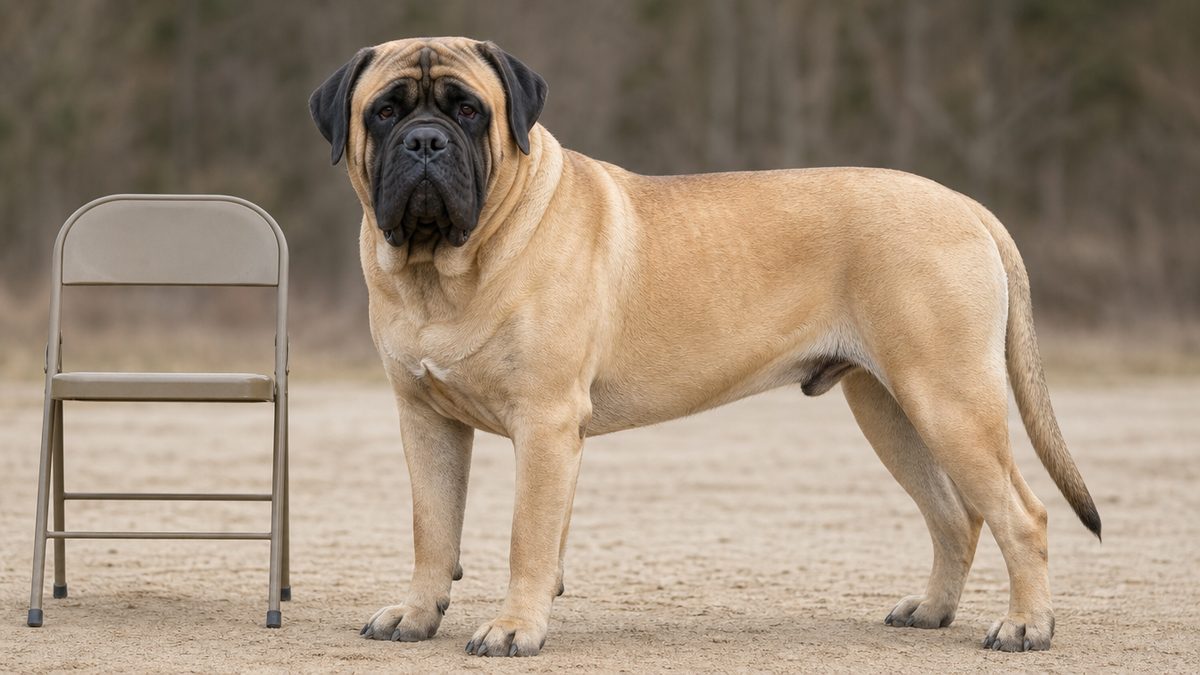
The Mastiff is a British giant guarding breed, one of the heaviest dogs alive, standing a minimum 30 inches at the shoulder for a male and carrying 72 to 104 kg on a short, close-lying coat and a shortened square head. Four registries write a standard for it and all four print the same name. It is calm indoors, indifferent to strangers, expensive to keep, and short-lived even by giant-breed measures.
The FCI classifies the Mastiff as Standard No. 264, Group 2, Section 2.1, Molossian type, Mastiff subtype, recognised on a definitive basis on 5 November 1964, country of origin Great Britain, with the official authentic language given as English. The FCI standard's own utilisation line reads simply "Watch and security dog";. The Royal Kennel Club places it in the Working group alongside four other breeds carrying the word mastiff, which are the Bullmastiff, the Neapolitan Mastiff, the Pyrenean Mastiff and the Tibetan Mastiff.
Size is the first fact and the only one the standards disagree about. The AKC's official standard sets a minimum of 30 inches at the shoulder for dogs and 27½ inches for bitches, and states plainly that dogs or bitches below the minimum are at fault, with the fault growing the further below standard the dog sits. It sets no weight at all. The UKC repeats the same two minimums and likewise gives no weight. The Kennel Club standard gives neither a height nor a weight, and appends a note for prospective puppy buyers warning that the standard is a guide and that a dog may be larger or smaller than any measurement given. Only the AKC's breed page, which is editorial rather than the standard, publishes a weight, at 160 to 230 pounds for males and 120 to 170 pounds for females.
| Registry | Name printed | Male minimum height | Weight in the standard |
|---|---|---|---|
| American Kennel Club | Mastiff | 30 inches at the shoulder | None given |
| FCI (Standard 264) | MASTIFF | Not specified | None given |
| The Kennel Club, UK | Mastiff | Not specified | None given |
| United Kennel Club | Mastiff | 30 inches at the shoulder | None given |
The AKC standard opens by calling the Mastiff "a large, massive, symmetrical dog with a well-knit frame" whose impression is one of grandeur and dignity, and it asks for substance that is massive and heavy boned with a powerful muscle structure, faulting any lack of substance. Read that alongside the absence of a stated weight and you have the breed's central tension: the standard demands mass without capping it.
The head is what makes the breed and what causes most of its problems. Every standard asks for a square head viewed from any angle, with breadth to length of the whole head and face as 2 to 3, a truncated muzzle cut off square, and a muzzle circumference to head circumference of 3 to 5. The AKC puts the proportion differently and more usefully: the muzzle should be half the length of the skull, dividing the head into three parts, one for the foreface and two for the skull. The UKC says the same thing again, calling the muzzle one-third the length of the entire head. Those three phrasings all resolve to one number, and that number decides how the breed sits on the brachycephalic scale.
The coat is short. The AKC asks for a straight, coarse, moderately short outer coat over a dense, short, close-lying undercoat, and faults a long or wavy coat. Colour is fawn, apricot or brindle, with a dark mask, and the Kennel Club calls any other colour unacceptable. There is no long-coated Mastiff in any standard, so a heavily coated "fluffy" Mastiff offered in India is either a cross or a different breed.
The Kennel Club standard describes the breed as calm, affectionate to owners, but capable of guarding, and usually indifferent with strangers, adding that timidity is unacceptable. The FCI's disqualifying faults are aggressive or overly shy dogs. Indifference is the target. A Mastiff that lunges at visitors and a Mastiff that cowers are both outside the standard.
History matters here because the modern population is narrow. The FCI standard records that the breed almost became extinct in Britain after the Second World War. The Old English Mastiff Club's own history is more specific: in 1946 an open meeting in London drew fifteen people, an attempt to trace every Mastiff left in the country found between twenty and thirty dogs, most of them too old to breed, and the club had to import puppies from the United States and Canada to restart the breed. Every Mastiff sold in India today descends from that bottleneck.
Mastiff or English Mastiff, and which name is the registry name
Mastiff is the registry name and English Mastiff is colloquial. Every organisation that publishes a breed standard for this dog prints the single word Mastiff: the American Kennel Club, the Fédération Cynologique Internationale, the Kennel Club in Britain and the United Kennel Club. No registry standard anywhere uses English Mastiff as the breed name. The two are the same dog.
Four documents settle it, and each was read directly rather than taken from a summary. The AKC's official standard is headed "Official Standard of the Mastiff", approved 12 November 1991 and effective 31 December 1991. FCI Standard No. 264 prints MASTIFF as the breed name in all four of its official languages, English, French, German and Spanish. The Kennel Club publishes the standard under the title "Mastiff | Breed Standards | The Kennel Club", last updated December 2024, in the Working group. The UKC's document is headed "Mastiff", Guardian Dog Group, revised 1 March 2008, and records that the breed was recognised by the United Kennel Club in 1948.
The AKC itself explains where the confusion comes from, in its own words. Its breed history opens by saying that in tracing the history of this noble breed we can avoid confusion by noting the distinction between mastiffs, with a lowercase m, and Mastiffs, the traditional giant breed of England, sometimes called the Old English Mastiff. Note the qualifier the AKC reaches for. It is Old English Mastiff, not English Mastiff, and it is offered as a nickname rather than a name.
The nickname is a club name that escaped. The Old English Mastiff Club's minutes record a meeting at the Crystal Palace on 19 January 1883 at which Dr Forbes Winslow moved that a Mastiff club be formed, Mr Mark Beaufoy seconded, and it was agreed the club should be called The Old English Mastiff Club to differentiate it from a Mastiff club already in existence. The words Old English were chosen to distinguish one club from another club, never to distinguish one dog from another dog. The same minutes show the club writing in 1894 to a rival Northern Old English Mastiff Club asking it to drop the words Old English for exactly that reason.
| Body | Document read | Name printed |
|---|---|---|
| American Kennel Club | Official Standard of the Mastiff (PDF) | Mastiff |
| FCI | Standard No. 264, nomenclature entry | MASTIFF |
| The Kennel Club, UK | Breed Standards, Working group | Mastiff |
| United Kennel Club | Official UKC Breed Standard | Mastiff |
| Orthopedic Foundation for Animals | Breed register, code MF | MASTIFF |
| Old English Mastiff Club | Club history, 1883 | Mastiff (the club, not the breed, is Old English) |
| Wikipedia | Article title | English Mastiff |
The health registers agree with the registries. The Orthopedic Foundation for Animals lists the breed under the code MF with the printed name MASTIFF, in the AKC Working Group, CKC Working Group, UKC Guardian Dog Group and TKC Working Group, and its parent club on the OFA record is the Mastiff Club of America. Searching OFA's full breed register returns seven breeds whose names begin with the word English, and none of them is a mastiff.
So why does English Mastiff persist? Because the plain word is ambiguous in running text. Bell and Hesketh's 2021 mortality study of the mastiff group had to distinguish nine separate breeds and wrote of "all Mastiff's or English Mastiffs as often known" in order to keep the breed apart from the Bullmastiff sharing its tables. Indian sellers do the same for the same reason, because a search for mastiff in India returns mostly Tibetan Mastiff pages.
Use Mastiff when you mean the registry breed, and treat English Mastiff as the same dog under a shopping name. When you see a KCI or FCI pedigree, expect it to read Mastiff. When you see an Indian listing headed English Mastiff, expect the same breed, but confirm the parents' papers before you accept it, because the same listing sites also sell four other mastiff breeds.
What 72 to 104 kg actually means in an Indian household
A male Mastiff weighs 72.6 to 104.3 kg, which is heavier than most adult humans and heavy enough to break four everyday assumptions about keeping a dog in India. It cannot be carried by one person, it cannot fly except as cargo, it does not fit a standard consulting table, and it needs a vehicle you may not own. Decide those four things before you decide anything about temperament.
The AKC breed page gives 160 to 230 pounds for males and 120 to 170 pounds for females, which converts to 72.6 to 104.3 kg and 54.4 to 77.1 kg. Hindustan Times reprints exactly 72.6 to 104.3 kg for the English Mastiff, which is the AKC figure converted rather than an Indian measurement. Asia Pets publishes 54 to 100 kg for the same breed. Treat all three as the same American source arriving by three routes.
Air travel is the hard constraint, and it is arithmetic
Air India carries a pet in the cabin only when pet and soft carrier together weigh 10 kg or less, as checked baggage from 10 kg to 32 kg, and as cargo only above 32 kg. An adult male Mastiff is 2.3 to 3.3 times the 32 kg checked-baggage ceiling, so cargo is the only category available for the animal's entire adult life. The cargo service adds two conditions that matter here. Pets must be at least three months old, and "certain breeds, such as snub-nosed or flat-faced pets, are carried only when temperatures are below 25°C", with acceptance decided by the local office rather than a published breed list.
That second condition is not settled for this breed and you should not assume it either way. Whether a carrier treats a Mastiff as snub-nosed is a counter decision, and the airline says to ring and ask. What is settled is the temperature: the mean temperature of Delhi's hottest month is 35.88 C, which is 10.88 C above that 25 C threshold. Plan a relocation around the answer, and get it in writing before you buy tickets.
| Category | Weight limit | Adult male Mastiff at 72.6 to 104.3 kg |
|---|---|---|
| Cabin, Economy | 10 kg including carrier | Exceeds by 7 to 10 times |
| Checked baggage | 10 kg to 32 kg | Exceeds by 2.3 to 3.3 times |
| Cargo | Above 32 kg | The only available category |
Veterinary access changes shape at this weight
Two people are needed for anything a smaller dog needs one person for. A 90 kg dog that collapses in a lift lobby has to be moved by two adults or a stretcher, and most Indian small-animal clinics are not built with a hydraulic table or a trolley rated for that load. This is not a hypothetical burden. In the OFA breed health survey, 809 of about 1,150 Mastiffs, or 70 percent, had been anaesthetised or sedated at least once. Divide it out and seven owners in ten will at some point need a clinic that can physically handle the dog under sedation.
Transport follows from the same number. A crate that a 30-inch dog can stand and turn in does not go in a hatchback, and most app-based cabs in Indian metros will refuse a dog of this size on sight. Owners who manage it well either own an SUV or keep a relationship with one specific vet who does home visits. Sort that out in the first month, not during the first emergency.
Most drug doses are per kilogram, so a 95 kg Mastiff consumes roughly three times the medicine of a 32 kg Labrador for the same illness. Tick and flea preventives, antibiotics, anaesthetic agents and joint supplements all scale the same way. When you price a Mastiff, price its medicines at three Labradors, not one.
Growth is the other half of the size question. A giant-breed puppy carries adult bone loads on immature joints for well over a year, which is why the exercise and feeding sections of this guide are stricter than they would be for a Labrador Retriever and closer to what a Great Dane needs. The Mastiff's own screening panel puts hips and elbows first for exactly this reason.
Mastiff price in India, and why published figures disagree by 66 times
Published Mastiff prices in India run from Rs 15,000 to Rs 10,00,000, a spread of 66.7 times, and no source on the first page of results explains the gap or admits it exists. The low figure is a business-to-business livestock listing with a minimum order of ten puppies. The high figure is a newspaper listicle. Between them sit two seller pages that publish no usable price at all.
Here is every published Indian figure this page could actually retrieve and read, with the source named. Nothing below is an offer, and Bonbeno does not broker sales or recommend sellers.
| Source | Figure published | What the listing actually is |
|---|---|---|
| TradeIndia, Rais Farms, Sehore | Rs 15,000 per puppy | B2B livestock listing, minimum order 10, supply ability 500 per day |
| Hindustan Times | Rs 5,00,000 to Rs 10,00,000 | Lifestyle listicle, no sourcing given |
| Asia Pets | Rs 100, in the meta description only | No price anywhere in the visible page |
| The Dog Farm (dogfarm.in) | No price published | Enquiry form only |
| Supertails 40-breed price list | Breed absent | Lists a Cane Corso x Mastiff mix at Rs 30,000 to Rs 1,50,000, not the Mastiff |
The gap is Rs 9,85,000 and it is real, not a currency artefact. Indian pages routinely republish a dollar figure run through one exchange rate, and this site has caught that at exactly 84.38 four separate times. Every figure above was divided by 84.38 before being reported here. Rs 15,000 gives 177.77 dollars, Rs 5,00,000 gives 5,925.58, Rs 10,00,000 gives 11,851.15 and Rs 100 gives 1.19. None of those is a round dollar amount, so the conversion artefact is not what is driving this spread. The dispersion is genuine.
One number that recurs across Indian listing sites was searched for and not found here. Rs 98,999 appears as a house price point attached to whatever puppy is in stock on several Indian pet-listing sites, and this site has caught it on six pages. A case-insensitive search of the Supertails 40-breed price list returned zero occurrences of 98,999, while a control search for Labrador in the same document returned 11, so the search worked and the absence is real. No Mastiff page read for this guide carried that figure.
The Rs 15,000 figure sits under the heading Livestock, with a minimum order quantity of 10 puppies, a stated supply ability of 500 per day, packaging details given as "cage", and a delivery time of 10 days. The same seller also lists Golden Retriever and Rottweiler puppies, Persian kittens, Sherohi goats and Kadaknath chickens. That is not a breeder price. It is a wholesale animal-trading price, and it tells you what the bottom of this market is.
What KCI registration is worth, in numbers
KCI registration is scarce enough that it should move the price, and Indian sellers rarely evidence it. The Kennel Club of India registered 33,880 pure-bred dogs with its studbook in 2025, down from a peak of 89,571 in 2021, a fall of 62.2 percent in four years. Against the FCI's own estimate of about 17.1 million dogs in India, those 33,880 registrations are 0.198 percent of the national dog population, or roughly one dog in 505. A KCI pedigree is therefore an uncommon document, and a seller who has one will produce the litter registration number without being pushed.
Two practical rules follow. Ask for the KCI registration number of the sire and the dam and check them, because a puppy price quoted as "KCI" with no numbers is a claim rather than a document. And separate pedigree paperwork from health paperwork, since neither the KCI nor the FCI certifies that a dog's hips were radiographed. The screening evidence is a separate set of documents covered in the health sections below.
Monthly cost of owning a Mastiff in India
Budget at least Rs 12,000 to Rs 20,000 a month, and treat that as a floor rather than an estimate. That band is what India's largest pet-commerce price list publishes for giant breeds, and its two worked examples, the Great Dane and the Saint Bernard, are both lighter than an adult male Mastiff. Every consumable on the list scales with bodyweight, so the heaviest breed in the category sits at the top of the range or above it.
Supertails breaks monthly cost down by size bracket, and its giant-breed column is the closest published Indian figure to this breed. The numbers below are theirs, not ours, and the right-hand column is our reading of how a Mastiff differs from their two exemplars.
| Cost line | Giant-breed band (Supertails) | Where a Mastiff sits |
|---|---|---|
| Dry or wet food | Rs 6,000 to Rs 10,000 | Top of band or above, being heavier than either exemplar |
| Routine vet visits | Rs 1,500 to Rs 3,000 | Top of band, dose and handling both scale |
| Vaccinations | Rs 2,000 per year | Same, vaccine dose does not scale with weight |
| Grooming | Rs 600 to Rs 1,500 | Low, the coat is short and close-lying |
| Training, six months | Rs 5,000 to Rs 10,000 | Top of band, a trainer used to giants costs more |
| Treats and toys | Rs 800 to Rs 1,500 | Top of band, chew toys must be giant-rated |
| Flea, tick and deworming | Rs 600 to Rs 1,000 | Above band, most products are dosed per kilogram |
| Stated monthly total | Rs 12,000 to Rs 20,000 | Plan for the upper half from month one |
Check that total against its own line items before you trust it. Adding Supertails' giant column, with vaccinations spread over twelve months and training over six, gives Rs 10,500 at the low end and Rs 18,834 at the high end, against a stated total of Rs 12,000 to Rs 20,000. Their headline is Rs 1,166 to Rs 1,500 a month higher than the parts they list. The same article elsewhere says monthly upkeep runs Rs 3,000 to Rs 18,000, and elsewhere again Rs 3,000 to Rs 11,000. Three different bands in one document is a reason to treat any single Indian monthly figure as indicative.
The costly line is the one nobody budgets
Medicines are dosed per kilogram, so an expensive month is expensive in proportion to bodyweight. A 95 kg Mastiff takes roughly three times the tick preventive, three times the antibiotic and three times the anaesthetic agent of a 32 kg Labrador. Seven Mastiffs in ten in the OFA breed health survey had been anaesthetised or sedated at least once, 809 of about 1,150 dogs, so this is a routine cost rather than a rare one.
Orthopaedic work is the second uncapped line. Among the 160 Mastiffs in that survey reporting an orthopaedic disorder other than hip or elbow dysplasia, arthritis accounted for 78 cases and cruciate ligament rupture for 76, which is 49 percent and 48 percent of that group. Cruciate surgery on a 90 kg dog is not the same operation as on a spaniel, and in Indian metros it is referral work rather than clinic work.
Multiply the monthly floor by the breed's own median lifespan. At Rs 12,000 a month across the 9.0-year median from the largest published study, lifetime upkeep is about Rs 12,96,000, which exceeds every purchase price published in India for this breed including the Hindustan Times top figure. The dog is never the expensive part. The next nine years are.
Two costs are optional but sensible here. Pet insurance in India is thin for giant breeds and often excludes hip and elbow dysplasia, which are precisely the conditions this breed is screened for, so read the exclusion list rather than the premium. And a one-off spend on a vehicle solution, a ramp or a rear-seat cover, is cheaper than discovering during an emergency that you cannot transport the dog at all.
Climate suitability, and why heat tolerance is rated 1 of 5
The Mastiff is rated 1 of 5 for heat tolerance because three things stack against it at once: the mass, the skull and the origin climate. Bodyweight of 50 kg or more carried the highest heat-illness odds of any weight band in a study of 905,543 UK dogs, and an adult male Mastiff starts at 72.6 kg. The breed was developed in a country whose hottest month averages 17.63 C. Indian cities run 11 to 18 C warmer than that.
Start with the origin climate, measured rather than asserted. NASA POWER, queried by explicit latitude and longitude over 2001 to 2020, gives London at 51.507 N, 0.128 W an annual mean of 10.39 C and a hottest-month mean of 17.63 C in July. Every Indian figure below comes from the same API, the same product and the same twenty-year window, so the comparison is like for like. Coordinates were used rather than place-name slugs, because a name-based climate lookup can silently return a different city.
| Place | Annual mean C | Hottest month mean C | Above London's hottest month |
|---|---|---|---|
| London (origin) | 10.39 | 17.63 (Jul) | - |
| Delhi | 25.60 | 35.88 (Jun) | +18.25 |
| Chennai | 27.95 | 31.51 (May) | +13.88 |
| Mumbai | 26.77 | 31.19 (May) | +13.56 |
| Pune | 23.86 | 28.93 (Apr) | +11.30 |
| Bengaluru | 23.74 | 28.37 (Apr) | +10.74 |
The mechanism is mass, not coat
Bodyweight is the single strongest physical predictor here, and it is measured directly rather than transferred. Hall, Carter and O'Neill examined 905,543 dogs under primary veterinary care at 886 UK clinics in 2016 and found 395 heat-related illness events, an incidence of 0.04 percent with an event fatality rate of 14.18 percent. In their final model, every bodyweight band above 10 kg carried significantly higher odds than dogs under 10 kg, and dogs of 50 kg or more had the highest odds of all at 3.42, with a 95 percent confidence interval of 1.54 to 7.57. The authors give the physics plainly: smaller dogs have a high heat-storage to radiative-surface-area ratio, so they shed heat faster than large dogs and can work for longer before overheating.
An adult male Mastiff is not near that 50 kg line, it is 45 to 109 percent past it. That makes this breed heat-sensitive by geometry before anything about its face or coat is considered, and it is why the rating here is 1 rather than 2.
The coat contributes less than Indian sellers imply, and in a direction people get wrong. The standards call for a short, coarse, moderately short outer coat over a dense, short, close-lying undercoat. Short is not the same as thin. There is still an undercoat, and it must never be shaved, because the coat also blocks solar radiation. The right intervention is shade, airflow and water, not clippers.
Humidity, and why Mumbai and Pune are worse than Delhi in July
Dogs cool by evaporating water from the respiratory tract, so humidity decides how well panting works. NASA POWER gives July relative humidity of 89.56 percent in Mumbai and 89.09 percent in Pune, against 62.72 percent in Delhi and 67.47 percent in Chennai. London's annual relative humidity is 84.59 percent, which looks similar to Mumbai until you notice London pairs it with 10.39 C. Humid and cold is comfortable. Humid and 31 C is the combination that defeats a panting giant.
An air-conditioned flat beats a compound with a shaded kennel for this breed in every Indian metro. The Mastiff is inactive indoors, so apartment living suits its behaviour, and the limiting factor is the lift rather than the floor area. Ask yourself whether you can get a collapsed 90 kg dog down the stairs during a power cut before you ask whether the flat is big enough.
Practical rules for Indian summers are short. Walk before 6 am and after 8 pm from March to June. Test the pavement with the back of your hand for five seconds. Carry water on every walk, not just long ones. And treat heavy panting that does not settle within a few minutes of rest as an emergency rather than a normal summer noise, because the fatality rate above is one in seven.
How brachycephalic a Mastiff really is, and what is transferred rather than measured
The Mastiff sits exactly at the brachycephalic threshold rather than inside it. Its own breed standards put the muzzle at half the cranial length, a craniofacial ratio of 0.5, and the study that quantified the link between facial shortening and airway disease found that the condition occurred only in dogs whose muzzles were shorter than half their cranial length. That places the breed at the boundary, not alongside the Pug. It is also not a named breed in the UK heat-illness work, so any breed-level odds ratio you see applied to it is a transfer.
Packer and colleagues measured 700 dogs of diverse conformations and then confirmed the finding in 154 brachycephalic dogs. They defined the craniofacial ratio as muzzle length divided by cranial length, and reported that risk of brachycephalic obstructive airway syndrome rises sharply and non-linearly as relative muzzle length shortens. Their key sentence is a threshold: BOAS only occurred in dogs whose muzzles comprised less than half their cranial lengths. Over 80 percent of dogs with a ratio below 0.1 were affected.
Now put the Mastiff's own standards next to that number. The AKC says the muzzle should be half the length of the skull, dividing the head into three parts, one for the foreface and two for the skull. The Kennel Club and the FCI say the length of muzzle to whole head and face is 1 to 3. The UKC says the muzzle is one-third the length of the entire head. All three phrasings give a craniofacial ratio of 0.5, which is the exact value at which Packer's cohort stopped producing cases.
| Source | What it states | Craniofacial ratio |
|---|---|---|
| AKC standard | Muzzle half the length of the skull | 0.50 |
| Kennel Club and FCI standard | Muzzle to whole head and face as 1 to 3 | 0.50 |
| UKC standard | Muzzle one-third the length of the entire head | 0.50 |
| Packer 2015, threshold | BOAS occurred only below half the cranial length | Below 0.50 |
| Packer 2015, Pug breed average | Worked example in the paper | 0.11 |
What is measured for this breed, and what is borrowed
The Mastiff is not one of the named breeds in the VetCompass heat-illness model, and saying otherwise would be a transfer. Hall and colleagues listed nine breeds at significantly increased odds, which are the Chow Chow at 16.61, Bulldog 13.95, French Bulldog 6.49, Dogue de Bordeaux 5.31, Greyhound 4.26, Cavalier King Charles Spaniel 3.45, Pug 3.24, English Springer Spaniel 2.74 and Golden Retriever 2.65. The Mastiff appears in none of the model's breed categories. It falls into "Other purebred", which was not significantly different from the Labrador Retriever at an odds ratio of 1.28, 95 percent confidence interval 0.76 to 2.14, p equals 0.358.
The same study reports brachycephalic dogs at 2.10 times the odds of mesocephalic dogs, 95 percent confidence interval 1.68 to 2.64. That is a class-level figure, and the paper does not publish how it classified the Mastiff's skull. Applying 2.10 to this breed would therefore be a double transfer, first from a class to a breed and then on an unconfirmed class assignment. This page does not do it, and you should distrust any page that quotes 2.10 as the Mastiff's own number.
One weak breed-level signal does exist and it points the same way. In the OFA breed health survey, only 20 of 1,141 Mastiffs, or 1.8 percent, were reported with any respiratory disorder, and of eleven specific answers, ten were logged as "other" and one as collapsed trachea. Respondents are self-selected and unverified by OFA's own warning, so read it as an absence of a strong signal rather than proof of a healthy airway. It is consistent with a breed sitting at the threshold rather than past it.
Packer found thicker neck girth independently raised BOAS risk in both study populations, a factor borrowed from human sleep apnoea research. The Mastiff standard asks for a neck measuring only 2.5 to 5 cm less in circumference than a skull that is itself required to be very broad. So the breed's own written description mandates the one soft-tissue feature the research flags, even while keeping the muzzle at the safe end of the ratio. Obesity compounds it further, which is a second reason to keep this dog lean.
The practical conclusion is narrower than either extreme you will read online. A Mastiff is not a Pug and does not carry a Pug's airway risk. A Mastiff is also not a long-muzzled breed, and it combines a borderline skull with a thick neck and the heaviest bodyweight band in the heat-illness data. Manage it as a heat risk driven by mass, and treat noisy breathing at rest as a veterinary question rather than a breed characteristic.
Temperament, and who should not buy this dog
A correct Mastiff is calm at home, indifferent to strangers and physically undemonstrative, and its guarding is meant to work through presence rather than aggression. Owner-reported data shows the protective behaviour arriving late: 15 percent of Mastiffs were described as protective in their first year, 23 percent in their second and 30 percent after two years. Buy this breed for the adult it becomes at three, not the puppy it is at three months.
The written target is unusually clear. The Kennel Club standard asks for a dog that is calm, affectionate to owners, but capable of guarding, and usually indifferent with strangers, and states that timidity is unacceptable. The AKC asks for a combination of grandeur and good nature, courage and docility, and says dignity rather than gaiety is the correct demeanour, while warning judges not to condone shyness or viciousness. The FCI's only disqualifying faults for behaviour are aggressive or overly shy dogs. Indifference is the goal in all three documents.
The maturation curve, in numbers
The OFA breed health survey asked owners to describe temperament at three life stages, with about 1,100 dogs answering and multiple selections allowed, so the columns do not sum to 100. The trajectory is the useful part.
| Description | 0 to 12 months | 13 to 24 months | After 24 months |
|---|---|---|---|
| Very friendly | 45% | 42% | 39% |
| Confident | 37% | 38% | 40% |
| Protective | 15% | 23% | 30% |
| Reserved | 18% | 20% | 22% |
| Timid | 12% | 12% | 11% |
| Dog aggressive | 3% | 6% | 8% |
| Aggressive toward people | 2% | 4% | 4% |
| Has bitten a person | 0% (5 dogs) | 1% (11 dogs) | 2% (21 dogs) |
Protective behaviour doubles between the first year and the third, and dog-aggression roughly triples. Respondents are self-selected and OFA prints a warning that there is no verification or duplicate checking, so treat these as owner perceptions rather than measured behaviour. Even so, the direction is consistent across three questions and it matches what the standards describe. The gentle, sociable puppy is not lying to you. It is simply not finished.
Who should not buy a Mastiff
- Buyers who want a guard dog that reacts. This breed guards by standing still and being enormous, and a Mastiff trained to bite is a public-liability problem, not a security system.
- Households without a second adult who can physically manage the dog. One person cannot lift or restrain 90 kg alone.
- First-time dog owners. The correction window closes at about six months, when the dog already outweighs a child.
- Anyone in a top-floor flat with an unreliable lift, for the reason set out in the climate section.
- Owners who travel and expect boarding to be easy. Most Indian boarding kennels are not built for a 30-inch dog and will decline or charge a premium.
Children are the question people ask most, and the honest answer has two halves. The breed is temperamentally suited to families, and 39 percent of adult Mastiffs were still described as very friendly. It is also heavy enough that an accidental shoulder-check knocks a small child over, and a tail at hock height clears a coffee table. Supervise on the physics, not on the temperament.
The standard asks for lips diverging at obtuse angles and slightly pendulous, so drool is built in rather than a fault. Expect it after drinking and in heat. The breed is quiet by disposition, which suits apartment living, but the snoring is loud enough to be a household negotiation. Neither is a health problem. Both are daily realities.
Training a Mastiff, and the timelines that actually apply
Train a Mastiff on the assumption that you have six months of physical advantage and then none. The breed is biddable rather than eager, it resists repetition and pressure, and it matures slowly enough that adult behaviour is not settled until about three years. Front-load socialisation, teach every handling behaviour before the dog is heavier than you can move, and expect to spend Rs 5,000 to Rs 10,000 on six months of professional help.
The weight curve is the training curve. A Mastiff puppy passes 20 kg well before it is six months old, and by its first birthday it can outweigh its handler. Everything that requires physical management, which includes lead manners, entering and leaving a lift, tolerating nail trims, accepting a muzzle and standing still on a vet table, has to be taught while the dog is small enough that a mistake is recoverable. After that you are negotiating, not correcting.
What this breed resists
- Repetition. Five clean repetitions beat twenty, because a bored Mastiff simply stops offering the behaviour.
- Physical correction. Leash pops and pinning damage the relationship and do not scale to a 90 kg adult.
- Speed. Recall and sit are learned quickly, then performed slowly, which is temperament rather than defiance.
- Heat. A dog that is thermally uncomfortable will not train, so schedule sessions before 6 am and after 8 pm in Indian summers.
- Crowds too early. Overwhelming a reserved puppy produces the timidity the standards explicitly call unacceptable.
Socialise deliberately and early, because the protective behaviour arrives on schedule whether you prepared for it or not. Owner reports put protective behaviour at 15 percent in the first year and 30 percent after two. A dog that met a hundred calm strangers before six months carries that into adulthood as indifference. A dog that met nobody carries it into adulthood as suspicion, and by then it weighs 80 kg. In Indian apartment buildings the specific list is worth writing down: watchmen, delivery riders, domestic staff, lift operators, children on the stairs and the building's other dogs.
| Age | Priority | What good looks like |
|---|---|---|
| 8 to 16 weeks | Socialisation and handling | Calm with strangers, tolerates paws, ears and mouth being handled |
| 4 to 6 months | Lead manners and lift routine | Walks on a loose lead while you can still physically manage the dog |
| 6 to 12 months | Impulse control, place and settle | Holds a settle while the doorbell rings |
| 12 to 24 months | Maintenance and proofing | Reliable recall in a quiet park, ignores other dogs |
| 24 to 36 months | Adult management | Protective behaviour is present but under verbal control |
Equipment matters more than method at this weight. Use a well-fitted harness or a flat collar rather than anything that works by pain, because a dog this strong will simply lean through discomfort and you will lose the lead. A second handler for the first few months of outdoor work is not a luxury.
Under the Prevention of Cruelty to Animals (Dog Breeding and Marketing) Rules, 2017, Rule 8, Conditions for sale, every breeder must ensure that pups less than eight weeks in age are not sold, and that dogs over six months in age are not sold without first being sterilised, unless they are being sold to another licensed breeder. So a lawful Indian purchase window for an unsterilised pet puppy sits between eight weeks and six months, which is exactly the period in which socialisation has to happen anyway.
How much exercise a Mastiff actually needs
Two short, flat, cool walks a day totalling 45 to 60 minutes is the adult requirement, and less than that during an Indian summer. The Mastiff is a low-endurance breed whose exercise is limited by heat and joints rather than by stamina, and the commonest owner error is not too little exercise but too much of the wrong kind before the skeleton has finished.
Adults need consistency, not distance. Two walks a day on level ground, at a pace the dog chooses, is enough for a healthy Mastiff. It is not a jogging companion, it does not need an hour of fetch, and it will happily sleep for most of the day between outings. That low activity level is exactly why apartment living works for the breed.
Before 24 months, protect the joints
Use 24 months as the marker for skeletal maturity, because that is the age the health register uses. The OFA does not issue a definitive hip evaluation before 24 months, and its own breed survey distinguishes preliminary radiographs from an "OFA examination for hip dysplasia after 24 months of age";. Its hip grading guidance notes that a young dog graded mild at 24 to 30 months may be resubmitted later, since hip dysplasia is chronic and progressive and the older the dog the more accurate the diagnosis. A growth plate that is still open is not a scheduling detail on a dog that will weigh 90 kg.
- Avoid forced running, cycling alongside and treadmill work entirely until 18 months.
- Limit stairs to what daily life requires, and carry or ramp the puppy where you reasonably can.
- Skip repetitive fetch on hard or slippery floors, because the stop-and-turn is what loads a cruciate ligament.
- Keep jumps off furniture and out of car boots, using a ramp instead.
- Let the puppy set the pace and stop when it stops, rather than completing a planned distance.
The joint data justifies the caution. Among Mastiffs whose owners reported an orthopaedic disorder other than hip or elbow dysplasia, cruciate ligament rupture appeared in 76 of 160 cases and arthritis in 78, which is 48 and 49 percent of that group. Separately, 20.3 percent of 14,023 Mastiffs radiographed by the OFA were graded dysplastic in the hips and 15.5 percent of 8,702 in the elbows. A breed carrying those rates does not need extra impact loading in its first two years.
What happens without enough exercise
Under-exercised Mastiffs get heavy rather than destructive, and heavy is the more dangerous failure here. Excess weight compounds three separate risks at once: it raises heat-illness odds, because Hall's model found dogs at or above their breed and sex mean bodyweight carried 1.42 times the odds of heat-related illness; it loads dysplastic hips; and it worsens airway resistance, since Packer found body condition score independently raised airway-syndrome risk. A fat Mastiff is not a comfortable Mastiff.
Scent games, slow feeders, chew work and short training sessions tire this breed more efficiently than walking does, and none of them raise core temperature. In April, May and June in Delhi or Chennai, indoor mental work should replace roughly half the outdoor routine rather than supplement it.
Grooming a short-coated giant through Indian humidity
Groom a Mastiff weekly with a rubber curry or bristle brush, dry the facial folds and the ear bases daily in the monsoon, and never shave the coat. The coat itself is the easiest part of this breed to look after. Skin and ears are the parts that fail in Indian humidity, and owner reports put skin disorders at 15 percent and ear disorders at 8 percent of surveyed dogs.
The coat is short and close-lying, coarser over the neck and shoulders, over a dense undercoat, with a long or wavy coat marked as a fault. Weekly brushing removes the dead undercoat and is enough outside the shedding peaks. Bathing every six to eight weeks is plenty for a healthy dog, and more frequent bathing in humid weather strips the coat and invites the skin problems below.
The wrinkle question is answered by the standard
A heavily wrinkled Mastiff is off-standard, and the standard says so in bold. The FCI text states that whilst in repose, any exaggeration of wrinkle or excess of skin is unacceptable in mature adults, and the Kennel Club uses almost the same words. The skull should show wrinkles when the dog is at attention, not permanent folds at rest. That matters more in India than in Britain, because a deep permanent fold in 89 percent July humidity is a moist, warm, closed environment. NASA POWER gives Mumbai July relative humidity at 89.56 percent and Pune at 89.09 percent. If you are choosing a puppy, choose the tighter face.
| Problem | Dogs reporting | Share of that problem group |
|---|---|---|
| Any skin disorder | 171 of 1,148 dogs (15%) | - |
| Seasonal allergies | 55 | 35% |
| Food or medicine allergies | 46 | 30% |
| Sebaceous cysts | 42 | 27% |
| Persistent staph infection | 28 | 18% |
| Any ear disorder | 88 of 1,146 dogs (8%) | - |
| Chronic ear infection | 61 | 77% |
Read the ear line carefully, because it is the strongest grooming signal this breed produces. Of Mastiffs whose owners reported an ear problem at all, 77 percent reported chronic ear infection, which is 61 dogs. The standard's ear is small, thin to the touch, and lies flat and close to the cheek when in repose. A flap lying flat against the head keeps the canal warm and unventilated, which is a mild design problem in Britain and a monsoon problem here.
A monsoon routine that takes four minutes
- Dry the ear flap and the skin under it after every wet walk, using a towel rather than heat.
- Wipe the facial folds and the lower lip pockets daily, because drool collects there and does not evaporate.
- Check between the toes weekly for softened skin, since a 90 kg dog puts more pressure through each pad.
- Plug the ears before bathing, and never let a wet dog air dry indoors in July.
- Book a veterinary look at any ear that smells, rather than reaching for a shop-bought cleaner.
Shaving removes the coat's function as a barrier against solar radiation without improving the dog's ability to lose heat, which happens by panting rather than through the skin. A shaved short-coated dog in Indian sun is at higher risk, not lower. Give shade, moving air and water instead.
Lifespan and causes of death, with the denominators printed
The largest study to measure it puts the Mastiff's median lifespan at 9.0 years against 12.5 years for dogs generally, from a UK dataset of 584,734 dogs of which 284,734 were deceased. A separate global owner survey of 1,036 mastiff-group dogs gives a mean and median age at death of 8.00 years. Those two figures disagree by a year and this page prints both rather than averaging them. Every Indian seller page found for this guide published a longer life expectancy than either.
McMillan and colleagues, publishing in Scientific Reports in February 2024, analysed 584,734 unique UK dogs including 284,734 deceased across 155 breeds. Median survival across all dogs, purebred and crossbred, was 12.5 years with a confidence interval of 12.5 to 12.6. The Mastiff was named explicitly among the breeds most at risk of early death, with a median of 9.0 years and a hazard ratio of 2.3, 95 percent confidence interval 2.2 to 2.4. The paper's per-breed sample size for the Mastiff sits in a supplementary table this build could not retrieve, so that denominator is reported here as unknown rather than guessed.
Bell and Hesketh's 2021 study in Veterinary and Animal Science is the only breed-focused mortality work on this group. It surveyed global mastiff clubs and analysed 1,036 usable dogs. Table 2 records 641 Mastiffs, 61.9 percent of the sample, and Table 3 gives a mean age at death of 8.00 years for the Mastiff at n equals 659. Those two counts do not agree with each other inside the same paper, which is worth knowing before you quote either. Across all dogs with a known age of death the median and mean were both 8.00 years, and only 0.96 percent of study dogs lived past fifteen.
| Source and year | Figure | Denominator | Type |
|---|---|---|---|
| McMillan et al. 2024 | 9.0 years, median | 584,734 dogs, 284,734 deceased, 155 breeds | Peer-reviewed cohort |
| Bell and Hesketh 2021 | 8.00 years, mean and median | 641 to 659 Mastiffs in a 1,036-dog survey | Owner survey, self-selected |
| OFA breed health survey | 49% died aged 5 to 10 | 286 reported deaths | Owner survey, unverified |
| AKC breed page | 6 to 10 years | None published | Editorial |
| dogfarm.in, Indian seller | 12 to 15 years | None published | Marketing claim |
| Asia Pets, Indian seller | 6 to 10 years | None published | Repeats the AKC figure |
Bell and Hesketh compare their result to "the median age stated by Dobson (2013) at 7.46 years" in a passage about Mastiffs. Dobson's Table 1 was opened and read for this page. It contains no Mastiff row at all. The 7.46 sits on the Bullmastiff row, alongside 96 deaths, 36 of them cancer-related, 37.5 percent with a 95 percent confidence interval of 27.8 to 47.2. The plain Mastiff falls inside Dobson's "Other breeds" line, 4,524 deaths at 17.8 percent cancer mortality. Do not quote 7.46 as a Mastiff figure.
What Mastiffs die of
Cancer dominates, and it arrives early. Bell and Hesketh recorded 22 distinct causes of death, with cancer accounting for 47 percent of all reported death causes and old age 16 percent. The mean age at a cancer death was 6.79 years against 11.32 years for old age, a gap of 4.53 years. Of 23 cancer types named, osteosarcoma accounted for about 50 percent of cancer deaths, lymphoma 14.3 percent and haemangiosarcoma 7.1 percent, and osteosarcoma specifically accounted for 50 percent of cancers in the Mastiff itself.
The OFA survey gives a lower cancer figure from a living population rather than a death register, with 182 of 1,154 dogs, or 16 percent, ever diagnosed with cancer or tumours, and osteosarcoma the commonest type at 36 of 138 responses, or 26 percent. The two are measuring different things and both are useful. Dobson's wider survey of 15,881 pedigree deaths put all-breed cancer mortality at 27.0 percent and noted that mastiff-type breeds dominate the top of her table.
Age at death from the OFA survey's 286 reported deaths breaks down as 49 percent between five and ten years, 23 percent over ten, 22 percent between two and five, 4 percent between six months and two years and 1 percent under six months. Add the bottom three rows and 27 percent of these dogs died before their fifth birthday. That is the number an Indian buyer paying lakhs should see before the purchase, not after.
One modifiable association appears in the breed-specific data. Bell and Hesketh found neutered dogs died at a mean of 8.40 years against 7.48 years for entire dogs, a difference of 0.92 years, while also noting that more neutered than entire Mastiffs died of cancer. Owner surveys cannot separate cause from confounding, so discuss timing with your vet rather than treating this as a rule.
Screening: what the OFA register actually holds on 14,023 Mastiffs
Ask a Mastiff breeder for four documents, which are hips, elbows, an ACVO eye examination after 24 months and a cardiac evaluation. Those four are the Mastiff Club of America's CHIC requirements, and the OFA holds enough Mastiff records to make each one meaningful. Hips are the weakest result: 20.3 percent of 14,023 evaluated Mastiffs were graded dysplastic.
Every figure below was read from the OFA's own breed page for MASTIFF, breed code MF, taken out of OFA's markup rather than guessed, with the breed name confirmed as printed on the returned page. The same numbers were independently reproduced from OFA's full disease-statistics dump. Counts move as evaluations are added, so the evaluation totals are printed next to every percentage.
| Test | Evaluations | Normal | Abnormal | Breed rank |
|---|---|---|---|---|
| Hips | 14,023 | 76.8% | 20.3% dysplastic | 52 |
| Elbows | 8,702 | 84.2% | 15.5% dysplastic | 32 |
| Patella | 3,917 | 99.7% | 0.3% | 149 |
| Congenital cardiac | 3,784 | 99.2% | 0.3% | 47 |
| Thyroid | 2,630 | 88.6% | 2.7%, plus 8.7% equivocal | 70 |
| Eyes (ACVO) | 2,202 | 91.6% | 8.4% | 34 |
| Progressive retinal atrophy, DNA | 2,181 | 99.4% | 0.6% | 8 |
| Canine multifocal retinopathy, DNA | 1,213 | 79.2% | 1.4%, plus 19.4% carriers | 3 |
| Degenerative myelopathy, DNA | 928 | 86.6% | 1.2%, plus 12.2% carriers | 61 |
| Cystinuria, DNA | 489 | 94.5% | 0.2%, plus 5.3% carriers | 3 |
| Advanced cardiac | 395 | 89.6% | 4.3%, plus 5.8% equivocal | 50 |
Every one of those lines clears OFA's own reporting threshold, which is 100 hip evaluations or 50 for the other databases, so none of these is a small-sample artefact. The hip breakdown adds up: of 14,023 dogs, 1,230 graded excellent, 6,929 good and 2,613 fair, together 10,772 normal, while 1,992 mild, 764 moderate and 94 severe together give the 2,850 dysplastic dogs behind the 20.3 percent.
The hips are improving, and the register shows it
OFA publishes the hip result by birth-year cohort, and the trend is genuinely good news. Dysplastic dogs fell from 24.1 percent among Mastiffs born up to 1990 to 16.1 percent among those born from 2021, while excellent hips rose from 4.6 percent to 13.3 percent over the same cohorts. Forty years of screening moved the breed by eight percentage points. A breeder who screens is participating in that; one who does not is free-riding on it.
Cystinuria is the breed-specific one worth knowing
Type III cystinuria is androgen-dependent, occurs in intact males only, appears later in life than the Newfoundland form and is less severe, and it is reported specifically in Mastiffs, French and English Bulldogs, Basset Hounds and Irish Terriers. An SLC3A1 nonsense mutation is associated with cystinuria in Mastiffs and related breeds. The review states plainly that in dogs with androgen-dependent cystinuria, castration will help. The Mastiff CHIC panel lists cystinuria as an optional test, recommending a urine nitroprusside test in intact males annually from eighteen months, or the Type 3 DNA marker.
Two of the OFA-registered diagnoses connect to the eyes rather than the joints, and Indian owners see them early. Among Mastiffs whose owners reported an eye disorder, entropion accounted for 24 cases, cherry eye 18 and ectropion 14. Both entropion and ectropion are named in Indian law as genetic defects a breeder must have tested for, which the legal section below sets out.
Ask for the OFA or equivalent hip grade of both parents, the elbow grade of both parents, the date of the sire and dam's ACVO eye examination, and which cardiac exam was done and by whom. A breeder who screens has these as documents with dates and numbers. A breeder who does not will answer with adjectives.
Bloat and gastric dilatation-volvulus, and what is actually known about this breed
The Mastiff is not a named breed in the main gastric dilatation-volvulus cohort literature, so any incidence figure you see attached to it has been transferred from other giant breeds. What does exist for the Mastiff is owner-report survey data: 21 cases of bloat or gastric torsion among 83 Mastiffs whose owners reported any gastrointestinal disorder. Treat the condition as a real and lethal risk for a deep-chested giant, and treat the numbers as weaker than they look.
Glickman and colleagues ran the definitive prospective cohort, following 1,914 dogs of eleven large and giant breeds. The eleven are named in the paper and they are the Akita, Bloodhound, Collie, Great Dane, Irish Setter, Irish Wolfhound, Newfoundland, Rottweiler, Saint Bernard, Standard Poodle and Weimaraner. The Mastiff is not among them. Their headline figures are 23 cases per 1,000 dog-years at risk for the seven large breeds and 26 per 1,000 for the four giant breeds, a cumulative incidence of 5.7 percent across all breeds, and 30 deaths among the 105 dogs that developed the condition, which is 28.6 percent.
Evans and Adams analysed the 2004 UK purebred dog health survey, covering 15,881 dogs of 165 breeds that had died in the previous ten years and 36,006 live dogs of 169 breeds. Gastric dilatation-volvulus was the cause of death for 389 dogs, 2.5 percent of all deaths with a 95 percent confidence interval of 2.2 to 2.7, at a median age at death of 7.92 years, and there were 253 episodes in 238 living dogs at a median age at first diagnosis of five years. The breeds they name at greatest mortality risk are the bloodhound, Grand Bleu de Gascogne, German longhaired pointer and Neapolitan mastiff, and at greatest morbidity risk the Grand Bleu de Gascogne, bloodhound, otterhound, Irish setter and Weimaraner. The plain Mastiff appears in none of those lists.
Evans and Adams conclude that sixteen breeds, mainly large or giant, are at increased risk. Their full breed-by-breed table is behind the publisher's paywall and this build could not open it, including with a stealth proxy. So this page cannot say whether the Mastiff is one of those sixteen. It is not named in the abstract, and that is as far as the evidence goes.
What the breed's own data says
Two owner-reported datasets do cover the Mastiff directly. In the OFA breed health survey, 83 of 1,151 dogs, or 7 percent, were reported with any gastrointestinal disorder, and within the specific diagnoses bloat or gastric torsion accounted for 21 cases, 31 percent of that group, second only to inflammatory bowel disease at 22. In Bell and Hesketh's mortality survey, gastric causes including general digestive problems, gastric dilatation-volvulus and bloat appear in the top causes of death, with the table recording 31 gastric deaths in Europe, 34 in North America and 3 elsewhere, 68 in total. Both are self-selected owner reports and neither gives an incidence rate.
| Source | Names the Mastiff? | What it gives |
|---|---|---|
| Glickman et al. 2000, prospective cohort | No, eleven other breeds | 5.7% cumulative incidence, 28.6% case fatality, in other breeds |
| Evans and Adams 2010, UK survey | Not in the abstract, table unread | 2.5% of 15,881 pedigree deaths, median age at death 7.92 years |
| OFA breed health survey | Yes | 21 owner-reported bloat or gastric torsion cases, no denominator for incidence |
| Bell and Hesketh 2021 | Yes, mastiff group | 68 gastric deaths across a 1,036-dog survey |
What to do anyway
The absence of a breed-specific incidence figure is not a reason to relax. Gastric dilatation-volvulus kills roughly one dog in four who gets it even with treatment, on Glickman's figures, and it does so within hours. Every deep-chested giant owner in India should be able to recognise it at 2 am.
- Watch for a swollen, drum-tight abdomen behind the ribs.
- Watch for repeated unproductive retching that brings nothing up.
- Watch for restlessness, pacing and an inability to settle or lie down.
- Watch for drooling out of proportion to normal, with pale gums.
- Go straight to a clinic that can operate at night, without waiting to see if it passes.
Prophylactic gastropexy is offered by some Indian referral surgeons, usually at the time of neutering. Because the breed-specific risk is unquantified, this is a conversation with your own vet about your own dog rather than a blanket recommendation, and any page that tells you the Mastiff's bloat risk as a percentage is quoting another breed's number.
Feeding a Mastiff in India, life stage by life stage
Feed a Mastiff to a lean body condition on a large or giant-breed diet, split across two or three meals a day, and grow the puppy slowly on purpose. Indian giant-breed food costs Rs 6,000 to Rs 10,000 a month on published figures, and that is the largest single line in the budget. Overfeeding a growing Mastiff is the most expensive mistake available, because it converts directly into the hip and elbow problems the breed is already screened for.
Body condition matters more than any number on a bag. You should be able to feel the ribs under a thin layer of fat without pressing, see a waist from above and a tuck-up from the side. Supertails' published Indian figure for giant-breed food is Rs 6,000 to Rs 10,000 a month, drawn from the Great Dane and the Saint Bernard, both lighter than an adult male Mastiff, so budget at the top of that band.
In the OFA survey, 89 percent of Mastiff owners fed dry food, 22 percent canned, 21 percent home-cooked and 18 percent raw, with multiple answers allowed. Home cooking is common in Indian households and it works if it is formulated, but a giant-breed puppy on an unbalanced home diet is the classic route to skeletal problems. If you cook, get the ration checked by a veterinarian rather than following an online recipe.
| Stage | Meals a day | The priority |
|---|---|---|
| 8 weeks to 6 months | 3 to 4 | Large or giant-breed puppy food, controlled calcium, deliberately slow growth |
| 6 to 18 months | 2 to 3 | Keep the dog visibly lean while the frame is still loading |
| 18 months to 2 years | 2 | Transition to adult food, reassess weekly by feel not by weight |
| Adult, 2 to 6 years | 2 | Stable lean weight, adjust down in summer when activity drops |
| Senior, from about 6 years | 2 to 3 | Smaller meals, joint support discussed with a vet, watch for weight loss |
Six years is early for a senior label and it is deliberate. Bell and Hesketh note that the AKC classes the Mastiff as senior from six to ten years, against seven to nine for the Bullmastiff, and that a large number of study dogs died inside that window. A Mastiff at six is not a middle-aged dog.
The three Indian-specific feeding rules
- Feed the main meal in the coolest part of the day, because a heavy meal raises heat production in a breed that already sheds heat badly.
- Never feed immediately before or after exercise, leaving at least an hour either side, since this is the one bloat precaution that costs nothing.
- Store dry food in a sealed container away from monsoon humidity, because a giant-breed bag lasts long enough to spoil in a Mumbai July at 89.56 percent relative humidity.
Water is the other half of feeding here. A 90 kg dog in a Chennai May, where the monthly mean is 31.51 C, drinks far more than the same dog would in Britain. Keep two large bowls in different rooms, refill both twice a day, and do not restrict water to manage indoor accidents.
Free-feeding removes your only early warning that the dog has gone off its food, which is often the first sign that something is wrong. Raised bowls are widely recommended in India and the evidence for them in preventing gastric dilatation is contested rather than settled, so do not treat a feeding stand as protection. Two measured meals, calm eating and no exercise around mealtimes are the changes worth making.
Mastiff puppy, the first year month by month
The first Mastiff year has four jobs and they run in order: socialise before sixteen weeks, complete vaccination by about eighteen weeks, protect the joints through the whole year, and get the dog used to being handled while you can still physically manage it. Everything else can wait. Miss the socialisation window and you spend the next eight years managing a 90 kg dog that finds strangers suspicious.
Two legal dates anchor the calendar. Under Rule 8 of the 2017 Rules a pup less than eight weeks old cannot lawfully be sold, so eight weeks is the earliest you should take one home. The same Rules record that all pups shall be vaccinated starting at the age of seven to eight weeks and usually completed at the age of eighteen weeks, which is also the outside edge of the socialisation window.
| Age | What is happening | What you do |
|---|---|---|
| 8 to 10 weeks | Settling in, first vaccinations | Quiet handling every day, name, crate, no stairs |
| 10 to 16 weeks | Socialisation window open | Meet 100 calm people, sounds, surfaces and the lift, carry where possible |
| 16 to 20 weeks | Vaccination completing at about 18 weeks | First supervised meetings with vaccinated adult dogs |
| 5 to 6 months | Growth accelerating, teething | Lead manners and vet-table practice while you can still lift the dog |
| 6 to 8 months | Adolescence, testing boundaries | Hold the routine, add impulse control, no forced running |
| 8 to 10 months | Weight now beyond one-person handling | Second handler outdoors, reinforce settle and place |
| 10 to 12 months | Frame filling, joints still immature | Keep exercise flat and short, book the first orthopaedic check |
Buy on the parents, not on the puppy. A Mastiff puppy price is set by supply and the seller's confidence, not by health, and the four screening documents in the section above cost the breeder real money to obtain. A seller who cannot produce the sire and dam's hip and elbow grades is selling you a lottery ticket on a 20.3 percent hip dysplasia rate.
Three things that go wrong in Indian first years
- Summer arrivals. A puppy that comes home in May in Delhi, where the monthly mean is 35.05 C, gets a curtailed socialisation window because outdoor exposure is unsafe. Buy for a September or October collection where you can.
- Calcium supplementation. Owners add calcium to make a big dog bigger, which is precisely the intervention that damages a growing giant-breed skeleton. Use a formulated giant-breed puppy food and add nothing.
- Lift training left too late. A dog that has never been in a lift by twelve weeks may refuse one at fifty kilograms, and there is no way to force the issue.
Microchipping is not optional if the puppy came from a registered breeder. Rule 8 requires that each pup sold is micro-chipped, and the breeder must keep records of individual dogs including the micro-chip number, breed, vaccination details and sale amount. Ask for the chip number in writing on the day you collect, and verify that it scans at your own vet rather than taking the seller's word.
At twelve months a Mastiff should be lean enough that you can feel the ribs, calm around strangers in the building, walking on a loose lead with one handler, and comfortable being examined nose to tail on a table. It should not yet have had a preliminary hip radiograph unless your vet advises one, since the definitive evaluation is at 24 months.
Mastiff versus the giants Indian buyers cross-shop
Indian buyers compare the Mastiff against four dogs, which are the Great Dane, the Saint Bernard, the Cane Corso and the Tibetan Mastiff. On the two numbers that decide an Indian purchase, published price and measured lifespan, the Mastiff is the most expensive claim and among the shortest lives. The table below puts the same two figures side by side from the same two sources for every breed.
Prices for the Great Dane, Saint Bernard, Cane Corso and Labrador come from India's largest published breed price list, which quotes a rupee band for each of them and omits the Mastiff entirely. The Mastiff and Tibetan Mastiff rows use the Hindustan Times figures instead, because no Indian price list covers them, with the Mastiff's lower bound taken from the TradeIndia listing. Lifespan comes from Supplementary Table S3 of McMillan's 584,734-dog UK study, which carries a row for every one of these six breeds. An earlier version of this table left three cells blank on the grounds that the breed was not named in the paper's early-death list. That list is a subset of the study, not the study, and all three breeds have rows.
| Breed | Published India price | Median lifespan, McMillan 2024 Table S3 | Heat tolerance here |
|---|---|---|---|
| Mastiff | Rs 15,000 to Rs 10,00,000 | 9.0 years | 1 of 5 |
| Great Dane | Rs 20,000 to Rs 80,000 | 10.6 years, HR 1.20 | 2 of 5 |
| Saint Bernard | Rs 25,000 to Rs 1,00,000 | 9.3 years | 1 of 5 |
| Cane Corso | Rs 50,000 to Rs 2,50,000 | 8.1 years | 2 of 5 |
| Tibetan Mastiff | Rs 2,00,000 to Rs 5,00,000 | 13.3 years on 22 deaths, HR 0.95 | 1 of 5 |
| Labrador Retriever | Rs 8,000 to Rs 80,000 | 13.1 years, HR 0.80 | 3 of 5 |
Three of the four cross-shopped giants sit within a factor of five of each other on price. The Mastiff's published band spans a factor of 66.7, which tells you the Indian market for this breed has no settled price rather than that the breed is worth more.
How the four actually differ in a flat
- Mastiff, against the Great Dane. Similar height, far greater mass, calmer indoors, more drool, a worse heat profile because of the bodyweight, and 1.6 years shorter on the measured median, 9.0 against 10.6.
- Mastiff, against the Saint Bernard. Comparable early-death risk at 9.0 against 9.3 years, but the Saint Bernard's coat makes Indian summers harder still.
- Mastiff, against the Cane Corso. The Cane Corso is lighter, sharper and far more active, and it dies younger at 8.1 years. It is a working guard; the Mastiff is a deterrent.
- Mastiff, against the Tibetan Mastiff. A different breed entirely, and the one Indian search results actually return for the word mastiff.
- Mastiff, against the Boerboel. Both are heavy guarding molossers, but the Boerboel is markedly more active and needs more daily work.
Do not cross-shop the Mastiff against the Bullmastiff on published health data, because their figures are routinely swapped. Dobson's UK table gives the Bullmastiff 96 deaths, 37.5 percent of them cancer-related, and a median age at death of 7.46 years, and contains no Mastiff row at all. Those Bullmastiff numbers are frequently quoted online as the Mastiff's. They are two breeds, listed separately in the Royal Kennel Club's Working group, alongside the Neapolitan Mastiff, the Pyrenean Mastiff and the Tibetan Mastiff.
If the appeal is a powerful, calm guarding presence and the constraint is Indian heat, the honest comparison set widens. An Indian Pariah Dog or a Rajapalayam is adapted to this climate, costs a fraction as much, and lives longer. Neither has the Mastiff's physical deterrent, and that is the trade you are actually making.
The Indian legal position on buying, breeding and importing a Mastiff
Three legal facts govern a Mastiff in India. Importing one commercially is prohibited outright, buying one is regulated by the 2017 breeding Rules, and those Rules require testing for three defects this breed measurably carries. None of the seller pages on the first page of Indian results mentions any of it.
Importing is the shortest answer. DGFT Trade Notice No. 22/2022-23, dated 19 December 2022, records dogs under ITC(HS) 01061900 as Restricted and sets out Policy Condition (7), under which import of dogs is allowed only for a pet dog with a valid pet book and relevant records in the name of the importer, dogs imported by R&D organisations with the recommendation of CPCSEA, or dogs for internal security by the Defence and Police Force. Policy Condition (8) states that import of commercial dogs for breeding or any other commercial activity other than those purposes is not permitted, and paragraph 6 adds that any applications for trading or breeding purposes, or made on behalf of another person or entity, shall be duly rejected.
Two further conditions bite in practice. Import is allowed only through the airports and seaports of Delhi, Mumbai, Chennai, Hyderabad, Bengaluru and Kolkata and, since October 2024, Kochi airport, seven entry points, with quarantine at the government station where required Department of Animal Husbandry…. And permanent import as passenger baggage without DGFT authorisation is available only to a person transferring residence to India after two years of continuous stay abroad. A Mastiff described to you as "imported bloodline" almost certainly means an Indian-bred descendant of an earlier import, not a dog that crossed a border last year. The full route is set out in how to import a dog to India.
What the 2017 Rules require of the person selling you a puppy
The Prevention of Cruelty to Animals (Dog Breeding and Marketing) Rules, 2017 came into force on 23 May 2017. Rule 8, Conditions for sale, requires every breeder to ensure that pups less than eight weeks in age are not sold, that dogs over six months are not sold without first being sterilised unless sold to another licensed breeder, that only dogs in good health that have been given the medical inoculations are sold, and that each pup sold is micro-chipped.
| Provision | What it says |
|---|---|
| Rule 8(1)(a) | Pups less than eight weeks in age are not sold |
| Rule 8(1)(b) | Dogs over six months not sold without first being sterilised, unless to another licensed breeder |
| Rule 8(1)(e) | Each pup sold is micro-chipped |
| Second Schedule, Part II, para 6(2) | Only out breeding and line breeding are permitted; in breeding and incest breeding are not |
| Second Schedule, Part II, para 6(4) | Female dogs shall not be mated after the age of eight years |
| Second Schedule, Part II, para 6(8) | Tail docking, ear cropping, de-barking, de-clawing and any other mutilation strictly forbidden |
| Second Schedule, Part II, para 6(9) | Breeding to create new breeds of dogs or unusual looks strictly prohibited |
| Second Schedule, Part III, para 8(10) | Dogs shall have been tested for genetic defects including hip dysplasia, entropion and ectropion |
The last row is the one that connects the law to this breed's measured health issues. Paragraph 8(10) of the Second Schedule, Part III, names hip dysplasia, progressive retinal atrophy, night blindness, hypothyroidism, entropion, ectropion, overshot and undershot jaw, wry mouth, two or more missing teeth and cryptorchidism as genetic defects a breeder's dogs shall have been tested for. Three of those are documented in the Mastiff at real rates: hip dysplasia in 20.3 percent of 14,023 OFA evaluations, entropion in 24 owner reports and ectropion in 14. An Indian breeder complying with the Rules would already hold most of the screening paperwork this page tells you to ask for.
Paragraph 8(10) also names undershot jaw, defined in the Rules as the case where the incisors do not touch or mesh. All four Mastiff standards permit a reversed scissor bite where the lower incisors project beyond the upper, provided the teeth are not visible when the mouth is closed. The two are compatible only because the standard's version keeps the teeth in contact. A Mastiff bred to an exaggerated undershot jaw is outside its own standard and inside the Rules' definition of a defect at the same time.
Note also paragraph 6(4). Indian law says a female dog shall not be mated after the age of eight years, which for this breed is 89 percent of the median lifespan the largest study reports Prevention of Cruelty to Animals. A rule written for dogs generally is a near-lifetime rule for a Mastiff.
Mistakes Indian Mastiff owners actually make
Five mistakes recur, and four of them are made before the dog arrives. Indian owners believe a lifespan that no study supports, buy from listings that are wholesale animal trading, plan the cost of ownership around a Labrador, leave the socialisation window to the summer, and treat a short coat as heat tolerance. Each one is checkable against a source before you commit.
1. Believing the twelve-to-fifteen-year claim
The Dog Farm's English Mastiff page states that the breed's average life span is 12 to 15 years. The largest study of dog longevity ever published gives the Mastiff a median of 9.0 years from a dataset of 584,734 dogs, the only breed-focused mortality survey gives 8.00 years, and the AKC's own page says 6 to 10. That seller page overstates expected life by four to six years against every source. Another Indian seller, Asia Pets, publishes 6 to 10 years on the same market, so this is not an industry consensus, it is one page being wrong.
Under "Compatible for Apartment?" The Dog Farm writes that the English Mastiff is one of the best choices for small apartment owners as the breed needs a short space. Three lines later, under "Is This Breed Suitable for Large Homes?", it writes that English Mastiffs are gentle giants requiring space and proper care. Both sentences are on the same page. When a seller page cannot hold one position for three lines, do not use it to plan around a nine-year commitment.
2. Buying from a listing that is selling livestock
The cheapest published Indian Mastiff figure sits under the heading Livestock with a minimum order quantity of ten puppies, a supply ability of 500 per day and packaging details given as "cage";. A seller offering 500 animals a day is not producing hip-screened litters. Read the specification block on any listing before you read its price, and treat a minimum order quantity above one as disqualifying.
3. Budgeting like a Labrador owner
Owners price the puppy and forget the decade. Published Indian giant-breed upkeep is Rs 12,000 to Rs 20,000 a month, and almost every line scales with bodyweight. Across the breed's 9.0-year median that is roughly Rs 12,96,000 at the floor. Routine vet care is a monthly cost for a giant, not an annual one, and 70 percent of surveyed Mastiffs had needed sedation or anaesthesia at least once.
4. Bringing a puppy home in May
The socialisation window closes at about sixteen to eighteen weeks, and it cannot be extended. A puppy that lands in Delhi in May, where the monthly mean is 35.05 C, or in Chennai, where May averages 31.51 C, loses most of its outdoor exposure to heat. The result shows up at two years as the suspicion that owner reports already track, with protective behaviour doubling from 15 to 30 percent between the first year and the third.
5. Treating a short coat as heat tolerance
The commonest Indian assumption is that a short-coated dog handles heat better than a Golden Retriever. The measured driver is mass, not coat. Dogs of 50 kg or more carried the highest heat-illness odds of any weight band at 3.42, and an adult male Mastiff starts 45 percent past that threshold. Shaving makes it worse, not better.
| Mistake | The fix |
|---|---|
| Planning for 12 to 15 years | Plan for 8 to 9, and buy the four screening documents |
| Buying from a bulk livestock listing | Read the minimum order quantity before the price |
| Budgeting like a large breed | Use the giant column and sit at the top of it |
| Summer collection | Aim for a September or October handover |
| Assuming short coat equals heat-hardy | Manage heat by mass, shade and timing, never by clipping |
One further health issues note that costs nothing to act on. The commonest single owner-reported ear problem in this breed is chronic ear infection, 61 of 88 dogs with any ear complaint, and it is the easiest thing on this page to prevent by drying the ear after every wet walk in the monsoon.
Adoption, rescue and how to verify a seller
Adopt a Mastiff if you can find one, and expect that to be hard in India. The breed's own parent club in Britain has run a rescue scheme for decades and reports that most dogs needing help come from non-member breeders rather than from club members. In India there is no Mastiff-specific rescue, so the realistic routes are a general shelter, a breed-agnostic rehoming group, or taking on an adult surrendered by an owner who underestimated the size.
The Old English Mastiff Club records that its rescue scheme has rehomed a number of Mastiffs over the years, that it is now close to overloaded, and that the majority of dogs requiring assistance come from non-club breeders who are not at all interested in what happens to their puppies, while most club members take responsibility for what they bred. That is the parent club describing the commercial end of its own breed, in Britain. The Indian commercial end is the one visible in the price section above.
Why adoptable Mastiffs exist in India at all
Two forces produce surrendered giants here. The first is cost: an owner who budgeted Rs 4,000 a month meets a Rs 12,000 to Rs 20,000 reality and gives up in year two. The second is size and housing, because a dog that was a manageable puppy in a two-bedroom flat is a 90 kg problem at eighteen months. Both failures land at the same age, which is why adoptable Mastiffs are usually adolescents rather than puppies or seniors.
An adolescent is not a worse dog, and for many Indian households it is the better one. You see the adult size, the adult temperament and the adult health rather than gambling on them, and you skip the eighteen months in which this breed is most fragile. What you take on instead is whatever socialisation the first owner did or did not do.
Verifying a breeder if you do buy
- Ask to see the establishment's registration with the State Animal Welfare Board, which Rule 13 of the 2017 Rules makes a precondition of any licence.
- Ask for the OFA or equivalent hip and elbow grades of the sire and the dam, with dates and numbers rather than descriptions.
- Ask for the KCI registration numbers of both parents and check them independently, remembering that only 33,880 dogs were registered nationally in 2025.
- Ask to meet the dam on the premises, and refuse any handover that happens in a car park or by courier.
- Ask for the micro-chip number in writing and verify that it scans before money changes hands.
Refuse home delivery. Asia Pets advertises "Safe and comfortable delivery across India with real-time tracking updates" for its listings, while the same page records the specific animal as Vaccinated: No and the site's own promise block claims up-to-date vaccinations from certified vets. It also carries three separate named testimonials with word-for-word identical text. A giant-breed puppy shipped unaccompanied across India in an Indian summer is a welfare problem before it is a purchase.
Consider whether what you actually want is a large, calm, deterrent dog rather than this specific breed. Indian shelters routinely hold big mixed-breed adults who are climate-adapted, cost a fraction as much to keep, and are not carrying a 20.3 percent hip dysplasia rate. If the answer is still a Mastiff, wait for a screened litter rather than buying the one that is available this week.
Whatever route you take, register the dog with your municipal body where local rules require it, and get it examined by a veterinarian within 48 hours of arrival. For a breed this heavy, a baseline weight, a body condition score and an orthopaedic look in the first week give you something to measure everything else against.
Mastiff questions Indian buyers actually ask
What is the price of a Mastiff in India?
Published Indian figures run from Rs 15,000 on a business-to-business livestock listing with a minimum order of ten puppies, to Rs 5,00,000 and Rs 10,00,000 in Hindustan Times. That is a spread of 66.7 times, and no source on the first page of results explains it.
Is a Mastiff the same as an English Mastiff?
Yes, they are the same dog. Mastiff is the registry name used by the American Kennel Club, the FCI in Standard 264, the Kennel Club in Britain and the United Kennel Club. English Mastiff is colloquial, and the AKC itself calls the nickname Old English Mastiff.
How long do Mastiffs live?
The largest study, covering 584,734 UK dogs including 284,734 deceased, gives a median of 9.0 years against 12.5 years for dogs generally. A breed-focused owner survey of 1,036 mastiff-group dogs gives 8.00 years. Ignore Indian seller pages claiming 12 to 15 years.
Can a Mastiff survive in Indian heat?
It can be kept safely in India with air conditioning, early and late walks and constant water, but it is among the most heat-sensitive breeds you can choose. Dogs of 50 kg and over carried the highest heat-illness odds of any weight band at 3.42.
Is a Mastiff brachycephalic?
It sits exactly at the threshold rather than inside it. All four breed standards put the muzzle at half the cranial length, a craniofacial ratio of 0.50, and the study that quantified airway risk found cases only in dogs below that ratio.
Which dog is under 5000 rupees?
No Mastiff is, and you should distrust any listing that suggests otherwise. India's published price list puts indie adoptions at zero to Rs 2,000 and says pedigree prices start around Rs 5,000. The lowest published Mastiff figure is Rs 15,000, on a listing with a ten-puppy minimum order.
How much does it cost to keep a Mastiff in India per month?
Budget Rs 12,000 to Rs 20,000 a month as a floor, which is India's published giant-breed band. Its two worked examples, the Great Dane and the Saint Bernard, are both lighter than an adult male Mastiff, so plan for the upper half of that range.
Do Mastiffs get bloat?
Owner surveys record 21 cases of bloat or gastric torsion among Mastiffs, but the breed is not named in the main cohort literature. Glickman's prospective study followed eleven other giant breeds, so any percentage quoted for the Mastiff is transferred from a different dog.
Is a Mastiff a good guard dog for an Indian home?
It deters by presence rather than by reacting, which suits most Indian households better than a sharper breed would. The standards ask for a dog indifferent to strangers, and a Mastiff trained to bite becomes a serious liability at 90 kg.
Can I import a Mastiff into India?
Only as your own pet. DGFT Trade Notice 22/2022-23 lists dogs as Restricted, permits import only for a pet with a valid pet book in the importer's name, CPCSEA-recommended research or Defence and Police use, and states applications for trading or breeding shall be duly rejected.
What health tests should a Mastiff breeder have done?
Four as a minimum, which are hips, elbows, an ACVO eye examination after 24 months and a cardiac evaluation. Those are the Mastiff Club of America's CHIC requirements, and 20.3 percent of 14,023 OFA-evaluated Mastiffs were graded dysplastic in the hips.
Can a Mastiff live in an apartment in India?
Yes, and an air-conditioned flat is safer for this breed than a compound with a shaded kennel. The dog is inactive indoors so floor area matters less than you think. The real constraint is whether you can move it downstairs during a power cut.
Are Mastiff and Bullmastiff health figures interchangeable?
No, and confusing them is the commonest sourcing error online. Dobson's UK table gives the Bullmastiff 96 deaths, 37.5 percent cancer-related, and a median age at death of 7.46 years. It contains no Mastiff row at all, so 7.46 is not a Mastiff figure.
Is a Mastiff a good family dog?
On temperament, yes: the Kennel Club standard asks for a dog that is calm, affectionate to owners, capable of guarding and usually indifferent with strangers, and the AKC wants good nature and docility with dignity rather than gaiety. The cautions are physical. A male weighs 72.6 to 104.3 kg, the breed is among the most heat-sensitive in India with tolerance rated 1 of 5, the median lifespan is 9.0 years against 12.5 for dogs generally, and owner-reported protective behaviour doubles between the first year and the third.
Is a Mastiff aggressive?
Not by any of its standards, all three of which make indifference the target. The FCI's only disqualifying faults for behaviour are aggressive or overly shy dogs, the Kennel Club calls timidity unacceptable, and the AKC warns judges not to condone shyness or viciousness. Guarding is meant to work through presence rather than reaction. Owner-reported data shows dog-aggression roughly tripling and protective behaviour rising from 15 to 30 percent by the third year, so the gentle puppy is not finished, and a Mastiff trained to bite is a serious liability at 90 kg.
Compare with similar breeds
Mastiff sits in 1 Bonbeno group. Each one compares it directly against the breeds it is genuinely an alternative to, on the same figures.