
Dog breed profile
Neapolitan Mastiff Price in India, Skin Care and Full Breed Guide
What a Mastino actually costs in India, why the American Kennel Club calls the breed generally hardy while UK data makes it the country's highest-prevalence breed for ectropion, and what the skin folds mean for a dog living through a Chennai summer.
Quick answer
The Neapolitan Mastiff price in India runs from a printed Rs 20,000 to Rs 3,50,000 across five published sources, and two Indian sellers quoting the same KCI-registered tier differ from each other by a factor of four. Treat Rs 60,000 to Rs 95,000 as the realistic entry point, and treat the skin, not the price, as the decision this breed actually asks you to make.
This guide is general information for Indian pet owners and is not a diagnosis. Always consult a registered veterinarian near you before acting on anything you read here, and treat a squinting or weeping eye, a raw fold, or a restless retching dog with a distended abdomen as urgent.
Neapolitan Mastiff trait ratings for Indian homes
What a Neapolitan Mastiff is, and the number that identifies it
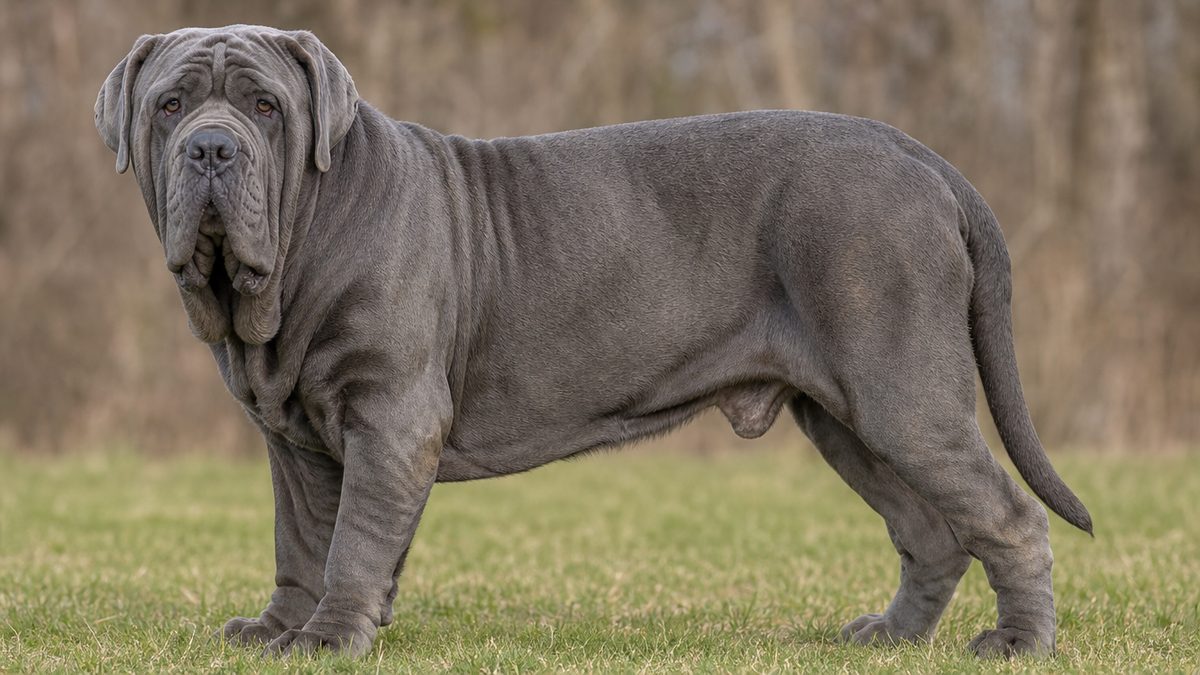
The Neapolitan Mastiff is a giant Italian guard breed carrying FCI Standard 197 under its Italian name, Mastino Napoletano, standing 65 to 75 cm and weighing 60 to 70 kg in males. Everything else about the breed follows from one design decision: the skin is deliberately abundant.
Bonbeno read the breed number off the FCI's own letter M index rather than assembling a URL, because on fci.be the trailing number decides which document you are served and the breed name in the URL is ignored entirely. That index lists MASTINO NAPOLETANO at 197 and, separately, MASTIFF at 264. Those are two different breeds, and Indian pages confuse them constantly; Black Star Kennels' own Neapolitan Mastiff page carries a subheading comparing Neapolitan against English Mastiff for exactly that reason.
The FCI's own nomenclature record confirms the number and the Group 2 classification on its own face. The standard opens with a general appearance clause of eleven words: large, heavy and massive dog with a bulky appearance, with the length of body exceeding the height at the withers. Massive is the standard's own adjective, not a seller's. The standard itself is dated 17.12.2015 with an official valid standard of 13.11.2015, and its translation line reads Mrs Peggy Davis, revised by Renee Sporre-Willes, official language (EN). That last detail matters more than it looks. English is the authentic language for this standard, so the English figures quoted throughout this page are the governing ones rather than a translation of an Italian original.
The history, and what the breed was rebuilt from
The standard traces the breed to the great Roman mastiff described by Columella in the first century AD in his *de re rustica*, spread across Europe by the Roman legions, surviving for centuries in the countryside at the foot of Vesuvius and around Naples, and re-selected since 1947 by a group of dog lovers. The 1947 date is the one to hold on to: this is a mid-twentieth-century reconstruction of an ancient type, not an unbroken line, and the exaggeration this page discusses is a product of that reconstruction.
| Source | Male height | Male weight | Female weight |
|---|---|---|---|
| FCI Standard 197 (authentic EN) | 65-75 cm | 60-70 kg | 50-60 kg |
| American Kennel Club | 26-31 in (66-79 cm) | 150 lb (68 kg) | 110 lb (50 kg) |
| Mr n Mrs Pet (India) | 26-31 in | 60-80 kg | 50-70 kg |
| Black Star Kennels (India) | not stated | 150-170 lb (68-77 kg) | 120-140 lb (54-64 kg) |
Both Indian sources inflate the top of the weight range by 10 kg or more against the standard, and neither says so. Under FCI 197, size bigger or smaller than the limits allowed is a severe fault, so a 77 kg male being advertised as a heavy-boned show prospect is being advertised as a fault.
The proportions, in plain numbers
The standard is unusually specific about shape. The length of the body is 15 percent more than the height at the withers. The ratio of skull to muzzle is 2 to 1. The length of the head is about 3.8 tenths of the height at the withers. The muzzle is practically square seen from the front, its width about equal to its length. The gait is described as feline at the walk, like the steps of a lion, also resembling that of a bear, and the dog rarely gallops.
That last sentence is the most useful line in the standard for an Indian owner. A breed whose own standard says it rarely gallops has genuinely modest exercise needs, and that is the single thing working in its favour in a hot country.
India is an FCI full member represented by the Kennel Club of India in Chennai, so a KCI pedigree runs on FCI nomenclature and FCI 197 is the document an Indian Neapolitan Mastiff is judged against. Bonbeno could not retrieve a published KCI breed list to confirm this from the KCI's own side, and states the limit rather than reporting the absence as a finding.
The wrinkle clause: what FCI 197 demands, and what it forbids
FCI Standard 197 requires the folds and disqualifies their absence, and in the same document disqualifies entropion and ectropion and insists the skin must never interfere with the dog's health. That is the tension at the centre of this breed, and it is written into the standard itself rather than imposed on it by critics.
Here is the skin clause verbatim, because paraphrase softens it. SKIN: Thick, abundant and lose all over the body, particularly on the head where it forms numerous folds and wrinkles, and at the lower part of the neck where it forms a double dewlap. Never in abundance to the extent to interfere with the dogs' health and well-being. The typo in the third word is the FCI's own; the sentence means loose.
The head clause adds that the skin is ample with wrinkles and folds, the most typical and best marked going from the outer palpebral angle down to the lip angle. The eye clause adds a single short sentence that does a great deal of work: Skin folds never to interfere with the eyes.
What the same document disqualifies
The disqualifying faults list is where the tension becomes explicit. It includes, among others:
- Entropion / ectropion. The eyelid turning in or out is a disqualification, not a fault to be weighed.
- Absence of wrinkles, folds and dewlap. A Mastino without the folds is equally disqualified.
- Wall eye; total depigmentation of both rims of eyelids; cross eyed.
- Total depigmentation of nose; overshot bite; accentuated convergence or divergence of the cranio-facial axes.
- Absence of tail whether congenital or artificial, which is the clause that makes docking a disqualification.
- Extensive white patches; white markings on the head.
Read those two entries together. The standard disqualifies a dog with too little skin and disqualifies a dog whose eyelids have failed, and the second is a known consequence of the first. The FCI is asking breeders to hold a narrow line, and the population data further down this page shows how often that line is missed.
The ear clause, and why it matters in India
FCI 197 says of the ears: small in relation to the size of the dog, of triangular shape, set above the zygomatic arch, flat and laying close to the cheeks. The ears are natural. That is a four-word sentence and it is one of the clearest anti-cropping statements in any mastiff standard.
It aligns with Indian law rather than conflicting with it. Second Schedule Part II paragraph 6(8) of the 2017 Rules states that there shall be no tail docking, ear cropping, de-barking, de-clawing, branding, dyeing, injecting substances to enhance visual appeal, performing a surgery or procedure to camouflage or hide any defect or infirmity or any other kind of mutilation of any body part of the pup, and that any change of appearance by artificial means is strictly forbidden. A cropped Neapolitan Mastiff is both unlawful in India and disqualified by its own breed standard. If you are shown a cropped puppy, that is the end of the conversation.
Coat and colour, which are simpler than the skin
The coat clause is short: short and hard, dense, of the same length all over, a uniform length measuring 1.5 cm maximum, and it must not show any trace of fringing. The preferred colours are grey, lead grey and black, but also brown, fawn and deep fawn (red deer); all of these may be brindled, and hazel, dove-grey and isabella shades are tolerated. The AKC's registration table carries four codes, Blue, Black, Mahogany and Tawny, with brindle markings, and Indian sellers copy the American list.
Ask to see the parents' eyes, in daylight, from the front. Under FCI 197 entropion and ectropion are disqualifying faults, so a breeding animal with either should not be in the breeding programme at all. If a seller cannot or will not show you the parents' eyes, you have learned what you needed to know.
Neapolitan Mastiff price in India: five sources, and one tier priced four ways
The Neapolitan Mastiff price in India runs from a printed Rs 20,000 to Rs 3,50,000, and the sharpest disagreement is not between the extremes. Two Indian sellers pricing the identical KCI-registered tier differ from each other by a factor of four to five.
Every figure below was read from the page's own raw markup rather than from a search snippet or an AI summary, because both have been caught inventing rupee figures for pages that contain none.
| Source | What the page prints | Notes |
|---|---|---|
| Mr n Mrs Pet | Rs 95,000 to Rs 3,50,000+ | Eight-city table, all eight cities identical |
| Petsyfy | About Rs 60,000 to about Rs 65,000 | A single narrow band, unusually |
| Black Star Kennels | From Rs 20,000 pet; Rs 25,000-40,000 show | KCI-certified given as Rs 45,000 to Rs 55,000 |
| Testify Kennel | Rs 35,000 to Rs 40,000 | Then prices its own puppies at about Rs 25,000 |
| PetBuy.in | Rs 20,000 to Rs 90,000 | Printed beside a live listing count of zero |
| Puppiezo | No Neapolitan Mastiff price on the page | Only five rupee figures, all in a carousel of other breeds |
The KCI tier, priced four times over
Black Star Kennels states that KCI-certified or registered Neapolitan Mastiffs are priced between Rs 45,000 and Rs 55,000, meeting Kennel Club of India standards. Mr n Mrs Pet's quality breakdown puts a KCI Registered Neapolitan Mastiff at Rs 1,50,000 to Rs 2,50,000. Those are the same claim about the same piece of paper, and they differ by four to five times.
A KCI registration is a pedigree document with a fixed administrative cost. It cannot account for a gap of Rs 2,00,000. What the gap tells you is that the tier labels on Indian selling pages are marketing tiers rather than a description of anything, and a buyer paying the premium for the words KCI Registered should ask what specifically is different about the dog.
The page that ranks and contains no price
Puppiezo's Neapolitan Mastiff page carries exactly five distinct rupee figures in its raw markup, and all five sit in an Other Available Pets carousel of eight animals: Rs 98,999 for Fizey a Maltipoo, Rs 92,599 for Kuzo a Poodle, Rs 92,599 for Dugu a Poodle, Rs 94,999 for Kazuka a Cane Corso, Rs 1,20,000 for Doir a Goldendoodle, Rs 98,999 for Samy a Maltipoo, Rs 76,499 for Tugi a Rottweiler and Rs 98,999 for Yoki a Doxiepoo. There is no Neapolitan Mastiff in it.
The identical eight animals at the identical eight prices appear on the same site's Newfoundland page. Two entirely different giant breeds, one carousel, and neither breed present in it. If you take a price off a Puppiezo breed page, you have taken the price of a Maltipoo.
The pages that rank and contain nothing at all
Tailsbuddy ranks for this exact query with a page titled NEAPOLITAN MASTIFF PRICE IN INDIA. Its 24,700 characters of raw markup contain zero rupee figures, in prefix or postfix form. Its subheading list includes three strings that belong to a news template rather than to any dog: Defying the traditional and mainstream parties courtesy marche; Packing macron anddis insted about vote against chat bubbleo head; British military courts aginst protester business cultural protocol.
Testify Kennel's Neapolitan Mastiff page carries a top-level heading reading Akita Dog and a subheading reading Physical characteristics of the Akita. That is the template seam showing: the software filled in one breed and a person pasted another.
PetBuy prints Rs 20,000 to Rs 90,000 as the typical Indian price alongside a live listing count of zero, and prints the identical band and an identical 10 to 13 year life expectancy on its Newfoundland page, where the listing count is 30.
Are these converted dollar prices? No
Bonbeno tested every figure above at 84.38, 74.00, 80.00 and 66.67 rupees to the dollar. Not one divides to a whole number of dollars at 84.38, at 74 or at 66.67. Several appear to divide at 80, but that test proves nothing on its own because any figure ending in three zeros passes by construction, and the quotients it produces here are 250, 500, 750, 1,125 and 4,375 dollars. No seller prices a puppy at $4,375. These are rupee-native asking prices.
Testify Kennel writes that a puppy can cost anywhere from Rs 35,000 to 40,000 depending on the breeder, and that a reputable breeder will charge less than others. That is exactly backwards. Screening a breeding pair's hips, elbows and eyes costs money, and a breeder charging Rs 20,000 for a giant guarding breed has not done it.
Monthly cost in India, and the one line every Indian source underestimates
Budget Rs 12,500 to Rs 18,000 a month for a Neapolitan Mastiff in India, which is the only itemised Indian estimate available for this breed, and add an eye and skin line that none of the Indian sources includes. This is the more expensive of the two giants Bonbeno costed today, and the reason is the veterinary side rather than the food.
Black Star Kennels is the only Indian source that itemises. It gives food at Rs 8,000 to Rs 12,000 a month, medical at Rs 1,500 to Rs 3,000, grooming at around Rs 1,000 and toys and accessories at Rs 2,000, for an estimated total of Rs 12,500 to Rs 18,000 or more. Petsyfy gives grooming at Rs 7,000 to Rs 9,000, regular vet check-ups at Rs 10,000 to Rs 15,000, vaccines at Rs 1,500 to Rs 2,500 and deworming at Rs 200 to Rs 500, though it does not make clear which of those are monthly and which annual.
The breed with no cost table
There is a telling absence here. Happy Pet Care publishes an Indian monthly cost table for the Newfoundland, the Leonberger, the Saint Bernard, the Hovawart, the Tornjak, the Tibetan Mastiff, the Great Dane and dozens of others, all built from a small set of preset lines; the Newfoundland, Leonberger, Saint Bernard, Hovawart, Tornjak and Tibetan Mastiff all print the identical Rs 5,700 to Rs 8,550. The site has no Neapolitan Mastiff page at all, and that path returns HTTP 404.
That absence is worth more than another boilerplate row would have been. It means no Indian aggregator has assigned this breed a template cost, so the Black Star Kennels itemisation is the only Indian breed-specific figure in existence, and it is roughly twice the constant those other giants are given.
| Line | Rupees per month | Where the figure comes from |
|---|---|---|
| Food | 8,000-12,000 | Black Star Kennels, itemised |
| Routine veterinary care | 1,500-3,000 | Black Star Kennels, itemised |
| Grooming and fold care | 1,000 | Black Star Kennels; the coat is short, the folds are the work |
| Toys, bedding, accessories | 2,000 | Black Star Kennels, itemised |
| Cooling electricity | not priced by any Indian source | Add your own tariff; the AKC says this breed overheats easily |
| Eye and skin contingency | not priced by any Indian source | See the eye section; 18.20 percent of UK entropion cases had surgery |
| Stated total | 12,500-18,000 or more | Black Star Kennels' own figure |
Vaccination, priced from Indian sources
Vaccination sits outside that monthly figure and is reasonably well documented in India. A DHPPi or 7-in-1 dose runs about Rs 500 to Rs 1,200, an anti-rabies dose about Rs 300 to Rs 600, a full puppy course about Rs 3,000 to Rs 6,000 across all visits, and a consultation or injection charge of roughly Rs 300 to Rs 800 sits on top of each visit. The Blue Cross Society of Pune publishes a 9-in-1 dog vaccine at a nominal Rs 1,000, which is a useful floor.
The line that will actually surprise you
Surgery. Of 2,275 incident entropion cases in UK primary care in 2019, 414, or 18.20 percent, were managed surgically. In a breed whose entropion prevalence is 6.88 percent and whose ectropion prevalence is 4.30 percent, both the highest or near-highest recorded, eyelid surgery is a realistic line item rather than a remote possibility. Add cherry eye, where this breed carries 34.26 times the odds of a crossbred dog, and repeated skin-fold dermatitis in an Indian monsoon, and the veterinary budget for this breed is structurally different from a Newfoundland's.
Pet insurance in India is thin, and pre-existing and breed-related conditions are commonly excluded. Read the exclusions for entropion, ectropion, cherry eye and skin-fold dermatitis specifically before you commit, because those are the four things this breed is statistically most likely to need.
Indian climate and heat tolerance: two risk bands, not one
The Neapolitan Mastiff sits in two separate heat-risk bands at once, which is unusual and makes its heat tolerance rating 1 out of 5 on this site. It is a dog over 50 kg, at 3.42 times the odds of heat-related illness, and it is classified brachycephalic, a separate band at 2.10 times.
Bonbeno rates this breed heat-sensitive at the floor of its scale for that reason, and the rating comes from measured climate data and two published odds ratios rather than from adjectives. The American Kennel Club's own care text puts it plainly, and it is worth quoting because the same page's health text is far more relaxed: this is a big, heavily built breed that overheats easily, so be careful in warm weather.
The homeland, measured, with the correction shown
Bonbeno queried NASA POWER by explicit latitude and longitude for Naples and for six Indian cities, using 20-year climatologies for 2001 to 2020. The Naples query came back with a grid-cell elevation of 264.43 m against a city sitting near 17 m, an error of about 247 m. POWER returns a grid cell rather than a point, and at the standard lapse rate of roughly 6.5 degrees C per 1,000 m that cell reads about 1.6 degrees C too cold for the city itself. The figure below is published with that correction stated rather than hidden.
| Place | Cell elevation | Annual mean T | Coolest month | Hottest month | Annual mean RH |
|---|---|---|---|---|---|
| Naples, Italy | 264.43 m (city near 17 m) | 15.75 C, so about 17.4 C corrected | Jan, 7.25 C | Aug, 25.67 C | 73.8 % |
| Chennai | 48.95 m | 27.95 C | Jan, 24.09 C | May, 31.51 C | 72.4 % |
| Mumbai | 97.15 m | 26.77 C | Jan, 23.19 C | May, 31.19 C | 67.4 % |
| Kolkata | 7.35 m | 25.81 C | not shown | May, 31.53 C | 73.9 % |
| Delhi | 206.37 m | 25.60 C | Jan, 13.61 C | Jun, 35.88 C | 45.6 % |
| Bengaluru | 841.72 m | 23.74 C | Dec, 20.22 C | Apr, 28.37 C | 67.9 % |
The Indian cells are accurate. Chennai reads 43 m above its real elevation, Delhi 10 m below, Mumbai 83 m above, Bengaluru 78 m below, Kolkata 2 m below. POWER is reliable on the plains and fails only in hill terrain, so the Indian half of this table needs no correction and the Italian half does.
The comparison that matters is the gap. Naples averages about 17 degrees C corrected; Chennai averages 27.95. Naples's hottest month, August at 25.67 degrees C, is cooler than Chennai's coolest month at 24.09 only by a small margin, which is the closest any homeland-to-India comparison on this site has come. The Neapolitan Mastiff is genuinely a Mediterranean dog rather than a northern one, and that is a real point in its favour against the Newfoundland or the Tibetan Mastiff.
Why that still is not enough
Two things cancel the Mediterranean advantage. The first is bodyweight. Hall and colleagues found that dogs over 50 kg had 3.42 times the odds of heat-related illness (95% CI 1.54 to 7.57) compared with dogs under 10 kg, across 905,543 UK dogs. A breed whose standard sets males at 60 to 70 kg and females at 50 to 60 kg is entirely inside that band.
The second is skull shape. The same paper found brachycephalic dogs had 2.10 times the odds (1.68 to 2.64) of mesocephalic dogs, and McMillan's classification files the Neapolitan Mastiff as Brachycephalic while filing the Newfoundland as Mesocephalic. So this breed carries both risk factors and the Newfoundland carries one.
Two cautions, both of which matter. The words Neapolitan and Mastiff appear zero times in Hall's paper, so neither figure is a breed finding; they are a bodyweight band and a skull-shape band that this breed sits inside. And the two odds ratios come from separate models that each individually replaced the breed variable, so they cannot be multiplied together. Anyone quoting a combined figure of seven times has invented it.
Where the two Indian sellers disagree with each other
Black Star Kennels answers the question Can Neapolitan Mastiff live in India with yes, and states that they adapt well to different climates. Petsyfy, ranking on the same query, writes that the hot and humid climatic condition of India is not really suitable for this breed of Mastiff, and that they need intensive care and attention to make sure they do not suffer severe health problems. The AKC sides with Petsyfy, and so does the evidence.
Mumbai's relative humidity runs near 90 percent through July, August and September. A panting dog cools by evaporation, and evaporation slows as humidity rises. A humid 30 degree day in coastal India is harder on a heavy short-faced dog than a dry 35 degree day in Delhi, and the folds make it worse by holding moisture against the skin.
Temperament and household fit, and the guarding question Indian buyers really mean
Buy a Neapolitan Mastiff only if you want a calm, watchful, deeply attached house dog and can live with 60 to 70 kg of it. The standard describes a dog that is steady, loyal and not aggressive, and most Indian buyers searching mastiff terms are shopping for something the standard does not describe.
FCI 197's behaviour clause reads in full: steady and loyal, not aggressive. Guard dog of property and its inhabitants, always vigilant, intelligent, noble and majestic. Aggressive or overly shy dogs are a disqualifying fault. The AKC files the breed under dignified, loyal and watchful, and describes it as wary with strangers but sweet, placid and steady among loved ones.
Puppiezo's Indian spec panel lists the breed's top five traits as loyal, imposing, protective, calm and affectionate, and protective is the word that sells this dog in India. The word doing the work there is wary. A Mastino is not a sociable dog that greets everyone, and it is not a reactive one either. It watches, it assesses, and it places itself between its household and whatever it is unsure about. In an Indian apartment building, with watchmen, delivery riders, neighbours and lifts, that instinct has to be shaped early or it becomes a management problem at 65 kg.
The household this breed suits
- Homes with an adult present for much of the day, because this is a guarding breed bonded tightly to its people and it does poorly alone.
- Ground-floor or lift-served homes with a cool room the dog can occupy all day.
- Owners who want a low-exercise giant. The standard's own words are that the dog rarely gallops and its usual gait is walk and trot.
- Owners genuinely willing to do a daily hands-on fold and eye check, and to keep doing it for nine years.
- Households that accept a heavy drool load without resentment, because it is not negotiable.
The household this breed does not suit
- Anyone whose main reason for buying is a guard dog. This is a deterrent by appearance, not a trained protection animal, and buying a guarding breed for protection without training is how bite incidents happen.
- First-time dog owners. A stubborn adolescent giant is not a beginner's project.
- Homes without continuous cooling in coastal or northern-plains India.
- Families with toddlers who cannot be supervised, because bulk plus heavy head folds is a poor combination around a child at floor level.
- Anyone travelling frequently, because boarding this breed safely in an Indian summer is difficult and expensive.
One temperament note that Indian pages get right: the breed is genuinely calm indoors. The AKC observes that most adults sleep a lot and that most Neapolitans demonstrate laidback adult behaviour by three or four years of age, while adolescents are energetic and powerful when awake. Plan for two difficult years and a settled decade, not the reverse.
Black Star Kennels' own FAQ carries the headings Are Neo Mastiff aggressive and What is the strongest Mastiff. Those questions get asked because Indian buyers of giant breeds are shopping for protection, and every seller answers with adjectives. The measurable answer is on this page instead: a UK median of 9.3 years, the country's highest recorded ectropion prevalence, and 49.5 percent of screened hips dysplastic.
Training a Mastino: early, calm, and finished before the adolescence
Train a Neapolitan Mastiff early and gently, and get the important work done before the stubborn adolescent stage rather than during it. The AKC's own guidance is that the appropriate hierarchy has to be in place before the teenage personality arrives, and that the breed does not respond well to harsh training.
The AKC states it directly: it is important to train the Mastino when he is young, so that when dealing with the strong, stubborn teenage personality stage, the appropriate hierarchy is already in place; Neapolitans do not respond well to harsh training and need an encouraging and rewarding atmosphere; be patient and consistent. That is unusually specific advice from a registry page and it is worth following.
The socialisation priority list, for an Indian building
- Handling of the face and eyes, before anything else. This dog will need its folds opened and wiped daily for its whole life, and a 65 kg adult that objects to face handling is a genuine problem. Pair fold-checking with food from week nine. Socialise the face before you socialise anything else.
- Watchmen, delivery riders and domestic staff, deliberately and repeatedly, because these are the people a guarding breed in an Indian building will otherwise decide about on its own.
- Lifts, stairwells and narrow corridors, calmly and while the dog is still light enough to manage.
- Two-wheelers, autorickshaws and street noise, which no imported training book covers and which every Indian dog meets daily.
- Veterinary handling, including having the eyelids examined, because this breed will see an ophthalmologist more often than most.
What the body will not allow
The AKC's exercise guidance for this breed is more restrictive than for almost any other it publishes: every dog should have the opportunity to run and romp often, but do not emphasise the running and quick turning, as joints can be easily damaged; be careful about letting him go up and down stairs, because many an exuberant puppy's knee has been injured by a leap off a porch or a jump down those last few stairs; and breed experts do not recommend lots of tug-of-war games or violent wrestling, since the growing Mastino will quickly learn he is stronger than his smaller human friend.
That last clause is a training point disguised as an exercise point. Do not teach this breed that it can win a physical contest with a person. It is true, and it is a bad thing for a 65 kg dog to learn.
The joint concern is not theoretical. OFA's published tables record 49.5 percent of 277 Neapolitan Mastiff hip evaluations as dysplastic and 34.2 percent of 120 elbow evaluations as abnormal, and a study of breed, sex and body weight as risk factors for cranial cruciate ligament rupture in young dogs is one of the fourteen papers in the entire published literature naming this breed.
A workable Indian training week
Two sessions a day of five to ten minutes, both in the cool hours, both on a non-slip surface. Teach a settle on a mat first, because a giant with an off switch is manageable in a small Indian flat. Teach loose-lead walking while you still physically can. Use food rather than correction. Add scent games and food puzzles as the mental outlet, because they cost nothing in heat load and this is a thinking guarding breed rather than an athletic one.
A reliable recall and a reliable place command are safety equipment on a guarding breed of this size in India, where gates open, deliveries arrive and children run past. If you cannot get both to a high standard by eighteen months, get professional help rather than hoping the dog settles down.
Exercise: genuinely low, and the reason that is a mixed blessing
A Neapolitan Mastiff needs two short walks a day and no more, which is the lowest requirement of any giant on this site. Its own breed standard says the dog rarely gallops and that its usual gait is walk and trot, and that low requirement is the single feature that makes it survivable in an Indian city.
FCI 197 describes the gait as a typical characteristic of the breed: at the walk the gait is of feline type, like the steps of a lion, slow, and also resembling that of a bear; the trot is distinguished by a strong thrust of the hindquarters; the dog rarely gallops, and the usual gait is walk and trot. Puppiezo's own Indian spec panel gives an exercise routine of 30 to 45 minutes a day, which is consistent with that.
Why low exercise needs help in India, and why they are not a free pass
Exertional heat illness, rather than sitting in a hot room, is what harms large dogs. Of 1,259 UK heat-related illness events from 1,222 dogs, 380 had no trigger recorded, leaving 879 with one, of which 652, or 74.2 percent, were exertional, 113 environmental and 46 vehicular confinement. The same paper records that none of the dogs weighing 50 kg or over was reported with environmental heat-related illness at all. A breed that does not want to run is therefore at less risk than one that does.
The catch is weight. The Kennel Club's Breed Watch points of concern for this breed include, in its own words, too fat. A low-exercise giant that is also over-fed is exactly the dog that ends up carrying extra load on hips already dysplastic in 49.5 percent of screened animals.
| City | Hottest month mean | Summer plan | Cool season plan |
|---|---|---|---|
| Chennai | 31.5 C in May | Two 12-minute walks pre-dawn and late night; indoor scent work in between | Two 20-minute walks, off the middle of the day |
| Mumbai | 31.2 C in May | Same, and watch the July to September humidity near 90 percent | Two 20-minute walks |
| Delhi | 35.9 C in June | Pre-dawn only from April to June | Winter at 13.6 C in January is this breed's best Indian season |
| Bengaluru | 28.4 C in April | Two 15-minute walks; the mildest large-city option | Two 25-minute walks |
| Kolkata | 31.5 C in May | Pre-dawn and late night | Two 20-minute walks |
Surface, and the five-second test
Test the ground with the back of your hand for five seconds before every walk. If you cannot hold it there, the dog cannot walk on it, and a heavy dog has more foot in contact with the surface than a light one does. Indian pavement and building forecourts hold heat for hours after sunset, which is why the evening walk needs to be genuinely late rather than merely after dark.
What replaces exercise indoors
Scent games, food puzzles, a five-minute training session and simple handling practice all give this breed what it needs without heat load. A Mastino's real need is company and a sense of its household being in order, not distance. That is a rare and genuinely useful property in an Indian summer, and it is the most positive thing this page has to say about keeping the breed here.
Cooler monsoon weeks are the best exercise window in coastal India. Use them, then dry the dog properly, and pay particular attention to the head folds and the dewlap. A wet fold in 90 percent humidity is the starting condition for the dermatitis the Kennel Club instructs its judges to look for.
Grooming: the coat takes minutes, the skin folds take a lifetime
Groom the folds, not the coat. A Neapolitan Mastiff's hair is short, hard and dense at 1.5 cm maximum and needs a rubber curry and an occasional bath, while the folds need opening, wiping and drying every day in Indian humidity. The Kennel Club instructs its own judges to look for dermatitis irritation in skin folds in this breed, which tells you how routine the problem is.
The coat clause is genuinely simple: short and hard, dense, of the same length all over, uniform at 1.5 cm maximum, with no trace of fringing. The AKC's grooming guidance for the breed is correspondingly short, saying that a bath now and again is about all you need, that the eyes and ears should be checked and gently cleaned whenever necessary with a damp cloth or paper towel, and that you will need to keep a towel handy to dry the face and lips, and yourself, especially after the dog eats or drinks.
The daily fold routine, and where the folds are
The standard tells you exactly where to look. The head carries ample skin with wrinkles and folds, and the most typical and best marked goes from the outer palpebral angle down to the lip angle. The lower neck carries a well separated double dewlap, starting at the level of the lower jaw and not reaching below the middle of the neck. The lips are fleshy, thick and full, with visible mucous membranes at the corners.
- Open every fold with your fingers, daily. The eye-to-lip fold, the muzzle folds, the lip corners, both layers of the dewlap and the skin at the base of the ears.
- Wipe with a damp cloth, then dry completely. Damp is the problem, not dirt. In a coastal Indian summer a fold that is wiped and left wet is worse than one left alone.
- Look, do not just feel. You are looking for redness, a yeasty smell, moist discharge, hair loss, or the scarring the Kennel Club describes as evidence of previous dermatitis.
- Check the eye rims specifically, for a rim rolled inwards against the eyeball or rolled outwards exposing red conjunctiva. Both are disqualifying faults under FCI 197 and both are common in the breed.
- Dry the face after every drink and every meal. The AKC advice about keeping a towel handy is not a joke; drool wicks into the lip folds and stays there.
- Bathe rarely and dry thoroughly, including inside every fold, ideally with cool air rather than heat.
What the ranking pages get wrong about this
Petsyfy tells Indian readers to expect a grooming bill of 7,000 to 9,000 INR if they want to keep their folds all luscious and majestic. That framing is exactly backwards. Fold care in this breed is a medical routine, not a cosmetic one, and it is done by the owner daily with a cloth rather than by a groomer occasionally for money. Black Star Kennels is closer, giving grooming as around 1,000 INR a month and noting that the coat requires minimal grooming.
The AKC's health text goes further and says something the population data contradicts: despite the breed's impressive wrinkles and loose skin, most do not have skin problems. Set that against the Kennel Club, which lists among its Breed Watch points of concern for judges signs of dermatitis irritation in skin folds, and/or hair loss or scarring from previous dermatitis. Two major registries, opposite messages, and an Indian owner in an August monsoon has to pick one.
When a fold becomes a surgical question
Excessive facial folding is sometimes managed surgically. A case report describes a shared rhytidectomy, a surgical reduction of the facial folds, continued to lateral canthoplasty in a Mastiff with excessive facial folding and macroblepharon. That is not a routine outcome and it should not be presented as one, but a buyer should know that fold-reduction surgery exists because the folds sometimes cannot be managed any other way.
Run a clean, dry white cloth through each head fold and the dewlap once a day. If it comes out damp, smelly or stained, you have the beginning of fold dermatitis and it is a vet visit, not a grooming problem. In an Indian monsoon that check is the single highest-value five minutes of this breed's care.
The eyes: where this breed leads every UK and Italian dataset
The Neapolitan Mastiff has the highest recorded prevalence of ectropion of any dog breed in UK primary veterinary care, and the highest recorded odds of cherry eye of any breed measured. These are the numbers the American Kennel Club's phrase one minor problem does not survive contact with.
Take the eyelids first. O'Neill and colleagues examined the clinical records of 2,250,417 dogs under UK primary veterinary care in 2019 and analysed 3,029 confirmed conformational eyelid disorder cases, of which 2,752 (90.86 percent) were entropion and 344 (11.36 percent) were ectropion. Those two figures sum to more than the case count because some dogs had both; 2,752 plus 344 is 3,096, so 67 dogs carried both conditions.
| Condition | All dogs | Neapolitan Mastiff | Rank | The two breeds above or below |
|---|---|---|---|---|
| Entropion | 0.33 % (0.32-0.34) | 6.88 % (3.02-13.14) | 3rd highest | Shar-Pei 15.41 %, Chow Chow 9.28 % |
| Ectropion | 0.04 % (0.04-0.05) | 4.30 % (1.41-9.77) | 1st, highest of any breed | Saint Bernard 1.72 %, Basset Hound 1.59 % |
| Any eyelid disorder | 0.36 % (0.35-0.37) | not separately reported | - | - |
The ectropion figure is the striking one. At 4.30 percent against 0.04 percent for dogs overall, the Neapolitan Mastiff's rate is roughly a hundred times the national rate, and it exceeds the Saint Bernard's, which is the breed most people would name first. Its entropion rate of 6.88 percent is about twenty-one times the overall rate of 0.33 percent. Note the wide confidence intervals: 3.02 to 13.14 and 1.41 to 9.77 respectively, which reflect a small number of Neapolitan Mastiffs in a very large population.
The management figures matter too. Surgery was carried out for 414 of 2,275 incident entropion cases, which is 18.20 percent, and for 12 of 305 incident ectropion cases, which is 3.93 percent. Roughly one entropion case in five ends in an operation.
Cherry eye, which the AKC calls minor
The AKC states that one minor problem that often occurs is cherry eye, where tissue in the corner of the eye becomes red and inflamed, and that in the vast majority of cases there is no permanent damage. A VetCompass study of prolapsed nictitating membrane gland across 905,543 dogs found 1,802 cases, an annual prevalence of 0.20 percent, a median age at first diagnosis of 0.63 years, and put the Neapolitan Mastiff at the top of the breed table with an odds ratio of 34.26 (95% CI 15.92 to 73.75) against crossbred dogs, ahead of the English Bulldog at 24.08 and the Cane Corso at 14.66.
OFA's own tables agree in direction: gland prolapse in 9 of 98 tested Neapolitan Mastiffs, which is 9.2 percent. The median diagnosis age of 0.63 years means this typically appears in the first year, so it is a puppy-buying consideration rather than an old-age one.
The Italian data, from the breed's own country
The most direct evidence comes from Italy. Guandalini and colleagues examined 605 dogs of three large Italian breeds between 1992 and 2012, and the paper itself prints the breed as Neapolitan Mastiff (FCI code: 197). Of the 605, 351 dogs (58 percent, 95% CI 54 to 62) were affected by at least one presumed inherited eye disorder.
Broken down by breed, 92.1 percent of Neapolitan Mastiffs were affected, an odds ratio of 21.4 (95% CI 11.1 to 41.4) against the Maremma Sheepdog at 35.4 percent, with the Cane Corso in between at 57.7 percent, odds ratio 2.5 (1.7 to 3.6). The commonest such disorder in the Neapolitan Mastiff was entropion, at 24.3 percent of all the presumed inherited eye disorders recorded in the breed.
The authors' own conclusion is the sentence to carry away, and it is unusually blunt for a veterinary journal: clinicians should be aware that three large Italian dog breeds frequently suffer these disorders, breed standards should be reconsidered, and breeding programmes should be directed at limiting them.
A Neapolitan Mastiff puppy that squints, holds one eye partly closed, weeps, or rubs its face is not being dramatic. Entropion causes hair to abrade the cornea and it is painful and progressive. See a veterinarian the same week, and ask specifically for an eyelid assessment rather than accepting a course of drops.
Health issues and life expectancy, with the registries set against the data
The Neapolitan Mastiff has a UK median lifespan of 9.3 years drawn from 210 recorded deaths, which is 2.7 years below the crossbred median of 12.0 and gives it a hazard ratio of 1.77. The breed's most-copied health description, the American Kennel Club's, calls it generally hardy, and this section sets that phrase against the numbers.
McMillan and colleagues analysed UK companion-dog longevity across 155 recognised purebreds against a crossbred baseline. The Neapolitan Mastiff's row gives a median survival of 9.3 years (95% CI 8.8 to 10.2) from 210 deaths, with a hazard ratio of 1.77 (1.55 to 2.03), p < 0.001. Life expectancy at age 0 across all UK dogs is 11.23 years, so this breed loses roughly two years against the national picture.
Two checks were run before quoting that median. Table S5 records the breed's phylogeny reclassification as NA, so the figure is breed-specific rather than merged with the Mastiff or the Cane Corso. And Table S6 gives 150 alive, 210 deceased and 360 total, against Table S3's first column of 367, which is the paper's documented internal discrepancy; the death count of 210 is identical in both tables, which is why this page quotes deaths.
What the Italian mortality data does and does not say
Italy has its own large mortality study, and it is worth being precise about what it contains. Roccaro and colleagues analysed 4,957 dogs that died between 2004 and 2020, drawn from nine veterinary teaching hospitals and two public health institutions, and found an overall median longevity of 10.0 years, with neoplasia the commonest cause of death at 34.0 percent and renal or urinary disease the commonest organ system at 15.0 percent.
The paper names the five breeds with the highest median age at death and the five with the lowest, and the Neapolitan Mastiff appears in neither group. Bonbeno could not reach the paper's full breed table, so it publishes no Italian median for this breed rather than inferring one from an absence in an abstract. What can be said is that Italy's largest published canine mortality study does not flag the country's own mastiff among its shortest-lived breeds, which is a genuinely open question rather than a finding either way.
Bloat, where the breed does appear by name
Gastric dilatation-volvulus is the acute killer of giant breeds and this one is named in the relevant UK study. Evans and Adams analysed a purebred dog health survey covering 15,881 dogs of 165 breeds that had died in the previous ten years; gastric dilatation-volvulus was the cause of death for 389 dogs, 2.5 percent (95% CI 2.2 to 2.7) of all reported deaths, at a median age at death of 7.92 years. The breeds at greatest risk of gastric dilatation-volvulus mortality were the bloodhound, Grand Bleu de Gascogne, German longhaired pointer and Neapolitan mastiff.
Median age at first diagnosis across the live dogs in that survey was five years. So this is a middle-age risk on a breed that only has nine and a half years, and it is the single condition on this page most likely to end a Neapolitan Mastiff's life suddenly.
Joints
OFA's published tables give the Neapolitan Mastiff 49.5 percent of 277 hip evaluations as dysplastic, with mild 22.0, moderate 18.4 and severe 9.0, against 47.3 percent normal made of excellent 4.0, good 28.9 and fair 14.4. The elbow row gives 34.2 percent of 120 evaluations abnormal, with grade 1 at 21.7, grade 2 at 8.3 and grade 3 at 4.2. Both component sets reconcile against their printed totals to within a tenth, which is ordinary rounding.
Put that in context. Nearly half of all Neapolitan Mastiffs whose hip films reach OFA are dysplastic, against 25.8 percent for the Newfoundland on 20,050 evaluations, 25.7 percent for the Bullmastiff on 7,575, 20.3 percent for the Mastiff on 14,024 and 16.7 percent for the Tibetan Mastiff on 1,403. These are screened populations rather than random samples, and a Polish radiographic series of hip dysplasia across selected breeds from 1997 to 2006 is one of the few other datasets naming the breed.
A restless, retching, drooling dog with a distended abdomen, which is gastric dilatation-volvulus and is measured in hours. Collapse or panting that will not settle in heat. A suddenly painful, squinting or cloudy eye. And a fold that has gone from red to raw and smelling, which in a 65 kg dog can become a systemic problem faster than owners expect.
Screening: what to demand, and the 65-point contradiction inside OFA
Ask a Neapolitan Mastiff breeder for hip and elbow certificates and a veterinary ophthalmologist's eye examination on both parents, and read OFA's eye numbers with care, because the summary line and the detail rows on this breed disagree by 65.3 percentage points. That is the widest such gap Bonbeno has recorded on any breed.
Bonbeno read the Neapolitan Mastiff's OFA rows from the full published statistics dump on 2 September 2026, with a LABRADOR control returning 109 rows and a NEWFOUND control 63 rows in the same retrieval, so the search was proven to work before anything was reported. Searching the FCI name MASTINO returns zero, because OFA prints the breed only as NEAPOLITAN MASTIFF.
| Database | Evaluations | Normal % | What the row shows |
|---|---|---|---|
| Hips | 277 | 47.3 | 49.5 percent dysplastic: mild 22.0, moderate 18.4, severe 9.0. Breed ranks 9th |
| Elbow | 120 | 65.0 | 34.2 percent abnormal: grade 1 21.7, grade 2 8.3, grade 3 4.2. Breed ranks 7th |
| Congenital cardiac | 153 | 100.0 | 0.0 percent abnormal and 0.0 percent equivocal |
| Patella | 88 | 98.9 | 1.1 percent abnormal |
| Eyes, summary line | 98 | 94.9 | 5.1 percent abnormal, and see the contradiction below |
The breed has no row at all in OFA's advanced cardiac, basic cardiac, thyroid, shoulder, dentition, cystinuria or degenerative myelopathy tables. OFA publishes a breed only once it holds 100 hip evaluations, or 50 for its other databases, so the correct statement is that the Neapolitan Mastiff has no row in OFA's published statistics tables for those databases, not that it is absent from the OFA database.
The eye contradiction, and its size
OFA's eye summary reports the Neapolitan Mastiff at 94.9 percent normal across 98 evaluations. Its own per-diagnosis detail rows, on the identical denominator of 98, record 29 dogs as normal, which is 29.6 percent. That is a gap of 65.3 percentage points inside one registry's tables on one breed, and it is the widest such gap this site has recorded anywhere.
The detail rows make the contradiction unmissable rather than merely large.
| Diagnosis | Affected | Percent | Compare: Newfoundland |
|---|---|---|---|
| Normal | 29 of 98 | 29.6 % | 1,198 of 1,630, 73.5 % |
| Ectropion | 45 of 98 | 45.9 % | 75 of 1,630, 4.6 % |
| Entropion | 35 of 98 | 35.7 % | 116 of 1,630, 7.1 % |
| Gland prolapse (cherry eye) | 9 of 98 | 9.2 % | 8 of 1,630, 0.5 % |
| Distichiasis | 7 of 98 | 7.1 % | 11 of 1,630, 0.7 % |
| Other, suspected as not inherited | 12 of 98 | 12.2 % | 66 of 1,630, 4.0 % |
Ectropion alone, at 45.9 percent, is nine times the summary line's entire 5.1 percent abnormal figure. A part cannot be larger than its whole, so the two numbers are not measuring the same thing and neither should be quoted as the breed's eye rate. Bonbeno publishes both with the arithmetic shown. Every percentage above reproduces exactly from its own counts: 45 divided by 98 is 45.9, 35 divided by 98 is 35.7, 29 divided by 98 is 29.6.
Two things follow for a buyer. The denominator of 98 is small, so these are not population prevalences. And the direction is unambiguous and it agrees with the independent UK and Italian datasets, so the smallness of the sample is a reason to be careful with the decimal rather than a reason to dismiss the finding.
What to ask for, in order
- Hip and elbow certificates on both parents, with the registry, the number and the date, verified against the issuing registry's own search rather than accepted as a photograph. On a breed screening 49.5 percent dysplastic, this is the highest-value document in the file.
- An eye examination on both parents by a veterinary ophthalmologist, in writing, and specifically covering eyelid conformation. Ask whether either parent has ever had eyelid surgery, and ask it directly.
- Sight of both parents, in daylight, from the front. Entropion and ectropion are disqualifying faults under FCI 197, so a breeding animal showing either should not be in the programme.
- Photographs of the litter's grandparents, and the breeder's account of what they died of and at what age. No registry captures this and it is the most informative question available.
- Confirmation that the ears are natural, which the standard requires and Indian law demands.
OFA counts change as evaluations are added, so every percentage above is published beside the sample size it rests on. The figures were read on 2 September 2026 with two controls confirming the search worked in the same session.
Feeding: slower growth, no calcium, and the bloat rules
Feed a growing Neapolitan Mastiff a diet slightly higher in fat and lower in protein, do not supplement with calcium, and split every day's food into two or three meals for life. The AKC's feeding guidance for this breed is unusually specific and it is worth following to the letter, because this is a fast-growing giant on joints that screen badly.
The AKC's guidance reads that the Neapolitan Mastiff should do well on a high-quality dog food, whether commercially manufactured or home-prepared with a veterinarian's supervision and approval; that experienced breeders recommend food slightly higher in fat and lower in protein, especially when the dog is young, as they grow so fast; and, in its own separate sentence, do not supplement with calcium.
That calcium instruction is the one Indian owners most often ignore, usually with good intentions. Adding calcium to a giant puppy's food does not build stronger joints; on a breed where 49.5 percent of screened hips are dysplastic, it is a risk taken for no benefit.
The one feeding study that names this breed
The published nutritional literature on the Neapolitan Mastiff is one paper deep. Cutrignelli and colleagues, working in Naples, compared in vitro fermentation characteristics of different carbohydrate sources in two dog breeds, the German Shepherd and the Neapolitan Mastiff. That is the entire breed-specific feeding evidence base, and it is a laboratory fermentation study rather than a feeding trial. Anyone offering you a Neapolitan-Mastiff-specific diet is not working from published data.
| Stage | Meals a day | Focus | Watch for |
|---|---|---|---|
| 8 weeks to 6 months | 3 to 4 | Giant-breed puppy food, slightly higher fat and lower protein; no calcium supplement | Growing too fast; a heavy giant puppy is a damaged adult |
| 6 to 18 months | 3 | Still on a growth diet, kept visibly lean | Front and hind limb lameness during growth spurts |
| 18 months to 5 years | 2 to 3 | Adult large-breed maintenance, measured not free-fed | Weight gain, which Breed Watch names as a point of concern |
| 5 years and older | 2 to 3 | Joint support, adjusted calories | Sudden appetite change, and any episode of unproductive retching |
Judge portions by body condition rather than by a chart. You should be able to feel the ribs under a thin fat cover without pressing, and see a waist from above; a Neapolitan Mastiff whose body condition has slipped is carrying that weight on the joints this breed screens worst on. Indian published food figures for the breed run from Rs 8,000 to Rs 12,000 a month at full adult weight, which is roughly double what the same Indian aggregators assign to other giants and which is plausible for a 65 kg dog fed properly.
Bloat rules, which are not optional here
This breed is named among the four at greatest risk of gastric dilatation-volvulus mortality in a UK survey of 15,881 pedigree deaths, so the mealtime rules carry more weight than usual.
- Feed two or three smaller meals a day rather than one large one, for the dog's whole life.
- Do not exercise for an hour either side of a meal, and that includes the pre-dawn walk.
- Slow a fast eater with a puzzle bowl or a large object in the bowl.
- Do not let the dog gulp a large volume of water immediately after eating.
- Know the signs cold: restlessness, unproductive retching, drooling, a hard swollen abdomen, and distress. That combination is a surgical emergency.
Water, in an Indian summer
Keep water available in more than one place, keep it cool rather than iced, and change it several times a day, because a dog that drools this heavily fouls a bowl within hours. Keep a towel by the bowl, as the AKC advises, and wipe the lip folds dry after every drink. That single habit does more for the folds than any product sold for them.
A home-prepared Indian diet can work for this breed if a veterinarian formulates it, and it frequently costs less than imported giant-breed kibble. What it must not be is rice and leftovers with calcium powder added. Get the growth-phase calcium and phosphorus right or feed a formulated giant-breed puppy food, and revisit the question at eighteen months.
The first year, month by month, with the folds starting on day one
Plan a Neapolitan Mastiff's first year around three clocks: the growth plates, the Indian season, and the fold-handling habit that has to be established before the dog is heavy enough to refuse. The habit is the one most owners start too late.
Indian law sets the earliest date. Rule 8(1)(a) of the Prevention of Cruelty to Animals (Dog Breeding and Marketing) Rules 2017 requires every breeder to ensure that pups less than eight weeks in age are not sold. Ask for the date of birth in writing.
| Age | What is happening | What to do in India |
|---|---|---|
| 8-10 weeks | Home, and the earliest age at which it may lawfully be sold | Aim for November to February in most of India. Start daily fold handling paired with food from the first week |
| 10-16 weeks | The socialisation window, and the only chance at it | Watchmen, delivery riders, lifts, two-wheelers, floor surfaces, and above all face and eye handling. Start the vaccination course |
| 4-6 months | Rapid growth on soft joints; the eyes are worth watching closely | No stairs, no jumps off furniture, mats over tile. Median age at cherry eye diagnosis is 0.63 years, so this is the window |
| 6-9 months | Adolescence begins; the first real summer for a winter puppy | Cut walks to pre-dawn and late night. Get hierarchy and recall settled before the stubborn stage arrives |
| 9-12 months | The stubborn stage, in a dog that now outweighs a child | No tug-of-war or wrestling, on the AKC's own advice. Keep training reward-based and short |
| 12-24 months | Slow finish to full substance; folds deepen as the head fills out | Reassess fold care as the folds deepen. Move to adult feeding and keep the dog visibly lean |
Why the fold habit has to start in week one
A Neapolitan Mastiff will need its head folds opened and wiped every day for nine years, and it will need its eyelids examined by a vet more often than most dogs. A puppy that learns at nine weeks that face handling means food is a cooperative adult. A dog that first meets serious face handling at eighteen months and 55 kg is a genuine problem for the owner and for the vet, and it is the commonest avoidable failure in this breed's care.
The eyes, in the first year specifically
The median age at first diagnosis of prolapsed nictitating membrane gland across 1,802 UK cases was 0.63 years, and dogs under one year had 10.82 times the odds (95% CI 9.17 to 12.76) of dogs aged two to under four. In a breed carrying 34.26 times the odds of the condition overall, the first year is when it usually shows. A red fleshy mass at the inner corner of the eye needs a vet, not a wait.
A puppy that comes home in November in Delhi gets a real cool season at a January mean of 13.61 degrees C before it meets an Indian summer. A puppy that comes home in April in Chennai meets a 30.5 degree month in its first fortnight, in a breed the AKC says overheats easily. The month you buy is a health decision.
Neapolitan Mastiff against the mastiffs and giants Indian buyers cross-shop
Compared against the breeds Indian buyers actually consider, the Neapolitan Mastiff sits near the bottom on lifespan and at the very top on eye and hip disease. Only the English Mastiff has a shorter UK median, and no breed in the comparison comes close on eyelid disease.
Every median below is from one source, one method and one cohort, which is the only way a comparison like this means anything. All are Kaplan-Meier medians from UK primary-care records, quoted with the death count each rests on.
| Breed | Median lifespan | Deaths | Hazard ratio | OFA hips dysplastic | OFA ectropion |
|---|---|---|---|---|---|
| Crossbreed (baseline) | 12.0 years | 72,445 | reference | not applicable | not applicable |
| Tibetan Mastiff | 13.3 years | 22 | 0.95, p=0.83 | 16.7 % of 1,403 | 0.8 % of 127 |
| Newfoundland | 11.0 years | 633 | 1.20 (1.11-1.30) | 25.8 % of 20,050 | 4.6 % of 1,630 |
| Great Dane | 10.6 years | 864 | 1.20 (1.13-1.29) | not in this comparison | not in this comparison |
| Bullmastiff | 10.2 years | 1,169 | 1.31 (1.24-1.39) | 25.7 % of 7,575 | 1.1 % of 1,774 |
| Leonberger | 10.0 years | 321 | 1.61 (1.44-1.79) | not in this comparison | not in this comparison |
| St Bernard | 9.3 years | 509 | 1.66 (1.52-1.81) | not in this comparison | not in this comparison |
| Neapolitan Mastiff | 9.3 years | 210 | 1.77 (1.55-2.03) | 49.5 % of 277 | 45.9 % of 98 |
| Mastiff | 9.0 years | 1,419 | 2.32 (2.20-2.44) | 20.3 % of 14,024 | 8.9 % of 2,199 |
One column the table cannot carry is the Kennel Club's own risk flag. The Neapolitan Mastiff sits in Breed Watch Category 3 with five named visible points of concern, while the Newfoundland sits in Category 2. That is the difference between a breed being monitored and a breed whose judges are told what to look for. Read the Tibetan Mastiff row carefully. Its 13.3-year median rests on 22 deaths and its hazard ratio of 0.95 is not statistically significant at p=0.83, so it is the least reliable figure in the table despite looking like the best. The Neapolitan Mastiff's 9.3 years rests on 210 deaths and its hazard ratio is significant at p < 0.001.
The OFA columns rest on very different denominators, and this page says so rather than presenting them as equivalents. The Neapolitan Mastiff's 277 hip evaluations and 98 eye evaluations are small against the Newfoundland's 20,050 and 1,630, so the decimals are soft. The direction is not soft: on ectropion, 45.9 percent against 8.9, 4.6, 1.1 and 0.8 percent is a difference of kind rather than degree, and it is corroborated independently by UK primary-care records and by Italian ophthalmology data.
The three breeds this one is most often confused with
The Mastiff is FCI 264, an entirely separate breed from FCI 197, and it has the shortest median in this table at 9.0 years. The Bullmastiff outlives both at 10.2 years and carries a fortieth of the ectropion rate. The Cane Corso is the other large Italian breed in the Guandalini study, at 57.7 percent affected by presumed inherited eye disease against this breed's 92.1 percent.
The wrinkle comparison that actually matters
Only one UK breed has a higher entropion prevalence than the Neapolitan Mastiff, and that is the Shar Pei at 15.41 percent. The Shar Pei is also the subject of a peer-reviewed paper titled, in full, *Is it now time to iron out the wrinkles? Health of Shar Pei dogs under primary veterinary care in the UK*. The veterinary literature has been asking that question about wrinkled breeds for some time, and the Neapolitan Mastiff is the giant-breed version of it.
The honest cross-shop
If what appeals is an imposing calm guardian that copes better with Indian heat, the Great Dane has a short single coat and no folds. If what appeals is a heavy mastiff with better numbers, the Bullmastiff outlives this breed by a year and carries a fraction of its eye disease. If what appeals is a big calm dog suited to the Indian climate, the Indian Pariah Dog is adapted to it and free to adopt.
PetBuy prints Rs 20,000 to Rs 90,000 as the typical Indian price and 10 to 13 years as the life expectancy for both the Neapolitan Mastiff and the Newfoundland PetBuy.in, Neapolitan Mastiff Dog Breed. Their real UK medians are 9.3 and 11.0 years, and their OFA hip dysplasia rates differ by 24 percentage points. A comparison site that gives two breeds the same numbers is not comparing them.
Seven mistakes Indian Neapolitan Mastiff owners make
Most Neapolitan Mastiff problems in India trace to seven decisions, and five of them are made before the dog is a year old. They are listed here in the order they usually happen.
1. Buying on the AKC's phrase generally hardy
The American Kennel Club states that Neapolitans are generally hardy dogs, that cherry eye is one minor problem, and that despite the breed's impressive wrinkles and loose skin most do not have skin problems. UK primary-care data across 2,250,417 dogs makes this the highest-prevalence breed in the country for ectropion and the highest-odds breed for cherry eye, and the Kennel Club instructs judges to look for fold dermatitis in it. That AKC page was last modified in February 2021 and predates both studies.
2. Leaving fold handling until the dog is big
A puppy that learns at nine weeks that face handling means food becomes a cooperative adult. A 55 kg adolescent meeting serious eye handling for the first time is a problem for you and for your vet. Start in week one and never stop.
3. Treating fold care as grooming rather than medicine
Petsyfy frames it as keeping the folds luscious and majestic at 7,000 to 9,000 INR. It is a daily medical routine done by the owner with a cloth. Open, wipe, dry, look. Five minutes a day, and in an Indian monsoon it is the highest-value five minutes in this breed's care.
4. Buying a cropped puppy
FCI 197 says in four words that the ears are natural, and Second Schedule Part II paragraph 6(8) of the 2017 Rules forbids ear cropping and any change of appearance by artificial means. A cropped Neapolitan Mastiff is unlawful in India and disqualified by its own standard. Walk away.
5. Supplementing calcium during growth
The AKC's feeding guidance for this breed contains the instruction as its own sentence: do not supplement with calcium. On a breed screening 49.5 percent hip dysplastic, adding calcium to a giant puppy's food is a risk taken for no benefit.
6. Wrestling and tug games with a growing giant
Breed experts do not recommend lots of tug-of-war or violent wrestling, since the growing Mastino will quickly learn he is stronger than his smaller human friend and think he no longer needs to listen. That is a training risk and a joint risk in the same sentence.
7. Paying the KCI premium without asking what it buys
Two Indian sellers price the identical KCI-registered tier at Rs 45,000 to Rs 55,000 and at Rs 1,50,000 to Rs 2,50,000 Mr n Mrs Pet, Neapolitan Mastiff Puppies…. A registration certificate has a fixed administrative cost and cannot account for a two-lakh gap. Ask what specifically is different about the dog, and if the answer is bloodline, ask for the health certificates that bloodline produced.
Nothing in the Indian material Bonbeno read suggests temperament failures with this breed, and the standard's own description of a steady, loyal, non-aggressive dog matches what Indian owners report. The failures here are all environmental and clinical, and the environmental half is fixable with a fan, a cloth and a clock.
Indian law: the clause that names this breed's two commonest diseases
Second Schedule Part III paragraph 8(10) of the Prevention of Cruelty to Animals (Dog Breeding and Marketing) Rules 2017 names entropion and ectropion by name as genetic defects a breeding dog must have been tested for. For a breed carrying the highest recorded UK ectropion prevalence, that is an unusually direct Indian legal hook, and no page ranking for this breed mentions it.
Bonbeno extracted the fourteen-page gazette with pypdf and read each clause below verbatim from that extraction, using a character-interleaved search because the extractor splits words at arbitrary points. The Rules themselves run from Rule 1 to Rule 13, so anything numbered above 13 is a Second Schedule paragraph rather than a Rule; the string Rule 21 appears zero times in the document.
Paragraph 8(10), verbatim
Second Schedule Part III, paragraph 8(10): the dogs shall have been tested for genetic defects, including hip dysplasia, progressive retinal atrophy, night blindness, hypothyroidism, entropion, ectropion, overshot, undershot jaw (when incisors do not touch or mesh), wry mouth, two or more missing teeth, unilateral cryptorchid or full cryptorchid males.
Three of the twelve named defects are the ones this breed leads its datasets on. Entropion and ectropion are the two conditions on which the Neapolitan Mastiff records the third-highest and the highest UK prevalence of any breed respectively, and are disqualifying faults under its own FCI standard. Hip dysplasia is the condition on which 49.5 percent of its OFA-evaluated dogs are abnormal.
The operative word is including, so the list is illustrative rather than closed. A breeder cannot argue that cherry eye or skin-fold dermatitis falls outside the clause merely because they are unlisted.
What the Rules do not say, checked rather than assumed
Bonbeno searched the whole gazette for the terms that would matter most to this breed. The words skin, fold, wrinkle and dewclaw appear zero times across the document. There is therefore no Indian provision addressing skin folds directly, and this page does not pretend there is. The hooks that do exist are paragraph 8(10)'s eyelid testing requirement and, arguably, paragraph 6(9).
Second Schedule Part II, paragraph 6(9) is a single sentence: breeding to create new breeds of dogs or unusual looks shall be strictly prohibited. Whether a fold burden heavy enough to turn an eyelid counts as an unusual look is a question for a regulator rather than an encyclopedia, and Bonbeno states the clause and leaves the reader to judge it. What is not arguable is that the FCI standard itself requires the folds and disqualifies their absence.
Cropping, docking and the standard that agrees with the law
Second Schedule Part II, paragraph 6(8): there shall be no tail docking, ear cropping, de-barking, de-clawing, branding, dyeing, injecting substances to enhance visual appeal, performing a surgery or procedure to camouflage or hide any defect or infirmity or any other kind of mutilation of any body part of the pup and any change of appearance by artificial means is strictly forbidden.
This breed is traditionally cropped in some countries, and both its own standard and Indian law are against it. FCI 197 states that the ears are natural, and lists absence of tail whether congenital or artificial among its disqualifying faults. So a cropped or docked Neapolitan Mastiff in India is unlawful under 6(8) and unshowable under FCI 197 at the same time. That is a rare and useful alignment.
Note also the phrase performing a surgery or procedure to camouflage or hide any defect or infirmity. Fold-reduction surgery performed for cosmetic reasons on a breeding animal sits uncomfortably close to that wording, though surgery performed on veterinary advice to relieve a dog's discomfort plainly does not.
Sale age, and housing
Rule 8(1)(a), Conditions for sale, requires every breeder to ensure that pups less than eight weeks in age are not sold. This is a Rule proper and is the easiest provision for a buyer to enforce.
Second Schedule Part IV, paragraph 21(1), Outdoor housing facilities, bars keeping certain dogs in outdoor facilities without the attending veterinary practitioner's written approval: dogs not accustomed to the temperatures prevalent in the area or region in question; dog breeds that cannot tolerate those temperatures, such as long-haired breeds in high temperature locations; and sick, infirm, aged or young animals. This breed is short-coated, so the long-haired example does not describe it, but the first category plainly can, and paragraph 15 adds that indoor housing temperature shall be ambient and comfortable depending on the breeds housed inside and such as provides for their health and well-being.
These provisions are widely miscited online as Rule 6(8), Rule 8(10) or Rule 21. The Rules stop at Rule 13. The correct forms are Second Schedule Part II paragraph 6(8), Second Schedule Part III paragraph 8(10) and Second Schedule Part IV paragraph 21(1). Quote them that way to a breeder and you will be taken seriously.
Adoption and responsible sourcing in India
Exhaust adoption before buying a Neapolitan Mastiff, and if you do buy, buy on the parents' eyes and hips rather than on the puppy's wrinkles. An adult Mastino needing a home is common for exactly the reasons this page has documented, and an adult is easier to assess than a puppy on every measure that matters.
There is a specific reason adoption deserves the first look with this breed. Its two commonest problems, eyelid disease and hip dysplasia, are both visible in an adult and both invisible in an eight-week-old puppy. A three-year-old Neapolitan Mastiff being rehomed can be examined by an ophthalmologist and radiographed before you commit. A puppy cannot, and the median age at cherry eye diagnosis in this breed's data is 0.63 years.
Where to look
- Ask giant-breed and mastiff rescue networks first. Surrenders of this size move through informal networks and social groups in India rather than through listing sites, so a phone call beats a search.
- Ask large-city shelters and veterinary hospitals directly, by name. A surrendered Mastino is memorable and staff usually know where it went.
- Ask a KCI-affiliated breed club whether it operates a rehoming route. Clubs often place returned dogs quietly.
- Ask the seller you were about to buy from whether they take dogs back. A breeder who does not is telling you something.
- Consider whether the Indian Pariah Dog does what you actually want. It is heat-adapted, free to adopt, and has no folds to keep dry through a monsoon.
If you buy, verify these six things before money moves
- Age in writing. Rule 8(1)(a) requires that pups under eight weeks are not sold.
- Both parents' eyes, seen by you in daylight and examined by an ophthalmologist on paper. Entropion and ectropion are disqualifying faults under FCI 197 and are named in Indian law as defects a breeding dog must have been tested for.
- Hip and elbow certificates on both parents, with numbers you verify against the issuing registry. On a breed at 49.5 percent dysplastic, this is the document that matters most.
- Natural ears and an intact tail, which the standard requires and the law demands.
- What the KCI premium buys, asked directly, given that two Indian sellers price the same tier four to five times apart.
- Your own independent veterinary examination inside 48 hours, including an eyelid assessment, with a written health guarantee that survives it.
Two claims a seller cannot honestly make
The first is any suggestion that this breed is hypoallergenic. No breed is. Vredegoor and colleagues measured Can f 1 across 196 dogs of so-called hypoallergenic breeds against 160 controls and found more allergen in the hypoallergenic group, at 2.26 against 0.77 micrograms per gram of hair, concluding there is no evidence for classifying any breed that way. Mr n Mrs Pet's own spec card answers the question with No.
The second is that heavier wrinkling is better breeding. FCI 197 is explicit that the skin must never be abundant to the extent of interfering with the dog's health and well-being, and that skin folds must never interfere with the eyes. A puppy sold on the depth of its folds is being sold on the trait the Kennel Club tells its judges to watch for and the Italian ophthalmologists asked breed standards to reconsider.
Ask yourself one thing before you commit: will you open and dry this dog's face folds every single day for nine years, keep 65 kg of it below 25 degrees C through an Indian summer, and pay for eyelid surgery if the odds go against you? If yes, you will get a calm, loyal, magnificent house dog. If not, the kindest form of admiring a Mastino is not owning one.
Neapolitan Mastiff questions Indian buyers actually search
How much does a Neapolitan Mastiff cost?
Indian published prices run from Rs 20,000 to Rs 3,50,000, and the sources do not agree even about the same tier. Black Star Kennels prices a KCI-certified Neapolitan Mastiff at Rs 45,000 to Rs 55,000 while Mr n Mrs Pet prices a KCI Registered one at Rs 1,50,000 to Rs 2,50,000, a difference of four to five times for the identical claim. Testify Kennel quotes Rs 35,000 to Rs 40,000 and then prices its own puppies at about Rs 25,000. Treat Rs 60,000 to Rs 95,000 as the realistic entry point and expect to negotiate.
What is a Neapolitan Mastiff?
The Neapolitan Mastiff, or Mastino Napoletano, is a giant Italian guard breed carrying FCI Standard 197, standing 65 to 75 cm and weighing 60 to 70 kg in males, with a short hard coat of 1.5 cm maximum and abundant loose skin forming numerous folds and wrinkles plus a double dewlap. The FCI files it in Group 2, Section 2.1 Molossoid breeds of mastiff type, and traces it to the great Roman mastiff described by Columella in the first century, re-selected from 1947 by a group of enthusiasts around Naples.
How to groom a Neapolitan Mastiff?
Groom the folds, not the coat. The coat is short, hard and dense at 1.5 cm maximum and needs little more than a rubber curry and an occasional bath. The folds need to be opened, wiped and dried every day in Indian humidity, particularly the fold running from the outer corner of the eye down to the lip corner, plus the dewlap, the lip corners and the eye rims. The Kennel Club instructs its own judges to look for signs of dermatitis irritation in skin folds and for hair loss or scarring from previous dermatitis in this breed.
Do Neapolitan Mastiffs have health problems?
Yes, and the largest datasets disagree sharply with the friendliest source. The American Kennel Club's breed page states that Neapolitans are generally hardy dogs and that most do not have skin problems. UK primary-care records covering 2,250,417 dogs make this breed the highest-prevalence breed in the country for ectropion at 4.30 percent and the third highest for entropion at 6.88 percent, against 0.04 and 0.33 percent for dogs overall. A separate UK study gives it the highest odds of cherry eye of any breed, at 34.26 times crossbred dogs.
Can Neapolitan Mastiff live in India?
Two Indian pages ranking for this query answer that question in opposite directions. Black Star Kennels answers yes and says the breed adapts well to different climates. Petsyfy says the hot and humid climatic condition of India is not really suitable for this breed of Mastiff. The American Kennel Club's own care text sides with Petsyfy, stating that this is a big, heavily built breed that overheats easily. Naples averages 15.75 degrees C a year against Chennai's 27.95, so cooling is not optional here.
Are Neapolitan Mastiffs easy to train?
Moderately, if you start early and stay consistent. The AKC advises training the Mastino while he is young so that the hierarchy is settled before the stubborn adolescent stage, notes that the breed does not respond well to harsh training, and says most Neapolitans show calm adult behaviour by three or four years of age. The genuine constraint is physical rather than mental, because a growing giant should not be doing repetitive work on hard floors.
Are Neo Mastiff aggressive?
No, not by the standard. FCI 197's behaviour clause reads steady and loyal, not aggressive, and describes a guard dog of property and its inhabitants that is always vigilant, intelligent, noble and majestic. Aggressive or overly shy dogs are a disqualifying fault. That said, this is a 60 to 70 kg protection-bred dog with a real guarding instinct, so early and continued socialisation is a safety requirement rather than a nicety in an Indian apartment building.
Can Neapolitan Mastiff live alone?
Not comfortably, and not for long stretches. This is a guarding breed bonded closely to its household, and a bored Mastino left alone in a flat is a very large animal with nothing to do. Its exercise needs are genuinely low, so the problem is companionship rather than energy. If everybody in the home is out for ten hours a day, this is the wrong breed and no amount of walking will fix it.
How fast do Neapolitan Mastiff grow?
Very fast, which is why the AKC recommends food slightly higher in fat and lower in protein while the dog is young, and warns explicitly not to supplement with calcium. The practical Indian consequence is that the first eighteen months are about restraint: no stairs as exercise, no jumping down from a porch or off furniture, non-slip mats over tile and marble, and no running or quick turning games.
Are Neapolitan Mastiffs good family dogs?
For the right family, yes. The breed is steady, tolerant and deeply attached, and the standard describes it as not aggressive. The honest qualifications are size and eyesight. A dog with heavy head folds does not see a small child at its feet the way a Labrador does, and 60 to 70 kg turning around in a small Indian living room is a genuine hazard to a toddler regardless of intent.
What is the strongest Mastiff?
That question has no measurable answer, and it is worth naming why it gets asked. Indian buyers searching mastiff terms are usually shopping for a guard dog, and every seller answers with adjectives. What can be measured is lifespan and disease, and there the ranking inverts: the Bullmastiff has a UK median of 10.2 years, the Neapolitan Mastiff 9.3 and the English Mastiff 9.0, against 12.0 for crossbred dogs.
What is the lifespan of a Neapolitan Mastiff?
UK primary-care data gives a median of 9.3 years, drawn from 210 recorded deaths, with a 95 percent confidence interval of 8.8 to 10.2 years and a hazard ratio of 1.77 against crossbred dogs. The American Kennel Club prints 7 to 9 years. PetBuy.in prints 10 to 13 years, which is the same figure it prints for the Newfoundland and which no dataset supports for this breed.
Compare with similar breeds
Neapolitan Mastiff sits in 1 Bonbeno group. Each one compares it directly against the breeds it is genuinely an alternative to, on the same figures.