
Breed profile
Presa Canario in India: Price, Law, Climate and Health
A giant Spanish guardian whose Indian legal position is unresolved rather than settled, read from the circular, the customs instruction and two High Court orders.
Quick answer
No verifiable Presa Canario price in India exists, and no Indian law in force today bans owning, buying or selling the breed, though the position is unresolved rather than settled. The Department of Animal Husbandry and Dairying named "Canario" in a circular of 12 March 2024, the Karnataka High Court quashed it on 10 April 2024, and the Delhi High Court set it aside on 16 April 2024. No replacement instrument has issued since.
This page is reference information, not veterinary advice. The Presa Canario carries documented hip, elbow and cardiac risk, and gastric dilatation-volvulus is a same-hour surgical emergency in any deep-chested giant dog. Nothing here substitutes for examining your own animal. Consult a registered veterinary practitioner before acting on anything you read here, and go to an emergency veterinary hospital immediately if your dog is retching without producing vomit or its abdomen is distending.
Presa Canario traits, rated for Indian conditions
What the Presa Canario is, and what the FCI standard actually says
The Presa Canario is a large Spanish guard dog from the Canary Islands, holding FCI standard number 346 on a definitive basis since 4 July 2011 after ten years on a provisional footing from 4 June 2001.
The Federation Cynologique Internationale files it in Group 2, Section Molossian type, Subsection Mastiff type, with Spain as the country of origin and Spanish as the official authentic language. That subsection matters, because the other Spanish giant in this guide, the Pyrenean Mastiff, sits in the neighbouring Mountain type subsection. One breed was built to hold cattle and property; the other was built to walk beside sheep.
The name on the register changed, and most Indian pages have not caught up. The FCI now prints PRESA CANARIO in all four of its working languages. The older name Dogo Canario is retired at the FCI, which is why searching that term returns nothing in the veterinary literature while "Presa Canario" returns four papers.
How we proved the FCI dates, rather than reading them off
FCI dates are ambiguous unless you prove the format from the document in front of you, and the two kinds of FCI document disagree with each other about how to write one. The web register prints M/D/YYYY and the standard PDF prints D.M.YYYY, so the same day can look like two different dates.
Bonbeno proved each format from the face of the document it was reading. On the web record, the French standard's publication date reads 5/17/2024 and the valid standard's reads 9/23/2023. Neither 17 nor 23 can be a month, so the second field is the day and the first is the month. That settles the whole table, and it means the definitive acceptance date 7/4/2011 is 4 July 2011 rather than 7 April 2011. In the standard PDF the other date printed is 23.09.2023, where the first field exceeds 12, so there the first field is the day. Read separately, both documents give the same answer: the standard in force was published 23 September 2023 and its text issued 5 October 2023.
The register and the standard agree on every field they share, which is worth saying because they do not always. Bonbeno checked publication date, authentic language and FCI classification across both documents and found no disagreement.
Size, and where Google's own panel departs from the standard
| Measure | FCI standard 346 | Google knowledge panel, 8 Sept 2026 |
|---|---|---|
| Height, males | 61 to 66 cm | 60 to 65 cm |
| Height, females | 57 to 62 cm | 56 to 61 cm |
| Weight, males | 45 to 57 kg | 50 to 65 kg |
| Weight, females | 40 to 50 kg | 38 to 50 kg |
| Life expectancy | not stated in the standard | 9 to 11 years |
Every row differs, and the panel is heavier at the top by 8 kg. The English and Spanish texts of standard 346 agree with each other to the kilogram, so this is not a translation drift; the panel simply carries different numbers from an unnamed source. Where they conflict, the standard governs, because that is the document a breed standard claim is made against.
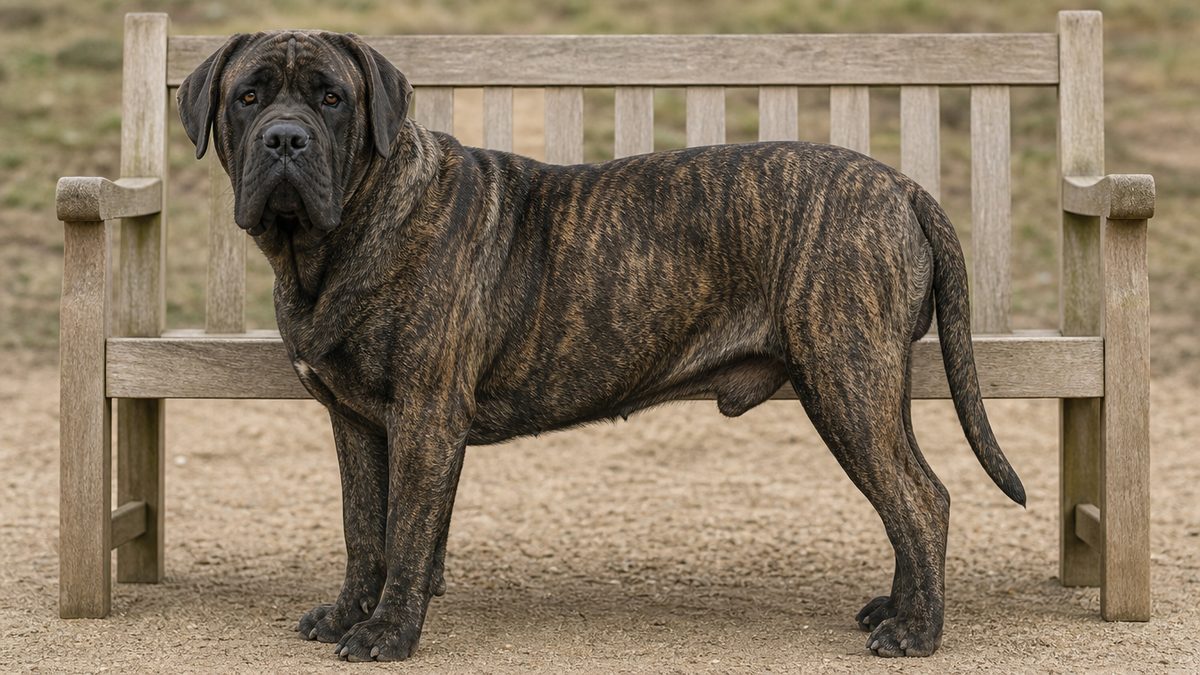
The dog the standard describes is a massive, powerful, short-coated animal with a near-cube head, a black mask in every colour, and a coat in shades of brindle or fawn. It is a deep-chested dog: the standard sets thoracic perimeter at roughly the height at the withers plus 30 percent. It is also, by the standard's own words, a calm but wary animal, "obedient and docile with family members, very devoted to its master, but can be suspicious of strangers".
The Presa Canario is one of 33 breeds listed in the Anexo to Real Decreto 558/2001, Spain's register of native canine breeds, which carries its own state-published racial prototype alongside the FCI text. Note which document a claim comes from before repeating it.
Is the Presa Canario legal in India? The instruments, in order
No Indian law in force in September 2026 bans owning, buying, breeding or selling this breed, and the position is unresolved rather than settled. Below is the sequence, read from the instruments themselves rather than from press summaries.
This is the question Google's own People Also Ask box puts first for this breed, and it is the question every ranking page answers badly. Bonbeno does not tell you the dog is legal or illegal. It tells you what each document says and where the gap is.
| Date | Instrument | What it did |
|---|---|---|
| 5 October 2023 | Private representation by a Delhi law firm to the AWBI and others | Asked the Centre to ban a named list that DOES include "PRESA CANARIO" |
| 6 December 2023 | Delhi High Court order in W.P.(C) 15673/2023 | Directed the Union to decide that representation after consulting all stakeholders |
| 12 March 2024 | DAHD circular D.O.V-11/1/2024-Anlm_Dadf | Named a list of "ferocious" breeds for prohibition on import, breeding and sale |
| 14 March 2024 | CBIC Instruction 05/2024-Customs | Told customs officers to enforce the import ban, reproducing the full list |
| 19 March 2024 | Karnataka High Court interim order | Stayed the circular so far as Karnataka was concerned |
| 10 April 2024 | Karnataka High Court, W.P. No. 8409 of 2024 | Held the circular "stands quashed" |
| 16 April 2024 | Delhi High Court, Sikander Singh Thakur v Union of India | Set the circular aside and ordered a fresh consultation |
| 2 May 2024 | DAHD public notice | Its own 12 March proceedings "shall not be enforced until further orders"; comments invited by 1 June |
| 24 January 2025 | Bombay High Court, PIL by Animal Rescue Trust | Centre states it is "not acting on" the circular at present, pending those objections |
| To 11 August 2026 | AWBI advisories register | Carries no replacement instrument on dog breeds |
The circular did not print the words "Presa Canario"
The Department's own list names "Canario", a bare word it never defines. Bonbeno established this from the only text it could find carrying the circular's complete list: CBIC Instruction 05/2024-Customs of 14 March 2024, which reproduces the Department's letter and runs "... Rhodesian Ridgeback, Wolf dogs, Canario, Akbash dog, Moscow Guard dog, Cane corso and every dog of the type commonly known as a Ban Dog (or Bandog)".
The words "Presa Canario" do appear in the Karnataka High Court file, and this is where almost every page goes wrong. They appear once, inside the private petitioners' representation of 5 October 2023 and the Delhi PIL prayer that quoted it, both of which are lists of what private parties asked for. They do not appear in the Department's list. A demand is not an instrument.
Bonbeno does not conclude from this that the breed escaped the circular. "Canario" almost certainly was meant to name this dog, and Google's own AI answer for the query silently expands it to "the Presa Canario (Canario)". But an Indian reader deciding what to do with a real animal deserves the distinction stated rather than smoothed over: the document named a word, and the word it named was not the breed's name.
Why the breed count is disputed, and what the answer is
Press reports say 23 breeds, SCC Online says 24, and the Karnataka judgment's reproduction resolves to 19. All four figures are readings of one list, and the dispute is a punctuation artefact rather than a substantive disagreement. The customs instruction's text carries 24 comma-separated entries, which is where the Delhi High Court's "twenty-four" comes from. Splitting "Japanese Tosa and Akita" into two gives 25. Folding the closing Bandog clause back in, or collapsing pairs as LawStreet's numbered version does when it prints item 12 as "Tornjak, Sarplaninac" and item 20 as "Canario Akbash dog", gives 23. Report the spread rather than picking one.
The Karnataka judgment's own reproduction is abridged: it omits Mastiffs, Rottweiler, Terriers, Rhodesian Ridgeback, Wolf dogs and Canario, leaving 19. So the six breeds missing from the judgment's version include the one this page is about. Read that judgment alone and you would conclude the Presa Canario was never on the list at all.
What has happened since, checked against a live register
Nothing has replaced the circular. The Animal Welfare Board of India maintains a public register of its advisories and circulars, and Bonbeno read it on 8 September 2026. It is current to 11 August 2026, and the most recent instrument on this subject remains entry 47, a "Public Notice regarding ban on dangerous dog breeds" dated 19 March 2024. Nothing on dog breeds appears after it in two and a half years of entries. Because the register is live and current, that absence is a finding rather than a failed search.
The Department did not simply lose in court and stop. On 2 May 2024 it issued its own public notice stating that the 12 March proceedings "shall not be enforced until further orders", and invited comments from all stakeholders by 1 June 2024. That notice is corroborated from a second, later source: when the Bombay High Court heard a public interest litigation on 24 January 2025, counsel for the Union Ministry told a bench of Chief Justice Alok Aradhe and Justice Bharati H Dangre that it was "not acting on" the circular at present and had issued the 2 May notice seeking objections, on which it would take a suitable decision.
So the correct description of the central position is not that the circular was struck down and forgotten. It is that the Department itself suspended it, opened a consultation, and has not yet closed it. That is why this page says unresolved rather than settled.
The courts quashed and set aside the DAHD circular. CBIC Instruction 05/2024-Customs of 14 March 2024, which told customs officers to enforce an import ban derived from it, is a different instrument, and Bonbeno could not trace any withdrawal or supersession of it. An untraced withdrawal is not proof that the instruction still binds anyone, and Bonbeno does not claim it does. Anyone planning an import should ask customs directly rather than reasoning from the court orders alone. Note also that a separate CBIC Circular numbered 05/2024-Customs, dated 22 May 2024, exists on an unrelated subject; the document discussed here is the Instruction of 14 March.
Bonbeno could not read the Board's 19 March public notice itself, and says so rather than summarising it. The file downloads as a one-page PDF of 1,009,260 bytes from which pypdf extracts zero characters: it is an image scan with no text layer. Nobody can quote from a document nobody can read, so nothing on this page is attributed to it beyond its title and date, which come from the register listing.
The Delhi High Court did not hold breed bans unlawful. It set the circular aside because no private body had been heard, and directed the Centre to publish a draft, invite written objections within two weeks, decide them, and then issue a final notification. The Karnataka court said the same thing in its own order. Its paragraph (iii) reads, verbatim: "The quashment of the Circular will not come in the way of the Government acting in accordance with law, bearing in mind the observations made in the course of the order";. Both courts left the door open, and a fresh instrument naming this breed would be lawful if made after due process.
What Spain does instead, and what Indian states have actually done
Spain regulates the Presa Canario through owner licensing rather than prohibition, and no Indian state Bonbeno could verify names the breed at all.
Spain is the comparison worth making, because it is the country of origin and it has had a dangerous-dogs regime since 1999. Real Decreto 287/2002 lists eight breeds by name in its Anexo I: Pit Bull Terrier, Staffordshire Bull Terrier, American Staffordshire Terrier, Rottweiler, Dogo Argentino, Fila Brasileiro, Tosa Inu and Akita Inu. Bonbeno searched the consolidated text and "Presa Canario" returns zero occurrences.
The breed is caught instead by the decree's second limb. Article 2.1(b) treats as potentially dangerous any dog matching all or most of the physical characteristics in Anexo II, and the fit is close enough to be worth setting out.
| Anexo II characteristic | What standard 346 requires | Match |
|---|---|---|
| Strong musculature, powerful and athletic build | Severe fault if the dog has "greyhound appearance" | Yes |
| Short coat | "Short, coarse, flat with no undercoat" | Yes |
| Height at withers 50 to 70 cm | Males 61-66 cm, females 57-62 cm | Yes |
| Weight over 20 kg | Males 45-57 kg, females 40-50 kg | Yes |
| Chest girth 60 to 80 cm | Withers height plus about 30 percent, so roughly 79-86 cm in males | Partly, larger males exceed the band |
| Voluminous cuboid head, broad skull, large strong jaws | "Triangular head, narrow (not cube shape)" is a severe fault | Yes |
| Broad, muscular, short neck | "Shorter than the length of the head ... cylindrical and muscular" | Yes |
Six of seven match outright and the seventh only fails at the top of the male range, so a Presa Canario in Spain is a potentially dangerous dog as a matter of measurement rather than reputation. What follows is a licence, third-party insurance, a clean criminal record, physical and psychological aptitude certificates, and compulsory microchipping under article 9. It is not a ban, and nobody has to give up a dog.
There is a second Spanish hook worth knowing. Article 4(l) of Real Decreto 558/2001 requires an officially recognised breeders' association to screen its breeding stock, admitting for reproduction only animals that have passed the socialisation tests for their breed, and to refuse show entry to aggressive specimens. Spain therefore puts the burden on the people producing the dogs. India's quashed circular put it on the people who already owned them, by requiring sterilisation of animals already kept as pets.
The Indian state layer, checked rather than assumed
Goa is the only Indian state Bonbeno could verify as having legislated. Its Animal Husbandry Directorate identified five breeds for prohibition: Pitbull, Rottweiler, Malinois, Cane Corso and Dogo Argentino, with the state passing a Bill carrying penalties of up to three months' imprisonment or a Rs 50,000 fine. The string "Presa" appears zero times in that reporting.
So the honest statement of the state layer is narrow: the central position is what Bonbeno verified, Goa's own list does not name this breed, and no other state or municipal list naming it could be confirmed. That is not the same as saying none exists. Municipal corporations and housing societies make their own rules, they are not centrally published, and a society resolution binds you whatever the Union government does. Ask your resident welfare association in writing before you bring a dog of this size home.
Even with the circular gone, you cannot lawfully import a Presa Canario to breed or sell it. DGFT Trade Notice 22/2022-23 makes dogs a Restricted import under ITC(HS) 01061900 and permits entry only for a pet dog with a valid pet book in the importer's name, for CPCSEA-recommended research, or for Defence and Police use. Applications for trading or breeding purposes "shall be duly rejected", and entry is limited to Delhi, Mumbai, Chennai, Hyderabad, Bengaluru, Kolkata and, since October 2024, Kochi Department of Animal Husbandry…. The full route is set out in how to import a dog to India.
Presa Canario price in India, and why Bonbeno publishes no figure
Bonbeno publishes no Presa Canario price in india because no rupee figure it examined survived testing. The numbers on the ranking pages are asserted, unsourced, and arithmetically suspicious, and this section shows you the tests so you can run them yourself.
One classified-style site dominates this query and prints a three-tier ladder: INR 1,50,000 to 2,50,000 for "Basic Quality", INR 2,50,000 to 4,50,000 for "KCI Registered", and INR 4,50,000 to 7,50,000 for "Champion Bloodline", with a headline band of INR 1,50,000 to 7,50,000+. No source is given for any of it. The page cites nothing, names no breeder, and offers a phone number.
Run the division tests, and read the quotients
Indian pages routinely publish a US dollar list converted at one rate. The strong test is 84.38, with 74 and a flat 80 as secondary checks. Here is the whole ladder tested.
| Rupee figure | At 84.38 | At 74 | At 80 |
|---|---|---|---|
| 1,50,000 | 1,777.67 | 2,027.03 | 1,875.00 |
| 2,50,000 | 2,962.79 | 3,378.38 | 3,125.00 |
| 4,50,000 | 5,333.02 | 6,081.08 | 5,625.00 |
| 7,50,000 | 8,888.36 | 10,135.14 | 9,375.00 |
Nothing divides cleanly at 84.38 or 74. Everything divides cleanly at 80, and that proves nothing at all, because 1,000 divided by 80 is 12.5, so any figure ending in three zeros passes at 80 by construction. The tell is the quotients: 1,875, 3,125, 5,625 and 9,375. No seller anywhere prices a dog at 5,625 dollars or 9,375 dollars. A genuine converted list yields the numbers a shop would actually print, like 500, 800 or 1,500.
So these are rupee-native and arbitrary rather than converted. That is a different failure from a disguised dollar price and it needs saying differently: nobody translated an American list, somebody chose round-looking numbers. The ladder is a pricing ladder for a sales funnel, not an observation of a market.
What the rest of the results actually contain
Bonbeno read the top six results for this query. Two of them are not about this breed at all: a Quora thread about Cane Corso puppy prices, and a Cane Corso price article. Google is filling an Indian query for a rare breed with a commoner one, which is itself the most useful signal on the page. Royal Canin's Indian page for the breed is the only one that cites a breed authority, naming the FCI as its source, and it quotes no price in any currency.
One more detail is worth your attention if you are about to spend six figures. The same seller page that prints the price ladder also says the breed has "dense, curly coats that need trimming every 4-6 weeks", while its own specification block on the same page says "short, coarse coat". The FCI standard says the coat is "Short, coarse, flat with no undercoat";. A page that contradicts itself about the coat of the dog it is selling has not been written by anyone who has met one.
Import for breeding or sale is barred by DGFT Trade Notice 22/2022-23 whatever happened to the 2024 circular, and applications for trading or breeding purposes "shall be duly rejected". A price band implies a market. Ask any seller quoting one where the founding stock came from, and ask to see the import paperwork.
What a Presa Canario actually costs to keep in India, per year
Budget between Rs 85,000 and Rs 1,60,000 a year for a healthy adult, before a single orthopaedic problem. Every line below comes from a published Indian price that Bonbeno opened, and the cost of ownership for this breed is driven by its size and its screening burden rather than by anything exotic.
Care costs are the honest half of the money question. There is no verifiable purchase price for this breed, but Indian vaccination, deworming, parasite control, grooming and food prices are real, published and checkable, and they apply to any 45 to 57 kg dog living here.
| Line | Published figure | Annual estimate |
|---|---|---|
| Anti-rabies vaccination | Rs 699 per dose, clinic chain price | Rs 699 |
| 9-in-1 DHPPiL booster | Rs 899 per dose | Rs 899 |
| Kennel cough | Rs 1,349 per dose | Rs 1,349 |
| Tick and flea plus worm control | Rs 1,103 per month for a 15-30 kg dog, and this dog is heavier | Rs 13,200 or more |
| Deworming tablets | Rs 125.67 per tablet, one per 10 kg | Rs 2,300 to Rs 3,400 |
| Grooming, bath and nails | From Rs 934 per session | Rs 5,600 at six sessions |
| Municipal registration, Delhi | Rs 500 new, Rs 500 renewal | Rs 500 |
| Food, large-breed dry | arithmetic, not a quoted price | Rs 70,000 to Rs 1,10,000 |
Two warnings about that table. The parasite line is a floor, not a figure: the Rs 1,103 monthly product is dosed for 15 to 30 kg, and a 50 kg dog needs the larger pack, so feed the real bodyweight into the dose before budgeting. And the food line is arithmetic rather than a quoted price. At roughly 500 to 700 grams a day of a large-breed dry food, a 15 kg bag lasts three to four weeks, and you should re-price the bag before trusting any monthly number, because one of five retail figures in Bonbeno's own reference pack went stale within days.
The line nobody budgets for is the orthopaedic one
This breed's screening figures are the worst part of owning one, and the cost follows the biology. With 40.0 percent of OFA hip evaluations graded dysplastic and 30.4 percent of elbow evaluations abnormal, the probability that you will be paying for imaging, pain management or surgery at some point is not small. Indian orthopaedic quotes published for comparable giant breeds run to tens of thousands of rupees for diagnostics alone and well into six figures for corrective surgery.
Municipal registration is the cheapest and most-skipped line. Delhi's MCD charges Rs 500 to register a pet dog, with a Rs 100 per month late fee, and it has issued 18,958 certificates since 2021 while rejecting 71 of 1,006 applications in one financial year, so it is a real process rather than a formality. Greater Chennai Corporation charges Rs 50 for a pet licence, issued 9,115 in 2024, and its six municipal clinics provide treatment and anti-rabies vaccination free of cost.
The same 9-in-1 vaccine costs Rs 600 at a Goa government veterinary hospital inclusive of the certificate, from Rs 899 at a private clinic chain, and from Rs 1,999 through a vet-at-home service plus a Rs 699 visit fee. That is a 3.3x spread on one drug, and a 12x spread on anti-rabies between Rs 100 and Rs 1,199. The price is a function of the delivery model, not of the medicine.
Heat tolerance: the Canary Islands are humid, so heat is the problem, not damp
The Presa Canario comes from a mild, very humid maritime climate that runs about 20 C all year, so what threatens it in India is heat and combined heat-humidity load, not humidity by itself. Its homeland is more humid than every Indian city Bonbeno measured.
Bonbeno queried NASA POWER by explicit latitude and longitude for the breed's homeland and for six Indian cities, echoing the model's cell elevation at every point. That elevation echo matters, and on the Canaries it caught a serious problem which is reported honestly below.
| Place | Annual mean temp | Annual mean humidity | Peak monthly wet bulb |
|---|---|---|---|
| Gran Canaria, coastal cell | 20.19 C | 78.18 percent | 20.58 C in August |
| Santa Cruz de Tenerife cell | 19.76 C | 77.79 percent | 20.20 C in August |
| Delhi | 25.60 C | 45.56 percent | 26.50 C in July |
| Mumbai | 26.77 C | 67.39 percent | 25.77 C in June |
| Chennai | 27.95 C | 72.39 percent | 26.11 C in May |
| Kolkata | 25.81 C | 73.93 percent | 27.09 C in June |
| Bengaluru | 23.74 C | 67.94 percent | 21.86 C in May |
| Pune | 23.86 C | 66.80 percent | 22.97 C in June |
Read the humidity column first, because it overturns the thing every page says about coastal breeds. The Canaries run 78.2 percent annual relative humidity, which is higher than Chennai at 72.4, Kolkata at 73.9, Bengaluru at 67.9, Mumbai at 67.4, Pune at 66.8 and Delhi at 45.6. This dog did not evolve in dry air. Telling an Indian buyer that Indian humidity will finish it is simply wrong.
The real gap is in the last column. Wet bulb combines temperature and humidity into the number that actually describes how hard it is to shed heat, and the homeland peaks at 20.58 C against 26.11 C in Chennai and 27.09 C in Kolkata. That is a gap of five and a half to six and a half degrees in the measure that matters, and it is a large gap. Bengaluru at 21.86 C and Pune at 22.97 C are the closest Indian analogues, and they are still above anything the breed's homeland produces.
The Canary Islands are narrower than one MERRA-2 grid cell, so POWER collapsed them. Las Palmas, Telde and Tejeda returned byte-identical series from a single cell at 109.29 m. Tejeda sits at about 1,050 m, so that cell is roughly 941 m too low and returns an ocean-dominated climate for a mountain village. Bonbeno therefore publishes ONE figure, for coastal and low-lying Gran Canaria, and makes no claim about the island's interior highlands. The Indian cells are sound, with elevation errors between 2 and 83 m.
Why size makes this worse, and what the law says about it
Bodyweight is an independent heat-illness risk factor, and this breed sits in the worst band. In 905,543 UK dogs, being at or above the breed and sex mean bodyweight carried an odds ratio of 1.42 for heat-related illness, and dogs over 50 kg carried an odds ratio of 3.42 with a confidence interval of 1.54 to 7.57. A male Presa Canario at the top of the standard is a 57 kg dog. Case fatality in that cohort was 14.18 percent.
The companion paper on the same cohort found that exertional illness, not hot cars, is the dominant trigger: 652 of the 879 events with a recorded trigger were exertional, which is 74.2 percent. That is a fact about exercise decisions, and it is the single most actionable heat finding for this breed. The dog does not overheat because you left it somewhere. It overheats because you walked it.
Indian law has a specific hook here. Second Schedule Part IV paragraph 21(1) of the Dog Breeding and Marketing Rules 2017 bars keeping in outdoor facilities, without the attending veterinary practitioner's written approval, dogs "that are not accustomed to the temperatures prevalent in the area or region in question" and breeds that cannot tolerate them. A heat-sensitive giant guardian kept in an uncooled outdoor kennel through a Chennai May is squarely inside that clause.
Temperament: a guard dog by design, and who should not buy one
The Presa Canario is a calm, confident guarding breed that is devoted to its household and reserved with strangers, and the FCI standard says so in as many words rather than leaving it to interpretation.
The standard's temperament paragraph reads: "Severe look; attentive expression. Especially suited to guarding and traditionally used for herding cattle. Balanced temperament and very self-confident. Low and deep bark. Obedient and docile with family members, very devoted to its master, but can be suspicious of strangers. Confident attitude, noble and a little distant";. Read that as a specification, because that is what it is. A breeder producing a wary dog is meeting the standard, not failing it.
That specification has consequences the sales pages leave out. A dog bred to guard and to be distant with strangers is a poor fit for a household with heavy visitor traffic, for a building with shared corridors and lifts, and for anyone who wants a dog that likes everyone. It is a good fit for an experienced handler on a private, fenced, ground-floor property who wants exactly what the standard describes.
What the standard disqualifies, and why it matters to a buyer
FCI 346 lists "Aggressive or overly shy dogs" as a disqualifying fault, alongside "Any dog clearly showing physical or behavioural abnormalities". So aggression is not the breed standard's aim and never has been. A seller who markets this dog on ferocity is describing a dog that would be put out of the ring.
Spain, the country of origin, backs that with a rule rather than a sentiment. Real Decreto 558/2001 article 4(l) requires an officially recognised breeders' association to combat aggressive and dangerous behaviour, to refuse show entry to such animals, and to admit for reproduction only dogs that have passed the socialisation tests for their breed. Temperament screening is written into the recognition conditions of the association that keeps the studbook.
The one thing the medical literature records
There is no measured bite force figure for this breed, and the numbers circulating online for it are unsourced. What the peer-reviewed literature does contain is a single 2015 case report in the paediatric ophthalmology journal: a seven-year-old boy sustained a zone 3 ruptured globe after an attack by a Perro de Presa Canario, with an inferotemporal corneoscleral laceration extending 15 mm posterior to the limbus and protrusion of uveal tissue. It was repaired, and vision recovered to 20/40 by the first postoperative month.
One case report is not a prevalence figure and Bonbeno does not present it as one. It is presented because it is the only thing in the literature, and because the honest answer to "how dangerous is this dog" is that the evidence base is a single child's eye rather than a statistic. Judge the breed on the standard's own description and on the size of the animal, not on numbers nobody measured.
An experienced owner, on private ground, with a fence, a plan for visitors, the budget for orthopaedic care, and written permission from whoever governs the property. Anyone missing two or more of those is buying a problem, and the problem weighs 50 kg.
Training a Presa Canario: the socialisation window is the whole job
To train a Presa Canario successfully, do the socialisation work between three and sixteen weeks and keep doing it through adolescence, because a guarding breed that missed its socialisation window cannot be retrofitted easily at 50 kg.
The breed is genuinely trainable. The standard calls it "Obedient and docile with family members, very devoted to its master", and a dog bred to work cattle under direction is a dog that takes direction. What it is not is forgiving of a late start.
Socialise deliberately and on a schedule. The socialisation window closes early, and for a breed whose default setting is reserve toward strangers, every week inside it is worth a month outside it. Introduce delivery riders, lift journeys, watchmen, children, other dogs, traffic and household staff while the puppy is small enough that a mistake costs nothing.
- Book the vaccination course early so safe outings can start early, using the Rs 699 to Rs 1,349 per-dose figures to plan the spend.
- Teach a reliable recall and a settled down-stay before adolescence, because both become negotiations later.
- Introduce a basket muzzle as a neutral piece of equipment in the first six months, so it is never associated with restraint.
- Practise handling of feet, ears and hips weekly, because this breed will need orthopaedic examination and it should not be its first experience of being handled.
- Enrol a qualified trainer who works with guarding breeds, and walk away from anyone selling dominance or aversive methods.
Why the muzzle line is practical rather than pessimistic
Teach the dog to wear a basket muzzle comfortably even if you never need it. India's legal position on this breed is unresolved, municipal rules differ from the central position, and housing societies make their own. A dog that already accepts a muzzle gives you options if a rule changes; a dog that has never worn one gives you a crisis. This is contingency planning, not a prediction.
Two things Indian law will not let you do
Do not crop the ears. Second Schedule Part II paragraph 6(8) of the Dog Breeding and Marketing Rules 2017 forbids "tail docking, ear cropping de-barking, de-clawing, branding, dyeing, injecting substances to enhance visual appeal" and any "change of appearance by artificial means";. FCI 346 permits erect cropped ears only "in countries were cropping is allowed", and India is not one, so the standard's default natural drop ear is the only lawful option here.
Do not remove the dewclaw either, and this one catches people out. FCI 346 lists "Presence of claw" among its minor faults, which creates a temptation to remove it before a show. Paragraph 6(8) expressly names de-clawing and "any other kind of mutilation of any body part of the pup";. Where a breed standard penalises what Indian law protects, the law wins and the fault stands.
A cropped tail is a DISQUALIFYING fault in FCI 346, and tail docking is prohibited in India by the same paragraph 6(8). On this point the breed standard and the gazette want the same thing, which is worth knowing when a seller tells you docking is normal for the breed.
Exercise: two controlled walks, and never in the heat of the day
Give an adult Presa Canario two controlled leashed walks a day totalling 60 to 80 minutes, taken before sunrise and after sunset, because exertion in Indian heat is the documented killer for a dog this size rather than confinement.
This is a guarding breed, not an endurance athlete. It was built to hold cattle and property, work that is explosive and brief rather than sustained. It does not need the mileage a working gundog needs, and giving it that mileage in an Indian summer is actively dangerous.
The evidence is unusually clear. Of the 879 UK heat-related illness events with a recorded trigger, 652 were exertional, which is 74.2 percent, against 113 environmental and 46 from vehicular confinement. The dominant mechanism is the walk, not the car and not the balcony. Combine that with a 3.42 odds ratio for dogs over 50 kg and you have a breed for which walk timing is a clinical decision.
- Walk before sunrise and after full dark, and check the pavement with the back of your hand before you start.
- Cap sessions at 30 to 40 minutes in the cool months and shorten them sharply from March onward.
- Carry water on every outing and offer it at the halfway point rather than at the end.
- Stop at the first sign of a widened tongue, a change of gait or a dog that wants to sit down.
- Skip the walk entirely on a high wet-bulb day and use scent work indoors instead.
Indoor enrichment does more for this breed than distance does. Scent games, a frozen stuffed toy, and short obedience sessions spread through the day meet the mental need without adding heat load. A dog that is mentally tired settles; a dog that is physically exhausted in 30 C heat is a dog in trouble.
If your heat plan depends on air conditioning, know that BESCOM load-shedding through March to May is a documented Bengaluru problem and a boarding kennel there may or may not have generator backup for its cooling. Ask before you book, not after.
Grooming: the easiest thing about the breed, with two Indian exceptions
Groom a Presa Canario weekly with a rubber curry mitt and bathe it only when it is dirty, because the standard's coat is "short, coarse, flat with no undercoat" and needs almost nothing.
The coat is genuinely low-maintenance and this is the one area where the sales pages undersell nothing. FCI 346 describes hair that is "Short, coarse, flat with no undercoat (it can appear on neck and on back of the thighs). Rather coarse to the touch. Very short and fine on the ears; slightly longer on the withers and on the back of thighs";. There is no undercoat to blow, no matting, and no professional trim.
Ignore any page telling you this breed has a "dense, curly coat" needing trimming every four to six weeks. One of the highest-ranking Indian sellers says exactly that, and contradicts itself in its own specification block on the same page. The standard settles it.
The two things Indian conditions do add
Dry the head folds. The standard describes skin that is "Thick and elastic. Looser on and around the neck", forming "symmetrical wrinkles" on the head when the dog is alert. Wrinkles hold moisture, and Indian monsoon humidity keeps them wet. Wipe and dry the folds after every bath and after any wet walk.
Plug the ears before bathing and dry them afterwards. Overseas breed-club grooming guidance routinely says to towel a dog and let it air dry. That advice was written for a dry northern summer and it does not transfer. In Indian conditions an ear left damp is an ear infection waiting, and published Indian series identify bathing without plugging the ears as a common cause of canine otitis. Dry actively rather than letting the dog air dry.
| Task | Frequency | Cost |
|---|---|---|
| Rubber curry mitt over the whole coat | Weekly, 10 minutes | Nil after the mitt |
| Bath | Every 6 to 8 weeks or when dirty | From Rs 934 at a clinic chain, less at home |
| Ear check and dry | After every bath and wet walk | Nil |
| Head and neck fold drying | After every bath and wet walk | Nil |
| Nail trim | Every 3 to 4 weeks | Add-ons from Rs 99 |
| Full bath and styling | Not needed for this coat | Rs 1,869 if you buy it anyway |
A coat this short is already the dog's best heat defence, reflecting sun and letting air reach the skin. Shaving it removes sun protection and does not improve cooling, because dogs shed heat by panting rather than through the skin. Shade, water, timing and air movement are what work.
Health: the worst orthopaedic figures OFA publishes, and a real cardiac literature
The Presa Canario carries 40.0 percent hip dysplasia and 30.4 percent elbow dysplasia on OFA's own tables and has its own documented dilated cardiomyopathy literature, and its median life expectancy in the largest UK study is 7.7 years.
These are the health issues that decide whether you should buy this dog, and unlike almost everything else written about the breed in India, all of it is measured.
Hips and elbows
Bonbeno read the rows out of OFA's own statistics tables rather than assembling a query URL, and ran a Labrador control in the same retrieval which returned the expected 109 rows.
| Screen | Evaluations | Normal | Affected | Grade breakdown |
|---|---|---|---|---|
| Hips | 458 | 57.9 percent | 40.0 percent dysplastic | Mild 23.8, Moderate 14.0, Severe 2.2 |
| Elbows | 303 | 69.3 percent | 30.4 percent abnormal | Grade 1 21.1, Grade 2 7.6, Grade 3 1.7 |
The arithmetic closes in both rows, which is worth checking and worth saying: 23.8 plus 14.0 plus 2.2 is exactly 40.0, and 21.1 plus 7.6 plus 1.7 is exactly 30.4. Within the normal hips, only 6.3 percent reached Excellent and 37.6 percent were Good, so even the passing dogs are clustered at the lower grades.
A 40 percent dysplastic rate is close to the worst OFA publishes for any breed. It is also independently visible in the clinical literature: a 2016 study from the veterinary faculty at Las Palmas de Gran Canaria recruited its entire subject group of ten lame dogs from Presa Canarios with osteoarthritis associated with bilateral hip dysplasia, which tells you how easy such dogs are to find in the breed's homeland.
That study carries a second lesson for any owner of this breed. It compared two subjective pain scales against objective force-platform gait analysis and found the concordance was not significant. Subjective scoring suggested improvement at six months while the force platform showed the same animals had returned to their initial lameness state. Owner impressions of a big stoic dog's pain are unreliable, so screen with imaging and objective measures rather than with your own eye.
The heart, where this breed has its own paper
Dilated cardiomyopathy is documented specifically in this breed. A 2001 study from the Animal Hospital of Las Palmas de Gran Canaria University examined 47 Presa canario dogs diagnosed with congestive heart failure due to DCM. Supraventricular or ventricular tachydysrhythmias were found in 29, atrial fibrillation was the commonest dysrhythmia, abnormalities of cardiac conduction were diagnosed in 16 (34 percent), changes in wave morphology were found in 29 (62 percent), and normal sinus rhythm was recorded in only 12 (26 percent).
Read the denominator carefully, because this is where pages go wrong. Those 47 dogs were already diagnosed with congestive heart failure from DCM. The percentages describe what the ECG shows in affected animals, not how common DCM is in the breed. No prevalence figure exists. The arithmetic checks out on its own terms: 16 of 47 is 34.0 percent, 29 of 47 is 61.7 percent, and 12 of 47 is 25.5 percent.
The same paper reports that ventricular dysrhythmias were observed infrequently but "had a very important prognostic value" in Presa canario dogs with DCM. If your dog is diagnosed, ask specifically about ventricular arrhythmia rather than accepting a general cardiac summary.
Life expectancy, bloat risk, and one cancer case report
The Presa Canario's median lifespan is 7.7 years, the second-lowest of the breeds named in the largest United Kingdom longevity study, and it is one of the few rare breeds for which that figure is genuinely measured rather than transferred.
McMillan 2024 analysed 584,734 UK dogs, including 284,734 deceased, and named the breeds most at risk of early death. The Presa Canario appears with a median of 7.7 years and a hazard ratio of 3.0, confidence interval 2.5 to 3.7. Only the Caucasian Shepherd Dog, at 5.4 years, did worse. The Cane Corso followed at 8.1, the Mastiff at 9.0, and the St Bernard and Neapolitan Mastiff at 9.3.
Bonbeno confirmed the breed is actually in that study rather than assuming it. A full-text search of the paper returns "Presa" twice, both genuine, against in-document controls of Labrador 3, Caucasian Shepherd 2 and Cane Corso 2. That test matters: the figure is only quotable because the breed is in the paper, and the companion Pyrenean Mastiff page carries no such figure precisely because it is not.
Compare that with the 9 to 11 years Google's knowledge panel prints, and the 9 to 11 years Royal Canin's Indian page gives. The measured median is between one and three years lower than the figure an Indian buyer will meet first, and the measured one comes with a confidence interval and a denominator.
Gastric dilatation-volvulus
Gastric dilatation-volvulus is the emergency this breed's shape sets it up for, and the honest position is that no study has measured it in Presa Canarios. The best evidence comes from two prospective cohorts of 1,914 and 1,637 dogs across eleven breeds, and the Presa Canario is not one of the eleven: they were the Akita, Bloodhound, Collie, Great Dane, Irish Setter, Irish Wolfhound, Newfoundland, Rottweiler, Saint Bernard, Standard Poodle and Weimaraner.
What transfers is the weight band rather than the breed. Those studies found incidence of 23 cases per 1,000 dog-years for large breeds of 23 to 45 kg and 26 per 1,000 dog-years for giant breeds over 45 kg, and a male Presa Canario at 45 to 57 kg sits in the giant band by bodyweight. Of the 105 dogs that developed GDV, 30 died, which is 28.6 percent.
The companion paper found the risk factors, and one of them contradicts advice Indian owners are routinely given. Increasing age, a first-degree relative with a history of GDV, faster eating speed and a raised feeding bowl all raised risk, and approximately 52 percent of GDV cases among giant breeds were attributed to the raised feed bowl. Raised bowls are sold in India as a large-breed accessory. The evidence points the other way.
Retching without producing vomit, a distending abdomen, restlessness and drooling in a deep-chested giant dog is gastric dilatation-volvulus until a vet says otherwise. Know your nearest 24-hour surgical hospital and its route before you need it, not after. Nothing you can do at home helps.
What else the literature holds
The entire peer-reviewed literature for this breed is four papers, and Bonbeno opened all four individually rather than trusting a batch response. Besides the hip and cardiac studies, there is a 2014 Canadian case report of suspected disseminated histiocytic sarcoma in a three-year-old Perro de Presa Canario, which presented with an acutely inflamed hind limb and an enlarged carpus and died two days after re-presentation. One case report establishes that the tumour occurs in the breed. It establishes nothing about how often.
For the same figures on the breeds Indian buyers cross-shop, see the Cane Corso and Boerboel guides, both of which were named in the circular outright rather than by a single word.
Indian owners should add the tick-borne load that applies to any dog here. In a West Bengal survey of 584 dogs screened at veterinary clinics, Babesia gibsoni was found in 76.54 percent and Anaplasma in 55.75 percent, with 72.9 percent of the 584 dogs screened carrying two or more pathogens. Those are clinic caseload figures rather than population prevalence, and they are the reason the parasite-control line in the cost table is not optional.
Feeding: slow the meal down, keep the bowl on the floor, keep the dog lean
Feed an adult Presa Canario two or three measured meals a day from a floor-level bowl, using a slow-feeder, and keep it at the lean end of its range because both of this breed's biggest risks get worse with weight.
Feeding decisions for this breed are risk decisions, not nutrition trivia. Three of the four modifiable GDV risk factors are things you control at the bowl, and bodyweight is an independent heat-illness risk factor.
- Split the daily ration into two or three meals rather than one large feed.
- Slow the eating speed with a slow-feeder bowl or a snuffle mat, because faster eating raised GDV risk.
- Keep the bowl on the floor, because a raised feed bowl was associated with about 52 percent of giant-breed GDV cases.
- Rest the dog before and after meals rather than walking it straight out.
- Weigh the food rather than scooping it, and re-weigh the dog monthly through growth.
Keep the dog lean, and mean it. Being at or above the breed and sex mean bodyweight carried an odds ratio of 1.42 for heat-related illness in 905,543 UK dogs, and crossing 50 kg raised it to 3.42. A Presa Canario carrying an extra five kilograms in a Chennai May is a materially different animal from the same dog kept lean.
Growth, and why slow is safer here than in most breeds
A breed with 40.0 percent hip dysplasia and 30.4 percent elbow dysplasia on OFA's tables should not be grown fast. Use a large-breed puppy formulation with controlled calcium and energy density, feed to a body condition score rather than to a chart, and resist the pressure to produce a heavy-looking youngster. The bone is what the joint has to carry for the next decade.
On availability, large-breed dry foods are widely stocked in Indian metros and a 15 kg bag is the practical unit. Bonbeno gives no monthly rupee figure as a quoted price because retail bags move fast: one of five retail figures in its own reference pack went stale within days of being recorded. Price the bag you actually intend to buy, divide by the grams per day on the pack, and you have your own number rather than someone else's.
Multiple water points, refreshed and shaded, cost nothing and matter more in an Indian summer than any supplement on the shelf. A 50 kg dog drinks a great deal, and a dog that cannot reach water cannot cool itself.
The first year, month by month
Plan the first year around three deadlines: the socialisation window closing near sixteen weeks, the vaccination course finishing, and the orthopaedic screening that should be booked before the dog is fully grown.
| Age | What matters | What it costs |
|---|---|---|
| Before purchase | Written housing-society permission; see the parents' hip and elbow scores | Nil, and worth more than anything else on this table |
| 8 to 10 weeks | Home, vet check, start the vaccination course, begin fold and ear handling | Anti-rabies Rs 699, DP Rs 849 |
| 10 to 16 weeks | The socialisation window. Lifts, watchmen, riders, traffic, children, other dogs | 9-in-1 Rs 899, kennel cough Rs 1,349 |
| 4 to 6 months | Basket muzzle conditioning as neutral equipment; recall and settle; municipal registration | MCD Delhi Rs 500 or Chennai GCC Rs 50 |
| 6 to 9 months | Adolescence and the first real guarding behaviour. Do not escalate; keep training | Trainer fees vary widely |
| 9 to 12 months | Growth slowing. Keep the dog lean. Book orthopaedic imaging with your vet | Imaging quoted locally |
| Through the year | Monthly parasite control at the dog's real weight; heat rules from March | About Rs 1,103 per month and rising with weight |
Two of those rows are the ones people skip. Written society permission, obtained before the dog arrives, is the single cheapest insurance available for a breed whose legal status is unresolved. And basket muzzle conditioning at four to six months costs nothing and takes ten minutes a week.
The orthopaedic booking is the third. With this breed's screening figures, imaging is not a formality you do if something looks wrong. Book it as a baseline while the dog is young enough that management options are still open, and remember that the force-platform study found owner impressions of lameness unreliable.
Second Schedule Part III paragraph 8(10) of the Dog Breeding and Marketing Rules 2017 requires that breeding dogs "shall have been tested for genetic defects, including hip dysplasia" and ten further named conditions, and Rule 8(1)(a) prohibits selling pups under eight weeks. Hip dysplasia is the first item on that statutory list and the worst figure in this breed. Ask to see the test results.
Presa Canario against the breeds Indian buyers cross-shop
Against the Cane Corso, Boerboel and Pyrenean Mastiff, the Presa Canario is the one with the worst measured longevity, the worst hip figures and the most ambiguous Indian legal history, and the Pyrenean Mastiff is the outlier on every count.
Buyers looking at this breed almost always look at the other giant guardians too, and Google's own "People also search for" block for the Presa Canario lists the Cane Corso, Boerboel, Neapolitan Mastiff and Fila Brasileiro. Here is how they differ on the things that are actually measured.
| Breed | Named in the 2024 circular? | Median lifespan, McMillan 2024 | OFA hips |
|---|---|---|---|
| Presa Canario | As "Canario", not by full name | 7.7 years | 40.0 percent of 458 |
| Cane Corso | Yes, "Cane corso", explicitly | 8.1 years | See the Cane Corso page |
| Boerboel | Yes, and again as "Mastiffs (boerbulls)" | Not among the named breeds | See the Boerboel page |
| Pyrenean Mastiff | No, on any reading of the list | Absent from the study entirely | 34.6 percent of 104 |
The circular column repays attention. The Boerboel appears twice in the Department's list, once by name and once inside "Mastiffs (boerbulls)". The Cane Corso is named outright. The Presa Canario appears only as "Canario". The Pyrenean Mastiff appears on no reading of the list at all, which is the sharpest practical difference between the two Spanish breeds on this site.
Presa Canario against Pyrenean Mastiff, the two Spanish giants
| Presa Canario | Pyrenean Mastiff | |
|---|---|---|
| FCI standard | 346, definitive 4 July 2011 | 92, definitive 15 November 1954 |
| FCI subsection | Molossian, Mastiff type | Molossian, Mountain type |
| Coat | Short, coarse, no undercoat | Long, thick, 6 to 9 cm on the topline |
| Height | Males 61 to 66 cm | Minimum 77 cm, no upper limit |
| Weight in the standard | 45 to 57 kg males | Not stated at all |
| Job it was bred for | Guarding and holding cattle | Walking with flocks against wolves |
| In the lifespan literature? | Yes, 7.7 years | No, zero mentions |
| Indian legal history | "Canario" on the quashed circular | Named in no Indian instrument found |
The Pyrenean Mastiff guide sets out that breed's own registry and health position in full, including why no lifespan figure appears on it. The practical read is that the Pyrenean Mastiff is the calmer, larger, hairier animal with the cleaner legal record and almost no measured health data, while the Presa Canario is the smaller, shorter-coated, more heat-workable animal with a genuinely alarming evidence base and an unresolved legal history. Neither is an easy dog for an Indian flat.
If what you want is a guard dog that copes with Indian heat, an Indian pariah-type dog from a shelter costs nothing, is adapted to the climate, carries no legal ambiguity, and has no 40 percent hip figure attached to it. Bonbeno says this on every giant-guardian page because it keeps being true.
What Indian owners get wrong with this breed
The five mistakes below are the ones that produce the most damage per rupee, and four of them are made before the dog arrives.
1. Believing the price ladder
Paying a "Champion Bloodline" premium of INR 4,50,000 to 7,50,000 for a tier that no document defines is the most expensive mistake available here. The ladder divides cleanly only at a rate that any round rupee number passes by construction, and its quotients are prices no seller would print. Ask what the tier means, in writing, with pedigree numbers.
2. Reading "the circular was quashed" as "the question is closed"
It is not closed. The Delhi High Court set the circular aside and directed the Centre to publish a draft, invite objections and issue a final notification, and the Karnataka court expressly contemplated a properly-made Rules amendment. Buy on the basis that a fresh instrument is possible.
3. Skipping the housing society
Central law and society bye-laws are different things, and the second one is what actually reaches your front door. Get permission in writing before purchase. This is the mistake that ends with a dog being rehomed at eighteen months, which is the worst possible age for a guarding breed to change households.
4. Exercising on a British schedule
Care guides for this breed are written for climates where a midday walk is fine. Exertional heat illness accounted for 74.2 percent of the UK events with a recorded trigger, and this dog sits in the over-50 kg band that carried a 3.42 odds ratio Hall EJ, Carter AJ. Move the walk, do not shorten the dog's life.
5. Buying the raised bowl
Raised feeders are marketed in India as a large-breed necessity. In the prospective cohort, a raised feed bowl was associated with approximately 52 percent of GDV cases among giant breeds. Keep the bowl on the floor and spend the money on a slow-feeder instead.
Cropping a Presa Canario's ears to match the erect look in photographs is unlawful in India under Second Schedule Part II paragraph 6(8), and so is removing the dewclaw the standard calls a minor fault. A seller offering a cropped puppy is telling you something about how the rest of its operation runs.
Adoption and responsible sourcing
Adopt rather than buy where you can, and if you buy, buy against documents rather than against photographs, because this breed has no verifiable Indian price and no lawful commercial import route.
Bonbeno does not recommend breeders, does not link puppy listings and does not broker sales. What it can do is tell you which documents exist and what they should say.
The adoption route
Giant guardians surrendered at eighteen months to three years are a real category in Indian rescue, usually because the household underestimated the size, the guarding behaviour or the cost. If you have the experience and the ground for this breed, that is where the need is. Adopt through a registered shelter, meet the dog more than once, and ask specifically what triggered the surrender.
Pure Presa Canarios are rare in Indian shelters. What is common is a large mixed guardian type, and for most of the households considering this breed that dog is the better answer: adapted to the heat, no legal ambiguity, no import question, and no 7.7-year median attached.
If you buy, this is the document list
- Kennel Club of India pedigree papers for both parents, with numbers you can check, since India is an FCI member represented by the KCI and this breed holds FCI standard 346.
- Hip and elbow scores for both parents, because paragraph 8(10) requires breeding dogs to have been tested for genetic defects "including hip dysplasia";.
- A cardiac evaluation for both parents, given the breed's documented DCM literature.
- The breeder's registration under the Dog Breeding and Marketing Rules 2017, which Rule 3 requires before breeding lawfully.
- Proof the puppy is at least eight weeks old, which Rule 8(1)(a) requires for a lawful sale.
- Import paperwork, if the line is claimed to be imported, given that trading and breeding applications "shall be duly rejected" under the DGFT notice.
Walk away from a cropped puppy, from a seller who cannot produce parental scores, and from anyone who tells you the 2024 circular settled the legal question in either direction. Walk away also from a puppy under eight weeks, whatever reason is offered.
Greater Chennai Corporation runs six pet clinics providing treatment and anti-rabies vaccination free of cost, and issued 9,115 pet licences in 2024 at Rs 50 each. Municipal provision is uneven across India but it is real, and it is worth checking before assuming private-clinic prices.
Presa Canario questions Indian buyers actually ask
Is Presa Canario legal in India?
Yes, as of September 2026 no Indian law in force prohibits owning, buying or selling this breed, but the position is unresolved rather than settled. The 12 March 2024 circular that named "Canario" was stayed by the Karnataka High Court on 19 March 2024, quashed by it on 10 April 2024, and set aside by the Delhi High Court on 16 April 2024. The Delhi bench expressly directed the Centre to invite written objections and issue a fresh notification, so a replacement instrument remains possible.
Is a Presa Canario a good family dog?
For most Indian households, no. The FCI standard describes a dog that is "obedient and docile with family members" but "can be suspicious of strangers", with a "confident attitude, noble and a little distant". That is a guarding temperament by design, not a defect. It suits an experienced handler with a private ground-floor property and a plan for visitors, and it suits a flat with a shared lift very badly.
How strong is a Presa Canario bite?
No reliable measured bite-force figure exists for this breed, and every number circulating online for it is unsourced. Bonbeno found no peer-reviewed measurement in a PubMed search across four name forms. What the literature does contain is a 2015 case report of a seven-year-old boy who sustained a zone 3 ruptured globe from a Perro de Presa Canario, repaired surgically, with vision recovering to 20/40 by the first postoperative month. That is a description of consequence, not of force.
Are Presa Canario legal in the US?
There is no United States federal breed ban, and the American Kennel Club records the breed in its Working Group, so legality is decided city by city and by landlords and insurers rather than nationally. The question matters to an Indian reader mainly because it shows the pattern this breed meets everywhere: no national prohibition, and a patchwork of local rules underneath it. India is currently in the same position.
Was the Presa Canario on the 2024 Indian breed circular?
The circular's own list names "Canario", not "Presa Canario". Bonbeno read the full list in CBIC Instruction 05/2024-Customs of 14 March 2024, which reproduces the Department's letter verbatim, and the twenty-first entry is the bare word "Canario" sitting between "Wolf dogs" and "Akbash dog". The words "Presa Canario" do appear in the file, but in the private petitioners' representation of 5 October 2023 rather than in the Department's own list.
What is the Presa Canario price in India?
Bonbeno publishes no Indian price for this breed because it could not verify one from a source that survives testing. Import for breeding or sale is barred by DGFT Trade Notice 22/2022-23 regardless of the quashed circular, so no lawful commercial supply chain exists to set a market rate. Treat any confident rupee band you meet for this breed as unsourced until you can trace it to a page that names a real animal.
How long does a Presa Canario live?
The median is 7.7 years, from 584,734 United Kingdom dogs in McMillan 2024, with a hazard ratio of 3.0 and a 95 percent confidence interval of 2.5 to 3.7. Only the Caucasian Shepherd Dog, at 5.4 years, fared worse among the breeds that study named. Google's own knowledge panel prints 9 to 11 years for the breed, which is between one and three years more optimistic and carries no source.
Does the Presa Canario have hip problems?
Yes, and the figure is among the worst OFA publishes. Of 458 Perro de Presa Canario hip evaluations, 40.0 percent were graded dysplastic and only 57.9 percent normal, of which just 6.3 percent reached Excellent. Elbows are no better: 30.4 percent of 303 evaluations were abnormal. A 2016 Spanish study from Las Palmas de Gran Canaria recruited its entire subject group, ten lame dogs, from Presa Canarios with bilateral hip dysplasia.
Can a Presa Canario have its ears cropped in India?
No. Ear cropping is prohibited in India by Second Schedule Part II paragraph 6(8) of the Prevention of Cruelty to Animals (Dog Breeding and Marketing) Rules, 2017, which forbids docking, cropping, de-barking, de-clawing and "any change of appearance by artificial means". FCI standard 346 permits erect cropped ears only "in countries were cropping is allowed", which India is not, so an Indian Presa Canario keeps the natural drop ear the same standard describes as its default.
Can a Presa Canario be registered with the Kennel Club of India?
In principle yes, because the FCI members register lists India as a full member represented by the Kennel Club of India, so the KCI issues pedigrees against FCI nomenclature, and the Presa Canario holds FCI standard 346 on a definitive basis since 4 July 2011. Ask to see the actual pedigree document rather than a claim about one, and check that the name on it is the breed's current FCI name.
Is the Presa Canario banned in Spain, where it comes from?
No, and Spain is the instructive comparison. Real Decreto 287/2002 lists eight potentially dangerous breeds by name and the Presa Canario is not among them; Bonbeno searched the consolidated text and found zero occurrences. Instead the breed is caught by the decree's second limb, which classes any dog matching all or most of a list of physical characteristics as potentially dangerous, and that brings owner licensing, insurance and microchipping rather than prohibition.
Which Indian states have banned the Presa Canario?
None that Bonbeno could verify. Goa is the one state that has actually legislated, passing a Bill in 2025 with penalties of up to three months' imprisonment or a Rs 50,000 fine, and its Animal Husbandry Directorate identified five breeds: Pitbull, Rottweiler, Malinois, Cane Corso and Dogo Argentino. The word "Presa" appears zero times in the reporting of that list. Housing-society bye-laws are a separate matter and bind you regardless.
Compare with similar breeds
Presa Canario sits in 1 Bonbeno group. Each one compares it directly against the breeds it is genuinely an alternative to, on the same figures.