
Breed profile
Perro Majorero in India: Price, Heat, Law and Health
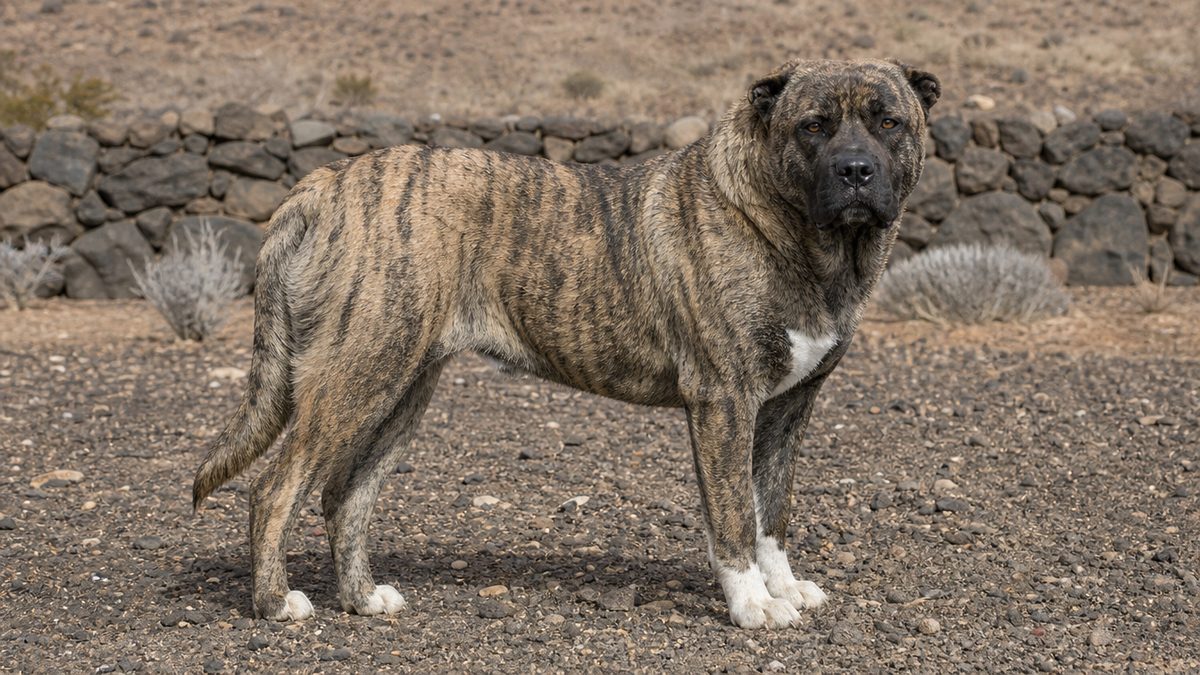
A brindle livestock guardian from Fuerteventura, one of only 26 Spanish breeds whose racial prototype the state actually printed, and the only breed on this site whose national standard describes tail docking as normal practice.
Quick answer
No verifiable Perro Majorero price in India exists, because no Perro Majorero has a lawful route into an Indian pet home. India classes dog imports as restricted, and the DGFT's own pet-import guidance bars commercial imports, gifts and newborn puppies outright. The only rupee figure attached to this breed in India is a paperback book.
This page is reference information and not veterinary advice. The Perro Majorero has almost no clinical literature of its own, so most health statements here are general canine facts or inferences from the breed's build and work, and they are labelled as such. For anything concerning your own dog, consult your nearby vet.
Perro Majorero traits, rated for India
What the Perro Majorero is, and why its state standard matters
The Perro Majorero is a brindle livestock guardian from the Canary island of Fuerteventura, and it is one of only 26 Spanish breeds for which the state printed a full racial prototype rather than merely a name.
Start with the document, because it is the fact everything else on this page rests on. The Anexo to Real Decreto 558/2001 opens with the line that the Spanish canine breeds are those set out below, and then lists 33 names. Read the same consolidated text further and you find that the decree prints a full prototype for only 26 of them, at pages 8 to 72. The Perro Majorero is one of the 26. Its prototype begins on page 41 and runs to page 44, covering head, neck, body, limbs, movement, skin, coat, colour, size, weight and a full list of faults.
The gap is not an oversight and the reason is citable. Real Decreto 1557/2005 replaced the whole annex and said so in its own recital: the new annex does not include the racial prototype definitions alongside the breed list, because those pass to the competent autonomous community in each case. Its third transitional provision then keeps the 2001 prototypes in force until each region regulates its own. So every breed added after 2005 has no state prototype by design. The Perro Majorero was in the original 2001 list and kept its own.
That single fact separates the Majorero from most of the rarities this site covers. The great majority of very rare breeds are described by a club, an enthusiast or an encyclopedia. This one is described by a Spanish royal decree, in the *Boletin Oficial del Estado*, in language a court could read. Everything from the ear carriage to the disqualifying faults is state text.
The vitola: what the standard actually describes
The prototype opens with a word borrowed from the island: *vitola*, the look or stamp of the dog. It describes a medium, almost square dog with the croup slightly higher than the withers, compact, with a broad neck that looks out of proportion to the smaller head, and it says plainly why: that neck is what gives the dog its grip and firmness in the bite. The chest is broad and deep, and the decree credits that chest with the dog's capacity to keep going, to tolerate heat and even to tolerate a shortage of water.
The ears are the single most diagnostic feature and the one most images get wrong. The standard requires them folded against the skull with a double crease, the first pinning the base to the head in an artichoke-like wrinkle, the second near the tip so the ear looks split. It then says that in no case can the dog hold them firmly erect. Erect or veiled ears are a disqualifying fault. The neck is the other giveaway: strongly muscular, conical or triangular, very wide where it joins the trunk and narrower at the head, with tight skin and no dewlap.
| Measure | Males | Females |
|---|---|---|
| Altura a la cruz | 56 cm | 54 cm |
| Alzada | 57 to 63 cm | 55 to 61 cm |
| Weight | 30 to 45 kg | 25 to 35 kg |
| Neck length, approximate | 25 cm | 22 cm |
| Chest, approximate | 14 cm | 13 cm |
Read those first two rows together. The decree gives *altura a la cruz* as a single figure of 56 cm for males, and then gives *alzada* as a range of 57 to 63 cm for the same sex. In ordinary Spanish cynological use those name the same measurement, and 56 sits below the bottom of the 57 to 63 range. The document does not say that 56 is a minimum, a mean or an ideal. We publish both rows rather than quietly reconciling them, because the disagreement is inside the primary source and a reader looking the breed up will meet it.
Colour is where the breed's other name comes from. The standard requires the dog to be always brindle, *abardinado* or *lagarteado*, with stripes running vertically from the back down over a ground that may run from greenish to beige, through light and dark grey, honey, yellowish or very dark. A dark or black mask is normal. Solid black with no striping is disqualifying, and so is white on the flanks or back. *Bardino* is simply the island word for that brindle coat, which is why the breed is as often called Bardino Majorero as Perro Majorero. English Wikipedia's article on the breed carries none of this detail; at 2,029 characters it describes a Spanish herding and guardian dog from Fuerteventura and stops.
The una de aire, a required extra toe
One small detail is worth knowing because it runs the opposite way to the docking clause below. The standard calls the presence of the uña de aire essential: an atrophied extra digit above the foot, sometimes dragged and used as a fifth toe, presenting as a single or double ring, open or closed, which the standard notes can be heard clicking when well developed. The same requirement applies to the hind feet. So the Spanish state text requires the Majorero to keep a structure that Indian law separately forbids anyone to remove.
The Real Sociedad Canina de Espana reproduces this prototype essentially word for word on its own breed record, which is useful confirmation that the club is following the state text rather than writing a competing one. The RSCE record adds something the decree does not: a history of the recovery effort, and a set of work-test notes for herding and guarding that describe what the dog is actually asked to do.
Perro Majorero price in India, and why the number you will be shown is invented
No Perro Majorero price in India exists, because the breed has no Indian population, no Indian breeder and no lawful import route into a pet home. The rupee figures circulating for it are conversions of European asking prices or costs for a transaction Indian trade policy does not allow.
We ran the commercial query on Google India on 9 September 2026, on an engine whose Labrador Retriever control passed in the same session with genuine Indian breed pages and a live People Also Ask box. The result is worth reproducing, because it is a clean specimen of how a fabricated Indian price gets made.
Google India's AI panel opened by saying, correctly, that there is no standard price for a Perro Majorero in India because the breed is virtually non-existent in the country. It then immediately printed a puppy cost of USD 1,000 to 2,500, given as approximately Rs 84,000 to Rs 2,10,000.
84,000 divided by 1,000 is 84.00. And 2,10,000 divided by 2,500 is 84.00. Both ends of that rupee band divide to exactly the same rate, which is the signature of a dollar figure run through one exchange rate rather than of anything anybody observed in India. The sequence is the tell as much as the arithmetic: the answer says no Indian price exists, and then supplies one.
The same answer went on to build a landed-cost estimate: puppy Rs 85,000 to Rs 2,00,000 plus, IATA crating and freight Rs 1,50,000 to Rs 3,00,000 plus, customs duty at 30 to 40 percent of assessed value, and paperwork at Rs 20,000 to Rs 40,000, for a total crossing Rs 3,50,000 to Rs 6,00,000. None of it carried a source.
That total prices a transaction India does not permit. The DGFT's own pet-import guidance states that the import policy for pets is restricted and permitted only with a DGFT authorisation, and it enumerates the permitted purposes: research by an R&D organisation with a CPCSEA recommendation, internal security by the Defence and Police Forces, a therapy or emotional-support dog on a medical certificate, or a dog that has already been with the applicant as a pet for at least two years where the applicant is transferring residence to India. It then says, in two consecutive clauses, that dogs for commercial purposes like breeding, as a gift or for other purposes are not allowed to be imported, and that new born puppies are not allowed.
What a lawful Majorero import would actually look like
There is one realistic route and it is not a purchase. You would have to already own the dog abroad, have owned it for two years, and be moving to India permanently or after two years of continuous residence abroad. Everything else runs through an import authorisation under ITC(HS) code 01061900, forwarded to the Department of Animal Husbandry, Dairying and Fisheries for a no-objection certificate, then to a monthly inter-ministerial Exim Facilitation Committee, and only then issued by DGFT headquarters.
- Entry is allowed only through the airports and seaports of Delhi, Mumbai, Chennai, Hyderabad, Bengaluru and Kolkata and, since October 2024, Kochi airport. The full route is set out in how to import a dog to India.
- An advance no-objection certificate must be obtained from the Regional or Quarantine Officer of the arrival port seven days before the dog arrives.
- Where required, the animal is quarantined at the government quarantine station of that port for a stipulated period.
- Applicants without an importer-exporter code may use the permanent IEC number IIHIE0153E.
The only rupee figure this breed genuinely attracts in India
There is exactly one Indian commercial listing that is really about the Perro Majorero, and it is not a dog. Amazon.in sells a paperback titled *Raising a Perro Majorero Dog: The Complete Handbook On How To Raising And Caring For Perro Majorero Dog* at Rs 984, in stock, free delivery. That is the merchandise trap in its purest form. A scraper, and a reader in a hurry, will record Rs 984 as a Majorero price.
| What is offered | Rupee figure shown | Is it a Perro Majorero? |
|---|---|---|
| Paperback handbook, Amazon.in | Rs 984 | No, it is a book |
| Presa Canario puppy, Mr n Mrs Pet | Rs 1,50,000 to Rs 7,50,000 plus | No, a different Canary breed |
| Dogo Argentino puppy, Mr n Mrs Pet | Rs 40,000 to Rs 2,00,000 | No, an Argentine breed |
| Cane Corso, Supertails | Rs 60,000 to Rs 1,50,000 plus | No, an Italian breed |
| AI panel import estimate | Rs 3,50,000 to Rs 6,00,000 | No, a cost for a barred transaction |
The panel's three suggested alternatives are the Presa Canario, the Dogo Argentino and the Cane Corso. The Dogo Argentino was named in the 2024 DAHD circular that Indian courts later quashed, and the same list carried the bare, undefined word Canario, which reaches a Presa Canario on its face. No Indian law in force today bans owning any of them, but a reader being steered toward them deserves to know that.
What a 40 kg guardian actually costs to keep in India
The cost of ownership for a Perro Majorero would be the cost of ownership of any 30 to 45 kg working dog in India, and the honest way to give that figure is to price the components from named Indian providers rather than to invent a monthly total for a breed nobody here keeps.
We publish no monthly total for this breed, because a monthly total for a dog with no Indian population is arithmetic wearing a price tag. What we can do is price the individual lines from Indian sources we opened, and let you assemble them for the size of dog the Spanish standard describes. Every figure below was checked against the 84.38, 80 and 74 divisors to verify that it is a rupee-native Indian price and not a converted dollar one.
| Line | Indian figure | Source |
|---|---|---|
| Puppy core vaccination course | Starts at Rs 6,499 on the national page | Vetic, 50-plus clinics |
| Annual booster | Starts at Rs 3,199 | Vetic |
| Anti-rabies, single dose | Rs 699 | Vetic |
| 9-in-1 DHPPiL, single dose | Rs 899 | Vetic |
| Tick and worm control, monthly | Rs 1,103 per month for a 15 to 30 kg dog | NexGard Spectra via Supertails |
| Municipal registration, Delhi | Rs 500, renewal Rs 500 | MCD Delhi |
| Municipal licence, Chennai | Rs 50 | Greater Chennai Corporation |
The same 9-in-1 vaccine costs Rs 600 at a Goa government veterinary hospital inclusive of certificate, from Rs 899 at a Vetic clinic and from Rs 1,999 through a vet-at-home service that adds a Rs 699 visit fee. That is a 3.3 times spread on one identical drug, and a 12 times spread on anti-rabies between the same three routes. The delivery model sets the price, not the medicine.
Two Indian municipal facts beat any breed price for usefulness. Greater Chennai Corporation issued 9,115 pet licences in 2024 at Rs 50 each, and its six municipal pet clinics provide treatment and anti-rabies vaccination free of cost. Delhi's MCD has issued 18,958 pet dog certificates since 2021 and rejected 71 of 1,006 applications in FY 2026-27. A large guardian breed is exactly the kind of dog a municipal application gets looked at twice for.
The cost line this breed adds that others do not
Feeding a 40 kg dog in India is the visible cost. The invisible one is containment. The Spanish work-test notes describe a dog that patrols a boundary it has decided on, follows a stranger with its eyes without losing sight of them, and launches if the stranger crosses the line the dog has drawn. In India that means real fencing, a gate that latches, and a plan for the delivery rider, the meter reader and the domestic help. Budget for the boundary before you budget for the food.
Can a Perro Majorero handle the Indian climate?
A Perro Majorero cannot be kept comfortably outdoors anywhere on the Indian plains in summer, and the reason is not humidity. Fuerteventura is more humid than every Indian city we measured. It is simply five to eight degrees cooler all year.
This is the section where we can be unusually precise, because Fuerteventura turned out to be one of the most accurately modelled places this project has queried. NASA POWER's grid cell for Puerto del Rosario reports an elevation of 25.76 m against a real town elevation of about 25 m, an error of +0.76 m. A second, separate cell at Gran Tarajal reports 6.17 m against a real 10 m. Two different cells, two coastal towns, both essentially right.
Betancuria, in the island's inland massif at about 395 m, returns the same cell as Puerto del Rosario, at 25.76 m, an error of about -369 m. So the island's interior is not resolvable at this grid scale and we do not publish an interior figure. The coastal cells are sound; the highland one is the coastal cell wearing a different name.
| Place | Cell elevation | Annual mean T2M | Annual mean RH2M | Hottest month mean | Peak Stull wet bulb |
|---|---|---|---|---|---|
| Puerto del Rosario, Fuerteventura | 25.76 m | 20.26 C | 77.5 percent | 23.14 C (Sep) | 20.62 C (Aug) |
| Chennai | 48.95 m | 27.94 C | 72.4 percent | 31.51 C (May) | 26.11 C (May) |
| Mumbai | 97.15 m | 26.77 C | 67.3 percent | 31.19 C (May) | 25.77 C (Jun) |
| Kolkata | 7.35 m | 25.80 C | 73.8 percent | 31.53 C (May) | 27.09 C (Jun) |
| Delhi | 206.37 m | 25.57 C | 45.5 percent | 35.88 C (Jun) | 26.50 C (Jul) |
| Bengaluru | 841.72 m | 23.74 C | 67.8 percent | 28.37 C (Apr) | 21.86 C (May) |
| Pune | 635.99 m | 23.86 C | 66.7 percent | 28.93 C (Apr) | 22.97 C (Jun) |
Read the humidity column first, because it kills the usual argument. Fuerteventura runs 77.5 percent annual relative humidity, which is higher than Chennai at 72.4, higher than Kolkata at 73.8 and far higher than Delhi at 45.5 NASA POWER climatology 2001 to 2020…. This dog is not going to be shocked by damp air. It comes from damp air. What Fuerteventura is, is arid in rainfall rather than dry in humidity, which is a distinction most breed pages miss when they call this a desert dog and conclude it must be heat-tolerant anywhere.
The single sentence that settles it
Chennai's coolest month averages 24.09 C. Fuerteventura's hottest month averages 23.14 C NASA POWER climatology 2001 to 2020. The coldest month an Indian coastal city has to offer is warmer than the warmest month this dog's home island has ever asked it to work through. There is no Indian season that is a Fuerteventura summer.
Peak wet bulb makes the same point in the units that matter for a working animal. Fuerteventura peaks at 20.62 C in August; Chennai peaks at 26.11 C in May, Kolkata at 27.09 C in June and Delhi at 26.50 C in July. A gap of five and a half to six and a half degrees of wet bulb is not a matter of acclimatisation. Wet bulb is the temperature evaporative cooling can actually reach, and a panting dog is an evaporative cooler.
Two cells in one place agreeing proves nothing, and this project has been caught by exactly that. So we checked three different islands with three different cells. Arrecife on Lanzarote returns a cell at 26.63 m against a real 21 m and gives an annual mean of 20.11 C with a September peak of 23.05 C. Las Palmas on Gran Canaria returns 109.29 m against a real 8 m and gives 20.18 C with a September peak of 23.03 C. Three islands, three cells, agreeing within 0.15 C on the annual mean and 0.11 C on the September peak. That is corroboration.
Note also that Fuerteventura peaks in September, not July or August, which is worth knowing if you are comparing seasons rather than annual means. Indian owners planning around a European breed's summer usually assume July.
Indian law gives you a hook here rather than leaving it to judgement. Second Schedule Part IV paragraph 21(1) of the Dog Breeding and Marketing Rules 2017 bars keeping in outdoor facilities, without the attending veterinary practitioner's written approval, dogs that are not accustomed to the temperatures prevalent locally. A dog imported from a 20 C island is that dog, on the face of the clause.
Temperament and household fit
The Perro Majorero is a loyal, deeply territorial guardian that the Spanish state prototype selects specifically for holding its ground, and that makes it a poor household dog in almost every Indian setting.
Most breed pages describe temperament from anecdote. Here we can read it out of a legal instrument. The prototype's own temperament paragraph says the dog's recognised bravery means it takes no measure of the opponent it is defending against or has to attack, whether person or animal; that its gaze is bright and cheerful with owners, family and acquaintances, and wary, distrustful and distance-marking with strangers whether loose or tied; and that it is loyal, very territorial and a tremendous defender of what it is entrusted with.
The standard's disqualification list includes, under character: timidity; drawing back; retreating or fleeing when excited; failing to stand firm and expectant in a provoking situation or before an unknown presence. A dog that backs away from a stranger is eliminated. Read that as a description of the gene pool, not of an individual, and you understand what you would be importing.
The RSCE's work-test notes for guarding go further and describe two modes. Loose, the dog knows the area it has to look after, stays watchful, changes posture when something unfamiliar approaches, marks a distance and, if the line is crossed, either launches or barks hoarse, deep and continuous. Tied, it barks more readily and prepares to act as soon as something enters the reach of the chain. The same notes observe that where the dog cannot tell by ear or scent who is approaching, a good fright is possible even for someone the owner knows, and that this happens more often at night or where there is no light, which is why it is a much feared dog.
Who should not consider this breed
- Anyone living in a flat with shared corridors, lifts and daily food and parcel deliveries.
- Anyone whose household includes regular unfamiliar visitors: domestic staff rotations, tutors, physiotherapists, delivery riders at the door.
- First-time dog owners, which Spanish sources say plainly is not a match for this breed's strong and independent character.
- Anyone who cannot secure a boundary the dog cannot cross and a stranger cannot walk through.
- Anyone who wants a dog that greets guests.
With its own household the picture is different and worth stating fairly. The same sources describe a dog that is noble, faithful and closely attached to its family unit, that works stock well without damaging it, and that is appreciated across the islands for exactly that Wikipedia in Spanish. This is not an unstable dog. It is a stable dog with a job description most Indian homes cannot supply.
The 2017 Rules require that dogs with a vicious or aggressive disposition be housed separately from other dogs, and state that sedation shall not be used to control the behaviour of such dogs. That clause is written for breeding establishments, but it names the shortcut that owners of powerful guarding breeds most often reach for, and it names it as forbidden.
Training a Perro Majorero, and what the breed resists
To train a Perro Majorero you work with its boundary instinct rather than against it, because the standard selects for a dog that decides for itself where the line is and does not consult you when someone crosses it.
The RSCE's herding test asks for speed in turning stock, endurance in driving semi-feral animals during the *apanadas*, quick understanding of the owner's instructions, whistles or signals, and obedience in staying near the stock once it is gathered. Its listed defects are attacking or biting the stock, slowness and fatigue, disobedience with a tendency to fight instead of work, and failing to answer a recall when in pursuit of a person or animal.
That last defect is the one an Indian owner would meet. A dog selected to hold ground and pursue is a dog whose recall is under competition from a stronger instinct. You do not fix that with more repetitions. You manage it with containment and with a long, patient socialisation programme started early.
The socialisation window matters more here than for most breeds
Because the standard actively eliminates a dog that retreats, the raw material arrives confident rather than fearful, and a confident guardian that has not met the world becomes a dog that treats every novelty as an intrusion. Socialise heavily and deliberately through the first four months: surfaces, traffic noise, lift doors, uniforms, umbrellas, the sounds of an Indian street. India's own rules note that puppy vaccination can start at seven to eight weeks and is usually completed at eighteen weeks, which is exactly the window you need to work in.
- Start boundary training on your terms before the dog sets its own, from the first week home.
- Teach a recall away from a moving target, on a long line, long before you need it.
- Introduce every category of routine visitor as a paid, structured session rather than an accident.
- Never use a chain or a tie-out as a behavioural tool, and read paragraph 22 of the 2017 Rules before you use one at all.
- Accept that this dog will bark at night, deeply and continuously, because that is what the standard describes as correct.
The RSCE's guarding notes describe a running cable with a sliding chain as the normal Canary arrangement. India permits tethering but sets conditions. Paragraph 22 of the Second Schedule allows tethers only in outside housing facilities meeting the rules; requires the tether to be attached to the front of the shelter or a post in front of it and to be at least three times the length of the dog measured from nose tip to tail base; requires a well-fitted collar that causes no trauma; and prohibits collars made of wire, flat chains, chains with sharp edges, or chains with rusty or non-uniform links. Most improvised Indian tie-outs fail at least one of those.
Daily exercise requirement
A Perro Majorero needs a long daily working walk plus real territory to patrol, and in Indian heat that walk has to move to the hours when the wet bulb drops.
The prototype describes a dog whose gait is cheerful and lively, with a firm but cushioned movement of the forelegs caused by the irregularity and roughness of the terrain, and more so over the abundant lava fields, adapting its step so as to keep the elegance of its gait, which tightens into trots and headlong runs during herding and gathering work. It also describes a dog ready to jump, which the standard calls vital on a flat island criss-crossed by a profusion of walls.
So the honest exercise figure is not a number of minutes on a lead. It is two things: sustained low-intensity movement over uneven ground, and a territory the dog considers its own to walk. An Indian flat supplies neither.
Scheduling exercise against the wet bulb, not the clock
Use the wet-bulb column rather than the temperature column. In Chennai the peak Stull wet bulb is 26.11 C in May and in Kolkata 27.09 C in June. Those are monthly means, so individual afternoons run above them. A dog acclimatised to a 20.62 C peak has a much narrower margin than an Indian street dog does, and it has no way to tell you it has run out.
- Walk before sunrise and after full dark from March to October in the plains.
- Carry water on every walk longer than fifteen minutes, and offer it before the dog asks.
- Treat any refusal to move as heat, not stubbornness, and stop.
- Skip the walk entirely on a day when the air is both hot and still, and use scent games indoors instead.
- Never exercise a heavy guarding breed on hot paving, which stays hot long after the air cools.
Indian boarding operators warn that generator backup for air conditioning matters in Bengaluru during BESCOM load shedding from March to May. If you board a heat-sensitive dog, ask about the generator before you ask about the price.
Grooming and coat care in Indian humidity
Grooming a Perro Majorero is light work, because the standard specifies a coat that is neither long nor very short, strong but soft and easy to bring to a shine, evenly distributed with no beard, mane or extra length on the neck.
The prototype allows slightly longer fringes low on the tail and on the back of the thigh, and requires the skin to be thick, wrinkle-free and well pigmented. That is a low-maintenance coat by any standard, and weekly brushing plus a bath when the dog is genuinely dirty covers it.
The Indian problem is not the coat. It is what sits under it during the monsoon.
What overseas grooming advice gets wrong for India
Guidance written for a Canary or European climate routinely tells you to towel a dog and let it air dry. In a Spanish autumn that is fine. In an Indian monsoon it is how you get an ear infection, because a thick-skinned dog with folded ears that sit flat against the skull holds moisture exactly where you cannot see it. The Majorero's ear carriage is not a cosmetic detail; the standard describes ears that pin to the head with a double crease and show the ear openings only when opened laterally.
- Dry the ear folds by hand after every bath and after every soaking, rather than air drying.
- Check under the base crease weekly during the monsoon, because a folded ear hides the early smell.
- Keep the uña de aire trimmed but present, since the Spanish standard requires it and Indian law forbids removing it.
- Bathe less often than you think, because frequent bathing on thick pigmented skin strips more than it cleans.
- Use a grooming rate card rather than a package: Indian salons quote haircut from Rs 1,359 and bathing from Rs 934 in Delhi, against a wider Rs 300 to Rs 2,000 range across the market.
India's Second Schedule Part II paragraph 6(8) forbids de-clawing among a list of mutilations. The Spanish state prototype for this breed calls the presence of the uña de aire, the atrophied extra digit, essential. For once the two instruments agree: keep it. Any groomer who offers to remove it is offering something Indian law prohibits.
Health risks, screening and life span
The Perro Majorero has no published list of breed health issues at all, but the one peer-reviewed paper that names it reports something genuinely good, and its home archipelago supplies a second finding that transfers directly to India. Where a page claims to know this breed's health issues, ask which document it read.
Start with what does not exist, because the absence is real and controlled. A PubMed search for the exact phrase returns zero with PubMed's own quoted-phrase-not-found warning; the bare term Majorero[tiab] returns seven records, and six of them are about goat cheese, because *Majorero* is also a protected-designation Canary cheese and the name of the island's goat. Controls run in the same session returned 1,109 for Labrador Retriever and nine for Spanish Water Dog, so the instrument was working and the query was ambiguous.
The one paper that names the breed, and what it found
The seventh record is the real one. Rodriguez and colleagues analysed a pathology tumour registry covering 7,362 samples from 5,240 female dogs resident on the Canary Archipelago over the 18 years from 2003 to 2020, and compared affected dogs against the Canarian canine population registry to derive breed odds ratios for mammary tumours. Samoyed, Schnauzer, Poodle, German Pinscher and Cocker Spaniel carried the highest odds against a crossbred reference. The Miniature Pinscher, American Staffordshire Terrier, English Pointer and, among local breeds, the Canary Warren Hound and the Majorero carried the lowest.
The same paper found that 89.2 percent of the mammary tumours diagnosed were malignant and that the proportion stayed stable across the whole 18 years, while the share of affected dogs that were neutered rose from 13.6 to 26.9 percent as the frequency of mammary diagnoses fell from 62.7 to 48.9 percent of all tumours in female dogs, a negative correlation of R = -0.84. India has low spaying rates and a large population of entire bitches. The actionable finding here is not the breed's low odds; it is the neutering association behind the fall.
Benign mammary tumours were diagnosed at a mean of 9.2 years, carcinomas at 9.7 and sarcomas at 10.4. Those ages are useful for planning examinations rather than for predicting an individual dog.
Heartworm: the Canary finding that transfers straight to India
Gran Canaria is a hyperendemic area for canine dirofilariasis, and a 2010 survey of the island reported an overall canine prevalence of 19 percent, with a considerably higher 43 percent in the autochthonous Canarian Warren Hound, alongside 33 percent in cats and specific antibodies in 12 percent of human residents. An earlier survey of the same island across 2000 to 2008 established the trend.
That figure is not about the Majorero, and we are not going to pretend it is. What it establishes is the risk profile of an outdoor-living, island-kept working dog in a warm mosquito climate, which is precisely the profile a Majorero would have in India. India is heartworm-endemic. Monthly prevention is not optional for a dog living outdoors here.
| Instrument | Result for the Perro Majorero | How it was checked |
|---|---|---|
| OFA breed code | None. No code exists | 435 canine codes read from OFA's own data-name markup, with Labrador Retriever LR, Bulldog BU and Beagle BE passing as controls |
| OFA statistics row | None, because there is no code | Same dump |
| PubMed, exact phrase | 0 records, with a quoted-phrase warning | Controls passed at 1,109 and 9 in session |
| PubMed, bare term | 7 records, 6 about cheese or goats, 1 about canine mammary tumours | Every record opened and read |
| Canary breed genetics | Not included | A 2013 study genotyped five Canary breeds and the Majorero was not one of them |
Suarez and colleagues reported nuclear and mitochondrial analysis of five Canary Island dog breeds, naming them: the Canarian Warren Hound, the Canary Island Mastiff, the Garafiano Shepherd, the La Palma Rat-Hunter and the El Hierro Wolfhound. They identified 168 alleles in autosomal microsatellites and 16 mitochondrial haplotypes, and described three new haplotypes exclusive to particular breeds. The Perro Majorero is not among the five. So the only published genetic characterisation of Canary dog breeds does not cover Fuerteventura's own breed, and nobody has published its heterozygosity, its haplotypes or its inbreeding position.
OFA's own threshold explains part of why absences like this are normal rather than sinister: a breed needs at least 100 hip evaluations to be published, or at least 50 for its other databases. But the Majorero does not even hold a breed code, which is a stronger absence than failing a threshold. We publish no hip, elbow or eye figure for this breed because none exists.
On life span we publish nothing. There is no cohort study, no registry median and no breed-club survey we could open. A page that borrowed the Presa Canario's figure would be inventing one.
Feeding a large working guardian in India
Feed a Perro Majorero as you would any 30 to 45 kg working dog in a hot country, splitting meals away from the heat of the day and pricing food from a current Indian rate rather than from a stale one.
The Spanish standard notes that weight within its 30 to 45 kg range for males depends on the rusticity or lightness of the individual, whether from handling or from occupation, and that a dog working stock presents differently from one settled into guarding. That is unusually honest for a breed standard and it is the right way to think about condition: feed the job, not the number.
What a monthly Indian food figure actually rests on
A monthly kibble figure is arithmetic, not a quoted price, and Indian retail prices for large-breed food move fast enough that we will not publish one for a breed nobody here feeds. What we will publish is the method: price a bag on the day, read the grams per day off the pack for your dog's weight, and divide. Indian retail figures in this category have gone stale inside days in our own records, so re-price before you commit.
- Split the daily ration into two meals and keep both away from the hottest four hours.
- Weigh the food rather than scooping it, because a deep-chested guardian hides condition under coat and muscle.
- Keep water available in more than one place, since the standard's own claim about tolerating a shortage of water is a claim about survival, not about welfare.
- Do not exercise hard within an hour either side of a full meal for a deep-chested dog.
- Recheck body condition monthly by hand, not by eye.
A combined monthly product covering ticks, fleas, roundworm and hookworm is the simplest route for an outdoor-living dog in India. NexGard Spectra for a 15 to 30 kg dog works out at about Rs 1,103 per month, and Drontal Plus at about Rs 125.67 per tablet dosed at one per 10 kg gives roughly Rs 377 to Rs 565 per deworming for a 30 to 45 kg dog. Check the weight band against your own dog before dosing.
Month by month through the first year
The first year of a Perro Majorero is a socialisation project with a guarding dog attached, and the milestones that matter are legal and behavioural rather than physical.
We set this out as a timeline rather than a table of weights, because no growth curve has been published for the breed and inventing one would be worse than omitting it.
| Age | What should be happening | Anchor |
|---|---|---|
| Under 8 weeks | The puppy stays with its dam. India prohibits the sale of pups under eight weeks | Rule 8(1)(a), 2017 Rules |
| 7 to 8 weeks | Core vaccination can begin | Second Schedule Part III, 2017 Rules |
| 8 to 16 weeks | Heaviest socialisation window: surfaces, traffic, uniforms, lifts, visitors | Behavioural |
| By 18 weeks | Core vaccination course usually complete | Second Schedule Part III, 2017 Rules |
| At sale | Every pup sold must be micro-chipped with records maintained | Rule 8(1)(e), 2017 Rules |
| Over 6 months | Not to be sold without prior sterilisation unless to another licensed breeder | Rule 8(1)(b), 2017 Rules |
| 6 to 12 months | Boundary training established before the dog sets its own | Behavioural |
| 12 months | Registration and licence current in your municipality | MCD Delhi or GCC Chennai |
The one thing not to leave until later
Do not defer the visitor work. A guardian puppy that meets forty different people calmly between eight and sixteen weeks becomes a dog that can be managed. One that meets four becomes a dog that has to be managed. The standard is going to give you the confidence; you have to supply the experience.
Perro Majorero against the breeds an Indian buyer is actually shown
An Indian buyer searching for a Perro Majorero is shown the Presa Canario, the Dogo Argentino and the Cane Corso instead, so the useful comparison is against those and against the other Canary breeds.
The first table compares recognition status, because that is the axis on which these breeds genuinely differ and the one no ranking page covers.
| Breed | In the RD 558/2001 Anexo? | State prototype printed? | FCI status |
|---|---|---|---|
| Perro Majorero | Yes, one of the original 26 | Yes, pages 41 to 44 | Not recognised |
| Presa Canario | Yes | Yes | Recognised, FCI 346 |
| Podenco Canario | Yes | Yes | Recognised, FCI 329, as Canarian Warren Hound |
| Pastor Garafiano | Yes | Yes | Not recognised |
| Lobito Herreno | No | No | Not recognised |
| Breed | Male height | Male weight | Original job | Available in India? |
|---|---|---|---|---|
| Perro Majorero | 57 to 63 cm | 30 to 45 kg | Herding and guarding stock | No |
| Presa Canario | Larger and heavier | Substantially heavier | Catch and guard | Yes, Rs 1,50,000 to Rs 7,50,000 plus |
| Dogo Argentino | Larger | Heavier | Big-game hunting | Yes, Rs 40,000 to Rs 2,00,000 |
| Cane Corso | Larger | Heavier | Roman-descended guardian | Yes, Rs 60,000 to Rs 1,50,000 plus |
None of the three breeds an Indian search offers is a Perro Majorero, and two of them are considerably larger and heavier. A reader who accepts the substitution ends up with a bigger dog than the one they researched, in a hotter country than the one it came from, and with a price attached to it. That is a worse outcome than being told the breed is unavailable.
Mistakes Indian readers make with this breed
The commonest mistake with the Perro Majorero is believing the rupee price an answer engine prints immediately after telling you no Indian price exists.
Five specific errors, and the check that catches each
- Taking the AI panel's rupee band as a market observation. Divide both ends by the same number. Rs 84,000 over USD 1,000 and Rs 2,10,000 over USD 2,500 both give exactly 84.00, so the band is a conversion.
- Treating the Rs 984 Amazon listing as a puppy price. Open the listing. It is a paperback handbook.
- Assuming a rare European breed can simply be imported. India bars import for commercial purposes, as a gift or for other purposes, and bars newborn puppies outright.
- Reading the standard's heat claim as a claim about India. The prototype says the dog tolerates heat and a shortage of water. It is describing a 20 C island, not a 27 C one.
- Accepting an erect-eared brindle dog as a Majorero. Erect or veiled ears are a disqualifying fault in the state prototype.
The docking mistake, which is the serious one
This is the collision that makes this page worth writing. The Spanish state prototype, in the *Boletin Oficial del Estado*, says under the tail heading: **in Fuerteventura it is normal that a few days after birth the last vertebrae are cut off, taking away the *rabuja*; that a docked tail should not go past the hock; and that as a minimum measure the cut should not exceed a third of the full tail length between its base and the hock. The fault list then makes a tail cut shorter than two thirds of that length a serious fault**. In other words, the state text does not merely permit docking. It assumes it and regulates how much.
Second Schedule Part II paragraph 6(8) of the Prevention of Cruelty to Animals (Dog Breeding and Marketing) Rules, 2017 reads: *There shall be no tail docking, ear cropping de-barking, de-clawing, branding, dyeing, injecting substances to enhance visual appeal, performing a surgery or procedure to camouflage or hide any defect or infirmity or any other kind of mutilation of any body part of the pup and any change of appearance by artificial means is strictly forbidden*. The gazette prints it without a comma after *ear cropping*, and we quote it as printed. There is no breed exception and no traditional-practice exception in the text. An Indian breeder following the Spanish standard would be breaking this clause, and it is a Second Schedule paragraph rather than a Rule, so it should be cited as Second Schedule Part II para 6(8) and never as Rule 6(8).
A second Indian clause reaches this breed's story from a different direction. Paragraph 6(9) prohibits breeding to create new breeds of dogs or unusual looks. That does not bite on the Majorero, which is an old landrace rather than a created breed, and we say so rather than reaching for it. Paragraph 6(3) does bite on any small closed population: it prohibits in breeding, defined as breeding between relatives of the second to fourth grade in straight or side line within the first four generations, giving uncle to niece, nephew to aunt, cousin to cousin and grandparent to grandchild as examples, and prohibits incest breeding between parents and children or brother and sister. Any conservation programme for a rare breed runs close to that line, and an Indian breeder would have to stay on the right side of it.
Adoption and responsible sourcing
You cannot adopt a Perro Majorero in India, and the responsible route is to recognise what you actually want from the breed and to meet it with a dog that is already here.
There is no Indian rescue holding this breed, no Indian breed club and no lawful import route for a puppy. Any Indian listing under this name is a different dog, and the cheapest way to verify that is to ask the seller for the parents' Spanish studbook papers and the name of the authorising autonomous community. That is not a counsel of despair; it is a redirection. It is also worth knowing that the FCI's provisional register, the route by which Spanish breeds have recently been entering international recognition, holds 20 entries and none of them is a Canary breed.
What people actually want when they search this breed
Read the search behaviour and the want is clear. Google's own related searches for this breed are the Garafian Shepherd, the Hierran wolfdog, the Podenco Canario and the Perro de Presa Canario. People are looking for a rustic, brindle, self-possessed guardian with a working history rather than a show history. India has that dog, and it is already here.
- Indian pariah dogs are the closest genuine match on temperament, climate fitness and independence, and they are free to adopt through shelters.
- Indian working guardian breeds already adapted to this climate are a far better bet than a 20 C island breed.
- Local shelters in every metro hold adult dogs whose temperament is already known, which is a better guide than any breed standard.
- Foster before adopting a large guarding-type dog, because the fit is behavioural and cannot be read off a page.
If the conservation of the Perro Majorero interests you, the useful action is not to import one. It is to know that the breed's studbook is kept by the Asociacion para la Conservacion del perro Majorero under the authority of the Gobierno de Canarias, and that the RSCE lists the breed as vulnerable for the year running from 1 May 2026 to 30 April 2027. A breed with fewer than a few thousand dogs is not helped by exporting one of them to a climate it was not selected for.
One naming oddity is worth recording for anyone trying to contact the breed's custodians. The RSCE's own studbook table names the authorised association as the Asociacion para la Conservacion del perro Majorero, while the RSCE's own breed record traces a lineage of associations ending in the Club Espanol del Perro Majorero. Two documents from the same body give two names. We publish both rather than picking one.
Perro Majorero questions, answered from the registers
¿Qué es el perro majorero?
Google returned this breed's People Also Ask box entirely in Spanish on an English-language Indian search, which is itself a finding about where information on this dog lives. The answer: the Perro Majorero is a Spanish herding and guarding breed from Fuerteventura in the Canary Islands, listed in the Anexo to Real Decreto 558/2001 and given a full state racial prototype at pages 41 to 44 of the consolidated decree.
¿Es peligroso el perro bardino?
It is a guardian bred to hold ground, which is a different thing from dangerous. The Spanish state prototype disqualifies timidity, retreating and fleeing, and describes a dog that takes no measure of the opponent it has to face. It is not on any Indian restricted list, and no Indian law in force today bans owning it, but it is not a beginner's dog and Spanish sources say so.
¿Cómo es el temperamento del perro majorero?
The state prototype describes a loyal, very territorial dog that is bright and cheerful with its owners, family and acquaintances, and wary, distrustful and distance-marking with strangers whether loose or tied. It works stock without damaging it. Character faults that disqualify include timidity, drawing back, and fleeing when excited.
¿Cómo se llama la raza de perros que parecen viejitos?
Google returned this question in the same Spanish box, and it is not about the Majorero. Breeds whose loose facial skin makes them look like little old men are usually the Shar Pei, the Neapolitan Mastiff and the Bloodhound. The Perro Majorero is the opposite: its standard requires thick skin with no wrinkles at all, and cheeks that are smooth and close to the bone.
What is the Perro Majorero price in India?
There is no verifiable Perro Majorero price in India, because the breed has no Indian population and no lawful import route into a pet home. The rupee band an answer engine prints for it divides to exactly 84.00 at both ends, which makes it a converted dollar figure rather than an observation. The only genuine Indian rupee figure attached to the breed is Rs 984 for a paperback handbook.
Is the Perro Majorero recognised by the FCI?
No. It is absent from the FCI's letter-P index, which returned 27 breeds including four Spanish entries beginning with Perro or Perdiguero as in-document controls, and absent from the FCI's 20-entry provisional register. Spain's own Real Sociedad Canina de Espana files it in Grupo 11, which it labels breeds not recognised by the FCI.
Can I import a Perro Majorero to India?
Not as a purchase. India's import policy for pet dogs and cats is restricted and permitted only with a DGFT authorisation, and the guidance states expressly that dogs for commercial purposes like breeding, as a gift or for other purposes are not allowed to be imported, and that newborn puppies are not allowed. The realistic route is owning the dog abroad for two years and transferring residence.
Why is the Perro Majorero's tail often cut?
Because its own Spanish state standard describes it. The prototype says that in Fuerteventura it is normal to cut the last vertebrae a few days after birth, sets a maximum and a minimum for the cut, and makes an over-short cut a serious fault. India takes the opposite position: Second Schedule Part II paragraph 6(8) of the 2017 Rules forbids tail docking outright, with no breed exception.
How big is a Perro Majorero?
The Spanish state prototype gives an alzada of 57 to 63 cm in males and 55 to 61 cm in females, with weights of 30 to 45 kg and 25 to 35 kg. It also prints a separate altura a la cruz of 56 cm and 54 cm, which sits below its own range, and we publish both figures rather than reconciling a contradiction that is inside the source.
Does the Perro Majorero have any known inherited diseases?
None have been published. The breed holds no OFA breed code, so there is no hip, elbow, eye or patella row for it, and a controlled PubMed search found no clinical paper about the breed. The only peer-reviewed finding that names it is favourable: an 18-year Canary Islands registry of 5,240 female dogs placed the Majorero among the breeds with the lowest odds of mammary tumours.
Is a Perro Majorero suitable for an Indian apartment?
No. It is a 30 to 45 kg territorial guardian whose standard describes a dog that marks a distance around strangers and launches when that distance is crossed. Shared corridors, lifts and daily deliveries put unfamiliar people inside its boundary several times a day, which is the situation the breed was selected to react to.
Is the Perro Majorero the same as the Presa Canario?
No, and confusing them is the commonest error in Indian search results for this breed. The Presa Canario is FCI-recognised as standard 346 and is substantially larger and heavier; the Majorero is not FCI-recognised at all and is a medium, almost square herding and guarding dog. Both are Canary breeds listed in Spain's national annex, which is where the confusion starts.
Compare with similar breeds
Perro Majorero sits in 2 Bonbeno groups. Each one compares it directly against the breeds it is genuinely an alternative to, on the same figures.