
Breed profile
Villano de Las Encartaciones in India: Price, Law, Heat
A brindle Basque catch dog bred to grip semi-feral Monchina cattle in steep valleys, the first breed ever added to Spain's national list without a state prototype, and the only one of the six in this batch whose living population is published to the dog.
Quick answer
No verifiable Villano de Las Encartaciones price in India exists, and no lawful route brings one here. What does exist is unusually good data at the other end: the breed's authorised studbook keeper publishes a live count of 438 active dogs, and a Basque Government order states in writing that the breed has no varieties, which settles its relationship to the Villanuco.
This page is reference information and not veterinary advice. The Villano de Las Encartaciones has no clinical literature of its own, so every health statement here is either a general canine fact or an inference from the breed's build and work, and each is labelled as such. For anything concerning your own dog, consult your nearby vet.
Villano de Las Encartaciones traits, rated for India
What the Villano de Las Encartaciones is, and the moment it changed Spanish law
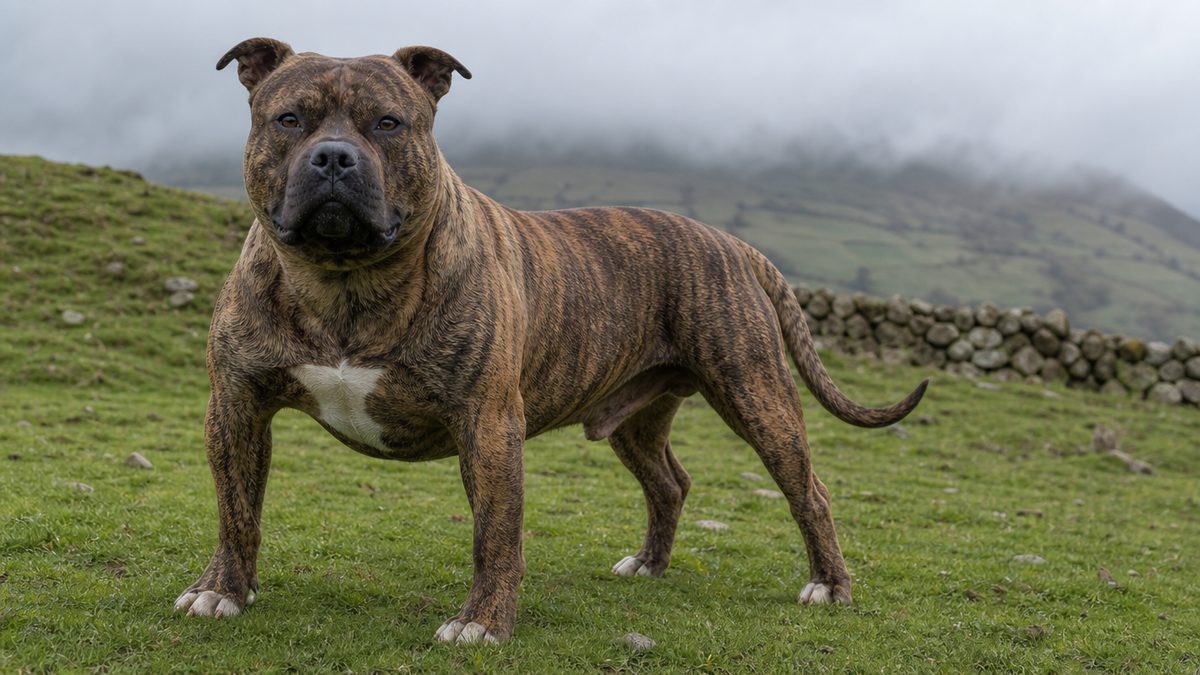
The Villano de Las Encartaciones is a brindle Basque catch dog bred to grip semi-feral cattle, and it holds a peculiar place in Spanish cynological law: it is the first breed ever added to the national list of Spanish canine breeds without a state racial prototype beside it.
The Anexo to Real Decreto 558/2001 lists 33 Spanish canine breeds, and the consolidated text prints a full racial prototype for only 26 of them. Most pages that notice the gap treat it as sloppiness. It is not. The document that created the gap is Real Decreto 1557/2005, and the Villano is the breed it created the gap for.
RD 1557/2005 replaced the whole annex with a new 27-name list, and its recital says verbatim: *El nuevo anexo no incluye junto con el listado de razas caninas su definicion del prototipo racial puesto que estos pasan a ser regulados por la comunidad autonoma competente en cada caso*. The new annex does not carry the prototype definitions because prototype-setting passes to the competent autonomous community. Its new Article 8 makes that binding, and its third transitional provision keeps the old 2001 prototypes alive until each region writes its own.
Count the 2005 list and the arithmetic closes. RD 1557/2005's annex holds 27 names, of which 26 already had prototypes printed in 2001. The twenty-seventh, the new one, is the Villano de las Encartaciones. It is therefore the first Spanish breed on the national list to be listed with no state prototype, and every breed added afterwards, the Pachon Navarro in 2010, the Perro de Agua del Cantabrico in 2012, three more in 2016 and the Valdueza in 2020, inherited the same position.
| Instrument | Date | Added | Running total | State prototype printed? |
|---|---|---|---|---|
| Real Decreto 558/2001 | 25 May 2001 | The original 26 | 26 | Yes, all 26 |
| Real Decreto 1557/2005 | 23 Dec 2005 | Villano de las Encartaciones | 27 | No, and the recital says why |
| Orden ARM/573/2010 | 4 Mar 2010 | Pachon Navarro | 28 | No |
| Orden AAA/251/2012 | 9 Feb 2012 | Perro de Agua del Cantabrico | 29 | No |
| Orden AAA/1357/2016 | 29 Jul 2016 | Podenco Paternino, Podenco Valenciano, Perro Leones de Pastor | 32 | No |
| Orden APA/698/2020 | 21 Jul 2020 | Valdueza | 33 | No |
The 2010 order that added the Pachon Navarro still describes the annex as carrying the breed list *con sus prototipos raciales*, with its racial prototypes. By 2010 that had been untrue for four years, and the same order added a breed without one. The later orders drop the phrase: the 2012 and 2016 orders and the 2020 order all describe the annex simply as *el listado de las razas caninas espanolas*. The wording caught up with the law five years late.
Where the prototype actually lives
The Basque Government wrote it. Orden of 15 February 2018 of the Consejera de Desarrollo Economico e Infraestructuras approved the specific regulation of the breed, and was published in the Boletin Oficial del Pais Vasco on 28 February 2018. It expressly repeals the earlier Orden of 9 December 2003 of the Consejero de Agricultura y Pesca, which is when the breed was first regulated.
That order is the document to read, and it does far more than set a breed standard. It sets a points-based morphological grading scheme, a four-register studbook, a management commission and the rules for who may breed. We take it section by section below. It is also the only breed standard for this dog that any Indian reader needs, since no other body publishes one.
The dog the order describes
Medium-sized, longiline, compact, with great breadth of head and chest and an expression of great muscular power in the front third; rustic in appearance with marked sexual dimorphism; lively and agile towards its owner and deep and serious in expression towards strangers. The head is mesocephalic with slightly divergent craniofacial axes, a long pronounced fronto-nasal depression, a broad deep truncated-pyramidal muzzle widest at the nose, straight powerful jaws with marked masseter development, and a pincer bite.
| Measure | Males | Females |
|---|---|---|
| Height at withers | 58 to 63 cm | 55 to 60 cm |
| Weight | No standardisable average | No standardisable average |
| Height to length ratio | 5 to 6 | 5 to 6 |
| Height to chest depth ratio | 2 to 3 | 2 to 3 |
| Skull to face length | 5 to 4 | 1 to 1 |
| Coat length | 1 to 3 cm | 1 to 3 cm |
The brindle coat is required: *barcina* or *atigrada*, locally *barreada*, more or less dark, over black, grey and fawn grounds, desirable in that order, with white marks permitted only on chest and limbs, a black nose and hazel eyes matching the coat. The coat itself is short, hard and flat, one to three centimetres, very dense and close to the body.
The order requires a long, fine tail carried in an outward sickle, with great lateral mobility both at rest and in movement, the base of the curve near the hocks at rest. Its eliminating faults then include cola corta, a short tail. So unlike the Perro Majorero, whose state prototype describes routine docking, this breed's standard disqualifies a shortened tail. On docking, the Basque order and Indian law point the same way.
The full eliminating list is worth having, because it tells you what the breed is selected against: character imbalance, any kind of prognathism, monorchidism, albinism, brachycephaly, short tail, rear dewclaws, depigmentation of the nose, and any coat other than the standard's.
Villano de Las Encartaciones price in India, and why there is not one
No Villano de Las Encartaciones price in India exists, and in this case the reason is arithmetic before it is legal: there are 438 living dogs of this breed and they are almost all in one Basque comarca.
The breed's own authorised studbook keeper publishes live counters on its front page. As read on 9 September 2026 they stood at 695 pure-breed certificates issued, 438 active Villanos, 236 dogs qualified for breeding and 21 with merits. That is not an estimate, a press figure or an enthusiast's guess. It is the register's own count, kept by the association the Basque Government authorised to keep it.
Most rare-breed pages, including several on this site, have to reach for a press estimate. This breed has a club that keeps the official genealogical book under the authority of Eusko Jaurlaritza, and publishes the count Club Nacional Villano de las Encartaciones. Before making any rarity claim about a breed, the right first question is whether it has its own club keeping its own studbook. Here the answer is yes, and the number is on the homepage.
Against 438 living dogs, the question of an Indian price does not arise commercially. Anyone shown a Villano puppy in India can verify the claim in one step: ask for the Spanish pedigree number and the issuing register, then check it against the Club Nacional Villano de las Encartaciones, which is the only body authorised to issue one. It also does not arise legally. India's import policy for pet dogs is restricted and permitted only with a DGFT authorisation, and the guidance states in consecutive clauses that dogs for commercial purposes like breeding, as a gift or for other purposes are not allowed to be imported, and that new born puppies are not allowed. The only realistic lawful route is a dog you have already owned abroad for at least two years, brought in on transfer of residence.
- Import authorisation is applied for under ITC(HS) code 01061900.
- The application goes to the Department of Animal Husbandry, Dairying and Fisheries for a no-objection certificate, then to a monthly inter-ministerial Exim Facilitation Committee.
- Entry is only through the airports and seaports of Delhi, Mumbai, Chennai, Hyderabad, Bengaluru and Kolkata and, since October 2024, Kochi airport. The full route is set out in how to import a dog to India.
- An advance no-objection certificate must be obtained from the port's Regional or Quarantine Officer seven days before arrival.
- Where required the animal is quarantined at the government quarantine station of that port.
What the Indian search actually returns for this breed
We ran the commercial query on Google India on 9 September 2026 and the fetch failed on two consecutive attempts, on the stealth proxy and then on the enhanced proxy. We record that as what happened on those attempts rather than drawing any conclusion from it. The informational query on the same engine, in the same session, returned normally, and what it returned is more revealing than a price would have been.
Google's four questions for this breed were: *Which dog can defeat Dogo Argentino?*, *What is the only breed of dog mentioned in the Bible?*, *What is the most aggressive fighting dog?* and *Is the Majorca Shepherd dog rare?*. Not one is about the Villano. Three of the four sit in the fighting-dog cluster. That is where the search engine places this breed, and an Indian reader arriving from that neighbourhood is arriving with the wrong expectations about what a cattle catch dog is for.
The ranking English pages also disagree about basic size. Wikipedia calls it a breed of large working dog, DogZone describes a medium-sized dog with the look of a long-legged mastiff, and Dog Breed Info calls it a medium sized hunting dog Wikipedia in English. The Basque order settles it at 58 to 63 cm for males, which is a solidly medium-to-large dog and not a mastiff. None of those pages cites the order.
The cost of ownership if one ever reached India
The cost of ownership for a Villano in India would be that of any 30 to 40 kg working dog, and since the breed's own standard declines to give a weight, the honest approach is to price components rather than assemble a fictitious monthly total.
The Basque order's weight clause is unusual and worth quoting because it shapes this section: *No existe un peso medio estandarizable, por lo que se admite un amplio margen de medicion en funcion de las condiciones de la crianza y de otras circunstancias propias del entorno*. There is no standardisable average weight, so a wide margin is accepted depending on rearing conditions and local circumstances. A standard that refuses to invent a weight is a standard worth trusting on other things.
| Line | Indian figure | Source |
|---|---|---|
| Puppy core vaccination course | Starts at Rs 6,499 on the national page | Vetic, 50-plus clinics |
| Annual booster | Starts at Rs 3,199 | Vetic |
| Anti-rabies, single dose | Rs 699 | Vetic |
| 9-in-1 DHPPiL, single dose | Rs 899 | Vetic |
| Tick and worm control, monthly | About Rs 1,103 for a 15 to 30 kg dog | NexGard Spectra via Supertails |
| Deworming, per dose | About Rs 125.67 per tablet at one per 10 kg | Drontal Plus via Supertails |
| Municipal registration, Delhi | Rs 500 new, Rs 500 renewal | MCD Delhi |
| Municipal licence, Chennai | Rs 50 | Greater Chennai Corporation |
The identical 9-in-1 vaccine costs Rs 600 at a Goa government veterinary hospital including the certificate, from Rs 899 at a Vetic clinic and from Rs 1,999 through a vet-at-home service that also charges a Rs 699 visit fee. That is 3.3 times on one drug, and twelve times on anti-rabies across the same three routes. Which route you use matters more than which breed you keep.
Two municipal facts are worth more to an Indian reader than any breed price. Greater Chennai Corporation issued 9,115 pet licences in 2024 and runs six municipal pet clinics that provide treatment and anti-rabies vaccination free of cost. Delhi's MCD has issued 18,958 pet dog certificates since 2021, and rejected 71 of 1,006 applications in FY 2026-27. A large brindle catch dog is exactly the registration a municipal officer looks at twice.
The line item this breed adds
Containment. The Basque order describes a dog with *justa agresividad y fiereza en el manejo del ganado*, just enough aggression and fierceness in handling stock. That is a working temperament with an off switch, not an unstable one, but it is a dog whose job was to close on a large animal and hold it. Fencing, gates and a management plan for visitors are not optional extras for this breed; they are the first line of the budget.
Heat tolerance and the Indian climate
A Villano de Las Encartaciones has no heat tolerance to speak of for Indian conditions, and this is the one page in this batch where we cannot measure the homeland directly and say so instead of guessing.
NASA POWER failed on Las Encartaciones, and it failed in the specific way this project has learned to watch for. Sodupe, Balmaseda and Karrantza are three separate towns in the comarca. All three return the same grid cell at 568.01 metres, against real elevations of about 70 m, 200 m and 200 m: errors of +498 m, +368 m and +368 m.
It would be easy to present those three identical readings as three confirmations. They are one reading returned three times. When several nearby points come back byte-identical, you have queried one cell repeatedly and learned nothing about how the places differ. We publish no Encartaciones climate figure, because the only figure available is a 568 m upland cell sitting over valleys at 70 to 200 m, and a temperature taken from it is about three degrees too cold for the valley floor.
What we can do is find the nearest point that survives an elevation check. Bilbao, about 20 km east of Sodupe, returns a cell at 106.47 m against a real 19 m, an error of +87 m, which is inside the tolerance this project uses. That cell gives an annual mean of 14.95 C at 76.8 percent relative humidity, a hottest month of August at 21.14 C, a coolest month of February at 9.77 C and a peak Stull wet bulb of 17.68 C in August.
Castro-Urdiales, on the Cantabrian coast, returns the same cell as Bilbao, also at 106.47 m. So Bilbao and Castro-Urdiales are not two independent readings either. We are using one usable cell, and saying so, rather than presenting a coincidence as corroboration.
| Place | Cell elevation | Annual mean T2M | Annual mean RH2M | Hottest month mean | Peak Stull wet bulb |
|---|---|---|---|---|---|
| Bilbao, 20 km from Sodupe | 106.47 m | 14.95 C | 76.8 percent | 21.14 C (Aug) | 17.68 C (Aug) |
| Chennai | 48.95 m | 27.94 C | 72.4 percent | 31.51 C (May) | 26.11 C (May) |
| Kolkata | 7.35 m | 25.80 C | 73.8 percent | 31.53 C (May) | 27.09 C (Jun) |
| Mumbai | 97.15 m | 26.77 C | 67.3 percent | 31.19 C (May) | 25.77 C (Jun) |
| Delhi | 206.37 m | 25.57 C | 45.5 percent | 35.88 C (Jun) | 26.50 C (Jul) |
| Bengaluru | 841.72 m | 23.74 C | 67.8 percent | 28.37 C (Apr) | 21.86 C (May) |
| Pune | 635.99 m | 23.86 C | 66.7 percent | 28.93 C (Apr) | 22.97 C (Jun) |
What those numbers mean for a dense-coated catch dog
Bilbao's annual mean of 14.95 C is nearly thirteen degrees below Chennai's NASA POWER climatology 2001 to 2020…. Its hottest month, August at 21.14 C, is below Chennai's coolest month of 24.09 C. As with the Canary breeds in this batch, there is no Indian season that resembles the homeland's summer, but here the gap is far wider.
Peak wet bulb is the number that matters for a working dog, because it is the limit evaporative cooling can reach and a panting dog is an evaporative cooler. Bilbao peaks at 17.68 C; Chennai at 26.11 C, Kolkata at 27.09 C and Delhi at 26.50 C NASA POWER climatology 2001 to 2020…. A gap of eight to nine and a half degrees of wet bulb is not something a dog acclimatises through.
Humidity is not the problem and it is worth saying so, because it is the usual assumption. Bilbao runs 76.8 percent annual relative humidity, higher than Chennai's 72.4 and Kolkata's 73.8 NASA POWER climatology 2001 to 2020…. This dog comes from damp air. It does not come from hot air.
Indian law gives you the hook. Second Schedule Part IV paragraph 21(1) bars keeping dogs in outdoor facilities, without the attending veterinary practitioner's written approval, where they are not accustomed to the temperatures prevalent locally, or where the breed cannot tolerate them. A dog from a 15 C Atlantic valley is inside that clause on its face.
Temperament, household fit and how it differs from the Villanuco
The Villano de Las Encartaciones is described by its own government order as very balanced, obedient and cheerful with its owner while cautious and wary with strangers, and it is not the same animal as the small ratter whose name looks almost identical.
The order's character clause reads: very balanced; obedient, cheerful and of great vivacity in its expressions towards its owner; powerful, agile and with just enough aggression and fierceness in handling stock; cautious and wary before unknown people, to whom it shows its deep and serious gaze, but from the serenity conferred by its self-recognised strength. Character imbalance is an eliminating fault. It is a loyal dog to its own household and a reserved one to everybody else, and the order does not pretend otherwise. It does not guard a boundary the way a livestock guardian does; it works alongside a handler and closes on command, which is a different job even though both dogs look formidable.
The Villano and the Villanuco are two different breeds
This is the single most important thing this page can tell an Indian reader, because every search route funnels the two together. Three separate authorities settle it.
- The Basque Government order. Clause 1.2, headed *Variedades de la raza*, reads in full: *No existen variedades dentro de la raza canina villano de las Encartaciones*. There are no varieties within the breed. A small variety of the Villano does not exist because the instrument that defines the Villano says it does not.
- The breed's own studbook keeper repeats it on its front page: no varieties exist within the breed.
- Spanish Wikipedia's Villanuco article opens with a disambiguation note and then states that despite the great similarity in the names, the Villano de Las Encartaciones is an independent breed, sharing common characteristics such as area of origin.
Searching the Villanuco on Google India returns an AI panel stating that the traditional dog of the comarca is the Villano, *aunque tambien existe una variante de tamano pequeno conocida como Villanuco de Las Encartaciones*, although a small-size variant known as the Villanuco also exists. That is contradicted by the Basque order, by the club and by the Spanish encyclopedia article the panel itself cites. If you meet the variant claim anywhere, this is where it comes from.
| Villano de Las Encartaciones | Villanuco de Las Encartaciones | |
|---|---|---|
| Type | Catch dog, perro de presa | Ratter and door-warning dog |
| Height at withers | 58 to 63 cm males, 55 to 60 cm females | 30 to 40 cm, bitches a little less |
| Coat length | 1 to 3 cm | A little over 1 cm |
| Coat colour | Brindle required, over black, grey or fawn | Most often black and white or black and tan |
| Original job | Gripping semi-feral Monchina cattle | Killing rats and announcing strangers |
| In the Spanish national annex? | Yes, since 2005 | No |
| Authorised studbook keeper | Club Nacional Villano de las Encartaciones, under Eusko Jaurlaritza | None |
| Published population | 438 active dogs | About 50, last counted in 2013 |
Who should not consider this breed
- Anyone in an Indian flat, where strangers cross the dog's boundary several times a day.
- Anyone who wants a dog to socialise into a friendly greeter, since the standard selects for reserve rather than sociability with strangers.
- First-time owners, because a catch dog's grip is not something training removes.
- Anyone attracted by the fighting-dog framing the search results put around this breed, which misrepresents a stock dog's job.
- Anyone who cannot supply cool ground, because this is a heat-sensitive Atlantic breed.
The 2017 Rules require dogs with a vicious or aggressive disposition to be housed separately from other dogs, and state that sedation shall not be used to control the behaviour of such dogs. That is written for establishments, but it names the shortcut owners of powerful dogs most often reach for and names it as forbidden.
Training a Villano, and what the breed resists
To train a Villano de Las Encartaciones you build a reliable recall and an off switch before the dog is strong enough to need them, because the one thing this breed does not offer is a soft mouth on a moving target.
The order describes a dog that is obedient and cheerful with its owner and quick in its movements, with easy wide extension of the limbs that does not take them far off the ground. Read as a training brief, that is a cooperative dog with a very specific hard-wired job.
The job is the catch. The order's own history paragraph says the breed descends from the old *chato*, used since ancestral times by owners of semi-feral Monchina cattle to capture them in the steep valleys where they are reared. Monchina cattle are themselves a Spanish native breed listed as endangered in the official livestock catalogue, which tells you how rough the work was.
The socialisation window is the whole game
Because character imbalance disqualifies, the raw temperament arrives confident rather than nervous, and a confident catch dog that has not met the world treats novelty as something to close on. India's own rules note that puppy vaccination can start at seven to eight weeks and is usually complete by eighteen weeks, which is exactly the window when the socialisation has to happen.
- Introduce moving stimuli, cyclists, joggers, cattle, other dogs, deliberately and on a long line from eight weeks.
- Build the recall away from a moving target before the dog is six months old, not after.
- Teach a release before you ever teach a hold, and never play tug as a substitute for either.
- Socialise every category of routine Indian visitor as a paid, structured session rather than an accident.
- Read paragraph 22 of the 2017 Rules before you tether the dog at all.
Paragraph 22 of the Second Schedule allows tethers only in outside housing facilities meeting the rules; requires the tether to be attached to the front of the shelter or a post in front of it, at least three times the length of the dog measured nose tip to tail base; requires a well-fitted collar causing no trauma; and prohibits collars made of wire, flat chains, chains with sharp edges, or chains with rusty or non-uniform links. Most improvised Indian tie-outs fail more than one of those conditions.
Breeding rules the club applies, and the Indian rule they meet
The Basque order builds a four-register genealogical book. The Registro Fundacional, the founding register, was open for 24 months from the day after publication, so from roughly 1 March 2018 to 1 March 2020, admitting dogs of at least twelve months scoring a minimum of 60 points for females and 65 for males. That founding register can be reopened by the management commission for dogs of unknown genealogy judged capable of helping the breed survive. After it closed, a Registro Auxiliar opened for females only, with categories RAA and RAB and a births sub-register, and the order states plainly that males born to an RA dam have no place in any birth register at all. Genetic filiation control is required at the management commission's discretion.
The club has gone further since. It now requires a certificate of no impurities to register dogs, and says that together with its cross simulator this determines genetic membership of the breed with 99.99 percent certainty.
A conservation programme on 438 dogs runs close to lines Indian law draws. Second Schedule Part II paragraph 6(3) prohibits in breeding, defined as breeding between relatives of the second to fourth grade in straight or side line within the first four generations, giving uncle to niece, nephew to aunt, cousin to cousin and grandparent to grandchild as its examples, and prohibits incest breeding between parents and children or brother and sister. Paragraph 6(4) separately provides that female dogs shall not be mated after the age of eight years. Anyone proposing to breed a rare European breed in India should read those clauses before the standard.
Daily exercise requirement
A Villano needs long, steady, low-intensity work over broken ground rather than sprints, and in India that work has to be scheduled against the wet bulb rather than against the clock.
The order describes movement that is quick and agile with easy wide extension of the limbs kept close to the ground, and a body built for power in the front third rather than for speed. This is a dog built to close distance and hold, not to run for an hour.
So the honest requirement is two things: sustained daily movement, ideally on uneven ground, and mental work that uses the nose and the problem-solving rather than the grip.
- Walk before sunrise and after full dark from March to October anywhere in the Indian plains.
- Carry water on any outing over fifteen minutes and offer it before the dog asks for it.
- Substitute scent work indoors on days when the air is hot and still.
- Never work a dense-coated dog on hot paving, which holds heat long after the air has cooled.
- Treat refusal to move as heat rather than stubbornness, and stop immediately.
Reading the wet bulb rather than the thermometer
Chennai's peak Stull wet bulb is 26.11 C in May and Kolkata's is 27.09 C in June. Those are monthly means, so individual afternoons run above them. A dog acclimatised to a 17.68 C peak has a far narrower margin than an Indian street dog, and no way to tell you it has used it up.
Indian boarding operators warn about generator backup for air conditioning during BESCOM load shedding from March to May. If you ever board a heat-sensitive dog in Bengaluru, ask about the generator before you ask about the nightly rate.
Grooming and coat care in Indian humidity
Grooming a Villano is close to the least demanding coat care any breed asks for, because the Basque order specifies a coat of one to three centimetres, short, hard, flat, very dense and close to the body.
The same order requires skin of medium thickness, strong, elastic and close-fitting, marking the bony reliefs and the muscle planes. There is no undercoat clause, no feathering and no furnishing. A rubber curry once a week and a bath when the dog is genuinely dirty covers the routine.
The Indian question is not tangles. It is what a very dense one to three centimetre coat does in a wet-bulb climate it was not selected for. Density that traps a layer of warm air against the skin is an advantage in an Atlantic winter and a liability in a Chennai May.
What overseas grooming advice gets wrong here
European and Atlantic guidance routinely says to towel a dog and let it air dry. In an Indian monsoon that is how skin and ear problems start, because a dense flat coat holds moisture at the skin where you cannot see it. Dry to the skin by hand, especially along the neck and behind the elbows where the coat is thickest.
- Dry to the skin after every bath and every soaking, rather than air drying.
- Part the coat weekly during the monsoon and look at the skin, not the coat.
- Never shave a dense working coat to cool the dog, because the coat is also sun protection.
- Keep nails short, since the standard describes greatly developed nails and very hard pads built for rough ground.
- Price grooming from a rate card rather than a package: Indian salons quote haircut from Rs 1,359 and bathing from Rs 934 in Delhi, against a Rs 300 to Rs 2,000 market range.
The order lists rear dewclaws and depigmentation of the nose among its eliminating faults. Removing a dewclaw to tidy a dog is separately prohibited in India: Second Schedule Part II paragraph 6(8) names de-clawing in the same sentence as tail docking and ear cropping. On this breed the two instruments do not conflict, but a groomer offering either should be refused on both grounds.
Health issues, screening and life span
There are no published health issues for the Villano de Las Encartaciones, and that absence is a measured result rather than an oversight: the breed has no clinical literature, no screening database entry and no cohort study anywhere.
We ran the searches with controls in the same session and read the query translation line on every one. The results are worth setting out, because the shape of the absence is itself informative.
| Query | Records | What they actually are |
|---|---|---|
| "Villano de las Encartaciones"[tiab] | 0 | PubMed returned a quoted-phrase-not-found warning |
| Villano[tiab] | 8 | All the surname Villano, including a gas-phase chemistry series and an emergency-medicine letter |
| Villanos[tiab] | 0 | Plural form run separately, since [tiab] does not stem |
| Encartaciones[tiab] | 3 | Two are Spanish donkey microsatellite genetics; one is human tuberculosis in Bilbao |
| "Basque catch dog"[tiab] | 0 | English descriptive name tried as well |
| Villano de las Encartaciones, unquoted | 0 | PubMed rewrote it into an author search for de las |
| Labrador Retriever[tiab], control | 1,109 | Control passed |
| "Spanish Water Dog"[tiab], control | 9 | Control passed |
Two of the three Encartaciones records are Aranguren-Mendez and colleagues on genetic structure and diversity in Spanish donkey breeds, using microsatellite markers Aranguren-Mendez J, Jordana J. The Asno de las Encartaciones is in Spain's official livestock catalogue as an endangered asinine breed, and it has published population genetics. The comarca's two dog breeds have neither. That is the clearest possible statement of where research attention has gone.
Screening databases
The breed holds no OFA code at all. We read 435 canine breed codes out of OFA's own data-name markup, with Labrador Retriever LR, Bulldog BU and Beagle BE passing as in-document controls, along with Spanish Mastiff SPM, Spanish Greyhound SGH and Basque Shepherd BAS, and there is no Villano and no Encartaciones entry. That is a stronger absence than failing a publication threshold, because OFA's own rule is that a breed needs at least 100 hip evaluations, or 50 for its other databases, before statistics are published. A breed with no code has not reached the point of being counted.
What can honestly be said instead
Three things, none of them a number.
- The standard screens behaviourally and structurally rather than medically. Its eliminating faults are character imbalance, prognathism, monorchidism, albinism, brachycephaly, short tail, rear dewclaws, nose depigmentation and off-standard coats. Not one is a health test.
- The population is small enough that inbreeding is the live risk. With 438 active dogs and 236 qualified for breeding, the club's own cross simulator and its certificate of no impurities exist precisely because the pool is finite.
- Brachycephaly is disqualifying, which matters in India more than it does in Bizkaia. A standard that eliminates a shortened skull is a standard that has not built a heat-loading airway into the breed.
On life span we publish nothing. There is no cohort study, no registry median and no breed-club survey. Borrowing a figure from another Spanish catch dog would be inventing one, and a page that did so would be guessing with a citation attached.
Feeding a working catch dog in India
Feed a Villano to condition rather than to a number, because its own standard refuses to give a weight and says why: rearing conditions and local circumstances set it.
That clause is the right instruction. A dog kept for cattle work in a wet Atlantic valley and a dog kept as a companion in a hot city will not carry the same weight, and the Basque order accepts a wide margin for exactly that reason.
Practical rules for a deep-chested dog in a hot country
- Split the ration into two meals and keep both away from the hottest four hours of the day.
- Weigh food rather than scooping it, because a dog whose front third carries this much muscle hides condition.
- Do not exercise hard within an hour either side of a full meal, given the chest depth the standard requires.
- Keep water in more than one place and refresh it twice daily in summer.
- Assess condition by hand every month, since a very dense one to three centimetre coat hides a rib line.
A combined monthly product is the simplest route in India. NexGard Spectra for a 15 to 30 kg dog works out at about Rs 1,103 per month, and Drontal Plus at about Rs 125.67 per tablet dosed one per 10 kg gives roughly Rs 377 to Rs 502 per deworming for a 30 to 40 kg dog. Check the weight band against your own dog before dosing, and re-price before you commit, because Indian retail figures in this category have gone stale inside days in our own records.
We publish no monthly Indian food total for this breed. A monthly kibble figure is arithmetic rather than a quoted price, and doing that arithmetic for a dog with no Indian population and no standard weight would produce a number with no referent.
Month by month through the first year
The first year of a Villano is a socialisation and impulse-control project, and the milestones worth tracking are legal and behavioural rather than a growth curve nobody has published.
No growth data exists for this breed, and inventing a weight-by-month table would be worse than leaving it out. What follows is anchored to Indian rules and to the Basque order's own age thresholds.
| Age | What should be happening | Anchor |
|---|---|---|
| Under 8 weeks | The puppy stays with its dam. India prohibits sale of pups under eight weeks | Rule 8(1)(a), 2017 Rules |
| 7 to 8 weeks | Core vaccination can begin | Second Schedule Part III, 2017 Rules |
| 8 to 16 weeks | Heaviest socialisation window: moving stimuli, visitors, surfaces, traffic | Behavioural |
| By 18 weeks | Core vaccination course usually complete | Second Schedule Part III, 2017 Rules |
| At sale | Every pup sold must be micro-chipped with records maintained | Rule 8(1)(e), 2017 Rules |
| Under 6 months | Puppies register in the Registro de Nacimientos in Spain if under six months or unweaned | Basque order of 15 Feb 2018 |
| Over 6 months | Not to be sold without prior sterilisation unless to another licensed breeder | Rule 8(1)(b), 2017 Rules |
| 12 months | Spanish grading becomes possible: minimum 60 points for females and 65 for males | Basque order of 15 Feb 2018 |
The grading scheme, and why it is worth knowing
The Basque order scores each anatomical region from one to ten and multiplies by a weighting coefficient. Head and neck carry 1.5, limbs and stance 1.5, sexual characters 0.5, and temperament and overall form carry 2.5 in males and 2.0 in females, the heaviest single weighting in the scheme. Awarding fewer than five points to any single region disqualifies the dog outright regardless of the rest.
That weighting is a statement of intent. In a breed where temperament is worth a quarter of the score and character imbalance eliminates, what is being bred is a mind first and a shape second.
Villano against the breeds it is confused with and cross-shopped against
The Villano de Las Encartaciones is confused with the Villanuco by name and cross-shopped against the Alano Espanol and imported guardian breeds by type, so the useful comparison runs on both axes.
The first comparison is administrative, because it is where the Spanish rare breeds genuinely differ and where no English page looks.
| Breed | In the RD 558/2001 Anexo? | State prototype? | Authorised studbook keeper | Authorising government |
|---|---|---|---|---|
| Villano de Las Encartaciones | Yes, added 2005 | No, Basque order instead | Club Nacional Villano de las Encartaciones | Eusko Jaurlaritza |
| Villanuco de Las Encartaciones | No | No | None | None |
| Euskal Artzain Txakurra | Yes, two varieties | Yes | Euskal artzain txakurraren elkartea | Eusko Jaurlaritza |
| Alano Espanol | Yes | Yes | Two keepers: an agrupacion and the RSCE | Comunidad de Madrid |
| Perro Majorero | Yes, original 26 | Yes | Asociacion para la Conservacion del perro Majorero | Gobierno de Canarias |
| Valdueza | Yes, added 2020 | No | Not listed in the 2018 table | Not listed in the 2018 table |
The RSCE's studbook table is dated by its own upload path to 2018, and the Valdueza was not added to the national annex until July 2020. So the Valdueza's absence from that table is a fact about the document's date, not about the breed. This is the kind of distinction that turns into a false claim if you read the table without reading its date.
| Breed | Male height | Coat | Original job | Available in India? |
|---|---|---|---|---|
| Villano de Las Encartaciones | 58 to 63 cm | Brindle, 1 to 3 cm, very dense | Catching semi-feral cattle | No |
| Villanuco de Las Encartaciones | 30 to 40 cm | Just over 1 cm, black and white or black and tan | Ratting and warning | No |
| Alano Espanol | Larger | Short | Catch dog for cattle and boar | No |
| Cane Corso | Larger and heavier | Short | Guardian | Yes, Rs 60,000 to Rs 1,50,000 plus |
One further difference matters and cuts against a lazy assumption. The RSCE publishes a list of Spanish breeds it considers vulnerable, in force from 1 May 2026 to 30 April 2027, and it names 21 breeds including the Majorero and the Valdueza. The Villano is not on it, even though the Basque catalogue classes the breed as being in critical situation.
The RSCE's vulnerable list concerns breeds whose studbooks sit in the RSCE's own orbit. The Villano's genealogical book is kept by its own club under the Basque Government, not by the RSCE. So the RSCE list is the wrong instrument for this breed, and a page that read the absence as evidence the Villano is not endangered would have it exactly backwards. Before building any rarity claim on a single registry, ask which register actually holds the breed.
Mistakes Indian readers make with this breed
The commonest mistake with the Villano de Las Encartaciones is treating the Villanuco as a smaller version of it, and the second commonest is arriving from the fighting-dog search cluster and expecting a fighting dog.
Five errors, and the check that settles each
- Believing the Villanuco is a small variety. Read clause 1.2 of the Basque order: no varieties exist within the breed.
- Reading the RSCE vulnerable list as a verdict on this breed. The Villano's studbook is not kept by the RSCE, so its absence from that list says nothing.
- Taking the fighting-dog framing from the search results. Google's four questions for this breed are about defeating a Dogo Argentino and the most aggressive fighting dog. The Basque order describes a stock dog with *just enough* aggression for handling cattle.
- Accepting a docked dog as correct. A short tail is an eliminating fault in the breed's own standard, and tail docking is separately prohibited in India.
- Assuming a rare European breed can be bought and imported. India bars import for commercial purposes, as a gift or for other purposes, and bars newborn puppies outright.
The name error, and why it is nobody's fault
It would be easy to blame readers for confusing two breeds whose names differ by three letters. The confusion is older and more official than that. The small ratter of the comarca was renamed *villanuco* in reference to a different, larger, now-vanished dog of that name, after a study of the comarca's breeds. In other words the resemblance in the names was created deliberately, by the people trying to save the smaller dog, and it has propagated ever since. Google's answer panel repeats it, most English breed sites repeat it, and only the Basque order and the Spanish encyclopedia article state the position clearly Wikipedia in Spanish.
Height. The Villano stands 58 to 63 cm at the withers in males; the Villanuco stands 30 to 40 cm. There is no overlap and no intermediate. If a dog offered to you as either sits between those bands, it is neither.
One more naming detail is worth recording for anyone chasing paperwork. The RSCE's own studbook table prints the breed as VILLANO DE ENCARTACIONES, dropping the article that the Basque order and the club both use. Searching for the exact official string will therefore miss one of the two documents that matter, which is a small thing that costs real time.
Adoption and responsible sourcing
You cannot adopt a Villano de Las Encartaciones in India, and with 438 living dogs in the world the responsible position is that you should not try to bring one here.
The breed's own studbook records 438 active dogs and 236 qualified for breeding. Removing a breeding-eligible animal from a pool that size to a climate it was not selected for is not conservation. It is the opposite.
What people actually want when they search this breed
Google's related-searches block for the Villano names the Villanuco de Las Encartaciones, the Erbi Txakur, the Basati alaunt and the Monchina. Read that list and the want is clear: a rustic, brindle, powerful, self-possessed working dog with a real job behind it rather than a show history. India already has dogs like that, and they do not need to be imported past a register that holds 20 provisional entries and no Basque breed at all.
- Indian pariah dogs match on independence, rusticity and climate fitness, and are free to adopt through shelters.
- Indian working breeds already adapted to this heat are a better bet than any Atlantic breed, whatever its rarity.
- Local shelters hold adult dogs whose temperament is already known, which beats any standard as a predictor.
- Foster first if you are drawn to a powerful working type, because the fit is behavioural and cannot be read off a page.
In Basque regulatory drafting, not in the export market. Law 9/2022 of 30 June on the protection of domestic animals in the Basque Country creates, at its article 30, a special legal framework for native Basque breeds declared Genetic and Ethnological Heritage of Euskadi. The Club Nacional Villano de las Encartaciones applied for the breed to be so declared on 30 June 2022, the day after the law was published. The declaration was due by 31 December 2024 and has not been made, because the department says more than 30 separate regulatory developments are needed and the plan they sit in carries 125 initiatives.
If the breed interests you, the useful things to know are that its genealogical book is kept by the Club Nacional Villano de las Encartaciones at the Casa de Cultura in Sodupe under the authority of Eusko Jaurlaritza, that the club has established a germplasm bank for the breed, and that it is one of five Basque canine breeds in the regional catalogue, three of which are classed as being in critical situation.
Villano de Las Encartaciones questions, answered from the orders
Which dog can defeat Dogo Argentino?
This was one of four questions Google actually returned for this breed, and its presence is a finding rather than a topic. None of the four questions was about the Villano, and three sat in the fighting-dog cluster. Bonbeno does not rank dogs by fighting ability. Organised animal fighting is an offence in India under section 11(1)(m)(ii) and 11(1)(n) of the Prevention of Cruelty to Animals Act, 1960, in the form those clauses took in 1982.
What is the only breed of dog mentioned in the Bible?
Google returned this question in the Villano's box and it has nothing to do with the breed. The claim usually made is that the greyhound appears in Proverbs 30:31 in the King James Version, where later translations render the same word as strutting rooster or war horse. It is a translation artefact rather than a fact about any breed, and we record it because it shows what search-adjacent content this breed attracts.
What is the most aggressive fighting dog?
We will not answer this as asked, and the reason belongs on this page. The Villano de Las Encartaciones is a cattle catch dog whose own government standard specifies just enough aggression and fierceness for handling stock, and lists character imbalance as an eliminating fault. A dog bred to grip a cow under control is not a fighting dog, and the search cluster that puts this breed beside that question is misleading readers.
Is the Majorca Shepherd dog rare?
Google returned this question in the Villano's box and it concerns a different breed. The Ca de Bestiar or Majorca Shepherd is in Spain's national annex with a printed state prototype, its studbook is kept by the Club del Ca de Bestiar under the Balearic Government, and it appears on the RSCE's vulnerable-breeds list in force from 1 May 2026 to 30 April 2027. So yes, it is officially classed as vulnerable, and unlike the Villano it is on that particular list.
What is the Villano de Las Encartaciones price in India?
There is no Villano de Las Encartaciones price in India. The breed has 438 living dogs according to its own authorised studbook keeper, essentially all in one Basque comarca, and India's pet import policy bars import for commercial purposes, as a gift or for other purposes, and bars newborn puppies. Any Indian listing under this name is a different dog.
How many Villano de Las Encartaciones are there?
The Club Nacional Villano de las Encartaciones, which keeps the breed's official genealogical book under the authority of the Basque Government, published counters reading 695 pure-breed certificates issued, 438 active dogs, 236 qualified for breeding and 21 holding merits, as read on 9 September 2026. That is a register count rather than an estimate.
Is the Villanuco a small Villano?
No. Clause 1.2 of the Basque Government order of 15 February 2018, headed varieties of the breed, states that no varieties exist within the Villano de Las Encartaciones. The club repeats it, and Spanish Wikipedia states that despite the similarity of the names the Villano is an independent breed. Google's answer panel calls the Villanuco a small-size variant, and that claim is contradicted by all three.
How much does a Villano de Las Encartaciones weigh?
Its standard does not say, and that is deliberate. The Basque order states that no average weight can be standardised, so a wide measurement margin is accepted depending on rearing conditions and other circumstances of the environment. The order does give height: 58 to 63 cm at the withers in males and 55 to 60 cm in females.
Is the Villano de Las Encartaciones recognised by the FCI?
No. The FCI's letter-V index returns three breeds, the Vastgotaspets, the Volpino Italiano and the Vostotchno-Sibirskaia Laika, and the Villano is not among them. It is also absent from the FCI's 20-entry provisional register. Its recognition is Spanish and Basque: the national annex of Real Decreto 558/2001 and the Basque order of 15 February 2018.
What inherited diseases does the Villano de Las Encartaciones have?
None have been published, and the absence was measured rather than assumed. The breed holds no OFA breed code among the 435 canine codes read from OFA's own markup, so no hip, elbow, eye or patella row exists for it. A controlled PubMed search across six query forms returned no clinical paper, with Labrador Retriever and Spanish Water Dog controls passing in the same session.
Can a Villano de Las Encartaciones live in an Indian apartment?
No. It is a 58 to 63 cm catch dog bred to grip semi-feral cattle, with a very dense coat and no measurable heat tolerance for Indian conditions. The nearest defensible climate point to its homeland peaks at 21.14 C in August, which is below Chennai's coolest month. Shared corridors and daily deliveries also put strangers inside its boundary several times a day.
Why is the Villano de Las Encartaciones not in the Spanish state standard?
Because it was added after Spain stopped printing standards. Real Decreto 1557/2005 replaced the annex of Real Decreto 558/2001 and stated in its recital that the new annex does not include prototype definitions, since those pass to the competent autonomous community. The Villano was the breed that order added, making it the first on the national list without a state prototype. The Basque Government supplied one in 2018.
Compare with similar breeds
Villano de Las Encartaciones sits in 1 Bonbeno group. Each one compares it directly against the breeds it is genuinely an alternative to, on the same figures.