
Breed profile
Valdueza in India: Price, Law, Heat and Pack Life
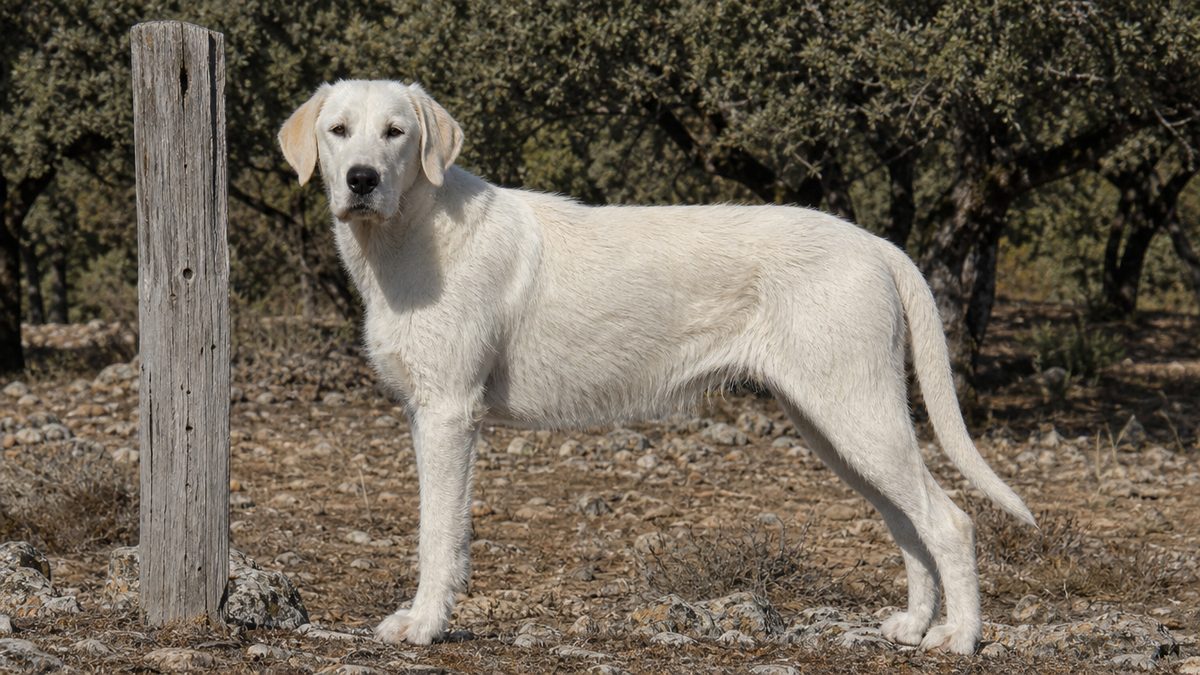
A very large white pack hound built deliberately from the 1940s for Spanish big-game hunting, the thirty-third and newest name on Spain's national list of canine breeds, and the only breed in this group whose standard describes two separate practices Indian law forbids by name.
Quick answer
No verifiable Valdueza price in India exists, and this breed has a legal problem in India beyond availability. Its own published standard describes ears that are traditionally cut and a tail that is traditionally cut, and India's Second Schedule Part II paragraph 6(8) forbids ear cropping and tail docking in the same sentence. No other breed in this group collides with two named prohibitions at once.
This page is reference information and not veterinary advice. The Valdueza has no clinical literature of its own, so every health statement here is a general canine fact or an inference from the breed's size and work, and each is labelled as such. For anything concerning your own dog, consult your nearby vet.
Valdueza traits, rated for India
What the Valdueza is, and how it became Spain's newest breed
The Valdueza is a very large white Spanish pack hound created deliberately from the 1940s for big-game hunting, and it became the thirty-third and newest name on Spain's national list of canine breeds on 21 July 2020.
The instrument is short and worth reading in full, because it is the whole of the breed's national status. Orden APA/698/2020, de 21 de julio, at its Article 1, says simply that the Spanish pure canine breed Valdueza is incorporated into the annex of Real Decreto 558/2001. Its recital adds that the proposal to include the breed was favourably reported by the Comision Nacional de Zootecnia at its meeting of 21 May 2020. It was published in the *Boletin Oficial del Estado* on 27 July 2020 and came into force the following day.
Because Spain stopped printing them fifteen years earlier and said so. Real Decreto 1557/2005 replaced the whole annex and its recital states that the new annex does not include the racial prototype definitions alongside the breed list, since those pass to the competent autonomous community in each case. So of the 33 names in the annex today, 26 carry a printed prototype and seven do not, and all seven of those were added in 2005 or later. The Valdueza is the last of the seven.
| Instrument | Date | Added | Running total | Prototype printed? |
|---|---|---|---|---|
| Real Decreto 558/2001 | 25 May 2001 | The original 26 | 26 | Yes, all 26 |
| Real Decreto 1557/2005 | 23 Dec 2005 | Villano de las Encartaciones | 27 | No |
| Orden ARM/573/2010 | 4 Mar 2010 | Pachon Navarro | 28 | No |
| Orden AAA/251/2012 | 9 Feb 2012 | Perro de Agua del Cantabrico | 29 | No |
| Orden AAA/1357/2016 | 29 Jul 2016 | Podenco Paternino, Podenco Valenciano, Perro Leones de Pastor | 32 | No |
| Orden APA/698/2020 | 21 Jul 2020 | Valdueza | 33 | No |
Who made this dog, and a disagreement about his name
The breed is a deliberate creation with a named founder, which is rare and which matters later on this page. The Real Sociedad Canina de Espana's own record says the Valdueza rehala hounds are the product of more than seventy years of rigorous selection begun in the 1940s by D. Alonso Alvarez de Toledo y Cabeza de Vaca and continued by his son D. Alonso Alvarez de Toledo y Urquijo, Marques de Valdueza.
Wikipedia says breeding was begun by Alfonso Alvarez de Toledo y Cabeza de Vaca, the eleventh Marquess of Valdueza, and continued after his death by his son Alonso Alvarez de Toledo y Urquijo, the twelfth marquess. The RSCE gives the father's first name as Alonso as well. So Spain's national kennel club and the top-ranking English source disagree about the founder's first name, while agreeing on both surnames, on the son's name and on the 1940s date. We have not found a document that settles it, and we are not going to pick the one we prefer.
The aim was constant from the beginning: to produce dogs suited to hunting in packs, specifically adapted to the *monteria* in the Montes de Toledo, the sierras of Extremadura and the Sierra Morena. The RSCE describes the present dogs as extraordinarily homogeneous in morphology, function and character, and calls the result a zootechnical marvel with a personality of its own.
What went into it
Wikipedia gives the composition as large rough-haired Podenco Andaluz dogs crossed with lightweight examples of the Mastin Extremeno, with some Griffon Vendeen blood added later by the son. Instagram and enthusiast accounts add that the white long-haired Podencos Campaneros are where the white, hardy and fast attributes came from.
A PubMed check of the three ancestors, with a Labrador Retriever control returning 1,109 in the same session, gives Griffon Vendeen 16 records, Mastin Extremeno 0, and Podenco Campanero 0. So the only one of the Valdueza's three founding types with any clinical literature at all is the French one.
The dog the standard describes
Large, rustic but elegant and of noble appearance, very sociable in character, docile, obedient and easy to live with both with people and with the other dogs of the rehala it works alongside, with a dense harsh-textured coat preferably white in colour. That breed standard is the RSCE's rather than the state's, and it is the only breed standard published for this dog anywhere, so every figure below comes from it. This is a modern breed and its documentation is correspondingly modern: a national listing dated 2020, an RSCE breed standard, and two peer-reviewed studies of the hunting system it belongs to.
| Measure | Males | Females |
|---|---|---|
| Height at withers | 67 to 75 cm | 66 to 72 cm |
| Coat length | Preferably 3 to 8 cm, shorter on the head | Preferably 3 to 8 cm, shorter on the head |
| Coat texture | Harsh, straight, with undercoat | Harsh, straight, with undercoat |
| Skull to muzzle ratio | 1 to 1 | 1 to 1 |
| Weight | Not stated in the standard | Not stated in the standard |
The colour clause is unusually restrictive and it is the easiest way to identify the breed. The coat is preferably white or waxy, and pale sand-coloured patches may appear on head and body, but never dark patches. Nose and mucous membranes may run from flesh-coloured to black but must always be adequately pigmented. Eyes are medium and almond-shaped with a lively and noble expression. The bite is preferably a scissor, with broad jaws and well-aligned teeth.
The RSCE's record heads the breed Grupo 11 - Tipo Pinscher y Schnauzer - Tipo Dogo. English sources uniformly call it a large pack-hound. Both cannot be the natural filing for a podenco-mastiff cross, and the disagreement is worth knowing because it changes what you expect from the dog. Note also what Grupo 11 means at the RSCE: it is that body's own group for razas no reconocidas por la FCI, breeds the FCI does not hold. It is a Spanish filing rather than an FCI grant, and the type label inside it is the RSCE's own.
Valdueza price in India, and the two Indian obstacles before price
No verifiable Valdueza price in India exists, and for this breed the interesting question is not the price but the two Indian rules a Valdueza owner would meet before ever reaching one.
Start with availability, briefly, because it is the least interesting obstacle. There is no Indian population, no Indian breeder and no lawful route to import a puppy. India's pet import policy is restricted and permitted only with a DGFT authorisation, and the guidance states in consecutive clauses that dogs for commercial purposes like breeding, as a gift or for other purposes are not allowed to be imported, and that new born puppies are not allowed. The single lawful route is a dog already owned abroad for at least two years, on transfer of residence, entering through one of seven named ports Department of Animal Husbandry…. The full route is set out in how to import a dog to India.
The first Indian rule: the standard describes two prohibited procedures
This is the finding that makes this page worth writing, and no other breed in this Spanish group produces it.
The RSCE's current standard for the Valdueza says of the ears: *De insercion alta y tamano medio. Tradicionalmente cortadas para evitar lesiones en el trabajo*. Set high, medium in size, traditionally cut to avoid injuries at work. And of the tail: *De insercion media. Tradicionalmente se corta para evitar lesiones en el trabajo*. Medium set, traditionally cut to avoid injuries at work.
Second Schedule Part II paragraph 6(8) of the Prevention of Cruelty to Animals (Dog Breeding and Marketing) Rules, 2017 reads: *There shall be no tail docking, ear cropping de-barking, de-clawing, branding, dyeing, injecting substances to enhance visual appeal, performing a surgery or procedure to camouflage or hide any defect or infirmity or any other kind of mutilation of any body part of the pup and any change of appearance by artificial means is strictly forbidden*. The gazette prints it without a comma after *ear cropping* and we quote it as printed. There is no breed exception and no working-dog exception in the text. Cite it as Second Schedule Part II para 6(8) and never as Rule 6(8); the Rules themselves stop at Rule 13, so any citation reading Rule 14 or higher is wrong by construction.
| Breed | What its own documentation says about ears and tail | Prohibitions engaged |
|---|---|---|
| Valdueza | Standard: ears traditionally cut, tail traditionally cut, both to avoid injuries at work | Two: ear cropping and tail docking |
| Perro Majorero | State prototype: in Fuerteventura it is normal to cut the last tail vertebrae a few days after birth | One: tail docking |
| Ratonero Murciano | Study: 68.75 percent born tailless; near-total amputation very common in the rest | One, and only for the surgically shortened minority |
| Villano de Las Encartaciones | Basque order: a short tail is an eliminating fault | None. The standard and Indian law agree |
| Villanuco de Las Encartaciones | No written standard exists | None stated anywhere |
The second Indian rule: this is a created breed
Paragraph 6(9) of the same Schedule provides that breeding to create new breeds of dogs or unusual looks shall be strictly prohibited. The Valdueza is not an old landrace. It is a breed whose own official record describes it as the product of more than seventy years of rigorous selection begun deliberately in the 1940s by a named man with a stated objective.
It does not make it unlawful to own a Valdueza in India, and nothing on this page says otherwise. What it means is that the programme that produced this breed could not lawfully be run in India today, and that anyone proposing to establish it here by crossing podencos with mastiffs would be doing exactly what 6(9) prohibits. Enforcement is a separate question from what the text says, and we say so rather than overstating the practical risk.
As for a rupee figure, none exists that we would print, and there is no register an Indian buyer could use to verify a claim against: the Real Sociedad Canina's table of official Spanish genealogical books names no keeper for this breed, because that table dates from 2018 and the breed was listed in 2020. Official recognition arrived first and the studbook paperwork has not caught up in the public record. The Indian result set for this breed carries no puppy listing and no seller. What it carries is Wikipedia, Animalia, an adoption charity for griffons, a hunting-dog blog, National Purebred Dog Day and a stock-photo listing. The breed is too new and too specialised to have been swept into India's dog-price content machinery yet.
The cost of ownership for a 70 cm pack hound in India
The cost of ownership for a Valdueza in India would be at the top of every line item, because at 67 to 75 cm this is the largest breed in this Spanish group, and because a pack hound alone is a dog with an exercise deficit to fill.
We publish no monthly total, because a monthly total for a breed with no Indian population and no stated standard weight is arithmetic wearing a price tag. What we can do is price the lines from named Indian providers, each checked against the 84.38, 80 and 74 divisors to confirm it is rupee-native rather than a converted dollar figure.
| Line | Indian figure | Source |
|---|---|---|
| Puppy core vaccination course | Starts at Rs 6,499 on the national page | Vetic, 50-plus clinics |
| Annual booster | Starts at Rs 3,199 | Vetic |
| Anti-rabies, single dose | Rs 699 | Vetic |
| 9-in-1 DHPPiL, single dose | Rs 899 | Vetic |
| Tick and worm control, monthly | About Rs 1,103 for a 15 to 30 kg dog, more for a larger band | NexGard Spectra via Supertails |
| Deworming, per dose | About Rs 125.67 per tablet at one per 10 kg | Drontal Plus via Supertails |
| Municipal registration, Delhi | Rs 500 new, Rs 500 renewal | MCD Delhi |
| Municipal licence, Chennai | Rs 50 | Greater Chennai Corporation |
| Boarding, large dog, per 24 hours | Rs 750 at one Bengaluru operator, against a Rs 500 to Rs 2,000 range | Operator listings |
The identical 9-in-1 vaccine costs Rs 600 at a Goa government veterinary hospital including the certificate, from Rs 899 at a Vetic clinic and from Rs 1,999 through a vet-at-home service that also charges a Rs 699 visit fee. A 3.3 times spread on one drug, and twelve times on anti-rabies. For a very large dog, home-visit services also become harder to arrange, which pushes you towards the clinic route whether you planned it or not.
Two Indian municipal facts matter more than any breed price. Greater Chennai Corporation, in Tamil Nadu, issued 9,115 pet licences in 2024 at Rs 50 each and runs six municipal pet clinics providing treatment and anti-rabies vaccination free of cost. Delhi's MCD has issued 18,958 pet dog certificates since 2021 and rejected 71 of 1,006 applications in FY 2026-27. A 70 cm hound is the kind of registration that gets read carefully, and in Karnataka and Maharashtra the position is harder still to state, because no live municipal page we could open publishes a current pet fee at all.
The line this breed adds and no other in this group does
Parasite prophylaxis at working-dog intensity. The rehala survey found routine deworming every six months across the packs studied, and 43 percent of breeders reported concern about leishmaniasis. Leishmaniasis is endemic in India too, and a large outdoor-living dog in a warm climate is the exposure profile. That is a monthly preventive cost and a veterinary monitoring cost, not an optional extra.
Heat tolerance and the Indian climate
The Valdueza faces the widest heat gap of any breed in this Spanish group, and unusually we can measure both ends of it, because its working country passes the elevation check that two other homelands in this batch failed.
That is worth stating first, because it makes this section unusually solid. NASA POWER's cell for Cardena, in the Sierra Morena of Cordoba where the rehala studies were done, reports an elevation of 628.28 m against a real town elevation of about 590 m, an error of +38.28 m. Its cell for Los Navalucillos, in the Montes de Toledo, reports 786.34 m against a real 720 m, an error of +66.34 m. Both are comfortably inside tolerance, and they are two separate cells rather than one cell queried twice.
Merida, in Extremadura, returns a cell at 349.61 m against a real 217 m, an error of +132.61 m. That is larger than the two sierra points and we treat it as indicative rather than as a measurement. The two sierra cells are what the figures below rest on.
| Place | Cell elevation | Annual mean T2M | Annual mean RH2M | Hottest month mean | Peak Stull wet bulb |
|---|---|---|---|---|---|
| Cardena, Sierra Morena | 628.28 m | 15.51 C | 60.6 percent | 27.33 C (Jul) | 16.42 C (Aug) |
| Los Navalucillos, Montes de Toledo | 786.34 m | 14.05 C | 61.9 percent | 25.87 C (Jul) | 15.52 C (Jul) |
| Merida, Extremadura, indicative | 349.61 m | 16.24 C | 63.8 percent | 27.57 C (Jul) | 17.37 C (Jul) |
| Bengaluru | 841.72 m | 23.74 C | 67.8 percent | 28.37 C (Apr) | 21.86 C (May) |
| Pune | 635.99 m | 23.86 C | 66.7 percent | 28.93 C (Apr) | 22.97 C (Jun) |
| Delhi | 206.37 m | 25.57 C | 45.5 percent | 35.88 C (Jun) | 26.50 C (Jul) |
| Chennai | 48.95 m | 27.94 C | 72.4 percent | 31.51 C (May) | 26.11 C (May) |
| Kolkata | 7.35 m | 25.80 C | 73.8 percent | 31.53 C (May) | 27.09 C (Jun) |
| Hyderabad | 494.59 m | 26.09 C | 60.2 percent | 33.30 C (May) | 23.35 C (Jun) |
| Ahmedabad | 46.53 m | 27.56 C | 48.2 percent | 35.06 C (May) | 26.11 C (Jun) |
| Mumbai | 97.15 m | 26.77 C | 67.3 percent | 31.19 C (May) | 25.77 C (Jun) |
Hyderabad and Ahmedabad both sit near the Sierra Morena on relative humidity, at 60.2 and 48.2 percent against 60.6 percent, and both are far above it on wet bulb, at 23.35 C and 26.11 C against 16.42 C NASA POWER climatology 2001 to 2020…. Dry air alone does not close the gap once the air temperature is ten degrees higher. This is also why the Deccan cities are not a safe substitute for a Spanish sierra simply because both are described as dry.
The trap in that table, and how to avoid it
Look at the hottest-month column and you might conclude this dog is fine in India. The Sierra Morena reaches 27.33 C in July, which is warmer than Bengaluru's hottest month and close to Pune's. Case closed, apparently.
It is not, and the wet-bulb column is why. The Sierra Morena peaks at a Stull wet bulb of 16.42 C and the Montes de Toledo at 15.52 C, against Bengaluru's 21.86 C, Pune's 22.97 C, Chennai's 26.11 C and Kolkata's 27.09 C NASA POWER climatology 2001 to 2020…. The gap to Chennai is 9.69 degrees, the widest in this Spanish group.
The Sierra Morena is hot and dry: 60.6 percent annual relative humidity against Chennai's 72.4 and Kolkata's 73.8 NASA POWER climatology 2001 to 2020…. A dog cools by evaporation, and evaporation works in dry air and fails in wet air. Wet bulb is the temperature evaporative cooling can actually reach, which is why a 27 C Spanish July and a 27 C Indian June are not the same event for a running dog. A breed that copes with a hot dry sierra is not thereby a breed that copes with a humid Indian coast, and the two look identical if you read only the thermometer.
The workload compounds it. This is not a dog kept in a yard. The rehala survey describes packs participating in roughly 40 hunting events per year, working the *monteria* across broken mountain country. A dog doing that in a 16 C wet-bulb environment and the same dog doing it in a 26 C one are in different physiological situations entirely.
Indian law gives the operative rule. Second Schedule Part IV paragraph 21(1) bars keeping in outdoor facilities, without the attending veterinary practitioner's written approval, dogs not accustomed to the temperatures prevalent locally, and breeds that cannot tolerate them, naming long-haired breeds in high-temperature locations as its example. A harsh-coated dog with undercoat at 3 to 8 cm, from a 15 C annual mean, sits squarely inside that clause.
Temperament and household fit
The Valdueza has the easiest temperament of any breed in this Spanish group, which is genuinely surprising for a big-game hunting dog and is the single most useful thing its standard says.
The standard's general appearance clause reads: large dog, rustic but elegant and of noble appearance; of a very sociable character; docile, obedient and easy to live with, both with people and with the other dogs of the rehala with which it shares its work.
That is not boilerplate. It is a functional requirement. A dog that works in a pack averaging 51.9 animals cannot be dog-aggressive and remain useful. Seventy years of selection for pack compatibility produces a dog that is easy with other dogs because dogs that were not easy did not breed.
The Perro Majorero's state prototype disqualifies a dog that retreats from a stranger. The Villano de Las Encartaciones is described as cautious and wary before unknown people. The Valdueza's own standard says docile, obedient and easy to live with. If you came to this group of breeds expecting rare Spanish dogs to be uniformly formidable, this one is the counter-example, and it is worth noticing that the counter-example is the big-game hunter.
What that does not solve
Everything else. An easy temperament in a 67 to 75 cm dog that was bred to run in a pack for a day at a time is not a household solution; it is one problem removed and the others left standing.
- The exercise requirement does not shrink because the dog is polite. A docile dog with an unmet need becomes a destructive one rather than an aggressive one.
- Pack sociability is not the same as solitude tolerance. A dog selected to live among fifty others is not a dog selected to be alone in a flat all day.
- Size is a housing problem in Indian cities regardless of temperament, from lifts to society rules to the physical space a 70 cm dog occupies.
- Prey drive is intact. This is a big-game hunting dog, and easy with people and pack-mates is not the same as safe with a neighbourhood cat.
- Heat does not care about character, and heat is this breed's real Indian obstacle.
Who runs these dogs in Spain, from the survey
The rehala study gives a clear picture of the human side, and it is worth knowing because it is the environment the dog was shaped by. The typical pack breeder surveyed was a 48-year-old man with 28.5 years of experience and basic formal education; feeding commonly combined commercial feed with supplementary food items; health management included routine deworming every six months; and training generally began at around 14.5 months of age and followed regular weekly routines. The study identified ten factors explaining 82.4 percent of the observed variability and three management typologies, which it calls traditional, pragmatic and non-organised.
Training a Valdueza, and what the breed resists
To train a Valdueza you work with a docile, biddable dog on a long timeline, because Spanish pack breeders do not start formal training until around fourteen and a half months.
That figure is the most concrete training fact published about this breed's world, and it comes from a survey of 30 rehala breeders in the Sierra Morena of Cordoba. It implies a dog that matures slowly and is not expected to work young, which is consistent with a hound of this size.
- Socialise heavily between eight and sixteen weeks, using the window India's own rules describe, since puppy vaccination can start at seven to eight weeks and is usually complete by eighteen.
- Build a recall away from moving game before adolescence, because a hound in cry is not listening afterwards.
- Teach loose-lead walking early, because a 70 cm dog that pulls is unmanageable by the time it is grown.
- Expect the working brain to switch on late, and do not read a slow first year as a dull dog.
- Give the nose real work daily, because a scenting hound with nothing to find will find something.
The two Indian rules a Valdueza breeder would meet
We set these out plainly because this is a created breed and the question is live.
Second Schedule Part II paragraph 6(8) forbids tail docking and ear cropping among a list of mutilations, and the breed's own standard describes both as traditional. Paragraph 6(9) forbids breeding to create new breeds of dogs or unusual looks, and this breed is a deliberate 1940s creation Real Sociedad Canina de Espana. Paragraph 6(3) forbids in breeding, defined as breeding between relatives of the second to fourth grade in straight or side line within the first four generations, with uncle to niece, nephew to aunt, cousin to cousin and grandparent to grandchild given as examples, and forbids incest breeding between parents and children or brother and sister. A closed line descended from one estate's stock is exactly the situation those limits bite on.
And one Indian rule about how such dogs are kept
If a Valdueza were ever kept in an Indian outdoor facility, paragraph 22 of the Second Schedule governs tethering: tethers only in outside housing facilities meeting the rules; the tether attached to the front of the shelter or a post in front of it and at least three times the length of the dog measured from nose tip to tail base; a well-fitted collar causing no trauma; and collars of wire, flat chains, chains with sharp edges or chains with rusty or non-uniform links prohibited. Paragraph 21 separately provides that dogs shall not be caged except at night when the caregiver retires, or when necessary for medical reasons.
Daily exercise requirement
A Valdueza needs hours of sustained movement over rough ground, which is the requirement of a working pack hound and is the single hardest thing to supply in an Indian city.
The standard describes movement that is powerful, covering much ground, easy and fluid in an efficient trot for the work it performs, with hindquarters angulated in consonance with the front to establish a trot that covers considerable ground at each stride. That is a description of an animal built for endurance at speed, not for a walk around a block.
The working reality gives the scale. Packs in the Sierra Morena participate in around 40 hunting events per year, and the *monteria* is a full-day pursuit across mountain country. Between events these dogs live in kennelled packs with space to move.
There is no Indian urban routine that substitutes for this. Two long walks a day is not a substitute; it is a reduction. If you cannot give a hound of this size several hours of off-lead running on safe ground several times a week, in cool conditions, you cannot keep this breed well, and no amount of good temperament changes that.
- Work the dog before sunrise and after full dark from March to October anywhere in the Indian plains.
- Use the wet-bulb column rather than the thermometer, since Chennai peaks at 26.11 C and Kolkata at 27.09 C against a homeland peak of 16.42 C NASA POWER climatology 2001 to 2020.
- Carry water on every outing and offer it before the dog asks.
- Never run a large harsh-coated dog on hot paving, which holds heat long after the air cools.
- Treat any slowing or refusal as heat rather than as unwillingness, and stop at once.
Indian boarding operators warn about generator backup for air conditioning during BESCOM load shedding in Bengaluru from March to May. For a large heat-sensitive dog, that is the first question to ask a kennel, ahead of the nightly rate.
Grooming and coat care in Indian humidity
Grooming a Valdueza is straightforward, because the standard specifies a harsh straight coat of three to eight centimetres, but the undercoat beneath it is the part that matters in India.
The standard requires the coat to be harsh in texture, straight and with undercoat, preferably white or waxy in colour, with pale sand patches permitted on head and body but never dark ones, and the length preferably between three and eight centimetres, shorter on the head.
A harsh outer coat over an undercoat is a weather coat. It sheds rain, resists thorn and keeps a dog comfortable across a wide temperature band. It is also insulation the dog cannot remove, which is the problem in a country where the annual mean is ten to thirteen degrees above the coat's design environment.
What overseas grooming advice gets wrong for India
European guidance for harsh-coated working breeds routinely says to bathe rarely, brush through the undercoat seasonally and let the dog air dry. The first two transfer. The third does not: an undercoat that stays damp against skin in Indian humidity is where hot spots and secondary infections begin. Dry to the skin by hand after every soaking.
- Brush out the undercoat weekly rather than seasonally, because in Indian heat the shedding cycle does not follow a European calendar.
- Dry to the skin after every bath and every monsoon soaking, rather than air drying.
- Never clip a harsh coat to cool the dog: it removes the sun barrier and often does not grow back correctly.
- Watch a white dog for sunburn on the nose bridge and ear edges, which is a real risk in Indian sun on a pale-pigmented breed.
- Price grooming from a rate card rather than a package: Indian salons quote haircut from Rs 1,359 and bathing from Rs 934 in Delhi, against a wider Rs 300 to Rs 2,000 market range.
Because the breed's standard describes traditionally cut ears, most images of working Valduezas show cropped ears. In India that procedure is prohibited under Second Schedule Part II paragraph 6(8), so an Indian-kept dog would have natural drop ears of medium size. Natural ears need weekly checks in the monsoon, which cropped ears did not, and that is a real change in the care routine rather than a cosmetic footnote.
Indian studies of dogs tested at veterinary clinics report heavy burdens: 56 of 178 dogs positive for Ehrlichia canis in Odisha, Babesia in 80 of 120 dogs in Kerala with a pre-monsoon peak from March to May, 51 of 442 positive by PCR in Andhra Pradesh, and in West Bengal 72.9 percent of the 584 dogs screened carrying two or more pathogens. Those studies sampled clinically suspected dogs or clinic caseloads rather than random populations, so read them as the burden among dogs tested at veterinary clinics.
Health issues, screening and life span
No health issues have been published for the Valdueza, but its working world has been studied, and that study names the disease its own breeders worry about most.
The literature search first, with controls in the same session and the query translation line read every time.
| Query | Records | What they actually are |
|---|---|---|
| Valdueza[tiab] | 3 | All the neurologist J.M. Valdueza, in Stroke and a neurosurgery journal |
| "Perro Montero"[tiab] | 0 | Quoted-phrase-not-found warning returned |
| "Montero Valdueza"[tiab] | 0 | Quoted-phrase-not-found warning returned |
| rehala[tiab] | 0 | Singular form, nothing |
| rehalas[tiab] | 2 | The two Cordoba rehala papers, PMIDs 41751033 and 41096503 |
| "Podenco Campanero"[tiab] | 0 | One of the founding types |
| "Mastin Extremeno"[tiab] | 0 | The other founding type |
| "Griffon Vendeen"[tiab] | 16 | The third founding type, the only one with a literature |
| "Labrador Retriever"[tiab], control | 1,109 | Control passed |
rehala[tiab] returns 0 and rehalas[tiab] returns 2. PubMed's title-and-abstract field does not stem plurals, and both papers about this breed's working system carry the plural in their titles. A researcher who searched only the singular would have concluded that the entire scientific literature on Spanish hunting-dog packs does not exist. It does; it is two papers, both from 2025 and 2026, and they are the best material available on how this dog actually lives.
What the rehala papers actually found
Martinez and colleagues surveyed 30 breeders in the Sierra Morena of Cordoba with an ethno-demographic questionnaire, using multiple correspondence analysis and hierarchical clustering. Packs averaged 51.9 dogs, predominantly of the Large-sized Podenco Andaluz breed, participating in about 40 hunting events a year. Health management included routine deworming every six months, and 43 percent of breeders reported concern about leishmaniasis.
Poderoso Martinez and colleagues measured 255 dogs on sixteen morphometric measurements and eleven indices, again in the Sierra Morena of Cordoba, to characterise the hounds and assess their relationships with other Spanish hunting breeds. That study found pronounced sexual dimorphism in the Podenco Campanero, the large Podenco Andaluz that is the Valdueza's principal ancestor.
Both studies name the Large-sized Podenco Andaluz, colloquially the Podenco Campanero, as the predominant breed in the packs they examined. Neither names the Valdueza. What they establish is the working system this breed belongs to and was designed for, and the leishmaniasis concern within it, which is transferable. A prevalence figure for the Valdueza specifically would be an invention.
Why the leishmaniasis point transfers to India
Leishmaniasis is endemic in parts of India as well as in Mediterranean Spain, and it is transmitted by sandflies rather than by ticks, so tick prophylaxis does not cover it. A large dog living outdoors in a warm climate is the exposure profile in both countries. That is a general statement about the disease rather than a breed finding, and we label it as one, but it is the single most useful health point available for a dog of this type in India.
Screening databases
The breed holds no OFA code. We read 435 canine breed codes out of OFA's own data-name markup, with Labrador Retriever LR, Bulldog BU and Beagle BE passing as in-document controls, and there is no Valdueza and no Montero entry. OFA's own publication threshold is 100 hip evaluations, or 50 for its other databases, but a breed with no code has not reached the point of being counted at all. For a hound of 67 to 75 cm, hip and elbow screening would be the obvious programme to want, and none exists.
On life span we publish nothing. There is no cohort study, no registry median and no breed-club survey. Borrowing a figure from the Podenco Andaluz or from a large hound generally would be inventing one.
Feeding a very large working hound in India
Feed a Valdueza to condition rather than to a number, because its standard gives a height range and no weight at all, and because the dogs it descends from were fed on a working ration rather than a maintenance one.
The RSCE standard specifies height at 67 to 75 cm in males and 66 to 72 cm in females and gives no weight clause of any kind. That is a real gap for anyone trying to feed one, and it is why the practical approach here is condition scoring rather than a target weight.
The working context tells you something about how these dogs are fed in Spain. The rehala survey found feeding practices that commonly combine commercial feed with supplementary food items across the packs studied. That is a working-kennel pattern rather than a companion-dog one, and an Indian owner feeding a single dog in a house would not replicate it.
- Split the daily ration into two meals and keep both well away from the hottest four hours.
- Do not exercise hard within an hour either side of a full meal, given the chest depth the standard requires.
- Weigh the food rather than scooping it, because a deep-chested hound hides condition under coat and frame.
- Assess condition by hand monthly, feeling for ribs rather than looking for them.
- Keep water in more than one place and refresh it at least twice daily in the Indian summer.
Combined monthly products are sized by weight band and a dog of this height sits above the common bands. NexGard Spectra for a 15 to 30 kg dog works out at about Rs 1,103 per month, and a larger band costs more. Drontal Plus is dosed at one tablet per 10 kg at about Rs 125.67 per tablet. Check the band against your own dog rather than the breed, and re-price before committing, because Indian retail figures in this category have gone stale inside days in our own records.
We publish no monthly Indian food total. A monthly kibble figure is arithmetic rather than a quoted price, and running that arithmetic for a breed with no standard weight and no Indian population would give a number with nothing behind it.
Month by month through the first year
The first year of a Valdueza runs long, because Spanish pack breeders do not begin formal training until around fourteen and a half months, and the milestones worth tracking are legal and behavioural rather than a growth curve nobody has published.
No growth data exists for this breed and we will not invent a weight-by-month table. What follows anchors to Indian rules and to the one dated training fact the rehala survey provides.
| Age | What should be happening | Anchor |
|---|---|---|
| Under 8 weeks | The puppy stays with its dam. India prohibits sale of pups under eight weeks | Rule 8(1)(a), 2017 Rules |
| 7 to 8 weeks | Core vaccination can begin | Second Schedule Part III, 2017 Rules |
| 8 to 16 weeks | Heaviest socialisation window: traffic, surfaces, other dogs, visitors | Behavioural |
| By 18 weeks | Core vaccination course usually complete | Second Schedule Part III, 2017 Rules |
| At sale | Every pup sold must be micro-chipped with records maintained | Rule 8(1)(e), 2017 Rules |
| Over 6 months | Not to be sold without prior sterilisation unless to another licensed breeder | Rule 8(1)(b), 2017 Rules |
| 6 to 14 months | Loose-lead work and recall established before the dog reaches full size | Behavioural |
| About 14.5 months | Spanish pack breeders typically begin formal training at this age | Rehala survey, Sierra Morena de Cordoba |
The growth problem this breed has and the small ones do not
A dog that will stand 67 to 75 cm reaches a size where mistakes stop being correctable long before its mind catches up. Loose-lead walking, recall and calm behaviour around other dogs have to be reliable at six months, when the dog is still liftable, rather than at fourteen months when it is not. That is a scheduling point rather than a training method, and it is the one an owner of a giant breed most often gets wrong.
The Valdueza against its ancestors and against Spain's other new breeds
The Valdueza is best understood against three things: the breeds it was made from, the other Spanish breeds added to the national list without a state prototype, and the standards in this group that do or do not describe cropping.
The first comparison is genealogical, and it explains the dog's shape.
| Ancestor | Contribution claimed | In the Spanish national annex? | PubMed records |
|---|---|---|---|
| Podenco Andaluz, large rough-haired | The base, plus the white coat and speed via the Campanero type | Yes, with a printed state prototype | 0 under Podenco Campanero |
| Mastin Extremeno, lightweight examples | Size and substance | Not as a separate breed | 0 |
| Griffon Vendeen | Added later by the twelfth marquess | No, it is French | 16 |
The RSCE files this breed under Grupo 11 as Tipo Pinscher y Schnauzer - Tipo Dogo; English sources call it a large pack-hound; and its ancestry is a warren hound crossed with a mastiff and later a French scenthound. All three descriptions are defensible and none is complete, which is what a genuinely composite breed looks like. We publish the disagreement rather than picking the tidiest label.
| Breed | Added by | Year | Prototype source since |
|---|---|---|---|
| Villano de Las Encartaciones | RD 1557/2005 | 2005 | Basque Government order of 15 February 2018 |
| Pachon Navarro | Orden ARM/573/2010 | 2010 | Regional and RSCE documents |
| Perro de Agua del Cantabrico | Orden AAA/251/2012 | 2012 | Cantabrian regional documents |
| Podenco Paternino | Orden AAA/1357/2016 | 2016 | Andalusian and RSCE documents |
| Podenco Valenciano | Orden AAA/1357/2016 | 2016 | Generalitat Valenciana order of 2015 |
| Perro Leones de Pastor | Orden AAA/1357/2016 | 2016 | Castilla y Leon and RSCE documents |
| Valdueza | Orden APA/698/2020 | 2020 | RSCE breed record |
English Wikipedia states that in 2026 the Valdueza was among the sixteen Spanish breeds the RSCE considers vulnerable. The RSCE's own list, in force from 1 May 2026 to 30 April 2027, names 21 breeds, and both the Valdueza and the Majorero are on it. We read that list through Firecrawl because rsce.es refused direct connections from this environment on two attempts, and a rendering can in principle drop rows, which would make the true count higher rather than lower. Either way it is not sixteen. The likeliest explanation is that Wikipedia read an earlier annual edition, since the list is reissued each May with its own validity dates.
Mistakes readers make with this breed
The commonest mistake with the Valdueza is reading its hottest-month temperature and concluding it will cope with India, and the second is repeating a search-engine cost breakdown for an import India does not permit.
Five errors, and the check that settles each
- Reading the thermometer instead of the wet bulb. The Sierra Morena reaches 27.33 C in July, warmer than Bengaluru's hottest month, and yet its peak wet bulb is 16.42 C against Bengaluru's 21.86 C NASA POWER climatology 2001 to 2020…. Hot and dry is not hot and wet.
- Searching rehala in the singular. It returns zero; the plural returns the two papers that describe this breed's entire working world.
- Treating the RSCE's Grupo 11 label as an FCI classification. Grupo 11 is the RSCE's own group for breeds the FCI does not recognise. An FCI group printed by anyone other than the FCI is a filing, not a grant.
- Assuming a cropped-eared Valdueza in a photograph is how the dog is born. The standard says the ears are traditionally cut; India prohibits cropping.
- Quoting sixteen vulnerable Spanish breeds. The current RSCE list names 21.
The founder-name error, which we are not going to resolve
Enthusiast sources and social posts widely credit the breed's creation to *Don Alonso Alvarez de Toledo y Cabeza de Vaca, the Marquess of Valdueza*. English Wikipedia credits Alfonso Alvarez de Toledo y Cabeza de Vaca, eleventh marquess, with the son Alonso Alvarez de Toledo y Urquijo as twelfth. The RSCE gives Alonso for both father and son, distinguishing them only by the second surname.
The two surnames are consistent across all sources and so is the 1940s date, so this is a first-name question rather than an identity question. Spain's national kennel club and the top-ranking English reference disagree, and neither cites a primary genealogical source. Picking one and printing it as fact would put a name on this page that a reader could not check, which is the same failure mode as printing an unverified price. We give all three readings and say the question is open.
And one thing this page is careful not to claim
We do not say the Valdueza cannot be kept in India. We say that its own standard describes two procedures Indian law prohibits, that the programme which created it could not lawfully be run here, that no lawful import route exists for a purchase, and that its working country is nine to eleven degrees of wet bulb cooler than India's coastal cities. Those are four separate statements, each with its own source, and none of them is a legal prohibition on ownership.
Adoption and responsible sourcing
You cannot adopt a Valdueza in India, and for a breed recognised only in 2020 and classed as vulnerable in 2026, importing one would work against the thing that makes it interesting.
There is no Indian population, no Indian breeder, no Indian rescue and no lawful import route for a purchase. The breed appears on the RSCE's list of Spanish breeds considered vulnerable for the year running from 1 May 2026 to 30 April 2027, six years after it first became a recognised Spanish breed.
What people are actually looking for
Read Google's own People Also Ask box for this breed and the pattern is unmistakable. All four questions are about other Spanish breeds: whether Podenco Canarios make good family dogs, whether Ibizan hounds are rare, what kind of dog Pulgoso is, and what dog originated in Spain. Nobody arriving at this breed is looking for this breed. They are exploring Spanish dogs.
- Indian pariah dogs offer the easy temperament and the athleticism without the heat problem, and are free to adopt.
- Indian sighthounds and hound types already adapted to this climate are a far better bet than a Spanish sierra breed.
- Local shelters hold adult dogs whose temperament is already known, which beats any standard as a predictor.
- Foster before adopting a very large dog, because the housing question is answered in practice rather than on paper.
In Spanish selection and Spanish paperwork. The breed took a documented route: it was listed among the Grupos Etnicos of the Real Sociedad Canina de Espana in 2014 as a preliminary step, then admitted to the national annex by ministerial order in 2020 after a favourable report from the Comision Nacional de Zootecnia. The RSCE publishes the test for that transition in its own words: a common project in the form of a racial standard, individuals registered generation by generation in a book of origins, and a notable level of homogenisation and stability in both phenotype and genotype. The Valdueza is the clearest recent example of a Spanish population completing that route.
One last thing worth recording for anyone who wants to follow the breed rather than own one. Its documentation is unusually good for a new breed and unusually thin in one specific place: there is a standard, a national listing, a vulnerability classification and two peer-reviewed studies of its working system, and there is no studbook keeper named for it in the Real Sociedad Canina's table of official Spanish genealogical books. That table is dated 2018 by its own upload path, two years before the breed was listed, so its absence is a fact about the document's date rather than about the breed, and it is exactly the kind of nuance that turns into a false claim if the date is not read.
Valdueza questions, answered from the orders and the studies
Are Podenco Canarios good family dogs?
Google returned this question in the Valdueza's own results box, which tells you that people reaching this breed are exploring Spanish dogs generally. On the Podenco Canario the honest answer is qualified: it is a rabbit-hunting warren hound with very high stamina and a strong prey drive, usually unsuitable in homes with cats or rabbits, and needing secure high fencing. It is also the only Canary breed the FCI recognises, as standard 329.
Are Ibizan hounds rare?
Not by the standards of the breeds on this page. The Ibizan Hound, FCI standard 89 since 26 May 1982, is on the Real Sociedad Canina's list of Spanish breeds considered vulnerable for 2026 to 2027, which is a formal classification rather than a casual one. Compared with the Valdueza, which was only recognised in 2020, or the Villanuco de Las Encartaciones at about fifty animals, the Ibizan Hound is well established.
What kind of dog is Pulgoso?
Pulgoso is not a breed. The word means flea-ridden in Spanish and is used as a proper name for dogs across Spanish-language comics, cartoons and households, which is why a breed-shaped question about it has no breed-shaped answer. Google returned it in this breed's box, and it is a good example of how a search engine's questions about a very obscure breed drift into general Spanish-language dog content.
What dog originated in Spain?
Thirty-three breeds, precisely, if you take Spain's own answer. The Anexo to Real Decreto 558/2001 lists the Spanish canine breeds and currently names 33, from the Alano Espanol to the Villano de Las Encartaciones, with the Valdueza added most recently in July 2020. Twenty-six of those 33 have a full racial prototype printed in the decree; the other seven were added after 2005, when prototype-setting passed to the regions.
What is the Valdueza price in India?
There is no verifiable Valdueza price in India. The breed has no Indian population and no Indian breeder, and India's pet import policy bars import for commercial purposes, as a gift or for other purposes, and bars newborn puppies. The Indian result set for this breed contains no seller and no rupee figure of any kind, only encyclopedia entries, an adoption charity, a hunting blog and a stock-photo listing.
When was the Valdueza recognised as a breed?
On 21 July 2020, by Orden APA/698/2020, whose Article 1 incorporates the Spanish pure canine breed Valdueza into the annex of Real Decreto 558/2001. The proposal was favourably reported by the Comision Nacional de Zootecnia on 21 May 2020, the order was published in the Boletin Oficial del Estado on 27 July 2020, and it came into force the following day. It had been listed among the Real Sociedad Canina's ethnic groups in 2014 as a preliminary step.
How big is a Valdueza?
Very large. The Real Sociedad Canina's standard gives 67 to 75 cm at the withers in males and 66 to 72 cm in females, which makes it the tallest breed in this Spanish group by a wide margin. The standard gives no weight clause at all, so any weight figure you see attached to this breed did not come from its standard.
Why do Valduezas have cropped ears and docked tails?
Because the breed's own standard describes both as traditional, to avoid injuries at work. That is a description of Spanish working practice, not a requirement, and it is directly relevant in India: Second Schedule Part II paragraph 6(8) of the 2017 Rules forbids ear cropping and tail docking in the same sentence, with no breed or working-dog exception. An Indian-kept dog of this breed would have natural ears and a natural tail.
Can a Valdueza handle Indian heat?
Badly, and its own homeland numbers show why even though the air temperature suggests otherwise. The Sierra Morena reaches 27.33 C in July, warmer than Bengaluru's hottest month, but at 60.6 percent humidity its peak Stull wet bulb is only 16.42 C, against Chennai's 26.11 C and Kolkata's 27.09 C. The gap of nine to eleven degrees of wet bulb is the widest in this Spanish group, and this is a dog expected to work at speed for hours.
Is the Valdueza recognised by the FCI?
No. The FCI's letter-V index returns exactly three breeds, the Vastgotaspets, the Volpino Italiano and the Vostotchno-Sibirskaia Laika, and the Valdueza is not among them. It is also absent from the FCI's 20-entry provisional register. Spain's own Real Sociedad Canina files it in Grupo 11, which that body labels breeds not recognised by the FCI.
What health problems does the Valdueza have?
None have been published. A controlled PubMed search across four name forms returned nothing about the dog, with the three records for Valdueza all belonging to a neurologist of that surname and the Labrador Retriever control passing at 1,109. The breed holds no OFA code among 435 canine codes. What its working world does report is that 43 percent of Spanish pack breeders surveyed named leishmaniasis as a concern, which transfers to India because the disease is endemic here too.
How many dogs are in a Valdueza pack?
The rehala survey of 30 breeders in the Sierra Morena of Cordoba found packs averaging 51.9 dogs, participating in approximately 40 hunting events per year. Training generally began at around 14.5 months of age, and the typical breeder was a 48-year-old man with 28.5 years of experience. That is the working system this breed was designed for, and it is the strongest single argument against keeping one alone in a city.
Compare with similar breeds
Valdueza sits in 1 Bonbeno group. Each one compares it directly against the breeds it is genuinely an alternative to, on the same figures.