
Breed profile
Ibizan Hound Price in India, Heat Limits and Health
What FCI Standard 89 says in Spanish, what the genetics say about Egypt, and why no Indian page quoting a price actually prints one.
Quick answer
No verifiable Ibizan Hound price in India exists, and the two Indian pages ranking for that query print no rupee figure at all. The breed is FCI standard 89, a 66 to 72 cm primitive hunting hound from Ibiza, and Indian law bars importing any dog for sale or breeding. Budget instead for care: roughly Rs 2,000 to Rs 4,500 a year for a routine wellness visit, before food.
This page reports published veterinary research and registry data for general information. It is not veterinary advice and it cannot substitute for examining your own dog. Canine multiple system degeneration, heat-related illness, tick-borne disease and transfusion reactions are all conditions that need a veterinarian, urgently in several cases. Consult a registered veterinary practitioner before acting on anything here, and treat any collapse, ataxia, seizure or suspected heatstroke as an emergency and go to a vet immediately.
Ibizan Hound at a glance
What the Ibizan Hound is, and what it is not
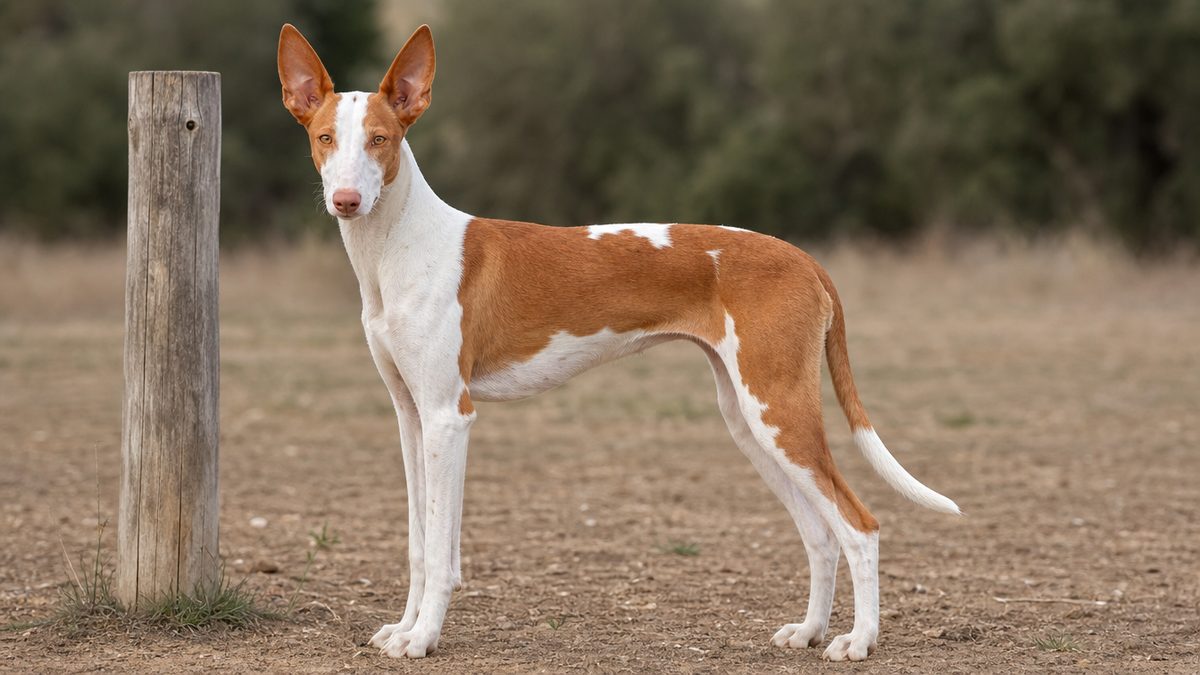
The Ibizan Hound is a tall, erect-eared hunting dog from the Balearic Islands, registered by the FCI as breed 89 under its Spanish name Podenco Ibicenco and placed in group 5, section 7, primitive type hunting dogs. It stands 66 to 72 cm at the withers for males and 60 to 67 cm for females, hunts rabbits by scent as much as by sight, and is not the ancient Egyptian dog that almost every page about it claims.
Start with the identity, because three separate names circulate and each one carries a different set of claims. The FCI files the breed under Podenco Ibicenco, and its own breed number is 89, read here off the FCI's letter-P nomenclature index rather than assembled from a guess. The English-language name is Ibizan Hound; the FCI's English page title reads Ibizan Podenco. On the islands themselves the standard records the original name as Ca Eivissec, and adds that the same dog is known in Catalonia, Valencia, the Roussillon and Provence as Mallorqui, Xarnelo, Mayorquais, Charnegue, Charnegui and the Balearic Dog.
That list of seven regional names matters more than it looks, and this page uses it. A breed with seven names splits its evidence across seven search strings, and the single most useful paper about the Ibizan Hound turned out to be filed under an eighth. More on that in the health section.
The registry facts, read off the register
The FCI accepted the breed on a definitive basis on 10 November 1954, and the official valid standard was published on 26 May 1982. Both dates come off the same table, and that table proves its own format: the standard's publication date is printed 5/26/1982, and 26 cannot be a month, so the FCI is writing month first. The acceptance date printed 11/10/1954 therefore reads as 10 November, not 11 October. Reading that column the other way round is how a page ends up asserting the wrong month in a sentence that looks entirely confident.
The record also carries a line most summaries drop. The official authentic language of Standard 89 is Spanish. The English text says so on its own face, printing TRANSLATION: C.Seidler. Official language (ES), and the French text prints Langue faisant foi : (ES) Standard FCI N 89 PODENCO IBICENCO. Everything an English-speaking buyer reads about this breed's standard is therefore a translation of a Spanish document, and one passage of that translation says something the Spanish does not.
The two varieties, and the third coat that is not one
The FCI's breed record lists exactly two varieties eligible for a CACIB, smooth-haired and rough-haired. The standard's coat paragraph, however, describes three hair types, opening "Hair: Smooth rough or long hair" and going on to specify that the long hair is softer and should be at least 5 cm long, with a very densely coated head. The Spanish authentic text carries the same 5 cm figure.
So the standard describes a long coat and the nomenclature does not register it. Wikipedia, following the registry rather than the standard, states the breed comes in smooth and wire-coated varieties only. Both are right about different documents. If someone offers you a long-coated Ibizan Hound, the coat is described in the breed standard and is not a variety the FCI awards a CACIB to, and that is the accurate way to say it.
What the dog is built to do
The standard's utilisation paragraph is unusually specific and worth reading before you decide you want one. It describes a dog used mainly for hunting rabbits without guns, by day and at night, that relies on scent and hearing more than on sight, works in packs formed mostly of bitches because males quarrel during a hunt, and surrounds indicated game while waiting. It even records a Spanish term, enconillarse, for the breed's habit of refusing to hunt again until it has rested after a pack has caught several thousand rabbits.
Two practical consequences follow for an Indian home. This is a scenting hound as much as a sighthound, so a secure boundary matters more than a long sightline, and a nose-down dog on a Bengaluru street will follow a trail across a road. And it is a dog selected to make its own decisions at distance from a handler, which sets a realistic ceiling on off-leash recall that no amount of training removes.
FCI Standard 89 contains no weight anywhere in the document, in any of its three languages. The AKC states 50 pounds for males and 45 pounds for females, roughly 22.7 kg and 20.4 kg. Any page presenting a weight range as the breed standard's figure has attributed it to a document that does not contain it.
The Egyptian origin story, and why the evidence goes the other way
The Ibizan Hound's history and origins are not Egyptian, and the genetic work says so plainly. Larson 2012 in the Proceedings of the National Academy of Sciences names the Ibizan Hound directly among European breeds whose apparent antiquity rests on depictions, and finds that only the Finnish Spitz retains a basal genetic signature. The FCI's own standard nonetheless still prints the 3400 BC claim, and the English translation states it more strongly than the Spanish original does.
The story is repeated everywhere because a primary source carries it. FCI Standard 89's brief historical summary says the dogs were probably brought to the islands by the Phoenicians, Carthaginians and eventually the Romans, and then makes the claim that does the damage. In the English translation it reads: "Illustrations of these dogs are found in the graves of the Pharaohs and on objects in museums, so that the existence of the breed can already be proved in the year 3400 BC";.
What the authentic Spanish text actually says
The FCI names Spanish as the authentic language of this standard, so the Spanish text governs and the English is a translation. Read the Spanish, and the sentence is weaker. It says the dogs can be seen in the tombs of the pharaohs and in museums "cuyos primeros indicios se remontan al 3.400 A.C.", whose earliest indications go back to 3,400 BC. The French translation renders it as "ce qui en fait remonter l'origine a 3400 ans A.C.", which puts the origin back to 3400 BC.
So three official versions of one standard make three different strength claims from the same evidence. The authentic Spanish reports indications. The French asserts an origin. The English asserts a proof. Nothing in the Spanish supports the word proved, and the English is the version almost every breed page in the world reads.
| Version | What it says about 3400 BC | Strength of the claim |
|---|---|---|
| Spanish (authentic, ES) | cuyos primeros indicios se remontan al 3.400 A.C. | Earliest indications |
| French (translation) | ce qui en fait remonter l'origine a 3400 ans A.C. | Origin dated |
| English (translation) | the existence of the breed can already be proved in the year 3400 BC | Proved |
What the genetics found
Larson and 19 co-authors compared the genetic signatures of 121 breeds against a worldwide archaeological assessment of the earliest dog remains, and the result contradicts the depiction argument head on. Their sentence names this breed: although dogs were present at numerous European archaeological sites around 15,000 years ago, "despite the fact that textual references or depictions superficially suggest temporally deep origins for 13 European breeds including the Pharaoh and Ibizan Hounds, only the Finnish Spitz retains a basal signature".
The paper's wider finding is the reason this matters beyond one breed. It concludes that the genetically distinct so-called ancient breeds "only appear so because of their relative isolation", and that none of them derives from the regions where the oldest archaeological remains are found. Antiquity of *type* is not antiquity of *breed*. A tall, prick-eared, lean hunting dog is an old shape that the Mediterranean has produced repeatedly, and it is not a pedigree.
The earlier and more widely cited source points the same way. Wikipedia's own statement that "DNA analysis indicates that the breed was formed recently from other breeds" is footnoted to Parker 2004 in Science, the study that separated several genuinely ancient-origin breeds from the remainder with modern European origins Parker HG, Kim LV, Sutter NB.
A dating problem inside the standard's own paragraph
There is a second tension in the same passage, and it needs stating carefully because it concerns people rather than dogs. The standard says the Phoenicians probably brought these dogs to the islands, and it dates the breed to 3400 BC. Ancient DNA work on Punic burials reports that Ibiza was permanently settled around the 7th century BCE by founders arriving from west Phoenicia, with the population peaking in the 4th century BCE.
Those two dates are roughly 2,700 years apart. The standard's own account therefore has the breed existing on the islands about twenty-seven centuries before the islands were permanently settled by the people it credits with bringing the dogs there. That is not a claim about canine genetics and Bonbeno does not present it as one; it is an internal inconsistency inside the standard's history paragraph, of exactly the kind the FCI's own translators warn about when they mark a document as a translation.
An Indian buyer paying a premium for a 5,000-year-old Egyptian pharaoh's dog is paying for a story that a primary genetic source names and rejects. The dog is still a real, distinctive, capable Mediterranean hunting breed with an FCI standard from 1954. It is simply a modern one, and knowing that changes what a fair price looks like.
The breed standard, and where two registries disagree about size
FCI Standard 89 and the AKC give different sizes for the same breed, and the gap is 6.3 cm at the male floor. The FCI requires 66 to 72 cm for males and 60 to 67 cm for females; the AKC states 23.5 to 27.5 inches for males and 22.5 to 26 inches for females, whose lower bounds convert to 59.7 cm and 57.2 cm American Kennel Club. Bonbeno publishes both rather than averaging them.
The FCI heights are stable across all three language versions, which is the first thing to check whenever a standard exists in translation. The Spanish authentic text gives "Para los machos: 66 a 72 cm, Para las hembras: 60 a 67 cm", the French gives "Chiens : de 66 a 72 cm, Chiennes : de 60 a 67 cm", and the English gives 66 to 72 and 60 to 67 Standard FCI N 89 PODENCO IBICENCO FCI-Standard N 89 PODENCO IBICENCO. No numeric drift exists between the versions of this standard, which is worth recording as a negative result because it does exist in others.
All three also add the same softening clause, that dogs close to the required measurements can be accepted without undue strictness provided they are well proportioned and aesthetic. So the FCI's own range is elastic at the edges, which partly but not wholly explains the AKC's lower floor.
| Measure | FCI Standard 89 | AKC | Gap at the floor |
|---|---|---|---|
| Male height | 66-72 cm | 23.5-27.5 in = 59.7-69.9 cm | 6.3 cm lower |
| Female height | 60-67 cm | 22.5-26 in = 57.2-66.0 cm | 2.8 cm lower |
| Male weight | Not stated | 50 lb = 22.7 kg | FCI gives none |
| Female weight | Not stated | 45 lb = 20.4 kg | FCI gives none |
| Life expectancy | Not stated | 11-14 years | FCI gives none |
The features that identify a real one
Four points in the standard do the work of telling an Ibizan Hound from a lookalike, and all four are things you can check by eye on a dog someone is offering you.
- Nose leather flesh colour, with brown pigment or black spots on the nose named as a disqualifying fault.
- Eyes light amber, described as reminiscent of caramel, with dark eyes named as a disqualifying fault.
- Ears always stiff and very mobile, set with their centre level with the eyes and shaped as an elongated rhomboid cut off by a third of its long diagonal, with folded ears disqualifying.
- Forechest pointed and strongly protruding, with a barely defined forechest and a broad croup both disqualifying.
The disqualifying fault that matters most to a buyer
Standard 89 disqualifies a dog showing "evidence of crossing with a Galgo or other form of sighthound";. That clause exists because the confusion is real and old, and it is the single most useful line in the document for anyone assessing a dog in a country with no breed community to ask. A Podenco Ibicenco should not read as a Galgo Espanol in the head or the hindquarters, and the standard spells out what the crossing looks like: dark eyes, folded ears, a broad croup, front legs set wide apart, and rounded broad thighs with visible veins.
The colour rule is narrower than most summaries suggest, too. White and red are preferred, either combined or as solid white or solid red. Fawn is permitted only in an exceptionally good specimen, and in smooth coats fawn "is not permitted" at all. The Spanish is equally firm, saying the colour is never accepted for the smooth coat.
What the standard says about temperament, in its own words
The standard's eye paragraph carries the only temperament description in the document, and it is blunter than any breed page will tell you. It says that without seeming very noble, "the expression shows intelligence but also fear and mistrust". A registry describing a breed's default expression as mistrustful is telling you something about how the dog meets strangers, and it should shape how a puppy is socialised in a dense Indian neighbourhood.
Neither registry is wrong. They describe the same breed under different rules, and a dog exported from a Spanish or Italian FCI line will average taller than one from an American show line. If you are assessing a dog in India, measure it and say which standard you are measuring against. A 61 cm male is undersized under the FCI and within range under the AKC, and that sentence is more useful than either number alone.
Ibizan Hound price in India: there is no figure, and here is the proof
No verifiable Ibizan Hound price in india exists, and the pages that rank for that query print no number. Bonbeno downloaded the raw HTML of the top Indian commercial result and counted the rupee figures on it. There are zero. This section shows how the search result set is actually built, because that is more useful to a buyer than any number Bonbeno could quote.
Search the target term from India and the result set answers a different question than you asked. The first six organic results are a book on Amazon.in, a book on Flipkart, a second Amazon.in book, a Flipkart memory game, and two Etsy craft-item category pages. Wikipedia comes next, then two Indian pet-content sites. Not one of the first six results offers a live dog. That is the finding, and it is the same shape Bonbeno has recorded on other absent breeds.
The top commercial page prints no price and stocks no Ibizan Hounds
The page titled "Ibizan Hound Price in India, Buy Elegant Ibizan Hound Puppies" was fetched in full and read as raw HTML rather than through any extraction layer. Two things came back. No rupee figure appears anywhere on it, in any form, whether written with the rupee sign, as Rs or as INR. And its "Other Available Pets" block lists eight animals.
| Name shown | Breed shown |
|---|---|
| Fizey | Maltipoo |
| (unnamed) | Poodle |
| (unnamed) | Poodle |
| (unnamed) | Cane Corso |
| (unnamed) | Goldendoodle |
| Samy | Maltipoo |
| (unnamed) | Rottweiler |
| Yoki | Doxiepoo |
Eight animals, and not one Ibizan Hound. The same site's Delhi NCR category page for the breed lists a Toy Poodle and three Rottweiler entries. A page can rank first for a breed's price query in India while holding no dog of that breed and quoting no price for one, and that is exactly what is happening here.
An answer engine invented a band the page does not contain
This is the part worth carrying to every other breed you research. A search summary generated over that same result set confidently reported that Ibizan Hound puppies in India "usually start from Rs 50,000 up to Rs 1,00,000", and attributed the variation to pedigree, breeder reputation, region and seasonal demand. Neither figure appears on any page in the result set. The page it would have to have come from carries no rupee figure at all.
So the generated answer did not launder a bad price from a seller. It manufactured one where no number existed, and dressed it in a plausible explanation of what drives it. Treat any rupee band that appears only inside an AI summary as unsourced until you have found it printed on a page you opened yourself.
Both Indian pages are machine-assembled, and the headings prove it
The two Indian content pages ranking for this term carry headings no person wrote. One prints "Prerequisites to pet a Ibizan Hound", with the article error that gives it away, alongside "Never Feed These Foods to an Ibizan Hound". The other prints "Never feed these foods to Ibizan Hound Puppies For Sale", where the template has substituted the whole page title into the sentence, ecommerce suffix included.
Those are template seams. The heading is generated from the URL slug or the page title, which means the section beneath it was never written for this breed by anyone who knew anything about it. When you see a heading that reads like a sentence with a variable dropped into it, stop treating the page as a source.
Why no lawful Indian supply chain can form
The legal position closes the question rather than merely explaining a shortage. DGFT Trade Notice 22/2022-23 puts dogs under ITC(HS) 01061900 as Restricted, and its Policy Condition 8 states that "Import of commercial dogs for breeding or any other commercial activities other than the purposes mentioned above is not permitted". Point 6 of the same notice states that "any applications for trading/breeding purposes, or applications made on behalf of some another person/entity shall be duly rejected";.
So a dog of this breed can lawfully reach India only as an individual's own pet, and the notice restricts even that to six ports: Delhi, Mumbai, Chennai, Hyderabad, Bangalore and Kolkata. A separate instrument, Notification S.O. 4396(E) of 10 October 2024 under the Livestock Importation Act 1898, adds Cochin International Airport, Kochi, to the pet route under the quarantine station at Chennai. Whether that changes the trade notice's own six-port list is a separate question this page does not answer, because the two instruments are different routes with different law behind them.
Ask for the FCI or KCI pedigree number and the parents' registered names before you discuss money. If the seller cannot produce them, the dog is not a registered Ibizan Hound whatever the price is, and no Indian consumer remedy will get you a refund on a pedigree that was never issued.
Monthly cost of ownership in India, using figures that do exist
Budget roughly Rs 2,000 to Rs 4,500 a year for a routine wellness visit before food, and expect a 22 kg dog's monthly cost to be driven by food, parasite prevention and the boarding you will need when nobody can walk it at 5 am. There is no Indian purchase price to report, but Indian care costs are published, sourceable and apply to any dog of this size living here.
Separate the two questions before you plan anything. A breed price and a care cost are different figures with different evidence behind them, and the absence of the first says nothing about the second. Bonbeno can quote no Ibizan Hound price in India honestly. It can quote what it costs to keep a 20 to 23 kg short-coated dog in an Indian city, because insurers and clinics publish that.
| Item | Published range |
|---|---|
| Basic consultation | Rs 500 - Rs 1,000 |
| Core vaccinations, rabies and DHPPiL | Rs 1,500 - Rs 3,000 |
| Deworming | Rs 300 - Rs 800 |
| Total annual wellness visit | Rs 2,000 - Rs 4,500 |
| Complete blood count | Rs 800 - Rs 1,500 |
| X-ray or ultrasound | Rs 1,200 - Rs 4,000 |
| Emergency consultation | Rs 1,000 - Rs 2,500 |
| Overnight hospitalisation | Rs 1,500 - Rs 5,000 per night |
| Surgery, minor to major | Rs 5,000 - Rs 50,000 and above |
| Grooming package | Rs 1,000 - Rs 3,000 |
| Nail trimming | Rs 200 - Rs 500 |
The three line items this breed changes
Most of that table applies to any dog. Three rows move for an Ibizan Hound specifically, and one of them moves a long way.
- Grooming falls to almost nothing. A smooth-coated Ibizan Hound needs a rubber mitt and a nail trim, so the Rs 1,000 to Rs 3,000 grooming package is optional rather than routine. Budget the Rs 200 to Rs 500 nail trim instead, monthly, because a lean dog exercised on soft ground does not wear its nails down.
- Parasite prevention rises. Half of Indian dogs sampled across four locations carried at least one tick-borne pathogen, so year-round tick control is not discretionary here.
- Boarding becomes structural. A dog whose exercise window is 5 am and 9 pm cannot be left with a neighbour who works office hours, so day-boarding or a walker becomes a recurring line rather than a holiday expense.
- Emergency reserve matters more than for most breeds. Two of this breed's documented risks, heat-related illness and transfusion-requiring tick-borne disease, are emergency-room events, and the published overnight and surgery bands above are what those cost.
A worked annual estimate, and what it excludes
Adding only the published figures gives a defensible floor. One annual wellness visit at Rs 2,000 to Rs 4,500, twelve nail trims at Rs 200 to Rs 500, and one baseline blood count at Rs 800 to Rs 1,500 comes to roughly Rs 5,200 to Rs 12,000 a year before food, parasite prevention, boarding or any illness. That is arithmetic on published ranges, not a survey, and Bonbeno labels it as such.
What that figure deliberately excludes is food, because Bonbeno has no verified Indian price series for feeding a 22 kg dog and will not invent one. It also excludes insurance premiums and any breed-specific screening, because the most important screening question for this breed has no test to buy. More on that below.
Government animal hospitals and municipal veterinary clinics vaccinate at a fraction of private-clinic rates in most Indian cities, and for core vaccines the product is the same. The private consultation buys you time and continuity, which matters for a breed whose serious inherited disease presents as a slowly worsening wobble that a rushed appointment will miss.
Heat tolerance in India, measured against Ibiza rather than guessed
The Ibizan Hound's heat tolerance is real, and it is the rare imported breed whose homeland is not far off an Indian city on the measure that matters. Ibiza's peak monthly-mean wet bulb is 22.6 C in August, against 26.1 C for Chennai in May and 26.5 C for Delhi in July Stull R. Wet-Bulb Temperature from Relative…. That is a 3.5 to 3.9 C wet-bulb gap, and Bengaluru's peak of 21.9 C sits below Ibiza's own. Wet bulb governs whether a panting dog can shed heat at all, so a gap that size is a scheduling problem rather than a disqualification. The dry-bulb extremes are a different story: Ibiza's record high is 33.2 C and Delhi's is 48.8 C.
Bonbeno queried NASA POWER by explicit latitude and longitude for every point below and echoed back the grid-cell elevation each time, because POWER returns a cell rather than a point and the cell can sit far from the town underneath it. The Indian cells check out: Delhi came back at 206 m against a city near 216 m, Bengaluru at 842 m against roughly 920 m, Mumbai at 97 m against roughly 14 m, and Pune at 636 m against roughly 560 m. Those are plains-scale offsets, so the cell is the town in each case. Two columns need labelling rather than assuming. The record-high column is NASA POWER's T2M_MAX, the hottest reading the climatology holds for that month across 2001 to 2020, and it is an extreme rather than an average afternoon. The wet-bulb column is computed from each month's mean temperature and mean humidity, so it is a monthly mean across day and night, and pairing a record high with a mean humidity would produce a figure no place on earth has ever recorded.
One homeland query failed, and saying so matters
The Ibiza Town cell reports 19.38 m, against a town at roughly sea level, so that figure is sound and is the baseline used throughout this page. A second query, aimed at Sa Talaia at 475 m, returned a byte-identical series and the same 19.38 m elevation. Two different places cannot be identically warm to the decimal; they fell inside one grid cell. So Bonbeno reports the Ibiza Town figure and reports that it could not resolve the island's high ground separately, rather than presenting the match as a finding about altitude.
| Place | Cell elevation | Hottest month | Record high | Peak mean wet bulb |
|---|---|---|---|---|
| Ibiza Town, Balearic Islands | 19 m | August | 33.2 C | 22.6 C (Aug) |
| Palma de Mallorca | 31 m | August | 34.3 C | 22.2 C (Aug) |
| Bengaluru | 842 m | April | 40.4 C | 21.9 C (May) |
| Hyderabad | 495 m | May | 45.0 C | 23.4 C (Jun) |
| Pune | 636 m | April | 43.2 C | 23.0 C (Jun) |
| Mumbai | 97 m | April | 44.9 C | 25.8 C (Jun) |
| Chennai | 49 m | May | 42.7 C | 26.1 C (May) |
| Jaipur | 406 m | June | 46.9 C | 25.3 C (Jul) |
| Delhi | 206 m | June | 48.8 C | 26.5 C (Jul) |
Reading that table honestly
Six of the seven Indian cities listed exceed the breed's homeland peak, and the ranking is not the one people expect. Bengaluru is the one that does not, at 21.9 C against Ibiza's 22.6 C. Delhi is the hardest at 3.9 C above, and its worst month is July rather than June, because the monsoon adds humidity to heat that is already extreme. Jaipur behaves the same way, peaking on wet bulb in July at 25.3 C despite its hottest dry month being June.
That July inversion is the single most useful line in this section for an Indian owner. Owners plan around the hottest *temperature*, which falls in May or June, and then relax in July when the rain starts. For a panting dog, July and August are worse in the northern plains than May is, because evaporative cooling stops working as humidity climbs. Delhi's July wet bulb of 26.5 C and August's 26.2 C are the two most dangerous months of the Ibizan Hound's Indian year, and both exceed its June figure of 24.4 C.
What the heat-illness research supports, and what it does not
Hall 2020 in Scientific Reports found that dogs at or above their breed and sex mean bodyweight had 1.42 times the odds of heat-related illness, with a confidence interval of 1.12 to 1.80, and that dogs over 50 kg carried odds of 3.42. The first factor transfers to this breed and the second does not, because an Ibizan Hound is a 20 to 23 kg dog and sits nowhere near the 50 kg band. Keeping one lean is therefore a measured intervention rather than general advice.
The companion paper in Animals is where the trigger split comes from, and its denominator is routinely misquoted. In a cohort of 905,543 dogs there were 1,259 heat-related illness events from 1,222 dogs, of which 879 had a recorded trigger, and 652 of those 879 events, or 74.2 percent, were exertional rather than caused by a hot car or a hot room. Exercise, in other words, is what puts dogs in the emergency room, and this is a breed whose standard describes hunting by day and night.
India's own threshold gives the practical trigger. The IMD criterion reproduced by the NDMA is that a heat wave is not considered until a station's maximum reaches at least 40 C in the plains, and that a heat wave is declared outright whenever the actual maximum stays at 45 C or above. Delhi, Jaipur, Hyderabad, Mumbai and Pune all average a monthly maximum above 40 C in their hottest month, so this is not an occasional event to plan around.
Watch the humidity, not just the thermometer. Delhi at a 32.3 C July mean and 63 percent humidity is more dangerous for a dog than Delhi at a 35.9 C June mean and 36 percent, because the wet bulb is 26.5 C against 24.4 C. Heat stroke is defined by the NDMA as a body temperature of 40 C or more with delirium, seizures or coma, and it is a potentially fatal condition.
Managing an Ibizan Hound through an Indian summer
Move all exercise outside daylight, keep the dog lean, and treat July and August in the northern plains as the dangerous months rather than May. Those three rules follow directly from the measured wet-bulb figures and from the finding that 652 of 879 triggered heat-illness events were exertional NASA POWER, Source Native Resolution….
Indian law is unusually specific here, and it applies to this breed by its own terms. Second Schedule Part IV paragraph 21(1) of the Prevention of Cruelty to Animals (Dog Breeding and Marketing) Rules, 2017 bars keeping certain dogs in outdoor facilities without the attending veterinary practitioner's written approval. The categories are "(i) dogs that are not accustomed to the temperatures prevalent in the area or region in question; (ii) dog breeds that cannot tolerate the temperatures prevalent in the area or region in question, such as long-haired breeds in high temperature locations; and (iii) sick, infirm, aged or young animals";.
Note the citation form, because it is wrong on many pages including some of Bonbeno's older ones. This is a Second Schedule paragraph, not a Rule. The Rules themselves stop at Rule 13, and the string "Rule 21" appears zero times in the gazette, which Bonbeno confirmed by extracting the 14-page document and searching it directly.
Clause (i) is the one that bites for an imported Ibizan Hound. A dog that arrived from a 33 C Mediterranean summer is by definition not accustomed to a 48 C Delhi June, and the Rules put the burden on written veterinary approval before it is housed outdoors.
The daily routine that actually works
- Walk before sunrise. Aim to be back before the sun clears the buildings, which in Delhi in June means finishing by about 6 am.
- Skip the midday walk entirely from March to October in the plains, and offer scent work indoors instead, which suits a hound that hunts by nose.
- Run after dark, on the surface you have checked with the back of your hand, because tarmac holds heat for hours after sunset.
- Weigh monthly and keep the dog at or below its breed and sex mean, since that alone corresponds to 1.42 times the odds of heat illness when exceeded.
- Carry water on every outing, and offer it before the dog looks like it wants any.
Why this breed hides trouble
Two features of the Ibizan Hound make heat stress harder to spot than in a heavy breed. It has almost no subcutaneous fat and a thin, taut skin the standard describes as close fitting to the body, so it looks the same whether it is coping or not. And it is a pack-bred working hound with the drive to keep going, which is precisely the profile that produces exertional cases rather than confinement cases.
The practical marker is recovery rather than appearance. A dog that is still panting hard fifteen minutes after coming inside into a cooled room has been worked too hard for the conditions, whatever it looked like outside. The NDMA's own threshold for heat stroke is a body temperature of 40 C or above with delirium, seizures or coma, and it labels the condition potentially fatal.
Where in India the breed is least badly matched
Bengaluru, on the measured figures, is the least hostile major Indian city for this dog, peaking at a 21.9 C wet bulb in May against Ibiza's 22.6 C. Pune and Hyderabad sit at 23.0 C and 23.4 C, Jaipur at 25.3 C, Mumbai at 25.8 C, Chennai at 26.1 C and Delhi at 26.5 C. Bengaluru sitting below the homeland is a routine that barely needs shifting; a 3.9 C gap in Delhi is a real summer constraint on the dog's life rather than a year-round one.
None of that makes the breed unkeepable in India. It makes it a dog whose exercise requirement and whose climate are in direct conflict for eight months of the year in most Indian cities, and a buyer should decide about that before the dog arrives rather than after.
Press the back of your hand to the pavement and hold it there for seven seconds. If you cannot, the dog should not be walking on it. That test costs nothing and catches the surface-temperature problem that the air temperature on your phone completely hides.
Temperament and household fit, starting from what the standard admits
Expect a quiet, clean, deeply bonded family dog that meets strangers with reserve rather than warmth. FCI Standard 89 describes the breed's own expression as showing "intelligence but also fear and mistrust", which is a franker temperament note than most registries print and the right place to start.
Take that sentence at face value rather than softening it. A registry writing mistrust into a breed's default expression is describing a dog that assesses new people before accepting them, and that will not perform confidence it does not feel. In a Balearic hunting context that is a working trait. In a Mumbai flat with a doorbell that rings eleven times a day, it is the single thing that determines whether the dog settles or lives in a state of low-grade alarm.
Who this breed suits
- Households with a secure, walled outdoor space, since the breed jumps and the standard describes a gallop of great agility.
- Owners who exercise at dawn, because that is when an Indian summer permits the work the dog needs.
- Families with older children who can be taught to let a reserved dog approach them.
- Second-time dog owners who have already met an independent breed and are not expecting retriever-style compliance.
- People who want a quiet indoor dog, since this hound is notably clean and undemanding in the house between bursts.
Who should not buy one
- Anyone in an unfenced ground-floor flat, because a sighthound that also tracks by scent will leave and will not hear you.
- Owners of small pets, since a breed selected to catch rabbits treats a rabbit, a kitten or a chicken as prey rather than as family.
- Households with a toddler and a narrow corridor, where the risk is a 22 kg collision rather than any aggression.
- First-time owners who want an easy dog, because the training ceiling on recall is real and permanent.
- Anyone who cannot walk before sunrise, which is the honest disqualifier for most of urban India.
The prey-drive problem in Indian streets
This deserves separating out, because Indian conditions make it worse than in Europe. The breed hunts by scent and hearing more than by sight, works at speed, and was bred to pursue away from the handler. Indian residential streets carry free-roaming dogs, cats, chickens and cattle in a density that European suburbs do not, and every one of those is a trigger for a dog built to chase.
The consequence is that off-leash walking is not a training goal to work toward; it is a thing this breed should not do outside a secured area. Owners who accept that early get a relaxed dog on a long line. Owners who keep testing it lose the dog, usually to traffic.
Noise, and what the standard implies about it
The utilisation paragraph notes that the dogs "bark only when they see or hear the game and when they have surrounded it";. That is a description of a selectively vocal dog rather than a silent one, and it maps reasonably well onto flat living: not a nuisance barker by default, but a dog that will sound off at something it has genuinely noticed. For an apartment in a dense Indian block, that is a better profile than most working breeds offer.
Reserve is the breed's default, so the first sixteen weeks decide how much of it the adult dog carries. In India that means deliberate, calm exposure to the specific things this dog will meet for the rest of its life: autos, temple bells, construction noise, free-roaming dogs at a distance, and people in a range of clothing. Doing that work indoors and in arms until the vaccination course is complete is the compromise most Indian vets will suggest.
Training approach, and the two things this breed resists
To train an Ibizan Hound, use short reward-based sessions, build a reliable long-line default instead of an off-leash recall, and accept that pressure produces shutdown rather than compliance. The breed resists two things specifically, correction-based handling and recall against a live scent, and only one of those is fixable.
Start from what the dog was selected for. The standard describes a hound that indicates game, surrounds it with the pack, waits at a distance, and decides for itself when it has hunted enough. Every part of that job requires independent judgement away from a handler. A breed shaped that way learns commands quickly and applies them conditionally, which people misread as stubbornness when it is job description.
Resistance one, correction-based handling
The standard's own line about an expression showing fear and mistrust is the practical warning here. A sensitive, reserved dog that is corrected harshly does not become compliant; it becomes avoidant, and an avoidant sighthound is harder to catch, harder to handle at the vet and slower to recover. Reward-based marking, short sessions and a high rate of reinforcement produce a faster result with this breed than with a biddable gundog, because the dog is quick and simply needs a reason.
Resistance two, recall against scent
This one does not fully resolve, and Bonbeno would rather say so than sell an optimistic training plan. The breed hunts by scent and hearing more than by sight, which means the trigger arrives before you see it and the dog is committed before you can interrupt. Aim for a long line and a secured area as the permanent management answer, and treat any off-leash reliability you build as a bonus rather than the plan.
A realistic first-year timetable
| Age | Priority | What good looks like |
|---|---|---|
| 8-16 weeks | Socialisation and handling | Calm with strangers approaching, accepts ear and paw handling, eats near household noise |
| 4-6 months | Long-line default and name response | Turns toward you on the name in a quiet park, no pulling toward scent on a loose line |
| 6-9 months | Impulse control around prey | Can disengage from a distant cat on a long line with a food trade |
| 9-12 months | Muzzle and vet conditioning | Accepts a basket muzzle voluntarily, tolerates a blood draw position |
| 12-18 months | Structured outlet | Regular lure coursing, flirt pole or scent work replacing free running |
Why muzzle training belongs on that list in India
Two Indian realities make it worth doing early rather than in a crisis. Tick-borne disease is common enough that a blood draw is a routine event for this dog, with 261 of 525 dogs sampled across four Indian locations carrying at least one pathogen. And a reserved sighthound in pain at an unfamiliar clinic is exactly the dog that snaps once and then carries a note on its file for life. A dog that has been taught a basket muzzle is a happy dog wearing one, not a restrained one.
The outlet that replaces hunting
This breed needs a job that uses the nose and the sprint together, and India offers fewer formal options than Europe does. A flirt pole in a walled compound at dusk, scatter-feeding in long grass, and simple tracking games with a food trail cover most of it. Lure coursing clubs exist in a handful of Indian cities and are the closest legitimate substitute for the work the standard describes. What does not substitute is a longer walk on a lead, and owners who try that route get a frustrated dog that starts inventing its own jobs indoors.
Teach a rock-solid stop or wait at a distance rather than a perfect recall. A dog that will freeze on a cue is retrievable from the far side of a road; a dog that will only come when called is not, because coming to you means crossing the road. For a breed that commits to a scent before you see the trigger, a distance stop is the safer investment.
Daily exercise requirement, and what happens without it
An adult Ibizan Hound needs two substantial sessions a day, and in most of India both have to fall outside daylight. The standard describes a dog that hunts rabbits by day and at night, works in packs and has a gallop of great agility, and a dog built for that does not decompress on a twenty-minute lead walk.
Quantify it the way the dog experiences it rather than in minutes. What this breed needs each day is one long low-intensity outing that lets it use its nose, plus one short high-intensity burst that lets it actually run. Two forty-five minute lead walks satisfy the first requirement twice and the second not at all, which is the commonest way owners of this breed end up with a destructive dog while insisting they walk it plenty.
The Indian scheduling problem, stated plainly
The exercise requirement and the climate are in direct conflict for most of the Indian year. Chennai's monthly mean sits at or above 28 C in seven months of the twelve, and Delhi's exceeds 30 C in four. Since 652 of the 879 heat-illness events with a recorded trigger in Hall 2020 were exertional, the risk is created by exactly the activity this dog requires.
So the schedule is not a preference. Work happens before sunrise and after full dark, year-round in the plains, and the owner who cannot commit to that should choose a different breed rather than a shorter walk.
| Slot | Duration | Content |
|---|---|---|
| Pre-dawn, daily | 45-60 min | Long-line walk with free sniffing, on grass or dirt where possible |
| Post-sunset, daily | 20-30 min | Sprint work in a secured area, flirt pole or lure, plus a settle |
| Twice weekly | 15 min | Scent games or a food trail, indoors during peak heat |
| Weekly | 60-90 min | A longer outing somewhere new, for novelty rather than distance |
| Monsoon substitute | 20 min | Indoor scatter feeding and stair work when the ground is unusable |
What an under-exercised Ibizan Hound does
The failure mode is specific and recognisable. An under-worked dog of this breed climbs, and it climbs well, because the same suspended trot and powerful hindquarters that the standard describes make furniture, counters and walls trivially accessible. Owners report counter-surfing before they report chewing. After that comes patrolling and reactive barking at the window, then destructive chewing, and by then the behaviour is a habit rather than an energy problem and takes far longer to unwind.
Growth-plate caution in the first year
Hold back the high-impact work while the dog is growing. A breed reaching 66 to 72 cm at the withers is still closing growth plates well past a year, and repeated jumping onto hard surfaces during that window is the wrong load. Free running on soft ground is fine; organised jumping, long road runs beside a bicycle and stair repetitions are not, until the dog is physically mature.
That caution matters more in India than in Europe, because the available surfaces are harder. Most urban Indian exercise happens on concrete, tarmac or compacted stone, and a lean-footed hound doing repeated impact work on those surfaces accumulates damage that soft European turf would absorb.
The instinct when a dog is restless is to work it harder. In an Indian summer that inverts the risk, because exertional heat illness is the dominant trigger and this breed will keep running past the point where it should stop. On a bad-humidity day, replace the sprint session with fifteen minutes of scent work indoors and accept a slightly under-exercised dog over a hospitalised one.
Grooming and coat care in Indian humidity
Grooming an Ibizan Hound takes about five minutes twice a week for the smooth variety, and the coat is not where the work is. The real maintenance items in India are the thin taut skin, the profusely haired feet, and the large open ears that the standard describes as hairless on the inside of the ear opening.
Deal with the coat first, because it is the easy part. The standard describes the smooth coat as "not silky, but strong and shiny", and the rough coat as hard and very dense, shorter on the head and ears and longer at the rear of the thighs and the underside of the tail, with a beard that is highly valued. Neither carries the dense undercoat that makes an imported northern breed suffer in Chennai. A rubber curry mitt twice a week lifts the dead hair from a smooth coat, and a slicker plus a comb through the beard and thigh feathering handles a rough one.
The skin is the fragile part, not the coat
The standard describes the skin as taut and close fitting to the body, with reddish pigment. Thin skin over a lean frame tears on the things Indian dogs actually meet, meaning compound gates, thorn scrub, construction debris and chain-link. Sighthound owners across breeds report the same pattern of shallow but long lacerations that need attention, and the published Indian consultation range of Rs 500 to Rs 1,000 is what an unremarkable one costs to have cleaned and closed.
That same thin coat and skin combination gives no sun protection. A white or predominantly white Ibizan Hound in an Indian summer is a sunburn candidate on the nose bridge, ear tips and belly, and the breed is preferentially white and red or solid white under its own standard.
The feet, which the standard describes in unusual detail
Standard 89 specifies "almost harefoot" feet with long close-set toes, "profuse hair in space between toes", very strong and normally white nails, and very hard pads, for both front and hind feet. Profuse interdigital hair in a humid Indian monsoon is a moisture trap, and interdigital dermatitis is one of the commonest presentations Indian small-animal clinics see in the rainy months.
- Dry between the toes after every wet walk, with a towel rather than heat.
- Trim the interdigital hair level with the pad, not shorter, so the foot still has its protection.
- Check the webbing weekly in monsoon months for redness or a yeasty smell.
- Keep nails short, since a lean dog on soft ground does not self-wear them and a long nail changes how the foot loads.
Ears, and the overseas advice that does not transfer
This is where imported breed-club grooming guidance gets Indian owners into trouble. Northern-hemisphere care sheets routinely tell owners to bath the dog and let it air dry. In an Indian monsoon that instruction is wrong, and Bonbeno says so on every breed page where it applies. Water that sits in an ear canal in 90 percent humidity does not evaporate; it incubates.
The Ibizan Hound's ear is in one sense an advantage here, because the standard specifies large, always-stiff, upright ears that are fine and hairless on the inside of the ear opening. An erect open ear ventilates far better than a spaniel's pendulous one. But an open ear also catches water directly during a bath and takes in dust and grass seed on a walk, so it is not maintenance-free. Plug the ears before bathing, dry them afterwards, and inspect rather than routinely flushing them.
Bathing frequency in India
Bath less often than an Indian grooming salon will suggest and more often than a European guide assumes. A short-coated dog exercised on dusty ground needs a rinse more frequently than one walking on wet European grass, but detergent shampoo on thin skin strips it. A plain water rinse after a dusty pre-dawn walk, with a mild shampoo only every four to six weeks, suits the coat the standard describes. A grooming package at the published Rs 1,000 to Rs 3,000 is an occasional convenience for this breed, not a routine cost.
One of the Indian ranking pages for this breed carries a heading asking whether you should shave your dog in summer. For a smooth-coated Ibizan Hound the answer is no, and the reason is the skin rather than the coat. There is no insulating undercoat to remove, the existing coat is already minimal, and removing it exposes thin, lightly pigmented skin to Indian sun.
Health risks and lifespan, with the numbers that actually exist
The Ibizan Hound's serious inherited problem is canine multiple system degeneration, an autosomal recessive neurodegenerative disease for which no DNA test exists because the causative gene has not been identified in this breed. Its orthopaedic picture, by contrast, is genuinely good: 653 OFA hip evaluations return 98.3 percent normal and 1.7 percent dysplastic.
Bonbeno could not reach ofa.org during this session, so every OFA figure on this page is read from a dated local snapshot of the organisation's published statistics tables taken on 31 August 2026. Before using it, a control was run: the snapshot contains 109 occurrences of LABRADOR, which is the expected figure for a common breed, so an absence in it would be meaningful and a presence is readable. IBIZAN appears 50 times across the disease tables.
Hips and the orthopaedic picture
The hip table is the most reassuring thing on this page. Across 653 evaluations the breed records 98.3 percent normal, split as 38.7 percent Excellent, 55.6 percent Good and 4.0 percent Fair, with 1.7 percent dysplastic broken into 0.5 percent mild, 0.9 percent moderate and 0.3 percent severe. Both halves of that row reconcile exactly: 38.7 plus 55.6 plus 4.0 is 98.3, and 0.5 plus 0.9 plus 0.3 is 1.7. A row that adds up is a row worth quoting.
The breed ranks 214th on that table, meaning 213 breeds have a worse hip picture. For a dog of this size that is a strong result and it reflects a population that was still working recently rather than being bred for show conformation alone.
| Registry | Evaluations | Normal | Key detail | Rank on table |
|---|---|---|---|---|
| Hips | 653 | 98.3% | 1.7% dysplastic, 38.7% excellent | 214 |
| Eyes, summary | 1,344 | 96.6% | 3.4% abnormal | 153 |
| Thyroid | 309 | 88.3% | 7.1% compensative autoimmune thyroiditis | 21 |
| BAER hearing | 666 | 98.5% | 1.5% abnormal | 13 |
| Advanced cardiac | 77 | 84.4% | 13.0% abnormal | 7 |
| Congenital cardiac | 91 | 93.4% | 3.3% abnormal, 3.3% equivocal | 5 |
| Basic cardiac | 116 | 100.0% | 0.0% abnormal | 83 |
Canine multiple system degeneration, the one with no test
This is the finding that should govern a buying decision. A 2022 paper in Veterinary Pathology describes three cases of canine multiple system degeneration in Ibizan Hounds, all showing marked cerebellar ataxia with cerebellar atrophy on MRI. At necropsy all three had cerebellar atrophy and two had gross cavitation of the caudate nuclei, with neuronal loss across the cerebellum, olivary nuclei, substantia nigra and caudate nuclei.
Pedigree analysis indicated autosomal recessive inheritance, and the authors state plainly that "the causative gene in this breed is yet to be identified". Two things follow. A carrier cannot be detected, so no breeder anywhere can honestly offer you a clear test result for it. And because the mode is recessive, the disease can appear in a litter whose parents were both healthy, which means an unaffected sire and dam are not reassurance.
The paper also notes that the condition resembles human multiple system atrophy. For an owner, the practical signal is a young adult dog developing a progressive, worsening wobble and loss of coordination rather than a sudden collapse, and it warrants neurological referral rather than watchful waiting.
Lifespan, and why this page gives no median
Bonbeno publishes no breed-specific median lifespan for the Ibizan Hound, because it could not verify one. The AKC states 11 to 14 years, which is a registry estimate rather than a study. The two large UK datasets this site normally uses, Teng 2022's life tables and McMillan 2024's longevity analysis, do not name the Ibizan Hound anywhere in their main texts.
Reporting the AKC's 11 to 14 alongside that absence is the honest position. Borrowing a Greyhound's or a Pharaoh Hound's median and presenting it as this breed's would be fabrication with a citation attached, and this page does not do it.
Every OFA percentage above is quoted with its denominator for a reason. These counts rise as evaluations are submitted, so 1.7 percent of 653 hips in August 2026 is not a fixed property of the breed; it is what 653 submitted radiographs showed on that date. A figure quoted without its denominator cannot be checked later, and this page will not print one.
Eyes, thyroid and heart, where the registry contradicts itself
OFA's eye data for the Ibizan Hound disagrees with itself by 20.8 percentage points, and neither figure should be quoted as the breed's eye rate. The summary table reports 96.6 percent normal across 1,344 evaluations, while the registry's own per-diagnosis detail rows report 1,015 normal of 1,339, which is 75.8 percent. This section publishes both with the arithmetic.
The gap is far too large to be rounding, and it is not unique to this breed. Bonbeno has recorded the same pattern on at least six other breeds, always in the same direction, with a high summary figure sitting above much lower detail rows on near-identical denominators. What the detail rows have going for them is that they name actual diagnoses, and they can be checked.
| Finding | Dogs affected | Percent |
|---|---|---|
| Normal | 1,015 | 75.8% |
| Persistent pupillary membranes, iris to iris | 154 | 11.5% |
| Cataract, significance unknown | 75 | 5.6% |
| Other, suspected as not inherited | 45 | 3.4% |
| Incipient cataract, nucleus | 32 | 2.4% |
| Persistent pupillary membranes, lens pigment foci | 29 | 2.2% |
| Punctate cataract, anterior cortex | 24 | 1.8% |
| Punctate cataract, nucleus | 22 | 1.6% |
| Y-suture tip opacities | 13 | 1.0% |
| Retinal dysplasia, folds | 1 | 0.1% |
Check the two headline rows and they hold: 1,015 divided by 1,339 is 75.80 percent, and 154 divided by 1,339 is 11.50 percent. So the detail arithmetic is internally sound, which makes the disagreement with the 96.6 percent summary a genuine conflict inside a primary source rather than a transcription error on Bonbeno's part.
The practical reading for a buyer is this. Persistent pupillary membranes, iris to iris, is the breed's commonest recorded eye finding at 11.5 percent, and in the iris-to-iris form it is usually of no clinical consequence. Cataract in various forms is the next cluster. Wikipedia's health section lists cataract, retinal dysplasia and deafness as things one sees "very rarely" in the breed; OFA's rows let you replace that adjective with a number, and for cataract of unknown significance the number is 5.6 percent rather than a rarity.
Thyroid, and the sighthound trap in Indian law
OFA's thyroid table gives the breed 88.3 percent normal across 309 evaluations, with 7.1 percent showing compensative autoimmune thyroiditis, 0.3 percent autoimmune thyroiditis, 0.0 percent idiopathic hypothyroidism and 4.2 percent equivocal, ranking it 21st on that table.
Now put that beside Indian law. Second Schedule Part III paragraph 8(10) of the 2017 Rules requires that breeding dogs "shall have been tested for genetic defects, including hip dysplasia, progressive retinal atrophy, night blindness, hypothyroidism, entropion, ectropion, overshot, undershot jaw (when incisors do not touch or mesh), wry mouth, two or more missing teeth, unilateral cryptorchid or full cryptorchid males".
Indian law therefore mandates a hypothyroidism test on a sighthound, and sighthounds as a group run lower resting thyroid hormone levels than other breeds as a normal feature of their physiology. A vet unfamiliar with the type can read a healthy Ibizan Hound as hypothyroid and treat it. If your dog is tested under this clause, ask explicitly for sighthound reference intervals rather than general canine ones, and read the result with the breed in mind.
Three cardiac tables, three different answers
The cardiac data is the least usable on the page, and the reason is worth showing. OFA runs three separate cardiac registries and the Ibizan Hound's rows disagree. Advanced cardiac reports 13.0 percent abnormal across 77 evaluations, ranking the breed 7th worst on that table. Congenital cardiac reports 3.3 percent abnormal and 3.3 percent equivocal across 91. Basic cardiac reports 0.0 percent abnormal across 116.
Those are three different examinations, not three measurements of one thing: an advanced screen is an echocardiogram by a cardiologist, a basic screen is auscultation. A breed can plausibly sound clean on the stethoscope and show findings on ultrasound, which is roughly what these rows say. What no page should do is quote the 13.0 percent as the breed's heart-disease rate, because it comes from the smallest sample and the most sensitive test, and 77 evaluations is a thin base.
One published case does sit behind the cardiac question. A 2002 report in the Canadian Veterinary Journal describes permanent transvenous pacemaker implantation in an Ibizan Hound cross with persistent atrial standstill. A single case report in a crossbred dog is not a breed prevalence, and this page does not present it as one.
Ask for hips, an annual eye certificate and a thyroid panel read against sighthound ranges. Do not ask for a clear DNA test for canine multiple system degeneration, because none exists, and a breeder who offers you one is selling you a test for something else.
The Indian disease picture, and the blood-type problem nobody mentions
An Ibizan Hound in Delhi faces a 39.5 percent city-level rate of Ehrlichia canis infection, a disease that destroys blood cells and frequently needs transfusion. That matters more for this breed than for most, because 75 percent of Ibizan Hounds carry DEA 1, and transfusing untyped blood between two of them carries an 18.5 percent chance of sensitising the recipient.
This section connects two published findings that have never been put together, and the connection is the most useful India-specific thing on the page. Take them in order.
What Indian dogs actually carry
A PCR survey of 525 dogs across Delhi, Mumbai, Sikkim and Ladakh found 261 of 525, or 49.7 percent, infected with one or more tick-borne pathogen. Hepatozoon canis led at 30.0 percent, followed by Ehrlichia canis at 20.6 percent, Mycoplasma haemocanis at 12.2 percent, Anaplasma platys at 6.5 percent, Babesia vogeli at 5.5 percent and Babesia gibsoni at 0.2 percent. Co-infection with more than one pathogen occurred in 39 percent of cases.
| Pathogen | Delhi (n=162) | Mumbai (n=162) | Sikkim (n=101) | Ladakh (n=100) |
|---|---|---|---|---|
| Ehrlichia canis | 39.5% | 27.2% | 0% | 0% |
| Hepatozoon canis | 38.3% | 43.8% | 0% | 24% |
| Mycoplasma haemocanis | 17.3% | 14.2% | 1% | 12% |
| Anaplasma platys | 13.0% | 8.0% | 0% | 0% |
| Babesia vogeli | 8.6% | 7.4% | 2% | 0% |
The city split is the actionable part. Delhi and Mumbai dogs were significantly more likely to carry ticks and pathogens than dogs in Sikkim and Ladakh, and Ehrlichia canis was absent from both mountain locations. So the risk is a plains-and-metro risk, and it overlaps exactly with the cities where an imported breed is most likely to end up.
Why the blood type turns that into a breed-specific problem
Ehrlichia canis causes tropical canine pancytopenia. A severe case destroys platelets and red cells, and the treatment for a severely anaemic dog is a transfusion. That is where this breed differs from others.
Blood typing of 92 Ibizan Hounds found DEA 1 in 75 percent, DEA 4 in 98.9 percent and DEA 7 in 25 percent, with DEA 1 and DEA 7 significantly more common than in Spanish greyhounds. The authors then computed the risk directly. The probability of sensitising a recipient to DEA 1 by transfusing untyped blood between Ibizan Hounds was 18.5 percent, and between an Ibizan Hound and a Spanish greyhound 13.7 percent. The probability of an acute haemolytic reaction on a second incompatible transfusion was 3.5 percent and 1.9 percent respectively.
Put the two together and the practical instruction writes itself. In a city where two in five dogs carry Ehrlichia canis, an Ibizan Hound has a well-above-average chance of needing a transfusion at some point, and it belongs to a breed with an unusually high DEA 1 frequency. Have the dog blood-typed while it is healthy, keep the card with its vaccination record, and tell the clinic the type before a crisis rather than during one. That costs one blood draw and removes a documented 18.5 percent risk from a bad night.
The leishmania resistance, and what it does not cover
The Ibizan Hound is genuinely unusual on one parasite, and it is the reason the breed has a scientific literature at all. Veterinarians in the Balearics observed very few cases of leishmaniosis in Ibizan Hounds while other breeds in the same endemic region were affected, and a study tested it: among 56 asymptomatic dogs, 81 percent of the 31 Ibizan Hounds were positive on the leishmanin skin test against 48 percent of the 25 dogs of other breeds. The breed mounts a predominantly cellular immune response, which is the protective one. Later work has characterised the immunology and genomics of that resistance in more detail.
Do not let that reassurance travel. Resistance to *Leishmania infantum* in the Mediterranean says nothing about *Ehrlichia*, *Babesia* or *Hepatozoon* in India, which are different organisms carried by different vectors. A breed page that lists leishmania resistance as a health advantage without saying so is inviting an Indian owner to relax about the wrong disease.
Half of the dogs in that Indian survey carried at least one tick-borne pathogen, and 39 percent of infected dogs carried more than one. Rhipicephalus and Haemaphysalis ticks were found on the sampled dogs. Whatever product your vet recommends, the schedule is continuous rather than seasonal, because India's tick season is most of the year in the cities this breed will live in.
Feeding and nutrition for a lean hound in an Indian kitchen
Feed an Ibizan Hound to a visible waist and palpable ribs, and use body condition rather than a scale target, because the breed carries almost no fat by design. Keeping the dog at or below its breed and sex mean weight is the one dietary intervention with a measured effect: exceeding it corresponds to 1.42 times the odds of heat-related illness.
Start with the shape the standard asks for, because it is unusually explicit. Standard 89 describes a neck that is "very dry" in both its upper and lower parts, a croup with "bone structure visible", flat ribs, and an underline that is tucked up but not too much. A correctly conditioned Ibizan Hound therefore looks thin to an Indian eye trained on Labradors and Golden Retrievers, and the commonest feeding mistake here is correcting an appearance that is not a problem.
Reading body condition on this breed
- Ribs should be felt easily under a thin layer of skin and be faintly visible in motion.
- Waist should be obvious from above, with a clear tuck from the side.
- Hip bones should be palpable without pressing, since the standard itself calls for visible croup bone structure.
- Spine should not be sharply prominent, which is where thin stops being correct and starts being underweight.
Use those four checks weekly rather than a monthly weigh-in alone. A number on a scale means little on a breed whose adult range spans 60 to 72 cm at the withers under one standard and a different range under another American Kennel Club.
Life-stage feeding
| Stage | Meals per day | Priority |
|---|---|---|
| 8-16 weeks | 4 | Steady growth, never rapid; large-breed puppy formulation |
| 4-9 months | 3 | Controlled calcium and phosphorus while growth plates close |
| 9-15 months | 2 | Transition to adult food as height growth finishes |
| Adult | 2 | Maintain lean condition, split around the exercise sessions |
| Senior, 8 years plus | 2-3 | Smaller meals, protein maintained, watch for muscle loss |
Two Indian-specific timing rules matter more for this breed than the food itself. Feed the main meal after the dog has cooled down from the pre-dawn walk rather than before it, and leave a clear gap between eating and any sprint work in the evening. Deep-chested dogs are the classic bloat shape, and the standard describes a chest that is "deep, narrow and long", so the precaution is worth taking even though no bloat prevalence figure exists for this breed specifically.
Water, and why it is the whole nutrition story in summer
Water access is a legal requirement as well as a welfare one. The 2017 Rules require an adequate supply of fresh, clean drinking water in a safe receptacle, available at all times. In practice, an Ibizan Hound exercising in a Chennai May, where the monthly mean is 31.5 C and the record high is 42.7 C, will drink substantially more than a house dog, and a single bowl left out at 6 am will be warm and half empty by noon.
What Bonbeno will not tell you
This page publishes no monthly Indian food cost for the breed, and the omission is deliberate. Bonbeno has no verified Indian price series for feeding a 20 to 23 kg dog, and every figure circulating for this breed traces back to pages that print no sourced number at all. A made-up rupee range would be the easiest thing on this page to write and the least defensible thing on it.
What can be said is the structure of the cost. A 22 kg active dog eats materially more than the small breeds most Indian urban households keep, deworming runs Rs 300 to Rs 800 a course, and the annual wellness visit sits at Rs 2,000 to Rs 4,500. Build your budget from those published figures and your own local food prices rather than from a number you found on a breed page.
Ask your vet about joint support only after the dog is skeletally mature, and ask about nothing else speculatively. This breed's documented problems are neurological, ocular and haematological rather than dietary, and no supplement addresses canine multiple system degeneration, which has no identified gene and therefore no known pathway to target.
Month by month through the first year
Plan an Ibizan Hound puppy's first year around three things: socialising a naturally reserved dog before sixteen weeks, protecting growth plates in a leggy breed that will reach 66 to 72 cm, and getting the whole routine onto a pre-dawn schedule before the first summer arrives.
Indian law sets the start date. Rule 8(1)(a) of the 2017 Rules requires that "pups less than eight weeks in age are not sold", and that is a genuine Rule rather than a Second Schedule paragraph. A seller offering a six-week-old puppy is breaking it, and that alone is enough reason to walk away.
| Age | Physical | Behavioural | Veterinary |
|---|---|---|---|
| 8-10 weeks | Four meals, no stairs, no jumping | Carry-and-watch outings; new sounds daily | First vaccinations; deworming |
| 10-16 weeks | Short lead walks on soft ground | Socialisation window; strangers, autos, traffic noise | Complete core course; vaccination usually finishes near 18 weeks |
| 4-6 months | Free play only, no forced running | Long-line habit established; name response | Blood typing while healthy; first tick prevention plan |
| 6-9 months | Growing fast; keep impact low | Impulse control near cats and free-roaming dogs | Baseline blood count; discuss neutering timing |
| 9-12 months | Height nearly final, frame still filling | Basket-muzzle and vet-handling conditioning | Annual eye examination begins |
| 12-18 months | Growth plates closing; begin sprint work | Structured outlet replaces free running | First adult thyroid panel, read against sighthound ranges |
The vaccination window, and what the Rules say about it
The 2017 Rules state that "All pups shall be vaccinated which can start at the age of seven-eight weeks, and are usually completed at the age of eighteen weeks";. That eleven-week gap is the period during which a puppy cannot safely meet unvaccinated dogs, and it overlaps almost exactly with the socialisation window. Indian owners of a reserved breed therefore face a genuine conflict, and the resolution most vets suggest is controlled exposure: carrying the puppy, meeting known vaccinated dogs, and letting it watch the street from a safe distance rather than walking in it.
Skipping that work because of the vaccination schedule produces the adult this breed is most likely to become anyway, given that its own standard records an expression of fear and mistrust.
Why blood typing belongs at four to six months
Do it early, while the dog is healthy and the visit is calm. Ibizan Hounds carry DEA 1 at 75 percent and DEA 7 at 25 percent, both significantly higher than Spanish greyhounds, and transfusing untyped blood between Ibizan Hounds carries an 18.5 percent probability of sensitising the recipient. In a country where 49.7 percent of sampled dogs carried a tick-borne pathogen, the chance that this information is needed at some point is not small.
Protecting the frame
A puppy that will finish at 66 to 72 cm spends its first year with open growth plates, and this is a breed that will leap spontaneously and well. Manage the environment rather than the dog: no repeated stair work, no jumping in and out of vehicles, no organised agility, and free running on grass or dirt rather than on the concrete that most Indian exercise happens on.
The first summer is the other structural task. A puppy that arrives in October should already be walking at 5.30 am by February, because establishing that habit before the heat arrives is far easier than moving an established routine in May, when Delhi averages 35.1 C and has recorded 48.1 C.
The eight-week minimum is not paperwork. A puppy removed from its litter earlier loses the bite-inhibition and dog-to-dog signalling it learns from siblings, and on a reserved, independent breed that gap shows up later as a dog that reads other dogs badly. Rule 8(1)(a) is the floor, not the target.
Compare with similar breeds, and what actually separates them
Buyers cross-shop the Ibizan Hound against the Pharaoh Hound, the Cirneco dell'Etna and the Indian sighthounds, and the useful separators are registry status, size and availability rather than looks. The Ibizan is the largest of the Mediterranean primitive group at 66 to 72 cm, it is genuinely rare outside Spain, and it is the only one of the group with a substantial peer-reviewed literature.
Start with a correction that changes the comparison. The Ibizan Hound is often filed as a sight hound, and the FCI does not classify it as one. It sits in group 5, spitz and primitive types, section 7, primitive type hunting dogs, not in group 10 with the sighthounds. Its own standard says it uses scent and hearing "more than sight", and specifies that the preferred movement is a suspended trot rather than the double suspension gallop that defines a running sighthound.
That is not a technicality. A dog that hunts by nose and trots to cover ground behaves differently on an Indian street from one that hunts by eye and sprints, and the standard's disqualification of "evidence of crossing with a Galgo or other form of sighthound" tells you the breed's own registry works hard to keep the two apart.
| Breed | FCI group | Male height | Indian availability | Peer-reviewed literature |
|---|---|---|---|---|
| Ibizan Hound | 5, primitive hunting | 66-72 cm | No verified listing found | 25 PubMed records |
| Pharaoh Hound | 5, primitive hunting | Smaller | No verified listing found | 4 PubMed records |
| Cirneco dell'Etna | 5, primitive hunting | Smallest of the three | No verified listing found | 8 PubMed records |
| Rampur Greyhound | Not FCI recognised | Tall | Available in north India | See our breed page |
| Chippiparai | Not FCI recognised | Medium | Available in Tamil Nadu | See our breed page |
| Mudhol Hound | Not FCI recognised | Medium-tall | Available in Karnataka | In India's own genomics work |
The literature counts come from PubMed searches run with controls in the same session, where "Labrador Retriever" returned 1,110 records and confirmed the instrument was working. The Ibizan Hound's 25 records are almost all about resistance to Leishmania infantum, which is why this is the best-studied breed in its group by a wide margin.
The Pharaoh Hound comparison, and the story they share
These two breeds are linked by a claim rather than by ancestry. Larson 2012 names them together as European breeds whose depictions superficially suggest deep origins, and finds that neither retains a basal genetic signature. So the shared Egyptian story is the one thing they genuinely have in common, and it is the part that is not true of either.
On the ground they separate on size. The Ibizan is the larger, leggy one at 66 to 72 cm for males under FCI 89. Both are athletic, both have a strong prey drive built on rabbit hunting, and both need the same pre-dawn Indian schedule.
How rare the breed genuinely is
Rarity here is documented rather than asserted. The AKC ranks the Ibizan Hound 174th of 210 breeds for popularity. In its homeland it is one of six Balearic breeds studied under the heading of endangered Balearic dog breeds, where genetic analysis of the Podenco Ibicenco found an average of 5.75 alleles per marker and moderate genetic diversity with highly informative polymorphic information content values.
A moderately diverse but small and geographically concentrated population is exactly the profile that makes a breed hard to obtain lawfully abroad, and it explains the Indian result more honestly than any claim about demand.
The comparison that matters most for an Indian buyer
Set the three Mediterranean breeds aside for a moment and compare the Ibizan Hound against an Indian sighthound. The Rampur Greyhound, the Chippiparai and the Mudhol Hound give you a similar shape, a similar prey drive and a similar exercise requirement, in a dog bred across generations for the climate you actually live in, obtainable without an import authorisation, and with a local community that can tell you what a good one looks like.
India's own dog genomics work makes the point from the other direction. A 2026 study genotyped 46 dogs of six breeds owned in India, identifying 75,811 high-quality SNPs and 2,033 tag-SNPs, and the breeds it covered were the indigenous Gaddi and Mudhol Hound plus four foreign breeds kept here. The Ibizan Hound is not among them, which is a reasonable proxy for how present the breed is in India.
The tall, prick-eared, lean hunting outline is an old Mediterranean and South Asian shape that several populations arrived at independently. If that silhouette is what draws you, an Indian sighthound gives you it in a heat-tolerant, obtainable dog, and you keep the option of verifying the animal in front of you rather than trusting a pedigree nobody in the country can check.
Mistakes Indian owners actually make with this breed
Six mistakes account for most of the trouble Indian owners have with an Ibizan Hound, and the costliest is believing a price quoted by a page that prints no price. The rest follow from treating a scent-hunting primitive breed as though it were a biddable, heat-tolerant companion dog.
1. Paying against an unverified price
Any rupee figure you are shown for this breed in India is unverified until you find it printed on a page you opened yourself. The top-ranking Indian commercial page for the price query contains zero rupee figures in its raw HTML, and its stock carousel holds eight dogs of six other breeds. A generated search summary nonetheless reported a confident Rs 50,000 to Rs 1,00,000 band, which appears nowhere in the result set. Ask for the pedigree number first and the price second.
2. Assuming a Mediterranean breed is heat-tolerant here
This is the most common reasoning error and it sounds sensible. Ibiza is hot, so the dog must cope with Indian heat. The measured gap says otherwise, and it is smaller than most: Ibiza's peak monthly-mean wet bulb is 22.6 C in August, while Chennai reaches 26.1 C and Delhi 26.5 C. The breed is more heat-tolerant than a northern coated dog and considerably less so than any Indian breed, and that middle position is where owners get caught out.
3. Trusting recall because the dog is trainable
An Ibizan Hound is quick to learn and genuinely trainable, which misleads people into testing off-leash recall. The breed hunts by scent and hearing more than by sight, so it commits to a trail before the handler sees the trigger. Indian streets add free-roaming dogs, cattle and traffic to that equation. Manage with a long line permanently and train a distance stop instead of a recall.
4. Reading a normal thyroid result as a disease
Second Schedule Part III paragraph 8(10) of the 2017 Rules requires breeding dogs to have been tested for genetic defects "including hip dysplasia, progressive retinal atrophy, night blindness, hypothyroidism" and several others. Sighthound-type breeds run lower resting thyroid values as normal physiology, and OFA records 88.3 percent of 309 Ibizan Hounds as thyroid-normal with 7.1 percent showing compensative autoimmune thyroiditis. Ask for sighthound reference intervals before anyone starts treatment.
5. Quoting the wrong eye figure in either direction
Owners repeat either "96.6 percent of the breed has normal eyes" or the alarming inverse. Neither is safe. OFA's summary says 96.6 percent normal of 1,344 evaluations while its own detail rows say 1,015 normal of 1,339, which is 75.8 percent. The registry contradicts itself by 20.8 points, so the correct move is to book an annual eye examination and stop quoting a percentage at all.
6. Misreading the import rules
The import rules are narrower than most sellers imply. DGFT Trade Notice 22/2022-23 makes dogs Restricted, states that applications for trading or breeding purposes shall be duly rejected, and limits entry to six ports. DAHD added a seventh port, Cochin International Airport at Kochi, for pets arriving under the baggage rules in October 2024. Import as passenger baggage without a DGFT authorisation is available only to people transferring residence to India after two years of continuous stay abroad, and only for up to two pets. Anyone offering to "handle the import" for a purchase is describing something the notice forbids. The full route is set out in how to import a dog to India.
A seventh, for anyone researching the breed online
Do not take a result count as evidence that a search worked. Bing India, queried with cc=IN for this breed's price, returned ten United States East Coast gardening and wildflower pages under "About 4,900 results", while a Labrador price control run minutes later in the same tool returned ten genuine Indian pages under "About 26,400 results";. The instrument was fine and the breed query alone was substituted. An alert researcher reads the result titles, not the count.
Buying on a health guarantee for canine multiple system degeneration is the one error you cannot recover from. The disease is autosomal recessive, both parents can be clinically normal, and the causative gene has not been identified in this breed, so no test exists to guarantee anything. A breeder claiming a clear result for it is either mistaken about which test they ran or is not telling you the truth.
Adoption and responsible sourcing in India
To adopt a dog like an Ibizan Hound in India, look for a sighthound-type mix in a shelter rather than a registered Ibizan Hound, because no verified Indian listing for the breed was found and no lawful commercial import route exists. The adoption route here is real; the purchase route mostly is not.
Say the honest thing first. Bonbeno found no evidence of an Ibizan Hound population in India. India's own dog genomics work covers the Gaddi, the Mudhol Hound and four foreign breeds kept here, and does not include this one. The two Indian commercial pages ranking for the breed's price query hold no dogs of the breed and print no price. A breed that rare, at 174th of 210 on the AKC's popularity ranking and listed among endangered Balearic breeds in its homeland, does not have a quiet Indian supply nobody has noticed Alanzor Puente JM, Pons Barro AL.
What adoption realistically offers
Indian shelters regularly take in tall, lean, prick-eared sighthound-type dogs, particularly in Tamil Nadu, Karnataka, Rajasthan and the north-western states where indigenous hunting breeds are kept. A dog of that type will give you the same athletic build, the same prey drive and much better heat adaptation than an imported Mediterranean hound, and you can assess the actual animal rather than a pedigree.
- Adopt from a registered shelter or a recognised municipal facility, and ask for the intake record.
- Meet the dog twice before deciding, once quietly and once with normal household activity around it.
- Ask what it does with cats and small dogs, because a sighthound-type adult's prey drive is already formed.
- Have it blood-typed and screened for tick-borne disease before you bring it home, given that 261 of 525 dogs sampled across four Indian locations carried at least one pathogen.
- Budget for the first wellness visit at the published Rs 2,000 to Rs 4,500.
If you are determined to source the breed itself
There is one lawful path and it is narrow. You may import a dog as your own pet, not for sale or breeding, and only through Delhi, Mumbai, Chennai, Hyderabad, Bangalore or Kolkata under DGFT Trade Notice 22/2022-23. Import as passenger baggage without a DGFT authorisation is restricted to people transferring residence to India after two years of continuous stay abroad, and covers up to two pets. A separate 2024 notification adds Cochin International Airport, Kochi, to the pet route under the Livestock Importation Act 1898. The notice advises starting the authorisation process at least two months before travel.
So the realistic profile of an Ibizan Hound owner in India is someone returning from Spain or another FCI country with the dog they already have. It is not someone buying one here.
What responsible sourcing looks like if you do buy abroad
- Verify the pedigree against the FCI's own nomenclature, where the breed is Podenco Ibicenco, number 89.
- Ask for hip results, and compare them against the breed's OFA baseline of 98.3 percent normal across 653 evaluations.
- Ask for a current eye certificate, given the registry's own 20.8-point internal disagreement on eye status.
- Ask about neurological disease in the line, and accept a truthful "we cannot test for it" as the correct answer.
- Check the breeding practice against Indian law if the dog will be bred here, since Second Schedule Part II paragraph 6(3) prohibits in-breeding within four generations and incest breeding outright.
That last point catches people out. The Rules define in-breeding to include uncle to niece, nephew to aunt, cousin to cousin and grandparent to grandchild matings, and incest breeding as matings between parents and children or between brother and sister. A rare breed's overseas club may recommend close breeding to manage a small gene pool, and following that advice in India would be unlawful.
The honest recommendation
If you want this specific breed and you live in India, the realistic answer is that you probably cannot get one lawfully unless you are already abroad with the dog. If what you want is the leggy, alert, independent hunting hound the Ibizan Hound represents, adopt an Indian sighthound-type dog or buy from a local breeder of the Rampur Greyhound, the Chippiparai, the Kanni or the Mudhol Hound. You get a dog built for the climate, verifiable in person, and legal to acquire.
This page names no breeder, links no listing and quotes no live offer. Bonbeno reports published price ranges as editorial content and, where no verifiable range exists, reports that instead. If a page tells you what an Ibizan Hound costs in India, ask it to show you the dog.
Ibizan Hound questions Indian buyers actually ask
What is the Ibizan Hound price in India?
No verifiable Ibizan Hound price in India exists. The two Indian commercial pages that rank for this exact query print no rupee figure anywhere in their raw HTML, and the top one shows a carousel of eight animals containing two Maltipoos, two Poodles, a Cane Corso, a Goldendoodle, a Rottweiler and a Doxiepoo, with no Ibizan Hound in it. Any number you are quoted for this breed in India comes from somewhere other than a dog.
Is the Ibizan Hound an ancient Egyptian breed?
The evidence does not support it. FCI Standard 89's English translation says the breed's existence can be proved in 3400 BC from tomb illustrations, but Larson 2012 in PNAS names the Ibizan Hound among 13 European breeds whose depictions superficially suggest deep origins while only the Finnish Spitz retains a basal genetic signature. The dog in front of you is a modern breed with an old-looking shape.
How tall is an Ibizan Hound?
FCI Standard 89 gives 66 to 72 cm at the withers for males and 60 to 67 cm for females, and those figures are identical in the authentic Spanish text and in the English and French translations. The AKC gives a lower range, 23.5 to 27.5 inches for males, whose floor of 59.7 cm sits 6.3 cm below the FCI minimum.
How much does an Ibizan Hound weigh?
FCI Standard 89 gives no weight at all, at any point in the document. The AKC states 50 pounds for males and 45 pounds for females, about 22.7 kg and 20.4 kg. Anyone quoting a weight range as the breed standard's figure is quoting something the standard does not contain.
Can an Ibizan Hound survive Indian summers?
It can live in India with real management, and the gap is smaller than for most imported breeds. Ibiza's peak monthly-mean wet bulb is 22.6 C in August, against 26.1 C in Chennai in May and 26.5 C in Delhi in July, and Bengaluru at 21.9 C is below the homeland. What does not transfer is the dry-bulb extreme: Delhi has recorded 48.8 C against Ibiza's 33.2 C. Exercise moves to before sunrise and after dark for most of the year.
What health problems does the Ibizan Hound have?
The serious one is canine multiple system degeneration, a progressive autosomal recessive neurodegenerative disease documented in three Ibizan Hounds with cerebellar ataxia and cerebellar atrophy on MRI. The causative gene has not been identified in this breed, so no DNA test exists and no breeder can screen for it. Eyes and thyroid also need watching.
Are Ibizan Hounds healthy dogs?
Orthopaedically, yes. OFA's published tables give 653 hip evaluations at 98.3 percent normal and only 1.7 percent dysplastic, which is a genuinely good figure. The eye picture is less clear: OFA's summary reports 96.6 percent normal across 1,344 evaluations while its own detail rows report 1,015 normal of 1,339, which is 75.8 percent.
Can you import an Ibizan Hound to India?
Only as your own pet, never to sell or breed. DGFT Trade Notice 22/2022-23 classifies dogs as Restricted under ITC(HS) 01061900, states that applications for trading or breeding purposes shall be duly rejected, and permits entry through six ports only: Delhi, Mumbai, Chennai, Hyderabad, Bangalore and Kolkata. DAHD added a seventh port, Cochin International Airport at Kochi, for pets arriving under the baggage rules in October 2024. Up to two pets travel as baggage only on transfer of residence after two years abroad.
How much does it cost to keep an Ibizan Hound in India per month?
The recurring costs are the Indian ones, and they are real even though the purchase price is not. HDFC ERGO's 2025 guide puts a basic consultation at Rs 500 to Rs 1,000, core vaccinations at Rs 1,500 to Rs 3,000 a year, deworming at Rs 300 to Rs 800 and a full annual wellness visit at Rs 2,000 to Rs 4,500, before food, parasite prevention or boarding.
Do Ibizan Hounds have a special blood type?
They have an unusual distribution of one. Typing 92 Ibizan Hounds found DEA 1 in 75 percent, DEA 4 in 98.9 percent and DEA 7 in 25 percent, with DEA 1 and DEA 7 significantly more common than in Spanish greyhounds. The probability of sensitising a recipient to DEA 1 by transfusing untyped blood between Ibizan Hounds was 18.5 percent.
Are Ibizan Hounds resistant to leishmaniasis?
They mount a stronger cellular immune response than other breeds in the same endemic area. Among 56 asymptomatic Balearic dogs, 81 percent of the 31 Ibizan Hounds were positive on the leishmanin skin test against 48 percent of the 25 dogs of other breeds. Resistance to one Mediterranean parasite is not protection against India's tick-borne diseases.
Is the Ibizan Hound recognised by the Kennel Club of India?
Effectively yes, through the FCI. India is a full FCI member represented by the Kennel Club of India in Chennai, so the KCI issues pedigrees against FCI nomenclature, and the Ibizan Hound sits in that nomenclature as the Podenco Ibicenco, breed 89, accepted on a definitive basis in 1954. Recognition, however, is not the same as availability.
Ibizan Hound vs Pharaoh Hound, what is the difference?
They are separate breeds that share a story and not an ancestry. The Ibizan Hound is FCI 89 from the Balearic Islands and stands 66 to 72 cm; the Pharaoh Hound is a smaller Maltese breed. Larson 2012 names both together as European breeds whose apparent antiquity rests on depictions rather than on any basal genetic signature.
How many coat types does the Ibizan Hound have?
The answer depends on which FCI document you read, which is itself worth knowing. The coat paragraph of Standard 89 describes smooth, rough and long hair, while the FCI's own breed record for number 89 lists only two varieties eligible for a CACIB, smooth-haired and rough-haired. The long coat is described in the standard but is not a registered variety.
Is an Ibizan Hound a good family dog?
For its own family, yes: expect a quiet, clean, deeply bonded dog that meets strangers with reserve rather than warmth. FCI Standard 89 describes the breed's own expression as showing intelligence but also fear and mistrust, which is a franker temperament note than most registries print, and it means a dog that assesses new people before accepting them. It is a poor fit for owners of small pets, since a breed selected to catch rabbits treats a rabbit, a kitten or a chicken as prey, and an under-worked one climbs, counter-surfs and patrols the window.
Are Ibizan Hounds rare?
Yes, genuinely rare outside Spain. The breed sits 174th of 210 on the AKC's popularity ranking and is listed among endangered Balearic breeds in its own homeland. In India Bonbeno found no evidence of an Ibizan Hound population at all: the country's own dog genomics work covers the Gaddi, the Mudhol Hound and four foreign breeds kept here and does not include this one, and the two Indian commercial pages ranking for the breed's price query hold no dogs of the breed and print no price.
Do Ibizan Hounds bark a lot?
Not by default. The utilisation paragraph of FCI Standard 89 notes that the dogs bark only when they see or hear the game and when they have surrounded it, which describes a selectively vocal dog rather than a silent one: not a nuisance barker, but a dog that will sound off at something it has genuinely noticed. That profile suits a flat in a dense Indian block better than most working breeds. The exception is an under-exercised dog, which moves from counter-surfing to patrolling and reactive barking at the window.
Are Ibizan Hounds expensive?
In India nobody can tell you, because no verifiable purchase price exists: the two Indian commercial pages that rank for the breed's price query print no rupee figure anywhere in their raw HTML and hold no dogs of the breed, and import is allowed only as your own pet, never to sell or breed. The costs that are real are the recurring Indian ones. HDFC ERGO's 2025 guide puts a basic consultation at Rs 500 to Rs 1,000, core vaccinations at Rs 1,500 to Rs 3,000 a year, deworming at Rs 300 to Rs 800 and a full annual wellness visit at Rs 2,000 to Rs 4,500, before food, parasite prevention or boarding.
Compare with similar breeds
Ibizan Hound sits in 1 Bonbeno group. Each one compares it directly against the breeds it is genuinely an alternative to, on the same figures.