
Breed profile
Maneto (Podenco Andaluz Maneto): Price in India, Heat, Health
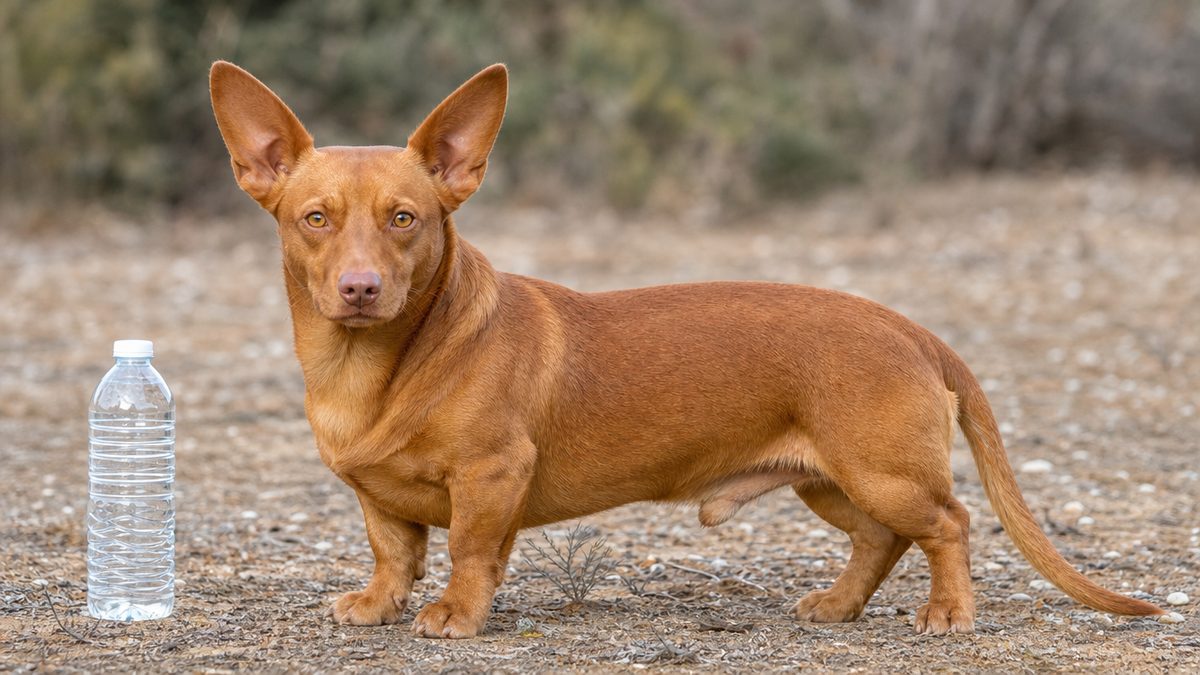
A 30 to 35 cm short-legged Andalusian rabbit hound from the Campo de Gibraltar, whose own breed standard says the short legs came from a dwarfism mutation, and which Spain's national kennel club classes as vulnerable while the state's list of Spanish dog breeds does not name it at all.
Quick answer
No honest maneto price in india can be quoted, because no Maneto is offered for sale anywhere in the country. A search restricted to India returns Pomeranian and Bernese price pages, Etsy merchandise and a rescue dog whose name happens to be India. This is a 30 to 35 cm short-legged Andalusian rabbit hound whose own breed standard attributes its shape to a dwarfism mutation. Bonbeno rates heat tolerance 4 of 5.
This page reports published veterinary research, registry documents and breed-standard text for general information. It is not a diagnosis and it is not a treatment plan. Short-legged conformation in dogs is associated with intervertebral disc disease, no study has ever measured that risk in this breed, and nothing here should be read as a prediction about an individual dog. Any dog showing sudden back pain, a reluctance to jump, wobbling, dragging a limb or loss of use of the hind legs is a same-day emergency. Consult a qualified veterinarian in your own city before acting on anything on this page.
Maneto at a glance
What a Maneto actually is
The Maneto is a short-legged Andalusian rabbit hound of 30 to 35 cm and about 10 kg, bred to work dense Mediterranean scrub that taller dogs cannot enter. It is a specialist hunting dog first and a companion second, and its own breed standard says the short legs came from a dwarfism mutation.
Its full Spanish name is Podenco Andaluz Maneto, and *maneto* is an ordinary Spanish word rather than a coined breed name, which is why searching for it in English returns a mess. The Real Sociedad Canina de España records the breed as autochthonous to southern Andalusia, specifically the province of Cádiz and the neighbouring villages of Málaga, with its greatest concentration in the Campo de Gibraltar.
The standard states its origin in one sentence that carries the whole page: the Maneto is 'derived from the medium-sized Podenco Andaluz, where it possibly arose by mutation of the character of *basetismo* or dwarfism responsible for its special morphostructure';. *Basetismo* is the Spanish term for the bassetted, short-legged build. The breed's own registry attributes the defining trait to a mutation, in writing, at the top of the document.
What it was built to do
Rabbit hunting in impossible cover. The standard says the Maneto is used exclusively in small game and specifically for the rabbit, that it is especially adapted to Mediterranean scrubland with brambles, streams and tight ravines, and that its short limbs are exactly what let it work terrain of thick vegetation and difficult access. It names a second quality that a buyer should read carefully: the *templanza*, the measured calm, with which it works its quarry.
It is also credited with partridge and quail, and with retrieving duck from water, and the standard calls it a great retriever in tight scrub, in reedbeds and in bushes. English Wikipedia gives the same list of jobs and adds nothing else, offering no height, no weight, no lifespan and no health information at all.
In Spain the breed still works. The Real Federación Española de Caza runs a national working championship for the Podenco Andaluz, Maneto and Orito Español, and its eleventh edition ran at Villarejo de Salvanés near Madrid on 6 and 7 December 2025. That is not a show class. It is a field trial, and a breed whose lack of interest in hunting is a disqualifying fault is still being judged on the job it was made for.
The population, in the only numbers that exist
No census of the breed has been published, so the honest measure is entries. 47 podencos ran at the 2025 national championship and 11 of them were Manetos, against 30 Podencos Andaluces and 6 Oritos. The 2024 edition at Vinaròs drew 45 entries of which 10 were Manetos. Two consecutive years at ten or eleven dogs is a small, stable working population rather than a dying one.
The Real Sociedad Canina de España lists the Maneto among 21 vulnerable Spanish breeds for the year running 1 May 2026 to 30 April 2027, eighteenth on a list headed by the Gos d'Atura Català and the Ca de Bestiar. Bonbeno re-read that list against the same PDF while building the Majorca Shepherd Dog page's claim about it, and both the count of 21 and the Ca de Bestiar's second place hold exactly.
The highest-ranking English editorial page on this breed calls it 'the Ibizan Maneto' four times, and refers to the Podenco Andaluz as 'the Ibizan Andaluz', while saying in the same paragraph that the breed comes from Cádiz and Málaga. Ibiza is a Balearic island roughly 700 km from the Campo de Gibraltar, and the Ibizan Hound is a separate, taller, FCI-recognised breed holding number 89. Google's own result snippet reproduces the error.
The breed standard, read in Spanish
The breed standard fixes this dog by ratio rather than by adjective. Body length divided by height at the withers is 1.337 in males and 1.335 in females, chest depth divided by withers height is 0.47 and 0.46, and muzzle length divided by total head length runs between 0.45 and 0.46 in both sexes. A correct Maneto is about a third longer than it is tall, by definition.
Height is 30 to 35 cm for both sexes and weight is around 10 kg with a variation of 1.5 kg either way, which is 8.5 to 11.5 kg. The top English page gives 8.5 to 11.5 kg and about 35 cm, so it is reading the same band from the top end. Nobody publishes a competing size, which makes this one of the few rare breeds on this site where the sources agree.
Head, ears and eyes, where the colour rules bite
The head is troncopyramidal, of medium size, and as wide as half its total length, with a subconvex skull profile and a slightly pronounced stop. The muzzle is shorter than half the total head length. The nose is medium, rounded and honey-coloured; the lips are firm, thin and honey-coloured; the eyes are medium, oval and honey-coloured in the iris. Ears are set at mid height on a broad base, triangular with blunt tips, and carried erect when the dog is alert.
Three of those are disqualifying when they go wrong. An iris of any colour other than honey disqualifies, ears that are not completely erect disqualify, and amputated ears disqualify. That last one matters in India, where Second Schedule Part II paragraph 6(8) of the Dog Breeding and Marketing Rules 2017 already forbids ear cropping outright, so the standard and Indian law agree.
The front end, described exactly as it is
This is the passage most breed pages would smooth over, and the standard does not. The forelegs are of great thickness with very marked muscular development, and their alignment is not entirely straight: the wrists sit closer together than the shoulders do. Forearms are strong, short and wide. Metacarpals are short, thick and strong, and viewed from the front are slightly inclined toward the lateral plane.
That is a plain description of a chondrodystrophic front, written by the body that keeps the standard, and it is why this page treats the conformation as a health topic rather than a curiosity. It sits alongside a hindquarter the standard describes as strong, very well developed, perfectly plumb from behind and well angled from the side, with a femoro-tibial angle of about 110 degrees and a tibiotarsal angle of 150 to 160 degrees.
| Point | Standard |
|---|---|
| Height at withers | 30 to 35 cm, both sexes |
| Weight | About 10 kg, plus or minus 1.5 kg |
| Length to height | 1.337 male, 1.335 female |
| Coat | Short or smooth, close, harsh, glossy, same length all over |
| Colour | Cinnamon in any shade, or white and cinnamon. Nothing else |
| Nose, lips, iris | Honey |
| Ears | Triangular, blunt-tipped, fully erect when alert |
| Tail | Low set, arched, past the hocks, almost to the ground |
| Teeth | 42, scissor bite preferred |
| Dewclaws | Disqualifying if present |
The tail is worth its own line because it is unusual. It is set low, arched, and of great length, passing the hocks and reaching almost to the ground, carried sabre-fashion at rest and in a crescent in movement. An amputated tail disqualifies, which again agrees with the Indian prohibition on docking.
This standard makes the presence of dewclaws or spurs a disqualifying fault. Bonbeno's Majorca Shepherd Dog page found the FCI standard for that breed requiring dewclaws to be amputated, which collides with India's paragraph 6(8) ban on de-clawing. The Maneto's version does not require the surgery, but it does penalise the dog that has them, which creates the same pressure on a breeder by a different route. Under Indian law the answer is identical: you may not remove them, and paragraph 6(8) covers de-clawing explicitly.
Two functional faults close the standard and they tell you what the breed is for. Under disqualifying faults, lack of interest in hunting. Under objectionable faults, failing to give tongue on a fresh scent, an imperfect retrieve, lack of stamina in the hunt, and fear of gunshot. A standard that disqualifies a dog for not wanting to hunt is not describing a pet.
FCI recognition, the Spanish state list, and the two-condition test
The Maneto passes Bonbeno's two-condition test, because a written standard exists and a studbook exists, and it fails FCI recognition on both the definitive and provisional registers Federation Cynologique Internationale. The interesting part is in between, where the Spanish state's own list of dog breeds does not name it.
The document everybody names is the wrong document
Spain's Catálogo Oficial de Razas de Ganado de España, set out in Anexo I of Real Decreto 45/2019, is routinely cited as the register that settles a Spanish breed's status. It is a livestock catalogue. Its species are Aviar, Bovino, Caprino, Equino Asnal, Equino Caballar, Ovino, Porcino and Otras Especies, the last holding the Canary camel and two rabbit breeds. There is no canine species in it at all, and the strings MANETO, PODENCO, PERRO and Canina each appear zero times on the ministry's own catalogue page.
The list of Spanish dog breeds lives somewhere else. Real Decreto 558/2001, which regulates official recognition of pure-bred dog breeder organisations, 'incorporates in an annex the list of Spanish canine breeds';. One 2020 ministerial order amends both instruments and does so in two separate articles, its Article 1 adding the Valdueza to the canine annex and its Article 2 removing two sheep breeds from the livestock catalogue. Two articles, two lists, one order. They are not the same register.
And the Maneto is not on the canine one
The current consolidated annex, headed RAZAS CANINAS ESPAÑOLAS and last amended with effect from 28 July 2020, carries 33 breeds with their racial prototypes. Six podenco-type entries are present: Podenco Andaluz, Podenco Canario, Podengo Galego, Podenco Paternino, Podenco Valenciano and, in terrier form, the Ratonero-Bodeguero Andaluz. So is the Ca de Bestiar. The string MANETO appears zero times in the whole decree.
The claim circulating in English is that the breed was recognised as an indigenous Spanish race in 2004. Bonbeno checked the only 2004 order amending that annex. Orden APA/807/2004 of 24 March added five Spanish canine breeds with their prototypes, and they were the Alano Español, Pastor Garafiano, Ratonero Valenciano, Ratonero Mallorquín and Ca Mè Mallorquí. The Maneto is not among them, and the words Maneto, Podenco and Andaluz appear zero times in that order. The 2004 claim is not supported by the state instrument, and Bonbeno could not find another that supports it. If a regional Andalusian act recognises the breed, this page has not seen it and does not assert it.
The FCI absence, with controls
The FCI's letter M index carries eleven entries, from MACEDONIAN SHEPHERD DOG KARAMAN to MUDI, with MASTÍN DEL PIRINEO and MASTÍN ESPAÑOL present as Spanish in-document controls. MANETO would sort between MANCHESTER TERRIER and MASTIFF and is absent. The letter P index holds twenty-seven entries including IBIZAN PODENCO 89, PORTUGUESE PODENGO 94, CANARIAN WARREN HOUND 329, BURGOS POINTING DOG 90, SPANISH WATER DOG 336, MAJORCA MASTIFF 249 and PRESA CANARIO 346, and holds no PODENCO ANDALUZ and no Maneto.
The provisional register was read separately, and it carries the strongest control available. RATONERO BODEGUERO ANDALUZ (371) was admitted provisionally on 3 September 2024 and GOS RATER VALENCIÀ (370) on 21 June 2022. Spain gets breeds onto the FCI register, and one of the two most recent is Andalusian. The Maneto's absence is not a story about Spanish breeds being overlooked. It is specific to this breed.
Bonbeno's pages repeatedly warn that an FCI group printed by a national body is that body's own filing rather than an FCI grant. The Real Sociedad Canina de España removes all doubt. It files the Maneto in Group 11, and it titles Group 11, in its own words, 'Razas no reconocidas por la FCI';, meaning breeds not recognised by the FCI. The FCI itself has only ten groups. A national body has invented an eleventh and labelled it honestly.
So what does the studbook actually hold?
The RSCE operates a Registro de Razas Caninas and the Libro de Orígenes Español, and admits a Spanish breed's dogs to the LOE from the third complete generation in the pedigree. For a vulnerable breed it has relaxed the entry rule: from 1 August 2026 to 31 July 2028, vulnerable Spanish breeds making an initial registration enter the RRC without a DNA test, though DNA stays obligatory to homologate any RSCE championship title or to obtain a Pedigree Plus.
The society is candid about how well this works, and its candour is the most useful thing on its site. Its own essay on ethnic groups admits that every Spanish ethnic group was granted breed status essentially from the start with very uneven results, and says of the Andalusian podencos that although they are among the most important populations in Spain's canine heritage, with thousands of individuals working perfectly well as hunting dogs, 'only a few have chosen to complete the three generations of a pedigree';.
That is the honest verdict. A standard exists and is detailed. A studbook exists and is national. Very few dogs are actually in it. And because India is an FCI member represented by the Kennel Club of India, which issues pedigrees against FCI nomenclature, a breed with no FCI number has no Indian registration route at all.
Maneto price in India, and the rescue dog called India
No maneto price in india exists, and the search that proves it is worth reading. A web search restricted to India for the purchase query returns ten results, of which not one is an Indian listing for this breed. Six are Indian price pages for entirely different dogs.
What actually comes back is a Pomeranian price video, a Bernese Mountain Dog price page on Instagram, a Supertails Pomeranian guide, a Quora thread about Belgian Malinois prices, a HubPages list of Indian breeds and a Puppiezo availability page. The Indian search index has plenty of dog prices. It has none for this dog, so it substitutes the ones it has.
Two of the ten are the interesting ones. The first is an Etsy India market page selling Podenco Andaluz merchandise. The second is an Instagram post from a rescue that opens 'Introducing India! A tiny Podenco Maneto with a big...'. India is the dog's name. The single result in the whole set that links this breed to the word India is a rescue dog someone named after the country.
The identical search, same session, same India restriction, run for the Labrador Retriever returned Mr n Mrs Pet with a band of INR 30,000 to 1,20,000 broken out across eight cities, plus Supertails and half a dozen other Indian sellers. The instrument finds Indian dog prices when they exist. And Google India printed 'About 159 results' for this breed against 'About 196 results' for that Labrador control, so the printed count measures nothing at all.
There is no Spanish retail price either, and that is normal
Bonbeno found no published purchase price for a Maneto in Spain and does not treat that as a gap. This is a working hunting dog distributed inside a hunting culture, not a puppy sold through a retail channel, and the national kennel club says in writing that only a few dogs of the Andalusian podenco group ever complete the three generations needed for a pedigree. Where dogs move between hunters rather than through breeders, no list price exists to publish.
Bonbeno therefore publishes no rupee figure of any kind for buying this dog. No conversion, no estimate, no range. The playbook behind these pages records Indian breed prices that turned out to be US dollar lists divided at 84.38, at 74, at 80 and at 66.67, and a single house price point attached to whatever puppy was in stock. Inventing a Maneto price would be the same act with a rarer breed attached.
The supply chain cannot form, and there are two reasons
First, the law. Dogs are a Restricted import under the DGFT trade notice, permitted only for a pet with a valid pet book in the importer's own name, for research with a CPCSEA recommendation, or for Defence and Police use, with applications for trading or breeding purposes to be duly rejected and entry limited to six named ports. DAHD added a seventh port, Cochin International Airport at Kochi, for pets arriving under the baggage rules in October 2024. You may import one for yourself. Nobody may import one to sell you. The full route is set out in how to import a dog to India.
Second, the paperwork at the far end. A breed with no FCI number cannot be registered with the Kennel Club of India, because the KCI issues pedigrees against FCI nomenclature. An Indian buyer paying for a 'pedigree Maneto' would be paying for a document that does not exist in India. The breed is commercially unavailable here, and it is unavailable for structural reasons rather than temporary ones.
If you meet a rupee figure anyway
- Divide it by 84.38, then by 80, then by 74, and see whether it lands on a round dollar amount. A converted list leaves a quotient.
- Ask whether the quotient is a price a seller would print. Rs 5,50,000 dividing to 6,875 dollars is not a real price, it is a rupee-native invention.
- Check the host country before trusting an 'Rs' figure, because Pakistani and Indian listings share the abbreviation and not the currency.
- Look at what the seller's carousel actually contains, since Indian listing sites have been caught printing one house price beside whichever puppy is in stock.
- Search the same digits against Spanish or US pages, because a stripped currency symbol leaves the digits intact and no arithmetic behind.
The one honest number on this page's commercial side is the population. Eleven Manetos ran in Spain's national working championship in December 2025 and ten ran in 2024. That is the pool. A breed producing that many competition entries a year in its own country does not have an export trade to India.
What a 10 kg working hound costs to keep in India
Budget Rs 3,000 to Rs 10,000 a month for any dog in India, with a 10 kg short-coated dog sitting in the lower half of that range on food and grooming and the upper half on parasite control. The lines below each come from an operator that publishes its own rate.
Two cautions before the table. Each figure is one provider's published price rather than a market average, and the two most-quoted Indian cost pages agree to the rupee on both consultation and vaccination, which means one copied the other and they count as a single data point. Use the numbers to orient a budget and then ring your own clinic.
| Item | Published price | Source |
|---|---|---|
| Puppy core course, four visits | Starts at Rs 6,499 | One clinic chain, 50+ clinics |
| Annual booster | Starts at Rs 3,199 | Same chain |
| Anti-rabies, single dose | Rs 699 | Same chain |
| Kennel cough | Rs 1,349 | Same chain |
| Consultation | Rs 500 to Rs 1,000 | Treat as one data point |
| Bath, small dog | From Rs 934 | Delhi price list |
| Boarding, 24 hours | Rs 899 | Bengaluru operator |
| Delhi MCD registration | Rs 500 a year | Municipal portal |
| Chennai GCC pet licence | Rs 50 | Corporation website |
The vaccination figures print 'Starts at' beside each price, which is a promotional floor rather than what you will pay. The bath figure is from a Delhi list where a full haircut runs from Rs 1,359, and the boarding figure is a Bengaluru operator's own overnight rate. Registration is cheap and mandatory: Delhi charges Rs 500 for a new pet dog registration and Rs 500 to renew with a Rs 100 monthly late fee, while Chennai charges Rs 50 and issued 9,115 licences in 2024 Greater Chennai Corporation.
Where this breed costs less
Grooming is close to free. The standard specifies a short, smooth, close-lying, harsh, glossy coat of the same length over the entire body, with no feathering anywhere and no undercoat described. A Maneto never needs the Rs 1,359 haircut line, and a bath a few times a year is the whole professional cost. That alone puts the cost of ownership below most imported breeds of similar weight.
Food is modest for a 10 kg frame, though a working hound in real work eats more than a 10 kg companion dog. Bonbeno publishes no monthly food figure, because a monthly number is arithmetic on grams per day and grams per day belongs on the pack rather than in an article.
Where it costs more, and one line is not optional
Parasite control is the line Indian owners under-budget, and a scent hound working ground cover is the worst case for it. A survey of 525 dogs across Delhi, Mumbai, Sikkim and Ladakh found 261, 49.7 percent, positive by PCR for at least one tick-borne pathogen. An Odisha clinic series of 178 dogs found *Ehrlichia canis* in 56, 31.46 percent, with 79 percent of infected dogs carrying a tick history. Read both as clinic caseloads rather than random populations, then budget monthly rather than seasonally.
The reference retail price for combined tick, flea and worm cover in India is Rs 3,308 for three NexGard Spectra tablets in the 15 to 30 kg band, which is Rs 1,103 a month. A 10 kg Maneto falls two bands below that, so the figure is quoted as a ceiling rather than as this breed's cost. Price the correct weight band against an Indian pack.
Spanish practice on the same problem is worth knowing. In a survey of 30 hunting-pack breeders in the Sierra Morena, routine deworming ran every six months and 43 percent of breeders reported concern about leishmaniasis. Six-monthly deworming is a Spanish interval for a Spanish parasite load. It is not an Indian one, and an Indian tick-borne pressure of the order above needs a monthly product rather than a twice-yearly one.
The last line is the one nobody prices. A breed with no Indian population has no Indian veterinary familiarity behind it, no local screening scheme and no comparison group. There is no DNA test to order for this breed's conformation because no laboratory offers one, and no orthopaedic registry holds a row for it. Budget for a good general practice and an orthopaedic referral you may never need.
Heat tolerance in India, measured against the Campo de Gibraltar
Bonbeno rates heat tolerance 4 of 5, which is the highest rating any European breed has earned on this site, and the breed standard says it first. The Real Sociedad Canina de España records the Maneto's heat resistance as 'withstands high temperatures very well'; and its cold resistance as merely 'acceptable'. The measurements support it.
Every figure below comes from NASA POWER queried by explicit latitude and longitude, with the grid-cell elevation echoed back and checked against the real elevation, because POWER returns a cell rather than a place. The homeland cells check out: Algeciras came back at 50.61 m against a town near 20 m, Jimena de la Frontera at 199.19 m against about 180 m, and Cádiz at 35.86 m against about 11 m. Ronda came back at 238.16 m against a real 723 m and was discarded.
One caveat belongs on the page rather than in a footnote. Algeciras and Los Barrios returned byte-identical series from one cell, so the two towns of the Campo de Gibraltar cannot be distinguished and this page uses that single cell as the homeland baseline rather than pretending to resolve them. The Indian plains cells are sound: Delhi 206.37 m against about 216 m, Chennai 48.95 m against about 6 m, Kolkata 7.35 m against 9 m, Bengaluru 841.72 m against about 920 m, Pune 635.99 m against about 560 m. Shimla returned 897.65 m against a real 2,200 m and Ooty 784.64 m against 2,240 m, so neither hill station can be assessed and no figure is published for either.
| Place | Cell elevation | Annual mean | Warmest month | Annual humidity | Peak wet bulb |
|---|---|---|---|---|---|
| Campo de Gibraltar, homeland | 51 m | 18.15 C | 23.88 C (Aug) | 78.19% | 20.67 C (Aug) |
| Cádiz city | 36 m | 18.33 C | 25.16 C (Aug) | 73.81% | 20.33 C (Aug) |
| Jimena de la Frontera | 199 m | 17.38 C | 25.96 C (Aug) | 70.84% | 19.72 C (Aug) |
| Bengaluru | 842 m | 23.74 C | 28.37 C (Apr) | 67.94% | 21.86 C (May) |
| Pune | 636 m | 23.86 C | 28.93 C (Apr) | 66.80% | 22.97 C (Jun) |
| Hyderabad | 495 m | 26.10 C | 33.30 C (May) | 60.30% | 23.35 C (Jun) |
| Jaipur | 406 m | 25.58 C | 34.57 C (Jun) | 40.94% | 25.33 C (Jul) |
| Mumbai | 97 m | 26.77 C | 31.19 C (May) | 67.39% | 25.77 C (Jun) |
| Chennai | 49 m | 27.95 C | 31.51 C (May) | 72.39% | 26.11 C (May) |
| Delhi | 206 m | 25.60 C | 35.88 C (Jun) | 45.56% | 26.50 C (Jul) |
| Kolkata | 7 m | 25.81 C | 31.53 C (May) | 73.93% | 27.09 C (Jun) |
Read the wet-bulb column, not the temperature column
On air temperature the gap looks large. The homeland's warmest month averages 23.88 C against Bengaluru's 28.37 C and Delhi's 35.88 C. On wet bulb the gap nearly closes at the mild end: the homeland peaks at 20.67 C and Bengaluru peaks at 21.86 C, just 1.19 C higher Stull R. Wet-Bulb Temperature from Relative…. Pune sits 2.30 C above the homeland. For a short-coated dog, evaporative capacity is what decides the day, and on that measure the Deccan plateau is close to home.
The far end is a different animal. Kolkata's peak wet bulb of 27.09 C sits 6.42 C above anything the Campo de Gibraltar produces, Delhi's 26.50 C is 5.83 C above, and Chennai's 26.11 C is 5.44 C above. Those are conditions no Andalusian summer supplies, and a breed praised for hot-weather tolerance in Spain has no reference for them.
The humidity finding, which is the opposite of what you would expect
The homeland is humid. The Campo de Gibraltar's annual mean relative humidity is 78.19 percent, above Kolkata's 73.93, Chennai's 72.39, Bengaluru's 67.94, Mumbai's 67.39, Pune's 66.80, Hyderabad's 60.30, Delhi's 45.56 and Jaipur's 40.94. This is a maritime corner of Spain at the mouth of the Mediterranean, not a dry interior, so a Maneto is not arriving in India humidity-naive. It is arriving heat-experienced and humidity-experienced, and short of nothing except the combination at Indian intensity.
The India Meteorological Department does not consider a heat wave until a plains station reaches at least 40 C, and declares one outright at 45 C. The homeland's warmest month averages 23.88 C. A dog that tolerates an Andalusian August is not thereby a dog that tolerates a Jaipur June, and heat stroke is defined there as a body temperature of 40 C or more with delirium, seizures or coma, 'a potential fatal condition'.
The heat risk is the work, not the weather
The largest study of canine heat-related illness supplies the transferable point, and Bonbeno takes only the transferable point because this breed was never in the model. Across 905,543 UK dogs in 2016 there were 395 confirmed heat-related illness events, an incidence of 0.04 percent with a case fatality of 14.18 percent. In the companion paper on the same cohort, of 1,259 events from 1,222 dogs, 879 had a recorded trigger and 652 of those 879, 74.2 percent, were exertional, against 113 environmental and 46 from vehicular confinement.
For a dog whose standard says it withstands long days of hunting and whose disqualifying faults include lack of interest in hunting, that is the whole warning. The Maneto will not stop itself. An Andalusian hunting dog asked to work an Indian April will keep working past the point at which a companion breed would quit, and the exertional pathway is the one that kills. Set the limit yourself, on the clock, not on the dog's willingness.
Indian law backs that up for housing. Second Schedule Part IV paragraph 21(1) bars keeping in outdoor facilities, without the attending veterinary practitioner's written approval, dogs not accustomed to local temperatures and breeds that cannot tolerate them. A short-coated Mediterranean hound is a better candidate for Indian outdoor housing than most, and the clause still requires the vet's written approval rather than an owner's judgement.
Temperament and who this dog actually suits
The Maneto suits an experienced, active household with secure outdoor space and no small pets. The standard describes a sober dog of strong temperament with a great sense of possession and superiority over other dogs, showing that territoriality from puppyhood, and simultaneously craving company and affection from people.
The standard's own list is unusually specific for a working breed and worth reading as written. It calls the Maneto very intelligent, says it will always incline towards logical reactions, credits it with a very wide capacity to retain information, and calls it very balanced and natural psychologically. It also calls the breed independent, 'recognising only a single master'.
On strangers it is precise in a way most standards are not. The Maneto is somewhat distrustful at first but moves quickly to cheerful and submissive behaviour, and it is somewhat distrustful and very much a guardian in the absence of its owner. A dog that guards when you are out and greets warmly when you are in is a specific management problem in an Indian apartment block with shared corridors and domestic staff.
Household fit, item by item
- Other dogs. Difficult. The standard names a sense of possession and superiority over other dogs, present from puppyhood. The English page that ranks highest reaches the same conclusion and says the breed probably sees itself as superior, so socialising it with many different breeds matters.
- Small pets. No. Lack of interest in hunting is a disqualifying fault for this breed, and the animal it was selected on is a rabbit. An Indian household with a rabbit, guinea pig or poultry should not take one.
- Children. Untested by any source Bonbeno could open. The English pages call the breed a sweet family pet, the standard says nothing about children at all, and no study exists. Bonbeno reports that gap rather than filling it.
- Cats and street dogs. Plan for a lead and a secure boundary. A hound bred to bay on a fresh scent in dense cover will find Indian street life extremely interesting.
- Guarding. Present without being trained for. The standard describes it directly, and an Indian buyer should treat that as a liability to manage rather than a feature to encourage.
The pack dog problem
This breed is normally kept in numbers, and that changes what a single pet Maneto experiences. Spanish hunting packs surveyed in the Sierra Morena averaged 51.9 dogs and ran roughly 40 hunting events a year, with training beginning at about 14.5 months. The Maneto's working method is co-operative: the dogs hunt in a group, and when one detects a rabbit it stops and barks so the others can move in.
A dog selected for that job, kept alone in a Chennai flat, is a dog whose entire behavioural context has been removed. Nothing in the literature says how one adapts, because no behavioural study of the breed exists. What can be said is that the standard describes an animal built for a social working life and for long days outdoors, and that neither is easy to reproduce in an Indian city.
Three households, and one of them is most Indian households. Anyone in an apartment without secure enclosed outdoor space, because a scent hound that bays cannot be exercised adequately on a balcony. Anyone keeping small mammals or birds, because the prey drive is written into the standard as compulsory. And anyone wanting a dog that obeys reliably off lead, because the standard describes independence and single-master attachment rather than biddability.
There is a welfare dimension an Indian reader should know before falling in love with the type. Spanish hunting dogs, podencos and galgos in particular, are the subject of a large international rescue movement, and the campaigning pages that dominate English-language coverage of this breed exist because of how many of them are discarded at the end of a season. If the breed appeals to you, the Galgo Español page explains how those dogs actually reach homes outside Spain, and it is through rescue rather than through purchase.
Training a Maneto, and what it will not give you
To train a Maneto, pay it for what you want and accept that recall in scent is a lifelong project rather than a finished skill. The standard describes a very intelligent dog with a wide memory that reasons logically, and in the same paragraph calls it very independent and says it recognises only a single master.
Read those two sentences together and the training picture is clear. This dog will learn a cue quickly and will then decide whether the cue is more interesting than the rabbit. The English page that ranks highest reaches the same conclusion from the field, advising owners to spend a lot of time early building the relationship, to practise calling the dog in, to make contact and to encourage it to follow. That is relationship work, not obedience drilling.
It also names the one advantage the conformation gives a handler, and it is not a joke: the short legs mean the dog cannot get away from you quickly. A Maneto that commits to a scent line is slower to disappear than a Podenco Andaluz would be. That buys you seconds, not safety.
Socialise deliberately, and start with other dogs
Socialise this breed on a written plan from the week it arrives, and put other dogs at the top of the list. The standard records a great sense of possession and superiority over other dogs, present from puppyhood, and the ranking English page says explicitly that because the dog probably sees itself as superior to others, it is important to socialise it with many different breeds.
An Indian city adds entries a Spanish list would not have. Auto-rickshaws, free-roaming street dogs behind and in front of gates, cattle, temple bells, firecrackers, monsoon thunder, lift shafts and building security staff. Introduce each at a distance the puppy can cope with, once, calmly, then stop. A hound bred to work in a pack of fifty will meet more unfamiliar dogs on one Indian street than most European puppies meet in a year.
- Pay every recall generously and never punish a dog that came back late, because the second is how you lose the first.
- Practise recall on a long line for the whole first year, and treat off-lead freedom as a place rather than a stage of training.
- Vary sessions and keep them short, since a dog with a wide memory and a logical bent disengages from repetition.
- Feed scentwork deliberately, because a nose-driven breed given no legitimate job invents one.
- Train indoors or after dusk from March to June, since the exertional pathway is what causes canine heat illness.
Spanish practice starts working training at about 14.5 months on average, according to a survey of 30 hunting-pack breeders in the Sierra Morena. That is late by companion-dog standards and it fits a breed that matures into its job. Basic manners and socialisation still begin at eight weeks; it is the serious work that waits.
Scent games. A dog whose standard requires it to give tongue on a fresh scent and to retrieve, and which is faulted for an imperfect retrieve, will take to indoor tracking and find-it work with almost no teaching. For an Indian owner facing four months a year when outdoor exercise is limited to two short windows, that is the single most useful thing you can build.
Daily exercise, and the jumping rule
A Maneto needs 90 minutes or more of real activity a day, most of it sniffing rather than walking, and it needs it in a securely enclosed space. The standard says the breed is very tough and physically withstands long days of hunting, and describes a working gait mixing a fast walk with short trots and gallops.
Do not read the short legs as low stamina. In Spain this dog works packs at around 40 hunting events a year across broken Mediterranean ground, and the standard's own summary of its adaptability to adverse situations is that it is very hard and physically endures long hunting days. It is a muscular, compact, strongly built animal, not a lap-sized version of anything.
The one restriction the conformation imposes
Manage the jumping and the stairs. Chondrodystrophy in dogs is defined by shortened long bones together with premature degeneration and calcification of the intervertebral discs, and this breed's own standard attributes its build to a dwarfism mutation. No study has measured disc disease in a Maneto, so Bonbeno gives no risk figure, but the mechanical advice that follows from the mechanism costs nothing and is worth taking.
- Lift the dog onto and off beds and sofas rather than letting it jump, and put a ramp where it habitually climbs.
- Limit stair repetitions, especially descending, which loads the front end this standard already describes as not perfectly aligned.
- Keep the dog lean, because every extra kilo on a 10 kg frame is ten percent more load through a long back.
- Swap high-impact fetch for scentwork and long low-level walking, which satisfies the same drive without the landings.
- Watch for a reluctance to jump that was previously normal, since that is often the first sign of back pain in a long-backed dog.
How this works in an Indian day
The requirement does not shrink in India; the window does. From March to June in Delhi, Jaipur, Hyderabad and Nagpur, plan on first light to about 7 am and after 8 pm once the pavement has cooled. Bengaluru and Pune allow far more, since their peak wet bulbs sit within 1.2 C and 2.3 C of the breed's homeland. Chennai, Mumbai and Kolkata are limited by humidity rather than by air temperature.
Test the pavement with the back of your hand for five seconds before every walk. A 30 to 35 cm dog carries its whole body within that heat layer. And remember that in the largest study of the problem, 652 of the 879 heat-illness events with a recorded trigger were exertional. The dog will not stop. You have to.
No study describes behaviour in an under-exercised Maneto, and Bonbeno will not invent one. What the sources support is narrower: a standard that makes lack of interest in hunting a disqualifying fault and requires the dog to give tongue on a fresh scent, and a working method built on barking to bring the pack in. A bored scent hound with no outlet and a voice is the predictable outcome, and an Indian apartment building is the least forgiving place to discover it.
Grooming, which is almost nothing, and the ear rule
Brush a Maneto once a week with a rubber mitt and the coat work is finished. The standard specifies a short or smooth coat, close-lying, harsh and glossy, covering the whole body equally and of the same length in every region, on skin of medium thickness that is very resistant, strong, well fitted and free of folds or wrinkles.
There is no feathering anywhere on this dog, no undercoat described, no furnishings, no mane and no trim. That is the lowest grooming load of any breed profile on this site, and it is the single largest practical advantage the breed brings to an Indian climate. It also means the professional grooming line in an Indian budget effectively does not apply: a bath from Rs 934 a few times a year rather than a Rs 1,359 haircut on a cycle.
The ears are the exception, and the reason is Indian
The Maneto's ears are set at mid height on a broad base and carried fully erect when the dog is alert. An erect ear is a well-ventilated ear, which is genuinely protective in a humid climate, and it is why this breed does not carry the monsoon otitis risk that a drop-eared spaniel does. What it does carry is exposure: an upright, thinly-haired ear leather on a dog working in sun takes direct radiation on both surfaces.
So the Indian ear routine is the reverse of the usual one. Check for sunburn and abrasion on the ear tips rather than for moisture inside the canal, and check the canal after swimming rather than after every wet walk. Nothing in the Spanish sources says this, because a dog working Andalusian scrub in autumn and winter is not standing in April sun on a Chennai terrace.
Skin, feet and the working coat
The standard describes pigmentation of the skin that is either light or in harmony with the coat colour, and the coat colour is cinnamon in any shade from the palest to the most fiery, or bicolour white and cinnamon, with every other colour explicitly not admitted. A pale cinnamon or predominantly white dog carries less pigment on thin-haired areas such as the nose bridge, the ear tips and the belly, and those are the places to watch in Indian sun.
Feet are rounded and slightly turned outward, with tight toes and compact, hard pads. Pads that hard are built for stone and scrub, not for hot tarmac, and hot tarmac is what an Indian city offers. Walk on earth and grass where you can find it.
- Brush weekly with a rubber mitt, which is enough for a coat this short.
- Bathe a few times a year, or after work in water, and not on a fixed calendar.
- Inspect the ear leather for sun damage and the ear canal after swimming.
- Trim the nails, since a dog kept off broken ground gets no natural wear.
- Check the pads after any walk on a hot surface, and stop walking on hot surfaces.
Do not remove dewclaws, and do not crop or dock. The standard makes the presence of dewclaws a disqualifying fault, an amputated tail a disqualifying fault and amputated ears a disqualifying fault, so a breeder chasing the standard faces pressure in two directions. Indian law removes the choice: Second Schedule Part II paragraph 6(8) of the Dog Breeding and Marketing Rules 2017 forbids tail docking, ear cropping, de-barking, de-clawing and any change of appearance by artificial means. A dog with dewclaws is not a defective dog, it is a dog that would lose in a Spanish ring.
Health, the missing literature, and what short legs actually mean
No published study has ever measured anything in a Maneto. PubMed returns zero records for the breed across five query forms, with the control returning 126 in the same session. So this section reports a mechanism the breed standard itself names, and refuses to attach a number to it.
The absence was earned rather than assumed. 'Maneto[tiab]' returns 0. Unquoted 'Maneto' returns 6 records and every one is the surname Maneto on South African COVID-19 cohort studies and insect biochemistry papers. 'Maneto dog' returns 0, 'podenco andaluz maneto' returns 0, and 'andalusian hound' returns 0 after the engine broadened Andalusian to a supplementary concept. The parent breed does appear: 'podenco andaluz' returns 2 records, both University of Córdoba studies of hunting packs, and neither names the Maneto Martinez CP, Gonzalez-Martinez. The search reaches Spanish podenco literature when it exists.
There is no orthopaedic data either. The Orthopedic Foundation for Animals holds 475 breed entries and the fragments MANETO, PODENC, ANDALU and RATONERO each return zero, so OFA holds no code for this breed and therefore cannot hold a statistics row for it. That is a stronger absence than the usual one, where a breed holds a code but falls under the publication threshold.
The mechanism the standard names out loud
The breed standard says the Maneto arose from the medium-sized Podenco Andaluz by 'mutation of the character of basetismo or dwarfism responsible for its special morphostructure';. It then describes forelegs of great thickness whose alignment is not entirely straight, with the wrists set closer together than the shoulders. That is a chondrodystrophic front, described accurately by the body that wrote the standard.
Chondrodystrophy in dogs has a known cause and a known consequence. It is defined as dysplastic, shortened long bones together with premature degeneration and calcification of the intervertebral discs, and the 2017 study that found its cause identified a highly expressed FGF4 retrogene on chromosome 12 that segregated with limb length and carried an odds ratio of 51.23, 95 percent confidence interval 46.69 to 56.20, for intervertebral disc disease. A follow-up evaluating 569 surgical disc-disease cases found that one or two copies of that retrogene lowered the age at first surgery in a dominant manner, gave an odds ratio of 18.42, CI 7.44 to 50.26, for disc herniation among mixed-breed cases and controls, and produced a relative risk for disc surgery of 5.5 to 15.1 within the breeds that segregate for it.
Transfer them. The Maneto has never been genotyped for either FGF4 retrogene in any published study, and the same paper reports allele frequencies across breeds ranging from 0.02 to 1, so the copy number in this breed could be anything. Applying a Dachshund's disc-disease rate, or any measured breed's, to a Spanish hound nobody has tested would be fabrication wearing a citation. What can honestly be said is that the standard names the mutation, the mechanism is established, and the risk in this specific breed is unmeasured. Read the Dachshund and Basset Hound pages to see what a measured short-legged breed looks like.
Where Indian law meets the standard
Two clauses of the Prevention of Cruelty to Animals (Dog Breeding and Marketing) Rules 2017 bear on this breed directly, and an Indian breeder should read both before starting.
Second Schedule Part II paragraph 6(9) reads, in full: 'Breeding to create new breeds of dogs or unusual looks shall be strictly prohibited.'; The top-ranking English page on this breed states that 'controlled by inbreeding within the breed to maintain pure bloodlines, breeders have produced the mutated gene in this breed to the point that it's an obvious characteristic of the classification of the breed';. Bonbeno cannot verify that sentence against a Spanish source and reports it as the ranking claim rather than as fact. But it describes, in English, an activity that paragraph 6(9) prohibits in India.
Paragraph 6(3) of the same Part prohibits in-breeding, defined as breeding between relatives of the second to fourth grade in straight or side line within the first four generations, and incest breeding between parents and children or between brother and sister. For a breed whose entire Spanish population is small enough that eleven dogs constitute a national championship entry, the breeding practice that maintains it abroad is not lawful practice here.
Screening, and there is almost nothing to screen for
There is no breed-specific health scheme, no DNA panel marketed for this breed, no parent-club survey and no registry statistics PubMed E-utilities esearch and esummary. What an Indian owner can actually screen is generic and still worth doing: a baseline orthopaedic examination, an annual weight check against the standard's 8.5 to 11.5 kg, and vigilance for the early signs of back pain.
Indian law adds one requirement for anyone breeding. Second Schedule Part III paragraph 8(10) requires breeding dogs to have been tested for genetic defects 'including hip dysplasia, progressive retinal atrophy, night blindness, hypothyroidism, entropion, ectropion, overshot, undershot jaw, wry mouth, two or more missing teeth, unilateral cryptorchid or full cryptorchid males'. The word is 'including', so the list is illustrative rather than closed, and a court would not read it as excusing a defect it does not name.
Life expectancy, and Indian disease pressure
No published life expectancy exists for this breed. The standard gives no figure, no mortality study includes it, and neither the UK life-table work nor the Dogs Trust longevity study covers the Maneto or the Podenco Andaluz McMillan KM, Bielby J, Williams CL. Bonbeno publishes none rather than borrowing one.
Indian disease pressure is measurable even where the breed is not. A PCR survey of 525 dogs across Delhi, Mumbai, Sikkim and Ladakh found 261, 49.7 percent, positive for at least one tick-borne pathogen, and an Odisha series of 178 clinic dogs found *Ehrlichia canis* in 56, 31.46 percent, with 79 percent carrying a tick history. Both sampled clinic caseloads rather than random populations. For a low-slung scent hound with its whole body in the vegetation layer, that is the health risk to spend money on.
For contrast, the parasite Spanish breeders worry about is different. In the Sierra Morena survey, 43 percent of pack breeders reported concern about leishmaniasis and routine deworming ran every six months. That is a Spanish risk profile on a Spanish schedule, and it does not transfer.
What the ranking pages say about health issues, and why none of it is usable
Search for this breed's health issues in English and you get silence dressed as reassurance. English Wikipedia's entry gives no height, no weight, no lifespan and no health information at all. The top aggregator describes a medium-sized dog with a narrow cone-shaped head and a weight of 8.5 to 11.5 kg and lists no conditions. The top editorial page describes the breed as a sweet family pet and mentions no health topic whatsoever.
That silence is not evidence of a healthy breed. It is evidence that nobody writing in English has read the standard, which names a dwarfism mutation on its second line and then describes a front assembly that is not perfectly aligned. A page that reports no health issues for a chondrodystrophic hound has not looked, and an Indian buyer reading it would conclude there is nothing to manage.
Bonbeno's position is narrower and, it thinks, more useful. There are no measured health issues in this breed because there are no measurements. There is a named mechanism, a defined condition, an established odds ratio in other breeds and a set of free precautions that follow from the mechanism alone Batcher K, Dickinson P, Giuffrida M. Take the precautions, refuse the numbers, and ask any breeder what the parents' backs are like at eight years old.
Feeding, and why leanness is the whole strategy
Keep a Maneto lean, and weigh the food to do it. The standard puts an adult at about 10 kg with a variation of 1.5 kg, so 8.5 to 11.5 kg is the whole permitted range. On a long-backed, short-legged dog, body condition is not cosmetic. It is the one variable an owner controls that bears directly on the spine.
Every kilo on a 10 kg frame is ten percent more load carried by a back the standard describes as long, with a loin that is long, of great width and very developed. Since chondrodystrophy is defined by premature disc degeneration, and since nobody has measured this breed's risk, weight is the intervention that is both free and certain to help. Ribs should be easy to feel under a thin covering, and the waist visible from above.
Life stages
- Weeks 8 to 16. Four meals a day of a small-breed puppy food, unchanged from what the breeder fed for the first two weeks. Do not overfeed for growth; a chondrodystrophic puppy has no benefit from rapid gain.
- Months 4 to 8. Three meals a day. Watch the front assembly as it develops, since this is the structure the standard already describes as not perfectly aligned.
- Months 8 to 14. Two meals, moving to adult food. Spanish working training does not begin until about 14.5 months, so there is no reason to push condition early.
- Adult. Two measured meals a day against the 8.5 to 11.5 kg range, adjusted for actual work rather than for theoretical activity level.
- Senior. Same frame, less energy. Cut the ration before the dog gains, not after.
Indian practicalities
Buy an Indian small-to-medium adult food and read its feeding table against your dog's real weight rather than against a breed label, since no manufacturer formulates for this breed. Bonbeno publishes no monthly rupee food figure, because a monthly figure is arithmetic on grams per day, and grams per day is printed on the pack you actually bought.
Move both meals away from the hottest part of the day, feeding early morning and after dusk, which lines up with the only two safe walking windows in most Indian cities from March to June. Keep water available in more than one room and refresh it rather than topping it up.
The ranking English page says the Maneto 'will gladly do anything for you as long as they are rewarded with a tasty reward';, and the standard's method-of-work description supports a food-motivated dog. That is useful for recall training and dangerous for weight. Take the training allowance out of the measured daily ration rather than adding it, and use the dog's own kibble for most rewards.
One thing this breed does not need is a joint supplement bought on the strength of its shape. No evidence exists for any supplement in this breed, because no evidence exists for anything in this breed. Spend the money on a kitchen scale and a good lead instead.
The first year, month by month
Two things dominate a Maneto's first year and neither is obedience. Socialisation with other dogs, because the standard records territoriality from puppyhood, and protecting the back, because the conformation is chondrodystrophic and the habits you set now last fifteen years.
| Age | What is happening | What you do |
|---|---|---|
| Weeks 0-8 | Litter socialisation at the breeder | Indian law bars sale under eight weeks under Rule 8(1)(a) |
| Weeks 8-12 | Home, four meals, first fears | Start the dog list. Territoriality towards other dogs shows from puppyhood |
| Months 3-4 | Growth, first climbing habits | Install a ramp now. Do not teach a chondrodystrophic puppy to jump off furniture |
| Months 4-6 | Puppy class, three meals | Long-line recall from day one. Never punish a late return |
| Months 6-9 | Adolescence, prey drive arriving | Secure the boundary. This is when the nose starts overriding the recall |
| Months 8-14 | Two meals, adult food | Keep lean against 8.5 to 11.5 kg, not against a growth chart |
| Month 14+ | Physical maturity | Spanish pack breeders start working training at about 14.5 months |
| Year 1 onwards | Adult | Annual weight check, baseline orthopaedic exam, annual municipal registration |
The ramp is not optional and it is cheap
Put a ramp or a set of steps at every place the dog will habitually get onto something, before the puppy learns to jump. A dog that has never jumped off a bed does not need to be retrained out of it at six years old with a painful back. Chondrodystrophy is defined by premature disc degeneration, nobody has measured how much of that this breed carries, and the cost of acting as though it does is one ramp.
Two Indian obligations in the first year
Register the dog. Delhi charges Rs 500 for a new pet dog registration and Rs 500 to renew, with a Rs 100 per month late fee and a one-month grace period tied to the anti-rabies certificate. Chennai charges Rs 50 and issued 9,115 licences during 2024. Both are conditions of lawful keeping, not optional paperwork.
Vaccinate on a written schedule. One Indian chain prices a four-visit puppy core course from Rs 6,499 and an annual booster from Rs 3,199, with anti-rabies at Rs 699 and kennel cough at Rs 1,349. Those are promotional floors from one operator rather than a market average. Ask your own clinic for its schedule and price before committing.
This breed's first Indian summer. A puppy imported or born here meets its first March to June at four to ten months old, in a body it has not finished building, with a drive it cannot yet moderate. The exertional pathway accounts for 652 of the 879 heat-illness events with a recorded trigger in the largest study of the problem, and India does not call a plains day a heat wave until 40 C. Set the outdoor limit on the clock for the whole first year.
Maneto against the dogs an Indian buyer can actually get
Every breed in this comparison is more obtainable in India than the Maneto, and one of them is free. The table sets the Maneto against the two short-legged breeds it is casually compared to, the podenco it is confused with, and the dog most Indian households should actually take.
| Breed | FCI number | On Spain's state dog list | Realistically available in India |
|---|---|---|---|
| Maneto | None | No | No |
| Podenco Andaluz | None | Yes | No |
| Ibizan Podenco | 89 | Yes | Rarely |
| Dachshund | 148 | Not Spanish | Yes |
| Basset Hound | 163 | Not Spanish | Yes |
| Indian Pariah Dog | None | Not Spanish | Everywhere, free |
The FCI numbers for the Ibizan Podenco and the Dachshund were read off the FCI's own alphabetical indexes rather than assembled into a URL, because an FCI address resolves on its trailing number and will serve a different breed with no error at all. The Spanish state-list column comes from the consolidated annex of Real Decreto 558/2001, where the Podenco Andaluz is present and the Maneto is not.
Against the short-legged breeds
The Dachshund and the Basset Hound are the two chondrodystrophic hounds an Indian buyer meets, and the difference that matters is not temperament. It is that they have been measured and the Maneto has not. Disc-disease genotyping, surgical case series and breed-level risk estimates exist for the studied breeds. For the Maneto there is nothing at all, and a buyer choosing a long-backed dog in a country with limited orthopaedic referral should weigh knowing against not knowing.
Against the podenco it gets confused with
The Ibizan Hound is FCI 89, a tall, leggy Balearic sighthound-scenthound, and it is a different animal from a 30 to 35 cm Andalusian rabbit specialist. The confusion is not the reader's fault. The highest-ranking English page calls this breed 'the Ibizan Maneto' four times and Google's own snippet repeats it Google India search results for 'maneto dog…. If a seller uses the phrase, they are quoting an aggregator.
Against the Spanish breeds Bonbeno has built
The Majorca Shepherd Dog is the instructive contrast, because it is what full recognition looks like: FCI 321, a definitive acceptance date, a published census and a state listing. The Ca Rater Mallorquí sits in the other direction, listed by the RSCE among breeds still in recovery with their prototypes in regional bulletins. The Maneto sits between them: standard yes, state list no, FCI no, vulnerable yes.
If the appeal is a small, tough, short-coated, heat-competent dog that suits an Indian climate, adopt an Indian Pariah Dog. It is genuinely hardy here, needs no import licence, no cooling strategy and no orthopaedic gamble, and it is free. If the appeal is specifically the Spanish hunting hound, the Galgo Español page explains the rescue route that actually moves those dogs abroad. If the appeal is the shape, take a Dachshund and read its health section first.
What Indian buyers get wrong about this breed
The first mistake is assuming the dog on offer is a Maneto, because there is no Indian supply of them. The rest come from English-language pages that an Indian reader met before this one, and three of the six are errors of fact rather than of judgement.
1. Calling it an Ibizan anything
The top English editorial page calls the breed 'the Ibizan Maneto' four times, and calls its parent breed 'the Ibizan Andaluz', in an article that also correctly places the breed in Cádiz and Málaga. Ibiza is a Balearic island; the Campo de Gibraltar is on the Strait. The Ibizan Hound is a separate FCI-recognised breed at number 89. Google India's own snippet reproduces the error, so it is now in the search results as well as in the article.
2. Believing it was recognised in Spain in 2004
The claim is repeated in English and Bonbeno could not substantiate it. The only 2004 order amending Spain's list of canine breeds added five, and they were the Alano Español, Pastor Garafiano, Ratonero Valenciano, Ratonero Mallorquín and Ca Mè Mallorquí. The current consolidated list holds 33 breeds and the string MANETO appears zero times in it. The breed does hold national kennel-club status and a vulnerable-breed listing, which is a different and more precise claim.
3. Looking for the breed in the wrong Spanish register
Spain's Catálogo Oficial de Razas de Ganado de España is a livestock catalogue with eight species and no canine section at all. The dog list lives in the annex to Real Decreto 558/2001, and a single 2020 ministerial order amends the two in separate articles, which is the clearest proof they are different instruments. Anyone reporting a Spanish dog breed's official status from the livestock catalogue is reading the wrong document.
4. Treating the short legs as a style choice
The standard attributes them to a dwarfism mutation and describes a front assembly whose alignment is not straight. Chondrodystrophy is defined by shortened long bones plus premature disc degeneration, and the retrogene responsible carries an odds ratio above 50 for disc disease across the breeds that have been studied. Nobody has studied this one, so the honest position is that the risk is real in mechanism and unmeasured in size. Manage the jumping anyway.
5. Underestimating the prey drive
Lack of interest in hunting is a disqualifying fault in this standard, alongside failing to give tongue on a fresh scent and an imperfect retrieve. That is a breed selected on drive across every generation that produced it. An Indian household with rabbits, poultry or an unfenced garden, or an owner planning to walk the dog off lead near street cats, has not read the standard.
6. Assuming a rupee price you saw is real
There is no Indian price for this breed, so any rupee figure you meet was produced rather than observed. Divide it by 84.38, by 80 and by 74; ask whether the quotient is a price a seller would print; check the host country of any 'Rs' figure, because Pakistani and Indian listings share the abbreviation and not the currency. A figure that survives all three tests can still be a house price point attached to whichever puppy is in stock.
Do not breed this conformation in India on a foreign model. Second Schedule Part II paragraph 6(9) of the Dog Breeding and Marketing Rules 2017 states that 'breeding to create new breeds of dogs or unusual looks shall be strictly prohibited', and paragraph 6(3) prohibits in-breeding within four generations and incest breeding outright. The English account of how this breed's mutation was fixed describes controlled inbreeding. Whatever is lawful in Spain, that method is not lawful here.
Adoption, and the only sourcing route that is real
Adopt an Indian dog. There is no Maneto in India to buy, no lawful commercial import route, and no Kennel Club of India registration to issue at the end of one. For almost every reader of this page, the answer is an Indian shelter.
India's shelters and streets hold the Indian Pariah Dog, a short-coated, heat-adapted, genuinely hardy native dog. If what drew you to the Maneto was a compact, tough, low-maintenance, nose-driven dog that copes with Indian summers, an Indian indie does all of that, costs nothing, and comes with a lifetime of local veterinary familiarity behind it.
If you are determined to source the breed itself
There is one lawful route and it runs through Spain, as a personal pet import. Dogs are Restricted under the DGFT trade notice, permitted for a pet with a valid pet book in the importer's own name, for research with a CPCSEA recommendation, or for Defence and Police use, with applications for trading or breeding purposes to be duly rejected, and entry limited to six named ports. DAHD added a seventh port, Cochin International Airport at Kochi, for pets arriving under the baggage rules in October 2024. You would be importing a dog you already own, not buying one for delivery.
Two Spanish routes exist for finding one. Working dogs move within hunting circles, and the Real Federación Española de Caza's national championship for the Podenco Andaluz, Maneto and Orito Español is where the breed's active owners gather. Rescue is the other, and for Spanish hunting dogs it is the larger of the two: the English-language coverage of this breed is dominated by podenco rescue organisations for a reason.
What to ask for, and what will not exist
- Ask whether the dog is in the Registro de Razas Caninas or the Libro de Orígenes Español, and expect the honest answer to be neither, since the RSCE itself says only a few Andalusian podencos complete the three generations a pedigree needs.
- Verify that no FCI pedigree is being claimed, because the FCI holds no number for this breed and any document saying otherwise is not what it appears to be.
- Request a written veterinary examination including a spinal assessment, since no breed screening scheme exists to fall back on.
- Refuse any puppy under eight weeks, which Rule 8(1)(a) of the Dog Breeding and Marketing Rules 2017 prohibits outright.
- Check that the dog has natural ears, a natural undocked tail and its dewclaws, because Indian law forbids removing any of them.
- Walk away from any Indian seller offering this breed, because no lawful supply chain exists that could produce one.
What Indian law forbids that a foreign breeder may still suggest
The 2017 Rules prohibit in-breeding between relatives of the second to fourth grade within four generations, and incest breeding between parents and children or brother and sister, in Second Schedule Part II paragraph 6(3). They also forbid tail docking, ear cropping, de-barking, de-clawing and any change of appearance by artificial means, in paragraph 6(8), and prohibit breeding for new breeds or unusual looks in paragraph 6(9).
That last clause is not academic for this breed. Its defining trait is a dwarfism mutation named in its own standard, and the ranking English account describes breeders propagating that mutation by inbreeding. An Indian reader who imports a pair and starts breeding is on the wrong side of two separate paragraphs.
The Maneto's real lesson is not about the Maneto. It is that a breed's own registry will sometimes tell you the uncomfortable truth if you read it in its own language. This standard names the mutation behind the breed's shape, its national kennel club titles the group it files the breed in 'breeds not recognised by the FCI', and that same club writes publicly that only a few of its Andalusian podencos ever complete a pedigree Real Sociedad Canina de Espana. None of that appears in any English page about this dog. Read the primary source, in the source language, before you believe an aggregator.
Maneto questions an Indian reader actually has
What type of dog is a podenco?
A podenco is an Iberian rabbit-hunting hound with large erect ears, worked by scent, sight and hearing together. Spain recognises several of them, and the Fédération Cynologique Internationale holds three: the Ibizan Podenco as number 89, the Portuguese Podengo as 94 and the Canarian Warren Hound as 329. The Maneto is a short-legged Andalusian podenco and holds no FCI number.
What kind of dog has a mane?
None of the dogs this page is about. That question appears in Google India's People also ask box for the Maneto because the string 'maneto' collides with the English word mane, not because this breed has one. The Maneto's coat is short, smooth, close-lying and exactly the same length over the whole body, with no ruff, mane or feathering anywhere.
What is the famous Japanese dog breed?
The Shiba Inu and the Akita, which have nothing to do with this breed. That question sits in Google India's People also ask box for the Maneto and Google's own AI Overview answers it about Japanese dogs. Bonbeno records it verbatim because it is what the search engine actually asked, and it is the clearest evidence that Google has not resolved this breed at all.
How much does a Maneto cost in India?
Nothing, because there is nothing to buy. A search restricted to India for the purchase query returns ten results, of which six are price pages for entirely different breeds, one is an Etsy merchandise page and one is a rescue post about a dog whose name is India. The same search for a Labrador returns Indian breeders with city-by-city price tables.
Is the Maneto recognised by the FCI?
No, on either basis, and its own national kennel club says so in a heading. The Real Sociedad Canina de España files the Maneto in Group 11, which it titles 'Razas no reconocidas por la FCI'. The FCI's letter M index holds eleven entries and the Maneto is not among them, with Mastín del Pirineo and Mastín Español present as Spanish controls, and the provisional register holds twenty entries without it.
Is the Maneto an official Spanish breed?
Partly, and the precise answer matters. The Real Sociedad Canina de España publishes a full standard for it and lists it among 21 vulnerable Spanish breeds for 2026 to 2027. But the state's own list of Spanish dog breeds, the annex to Real Decreto 558/2001, carries 33 breeds and the string MANETO appears zero times in it, while the Podenco Andaluz it descends from is there.
Why are the Maneto's legs so short?
Because of a mutation, and the breed standard says so itself. It records that the Maneto derived from the medium-sized Podenco Andaluz and 'possibly arose by mutation of the character of basetismo or dwarfism responsible for its special morphostructure'. The top-ranking English page goes further and says breeders propagated the mutated gene by inbreeding until it became a defining characteristic of the breed.
Does the Maneto get back problems?
Nobody knows, and any page that gives you a percentage has invented it. Chondrodystrophy in dogs is defined by shortened long bones with premature disc degeneration, and the chromosome 12 FGF4 retrogene that causes it carries an odds ratio of 51.23 for intervertebral disc disease across breeds. No published study has genotyped a Maneto or measured disc disease in this breed, so Bonbeno reports the mechanism and refuses to attach a number to it.
Can a Maneto handle Indian heat?
Better than almost any European breed on this site, and Bonbeno rates it 4 of 5. The standard records the breed's heat resistance as withstanding high temperatures very well, and its homeland's peak monthly-mean wet bulb of 20.67 C is only 1.19 C below Bengaluru's. The real limit is coastal humidity: Kolkata's peak wet bulb of 27.09 C is 6.42 C above anything the breed's homeland produces.
How big does a Maneto get?
Between 30 and 35 cm at the withers, for both sexes, and about 10 kg with a variation of 1.5 kg either way. The standard also fixes the shape numerically: body length divided by withers height is 1.337 in males and 1.335 in females, so a correct dog is about a third longer than it is tall. The top English page gives 8.5 to 11.5 kg and about 35 cm, which is the same band read from the top.
What is the life expectancy of a Maneto?
No published figure exists. The breed standard gives none, no mortality study includes the breed, and the UK life-table and longevity studies this site normally uses cover neither the Maneto nor the Podenco Andaluz. Bonbeno will not borrow a Dachshund or a Podenco Ibicenco figure to fill the gap, because a borrowed lifespan is a fabricated one.
Could I import a Maneto into India?
As your own pet, yes; to sell or breed, no. Dogs are a Restricted import under the DGFT trade notice, permitted for a pet with a valid pet book in the importer's own name, for research with a CPCSEA recommendation, or for Defence and Police use, and applications for trading or breeding purposes are to be duly rejected. Entry is limited to seven named ports.
Is a Maneto a good family dog?
For an experienced household with space, possibly. The standard describes a dog that craves company and affection but is very independent and recognises only a single master, is distrustful of strangers at first, guards strongly in its owner's absence, and shows territoriality towards other dogs from puppyhood. Lack of interest in hunting is a disqualifying fault, so the prey drive is not optional.
How rare is the Maneto?
Rare enough that the national championship is countable. Spain's Royal Hunting Federation ran the eleventh national working championship for the Podenco Andaluz, Maneto and Orito Español in December 2025, and of 47 podencos entered, 11 were Manetos. The year before it was 10 of 45. The RSCE lists the breed among 21 vulnerable Spanish breeds.
Compare with similar breeds
Maneto sits in 1 Bonbeno group. Each one compares it directly against the breeds it is genuinely an alternative to, on the same figures.