
Breed profile
Ca Rater Mallorqui: The Complete India Guide
Mallorca's ratting terrier, four kilos and built to jump: 2,119 in the studbook, a tail clause the whole internet misreads, and an abstract that reverses its own paper.
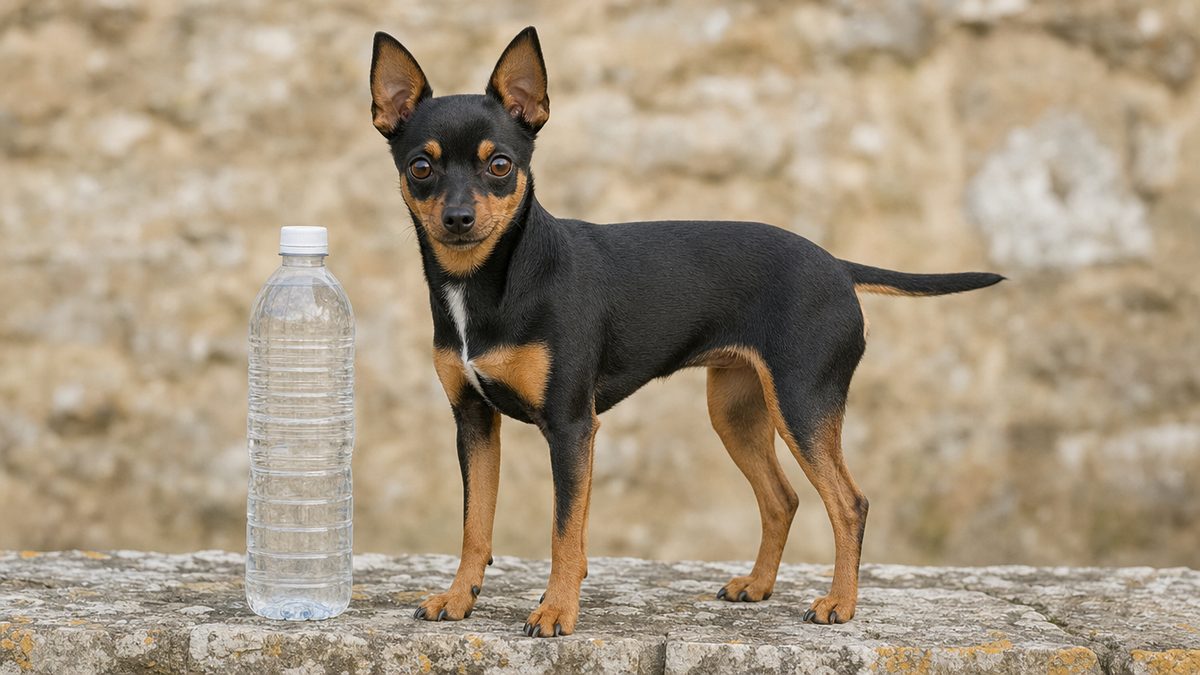
Quick answer
The Ca Rater Mallorqui is Mallorca's native ratting terrier, 32 to 36 cm and 3.5 to 5 kg for a male, short-coated, very lively and very nervous by its own standard. Its tail clause describes docking as habitual but grades an uncut tail as only a minor fault, so the breed can lawfully be kept to standard in India. No Indian price and no lawful breeding import exist. Heat tolerance rates 3 of 5.
This page summarises published breed-standard text, registry data, government notifications and peer-reviewed veterinary research for general information. It is not a diagnosis and it is not treatment advice. No health study of this breed has ever been published, so every risk named here is inferred from body type or borrowed from other breeds and labelled as such. Consult a registered veterinarian about your own dog before acting on anything here, and treat collapse, unsteadiness, a sudden inability to bear weight on a hind limb, or a tongue that turns dusky in heat as an emergency.
Ca Rater Mallorquí at a glance
What the Ca Rater Mallorqui actually is
The Ca Rater Mallorqui is Mallorca's native ratting dog, a square, small, short-coated terrier-type of 32 to 36 cm and 3.5 to 5 kg for a male, recognised by the Balearic government in 2002 and by the Spanish state in 2004, and not recognised by the Federation Cynologique Internationale.
Four numbers frame this breed better than any adjective. The Balearic studbook census stands at 2,119 dogs, the largest of the six Balearic breeds. The breed club told a Spanish canine magazine in September 2023 that 2,041 were entered in the libros de origenes. The one genetic study of the breed says 363 animals were registered, of which 146 were founders. And that study genotyped 77 dogs in its Methods while its own Table 1 prints 79. Those figures are set side by side later on this page, because no other page anywhere has done it.
Its job is in its name. The breed standard gives the utility as guard of the house, hunter of rats and rabbits, and companion animal. The Catalan original is more specific and says why the dog is good at it: it warns its owner at once, it goes into any crevice, it jumps walls very easily and it runs very fast.
The short version for an Indian reader
- No Ca Rater Mallorqui price in India exists. Google, searched from India, reports about 97 results for the breed name in total and not one is an Indian listing.
- The tail clause is the whole story, and the internet has it wrong. The standard describes a habitually cut tail but grades an uncut one as a minor fault, the mildest of three tiers.
- Heat tolerance rates 3 of 5. Palma averages 18.76 C a year against Chennai's 27.95 C, but the coat is short and fine and the dog weighs four kilos, so the body has little insulation to shed and little mass to overheat.
- No lawful breeding route exists. Dogs are a Restricted import and applications for trading or breeding purposes shall be duly rejected.
Where it sits among the Balearic breeds
The Balearic Islands officially recognise five dog breeds and one racial grouping, and this is the most numerous of them. Set against its neighbours, the Ca Rater's studbook holds 2,119 dogs, the Ca Eivissenc 1,037, the Ca Me Mallorqui 654, the Ca de Bestiar 507, the Ca de Conills 316 and the Ca de Bou 243. Together those breeds are reckoned to represent about 20 percent of Spain's entire canine heritage.
| Breed | FCI number | Studbook census | Job |
|---|---|---|---|
| Ca Rater Mallorqui | None | 2,119 | Ratting, rabbiting, house guard |
| Ca Me Mallorqui | None | 654 | Pointing and retrieving |
| Ca de Bestiar | 321 | 507 | Shepherding and guarding |
| Ca de Bou | 249 | 243 | Guard, historically bull-catching |
That ranking matters because it inverts the usual assumption. This is the rare breed nobody has heard of and it is also, on the studbook evidence, the least rare dog on the island. What it lacks is not dogs. What it lacks is international recognition, published health data and, outside Mallorca, anyone at all.
If you read nothing else here, read the tail sections. Every English page about this breed says its tail is customarily amputated, and the sibling guide to the Ca Me Mallorqui reports that this breed's standard requires it. Bonbeno checked the gazette in both languages and that is not what it says. The standard describes docking as habitual and penalises a natural tail as a minor fault, which is a very different legal position for an Indian breeder.
What the standard actually says about the tail
The tail clause reads Habitualmente cortada a ras del cuerpo o conservando una vertebra, habitually cut flush with the body or keeping one vertebra, and it is a description of custom rather than a command, because the same standard grades a tail with more than one vertebra as a minor fault and records dogs born with no tail at all.
Read the gazette, not the summaries. Section V, Cola, of the Prototipo racial del Ratonero Mallorquin printed in the Boletin Oficial del Estado on 30 March 2004 reads in full: Habitualmente cortada a ras del cuerpo o conservando una vertebra. Algunos perros nacen sin cola o con una cola muy rudimentaria que se atrofia y se cae. Habitually cut flush with the body or keeping one vertebra. Some dogs are born without a tail, or with a very rudimentary tail that atrophies and falls off.
The Catalan original of 2002 says the same and adds a note of surprise. Section d), Coa, of Annex II of the Ordre of 18 December 2002 reads: Habitualment es tallada ran del cos o conserva una vertebra. Es curios observar que alguns cans neixen sense coa i d'altres amb una coa molt rudimentaria que moltes vegades s'atrofia i cau tota sola. It is curious to observe that some dogs are born without a tail. A standard that finds its own tailless puppies curious is not a standard mandating amputation.
The fault list has three tiers and the tail sits in the mildest
This is the point every page ranking for the breed name misses. The 2004 Spanish text prints the faults in three ruled columns headed Defectos leves, Defectos graves and Defectos eliminatorios. The 2002 Catalan text prints the identical set as a numbered list, 1) Lleus, 2) Greus, 3) Eliminatoris, which removes any doubt about which fault belongs to which tier.
| Defectos leves (minor) | Defectos graves (serious) | Defectos eliminatorios (disqualifying) |
|---|---|---|
| A missing premolar | Moderate prognathism | Excessive prognathism |
| Apathetic character | Several missing premolars | Depigmented nose or mucous membranes |
| A tail with more than one vertebra | Wavy or excessively long coat | Monorchidism |
| More than three centimetres above or below the height | ||
| Dropped ears from one year of age |
So a Ca Rater Mallorqui with a full natural tail carries the same weight of fault as one missing a single premolar. It is not disqualified, it is not seriously faulted, and it can still be registered, shown and bred. A monorchid dog is disqualified outright; a dog three centimetres over height is disqualified outright; a dog with a tail is docked one mark.
How the internet lost the tiers
Mundoanimalia ranks in the top ten for this term and reproduces the entire Spanish standard clause by clause, faithfully, including the tail sentence. Then it reaches the Faltas section and flattens all eleven faults into a single undifferentiated bullet list, so that Cola con mas de una vertebra appears in the same visual rank as Monorquidia. A reader of that page cannot tell that one is trivial and the other ends the dog's show career. That is the mechanism by which a descriptive clause became, in English, a requirement.
The Ca Me Mallorqui guide states that this breed's standard requires amputation, and that of the five Spanish breeds recognised together in 2004 only the Ca Me could be bred to standard in India. Having read both gazettes, this page disagrees. The requirement is not there. What is there is a habit, a minor fault and an explicit acknowledgement of naturally tailless dogs, and that changes the Indian answer completely.
The tail clause against Indian law, clause by clause
An Indian breeder can keep a Ca Rater Mallorqui to standard, because Indian law forbids the amputation the standard describes but the standard does not require it, and the only penalty for a natural tail is one minor fault.
Indian law on this is short and absolute. Second Schedule Part II paragraph 6(8) of G.S.R. 496(E), the Prevention of Cruelty to Animals (Dog Breeding and Marketing) Rules 2017, reads: There shall be no tail docking, ear cropping de-barking, de-clawing, branding, dyeing, injecting substances to enhance visual appeal, performing a surgery or procedure to camouflage or hide any defect or infirmity or any other kind of mutilation of any body part of the pup and any change of appearance by artificial means is strictly forbidden. That text is quoted from Bonbeno's own extraction of the 14-page gazette rather than from any summary of it.
Say which paragraph you are quoting, because the document numbers its clauses twice. There is a Rule 8, headed Conditions for sale, whose sub-rule 8(1)(a) says pups less than eight weeks in age are not sold. There is separately a Second Schedule, headed [See rules 5(2) and 6], whose Part II paragraph 6 is headed Common breeding techniques and whose sub-paragraph 6(8) is the docking prohibition. Rule 6 itself is a different provision, Requirements to be met by breeders and establishments, and its whole function is to make the Second Schedule binding.
| Provision | What it says | What it means for a Ca Rater |
|---|---|---|
| Second Schedule Part II para 6(8) | No tail docking, ear cropping, de-barking, de-clawing or any other mutilation; any change of appearance by artificial means is strictly forbidden | You may not dock the tail. You may keep the dog with its natural tail and take one minor fault |
| Second Schedule Part II para 6(3) | In breeding and incest breeding are prohibited, in breeding being relatives of the 2nd to 4th grade within the first four generations | Bites hard on a gene pool rebuilt from 146 founders in 363 registered dogs |
| Second Schedule Part III para 8(10) | Dogs shall have been tested for genetic defects including hip dysplasia, progressive retinal atrophy, night blindness, hypothyroidism, entropion, ectropion, overshot and undershot jaw, wry mouth, two or more missing teeth, and unilateral or full cryptorchid males | Indian law mandates testing for exactly two of the breed's own listed faults |
| Rule 8(1)(a) | Pups less than eight weeks in age are not sold | A four-kilo breed is often moved early. Eight weeks is the floor, not a guideline |
The overlap nobody has noticed
Set paragraph 8(10) beside the breed's own fault list and two items match exactly. The Rules require a dog to have been tested for two or more missing teeth and for unilateral cryptorchid or full cryptorchid males. The Ca Rater standard grades a missing premolar as a minor fault, several missing premolars as a serious fault, and monorchidism as disqualifying. An Indian breeder complying with paragraph 8(10) is, by accident, running the exact tests the Spanish standard cares most about. That is a genuinely convenient alignment and no page anywhere states it.
Where the collision really is
The tail is not the hard problem. Paragraph 6(3) is. It prohibits in breeding, defined as mating between relatives of the second to fourth grade in straight or side line within the first four generations, giving uncle to niece, nephew to aunt, cousin to cousin and grandparent to grandchild as its examples, and it prohibits incest breeding, parent to child and brother to sister, outright. Only out breeding and line breeding remain permitted. In a breed whose published founder base is 146 animals inside 363 registered dogs, on an island, avoiding all four-generation relatedness is arithmetically difficult.
A Ca Rater Mallorqui kept in India with its natural tail breaks no rule and fails no clause of its own standard beyond one minor fault. A Ca Rater Mallorqui docked in India breaks Second Schedule Part II paragraph 6(8). Nobody needs to choose between the standard and the law here, which is the opposite of the position on a breed whose standard makes an entire trait disqualifying.
Spain forbids it too, and the club has already moved
Docking is now unlawful in Spain itself, so the standard's tail clause describes a practice its own country prohibits, and the breed club's published position is that dogs with or without a tail are admitted.
Two Spanish instruments close this. Ley 7/2023, de 28 de marzo, de proteccion de los derechos y el bienestar de los animales, Articulo 27, Prohibiciones especificas respecto de los animales de compania, letter b), prohibits todo tipo de mutilacion o modificaciones corporales permanentes, excepting only ear-marking of community cats and procedures of therapeutic necessity, and states expressly that no puede servir de justificacion un motivo funcional o estetico de cualquier tipo. No functional or aesthetic motive of any kind can justify it. Articulo 74, letter e), makes an unauthorised mutilation a grave infraction, and Articulo 76(1)(b) prices a grave infraction at 10,001 to 50,000 euros. The law entered into force six months after publication.
Spain is also bound internationally, without the escape hatch most of its neighbours took. The Council of Europe treaty chart for the European Convention for the Protection of Pet Animals, ETS No. 125, records Spain signing on 9 October 2015, ratifying on 19 July 2017 and entry into force on 1 February 2018. Ten ratifying states filed reservations, including Belgium, Denmark, Finland, France, Germany, Luxembourg and Portugal. Spain filed none. Its single declaration, read in full, concerns Gibraltar and the Treaty of Utrecht, and the Treaty Office's own field records Articles concerned: 0.
The club got there first
The Club del Ca Rater Mallorqui states its own position plainly on its English characteristics page. Under TAIL it writes that a characteristic of this breed is that 20 percent are born without a tail, with a small vertebra flush with the body, and that in the breed standard, specimens with or without tail are admitted, in compliance with the European regulations that refer to amputations for aesthetic reasons. That is the body that manages the studbook telling readers, in writing, that the 2004 clause is no longer applied as written.
So the position is settled in practice and unamended on paper. The gazette text of 2004 has never been revised. The club that administers the breed reads it as permitting a natural tail. Spanish national law forbids the alternative. And every English-language page still repeats the 2004 sentence with none of that context.
The FCI already rewrote the sentence for the sister breed
The nearest recognised relative shows what an updated clause looks like. FCI-Standard N 370, GOS RATER VALENCIA, published 14 September 2022, gives its whole tail clause as TAIL: Previously customarily docked, not now. followed by There are tailless dogs and then a description of a medium-length natural tail carried elevated during movement. That breed was accepted on a provisional basis by the FCI on 21 June 2022, into Group 3 Terriers, Section Large and medium sized Terriers, country of origin Spain.
| Breed | Standard and date | Tail clause |
|---|---|---|
| Ca Rater Mallorqui | Orden APA/807/2004, 24 March 2004, unamended | Habitually cut flush with the body or keeping one vertebra. Some dogs are born without a tail |
| Gos Rater Valencia | FCI-Standard 370, 14 September 2022 | Previously customarily docked, not now. There are tailless dogs |
Nothing sinister explains it. The Ca Rater's standard is an annex to a Spanish ministerial order and amending it means amending the order, while the Valencian ratter's standard was written fresh for FCI submission in 2022 and could simply say the modern thing. The practical effect is that the older text keeps circulating and keeps being quoted, twenty-two years after it was drafted and eight years after the Convention bound Spain.
The 20 percent born without a tail, and what nobody has tested
The breed club claims that 20 percent of Ca Rater Mallorqui puppies are born tailless, the claim rests on the club alone, and the gene behind natural bobtails in other breeds kills homozygous embryos, so the figure is the most important untested number in the breed.
The 20 percent figure appears twice and traces to one source. The club's own characteristics page states that 20 percent are born without a tail. Ladridos, a Spanish canine magazine, printed the same figure in September 2023 in a data box beside an interview with the club's vice-president, alongside 2,041 dogs in the studbook and 1990 as the club's founding year. Two outlets, one claim, no study. Treat it as the club's working estimate rather than a measured prevalence, because that is what it is.
The gazette independently supports the phenomenon without quantifying it. Both the 2004 Spanish text and the 2002 Catalan text record that some dogs are born with no tail or with a rudimentary tail that atrophies and falls away. So the trait is real and officially noticed. Only the rate is unverified.
What a natural bobtail usually costs a litter
In most short-tailed breeds the cause is one dominant mutation with a lethal homozygote. Hytonen and colleagues tested 23 breeds, 360 dogs of which 156 were naturally short-tailed, and found the C189G mutation in the T-box transcription factor T gene in 17 of them, with a perfect correlation between the mutation and the short-tail phenotype. Six breeds carried neither C189G nor any other mutation in the T gene coding regions, so more than one genetic route to a bobtail exists. Critically, no dog in the study was homozygous, which the authors read as evidence that the homozygous condition is lethal, and in the Swedish Vallhund they measured a 29 percent decrease in litter size when both parents were short-tailed.
| Finding | Value | Status for the Ca Rater Mallorqui |
|---|---|---|
| Breeds carrying C189G | 17 of 23 tested | Never tested |
| Dogs sampled | 360, of which 156 naturally short-tailed | None from this breed |
| Homozygotes found | Zero, suggesting the homozygous state is lethal | Unknown |
| Litter-size effect, short-tailed to short-tailed | 29 percent smaller in the Swedish Vallhund | Unmeasured |
Nothing in the published record tests this breed for C189G. The only genetic work on the Ca Rater Mallorqui is a microsatellite study of population structure, which does not look at the T gene at all. A search of Europe PMC for the breed name returns three records, all population genetics, and PubMed returns one, the same studyNCBI PubMed E-utilities esearch…. So a breeder pairing two tailless Ca Raters is running an experiment nobody has done.
Where a bobtail is dominant with a lethal homozygote, the safe pairing is tailless to tailed, never tailless to tailless. That produces roughly half tailless puppies with no embryonic loss. Since nobody has genotyped this breed, an Indian or Spanish breeder should assume the general case rather than the favourable one, and screen litter sizes rather than trusting that this population is the exception. Second Schedule Part II paragraph 6(9) of the Indian Rules separately prohibits breeding to create unusual looks, which is worth remembering before anyone starts selecting for taillessness.
The breed standard in numbers
The official Spanish prototipo gives males 32 to 36 cm and 3.5 to 5 kg, females 29 to 33 cm and 3 to 4 kg, with a square body, a right-angled stop, round dark amber eyes, erect triangular high-set ears and a short, fine coat that is principally black and tan.
Every figure below comes from the gazette rather than a secondary description, because the secondary descriptions of this breed disagree with each other. The Catalan Annex II adds one number the Spanish version drops entirely: la seva alcaria no arriba als 40 cm, its height does not reach 40 cm. That ceiling is a checkable limit and it survives only in Catalan and on the club's own page.
| Clause | What the standard says |
|---|---|
| Height at withers | Males 32 to 36 cm, females 29 to 33 cm |
| Weight | Males 3.5 to 5 kg, females 3 to 4 kg |
| Overall height ceiling | Does not reach 40 cm (Catalan text only) |
| Build | Rectilinear, brevilinear and ultraelipometric under Baron's system |
| Proportions | Height equals length in males, giving a square dog; females slightly longer |
| Skull | Width similar to length, and length greater than that of the face or muzzle |
| Stop | Very marked, forming a right angle with the cranio-facial axes |
| Muzzle | Narrow and markedly pointed, with well marked masseters |
| Eyes | Round, large, somewhat prominent, horizontal and frontal, dark amber |
| Ears | Erect, medium, triangular, mobile, set high, not projecting beyond the outer lateral plane of the head when alert |
| Neck | Robust and cylindrical, low set, the same length as the head |
| Body | Quadrangular in males; withers level with the croup; belly tucked up; ribs arched |
| Feet | Very fine and of the hare type |
| Coat | Short and fine |
| Colour | Principally black and tan, with white patches common; brown and tan and white and orange mutations occur; tricolours recognised |
The ear clause, and an English page that reverses it
The standard says the erect ears no sobresalen del plano lateral externo de la cabeza cuando el animal esta en posicion de alerta, they do not project beyond the outer lateral plane of the head when the animal is on alert. The Catalan says the same, no sobresurten. The club's English page renders that as protrude from the outer lateral plane of the head when the animal is alert, dropping the negation and inverting the clause. Anyone judging or drawing the breed from the English page would get the ear carriage exactly backwards.
That page carries two further translation artefacts worth naming, because they show it is machine-translated rather than authored. The Catalan llambrot, the lip commissure, becomes the marinade, and the gait section Marxa becomes GATHER. Read the gazette instead.
The standard describes hindquarters with strong bones and good joints lo que favorece la capacidad para efectuar saltos sobre su vertical a gran altura, favouring the capacity to jump vertically to a great height, and adds that at both trot and gallop the dog is very fast because it moves its limbs at great speed. A four-kilo dog built to leave the ground vertically is a fence problem, a balcony problem and a countertop problem, and every Indian care decision on this page follows from that sentence.
What the Spanish translation dropped from the Catalan standard
The 2004 Spanish prototipo is a translation of the 2002 Catalan standard, and the clauses it shortened are the ones that describe how this dog actually works.
Both texts are official, both are free, and the comparison takes ten minutes. The Butlleti Oficial de les Illes Balears published the Catalan standard as Annex II of the Ordre of 18 December 2002. The Boletin Oficial del Estado published the Spanish prototipo inside Orden APA/807/2004. Set them side by side and the Spanish version is consistently shorter in the functional clauses.
| Catalan, 2002 | Spanish, 2004 |
|---|---|
| A great house guard, since it warns its owner at once; a great hunter of rats and rabbits, since it goes into any crevice, jumps walls very easily and runs very fast; equally an animal of excellent company | Guard of the house, hunter of rats and rabbits owing to its size and agility, and companion animal |
| Its height does not reach 40 cm, and 32 to 36 cm in males and 29 to 33 cm in females are normal | Small, well below the average size of the canine species (the 40 cm ceiling is absent) |
| It is curious to observe that some dogs are born without a tail and others with a very rudimentary tail that often atrophies and falls off by itself | Some dogs are born without a tail or with a very rudimentary tail that atrophies and falls off |
The utility clause is the real loss. Avisa tot d'una a l'amo and entra per qualsevol enfony are the Catalan standard telling a judge what the dog does, not what it looks like. The Spanish replaces all four behaviours with debido a su tamano y agilidad, owing to its size and agility, which is an explanation rather than a description. Anyone assessing whether a puppy is typical loses the four checkable behaviours and gains an adjective.
Why an Indian reader should care about a translation
You will meet the Spanish version, not the Catalan one. It is the text Mundoanimalia reproduces for a Spanish-reading audience, and it is the text every English write-up is translated from, one language further away again. So the wall-jumping, the crevice-entering and the instant alarm bark all quietly disappear from the record twice over, and what survives into English is a small dog with a cut tail.
What the Catalan text adds that nothing else records
Annex III of the 2002 Ordre carries a qualification scheme the Spanish prototipo omits entirely. Adult dogs are assessed from twelve months against ten parameters: head and neck, back withers and arms, chest thorax and belly, the dorso-lumbar region, croup and tail, forelimbs and their stance, hindlimbs and their stance, overall shape, temperament, and movement. Each is scored 1 to 10 on a named scale running from Perfecte at 10 down to Dolent at 1 or 2. A dog needs at least 60 points to enter the Auxiliary or Definitive registers, fewer than 5 points on any single basic parameter disqualifies it outright, and dogs scoring between 55 and 60 get one second chance within the following twelve months.
Annex I sets the registry structure, and it is worth knowing because it explains how an unregistered island dog can become a pedigree one. The studbook has an Annexed Section for dogs lacking full genealogical documentation, containing an Auxiliary Birth Register, a Foundational Register for dogs over twelve months with unknown or unregistered parents that have passed breed confirmation, and an Auxiliary Adult Register; and a Principal Section for pure-bred dogs, containing a Principal Birth Register, a Definitive Register and a Merit Register. Every animal entered is identified by microchip.
Two of the ten scored parameters are temperament and movement. That makes this a working register rather than a beauty register, and it is the reason the breed still behaves like a ratter after twenty-four years of formal breeding. It also means a breeder who cannot verify a dog's parentage still has a documented route in, through the Foundational Register and a breed confirmation at twelve months.
Who recognises this breed, and on which date
Recognition came in two steps, from the Balearic government on 18 December 2002 and from the Spanish state on 24 March 2004, and three wrong dates are in wide circulation for the second step.
Start with the documents. The Balearic step is the Ordre del Conseller d'Agricultura i Pesca, de 18 de desembre de 2002, per la qual es crea el Llibre genealogic del Ca rater mallorqui i se'n regula el funcionament, item 26150, published in the Butlleti Oficial de les Illes Balears number 156 on 28 December 2002 at pages 23306 to 23308 and signed by Mateu Morro i Marce. It approves the specific regulation of the studbook, the racial standard and the adult qualification rules as Annexes I, II and III, and hands management of the studbook to the Club del Ca rater mallorqui, recognised by the Conselleria by a Resolucio of 21 November 2002.
The Spanish step is Orden APA/807/2004, de 24 de marzo, published in the Boletin Oficial del Estado number 77 on 30 March 2004 at pages 13430 to 13435, reference BOE-A-2004-5652 and signed by Arias Canete. Its single article adds five Spanish breeds to the annex of Real Decreto 558/2001: Alano Espanol, Pastor Garafiano, Ratonero Valenciano, Ratonero Mallorquin and Ca Me Mallorqui. The proposal had been accepted by the Comite de Razas de Ganado de Espana on 22 April 2003, and the order took effect the day after publication.
| Date | What it actually is | Who says it |
|---|---|---|
| 22 April 2003 | The Comite de Razas de Ganado meeting that accepted the proposal | The order's own preamble |
| 2003 | Stated as the year the ministry acted, one year early | Ladridos, September 2023 |
| 10 March 2004 | Given as the date of ministerial recognition | Govern de les Illes Balears |
| 24 March 2004 | The date the order was signed, published 30 March | Boletin Oficial del Estado |
The Balearic government's 10 March is the interesting error, because it is not a typo. Its Ca rater mallorqui page states El 10 de marc de 2004, el Ministeri d'Agricultura, Pesca i Alimentacio va reconeixer oficialment la raca i publicar l'estandard al BOE. The same government publishes the identical 10 March 2004 date on its Ca Me Mallorqui page, and both breeds were recognised by the same order. So this is one systematic error repeated across a whole site section, not a slip on one page. This guide uses 24 March 2004 for signature and 30 March 2004 for publication, because those are printed on the gazette.
The club is older than either instrument
The breed club was founded in 1990, twelve years before the first gazette. The Balearic government states that the Club Espanyol del Ca Rater Mallorqui was constituted in 1990 and that registration of dogs began at foundation. Ladridos gives 1990 in its data box, Animalia gives 1990, and the 2002 Ordre's own preamble corroborates it by noting that the club had been recognised by the Conselleria many years earlier and had maintained the breed's registers until then. Four sources, one year, no dispute. That is unusual for a breed this obscure and it is worth stating plainly.
Two figures circulate and both come from Mallorca. The Balearic government says its antiquity is documented for at least 150 years. Ladridos says 160 years. Mundoanimalia says at most 150 years. There is no documentary evidence before the second half of the nineteenth century, which every source agrees on, so treat any claim of an ancient Egyptian lineage as a theory the government itself reports rather than endorsesWikipedia, Ca Rater Mallorqui.
Why the Spanish kennel club files this breed under Otras razas
The Real Sociedad Canina de Espana lists the Ca Rater Mallorqui under Otras razas, breeds in a phase of recovery, and the reason is not the breed's condition: the club has never applied to join, because it prefers to keep the studbook itself.
Open the RSCE's Razas Espanolas index, last modified 6 August 2026, and the structure is unambiguous. Numbered ethnic groups run Grupo 1 through Grupo 11. Grupo 3, Terriers, contains exactly two breeds, the Ratonero Valenciano (Gos Rater Valencia) and the Ratonero Bodeguero Andaluz. Grupo 11, headed Razas no reconocidas por la FCI, contains eleven breeds and ends with the Ca Me Mallorqui. The Ca Rater Mallorqui appears in neither. It appears instead in a separate block near the foot of the page, headed Otras razas, introduced with the sentence that these breeds estan en fase de recuperacion and that their racial prototypes may be consulted in the official bulletins of the corresponding autonomous communities. Under BALEARES, one name: Ca Rater Mallorqui.
| Breed | RSCE placement, August 2026 | FCI |
|---|---|---|
| Ratonero Valenciano (Gos Rater Valencia) | Grupo 3, Terriers | Provisional, 370, since 21 June 2022 |
| Ratonero Bodeguero Andaluz | Grupo 3, Terriers | 371 |
| Ca de Bou (Dogo Mallorquin) | Grupo 2 | 249 |
| Ca de Bestiar (Perro de Pastor Mallorquin) | Grupo 1 | 321 |
| Ca Me Mallorqui | Grupo 11, breeds not recognised by the FCI | None |
| Ca Rater Mallorqui | Otras razas, in a phase of recovery | None |
The reason, in the club's own words
Read naively, Otras razas reads like a demotion, and every page that mentions it treats it that way. The club's vice-president told Ladridos in September 2023 something quite different: El club se creo en 1990 y como otros clubes, prefirieron siempre llevar ellos la gestion de los libros de origenes, por lo que no se plantearon ingresar en la RSCE. The club was created in 1990 and, like other clubs, always preferred to run the studbooks itself, so it never considered joining the RSCE. He added: Quien sabe si en un futuro lo haremos, pero a dia de hoy el club preferimos controlar la raza. Cuando nos hagamos mayores y no haya relevo habra que tomar la decision. Who knows whether we will in future, but today we prefer to control the breed ourselves; when we get older and there is no succession, the decision will have to be made.
So the placement records an absence of application, not an assessment of the breed. On the numbers the Ca Rater outranks every breed above it in that table: 2,119 studbook entries against 654 for the Ca Me in Grupo 11 and 243 for the Ca de Bou in Grupo 2. It is the most numerous Balearic breed sitting on the lowest rung of the Spanish ladder, and the reason is administrative.
What that costs a buyer
Two concrete things. The RSCE's list of vulnerable Spanish breeds carries a real concession, an initial registration into the Registro de Razas Caninas without a DNA test between 1 August 2026 and 31 July 2028, with DNA still compulsory for any championship title or a Pedigree Plus. A breed outside the RSCE system gets no such relief because it is not in the system. And a dog registered only in the club's own libro de origenes holds Balearic papers, not an RSCE Libro de Origenes Espanol pedigree and not an FCI one.
Mundoanimalia, in the top ten for this term, states that the Ca Rater Mallorqui is a raza espanola reconocida por la RSCE and that la RSCE trabaja por su preservacion, and refers readers to rsce.es. The RSCE's own index does not recognise it into any of the eleven groups; it lists it among breeds in recovery whose standards live in regional bulletins. The same page's price advice tells buyers to insist on a breeder inscrito en la RSCE whose dogs are entered in the LOE with pedigree in order, which for this breed is advice to demand a document that does not exist.
The FCI does not recognise this breed, and here is the control
The Federation Cynologique Internationale carries no Ca Rater Mallorqui in any group, definitively or provisionally, and two of its own alphabetical indexes prove the absence is real rather than an artefact of the search.
Absence is a strong claim, so it has to be earned. Two FCI alphabetical indexes were pulled in the same session and both work. The index for C returns 44 breeds and it does carry a Mallorcan Ca: CA DE BESTIAR, linking to MAJORCA SHEPHERD DOG, number 321, sitting first in the list before Cairn Terrier and Canaan Dog. There is no CA RATER entry. The index for R returns 11 breeds and it does carry a Spanish Ratonero: RATONERO BODEGUERO ANDALUZ, linking to ANDALUSIAN TERRIER, number 371. There is no RATONERO MALLORQUIN entry.
So both indexes render, both are genuinely alphabetical, both surface exactly the kind of breed the search was looking for, and neither contains this one. That is a controlled absence rather than an empty query.
The provisional register was checked separately
A breed missing from the definitive nomenclature can still be provisionally recognised, so the provisional route was checked on its own. The Gos Rater Valencia's FCI record shows what a provisional entry looks like: breed status Recognized on a provisional basis, Group 3 Terriers, Section Large and medium sized Terriers, country of origin SPAIN, date of acceptance on a provisional basis 21 June 2022, official authentic language English. The Ca Rater Mallorqui has no such record, no number and no standard PDF in any of the FCI's four publication languages.
The five breeds of 2004, twenty-two years later
Spain added five breeds to its national annex in one order in March 2004, and they have diverged sharply since. One of the five is now in the FCI. Four are not.
| Breed | FCI status in August 2026 | RSCE placement |
|---|---|---|
| Ratonero Valenciano (Gos Rater Valencia) | Provisionally recognised, 370, since 21 June 2022 | Grupo 3, Terriers |
| Alano Espanol | Not recognised | Grupo 11 |
| Pastor Garafiano | Not recognised | Grupo 11 |
| Ca Me Mallorqui | Not recognised | Grupo 11 |
| Ratonero Mallorquin (Ca Rater Mallorqui) | Not recognised | Otras razas |
The peer-reviewed literature agrees and dates the position. Table 1 of the 2022 genetics paper records the FCI and RSCE classification of all 18 breeds it compared, and gives CA RATER as NR under both columns, not recognised. English Wikipedia says the same, that the breed is recognised by the Govern Illes Balears and by the Spanish national government but not by the FCI.
An Indian national kennel club works inside the FCI nomenclature, so a breed absent from that nomenclature has no Indian pedigree route at all. There is no Indian register a Ca Rater Mallorqui could be entered in, no Indian judge qualified in the breed, and no Indian show class for it. Anyone in India offering you an FCI pedigree for this dog is offering a document that has never existed.
How many Ca Rater Mallorqui exist, and why three published figures disagree
Three published figures circulate for this breed, 2,119, 2,041 and 363, and unlike most rare-breed census confusion they cannot all be reconciled, because two of them come from overlapping research groups two years apart.
Take the numbers one at a time and label what each counts.
| Figure | What it counts | Source and date |
|---|---|---|
| 2,119 | Studbook census across all registers | Alanzor Puente et al., Animals, February 2024 |
| 2,041 | Dogs entered in the libros de origenes | The breed club, quoted in Ladridos, September 2023 |
| 363 | Registered animals, of which 146 were founders | Aguilera Garcia et al., Animals, October 2022 |
| 77 or 79 | Dogs genotyped, depending on which part of the paper you read | Aguilera Garcia et al., Animals, October 2022 |
The first two agree. A studbook total of 2,119 in early 2024 and a club figure of 2,041 in late 2023 are the same number moving forward by 78 dogs in a few months, which is exactly what a working register does. That agreement is worth stating, because it means the headline census for this breed is solid.
The 363 is the outlier and it will not reconcile
The 2022 genetics paper writes: If we consider the census, 146 out of 363 registered animals were founders of the breed. The maximum number of females was 33, and the maximum number of progenies per male was 72. Since 2011, a continued decline in births has been observed. It attributes that census to the same research line that produced the 2024 studbook paper, and the two papers share authors including Delgado Bermejo and Navas Gonzalez. A 363 in 2022 and a 2,119 in 2024 differ by a factor of nearly six, and no published sentence reconciles them.
Bonbeno publishes both rather than choosing, and states the likeliest reading without asserting it: 363 probably counts a pedigree subset used for the founder analysis, while 2,119 counts every entry across the Annexed and Principal Sections defined in the 2002 Ordre. That is a hypothesis, not a finding, and the papers do not say it.
The founder arithmetic, which is the number that should worry a breeder
Work the ratio yourself. 146 founders in 363 registered animals is 40.2 percent, which is an extremely high founder fraction and means the registered population is barely two generations deep in pedigree terms. Set that beside one male producing up to 72 offspring and a maximum of 33 breeding females, and the shape of the risk is obvious: a small number of males carrying a large share of the gene pool. The 2024 paper estimates that roughly seven to eight generations have passed since these studbooks were founded, assuming a three-year breeding age and a three-year generation length.
The decline in births since 2011 is the other figure worth carrying, and it is the reason the paper argues for a conservation programme at all. A breed can be numerous and falling at the same time. This one is.
Both 2024 papers file this breed among the endangered Balearic dog breeds, and that is the right word for it even at two thousand dogs, because the whole population sits on one island with a founder base of 146Alanzor Puente, J. M. and colleagues. What these numbers support is a registered population of roughly two thousand dogs, concentrated on one Mediterranean island, built on that founder base, with births declining since 2011 and no formal conservation programme yet in placeAlanzor Puente, J. M., Pons Barro, A. L.. What they do not support is either version the internet prefers: that this is a near-extinct breed of a few hundred, or that a census in the thousands means it is secure.
What the one genetic study found
Seventy-seven Ca Rater Mallorqui were genotyped at 33 ISAG microsatellites and the breed came back with moderate to high genetic diversity, no significant inbreeding signal and a clear identity of its own, sitting genetically nearer the podencos and the Jack Russell than the terrier group it is usually filed with.
There is exactly one genetic dataset for this breed in the world. Aguilera Garcia and colleagues published it in Animals in October 2022, analysing 33 microsatellites recommended by the International Society of Animal Genetics in 77 hair samples, all from Mallorca, all collected by veterinarians during official identification and health programmes from dogs that had phenotypically complied with the standard at club events. The same figures reappear in the results of a 2024 paper in the International Journal of Molecular Sciences.
| Measure | Value |
|---|---|
| Mean number of alleles per locus | 6.61 |
| Mean effective number of alleles | 3.58 |
| Allele range | 2 at markers 0959RD and 1055RD, to 15 at REN169O18 |
| Expected heterozygosity, He | 0.685 |
| Observed heterozygosity, Ho | 0.655 |
| Inbreeding coefficient, FIS | 0.044, confidence interval minus 0.0002 to 0.073, not significant |
| Hardy-Weinberg equilibrium | Four markers deviate after Bonferroni; the population does not |
| Marker with a significant deficit of homozygotes | 0669RD |
| Markers with a significant excess of homozygotes | REN169D0, 0959RD and 0914RD |
Check the arithmetic and the table holds. Expected heterozygosity minus observed, divided by expected, is 0.030 over 0.685, which is 0.0438, and the paper reports FIS 0.044. Weir and Cockerham's estimator is not the simple ratio and the two need not match, so agreement to the third decimal is a good sign rather than a trivial one. For a breed rebuilt from about 146 founders on one island, essentially no measurable excess of homozygotes is a better result than anyone had a right to expect.
Where it sits among its neighbours
The between-breed comparison used 20 of the markers across 18 breeds, and the Ca Rater does well. It shows the second highest mean number of alleles, 7.25, behind only the Podenco Valenciano at 7.65 and ahead of the Ca de Conills at 7.20 and the Podenco Andaluz at 7.10. Its expected heterozygosity in that table is 0.713 and observed 0.700, the highest of any Balearic breed, against 0.675 for the Ca Me Mallorqui and 0.644 for the Ca de Bou. The Bull Terrier anchors the bottom at 0.428 expected and 0.318 observed.
Wright's fixation indices place it firmly. Among the Balearic breeds, FST came to 0.131, so roughly 13 percent of total genetic variation is between-breed. Across all eighteen breeds, FST came to 0.175. The factorial correspondence analysis separates the Ca Rater from the terriers and places it near the podencos and the Jack Russell Terrier, which the authors attribute to British influence on the Balearic Islands favouring crossing with Jack Russells.
The within-breed analysis uses 33 markers and reports He 0.685 and Ho 0.655. The between-breed table uses 20 markers and reports He 0.713 and Ho 0.700. Both are correct, they simply rest on different marker panels, and a reader lifting a single heterozygosity figure for this breed will get one or the other depending on which section they opened. Bonbeno quotes the 33-marker pair for the breed itself and the 20-marker pair only when comparing breeds.
The 2024 abstract reverses its own paper's conclusion about this breed
The published abstract of the 2024 International Journal of Molecular Sciences paper reports this breed's observed heterozygosity as 0.563 and asserts deviations from equilibrium indicating potential risks of inbreeding, while section 2.1.4 of the same paper prints 0.656 and states there is no significant deviation from Hardy-Weinberg equilibrium.
Set the two passages against each other and the gap is not a rounding difference. The abstract reads: CR displays robust genetic diversity with an average of 6.61 alleles and deviations from equilibrium, indicating potential risks of inbreeding (average Ho = 0.563, He = 0.658). Section 2.1.4, headed Ca Rater (CR), reads: The average values of He and Ho are 0.685 and 0.656, respectively... The average FIS value for the population is 0.044, not significantly different from 0, indicating no significant deviation from Hardy-Weinberg equilibrium.
| Quantity | Abstract | Section 2.1.4 | Independent check |
|---|---|---|---|
| Observed heterozygosity, Ho | 0.563 | 0.656 | 0.655 in the 2022 source study |
| Expected heterozygosity, He | 0.658 | 0.685 | 0.685 in the 2022 source study |
| Hardy-Weinberg equilibrium | Deviations, indicating potential risks of inbreeding | No significant deviation | FIS 0.044, not significant, in the 2022 source study |
The independent check settles which side is right. The 2022 study that generated the data reports He 0.685, Ho 0.655 and FIS 0.044 with a confidence interval spanning zero. Section 2.1.4 matches it to within one thousandth. The abstract matches nothing. Its Ho of 0.563 appears nowhere in the underlying dataset, and its verdict on inbreeding is the opposite of the paper's own.
Why an error in an abstract matters more than one in a table
Abstracts are what get indexed, scraped, quoted and fed to language models. The body text sits behind a click and, for many readers, behind a paywall. Ask a chatbot today whether the Ca Rater Mallorqui shows inbreeding risk and the sentence it is most likely to reach for is the one that says yes, sourced to a peer-reviewed paper whose Results section says no. Bonbeno publishes 0.655 and no significant deviation, and flags the discrepancy rather than picking quietly.
Three more internal inconsistencies in the same literature
- 77 or 79 dogs. Section 2.1 of the 2022 paper says a total of 77 hair samples from the Ca Rater Mallorqui breed were analysed. Table 1 of the same paper, three paragraphs later, prints CA RATER (RAT) 79. Two sample sizes for the study's own subject breed.
- A confidence interval that excludes its own estimate. Among the Balearic breeds the paper gives FIT as 0.149 with a 95 percent interval of 0.157 to 0.191. The interval does not contain the point estimate. The neighbouring FIS of 0.021 (0.018 to 0.049) and FST of 0.131 (0.130 to 0.160) both behave normally, so this is one broken row rather than a broken method.
- A paragraph about Balearic breeds that calls them Terriers. The same passage reports that the FST value indicated a moderate differentiation among the Terrier populations under study, in a section explicitly analysing the Ca Rater against other Balearic dogs. Elsewhere the paper writes Ca Rater Maloqui, Ca Me Mallorqui as Ca Me Mallorqui, and Kurt Russell Terrier for Jack Russell Terrier.
The underlying dataset is sound, the arithmetic checks out where it can be checked, and this is still the only real genetic work anyone has done on the breed. What these slips mean is narrower and more useful: read the Results, never the abstract, and where a figure is load-bearing, trace it back to the paper that generated it.
The entire clinical record for this breed is one dog
Three peer-reviewed papers name the Ca Rater Mallorqui and all three are population genetics, no screening register anywhere carries it, and the only clinical appearance of the breed in the searchable literature is a single dog in the malignant-tumour group of a German serum-marker study.
Europe PMC, searched on 24 August 2026, returns three records for the breed name: the 2022 genetic structure paper, the 2024 studbook paper and the 2024 Balearic diversity paper. Controls run in the same session returned 99 records for Ibizan Hound and 641 for patellar luxation dog, so the database was working. PubMed returns one record, the 2022 genetics paper, and it is worth saying that PubMed found it despite mangling the query: it dissolved the phrase into a journal-abbreviation search, ("crit arts"[Journal] OR "ca cancer j clin"[Journal] OR "ca"[All Fields]) AND ("rater"[All Fields] OR ...), and returned the right paper anyway.
Two variant spellings were tested and both translated cleanly. Ratonero Mallorquin returned zero on PubMed with the translation "ratonero"[All Fields] AND "mallorquin"[All Fields], and Majorca Ratter returned zero with "majorca"[All Fields] AND "ratter"[All Fields]. Controls in the same session returned 43 records for golden retriever hip dysplasia and 316 for patellar luxation dog. So the zeros are real zeros.
The one clinical dog
Europe PMC's search for Ratonero Mallorquin returns exactly one record that is not a population-genetics paper, and it is not about the breed. It is a study of serum Ki-67 as a tumour marker in dogs, run at the University of Gottingen on 140 animals diagnosed between January 2018 and December 2019 and sorted into four groups: healthy, non-neoplastic diseased, benign tumours and malignant tumours. In the breed breakdown of the malignant-tumour group, among a run of single animals that includes a Beagle, a Bichon Frise, a Golden Retriever and a Plott Hound, sits Ratonero Mallorquin (n = 1).
That is the whole clinical literature. One dog, in Germany, in a cancer-marker assay, listed for completeness. No conclusion about the breed follows from it and none is drawn here. It is recorded because a reader who searches will find that record and deserves to know what it actually is.
No screening register in the world carries it
The Orthopedic Foundation for Animals statistics dump was retrieved in full, 2,225,910 characters of tables, and searched case-insensitively. MALLORQ returns zero. So do RATER, RATONERO, MAJORCA, BALEAR, PODENCO and VALENCIA. Ten controls in the same file returned LABRADOR 109, POINTER 166, BULL TERRIER 125, FOX TERRIER 72, CHIHUAHUA 69, BEAGLE 61, YORKSHIRE 59, WEST HIGHLAND 52, JACK RUSSELL 51 and IBIZAN 50, the last including a complete IBIZAN HOUND row built on 77 evaluations.
So the register plainly does carry small ratting terriers, and it carries one Balearic breed. It simply carries no Mallorcan ratter and no Spanish podenco of any kind. A case-sensitive search would have produced the same zeros for a different reason, since OFA prints every breed name in capitals, so the search was run case-insensitively and the controls confirm it.
It does not mean the breed is healthy. It means nobody has measured it. OFA needs a meaningful number of submissions before a breed appears at all, and a population concentrated on one Mediterranean island will never generate them. Every claim you will read that this breed enjoys good health, as one ranking page puts it, and that no diseases of the breed are known, rests on that silence rather than on any survey. Rarity here is unmeasured risk, not proven soundness.
Ca Rater Mallorqui price in India
No Ca Rater Mallorqui price in india exists, because no verifiable Ca Rater Mallorqui exists in India, and the only published purchase prices anywhere are Spanish and come from one page that contradicts itself.
Start with what Google actually returns. Searched from India on 24 August 2026 with gl=in and hl=en, the breed name produced About 97 results in total, offered the spelling correction Did you mean carter mallorquin, and ranked a Wikipedia article, a PubMed Central paper, three YouTube videos, the breed club, Wikimedia Commons, an encyclopaedia aggregator, a dog-scanner app, an Instagram post, a Spanish breed portal and the Balearic government. Not one Indian listing, not one Indian breeder, not one Indian advertisement.
The single on-topic query Google itself surfaces is Majorca Ratter Price, first in its People also search for list. That is the demand this section answers, and the honest answer for India is that there is no number.
The Spanish prices, and a page that gives two of them
Mundoanimalia ranks in the top ten for the term and carries a price field Google surfaces directly in the result snippet: Precio Promedio 550 to 750 euros, with Pedigree: No Mundoanimalia, Ca Rater Mallorqui. Further down the same page, under the heading Cuanto cuesta un Ca Rater Mallorqui, it states that a puppy from a responsible breeder registered with the RSCE costs in Spain between 300 and 800 euros. Two bands, one page, and they do not have the same midpoint or the same floor.
| Figure | Where it appears | What it is worth |
|---|---|---|
| 550 to 750 euros | Mundoanimalia structured price field, surfaced in Google's India results | The only figure an Indian searcher will actually see |
| 300 to 800 euros | Mundoanimalia prose, same page, further down | Contradicts the field above it |
| 150 euros | Club recognition fee for a dog without origins, 19 October 2024 | A registration fee, not a purchase price |
| No rupee figure | Nowhere | No Indian listing of any kind exists |
The 150 euros is worth separating out because it is real and often confused with a price. The Club del Ca Rater Mallorqui announced a recognition day at Passeig del Dau de Montuiri on 19 October 2024 for dogs that had completed one year, with and without origins, at a fee of 150 euros for dogs without origins, for members and non-members alike, requiring a microchip and a valid health card. That is what it costs to get an unpapered Mallorcan dog assessed into the studbook, not what it costs to buy a puppy.
The check to run on any Indian rupee figure you are shown
Indian pages routinely publish breed prices that are a dollar figure run through one exchange rate, and this site has caught it repeatedly at exactly 84.38 and at 74. Divide any rupee price you are quoted for this breed by 84.38 and then by 74, and look at whether the result lands on a round dollar number. If it does, you are reading a converted American price list, not an Indian market. Watch also for Rs 98,999, a rupee-native charm price that one Indian listing site attaches to whichever puppy is in stock and prints on pages for breeds it does not carry at all. For this breed there is nothing to divide, because no Indian figure exists, and that absence is the finding.
Two facts close it. Dogs are a Restricted import under ITC (HS) 01061900, and DGFT Trade Notice 22/2022-23 states that any applications for trading or breeding purposes, or applications made on behalf of some another person or entity shall be duly rejected. And the breed sits outside the FCI nomenclature, so no Indian pedigree route exists. Between them those two facts mean a lawful Indian breeding population cannot form, whatever any seller tells you.
The only lawful way this dog reaches India
One route exists and it is narrow: you bring your own dog with you, as a pet, with a pet book in your own name, through one of seven ports, and never for breeding or sale. The full route is set out in how to import a dog to India.
DGFT Trade Notice No. 22/2022-23 of 19 December 2022 sets the whole position out, and this page quotes it from its own extraction of the five-page notice. Under Policy Condition (7), import of dogs is allowed only for the following specific purposes: a pet dog with a valid pet book and relevant records in the name of the importer; dogs imported by R and D organisations with the recommendation of CPCSEA; and dogs for internal security by the Defence and Police Force. Policy Condition (8) adds that import of commercial dogs for breeding or any other commercial activities other than the purposes mentioned above is not permitted.
| Question | The notice's answer |
|---|---|
| Classification | ITC (HS) 01061900, Mammals: Other. Import policy: Restricted |
| Up to two pets, permanent move | Allowed as passenger baggage without DGFT authorisation, only for persons transferring residence to India after two years of continuous stay abroad |
| Stay abroad under two years | DGFT import authorisation required |
| More than two pets | DGFT authorisation required, with applications examined by DAH and D on justification |
| Temporary imports | DGFT authorisation required in every case |
| Trading or breeding | Applications shall be duly rejected |
| Ports | Airports and seaports of Delhi, Mumbai, Chennai, Hyderabad, Bangalore and Kolkata only; DAHD added Kochi for pets arriving under the baggage rules in October 2024 |
| Lead time | Begin the authorisation process at least two months before travel |
Two practical details are easy to miss. Applications made on behalf of another person or entity shall be duly rejected, so you cannot have an agent import a dog into your name. And where required, the animal is quarantined at the government quarantine station of the port of entry for a stipulated period, after an Advance No Objection Certificate is obtained from the Regional or Quarantine Officer of that port.
What this means for the two kinds of reader
- Returning from Spain with a Ca Rater you already own. This is the one clean case. Two years of continuous stay abroad, up to two animals, pet book in your own name, one of the seven ports, microchip and health certificate in order.
- Wanting to buy one into India. There is no route. Not an expensive one, not a slow one. The notice forecloses it and no Indian pedigree exists to register the dog against afterwards.
- Wanting to breed the line in India. Forbidden twice over: by the trade notice, and, if anyone tried it with docked puppies, by Second Schedule Part II paragraph 6(8) of G.S.R. 496(E).
A four-kilo, short-coated, alert, high-prey-drive ratter that jumps well and warns its owner instantly is not an exotic requirement in India. It is a description of a great many small Indian street dogs, available free, already acclimatised, and legal to own without a single form. The Indian Pariah Dog guide covers the closest match, and the adoption section below covers how to adopt rather than search for a dog that is not here.
Cost of ownership, and why this page publishes no rupee figures
Bonbeno publishes no rupee cost figures for the Ca Rater Mallorqui, because no Indian owner of one has ever been documented and inventing a number would be worse than admitting the gap; what follows is the cost structure a four-kilo dog generates in India, with each driver named and sourced.
Say the uncomfortable thing first. Every Indian breed page that prints a monthly maintenance figure for a breed nobody in India keeps has made that figure up. There is no Indian veterinary case record for this breed, no Indian owner survey, no Indian retail listing, and no Indian insurance data. So this section gives the cost of ownership structure instead of a total, which is the only honest thing a page in this position can do.
What actually drives the bill for a four-kilo dog
| Driver | What sets it | What is actually known |
|---|---|---|
| Food | Body mass. Males 3.5 to 5 kg, females 3 to 4 kg | One Spanish source suggests 60 to 100 g a day of small-breed kibble. Uncited and Spanish, so treat as a starting point |
| Parasite control | Tick and flea pressure, which in India is heavy | 49.7 percent of 525 Indian dogs carried a tick-borne pathogen by PCR; ticks were found on 53 percent |
| Mandatory pre-breeding tests | Second Schedule Part III para 8(10) of G.S.R. 496(E) | A named list of eleven checks including hip dysplasia, PRA, hypothyroidism and cryptorchidism |
| Grooming | Coat: short and fine, no clipping, no stripping | The lowest recurring grooming cost of almost any breed on this site |
| Dental care | Small jaw, crowded teeth; missing premolars are a listed fault | Toy-breed dentistry is the recurring cost owners underestimate |
| Acquisition | There is no Indian route | Only an import authorisation process, and only for a dog you already own |
Two of those rows are hard numbers and both come from Indian or Indian-facing sources. The tick figures are from a PCR survey of 525 dogs across four Indian cities, which found 261 infected with at least one tick-borne pathogen, 49.7 percent, with Hepatozoon canis at 30 percent, Ehrlichia canis at 20.6 percent and co-infection with more than one pathogen in 39 percent of cases. The mandatory testing list is Second Schedule Part III paragraph 8(10) of the 2017 Rules and it is binding on any Indian breeder, not optional guidance.
The one Spanish figure, and its limits
A Spanish ranking page gives 60 to 100 g of high-quality small-breed kibble a day, 30 to 45 minutes of daily exercise, weekly brushing, a bath every six to eight weeks, and monthly nail and dental attention. None of that carries a citation on the source page and all of it is written for a Spanish household. The feed quantity is at least dimensionally sensible for a 4 kg dog; the bathing interval is written for a Mediterranean spring and is discussed in the grooming section below.
The cheapest is the coat. Short and fine, no professional grooming ever required, which over ten years is a genuinely large saving against any of the small coated breeds Indian buyers cross-shop. The most expensive is the thing you cannot buy: veterinary familiarity. No Indian vet has seen this breed, so every clinical judgement will be made by analogy to other small terriers, and analogy is what second opinions are for.
Heat tolerance in India, city by city
Heat tolerance rates 3 of 5. Palma de Mallorca averages 18.76 C across the year against 27.95 C in Chennai, and Palma's hottest month averages 26.54 C, a figure Chennai and Ahmedabad each exceed in eight months of twelve.
The origin climate was pulled from NASA POWER by explicit latitude and longitude rather than by place name, because climate sites serve the wrong city at HTTP 200 more often than anyone expects. The query for Palma returned longitude 2.65, latitude 39.57 and elevation 31.47 m, which is Palma. Its annual mean 2 m air temperature is 18.76 C and its annual mean relative humidity is 74.18 percent. Its hottest month is August at 26.54 C.
Every Indian city below was queried the same way and each returned its own coordinates and elevation. Chennai came back at longitude 80.271, latitude 13.083, elevation 48.95 m; Bengaluru at 77.595, 12.972 and 841.72 m; Pune at 73.857, 18.520 and 635.99 m.
| City | Annual mean T | Annual mean RH | Hottest month | Months above 26.54 C |
|---|---|---|---|---|
| Palma de Mallorca | 18.76 C | 74.18 percent | August, 26.54 C | 0 |
| Chennai | 27.95 C | 72.39 percent | May, 31.51 C | 8 |
| Ahmedabad | 27.57 C | 48.32 percent | May, 35.06 C | 8 |
| Kolkata | 25.81 C | 73.93 percent | May, 31.53 C | 7 |
| Delhi | 25.60 C | 45.56 percent | June, 35.88 C | 6 |
| Mumbai | 26.77 C | 67.39 percent | May, 31.19 C | 5 |
| Bengaluru | 23.74 C | 67.94 percent | April, 28.37 C | 3 |
| Pune | 23.86 C | 66.80 percent | April, 28.93 C | 2 |
Why the rating is 3 and not 2
Three things work in this dog's favour and one against. In its favour: the coat is described in four words, corto y fino, short and fine, with no undercoat mentioned anywhere in the standard, which is the lightest coat description of any breed guide on this site. Palma runs at 74.18 percent relative humidity year-round, so the breed is not naive about humid air the way a mountain breed is. And the skin is described as very fine and closely adherent to the body, with no dewlap and no folds, so there are no skin pockets to trap heat or moisture.
Against it, and this is the part every Spanish page gets backwards: a 3.5 to 5 kg dog has a very high surface-area-to-mass ratio, which helps it shed heat but also means it has almost no thermal buffer. It heats fast and it dehydrates fast. A four-kilo dog on hot pavement is also about 20 cm off a surface that in a Chennai May is far hotter than the 31.51 C air figure above.
A ranking Spanish page warns that this breed is sensible al frio por el pelo corto, sensitive to cold because of its short coat. That is correct for a Mallorcan January and it is the single least useful sentence an Indian owner could act on. Pune and Bengaluru bottom out around 20 C in December. Nothing in India requires you to warm this dog. Everything about eight months of the Chennai year requires you to cool it.
The daily routine that works in an Indian summer
Move the walks to the ends of the day, replace distance with scent work, and treat the pavement rather than the air temperature as the limit.
Work backwards from the numbers. In Chennai eight months of the year run hotter than the hottest month this breed evolved in, in Ahmedabad eight, in Kolkata seven and in Delhi six. In Bengaluru it is three and in Pune two, which is why those two cities are the realistic ones for any Mediterranean breed.
| City | Hard months | Workable pattern |
|---|---|---|
| Pune, Bengaluru | March to May | Normal routine most of the year. Give up the 12 to 4 window in the hot months and nothing else changes |
| Mumbai | March to June | Dawn and after dark. Indoors midday from March. Monsoon brings drying problems rather than heat problems |
| Chennai, Kolkata | March to October | Dawn and dark only, for eight and seven months respectively. Indoor scent work carries the rest |
| Delhi, Ahmedabad | April to June | The peak is the harshest in the set, 35.88 C and 35.06 C monthly means. Indoors midday, and treat June as a write-off |
Four rules that come straight from the standard
- Use the nose, not the legs. A ratting dog selected to enter crevices and quarter ground works its brain hard at low speed. Twenty minutes of scent games in a cool room tires this dog more than an hour of pavement and generates a fraction of the heat.
- Test the pavement with the back of your hand. Five seconds is the standard test. A dog whose chest sits 20 cm off the ground is in a different microclimate from your face.
- Watch the jumping. The standard describes a dog built for high vertical leaps. A heat-stressed small dog that keeps launching itself at things is not fine; it is running on adrenaline.
- Carry water for a four-kilo body. Small dogs dehydrate on a timescale that surprises people used to Labradors, and the Labrador Retriever guide is the contrast worth reading on this.
One further point specific to the monsoon. This is a smooth-coated dog with fine skin closely adherent to the body and no folds, which dries quickly and resists the interdigital problems that plague coated breeds. Its ears are the opposite of a risk factor: erect, medium, triangular and mobile, so the canal is ventilated rather than covered. Compared with a drop-eared gundog such as the Ca Me Mallorqui, that is a real monsoon advantage and worth saying plainly.
Bengaluru, at 841.72 m elevation and a 23.74 C annual mean, exceeds Palma's hottest month in only three months of twelve and never reaches 29 C as a monthly mean. For a Mediterranean small breed that is close to a match. It does not change the fact that you cannot lawfully acquire one, but it does mean that if you already own one and are posted to India, Bengaluru or Pune is where the dog will be comfortable.
Temperament, in the standard's own uncomfortable words
The official temperament clause is four words long and two of them are warnings: Muy vivo, carinoso, muy nervioso y susceptible, very lively, affectionate, very nervous and susceptible.
Most breed standards flatter the breed. This one does not. The Spanish prototipo gives the temperament as Muy vivo, carinoso, muy nervioso y susceptible, and the Catalan original says the same, es un animal molt viu, amoros, molt nervios i susceptible. The Balearic government's own summary page softens it very slightly to lively, loving and nervous at the same time, but nobody drops the nervous.
Read the fault list beside it and the picture sharpens. Caracter apatico, an apathetic character, is a listed fault. So the breed is selected against dullness and openly described as highly reactive. That is a ratter's temperament and it is precisely what makes the dog good at its job: it warns its owner at once, as the Catalan utility clause says.
Who this breed suits
- Someone who wants a doorbell with legs. The standard's first stated utility is guard of the house, and the Catalan explains why: it alerts the owner immediately.
- Someone with time for daily engagement. Very lively plus very nervous plus four kilos is a dog that fills any vacuum you leave.
- Someone in a quiet home. A susceptible dog in a noisy Indian apartment block, with lift doors, horns and festival firecrackers, is being asked to be reactive in an environment engineered to trigger it.
- Someone with older children. One Spanish source notes the breed suits families with school-age children and that its small size makes it vulnerable to rough play, which is consistent with the standard rather than derived from it.
Who it does not suit
Anyone hoping for a placid lap dog is reading the wrong page. Anyone with free-roaming cats, backyard poultry or a rabbit is inviting a conflict, because this is a dog bred for centuries to kill rats commercially and now used mainly on rabbits. And anyone who cannot secure a boundary is going to lose the dog, because the standard describes hindquarters built for high vertical jumps and a Catalan clause that says it jumps walls very easilyMateu Morro i Marce.
One independent observer's description is worth recording because it is the only non-official character sketch in the ranking set. Humans of Mallorca, quoted in a post Google surfaces for the breed name, describes the rater as quiet, watchful, territorial, and allergic to fuss, and as less a pet than a tiny sentinel. That is one writer's impression rather than data, and it is flagged as such, but it fits the standard better than any of the aggregator prose does.
The standard prizes reactivity and penalises apathy. That is a working selection decision, not an accident, and it means the breed's own register scores temperament as one of ten parameters from 1 to 10 rather than treating it as a footnote. An owner who wants the ratting instinct cannot also want a dog that ignores movement in the corner of its eye. Buy the whole animal or buy a different one.
Training a dog that was selected to work without you
Train this breed on short, high-frequency sessions using its nose, start socialisation the week the puppy arrives, and accept that recall around live prey will never be reliable enough to bet the dog's life on.
Start from the job. A pointing breed is selected to check in with its handler. A ratting breed is selected to commit to a hole and finish the job alone. The Ca Rater Mallorqui is the second kind, and every training decision follows from that. The standard describes a dog that enters any crevice, jumps walls easily and runs very fast. None of those behaviours involves looking at you.
The Spanish material on training is thin and uncited but not unreasonable: the breed is described as intelligent, trainable and learning with relative ease, with training from puppyhood using positive reinforcement described as fundamental, and early socialise work with people, noises and animals as important. There is no behavioural study of this breed, so that is the best that exists, and this page says so rather than dressing it up.
What works, in order
- Pay with movement, not food alone. A dog selected to chase pays attention to things that move. A thrown toy is a stronger reinforcer than a biscuit for most individuals of a ratting type.
- Keep sessions under five minutes. Very lively and very nervous is a nervous system that saturates quickly. Six short sessions beat one long one.
- Build a scent game before you need it. Hidden food in a rolled towel, then in a room, then in a stairwell. This is the tool that carries an Indian summer when walking is off the table.
- Socialise to noise deliberately. The standard says susceptible. Indian streets are loud. Pair recorded horns and firecrackers at low volume with food from week eight, long before Diwali.
- Teach a station, not just a sit. A reactive small dog needs somewhere to be when the doorbell goes. A mat with a chew on it is worth more than any obedience exercise.
What this breed resists
Recall in sight of prey. Nothing in a 150-year selection history for killing rats rewards a dog for turning back. One Spanish source advises never letting the breed off lead outside fenced areas because of the strong predatory instinct, and that is the one piece of its advice this page endorses without reservation. In India, where free-roaming cats, monkeys, squirrels and poultry are ordinary features of a residential lane, an off-lead Ca Rater is a lost Ca Rater.
Harsh handling is the other failure mode. A susceptible dog that has been corrected hard does not become obedient; it becomes a dog that hides its intentions. The register that governs this breed scores temperament and movement rather than only shape, so the breeders themselves are selecting for a dog that can be worked with.
Rule 8(1)(a) of the Prevention of Cruelty to Animals (Dog Breeding and Marketing) Rules 2017 states that pups less than eight weeks in age are not sold. Toy-sized puppies are routinely moved earlier in India because they are portable and because buyers want them smaller. A puppy separated at six weeks has missed two weeks of bite inhibition and litter feedback it will never get back, and in a breed already described as very nervous that is the worst possible corner to cut.
How much exercise a four-kilo ratter actually needs
Plan on 45 to 60 minutes a day split across two or three sessions, with at least a third of it scent or problem-solving work rather than distance, and expect a dog that will still be looking for something to do.
Two published figures exist and they disagree in the way you would expect. One Spanish page calls the breed very active for its small size and puts the requirement at 30 to 45 minutes of daily exercise. The breed's own standard describes a dog that goes into any crevice, jumps walls very easily, runs very fast and can leap vertically to a great heightMinisterio de Agricultura. Those two descriptions are not compatible with each other, and this page sides with the standard, because the standard was written by the people who hunt with the dogs.
The split that works
| Block | Duration | What it does |
|---|---|---|
| Morning walk, on lead | 20 to 25 minutes | Toileting, environmental exposure, low-grade cardio |
| Scent or problem work | 15 to 20 minutes | The block that actually tires the dog, and the one that works indoors in May |
| Evening walk or secure-area free running | 15 to 20 minutes | Sprint capacity. Only inside a fence the dog cannot jump |
| Unstructured chewing or foraging | Ad libitum | Fills the gaps a very lively breed will otherwise fill itself |
The fence height matters more than the fence exists. This is a 32 to 36 cm dog whose standard specifically praises its capacity for high vertical jumps and whose Catalan text says it clears walls easilyMateu Morro i Marce. Indian apartment balconies with horizontal railings and gaps at ground level are, for this breed, a ladder and a doorway. Assess any boundary from the dog's point of view before the first off-lead minute.
What happens without it
The failure mode of an under-exercised ratter is not destruction so much as noise and vigilance. A dog selected to alert its owner at once, kept in a flat with nothing to alert about, will find things. Barking at the corridor, at the lift, at the neighbour's door. That is the predictable Indian apartment complaint about this type and it is a management failure rather than a temperament fault.
Earthdog and barn-hunt trials use artificial tunnels and caged, protected rats to test exactly the instinct this breed carries. Neither sport has an Indian circuit. The legal and available substitutes are scent-work games, flirt-pole sessions in a secure space, and food puzzles, all of which engage the same search-and-commit sequence without any animal being involved. Nothing on this page endorses using live prey, and Second Schedule Part II of the 2017 Rules should be read by anyone who thinks otherwise.
Grooming in Indian humidity, which is almost nothing
Groom this breed with a weekly rubber curry mitt and a daily hands-on tick check, and spend the time you save on ears, teeth and nails, because the coat clause in the standard is three words long: corto y fino, short and fine.
The grooming load here is the lowest of any breed guide on this site. Section VIII of the standard reads, in full, Corto y fino. Section VII adds that the skin is muy fina y adherida al cuerpo, very fine and adherent to the body, with no marked lip commissure, no dewlap and no other folds. No stripping, no clipping, no professional appointment, ever. The one thing the standard actively penalises is a wavy or excessively long coat, which sits in the serious-fault column.
What the weekly routine actually is
- Rubber curry mitt, once a week, five minutes. Enough to lift dead coat on a fine short jacket. A slicker brush is the wrong tool on skin this thin.
- Tick check, daily, by hand. Run your fingers over the whole dog including between the toes, the groin and the base of the ears. On a four-kilo smooth-coated dog you will find a tick by touch before you see it.
- Nails, every three to four weeks. A dog with hare feet and separated toes shows overgrowth early.
- Teeth, several times a week. A narrow, markedly pointed muzzle houses a crowded mouth, and the standard's fault list treats missing premolars as a defect, which tells you where the breed's dental weak point is.
- Ears, weekly look, no routine flushing. The ears are erect, triangular and mobile, so the canal ventilates naturally. Leave a healthy ear alone.
The bathing advice that does not transfer
One Spanish page recommends a bath every six to eight weeks. That interval is written for a Mediterranean climate where a dog is not sweating through a Chennai August and where street dust is a different problem. In Indian conditions the useful rule is not an interval at all: bathe when the dog is dirty, dry it actively rather than letting it air dry, and never leave a damp dog in front of a fan in monsoon humidity on the assumption that it will sort itself out.
That said, the drying risk here is genuinely lower than for most imported breeds, and it is worth being precise about why. The coat is short and fine with no described undercoat, the skin has no folds except none at all, and the ears are erect rather than pendulous. Compare that with a drop-eared, dense-coated gundog such as the Ca Me Mallorqui, where a flat-lying ear over a slow-drying coat is a genuine monsoon otitis risk. This breed's anatomy is on your side.
Nothing about a short fine coat makes a dog hypoallergenic, and one of the ranking aggregators tags this breed non-hypoallergenic for exactly that reason. The evidence is settled across the species rather than breed by breed: measured Can f 1 levels in so-called hypoallergenic breeds came back higher than in control dogs, not lower, and the standard for this breed says nothing about shedding at all. If an Indian seller prices a Mallorcan ratter as allergy-safe, that is a marketing claim with nothing behind it.
Health: what is known, what is assumed, and what is simply missing
No lifespan study, no screening register entry, no disease survey and no case series exist for the Ca Rater Mallorqui, so this section names the risks its size and structure imply and labels every borrowed figure as borrowed.
Say the shape of the gap first. Three peer-reviewed papers name this breed and all three are population genetics. The OFA carries no row for it under any spelling, against 51 hits for JACK RUSSELL and 44 for MINIATURE PINSCHER in the same file. The only clinical appearance anywhere is a single dog in a German cancer-marker study. So there is no breed-specific health evidence to report, and any page that gives you a list of this breed's conditions has invented it.
The life expectancy figure, and why this page will not print it
One ranking page states an life expectancy of 12 to 16 years for the breed. It carries no citation, no cohort, no source and no method, and it sits on a page that also says the breed goza de buena salud, enjoys good health, and that no se conocen enfermedades de la raza, no diseases of the breed are known. Those two statements describe an absence of data, not a finding about longevity. Bonbeno publishes no lifespan figure for this breed, and states plainly that none has ever been measured.
What the standard's own fault list tells you to watch
A breed standard's disqualifying faults are the closest thing to a health signal an unstudied breed has, because they record what breeders kept finding. Two of the five disqualifying faults here are structural rather than cosmetic. Monorquidia, monorchidism, is disqualifying outright. Trufa o mucosas despigmentadas, a depigmented nose or mucous membranes, is disqualifying. And missing premolars appear in both the minor and the serious column, which is a dentition problem being managed rather than a stylistic preference.
| Breed standard fault | Tier | Named in Second Schedule Part III para 8(10)? |
|---|---|---|
| Monorchidism | Disqualifying | Yes: unilateral cryptorchid or full cryptorchid males |
| Several missing premolars | Serious | Yes: two or more missing teeth |
| A missing premolar | Minor | Yes, once it reaches two |
| Excessive prognathism | Disqualifying | Yes: overshot, undershot jaw and wry mouth |
| Depigmented nose or mucous membranes | Disqualifying | No |
| A tail with more than one vertebra | Minor | No, and docking it is separately forbidden by para 6(8) |
Four of the six line up. An Indian breeder complying with paragraph 8(10), which requires that dogs shall have been tested for genetic defects, including hip dysplasia, progressive retinal atrophy, night blindness, hypothyroidism, entropion, ectropion, overshot, undershot jaw (when incisors do not touch or mesh), wry mouth, two or more missing teeth, unilateral cryptorchid or full cryptorchid males, is already testing for most of what the Spanish standard disqualifies. That alignment is real and no page anywhere has noticed it.
Everything in the next section is inference from body type and from other breeds' data. It is not evidence about this breed, because none exists. Treat it as a list of things to ask a veterinarian about, never as a diagnosis or a prediction, and screen rather than assume.
What a four-kilo jumping terrier is statistically exposed to
Patellar luxation is the condition to ask about, because it is the commonest orthopaedic problem of dogs this size and because the OFA's own table shows how wide the spread is between small breeds, from 29.1 percent abnormal in one to 2.7 percent in another.
The OFA carries no Ca Rater Mallorqui row, so this section uses the comparators instead and labels them as comparators. The full PATELLA table gives, for each breed, the number of evaluations and the percentage graded abnormal, and it is the single most useful thing an owner of an unstudied toy-sized dog can read.
| Breed | Rank | Evaluations | Abnormal percent |
|---|---|---|---|
| Pomeranian | 1 | 3,500 | 29.1 |
| Australian Terrier | 3 | 540 | 17.6 |
| Yorkshire Terrier | 4 | 3,178 | 17.0 |
| Russian Toy | 12 | 133 | 9.0 |
| Portuguese Podengo Pequeno | 19 | 301 | 7.0 |
| Chihuahua | 22 | 5,489 | 6.4 |
| Toy Fox Terrier | 31 | 346 | 5.5 |
| Jack Russell Terrier | 42 | 106 | 4.7 |
| Rat Terrier | 64 | 1,809 | 3.2 |
| Affenpinscher | 60 | 512 | 3.3 |
| Miniature Pinscher | 72 | 814 | 2.7 |
Read the spread, not the average. Toy breeds bred primarily for companionship cluster at the top; working ratters cluster near the bottom. The Rat Terrier, an American working ratter of broadly comparable build and function, sits at 3.2 percent of 1,809 evaluations, and the Jack Russell Terrier, the breed the genetics places nearest to the Ca Rater in the factorial analysis, sits at 4.7 percent of 106Aguilera Garcia, L. S., Gonzalez Ariza, A.. That is the honest reference band for a working ratter, and it is a long way from the Pomeranian's 29.1 percent.
Two rows in that table are worth reading alongside this breed for a second reason. The Miniature Pinscher is a black-and-tan toy of almost identical weight whose standard was also historically written around a docked tail, and it posts the lowest abnormal rate in the set at 2.7 percent of 814. The Chihuahua is the largest small-breed sample available at 5,489 evaluations and 6.4 percent, which is the most statistically stable number a toy-dog owner can anchor on. Neither is this breed, and neither figure should ever be quoted as though it were.
Publish the sample size beside every percentage and check it later, because these registers move. A figure resting on 106 evaluations is a different kind of number from one resting on 5,489, and OFA's own threshold means a breed needs a meaningful number of submissions to appear at all.
Three more things the body plan implies
- Dental crowding. A narrow, markedly pointed muzzle on a 4 kg skull is the classic setup for retained deciduous teeth and periodontal disease, and the standard's own faults record missing premolars at two tiers.
- Jump-landing injury. The standard specifically praises the capacity for high vertical leaps. Repeated landings from furniture onto hard Indian flooring are the mundane cause of small-dog forelimb and stifle trouble.
- Trauma risk from size alone. A 3 to 5 kg dog in a household with children, doorways and traffic is exposed to a category of injury that a 25 kg dog is not. One Spanish source makes the same point about rough play.
None of the rows above is a figure for the Ca Rater Mallorqui and none should ever be quoted as one. What they establish is the range a veterinarian should expect and the question an owner should ask at the first orthopaedic check: has this dog's patella been graded, and what did it grade? Ask it at six months and again at eighteen. That is worth more than any borrowed percentage.
The Indian disease burden this breed has never met
Half of Indian dogs sampled by PCR carried a tick-borne pathogen, and a breed from a Mediterranean island has no population history with any of them.
The best Indian figure available is from a survey of canine tick-borne disease across 525 dogs in four Indian cities, screened by both blood smear and PCR. 261 of 525 dogs, 49.7 percent, were infected with one or more canine tick-borne pathogen. Smear microscopy found only 12 of 525, 2.3 percent, which is the finding that matters clinically: the traditional Indian diagnostic route missed roughly 95 percent of what PCR detected.
| Pathogen or finding | Prevalence |
|---|---|
| Any tick-borne pathogen | 49.7 percent (261 of 525) |
| Hepatozoon canis | 30 percent |
| Ehrlichia canis | 20.6 percent |
| Mycoplasma haemocanis | 12.2 percent |
| Anaplasma platys | 6.5 percent |
| Babesia vogeli | 5.5 percent |
| Babesia gibsoni | 0.2 percent |
| Co-infection with more than one pathogen | 39 percent of infected cases |
| Ticks found on the dog | 53 percent (278 of 525) |
Do the arithmetic yourself and the paper holds: 261 divided by 525 is 0.4971, and 278 divided by 525 is 0.5295. Both round exactly as printed, which is a cheap check worth running on any percentage you are handed.
Why this hits a small smooth-coated dog particularly
Two reasons, and only one is obvious. The obvious one is that a smooth short coat makes ticks easy to find, which is an advantage, so the daily hands-on check recommended in the grooming section is genuinely effective on this breed. The less obvious one is dose. The same tick burden on a 4 kg dog represents a far larger blood loss and pathogen load per kilogram than on a 30 kg dog, so anaemia from a heavy infestation arrives sooner and harder.
The authors' own conclusion is the practical one for an Indian owner: because co-infections were common, the discovery of one pathogen raises the potential for multiple infections, which may warrant different clinical management. Ask for the full panel, not the single test.
Nothing here is a breed-specific susceptibility claim, because no such data exists for this dog. What is true is structural: a population that has spent 150 years on one Mediterranean island has no selection history with Hepatozoon canis or Ehrlichia canis at Indian prevalences, and a first-generation import meets that burden with whatever its individual immune system happens to bring. Year-round parasite prevention is not optional in this context.
Feeding a 4 kg working dog in India
Feed an adult Ca Rater Mallorqui roughly 60 to 100 g a day of a good small-breed complete food, split into two or three meals, and manage the whole thing by body condition score rather than by the number on the bag.
The only published quantity for this breed is Spanish and uncited: 60 to 100 g a day of high-quality small-breed kibble. For a 3 to 5 kg dog that is dimensionally reasonable, and this page reports it as a starting point with its provenance attached rather than as a recommendation. Nobody has run a feeding trial on this breed and nobody is going to.
Why the number matters more here than on a big dog
Precision scales inversely with size. On a 30 kg Labrador, 30 g of error is one percent of daily intake. On a 4 kg Ca Rater it is a third of a meal. The standard describes a dog whose belly is recogido, tucked up, with firm, long, well-marked musculature and a horizontal topline, and a tucked belly is not a look you can preserve by eye once a small dog starts gaining. Weigh the food.
| Life stage | Approach | Status of the figure |
|---|---|---|
| 8 to 16 weeks | Four meals a day of a small-breed puppy food | General small-breed practice, not breed-specific |
| 4 to 9 months | Three meals a day, weighed, adjusted every two weeks | General small-breed practice |
| Adult | 60 to 100 g a day across two or three meals | One uncited Spanish source |
| Working or hot-season adjustment | Same total, moved to the cool ends of the day | Inference from the climate data on this page |
| Senior | Same total, reassessed against body condition every month | No breed data exists |
Three Indian specifics
- Hypoglycaemia in toy puppies. A very small puppy that misses meals can crash. Four meals a day until sixteen weeks is not fussiness, it is the standard precaution for a dog that will mature under five kilos.
- Water before food in the hot months. In a Chennai May, with eight months of the year above Palma's hottest, intake drops before appetite does. Watch the bowl, not the plate.
- Roti and rice diets do not scale down well. A dog this small has almost no margin for a diet that is bulky and protein-poor. If a home diet is the plan, it needs a veterinarian to formulate it, not a rule of thumb.
Body condition score on the nine-point scale takes ten seconds and settles every feeding argument. You should feel the ribs easily under a thin layer, see a waist from above, and see an abdominal tuck from the side, which is exactly what the standard describes as vientre recogido. On a four-kilo dog, a score of 6 out of 9 is already half a kilo of surplus, and half a kilo on this breed is twelve percent of its body weight.
The first year, month by month
The Ca Rater Mallorqui's own registry sets the two dates that structure this breed's first year: eight weeks as the legal floor for sale in India, and twelve months as the age at which the breed's own confirmation assessment takes place.
Two rules bracket the year and both are documents rather than opinions. Rule 8(1)(a) of the Indian Rules states that pups less than eight weeks in age are not sold. Annex I of the 2002 Balearic Ordre states that from twelve months of age animals must undergo the required breed confirmation, carried out by expert personnel appointed by the studbook's governing commission, to check their fitness for breeding and the absence of transmissible zootechnical and psychological defects. Everything below fits between those two.
| Age | What is happening | What you do |
|---|---|---|
| 0 to 8 weeks | With the litter. Bite inhibition and litter feedback. Breeder must notify the birth within 30 days under the Balearic rules | Nothing. Eight weeks is a legal floor in India, not a target |
| 8 to 12 weeks | Arrival, microchip, first vaccines. The socialisation window is closing | Four meals a day. Start noise pairing at low volume. Handle the feet daily |
| 3 to 4 months | Teething. The breed's dental faults start here | Check for retained deciduous canines. Begin the scent game that will carry the summer |
| 4 to 6 months | Prey drive switches on properly. The dog starts jumping | Audit every boundary from the dog's eye level. First orthopaedic check, ask for a patellar grade |
| 6 to 9 months | Adolescent recall collapse. Neutering conversation | Three meals a day. Never off lead outside a fence. Weigh monthly |
| 9 to 12 months | Adult weight approached. Males 3.5 to 5 kg, females 3 to 4 kg | Move to adult food and two or three meals |
| 12 months | The breed's own confirmation assessment becomes possible | Ten parameters scored 1 to 10, 60 points minimum, under 5 on any basic parameter disqualifies |
What the twelve-month assessment actually scores
It is worth knowing even if you will never enter a dog, because it tells you what the breed's own custodians think matters. The ten parameters are head and neck; back, withers and arms; chest, thorax and belly; the dorso-lumbar region; croup and tail; forelimbs and their stance; hindlimbs and their stance; overall shape; temperament; and movement. Each is scored on a named scale from Perfecte at 10 down to Dolent at 1 or 2. A dog scoring between 55 and 60 gets one second chance within twelve months and no more.
Two of ten being behaviour and gait is the point. A breed whose confirmation can be failed on temperament is one whose breeders are actively selecting against the nervousness the standard itself describes, which is a more encouraging fact about this population than any health claim on the internet.
In India there is nothing to decide: Second Schedule Part II paragraph 6(8) forbids docking outright, so the puppy keeps whatever tail it was born with. In Spain the position is now the same under Ley 7/2023 Articulo 27(b). A breeder who offers to dock a litter is offering to commit a grave infraction in Spain and a prohibited mutilation in India, and the breed's own club has already said dogs with or without a tail are admitted.
Head to head against the breeds you would actually cross-shop
Compare the Ca Rater Mallorqui against the Gos Rater Valencia, the Rat Terrier, the Jack Russell Terrier and the Indian pariah dog, and the Mallorcan loses on availability and paperwork while holding its own on genetics and coat.
The comparison that matters most is with the Gos Rater Valencia, because the two breeds are historically linked and only one of them got into the FCI. The Balearic government's own origins page records the theory that Valencians who came to grow rice at s'Albufera in the early twentieth century brought their ratters and crossed them with Mallorcan dogs, and the 2022 genetics paper says the breed is strongly related to the Gos Rater Valencia for the same reason. English Wikipedia dates that arrival precisely, to Valencian rice farmers reaching Mallorca in 1901 to work the wetlands of the Albufera de Muro, which is a sharper claim than the government's early twentieth century and worth checking before anyone repeats it.
| Breed | Size | Tail clause | Registry status | Available in India? |
|---|---|---|---|---|
| Ca Rater Mallorqui | 32 to 36 cm, 3.5 to 5 kg | Habitually cut; an uncut tail is a minor fault | Balearic and Spanish national; RSCE Otras razas; no FCI | No. No listing, no pedigree route |
| Gos Rater Valencia | 30 to 40 cm, 4 to 8 kg | Previously customarily docked, not now | FCI provisional 370 since 2022; RSCE Grupo 3 | No practical market, but an FCI pedigree exists |
| Rat Terrier | Small to medium American ratter | Varies by registry | Full AKC recognition | Occasionally, and with a real registry behind it |
| Jack Russell Terrier | Small British working terrier | Docking prohibited in most of Europe | FCI recognised | Yes, widely, with KCI papers available |
| Indian Pariah Dog | Medium, variable | Natural, always | Recognised as a landrace; no import needed | Yes. Free, from any shelter |
On genetic diversity the Mallorcan wins
This is the comparison nobody makes and it is genuinely favourable. In the 2022 study's 20-marker table across 18 breeds, the Ca Rater's expected heterozygosity of 0.713 is the highest of the Balearic breeds and higher than the Jack Russell Terrier at 0.665, the Fox Terrier at 0.600, the West Highland White Terrier at 0.465, the Kerry Blue Terrier at 0.490 and the Bull Terrier at 0.428. Its allelic richness of 3.72 beats every terrier in the set. A breed with 2,119 studbook entries and no FCI recognition is carrying more genetic diversity than several internationally recognised terriers with vastly larger populations.
On everything an Indian buyer can act on, it loses
No Indian listing exists, no Indian pedigree route exists, no Indian veterinary precedent exists, and no lawful breeding import existsFederation Cynologique Internationale. Against that, the Jack Russell Terrier delivers a comparable working temperament with a functioning registry, and the Indian Pariah Dog delivers the short coat, the alertness and the heat tolerance for nothing.
The Ca Me Mallorqui guide states that of the five Spanish breeds recognised together in 2004, only the Ca Me can be bred to standard in India, because this breed's standard requires amputation. On the gazette text that is not sustainable. Both breeds can be bred to standard in India. The Ca Me's own fault list treats a cut tail as a fault, and this breed's fault list treats an uncut one as a minor fault, so an undocked Ca Rater is a slightly imperfect show dog and a perfectly legal oneMinistry of Environment.
The fault this breed lent to its neighbour, and the contradiction it created
The Ca Me Mallorqui's standard, printed in the same 2004 gazette, forbids both a cut tail and a tail with more than one vertebra, and the second of those clauses is this breed's fault, copied across.
Both prototypes sit in the same six-page gazette, one after the other, the Ratonero Mallorquin ending on page 13434 and the Ca Me Mallorqui beginning on the same page. Read the Ca Me's fifteen faults and two of them cancel out: Cola cortada, a cut tail, and, four items later, Cola con mas de una vertebra, a tail with more than one vertebra. Those cannot both hold. The Ca Me's own tail clause describes a natural tail that is relatively short, thick at the base and never passes the hock, which plainly has more than one vertebra.
The sibling guide to the Ca Me Mallorqui reports that contradiction and attributes the stray clause to this breed. Bonbeno can now confirm the attribution from the primary text. Cola con mas de una vertebra is the Ca Rater Mallorqui's fault, sitting in its Defectos leves column, and it appears verbatim in the 2002 Catalan original as Coa amb mes d'una vertebra under Lleus. It belongs to a docked ratting breed and it makes no sense in a pointing breed whose standard describes a tail reaching almost to the hock.
| Standard | Tail clause | Fault list | Coherent? |
|---|---|---|---|
| Ratonero Mallorquin (Ca Rater) | Habitually cut flush with the body or keeping one vertebra | A tail with more than one vertebra, graded minor | Yes. The clause matches the tail described |
| Ca Me Mallorqui | Relatively short, thick at the base, never past the hock | Both a cut tail and a tail with more than one vertebra | No. The two faults exclude each other and the second contradicts the tail clause |
Why this matters beyond a curiosity
Two reasons, and the second is the useful one. First, it dates the error: the Catalan Ca Me standard of 2002 has no such clause, its fault list ending at a cut tail, so the stray fault entered when the two prototypes were compiled into one Spanish order in 2004. Second, it tells you how to read both documents. The Ca Me's tail clause is authoritative and its stray fault is a compilation slip; this breed's tail clause and its minor fault are consistent with each other and with a genuinely docked tradition.
The Real Sociedad Canina de Espana reproduces the Ca Me's Spanish fault list including the contradiction on its own breed page, so the error is still propagating twenty-two years later. Nobody has traced it to its source before.
Nothing clever. Download the six-page gazette PDF, extract it with pypdf, and then extract page five again in layout mode reading the x-coordinate of every text run, because the fault table is three ruled columns and a flat extraction destroys them. The Defectos leves column sits at x 321, the Defectos graves column at x 400 and the Defectos eliminatorios column at x 489, and Cola con mas de una vertebra sits at x 321. The 2002 Catalan text, which prints the same tiers as a numbered list, confirms it independently.
What people get wrong about this breed
Six mistakes recur, and five of them are about the tail.
- Reading the tail clause as a requirement. It says habitually cut, and the fault it creates for an uncut tail sits in the mildest of three tiers, beside a missing premolar.
- Treating an undocked dog as disqualified. The disqualifying faults are excessive prognathism, depigmented nose or mucous membranes, monorchidism, being more than three centimetres off the height, and dropped ears from one year. The tail is not among them.
- Assuming Spain still permits docking. Ley 7/2023 Articulo 27(b) prohibits all mutilation with no aesthetic justification, Articulo 74(e) makes it a grave infraction and Articulo 76(1)(b) sets the fine at 10,001 to 50,000 euros.
- Assuming the club still wants it. The Club del Ca Rater Mallorqui states on its own site that specimens with or without a tail are admitted, in compliance with the European regulations on amputations for aesthetic reasons.
- Breeding tailless to tailless. Where a natural bobtail is caused by the C189G T-box mutation, no homozygotes have ever been found and litter size fell 29 percent in one breed when both parents were short-tailed. This breed has never been genotyped for it.
- Reading Otras razas as a demotion. The club never applied to the RSCE, because it prefers to run the studbook itself.
Three more that cost Indian owners money
- Believing the breed is healthy because nothing is published. The OFA carries no row for it, three papers name it and all three are genetics, and the entire clinical literature is one dog in a German cancer-marker study.
- Acting on a lifespan figure nobody measured. A ranking page prints 12 to 16 years with no cohort and no source. Bonbeno prints none.
- Following Spanish care advice unread. The same page warns the breed is sensitive to cold because of its short coat, which is correct for Mallorca in January and irrelevant in Chennai, where eight months of the year exceed Palma's hottest.
Bonbeno's own Ca Me Mallorqui guide states that this breed's standard requires amputation and that only the Ca Me of the 2004 five could be bred to standard in India. Having read both gazettes in both languages, this page corrects that. Publishing the correction is worth more than being quietly consistent, and the sibling page should be amended rather than this one softened.
Adoption, and the dog you should actually be looking for
You cannot adopt a Ca Rater Mallorqui in India, because none has ever been documented here, so the useful question is what to do with the wanting, and the answer is a small Indian dog from a shelter.
Take the availability question seriously before the ethics one. Google, searched from India, returns about 97 results for the breed name in total, of which none is a listing, a rescue or a breeder. A site-restricted search of Justdial, India's largest auto-generated business directory, returns no category page for this breed at all, while the same query pattern returns working nct- category pages for the Saint Bernard, the Labrador and imported dogs generally. So the control passes and the absence is real: the Indian internet has not even manufactured a fake market for this dog, which it routinely does for other rare breeds.
The control page is worth describing, because it shows what such a page is made of. Justdial's Pet Shops For Saint Bernard Dog in Guntur, category nct-11983082, lists ten businesses with ratings and phone numbers and 2,814 reviews between them, and prints a comparison table giving each one's own Listed Categories. Not one of the ten lists Pet Shops For Saint Bernard Dog among its categories. They list Pet Shops, Pet Shops For Dog, Pet Shops For Labrador Dog, Aquarium Fish Dealers and Veterinary Clinics. The breed category is a template wrapper around a generic pet-shop list, complete with generated FAQ answers quoting rupee prices for Saint Bernard grooming. The Ca Rater Mallorqui does not even have that.
If you are already in Spain or already own one
The route is the club, not a marketplace. The Club del Ca Rater Mallorqui runs recognition days for dogs over twelve months with and without origins, at Passeig del Dau de Montuiri, at a fee of 150 euros for a dog without origins for members and non-members alike, requiring a microchip and a valid health card. An unregistered island dog of the right type can therefore be brought into the studbook through the Foundational Register after passing breed confirmation, which is exactly the mechanism Annex I of the 2002 Ordre was written to provide.
One caveat about the club, stated plainly because it affects anyone trying to contact it. The most recent announcements on its website are the recognition day of 19 October 2024 and the XXI Monografica of 1 December 2024. As of August 2026 nothing newer is posted. Write, but do not assume the site reflects the current calendar.
What to adopt instead, and why it is not a consolation prize
Name the traits rather than the breed. What draws people to this dog is a small, short-coated, alert, hardy, high-prey-drive animal that warns instantly, needs almost no grooming and is genuinely affordable to keep. Every one of those is available from an Indian shelter today.
- Small Indian street dogs and their crosses are the closest functional match: short coat, high alertness, heat-adapted, and free. The Indian Pariah Dog guide covers what to expect.
- A shelter terrier cross gives the ratting temperament with a known adult size, which a puppy of any breed does not.
- A retired working dog from a rescue often arrives already socialised to noise, which is the single hardest thing to build in a susceptible breed.
- Ask the shelter to let you meet the dog three times before deciding. Reactivity shows on the second visit, not the first.
This page reports published breed standards, government gazettes, registry statistics and peer-reviewed research as editorial content. It does not broker sales, recommend breeders, accept payment for placement or link puppy listings, and it will not tell you where to buy a dog that cannot lawfully be brought into the country. If you want the traits, adopt. If you want this specific breed, you want to be in Mallorca.
Ca Rater Mallorqui: the questions people actually ask
Majorca Ratter Price
No Indian price exists for the Majorca Ratter, because no verifiable Ca Rater Mallorqui has ever been documented in India and no Indian listing of any kind exists. The only published purchase figures are Spanish, and they come from a single page that gives two different bands: an average price field of 550 to 750 euros and, further down the same page, 300 to 800 euros. Bonbeno reports both and converts neither.
Does the Ca Rater Mallorqui standard require the tail to be docked?
No. The official Spanish prototipo says the tail is habitually cut flush with the body or keeps one vertebra, which describes a custom rather than imposing a requirement, and the same standard grades a tail with more than one vertebra as a defecto leve, the mildest of three fault tiers, alongside a single missing premolar. The 2002 Catalan original confirms the tiering by listing the faults as Lleus, Greus and Eliminatoris.
Can a Ca Rater Mallorqui be kept legally in India with its natural tail?
Yes. Second Schedule Part II paragraph 6(8) of G.S.R. 496(E) states there shall be no tail docking and that any change of appearance by artificial means is strictly forbidden, so docking is prohibited outright. Because an uncut tail is only a minor fault in the breed standard rather than a disqualification, an Indian owner faces no conflict between the law and the standard, which corrects what Bonbeno's own Ca Me Mallorqui guide previously reported.
Is docking still legal in Spain?
No. Ley 7/2023, de 28 de marzo, Articulo 27(b) prohibits every kind of mutilation or permanent bodily modification of companion animals and states expressly that no functional or aesthetic motive of any kind can justify one. Articulo 74(e) makes an unauthorised mutilation a serious infraction and Articulo 76(1)(b) sets the fine for a serious infraction at 10,001 to 50,000 euros. Spain also ratified the European Convention for the Protection of Pet Animals on 19 July 2017 with no reservation to any article.
How many Ca Rater Mallorqui are there?
The studbook census stood at 2,119 dogs in a February 2024 study of all six Balearic breeds, making it the most numerous of them, and the breed club gave 2,041 entered in the libros de origenes in September 2023. A 2022 genetics paper instead reports 363 registered animals of which 146 were founders, and no published sentence reconciles that figure with the other two.
Is the Ca Rater Mallorqui recognised by the FCI?
No. The Federation Cynologique Internationale carries no entry for the breed under any name, and the absence was checked with two working controls: the alphabetical index for C returns 44 breeds including Ca de Bestiar linked to Majorca Shepherd Dog 321, and the index for R returns 11 breeds including Ratonero Bodeguero Andaluz linked to Andalusian Terrier 371. Neither index contains this breed.
Why is the breed listed under Otras razas by the Spanish kennel club?
Because the club never applied. The RSCE's index files the Ca Rater Mallorqui among breeds in a phase of recovery rather than in any of its eleven numbered groups, which reads like a demotion, but the club's vice-president told Ladridos in September 2023 that the club has always preferred to run the studbooks itself and so never considered joining the RSCE. It is an administrative position, not an assessment of the breed.
Do Ca Rater Mallorqui puppies really get born without tails?
The breed club says 20 percent are, and both the 2004 Spanish and 2002 Catalan standards record that some dogs are born with no tail or with a rudimentary one that atrophies and falls away. The 20 percent figure traces to the club alone and has never been measured in a study. Nobody has tested this breed for the C189G T-box mutation that causes natural bobtails in 17 of 23 breeds examined, in which no homozygote has ever been found.
How long does a Ca Rater Mallorqui live?
Nobody knows, and Bonbeno publishes no figure. One ranking page states 12 to 16 years with no cohort, no method and no source, on the same page that says no diseases of the breed are known. Europe PMC returns three records for the breed name and all three are population genetics, while the Orthopedic Foundation for Animals carries no row for it under any spelling. Absence of data is not evidence of longevity.
Can I import a Ca Rater Mallorqui to India?
Only as your own existing pet, and never for breeding. DGFT Trade Notice 22/2022-23 makes dogs a Restricted import under ITC (HS) 01061900, permits entry only for a pet dog with a valid pet book in the importer's name, for CPCSEA-recommended research or for Defence and Police use, and states that applications for trading or breeding purposes shall be duly rejected. Entry is limited to the airports and seaports of Delhi, Mumbai, Chennai, Hyderabad, Bengaluru and Kolkata and, since October 2024, Kochi airport.
Dog breeds starting with C
The FCI's own alphabetical index for the letter C lists 44 recognised breeds, from Ca de Bestiar and Cairn Terrier through Cane Corso Italiano, Chihuahueno and Chow Chow to Curly Coated Retriever. The Ca Rater Mallorqui is not among them, and neither is any other Mallorcan breed except the Ca de Bestiar, which appears as Majorca Shepherd Dog, number 321.
Dog breeds by country
Spain has recognised canine breeds at three separate levels, and this breed sits at the second. The Balearic Islands officially recognise five dog breeds plus one racial grouping; the Spanish state added five more breeds nationally in one order in March 2004; and the FCI recognises a smaller set again, into which only one of those five, the Gos Rater Valencia, has since been admitted, provisionally, in June 2022.
Is the Ca Rater Mallorqui good with children and other pets?
With older children, cautiously yes; with small pets, no. The standard describes the temperament as very lively, affectionate, very nervous and susceptible, and lists an apathetic character as a fault, so this is a reactive dog by design. At 3 to 5 kg it is also physically vulnerable to rough play. Its stated utility is hunting rats and rabbits, so cats, poultry and house rabbits are a management problem rather than a compatibility question.
How much heat can a Ca Rater Mallorqui take?
Moderate heat, and less than its short coat suggests. Palma de Mallorca averages 18.76 C across the year against 27.95 C in Chennai, and Palma's hottest month averages 26.54 C, a figure Chennai and Ahmedabad each exceed in eight months of twelve, Kolkata in seven and Delhi in six. Bengaluru at three months and Pune at two are the only Indian cities on that list where a Mediterranean breed of this size has an easy year.
Compare with similar breeds
Ca Rater Mallorquí sits in 1 Bonbeno group. Each one compares it directly against the breeds it is genuinely an alternative to, on the same figures.