
Breed profile
Ca de Bou: The Complete India Guide
A 35 to 38 kg Mallorcan catch dog that Spain's own kennel club still lists as vulnerable, rebuilt from a registry that held six dogs, and absent from every Indian price list we could open.
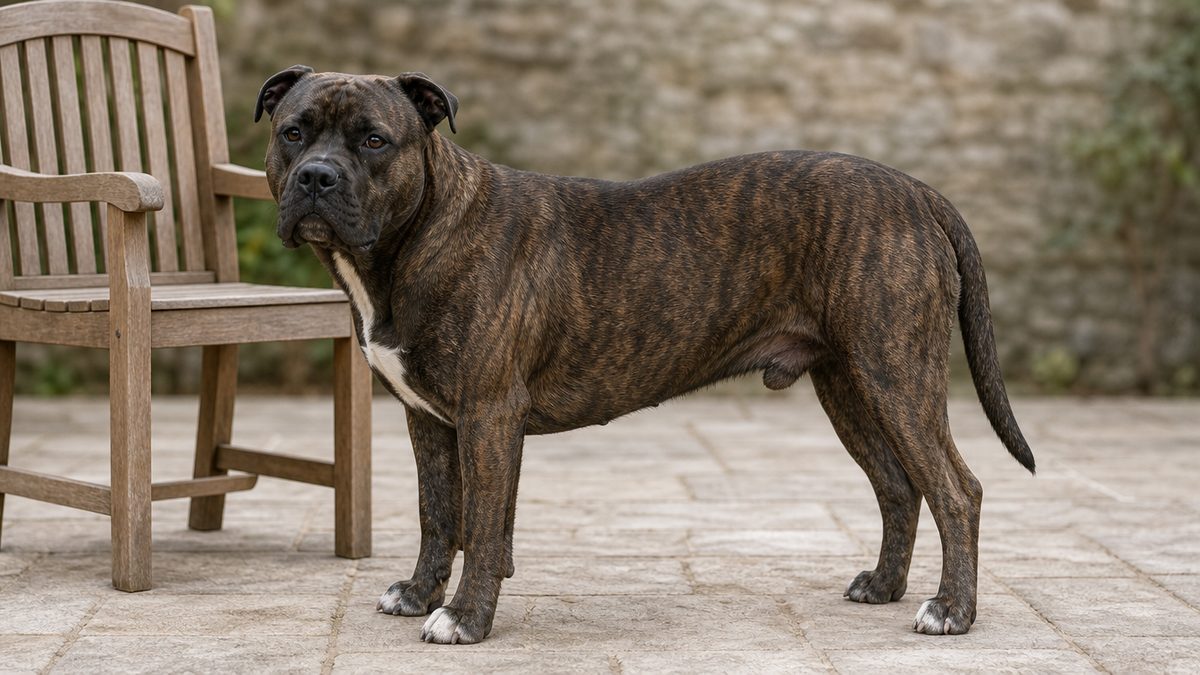
Quick answer
The Ca de Bou is a 35 to 38 kg Spanish catch dog from Mallorca, FCI standard 249, accepted on a definitive basis on 21 September 1963, with a muzzle one third of its head and a required undershot bite. Spain's kennel club still lists it as vulnerable. No Indian seller publishes a price, because no Indian population exists and commercial import is not permitted.
This page summarises published breed standards, registry data, government texts and peer-reviewed veterinary research for general information. It is not a diagnosis and it is not treatment advice. Consult a registered veterinarian about your own dog before acting on anything here, and treat a rectal temperature at or above 41.0 degrees Celsius, noisy or obstructed breathing that does not settle with rest in shade, staggering or collapse after exertion in heat, or a distended painful abdomen with unproductive retching as an emergency.
Ca de Bou at a glance
What the Ca de Bou is, and what FCI-249 actually says
The Ca de Bou is a medium-sized, short-coated, square-headed Spanish catch dog from Mallorca, recognised by the Fédération Cynologique Internationale as breed number 249 in Group 2, Section 2.1, Molossian type, Mastiff type, without working trial, and its listed utilization is two words: watch and guard dog.
FCI-249 sets the size in one short clause. Males stand 55 to 58 cm at the withers and weigh 35 to 38 kg; bitches stand 52 to 55 cm and weigh 30 to 34 kg. Those are the numbers an Indian reader should carry, because they place this molossoid in a bodyweight band with its own measured heat risk, and because the Spanish national standard disagrees with them by seven kilograms at the top, which the two-standards section below sets out.
The general appearance clause is deliberately modest. The breed is a typical Molossian of somewhat elongated build, strong and powerful, of medium-sized stature, and the difference between the sexes shows in the head, whose circumference is definitely greater in dogs than in bitches. This is not a giant breed. At 36 kg the standard's own model dog is lighter than a large Labrador and roughly two thirds the weight of a Bullmastiff.
The head, and the one measurement that decides how this dog breathes
One clause governs the face, and it is the most misquoted sentence in the breed. The Spanish authentic text reads that the length of the muzzle must be in a ratio of one third with respect to the head. The standard then supplies its own worked measurements for a standard dog: distance from occiput to muzzle 22 cm, distance from muzzle to the frontal depression 8 cm. Eight over twenty-two is 36.4 percent. The clause and the measurement agree, and both describe a short-muzzled dog.
The rest of the head follows from that. The skull is large, broad and tending to square, with a circumference greater than the height at the withers in males, a broad flat forehead and a well marked frontal furrow. The stop is strongly defined and protruding in profile. The jaw muscles are strong and prominent, and although there are folds on the sides of the masseters, the skin of the head overall carries no wrinkles, which is the clause that separates this breed from the Dogue de Bordeaux and the Neapolitan Mastiff.
Eyes are large, oval, set low and wide apart, as dark as possible in relation to the coat, and the conjunctiva must not show. Ears are the rose ear, set high and to the side, rather small, drawn backwards in a curve so the inner ear shows, with the tip below the eye line at rest. Anything else is a serious fault: ears lying flat against the cheeks, or ears erect at the base even if the last third is a rose, are both listed.
The bite the standard demands
The Ca de Bou is one of the few breeds whose standard requires a malocclusion. The bite is undershot, the gap of the not exaggerated undershot bite should not be more than 1 cm, and when the muzzle is closed the teeth must not be visible. A scissor bite or a pincer bite is a serious fault, and an overshot mouth is a disqualifying fault. Hold that clause in mind, because the Indian-law section shows that the Prevention of Cruelty to Animals (Dog Breeding and Marketing) Rules 2017 name an undershot jaw as a genetic defect a breeding dog must be tested for.
Coat and colour
The coat is short and rough to the touch, with no undercoat mentioned anywhere in the standard. Colour is brindle, fawn and black, desirable in that order, with dark tones preferred in the brindle dogs and intense colours preferred in the fawn. White patches are permitted on the front feet, chest and muzzle up to a maximum total of 30 percent, and a black mask is also permitted. More than 30 percent white anywhere else, or patches of any other colour, are disqualifying faults.
| Item | What the FCI record states |
|---|---|
| Breed number and group | 249, Group 2, Section 2.1 Molossian type, Mastiff type, without working trial |
| Official breed name | PERRO DOGO MALLORQUIN |
| Country of origin | Spain |
| Official authentic language | Spanish |
| Date of acceptance on a definitive basis | 21 September 1963 |
| Breed status | Recognized on a definitive basis |
| Valid standard published | 11 December 1996; English translation dated 13 June 1997 |
| Utilization | Watch and guard dog |
| Height and weight | Male 55-58 cm and 35-38 kg, bitch 52-55 cm and 30-34 kg |
| Muzzle proportion | Muzzle one third of the head; worked example 8 cm of 22 cm |
| Coat | Short and rough to the touch |
| Colour | Brindle, fawn and black, desirable in that order |
| Disqualifying faults | Aggression or extreme timidity; overshot mouth; light or yellow eyes; cropped ears or docked tail |
FCI-249 disqualifies a dog with amputated ears or tail. So does the Spanish national standard. So does Indian law, in the Second Schedule Part II paragraph 6(8) of the Prevention of Cruelty to Animals (Dog Breeding and Marketing) Rules 2017, which forbids tail docking and ear cropping outright. Three documents from three jurisdictions agree, which is rare, and it means a cropped Ca de Bou in India is unlawful and unregistrable at the same time.
Two standards, one breed: where the FCI and the Spanish kennel club disagree
The Ca de Bou is governed by two written standards that do not match, the FCI's standard 249 and the Real Sociedad Canina de España's national record, and the gap is not cosmetic: the Spanish standard permits a male seven kilograms heavier, two centimetres taller, with a bite the FCI faults and a colour ranking the FCI reverses.
Start with weight, because it is the number a buyer is quoted. FCI-249 gives males 35 to 38 kg and bitches 30 to 34 kg. The RSCE's national record gives males 35 to 45 kg and bitches 30 to 35 kg. A 44 kg male Ca de Bou is six kilograms over the FCI ceiling and comfortably inside the Spanish one. Height moves the same way: 55 to 58 cm under the FCI, 55 to 60 cm under the RSCE.
That matters beyond the show ring, and the climate section returns to it. A 38 kg dog and a 45 kg dog sit in different bodyweight bands in the only large study that has measured canine heat-illness risk by weight. If you are told a Ca de Bou weighs 30 to 45 kg, you have been given the union of two standards rather than either one of them.
The bite, the colour order and the head proportions
On the bite the two documents part company in a way that would change a judge's card. The FCI lists a scissor or pincer bite among its serious faults without qualification. The RSCE says prognathism with contact is valued more highly, and that in specimens of excellent quality a pincer bite is accepted. It also states the desirable prognathism as up to 0.7 cm while admitting up to one centimetre, where the FCI gives only the one-centimetre maximum.
On colour the ranking flips. The FCI's Spanish authentic text reads brindle, fawn and black, desirable in that order. The RSCE says fawn or brindle, both with the same preference, with black admitted but in second order of importance. Modern Molosser, which ranks second on the Indian search for this breed, tells its readers there are three main colours mentioned in the standard, fawn, which is preferred, then brindle, then black. Three sources, three different orderings, and only one of them is the authentic text.
The RSCE also publishes head proportions the FCI does not. It gives skull length to face length as 6 to 4, skull length to head width as 1 to 1, and height at withers to body length as 10 to 11. A 6 to 4 skull-to-face ratio makes the muzzle 40 percent of the head, slightly longer than the FCI's one third. Both are short. Neither is the one to three against the skull that the FCI's English translation prints.
| Clause | FCI-249 (Spanish authentic text) | RSCE national record |
|---|---|---|
| Male height | 55-58 cm | 55-60 cm |
| Bitch height | 52-55 cm | 52-57 cm |
| Male weight | 35-38 kg | 35-45 kg |
| Bitch weight | 30-34 kg | 30-35 kg |
| Muzzle proportion | One third of the head | Skull to face 6 to 4 |
| Prognathism permitted | Up to 1 cm | Desirable up to 0.7 cm, admitted up to 1 cm |
| Pincer bite | Serious fault | Accepted in excellent-quality specimens |
| Colour order | Brindle, fawn, black in that order | Fawn and brindle equal, black second order |
| Thighs | Long, natural joints | Short in comparison with the back |
| Missing premolars | Lack of two premolars is a serious fault | Lack of two or three premolars excludes an excellent grade |
| Recovery clause | None | Proportions and angulations are desirable only, because the breed is in a period of recovery |
| Cropped ears or docked tail | Disqualifying | Disqualifying |
The last row of that table is the one nobody quotes and it is the most honest sentence either registry has written about this dog. Under Faults, the RSCE states that since this is a breed in a period of recovery, the proportions and the angulations are understood as desirable, and a moderate deviation is not cause for elimination. That is the Spanish kennel club saying, in its own published standard in 2026, that the reconstruction is not finished.
The RSCE's own Ca de Bou page prints its FCI classification twice, and the second one belongs to another breed. Under Clasificación FCI it gives Group 2, Section 2.1, Molossoids, dogo type, without working trial, and then immediately prints 'Grupo 1 Perros de pastor y perros boyeros (excepto perros boyeros suizos) - Sección 1 Perros de pastor';. The Ca de Bou is not a sheepdog and has never been in Group 1. The same page also dates its standard '249 / 2017 / E' while the FCI's nomenclature record shows the valid standard published on 11 December 1996 with no 2017 revision listed. Treat the RSCE page as authoritative on Spanish national requirements and the FCI record as authoritative on FCI ones.
The English translation of FCI-249 gets the muzzle wrong, and everyone repeats it
The English translation of FCI-249 states that the length of the muzzle is in proportion of one to three to the length of the skull, which makes the muzzle a quarter of the head, while the Spanish authentic text says the muzzle is one third of the head, and the standard's own worked measurements prove the Spanish is right.
Set the two sentences beside each other. The Spanish original, dated 11 December 1996, reads: 'La longitud del hocico debe estar en relación 1/3 respecto de la cabeza'. The English translation by C. Seidler, dated 13 June 1997, reads: 'Length of muzzle is in proportion of 1 to 3 to length of skull'. Cabeza is head. The skull is the part of the head behind the stop. Swapping one for the other changes the arithmetic completely.
Work it through on the standard's own model dog. The measurements section gives occiput to muzzle 22 cm and muzzle to frontal depression 8 cm. If the muzzle is one third of the head, it should be 7.3 cm; the measured figure is 8 cm, so the Spanish clause is right to within seven millimetres. If instead the muzzle were one third of the skull, the skull would be 3 times the muzzle and the head 4 times it, giving a muzzle of 5.5 cm out of 22 cm. The standard's own table contradicts the English translation by two and a half centimetres on a 22 cm head.
Why a Bonbeno reader should care about a translation error
The muzzle ratio is the single number that decides whether this dog belongs in the brachycephalic conversation, and the whole English-language internet is working from a figure that is 25 percent too short. That cuts both ways. It makes the Ca de Bou look flatter-faced than the standard asks for, which overstates the breathing problem; and because nobody has checked it, no English page has done the comparison that actually matters, which is how 36 percent of head length compares with breeds whose heat risk has been measured.
| Source | Stated proportion | Implied muzzle on a 22 cm head | Agrees with the 8 cm measurement? |
|---|---|---|---|
| FCI-249 Spanish authentic text | Muzzle one third of the head | 7.3 cm | Yes, within 0.7 cm |
| FCI-249 English translation | Muzzle 1 to 3 against the skull | 5.5 cm | No, out by 2.5 cm |
| RSCE national record | Skull to face 6 to 4 | 8.8 cm | Yes, within 0.8 cm |
| Modern Molosser | Skull to muzzle as two is to one | 7.3 cm | Yes, within 0.7 cm |
Modern Molosser's version turns out to be arithmetically identical to the Spanish text even though it is phrased backwards: skull to muzzle as two to one on a 22 cm head gives a 7.3 cm muzzle, the same as one third of the head. So the outlier is not the enthusiast site. It is the FCI's own English translation, which is also the version linked from Wikipedia's infobox and reproduced by dogbreedslist.info as its sole reference Dogbreedslist.info.
The translation slips twice more in the hindquarters
Two further clauses do not survive the crossing. The Spanish text says the hindquarters are muscled and longer than the forequarters, and that the thighs are long; the English says the hindquarter muscles are broader than in the forequarters and that the upper thigh is broad. Largo means long, not broad, and the two describe different dogs from behind. The RSCE then adds a third position, calling the thighs short in comparison with the back.
None of this is a reason to distrust the FCI. It is a reason to read the authentic text, which the FCI itself designates: the nomenclature record names Spanish as the official authentic language for breed 249. Where the translation and the original disagree, the original governs, and on this page we have used the Spanish text for every figure and named it every time.
Open the Spanish PDF at fci.be/Nomenclature/Standards/249g02-es.pdf, scroll to MEDIDAS ORIENTATIVAS EN UN PERRO STANDARD near the end, and read the last two lines: distancia del occipital al hocico 22 cm, distancia del hocico a la depresión frontal 8 cm. Divide 8 by 22. Any figure a seller or a website gives you for this breed's face should be consistent with 36 percent, and if it is not, the burden is on them.
The butcher's dog: what a Ca de Bou was actually for
The Ca de Bou was a working catch dog on Mallorca for at least five centuries, holding cattle for butchers and slaughtermen, hunting deer and wild boar, guarding the island's rural estates, and fighting bulls and other dogs in public spectacles, and the name itself is Catalan for bull dog.
The FCI's own historical summary starts at sea. Mediterranean trade moved domestic animals as well as goods, and the harbours and coastal villages of the region needed large, thick-set, big-headed dogs with a strong bite to defend against pirates and buccaneers. Among them the Iberian mastiff stood out, used in some parts of Spain for hunting and in others for fighting, against dogs or against bulls. That dog accompanied King Jaume I on his conquests and reached the Balearics around 1230.
The Balearic Government's own breed documentation is more granular and dates the type earlier. Its chronology places indigenous catch and guard dogs on Mallorca before 1229, then presa dogs brought by Catalan and Aragonese colonists with the Butchers' Guild in 1230, then an old Presa Mallorquín that came to be called Ca de Bou somewhere around 1600 to 1700 and persisted from the thirteenth century to the late nineteenth. In the thirteenth to fifteenth centuries the same dog was sometimes called Alano.
Five jobs, only one of which was fighting
The activities list on that document is worth reading in full, because English pages reduce this breed to bull-baiting. It names guard and defence; handling cattle as an auxiliary to butchers and slaughtermen; hunting deer and wild boar; fighting, with dogs and with bulls; and companionship. The butcher's-dog role is the one that shaped the animal. A dog that holds a bullock still for a man with a knife needs grip, weight and nerve, and needs to let go on command, which is a different selection pressure from a pit dog.
Two primary artefacts survive in that record and both are worth naming. A 1796 proclamation by the mayor of Selva ordered catch dogs to be presented at his house under a fine of 25 libras if they were not, which tells you the dogs were numerous enough and consequential enough for a village mayor to want them counted. And a drawing published in the satirical Mallorcan paper La Charanga in 1864 shows a man being tossed by a bull, which dates the spectacle rather than the dog.
The British century, and the name
In the seventeenth century Menorca and other territories passed to England under the Treaty of Utrecht, and the English brought their own guard and catch dogs, which crossed with the Iberian mastiff already present in the islands. By the early eighteenth century fights between dogs and bulls were popular, the English residents wanted a dog suited to them, and the name Ca de Bou followed. Wikipedia dates the formative period differently, to Catalan influence over Mallorca between 1270 and 1570, and sources that to Fogle and Morris rather than to a registry.
| Date | Event | Source |
|---|---|---|
| about 1230 | Catch dogs arrive in the Balearics with King Jaume I and the Butchers' Guild | FCI-249 and the Balearic breeds portal |
| 1600-1700 | The type begins to be called Ca de Bou | Balearic breeds portal, after Gual 2010 |
| 1796 | Mayor of Selva orders catch dogs presented under a 25-libra fine | Balearic breeds portal |
| 1864 | Bull-and-man drawing published in La Charanga, Mallorca | Balearic breeds portal |
| 1923 | The breed's existence is established in the Spanish stud book | FCI-249 |
| 1925 | Mr Deland of the French Dogue de Bordeaux club studies the breed in Barcelona | Sergio Gual, via doogweb.es |
| 1926 | A dog named Moreno is registered in the Libro de Orígenes Español | Sergio Gual, via doogweb.es |
| 1928 | The first official entry of the breed | FCI-249 |
| 1929 | A Ca de Bou is exhibited and prized at the Barcelona show | FCI-249 and Royal Canin |
The Deland account is the only physical description of the breed from before the collapse, and it does not describe the modern dog. Writing in the French cynological review L'Eleveur after a 1925 visit to Barcelona, Deland reported finding specimens of 45 to 50 kg whose conformation, apart from a bear-like muzzle, recalled the Dogue de Bordeaux, mostly brindle, sometimes harlequin or fawn, and orthognathous with a pincer jaw. Read that against FCI-249 and two things have changed since: the dogs were seven to twelve kilograms heavier than the modern ceiling, and their bite was the one the standard now faults.
A dog bred to hold a bullock and then release it is a dog with grip strength, a low centre of gravity and a habit of leaning its whole weight into whatever it is dealing with. That is not aggression and it is not a training failure. It is the breed working correctly, and it is why the temperament and training sections below treat physical management as seriously as obedience.
Which Mallorcan breeds are actually recognised, and by whom
Of the four Balearic breeds most often listed together, only the Ca de Bou is recognised by the FCI, and the other three sit on three different lower rungs of the Spanish system, a distinction that no English page draws and that decides whether a dog can hold an international pedigree at all.
Take the recognition question at its strictest. The FCI's nomenclature record for breed 249 states, on its own face, that the Perro Dogo Mallorquín was accepted on a definitive basis on 21 September 1963, that its breed status is Recognized on a definitive basis, that its country of origin is Spain, and that Spanish is the official authentic language. There is no provisional period recorded and no provisional date. The breed went straight onto the definitive register.
Two things follow from that record and neither is obvious. The Ca de Bou was recognised internationally in 1963, more than a decade before the recovery work described later on this page began in 1980, so the FCI number predates the modern dogs it now describes. And Spanish being the authentic language means the English translation is a secondary document, which the translation section shows matters on the muzzle clause.
The one date that is genuinely contested
Two sources give two different dates for FCI recognition and neither cites the other. The FCI's nomenclature record gives 21 September 1963, and Wikipedia follows it, saying the breed was definitively accepted by the FCI in 1963. The Spanish breed literature gives 23 June 1964, in a book review that draws on the breed club's own history and states that after national recognition in 1932 a standard was drafted and FCI acceptance requested, and that the FCI admitted the breed on that date. We follow the FCI's own nomenclature record, because that is the register the date belongs to, and we print the Spanish date beside it rather than hiding the disagreement.
FCI recognition means a Ca de Bou can hold an FCI-member pedigree, which for India means a Kennel Club of India pedigree, and can be shown internationally. It does not mean the breed is present in India, and it does not mean an Indian dog sold as a Ca de Bou has any papers at all. The adoption section sets out what a claimed pedigree should actually contain.
The other three Balearic breeds, and the three different rungs they sit on
The Ca Me Mallorqui, the Ca Rater Mallorqui and the Ca de Conills are all unrecognised by the Fédération Cynologique Internationale, but they are not equivalent to each other, because the Spanish system places them on three different rungs and only two of them are legally breeds at all.
A 2016 document prepared for the Balearic Government sets out the Spanish legal position precisely: five Balearic canine breeds are officially recognised under Real Decreto 558/2001, namely the Podenco Ibicenco (Ca Eivissenc), the Pastor Mallorquín (Ca de Bestiar), the Perdiguero Mallorquín (Ca Mè), the Ratonero Mallorquín (Ca Rater) and the Perro de Presa Mallorquín (Ca de Bou); and one canine racial grouping under Balearic Decree CAIB 5/2007, the Ca de Conill de Menorca. A racial grouping is a lower tier than a breed.
The peer-reviewed literature agrees and adds the registry columns. Table 1 of a 2022 microsatellite study records the FCI and RSCE classification of every breed it compared: Ca de Bou FCI Group 2 and RSCE Group 2; Ca de Bestiar Group 1 in both; Podenco Ibicenco Group 5 in both; and Ca Rater, Ca de Conills de Menorca and Ca Mè Mallorquí all NR, not recognised, by both the FCI and the RSCE.
The RSCE's own index has moved since 2024
The Spanish kennel club's live pages let you watch the ladder change. Its Razas Españolas index, last modified 6 August 2026, lists the Ca de Bou in Group 2 alongside the Mastín Español, the Mastín del Pirineo and the Presa Canario; puts the Ca Mè Mallorquí in Group 11, which the page itself heads 'Razas no reconocidas por la FCI', breeds not recognised by the FCI; and lists only the Ca Rater Mallorquí under Otras razas, breeds in a phase of recovery whose racial prototypes are published in the official bulletins of the autonomous communities.
The earlier version of that same index, last modified 24 June 2024, put both the Ca Mè Mallorquí and the Ca Rater Mallorquí under Otras razas and gave neither a Group 11 slot. So the Ca Mè has been promoted one rung between those two dates. The Ca de Conills appears on neither version of the page, in any group, which is consistent with its status as a racial grouping rather than a breed.
| Breed | FCI | RSCE | Spanish and Balearic law | Island |
|---|---|---|---|---|
| Ca de Bou (Perro Dogo Mallorquín) | Group 2, standard 249, definitive 21.09.1963 | Group 2; on the 2026-27 vulnerable list | Recognised breed under RD 558/2001 | Mallorca |
| Ca Mè Mallorquí (Perdiguero Mallorquín) | Not recognised | Group 11, breeds not recognised by the FCI | Recognised breed under RD 558/2001 | Mallorca |
| Ca Rater Mallorquí (Ratonero Mallorquín) | Not recognised | Otras razas, in a phase of recovery | Recognised breed under RD 558/2001 | Mallorca |
| Ca de Conills | Not recognised | Not listed | Racial grouping under Balearic Decree CAIB 5/2007 | Menorca |
The Spanish national government register closes the question independently. The Ministry of Agriculture, Fisheries and Food maintains, through its ARCA system, the official list of pure-breed dog breeders' organisations recognised under Real Decreto 558/2001, updated 6 October 2025. Five Balearic entries appear on it, each with the Govern de Les Illes Balears as competent authority: the Club Español del Perro de Presa Mallorquín (Cá de Bou) for CA DE BOU, the Associació de caçadors i criadors del ca mè mallorquí for CA MÈ, the Asociación Club Español del Perro Ratero Mallorquín for CA RATER, the Club del Ca de Bestiar for CA DE BESTIAR, and the Associació del Ca Eivissenc d'Eivissa i Formentera for CA EIVISSENC.
There is no Ca de Conills entry on that register. Three separate documents now agree on this: the Spanish national breeders' register, the RSCE's own breed index, and the University of Córdoba study that classifies it NR by both the FCI and the RSCE Aguilera and colleagues. It is a racial grouping under Balearic Decree CAIB 5/2007, which is a real legal status and a lower one.
Two corrections belong in that table and both are worth stating plainly. The Ca de Conills is a Menorcan breed, not a Mallorcan one: the University of Córdoba study calls it Ca de Conills de Menorca throughout, and the Balearic portal files it under a Menorcan selection event. And the Ca Mè Mallorquí's promotion into RSCE Group 11 postdates the 2022 study that recorded it as NR, so a page citing that study alone would now be one rung out of date.
Only the Ca de Bou can hold an FCI pedigree, which is the only document that travels internationally. A Ca Me Mallorqui or Ca Rater Mallorqui can hold Spanish national papers and nothing more, and a Ca de Conills is registered as a member of a racial grouping rather than of a breed. Anyone offering you an FCI pedigree for one of the other three is offering a document that does not exist.
Six registered dogs, then nothing: how the Ca de Bou was rebuilt
The Ca de Bou nearly disappeared, and the numbers behind that sentence are small enough to name: six dogs entered the Spanish stud book between 1926 and 1931, the last of them born on 5 February 1931, and by the time the FCI recognised the breed cynology considered it extinct.
The cynological history begins in 1926, when the Real Sociedad Canina registered a dog named Moreno in the Libro de Orígenes Español as a Ca de Bou. Moreno's appearance at the Barcelona International Dog Show in 1929 caused real interest. Then five more specimens reached the genealogical registers, the last of them a dog named Atila born on 5 February 1931. That is the entire documented founding population: six animals across five years.
National recognition followed in 1932, a racial standard was drafted, and FCI acceptance was requested and granted. The paradox is the part worth sitting with. By the date of international recognition Spain had an ethnic group recognised since the start of the century, studied by European cynologists, with animals in the stud book, a written standard and an FCI number, and no dogs, because cynology had by then written the breed off as extinct.
The rebuild, 1980 to 1996, and the three breeds that went into it
Recovery work began in 1980. The Balearic Government's own chronology, prepared with the breed club, sets out what that actually meant in three parallel streams between 1980 and 1995. The first was the recovery of Ca de Bou crossed with Ca de Bestiar animals that showed Ca de Bou phenotype. The second was the survival of specimens carrying earlier input from the old Pastor Mallorquín, dating to the early twentieth century. The third, stated on the same slide, was the contribution of other breeds, Bulldog, Bullmastiff and others, with undesirable characteristics.
The modern Ca de Bou is described in that document as drawing on all three of those branches between 1980 and 1996. Then comes the correction: eradication of specimens with undesirable characteristics from other breeds, beginning in 1996, followed by fixation of the correct type from 1996 to the present. Modern Molosser reports the same event from the inside, saying that since 1996 there has been a purge to remove all untypey Ca de Bous.
| Period | What happened |
|---|---|
| before 1229 | Indigenous catch and guard dogs on Mallorca |
| 1230 | Presa dogs arrive with Catalan and Aragonese colonists and the Butchers' Guild |
| 13th century to late 19th | Old Presa Mallorquín, called Ca de Bou from roughly 1600-1700 |
| early 20th century | Input from the old Pastor Mallorquín |
| early to mid 20th century | Old Ca de Bou: pure catch dogs and Pastor Mallorquín crosses side by side |
| 1980-1995 | Recovery of Ca de Bou x Ca de Bestiar crosses showing Ca de Bou phenotype |
| 1980-1995 | Input from other breeds, Bulldog and Bullmastiff among them, with undesirable characteristics |
| 1980-1996 | Modern Ca de Bou assembled from all three branches |
| from 1996 | Eradication of the undesirable traits from other breeds; fixation of the correct type |
That table is the reason the Spanish kennel club still writes a recovery clause into its faults section. A breed reassembled from three streams between 1980 and 1996, one of which was openly acknowledged to be off-type, is thirty years into a fixation programme, not a century into a settled one.
The club that ran it
The Club Español del Ca de Bou began official operation on 7 August 1991 under the earlier name Club Español del Perro de Presa Mallorquín, and changed to its present name in 1996 Eduardo de Benito, Ca de bou. Its first president was Francisco Ruiz Rodríguez, who held the post until 19 November 1992, followed by Manuel Calviño Breijo to early 1996 and then Sergio Gual Fournier, who has held the presidency for most of the period since. The club states that one of its principal tasks is updating the register, taking measurements and running DNA tests.
That is not window dressing. It is the mechanism by which a breed with six founders keeps adding animals, and the genetics section below shows both what it has achieved and what it has not.
There is no published Ca de Bou pedigree analysis, no published effective population size, and no published inbreeding coefficient for the breed. Pages that quote one have taken it from a neighbouring molossoid. What does exist is two independent microsatellite studies, and this page uses those and says plainly where they stop.
The gene pool, measured twice, six years apart, with the same answer
Two independent microsatellite studies have measured the Ca de Bou's genetic diversity, one in 2016 on 42 dogs and one in 2022 on 83, and both put it at the bottom of the Balearic group: expected heterozygosity of 0.62 and 0.644, observed heterozygosity of 0.58 and 0.566.
The first study was presented at SPREGA in Castelo Branco by Agueda Laura Pons Barro, with authors from the University of Córdoba, the Balearic Government's agricultural improvement service and the INAGEA institute, and the collaboration of the president of the Ca de Bou breeders' association. It sampled 42 animals, all of them entered in the breed's official genealogical register, collected at morphological competitions, and genotyped them at 21 ISAG-recommended microsatellites, all of which proved polymorphic. The FAO recommends 40 to 50 samples to reduce statistical bias, so 42 clears the bar.
The second is a 2022 paper in Animals on the gene pool of the Ca Rater Mallorquí, which used the Ca de Bou as one of 17 comparison breeds and genotyped 83 of them at 20 markers. Different laboratory, different marker panel, different sample, twice the dogs, six years later.
| Breed | Dogs sampled | Mean alleles per locus | Expected heterozygosity | Observed heterozygosity |
|---|---|---|---|---|
| Ca de Bou | 42 | 5.05 | 0.62 | 0.58 |
| Ca de Bestiar | 49 | 7.05 | 0.73 | 0.74 |
| Ca de Conill | 67 | 6.57 | 0.72 | 0.69 |
| Ca Rater | 12 | 4.90 | 0.72 | 0.76 |
| Ca Eivissenc | 67 | 6.48 | 0.69 | 0.68 |
| Podenco Andaluz | 29 | 7.33 | 0.75 | 0.71 |
| Podenco Canario | 26 | 5.95 | 0.68 | 0.71 |
| Podenco Valenciano | 69 | 8.14 | 0.76 | 0.72 |
| German Shepherd | 26 | 4.43 | 0.60 | 0.63 |
| Mean of all nine | 6.21 | 0.70 | 0.69 |
Read down the heterozygosity columns and the Ca de Bou is last among the island breeds on both. Its expected heterozygosity of 0.62 sits eight points below the nine-population mean of 0.70, and the only population below it on that measure is the German Shepherd sample at 0.60. The study's own annotation on that slide is careful rather than alarmist: allelic diversity is acceptable although low, and higher than the German Shepherd's.
The 2022 replication
The Animals paper reports the Ca de Bou at N 83, mean number of alleles 6.35, allelic richness 3.19, expected heterozygosity 0.644 and observed heterozygosity 0.566. Set that beside the 2016 figures of 0.62 and 0.58 and the agreement is close: two centres, two panels, two samples, and expected heterozygosity within 0.024 of each other. Replication at that level on a rare breed is unusual and it is the strongest single fact on this page.
The 2022 paper also puts the Ca de Bou last in the Balearic group on allelic richness, at 3.19 against 3.72 for the Ca Rater, 3.88 for the Ca de Bestiar, 3.73 for the Ca de Conills, 3.44 for the Podenco Ibicenco and 3.27 for the Ca Mè. Allelic richness is the diversity measure least distorted by unequal sample sizes, which matters here because the samples ranged from 49 to 112 dogs.
What the researchers blame
The 2016 conclusions name three causes and refuse to name a fourth. The lower genetic diversity observed in the Ca de Bou is probably due to the reduced census, to geographic isolation, and to the recent selection actions against undesirable morphological characteristics, with possible migration as a factor. That third cause is the 1996 purge described in the reconstruction section above: removing off-type animals removes their genes too, and a breed already at 42 registered dogs' worth of sampled diversity cannot afford much of that.
The same document also names the fix. A validated genetic profile allows checking the breed assignment of individuals bred abroad who are candidates for entry into the genealogical register, and doing so would favour an increase in the genetic diversity of the population. In other words, the breed's own geneticists are arguing for importing diversity back from the international population, which is the opposite of the closed-studbook instinct.
Ask what the coefficient of inbreeding is on the specific pairing, and ask to see the four-generation pedigree it was computed from. On a breed with this diversity profile that question does more work than any champion title. Under Indian law that pedigree is not optional either, because Second Schedule Part II paragraph 6(3) of the Prevention of Cruelty to Animals (Dog Breeding and Marketing) Rules 2017 prohibits mating relatives of the second to fourth grade within the first four generations.
Reading the two genetics studies against each other, and against themselves
Check the two Ca de Bou genetics studies line by line and four internal problems appear, none of which changes the conclusion that this is the least diverse Balearic breed, but every one of which changes which number you should print and which you should not.
This is not an attack on either paper. Between them they are the only genome-level work that exists on this breed, and their agreement on heterozygosity is the reason this page can state anything with confidence. But a page that copies a decimal out of an abstract is repeating, not reporting, and both of these documents reward being read properly.
Problem one: the fixation index does not follow from the heterozygosities
The 2022 paper's Table 2 gives the Ca de Bou an expected heterozygosity of 0.644, an observed heterozygosity of 0.566, and an FIS of 0.00804 with a confidence interval of minus 0.13240 to 0.04131. Work the simple deficit from its own two numbers: 0.644 minus 0.566, divided by 0.644, is 0.121. Weir and Cockerham's estimator is not the simple ratio and the two need not match exactly, but a fifteenfold gap on the same pair of numbers is worth flagging.
The coincidence in the next row is the part that made us check. The Ca de Bestiar in the same table has an expected heterozygosity of 0.712 and an observed of 0.706, a simple deficit of 0.008, and a printed FIS of 0.12109. The two breeds' simple deficits are 0.121 and 0.008; their printed FIS values are 0.008 and 0.121. We are not asserting the rows were transposed, because the confidence intervals and the paper's own text are internally consistent with the printed values. We are saying the arithmetic does not reconcile and a reader should not quote either FIS as settled.
Problem two: three sample sizes move between tables
Table 1 of the same paper gives Braco n 26, German Shepherd n 14 and Pointer Inglés n 23. Table 2 gives PON 26, BRA 14 and PAS 23. The three values are the same set, attached to different breeds. The Ca de Bou's own figure of 83 is identical in both tables, so the breed this page is about is unaffected, but a reader lifting a comparison breed's sample size out of Table 2 would get the wrong one.
Two further slips in that paper are cosmetic and worth noting only so a reader is not confused: the Yorkshire Terrier's acronym is YTE in Table 1 and YST in Table 2, and the results text refers once to the 'Kurt Russell Terrier' where it means the Jack Russell Terrier.
Problem three: the 2016 study's headline percentage is not what it sounds like
The 2016 Balearic slide deck prints, next to its per-locus table, the sentence 'La variabilidad dentro de la raza es de un 8,1 %', within-breed variability is 8.1 percent. That figure is not comparable to the heterozygosity values above and it is not an inbreeding coefficient. The deck separately reports the mean fixation indices across all nine populations as FIS 0.02, FIT 0.12 and FST 0.10, glossing the last two as 12 percent fixation of the individual to the whole and 10 percent differentiation between breeds. Quote the heterozygosities, which are directly comparable, and leave the 8.1 percent alone.
| Measure | Pons and colleagues 2016 | Aguilera and colleagues 2022 | Agreement |
|---|---|---|---|
| Dogs genotyped | 42 | 83 | Different samples |
| Microsatellite markers | 21 | 20 | Different panels |
| Expected heterozygosity | 0.62 | 0.644 | Within 0.024 |
| Observed heterozygosity | 0.58 | 0.566 | Within 0.014 |
| Mean alleles per locus | 5.05 | 6.35 | Panel-dependent, not comparable |
| Rank among Balearic breeds | Lowest heterozygosity of five | Lowest heterozygosity of five | Identical conclusion |
Problem four: nobody has measured the thing everyone wants
Neither study reports an effective population size, a pedigree inbreeding coefficient, a runs-of-homozygosity profile or a founder analysis for the Ca de Bou. Those are the four numbers a reader coming from a Bullmastiff or Broholmer page will expect, and for this breed they do not exist. Any page that prints one has borrowed it. What does exist is a replicated heterozygosity deficit, a bottom-of-group allelic richness, and a documented founder set of six registered dogs.
Three conclusions hold under every check. The Ca de Bou has the lowest expected and observed heterozygosity of the five Balearic breeds, measured twice, six years apart, by two different groups. Its allelic richness is the lowest of the five on the measure least sensitive to sample size. And its own researchers attribute that to a reduced census, geographic isolation and the deliberate removal of off-type animals from 1996 onward.
Vulnerable in Spain, threatened in Mallorca: the conservation status nobody mentions
The Real Sociedad Canina de España lists the Ca de Bou among 21 Spanish breeds it classes as vulnerable for the year from 1 May 2026 to 30 April 2027, and the Balearic Government's own breeds portal records its conservation status as Amenazada, threatened, which together make this a conservation animal rather than a fashion breed.
The Spanish list is a single-page document on RSCE letterhead headed RAZAS ESPAÑOLAS CONSIDERADAS VULNERABLES, covering 1 May 2026 to 30 April 2027. The Ca de Bou is fourth on it, after the Gos d'Atura Català, the Ca de Bestiar and the Mastín del Pirineo. The full list runs to 21 breeds, and it also contains the Ratonero Valenciano, the Ratonero Bodeguero Andaluz, the Podenco Ibicenco, the Podenco Canario, the Sabueso Español, the Perdiguero de Burgos, the Alano Español, the Euskal Artzain Txakurra, the Galgo Español, the Podenco Andaluz, the Valdueza, the Xarnego Valenciano, the Perro de Pastor Garafiano, the Maneto, the Perro Leonés de Pastor, the Pachón Navarro and the Majorero.
Wikipedia reports the breed as one of sixteen vulnerable Spanish breeds, citing the previous edition of the same document for 2025 to 2026. The current edition has 21 names. Both statements can be true of their own year, and a reader should quote the year with the count.
The Balearic Government's portal is the second, independent classification. Its Razas Autóctonas Caninas index lists five canine breeds and prints a conservation situation against each: Ca de Bou, Situación Amenazada; Ca Eivissenc, Situación Amenazada; Ca de Bestiar, Situación De Fomento; and no situation recorded for the Ca Mè Mallorquí or the Ca Rater Mallorquín. Amenazada is the threatened category. De Fomento is the promotion category, which is a better place to be.
What vulnerable status buys, in euros
The RSCE attaches money and paperwork relief to the label, and both are published. An initial registration costs 28.50 euros for a Spanish breed, 11.30 euros for a vulnerable Spanish breed and 70.00 euros for every other breed, with identical tariffs for members and non-members. Entering an unregistered Ca de Bou into the Spanish system therefore costs a sixth of what entering an unregistered imported breed costs.
The procedure is the interesting part for anyone outside Spain. A dog not entered in any RSCE stud book can apply for a Registro Inicial, which is judged at an RSCE-organised or RSCE-authorised show by a qualified judge who assesses the animal against the breed standard and marks it Apto or No Apto. The dog must be at least 12 months old on the date of the show and must not already be registered. If it passes and DNA is supplied, it enters the Registro de Razas Caninas; without DNA it enters the Registro Blanco de Razas.
On top of that, the RSCE's Comité de Dirección has agreed that from 1 August 2026 to 31 July 2028, vulnerable Spanish breeds doing an initial registration enter the Registro de Razas Caninas without needing to supply DNA proof, with DNA remaining obligatory only for homologating a championship title and for obtaining a Pedigree Plus. The exceptional regime has an initial validity of two years.
| Status or rule | Value | Source |
|---|---|---|
| RSCE vulnerable list 2026-27 | Listed, 4th of 21 breeds | RSCE vulnerable breeds sheet |
| Balearic conservation situation | Amenazada (threatened) | Balearic Government breeds portal |
| Spanish legal recognition | Recognised breed under Real Decreto 558/2001 | Balearic Government, SPREGA 2016 |
| Initial registration fee, vulnerable breed | 11.30 euros | RSCE Registros Iniciales |
| Initial registration fee, other breeds | 70.00 euros | RSCE Registros Iniciales |
| Minimum age for initial registration | 12 months at the show | RSCE Registros Iniciales |
| DNA waiver for vulnerable breeds | 1 August 2026 to 31 July 2028 | RSCE Razas Españolas |
| Sampled registered dogs, 2016 study | 42, all in the official genealogical register | SPREGA 2016 |
Put those rows together and you get the shape of the breed's present. It is legally a Spanish breed, conserved by an autonomous-region programme, judged vulnerable by its national kennel club, cheap to register, currently exempt from a DNA requirement, and still open enough that an unpapered adult can be assessed into the studbook at twelve months. That is a rare breed being actively rebuilt, and it is a very different animal from a settled show breed with a closed book.
An open studbook that admits adults on a judge's opinion is a good conservation tool and a poor consumer guarantee. It means a registration certificate on this breed can attest that one judge thought one dog looked correct at twelve months, rather than that four generations of ancestry were recorded. Ask which register the paper is from, RRC, RBR or the Libro de Orígenes, because they mean different things.
Spain's dangerous-dog decree does not name the Ca de Bou, and catches it anyway
Real Decreto 287/2002 lists eight breeds by name as potentially dangerous and the Ca de Bou is not one of them, but the same decree has a second route by description, and the Ca de Bou matches that description on the FCI standard's own worked measurements.
Annex I of Real Decreto 287/2002 names eight breeds: Pit Bull Terrier, Staffordshire Bull Terrier, American Staffordshire Terrier, Rottweiler, Dogo Argentino, Fila Brasileiro, Tosa Inu and Akita Inu. That is the whole list. No Ca de Bou, no Presa Canario, no Bullmastiff, no Cane Corso.
Article 2.1 then opens the second door. A dog is potentially dangerous if it belongs to an Annex I breed or its crosses, or if its characteristics correspond to all or most of those in Annex II. Annex II is a morphological description, and it is worth reading against FCI-249 line by line.
| Annex II characteristic | What FCI-249 says | Match |
|---|---|---|
| Strong musculature, powerful robust appearance, athletic build, agility, vigour, endurance | Typical Molossian, strong and powerful; forelimbs of great muscular and bone strength | Yes |
| Marked character and great courage | Quiet by nature, can be courageous and brave; unsurpassed as a guard dog | Yes |
| Short hair | Short and rough to the touch | Yes |
| Chest girth between 60 and 80 cm | Chest circumference 78 cm on the standard's model dog | Yes |
| Height at withers between 50 and 70 cm | 55 to 58 cm males, 52 to 55 cm bitches | Yes |
| Weight over 20 kg | 35 to 38 kg males, 30 to 34 kg bitches | Yes |
| Voluminous cuboid head, broad large skull, muscular bulging cheeks, large strong jaws | Skull large, broad and almost square; jaw muscles strong, protruding, well developed; jaws strong | Yes |
| Broad, muscular, short neck | Neck strong, thick, roughly the diameter of the head at its set on | Partial: the standard does not call it short |
| Massive, broad, deep chest, arched ribs, short muscled loin | Chest broad and deep to the elbows; loins short, relatively narrow | Yes |
| Parallel straight robust forelimbs, very muscular hindlimbs | Upper arm straight, parallel, set well apart; hindquarter muscles heavier than forequarters | Yes |
Nine of ten characteristics match on the standard's own words, and the tenth matches partially. The chest measurement is the striking one: Annex II asks for a girth between 60 and 80 cm and FCI-249's own model dog measures 78 cm Real Decreto 287/2002, de 22 de marzo. That is not a coincidence of biology so much as a decree written to describe exactly this class of dog.
What the classification actually costs an owner in Spain
If a Spanish municipality applies Article 2.1(b) to a Ca de Bou, the owner needs an administrative licence, and the requirements are specific. The holder must be of legal age, must hold clean criminal-record certificates covering homicide, injury, torture, offences against liberty and moral integrity, sexual freedom and public health, must pass physical-capacity and psychological-aptitude certificates, and must hold third-party liability insurance with cover of not less than 120,000 euros. The licence runs five years.
The handling rules bite daily. In public places the dog must wear a muzzle appropriate to its racial type, must be led on a non-extensible chain or lead of less than two metres, and one person may not lead more than one such dog. On enclosed private land the animal must be tied up unless there is an enclosure of adequate surface, height and fencing. Every potentially dangerous dog must carry a microchip, and loss or theft must be reported to the municipal register within 48 hours.
There is a third route as well, and it applies to any dog anywhere. Article 2.2 makes potentially dangerous any dog that shows a markedly aggressive character or that has attacked people or other animals, assessed by the competent authority on objective criteria after a report from an official or licensed veterinarian. Breed is not required for that one.
Real Decreto 287/2002 closes with the line 'Dado en Palma de Mallorca a 22 de marzo de 2002';. The Spanish dangerous-dogs decree that reaches Mallorca's own catch dog by description was signed at Palma de Mallorca. That is a detail, not an argument, but it is a true one and no English page carries it.
Ca de Bou price in India: there is no published Indian price, and that is the answer
No Indian seller, listing platform, breeder directory or price-guide page publishes a rupee figure for the Ca de Bou, so the honest answer to the price in india question is that no Indian market exists for this breed, and the evidence for that is a controlled search rather than an empty result.
Start with what a real Indian breed market looks like, because the contrast is the proof. Search the Indian web for a Labrador puppy price and the first page returns six commercial Indian price pages, including a national listing platform that publishes a band of INR 30,000 to INR 1,20,000 plus, a three-tier quality breakdown, and a per-city table covering Hyderabad, Bangalore, Delhi, Chennai, Lucknow, Mumbai, Jaipur and Pune, all at the same band. That is what an Indian breed with a market looks like in a search result.
Run the equivalent searches for this breed and none of that appears. Two India-localised searches, one for the term ca de bou with price and rupee wording and one for Perro de Presa Mallorquin with Kennel Club of India wording, returned twenty results between them on 24 August 2026. Not one was an Indian price page. What came back instead was Wikipedia, a US stock-photo library, an Etsy car-sticker listing priced at 455 rupees, a Facebook post about hybrid bulldogges, a Quora thread, a Springer book chapter and the English-language breed encyclopaedias.
The Bing India People Also Ask pull points the same way. The four questions Bing India printed for this term are 'What is a Ca de Bou dog?', 'What does Ca de Bou mean?', 'What does a Ca de Bou do?' and 'Where did Ca de Bou come from?', and the eight related searches were history, facts, lifespan, puppies, characteristics, bulldog, breeders usa and majorca mastiff. Every one of them is an identity question. None is a purchase question, and the only country named anywhere in the set is the United States.
The one price figure in print, and it is in dollars
A single co-ranking page publishes a number. Dogbreedslist.info gives puppy prices as an average of 1,500 to 2,500 US dollars and litter size as 2 to 5 puppies. That is an American figure on an American page, and it is the figure any Indian reseller would convert if one ever decided to list the breed. The price-forensics section below shows what that conversion looks like so a reader can recognise it.
| Query, localised to India, 24 August 2026 | Indian price pages returned |
|---|---|
| ca de bou price in india puppy price rupees | 0 |
| Perro de Presa Mallorquin or Ca de Bou dog price India kennel club of India | 0 |
| ca de bou (plain breed term) | 0 |
| labrador retriever price in india puppy rupees (control) | 6 |
The control is doing real work in that table. A search returning nothing is not evidence of anything if the search itself is broken, and this site has been caught before by a blocked query wearing a results page. Here the same tool, in the same session, minutes apart, returned six Indian commercial price pages for a common breed and zero for this one. The tool works. The market does not exist.
Why there is no Indian supply chain, and why one cannot form
Two facts close the loop. First, the breed's global population is small enough that its own national kennel club classes it as vulnerable and its home region classes it as threatened Govern de les Illes Balears. Second, Indian import law makes a commercial route impossible: dogs sit at ITC(HS) 01061900 as a Restricted import, and Policy Condition 8 states that import of commercial dogs for breeding or any other commercial activity is not permitted. A breed with no domestic stock and no lawful import route for breeding stock cannot develop a market, whatever a listing page might one day claim.
Ask three questions before you ask about money. Which register is the pedigree from, and is it the FCI-member Kennel Club of India, the Spanish Libro de Orígenes, the RRC or the RBR? Where was the dog imported from, under which DGFT authorisation number, and through which of the seven permitted ports? And what does the four-generation pedigree show for coefficient of inbreeding? A seller who can answer all three is describing a real dog. A seller who cannot is describing something else.
What a converted price would look like, so you can spot one
Because the only Ca de Bou price in print is an American figure of 1,500 to 2,500 dollars, any rupee number that appears for this breed will almost certainly be that figure run through an exchange rate, and this section prints the arithmetic in advance so a reader can check a quote in a calculator.
Two exchange rates have been caught converting foreign price lists on Indian breed pages, and this site has now found both more than once. At 84.38 rupees to the dollar, one breed's page returned nine separate cost figures as round dollar amounts. At 74, another page's whole table resolved cleanly while only the hand-typed Indian breeds refused to divide. The tell in both cases was the same: a rupee number that divides to something suspiciously round.
So here is the Ca de Bou's only published price, run through both rates in advance.
| Published US figure | At 84.38 rupees | At 74 rupees |
|---|---|---|
| USD 1,500 | Rs 1,26,570 | Rs 1,11,000 |
| USD 2,000 | Rs 1,68,760 | Rs 1,48,000 |
| USD 2,500 | Rs 2,10,950 | Rs 1,85,000 |
If an Indian page ever prints a Ca de Bou band close to Rs 1,26,570 to Rs 2,10,950, or close to Rs 1,11,000 to Rs 1,85,000, the number is a conversion of an American average rather than a price anybody in India has charged for this dog. Round rupee equivalents of round dollar figures are the signature.
The house charm price to reject outright
One rupee figure recurs across Indian listing pages regardless of breed and should never be reported as any breed's price: Rs 98,999. It has been found on ten separate pages of a single Indian listing site, three times on one page, attached to whichever puppy happened to be in stock, and it appears on pages for breeds that site does not stock at all. It is not even a conversion: divided by 84.38 it gives 1,173.25 dollars and divided by 74 it gives 1,337.82, neither of which is round. It is a rupee-native charm price ending in 999, and the neighbouring figures in the same carousels, Rs 92,599, Rs 94,999, Rs 76,499 and Rs 1,20,000, follow the same pattern.
The only rupee figure this breed has in India
Searching the Indian web for a Ca de Bou price returns exactly one rupee number, and it is for a car window sticker. An Etsy India listing offers a Ca De Bou on Board decal at Rs 455. Divided by 84.38 that is 5.39 dollars and divided by 74 it is 6.15, so it is a genuinely rupee-denominated Indian retail price. It is also, as far as the Indian internet is concerned, the entire commercial footprint of this breed in the country.
That is worth stating without irony. A breed with a 455-rupee sticker and no dog is a breed nobody in India is selling, and knowing that is more useful to a buyer than any invented price band. If an Indian reader wants a medium-sized molossoid guard dog, the comparison section below sets out what is actually available here and what each option costs.
Every figure above is reported as editorial content, converted arithmetic or a published foreign average. Bonbeno does not sell animals, does not link listings and does not recommend breeders. Where we have printed a conversion it is so a reader can recognise a converted number, not so a reader can budget from one.
Importing a Ca de Bou into India: the exact rule, and what it forbids
Indian import law treats dogs as a Restricted item and allows entry for only three purposes, and none of them covers buying a Ca de Bou abroad to breed or sell in India, so the only lawful route for this breed is an owner relocating with a dog that is already theirs.
The governing document is DGFT Trade Notice No. 22/2022-23, dated 19 December 2022 and issued to all international airlines, all Indian embassies and consulates abroad, and pet owners concerned. It sets out that dogs and cats fall under ITC(HS) 01061900, Mammals: Other, with an import policy of Restricted, subject to Policy Condition 6 of that chapter.
Policy Condition 7 lists the only three permitted purposes. First, a pet dog with a valid pet book and relevant records or documents in the name of the importer. Second, dogs imported by R&D organisations for research with the recommendation of CPCSEA. Third, for internal security by the Defence and Police Force. Policy Condition 8 then states that import of commercial dogs for breeding or any other commercial activity other than the purposes above is not permitted.
Paragraph 6 removes any ambiguity about who may apply: any applications for trading or breeding purposes, or applications made on behalf of some other person or entity, shall be duly rejected. That single sentence is why a Ca de Bou breeding programme cannot lawfully start in India by importing foundation stock.
What the permitted route requires
For a permanent import of up to two pets, entry as passenger baggage without DGFT authorisation is allowed only to a person transferring residence to India after two years of continuous stay abroad, and only cats and dogs may come under baggage rules. DGFT authorisation is required instead if the stay abroad was under two years, if the pet is not travelling as passenger baggage, or if the pet cannot come under baggage rules. For more than two pets, DGFT authorisation is always required and the application goes to the Department of Animal Husbandry and Dairying for examination.
| Rule | What the trade notice states |
|---|---|
| Tariff line and policy | ITC(HS) 01061900, Mammals: Other, Restricted |
| Permitted purpose 1 | Pet dog with valid pet book and records in the importer's name |
| Permitted purpose 2 | R&D organisations for research, with CPCSEA recommendation |
| Permitted purpose 3 | Internal security by the Defence and Police Force |
| Forbidden | Commercial dogs for breeding or any other commercial activity |
| Applications to be rejected | Trading or breeding purposes, or made on behalf of another person or entity |
| Baggage route | Up to two pets, on transfer of residence after two years continuous stay abroad |
| Documents, permanent import | Vaccination book, pet passport or pet book; certificate for emotional support; passport of the pet |
| Permitted ports | Airports and seaports of Delhi, Mumbai, Chennai, Hyderabad, Bangalore and Kolkata; DAHD added Kochi for pets arriving under the baggage rules in October 2024 |
| Advance NOC | From the AQCS regional or quarantine officer, seven days before travel, relaxable to three |
| Lead time advised | Start the authorisation process at least two months before travel |
Two of those rows are the ones people trip over. Entry is allowed through only seven ports, so a dog arriving at any other airport has no lawful route in, and quarantine at the government station of that port may be required. And the advance No Objection Certificate has to be obtained from the AQCS officer after submitting the DGFT licence and a health certificate from the exporting country's veterinarian, with the prescribed disease testing done in the exporting country and the reports travelling with the animal. The full route is set out in how to import a dog to India.
The practical consequence for this breed
Put the two legal facts together. A Ca de Bou cannot be imported into India as breeding stock, and there is no established Indian population to breed from. So the only Ca de Bou that can lawfully be in India is one that belonged to its owner abroad and travelled with them on a transfer of residence, or one imported under a DGFT authorisation as that person's existing pet. Any dog offered for sale in India as a Ca de Bou is therefore either a very unusual private rehoming or not a Ca de Bou.
Start two months out, as the trade notice itself advises. Confirm your arrival airport is one of the six, get the exporting-country health certificate and test reports issued in the exporting country, and apply for the advance NOC from the AQCS regional officer seven days before travel. Apply against your own Importer Exporter Code if you have one, or against the standing IEC for persons importing goods for personal use that the trade notice names.
What a Ca de Bou would cost to keep in India, honestly bounded
No Indian cost figure exists for the Ca de Bou because no Indian population exists, so the only defensible way to bound the monthly cost is to take a published Indian figure for a dog of similar bodyweight and then name every line where this breed differs.
The closest published Indian proxy is a Labrador Retriever, which one national listing platform specifies at 29 to 36 kg for males and 25 to 32 kg for females and costs at INR 3,000 to INR 7,000 a month, covering quality food, grooming, vet visits and routine care. An FCI-standard male Ca de Bou at 35 to 38 kg sits just above the top of that Labrador weight band, so the food line will run at or slightly above the upper end of that range rather than the lower.
Treat that number with the caution the source deserves. The same page states that Labradors have dense, curly coats needing trimming every four to six weeks, which describes a Poodle rather than a Labrador; refers to its own verified breeders as Corgi breeders; and ends the maintenance answer with the fragment 'Labrador Retrievers typically cost less to maintain than Standard ones', which is a leftover from a size-variant breed. Three template leaks on one page is a reason to use the figure as an order of magnitude and not as a budget.
Where the Ca de Bou's cost structure differs from a Labrador's
Five lines move, and only one of them moves down.
- Grooming costs less. The coat is short and rough with no undercoat named in the standard, so there is no clipping, no stripping and no de-shedding programme. A brush and a weekly fold check is the whole routine.
- Cooling costs more. A short-muzzled 36 kg dog in Chennai or Delhi needs an air-conditioned or at minimum a cross-ventilated room through the hot months, and that is an electricity line rather than a pet line.
- Insurance and liability cost more, or are unavailable. Spain requires third-party cover of at least 120,000 euros for a dog classified under its dangerous-dogs decree. India has no equivalent statutory requirement, but Indian housing societies increasingly ask for indemnity from owners of large guard breeds, and a molossoid is where that conversation starts.
- Import and paperwork cost more, and are one-off. A DGFT authorisation, an advance NOC from the AQCS quarantine officer, exporting-country testing and possible quarantine at one of seven ports apply to every dog that reaches India lawfully.
- Screening costs more, and should. The health section sets out which tests Indian law actually requires of a breeding dog, and hip radiographs on a 36 kg molossoid are not a cheap line item.
| Line | Published Indian figure | How a Ca de Bou differs |
|---|---|---|
| Total monthly maintenance, 29-36 kg dog | INR 3,000 to INR 7,000 | Expect the upper half; the dog is heavier than the proxy |
| Food | Included in the above | Scales with bodyweight; a 38 kg male eats more than a 29 kg Labrador |
| Professional grooming | Quoted at every 4-6 weeks for the proxy | Not required; the coat is short and rough with no undercoat |
| Cooling | Not published | Material in Delhi, Chennai and Mumbai from March to October |
| Third-party liability cover | Not required in India | Required at 120,000 euros minimum in Spain under RD 287/2002 |
| Import authorisation and NOC | Not published | Mandatory; seven permitted ports; two months lead time advised |
| Hip and elbow screening | Not published | Not optional for a breeding dog under the 2017 Rules |
The honest summary is short. If a Ca de Bou were somehow in your house in Pune, the recurring bill would look like a large Labrador's with the grooming line deleted and an electricity line added, and the one-off bill would be dominated by paperwork rather than by the dog. Anyone who quotes you a precise Indian monthly cost for this breed has extrapolated it, because nobody has measured it.
Veterinary cost over a lifetime depends on inherited disease risk, and for this breed there is no registry data at all, as the health section proves with a control. That is not a small gap. It means a prospective owner cannot price the risk the way a Labrador or Bullmastiff owner can, and should budget for uncertainty rather than for an average.
Mallorca versus India: the comparison is not the one you expect
Mallorca is more humid year round than Chennai, Mumbai or Bengaluru, so the thing an Indian Ca de Bou owner has to manage is not damp, it is temperature, and on temperature the gap is large enough that Palma's hottest month is cooler than Chennai's annual average.
Every figure below comes from NASA POWER's 20-year monthly climatology for January 2001 to December 2020, queried by explicit latitude and longitude, with the coordinates the service returned printed beside each place so a reader can confirm we asked for the right point on the map. That method was chosen deliberately, because slug-based climate pages have repeatedly served this project a complete, correctly formatted document for the wrong city.
| Place | Coordinates returned | Hottest month mean | Coolest month mean | Annual mean | Peak monthly max | Annual mean humidity |
|---|---|---|---|---|---|---|
| Palma de Mallorca | 2.65 E, 39.57 N, 31 m | 26.54 C (Aug) | 12.32 C (Feb) | 18.76 C | 34.29 C | 74.18% |
| Chennai | 80.271 E, 13.083 N, 49 m | 31.51 C (May) | 24.09 C (Jan) | 27.95 C | 42.70 C | 72.39% |
| Mumbai | 72.878 E, 19.076 N, 97 m | 31.19 C (May) | 23.19 C (Jan) | 26.77 C | 44.91 C | 67.39% |
| Delhi | 77.209 E, 28.614 N, 206 m | 35.88 C (Jun) | 13.61 C (Jan) | 25.60 C | 48.79 C | 45.56% |
| Bengaluru | 77.595 E, 12.972 N, 842 m | 28.37 C (Apr) | 20.22 C (Dec) | 23.74 C | 40.38 C | 67.94% |
Three readings of that table matter. First, Palma's hottest month averages 26.54 degrees Celsius, which is below Chennai's annual mean of 27.95. The peak of a Mallorcan summer is cooler than an ordinary Chennai year. Second, Delhi's hottest month averages 35.88 degrees, 9.34 degrees above Palma's hottest, and Delhi's peak monthly maximum of 48.79 degrees is 14.5 degrees above Palma's 34.29. Third, Palma's coolest month at 12.32 degrees is below anything Chennai, Mumbai or Bengaluru ever sees.
The humidity finding, which runs the other way
Here the expected story collapses. Palma's annual mean relative humidity is 74.18 percent, higher than Chennai at 72.39, Bengaluru at 67.94, Mumbai at 67.39 and Delhi at 45.56. Mallorca is a Mediterranean island and it is damp all year. This is not a dry-climate breed being moved to a wet one.
Only one Indian month beats anything Palma sees, and it beats it decisively: Mumbai in August averages 90.36 percent relative humidity, where Palma's wettest month, March, reaches 77.80. So monsoon humidity on the west coast is a genuine step change, and the grooming section treats skin-fold and ear management as a monsoon problem there. Everywhere else in India the Ca de Bou is arriving in a climate no damper than the one it left.
What that means for a heat rating
This page rates the Ca de Bou 2 out of 5 for heat tolerance, not 1, and the reasoning is arithmetic rather than sentiment. United Kingdom primary-care data covering 905,543 dogs put dogs in the 30 to under 40 kg band at 1.74 times the odds of heat-related illness compared with dogs under 10 kg, with a 95 percent interval of 1.14 to 2.65. An FCI-standard Ca de Bou sits inside that band. It does not sit in the over-50 kg band, where the odds ratio jumps to 3.42, and pages that borrow that figure from a Bullmastiff are describing a different dog.
The second odds ratio does apply. Brachycephalic dogs in the same dataset had 2.10 times the odds of heat-related illness compared with mesocephalic dogs, interval 1.68 to 2.64. The Ca de Bou is not named in that study, because it is a UK primary-care population and this breed is not present in it, so the classification is ours and it rests on the standard: a muzzle that is one third of the head, with worked measurements of 8 cm against 22 cm, is a short-muzzled dog by written definition.
Two further multipliers stack on top and both are within an owner's control. Purebred dogs had 1.86 times the odds of crossbreds, and dogs at or above their breed and sex mean bodyweight had 1.42 times the odds of dogs below it, interval 1.12 to 1.80. The second of those is the whole argument for keeping this breed at the FCI's 38 kg rather than the Spanish standard's 45 kg in an Indian summer.
In a companion analysis of 1,259 heat-related illness events from 1,222 dogs, exertional heat-related illness was the predominant trigger at 74.2 percent of the 879 events where a cause was recorded, against 12.9 percent environmental and 5.2 percent vehicular confinement, and brachycephalic dogs had greater odds of all three types. Exercise, not a parked car, is what puts dogs in the clinic. The exercise section below is written from that number.
Managing a short-muzzled molossoid through an Indian summer
Manage the exercise first, because United Kingdom veterinary data put exertion behind 74.2 percent of canine heat-related illness events against 12.9 percent for the environment alone, which means the walk you choose matters more than the room the dog sleeps in.
Start with the ceiling rather than the clock. Delhi's hottest month averages 35.88 degrees Celsius and peaks at 48.79, Mumbai peaks at 44.91, Chennai at 42.70 and Bengaluru at 40.38. Palma, where the breed was assembled, peaks at 34.29. A Ca de Bou in any of those four Indian cities is working above the top of its origin range for several months a year.
Seven rules that follow from the evidence
- Move both walks outside daylight. Exertional heat-related illness is the dominant trigger at 74.2 percent of events, so the single most effective change is when the dog exerts itself, not how much water it has afterwards.
- Weigh the dog monthly and keep it below its breed and sex mean. Dogs at or above the mean carried 1.42 times the odds of heat-related illness, interval 1.12 to 1.80. On this breed that means keeping a male nearer 35 kg than 38.
- Treat the FCI weight range as the target, not the Spanish one. The RSCE permits 45 kg. In Chennai in May there is no argument for the extra seven kilograms.
- Watch the older dog harder. Dogs aged 12 years or more carried 1.75 times the odds of dogs under two, interval 1.14 to 2.70.
- Assume the flat face costs you in every setting. Brachycephalic dogs had greater odds of exertional, environmental and vehicular heat events alike, so there is no situation in which the head shape stops mattering.
- Do not shave the coat. It is short and rough with no undercoat named in the standard, so there is nothing to thin and clipping only removes sun protection.
- Know the emergency threshold. Heat-related illness in the UK primary-care dataset carried an event fatality rate of 14.18 percent, interval 11.08 to 17.96, on an incidence of only 0.04 percent. It is uncommon and it kills roughly one dog in seven that gets it.
The Indian-specific parts nobody writes down
Three failure modes are peculiar to Indian housing and none of them appears in a European breed guide. The first is the power cut. A 36 kg short-muzzled dog in a sealed flat with the air conditioning off in a Delhi June is in a different situation within twenty minutes, and the plan has to be a battery-backed fan and a tiled floor rather than a hope. The second is the balcony, which in most Indian cities becomes an oven by mid-morning and is exactly where a guard breed wants to lie. The third is the lift: a heavy dog and a stalled lift in summer is a genuine hazard, and a stairwell is worse.
The fourth is the one owners get wrong out of kindness. A Ca de Bou that has been outside will want to lie on a cool surface, and the correct surface is uncovered stone or tile, not a wet towel over the body. Wetting the coat of a short, rough-coated dog and then keeping it in humid air is how a skin problem starts, and Mumbai in August runs at 90.36 percent relative humidity.
| City | Worst months | Walk windows | The specific risk |
|---|---|---|---|
| Delhi | April to June | Before 05:30 and after 21:00 | Peak monthly max of 48.79 C with low humidity, so dehydration precedes distress |
| Chennai | March to June | Before 06:00 and after 20:30 | 31.51 C monthly mean with 65 to 70 percent humidity; evaporative cooling works poorly |
| Mumbai | March to May, then the monsoon | Before 06:00 and after 21:00 | 44.91 C peak in April, then 90.36 percent humidity in August |
| Bengaluru | March to May | Before 06:30 and after 20:00 | Mildest of the four at 28.37 C, but 40.38 C peak days still occur |
| Hill stations and the north in winter | December to January | Any | Delhi at 13.61 C in January is close to Palma's coolest month; this breed is comfortable |
Treat a rectal temperature at or above 41.0 degrees Celsius, noisy or obstructed breathing that does not settle within a few minutes of rest in shade, brick-red or very pale gums, staggering, vomiting or diarrhoea after exertion in heat, or collapse as an emergency in this breed. Cool the dog with running water on the body and move it to airflow while you travel, and call the clinic before you arrive.
Temperament: quiet by design, and possessive by history
FCI-249 describes the Ca de Bou as quiet by nature, courageous and brave when circumstances require it, at ease with people, faithful to its owner, unsurpassed as a watch and guard dog, trusting and self-assured at rest, with a piercing gaze when roused.
That clause is unusually specific for a guard breed and every phrase in it is load-bearing. Quiet by nature is the first thing the standard says about the dog's character, before courage, before loyalty. The Spanish national record uses the same word, tranquilo, and adds sociable in human dealings and faithful to the owner. Two registries agree that the default state of a correct Ca de Bou is calm.
The disqualifying fault tells you what the registries feared. FCI-249 disqualifies a dog showing aggression or extreme timidity, and the Spanish text disqualifies excessively shy or fearful character. A guard breed whose governing standards disqualify aggression is telling a buyer something the marketing does not. If a seller presents a Ca de Bou's reactivity as proof of quality, both standards under which the dog could be registered disagree with the seller.
What owners actually report, and where it fits
The most detailed first-person account in English is from a French owner and club delegate writing for Modern Molosser, and it is worth reading with its bias visible: it is enthusiast writing, not data. Her description is consistent though, and it is specific. She reports the breed as very protective, very close to its family, an excellent guard dog, sociable with its own people while remaining reserved with strangers, and states plainly that these dogs are very stubborn and know how to manipulate their owners to get what they want.
She adds a point about same-sex tolerance that matters in Indian multi-dog households: it is quite unusual to have males that get along very well with each other, because the Ca de Bou is generally rather dominant, and she keeps her own two males separated when they sleep and when she is not there to supervise. That is an owner of six describing her own management, not a warning about the breed's ceiling.
The trait that surprises Indian buyers
This is not a barking dog and that is a problem, not a feature. A catch dog was selected to close distance and hold, not to announce. Combine that with the standard's quiet-by-nature clause and you get an animal that may not give you the warning an Indian household expects from a guard breed. A dog that acts before it speaks is harder for a housing society to live with than a noisy one, not easier.
| Situation | Verdict | Why |
|---|---|---|
| Independent house with a walled compound | Good fit | The standard's utilization is watch and guard dog and the dog wants a perimeter |
| Large flat with a first-time large-breed owner | Poor fit | Stubborn, dominant with same-sex dogs, and 36 kg of dog that leans |
| Household with resident children | Workable with supervision | Affectionate with its own family; the risk is accidental impact, not intent |
| Household with frequent visitors | Needs deliberate work | Reserved with strangers by design; a guard breed's default is not hospitality |
| Second dog of the same sex | High risk | Owner reports describe males rarely getting on and needing separation |
| Owner who wants a deterrent that barks | Wrong breed | Selected to act, not to announce |
| Owner who travels and boards the dog | Difficult | Few Indian boarding facilities are set up for a reserved 36 kg molossoid |
One more piece of the picture belongs here even though it comes from a page that gets other things wrong. Dogbreedslist.info scores the breed 5 out of 5 for watchdog ability, 1 out of 5 for dog friendliness, 1 for cat friendliness, 2 for child friendliness and 1 for apartment friendliness. Those are unsourced editorial scores rather than measurements, but the shape of them matches the standards and the owner accounts, and a prospective buyer should notice that the same page rates apartment friendliness at the floor.
Both registries say the same thing about the dog at rest: confident and sure of itself, with a piercing gaze only when alert Real Sociedad Canina de España. A Ca de Bou that is switched on all the time is not a better guard dog. It is a dog that is not meeting its own standard, and it is the temperament to walk away from at eight weeks.
Training a dog that learns at its own pace
Train the Ca de Bou in short sessions with few repetitions, because the most detailed owner account in English describes a breed that understands quickly, refuses drilling once it has understood, and will simply decline to work when it decides not to.
The description is worth quoting rather than paraphrasing. The Ca de Bou is extraordinarily intelligent, always looking for something new to do and to get her way even if she was unsuccessful before; he learns at his own pace, and when he decides he does not want to work, he will not, even if he understands what is being asked; he likes to learn but in small doses, and once he understands what is expected of him he does not see the need to be drilled on it. The recommended approach that follows is short review sessions and short training exercises in general.
That is enthusiast writing and it is one owner's experience, so treat it as a hypothesis rather than a finding. It happens to be consistent with the standards, which describe a quiet, self-assured animal rather than a biddable one, and with a working history of holding cattle rather than fetching birds.
Socialisation, and why the window is not optional here
The same account is explicit that the Ca de Bou must be socialised from an early age, especially the males, and recommends private sessions before a group obedience class rather than after, so that basic obedience exists before the dog enters a multi-dog environment. In an Indian city that translates into a specific plan: controlled exposure to lifts, stairwells, delivery riders, security guards, temple bells, firecrackers and the neighbour's dog, in that order of difficulty, before sixteen weeks.
The legal frame matters here too. Puppies cannot lawfully be sold below eight weeks in India under rule 8(1)(a) of the Prevention of Cruelty to Animals (Dog Breeding and Marketing) Rules 2017, so a buyer collecting at eight weeks has roughly eight weeks of the primary socialisation window left. On a reserved guard breed that is the most valuable eight weeks of the dog's life.
| Age | Focus | Session design |
|---|---|---|
| 8 to 12 weeks | Handling, name response, crate, surfaces, household noise | Three sessions a day of 2 to 3 minutes |
| 12 to 16 weeks | Lead manners, sit and down on cue, controlled greetings | Two sessions of 5 minutes; stop while the dog is still keen |
| 4 to 6 months | Recall on a long line, settle on a mat, door and gate manners | One 8-minute session; no repetition once the behaviour is right |
| 6 to 12 months | Loose-lead walking at weight, muzzle conditioning, vet handling | Two short sessions; add difficulty rather than repetitions |
| 12 to 24 months | Proofing around strangers, guests and other dogs | Short, frequent, always ending on a success |
| Lifelong | Scentwork and problem-solving games indoors | 10 minutes replaces a hot walk without heat load |
Two things to train early that most owners leave late
The first is the muzzle. Not because the dog is dangerous, but because Spanish law requires a muzzle appropriate to the racial type for any dog classified as potentially dangerous in a public place, because Indian veterinary practices increasingly ask for one on large guard breeds, and because a muzzle introduced at four months is a piece of furniture while a muzzle introduced at four years is a fight. Condition it with food, never as a correction.
The second is being handled while hot and tired. A vet examining this breed for a heat episode needs to take a rectal temperature on a distressed 36 kg dog, and that goes very differently if the dog has practised it in the cool. Both of these are five-minute habits that pay off once.
Do not drill. The single consistent report across every account of this breed is that repetition after understanding produces refusal rather than fluency. If the dog has done the behaviour correctly twice, the session is over. That is not indulgence, it is the training method that this particular animal responds to.
Exercise: less distance, more thinking, and never in the middle of the day
Give an adult Ca de Bou two short walks a day outside daylight hours plus indoor problem-solving, because exertion caused 74.2 percent of heat-related illness events in the largest United Kingdom dataset and this breed carries both a short muzzle and a bodyweight band with measurably raised odds.
The breed is not a distance athlete and its own literature does not claim it is. Modern Molosser's account describes a dog that is athletic, agile and flexible despite a heavy frame, that competes in agility, obedience, bitework, search and rescue and even canine freestyle in France, and that was invaluable for immobilising a bull for the butcher. Those are power and grip activities in short bursts, which is exactly what the conformation suggests.
The FCI standard adds one line about movement and it is the whole gait section: the typical movement of the breed is the trot. Not the gallop, not tireless coverage. A trotting molossoid with a 36 percent muzzle ratio is built for sustained moderate effort in a temperate climate, and India is not that.
The number that should set the schedule
In 1,259 heat-related illness events from 1,222 dogs in United Kingdom primary care, exertional heat-related illness accounted for 74.2 percent of the 879 events with a recorded trigger, environmental exposure for 12.9 percent and vehicular confinement for 5.2 percent. The odds of death following a vehicular event were similar to those following an exertional one. Put plainly, the walk is the risk, and hot-car campaigns have taught Indian owners to worry about the smallest slice of it.
Bodyweight compounds it in the way the climate section set out: 1.74 times the odds in the 30 to under 40 kg band, and 1.42 times the odds for a dog at or above its breed and sex mean. Both of those are levers an owner pulls with a weighing scale and a clock.
| Element | Adult dog | Notes |
|---|---|---|
| Morning walk | 25 to 35 minutes before sunrise | Flat ground; lead work rather than free running |
| Evening walk | 25 to 35 minutes after dark | Check the pavement with the back of your hand first |
| Indoor scentwork | 10 to 15 minutes daily | Replaces a midday walk with no heat load |
| Strength and balance | Twice a week, 10 minutes | Slow sit-to-stand and controlled steps; protects joints on a heavy frame |
| Free running off lead | Rarely, and only in cool conditions | Sprinting is where exertional heat illness happens |
| Total daily | Roughly 60 to 80 minutes of activity | Split, never continuous, never between 09:00 and 19:00 in summer |
| Puppy under 12 months | 5 minutes per month of age, twice daily | Growth plates on a molossoid do not forgive early distance work |
What happens without it
An under-exercised Ca de Bou does not become hyperactive. It becomes heavier, and weight is the risk factor with the clearest measured effect on this page: at or above the breed and sex mean carries 1.42 times the odds of a heat event, and a molossoid carrying extra weight on hips and elbows is compounding a joint problem the health section describes in related breeds. The behavioural cost shows up as boundary work rather than as bouncing: more patrolling, more reactivity at the gate, more decisions made without you.
The fix is not more distance. It is more decisions. A breed described as always looking for something new to do and how to get its way is telling you it wants problems, and a scatter feed across three rooms costs nothing and burns more than a hot kilometre would.
Short-muzzled dogs sit lower in the water and have to work harder to keep the nostrils clear, so swimming as a hot-weather substitute needs a life jacket, shallow water and constant supervision rather than being the obvious solution it is for a retriever. Use it if the dog enjoys it, but do not plan the summer around it.
Grooming: the coat is the easy part and the face is not
Groom the Ca de Bou's coat once a week with a rubber curry and nothing else, because the standard describes hair that is short and rough to the touch with no undercoat mentioned anywhere, and spend the saved time on the folds over the masseters, the rose ears and the eyes.
The coat clause is four words in the Spanish authentic text: pelo corto y áspero al tacto, short and rough to the touch. There is no undercoat, no feathering, no furnishings, no seasonal blow. The skin is described as rather thick and close-fitting to the body except at the neck, where a slight dewlap may form. A short-coated dog of this type needs a weekly brush to lift dead hair and nothing more.
That is genuinely different from the molossoids Indian buyers cross-shop. This breed does not carry the wrinkle load of a Dogue de Bordeaux or a Neapolitan Mastiff, and the standard says so explicitly: although there are some folds on the lateral faces of the masseters, in general the skin of the head presents no wrinkles. Those masseter folds are the only fold on the dog, and they are the only fold you have to manage.
The three checks that matter in Indian humidity
- Masseter folds, daily in the monsoon. Wipe with a dry cloth, then a barely damp one, then dry again. Warm, moist skin held closed is where yeast and bacteria establish, and Mumbai in August runs at 90.36 percent relative humidity.
- Rose ears, twice weekly. The rose ear is folded back and curved so the ear canal shows, which is better ventilated than a heavy drop ear but still traps water. Never bathe without plugging the ears, and dry the canal opening afterwards rather than leaving it to air.
- Eyes, daily. The standard asks for large, oval eyes set low and wide apart with firm lids that do not show the conjunctiva. Any visible haw, any redness held for more than a day, and any squinting in a short-muzzled breed is a veterinary visit rather than a wipe.
The air-dry instruction that overseas breed guides hand out is one to ignore in an Indian monsoon. It is written for a European summer. Towel the dog properly, dry the ear openings and the masseter folds specifically, and do not leave a rough-coated dog damp in a room at 85 to 90 percent humidity.
Nails, teeth and the bite
Nails on a heavy trotting dog wear unevenly on tile and not at all on carpet, so plan a fortnightly trim from puppyhood. Teeth need more attention than most owners expect, because the standard requires an undershot bite of up to one centimetre and specifies that the teeth must not be visible when the mouth is closed. An undershot jaw changes how the incisors self-clean and puts more of the cleaning burden on you. Brush three times a week from twelve weeks.
| Task | Frequency | Monsoon adjustment |
|---|---|---|
| Rubber curry brush over the body | Weekly | Twice weekly; dead hair holds damp |
| Masseter fold check and dry | Twice weekly | Daily from June to September |
| Ear opening check and dry | Twice weekly | After every wetting, without exception |
| Eye check | Daily | Unchanged |
| Bath | Every 6 to 8 weeks | Only when the dog can be dried properly indoors |
| Nail trim | Fortnightly | Unchanged |
| Tooth brushing | Three times a week | Unchanged |
| Professional grooming | Not required | There is nothing on this dog to clip or strip |
A short, single coat is not a hypoallergenic coat. The settled evidence on that claim measured the major dog allergen across 196 dogs of so-called hypoallergenic breeds against 160 control dogs and found the hypoallergenic group higher, not lower, on hair and coat samples, with no difference in airborne allergen. FCI-249 says nothing about shedding at all, and anyone selling this breed on allergy grounds is selling something the standard does not describe.
Health: what is genuinely known about this breed, which is very little
No screening register, no health survey and no peer-reviewed disease study exists for the Ca de Bou, and this section proves that absence with a control rather than asserting it, because on a rare breed an empty result is usually a broken search rather than a finding.
Start with the Orthopedic Foundation for Animals, which publishes hip, elbow, cardiac, eye, patella and thyroid statistics for roughly 292 breeds. We retrieved its complete disease-statistics page on 24 August 2026, saved the full 2.2 million characters and searched it case-insensitively for every name this breed uses. Ca de Bou returned zero. Mallorqu returned zero. Majorca returned zero. Bestiar returned zero. The only Presa and Dogo hits in the entire dump belong to the Perro de Presa Canario and the Dogo Argentino, which are different breeds.
Now the control, in the same retrieval, from the same file. Labrador returned 109 rows, Bullmastiff 64, Boxer 49 and Cane Corso 46. The search works and the file is complete. The Ca de Bou is genuinely absent from OFA's registry, which is the expected result: OFA requires 100 hip evaluations, or 50 for its other databases, before a breed appears at all, and a breed whose home-country genetic study sampled 42 registered dogs is nowhere near that threshold.
So this page publishes no hip dysplasia percentage, no elbow figure, no cardiac figure and no eye figure for the Ca de Bou, because none exists. What it can do is show what the same registry records for the molossoids this breed is built like, so a reader understands the size of the risk being taken on blind.
| Breed | Rank | Evaluations | Normal % | Dysplastic % |
|---|---|---|---|---|
| Bulldog | 3 | 1,656 | 27.0 | 70.8 |
| Neapolitan Mastiff | 10 | 277 | 47.3 | 49.5 |
| American Bully | 12 | 915 | 53.1 | 43.8 |
| Perro de Presa Canario | 13 | 455 | 58.0 | 39.8 |
| Fila Brasileiro | 18 | 742 | 56.1 | 37.9 |
| Cane Corso | 20 | 3,862 | 60.9 | 37.2 |
| Dogo Argentino | 21 | 450 | 61.6 | 36.9 |
| Bullmastiff | 32 | 7,569 | 71.3 | 25.7 |
| Rottweiler | 49 | 108,934 | 76.9 | 21.1 |
| Boxer | 101 | 7,713 | 85.6 | 12.7 |
| Ca de Bou | not listed | 0 | no data | no data |
Read that table as a range rather than a prediction. Bull-derived molossoids of this general build cluster between 25 and 44 percent dysplastic on OFA data, with the Bulldog itself as an extreme outlier at 70.8 percent. There is no basis for placing the Ca de Bou at any specific point in that range, and this page will not do it. What the table does establish is that hip dysplasia is the default expectation for the conformation, and that a buyer who is offered no parental hip scores is being asked to accept an unquantified risk in a breed group where the quantified risk runs from one dog in eight to seven dogs in ten.
What the standard itself flags as health-relevant
Three clauses in FCI-249 have health consequences that no breed guide connects. The undershot bite of up to one centimetre is a required malocclusion, and malocclusion affects dental wear and self-cleaning. The rose ear is better ventilated than a drop ear but still folds. And a muzzle that is one third of the head is short enough to sit in the conversation about upper-airway function, even though it is not extreme.
The RSCE adds a fourth by omission. Its faults section says that proportions and angulations are understood as desirable rather than mandatory because the breed is in a period of recovery, and that a moderate deviation is not cause for elimination. Conformational tolerance is the right conservation choice and it is also a health variable, because angulation is what a dog's joints run on.
Modern Molosser's account says that generally speaking the Ca de Bou is a healthy dog with no particularly prevalent health issues. That sentence is not supported by data; it is supported by the absence of data, which is a different thing. A breed with 42 registered dogs in its home genetic study and zero rows in the world's largest orthopaedic registry has not been shown to be healthy. It has not been looked at.
Life expectancy: three sources, one number, and no study behind it
Every published Ca de Bou life expectancy is 10 to 12 years, three separate pages give the same band, and not one of them cites a dataset, so the honest position is that this breed's lifespan has never been measured.
Wikipedia gives life expectancy as typically 10 to 12 years, sourced to Bruce Fogle's 2009 encyclopaedia of the dog, page 238. Dogbreedslist.info gives life span as 10 to 12 years, and its only cited reference for the whole page is the FCI standard, which contains no lifespan clause at all. Royal Canin's breed page gives average life expectancy as 10 to 12 years with no source. Three pages, one band, zero datasets.
That is not a criticism of Fogle, who was writing a general reference rather than an epidemiology paper. It is a description of what an Indian buyer is actually being told: a single figure from a 2009 book, recycled three times, presented on two of those three pages as though it were established.
Why no dataset contains this breed
The largest study of canine longevity yet published used 584,734 unique dogs in the United Kingdom, including 284,734 deceased, and reported longevity estimates for 155 recognised breeds together with body size, sex and cephalic index. Its breed-level results sit in a supplementary table we did not open, so this page makes no claim about whether the Ca de Bou appears in it. What can be said from the study's own abstract is that it covers breeds recognised in the United Kingdom, and the Ca de Bou is a Spanish breed with no United Kingdom breed register presence, so its inclusion would be surprising.
The same logic applies everywhere else. Insurance-database and primary-care studies draw on national populations, and this is a breed whose national kennel club classes it as vulnerable and whose home region classes it as threatened Govern de les Illes Balears. There are not enough dogs in any single national dataset to generate a median with a usable confidence interval.
| Source | Figure | Underlying evidence |
|---|---|---|
| Wikipedia | 10 to 12 years | Fogle, The Encyclopedia of the Dog, 2009, page 238 |
| Dogbreedslist.info | 10 to 12 years | None; the page's only reference is the FCI standard, which gives no lifespan |
| Royal Canin | 10 to 12 years | None stated |
| FCI-249 | No figure | The standard does not address lifespan |
| RSCE national record | No figure | The record does not address lifespan |
| OFA | No data | Breed absent from the registry, confirmed with controls |
| Peer-reviewed literature | No figure | No longevity study of this breed exists |
What a reader should take from that
Ten to twelve years is a plausible band for a 36 kg dog and it may well be right. It is simply not evidence, and the difference matters when a page is being used to make a fifteen-year decision. Where a Bullmastiff buyer can read a median survival of 10.2 years with a confidence interval from a dataset of over a thousand deaths, a Ca de Bou buyer has a line from a coffee-table book.
The practical consequence is that lifespan cannot be used as a differentiator when choosing between this breed and its alternatives. Use the things that are measured instead: the OFA hip figures for comparable molossoids, the replicated heterozygosity deficit, and the fact that Indian law requires specific genetic-defect testing before a dog is bred Aguilera and colleagues G.S.R. 496(E), Prevention of Cruelty….
There are few enough Ca de Bous in the world that individual owner records genuinely matter. Keep the dog's weight, its screening results and its age and cause of death in a form that can be shared with the Spanish breed club, which states that updating the register, taking measurements and running DNA tests is one of its principal tasks. That is how a 10 to 12 becomes a real number.
Feeding a 36 kg molossoid in India, by life stage
Feed to a body condition score rather than to a bowl measure, because the one dietary variable with a measured effect on this breed's biggest Indian risk is bodyweight relative to the breed mean, which carried 1.42 times the odds of heat-related illness in a study of 905,543 dogs.
The standard gives the target rather than the diet. An FCI-standard male weighs 35 to 38 kg and a bitch 30 to 34 kg; the RSCE permits up to 45 kg and 35 kg respectively Real Sociedad Canina de España. In an Indian climate, feed to the FCI figure. The Spanish ceiling exists for a Mediterranean island where the hottest month averages 26.54 degrees Celsius, not for Chennai where the hottest month averages 31.51.
Body condition beats arithmetic here. You should be able to feel the ribs under a thin fat cover without pressing, see a waist from above, and see an abdominal tuck from the side, which the standard describes in its own way as a belly line that rises and is tucked up lightly, never greyhound-like. If the waist disappears, cut the daily ration by ten percent and recheck in three weeks.
Life stages
- 8 to 16 weeks. Four meals a day of a large-breed puppy food. Large-breed formulations matter on a molossoid because controlled calcium and energy density slow growth to the rate the skeleton can carry.
- 4 to 6 months. Three meals a day. This is the fastest growth phase and the phase where overfeeding causes the most durable damage to joints.
- 6 to 12 months. Two meals a day, still on a large-breed puppy or junior food. Weigh fortnightly and plot it, because a growth curve tells you more than any single weight.
- 12 to 24 months. Transition to an adult food across two weeks. A slow-maturing molossoid is still filling out at two years, and the standard's own model dog is 36 kg rather than the top of the range.
- Adult. Two meals a day, both outside the hottest part of the day. Never feed immediately before or after exertion in heat.
- Senior, from about eight years. Two meals, reduced energy, joint support discussed with a veterinarian. Dogs aged 12 or over carried 1.75 times the odds of a heat event, so an old dog needs the schedule tightened rather than relaxed.
| Decision | What to do | Why |
|---|---|---|
| Meal timing in summer | First meal before 06:30, second after 21:00 | Digestion generates heat; a heavy meal in a hot afternoon adds load |
| Water | Two bowls in different rooms, refreshed twice daily | Standing water warms quickly and a molossoid drinks a lot |
| Food storage | Airtight, off the floor, away from humidity | Mumbai at 90.36 percent August humidity spoils opened kibble fast |
| Feeding around exercise | Nothing for 60 minutes either side | Deep-chested breeds and post-meal exertion is a combination to avoid |
| Bone and raw feeding | Discuss with a veterinarian first | An undershot bite changes how the dog manages hard items |
| Weight checks | Monthly, written down | The 1.42 odds ratio for being at or above the breed mean is the reason |
| Treats | Counted inside the daily ration | On a 36 kg dog, training treats are a real fraction of intake |
Availability in India
Large-breed puppy and adult formulations from the major international manufacturers are widely available in Indian metros and online, and a Ca de Bou has no breed-specific dietary requirement that any of them fails to meet. Royal Canin publishes a Ca de Bou breed page but no breed-specific formulation for it, which is the correct outcome: a 36 kg short-coated molossoid is nutritionally a large-breed dog, not a special case.
What is not available in India is any breed-specific feeding guidance grounded in data, because none exists anywhere. Feed a good large-breed food, weigh the dog, and adjust. That is the whole of the honest advice.
Weigh the dog and record it, then keep that number as the reference. Every heat-risk decision on this page turns on whether the dog is at or above its own adult weight, and an owner who knows the number to within a kilogram can act on it. An owner who guesses cannot.
Indian law names the Ca de Bou's required bite as a genetic defect
The Prevention of Cruelty to Animals (Dog Breeding and Marketing) Rules 2017 list an undershot jaw among the genetic defects every breeding dog must be tested for, and FCI-249 requires an undershot bite, so the breed standard and Indian law point in opposite directions on the same clause.
The rule is in the Second Schedule, Part III, Health related requirements, at paragraph 8(10): the dogs shall have been tested for genetic defects, including hip dysplasia, progressive retinal atrophy, night blindness, hypothyroidism, entropion, ectropion, overshot, undershot jaw (when incisors do not touch or mesh), wry mouth, two or more missing teeth, unilateral cryptorchid or full cryptorchid males. We read that clause in the gazette text of G.S.R. 496(E) ourselves rather than taking it from a summary.
Now set it against the standard. FCI-249 requires a bite that is undershot, with the gap not more than one centimetre, and faults a scissor or pincer bite seriously. The Spanish national record goes further and says prognathism with contact is valued more highly, with the desirable gap up to 0.7 cm.
The parenthesis in the Indian rule is what saves the breed, and it is easy to miss. The rule defines the defect as an undershot jaw when the incisors do not touch or mesh. The RSCE's preference for prognathism with contact describes exactly the case that falls outside that definition. So a correct Spanish-standard Ca de Bou, whose lower incisors still meet the uppers, is arguably not carrying the defect the rule names. A dog at the FCI's full one-centimetre gap, whose incisors clearly do not touch, arguably is.
| Trait | FCI-249 requires | RSCE prefers | 2017 Rules, Second Schedule Part III para 8(10) |
|---|---|---|---|
| Bite | Undershot, gap up to 1 cm | Undershot with contact, up to 0.7 cm desirable | Undershot jaw is a listed genetic defect when incisors do not touch or mesh |
| Overshot mouth | Disqualifying fault | Eliminating fault | Overshot is a listed genetic defect |
| Missing premolars | Lack of two is a serious fault | Lack of two or three excludes an excellent grade | Two or more missing teeth is a listed genetic defect |
| Eyes | Firm lids, conjunctiva not visible | Firm lids that do not show the conjunctiva | Entropion and ectropion are listed genetic defects |
| Hips | Not addressed | Not addressed | Hip dysplasia is a listed genetic defect |
| Testicles | Two normal testicles fully descended | Two normal testicles fully descended | Unilateral or full cryptorchidism is a listed genetic defect |
Five other clauses of the 2017 Rules that bind a Ca de Bou breeder in India
- Rule 8(1)(a): no sale below eight weeks. Every breeder shall ensure that pups less than eight weeks in age are not sold. A seller offering a six-week Ca de Bou puppy is breaking the law before the conversation about pedigree starts.
- Second Schedule Part II paragraph 6(8): no cropping or docking. There shall be no tail docking, ear cropping, de-barking, de-clawing, branding, dyeing, injecting substances to enhance visual appeal, surgery to camouflage a defect, any other kind of mutilation, or any change of appearance by artificial means, and all of it is strictly forbidden. Both breed standards disqualify amputated ears or tail as well, so on this point everybody agrees.
- Second Schedule Part II paragraph 6(3): no in-breeding. Only out breeding and line breeding are permitted. In breeding, defined as mating relatives of the second to fourth grade in straight or side line within the first four generations, and incest breeding between parents and children or brother and sister, are both prohibited. On a breed rebuilt from six registered founders, that clause is not theoretical.
- Second Schedule Part II paragraph 6(9): no breeding for unusual looks. Breeding to create new breeds of dogs or unusual looks shall be strictly prohibited. A Ca de Bou crossed with anything to make it heavier, wider or flatter-faced is on the wrong side of that clause.
- Second Schedule Part II paragraph 5: female welfare limits. No female shall be bred before eighteen months, none shall produce litters in two consecutive seasons, only one litter a year is permitted, artificial insemination is prohibited, no female shall produce more than five litters in her lifetime, and no female shall be mated after the age of eight years.
The in-breeding clause deserves one more sentence because of what this breed is. A conservation breed with a documented founder set of six registered dogs, whose home researchers measured the lowest heterozygosity of the five Balearic breeds and attributed it in part to a reduced census, is a breed under real pressure to line-breed Aguilera and colleagues. Indian law permits line breeding and prohibits in-breeding within four generations, and the boundary between those two is exactly where a small-population breeder operates.
G.S.R. 496(E) contains both a Rule 8, Conditions for sale, and a Second Schedule paragraph 8, Health related requirements. The eight-week minimum age is Rule 8(1)(a). The genetic-defect testing list is Second Schedule Part III paragraph 8(10). The docking and cropping prohibition is Second Schedule Part II paragraph 6(8). Say which one you mean, because agents and articles have reported real rules as absent by grepping the wrong half of the document.
Is the Ca de Bou banned in India? No, and here is the full position
No dog breed is banned nationwide in India in 2026, the Ca de Bou has never appeared on any Indian list, and the 2024 central circular that named 24 breeds was stayed by two High Courts within days and is not currently being enforced by the government that issued it.
The circular was issued by the Department of Animal Husbandry and Dairying on 12 March 2024. Its list runs to 24 comma-separated entries where CBIC Instruction 05/2024-Customs of 14 March 2024 reproduces it, 23 in press reports that fold the closing Bandog clause in and 25 where Japanese Tosa and Akita is split. It directed the chief secretaries of all states and union territories to ensure that no licences or permissions were issued for the sale, breeding or keeping of dog breeds described as dangerous for human life, and directed people already keeping such dogs to sterilise them.
The named breeds, including mixed and cross breeds, were reported as Rottweiler, Pitbull Terrier, American Bulldog, American Staffordshire Terrier, Dogo Argentino, South Russian Shepherd Dog (Ovcharka), wolf dogs, and every dog of the type commonly known as a Ban Dog or Bandog, among others making 23 in total. The Ca de Bou is not among them under any of its names.
What happened to the circular
It did not survive contact with the courts. The Karnataka High Court stayed it on 19 March 2024, seven days after it was issued, with a single-judge bench ordering that the stay operate only within the State of Karnataka. The Calcutta High Court also stayed it in March 2024, and the Delhi High Court subsequently set it aside.
The Ministry of Fisheries, Animal Husbandry and Dairying then issued a public notice on 2 May 2024 seeking objections to the notification, and told the Bombay High Court on 24 January 2025 that at present it is not acting on the March 2024 circular. That is where the matter stood at the time of writing.
| Instrument | Status | Does it name the Ca de Bou? |
|---|---|---|
| DAHD circular, 12 March 2024, 24 breeds | Stayed by Karnataka and Calcutta High Courts; set aside by Delhi High Court; not being enforced | No |
| Public notice, 2 May 2024, seeking objections | Issued; decision pending | Not applicable |
| Prevention of Cruelty to Animals (Dog Breeding and Marketing) Rules 2017 | In force | No breed list at all; the Rules regulate breeders, not breeds |
| DGFT Trade Notice 22/2022-23 | In force | No breed list; all dogs are Restricted imports |
| Municipal and housing-society rules | Vary by city and society | Some restrict large guard breeds by description rather than by name |
The comparison that is genuinely instructive
Spain and India have taken opposite approaches to the same problem and the Ca de Bou sits differently under each. Spain's Real Decreto 287/2002 names eight breeds in Annex I and adds a descriptive route in Annex II, which the Ca de Bou matches on nine of ten characteristics using the FCI standard's own worked measurements. India's withdrawn 2024 circular took the naming route only, and this breed was never named.
So the practical answer differs by country in a way that will surprise people. In Spain, the Ca de Bou's home country, a municipality can classify the breed as potentially dangerous by description and require a licence, a psychological aptitude certificate, 120,000 euros of third-party cover, a muzzle in public and a lead under two metres. In India, no national instrument restricts it at all. The stricter jurisdiction is the one that invented the dog.
Two Indian caveats remain. Municipal corporations and housing societies set their own rules, and several restrict large guard breeds by description rather than by name, which is the Spanish approach applied at building level. And any dog anywhere can attract restrictions after a bite incident, which is how most Indian enforcement actually happens.
Get your housing society's pet policy in writing before acquiring any molossoid, and check whether it restricts by breed name, by weight or by description. A rule written as 'no dog over 25 kg' catches a Ca de Bou at 36 kg without ever naming it, and that is the form these rules usually take in Indian apartment complexes.
The first year, month by month
Plan the first year around three fixed points: the eight-week legal floor on sale, the socialisation window that closes around sixteen weeks, and the twelve-month mark at which a Spanish initial registration becomes possible, and build everything else around them.
Two of those three points are statutory rather than advisory. Rule 8(1)(a) of the 2017 Rules means no puppy may lawfully be sold in India below eight weeks, and the RSCE's Registro Inicial requires the dog to be at least twelve months old on the date of the show at which it is assessed. Everything between those two dates is where an owner's work goes.
| Age | Physical | Behaviour and training | Health and admin |
|---|---|---|---|
| 8 to 9 weeks | Earliest lawful sale age in India | Name, crate, handling, floor surfaces | First veterinary examination; vaccination course begun |
| 10 to 12 weeks | Rapid growth begins | Household noise, lift, stairwell, strangers at the door | Vaccination course continued; deworming |
| 12 to 16 weeks | Ears set; rose fold becomes visible | The socialisation window; controlled exposure daily | Vaccination usually completed by about 18 weeks |
| 4 to 5 months | Fastest growth phase | Lead manners; introduce the muzzle as a food game | Switch to three meals; large-breed puppy food throughout |
| 5 to 6 months | Teething; adult teeth erupt | Do not test the bite by tug games during teething | Discuss the developing bite with your veterinarian |
| 6 to 8 months | Chest deepens; croup rises above the withers | Recall on a long line; settle on a mat | Two meals a day; fortnightly weight record |
| 8 to 10 months | Head begins to broaden, especially in males | Proofing around visitors and other dogs | First discussion of hip screening timing |
| 10 to 12 months | Approaching adult height at 55 to 58 cm | Consolidate; add difficulty, not repetition | Neutering decision; ask about timing on a large breed |
| 12 months | Eligible for a Spanish initial registration | Adult routine established | Record the reference adult weight |
| 12 to 24 months | Filling out toward 35 to 38 kg | Reserved-with-strangers behaviour firms up | Transition to adult food; annual boosters |
What to watch in each quarter
In the first quarter the risk is infection and the fix is a completed vaccination course, so resist the temptation to socialise on the street before your veterinarian clears it. Carry the puppy to the places you want it to accept instead. A ten-kilogram puppy can be carried; a thirty-kilogram adolescent cannot.
In the second quarter the risk is the growth plate. A molossoid that does distance work or stair repetitions at five months pays for it at five years, and the rule of five minutes of formal exercise per month of age twice daily exists precisely for this shape of dog. In the third quarter the risk is the first heat season, because a puppy that has never met an Indian April will attempt things an adult would not.
In the fourth quarter the risk is the owner relaxing. A dog that has been easy for ten months and then starts blocking doorways at eleven is not regressing; it is a guard breed arriving at its job. That is the moment to tighten the routine rather than to conclude the training worked.
Both breed standards disqualify amputated ears and tail, and Indian law forbids tail docking, ear cropping, de-barking, de-clawing and any other mutilation or change of appearance by artificial means under the Second Schedule Part II paragraph 6(8) Real Sociedad Canina de España G.S.R. 496(E), Prevention of Cruelty…. A Ca de Bou has natural rose ears and a natural tail reaching to the hock. Anything else is both a disqualification and an offence.
Ca de Bou against the molossoids an Indian buyer can actually get
Compare the Ca de Bou with the four molossoids Indian buyers genuinely cross-shop and the picture is blunt: it is the smallest of them, the one with no registry health data, the one with no Indian supply, and the one whose home country is closest to India on humidity and furthest on heat.
This comparison exists to be useful rather than flattering. Three of the four alternatives are available in India, have published Indian prices and have OFA hip data behind them. The Ca de Bou has none of those things, and that is the honest headline of the table.
| Breed | OFA rank | Hip evaluations | Dysplastic % | Findable in India? |
|---|---|---|---|---|
| Ca de Bou | not listed | 0 | no data | No listing, no published price |
| Boxer | 101 | 7,713 | 12.7 | Widely listed |
| Rottweiler | 49 | 108,934 | 21.1 | Widely listed |
| Bullmastiff | 32 | 7,569 | 25.7 | Listed by several sellers |
| Dogo Argentino | 21 | 450 | 36.9 | Occasionally listed |
| Cane Corso | 20 | 3,862 | 37.2 | Widely listed |
| Perro de Presa Canario | 13 | 455 | 39.8 | Rarely listed |
| Neapolitan Mastiff | 10 | 277 | 49.5 | Rarely listed |
| Bulldog | 3 | 1,656 | 70.8 | Widely listed |
Every OFA figure in that table was read from a single retrieval of a single table on 24 August 2026, with the column header confirmed before any row was used and the breed name checked on each row. The Ca de Bou's blank is not laziness. The breed returns zero rows in a file where Labrador returns 109 and Bullmastiff returns 64.
One column is deliberately qualitative. We have not opened and verified an Indian price page for any breed on that list other than the Labrador control, so the last column reports only whether Indian listings exist, not what they say. A page that prints a rupee band it did not retrieve is doing the thing this site exists to catch.
Where the Ca de Bou genuinely wins
Three real advantages survive scrutiny. It is medium-sized rather than giant, which matters in an Indian flat and matters more in an Indian summer, because the 30 to under 40 kg band carries 1.74 times the odds of heat-related illness against 3.42 for dogs over 50 kg. Its coat is short and rough with no undercoat and no professional grooming requirement at all. And its head carries essentially no wrinkle load, which removes the fold-infection problem that dominates Dogue de Bordeaux and Neapolitan Mastiff ownership in a humid climate.
One further advantage is real but abstract. Both governing standards disqualify aggression outright, which is not true of every guard breed's paperwork, and the FCI text opens its temperament clause with the word quiet Real Sociedad Canina de España.
Where it loses, and it loses on the things that matter
The losses are structural rather than about the dog. There is no Indian population, no lawful import route for breeding stock, no published Indian price, no OFA data, no longevity study and no health survey. A Bullmastiff buyer in India can read a hip figure computed on 7,569 evaluations and compare published Indian price bands across named sellers. A Ca de Bou buyer can read a breed standard and two microsatellite studies, and that is the whole evidence base.
For most Indian buyers, that settles it. If the appeal is a short-coated, low-grooming molossoid guard dog, the Boxer makes the same argument with data behind it: 12.7 percent dysplastic across 7,713 OFA evaluations, the best figure of any breed in the table above, and easy to find in India. If the appeal is specifically this breed's history and rarity, the honest route runs through Spain, not through an Indian listing page.
On humidity, Mallorca is closer to India than Germany or England is. Palma's annual mean relative humidity of 74.18 percent exceeds Chennai's 72.39 and Bengaluru's 67.94. A Ca de Bou is not a dry-climate dog being moved somewhere damp, which is exactly what a Rottweiler or a Bullmastiff is. The problem this breed faces in India is temperature alone, and temperature is the variable an owner can schedule around.
Nine mistakes Indian buyers make with this breed, and eight of them start before the dog arrives
Most Ca de Bou mistakes in India are not handling errors, they are identification errors, because a breed with no Indian population and a foreign-language standard is the ideal cover for selling something else.
- Believing the dog is a Ca de Bou at all. There is no Indian population, no lawful import route for breeding stock, and no Indian seller publishing a price. A dog offered here under this name is far more likely to be a bull-type crossbreed, and the burden of proof sits with the seller.
- Accepting a pedigree without asking which register it is from. The Spanish system has at least four destinations: the Libro de Orígenes, the Registro de Razas Caninas, the Registro Blanco de Razas and an initial registration assessed by one judge at twelve months. They mean very different things and only one of them implies recorded ancestry.
- Quoting the English translation's muzzle ratio. The English FCI text says one to three against the skull; the Spanish authentic text says one third of the head, and the standard's own measurements of 8 cm against 22 cm confirm the Spanish FCI-Standard N° 249. Buyers who have learned the wrong ratio then reject correct dogs and accept over-shortened ones.
- Taking the RSCE weight ceiling as the target. The Spanish national record permits a 45 kg male; the FCI caps him at 38 Estándar-FCI N° 249. In an Indian summer the seven kilograms are pure liability, and dogs at or above their breed and sex mean carried 1.42 times the odds of heat-related illness.
- Borrowing the Bullmastiff's heat figure. The 3.42 odds ratio belongs to dogs over 50 kg. A Ca de Bou at 35 to 38 kg sits in the 30 to under 40 kg band at 1.74, interval 1.14 to 2.65. Overstating the risk is not a safe error; it makes readers discount the real one.
- Assuming humidity is the problem. Palma's annual mean relative humidity of 74.18 percent is higher than Chennai's, Mumbai's or Bengaluru's. This breed is used to damp. What it is not used to is a hottest month of 35.88 degrees Celsius, which is what Delhi delivers in June.
- Expecting a barking deterrent. Both standards describe a quiet, self-assured dog whose gaze changes when alert. A catch dog closes distance rather than announcing, which is harder for an Indian housing society to accommodate, not easier.
- Drilling the training. The most detailed owner account in English reports that once the dog understands, repetition produces refusal rather than fluency. Two correct repetitions and the session ends.
- Cropping or docking to make it look the part. Both breed standards disqualify amputated ears and tail, and the Second Schedule Part II paragraph 6(8) of the 2017 Rules forbids docking, cropping, de-barking, de-clawing and any other mutilation or change of appearance by artificial means.
The mistake the ranking pages help you make
One co-ranking page prints, on its trainability line for this breed, the sentence 'The Mudi is average when it comes to training';. A different Indian listing page tells its readers that Labradors have dense curly coats needing trimming every four to six weeks and refers to its own network as Corgi breeders. These are template fills, not research, and they are what a buyer searching in English is reading.
The point is not that those sites are careless. It is that on a breed with no data, template text is what fills the vacuum, and a reader has no way to tell a template from a finding unless the page shows its working. That is why every figure on this page names its document and why the ones we could not verify have been left out rather than smoothed over.
| Claim | Where it comes from | Verdict |
|---|---|---|
| Muzzle is one third of the skull | FCI-249 English translation | Wrong; the Spanish authentic text says one third of the head, and 8 cm of 22 cm confirms it |
| Fawn is the preferred colour | Modern Molosser | Wrong under the FCI, which ranks brindle first; the RSCE gives fawn and brindle equal preference |
| Generally a healthy breed with no prevalent issues | Modern Molosser | Unsupported; the breed returns zero rows in OFA's registry, which is absence of data rather than absence of disease |
| Life expectancy 10 to 12 years | Wikipedia, Royal Canin, dogbreedslist.info | Plausible but unmeasured; all three trace to a 2009 general reference or to nothing |
| Recognised by the FCI in 1964 | Spanish breed literature | The FCI's own nomenclature record gives 21 September 1963 |
| One of sixteen vulnerable Spanish breeds | Wikipedia | The current RSCE list, for 2026-27, contains 21 breeds |
Ask to see the parents' hip scores and the four-generation pedigree with a coefficient of inbreeding on it. On a breed with the lowest heterozygosity of the five Balearic breeds, measured twice, and no registry hip data at all, those two documents are worth more than any title, any photograph and any price.
What the ranking pages cover, and the five subjects none of them touches
The eight English-language pages that rank for this breed in India cover between them appearance, origin, temperament, training and keeping conditions, and not one of them covers recognition status, conservation status, genetics, law or climate, which is why this page exists.
Take their own headings as the evidence. Animalia's page is organised as Appearance, Gallery, Origin, Temperament, Training, Interesting facts, Keeping conditions and References. Worldly Dogs runs Ca de Bou, then a list of alternative names, then Ca de Bou Standards, then History of the Ca de Bou, and describes itself as covering history, origins, standards, health, care and temperament. Wikipedia runs History, Description, Character and References. Royal Canin runs About the Ca de Bou, Breed Specifics, Key facts, A healthy start to life and Lifetime of health.
Two of the ten results are not articles at all. Molosser Dogs carries a single heading, the breed name, and opens with the line that the breed is believed to have arrived in the Balearic Islands in the 1200s. Rocadog is a numbered listicle whose first item states that this is a very old ancient dog breed from the Spanish island of Mallorca and that thanks to the isolation of the island the dogs remained very similar for centuries. Positions three, four and eight of the Indian search are a video, a stock-photo library and a forum thread.
Five subjects with zero coverage across the ranking set
- Recognition status of the sibling breeds. No page states that the Ca Me Mallorqui, the Ca Rater Mallorqui and the Ca de Conills are unrecognised by the FCI, or that they sit on three different rungs of the Spanish system.
- Conservation status. No page reports the RSCE vulnerable listing or the Balearic Amenazada classification, even though both are published on official sites.
- Genetics. No page cites either microsatellite study, so no page tells a reader that this is the least genetically diverse of the five Balearic breeds on two independent measurements.
- Law. No page mentions Real Decreto 287/2002, the 2017 Indian breeding Rules, or DGFT import policy, so no page tells a buyer that the breed cannot lawfully be imported into India as breeding stock.
- Climate. No page compares Mallorca's climate with an Indian one, so no page has noticed that Mallorca is more humid year round than Chennai and that temperature alone is the variable that changes.
The last of those is the one that matters most for the question an Indian reader is really asking. A buyer wants to know whether this dog is heat-tolerant enough for their city, and every ranking page answers that question with silence or with an adjective. The climate section on this page answers it with two odds ratios, a bodyweight band and five sets of coordinates.
Where the useful Spanish material actually lives
The Balearic Government's own breed record for the Ca de Bou is the single most useful page on the internet about this dog and it has no English-language equivalent. It links the 2016 genetic characterisation, the Spanish royal decree that recognises the five Balearic canine breeds, the current zootechnical norms, the national monographic show for the breed and its regional competition, and four publications on the archipelago's autochthonous breeds dating back to 1998.
It also shows the breed's international spread in a way no English page does, listing a Ca de Bou exhibition and a breed seminar held in Valmiera, Latvia in 2019. A conservation breed that runs seminars in the Baltic has already recovered far enough to have a diaspora, which is precisely the population the 2016 study wanted to bring back into the Spanish register.
| Subject | Pages covering it, of eight |
|---|---|
| Appearance and standard summary | 8 |
| History and origin | 8 |
| Temperament | 6 |
| Training | 3 |
| Keeping conditions or care | 3 |
| Life expectancy figure | 3 |
| Genetics or population data | 0 |
| Conservation or vulnerable status | 0 |
| Recognition status of sibling Balearic breeds | 0 |
| Spanish or Indian law | 0 |
| Climate comparison for any Indian city | 0 |
| Indian price | 0 |
Every substantive fact on this page that is not a veterinary study came from a Spanish or Catalan document: the FCI's Spanish authentic standard, the RSCE's national record and vulnerable list, the Balearic Government's breeds portal, and a conference presentation given in Portugal. The English-language internet on this breed is a translation of a translation, and on the muzzle clause it is a translation with an error in it.
Adoption and responsible sourcing: what to do instead
Adopt an Indian bull-type dog from a shelter rather than chasing a Ca de Bou, because the breed has no Indian population, no lawful commercial import route and no health data, while Indian shelters hold large numbers of the exact bull-type crossbreeds that Ca de Bou listings would be describing anyway.
Start with what is true rather than with a disclaimer. Indian import law permits a dog to enter only as a pet with a valid pet book in the importer's own name, for CPCSEA-recommended research, or for Defence and Police use, and applications for trading or breeding purposes shall be duly rejected. There is therefore no legitimate Indian pathway to acquire this breed as a purchase, and a listing that offers one is describing something that could not lawfully have arrived.
The second fact matters just as much. The Ca de Bou is a conservation breed: fourth on the Real Sociedad Canina de España's list of 21 vulnerable Spanish breeds for 2026-27, and recorded as Amenazada, threatened, by the Balearic Government's own breeds portal. Moving individuals of a threatened breed out of a conservation programme to a country with no breed club, no register and no other dogs of the breed is not a neutral act.
What an Indian buyer is actually being offered
If a dog is presented to you in India as a Ca de Bou, run four checks before anything else.
- Ask for the import authorisation. A DGFT authorisation number, the port of entry from the permitted six, and the AQCS advance No Objection Certificate. A dog that entered India lawfully has all three.
- Ask which register the pedigree is in. Kennel Club of India as the FCI member body, or the Spanish Libro de Orígenes, RRC or RBR. Ask for the registration number and check it reads back as this breed.
- Check the head against the standard. Rose ears set high and to the side, folded back and curved so the ear canal shows; a skull tending to square with no wrinkles except on the masseters; a muzzle roughly a third of the head; and an undershot bite where the teeth are not visible with the mouth closed. A wrinkled head, a drop ear or a scissor bite is a different dog.
- Check the tail and ears are natural. Amputated ears or tail are a disqualifying fault in both standards and an offence under Indian law.
The adoption route, in detail
Indian shelters and municipal facilities hold large numbers of bull-type and molossoid-type crossbreeds, and a great many of them are surrendered by owners who bought a guard breed and could not manage it. That dog is temperamentally closer to what a Ca de Bou buyer wants than anything a listing page will produce, and it comes with two advantages the imported dog cannot offer: you can meet the adult animal and assess its actual temperament, and you can see how it copes with Indian heat before you commit.
Ask the shelter four things. What is the dog's adult weight, because everything in the climate section turns on which bodyweight band it sits in. What is its history with other dogs of the same sex, because that is where molossoid-type dogs most often fail in a household. How does it behave with strangers at a gate. And has it had a full veterinary examination including hips, because a large bull-type crossbreed carries the same conformational risk as the pedigree versions in the OFA table above.
If you specifically want this breed and not a substitute, the honest route is Spain. The Club Español del Ca de Bou states that one of its principal tasks is updating the register, taking measurements and running DNA tests, and it maintains delegates in several countries. Approaching a conservation programme directly, and accepting that you may be told no, is a different transaction from buying a puppy, and it is the correct one for a breed in this position.
If you do end up with a Ca de Bou in India, you are one of very few, and the breed's own researchers have said what they need: a validated genetic profile that lets them check the breed assignment of dogs bred abroad and bring them into the genealogical register, which they state would favour an increase in the genetic diversity of the population. Register the dog, DNA it, and keep the records. That is worth more to this breed than another photograph.
Ca de Bou questions Indian buyers actually ask
What is a Ca de Bou dog?
The Ca de Bou is a medium-sized Spanish catch dog from Mallorca, recognised by the Fédération Cynologique Internationale as breed 249 in Group 2, Molossian type, Mastiff type. Males stand 55 to 58 cm and weigh 35 to 38 kg, females 52 to 55 cm and 30 to 34 kg. Its listed utilization is watch and guard dog, and its official Spanish name is Perro Dogo Mallorquin.
What does Ca de Bou mean?
Ca de Bou is Catalan for bull dog. The FCI's own historical summary explains the name directly: in the early eighteenth century fights between dogs and bulls were popular on Mallorca, the English residents of the island looked for a breed suited to them, and the name Ca de Bou followed from that use.
What does a Ca de Bou do?
The Ca de Bou worked as a catch dog. The Balearic Government's own breed documentation lists five historical activities: guard and defence, handling cattle as an auxiliary to butchers and slaughtermen, hunting deer and wild boar, fighting with dogs and bulls, and companionship. The FCI standard today lists its utilization as watch and guard dog only.
Where did Ca de Bou come from?
The Ca de Bou comes from Mallorca, the largest of Spain's Balearic Islands. Catch dogs of Iberian mastiff type reached the Balearics with King Jaume I around 1230, crossed later with guard and catch dogs brought by the English, and the resulting type was recorded in the Spanish stud book by 1923 with the first official entry in 1928.
What is the Ca de Bou price in India?
No Indian seller publishes a price for the Ca de Bou. Two India-localised searches returned zero Indian price pages for this breed on 24 August 2026, while a control search for a Labrador price returned six Indian commercial price pages from the same tool in the same session. The only published figure anywhere is an American average of 1,500 to 2,500 US dollars.
Is the Ca de Bou banned in India?
No. No dog breed is banned nationwide in India, and the Ca de Bou has never appeared on any Indian list. The central circular of 12 March 2024 that named 24 breeds was stayed by the Karnataka High Court on 19 March 2024 and by the Calcutta High Court in the same month, quashed by the Karnataka High Court on 10 April 2024, set aside by the Delhi High Court on 16 April 2024, and the government told the Bombay High Court in January 2025 that it is not acting on it.
Can a Ca de Bou handle Indian heat?
Only with a managed routine. Palma de Mallorca's hottest month averages 26.54 degrees Celsius, below Chennai's annual mean of 27.95 and well below Delhi's hottest month at 35.88. UK data put dogs of 30 to under 40 kg at 1.74 times the odds of heat-related illness and brachycephalic dogs at 2.10 times, so walk before sunrise and after dark and keep the dog at the lower end of its weight range.
Is the Ca de Bou a brachycephalic breed?
It is short-muzzled by written definition, though not extreme. The FCI standard's Spanish authentic text requires the muzzle to be one third of the head, and the standard's own worked measurements give 8 cm of muzzle on a 22 cm head, which is 36 percent. No study has classified the breed formally, because it does not appear in the large veterinary datasets that assign cephalic index.
How long does a Ca de Bou live?
Every published figure says 10 to 12 years and none of them cites a dataset. Wikipedia sources it to a 2009 general encyclopaedia, dogbreedslist.info cites only the FCI standard, which contains no lifespan clause at all, and Royal Canin gives no source. No longevity study of this breed exists, so treat 10 to 12 years as plausible rather than measured.
Is the Ca de Bou recognised by the FCI?
Yes. The FCI's own nomenclature record for breed 249 states that the Perro Dogo Mallorquin was accepted on a definitive basis on 21 September 1963, that its breed status is recognized on a definitive basis, and that Spanish is the official authentic language. Spanish breed literature gives 23 June 1964 instead, and the two have never been reconciled.
Are the other Mallorcan breeds recognised too?
Only the Ca de Bou. The Ca Me Mallorqui sits in the Spanish kennel club's Group 11, headed breeds not recognised by the FCI. The Ca Rater Mallorqui sits below that under Otras razas, breeds in a phase of recovery. The Ca de Conills is Menorcan rather than Mallorcan and is a racial grouping under Balearic Decree CAIB 5/2007 rather than a breed. All three are recorded as not recognised by both the FCI and the RSCE in the peer-reviewed literature.
Does the Ca de Bou get hip dysplasia?
Nobody knows, and that is a finding rather than an evasion. The breed returns zero rows in the Orthopedic Foundation for Animals complete disease-statistics file, where Labrador returns 109 rows and Bullmastiff 64 in the same retrieval. Comparable bull-derived molossoids in that file run from 12.7 percent dysplastic in the Boxer to 70.8 percent in the Bulldog, so the conformational risk is real and unquantified for this breed.
How much grooming does a Ca de Bou need?
Very little on the coat and daily attention on the face. The standard describes hair that is short and rough to the touch with no undercoat, so a weekly brush is the whole coat routine and no professional grooming is required. The folds over the masseters, the rose ears and the eyes need checking daily through the monsoon, because Mumbai in August averages 90.36 percent relative humidity.
Can I import a Ca de Bou into India?
Only as your own existing pet. DGFT Trade Notice 22/2022-23 classes dogs as a Restricted import and permits entry for three purposes only: a pet dog with a valid pet book in the importer's name, research by an R and D organisation with CPCSEA recommendation, and internal security by the Defence and Police Force. Applications for trading or breeding purposes shall be duly rejected, and entry is allowed through only seven ports.
Why is the Ca de Bou called vulnerable?
Because two separate authorities classify it that way. The Real Sociedad Canina de Espana lists it fourth among 21 Spanish breeds considered vulnerable for 1 May 2026 to 30 April 2027, and the Balearic Government's own autochthonous breeds portal records its conservation situation as Amenazada, threatened. Vulnerable status cuts its Spanish initial registration fee from 28.50 euros to 11.30.
Compare with similar breeds
Ca de Bou sits in 1 Bonbeno group. Each one compares it directly against the breeds it is genuinely an alternative to, on the same figures.