
Breed profile
Broholmer: The Complete India Guide
A 70 kg Danish mastiff rebuilt from four puppies in one 1976 litter, still officially under reconstruction, and born in a country whose hottest month is cooler than Bengaluru's coldest.
Quick answer
The Broholmer is a 50 to 70 kg Danish mastiff, FCI standard 315, rebuilt after the Second World War from a handful of dogs, including one 1976 litter that yielded just four registrable puppies. No Indian price exists and no lawful breeding import route exists either. Heat tolerance rates 1 out of 5, because Gudme in Denmark averages 17.9 degrees Celsius in its hottest month.
This page summarises published veterinary research and breed-club screening data for general information. It is not a diagnosis and it is not treatment advice. Consult a registered veterinarian about your own dog before acting on anything here, and treat a rectal temperature at or above 41.0 degrees Celsius, a distended painful abdomen with unproductive retching, or sudden collapse in a giant-breed dog as an emergency.
Broholmer at a glance
What the Broholmer is, and what FCI-315 actually says
The Broholmer is a giant, short-coated, rectangular Danish guard dog of mastiff type, recognised by the Fédération Cynologique Internationale as breed number 315 in Group 2, Section 2.1, Molossian, Mastiff type, without working trial, and it is one of only five Danish national breeds.
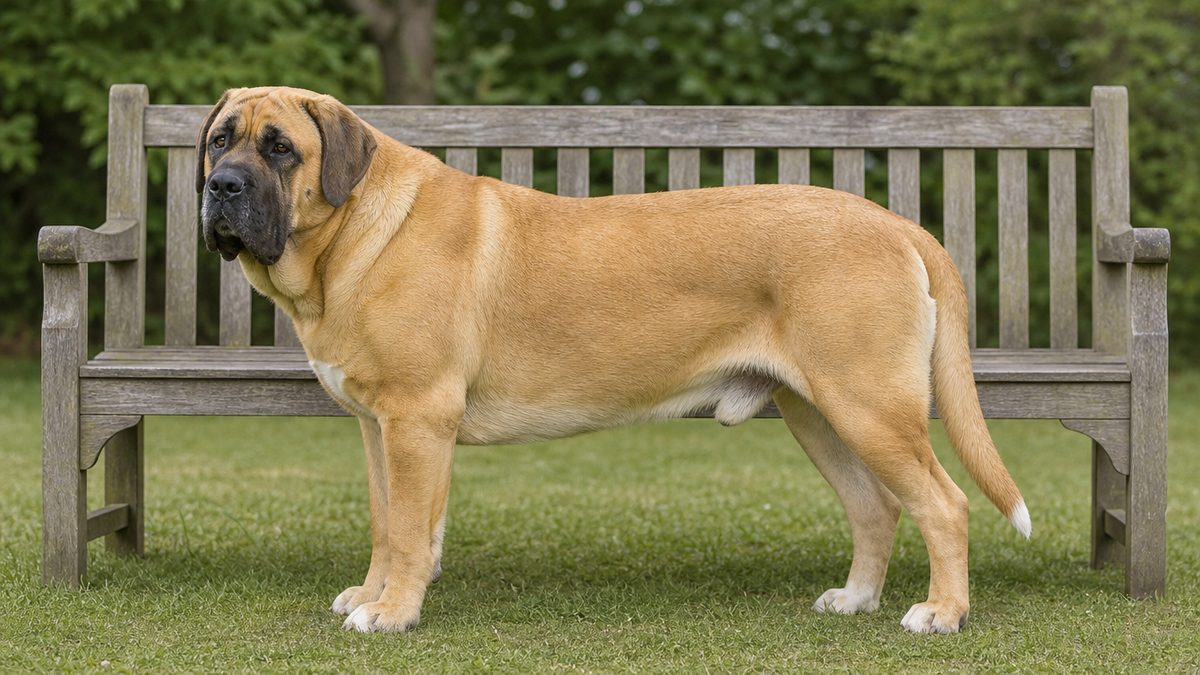
FCI-315 sets the size without hedging. Males stand about 75 cm at the withers and weigh 50 to 70 kg; bitches stand about 70 cm and weigh 40 to 60 kg. That upper figure matters for an Indian reader more than anything else on the page. A 70 kg dog is heavier than most of the adults who will be walking it, and it is heavier than the ceiling that United Kingdom primary-care data treat as the highest-risk band for heat-related illness.
The standard gives one proportion you can measure with a tape and a level floor. The dog is rectangular, and the height from the withers to the elbow and from the elbow to the ground is 1:1. A dog whose legs look long under a shallow body is not a Broholmer, and neither is a dog built square; square proportions and lacking substance are both listed faults.
Head, coat and colour
The head is rather big and wide with a heavy appearance, the muzzle is massive though it looks short against the heavy skull, and the skull and muzzle are of equal length. The skull is broad and rather flat, its topline parallel to the topline of the muzzle and set a little higher, and the stop is not too pronounced. Eyes are round, not too big, and range from light to dark amber; the eye rims are tightly fitting, which is a deliberate 2025 amendment and a welfare point, because loose rims in a heavy-headed dog invite entropion and ectropion. Ears are medium sized, rather high set, and carried hanging close to the cheeks. Erect ears are a disqualifying fault.
The coat is short and close lying with undercoat. Read that phrase twice before you buy one in India. This is not a single-coated tropical dog with a thin jacket; it is a northern European double coat on a body the size of a small sofa. Colour is yellow with or without a black mask, red with or without a black mask, or black, and the 2025 standard adds that the mask should only be seen on the muzzle. White markings on chest, feet and tip of tail are optional; white anywhere else is a fault.
Temperament as the standard defines it
FCI-315 gives four words and one demand. The Broholmer is calm, good tempered, friendly, yet watchful, and it must show great self-confidence. The United Kennel Club standard says the same thing in its own words, that the breed is good-tempered, friendly and calm but ever watchful, and that it is important the dog shows great self confidence. A self-confident dog is what both registries are asking for, and neither will accept an aggressive one. Aggressive or overly shy dogs are disqualified. The Danish Kennel Club puts the same thing in plainer language: watchful, able to appear with great self-confidence, but generally friendly even towards strangers, and a patient, child-loving companion and family dog that adapts willingly, provided it is socialised early and given sensible upbringing because of its size.
| Item | What FCI-315 states |
|---|---|
| Breed number and group | 315, Group 2, Section 2.1 Molossian, Mastiff type, without working trial |
| Country of origin | Denmark |
| Official authentic language | English |
| Valid standard published | 3 May 2025, English text dated 16 May 2025 |
| Translation by | DKK Standard Committee |
| Utilization | Companion dog, guard dog |
| Height and weight | Male about 75 cm and 50-70 kg, bitch about 70 cm and 40-60 kg |
| Coat | Short and close lying, with undercoat |
| Colour | Yellow or red with or without a black mask, or black |
| Disqualifying faults | Aggression or extreme shyness, nose other than black, overshot or undershot mouth, eyes of different colour, erect ears, tail curled up, faulty colour, long hair |
The American Kennel Club prints the pronunciation on its own breed page as Bro-hell-mer. Indian sellers who cannot pronounce a breed name usually cannot document it either.
The reconstruction: how a dead breed was rebuilt from four puppies
The modern Broholmer descends from a rescue operation that began at a Danish Kennel Club banquet in 1974 and produced its first four registrable puppies on 22 October 1976, and the breed club's own anniversary publication names every founder dog.
Denmark lost the breed twice. The first collapse came in the early 1900s, which the breed club attributes to inbreeding problems, distemper and other epidemic diseases. When the last dog was registered is genuinely disputed, and this page is not going to pretend otherwise. Modern Molosser says the Danish Kennel Club registered its last Broholmer in 1910. Ria Hörter's Canine Chronicle history says there were some registrations in 1910, dogs were shown around 1939, and the last Broholmer was entered in the stud book in 1940. The breed club's own RAS says the last dogs were registered during the 1950s. Three primary-adjacent sources, three different dates, and no page ranking for the breed mentions that the question is open.
1974: an argument at a banquet
The trigger is documented by the club itself. At a Danish Kennel Club international exhibition in Copenhagen in 1974, judges at the banquet were discussing national breeds, someone raised the Great Dane and someone else objected that it might be German, and the Broholmer was suggested instead; the Danish participants then realised nobody had seen one for a very long time. In May 1974 the journalist Jytte Weiss published an article titled In search of the Broholmer in the DKK member magazine Hunden, and asked possible owners to contact the club's Committee for National and Forgotten Breeds.
Two dogs answered. Bjørn, an 11-year-old yellow male from Helsinge, turned out to be sterile. Manne, a 7-year-old black male from Asserbo, had fathered a great many unregistered puppies locally. During 1975 roughly five or six further dogs were examined by the DKK judges Ole Staunskjær and Gerhard Refsgaard and accepted as mixed dogs of good type, and on 2 and 3 June 1976 six dogs were presented at the Roskilde exhibition, of which five were declared suitable for breeding.
22 October 1976: the four dogs everything descends from
The founding mating paired C. Bastian, a yellow male descended from Manne, with Muffe, a yellow crossbred female. Twelve puppies were born on 22 October 1976 and four of them, three males and one female, could be categorised as Broholmer-like and were given DKK X-register numbers: X-1 Bjørn, X-2 Dana, X-3 Sam and X-4 Thor Broholmerselskabet. C. Bastian himself was produced by mating Manne to his own granddaughter, out of a St Bernard female and a boxer dog. Every FCI-registered Broholmer alive today traces back through that.
New blood came from outside twice. In 1978 the committee bought two litter siblings in Holland, the accidental result of an English Mastiff crossed with a Spanish Mastiff; the female, Sif, was approved and mated to X-1 Bjørn, and her granddaughter Kraka's litter with Bjørn in October 1982 produced X-31 Grane, who went on to father thirteen litters between 1985 and 1989. DKK also bought a Spanish Mastiff puppy outright, then eliminated it after its hip radiograph came back grade E. In 1997 a black male called Oscar, registered X-393, was brought in to save the black colour; he was third generation after X-7 Tor, mixed with a little Great Dane.
| Milestone | Detail |
|---|---|
| Search launched | May 1974, article in the DKK magazine Hunden |
| First dog found | Bjørn from Helsinge, 11 years old, yellow, sterile |
| Second dog found | Manne from Asserbo, 7 years old, black |
| Dogs accepted 1975 | About 5 to 6, declared mixed dogs of good type |
| Roskilde presentation | 2-3 June 1976, 6 dogs shown, 5 approved for breeding |
| First litter | 22 October 1976, C. Bastian x Muffe, 12 born, 4 registered |
| First seven years total | 4 males used on 6 females, 10 litters, 42 approved puppies |
| Average approved per litter | 4.2 |
| Outside blood 1978 | Sif, from an English Mastiff x Spanish Mastiff litter in Holland |
| Outside blood 1997 | Oscar X-393, black, third generation after X-7 Tor with some Great Dane |
Which registry recognised the breed, and when: 1982 or 1998
The Fédération Cynologique Internationale's own nomenclature record gives 26 May 1982 as the date of acceptance on a definitive basis, while the breed club's anniversary publication and the only peer-reviewed genetic paper on the breed both say 1998, and both statements are defensible once you see what changed on each date.
Start with the registry's own database. The FCI nomenclature entry for BROHOLMER (315) prints, in its own table, Date of acceptance on a definitive basis by the FCI: 5/26/1982, breed status Recognized on a definitive basis, country of origin Denmark, official authentic language English. That is not a secondary retelling; it is the governing body's record of its own decision.
Now read the breed club. Its 40th anniversary publication says a milestone was reached on 1 January 1998, that the breed had been acknowledged by FCI with Standard 315, that Broholmerselskabet became a breed club under DKK, and that twenty years of work had proven successful. The club's breeding strategy adds the operative detail: in 1998 it became possible to get normal DKK/FCI pedigrees, and the FCI approval also meant that the pedigree was closed, so non-FCI dogs could no longer be taken into the breeding. The peer-reviewed genetic characterisation of five Danish breeds states flatly that the Broholmer was approved as an official Danish dog breed by the FCI in 1998.
How both dates can be right
The RAS resolves it in one line that nobody has quoted. In 1982 the old breed standard from 1886 was updated and approved by FCI. Canine Chronicle says the same thing from the other side: in 1982 the breed was officially recognised by the FCI, which used the description from 1886, the only difference being acceptance of the colour black. So 1982 is when the standard entered the FCI nomenclature. 1998 is when the studbook closed and ordinary DKK/FCI pedigrees started being issued, which is the date that changed what a buyer could actually hold in their hand. Both are real; only one is in the FCI database.
What the other registries do
The United Kennel Club recognised the Danish Broholmer in 2006 and files it in the Guardian Dog Group. The American Kennel Club does not recognise the breed at all; its page carries a Foundation Stock Service label, which is a recording service for rare breeds rather than registration, and it lists the Broholmer Club of the USA as the club contact. Two Indian-facing pages get this wrong: one asserts the breed was registered into the AKC in 2013, a year that in fact marks the first American-bred Broholmer litter, produced by the club's only breeder in Wisconsin.
| Body | Status | Date on record |
|---|---|---|
| FCI nomenclature database | Recognized on a definitive basis | 26 May 1982 |
| FCI valid standard | Published standard 315, English authentic | 3 May 2025 |
| Broholmerselskabet | FCI acknowledgement, studbook closed, DKK/FCI pedigrees begin | 1 January 1998 |
| Pertoldi et al., J Anim Sci | Approved as an official Danish dog breed by the FCI | 1998 |
| United Kennel Club | Recognised, Guardian Dog Group | 2006 |
| American Kennel Club | Foundation Stock Service, not a recognised breed | Not recognised |
| Kennel Club of India | No breed list published at all | Not applicable |
UKC lists unilateral or bilateral cryptorchid as a disqualification, meaning such a dog cannot be placed in a UKC conformation event and must be reported to UKC. Broholmerselskabet, with DKK, has an open project specifically trialling the use of unilaterally cryptorchid males in breeding to widen the gene pool. Both positions are honest responses to the same problem; they simply cannot both be followed.
The gene pool: what a reconstructed breed's numbers actually look like
The Broholmer gene pool holds roughly 1,200 living dogs worldwide, every one of them descended from the same few parent dogs, in a studbook that has been closed since 1998 and cannot be reopened from abroad.
Broholmerselskabet states the position without softening it. With approximately 1,200 live dogs all over the world the Broholmer is still a fragile breed, the gene pool is limited, and it is not possible to get new blood for the breed from abroad, because the FCI-registered Broholmers outside Denmark are all descendants of Danish dogs and therefore bring nothing new. Modern Molosser gives the same total from Danish breeders in 2015 and adds that only about 250 of those 1,200 sit outside Denmark, in continental Europe.
That figure has moved. Ria Hörter's 2010 history put the population at fewer than 800 worldwide, most of them in Denmark. One of the pages ranking on the Indian first page for this breed still prints an estimated 300 to 400 Broholmers worldwide, which is roughly a quarter of the club's own count and is not attributed to anything.
What the peer-reviewed genetics found
One published study has genotyped the breed. Pertoldi and colleagues typed 22 Broholmers on the 170,000-SNP CanineHD BeadChip alongside four other Danish breeds and ranked expected heterozygosity in the order Danish Spitz, Danish-Swedish Farm Dog, Broholmer, Old Danish Pointing Dog, Greenland Dog. The paper appeared in the Journal of Animal Science in November 2013, and its author list includes Helle Friis Proschowsky, the DKK geneticist who later advised on the breed club's own breeding strategy, and Merete Fredholm of the University of Copenhagen. In the discussion the authors attribute the Broholmer's relatively low heterozygosity to founder effect and genetic drift, and write that crossbred dogs of suitable phenotype were advertised for but only a handful of founders were identified and used to reconstruct the breed. Among the 22 dogs, the genetic profile of one deviated strongly; the authors checked its studbook and found that both the dog and its father had been accepted for breeding on phenotypic resemblance.
Search results pair a Broholmer heading with the phrase 'effective population size was 29.1, with an average inbreeding coefficient of 0.035, all estimated using SNP data'. Those two figures come from the Bullmastiff genome-diversity paper on the same aggregator page, not from any Broholmer study. Pertoldi et al. report heterozygosity and identity-by-descent for the Broholmer, not an effective population size. No published effective population size exists for the Broholmer, and any page that gives you one is quoting a different breed.
The rules the club uses instead of an Ne figure
Without a published Ne, the club manages the pool by arithmetic it can control. Inbreeding is calculated on the fourth generation and should not exceed 6.25 percent, which is stricter than DKK's three-generation minimum recommendation, and the breeding committee encourages breeders to look further back still. DKK's popular sire limit says no male should father more than 25 percent of the average annual number of puppies registered, recalculated yearly from the last three years; for the Broholmer that limit was 34 in 2018 and 37 on 1 January 2019.
Both controls were being breached at the time of writing. The RAS records that two males had exceeded the limit and had also been used abroad, that three matings had been repeated in a few years, and that two males had been used on both a mother and her daughter. It also records how thin the breeding pool is in absolute terms: 63 Danish males and 35 Danish females on the approved lists, of which 29 males and 17 females had produced at least one litter, plus 29 foreign males of which exactly one had ever been used for breeding in Denmark.
| Year | Litters | Puppies registered |
|---|---|---|
| 2007 | 14 | 110 |
| 2008 | 13 | 89 |
| 2009 | 18 | 121 |
| 2010 | 16 | 107 |
| 2011 | 19 | 132 |
| 2012 | 18 | 140 |
| 2013 | 18 | 134 |
| 2014 | 18 | 129 |
| 2015 | 12 | 94 |
| 2016 | 18 | 141 |
| 2017 | 38 | 148 |
Two things stand out in that table. Registrations dipped to 94 in 2015, the year DKK transferred the breed back to its committee and freed the breeding, and the 2017 litter count of 38 sits so far outside the 12 to 19 range of every other year, against a puppy total in line with the rest, that it reads as a typographical error in the club's own document rather than a real doubling. Cite the puppy column, which is internally consistent, and treat the litter column for 2017 with caution.
Broholmer price in India: there is no Indian price, and here is what you are actually being shown
No Broholmer price exists in India, because no Broholmer is sold in India, and every rupee figure a search returns for this breed belongs to something else.
Search broholmer price in india from an Indian connection and the first page returns no Indian dog. In the pull recorded in this page's SERP block on 23 August 2026 it returned dogbreedslist.info quoting United States dollars, a Facebook group thread quoting dollars, an Etsy market page, petlur quoting dollars, a United Kingdom page quoting pounds, the AKC, a Wuuff listing page, Royal Canin India, and at the bottom a Rottweiler sales page. The third organic result was Etsy, offering Broholmer-themed printed merchandise from Rs 1,699, not a dog. That is the honest answer to the query: the only thing carrying the word Broholmer that anyone in India will actually sell you is a poster.
The specialist puppy marketplace is blunter still. Wuuff's Danish Broholmer page returns the string 'Sorry, there is no result' twice and then prints 'Currently, there are no available Danish Broholmer puppies here';. That is a pan-European breeder marketplace with a dedicated page for the breed, and it has nothing.
The four overseas figures, and the currency tests
Four published puppy price ranges exist, all in foreign currency, none of them Indian. Dogbreedslist.info's table says USD 1,500 to 2,000; the same page's own meta description says USD 1,500 to 1,800, so the site disagrees with itself about its only number. Petlur says USD 1,300 to 1,500. A Facebook breed-group thread quotes USD 2,500 to 3,500. A United Kingdom page quotes GBP 700 to 1,000. Not one of those four puppy price figures names a breeder, a litter or a registry.
Run this site's standard test on any rupee figure a seller does quote you. Divide by 84.38, then divide by 74. A rupee price that comes back as a round dollar amount under either divisor is a converted American list price with a rupee sign in front of it, not a price anyone in India set. And if you are shown Rs 98,999, walk away: that is a recurring house charm price on one Indian listing carousel, attached to whichever puppy happens to be in stock, and it has appeared on pages for breeds that site does not stock at all.
| Source | Published figure | At 84.38 | At 74 |
|---|---|---|---|
| dogbreedslist.info table | USD 1,500 - 2,000 | Rs 1,26,570 - 1,68,760 | Rs 1,11,000 - 1,48,000 |
| dogbreedslist.info meta description | USD 1,500 - 1,800 | Rs 1,26,570 - 1,51,884 | Rs 1,11,000 - 1,33,200 |
| petlur | USD 1,300 - 1,500 | Rs 1,09,694 - 1,26,570 | Rs 96,200 - 1,11,000 |
| Breed group thread | USD 2,500 - 3,500 | Rs 2,10,950 - 2,95,330 | Rs 1,85,000 - 2,59,000 |
| Indian listing sites | No listing exists | Not applicable | Not applicable |
The right-hand columns exist so you can recognise a converted figure when a seller shows you one. Bonbeno is not quoting a price for this breed in India, because there is no lawful route to buy one here and no Indian seller has one. Any Indian listing using the word Broholmer is selling you a different dog.
What an Indian seller is likely to be offering instead
Three substitutions are predictable, and each has a tell. The first is a Great Dane, which is genuinely sold across India, is a different FCI breed in the same group, and is taller but far lighter-boned than a Broholmer; the Broholmer standard demands a rectangular body with a broad deep chest and a 1:1 withers-to-elbow ratio, while a Great Dane is longer in leg. The second is a Mastiff or a Mastiff cross, which is squarer and heavier in the head. The third is an unregistered large crossbreed with a black mask, sold on the mask alone.
Ask for the pedigree, not the photograph. A lawfully imported Broholmer in India would carry a DKK or FCI export pedigree naming Broholmerselskabet-approved parents, a microchip whose number matches the pedigree, a DGFT import authorisation, and an Advance No Objection Certificate from the port quarantine officer. If any of those four is missing, the dog is not what you were told it is.
Why no lawful supply chain for the Broholmer can form in India
Two independent barriers close the route, one at the Indian border and one in the Danish studbook, and either alone would be enough.
Start with the Indian side. Live dogs sit at ITC (HS) 01061900, Mammals: Other, and the import policy for that line is Restricted. DGFT Trade Notice 22/2022-23 of 19 December 2022 sets out Policy Condition (7), which permits the import of dogs only for three purposes: a pet dog with a valid pet book and relevant records in the name of the importer, dogs imported by R&D organisations for research with the recommendation of CPCSEA, and internal security by the Defence and Police Force. Policy Condition (8) then states that import of commercial dogs for breeding or any other commercial activities other than the purposes mentioned above is not permitted.
Paragraph 6 of the same trade notice removes the workaround. Any applications for trading or breeding purposes, or applications made on behalf of some other person or entity, shall be duly rejected. Paragraph 7 limits entry to the airports and seaports of Delhi, Mumbai, Chennai, Hyderabad, Bangalore and Kolkata, with quarantine where required. DAHD added a seventh port, Cochin International Airport at Kochi, for pets arriving under the baggage rules in October 2024. The full route is set out in how to import a dog to India.
The one route that is open, and how narrow it is
A person genuinely transferring residence to India after two years of continuous stay abroad may bring up to two pets as passenger baggage without a DGFT authorisation, and only cats and dogs qualify under the baggage rules. Everything else needs an import authorisation applied for on ANF-2M, submitted against an Importer Exporter Code or the permanent IEC IIHIE0153E for personal-use imports, with the Vaccination Book or Pet Passport or Pet Book, a Certificate for Emotional Support and the pet's passport attached. DGFT advises starting at least two months before travel, and an Advance No Objection Certificate must be obtained from the port Quarantine Officer seven days before travel, relaxable to three.
So one family relocating from Copenhagen to Bengaluru with their own Broholmer can lawfully bring it. That single dog cannot legally found anything, because a breeding import is refused by definition.
The Danish side closes the other end
Even if the Indian door were open, the Danish one is shut. The studbook closed when the FCI approval took effect, and Broholmerselskabet states that it is therefore not possible to accept dogs without pedigree into the breed. Offspring can only be entered in DKK if both parents already hold an official HD status of A or B registered in DKK before mating, both hold AD status 0 or 1, both have been awarded at least Very Good after 24 months of age by a Danish judge authorised for the breed or hold an approved exterior description on the Broholmerselskabet form, and both have completed a mentalbeskrivelse after ten months of age. Those requirements were introduced on 1 March 2026 and every one of them has to happen physically in Denmark or under a small list of recognised foreign equivalents.
A dog in India cannot satisfy any of them. There is no Danish authorised judge here, no DKK-registered radiograph, and no Danish mental description. A litter bred in India would therefore be unregistrable in DKK, unregistrable in FCI, and unrecognisable by the Kennel Club of India, whose website publishes forms and a tariff sheet and no breed list at all.
| Gate | Position | Effect |
|---|---|---|
| DGFT import policy | ITC(HS) 01061900 Restricted | Only pet, R&D or Defence and Police imports permitted |
| DGFT paragraph 6 | Breeding or trading applications duly rejected | No commercial import route exists |
| Danish studbook | Closed since the FCI approval | No unregistered dog can enter the breed |
| DKK breeding requirements | HD, AD, show grading and mental description, all in Denmark | No India-bred litter can be registered |
The absence of Broholmers in India is not a market gap waiting to be filled. It is the arithmetic result of a restricted import line meeting a closed studbook. Anyone offering to source you one for a deposit is describing a transaction that DGFT says shall be duly rejected.
Cost of ownership in India for a 70 kg dog
Budget for a dog that eats like three Labradors, needs a room-sized cool space running for eight months a year, and costs by weight at the vet, and treat every published monthly figure for this breed as written for a different country.
The overseas pages that do give a monthly cost are unusable here. Petlur prints a daily food cost of USD 1.50 to 1.90 and a monthly cost of USD 39 to 52, and on the same page gives daily food as 3 cups in one row and 5 to 6 cups of high-quality dry food in another. A page ranking fourth on the Indian first page independently prints the same 3-cups figure and the same 45 minutes and 6 miles a week exercise numbers, which tells you the two pages share an origin rather than a source. Three cups is roughly 300 g of dry food. A 70 kg dog does not live on 300 g a day.
The three costs that actually scale with a giant breed
Food is the first and it scales close to linearly with maintenance energy needs. Plan on 700 g to 1 kg of a large-breed dry diet a day for an adult male at maintenance, split across two meals, and more during growth. At Indian large-breed dry-food prices, a 15 kg bag lasts a Broholmer about two to three weeks rather than the two months it lasts a Beagle owner, and food will be the single largest line in the budget every month for the dog's life.
Cooling is the second, and it is the line nobody outside India budgets. This breed carries an undercoat and cannot be shaved. From March to October across most of the country it needs a genuinely cool indoor space during the day, which in practice means an air conditioner running in one room for eight to ten hours rather than a fan. That is an electricity bill, not a one-off purchase, and it is the cost that makes this breed expensive in Chennai and merely inconvenient in Shimla.
Veterinary care is the third, and it is priced by weight for almost everything that matters. Anaesthesia, most injectable drugs, antibiotics, joint supplements, tick and flea preventives and any surgery are all dosed or charged by body weight, so a 70 kg dog is roughly ten times a 7 kg dog on the drug line alone. Gastric dilatation-volvulus surgery on a giant breed is an emergency laparotomy with an overnight critical-care stay, and giant-breed dogs have a documented case fatality of 28.6 percent once GDV occurs.
| Line | Why it is different at 70 kg | Practical consequence |
|---|---|---|
| Dry food | Maintenance energy scales with body mass | A 15 kg bag lasts weeks, not months |
| Cooling | Double coat plus large body mass, low surface-to-volume ratio | AC running eight to ten hours daily, March to October |
| Anaesthesia and drugs | Dosed per kilogram | Roughly ten times a small-breed dose and cost |
| Orthopaedic care | Joint loading rises with mass | Hip, elbow and shoulder problems are the expected failure mode |
| Emergency abdominal surgery | Giant breeds carry GDV risk | 28.6 percent of dogs that developed GDV died in the Purdue cohort |
| Boarding and transport | Priced by size band, and most Indian carriers cap crate size | Few kennels and few cabs will take the dog at all |
| Grooming | No clipping needed, but undercoat work and skin checks are weekly | Cheap in money, expensive in owner time |
The registration line, if you somehow have one
Kennel Club of India charges Rs 2,500 to register an imported dog, and Rs 1,500 per puppy for a whelp-import litter registered within 60 days, rising to Rs 2,000 within 61 to 120 days and Rs 3,000 within 121 to 180 days. An Indian Kennel Gazette subscription for a year is Rs 1,200, a certified four-generation pedigree is Rs 1,000, and an export pedigree is Rs 2,000. KCI sorts registrations into four categories, and an imported dog falls in Category 2, which requires the airway bill and customs clearance alongside the usual papers. None of this makes an unregistered Broholmer-like dog into a Broholmer.
Check the fee against the club's own sheet before you pay, because the widely-read Indian guides do not match it. One popular 2026 guide gives litter registration as Rs 337 per puppy within 60 days and Rs 562 within 61 to 120 days, while KCI's own tariff sheet effective 1 April 2024 gives Rs 750 and Rs 1,200 for the same two windows, with Rs 375 and Rs 600 for Indian breeds. Neither of the guide's two figures appears anywhere on the official sheet. That is a small discrepancy with a large lesson: on Indian pedigree paperwork, read the registry's own PDF and not the summary.
Add the monthly food bill to the monthly electricity delta for eight months of daytime cooling, then multiply by twelve and again by the low end of the printed lifespan range. For a giant double-coated northern dog in an Indian metro, that lifetime figure is usually larger than the purchase price argument the seller is having with you.
Heat tolerance: Denmark's hottest month is colder than Bengaluru's coldest
The Broholmer rates 1 out of 5 for heat tolerance, the lowest rating this site gives, because the village it is named after averages 17.9 degrees Celsius in its warmest month while the coolest large Indian city averages 20.2 degrees Celsius in its coldest.
Broholm sits at Gudme on the island of Funen, between Svendborg and Nyborg. Query NASA POWER by explicit coordinates for that point, latitude 55.16 and longitude 10.69, and the service returns coordinates 10.69, 55.16 at 10.31 m elevation, confirming it answered for the place asked. The climatology there gives an annual mean of 9.3 degrees Celsius, a February mean of 1.4 degrees Celsius, and a warmest month, August, at 17.9 degrees Celsius. Copenhagen, queried at 55.6761 and 12.5683 and returning 12.568, 55.676, gives an annual mean of 9.0 degrees Celsius and a July peak of 17.9 degrees Celsius.
Now put an Indian city beside it. Bengaluru, at 12.9716 and 77.5946, elevation 841.72 m, is the mildest big city in this comparison, and its coldest month, December, averages 20.2 degrees Celsius. Bengaluru in December is 2.3 degrees warmer than Funen in August. For a dog with a thick undercoat and 70 kg of body mass, the mildest month of the mildest metro is already outside the entire temperature range the breed was rebuilt in.
That is why this page rates the Broholmer 1 out of 5 rather than hedging. A heat-tolerant breed is one whose origin climate overlaps the destination climate somewhere in the year, and for this dog there is no overlap anywhere in mainland India. Every giant double-coated northern breed is heat-sensitive by construction, and the Broholmer is at the extreme end of both properties, being both the heaviest category of dog and one carrying an undercoat the standard requires.
Wet-bulb temperature is the number that matters, not the air temperature
A dog sheds heat by panting, which is evaporative, so humidity decides whether panting still works. Wet-bulb temperature captures both at once. NASA POWER's wet-bulb climatology puts Gudme's annual mean at 8.2 degrees Celsius and its August peak at 16.2 degrees Celsius. Kolkata peaks at 27.9 degrees Celsius in June, Delhi at 27.7 degrees Celsius in July, Ahmedabad at 27.6 degrees Celsius in June, Chennai at 27.4 degrees Celsius in May, Mumbai at 26.6 degrees Celsius in June, Pune at 23.6 degrees Celsius and Bengaluru at 22.7 degrees Celsius. Every one of those peaks is above Gudme's, and Kolkata's is 11.7 degrees higher.
| Place | Annual mean air temp, C | Hottest month mean, C | Peak monthly wet bulb, C | Verdict for a Broholmer |
|---|---|---|---|---|
| Gudme, Funen (origin) | 9.3 | 17.9 (Aug) | 16.2 (Aug) | The baseline the breed was rebuilt in |
| Copenhagen | 9.0 | 17.9 (Jul) | 16.0 (Aug) | Same baseline |
| Bengaluru | 23.7 | 28.4 (Apr) | 22.7 (May) | Best wet bulb in India, and still warmer year round than Danish summer |
| Pune | 23.9 | 28.9 (Apr) | 23.6 (Jun) | Second best, indoors most of the day |
| Shimla | 21.1 | 30.2 (Jun) | 24.2 (Jul) | Coolest air, but a humid July grid cell that averages the valleys |
| Delhi | 25.6 | 35.9 (Jun) | 27.7 (Jul) | Unsuitable April to September |
| Kolkata | 25.8 | 31.5 (May) | 27.9 (Jun) | Worst wet bulb of the set |
| Mumbai | 26.8 | 31.2 (May) | 26.6 (Jun) | Unsuitable, humid year round |
| Ahmedabad | 27.6 | 35.1 (May) | 27.6 (Jun) | Unsuitable, extreme dry heat |
| Chennai | 27.9 | 31.5 (May) | 27.4 (May) | Unsuitable, hot and humid together |
What the veterinary evidence says about dogs this size
Body mass is an independent risk factor, and the effect size is published. A VetCompass study of 905,543 United Kingdom dogs under primary veterinary care in 2016 identified 395 heat-related illness events, an incidence of 0.04 percent, and an event fatality rate of 14.18 percent, with 56 of the 395 dogs dying. In the multivariable model, dogs over 50 kg had 3.42 times the odds of heat-related illness compared with dogs under 10 kg, with a 95 percent confidence interval of 1.54 to 7.57, and dogs at or above the mean adult bodyweight for their breed and sex had 1.42 times the odds of lighter dogs of the same breed.
Read that against the standard. A male Broholmer is specified at 50 to 70 kg, so the whole breed sits inside the highest-risk weight band, and the dog at the top of the standard is not an outlier but a correct specimen. That study ran in a British summer. India Meteorological Department criteria declare a heat wave when a plains station reaches at least 40 degrees Celsius, or 37 degrees for coastal stations and 30 degrees for hilly regions, with a severe heat wave at a departure from normal above 6.4 degrees. Delhi's monthly mean air temperature peaks at 35.9 degrees Celsius in June, and the same NASA POWER climatology records a maximum 2-metre temperature of 48.8 degrees Celsius at that point, against 30.0 degrees Celsius for Copenhagen.
If a Broholmer already lives in India, run this heat protocol
Manage a Broholmer in India by moving activity to the coolest ninety minutes of the day, keeping one genuinely cooled room available all day, and treating a rectal temperature of 41.0 degrees Celsius or above as an emergency rather than a reading.
A relocating family can lawfully bring their own dog, so this section exists for the small number of people who will actually need it. Nothing here makes the breed suitable. It makes the individual dog safer.
The most useful finding is about walking, not about rooms
A second VetCompass paper on the same 905,543 dogs classified the trigger for 1,259 heat-related illness events, recorded one for 879 of them, and found that 74.2 percent were exertional, 12.9 percent environmental and only 5.2 percent caused by confinement in a vehicle. For dogs weighing 50 kg or more the odds of exertional heat-related illness were 2.21 times those of dogs under 10 kg, with a 95 percent confidence interval of 1.02 to 4.79. The authors also note something specific to this weight class: none of the dogs weighing 50 kg or over were reported with environmental heat-related illness at all.
Read that as an instruction. A giant dog in India is far more likely to be harmed by a walk than by a warm room, so the intervention that matters most is not the air conditioner but the decision not to leave the house. The authors' own summary is that owners can prevent most heat-related illness events by making sensible decisions about when and how to exercise their dogs.
Seven rules that do the work
- Walk before sunrise and after full dark, and skip the walk entirely on any day the local station is under a heat wave advisory at 40 degrees Celsius or above.
- Test the pavement with the back of your hand for seven seconds; a 70 kg dog puts far more pressure per pad than a small dog and burns faster.
- Keep one cooled room available all day rather than cooling the whole flat for an hour, because a large body cools slowly and needs somewhere to stay cool, not somewhere to cool down.
- Weigh the dog monthly and keep it at the lower half of its standard range, since dogs at or above the breed mean weight carry 1.42 times the odds of heat-related illness.
- Never shave the double coat, because the undercoat insulates against heat gain as well as heat loss and shaving exposes skin to sun.
- Carry water on every outing and offer it before the dog asks, not after.
- Learn the rectal temperature routine and own a digital thermometer, because panting tells you nothing about how far the dog has gone.
What heat-related illness looks like before it is obvious
The early signs in a heavy dog are behavioural rather than dramatic. Refusing to move on a walk it normally enjoys, lying flat on tile rather than on its bed, seeking the bathroom floor, drooling more thickly than usual and a change in the sound of the panting all come before collapse. A dog's healthy body temperature is around 37 to 39 degrees Celsius, and going above 41 degrees Celsius can trigger heat-related illness, a progressive disorder that is fatal if severe or left untreated. The published fatality rate is what makes early action worth it: 56 of 395 heat-related illness events in the VetCompass cohort ended in death, 35 of those by euthanasia and 19 unassisted.
Start cooling before you leave for the clinic. The VetCompass team's own guidance is that tap water is fine, used either as a cool bath or sprayed on to the dog, and that covering the dog in wet towels just acts as an insulator, so avoid it, because air movement is critical for effective cooling. Wet the coat, get air moving over it with a fan or the car air conditioning, and drive. If the dog has lost consciousness or is gasping, keep water out of its mouth to protect the airway. For a 70 kg dog, getting into a vehicle at all needs planning, so know in advance which clinic will take a giant-breed emergency and how you will lift the dog.
One more detail from the same team, because Indian pavements are hotter than British ones. Walking on hot pavement can burn a dog's footpads, and where crossing hot surfaces is unavoidable, fabric paw boots are a temporary option that should come off as soon as possible, since dogs sweat through their paws.
Where in India this breed is least unreasonable, city by city
Bengaluru and Pune are the two least punishing large Indian cities for a Broholmer on the measure that matters, peak wet-bulb temperature, and no Indian city is comfortable for one outdoors between March and October.
The answer is not the one most people expect, and the wet-bulb column is why. Ranked by peak monthly wet bulb, the three best Indian points measured here are Bengaluru at 22.7 degrees Celsius, Pune at 23.6 and Shimla at 24.2, with the plains cluster of Mumbai, Chennai, Ahmedabad, Delhi and Kolkata bunched between 26.6 and 27.9. On air temperature Shimla looks best, at an annual mean of 21.1 degrees Celsius against Bengaluru's 23.7, but its July monsoon is humid enough that its worst month is harder on a panting dog than Bengaluru's. For a breed whose only cooling mechanism is evaporative, the wet-bulb ranking is the one to use.
One caveat on the Shimla figure, stated because the number would otherwise mislead. NASA POWER returned an elevation of 897.65 m for the Shimla coordinates, well below the town's actual altitude, because the product averages a grid cell that includes the surrounding valleys. Treat the hill-station rows as an indication of the region, not of a specific ridge. Chennai, Mumbai, Kolkata, Delhi and Ahmedabad need no such caveat: none of them is a place to keep this dog outdoors at any point between March and October.
| City group | Outdoor activity possible | Restricted | Indoors and cooled by day |
|---|---|---|---|
| Shimla and hill stations | November to March | April and October | May to September |
| Bengaluru, Pune | December and January | November, February, June to September | March to May |
| Delhi, Ahmedabad | December and January | November and February | March to October |
| Mumbai, Chennai, Kolkata | None | December and January | February to November |
Temperament and household fit: a calm dog with a mass problem
The Broholmer is calm, good-natured, sociable and watchful, and it must show great self-confidence, so the household risk it presents is physical rather than behavioural.
FCI-315 requires calm, good tempered, friendly, yet watchful, with great self-confidence, and disqualifies both aggressive and overly shy dogs. The Danish Kennel Club's own lexicon expands it: watchful, capable of appearing with great self-confidence, but in general friendly even towards strangers, and a patient, child-loving companion and family dog that adapts willingly, though it must be socialised early and given sensible upbringing because of its size.
The breed club's own answer to why a Broholmer describes a very affectionate and devoted dog that is highly attentive and wants only to please its owner, watchful enough to give tongue when strangers are at the door, sedate and self-assured in bearing, and an excellent family dog that, because of its gentle disposition, must be treated with great consideration. That last clause is the one Indian buyers reading a guard-dog listing will skip.
What the mental testing programme found
Denmark measures this rather than asserting it. Before 2015 almost every Broholmer went through a mentalbeskrivelse, a standardised behaviour description, and the club charted the breed average against the ideal breed profile across 22 test moments including contact, handling, play, hunting, activity level, surprise, sound, ghosts and gunshot. Their reading of the 2010 to 2017 data is specific: the breed has developed positively on fear, curiosity and abreaction, but still has a long way to go before curiosity reaches the breed profile, so the breeding priority is to increase curiosity and lower fear.
They also publish the failure cases. The RAS records some lines in which many related dogs show restless, hyperactive and at times very noisy behaviour, dogs that stress easily and carry a higher activity level than the breed should, and it states that such dogs are usually not caught during a mental description because they perform as expected on the day. Within six months in 2017 and 2018, three young Broholmers were euthanised because of behaviour problems of that kind. Given the size of the dog, the club says plainly, that is not acceptable behaviour for the breed.
Who this dog suits in an Indian household
- Ground-floor homes with a cooled indoor room and a shaded yard, because the dog wants to lie where it can watch everyone rather than run.
- Households with older children, since the dog leans and underestimates its own size rather than showing aggression.
- Owners who can physically manage 70 kg on a lead if the dog decides to move, which rules out handling by a child or a frail adult.
- Families who are home during the day, because the breed needs close social contact with its family and does not do well warehoused outdoors.
- People who accept a dog that will greet visitors politely rather than repel them, since the AKC observes that today the Broholmer's size is the only thing that keeps intruders at bay.
Who should not buy one
Anyone buying a guard dog on the strength of the word mastiff is buying the wrong animal. The American breed club's own founder describes the breed as being in the guardian group but not that guardy, and says they are majestic, sweet and devoted. Anyone in a flat above the ground floor should also stop here, because the Danish Kennel Club states that the large heavy dog should be exercised moderately as a youngster and that it does not do well going up and down many stairs before it is fully grown.
The Danish sources do not flag prey drive as a breed problem, and the AKC calls it an excellent dog with children and other dogs while recommending supervision because it underestimates its size. Treat introductions to Indian street cats and small pets as a size and management question, not a temperament one.
Training: build the leadership on trust, because you cannot out-muscle 70 kg
Train a Broholmer with short varied sessions, generous food payment and consistent rules from week one, because the Danish Kennel Club's guidance is that settled leadership matters for this breed on account of its size and not its temperament.
DKK's own tips are unusually direct and worth quoting properly. A settled leadership is important because of the dog's size, not because of its temperament; the dog is cooperative and can learn anything when the method is built on desire, friendliness and trust; train variedly in short sequences and reward generously. Read the middle clause carefully. It is a claim about method, and it rules out the correction-heavy handling that Indian trainers still apply to large guarding breeds.
There is a competing account in the English-language results and it should be named. A page ranking fourth on the Indian first page says the breed is rather stubborn, requires a firm and strong state of mind to master, needs more intensive and ongoing training so it does not begin to think of itself as the leader, and may need to be put in its place using a stern voice. That framing appears nowhere in the Danish material and it contradicts DKK's own instruction to build on desire, friendliness and trust. Where the national kennel club of the breed's own country and an American emotional-support-animal marketing blog disagree about method, follow the kennel club.
The four things to install before the dog reaches 40 kg
- Loose-lead walking, taught on a flat collar or a Y-front harness before the puppy outweighs the handler, because a 70 kg dog that pulls is not a training problem but a safety one.
- A settle on a mat, so the dog has a taught default for lying quietly where it can see the family, which is where this breed wants to be anyway.
- Handling tolerance for paws, ears, mouth and hips, which the exterior description in Denmark tests and which every Indian vet visit will need.
- A reliable recall and a quiet cue, since the bark is used to announce strangers at the door and Indian housing societies will notice.
Realistic timelines
Expect house training in three to six weeks, a settle that holds through the doorbell by four to six months, and loose-lead walking that survives an adolescent growth spurt only if you retrain it twice, once around seven months and again around twelve. Denmark treats mental maturity as late in this breed: an official mentalbeskrivelse can only be completed after the dog is ten months old, and show grading for breeding approval requires the dog to be at least 24 months old. Those two ages are a good guide to when a Broholmer is behaviourally testable and when it is actually finished.
What this breed will not do
It will not work at speed and it will not repeat drills for their own sake. The Danish Kennel Club describes a dog that moves willingly but mostly at a slightly sedate pace, stays closely attached to its area, does not stray unnecessarily, responds well to instructions and keeps relatively close contact with its owner. The breed club adds that it is a solid strong dog well suited to pulling, that some Broholmers work as therapy, rescue, blood-tracking and tracking dogs and compete in rally, and that its gentle disposition makes it an outstanding care dog. Those are the sports to aim at, and in India they are also the ones that can be done in the cool part of the day.
DKK says the breed must be socialised early because of its size. In India that means planned exposure to auto rickshaws, two-wheelers, free-roaming dogs, cattle, festival drums and firecrackers, in short sessions at a distance the puppy can handle, and always in the cool hours.
Exercise: the breed club says this is not a very active dog, and in India that is the safety margin
A Broholmer needs two short flat walks a day plus something to watch over, not distance work, because Broholmerselskabet states directly that this is not a particularly active dog breed.
The club addresses the question as a myth to be corrected. Under the heading Myths about the Broholmer, myth number four is that Broholmers require a lot of exercise. The club's answer, translated from the Danish, is that a Broholmer of course needs exercise like every other dog, but that this is not a particularly active dog breed, and that the Broholmer is happiest when it can keep an eye on the whole family at once. Its own owner guidance adds that hour-long walks every day are not required, though the dog is always glad to get out and move its muscles.
DKK's lexicon agrees and is more specific about the risk. The large heavy dog is exercised moderately as a youngster, and it does not do well going up and down many stairs before it is fully grown. Activity level is rated Medium and grooming is rated Small on the same page.
The number the copy sites use, and where it comes from
Two of the ten pages ranking for this breed print exactly the same exercise prescription, 45 minutes of activity a day and at least 6 miles of walking a week. Identical figures on two unrelated sites are a sign of a shared origin, not of independent measurement, and neither page names a source. Six miles a week for a dog whose national kennel club warns against stairs and prescribes moderate exercise during growth is not obviously wrong in Denmark, but as a rule for an Indian owner in May it is dangerous.
The Indian version of the prescription
- Two walks daily of 20 to 30 minutes each, taken before sunrise and after full dark, on flat ground.
- One structured mental job a day, such as scentwork in a cool room, a food puzzle or a short tracking exercise, which substitutes for distance the dog cannot safely cover.
- Cart or weight pulling only in winter, only after skeletal maturity, and only where the club's own note that the breed is well suited to pulling can be acted on without heat load.
- No forced running, no bicycle work and no stair repetitions at any age, because joint loading in a 70 kg dog is the failure mode this breed is screened for.
- Zero outdoor exercise on any day the local station meets IMD heat wave criteria of 40 degrees Celsius in the plains, 37 degrees on the coast or 30 degrees in the hills.
Growth restrictions, which matter more than daily minutes
Osteochondrosis dissecans is the specific reason to keep a young Broholmer's exercise low. The breed club describes OCD as a growth disturbance particularly seen in big fast-growing breeds, says the Broholmer is predisposed by size and growth pattern, and reports that it is mostly seen in young dogs at 9 to 10 months, most often in the shoulder joint but also in knee and hock, that it is often bilateral, and that untreated OCD carries a big risk of arthritis in the affected joint. There is no OCD screening requirement for the breed and therefore no breed statistic, but the club states that operations are performed every year on young dogs.
Until the growth plates close, keep walks short and flat, keep the puppy off stairs and off slippery Indian floor tiles, and never let a heavy puppy jump down from a bed or a car. The Danish Kennel Club's stair warning is not a courtesy; it is the club's own summary of what goes wrong in this breed.
Grooming in Indian humidity: the once-a-month advice is written for Denmark
Groom an Indian Broholmer weekly with an undercoat rake and check skin folds daily in the monsoon, because the breed club's own advice of one brush a month assumes a Danish spring and autumn moult that does not happen here.
The Danish guidance is explicit and it is correct in Denmark. Broholmerselskabet's owner page says grooming is minimal, that a trip with the brush once a month is plenty, and that Broholmers can shed a lot in periods. DKK's lexicon is slightly stronger: the coat is short and close lying with a strong undercoat, it sheds somewhat in spring and autumn, and should therefore be brushed through regularly. Royal Canin's Indian page carries the shortest version of all, listing Requires minimal grooming as a key fact.
All three assume a temperate photoperiod. A double-coated dog in Chennai or Mumbai does not get two sharp seasonal moults; it sheds across the year, and the dead undercoat that a Danish dog drops in two concentrated bursts instead sits in the coat as a warm, damp mat. That trapped undercoat is what turns a low-maintenance coat into a skin problem, and it is the reason a monthly brush is the wrong instruction on this side of the world.
The Indian weekly routine
- Rake the undercoat once a week with a wide-tooth undercoat rake, working against the lie of the coat over the neck, shoulders, flanks and thighs until the rake comes back clean.
- Finish with a rubber curry mitt to lift loose topcoat and spread skin oils.
- Check the neck folds and the loose skin the standard calls throatiness, because that is where moisture collects on a dog with a thick, well-pigmented skin.
- Dry the ears after every bath and after every rain, and never let a dog with hanging ears air dry in the monsoon.
- Inspect between the toes and under the tail for ticks after every walk, then repeat the check indoors under a light.
Bathing, and the advice that does not transfer
One ranking page recommends a bath once every few months, warning that more frequent bathing risks drying the skin. That is sound in a Danish winter and wrong in an Indian summer, where a dog that lies on warm tile and sweats through its paws needs washing more often. Bathe as often as the dog needs it, use a soap-free dog shampoo, rinse to the skin rather than to the topcoat, and then dry the dog completely, including the undercoat, with towels and a fan or a cool dryer. Wet undercoat under a dense topcoat in 80 percent relative humidity is how pyoderma starts.
The skin evidence from the breed's own health review
Skin is a documented breed issue and the numbers are the club's own. Its 2012 health review of the whole breed drew 188 replies, of which 40 owners reported skin itching to some extent, 59 reported ear problems such as fungus, reddening or inflammation, 30 reported hair loss beyond normal shedding, 23 reported paw problems such as reddening or furunculosis, 30 reported signs of allergy and 26 reported a diagnosed allergy.
The follow-up is the more useful part. A veterinary dermatology specialist examined 40 dogs at exterior descriptions and concluded that 18 had skin problems caused by a lack of essential fatty acid oil in the feed, 9 had epidermal cysts, and 14 had skin problems unrelated to nutrition or cysts, of which 6 were metabolic disorders, 2 were allergy and 6 needed further examination. His conclusion was that many dogs are diagnosed with allergy by their own vet on a very slender basis, and that a vet with expertise in skin disease should be used. Nearly half the dogs examined had a diet problem being treated as an allergy. In an Indian clinic that pattern is worth remembering before you accept a lifetime allergy diagnosis for a 70 kg dog.
FCI-315 describes a short, close-lying coat with undercoat, and long hair is a disqualifying fault, so nothing about the coat needs clipping. Shaving a double coat removes the layer that reflects radiant heat and exposes skin to Indian sun, which makes the dog hotter, not cooler.
Health: hips and elbows, where the Danish data are unusually good
Hip and elbow dysplasia are the Broholmer's core inherited risks, and Denmark has graded 774 hips and 770 elbows in ten years, which is a better evidence base than most giant breeds have anywhere.
Broholmerselskabet publishes the distribution rather than an adjective. Across the last ten years covered by its breeding strategy, 774 dogs were radiographed for hips: 62.9 percent scored A (487 dogs), 20.7 percent B (160), 11.9 percent C (92), 3.6 percent D (28) and 0.9 percent E (7). Those counts sum exactly to 774, and each percentage divides out correctly, which is worth saying because published breed percentages often do not. Adding A and B gives 83.6 percent of graded dogs free of dysplasia by the FCI scale.
Elbows tell the same story. Of 770 dogs radiographed, 71.3 percent scored grade 0 (549 dogs), 21.4 percent grade 1 (165), 4.4 percent grade 2 (34) and 2.9 percent grade 3 (22). Again the counts sum to the stated total.
| Screen | Dogs graded | Free | Borderline | Affected |
|---|---|---|---|---|
| Hips (HD, FCI A to E) | 774 | 83.6 percent A or B | 11.9 percent C | 4.5 percent D or E |
| Elbows (ED, 0 to 3) | 770 | 71.3 percent grade 0 | 21.4 percent grade 1 | 7.3 percent grade 2 or 3 |
How that compares with the giant breeds India does buy
The Orthopedic Foundation for Animals grades on a different scale, so this is a comparison of orders of magnitude and not a like-for-like conversion. In the OFA hip database the Mastiff shows 76.8 percent normal across 14,023 evaluations with 20.3 percent dysplastic, the Bullmastiff 71.3 percent normal across 7,569 evaluations, the Newfoundland 72.2 percent across 20,042, the St Bernard 47.9 percent across 2,966, the Great Dane 86.0 percent across 19,264 and the Labrador Retriever 87.5 percent across 324,662. On elbows, OFA gives the Mastiff 84.2 percent normal across 8,702 evaluations and the Bullmastiff 82.5 percent across 4,126.
Set the Danish 83.6 percent hip-free figure against those and the Broholmer sits in the upper half of the giant breeds rather than the bottom, which is what four decades of compulsory screening was for. The club's own myths page makes exactly this claim and it is supported: myth three is that Broholmers have very bad hips and elbows, and the club answers that a huge effort has gone into the breeding work to ensure good hips and elbows, that every Broholmer used in breeding must be radiographed, and that it pushes for whole litters rather than only breeding dogs to be radiographed so the trend can be followed.
A case-insensitive search of the full OFA disease-statistics dump returns zero occurrences of Broholmer across roughly 2.2 million characters and every disease table on the site. The same dump returns 109 occurrences of LABRADOR, 176 of MASTIFF and 83 of GREAT DANE, so the search itself works. OFA's own tables print the reason: several read 'No individual breeds have had 50 or more individuals tested';. The absence is a real finding about North American screening volume, not a broken query, and it means an American or Indian buyer has no OFA number to lean on. Use the Danish figures instead.
What the Danish rules require before a mating
The current DKK requirements, introduced on 1 March 2026, are stricter than the ones the RAS describes. Puppies can only be registered if both parents hold an official HD status of A or B in DKK before the mating; a dog graded HD C may still be used, but only with a partner graded A. Both parents must hold AD status 0 or 1. That is a real tightening: between 2015 and 2017 a dog graded HD D or E could be used as an exception if the breeder judged its total contribution positive, provided the partner was free, and the RAS notes that in practice no HD D or E dog had ever been used.
For the higher Basis+ pedigree, introduced on 1 July 2025, both parents additionally need an exterior description from Broholmerselskabet, a combined HD index of at least 200 at the time of mating, AD status 0 or 1, and a known SAS heart status registered in DKK. That last requirement is new, and the next section explains why it exists.
There is an escape valve and the club is careful about it. Because the breed is still being reconstructed, Broholmerselskabet and DKK have set what the club calls few but important breeding recommendations and restrictions, and an owner whose dog does not meet them may apply to DKK for a dispensation. The club states that it does not in principle recommend dispensation from the breeding restrictions unless the dog has documented extraordinary qualities that can contribute to the breed's further development. It also draws one hard line: no dispensation is given from the rules of the Danish order on minimum animal-welfare requirements for keeping dogs. DKK's own board can additionally waive its studbook and ethical rules for this breed on the recommendation of the Committee for National and Forgotten Breeds, where doing so is judged to benefit the work of building and holding a type-fixed breed.
Project Broholmer Heart: the aortic stenosis story, with the numbers
Subaortic stenosis is the Broholmer's most serious documented inherited disease, and a screening project run with Copenhagen University found it hidden in the breed after three unrelated young dogs were diagnosed with severe SAS in 2013.
The trigger is precisely dated. In 2013 three young unrelated Broholmers were found to have severe aortic stenosis, and the board and breeding council then went through the dog database to see whether heart disease had appeared before. It had: sporadic diagnosed cases of aortic stenosis, notes about dogs with enlarged hearts, and dogs that had died unexpectedly and suddenly. The RAS adds that two of those dogs were not yet two years old, that a puppy diagnosed at four months with moderate SAS and mild pulmonary stenosis had to be euthanised, and that the three SAS dogs did not live more than three to five years.
Project Broholmerhjerte followed, run with the heart specialists of the University Hospital for Family Animals at Copenhagen University and the EKKO group. Screening began with dogs approved for breeding who were related to affected dogs, then widened to volunteers from across the breed, then targeted parent pairs of both free and affected dogs to work out the inheritance. Blood samples were banked at Copenhagen University in the hope of finding the gene.
The results, and a discrepancy in the club's own figures
Appendix 1 of the RAS tabulates the screening outcome for 159 dogs scanned plus 3 previously diagnosed, 162 in total: 120 free, 19 in the grey zone, 14 mild, 2 moderate, 4 severe and 3 of unknown grade. Those counts sum to 162. So 120 of 162 dogs, 74.1 percent, were free, while 20 of 162, 12.3 percent, were mild or worse.
The club's own heart page gives a different denominator, stating that 72 dogs were included in the project, and the RAS body text says Broholmerselskabet selected and paid for a screening of approximately 70 dogs. The most likely reading is that the club funded about 70 scans while the appendix tabulates every result it received, including volunteers and previously diagnosed dogs. Both numbers are the club's own, both are published, and no page ranking for this breed mentions either.
| Grade | Aortic flow | Breeding rule | Dogs found |
|---|---|---|---|
| 0, free | Below 2.00 m/s | May be used with grade 0 and grade 1 | 120 |
| 1, grey zone | 2.00 to 2.25 m/s | May be used with grade 0 and grade 1 | 19 |
| 2, mild | Above 2.25 to 3.50 m/s | Should not be used unless vital to the reconstruction, then only with grade 0 | 14 |
| 3, moderate | Above 3.50 to 4.50 m/s | Should not be used for breeding | 2 |
| 4, severe | Above 4.50 m/s | Should not be used for breeding | 4 |
| Unknown grade | Not recorded | Not applicable | 3 |
The RAS appendix table heads its columns MILD (Grade 3), MODERATE (Grade 4) and SEVERE (Grade 4), which contradicts the grading scale defined twice elsewhere in the same document, where grade 2 is mild, grade 3 moderate and grade 4 severe. The counts are usable; the grade numbers in that one appendix header are not. Read the words, not the numbers in brackets.
Why the club is worried again
The RAS is unusually candid about what happened after the project. A few dogs were later diagnosed with grey-zone or mild SAS, and the effect was that many breeders and owners decided SAS was not an important issue, so today many breeders do not heart scan their bitches and some use unscanned males despite the university recommendation. The consequence it then lists is a fresh cluster: a young dog dying suddenly in Germany in September 2018 with heart and liver changes unexplained by the poisoning that killed it, two of its littermates subsequently diagnosed with mitral valve insufficiency, a Swedish puppy dead at five months of heart disease with an enlarged heart, a Danish puppy euthanised in August 2018 with severe SAS whose dam later scanned as mild SAS, a four-year-old Danish bitch dead in summer 2018 of an enlarged heart with fluid in the lungs, a six-year-old bitch euthanised with the same diagnosis, a young male diagnosed with annuloaortic ectasia, and a Dutch male dead of dilated cardiomyopathy.
The club's summary is worth quoting: it is very worrying that almost five years after the beginning of the Heart Project we see a fresh outbreak of heart diseases. Denmark's answer was regulatory. Known heart status became a breeding recommendation on 1 January 2021, and from 1 July 2025 a registered SAS heart status for both parents is one of the four conditions for a Basis+ pedigree. The dog must now be 18 months old for an official scan result, up from the 12 months Copenhagen University originally set.
Spondylosis, cryptorchidism and the degenerative myelopathy claim that will not die
Three further conditions sit in the Broholmer's record, and one of them is the single most-repeated false statement about the breed on the English-language internet.
Start with the correction, because it is on the second result for the breed. Wikipedia's Degenerative myelopathy section states that the Broholmers imported into the United States were all afflicted with degenerative myelopathy, that the first ever imported with intent to breed died in 2018 of DM, and that all other imported dogs have DM as well. Those sentences carry no citation. The article's only two references are the UKC breed standard and a 2004 encyclopaedia, neither of which is attached to that paragraph, and the whole article has carried a needs-additional-citations banner since June 2024. Dogbreedslist.info reprints the same claim word for word and cites a YouTube video and the AKC page.
The breed club's position is the opposite and it is reasoned. DM is an exclusion diagnosis, and a final diagnosis can only be made by autopsy; Broholmerselskabet has no knowledge of any dog with a diagnosis confirmed by autopsy, and it does not currently recommend testing Broholmers for DM or using the test result as a breeding parameter. On the American dog specifically, the RAS records that in 2017 or 2018 the club heard of a Broholmer in the USA that seemed to have DM, that the dog had not been bred within Broholmerselskabet or a cooperating society, that as far as the club knows it was 8 when diagnosed and died at 9, and that whether an autopsy was carried out afterwards is unknown. The club also notes that the DNA test is not conclusive, since DM has been seen in dogs without the gene and homozygous dogs have never developed it, because the mutation has variable penetrance.
One American Broholmer reportedly had DM, unconfirmed by autopsy, in a line the Danish club had never approved. That is the whole of the evidence. The claim that all imported dogs have DM is unsourced and is contradicted by the only organisation that keeps the breed's records. The club does add, honestly, that many older Broholmers develop hindquarter problems and are put to sleep, and that whether the cause is age, DM or something else is unknown because autopsies on old dogs are not customary in Denmark.
Spondylosis, and the Finnish data Denmark does not collect
Spondylosis is extra bone laid down on the underside and sides of the vertebrae, sometimes bridging one vertebra to the next; it usually causes no symptoms, is often found incidentally, and in older dogs is part of ageing. The concern in this breed is that young dogs are getting it. Denmark does not radiograph Broholmers for spondylosis routinely because there is no breeding requirement, but Finland does, and Finnish breeders saw young Broholmers diagnosed at varying severities early on; Denmark has since seen the same trend. The club's reporting suggests heritability, because in litters where one young dog is diagnosed, several littermates often follow.
The Finnish figures the club reproduces from Kennelliitto cover birth years 2010 to 2018: 163 dogs born, 34 with a spondylosis result recorded, of which 17 were grade 0, 7 grade 1, 7 grade 2, 2 grade 3 and 1 grade 4. Those counts sum to 34, and 34 of 163 is a 20.9 percent reporting rate rather than a prevalence, which is exactly why the club calls its statistical material in this area inadequate.
Cryptorchidism, and a project that would be illegal in India
DKK considers a male cryptorchid if by nine months of age he is missing one or both testicles from the scrotum, and the breed database records 113 cryptorchid males over the years, with a known hidden figure because owners of affected dogs stopped presenting them once the exterior description became optional in 2015. Some lines carry a raised incidence and others show it only sporadically.
Denmark's response is a controlled experiment. Broholmerselskabet, together with DKK, has begun a project on the use of unilaterally cryptorchid males in breeding, and invites owners and breeders of such dogs to contact the breeding council. That is a defensible choice in a breed that cannot afford to discard males. It also means the Broholmer is one of the very few breeds whose parent club is deliberately breeding from a defect that the United Kennel Club treats as a reportable disqualification and that Indian law names in its mandatory testing list.
The rest of the list
The RAS also records intermittent gastric torsion, sporadic bone cancer and other cancers, and sporadic metabolic disorders, epilepsy and meningitis. On the exterior it notes a recent increase in both undershot and overshot jaws and a link between pincer bites and undershot bites in the same lines, which matters because both are disqualifying faults under FCI-315 Fédération Cynologique Internationale. Three of the health surveys the club now sends owners are timed at 2, 5 and 8 years of age to catch exactly this kind of drift.
The Indian health risks nobody in Denmark has to think about
Three Indian conditions dominate the risk profile for a giant imported dog here: tick-borne disease, gastric dilatation-volvulus, and heat, and only the third is discussed on any page currently ranking for this breed.
Ticks come first because the exposure is almost universal. In a Chennai study of 230 free-ranging dogs sampled between October and December 2018, 229, or 99.6 percent, were infested with ticks, at a mean intensity of 5.6 ticks per dog, and Rhipicephalus sanguineus sensu lato was identified on 98.3 percent of infested dogs. None of those dogs showed apparent clinical signs, which is the point: this is background carriage in the street population your Broholmer will share a pavement with, not a sick-dog sample. Of the 230 dogs, 156, or 67.8 percent, tested positive for at least one vector-borne pathogen: Hepatozoon canis in 37.8 percent, Anaplasma platys in 22.6 percent, Ehrlichia canis in 16.1 percent, Babesia vogeli in 10 percent, and Anaplasma phagocytophilum and Babesia gibsoni in 0.4 percent each.
A Haryana study reached a similar total by a different route and found something an owner can act on. Among 120 suspected dogs, Giemsa-stained blood smears detected canine tick-borne disease in only 15, or 12.5 percent, while PCR detected it in 77, or 64.16 percent. Hepatozoon canis was again the most abundant at 35 percent, then Ehrlichia canis at 25.8 percent, Babesia vogeli at 20 percent and Babesia gibsoni at 2.5 percent, and 21 of the 77 positive dogs carried two or more species.
In the same 120 Haryana dogs, a blood smear found 12.5 percent and PCR found 64.16 percent. If your Broholmer is febrile, lethargic or thrombocytopenic after tick exposure and the smear comes back negative, that negative is weak evidence. Ask for a PCR panel. The paper's own recommendation is to use PCR-based molecular tests in addition to conventional microscopy.
| Pathogen | Tamil Nadu, 230 dogs | Haryana, 120 dogs by PCR |
|---|---|---|
| Any pathogen | 67.8 percent (156) | 64.16 percent (77) |
| Hepatozoon canis | 37.8 percent | 35 percent |
| Anaplasma platys | 22.6 percent | Not reported |
| Ehrlichia canis | 16.1 percent | 25.8 percent |
| Babesia vogeli | 10 percent | 20 percent |
| Babesia gibsoni | 0.4 percent | 2.5 percent |
| Tick infestation rate | 99.6 percent (229 of 230) | Not reported |
The two series agree on the headline and disagree on the ranking below it, with Haryana finding Ehrlichia canis at 25.8 percent against Tamil Nadu's 16.1 percent, and Babesia vogeli at double the Tamil Nadu rate. Treat the pathogen mix as regional and the overall exposure as national.
Gastric dilatation-volvulus, the giant-breed emergency
The Broholmer sits squarely in the weight class that the definitive GDV cohort studied. Glickman and colleagues followed 1,914 purebred large and giant-breed dogs at Purdue and reported 26 GDV cases per 1,000 dog-years at risk in the four giant breeds, defined as over 45 kg, against 23 per 1,000 in the seven large breeds of 23 to 45 kg. Of the 105 dogs that developed GDV, 30, or 28.6 percent, died. The lifetime risk they calculated was about 21.6 percent for a giant-breed dog assuming an eight-year life span, and 42.4 percent for the Great Dane specifically, with a 12.6 percent lifetime risk of dying of it.
One conformation detail cuts the other way for this breed. The Purdue work established that a deep and narrow thorax raises GDV risk, and the team measured depth and width of the thorax at the costal arch on every dog. FCI-315 asks for a chest that is powerful and deep, with well-developed forebreast bone, and a general appearance dominated by powerful forequarters with a broad chest. A broad deep chest is a lower depth-to-width ratio than a deep narrow one. No Broholmer has been measured in any published GDV cohort, so this is an inference from the standard rather than a finding, but it is the honest reading and it is more than any ranking page offers.
The practical Indian protocol
- Split the daily ration into two or three meals and never one, and keep the dog quiet for an hour either side of eating.
- Use a tick preventive year round rather than seasonally, because Rhipicephalus sanguineus is a kennel and household tick that does not go away in winter.
- Learn the GDV picture: a distended painful abdomen, unproductive retching, restlessness and rapid decline, which is a surgical emergency inside hours.
- Ask your vet about prophylactic gastropexy at the time of neutering, since the lifetime giant-breed risk is high enough that it is a routine conversation abroad.
- Screen annually for tick-borne disease with a PCR panel rather than a smear if the dog has any exposure.
Life expectancy: four numbers in print, none of them measured
Four different life expectancies are published for the Broholmer, 7 to 12, 8 to 10, 8 to 11 and 10 to 11 years, none of them cites a study, and the breed is absent from the largest United Kingdom longevity dataset, so no measured figure exists.
Line them up. The American Kennel Club prints 8 to 10 years. Wikipedia says the average life span is around 7 to 12 years. Royal Canin's Indian page gives an average life expectancy of 7 to 12 years. Dogbreedslist.info's table says 8 to 11 years. Petlur's header says 10 to 11 years while its own description text on the same page says between 10 and 12 years.
Now check the sources that would know. FCI-315 gives no lifespan. The UKC standard gives none. The Danish Kennel Club's breed page gives none. The breed club's 43-page breeding strategy, which reports hip grades to one decimal place and tabulates 162 heart scans, gives none. Every organisation that holds the breed's records declines to publish a lifespan, and every organisation that does publish one holds no records.
| Source | Figure | Source cited |
|---|---|---|
| FCI-315 standard | None given | Not applicable |
| UKC breed standard | None given | Not applicable |
| Dansk Kennel Klub breed page | None given | Not applicable |
| Broholmerselskabet RAS 2019 | None given | Not applicable |
| American Kennel Club | 8 to 10 years | No |
| Wikipedia | 7 to 12 years | No |
| Royal Canin India | 7 to 12 years | No |
| dogbreedslist.info | 8 to 11 years | No |
| petlur (header) | 10 to 11 years | No |
| petlur (body text, same page) | 10 to 12 years | No |
What the biggest longevity dataset can and cannot tell you
The reference study is McMillan and colleagues, who analysed 584,734 unique United Kingdom dogs, including 284,734 deceased, across 155 recognised purebreds. The Broholmer is not among the 155; a search of the full paper returns zero occurrences of the breed name, while Mastiff, St Bernard, Neapolitan Mastiff, Cane Corso, Presa Canario and Caucasian Shepherd Dog all appear, so the search works and the absence is real.
What the study does give you is the size effect and the peer group. Median survival was 12.7 years for small purebreds, 12.5 for medium and 11.9 years for large purebreds, from 123,072 large dogs with 61,976 recorded deaths; large males came in at 11.8 and large females at 12.0. Among the breeds most at risk of early death, the giant molossers dominate the bottom of the table: Caucasian Shepherd Dog at a median of 5.4 years, Presa Canario 7.7, Cane Corso 8.1, Mastiff 9.0, St Bernard 9.3 and Neapolitan Mastiff 9.3.
No measured life expectancy exists for the Broholmer. The breeds it most closely resembles in size and type, measured on hundreds of thousands of United Kingdom dogs, sit between 9.0 and 9.3 years, well below the 11.9-year median for large purebreds as a group. The AKC's unsourced 8 to 10 years is therefore plausible for the type, and the 10 to 12 years printed by two aggregator pages is optimistic against everything measured in comparable dogs. Bonbeno publishes no single figure for this breed, because none has been earned.
What actually shortens the life of a Broholmer
The club's own record points at four things rather than one. Severe aortic stenosis killed three young dogs inside three to five years and euthanised a four-month-old puppy. Hindquarter failure in old age leads to euthanasia often enough that the club discusses it explicitly, without knowing the cause. Gastric torsion appears intermittently. And behaviour, in a dog this heavy, has ended three young lives in six months. In India you would add heat to that list, at 3.42 times the odds of heat-related illness for a dog over 50 kg and a 14.18 percent event fatality rate once it happens.
Feeding a giant breed in India: grow it slowly, split every meal
Feed a Broholmer a large-breed or giant-breed diet in two or three meals a day, keep the growing puppy lean and slightly under its maximum growth rate, and treat the cup counts printed on the ranking pages as unusable.
The published numbers for this breed contradict each other on the same page. Petlur lists average daily food as 5 to 6 cups of high-quality dry food a day divided into two meals in one row and 3 cups per day in another. A second page ranking on the Indian first page independently prints the 3-cup figure. Three cups is roughly 300 g of dry food, which would not maintain a 30 kg dog, let alone one at 50 to 70 kg.
Work from body weight rather than cups. An adult male Broholmer at maintenance in a cool indoor Indian home will typically eat 700 g to 1 kg of a complete dry large-breed diet a day, split across two or three meals, adjusted by body condition score rather than by the bag. Weigh the food. A cup is not a unit and a giant breed magnifies every guess.
Why the growth rate matters more than the total
The breed's own screening programme tells you what to protect. Osteochondrosis dissecans is a growth disturbance in the ossification process, where cartilage that hardens too quickly can crack, and the club states that the Broholmer is predisposed by size and growth pattern, with cases mostly appearing at 9 to 10 months and often bilaterally. Hip and elbow dysplasia are graded from 18 months in Denmark, which is the earliest DKK will accept an official radiograph for this breed.
The feeding consequence is simple. Do not push a Broholmer puppy to grow at its maximum possible rate. Use a diet formulated for large-breed or giant-breed growth, keep the puppy visibly lean with a waist and easily felt ribs, and resist the Indian breeder folklore that a heavy puppy is a healthy puppy. In a dog that reaches 40 to 60 kg as a youngster, every extra kilogram during growth is load on cartilage that has not finished converting to bone.
| Stage | Meals per day | Diet | Watch for |
|---|---|---|---|
| 8 to 16 weeks | 4 | Large or giant-breed puppy | Loose stool from over-feeding, not under-feeding |
| 4 to 9 months | 3 | Large or giant-breed puppy | Rapid weight gain, limping, reluctance on stairs |
| 9 to 18 months | 2 to 3 | Large-breed junior or adult | OCD signs in shoulder, knee and hock |
| 18 months to 6 years | 2 to 3 | Large-breed adult | Body condition, joint stiffness after rest |
| 6 years onward | 2 to 3 | Senior large-breed | Hindquarter weakness, exercise intolerance, heat |
The essential fatty acid finding, which is directly actionable in India
One of the most useful lines in the breed's health record is about diet, not disease. When a veterinary skin specialist examined 40 Broholmers, he concluded that 18 of them had skin problems caused by a lack of essential fatty acid oil in the feed, against 9 with epidermal cysts and 14 with problems unrelated to nutrition or cysts. Nearly half the dogs examined had a food problem being managed as a skin problem, and his conclusion was that many dogs are diagnosed with allergy on a very slender basis.
In India, where budget large-breed kibble is often low in omega-3 and where dogs are frequently switched between brands, that is the first thing to check when a Broholmer's coat dulls or it starts scratching. Confirm the fat sources on the label, and discuss a fatty-acid supplement with your vet before you accept a lifetime allergy diagnosis.
Water, and the Indian bloat rule
Keep a large, heavy, non-tip water bowl available at all times and refill it more often than you think you need to in summer, because a 70 kg dog panting in 30-degree heat loses water fast. Do not restrict water after exercise; restrict activity instead. Feed the meal after the dog has settled from a walk, not before, and keep it quiet for an hour afterwards, because giant breeds carry 26 GDV cases per 1,000 dog-years at risk and 28.6 percent of dogs that develop it die.
Large-breed and giant-breed complete dry diets from mainstream brands are widely stocked in Indian metros, and Royal Canin runs an Indian site that carries a Broholmer breed page even though it has no Broholmer-specific formula. The constraint is volume and cost, not supply.
The Broholmer could not have been reconstructed in India, and here is the rule that says so
Indian breeding law prohibits, by name, three of the specific practices the Broholmer's reconstruction depended on, and it names three of the defects the Danish breed club currently reports as rising in the breed.
The governing text is the Prevention of Cruelty to Animals (Dog Breeding and Marketing) Rules 2017, notified as G.S.R.496(E). The Second Schedule Part II paragraph 6(3) permits only out breeding and line breeding and prohibits two techniques by name. The first is in breeding, defined in the Rules as mating between dogs that are related, meaning at least one ancestor of either is present on the side of both sire and dam, and specifically breeding between relatives of the 2nd to 4th grade in straight or side line within the first four generations, for example uncle to niece, nephew to aunt, cousin to cousin, grandparents to grandchildren. The second is incest breeding, mating between parents and children or between brother and sister.
Now read the founding mating again. C. Bastian, the sire of the first registered Broholmer litter, was himself produced by mating Manne to his own granddaughter. Grandparent to grandchild is named in paragraph 6(3) as prohibited in-breeding. The RAS also records that in the reconstruction it was always avoided to mate siblings, but that of course line breeding had to be used since the gene pool was very limited, and that in recent years two males were used on both a mother and her daughter.
Broholmerselskabet's own standing recommendation is that inbreeding be calculated across four generations and not exceed 6.25 percent. Second Schedule Part II paragraph 6(3) of India's 2017 Rules does not set a percentage; it prohibits the relationships outright within the first four generations. A Danish breeder following the club's guidance to the letter can still plan a mating that Indian law forbids, and the mating that founded the modern breed is one Indian law names as an example of the prohibited category.
Paragraph 6(9), and what it does to a reconstruction project
The next clause is broader still. Second Schedule Part II paragraph 6(9) states that breeding to create new breeds of dogs or unusual looks shall be strictly prohibited. A programme that crossed descendants of a St Bernard, a boxer, an English Mastiff, a Spanish Mastiff and a Great Dane over two decades in order to fix a lost phenotype is, on the plain words of that clause, exactly the activity it forbids Broholmerselskabet. Denmark did this under the supervision of its national kennel club and considers it a conservation success. India's rules leave no lawful route to do the same for an Indian breed.
The mandatory testing list, and the three hits
Second Schedule Part III paragraph 8(10) requires that dogs have been tested for genetic defects, and it names the list: hip dysplasia, progressive retinal atrophy, night blindness, hypothyroidism, entropion, ectropion, overshot, undershot jaw when incisors do not touch or mesh, wry mouth, two or more missing teeth, and unilateral cryptorchid or full cryptorchid males. Three of those are live issues in this breed right now.
| Defect named in para 8(10) | Broholmer position | Source |
|---|---|---|
| Hip dysplasia | 774 dogs graded, 4.5 percent D or E, mandatory before mating in DKK | Broholmerselskabet RAS and Hundeweb |
| Unilateral or full cryptorchid males | 113 recorded, and an active club project to breed from unilaterally affected males | Broholmerselskabet |
| Overshot and undershot jaw | Club reports a recent increase in both, and both are FCI disqualifying faults | Broholmerselskabet RAS and FCI-315 |
| Progressive retinal atrophy | Not named as a breed problem by the club or DKK | Absent from the Danish record |
| Hypothyroidism | Not named as a breed problem by the club or DKK | Absent from the Danish record |
| Entropion and ectropion | Not named, though FCI-315 added a tightly fitting eye rim requirement in 2025 | FCI-315 |
Three of the eleven defects Indian law names by rule are conditions the Danish breed club itself flags as current problems, and one of them, unilateral cryptorchidism, is the subject of an active Danish breeding experiment. The other eight, including progressive retinal atrophy and hypothyroidism, appear nowhere in the Danish record for this breed, which is worth saying plainly so nobody sells you a test the breed does not need.
The welfare rules that bind a buyer, in India and in Denmark
Two Indian clauses govern every dog purchase whatever the breed, an eight-week minimum age and a total ban on cosmetic mutilation, and Denmark's own order sets the same eight-week bar while regulating guard dogs far more tightly than most Indian owners would expect.
Take India first. Rule 8, Conditions for sale, sub-rule (1)(a) requires every breeder to ensure that pups less than eight weeks in age are not sold. Second Schedule Part II paragraph 6(8) states that there shall be no tail docking, ear cropping, de-barking, de-clawing, branding, dyeing, injecting substances to enhance visual appeal, performing a surgery or procedure to camouflage or hide any defect or infirmity or any other kind of mutilation of any body part of the pup, and that any change of appearance by artificial means is strictly forbidden.
How Denmark regulates the same dog
The comparison is instructive because Denmark writes its rules around exactly the job FCI-315 gives this breed, guard dog. Under the Danish order on minimum animal-welfare requirements for keeping dogs, section 6 forbids selling, transferring, buying or acquiring puppies delivered before they are 8 weeks old, the same threshold India sets. Section 7 forbids transferring dogs at markets outright. Section 4 bans any remote-controlled or automatic device attached to a dog that delivers an electric shock or other significant discomfort.
Three provisions apply specifically to guard dogs and they read like a rebuke to the Indian practice of chaining a large dog outside. Section 33 states that guarding dogs must not be kept alone and must be kept at minimum in pairs. Section 34 requires that guarding dogs have access to sufficient protection against rain, wind and cold and must also be able to seek shade, be fed at least once every 24 hours, and have constant access to fresh water. Section 26 requires that at the guard post the dog has access to a shelter protecting it against rain, wind, heat and cold, and that the dog is checked at intervals of no more than 8 hours.
One place the two countries genuinely differ is docking. Section 8 of the Danish order permits tail or ear cropping only where it is specifically required on veterinary grounds. India's paragraph 6(8) admits no such exception and forbids the procedures outright. On this narrow point India is the stricter jurisdiction, which is worth knowing before anyone tells you Indian dog law is lax.
| Question | India, G.S.R.496(E) 2017 | Denmark, BEK 607 of 2025 |
|---|---|---|
| Minimum age to sell or hand over a puppy | 8 weeks, Rule 8(1)(a) | 8 weeks, section 6 |
| Tail docking and ear cropping | Strictly forbidden, no exception, para 6(8) | Only where specifically required on veterinary grounds, section 8 |
| Selling dogs at markets | Not addressed in these Rules | Forbidden, section 7 |
| Electric shock collars | Not addressed in these Rules | Forbidden, section 4 |
| Guard dogs kept alone | Not addressed in these Rules | Forbidden, minimum in pairs, section 33 |
| Shade and shelter for a guarding dog | Not addressed in these Rules | Required against rain, wind, heat and cold, sections 26 and 34 |
| Checking interval at a guard post | Not addressed in these Rules | At most every 8 hours, section 26 |
| Mandatory genetic-defect testing | Named list, Second Schedule Part III para 8(10) | Not framed as a testing list in this order |
Getting the clause numbers right
Note the numbering, because it trips people up. The Indian Rules number clauses twice: there is a Rule 8 about conditions for sale and a separate Second Schedule Part III paragraph 8 about veterinary care. The eight-week bar is Rule 8(1)(a). The docking and cropping ban is Second Schedule Part II paragraph 6(8). The genetic testing list is Second Schedule Part III paragraph 8(10). Two further provisions worth knowing: paragraph 6(4) bars mating a female after the age of eight years, and paragraph 8(9) states that all pups shall be vaccinated starting at seven to eight weeks and usually completing at eighteen weeks.
You are not bound by BEK 607 in India. You can still use it as a standard. A guard dog that is never alone, always has shade and shelter that works against heat as well as cold, always has fresh water, and is checked at least every eight hours is the minimum Denmark requires for the job this breed was written for. A 70 kg double-coated dog chained on an Indian terrace meets none of it.
Month by month through the first year of a Broholmer in India
Plan the first year around three fixed dates that Denmark uses, ten months for the mental description, eighteen months for official hip and elbow radiographs, and twenty-four months for show grading, and around one Indian variable, the month the dog was born relative to summer.
The Indian calendar changes everything about this timeline. A puppy that arrives in November gets four cool months to socialise before it meets its first Indian summer at four months old. A puppy that arrives in March meets 40-degree heat during its most important socialisation window, when it should be out meeting the world. If you have any choice, take a winter puppy.
Weeks 8 to 16, the socialisation window
Indian law sets the floor at eight weeks: Rule 8(1)(a) requires that pups less than eight weeks in age are not sold. Vaccination starts at seven to eight weeks and usually completes at eighteen weeks. Use every one of those ten weeks. DKK says the breed must be socialised early because of its size, and this is the only period in which a Broholmer is small enough to carry. Expose the puppy in short cool-hour sessions to traffic, two-wheelers, free-roaming dogs, cattle, lifts, tiled floors and household staff.
Keep the puppy off stairs from the first day. DKK's warning that the breed does not do well going up and down many stairs before it is fully grown applies from week eight, not from month six.
Months 4 to 9, the growth danger zone
This is where a Broholmer gets heavy fastest and where the joints are most vulnerable. Broholmerselskabet describes a puppy of 40 to 60 kg that wants to explore the world, and says the young dog has considerably more energy than the adult, which given the dog's size should be part of anyone's thinking before they acquire one. Osteochondrosis dissecans appears mostly at 9 to 10 months, most often in the shoulder. Keep exercise short, flat and free-form, keep the puppy lean, and film your dog trotting away from you once a month so you have a baseline if a limp appears.
| Age | What happens | Indian note |
|---|---|---|
| 8 weeks | Earliest lawful sale in India under Rule 8(1)(a) | Vaccination begins at 7 to 8 weeks |
| 8 to 16 weeks | Socialisation window | Cool-hour outings only from March to October |
| 18 weeks | Puppy vaccination course usually complete | Start tick prevention now, not later |
| 4 to 6 months | Rapid growth, adult teeth | Watch for OCD lameness in the shoulder |
| 6 months | Adolescent testing of rules begins | Retrain loose-lead walking from scratch |
| 9 months | DKK considers a male cryptorchid if a testicle is still undescended | Record it, do not hide it |
| 9 to 10 months | Peak age for OCD presentation | Any limp gets radiographed, not rested and forgotten |
| 10 months | Earliest age for an official Danish mentalbeskrivelse | Useful as a behavioural checkpoint even outside Denmark |
| 12 months | Switch from growth diet to adult | Reassess body condition, not the bag's chart |
| 18 months | Earliest DKK-official HD, AD and OCD radiographs, and heart scan | Book all four for one anaesthetic |
| 24 months | Earliest show grading for breeding approval in Denmark | The dog is physically finished around here |
Months 12 to 18, the screening block
Denmark will not accept a hip, elbow or OCD radiograph before 18 months for this breed, and an official heart scan result now also requires the dog to be 18 months old Broholmerselskabet. That is a useful discipline even for an owner with no intention of breeding, because it produces a documented baseline for a dog whose whole risk profile is orthopaedic and cardiac. Book hips, elbows, shoulders and an echocardiogram for one sedation rather than four visits, and ask that the heart scan be done before sedation for radiography, which is the sequence Broholmerselskabet specifies.
Broholmerselskabet sends its member owners a health questionnaire at 2 years, at 5 years and at 8 years when the dog is considered a veteran. Keep the same three checkpoints yourself. In a breed with roughly 1,200 living dogs, one Indian owner's careful record is a meaningful fraction of what is known.
Broholmer against the giant breeds India actually sells
An Indian buyer drawn to the Broholmer is almost always choosing between a Great Dane, a Mastiff, a Rottweiler and a large Indian breed, and on the two measures that decide the outcome in India, availability and heat, the Broholmer loses to all four.
Take availability first, because it settles the question before temperament matters. The Great Dane is among the most commonly registered breeds with the Kennel Club of India. The Broholmer has no Indian listing, no Indian price, no breed rescue and no lawful breeding import route Wuuff.dog, Danish Broholmer Puppies…. A buyer comparing the two is not comparing two purchases; one of them is not a purchase.
| Breed | Male weight | Measured UK median lifespan | OFA hip evaluations | Available in India |
|---|---|---|---|---|
| Broholmer | 50 to 70 kg | Not measured, absent from the 155-breed set | Zero rows | No |
| Mastiff | Heavier, breed-dependent | 9.0 years | 14,023, 76.8 percent normal | Rarely |
| Great Dane | Taller, lighter-boned | Not in the risk list quoted | 19,264, 86.0 percent normal | Yes, widely |
| St Bernard | Comparable mass | 9.3 years | 2,966, 47.9 percent normal | Occasionally |
| Neapolitan Mastiff | Comparable mass | 9.3 years | 277, 47.3 percent normal | Rarely |
| Cane Corso | Lighter | 8.1 years | 3,862, 60.9 percent normal | Yes |
| Labrador Retriever | 25 to 36 kg | Not in the risk list quoted | 324,662, 87.5 percent normal | Yes, everywhere |
The OFA columns are worth reading twice. The Broholmer's zero is not a good score; it means no data, verified against controls of 109 LABRADOR rows, 176 MASTIFF rows and 83 GREAT DANE rows in the same dump. The St Bernard and Neapolitan Mastiff figures, 47.9 percent normal across 2,966 evaluations and 47.3 percent across 277, show how bad a giant breed's hips can get without a national screening programme, and the Caucasian Shepherd at 46.2 percent of 117 is worse again. They are the best argument for what Denmark achieved with the Broholmer's 83.6 percent A or B.
Against the Great Dane, which is the real cross-shop
The two are confused constantly, and one page ranking for the Broholmer even claims the breed is a descendant of the Great Dane while another calls it the original Great Dane. The FCI standards separate them cleanly. FCI-315 asks for a rectangular dog whose height from withers to elbow equals the height from elbow to ground, with a broad deep chest, powerful forequarters, a rather long back and a low-set drooping tail. A Great Dane is taller, longer in leg, deeper and narrower in chest, and carries its head high. If you are shown a leggy dog with a narrow chest, you are being shown a Dane.
For India the Dane is the more available dog and the Broholmer is the heavier one. Neither is a good heat proposition. The Dane sits in the same over-50 kg risk band that carries 3.42 times the odds of heat-related illness, and the Dogue de Bordeaux, another molosser, had one of the highest breed incidences in the same study at 0.17 percent.
Against the Indian alternatives
If what you want is a large, calm, deep-voiced guarding dog that can actually live in this climate, the honest comparison is not with another import. A Rajapalayam or a Kanni is built for South Indian heat, a Bully Kutta is a genuine subcontinental molosser, and an Indian Pariah Dog of any size is free to adopt, locally adapted and the lowest-risk large dog anyone in India can own. None of them will look like a Broholmer. All of them will outlive one here.
Documentation. Denmark grades hips and elbows before every mating, requires a mental description, runs a heart project with a university, publishes a 43-page breeding strategy with the raw counts, and surveys owners at 2, 5 and 8 years Broholmerselskabet. No breed you can buy in India comes with a record like that. It is just a record you cannot access from here.
Eight mistakes Indian buyers make with this breed, and how to catch each one
Seven of these eight mistakes are made before the dog arrives, which is the useful thing about them, because every one is checkable in an afternoon.
1. Believing an Indian listing that uses the word Broholmer
No Indian seller has one. Searching the term with an Indian connection returns United States dollar prices, a United Kingdom pound price, a merchandise marketplace and a puppy site that says there is no result. Ask for the DKK or FCI export pedigree, the microchip number, the DGFT import authorisation and the port Advance No Objection Certificate before any money moves. Four documents, no exceptions.
2. Reading the Danish grooming advice literally
The breed club says a brush once a month is plenty, and DKK says the coat sheds in spring and autumn. Both are true in Denmark. An Indian double-coated dog sheds year round, and trapped damp undercoat under a dense topcoat in monsoon humidity is how skin disease starts. Rake weekly, dry the dog completely after every bath and every soaking, and never shave the coat.
3. Assuming a calm low-exercise dog will therefore tolerate heat
These are unrelated properties. The club is right that this is not a particularly active breed, and that makes the dog easier to manage indoors. It does nothing for thermoregulation. A 70 kg double-coated dog lying still in a 34-degree room is still a dog over 50 kg, which is the band carrying 3.42 times the odds of heat-related illness.
4. Repeating the degenerative myelopathy claim
Wikipedia's uncited assertion that all imported American Broholmers have DM has been copied onto page after page Dogbreedslist.info, Broholmer breed page. The breed club states it has no knowledge of any dog with a diagnosis confirmed by autopsy and does not recommend DM testing as a breeding parameter. Do not pay a premium for a DM-clear certificate on this breed, and do not reject a dog on a DM result either.
5. Buying on the word mastiff and expecting a deterrent
FCI-315 disqualifies aggressive dogs and requires a friendly, calm animal. The AKC observes that today the dog's size is the only thing that keeps intruders at bay, and the American club's founder says they are in the guardian group but not that guardy. Anyone in India buying a 70 kg deterrent will be disappointed, and a disappointed owner of a giant dog is how a giant dog ends up chained on a terrace.
6. Putting a growing giant on stairs and tiles
DKK says the breed does not do well going up and down many stairs before it is fully grown, and the club reports OCD surgery every year on young dogs, mostly shoulders. Indian flats mean stairs and polished tile. Carry the puppy where you can, lay runners on smooth floors, and forget any plan involving a third-floor walk-up.
7. Trusting the copied care numbers
Two pages ranking on the Indian first page print identical exercise figures of 45 minutes a day and 6 miles a week, and one of them gives daily food as both 3 cups and 5 to 6 cups on the same page. The same page also states that the breed was recognised as a distinct breed by the Danish Kennel Club in 1883. DKK was founded in 1897, fourteen years later, so that recognition could not have happened. When a page fails a date check that simple, none of its numbers are safe.
8. Skipping the eight-week rule and the paperwork that goes with it
Rule 8(1)(a) of the 2017 Rules requires that pups less than eight weeks in age are not sold, and Second Schedule Part II paragraph 6(8) forbids docking, cropping, de-barking, de-clawing, branding, dyeing and any change of appearance by artificial means. A giant-breed puppy offered at six weeks is not an early bargain; it is a dog that has missed the litter learning that makes 70 kg manageable later.
Ask the seller two questions. Which colour varieties does the FCI standard permit, and what is the withers-to-elbow ratio? The answers are yellow, red and black, and 1:1. Anyone who cannot answer both has not read the standard for the breed they claim to be selling.
Adoption and responsible sourcing: what to do instead
No Broholmer rescue exists in India and no Indian shelter will have one, so responsible sourcing here means either relocating with your own dog lawfully or adopting the large dog that is already in front of you.
Start with the honest position. There is no Indian Broholmer rescue, no Indian breed club, no Kennel Club of India breed page and no Indian breeder. Searching the breed with Bing set to India returns, at position nine, a page offering rescue Broholmers near Fort Lauderdale, Florida, which is the clearest possible illustration of where this breed's rescue network actually is.
The one lawful route into India, step by step
- Establish that you qualify. Transfer of residence to India after two years of continuous stay abroad permits up to two pets as passenger baggage without a DGFT authorisation, and only cats and dogs qualify.
- Apply early if you do not qualify. An import authorisation is applied for on ANF-2M against your Importer Exporter Code, or against the permanent IEC IIHIE0153E for personal-use imports, at least two months before travel.
- Assemble the documents: Vaccination Book or Pet Passport or Pet Book, Certificate for Emotional Support, and the pet's passport, plus a return ticket and a local host undertaking for a temporary import.
- Choose a permitted port. Entry is allowed only through the airports and seaports of Delhi, Mumbai, Chennai, Hyderabad, Bengaluru and Kolkata and, since October 2024, Kochi airport Department of Animal Husbandry….
- Obtain the Advance No Objection Certificate from the Regional or Quarantine Officer seven days before travel, relaxable to three, after submitting the DGFT licence and the exporting country's veterinary health certificate.
- Register the dog with KCI if you want an Indian pedigree record. Registration of an import dog costs Rs 2,500, and imported dogs fall in Category 2, requiring the airway bill and customs clearance.
If you are buying in Denmark or Europe
The breed club publishes a buyer checklist that transfers well. Check that the puppy itself, not just its parents, has a Dansk Kennel Klub pedigree, because anyone can produce a worthless pedigree on a computer; if the puppy is lawfully imported it must carry an EU passport from the country it came from, be identified with an electronic chip, and have a chip number matching the passport, and you should insist on a vet checking all three before you pay. Never buy from a person you cannot find in a public directory.
The club also warns against a specific contract clause that Indian buyers meet constantly. Some breeders want to write in a requirement that the dog produce a litter for the breeder, or be made available for mating; think very carefully before accepting such a condition and do not accept it without it being reflected in the price. And the breeder may say no, because most want to look at their buyers first, so having spoken on the phone or visited the litter gives you no claim to a puppy.
The club's own myths page corrects both. There is not a breeding obligation on a Broholmer; there once was, but it was abolished many years ago. And you do not need to be approved by Broholmerselskabet to buy one; the purchase is purely a matter between breeder and buyer, and the society does not involve itself in who buys a Broholmer. Both claims still circulate in English because they were true when the widely-copied 2015 magazine profile was written.
The adoption argument, stated properly
India already has more large dogs than homes, and the ones in shelters are heat-adapted, tick-experienced and free. If the appeal of the Broholmer is a big, calm, quiet dog that wants to lie where it can see the family, that description fits a great many adult Indian shelter dogs, and an adult dog has the enormous advantage that its size, temperament and joints are already known rather than forecast. Adopting an adult also removes the entire growth-phase risk that dominates the first eighteen months of a giant breed.
If you specifically want the Danish breed, the responsible answer is to wait until you are actually living somewhere it can be kept, and then buy from a Broholmerselskabet breeder under Danish rules. Buying one into an Indian summer, from a seller who cannot produce four documents, is not acquiring a rare breed. It is acquiring a different dog with a rare breed's name on the receipt.
Broholmer questions Indian buyers actually ask
What is the Broholmer price in India?
No Broholmer price exists in India, because no Broholmer is sold here. Overseas pages quote USD 1,300 to 3,500 and GBP 700 to 1,000, and the third organic Indian result for the query sells printed Broholmer merchandise from Rs 1,699 rather than a dog. Divide any rupee figure a seller quotes by 84.38 and by 74; a clean dollar answer means a converted foreign list price.
Can I import a Broholmer into India?
You can import one only as your own pet. Live dogs sit at ITC(HS) 01061900 as a Restricted import, and DGFT Trade Notice 22/2022-23 permits dogs only as a pet with a valid pet book in the importer's name, for R&D with CPCSEA recommendation, or for Defence and Police use. Applications for trading or breeding purposes shall be duly rejected, and entry is limited to seven ports.
How much does a Broholmer cost?
Published figures outside India span USD 1,300 to 1,500 on one aggregator, USD 1,500 to 2,000 on another whose own meta description says USD 1,500 to 1,800, USD 2,500 to 3,500 in a breed group thread, and GBP 700 to 1,000 in the United Kingdom. None of those pages cites a breeder or a registry, and the specialist marketplace for the breed currently lists no puppies at all.
How long do Broholmers live?
Nobody has measured it. Four unsourced figures are in print, 7 to 12, 8 to 10, 8 to 11 and 10 to 11 years, and the breed is absent from the 155-breed United Kingdom longevity dataset covering 584,734 dogs. In that dataset the comparable giant molossers sit at 9.0 to 9.3 years against 11.9 years for large purebreds overall.
Are Broholmers good family dogs?
Yes, on temperament and with a caution about mass. FCI-315 requires calm, good tempered, friendly and watchful with great self-confidence, and disqualifies aggressive or overly shy dogs. The Danish Kennel Club calls it a patient, child-loving family dog that adapts willingly, provided it is socialised early and raised sensibly because of its size.
Can a Broholmer survive Indian heat?
Not outdoors for most of the year. Gudme on Funen, the breed's home village, averages 17.9 degrees Celsius in its hottest month, which is cooler than Bengaluru's coldest month at 20.2 degrees Celsius. United Kingdom primary-care data put dogs over 50 kg at 3.42 times the odds of heat-related illness, and every male Broholmer is inside that weight band.
How big does a Broholmer get?
FCI-315 gives about 75 cm at the withers and 50 to 70 kg for males, and about 70 cm and 40 to 60 kg for bitches. The standard also fixes the proportions: the dog is rectangular, and the height from withers to elbow equals the height from elbow to ground, a 1:1 ratio you can check with a tape.
Do all Broholmers have degenerative myelopathy?
No, and the claim is uncited. Wikipedia states that all Broholmers imported into the United States are affected, with no reference attached and a needs-additional-citations banner on the article. Broholmerselskabet states it has no knowledge of any Broholmer with a DM diagnosis confirmed by autopsy, and does not currently recommend DM testing as a breeding parameter.
Do Broholmers have bad hips?
Not by giant-breed standards. Across 774 Danish dogs radiographed over ten years, 62.9 percent scored HD grade A and 20.7 percent grade B, so 83.6 percent were free, with 11.9 percent C, 3.6 percent D and 0.9 percent E. For comparison, the OFA hip database gives the Mastiff 76.8 percent normal across 14,023 evaluations and the St Bernard 47.9 percent across 2,966.
How much exercise does a Broholmer need?
Less than buyers expect. Broholmerselskabet addresses this as a myth and answers that the Broholmer is not a particularly active dog breed and is happiest when it can keep an eye on the whole family at once, and its owner guidance says hour-long daily walks are not required. Two short flat walks plus a mental job is the Indian version.
Is the Broholmer recognised by the Kennel Club of India?
The Kennel Club of India publishes no breed list at all on its website, only registration forms and a tariff sheet, so there is nothing to be listed on. Registration of an imported dog costs Rs 2,500 and an imported dog falls into KCI Category 2, which requires the airway bill and customs clearance alongside the usual papers.
When was the Broholmer recognised by the FCI?
The FCI's own nomenclature record gives 26 May 1982 as the date of acceptance on a definitive basis. The breed club and the only peer-reviewed genetic paper on the breed both say 1998, which is when the studbook closed and ordinary DKK and FCI pedigrees began being issued. Both dates are real and they describe different events.
How rare is the Broholmer breed?
Broholmerselskabet puts the figure at approximately 1,200 live dogs worldwide, of which roughly 250 sit outside Denmark in continental Europe. That count has grown from fewer than 800 reported in 2010, and it is four times higher than the 300 to 400 still printed by one page ranking for the breed.
Is it legal to breed a Broholmer in India?
No lawful route exists. The Danish studbook closed at FCI approval so no unregistered dog can enter the breed, DKK requires hip, elbow, show and mental-description results that can only be obtained in Denmark, and Second Schedule Part II paragraph 6(3) of India's 2017 Rules prohibits in-breeding within the first four generations, which is the technique the reconstruction itself relied on.
How often should you groom a Broholmer in India?
Weekly, not monthly. The Danish breed club says a brush once a month is plenty and the Danish Kennel Club describes a spring and autumn moult, both of which assume a temperate photoperiod. A double-coated giant in Indian humidity sheds year round, needs a weekly undercoat rake and daily fold checks in the monsoon, and must never be shaved.
Compare with similar breeds
Broholmer sits in 1 Bonbeno group. Each one compares it directly against the breeds it is genuinely an alternative to, on the same figures.