
Breed profile
Old Danish Pointer: the Indian buyer's guide to a breed India has never imported
Denmark's only native pointing breed, held to a hip screen by law and a DNA test by its own kennel club, with no Indian market and a homeland 19.5 C cooler than Chennai.
Quick answer
The Old Danish Pointer has no price in india, because no Indian breeder, kennel club register or classified listing holds one and DGFT Trade Notice 22/2022-23 rejects any import application made for trading or breeding. It is FCI breed 281, accepted on a definitive basis on 2 April 1969, and Denmark requires a hip examination before breeding it by law. Its homeland averages 8.41 C against Chennai's 27.95 C.
This page reports published veterinary research and registry data. It is not veterinary advice and no Bonbeno page can diagnose or treat an animal. Progressive retinal atrophy, congenital myasthenic syndrome and hip dysplasia all need a qualified veterinarian, and an eye or gait change in any dog is a reason to book an appointment rather than to read further. Talk to a registered veterinarian before acting on anything here.
Old Danish Pointer at a glance
What the Old Danish Pointer is, and what the FCI classification actually says
The Old Danish Pointer is a medium-sized Danish pointing dog registered by the Federation Cynologique Internationale as breed number 281, in Group 7 Section 1.1, the Braque type, and subject to a working trial.
Its Danish name is Gammel Dansk Honsehund, and the FCI's own record prints that name at the head of the document, with the English title Old Danish Pointing Dog beneath it. Denmark is the country of origin, the breed status reads recognised on a definitive basis, and the official authentic language of the standard is English.
The acceptance date, and how the format was proved
The FCI accepted the breed on a definitive basis on 2 April 1969. That date is printed in the record as `4/2/1969`, which is ambiguous on its face, so the format was proved from inside the same document rather than assumed. The record's own table of standard-publication dates carries a French row reading `3/22/2002`, and a second field of 22 cannot be a month. The column is therefore month, day, year, and `4/2/1969` is 2 April.
The FCI's Group 7 page proves the same format independently and more heavily. Nine rows in its validity column carry a second field above 12, among them the Braque d'Auvergne at `3/24/2004`, the Perdiguero de Burgos at `5/26/1982`, the Deutsch Kurzhaar at `10/25/2000`, the English Pointer at `7/28/2009` and the Cesky Fousek at `5/21/1963`, and no row anywhere carries a first field above 12.
The FCI writes one date in two formats across its own documents. The breed record gives the French standard's publication date as 3/22/2002, month first. The French PDF itself prints 22.03.2002 in its header, day first. Both mean 22 March 2002. Read either document alone and you get the right answer. Carry one house style across both and you get 3 February in one place and 22 March in the other.
Physical characteristics, from the authentic text
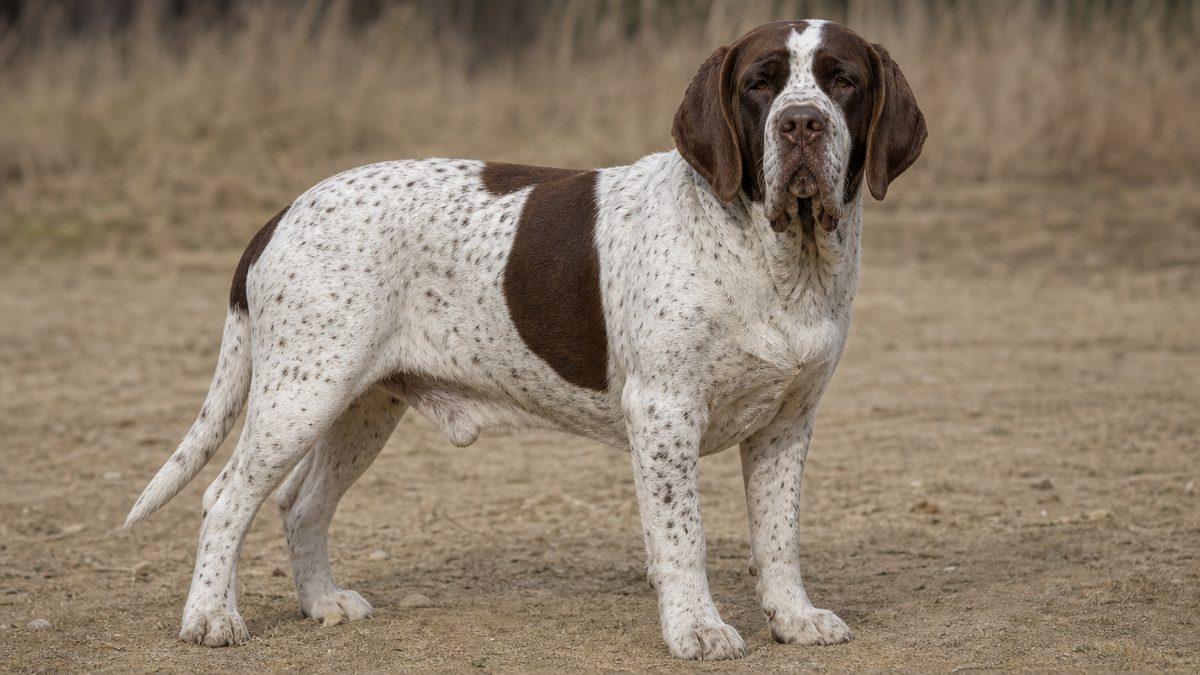
The standard makes males 54 to 60 cm at the withers with above 56 cm preferred, and bitches 50 to 56 cm with above 52 cm preferred. Males weigh 30 to 35 kg and bitches 26 to 31 kg, and the ratio of height at withers to body length is about 8 to 9. The coat is short and dense, somewhat hard to the touch, white with brown markings that run from a few large patches to many small freckles.
Bonbeno checked the English and French texts against each other for the measurement drift this project has found in other FCI standards, and there is none. Every height and weight figure matches. The French adds two words to the coat clause, *regulierement distribue*, which have no counterpart in the authentic English, and the French text names English as the authentic language on its own face with the line *Langue faisant foi : (EN)*. A negative result is worth recording, and this one is negative.
Origins and history, and where the standard hedges
The standard traces the breed to about 1710 and to one named man. Morten Bak, living at Glenstrup between the towns of Randers and Hobro, crossed gypsy dogs with local farm dogs through eight generations and fixed a piebald white and brown dog called the Bakhound. The same passage says it is *probable* that those gypsy dogs generally descended from Spanish pointing dogs, and that St Hubert Hounds contributed in several ways.
Wikipedia, which ranks fifth in India for the breed, converts that hedge into a flat statement and moves the date. It says the breed dates back to the 17th century and descends from the Spanish Pointer, sourced to a 2001 encyclopedia rather than to the standard. That is a century earlier than the standard's own account and a good deal more confident than the word probable allows. Bonbeno reports both and follows neither, because the disagreement is the finding. The ancestral type in question has its own page here, the Old Spanish Pointer, and it is not a breed.
Old Danish Pointer price in India, and why no honest figure exists
No Old Danish Pointer price in india exists, from any source Bonbeno could open, and the correct response is to publish none rather than to convert a European figure into rupees.
That is not an absence produced by a failed search. It is the finding, and it holds from three directions at once.
The purchase price nobody will quote
Wamiz ranks eighth in India for this breed and is the only page in the top ten carrying a purchase-price heading. Under that heading it prints a refusal: it does not have enough data to set an average price for an Old Danish Pointing Dog anywhere in the world. When the aggregator whose business is publishing breed prices declines to publish one, an Indian page inventing a rupee band is doing something the source material cannot support.
GoofyTails, an Indian pet-food retailer in Okhla, ranks ninth in India for this breed and carries a page under its name. It sells food and accessories rather than dogs, and the only rupee figure Bonbeno could read on that page was an empty cart subtotal of Rs 0.00. Bonbeno draws no conclusion about the page from that, because control retrievals of the same site’s Labrador Retriever and Pug pages in the same session extracted the same way, so the body copy is rendered client-side on all three. The Danish Kennel Club runs a live puppy counter on the breed's own page, and on 3 September 2026 it read nine puppies for sale, in Denmark, through Kobhund.dk. That is the whole visible market, and none of it is in India.
What an Indian search actually returns
Searching the breed name in India does not return sellers. It returns the M. Night Shyamalan film. Bonbeno captured Bing India result pages on 3 September 2026 and read the raw markup rather than the result count. The control query for Labrador Retriever prices returned 29,300 results and ten genuine Indian pricing pages, so the instrument was healthy. The breed query returned 371,000 results made up of the Uttar Pradesh pension portal, the 2021 film *Old* on Wikipedia, IMDb, YouTube and Netflix, and dictionary definitions of the word old.
Four further query forms returned the identical count and the identical result set, including a quoted phrase and a version with the country parameter dropped. The engine is collapsing the query to the single token *old*, and that token sits inside this breed's name. Searching the Danish name instead returned fifty results that were all Google Translate landing pages.
happypet.care ranks in India for pointer terms and prints a Pointer cost of buying of Rs 10,000 to Rs 50,000 with monthly expenses of Rs 3,550 to Rs 5,400. It is a house tier, not an observation. Bonbeno pulled two unrelated breeds from the same site in the same session: the German Shorthaired Pointer prints Rs 4,900 to Rs 7,650 and the Beagle Rs 2,200 to Rs 3,750, and all three rows reproduce cost tiers this project has already recorded on that site for unrelated breeds. All three also print an identical ideal weather band of 15 to 25 C and an identical Rs 50,000 ceiling on the cost of buying, with only the floor varying.
The division tests, and what they show
Rupee figures on Indian breed pages are routinely dollar prices run through one exchange rate, so Bonbeno divides before quoting. The happypet.care Pointer figures fail at 84.38, giving 118.51 and 592.56, and fail at 74, giving 135.14 and 675.68. They appear to divide at 80, giving 125 and 625, but any rupee figure ending in three zeros divides cleanly at 80 by construction, so that proves nothing. These are round rupee numbers reused as a house band across unrelated breeds, which is a different problem from conversion and needs saying differently.
The Indian care costs quoted later on this page were run through the same tests. The NexGard Spectra prices of Rs 3,308 and Rs 3,446 divide to 39.20 and 40.84 at 84.38, to 41.35 and 43.08 at 80, and to 44.70 and 46.57 at 74. None is clean, so both are genuine rupee prices.
The legal reason the market cannot form
No lawful supply chain can develop here, and that is a documentary fact rather than an inference from an empty search. DGFT Trade Notice 22/2022-23 places live dogs in the Restricted category under ITC(HS) 01061900 and states that applications to import for trading or breeding purposes shall be duly rejected, confining entry to six named ports and to three narrow purposes. DAHD added a seventh port, Cochin International Airport at Kochi, for pets arriving under the baggage rules in October 2024. A person relocating to India with a documented pet may bring their own dog. Nobody may import one to sell you. The full route is set out in how to import a dog to India.
Monthly cost of ownership in India, priced from clinic and municipal rate cards
Running a 30 kg short-haired gundog in an Indian metro costs roughly Rs 4,500 to Rs 9,000 a month once parasite control, food, grooming and a routine consultation are counted, and every component below comes from a page Bonbeno opened and re-priced on 3 September 2026.
The breed price does not exist, but the care cost does, and the care cost is the number an Indian reader can actually use. It applies to any 26 to 35 kg dog kept here, which is what this breed is.
| Item | Published price | Source and caveat |
|---|---|---|
| Puppy core vaccination, 4 visits | From Rs 6,499 | Vetic, one chain's promotional floor across ~50 clinics |
| Annual booster | From Rs 3,199 | Vetic, same caveat |
| Anti-rabies, single dose | Rs 699 | Vetic |
| Kennel cough | Rs 1,349 | Vetic |
| Tick and flea plus worming, 30-60 kg | Rs 3,446 per 3 months | NexGard Spectra at Supertails, Rs 1,148.67 a month |
| Tick and flea plus worming, 15-30 kg | Rs 3,308 per 3 months | The band a bitch of this breed sits in |
| Grooming, full bath and styling | From Rs 1,869 | Vetic Delhi |
| Bathing alone | From Rs 934 | Vetic Delhi |
| Boarding, 24 hours | Rs 899 | PawSpace Bengaluru |
| Consultation | Rs 500 to Rs 1,000 | One data point, not two, see below |
The weight band most Indian pages get wrong for this breed
A male of this breed weighs 30 to 35 kg, so he sits above the 15 to 30 kg parasite pack that Indian breed pages quote by default. He needs the 30 to 60 kg pack, which is Rs 3,446 for three tablets, or Rs 1,148.67 a month, against Rs 3,308 and Rs 1,102.67 for the lighter pack. A bitch at 26 to 31 kg straddles the boundary and has to be weighed rather than assumed. That is a small difference in rupees and a real one in dosing, because afoxolaner and milbemycin oxime are dosed by bodyweight.
The Rs 500 to Rs 1,000 consultation range is published byte-identically by a dog sanctuary and a general insurer, along with an identical Rs 1,500 to Rs 3,000 vaccination range. Two unrelated organisations agreeing exactly on two separate quantities is evidence against independence, not for it. Bonbeno counts it as one data point and says so.
The municipal costs, which are the durable ones
Registration is cheap and it is a legal requirement in most metros. Delhi's MCD charges Rs 500 for a new pet dog registration and Rs 500 to renew, with a late fee of Rs 100 a month, and its own portal counters record 18,958 certificates issued since 2021 and 71 of 1,006 applications rejected in FY 2026-27. Chennai charges Rs 50 for a pet licence, issued 9,115 licences in 2024, and runs six pet clinics that provide all treatment and anti-rabies vaccination free of cost. Microchipping at a named Chennai clinic is Rs 1,250. Boarding a dog of this size overnight in Bengaluru runs to Rs 899 for 24 hours, against Rs 799 for a ten-hour daycare and Rs 599 for four hours.
Bonbeno could not obtain a Mumbai BMC fee or a current BBMP Bengaluru fee, and says so rather than filling the gap. Retail prices move and municipal fees rarely do, which is why the municipal rows above carry more weight than the retail ones.
What the only European figure says, and why it is not converted
Wamiz gives a care cost of between 150 and 190 pounds a month for this breed. Bonbeno publishes no rupee conversion of it. A converted foreign figure is the single commonest fabrication on Indian breed pages, and a European care cost reflects European veterinary labour, European insurance and European food retail, none of which describes what a dog costs in Pune.
Heat tolerance in India, measured against the Danish homeland cell
The Old Danish Pointer's heat tolerance is poor for Indian conditions, and the size of the gap is measurable: its homeland grid cell averages 8.41 C a year against Chennai's 27.95 C, a difference of about 19.5 C.
Bonbeno queried NASA POWER by explicit latitude and longitude rather than by place name, and echoed back the elevation each cell reports, because a wrong origin climate would discredit the most original argument this page makes.
The homeland, and an honest limit on it
The standard names the breed's birthplace precisely, at Glenstrup between Randers and Hobro, so that is where the query went. The cell covering 56.60 N, 9.95 E returns an annual mean of 8.41 C, a January mean of 0.72 C, a July mean of 16.88 C and annual relative humidity of 87.43 per cent, at a reported elevation of 28.51 m against a real ground level near 40 m.
Querying Randers separately returned a byte-identical series at the same elevation. The two towns fall inside one grid cell, roughly 19 km apart, so they cannot be used to distinguish anything and Bonbeno presents them as one Danish homeland cell rather than as two agreeing measurements. Saying so is more useful than presenting the match as a finding.
| Place | Annual mean C | Hottest month mean C | Cell elevation m | Real elevation m |
|---|---|---|---|---|
| Danish homeland cell (Glenstrup/Randers) | 8.41 | 16.88 (July) | 28.51 | ~10 to 40 |
| Bengaluru | 23.74 | 28.37 (April) | 841.72 | ~920 |
| Pune | 23.86 | 28.93 (April) | 635.99 | ~560 |
| Delhi | 25.60 | 35.88 (June) | 206.37 | ~216 |
| Mumbai | 26.77 | 31.19 (May) | 97.15 | ~14 |
| Chennai | 27.95 | 31.51 (May) | 48.95 | ~7 |
Every Indian elevation echo falls inside the range this project has measured for plains cities, so no lapse-rate correction is applied and none is needed. The check matters because NASA POWER returns a grid cell rather than a point, and in hill terrain that cell can miss the town beneath it by more than a kilometre. None of these are hill stations.
What the numbers mean for a working dog
Delhi's June mean of 35.88 C is 19.0 C above the hottest month this breed's homeland experiences. Even Bengaluru, the mildest large Indian city on the list, sits 15.3 C above the Danish annual mean. The breed is short-haired, which helps a little, but it is a heat-sensitive animal built to trot for hours in single-digit temperatures, and a dog that cannot work is a dog that cannot be exercised.
Bodyweight makes it worse rather than better. Hall and colleagues, working from 905,543 UK dogs under primary veterinary care, found that bodyweight at or above the breed and sex mean carried an odds ratio of 1.30 for exertional heat-related illness. In their data 652 of the 879 events with a recorded trigger, or 74.2 per cent, were exertional rather than caused by a hot car. A 33 kg gundog asked to run in Indian afternoon heat is the exact profile that paper describes.
Second Schedule Part IV paragraph 21(1) of the Prevention of Cruelty to Animals (Dog Breeding and Marketing) Rules 2017 bars keeping in outdoor facilities, without the attending veterinary practitioner's written approval, dogs not accustomed to local temperatures and breeds that cannot tolerate them. A dog bred for an 8.41 C homeland is squarely the first category.
Humidity, and a counterintuitive number
The Danish homeland cell reads 87.43 per cent annual relative humidity, which is higher than Chennai's 72.39 per cent. Humidity by itself is therefore not novel to this breed. What is novel is humidity at 28 C rather than at 8 C, because evaporative cooling from panting is what fails when warm air is already close to saturated. Reading the two humidity figures side by side without that qualification would give exactly the wrong impression.
Tick-borne disease pressure, framed honestly
Indian tick-borne disease is a real hazard for any dog kept here, and it hits larger dogs harder. An Odisha study of 178 dogs found Ehrlichia canis in 56 of them, 31.46 per cent, with 75 per cent of the infected dogs weighing over 20 kg and 79 per cent carrying a tick history. A Kerala study of 120 dogs found Babesia in 80 of them, 66.7 per cent, peaking before the monsoon between March and May. Both sampled dogs presented at veterinary clinics rather than random populations, so those proportions describe a clinic caseload and not the risk to a well-managed pet. They still justify year-round tick control on a 30 kg dog.
Temperament and household fit, and who should not buy one
The Old Danish Pointer is a calm, steady, biddable gundog that suits an active family with land and suits almost nobody in an Indian apartment, and both halves of that come from the recognising bodies rather than from breeder marketing.
The FCI standard describes a dog conveying the impression of a quiet and stable animal showing determination and courage, which during the hunt progresses rather slowly, always maintaining contact with the hunter and accomplishing its task without creating unnecessary disturbance of the ground. The slowness is deliberate selection, not a shortage of drive.
The Danish Kennel Club puts the household side plainly. It calls the breed generally restrained and even-tempered, quiet and unobtrusive in the family, forbearing and patient with the family's children, and easy with strangers and other dogs, and it says the temperament makes a good family dog preferably for active people who like to spend a lot of time outdoors.
The one household feature the standard singles out
The standard names sexual dimorphism as a defining charm of the breed. The dog is powerful and substantial while the bitch is characterised as lighter, more spirited and capricious. That is unusual language for a breed standard and it has a practical consequence: a household choosing between a male and a female here is choosing between two noticeably different animals, not between the same animal in two sizes.
Who should not buy one, stated as five conditions
- Skip this breed if you live in a flat. Danish sources say directly that it is not suitable for apartments or small yards.
- Skip it if nobody is home. This is a dog selected for continuous contact with a working handler, and close human company is named as a welfare need rather than a preference.
- Skip it if your only free hours are the middle of the day. In Chennai or Delhi that window is unusable for a 30 kg gundog for much of the year.
- Skip it if you want a guard dog. Nothing in the standard or the club description points that way, and easy with strangers is exactly what is recorded.
- Skip it if you cannot verify a pedigree. Without a Danish studbook entry there is no way to know whether the parents were screened at all.
The positive case is narrow and real. A household with a garden, a person at home, a tolerance for a dog that needs a genuine hour or more of work a day, and hill-station or northern-winter conditions for part of the year could keep this breed well. In an Indian metro flat it would be an unkind purchase, and it is one you cannot lawfully make anyway.
Training approach, and the one thing this breed resists
To train an Old Danish Pointer, work with its pace rather than against it, because the breed was selected for slow, methodical ground work in constant contact with a handler and it resists being pushed into a fast, wide-ranging style.
The Danish Kennel Club describes the breed as attentive, willing to learn and pleased to co-operate, and says the fastest and most durable learning comes from that co-operative disposition. That is a high trainability rating earned honestly, and it comes with a specific limit.
The limit, stated as the standard states it
The standard writes the working style into the breed itself. During the hunt the dog progresses rather slowly, always maintaining contact with the hunter, and accomplishes its task without creating unnecessary disturbance of the ground. A handler who trains for a big, fast, independent quartering pattern is training against a hundred generations of selection and will get a confused dog.
The FCI marks the breed as subject to a working trial, which means a conformation title alone does not qualify a dog under FCI nomenclature. Danish breeding recommendations go the same way. To obtain a Basis+ pedigree, both parents must hold a mating permit issued by Klubben for Gamle Danske Honsehunde under the club's own breeding remit, a requirement introduced on 1 September 2017.
Realistic timelines
- Weeks 8 to 16, socialise hard and early. Take the puppy to traffic, markets, lifts and other dogs while the window is open, because a quiet, steady adult is made here.
- Months 4 to 8, build recall and contact. This breed already wants to stay near you, so reward the check-in rather than only the return.
- Months 6 to 12, introduce retrieving. Danish sources name fetching as a core need, not a trick.
- Months 12 to 18, add distance and duration. Do not add speed; the breed's job description is the opposite.
- From 12 months, screen before any breeding thought. Hips cannot be officially graded before 12 months in most breeds.
Two Indian constraints reshape all of that. The safe training window in a metro is early morning and after dark for much of the year, and a dog you cannot exercise is a dog you cannot train. Group classes are also where a young dog meets ticks, so tick control has to be in place before socialisation starts rather than after.
Daily exercise requirement, and what happens without it
An adult Old Danish Pointer needs about an hour to ninety minutes of real work a day, split across at least two outings, and in most of India that has to happen before sunrise and after dark.
The Danish Kennel Club states the requirement without hedging: the breed needs plenty of physical exercise, with the chance to move freely, to use its fine sense of smell and to retrieve, and close human contact matters to its wellbeing. Free movement, scentwork and retrieving are three separate things, and a lead walk supplies none of them properly.
Why a walk is not enough for this particular dog
This is a trotting breed rather than a galloping one, so distance substitutes for speed. A dog bred to work a field methodically for two or three hours is not satisfied by twenty minutes on a lead, and the standard's own description of a dog that quarters without disturbing the ground implies sustained, unhurried effort rather than bursts.
Under-exercised gundogs of this build become destructive and vocal indoors, which is the usual reason they are rehomed. The Danish description of a dog that is fast and active outdoors and quiet indoors is conditional on the outdoor half actually happening.
An Indian exercise schedule that works
| Season | Morning | Evening | Note |
|---|---|---|---|
| Winter, Nov to Feb | 45 to 60 min from 06:30 | 30 to 45 min after 18:00 | The only season Delhi is genuinely comfortable, at a January mean of 13.61 C |
| Pre-monsoon, Mar to May | 40 min before 06:00 | 30 min after 20:00 | Delhi's May mean is 35.05 C, so the afternoon is unusable |
| Monsoon, Jun to Sep | 45 min, weather allowing | 45 min | Dry the ears after every wet outing |
| Post-monsoon, Oct | 45 min | 45 min | Peak tick season in much of the country |
Scentwork is the honest indoor substitute in a heat wave. Hiding food and asking the dog to find it uses the trait the breed was actually built around, costs nothing, and can be done at 22:00 in an air-conditioned room. It does not replace running, and nothing indoors does.
If you cannot commit to that pattern, the breed is the wrong choice, and in India it is the wrong choice for most households on exercise grounds alone before the import question is even reached.
Grooming and coat care in Indian humidity, where the ear is the real job
Coat care for an Old Danish Pointer is genuinely light, about half an hour of brushing a week, and the demanding part of grooming this breed in India is not the coat at all but the low-set, broad, close-hanging ear.
The coat is short and dense, somewhat hard to the touch, and must cover the body entirely. Wamiz recommends half an hour of brushing a week with a slicker brush and a metal comb, and weekly ear checks for mites, fungal infection and wax build-up. A short-haired dog in a humid climate needs less brushing than a double-coated one and more skin attention.
Shedding, and the allergy claim that follows it around
The breed sheds a moderate amount and no dog is hypoallergenic. Wamiz's page says the breed moults moderately and may not excite a human allergic reaction, which is the softened version of a claim that is not supported anywhere. Vredegoor and colleagues measured Can f 1 across 196 dogs of so-called hypoallergenic breeds against 160 control dogs and found the hypoallergenic group higher, at 2.26 against 0.77 micrograms per gram on hair and 27.04 against 12.98 on coat, with no difference in airborne allergen. The FCI standard says nothing about shedding or allergy at all.
The ear, and why overseas grooming advice needs adapting here
The standard describes an ear set rather low, broad, slightly rounded at the ends, whose front edge should hang nicely close to the cheek. That is a warm, poorly ventilated ear canal, and Indian monsoon conditions are exactly where such an ear fails. Overseas breed advice is written for a climate where a damp dog dries in an hour. Here it may not.
- Dry the ear after every bath, swim and wet walk, rather than only after baths.
- Plug the ears before bathing, because water entering the canal is a commonly named cause of otitis in Indian veterinary writing.
- Check weekly through June to September for smell, discharge and head-shaking, which precede visible inflammation.
- Bathe less often than an Indian groomer will suggest. A short hard coat does not need frequent shampooing, and stripping skin oils in humidity invites trouble.
- Book a professional groom only when it earns its cost, because this coat does not need styling.
Vetic's Delhi list, re-priced on 3 September 2026, runs a full bath and styling from Rs 1,869, bathing alone from Rs 934 and a haircut from Rs 1,359. A short-coated pointer needs the bath and nothing else, so the Rs 934 line is the relevant one and the haircut line is not. Add-ons start at Rs 99.
Bonbeno found no citable Indian figure for canine otitis seasonality in the indexed literature, and says so rather than reaching for a prevalence number that cannot be sourced. Much Indian veterinary work appears in journals that are not indexed, so that is a coverage gap rather than proof the problem is small.
Health risks and lifespan, with two named mutations and no lifespan study
The Old Danish Pointer carries two documented recessive mutations of its own, one causing progressive retinal atrophy and one causing congenital myasthenic syndrome, plus hip dysplasia risk serious enough that Denmark regulates it by statute, and it has no breed-specific lifespan study at all.
This is an unusually well characterised rare breed. Most tier-three breeds on this site have no genetics literature whatever; this one has papers running from 1982 to 2018, and the causal variants for both of its signature diseases have been found.
Progressive retinal atrophy, and the exact variant
PRA has been diagnosed in the breed since the late 1990s, is late-onset and is inherited as an autosomal recessive trait. In 2018 Karlskov-Mortensen and colleagues, working from whole-genome sequencing, identified a single base insertion c.3149_3150insC in exon 1 of C17H2orf71. That is the same mutation, known as rod-cone degeneration 4 or rcd4, previously found in Gordon and Irish Setters.
The original rcd4 paper located the variant by genome-wide association on 16 Gordon Setter cases against 22 controls, found it homozygous in 19 of 21 PRA cases, and estimated an allele frequency of about 0.37 in Gordon Setters and about 0.26 in the Irish Setter Downs LM, Bell JS, Freeman J, Hartley C. Roughly 10 per cent of the cases in that study, 2 of 21, were not explained by it, so PRA in a breed is rarely one gene.
The 2018 authors screened 262 dogs from 44 breeds plus four crossbreds and added Miniature Poodle and the Polski Owczarek Podhalanski to the list of breeds carrying the same variant, and concluded that its presence across such a diverse range of breeds indicates an origin preceding the creation of modern breeds. A wider screen of 231 PRA-affected dogs across 36 breeds found that in 15 of the 21 breeds where a PRA mutation is known to segregate, cases still turned up carrying none of the known mutations.
The Danish Kennel Club will not enter a litter in the studbook unless both parents were DNA-tested for rcd4 before mating with an official status registered at DKK. Offspring of two clear parents are recorded free by reason of their ancestors' test, and offspring of a clear-by-affected mating are recorded as carriers on the same basis. One of the 2018 paper's authors is affiliated to the Danish Kennel Club itself, so the register and the research are the same programme.
Congenital myasthenic syndrome, the breed's own disease
A recessive inherited muscle disease has been known in this breed since at least 1982, when Flagstad published the first genetic investigation under the breed's Danish name, and it was characterised clinically and electrophysiologically against acquired myasthenia gravis in 1989. In 2007 Proschowsky and colleagues sequenced exons 5 to 18 of the choline acetyltransferase gene and found a G to A missense mutation in exon 6 causing a valine to methionine substitution that segregates with the disease.
The decisive detail for a buyer is that the mutation was not detected in 50 dogs representing 25 other dog breeds, so this is the breed's own variant rather than a shared one. A DNA test was developed and made available to breeders at the time.
Genetic diversity, and a warning about census size
A 2013 study genotyped five Danish breeds on the CanineHD BeadChip with 170,000 markers, using 24 Old Danish Pointing Dogs. On expected heterozygosity and degree of polymorphism the breeds ranked Danish Spitz above Danish-Swedish Farmdog above Broholmer above this breed above the Greenland Dog Pertoldi C, Kristensen TN, Loeschcke V. So the breed's genetic diversity is fourth of five, which is not comfortable.
The study's own headline is more useful than the ranking. The Greenland Dog, with a census population roughly tenfold larger than the others, had the lowest within-breed variation, which the authors say emphasises that census size is a poor predictor of genetic variation. A buyer told that a breed is safe because there are lots of them is being told something the data does not support.
Lifespan, and what is honestly not known
No breed-specific life expectancy figure exists. The AKC prints 10 to 13 years on its page and attaches no source to it. The breed is far too rare to appear as its own row in the large UK life-table work, and where a breed has no row the correct answer is to publish no median rather than to borrow a relative's. Bonbeno reports the AKC band as an unsourced trade estimate and nothing more.
Eye and jaw defects also sit in the standard's own disqualifying list. Ectropion, entropion and distichiasis all disqualify, while a slight drooping of the lower eyerim is tolerated in view of the breed's origin. A standard that tolerates a mild form of a defect it elsewhere disqualifies is a standard worth reading closely before buying an eye.
What Denmark requires before breeding, and what India requires instead
Denmark regulates this breed's hips by statute and its eyes by kennel-club rule, while India requires testing for the same conditions in principle and names no grade, no threshold and no test, and the contrast is the most useful thing an Indian reader can take from this page.
The Danish position, from the statutory list
Denmark publishes a list of breeds that must be examined before breeding under BEK nr 607 of 26 May 2025, the order on minimum animal-welfare requirements for keeping dogs. The hip-dysplasia table names 70 breeds. Gammel dansk honsehund carries an X in the hip column and no X in the elbow column, so the statutory requirement for this breed covers hips and not elbows, and it reaches crossbreds that are 50 per cent or more of a listed breed.
The law then sets thresholds rather than merely requiring a test. On the FCI five-step scale adopted at Copenhagen in 2022, A and B are free, C is mild, D moderate and E severe. A dog graded C may be bred only to a dog graded A. Dogs graded D or E may not be bred at all, and dogs graded 2 or 3 for elbows may not be bred at all.
The kennel club goes further than the law
The Danish Kennel Club's own requirement for this breed is stricter than the statutory minimum. A litter can be studbook-registered only if both parents held an official hip status of A or B before mating, with a single exception allowing an HD C dog to be used against an HD A partner. The law permits C to A; the studbook rule sets the default at A or B.
The club also calculates a hip index for this breed, one of only nineteen breeds for which DKK does so, alongside the Labrador Retriever and the German Shepherd. That is striking for a numerically tiny population, and it is meaningful, because DKK withdrew index calculation from six breeds in August 2013 precisely because fewer than the recommended 50 dogs a year were being X-rayed. This breed still clears that bar.
| Condition | Denmark | India |
|---|---|---|
| Hip dysplasia | Statutory examination; D and E barred from breeding; C only to A | Testing required in principle by Second Schedule Part III para 8(10); no grade or threshold named |
| Elbow dysplasia | Not required for this breed; grades 2 and 3 barred generally | Not mentioned in the Rules |
| Progressive retinal atrophy | DKK requires an rcd4 DNA test on both parents with a registered status | Named in para 8(10) as a defect to test for; no test, gene or method specified |
| Entropion and ectropion | Disqualifying faults in the FCI standard | Both named in para 8(10) |
| Patellar luxation | Not applicable to this breed | The word patella appears zero times in the Rules |
| Deafness | Not applicable | BAER and deaf appear zero times in the Rules |
Why the gap matters to an Indian buyer
India's Second Schedule Part III paragraph 8(10) says breeding dogs shall have been tested for genetic defects, *including* hip dysplasia, progressive retinal atrophy, night blindness, hypothyroidism, entropion, ectropion and several dentition faults. The word including makes that list illustrative rather than closed, which is a strength. What it does not do is name a grading scale, a passing threshold or a laboratory, so a breeder can satisfy the clause with a piece of paper that a Danish registrar would not accept.
For a would-be Indian owner of any pointing breed, the practical lesson transfers even though this particular dog cannot be bought here. Ask which scale a hip result is on, ask for the registering body's own record rather than a certificate, and for eyes ask which mutation was tested and by whom.
Feeding and nutrition, priced and portioned for Indian conditions
Feed an Old Danish Pointer by body condition rather than by a printed cup measure, because the single controllable risk factor in the largest heat-illness study available is bodyweight at or above the breed mean.
The breed standard gives a mature male 30 to 35 kg and a bitch 26 to 31 kg. Those are working weights on a dog with a deep, wide chest and a ratio of height to length of about 8 to 9, so a dog at the top of the range should be muscular rather than merely heavy.
Why weight is a heat question here, not a vanity question
Hall and colleagues found that bodyweight at or above the breed and sex mean carried an odds ratio of 1.30, with a confidence interval of 1.09 to 1.55, for exertional heat-related illness across 905,543 UK dogs. In a country where a gundog's usable exercise window is already narrow, carrying extra weight compounds the one risk that matters most. Ribs that can be felt without pressing is the working target.
Life-stage feeding
- Weeks 8 to 16, feed four meals a day of a large-breed puppy food and do not free-feed. Rapid growth is a named environmental risk factor for hip dysplasia alongside incorrect feeding and excessive exercise.
- Months 4 to 12, drop to three meals then two, and keep growth steady rather than fast.
- Months 12 to 18, move to adult food and re-weigh monthly. Hips cannot be officially graded before 12 months, so this is the period where feeding decisions are still shaping a joint nobody has yet assessed.
- Adult, feed twice daily and split the ration around the cooler exercise window rather than before it.
- Senior, from about eight years, reduce calories and keep protein up, and watch for the first signs of night vision loss.
A monthly kibble cost is arithmetic, not a quoted price, and the arithmetic moves with the pack. Bonbeno's own reference pack for Indian care costs recorded a large-breed food price that had already gone stale within days of being taken. At roughly 300 to 390 grams a day for a dog of this size, a 15 kg bag lasts between 38 and 50 days, and the only honest way to get a monthly number is to check today's price on the size of bag you actually buy.
Availability in India
Large-breed dry food, wet food and veterinary diets for a 30 kg dog are all readily available in Indian metros, so nothing about feeding this breed is exotic. Parasite control is the item most often skipped and the least skippable, at Rs 1,148.67 a month for the 30 to 60 kg NexGard Spectra pack that a male of this breed needs, which covers ticks and fleas together with roundworm and hookworm in one product. Given the tick-borne disease pressure documented above, that is not an optional line in the budget.
Month by month through the first year
A first year with this breed runs on three clocks at once, the socialisation window that closes at about sixteen weeks, the vaccination schedule that finishes at around day 120, and the joint-maturity clock that only lets hips be graded at twelve months.
The timeline below is written for a dog that is legally in India, which in practice means one that arrived with a relocating owner, since no other lawful route brings a puppy of this breed here.
| Age | What matters | Cost or constraint |
|---|---|---|
| 8 weeks | Sale below eight weeks is prohibited under Rule 8(1)(a) of the 2017 Rules | Non-negotiable, and a breeder who offers younger is disqualifying themselves |
| Days 75 to 120 | Core course of four visits, then vaccinate annually thereafter | From Rs 6,499 for the course at one chain |
| 8 to 16 weeks | Socialise to traffic, lifts, markets, other dogs | Free, and the highest-value hours of the whole year |
| From 8 weeks | Start monthly tick and flea cover before group classes | Rs 1,102.67 a month on the 15 to 30 kg pack |
| 3 to 4 months | Register with the municipality | Rs 500 in Delhi, Rs 50 in Chennai |
| 4 to 8 months | Recall, contact work, first retrieves | Restrict to the cool window; a June afternoon in Delhi averages 35.88 C |
| 6 months | Growth check. Steady beats fast for hips | Weigh monthly against the 26 to 35 kg adult target |
| 12 months | Earliest official hip grading in most breeds | The gate every Danish breeding decision turns on |
| 12 to 18 months | Adult food, full workload, adult coat | Ears still need weekly checks through the monsoon |
What is different about this breed's first year
Two things. First, the eye disease is late-onset, so a clear-eyed yearling proves nothing about rcd4 and only the parents' DNA status does. Second, the congenital myasthenic syndrome is not late-onset, and a puppy showing exercise intolerance or collapse after mild effort needs a veterinarian rather than a training plan.
Do not treat a heat wobble and a neuromuscular sign as the same thing. Both look like a dog that stops, and only one of them resolves in the shade.
Head to head against the pointing breeds an Indian buyer can actually get
An Indian buyer who wants this breed cannot have it, so the useful comparison is against the continental pointers that are obtainable here, and on the two axes that decide an Indian outcome, availability and heat.
The table sets the Old Danish Pointer against three breeds Bonbeno has already researched, using each breed's own recognising document for the size figures rather than an aggregator.
| Breed | FCI number | Male height | Obtainable in India | Bonbeno heat rating |
|---|---|---|---|---|
| Old Danish Pointer | 281 | 54-60 cm | No lawful route to buy | 2 of 5 |
| Burgos Pointer | 90 | 62-67 cm | No | See its page |
| German Shorthaired Pointer | 119 | 62-66 cm | Yes, widely and with KCI papers | See its page |
| Braque Francais | 133 and 134 | Two types | No | See its page |
The comparison that actually happens on an Indian search page
Searching for a rare pointer in India does not return that pointer. It returns the German Shorthaired Pointer. When Bonbeno searched for the Old Spanish Pointer with an India location, the organic results included German Shorthaired Pointer sellers on Puppiezo, Instagram and Facebook alongside pages about the Perdiguero de Burgos. That is what a buyer will actually be offered, and knowing it is worth more than a price band.
There is nothing wrong with the German Shorthaired Pointer as a substitute. It is the same FCI group and section, it is genuinely available with Kennel Club of India papers, and it is a hardy, well-documented breed with a real Indian population. What is wrong is being sold it under another name, or being told a rare Danish breed is available when no lawful import route exists for one.
Against the Old Spanish Pointer, which is not a breed at all
The two dogs share a page family and almost nothing else. This breed is a living, FCI-recognised, studbook-registered population with a mandatory hip screen and a mandatory DNA test. The Old Spanish Pointer has no studbook anywhere and never had one, and the only modern population descended from it, the Pachon Navarro, is a separate reconstructed breed with its own standard. This breed's own FCI standard names Spanish pointing dogs as a probable ancestor of its founding stock, which is the connection, and it is a hedged one.
Mistakes Indian buyers actually make with this breed
The commonest mistake with this breed in India is believing a seller who claims to have one, because there is no lawful route by which a seller could.
Six errors, in the order they cost money
- Paying a deposit for a rare imported pointer. DGFT Trade Notice 22/2022-23 states that applications to import for trading or breeding shall be duly rejected, so a commercial import of this breed cannot be lawfully completed.
- Accepting a substitute under the right name. Indian pointer searches surface German Shorthaired Pointer sellers, and a liver-and-white shorthaired dog can be presented as almost any continental pointer.
- Trusting a rupee price found online. The only Indian cost figures Bonbeno found for pointer terms were a house tier reused across unrelated breeds on the same website.
- Reading a European care cost as an Indian one. Wamiz quotes 150 to 190 pounds a month; converting that into rupees produces a number that describes nothing in India.
- Assuming a rare breed is a hardy breed. This one ranks fourth of five Danish breeds on genetic diversity, carries two known recessive mutations, and is regulated by Danish statute for its hips.
- Exercising a 30 kg gundog at the wrong hour. Delhi's June mean is 35.88 C, and exertional heat illness accounted for 652 of 879 triggered events in the largest study available.
Two mistakes that come from the ranking pages themselves
Wikipedia's article, ranking fifth in India, states flatly that the breed dates to the 17th century and descends from the Spanish Pointer, where the FCI standard says about 1710 and says only that Spanish ancestry is *probable* FCI-Standard N 281. The article has carried a needs-more-citations banner since December 2017, and its own infobox link labelled as the Danish Kennel Club standard resolves to the Broholmer's page instead of this breed's.
The second is a translation. The AKC glosses Gammel Dansk Honsehund as Old Danish Chicken Dog, while Wikipedia argues that honsehund names a dog for gallinaceous game birds and that the chicken rendering is incorrect or at best badly translated. The FCI's own document settles it in Wikipedia's favour without taking sides, because it gives the English name as Old Danish Pointing Dog and the utilization as a versatile gundog for birds.
Do not read an empty Indian search as proof of rarity or a busy one as proof of supply. Searching this breed's name on Bing India returns 371,000 results, and they are about a horror film. The count is not evidence of anything, and the same 371,000 came back for three different queries.
Adoption and responsible sourcing, and what to do instead
Nobody in India can adopt an Old Danish Pointer, because none is here, so the honest advice is to adopt the dog that is in front of you and to reserve the pointer-specific checklist below for the breeds you can actually get.
India's shelters and street-dog rescues hold thousands of medium-sized, short-haired, heat-adapted dogs that will do everything a family needs and several things a Danish gundog cannot do in this climate. That is not a consolation line. A dog bred for an 8.41 C homeland is genuinely a worse fit for Chennai than an Indian pariah-type dog, on the evidence set out above.
If you are relocating to India with one
This is the one lawful route, and it runs on different law from the commercial one. Personal pet import runs under the Livestock Importation Act 1898 rather than under the DGFT notice, and the dog must accompany its owner with a valid pet book in the importer's name. Before you move, do three things.
- Carry the Danish studbook record itself, not a breeder's certificate. It shows the hip grades and the rcd4 status that DKK actually registered.
- Get the hip grade translated into the FCI A to E scale in writing, because an Indian veterinarian will not necessarily recognise a Danish form.
- Plan the arrival month. Landing a cold-climate gundog in a Delhi May is a bad first fortnight, and an October arrival gives it a winter to acclimatise.
If you are buying a pointing breed that is available here
The verification checklist transfers even though the breed does not. Ask for the registering body's own record rather than a certificate the breeder printed. Ask which grading scale a hip result is on and what the grade was, since India's own Rules name hip dysplasia as a defect to test for but set no threshold. Ask which eye mutation was tested and by which laboratory. Ask to see the dam. Refuse any puppy under eight weeks, which Rule 8(1)(a) prohibits outright.
Chennai's six corporation pet clinics provide all treatment and anti-rabies vaccination free of cost, and the city's pet licence is Rs 50. Delhi's registration is Rs 500 and its portal has issued 18,958 certificates since 2021. Whatever dog you end up with, register it and vaccinate it; both are cheap, both are legal requirements in most metros, and rabies vaccination is the single highest-value veterinary spend in the country.
Bonbeno does not recommend breeders, link puppy listings or quote a live price as an offer. Where a breed has no Indian market, the most useful thing a directory can do is say so plainly and point the reader at the dog they can actually help.
Common questions
What is the Old Danish Pointer price in India?
No Old Danish Pointer price in India exists, and Bonbeno publishes none rather than convert a foreign figure. No Indian breeder, register or classified listing holds the breed. Wamiz, the only ranking page with a purchase-price heading, states that it has too little data to set an average price anywhere.
Is the Old Danish Pointer recognised by the FCI?
Yes. The Old Danish Pointer is FCI breed 281, recognised on a definitive basis, in Group 7 Pointing Dogs, Section 1.1 Continental Pointing Dogs of the Braque type, and it is subject to a working trial. The FCI's own record gives the date of acceptance as 2 April 1969.
Is the Old Danish Pointer kept in the Danish Kennel Club's X-register?
No. The X-register is the appendix that FCI clubs keep for dogs outside the main register, chiefly breeds the FCI has not definitively approved or breeds recognised only nationally. This breed is definitively FCI-recognised, so its pedigrees sit in the ordinary main register and can be used for FCI-recognised breeding.
Can you legally import an Old Danish Pointer into India?
Not to buy or breed from. DGFT Trade Notice 22/2022-23 makes live dogs a Restricted import and states that applications for trading or breeding purposes shall be duly rejected. The only realistic route is a genuine relocation, where the dog accompanies its owner with a valid pet book in the importer's name.
Can the Old Danish Pointer handle Indian heat?
Poorly, and the numbers say so. Its homeland grid cell averages 8.41 C a year with a July mean of 16.88 C, while Chennai averages 27.95 C and Delhi reaches a June mean of 35.88 C. That is a gap of about 19.5 C on the annual mean for a working dog bred to run.
What health tests does the Old Danish Pointer need?
Two, and Denmark makes both binding. Danish law requires a hip examination before breeding, and not an elbow one. The Danish Kennel Club goes further, refusing to studbook a litter unless both parents hold hip status A or B and both have been DNA-tested for the rcd4 form of progressive retinal atrophy.
Does the Old Danish Pointer descend from the Spanish Pointer?
The FCI standard hedges and Wikipedia does not. The standard says only that it is probable the gypsy dogs used around 1710 descended from Spanish pointing dogs. Wikipedia states flatly that the breed dates to the 17th century and descends from the Spanish Pointer, which is a century earlier and a good deal more certain.
Does Gammel Dansk Honsehund mean Old Danish Chicken Dog?
The AKC says yes and Wikipedia says that rendering is wrong, and the FCI's own document supports Wikipedia. Honsehund names a dog for gallinaceous game birds rather than for poultry, and the FCI gives the breed's English name as Old Danish Pointing Dog and its use as a versatile gundog for birds.
Is the Old Danish Pointer hypoallergenic?
No, and no dog is. Vredegoor and colleagues measured Can f 1 across 196 dogs of so-called hypoallergenic breeds against 160 controls and found the hypoallergenic group higher, not lower. The FCI standard says nothing about shedding or allergy, and the breed sheds a moderate amount.
What is the lifespan of a Pointer dog?
No breed-specific lifespan study exists. The AKC prints 10 to 13 years on its breed page and attaches no source to it, and the breed is far too rare to appear in the large UK life-table studies. Bonbeno reports the AKC figure as an unsourced trade estimate rather than as evidence.
Is the Old Danish Pointer a rare breed?
Yes, and the 2018 mutation paper puts it plainly: seventy years ago the breed almost vanished, and today a population still exists primarily in Denmark with some dogs in Germany and Sweden. A 2013 study genotyped only 24 of them on a 170,000-marker chip.
Would tail docking an Old Danish Pointer be legal in India?
No, and unusually the breed standard agrees with Indian law. FCI Standard 281 states that docking is not allowed, and the Prevention of Cruelty to Animals (Dog Breeding and Marketing) Rules 2017, Second Schedule Part II paragraph 6(8), forbids tail docking outright as a change of appearance by artificial means.
Which Pointer is the calmest?
On its own documents, the Old Danish Pointer is bred to be the slow, quiet one. FCI Standard 281 describes a dog conveying the impression of a quiet and stable animal that during the hunt progresses rather slowly, always keeping contact with the hunter, and the Danish Kennel Club calls it generally restrained and even-tempered, quiet and unobtrusive in the family, patient with children and easy with strangers and other dogs. That calm is conditional: an under-exercised gundog of this build becomes destructive and vocal indoors.
Compare with similar breeds
Old Danish Pointer sits in 2 Bonbeno groups. Each one compares it directly against the breeds it is genuinely an alternative to, on the same figures.