
Breed profile
Greenland Dog (Qimmeq): The Inuit Sled Dog of Kalaallit Nunaat
The Qimmeq, one of the world's oldest working dog lineages, an unresolved argument about whether it is the same breed as the Canadian Eskimo Dog, and a genome that cannot digest an Indian rice-based diet.
Quick answer
The Greenland Dog, called the Qimmeq in Greenlandic, is an Arctic sledge breed held under FCI Standard 274 with Greenland as its country of origin. Males stand 60 cm and upwards. Whether it is the same breed as the Canadian Eskimo Dog is genuinely unresolved, no verified Indian price exists, and its genome lacks the starch adaptations that let other dogs live on an Indian rice-based diet.
This page summarises published veterinary and genomic research and registry data for general information. It is not a diagnosis and it is not treatment advice. Consult a registered veterinarian about your own dog before acting on anything here, and treat collapse, a rectal temperature at or above 41 degrees Celsius, or laboured breathing in a heavy double-coated northern dog in Indian heat as an emergency.
Greenland Dog at a glance
What the Greenland Dog is, from its own breed standard
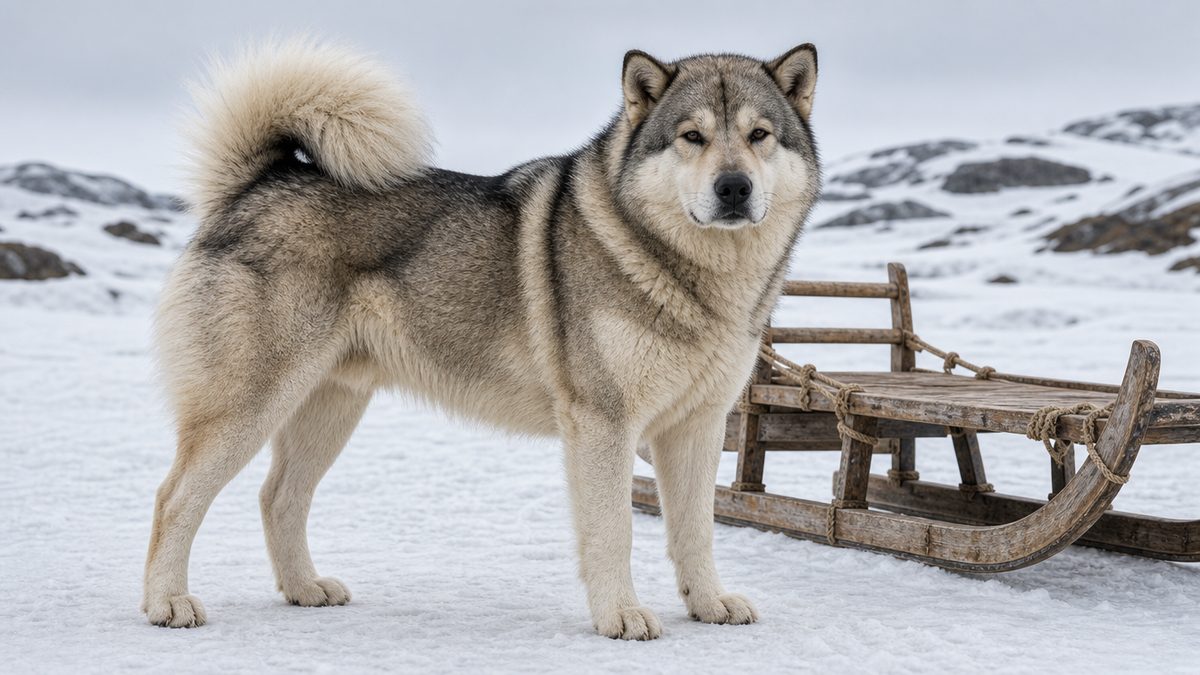
The Greenland Dog is a very strong polar spitz built for endurance and strenuous work as a sledge dog under arctic conditions, held under FCI Standard 274. Males stand 60 cm and upwards at the withers and females 55 cm and upwards, with no upper limit given, and the standard prints no weight at all under a heading that reads SIZE AND WEIGHT.
Start with the title of the document, because the 2022 standard changed it. The current FCI-Standard No 274, published 6 September 2022 in English against an official valid standard dated 30 March 2022, is headed GRONLANDSHUND / QIMMEQ QIMUTTOQ (Greenland Dog). Qimmeq is the Greenlandic word for dog and qimuttoq marks it as the sledge dog, so the FCI now carries the Greenlandic name inside the breed's own title alongside the Danish one. Not one page ranking in India for this breed mentions that.
The registry facts are short and checkable. FCI Group 5, Spitz and primitive types, Section 1, Nordic Sledge Dogs. Country of origin GREENLAND, country of patronage DENMARK. Official authentic language English, which is unusual and means the English text is the original rather than a translation. Accepted on a definitive basis 5 May 1967. And, distinctively, subject to a working trial.
What the standard actually specifies
| Point | What the standard says |
|---|---|
| Height at withers, males | 60 cm and upwards |
| Height at withers, females | 55 cm and upwards |
| Weight | None printed, under a heading that reads SIZE AND WEIGHT |
| Body proportion | Short rectangular, height at withers to body length 10 to 11; females allowed a slightly longer body |
| Coat | Double coat: soft dense undercoat and an outer coat of dense, straight, coarse hair without curl or wave |
| Colour | Any colour, solid or parti-coloured, except albinos and merle-marked dogs, which are disqualified |
| Ears | Rather small, triangular with rounded tips, carried firmly erect, very mobile and expressive |
| Tail | Set on high, thick and bushy, carried in a curve or lightly curled over the back |
| Utilisation | Sledge dog |
| Temperament | Energy, mental strength and boldness; friendly to strangers; not suitable as a guard dog |
Three of those rows do work no ranking page does. The height figures are open-ended, so a Greenland Dog can be any size above the minimum provided working ability and harmony are not affected, which the standard says explicitly. The weight row is an absence, not an omission Bonbeno failed to find: the heading promises a weight and the document prints none. And the colour clause is permissive rather than restrictive, allowing anything except albinism and merle, which means the black-and-white husky image most Indian pages use is one option among many rather than the breed's appearance.
Compare that with what the ranking pages print. One gives height as 22 to 25 inches, or 56 to 64 cm, and weight as 66 to 70 pounds, or 30 to 32 kg. Neither figure appears in the standard. The 56 cm floor is below the standard's 60 cm minimum for males, the 64 cm ceiling exists nowhere, and a 2 kg weight range is impossible for a breed whose own standard says 'some variation in size is allowed'. Bonbeno prints no weight for this breed, because its standard prints none and no study Bonbeno opened supplies one.
What it was built to do
The standard's own description is a job description rather than a look. 'A very strong polar spitz, built for endurance and strenuous work as a sledge dog under arctic conditions.' On temperament: 'The predominant temperamental qualities of the Greenland Dog are energy, mental strength and boldness. He is a passionate and tireless sledge dog. To people, also strangers, he is friendly, and while acting as sledge dog not closely attached to any particular person and therefore not suitable as a guard dog. On hunting seal and polar bear he will show a strong hunting instinct'.
Read that last clause carefully before buying one for security. A breed whose own standard says it is friendly to strangers, unattached to any particular person and unsuitable as a guard dog is close to the opposite of what an Indian buyer usually wants from a large imposing dog. The Royal Kennel Club records the same practical shape in its own words, listing the breed as Country rather than town, needing a large house, a large garden and more than two hours of exercise a day.
One historical note, kept where it belongs. Roald Amundsen used Greenland dogs on the expedition that first reached the South Pole, and the party started with more dogs than the sledges needed and killed them along the way as food for the dogs and the men. That is the working relationship this breed comes from, and it is worth knowing before treating it as a companion animal with an unusual coat.
Qimmeq, Qimmit, Kalaallit Qimmiat: what to call this dog and why it matters
Qimmeq is the Greenlandic word for the dog and Qimmit is the plural, and since 2022 the FCI standard has carried Qimmeq Qimuttoq in the breed's own title alongside the Danish Gronlandshund. The English name Greenland Dog is a trade name, and getting the Greenlandic right is not decoration, because the words tell you what the animal was for.
Take the registry title first, because it is the checkable part. FCI-Standard No 274 is headed 'GRONLANDSHUND / QIMMEQ QIMUTTOQ (Greenland Dog)';. Qimmeq is the Greenlandic, Kalaallisut, word for a dog. Qimmit is its plural, and the 2025 Science paper uses exactly that pairing in its own title and abstract, writing of 'Greenland's Qimmit' and of 'the Qimmeq (Greenland sled dog)';. Qimuttoq marks the sledge dog specifically. The fuller collective form, Kalaallit Qimmiat, means the Greenlanders' dogs.
| Body | Name it uses | What that name records |
|---|---|---|
| Federation Cynologique Internationale | GRONLANDSHUND / QIMMEQ QIMUTTOQ | Standard 274, valid from 30 March 2022, English authentic |
| The Royal Kennel Club | Greenland Dog | Working group, not a vulnerable native breed |
| Orthopedic Foundation for Animals | GREENLAND DOG | Breed code GLD, separate from CE and ED |
| Royal Canin India | Greenland Dog | Prints Country: Denmark, which is the patronage rather than the origin |
| Greenland National Museum | Greenlandic sled dog, Qimmeq | Distinguished from 'European dogs', Qallunaat qimmii |
| Science, 2025 | Qimmeq, plural Qimmit | Listed beside the Canadian Inuit dog as a separate Arctic breed |
| English Wikipedia | Kalaallit Qimmiat (Qimmeq) | Also Gronlandshund, Grunlandshund, Esquimaux Dog |
The 2022 addition is the news, and it is checkable. The FCI title now carries the Greenlandic name, on a standard whose authentic language is English and whose closing line reads 'The latest amendments are in bold characters'. A registry adding an indigenous name to a breed's own title is a small act with a long history behind it, and Bonbeno records it rather than passing over it.
Qallunaat qimmii, and what the category is for
Greenland has a second term that no breed page uses and that explains the whole legal system around this dog. The Greenland National Museum records that dogs not classified as Greenlandic sled dogs are referred to in Greenland as 'European dogs', Qallunaat qimmii. That is not a slur and it is not casual. It is the operative category in a two-zone country: above the Arctic Circle from Sisimiut northward and throughout East Greenland only Greenlandic sled dogs are generally permitted, while from Maniitsoq to Narsarmiit in the southwest all breeds are allowed.
So the Greenlandic vocabulary distinguishes a working animal inside a protected district from every other dog in the world, and the law follows the vocabulary. An English breed page that gives only 'Greenland Dog' cannot express that distinction at all.
The older English names, and how to handle them
The breed appears in nineteenth-century British records as the Esquimaux Dog, and an Esquimaux bitch was exhibited at an early Darlington show on 29 July 1875. Wikipedia also carries a claim that the Kennel Club recognised the breed at its foundation in 1880, and flags that claim itself as needing a better source, which Bonbeno repeats rather than laundering into a fact.
Bonbeno's practice on this page follows what it does on the Canadian Eskimo Dog page. Where a registry document is being quoted, the registry's own name is used, because that is what the document says and because a reader has to be able to find it. Everywhere else the page uses Greenland Dog and Qimmeq. The older term is reproduced only inside quotations from historical records, and the plural forms are used correctly: one Qimmeq, several Qimmit.
Qimmeq is singular, Qimmit is plural, Qimmeq Qimuttoq is the sledge dog specifically, and Kalaallit Qimmiat means the Greenlanders' dogs. In Canada the Inuktitut cognates are qimmiq and qimmiit, which is why the two look so similar and why a page that mixes them without noticing is already halfway to the identity confusion the next section is about.
One more naming trap sits in the literature rather than in the marketing. McMillan and colleagues' 2024 breed reference table lists this breed as the Greenland Sledge Dog, with Greenland Dog as the alternative name and GREN as the phylogeny code, and separately maps the American Eskimo Dog onto 'Canadian Eskimo Dog' as its phylogeny reclassification. The American Eskimo Dog is a German-descended companion spitz with no Arctic working history at all. Name-based matching produced that conflation inside a peer-reviewed supplementary table, which is the clearest possible warning against matching Arctic breeds by their English names.
Is the Greenland Dog the same breed as the Canadian Eskimo Dog?
The honest answer is that this is unresolved, and both confident versions are wrong. One peer-reviewed genetic study says the two should not be distinguished as separate breeds. Every registry that holds them keeps them apart, with different numbers, different origin countries and different working-trial status.
The case that they are one breed
Brown and colleagues, publishing in Heredity in 2015, used autosomal microsatellites, Y-chromosome markers and mitochondrial DNA on North American Arctic dogs. Their stated conclusions are that Inuit dogs 'have maintained their indigenous nature', that they 'likely derive from Thule dogs', and, in terms: 'we provide support for previous research that the Inuit dogs from Canada and Greenland dog should not be distinguished as two breeds';. The same work found the dogs distinct from Siberian Huskies, Alaskan Huskies and Malamutes, and reported that the maternal sequences fell into a single haplotype, A31, not found in other modern dogs.
That is a real finding from a real study, and it is the single strongest piece of evidence on the question. It is also the sentence every downstream page repeats. English Wikipedia states flatly that 'the Canadian Eskimo Dog is considered the same breed as the Greenland Dog since they have not yet diverged enough genetically to be considered separate breeds, despite their geographic isolation';.
The case that they are two, and only one point is bureaucratic
- The FCI holds two definitive breeds, not one. Standard 274, Gronlandshund, country of origin Greenland, patronage Denmark, definitive since 5 May 1967, subject to a working trial. Standard 211, Canadian Eskimo Dog, country of origin Canada, definitive since 25 June 1959, not subject to a working trial. Same group, same section, eight years apart, different obligations Federation Cynologique Internationale.
- The 2015 study's resolution is bounded by its markers. Microsatellites, mitochondrial DNA and Y-chromosome haplotypes are powerful for lineage and weak for recent population structure, which matters for the next point.
- Whole-genome work found structure inside Greenland alone. Feuerborn and colleagues sequenced 92 modern and ancient genomes in 2025 and found 'distinct regional populations' matching Tunu in the east, Kitaa in the west and Avanersuaq in the north, plus a now-extinct precontact northeast population, with genome-wide fixation index values of 0.184, 0.195 and 0.202 between the northeast dogs and their neighbours.
- The 2025 paper's own list names them separately. It describes the Arctic breeds as 'the Siberian husky, Alaskan malamute, Samoyed, Canadian Inuit dog, and Qimmeq (also known as the Greenland sled dog)', which is five entries, not four.
Point three is the interesting one, and it is not a refutation. A low-resolution marker set found no difference between two countries; a high-resolution genome study found measurable differentiation between three regions of one country. Both results can be true, because they are not the same measurement. What follows is narrower and worth stating carefully: the 2015 conclusion cannot now be repeated as though whole genomes had confirmed it, because the only whole-genome study of Greenland's dogs found more structure than the earlier markers could see, not less.
What Bonbeno concludes on the identity question, including where it corrects itself
Bonbeno publishes the dispute rather than resolving it, and corrects one of its own pages in the process. What can be said without hedging is that the two populations share a Thule origin, are far closer to each other than either is to a Siberian Husky, and are held apart by every registry that holds either.
| Position | Source | Evidence type | What it establishes |
|---|---|---|---|
| Should not be distinguished as two breeds | Brown et al, Heredity, 2015 | Autosomal microsatellites, mtDNA, Y-chromosome | No detectable differentiation between Canadian and Greenlandic Inuit dogs on those markers |
| Two separate definitive breeds | FCI nomenclature, current | Registry decision | Different numbers, origin countries, acceptance dates and working-trial status |
| Listed as separate Arctic breeds | Feuerborn et al, Science, 2025 | 92 whole genomes | Distinct regional populations within Greenland; Qimmeq named apart from the Canadian Inuit dog |
| Two separate breed codes, plus a third | Orthopedic Foundation for Animals | Registry filing | GLD for Greenland Dog, CE for Canadian Eskimo Dog, ED for a third entry named Eskimo Dog |
The registry column of that table was read from raw markup rather than from a structured extraction, because a guessed or extracted breed code returns another breed's data with no error at all. OFA's own filter list prints data-name="GREENLAND DOG" against value="GLD", data-name="CANADIAN ESKIMO DOG" against value="CE" and a separate data-name="ESKIMO DOG" against value="ED", with the control entry for Labrador Retriever reading LR exactly as it should.
A fifth registry deserves its own line, because it is the one that would notice first if the two breeds merged in practice. The Canadian Kennel Club maintains a Greenland Dog category alongside its Canadian Eskimo Dog category, and publishes a stud book volume for it every year. The 2024 volume prints 'FOREIGN DOGS REGISTERED (no registrations)', 'LITTERS REGISTERED (no registrations)' and 'CANADIAN BORN DOGS REGISTERED (no registrations)', and the 2023 volume says the same The Canadian Kennel Club, Stud Book. A registry that thought the two were one breed would not keep an empty second file open for it in the country where the other one lives.
Where this page disagrees with Bonbeno's own sibling page
Bonbeno's page on the Canadian Eskimo Dog states that 'the genetics say' the Greenland Dog 'is the same dog under another name', citing Brown 2015. This page disagrees with that phrasing and says so openly. The 2015 paper is one study on one marker set, and the whole-genome work published since finds enough structure inside Greenland alone that a flat statement of sameness across two countries carries more confidence than the evidence supports. Bonbeno would rather correct itself in public than have two of its own pages quietly assert different things.
The sibling page is right about the direction and too strong about the certainty, which is a distinction worth preserving. Nothing in the 2025 work contradicts a shared Thule origin. What it does is make 'the same breed' a harder claim to make casually.
Why a genetics paper and a kennel club can both be right
Whether a Canadian dog and a Greenlandic dog are the same breed is a question about what a breed is, not only a question about DNA. A breed is a managed population with a studbook, a standard and a boundary. Greenland's boundary is a legal district that bars imported dogs; Canada's is a registry. Two populations can be genetically indistinguishable on a given marker set and still be separately managed, separately bred and separately obligated, which is exactly what the FCI's differing working-trial status records.
The reverse also holds and is the part most pages miss. Feuerborn and colleagues found the precontact northeast Greenland dogs so differentiated from their own neighbours that the fixation index against precontact Kitaa dogs reached 0.184, which the authors describe as 'a high level of differentiation through discontinued gene flow between the populations and drift over time';. Those were all Greenland Dogs. If differentiation inside one country can reach that level, an argument built on the absence of differentiation between two countries needs to say which markers it was using.
If somebody offers you a Greenland Dog in India, the identity question decides what paperwork should exist. An FCI pedigree under standard 274 names Greenland as the country of origin; a pedigree under standard 211 names Canada. There is no single document covering both, so a seller who says the two are the same breed and produces papers for the other one is not describing a technicality.
One footnote on how the confusion spreads. McMillan and colleagues' 2024 supplementary breed table maps the American Eskimo Dog onto 'Canadian Eskimo Dog' as its phylogeny reclassification. The American Eskimo Dog is a German-descended companion spitz. If a name-based match can put those two together inside a peer-reviewed supplement, the same mechanism will merge a Greenland Dog and a Canadian Eskimo Dog anywhere the names are treated as data.
History and origins, as the genome records them
The history and origins of this breed are better documented in DNA than in any studbook, because two whole-genome studies were done on Greenland dogs specifically rather than on Arctic dogs in general. Together they establish an unbroken working lineage of at least 9,500 years, isolation in Greenland since a bottleneck about 850 years ago, and a diet adaptation that decides how this dog should be fed anywhere in the world.
Sinding and colleagues sequenced ten modern Greenland sled dog genomes in 2020, alongside a dog mandible from Zhokhov Island in the Siberian Arctic dated to 9,524 calibrated years before present. Their description of the breed is more precise than any breed page: 'a dog best described as an indigenous landrace breed, used for hunting and sledging by Inuit'.
| Finding | Study | Detail |
|---|---|---|
| Continuity for at least 9,500 years | Sinding 2020 | Zhokhov dog most similar to modern sled dogs, setting a lower bound on the sled dog lineage |
| Least admixed of the sled dogs | Sinding 2020 | Greenland sled dogs kept largely isolated from other breeds; non-Greenland sled dogs carry non-sled-dog ancestry |
| Isolation since about 850 years ago | Sinding 2020 | A severe bottleneck matching Inuit colonisation of Greenland, stable population size before it |
| No starch adaptation | Sinding 2020 | Substantially fewer AMY2B copies than other breeds and the ancestral wolf-type MGAM haplotype |
| Fat-handling haplotypes | Sinding 2020 | Unique SLC25A40 and APOO haplotypes, absent in Zhokhov, so post-dating the common ancestor |
| Cold-adaptation candidates | Sinding 2020 | TRPC4 and TRPV2 thermosensors differentiated, paralleling selection in cold-adapted woolly mammoths |
| Distinct regional populations | Feuerborn 2025 | Tunu, Kitaa and Avanersuaq plus an extinct precontact northeast population, mirroring Greenlandic dialects |
| Two migrations into Greenland | Feuerborn 2025 | Evidence for two movements of dogs into Greenland with the Inuit from Canada |
| Minimal European ancestry today | Feuerborn 2025 | Limited recent inbreeding despite low heterozygosity; runs of homozygosity within the range of modern breeds |
The regional populations, and what they are named after
Feuerborn and colleagues found that the Qimmit's population structure mirrors the human one. Studies of Greenlandic Inuit show genetic differentiation between Tunu in the east, Kitaa in the west and Avanersuaq in the north, corresponding to the three Greenlandic dialects Kalaallisut, Tunumiit oraasiat and Inuktun, and the dogs conform to clades matching the same regions. The authors call this 'the mirrored population structure observed in the Qimmit and the Kalaallit', and read it as evidence of shared human and dog movements and shared geographical isolation.
One of those populations is gone. The precontact northeast dogs were a homogeneous population whose closest genetic relatives are the other precontact northeast individuals, and after the Inuit disappeared from northeast Greenland a permanent settlement, Ittoqqortoormiit, was established in 1925 and populated by Inuit and Qimmit brought from Tasiilaq in Tunu. The dogs of northeast Greenland today are not descended from the dogs that were there before.
The wolf question, where oral history and genomics disagree
This is the most interesting unresolved point on the page after the identity question, and Bonbeno publishes the disagreement rather than choosing. Thule Inuit oral traditions, continuing to the present day, describe deliberate hybridisation of the Qimmeq with wolves to strengthen the dog population, accomplished by tethering a female dog in estrus outside camp to attract a wolf. Sinding and colleagues likewise note that ethnographic evidence from Greenland indicates dog-wolf matings were not uncommon historically.
The genomics find the opposite for recent history. Sinding's group found no significant gene flow between any sled dog and modern American-Arctic wolf populations, and wrote that if the ethnographic account is true, the absence implies selection against hybrids. Feuerborn's group reached the same place in 2025: greater allele sharing between wolves and Arctic dogs than between wolves and European or African dogs, but 'no signal was detected for recent hybridization between the Qimmeq and wolves in the current dataset';, with the shared alleles reflecting ancient introgression before the lineage reached North America.
Both accounts can hold. Hybrid matings can have happened and the hybrids can have failed to enter the breeding population, which is what the 2025 paper suggests when it records that Qimmeq-wolf hybrids bond to a single owner, show aggression toward humans outside their family and kill dogs from outside their team. A dog that kills its teammates does not last in a working team long enough to leave descendants, which is a selection mechanism rather than a contradiction.
Of everything in the genomics, the one that changes daily practice is the diet result. Sled dogs carry fewer AMY2B copies than other breeds and the wolf-type MGAM haplotype, so they lack the starch adaptations that let an ordinary dog live on rice. The feeding section below sets out what that means in an Indian kitchen.
Population decline: from 25,000 to 13,000 in eighteen years
The number of Qimmit in Greenland dropped from about 25,000 in 2002 to about 13,000 in 2020, a fall of roughly 48 percent, and outside Greenland the breed barely exists at all. Germany registered 61 puppies across the whole of the fifteen years from 2011 to 2025, and the Greenland Dog has no row anywhere in the Orthopedic Foundation for Animals published statistics.
Take the Greenland figure from the paper rather than from the press. Feuerborn and colleagues write that the Qimmit 'now face drastic population declines caused by climate change, urbanization, and competition from snowmobiles', and that 'the number of Qimmit in Greenland dropped from ~25,000 in 2002 to ~13,000 in 2020';. The Greenland National Museum's own account of the Qimmeq Project 2016 to 2022 gives the same shape from a different angle, reporting 'an approximate 50 percent decline in the dog population over two decades';.
A third source disagrees on the intermediate numbers, and Bonbeno prints the disagreement rather than averaging it. English Wikipedia gives about 15,000 in Greenland as of 2016 and 12,000 as of 2021. Set against the paper's 13,000 in 2020, the 2021 figure of 12,000 is consistent, but the 2016 figure of 15,000 implies a steeper fall in the mid-2010s than a straight line between 25,000 and 13,000 would give. Nobody publishing these numbers shows the annual series, so treat the endpoints as sound and the middle as unresolved.
Outside Greenland, the numbers collapse to almost nothing
| Year | Groenlandhund | Canadian Eskimo Dog | Siberian Husky | All breeds |
|---|---|---|---|---|
| 2025 | 0 | 0 | 184 | 55,053 |
| 2024 | 4 | 0 | 271 | 56,851 |
| 2023 | 0 | 0 | 234 | 60,306 |
| 2022 | 12 | 7 | 357 | 69,381 |
| 2021 | 5 | 1 | 438 | 85,595 |
| 2018 | 14 | 0 | 327 | 75,038 |
| 2013 | 8 | 0 | 341 | 77,061 |
| 2011 | 0 | 0 | 278 | 80,719 |
| 2011 to 2025 total | 61 | 8 | - | - |
Sixty-one puppies in fifteen years, in the largest pedigree-registering country in continental Europe, with zeros in 2011, 2012, 2014, 2019, 2023 and 2025. In 2025 alone Germany registered 184 Siberian Huskies and zero Greenland Dogs. That is the practical meaning of rarity: not that the breed is expensive, but that in most years, in most countries, none are born.
Canada tells the same story from a registry that keeps the breed on its books. The Canadian Kennel Club publishes a per-breed stud book every year, and its Greenland Dog volume for 2024 is a single page carrying three lines: 'FOREIGN DOGS REGISTERED (no registrations)', 'LITTERS REGISTERED (no registrations)' and 'CANADIAN BORN DOGS REGISTERED (no registrations)';. The 2023 volume says the same thing in two lines. Two consecutive years, a maintained breed category, and nothing in it.
No screening data exists, and Bonbeno proved that rather than assuming it
Bonbeno pulled the Orthopedic Foundation for Animals disease-statistics tables in full on 31 August 2026, roughly 2.2 million characters covering about 5,373 rows across every breed and every disease. The string GREENLAND appears zero times in the entire dump. Before reporting that as a finding, Bonbeno ran controls in the same retrieval: LABRADOR RETRIEVER appears on 109 rows and CANADIAN ESKIMO DOG on 13, including an eye summary of 70 evaluations at 92.9 percent normal. A control that returns data is what turns an empty result into evidence rather than a broken query.
The absence is also explicable rather than mysterious. OFA requires a minimum number of evaluations before it publishes a breed row, so a breed with a code but no published row has been screened too rarely to appear. The Greenland Dog does hold a code, GLD, read from OFA's own markup. So the correct wording is that this breed has no row in OFA's published statistics tables, not that it is absent from the OFA database, and Bonbeno states it that way deliberately.
The same absence shows up in the longevity literature. McMillan and colleagues' 2024 breed table flags the Greenland Sledge Dog N for inclusion in the survival analysis, with the table's own header explaining that the flag reflects presence in the data, while the Labrador Retriever control reads Y. There is therefore no median lifespan, no confidence interval and no hazard ratio for this breed in the largest UK dataset.
No OFA statistics row, no entry in the largest longevity dataset, and 61 German puppies in fifteen years. None of those is a failure of research and none is a reason to substitute another breed's numbers. It is what a working landrace kept inside a closed Arctic district looks like from the outside, and saying so is more useful to a reader than a borrowed figure would be.
One rarity claim Bonbeno refuses to make
Rarity findings are easy to fake with a search engine, and this page will not use one. The Bing India results page for this breed returned a plausible-looking result set that contained no dogs at all, and two control queries in the same session failed the same way with different substitutions.
Here is what happened, in the order it happened. Bonbeno requested the Bing results page for 'greenland dog price in india' with the country set to India on 31 August 2026. It returned HTTP 200 with the correct page title, and then served ten organic results that were all United States renters-insurance pages: U.S. News, Forbes Advisor, TopConsumerReviews, NerdWallet twice, ValuePenguin, The Zebra, SafeButler, ConsumersAdvocate and GoCompare. Not one concerned a dog.
Nothing about that page looks broken. The title is right, the status code is right, the layout is right, and an agent or a reader skimming for a result count would have taken away the impression that almost nothing exists about this breed in India. That impression would have been a fabrication with a number attached.
The controls, and what they proved
So Bonbeno ran two control queries through the identical path minutes later. 'Labrador retriever price in india' came back with ten Microsoft corporate pages against 'About 159,000 results', from microsoft.com and the Microsoft account sign-in through to signup.live.com. 'Greater swiss mountain dog price in india' came back with ten Amazon corporate pages, from Amazon.com and Seller Central through to Amazon Kindle and Amazon Web Services.
| Query | HTTP status | Reported results | What the ten organic results actually were |
|---|---|---|---|
| greenland dog price in india | 200 | not shown | US renters-insurance comparison sites |
| labrador retriever price in india (control) | 200 | About 159,000 | Microsoft corporate pages |
| greater swiss mountain dog price in india (control) | 200 | About 84 | Amazon corporate pages |
A control that fails identically is what turns a suspicious result into a proven one. The Labrador Retriever is one of the most searched breeds in India and cannot plausibly return zero dog pages, so a control returning Microsoft's corporate site proves the result sets were being substituted rather than that any breed was absent. Three queries produced three unrelated brand families, which rules out coincidence.
The consequence for this page is a rule rather than a finding. No claim about this breed's rarity, absence or Indian availability on this page rests on a search engine. Every one of them rests on a document: a German registry's fifteen-year table, a Canadian registry's stud book volumes, an American screening database with its own controls, a British registry's breed record, a peer-reviewed population figure, and an Indian marketplace's own 404 page tested against its own working page for a different breed The Canadian Kennel Club, Stud Book Orthopedic Foundation for Animals Mr n Mrs Pet, request for a Greenland Dog… Mr n Mrs Pet, Greater Swiss Mountain Dog….
Because an answer engine reading only the target query would have found no dog pages and could reasonably have reported that nothing exists about this breed in India. The control is the cheapest thing that separates a real absence from a broken search, it costs one extra query, and publishing it lets a reader check Bonbeno's reasoning rather than trusting it.
Greenland Dog price in India, and why every figure on the first page fails a check
No Greenland Dog price in india exists, because no Greenland Dog is offered for sale in India. The two pages carrying prices at the top of the Indian results for this query are the same document published under two brands, and India's largest pet marketplace returns a 404 for the breed while carrying a page for other rare Western breeds.
Say the finding first and then show the checks. On 31 August 2026 Bonbeno pulled the Indian results page for this query and opened the commercial results. Not one showed a Greenland Dog offered in India at a stated rupee price. What ranked instead was a United States puppy marketplace, a United Kingdom pet classifieds site, a global breed directory, Wikipedia, and Royal Canin's Indian brand site.
| Source | What it publishes | What the check found |
|---|---|---|
| US puppy marketplace, position 1 | A dollar price band and six named puppies | The same document as the position-4 page, and none of the named puppies is presented as this breed's own litter |
| Global breed directory, position 2 | USD 1,200 to 2,000; weight 30 to 32 kg | Neither the weight nor the height range appears in the FCI standard |
| Wikipedia, position 3 | No price | The only ranking page that does not invent one |
| UK classifieds, position 4 | A pound price band | Identical headings, identical description, identical image asset and identical verification token to position 1 |
| Royal Canin India, position 5 | No price; 'Country: Denmark' | Says its facts come from the FCI, then prints the country of patronage as the country |
The duplicate-page check, and how to run it yourself
This is the most useful thing on this section, because it generalises to any breed. The page ranked first and the page ranked fourth are not two sources. They share, item for item: the same H1, the same H2 set from 'Pros' and 'Cons' through 'Buying a Greenland Dog puppy: advice', the same Open Graph description word for word, the same image asset served from the same eu-central-1.graphassets.com content delivery network path with the same asset identifier, and the same ahrefs-site-verification token, `b1d03cfda1dd6789056136a64c7003472006b204b3d5413887d30fb5b49c3dba`.
A site-verification token is a string a service issues to prove control of a property. Two different brands publishing the same token are the same operator. So when an Indian reader sees a US site and a UK site agreeing on what a Greenland Dog costs, they are reading one page twice with the currency symbol swapped. The check takes thirty seconds: view the page source of any two apparently independent breed pages and compare the verification meta tags and the image host.
The US page also inserts six named animals into the Greenland Dog page under the headings 'Greenland Dog Puppies' and 'Related Ads': Chloe, Euro Sampson, Euro Stetson, Euro Sterling, Oreo and Buddy. Bonbeno makes no claim about what breed those animals are, because the page does not say on its face. What it does say is that a reader arriving from an Indian search for a price will see puppies beside a price band and connect the two.
The Indian marketplace test
India's most visible pet marketplace has no Greenland Dog page at all. Requesting one redirects to a page reading 'Sorry, this page isn't available', and the site's own breed selector runs Great Pyrenees, Greater Swiss Mountain Dog, Greyhound, with nothing between the second and third. Bonbeno ran the within-site control before drawing a conclusion: the same marketplace does serve a Greater Swiss Mountain Dog page, another rare Western breed with no verified Indian population, so it generates listing pages for rare breeds when they are in its selector. The Greenland Dog's 404 is therefore an absence in the breed list, not a fetch failure.
No verified Indian sale price for this breed exists. There is no Indian listing, no seller-stated rupee figure, and no marketplace page. The only lawful route to owning one is a personal pet import in the importer's own name, which carries airfare, quarantine and paperwork costs rather than a shop price. Treat any rupee figure quoted for this breed as unevidenced until the seller produces the DGFT import authorisation and an FCI pedigree naming Greenland as the country of origin.
That is the answer rather than a gap in the research, and two documents explain why no Indian market can form. Greenland's own Act No 18 of 1998 defines sled dog districts in which only Greenlandic sled dogs may be kept and prohibits importing other breeds into them, which keeps the population closed at source. India's DGFT Trade Notice 22/2022-23 bars importing dogs for breeding or any other commercial activity and states that applications for trading or breeding purposes shall be duly rejected. Between a closed district at one end and a Restricted import classification at the other, there is no lawful supply chain to price.
Cost of ownership for a Greenland Dog in India, built from first principles
No Indian source publishes a monthly cost of ownership for this breed, so Bonbeno builds one from the requirements the registries and the genomics actually establish rather than borrowing another breed's figure. The three lines that dominate are a fat-forward diet, year-round cooling, and the fact that no rupee purchase price exists to anchor the rest.
Start by naming what is missing. Bonbeno found no Indian page publishing monthly expenses for the Greenland Dog, no Indian food-cost figure and no Indian veterinary figure. That is different from the Greater Swiss Mountain Dog, where at least one Indian site publishes a band Bonbeno could test. Where a figure does not exist, Bonbeno does not manufacture one, and the honest output here is a structure rather than a number.
| Line | What drives it | Source of the requirement |
|---|---|---|
| Diet | A fat-forward, starch-poor diet rather than commodity rice-based kibble | Fewer AMY2B copies and the wolf-type MGAM haplotype |
| Cooling | Air conditioning through most of the Indian year for a dense double-coated Arctic dog | FCI standard coat requirement plus a 31.33 C annual-mean gap to Chennai |
| Exercise provision | More than two hours a day, in a large garden, in the country | The Royal Kennel Club's own breed record |
| Containment | Secure fencing for a breed with a strong hunting instinct and no attachment to one person | The FCI standard's own temperament clause |
| Veterinary | Hip screening and genetic-diversity management; no breed-specific DNA panel exists | Royal Kennel Club good-practice and best-practice tiers |
| Purchase | Unpriceable. No Indian listing, no lawful breeding import | DGFT Policy Condition 8 and Greenland's sled dog district law |
The exercise line is the one Indian buyers underestimate, and the Royal Kennel Club states it without softening: more than two hours per day, size of home a large house, town or country Country, size of garden large. In an Indian metro that is not a scheduling problem, it is a climate problem, because most of those two hours have to fall in the few cool hours the day offers.
The diet line, which no Indian cost guide would ever include
This is where a borrowed cost figure would mislead badly. Sled dogs carry substantially fewer AMY2B copies than other dog breeds and the ancestral wolf-type MGAM haplotype, and the authors conclude that they 'do not carry the genetic adaptations to starch rich diets seen in other dog breeds' while carrying unique haplotypes at SLC25A40 and APOO involved in coping with high fat intake. A cheap Indian kibble is cereal-forward by construction, so the food line for this breed is not the food line for a Labrador of the same weight, and any cost estimate that assumes otherwise is estimating the wrong diet.
The cooling line, quantified
Bonbeno's climate figures put Ilulissat's annual mean at minus 3.38 degrees Celsius against Chennai's 27.95 and Kolkata's 25.81. A dog whose standard requires a soft dense undercoat under a dense coarse outer coat, with no thinner variant permitted, is carrying that insulation through an Indian summer. The practical consequence is an electricity line rather than a pet line: one room held near 24 degrees for eight to ten months of the year, plus the standby cost of keeping it running through a power cut.
The line nobody can budget for
Veterinary access for this breed is thin even in Greenland. The Greenland National Museum records that 'a significant challenge to sled dog health is the absence of practising veterinarians' in the sled dog district, which is why the Qimmeq Health project runs temporary clinics in Ilulissat, Sisimiut, Uummannaq, Upernavik and Tasiilaq. In India the problem inverts: veterinary access in a metro is good, but no Indian veterinarian has seen this breed, and there is no OFA statistics row, no published breed-specific disease profile and no DNA panel to guide them The Royal Kennel Club.
Take a Siberian Husky's published Indian monthly cost as the floor, because it is the nearest breed with a real Indian market. Then add the difference between cereal-forward and fat-forward food at your own retailer, add your summer electricity increment for one cooled room across eight months, and hold a contingency for a condition nobody can name in advance because no breed-specific data exists. If that total is uncomfortable, the answer this page has been giving throughout applies here too.
Can a Greenland Dog live in the Indian climate
Ilulissat, in the heart of Greenland's sled dog district, averages minus 3.38 degrees Celsius across the year. Chennai averages 27.95. That is a gap of 31.33 degrees, the largest on any Bonbeno breed page, and it is why the heat tolerance rating for this breed is 1 of 5.
Bonbeno builds the origin figures from satellite climatology queried by explicit latitude and longitude, because climate sites routinely serve the wrong place at HTTP 200. Every query below echoed back the coordinates and grid elevation it served, and those are printed so a reader can confirm the place. Wet-bulb temperature is computed from each month's mean air temperature and mean relative humidity using the empirical expression published by Stull in 2011; a monthly mean smooths the afternoon peak, so real afternoon readings run higher than the table.
| Place | Grid elevation | Annual mean air temp | Annual mean humidity | Annual mean wet-bulb | Warmer than Ilulissat by |
|---|---|---|---|---|---|
| Qaanaaq, Greenland | 296 m | -10.94 C | 84.4 % | -11.98 C | 7.56 C colder |
| Sisimiut, Greenland | 169 m | -3.98 C | 88.9 % | -4.93 C | 0.60 C colder |
| Ilulissat, Greenland | 84 m | -3.38 C | 78.8 % | -4.99 C | the baseline |
| Tasiilaq, Greenland | 89 m | -0.98 C | 79.8 % | -2.62 C | 2.40 C |
| Leh, India | 4,533 m | -2.75 C | 52.2 % | -5.78 C | 0.63 C |
| Gangtok, India | 3,240 m | 7.45 C | 73.8 % | 4.92 C | 10.83 C |
| Tawang, India | 3,175 m | 7.49 C | 79.0 % | 5.43 C | 10.87 C |
| Darjeeling, India | 1,314 m | 18.42 C | 67.1 % | 14.45 C | 21.80 C |
| Bengaluru | 842 m | 23.74 C | 67.9 % | 19.48 C | 27.12 C |
| Kolkata | 7 m | 25.81 C | 73.9 % | 22.25 C | 29.19 C |
| Mumbai | 97 m | 26.77 C | 67.4 % | 22.20 C | 30.15 C |
| Chennai | 49 m | 27.95 C | 72.4 % | 24.04 C | 31.33 C |
One Indian location in the sample comes within a degree of Greenland, and it is Leh. The POWER grid cell for Leh returned an annual mean of minus 2.75 degrees against Ilulissat's minus 3.38, a difference of 0.63 degrees, and a wet-bulb of minus 5.78 against Ilulissat's minus 4.99, which makes Leh's air marginally drier and easier to shed heat into than Ilulissat's. That is a genuinely surprising result and it deserves the caveat that goes with it.
Read the elevation column before believing the Leh row
NASA POWER works on a grid, and a grid cell in the Himalaya averages a valley floor with the ridges above it. The cell that returned Leh's figures sits at a grid elevation of 4,533 metres, well above the town itself, which sits nearer 3,500. So the Leh row describes the high country around Ladakh rather than the bazaar in Leh, and the real town is warmer than the number. Bonbeno prints the elevation rather than hiding it, because a reader who does not see it will draw the wrong conclusion twice: too optimistically here, and too pessimistically for Shimla, whose grid cell came back at 898 metres, far below the town.
The Gangtok and Tawang rows carry the same caveat in the opposite direction, at grid elevations above 3,100 metres. Even taking them at face value, both are about 10.8 degrees warmer than Ilulissat on the annual mean, which puts them a long way outside this breed's range even though they are the coolest populated Indian places Bonbeno sampled.
Why the coat cannot adapt
The FCI standard requires a double coat, described as 'a soft, dense undercoat and an outer coat of dense, straight and coarse hair, without curl or wave', shorter on the head and legs and longer on the body. There is no permitted thin variant, no short-coated version and no summer exception. And the genomics point the same way: Sinding and colleagues found the thermosensor genes TRPC4 and TRPV2 among the most differentiated regions in sled dogs, in the same calcium-transport pathway reported under selection in cold-adapted woolly mammoths, which they read as convergent Arctic adaptation.
A genome selected for cold does not run in reverse over one summer. The evidence on what heat does to a heavy dog is specific: dogs at or above their breed and sex mean bodyweight carried 1.42 times the odds of heat-related illness in a cohort of 905,543 UK dogs, dogs over 50 kg carried 3.42 times the odds of dogs under 10 kg, and the event fatality rate across the cohort was 14.18 percent. Neither Hall paper modelled this breed individually, so Bonbeno claims only the transferable weight-band finding and attaches no breed-specific odds ratio to the Qimmeq.
The only plausible Indian analogue is Ladakh, and here is why
Ladakh is the one place in India whose annual climate resembles Greenland's sled dog district, and the resemblance survives a month-by-month check rather than only an annual average. Everywhere else in India the question is not whether the dog can live there but how many hours a day it can leave a cooled room.
Compare the warmest month rather than the annual mean, because the warmest month is what kills. Ilulissat's warmest month is July, at a mean of 8.53 degrees Celsius and a wet-bulb of 5.97. That is the upper edge of what this breed evolved to work in, and it is cooler than the coldest month in most of India.
| Place | Warmest month | Mean air temp | Mean humidity | Wet-bulb | Above Ilulissat's worst month |
|---|---|---|---|---|---|
| Ilulissat, Greenland | July | 8.53 C | 74.1 % | 5.97 C | the baseline |
| Sisimiut, Greenland | July | 6.75 C | 86.9 % | 5.43 C | 0.54 C cooler |
| Tasiilaq, Greenland | August | 4.97 C | 83.4 % | 3.39 C | 2.58 C cooler |
| Leh grid cell, India | July | 10.18 C | 46.8 % | 4.96 C | 1.01 C cooler |
| Tawang grid cell | July | 13.67 C | 86.7 % | 12.18 C | 6.21 C |
| Gangtok grid cell | July | 13.60 C | 89.1 % | 12.36 C | 6.39 C |
| Darjeeling grid cell | July | 22.46 C | 89.5 % | 21.12 C | 15.15 C |
| Bengaluru | May | 26.97 C | 63.8 % | 21.86 C | 15.89 C |
| Mumbai | June | 28.66 C | 79.5 % | 25.77 C | 19.80 C |
| Chennai | May | 31.51 C | 64.5 % | 26.11 C | 20.14 C |
| New Delhi | July | 32.27 C | 62.7 % | 26.50 C | 20.53 C |
| Kolkata | June | 29.90 C | 80.4 % | 27.09 C | 21.12 C |
Leh's hottest month has a lower wet-bulb than Ilulissat's, at 4.96 against 5.97, because Ladakh in July is warmer in air temperature and far drier at 46.8 percent humidity against 74.1. For a panting dog, which cools by evaporation, dry heat at 10 degrees is easier than damp cold at 8. That is the single most useful climate finding on this page and no ranking page contains anything like it.
Kolkata sits 21.12 degrees of wet-bulb above the worst month this breed's homeland asks it to work through. Delhi is 20.53 above, Chennai 20.14, Mumbai 19.80. Those are not differences of degree. Even Bengaluru, the Indian city with the best climate reputation, runs 15.89 degrees of wet-bulb above Ilulissat's July.
What each place actually means for the dog's day
- Ladakh, above about 3,000 metres. The only Indian region whose annual mean and warmest-month wet-bulb both sit inside the breed's own range. Winter is comfortably colder than Greenland. The practical objections become veterinary access, altitude on a newly arrived dog, and the fact that the grid cell reads cooler than the town.
- High Sikkim and high Arunachal. About 6.2 to 6.4 degrees of wet-bulb above Ilulissat's July. Workable in winter with real management, not workable in the monsoon, where humidity above 86 percent removes the dog's main cooling route.
- Darjeeling, Shimla, Nainital, Ooty. These read as hill stations to a buyer and as lowlands to a satellite grid. Judge them on the town's own weather station rather than on Bonbeno's grid rows, and treat the Darjeeling figure as an upper bound on temperature rather than a description.
- Every Indian metro. The annual mean already exceeds this breed's warmest month by 27 to 31 degrees. Assume a cooled indoor life, exercise before dawn and after dark, and no unsupervised balcony, terrace or car time in any month of the year.
That is the honest resolution, and it is more useful than a flat statement that the breed cannot live in India. It can, in Ladakh, and almost nowhere else. But note what the same map does to the exercise requirement: the Royal Kennel Club puts this breed at more than two hours a day in a large garden in the country, and Ladakh is precisely where a dog can do that, while every place with the veterinary infrastructure to support it is 20 degrees too warm.
Indian law already names this category of dog
One Indian rule speaks directly to breeds like this one, and almost nobody quotes it. Second Schedule Part IV paragraph 21(1) of the Prevention of Cruelty to Animals (Dog Breeding and Marketing) Rules, 2017 bars keeping in outdoor facilities, unless the attending veterinary practitioner approves it in writing, three categories of dog: dogs not accustomed to the temperatures prevalent in the area, 'dog breeds that cannot tolerate the temperatures prevalent in the area or region in question, such as long-haired breeds in high temperature locations';, and sick, infirm, aged or young animals.
Read the scope before repeating it. Those paragraphs bind breeding establishments registered under the Rules, not private owners, so a family keeping one Qimmeq in a Chennai flat is not governed by paragraph 21. What it establishes is that Indian animal-welfare law already recognises the category this breed falls into, in its own words, and sets a written veterinary sign-off as the threshold for keeping such a dog outdoors. A private owner has neither the requirement nor the safety net.
Greenland's sled dog district law, and what it is protecting
Greenland keeps this breed inside a legal boundary. Above the Arctic Circle from Sisimiut northward, and throughout East Greenland, only Greenlandic sled dogs may generally be kept, and importing other breeds into those districts is prohibited. The rule is genetic rather than sentimental, and it is the reason this breed still exists in a recognisable form.
The current instrument is Landstingslov nr. 18 af 30. oktober 1998 om slaedehunde samt hunde- og kattehold, the Act on sled dogs and the keeping of dogs and cats, in force since 1 January 1999. It regulates the keeping of dogs and cats with a stated focus on protecting the Greenland sled dog breed, defines specific sled dog districts in which only Greenlandic sled dogs may be kept, and prohibits the import of other dog breeds into them. It also sets rules on housing, treatment, feeding and euthanasia, prohibits mutilation and abandonment, and requires permits for kennels.
The Act has been amended three times, and the amendments trace what the district has had to worry about.
| Amending Act | Date | What it changed |
|---|---|---|
| Act No 28 | 18 November 2010 | Definition of the sled dog districts, compensation-free euthanasia of loose dogs, prohibition of tooth clipping |
| Act No 23 | 22 November 2011 | Introduced a ban on fighting dogs and muscular dogs |
| Act No 24 | 28 November 2016 | Mandatory vaccination, marking and registration of dogs |
The geography is precise. The Greenland National Museum sets out two zones: above the Arctic Circle from Sisimiut northward and including all of East Greenland, generally only Greenlandic sled dogs are permitted; from Maniitsoq to Narsarmiit in the southwest, all breeds other than Greenlandic sled dogs are allowed. Wikipedia adds the detail that police and assistance dogs may enter the protected zone on a special permit, and that since 2017 every dog in Greenland must be microchipped and registered in a national database.
This is older than the 1998 Act
Legislation governing the sled dog districts dates back to 1907, outlining rules for transporting dogs into and out of these areas and specifying permissions for service dogs of other breeds to live there. So Greenland has been legislating to keep this population closed for well over a century, which is unusual enough that it explains the genomic result: Sinding and colleagues found Greenland sled dogs to be the least admixed of all sled dogs, kept largely isolated from contact with other breeds.
The museum also records why the southwest is different, and it is not a policy failure. Before colonisation sled dogs were used throughout Greenland, but with colonisation after 1721 they were gradually replaced by other breeds in the southwest, because their instinctive behaviour to attack livestock made them unsuitable for the new economic and housing conditions. The zone boundary follows a real change in how people lived, not an arbitrary line on a map.
The category the law works with
Greenlandic has a word for everything the law is keeping out. Dogs not classified as Greenlandic sled dogs are called European dogs, Qallunaat qimmii. That single term does the work that a whole paragraph of English regulation would need: it names the category, marks the boundary, and makes the rule intelligible to anyone in the district.
Because it is the upstream half of the answer to the price question. India's DGFT notice bars importing dogs for breeding or commercial activity at the Indian end. Greenland's Act No 18 keeps the breeding population inside a closed district at the Greenlandic end. Two independent legal systems, neither aware of the other, close both ends of a supply chain that consequently does not exist.
What Canada did instead, and why it is on this page
The contrast is worth one paragraph because it explains why the Canadian population is so much smaller than Greenland's. The Greenland National Museum records that in Canada the colonial administration's culling of up to 20,000 dogs from the 1950s onwards had a devastating impact on Inuit communities, that this was an assault on Canadian Inuit culture denounced by the Qikiqtani Truth Commission, and that it led to an official apology from the Canadian government in 2019. Canada is now exploring the possibility of bringing sled dogs from Greenland to help revive the tradition.
That last sentence is the strongest single argument that the identity question matters. If Canada restocks from Greenland, the two registry populations converge in fact whatever the studbooks say, and a genetic study run in twenty years will find something different from what Brown and colleagues found in 2015. Bonbeno records it here rather than in the identity section because it is a policy development rather than a finding.
Indian law and the Greenland Dog: import, housing and what nobody requires
Three Indian legal facts decide this breed's position in India. Dogs are a Restricted import and cannot be brought in to breed or sell. Indian welfare rules explicitly name heat-intolerant breeds when restricting outdoor housing at breeding establishments. And there is no Indian requirement for a patella grade or a hearing test on any breed, whatever a seller tells you.
The import position
Dogs enter India under ITC (HS) 01061900 as a Restricted item. Policy Condition (7) allows import of dogs only as a pet dog with a valid pet book and relevant records in the name of the importer, by research organisations with a recommendation from the Committee for the Purpose of Control and Supervision of Experiments on Animals, or for internal security by the Defence and Police Force. Policy Condition (8) states that import of commercial dogs for breeding or any other commercial activity other than those purposes is not permitted.
The procedural detail is what a buyer can actually check. Applications for trading or breeding purposes, or made on behalf of another person or entity, 'shall be duly rejected'. Import is allowed only through the airports and seaports of Delhi, Mumbai, Chennai, Hyderabad, Bengaluru and Kolkata and, since October 2024, Kochi airport. Up to two pets may enter as passenger baggage without a DGFT import authorisation only for a person transferring residence to India after two years of continuous stay abroad, and an advance No Objection Certificate must be obtained from the Animal Quarantine and Certification Station regional officer seven days before travel. The full route is set out in how to import a dog to India.
Ask for the DGFT import authorisation number or the transfer-of-residence baggage entry. Ask which of the seven permitted ports the dog entered through. Ask for an FCI pedigree under standard 274 naming Greenland as the country of origin. A genuine imported dog has all three. Anything else is a claim without a document.
The housing rule that names this category of dog
Second Schedule Part IV paragraph 21(1) of the Prevention of Cruelty to Animals (Dog Breeding and Marketing) Rules, 2017 provides that three categories shall not be kept in outdoor facilities unless the attending veterinary practitioner approves it in writing: dogs not accustomed to the temperatures prevalent in the area or region, 'dog breeds that cannot tolerate the temperatures prevalent in the area or region in question, such as long-haired breeds in high temperature locations';, and sick, infirm, aged or young animals.
Two neighbouring paragraphs complete the picture. Paragraph 15 requires that the temperature within indoor housing facilities be 'ambient and comfortable, depending on the breeds of dogs that are housed', and paragraph 16 permits ventilation by windows, doors, vents or air conditioning. Indian welfare law therefore already contemplates that some breeds need mechanical cooling, in its own words, and sets a written veterinary sign-off as the threshold.
State the scope precisely, because it is easy to overclaim. These Rules bind breeders and breeding establishments registered under them, not private pet owners. A family keeping one Qimmeq in a Chennai flat is not governed by paragraph 21. Its value to a buyer is as a standard for judging anyone who breeds or houses dogs commercially, and as evidence that the category 'breed that cannot tolerate local temperatures' is a recognised legal one in India rather than a Bonbeno opinion.
Genetic testing: what the Rules do and do not require
Second Schedule Part III paragraph 8(10) requires that breeding dogs 'shall have been tested for genetic defects, including hip dysplasia, progressive retinal atrophy, night blindness, hypothyroidism, entropion, ectropion, overshot, undershot jaw (when incisors do not touch or mesh), wry mouth, two or more missing teeth, unilateral cryptorchid or full cryptorchid males'. The word is 'including', so the list is illustrative rather than closed, and hip dysplasia on it lines up exactly with the one disease screen the Royal Kennel Club puts in its best-practice tier for this breed.
Now the absences, counted across the full fourteen-page gazette text.
| Term | Occurrences in the Rules |
|---|---|
| patella | 0 |
| BAER | 0 |
| deaf | 0 |
| dental or tooth | 0 |
| teeth | 1, inside paragraph 8(10) |
There is no Indian legal requirement for a patella grade and none for a hearing test, on this breed or any other. Bonbeno states that because 'legally required health testing' is a common sales phrase in India and it describes paragraph 8(10) and nothing wider. Rule 8(1)(a), a genuine Rule rather than a Schedule paragraph, additionally provides that every breeder shall ensure 'pups less than eight weeks in age are not sold';.
One clause does not bite here, and saying so is part of citing accurately. Second Schedule Part II paragraph 6(8) forbids tail docking, ear cropping, de-barking, de-clawing and 'any change of appearance by artificial means';. The FCI standard for the Greenland Dog contains no docking, cropping or dewclaw instruction at all, so unlike several European breeds this one presents no conflict between its standard and Indian law. That is worth recording precisely because it is the sort of clash Bonbeno usually finds.
Temperament, household fit and who should not consider one
The FCI standard describes energy, mental strength and boldness, a passionate and tireless sledge dog that is friendly even to strangers, not closely attached to any particular person, and therefore not suitable as a guard dog. Read that last clause twice, because it inverts what most Indian buyers want from a large imposing dog.
The standard's temperament clause is unusually blunt and worth quoting whole: 'The predominant temperamental qualities of the Greenland Dog are energy, mental strength and boldness. He is a passionate and tireless sledge dog. To people, also strangers, he is friendly, and while acting as sledge dog not closely attached to any particular person and therefore not suitable as a guard dog. On hunting seal and polar bear he will show a strong hunting instinct'. The severe faults list includes a timid temperament, and aggressive or overly shy dogs are disqualified outright.
Three things follow from that paragraph that no Indian breed page draws out.
- It is not a one-person dog. A team animal that works for whoever is driving does not form the exclusive bond an Indian family often expects from a large breed. It will be friendly to your neighbours, your watchman and the courier.
- It is not a guard dog and its own standard says so. Anyone buying a big northern dog for security has misread the breed at the level of the registry document.
- The hunting instinct is toward large prey. A breed selected to hold a polar bear at bay is not a breed to trust off-lead near livestock, street dogs or cats, and a global directory records the same point in its own words, that the breed has 'a strong instinct for hunting polar bear and seal' and is 'not suitable as a guard dog'.
Pack behaviour, which is the part that surprises people
This is a working team dog, and its pack behaviour is the operating system rather than a quirk. The 2025 Science paper records, in the context of wolf hybrids, that dogs of this type are reported to form strong bonds within their own team and to kill dogs from outside it. Bonbeno notes carefully that the paper attributes that description to hybrids specifically, not to the breed as a whole, and does not extend it. What the standard does say generally is that this is a sledge dog whose relationships are organised around the team it works with.
For an Indian household the practical translation is about other dogs rather than about people. A dog with strong in-group and out-group behaviour, in a country where free-roaming street dogs are present on most residential roads, is a management problem every single walk. That is not a temperament flaw. It is a mismatch between what the breed is for and where you are standing.
Good with children, and what the rating means
One directory rates the breed 4 of 5 for child friendliness and 4 of 5 for both cat friendliness and dog friendliness, describing it as suitable for kids and very friendly toward strangers. Bonbeno reports that rating rather than contradicting it, and adds the two qualifications the rating cannot carry. First, the same page marks trainability, shedding and barking as Unknown, which tells you how thin the underlying evidence for any of its ratings is. Second, a friendly, bold, powerful, independent dog of 60 cm and upwards is a physical presence around a small child regardless of intent.
Apartment living, honestly assessed
The same directory rates the breed 2 of 5 for apartment friendliness and says plainly that it 'is not good for apartment life. It needs space, room to run and a job to do. This breed can live outdoors. It can withstand cold temperatures and does not like excessive heat';. The Royal Kennel Club agrees from a different direction, recording size of home as a large house, town or country as Country, and size of garden as large.
Both are right and both understate the Indian version of the problem. In India the constraint is not floor area, it is that the space this dog needs is outdoor space, and outdoor space is exactly what a dog rated 1 of 5 for heat tolerance cannot use for most of the year. A large Indian garden in May is not a resource for this breed. It is a hazard.
Anyone in an Indian metro without full-time cooling. Anyone wanting a guard dog. Anyone who cannot commit more than two hours a day to exercise. Anyone whose walking route passes free-roaming dogs daily. And anyone buying on the strength of a price found online, since no verified Indian price exists and the two pages carrying one are the same document.
Intelligence and trainability: what this breed will and will not do
Train a Greenland Dog for cooperation rather than obedience, because it was bred to make decisions on ice rather than to wait for instructions. The most-cited directory rates its intelligence and trainability as Unknown, which is honest, and the FCI standard tells you more about how it thinks than any star rating does.
Start with the honest gap. The global directory that ranks highest for this breed in India marks trainability at 0 stars, labelled 'Unknown';, along with barking tendencies and shedding level, and gives no intelligence ranking. Bonbeno reports that rather than filling the vacuum, because a fabricated trainability score for a breed with almost no pet population would be exactly the kind of invention this site exists to correct.
What the primary documents do establish is the shape of the mind. The standard describes energy, mental strength and boldness in a dog 'not closely attached to any particular person';. The Qikiqtani and Greenlandic record of what these dogs actually did, preserved by the museum that studies them, is of animals that found seal breathing holes under snow, avoided ice cracks in fog and darkness, and led drivers home in blizzards. None of that is obedience. All of it is independent judgment under load.
What works
- Give the job first and the cue second. A dog selected to pull will pull, and a training plan that treats pulling as a fault is fighting the breed's entire history. Teach a harness cue and a lead cue as separate contexts rather than trying to extinguish the behaviour.
- Socialise deliberately and early, because a friendly dog that has never met an Indian street, a scooter horn or a free-roaming dog pack is still an unprepared dog. Short sessions, ending while the puppy is comfortable, all before sixteen weeks.
- Train for recall you can actually rely on, and then do not rely on it. A breed with a documented strong hunting instinct toward large prey does not get off-lead freedom in an unfenced Indian space, however good the recall looks in a garden.
- Condition handling and restraint early. Muzzle work, standing for a thermometer and tolerating a stranger's hands matter more here than in a common breed, because your vet has never seen one and will be working without a reference.
What this breed resists
Repetition without a purpose, first. A dog bred to work a whole day at a steady pace does not drill a sit forty times for the sake of it. Confinement and boredom, second: the same directory that rates apartment life at 2 of 5 notes that the breed 'needs space, room to run and a job to do';. And heat, third, which in India is not a training issue but a hard constraint on when training can happen at all.
There is one more thing worth naming because it belongs to this breed rather than to dogs in general. The FCI classifies it as subject to a working trial, which the Canadian Eskimo Dog's own entry does not. That is a registry statement that working capacity is part of what the breed is assessed on, not an optional extra, and it sits oddly beside any plan to keep one as an urban companion.
A realistic first-year training schedule for India
| Age | Target | Why the deadline |
|---|---|---|
| 8 to 16 weeks | Name, crate, house training, handling of ears, feet and coat | The socialisation window closes at sixteen weeks and Indian heat may confine it to dawn |
| 4 to 6 months | Lead manners in both harness and collar contexts, settle on a mat, reliable name response | Install control while you still outweigh a dog that will exceed 60 cm at the withers |
| 6 to 12 months | Muzzle conditioning, tolerance of a rectal thermometer, calm passage past street dogs | A dog whose temperature you can take is a dog whose heat stress you can measure |
| 12 months onward | Harness work or cart work if you can provide it; otherwise structured daily distance | The Royal Kennel Club puts the requirement at more than two hours a day |
That thermometer row is not a flourish. In a country 20 degrees of wet-bulb above this breed's homeland, the single most useful trained behaviour is standing still for a rectal temperature, because it turns 'the dog seems uncomfortable' into a number. Teach it with food, before four months, and repeat it monthly so it is boring by the time it matters.
Exercise needs: more than two hours a day, in a country that will not allow it
The Royal Kennel Club puts this breed's requirement at more than two hours per day, in a large house with a large garden, in the country rather than a town. In an Indian metro those two hours have to be squeezed into the few hours a day the temperature permits, and that collision is the whole exercise problem in one sentence.
Take the requirement from the registry rather than from a blog. The Royal Kennel Club's breed record lists exercise as 'More than 2 hours per day', size of home as a large house, size of garden as large, and town or country as Country. A global directory rates exercise needs at 4 of 5 and notes the breed 'is not a breed to contently lie around your house. It needs to be taken on a daily, long brisk walk, and needs to have a job to do';. Royal Canin's Indian page compresses the same thing into three words, 'Needs a lot of exercise';.
Understand where that number comes from and it stops looking like a lifestyle preference. This is a draught breed whose FCI utilisation is a single word, 'Sledge dog', and whose gait clause says 'an efficient, harmonious, fluent and tireless trot is most essential to a sledge dog';. The exercise requirement is a job description with the job removed.
The Indian timing constraint, quantified
Exertional heat illness, meaning heat illness triggered by activity rather than by a hot vehicle, dominated the largest study of the condition: of the 879 heat-related illness events that had a trigger recorded in a cohort of 905,543 UK dogs, 652 were exertional, which is 74.2 percent, against 113 environmental and 46 from vehicular confinement. In the companion paper on the same cohort the event fatality rate was 14.18 percent. Roughly one in seven heat-illness events in that dataset killed the dog, and three quarters of the triggered events were exercise.
Weight loads it further. Dogs at or above the mean bodyweight for their breed and sex carried 1.42 times the odds, and dogs over 50 kg carried 3.42 times the odds of dogs under 10 kg. Bonbeno cannot place this breed in a weight band, because the FCI standard prints no weight at all, and it declines to import a figure from a directory that invented one. What transfers regardless is that neither Hall paper modelled this breed, so no breed-specific odds ratio belongs on this page.
| Region | Months you can work the dog normally | Months restricted to dawn and night | Hard limit |
|---|---|---|---|
| Ladakh above 3,000 m | Most of the year | July and August afternoons only | The one Indian region where two hours a day is genuinely achievable |
| High Sikkim, high Arunachal | November to March | April to October | Monsoon humidity above 86 percent removes evaporative cooling |
| Darjeeling, Shimla, Ooty | December to February | March to November | Judge by the town's own station, not a satellite grid cell |
| Delhi, Pune, Bengaluru | None on the annual mean | All twelve, in practice | No work between 9 am and 7 pm from February to November |
| Chennai, Mumbai, Kolkata | None | All twelve, and even dawn is marginal in May and June | Kolkata's June wet-bulb runs 21.12 C above this breed's warmest month at home |
What happens without enough
The published guidance is consistent and the mechanism is obvious. A breed described as needing 'a job to do' and rated poorly for apartment life will find its own occupation, and a 60 cm working dog's chosen occupation is expensive. The more serious Indian version of the problem is that owners compensate for missed exercise by extending walks into warmer hours, which converts a behaviour problem into the exertional heat risk the studies above describe.
Press the back of your hand to the walking surface and hold it for five seconds. If you cannot, the walk is not happening, whatever the clock says. Indian concrete holds heat for hours after sunset, and this dog is carrying an Arctic undercoat across four bare pads.
One structural point to close on. If you can genuinely provide more than two hours a day of work for a sledge dog, you are probably in Ladakh, where a dog can pull a load in winter and the climate fits. If you are in a metro with the veterinary infrastructure a rare breed needs, you cannot provide the exercise safely for most of the year. The two halves of this breed's requirements point at different parts of India, and no single Indian address satisfies both.
Grooming and coat care for an Arctic double coat in Indian humidity
Brush a Greenland Dog weekly and daily through a shed, and never clip it. The Royal Kennel Club puts grooming at once a week and records that the breed sheds, and the FCI standard makes the coat non-negotiable, so the Indian question is not how to reduce the coat but how to keep it dry.
The standard specifies a double coat, described as 'a soft, dense undercoat and an outer coat of dense, straight and coarse hair, without curl or wave', short on the head and legs, longer on the body, and longer still on the underside of the tail to give it a bushy appearance. A long soft coat is a severe fault. There is no short-coated variety, no summer coat and no permitted thin version, which settles the clipping question before it is asked.
The published routine is light for the size. The Royal Kennel Club records grooming once a week, coat length medium, and sheds yes. Royal Canin's Indian page says the breed 'requires moderate grooming';. A global directory rates grooming 1 of 5 as low maintenance while marking shedding level as Unknown, which is a fair admission and not much use to a reader.
The Indian correction: do not let it air dry
Overseas grooming guidance for northern breeds assumes a dog dries. In Ilulissat the annual mean relative humidity is 78.8 percent, which sounds similar to Kolkata's 73.9, but Ilulissat's air is 29.19 degrees colder and therefore holds a fraction of the water. In an Indian monsoon a dense Arctic undercoat stays wet for hours. Towel and then dry to the skin with a stand dryer or a fan, plug the ears before a bath, and check the skin under the neck ruff and behind the elbows where the coat is thickest. Bonbeno makes this correction on every double-coated breed it covers, because European and North American breed guidance routinely says to let the dog air dry, which is correct there and wrong in an Indian July.
- Brush weekly with an undercoat rake, daily during a shed, working in sections down to the skin rather than over the top.
- Bathe rarely, and dry completely every time. A working Arctic coat is largely self-cleaning and over-bathing strips it.
- Check ears weekly. Wet canals plus Indian humidity is how otitis starts, and the small erect ears this standard requires are well furred inside, which hides trouble until it smells.
- Inspect for ticks at every session. A thick undercoat conceals ticks completely, so part the coat behind the ears, along the collar line, between the toes and at the tail base.
- Never clip or shave. The outer coat is the sun barrier and the undercoat is the insulation. Removing the first without removing the second leaves an Arctic dog with exposed skin in Indian sun.
The shedding volume nobody warns Indian buyers about
Two seasonal coat blows a year from a thick-coated Arctic dog produce a quantity of hair that surprises people who have owned short-coated dogs. Bonbeno cannot give an Indian figure because no source publishes one, and will not borrow a Siberian Husky's. What can be said is structural: the coat exists to hold body heat at minus 3.38 degrees Celsius annual mean, the standard requires it to be dense, and a dog kept in an air-conditioned Indian room may shed less predictably than one on a seasonal cycle, because the seasonal cue is artificial.
What the standard's colour clause means for a buyer
The colour rule is the most permissive Bonbeno has seen on any breed: 'Any colour, solid or parti-coloured, is permitted, except albinos and dogs with merle-markings which should be disqualified';. Eyes of different colour and blue eyes are also disqualifying faults. So a Greenland Dog can be almost any colour, and the black-and-white husky image every Indian page uses is one option rather than the breed's appearance. The Royal Kennel Club lists ten breed-standard colours, from black and white through red, sable and white, and plain white.
Two of those rules are also a fraud check. A merle-patterned dog offered as a Greenland Dog is disqualified by the standard, and a blue-eyed one likewise. Merle does not occur in this breed's genome, so a merle 'Greenland Dog' is a cross with something that carries the allele. That is a check a buyer can run from a photograph before any paperwork changes hands, and it is the single most useful thing in this section for an Indian reader looking at a listing.
Health problems: what is known, what is not, and why the gap is honest
There is no published breed-specific disease profile for the Greenland Dog, no row in the Orthopedic Foundation for Animals statistics, no breed DNA panel and no median lifespan in the largest longevity dataset. The Royal Kennel Club's own guidance names exactly two priorities, genetic diversity and hip screening, and that short list is the most reliable health information available.
Say what is missing first, because the alternative is borrowing another breed's numbers. Bonbeno pulled the full Orthopedic Foundation for Animals disease-statistics dump on 31 August 2026, about 2.2 million characters across roughly 5,373 rows, and the string GREENLAND appears zero times in it. Controls in the same retrieval returned LABRADOR RETRIEVER on 109 rows and CANADIAN ESKIMO DOG on 13, so the query worked and the absence is real. The breed does hold an OFA code, GLD, read from OFA's own markup, so the correct statement is that it has no row in OFA's published statistics tables, not that it is absent from the database.
What the Royal Kennel Club actually prioritises
| Tier | Test or scheme | What it addresses |
|---|---|---|
| Good practice, minimum | Prioritising genetic diversity | Inbreeding and the loss of variation in a very small closed population |
| Best practice | BVA/KC Hip Dysplasia Scheme | Hip dysplasia, still significant though less critical than the diversity issue |
| Breed-specific DNA package | None offered | No breed DNA panel exists for the Greenland Dog |
| Breed Watch | Category 1 | No points of concern identified for judges beyond the standard |
| Breed-specific breeding restrictions | None in place | No additional Kennel Club restrictions apply |
Notice what tops that list. For most breeds the good-practice tier holds a disease screen. Here it holds genetic diversity, which tells you the primary health threat to this breed is the size and closure of the population rather than any named condition. That reading is supported directly by the genomics: Feuerborn and colleagues report limited recent inbreeding despite low heterozygosity, with runs of homozygosity in present-day Qimmit within the range of modern breed dogs.
That combination is worth unpacking because it is unusual. Low heterozygosity means the population has lost variation over centuries of isolation, which the 850-year bottleneck at Inuit colonisation explains. Limited recent inbreeding means present-day breeders and drivers are not compounding it. The problem is historical rather than current management, which is exactly the situation a genetic-diversity programme addresses and a disease screen does not.
Hip dysplasia, and how to ask about it
Hip dysplasia sits in the Royal Kennel Club's best-practice tier, screened through the BVA/KC scheme, and there is no OFA row to give a breed percentage against. So the honest position is that hips are worth screening in a large working breed and that nobody has published what this breed's hip picture looks like. Ask any breeder for the parents' hip score and the puppy's inbreeding coefficient, both of which the Kennel Club publishes tools for, and treat 'we have never had a problem' as the non-answer it is.
Veterinary access, at both ends
Health care for this breed is thin in its homeland and absent in India, for opposite reasons. The Greenland National Museum records that 'a significant challenge to sled dog health is the absence of practising veterinarians, leaving owners without immediate veterinary assistance for injured or sick dogs', which is why the Qimmeq Health project runs temporary clinics in Ilulissat, Sisimiut, Uummannaq, Upernavik and Tasiilaq. In an Indian metro the clinics exist, and the breed knowledge does not.
Life expectancy, where the sources disagree
No study Bonbeno opened gives a lifespan for this breed. McMillan and colleagues' 2024 supplementary table flags the Greenland Sledge Dog N for inclusion in the survival analysis, with the header explaining that the flag reflects presence in the data, while the Labrador Retriever control reads Y. So there is no median, no confidence interval and no hazard ratio in the largest UK dataset, which covered 584,734 dogs.
What exists instead are three breed-page estimates that do not agree. The Royal Kennel Club says 'Over 10 years';. Royal Canin India says 12 to 14 years. A global directory also says 12 to 14. The FCI standard gives no life expectancy at all. Bonbeno prints the spread rather than averaging it into a false precision, and notes that two of the three sources agreeing does not make 12 to 14 a measurement, because neither cites anything.
Feeding and diet: the genome that cannot live on rice
Feed a Greenland Dog a fat-forward, starch-poor diet, because its genome lacks the starch adaptations every other dog breed carries. That single finding, from whole-genome sequencing of ten Greenland sled dogs, is the most India-relevant fact on this page, since the default Indian home diet for a dog is rice.
The finding is specific and it comes from the breed itself rather than from Arctic dogs in general. Sinding and colleagues sequenced ten modern Greenland sled dog genomes and reported two things about diet. First, sled dogs carry substantially fewer AMY2B copies than other dog breeds, and modern sled dogs together with the 9,500 year old Zhokhov dog 'are among the only dogs in our dataset that carry the ancestral MGAM haplotype found at high frequency in wolves'. Their conclusion is stated plainly: sled dogs 'do not carry the genetic adaptations to starch rich diets seen in other dog breeds'.
Second, the same dogs carry adaptations pointing the other way. Unique haplotypes at SLC25A40, a mitochondrial carrier protein involved in clearing triglycerides from the blood, and APOO, an apolipoprotein gene involved in regulating high levels of fat and fatty acid metabolism, are both highly differentiated in sled dogs. The derived haplotypes are absent in the Zhokhov dog, so they post-date the common ancestor, and the authors note the parallel with APOB selection in polar bears adapting to fat-rich diets. Their summary is that sled dogs 'adapted to a fat rich and starch poor diet, echoing the dietary adaptations of the Arctic human cultures they co-existed with'.
The default Indian home diet for a dog is rice with some dal, curd or chicken, and the default budget Indian kibble is cereal-forward because cereal is the cheap ingredient. Both are starch-first. A breed whose genome carries the wolf-type MGAM haplotype and fewer AMY2B copies is the worst possible match for both, and the mismatch is invisible until it shows up as chronic loose stools, poor coat and weight that will not hold.
What to feed instead
Bonbeno does not endorse brands and has not tested any food on this breed, because no Indian population exists to test on. What the evidence supports is a direction rather than a product.
- Protein and fat forward. Build the ration around meat, fish and fat rather than around grain or rice. This is the same instruction the AMY2B and MGAM findings imply and it needs no brand attached.
- Read the first five ingredients. If three of them are cereals, the food is built for a genome this breed does not have.
- Adjust for a dog that is not working. An Arctic sledge dog's calorie requirement in Ilulissat and a cooled indoor dog's requirement in Bengaluru are not the same number, and a fat-forward diet fed at working volume to a non-working dog produces obesity fast.
- Watch body condition rather than a published calorie figure. No credible source publishes a calorie requirement for this breed, so a visible waist and easily felt ribs beat any number you find online.
Feeding around the Indian heat
Three adjustments belong to the climate rather than to the breed. Feed at the cool ends of the day, aligning meals with the hours the dog can also be exercised. Treat water as a bigger line than food, because a dense-coated dog in an Indian summer drinks heavily and a bowl that runs dry at two in the afternoon is a heat-illness contributor rather than a hydration inconvenience. And read appetite as a heat signal, since a dog going off its food in May in a house without cooling is more likely to be overheating than fussy.
One caution about how far this finding stretches
Sinding and colleagues studied sled dogs as a group and ten Greenland sled dogs specifically, and their AMY2B and MGAM results are reported for sled dogs collectively. So the finding is well supported for this breed and also applies to the other Arctic sledge breeds in that group. It is not a claim about all northern-looking dogs, and it is certainly not a claim about a husky cross bred in India, whose ancestry will include whatever else went into it.
It is also not a licence to feed a raw all-meat diet without veterinary input. The genomics say what this breed can metabolise, not what a balanced ration looks like, and a home-formulated fat-forward diet without calcium and phosphorus balance will damage a growing large-breed dog whatever its AMY2B copy number is. Take the direction from the genome and the formulation from a veterinarian.
Month by month through the first year in India
Plan the first year of a Greenland Dog in India around three deadlines: socialisation before sixteen weeks, a fat-forward diet established from the first bowl, and physical control installed while the dog still weighs less than you. Indian heat pushes every outdoor item on that list to before dawn and after dark for most of the year.
Two legal points bound the start. Rule 8(1)(a) of the 2017 Rules provides that pups less than eight weeks in age are not sold, and Second Schedule Part III paragraph 8(9) records that vaccination can start at seven to eight weeks and is usually completed at eighteen weeks. A puppy arriving at eight weeks mid-course is normal; one offered at six weeks is a statement about the seller.
| Age | Diet and body | Training and socialisation | Heat and health |
|---|---|---|---|
| 8 to 12 weeks | Fat-forward, starch-poor food from the first bowl, formulated with a vet | Name, crate, house training, daily handling of ears, feet and coat | Complete the vaccination course; indoors during daylight from February to November in any metro |
| 12 to 16 weeks | Three meals; watch stool quality as the diet settles | The socialisation window closes. Lifts, stairwells, watchmen, traffic, delivery riders, and calm passage past free-roaming dogs | First full grooming and drying routine; teach standing for a rectal thermometer |
| 4 to 6 months | Two meals; keep visibly lean through growth | Lead manners in harness and collar as separate contexts; reliable settle | Baseline weight curve with your vet; discuss that no breed-specific disease data exists |
| 6 to 12 months | Adjust volume down for a non-working dog in a cooled house | Muzzle conditioning; consistent recall practice inside a fence only | Hip screening conversation with the vet ahead of the two-year films |
| 12 to 24 months | Adult ration; body condition over any published number | More than two hours a day of structured work, timed around the heat | Annual coat, skin and ear check through the monsoon |
The three things that go wrong most often
Starting on the wrong food and never revisiting it. This is the mistake with the clearest evidence behind it. Sled dogs carry fewer AMY2B copies than other breeds and the wolf-type MGAM haplotype, so they lack the starch adaptations that let an ordinary dog thrive on a cereal-forward ration. An Indian household that starts a Qimmeq puppy on rice because that is what it feeds its other dog has made a genetic mismatch on day one and will spend a year treating the symptoms.
Losing the socialisation window to the weather. A puppy arriving in Chennai in March has its entire window inside the hottest months, when safe outdoor exposure exists only before six in the morning. That is a real planning constraint rather than an excuse. If you cannot commit to dawn outings for eight consecutive weeks, take delivery in November instead, and if you are in Ladakh the constraint reverses and you plan around winter darkness instead.
Treating independence as disobedience. The FCI standard describes a dog 'not closely attached to any particular person', and the working record from Greenland describes animals that led drivers home in blizzards on their own judgment. A puppy that assesses a cue before complying is not defying you. Punishing that out of a working sledge dog removes the trait the breed exists for.
Teach the puppy to stand quietly for a rectal thermometer before sixteen weeks, and take a reading once a month so it stays boring. For a breed whose homeland runs 20 degrees of wet-bulb below every Indian metro's worst month, a number beats an impression, and the day it matters is not the day to start teaching it.
Two India-specific first-year checks
Ticks, weekly, all year. A dense Arctic undercoat hides ticks completely. Part the coat behind the ears, along the collar line, in the armpits, between the toes and at the tail base at every grooming session, and do it in good light rather than by feel.
Ear canals after every wetting. Small erect well-furred ears plus Indian monsoon humidity plus a coat that will not air dry is the standard route to otitis in a northern breed. Plug before bathing, dry to the skin after, and treat head-shaking or an odour as a same-week appointment rather than a wait-and-see.
Greenland Dog against the Arctic breeds it is confused with
The Greenland Dog is heavier than a Siberian Husky and lighter than an Alaskan Malamute, and the Royal Kennel Club puts it exactly there, describing a haulage dog that 'stands midway between the heavy weight Alaskan Malamute and the lighter Siberian Husky'. The comparison that actually matters, though, is with the Canadian Eskimo Dog, and that one is unresolved.
Take the registry facts first, because they are the only part of this comparison that is settled. The FCI holds four Nordic sledge breeds in Group 5, Section 1, and gives each a different number, country and working-trial status.
| Breed | FCI number | Country of origin | Definitive since | Working trial |
|---|---|---|---|---|
| Greenland Dog / Gronlandshund | 274 | Greenland, patronage Denmark | 5 May 1967 | Subject to a working trial |
| Canadian Eskimo Dog | 211 | Canada | 25 June 1959 | Not subject to a working trial |
| Siberian Husky | 270 | United States | - | - |
| Alaskan Malamute | 243 | United States | - | - |
Two of those rows carry a difference nobody writes about. The Greenland Dog is subject to an FCI working trial and the Canadian Eskimo Dog is not, even though both sit in the same group and section and are argued to be the same animal. Bonbeno prints the Siberian Husky and Alaskan Malamute rows with dashes rather than filling them in, because it verified the Greenland Dog and Canadian Eskimo Dog entries directly and did not open the other two.
Against the breeds an Indian buyer can actually get
Nobody in India is choosing between a Greenland Dog and a Canadian Eskimo Dog. They are choosing between the northern dog they read about and the northern dog a seller has. In India that is almost always a Siberian Husky, sometimes an Alaskan Malamute, and occasionally a Samoyed.
| Breed | Male height | Coat | Heat tolerance, Bonbeno rating | Real Indian supply |
|---|---|---|---|---|
| Greenland Dog | 60 cm and upwards, no upper limit | Thick double coat, coarse straight outer coat | 1 of 5 | None. No listing, no marketplace page |
| Siberian Husky | 53.5 to 60 cm | Double coat, medium length | 1 of 5 | Heavy. India's second most listed breed on one marketplace |
| Alaskan Malamute | About 63.5 cm | Thick double coat | 1 of 5 | Present, smaller than the Husky market |
| Indian Pariah Dog | 51 to 64 cm | Short single coat | 5 of 5 | Free to adopt, everywhere |
The scale of that supply gap is worth a number. On the single Indian marketplace Bonbeno checked, the Siberian Husky sat second in its most-popular-breeds list with 549 listings, while the same site returns a 404 page for the Greenland Dog and does not carry the breed in its selector at all. In India the practical comparison is not between two Arctic breeds. It is between a breed with hundreds of listings and a breed with none.
Why the Husky is the wrong substitute anyway
If the appeal is the look, the Siberian Husky is the obtainable version, and it comes with the same heat problem and none of the working obligation. If the appeal is what the Greenland Dog actually is, a Husky does not substitute for it, and the genomics say why. Sinding and colleagues found that Greenland sled dogs are the least admixed of the sled dogs, kept largely isolated from other breeds, with a lineage tracing more genomic ancestry to a 9,500 year old Zhokhov Island dog than any other Arctic breed carries. A Husky bred in India for the pet market is a long way from that.
And if the appeal is a hard-working outdoor dog for an Indian home, the honest answer is neither. The Royal Kennel Club puts the Greenland Dog's requirement at more than two hours of exercise a day, in a large house, in the country, with a large garden. An Indian Pariah Dog will work all day beside you in April, costs nothing, and is the only dog in this comparison that Bonbeno rates 5 of 5 on heat.
Mistakes Indian readers make about the Greenland Dog
The five mistakes worth naming are believing a price on a page that also exists under another brand, feeding an Indian rice-based diet to a dog whose genome cannot handle it, treating the Qimmeq as a husky with a different name, assuming a heat-adapted dog can be produced by acclimatisation, and repeating that Greenland and Canadian dogs are settled to be one breed.
1. Taking a price from a page that is published twice
The page ranked first for this query in India and the page ranked fourth are the same document. They carry the same H1, the same sixteen H2 headings, the same Open Graph description word for word, the same image asset on the same content delivery network path, and the same ahrefs site-verification token, which is a string a site owner puts on a property it controls. The prices differ only in currency symbol. So when an Indian reader sees two independent-looking sources agreeing on a price, they are seeing one source twice. Check the verification token or the image path before treating two sites as two sources.
2. Feeding it the way you feed an Indian pet dog
This is the one with real consequences. Sinding and colleagues sequenced ten Greenland sled dog genomes and found the breed carries substantially fewer AMY2B copies than other dog breeds, and carries the ancestral MGAM haplotype found at high frequency in wolves rather than the dog-specific one. Their conclusion is that sled dogs 'do not carry the genetic adaptations to starch rich diets seen in other dog breeds', and that they instead carry unique haplotypes at SLC25A40 and APOO, genes involved in coping with a high intake of fatty acids. A rice-and-roti household diet is the single most common way Indians feed a dog, and it is close to the opposite of what this genome is built for.
3. Calling it a husky
Three separate registry facts say otherwise. The FCI holds it as breed 274 with Greenland as country of origin and Denmark only as patronage, and subjects it to a working trial, which the Siberian Husky's own entry does not share. The Orthopedic Foundation for Animals files it under its own code, GLD, separate from both the Canadian Eskimo Dog at CE and a third entry simply called Eskimo Dog at ED. And the genomics put it as the least admixed sled dog of all, isolated since a bottleneck about 850 years ago. Greenland Husky is a marketing name, not a breed name, and one ranking page prints it as an alternative title without saying so.
4. Believing a northern dog can acclimatise to India
Coat management is not thermoregulation. The FCI standard requires a double coat with a soft dense undercoat under a dense coarse outer coat, and disqualifies neither a shorter nor a thinner version because neither exists in the breed. Bonbeno's own climate figures put Ilulissat's annual mean at minus 3.38 degrees Celsius against Chennai's 27.95, a gap of 31.33 degrees. And the largest study of canine heat illness found dogs over 50 kg at 3.42 times the odds of dogs under 10 kg, with an event fatality rate of 14.18 percent across the cohort. The published guidance from one ranking page is blunt and correct: this breed 'can withstand cold temperatures and does not like excessive heat';.
5. Repeating that the identity question is settled
Both confident versions are wrong. Saying the Greenland Dog and the Canadian Eskimo Dog are definitely two breeds ignores Brown and colleagues, who used autosomal, paternal and maternal markers and concluded that the Inuit dogs of Canada and Greenland 'should not be distinguished as two breeds';. Saying they are definitely one ignores that four registries keep them apart, that the FCI gives them different numbers, different origin countries and different working-trial status, and that the 2025 whole-genome study lists 'Canadian Inuit dog' and 'Qimmeq' as separate entries in its own list of Arctic breeds while finding distinct regional populations inside Greenland alone Feuerborn TR, Appelt M. The section on identity below sets out both positions in their own words.
Do not price this breed from a page you have not checked for a duplicate, do not feed it a starch-heavy Indian household diet, do not call it a husky, do not assume it will adjust to Indian heat, and do not tell anyone the Canada question is settled in either direction.
6. Assuming a thick coat means an allergy problem or an allergy solution
Neither. No breed is hypoallergenic, and the evidence is settled: Vredegoor and colleagues measured Can f 1 across 196 dogs of so-called hypoallergenic breeds against 160 control dogs and found the hypoallergenic group higher, at 2.26 against 0.77 micrograms per gram of hair. The Greenland Dog is not sold on that claim, which is a small mercy, but the Royal Kennel Club records plainly that it sheds and needs grooming once a week, and a dense Arctic undercoat blown out in an Indian flat is a volume of hair few people anticipate.
Adoption, sourcing and why Greenland itself will not sell you one
You cannot adopt a Greenland Dog in India, and Greenland's own law is designed to stop dogs leaving the sled dog districts as much as to stop other dogs entering. Between Greenland's export reality and India's import rules, there is no lawful route to a Greenland Dog in an Indian home except a personal pet import by someone moving to India.
Start at the Greenland end, because that is where the supply is. Landstingslov nr. 18 of 30 October 1998 on sled dogs and the keeping of dogs and cats, in force since 1 January 1999, defines specific sled dog districts in which only Greenlandic sled dogs may be kept, and prohibits the import of other dog breeds into them. The Greenland National Museum sets out the geography: only Greenlandic sled dogs are generally permitted above the Arctic Circle from Sisimiut northward and throughout East Greenland, while from Maniitsoq to Narsarmiit in the southwest all breeds are allowed.
The purpose of the rule is genetic. The Royal Kennel Club states it in one sentence: this is 'the only surviving native breed in Greenland, having survived a canine epidemic and it was protected from genetic dilution by a law forbidding matings with imported dogs';. Since 2017 every dog in Greenland must also be microchipped and registered in a national database Landstingslov nr. 18 af 30. oktober 1998 om….
A working Qimmeq in Ilulissat is not a puppy in a shop. It is part of a team, registered in a national database, inside a district built to keep the population closed. Nobody in that system is shipping dogs to Delhi, and a seller who claims to have one should be asked which district it came from and what its registration number is.
The Indian end of the same question
Dogs enter India under ITC (HS) 01061900 as a Restricted item. Policy Condition (7) permits import only as a pet dog with a valid pet book and records in the importer's own name, by a research organisation with a CPCSEA recommendation, or for internal security by the Defence and Police Force. Policy Condition (8) states that import of commercial dogs for breeding or any other commercial activity is not permitted, and the notice adds that applications for trading or breeding purposes, or made on behalf of another person or entity, 'shall be duly rejected';.
Two limits follow. Import of pet animals is allowed only through the airports and seaports of Delhi, Mumbai, Chennai, Hyderabad, Bengaluru and Kolkata and, since October 2024, Kochi airport, and up to two pets may come as passenger baggage without a DGFT authorisation only for a person transferring residence to India after two years of continuous stay abroad Department of Animal Husbandry…. So the only lawful Greenland Dog in India arrives beside a named human who is moving home, from a country where the breed is kept inside a closed district. That is not a supply chain. It is a coincidence waiting to happen.
What a rescue route would look like, and why there is not one
Breed rescue exists where a breed exists. Germany, the largest continental market Bonbeno checked, registered a total of 61 Groenlandhund puppies across the fifteen years from 2011 to 2025, including zero in 2025, zero in 2023, zero in 2019, zero in 2014 and zero in each of 2011 and 2012. A population that produces four puppies in a good year does not generate a rescue pipeline, and any overseas rescue placement would still have to clear the same DGFT route, which the notice does not permit for a third party acting on someone else's behalf.
What India does have to adopt is a hardy, independent, heat-adapted dog. The Indian Pariah Dog is in every shelter in the country and is the only breed on this page Bonbeno rates 5 of 5 for heat tolerance. For a cold-climate Indian dog with a real local population, the Himalayan Sheepdog and the Bakharwal are native to the only Indian latitudes where an Arctic coat makes sense.
If you are determined anyway, what to verify
- The import authorisation. Ask for the DGFT authorisation number or the transfer-of-residence baggage entry, and which of the seven permitted ports the dog entered through.
- The registry paperwork. The FCI holds this breed as number 274 under the name Gronlandshund with Greenland as country of origin. A pedigree naming a different origin country is describing a different document.
- The screening. The Royal Kennel Club's guidance for this breed puts prioritising genetic diversity in its good-practice tier and BVA/KC hip screening in its best-practice tier, and notes there is no breed-specific DNA testing package. Ask for the hip score and the inbreeding coefficient.
- The Indian legal minimums. Rule 8(1)(a) of the 2017 Rules prohibits selling pups under eight weeks, and Second Schedule Part III paragraph 8(10) lists the genetic defects a breeding dog must have been tested for.
One last check, and it is the cheapest. Ask what the dog eats. A seller who has actually kept this breed will know that its genome carries fewer AMY2B copies and the wolf-type MGAM haplotype, and will be feeding a fat-forward, starch-poor diet rather than commodity kibble. A seller who has not will say 'normal dog food', and that answer tells you everything about the rest of the transaction.
Greenland Dog questions, answered from the registries and the genomics
What is the Greenland Dog price in India?
No verified Indian sale price exists. India's largest pet marketplace returns a 404 for the breed and does not carry it in its breed selector at all, while the same site does serve a page for another rare Western breed, which is the control that makes the absence meaningful. The two ranking pages that do print a price are the same document published under two brands with the currency symbol swapped.
Is the Greenland Dog the same breed as the Canadian Eskimo Dog?
It is unresolved. A 2015 study using microsatellites, mitochondrial and Y-chromosome markers concluded the two should not be distinguished as separate breeds. The FCI holds them as two definitive breeds with different numbers, different origin countries, acceptance dates eight years apart and different working-trial status, and the 2025 whole-genome study lists them separately while finding distinct regional populations inside Greenland alone.
How big does a Greenland Dog get?
FCI Standard 274 gives males 60 cm and upwards at the withers and females 55 cm and upwards, with no upper limit, and prints no weight at all under a heading that reads SIZE AND WEIGHT. A ranking directory prints 56 to 64 cm and 30 to 32 kg, neither of which appears in the standard, and the 56 cm floor is below the standard's own minimum for males.
Can a Greenland Dog handle India's heat?
Almost nowhere. Ilulissat averages minus 3.38 degrees Celsius across the year against Chennai's 27.95, a gap of 31.33 degrees, and the wet-bulb gap is 29.03. Bonbeno rates the breed 1 of 5 for heat tolerance. The only Indian location in its sample that came within a degree of Greenland's annual mean was the Ladakh grid cell, at minus 2.75 degrees.
What does Qimmeq mean and how do you use it?
Qimmeq is the Greenlandic word for the dog and Qimmit is the plural, while Qimmeq Qimuttoq specifies the sledge dog. Since the standard published on 30 March 2022 the FCI has carried Qimmeq Qimuttoq in the breed's own title alongside the Danish Gronlandshund. Kalaallit Qimmiat, the fuller collective form, means the Greenlanders' dogs.
How many Greenland Dogs are left?
The number in Greenland fell from about 25,000 in 2002 to about 13,000 in 2020, driven by climate change, urbanisation and competition from snowmobiles. Outside Greenland the breed barely exists: Germany registered 61 puppies across the whole fifteen years from 2011 to 2025, including zero in 2025, zero in 2023 and zero in 2019.
What should a Greenland Dog eat?
A fat-forward, starch-poor diet. Whole-genome sequencing of ten Greenland sled dogs found substantially fewer AMY2B copies than other breeds and the ancestral wolf-type MGAM haplotype, so the breed lacks the starch adaptations other dogs carry, while carrying unique SLC25A40 and APOO haplotypes for handling high fat intake. A rice-based Indian household diet is close to the opposite of what this genome expects.
How long do Greenland Dogs live?
Nobody has measured it. The largest UK longevity study flags this breed N for inclusion in its survival analysis because it was not present in the data, so there is no median and no confidence interval. The Royal Kennel Club says over 10 years, Royal Canin India and a global directory both say 12 to 14, and the FCI standard gives no figure at all.
Are Greenland Dogs good guard dogs?
No, and the breed standard says so in terms. The FCI text reads that to people, also strangers, he is friendly, and while acting as sledge dog not closely attached to any particular person and therefore not suitable as a guard dog. Anyone buying a large northern dog in India for security has misread the breed at the level of the registry document.
Can you buy a Greenland Dog?
Both ends of the route are closed. Greenland's Act No 18 of 1998 defines sled dog districts where only Greenlandic sled dogs may be kept and prohibits importing other breeds into them. India's DGFT trade notice classifies dogs as Restricted and states that import of commercial dogs for breeding or any other commercial activity is not permitted, with applications for trading or breeding purposes to be duly rejected.
What health tests should a Greenland Dog have?
The Royal Kennel Club puts prioritising genetic diversity in its good-practice tier and BVA/KC hip screening in its best-practice tier, and notes there is no breed-specific DNA testing package. That diversity comes first, ahead of any disease screen, tells you the primary threat is the size and closure of the population rather than a named condition.
Is there any OFA screening data for the Greenland Dog?
None. Bonbeno pulled the full Orthopedic Foundation for Animals statistics dump on 31 August 2026, about 2.2 million characters across roughly 5,373 rows, and the string GREENLAND appears zero times. Controls in the same retrieval returned 109 rows for Labrador Retriever and 13 for Canadian Eskimo Dog, so the query worked and the absence is real.
Did Inuit really breed these dogs with wolves?
Oral tradition says yes and the genomics find no recent signal, and both can be true. Thule Inuit traditions describe deliberate hybridisation, accomplished by tethering a female dog in estrus outside camp. The 2025 whole-genome study found no signal for recent Qimmeq-wolf hybridisation, and reports that hybrids kill dogs from outside their team, which would remove them from a working population.
Is the Greenland Dog a husky?
No, and three registries file it separately. The FCI holds it as breed 274 with Greenland as country of origin and subjects it to a working trial. The Orthopedic Foundation for Animals gives it its own code, GLD. And whole-genome work found Greenland sled dogs the least admixed of all sled dogs, isolated since a bottleneck about 850 years ago. Greenland Husky is a marketing name.
Can a Greenland Dog live in an Indian apartment?
Realistically no. The Royal Kennel Club records a large house, a large garden and Country rather than town, with more than two hours of exercise a day, and a ranking directory rates apartment friendliness 2 of 5 while noting the breed needs space, room to run and a job to do. In an Indian metro the outdoor space it needs is exactly the space its heat intolerance forbids it to use.
What breed is a Greenland Dog?
A very strong polar spitz built for endurance and strenuous work as a sledge dog under arctic conditions, held by the FCI as its own breed under Standard 274 with Greenland as country of origin and subject to a working trial. Males stand 60 cm and upwards at the withers and females 55 cm and upwards, with no upper limit and no weight printed. It is not a husky: the Orthopedic Foundation for Animals gives it its own code, GLD, and whole-genome work found Greenland sled dogs the least admixed of all sled dogs, isolated since a bottleneck about 850 years ago. In Greenlandic it is Qimmeq.
Are Greenland dogs good pets?
Friendly, and a poor fit for almost every Indian home. The FCI standard's temperament clause is blunt: energy, mental strength and boldness, a passionate and tireless sledge dog, friendly to people including strangers, not closely attached to any particular person and therefore not suitable as a guard dog, with a strong hunting instinct toward seal and polar bear. So it is not a one-person dog, not a guard, and not to be trusted off-lead near livestock, street dogs or cats. The Royal Kennel Club asks for a large house, a large garden, country rather than town and more than two hours of exercise a day, and Ilulissat averages minus 3.38 C across the year against Chennai's 27.95.
Compare with similar breeds
Greenland Dog sits in 1 Bonbeno group. Each one compares it directly against the breeds it is genuinely an alternative to, on the same figures.