
Indian breed profile
Himalayan Sheepdog: Price, Heat Tolerance and Care in India
India's high-altitude livestock guardian, wrapped in a coat built for snow. Registered, stamped, celebrated, and one of the worst dogs you can buy for the Indian plains.
Quick answer
The Himalayan Sheepdog costs roughly Rs 5,000 to Rs 80,000 in India, and every published figure comes from sources that cite nothing. It is a high-altitude livestock guardian from the Himalayan foothills, carrying a thick double coat built for snow. Rate its heat tolerance the lowest of any Indian breed. Buyers in Delhi, Punjab and the plains do buy this dog, and it is close to the worst climate match available to them.
This guide is general information for Indian pet owners and is not a diagnosis. Always consult a registered veterinarian near you before acting on anything you read here, and treat any sudden change in your dog's condition as urgent.
Himalayan Sheepdog at a glance
What the Himalayan Sheepdog is
The Himalayan Sheepdog is a livestock guardian dog of the Himalayan foothills, found from eastern Nepal across to Kashmir, and known locally as the Bhote Kukur, Bhotia, Gaddi Kutta or Bangara. Its job is to stand between a flock of yak or sheep and whatever wants to eat them.
This is a working breed, not a show breed. Unusually for a livestock guardian, it also assists with herding rather than only guarding, and it is used to help with hunting as well. The dogs are specifically adapted to high altitude, which is the single fact that governs everything else on this page.
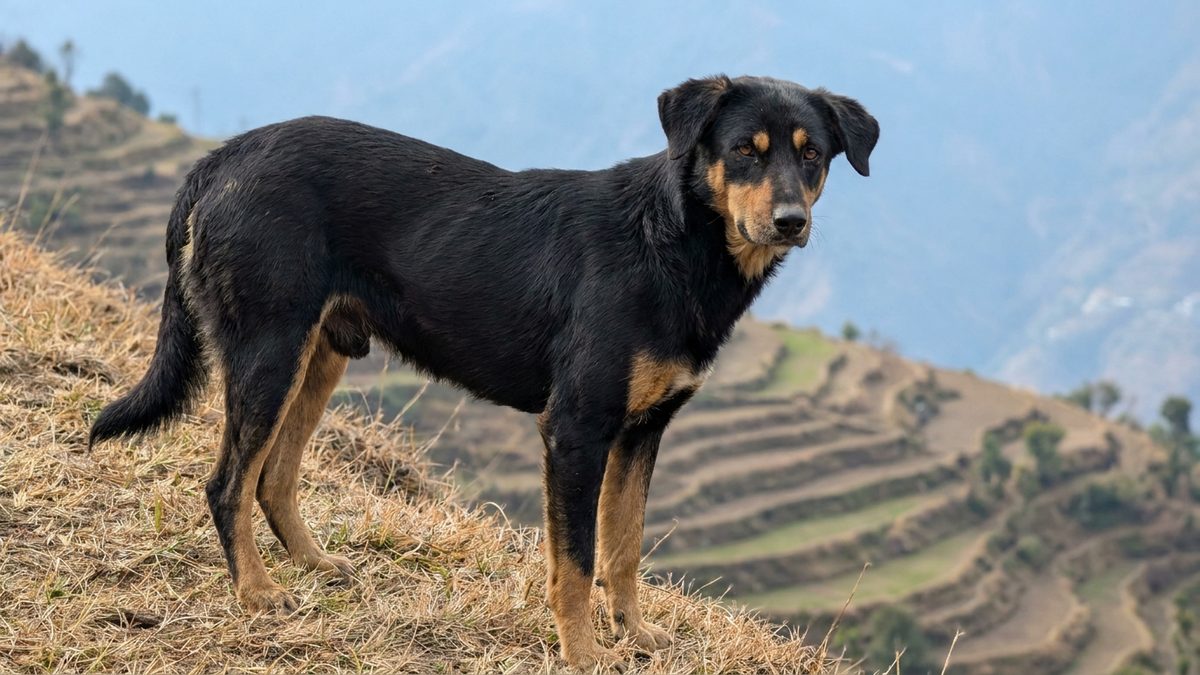
The coat is a long, thick and harsh double coat. Colour runs black and tan or solid black, usually with white markings on the toes, chest and neck. The ears are small and drooped, the tail is heavily plumed and carried curled over the back, and the bark is distinctively deep.
| Attribute | Detail |
|---|---|
| Type | Livestock guardian and herding dog |
| Range | Himalayan foothills, eastern Nepal to Kashmir |
| Also called | Bhote Kukur, Bhotia, Gaddi Kutta, Bangara, Himalayan Mastiff |
| Coat | Long, thick, harsh double coat |
| Colour | Black and tan or solid black, white on toes, chest and neck |
| Ears and tail | Small drooped ears, plumed tail curled over the back |
| Original role | Guarding yak and sheep, property guarding, herding, hunting |
| Kennel club status | Not recognised by any major kennel club |
History, and why the dogs are disappearing
Himalayan Sheepdogs have worked as guardians and companions for shepherds and for Nepalese monasteries since ancient times, and the population is now in decline because the nomadic herding life that created them is in decline. Dedicated breeders and enthusiasts are working to hold the line, but the underlying pressure is economic rather than canine.
One estimate puts the surviving purebred Gaddi population at fewer than 1,000 dogs, and notes that finding a thoroughbred is now genuinely difficult because the gene pool has been diluted and there is no organised breeding programme. The closely associated Bakharwal of Jammu and Kashmir is described in similar terms, on the verge of extinction, with local communities asking for endangered status.
Regional subtypes
The breed is not uniform across its range, and the recorded subtypes matter when you are trying to judge whether a dog in front of you is the real thing. Two are documented in the literature. The Kumaon hills type, called the cypro kukur or kumaon mastiff, is brindle, rich golden brown or black. The Chamba type is smaller than most of the breed and resembles a larger, longer-haired black Labrador Retriever. Bhutan holds a larger variant known there as the bhutia sheepdog.
Honoured on a stamp, twice over
India has recognised this dog publicly twice. In 2005 the then Union Minister for Communications and Information Technology, Dayanidhi Maran, released four postage stamps on Indian dog breeds, and the Himalayan Sheepdog was one of them alongside the Rajapalayam, the Mudhol Hound and the Rampur Hound. Wikipedia records the same 2005 release. Twenty years later, in January 2025, the Gaddi dog became a registered indigenous breed.
There is also a record that has nothing to do with guarding. A stray Himalayan Sheepdog mix holds the highest known altitude scaled by a dog, having accompanied climbers to the summit of Baruntse at 7,129 metres. It is a good story and a fair illustration of what a high-altitude dog's physiology can do.
The ecological complication
Free-ranging Himalayan Sheepdogs are now a conservation problem in parts of Uttarakhand. They compete with snow leopards in Gangotri National Park because both hunt the same prey, including bharal, and the growing dog population, much of it hunting in packs and supplementing its diet with human scraps, is pushing the food chain out of balance. Reporting from the ground put at least five dozen of these dogs in the Nelang Valley region of the park, most of them near border force camps where food scraps are easy to find, against roughly 20 snow leopards in the park out of 86 in Uttarakhand.
The feral packs above the treeline and the guarded, working shepherd dog are both called Himalayan Sheepdogs. When you read that the breed is thriving or that it is nearly extinct, check which population the writer means. The feral one is increasing. The working purebred one is not.
Himalayan Sheepdog price in India
Published prices for this dog run from Rs 5,000 to Rs 80,000, and not one of the pages publishing those figures cites a source for them. Treat every number below as a claim rather than a market rate, because the breed is not sold through an organised commercial channel.
Two positions exist in the Indian sources, and they contradict each other completely. One publishes a tiered price table. The other says the numbers are meaningless. Bonbeno's view is that both are telling you something true, and you should read them together.
| Source | Stated position | Sourcing |
|---|---|---|
| Wrapinfur | Rs 5,000 to Rs 80,000 overall | No citation given |
| Wrapinfur, working line | Rs 5,000 to Rs 20,000 | No citation given |
| Wrapinfur, family companion puppy | Rs 15,000 to Rs 40,000 | No citation given |
| Wrapinfur, premium guardian bloodline | Rs 40,000 to Rs 80,000 and above | No citation given |
| Dog with Blog, Gaddi | Ignore the numbers, this is not a commercial breed | Population estimate given |
| Dog with Blog, Bhotia | There is no reliable market price | States the absence directly |
| New Indian Express | Punjab farmers buy at a premium from migrating shepherds | Named state officials quoted |
Why the spread is this wide
Three things drive it, and only one of them is about the dog.
- Supply is genuinely tiny. Fewer than a thousand purebreds are thought to remain, and the real working dogs live with shepherds who are not in the business of selling them. A market with almost no supply does not produce a stable price.
- The name is unpoliced. Nothing stops a seller calling a Tibetan Mastiff cross a Gaddi, and breeders lean on that confusion because a Tibetan Mastiff sells. Part of the Rs 80,000 band is a different dog with a better story.
- The pages quoting prices cite nothing. The most detailed price table currently ranking for this query carries no source for any figure, and its live body copy still contains an unedited note to its own writer about the topic being a good SEO niche. That is the quality of evidence behind the numbers Indian buyers are reading.
The one documented purchase pattern
The only price behaviour reported by a named official rather than a content page is the Punjab one. Gaddi dogs are bred in the Gurdaspur, Hoshiarpur and Ropar districts of Punjab, where farmers use them to protect crops from wild animals, and those farmers often buy at a premium when Gaddi shepherds bring the dogs down from the hills to the plains. That is a real, documented, recurring transaction, and it is also the exact transaction this page would ask you to think twice about, for reasons the climate section sets out.
A Rs 5,000 puppy advertised as a Gaddi or Bhotia in a plains city is almost certainly a mixed-breed guess or a Tibetan Mastiff cross, and buying it fuels demand that harms a rare working dog. Bonbeno reports these bands as published editorial figures. We do not broker sales and we do not link listings.
Monthly cost of owning a Himalayan Sheepdog
One Indian source publishes a monthly figure of Rs 4,000 to Rs 12,000, broken into five categories, and it states no method and no sample. Bonbeno reproduces it below because it is the only structured Indian estimate that exists, and flags it as unverified rather than repeating it as fact.
| Expense category | Stated monthly cost |
|---|---|
| Food and nutrition | Rs 2,000 to Rs 5,000 |
| Veterinary care | Rs 500 to Rs 2,500 |
| Grooming | Rs 300 to Rs 1,500 |
| Training and exercise | Rs 500 to Rs 2,000 |
| Accessories and miscellaneous | Rs 500 to Rs 1,500 |
| Total | Rs 4,000 to Rs 12,000 |
What that table leaves out for a plains household
The published breakdown was written as though the dog lives somewhere cool. Keep a heavy double-coated mountain guardian in Delhi, Chandigarh, Ludhiana or Jaipur and two large line items appear that no Indian cost page currently prices.
- Cooling that runs for months. Veterinary guidance for double-coated cold-climate breeds in India is blunt: if you own one, indoor air conditioning is not optional. That is an electricity bill, not an accessory.
- Professional coat work through the moult. A dense double coat needs moderate to high maintenance, and the winter coat sheds heavily for about a month when the weather warms. Budget for the tools or the groomer, and never for a clipper.
- Emergency capacity. Heat stroke is a veterinary emergency, and the recorded fatality rate across heat-related illness events in a large primary-care dataset was 14.18 percent. Money set aside for an unplanned emergency visit is a real cost of owning this breed outside the hills.
- Secure containment. A territorial guardian needs a physical boundary rather than a latch, and the breed is suited to a farm or a house with a large yard rather than a shared plot.
When Bonbeno publishes its own cost figures, we state the sample size, the cities covered and the collection date. Where the only available number is a single uncited estimate, we print it, name the source and say that it is unverified, rather than laundering it into a Bonbeno figure.
Heat tolerance: the reason most Indians should not buy this dog
Rate this breed's heat tolerance at the bottom of the scale. It carries a long, thick, harsh double coat and is specifically adapted to high altitude, which makes it one of the worst climate matches available to a buyer on the Indian plains.
Start with the physics, because it is not complicated. A dense undercoat is insulation. Insulation that keeps a dog alive at altitude is the same insulation that traps heat on a Delhi afternoon, and Indian veterinary guidance says exactly that about cold-climate double-coated breeds. Dogs shed heat mainly by panting, and a heavy coat gives that mechanism a harder job.
What the evidence actually shows
The best available dataset on canine heat-related illness comes from UK primary-care records rather than Indian ones, and it is still the most useful thing you can read before buying a mountain dog for a hot country. Across 905,543 dogs under veterinary care in 2016, researchers identified 395 confirmed heat-related illness events. Incidence was 0.04 percent (95 percent CI 0.04 to 0.05), and the event fatality rate was 14.18 percent (95 percent CI 11.08 to 17.96). Significant risk factors included breed, a higher bodyweight relative to the breed and sex mean, and being over two years of age, with brachycephalic dogs and dogs weighing over 50 kg at greater risk.
That last clause matters here. Several published weight ranges for this breed cross or approach 50 kg, and one goes to 150 lb GoofyTails, Himalayan Sheepdog. A large, heavy, thickly coated dog sits on the wrong side of two separate risk factors at once.
Purina India's own guidance names heavy-coated breeds alongside short-faced ones as the higher-risk group, listing Huskies and Newfoundlands among them, and sets out the signs to watch for: severe panting, difficulty breathing, severe salivating, vomiting, diarrhoea, raised temperature, blood in urine, nose bleeds, collapse and coma.
Where the sources disagree, and who is right
Indian pages selling this breed to an urban audience soften the problem. One states plainly that Gaddi dogs can adapt to hot Indian cities with proper care. Another says that while they love cooler weather, with proper care and grooming they can adapt to many parts of India. The pages that know the breed best say the opposite. It struggles badly in plains heat, and shade, fresh water and cool walking hours are not optional. It struggles in small flats and on the hot plains. Even the softer sources concede that thick coats make the dog more suited to cooler climates and that it may struggle in extreme heat.
| Source | Position |
|---|---|
| Wrapinfur | Yes, can adapt to hot Indian cities with proper care |
| petZcare India | Can adapt to many parts of India with care and grooming |
| Pawgy Pets | More suited to cooler climates, may struggle in extreme heat |
| Dog with Blog, Gaddi | Struggles badly in plains heat |
| Dog with Blog, Bhotia | Struggles in small flats and on the hot plains |
| Vet Care Plus | Cold-climate double coats are dangerous on a Delhi afternoon, air conditioning is not optional |
Bonbeno's position is the veterinary one. "Can adapt with proper care" is technically true of almost any dog and any climate, and it hides how much care, how much cost and how little margin for a single mistake. The honest sentence is that this dog is livable on the plains only inside an air-conditioned home with a disciplined summer routine, and that most households buying one will not sustain that for a decade.
If you already own one on the plains
- Move both walks to the cool hours, before 8 AM or after 7 PM, and test the road with the back of your hand for seven seconds before you step out.
- Keep fresh water in several places, including next to where the dog sleeps.
- Never shave the double coat. The undercoat insulates against heat as well as cold, and shaving disrupts that and worsens sun exposure.
- Keep the dog lean. Higher bodyweight relative to the breed and sex mean was an identified risk factor for heat-related illness.
- Act immediately on the signs. Move the dog into shade, spray or sponge it with cool water, use a fan, gently massage the legs and body, and get veterinary attention.
Everything above applies to the plains. In Shimla, Manali, Dharamshala, Almora, Gangtok, Leh or Srinagar this is a superbly matched breed and the climate objection disappears. The distinction Indian buyers need is not city versus village, it is altitude.
Temperament and household fit
The Himalayan Sheepdog is a territorial guardian for experienced owners with land, and this section should decide whether you go further. It is described as more protective against people than the Tibetan Mastiff, which is an unusual thing to say about any dog.
Sources describe a proud, confident dog that is not easy to ignore, quite territorial, and willing to protect the home and family with aggression and courage. Indian writing on the Gaddi is blunter still: huge, aggressive and incredibly strong, very intelligent, very friendly with the owner and family, and capable of being ferocious with strangers.
Around its own people the picture flips. It is calm, loyal and affectionate, switches on only when something is off, and then means it. Bhotia dogs are renowned for unwavering loyalty and protective instincts, form strong bonds with their families, and are affectionate and gentle with their own children while naturally wary of strangers.
The independence is the part people underestimate. This dog was bred to make its own decisions on a mountainside without a handler in sight, which produces an intelligent problem-solver rather than a biddable follower. It does not switch that off because it now lives behind a gate.
Who this breed suits
- Good fit. Hill households with land, working farms and orchards, owners with livestock guardian experience, cool-climate properties with a secure boundary.
- Poor fit. First-time owners, apartments, plains cities, homes with a steady flow of visitors, anyone who wants a sociable family dog.
- Non-negotiable. Socialisation from puppyhood, which every source treats as the difference between a discriminating guardian and an unmanageable one.
One practical detail that catches urban buyers out is the noise. The breed has a loud, deep bark Himalayan Sheepdog, Wikipedia, and a guardian barking at a shared stairwell at 2 AM is a neighbour problem long before it is a training problem.
The most useful sentence written about this dog is that for almost everyone reading about it, it is the wrong dog. Wanting an Indian breed is a good instinct. If you want a companion for a normal home in a warm city, the Indian Pariah Dog fits the climate, fits the household and is free to adopt.
Training a Himalayan Sheepdog
Train this breed through relationship and early exposure rather than repetition, because a livestock guardian is built to override instruction when its own judgement disagrees. Training a guardian breed takes experience, early socialisation and patience, not repetition drills.
Socialisation is the safety decision
Socialise this dog from puppyhood, deliberately and continuously, because that is what decides whether the adult can tell a guest from a threat. Sources are unanimous on it. The breed must be socialised from puppyhood to get along with children and other pets, early socialisation is crucial to help it distinguish friend from foe, and it needs early socialising to relax in the company of unfamiliar people and animals.
The independence requires firm but compassionate handling rather than force. A dog with this much confidence and this much physical capacity does not improve under correction, and an adversarial relationship with a guardian breed is a bad trade for the handler.
What works
- Structure every arrival. Teach a place command and use it for every visitor, because a guardian with no instruction defaults to its own judgement.
- Keep sessions short and meaningful. Regular physical activity and mental stimulation are both treated as essential rather than optional for this breed.
- Walk the dog properly. Guidance for the breed is to keep it heeling beside or behind the handler on the lead rather than out in front.
- Protect the growing skeleton. Do not overwork the bones, muscles and joints of a young dog during the growth stage.
- Get help early. If you have not raised a livestock guardian before, book a trainer who has, in month one rather than month ten.
| Skill | Start | Reliable by |
|---|---|---|
| Name response | Week 1 home | 3 to 5 weeks |
| Sit, down, place | Week 1 home | 6 to 10 weeks |
| Handling and grooming tolerance | Week 1 home | 8 to 12 weeks |
| Loose-lead walking | Month 2 | 8 to 12 months |
| Recall, no distraction | Month 2 | 6 to 12 months |
| Controlled greeting of visitors | Month 2 | Ongoing management |
| Settling around unfamiliar dogs | Month 2 | Ongoing management |
Puppies of guardian breeds are often sociable, and the territorial behaviour emerges months after the early socialisation window has closed. Owners who judge the breed by a friendly ten-week-old and ease off on exposure get a reactive adult and very little room to correct it.
How much exercise a Himalayan Sheepdog needs
Give an adult at least two long walks a day, every day. This is a busy dog with high exercise requirements, ideally suited to a country farm and adaptable to a house with a large yard. Indian writing on the Gaddi puts it at roughly a couple of hours of real daily activity.
Regular physical activity and mental stimulation are both required to keep the breed physically and mentally well, and the dogs are described as highly active and needing consistent output. A guardian without a boundary to patrol invents a job, and the invented job is usually barking or destruction.
The apartment question, and the one source that disagrees
Almost every source says no, and the living conditions sections of the ranking breed references are unusually consistent about it. The breed prefers living indoors with access to secure outdoor space and is not well suited to apartment living or prolonged isolation. Small apartments are generally not ideal. It struggles in small flats. One long-standing breed reference dissents under its own living conditions heading, saying the dog can live in an apartment if it is very well exercised, and that these dogs are not very active indoors.
That dissent is worth reading carefully rather than dismissing. It is a statement about indoor energy level, not about heat, noise or territorial behaviour in a shared building. In an Indian apartment all three of those problems arrive before the exercise problem does.
| Stage | Guidance |
|---|---|
| Puppy | Short frequent sessions, no forced distance or stairs work |
| Adult | Two long walks daily plus patrol or work time |
| Senior | Shorter and gentler, still twice daily |
| Plains summer | Both sessions before 8 AM and after 7 PM, road tested by hand first |
- Walk on lead in unfenced country. A guardian that ranges will treat a neighbour's livestock or dog as its business.
- Give the dog a boundary. Patrolling a fixed perimeter satisfies this breed more than an aimless longer walk.
- Stop the dog before it stops itself. A working breed in drive does not self-regulate in Indian heat, and the handler has to.
- Do not substitute a yard for a walk. Space alone is not exercise for a dog bred to move with people and animals.
Grooming a double coat in Indian humidity
Brush this coat regularly all year and daily through the moult, and never clip it. The dense double coat carries moderate to high maintenance, and the winter coat sheds once a year for about a month as the weather warms, during which the dog should be brushed and combed every day.
Regular brushing removes loose hair, and a specialised comb through the hot months helps clear the parasites an outdoor dog picks up. Weekly brushing is usually enough outside the shedding season, with far more frequent work while the coat is coming out. Nails, ears and teeth belong on the same routine.
Bathe rarely. Guidance for the breed suggests perhaps three baths a year using a dog shampoo that protects the natural oils in the coat, and stresses drying the dog thoroughly afterwards, especially in cooler months. A double coat that stays damp is the start of a skin problem, and in Indian humidity that window is short.
What goes wrong in Indian conditions
Coat problems in this breed are humidity problems more than genetics problems. Reported issues include skin infections, hot spots, tick infestations and seasonal shedding difficulties, all linked to neglecting a thick coat.
- Brush to the skin, not the surface. A rake or undercoat tool reaches the layer that mats. A surface brush leaves a felted undercoat trapping heat and moisture.
- Check for ticks at every session, particularly around the ears, neck, groin and between the toes. Tick and flea control is a year-round job in most of India, not a monsoon one.
- Dry the dog completely after any bath or heavy rain, because damp trapped against skin under a dense coat invites infection.
- Never shave the coat for summer. The undercoat insulates against heat as well as cold, and shaving disrupts that insulation and worsens sun exposure.
- Increase inspection frequency through the monsoon rather than sticking to a fixed weekly slot.
Every Indian summer, owners of double-coated dogs shave them in good faith and make the animal hotter and more sun-exposed. If a groomer offers to clip this breed down for the heat, find another groomer.
Health, screening and lifespan
The Himalayan Sheepdog is generally described as having strong health, with a consistent cluster of joint and eye conditions reported across sources. The honest caveat is that no breed-level prevalence study exists, so every percentage you see online for this dog is extrapolated rather than measured.
The conditions that are consistently reported
| Condition | Reported by |
|---|---|
| Hip dysplasia | Animalia, Wag!, Pawgy Pets, Dog with Blog Wag!, Himalayan Sheepdog Dog Breed Facts… Pawgy Pets, Everything you need to know… Dog with Blog, The Gaddi dog |
| Elbow dysplasia | Animalia, Wag! Wag!, Himalayan Sheepdog Dog Breed Facts… |
| Arthritis | Animalia, Wag! Wag!, Himalayan Sheepdog Dog Breed Facts… |
| Patellar luxation | Animalia, Wag! Wag!, Himalayan Sheepdog Dog Breed Facts… |
| Glaucoma | Animalia, Wag! Wag!, Himalayan Sheepdog Dog Breed Facts… |
| Bloat, gastric torsion | Dog with Blog, Wrapinfur Wrapinfur, Himalayan Gaddi Dog |
| Obesity | Wag! |
| Skin infection and hot spots | Wrapinfur |
| Ear infection | Wrapinfur |
Two of those deserve emphasis for an Indian owner. Bloat is the fast, dangerous stomach emergency that large deep-chested dogs are prone to, and it is worth knowing the signs before you need them. Heat-related illness is not on any breed list for this dog because nobody has studied it, and it is nonetheless the most likely thing to kill a Himalayan Sheepdog living on the Indian plains.
Lifespan, and how much the published figures vary
Published lifespans run from 9 to 14 years, and the sources do not agree with each other. Dog Breed Info gives about 9 to 14 years, Animalia and PuppyFinder give 10 to 13 PuppyFinder, All about Himalayan Sheepdog…, GoofyTails gives 10 to 12, and the Bhotia and Gaddi write-ups give 10 to 14 and 10 to 12 respectively Dog with Blog, The Gaddi dog. None of them names a dataset. Read the range, not the midpoint.
What to actually do
- Keep vaccination and deworming current, and build a relationship with a vet who handles big breeds before you need one.
- Run year-round tick and flea control. Regular veterinary checkups, vaccinations and parasite prevention are treated as vital for this breed.
- Keep the dog lean and conditioned. Routine veterinary care, responsible breeding, regular exercise and maintaining a healthy weight are the levers that support long-term health here, and excess weight also raises heat-related illness risk.
- Monitor the joints from puppyhood. Avoid forced distance work while the skeleton is growing.
- See both parents where possible, which remains the most useful health screen available for a breed with no formal health registry.
Any page giving you a precise disease percentage for the Himalayan Sheepdog is extrapolating from other breeds. The characterisation work that could eventually support real figures only began recently: a scientific study of the Gaddi dog started in 2019, ran three years, and the data went to NBAGR in 2022. Genomic and morphological characterisation is expected to establish the population size and defend the breed's purity.
Feeding a Himalayan Sheepdog
Feed this dog as a large, active working breed and match intake to workload rather than to a fixed chart. A balanced diet rich in protein is treated as essential for the breed's health and vitality, and the single published Indian estimate puts food at Rs 2,000 to Rs 5,000 a month.
Body condition is the measure that matters more than the number in the bowl. Maintaining a healthy weight is listed among the factors that support long-term health in this breed, obesity is a reported problem, and higher bodyweight relative to the breed and sex mean was an identified risk factor for heat-related illness. In a heavy mountain dog living in a hot country, those three facts compound.
- Split the daily ration across two meals rather than one large meal, which is standard risk management for a large deep-chested breed prone to bloat.
- Avoid hard exercise close to a meal, for the same reason.
- Match intake to actual output, adjusting between working and resting periods rather than feeding a constant amount.
- Keep fresh water continuously available, in several places around the house through summer.
- Expect appetite to drop in peak summer. A short dip is normal. Persistent inappetence in a large dog in the heat is a veterinary matter, not a preference.
One India-specific note on availability. Large-breed food in the volumes this dog needs is stocked reliably in metros and hill-station towns but thinly in smaller Himachal and Uttarakhand towns, which is where most correctly placed dogs of this breed actually live. Plan a supply route rather than assuming a local shop, and change brands gradually rather than because a shelf ran empty.
Bonbeno reviews Indian pet food brands separately and tests products first-hand before publishing a verdict. See our testing method for what a Bonbeno food review does and does not claim.
Himalayan Sheepdog puppy: the first year
Spend the first year on socialisation and joint protection, in that order. Litters are reported at about 6 to 10 puppies, and the dog will mature into a large guardian whose adult temperament is decided far more by this year than by its pedigree.
- 8 to 16 weeks. Complete the vaccination course. Run structured socialisation to people, dogs, surfaces, traffic and noise, which every source treats as the decisive work with this breed. Start handling and grooming habits now, because a 45 kg adult that dislikes being brushed is not a problem you can fix later.
- 4 to 6 months. Begin loose-lead work and teach the dog to heel beside or behind you rather than out front. Keep exercise frequent and light. Do not overwork the bones, muscles and joints of a growing dog.
- 6 to 12 months. Territorial and guarding behaviour emerges. Continue socialising rather than withdrawing the dog from the world, which is the instinctive and wrong response. This is also the first summer for most puppies, so establish the cool-hours walking routine now.
- 12 months onward. Move to the adult load of two long daily walks plus patrol time. Begin monthly weight checks, because excess weight loads the joints and raises heat risk at the same time.
- Through the first moult. Expect the winter coat to shed heavily for about a month as the weather warms, and brush and comb daily through it.
"Bite force" is among the top autocompleted queries for the Himalayan Sheepdog, the Gaddi and the Bhotia in India. Bonbeno found no measured study of bite force in this breed and publishes no figure. Treat any specific PSI number for an Indian breed as marketing until someone shows you the measurement.
Himalayan Sheepdog vs Tibetan Mastiff
Choose a Tibetan Mastiff if you want a recognised, documented, heavier show and guardian breed, and a Himalayan Sheepdog if you want the lighter, faster working mountain guardian it came from. Indian buyers confuse the two constantly, and sellers rely on that confusion because a Tibetan Mastiff sells.
The relationship is real. The Himalayan Sheepdog is closely related to the slightly larger Tibetan Mastiff and is distinguished by being more protective against people. Indian veterinary writing describes the Gaddi as originally developed from the Tibetan Mastiff. Wikipedia's own Tibetan Mastiff entry notes that a better name for that breed might be the Tibetan mountain dog, or, to encompass the landrace throughout its range, the Himalayan mountain dog.
| Factor | Himalayan Sheepdog | Tibetan Mastiff |
|---|---|---|
| Kennel club status | Not recognised by any major kennel club | AKC and FCI recognised, FCI Group 2 |
| Height | 51 to 76 cm | Males 66 cm, females 61 cm |
| Weight | 23 to 41 kg | Males 40 to 70 kg, females 30 to 55 kg |
| Coat | Long, thick, harsh double coat | Medium to long double coat, heavier mane, more face hair Dog with Blog, Bhutia Dog |
| Tail | Plumed, curled over the back, less curly and heavily feathered | Curlier and less feathered by comparison |
| Build | Leaner, faster, built for stamina | Heavier, taller, slower |
| Protectiveness toward people | Described as more protective Dog with Blog, Bhutia Dog | Protective, but less so toward people |
| Heat tolerance | Very low, dense undercoat built for altitude Vet Care Plus, Is Your Summer Dog at Risk?… | Very low, and above 25 C described as torture |
| Documented lifespan | 9 to 14 years across sources | 10 to 16 years, claims unsubstantiated |
The plainest summary comes from the Indian writing: the Tibetan Mastiff is the bodybuilder, the Gaddi is the mountaineer. If a seller shows you a giant fluffy "Gaddi" that looks like a lion, you are probably looking at a Tibetan Mastiff or a cross.
Neither is a plains dog. Both carry the risk factors the heat-related illness research flags, and the Tibetan Mastiff's weight range puts a large share of individuals over the 50 kg threshold associated with greater risk Tibetan Mastiff, Wikipedia. The comparison people should be making is not between these two breeds, it is between either of them and a breed suited to where they live.
And the Bakharwal, the third dog in this argument
The Bakharwal dog of Jammu and Kashmir is the fourth name that gets mixed into this family. It is a livestock guardian of Ladakh and the Pir Panjal range, bred by the Gaddis, Jats, Gujjar and Bakerwal communities, and it is closely associated with both the Gaddi Kutta and the Himalayan Sheepdog. It is also not recognised by any major kennel club, and is likewise described as on the verge of extinction. One more name belongs in this family, the Vikhan, a livestock guardian reported from the Chitral region of Khyber Pakhtunkhwa and from Himachal Pradesh, described as lighter framed and built more for speed than strength, recognised by no registry, and not yet shown to be either a distinct breed or a local name for a population already documented under another name.
The naming problem, and the mistakes it causes
The single most useful thing to know about this dog is that "Himalayan Sheepdog", "Gaddi Kutta", "Bhotia" and "Bangara" are used inconsistently by serious sources, and no ranking page publishes that disagreement. Bonbeno publishes it below rather than picking one answer silently.
What each source actually says
| Source | Position | Evidence on the page |
|---|---|---|
| Wikipedia | One breed, many local names | Lists Bhote Kukur, Bhotia, Gaddi Kutta, Bangara and Himalayan Mastiff as other names for a single breed. The Gaddi Kutta URL redirects to the Himalayan Sheepdog article. |
| ICAR-NBAGR, via New Indian Express | The Gaddi is its own registered breed | Registered as an indigenous breed with its own accession number, INDIA_DOG_0600_GADDI_19004, after morphological and genomic characterisation. |
| New Indian Express | The dispute is live | States there are other dog breeds in Jammu and Kashmir and Uttarakhand which also claim to be Gaddi dogs. |
| Dog with Blog Dog with Blog, Bhutia Dog | Close cousins in one family | Says the names overlap heavily, that locals have long debated whether Gaddi and Bhotia are two varieties or two breeds, and that the honest answer is close cousins shaped by the same job. |
| Food and Scientific Reports | Gaddi, Bhotia and Himalayan Sheepdog are the same dog | Uses all three names for one animal and traces it to the Tibetan Mastiff. |
| Wrapinfur | Gaddi Kutta equals Himalayan Sheepdog | Asserts the equivalence flatly in a spec table, with no source and no mention of the Bhotia or of NBAGR. |
| Wikipedia, Bakharwal | Related but distinct | Treats the Bakharwal as a separate breed closely associated with both the Gaddi Kutta and the Himalayan Sheepdog. |
Two dates make the muddle concrete. Reporting on the registration itself disagrees about when the committee met: one account puts the Breed Registration Committee's approval at its meeting held on 5 January 2025, another gives 6 January 2025 at the committee's 12th meeting. Both agree the Gaddi became India's fourth registered indigenous dog breed, after the Rajapalayam and Chippiparai of Tamil Nadu and the Mudhol Hound of Karnataka, and the first from the Himalayas Dog with Blog, The Gaddi dog. The Haofa Tangkhul Hui, Manipur's hunting and guarding hound, is still waiting on the same line, with an application filed with ICAR-NBAGR in July 2022, a 2024 study that measured 100 adult dogs, and no place on the register when Bonbeno checked in August 2026.
Treat "Himalayan Sheepdog" as the umbrella name for a family of Himalayan livestock guardians, and "Gaddi" as the Himachali, predominantly black end of that family, which is the name Indian science chose when it registered a breed Harpreet Bajwa, Himalayan 'Gaddi' dog…. Anyone who tells you the question is settled is selling something.
The mistakes Indian buyers actually make
- Buying one for the plains. Documented purchase behaviour has Punjab farmers buying Gaddi dogs at a premium when shepherds bring them down from the hills, into a climate the breed is not built for.
- Believing the "adapts with proper care" line. It is the most common claim on Indian pages selling this breed, and it is contradicted by every source that keeps the dog Dog with Blog, Bhutia Dog.
- Shaving the coat in summer. The undercoat insulates against heat, and shaving worsens the problem.
- Paying a Tibetan Mastiff price for a Gaddi, or the reverse. Sellers lean on the confusion deliberately.
- Trusting a price table that cites nothing. The most detailed Indian price page for this breed carries no source for a single figure.
- Skipping socialisation because the puppy is friendly. Every source treats early socialisation as the decisive intervention.
- Letting the dog carry weight. Obesity is a reported problem and higher relative bodyweight raises heat-related illness risk.
- Assuming an apartment will work because one reference says it can. That source is talking about indoor activity level, not about heat, deep barking or a territorial dog in a shared corridor.
- Quoting bite force figures. No measured study of this breed's bite force exists, so Bonbeno publishes no number.
Sourcing, verification and the adoption route
Source this dog through hill rescues and shepherd networks rather than a city breeder, and adopt if what you want is a companion. The purebreds most Indians will ever meet are rescues and mixes, not puppies for sale.
Is the Himalayan Sheepdog banned in India?
No. In March 2024 the Ministry of Fisheries, Animal Husbandry and Dairying issued a circular prohibiting the import, breeding and sale of a list of "ferocious" dog breeds, and six different High Courts later nullified or suspended it. No Himalayan, Gaddi, Bhotia or other Indian livestock guardian appeared on that list. "Is Gaddi Kutta banned in India" is one of the most searched questions about this breed, and the answer is that it never was.
Verification checklist
- Buy near the source or not at all. The working population sits in the higher reaches of Himachal Pradesh and the surrounding hills.
- Check the dog against the Tibetan Mastiff, not against a photo. Look for the leaner face, the less curly and more heavily feathered tail, and a working build rather than a heavy mane.
- Ask what the parents do. A livestock guardian's temperament is only observable in its working context, and a posed photograph tells you nothing.
- Verify any registration claim directly. The breed is not recognised by any major kennel club, and the ICAR-NBAGR registration is a breed-level accession for the Gaddi, not a per-dog pedigree certificate. A seller waving paperwork should be able to explain which of those two things it is.
- Decline any seller who will not let you visit the place the puppies were raised, and any seller advertising cheap Gaddi puppies in a plains city.
Adoption
Gaddi and Bhotia mixes turn up regularly in hill rescues across Himachal Pradesh and Uttarakhand, and rehoming one is the outcome a rare breed actually needs, because it means fewer people buying and more people adopting. An adult also removes the largest unknown in the purchase, which is temperament, because an adult guardian's character is already formed and observable.
Adopting a mix has a second advantage in this specific case. A Gaddi crossed with an Indian village dog usually carries a lighter coat than the purebred, which materially improves its odds in a warm Indian city, while keeping the alertness people want. That is not a compromise, it is the sensible version of the dog for most of the country.
One thing not to do
Do not take a free-ranging Himalayan dog off a mountain because it looks like a rescue. The feral population in places like Gangotri National Park is a conservation problem, competing with snow leopards for shared prey Abhyudaya Kotnala, and it is managed by wildlife authorities rather than by individuals. Report the situation, do not adopt out of a national park.
That is the expected outcome for most readers, and it is not a failure. If you want an Indian dog for a warm-climate household, the Indian Pariah Dog is better tempered for family life, adapted to the heat, longer-lived and free to adopt. If you want a working guardian and you live in the hills, this is one of the best dogs in the world at that job.
Himalayan Sheepdog questions Indians actually search
Is Gaddi Kutta banned in India?
No. The March 2024 circular from the Ministry of Fisheries, Animal Husbandry and Dairying listed foreign fighting and guarding breeds, and no Himalayan, Gaddi or Bhotia dog appeared on it. Six High Courts subsequently nullified or suspended that circular anyway. The Gaddi is a registered Indian indigenous breed, not a banned one.
Is Gaddi Kutta dangerous?
It is a powerful livestock guardian bred to face snow leopards, wolves and bears, so it is capable of serious damage. Sources describe it as huge, aggressive with strangers and incredibly strong, while being very friendly with its own family. Danger here is a function of the handler and the socialisation, not of the dog being unpredictable.
Is Gaddi Kutta aggressive?
It is territorial rather than indiscriminately aggressive. The breed will protect home and family with aggression and courage, is reserved with strangers because of its guarding instinct, and is described as more protective against people than the Tibetan Mastiff. Early socialisation from puppyhood is what keeps that instinct discriminating.
Can Gaddi Dogs live in hot Indian cities?
Only inside an air-conditioned home with a strict summer routine, and Bonbeno would advise against it. The dense undercoat that keeps this dog alive at altitude traps heat on a Delhi afternoon, and Indian veterinary guidance for cold-climate double-coated breeds says indoor air conditioning is not optional. Pages claiming easy adaptation are contradicted by everyone who keeps the breed.
What is the price of a Himalayan Sheepdog in India?
Published figures run from Rs 5,000 to Rs 80,000, split into working line, family companion and premium bloodline tiers, and no source cites any evidence for them. Other Indian writers say there is no reliable market price at all because fewer than a thousand purebreds remain and the real dogs live with shepherds who do not sell them.
What is the difference between a Gaddi Dog and a Tibetan Mastiff?
The Tibetan Mastiff is heavier, taller and slower, with a bigger mane and more face hair, and is recognised by the AKC and FCI. The Himalayan Sheepdog or Gaddi is leaner, faster, built for stamina, has a less curly and more heavily feathered tail, and is recognised by no major kennel club. Sellers exploit the confusion because a Tibetan Mastiff sells.
Can a Gaddi Dog protect against leopards?
That is the job it was bred for. The Gaddi is known as the Indian Panther Hound because of its ability to fight snow leopards, and shepherds use it to hold off snow leopards, Himalayan wolves and black bears on high pastures. A single dog facing a leopard is still a fight the dog can lose, and no source claims otherwise.
Gaddi Dog vs German Shepherd: Which is better?
Neither, in the abstract. A German Shepherd is a trainable all-purpose working dog with an established presence, veterinary familiarity and food supply across India. A Gaddi is an independent livestock guardian, harder to source, harder to train and far worse suited to the plains. For a first-time Indian owner in a city the German Shepherd is the more realistic dog, and both are double-coated and struggle in peak summer.
What is the Himalayan Sheepdog size?
Published figures disagree sharply. Wikipedia gives 51 to 76 cm and 23 to 41 kg, Dog Breed Info gives 61 to 71 cm and 40 to 45 kg, GoofyTails gives up to 76 cm and up to 55 kg for males, and PuppyFinder goes as high as 150 lb. Read that as a range across a landrace with regional subtypes, not as one measurement anyone has averaged correctly.
What is the Himalayan Sheepdog bite force?
No measured figure exists. Bonbeno searched for a study of bite force in the Himalayan Sheepdog, Gaddi or Bhotia and found none, so we publish no number. Every PSI figure circulating for Indian breeds online traces back to other pages rather than to a measurement, and a large guardian's bite is dangerous regardless of the number attached to it.
Is the Himalayan Sheepdog the same as the Bhotia dog?
Sources genuinely disagree. Wikipedia treats Bhotia, Bhote Kukur, Gaddi Kutta and Bangara as local names for one breed, and its Gaddi Kutta page redirects to the Himalayan Sheepdog article. ICAR-NBAGR registered the Gaddi separately with its own accession number in January 2025. Indian writers describe them as close cousins shaped by the same job rather than one settled breed.
Is the Himalayan Sheepdog recognised by a kennel club?
Not by any major kennel club. The Gaddi is registered by ICAR-NBAGR as an indigenous animal genetic resource, which is a scientific breed registration rather than a pedigree registry, and Wikipedia records recognition of the bhote kukur by the International Kennel Club. Neither the FCI, the AKC nor the Kennel Club of India publishes a standard for it.
How long do Himalayan Sheepdogs live?
Published lifespans span 9 to 14 years and no source names a dataset. Dog Breed Info gives about 9 to 14, Animalia gives 10 to 13, GoofyTails gives 10 to 12 and the Gaddi and Bhotia write-ups give 10 to 12 and 10 to 14. Treat the range as the answer, because nobody has run a mortality study on this breed.
Are Himalayan sheepdogs good family dogs?
Not for most families. Around its own people the Himalayan Sheepdog is calm, loyal and affectionate, and Bhotia dogs are described as gentle with their own children while naturally wary of strangers. But it is a territorial livestock guardian bred to make its own decisions on a mountainside, described as more protective against people than the Tibetan Mastiff, with a loud deep bark. It suits hill households with land and guardian experience, and is a poor fit for first-time owners, apartments, plains cities, homes with a steady flow of visitors, and anyone who wants a sociable family dog.
Compare with similar breeds
Himalayan Sheepdog sits in 3 Bonbeno groups. Each one compares it directly against the breeds it is genuinely an alternative to, on the same figures.