Dalbo Dog: Sweden's Extinct Wolf Guardian, and Why India Cannot Buy One
No kennel club anywhere lists this dog, no living population exists, and the whole English-language internet repeats four sentences that contradict the Swedish primary source. Here is what the Swedish record actually says, including the two dated photographs nobody outside Sweden cites.
By Bonbeno EditorialVeterinary review: Dr. Ashish J., MVScUpdated 27 August 202642 min read
Quick answer
The Dalbo dog is extinct, so no Indian price exists and no puppy of this breed can be bought anywhere in the world. It was a Swedish livestock guardian of molosser type, 75 to 80 cm at the shoulder, kept in Dalsland and neighbouring provinces to defend free-grazing cattle from wolves and bears. The last dog documented as purebred was a bitch called Bella, photographed on 22 June 1904 in Mellerud. A Swedish survey in 1913 found none left.
Health information notice
This guide summarises nineteenth-century Swedish breed literature, national library and kennel-club register records, peer-reviewed veterinary research, Indian import and breeding law and satellite climate data as general information for Indian pet owners. It is not a diagnosis and it is not treatment advice. Consult a registered veterinarian near you before acting on anything you read here, and treat collapse, laboured panting that will not settle, or a suspected heat stroke as an emergency.
652Exertional share of UK heat-illness events with a recorded triggerof the 879 events with a recorded trigger, 74.2 percentSource: Hall EJ, Carter AJ, O'Neill DG
The lowest rating available, and it rests on the origin climate rather than on any measurement of the dog, because none exists. This was a heat-sensitive northern type: Dalsland averages 6.59 C across the year and 17.41 C in its warmest month, while Chennai's coolest month averages 24.09 C and Delhi's annual maximum reaches 48.79 C. Add a dense undercoat under a harsh outer coat and there is no month in Chennai, Mumbai or Bengaluru when this dog would have been comfortable.
Availability in India1 of 5
Zero, and not recoverable. The breed is extinct, so no supply chain can exist, and Indian import law would bar one anyway. India's most-cited 40-breed price list carries zero mentions of it, and the country's largest puppy-listing site returns its 404 page for the breed's URL while serving a full commercial page for the Labrador.
Registry recognition1 of 5
None anywhere, and the dog is unrecognised in both senses: no register lists it and no standard describes it. Absent from the FCI definitive register under D, absent from the twenty breeds on the FCI provisional register, absent from the Swedish Kennel Club's complete 376-breed list and absent from its twelve-breed Swedish page, which does carry two breeds the FCI does not recognise.
Strength of the evidence base2 of 5
Better than most extinct breeds and still thin. One researcher, Il Ohman, collected the whole record in the 1950s from interviews with people who remembered the dogs, and she produced a full breed description. Against that, the health, lifespan, weight and litter data are entirely undocumented, and four photographs exist in the world.
Grooming load in Indian humidity4 of 5
Rated as load, so a high number means hard work. A dense harsh coat with a good undercoat needs brushing to the skin two or three times a week through summer and daily through the monsoon, must be force-dried after every bath, and must never be shaved. The published Indian giant-breed grooming budget of Rs 600 to Rs 1,500 a month assumes a short-coated dog.
Independence from a handler5 of 5
As high as it gets. A livestock guardian dog left in a forest with cattle for days makes its own decisions about threats, and this breed is described as courageous and sharp toward predators while gentle with people. That is an independent working profile, not a biddable one, and it is the trait Indian buyers of guardian breeds most often underestimate.
Suitability for an Indian flat1 of 5
Unsuitable on every axis at once. A large nocturnally alert guardian with a heavy coat, in a climate where the coolest month in three of four metros is warmer than a Dalsland July, with nothing to guard and a boundary it will invent for itself. No page that rates this breed as apartment-workable has looked at the breed at all.
Risk of being sold something else5 of 5
The highest on this site. Rated as risk, so 5 is bad. A page ranking on the first screen in India for this breed name publishes the Dalmatian under it, complete with a conservation status reading 'Not Extinct'. Indian search results for the price return Dalmatian pages at positions two and ten. Nobody has this dog, so anyone offering one is offering something else.
What a Dalbo dog actually was, and why you cannot buy one
The Dalbo dog was a Swedish livestock guardian dog of molosser type, kept in Dalsland and the provinces around it to defend free-grazing cattle, horses, sheep and goats against wolves and brown bears. It is extinct, it was never recognised by any kennel club, and no living population exists anywhere.
Its Swedish name tells you where it belonged. 'Dalbo' is the dialect word for a person from Dalsland, so Dalbohund means, literally, the Dalsland dog, and Dalsland is taken to be the breed's area of originIl (Hildegard) Ohman's Dalbohund breed…. English writers sometimes call it the Dalsland Mastiff, which points at the same country. Swedish Wikipedia classes it as a boskapsvaktare, a livestock guardian, of molossertyp.
The job was specific and it explains the dog. Swedish farmers drove cattle into the forest to graze, which was productive and dangerous, because the forest held wolves and bears. The dogs went with the stock and stayed with it. They often worked in pairs rather than singly, and they were fitted with a spiked collar to protect the throat, which is the classic countermeasure against a wolf's classic targetPatrik Otter, 'Dalbohunden - utdod men anda…. The largest such collar found in Sweden measures 70 cm around.
The written record, in two entries two centuries apart
Two documents carry the breed's whole written history before the twentieth century. The first is Gunno Brynolphi Blutherus's *Dalia*, printed in 1632, where a large, brisk dog is praised for guarding cattle and attacking predators so effectively that stock could be left in the wilderness without a human herdsmanSwedish Wikipedia, Dalbohund. The second is Axel Emanuel Holmberg's *Bohuslans historia och beskrifning* of 1843, which is where the name Dalbohund appears in print for the first time.
One caveat belongs on the 1632 entry and it exists only in Swedish. svenskhund.se points out that Blutherus does not name the dog, so we cannot be entirely sure the animal he praised was this breed. Every English page prints 1632 as the first mention with no such hedge. The hedge is the more accurate statement.
Where it lived, and where the sources disagree
Its range contracted before it disappeared, and that contraction is documented. Into the 1800s the dog was generally spread across south-western Sweden, Dalarna, Varmland and the border districts of south-eastern Norway. By the 1820s it had been reduced to Bohuslan, Dalsland and Vastergotland. English and Swedish Wikipedia list Vastergotland, Bohuslan, Dalsland, Varmland and Ostfold and leave Dalarna outSwedish Wikipedia, Dalbohund. Svensk Jakt names Dalarna, Narke, Sormland and Ostergotland. Read together, the wider historical range and the later, narrower one are compatible; read one at a time, they look like a contradiction.
Nothing on this page is for sale, and nothing anywhere is
There is no Dalbo dog price in India because there is no Dalbo dog. Any Indian listing using this name is selling something else. If you want the short version of what to do instead, skip to the comparison table and the adoption section.
One more absence is worth stating up front, because it shapes everything below. There is no breed standard. No kennel club ever wrote one, because the dog was gone before Swedish dog registration matured. Everything this page says about how the animal looked comes from one woman's reconstruction, made in the 1950s from interviews with people who remembered it.
The one person who saved the evidence, and how she did it
Il Ohman is the reason anything is known about this breed. In the 1950s she gathered its entire evidentiary base, partly by researching older literature and partly by interviewing old people who remembered the Dalbo dog, and without that work the breed would have been forgotten completely.
That sentence is not a flourish, it is the Swedish source's own assessment: the Dalbohund would probably have fallen entirely into oblivion had it not been for Il Ohman, who in the 1950s collected information about the breed. National Purebred Dog Day, the only English page that names her, describes the same method, interviewing locals who remembered the breed.
Her output is short and it is findable. LIBRIS, the National Library of Sweden's union catalogue, holds a record for *Vakt och Vige: bidrag till kannedom om dalbohunden*, by Ohman, Il, 1912-1997, published 1955. The title translates as 'Vakt and Vige: a contribution to knowledge of the Dalbo dog', and Vakt and Vige are dogs' names. A second piece, *Bella och Fragen*, described as a picture contribution to knowledge of the Dalbo dog, appeared in the Dalsland local-history journal *Hembygden* in 1976Il (Hildegard) Ohman's Dalbohund breed….
Why this matters more than it sounds
Ohman was born in 1912, one year before the survey that declared the breed extinct. She never saw a living Dalbo dog. Everything she recorded is second-hand oral history, collected forty to fifty years after the last dogs, from people recalling their childhoods. That is a real limitation and it should be stated plainly rather than laundered into confident breed facts, which is exactly what the aggregator pages do.
It is also, in its own way, unusually good evidence. Oral history collected systematically by one researcher from many independent informants beats a single writer's summary, and it is a great deal better than what most extinct breeds have, which is one sentence in one book. The failure mode to watch is not that Ohman invented things. It is that English pages have compressed her careful description into four sentences and then changed two of them.
The other named researcher, and what he holds
Kurt Aronsson of Odeborg in Dalsland is the modern equivalent. He began researching and writing about the Dalbo dog around 1997, has published several articles including in the magazine *Land*, and is described by his local paper as about as close to an expert on the breed's history as anyone can be. In 2009 a well-preserved Dalbo dog skin reached him. It had been bought at an auction near Tengene in Vastergotland in the 1920s and kept in one family ever since; a woman from that family made contact, and Sara Askenborn of Mellerud collected it from Toreboda and brought it to Dalsland.
Aronsson's own summary of the state of knowledge is the most honest line published about this breed anywhere. Asked what is known, he answered that there is actually not that much that anyone knows. The skin was intended for a display case at the Fornsalen local-history museum in OdeborgElisabeth Enger, 'Ett valbevarat skinn…. English Wikipedia separately says a preserved large brown skin is at Hindas, without a source; the Odeborg skin is the one whose provenance is documented in the Swedish press.
Il Ohman's breed description, translated, in full
This is the closest thing to a breed standard that exists, and it has never appeared in English. Ohman compiled it in the 1950s from her interviews and from the literature, and she wrote it before she had seen a single photograph of the dog.
The point about the photographs matters for how much weight to give this. When she wrote the description, no image of a Dalbo dog was known to her, and she found neither bone remains nor pictures during the work. Photographs only came to her attention in 1971. So the description below is a reconstruction from testimony, and it was later checked against images rather than derived from them.
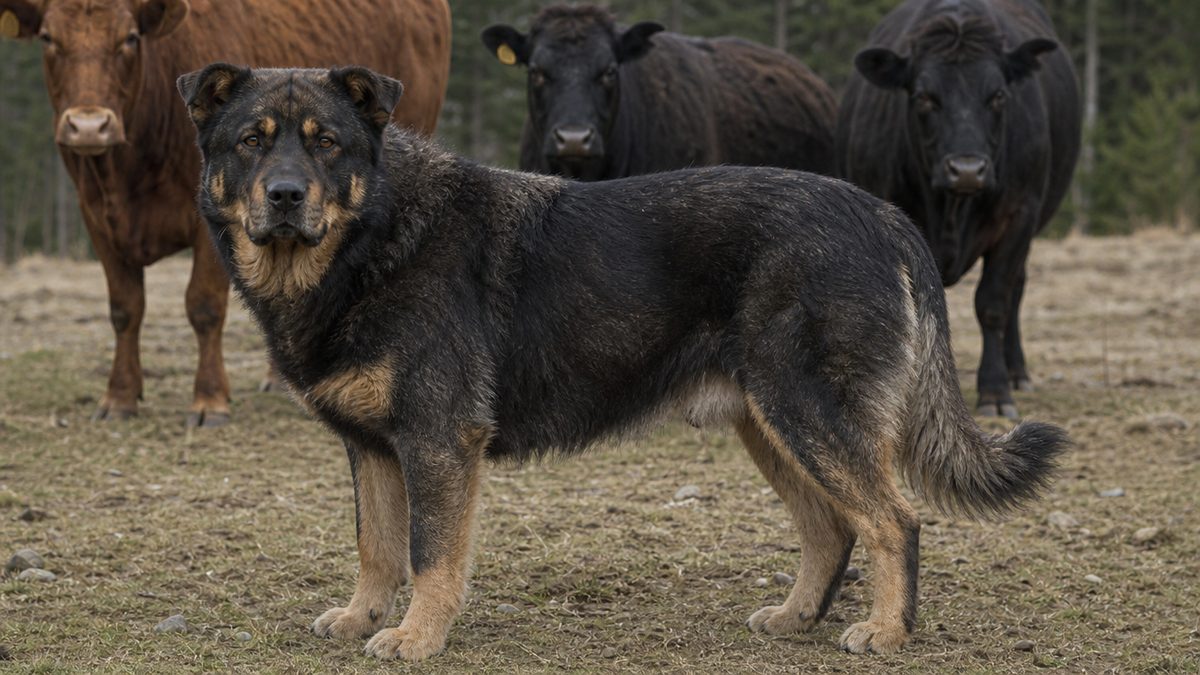
Large-grown and supple. His exterior suggested considerable strength through a certain low-set, thickset build
Head
Broad, with a clearly marked frontal furrow and stop. Muzzle broad and fairly short. Lips covered a strong, correct bite without being tight and without hanging
Eyes
Usually dark, fairly large
Ears
Medium-sized with a stiff base, the ear tip hanging. No feathering
Neck
Strong, coarse, medium-length
Body
Back rather long. Body and shoulders strong
Limbs
Legs coarsely built, often provided with dewclaws
Tail
Long, carrying a plume, held in a slight upward arc
Coat
Dense, harsh coat with a good undercoat. Back, legs and neck with long guard hairs
Colour
Black with face, extremities and belly yellow-grey, yellow-brown or red-brown. Or solid brown or yellow-grey mixed with darker hairs. Seldom with white markings
Size
Shoulder height 75 to 80 cm, occasional smaller specimens 62 cm
Three things in that table that appear nowhere in English
The 62 cm dogs are the first. Every English page prints 80 cm as the shoulder height of the breed. Ohman gives a range of 75 to 80 cm and then records occasional smaller specimens at 62 cm, an 18 cm spread that nobody outside Sweden mentions. A breed with that much variation is a landrace, not a standardised breed, which is exactly what you would expect of a farm dog nobody registered.
The ears are the second. Ohman describes medium-sized ears with a stiff base and only the tip hanging. That is a specific, unusual ear, and it is not the full drop ear of a mastiff or the prick ear of a Nordic spitz. Every illustration circulating online gets it wrong in one direction or the other.
The dewclaws are the third, and they matter for an Indian reader in a way Ohman could not have anticipated. She records that the legs were often provided with dewclaws. Under the Prevention of Cruelty to Animals (Dog Breeding and Marketing) Rules, 2017, Second Schedule Part II paragraph 6(8), de-clawing is one of the procedures on a prohibited list, alongside tail docking, ear cropping and de-barking, and the clause closes by declaring that any change of appearance by artificial means is strictly forbidden. Anyone in India producing a dog to this description could not lawfully remove them.
The coat: three sources, three different answers
The Dalbo dog's coat is described three incompatible ways by three sources of genuine standing, and no page anywhere has printed the conflict. It is the single most-repeated fact about the breed and it is unsettled.
Here is the disagreement laid out. Read the third column, because that is where the argument is won.
A long furry coat. Brown or dark, some with big white patches like a St. Bernard
Tagged 'citation needed' on the page itself, on both the coat and the height
Nationalencyklopedin
A short, coarse coat. Usually solid yellow-grey with darker markings on the head, also black-grey with white
Sweden's national encyclopedia. No working shown
Il Ohman, 1950s
Dense, harsh coat with a good undercoat, long guard hairs on back, neck and legs. Seldom with white markings
Interviews with people who remembered the dogs, plus the older literature
English Wikipedia's description carries a citation-needed tag on the sentence itself, so the page is telling you it is unsourced. Nationalencyklopedin, which is Sweden's standard reference work, describes a powerful mastiff-like dog with a short, coarse coat, usually solid yellow-grey with darker markings on the head. Ohman describes a dense, harsh coat with a good undercoat and long guard hairs in specific places.
How to reconcile them, and where they cannot be reconciled
Two of the three are closer than they look. A dense, harsh outer coat over a good undercoat, with longer guard hair on back, neck and legs, is what a working livestock guardian dog carries, and to a casual observer that reads as short and coarse over most of the body. Nationalencyklopedin and Ohman are describing the same animal at different resolutions. What neither describes is a long, furry coat, which is the English Wikipedia version and therefore the version the whole English internet has.
The white markings cannot be reconciled at all. Ohman says white markings were seldom seen. English Wikipedia says some dogs carried big white patches like a St. Bernard, and Creatures.com repeats it as 'sometimes marked with large white patches';. On the evidence available, the primary researcher and the aggregators disagree outright, and the aggregators are the ones without a source.
Why an Indian reader should care about a coat argument
Coat length is the one physical variable that most affects how a dog copes with Indian heat, and it is the variable in dispute here. A page that tells you this breed had a long furry coat is telling you something about heat tolerance it cannot support. What the evidence supports is a double coat with a dense undercoat, which is worse in Indian humidity than either a long silky coat or a genuinely short one, because the undercoat traps moisture against the skin.
There is one more descriptive claim worth flagging. Both Wikipedias say the dog resembled the Cao da Serra da Estrela, the Portuguese mountain guardianSwedish Wikipedia, Dalbohund. English Wikipedia adds the Leonberger, the Hovawart and the English Mastiff as alternatives, attributed to nobody in particular and tagged as unsupported on the page. These are comparisons of type and mass, not evidence of relationship, and they should be read as 'something roughly this shape' rather than as a family tree.
When did the Dalbo dog actually go extinct? Dating it from the documents
The Dalbo dog died out between 1860 and 1913, and the last individual documented as purebred was a bitch called Bella, photographed on 22 June 1904 at Mellerud in Dalsland. That is a firmer date than any English page carries, and it comes from putting four Swedish sources side by side.
Four different extinction dates are in circulation, which is why the question needs doing properly rather than repeating.
The collapse of the working population, not the last dog
Disappeared around the 1870s
Swedish Wikipedia
Follows Nationalencyklopedin
Became extinct around 1870
English Wikipedia
Same claim, then contradicted three sentences later by its own 1913 inventory
Went extinct in 1913
National Purebred Dog Day
The year of the search, mistaken for the year of death
Died out at the turn of the century
Svensk Jakt, TTELA
The closest of the five to what the evidence supports
The timeline the Swedish sources actually support
Work forward and the picture is consistent. Into the 1800s the dog was widespread; by the 1820s it survived only in Bohuslan, Dalsland and Vastergotland; by 1860 the breed was nearly wiped out, and the animals still alive were mostly kept as yard guards rather than as livestock guardians. That is the 1870s date's real meaning. The type stopped working in the 1860s, and Nationalencyklopedin's 1870s figure is measuring the end of the population as a functioning breed.
It is not measuring the end of the animals. Per Erlandsson published an article titled 'Dalbohunden' in *Hunden*, the Swedish Kennel Club's journal, at Gothenburg in 1890. Then come the photographs. Ohman found no images at all during her 1950s work, but in 1971 a set reached her, taken in the early 1900s at Mellerud in Dalsland. One shows the bitch Bella, described as a purebred Dalbohund, and the photograph is dated 22 June 1904, photographer K.F. Karlsson of Mellerud. A second shows a dog called Fragen on Midsummer Day 1906. Fragen was Bella's son, probably not purebred, but during his lifetime he was regarded as a Dalbohund.
Then comes the survey. In the early 1900s a couple of attempts were made to save the breed by searching for surviving specimens, and it was too late; in 1913 it was established that the breed was already extinct. That effort has a bibliographic record: LIBRIS holds C. Otto G. Wibom, *Dalbohunden: hans bibliografi och mojliga nuvarande existens*, Stockholm, 1913. The title means 'The Dalbo dog: his bibliography and possible present existence'. A man does not write a book asking whether an animal still exists unless the question is genuinely open, and 1913 is when it closed.
The firmest date this breed has
22 June 1904. That is the date on the photograph of Bella, the last dog documented as a purebred Dalbohund, taken by K.F. Karlsson at Mellerud in Dalsland. Anyone writing that the breed was extinct by 1870 has to explain a purebred bitch photographed thirty-four years later.
What cannot be recovered is the year the last dog died. No source names a final individual or a death date, and this page will not invent one. The defensible statement is a range with an anchor inside it: functionally gone as a working breed by 1860, a purebred animal still alive and photographed in 1904, a non-purebred descendant still being called a Dalbohund in 1906, and no dogs found by an organised search in 1913.
Why the Dalbo dog died out, including the cause English pages leave out
The Dalbo dog died because its job ended, and the job ended for a reason no English page mentions: new fodder crops made forest grazing unnecessary. Four causes are recorded in the Swedish sources and only three of them reach English-language pages.
The three that travel are these. Humans waged a systematic campaign against wolves and bears, and as predator numbers fell the need for the dog fell with them. A rabies epidemic struck Sweden in 1854. And 1867 brought a great year of hunger, the Swedish famine of 1867 to 1868, which fell on exactly the rural households that kept these dogs. Swedish Wikipedia locates the rabies outbreak specifically at Kinnekulle, and svenskhund.se says the same, while the English page gives only the year.
The fourth cause: timothy and oats
The fourth cause is the interesting one. During the 1800s Swedish agriculture advanced, and the new crops timothy and oats meant a farmer could take fodder in proper quantity for his animals, so the custom of driving cattle into the forests to graze ceased. That single change removed the entire reason the dog existed. It did not kill any dogs. It made them pointless.
Notice the order of events this implies. The usual telling is that the wolves went, so the guardian went. The Swedish record says the practice of forest grazing went too, and it went because of a fodder crop. A dog whose whole specification was 'stay with cattle in a forest where there are wolves' has no role left once the cattle stay home, regardless of how many wolves remain.
The fifth cause, and the one that finished it
A dog tax introduced late in the nineteenth century added a running cost, and people could no longer afford to keep a dog. Creatures.com repeats this from Swedish sources as a later dog tax that made a large working dog harder to justify. Put the sequence together and it is brutally simple economics. The work disappears, so the dog is a pure cost. Then a famine makes a large dog an expensive mouth. Then a tax puts a price on keeping one at all.
Taxation. A dog tax late in the century made keeping a large dog unaffordable.
This is what the page is actually for, for an Indian reader. Regional working types do not usually vanish because someone decides to end them. They vanish when the agricultural practice that required them is replaced by something cheaper, and the dog is discovered afterwards to have been a cost rather than an asset. India has its own working types on exactly that trajectory, kept by shepherds and stockmen whose practices are changing, and the Dalbo dog is what the end of that road looks like when nobody is watching.
Is anyone bringing the Dalbo dog back? What the revival claim rests on
No Dalbo dog revival project exists. What exists is one local researcher saying that DNA recovery from a preserved skin is theoretically possible, a Facebook friends group, and a Dalsland columnist who reviewed the same material and concluded it stayed a wish.
The claim traces to a single quotation, and it is worth reading exactly. When the preserved skin reached Kurt Aronsson in 2009, he told TTELA that in theory it would be possible to take DNA from the skin and thereby recreate the breed. The word doing the work is 'in theory'. The article's own next line says the outcome of that may be worth returning to, which is a reporter's way of saying nothing has happened.
Nothing has happened since. Dalslanningen reported the idea of creating a new Dalbo dog from the DNA in the Odeborg skin as a thought that had been put forward, among other places on Facebook, where the Dalbo dog has its own friends group. A column in Provinstidningen Dalsland reviewing the same story recorded that thoughts had existed of trying to reconstruct the breed with DNA, but that it stopped at a wishful dream. The column is headed, in Swedish, 'Dalsland dog gone for good'.
Separating three things that get mixed together
Documented continuity. A living population with unbroken descent. None exists, and no register lists one.
Documented descent into other breeds. A claim that a modern breed carries this one's blood. National Purebred Dog Day states that it is aware of no modern breed descended from or related to the Dalbo, and no genomic study names the breed at all.
Aspiration. A wish, a Facebook group, a theoretical remark about DNA. This is the only category with anything in it.
Why a reconstruction would not produce the breed even if someone tried it is worth stating, because the DNA framing invites the wrong expectation. Recovering usable nuclear DNA from a century-old tanned hide, sequencing it, and then breeding living dogs toward that genome is not the same operation as recovering the animal. What you would get is a new breed selected to resemble an old one, from founders that are not its ancestors. Creatures.com puts this correctly in its own FAQ: recreating an extinct breed is not the same as recovering the original animal, and no verified population exists today.
The Indian legal position on a reconstruction
Anyone attempting this in India would collide with the Prevention of Cruelty to Animals (Dog Breeding and Marketing) Rules, 2017. The Second Schedule Part II paragraph 6(9) reads, in full: 'Breeding to create new breeds of dogs or unusual looks shall be strictly prohibited.'; A programme breeding living dogs toward a lost type is, on the face of that clause, breeding to create a new breed.
So the honest answer to the revival question is that the Dalbo dog is not coming back, nobody is seriously trying, and the one person who could try says only that it is theoretically possible. Treat any page that describes an active reconstruction effort as unsourced until it names the programme, the founders and the register.
Recognition status, register by register, each checked with a control
No kennel club anywhere recognises the Dalbo dog, and this section proves it rather than asserting it. Four registers were read in full on 27 August 2026, and each one was tested with a control breed that returned in the same session.
An absence is only worth publishing when the search that produced it has been shown to work. A zero from a broken query is not a finding. So every row below has a control.
The page listed DANSK-SVENSK GARDSHUND (356) and DREVER (130), both Scandinavian, so a Swedish breed would appear here if recognised
FCI provisional register
Absent from all 20 breeds listed
The list is current: Macedonian Shepherd Dog Karaman (378) recognised provisionally on 11 February 2026
Swedish Kennel Club, all breeds
Absent from the complete 376-breed list
The list runs Curly-coated retriever, Dalmatiner, Dandie dinmont terrier, Dansk spids, Dansk-svensk gardshund, with nothing between
Swedish Kennel Club, Swedish breeds
Absent from all 12 breeds listed
The page carries Gotlandsstovare and Halleforshund, which the FCI does not recognise, so national-only breeds do appear
Why the Swedish Kennel Club control is the decisive one
The strongest of those four controls is the last. The Swedish Kennel Club's Swedish-breeds page lists exactly twelve breeds: Dansk-svensk gardshund, Drever, Gotlandsstovare, Hamiltonstovare, Halleforshund, Jamthund, Norrbottenspets, Schillerstovare, Smalandsstovare, Svensk lapphund, Svensk vit alghund and Vastgotaspets. Two of those, the Gotlandsstovare and the Halleforshund, are not FCI breeds; the club recognises them nationally. So the SKK does list Swedish breeds the FCI will not, and the Dalbohund is still not among them.
That closes the argument for Sweden. It also closes it for India, because of how Indian recognition works. India is a full member of the Federation Cynologique Internationale, listed under Asia, Africa and Oceania, and the Kennel Club of India issues pedigrees against FCI nomenclature. A breed that is absent from both the FCI definitive and provisional registers therefore has no route to a recognised Indian pedigree either.
One decoy worth naming
The FCI URL fci.be/en/nomenclature/breeds-recognised-on-a-provisional-basis-2.html returns HTTP 200 and serves a complete English Setter page. Anyone checking a provisional listing there would find no mention of their breed and reach a correct conclusion from entirely the wrong document. The real provisional register is at /nomenclature/provisoire.aspx, which is the page read for this section.
Two smaller points finish the picture. Wikidata classes the Dalbohund as a dog type rather than a dog breed, which is a defensible call for a landrace with an 18 cm height spread and no standard. And English Wikipedia's own infobox says the same thing in plainer words: variety status extinct, not recognized as a breed by any major kennel club. On this one point every source agrees, which is rare on this page.
What the scientific and library record holds, which is almost nothing
No peer-reviewed paper anywhere mentions the Dalbo dog, and Sweden's national library catalogue holds three records for its name. Both of those figures were produced with working controls, and the PubMed result in particular is a trap worth showing in full.
PubMed returns one record, and it is not about a dog
Search PubMed for '"Dalbohund" OR "Dalbo dog"' and it reports a count of 1. Take that number at face value and you would report that the breed has a single paper. Read the query translation the same response returns and the picture changes completely: PubMed discarded 'Dalbohund' entirely and rewrote the rest as `"dalbo"[All Fields] AND ("dogs"[MeSH Terms] OR "dogs"[All Fields] OR "dog"[All Fields])`.
The single hit is PMID 17260668, 'Bioassay of safinamide in biological fluids of humans and various animal species', published in Arzneimittelforschung in 2006. Its first author is Dal Bo L. The match is a surname split across a space, plus the word 'dog' from 'various animal species'. The genuine count is zero.
Two controls were run in the same session and both behaved. 'Swedish Vallhund' returned 7 records with the phrase preserved intact as `"Swedish Vallhund"[All Fields]`, which proves a Swedish breed name survives PubMed's translation and finds literature when literature exists. 'livestock guardian dog' returned 80 records. The tool was working. Only this breed is missing.
Europe PMC agrees, and its control is cleaner
Europe PMC's REST search for the same two exact phrases, with synonym expansion switched off, returns a hit count of 0. The control, 'Swedish Vallhund', returns 48. No rewriting, no ambiguity, no surname collision. Zero is the answer.
Three records in Sweden's national library, against seven for a living breed
LIBRIS, the National Library of Sweden union catalogue, returns three records for 'dalbohunden': Wibom's 1913 book, Ohman's 1955 *Vakt och Vige*, and a modern mini-ebook called *Sveriges hundraser 1880*. Two of the three are the primary sources this page has already used. The control, 'vastgotaspets', returns seven records including a breed-club yearbook running from 1985, a members' journal running from 1975 and a 2004 dissertation on breeding strategies for the breed.
That contrast is the honest measure of the difference. The Vastgotaspets is not a famous breed, but it has an apparatus: a club, a journal, a breeding strategy. The Dalbohund has two books and a photograph album.
Swedish Vallhund returned 7, livestock guardian dog returned 80
Peer-reviewed papers mentioning the breed, Europe PMC
0
Swedish Vallhund returned 48
Records in Sweden's national union catalogue
3
Vastgotaspets returned 7 including a club journal and a dissertation
Photographs on Wikimedia Commons
4
The category is complete; the caption reads 'out of 4 total'
Kennel-club registers listing the breed
0 of 4
Each register returned its control in the same session
Four photographs is the number that lands hardest. The world's largest free media repository holds four images of this animal, and two of them are the Bella and Fragen pictures from Mellerud.
Dalbo dog price in India, and what is actually being served instead
There is no Dalbo dog price in India, because the breed has been extinct for over a century and no dog of it exists anywhere to price. Every rupee figure a search engine puts in front of you for this query belongs to a different breed.
Test that claim rather than taking it. India's most-cited dog price list carries 40 breeds and does not mention this one: a full-text check of Supertails' 'Dog Price List in India: Top 40 Breeds' returns zero occurrences of 'Dalbo', against 11 of 'Labrador' on the same page. The list has one Dalmatian mention and no Swedish breed at all.
India's largest puppy-listing site has never generated a page for it either. A request for mrnmrspet.com/dogs/dalbo-puppies-for-sale redirects to the site's 404 page. The same site's Labrador page is fully built out, with three quality tiers and an eight-city price table running from Rs 30,000 to Rs 1,20,000 in Hyderabad, Bangalore, Delhi, Chennai, Lucknow, Mumbai, Jaipur and Pune. When a listing site that auto-generates a page for almost every breed has no shell for yours, the breed has no Indian market at all.
What the Indian search results actually put in front of you
Search 'dalbo dog price in india' from India and the second result is a Dalmatian price page giving Rs 20,000 to Rs 80,000, and the tenth is a Quora thread asking the price of a Dalmatian in India. The first is the Supertails 40-breed list, which does not contain the breed. Not one result on page one prices a Dalbo dog, because there is nothing to price.
The substitution is not accidental and two independent sources notice it. Creatures.com opens a paragraph with the warning that if you landed there expecting a spotted carriage dog, that is a different animal entirely. Snoutastic, ranking at position three for the breed name on Bing India, has gone the other way and simply merged the two, publishing a page headed Dalbo whose subtitle reads 'Also known as: Dalmatian, Dalmation';.
If someone offers to sell you one
Walk away. There is no lawful supply chain and no unlawful one either. Nobody has a Dalbo dog to sell, so whatever is in the crate is a different animal being sold under a name you cannot verify against any register.
The nearest real price, for context only
If size and a guardian temperament are what drew you, the two giant breeds on the Indian list are the Great Dane at Rs 20,000 to Rs 80,000 and the Saint Bernard at Rs 25,000 to Rs 1,00,000. Neither is a livestock guardian dog and both are worse in Indian heat than the number suggests. One thing worth noticing about that 40-breed list: it contains no livestock guardian breed from anywhere, and the two Indian breeds on it, the Rajapalayam at Rs 5,000 to Rs 20,000 and the Mudhol Hound at Rs 3,000 to Rs 15,000, are both sighthounds.
Running the currency tests when there is no rupee figure to test
The usual test for a fabricated Indian price is to divide it by an exchange rate and see whether a US dollar figure falls out. That test cannot be run here, because no page anywhere publishes a rupee price for this breed. So we ran it on what the search engine serves instead, and the result is worth reporting.
Indian price pages routinely publish figures that are an American number run through one exchange rate, and the rates seen most often are 84.38, 80.00, 74.00 and 66.67. A figure that divides cleanly by one of them, into a number a seller would actually print, is almost certainly converted rather than observed.
Applied to the Dalmatian band that the Indian search results hand you in place of this breed, Rs 20,000 to Rs 60,000, the results run like this.
The 80 test is structurally weak and must never be run on its own. One thousand divided by eighty is 12.5, so any rupee figure ending in three zeros divides cleanly at 80 by construction. Both figures above end in three zeros. The match is arithmetic, not evidence.
The way to break the tie is to test the whole table rather than a sample, and to look at the quotients. Run the same rate across the Indian list's other rows and it produces 62.5 and 250 for the Rajapalayam, 37.5 and 187.5 for the Mudhol Hound, and 500 and 1,875 for the Siberian Husky. Nobody prices a dog at 37.5 dollars or at 1,875 dollars. Those are rupee-native numbers that happen to end in zeros, not converted ones.
So the honest verdict on this particular list is clean. It is not a converted American price table. Zero of its figures divide to whole dollars at 84.38, zero at 74.00, and the ones that appear to match at 80.00 do so by arithmetic construction while producing quotients no seller would use. That is a good result and it deserves saying, because this site has caught several Indian price tables that were converted wholesale.
The test that does apply to this breed
Since there is no rupee figure to divide, the useful check is the one run above in the price section: does the breed appear in the country's main price list at all, and does the country's main listing site have a page for it? Zero mentions in a 40-breed list and a 404 on the listing site is a stronger finding than any exchange-rate arithmetic could have been.
The aggregator audit: what the ranking pages say, field by field
Two of the pages ranking for this breed publish spec cards for it, and both cards are generated rather than researched. One of them describes an entirely different dog. Checking them field by field is the fastest way to see how a breed with no data acquires a full data sheet.
Start with the most striking case. Snoutastic ranks third on Bing India for 'dalbo dog' and publishes what looks like a complete breed profile. Every field in it belongs to the Dalmatian.
That last row is the one to sit with. A page ranking on the first screen in India for an extinct breed prints, under a heading called Conservation Status, the sentence 'The breed exists today and isn't classified as extinct' and the note 'This breed is well-established with healthy population numbers';. Its similar-breeds engine then offers the Limer at an 87 percent match and the Old Welsh Grey Sheepdog at 85 percent, both of which are also extinct.
The more interesting failure: a careful page with a shop attached
Creatures.com is the opposite case and in some ways the more instructive one. Its prose is careful, it states plainly that no living Dalbo dogs exist, that no breeder produces them and that any listing claiming to sell one should be treated with real skepticism. Then the page furniture takes over. The same page carries sections headed 'Dalbos for Sale', 'Dalbo Herdbook', 'Dalbo Breeders' and 'Dalbo Profiles', invites you to get an alert the moment a new Dalbo listing goes live, offers a button to add your Dalbo, and provides a Dalbo Dog Gestation Calculator. Its title tag reads 'Dalbo Dog: Breed Facts, Prices & Breeders'.
Nobody wrote those headings for this breed. They are generated for every entry in a species database, which is exactly why they appear on one whose own article says the animal has been gone for well over a century. It is the clearest available demonstration that the commercial scaffolding on a modern breed page is independent of whether the breed exists.
Two smaller ones worth naming
A dog-identification app. Siwalu's Dog Scanner publishes a page asking whether your dog is a Dalbo Dog and inviting you to photograph it for identification. Four photographs of this breed exist in the world.
A garbled generated sentence. limedogsrunning.com, ranking on the same page, prints that Dalbo Dogs 'were a Molosser breed of dog that was extinct in Sweden until the twentieth century'. Extinct until is not a state anything can be in.
The one ranking page that does real work is National Purebred Dog Day, which names Il Ohman, describes her method, mentions the 1904 photograph of Bella and states outright that no modern breed is known to descend from the Dalbo. It still dates the extinction to 1913, which is the survey year rather than the death year, but it is the only English page that opens a source.
What a dog this size costs to keep in India every month
Budget Rs 12,000 to Rs 20,000 a month for a giant breed in urban India, and treat that as the floor rather than the estimate for a 75 to 80 cm working guardian. This section exists because the size is the one thing about the Dalbo dog that is documented, and size is what drives cost.
The published Indian giant-breed breakdown runs as follows, for breeds the list exemplifies with the Great Dane and the Saint Bernard.
For a short-coated giant. A harsh double coat costs more
Training, first six months
Rs 5,000-Rs 10,000
About Rs 833 to Rs 1,667 a month over that period
Treats and toys
Rs 800-Rs 1,500
Flea, tick and deworming
Rs 600-Rs 1,000
Higher in India than the source implies, see the health section
Published monthly total
Rs 12,000-Rs 20,000
Does not reproduce from the rows above
The published total does not add up, and by how much
Add the itemised rows and the total comes out lower than the one printed. Summing the five genuinely monthly lines gives Rs 9,500 at the low end and Rs 17,000 at the high end. Amortise the annual vaccination at Rs 167 a month and the six-month training block at Rs 833 to Rs 1,667 a month, and the totals become Rs 10,500 and Rs 18,833. The published band of Rs 12,000 to Rs 20,000 sits about Rs 1,500 above the low sum and about Rs 1,167 above the high one. Read it as a rounded-up band rather than an addition, and do your own arithmetic from the rows.
Why this dog would have cost more than the table says
Three lines would run higher for a Dalbo dog than for a Great Dane, and one of them is not in the table at all.
Food. The published giant band is Rs 6,000 to Rs 10,000 and the same source gives the Great Dane's own food bill as Rs 5,000 to Rs 10,000 a month. No weight was ever recorded for the Dalbo dog, so this cannot be scaled honestly, only bounded: a dog of 75 to 80 cm eats at the top of that band, not the bottom.
Grooming. The Rs 600 to Rs 1,500 band assumes a short-coated giant. A dense harsh coat with a good undercoat needs regular de-shedding through an Indian summer, which is a different service at a different price.
Parasite control. The Rs 600 to Rs 1,000 miscellaneous line is the single most under-budgeted item in India for an outdoor-living dog, for reasons the health section sets out with the numbers.
Cooling. Not a line in any published Indian table. For a dog with this coat in Chennai or Mumbai, air conditioning is a running electricity cost, not an optional comfort.
The comparison worth carrying away is with the bottom of the same list. An adopted Indie costs Rs 0 to Rs 3,000 to bring home and sits in the small-to-medium cost bands, against Rs 12,000 to Rs 20,000 a month for a giant. Over a ten-year life that difference is not a rounding item.
Could a Dalbo dog handle the Indian climate? The numbers say no
A Dalbo dog would not have coped in any Indian metro, and the gap is larger than for almost any breed this site has rated. Chennai's coolest month averages 6.68 C warmer than the warmest month of the country this dog came from.
The origin figures come from NASA POWER, queried by explicit latitude and longitude rather than by a place-name slug, because a climate page asked for one city will happily serve another. The point used is longitude 12.70, latitude 59.05, which is Amal in Dalsland at 113 m elevation, and the values are the 2001 to 2020 monthly climatology.
Dalsland against four Indian cities, NASA POWER 2001-2020 climatology, all queried by explicit coordinates NASA POWER 20-year climatology
Place
Annual mean
Coolest month
Warmest month
Annual max
Amal, Dalsland (12.70 E, 59.05 N)
6.59 C
-3.71 C in January
17.41 C in July
30.81 C
Bengaluru (77.59 E, 12.97 N)
23.74 C
20.22 C in December
28.37 C in April
40.38 C
Delhi (77.21 E, 28.61 N)
25.60 C
13.61 C in January
35.88 C in June
48.79 C
Mumbai (72.88 E, 19.08 N)
26.77 C
23.19 C in January
31.19 C in May
44.91 C
Chennai (80.27 E, 13.08 N)
27.95 C
24.09 C in January
31.51 C in May
42.70 C
Read the coolest-month column, not the annual mean
Delhi is the one exception and it is a trap. Delhi's January mean of 13.61 C is genuinely 3.80 C cooler than Dalsland's warmest month, so a heavily coated dog would be comfortable there in winter. Then June arrives at a mean of 35.88 C, which is 18.47 C above anything Dalsland ever produces as a monthly average, with an annual maximum of 48.79 C. A dog that is fine for four months and in danger for five is not a dog that suits the city.
What the heat-illness evidence supports, and what it does not
The best evidence on canine heat illness comes from UK primary-care records, and it has to be applied carefully here. Hall, Carter and O'Neill reviewed 905,543 dogs under primary veterinary care in 2016 and identified 1,259 heat-related illness events from 1,222 dogs. Of those events, 380 had no trigger recorded. Of the remaining 879 events with a recorded trigger, 652 were exertional, which is 74.2 percent, followed by 113 environmental at 12.9 percent and 46 from vehicular confinement at 5.2 percent.
Two things transfer to this breed and one does not. The breed itself was never in the model, because it has not existed since long before VetCompass, so no breed-specific odds ratio applies to it and none is quoted here. What does transfer is bodyweight. In the same paper, dogs of 30 to under 40 kg had 2.30 times the odds of exertional heat illness compared with dogs under 10 kg, with a 95 percent confidence interval of 1.68 to 3.15, and dogs of 50 kg and over had 2.21 times the odds, interval 1.02 to 4.79. No weight was ever recorded for the Dalbo dog, so all that can honestly be said is that a 75 to 80 cm guardian falls in the bands where the odds roughly double.
The finding every Indian owner of a big dog should know
Of the 652 exertional heat-illness events in that study, the type of exercise was unrecorded for 101. Of the remaining 551, 372, or 67.5 percent, happened after walking, against 97 after high-intensity activity such as running or cycling and 76 after play. Exertional heat illness in that dataset carried a 7.6 percent fatality rate. Most dogs that collapse were not doing anything strenuous. They were on a walk.
The humidity finding that surprised us, and what it changes
Dalsland is more humid than Mumbai on an annual average, which breaks the usual argument about northern breeds in India. The problem in India is not moisture. It is moisture at 26 C instead of at 6 C.
Dalsland is more humid, year-round, than any of them. Its driest month, June at 77.07 percent, is still more humid than Mumbai's annual average. Its December runs at 97.07 percent.
A dog sheds heat mainly by panting, which is evaporative, and evaporation slows as the air fills with water. That only becomes a problem when the dog is also trying to shed heat. In a Dalsland December at 97.07 percent humidity, the dog has no surplus heat to lose, so the humidity costs it nothing. In a Mumbai August at 90.36 percent and 26.05 C, the same dog has a large heat load and a compromised route for losing it.
Only one Indian figure in the table beats Dalsland's annual average, and it is Mumbai's monsoon peak. That single month is the genuinely dangerous combination for a heavy-coated dog on the Indian coast, and it is exactly the month when Indian owners assume the weather has turned mild because the sun has gone.
What this changes for any northern breed in India
Stop arguing about damp and argue about the pairing. A breed from a cold, wet place is not adapted to dryness, it is adapted to losing heat easily because there is a large temperature gradient to lose it into. Take the gradient away and the coat that was an asset becomes insulation the dog cannot remove.
For the Dalbo dog specifically the coat makes it worse, and that is why the coat dispute earlier on this page is not a pedantic argument. A dense undercoat under a harsh outer coat, which is what the primary source describes, holds moisture against the skin in a way a genuinely short coat does not, and it cannot be shaved off without destroying the outer coat's function. That is the specification that would have failed here.
Temperament, from the handful of sentences that actually exist
The Dalbo dog is described as courageous, sharp toward predators and gentle with people, and that description rests on perhaps five sentences across the whole Swedish record. There is no behavioural study, no breed-club survey and no living dog, so everything below is historical characterisation rather than measured data.
The most quotable line comes from a dog owner in Bohuslan, reported in Svensk Jakt's 2009 feature, who described his Dalbo dog as gentle as a lamb toward people but a terrible beast when he fought the wolf, which was the order of the day. Swedish Wikipedia summarises the same split: the breed is considered to have had a sharp temperament and great courage. English Wikipedia's entire temperament section is one sentence, and it carries a citation-needed tag.
Read that split for what it is rather than as a marketing claim. It is the standard livestock guardian profile, found in guardians all over Europe and Asia: low reactivity to the stock and to familiar humans, very high reactivity to a predator. A guardian is not a dog that is aggressive in general. It is a dog with a narrow, fierce, specific trigger and a great deal of tolerance everywhere else.
The independent streak nobody writes down
Guardians work independent of a handler and that is the trait most Indian buyers underestimate. The Dalbo dog was left in a forest with cattle for days at a time and expected to make its own decisions about what was a threat. That job selects for a dog that does not look to a person for instructions, which is the opposite of what a first-time owner usually wants and the reason livestock guardian breeds have a reputation for stubbornness they do not deserve.
Two details support the picture. The dogs often worked in pairs rather than singly, which suggests they tolerated a working partner well and were expected to coordinate. And Ohman recorded the folklore that children lost in the forest were reliably found and brought home by these dogs. Treat the second as folklore, because that is what it is, but note what it tells you about how the animal was regarded in its own country.
What no source records at all
Nobody wrote down how these dogs behaved with strangers at a gate, with other dogs off the farm, with children they did not know, or in a household. Every temperament sentence in the record is about the dog at work. Any page that gives you a family-suitability rating for this breed has invented it, and Snoutastic gives it five out of five for kid-friendliness while describing a Dalmatian.
The trait most likely to have made this a difficult dog in an Indian city is the one the record is clearest about. A large, courageous, independent animal selected over generations to confront wolves is not a dog you keep in a flat with nothing to guard. The temperament was not a personality, it was a job description.
Training a livestock guardian, and the training the Dalbo dog never had
To train a livestock guardian, you place it with stock young and let the bond form, rather than teaching obedience and hoping the guarding follows. The Dalbo dog was almost certainly raised that way, and no source records anyone training one in the modern sense.
The Swedish record contains no training method, no commands and no accounts of anyone teaching these dogs anything. What it contains is a working arrangement: the dogs went out with cattle into the forest, often in pairs, wearing a spiked collar, and stayed with the stockPatrik Otter, 'Dalbohunden - utdod men anda…. That is placement, not training. A guardian raised with the animals it will guard treats them as its own, and everything afterwards is management rather than instruction.
Why this matters for anyone buying a living guardian in India
Indian buyers routinely acquire guardian breeds and then train them as if they were German Shepherds. The result is a dog that has learned to sit and is still making its own security decisions, because that is what the wiring does. If you want a dog that takes direction, buy a herding or working breed and train it. If you buy a guardian, your job is to manage its environment so that the decisions it makes on its own are the ones you want.
Socialise deliberately and early. A guardian's default is suspicion of the unfamiliar. Broad, calm exposure between eight and sixteen weeks is not optional for one of these dogs in an Indian city.
Do not train the guarding out. Correcting a guardian for alerting produces a dog that guards silently, which is worse. Teach a reliable recall and an off-switch instead.
Give the job a shape. A guardian with nothing to guard invents a territory, and that territory will be your gate, your lift lobby or your stairwell.
Manage the heat, not the drive. Train early morning and after dark. Most heat collapse in the best available dataset happened on ordinary walks.
The Indian legal point that catches breeders, not owners
Anyone in India thinking about producing dogs to this type, rather than training one, runs into the Prevention of Cruelty to Animals (Dog Breeding and Marketing) Rules, 2017 before they run into anything else. The Second Schedule Part II paragraph 6 sets out four common breeding techniques and permits only two of them: out breeding, the mating of dogs which are not at all related to one another, and line breeding, mating between dogs that are marginally related. Paragraph 6(3) prohibits in breeding, defined as breeding between relatives of the second to fourth grade in straight or side line within the first four generations, and incest breeding, mating between parents and children or between brother and sister.
That clause is fatal to any reconstruction attempt from a small founder group, because a tiny founder base makes relatedness within four generations unavoidable. It is worth citing correctly too: this is Second Schedule Part II paragraph 6(3), not 'Rule 6(3)'. Rule 6 of the main Rules is a different provision, headed 'Requirements to be met by breeders and establishments used for breeding or housing dogs for breeding', and what it does is make the Second Schedule binding.
The daily exercise requirement, and the number nobody sourced
No source records how much exercise a Dalbo dog needed, and any page that gives you a figure in minutes has made it up. The honest answer describes the working day these dogs actually had, and then says what that would mean in an Indian city.
Snoutastic prints 60 minutes a day for this breed and repeats it in four separate places, including a generated FAQ answer. That number is the Dalmatian's, because the whole page is the Dalmatian's. Creatures.com, which does not confuse the two, gives no exercise figure at all, which is the correct behaviour.
What the working day actually was
The dogs went into the forest with grazing cattle and stayed with them. That is not an exercise regime, it is a residence. A livestock guardian on the job typically covers a lot of ground at very low intensity, sleeps a great deal during the day, and is active mostly at dusk and through the night when predators move. It is close to the opposite of a retriever's day, which is short bursts of high effort punctuating a lot of household time.
Two behaviours follow from that pattern and they matter more than a minutes-per-day figure. A guardian is nocturnally alert, so a dog with this wiring barks at night in an apartment building. And a guardian patrols a boundary rather than exercising in a circuit, so a walk on a lead does not satisfy the thing the dog is trying to do.
The exercise number that would matter in India is a temperature, not a duration
In the largest study of canine heat-related illness available, 372 of the 551 exertional events with a recorded exercise type, 67.5 percent, happened after walking rather than after any strenuous activity, and exertional events carried a 7.6 percent fatality rate. For a heavy-coated large dog in Chennai, where the coolest month averages 24.09 C, the useful question is what time of day you go out, not for how long.
What we can say honestly about this breed's needs
Documented: the dogs lived outdoors with stock, worked in pairs and covered forest ground.
Reasonable inference: low-intensity, long-duration activity with nocturnal alertness, which is the pattern of every surviving livestock guardian dog.
Not documented and not inferable: a daily minute count, a distance, a tolerance for apartment life, or a suitability rating for any household.
If you are reading this section because you want a living guardian and need to know what you are taking on, the honest transfer is that these breeds need space and a boundary far more than they need a workout. That is a housing decision, not a fitness one, and it is the reason a guardian breed in a two-bedroom flat is a problem no amount of walking solves.
Grooming a harsh double coat in Indian humidity
Groom a coat like this by brushing out the undercoat frequently and never by shaving it, and expect that job to be harder in India than in the country it came from. The Dalbo dog's coat is described as dense and harsh with a good undercoat and long guard hairs on back, neck and legs.
That structure is a working double coat and it behaves in a specific way. The harsh outer coat sheds water and blocks sun; the dense undercoat insulates. Removing the outer coat with clippers destroys the sun-blocking layer while leaving the insulating one, which is why shaving a double-coated dog in Indian summer makes the dog hotter, not cooler, and is the single most common grooming error committed on northern breeds here.
What Indian humidity does to this coat
The problem is not the heat, it is what sits under the coat when the air will not dry it. Mumbai runs at 90.36 percent relative humidity in August at a mean of 26.05 C, and Chennai at 82.33 percent in November at 25.76 CNASA POWER 20-year climatology. A dense undercoat in those conditions holds moisture against the skin for hours after a bath or a walk in the rain, and warm damp skin under matted hair is where hot spots and yeast overgrowth start.
Note that this is not an argument the origin climate prepared the dog for dryness. Dalsland's own annual humidity is 87.46 percent, higher than any of the four Indian cities on an annual mean. What Dalsland has is the temperature to go with it. A wet coat at 6 C dries slowly and nothing grows in it. A wet coat at 26 C is a culture medium.
Brush to the skin, not over the top. A slicker followed by an undercoat rake, done two or three times a week through summer and daily through the monsoon.
Dry all the way down after every bath. Towel-drying a double coat leaves the undercoat wet. Force-dry it or do not bathe the dog.
Never shave. Clip feathering and sanitary areas if you must. Leave the coat.
Check the skin where the coat is thickest. Neck, ruff and the back of the thighs, which on this description carried the long guard hairs.
Budget above the published giant-breed grooming line. The Indian giant-breed band is Rs 600 to Rs 1,500 a month for a short-coated dog. A dense coat costs more than that in a country where the de-shedding service is priced for Labradors.
A care instruction from a foreign climate, and why it would not transfer
Northern-breed care guidance written for Scandinavia routinely says to let a working coat air dry, because in that climate it will. In an Indian monsoon it will not, and the same advice produces the skin problems it was written to avoid. This is the general rule for any imported breed on this site: ask what climate a piece of care advice assumes before you follow it, and where it does not transfer, say so.
Health and life expectancy: what is known, which is nothing
Nothing is known about the Dalbo dog's health, and no life expectancy figure for it exists in any source. That is not a gap in this page's research, it is the state of the record, and saying so is more useful than borrowing a number from a breed that still exists.
There is also no body of dogs to study. Il Ohman found neither bone remains nor photographs during her 1950s fieldwork, and the photographs only surfaced in 1971. The one physical specimen with a documented provenance is a tanned skin bought at auction near Tengene in the 1920s.
The invented figures, and where they come from
Two health numbers are nonetheless in circulation for this breed and both are fabrications of the same kind. Snoutastic gives a life expectancy of 10 to 13 years and names urinary stones, hip dysplasia and skin allergies as the breed's common health problems, with warning signs, diagnosis and management tips for each. Those are the Dalmatian's conditions, urate urolithiasis in particular, on a page that is the Dalmatian throughout. Creatures.com, by contrast, states that weight, lifespan and other physical details were never reliably recorded and that inventing numbers for them would only mislead. That is the right answer.
No life expectancy is published on this page
This site will not borrow a lifespan from a related breed and attach it to this one. There is no study, no register and no survey. Any figure you see quoted for the Dalbo dog's life expectancy was generated, not measured.
What can be said, carefully, about a dog of this size
One inference is defensible and it should be labelled as an inference. Bodyweight is inversely associated with longevity across dogs generally, and a breed described at 75 to 80 cm at the shoulder would sit at the giant end of any modern size distribution. That is a statement about large dogs, not about this breed, and it is the limit of what the evidence supports.
Two health claims that could have been made are deliberately not made here. Nobody recorded hip status, because hip scoring did not exist. Nobody recorded a cause of death for any individual. Where a breed has no data, three honest sentences beat one borrowed number.
What would actually have threatened a guardian dog kept in India
Ticks would have been the first problem, not the heat. A dog living outdoors with livestock in India is exposed to a tick-borne disease load that has no Scandinavian equivalent, and the Indian evidence on it is recent and specific.
A study of 120 clinically affected dogs in southern India, sampled from November 2023 to September 2024, screened by blood smear and PCR, found Babesia species in 66.7 percent, which is 80 of 120 dogs. Co-infection with both Babesia gibsoni and Babesia vogeli accounted for 76.3 percent of the Babesia-positive cases. Ehrlichia canis was found in 6 of 120 dogs at 5.0 percent, Anaplasma platys in 2 of 120 at 1.7 percent and Hepatozoon canis in 2 of 120 at 1.7 percent, with no Rickettsia species detected.
Read that figure correctly. Those are dogs that were already sick, presenting with fever, anorexia and thrombocytopenia, so 66.7 percent is the proportion of a clinically affected group and not a population prevalence. What it tells you is what a sick dog in southern India is most likely to have, and the answer is a tick-borne infection more often than anything else.
The seasonal detail that matters for a working dog
Cases in that series peaked in the pre-monsoon season, March to May, tick infestation was frequently observed among them, and infected dogs were typically one to three years old. A national review published the same year names Babesia gibsoni and Ehrlichia canis as the major canine pathogens in India and calls tick-borne infection a significant constraint on animal health across the country.
March to May is also the hottest part of the year in three of the four cities in our climate table, with Chennai peaking at a mean of 31.51 C in May and Bengaluru at 28.37 C in AprilNASA POWER 20-year climatology. So the tick season and the heat season are the same season, and a heavy-coated dog is fighting both at once.
What a livestock guardian dog would face in India that it never faced in Dalsland Venugopal V, Deepa PM
Threat
The Indian evidence
Why the coat makes it worse
Babesiosis
66.7 percent of 120 clinically affected dogs in southern India
A dense undercoat hides attached ticks until they engorge
Ehrlichiosis
5.0 percent of the same series; named a major canine pathogen nationally
Same
Hepatozoonosis
1.7 percent of the same series
Transmitted by ingesting the tick, which an outdoor dog does while grooming
Exertional heat illness
74.2 percent of the 879 UK events with a recorded trigger were exertional
Insulation the dog cannot remove
Practical consequences for anyone keeping a large coated dog here
Run tick prevention year-round, and hardest from March to May. That is when the published Indian series peaks.
Check to the skin, not through the coat. Neck, ruff, ears and between the toes. On a coat this dense, a visual check finds nothing.
Treat sudden lethargy and pale gums as an emergency. The Indian series records anaemia, thrombocytopenia, splenomegaly and raised liver enzymes as the common presentation.
Do not read the published grooming and miscellaneous budget lines as adequate.Rs 600 to Rs 1,000 a month for flea and deworming is the published Indian giant-breed figure, and it assumes a dog that lives indoors.
Feeding a 75 to 80 cm guardian in India, and the number that does not exist
Feed a dog of this size on the giant-breed schedule, and accept that no portion figure for the Dalbo dog can be given, because its weight was never recorded. Height was written down; weight never was.
So the honest feeding guidance is a band tied to size class rather than a gram figure tied to bodyweight. In India, the published giant-breed food budget is Rs 6,000 to Rs 10,000 a month, and the Great Dane's own food bill is given at Rs 5,000 to Rs 10,000. A 75 to 80 cm dog sits at the top of that band.
Life-stage feeding for a giant-breed frame
Puppy, to about 18 months. Feed a large or giant-breed puppy formulation with controlled calcium and controlled energy density. Over-feeding a giant puppy is the classic cause of developmental orthopaedic disease, and growing one fast is worse than growing one slowly.
Adult, 18 months onward. Two meals a day, never one large meal, and no exercise for an hour either side. Deep-chested giants are the classic bloat risk profile.
Senior. Giant breeds age early. Expect a senior diet years before a Labrador would need one.
Throughout. Keep the dog lean. Body condition score is the single most useful thing you can control, and it is free.
What is actually available in India for a dog this size
Large and giant-breed dry food is widely stocked in Indian metros and is the practical default. Two Indian realities are worth planning for. Storage is the first: a 15 kg bag opened in Mumbai in August, at 90.36 percent humidity, goes stale and can grow mould, so decant into an airtight container and buy smaller bags more often. Cost is the second: at Rs 6,000 to Rs 10,000 a month, food is the largest single line in the giant-breed budget and roughly half of the published monthly total.
One thing the historical record does tell you
These dogs were expensive to feed and that is part of why they died. When wolves and bears were gone and forest grazing had ended, it seemed too costly to keep large dogs that no longer served a clear purpose, and the famine of 1867 to 1868 and a later dog tax finished the calculation. A giant dog has always been a large recurring cost, and pretending otherwise is how people end up surrendering one.
The first year, and why no month-by-month timeline can be written
No month-by-month timeline for a Dalbo dog puppy exists, because nobody ever recorded one and no puppy of this breed has been born in over a century. What follows is what the record does contain about young dogs, and then what a giant-breed first year looks like in India.
The Swedish record contains exactly one relevant fact about the young of this breed, and it is a genealogical one. Bella, photographed on 22 June 1904 and described as a purebred Dalbohund, had a son called Fragen who was photographed on Midsummer Day 1906. Ohman's note is that Fragen was probably not purebred, but that during his lifetime he was regarded as a Dalbohund. That single line is the entire documented breeding record of the breed.
It is also, incidentally, a small piece of evidence about how a landrace ends. The last dogs are not shot or lost. They are bred to whatever is available, their offspring are still called by the old name, and within a generation the name has outlived the type.
What the record does not contain
No litter size. No source records how many puppies these dogs produced.
No growth data. No weights, no heights at any age, no maturity age.
No socialisation practice. Nothing about how a farm placed a young dog with stock, which is the one thing worth knowing about raising a guardian.
No weaning or sale age. Which matters, because in India Rule 8(1)(a) of the 2017 Rules requires that pups less than eight weeks in age are not sold.
What a giant-breed first year does look like in India
This part is general large-dog guidance rather than breed-specific, and it is labelled that way deliberately.
A giant-breed first year in India, general guidance rather than breed data Ministry of Environment
Period
What matters most
The Indian complication
Weeks 0-8
The pup stays with the dam. Sale below eight weeks is prohibited under Rule 8(1)(a)
Sellers routinely offer six-week pups. Ask for the whelping date
Weeks 7-18
Vaccination course. The 2017 Rules note that vaccination can start at seven to eight weeks and is usually completed at eighteen weeks
Rabies exposure is a real risk, not a formality
Weeks 8-16
Socialisation window. Broad, calm exposure to people, surfaces and sounds
Do it at dawn and after dark in summer, not at midday
Months 3-12
Controlled growth. Giant-breed puppy food, no forced exercise, no stairs
Tick prevention from the first week home, hardest March to May
Months 12-24
Slow physical maturity. Skeletal growth continues well past the first birthday
Heat management becomes the whole training constraint
Two Indian legal requirements belong in a first-year plan and are routinely skipped. The 2017 Rules require individual health records for all animals above eight weeks of age, or that have been weaned, or that have been treated with a medical procedure, whichever occurs first, and require that health records accompany all animals upon transfer of ownership. If a seller hands you a puppy and nothing else, that transfer is already outside the Rules.
What Indian law says about importing or recreating an extinct breed
Indian law closes both doors on this breed. Importing one is impossible because no dogs exist, and recreating one runs into a clause of the 2017 breeding Rules that prohibits breeding to create new breeds outright.
Take the import question first, because it settles the practical case. Dogs enter India under ITC (HS) 01061900, listed as Restricted. The DGFT's Trade Notice 22/2022-23 of 19 December 2022 sets out Policy Condition 7, which permits the import of dogs only for three purposes: a pet dog with a valid pet book and relevant records in the name of the importer; dogs imported by R&D organisations for research with the recommendation of CPCSEA; and dogs for internal security by the Defence and Police Force. Policy Condition 8 states that the import of commercial dogs for breeding or any other commercial activity other than those purposes is not permitted.
The same notice is blunter still at paragraph 6, which reads that any applications for trading or breeding purposes, or applications made on behalf of some another person or entity, shall be duly rejected. Paragraph 7 limits pet imports to the airports and seaports of Delhi, Mumbai, Chennai, Hyderabad, Bangalore and Kolkata. DAHD added a seventh port, Cochin International Airport at Kochi, for pets arriving under the baggage rules in October 2024. Even the narrow pet route needs paperwork: an import authorisation from the DGFT is required whenever the owner's continuous stay abroad has been under two years, whenever the animal is not travelling as passenger baggage, or for more than two pets, and applicants are advised to start the import authorisation process at least two months before travel. None of this matters for a Dalbo dog, since there is no dog to put on a plane, but it matters enormously for the seller who claims to be arranging one. The full route is set out in how to import a dog to India.
The clause that stops a reconstruction
Now the interesting half. Suppose someone in India decided to breed toward the Dalbo type from living guardian breeds. Three clauses of the Prevention of Cruelty to Animals (Dog Breeding and Marketing) Rules, 2017, notified as G.S.R. 496(E) on 23 May 2017, would apply, and they are cited here as they are actually numbered.
Three clauses of the 2017 Rules that a Dalbo dog reconstruction would meet Ministry of Environment
Clause
What it says
Effect on a reconstruction
Second Schedule Part II para 6(9)
'Breeding to create new breeds of dogs or unusual looks shall be strictly prohibited.'
Fatal on its face. A programme breeding toward a lost type is creating a new breed
Second Schedule Part II para 6(3)
Prohibits in breeding, relatives of the second to fourth grade within the first four generations, and incest breeding between parents and children or brother and sister
A small founder group cannot avoid relatedness within four generations
Second Schedule Part II para 6(8)
'There shall be no tail docking, ear cropping de-barking, de-clawing, branding, dyeing... and any change of appearance by artificial means is strictly forbidden.'
Ohman records dewclaws on this type. They could not lawfully be removed
Cite these clauses correctly, because almost nobody does
These are paragraphs of the Second Schedule, not Rules. The Schedule opens with the words 'See rules 5(2) and 6', and Rule 6 of the main Rules is a separate provision headed 'Requirements to be met by breeders and establishments used for breeding or housing dogs for breeding', which simply makes the Schedule binding. Writing 'Rule 6(9)' sends any reader who checks to the wrong provision. Rule 8(1)(a), the eight-week minimum sale age, genuinely is a Rule, and that one should never be rewritten as a Schedule paragraph.
One more clause is worth knowing for any large breed. Second Schedule Part III paragraph 8(10) requires that dogs shall have been tested for genetic defects, and it names hip dysplasia, progressive retinal atrophy, night blindness, hypothyroidism, entropion, ectropion, overshot and undershot jaw, wry mouth, two or more missing teeth and cryptorchidism. The word the clause uses is 'including', so the list is illustrative rather than closed.
The net position
No Dalbo dog can be imported, because none exists. No Dalbo dog can be bred in India, because paragraph 6(9) prohibits breeding to create a new breed and paragraph 6(3) prohibits the in breeding a small founder base would require. And no Dalbo dog can be registered, because neither the FCI nor the Kennel Club of India has a nomenclature entry for itFederation Cynologique Internationale. Three independent barriers, any one of which would be sufficient.
The Dalbo dog against the guardian breeds an Indian buyer can actually get
Compare the Dalbo dog against living breeds rather than against other extinct ones, because the only useful comparison is between a dog you cannot have and the dogs you can. Four living guardians do in India roughly what the Dalbo dog did in Dalsland, and two of them are Indian.
The table below sets the reconstructed Dalbo dog beside four living options. Every Dalbo figure in it comes from Il Ohman's 1950s description and is marked as reconstructed, because there is no breed standard to quote. The Indian price bands come from Supertails' published 40-breed list, which is the most-cited Indian price table there is. Where that list carries no row for a breed, the cell says so rather than guessing.
India's own mountain flock guardian, kept where the climate suits it
Bakharwal Dog
See our breed guide
Not listed in the 40-breed table
2
A Jammu and Kashmir livestock guardian dog still doing the job
Tibetan Mastiff
See our breed guide
Not listed in the 40-breed table
1
The heavy-coated guardian Indian buyers actually chase, and the one that suffers most below the hills
Indian Pariah Dog
Varies
Rs 0-Rs 3,000 as an adoption
5
A heat-adapted, alert, low-cost dog you can bring home this week
Read the heat tolerance column before the price column. A Dalbo dog scores 1, the floor, and so does the Tibetan Mastiff, because both were built for cold. The Indian Pariah Dog scores 5 because it evolved in this climate, and it is the only row on the table you can act on today for the cost of a vet visit.
Why the guardian comparison usually goes wrong
Indian buyers cross-shop guardians on size and coat, which is exactly backwards. The Dalbo dog's job was not to look imposing, it was to live outdoors with cattle in a forest where the July mean is 17.41 C. Transplant that specification to a country where Chennai's coolest month averages 24.09 C and you have not bought a guardian, you have bought a heat casualty.
The other error is treating a livestock guardian dog as a house guard. A guardian bonds to stock, works largely independent of a handler, and makes its own decisions about threats. A dog with that wiring, kept in a Bengaluru flat with nothing to guard, is not a safer dog. It is a bored 70 kg animal with a job description nobody is giving it.
Do not accept the aggregator comparison
Snoutastic's Dalbo page lists its closest matches as the Limer at 87 percent and the Old Welsh Grey Sheepdog at 85 percent. Both of those are also extinct. A recommendation engine that offers you two extinct breeds as alternatives to a third is not comparing dogs, it is comparing rows in a table.
If the thing you liked about this breed was the working history rather than the size, the honest substitute is a working Indian dog rather than an imported giant. Our guides to the Himalayan Sheepdog and the Bakharwal Dog cover breeds that still guard livestock in India, with Indian prices and Indian climate ratings rather than borrowed ones.
Ten things people get wrong about the Dalbo dog
Most errors about this breed come from copying English Wikipedia instead of opening the Swedish sources it summarises. Here are the ten that recur, each with what the record actually says.
Thinking it is a Dalmatian. The top Indian search results push you there. Snoutastic publishes a page headed Dalbo whose first line reads 'The Dalbo, or Dalmatian', gives Croatia as the origin and lists urate stones as a health problem. Searching for the price in India surfaces Dalmatian price pages at positions two and ten. The two breeds share four letters and nothing else.
Believing it had a long, soft coat. Il Ohman, who assembled the only description that exists, recorded a dense, harsh coat with a good undercoat and long guard hairs on back, neck and legs. That is a working double coat, not a show coat, and Sweden's national encyclopedia goes further and calls it short and coarse.
Repeating the St. Bernard patches. English Wikipedia says some dogs had big white patches like a St. Bernard. Ohman's description says white markings were rare. The primary source inverts the claim the aggregators repeat.
Saying it went extinct in 1913. A widely shared Facebook post says 'extinct since 1913', and National Purebred Dog Day dates the extinction to 1913. 1913 is the year a search concluded the breed was already gone, not the year it died.
Assuming a kennel club once recognised it. None ever did. It is absent from the FCI definitive register under D, absent from the FCI provisional register, and absent from the Swedish Kennel Club's complete 376-breed listSvenska Kennelklubben, Hundraser.
Assuming a modern breed descends from it. National Purebred Dog Day states plainly that it is aware of no modern breed descended from or related to the Dalbo. No genomic study names the breed, because no study of any kind does.
Treating the 1632 book as proof of the breed. svenskhund.se, a Swedish source, points out that Blutherus praises a large useful cattle-driving dog but does not name it, so we cannot be certain he meant the Dalbo dog at all. That caveat exists in Swedish and nowhere in English.
The mistake that costs an Indian reader money
None of the ten above will cost you anything. The eleventh will. If a seller in India offers you a Dalbo dog, a Dalsland Mastiff or a Swedish mastiff puppy, you are being sold a different animal under a name nobody can check. India's largest puppy-listing site does not even generate a shell page for this breed: a request for its Dalbo puppies-for-sale URL lands on the site's 404 page, while the same site serves a full commercial page for the Labrador with per-city price tablesMr n Mrs Pet, Labrador Retriever Puppies…. When the listing infrastructure itself has never heard of a breed, a listing for it is the strongest possible signal that something else is in the crate.
How to verify any rare-breed claim in five minutes
Search the FCI definitive register for the breed's initial letter, then the FCI provisional register, then the national kennel club of the claimed country of origin. Run one breed you know is recognised through the same three pages first. If your control returns and your breed does not, the absence is real. If your control also returns nothing, your tool is broken and you have learned nothing.
Adoption, and what to do instead of looking for a Dalbo dog
Adopt a dog that exists. No Dalbo dog can be adopted, rescued, imported or bred, so the only honest advice this page can give an Indian reader is where to put the same impulse.
Start from what drew you here. Readers arrive at an extinct guardian breed for one of three reasons, and each has a different answer.
You wanted a large, serious guard dog. Look at the living guardians in our comparison table, and read the heat tolerance rating before the price. A dog that cannot thermoregulate in your city is not protecting anything.
You wanted a working dog with real history. India has its own. The Himalayan Sheepdog and the Bakharwal Dog still guard livestock against real predators, and both are closer to the Dalbo dog's actual job than any imported show breed.
You were curious about extinct breeds. Read our guides to the Cumberland Sheepdog and the Chien-gris next. Each shows a different way the evidence for a lost breed can fail.
The adoption route that is actually open to you
Adopt an Indian street dog if what you want is a dog rather than a breed. The Indian Pariah Dog is the only row in our comparison table you can act on this week, it costs Rs 0 to Rs 3,000 through an adoption rather than a purchase, and it is the only dog on that table with a heat tolerance rating of 5. It is also, unlike everything else on the list, native to the climate you will keep it in. Our Indian Pariah Dog guide covers temperament, health and what to expect in the first month.
Work through a registered shelter or a recognised animal welfare organisation rather than a roadside seller. Under the Prevention of Cruelty to Animals (Dog Breeding and Marketing) Rules, 2017, an Animal Welfare Organisation means an organisation for animals recognised by the Animal Welfare Board of India, which gives you a definition to check a shelter against.
If you are buying rather than adopting, verify these four things
Age. Rule 8(1)(a) of the 2017 Rules requires that pups less than eight weeks in age are not sold. Ask to see proof of the whelping date, not the seller's estimate.
Registration. The Rules require breeders to be registered with the State Animal Welfare Board and inspected at least once each year. Ask for the registration and check the state, not the certificate design.
The mother. See her, in the place the puppies were raised. A breeder who will not show you the dam is not showing you the establishment either.
The paperwork that is legally required. The Rules require individual health records for all animals above eight weeks of age, and that health records accompany all animals upon transfer of ownership. If nothing comes with the puppy, the sale is already outside the Rules.
What the Dalbo dog is actually good for
It is a warning, and a well-documented one. A dog that was widespread across south-western Sweden into the 1800s was nearly wiped out by 1860, photographed for the last time as a purebred in 1904, and formally searched for and not found in 1913. Nobody decided to end it. Its work ended, and it went with the work. That is worth carrying into any decision about a working breed you are thinking of buying into today.
Dalbo dog questions, answered
Is the Dalbo dog the same as a Dalmatian?
No. They are unrelated breeds that share four letters. The Dalmatian is a spotted carriage dog from Croatia. The Dalbo dog was a Swedish livestock guardian of 75 to 80 cm with a harsh double coat, extinct for over a century. The confusion is real enough that a page ranking third in India for the breed name publishes the Dalmatian under the Dalbo name.
When did the Dalbo dog go extinct?
Between 1860 and 1913, with the last documented purebred alive in 1904. The Swedish record says the breed was nearly wiped out by 1860, a bitch called Bella accepted as purebred was photographed on 22 June 1904 at Mellerud, her son was photographed in 1906 and was probably not purebred, and a search in 1913 found no dogs left.
Why did the Dalbo dog die out?
Its job ended before it did. Wolves and bears were hunted out, and separately the arrival of timothy and oats as fodder crops ended the practice of driving cattle into the forest to graze, which removed the dog's whole purpose. A rabies outbreak in 1854, the famine of 1867 to 1868 and a later dog tax finished the calculation.
How big was the Dalbo dog?
Shoulder height was 75 to 80 cm, with occasional smaller dogs recorded at 62 cm, in the only description that exists. The famous 80 cm figure everyone quotes is the top of that range rather than the breed average, and no weight for the breed was ever recorded by anyone, so any kilogram figure you see has been invented.
What did the Dalbo dog look like?
Broad-headed, with medium ears whose tips hung from a stiff base, a long plumed tail carried in a slight upward arc, coarsely built legs often carrying dewclaws, and a dense harsh coat with a good undercoat. Colour was black with yellow-grey to red-brown markings on face, legs and belly, or solid yellow-grey shot through with darker hairs. White markings were rare.
Are there any Dalbo dogs left, or projects to bring the breed back?
None, and no serious project either. A local researcher in Dalsland has said that recovering DNA from a preserved skin would in theory make recreating the breed possible, and there is a Facebook friends group. A Dalsland newspaper column reviewing the same material concluded that it stopped at a wishful dream.
What is the Dalbo dog price in India?
There is none, because there is no dog to price. India's most-cited 40-breed price list has zero mentions of the breed against eleven for Labrador on the same page, and the country's largest puppy-listing site returns its 404 page for the breed's URL. Any Indian listing under this name is selling a different animal.
Can I import a Dalbo dog to India?
No, and not only because none exists. Dogs are a Restricted import under ITC (HS) 01061900, and India's DGFT permits their entry only for a pet with a valid pet book in the importer's name, for research with CPCSEA recommendation, or for Defence and Police use. Applications for trading or breeding purposes are duly rejected.
Could a Dalbo dog have survived the Indian climate?
No. Its home region averages 6.59 C across the year and 17.41 C in its warmest month, while Chennai's coolest month averages 24.09 C and Mumbai's 23.19 C. In three of India's four largest metros there is no month of the year as cool as a Dalsland July, and the dog carried a dense undercoat it could not shed.
How long do Dalbos live?
Nobody knows and this page publishes no figure. There is no register, no health survey and no study of any kind: PubMed and Europe PMC both return zero genuine records against working controls. The 10 to 13 year lifespan circulating online belongs to the Dalmatian, on a page that describes the Dalmatian throughout.
How much exercise does a Dalbo need?
No source records an exercise requirement, so the 60 minutes a day printed by one ranking page is the Dalmatian's number rather than this breed's. What the record describes is a residence rather than a routine: the dogs lived outdoors with grazing cattle, often in pairs, and were alert at night.
Which livestock guardian dog can I actually get in India?
The Himalayan Sheepdog and the Bakharwal Dog both still guard livestock in India and are far closer to this breed's real job than any imported giant. If you want a dog rather than a breed, an adopted Indian Pariah Dog costs Rs 0 to Rs 3,000 and is the only option on our comparison table with a heat tolerance rating of 5.
Was the Dalbo dog ever recognised by a kennel club?
Never, by any club anywhere. It is absent from the FCI definitive register under D and from the FCI provisional register, and absent from both the Swedish Kennel Club's complete 376-breed list and its twelve-breed Swedish page, which does include two breeds the FCI does not recognise. Wikidata classes it as a dog type rather than a breed.
Which dog costs 1000 rupees?
No pedigree breed on the 40-breed Indian price list this page checked is priced at Rs 1,000; the cheapest bands are the Mudhol Hound at Rs 3,000 to Rs 15,000 and the Rajapalayam at Rs 5,000 to Rs 20,000. The one dog on this page's comparison table inside that budget is an adopted Indian Pariah Dog at Rs 0 to Rs 3,000, which is also the only entry with a heat tolerance rating of 5. A Dalbo dog has no price at all, because none exists.
Is Dalmatian a friendly dog?
This page does not assess the Dalmatian, a spotted carriage dog from Croatia that shares four letters and nothing else with the Dalbo dog, and Bonbeno's Dalmatian page covers that breed's temperament. What this page records is the confusion: the page ranking third in India for the Dalbo name publishes a Dalmatian profile under it, awarding five out of five for kid-friendliness with no method or source, and Indian searches for a Dalbo price surface Dalmatian price pages at Rs 20,000 to Rs 80,000.
Compare with similar breeds
Dalbo Dog sits in 2 Bonbeno groups. Each one compares it directly against the breeds it is genuinely an alternative to, on the same figures.
Bonbeno is an independent pet reference for India. We do not sell pet food, products or animals, and we do not broker puppy sales. Price ranges here are reported from published sources as editorial content and are not offers.