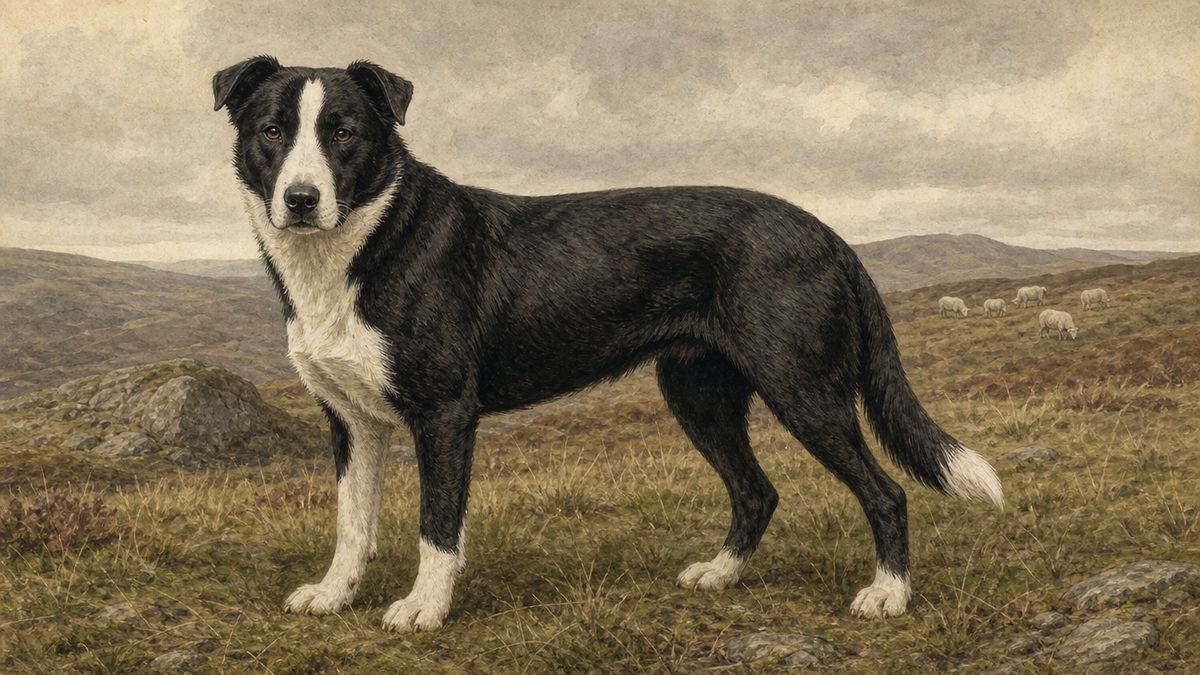
Cumberland Sheepdog: The Extinct Fell Collie, and Why India Cannot Buy One
No kennel club anywhere recognises this dog, no living population exists, and almost everything published about it traces back to a single English book from 1948. Here is what that book actually says, and what the internet added afterwards.
By Bonbeno EditorialVeterinary review: Dr. Ashish J., MVScUpdated 27 August 202670 min read
Quick answer
The Cumberland Sheepdog is extinct, so no Indian price exists and no puppy of this breed can be bought anywhere. It was a black-and-white working collie of the Cumberland and Westmorland fells, recorded by Clifford Hubbard in 1948 and tied to the Lowther family of Lowther Castle. No kennel club lists it. By the early twentieth century its dogs were simply being called Border Collies.
Health information notice
This guide summarises historical breed literature, kennel-club register records, peer-reviewed veterinary and genomic research, Indian import law and satellite climate data as general information for Indian pet owners. It is not a diagnosis and it is not treatment advice. Consult a registered veterinarian near you before acting on anything you read here, and treat collapse, laboured panting that will not settle, or a suspected heat stroke as an emergency.
The lowest rating available, and it rests on the gap rather than on any measurement of the breed, because none exists. This was a heat-sensitive northern type by origin: the Cumberland fells average 7.72 C across the year and 14.01 C in July, while Chennai's coolest month averages 24.09 C. British dogs were already reaching veterinary clinics with heat-related illness at a median ambient of 16.9 C, which the fells never reach as a monthly mean. Anyone reading this page for heat tolerance should read it as a warning about the Border Collie they will actually be sold.
Availability in India1 of 5
Zero, and not recoverable. The breed is extinct, so there is no supply chain to have, and Indian import law would block one anyway. India's most-cited dog price list carries zero mentions of it against eleven for Labrador in the same page, and the top Indian search result for its price is a training-guide book on Flipkart.
Registry recognition1 of 5
None anywhere, and the dog is unrecognised in both senses: no register lists it and no standard describes it. Absent from the FCI definitive register under C, absent from the twenty breeds on the FCI provisional register, absent from the Royal Kennel Club breed-standard index across all seven groups, and absent from the complete AKC breed selector including Foundation Stock Service entries. There is no Kennel Club of India route either, because the KCI works inside FCI nomenclature.
Evidence quality1 of 5
Worse than almost any breed on this site. One paragraph of description from a 1948 handbook, one family association, and a set of downstream claims. No breed standard, no register entry, no skeleton series, no DNA, no health survey, no verified lifespan, no litter record and no photograph that can be authenticated. Two of the top twelve image results are files named for other animals entirely.
Monsoon tolerance1 of 5
Untested and untestable, and the origin climate cuts both ways. The fells are more humid on an annual average, at 90.49 percent, than Mumbai, Chennai, Bengaluru or Delhi. What they are not is hot, at an annual mean of 7.72 C against Mumbai's 26.77 C. A dense coat in saturated air at 8 C dries between showers; the same coat in saturated air at 27 C does not, which is why active drying replaces air drying in India.
Grooming demand3 of 5
Moderate to high, inferred from four words. Hubbard recorded a coat 'fairly heavy and quite dense' and nothing else, so groom it on the schedule used for the living equivalent, brushing two to three times weekly, and dry it actively rather than leaving it. Monkoodog's shedding score of 40 percent has no scale behind it and should be ignored.
Trainability4 of 5
High by inference, with one important caveat. Hubbard recorded a dog that worked quietly, quickly and low to the ground, which describes a biddable close worker that would herd stock without voice. He did not record eye, the trait that makes a Border Collie trainable at distance, so the distance-handling methods the internet recommends for this breed may be the wrong methods for it.
Suitability for Indian living conditions1 of 5
Not applicable in practice, since the dog does not exist, and poor in principle. Indian living conditions for a medium working collie mean apartment life, a hard-exercise window confined to before dawn and after dark for six months of the year, and a monsoon that keeps a dense coat damp. Published Indian guidance rates the living equivalent Poor for apartment friendliness on grounds of extreme energy.
What a Cumberland Sheepdog actually was, and why you cannot buy one
The Cumberland Sheepdog was a black-and-white working collie of the north-west English fells, and it no longer exists. English Wikipedia files it under Extinct dog breeds, Herding dogs and Dog breeds originating in England, and its whole article runs to four sentences of substance resting on one book.
Cumberland is a historic county in the far north-west of England, absorbed into Cumbria in 1974, and its high ground is the Lake District fells and the Pennine watershed. That is the country this dog worked. It was not a show breed, it was never registered anywhere, and nobody wrote a standard for it. What survives is one paragraph of description published in 1948, a family association with Lowther Castle, and a set of claims about what happened to it afterwards.
The claim you will meet first is that it became the Border Collie. Wikipedia states that in the early part of the twentieth century some Cumberland Sheepdogs were being referred to as Border Collies and may have been absorbed into the latter breed. That is a careful sentence and it is worth reading twice, because the two halves of it say different things. Being referred to by another name is a fact about paperwork. Being absorbed is a fact about breeding. This page separates them.
It was one of several, not a special case
The Cumberland Sheepdog belongs to a whole category of vanished British regional working collies, and it was not the best documented of them. Carole Presberg, who has maintained the Border Collie Museum for two decades, lists the ones she can name and adds a plain warning. 'There are a number of other collie breeds in Great Britain that have gone extinct, their names but alluded to in books. Others that come to mind are the Cumberland, the Dalesman, the Manx, and the Warwickshire. Information on them is seriously lacking';.
That is the honest frame for this breed. It sits alongside the Welsh Grey, the Welsh Hillman, the Welsh Black-and-Tan, the Dorset Blue Shag, the Sussex Sheepdog, the Smithfield, the Galway Collie, the Glenwherry Collie and the Wicklow Collie, all named in the same survey, and most of them have less evidence behind them than this one does.
Why they all disappeared at once
Peer-reviewed work gives the mechanism and the period. Barrios and colleagues, writing in PLoS Genetics on the genomics of the Patagonian sheepdog, state that in mid-nineteenth-century Britain 'official standards for individual collie-type breeds were not yet defined' and that dogs used in sheep farming 'were simply known as working collies or shepherd dogs that had been adapted to terrain and climate'. They add that those regional varieties 'disappeared from the UK at the end of the 19th century as a result of industrialization and changes in trade and transportation patterns';.
So the Cumberland Sheepdog was not a breed that failed. It was a local population inside an unstandardised working pool, and the pool was standardised around it. When the paperwork arrived, one name won and the rest were folded into it or forgotten.
There is no living population and no lawful route to one
No register lists this breed, no breed club exists for it, no standard has ever been written, and India's import rules would not admit a dog of it even if one existed. Any page offering a Cumberland Sheepdog puppy, a Cumberland Sheepdog price or a Cumberland Sheepdog popularity ranking is generating those fields, not reporting them.
The one book that describes it, and what Hubbard actually wrote
Almost every sentence published about this breed traces to a single source, Clifford L. B. Hubbard's Dogs in Britain of 1948. Read that entry and two things stand out that no ranking page mentions.
Hubbard's book is a general handbook with a chapter on each group, published by Macmillan and Co. Ltd. in London in 1948, and it carries a chapter on the Sheepdog Group. He had published Working Dogs of the World the previous year with Sidgwick and Jackson, so he was not a casual observer of the working types. Wikipedia's entire Conformation paragraph, and therefore every spec card downstream of it, is a paraphrase of one Hubbard entry.
The Border Collie Museum quotes him directly. Hubbard described a breed 'much like the Welsh Sheepdog and the old working Collie types, [that] works quietly, quickly and low-to-ground';. Wikipedia renders the same passage as working quietly, quickly and low-to-ground, with a head rather broad and flat tapering to a medium-length muzzle, ears that fell over to the front or were semi-erect and rather small, a fairly long and extremely lithe body, light but muscular legs, and a low-set tail carried at the trail.
The first thing nobody mentions: there is no eye
Presberg's observation on that passage is the sharpest sentence written about this breed anywhere, and it is four words long. 'There is no mention of eye';. Eye is the crouching, staring, hypnotic control that defines the Border Collie and separates it from every other herding type in Britain. A description of a working collie that covers head, ears, body, legs, tail, coat and colour, and never mentions eye, is describing a dog that either did not have it or was not selected for it.
That single absence undercuts the whole absorption story more than any other detail on record, and it has never been printed on a page that ranks for this breed. Aggregators go the other way. Monkoodog's version of the passage asserts that the described work style 'also includes the modern border collie, known for its strong-eyed breed';, attributing to Hubbard a trait that his text does not contain.
The second thing nobody mentions: he was complaining about naming
Hubbard's most quoted sentence is a grievance about registration, not about genetics. 'Cumberland farmers have entered this breed in Sheepdog Trials for at least sixty-five years, [and] indeed, many of the so-called Border Collies which have won awards have really been Cumberland Sheepdogs';.
Read that as a breeding claim and it says Cumberland blood is inside the Border Collie. Read it as a naming claim and it says Cumberland dogs were being entered and recorded under someone else's breed name. The second reading is far better supported, and the reason is a date given in the next section.
Presberg's own verdict
The specialist who assembled the quotations does not treat this as a lost breed at all. 'Since they looked and worked like a Border Collie the point is moot. The Cumberland Sheepdogs were likely just a local variant of the same dog. Even today, unregistered sheepdogs do not get to use the name Border Collie';.
Dating this breed from the documents instead of from the internet
Subtract sixty-five from 1948 and you get 1883, which is the firmest date anyone has for this breed and it comes from Hubbard's own sentence. Four independent dates can be pinned down this way, and together they explain the whole story.
Hubbard wrote in 1948 that Cumberland farmers had entered the breed in sheepdog trials 'for at least sixty-five years';. That is not a vague antiquity claim, it is arithmetic. It places organised Cumberland trial entries at 1883 or earlier, which puts this dog in formal competition a full generation before the name Border Collie existed.
Collies enter the show ring, beginning the split between show and working stock
Wikipedia, Border Collie history
1850 to 1870
The UK herding breeds genetically separate from a common foundational population
Barrios 2022, haplotype-sharing model
1883 or earlier
Cumberland farmers already entering this breed in sheepdog trials
Hubbard 1948, 'at least sixty-five years', minus 65
1915
James Reid, ISDS secretary, first uses the term 'border collie'
Wikipedia, Border Collie history
1935 to 1944
Lord Lonsdale disperses the Lowther kennel
Hubbard's 'a few years ago', bounded by the 5th Earl's dates
The 1915 line settles Hubbard's grievance. James Reid, secretary of the International Sheep Dog Society, first used the term border collie in 1915 to distinguish dogs registered by the ISDS from the Kennel Club's collie, which had come from the same working stock but had developed a different standardised appearance after entering the show ring in 1860. Before 1915 there was no Border Collie to be confused with. After 1915 there was a registry, and a dog was a Border Collie if the ISDS said so.
So when Hubbard complains that award-winning Border Collies 'have really been Cumberland Sheepdogs', he is describing Cumberland fell dogs being entered under the new registered name from 1915 onward. That is a renaming, not an absorption. Presberg reaches the same conclusion from the other direction when she notes that even today unregistered sheepdogs do not get to use the name Border Collie.
The genomic date agrees
Barrios and colleagues estimated the year of genomic divergence between pairs of herding breeds from the total length of shared haplotypes, using 159 Patagonian sheepdogs against 1,514 individuals representing 175 breeds. The Patagonian sheepdog diverged from each UK herding breed about 149 years before its 2019 sampling, and its breed-to-breed divergence dates fall between 1850 and 1870, 'prior to the genetic separation of most of the UK herding breeds'.
Put those two findings side by side and the picture is coherent. The British herding breeds had not genetically separated from each other before about 1870. Cumberland farmers were competing in trials by 1883. The name Border Collie arrived in 1915. A regional fell population sitting inside that timeline was never a distinct breed in the modern sense, because no British herding dog was.
The date the aggregators print instead
Several pages date the breed's decline to a cross with German Shepherd Dogs in 1899. That date is examined further down this page. What matters here is that it is the only date most pages give, it comes from a passage they reproduce in translation, and none of them checks it against the German Shepherd's own chronology.
The Lonsdale problem: two ranking pages name the wrong Earl
The Cumberland Sheepdog's only named patron was Hugh Cecil Lowther, 5th Earl of Lonsdale, and two of the pages ranking for this breed name his younger brother instead. The correction is checkable in a peerage table and it re-dates half the story.
Presberg records that the breed's 'history is tied to Lord Lonsdale, whose family owned Cumberland Sheepdogs for more than a hundred years', and quotes Hubbard describing the late Lord Lonsdale as a great admirer of the breed who kept many during his time. Hubbard published in 1948, so 'the late Lord Lonsdale' has to be an Earl who had already died by then.
Hugh Cecil Lowther, 5th Earl of Lonsdale, was born on 25 January 1857 and died on 13 April 1944. He succeeded his brother St George in 1882 and held the earldom until his death, a span of sixty-two years. He was Lord Lieutenant of Cumberland from 1917 to 1944, inherited wealth from his father's Cumberland coalmines, owned 75,000 acres, and had his principal seat at Lowther Castle in Westmorland.
Lancelot Edward Lowther, 6th Earl of Lonsdale, lived from 1867 to 1953 and inherited the earldom only in 1944, on Hugh's death. He was so short of money by then that he auctioned the contents of Lowther Castle in 1947, in what became the largest English country house sale of the twentieth century.
Pet Paw states that the Cumberland Sheepdog 'was said to be the favorite breed of Lancelot Edward Lowther, 6th Earl of Lonsdale, and that the breed had been in his family for more than a hundred years';. Monkoodog carries the same claim in mangled form, calling him 'the 6th Earl of Lonsdale, the favorite breed of Lansdale Edward Lothar';. Both name a man who was not the Earl during the events described and who was still alive when Hubbard called the patron late.
What the correction buys you
Fixing the Earl fixes the dates. Hubbard wrote that 'a few years ago Lord Lonsdale dissolved his kennel and gave his Cumberlands to farmer friends around Lowther', in the version of the passage reproduced by Monkoodog. Hugh's finances collapsed in stages and he left Lowther Castle in 1935 because he could no longer afford to live there. That bounds the kennel dispersal between 1935 and his death in 1944, which is as close as the record allows anyone to get.
It also tells you what kind of holding this was. Hugh Lowther was a vice-president of the RSPCA, president of Our Dumb Friends' League for twenty years until he resigned in 1930, a founder and first president of the Automobile Association, and the donor of the original Lonsdale Belts for boxing in 1909. A man that publicly involved in dogs and animal welfare kept Cumberland Sheepdogs for decades and never sought a breed standard for them, which is itself evidence about how the type was regarded.
Absorbed into the Border Collie, or simply renamed?
Renamed is the better-supported answer, and one line in a bibliography settles most of it. Hubbard's 1948 book has no Border Collie entry at all, because he wrote about the working collie under its regional names instead.
The Border Collie Museum's bibliography summarises Dogs in Britain in a single note that changes how the whole book reads. 'General handbook with chapters on each group of breeds. Includes a chapter on the Sheepdog Group. By collie the show collie is meant, but the Border Collie is described as the Cumberland Sheepdog and later, as the Welsh Sheepdog';.
So Hubbard's Cumberland Sheepdog entry is not an entry on a lost breed sitting beside a Border Collie entry. It is his Border Collie entry, filed under a regional name, in a book published thirty-three years after the term Border Collie was coined and twenty-eight years before the Kennel Club would take the breed onto its own register. Once you know that, his complaint about award winners being 'really' Cumberland Sheepdogs reads exactly as a working man's objection to a new label being applied to old dogs.
The Border Collie's own article does not mention it
Wikipedia's Border Collie article runs to tens of thousands of words on history, working style, health, and famous individuals, and the string Cumberland appears in it twice, both times inside the navigation box at the foot of the page listing extinct British breeds. The body of the article never mentions the Cumberland Sheepdog. A breed that had genuinely been absorbed into another would normally leave a trace in that other breed's own history section, and this one leaves none.
What absorption would actually have to mean
Presberg puts the case for renaming in one sentence. 'Since they looked and worked like a Border Collie the point is moot. The Cumberland Sheepdogs were likely just a local variant of the same dog';. Barrios and colleagues supply the population-genetic version of the same point: before the mid-nineteenth century, British sheep-farming dogs 'were simply known as working collies or shepherd dogs that had been adapted to terrain and climate', with no official standards for individual collie types.
Absorption implies two separate gene pools merging. Renaming implies one pool that acquired a registry and a label. Every checkable piece of evidence on this page points at the second: no recorded eye, no standard, no register entry, a name that predates the rival name by decades, and a specialist's judgement that the two were the same dog.
The 1899 German Shepherd claim, and why it cannot be both specific and true
Several pages state that Lord Lonsdale crossed his Cumberland Sheepdogs with German Shepherd Dogs in 1899 to save the type. Dog Breed Info writes that he bred his dogs with 'another herding dog, then known as the German Shepherd which is different than today's modern German Shepherd';. Monkoodog reproduces the same passage and then bolts on a paragraph explaining that the modern breed was developed from 1899 by 'Captain Max Emil Friedrich von Steffenitz';, a garbling of Max von Stephanitz.
Those two claims cannot both stand. Either the 1899 cross was with a generic continental sheepdog, in which case the sentence carries no breed information at all and tells you nothing about what went into the Cumberland dogs, or it was with the German Shepherd Dog as a breed, in which case it happened in Cumberland in the same year that von Stephanitz began the breed in Germany. The Royal Kennel Club's own German Shepherd Dog page credits von Stephanitz and his followers with developing and promoting the breed, and dates the first breed club to 1881 rather than to 1899, so even the recognising body in Britain does not print the date the aggregators build on.
Report the disagreement, do not resolve it
Bonbeno cannot verify the 1899 cross from a primary document, because Hubbard's page has not been read here directly and the versions in circulation are translations of a translation. What can be verified is that the aggregators contradict themselves within a single paragraph, and that the Royal Kennel Club prints a different founding date for the breed they say was used. The honest position is that the 1899 claim is unconfirmed and internally inconsistent as published.
The Australian Shepherd claim, followed back to its only source
Wikipedia's single citation for the Australian Shepherd claim does not make that claim. It contains one sentence about emigrant farmers, inside a section whose only source is a private letter from one woman in Birmingham in 1978.
Wikipedia's opening line states that the Cumberland Sheepdog 'is claimed to be one of the ancestors of the Australian Shepherd', and attaches exactly one footnote to it, pointing at an archived Working Aussie Source page carrying Phillip C. Wildhagen's 'History of the Australian Shepherd';. That article was opened for this page.
It mentions Cumberland once. The sentence reads: 'From the hill farms of Westmoorland and Cumberland the farmers took their Cumberland Sheepdog, another dog of somewhat Border Collie type';. It sits in a list of the dogs that emigrant British farmers took with them, under a section heading that reads HERDERS FROM EUROPE IMPORTED INTO AUSTRALIA. It names the breed as cargo, not as ancestry.
Where that list came from
The section heading carries an asterisk, and the asterisk resolves at the foot of the article to a single line: 'Correspondence from Mrs. Muriel Landers-Cooke, Birmingham, England (1978)';. Every British, Welsh, Irish and German breed named in that passage, the Cumberland Sheepdog included, rests on one private letter written by one person in 1978 and never published.
The site that hosts the article says so itself, in an editor's note above the text. 'This article, published in the 1977 ASCA Yearbook, is a summary of what was then known or surmised about the origins of the Aussie. At this remove, both the article and its content are of historical interest. More detailed, and sometimes, contradicting, information has come to light in the meantime';.
An early relative of the Border Collie and Australian Shepherd
Assertion
Wikipedia
Claimed to be one of the ancestors of the Australian Shepherd
Hedged, one citation
Wildhagen article
Cumberland farmers took their Cumberland Sheepdog to Australia
Not an ancestry claim
Wildhagen's source
Correspondence from Mrs. Muriel Landers-Cooke, Birmingham, 1978
Unpublished private letter
Host's editor note
What was then known or surmised, since contradicted
Explicit warning
AKC breed page
The word Cumberland does not appear
Silence from the registry
The article also dates itself twice and disagrees with itself. The editor's note says the 1977 ASCA Yearbook; the article's own closing line says 'this article was first published in the ASCA Yearbook, 1978'; and the sourcing footnote is dated 1978. When a document cannot settle its own publication year, treating its passing mention of a breed as settled ancestry is not defensible.
What the registry that recognises the Australian Shepherd says
The American Kennel Club's Australian Shepherd page does not contain the word Cumberland anywhere. Its history begins in Europe near the Pyrenees, in the borderlands between France and Spain, and the page notes separately that the breed 'is not registered in Australia as a native breed' and is the AKC's 135th breed. Wildhagen himself names the Border Collie, not the Cumberland Sheepdog, when he gets to likely ancestry, calling it 'one likely ancestor' in his working-style section, and he writes that 'prior to 1945, there is no reliable evidence that the Australian Shepherd was being molded into a true breed type';.
The specialist's caution, which applies exactly here
Presberg, writing about a different attempt to link the Australian Shepherd to one specific British type, says the thing worth remembering: 'There may indeed be one, but without genetic testing we will probably never know. Even with genetic testing, all the current collie breeds may be so closely related that to single out two of them and make some special connection between only those two may be impossible';.
What peer-reviewed genomics says, and what it never says
No peer-reviewed paper anywhere mentions the Cumberland Sheepdog, and that absence was tested with controls rather than assumed. The one modern genomic study of extinct UK herding ancestry names a different breed entirely, and takes its illustration from an amateur website.
Two literature databases were searched for this page, each with a control run in the same session. PubMed was given the exact phrase 'Cumberland Sheepdog'. It broadened the query on its own initiative, returning the translation "cumberland"[All Fields] AND ("sheepdog"[All Fields] OR "sheepdogs"[All Fields]), and still returned a count of zero. A broadened query that finds nothing is a stronger negative than a narrow one, because the engine widened the net itself. The control 'Border Collie', run in the same session, returned 277 records, so the instrument was working.
Europe PMC, which searches full text and not only abstracts, returned a hit count of zero for the same phrase with synonym expansion switched off. Its control was chosen to be as unflattering as possible: the Lancashire Heeler, a small northern English herding breed the FCI recognised only provisionally in 2016. That query returned 40 records with real PubMed and PubMed Central identifiers.
Barrios and colleagues published 'Patagonian sheepdog: Genomic analyses trace the footprints of extinct UK herding dogs to South America' in PLoS Genetics in 2022, combining genome-wide marker data from 159 Patagonian sheepdogs with 1,514 individuals representing 175 dog breeds and two wild canids. If any peer-reviewed work were going to name this breed, it is that one, and it does not. A field search restricted to that single article returned zero for Cumberland and zero for Welsh Sheepdog, against a control search for Patagonian inside the same article that returned one.
What the paper names instead is the Old Welsh Grey. 'Among breeds likely related to PGOD before and during the period of extensive Patagonian colonization, between 1877 to 1910, are the Old Welsh Grey and other historic UK herding dogs which have similar aptitudes for herding sheep'. The Patagonian sheepdog itself clustered with a sixteen-member UK rural clade in 92 percent of bootstrap replicates, a clade that includes the Border Collie, Shetland Sheepdog, Old English Sheepdog, Pembroke Welsh Corgi and Australian Shepherd, and it came out monophyletic with the Border Collie and the Australian Kelpie.
The detail that should make everyone humble
The illustration Barrios and colleagues use for an extinct British herding type, Figure 1B, is credited in their own caption to 'Carpenter B' at bordercolliemuseum.org, on the very page this Bonbeno guide has been quoting throughout. A PLoS Genetics paper on extinct UK herding ancestry sources its picture of a lost British breed to the same amateur website that carries the only usable summary of Hubbard's Cumberland entry.
That is not a criticism of the paper. It is a measurement of how thin the record is. When the best genomic laboratory work on this question has to reach for a hobbyist site for a photograph, an Indian reader can safely conclude that nobody has better material on the Cumberland Sheepdog than what is on this page.
Where the Australian Shepherd sits genetically
Barrios places the Australian Shepherd and the Border Collie inside one sixteen-member UK rural clade. That is exactly why a claim of descent from one specific extinct English population is untestable. Everything in that clade is closely related to everything else in it, so singling out two members and drawing a line between them adds nothing a reader can act on.
Recognition status, register by register, each one checked with a control
No kennel club anywhere recognises the Cumberland Sheepdog, and this section names each register that was opened, what was read inside it, and the control breed that returned a result in the same session. A zero without a control is not evidence.
The FCI check needed the letter C, because the FCI files breeds under their native names and a Cumberland Sheepdog would sit there. The complete C list carries 44 breeds from Ca de Bestiar to Curly Coated Retriever, including Collie Rough at number 156 and Collie Smooth at number 296. Both controls returned, so the page rendered; the Cumberland Sheepdog is not on it.
The provisional register matters more than people expect, because a rare breed is far more often provisionally recognised than absent altogether. The FCI currently lists 20 breeds on a provisional basis, the highest number being 378, the Macedonian Shepherd Dog Karaman, recognised on 11 February 2026. That register does carry recent herding admissions, including the Miniature American Shepherd at 367 and the Lancashire Heeler at 360, so it is not closed to obscure pastoral types. This breed is not on it.
The two registers a British breed would sit in
The Royal Kennel Club publishes its complete breed-standard index across all seven groups on one page, and the Pastoral group there runs from the Anatolian Shepherd Dog to the White Swiss Shepherd Dog, taking in the Border Collie, Collie Rough, Collie Smooth, Bearded Collie, Lancashire Heeler, Old English Sheepdog, Shetland Sheepdog and Australian Shepherd along the way. The whole list was read rather than searched from outside, which matters because a search box can miss a breed filed under another name. The Cumberland Sheepdog is in none of the seven groups.
The American Kennel Club prints its complete breed selector on every group page, and that selector is not limited to fully recognised breeds. It carries Foundation Stock Service and Miscellaneous entries too, including the Working Kelpie, the Mountain Cur, the Nenets Laika and the Thai Bangkaew, so an obscure herding type recorded anywhere in the AKC system would appear. The controls Border Collie, Collie, Australian Shepherd and Miniature American Shepherd all appear. Cumberland Sheepdog does not.
What this means for an Indian buyer specifically
There is no Kennel Club of India route either, and the reason is structural rather than local. The KCI issues pedigrees against FCI nomenclature, so a breed absent from both the FCI definitive and provisional registers has no standard for a KCI judge to apply and no pedigree the KCI could issue. A Cumberland Sheepdog in India would therefore be unregisterable twice over, once internationally and once at home, on top of not existing.
Give the absence a direction
An absence from a register can mean promoted out, never admitted, or removed. This one is the second. The Cumberland Sheepdog was a working population in a country whose working sheepdogs were registered by the International Sheep Dog Society on ability rather than by the Kennel Club on appearance, and it stopped being called by its own name before either body would have had cause to write a standard for it. Saying it is 'not recognised' is true but slightly misleading; nothing was ever put forward to recognise.
What it looked like, from the only description that exists
One paragraph describes this dog, and every illustration on the internet departs from it somewhere. Hubbard recorded a black dog with white points, small forward-falling or semi-erect ears, a long lithe body and a low tail carried at the trail.
Wikipedia's conformation paragraph is the fullest surviving rendering of Hubbard's description, and it reads as follows. The head was rather broad and flat, tapering to a medium-length muzzle. The ears fell over to the front or were semi-erect and rather small. The body was fairly long and extremely lithe, with light but muscular legs and a low-set tail carried at the trail. The coat was fairly heavy and quite dense. The dogs were black with white blaze, chest, feet and tip of tail. Height was about 20 inches and weight ranged 40 to 50 pounds.
Hubbard's description against what the ranking pages illustrate Dog Breed Info Center
Feature
Hubbard 1948
Dog Breed Info
Agrees?
Base colour
Black
Typically white
No
Markings
White blaze, chest, feet, tail tip
Black or dark brown around face, back, sides
No
Ears
Small, fell forward or semi-erect
Medium, wide apart, stuck up
No
Skull
Rather broad and flat
Top of head flat
Yes
Muzzle
Medium length
About the same length as the skull
Roughly
Body
Fairly long, extremely lithe
Not described
Not stated
Tail
Low-set, carried at the trail
Long fluffy tail to the ankles
No
Coat
Fairly heavy and quite dense
Longer coats
Roughly
Five of those eight rows disagree, and the two that matter most for identification, colour and ear carriage, disagree completely. Dog Breed Info describes a dog 'typically white with black or dark brown markings around the face, back, and sides' with 'medium sized ears that were wide apart and stuck up', and illustrates the page with two drawings, one of them a brown, tan and white dog with a white blaze. Hubbard's dog was black with white points and small ears that fell forward.
The pictures are worse than the text
Search the breed's images and the results are openly unreliable. Two of the top twelve image results on a Bing India query are files named for other animals: a pupvine.com image on a '26 Extinct Dog Breeds' listicle whose filename is Chiribaya-Dog-1.jpg, and a recentlyextinctspecies.com image whose filename is The_Cur_Cynographia_Britannica.jpg. A third, on a '10 Extinct Dog Breeds' page, is served from koala.sh with a URL parameter reading dream, which is an image-generation endpoint rather than a photograph.
So the picture problem is not that images of this breed are rare. It is that the images circulating are a Peruvian mummified dog, an eighteenth-century engraving of a Cur, and machine-generated art, all captioned as a Cumberland Sheepdog. Bonbeno's own hero image brief for this page requires a period-style illustration matching Hubbard's description and explicitly rejects a photorealistic modern collie, for exactly this reason.
One honest uncertainty
Hubbard says the coat was 'fairly heavy and quite dense'. That is not the same as rough-coated in the show sense, and it is not the same as smooth. Presberg, summarising, calls the dog rough-coated; Wikipedia stays with Hubbard's words. The difference is small, but it decides whether this was a heavy-coated fell dog or a moderately coated one, and no source can settle it. Both readings are recorded here rather than one being chosen.
Four published height and weight figures, and only one has a source
Every size figure printed for this breed traces to Hubbard's about 20 inches and 40 to 50 pounds, or it traces to nothing. Three of the four ranking pages that give measurements have widened, converted or invented them.
Monkoodog is the clearest case, because the page contradicts itself twice over. Its spec card at the top prints a male height of 23 to 24.5 and a male weight of 32 to 32.5, with no units on either figure, and classifies the breed's size as Large. Scroll down the same page and the Hubbard passage it reproduces says the dog 'is about 20 in height, and weighs up to 40 to 50 pounds'. A 20-inch, 45-pound dog is a medium-sized working collie, not a large dog, and the card and the article cannot both be describing it.
Dog Breed Info's widening is quieter and more instructive. It converts Hubbard's height correctly to 51 cm, then prints the weight as 35 to 55 pounds, 16 to 25 kg. That is Hubbard's range extended by five pounds at each end, with no note, no source and no explanation. Nothing in the record supports a 35-pound or a 55-pound Cumberland Sheepdog. The range simply grew in transit.
What the one real figure is worth
Hubbard's 20 inches and 40 to 50 pounds describe a dog of very close to Border Collie size. For scale, an Indian guide to the Border Collie quotes 48 to 56 cm for males and 14 to 20 kg, and 20 inches is 50.8 cm while 40 to 50 pounds is 18.1 to 22.7 kg. So Hubbard's Cumberland dog was a Border Collie in height and a shade heavier at the top of its weight range. That is one more line of evidence that the two were the same animal under two names, and it is a comparison no ranking page has made.
Why no breed standard was ever written
A breed standard requires somebody with authority to write one, and the two British bodies that could have done it were both looking elsewhere. The Kennel Club standardised the show Collie after the show ring opened to the type in 1860, and the International Sheep Dog Society registered working dogs on trial ability rather than on conformation. A fell working collie owned by farmers and one Cumberland peer fell between the two, and by the time either body took an interest, its dogs were being entered as Border Collies.
Divide any suspicious rupee figure, but there is nothing here to divide
Bonbeno routinely tests Indian breed prices for the signature of a wholesale currency conversion, at 84.38, at 74 and at 80. That test cannot be run on this breed because no Indian page prints a rupee figure for it at all. The absence of a price to test is itself the finding, and it is examined in the price section below.
Cumberland Sheepdog price in India, and what is actually being sold
There is no Cumberland Sheepdog price in India, because there is no Cumberland Sheepdog. No Indian dog-price list carries the breed, no Indian seller lists it, and the top Indian result for the phrase is a book about it on Flipkart.
Say the obvious thing first. This breed cannot be bought at any price, in India or anywhere else, because no living population exists and no register would issue a pedigree for one. Any figure you are quoted is for a different dog.
That was tested rather than assumed. Supertails publishes one of India's most-cited dog price lists, covering forty breeds with city-wise costs and monthly budgets. The whole page was fetched and searched. The string Cumberland appears zero times and the string Sheepdog appears zero times, while the control Labrador appears eleven times and Border Collie appears once with a real price row of Rs 20,000 to Rs 60,000. The search worked, and the breed is genuinely absent.
Read that table as a buyer would. An Indian searching for this breed's price is offered three different living breeds, a training manual, and an American Cavapoo breeder whose kennel name happens to contain the word Cumberland. Not one result is an offer of the breed searched for, which is the correct outcome and worth stating plainly.
The two shells that do exist
Two pages come closer to pretending. Dog Breed Standards publishes a page at dogbreedstandards.com whose meta description reads 'Cumberland Sheepdog and Cumberland Sheepdog puppies, Information, Pictures and Videos', dated 3 April 2013 under the byline Bhola, and whose visible body contains nothing at all beyond a skip-to-content link. Petlur prints a spec card giving the breed a Popularity or Rank of 494 and an alternative name of Cumberland Shepherd. A popularity rank implies a population being ranked.
Even if one existed, India could not import it
Indian import law would close the route independently. Under ITC (HS) 01061900, mammals other than those separately listed are Restricted, and DGFT Trade Notice 22/2022-23 sets Policy Condition (7), under which import of dogs is allowed only for a pet dog with a valid pet book and records in the importer's name, for R and D organisations with a CPCSEA recommendation, or for internal security by the Defence and Police Force. Policy Condition (8) states that import of commercial dogs for breeding or any other commercial activity is not permitted.
The notice is blunter still at paragraph 6: 'any applications for trading or breeding purposes, or applications made on behalf of some another person or entity shall be duly rejected'. Entry is limited to airports and seaports at Delhi, Mumbai, Chennai, Hyderabad, Bengaluru and Kolkata and, since October 2024, Kochi airport, and an import authorisation must be applied for at least two months before travelDepartment of Animal Husbandry…. So even a hypothetical surviving Cumberland Sheepdog could reach India only as one person's existing pet, never as founding stock. The full route is set out in how to import a dog to India.
Running the currency tests when there is no rupee figure to test
The usual test for a fake Indian breed price cannot be run here, and that is the finding. Indian pages routinely publish rupee prices that are a dollar figure run through one exchange rate, and this breed has no rupee figure at all to divide.
Bonbeno tests suspicious Indian price bands against three rates. Dividing by 84.38 has caught converted lists three times on this site. Dividing by 74 has caught a 155-breed table where 453 of 463 rupee values resolved to exact dollar amounts. Dividing by 80 is the weakest of the three, because any rupee figure ending in three zeros divides cleanly at 80 by construction, so a match there counts only when the quotient is also a price a human would print.
None of those tests applies to the Cumberland Sheepdog, because no Indian page prints a price for it. That absence is unusual and it is worth saying why it is good news. For most rare breeds, Indian listing sites generate a plausible rupee band from an American figure, and the division exposes it. Here the aggregators stopped short of inventing a price, and the reason is almost certainly that Wikipedia's opening word is extinct, which is one of the few facts a template generator will not paper over.
So the tests were run on the substitute instead
The dog an Indian buyer is actually steered toward is the Border Collie, so the three published Indian Border Collie bands were tested. None of them shows a conversion signature at the strong rate.
Zero of the eight bands divide to a whole number of dollars at 84.38, and zero at 74. Six of eight do at 80, which is exactly what the arithmetic guarantees for round rupee figures and therefore proves nothing. The honest conclusion is that Indian Border Collie prices look rupee-native rather than converted, which is a mildly reassuring result and one no Indian page has bothered to check.
What the price pages get wrong instead
The Indian Border Collie pages fail on internal consistency rather than on currency. WhatsTheCost's page title says Rs 15,000 to Rs 40,000 while its own meta description says the price 'ranges from Rs 4,000 to Rs 100,000';. Its pros and cons table prints the identical line 'Intelligent temperament makes them wonderful companions' three separate times as three separate pros. Its Similar Breeds table lists the Beagle twice with identical wording. And its buying advice tells readers that 'eye and patella checks important for small breeds', on a page about a 14 to 20 kg herding dog.
Rs 98,999 is a house price point, not a breed price
One Indian listing site has now been caught printing Rs 98,999 across ten separate breed pages, attached to whichever puppy is in stock, including breeds it does not stock at all. It does not appear on any Cumberland Sheepdog page for the simple reason that no Indian seller has built one. If you ever see it quoted as this breed's price, it is the carousel talking.
Monthly cost in India for a dog of this size, if one existed
A 20-inch, 40 to 50 pound working collie costs between Rs 4,000 and Rs 9,000 a month to keep in an Indian city, on the only detailed Indian breakdown published for its living equivalent. This section uses the Border Collie's numbers and says so, because borrowing a related breed's figures is only honest when it is declared.
No cost data exists for the Cumberland Sheepdog and none can. What can be done is to take the closest living dog of the same size and job, and print its Indian running costs with the source attached, so a reader can see exactly what is being substituted and why.
First-year cost runs higher because of vaccination, sterilisation and setup. The same source budgets Rs 30,000 at the low end and Rs 95,000 at the high end for year one including the purchase price, and puts lifetime cost across a 12 to 15 year commitment at roughly Rs 6 lakh to Rs 17 lakh.
The line that matters most in India
Tick prevention is the line item an Indian owner should not economise on. The same breakdown puts monthly tick and flea prevention at Rs 200 to Rs 500 and treatment of tick-borne disease, naming ehrlichiosis and babesiosis, at Rs 5,000 to Rs 20,000 per episode. Twelve months of prevention at the top of the range costs Rs 6,000, which is less than a single mid-range episode.
That arithmetic is not theoretical. In a Kerala study of 150 dogs, polymerase chain reaction detected Babesia gibsoni in 47.3 percent of animals while light microscopy found it in only 26.67 percent. Those figures work out to roughly 71 and 40 dogs of 150 respectively, so the routine blood smear an Indian clinic runs first missed close to half the infections present. Anaemia and thrombocytopenia were the significant haematological changes in chronic infection.
Where the published Indian costing falls short
The Indian cost guide's health section lists skin allergies, ear infections, dental disease and tick-borne disease. It does not list Collie Eye Anomaly, the MDR1 drug-sensitivity variant, epilepsy or hip dysplasia, which are the four things that actually shape veterinary spending in a collie-lineage dog over its lifetime. A budget built from that page will be about right for routine months and badly wrong for the expensive ones.
Two Indian sources, two different purchase bands
Supertails prints a single Border Collie band of Rs 20,000 to Rs 60,000. WhatsTheCost splits it into pet quality at Rs 15,000 to Rs 40,000, KCI registered at Rs 32,000 to Rs 60,000, show quality at Rs 50,000 to Rs 1,00,000 and imported bloodline at Rs 1,50,000 to Rs 2,00,000. The two disagree at both ends. Publish the disagreement, do not average it.
Could a Cumberland Sheepdog handle the Indian climate? The numbers say no
The Cumberland fells average 7.72 C across the year, and Chennai's coolest month averages 24.09 C. That single comparison decides this breed for India before any question of coat, grooming or exercise arises.
The heat rating on this page is one of the few figures that is genuinely Bonbeno's own rather than borrowed, so it was built from satellite climatology queried by explicit latitude and longitude rather than from a place-name lookup. The origin point chosen is longitude -2.44, latitude 54.81, near Alston in Cumberland, the highest market town in England and the settlement named in the one nineteenth-century anecdote the aggregators quote about a Cumberland working dog.
Read the coolest-month column against the fells' warmest-month figure and the scale of the mismatch becomes concrete. Chennai's coldest month averages 10.08 C hotter than the hottest month this dog's ancestors ever worked in. Mumbai's coldest month is 9.18 C hotter. Bengaluru, the mildest large Indian city, is still 6.21 C hotter in December than Cumberland is in July.
Delhi is the exception, and it proves the point
Delhi has exactly one month that a Cumberland fell dog would recognise. Its January mean of 13.61 C sits 0.40 C below Alston's July mean of 14.01 C. That is the only month in any of these four cities that is not hotter than a Cumberland summer. For the other eleven months Delhi climbs to a June mean of 35.88 C and an annual maximum of 48.79 C, which is 21.52 C above the highest temperature recorded at the Cumberland point in the same dataset.
Where dogs from this climate actually start collapsing
A VetCompass study of UK primary-care records found that the median ambient temperature on days when British dogs presented with heat-related illness was 16.9 C. That number is the single most useful figure on this page for an Indian reader, because it is 2.89 C above the warmest monthly mean on the Cumberland fells. Dogs bred and kept in British conditions were already reaching veterinary clinics with heat illness at temperatures that Cumberland does not reach as a monthly average, and every Indian city in the table above spends most of the year well past it.
The study also found that age, bodyweight and trigger predicted severe disease, while age, skull shape and clinical grade predicted a fatal outcome, and that risk was highest where a dog could not escape the heat source. A working collie is not brachycephalic, so the skull-shape risk does not apply, but the bodyweight and exertion findings do, and a herding dog in an Indian city is precisely a dog whose owner will be tempted to exercise it hard.
Why this rating is a 1 and not a 2
The heat-tolerance trait on this page is set at the lowest available value, and the justification is the gap rather than any measurement of the breed itself. No thermal data exists for a Cumberland Sheepdog and none can. What exists is a 20.23 C gap between its origin climate's annual mean and Chennai's, and a UK heat-illness median that the fells never reach. Where the evidence is that lopsided, the honest rating is the floor.
The humidity finding that surprised us, and what it changes
The Cumberland fells are more humid across the year than Mumbai is, and that fact cuts against the lazy version of the monsoon argument. Humidity alone was never this dog's problem. Humidity carried at 27 C instead of 8 C is.
Alston's annual mean relative humidity is 90.49 percent. Mumbai's annual mean is 67.39 percent, Chennai's is 72.39 percent, Bengaluru's is 67.94 percent and Delhi's is 45.56 percent. The Cumberland point is more humid on an annual average than any of the four Indian cities, and its driest month, May at 84.55 percent, is still more humid than Mumbai's annual mean.
So the correct statement is not that this dog could not cope with damp. It evolved in permanent damp. Mumbai's wettest month reaches a humidity of 90.36 percent, which is almost exactly the Cumberland annual average of 90.49 percent. The difference is that Cumberland carries that moisture at an annual mean of 7.72 C and Mumbai carries it at 26.77 C, a gap of 19.05 C. Wet and cold is the climate this coat was built for. Wet and hot is a different physiological problem entirely, because evaporative cooling from panting works badly in saturated air.
The rain pattern is the sharper difference
Cumberland has no dry season and no wet season. Its driest month averages 2.03 mm of rain a day and its wettest averages 3.82, a ratio of 1.88 to 1 across the whole year. Mumbai's driest month averages 0.01 mm a day and its wettest averages 26.90, a ratio of two thousand six hundred and ninety to one. A dog adapted to steady drizzle is not adapted to four months of nothing followed by four months of everything.
That matters for coat management rather than for comfort. A fairly heavy, quite dense coat in a climate with no drying season stays functional because it never fully soaks and never fully bakes. The same coat in Mumbai gets soaked in June, stays soaked through September at 88 to 90 percent humidity, and then has to cope with a May annual maximum of 44.91 C.
Do not copy overseas drying advice into an Indian monsoon
British and American breed clubs commonly advise towelling a working dog and letting it air dry, which is sound guidance in a climate with 85 percent humidity at 12 C. In an Indian monsoon at 90 percent humidity and 27 C it leaves a dense coat damp against the skin for hours. Dry a heavy-coated dog actively in the monsoon, and dry inside the ears rather than leaving them, because ear canals that stay wet are where Indian owners lose the argument.
Temperament, from the handful of sentences that exist
Two temperament traits are actually on record for this breed, and everything else printed about its character is imported from the Border Collie. Hubbard recorded a dog that worked quietly, quickly and low to the ground, and did not record eye.
Start with what quietly means in a working context, because it is the one temperament word Hubbard used and it carries real information. A quiet worker moves stock without barking. That separates the fell collies from the drovers' and cur types described in the same survey, which David Hancock characterised as 'alert, aggressive, fiercely protective and suspicious of strangers', and from the Irish cattle dogs Marjorie Quarton remembered, which worked head and heel 'biting seldom, but barking incessantly';.
So the Cumberland Sheepdog belonged to the gathering, silent, close-working half of the British herding world rather than the driving, noisy half. In household terms that means a dog that watches rather than announces, which is the opposite of what most Indian buyers assume a farm dog is.
What the aggregators add, and where it comes from
Dog Breed Info describes the breed as 'extremely intelligent', easily trained, quick to learn complicated tasks, needing a pack leader, needing heavy socialisation as a puppy, and prone to chewing household objects when bored. Every one of those statements is prefaced elsewhere on the same page by the admission that 'although this dog is extinct, we can probably assume that they had the same needs as the modern day Border Collie'. The page is honest about the substitution in three sections and forgets to be honest about it in the temperament section.
The few written documents referring to the Cumberland Sheepdog, that page says, 'describe the dog as highly intelligent, energetic, loyal, and strong willed';. Those adjectives do not appear in the Hubbard passage as quoted by either Wikipedia or the Border Collie Museum, and no document containing them has been produced by any page that prints them.
Who this breed would have suited, if it existed
The honest household-fit answer is short. A quiet, close-working, medium-sized collie with a heavy coat would have suited a household with land, cool weather, and a job for the dog. It would not have suited an Indian apartment, and an Indian city buyer drawn to the description should read that as information about the Border Collie, which is the dog they will actually be sold.
The Indian guide to that living breed rates it Poor for apartment friendliness on the grounds of extreme energy, and Good with children in active families with supervision around small children. It also rates Indian climate suitability as 'Moderate, manageable', which is the most generous reading available and sits awkwardly beside its own admission that skin allergies and infections are 'common in Indian climate'.
The temperament scores on the spec cards are fictional
Monkoodog's spec card gives this breed a Temperament score of 60 percent and a Shedding score of 40 percent. There is no scale, no method and no source, and there cannot be, because no living dog of this breed has been assessed by anyone since before the Second World War. Percentages presented without a denominator are decoration.
Training a fell collie, and the trait Hubbard never recorded
Train this type by shaping the gathering instinct rather than by suppressing it, which is what every working-collie handler in Britain does. The one thing that cannot be assumed here is eye, because Hubbard's description does not contain it.
Eye is the crouched, fixed stare a Border Collie uses to move sheep without touching them, and it is the single trait that makes the breed trainable to whistle and hand signal at a quarter mile. Presberg's note on Hubbard's Cumberland entry is that 'there is no mention of eye';. Wikipedia's rendering of the same passage covers work style, head, ears, body, legs, tail, coat and colour, and contains no equivalent word.
That absence has a practical consequence for anyone who reads this page and then goes to buy the living substitute. A strong-eyed dog is trained differently from a loose-eyed one. Strong eye responds to distance work and directional commands; loose eye responds to closer, more physical handling. If Hubbard's dog genuinely worked without eye, then the training method the internet recommends for it, borrowed wholesale from the Border Collie, is the wrong method.
What working quietly and low to the ground implies
Hubbard's three words describe a handling style rather than a personality. A dog that works low to the ground carries its head at or below the level of its shoulders and reads stock at close range. A dog that works quickly covers ground rather than pushing. A dog that works quietly does not use voice as a tool. Those three together describe a dog you train by giving it stock and letting it discover the balance point, not by drilling obedience first.
Indian owners of the living equivalent get the sequence backwards more often than not. The published Indian guidance recommends starting basic obedience at 8 to 10 weeks, group classes at Rs 3,000 to Rs 8,000 for six to eight weeks, and private sessions at Rs 500 to Rs 1,500. That is sound as far as it goes, and it says nothing about giving a herding dog an outlet for the instinct that is going to drive its behaviour for the next twelve years.
Realistic timelines for the dog you will actually own
Weeks 8 to 16. Socialisation window. Every surface, every sound, every kind of person. Nothing else you do in the first year matters as much.
Months 4 to 8. Recall under distraction, on a long line, outdoors, every day. A herding dog that will not recall off a moving stimulus is unmanageable in an Indian street.
Months 6 to 12. Impulse control around wheels, cattle, children and other dogs. Herding instinct expresses itself in cities as chasing autos and nipping ankles.
Months 12 to 24. Give the instinct a job. Treibball, scent work, agility, or formal herding if you have access. Without one, the dog invents a job you will not like.
Lifelong. Twenty minutes of thinking work is worth an hour of running. This is the correction most Indian owners of working breeds never make.
The honest limit of this section
Nobody alive has trained a Cumberland Sheepdog. This section describes how the type Hubbard described would have been handled, and how the living breed an Indian buyer will meet instead should be handled, and it labels which is which. A page that gives you confident training advice for an extinct dog is describing a Border Collie and not telling you.
The daily exercise requirement, and the number nobody sourced
No exercise figure exists for the Cumberland Sheepdog, and the figures printed for it are the Border Collie's. The living equivalent needs ninety minutes or more of intense work a day, which in most of India can only happen before sunrise or after dark.
Dog Breed Info states plainly that its exercise section is an assumption: 'Although this dog is extinct, we can probably assume that they had the same needs as the modern day Border Collie', then describes a dog needing an immense amount of both mental and physical exercise daily, bored easily, happiest with a job. That is a fair way to write it, and it is worth noting that Dog Breed Info flags the substitution three separate times on that page while other sites do not flag it once.
The Indian figure for the living breed is 90 minutes or more of intense exercise, with the same source rating apartment friendliness as Poor on grounds of extreme energy and warning that under-exercised dogs of this breed become destructive and develop behavioural problems. Monkoodog, by contrast, prints the word 'Unavailable' under Exercise, Training, Grooming, Nutrition and Health for this breed, which is at least accurate.
The Indian constraint the overseas advice ignores
Ninety minutes of intense exercise is a British recommendation written for a British day. In Chennai the annual mean is 27.95 C and the annual maximum reaches 42.70 C; in Delhi the annual maximum reaches 48.79 C and June averages 35.88 C. Hard exertion in those conditions is how a working dog reaches a veterinary clinic, and the VetCompass work found that the majority of heat-related illness events overall were triggered by exertion.
Bengaluru is the one Indian metro where a collie-type dog can be worked through most of the year, and even there the annual maximum reaches 40.38 C. Note what the table does not say. It does not say these cities are unsuitable; it says the exercise has to move to the two ends of the day, which for most working owners means the dog gets exercised once rather than twice.
Substitute thinking for running when you cannot run
Scent games, food puzzles, shaping sessions and short high-value training bursts do more for a herding dog's mental state per minute than distance running does, and they can be done indoors at any hour. That is the single most useful adaptation an Indian owner of any collie-type dog can make, and it is absent from every Indian page selling the breed.
Watch bodyweight, not just temperature
The VetCompass analysis found bodyweight to be a risk factor for severe disease among dogs that developed heat-related illness. A heavy-coated working dog kept in an Indian flat and fed for an activity level it is not getting is carrying two risks at once. Keep it lean, and keep the hardest work for the coolest hour available.
Grooming a fairly heavy, quite dense coat in Indian humidity
Brush a coat of this type two to three times a week and dry it actively after every soaking, which is the opposite of the air-dry advice written for British and American owners. Hubbard recorded a fairly heavy and quite dense coat, and nothing more.
For practical purposes, treat it as the coat the living equivalent carries. Indian guidance for the Border Collie recommends brushing two to three times weekly to prevent matting and distribute natural oils, bathing every three to four weeks, professional grooming every six to eight weeks at Rs 800 to Rs 2,000, weekly ear cleaning and nail trimming every two to three weeks.
Where overseas grooming advice fails in India
Overseas breed clubs routinely tell owners to towel a working dog and let it air dry. That instruction assumes a climate where the air will take moisture out of a dense coat. At Alston the annual mean humidity is 90.49 percent but the annual mean temperature is 7.72 C, so a wet dog is cold rather than fermenting. In Mumbai in August the humidity is 90.36 percent at an air temperature averaging 26.05 C. Those are different problems and they need different handling.
Dry actively, not passively. Towel hard, then use a forced-air dryer or a fan until the undercoat is dry to the skin at the ruff, the armpits and the base of the tail.
Dry inside the ears every time. Water left in a canal at 90 percent ambient humidity is the commonest avoidable ear problem in Indian dogs.
Brush before bathing, never after. Wetting a matted coat sets the mat and turns a five-minute job into a clip-out.
Check between the toes weekly in the monsoon. Interdigital moisture is where Indian skin infections start.
Do not clip a double coat to cool the dog down. It removes the insulating layer that keeps radiant heat out and it does not grow back the same.
Shedding, and the claim nobody should repeat
Indian guidance rates the living equivalent's shedding as moderate to heavy and says a good vacuum cleaner is essential. Monkoodog's spec card gives this extinct breed a shedding score of 40 percent, which measures nothing. No page should be trusted that offers a shedding percentage for a dog last described in 1948.
Nobody has ever called this breed hypoallergenic, and nobody should
The evidence on that claim is settled for every breed. Vredegoor and colleagues measured the Can f 1 allergen in 196 dogs of so-called hypoallergenic breeds against 160 non-hypoallergenic dogs and found the hypoallergenic group higher, not lower, at a geometric mean of 2.26 against 0.77 micrograms per gram in hair and 27.04 against 12.98 in coat samples, with no difference in airborne levels, concluding that 'there is no evidence for the classification of certain dog breeds as being hypoallergenic'. A fairly heavy, quite dense coat is the opposite of a low-allergen coat in any case.
Health and lifespan: what is actually known, which is nothing
Nothing is known about this breed's health. No survey, no screening scheme, no mortality dataset and no genetic study exists, and every health figure printed for it is the Border Collie's with the label changed.
Dog Breed Info is the most transparent of the offenders and is worth quoting in full, because its own wording gives the game away. 'Although this dog is extinct, we can probably assume that they had the same health issues as the modern day Border Collie. This includes epilepsy, hip dysplasia, PRA (Collie Eye Anomaly) and deafness';.
Two things are wrong there beyond the substitution. Progressive retinal atrophy and Collie Eye Anomaly are two different conditions, not one condition with two names. PRA is a degenerative loss of photoreceptors that appears over time; Collie Eye Anomaly is a congenital developmental defect of the choroid present from birth. Printing them as a single parenthetical item is a clinical error, and it is the kind of error that misleads an owner into thinking one eye test covers both.
Health figures published for this breed, and what is behind each Dog Breed Info Center
Figure
Printed by
Evidence behind it
Life expectancy about 12 to 15 years
Dog Breed Info
None. Declared as a Border Collie assumption
Life span 12 to 15 years
Monkoodog spec card
None. No source given
Litter size about 4 to 8 puppies
Dog Breed Info
None. No source given
Epilepsy, hip dysplasia, PRA, deafness
Dog Breed Info
None. Declared as a Border Collie assumption
Health section
Monkoodog
Printed as 'Unavailable', which is correct
Health section
Wikipedia
Absent, which is correct
The literature is empty, and that was tested
PubMed returned zero for the breed after broadening the phrase itself, against a Border Collie control of 277 in the same session. Europe PMC full-text search returned zero, against a Lancashire Heeler control of 40. No veterinary paper anywhere has ever reported a case, a survey, a prevalence figure or a genetic finding in a Cumberland Sheepdog.
That is not a gap in Bonbeno's research. It is the state of the world, and it is worth an Indian reader knowing, because it means every confident health claim about this breed on every other page was written by inference.
What the collie lineage genuinely carries
If you are reading this because you are about to buy the living substitute, the four things that matter in a collie-lineage dog are Collie Eye Anomaly, the MDR1 drug-sensitivity variant, idiopathic epilepsy and hip dysplasia. The MDR1 variant is the one Indian owners most often meet the hard way, because it changes how a dog handles several common drugs and an Indian vet will not know a dog carries it unless the dog has been tested. The test is routine in Britain; the Royal Kennel Club sells MDR1 screening as part of its own breed-specific DNA package for another pastoral breed. Ask for it before your dog needs it, not after.
Never substitute a related breed's numbers without saying so
This page has just done exactly that, twice, in the cost section and the exercise section, and it has labelled it both times. That is the difference between a substitution and a fabrication. A page that prints a lifespan of 12 to 15 years for a breed with no lifespan data, without a label, has crossed the line.
What would actually threaten a working collie in India
Ticks, heat and trapped moisture are the three Indian risks that overseas breed literature does not prepare an owner for. None of them is in the health section of the Indian pages selling the living substitute, and all three are measurable.
Take ticks first, because the Indian evidence is the strongest. A Kerala study of 150 dogs found molecular evidence of Babesia gibsoni in 47.3 percent of animals by polymerase chain reaction, while light microscopy detected it in only 26.67 percent. The authors reported anaemia and thrombocytopenia as the significant haematological changes in chronic infection, and their isolate clustered most closely with a Bareilly isolate from north India, so this is not a purely southern problem.
The practical consequence is the one Indian owners most often miss. If your dog is unwell and the clinic runs a blood smear that comes back negative, that negative is worth less than you think, because in this series the smear missed close to half the confirmed infections. Ask whether a PCR is available before accepting a clear smear as an answer in a dog with unexplained anaemia or a low platelet count.
Median ambient temperature on UK heat-illness days
16.9 C
VetCompass 2022
Mumbai August humidity
90.36%
NASA POWER
Indian tick-borne disease treatment cost
Rs 5,000 to Rs 20,000 per episode
Indian cost guide
Indian monthly tick prevention cost
Rs 200 to Rs 500
Indian cost guide
Heat is the risk that kills fastest
The VetCompass analysis of UK primary-care records is the most transferable heat evidence available, and its central number is uncomfortable. British dogs were reaching veterinary clinics with heat-related illness at a median ambient temperature of 16.9 C. Chennai does not fall below a monthly mean of 24.09 C in any month of the year. Delhi's June averages 35.88 C.
The study also found that the risk of severe disease was greater where dogs could not escape the heat source, naming vehicular confinement, and that the risk of death was greater in older dogs and in those with reduced capacity to thermoregulate. Both findings translate directly to India, where leaving a dog in a parked car is a routine, casual and frequently fatal act.
Trapped moisture, and where the coat becomes a liability
A fairly heavy and quite dense coat is an asset at 7.72 C annual mean and a liability at 26.77 C with 90 percent humidity. The Indian cost guide for the living substitute lists skin allergies and infections at Rs 500 to Rs 5,000 per episode and calls them 'common in Indian climate', and ear infections at Rs 500 to Rs 2,000 per episode with the advice to keep ears clean and dry. That advice is correct and is stated far too casually for a country where the ambient air will not do the drying for you.
One honest limit on all of this
None of these figures is about the Cumberland Sheepdog, because no figure about the Cumberland Sheepdog exists. They describe the Indian conditions any dense-coated, medium-sized working dog of northern European origin would meet here. That is a legitimate transfer and it is labelled as one. What would not be legitimate is quoting a breed-specific odds ratio from a study that never included the breed.
Feeding a 40 to 50 pound working collie in India
Feed a dog of this size 200 to 300 grams of quality dry food a day, split into two meals, and judge the amount by body condition rather than by the bag. Hubbard's weight range is the only feeding-relevant figure this breed has.
Hubbard recorded 40 to 50 pounds, which is 18.1 to 22.7 kilograms. That single number is what a feeding plan is built from, and it is the only nutritional data point in existence for this breed. Monkoodog prints 'Unavailable' in its Nutrition section, which is the correct answer.
For the living equivalent, Indian guidance puts daily intake at 800 to 1,500 calories depending on size and activity, fed twice daily, with puppies on three to four meals until six months. That same source puts the daily quantity at 200 to 300 grams of dry food for a medium breed and gives four Indian price tiers.
Home-cooked rice, chicken and vegetables mixed with dry food is the commonest Indian feeding pattern and the Indian guide itself flags that it needs a vet to balance it. The failure mode is not protein, it is calcium and phosphorus ratio in a growing large-framed puppy, and it is invisible until the dog is a year old.
The second mistake is feeding for an activity level the dog is not getting. A working collie in a Bengaluru flat that is walked twice for twenty minutes does not need the calories a working collie on a hill needs, and bodyweight was a risk factor for severe heat-related illness in the VetCompass data. Feed to a visible waist and easily felt ribs, not to a chart.
Life stage in three lines
Puppy to six months. Three to four meals daily on a large or medium breed puppy formula. Do not free-feed. Do not supplement calcium.
Six months to adult. Two meals daily. Transition over ten days. Watch the waist through the growth spurt.
Adult and senior. Two meals daily, adjusted down as activity drops. Add a monthly weigh-in, because Indian owners overwhelmingly notice weight gain too late.
Water, in an Indian summer, is the real feeding question
A dense-coated dog in Delhi in June at a monthly mean of 35.88 C loses water faster than an owner expects. Two bowls, refilled twice a day, in shade, in different rooms. That is a more consequential intervention for this kind of dog in India than any choice between food brands.
The first year, and why no month-by-month timeline can be honest here
No puppy of this breed has been born for roughly a century, so a month-by-month development timeline for it would be fiction. What follows is the first year for the living working collie an Indian buyer will actually bring home, with the Indian legal minimums attached.
Say the limit plainly first. Dog Breed Info prints a litter size of about 4 to 8 puppies for this breed with no source. Nothing in Hubbard's entry, in the Border Collie Museum's summary, or in any register records a Cumberland Sheepdog litter, so there is no whelping data, no growth curve and no weaning age on record. Every developmental figure below therefore belongs to the substitute and is labelled as such.
First year for a working collie in India, with the legal minimums from the 2017 Rules Ministry of Environment
Age
What happens
Indian legal position
Under 8 weeks
Still with the dam
Rule 8(1)(a): pups less than eight weeks in age are not sold
7 to 8 weeks
First vaccinations begin
Second Schedule Part III para 8(9)
8 to 16 weeks
Socialisation window, the single most important period
Micro-chipping required at sale, Rule 8(1)(e)
Up to 18 weeks
Vaccination course usually completed
Second Schedule Part III para 8(9)
4 to 8 months
Recall under distraction, impulse control
No specific provision
Over 6 months
Growth slowing, adolescence
Rule 8(1)(b): not sold without sterilisation unless to another licensed breeder
12 months
Structurally close to adult, mentally not
No specific provision
The eight-week minimum is a genuine numbered Rule and it is the one Indian buyers should quote at a seller. Rule 8(1)(a) of the Prevention of Cruelty to Animals (Dog Breeding and Marketing) Rules, 2017 requires every breeder to ensure that 'pups less than eight weeks in age are not sold';. The vaccination timing sits elsewhere, in the Second Schedule Part III paragraph 8(9), which states that 'all pups shall be vaccinated which can start at the age of seven-eight weeks, and are usually completed at the age of eighteen weeks'.
The two clauses Indian buyers almost never check
Rule 8(1)(e) requires that each pup sold is micro-chipped, with a complete record of treatment and vaccination, and Rule 8(1)(b) prohibits selling a dog over six months of age without first sterilising it, unless the sale is to another licensed breeder. An Indian seller offering an unchipped eight-month-old entire puppy is outside the Rules on two counts at once, and most buyers do not know either clause exists.
What actually goes wrong in the first year in India
Two things, both climate-driven. The socialisation window from eight to sixteen weeks in an Indian summer collides with the hours when it is safe to take a puppy outside, so socialisation quietly gets skipped and shows up as reactivity at eight months. And the monsoon coincides with the period when a puppy is being house-trained, so outdoor toileting habits form badly and have to be rebuilt in October.
Cite the clause you actually read
The provisions above sit in two different numbering systems inside one instrument, which is why they are so often quoted wrongly. Rule 8 is 'Conditions for sale' in the numbered Rules. Second Schedule Part III paragraph 8 is 'Veterinary care'. They are not the same clause and neither is 'Rule 8(9)'. Bonbeno names which of the two it is quoting every time.
What Indian law says about recreating an extinct breed
Recreating the Cumberland Sheepdog in India would be unlawful. Second Schedule Part II paragraph 6(9) of the Dog Breeding and Marketing Rules, 2017 states that breeding to create new breeds of dogs or unusual looks shall be strictly prohibited.
This matters because breed revival projects are a real and growing thing, and because an Indian reader who finishes this page wanting to bring the type back would be walking into a named prohibition rather than a legal grey area. The clause is short and unqualified: '(9) Breeding to create new breeds of dogs or unusual looks shall be strictly prohibited';.
Note where that clause lives, because almost every Indian page that quotes it gets the citation wrong. It is paragraph 6(9) of Part II of the Second Schedule, not 'Rule 6(9)'. The Rules themselves contain a genuine Rule 6, headed 'Requirements to be met by breeders and establishments used for breeding or housing dogs for breeding', and its job is to make the Second Schedule binding. Citing a Schedule paragraph as a Rule sends any reader who looks it up to the wrong text.
The clauses of the 2017 Rules that bear on this breed, cited the way the gazette numbers them Ministry of Environment
Provision
Where it sits
What it says
Eight-week sale minimum
Rule 8(1)(a)
Pups less than eight weeks in age are not sold
Sterilisation before sale over six months
Rule 8(1)(b)
Not sold without first being sterilised, unless to another licensed breeder
Micro-chipping at sale
Rule 8(1)(e)
Each pup sold is micro-chipped with a complete record
In-breeding and incest breeding
Second Schedule Part II para 6(3)
Both prohibited; only out breeding and line breeding permitted
Docking, cropping, mutilation
Second Schedule Part II para 6(8)
Strictly forbidden, including any change of appearance by artificial means
Creating new breeds or unusual looks
Second Schedule Part II para 6(9)
Strictly prohibited
Genetic-defect testing
Second Schedule Part III para 8(10)
Dogs shall have been tested for listed genetic defects
Why a revival project would also fall foul of paragraph 6(3)
Any attempt to rebuild an extinct breed from a small founding group runs into the in-breeding prohibition immediately. Paragraph 6(3) prohibits in breeding, defined in the gazette as 'breeding between relatives of the 2nd to 4th grade in straight or side line within the first four generations e.g. uncle to niece, nephew to aunt, cousin to cousin, grandparents to grandchildren', and incest breeding, defined as 'mating between parents and children or between brother and sister';. Only out breeding and line breeding are permitted.
A revival from a handful of dogs cannot avoid cousin matings within four generations. So the law closes the route twice over, once on the purpose and once on the method.
The genetic-defect clause, and what it does not name
Second Schedule Part III paragraph 8(10) reads, verbatim, that 'the dogs shall have been tested for genetic defects, including hip dysplasia, progressive retinal atrophy, night blindness, hypothyroidism, entropion, ectropion, overshot, undershot jaw (when incisors do not touch or mesh), wry mouth, two or more missing teeth, unilateral cryptorchid or full cryptorchid males';.
Two collie-lineage conditions are conspicuously not on that list. The word 'Collie' appears zero times in the entire gazette, and neither Collie Eye Anomaly nor the MDR1 variant is named anywhere in it. That does not put them outside the clause, because the operative word is 'including', which makes the list illustrative rather than closed. But an Indian breeder reading the list literally would test for progressive retinal atrophy and night blindness and skip the two eye and drug-sensitivity issues that actually matter in this lineage, which is a real and predictable failure.
One thing the Rules do not mention at all
Deafness is absent from the 2017 Rules entirely. Across the whole gazette the string 'deaf' appears zero times and 'BAER' appears zero times; 'hearing' appears once, and it refers to an appeal hearing before the Secretary, Animal Husbandry, not to an auditory test. Since Dog Breed Info lists deafness among this breed's assumed health problems, an Indian buyer should know that no Indian breeding rule requires a hearing test on any breed.
The spec cards, field by field, and how to spot a generated one
Nine pages rank for this breed and seven of them print fields that cannot exist. This section names them field by field, because learning to read a generated spec card is more useful to an Indian buyer than any single fact about a dead English dog.
The single most diagnostic tell on that list is the missing unit. Monkoodog prints a male weight of '32-32.5' and a male height of '23-24.5' with no kilogram, pound, inch or centimetre anywhere. A human writing about a dog states the unit. A template filling a field from a database does not, because the unit lives in the field label that this theme does not render.
The translation tell
Monkoodog's article text is a machine round-trip translation and it announces itself in a dozen places. It calls the breed the 'Cumberland Sheepman', calls Border Collies 'border collages' and 'border colleges', renders the Welsh Sheepdog as 'Welsh lambs', renders William Youatt as 'William Uyatt', renders 'herding abilities' as 'superb herring abilities', renders Lowther as 'Lothar', and renders Max von Stephanitz as 'Captain Max Emil Friedrich von Steffenitz';.
That matters beyond comedy. It means the Hubbard quotation on that page has passed through at least two machine translations, so no figure or phrase in it can be quoted as Hubbard's own words. Bonbeno uses that page only as evidence of what the aggregators claim, never as a source for what Hubbard wrote. For Hubbard's actual wording this page relies on the Border Collie Museum's direct quotationsand on Wikipedia's paraphrase.
The empty-page tell
Dog Breed Standards is the purest example of a shell. Its page carries a title, a meta description advertising 'Cumberland Sheepdog and Cumberland Sheepdog puppies, Information, Pictures and Videos', an author byline of 'Bhola', a published date of 3 April 2013, an image, and no body text whatsoever. It exists to occupy a URL. An identical page almost certainly exists for every breed name that site could find.
What a good page on this breed looks like
Two of the nine pages behave well and deserve saying so. Wikipedia carries no health section, no lifespan, no litter size and no price, because none exists, and it hedges the Australian Shepherd claim with the word 'claimed';. Monkoodog, for all its translation damage, prints the word 'Unavailable' under General Appearance, Pros, Cons, Breeding, Grooming, Training, Nutrition, Exercise and Health rather than generating content for them. Both are the correct behaviour, and both are rarer than they should be.
The three questions that catch a generated page
Ask whether the numbers carry units. Ask whether the page names the document a figure came from, not just a website. And ask whether the page ever says it does not know something. A page about an extinct breed that answers every field confidently has answered none of them.
The Cumberland Sheepdog against the herding breeds an Indian buyer can actually get
Compare the Cumberland Sheepdog against a living breed and the comparison collapses, because only one column has data in it. This table is honest about that. It sets Hubbard's 1948 description beside four herding dogs an Indian household can genuinely acquire, and marks every Cumberland cell that has no source.
What is actually recorded, breed by breed. Cumberland figures are Hubbard 1948 only Carole L. Presberg
Cumberland Sheepdog
Border Collie
Australian Shepherd
Indian Pariah Dog
Mudhol Hound
Available in India
No, extinct
Yes
Yes
Yes, free
Yes
Recognised by a register
None anywhere
Royal Kennel Club, FCI, AKC
Royal Kennel Club, FCI, AKC
No formal standard
Kennel Club of India
Height on record
About 20 in
48-56 cm quoted for India
AKC standard
No single standard
KCI standard
Weight on record
40-50 lb
14-20 kg quoted for India
AKC standard
Varies
Varies
Lifespan evidence
None. No study, no survey
12-15 yr quoted, no Indian study
AKC data
No Indian cohort study
No Indian cohort study
Indian price band
Does not exist
Rs 15,000 to Rs 1,00,000
Quoted far higher
Free to Rs 2,000
Adoption or breeder
Heat tolerance
Unknown, origin climate 7.72 C
Poor to moderate
Poor to moderate
Selected in Indian heat
Selected in Deccan heat
Coat
Fairly heavy and quite dense
Medium double coat
Double coat
Short single coat
Short single coat
Read the first column downward and the point makes itself. Four of the eight rows for the Cumberland Sheepdog contain no verifiable figure at all, and two more contain a single number from one book. Every other column has a register behind it, a written breed standard, and a price a buyer can check. That asymmetry is the honest comparison, and it is the reason a comparison chart on any other site should make you suspicious rather than informed.
Dogell publishes a full Border Collie versus Cumberland Sheepdog comparison covering size, temperament, grooming and care requirements. There is no measured Cumberland Sheepdog data to populate such a comparison, because the whole documentary record is one paragraph of description and one height and weight range. A comparison table with numbers in every cell for a breed with numbers in two is generated, not researched.
If the fell-collie type is what appeals to you
Buy a Border Collie if what draws you to this page is the low, quiet, close working style Hubbard described. That is the same working style, in a living dog, with a Royal Kennel Club breed standard, health screening schemes, and a real Indian price. WhatsTheCost puts Indian pet-quality puppies at Rs 15,000 to Rs 40,000 and show-quality at Rs 50,000 to Rs 1,00,000, while Supertails prints a single band of Rs 20,000 to Rs 60,000. Those two published bands do not agree, and the gap is worth knowing before you negotiate.
Choose the Australian Shepherd only with your eyes open about the price. It is a genuinely biddable, intelligent herding dog with an AKC standard behind it, but Indian listings for it run several times the Border Collie band, and it carries the same heat problem in a heavier coat.
The comparison this page actually recommends
An Indian Pariah Dog is the only dog in that table selected by Indian conditions rather than despite them, and it is available free this week in every metro. If you want a herding breed with an Indian registry route instead, the Himalayan Sheepdog is an Indian working type kept in the one part of the country whose climate resembles a British fell.
Ten things people get wrong about the Cumberland Sheepdog
Nine of these ten mistakes are printed somewhere in the current top ten results, which is why this section exists. Each one is paired with what the primary record actually supports.
Treating it as a buyable breed. Dog Breed Standards publishes a page whose meta description offers 'Cumberland Sheepdog and Cumberland Sheepdog puppies' and whose body is empty. Petlur prints a popularity rank of 494 for it. Neither can be true of a dog with no living population.
Believing the lifespan figures. Dog Breed Info gives 'About 12 to 15 years' and Monkoodog gives 12 to 15 years. No lifespan study, breed survey or mortality dataset for this breed exists anywhere, and Dog Breed Info states plainly on the same page that it is assuming Border Collie figures.
Believing the litter size. Dog Breed Info prints 'About 4 to 8 puppies';. Nothing in Hubbard's entry, in the Border Collie Museum's summary of it, or in any register records a litter from this breed.
Accepting 'Smithfield Sheepdog' and 'Dorset Blue Shag' as other names. Dog Breed Info lists both as alternative names for the Cumberland Sheepdog. Wildhagen's own list names the Smithfield and the Dorset Blue Shag as the dogs English farmers took, separately from the Cumberland Sheepdog, in the same sentence sequence.
Repeating 'ancestor of the Australian Shepherd' as established. Wikipedia's own citation for that claim does not make it, and the AKC's Australian Shepherd page does not contain the word Cumberland.
Assuming the ears stood up. Dog Breed Info describes 'medium sized ears that were wide apart and stuck up' and illustrates the breed accordingly. Hubbard recorded ears that fell over to the front or were semi-erect, and rather small.
Assuming it was mostly white. Dog Breed Info describes a dog 'typically white with black or dark brown markings' and prints a brown, tan and white drawing. Hubbard recorded black with a white blaze, chest, feet and tail tip.
Trusting the image results. Two of the top twelve Bing image results for this breed are files named for other animals entirely, one Chiribaya Dog and one Cur, and a third is served from koala.sh, an image-generation host.
Planning to recreate it in India. Second Schedule Part II paragraph 6(9) of the Dog Breeding and Marketing Rules 2017 states that breeding to create new breeds of dogs or unusual looks shall be strictly prohibited.
The tenth is the one that matters most and it is discussed in full further up this page. Reviving an extinct breed is not a legal grey area in India. It is named and prohibited, and the prohibition sits in the Second Schedule rather than in the numbered Rules, which is why it is so often cited wrongly.
The pattern behind all ten
Every one of these errors is the same error in different clothes. A page assumes that because a breed has a name, it must also have a lifespan, a litter size, a temperament score, a popularity rank and a price. It fills those fields from the nearest living relative and prints the result without saying so. That is how an extinct dog with one paragraph of documentation ends up with a full spec card.
Adoption, and what an Indian reader should actually do instead
Adopting a Cumberland Sheepdog is impossible, so the useful question is which available dog fills the same role. Three answers follow, in order of how well they fit an Indian household, and one of them costs nothing.
Start with the shelter, because the fell collie's job in an Indian home is companionship, not stock work. Almost nobody in an Indian city needs a dog to gather sheep off open ground. What people who read this page actually want is what Hubbard described, a medium-sized, intelligent, biddable dog that works quietly and stays close. Indian shelters have hundreds of those, and adoption fees run from nothing to about Rs 5,000 including vaccination and neutering, against Rs 15,000 to Rs 40,000 for a pet-quality Border Collie puppy.
Route one, the Indian Pariah Dog
Adopt an Indian Pariah Dog if heat tolerance matters to you at all, and in India it does. This is the only dog discussed on this page whose ancestors were selected in the climate the dog will live in. Chennai's annual mean of 27.95 C is the environment it evolved for, not an environment it must be protected from. It carries a short single coat that dries in an Indian monsoon rather than holding water, and it is available free from any municipal shelter or street rescue.
Route two, a Border Collie in rescue
Take a rescue Border Collie if the working-collie type is genuinely what you want. WhatsTheCost lists breed rescue and adoption at Rs 0 to Rs 5,000 for adult dogs and notes that adult dogs skip the destructive puppy phase. A rescued adult also lets you see the finished temperament instead of guessing at it, which matters more in this breed than in most, because an under-exercised working collie is the single most commonly surrendered kind of dog in Indian metros.
Route three, an Indian working breed with a real registry
Consider the Mudhol Hound or the Rajapalayam if what appeals to you is owning a piece of working history rather than a specific silhouette. Both are Indian breeds with a Kennel Club of India route, both were selected in Indian heat, and both are alive. The Cumberland Sheepdog's story is precisely the story of a regional working type that was never written down in time; India has several of those still breathing, and they benefit far more from an owner than a dead English breed benefits from a page view.
If any Indian seller offers you a Cumberland Sheepdog, walk away and report the listing. The breed has no living population, no register, no pedigree route and no lawful import path, so the animal on offer is something else and the seller either knows that or has not checked. Bonbeno does not broker sales and does not recommend breeders.
Cumberland Sheepdog questions people actually ask
Is the Cumberland Sheepdog extinct?
Yes. The Cumberland Sheepdog is extinct and has been for roughly a century. English Wikipedia files it under Extinct dog breeds, no kennel club anywhere lists it, no breed club exists, and no living population has been reported by any register or authority. By the early twentieth century its dogs were being called Border Collies instead.
What is the price of a Cumberland Sheepdog in India?
There is no price, because there is no dog. India's most-cited dog price list carries zero mentions of the breed while returning eleven for Labrador in the same page, so the search worked and the breed is genuinely absent. Any Indian seller quoting a price for one is offering a different animal.
Is the Cumberland Sheepdog the same as the Border Collie?
Probably yes, under a different name. Clifford Hubbard's 1948 handbook has no separate Border Collie entry at all; it describes the working collie under regional names, this one included. The specialist Border Collie Museum concludes the Cumberland dogs were likely just a local variant of the same dog.
Cumberland sheepdog extinct dog breed, what happened to it?
It was renamed rather than wiped out, on the best available evidence. The term border collie was coined only in 1915 to separate dogs registered by the International Sheep Dog Society from the Kennel Club's show collie, and Cumberland fell dogs were entered under the new label. Hubbard complained about exactly that in 1948.
Was the Cumberland Sheepdog an ancestor of the Australian Shepherd?
Nobody has shown that. Wikipedia's single citation for the claim is an ASCA Yearbook article that never says it, mentioning the breed once as cargo taken to Australia by emigrant farmers, in a section footnoted entirely to one private letter written in 1978. The AKC's own Australian Shepherd page never uses the word Cumberland.
What makes the Cumberland Sheepdog unique?
Almost nothing that can be verified, which is itself the honest answer. Hubbard recorded a black dog with a white blaze, chest, feet and tail tip, about 20 inches tall at 40 to 50 pounds, working quietly, quickly and low to the ground. He did not record eye, the trait that defines the Border Collie.
Is the Cumberland Sheepdog recognised by any kennel club?
No, and each register was checked with a control. It is absent from the FCI definitive register under C, from the twenty breeds on the FCI provisional register, from the Royal Kennel Club breed-standard index across all seven groups, and from the complete AKC breed selector that also carries Foundation Stock Service entries.
What did the Cumberland Sheepdog look like?
Black with a white blaze, white chest, white feet and a white tail tip, with a rather broad flat skull, small ears falling forward or semi-erect, a fairly long and extremely lithe body on light but muscular legs, a low-set tail carried at the trail, and a fairly heavy, quite dense coat. That is the whole description on record.
How long did Cumberland Sheepdogs live?
Nobody knows and nobody can. No lifespan study, breed survey or mortality dataset exists for this breed anywhere. Pages printing twelve to fifteen years are quoting the Border Collie, and the most honest of them says so on the same page while still printing the figure in its own life expectancy field.
Which Earl of Lonsdale kept Cumberland Sheepdogs?
Hugh Cecil Lowther, the 5th Earl, who held the title from 1882 until his death in 1944 and was Lord Lieutenant of Cumberland from 1917. Two ranking pages name his younger brother Lancelot, the 6th Earl, who inherited only in 1944 and lived until 1953, so he was neither Earl in 1899 nor the late Lord Lonsdale in 1948.
Could I import a Cumberland Sheepdog into India?
No, on two separate grounds. No living dog of the breed exists, and Indian import rules would refuse it anyway. DGFT Trade Notice 22/2022-23 permits dogs only as an existing pet in the importer's name, for research with a CPCSEA recommendation, or for Defence and Police use, and states that applications for trading or breeding purposes shall be duly rejected.
Could someone recreate the breed in India?
Not lawfully. Second Schedule Part II paragraph 6(9) of the Prevention of Cruelty to Animals (Dog Breeding and Marketing) Rules, 2017 states that breeding to create new breeds of dogs or unusual looks shall be strictly prohibited, and paragraph 6(3) prohibits the close matings any small-founder revival would require.
Would a Cumberland Sheepdog have coped with the Indian climate?
The numbers say no. Its home fells average 7.72 degrees Celsius across the year and 14.01 in July, while Chennai's coolest month averages 24.09 and Delhi's annual maximum reaches 48.79. British dogs were already presenting with heat-related illness at a median ambient temperature of 16.9 degrees.
Which dog should an Indian buyer choose instead?
An Indian Pariah Dog if heat tolerance matters, because it is the only option selected in the climate it will live in and it costs nothing to adopt. A rescued adult Border Collie if the working-collie type is genuinely what you want, at zero to Rs 5,000 rather than Rs 15,000 to Rs 40,000 for a puppy.
How much do sheepdogs cost?
A Cumberland Sheepdog costs nothing because none exists. For the Border Collie, the living sheepdog an Indian buyer will actually be sold, the two Indian price guides disagree at both ends: Supertails prints a single band of Rs 20,000 to Rs 60,000, while WhatsTheCost splits it into pet quality at Rs 15,000 to Rs 40,000, KCI registered at Rs 32,000 to Rs 60,000, show quality at Rs 50,000 to Rs 1,00,000 and imported bloodline at Rs 1,50,000 to Rs 2,00,000. A rescued adult costs zero to Rs 5,000.
Is a sheepdog a good family dog?
For this extinct breed only two temperament traits are on record, that it worked quietly, quickly and low to the ground, so it would have suited a household with land, cool weather and a job for the dog, not an Indian apartment. The Border Collie you will actually be offered is rated Poor for apartment friendliness on extreme energy and Good with children in active families with supervision around small children.
What is the best sheepdog in the world?
This page holds no ranking of sheepdogs. What it records is that the Cumberland Sheepdog was one of several vanished British regional working collies, that by the early twentieth century its dogs were being called Border Collies, and that an Indian buyer should choose an Indian Pariah Dog if heat tolerance matters or a rescued adult Border Collie if the working-collie type is genuinely what they want.
Compare with similar breeds
Cumberland Sheepdog sits in 3 Bonbeno groups. Each one compares it directly against the breeds it is genuinely an alternative to, on the same figures.
Bonbeno is an independent pet reference for India. We do not sell pet food, products or animals, and we do not broker puppy sales. Price ranges here are reported from published sources as editorial content and are not offers.