
Dog breed profile
Bearded Collie in India: Price, Addison's Risk and the Coat
The Indian search results for this breed are mostly about a different dog. This page reads the Kennel Club, AKC and FCI standards in full, divides out every Addison's disease percentage, and prices the grooming load in hours rather than adjectives.
Quick answer
No reliable Bearded Collie price in India exists. Indian pages publish bands from Rs 12,000 to Rs 1,00,000, an eight-fold spread, and the breed is so rare here that the Indian search results for its own name are dominated by Border Collie listings. Treat any Indian Bearded Collie offer as a breed-identity question first and a price question second.
This guide is general information for Indian pet owners and is not a diagnosis. Consult your nearby vet, a registered veterinarian, before acting on anything you read here, and treat heatstroke, collapse, or a sudden refusal to eat in a Bearded Collie as an emergency, because the breed's signature disease presents exactly that vaguely.
Bearded Collie at a glance
What the Bearded Collie actually is, in the words of its own breed standards
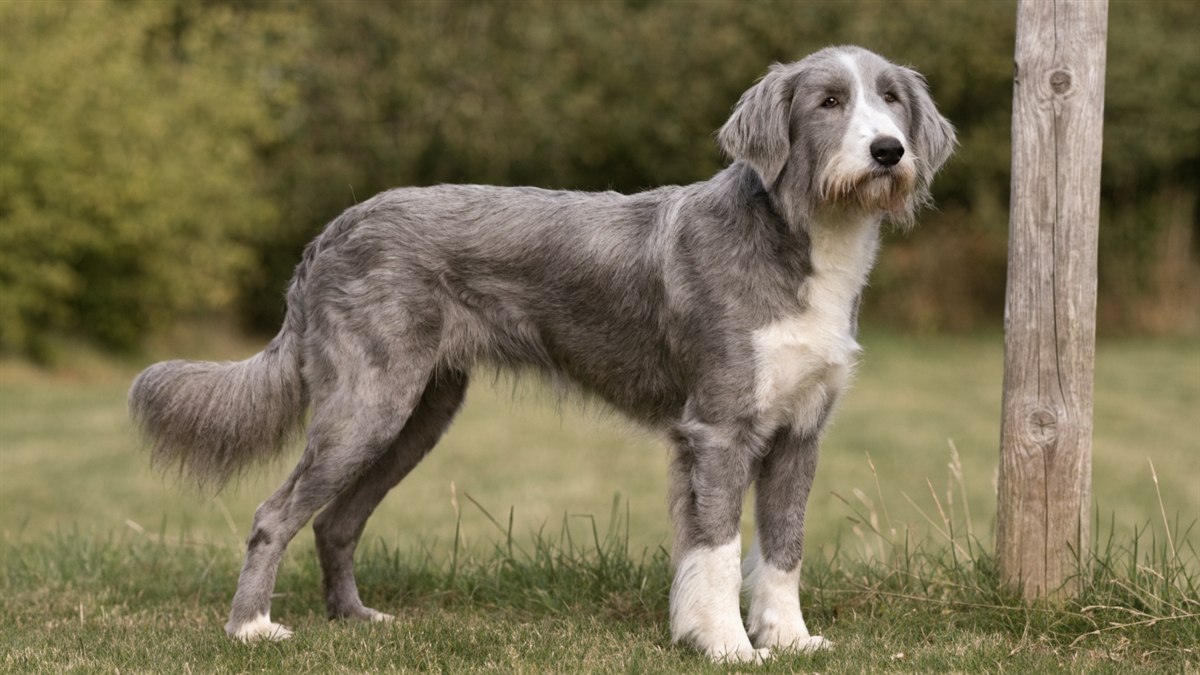
The Bearded Collie is a medium-sized shaggy herding dog of Scotland, standing 53 to 56 cm at the withers in dogs and 51 to 53 cm in bitches, built longer than tall in a ratio of about 5 to 4, and carrying a harsh flat outer coat over a soft furry undercoat. Three registries publish a standard for it, and all three agree on the height. None of the three publishes a weight. American Kennel Club. Official Standard… Federation Cynologique Internationale.…
The Kennel Club places the breed in the Pastoral group and describes a "lean active dog" that "should show plenty of daylight under body and should not look too heavy", with a "bright, enquiring expression" as its distinctive feature. The Federation Cynologique Internationale files the same dog as FCI-Standard No. 271, Group 1 Sheepdogs and Cattle Dogs, Section 1 Sheepdogs, without working trial, origin Great Britain, utilisation sheepdog and companion. The American Kennel Club standard, approved 9 August 1978, calls it "a natural and unspoiled breed" and says the express objective of its height criterion "is to insure that the Bearded Collie remains a medium sized dog";.
The coat clause is the most important paragraph on this page
The coat is described identically by all three registries, and the description matters more in India than anywhere else. It is "Double with soft, furry, and close undercoat. Outer coat flat, harsh, strong and shaggy, free from woolliness and curl, though slight wave permissible." Length and density must be "sufficient to provide a protective coat" but "not enough to obscure natural lines of body". Then comes the sentence that every Indian grooming recommendation collides with: "Coat must not be trimmed in any way."; Federation Cynologique Internationale.… The AKC repeats it and goes further, listing "Trimmed or sculptured coat" as a serious fault and requiring that the coat "falls naturally to either side but must never be artificially parted".
The beard the breed is named for is a standard requirement, not a grooming choice. From the cheeks, lower lips and under the chin, the coat "increases in length towards chest, forming typical beard", while the bridge of the nose stays sparsely covered. The feet are oval with toes "well covered with hair, including between pads", which is a detail worth remembering before a monsoon walk. Ears are medium sized and drooping, set level with the eyes and covered in long hair.
| Registry | Group and number | Height, dogs | Height, bitches | Weight published |
|---|---|---|---|---|
| The Kennel Club (UK) | Pastoral, no number | 53-56 cm | 51-53 cm | None |
| FCI | No. 271, Group 1 Section 1 | 53-56 cm | 51-53 cm | None, despite a heading reading SIZE AND WEIGHT |
| AKC | Herding | 21-22 in (53-56 cm) | 20-21 in (51-53 cm) | None |
The FCI prints a section heading that reads SIZE AND WEIGHT and then publishes no weight at all. Neither the Kennel Club nor the AKC publishes one either. American Kennel Club. Official Standard… Yet Puppiezo advertises 18-27 kg and PetBuy advertises 25-45 kg with a height of 55-70 cm. PetBuy.in. Bearded Collie Dog Breed PetBuy's upper height is 14 cm above the maximum any registry allows, and its size category reads "Large" for a dog whose standard exists specifically to keep it medium-sized.
The breed passed through a bottleneck of two dogs, and that explains its health profile
The modern Bearded Collie descends from essentially one pair. The first breed standard was drawn up in 1912, the population was very scarce by the 1940s, and the revival came from an accident. Mrs G Olive Willison asked a Scottish farmer for a working Shetland Sheepdog and received a Bearded Collie instead, which she named Jeannie. She found a mate for her, a dog called Bailey, and the Bothkennar kennel that followed "set the mould for today's Bearded Collies";. Federation Cynologique Internationale.… The Kennel Club recognised the breed in 1959 and the AKC in 1977.
That history is not colour. It is the mechanism behind everything in the health sections below. The Kennel Club's 2015 population analysis put the breed's effective population size at 23.9, against a threshold of 50 below which the Food and Agriculture Organisation considers a breed's future at risk, and the current breed average inbreeding coefficient at 15.0 percent. A gene pool that small concentrates whatever the founders carried, and what these founders carried was a predisposition to autoimmune disease.
The Indian search results for this breed are mostly a different dog
Search bearded collie price in india from India and ten of the twelve results you get back are about the Border Collie. Only one result on the whole page is genuinely about the Bearded Collie, and that page carries no price. Before you compare a single rupee figure, check which dog it belongs to.
This is not a subtle overlap. The Border Collie and the Bearded Collie are separate breeds with separate standards. The Bearded Collie is a shaggy, long-coated, drop-eared dog of 53 to 56 cm whose coat must never be trimmed. The Border Collie is a shorter-coated working sheepdog with a different outline, a different job and, in India, a vastly larger market. The Bearded Collie Club of America puts it plainly in its own FAQ: "a Beardie should not be confused with the Border Collie or the Old English Sheepdog";.
| Position | Domain | Which breed | What it offers |
|---|---|---|---|
| 1 | puppiezo.com | Bearded Collie | A page titled Bearded Collie Price with no price on it |
| 2 | quora.com | Border Collie | A thread asking the price of a Border Collie puppy |
| 3 | youtube.com | Border Collie | A video called Border Collie Dog Price In India 2024 |
| 4 | instagram.com | Border Collie | A topic page for border-collie-price-in-india |
| 5 | youtube.com | Border Collie | Quotes Rs 2,40,000 to Rs 4,50,000 for that breed |
| 6 | supertails.com | Border Collie | A 40-breed price list, Border Collie at Rs 20,000 to Rs 60,000 |
| 7 | mrnmrspet.com | Border Collie | Quotes Rs 3,50,000 to Rs 7,00,000 for that breed |
| 8 | dogsindia.com | Border Collie | A breeder listing page |
| 9 | amazon.in | Border Collie | A retail product, not a dog |
| 10 | breednbreeder.com | Border Collie | A for-sale category with Bearded Collie only in a dropdown |
The practical damage is a factor of thirty. A buyer reading position five comes away believing this breed costs Rs 2,40,000 to Rs 4,50,000, and a buyer reading position six comes away believing it costs Rs 20,000 to Rs 60,000. Neither figure is about the Bearded Collie. Both belong to the Border Collie.
The one page that is about the right breed carries no price
Puppiezo holds position one with a product page titled "Bearded Collie Price, Buy Healthy Bearded Collie Dogs Online in India". The page publishes a spec card giving height 20-22 inches, weight 18-27 kg, life expectancy 12-14 years and origin Scotland, and then offers no rupee figure at all. Its related-product carousel shows a Maltipoo, two Poodles, a Cane Corso, a Goldendoodle, a second Maltipoo, a Rottweiler and a Doxiepoo. Not one Bearded Collie. Its own footer lists the breeds the business actually stocks, and the Bearded Collie is not among them.
Mr n Mrs Pet says three results and shows three other breeds
The listing page at Mr n Mrs Pet is titled "Bearded collie Puppies For Sale", states "3 Result Found", and promises "healthy, purebred KCI-certified Bearded Collie Puppies in India". The three animals it then displays are an Australian Shepherd in Delhi, a French Bulldog in Chennai and a Border Collie in Pune. No Bearded Collie appears anywhere on the page, and every price is behind a sign-up wall. The same site's Most Popular Breeds sidebar lists ten breeds by live count, from Shih Tzu at 650 down to Cane Corso at 134. The Bearded Collie is on none of those lists.
Ask the seller for the parents' Kennel Club of India registration numbers and look at the photograph. A Bearded Collie has a long harsh shaggy coat, a full beard under the chin, arched eyebrows that frame but do not hide the eyes, and drooping ears set level with the eyes. A Border Collie has none of those. If the coat in the photograph is short on the face, you are not looking at this breed, whatever the advertisement says.
Bearded Collie price in India: three published bands, an eight-fold spread and no live listing
No verified Bearded Collie price in India exists. Three Indian sites publish a band for the breed and they disagree by a factor of more than eight, from a floor of Rs 12,000 to a ceiling of Rs 1,00,000. Not one of them was showing a live Bearded Collie for sale when this page was researched.
| Source | Band published | Spread | What the page is |
|---|---|---|---|
| HappyPet.care | Rs 40,000 - Rs 1,00,000 | 2.5x | An editorial breed guide with a monthly cost model |
| PetBuy.in | Rs 12,000 - Rs 50,000 | 4.2x | A marketplace shell page showing Listings: 0 and Live Avg: none |
| Puppiezo | No figure | n/a | A product page titled Bearded Collie Price carrying no price |
| Mr n Mrs Pet | Behind a sign-up wall | n/a | A listing page returning three dogs of three other breeds |
Read the disagreement rather than averaging it. HappyPet's floor of Rs 40,000 is 3.3 times PetBuy's floor of Rs 12,000, and HappyPet's ceiling of Rs 1,00,000 is twice PetBuy's ceiling of Rs 50,000. PetBuy.in. Bearded Collie Dog Breed Two sources that never overlap at the bottom of the range are not two estimates of one number. They are two guesses at a market that does not exist.
The 84.38 test comes back clean here, which is worth saying
Indian breed pages routinely publish a "price" that is a US dollar figure run through one exchange rate, and Bonbeno checks every rupee figure by dividing it by 84.38. Applied here, the figures do not resolve to round dollar amounts. Rs 12,000 becomes USD 142.21, Rs 50,000 becomes USD 592.56, Rs 40,000 becomes USD 474.05 and Rs 1,00,000 becomes USD 1,185.11. None of those is a price anybody would advertise. The monthly costs fail the same test: Rs 2,250 becomes USD 26.66 and Rs 1,200 becomes USD 14.22. PetBuy.in. Bearded Collie Dog Breed So these numbers are not converted overseas prices. They appear to be invented in rupees, which is a different problem and not a smaller one.
PetBuy's Bearded Collie page is a template with the breed name swapped in
PetBuy's page carries a paragraph headed "History & Origin of the Bearded Collie" that reads: "Like most established breeds, the Bearded Collie was shaped by the needs of the people who first kept it, from work and protection to companionship. Its traits were passed down and standardised by dedicated breeders. Today the Bearded Collie is enjoyed by Indian families who appreciate its personality and presence."; Bonbeno pulled the site's Clumber Spaniel page as a control. The same paragraph appears there word for word with "Clumber Spaniel" substituted, along with an identical care paragraph and three identical FAQ answers. Both pages use the same default placeholder photograph, and both report Listings: 0.
PetBuy prints Typical Low Rs 12,000 and Typical High Rs 50,000, and directly beneath them prints Live Avg (PetBuy) as a dash and Listings as 0. The band is therefore not derived from anything the site has ever sold. The same page describes this breed as "Large", gives a height of 55-70 cm and a weight of 25-45 kg, and offers a comparison against a Doberman. Every one of those numbers contradicts the three published breed standards. Federation Cynologique Internationale.… American Kennel Club. Official Standard…
Why the market is thin even at source
The scarcity is not an Indian artefact. The Bearded Collie is classified by The Kennel Club as a vulnerable native breed, meaning fewer than 300 new UK registrations a year. Its registration trend between 1980 and 2018 was minus 29.20 dogs per year, with a 95 percent confidence interval of minus 38.77 to minus 19.63, a decline steep enough to be statistically significant. The annual counts have kept falling since: 371 in 2014, 284 in 2016, 274 in 2018, 268 in 2020, 281 in 2022 and 232 in 2023, the lowest in recent times. Litter registrations fell from 104 in 2008 to 42 in 2018. A breed producing forty-odd UK litters a year does not generate an export surplus.
Indian import law, and why no lawful Bearded Collie supply chain can form here
Indian import law treats dogs as a Restricted item, and under DGFT Trade Notice 22/2022-23 they may enter only for three purposes: a personal pet with a valid pet book in the importer's name, research by an R&D organisation with CPCSEA recommendation, or internal security use by the Defence and Police Force. Import for breeding or any other commercial activity is not permitted.
The trade notice, dated 19 December 2022, sets the entry for ITC (HS) code 01061900, Mammals: Other as Restricted, subject to Policy Condition 6 of that chapter. Policy Condition 7 lists the three permitted purposes above. Policy Condition 8 states that "Import of commercial dogs for breeding or any other commercial activities other than the purposes mentioned above is not permitted." Paragraph 6 of the notice puts the same rule in procedural terms: "any applications for trading/breeding purposes, or applications made on behalf of some another person/entity shall be duly rejected."
The DGFT's own trade notice archive lists only the current year's notices, and its PDF URLs carry random identifiers that cannot be derived. A guessed path on content.dgft.gov.in returned HTTP 403 and a mirror at worldtradescanner.com returned a 502 Bad Gateway. The text quoted here was read in full from a verbatim reproduction that carries the ITC (HS) table, Policy Conditions 6, 7 and 8, the permanent-and-temporary import matrix, the document schedule and all eight numbered paragraphs. Bonbeno has not seen the DGFT's own signed PDF and says so rather than implying otherwise.
The seven-port limit and what a legitimate import actually looks like
Import of pet animals is allowed only through the airports and seaports of Delhi, Mumbai, Chennai, Hyderabad, Bengaluru and Kolkata and, since October 2024, Kochi airport, with quarantine at the government station of that port where required. Permanent import as passenger baggage without a DGFT authorisation is open only to a person transferring residence to India after two years of continuous stay abroad, and only cats and dogs may come in under the baggage rules. Anything else needs a DGFT authorisation, applied for against an Importer Exporter Code using form ANF-2M, with the application examined by the Department of Animal Husbandry and Dairying. The full route is set out in how to import a dog to India.
- Start at least two months before the travel date, which is the notice's own advice.
- Carry the vaccination book, pet passport or pet book, and the pet's passport.
- For a temporary import, add the return ticket and a local host's undertaking accepting liability under the Foreign Trade (Development and Regulation) Act, 1992 if the pet is not taken back.
- Obtain an Advance No Objection Certificate from the Regional or Quarantine Officer (AQCS) at one of the seven ports, seven days before travel, relaxable to three days.
- Have every disease test named in the health certificate done in the exporting country, with the reports travelling with the animal.
Put the two facts together
The UK produces roughly forty Bearded Collie litters a year and the number is falling. Bearded Collie Foundation for Health… India prohibits importing dogs for breeding or trading and rejects such applications outright. Between them those two facts mean there is no lawful mechanism by which a commercial Indian Bearded Collie supply could form. A puppy of this breed can lawfully arrive in India as somebody's personal pet returning home after two years abroad. It cannot lawfully arrive as stock for a kennel.
That is why the price bands above have nothing behind them, and why every Indian page selling this breed either shows zero listings or shows a different dog. Mr n Mrs Pet. Bearded Collie Puppies… Puppiezo. Bearded Collie Price If somebody is offering you a Bearded Collie puppy in an Indian city today, the two questions worth asking are where the parents are and what their Kennel Club of India registration numbers are. A seller who can answer neither is not selling you this breed.
Two paths stay open and both are legal. Bring your own dog with you if you are relocating to India and can meet the pet-book and two-year residence conditions. Or adopt, which is covered in full at the end of this guide and which is, for almost every Indian reader, the better answer anyway.
Monthly cost of ownership in India, with the grooming line multiplied out honestly
One Indian source models the monthly cost of keeping this breed, and it puts the range at Rs 4,650 to Rs 6,600 a month, or Rs 55,800 to Rs 79,200 a year. That model is internally consistent and its arithmetic checks out. It also understates the one line that matters most for a long-coated dog in India.
| Line | Basic | Premium | Annual at premium |
|---|---|---|---|
| Food | Rs 2,250 | Rs 3,000 | Rs 36,000 |
| Veterinary | Rs 1,200 | Rs 1,800 | Rs 21,600 |
| Grooming | Rs 1,200 | Rs 1,800 | Rs 21,600 |
| Total | Rs 4,650 | Rs 6,600 | Rs 79,200 |
The three basic lines sum to Rs 4,650 and the three premium lines sum to Rs 6,600, so the published totals are real additions rather than round numbers written over the top. That is more than most Indian breed pages manage. The same page also states this breed's daily calorie requirement as 1,500 kcal for puppies and 1,400 kcal for adults, and rates its shedding High.
The grooming line is the one to stress-test
Rs 1,200 to Rs 1,800 a month buys, at Indian salon rates, roughly one full groom. The Bearded Collie Club of America says a mature dog needs a thorough grooming at least once a week, taking half an hour to a full hour each time. The Kennel Club's own breed summary is blunter and says grooming is required every day. Neither of those is a monthly salon visit. They are a standing household commitment, and the salon bill sits on top of it.
Work the labour out rather than accepting an adjective. At the parent club's own figures, weekly grooming at 30 to 60 minutes is 26 to 52 hours a year. During the puppy shed, which runs somewhere between nine and eighteen months of age and lasts two to three months, the club advises increasing to two or three sessions a week. At three sessions a week for twelve weeks, that single phase adds another 18 to 36 hours. If you follow the Kennel Club's daily figure instead, and allow even fifteen minutes a day, you are at 91 hours a year.
The Kennel Club, in the breed's country of origin, publishes Grooming: Every day. The Bearded Collie Club of America, the AKC parent club, publishes at least once a week. Bonbeno is not going to average those. Publish the gap instead, and note that in Indian humidity the honest answer sits at the Kennel Club end, because a damp double coat mats faster than a dry one.
Lines the Indian model leaves out
- Ectoparasite control. Tick and flea prevention is a year-round cost in most Indian cities and a long shaggy coat makes visual checks slower, not easier.
- Ear care. Drooping ears carrying long hair are a named predisposing conformation for otitis externa, and the Indian data on that is in the monsoon section below.
- Cooling. A fan is not a cost line for a short-coated Indian dog. For this coat in a Delhi May it effectively is, and the electricity is real money.
- Autoimmune disease. Addison's disease requires lifelong replacement medication and periodic electrolyte monitoring. Fifteen of 1,147 dogs in the 2024 UK breed survey carried it as a long-term condition, and 163 dogs (14.2 percent) of that survey were on long-term medication of some kind.
Bonbeno publishes no Indian rupee figure for Addison's treatment, because none could be verified from a source we opened. Saying so is more useful than printing a number nobody can check.
Heat tolerance: a Scottish insulation system in a country that never gets cold
Bonbeno rates the Bearded Collie 2 out of 5 for heat tolerance, and the rating is argued from the coat the standard describes against the climate the breed was built for. Bengaluru's coolest month, measured by mean daily maximum, is 8.4 degrees warmer than Glasgow's warmest month. Bengaluru is the mildest of India's large cities.
Start with what the standard requires the dog to carry. The coat is double, with a "soft, furry, and close undercoat" beneath a "flat, harsh, strong and shaggy" outer coat, and its length and density must be "sufficient to provide a protective coat". The Kennel Club places the breed in the Pastoral group and describes that group as dogs which "usually" have "a weatherproof double coat to protect it from the elements when working in severe conditions";. That is a specification for retaining body heat and shedding rain. It is the wrong specification for India.
The comparison, on one source and one methodology
Every figure in the table below comes from Climate-Data.org on its 1991-2021 baseline, so the three cities are measured the same way. Comparing a UK Met Office normal against an India Meteorological Department normal would introduce a methodology difference into the middle of the argument, so Bonbeno does not do that.
| Measure | Glasgow | Bengaluru | New Delhi |
|---|---|---|---|
| Warmest month, mean daily max | 17.3 C (July) | 32.8 C (April) | 39.6 C (May) |
| Coolest month, mean daily max | 5.3 C (January) | 25.7 C (November) | 20.0 C (January) |
| Months with mean max above 20 C | 0 of 12 | 12 of 12 | 11 of 12 |
| Annual mean temperature | 8.1 C | 23.0 C approx | 26.3 C approx |
| Humidity in the wettest months | 79-82% | 78-79% | 71-77% |
Glasgow has no month whose mean daily maximum reaches 20 C. Its hottest, July, tops out at 17.3 C. New Delhi's coldest month, January, already runs at 20.0 C. Bengaluru's coldest month, November, runs at 25.7 C. A dog engineered for a place that never gets warm is being asked to live somewhere that never gets cool, and the gap at the mild end of India is 8.4 degrees.
An Indian pet site gives the breed's own ideal range, and no Indian city meets it
HappyPet.care publishes an Ideal Weather field for this breed reading 4 to 25 degrees C. Take that at face value and check it against the same site's own market. Bengaluru's lowest monthly mean daily maximum is 25.7 C, which is above the ceiling. There is therefore not one month in India's mildest large city where the average afternoon sits inside the range an Indian pet site itself says this breed wants. That is the argument in the cleanest form available, because it uses the seller's own number.
What the largest heat-illness study says about coats
The biggest study of heat-related illness in dogs examined 905,543 dogs under UK primary veterinary care in 2016 and found 395 confirmed events, a 2016 incidence of 0.04 percent with an event fatality rate of 14.18 percent. Its highest-incidence breed was not a Bulldog. It was the Chow Chow, at 0.50 percent, with odds of 16.61 (95 percent CI 6.21 to 44.44) against the Labrador Retriever, and the Chow Chow's defining feature is a profuse double coat. The paper states the mechanism directly, noting that purebred dogs "are more likely to have exaggerated features such as thick coats, extreme body size and skull shapes, all of which were predicted, and subsequently appear to, impact HRI risk".
Two mesocephalic long-coated breeds also carried significantly raised odds against the Labrador: the English Springer Spaniel at 2.74 (1.25 to 6.01) and the Golden Retriever at 2.65 (1.40 to 5.01). Neither has a flat face. That is the finding that transfers to this breed. Heat risk in a long-coated mesocephalic herding dog does not depend on brachycephaly at all.
The Bearded Collie itself does not appear in that study. Bonbeno searched the retrieved paper and found zero occurrences of "Bearded";, against four occurrences of "Springer" and nine of "Golden Retriever" in the same document, which proves the search worked and the breed is genuinely absent. The reason is population size, not safety. A breed with fewer than 300 UK registrations a year cannot generate enough cases in one year to be modelled. Absence from a risk table is not evidence of low risk.
The monsoon problem: a wet double coat, drop ears and what the Indian data shows
Do not let this coat stay damp in an Indian monsoon. A published Indian series from Palam Valley, Himachal Pradesh found that 48 of 81 otitis externa cases, 59.3 percent, presented in the rainy season of July and August alone, and named excessive moisture and pendulous, densely haired ears as predisposing factors. This breed has exactly that ear.
The study screened 2,476 dogs presented to the veterinary clinics at Dr G.C. Negi College of Veterinary and Animal Sciences, Palampur, between June 2022 and July 2023, and diagnosed otitis externa in 81, a hospital prevalence of 3.27 percent. Its seasonal split is the useful part, and the four categories sum correctly to 81.
| Season | Cases | Share of 81 | Checked |
|---|---|---|---|
| Rainy, July to August | 48 | 59.3% | 48/81 = 59.26% |
| Summer, April to June | 15 | 18.5% | 15/81 = 18.52% |
| Winter, December to March | 10 | 12.3% | 10/81 = 12.35% |
| Autumn, September to November | 8 | 9.9% | 8/81 = 9.88% |
Two months of the year carried nearly six in ten of the year's cases. The paper's own explanation is that "most cases occurred during the rainy season due to increased humidity favouring microbial growth", and that "breeds with pendulous or densely haired ears are predisposed due to poor ventilation and moisture retention";. Among the named predisposing factors, excessive moisture accounted for 17 of 81 cases, 20.99 percent, and treatment error for 9 of 81, 11.11 percent.
The same table reports "Pendulous ear breed, 53, 69.13%". 53 of 81 is 65.4 percent, not 69.13. A figure of 69.13 percent would require 56 cases. The paper's own text also refers to "a study of 50 cases" in a section describing 81, and gives moisture in the ear canal as 33.33 percent in prose against 20.98 percent in the table. Those figures are internally inconsistent, so Bonbeno reports the seasonal, sex and age tables, whose arithmetic checks out to the last decimal, and drops the ones that do not.
Why this breed's ear is the ear the paper describes
All three registries describe ears of medium size and drooping, set level with the eyes and covered with long hair, lifting only slightly at the base when the dog is alert. Federation Cynologique Internationale.… That is a drop ear with hair inside the flap, which is the exact combination of poor ventilation and moisture retention the Palampur authors name. The breed's feet compound it. The standard requires toes "well covered with hair, including between pads", which in a Mumbai July is a wick.
The overseas air-drying instruction, checked
National breed clubs write care advice for their own climate, and this site has previously found club guidance that is actively wrong in an Indian monsoon. Bonbeno went looking for an air-dry instruction in this breed's guidance and did not find one. The Bearded Collie Club of America's grooming FAQ does not tell you to towel the dog and let him dry. That absence is reported honestly rather than turned into a finding it is not.
What the club does publish is a different Indian hazard. Its weekly routine is to "lay the Beardie on its side and mist with water or anti-tangle spray", then line brush the whole coat. That is a deliberate weekly wetting of a dense double coat next to the skin. In Glasgow, at a July mean daily maximum of 17.3 C, a misted undercoat is a minor thing even though the city is itself humid. In a humid Bengaluru August at 79 percent, or a humid Delhi August at 77 percent, the same coat sits on far warmer skin and dries far more slowly, and the Palampur data says what a slow-drying ear canal does in those months. Climate-Data.org. New Delhi climate table Nainika and Sharma P. Otitis externa…
One caution about seasonality. The Palampur series is a single hospital population in a Himalayan valley, and Indian otitis studies do not all agree on when the peak falls. Bonbeno reports this one because we opened it and checked its arithmetic, and flags that a series elsewhere in India could easily peak in a different season. Treat 59.3 percent in July and August as one well-documented Indian pattern, not as a national constant.
The drop-ear penalty, measured, and the weekly ear routine for an Indian home
A drooping ear covered in long hair roughly doubles this dog's odds of ear disease before the Indian climate is even considered. In UK primary care, breeds with pendulous ear carriage carried 1.76 times the odds of otitis externa against erect-eared breeds, and breeds with V-shaped drop ears carried 1.84 times the odds. The Bearded Collie has that ear. The Border Collie, which Indian search results keep substituting for it, does not.
The UK's own primary-care study of this disease puts a number on the conformation. Among a random sample of 22,333 dogs drawn from 905,554 under veterinary care in 2016, the one-year period prevalence of otitis externa was 7.30 percent (95 percent CI 6.97 to 7.65). Against breeds with erect ears, breeds with pendulous ear carriage carried 1.76 times the odds (95 percent CI 1.48 to 2.10) and breeds with V-shaped drop ears carried 1.84 times the odds (95 percent CI 1.53 to 2.21).
Two things follow for this page. First, the Bearded Collie's medium drooping ear sits on the wrong side of that ratio, while the Border Collie, the breed Indian search results keep substituting for it, is one of only four breeds the study found protected, at an odds ratio of 0.34. A buyer who prices the wrong dog is also reading the wrong ear risk. Second, that study's own preventive advice is worth repeating verbatim in an Indian monsoon: clean with a dry paper cloth, use ear cleaners judiciously, and avoid overzealous ear-cleaning.
Dry the dog actively, never passively. Towel first, then use a forced-air dryer or a fan on a cool setting until the coat is dry to the skin, not just at the surface. Dry the ear flaps and the hair inside them last and most carefully. Do not mist and brush late in the evening in the monsoon, when the coat will sit damp overnight; do it in the morning so it dries in daylight. Check both ears weekly from June to September and treat a head shake, a scratch at the ear or a smell as a same-week vet visit, not a wait-and-see.
The weekly two-minute check, and the mistake that makes ears worse
- Lift both ear flaps and look. You are checking for redness, brown or creamy discharge, and smell. Erythematous canals appeared in 88.8 percent of the Palampur cases, so redness is the earliest visible sign.
- Wipe the visible part of the flap with a dry paper cloth. That is the UK study's own preventive wording, and it is deliberately conservative.
- Do not push anything into the canal. Treatment error was a named predisposing factor in 9 of 81 Indian cases, 11.1 percent.
- Use medicated ear cleaners only when a vet has told you to, because the same study warns explicitly against overzealous ear-cleaning.
- Dry the flaps and the hair inside them after every bath, swim or rain walk, and treat June to September as the season that decides the year.
One caution on the seasonality figure. The Palampur series is a single hospital population in a Himalayan valley, and Indian otitis studies do not all agree on when the peak falls. Bonbeno reports this one because we opened it and checked its arithmetic, and flags that a series elsewhere in India could easily peak in a different season. Treat 59.3 percent in July and August as one well-documented Indian pattern, not as a national constant.
Grooming load in hours a week, and what a wrong clip does to this coat
Budget 26 to 52 hours a year of grooming time for a mature Bearded Collie at the parent club's own figures, and up to 91 hours if you follow The Kennel Club's daily recommendation. That grooming time is the honest range, and it is the single biggest reason this breed does not suit a first-time Indian owner with a full-time job.
The Bearded Collie Club of America gives the method and the clock. "Most owners do a thorough grooming at least once a week... Lay the Beardie on its side and mist with water or anti-tangle spray. Brush the hair up with a bristle or pin brush. Then brush the hair back down a few inches at a time (called line brushing). Any mats that develop can be worked out with anti-tangle spray and your fingers or a mat rake. A comb should go easily through the hair when finished." And then the number: "When mature, Beardies usually require about one-half to one hour for grooming.";
| Schedule | Source | Per session | Per year |
|---|---|---|---|
| Weekly | Bearded Collie Club of America | 30-60 min | 26-52 hours |
| Daily | The Kennel Club (UK) | 15 min assumed | 91 hours |
| Puppy shed, 3x weekly for 12 weeks | Bearded Collie Club of America | 30-60 min | 18-36 hours, on top |
| Indian monsoon, add ear and paw drying | Bonbeno, from the otitis data | 5-10 min daily, Jun-Sep | 10-20 hours, on top |
The puppy shed is a distinct phase and worth planning around. The parent club puts it "usually between nine months and eighteen months", lasting two to three months, during which the dog "often loses its cuddly appearance and looks scraggly and ragged" and the schedule should rise to two or three sessions a week. An owner who abandons brushing during that window inherits a matted dog, and a matted dog in Indian humidity is a skin case waiting to happen.
Shedding: the club and the registry disagree, and the registry is easier to check
The Bearded Collie Club of America says "Groomed properly, they shed minimally", on the reasoning that "most of the dead hair will be removed by the comb and brush";. The Kennel Club's breed summary answers the same question with a flat Sheds: Yes. HappyPet.care, selling to Indian buyers, rates shedding High in one panel of its page and then lists "Low Shedding" among the benefits of grooming in another panel of the same page. Read the club's claim carefully and it is not really a claim about shedding. It is a claim about where the hair ends up, and it is conditional on you doing 26 to 52 hours of work a year.
What a wrong clip does, and what the standard says about clipping at all
Every Indian summer, somebody advises clipping a long-coated dog down to the skin. For this breed the breed standards forbid it outright. "Coat must not be trimmed in any way" appears verbatim in both the Kennel Club and FCI standards, and the AKC lists "Trimmed or sculptured coat" and "Excessively long, silky coat" together as serious faults. Federation Cynologique Internationale.… American Kennel Club. Official Standard…
The no-trimming clause governs the show ring, not your veterinarian. If a vet needs to clip a mat out, or clip a patch to treat a hot spot, that is medical care and the standard has nothing to say about it. What the clause does tell you is that the registries consider the coat as-grown to be the correct coat, described as "a protective coat", not an inconvenience to be removed. A dog clipped to the skin loses the outer coat that shades it and keeps the undercoat that insulates it, because the harsh outer guard hair regrows more slowly than the soft undercoat. That is the wrong half to remove in Indian sun.
- Comb to the skin, not across the top. A pin brush that glides over the surface leaves the mat forming underneath it, which is exactly why the club teaches line brushing.
- Check the friction points every session, meaning behind the ears, under the front legs, the chest, the belly, the collar line and the harness line.
- Wash and dry the beard after every meal in the monsoon. A permanently damp beard is a skin problem on the chin.
- Clip the hair between the pads short in the rains, which the standard describes as present but which is a genuine welfare call in an Indian July.
- Never shave the whole dog for summer. Shade, timing and water do more, and cost less.
Addison's disease in the Bearded Collie: the real numbers, and what an owner would notice
The Bearded Collie's high-risk status for hypoadrenocorticism, or Addison's disease, rests on published data rather than on repetition, and that data spans four different denominators giving four different answers: 9.4 percent, 3.1 percent, 1.3 percent and 0.322 percent. All four are real. They measure different populations, and the difference between them is the most useful thing on this page.
| Figure | Numerator and denominator | Study and year | What the population was |
|---|---|---|---|
| 9.4% | 60 of 635 Bearded Collies | Oberbauer et al., Am J Vet Res, 2002 | A pedigree cohort assembled for a genetics study, enriched for affected families |
| 3.1% | Of 3,072 Bearded Collies | BeaCon open health registry 2019, as reported by Gershony et al. 2020 | A voluntary owner-reported international health registry |
| 1.3% | 15 of 1,147 Bearded Collies | UK Bearded Collie Health Survey, 2024 | Owner-reported chronic conditions in KC-registered dogs |
| 0.322% | Of insured live Bearded Collies | Hanson et al., J Vet Intern Med, 2016 | An insured whole-of-breed population inside 525,028 Swedish dogs |
| 0.0867% | 166 of 191,434 dogs, all breeds | Hanson et al., 2016 | The same insured population, every breed, as the baseline |
The 9.4 percent everybody quotes, and where it comes from
The origin of the breed's reputation is a 2002 paper by Oberbauer and colleagues at the University of California, Davis, which assessed heritability and mode of inheritance across 635 Bearded Collies. Its Results state that "hypoadrenocorticism was diagnosed in 60 (9.4%) dogs", that heritability was estimated at 0.76, and that both sexes were affected with equal probability. Divide it out and 60 of 635 is 9.449 percent, so the arithmetic holds. A heritability of 0.76 is very high, and the authors conclude that "breeding decisions must include consideration of the genetic likelihood of passing on this deleterious disorder".
That cohort was assembled from pedigree and phenotype data for a genetics study, not sampled at random from the breed. Families with affected dogs are exactly the families who send in samples. The figure is a true statement about those 635 dogs and it is the right figure for judging heritability. It is not the probability that a randomly chosen Bearded Collie develops Addison's disease, and every page that quotes it as though it were is misleading you.
The population figure, from half a million insured dogs
The only whole-of-breed denominator available comes from Swedish insurance. Hanson and colleagues analysed 525,028 Agria-insured dogs representing 2,364,652 dog-years at risk between 1995 and 2006, and found 534 cases of naturally occurring adrenocortical insufficiency, an overall incidence rate of 2.26 cases per 10,000 dog-years at risk (95 percent CI 2.07 to 2.46). Of those 534 cases, 35 were Bearded Collies, the second-largest breed group after 74 Standard Poodles, in a breed nowhere near the second most common in Sweden.
At the end of the study period 191,434 dogs were alive, of which 166 had at least one claim, an overall prevalence of 0.0867 percent, and 166 divided by 191,434 gives 0.0867 exactly. The breed-level prevalences were Standard Poodle 1.17 percent, Portuguese Water Dog 1.16 percent, Cairn Terrier 0.417 percent and Bearded Collie 0.322 percent (95 percent CI 0.0880 to 0.825). So the breed's population prevalence runs about 3.7 times the all-breed figure, or roughly one dog in 310. Significantly raised, and nowhere near nine percent.
The same study found that after Bonferroni correction, Cairn Terriers and Bearded Collies with the disease had a significantly higher mortality rate than dogs of the same breed without it, while the Standard Poodle, the breed with the most cases, did not. Across all breeds the relative risk of death in affected dogs was 1.92 (95 percent CI 1.67 to 2.20), and median age at death was 6.90 years against 6.53 years for other dogs. Prevalence in this breed is moderate. Consequence is not.
The absence, with its control
The largest primary-care study of this disease ever run, covering 905,543 UK dogs in 2016, contains zero occurrences of the word "Bearded". Bonbeno searched the retrieved paper and found seven occurrences of "Collie", every one of them the Border Collie, which appears in the breed table with 22,167 dogs in the study population, five cases, a prevalence of 0.07 percent and a non-significant odds ratio of 1.62. The control passed, so the absence is real. The Kennel Club's own Breed Health and Conservation Plan confirms it in one line: "No VetCompass data relating to the Bearded Collie were available."; The breed is simply too rare in the UK to appear in a population study of any size.
What Addison's disease actually is, and the vague early signs an Indian owner will miss
Addison's disease is the immune-mediated destruction of the adrenal cortex, which stops the dog making enough cortisol and aldosterone. It is missed constantly because the early signs are ordinary. In the largest primary-care series, the three commonest presenting signs were lethargy in 51 of 66 dogs (77.3 percent), anorexia in 48 of 66 (72.7 percent) and vomiting in 48 of 66 (72.7 percent).
Cortisol is the hormone that lets a body cope with stress. Aldosterone is the hormone that holds sodium and dumps potassium. Lose both and the dog looks fine on a quiet Tuesday and collapses on a hot Sunday after a car journey, because the stressor is the thing that unmasks the deficit. That is why the condition is nicknamed "the great pretender", and why the Schofield study describes it as "an uncommon but clinically important disease in dogs due to the potential progression to a critical emergency presentation, the Addisonian crisis";.
| Sign | Dogs | Share of 66 | Checked |
|---|---|---|---|
| Lethargy | 51 | 77.3% | 51/66 = 77.27% |
| Anorexia, off food | 48 | 72.7% | 48/66 = 72.73% |
| Vomiting | 48 | 72.7% | 48/66 = 72.73% |
| Diarrhoea | 30 | 45.5% | 30/66 = 45.45% |
| Weakness | 25 | 37.9% | 25/66 = 37.88% |
| Weight loss | 19 | 28.8% | 19/66 = 28.79% |
The abstract of Schofield et al. gives "anorexia (48/66, 66.7%)" and "vomiting (48/66, 66.7%)". 48 of 66 is 72.7 percent, and 66.7 percent would require 44 dogs. The paper's own Results section prints the correct 72.7 percent for both. Bonbeno uses the Results figure. This is exactly why every percentage on this site gets divided out before it is published, including percentages from peer-reviewed journals.
The age at which it appears
It is a young-adult disease, not an old-age one. In UK primary care the median age at first diagnosis was 5.18 years (n = 72, interquartile range 3.15 to 6.79, full range 0.14 to 13.39), against a median age of 4.42 years for the 883,436 non-cases, and dogs aged 4 to under 9 years carried 2.07 times the odds of diagnosis compared with dogs under 4. In Bearded Collies specifically, the UC Davis genetics cohort recorded an average age at diagnosis of 50 months, roughly 4.2 years, with a range of 5 to 120 months.
That is the cruel part. A four-year-old Bearded Collie is a dog you have had long enough to love and not long enough to think of as ill.
How it is confirmed, and what to ask your vet for
Diagnosis is a blood test, not a guess. The UC Davis study required "a veterinary diagnosis of primary hypoadrenocorticism that included an ACTH stimulation test (serum cortisol levels below 55 nmol/L before and after ACTH administration) and evidence of electrolyte imbalance (sodium to potassium ratio below 27:1)". In UK primary care, of the confirmed cases with electrolytes recorded, hyperkalaemia appeared in 47 of 53 (88.7 percent) and hyponatraemia in 46 of 53 (86.8 percent), and the median sodium to potassium ratio was 19.00 (n = 38, IQR 16.20 to 20.60, range 12.90 to 26.00).
If your Bearded Collie is between three and seven years old and has had repeated bouts of being off food, flat, or vomiting that resolve and come back, ask for a serum electrolyte panel and specifically for the sodium to potassium ratio. It is an inexpensive test available in most Indian city labs. If that ratio is below 27:1, ask for an ACTH stimulation test. Say the word hypoadrenocorticism. This breed is rare enough in India that a vet may not have it on the differential list, and there is no shame in naming it yourself.
Two more facts worth carrying. There is no commercial DNA test that identifies susceptible dogs, which the 2024 UK survey states plainly. And unlike most breeds, males and females are affected with equal probability in the Bearded Collie, so a male puppy carries no reassurance.
The health surveys, with every denominator printed and every percentage divided out
This breed has better health data than almost any breed of comparable rarity, because its clubs have surveyed it repeatedly. Five separate surveys covering 563, 226, 700, 1,132 and 1,147 dogs are on the public record, and the most recent one is the seventh in an unbroken annual run. Here is what they found, with the counts beside the percentages.
| Survey | Dogs covered | Affected with at least one condition | Median or mean age at death |
|---|---|---|---|
| KC/BSAVA Purebred Dog Health Survey 2004 | 563 live, 278 deaths | 239 of 563, 42% | Median 13 years 6 months |
| Southampton breed survey 2012 (Kershaw et al.) | 700 KC-registered of 789 | 527 of 700, 75.3% | Mean 13 years 2 months, 188 deaths |
| KC Pedigree Breed Health Survey 2014 | 226 live, 52 deaths | 80 of 226, 35.4% | Median 12.5 years |
| UK Bearded Collie Health Survey 2018 | 1,132 | 231 of 1,132, 20.4% new problems | 5 deaths in the year |
| UK Bearded Collie Health Survey 2024 | 1,147 | 405 of 1,147, 35.3% new problems | 36 deaths, 75% aged 10 or over |
The 2004 survey is still the most detailed, and its arithmetic is sound
Health information was collected for 563 live Bearded Collies, of which 324 (58 percent) were healthy and 239 (42 percent) had at least one reported condition. Across 437 reported conditions the top categories were musculoskeletal at 63 of 437 (14.4 percent), gastrointestinal at 55 of 437 (12.6 percent), urologic at 43 of 437 (9.8 percent), reproductive at 42 of 437 (9.6 percent) and dermatologic at 41 of 437 (9.4 percent). The commonest named conditions were chronic colitis (26 cases, 4.6 percent), kennel cough (24, 4.3 percent), cystitis (21, 3.7 percent), pyometra (11 of the 334 females, 3.3 percent), urinary incontinence (14, 2.5 percent) and hypothyroidism (14, 2.5 percent). Every one of those divides out correctly.
Its mortality arm covered 278 deaths. The most frequent causes were old age at 72 of 278 (25.9 percent), cancer at 54 (19.4 percent), stroke at 26 (9.4 percent) and chronic renal failure at 19 (6.8 percent).
The 2014 survey's commonest finding in this breed was skin cyst at 19 of 226 dogs, 8.4 percent, followed by arthritis at 11 of 226 (4.9 percent) and lipoma at 9 of 226 (4.0 percent). The primary source for that survey covered 43,005 live Kennel Club registered dogs across 192 breeds and found all-breed prevalences of lipoma 4.3 percent (95 percent CI 4.13 to 4.52) and skin cyst 3.1 percent (2.94 to 3.27). So this breed's lipoma rate is ordinary, at 4.0 against 4.3, while its skin-cyst rate runs about 2.7 times the all-breed figure, at 8.4 against 3.1. That comparison appears on no page currently ranking for this breed.
The 2012 Southampton survey is reported as "75.9% (527 dogs)" affected by at least one condition among 700 registered dogs, and as "10.3% (73 dogs)" affected by at least one autoimmune disorder. 527 of 700 is 75.3 percent, not 75.9. 73 of 700 is 10.4 percent, not 10.3. Both gaps are about one dog wide and are almost certainly rounding or transcription, not fabrication. Bonbeno prints the counts, which are checkable, and lets you see the discrepancy rather than picking one.
Read across the five surveys and the picture is consistent rather than alarming. Roughly a third to two thirds of live dogs carry at least one reported condition depending on how the question was asked, most of the named problems are age-related, and the age at death sits between 12.5 and 13.5 years in every one of them. Bearded Collie Foundation for Health… The exception, and the reason the next section exists, is immune-mediated disease.
The breed's autoimmune load, and the genetics now mapped behind it
Immune-mediated disease is the one thing in this breed that is getting worse, not better. Across seven consecutive UK surveys the share of dogs carrying an immune-mediated condition rose from 5.4 percent in 2018 to 7.3 percent in 2024, and in the most recent survey those 84 dogs accounted for 27.1 percent of every long-term problem reported.
The seventh annual UK survey collected data on 1,147 dogs to April 2024. Eighty-four dogs, 7.3 percent of the sample, carried an immune-mediated disease as a long-term condition, and 84 of 1,147 divides out to 7.32 percent. Those 84 dogs accounted for 27.1 percent of all 310 long-term problems reported. The trend across the seven surveys runs 61 dogs (5.4 percent) in 2018, 57 (4.9 percent) in 2019, 68 (5.3 percent) in 2020, 67 (5.6 percent) in 2021, 65 (6.8 percent) in 2022, 71 (5.9 percent) in 2023 and 84 (7.3 percent) in 2024.
| Condition | Dogs | Share of the 1,147 |
|---|---|---|
| Symmetrical lupoid onychodystrophy (SLO) | 34 | 3.0% |
| Addison's disease | 15 | 1.3% |
| Thyroid disease | 7 | 0.6% |
| Autoimmune haemolytic anaemia (AIHA) | 6 | 0.5% |
| Steroid responsive meningitis-arteritis (SRMA) | 6 | 0.5% |
| Autoimmune, unspecified | 6 | 0.5% |
| Immune mediated polyarthritis (IMPA) | 3 | 0.3% |
| Discoid lupus erythematosus, masticatory myositis | 2 each | 0.2% each |
| IMTP, anal furunculosis, sebaceous adenitis | 1 each | 0.1% each |
SLO is the breed's biggest immune-mediated problem by count, not Addison's. It is a nail-bed condition in which the claws split, separate and shed, and it appeared in 34 dogs against Addison's 15. In the year's new cases the split was 15 SLO to 10 Addison's out of 47 immune-mediated presentations. The Breed Health Coordinator ranked the breed's priority health issues as Addison's, SLO, AIHA and CEA in 2017, and as SLO, Addison's and CEA in 2018, so both conditions have been named top-three health issues in consecutive years.
The 3,072-dog registry, and what its two headline numbers actually mean
One denominator recurs in the research literature and is worth pinning down, because it is the source of the 3.1 percent figure quoted on this page. The BeaCon open health registry's 2019 report covered 3,072 Bearded Collies, and two separate peer-reviewed papers from the same laboratory quote it. One states that autoimmune conditions ran at 11.1 percent of those 3,072 dogs, of which 3.1 percent had been diagnosed with primary hypoadrenocorticism. The other, published the same year, states that SLO now affects 3.6 percent of the 3,072 surveyed dogs.
The phrase "of these, 3.1 percent" in the Addison's paper could be read as 3.1 percent of the 11.1 percent autoimmune subgroup rather than of the whole 3,072. The SLO paper settles it. 3.6 percent of the 3,072 dogs is unambiguously a share of the full sample, and 3.6 plus 3.1 is 6.7 percent, which sits comfortably inside an 11.1 percent autoimmune total. Read the other way round, 3.1 percent of the 341 autoimmune dogs would be about eleven animals, which no paper would describe as "a relatively high prevalence". So both figures are shares of 3,072, roughly 111 SLO dogs and 95 Addison's dogs. Gershony LC, Belanger JM, Hytonen MK Bonbeno could not open the BeaCon 2019 report itself and reports both figures as the two papers state them.
The genetics behind that clustering is now partly mapped, and it is the same machinery for both diseases. A study of DLA class II haplotypes found a single three-locus haplotype associated with increased Addison's risk in Bearded Collies, and two different risk haplotypes associated with SLO in the same breed. For SLO the association is strong: 88 percent of affected dogs carried two DLA risk haplotypes, and dogs homozygous for the top chromosome 12 variant had 24.0 times the odds of SLO (95 percent CI 2.94 to 195.61) against dogs homozygous for the reference allele. For Addison's the same locus explains far less: only 37.7 percent of affected Bearded Collies carry the breed's identified DLA class II risk haplotype, which is why the 2020 genome-wide study went looking elsewhere and found a significant region on chromosome 18.
The 2024 report compares dogs neutered under twelve months against the whole sample and states that "nine dogs (0.8%) neutered under 12 months went on to develop autoimmune disease whilst the prevalence of autoimmune disease in the overall population was 7.3%";. Those two figures use different denominators. Ninety-two dogs were neutered under twelve months, so 9 of 92 is 9.8 percent, not 0.8 percent, and the honest comparison is 9.8 percent against 7.3 percent. Bonbeno draws no conclusion from nine dogs either way, but the comparison as printed is not one.
Lifespan from a real study, screening results with sample sizes, and the drug question
The Bearded Collie's lifespan is not a guess. A UK primary-care study measured a median longevity of 13.7 years across 25 Bearded Collies, which placed the breed second-longest-lived of the thirty-six breeds it tabulated, behind only the Miniature Poodle. The sample is small. It is also real, and it is more than any competing Indian page offers.
O'Neill and colleagues analysed deceased dogs in English primary practice and reported an overall median longevity of 12.0 years (interquartile range 8.9 to 14.2), with crossbreds at 13.1 years and purebreds at 11.9 years. Against that baseline the Bearded Collie sat well ahead.
| Breed | Median years | IQR | Dogs |
|---|---|---|---|
| Miniature Poodle | 14.2 | 11.1-15.6 | 20 |
| Bearded Collie | 13.7 | 12.2-14.3 | 25 |
| Border Collie | 13.5 | 11.5-15.0 | 184 |
| Crossbreed | 13.1 | 10.1-15.0 | 1,120 |
| Labrador Retriever | 12.5 | 10.6-14.0 | 418 |
| Rough Collie | 12.0 | 9.4-13.8 | 28 |
| All dogs in the study | 12.0 | 8.9-14.2 | n/a |
The Bearded Collie's interquartile range of 12.2 to 14.3 years is unusually tight, which is reassuring, but it rests on 25 animals with a full range of 4.0 to 17.0 years. Bonbeno checked whether a larger study covers the breed. The 2022 VetCompass life tables, built from 30,563 dogs, published breed-level tables for only 18 breeds and crossbreds, and the Bearded Collie is not among them; the closest available figure is the Pastoral group as a whole at 11.20 years (95 percent CI 11.06 to 11.35). A 2024 longevity study of 584,734 dogs exists, but its 155-breed table sits in supplementary material Bonbeno did not open, so we make no claim about whether it covers this breed.
Three other sources agree on the shape without agreeing on the number. The 2004 KC survey gave a median age at death of 13 years 6 months across 278 deaths, the 2012 Southampton survey a mean of 13 years 2 months across 188 deaths, and the 2014 KC survey a median of 12.5 years across 52 deaths. The parent club states "12-14 years on an average";. In the 2024 survey, 75 percent of the 36 dogs that died were ten years or older. Whatever the exact figure, this is a long-lived breed.
Screening results, with the denominators the Kennel Club publishes
| Test | Dogs | Result | Source and date |
|---|---|---|---|
| BVA/KC Hip Dysplasia Scheme | 3,072 all-time | Breed median hip score 9 | KC, to 27 June 2019 |
| BVA/KC Elbow Dysplasia Scheme | 268 since 1998 | 20 of 268, 7.5%, with some degree of dysplasia | KC, to 2019 |
| CEA/CH DNA test | 1,312 results | 7 carriers (0.5%), 1 affected (0.1%) | KC, to 27 June 2019 |
| ACVO eye examinations | 865 (2010-2018) | 648 of 865, 74.9%, free of any eye disease | ACVO, US dogs |
| Owner-reported hip dysplasia | 1,147 | 13 dogs, 1.1% | UK survey 2024 |
| Owner-reported elbow dysplasia | 1,147 | 21 dogs, 1.8% | UK survey 2024 |
The elbow figures are the ones to watch. Elbow scoring is not a Kennel Club requirement for this breed while hip scoring is, and yet for five consecutive surveys owner-reported elbow dysplasia has run higher than owner-reported hip dysplasia: 1.8 percent against 1.1 percent in 2024, 1.8 against 1.2 in 2023, 1.6 against 1.4 in 2022, 3.4 against 1.7 in 2021 and 2.0 against 1.0 in 2020. The survey's own author writes that this means the breed should reconsider whether to ask for elbow screening to become an advised test.
The MDR1 question, which matters more in India than in Britain
Ivermectin is used constantly in India, for demodectic mange, for sarcoptic mange and in some heartworm protocols, and several Collie-named breeds carry an ABCB1 mutation that makes it neurotoxic. So the question is fair. Washington State University publishes the reference breed table, and it lists eighteen breeds alphabetically, running Australian Shepherd 50 percent, Australian Shepherd Mini 50 percent, Black Mouth Cur, Border Collie under 5 percent, Carolina, Chinook 25 percent, Collie 70 percent, English Shepherd 15 percent, German Shepherd 10 percent and onward through Old English Sheepdog 5 percent and Shetland Sheepdog 15 percent.
The list is alphabetical, so a Bearded Collie entry would sit between Australian Shepherd, Mini and Black Mouth Cur. It is not there. But WSU states its own caveat: "The only way to know if an individual dog has the mutant MDR1 gene is to have the dog tested. As more dogs are tested, more breeds will probably be added to the list." Absence from the list means not enough tested, not proven clear. The Kennel Club's screening recommendations for this breed also do not include MDR1. The safe position in India is to have the dog tested before any ivermectin protocol, and to note that the parent club separately warns that "some Beardies have reactions to monthly heartworm preventative";.
Temperament and household fit: who this breed suits in India, and who it does not
The breed standard asks for a "steady, intelligent working dog, with no signs of nervousness or aggression";, and describes the dog itself as "alert, lively, self-confident and active". The parent club translates that into plainer language: you have to be willing to tolerate "brushing long hair, wet beards in your lap, and muddy pawprints in the wrong places", and "you HAVE to like bounce";.
That last phrase is the honest summary. This is not a placid apartment ornament. The AKC standard opens by calling the breed "hardy and active, with an aura of strength and agility characteristic of a real working dog", and "stable and self-confident, showing no signs of shyness or aggression";. A Bearded Collie that is quiet all day is usually a Bearded Collie that is bored, and a bored one will, in the club's phrasing, "provide their own entertainment, not always one that makes the owner happy";.
The separation problem is the biggest Indian mismatch
The parent club states it directly: "Beardies are people-oriented dogs. They NEED to be with their family. If left alone for long periods, they are liable to become frustrated."; Map that onto a typical Indian metro household where both adults commute and the dog is alone from nine to seven, and the mismatch is obvious before you get to the heat or the coat. This breed suits a home where somebody is usually in it.
Children, other animals and the herding instinct
The club reports that Beardies "interact well with other animals, particularly if raised with them", with photographs of them alongside Chihuahuas and Wolfhounds, and notes some are "a mite bossy about possessions";. The real caveat is herding behaviour. "Some Beardies have a high herding instinct and nip at ankles or eye-level bottoms, trying to bunch their flock," and "being herding dogs, they will yield to a chase if tempted". That is a genuine issue in an Indian building compound with children running and two-wheelers moving, and it is the behaviour to socialise away from earliest puppyhood rather than to correct at eighteen months.
The club also flags the greeting. Beardies "like to jump up to look you in the eyes or kiss your nose", which suits some families and not those with toddlers, elderly relatives or nervous visitors. Its recommendation is to train a sit-and-shake greeting instead.
Barking, which matters in a flat
The club describes them as "not yappy nor continuous barkers" but says they are "great doorbells, announcing all visitors with joy", and that they bark when excited and when bored. In a standalone house that is a feature. In a shared-wall Indian apartment with a doorbell ringing for deliveries several times a day, it is something to plan for.
A household with somebody home most of the day, a hill-station or Deccan-plateau climate rather than a coastal one, space to run, an owner who enjoys grooming rather than tolerating it, and a realistic expectation of an autoimmune diagnosis somewhere in the dog's life. Pune, Bengaluru, Shillong, Dehradun and Ooty are workable. Chennai, Mumbai and Kolkata in May are not, and no amount of air conditioning changes what the dog does on the walk.
A first-time owner. Anybody buying on looks. Anybody who works full days away from home. Anybody who cannot commit 26 to 52 hours a year to grooming. And anybody in a hot coastal Indian city who is planning to solve the heat by clipping the dog, which the section above explains does not work.
Training approach: the one method that reliably fails with this breed
Train this breed by making it want the thing you want. The parent club puts the rule in one sentence: "Beardies were bred to be independent thinkers. Sometimes they'll decide what THEY want is better than what you want... The trick in training Beardies is to convince them it's something THEY want to do." Compulsion-based drilling, which is still common in Indian training practice, is the method that fails here.
The independence is functional, not a defect. The parent club explains that the breed "was developed as an independent worker, able to make decisions concerning the welfare and safety of their charges without depending on the shepherd who might be miles away";. A dog selected for centuries to think for itself out of sight of its handler does not respond to a training style built on unquestioned obedience. It responds to a training style built on making the right answer the interesting one.
A realistic Indian timeline
| Age | Priority | Why now |
|---|---|---|
| 8-16 weeks | Grooming acclimatisation and socialisation | The club says to start hair care immediately, building from one minute to an hour of stillness |
| 3-6 months | Recall, greeting manners, no ankle-nipping | The herding instinct starts expressing itself and is easier to redirect than to undo |
| 6-12 months | Impulse control, settle on cue, alone-time tolerance | Frustration behaviours set in this window if the dog is left alone untrained |
| 9-18 months | Hold the grooming habit through the puppy shed | Two to three sessions a week for two to three months, or the coat mats |
| 12-24 months | Structured activity: obedience, agility, scentwork | The club calls the breed "made for agility"; a job is the cheapest behaviour management there is |
Housebreaking is normal-to-slow and the club is refreshingly plain about why: "Bladder capacity, not brains, is what determines this. If the owners are well-trained to be aware of signals and to watch the clock, the Beardie is more easily housebroken."; In an Indian monsoon, when the dog does not want to go out into rain, expect that timeline to stretch.
Grooming is a training task, not a grooming task
This is the piece Indian owners most often miss. The club's instruction is to start on day one: "Baby Beardies can be groomed in one minute. The idea is to acclimate the pup to be still for longer periods of time until they can spend an hour quietly accepting brushing and combing."; You are not brushing a puppy for the sake of the coat, which does not need it yet. You are building the tolerance for the hour of stillness you will need every week for the next thirteen years. An adult Bearded Collie that will not lie on its side to be combed is a welfare problem and a salon expense.
- Reward the behaviour, never punish the refusal. An independent thinker that is corrected harshly disengages rather than complies.
- Keep sessions short and varied. Repetition bores a dog bred to solve problems, and a bored Beardie invents its own game.
- Give the herding instinct a legal outlet. A flirt pole, a chase-and-retrieve game or a herding-ball beats correcting ankle-nipping after the fact.
- Practise alone-time deliberately from twelve weeks, in minutes, so the dog learns that departure is survivable before you have to leave for a full day.
One brand-new-owner warning specific to India. Board-and-train kennels advertising quick results usually deliver them through pressure, and this is the breed least likely to come back the same dog. If you want professional help, find a trainer who will train you alongside the dog and who works on reward.
Daily exercise requirement, and what an Indian summer does to it
Plan for 60 to 90 minutes of activity a day, which is what the Indian breed guides publish, against The Kennel Club's more conservative up to one hour per day. The Kennel Club (UK). Bearded Collie In an Indian summer the constraint is not the dog's willingness. It is the hours of the day in which a long-coated dog can safely be outside at all.
The published figures disagree by half an hour and it is worth seeing why. The Kennel Club lists exercise as "Up to 1 hour per day" and size of home as "Large house" with a "Large garden";. HappyPet.care, writing for Indian buyers, gives "60 - 90 minutes" and energy level "High";. Puppiezo gives "1-2 hours daily";. The parent club declines to give a number and says instead that "Beardies are not hyper dogs, but are happy to join their owners in any activity" and are "more content when they are able to run and play";.
Take the middle. Sixty to ninety minutes, of which at least part is free running rather than a lead walk, is the honest requirement for an adult.
The Indian scheduling problem, in numbers
In New Delhi the mean daily maximum sits at or above 32 C for six months of the year, from April through September, peaking at 39.6 C in May. In Bengaluru, the mildest of the big cities, the mean daily maximum never falls below 25.7 C in any month. Glasgow, where the coat was designed, tops out at 17.3 C. The practical consequence is that from March to October across most of India, the usable exercise window for this breed is the hour after dawn and the hour after dark.
| Period | Outdoor exercise | Indoor or substitute work |
|---|---|---|
| November to February | 60-90 min, split morning and evening | Normal training and play |
| March to May | Two 25-min sessions, before 07:00 and after 20:00 | Scentwork, food puzzles, indoor recall games |
| June to September, monsoon | 30-45 min in gaps between rain, dried thoroughly after | Trick training; dry the coat and ears every time |
| October | Rebuild toward 60-90 min as temperatures drop | Reintroduce longer free running |
Press the back of your hand to the pavement for seven seconds. If you cannot hold it there, the dog cannot walk on it. That rule applies to every breed. It applies harder here because the standard requires the toes to be "well covered with hair, including between pads", so hair traps heat against the pad and hides early burns from you until the dog limps. Check the pads by hand after every summer walk.
What happens without it
Under-exercised, this breed does not become calm. It becomes destructive and noisy, which is what the parent club means by "provide their own entertainment";. The 2024 UK survey offers a quieter warning in the other direction: musculoskeletal problems were the single largest category in both new and long-term conditions, with 74 of 491 new problems and 85 of 310 long-term problems, and arthritis accounted for 56 of those 85 long-term musculoskeletal cases, which is 4.9 percent of all 1,147 dogs surveyed. Nearly all the arthritis was in dogs over eight. Sustained, moderate, lifelong exercise is what protects those joints; weekend bursts after five sedentary days do not.
Substitute mental work when the weather removes the physical option. The parent club notes that Beardies are "made for agility" and compete in obedience, herding, tracking and scent work. A twenty-minute scent game in an air-conditioned room in a Delhi May does more for the dog than a thirty-minute walk that risks heatstroke.
Feeding and body condition in India, and the one weight rule that matters most
Keep this dog lean, because bodyweight is one of only three risk factors that survived into the final model of the largest heat-illness study ever run on dogs. Dogs at or above the mean adult bodyweight for their breed and sex carried 1.42 times the odds of heat-related illness (95 percent CI 1.12 to 1.80) compared with dogs below it. Under a long double coat, in India, that is not a cosmetic point.
No registry publishes a target weight for this breed, so you cannot feed to a number. American Kennel Club. Official Standard… Federation Cynologique Internationale.… You have to feed to body condition instead, and the breed standard gives you the description to aim at: a "lean active dog"; that, "though strongly made, should show plenty of daylight under body and should not look too heavy". That phrase, plenty of daylight under the body, is the most useful feeding instruction in any of the three standards.
A profuse shaggy coat hides a waistline completely. Assess condition with your hands, not your eyes. Run your palms along the ribs. You should feel each rib easily under a thin layer of covering, without pressing. Feel for a tuck at the flank and a visible waist from above when the coat is wet or parted. Do this monthly and write the weight down, because the coat will let a dog gain four kilos before anybody notices.
The one published Indian calorie figure, and how to read it
HappyPet.care publishes daily requirements of 1,500 kcal for puppies and 1,400 kcal for adults, with a monthly food budget of Rs 2,250 to Rs 3,000. Treat those as a starting point, not a prescription. A neutered adult living in an air-conditioned Bengaluru flat and exercising forty minutes a day in May needs materially less than an entire adult working two hours a day in a Dehradun December. Adjust on the monthly hands-on check, not on the packet.
| Stage | Meals a day | What to prioritise |
|---|---|---|
| 8 weeks to 4 months | 4 | Large-breed-appropriate growth food, controlled calcium, no rapid weight gain |
| 4 to 9 months | 3 | Steady growth; joints are still forming and elbow disease shows up in this breed |
| 9 to 18 months | 2 | Puppy shed is running; coat quality and skin support matter, keep the dog lean |
| 18 months to 8 years | 2 | Maintenance to body condition, adjusted seasonally for the exercise window |
| 8 years and older | 2 | Joint support, reduced calories against reduced activity, monthly weight checks |
Indian availability and what actually changes here
Every mainstream large-breed and all-life-stages diet sold in India is adequate for this dog. There is no Bearded Collie-specific nutritional requirement in any published standard or club guidance. What changes in India is water, timing and storage. Keep water available and cool at all times, because a dog under an insulating coat in a Chennai afternoon is losing far more to panting than the same dog in Scotland. Feed the larger meal in the cooler part of the day and leave a gap before exercise. And store kibble airtight, because Indian monsoon humidity spoils an opened bag faster than the printed shelf life suggests.
The beard is a feeding problem. The standard requires a coat that "increases in length towards chest, forming typical beard", which means the dog wears part of every wet meal. Wipe and dry the beard after meals, especially in the monsoon, or you will get a chronically damp chin and the skin problem that follows. Sudden inappetence is not a fussy phase in this breed. Anorexia appeared in 48 of 66 confirmed Addison's cases, 72.7 percent. A Bearded Collie that repeatedly goes off its food and then recovers deserves a blood test, not a change of brand.
Month by month through the first year in an Indian home
The first year of a Bearded Collie has one fixed landmark that no other breed section on this site has to plan around: the puppy shed, which runs somewhere between nine and eighteen months and lasts two to three months. Everything else on this timeline is arranged so that you arrive at that window with a dog that will lie still to be combed.
| Month | Coat and grooming | Behaviour and health |
|---|---|---|
| Month 2 (8 weeks) | One minute on the table, every day. Nothing more. | Puppy must be at least eight weeks old at sale. Meet the dam. Get the parents' hip scores and CEA results in writing. |
| Month 3 | Build to 3-5 minutes. Introduce the comb and the side-lying position. | Socialisation window: lifts, traffic, autos, delivery riders, other dogs. Complete the vaccination course. |
| Month 4 | 5-10 minutes twice a week. Handle ears and feet deliberately. | Recall foundations. Start deliberate short alone-time practice. |
| Month 5-6 | 15 minutes weekly, line brushing properly to the skin. | Ankle-nipping and herding chase appear. Redirect onto a toy now. |
| Month 7-8 | 20-30 minutes weekly. The adult texture starts coming through. | Impulse control. Discuss neutering timing with your vet, not with a rule of thumb. |
| Month 9-12 | Puppy shed may start. Go to two or three sessions a week. | Dog looks scraggly and ragged; this is normal and passes. |
| Month 12-18 | Hold the increased schedule until the shed finishes. | Adult exercise load. Begin the monthly hands-on body condition check. |
Buy the puppy legally, and know the age rule
Bonbeno read the gazette text of the Prevention of Cruelty to Animals (Dog Breeding and Marketing) Rules, 2017, notified as G.S.R. 496(E) on 23 May 2017, and grepped it for each clause quoted here. Rule 8, Conditions for sale, sub-rule (1)(a) requires that "pups less than eight weeks in age are not sold". A seller offering a six-week-old puppy is breaking Indian law, and that is a reason to walk away rather than to negotiate. Rule 8(1)(b) additionally requires that dogs over six months are not sold without first being sterilised, unless sold to another licensed breeder.
Two clauses in the Second Schedule matter for this breed specifically. Paragraph 6(8) states that "there shall be no tail docking, ear cropping de-barking, de-clawing, branding, dyeing... or any other kind of mutilation of any body part of the pup and any change of appearance by artificial means is strictly forbidden";, which is why every image of this breed on Bonbeno shows a natural undocked tail and natural uncropped ears. Paragraph 8(10) of Part III requires that "the dogs shall have been tested for genetic defects, including hip dysplasia, progressive retinal atrophy, night blindness, hypothyroidism, entropion, ectropion, overshot, undershot jaw... unilateral cryptorchid or full cryptorchid males".
Read paragraph 8(10) against the breed's own survey data and it lands squarely. Hip dysplasia is the breed's one mandatory Kennel Club test and 13 of 1,147 dogs (1.1 percent) were reported affected in 2024. Hypothyroidism appeared in 14 of 563 dogs (2.5 percent) in the 2004 KC survey and thyroid disease in 7 of 1,147 in 2024. Overshot and undershot jaw appeared in 37 of 1,147 dogs (3.2 percent), split 13 overshot and 12 undershot. And cryptorchidism was reported in 111 of 558 male dogs, 19.9 percent, against a published general range of 0.8 to 10 percent. The Kennel Club. Breed Health… Ministry of Environment An Indian breeder of this breed who has not tested for those four is not compliant with the 2017 Rules.
Skipping grooming in months two to six because the puppy coat does not need it. It does not need it. You are not grooming the coat, you are training the dog. An owner who starts at nine months, when the shed hits and the coat suddenly does need daily work, is asking an adolescent dog to accept an hour of restraint it has never experienced. That is how Beardies end up shaved at a salon, which the breed standards describe as the wrong coat for the dog. American Kennel Club. Official Standard…
What to ask the seller, and what a real answer looks like
- Where are the parents and may I meet the dam? The parent club's own test is "would you take her home?"
- What are the parents' hip scores? The breed median is 9, and you want both parents at or below it.
- Are the parents CEA DNA tested? The Kennel Club lists this as a Best Practice test for the breed.
- Have the parents been elbow scored? It is not required, so a breeder who has done it anyway is telling you something.
- Has any Addison's disease, SLO or autoimmune haemolytic anaemia appeared in this line? A breeder who has never heard of any of the three has not read the breed's own health plan.
If the answer to all five is vague, or if the seller offers to ship the puppy without you seeing the parents, you are almost certainly not being offered a Bearded Collie. Return to the adoption section instead.
Head to head against the breeds Indian buyers actually cross-shop
Most people searching for this breed in India are looking at the Border Collie without knowing it, because that is what the search results serve them. So the first comparison below is the one nobody publishes: Bearded Collie against the dog you probably found instead.
| Bearded Collie | Border Collie | Rough Collie | Old English Sheepdog | |
|---|---|---|---|---|
| Kennel Club group | Pastoral | Pastoral | Pastoral | Pastoral |
| Height, dogs | 53-56 cm | Taller-legged working type | Taller | Taller and heavier |
| Coat | Harsh flat shaggy over soft undercoat, never trimmed | Shorter, weather-resistant | Long with heavy mane | Profuse, often clipped |
| Median longevity, O'Neill 2013 | 13.7 yr (n=25) | 13.5 yr (n=184) | 12.0 yr (n=28) | Not in that table |
| Addison's disease risk | Significantly raised, 0.322% insured prevalence | Not significant, OR 1.62 | Not flagged | Not flagged |
| MDR1 on WSU's list | Not listed | Under 5% | 70% as Collie | 5% |
| Availability in India | Effectively none | Widely advertised | Advertised | Occasionally advertised |
| Heat tolerance, Bonbeno rating | 2 of 5 | 3 of 5 by coat, still low | 2 of 5 | 1 to 2 of 5 |
Bearded Collie against Border Collie
These are the two most confused breeds on the Indian internet and they are genuinely different animals. On longevity they are close: 13.7 years across 25 Bearded Collies against 13.5 years across 184 Border Collies in the same study. On drug safety the Border Collie is the one with the flagged mutation, at under 5 percent MDR1 frequency on the WSU table, while the Bearded Collie is not on that table at all. On Addison's disease the position reverses: the Border Collie appeared in a 905,543-dog UK study with 22,167 dogs, five cases and a non-significant odds ratio of 1.62, while the Bearded Collie carries a significantly raised relative risk in a 525,028-dog Swedish cohort. Hanson JM, Tengvall K, Bonnett BN
The practical difference for an Indian buyer is availability and grooming. Border Collies are advertised across India at bands from Rs 20,000 to Rs 60,000 on one source and Rs 3,50,000 to Rs 7,00,000 on another, so their own market is chaotic, but the dogs exist. Bearded Collies effectively do not. And the Border Collie's shorter coat is a fraction of the 26 to 52 hours a year the Bearded Collie demands.
Bearded Collie against Rough Collie
The Rough Collie is the Lassie dog and the name confusion runs both ways. The parent club explains that "Collie is a Scottish word for dogs that herd sheep", which is why three unrelated-looking breeds share it. Two hard differences matter. The Rough Collie appears on the WSU MDR1 table at 70 percent mutant-allele frequency, the highest of any breed listed, which in India means ivermectin protocols need genuine care. And on longevity the Rough Collie sat at 12.0 years across 28 dogs against the Bearded Collie's 13.7 across 25, in the same study on the same methodology.
If what attracts you is the shaggy herding look, the intelligence and the long life, then look first at an Indian pariah dog or a well-matched shelter crossbreed. Crossbreds in the same English study lived a median 13.1 years across 1,120 dogs, within half a year of the Bearded Collie's figure on a sample forty-four times larger, and they carry a fraction of the coat load and none of the founder-bottleneck autoimmune risk. That is not a consolation prize. On the numbers it is the better dog for most Indian homes.
If your heart is set on this specific breed, the realistic route is not a purchase at all. It is the adoption route below, plus patience, plus a willingness to wait for a Beardie or Beardie-cross to appear in an Indian rescue, which happens rarely but does happen.
Nine mistakes Indian buyers and owners make with this breed
The first mistake happens before anybody buys anything: pricing the wrong dog. Ten of the twelve Indian results for this breed's own name and price belong to the Border Collie, so a buyer can research diligently for an hour and end up with a figure for a different animal. Here are the nine that follow it.
1. Trusting a rupee band that has nothing behind it
PetBuy prints Rs 12,000 to Rs 50,000 and, in the same panel, Listings: 0 and Live Avg: none. HappyPet prints Rs 40,000 to Rs 1,00,000, which does not overlap PetBuy's floor at all. Puppiezo's page is titled Bearded Collie Price and has no price on it. Three sources, one of which sells nothing, one of which quotes nothing, and no two of which agree.
2. Believing a specification no registry publishes
PetBuy calls this breed "Large" with a height of 55-70 cm and a weight of 25-45 kg. Puppiezo gives 18-27 kg. No registry publishes a weight for this breed at all, and the maximum height any of the three allows is 56 cm. Federation Cynologique Internationale.… American Kennel Club. Official Standard… PetBuy.in. Bearded Collie Dog Breed Puppiezo. Bearded Collie Price A page that invents a weight has invented other things too.
3. Shaving the dog for the Indian summer
All three standards state that the coat must not be trimmed in any way, and the AKC lists a trimmed or sculptured coat as a serious fault. Federation Cynologique Internationale.… American Kennel Club. Official Standard… More practically, a clipped-out double coat loses the harsh outer guard hair that shades the skin faster than it loses the soft undercoat that insulates it, which is the wrong half to remove under Indian sun. Manage heat with timing, shade and water instead.
4. Letting the coat dry by itself in the monsoon
In a published Indian series, 48 of 81 otitis externa cases, 59.3 percent, presented in July and August, and excessive moisture was a named predisposing factor in 17 of 81 cases. This breed carries drooping ears covered in long hair and hair between the pads, which is the exact conformation that paper describes as predisposed. Dry actively, to the skin, ears last.
5. Starting grooming at nine months instead of eight weeks
The parent club's instruction is to start at one minute a day in puppyhood and build toward an hour of stillness. The point is not the coat, which does not need it yet. The point is that when the puppy shed arrives between nine and eighteen months and the schedule triples, the dog has to already accept being handled.
6. Reading 9.4 percent as this dog's odds of getting Addison's
That figure describes 60 of 635 dogs in a pedigree cohort assembled for a genetics study, enriched for affected families. The whole-of-breed insured figure is 0.322 percent, roughly one dog in 310. Quoting the first as a population risk overstates it by a factor of about twenty-nine.
7. Treating repeated off-food episodes as fussiness
Lethargy appeared in 51 of 66 confirmed cases, anorexia in 48 of 66 and vomiting in 48 of 66, and median age at diagnosis was 5.18 years. In this breed the average age at diagnosis was 50 months. A middle-aged Bearded Collie with a recurring pattern of going off food and bouncing back needs a sodium-to-potassium ratio, not a new brand of kibble.
8. Assuming a "Collie" cannot have ivermectin
The Bearded Collie is not on Washington State University's MDR1 breed list, unlike the Rough Collie at 70 percent. But WSU's own caveat is that unlisted means untested, not clear. Test the individual dog before any ivermectin protocol rather than reasoning from either direction on the name.
9. Buying from a seller who cannot show you the parents
Under Indian law a breeder must not sell a pup under eight weeks, and must have tested breeding stock for hip dysplasia, hypothyroidism, jaw defects and cryptorchidism among others. Given that DGFT rejects import applications for breeding or trading outright, a genuine Indian Bearded Collie litter would have to descend from privately imported personal pets and would be traceable. If nobody can show you the dam, you are being sold something else.
Check the breed before the price, check the standard before the spec card, check the arithmetic before the percentage, and dry the dog properly.
Adoption and responsible sourcing, and the honest answer for most Indian readers
Adoption is the only route to this breed in India that is both lawful and likely. Import for breeding or trade is prohibited and such applications "shall be duly rejected", the UK produced 232 registered puppies in the whole of 2023, and no Indian marketplace was showing a live Bearded Collie when this page was researched. What remains is rescue, patience and an open mind about crossbreeds.
Start by understanding that breed rescue exists and works. The Bearded Collie Club of America "was one of the first breed clubs to organize a rescue service", and its rescues are "strays, abandoned Beardies, shelter surrenders or those rescued from neglect or abuse", each taken to a veterinarian, examined, spayed or neutered and treated before placement. The club is careful to note that "not all rescues are victims of abuse. Some are the sad result of divorce, death or incapacitated owners." That is worth carrying into an Indian shelter conversation, because the assumption that a surrendered dog is a damaged dog is the commonest reason Indian adopters walk past a good one.
Where a Bearded Collie or Beardie-cross actually surfaces in India
- Municipal and NGO shelters in the metros, where imported and abandoned pedigree dogs do appear, most often at three to six years old when the coat work became too much for the original owner.
- Relocation surrenders. Expatriate and returning-NRI households are the only lawful route by which this breed enters India, under the personal-pet provision, so they are also the route by which it is occasionally given up.
- Breed-agnostic long-coat rescue. Ask shelters to flag any long-coated herding-type dog rather than the breed name, because Indian shelters rarely identify a Beardie correctly and will more often log it as a mixed-breed or an Old English Sheepdog cross.
- Foster-based networks in Bengaluru, Pune, Mumbai, Delhi NCR and Chennai, which handle far more pedigree surrenders than their public listings suggest.
What to check before you adopt an adult of this breed
| Check | Why, for this breed specifically |
|---|---|
| Serum electrolytes and sodium-to-potassium ratio | Addison's disease typically appears around 4 to 5 years, exactly the age most surrendered dogs are |
| Full coat and skin assessment down to the skin | A surrendered long-coated dog is usually surrendered because the coat was neglected; mats hide sores |
| Both ears, otoscopically | Drooping haired ears plus Indian humidity; 59.3 percent of one Indian series presented in July and August |
| Nail beds on all four feet | SLO was the commonest immune-mediated condition in the 2024 survey, in 34 of 1,147 dogs |
| Thyroid panel | Hypothyroidism ran at 2.5 percent in the 2004 KC survey and is named in India's own breeding rules |
| Hips and elbows on examination | Owner-reported elbow disease has run above hip disease for five consecutive surveys |
An adopted adult Bearded Collie arrives with a coat somebody else stopped maintaining. Expect a first professional session that is longer and more expensive than a routine groom, and expect to build the dog's tolerance for handling from a low base, because an adult that was never taught to lie still for combing will not start willingly. Then plan for 26 to 52 hours a year, every year, for the rest of its life.
If no Bearded Collie appears, and it probably will not
Say the honest thing rather than the flattering one. The evidence on this page points at a breed that is heat-sensitive by design, grooming-intensive by standard, autoimmune-loaded by founder history, and effectively unavailable in India by law. Hanson JM, Tengvall K, Bonnett BN Directorate General of Foreign Trade An Indian pariah dog or a shelter crossbreed gives you a comparable lifespan on a vastly larger evidence base, 13.1 years across 1,120 dogs, with a coat suited to the climate you actually live in.
Bonbeno does not broker sales, recommend breeders or link puppy listings, and nothing on this page is an offer. If you take one action after reading it, make it a visit to a shelter within twenty kilometres of your home, and ask them to call you if a long-coated herding-type dog comes in. That is the realistic path to this dog in India, and it is also the one that leaves an animal better off than it started.
Bearded Collie questions Indian buyers actually ask
What is the price of a Bearded Collie in India?
No verified price exists. Two Indian sites publish bands that do not overlap at the bottom, Rs 12,000 to Rs 50,000 on PetBuy and Rs 40,000 to Rs 1,00,000 on HappyPet, and the PetBuy page shows zero live listings. The one ranking page actually titled Bearded Collie Price carries no price at all.
Why do searches for Bearded Collie price in India show Border Collies?
Because the Bearded Collie has almost no Indian market and the Border Collie has a large one, so Google fills the gap with the nearest well-supplied breed. Ten of the twelve results returned for the exact phrase in August 2026 were about the Border Collie, a separate breed with a different coat and a different price.
Do Bearded Collies get Addison's disease?
Yes, and the breed is one of a handful with a genuinely raised risk. In a Swedish study of 525,028 insured dogs, Bearded Collie prevalence was 0.322 percent against 0.0867 percent across all breeds, roughly 3.7 times higher, or about one dog in 310. Affected Bearded Collies also died at a significantly higher rate than unaffected ones of the same breed.
Is 9 percent the real rate of Addison's disease in Bearded Collies?
No. The 9.4 percent figure comes from 60 of 635 dogs in a pedigree cohort assembled for a genetics study, which is enriched for affected families and is the right number for measuring heritability, not population risk. The whole-of-breed insured prevalence is 0.322 percent. Both figures are real and they answer different questions.
How long do Bearded Collies live?
A UK primary-care study measured a median longevity of 13.7 years across 25 Bearded Collies, second-longest of the thirty-six breeds it tabulated and ahead of the overall median of 12.0 years. Three breed health surveys give 13 years 6 months, 13 years 2 months and 12.5 years at death, on samples of 278, 188 and 52 dogs respectively.
Can a Bearded Collie survive Indian heat?
Only with real management, and Bonbeno rates heat tolerance 2 out of 5. Glasgow, where the coat evolved, has no month whose mean daily maximum reaches 20 C. Bengaluru, India's mildest large city, never drops below 25.7 C in any month, and New Delhi peaks at 39.6 C in May. Exercise before dawn and after dark from March to October.
How much grooming does a Bearded Collie need?
The parent club says a thorough grooming at least once a week taking half an hour to a full hour, which is 26 to 52 hours a year. The Kennel Club says grooming is needed every day. During the puppy shed, between nine and eighteen months, the club advises two or three sessions a week for two to three months.
Should I shave my Bearded Collie in summer?
No. All three breed standards state that the coat must not be trimmed in any way, and the AKC lists a trimmed or sculptured coat as a serious fault. Clipping also removes the harsh outer coat that shades the skin faster than the soft undercoat that insulates, which is the wrong half to lose in Indian sun. Manage heat with shade, timing and water instead.
Do Bearded Collies shed?
The Kennel Club answers this with a flat yes, and one Indian breed guide rates shedding high. The parent club says that groomed properly they shed minimally, on the reasoning that the comb and brush remove the dead hair first. That claim is conditional on you doing 26 to 52 hours of grooming a year, so read it as a statement about where the hair ends up.
Is the Bearded Collie sensitive to ivermectin like other Collies?
Unknown, and that is the honest answer. The Bearded Collie does not appear on Washington State University's MDR1 breed table, where the Rough Collie sits at 70 percent and the Border Collie under 5 percent. WSU states that unlisted means not enough dogs tested, not proven clear. Test the individual dog before any ivermectin protocol.
Can I import a Bearded Collie into India?
Only as your own pet. Dogs are a Restricted import and DGFT Trade Notice 22/2022-23 permits entry for a personal pet with a valid pet book in the importer's name, for research with CPCSEA recommendation, or for Defence and Police use. Applications for trading or breeding purposes shall be duly rejected, and entry is limited to seven ports.
What health tests should a Bearded Collie breeder have done?
Hip scoring under the BVA/KC scheme is the Kennel Club's minimum, with CEA DNA testing and elbow scoring as best practice. Indian law goes further: the 2017 Dog Breeding and Marketing Rules require testing for genetic defects including hip dysplasia, hypothyroidism, overshot and undershot jaw, and cryptorchidism, all four of which this breed measurably carries.
Are Bearded Collies good for first-time owners in India?
No. The combination of 26 to 52 hours of annual grooming, a strong need for company through the day, a herding instinct that expresses as chasing and nipping, and a coat built for a country that never exceeds 17 C makes this a poor first dog in an Indian city. It suits an experienced owner in a cooler city with somebody home.
What is SLO in Bearded Collies?
Symmetrical lupoid onychodystrophy is an immune-mediated nail-bed condition in which the claws split, separate and shed. It is the breed's commonest immune-mediated problem by count. In the 2024 UK survey of 1,147 dogs it appeared in 34 as a long-term condition against Addison's disease in 15, and the breed clubs rank it alongside Addison's as a top priority.
Is a Bearded Collie a good family dog?
Yes for a household that is usually at home. The standard asks for a steady, intelligent working dog with no signs of nervousness or aggression, and the parent club describes people-oriented dogs that need to be with their family and become frustrated if left alone for long periods. They interact well with other animals when raised with them, are not yappy, and the two things to train early are the herding nip at ankles and the habit of jumping up to greet.
Are Bearded Collies rare?
Yes. The modern breed descends from essentially one pair, Jeannie and Bailey, after the population became very scarce by the 1940s, and the Kennel Club's 2015 population analysis put its effective population size at 23.9 against the threshold of 50 below which a breed's future is considered at risk, with an average inbreeding coefficient of 15.0 percent. In India there is effectively no supply: ten of the twelve Indian search results for the breed's own name are Border Collie listings.
Is a Bearded Collie the same as a border collie?
No. They are separate breeds with separate standards. The Bearded Collie is a shaggy, long-coated, drop-eared dog of 53 to 56 cm whose coat must never be trimmed; the Border Collie is a shorter-coated working sheepdog with a different outline and a far larger Indian market. The Border Collie carries the MDR1 drug-sensitivity mutation at under 5 percent while the Bearded Collie is not on that table, and the Bearded Collie carries a significantly raised Addison's disease risk while the Border Collie does not.
What is a Bearded Collie dog?
A medium-sized shaggy herding dog of Scotland, standing 53 to 56 cm at the withers in dogs and 51 to 53 cm in bitches, built longer than tall in a ratio of about 5 to 4, with a harsh flat outer coat over a soft furry undercoat and the beard the breed is named for. The Kennel Club recognised it in 1959 and places it in the Pastoral group, the FCI files it as Standard No. 271, and none of the three registries publishes a weight.
Compare with similar breeds
Bearded Collie sits in 2 Bonbeno groups. Each one compares it directly against the breeds it is genuinely an alternative to, on the same figures.