
Breed profile
Old English Sheepdog in India: Price, Coat Load and Heat Risk
The page that opens the sellers' own markup and counts what is actually being priced, reads the Royal Kennel Club's registration PDFs cell by cell, and puts a number on the coat.
Quick answer
The Old English Sheepdog price in India is published at Rs 50,000 to Rs 65,000 for a basic puppy and Rs 85,000 to Rs 1,25,000 for show quality by the one Indian page that quotes rupee bands, but no ranking Indian listing actually holds the breed. Google's own AI answer credits a site whose Old English Sheepdog page shows three dogs of three other breeds. Treat every figure as unverified.
This page reports published veterinary research, registry statistics and breed-standard documents for general information. It is not veterinary advice and it cannot diagnose or treat any animal. Heat stress, matting dermatitis and the inherited conditions described here need a qualified veterinarian who has examined your dog. If your Old English Sheepdog is panting hard, collapsing, coughing repeatedly or losing sight, contact a veterinarian immediately rather than acting on anything written here.
Old English Sheepdog at a glance
What the Old English Sheepdog actually is
The Old English Sheepdog is a large, square, profusely coated British herding breed, registered by the Federation Cynologique Internationale as standard 16 and accepted on a definitive basis on 25 November 1963. It is a drover's dog, not a hill collie, and almost everything an Indian buyer needs to decide follows from the coat.
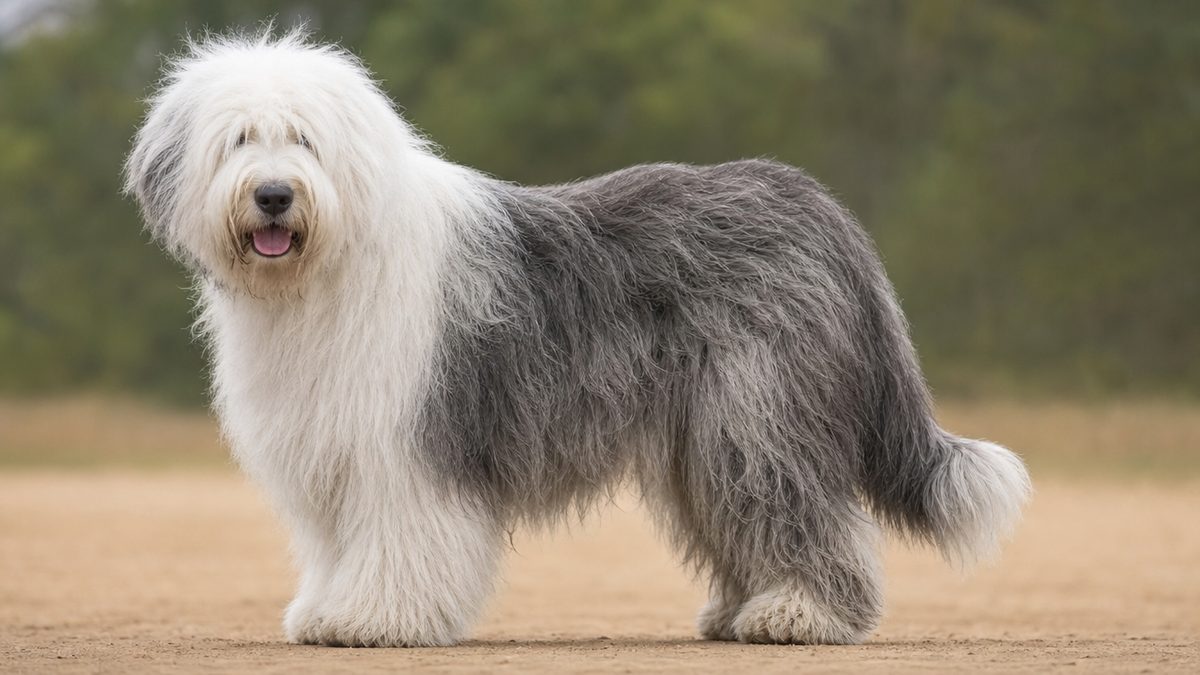
The FCI breed standard describes a strong, square-looking dog of great symmetry, absolutely free from legginess and profusely coated all over, with a gently rising topline and a pear-shaped body seen from above. The line that matters most in India comes two sentences later: the natural outline should not be artificially changed by scissoring or clipping. That single clause governs what you may lawfully do to this coat in a Chennai May, and it is why the grooming section below is the longest on this page.
English is the official authentic language of FCI standard 16, so where a translation disagrees the English text governs. The standard's own history section is unusually candid about how little is settled: it says that although the breed is registered to Britain, its ancestry is thought to be from the European shepherd dogs of the Owtcharka and Bergamasco types crossed onto British sheepdogs. The Royal Kennel Club tells a different version, crediting the Scottish Collie or Bearded Collie, and finishes the passage by admitting that very little is certain in the origins and development of any breed.
The name says drover, not shepherd
The Royal Kennel Club records a real argument about the breed's own name. It notes the dog was seen as a drover's dog for driving cattle, hence calling into question the title of the breed as sheepdogs, and explains that true sheepdogs were not docked because they needed their tail as a rudder for quick athletic turns, while slower-moving cattle dogs did not. The American standard agrees on function, describing a dog fitted for the demanding tasks required of a shepherd's or drover's dog.
Two accounts compete for why the tail was removed. One says the tail was docked for hygiene, as sheep are docked. The other says the practice began as a ruse to avoid tax, because drovers' dogs were once tax-exempt and a docked tail was the mark of one. Bonbeno is not going to pick between them. Both are recorded by the breed's own national club as unresolved, and the honest thing is to say so.
Two standards, two different dogs on paper
Read the FCI and AKC standards side by side and they do not describe the same animal. The FCI sets male height at 61 cm and upwards and female height at 56 cm and upwards, with no ceiling. The AKC sets its floors at 22 inches, 55.8 cm for dogs and 21 inches, 53.3 cm for bitches. A male that clears the American minimum by a whisker stands 5.2 cm below the FCI floor. That is not a rounding difference. It is a different dog.
| Point | FCI standard 16 | AKC standard | Royal Kennel Club |
|---|---|---|---|
| Male height floor | 61 cm and upwards | 22 in / 55.8 cm and upward | Published as a large breed |
| Female height floor | 56 cm and upwards | 21 in / 53.3 cm and upward | Published as a large breed |
| Weight | None given under a SIZE AND WEIGHT heading | Word does not appear in the standard | Not published |
| Tail | Docked or undocked, both described | Docked close to the body, when not naturally bob tailed | Docking no longer allowed |
| Merle | Not listed | Blue merle permitted | Not a breed standard colour |
| Clipping | Natural outline not to be changed by scissoring or clipping | Feet and rear may be trimmed for cleanliness | Grooming: every day |
Notice the weight row. The FCI prints a heading reading SIZE AND WEIGHT and then gives no weight at all. The word weight appears zero times in the AKC standard. Yet the one Indian page publishing rupee bands for this breed prints a confident 27 to 45 kilograms, and DogsIndia prints about 30 kgs. DogsIndia. Old English Sheep Dog breed page… Neither figure comes from any breed standard, because no breed standard publishes one.
DogsIndia gives the breed as 56 to 61 cms tall. Those two numbers are real, but they are not a range. They are the FCI's female floor and its male floor, two separate minima with no upper limit, flattened into a single band. Read literally, DogsIndia's figure caps the breed 5 cm below where the standard says most males start.
How rare the Old English Sheepdog has become
The Royal Kennel Club registered 218 Old English Sheepdog puppies in the United Kingdom in 2025, and lists the breed as a vulnerable native breed. The Royal Kennel Club. Vulnerable native… That is the single most useful number on this page, because it explains both the Indian price and the Indian absence.
The club defines the category precisely. A vulnerable native breed is a breed of British or Irish origin with fewer than 300 registrations a year, and an at-watch breed is one running between 300 and 450. The Old English Sheepdog sits in the first list, not the second. Being inside the vulnerable-breeds document is not enough on its own, because that same file carries a separate AT WATCH block holding the Airedale Terrier, Cairn Terrier, Rough Collie and five others. This breed is in the main list.
| Year | Puppies registered | Change on 2016 |
|---|---|---|
| 2016 | 424 | - |
| 2017 | 384 | -9.4% |
| 2018 | 318 | -25.0% |
| 2019 | 317 | -25.2% |
| 2020 | 227 | -46.5% |
| 2021 | 377 | -11.1% |
| 2022 | 333 | -21.5% |
| 2023 | 359 | -15.3% |
| 2024 | 241 | -43.2% |
| 2025 | 218 | -48.6% |
Why this table is trustworthy, and how it could have gone wrong
Bonbeno checked this row in four places rather than one, because the Royal Kennel Club's own registration statistics do not always agree with each other. The 2025 figure of 218 appears identically in the ten-yearly Pastoral group PDF, in the ten-year vulnerable-breed PDF, and in the club's web table. The Royal Kennel Club. Vulnerable native… The quarterly PDF then corroborates it from underneath: 22 in the first quarter, 71 in the second, 74 in the third and 51 in the fourth, which sum to exactly 218.
That matters because two things do go wrong in these documents, and Bonbeno reproduced both while checking. First, the club's web table and its own PDFs disagree in specific cells: the web table gives the Bull Terrier (Miniature) 493 in 2016 and 143 in 2025 while the PDFs give those figures to the Bullmastiff, and it prints Manchester Terrier 2019 as 243 where both PDFs read 133. The Royal Kennel Club. 10 year VULNERABLE… Neither defect touches this breed, whose row is identical everywhere.
Second, and more subtly, machine-extracting the ten-yearly PDF quietly drops cells. Four Pastoral rows come back short because those breeds have blank years, and adding up only the complete rows undercounts the group against its own printed totals by between 12 and 173 dogs depending on the year. The Old English Sheepdog row extracts complete, all ten values present, so the trap exists but does not reach this figure.
Two hundred and eighteen puppies were registered in the whole of the United Kingdom in a year. Britain is where the breed comes from, where its clubs are, and where nearly all the health-tested breeding stock lives. A breed that rare at home cannot have a deep supply chain in India, and any Indian seller offering immediate availability of multiple puppies is describing a market that does not exist.
For scale, the Royal Kennel Club notes that the top ten breeds in the UK, including the Labrador, French Bulldog and Cocker Spaniel, account for more than 60 percent of all annual puppy registrations. The Old English Sheepdog's 218 sits against a Pastoral group total of 9,263 for 2025, itself down from 14,245 in 2016. The whole group is shrinking; this breed is shrinking faster than the group.
One last thing worth knowing before you search for this breed yourself. The word old in its name breaks search engines. Bing India, asked for the price of this breed with a country filter set to India, returns ten results about a 2021 film called Old, and quoting the full breed name returns Old Navy at position one. A Labrador control run in the same session returned ten genuine Indian Labrador price pages, so the search engine was working correctly and the breed name was doing the damage. Expect to have to fight your own search results.
Old English Sheepdog price in India
The published Old English Sheepdog price in India runs from Rs 50,000 for a basic puppy to Rs 1,25,000 for show quality, and exactly one Indian page publishes those bands. No ranking Indian listing site actually holds a dog of this breed, so treat the range as a published claim rather than a market rate.
Tailsbuddy is the only Indian page quoting rupee figures for the breed, and it splits them three ways.
| Category | Published band | What the label means |
|---|---|---|
| Basic | Rs 50,000 to Rs 65,000 | Not registered with any kennel club, including the KCI |
| KCI registered | Rs 65,000 to Rs 85,000 | Comes with a Kennel Club of India registration certificate |
| Show quality | Rs 85,000 to Rs 1,25,000 | Claimed to be closest to the breed standard |
Those figures are at least rupee-native. Divided by 84.38, the exchange rate that has exposed converted dollar price lists on this site three times, Rs 50,000 gives 592.6 and Rs 1,25,000 gives 1,481.4, neither of which a seller would print. At 74 they give 675.7 and 1,689.2, equally implausible. Only the structurally weak flat-80 test produces round numbers, and it does so by construction for any figure ending in three zeros. So these are not converted American prices. That is the most that can be said for them.
Google's own answer prices a breed nobody is selling
The same page lists seven factors affecting the price it publishes, and they are worth reading because most of them are not about the dog. Type, physical attributes, age and gender, purebred against mixed, availability and location, breeder reputation, and a miscellaneous bucket holding champion bloodline and microchipping. Only two of those seven, type and physical attributes, describe anything a breed standard would recognise, and the Royal Kennel Club's published standard for this breed says nothing about any of them. The other five are supply-chain factors dressed as breed qualities.
Google India returns an AI answer for this query stating that an Old English Sheepdog puppy typically costs between Rs 80,000 and Rs 1,50,000, with KCI-certified quality at Rs 1,00,000 to Rs 1,50,000 and above. It attributes the reliability of that band to puppies from verified platforms like Mr n Mrs Pet. Bonbeno opened that platform's Old English Sheepdog page the same day.
The page reports 3 Result Found, and the three results it renders sit under a heading reading Similar breeds at other locations. They are a Bernese Mountain Dog in Kolkata, a Border Collie in Kochi and an Australian Shepherd in Delhi. Every price is behind a View Price sign-up wall, so the page quotes no rupee figure at all. Zero Old English Sheepdogs, zero prices, and it is the source Google's answer names for confidence in an Indian price band.
Run the same division tests on Google's own band and it fails them too. Rs 80,000 divided by 84.38 is 948.1 and Rs 1,50,000 is 1,777.7. At a flat 80 the quotients are 1,000, 1,250 and 1,875, and while 1,000 and 1,250 are prices a seller might print, 1,875 is not, and every one of those figures ends in enough zeros to divide cleanly at 80 whatever its origin. The band is a round-number guess, not a converted list and not an observation.
The page that ranks on Google India under the title Old English Sheepdog Price prints seven prices: Rs 98,999 three times, Rs 92,599 twice, Rs 94,999 and Rs 76,499. Rs 98,999 is a recurring house price point this site has now tracked across a dozen unrelated breed pages on the same seller. It divides to 1,173.25 dollars, so it is not even a conversion. It is a charm price attached to whatever animal is in stock.
What the seller's own markup says it is selling
Bonbeno read the raw HTML of the highest-ranking Indian page for this query and matched each price to the animal photographed beside it. Seven animals are priced and none of them is an Old English Sheepdog. This is the finding no other page on this query has.
The method is simple enough to repeat. The page returns HTTP 200 with the title Old English Sheepdog Price, Buy Puppies for Sale in India. Each price sits in an identical template widget, and immediately above each one is the photograph of the animal it belongs to. Image filenames on a commercial site are typed by whoever uploaded the picture, so they name the animal honestly even when the surrounding page does not.
| Price shown | Animal, from its own image filename | Is it the breed? |
|---|---|---|
| Rs 98,999 | Maltipoo, named Fizzy | No |
| Rs 92,599 | Poodle, named Kuzo | No |
| Rs 92,599 | Poodle, named Dugu | No |
| Rs 94,999 | Cane Corso, named Kazuka | No |
| Rs 98,999 | Maltipoo, named Samy | No |
| Rs 76,499 | Rottweiler, named Tugi | No |
| Rs 98,999 | Dachshund, named Yoki | No |
Seven priced animals, six different breeds, not one of them the breed the page is titled for and ranks for. The page's own lead photographs are genuinely of Old English Sheepdogs, filed as OLD-ENGLISH-SHEEPDOG-1 through 4, so the chrome is honest and the commerce is not. A buyer scrolling that page sees a correct picture of the breed at the top and a carousel of other people's dogs underneath, with prices.
The loop closes
Put the two findings together and the mechanism is complete. A listing site prices seven animals of other breeds under this breed's name. A second listing site shows three dogs of three other breeds under this breed's name. Google's AI answer then reads that second site, calls it verified, and issues an Indian price band for a breed neither site is selling. Nobody in that chain has seen an Old English Sheepdog for sale in India.
What the Indian sources that are not selling say
DogsIndia, the country's oldest dog portal, keeps a breeders' list for every breed it covers. Under the Old English Sheepdog it prints: There are no breeders listed currently under this breed. The same page asks readers to send a photograph of the breed if they have one, which tells you the site has not been sent an Indian dog to photograph. Breed n Breeder's page offers to help you find a puppy, gender and price in india to suit your preferences, and lists no dog and no figure.
Right-click any puppy photograph on a listing page and open it in a new tab. The filename appears in the address bar. If it names a different breed, you are looking at a different breed. This is how the seven animals above were identified, and it needs no tools at all. Then ask for the parents' KCI registration numbers and verify them with the Kennel Club of India before any money moves.
Monthly cost of ownership in an Indian city
Budget Rs 9,000 to Rs 16,000 a month to keep an Old English Sheepdog in an Indian metro, and understand before you start that grooming is the line that makes this breed expensive rather than merely large. Every figure below comes from a named Indian provider's own published price.
Bonbeno does not publish an all-in monthly number without showing where it comes from, because Indian breed sites publish running costs as shared constants across unrelated breeds. The table below is assembled from individual providers instead.
| Line | Published Indian figure | Monthly equivalent |
|---|---|---|
| Professional grooming, full haircut with dematting | From Rs 1,359 per 120-minute session, Delhi | Rs 1,359 to Rs 2,718 at one or two sessions |
| Bath and blow-dry between haircuts | From Rs 934 per 60-minute session, Delhi | Rs 934 to Rs 1,868 |
| Grooming add-ons: nails, ears, medicated bath | From Rs 99 each, Delhi | Rs 200 to Rs 400 |
| Monthly parasite prevention | NexGard Spectra, Rs 3,308 for three tablets | About Rs 1,103 |
| Core vaccination, annual booster | From Rs 3,199 a year | About Rs 267 |
| Puppy vaccination course, first year only | From Rs 6,499 over four visits | One-off |
| Veterinary consultation | Rs 500 to Rs 1,000 a visit | Rs 500 to Rs 1,000 |
| Food, large-breed adult | Re-price locally before budgeting | Rs 4,000 to Rs 7,500 |
| Municipal registration, Delhi | Rs 500 a year, renewal Rs 500 | About Rs 42 |
The grooming lines are Vetic's own published Delhi prices, re-checked on 3 September 2026 and unchanged. Note that these are Starts at figures against struck-through prices of Rs 1,599, Rs 1,099 and Rs 2,199, so they are a promotional floor from one chain across sixty-odd centres, not a market average. Vaccination figures are the same chain's published floors. Consultation at Rs 500 to Rs 1,000 should be treated as one data point rather than two, because two unrelated organisations publish that range byte-identically, which is evidence of copying rather than corroboration.
The line nobody prices honestly
Every Indian breed page that quotes a monthly cost for a long-coated dog prices one salon visit and stops. The Royal Kennel Club publishes this breed's grooming requirement as every day. A salon session is 120 minutes of professional work, and Vetic's own FAQ puts a grooming session at one hour to two and a half hours depending on breed, size and coat. Whatever you pay the salon, the daily grooming load stays with you, and pricing this breed without pricing your own hours produces a number that is wrong by more than money.
Boarding costs more for this dog than for a Labrador
Indian boarding is priced by size band, and this breed sits at the top of it. PawSpace in Bengaluru publishes Rs 599 for up to four hours, Rs 799 for daycare to ten hours and Rs 899 for an overnight stay to 24 hours. A two-week trip is therefore about Rs 12,600 in boarding alone, before the grooming the dog will need afterwards. Budget for that at the point you buy, not at the point you travel.
The Greater Chennai Corporation runs six pet clinics that provide all treatment and anti-rabies vaccination free of cost, and its pet licence costs Rs 50. Delhi's MCD registration is Rs 500 with a Rs 100 per month late fee. Municipal fees are the one Indian cost line that does not move, so register the dog and stop worrying about that column.
Suitability for the Indian climate
The Old English Sheepdog has the lowest heat tolerance rating Bonbeno gives, because its double coat with a waterproof undercoat pile was built for a homeland whose warmest month averages 16.39 C. NASA Langley Research Center. POWER… Chennai's coolest month is 7.7 C warmer than that.
Bonbeno queried NASA POWER by explicit latitude and longitude rather than by place name, because climate sites serve the wrong city at HTTP 200 often enough to matter. The homeland point is Taunton in Somerset, 51.0190 N and 3.1030 W, in the West Country drover territory the breed worked.
| Place | Coolest month, mean | Gap against Taunton's July 16.39 C | Months at or above 25 C |
|---|---|---|---|
| Taunton, Somerset | 4.88 C in February | - | 0 of 12 |
| Chennai | 24.09 C in January | +7.70 C | 10 of 12 |
| Mumbai | 23.19 C in January | +6.80 C | 9 of 12 |
| Bengaluru | 20.22 C in December | +3.83 C | 3 of 12 |
| Pune | 19.62 C in December | +3.23 C | 4 of 12 |
| Delhi | 13.61 C in January | -2.78 C | 7 of 12 |
Read the Chennai row properly. Its coldest month is nearly eight degrees warmer than the warmest month this coat evolved in, and ten of its twelve months average above 25 C. There is no season in Chennai that resembles an English summer, let alone an English winter. Mumbai is barely different.
Delhi is the exception, and not in the way sellers claim
Delhi is the one Indian metro where this breed gets a real cold season. Its January mean of 13.61 C is 2.78 C cooler than Taunton's July, so for roughly three months a Delhi Old English Sheepdog is more comfortable than an English one in high summer. Then June arrives at a 35.88 C mean. Delhi is not mild, it is bimodal, and a coat that handles one end of that year has nothing in its history for the other.
Wet cold is not the same problem as wet heat
Annual relative humidity at the Taunton point is 87.46 percent, higher than Chennai's 72.39 percent or Mumbai's 67.39 percent. So the objection to India is not that it is more humid than England. The coat is explicitly waterproof and was built for wet. The objection is that India is humid and hot at the same time, and evaporative cooling through panting is exactly what high humidity degrades. A dog carrying a waterproof undercoat in 30 C at 70 percent humidity has both problems at once.
Sellers point buyers at Ooty. NASA POWER returns a grid cell for Ooty sitting at 784.64 m, against a real town elevation of about 2,240 m, an error of 1,455 m. Temperature falls roughly 6.5 C per 1,000 m, so the model is describing a place about 9 C warmer than the town. Bonbeno therefore publishes no Ooty figure. The five plains cities above check out within 83 m of their real elevations and can be used at face value.
The breed is not helped by size either. Bonbeno checked whether the largest UK study of canine heat-related illness models this breed, and it does not. The string Old English Sheepdog and even the word Sheepdog appear zero times in either Hall 2020 paper, while Chow Chow and Labrador appear throughout both. Hall EJ, Carter AJ So no breed-specific odds ratio may honestly be quoted here, and this page quotes none.
What does transfer is the non-breed finding. Across 905,543 UK dogs, 652 of the 879 heat-illness events with a recorded trigger, 74.2 percent, were exertional rather than caused by hot cars. A further 40 events, 4.6 percent, happened while the dog was in the care of a veterinary clinic or groomer. For a breed that needs professional grooming this often, that last category is not a footnote.
What Indian law says about this coat and this tail
Two clauses of the Prevention of Cruelty to Animals (Dog Breeding and Marketing) Rules, 2017 bite directly on this breed, and one of them names its coat type explicitly. Bonbeno extracted the gazette itself, 14 pages and 51,953 characters, rather than relying on a summary.
The heat clause names long-haired breeds by name
Second Schedule Part IV paragraph 21(1), Outdoor housing facilities, reads that the following categories of dogs shall not be kept in outdoor facilities unless specifically approved by the attending veterinary practitioner in writing: dogs not accustomed to the temperatures prevalent in the area, dog breeds that cannot tolerate the temperatures prevalent in the area or region in question, such as long-haired breeds in high temperature locations, and sick, infirm, aged or young animals.
That middle limb is not a general principle a reader has to apply by analogy. It names long-haired breeds in high temperature locations as its own worked example. An Old English Sheepdog in Chennai is the clause's central case, not an edge of it. The same paragraph goes on to require roofed shelters plus separate outside areas of shade large enough to hold all the animals at once, and shelters that provide adequate protection from heat and cold.
This provision is widely miscited as Rule 21. The string Rule 21 appears zero times in the gazette, checked both literally and with a pattern allowing for the word-splitting that PDF extraction introduces. The Rules themselves stop at Rule 13. Everything numbered higher is a Second Schedule paragraph, so the correct citation is Second Schedule Part IV paragraph 21(1).
The tail the American standard requires cannot lawfully be made in India
Second Schedule Part II paragraph 6(8) states that there shall be no tail docking, ear cropping, de-barking, de-clawing, branding, dyeing, injecting substances to enhance visual appeal, or any other kind of mutilation of any body part of the pup, and that any change of appearance by artificial means is strictly forbidden. Part II runs to sub-clause (9) and no further, so a citation to 6(10) or above is wrong on its face.
Set that against the registries. The AKC standard, approved in 1990 and still current, reads Tail: docked close to the body, when not naturally bob tailed. The FCI standard describes the tail as previously customarily docked and gives both a docked and an undocked form. The Royal Kennel Club is blunt: the breed was customarily docked until docking was banned, and the traditional epithet The Bobtail is no longer appropriate.
So the world's largest registry still describes, as its official standard, a dog that cannot lawfully be produced in India. An Indian breeder following the AKC standard would be committing an offence. This is worth knowing before you are shown a docked puppy and told it is correct to type.
The genuinely tailless dogs, and how Britain tracks them
Some Old English Sheepdogs are born with a natural bobtail, and the Royal Kennel Club records those separately. Since October 2008 it records puppies born with naturally bobbed tails on registration certificates, specifically to help breeders identify which lines carry the tailless gene, and it accepts bobtail as the only permitted description. Confirmation must come with veterinary certification on practice headed paper, which is why the service is not available online. A short tail is therefore either genetic and documented, or it is evidence of something illegal.
What the Rules require a breeder to have tested
Second Schedule Part III paragraph 8(10) requires that breeding dogs shall have been tested for genetic defects, including hip dysplasia, progressive retinal atrophy, night blindness, hypothyroidism, entropion, ectropion, overshot, undershot jaw, wry mouth, two or more missing teeth and cryptorchidism. Two of those matter here: hip dysplasia, which OFA finds in 18.9 percent of 12,639 evaluated dogs of this breed, and hypothyroidism, against a breed that ranks 26th for autoimmune thyroiditis. The clause says including, so the list is illustrative and not closed, but note that it names none of the breed-specific DNA tests, and Indian law contains no requirement to screen for primary ciliary dyskinesia or MDR1.
Grooming and coat care in Indian humidity
Plan on grooming this coat every day, which is the Royal Kennel Club's own published figure for the breed, plus a professional session every four to six weeks at Rs 1,359 and upwards in Delhi. The grooming load is the single biggest reason this breed does not suit a working Indian household.
The Royal Kennel Club prints this breed's characteristics as a set of bands, and two of them are at the top of their scale: Grooming: Every day, and Coat length: Long. It also answers the shedding question with a flat Sheds: Yes. There is no low-maintenance reading of that combination.
Understand what you are dealing with structurally. The FCI standard describes hair that is profuse, of good harsh texture, not straight but shaggy and free from curl, over an undercoat of waterproof pile, with the hindquarters more heavily coated than the rest of the body. The AKC adds that the hams carry a thick, long jacket in excess of any other part. The heaviest coat sits over the rear, which is also where a dog sits down on wet ground.
What a session actually costs and takes
Vetic publishes Delhi grooming prices with session lengths attached, which is unusual and useful.
| Service | Time booked | Starts at | Struck-through price |
|---|---|---|---|
| Haircut, including coat brushing and dematting | 120 minutes | Rs 1,359 | Rs 1,599 |
| Bathing, shampoo, conditioning, blow dry | 60 minutes | Rs 934 | Rs 1,099 |
| Complete bath and hair styling | 120 minutes | Rs 1,869 | Rs 2,199 |
| Add-ons: nails, ears, anal glands, medicated bath | 30 minutes | Rs 99 | Not shown |
The chain's own FAQ says a session runs one hour to two and a half hours depending on breed, size, temperament and services. For an Old English Sheepdog you are at the top of that band every time. Note also that these are promotional Starts at floors from one chain across sixty-odd centres in eleven cities, not a national average, and a long-haired 35 kg dog is not what a floor price is calculated on.
You may not simply clip it off
Every Indian summer somebody advises shaving a shaggy dog down to the skin. For this breed both standards forbid changing the coat's outline. The FCI text reads that the natural outline should not be artificially changed by scissoring or clipping. The AKC is more specific about the exception: neither the natural outline nor the natural texture of the coat may be changed by any artificial means except that the feet and rear may be trimmed for cleanliness.
Those are show rules rather than Indian law, and a pet owner is entitled to ignore them. What is not a show rule is the physics. A double coat with a waterproof undercoat insulates in both directions, and stripping it removes the barrier that keeps radiant heat off the skin as well as the one that keeps cold out. Talk to a veterinarian about a thorough de-shed and strip-out, which removes dead undercoat and leaves the structure intact, rather than a clip to the skin.
One Indian page lists this breed's common coat colours as including Blue Merle and White, and states plainly that the rarer the color, the higher might be the price. The AKC standard does allow blue merle. The Royal Kennel Club does not list merle among this breed's breed standard colours at all, rates the breed Colour Watch Category 0, meaning no non-breed-standard colour may be registered for it, and warns in terms about high-volume breeding of unrecognised colours advertised as being rare. The Royal Kennel Club. Old English… Paying a premium for merle is paying a premium the breed's own country will not register.
The monsoon problem this coat creates
A waterproof undercoat that takes hours to dry is the worst possible structure for an Indian monsoon, and matting in a wet double coat is not a cosmetic problem. It is a skin problem that starts under hair you cannot see through.
The coat is designed to keep the dog dry in English rain and then dry out in English air at 16 C. NASA Langley Research Center. POWER… In a Mumbai July the dog gets wet the same way and then sits in air that is warm and already close to saturated. Water held against skin under a dense pile, at body temperature, is a growth medium.
Three things follow, and Indian owners meet them in this order.
- Mats form at the friction points first. Behind the ears, in the armpits, on the inner thighs and across the heavily coated hindquarters the AKC standard describes. A mat traps moisture against skin and stops air moving through it.
- The skin under a mat goes wrong before you find it. By the time there is a smell or a hot spot, the mat has been there for a while. This is why the Royal Kennel Club's answer is every day rather than every week.
- The ears are the last thing to dry. Small ears carried flat to the side of the head, over a dense coat, in monsoon humidity. Plug them before a bath and dry them afterwards.
Do not take the drying advice from a British source
Overseas breed clubs write care guidance for their own climate, and some of it is actively wrong here. Air-drying a heavy double coat is normal advice in a cool, low-humidity country. In an Indian monsoon it leaves the undercoat damp for hours. Use a forced-air dryer to the skin, work in sections, and confirm the coat is dry at the base rather than at the tip before the dog is allowed to lie down.
Ticks are the other reason to part this coat weekly
Tick-borne disease pressure in India is high enough that a coat you cannot see through is a genuine clinical risk. Among 584 dogs presented at veterinary clinics in West Bengal, canine haemoprotozoa were found at high rates, and among 120 clinically suspected dogs in southern India a similar picture emerged with a pre-monsoon peak. Molecular epidemiology and phylogenetics… Both studies sampled dogs tested at veterinary clinics, not random pets, so the percentages are not population prevalence and Bonbeno does not quote them as such. The transferable point stands: ticks are common, and this coat hides them.
That is why the monthly parasite line in the cost table is not optional. A combined product covering ticks, fleas and intestinal worms runs about Rs 1,103 a month at Indian retail for a dog in the 15 to 30 kg band, and a mature male of this breed will usually sit above that band, so verify the weight banding on the pack before you buy.
Once a week, part the coat to the skin at eight places: behind each ear, each armpit, each inner thigh, the base of the tail and the chest. You are looking for ticks, mats and any patch of damp or reddened skin. Do it on the same day every week, and brush out what you find rather than cutting it out, because scissors near a mat reach skin faster than you expect.
Health risks, inherited disease and life span
The Old English Sheepdog's three documented health issues with real numbers behind them are hip dysplasia at 18.9 percent of 12,639 evaluated dogs, autoimmune disease running through the breed, and primary ciliary dyskinesia carried at up to 19 percent in European stock. Merveille AC, Battaille G, Billen F Every figure below carries its denominator.
Bonbeno read these off OFA's own tables, using the breed code SD taken from OFA's raw markup rather than guessed, and confirmed the returned page prints OLD ENGLISH SHEEPDOG as its own heading. A Labrador control returned 109 rows against this breed's 64 in the same retrieval, so the tables were genuinely loaded.
| Registry | Dogs evaluated | Result |
|---|---|---|
| Hips | 12,639 | 80.1% normal, 18.9% dysplastic |
| Elbows | 1,204 | 95.0% normal, 4.7% abnormal |
| Thyroid | 1,425 | 86.2% normal, 7.0% abnormal, 6.7% equivocal |
| BAER hearing | 768 | 99.2% normal, 0.8% abnormal |
| Primary ciliary dyskinesia DNA | 413 | 19 carriers, 4.6% |
| MDR1 drug sensitivity DNA | 404 | 31 carriers, 7.7% |
| Cerebellar degeneration DNA | 532 | 34 carriers, 6.4% |
| Exercise-induced collapse DNA | 547 | 46 carriers 8.4%, 1 affected 0.2% |
| Patella | 127 | 99.2% normal |
Hips are the big number, and Indian law already asks about them
One dog in five, 2,384 of 12,639, comes back dysplastic. Broken down, 10.4 percent are mild, 7.5 percent moderate and 1.0 percent severe. This is the one inherited condition Indian law names directly: Second Schedule Part III paragraph 8(10) requires breeding dogs to have been tested for genetic defects including hip dysplasia. A seller who cannot produce a hip score for both parents is not meeting a standard Indian law already sets.
The three normal sub-grades OFA prints, Excellent 1,688, Good 6,529 and Fair 1,892, sum to 10,109, while the same table's Normal cell reads 10,121. Twelve dogs are unaccounted for. The dysplastic sub-grades do reconcile exactly at 2,384. Bonbeno quotes the headline 18.9 percent because it recomputes correctly from 2,384 of 12,639, and flags the 12-dog gap rather than hiding it.
An immune system that misfires
The breed ranks 26th of all breeds OFA publishes for autoimmune thyroiditis, which is high, and 7.0 percent of 1,425 tested dogs come back abnormal with a further 6.7 percent equivocal. Orthopedic Foundation for Animals. CHIC… That fits a much older clinical picture. A Western Australian series recorded 19 cases of immune-mediated disease in this breed between 1978 and 1989: seven autoimmune haemolytic anaemias, five Evans' syndrome, two multiple myeloma, two hypothyroidism, one idiopathic thrombocytopenia, one systemic lupus and one discoid lupus. The counts sum to 19 exactly.
Its authors reported raised serum IgG in 60 percent, depressed IgM in 60 percent, anti-red-blood-cell antibodies in 78 percent and antinuclear antibody in 44 percent, and concluded that an underlying, breed-related disorder of immune regulation may account for the pattern. Read it for what it is: a 19-dog case series from one Australian state over eleven years, not a prevalence. It is a signal, and the modern thyroid ranking points the same way.
The respiratory one an Indian owner will meet as pneumonia
Primary ciliary dyskinesia is recessive, caused in this breed by a mutation in CCDC39, and it stops the cilia lining the airway from clearing it. A study of 578 Old English Sheepdogs, 28 affected and 550 clinically healthy, found the clinical picture to be recurrent nasal discharge and cough, pyrexia, leucocytosis and bronchopneumonia. The carrier rate was 19 percent in a non-randomly selected European population against 7 percent in non-European dogs.
OFA's tested population, mostly American, shows 19 carriers in 413 dogs, 4.6 percent, which sits below the paper's non-European figure and in the same direction. For an Indian buyer the consequence is concrete: a puppy from untested European lines has a real chance of carrying this, and a PCD dog in an Indian city will present as a puppy with pneumonia that keeps coming back.
The eye problem, the newest DNA test, and what to demand
Ask any Old English Sheepdog breeder for six documents: hip and elbow scores, an eye examination, a thyroid result, and DNA results for primary ciliary dyskinesia and MDR1. The two major registries do not ask for the same set, so ask for both.
| Test | Royal Kennel Club | OFA CHIC scheme |
|---|---|---|
| Hip scoring | Good Practice | Required |
| Elbow scoring | Good Practice | Not a requirement |
| Eye examination | Good Practice | Required, ACVO exam |
| Genetic diversity | Good Practice | Not listed |
| Autoimmune thyroiditis | Not listed | Required |
| Exercise-induced collapse DNA | Not listed | Required |
| MDR1 drug sensitivity DNA | Not listed | Required |
| Primary ciliary dyskinesia DNA | Best Practice | Optional |
| Multiocular defect DNA | Best Practice, new August 2026 | Not listed |
| BAER hearing | Not listed | Optional |
Look at the disagreements rather than the agreements. The Royal Kennel Club asks for elbows and OFA does not, despite OFA holding 1,204 elbow evaluations for the breed. Orthopedic Foundation for Animals. CHIC… OFA requires MDR1 and thyroid and the Royal Kennel Club lists neither. A breeder who has satisfied one scheme has not satisfied the other.
MDR1 is the test that matters most in India
7.7 percent of 404 tested Old English Sheepdogs carry the MDR1 mutation. MDR1 governs how a dog handles a family of drugs that includes ivermectin, and ivermectin is one of the most widely used antiparasitics in Indian veterinary practice, including in cheap injectable forms sold for livestock. A carrier or affected dog given a livestock-dose avermectin can develop severe neurological toxicity. This is a herding breed, and herding breeds are the MDR1 group.
If you cannot produce an MDR1 result for your dog, say so to your veterinarian in writing before any avermectin is given, and ask for an alternative. A DNA test is a cheek swab. The OFA scheme treats first-generation offspring of tested dogs as clear by parentage, so a breeder's result covers your puppy if the breeder actually has one.
OFA's eye tables contradict themselves, so read both
OFA's eye summary for this breed reports 95.9 percent normal across 2,608 evaluations. Its own per-diagnosis detail tables, on 2,600 dogs, report 1,844 normal, which is 70.9 percent. Orthopedic Foundation for Animals. CHIC… That is a gap of 25.0 percentage points, or 657 dogs, and the two figures do not even share a denominator, differing by eight. Bonbeno publishes both and quotes neither as the rate.
The detail rows are the ones that name diagnoses, and one of them dwarfs the summary. Persistent pupillary membranes, iris to iris, appear in 370 of 2,600 dogs, 14.2 percent, which on its own is more than three times the summary table's entire abnormal count of 107. Cataract of unknown significance reaches 166 dogs, 6.4 percent.
The newest test exists because of a 2023 paper
The Royal Kennel Club added a DNA test for multiocular defect to this breed's Best Practice list in August 2026, and it becomes formal in January 2027. The science behind it is a 2023 study from the Kennel Club Genetics Centre at Cambridge, which identified a missense variant in COL11A1, c.1775T>C, and described it as a canine form of Stickler syndrome type II.
Two details matter to a buyer. The inheritance is dominant, so one copy is enough, and the variant segregated in eight of nine hereditary-cataract-affected dogs tested. The index dog was diagnosed with cataracts at five and went on to vitreal degeneration, retinal detachment, uveitis and secondary glaucoma. The paper's authors declare that one of them manages a service selling the resulting DNA test, which is disclosed in the paper and worth knowing.
Two further inherited conditions are documented in this breed and neither registry currently asks about them. Hereditary ataxia in Old English Sheepdogs and Gordon Setters is associated with a defect in the autophagy gene RAB24. And a 2025 report described a litter of three two-week-old puppies with startle disease, episodic muscle hypertonia and cyanosis triggered by touch and noise, traced to a frameshift variant in SLC6A5, with three unaffected carriers found on population screening.
Life span, measured at 12.1 years in McMillan's Table S3
The Royal Kennel Club publishes this breed's life span as over 10 years, a band rather than a figure. The Indian page selling the breed prints 10 to 12 years. McMillan 2024's Supplementary Table S3 gives the Old English Sheepdog a median survival of 12.1 years, 95 per cent CI 11.9 to 12.5, from 604 recorded deaths, at a hazard ratio of 0.98 (0.90 to 1.06) against the crossbred group. The hazard ratio does not clear significance at p = 0.61, so a well-kept Old English Sheepdog lives about as long as a crossbred dog, and the registry's over 10 years and the Indian seller's 10 to 12 both understate it. The string Old English Sheepdog does not appear in the main text of either large UK study, while Labrador and Jack Russell do, and an earlier version of this page treated that as a reason to publish nothing. Teng KT, Brodbelt DC, Pegram C, Church DB It was the wrong test: the per-breed rows live only in the supplementary tables, and this breed has one.
Temperament and who this breed actually suits
The FCI standard describes a biddable dog of even disposition, bold, faithful and trustworthy, with no suggestion of nervousness or unprovoked aggression. The temperament is not the problem. The problem is that it comes attached to a coat and an exercise requirement that most Indian households cannot meet.
The AKC agrees almost word for word, calling it an adaptable, intelligent dog of even disposition, with no sign of aggression, shyness or nervousness. Both standards also flag the bark. The FCI says it has a particularly resonant bark sufficient to frighten off any intruder, and the AKC describes a loud bark with a distinctive pot-casse ring in it. In an Indian apartment block that is a neighbour problem, not a security feature.
This household suits the breed
- Households with an air-conditioned indoor space the dog can use all day, because Second Schedule Part IV paragraph 21(1) treats long-haired breeds in high temperature locations as barred from outdoor housing without a vet's written approval.
- Households with someone home, because more than two hours of exercise a day and daily grooming do not fit around two full-time jobs.
- Households in Delhi, Pune or Bengaluru rather than Chennai or Mumbai, because those three have a real cool season and the two coastal cities do not.
- Households prepared to spend Rs 1,359 upwards on grooming every four to six weeks, on top of daily work at home.
- Households with older children, because a drover's dog instinctively moves what moves, and 35 kg leaning into a running toddler is not aggression but is still a fall.
This household does not
- First-time owners. One Indian page rates this breed a good option for a novice dog parent and rates its heat tolerance pretty average. Both claims are wrong for this climate, and the Royal Kennel Club's own bands say so.
- Anyone who plans to keep the dog on a balcony or terrace, which is exactly what the statutory clause is about.
- Anyone buying on appearance. The coat in the photograph is four to six hours of professional work a month plus daily maintenance.
- Anyone who wants a low-shedding dog. The Royal Kennel Club answers the shedding question with a flat yes.
If what you like is a big, shaggy, friendly, biddable dog and you live in an Indian city, look first at an Indian Pariah Dog, which is climate-matched and free to adopt, and then at a Border Collie if you want a pastoral breed with genuine Indian supply and a coat you can manage. This breed is a wonderful animal in the wrong country.
Training: what works and what this breed resists
Train this breed with short, consistent, reward-based sessions from eight weeks, and put the work into recall and into an off switch for the herding instinct. The FCI calls it biddable, which means it takes direction, not that it needs none.
Start with what the standard tells you about the dog's job. This is a drover's dog bred to move cattle over distance and to bark while doing it. Both of those are still in there. A puppy that is not given something to move will find something, and in an Indian home the moving things are children, house staff and the delivery rider at the gate.
The first sixteen weeks decide most of it
Indian law sets the floor on when your training can start. Rule 8(1)(a) of the 2017 Rules requires that pups less than eight weeks in age are not sold, and Second Schedule Part III paragraph 8(9) records that vaccination can start at seven to eight weeks and is usually completed at eighteen weeks. So you get the puppy at eight weeks and you have roughly ten weeks before the course finishes.
Use them. Socialise the puppy to the specific things an Indian city will throw at it: horns, two-wheelers on footpaths, cattle, monkeys, firecrackers, lift doors, and the sound of a pressure cooker. Do it carefully while vaccination is incomplete, on carried visits and in clean private spaces rather than public parks.
Four things to teach before the dog is six months old
- Stand for grooming. This is the highest-value obedience behaviour this breed will ever learn. A dog that stands calmly for twenty minutes turns a fight into a routine, and you will do it several thousand times over its life. Start on day one with a brush the puppy barely feels.
- Recall away from movement. Not recall in a quiet room. Recall while a cat, a child or a scooter is going past, because that is the recall the herding instinct will override.
- Settle on a mat. An off switch matters more in a hot country, where the dog cannot be exercised into tiredness for four months of the year.
- Tolerating the dryer and the ear-plug. Both are monsoon necessities and both are easier taught at ten weeks than at ten months.
What it resists
Repetition without purpose, and correction-based handling. A biddable dog of even disposition shuts down under harsh methods rather than escalating, which is worse because it looks like compliance. It also resists being left alone for long stretches, which combined with the resonant bark produces the complaint most Indian apartment owners actually make.
In Chennai, ten of twelve months average above 25 C. Training sessions in the middle of the day are not a discipline problem, they are a thermoregulation problem, and a dog that is overheating cannot learn. Work before 7 am and after 8 pm and keep sessions to ten minutes.
The daily exercise requirement, and the Indian timetable problem
The Royal Kennel Club puts this breed's requirement at more than two hours per day, its highest band, and pairs it with a large house and a large garden. In an Indian metro all of that has to happen in two narrow windows at either end of the day.
Two hours a day is roughly 730 hours a year. Price that against your own week before you price the puppy, because it is the second largest cost on this page after grooming and it is not payable in money.
When you can actually walk this dog
Bonbeno's climate work gives the answer city by city. In Chennai, ten of twelve months average at or above 25 C, and in Mumbai nine do. Delhi has seven such months but its June mean is 35.88 C, the highest of any city checked. Bengaluru and Pune, at three and four months respectively, have the widest usable windows in the country for this breed.
| City | Months at or above 25 C mean | Practical guidance |
|---|---|---|
| Bengaluru | 3 of 12 | Two outdoor hours are realistic for most of the year |
| Pune | 4 of 12 | Workable, with a hard summer break |
| Delhi | 7 of 12 | Excellent December to February, then indoor work through summer |
| Mumbai | 9 of 12 | Two windows a day, year round, no exceptions |
| Chennai | 10 of 12 | The hardest city in this table for this breed |
Exertion is the risk, not the parked car
The largest UK study of heat-related illness found that 652 of the 879 events with a recorded trigger, 74.2 percent, were exertional, against 12.9 percent environmental and just 5.2 percent from vehicular confinement. The dog that overheats is usually the dog that was being walked, played with or exercised, not the dog left in a car. For a breed whose owner is trying to fit two hours into a hot country, that is the finding that should change behaviour.
Bonbeno is careful about what it borrows from that study. The Old English Sheepdog is not in either Hall 2020 paper: the word Sheepdog appears zero times in both, while Chow Chow and Labrador appear throughout. Hall EJ, Carter AJ So no breed odds ratio is quoted here. The trigger split is a finding about dogs in general and transfers honestly.
What to do in the four months you cannot walk
- Scent work indoors. Hiding food and letting the dog find it tires a herding brain faster than distance does.
- Short, frequent sessions. Four fifteen-minute blocks beat one hour, because heat load accumulates.
- Swimming where it is genuinely available and clean, remembering that this coat takes a long time to dry and must be dried properly afterwards.
- Treadmill work only with veterinary sign-off, because exertional heat illness is the dominant trigger and a treadmill removes the dog's ability to stop.
Feeding an Old English Sheepdog in India
Feed a large-breed growth diet to twelve to eighteen months, then a large-breed adult food, and budget Rs 4,000 to Rs 7,500 a month for a 30 to 40 kg dog. Re-price the bag locally before you rely on that figure, because Indian retail food prices move fast.
Bonbeno will not print a monthly food figure as though it were a quoted price. It is arithmetic: a large-breed adult eats roughly 300 to 450 grams a day depending on weight and activity, and the rupee figure follows from whatever your bag costs per kilogram this month. Check the grams-per-day panel on the pack you actually buy against your dog's weight rather than taking a number from any breed page, including this one.
Growth rate is the thing to control, not quantity
This breed has 18.9 percent dysplastic hips across 12,639 OFA evaluations. Rapid growth and excess body condition in a large-breed puppy are the two dietary factors an owner controls that bear on joint development. Use a food formulated for large-breed growth, weigh meals rather than scooping, and keep the puppy lean enough that you can feel ribs without pressing.
Body condition matters more here than in England
The largest UK heat-illness study found that dogs at or above their breed and sex mean bodyweight had 1.42 times the odds of heat-related illness, 95 percent confidence interval 1.12 to 1.80, and dogs over 50 kg had 3.42 times the odds, interval 1.54 to 7.57. The breed itself was not modelled in that study, so those are general findings rather than breed figures. A heavy Old English Sheepdog in Chennai is carrying a coat problem and a weight problem at once.
Practical points specific to India
- Store food against humidity. Large bags in a coastal Indian monsoon go rancid and grow mould faster than the best-before date suggests. Decant into an airtight container and buy smaller bags in July and August.
- Water is a bigger deal than food. A heavily coated dog in a hot climate needs constant access to clean water in more than one place in the house.
- Beards get into everything. The facial coat carries water and food away from the bowl. Use a narrow deep bowl and wipe the beard after meals, or the damp coat around the mouth becomes a skin problem in exactly the way the monsoon section describes.
- Do not free-feed. Measured meals let you see appetite changes, and appetite change is often the first sign of the immune-mediated conditions this breed carries.
Before any deworming or antiparasitic, tell your veterinarian that this is a herding breed and that 7.7 percent of tested Old English Sheepdogs carry the MDR1 mutation. That gene governs how the dog handles ivermectin and related drugs. It is a feeding-adjacent point because most Indian owners meet it at the monthly parasite dose.
Month by month through the first year
The first year of an Old English Sheepdog is a coat-management apprenticeship with a dog attached. The schedule below is built around the two things that actually change month to month in India: the vaccination course and the coat.
| Age | What is happening | What you do |
|---|---|---|
| 8 weeks | The legal earliest sale age in India under Rule 8(1)(a) | Collect the puppy, collect both parents' health documents, start brushing with a soft brush for 60 seconds a day |
| 8 to 12 weeks | Vaccination course under way; it can start at seven to eight weeks | Carried socialisation only. Introduce the dryer at low speed with the motor across the room |
| 12 to 18 weeks | Course usually completes around eighteen weeks | Begin short outdoor walks in cool hours. Book the first salon visit as a handling session, not a haircut |
| 4 to 6 months | Adult coat starts pushing through the puppy coat | Grooming time roughly doubles. This is where most owners fall behind and mats first appear |
| 6 to 9 months | The heavy coat change. Herding instinct becomes obvious | Daily grooming is now non-negotiable. Work recall against moving distractions |
| 9 to 12 months | Frame fills out; growth plates still closing | Keep the dog lean, avoid forced running on hard surfaces, keep using large-breed growth food |
| 12 to 18 months | Transition to adult food | Book hip and elbow screening timing with your vet if you intend to breed, which is a decision to make now, not later |
The two months that decide the next twelve years
Months four to nine are when the puppy coat is replaced and the grooming load roughly doubles. Owners who keep up through that window generally keep up for life. Owners who fall behind arrive at the salon with a matted dog, are told the only humane option is to clip it off, and then discover that they have removed the coat's insulating structure going into an Indian summer.
Take the puppy to the salon at around fourteen weeks for a bath and a blow dry rather than a haircut. A 60-minute bathing session at a Delhi chain starts at Rs 934. It buys a dog that is not frightened of the table, the dryer or the clippers, which is worth more over twelve years than any single groom.
Head to head against the breeds Indian buyers cross-shop
Indian buyers looking at an Old English Sheepdog usually end up choosing between it, a Bearded Collie and a Border Collie, and the listing sites will offer them a Border Collie whichever they searched for. The table below is the comparison none of those sites publishes.
| Point | Old English Sheepdog | Bearded Collie | Border Collie |
|---|---|---|---|
| UK registrations, 2025 | 218 | 158 | 1,292 |
| Vulnerable native breed | Yes | Yes | No |
| Royal Kennel Club grooming band | Every day | Every day | More than once a week |
| Royal Kennel Club exercise band | More than 2 hours a day | Up to 1 hour a day | More than 2 hours a day |
| Coat | Profuse double coat, waterproof undercoat pile | Long harsh shaggy coat with a beard | Moderate double coat |
| Real Indian supply | None found | None found | Yes, listed on Indian marketplaces |
| Published Indian price band | Rs 50,000 to Rs 1,25,000 | No verified figure | Widely listed |
| Heat tolerance rating | 1 of 5 | 1 of 5 | 2 of 5 |
Registration figures come from the Royal Kennel Club's own documents: 218 for this breed, 158 for the Bearded Collie and 1,292 for the Border Collie in 2025. The Royal Kennel Club. Comparative tables… Two of the three are vulnerable native breeds and the third is the most registered Pastoral breed in Britain after the German Shepherd.
The one row that surprises people
The Bearded Collie carries a comparable coat and a comparable grooming band, but the Royal Kennel Club puts its exercise requirement at up to one hour a day against more than two hours for this breed. If your constraint is time outdoors rather than time with a brush, the Bearded Collie is the easier of the two shaggy breeds in an Indian city, and Bonbeno's page on it carries the same warnings about coat and heat.
If your constraint is the coat, neither is the answer, and the Border Collie is the pastoral breed with real Indian availability. Be clear-eyed about it though: its exercise band is the same top band, so you are trading a grooming problem for a stimulation problem, not solving anything.
Against all three, an Indian Pariah Dog costs nothing to adopt, carries a coat evolved for the climate you live in, and needs no salon at all. That is not a consolation prize. On the two measures this page has spent most time on, heat and coat, it beats every breed in the table.
Mistakes Indian owners actually make with this breed
Five mistakes account for most of the harm done to Old English Sheepdogs in India, and the first one happens before the dog arrives.
- Buying from a page that is not selling this breed. Seven priced animals on the highest-ranking Indian page are two Maltipoos, two Poodles, a Cane Corso, a Rottweiler and a Dachshund. Open the photograph's filename before you open your wallet.
- Trusting an AI answer's price band. Google India quotes Rs 80,000 to Rs 1,50,000 and credits a platform whose Old English Sheepdog page shows three dogs of three other breeds. A price repeated by a machine is not a verified price.
- Shaving the dog in May. Both standards forbid changing the coat's natural outline, and the undercoat that traps heat in also keeps radiant heat out. Ask a veterinarian about a strip-out instead.
- Keeping the dog on a balcony or terrace. Second Schedule Part IV paragraph 21(1) bars keeping breeds that cannot tolerate local temperatures in outdoor facilities without the attending veterinarian's written approval, and names long-haired breeds in high temperature locations as its example.
- Giving a routine ivermectin dose without an MDR1 result. This is a herding breed and 7.7 percent of tested dogs carry the mutation. Tell your vet before the first dose.
Two more that cost money rather than health
Paying a premium for a merle puppy. The Royal Kennel Club does not list merle among this breed's breed standard coat colours, rates it Colour Watch Category 0 with no non-breed-standard colour registration available, and warns specifically about unrecognised colours advertised as rare. The Royal Kennel Club. Old English… An Indian page nonetheless lists Blue Merle and White among the breed's colours and says outright that rarer colours cost more.
Budgeting for the puppy and not for the coat. A buyer who finds Rs 85,000 for a show quality puppy and then discovers a Rs 1,359 salon bill every four to six weeks, plus daily work at home, is the buyer who rehomes at eighteen months. The cost of ownership section above exists so that conversation happens before the purchase.
If you are shown a docked puppy of this breed in India, something illegal has happened. Second Schedule Part II paragraph 6(8) forbids tail docking outright and calls any change of appearance by artificial means strictly forbidden. A naturally bobbed tail is a different thing, and in Britain it needs veterinary certification to be recorded at all. Ask which one you are looking at and ask for the paperwork.
Adoption, responsible sourcing and how to verify a seller
Adopt first, and if you buy, buy from someone who can produce six documents. For this breed in India there is a third option most buyers do not consider, which is to want the dog and choose a different one.
Adoption, honestly framed
There is no Old English Sheepdog rescue network in India, because there is no population to rescue from. DogsIndia lists no breeders for the breed at all. What does exist is a very large population of Indian dogs needing homes, and every metro has shelters placing them. The Greater Chennai Corporation's six pet clinics give treatment and anti-rabies vaccination free of cost, which lowers the running cost of an adopted dog further.
If you specifically want a large shaggy dog and you want to adopt, ask shelters to flag long-coated mixes rather than waiting for a purebred. A coat is a coat, and a dog born in India already has the climate history this breed lacks.
The six documents to demand before any money moves
- Both parents' hip scores. Indian law requires breeding dogs to have been tested for genetic defects including hip dysplasia under Second Schedule Part III paragraph 8(10).
- Both parents' eye examination certificates, which the Royal Kennel Club lists as Good Practice and OFA requires as an ACVO exam.
- A primary ciliary dyskinesia DNA result, because the European carrier rate runs to 19 percent.
- An MDR1 DNA result, because 7.7 percent of tested dogs carry it and Indian parasite protocols use the drugs it affects.
- The breeder's State Board registration under the 2017 Rules, which every commercial breeder in India is required to hold.
- KCI registration papers for both parents, which you should verify with the Kennel Club of India rather than accepting a photograph of a certificate.
Three checks that take ten minutes and cost nothing
- Open the image filename on every photograph in the listing. This is how Bonbeno identified seven animals of six other breeds on the top-ranking Indian page for this query.
- Ask to see the mother with the litter, on video if not in person. A page that cannot show you the dam is a page that does not have one.
- Ask what the puppy's tail status is and why. Docked is illegal, naturally bobtailed is genetic, and a seller who does not know the difference is not a breeder of this breed.
Municipal registration is the cheapest paperwork in Indian dog ownership and the one most owners skip. Delhi's MCD charges Rs 500 with a Rs 100 per month late fee, and has issued 18,958 pet dog certificates since 2021. The Greater Chennai Corporation charges Rs 50 and issued 9,115 licences in 2024. Neither figure has moved the way retail prices have.
Old English Sheepdog in India: the questions people ask
Which dog is under 4000?
Not this one, and that is worth saying plainly because Google shows this question against the Old English Sheepdog price query. The only Indian page publishing rupee bands for the breed starts at Rs 50,000. Under Rs 4,000 in India buys an adoption from a shelter, where the fee usually covers vaccination and sterilisation, and the Greater Chennai Corporation's six pet clinics give treatment and anti-rabies vaccination free of cost.
Which dog is best under 20,000?
An Indian Pariah Dog, and this page will not pretend otherwise. Google surfaces this question against a breed whose cheapest published Indian band starts at Rs 50,000 and whose grooming alone runs from Rs 1,359 a session at Delhi salon rates. A dog adapted to the climate, costing under Rs 20,000 all in, is a better outcome for the animal and for your budget than a coat built for an English winter.
Which dog is under RS 10,000?
Indian street and shelter dogs, and some Indian Spitz litters, sit under Rs 10,000. The Old English Sheepdog does not come close: its published Indian floor is Rs 50,000 and its running costs are driven by a coat the Royal Kennel Club says needs grooming every day. Anyone offering you this breed under Rs 10,000 is not selling you this breed.
Which dog price is 2000?
No registered pedigree breed is genuinely priced at Rs 2,000 in India, and a rupee figure that low against an imported breed is a warning sign rather than a bargain. Bonbeno has checked the rupee figures on this breed's ranking Indian pages and the seven priced animals on the highest-ranking one are two Maltipoos, two Poodles, a Cane Corso, a Rottweiler and a Dachshund, not Old English Sheepdogs.
What is the real Old English Sheepdog price in India?
No verified Indian price exists. Tailsbuddy publishes Rs 50,000 to Rs 65,000 basic, Rs 65,000 to Rs 85,000 KCI registered and Rs 85,000 to Rs 1,25,000 show quality, and it is the only Indian page quoting rupee bands for the breed. Those figures do not divide cleanly at 84.38 or 74, so they are rupee-native rather than converted dollars, but rupee-native is not the same as verified, and no ranking Indian listing actually holds a dog of this breed.
Can an Old English Sheepdog survive Indian heat?
Only indoors, with cooling, and never in an outdoor kennel without a vet's written approval. NASA POWER puts the warmest month in the breed's West Country homeland at a 16.39 C mean, while Chennai's coolest month runs 24.09 C and ten of its twelve months average above 25 C. Indian law names long-haired breeds in high temperature locations as a category barred from outdoor housing without that written approval.
Should I shave an Old English Sheepdog in summer?
Both breed standards forbid changing the coat's natural outline, and shaving a double coat removes the insulating layer that also keeps heat out. The FCI standard says the natural outline should not be artificially changed by scissoring or clipping, and the AKC standard allows trimming only of the feet and rear for cleanliness. Talk to a veterinarian about a strip-out and thorough de-shedding instead of a clip-down.
Is the Old English Sheepdog a rare breed?
Yes, and increasingly so in its own country. The Royal Kennel Club registered 218 Old English Sheepdog puppies in the United Kingdom in 2025, down from 424 in 2016, and lists the breed as a vulnerable native breed, a category defined as fewer than 300 registrations a year. That is fewer new puppies in a year, in the breed's homeland, than many Indian cities register dogs in a month.
Why do Old English Sheepdogs have no tail?
Historically because they were docked, not because they are born tailless, and that history matters legally in India. The Royal Kennel Club says the breed was customarily docked until docking was banned, so the epithet Bobtail is no longer appropriate. The AKC standard still reads Tail: docked close to the body, while Indian law forbids tail docking outright.
What health tests should an Old English Sheepdog breeder show me?
Hips, elbows, eyes and thyroid as screening, plus DNA results for primary ciliary dyskinesia and MDR1. The Royal Kennel Club lists hip, elbow and eye screening plus genetic diversity as Good Practice and the PCD DNA test as Best Practice, while OFA's CHIC scheme requires hips, an ACVO eye exam, autoimmune thyroiditis, exercise-induced collapse and MDR1. The two registries do not ask for the same tests, so ask for both sets.
How much does it cost to keep an Old English Sheepdog in India every month?
Budget roughly Rs 9,000 to Rs 16,000 a month once grooming is priced honestly, and grooming is the line that separates this breed from a same-sized smooth-coated dog. A single full haircut with dematting at a Delhi chain starts at Rs 1,359 for a 120-minute session, and the Royal Kennel Club's own guidance is that this coat needs attention every day between salon visits.
Is the Old English Sheepdog good for a first-time owner in India?
No, and the Indian page that says it is a good option for a novice dog parent is giving bad advice for this climate. The Royal Kennel Club puts exercise above two hours a day and grooming at every day, pairs the breed with a large house and a large garden, and India adds a coat-versus-heat problem no British owner has to solve.
Are blue merle Old English Sheepdogs real?
The American standard allows blue merle and the Royal Kennel Club does not list merle among this breed's breed standard colours at all, so an Indian page advertising Blue Merle and White as a common colour is quoting one registry while implying another. The Royal Kennel Club rates this breed Colour Watch Category 0, meaning it offers no non-breed-standard colour registration options, and warns specifically about unrecognised colours advertised as rare.
How big does an Old English Sheepdog get?
The FCI standard gives males 61 cm at the withers and upwards and females 56 cm and upwards, with no upper limit and no weight at all despite printing a heading that reads SIZE AND WEIGHT. The AKC sets its floors 5.2 cm and 2.7 cm lower, at 55.8 cm and 53.3 cm. Indian pages that quote 27 to 45 kg or about 30 kg are quoting figures no breed standard publishes.
Compare with similar breeds
Old English Sheepdog sits in 2 Bonbeno groups. Each one compares it directly against the breeds it is genuinely an alternative to, on the same figures.