
Breed profile
Bernese Mountain Dog in India: Price, Heat Risk and Lifespan
Quick answer
Bernese mountain dog price in India runs from about Rs 45,000 to Rs 4,00,000 across published Indian listings, a spread of nearly nine times. Before you pay it, weigh two numbers: a median lifespan of 8.4 years in the largest Swiss study, and 58.3 percent of deaths from cancer. This is a cold-climate farm dog and India is not its climate.
This page reports published veterinary research and registry data for general information. It is not a diagnosis and it is not a treatment plan. Talk to a registered veterinarian before you act on anything here, and get emergency veterinary help immediately if your dog collapses, pants uncontrollably or shows signs of heatstroke.
Bernese Mountain Dog at a glance
What a Bernese Mountain Dog actually is
The Bernese Mountain Dog is a large, long-coated, tricolour Swiss farm dog bred to guard, drive cattle and pull carts in the pre-alpine country around Bern. The FCI recognises it as Standard No. 45, in Group 2, Section 3 Swiss Cattle Dogs, with Switzerland named as the country of origin.
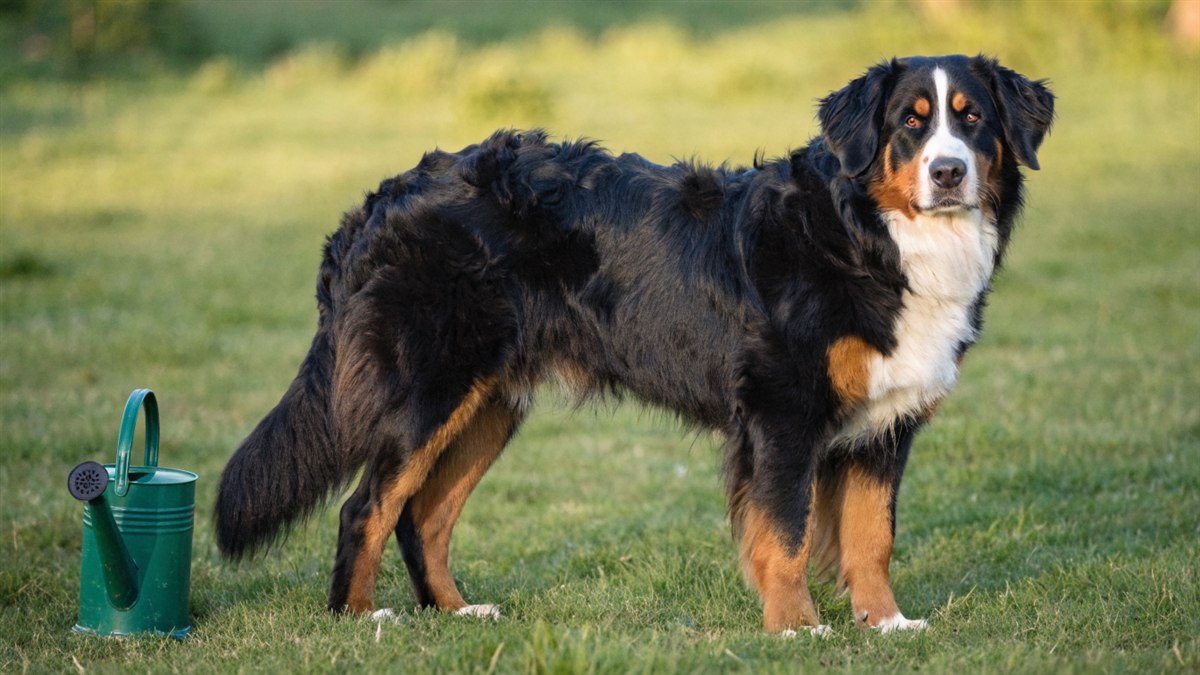
Every physical feature that makes the breed beautiful was selected for a cold, wet, high-altitude working life. The standard calls for a coat that is long, shining, straight or slightly wavy, over a jet black main colour with rich tan markings on the cheeks, above the eyes, on all four legs and on the chest, plus clean white symmetrical markings on the head, throat and chest. Males stand 64 to 70 cm at the withers with an ideal of 66 to 68 cm; females stand 58 to 66 cm with an ideal of 60 to 63 cm. That puts a typical male above the 50 kg bodyweight band that carries the highest measured heat-illness odds in UK primary-care data.
The standard disqualifies a short coat, and that matters in India
A short-coated Bernese does not exist as a legitimate variant. FCI Standard No. 45 lists short coat, double coat (Stockhaar) among the disqualifying faults, alongside a coat that is any colour other than tricolour. Stockhaar is the short stock-hair coat type of the breed's Swiss relatives, so a smooth-coated tricolour Swiss dog offered to you as a Bernese is either a Greater Swiss Mountain Dog, an Appenzeller, an Entlebucher or a cross. The long coat is not optional and it cannot be bred away for a warm climate.
Read that clause together with the size clause and you have the whole India problem in two lines of a breed standard. This is a 64 to 70 cm dog carrying a long black double coat, and neither figure is negotiable if the animal is genuinely the breed you are paying for.
History, and why the breed is genetically narrow
The breed was assembled from a small regional population in a single decade. Dogs of this type were called Duerrbaechler after the hamlet and inn of Duerrbach near Riggisberg in the Canton of Bern; breeders around Burgdorf founded the Schweizerischer Duerrbach-Klub in 1907 to fix the type, and by a 1910 Burgdorf show 107 specimens were exhibited. A breed built from roughly a hundred founder dogs in one Swiss valley starts life with a narrow gene pool, and the health record described further down this page is what that narrowness looks like a century later.
Where the registries place it
| Registry | Group | Height, male | Height, female |
|---|---|---|---|
| FCI (Standard 45) | Group 2, Section 3 Swiss Cattle Dogs | 64-70 cm, ideal 66-68 | 58-66 cm, ideal 60-63 |
| The Royal Kennel Club (UK) | Working | See FCI standard | See FCI standard |
| American Kennel Club | Working | 25-27.5 in (63.5-70 cm) | 23-26 in (58.4-66 cm) |
The Royal Kennel Club lists the Bernese Mountain Dog in its Working group, next to the Alaskan Malamute, the Newfoundland, the St Bernard and the Great Swiss Mountain Dog. The American Kennel Club places it in the Working group too and publishes 25 to 27.5 inches for males and 23 to 26 inches for females. Every registry that recognises the breed agrees on the same two things, a large frame and a long coat.
FCI Standard 45 says of the hind metatarsus, 'Dewclaws to be removed (except in those countries where it is prohibited by law).' India is one of those countries. Second Schedule Part II paragraph 6(8) of the Prevention of Cruelty to Animals (Dog Breeding and Marketing) Rules 2017 forbids 'any other kind of mutilation of any body part of the pup and any change of appearance by artificial means';. An Indian breeder who follows the standard's dewclaw instruction is breaking Indian law. The parenthesis in the standard exists precisely so that national law wins.
Bernese Mountain Dog price in India, and why the range is nine times wide
Bernese mountain dog price in India runs from about Rs 30,000 at the bottom of published editorial guidance to Rs 4,00,000 at the top of a Delhi NCR seller's own page. That is a spread of more than nine times for one breed, and the spread itself is the most useful thing on this page.
Unlike most of the rare breeds Bonbeno covers, this one has a real Indian market with real published rupee figures. A Delhi NCR seller had eight live Bernese puppy prices on its product page on 21 August 2026, at Rs 76,499, Rs 92,599, Rs 92,599, Rs 94,999, Rs 98,999, Rs 98,999, Rs 98,999 and Rs 1,20,000, while the same page's meta description states a price of Rs 4,00,000. A second Indian price list gives Rs 60,000 to Rs 1,50,000. A third gives Rs 30,000 to Rs 70,000 for pet quality.
| Source | What it publishes | Rupee figure |
|---|---|---|
| Delhi NCR seller, live listings | Eight individual puppies on one page | Rs 76,499 to Rs 1,20,000 |
| Same seller, meta description | A single headline price | Rs 4,00,000 |
| Indian 50-breed price list | Purchase price band | Rs 60,000 to Rs 1,50,000 |
| Indian cost guide, pet quality | No KCI papers, basic health check | Rs 30,000 to Rs 70,000 |
| Indian cost guide, KCI registered | Kennel Club of India papers | Rs 56,000 to Rs 1,05,000 |
| Indian cost guide, show quality | Champion parents | Rs 80,000 to Rs 2,00,000 |
| Indian cost guide, imported bloodline | Parents imported | Rs 3,00,000 to Rs 4,00,000 |
| Indian cost guide, adoption | Fee covers vaccination and neutering | Rs 0 to Rs 5,000 |
| National marketplace, 11 listings | Every price behind a sign-up wall | Not published |
The marketplace row deserves a sentence of its own. On the day this page was researched, India's most visible pet marketplace carried eleven Bernese listings, in Bhopal, Coimbatore, Kolkata, Bengaluru, Mumbai, Gurugram, Ahmedabad, Hyderabad and Pune, and every single one required you to create an account before it would show a price. Every one was also listed as male, with the age field reading only 'Weeks'. A price you cannot see before you hand over a phone number is not a price, it is a lead form.
Run the 84.38 test before you trust any rupee figure
Indian breed pages routinely publish a United States dollar price run through one exchange rate and print it as an Indian price. Bonbeno tests every suspicious figure by dividing it by 84.38, and on three earlier breeds the numbers came back as round dollar amounts. On the Bernese, they do not. Every published Indian figure divides into an untidy dollar number, and several end in the 499, 599 and 999 pattern that is characteristic of genuine Indian retail pricing rather than currency conversion.
| Rupee figure | Divided by 84.38 | Verdict |
|---|---|---|
| Rs 30,000 | USD 355.53 | Not a round dollar amount |
| Rs 70,000 | USD 829.58 | Not a round dollar amount |
| Rs 76,499 | USD 906.60 | Not a round dollar amount |
| Rs 98,999 | USD 1,173.25 | Not a round dollar amount |
| Rs 1,20,000 | USD 1,422.14 | Not a round dollar amount |
| Rs 1,50,000 | USD 1,777.67 | Not a round dollar amount |
| Rs 2,00,000 | USD 2,370.23 | Not a round dollar amount |
| Rs 4,00,000 | USD 4,740.46 | Not a round dollar amount |
Check it the other way as well. A USD 1,000 American puppy converted at 84.38 would print as Rs 84,380, and a USD 2,500 one as Rs 2,10,950. No Indian Bernese figure lands on either number. So the conclusion here is the opposite of the one this site has had to reach on rare breeds, and it should be said plainly: these look like genuine Indian prices set by Indian sellers, not converted American ones. That makes them real money, which makes the rest of this page a real decision rather than a hypothetical one.
A nine-times price range does not mean some sellers are generous. It means the market has no agreed definition of what you are buying. At Rs 30,000 you are almost certainly not buying an imported-line dog with screened parents, because the paperwork alone costs more than that. At Rs 4,00,000 you are being asked to take an import claim entirely on trust. The next section shows exactly which documents make that claim checkable.
How to check a Bernese price claim in thirty seconds
Check a Bernese price claim by testing three things: whether the city-wise table you are reading is arithmetic rather than observation, whether the seller can produce a DGFT licence for an imported dog, and whether 'KCI registered' means what the buyer assumes it means. All three are checkable without leaving your chair.
The city-wise price table on the top-ranking page is a spreadsheet
The best-ranked Indian cost guide for this query publishes Bernese prices for ten cities, from Rs 24,000 in Jaipur to Rs 84,000 in Mumbai. Divide each city's figure by the Chennai figure and the illusion collapses. Every city is the same base range multiplied by a fixed index. Mumbai is exactly 1.20 times Chennai at both ends of the band. Bengaluru is exactly 1.10. Hyderabad is exactly 0.90. Jaipur and Lucknow are exactly 0.80. The remaining cities resolve to a two-decimal multiplier rounded to the nearest thousand rupees.
| City | Published range | Divided by Chennai | Multiplier |
|---|---|---|---|
| Jaipur | Rs 24,000-56,000 | 24,000/30,000 and 56,000/70,000 | 0.80 exactly, both ends |
| Lucknow | Rs 24,000-56,000 | Identical to Jaipur | 0.80 exactly, both ends |
| Kolkata | Rs 25,000-59,000 | 30,000 x 0.84 = 25,200 | 0.84, rounded |
| Ahmedabad | Rs 25,000-59,000 | Identical to Kolkata | 0.84, rounded |
| Hyderabad | Rs 27,000-63,000 | 27,000/30,000 and 63,000/70,000 | 0.90 exactly, both ends |
| Chennai | Rs 30,000-70,000 | The base range | 1.00 |
| Pune | Rs 31,000-73,000 | 30,000 x 1.04 = 31,200 | 1.04, rounded |
| Bengaluru | Rs 33,000-77,000 | 33,000/30,000 and 77,000/70,000 | 1.10 exactly, both ends |
| Delhi NCR | Rs 34,000-80,000 | 30,000 x 1.14 = 34,200 | 1.14, rounded |
| Mumbai | Rs 36,000-84,000 | 36,000/30,000 and 84,000/70,000 | 1.20 exactly, both ends |
Four cities give the identical multiplier at both ends of the band, which cannot happen if someone actually surveyed ten markets. Two pairs of cities are byte-identical to each other. This is a single number in a spreadsheet column, not a price observed in Lucknow. Treat any city-wise table for any breed the same way, because the test costs one division.
An imported Bernese leaves a paper trail, and Indian law says what it must contain
Dogs enter India as a Restricted item. Under ITC (HS) 01061900, DGFT Policy Condition (7) allows import of dogs only for three purposes: a pet dog with a valid pet book and records in the name of the importer, dogs imported by R and D organisations with a recommendation from CPCSEA, and dogs for internal security by the Defence and Police Force. Policy Condition (8) states that 'Import of commercial dogs for breeding or any other commercial activities other than the purposes mentioned above is not permitted', and the notice's own guidance says applications 'for trading/breeding purposes' shall be duly rejected. A second independent reproduction of the notice carries the same three permitted purposes.
Two more limits are worth knowing. Import of pet animals is allowed only through the airports and seaports of Delhi, Mumbai, Chennai, Hyderabad, Bengaluru and Kolkata, and up to two pets may come as passenger baggage without a DGFT authorisation only for a person transferring residence to India after two years of continuous stay abroad. So a lawfully imported Bernese arrives with a named human returning home, not with a kennel building breeding stock.
The nine documents the Kennel Club of India asks for
The Kennel Club of India publishes its own checklist for registering a dog with import status, and it is the single most useful document an Indian buyer can print before meeting a seller. It requires the export pedigree in original, the airway bill in original, the air ticket in original from country of import to final destination, the boarding pass, the DGFT licence, the customs clearance document, the quarantine clearance document, the pet passport, and a duly notarised affidavit.
If a seller quotes Rs 3,00,000 to Rs 4,00,000 for an imported bloodline, ask to see the DGFT licence named in the Kennel Club of India's own import checklist. Then read what purpose it was issued for. A licence issued to a returning pet owner covers that person's pet. There is no lawful category for importing a dog to breed and sell in India, because Policy Condition (8) excludes it. And note what 'KCI registered' does and does not mean: it is a pedigree registration, not a health certificate, and it says nothing at all about hips, elbows or cancer risk.
Monthly cost of a Bernese Mountain Dog in India
Two Indian sources publish a monthly cost for this breed, and they agree closely. One gives Rs 6,000 to Rs 15,000 a month, the other Rs 6,000 to Rs 12,000. Neither cites anything, so treat both as market guidance rather than measurement, and read the lifetime arithmetic below with that caveat attached.
The higher of the two guides breaks its figure down as food at Rs 4,000 to Rs 8,000, grooming at Rs 800 to Rs 2,000, plus veterinary care, treats and accessories, and adds Rs 1,000 to Rs 3,000 a month for air-conditioning during summer. The second source publishes Rs 6,000 to Rs 12,000 a month for the same breed alongside a purchase band of Rs 60,000 to Rs 1,50,000. Neither breaks out surgery, cancer treatment or emergency care, and both are the kind of round-numbered guidance that gets copied between Indian pages without a source.
Lifetime cost, calculated against a real lifespan instead of a guessed one
Every Indian cost guide multiplies its monthly figure by a lifespan it did not measure. Bonbeno uses the largest published cohort instead. The Swiss study of dogs born in 2001 and 2002 found a median life expectancy of 8.4 years across 389 registered Bernese Mountain Dogs, 381 of which had died by the end of the study. Multiply the monthly bands by 8.4 years and the running cost alone comes to between Rs 6.05 lakh and Rs 15.12 lakh, before you have paid for the dog.
| Monthly figure | Per year | Across 8.4 years | Plus a Rs 98,999 puppy |
|---|---|---|---|
| Rs 6,000 | Rs 72,000 | Rs 6,04,800 | Rs 7,03,799 |
| Rs 9,000 | Rs 1,08,000 | Rs 9,07,200 | Rs 10,06,199 |
| Rs 12,000 | Rs 1,44,000 | Rs 12,09,600 | Rs 13,08,599 |
| Rs 15,000 | Rs 1,80,000 | Rs 15,12,000 | Rs 16,10,999 |
Buy at the top of the seller's own range, at Rs 4,00,000, and the same arithmetic gives Rs 10.05 lakh to Rs 19.12 lakh over a median life. That is a Delhi or Bengaluru small-car budget spent on an animal whose median lifespan is shorter than almost any other breed with published data.
Cost per year of dog is the honest comparison
The right way to compare a short-lived breed against a long-lived one is cost per year of life, not cost per month. A UK study of 584,734 dogs put median survival for purebred dogs at 12.7 years and for large purebreds at 11.9 years. Against the Bernese median of 8.4 years, you are paying the same monthly amount for roughly three and a half fewer years. At Rs 9,000 a month, a large breed living 11.9 years costs about Rs 12.85 lakh in running costs and a Bernese about Rs 9.07 lakh, but you have the second dog for 29 percent less time.
The costs Indian guides leave out
- Elbow and hip radiographs under sedation, because the breed's elbow abnormality rate is 26.6 percent of 25,941 evaluations
- Cancer workup, which for this breed is not a remote possibility but the single likeliest cause of death at 58.3 percent
- Year-round tick prevention, in a country where 261 of 525 dogs tested across four cities carried at least one tick-borne pathogen
- Cooling that runs through the day rather than only at night, which is the practical meaning of the Rs 1,000 to Rs 3,000 summer AC line
- Professional de-shedding during the two seasonal coat blows, on top of the Rs 800 to Rs 2,000 monthly grooming figure
In the Swiss cohort, dogs that died of a neoplastic process had a median survival of 7.83 years, and the shortest median survival of any specific disorder with at least five cases was renal injury at 6.83 years. A large fraction of this breed's total veterinary spend arrives in a compressed window between roughly six and eight years of age. Plan the money for that window, not for the puppy year.
Heat tolerance: why this breed rates 1 out of 5 for India
Heat tolerance in the Bernese Mountain Dog rates 1 out of 5 for India, and the rating is built from four physical facts rather than an opinion. The breed carries a long dense coat, a jet black main colour, a body mass that pushes males past 50 kg, and an origin climate whose hottest month averages a daily maximum of 23.0 degrees Celsius.
One: the coat is long, dense and not removable
The standards are explicit about the outer coat and silent about the undercoat, which is worth knowing because Indian sellers use the phrase double coat loosely. FCI Standard 45 says the hair is 'Long, shining, straight or slightly wavy';. The Royal Kennel Club standard says 'Soft, silky with bright natural sheen, long, slightly wavy but should not curl when mature';. The American Kennel Club describes 'the thick, silky, and moderately long coat' and calls the Berner 'a hardy dog who thrives in cold weather';. That last phrase is the parent registry of the largest Berner population on earth, saying in its own words what the breed was built for.
There is a genuine terminology trap here. FCI Standard 45 lists 'Short coat, double coat (Stockhaar)' among its disqualifying faults. That does not mean the Bernese lacks an undercoat. Stockhaar is the short stock-hair coat type of the breed's Swiss relatives, so the clause is excluding a smooth-coated dog, not excluding insulation. A seller who quotes that line to argue the breed is single-coated and therefore heat-suited is misreading it.
Two: jet black absorbs radiant heat that a pale dog reflects
Both standards make the main colour jet black, with tan and white restricted to specific markings, and both make any other main colour a fault or unacceptable. In Indian sun that is not a cosmetic detail. A dark surface absorbs a larger share of incident short-wave radiation than a pale one, so the same walk at the same air temperature loads more heat into a black coat than into a cream or fawn one. The breed standard has locked the colour in place, so this is not something an owner can select away from.
Three: mass beats surface area, and this dog is heavy
The AKC publishes 80 to 115 pounds for males, which is 36 to 52 kg, and 70 to 95 pounds for females, which is 32 to 43 kg. A large dog generates heat in proportion to its mass but sheds it across a surface, and the ratio moves against it as it gets bigger. UK primary-care data puts a number on the consequence. In a study of 905,543 dogs under veterinary care in 2016, dogs weighing over 50 kg had 3.42 times the odds of heat-related illness compared with dogs under 10 kg, with a 95 percent confidence interval of 1.54 to 7.57. A male Bernese at the top of the AKC weight range sits in that band.
Four: the origin climate, in numbers from one weather service
Comparing Switzerland with India needs one source and one method, so both sides of this table come from the World Meteorological Organization's World Weather Information Service, which publishes climatological normals supplied by each country's own national weather service. The Swiss figures come from MeteoSwiss and the Indian figures from the India Meteorological Department, and the normals periods differ, which is stated in every row.
| City | Hottest month | Mean daily max | Mean daily min | Normals period |
|---|---|---|---|---|
| Zurich, Switzerland | July | 23.0 C | 12.8 C | 1961-1990 |
| Shimla | June | 23.7 C | 15.8 C | 1901-1992 |
| Srinagar | July | 30.3 C | 18.2 C | 1901-2000 |
| Bengaluru | April | 33.9 C | 21.3 C | 1901-2000 |
| Mumbai | November | 33.5 C | 20.8 C | 1951-2000 |
| Kolkata | April | 35.7 C | 24.9 C | 1901-2000 |
| Chennai | May | 37.4 C | 27.6 C | 1901-2000 |
| Pune | April | 37.9 C | 20.1 C | 1901-2000 |
| Hyderabad | May | 39.0 C | 26.2 C | 1951-2000 |
| New Delhi | May | 39.8 C | 26.2 C | 1901-2000 |
| Ahmedabad | May | 41.4 C | 26.3 C | 1901-2000 |
Two comparisons decide the rating. New Delhi's hottest month averages a daily maximum 16.8 degrees Celsius above Zurich's hottest month. And in Chennai the mean daily minimum in May is 27.6 degrees, which is 4.6 degrees hotter than the mean daily maximum of Zurich in July. Read that again, because it is the whole argument in one line: the coolest part of a Chennai May day is hotter than the hottest part of a Zurich July day. A coat evolved for the second is being asked to work in the first, all night, for weeks.
What the heat-illness evidence does and does not say about Berners
No published study reports a heat-illness odds ratio for the Bernese Mountain Dog specifically, so this page does not print one. The largest UK primary-care study of heat-related illness does not mention the breed anywhere in its text, and borrowing another breed's number would be exactly the kind of invention this site exists to correct.
Here is the control that makes that absence meaningful. The same retrieved full text of the VetCompass heat-related illness study names nine breeds with significantly higher odds than Labrador Retrievers, and all nine are readable in it: Chow Chow, Bulldog, French Bulldog, Dogue de Bordeaux, Greyhound, Cavalier King Charles Spaniel, Pug, English Springer Spaniel and Golden Retriever. Searching that same document for the word Bernese returns nothing. The document loaded, the breed list is there, and the breed is not on it. That is a genuine absence, not a failed search.
The risk factors that do transfer
What the study measures instead of breed identity is a set of physical characteristics, and those apply to any dog. From 905,543 dogs under UK veterinary care in 2016, 395 confirmed heat-related illness events were identified, an incidence of 0.04 percent, with an event fatality rate of 14.18 percent, 56 deaths out of the 395 events.
| Risk factor | Odds ratio (95% CI) | Does it apply to a Bernese? |
|---|---|---|
| Bodyweight over 50 kg vs under 10 kg | 3.42 (1.54-7.57) | Yes for many males, who reach 52 kg |
| Purebred vs crossbred | 1.86 (1.39-2.49) | Yes, by definition |
| Bodyweight at or above the breed and sex mean | 1.42 (1.12-1.80) | Yes for any Berner carrying condition |
| Age 12 years or more vs under 2 | 1.75 (1.14-2.70) | Rarely, because few Berners reach 12 |
| Brachycephalic vs mesocephalic skull | 2.10 (1.68-2.64) | No, the breed is not flat-faced |
Four of the five apply. The one that does not, brachycephaly, is the factor most Indian buyers think about, which is why 'it is not a Pug, so it will be fine' is such a common and such an expensive mistake. Note also who is on the nine-breed list: the Golden Retriever, a heavy, long-coated, entirely normal-faced gundog. Coat and mass are enough on their own.
Read the UK incidence figure correctly
That 0.04 percent annual incidence describes the United Kingdom, where the hottest month in the nearest comparable climate averages a daily maximum in the low twenties. It is not an Indian number and this page does not pretend it is. What transfers from the study is the structure of risk, which is that mass, coat, purebred status and body condition drive heat-related illness, and every one of those points the same way for this breed. What also transfers is the fatality figure: roughly one in seven dogs that develop heat-related illness dies of it.
Signs, and the thing owners get wrong under pressure
- Watch for heavy relentless panting that does not settle within a few minutes of stopping, a widened tongue, drooling, staggering, vomiting or collapse
- Move the dog into shade or indoors first, then cool it, then transport
- Wet the dog thoroughly with cool tap water and keep air moving over it with a fan, because evaporation is what removes heat
- Skip ice-water immersion and ice packs, which cause surface vessels to constrict and can slow heat loss
- Call the veterinarian while you are cooling, not after, because a dog that has collapsed needs fluids and monitoring, not just a cold bath
Shaving a long double-coated breed removes the layer that shades the skin and slows radiant gain, and the regrown coat is often patchy and coarser. The coat is insulation in both directions. What actually works is a genuinely cool room, a hard fan, unrestricted water, dawn and late-night walking, and accepting that midday outdoor time is off the table from March to October in most of India.
Where in India this breed is least unsuitable
Shimla is the only Indian city in the WMO dataset whose hottest month resembles the breed's origin climate. Shimla's warmest month, June, averages a daily maximum of 23.7 degrees Celsius, which is 0.7 degrees above Zurich's July figure of 23.0 World Meteorological Organization. Everywhere else in the table, the gap runs from 7.3 degrees to 18.4 degrees.
That single comparison changes the honest answer for a small number of Indian readers. A Bernese in Shimla, Manali, Mussoorie, Gangtok, Darjeeling, Ooty or Kodaikanal is living in something the coat can actually work in. A Bernese in Ahmedabad is being asked to carry an alpine coat through a hottest month averaging 41.4 degrees, which is 18.4 degrees above Zurich. The dog is the same dog. Only the arithmetic is different.
| City | Hottest-month mean max | Degrees above Zurich | Verdict for a Bernese |
|---|---|---|---|
| Shimla | 23.7 C | 0.7 | Workable, and the only one that is |
| Srinagar | 30.3 C | 7.3 | Hard summer, tolerable winter |
| Mumbai | 33.5 C | 10.5 | Unsuitable, and humid year-round |
| Bengaluru | 33.9 C | 10.9 | Unsuitable, but the mildest metro |
| Kolkata | 35.7 C | 12.7 | Unsuitable |
| Chennai | 37.4 C | 14.4 | Unsuitable, nights do not cool |
| Pune | 37.9 C | 14.9 | Unsuitable, cool winters only |
| Hyderabad | 39.0 C | 16.0 | Unsuitable |
| New Delhi | 39.8 C | 16.8 | Unsuitable, worst April to June |
| Ahmedabad | 41.4 C | 18.4 | Unsuitable, the widest gap here |
The hills are not a free pass, because the monsoon comes with them
Choosing a hill station solves the temperature problem and hands you a coat problem. Shimla receives about 1,539 mm of rain a year against Zurich's 1,086 mm, roughly 42 percent more World Meteorological Organization. A long, soft, dense coat that stays damp for days is a skin infection waiting to start, and Indian clinical data shows exactly where those cases land in the calendar. In a year-long study of 987 dogs presented to a veterinary clinical complex in Udaipur, 205 had dermatological conditions, and those cases were distributed 39.51 percent in the rainy season, 36.58 percent in summer and 23.90 percent in winter. Divide it out and that is 81 cases in the monsoon, 75 in summer and 49 in winter, so 156 of 205 skin cases, 76 percent, fell outside winter.
Apartment living, honestly assessed
A Bernese can live in an Indian apartment, and the reason is not the one buyers expect. The breed's exercise requirement is moderate rather than extreme, so a flat is not automatically wrong. The real apartment constraints are heat, stairs and floors. A cooled room is easier to achieve in a 900 square foot flat than in an unairconditioned independent house, which is a genuine point in the apartment's favour. Against it, a growing giant-breed puppy should not be doing repeated flights of stairs, and polished granite or vitrified tile gives a heavy puppy no grip while its elbows and hips are forming. Rugs and runners on every route the dog uses are not decoration, they are orthopaedic management.
This breed is defensible in India when four things are true together. You live above roughly 1,800 metres, in a hill station whose hottest month sits near 23 degrees. You can keep a cool, dry, well-ventilated indoor space through the monsoon. You have a veterinary practice within reach that can run bloodwork and imaging, because this is a cancer breed. And you have budgeted Rs 6 lakh to Rs 15 lakh in running costs across a median 8.4-year life. If any one of those four is missing, the honest answer is that a different dog will have a better life.
Temperament, and who should not buy this breed
The Bernese Mountain Dog is a gentle, people-attached, slow-maturing family dog that is calm with strangers rather than suspicious of them. Both recognising registries describe the same animal, and the temperament is the least controversial thing about the breed.
FCI Standard 45 calls for a dog that is 'Self-confident, attentive, vigilant, fearless in everyday situations; good-natured and devoted to his own people, self-assured and placid towards strangers; of medium temperament, docile';. The Royal Kennel Club standard is shorter and identical in substance: 'Self-confident, good-natured, friendly and fearless. Aggressiveness unacceptable', and it flags separately that the breed is slow to mature. The AKC adds the detail owners recognise most, that Berners get on with the whole family but will often attach hardest to one person.
What that means in an Indian household
Placid towards strangers is a real advantage in Indian homes, where a dog meets a stream of people the family did not schedule. Domestic help, the maid, the cook, the presswala, delivery riders, the plumber, the society guard and a constant flow of relatives all arrive at the door. A breed whose standard asks for calm rather than suspicion handles that better than a guarding breed does. Set against that, this is a 40 to 50 kg dog that leans on people, and a friendly lean from a Berner will knock over a small child or an elderly grandparent without any intent at all.
- Expect a dog that follows you room to room and does badly left alone all day
- Expect sensitivity, because a Berner shuts down under shouting rather than shrugging it off
- Expect slow mental maturity, with adolescent behaviour persisting well past the point the dog looks adult
- Expect close attachment to one family member, with the rest of the household in second place
- Expect low guarding drive, which makes this a poor choice if you want a watchdog
Heat changes temperament, and Indian owners misread it
A calm breed in a hot flat looks like a lazy breed, and it is not the same thing. A Bernese that lies flat all day in a Chennai May, refuses walks and snaps when moved is not badly socialised, it is thermally overloaded. Owners reliably describe this as the dog 'becoming lazy' or 'getting moody' as it grows, when what changed was the season. Before you treat any behaviour change in this breed as a training problem, rule out heat, pain from a growing joint, and thyroid or systemic illness.
Who should not buy a Bernese Mountain Dog
| Situation | Verdict |
|---|---|
| Hill-station home, cool year round, family at home | The best case this breed has in India |
| Plains metro, air conditioning on all summer, someone home | Possible, expensive, and still hard on the dog |
| Plains metro, no air conditioning | Do not buy this breed |
| Both adults working full days out of the house | Do not buy this breed |
| Wanting a guard dog | Wrong breed entirely, look elsewhere |
| First dog, wanting an easy start | Wrong breed, the health load alone is heavy |
| Family with toddlers and a small flat | Manageable only with strict supervision, given the dog's weight |
Almost nobody regrets a Berner's character. What owners describe, again and again, is grief that arrives early. In the Swiss cohort the median life expectancy was 8.4 years and 58.3 percent of deaths were caused by neoplasia. Buying this breed means buying a short, wonderful dog, and being honest with your family in advance about the timeline is part of buying it responsibly.
Training a Bernese Mountain Dog in India
To train a Bernese Mountain Dog, use short reward-based sessions, socialise heavily before sixteen weeks, and finish loose-lead work before the dog outweighs the handler. The breed is willing and sensitive rather than stubborn, so the usual Indian failure is not resistance, it is a dog that shuts down under correction.
The Royal Kennel Club standard describes the breed as slow to mature, and that single phrase predicts most of the training experience. A Berner looks adult at twelve months and behaves adolescent well past eighteen. Handlers who expect adult judgement from an adult-sized dog get frustrated, escalate, and meet a breed the standards call good-natured and docile going quiet on them.
The four things to get right before eighteen months
- Socialise before sixteen weeks, to the specific Indian inputs the dog will meet for life, which are horns, two-wheelers, firecrackers, cattle, street dogs, lifts, marble floors and a rotating cast of visitors
- Train loose-lead walking while the puppy is still under 20 kg, because a 45 kg adult that pulls is a dog nobody in the family can walk
- Condition handling early, meaning ears, feet, mouth, tail and belly, so that grooming and later veterinary examinations are routine rather than a fight
- Build a solid settle on a mat, because the calm indoor default is what makes a giant breed liveable in an Indian flat
What this breed resists
Berners resist repetition, pressure and shouting. They do not resist learning. Drilling the same recall twenty times produces a dog that disengages, while three short sessions across a day produce one that offers the behaviour. Aversive methods are the fastest way to break a soft dog, and this is a soft dog. Any Indian trainer who proposes a prong collar, an e-collar or an alpha-roll for a Bernese is proposing a method the breed's own temperament clause argues against.
Heat sets your training timetable
In most Indian cities the usable training window is not a matter of preference. With New Delhi's hottest month averaging a daily maximum of 39.8 degrees Celsius, outdoor work from March to October happens before roughly seven in the morning and after roughly nine at night, or it does not happen. That leaves indoor work as the backbone of the programme, which suits the breed. Scent games, mat settles, body handling, stairs-free physiotherapy and impulse-control games all run in an air-conditioned room.
| Age | Focus | Realistic outcome |
|---|---|---|
| 8-16 weeks | Socialisation, name, handling, crate, toilet | Confident with household traffic, sleeping through |
| 4-6 months | Loose lead, settle, recall foundations, bite inhibition | Walkable on lead at 20 to 25 kg |
| 6-12 months | Proofing in mild distraction, stair and floor management | Reliable indoors, still adolescent outdoors |
| 12-18 months | Public manners, greeting without leaning or jumping | Handler can control 40 kg on a flat collar |
| 18-30 months | Maturity consolidates, carting or draught work optional | Adult judgement finally arrives |
The FCI standard describes a dog originally used as a guard, draught and cattle dog around Bern, and draught work is still what a Berner enjoys most. In a hill station, light carting is a genuine option. In a plains city it is not, because the work generates exactly the heat load the coat cannot shed. Replace it with indoor scentwork and short structured walks rather than pretending the dog does not need a job.
How much exercise a Bernese Mountain Dog actually needs
An adult Bernese Mountain Dog needs roughly 30 to 60 minutes of moderate exercise a day, split across two sessions, taken in the coolest hours available. The Indian cost guide that ranks for this breed publishes the same 30 to 60 minute figure and rates the energy requirement as moderate.
That is a modest requirement by working-breed standards, and it is one of the few things about this breed that suits Indian city life. The catch is that the window in which it can safely be delivered is narrow for most of the year. You will walk this dog at 5.45 in the morning and at 10 at night for eight months, and on the worst days you will skip the walk entirely and do indoor enrichment instead. That is not failure, it is correct management.
Growth comes first, before eighteen months
A giant-breed puppy's joints are the constraint, not its stamina. Forced repetitive exercise on hard surfaces while the growth plates are open is the one thing an owner can do that measurably worsens an already bad orthopaedic starting position, and the starting position here is genuinely bad. Across 25,941 elbow evaluations the breed's abnormal rate is 26.6 percent against 12.0 percent across all breeds, and across 31,534 hip evaluations 16.3 percent are graded dysplastic.
- Skip forced running, jogging alongside a bicycle and long hikes until eighteen months
- Skip repeated stairs, and carry the puppy where a lift is unavailable and the flight is short
- Skip jumping out of cars and off furniture, using a ramp or a lift instead
- Allow free play on grass or sand, which the puppy self-regulates
- Allow swimming where genuinely clean water exists, because it loads muscle without loading joints
What happens without enough exercise
An under-exercised Berner does not usually become destructive in the way a Malinois or a Labrador does. It becomes heavy, and heavy is the specific thing you cannot afford. Dogs at or above their breed and sex mean bodyweight carried 1.42 times the odds of heat-related illness in UK primary-care data, and every extra kilogram loads elbows that are already the breed's weakest joint. Weight gain in this breed is not cosmetic, it feeds directly into both the heat problem and the orthopaedic one.
| Season | Morning | Evening | Indoors |
|---|---|---|---|
| Winter, plains | 30-40 min walk | 20-30 min walk or play | Optional |
| Summer, plains | 20 min before sunrise | 20 min after 21:00, if surfaces have cooled | Mandatory, 20-30 min of scentwork or training |
| Monsoon, plains | Short walk between showers | Short walk, dry the coat fully after | Mandatory on wet days |
| Any season, hill station | 45-60 min | 30 min | Optional |
Indian tarmac and concrete hold heat long after air temperature falls. Press the back of your hand to the surface and hold it for five seconds. If you cannot, the dog should not walk on it. This matters more for a Bernese than for a lighter dog, because a heavy dog spends longer on the surface covering the same distance and carries more mass over each pad.
Grooming a long double coat in Indian humidity
Brush a Bernese Mountain Dog three to four times a week with a slicker and an undercoat rake, and daily during the two seasonal coat blows. Shedding is heavy and continuous, and in Indian humidity the harder job is not removing hair, it is getting the coat completely dry after every wetting.
The coat the standards describe is long, soft and silky with a natural sheen, and the AKC calls it thick and moderately long. A coat like that traps loose undercoat rather than dropping it cleanly, so a neglected Berner mats behind the ears, in the armpits, along the trouser feathering and around the tail base. Mats are not a cosmetic problem in a hot country. A mat is a sealed pocket of damp air against skin, and it is where a hot spot starts.
A weekly routine that works in India
- Brush the whole dog three to four times a week, working in sections down to the skin rather than skimming the topcoat
- Rake the undercoat weekly in normal weeks and daily during a coat blow, which arrives roughly twice a year
- Check and dry the ear canals after every bath, swim or heavy rain, because a heavy dropped ear over a wet canal is the classic monsoon otitis setup
- Comb the feathering behind the elbows, on the hocks and under the tail, which is where mats form first
- Inspect the skin while you brush, using the session as a weekly tick and lump check
Overseas grooming advice assumes a climate India does not have
Grooming guidance written in Switzerland, the United Kingdom or the American Midwest quietly assumes that a towelled dog finishes drying by itself in a few hours. In an Indian monsoon it does not. A dense long coat in high humidity can stay damp at skin level all day, and Indian clinical data shows where that leads. Of 205 dermatological cases in a year-long Udaipur study, 39.51 percent presented in the rainy season and 36.58 percent in summer, against 23.90 percent in winter. Divided out, that is 81 monsoon cases and 75 summer cases against 49 in winter, from a base of 987 dogs seen. Force-dry this breed. Do not let it air dry.
The coat hides ticks, and India has plenty
A tick sitting on a short-coated dog is visible from across the room. On a Berner it is not. That matters because tick-borne disease pressure in India is high. In a survey of 525 dogs across four Indian cities, 261 dogs, or 49.7 percent, were PCR-positive for at least one tick-borne pathogen, and potential vector ticks were found on 278 dogs, or 53 percent. The commonest findings were Hepatozoon canis at 30 percent, Ehrlichia canis at 20.6 percent and Mycoplasma haemocanis at 12.2 percent, with concurrent infection by more than one pathogen in 39 percent of cases.
| Period | Brushing | Bathing | Extra |
|---|---|---|---|
| Winter | 3 times a week | Every 4-6 weeks | Easiest months, use them for a full de-shed |
| Pre-summer coat blow | Daily rake | Every 3-4 weeks | Expect hair everywhere for 3-4 weeks |
| Summer | 3-4 times a week | Every 3-4 weeks | Dry fully, keep the dog out of midday sun |
| Monsoon | 4 times a week | Only when needed | Force-dry after every wetting, check ears daily |
| Post-monsoon coat blow | Daily rake | Every 3-4 weeks | Second heavy shed of the year |
Ask an Indian grooming salon what to do with a heat-sensitive double-coated dog in May and a summer shave is a common answer. Refuse it. The coat shades the skin from direct radiation and traps a layer of still air that slows heat gain as well as heat loss, and on a long-coated breed it frequently regrows patchy and coarse. Cooling comes from a cool room, moving air, water and shifted walk timing, not from clippers.
Lifespan: four real studies, and where they disagree
The Bernese Mountain Dog median lifespan is 8.4 years in the largest published cohort and 7.0 years in the largest Danish one. Four independent datasets from three countries put the breed between 7.0 and 8.4 years, against a UK purebred median of 12.7 years. This page publishes the disagreement rather than averaging it away.
| Study | Country and year | Sample | Figure |
|---|---|---|---|
| Klopfenstein et al. | Switzerland, 2016 | 389 dogs from a 1,290-dog birth cohort, 381 dead by study end | Median life expectancy 8.4 years, IQR 6.9-9.7 |
| Nielsen et al. | Denmark, 2010 | 812 dogs reported, 290 of them dead | Average life span 7.1 years |
| Proschowsky et al. | Denmark, 2003 | 2,928 dogs across 20 breeds | Median age at death 7.0 years, the shortest in the study |
| Bonnett and Egenvall | Sweden, 2005 | Over 350,000 insured dogs, 1995-2000 | 72 percent of Berners dead by 10 years |
| Egenvall et al. | Sweden, 2000 | Eight insured breeds | Yearly mortality risk 6.5 percent, the highest of the eight |
| American Kennel Club | United States, current | Not stated | 7-10 years |
The Swiss study, and why 8.4 is the best single number
Of 1,290 Bernese Mountain Dogs born in Switzerland in 2001 and 2002 and registered with the Swiss Bernese Mountain Dog Club, questionnaire data was collected from owners and veterinarians for 389 dogs, a 30.2 percent response rate. By the end of the study 381 of those 389 dogs, 97.9 percent, had died. Median life expectancy across all dogs was 8.4 years, with an interquartile range of 6.9 to 9.7. That design is the strongest here because it starts from a closed birth cohort rather than from whichever owners chose to answer a survey, and because almost every dog in it had died before the count was taken.
Sex made a measurable difference. Females had a median survival of 8.8 years with an interquartile range of 7.1 to 10.3, and males 7.7 years with an interquartile range of 6.6 to 9.3. A Berner bitch and a Berner dog are more than a year apart.
The Danish studies say seven, not eight
Two Danish datasets are lower. A 1997 questionnaire study of 2,928 dogs from Danish Kennel Club members found a median age at death of 10.0 years across all dogs and 11.0 for mixed-breeds, with the Bernese Mountain Dog tied for the shortest life span in the entire study at a median of 7.0 years. A later survey of the Danish Bernese Mountain Dog Club sent 756 questionnaires, achieved a 57.7 percent response, gathered information on 812 dogs of which 290 had died, and reported an average life span of 7.1 years.
So the honest range is 7.0 to 8.4 years, and the gap has a plausible explanation rather than being noise. The Danish figures are club questionnaires reporting on dogs their owners chose to describe, while the Swiss figure is a defined birth cohort followed to near-complete mortality. Different denominators produce different medians. What none of them produce is a number above nine.
Swedish insurance data, which counts differently and agrees
Swedish insurance records escape questionnaire bias entirely because a claim is filed whether or not an owner feels like answering a survey. In over 350,000 dogs insured with Agria between 1995 and 2000, the Bernese Mountain Dog's probability of death was 17 percent by five years, 45 percent by eight years and 72 percent by ten years. The Golden Retriever in the same dataset ran 7, 13 and 22 percent, and the Labrador Retriever 7, 14 and 25 percent. An earlier analysis of eight insured breeds put the Bernese yearly mortality risk at 6.5 percent, the highest of the eight, against 1.7 percent for the Poodle.
Indian price pages give this breed 6 to 8 years and 7 to 10 years, and the AKC gives 7 to 10. None of them cites a study. The first is closer to the evidence than the other two. That paper carries the breed's own row, and this page previously missed it. McMillan 2024's Supplementary Table S3 gives the Bernese Mountain Dog a median survival of 10.1 years, 95 per cent CI 9.8 to 10.4, from 449 recorded deaths, at a hazard ratio of 1.42 (1.30 to 1.56) against the crossbred group, against 12.7 years for purebred dogs and 11.9 years for large purebreds in the same analysis. The breed is not named anywhere in that paper's article text, which is why the row was missed; every per-breed row is published only in the supplementary tables. Note that 10.1 years is higher than the Swiss cohort's 8.4 and the Danish 7.0, because it measures a different population by a different method, and this page prints all three rather than averaging them. The 18-breed UK VetCompass life tables do not include the breed either, so no UK primary-care life expectancy exists for it. This is a short-lived breed by any measure that has actually been taken.
Cancer and histiocytic sarcoma: the single most important health fact
Cancer kills 58.3 percent of Bernese Mountain Dogs in the largest published cohort, against 14.5 to 16.5 percent in the general dog population. Histiocytic sarcoma is the breed-defining tumour, and the famous 25 percent figure attached to it is not a population rate. Every number below carries its denominator.
In the Swiss birth cohort, 381 of 389 registered Bernese Mountain Dogs had died by the end of the study. Cause of death was unknown for 89 of those 381, or 23.4 percent. Among the remainder, neoplasia accounted for 222 of 381 deaths, 58.3 percent, followed by degenerative joint disease at 16 of 381, spinal disorders at 13 of 381, renal injury at 12 of 381 and gastric or mesenteric volvulus at 7 of 381. The same paper notes that earlier work put neoplasia at 28.1 to 55.1 percent of Bernese deaths against 14.5 to 16.5 percent across dogs generally.
| Cause of death | Dogs | Share of 381 deaths |
|---|---|---|
| Neoplasia | 222 | 58.3% |
| Unknown | 89 | 23.4% |
| Degenerative joint disease | 16 | 4.2% |
| Spinal disorder | 13 | 3.4% |
| Renal injury, acute or chronic | 12 | 3.1% |
| Gastric or mesenteric volvulus | 7 | 1.8% |
Males died of neoplasia more often than females, 104 of 161 males against 118 of 220 females, which is 64.6 percent against 53.6 percent, a relative risk of 1.20 with a 95 percent confidence interval of 1.02 to 1.42. That is the same sex gap that shows up in the lifespan figures.
How much of it is histiocytic sarcoma? Divide it out
Histiocytic sarcoma is an aggressive cancer of the histiocyte cell line to which this breed is strongly predisposed. The confirmed numbers are lower than the reputation, and the reason is diagnostic, not biological. Of the 222 Swiss dogs that died of a neoplastic process, histiocytic sarcoma was the confirmed diagnosis in 23, which is 10.4 percent of cancer deaths and 6.0 percent of all 381 deaths. Lymphoma accounted for 15 of 222, or 6.8 percent, and osteosarcoma for 11 of 222, or 5.0 percent.
That 6.0 percent is a floor, not a true rate, and the authors say so. Most of the remaining tumours in that cohort were never confirmed on cytology or histology, including 45 recorded only as multiorgan tumours, 29 as lung tumours and 14 as splenic tumours. Disseminated histiocytic sarcoma presents exactly like that, as multiorgan, lung and splenic disease. The paper's own conclusion is that 'the diagnostic accuracy leaves much to be desired';.
Four sources, four different numbers, one denominator problem
| Source | Figure | Denominator | What it really measures |
|---|---|---|---|
| Klopfenstein 2016, Switzerland | 23 dogs | 381 deaths in a birth cohort | 6.0% of deaths, confirmed diagnoses only, a floor |
| Nielsen 2010, Denmark | 13 dogs | 290 deaths reported by club members | 4.5% of deaths, and 11 of the 13 were genealogically related |
| Erich 2013, Netherlands | Over 1 in 7 | Not stated in the abstract | Over 14.3% of all Berners, sample size unverified |
| Abadie 2009, France | About 25% | 800 DNA donors including 200 affected dogs | Not a population rate at all, see below |
Where the 25 percent figure comes from, and why it is not a prevalence
The widely repeated claim that a quarter of Bernese Mountain Dogs get histiocytic sarcoma traces to a 2009 French genetics paper. That paper states a frequency of approximately 25 percent in the breed, and in the same abstract describes its material: 'We collected DNA samples and clinical information from 800 BMDs, of which 200 are affected by HS'. Divide it out. 200 of 800 is exactly 25.0 percent, and that cohort was assembled for a genetic linkage study, which means affected dogs were recruited on purpose. A case-enriched research sample cannot produce a population prevalence, and the paper was not trying to.
The rest of that study is worth knowing all the same, because it describes what the disease does. Mean age of onset across 89 analysed cases was 6.5 years, males and females were equally affected, and life span after diagnosis was estimated at 49 days. A pedigree of 327 dogs contained 121 affected animals, and the authors proposed an oligogenic mode of transmission.
Cancer of some kind is the likeliest way this dog will die, at 58.3 percent of deaths in the best cohort. Confirmed histiocytic sarcoma runs 4.5 to 6.0 percent of deaths in the two studies that recorded diagnoses, the Dutch study puts it above one in seven, and 25 percent is a recruited sample, not a rate Erich SA, Rutteman GR Abadie J, Hedan B, Cadieu E. Anyone quoting you a single confident percentage for this breed has not looked at the denominators.
Hip dysplasia and elbow dysplasia, with the evaluation counts
Elbow dysplasia is this breed's worst orthopaedic problem, not hip dysplasia. Across 25,941 Bernese elbow evaluations the abnormal rate is 26.6 percent against 12.0 percent for all breeds combined, while across 31,534 hip evaluations 16.3 percent are graded dysplastic against 14.2 percent for all breeds.
Those figures come from the Orthopedic Foundation for Animals register, read on 21 August 2026 with the printed breed name confirmed on every row. They are live counts and they move as evaluations are added, so the sample size matters as much as the percentage and both are printed here.
| Screen | Bernese evaluations | Bernese result | All breeds |
|---|---|---|---|
| Hips, normal | 31,534 | 82.1% (Excellent 15.8, Good 53.9, Fair 12.4) | 84.3% of 1,711,735 |
| Hips, dysplastic | 31,534 | 16.3% (Mild 10.5, Moderate 5.1, Severe 0.7) | 14.2% |
| Elbows, normal | 25,941 | 73.1% | 87.8% of 649,500 |
| Elbows, abnormal | 25,941 | 26.6% (Grade 1 18.5, Grade 2 6.1, Grade 3 2.0) | 12.0% |
| Shoulder (OCD) | 828 | 2.5% abnormal | 2.6% of 11,611 |
| Patella | 1,799 | 0.4% abnormal across grades | 3.5% of 225,084 |
Read the two headline rows together. On hips the breed is 2.1 percentage points worse than the all-breed average, which is a modest gap. On elbows it is 14.6 percentage points worse, and the breed ranks 13th of all breeds in the register for elbow abnormality. The Bernese elbow rate is more than twice the all-breed rate. Any Indian buyer told that 'hip scoring is the important one for large breeds' is being given generic advice that is wrong for this specific breed.
The limitation nobody prints next to these numbers
OFA figures come from radiographs owners chose to submit, so they are not a random sample of the breed. Submission bias usually flatters a register, because an owner who has already seen a bad film has less reason to send it in. That cuts one way only, which means 26.6 percent abnormal elbows is more likely to be an underestimate of the breed's true burden than an overestimate. Treat these as the best available figures rather than exact ones, and always quote them with the count attached.
What it costs the dog
Joint disease is not just a quality-of-life issue in this breed, it is a cause of death. Degenerative joint disease was the recorded cause of death for 16 of 381 Swiss Bernese, 4.2 percent, the second most common specific cause after neoplasia. Swedish insurance data puts the breed's mortality rate ratio for locomotor causes at 7.1, with a 99.9 percent confidence interval of 5.4 to 9.4, against baseline breeds. A giant breed that cannot walk comfortably at seven is a giant breed that gets euthanised at seven.
Indian law mandates hip screening and says nothing about elbows
This is the sharpest gap between Indian regulation and this breed's actual risk. Second Schedule Part III paragraph 8(10) of the Dog Breeding and Marketing Rules 2017 requires that breeding dogs 'shall have been tested for genetic defects, including hip dysplasia, progressive retinal atrophy, night blindness, hypothyroidism, entropion, ectropion, overshot, undershot jaw (when incisors do not touch or mesh), wry mouth, two or more missing teeth, unilateral cryptorchid or full cryptorchid males'. The word elbow does not appear anywhere in those Rules, and neither does cancer. A full-text search of the machine-readable gazette returns zero matches for both.
So an Indian breeder can comply fully with the law while never screening the joint the breed fails most often, and while ignoring the disease that kills 58.3 percent of it. Compliance is a floor, not a health guarantee. The Bernese Mountain Dog Club of America sets a higher bar, listing hips, elbows, eyes, heart and degenerative myelopathy as the minimum recommended screening, plus one of von Willebrand disease, thyroid or a histiocytic sarcoma risk test.
The BMDCA states plainly that neither the CHIC scheme nor its own Berner Recommended Testing programme requires results 'to be free from the disease, only that the tests be completed and the results be shared', and warns that one should never assume a qualifying dog has cleared anything. An Indian seller waving a CHIC number is showing you that tests exist, not that they passed. Ask for the actual OFA hip grade, the actual elbow grade and the actual eye certificate for both parents, by registration number.
Degenerative myelopathy, bloat, kidneys and the screens that come back clean
Degenerative myelopathy is the Bernese Mountain Dog's second genetic problem after cancer, with 10.7 percent of 4,238 tested dogs carrying two copies of the SOD1A risk variant and 42.8 percent carrying one. Several other screens, including eyes, thyroid, heart and von Willebrand disease, come back better than the all-breed average, and saying so is part of an honest health picture.
Degenerative myelopathy
Degenerative myelopathy is a progressive, painless, incurable degeneration of the spinal cord that begins with hindlimb weakness and ends in paralysis. On OFA's register the Bernese Mountain Dog ranks 19th of all breeds for the SOD1A variant, with 4,238 evaluations returning 46.6 percent normal, 42.8 percent carrier and 10.7 percent at risk, against all-breed figures of 65.4, 21.3 and 13.2 percent across 90,379 evaluations. There is also a second, Bernese-specific SOD1B variant, and the Bernese is the only breed listed on that table, with 655 evaluations returning 91.9 percent normal. Both tests are cheap DNA tests and both are on the BMDCA's minimum screening list.
Gastric dilatation-volvulus, or bloat
Gastric dilatation-volvulus killed 7 of 381 Swiss Bernese, 1.8 percent of deaths. That is lower than a deep-chested giant breed's reputation suggests, and the likely reason is that cancer reaches these dogs first. No breed-specific incidence exists for the Bernese. The landmark five-year prospective study covered 11 large and giant breeds and does not mention the Bernese anywhere in its text, while naming the Great Dane 15 times, the Saint Bernard 9 times and the Akita 8 times in the same document, so the absence is real rather than a failed search.
What that study does give is a transferable figure. Lifetime risk of developing gastric dilatation-volvulus was estimated at about 24 percent for large breeds and 21.6 percent for giant breeds, and lifetime risk of dying from it at about 7 percent given a 30 percent case fatality rate, with the Great Dane far higher at 42.4 percent and 12.6 percent. The giant-breed estimate assumed an average life span of 8 years, which happens to be almost exactly the Bernese median, so it transfers better than most borrowed numbers.
- Feed two or three smaller meals rather than one large one
- Skip the raised feeding bowl, which was associated with roughly 52 percent of giant-breed cases in that study
- Slow a fast eater with a puzzle bowl, because faster eating raised risk
- Ask the breeder whether any first-degree relative has had bloat, which was an independent risk factor
- Discuss prophylactic gastropexy at the time of neutering with your veterinarian
Kidneys and spine
Renal injury caused 12 of 381 deaths, 3.1 percent, and carried the shortest median survival of any specific disorder with at least five cases in the Swiss cohort, at 6.83 years. Spinal disorders caused 13 of 381 deaths, 3.4 percent. Neither is famous, and both kill Berners earlier than cancer does.
The screens that come back better than average
| Screen | Bernese evaluations | Bernese | All breeds |
|---|---|---|---|
| Eyes (CAER), abnormal | 9,375 | 3.5% | 6.6% of 885,226 |
| Thyroid, autoimmune thyroiditis | 1,357 | 0.0% | 0.4% of 121,330 |
| Thyroid, compensative autoimmune thyroiditis | 1,357 | 1.7% | 4.5% |
| Congenital cardiac, abnormal | 5,752 | 0.2% | 0.5% of 209,851 |
| Advanced cardiac, abnormal | 1,996 | 1.5% | 5.4% of 93,246 |
| Von Willebrand disease, carrier | 1,823 | 1.4% | 5.9% of 17,721 |
Within the 9,364 Bernese eye examinations broken out by code, the commonest findings were persistent pupillary membranes iris to iris in 415 dogs, 4.4 percent, cataract of unknown significance in 493 dogs, 5.3 percent, distichiasis in 115 dogs, 1.2 percent, entropion in 106 dogs, 1.1 percent, and ectropion in 42 dogs, 0.4 percent. Indian law happens to mandate testing for hypothyroidism, entropion and ectropion in breeding dogs, and those are three areas where this breed is not the problem.
OFA lists a histiocytic sarcoma pre-test, and on 21 August 2026 it held 94 evaluations in total, every one of them a Bernese Mountain Dog, all returning normal. Ninety-four results across an entire breed is not a screening programme yet. The BMDCA lists it as one of three optional add-on tests rather than a core requirement. Do not let an Indian seller present a histiocytic sarcoma test result as proof that a puppy will not get the disease.
Feeding a Bernese Mountain Dog in India
Feed a Bernese Mountain Dog puppy a large-breed growth formula in two or three measured meals a day, keep it lean rather than round, and switch to adult food between twelve and eighteen months. The single most important feeding decision for this breed is not the brand, it is holding the dog at a lean body condition score for life.
Weight is the lever that connects almost every problem on this page. A dog at or above its breed and sex mean bodyweight carried 1.42 times the odds of heat-related illness in UK primary-care data, and every extra kilogram loads elbows that are already abnormal in 26.6 percent of 25,941 evaluations. Fat is not neutral on a breed that overheats and whose joints fail.
Use a body condition score, not the bathroom scale
Run both hands flat along the ribcage. On a correctly conditioned Bernese you should feel each rib clearly through a thin layer of covering, without pressing. Looking down from above there should be a visible waist behind the ribs, and from the side an upward tuck from chest to belly. The long coat hides all of it, which is exactly why owners of this breed let dogs get heavy without noticing. Score by hand every fortnight, and photograph the dog from above and from the side once a month.
Growth, and the mistake that costs elbows
- Use a large-breed or giant-breed puppy formula, which controls calcium, phosphorus and energy density rather than simply adding protein
- Skip calcium supplements, bone powder and extra milk, because excess calcium during growth is associated with developmental orthopaedic disease in large breeds
- Feed to a target growth curve rather than to appetite, since a fast-growing giant puppy is not a healthier one
- Weigh the puppy fortnightly on the same scale and write it down, which takes two minutes and gives your veterinarian something real to work from
- Switch to adult food between twelve and eighteen months, earlier for bitches and later for slow-maturing males
Cost, and what Indian owners actually spend
The Indian cost guide that ranks for this breed puts food at Rs 4,000 to Rs 8,000 a month inside a total monthly figure of Rs 6,000 to Rs 15,000, and a second Indian list puts total monthly maintenance at Rs 6,000 to Rs 12,000. Neither cites a source, so treat them as market guidance. Across the 8.4-year median from the Swiss cohort, food alone at Rs 6,000 a month comes to about Rs 6.05 lakh.
Heat changes how and when this dog eats
| Season | Meals | What changes |
|---|---|---|
| Winter | 2 meals, morning and evening | Appetite is normal, use these months to build condition |
| Summer, plains | 2 or 3 smaller meals, early and late | Appetite drops in the heat, do not chase it with rich toppers |
| Monsoon | 2 meals, kept dry and fresh | Kibble spoils fast in humid air, store in a sealed container |
| Any season | Water always available, changed twice daily | A 45 kg dog drinks a lot, and a heat-stressed one drinks more |
Two feeding rules tie back to bloat. Feed smaller meals rather than one big one and skip the raised bowl, because roughly 52 percent of giant-breed gastric dilatation-volvulus cases in a five-year prospective study were attributed to a raised feeding bowl. Slow a fast eater with a puzzle bowl, since faster eating speed was an independent risk factor in the same study.
Many Indian households feed a home-cooked base by default. That can work for an adult dog with veterinary input on calcium, phosphorus and total energy, and it will not work unsupervised for a giant-breed puppy growing from 5 kg to 45 kg in a year. If you want to home cook, get a formulated plan from a veterinarian before the puppy is twelve weeks old, not after the first limp.
Month by month through a Bernese puppy's first year in India
A Bernese Mountain Dog puppy grows from roughly 5 kg at eight weeks to 40 kg or more by twelve months, and the decisions that shape its joints, its heat tolerance and its manners are nearly all made inside that window. Indian law also fixes two dates in it, the earliest legal sale age and the vaccination schedule.
Rule 8, Conditions for sale, sub-rule (1)(a) of the Dog Breeding and Marketing Rules 2017 states that every breeder shall ensure that 'pups less than eight weeks in age are not sold'. Separately, Second Schedule Part III paragraph 8(9) states that 'All pups shall be vaccinated which can start at the age of seven-eight weeks, and are usually completed at the age of eighteen weeks';. A seller offering you a six-week-old Bernese is breaking the law, and you should walk away rather than rescue that puppy by paying for it.
| Age | What is happening | What you do |
|---|---|---|
| 8-10 weeks | Legal earliest sale age, vaccination course starting | Verify the parents' hip, elbow, eye, heart and degenerative myelopathy results by certificate number before collection |
| 10-16 weeks | The socialisation window, closing fast | Expose to Indian street noise, floors, lifts, visitors and vehicles; keep every session short and positive |
| 4-6 months | Rapid skeletal growth, roughly 15 to 25 kg | Loose-lead work now, no stairs, no jumping, rugs on tiled floors |
| 6 months | Legal point for sterilisation before resale under Rule 8(1)(b) | Discuss neutering timing and prophylactic gastropexy with your veterinarian |
| 6-9 months | First adult coat coming through, first serious summer | Cooling plan in place before April, walks moved to dawn and late night |
| 9-12 months | Growth slowing, 35 to 45 kg, adolescence at full strength | Hold the training line, keep the dog lean, switch to adult food |
| 12-18 months | Frame finishing, growth plates closing | Baseline hip and elbow radiographs, then start real exercise |
| 18-30 months | Mental maturity arrives, the standard calls the breed slow to mature | Consider carting or draught work if you live somewhere cool enough |
The first summer is the test
A Bernese puppy bought in December meets its first Indian summer at roughly six months, with a coat thickening and a body that has doubled. In New Delhi, whose hottest month averages a daily maximum of 39.8 degrees Celsius, that summer is when families discover whether their cooling plan was real. Decide before April where the dog will spend 11am to 5pm, and make sure that room actually holds temperature with the door shut and a fan running.
Five things to get on paper before you collect the puppy
- The parents' actual screening results, by registration number, not a CHIC logo
- The vaccination record with dates and vaccine batch numbers, matching the seven to eighteen week schedule in the Rules
- The deworming record
- For any dog sold as imported, the DGFT licence and the export pedigree named on the Kennel Club of India import checklist
- A written health guarantee that names specific conditions and a period, because a verbal one is worth nothing
The mother tells you more about a Bernese litter than any certificate. Look at her coat condition, her weight, her movement across a floor, and whether she is relaxed with the person handling her. A breeder who will not let you see the dam, or who meets you at a mall or a highway dhaba with a puppy in a carrier, is a breeder whose paperwork you have no reason to believe either.
Bernese Mountain Dog compared with the breeds Indian buyers cross-shop
Against the breeds Indian buyers consider alongside it, the Bernese Mountain Dog is middle of the pack on hips, near the worst on elbows, and by a wide margin the worst on cancer mortality. One Swedish insurance dataset lets six of these breeds be compared on identical terms.
The table below uses two datasets and nothing else, so every row is measured the same way. Mortality comes from Agria's records for over 350,000 insured Swedish dogs between 1995 and 2000, and the joint figures come from the OFA register read on 21 August 2026.
| Breed | Dead by 10 years | Hips dysplastic (evaluations) | Elbows abnormal (evaluations) |
|---|---|---|---|
| Great Dane | 83% | 12.5% (19,259) | 5.0% (5,896) |
| St Bernard | 74% | 49.9% (2,965) | 15.4% (857) |
| Bernese Mountain Dog | 72% | 16.3% (31,534) | 26.6% (25,941) |
| Newfoundland | 62% | 25.8% (20,040) | 23.3% (10,708) |
| Labrador Retriever | 25% | 11.3% (324,629) | 9.9% (148,511) |
| Golden Retriever | 22% | 19.3% (192,845) | 11.8% (83,994) |
Two things jump out. First, 72 percent of Berners were dead by ten years against 22 percent of Golden Retrievers in the same insurance book. Those are not slightly different breeds, they are different decisions. Second, the Bernese has better hips than the St Bernard and worse elbows than almost everything here except the Rottweiler, whose elbow abnormality rate is 38.8 percent across 27,337 evaluations.
On cancer, the gap is not close
The same Swedish dataset ran a Poisson model for tumour mortality against baseline breeds, and the Bernese Mountain Dog returned the highest mortality rate ratio in the table.
| Breed | Tumour mortality rate ratio | 99.9% confidence interval |
|---|---|---|
| Bernese Mountain Dog | 17 | 9.4 to 31 |
| Irish Wolfhound | 8.9 | 5.7 to 14 |
| Leonberger | 5.5 | 4.1 to 7.6 |
| Great Dane | 4.6 | 2.7 to 7.8 |
| Dobermann | 4.0 | 2.9 to 5.5 |
| St Bernard | 3.9 | 2.2 to 6.6 |
| Newfoundland | 2.2 | 1.5 to 3.2 |
The same paper notes that Bernese Mountain Dogs were over-represented in mortality at twice their share of the insured population. Whatever else is true about this breed, cancer is what makes it different from other giant dogs, and not by a small margin.
The heat comparison Indian buyers should actually run
Against the other cold-climate breeds Indians buy, the Bernese is in the same category of problem as the Siberian Husky and the Tibetan Mastiff, with one difference in its favour and one against. In its favour, its exercise requirement is genuinely moderate, so the heat exposure of a daily routine is smaller than a Husky's. Against it, its coat is longer and its main colour is fixed at jet black by the breed standard, and its median lifespan is shorter than any of them.
If what you want is a large, gentle, family dog that can live in Indian conditions, the Indian Pariah Dog is the breed adapted to this climate by several thousand years of selection, and it is free to adopt. If you want a big soft retriever temperament, the Golden Retriever sits at 22 percent dead by ten in the same Swedish book where the Bernese sits at 72 percent. Neither of those is a consolation prize. Both are dogs you get to keep for longer.
Ten mistakes Indian owners make with this breed
The mistakes that cost Bernese Mountain Dogs the most in India are the ones that look like reasonable decisions at the time. Nine of the ten below are made in the first year, and every one of them is avoidable with a fact this page has already given you.
| The mistake | Why it happens | What to do instead |
|---|---|---|
| Shaving the coat for summer | It looks like the obvious way to cool a hot dog | Keep the coat, cool the room; the coat shades skin and slows radiant gain |
| Buying in December, planning for summer in May | The puppy is comfortable all winter and nobody thinks ahead | Have the cooling room, the fan and the walk timing decided before April |
| Reading heat lethargy as laziness | A flat, unwilling dog looks like a personality change | Check the season first, then pain, then thyroid; the standard calls this breed docile, not inert |
| Treating KCI registration as a health claim | Sellers use it as a quality signal | Ask for the parents' hip, elbow, eye, heart and degenerative myelopathy certificates by number |
| Ignoring cancer because the puppy looks fine | Nobody wants to think about it at eight weeks | Budget for it; neoplasia caused 58.3 percent of deaths in the largest cohort |
| Letting the dog get heavy | The long coat hides body condition completely | Score by hand fortnightly, because extra weight raises heat-illness odds 1.42 times |
| Stairs and polished floors during growth | Indian flats have both and nobody thinks about traction | Rugs on every route, lift instead of stairs until eighteen months |
| A raised bowl and one big meal | Raised bowls are sold as good for large breeds | Floor-level bowl, two or three smaller meals; raised bowls were linked to about 52 percent of giant-breed bloat cases |
| Letting the coat air dry in the monsoon | It is what overseas grooming guides say to do | Force-dry; 39.51 percent of Indian skin cases in one year-long series presented in the rainy season |
| Paying lakhs for an imported bloodline on trust | The claim is unverifiable if you do not know what to ask for | Ask for the DGFT licence and export pedigree from the Kennel Club of India import checklist |
The eleventh mistake, which belongs to the industry rather than the owner
Almost every Indian page selling this breed omits both of its defining facts. On the India page-one results for this query, not one page publishes a lifespan figure traceable to a study, and not one mentions histiocytic sarcoma at all. The closest any of them comes is an uncited 6 to 8 years alongside a climate rating of 'Very Poor (AC mandatory)', and that page is the good one. Sellers publish live prices from Rs 76,499 to Rs 4,00,000 with no health data attached to any of them, and city-level seller pages such as the Ludhiana one carry no price at all, only a promise of verified breeders and pan-India delivery.
There is a telling absence alongside all that noise. Supertails, India's most visible pet-commerce publisher, ranks on page one for this query with a 40-breed dog price list that does not contain the Bernese Mountain Dog at all. That page was retrieved in full at 1,592,707 bytes and searched: Labrador appears 30 times, Rottweiler 26, Golden Retriever 23, Great Dane 12 and Saint Bernard 4, while Bernese appears zero times. The control passes, so the absence is real. India's largest pet retailer has not put a price on this breed, and it ranks for the query anyway.
Two mistakes that only look like caution
Some Indian buyers try to reduce risk in ways that do not work. Buying a female because she lives longer is real but small, at a median of 8.8 years against 7.7 for males, and it does nothing about cancer risk, which was elevated in both sexes. Buying from a seller who shows a histiocytic sarcoma risk test result is also not the protection it sounds like, because OFA's register for that test held only 94 evaluations in total on 21 August 2026.
The Dog Breeding and Marketing Rules 2017 require testing for hip dysplasia, progressive retinal atrophy, night blindness, hypothyroidism, entropion and ectropion, among others, and the word elbow appears nowhere in the document. This breed's elbow abnormality rate is 26.6 percent across 25,941 evaluations, more than double the all-breed figure. The one screen the law omits is the one this breed needs most.
Adoption and responsible sourcing
Adopt rather than buy wherever an adult Bernese Mountain Dog is genuinely available, because the adoption fee band published for India is Rs 0 to Rs 5,000 against a purchase range that reaches Rs 4,00,000, and because an adult dog has already shown you its temperament and its joints.
Whether an Indian Bernese rescue exists, honestly reported
Bonbeno could not establish whether a breed-specific Bernese Mountain Dog rescue operates in India, and the reason is that the search could not be trusted. Searching for Bernese rescue and adoption with the country set to India returned an almost entirely United States result set. The control query for a far commoner breed, run in the same tool in the same session with the same country setting, returned the same United States-dominated pattern. A tool that cannot surface Indian Labrador rescues cannot be used to prove that Indian Bernese rescues do not exist. So this page draws no conclusion either way, and readers should ask their city's established rehoming groups directly.
What the same search did establish is that dedicated Bernese rescue networks are well developed in the United States, including a national network plus state-level groups in Arizona and Michigan. That is what a mature breed-rescue ecosystem looks like, and it exists because that country has tens of thousands of Berners and a steady flow of surrenders.
Where an adoptable Bernese in India is most likely to come from
Follow the import law and it points at one source. DGFT Policy Condition (7) allows a dog into India as a pet with a valid pet book in the importer's name, and up to two pets arrive as passenger baggage without a DGFT authorisation only for someone transferring residence after two years of continuous stay abroad. So the Berners lawfully entering India arrive with returning families. When one of those families moves again, or discovers that a Mumbai flat in May is not survivable for the dog, that dog needs a home. Ask expatriate and returning-Indian networks, not classified sites.
If you are buying, this is the verification list
- Ask to see the dam at the premises where the litter was raised, and watch her move across a floor
- Ask for both parents' hip grade, elbow grade, eye certificate, cardiac clearance and degenerative myelopathy result by registration number, not a scheme logo
- Ask what the grandparents died of and at what age, because in this breed that answer is the health history
- Refuse any puppy under eight weeks, which Rule 8(1)(a) prohibits selling
- For any imported claim, ask for the DGFT licence and the original export pedigree from the Kennel Club of India import checklist
- Ask whether either parent's line has produced histiocytic sarcoma, and expect a straight answer, since 11 of 13 affected Danish dogs in one study were genealogically related
What Indian law asks of the breeder
The Prevention of Cruelty to Animals (Dog Breeding and Marketing) Rules 2017 set several conditions a buyer can check. No female dog may be made to produce more than five litters in her lifetime, no male may be used for breeding before eighteen months, and females may not be mated after the age of eight. Second Schedule Part II paragraph 6(3) prohibits in breeding and incest breeding, defining in breeding as mating between relatives of the second to fourth grade within the first four generations, and giving uncle to niece, cousin to cousin and grandparent to grandchild as examples.
India's Bernese population is small and descended from a handful of imports, and DGFT Policy Condition (8) blocks importing more dogs commercially to widen it. A breeder working from that base and still obeying the ban on in breeding and incest breeding in Second Schedule Part II paragraph 6(3) has very few lawful matings available. In a breed where histiocytic sarcoma follows family lines Abadie J, Hedan B, Cadieu E, a closed Indian gene pool is not a neutral fact. Ask any Indian breeder for a four-generation pedigree and check for repeated names.
What an Indian buyer should actually do
For most of India, the honest answer is that the Bernese Mountain Dog is a poor choice, and the reason is not snobbery about climate suitability. It is a 40 to 50 kg, long-coated, jet black dog with a median lifespan of 8.4 years and a 58.3 percent cancer mortality rate, being asked to live where the hottest month runs 10 to 18 degrees Celsius above its origin climate.
That said, poor choice is not the same as never. Here is the decision, laid out so you can place yourself on it rather than take a verdict on trust.
| Your situation | Recommendation |
|---|---|
| Hill station above about 1,800 m, cool year round | Defensible. Shimla's hottest month is 0.7 C above Zurich's World Meteorological Organization |
| Srinagar or comparable, hot summer and cold winter | Possible with a strict summer plan; July runs 7.3 C above Zurich |
| Bengaluru or Pune, cooling available, someone home all day | Only if you accept the cost and the shortened life |
| Delhi, Ahmedabad, Hyderabad, Jaipur or Lucknow | Do not buy this breed |
| Chennai, Mumbai or Kolkata | Do not buy this breed; Chennai's May nights average 27.6 C |
| No reliable air conditioning anywhere in the home | Do not buy this breed, at any price |
If you go ahead, do these six things
- Fix the cooling before the dog arrives, meaning one room that genuinely holds temperature with a fan running, not a promise to switch on the AC when it gets hot
- Verify the parents' screening by certificate number, with elbows explicitly included, because Indian law does not require them Orthopedic Foundation for Animals
- Budget Rs 6 lakh to Rs 15 lakh in running costs across a median 8.4-year life, before purchase price
- Register with a veterinary practice that can run bloodwork, ultrasound and radiographs before you need them, since this breed's health issues arrive fast and late
- Keep the dog lean for life, scored by hand under the coat, and never shave it
- Have the conversation with your family now about a dog that will probably not reach nine
What to buy instead, if the answer is no
Nobody needs a second-best dog. If what appealed was the gentle giant temperament, the St Bernard shares it and lives no longer, so that is not the swap. If it was size and calm, the Great Dane is shorter-coated and lighter-coloured but sat at 83 percent dead by ten in the same Swedish book. If it was a big soft family dog you keep for a decade or more, the Labrador Retriever and the Golden Retriever sat at 25 and 22 percent. And if what you actually want is a dog built for this country, adopt an Indian Pariah Dog.
Bonbeno does not sell dogs and takes nothing from any breeder or marketplace, so it has no reason to soften either number. The Bernese Mountain Dog is one of the most affectionate breeds anyone has ever bred, and everything difficult on this page is true at the same time. A buyer who reads both halves and still chooses the breed, with cooling in place and screening verified, is making an informed decision. A buyer who was told only the first half is not.
Bernese Mountain Dog in India, answered
What is the price of a Bernese Mountain Dog in India?
Published Indian figures run from Rs 30,000 for pet quality up to Rs 4,00,000 for a claimed imported bloodline. A Delhi NCR seller listed eight live puppies between Rs 76,499 and Rs 1,20,000 on 21 August 2026, and a national price list gives Rs 60,000 to Rs 1,50,000. None of these figures divides into a round dollar amount at 84.38, so they appear to be genuine Indian prices rather than converted American ones.
What is the monthly cost of owning a Bernese Mountain Dog?
Two Indian sources publish Rs 6,000 to Rs 15,000 and Rs 6,000 to Rs 12,000 a month, with food at Rs 4,000 to Rs 8,000 and summer air-conditioning adding Rs 1,000 to Rs 3,000. Neither cites a source. Across the 8.4-year median lifespan from the largest published cohort, that is roughly Rs 6.05 lakh to Rs 15.12 lakh in running costs before you pay for the dog.
Is Bernese Mountain Dog suitable for Indian climate?
No, for almost all of India. The breed comes from a climate whose hottest month averages a daily maximum of 23.0 degrees Celsius in Zurich, while New Delhi's hottest month averages 39.8 and Ahmedabad's 41.4. The only Indian city in the WMO dataset that resembles the origin climate is Shimla, at 23.7 degrees. Everywhere else the coat, the mass and the jet black colour work against the dog.
Is Bernese Mountain Dog good for apartments?
A Bernese can live in an Indian apartment, because its exercise requirement is moderate at 30 to 60 minutes a day. The real constraints are heat, stairs and floors. A cooled room is easier in a flat than in an unairconditioned house, but a growing giant-breed puppy should avoid repeated stairs, and polished tile gives no grip while elbows and hips are still forming.
Is Bernese Mountain Dog good with children?
Yes. Both recognising registries describe a good-natured, self-confident dog that is placid with strangers and devoted to its own people, and the AKC notes Berners are particularly gentle with children. The practical caution is weight rather than temperament, because a friendly lean from a 45 kg dog will knock over a toddler without any intent at all.
How much exercise does a Bernese Mountain Dog need?
An adult needs roughly 30 to 60 minutes of moderate exercise a day, split into two sessions. In most Indian cities that has to happen before sunrise and after 9pm for eight months of the year. Before eighteen months, skip forced running, repeated stairs and jumping, because the breed's elbow abnormality rate is 26.6 percent across 25,941 OFA evaluations.
What is the lifespan of a Bernese Mountain Dog?
The median is 8.4 years in the largest published cohort, 389 Swiss dogs of which 381 had died, and 7.0 years in a Danish study of 2,928 dogs where the breed had the shortest life span of any studied. Swedish insurance records show 72 percent of Berners dead by ten years. Registry pages quote 7 to 10 years without citing anything.
Does Bernese Mountain Dog shed a lot?
Yes, heavily and continuously, with two seasonal coat blows a year on top. The standards describe a long, soft, silky coat, and the AKC calls it thick and moderately long. Plan on brushing three to four times a week with a slicker and an undercoat rake, and daily during a blow. Never shave the coat to reduce shedding, because it is insulation in both directions.
Where can I buy a Bernese Mountain Dog in India?
Sellers in Delhi NCR, Ludhiana and on national marketplaces list this breed, with 11 listings across nine cities on one platform alone, all with prices behind a sign-up wall. Bonbeno does not recommend sellers. Before paying, ask for both parents' hip, elbow, eye, cardiac and degenerative myelopathy results by certificate number, and for any imported claim ask for the DGFT licence.
What is the first year cost of owning a Bernese Mountain Dog?
Take the purchase price and add twelve months of running cost. At the published Indian bands, that is Rs 72,000 to Rs 1,80,000 of running cost in year one, so a Rs 98,999 puppy costs roughly Rs 1.7 lakh to Rs 2.8 lakh in its first year. Vaccination, neutering, baseline radiographs and a cooling setup all land inside that year.
Do Bernese Mountain Dogs get cancer more than other dogs?
Yes, by a wide margin. Neoplasia caused 222 of 381 deaths, 58.3 percent, in the Swiss cohort, against 14.5 to 16.5 percent in the general dog population. Swedish insurance data gives the breed a tumour mortality rate ratio of 17 with a 99.9 percent confidence interval of 9.4 to 31, the highest of any breed in that table.
Do 25 percent of Bernese Mountain Dogs get histiocytic sarcoma?
No, that figure is not a population rate. It comes from a 2009 genetics paper whose DNA cohort was 800 Bernese Mountain Dogs of which 200 were affected by histiocytic sarcoma, which is 25 percent by construction because affected dogs were recruited deliberately. Confirmed histiocytic sarcoma accounted for 6.0 percent of deaths in Switzerland and 4.5 percent in Denmark.
Can a Bernese Mountain Dog survive in Delhi?
Only with continuous cooling, and Bonbeno does not recommend it. New Delhi's hottest month averages a daily maximum of 39.8 degrees Celsius, 16.8 degrees above Zurich's hottest month. Dogs over 50 kg carried 3.42 times the odds of heat-related illness in UK primary-care data, and roughly one in seven dogs that develop heat-related illness dies of it.
Can a Bernese Mountain Dog survive in India?
Only in the hills, or under continuous cooling, and Bonbeno rates its heat tolerance 1 out of 5. Shimla is the only Indian city in the WMO dataset whose hottest month, at a 23.7 degree daily maximum, resembles Zurich's 23.0; everywhere else the gap runs from 7.3 to 18.4 degrees, and the coolest part of a Chennai May day at 27.6 degrees is hotter than the hottest part of a Zurich July day. The breed is jet black, long-coated and up to 52 kg, and dogs over 50 kg had 3.42 times the odds of heat-related illness in a study of 905,543 UK dogs.
Is a Bernese Mountain Dog a good house dog?
Temperamentally, yes. FCI Standard 45 asks for a self-confident, good-natured dog, devoted to its own people, self-assured and placid towards strangers, docile and of medium temperament, and the Royal Kennel Club adds that aggressiveness is unacceptable and the breed is slow to mature. Expect a dog that follows you from room to room, does badly left alone all day, has low guarding drive, and at 40 to 50 kg can knock over a small child or a grandparent with a friendly lean. The constraints in an Indian house are heat, stairs and slippery floors, not behaviour.
Why are Bernese so expensive?
Because the Indian market has no agreed definition of what you are buying, so the price runs nine times wide. One Indian cost guide tiers it as Rs 30,000 to Rs 70,000 for pet quality with no KCI papers, Rs 56,000 to Rs 1,05,000 with Kennel Club of India registration, Rs 80,000 to Rs 2,00,000 for show quality from champion parents, and Rs 3,00,000 to Rs 4,00,000 for a claimed imported bloodline. At the top you are taking an import claim on trust, and every published Indian figure fails the converted-dollar test, so these are genuine Indian prices set by Indian sellers.
Compare with similar breeds
Bernese Mountain Dog sits in 1 Bonbeno group. Each one compares it directly against the breeds it is genuinely an alternative to, on the same figures.