
Breed profile
Entlebucher Mountain Dog: The Smallest Swiss Sennenhund
The smallest of the four Swiss Sennenhund breeds, the ectopic-ureter screening programme that halved its own problem, and why no Indian rupee price for it is real.
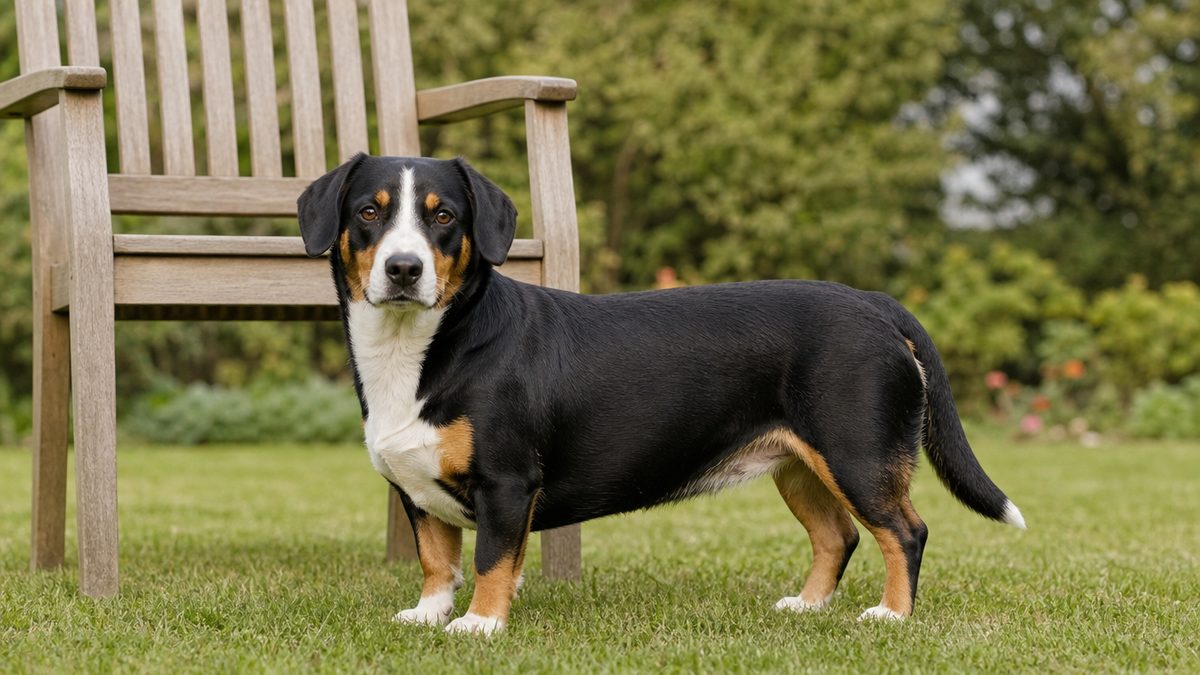
Quick answer
The Entlebucher Mountain Dog is the smallest of the four Swiss Sennenhund breeds, held under FCI Standard 47 at 44 to 50 cm for males with tolerance to 52 cm. No verifiable Indian price exists, and every rupee figure Bonbeno tested came from a template that prints the same band for unrelated breeds. Bonbeno rates heat tolerance 2 of 5. The breed's defining health issue is ectopic ureter, and Swiss screening cut the extravesical phenotype from 24 percent to 1.4 percent in a decade.
This guide is general information for Indian pet owners and is not a diagnosis. Consult your nearby vet, a registered veterinarian, before acting on anything you read here, and treat sudden urinary changes, collapse in heat or a red painful eye as urgent.
Entlebucher Mountain Dog traits, rated for India
What the Entlebucher Mountain Dog actually is
The Entlebucher Mountain Dog is the smallest of the four Swiss Sennenhund breeds, held under FCI Standard 47 at 44 to 50 cm at the withers for males with a tolerance to 52 cm, and 42 to 48 cm for females with a tolerance to 50 cm. Its own standard calls it an only just medium-sized, compactly built dog of slightly elongated shape, and that elongation is a measured requirement rather than an impression, because the ratio of height at withers to length of body is fixed at 8:10.
Start with the name, because it is where most pages go wrong. Sennenhund means the dog of the Senn, the Alpine herdsman and dairyman, and the breed takes its first half from Entlebuch, a valley in the region of the Cantons Lucerne and Bern. The English trade name Entlebucher Mountain Dog is a convenience. The FCI's own English title for standard 47 is Entlebuch Cattle Dog, and the German authentic name is Entlebucher Sennenhund.
| Item | What the standard says |
|---|---|
| Height, males | 44 to 50 cm, tolerance up to 52 cm |
| Height, females | 42 to 48 cm, tolerance up to 50 cm |
| Weight | The standard gives none |
| Body proportion | Height to length 8:10 |
| Muzzle to skull | 9:10 |
| Coat | Double coat (Stockhaar), topcoat short, close fitting, harsh and shiny |
| Tail | Natural long tail and congenital bobtail equally acceptable |
| Original job | Driving, watch, guard and farm dog |
| Working trial | Without working trial |
Two entries in that table do real work. The standard prints no weight at all, which is why the popular figures disagree so widely and why this page tabulates that disagreement rather than picking one. And the forelegs are specified as short, sturdy, straight and placed well under the body, which is why a correct Entlebucher reads as short-legged and low-slung rather than leggy. The overall impression is compact, and visibly longer than it is tall.
The colour rules are exact, and they are how you check a photograph
The base colour is black, with yellow-to-reddish-brown tan markings placed above the eyes, on the cheeks, on the muzzle and throat, on either side of the chest and on all four legs, and on the legs the tan sits between the black and the white. A distinct white blaze runs without interruption from the top of the head over the bridge of the nose. White runs from chin over throat to chest, and white appears on all four feet. A totally black head is a very serious fault, a white collar around the whole neck is a serious fault, and any coat other than tricolour is a disqualifying fault, as is a coat that is too long or soft with no double coat.
That last disqualification matters in India more than anywhere the standard was written for. The FCI does not merely permit a double coat on this breed; it disqualifies a dog that lacks one. A muscular, agile, energetic dog carrying a mandatory dense undercoat is a heat problem before it is anything else, and the climate section works that through with real numbers.
Entropion and ectropion are disqualifying, and Indian law names both
The standard lists entropion and ectropion among its disqualifying faults, alongside aggressive or overly shy dogs, yellow hawk eyes, wall eyes, blue eyes and a ring tail. India's Prevention of Cruelty to Animals (Dog Breeding and Marketing) Rules 2017 reach the same two conditions from the other direction. Second Schedule Part III paragraph 8(10) requires that dogs used for breeding shall have been tested for genetic defects, including hip dysplasia, progressive retinal atrophy, night blindness, hypothyroidism, entropion, ectropion, overshot, undershot jaw, wry mouth, two or more missing teeth and cryptorchidism. The word is including, so the list is illustrative rather than closed. For this breed the overlap is unusually tidy: the two eyelid faults that disqualify under FCI 47 are the same two that Indian law names, and progressive retinal atrophy in the same clause is the breed's one condition with a DNA test.
History, dated to documents rather than to legend
The Entlebucher's paper trail begins in 1889, when the first description under the name Entlibucherhund was published, and for a considerable time after that no difference was made between the Appenzell and Entlebuch cattle dogs. That single sentence in the FCI standard explains why the two breeds are still confused a century later.
In 1913 four examples of this small herding dog with congenital bobtail were exhibited at the dog show in Langenthal and presented to Professor Dr Albert Heim, the patron of the Swiss mountain and cattle dog breeds. On the judges' reports they were entered into the Swiss Canine Stud Book, the SHSB, as the fourth mountain and cattle dog breed. The breed club puts names and stud-book numbers to the rebuild: Babeli von der Rothoehe, born 1924, SHSB 27199, was the first bitch used for the revival, and Spiro von Bruggen, born 1 November 1926, SHSB 28686, was one of the first males used in planned breeding.
The Swiss Club of Entlebuch Cattle Dogs was founded on 28 August 1926 at the initiative of Dr Bernhard Kobler, a veterinarian from St Gallen, and it began with just 19 members. The first standard was completed only in 1927. As the small number of entries into the stud book shows, the breed developed only slowly.
Two paragraphs after giving 28 August 1926, the same SKES centenary page says the club was founded on 20 August 1926. Three separate attestations give 28 August: the club's history page, the Swiss Cynological Society's breed portrait, and the FCI standard itself. Bonbeno reports the 28 August date and names the discrepancy rather than quietly picking a side.
All four Swiss breeds were recognised in the same three weeks of 1954
The FCI accepted the Entlebucher on a definitive basis on 28 July 1954. The Bernese went through on 26 July, the Appenzeller on 27 July, and the Great Swiss Mountain Dog on 13 August Federation Cynologique Internationale. So when a page tells you one of the four is an older or newer breed than the others, it is talking about folk history rather than about the register. In FCI terms they arrived together, inside three weeks.
Kennel club recognition, breed by breed
Kennel club recognition of the Entlebucher is complete but recent outside Switzerland. The American Kennel Club recognised the breed in 2011 and places it in the Herding Group, printing its current breed popularity ranking as 178 of 210. The Royal Kennel Club lists it in the Working group as Entlebucher Mountain Dog (Imp), the suffix marking the imported register. Note that two national bodies place the same dog in two different groups, which tells you how awkward a cattle-driving breed is to classify once the cattle are gone.
India has no separate route. The Kennel Club of India is a full FCI member and issues pedigrees against FCI nomenclature, so FCI Standard 47 is the standard that would apply here, and the KCI's own import checklist requires the export pedigree issued by the origin country's kennel club before it will register an imported dog at all. There is no Indian breed standard for the Entlebucher and no reason there would be one.
The bobtail, and why it is not a docked tail
The Entlebucher is the only one of the four Swiss breeds whose standard accepts a congenital bobtail as an equal alternative to a natural long tail, and the word congenital is the one that matters. A congenital bobtail is a tail the dog is born with, and the FCI prints the two options side by side with the line that a natural long tail and bobtail are equally acceptable.
Compare that with the other three standards and the difference is total. The Appenzeller's tail must be carried tightly curled over the croup in movement. The Bernese tail is bushy, reaching at least to the hocks, hanging straight down at rest. The Great Swiss tail is set on harmoniously following the croup, pendulous in repose and never curled or tilted over the back. Only FCI 47 offers a stump as a legitimate alternative, and only FCI 47 makes a ring tail a disqualifying fault.
The bobtail is also becoming rare. The Swiss conservation body ProSpecieRara records that the tail is usually long today and carried level or hanging, and that a congenital bobtail, once more common, now occurs only rarely. So the feature that got the breed noticed at Langenthal in 1913 is on its way out of the living population.
The Swiss club forbids bobtail to bobtail matings
The Schweizerischer Klub fuer Entlebucher Sennenhunde writes the safeguard into its breeding regulation in one sentence. Article 8.4 states that dogs which have a congenital stump tail may only be mated with dogs born with a fully formed tail. That is a standard genetic precaution rather than a cosmetic preference, and it is the kind of rule that only exists where a club has watched the consequences of ignoring it.
The same regulation then does something no ranking page mentions, and it is the most useful rule on this page for anyone buying a puppy. Article 11.1 requires that a litter containing puppies born with a congenital stump tail must be reported to the club's breeding warden, and obliges the warden to inspect those puppies in the first days of life. Article 17 lists stump-tail litter inspections among the services the club charges a fee for. In other words the Swiss club independently verifies, within days of birth, that a short tail was born rather than cut. That is the check an Indian buyer cannot perform on an eight-week-old puppy, and it is a concrete reason to prefer a club-registered litter over a photograph.
Second Schedule Part II paragraph 6(8) of the Prevention of Cruelty to Animals (Dog Breeding and Marketing) Rules 2017 states that there shall be no tail docking, ear cropping, de-barking, de-clawing, branding, dyeing, injecting substances to enhance visual appeal, performing a surgery or procedure to camouflage or hide any defect or infirmity or any other kind of mutilation of any body part of the pup, and that any change of appearance by artificial means is strictly forbidden. A congenital bobtail is lawful because nothing was done to the dog. A docked tail is an offence. On an eight-week-old puppy the two look identical to a buyer, which is exactly why this needs saying out loud.
The standard also tells breeders to do something India forbids
FCI 47 instructs that dewclaws must be removed, except in those countries where the removal is prohibited by law. India is one of those countries, because paragraph 6(8) names de-clawing in the same list as docking and cropping. All four Swiss standards carry the identical instruction and the identical carve-out, so this is not an Entlebucher quirk Federation Cynologique Internationale Federation Cynologique Internationale.
The Swiss club's own regulation goes further and drops the carve-out. Article 9.4 requires that any dewclaws present on the hind legs be properly removed between the second and fourth day of life, stated as an obligation with no exception for countries where the procedure is unlawful. A breeder in India following that article to the letter would be performing an act that Second Schedule Part II paragraph 6(8) of the 2017 Rules names among prohibited mutilations. This is the clearest single example of the problem this page keeps returning to: breeding rules are written for the country that wrote them, and an Indian reader who follows one literally can end up breaking Indian law. Where the two conflict, Indian law governs what happens in India.
Entlebucher Mountain Dog price in India, and why every figure fails
No verifiable Entlebucher Mountain Dog price in India exists. Bonbeno found rupee figures on five Indian pages, tested every one of them, and none survived. Two are site-wide defaults printed identically for unrelated breeds, one contradicts itself on its own page, one is a house charm price attached to other breeds' puppies, and one marketplace returns bulldogs.
Start with what the ranking pages do. Not one of the ten pages that ranks in India for this breed prints a price in any currency, including the American Kennel Club, Wikipedia, the Royal Kennel Club and the breed's own parent club Wikipedia, Entlebucher Mountain Dog. Gives… The Royal Kennel Club National Entlebucher Mountain Dog…. The only India-focused page in the top ten is HappyPet.care, and it prints two different answers. Its specification block gives a cost of buying of Rs 60,000 to Rs 1,50,000, while its own FAQ, on the same page, says the price can range between Rs 1.5 and 3 lakhs. The FAQ's floor is the specification block's ceiling.
The division tests, run on every figure, with the quotients printed
Indian breed pages routinely publish a dollar figure run through one exchange rate, so the first check is arithmetic. Bonbeno divided every rupee figure by 84.38, by 74 and by 66.67, and prints the quotient rather than a verdict, because a quotient a real seller would never print tells you more than whether the division was clean.
| Rupee figure | Divided by 84.38 | Divided by 74 | Divided by 66.67 | Where it came from |
|---|---|---|---|---|
| Rs 8,000 | 94.81 | 108.11 | 119.99 | PetBuy.in low |
| Rs 35,000 | 414.79 | 472.97 | 524.97 | PetBuy.in high |
| Rs 50,000 | 592.56 | 675.68 | 749.96 | Poodles.in low |
| Rs 60,000 | 711.07 | 810.81 | 899.96 | HappyPet.care low |
| Rs 1,50,000 | 1,777.67 | 2,027.03 | 2,249.89 | HappyPet.care and Poodles.in high |
| Rs 3,00,000 | 3,555.34 | 4,054.05 | 4,499.78 | HappyPet.care FAQ high |
| Rs 98,999 | 1,173.25 | 1,337.82 | 1,484.91 | Puppiezo carousel |
Read that table and the conversion hypothesis fails. Not one quotient is an exact whole number of dollars at the strong 84.38 rate. The near-misses at 66.67 are an artefact of the inputs, because 8,000, 50,000, 60,000, 1,50,000 and 3,00,000 are round rupee numbers and a round rupee number divides tidily at almost any rate. These figures were not converted from dollars. They were typed in rupees, which is a different and worse problem, because there is no foreign price underneath them at all.
What the figures actually are
- PetBuy.in, Rs 8,000 to Rs 35,000. The same page prints Listings 0 and carries no breed photograph. Its Mal-Shi page prints the identical band, the identical size, weight, height, grooming, shedding and barking values, for a three to six kilogram toy cross.
- Poodles.in, Rs 50,000 to Rs 1,50,000. Its Great Swiss Mountain Dog page carries the same band in its own meta description, for a dog more than twice the weight, and the buying section renders the rupee symbol as a question mark.
- HappyPet.care, two answers. Rs 60,000 to Rs 1,50,000 in the specification block against Rs 1.5 to 3 lakhs in the FAQ, with neither sourced to a named breeder or a completed sale.
- Puppiezo, Rs 98,999. It appears three times on the Entlebucher page and each time it is attached to a different breed's puppy, two Maltipoos and a Doxiepoo. The eight animals in that carousel include no Entlebucher at all.
- Mr n Mrs Pet, no figure. The page claims three results and renders two French Bulldogs and an English Bulldog, with every price behind a sign-up.
Justdial completes the picture. Its page is headed Popular Pet Shops For Entlebucher Mountain Dog in Thane West, Thane, and the five businesses it lists are in Kota, Jhansi, Delhi, Dehradun and Surat, none of them in Thane, none of them claiming to stock the breed. Its own meta description lists the template's other variants for German Shepherds, Labradors and birds.
There is no honest number to print. Quoting any of the figures above would launder a template default into a market rate, which is precisely how a wrong figure ends up being restated by an answer engine. If you are quoted a puppy price for this breed in India, ask for the KCI registration number, the export pedigree and the DGFT import licence before you ask about the price, because without those three the transaction cannot be lawful whatever the price is.
Monthly cost of ownership, if one ever reached India
A 25 kg Entlebucher in an Indian city would cost roughly Rs 9,000 to Rs 14,000 a month to keep properly, and food is the largest single line. Bonbeno builds that from live Indian retail prices rather than from a foreign estimate, and shows the arithmetic so you can substitute your own dog's ration.
Food first, because it is the one line that scales with the dog. Royal Canin Medium Adult is formulated for dogs of 11 to 25 kg, which puts a female Entlebucher squarely inside it and a heavy male at the top edge or just past it. On 27 August 2026 Supertails listed the 15 kg pack at Rs 10,293 against an MRP of Rs 10,950, which the page itself expresses as Rs 68 per 100 g, and the 10 kg pack at Rs 7,607 against Rs 8,650, or Rs 76 per 100 g. Those were lightning-deal prices, so the MRP is the safer planning number: Rs 10,950 for 15 kg works out at Rs 73 per 100 g.
| Daily ration | At Rs 68 per 100 g (deal) | At Rs 73 per 100 g (MRP) |
|---|---|---|
| 250 g | Rs 5,100 a month | Rs 5,475 a month |
| 300 g | Rs 6,120 a month | Rs 6,570 a month |
| 350 g | Rs 7,140 a month | Rs 7,665 a month |
Bonbeno does not print a single daily ration for this breed, because the right number depends on the individual dog's weight, age, neuter status and workload, and your vet should set it. What the table does is let you multiply once you have that number, which is more useful than an invented average and cannot be wrong.
The lines that are not food
- Preventives. Monthly ectoparasite control and quarterly deworming are not optional anywhere in India, and a short-coated dog that works outdoors picks up ticks. Budget for twelve months, not for a season.
- Annual vaccination and a wellness visit. One consultation plus core vaccines, plus rabies on the schedule your municipality requires.
- Eye examination. This breed's own clubs require an annual specialist eye check for breeding dogs, and an owner who is not breeding still benefits from a baseline, because cataract and glaucoma are the two eye problems its parent clubs name.
- Grooming. A short double coat needs equipment rather than a salon, so this line is small: a rake, a rubber curry and a good drier.
- Air conditioning. For a mandatory-double-coated Alpine breed in an Indian plain, cooling is a recurring cost and not a luxury, and it belongs in the budget rather than in the aspiration.
Add the one-off costs before the first month. The Swiss breed club prices the full pre-breeding examination battery, hip radiographs, the specialist eye examination, the prcd-PRA DNA test, the ectopic ureter ultrasound, heart auscultation and the breeding approval itself, at about CHF 1,000 for a member. That is a Swiss figure for a Swiss process and it does not convert usefully to India, but it is a fair signal of what a properly screened dog of this breed costs to document, and it is the reason a serious breeder anywhere charges what they charge.
The expensive part of this breed is not the food. It is the ninety minutes a day of real work it needs, every day, in a country where the safe window for that work is roughly two hours at each end of the day for much of the year. That is a time cost, and unlike a monthly cost it cannot be reduced by shopping around.
Heat tolerance in India, rated 2 of 5
Bonbeno rates the Entlebucher Mountain Dog 2 of 5 for heat tolerance, and the reason is a nineteen-degree wet-bulb gap rather than an opinion. The valley the breed comes from has an annual mean wet-bulb temperature of 5.79 C. Chennai's is 24.94 C. Comparing air temperature alone would understate the problem, because a dog cools itself by evaporation and evaporation is governed by wet-bulb, not by the number on a thermometer.
Bonbeno queried NASA POWER by explicit latitude and longitude rather than by a place-name slug, because a climate site that resolves on a guessed slug can and does serve a different city at HTTP 200. The figures below come from the same 20-year climatology, January 2001 to December 2020, for six points.
| Location | Annual mean air temp | Annual mean humidity | Annual mean wet-bulb | Worst month wet-bulb |
|---|---|---|---|---|
| Entlebuch valley, Lucerne | 7.58 C | 80.22 percent | 5.79 C | 14.93 C in July |
| Bengaluru | 23.74 C | 67.94 percent | 19.80 C | 22.66 C in May |
| Pune | 23.86 C | 66.80 percent | 19.66 C | 23.56 C in June |
| Delhi | 25.60 C | 45.56 percent | 18.03 C | 27.74 C in July |
| Mumbai | 26.77 C | 67.39 percent | 22.73 C | 26.55 C in June |
| Chennai | 27.95 C | 72.39 percent | 24.94 C | 27.36 C in May |
One line in that table settles the argument. The Entlebucher's hottest month at home, July, has a wet-bulb temperature of 14.93 C, which is lower than the annual mean wet-bulb of every Indian city in the table, Delhi's 18.03 C included NASA POWER Climatology API. The breed's worst case is milder than our average case, everywhere.
Delhi's trap is that its two peaks fall in different months
Delhi looks deceptively survivable on humidity, at an annual mean of 45.56 percent, the driest city in the table. But its absolute maximum air temperature is 48.79 C in June, and its wet-bulb peak arrives a month later, at 27.74 C in July, once the monsoon has loaded the air. So the month that will kill a dog by dry heat and the month that will kill it by failed evaporation are not the same month, and an owner who plans around one has not planned around the other. Chennai is more honest about itself: the air maximum and the wet-bulb peak both land in May, at 42.70 C and 27.36 C. Mumbai's August relative humidity of 90.36 percent is the highest figure in the whole dataset.
The coat is not optional, and that is the point
The FCI does not merely permit a double coat on this breed. It disqualifies a dog whose coat is too long or soft with no double coat, and it requires a dense undercoat that is itself dark grey to brownish. So there is no lightly-coated Entlebucher to look for. Every correct one carries insulation it cannot take off, and shaving it is the wrong answer, because the topcoat is what shields the skin from Indian sun and a shaved double coat regrows unevenly.
The breed's own parent club states the position plainly and briefly, that Entlebuchers originated in Switzerland where the climate is cool, that they prefer cool temperatures, and that in warmer climates they need to be kept cool. That is one sentence, and it is more than the other nine ranking pages manage between them.
What the heat-illness evidence actually says
The largest study of canine heat-related illness looked at UK dogs under primary veterinary care and separated events by their trigger. Of the 879 events that had a trigger recorded, 652 were exertional, which the paper reports as 74.2 percent; 113 were environmental at 12.9 percent, and 46 were vehicular confinement at 5.2 percent. Those percentages are computed on the 879 events with a recorded trigger, not on the 1,259 events in the dataset, and the difference matters: the same 652 cases would be 51.8 percent of 1,259, which is not what the paper prints. The cohort behind it was 905,543 dogs under primary veterinary care in 2016.
For a breed that needs ninety minutes of real work a day, the dominant trigger in that study is the one you schedule yourself. The practical rule for India is to move all work to the two hours after sunrise and the two hours before sunset, to carry water on every outing, to stop on the first sign of a widened tongue or a change in gait rather than on collapse, and to cool with cool running water on the belly and paws rather than with ice.
Temperament and household fit
The FCI describes the Entlebucher's temperament in nine words that predict most of what goes wrong in an Indian flat: lively, high-spirited, self-assured and fearless, good-natured and devoted towards people familiar to him, slightly suspicious of strangers, cannot be bribed as a watch dog, cheerful and capable of learning.
Take those in order, because each one is a household consequence. Lively and high-spirited is a demand for activity, not a description of charm. Self-assured and fearless means the dog will not defer to a stranger it has decided about. Devoted towards familiar people means it will follow you room to room and will not settle alone easily. And cannot be bribed as a watch dog is the FCI telling you, politely, that a visitor with a packet of treats will not buy their way past this dog.
The Swiss conservation body reaches the same place from a different direction, describing the Aentlibuecher as lively, enduring and self-confident, and as intelligent, eager to learn, quick and very affectionate. Note what neither source says. Nobody describes this breed as calm, low-maintenance or content to be left.
The driving instinct is the part Indian buyers do not expect
This is a cattle-driving breed, and driving means moving livestock by pressing at their heels. The FCI names the original job as driving, watch, guard and farm dog. A dog bred to control fast-moving bodies at ground level does not switch that off around fast-moving children, and the correction is training and supervision rather than surprise. The parent club describes a dog that wants a job and will invent one if you do not supply it, including herding the entire family, and that has a focused intensity and loves structure and routine.
It is vocal, and de-barking is illegal here
The breed is a watchdog and it announces. That is a feature in a Swiss farmyard and a problem in an Indian apartment tower with shared walls and a resident welfare association. There is no lawful shortcut: Second Schedule Part II paragraph 6(8) of the 2017 Rules names de-barking in the same prohibited list as docking and cropping. The only legitimate answers are to socialise the dog properly, to manage what it can see from the window, and to give it enough work that it is not barking out of boredom.
Who this breed suits, and who it does not
- Suits a household with a ground-floor home or a real yard, in Bengaluru or Pune rather than Chennai, with someone at home most of the day.
- Suits an owner who already does a dog sport, because this breed's mental needs are met by training rather than by walking.
- Suits a family with older children who understand not to run past a herding dog and shriek.
- Does not suit a first-time owner, a small flat, a household out at work for ten hours, or anyone who wants a dog that will settle quietly on a mat all evening.
- Does not suit the plains in summer without air conditioning, whatever the rest of the household looks like.
One trait rating on this page is deliberately not the heat rating. Bonbeno scores availability in India at 1 of 5, and that is the trait that actually decides the question for most readers, because a breed you cannot lawfully obtain is not a choice however well it would have fitted.
Training a self-assured driving dog
To train an Entlebucher, give it a job first and obedience second. The FCI standard calls the breed cheerful and capable of learning, and the Swiss conservation body calls it intelligent, eager to learn and quick, so the constraint is never intelligence. The constraint is that a self-assured, fearless dog will argue with handling it thinks is unfair, and will invent its own work if you do not supply any.
The parent club is blunt about the mechanism. Entlebuchers like to have a job to do, and if they are not given one they will make up their own, often ones you may not want, like herding the entire family or getting into the rubbish. That is not a training failure; it is a working breed operating correctly in the absence of work. The fix is to hand the dog a real routine rather than to suppress the behaviour: bringing in the post, collecting laundry, alerting to deliveries. The club's advice is to be visibly pleased about it, so the dog knows the contribution registered.
The socialisation window is where Indian owners lose this breed
The FCI describes an adult that is slightly suspicious of strangers and cannot be bribed as a watch dog. Those are adult traits with a puppy-stage cost, and the parent club spells out what under-socialisation produces: Entlebuchers that do not receive sufficient socialisation as young puppies can develop significant mental health challenges, and may become afraid of any woman, anyone wearing a hat, or all mobility equipment. The specificity of that list is worth noticing. It is a club describing dogs it has actually met.
In India the socialisation problem has a local shape. The window for exposure runs through the months when a puppy is least vaccinated and the heat is least forgiving, and the two constraints push in opposite directions. Work the window in the cool hours, use quiet residential streets rather than crowded markets, and take the puppy places in a carrier before it can walk them.
What works, and what this breed resists
- Short sessions with a clear payoff. A quick dog gets bored by repetition faster than it gets tired by difficulty.
- Structure and routine, which the parent club names explicitly as something the breed loves.
- Impulse work around movement, taught early, because the driving instinct targets whatever moves fast at ground level.
- Recall under distraction, trained before the dog is strong enough for it to matter.
- Never heavy-handed correction, because a self-assured, fearless dog does not fold under it; it argues.
One thing this breed does not need is a formal working qualification. The FCI lists standard 47 as without working trial, unlike the Estonian Hound at standard 366, which is subject to one Federation Cynologique Internationale. That is a registry fact rather than a training one, but it tells you the FCI regards this dog as a companion first now, whatever its original job was.
Daily exercise, and the two activities to avoid
An adult Entlebucher needs roughly ninety minutes of real work a day, and in India that has to fit into the cool hours at each end of the day. The parent club puts a number on the walking component: a typical Entlebucher can enjoy up to a three-mile walk in comfortable temperature.
Read that sentence again, because the last three words are doing all the work. In comfortable temperature is a Wisconsin qualifier written for a Wisconsin reader, and it is the single most important caveat on the club's whole exercise page. A three-mile walk at a Chennai May wet-bulb of 27.36 C is a different activity from a three-mile walk at an Entlebuch July wet-bulb of 14.93 C NASA POWER Climatology API v2.9.7. The distance transfers; the conditions do not.
Two activities the parent club warns against, and the anatomy behind them
The club advises against frisbee, and gives the reason: the long length of an Entlebucher body makes the jumping in this activity ripe for injuries like torn cranial cruciate ligaments. That is not a general dog-sport caution. It is a structural argument, and the structure is in the FCI standard, which fixes the height-to-length ratio at 8:10 and specifies short forelegs placed well under the body. A long back on short legs takes a bad landing badly.
The same page limits running. Short distances at moderate speed are fine for what the club calls our short legged friends, but running distances could cause strain on legs and hips. Note that this is a club telling its own members not to do the thing owners of energetic dogs most want to do, which is jog with them. It is worth taking seriously for that reason alone.
| Slot | What to do | Why |
|---|---|---|
| Roughly 05:30 to 07:00 | Forty-five minutes of walking, sniffing and recall work | The coolest window and the lowest wet-bulb of the day |
| Mid-morning | Ten to fifteen minutes of scent work or a puzzle indoors | Mental work with no heat load, which is what this breed actually needs |
| Afternoon | Rest, indoors, on a cool floor | Non-negotiable in the plains from March to October |
| Roughly 18:30 to 20:00 | Forty-five minutes of walking plus short training | Second cool window; keep it below the dog's panting threshold |
| Never | Frisbee, distance running, midday walks | Cruciate ligament risk, joint strain and heat risk in that order |
The parent club's framing is that the dog needs a job rather than a distance. In an Indian summer that is convenient, because scent games, trained household tasks and short shaping sessions all happen indoors at room temperature and satisfy the part of this breed that walking never reaches. It is still only half the requirement. The other half is physical, and it still has to happen at 05:30.
Grooming and coat care in Indian humidity
To groom an Entlebucher, brush the short topcoat weekly, rake the dense undercoat when it loosens, and dry the dog to the skin every time it gets wet. The coat itself is low effort by design, because the FCI specifies a short, close-fitting, harsh and shiny topcoat. The Indian difficulty is not the brushing. It is the drying.
ProSpecieRara summarises the maintenance in one word, calling the breed robust, weatherproof and easy to care for. That is accurate for Switzerland, where the annual mean relative humidity in the breed's home valley is 80.22 percent but the annual mean temperature is 7.58 C. Humidity at 7 C does not do what humidity at 27 C does. Mumbai's August relative humidity of 90.36 percent arrives at a wet-bulb of over 25 C, and that combination is where a dense undercoat that stays damp becomes a skin problem rather than a comfort problem.
The routine, in five lines
- Brush the topcoat weekly with a rubber curry or a short-bristle brush, which also lifts loose undercoat.
- Rake the undercoat during the two seasonal drops, more often if you can feel matting at the ruff and thighs.
- Bathe only when the dog is genuinely dirty, because frequent bathing strips the topcoat's weather protection.
- Dry to the skin with a drier on a cool setting, checking the armpits, groin and the base of the tail, and never let a double-coated dog air dry in Indian humidity.
- Check the ears after every bath and every swim, and dry the ear canals rather than leaving them damp.
That fourth step contradicts a lot of published grooming advice, and deliberately. Overseas club guidance for double-coated breeds routinely says to towel the dog and let it air dry, which is sound in a cool dry climate and unsound in an Indian monsoon, where a damp undercoat against warm skin is a fungal and bacterial invitation. Where an overseas care instruction assumes a climate India does not have, Bonbeno says so rather than reproducing it.
The FCI disqualifies an Entlebucher whose coat is too long or soft with no double coat, which tells you how central the double coat is to the animal. Shaving removes the topcoat that reflects sun and shields skin, leaves the undercoat to regrow unevenly, and does not make the dog cooler. If the dog is overheating, the answer is shade, water, air movement and a changed schedule, not clippers.
One more coat note that matters for buyers. The standard tolerates slightly wavy hair on the withers and back but calls it undesirable, and a totally black head is a very serious fault while any non-tricolour coat is disqualifying. A seller offering an unusually coloured or unusually fluffy Entlebucher is offering something that would not pass its own breed standard, which is a useful thing to be able to say out loud when you are looking at photographs.
Ectopic ureter, the condition this breed is defined by
The Entlebucher Mountain Dog's signature health problem is ectopic ureter, a congenital anomaly in which one or both ureters bypass the normal opening into the bladder. It is the most thoroughly measured inherited condition in any Swiss Sennenhund breed, and none of the ten pages ranking in India for this breed mentions it once.
Begin with scale, because the breed numbers only mean something against the general population. The Merck Veterinary Manual reports the prevalence of ectopic ureters in dogs as 0.016 to 0.045 percent, and names Labrador Retrievers, Siberian Huskies, Golden Retrievers, Newfoundlands and English Bulldogs as familial breeds, without naming the Entlebucher at all. That general figure traces back to a 1988 review and is drawn from clinical caseloads rather than from screening every dog, so it is not directly comparable with the breed figures below. Read it as an order of magnitude, not as a denominator.
What screening every dog actually finds
A Swiss and German study imaged 565 Entlebucher Mountain Dogs and successfully classified 552 of them by where the most caudal ureteral opening terminated. Of those 552, 32.9 percent had normal terminations of both ureters in the bladder trigone, 47.3 percent had at least one intravesicular ectopic termination, and 19.8 percent had at least one extravesicular ectopic termination. Those three add to exactly 100.0 percent, which is a cheap check worth running on any published breakdown. Read the other way, two thirds of screened Entlebuchers carried an anatomically ectopic ureter on at least one side, and the analysis found males more often affected than females, which reverses the general canine pattern.
The North American picture from a separate group is the same shape at a smaller scale. Twenty client-owned Entlebuchers were investigated, of which nine had clinical signs of urinary tract disease; eleven females and two males, thirteen of the twenty, were found to have ectopic ureters, and six of those females and one male were continent. So seven of the thirteen affected dogs, more than half, showed no incontinence at all. That paper compiled clinical and pedigree histories from 165 North American Entlebuchers and identified 26 dogs with ectopic ureters in the pedigree.
Two thirds of screened dogs carry an ectopic termination on imaging. Around 11 percent show clinical signs. The American parent club estimates that fewer than 5 percent of Entlebuchers in the United States and Canada have been afflicted, while stating plainly that the precise estimate is not known. Those are not three contradictory answers. They are answers to three different questions: what an ultrasound sees, what an owner notices, and what a club has recorded. A page that quotes only one of them is telling you a third of the story.
The clinical range is wide, and the parent club sets it out honestly. Presentations run from no clinical signs at all, through occasional leaking of urine and constant dribbling, to renal failure and death, and the commonest presentation is slight urine leaking with occasional bladder infections, noticed especially during house training. That last detail is the one an Indian owner can act on: a puppy that is not learning house training in a reasonable time is a puppy to take to a vet, not a puppy that is being slow.
The screening programme that cut the severe phenotype to 1.4 percent
Swiss phenotype-based breeding selection reduced the extravesical ectopic ureter phenotype in the Entlebucher from 24 percent to 1.4 percent in a decade, and it did so without the inbreeding rise the breed feared. That is the single most consequential piece of health work in the Sennenhund group, and it is a template for any small breed facing a condition with no genetic test.
Because clinical signs clustered in 11 percent of Entlebucher Mountain Dogs and no genetic test for ureteral ectopia existed, screening was introduced in 2008 to allow phenotype-based breeding selection, with ureteral orifices visualised by ultrasound and existing urinary retention or incontinence documented, and findings assessed centrally into one of five phenotypes. Across 1,456 phenotyped Entlebucher Mountain Dogs, males were assigned to the extravesical phenotype more often than females, 11 percent against 5 percent.
The effect was measured in a subpopulation of 876 phenotyped parents and their offspring. The prevalence of the extravesical phenotype fell from 24 percent in the 2005 to 2007 birth cohorts to 1.4 percent in the 2015 to 2017 birth cohorts, and since 2015 almost no Entlebucher Mountain Dogs with incontinence, hydroureter or hydronephrosis have been recorded. It had been feared that extra selection pressure on so small a population would accelerate inbreeding. It did not, which is why the authors recommend continuing the programme while watching the inbreeding coefficient.
The genetics are still unsolved, which is why it runs on phenotype
A genome-wide association study found six loci on canine chromosomes 3, 17, 27 and 30 carrying sixteen significantly associated SNPs, but no single outstanding SNP, and the association signals were not close to known genes involved in human congenital anomalies of the kidney or lower urinary tract. The German club states the practical consequence in one sentence: genetic research identified a group of loci involved in the malformation but no major gene, so unfortunately no genetic test could yet be developed.
Three countries, three different rules for the same condition
| Body | Scale used | Effect on breeding |
|---|---|---|
| Switzerland, SKES | Normal, Abnormal, Ektopisch, Nicht einteilbar | Examination required for breeding approval; a finding is not an automatic exclusion |
| Germany, SSV | A, B, C | Dogs graded EU C may not be used for breeding |
| North America, NEMDA | None yet | No screening or grading; two willing veterinarians found in May 2026 |
The Swiss position is the interesting one, and it is deliberate. The club's breeding regulation says its breeding commission will where possible, but not compulsorily, take cataract, ectopic ureter and goniodysplasia results into account, because the inheritance of these conditions is complex, the scientific evidence is currently insufficient, and drawing unrestricted, premature breeding exclusions even from slight deviations would endanger the gene pool of the breed. Germany takes the harder line and excludes grade C outright. North America has neither, and its parent club said so plainly in May 2026, reporting that it had just found two veterinarians willing to work on the project.
Compliance is measurable in Germany. Between 2010 and 2021, 56.2 percent of Entlebucher puppies bred within the German club were examined by ultrasound, run since 2008 with Professor Reichler at the Vetsuisse Faculty of the University of Zurich. That is the participation rate that produced the improvement, and it is a fair benchmark for what voluntary screening actually achieves in a small breed.
Ask which country the parents were screened in and under which scale. A Swiss dog will have a Normal, Abnormal, Ektopisch or Nicht einteilbar finding. A German dog will have an A, B or C grade. A North American dog will have nothing, because no screening scheme exists there yet. Those are not interchangeable, and a seller who cannot tell you which scheme a certificate came from has probably not seen the certificate.
Eyes, where the breed's real burden sits
Eyes are the Entlebucher's heaviest documented health burden, and the summary figures understate it. The Orthopedic Foundation for Animals ranks the breed 14th on its eye register with 11.1 percent abnormal across 782 evaluations, while the detail rows underneath that same summary show only 67.5 percent of examined dogs recorded as normal.
Both figures come from the same source on the same day, and they measure different things. The summary counts dogs graded abnormal. The detail rows count every recorded finding, including those a breeder is left to judge for themselves. Bonbeno prints both and shows the gap rather than choosing the flattering one.
| Finding | Dogs | Percent |
|---|---|---|
| Normal, no finding recorded | 527 | 67.5 |
| Cataract, significance unknown | 72 | 9.2 |
| Other, suspected as not inherited | 52 | 6.7 |
| Incipient cataract, posterior cortex | 39 | 5.0 |
| Persistent pupillary membranes, iris to iris | 34 | 4.4 |
| Punctate cataract, capsular | 31 | 4.0 |
| Punctate cataract, posterior cortex | 28 | 3.6 |
| Vitreous degeneration, syneresis | 17 | 2.2 |
| Retinal dysplasia, folds | 11 | 1.4 |
OFA's eye summary for this breed prints 782 evaluations with 693 normal at 88.6 percent and 87 abnormal at 11.1 percent. But 693 plus 87 is 780, not 782, and 88.6 plus 11.1 is 99.7, not 100. Two evaluations are unaccounted for in the summary row. The hip row by contrast reconciles exactly, at 464 normal plus 92 dysplastic plus 14 equivocal equalling 570. Bonbeno reports the discrepancy rather than smoothing it, because a percentage that does not reproduce from its own counts is the cheapest fabrication check there is, and it should be run on primary sources too.
The pattern in those detail rows is worth reading, not just counting. Cataract findings dominate, appearing across five separate lens categories, which is consistent with nearly forty years of published Swiss and German work on cataract in this breed Heitmann M, Hamann H, Brahm R Kuster N, Haessig M. The trend is also improving: OFA's own by-birth-year breakdown shows the share of eye examinations recorded as normal rising from 80.8 percent for dogs born 2006 to 2010 to 95.2 percent for those born from 2021. Whatever the clubs have been doing on eyes for the last two decades appears to be working.
Glaucoma, the drainage angle, and the one condition that has been solved
Only 28 percent of Swiss Entlebucher breeding dogs have a normal iridocorneal angle, yet only 3.2 percent develop glaucoma. That gap between a common anatomical abnormality and a rare disease is the reason the breed's regulators chose graded selection over blanket exclusion, and it is the newest significant finding on the breed.
After sporadic glaucoma cases, the Swiss Cynological Society required the Swiss Entlebucher club to introduce a one-time gonioscopy for every breeding dog before breeding approval from 2017, and researchers then analysed what the examinations found. In a sample of 126 Entlebucher Mountain Dogs, 78 bitches and 48 males, drawn from European College of Veterinary Ophthalmologists forms between 2016 and 2025, only 28 percent of the dogs were unaffected by iridocorneal angle abnormalities. Mild abnormalities appeared in 13 percent, moderate in 38 percent and severe in 21 percent, and those four figures add to exactly 100 percent.
The mechanism matters for an owner. Abnormalities of the iridocorneal angle consist of pectinate ligament abnormalities and narrow or closed angles; they may reduce the outflow of aqueous humour, raise intraocular pressure, and lead to glaucoma, and affected dogs often go blind. Despite that, Swiss Entlebuchers rarely develop glaucoma, at 3.2 percent, which is four primary cases against the 126 breeding dogs. The abnormalities became more severe with age in some dogs, and the authors' advice is to follow the ECVO selection strategy rather than to exclude every affected animal.
Bonbeno read the full text and found three figures that do not reproduce. The body text says about 30 percent of the examined breeding animals were free of an abnormality, and the French and Italian abstracts repeat 30, but 30 plus 13 plus 38 plus 21 is 102 percent, while 28 balances to exactly 100. The French and Italian abstracts also give glaucoma as 2.8 percent where the German and English give 3.2 percent, and only 3.2 reproduces from four cases in 126. And the French abstract dates the gonioscopy requirement to 2027, which is plainly a typo for 2017. Bonbeno uses 28 percent, 3.2 percent and 2017, and names the discrepancies rather than quietly picking a side.
Two dates conflict on that requirement and both are published. The peer-reviewed paper says the gonioscopy ran from 2017; the club's own breeding page says the extended eye test for goniodysplasia has been compulsory in Switzerland since 2018. A one-year gap is small and unresolved, and this page prints both rather than picking. Work toward a DNA test for glaucoma in the breed was still being reported in 2024, and the American parent club runs a glaucoma eye donation programme to supply tissue for that research.
Progressive retinal atrophy is the one thing that has been solved
The breed sits fourth of all breeds on OFA's progressive retinal atrophy table, with 137 dogs tested, 104 clear at 75.9 percent, 31 carriers at 22.6 percent and 2 affected at 1.5 percent. Those three add to 137 and to exactly 100.0 percent. A carrier rate near a quarter is high, and it is precisely why a DNA test matters, because a carrier is healthy and only mating two carriers produces an affected dog. Switzerland made the prcd-PRA test compulsory in 2005 and permits breeding only from genotype A and B tested dogs, and the club's plain summary is that no blind Entlebucher should be born today.
The American parent club agrees that PRA can now be selectively bred out while cataracts and glaucoma remain serious threats, and OFA lists a DNA-based prcd-PRA test among the four CHIC requirements for the breed alongside hip radiographs, an ACVO eye examination and a patellar luxation evaluation. Note what is missing from that list. Ectopic ureter, the condition Switzerland and Germany built entire programmes around, is not a CHIC requirement in North America at all.
Indian law reaches the same eye conditions from a different direction. Second Schedule Part III paragraph 8(10) of the 2017 Rules requires breeding dogs to have been tested for genetic defects including progressive retinal atrophy, night blindness, entropion and ectropion. For this breed the overlap is close to complete on eyes, and entirely absent on ureters, because the Rules never mention them.
Hips, elbows and knees, and the trend that has not moved
Sixteen point one percent of Entlebucher Mountain Dogs evaluated by the Orthopedic Foundation for Animals are dysplastic on hips, from 570 evaluations, and unlike the breed's ectopic ureter figure that number has not fallen over four decades of birth cohorts. Elbows and knees, by contrast, are close to clean.
The hip row reconciles exactly, which is the first thing to check. OFA records 570 evaluations, of which 464 are normal at 81.4 percent, 92 are dysplastic at 16.1 percent and 14 are equivocal at 2.5 percent, and 464 plus 92 plus 14 is 570. Inside the normal group, 39 dogs were graded Excellent at 6.8 percent, 301 Good at 52.8 percent and 124 Fair at 21.8 percent, which sums to 81.4 exactly. Inside the dysplastic group, 78 were Mild at 13.7 percent, 14 Moderate at 2.5 percent and none Severe. The breed's own parent club quotes the same picture as roughly 80 percent passing over the past twenty years of evaluations, which matches.
| Register | Evaluations | Abnormal | Rank among breeds |
|---|---|---|---|
| Hips | 570 | 16.1 percent dysplastic | 78 |
| Elbow | 205 | 1.5 percent | 134 |
| Patella | 194 | 2.1 percent, all grade 1 | 85 |
| Eyes | 782 | 11.1 percent | 14 |
| Progressive retinal atrophy | 137 | 1.5 percent affected, 22.6 percent carrier | 4 |
The hip trend by birth year is the uncomfortable finding
OFA also publishes the dysplastic share by birth cohort, and it does not describe a breed getting better. It runs 9.1 percent for dogs born up to 1990, 25.0 percent for 1991 to 1995, 17.1 percent for 1996 to 2000, 20.0 percent for 2001 to 2005, 10.4 percent for 2006 to 2010, 16.8 percent for 2011 to 2015, 13.3 percent for 2016 to 2020 and 14.3 percent for dogs born from 2021. That is noise around a flat line, on a small and shifting sample. Set it beside the ectopic ureter figure, which fell from 24 percent to 1.4 percent over roughly the same recent period under a centrally assessed programme, and the contrast is instructive: co-ordinated central screening moved one condition decisively and voluntary submissions did not move the other.
The Swiss rule is stricter than the American one and worth knowing if you are reading a European pedigree. Only dogs with hip dysplasia grades A to C, meaning free through mild, may be bred, all breeding dogs must be radiographed, and the club recognises evaluations only from the Vetsuisse faculties at Bern or Zurich, with X-rays taken no earlier than 15 months. There is no elbow dysplasia requirement in that regulation at all, which the OFA elbow figure of 1.5 percent abnormal on 205 evaluations makes look reasonable rather than negligent.
Second Schedule Part III paragraph 8(10) of the Prevention of Cruelty to Animals (Dog Breeding and Marketing) Rules 2017 requires breeding dogs to have been tested for genetic defects including hip dysplasia. The word patella does not appear anywhere in those Rules, and neither does luxation, so there is no Indian patellar-testing requirement to cite however often a seller implies one. For this breed that gap is small in practice, because OFA finds only 2.1 percent abnormal on 194 patellar evaluations and every one of those is grade 1.
The cranial cruciate ligament is the joint risk the registers do not capture, and it is structural rather than genetic. The parent club advises against frisbee because the long length of an Entlebucher body makes the jumping ripe for injuries like torn cruciate ligaments, and limits running to short distances at moderate speed. The FCI's 8:10 height-to-length ratio and short forelegs are the reason. No screening programme protects against a bad landing.
Muscular dystrophy, anaemia, litter size and lifespan
Beyond ureters, eyes and hips, the Entlebucher literature holds one confirmed breed-specific genetic variant, two single case reports, a measured decline in litter size, and four published lifespans that disagree. This section prints all of it, including a widely repeated claim that Bonbeno could not support.
Duchenne muscular dystrophy, confirmed in the breed in 2024
Two male Entlebucher Mountain Dogs presented with marked dysphagia starting at the age of several weeks and later recognisable exercise intolerance with highly increased serum creatine kinase. Whole genome sequencing of one identified an intragenic 8.6 kilobase duplication in the X-chromosomal DMD gene, including exon 52, predicted to cause a frameshift and truncate 30 percent of the wild-type open reading frame. Genotyping the family confirmed the mutant allele in both affected dogs and in the unaffected dam, which is the classic X-linked recessive pattern. Two dogs is a case series, not a prevalence, and nobody knows how common the allele is. A puppy that struggles to swallow from a few weeks old is worth investigating rather than waiting out.
Haemolytic anaemia, and a correction worth making
The breed is often listed as carrying an inherited haemolytic anaemia, and the claim needs unpicking rather than repeating. There is no phosphofructokinase deficiency in this breed on any evidence Bonbeno could find: OFA's phosphofructokinase deficiency table lists four breeds, the English Springer Spaniel, Boykin Spaniel, Cocker Spaniel and English Cocker Spaniel, and the Entlebucher Mountain Dog is not among them. The four CHIC requirements for the breed include no such test.
What does exist is different and should be named differently. The American parent club lists Auto-Immune Mediated Anemia, a disease in which the body's immune system mistakenly attacks red blood cells, among conditions identified in a number of Entlebuchers, while stating that these are not common problems in the breed and offering no denominator. The peer-reviewed record contains a single case report, a female, spayed, five-year-old, 28 kg Entlebucher Mountain dog with regenerative anaemia and positive autoagglutination diagnosed as immune-mediated haemolytic anaemia. One case supports no breed-level claim, and English Wikipedia's own mention of hemolytic anaemia in this breed is tagged as needing a citation. So: immune-mediated, not enzymatic; documented, not quantified.
The size of that literature is worth stating for a breed this rare. A PubMed search for Entlebucher run on 27 August 2026 returned 23 records against a clean query translation of Entlebucher in all fields, of which roughly eight are genuinely breed-focused rather than multi-breed studies that list the Entlebucher among others. That is more published attention than most breeds with a hundred times the population receive. The literature also holds one renal tumour case, a mesoblastic nephroma in an intact 16-month-old female treated by nephrectomy and clinically healthy at three-year follow-up. That is a case report in a breed already known for renal and ureteral anomalies, and it is worth knowing for that reason alone.
Litter size is falling, and the effect has been measured
Average litter size in Entlebucher Mountain dogs decreased by approximately 0.8 puppies over the past two decades. A genome-wide association study using 1,632 pedigree records, 892 phenotypes and 372 genotypes across 173,662 markers estimated the heritability of litter size at 43.1 percent and traced roughly 15 percent of that to the growth differentiation factor 9 locus. The derived allele was validated in 111 dogs and associated with a decrease of 0.75 plus or minus 0.22 puppies per litter. A separate paper examined the factors influencing litter size and puppy losses in the breed. For a breed with roughly 1,900 living registered dogs in its home country, a shrinking litter is a population problem before it is a breeder's problem.
Lifespan, where four authorities give four answers
| Source | Figure |
|---|---|
| American Kennel Club | 11 to 13 years |
| The Royal Kennel Club | Over 12 years |
| Swiss Cynological Society, with the breed club | 12 to 15 years |
| ProSpecieRara | About 12 to 15 years |
| VCA Animal Hospitals | 11 to 15 years |
No peer-reviewed lifespan study of this breed exists in the sources Bonbeno could open, so every figure above is a body's own estimate rather than a measured median The Royal Kennel Club Schweizerische Kynologische Gesellschaft ProSpecieRara, Entlebucher Sennenhund… VCA Animal Hospitals. The spread runs four years, and the two European sources closest to the breeding population give the longest figures. Bonbeno prints the disagreement instead of averaging it, because an average of five estimates is not a sixth estimate; it is a number nobody published.
Feeding an active medium-sized working dog in India
Feed an Entlebucher a medium-breed adult diet and weigh the dog rather than the bowl, because this breed sits awkwardly across two food categories. Royal Canin's Medium Adult range is built for dogs of 11 to 25 kg, which covers every female and most males, while the American Kennel Club puts males at 50 to 65 pounds, roughly 23 to 29 kg, so a heavy male crosses into large-breed formulations.
The FCI standard gives no weight at all for this breed, which is why the published figures scatter. The AKC prints 50 to 65 pounds for males and 40 to 55 for females, VCA prints 55 to 66 pounds, and Wikipedia prints 45 to 65 pounds, or 20 to 30 kg. That is a 21-pound spread across three sources for the same dog, and no page that ranks in India reconciles it. In practice, weigh your own dog and feed to that.
The parent club's diet advice, and what transfers to India
The American club's guidance is unusually practical. It advises avoiding the cheapest grocery-store kibble, looking for a product made by a local company rather than overseas, checking the ingredient list for actual meat content, watching for additives, and adding vegetables, noting that even 10 percent fresh food on top of regular kibble makes a difference. All of that transfers to India directly, and the local-manufacture point transfers better here than it does in North America, because an imported bag carries freight and duty into its price without carrying nutrition.
The club's single strongest line is about quantity rather than quality: the most important thing an owner can do is avoid overfeeding, know the dog's appropriate weight from the vet, and limit the ration to maintain it, which the club says can literally add years to a dog's life. For a long-backed, short-legged breed already carrying a cruciate-ligament risk, every extra kilogram is loaded onto the joints the structure is weakest at.
The toxic list, with the Indian household in mind
- Raisins and grapes, which the parent club singles out as particularly toxic and which sit in every Indian kitchen through festival season.
- Onion, onion powder and garlic, which means most Indian gravy is not a treat.
- Chocolate, worse when dark, and the club's advice is to lock it in the fridge.
- Xylitol and birch sugar, including sugar-free gum and mints left in a car.
- Alcohol, in any quantity.
Heat changes when the dog eats, not what
In an Indian summer the practical adjustment is timing. Feed the main meal after the evening walk rather than before it, keep water available and changed through the day, and do not feed immediately before the morning session either. A dog that has to work through a wet-bulb temperature above 25 C should not be doing it on a full stomach. Body condition is easier to hold in a hot climate than in a cold one, because appetite drops, so watch for the opposite problem in the monsoon when activity falls and the food stays the same.
The first year, month by month
An Entlebucher's first year has four dates that matter more than the rest: eight weeks, when Indian law first permits a sale; ten weeks, before which the Swiss breed club will not release a puppy; the socialisation window that closes around sixteen weeks; and fifteen months, when the breed's own screening can finally begin.
| Age | What is happening | What you do |
|---|---|---|
| 8 weeks | The earliest a puppy may lawfully be sold in India under Rule 8(1)(a) | Do not accept a younger puppy, whatever the reason given |
| 10 weeks | The earliest the Swiss breed club permits release | Prefer a breeder who holds to this, not to the legal minimum |
| 8 to 16 weeks | The socialisation window, and the least vaccinated period | Carry the puppy to new places; work the cool hours; avoid crowded markets |
| 3 to 5 months | House training, and the window in which ureteral problems show | A puppy not learning house training in reasonable time needs a vet, not patience |
| 4 to 6 months | Driving instinct emerges around fast movement | Teach impulse control near running children and vehicles now |
| 6 to 9 months | Growth plates still open on a long back and short legs | No frisbee, no distance running, no repeated stair work |
| 9 to 12 months | Adolescent testing of a self-assured breed | Hold routine and structure; do not escalate corrections |
| 15 months | Earliest hip radiograph and earliest valid eye examination under Swiss rules | Book both if the dog will ever be bred or shown |
| 18 months | Earliest Swiss breeding approval | Full battery: hips, eyes, prcd-PRA DNA, ureter ultrasound, heart |
Two of those rows are legal rather than developmental. Rule 8(1)(a) of the Prevention of Cruelty to Animals (Dog Breeding and Marketing) Rules 2017 states that pups less than eight weeks in age are not sold, and that is a Rule in the main body of the instrument rather than a Schedule paragraph. The Swiss club goes further in its own regulation, at Article 9.6, barring release before the tenth week of life. Where a breeder's own club is stricter than your country's law, follow the club.
The two things to watch for in the first year
The first is urinary. The parent club's advice is direct: if your puppy is not learning house training in a reasonable amount of time, ask your veterinarian about ectopic ureter. Given that roughly two thirds of screened dogs in the breed carry an ectopic termination on at least one side, and that more than half of affected dogs in one North American series were fully continent, an early ultrasound is a reasonable thing to ask for rather than an over-reaction North C, Kruger JM, Venta PJ, Miller JM.
The second is swallowing. The two Entlebuchers with confirmed Duchenne muscular dystrophy both presented with marked dysphagia starting at the age of several weeks, well before the exercise intolerance appeared. A very young puppy that struggles to swallow is not fussy.
The Swiss club caps a bitch at three litters in two calendar years, requires an eight-month break after rearing more than eight puppies, permits breeding of bitches only up to their completed ninth year, and requires the breeding approval to be renewed annually on an eye certificate no older than six months. Ask an overseas breeder which of those they follow. The answer tells you more about the litter than any photograph will.
Head to head against the three breeds it gets confused with
The Entlebucher is the smallest of the four Swiss Sennenhund breeds by 12 cm at the top of the male range, and it is the only one that may carry a bobtail. Every page that ranks in India mentions that four Swiss breeds exist. Not one puts them side by side from their own FCI standards, which is the comparison a buyer is actually making.
The FCI's Section 3 holds exactly four breeds under one country heading, Switzerland, and nothing else: the Appenzeller at 46, the Berner at 45, the Entlebucher at 47 and the Grosser Schweizer at 58. Each row below is taken from that breed's own standard rather than from a summary.
| Breed | FCI standard | Male height | Coat per the standard | Tail per the standard |
|---|---|---|---|---|
| Entlebucher Sennenhund | 47 | 44 to 50 cm, tolerance to 52 | Double coat, topcoat short, close fitting, harsh and shiny | Natural long tail and congenital bobtail equally acceptable |
| Appenzeller Sennenhund | 46 | 52 to 56 cm, tolerance 2 cm either way | Double coat, topcoat thick and shiny | Carried tightly curled over the croup in movement |
| Berner Sennenhund | 45 | 64 to 70 cm, ideal 66 to 68 | Long, shining, straight or slightly wavy | Bushy, hanging straight down at rest |
| Grosser Schweizer Sennenhund | 58 | 65 to 72 cm | Double coat, thick outer coat of medium length | Pendulous in repose, never curled over the back |
Read down that table and the differences are structural rather than cosmetic Federation Cynologique Internationale Federation Cynologique Internationale Federation Cynologique Internationale. The Bernese is the only one whose standard calls the coat long, and it stands a full 20 cm taller than the Entlebucher at the top of the male range. The Great Swiss is taller still and was a watch and draught dog rather than a driving dog. The Entlebucher is the smallest, the only one built on an 8:10 ratio that makes it visibly longer than tall, and the only one for which a stump tail is legitimate. The Appenzeller sits between at a nearly square 9:10, and its tightly curled tail is the fastest way to tell it from an Entlebucher in a photograph.
Rarity, in three registries
| Breed | UK registrations 2025 | German puppies 2025 | Living in Switzerland, July 2026 |
|---|---|---|---|
| Entlebucher | 6 | 88 | 1,894 |
| Appenzeller | No entry in the table | 74 | 4,568 |
| Bernese | 615 | 539 | 6,547 |
| Great Swiss | 14 | 96 | 1,309 |
Those three columns tell three different stories about the same four breeds Verband fuer das Deutsche Hundewesen (VDH) Identitas AG, Swiss national dog database. In Britain the Bernese outnumbers the Entlebucher by roughly a hundred to one. In Germany the gap narrows to six to one. In Switzerland, where all four are native, the Entlebucher is only the third most numerous of the four, behind the Appenzeller as well as the Bernese. And the German trend is downward: Entlebucher puppy registrations there ran at 191 in 2012 and 188 in 2015, and have fallen to 93 in 2024 and 88 in 2025.
The breed an Indian buyer will actually be offered
If you search for a Swiss tricolour dog in India, what you will find is a Bernese Mountain Dog, because it is the only one of the four with an Indian market at all. That is an uncomfortable conclusion for an Entlebucher page to reach and it is the truthful one. The Bernese is 20 cm taller, long-coated rather than short, and its own breed body groups it with the Great Swiss as the heavy, calm pair against the agile Appenzeller and Entlebucher. For an Indian flat, the calmer, lower-drive dog is the more forgiving one. The Appenzeller Sennenhund is the nearest relative in temperament and the closest in size, and Bonbeno's page on it reaches the same conclusion from the other side.
If what attracts you is the working drive rather than the tricolour coat, the honest alternatives are obtainable. A Border Collie or an Australian Shepherd offers a comparable requirement and an actual Indian supply. And an Indian Pariah Dog is heat-adapted, free to adopt and every bit as keen on a job.
Mistakes Indian buyers make with this breed
The commonest mistake is buying a photograph. Six of the seven errors below come from treating an Entlebucher as a smaller, cheaper Bernese Mountain Dog, and the seventh comes from trusting a rupee figure that no seller ever quoted.
- Believing a published Indian price. Every rupee figure Bonbeno tested was a template default, a self-contradiction or a house charm price attached to another breed's puppy. If a seller quotes you a number, ask for the export pedigree and the import licence before you discuss it.
- Assuming a short-tailed puppy is a bobtail. A congenital bobtail is lawful and a docked tail is a criminal offence in India, and on an eight-week-old puppy the two look the same.
- Buying it as an apartment dog because it is the small one. Small relative to a Great Swiss is not small, and the constraint is not size. It is ninety minutes of daily work plus a carrying alarm bark in a building with shared walls.
- Jogging with it or throwing a frisbee. The parent club advises against both, and the reason is the 8:10 body ratio and the short forelegs that the FCI standard requires Federation Cynologique Internationale.
- Shaving the coat in summer. The FCI disqualifies a dog with no double coat, and removing the topcoat removes sun protection without making the dog cooler.
- Letting it air dry after a bath. Overseas grooming advice written for a cool dry climate does not survive an Indian monsoon, where a damp undercoat against warm skin is a skin infection waiting to happen.
- Ignoring slow house training. In a breed where roughly two thirds of screened dogs carry an ectopic ureter on at least one side, a puppy that will not house train is a puppy to scan.
The mistake the internet makes on your behalf
Two of the Indian pages carrying an Entlebucher price also carry the identical price for an unrelated breed, and one marketplace ranks for the breed while listing two French Bulldogs and an English Bulldog Mr n Mrs Pet, Entlebucher Mountain Dog…. A directory page headed with a Thane location lists five shops in Kota, Jhansi, Delhi, Dehradun and Surat. None of this is aimed at you specifically. It is a template filling a breed name into a slot, and the reason it matters is that answer engines read those pages and restate their numbers as facts.
Ask for the DGFT import licence reference, because dogs are a Restricted import in India and applications for trading or breeding purposes shall be duly rejected. Ask for the export pedigree from the origin country's kennel club, because the Kennel Club of India will not register an imported dog without it. Ask which country the parents were screened in for ectopic ureter and under which scale. A seller who cannot answer all three is not selling you an Entlebucher.
Adoption and responsible sourcing
No Entlebucher Mountain Dog rescue exists in India, and no lawful commercial route brings one here. The realistic options are three: adopt a dog that is actually available in India, import a pet you already own under the baggage route, or wait on an overseas breeder's list and accept the import restrictions that follow.
Start with the law, because it settles most of the question. Dogs sit at ITC(HS) 01061900 as a Restricted import, and the Directorate General of Foreign Trade permits import only for a pet accompanying a transferee of residence with a valid pet book in the importer's name, for research and development with CPCSEA recommendation, or for Defence and Police use, and states that applications for trading or breeding purposes shall be duly rejected. There is no commercial import of Entlebuchers into India because that route does not exist for any breed.
The pet route is real but narrow. It runs on the baggage rules, requires quarantine and certification through the Animal Quarantine and Certification Service, and applies to a pet you already own rather than to a dog you are buying. If the dog is to be registered here afterwards, the Kennel Club of India requires the export pedigree issued by the origin country's kennel club.
The overseas rescue that does exist
The American parent club runs a Rescue and Rehome programme with an adoption questionnaire and a surrender questionnaire, and it is the only breed-specific rescue Bonbeno could find anywhere. It is a North American programme for North American homes, and a rescue dog placed through it will not be crossing an ocean into a country where the breed has no vet familiar with it. Naming it is honest; suggesting it as an Indian route would not be.
What to adopt instead, and why it is not a consolation prize
- An Indian Pariah Dog, which is heat-adapted by 4,000 years of selection rather than by a thermostat, free to adopt, and entirely capable of the work this breed wants.
- A Rajapalayam, a short-coated Indian guarding breed with no coat penalty in the plains.
- A Mudhol Hound, a native breed with a real working history and an actual Indian breeding population.
- A Border Collie or an Australian Shepherd, if the working requirement rather than the origin is what attracts you.
If you are set on this breed and are moving abroad or already living overseas, the sourcing checklist is short. Buy from a club-registered breeder who screens for ectopic ureter, holds hip grades A to C, tests prcd-PRA and gonioscopes for goniodysplasia, and who will not release a puppy before ten weeks Schweizer Sennenhund-Verein fuer…. Ask which country's scheme the certificates come from. Expect to wait, because Germany registered 88 puppies in the whole of 2025 and the Royal Kennel Club recorded six registrations across the same year.
Bonbeno does not broker puppy sales, does not recommend breeders and does not link puppy listings. For most Indian readers the honest answer on this breed is that it is not obtainable here lawfully, that the rupee prices circulating for it are not real, and that a heat-adapted local dog will be happier in a Chennai May than a mandatory-double-coated Alpine driving dog ever will.
Entlebucher Mountain Dog questions, answered
What kind of weather are they suited for?
Cool weather, and the numbers are stark. The breed's home valley in Lucerne has an annual mean wet-bulb temperature of 5.79 C, and its hottest month, July, reaches only 14.93 C, which is below the annual mean wet-bulb of every major Indian city including Delhi's 18.03 C. Bengaluru and Pune at roughly 19.7 C annual mean are the least punishing Indian options; Chennai at 24.94 C is the worst.
How much exercise do they need?
Around ninety minutes of real work a day, split across the two cool windows. The parent club says a typical Entlebucher can enjoy up to a three-mile walk in comfortable temperature, and that qualifier is doing heavy lifting in India. It also advises against frisbee, because the long body makes jumping ripe for torn cruciate ligaments, and limits running to short distances at moderate speed.
What kind of health problems do they have?
The dominant health issues are ectopic ureter, eye disease and hips. Roughly two thirds of screened dogs carry an ectopic ureteral termination on at least one side, only 28 percent of Swiss breeding dogs have a normal iridocorneal angle, and OFA records 16.1 percent hip dysplasia across 570 evaluations. Progressive retinal atrophy is the one condition with a DNA test and it is being bred out.
Is the Entlebucher good for a person with allergies?
No, and no breed is. Vredegoor and colleagues measured Can f 1 across 196 dogs of so-called hypoallergenic breeds against 160 controls, and the hypoallergenic group came back higher, not lower, at 2.26 against 0.77 micrograms per gram of hair, with no difference in airborne allergen. The authors conclude there is no evidence for classifying any dog breed as hypoallergenic. This breed also carries a mandatory dense undercoat.
Are they protective and do they bark a lot?
Yes to both. The FCI standard describes a dog that is slightly suspicious of strangers and cannot be bribed as a watch dog, which is a polite way of saying a visitor with treats will not buy their way in. It announces, and in an Indian apartment that is a real problem, because de-barking is prohibited by the 2017 Rules alongside docking and cropping.
Are they good with children?
With supervision and early training, yes. Without either, the driving instinct is the problem. This is a cattle-driving breed built to move livestock by pressing at their heels, and a dog bred to control fast movement at ground level does not distinguish between a calf and a running child. Older children who understand not to sprint and shriek past a herding dog do best.
What about feeding and grooming?
Feeding is a medium-breed adult diet with the ration set by your vet, not by the bag, because the parent club's strongest advice is to avoid overfeeding on a long back and short legs. Grooming is a weekly brush of the short topcoat and a rake of the undercoat when it loosens. The one Indian rule that overseas guidance gets wrong is drying: never let a double-coated dog air dry in Indian humidity.
What kind of temperament does this breed have?
The FCI standard is precise: lively, high-spirited, self-assured and fearless, good-natured and devoted towards familiar people, slightly suspicious of strangers, cannot be bribed as a watch dog, cheerful and capable of learning. Nobody who has written about this breed describes it as calm or content to be left alone, and the parent club warns it will invent its own job if you do not give it one.
How big are Entlebucher Mountain Dogs?
Males stand 44 to 50 cm at the withers with a tolerance to 52 cm, and females 42 to 48 cm with a tolerance to 50 cm, which makes it the smallest of the four Swiss Sennenhund breeds by a clear margin. The FCI standard prints no weight at all, and published figures range from 20 to 30 kg across three sources that do not agree with each other.
What is the Entlebucher Mountain Dog price in India?
There is no real one. Bonbeno tested seven rupee figures and none survived. Two Indian sites print the same puppy price band for the Entlebucher and for unrelated breeds, one page gives Rs 60,000 to Rs 1,50,000 in its spec block and Rs 1.5 to 3 lakhs in its own FAQ, and a marketplace attaches Rs 98,999 to two Maltipoos and a Doxiepoo on the Entlebucher page. Monthly expenses are estimable at roughly Rs 9,000 to Rs 14,000; the purchase price is not.
What is the difference between an Entlebucher and an Appenzeller?
Size and tail, from their own standards. The Appenzeller stands 52 to 56 cm against the Entlebucher's 44 to 50 cm, and its tail must be carried tightly curled over the croup in movement, while the Entlebucher accepts a natural long tail or a congenital bobtail equally and disqualifies a ring tail. The Entlebucher is also built longer than tall on an 8:10 ratio against the Appenzeller's nearly square 9:10.
Can you buy an Entlebucher Mountain Dog in India?
Not lawfully through a commercial route. Dogs are a Restricted import at ITC(HS) 01061900, and the DGFT trade notice states that applications for trading or breeding purposes shall be duly rejected. The only routes are a pet you already own under the baggage rules, or a research or Defence import. No Indian breeder, kennel or classified verifiably lists this breed.
Do Entlebucher Mountain Dogs get urinary incontinence?
Some do, and many affected dogs do not. In one North American series, seven of the thirteen dogs found to have ectopic ureters were fully continent, so absence of leaking does not mean absence of the anomaly. Swiss screening since 2008 has cut the severe extravesical phenotype from 24 percent to 1.4 percent, and since 2015 almost no dogs with incontinence, hydroureter or hydronephrosis have been recorded.
Do entlebucher mountain dogs bark a lot?
Yes. The FCI standard describes a watch dog that is slightly suspicious of strangers and cannot be bribed, and it announces, which is a feature in a Swiss farmyard and a problem in an Indian apartment tower with shared walls. There is no lawful shortcut, because the 2017 Dog Breeding and Marketing Rules name de-barking in the same prohibited list as docking and cropping; the only answers are proper socialisation, managing what the dog can see from the window, and enough work that it is not barking from boredom.
Are entlebucher mountain dogs rare?
Yes, and the numbers are falling. Switzerland holds roughly 1,900 living registered dogs, where the breed is only the third most numerous of the four Swiss mountain dogs, German club puppy registrations dropped from 191 in 2012 to 88 in 2025, and the Royal Kennel Club recorded six registrations in the whole of 2025, with the Bernese outnumbering it there by roughly a hundred to one. Average litter size has also shrunk by about 0.8 puppies over two decades.
How expensive is a mountain dog?
For the Entlebucher there is no real Indian purchase price, because Bonbeno tested seven rupee figures on five Indian pages and none survived: two are site-wide defaults printed identically for unrelated breeds, one page gives Rs 60,000 to Rs 1,50,000 in its spec block and Rs 1.5 to 3 lakhs in its own FAQ, and a marketplace attaches Rs 98,999 to two Maltipoos and a Doxiepoo. What can be estimated is upkeep, roughly Rs 9,000 to Rs 14,000 a month for a 25 kg dog in an Indian city, built from live Indian retail prices.
Compare with similar breeds
Entlebucher Mountain Dog sits in 1 Bonbeno group. Each one compares it directly against the breeds it is genuinely an alternative to, on the same figures.