
Breed profile
Estonian Hound: Estonia's Only Native Breed
Estonia's only native breed, built to a height limit its own government set in 1934, still only provisionally recognised by the FCI, and unobtainable in India.
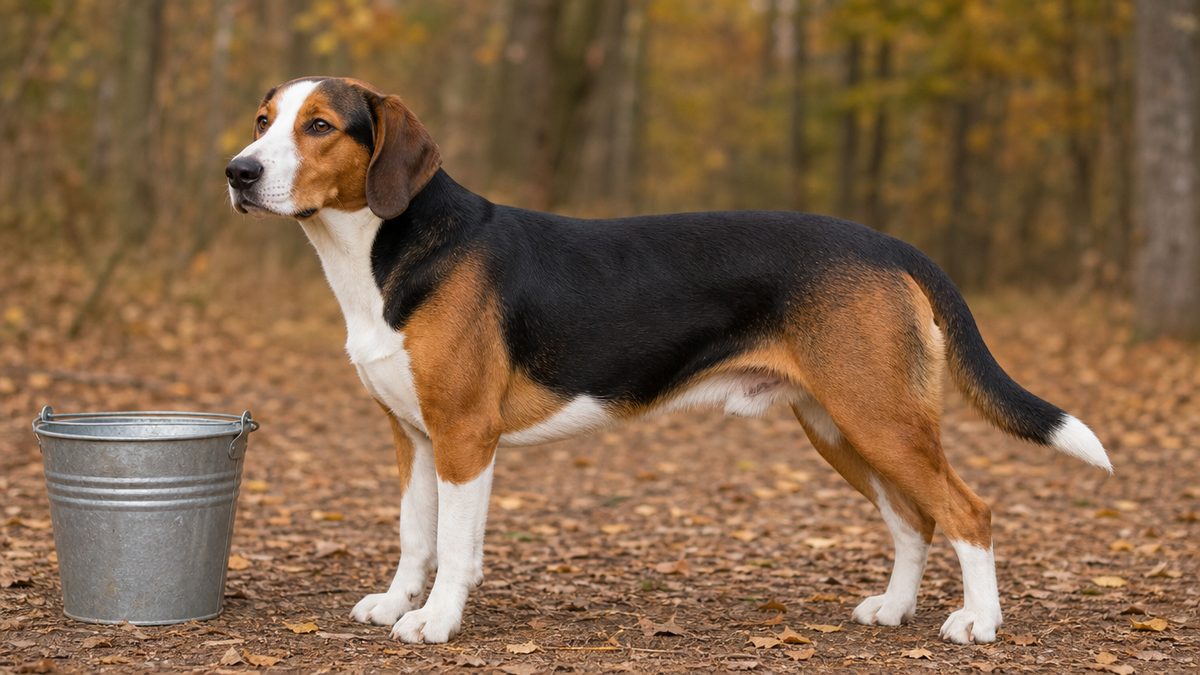
Quick answer
The Estonian Hound is Estonia's only native dog breed, a medium-sized scent hound standing 45 to 52 cm for males under FCI Standard 366. The FCI recognises it on a provisional basis only, from 4 September 2019, so it cannot compete for the CACIB. No Indian breeder or classified lists it and no rupee price for it is real. Bonbeno rates heat tolerance 2 of 5.
This guide is general information for Indian pet owners and is not a diagnosis. Consult your nearby vet, a registered veterinarian, before acting on anything you read here, and treat collapse in heat, sudden lameness or a change in a working dog's stamina as urgent.
Estonian Hound traits, rated for India
What the Estonian Hound actually is
The Estonian Hound is a medium-sized scent hound from Estonia, held under FCI Standard 366 at 45 to 52 cm at the withers for males and 42 to 49 cm for females. Its own standard names its job precisely: a scent hound used for hunting the hare, fox and lynx. Almost everything distinctive about the breed follows from a single number, the 52 cm ceiling, and from why that ceiling exists.
Read the standard's appearance section and a compact working dog emerges rather than a show dog. It describes a proportionate hound of medium size on a strong and dry build, with strong bone, good feet and well-developed muscles, and it says explicitly why the white markings matter: they are clearly visible and help to see the dog better when working in the field. That is a standard written by people who watch these dogs work in cover.
| Item | What the standard says |
|---|---|
| Height, males | 45 to 52 cm |
| Height, females | 42 to 49 cm |
| Weight | The standard gives none |
| Body proportion | Length of body exceeds clearly the height at the withers |
| Leg length | About 50 percent of the height at the withers |
| Coat | Short, even, harsh and glossy, with a moderate undercoat |
| Colour | Tricolour typical; bicolour lemon to golden-tan also allowed |
| Original job | Scent hound for hare, fox and lynx |
| Working trial | Subject to a working trial |
Two of those rows separate this breed from the hounds it is confused with. Females can be slightly longer than males, which is unusual to state outright, and the legs are specified at about half the height at the withers, which is what gives the breed its low, ground-covering outline. And unlike the Swiss Sennenhund breeds, this one is subject to a working trial under FCI nomenclature, meaning the FCI still classifies it as a dog that must prove it can do its job.
The colour rules, and how to check a photograph
The typical colour is black patches with tan markings and vivid white markings, a tricolour, and the size of the patches is not limited. A lemon to golden-tan patched dog with no black is also allowed, which makes bicolour a legitimate variant rather than a fault. The white is the part that is not optional: white markings should be on the head, on the throat and chest stretching on to the belly, and all feet and the tip of the tail must be white. A dog overmarked with black or tan, meaning one lacking white markings, is disqualified outright, as is a dog with brown or coffee-coloured patches and a liver-pigmented nose.
The disqualification that carries the whole history
Among the disqualifying faults, one is unlike the others: size over the limits indicated by the standard. Most breed standards treat height as a fault graded by degree. This one treats an oversized dog the way it treats an aggressive dog or a wall eye, as grounds for exclusion. That is not aesthetics. It is a legal history written into a breed standard, and the next two sections trace it.
The standard also lists a full set of 42 teeth with a complete scissor bite, a saber-shaped tail reaching to the hocks whose base must never be lifted above the line of the back, and thin hanging ears set medium high that reach about half the length of the muzzle when pulled towards the nose. Small, pricked or semi-pricked ears are disqualifying. Those ear rules are worth knowing because the breed is routinely mistaken for a Beagle in photographs, and ear set is one of the few features that separates them cleanly.
FCI recognition, which every ranking page gets wrong
The FCI recognises the Estonian Hound on a provisional basis only, accepted on 4 September 2019, and a provisional breed cannot compete for the CACIB. Every page that ranks in India for this breed states that status incorrectly, and the errors run in both directions.
Bonbeno read the FCI's own register rather than a summary of it, and read the provisional list at its correct address rather than at a similarly-named page that serves an English Setter. The breed's nomenclature entry prints Breed status: Recognized on a provisional basis, Date of acceptance on a provisional basis by the FCI 4 September 2019, Group 6 Scent hounds and related breeds, Section Scent hounds, Subsection Medium-sized Hounds, country of origin Estonia. Its Group 6 link on that page points at the provisional register rather than at the ordinary group list, which is itself a tell.
The breed's own home registry says the same thing. The Estonian Kennel Union's English breed page records that in September 2019 the FCI confirmed the Estonian Hound as a breed recognised on a provisional basis with the breed number 366, and its Estonian page calls the breed eeltunnustatud, pre-recognised. So the registry that bred it, the register that admitted it and the standard itself all agree, and the page that ranks first in India does not. The provisional register confirms it and states the consequence in its own words. FCI breeds recognised on a provisional basis are not eligible for the CACIB until they are recognised on a definitive basis, but are eligible for the FCI titles, and the pedigrees issued to dogs of these breeds have to carry the FCI logo. The Estonian Hound sits in that list as EESTI HAGIJAS (366) with a provisional date of 4 September 2019 and no definitive date.
A stale register would produce exactly this answer too, so the reading was dated. The four most recent entries on the provisional list, the Macedonian Shepherd Dog Karaman at 378, the Sabueso Fino Colombiano at 376, the Segugio dell'Appennino at 375 and the Tatransky Duric at 377, all carry a provisional date of 11 February 2026. A register that shows admissions from February 2026 is the live one, and the Estonian Hound is still on it, still without a definitive date.
Four errors, on the pages that rank
| Page | What it says | What the FCI register says |
|---|---|---|
| English Wikipedia, position 1 | In September 2019, the FCI officially recognized the breed | Recognized on a provisional basis, 4 September 2019 |
| Siwalu Software, position 8 | The same sentence, word for word | Same |
| DogBreedInfo | The Estonian Kennel Union is now working on the recognition of the breed by FCI, and lists nine recognising bodies without the FCI | Provisionally recognised since 2019 |
| WorldlyDogs | Recognition: Estonian Kennel Club | The FCI is absent from that page's recognition field |
| RocaDog, position 4 | It was officially declared the national dog of Estonia by the government in 2019 | The FCI acted in 2019; no government did |
Two of those are the same error propagating. Wikipedia holds position one, and its sentence is reproduced word for word by another page in the top ten and repeated by the search engine's own snippet, so an answer engine reading this SERP is being told three times that the breed is fully recognised. Officially recognized and recognised on a provisional basis are not synonyms. One of them lets a dog compete for the CACIB and the other does not.
The opposite error is just as common and is a generation older. Three pages describe the Estonian Kennel Union as still working towards FCI recognition, which was true before September 2019 and has not been true since. One of them lists nine recognising bodies and leaves the FCI out entirely.
What provisional status means for a buyer
- A pedigree still carries the FCI logo, so the paperwork is real and internationally readable.
- The dog cannot win a CACIB, which is the FCI's international beauty certificate and the route to an International Beauty Champion title.
- It can still win FCI titles at the World Dog Show and the Section shows, which the register states explicitly.
- In India the practical effect is nil, because there is no Indian population to show, and the Kennel Club of India would in any case register an imported dog only against an export pedigree from the origin country's kennel club.
- The status can change, so any page stating it should carry the date it was checked. Bonbeno read the register on 27 August 2026.
What the sources get wrong, checked line by line
The page that ranks first for this breed in India contradicts its own cited source, contradicts its own infobox, and contradicts Estonian hunting law, all in about four hundred words. Bonbeno checked each claim against the primary document rather than against another breed page, and this section prints the results.
English Wikipedia's Estonian Hound article, last modified 5 June 2025, opens by stating that in September 2019 the FCI officially recognized the breed. Its footnote for that sentence points at the FCI's own nomenclature entry for standard 366. Open that entry and it reads Breed status: Recognized on a provisional basis. The citation is correct and the sentence it supports is not, which is the most instructive kind of error: the writer reached the right document and read the wrong line off it.
| The claim | The primary source | Verdict |
|---|---|---|
| In September 2019, the FCI officially recognized the breed | FCI nomenclature 366: Recognized on a provisional basis | Wrong, and it cites the page that says so |
| It was established that only dogs with a maximum height of 17 inches were allowed to hunt, as part of the 1947 Soviet ultimatum | Estonian regulation of 13 July 1934, effective 15 October 1937, at 45 cm, which is 17.7 inches | Wrong instrument, wrong decade, wrong number |
| The Estonian Hound's height is 17 to 21 inches (43 to 53 cm) | FCI 366: males 45 to 52 cm, females 42 to 49 cm, and the same article's own infobox | Contradicts its own infobox |
| They cannot hunt hoofed animals in Estonia, where only hare and foxes are allowed to be hunted | Jahieeskiri paragraph 5(7), in force 4 April 2026, permits roe deer with a qualifying Group 6 hound | The opposite of what Estonian law says |
The second row is the one that matters most, because it is the origin story of the breed. The height ceiling was set by the Republic of Estonia, published on 13 July 1934 and effective from 15 October 1937, and the figure was 45 centimetres, which converts to 17.7 inches rather than 17. Attaching it to a Soviet ultimatum of 1947 moves the instrument to the wrong state, the wrong decade and, by rounding, the wrong height.
The fourth row is checkable in one minute against a current legal text. Estonia's hunting rules permit hunting roe deer, both buck and doe, with an FCI Group 6 hunting dog whose breed standard confirms a maximum height at the withers of 52 cm, from 1 October to 31 January. The Estonian Hound's standard maximum is exactly 52 cm. So the breed is not merely permitted on hoofed game in Estonia; it is the qualifying hound for it.
Because the errors are being laundered. The recognition sentence is reproduced word for word by another page in the same Indian top ten, and by the search engine's own snippet, so an answer engine reading this SERP encounters it three times and encounters the FCI register once. On an obscure breed, one popular page becomes the fact, and the correction has to be published somewhere with its primary source attached or it does not exist.
Bonbeno cites Wikipedia here only as evidence of what the ranking set says, never for a fact about the dog. The same applies to the other pages named on this page. Where a claim about this breed appears here, it is sourced to the FCI's register, the FCI's standard, Estonian legislation, the Estonian Kennel Union or NASA POWER, and where none of those has an answer, this page says so.
The 45 cm rule of 1934, which is why this breed exists
The Estonian Hound exists because the Republic of Estonia made tall hounds illegal to hunt with. A regulation published on 13 July 1934 set the ceiling at 45 centimetres from 15 October 1937, and Estonian hunters were left needing a hound nobody had yet bred. The rule is usually reported as Soviet and from the 1940s. It is neither.
Bonbeno read the 1934 legal text rather than a summary of it. The enabling instrument is the Hunting Act, given by the State Elder as a decree on 16 May 1934 and published on 1 June 1934 in Riigi Teataja 45-1934. Its paragraph 42 point 6 empowers the minister to restrict, or partly or wholly prohibit, hunting with hounds, and to fix the height at the withers above which hounds may not be used for hunting.
The operative rule sits in the implementing regulation published on 13 July 1934 in Riigi Teataja 59-1934. Its paragraph 31 reads, verbatim in Estonian:
Alates 15. oktoobrist 1937 keelatakse jahipidamisel kasutada hagijaid, kelle turjakorgus uletab 45 sentimeetrit. Hagija turjakorgust moodetakse pustloodis esimese jala kohalt. In English: from 15 October 1937 it is prohibited to use in hunting hounds whose height at the withers exceeds 45 centimetres. The hound's height at the withers is measured vertically at the foreleg.
Note what that settles. The instrument is Estonian, not Soviet. Its date is 1934, not 1947. And the three-year gap between publication and effect, 13 July 1934 to 15 October 1937, is the state telling hunters exactly how long they had to change their dogs. Sources that give 1934 and sources that give 1937 are both right about different things, which is why they appear to disagree.
Cloven-hoofed game, not cattle: an FCI translation error worth naming
The FCI's English standard 366 explains the height rule as a measure to protect the bovine animals and to prevent from big hounds that might track game too fast. The Estonian Kennel Union's own original standard, approved 8 November 2007, says something different. Its history section reads that in that period it was decided to start preferring a smaller-statured type that does not endanger soralisi, and soraline is the Estonian word for a cloven-hoofed animal, meaning roe deer, red deer, elk and wild boar. The Estonian for cattle is veised, and it does not appear.
English is the authentic language of standard 366, so the FCI's other translations were made from it rather than from the Estonian. The French standard says de maniere a proteger les bovins and the German says zum Schutz der Rinder, both of which mean cattle. The Estonian Kennel Union's own English-language breed page, by contrast, renders the same passage correctly as a type that does not threaten hoofed animals. So the mistranslation is the FCI's, it is now in three of its four published versions, and the breed's home registry is not the source of it.
The rule is still alive, and the number has moved to 52
This is the part no other page reaches. Estonia's current Jahieeskiri, the Hunting Rules in force from 4 April 2026, still regulates hunting by hound height, and the modern threshold is 52 centimetres. Paragraph 5(7) permits driven hunting and hunting for roe deer with an FCI Group 3 or Group 4 hunting dog, and with an FCI Group 6 hunting dog whose breed standard confirms a maximum height at the withers of 52 cm, from 1 October to 31 January.
Paragraphs 5(4), 5(5) and 5(6) run the same test in the other direction. For elk, red deer and wild boar, hunting with a hunting dog is permitted except with an FCI Group 6 hunting dog whose breed standard confirms a maximum height at the withers of over 52 cm. Cloven-hoofed game, in other words, is exactly what the thresholds are about, then and now.
FCI Standard 366 gives males 45 to 52 cm and makes size over the limits a disqualifying fault. So the breed's standard maximum is exactly the number Estonian law uses, and it clears both tests: it is the qualifying Group 6 hound on roe deer, and it is not among the Group 6 hounds excluded from elk, red deer and boar. A breed created under a 45 cm ceiling in 1937 now sits precisely on a 52 cm line drawn ninety years later. That is not a coincidence a page should leave unstated.
One more thing follows. This is the rare breed whose height clause is not a show-ring preference. In Estonia, a dog over the standard maximum is a dog its owner cannot lawfully take after a roe buck, and the disqualifying fault in the standard and the threshold in the hunting rules are the same rule expressed twice.
The Soviet-era programme that built the breed, 1947 to 1954
The Estonian Hound was assembled to order. In 1947 the Ministry of National Economy of the USSR decided that each Union republic must have its own dog breed, and Estonia already had a hound problem to solve, because its own pre-war law had made tall hounds unusable. The two facts met, and seven years of systematic evaluation followed.
The programme's scale is recorded by the Estonian Kennel Union in its own words. From 1947 to 1954, 2,460 hounds, including purebreds of various breeds, crossbreeds and breedless dogs, were reviewed and evaluated in Estonia, and by September 1954, 48 relatively uniform small-statured individuals had been identified and presented to the relevant commission of specialists for evaluation on 24 to 26 October 1954. Reading those two numbers together is the whole story of the breed: 2,460 dogs examined to keep 48, which is roughly one dog in fifty.
By the same date the hunting-dog judge of republican category Sergei Smelkov had drawn up a draft standard for the new hound breed, breeding started with the available stock, and the breed was named the Estonian Hound. National approval of the standard came by the order of the head of the Main Administration of Nature Reserves and Game Management of the USSR Ministry of Agriculture, order no. 161 of 27 December 1954, and the original standard was published in Russian.
The Estonian Kennel Union's current breed page gives the date and the issuing body but no longer prints the order number. The number 161 is on the Kennel Union's own 2007 breed standard document, and it was on an earlier version of the same web page before it was rewritten. Bonbeno prints it with that provenance rather than dropping it, because a number that has been edited out of a live page is exactly the kind of detail a reference should preserve.
Most accounts compress this into a single Soviet order from the 1940s that mandated a hound under 45 cm to protect deer. That is two different things welded together. The 45 cm ceiling was set by the Republic of Estonia in 1934, effective 15 October 1937, before the Soviet occupation. The 1947 Soviet decision said only that each republic should have its own breed and set no height at all. English Wikipedia gets the ministry wrong as well, calling it the Ministry of Agriculture and Economy; the Kennel Union names the Ministry of National Economy for 1947, and the Ministry of Agriculture is the different body that issued the 1954 order seven years later.
What Estonia was actually working with in 1938
The Estonian Kennel Union grounds the starting point in a specific document. According to the Handbook of Hunting by Franz Reidolf, issued by the Department of State Lands and Forests of the Republic of Estonia in 1938 and based on the stud book published the same year, Estonia did not have its own local hound breed until then, and the hounds used in the chase, 43 animals in the stud book at numbers 245 to 398, were of unspecified breed, consisting mainly of Swiss hounds and beagles together with Deutscher Bracke and dachsbracke.
That is checkable in a useful way. Franz Reidolf is the same compiler whose 1934 edition of the Hunting Act and its implementing regulations carries the 45 centimetre clause this page quotes. The man who published the law also published the stud-book survey showing what the law had left Estonian hunters with. Then, in the Kennel Union's own phrase, most of the breeding material was destroyed in the turmoil of the war.
What went into it, and why it still looks like a Beagle
The Estonian Hunters' Society names the breeds crossed in as the English beagle, the English foxhound, the Swiss hound, the Lucerne hound and the Bern hound, and states plainly that the whole breeding effort was shaped by the pre-war prohibition on hunting with hounds over 45 cm at the withers. That list is the hunters' association's own account rather than a registry document, and Bonbeno reports it as such, but it sits comfortably beside the Kennel Union's independently stated 1938 stock of Swiss hounds, beagles, Deutscher Bracke and dachsbracke.
Those two lists together explain the finished dog and the enduring confusion with the Beagle, which is a relationship rather than a resemblance. The beagle pulled size downward, the foxhound and the Swiss hounds contributed nose, voice and tricolour, and the 45 centimetre ceiling did the selecting. The FCI now separates the two by a full size class, the Beagle under Small-sized Hounds and the Estonian Hound under Medium-sized Hounds Federation Cynologique Internationale, but the ancestry is real.
Is the Estonian Hound Estonia's national dog?
In practice yes, and in law no. Bonbeno could find no Estonian legal instrument designating a national dog, and the breed society's own published programme shows why: naming the Estonian Hound as Estonia's national dog was something the Kennel Union set out to request in 1997, not something that had already happened.
The primary document is the breed society's copy of the Eesti hagija eristaatuse programm, the Estonian Hound special-status programme, confirmed by the Estonian Kennel Union Council on 18 October 1997. Its stated aim is to prepare and submit to the President of the Republic of Estonia an application to name the Estonian Hound as Estonia's national dog. A programme that plans to ask cannot also be evidence that the answer arrived.
What did happen is heraldic rather than legal. The Estonian Kennel Union, founded at the end of 1989, chose the Estonian Hound as its emblem animal, and the breed appears on the Union's coat of arms. That is a real status conferred by a real body, and it is the thing most people mean when they call the breed Estonia's national dog. It is not a state designation.
Bonbeno found no Estonian government decision, no Riigikogu act and no presidential instrument naming a national dog, and the 1997 programme is positive evidence that none existed at that date. Proving a legal negative from outside a country's own archives is hard, so this page states it that way rather than more strongly. What it does not do is repeat the claim that a government declared the breed Estonia's national dog in 2019, which one ranking page prints and which appears to be the FCI's provisional-recognition year attached to the wrong institution. English Wikipedia puts it differently and no better, saying that after Estonia regained its independence the Estonian Hound was proclaimed the country's national dog, and footnoting that to a breed-content site retrieved in 2012 rather than to any Estonian instrument.
The claim that is unambiguously true
The Estonian Hound is Estonia's only native dog breed, and that needs no instrument to be true. The FCI's nomenclature records exactly one breed with Estonia as its country of origin, standard 366. For a country of 1.3 million people to have produced, catalogued and kept a breed of its own is a genuine distinction, and it is a stronger claim than the one the internet keeps making on the breed's behalf.
There is a second, quieter form of national status that no page mentions and that is arguably more meaningful. Estonia's hunting rules are written around a 52 centimetre threshold that the Estonian Hound's standard maximum matches exactly, which makes it the qualifying Group 6 hound for roe deer while excluding its larger Finnish neighbour Federation Cynologique Internationale. A country whose game law is shaped to fit one breed has given that breed a place in national life that a ceremonial title would not add to.
Estonian Hound price in India, and why there is not one
No Estonian Hound is verifiably for sale in India, and every rupee figure Bonbeno found attached to the breed name is either merchandise or a pet-service fee. The only Indian retail listing carrying the breed name is a wall sticker.
Bonbeno proved the tool before reporting the absence, because a zero from a blocked search is not evidence of anything. A control search for golden retriever puppy price india returned ten on-topic Indian pages with live rupee bands, and a second control on Bing India for labrador retriever price in india returned Indian price pages and a full People also ask block. Both controls came back sane. The zero on the Estonian Hound is therefore a property of the market, not of the search.
Every rupee figure found, divided three ways
| Rupee figure | Divided by 84.38 | Divided by 74 | Divided by 66.67 | What it actually is |
|---|---|---|---|---|
| Rs 799 | 9.47 | 10.80 | 11.98 | MRP of a PVC wall sticker |
| Rs 126 | 1.49 | 1.70 | 1.89 | Sale price of the same sticker |
| Rs 119 | 1.41 | 1.61 | 1.79 | Checkout price of the same sticker |
| Rs 8,000 | 94.81 | 108.11 | 119.99 | A dog-training start price printed identically on every city page |
| Rs 1,199 | 14.21 | 16.20 | 17.98 | A grooming package on the same site |
Not one of those quotients is a price a seller would print, and none of them needs to be, because none of the figures is a dog price at all ThePetNest, dog training pages.…. The dog-training figure of Rs 8,000 is worth a second look and then dismissal: it divides to 119.99 at 66.67, which looks tidy, but it is a perfectly plausible native Indian training fee and it appears unchanged on the Lucknow, Panchkula, Bhubaneswar, Chandigarh, Kolkata and Thiruvananthapuram pages of the same site.
Rs 98,999 is a house price point on one Indian listing site, attached to whichever puppy is in stock and printed on pages for breeds that site does not stock at all. Bonbeno searched for it against this breed specifically. It does not appear. No Indian listing site attaches that figure to the Estonian Hound, and this page does not import a trap that was not sprung.
What the string Estonian Hound is actually doing on Indian sites
It is sitting in a dropdown. On the highest-frequency Indian domain carrying the breed name, the words appear only inside an auto-generated breed-selector list, byte-identical across the rehoming, dog-training, dog-walking and grooming paths and across every city variant, with no body copy and no price. One marketplace's India path returns HTTP 403 behind a human-verification wall, so Bonbeno could not read it and draws no conclusion from it. That honesty matters: an unreadable page is not evidence of absence.
The global picture is barely better
A large international classifieds site states it plainly on the breed's own page: there are no classifieds listed for the Estonian Hound (366) dog breed. A German commercial listing page titled Buy Estonian Hound Puppies carries zero listings, a price FAQ that answers with no number, an About section rendered in German on its English page, and a last-updated stamp generated to today's date. The only page that quotes a figure at all is aimed at Brazil and gives USD 2,500 to 10,000 or EUR 2,000 to 8,000, framed around a market where the breed is described as extremely rare and mostly directly imported.
Bonbeno publishes no rupee price for this breed, because there is no honest one to publish. Converting the Brazilian dollar figure would manufacture exactly the kind of number this page exists to warn about.
Monthly cost of ownership, if one ever reached India
A 20 kg Estonian Hound in an Indian city would cost roughly Rs 8,000 to Rs 12,000 a month to keep properly, with food the largest line. Bonbeno builds that from live Indian retail prices and shows the arithmetic, so you can substitute your own dog's ration rather than trust an average.
Food first. The FCI standard gives no weight for this breed, but at 45 to 52 cm on a dry, strong build the breed sits comfortably inside a medium-breed adult formulation for dogs of 11 to 25 kg. On 27 August 2026 Supertails listed Royal Canin Medium Adult at Rs 10,293 for 15 kg against an MRP of Rs 10,950, which the page expresses as Rs 68 per 100 g, and at Rs 7,607 for 10 kg against Rs 8,650, or Rs 76 per 100 g. Those were lightning-deal prices, so the MRP is the safer planning figure: Rs 10,950 for 15 kg is Rs 73 per 100 g.
| Daily ration | At Rs 68 per 100 g (deal) | At Rs 73 per 100 g (MRP) |
|---|---|---|
| 200 g | Rs 4,080 a month | Rs 4,380 a month |
| 250 g | Rs 5,100 a month | Rs 5,475 a month |
| 300 g | Rs 6,120 a month | Rs 6,570 a month |
Bonbeno prints no single daily ration for this breed, because the right figure depends on the individual dog's weight, age, neuter status and workload, and your vet should set it. A working hound in the cool season eats far more than the same dog resting through an Indian May, and the table lets you multiply once you know your own number.
The other monthly expenses, and one that is specific to a hound
- Preventives. Monthly ectoparasite control and quarterly deworming, twelve months a year. A short-coated dog whose job is to push through cover collects ticks faster than a pet that walks on pavement.
- Ear care. Thin, hanging ears lying close to the cheeks trap moisture, and an Indian monsoon is the worst possible environment for them. Budget for cleaner and for the occasional consultation.
- Annual vaccination and a wellness visit, plus rabies on the schedule your municipality requires.
- A long line and a secure boundary, which for this breed are safety equipment rather than accessories.
- Cooling. Fans at minimum, air conditioning through the hot months in the plains. It belongs in the budget, not in the aspiration.
One line that does not appear here is health screening, and its absence is a finding rather than a saving. Neither the FCI standard nor the Estonian registry requires any hip, elbow, eye or DNA disease test to breed this dog, so there is nothing to budget for and equally nothing to reassure you. The health section works that through.
Heat tolerance in India, rated 2 of 5
Bonbeno rates the Estonian Hound 2 of 5 for heat tolerance, on a wet-bulb gap of nearly twenty-one degrees. Tartu has an annual mean wet-bulb temperature of 4.15 C. Chennai's is 24.94 C. Air temperature alone would flatter the comparison, because a dog cools by evaporation and evaporation is governed by wet-bulb.
Bonbeno queried NASA POWER by explicit latitude and longitude rather than by a place-name slug, because a climate site that resolves on a guessed slug can serve a different city entirely at HTTP 200. All six points below come from the same 20-year climatology, January 2001 to December 2020.
| Location | Annual mean air temp | Annual mean humidity | Annual mean wet-bulb | Worst month wet-bulb |
|---|---|---|---|---|
| Tartu, Estonia | 5.33 C | 87.05 percent | 4.15 C | 16.57 C in July |
| Pune | 23.86 C | 66.80 percent | 19.66 C | 23.56 C in June |
| Bengaluru | 23.74 C | 67.94 percent | 19.80 C | 22.66 C in May |
| Delhi | 25.60 C | 45.56 percent | 18.03 C | 27.74 C in July |
| Mumbai | 26.77 C | 67.39 percent | 22.73 C | 26.55 C in June |
| Chennai | 27.95 C | 72.39 percent | 24.94 C | 27.36 C in May |
One row in that table is the whole argument. Tartu's hottest month, July, reaches a wet-bulb of 16.57 C, which is lower than the annual mean wet-bulb of every Indian city listed, Delhi's 18.03 C included NASA POWER Climatology API. The breed's worst case at home is milder than the Indian average case everywhere.
Estonia is more humid than Chennai, and that tells you nothing
Tartu's annual mean relative humidity is 87.05 percent, higher than Chennai's 72.39 percent and higher than Mumbai's 67.39 percent NASA POWER Climatology API NASA POWER Climatology API. January in Tartu runs at 96.95 percent. Anyone reasoning from relative humidity alone would conclude the breed is pre-adapted to Indian conditions, and would be badly wrong. Humidity at 5 C is a fog; humidity at 28 C is a thermoregulatory problem. That is exactly why this page uses wet-bulb, which combines the two, rather than either number alone.
Delhi carries the same trap in a different form. Its annual mean humidity of 45.56 percent is the lowest in the table and reads as survivable, but its absolute maximum air temperature is 48.79 C in June and its wet-bulb peak arrives a month later at 27.74 C, after the monsoon loads the air. The month that would kill this dog by dry heat and the month that would kill it by failed evaporation are not the same month.
What the heat-illness evidence actually says
The largest study of canine heat-related illness separated events by trigger. Of the 879 events that had a trigger recorded, 652 were exertional, which the paper reports as 74.2 percent; 113 were environmental at 12.9 percent, and 46 were vehicular confinement at 5.2 percent. Those percentages are computed on the 879 events with a recorded trigger, not on the 1,259 events in the dataset, and the distinction matters: the same 652 cases would be 51.8 percent of 1,259, which is not what the paper prints. The cohort was 905,543 dogs under primary veterinary care in 2016.
A hound on a scent does not self-regulate. It runs until the line runs out, and exertion is the trigger behind roughly three quarters of the heat-illness events with a recorded cause. In India that means no off-lead scent work after about eight in the morning for much of the year, water carried on every outing, and a stop rule based on a widened tongue and a change of gait rather than on collapse. Cool with cool running water on the belly and paws, not ice.
Temperament and household fit
The FCI describes the Estonian Hound in one balanced sentence and one alarming one. Balanced: even-tempered, agile and friendly. Alarming, for anyone in an Indian flat: a resonant voice helps to locate the dog at long distance. This is a breed engineered to be audible across a forest.
The full temperament clause reads that the breed is even-tempered, agile and friendly, and that a very well-developed sense of scent and detection of game, together with a pronounced passion for hunting, guarantee good results in finding prey and tracking in difficult terrain. Every word of that is a working specification, and three of them are household consequences.
- Friendly means a poor guard dog. This is a pack hound, not a watchdog, and it will greet a stranger at the gate.
- Pronounced passion for hunting means a dog that follows its nose over your recall, and that treats cats, chickens and street dogs as game unless taught otherwise from puppyhood.
- Resonant voice means the bark carries. The standard says so as a feature, because a hunter needs to place the dog by ear at distance.
- Even-tempered is genuine, and it is why the breed transfers reasonably well to family life where the exercise requirement is met.
- Agile and built long and low, with legs about half the height at the withers, so it is a stamina dog rather than a sprinter.
The bark is the reason this breed fails in an Indian tower
A hound bred so that a hunter can locate it across difficult terrain is a hound whose voice was selected to travel. In a Swiss valley that is charming; in a Mumbai high-rise with shared walls and a resident welfare association it is a complaint. There is no lawful shortcut, either: Second Schedule Part II paragraph 6(8) of the Prevention of Cruelty to Animals (Dog Breeding and Marketing) Rules 2017 names de-barking in the same prohibited list as tail docking and ear cropping. The legitimate answers are enough work that the dog is not baying from boredom, management of what it can see and hear, and honest self-assessment about whether a flat is the right home.
The disqualifying temperament faults are worth knowing
The standard disqualifies aggressive or overly shy dogs, and lists shy or over agitated as a severe fault. It also disqualifies absence of sexual dimorphism, which is an unusual entry and tells you the breed's founders were worried about type drifting in a population assembled from many sources. For a buyer, the practical version is simple: a nervous or reactive Estonian Hound is not a variant of the breed, it is a dog outside it.
Who this breed suits, and who it does not
- Suits a household with a secure garden, in a cooler Indian city such as Pune or Bengaluru, with an owner who will do daily scent work.
- Suits anyone who wants a friendly, even-tempered family dog and is prepared for the noise and the nose.
- Does not suit an apartment, because of the voice, or a household with free-roaming cats or poultry.
- Does not suit an owner who wants reliable off-lead recall without months of work, because a scent hound on a line is not disobeying, it is working.
- Does not suit Chennai, Mumbai or coastal Kerala in summer, whatever the rest of the household looks like.
Training a scent hound, and the recall problem
To train an Estonian Hound, train the nose rather than against it. This is the only breed on Bonbeno's Swiss and Baltic pages that the FCI still lists as subject to a working trial, which means the registry itself expects the dog to demonstrate hunting ability rather than merely to look correct.
That working-trial status is a real distinction and it sets expectations. Under FCI nomenclature the Estonian Hound is subject to a working trial, while the four Swiss Sennenhund breeds are not. An FCI-recognised breed that must still prove its work is a breed whose registry has not conceded that it has become a pet, and an owner who ignores that inheritance will spend the dog's adolescence fighting it.
The five things that work
- Start scent games at eight weeks. A hound given a legitimate outlet for its nose is a far easier dog than one denied it.
- Train recall on a long line for the first two years, not off-lead. The passion for hunting the standard describes is not a training failure; it is the breed working.
- Socialise hard around cats, poultry and livestock from the socialisation window, because a hound that has never met them will treat them as quarry.
- Keep sessions short and food-motivated. Scent hounds are food-driven and repetition-intolerant.
- Teach a stop cue and a whistle recall before the dog is fast enough for it to matter.
The socialisation window, in Indian conditions
The window runs from roughly eight to sixteen weeks, and in India it collides with two local constraints. The puppy is least vaccinated exactly when it most needs exposure, and the heat is least forgiving exactly when you most want to be out. Work the window in the cool hours, carry the puppy to new places before it can safely walk them, and prefer quiet residential streets to crowded markets. A friendly breed that misses the window becomes a shy one, and shy is a severe fault in its own standard.
What Indian law says about breeding this dog, and it is not decorative
For a breed with an effective population in the sixties, one Indian rule is unusually relevant. Second Schedule Part II paragraph 6(3) of the 2017 Rules prohibits two named mating techniques: in breeding, defined as breeding between relatives of the 2nd to 4th grade in straight or side line within the first four generations, giving uncle to niece, nephew to aunt, cousin to cousin and grandparent to grandchild as examples; and incest breeding, defined as mating between parents and children or between brother and sister. Anyone who imagined breeding this hound in India would run straight into that clause, because in a population this small the close relatives are most of the population.
Note also what the Rules do not require. There is no Indian patella-testing requirement, because the words patella and luxation appear nowhere in them, and no dental requirement either. What they do require, at Second Schedule Part III paragraph 8(10), is testing for genetic defects including hip dysplasia, progressive retinal atrophy, night blindness, hypothyroidism, entropion and ectropion. For this breed that clause is more demanding than anything its own home registry asks.
Daily exercise, and the season this dog was built for
An adult Estonian Hound needs at least ninety minutes of work a day, and most of it should engage the nose rather than the legs. The breed's original working season in Estonia runs from 1 October to 31 January, four cold months of driven hunting, which is a useful reminder of what its stamina was actually built around.
Estonia's current hunting rules put dates on it. Driven hunting and hunting with a qualifying Group 6 hound is permitted for roe buck from 1 October to 31 January, and for doe and fawn on the same window. So the dog was selected to work hard through an Estonian autumn and winter, at wet-bulb temperatures that in Tartu sit below 5 C for four months of the year. Nothing about that inheritance transfers to an Indian April.
| Slot | What to do | Why |
|---|---|---|
| Roughly 05:30 to 07:00 | Forty-five to sixty minutes of walking on a long line with deliberate sniffing time | The coolest window and the lowest wet-bulb of the day |
| Mid-morning | Fifteen minutes of indoor scent work, a find-the-treat game or a snuffle mat | Nose work with no heat load, which is what a scent hound actually needs |
| Afternoon | Rest indoors on a cool floor | Non-negotiable in the plains from March to October |
| Roughly 18:30 to 20:00 | Thirty to forty-five minutes of walking plus short training | Second cool window; keep it below the dog's panting threshold |
| Never | Off-lead scent work in open ground after mid-morning | A hound on a line does not self-regulate, and exertion is the dominant heat-illness trigger |
The single most useful adjustment for this breed in India is to move exercise from distance to difficulty. Twenty minutes of a genuinely hard scent problem tires an Estonian Hound more than an hour of pavement, costs nothing in heat load, and can be done on a cool floor indoors at two in the afternoon. Distance work is the part that has to wait for the cool window; nose work does not.
The standard describes a pronounced passion for hunting and a very well-developed sense of scent. A dog with both will follow a line under a gate and across a road without hearing you, and it is bred to keep going in difficult terrain. In India that means a physically secure garden, a long line rather than a flexi, and a collar tag and microchip that are actually current. This is not a breed that stays close because it likes you.
Grooming and coat care in Indian humidity
To groom an Estonian Hound, brush the short coat weekly and dry the ears after every wetting. The coat is the easiest part of owning this breed. The ears are the part an Indian owner has to think about, because thin hanging leathers lying flat against the cheek are a moisture trap in a monsoon.
The standard specifies short, even, harsh and glossy hair with a moderate undercoat, and it notes that the tail is covered with even dense hair along its whole length so that it looks thick, with somewhat shorter hair at the tip. Clearly wavy hair or a lack of undercoat is a severe fault, so the undercoat is required rather than incidental. That is worth knowing before assuming a short-coated hound is a low-insulation hound.
The routine, in five lines
- Brush weekly with a rubber curry or a short-bristle brush, which lifts loose undercoat and spreads coat oils.
- Bathe only when the dog is genuinely dirty, because frequent bathing strips a harsh coat of its weather resistance.
- Dry to the skin after every bath and every swim, with a cool drier, and never let a dog with an undercoat air dry in Indian humidity.
- Check and dry the ears after every wetting and after every session in wet cover, because a pendant ear held flat to the head does not ventilate.
- Inspect for ticks along the ear margins, between the toes and in the groin after every outing in long grass.
The third and fourth steps contradict a good deal of published grooming advice, and deliberately. Overseas guidance for short-coated hounds routinely says to towel the dog and let it air dry, which is sound in a Baltic autumn and unsound in an Indian monsoon, where a damp undercoat against warm skin and an unventilated ear canal are an invitation. Where an overseas care instruction assumes a climate India does not have, Bonbeno says so rather than reproducing it.
The standard requires a moderate undercoat and makes its absence a severe fault, and the short harsh topcoat is what reflects sun and shields skin. Clipping a hound in an Indian summer removes the protection and does not lower the dog's core temperature. If the dog is overheating, the answers are shade, water, air movement and a changed schedule.
One appearance point for buyers rather than groomers. The white markings are a working feature, not a decoration: the standard says the white markings are clearly visible and help to see the dog better when working in the field, and it requires white on all four feet and the tip of the tail. A photograph of a supposed Estonian Hound with dark feet is a photograph of something else.
Health, and what an empty record actually means
There is no peer-reviewed veterinary literature on the Estonian Hound, no registry disease statistics for it, and no health test required anywhere in the world to breed one. Its FCI standard asks only that dogs used for breeding be functionally and clinically healthy with breed-typical conformation. That is not the same as a clean bill of health, and this section explains the difference.
Start with the literature, because the claim of absence has to be earned rather than assumed. Bonbeno ran the search through PubMed's own E-utilities so the query translation could be read rather than guessed at. The phrase Estonian Hound returned a count of zero, and PubMed did not fail silently: it reported the phrase as not found, broadened the search to Estonian or Estonians or the Estonian people concept, combined with hound or hounds, and still returned nothing. A search the engine has widened on its own and which still finds nothing is a real absence, not an artefact of a narrow phrase.
Search PubMed for the Estonian name Eesti hagijas and it returns 491 records. That number is worthless. PubMed reports the phrase as not found and its query translation reads simply eesti in all fields, which matches Estonian author affiliations across every discipline. Anyone quoting 491 as literature on this breed would be quoting a search that was never run. A control query in the same session, Labrador Retriever and hip dysplasia, returned 52, so the tool was working correctly and only the query had been rewritten.
Why OFA has nothing either, and it is arithmetic rather than neglect
The Orthopedic Foundation for Animals states its own inclusion rule plainly: breeds are not included in the OFA statistics tables until a minimum number of individuals have been evaluated, and for hips each breed must have at least 100 evaluations, with at least 50 for all other databases. Set that against a breed registering a few dozen puppies a year in its home country and effectively none in North America, and the threshold is unreachable. Absence from an OFA table is a statement about sample size, not about joints.
The breed is not in OFA's breed list at all, which is a separate thing, and Bonbeno checked it with a control rather than assuming. The alphabetical breed picker on OFA's Advanced Search and CHIC pages runs straight from ESKIMO DOG to ESTRELA MOUNTAIN DOG with nothing between, across roughly 480 breed entries that do include the Entlebucher Mountain Dog. Labrador Retriever and Estrela Mountain Dog were both confirmed present in the same session, so the list was working when the Estonian Hound was not found in it.
What the standard polices, and what nobody screens for
FCI Standard 366 asks only that dogs used for breeding be functionally and clinically healthy with breed-typical conformation, and Estonia's own registry asks for no health test at all. Between them that is the entire screening regime for this breed, and the contrast with a breed that has a real programme is worth setting out.
FCI Standard 366 carries the boilerplate breeding clause and nothing more: only functionally and clinically healthy dogs, with breed-typical conformation, should be used for breeding. Its severe and disqualifying faults are conformational and temperamental rather than medical. Insufficiently pigmented nose, eye or lip rims is a severe fault; heterochromia and wall eye are disqualifying; small, pricked or semi-pricked ears are disqualifying; a bent or defective tail is disqualifying.
The comparison worth drawing is with a Swiss Sennenhund breed, where the parent club requires hip radiographs, a specialist eye examination, a DNA test, an organ ultrasound and heart auscultation before breeding approval. This breed's standard requires a judge's opinion. Neither approach is dishonest; they are simply at opposite ends of what a small registry can sustain.
Indian law asks for more than the breed's home registry does
This is the collision an Indian reader should know about. Second Schedule Part III paragraph 8(10) of the Prevention of Cruelty to Animals (Dog Breeding and Marketing) Rules 2017 requires that dogs used for breeding shall have been tested for genetic defects, including hip dysplasia, progressive retinal atrophy, night blindness, hypothyroidism, entropion, ectropion, overshot, undershot jaw, wry mouth, two or more missing teeth and cryptorchidism. The word is including, so the list is illustrative rather than closed.
Nothing in FCI Standard 366 or in the breed's home registry requires any of those tests. So an imported Estonian Hound arriving in India with a full FCI-logo pedigree would still carry no test result that paragraph 8(10) asks for, and a breeder here would have to commission them from scratch. The pedigree and the legal requirement are simply about different things.
Estonia's registry asks for nothing either, and Bonbeno checked that against the document rather than assuming it. The Estonian Kennel Union's studbook regulation carries an annex listing the breed-specific breeding requirements submitted by Estonian breed organisations, covering hip and elbow grading and eye and patella testing for 23 breeds in its 2021 edition and 21 in the list that replaced it. The rows run in unbroken alphabetical order, and the slot where eesti hagijas would fall, between Dobermann and Gordoni setter, is empty in both. No hip grading and no eye testing is required to breed an Estonian Hound in Estonia.
It is common to read that the Estonian Hound is a healthy breed with no known hereditary diseases. Bonbeno cannot confirm or refute that, and neither can anyone else, because nobody is looking. Zero papers, zero registry statistics and zero mandatory screening produce exactly the same evidence as perfect health. The one documented risk in this breed is not clinical at all. It is genetic, and it is the size of the population.
Population, inbreeding and lifespan, with the numbers that exist
Fifty-seven Estonian Hound puppies were born in Estonia in 2023 and nineteen in 2024, and a 2026 studbook analysis puts the breed's effective population size at 67.25 across eight years of breeding. Those figures, not any disease, are the breed's real health problem.
The Estonian Kennel Union publishes the register figures, and the two language versions of its own page are a year apart, which is worth reading rather than resolving. The English page, last modified 28 November 2024, says that since 1991 nearly 1,500 Estonian Hounds have been entered in the EST register and that 57 Estonian Hounds were born in Estonia in 2023. The Estonian page, modified 20 January 2025, says over 1,500 since 1991 and that 19 Estonian Hound puppies were born and registered in Estonia in 2024, plus one dog brought in from Lithuania.
Both language versions carry a section heading that reads, in translation, that on average half a hundred puppies are born a year. On the Estonian page that heading now sits directly above the figure of 19. The heading was written for the 2023 count of 57 and was not updated when the body moved to 2024. Nothing here is dishonest; it is an ordinary editing lag. But it is why a reader who skims headings on the breed's own registry comes away with a number roughly three times the current one, and it is a good reason to quote the figure and its year together, always.
For scale, the FCI records 4,299 puppies registered across all breeds by the Estonian Kennel Union in 2023, falling to 3,726 in 2024. So Estonia's only native breed accounted for about 1.3 percent of registrations in 2023 and about 0.5 percent in 2024.
The 933-puppy figure is Finnish, and it is easy to misread
The same page notes that the breed is popular in places other than Estonia, for example in Finland, where a total of 933 puppies were born from 1991 to 2023, as well as in Ukraine and the European part of Russia. Search snippets truncate that sentence so the Finnish figure appears to be Estonian, and 933 over 33 years reads very differently from 57 in one year. Bonbeno checked the figure against the Finnish Kennel Club's own year-by-year record of puppies born in Finland and the series sums to exactly 933 across those years, so the Kennel Union's number is sound and it is Finnish. This page prints the country and the period alongside it every time.
The studbook analysis, and what an effective population of 67 means
A 2026 bachelor's thesis at the Estonian University of Life Sciences analysed the breed's studbook from 2018 to 2025 and produced the only quantitative population figures that exist. A total of 431 puppies from 61 litters were registered in Estonia over those eight years, at an average litter size of 7.07, with the highest number registered in 2021 and both puppies and litters declining afterwards. Across the whole period, 40 different females and 29 different males were used in breeding, and the effective population size was 67.25.
Two arithmetic checks turn those quoted figures into usable ones. First, 431 divided by 61 is 7.066, which rounds to the 7.07 the abstract prints, so the litter figure is internally consistent. Second, 431 puppies across eight years averages 53.9 a year, which brackets the Kennel Union's 57 for 2023 and 19 for 2024 and confirms the thesis's own finding that the numbers fell after 2021. Two independent sources agreeing on the shape of the decline is worth more than either alone.
The breeding-animal counts are the ones to sit with. Sixty-nine individual dogs produced eight years of a national breed, which is why almost every recent puppy is related to almost every other, and why an effective population size in the sixties is the number a serious buyer should ask about rather than a hip score. The Kennel Union lists seven registered Estonian Hound kennels, founded between 1995 and 2021. The thesis's own conclusion is that the major problem in Estonian Hound breeding is the small and narrowing breeding base.
Indian law would bite here harder than anywhere
Second Schedule Part II paragraph 6(3) of the Prevention of Cruelty to Animals (Dog Breeding and Marketing) Rules 2017 prohibits in breeding, defined as breeding between relatives of the 2nd to 4th grade in straight or side line within the first four generations and giving uncle to niece, nephew to aunt, cousin to cousin and grandparent to grandchild as examples, and prohibits incest breeding, defined as mating between parents and children or between brother and sister. In a population built on 69 breeding animals across eight years, avoiding cousins is not a preference. It is most of the work.
Lifespan, where every figure is an estimate
No study reports a lifespan for the Estonian Hound. Every figure in circulation is a breed page's own estimate, and the estimates do not agree with each other or, in one case, with themselves.
No study reports a lifespan for this breed, and the published figures come from breed pages rather than from data. One ranking page gives around 13 or 14 years, several give 12 to 15, and one prints both 10 to 12 and 12 to 15 in different sections of itself without noticing Wisdom Panel, Estonian Hound. Makes no…. Bonbeno prints the disagreement rather than averaging estimates nobody measured, and notes that a lean, medium-sized, muscular working hound with no documented inherited disease would be expected to sit at the longer end of that range if anyone ever counted.
Feeding a working scent hound in India
Feed an Estonian Hound a medium-breed adult diet, weigh the dog monthly, and expect its appetite to swing with the season. This is a stamina breed with a food drive, and in India the risk runs in both directions: it will over-eat in the cool months when activity has dropped, and it will under-eat in May when nothing is appealing.
The FCI standard prints no weight, so there is no official target to feed to. What it does give is a build: strong and dry, with strong bone, good feet and well-developed muscles, on a body clearly longer than it is tall. Dry, in a breed standard, means the opposite of soft, and a correctly conditioned Estonian Hound should have a visible waist and easily palpable ribs. A scent hound carrying extra weight loses stamina before it loses shape, so the owner notices last.
Formulation-wise, a dog of 45 to 52 cm on a lean build sits inside a medium-breed adult range for 11 to 25 kg. Royal Canin Medium Adult was listed on 27 August 2026 at Rs 68 per 100 g on the 15 kg pack during a promotion, or Rs 73 per 100 g at MRP, which is the arithmetic the cost section works through.
Three feeding rules specific to a hound in an Indian climate
- Feed after work, not before it. A dog that will do scent work at 05:45 should not be doing it on a full stomach, and a deep-chested hound has no business exercising hard on a recent meal.
- Split the ration in the hot months. Two smaller meals hold appetite better than one large one when a dog is off its food in May.
- Re-weigh every month, not every year. Seasonal activity swings of the kind an Indian year forces will move a working hound's weight by more than an owner expects.
The toxic list, with the Indian kitchen in mind
A dog whose defining trait is a very well-developed sense of scent will find food you thought was hidden. Raisins and grapes are the Indian household's worst offender, present in most kitchens through festival season and genuinely dangerous. Onion and garlic rule out almost every Indian gravy as a treat. Chocolate, worse when dark, belongs in the fridge behind a door. Xylitol and birch sugar in sugar-free gum and mints are lethal in small quantities, and are the ones people leave in a car. Alcohol, in any amount, is out.
Scent hounds are food-driven, and that is the lever an owner should use rather than fight. Move a meaningful share of the daily ration out of the bowl and into scent games, scatter feeding and training. It costs nothing, it satisfies the part of this breed that walking never reaches, and in an Indian summer it can all be done indoors on a cool floor at two in the afternoon.
The first year, month by month
An Estonian Hound puppy's first year has one legal date and four behavioural ones, and unlike most European breeds it has no health-screening milestone at all, because neither its registry nor its standard requires one. That absence is the most important thing on this timeline.
| Age | What is happening | What you do |
|---|---|---|
| 8 weeks | The earliest a puppy may lawfully be sold in India under Rule 8(1)(a) | Do not accept a younger puppy, whatever the reason given |
| 8 to 16 weeks | The socialisation window, and the least vaccinated period | Carry the puppy to new places; work the cool hours; introduce cats and poultry now |
| 8 weeks onward | The nose is already the dominant sense | Start scent games immediately; a snuffle mat before a lead |
| 3 to 6 months | Ears grow into their adult leather and start trapping moisture | Establish an after-every-wetting ear-drying habit before the first monsoon |
| 4 to 8 months | The hunting drive switches on and recall degrades | Move to a long line; do not test off-lead recall in open ground |
| 6 to 12 months | Adolescence in a friendly, food-driven breed | Keep training short and paid; hold the boundary secure |
| 12 months | No mandatory screening exists for this breed anywhere | Book a baseline hip, eye and heart check anyway, and record it |
That first row is law rather than advice. Rule 8(1)(a) of the Prevention of Cruelty to Animals (Dog Breeding and Marketing) Rules 2017 states that pups less than eight weeks in age are not sold, and it sits in the main body of the Rules rather than in a Schedule, which is worth saying because the two are numbered separately and are routinely confused.
The missing milestone, and why it matters
Compare this timeline with a European breed that has a screening programme and the gap is stark. A Swiss breed club will typically hold a puppy to ten weeks, radiograph hips from fifteen months, require a specialist eye examination and a DNA test, and only then grant breeding approval at eighteen months. The Estonian Hound has none of that. Its own registry sets no health test as a condition of breeding, and its FCI standard asks only that dogs used for breeding be functionally and clinically healthy with breed-typical conformation.
It is common to read that the Estonian Hound has no known hereditary diseases. Read that sentence carefully. No health screening is required to breed one, no registry publishes disease statistics for it, and no peer-reviewed veterinary literature on the breed exists. A condition nobody looks for is a condition nobody finds. Bonbeno reports the claim, reports what is behind it, and recommends baseline screening anyway.
For an Indian owner the practical version is short. Book a hip radiograph, an eye examination and a heart auscultation at around twelve to eighteen months, keep the results, and share them with the breeder. In a breed with no surveillance, an owner who screens voluntarily is the surveillance.
Head to head against the hounds it gets mistaken for
The Estonian Hound is not a Beagle, and the FCI puts a whole size class between them: the Beagle sits in Small-sized Hounds and the Estonian Hound in Medium-sized Hounds. The more revealing comparison is with the Finnish Hound, because Estonian law disqualifies the Finnish one from the work the Estonian one was created for.
All three are Group 6 scent hounds subject to a working trial, and all three are tricolour, which is why photographs get confused. The classification and the numbers separate them cleanly.
| Breed | FCI standard | Subsection | Male height | FCI status |
|---|---|---|---|---|
| Estonian Hound | 366 | Medium-sized Hounds | 45 to 52 cm | Recognised on a provisional basis, 4 September 2019 |
| Finnish Hound | 51 | Medium-sized Hounds | 55 to 61 cm, ideal 57 to 59 | Recognised on a definitive basis |
| Beagle | 161 | Small-sized Hounds | A size class below the Estonian Hound | Recognised on a definitive basis, 26 April 1955 |
Read the height column against Estonian hunting law and something striking falls out Federation Cynologique Internationale Jahieeskiri (Hunting Rules), Estonia. The Finnish Hound's standard maximum is 61 cm. Estonia's Jahieeskiri permits an FCI Group 6 hound on roe deer only where its breed standard confirms a maximum height at the withers of 52 cm, and excludes from elk, red deer and wild boar hunting any Group 6 hound whose standard maximum is over 52 cm. So the Finnish Hound, one of the breeds that went into the Estonian Hound and its closest working relative across the gulf, fails both tests in Estonia while the Estonian Hound passes both. That is the 1934 height rule still doing its work ninety years later, and no page in the ranking set mentions it.
Why it keeps being called a Beagle
Both are tricolour, both are hanging-eared, both are scent hounds with a working-trial requirement, and both are longer than tall. The differences that matter are size and ear. The FCI places the Beagle a full subsection below in Small-sized Hounds, and the Estonian Hound's ears are specified thin and hanging, set medium high, lying closely to the cheeks, and reaching only about half the length of the muzzle when pulled towards the nose. A Beagle's ear is longer and rounder. If a photograph shows a short-eared tricolour hound at knee height on white feet, it is the Estonian dog; if the ears fall past the muzzle on a smaller frame, it is not.
The hounds an Indian buyer can actually get
This is the comparison that decides the question in India. The Beagle and the Basset Hound both have real Indian markets with published price bands and identifiable sellers, and Bonbeno's pages on both print those bands with their sources. The Estonian Hound has none. If what attracts you is a friendly tricolour scent hound at a size that fits an Indian home, the Beagle is the version of that dog you can lawfully buy here, and its page carries the health warnings that come with it.
If it is the working hound rather than the look that appeals, the native options are stronger than most buyers expect. The Mudhol Hound is a sighthound rather than a scent hound, but it has an Indian breeding population, a working history and army service. The Indian Pariah Dog is heat-adapted, free to adopt, and a better nose than its reputation suggests. And the Rajapalayam is a short-coated native breed with no coat penalty in the plains.
Mistakes buyers make with this breed
The commonest mistake is reading a recognition claim off a page that copied it from another page. Five of the six errors below are about paperwork, provenance and law rather than about the dog, because for an Indian reader those are the parts that decide whether the transaction is possible at all.
- Believing the breed is fully FCI recognised. It is recognised on a provisional basis only and cannot compete for the CACIB. The page that says otherwise holds position one on the Indian SERP and is copied word for word by another page in the same top ten Siwalu Software, Dog Scanner.
- Believing the opposite, that it is not FCI recognised at all. Three pages still describe the Estonian Kennel Union as working towards recognition, which stopped being true in September 2019 DogZone, Estonian Hound. States that… WorldlyDogs, Estonian Hound. Its….
- Repeating that a government declared it Estonia's national dog in 2019. That is the FCI's year attached to the wrong institution.
- Taking the FCI standard's bovine animals at face value. Estonian hound-height law has always been written around roe deer, elk, red deer and wild boar, not cattle.
- Treating no known hereditary diseases as a health record. No screening is required to breed this dog anywhere, so nothing is being counted.
- Trusting a rupee figure. Every one found was merchandise or a pet-service fee, and one of them was a wall sticker.
Two ranking pages that refute themselves
One page describes the Estonian Hound as a brachycephalic breed with a shortened snout, more susceptible to breathing difficulties and overheating, and then three questions later states that it is not a brachycephalic breed and has a well-proportioned muzzle. The same page calls it a low-energy dog breed in its care section and rates its exercise requirements 9 out of 10 in the next, and refers to an AKC recognized Estonian Hound color for a breed the AKC does not recognise in any form. The FCI standard is unambiguous: the muzzle is long, straight and in proportion to the skull.
Another page's Estonian Hound article returns a page title and canonical URL belonging to its Ca de Bou page, so one breed's metadata is being served under another breed's name. Bonbeno cites both pages only as evidence of how this breed's information is produced, never for a fact about the dog.
Ask for the FCI-logo pedigree from the Estonian Kennel Union or another FCI member registry, because a provisionally recognised breed's pedigree must carry the FCI logo and that is checkable. Ask for the DGFT import licence reference, because dogs are a Restricted import in India and applications for trading or breeding purposes shall be duly rejected. Ask what health screening the parents had, and accept the honest answer, which is usually none, rather than a reassurance. A seller who answers all three has something real; a seller who answers none has a dropdown entry.
Adoption and responsible sourcing
No Estonian Hound rescue exists in India, no Indian breeder or classified lists the breed, and no lawful commercial route brings one here. The realistic options are to adopt a dog that is actually available in India, or to import a pet you already own under the baggage rules.
The law settles most of it. Dogs sit at ITC(HS) 01061900 as a Restricted import, and the Directorate General of Foreign Trade permits import only for a pet accompanying a transferee of residence with a valid pet book in the importer's name, for research and development with CPCSEA recommendation, or for Defence and Police use, stating that applications for trading or breeding purposes shall be duly rejected. There is no commercial import of Estonian Hounds into India because that route does not exist for any breed.
The pet route is real but narrow. It runs on the baggage rules with quarantine and certification through the Animal Quarantine and Certification Service, and it applies to a dog you already own rather than to one you are buying. If the dog is to be registered here afterwards, the Kennel Club of India requires the export pedigree issued by the origin country's kennel club, which for this breed means the Estonian Kennel Union.
Even abroad, the supply is thin
This is not a case of Indian buyers being locked out of an abundant market. A large international classifieds site states on the breed's own page that there are no classifieds listed for the Estonian Hound (366) dog breed, and a German commercial listing page built to sell the breed carries zero listings and a price FAQ that answers with no number. The live litters found in this research were all in Estonia. Anyone serious about the breed is joining a queue in the Baltic, not shopping.
What to adopt instead, and why it is not a consolation prize
- An Indian Pariah Dog, heat-adapted by millennia rather than by a thermostat, free to adopt, and a genuinely capable nose.
- A Beagle, the friendly tricolour scent hound an Indian buyer can actually obtain, with a real market and Bonbeno's health cautions attached.
- A Mudhol Hound, an Indian working breed with a breeding population, a KCI route and army service behind it.
- A Rajapalayam, a short-coated native breed suited to the plains.
- A retired laboratory or ex-breeding hound, of which India has more than most readers realise, and which the Beagle page covers in detail.
If you live in or are moving to Europe and are set on this breed, the sourcing checklist is short. Buy from a kennel registered with the Estonian Kennel Union, insist on the FCI-logo pedigree, ask what voluntary health testing the parents had and record the answer, and expect a wait measured in seasons rather than weeks.
Bonbeno does not broker puppy sales, does not recommend breeders and does not link puppy listings. For an Indian reader the honest answer on the Estonian Hound is that it is not obtainable here, that the rupee figures attached to its name are stickers and training fees, and that a heat-adapted local dog with a working nose is a better animal in a Chennai May than a Baltic hound bred for four cold months of driven hunting.
Estonian Hound questions, answered
Is the Estonian Hound recognised by the FCI?
Yes, but only on a provisional basis, accepted on 4 September 2019 and still provisional when Bonbeno read the register on 27 August 2026. The FCI states that provisionally recognised breeds are not eligible for the CACIB until they are recognised on a definitive basis, though they remain eligible for FCI titles and their pedigrees carry the FCI logo.
Is the Estonian Hound a Beagle?
No, and the FCI puts a size class between them. Both sit in Group 6 as scent hounds subject to a working trial, but the Beagle is classified under Small-sized Hounds while the Estonian Hound is under Medium-sized Hounds at 45 to 52 cm for males. Ear length separates them fastest: the Estonian Hound's ear reaches only about half the muzzle.
What is the Estonian Hound price in India?
There is no real one. No Indian breeder, kennel or classified lists the breed, and every rupee figure Bonbeno found attached to the name was something else: a wall sticker at Rs 799, a dog-training start price of Rs 8,000 printed identically on every city page of one site, and a grooming package. There is no honest puppy price to quote.
How big does an Estonian Hound get?
Males stand 45 to 52 cm at the withers and females 42 to 49 cm, on a body clearly longer than the height at the withers, with legs about 50 percent of that height. The FCI standard gives no weight. Size over the limits is a disqualifying fault rather than a graded one, which is unusual and is a direct legacy of the height law that created the breed.
Why was the Estonian Hound bred to be small?
Because tall hounds were made illegal to hunt with. An Estonian regulation published on 13 July 1934 prohibited the use in hunting of hounds standing over 45 centimetres at the withers from 15 October 1937, and Estonian hunters were left needing a hound nobody had yet bred. The rule was Estonian and pre-war, not Soviet.
Can an Estonian Hound cope with Indian heat?
Poorly. Tartu's hottest month reaches a wet-bulb temperature of 16.57 C, which is below the annual mean wet-bulb of every major Indian city including Delhi's 18.03 C. Bengaluru and Pune at roughly 19.7 C are the least punishing Indian options and Chennai at 24.94 C is the worst. Bonbeno rates heat tolerance 2 of 5.
Are Estonian Hounds good family dogs?
Temperamentally yes. The FCI standard describes an even-tempered, agile and friendly dog, and it disqualifies aggressive or overly shy animals outright. The two practical obstacles are the voice, which was selected to carry across a forest, and an exercise requirement of around ninety minutes a day that has to fit into India's cool hours.
Do Estonian Hounds bark a lot?
Yes, and the standard treats it as a feature rather than a fault, saying that a resonant voice helps to locate the dog at long distance. That is exactly what a hunter needs and exactly what an Indian apartment tower cannot absorb. De-barking is not an option either, because it is prohibited in India alongside tail docking and ear cropping.
Are Estonian Hounds hypoallergenic?
No, and no breed is. Vredegoor and colleagues measured Can f 1 across 196 dogs of so-called hypoallergenic breeds against 160 controls, and the hypoallergenic group came back higher rather than lower, at 2.26 against 0.77 micrograms per gram of hair, with no difference in airborne allergen. The authors conclude there is no evidence for classifying any dog breed as hypoallergenic.
What health problems do Estonian Hounds have?
Nobody knows, and that is the honest answer. PubMed returns zero records on a query it broadened itself, the breed cannot reach OFA's 100-evaluation threshold for a hip table, and no health test is required anywhere to breed one. A condition nobody screens for is a condition nobody counts, so absence of reported disease is not evidence of health here.
How long do Estonian Hounds live?
No study says. The published figures come from breed pages rather than from data, and they disagree: one gives around 13 or 14 years, several give 12 to 15, and one page prints both 10 to 12 and 12 to 15 in different sections of itself. Bonbeno prints the disagreement rather than averaging estimates that nobody measured.
Can you buy an Estonian Hound in India?
Not lawfully through a commercial route. Dogs are a Restricted import at ITC(HS) 01061900, and the DGFT trade notice states that applications for trading or breeding purposes shall be duly rejected. The only routes are a pet you already own under the baggage rules, or a research or Defence import. A large international classifieds site reports zero listings for the breed worldwide.
Is Estonia dog friendly?
This page holds no data on Estonian pet-keeping, but it does show a country that built and keeps its own hound. Between 1947 and 1954 Estonia reviewed 2,460 hounds to select 48 founders for the breed, the Estonian Kennel Union founded in 1989 put the Estonian Hound on its own coat of arms, and a 1934 regulation shaped the breed by barring hunting with hounds over 45 cm at the withers. No Estonian legal instrument names a national dog, though the Kennel Union set out to request that status in 1997.
What is the calmest hound?
This page ranks no hounds by calmness, and the Estonian Hound's standard describes an even-tempered, agile and friendly dog rather than a quiet one. FCI Standard 366 disqualifies aggressive or overly shy animals, lists shy or over agitated as a severe fault, and treats a resonant voice that carries across a forest as a feature. Calm at home depends on around ninety minutes of exercise a day, which in India has to fit into the cool hours.
Compare with similar breeds
Estonian Hound sits in 1 Bonbeno group. Each one compares it directly against the breeds it is genuinely an alternative to, on the same figures.