
Dog breed profile
Dachshund in India: Price, IVDD Risk and Full Breed Guide
What a Dachshund costs in India across six published sources that disagree by twenty times, what the peer-reviewed evidence actually says about intervertebral disc disease, and why the stairs advice you have read is not what the studies found.
Quick answer
The dachshund price in India runs Rs 5,000 to more than Rs 1,00,000 in 2026, and six published Indian sources disagree by roughly twenty times for the same breed. The health number matters more than the price. Dachshund Health UK puts intervertebral disc disease at around 1 in 4 dogs, and the largest owner survey found 24.4 percent prevalence in Standard Smooth-Haired dogs against 7.1 percent in Standard Wire-Haired.
This guide is general information for Indian pet owners and is not a diagnosis. Always consult a registered veterinarian near you before acting on anything you read here, and treat any sudden change in your dog's condition as urgent.
Dachshund at a glance
What a Dachshund is, and why the shape is the whole story
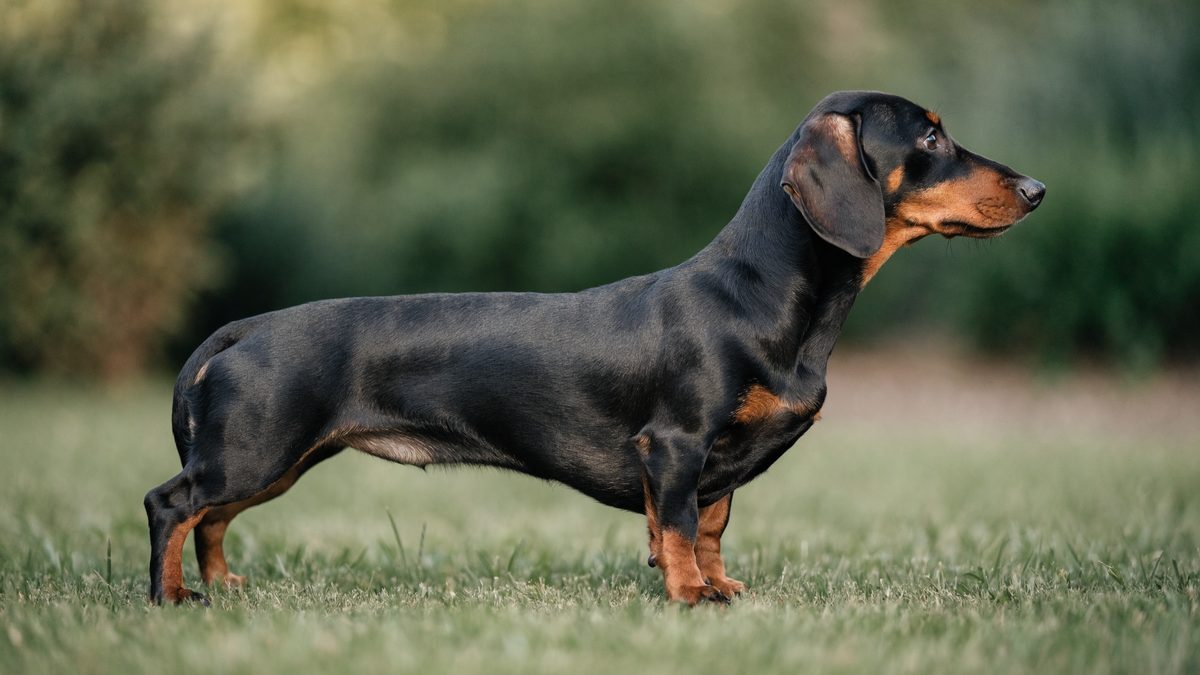
A Dachshund is a German badger hound built long and low on purpose, and that single design decision drives almost everything else on this page, from the price premium sellers charge for rare colours to the spinal condition that shortens the breed's life. The word is German for badger dog, and the breed was developed to dig into a badger den and take on what it found there.
The UK Kennel Club breed standard, last updated 1 April 2025, is more careful about the shape than most buyers realise. It calls for a dog moderately long in proportion to height, with no exaggeration, a compact well-muscled body, and ground clearance not less than one quarter of the height at the withers so the dog can move freely. Height at the withers should be half the length of the body measured from breastbone to the rear of the thigh. A Dachshund whose chest skims the floor is not a better Dachshund. It is a dog bred away from its own standard.
The breed comes in two sizes in the UK and three coat types, and the six resulting varieties all share a single breed standard divided by size and coat. In Germany there are three sizes rather than two, standard, miniature and Kaninchen or rabbit dog, all defined by measuring the circumference of the chest. Indian sellers almost never mention the Kaninchen, and the word "toy Dachshund" that appears in Indian listings is not a size recognised by either registry.
| Attribute | UK Kennel Club | American Kennel Club |
|---|---|---|
| Standard weight | Ideal 9 to 12 kg (20 to 26 lb) | Usually 16 to 32 lb, roughly 7 to 14.5 kg |
| Miniature weight | Ideal 4.5 kg (10 lb), desired maximum 5 kg (11 lb) | 11 lb and under |
| Height, standard | Not specified as a number; withers about half the body length | 8 to 9 inches |
| Height, miniature | Not specified as a number | 5 to 6 inches |
| Sizes recognised | Two in the UK, three in Germany including Kaninchen | Two |
| Coat types | Smooth, long, wire, giving six varieties | Smooth, wirehaired, longhaired |
| Life expectancy quoted | Over 12 years | 12 to 16 years |
Read those two columns side by side and you can see why Indian listings quote such different weights. The AKC standard band starts lower and ends higher than the Kennel Club ideal, so a 15 kg Dachshund is oversize under one standard and inside the range under the other. Bonbeno prints both rather than averaging them into a number neither registry publishes.
The gene that made the shape
The short legs are not a matter of selective breeding for proportion alone. Chondrodystrophy in dogs is defined by dysplastic, shortened long bones and premature degeneration and calcification of the intervertebral discs, and a 2017 genome-wide study identified an FGF4 retrogene on canine chromosome 12 as the cause. The same retrogene that segregated with limb length carried an odds ratio of 51.23 (95 percent CI 46.69 to 56.20) for intervertebral disc disease. The leg length and the disc disease are the same mutation. You cannot buy one without the other, and no breeder can promise otherwise.
Here is the correction that reframes everything Indian pages say about this breed. Dachshund Health UK's IVDD site puts it as a question. "Did you know the Dachshund is a short-legged breed, not a long-backed one? It's the genetics of short legs that pre-dispose Dachshunds to back disease";. Every Indian page attributes the breed's spinal risk to the long body. The breed's own health charity says the causal factor is the short legs, because the discs in the spine calcify at a much younger age than in normal-legged breeds of dog Dachshund IVDD UK, Lifestyle Advice. That is not a semantic quibble. It changes what you screen for, because you screen the discs rather than measure the back.
That is why this page treats the Dachshund as a chondrodystrophic breed first and a small companion dog second. Every practical recommendation below, on feeding, on exercise, on how you lift the dog, follows from it.
Temperament in the breed standard's own words
The Kennel Club standard describes the Dachshund as intelligent, lively, courageous to the point of rashness, obedient, with an excellent nose and the persevering nature of a hunter and tracker. Temperament is listed as faithful, versatile and good tempered. The AKC adds the part buyers notice at home. Smart and vigilant, with a big-dog bark, these dogs make fine watchdogs, and having been bred to be an independent hunter of dangerous prey they can be brave to the point of rashness and a bit stubborn.
Note what is missing from both descriptions. Nothing in either standard describes a lap dog. The compact size is a by-product of going to ground after badgers, not a design goal for apartment living, and the difference shows up in the training and exercise sections below.
The Dachshund was developed in Germany more than 300 years ago to hunt badgers, from dachs meaning badger and hund meaning dog, and in its native country it is still called the Teckel. It is still used for tracking wounded game such as deer and for going to ground after badger or rabbits. A dog with 300 years of underground hunting behind it will dig up your balcony planters. That is not a behaviour problem.
Dachshund price in India
A Dachshund puppy is published in India at anywhere from Rs 5,000 to more than Rs 1,00,000 in 2026, and the single most useful fact about that range is that the sources disagree by roughly twenty times for the same breed. This is the widest published spread Bonbeno has recorded on any breed page so far, wider in relative terms than the Siberian Husky, and nobody is auditing any of it.
Bonbeno pulled the puppy price bands published by every Indian page ranking or listing for this query and set them side by side. Read them together rather than one at a time.
| Source | Headline range | Pet or basic quality | KCI registered | Show or champion line |
|---|---|---|---|---|
| Asia Pets | Rs 5,000 to Rs 20,000 | Not tiered | Not stated | Not stated |
| Marshalls Petzone | Rs 7,000 to Rs 9,000 | Not tiered | Not stated | Not stated |
| Wrapinfur | Rs 8,000 to Rs 90,000 and above | Rs 8,000 to Rs 15,000 | Rs 30,000 to Rs 50,000 | Rs 50,000 to Rs 90,000 and above |
| HappyPet | Rs 10,000 to Rs 30,000 | Not tiered | Not stated | Not stated |
| Supertails | Rs 15,000 to Rs 80,000 | Rs 15,000 to Rs 25,000 | Rs 25,000 to Rs 50,000 | Rs 45,000 to Rs 80,000 |
| Mr n Mrs Pet | Rs 25,000 to Rs 1,00,000 and above | Rs 25,000 to Rs 50,000 | Rs 50,000 to Rs 75,000 | Rs 75,000 to Rs 1,00,000 |
The disagreement is not a rounding difference. Mr n Mrs Pet's floor of Rs 25,000 is higher than Asia Pets' ceiling of Rs 20,000 Asia Pets, Dachshund, Breed Information. What one page calls a basic pet-quality Dachshund at Rs 25,000 to Rs 50,000 is what another page calls a KCI registered dog at Rs 30,000 to Rs 50,000. Supertails puts KCI registered dogs at Rs 25,000 to Rs 50,000, which sits entirely below Mr n Mrs Pet's KCI band of Rs 50,000 to Rs 75,000 Mr n Mrs Pet, Dachshund Puppies For Sale…. The same three words, KCI registered Dachshund, describe a Rs 25,000 dog on one page and a Rs 75,000 dog on another.
A separate Supertails index of Indian dog prices lists the Dachshund at Rs 15,000 to Rs 50,000 and calls the breed quite affordable, which does not match the same publisher's dedicated Dachshund page ceiling of Rs 80,000. Bonbeno prints that internal inconsistency rather than quietly picking the more convenient of the two.
City-wise price, and how much weight to give it
Two publishers give a city-wise price breakdown, and they do not agree either.
| City | Supertails | Wrapinfur |
|---|---|---|
| Mumbai | Rs 25,000 to Rs 55,000 | Rs 15,000 to Rs 35,000 |
| Delhi and NCR | Rs 25,000 to Rs 55,000 | Rs 12,000 to Rs 30,000 |
| Bengaluru | Rs 20,000 to Rs 50,000 | Rs 12,000 to Rs 28,000 |
| Hyderabad | Rs 20,000 to Rs 50,000 | Rs 10,000 to Rs 25,000 |
| Chennai | Rs 18,000 to Rs 45,000 | Rs 12,000 to Rs 30,000 |
| Kolkata | Rs 18,000 to Rs 45,000 | Rs 8,000 to Rs 22,000 |
| Pune | Rs 18,000 to Rs 45,000 | Not listed separately |
| Tier-2 and smaller cities | Rs 15,000 to Rs 35,000 | Rs 8,000 to Rs 18,000 |
A third source, Mr n Mrs Pet, publishes the identical band of Rs 25,000 to Rs 1,00,000 for Hyderabad, Bangalore, Delhi, Chennai, Lucknow, Mumbai, Jaipur and Pune without variation. A city table where every city carries the same number is a template, not a market survey. Treat all three as one publisher's estimate each, and treat the gap between them as the real finding.
What the puppy price is actually tracking
- KCI registration. Every tiered source charges more for a Kennel Club of India registered dog, with the premium running from roughly Rs 15,000 to Rs 25,000 depending on whose table you read Wrapinfur, Dachshund Dog in India: Price. KCI registration documents pedigree. It is not a health certificate, and it does not mean either parent was screened for anything.
- Coat type. Long-haired dogs are quoted at a premium of Rs 3,000 to Rs 8,000 over smooth, and wire-haired at Rs 5,000 to Rs 12,000, on the stated logic that the grooming is more complex. The wire coat premium is the one with a real basis, because a wire coat needs plucking or hand-stripping several times a year.
- Colour and pattern. Dapple is quoted at Rs 40,000 to Rs 70,000 and piebald at Rs 35,000 to Rs 65,000, against standard reds and black-and-tans at the bottom of the range. This is the premium that deserves the most scrutiny, and the next box explains why.
- Size. Miniatures and standards are priced similarly by most Indian sellers, which is odd given that the two sizes carry measurably different IVDD risk and different recorded lifespans. Nothing in the Indian pricing reflects that.
- Who is publishing. Four of the six sources in the table above sell or broker puppies directly Asia Pets, Dachshund, Breed Information Supertails, Dachshund Price in India 2026. That is a commercial interest in the number, disclosed here because none of those pages discloses it itself.
Under the Kennel Club breed standard, double dapple, Isabella, blue and all other colours or patterns including piebald and tricolour are unacceptable. The Kennel Club's non-breed-standard colour list for this breed names Blue and Tan, Isabella and Cream, Red Piebald, Black and Tan Piebald and more. With effect from 1 January 2010 the Kennel Club will not register any Dachshund puppies from matings where both parents are dapple, because of the associated health risks of impaired vision and hearing linked to the dapple gene in this breed. An Indian seller quoting Rs 40,000 to Rs 70,000 for a dapple, or Rs 35,000 to Rs 65,000 for a piebald, is charging a premium for a pattern the recognising registry either restricts or refuses. Supertails itself warns that a responsible breeder will never produce a double dapple. Bonbeno goes further. Treat any listing that advertises double dapple as a reason to walk away, not a reason to pay more.
Under the Animal Welfare Board of India's Dog Breeding and Marketing Rules, all breeders of dogs must be registered with the AWBI, and breeding without registration is an offence that can result in confiscation of breeding stock and puppies as well as a fine of up to Rs 5,000 per un-sterilized bitch. Registration costs Rs 500 per animal registered. A Rs 7,000 puppy is being sold below the cost of doing this legally. That is worth knowing before you treat the low end of the price table as a deal.
Bonbeno does not broker puppy sales and does not publish breeder listings. Every figure above is reported from a third party so you can see the disagreement yourself and price it into your own decision.
Monthly cost of owning a Dachshund in India
Published Indian monthly running costs for a Dachshund sit between Rs 2,200 and Rs 7,700, and the four sources that publish a monthly cost agree more closely than the six that publish a purchase price. The number none of them publishes is the one that matters most, which is what spinal surgery costs in India.
Start with the recurring monthly figure, which is genuinely modest for a small dog.
| Line item | Supertails | Wrapinfur | HappyPet |
|---|---|---|---|
| Food | Rs 1,900 to Rs 3,800 | Rs 1,500 to Rs 3,000 | Rs 1,200 to Rs 1,800 |
| Grooming | Rs 300 to Rs 900 | Rs 300 to Rs 800 | Rs 700 to Rs 1,200 |
| Veterinary and supplements | Rs 500 to Rs 1,200 | Rs 800 to Rs 2,000 | Rs 300 to Rs 750 |
| Flea and tick prevention | Rs 400 to Rs 700 | Included in vet care | Not itemised |
| Treats | Rs 300 to Rs 600 | Not itemised | Not itemised |
| Toys, accessories and enrichment | Rs 200 to Rs 500 | Rs 600 to Rs 1,600 | Not itemised |
| Stated monthly total | Rs 3,600 to Rs 7,700 | Rs 3,200 to Rs 7,400 | Rs 2,200 to Rs 3,750 |
Mr n Mrs Pet publishes a fourth figure of Rs 3,000 to Rs 7,000 a month covering quality food, grooming, vet visits and routine care. Three of the four totals overlap heavily in the Rs 3,000 to Rs 7,700 band. HappyPet's lower ceiling comes from a smaller food allowance, at Rs 1,200 to Rs 1,800 against Supertails' Rs 1,900 to Rs 3,800 Supertails, Dachshund Price in India 2026. None of the four states a sample size or a collection method, so none of them is a survey result.
The first-year setup, itemised
| Item | Published estimate |
|---|---|
| Vaccination course | Rs 3,000 to Rs 5,000 |
| Spay or neuter | Rs 3,500 to Rs 8,000 |
| Orthopedic dog bed | Rs 1,500 to Rs 4,000 |
| Harness and leash | Rs 800 to Rs 2,000 |
| Dog ramp or pet stairs | Rs 1,500 to Rs 4,000 |
| Bowls and elevated stand | Rs 500 to Rs 1,500 |
| Carrier | Rs 1,500 to Rs 3,500 |
| Toys and enrichment | Rs 1,000 to Rs 2,500 |
| Stated setup total | Rs 13,300 to Rs 30,500 |
The harness line deserves a caveat that no Indian page gives it. Indian sources recommend a harness to reduce pressure on the neck and back, and the setup cost is Rs 800 to Rs 2,000. The evidence does not support treating it as an IVDD measure. The DachsLife survey found no significant difference in IVDD odds between collar users and harness users, at odds ratios of 0.70 and 1.06 against dogs using neither, and Dachshund Health UK reports that dogs over the age of 3 exercised in harnesses were 2.3 times more likely to have suffered an IVDD incident than those exercised in collars, while stating plainly that this does not imply causation and probably reflects owners switching to a harness after an incident. Their conclusion is the one to act on. Since 90 to 95 percent of all Dachshund disc herniations occur in the middle to lower back rather than the neck, it seems unlikely that walking a Dachshund in a collar increases its risk of back problems. Buy a harness if it suits your dog and your handling, and buy it knowing it is a comfort and control choice rather than a spinal insurance policy.
The cost nobody publishes
No published Indian figure exists for the cost of decompressive spinal surgery in a Dachshund. Bonbeno searched the Indian pages ranking for this breed and none of them prices a hemilaminectomy, an MRI, or post-operative rehabilitation, even though the same pages describe IVDD as the breed's defining condition. That silence is the biggest gap in the Indian Dachshund literature and this page will not fill it with an invented number.
What can be stated from evidence is the scale of the exposure. In the DachsLife 2015 survey of 310 veterinarian-diagnosed cases, the diagnostic route included MRI in 39.0 percent of cases, plain radiography in 38.1 percent, myelography in 13.9 percent and CT in 13.2 percent. An MRI plus surgery plus hospitalisation is not a Rs 5,000 event in any Indian metro. If you are budgeting for this breed, budget for advanced imaging and referral neurology as a realistic possibility somewhere around the middle of the dog's life, because the mean age at diagnosis in that survey was 5.42 years.
When we publish cost figures we state the sample size, the cities covered and the collection date. Where several published sources disagree, as they do on purchase price here, we print all of them rather than averaging them into a number no source supports. Where no figure exists at all, as with Indian spinal surgery pricing, we say so plainly instead of guessing. See our testing method for what a Bonbeno cost figure does and does not claim.
Climate suitability: why heat tolerance is rated 3 of 5
Bonbeno rates the Dachshund 3 of 5 for heat tolerance, which is the middle of our scale and well above the Arctic imports, because a smooth-coated hound sheds heat far better than a double-coated one. The rating is not higher because the two things that raise heat stroke risk most in this breed, weight gain and humid coastal air, are exactly the two things Indian Dachshund households get wrong.
Purina India lists the factors that increase heat stroke risk in dogs, and four of the eight apply directly to a typical Indian Dachshund household. They are lack of water, enclosed space, excessive humidity, obesity, intense exercise, old age, cardiovascular or respiratory disease, and lack of acclimatisation. Purina names short-faced breeds and heavy-coated breeds as the two categories at particular risk, and the Dachshund is neither. That is the good news, and it is real.
The risk that remains is behavioural rather than anatomical. Purina notes that a dog can develop heat stroke in as little as 30 minutes of vigorous exercise in hot weather, and this is a breed that will follow a scent past the point of sense.
The temperature bands that decide your day
| Ambient temperature | Risk level | What it means in practice |
|---|---|---|
| Below 28 C | Low | Normal activity with shade and water |
| 28 to 35 C | Moderate | Shorten walks to 15 to 20 minutes, early morning and late evening only |
| 35 to 42 C | High | Outdoor activity contraindicated. Asphalt reaches 60 C and above |
| Above 42 C | Extreme | Heat stroke possible within 10 to 15 minutes outdoors. Indoor temperatures without cooling can be fatal |
Humidity changes that arithmetic completely. A 35 C day at 90 percent humidity is more dangerous than a 42 C day at 20 percent humidity, because panting works by evaporation and humid air blocks it. Chennai, Mumbai and Kolkata in monsoon are therefore harder on a Dachshund than the thermometer suggests, and the moderate temperature reading is exactly what lulls owners into a long walk.
One India-specific point about ground clearance
Here is a piece of reasoning Bonbeno flags clearly as reasoning rather than as a finding. Asphalt in direct Indian sun reaches 60 C and above, and grass runs 10 to 15 C cooler than asphalt in the same sun. The Kennel Club standard requires ground clearance of not less than one quarter of the height at the withers, and the AKC lists standard Dachshunds at 8 to 9 inches tall and miniatures at 5 to 6 inches. A miniature Dachshund's chest therefore sits a few centimetres above a surface radiating at 60 C, far closer than a Labrador's does. No study has measured breed-level radiant heat load by height in dogs, so Bonbeno states this as a mechanical inference from two cited facts, not as a demonstrated risk. Route the walk over grass anyway.
- Do the 7-second pavement test before every summer walk. Place the back of your hand on the pavement for seven seconds. If you cannot hold it there, it will burn paw pads, with third-degree burns possible within about 30 seconds.
- Walk only before 7 am or after 8 pm from April to September, and cap the walk at 15 to 20 minutes even in those windows.
- Run fans or air conditioning continuously above 32 C indoors, because indoor temperature above 32 C is dangerous for a dog at rest.
- Never confine the dog to a balcony above 30 C. Concrete balconies are heat traps with no shade and no airflow.
- Refresh multiple water stations two to three times a day, since dehydration dramatically increases heat stroke risk.
- Keep the dog lean going into summer. Obesity is a named heat stroke risk factor and overweight dogs overheat two to three times faster than lean dogs.
Purina India lists the signs as severe panting, difficulty breathing, severe salivating, vomiting, diarrhoea, a raised temperature of 40.5 C or above, blood in the urine, nose bleeds, and ultimately collapse and coma. Move the dog into shade or air conditioning, spray or sponge with cool but not cold water making sure it reaches the skin, thoroughly wet the belly and inside the legs, and use a fan. Do not plunge the dog into cold water or an ice bath, which prevents the core temperature coming down. Stop cooling once the temperature returns to 39.4 C to avoid tipping into hypothermia, then get to a veterinarian immediately.
Monsoon is the season this breed actually struggles with
Drop ears plus humid air is the Indian Dachshund's real seasonal problem, and it is not heat. The AKC notes that like most dogs with drop ears, Dachshunds can get ear infections if their ears are not kept clean. An Indian breed guide makes the same point in local terms, that Dachshunds have floppy ears needing regular cleaning because dirt and debris collect and may cause ear infection. In a Mumbai or Kochi July, a wet ear that never fully dries is the setup. Check and dry both ears after every walk in the rain, and treat a head shake or a smell as a veterinary appointment rather than a wipe.
Skin is the second monsoon item. The DachsLife 2015 survey found that the most prevalent diagnosis in Dachshunds other than IVDD was skin allergies at 13.1 percent of 2,031 dogs, ahead of heart murmurs at 3.5 percent and arthritis at 3.1 percent. That is a UK population in a temperate climate. Indian humidity, tick pressure and fungal load push in the same direction, so budget the Rs 400 to Rs 700 a month that Indian sources allocate to flea and tick prevention rather than treating it as optional.
The Animal Welfare Board of India's breeding and marketing rules state that no animal may be transported in a vehicle where the temperature rises above 35 centigrade or falls below 5 centigrade, and animals being transported must be checked every two hours. Indian summer temperatures routinely exceed 45 C in the north. Sellers that deliver puppies by road across India, which is the stated model of at least one of the largest Indian puppy marketplaces, are operating against that ceiling for several months of the year. If you buy a puppy that has to travel, ask when it travels and in what, and be prepared to wait for winter.
Temperament and household fit
The Dachshund suits a household that wants a small, funny, opinionated hound and can tolerate noise, and it does not suit a household that wants a quiet, biddable lap dog because it is small. Every difficulty this breed presents in an Indian flat comes from what it was bred to do rather than from any flaw in character.
Both registries describe the same animal. The Kennel Club calls it intelligent, lively, courageous to the point of rashness and obedient, with temperament listed as faithful, versatile and good tempered. The AKC calls it smart and vigilant with a big-dog bark, brave to the point of rashness, and a bit stubborn. Put those together and you get a small dog with a large opinion and a working nose.
Three temperament facts drive most Indian rehoming conversations for this breed, and none of them is about aggression.
- It is vocal. Indian breed guides rate the Dachshund's barking level as high and note that without training it becomes a habit that creates problems in apartments or small homes. The AKC frames the same trait positively as a big-dog bark that makes them fine watchdogs. In a shared Indian building with common walls and a lift lobby, that is a neighbour conversation within weeks.
- It is stubborn. The AKC states it plainly. Dachshunds are very intelligent but are also independent and often stubborn, so they can be a challenge to train. Indian breed listings put stubbornness and difficulty in housetraining among the breed's main considerations.
- It digs. Asia Pets lists digging among the drawbacks of the breed, and this is a dog developed to dig its way into a badger den. Balcony planters, sofa cushions and any loose bedding are all fair game unless the dog gets a legitimate outlet.
Apartment reality
The UK Kennel Club lists the ideal home for this breed as a small house with a small or medium garden, and the breed as suitable for town or country. That is a materially easier specification than the large house it lists for the working breeds, and it is the strongest argument in the Dachshund's favour for Indian metros. Bonbeno rates apartment suitability 4 of 5 for this breed on that basis.
Size is not the constraint in an Indian flat. Noise is, and stairs are the second consideration, though not for the reason most Indian pages give. The health and common-mistakes sections below set out what the evidence actually shows about stairs, which is close to the opposite of the standard advice.
- Good fit. A household that is home much of the day, in a flat or small house, that wants a companion dog with personality and can commit to house training for months rather than weeks.
- Poor fit. A first dog for a household that works ten-hour days, a building with strict noise complaints, or a family expecting a low-effort small dog because the dog is physically small.
- Watch item. Supertails notes that Dachshunds can develop separation anxiety, particularly the miniatures. A vocal breed with separation anxiety in a shared building is the specific combination that ends Indian tenancies.
Children, and the honest version
Indian breed guides describe the Dachshund as a wonderful family pet that is loyal, playful and affectionate, while adding that supervised interactions with young children are necessary to prevent rough handling given the breed's delicate build. Bonbeno rates good-with-children 3 of 5 rather than higher for exactly that reason. The risk is not that the dog will hurt the child. The risk is that a six-year-old picking up a long-backed dog by the middle, or a toddler falling onto one, loads a spine that is already this breed's documented weak point.
Teach every person in the house one rule before the puppy arrives. You lift a Dachshund with two hands, one supporting the chest and one supporting the hindquarters, so the back stays level and never hangs. Nobody picks the dog up by the front legs or the armpits, and nobody carries the dog on a hip.
This is a scent hound with a strong prey drive, bred to stay focused and follow a trail without distraction, and the AKC warns that if the dog is busy with something more interesting it may not always pay attention to you. In an Indian park with street cats, food waste and open gates, that is a safety issue rather than a quirk. This is not an off-lead dog in an unfenced space, and no amount of recall training makes it one.
Training a Dachshund
Train a Dachshund with short, reward-based sessions and a long timeline for house training, because this breed is very intelligent, independent and often stubborn, and it will not respond to harsh handling. The AKC is blunt that Dachshunds can be a challenge to train, and that patience and consistency are the two things that decide the outcome.
The AKC's guidance is specific about method. Dachshunds love to give and receive affection and do best with positive, reward-based training. They are sensitive and will not react well to harsh commands or punishment. That is not a soft preference. A sensitive hound that is corrected harshly stops offering behaviour, and with a dog this independent you lose the only leverage you had.
The Kennel Club standard explains why the dog tunes you out. It describes an excellent nose and a persevering hunter and tracker, a dog especially suited to going to ground because of low build and very strong forequarters. You are asking a purpose-built underground hunter to ignore a scent trail. Sometimes it will.
The step Indian owners underestimate
House training is the realistic problem, not obedience. Indian breed listings name difficulty in housetraining among the breed's principal considerations. Two Indian conditions make it worse. Monsoon means weeks where the dog does not want to go outside, and apartment living means the toilet trip is a lift ride rather than a door. Plan for six months, not six weeks, and set up an indoor option before the first monsoon so the routine already exists when the rain starts.
| Skill | Start | Realistic outcome |
|---|---|---|
| Name response | Week 1 home | Reliable indoors in 2 to 4 weeks |
| Sit, down, settle | Week 1 home | 4 to 8 weeks with short daily sessions |
| Harness acceptance | Week 2 home | 2 to 4 weeks. Start before the first walk |
| House training | Week 1 home | 4 to 8 months, longer if the first monsoon lands mid-training |
| Ramp use onto sofa or bed | Month 2 | 2 to 6 weeks if trained as a game, not enforced as a rule |
| Loose-lead walking | Month 2 | 6 to 12 months, with ongoing maintenance |
| Quiet on cue | Month 3 | Partial. Alert barking is breed-typical |
| Reliable recall off-lead | Month 3 | Never treat as reliable in an unfenced space |
Socialise early, and make the ramp part of it
Socialise the puppy across lifts, traffic, tiled and marble floors, groomers, veterinary handling and other dogs before the socialisation window closes, and book that exposure into the cool hours the same way you book walks. Add one item to the usual list for this breed. Teach the ramp during the socialisation window, while everything is new and nothing is frightening, rather than after an episode of back pain when the dog already associates the sofa with being hurt.
Train the pick-up too. A dog that has been lifted correctly a hundred times as a puppy will hold still for a veterinarian at five years old, and a dog that has learned to squirm will not.
In the DachsLife 2015 survey, Dachshunds that had completed the Kennel Club Good Citizen Dog Scheme had lower odds of IVDD, at an odds ratio of 0.46 (95 percent CI 0.26 to 0.81), and dogs shown at Kennel Club Championship shows had an odds ratio of 0.21 (95 percent CI 0.11 to 0.41). Do not read that as training preventing disc disease. The authors offer several alternative explanations, including that dogs which experience an IVDD episode stop being shown, which biases the show population toward unaffected dogs. Bonbeno prints the association and the authors' own caveat together, because printing only the number would be misleading.
The practical training conclusion for India is unglamorous. Two short sessions a day, food rewards, a harness rather than a collar, a ramp taught as a trick, and a household rule that nobody ever shouts at this dog. Everything else is patience.
How much exercise a Dachshund actually needs
The UK Kennel Club puts the Dachshund's requirement at up to one hour of exercise per day, and the peer-reviewed evidence suggests that number is a floor rather than a ceiling for spinal health. Indian pages routinely publish 20 to 30 minutes, and that gap is the most consequential error in the Indian Dachshund literature.
Look at what the published sources actually say, side by side.
| Source | Stated daily requirement |
|---|---|
| UK Kennel Club | Up to 1 hour per day |
| American Kennel Club | Two walks every day of moderate length |
| Dachshund Club of America | A daily routine of on-leash walks and free play |
| HappyPet, India | At least 1 hour for standards, minimum 30 minutes for miniatures |
| Supertails, India | Regular exercise, framed as the right kind rather than a duration |
| Wrapinfur, India | 20 to 30 minutes |
Why the low Indian number is the dangerous one
This is where Bonbeno departs from every page ranking for this query. The DachsLife 2015 survey of 2,031 Dachshunds measured exercise duration against IVDD diagnosis and found a clear gradient in the wrong direction for short walks.
| Category | Odds ratio for IVDD | 95 percent CI | p value |
|---|---|---|---|
| Less than 30 minutes exercise daily | 2.49 | 1.85 to 3.52 | Under 0.001 |
| 30 minutes to 1 hour daily | 1.17 | 0.90 to 1.52 | 0.257 |
| Over 1 hour daily | 0.50 | 0.39 to 0.64 | Under 0.001 |
| Owner-rated highly active | 0.140 | 0.07 to 0.27 | Under 0.001 |
| Owner-rated moderately active | 0.264 | Reported as 1.45 to 0.47 in the source table | Under 0.001 |
| Owner-rated not at all active | 1 (base) | Reference category | Under 0.001 |
Read the two ends of that table together. Dogs walked under 30 minutes a day carried roughly five times the odds of the dogs walked over an hour a day, and owner-rated highly active dogs sat at an odds ratio of 0.140 against inactive dogs. A large independent US dataset points the same way. The Dog Aging Project analysis of 43,517 companion dogs found that higher daily active time was associated with reduced odds of owner-reported IVDD.
The DachsLife authors raise the obvious objection themselves. It is possible that this is a case of reverse causality, and that owners of dogs which experienced an episode of IVDD subsequently exercised them less. They also offer a mechanism that runs the other way, that dogs receiving more exercise have a correspondingly increased level of musculature that supports the spine, and that increased exercise duration may improve disc nutrition, since nutrient diffusion into the disc is believed to be facilitated by moderate intermittent hydrostatic pressure during physical activity. Bonbeno's position is that both readings support the same practical instruction. Do not use the fear of back injury as a reason to under-exercise a Dachshund.
What an Indian day actually looks like
- Two structured walks a day, before 7 am and after 8 pm from April to September, totalling around an hour for a standard and 30 to 45 minutes for a miniature HappyPet, Complete Breed Information….
- Walk on grass or dirt rather than asphalt, which is both a heat measure and a joint measure, since grass runs 10 to 15 C cooler in the same sun.
- Add scent work indoors on days the weather closes the outdoors. Twenty minutes of nose work tires a scent hound bred to follow a trail without distraction, and it runs in an air-conditioned room.
- Skip repetitive high-impact jumping games such as fetch up a staircase or leaping for a toy, which load the spine without building the supporting musculature that steady walking does.
- Build a puppy up gradually. The Dachshund Club of America advises caution when exercising a puppy and gradually building activity level until it is a year old, when bones and muscles are more developed.
- Weigh the dog monthly and treat any upward drift as an exercise problem before it becomes a feeding problem.
A Dachshund that does not get its outlet redirects the energy into the house, and the Indian failure pattern is predictable. Digging at floors and furniture, sustained alert barking, and destroyed cushions. That is an under-employed hunting dog doing the only job available, and the fix is a longer walk rather than a stricter rule.
Grooming three different coats in Indian humidity
Groom a Dachshund according to its coat type rather than to a single breed rule, because the smooth, long and wire varieties need genuinely different work. The UK Kennel Club sets the baseline at once a week, and Indian humidity adds ear and skin checks that no overseas guide mentions.
The AKC describes Dachshunds as moderate shedders, relatively clean, with little or no body odour, and sets out how the three coats differ. Smooth-coated Dachshunds are somewhat wash and wear, needing little beyond a wipe with a towel or hound glove. Longhaired Dachshunds may require more frequent brushing depending on the thickness of the coat. The wirehaired coat can be plucked or hand-stripped several times a year to look its best, and beyond that is easy to maintain between groomings with occasional trimming of the beard and eyebrows and brushing or combing once or twice a week. All Dachshunds should have their nails trimmed every month.
| Coat type | DIY monthly cost | Professional add-on |
|---|---|---|
| Smooth | Rs 150 to Rs 400 | Rs 300 to Rs 600 every 2 months |
| Long-haired | Rs 300 to Rs 600 | Rs 500 to Rs 900 every 6 to 8 weeks |
| Wire-haired | Rs 300 to Rs 600 | Rs 600 to Rs 1,200 every 8 to 12 weeks |
Indian sources put the general routine at brushing two to three times a week and bathing every three to four weeks, plus ear cleaning and nail trimming. That is a reasonable schedule for a smooth coat in a dusty Indian city, and it is not enough for a long coat in monsoon.
The wire coat problem specific to India
Hand-stripping is the honest gap. The wire coat is meant to be plucked or hand-stripped several times a year, and Indian sellers charge a premium of Rs 5,000 to Rs 12,000 for a wire-haired puppy partly on the basis that stripping or clipping is needed. Groomers who hand-strip are rare outside a handful of Indian metros, so most wire Dachshunds in India get clipped instead. Clipping is not wrong, but it softens the harsh outer coat over time and changes the texture the standard describes. Decide before you pay the wire premium whether you have a groomer who can maintain it, because a clipped wire coat in year three does not look like the puppy photograph.
The monsoon checklist that overseas guides skip
- Dry both ears after every wet walk. Drop-eared dogs get ear infections when the ears are not kept clean, and Indian guides note that dirt and debris collect in floppy ears and may cause infection. Use a vet-recommended ear cleaner rather than cotton buds.
- Dry the coat to the skin after a bath, especially on a long coat. A damp coat in humid weather is the main driver of hot spots.
- Check the belly and armpits weekly for skin irritation. Skin allergies were the most common non-IVDD diagnosis in the DachsLife survey at 13.1 percent, and Indian monsoon conditions do not help.
- Brush a long coat three or four times a week through monsoon, because mats trap moisture against the skin.
- Keep flea and tick prevention continuous rather than seasonal, at the Rs 400 to Rs 700 a month Indian sources budget for it.
- Trim nails monthly. Long nails change how the dog loads its front assembly, which matters more on a dog built this way than on a leggy one.
- Clean the teeth at least once a week, which is the Dachshund Club of America's stated minimum.
A smooth-coated Dachshund is one of the lowest-maintenance coats an Indian household can own. Moderate shedding, little or no body odour, and a towel wipe most days. If grooming load is the deciding factor between this breed and a longer-coated small dog, the smooth Dachshund wins comfortably, and it is also the cheapest of the three coats to keep.
Health issues, IVDD and lifespan
One condition dominates Dachshund health, and it is intervertebral disc disease. Dachshund Health UK states that IVDD is by far the most common health problem in UK Dachshunds and that around 1 in 4 may be affected at some stage in their lives. Everything else in this section is secondary to that number, and the Indian pages that mention back problems in one line are under-reporting the single most important fact about the breed.
How common IVDD actually is, source by source
Published prevalence figures differ, and the differences are methodological rather than contradictory. Print them together.
| Source | Figure | What it is measuring |
|---|---|---|
| Dachshund Health UK | Around 1 in 4 affected at some stage | Breed health charity summary of UK dogs |
| Published literature via DachsLife | 19 to 24 percent showing clinical signs in a lifetime; relative risk 10 to 12 times other breeds | Prior studies summarised in a peer-reviewed paper |
| DachsLife 2015, 2,031 dogs | 15.7 percent (95 percent CI 14.1 to 17.3) | Owner-reported, veterinarian-diagnosed cases only |
| Dog Aging Project, 43,517 dogs | 15.3 percent lifetime prevalence in Dachshunds (83 of 541) | Owner-reported IVDD in a US companion dog cohort |
| Dog Aging Project, all breeds | 1.2 percent lifetime prevalence (520 of 43,517) | The all-dog baseline for comparison |
| Insurance data cited in DachsLife | 24.4 percent of Miniature Dachshunds affected | Insurance claims, higher than survey data |
| Supertails, India | Approximately 25 percent | Unsourced editorial estimate |
The two large modern datasets land within half a percentage point of each other at 15.7 and 15.3 percent, despite being collected on different continents by different methods. Against an all-dog baseline of 1.2 percent, that is roughly a thirteen-fold difference. The Indian figure of approximately 25 percent that circulates on ranking pages is not wrong so much as unsourced, and it sits at the top of a range whose bottom is 15 percent.
Which variety, and this is the table no Indian page publishes
Risk is not evenly distributed across the six varieties, and the difference is large enough to change which dog you buy. DachsLife 2015 measured all six.
| Variety | Cases | Total dogs | Median age at onset | Prevalence | Odds ratio vs Standard Wire-Haired |
|---|---|---|---|---|---|
| Standard Smooth-Haired | 49 | 201 | 6.0 years | 24.4 percent (95 percent CI 22.51 to 26.29) | 4.19 (2.35 to 7.47) |
| Miniature Wire-Haired | 54 | 305 | 5.0 years | 17.7 percent (16.02 to 19.38) | 2.80 (1.59 to 4.91) |
| Miniature Smooth-Haired | 127 | 744 | 5.0 years | 17.1 percent (15.44 to 18.76) | 2.68 (1.60 to 4.48) |
| Miniature Long-Haired | 46 | 346 | 6.0 years | 13.3 percent (11.80 to 14.8) | 1.99 (1.13 to 3.53) |
| Standard Long-Haired | 16 | 127 | 6.0 years | 12.6 percent (11.14 to 14.06) | 1.87 (0.92 to 3.81), not significant |
| Standard Wire-Haired | 18 | 252 | 7.0 years | 7.1 percent (5.97 to 8.23) | 1 (base) |
A Standard Smooth-Haired Dachshund carried 4.19 times the odds of IVDD of a Standard Wire-Haired in that dataset, and 24.4 percent against 7.1 percent prevalence. Indian sellers price the smooth coat as the cheapest and the wire coat as the most expensive. On this evidence the Indian price ladder runs in the opposite direction to the risk ladder, and no Indian page mentions it.
The multivariable model held that pattern. Miniature Smooth-Haired dogs had 4.6 times the odds (95 percent CI 2.6 to 8.1), Miniature Wire-Haired 3.1 times (1.7 to 5.3) and Standard Smooth-Haired 4.5 times (2.4 to 8.4) compared with the Standard Wire-Haired.
A second, later survey by the Dachshund Breed Council reached the same conclusion about which variety is safest and a different conclusion about which is riskiest. In 2018, out of 1,173 Dachshunds over three years old, 21.1 percent were reported to have IVDD.
| Variety | Reported IVDD | Rank in the 2015 survey |
|---|---|---|
| Miniature Smooth Haired | 29.9 percent | Third highest at 17.1 percent |
| Smooth Haired | 16.8 percent | Highest at 24.4 percent |
| Miniature Wire Haired | 16.5 percent | Second highest at 17.7 percent |
| Miniature Long Haired | 15.7 percent | Fourth at 13.3 percent |
| Long Haired | 9.4 percent | Fifth at 12.6 percent |
| Wire Haired | 8.6 percent | Lowest at 7.1 percent |
Read the two surveys together rather than picking one. They disagree about whether the Miniature Smooth or the Standard Smooth carries the highest risk, at 29.9 percent against 16.8 percent in 2018 and 17.1 percent against 24.4 percent in 2015 Packer RMA, Seath IJ, O'Neill DG. They agree on the thing that matters. Both surveys put the Wire Haired varieties at or near the bottom, and both put smooth coats at the top. Bonbeno prints both rather than averaging them, because the disagreement is itself information about how noisy owner-reported breed data is.
There is a plausible genetic reason the wire coat sits low. A 2020 review of the genetics of intervertebral disc degeneration notes that the Wire Haired Dachshund was developed through crossbreeding with Schnauzer and Terrier breeds, which may explain the lower frequency of the CFA12 susceptibility locus and the lower incidence of IVDD in some wire haired populations. The same review describes the CFA12 retrogene as acting in a dominant manner, with heterozygous and homozygous dogs potentially having overlapping degrees of IVDD and calcification, which is part of why radiographic screening reduces disease slowly rather than quickly.
The genetics, and what screening exists
The mechanism is understood. An FGF4 retrogene on canine chromosome 12 causes both the shortened limbs and premature degeneration and calcification of the intervertebral discs, with an odds ratio of 51.23 (95 percent CI 46.69 to 56.20) for IVDD. Histological evidence of disc calcification has been reported in 46 to 48 percent of Dachshund intervertebral discs in earlier work.
That is why the screening programme is an X-ray rather than a DNA test. X-ray screening and back scoring has been used in Scandinavia for several years and is currently the best available tool to reduce the genetic risk of IVDD, and research there has shown a good correlation between calcification of the discs and clinical herniations when dogs are screened between the ages of 2 and 4. Since 25 May 2021 the UK screening programme has been managed by the Kennel Club, which lists spine screening using the IVDD scheme as a Good Practice test for the breed The Kennel Club, Breeds A to Z. Dachshund Health UK subsidises it by 100 pounds per dog, while the Kennel Club itself no longer offers a subsidy The Royal Kennel Club.
The scheme is worth understanding in detail, because it is the closest thing this breed has to a hip score and an Indian buyer can at least ask whether a breeder has heard of it. The dog must be between 24 and 48 months of age at the time of the X-ray, it is screened once and the result is valid for its entire lifetime, and the Kennel Club charges a 40 pound registration fee on top of the radiograph fee at a participating centre. The dog's Kennel Club registration certificate and microchip identification must match the details given at registration.
| Grade | Calcifications observed | What it means |
|---|---|---|
| Grade 0 | None | Lowest risk of clinical signs and of passing the disease to offspring |
| Grade 1 | One to two | Low but not zero |
| Grade 2 | Three to four | Higher risk |
| Grade 3 | Five or more | Highest risk of developing clinical signs and of passing it on |
The scheme's own breeding guidance is honest about its limits, and Indian readers should note the caveat as carefully as the grades. Even used responsibly, the guidance cannot guarantee that a puppy from grade 0 parents will be free of IVDD, and breeding appropriately from screened dogs reduces rather than removes the risk of producing affected puppies. A breeder promising an IVDD-free Dachshund is promising something the screening body explicitly says is not available.
There is no Indian IVDD screening programme, no Indian back-scoring database and no requirement on any Indian breeder to X-ray a Dachshund before breeding from it. The Kennel Club of India's registration certificate documents pedigree, not spinal calcification. That means an Indian buyer cannot verify the one thing that most predicts this breed's future, and should treat any seller who cannot discuss IVDD in detail as a seller who has not thought about it The Kennel Club, Breeds A to Z.
Conformation and body condition, where the studies disagree
Three good studies have looked at whether shape and weight change IVDD risk, and they do not fully agree. Bonbeno prints all three.
| Study | Population | Finding on body condition |
|---|---|---|
| Packer et al, PLOS ONE 2013 | 700 dogs at a UK referral hospital, 79 with thoracolumbar IVDE | Being overweight significantly increased IVDE risk, as did being skeletally smaller |
| DachsLife 2015 | 2,031 Dachshunds, owner survey | Body condition score was NOT found to be a risk factor in this study |
| Dog Aging Project, JAVMA 2025 | 43,517 US companion dogs | Overweight dogs had increased odds, OR 1.67 (95 percent CI 1.38 to 2.01) |
Two of the three found that weight matters and one did not. The DachsLife authors explain their own null result rather than burying it, noting that owners may have been unreliable in reporting body condition, or that the 5-point body condition score scale they used was not sensitive enough to differentiate dogs compared with the 9-point scale used previously. Bonbeno's reading is that the weight of evidence supports keeping a Dachshund lean, and that the one null finding is a measurement limitation rather than a licence to let the dog gain weight.
The conformation finding is more precise and more useful. Packer's 2013 study measured back length relative to height at the withers and found the ratio positively associated with risk. The probability of intervertebral disc extrusion was 0.30 for Miniature Dachshunds when the back length to height ratio equalled 1.1, compared to 0.68 when it equalled 1.5. The authors concluded that selection for longer backs and for miniaturisation should be discouraged in high-risk breeds. That is a direct scientific argument for buying the least exaggerated Dachshund you can find, and it lines up exactly with the Kennel Club standard's insistence on moderate length with no exaggeration and proper ground clearance.
In the DachsLife survey of 310 veterinarian-diagnosed cases, the causal disc was thought to be in the thoracolumbar region in 88.1 percent of cases, with 7.7 percent cervical, and the mean age at diagnosis was 5.42 years with a standard deviation of 2.40. This is a mid-life condition in the middle of the back. A five-year-old Dachshund that suddenly cries out, hunches, refuses to move or drags a hind leg is a same-day veterinary emergency, not a wait-and-see.
The other health issues worth screening for
- Skin allergies, 13.1 percent of dogs in the DachsLife survey, the most common diagnosis after IVDD.
- Heart murmurs, 3.5 percent, and arthritis, 3.1 percent in the same population. The Dachshund Club of America lists mitral valve disease among the breed's common conditions.
- Progressive retinal atrophy, cord1 type. The Kennel Club lists a DNA test for PRA(cord1) as a Best Practice test for the breed.
- Lafora's disease. The Kennel Club lists a DNA test for Lafora's specifically for Miniature Wire Haired Dachshunds. Ask about it if you are buying that variety.
- Eye disease generally. Eye testing under the BVA, Kennel Club and ISDS Eye Scheme is listed as Best Practice, and the AKC's national breed club recommends an ophthalmologist evaluation alongside a patella evaluation and a cardiac exam.
- Hemangiosarcoma and puppy strangles, both listed by the Dachshund Club of America among the breed's recognised conditions.
Lifespan, and a distribution that tells the real story
| Source | Figure | What it is measuring |
|---|---|---|
| American Kennel Club | 12 to 16 years | Breed-club expectation |
| Dachshund Club of America | 12 to 16 years | Breed-club expectation |
| UK Kennel Club | Over 12 years | Breed-club expectation |
| VetCompass raw data, 76 Standards | Mean 11.2 years, median age at death 12.3 years | Recorded deaths in UK primary veterinary care |
| VetCompass raw data, 103 Miniatures | Mean 10.2 years, median age at death 10.5 years | Recorded deaths in UK primary veterinary care |
| VetCompass all UK dogs | 11.23 years at age 0 (95 percent CI 11.19 to 11.27) | Life table from 30,563 recorded deaths |
| Asia Pets and HappyPet, India HappyPet, Complete Breed Information… | 12 to 16 and 12 to 15 years | Unsourced editorial estimates |
The recorded-death figures sit two to five years below the breed-club expectation, and the Miniature figure sits below the all-dog UK average of 11.23 years Teng KT, Brodbelt DC, Pegram C, Church DB. That alone corrects most Indian pages. But the distribution matters more than the average.
Dachshund Health UK analysed the age-at-death histograms in the VetCompass raw data and found that the Miniature distribution is bimodal, with a cluster of deaths between 5 and 8 years and a second cluster around 14 to 15 years. The charity's assessment is that the lower cluster is almost certainly caused by dogs being euthanised for back disease, and the higher cluster by conditions of old age. The Standard histogram shows fewer dogs dying young. Line that up against the mean age at IVDD diagnosis of 5.42 years and the picture is stark. A Dachshund does not usually live an averagely shortened life. It either avoids serious disc disease and lives to 14, or it does not and the story ends in the middle. Averages hide that completely, and no Indian page publishes it.
One further limitation deserves stating plainly. No Indian breed-level dataset exists for the Dachshund. There is no Indian equivalent of VetCompass, no Indian insurance morbidity series and no Indian IVDD registry, so every prevalence and lifespan figure on this page comes from UK or US populations. Indian conditions plausibly change some of them, particularly skin and ear disease, and nobody knows by how much. That gap is worth naming rather than papering over.
Feeding a Dachshund in India
Feed a Dachshund to a measured portion and keep it visibly lean, because the AKC states that it is extremely important that a Dachshund not be allowed to become overweight, not only for general health but to avoid strain on the long back which can lead to slipped or ruptured discs. In this breed, feeding is spinal management.
The Dachshund Club of America is equally direct on method. Dachshunds should always be fed on a schedule and never allowed to free feed, because with their ravenous appetites they can easily become overweight and at risk for the health issues associated with excess weight. The AKC adds the practical instruction. Give only the recommended amount from the manufacturer of a quality food, give table scraps very sparingly if at all, avoid cooked bones and high-fat foods, and keep food out of the dog's reach because the nose will find it.
Published Indian portions, where the two sources disagree
| Source | Miniature | Standard or adult | Monthly food cost |
|---|---|---|---|
| Supertails | 200 to 300 kcal per day | 400 to 600 kcal per day | Rs 1,900 to Rs 3,800 |
| HappyPet | Not split by size | Adults 600 kcal, puppies 1,000 kcal per day | Rs 1,200 to Rs 1,800 |
| Wrapinfur | Not stated in kcal | Not stated in kcal | Rs 1,500 to Rs 3,000 |
The two sources that publish calorie figures agree at the top of the adult range and diverge on puppies, and neither states the bodyweight the figure assumes HappyPet, Complete Breed Information…. Treat both as starting points to be adjusted against the dog in front of you rather than prescriptions, and set the actual number with a veterinarian who has weighed and examined your dog.
Body condition beats the bag
- Weigh the dog monthly and record it. A 500 g gain on a 5 kg miniature is a 10 percent change. On a 30 kg dog nobody would notice it.
- Score body condition by hand every week. Ribs should be easy to feel under light pressure, with a visible waist from above and a tuck-up from the side. Feed to the dog, not to the bag.
- Get the score verified by your vet rather than trusting your own eye. Dachshund Health UK's first two pieces of lifestyle advice are to keep the Dachshund fit not fat and to ask your vet to check whether it has an ideal body condition score, and it defines ideal as not too lean and not overweight. Owner-reported scores were unreliable enough that a 2,031-dog survey could not detect a body condition effect at all.
- Measure every meal with a scoop or a scale, never by eye, and split the daily ration across two meals for an adult.
- Feed on a schedule and remove the bowl afterwards. Free feeding is specifically warned against for this breed.
- Count treats into the daily ration, because Indian monthly budgets allocate Rs 300 to Rs 600 a month to treats and that is real energy.
- Treat weight gain as a spine issue, not a cosmetic one. Overweight dogs had 1.67 times the odds of IVDD in the largest US dataset, and being overweight significantly increased disc extrusion risk in the referral-hospital study.
- Treat weight gain as a heat issue too. Obesity is a named heat stroke risk factor, and overweight dogs overheat two to three times faster than lean dogs.
The supplement question, answered from the data
Glucosamine and chondroitin are widely sold in India as joint and back protection for this breed. The DachsLife 2015 survey looked at 18 diet, treat and supplement variables and found that dogs supplemented with glucosamine or chondroitin had increased odds of IVDD compared with dogs that were not. The authors are careful about what that means. These supplements are provided by owners as preventative measures for IVDD; however, to the authors' knowledge, their effect on disc degeneration has not been clinically reported, and only weak evidence exists to support a positive effect of glucosamine and chondroitin sulfate in dogs for the treatment of osteoarthritis.
The most likely explanation is reverse causality, that owners start supplementing after a diagnosis or a scare. Bonbeno's practical reading is narrower and safer. Do not buy a supplement as IVDD insurance. There is no evidence it prevents disc disease, and the money is better spent on a ramp, a harness and a longer walk. Discuss any supplement with your veterinarian rather than a shop.
Feeding quantities depend on the individual dog's age, weight, body condition and activity level. Set them with a registered veterinarian who has examined your dog, and review them at every annual wellness exam, which the Dachshund Club of America recommends at least once a year even when the dog appears in perfect health. Bonbeno reviews Indian pet food brands separately and tests products first-hand before publishing a verdict. See our testing method.
Dachshund puppy: the first year, month by month
A Dachshund puppy's first year in India is organised around four deadlines, which are the legal minimum sale age, the vaccination course, the socialisation window and the first monsoon. Plan the arrival date around the calendar rather than around the litter, and bring the puppy home in October or November if you have any choice.
October or November arrival gives the puppy the cool months for the socialisation window, house training and early lead work. It also means the first monsoon arrives when the dog is eight to ten months old and already toilet trained indoors and out, rather than at eight weeks old when a week of rain can undo a month of progress.
Know the legal floor before you agree a collection date. Under the Animal Welfare Board of India's rules, no puppies may be sold until they have reached 8 weeks of age and are fully weaned, all puppies must be microchipped before sale, and all puppies must get their first vaccination at 6 weeks of age against distemper, parvovirus, adenovirus and leptospirosis. Every puppy sold must come with a vaccination certificate signed by the breeder's registered veterinary doctor. A seller offering a six-week-old puppy is breaking the rules and telling you something about the rest of their operation.
| Age | Milestone |
|---|---|
| 6 to 8 weeks | First DHPP vaccine covering distemper, hepatitis, parvovirus and parainfluenza |
| 10 to 12 weeks | DHPP booster plus leptospirosis vaccine |
| 14 to 16 weeks | DHPP booster plus rabies vaccine |
| 6 months | Spay or neuter, described as recommended |
| 12 months | Annual DHPP and rabies boosters plus a full health examination |
Indian guides list spay or neuter at six months as a default. The DachsLife 2015 survey found neutered dogs at increased odds of IVDD, and the authors examine why. Some dogs were neutered after an IVDD event specifically to avoid breeding from them, which introduces reverse causality. They also note that of the 229 IVDD-affected dogs that had been neutered, the majority, 86.9 percent or 199 dogs, had been neutered before their first IVDD event, and raise the possibility of unidentified hormonal influences on IVDD risk. Dachshund Health UK turns that finding into an explicit recommendation, advising owners to allow the Dachshund to mature fully before considering neutering, unless there is a strong health reason to do it before 12 months. That is a direct conflict with the six-month default published on Indian pages. This is not a reason to skip neutering. It is a reason to discuss timing with your veterinarian for this specific breed rather than accepting a calendar default.
- 8 to 12 weeks. Home, name, crate, toilet routine, and the pick-up lesson from day one. Confirm the microchip number matches the paperwork. Start managed socialisation now rather than waiting for the last vaccine, and introduce a harness before the first walk.
- 3 to 4 months. Teething, so mouthing peaks. Vaccination course continues to 14 to 16 weeks. Introduce the ramp as a game while everything is still novel. Build the habit of walking only in the cool windows so it is normal by April.
- 4 to 6 months. Vaccination course completes. Loose-lead work in earnest. Exercise the puppy with caution and build activity gradually rather than adding distance quickly, since bones and muscles are not fully developed until a year old. Discuss neutering timing rather than booking it by default.
- 6 to 9 months. Adolescence, and the point at which the independent streak sharpens and recall gets worse. Hold the rule that this dog is never off-lead in an unfenced space. Keep weighing monthly, because this is when many Dachshunds quietly start gaining.
- 9 to 12 months. Move toward the adult exercise target of up to an hour a day, split across two cool-hour walks. Book the first full health examination at twelve months alongside boosters.
- 12 months onward. Annual wellness exam every year even when the dog looks perfect. If you intend to breed, note that the UK screening scheme X-rays dogs between the ages of 2 and 4, which is the window where disc calcification correlates best with clinical herniation.
The first summer and the first monsoon
Set the cooling plan up before the puppy's first April rather than during it. That means fans or air conditioning working, curtains blocking direct sun through peak hours, water stations refreshed two to three times a day, and a written fallback for power cuts. A puppy under six months has immature thermoregulation and is in an elevated risk category on its own.
For the first monsoon, decide in advance where the dog will toilet when the balcony is flooded and the lift lobby is wet, and buy the ear cleaner before you need it. House training that survives one Indian monsoon usually survives everything after it.
Miniature vs standard, and Dachshund vs Beagle
Choose a Standard Wire-Haired Dachshund if spinal risk is your deciding factor, and choose a Beagle or an Indian Pariah Dog if you want a small-to-medium companion without a chondrodystrophic spine at all. This is the comparison Indian buyers actually make, and the evidence points somewhere different from the sales copy.
Miniature vs standard, and a lifespan claim that does not survive checking
Indian pages sell the miniature as the apartment choice and the standard as the family choice. Set the published claims against the recorded data.
| Factor | Miniature | Standard |
|---|---|---|
| Weight, UK Kennel Club | Ideal 4.5 kg, desired max 5 kg | Ideal 9 to 12 kg |
| Weight, AKC | 11 lb and under | Usually 16 to 32 lb |
| Weight, Indian seller claim | Under 5 kg | 7 to 15 kg |
| Lifespan, Indian seller claim | 13 to 16 years | 12 to 14 years |
| Lifespan, UK recorded deaths | Mean 10.2 years, median 10.5 | Mean 11.2 years, median 12.3 |
| IVDD prevalence, smooth coat | 17.1 percent | 24.4 percent |
| IVDD prevalence, wire coat | 17.7 percent | 7.1 percent |
| IVDD prevalence, long coat | 13.3 percent | 12.6 percent |
| Conformation risk | Miniaturisation itself increased extrusion risk | Lower on the size axis, higher in the smooth variety |
Supertails states that miniatures typically live longer, at 13 to 16 years against 12 to 14 for standards. The VetCompass raw data runs the other way. Standards averaged 11.2 years with a median age at death of 12.3, while Miniatures averaged 10.2 years with a median of 10.5, across 76 Standards and 103 Miniatures. Dachshund Health UK notes this is the opposite of what would usually be expected of a smaller dog, and attributes it to the cluster of young deaths from back disease in Miniatures. Bonbeno prints both and tells you which one is a recorded outcome and which one is an editorial estimate. Sample sizes here are small, at under 200 dogs, so treat the direction as the finding rather than the exact years.
The genuinely useful conclusion from those two tables is not miniature or standard. It is coat variety. The Standard Wire-Haired sat at 7.1 percent prevalence with a median onset age of 7.0 years, while every other variety measured sat between 12.6 and 24.4 percent with onset at 5.0 to 6.0 years. If you have decided on a Dachshund and spinal risk is what worries you, the wire-haired standard is the variety the evidence favours, and it is the one Indian sellers charge the highest coat premium for.
Dachshund vs Beagle vs Indian Pariah Dog
The Beagle is the breed Indian buyers most often cross-shop against the Dachshund, and an Indian comparison already ranks for that query. Both are hounds with strong noses. Only one of them is chondrodystrophic.
| Factor | Dachshund | Beagle | Indian Pariah Dog |
|---|---|---|---|
| Origin | Germany, bred to hunt badgers underground | England, smallest of the British pack hounds | Indian subcontinent, native landrace |
| Build | Chondrodystrophic, long-backed and short-legged | Normally proportioned scent hound | Normally proportioned, medium build |
| Size, Indian comparison | Small | Medium | Medium |
| Exercise needs, Indian comparison | Low to moderate | High | Moderate, roughly an hour |
| Trainability, Indian comparison | Moderate | Easy | Moderate and highly adaptable |
| Barking level, Indian comparison | High | Moderate to high | Moderate |
| Defining health risk | IVDD, around 1 in 4 in UK dogs | Not a chondrodystrophic spine risk of this magnitude | Very low inherited disease burden |
| Heat tolerance, Bonbeno rating | 3 of 5 | Not yet rated on Bonbeno | 5 of 5 |
| Purchase cost in India | Rs 5,000 to Rs 1,00,000 and above Mr n Mrs Pet, Dachshund Puppies For Sale… | Comparable mid-market imported breed pricing | Usually free to adopt |
| Published monthly cost | Rs 2,200 to Rs 7,700 Supertails, Dachshund Price in India 2026 | Higher food volume for a larger dog | Substantially lower |
| Best for, Indian comparison | Apartments and small homes | Active families | Almost any Indian household |
The Indian Pariah Dog is a landrace rather than a registered breed with a kennel-club standard, and there is no breed-level epidemiology for it in the way there is for the Dachshund. Its figures here are observational and drawn from Bonbeno's own profile at Indian Pariah Dog rather than from a registry or an insurance dataset. The Beagle rows drawn from an Indian comparison article are that publisher's editorial assessment, not measured data. Bonbeno flags that asymmetry rather than presenting three equally evidenced columns.
Two other small breeds Indian buyers weigh against the Dachshund are worth naming for a different reason. The Pug and the Shih Tzu both carry brachycephalic airway compromise, which Purina India and Indian veterinary guidance both name as the highest heat stroke risk category AlcoVet Healthcare. On heat alone the Dachshund is the safer of those three choices in an Indian summer. On spine it is the riskiest. Pick the problem you are equipped to manage.
If neither trade-off appeals, the Indian Spitz is a small, heat-adapted, normally proportioned option, and the Labrador Retriever or Golden Retriever are the mainstream imports Indian families cross-shop when apartment size is not the constraint.
Mistakes Indian Dachshund owners actually make
The failure modes for this breed in India are specific, documented and mostly avoidable, and the first one on this list is a piece of advice that appears on nearly every page you will read. These are ranked by how much damage they do rather than by how often they are repeated.
- Treating "never stairs, never furniture" as settled prevention. The AKC states that to avoid injury you should never allow your Dachshund to run up and down stairs or jump on or off furniture. Two large datasets found the opposite association. In DachsLife 2015, dogs that were not allowed to jump on and off furniture had 3.16 times the odds of IVDD (95 percent CI 2.47 to 4.05), and dogs with no stairs each day had 1.46 times the odds (1.10 to 1.96) compared with dogs that used a flight of stairs daily. The Dog Aging Project found regular use of a staircase among the lifestyle factors associated with reduced odds of IVDD across 43,517 dogs. Both papers flag reverse causality, and DachsLife also offers the alternative that dogs which regularly jump may develop more adequate musculature supporting the spine. The breed's own health charity, which ran that survey, states the resulting position plainly. Its lifestyle advice is to keep your Dachshund fit not fat, adopt a mixed regime of on and off-lead exercise, increase exercise as the dog grows from puppy to adult, and avoid over-protection, because "over-protecting it and wrapping it in cotton wool to try to avoid a back problem will be no fun for you or your dog";. The charity is equally clear that association is not the same as causation and that its findings do not prove cause and effect. The defensible instruction is therefore narrower than the slogan, and the charity states it by life stage. A mature Dachshund that is well-muscled and in ideal body condition should be capable of tolerating the normal activities of day-to-day living, while puppies up to 12 months, dogs over 7 years, and any dog already diagnosed with disc degeneration or a previous IVDD incident are at higher risk and should be managed. Sudden shocks from jumping down do put extra stress on the spine, and there is always a risk of a fall, but the majority of reported cases of dogs going down with back problems are not directly attributable to an event such as running down stairs or jumping off furniture. A Scandinavian study found that moderate use of stairs reduced the risk of disc calcification, while exercise accompanying a cyclist increased it. So provide a ramp for high jumps such as a bed, restrict jumping for puppies, seniors and previously affected dogs, keep every dog fit and lean, skip the bicycle, and do not respond to the fear of injury by confining a healthy adult to one room.
- Under-exercising because the dog is small. An Indian guide publishes 20 to 30 minutes a day against the UK Kennel Club's up to one hour, and dogs walked under 30 minutes daily carried 2.49 times the odds of IVDD in the largest survey of the breed. This is the most consequential Indian error and it looks like caution.
- Paying a premium for double dapple, piebald, blue or Isabella. All four are unacceptable under the Kennel Club standard and appear on its non-breed-standard colour list, yet Indian sellers quote Rs 35,000 to Rs 70,000 for dapple and piebald puppies. The Kennel Club has refused to register puppies from dapple to dapple matings since 1 January 2010 because of impaired vision and hearing risks.
- Buying glucosamine or chondroitin as IVDD insurance. DachsLife 2015 found supplemented dogs at increased odds of IVDD and noted that no clinical effect on disc degeneration has been reported. Spend the money on a ramp and a longer walk.
- Free feeding. The Dachshund Club of America says Dachshunds should never be allowed to free feed because their ravenous appetites make them easily overweight, and overweight dogs carried 1.67 times the odds of IVDD in the Dog Aging Project data.
- Lifting the dog badly. Nobody in the household should pick a Dachshund up by the front legs or under the armpits. Support the chest with one hand and the hindquarters with the other so the back stays level, which is the position the breed standard describes as reasonably level with a slightly arched loin.
- Believing a harness protects the back. This one is a mistake in the opposite direction to the usual advice. Indian guides present a harness as back protection, but 90 to 95 percent of Dachshund disc herniations occur in the middle to lower back rather than the neck, so it seems unlikely that a collar increases back-problem risk, and harness-walked dogs over 3 were 2.3 times more likely to have had an IVDD incident in survey data, which the charity attributes to owners switching after a diagnosis rather than to the harness. Use a harness for comfort, control or a dog with a previous neck injury, on veterinary advice. Do not use it as a substitute for keeping the dog fit and lean.
- Buying from an unregistered breeder. All breeders of dogs in India must be registered with the Animal Welfare Board of India, and breeding without registration is an offence carrying confiscation and a fine of up to Rs 5,000 per un-sterilized bitch. Most Indian buyers never ask to see the registration.
- Accepting a puppy under eight weeks, or one shipped in peak summer. No puppy may be sold before 8 weeks of age and fully weaned, and no animal may be transported in a vehicle where the temperature rises above 35 centigrade. Indian summer road temperatures routinely exceed 45 C, and puppies are routinely shipped across India by marketplaces year-round.
- Ignoring the ears through monsoon. Drop-eared dogs get ear infections when ears are not kept clean, and Indian guides note dirt and debris collecting in floppy ears. A weekly ear check costs nothing and catches it early.
- Treating KCI papers as a health guarantee. A KCI certificate documents pedigree. The screening the Kennel Club lists as Good Practice for this breed is spine screening under the IVDD scheme, with PRA(cord1) and eye testing as Best Practice, and none of that is implied by an Indian registration certificate.
- Waiting overnight on back pain. Mean age at IVDD diagnosis is 5.42 years and 88.1 percent of cases are thoracolumbar. A sudden yelp, a hunched back, reluctance to move or a dragging hind leg is a same-day emergency.
The costliest mistake is buying on the purchase price and discovering the health exposure later. A national Indian price index lists the Dachshund at Rs 15,000 to Rs 50,000 and files it under small breeds, alongside the Chihuahua at the same band. At the bottom of that band the breed looks affordable, and it is, right up to the point where a roughly 15 percent lifetime chance of IVDD arrives in a condition whose diagnostic route involved MRI in 39.0 percent of surveyed cases. That mismatch between a low purchase price and an expensive tail risk, not cruelty, is what fills Indian rescue lists with adult small-breed dogs.
Adoption, responsible sourcing and how to verify a breeder
Adopt an adult Dachshund if you can find one, because adopting removes the two largest unknowns in a puppy purchase, which are adult temperament and early health history, and in this breed it also tells you whether the dog has already had a disc episode. If you buy instead, the verification list below is short and every item is checkable.
Start with what is not knowable. India publishes no shelter intake statistics by breed, no rehoming figures for imported breeds and no registry of Dachshund ownership, so nobody can honestly tell you how many Dachshunds are surrendered in India each year or why. Bonbeno states that limit rather than inventing a percentage, and will publish real numbers if and when an Indian shelter network releases them.
What can be said is that adoption is the route Indian sellers themselves nod to. Even a commercial puppy listing carries a "Consider Adoption" line above its price, and Mr n Mrs Pet runs a buy-or-adopt question in its own FAQ. Take that seriously rather than as decoration.
Adopting an adult Dachshund
- Ask whether the dog has ever had a back episode, at what age, how it was diagnosed and how it was treated. Mean age at diagnosis is 5.42 years, so an eight-year-old dog with no history is genuinely informative.
- Ask which variety it is. Coat and size change the risk picture materially, from 7.1 percent in Standard Wire-Haired to 24.4 percent in Standard Smooth-Haired.
- Get a veterinary examination before you commit, with particular attention to the spine, the ears and the skin, given that skin allergies were the most common non-IVDD finding at 13.1 percent.
- Weigh the dog and set a target weight with the vet on day one, because an overweight adult carries 1.67 times the odds of IVDD.
- Budget the same running cost as for a puppy. Adoption reduces the purchase price to near zero. It does not reduce the Rs 3,000 to Rs 7,700 a month Mr n Mrs Pet, Dachshund Puppies For Sale….
If you buy, verify these seven things
- Verify the breeder's AWBI registration. All breeders must be registered, registration costs Rs 500 per animal, and breeding without it is an offence. Ask to see the certificate and the registration number.
- Confirm the puppy is at least 8 weeks old and fully weaned. Ask for the date of birth in writing.
- Check the microchip. All puppies must be microchipped before sale and all breeding stock must be microchipped. Scan it in front of the seller and match the number to the paperwork.
- Ask for the signed vaccination certificate from the breeder's registered veterinary doctor covering distemper, parvovirus, adenovirus, influenza and leptospira.
- Ask about the parents' spines. There is no Indian screening scheme, so what you are really testing is whether the breeder knows that X-ray back scoring exists, that it is done between 2 and 4 years of age, and that it correlates with clinical herniation. A breeder who has never heard of it has not selected for it.
- Ask for eye testing and, for a Miniature Wire-Haired, the Lafora's DNA test result The Kennel Club, Breeds A to Z. The AKC's national breed club also recommends a patella evaluation and a cardiac exam.
- See the dam, and see the litter where it lives. The rules require that the veterinary doctor certify the mated animals were fit, healthy, of good sound temperament and free of major genetic problems, recorded in a stock register. An ethical breeder will show you the register. A broker will not have one.
A breeder worth buying from will raise IVDD before you do, will tell you which variety they breed and why, will discuss back length and ground clearance rather than only colour, and will ask you as many questions as you ask them. Supertails' own guidance says a responsible breeder is willing to answer all your questions about IVDD, diet and care and proactively shares this information. If the conversation is only about colour, price and delivery date, you are talking to a seller rather than a breeder.
One structural note for Indian buyers. In the UK, breeders can send a dog for X-ray screening and Dachshund Health UK will subsidise it by 100 pounds, with results recorded by the Kennel Club. India has no equivalent scheme, no subsidy and no national results database. Until one exists, the Indian Dachshund market is selecting on appearance and colour while the country with a scheme is selecting on spines. That is the honest state of play, and it is the strongest single argument for adopting an adult whose back history you can actually see.
Bonbeno does not sell animals and does not broker puppy sales. If you want a dog that suits Indian conditions by default, the Indian Pariah Dog is free to adopt, better adapted to the heat, and carries no chondrodystrophic spine risk at all.
Dachshund questions Indians actually search
What is the price of Dachshund in India?
Published Indian prices run from Rs 5,000 to more than Rs 1,00,000, and six sources disagree by roughly twenty times. Asia Pets publishes Rs 5,000 to Rs 20,000, Supertails Rs 15,000 to Rs 80,000, and Mr n Mrs Pet Rs 25,000 to Rs 1,00,000 and above. Bonbeno prints all of them rather than averaging them into a number no source supports.
How much does a Dachshund cost?
There is no reliable average, because the published bands do not overlap enough to produce one. Mr n Mrs Pet's floor of Rs 25,000 is higher than Asia Pets' ceiling of Rs 20,000, so any single average would sit outside at least one published range. Compare the tiers instead and ask what the seller is actually charging for.
What is the difference between a miniature and standard Dachshund?
The UK Kennel Club puts the miniature at an ideal 4.5 kg with a desired maximum of 5 kg, and the standard at an ideal 9 to 12 kg. The AKC uses 11 lb and under for miniatures and 16 to 32 lb for standards. Coat variety matters more than size for spinal risk, since Standard Wire-Haired dogs showed 7.1 percent IVDD prevalence against 24.4 percent in Standard Smooth-Haired.
What is IVDD and how common is it in Dachshunds?
Intervertebral disc disease is premature degeneration and calcification of the spinal discs caused by the same FGF4 retrogene that gives the breed its short legs, with an odds ratio of 51.23. Dachshund Health UK says around 1 in 4 UK Dachshunds may be affected. Two large surveys measured 15.7 percent and 15.3 percent prevalence against an all-dog baseline of 1.2 percent.
Are Dachshunds prone to back problems?
Yes, more than almost any other breed, and the mechanism is genetic rather than accidental. The FGF4 retrogene on canine chromosome 12 causes both the short legs and premature disc degeneration, carrying an odds ratio of 51.23 with a 95 percent confidence interval of 46.69 to 56.20. Around 88.1 percent of diagnosed cases involve the thoracolumbar region, at a mean age of 5.42 years.
Are Dachshunds good for apartments in India?
Yes on size and no on noise. The UK Kennel Club lists the ideal home as a small house with a small or medium garden, which is an easy specification for an Indian flat. Indian breed guides rate the barking level high and warn it becomes a habit in small homes, and Supertails notes separation anxiety particularly in miniatures.
Are Dachshunds suitable for the Indian climate?
Better than any double-coated import and worse than the marketing suggests. Purina India does not list Dachshunds among the high-risk short-faced or heavy-coated breeds, but it does name obesity, excessive humidity and intense exercise as heat stroke risk factors, and this breed gains weight easily. Bonbeno rates heat tolerance 3 of 5 for that reason.
Are Dachshunds easy to train?
No. The AKC states they are very intelligent but also independent and often stubborn, so they can be a challenge to train, and they are sensitive enough that harsh commands or punishment backfire. House training is the step Indian owners underestimate most, and Indian breed listings name it among the breed's main considerations. Plan for months, not weeks.
Which coat type of Dachshund sheds the least?
The smooth coat is the lowest-maintenance of the three, described by the AKC as somewhat wash and wear and needing little beyond a wipe with a towel or hound glove. All Dachshunds are moderate shedders with little or no body odour. The wire coat needs plucking or hand-stripping several times a year, which is hard to find outside a few Indian metros.
What do Dachshunds eat in India, and how much does it cost per month?
Published Indian food costs run Rs 1,200 to Rs 3,800 a month depending on brand and dog size. Supertails puts miniatures at 200 to 300 kcal a day and standards at 400 to 600 kcal, while HappyPet publishes 600 kcal for adults and 1,000 kcal for puppies. Neither states the assumed bodyweight, so set the actual portion with your veterinarian.
How much does it cost to maintain a Dachshund in India monthly?
Four published Indian estimates cluster between Rs 2,200 and Rs 7,700 a month covering food, grooming, veterinary care, parasite prevention and enrichment. None states a sample size or collection method. No Indian source publishes the cost of spinal imaging or surgery, which is the largest realistic one-off expense this breed carries.
How long do Dachshunds live in India?
No Indian lifespan data exists for this breed. UK VetCompass records give Standards a mean of 11.2 years and Miniatures 10.2 years, against breed-club expectations of 12 to 16 years. The Miniature age-at-death curve is bimodal, with a cluster of deaths at 5 to 8 years attributed to back disease and another at 14 to 15 years.
Should I buy or adopt a Dachshund?
Adopt an adult if you can find one, because it removes the two biggest unknowns in a puppy purchase and tells you whether the dog has already had a disc episode. India has no IVDD screening scheme, so a puppy's spinal risk is unverifiable at the point of sale, while an adult dog's back history is a fact you can ask about.
Is a Dachshund a good family dog?
Yes, with one physical rule. Indian breed guides describe the Dachshund as a loyal, playful and affectionate family pet, and both registries call it intelligent, lively and good tempered, but Bonbeno rates good-with-children 3 of 5 because of the back. The risk is not that the dog hurts the child; it is that a six-year-old lifting a long-backed dog by the middle, or a toddler falling onto one, loads a spine that is the breed's documented weak point. Teach everyone to lift with two hands, one under the chest and one under the hindquarters, and supervise small children.
Is a Dachshund a good pet?
For a household that wants a small, funny, opinionated hound and can tolerate noise, yes; for one that wants a quiet, biddable lap dog because it is small, no. The Kennel Club lists the ideal home as a small house with a small or medium garden, so Bonbeno rates apartment suitability 4 of 5, but three traits drive most Indian rehoming conversations: it is vocal, with a barking level rated high, it is stubborn and slow to house-train, and it digs. It suits a home where someone is in much of the day and does not suit a ten-hour workday or a building with strict noise complaints.
Compare with similar breeds
Dachshund sits in 3 Bonbeno groups. Each one compares it directly against the breeds it is genuinely an alternative to, on the same figures.