
Dog breed profile
Cardigan Welsh Corgi in India: Price, the Pembroke Difference and Full Breed Guide
The Corgi that was never docked, priced in India at four times its sibling and on the strength of paperwork that costs Rs 750, with 80 puppies registered in its home country last year and a blindness gene it gave to veterinary medicine.
Quick answer
No verified cardigan welsh corgi price in india exists. One vendor sets the band at Rs 3,50,000 to Rs 8,50,000, Google's AI Overview now repeats it, and the first listing under that heading describes a Pembroke. The breed itself is a 13.6 to 17.2 kg Welsh cattle dog, a Kennel Club vulnerable native breed with 80 UK registrations in 2025, and the only Corgi that was never docked.
This guide summarises published breed standards, registry data, peer-reviewed veterinary literature and Indian government texts as general information for Indian pet owners. It is not a diagnosis and it is not treatment advice. Consult a registered veterinarian near you before acting on anything you read here, and treat sudden hind limb weakness, collapse in heat, a painful back or any loss of vision as an emergency.
Cardigan Welsh Corgi at a glance, rated for India
What a Cardigan Welsh Corgi actually is
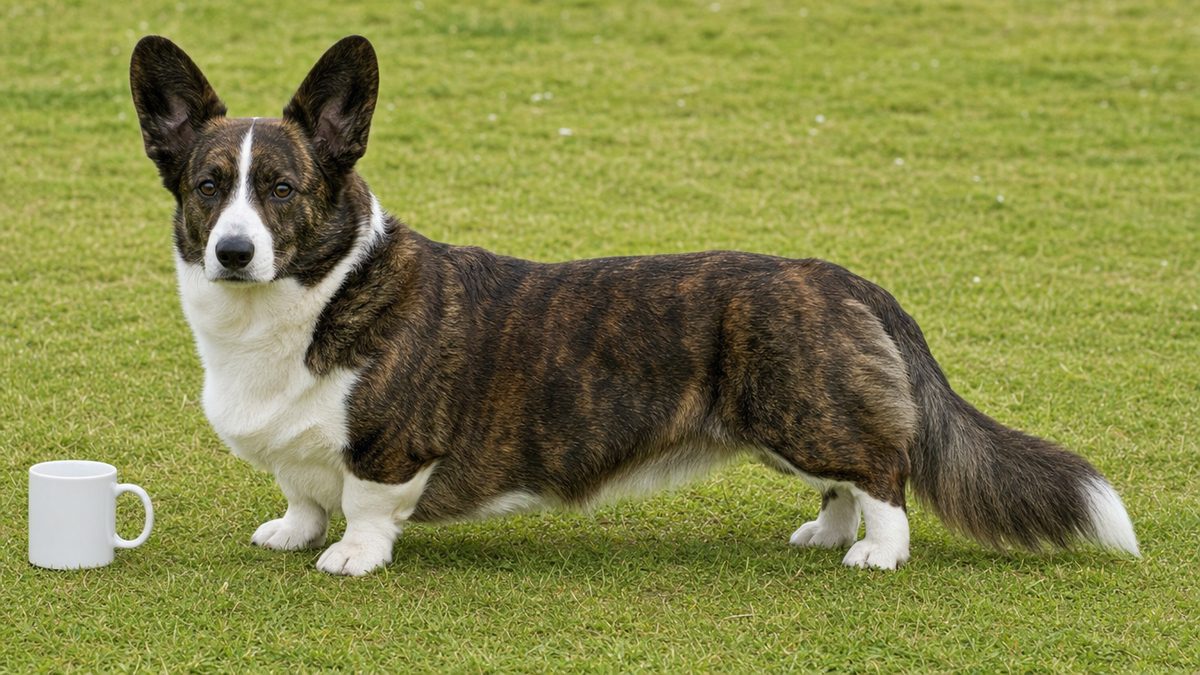
A Cardigan Welsh Corgi is a long, low, heavy-boned Welsh cattle-driving dog with a full fox-brush tail, standing an ideal 30 cm at the withers under FCI-Standard No. 38 and weighing 30 to 38 pounds for dogs and 25 to 34 pounds for bitches under the American standard. It is the older and much rarer of the two Corgi breeds, and it is the one that never had its tail removed.
The FCI classifies it as Group 1, Sheepdogs and Cattle Dogs, Section 2 Cattledogs, without working trial, under standard number 38, and describes it in five words: sturdy, tough, mobile, capable of endurance. The Royal Kennel Club places it in the Pastoral group and repeats the same text almost verbatim. The American Kennel Club puts it in the Herding Group and adds the one number neither European registry gives, an ideal length to height ratio of 1.8 to 1 measured from the prosternum to the ischial tuberosity against ground to withers.
The breed is a genuine dwarf, and the genetics of that are now settled. Every Cardigan tested so far carries two copies of CDPA, an FGF4 retrogene on chromosome 18 that produces most of the leg shortening, and roughly 85 percent also carry CDDY, a separate FGF4 retrogene on chromosome 12 that shortens the legs a little more and changes the composition of the intervertebral discs. The University of California Davis laboratory that runs the test describes CDPA as autosomal dominant and CDDY as autosomal dominant for disc disease and semi-dominant for height. This matters more than any show point on the page, and the [health sections](#health) return to it with real denominators.
The parts of the standard an Indian buyer can actually check
| Point | FCI-Standard No. 38 | Royal Kennel Club | American Kennel Club |
|---|---|---|---|
| Height at withers The Royal Kennel Club, Breed Standard American Kennel Club | Ideal 30 cm | Ideal 30 cm (12 ins) | 10.5 to 12.5 inches, dogs and bitches alike |
| Weight | No figure given, in proportion to size | No figure given, in proportion to size | Dogs 30 to 38 lb, bitches 25 to 34 lb |
| Tail | Fox's brush, moderately long, to touch or nearly touch ground | Same wording | Set fairly low, reaching well below hock; a high tail set is a serious fault |
| Ears | Erect, rather large, set about 8 cm (3.5 ins) apart | Erect, rather large, set about 9 cms (3.5 ins) apart | Large and prominent, drop ears are a disqualification |
| Forearm | Slightly bowed to mould round the chest | Slightly bowed to mould round the chest | Curved to fit spring of ribs; a straight front is a serious fault |
| Feet | Round, rather large, turned slightly outwards | Round, rather large | Relatively large and rounded, pointing out not more than 30 degrees |
| Coat | Short or medium, hard texture, weather-proof, good undercoat | Same wording | Medium length, dense double coat; a long or fluffy coat is an extremely serious fault |
Two things in that table are worth stopping on. Only the American standard puts a number on weight at all, so any Indian page quoting a Cardigan weight is quoting the AKC whether it says so or not. And the ear measurement genuinely disagrees between registries: the FCI prints 8 cm against 3.5 inches, the Royal Kennel Club prints 9 cms against the same 3.5 inches, and 3.5 inches is 8.89 cm, so the FCI's metric conversion is the one that has drifted.
What the dog is for
The Cardigan was bred to drive cattle, not to herd sheep, and the whole body plan follows from that. It worked by nipping at the heels of cattle and then dropping flat to let the kick pass over it, which is why the standard asks for short legs, a body well clear of the ground, and forelegs that curve round a deep chest rather than standing straight American Kennel Club. The Royal Kennel Club notes the two Corgi breeds were traditionally used as heelers, driving cattle by day and guarding them at night.
That job left the breed with a real voice, which Indian apartment buyers should take seriously. The AKC describes Cardigans as vigilant guardians with a big dog bark, and the Dog Breeds List data card rates watchdog ability 4 of 5 while rating barking 3 of 5 and calling it occasional. In a Mumbai flat with shared walls, a cattle dog's alarm bark is not a small thing.
Every ranking page repeats the AKC's line that the quickest way to tell the two Corgis apart is the hindquarters, because Cardigans have tails and Pembrokes do not. That is a shortcut written for a country where docking a Pembroke is still lawful. In India it is not, and the next section sets out what actually separates FCI-38 from FCI-39.
Cardigan against Pembroke, clause by clause in the FCI standards
The difference between a Cardigan Welsh Corgi and a Pembroke Welsh Corgi is not one thing, it is fourteen, and every one of them is written down in a document you can open. FCI-Standard No. 38 and FCI-Standard No. 39 were both revised on the same day, 16 June 2022, and both published on 19 September 2022, which makes them unusually easy to read against each other.
We diffed the two texts line by line. The table below reports only points where the two standards actually say different things, in their own words.
| Clause | Cardigan, FCI-38 | Pembroke, FCI-39 |
|---|---|---|
| Utilization | Herding and companion | Sheepdog |
| General appearance | Sturdy, tough, mobile, capable of endurance. Long in proportion to height | Low set, strong, sturdily built, giving impression of substance and stamina in small space |
| Temperament | Alert, active and intelligent. Steady, not shy nor aggressive | Bold in outlook, workmanlike. Outgoing and friendly |
| Eyes | Preferably dark, or to blend with coat. Pale blue, blue or blue flecked permissible only in blue merles | Well set, round, medium size, brown |
| Ears | Erect, proportionately rather large, set about 8 cm apart, set well back so they can be laid flat along neck | Pricked, medium sized. A line from nose tip through the eye should pass through or close to the ear tip |
| Neck | Muscular, well developed, in proportion to the dog's build | Fairly long |
| Body | Fairly long and strong. Waist clearly defined | Medium length, not short coupled, slightly tapering viewed from above |
| Tail | Like a fox's brush, moderately long, to touch or nearly touch ground. No docking language of any kind | Previously customarily docked short. Undocked, natural bobtails may occur |
| Forearm | Slightly bowed to mould round the chest | Short and as straight as possible |
| Feet | Round, tight, rather large, turned slightly outwards | Oval, two centre toes slightly advanced |
| Coat | Short or medium, of hard texture, weather-proof | Medium length, straight, never soft, wavy or wiry |
| Colour | Blue merle, brindle, red, sable, tricolour with brindle points, tricolour with red points | Self colours in red, sable, fawn, black and tan |
| Height | Ideal 30 cm | Approximately 25 to 30 cm |
| Weight | In proportion to size, no figure given | Males 10 to 12 kg, females 9 to 11 kg |
Which of those a buyer can use in a courtyard in Pune
Colour settles it faster than the tail does. Blue merle and brindle are accepted Cardigan colours and appear nowhere in the Pembroke standard, whose whole colour clause is self colours in red, sable, fawn, black and tan. So a merle Corgi or a brindle Corgi is not a standard Pembroke, whatever the seller writes on the receipt. The Royal Kennel Club goes further and prints twelve breed standard colours for the Cardigan, including black brindle and white, red brindle and brindle point tricolour, and closes the Pembroke colour clause with the sentence any other colour or combination of colours unacceptable The Royal Kennel Club, Breed Standard.
Eye colour is the second free test. The Cardigan standard permits one or both eyes pale blue, blue or blue flecked, but only in blue merles; the Pembroke standard simply says brown. The American standard is blunter still and makes blue eyes in any coat colour other than blue merle a disqualification, alongside drop ears and a nose that is not solid black. A blue-eyed, non-merle Corgi puppy fits neither breed's standard.
Feet and forelegs are the third. FCI-38 asks for round feet turned slightly outwards on forearms slightly bowed to mould round the chest. FCI-39 asks for oval feet on forearms short and as straight as possible Federation Cynologique Internationale. The AKC Cardigan standard is explicit that the correct Cardigan front is neither straight nor so crooked as to appear unsound, and calls a straight front a serious fault. Turn the puppy to face you and look at the front legs.
Look at the colour, then the eyes, then the front legs, then the tail, in that order. Three of the four are visible in a photograph, none of them needs paperwork, and the tail is the only one an Indian seller can have altered, because docking is prohibited here under the Second Schedule Part II paragraph 6(8) of the Dog Breeding and Marketing Rules 2017.
How big a Cardigan really is, and why the two Corgis barely overlap
A correct Cardigan Welsh Corgi dog weighs 30 to 38 pounds, which is 13.6 to 17.2 kg, and a correct Pembroke Welsh Corgi dog must not exceed 30 pounds, which is 13.6 kg. The two American weight ranges touch at exactly one point and do not overlap at all, so the Cardigan is not a Pembroke with a tail, it is a heavier dog on the same length of leg.
Set the two American standards next to each other and the size question answers itself. The AKC Cardigan standard asks for 10.5 to 12.5 inches at the withers and, ideally, 30 to 38 pounds for dogs and 25 to 34 pounds for bitches. The AKC Pembroke standard asks for 10 to 12 inches and weight not exceeding 30 pounds for dogs and 28 pounds for bitches, adding that in show condition the preferred dog weighs approximately 27 pounds and the preferred bitch approximately 25.
| Measure | Cardigan Welsh Corgi | Pembroke Welsh Corgi | Difference |
|---|---|---|---|
| Height, AKC American Kennel Club | 10.5 to 12.5 in (26.7 to 31.8 cm) | 10 to 12 in (25.4 to 30.5 cm) | About 1.3 cm taller at the top |
| Dog weight, AKC | 30 to 38 lb (13.6 to 17.2 kg) | Not exceeding 30 lb (13.6 kg) | Ranges touch at one point |
| Bitch weight, AKC | 25 to 34 lb (11.3 to 15.4 kg) | Not exceeding 28 lb (12.7 kg) | Cardigan range runs 6 lb higher |
| Preferred show weight | Not specified | About 27 lb dogs, 25 lb bitches | Cardigan midpoint 34 lb, 26 percent heavier |
| Height, Royal Kennel Club The Royal Kennel Club, Breed Standard | Ideal 30 cms (12 ins) | Approximately 25 to 30 cms (10 to 12 ins) | Cardigan pinned to the top of the Pembroke range |
| Weight, Royal Kennel Club | No figure, in proportion to size | Dogs 10 to 12 kgs, bitches 9 to 11 kgs | No published Cardigan figure exists in the UK |
| Weight, FCI Federation Cynologique Internationale | No figure, in proportion to size | Males 10 to 12 kg, females 9 to 11 kg | No published Cardigan figure exists in Europe |
Read the bottom three rows before you accept any Indian weight claim. Neither the FCI nor the Royal Kennel Club publishes a Cardigan weight at all; both say only that weight should be in proportion to size with overall balance the prime consideration. So when an Indian listing prints a Cardigan weight, it is either quoting the AKC or inventing one.
Two Indian pages that get the size wrong
Dav Pet Lovers publishes a specification block giving males 10.5 to 12.5 inches and 13 to 17 kg, and females 9 to 12 inches and 11 to 15 kg. The male figures are the AKC's, converted. The female height is not: the AKC standard gives 10.5 to 12.5 inches for dogs and bitches alike, so the 9 inch floor for females appears in no standard anywhere. The same page lists coat type as smooth and coat length as short, on a breed whose own standard calls for a dense double coat American Kennel Club.
Dog Breeds List, which also ranks for this query, prints 10 to 13 inches and 25 to 30 pounds for both sexes. That caps a Cardigan dog at 30 pounds, which is the AKC's *floor* for a dog and the AKC Pembroke's *ceiling* American Kennel Club. Follow that card and you will reject a correctly built Cardigan for being oversized. Petfinder supplies a fourth range again, 12 inches and 33 to 40 pounds, which runs above the AKC ceiling of 38. Four widely read sources, four different weight ranges, and only one of them is a breed standard.
A Cardigan is a compact dog, not a small one. Plan for 14 to 17 kg of adult dog with heavy bone in a body 1.8 times as long as it is tall. That is Beagle weight on Dachshund legs, and it changes how you lift it, how you build the ramp, and how much food it needs. The [feeding section](#feeding) puts numbers on the last of those.
The 2022 revision that stopped calling the Corgis sheepdogs
On 16 June 2022 the FCI moved both Welsh Corgis out of Group 1 Section 1, Sheepdogs, and into Group 1 Section 2, Cattledogs. That single line is the only substantive change the 2022 revision made to the Cardigan standard, and we proved it by diffing the current text against the superseded one rather than reading the change off the current document alone.
The current FCI-38 prints its classification as Group 1 Sheepdogs and Cattle Dogs, Section 2 Cattledogs (except Swiss Cattledogs), without working trial, and closes with the FCI's standing note that the latest amendments are in bold characters. Extracting the bold runs from the PDF returns the section headers plus exactly one line of content: Section 2 Cattledogs (except Swiss Cattledogs). Nothing else in the document is bolded.
That is a claim about what changed, so we checked it against the document that changed. The superseded FCI-38, dated 07.02.2017 for an official valid standard of 30.10.2016, reads Section 1 Sheepdogs. Every other clause we compared, from the 8 cm ear spacing to the fox's brush tail to the ideal 30 cm height, is word for word identical, including the typographical error white should nod predominate, which survives unchanged in the 2022 text Federation Cynologique Internationale.
| Clause | Standard of 30.10.2016 | Standard of 16.06.2022 | Changed |
|---|---|---|---|
| FCI classification, section | Section 1 Sheepdogs | Section 2 Cattledogs (except Swiss Cattledogs) | Yes, and bolded as the amendment |
| Ideal height at withers | 30 cm | 30 cm | No |
| Weight | In proportion to size | In proportion to size | No |
| Tail | Fox's brush, to touch or nearly touch ground | Identical | No |
| Ear spacing | About 8 cm (3.5 ins) apart | Identical | No |
| Accepted colours | Blue merle, brindle, red, sable, two tricolours | Identical | No |
| Disqualifying faults | Aggressive or overly shy dogs; any dog clearly showing physical or behavioural | Identical, sentence still incomplete | No |
The same change hit the Pembroke on the same day
The superseded FCI-39, dated 31.08.2021 for an official valid standard of 27.07.2021, also reads Section 1 Sheepdogs. The current FCI-39, valid 16.06.2022, reads Section 2 Cattledogs, with the same single bolded line. So this was one decision applied to both breeds at once, not a Cardigan-specific reclassification.
The reclassification is not cosmetic, and it lands closer to the truth of the breed. A Cardigan was never a sheepdog. The Royal Kennel Club describes both Corgis as heelers that drove cattle by day and guarded them at night, and the AKC standard calls the Cardigan a low, relatively heavy herding dog whose hindquarters must denote sufficient power to propel it over rough terrain. FCI-38 itself lists utilization as herding and companion, while FCI-39 still lists the Pembroke as sheepdog, a leftover inconsistency the section move did not tidy up Federation Cynologique Internationale.
A show entry, an export pedigree and a KCI classification all key off the FCI group and section. An Indian owner entering a Cardigan at a show, or reading a European pedigree issued before 2022, will meet the old Section 1 label and should know it is a filing change and not a different dog. Dating a change to the document that made it, rather than to the reissue you happen to be holding, is the only way to say that safely.
Where the Cardigan came from, and the year the two Corgis split
The Cardigan and the Pembroke were one interbreeding population until 1934, when The Kennel Club recognised them as two separate breeds. The Cardigan is thought to be the older of the two, and it takes its name from Cardiganshire in west Wales, where it was measured nose to tail as a Welsh yard.
The Royal Kennel Club states the position plainly. At one time the Cardigan and the Pembroke were allowed to interbreed freely, but in 1934 The Kennel Club recognised them as two separate breeds. Of the two types of Corgi, it adds, the Cardigan is thought to be the older, and he is the longer bodied of the two breeds with front legs that are slightly bowed.
The old Welsh name records the length of the dog. The Cardigan was once known affectionately as the Yard Dog, Ci Llatharid, because the measurement from his nose to the end of his tail was a Welsh yard, 102 cm or 40 inches. Petfinder tells the same story and spells the name Ci Llathaid, so treat the spelling as unsettled and the meaning as agreed. Either way it is a working measurement rather than a show point, and it is the earliest evidence anyone published that the Cardigan is defined by length rather than by height.
The word Corgi itself is Welsh. The Royal Kennel Club derives it from the Celtic cor, meaning dwarf, and gi, dog. Dog Breeds List gives the same derivation from the softly mutated form of ci.
The order of recognition, which is the reverse of what people assume
| Event | Cardigan Welsh Corgi | Pembroke Welsh Corgi |
|---|---|---|
| Recognised as a separate breed by The Kennel Club | 1934 | 1934 |
| Recognised by the American Kennel Club Dog Breeds List, Cardigan Welsh Corgi | 1935 | 1934 |
| Current FCI standard number Federation Cynologique Internationale | 38 | 39 |
| AKC breed standard last approved American Kennel Club | 13 December 1994, effective 31 January 1995 | 13 June 1972, reformatted 28 January 1993 |
Read the last row twice. The American standard the Pembroke is judged against was approved in 1972 and only reformatted since, while the Cardigan standard was rewritten in 1994 American Kennel Club. That gap explains a great deal about the tail clause, because a 1972 document was written when docking was routine everywhere and a 1994 document was not.
Two origin stories, and how much weight to put on them
Dog Breeds List reports the common account, that the Cardigan came to Cardiganshire with the Celts around 1200 BC while the Pembroke's ancestors arrived with Flemish weavers in the 1100s, and that a show judge in 1934 thought the two too different to remain one breed. Treat the dates as tradition rather than evidence. No kennel club publishes them, the Royal Kennel Club's own history says only that the Cardigan is thought to be the older, and the one hard date in the whole story is 1934.
What is not in doubt is what happened afterwards. The Pembroke gained sharply in popularity and the Cardigan did not, a gap that widened through the Elizabethan decades and has never closed. The Kennel Club recorded nearly 9,000 Pembroke puppy registrations in 1960 and 1,806 twenty years later. The Cardigan's own registration series, set out in the next section, has never reached 300 in the last decade.
Because sellers do not. Mr n Mrs Pet files a listing under Cardigan Welsh Corgi whose own description reads breed: pembroke Welsh corgi, two male puppies. Ninety years after the split, the Indian retail market still treats the two as one product, and the price section shows what that costs you.
The Cardigan is a vulnerable native breed, and 2025 was its worst year
The Royal Kennel Club lists the Welsh Corgi (Cardigan) as a vulnerable native breed, which means fewer than 300 puppies are registered in the UK each year. In 2025 the figure was 80, the lowest in the published ten-year series and a fall of 63 percent from 218 in 2016.
The Royal Kennel Club maintains two lists. The vulnerable native breeds list covers British and Irish breeds registering fewer than 300 puppies a year; the at watch list covers those between 300 and 450. The Cardigan's breed page answers the field vulnerable native breed with a single word, Yes, and Crufts states that the Cardigan Welsh Corgi have always been on The Kennel Club Vulnerable breed list.
| Year | Registrations | Change on prior year |
|---|---|---|
| 2016 | 218 | Baseline |
| 2017 | 141 | Down 35 percent |
| 2018 | 147 | Up 4 percent |
| 2019 | 126 | Down 14 percent |
| 2020 | 132 | Up 5 percent |
| 2021 | 123 | Down 7 percent |
| 2022 | 201 | Up 63 percent |
| 2023 | 82 | Down 59 percent |
| 2024 | 81 | Down 1 percent |
| 2025 | 80 | Down 1 percent, lowest in the series |
The 2022 figure of 201 is confirmed independently. Crufts, reporting Libby's win in the Vulnerable British and Irish Breeds final on 10 March 2023, records that there were just 201 Cardigan Welsh Corgi puppies registered with The Kennel Club in 2022. The same table has the breed sitting at 80 to 82 for three consecutive years since.
What a registration base of eighty does to a breed
Eighty puppies a year is a gene pool, not a market. For scale, the Cairn Terrier registered 447 in 2025 and sits on the at watch list rather than the vulnerable one, and the Old English Sheepdog registered 218, the number the Cardigan managed in 2016. A breed this small cannot avoid relatives in a pedigree, which is why the Royal Kennel Club's only Good Practice health recommendation for the Cardigan is not a disease test at all but prioritising genetic diversity.
It also explains the import rule. With effect from 6 January 2025, imported Welsh Corgis (Cardigan) and litters from overseas sires are only eligible for Kennel Club registration if proven clear or carriers of progressive retinal atrophy rcd3, or hereditarily clear, a scheme introduced at the request of the breed clubs to safeguard the UK population. A gene pool that small has to import, and importing is exactly how a recessive gets reintroduced.
The dog that won the 2023 vulnerable breed final makes the point in one line. Libby's registered name is Ch Pi Et Ra of Trefilio Borntobe Avalanche JW (Imp Hun): the UK's top vulnerable native breed that year was an import from Hungary.
One Indian vendor asks Rs 3,50,000 to Rs 8,50,000 for a Cardigan and offers nine of them for sale. The breed's home registry recorded eighty puppies in the whole of the United Kingdom in 2025. Both things can be true only if the Indian dogs are not what the listing says they are, and the [price section](#price) sets out what the evidence supports.
Cardigan Welsh Corgi price in India, and what the sellers are actually offering
No trustworthy cardigan welsh corgi price in india exists. Exactly one Indian vendor publishes a Cardigan-specific figure, Rs 3,50,000 to Rs 8,50,000, and the first listing under that heading on its own page describes a Pembroke. Google's AI Overview now repeats that band as the market rate, which is why this section exists.
Start with how thin the evidence is. A live Google India search for this exact query on 25 August 2026 returned about 128 results in total, and only two of the ranking pages price the Cardigan as its own breed at all. Everything else prices a generic Corgi.
| Source | What it prices | Figure | What the page actually shows |
|---|---|---|---|
| Mr n Mrs Pet listing | Cardigan Welsh Corgi | Rs 3,50,000 to Rs 8,50,000+ | Nine listings, all Pet Quality, no price visible without signing up, first one described as a Pembroke |
| Mr n Mrs Pet blog | Pembroke Welsh Corgi | Rs 75,000 to Rs 2,50,000+ | Same vendor, three tiers, 3.4 to 4.7 times cheaper than its own Cardigan card |
| Supertails | Corgi, undifferentiated | Rs 45,000 to Rs 1,50,000+ | City tables for six metros, no mention of which Corgi is priced |
| Dav Pet Lovers | Cardigan Welsh Corgi | No price published | Product price field set to 0.00 INR; body copy is AKC text |
| Dog Breeds List | Cardigan Welsh Corgi, United States | USD 1,200 to USD 2,200, top quality to USD 3,000 | Reputable-breeder band, not an Indian figure |
| A-Z Animals | Cardigan and Pembroke separately, United States | Cardigan USD 1,200 to 1,800; Pembroke USD 1,000 to 2,000 | The only ranking page that prices the two breeds apart |
The Rs 3,50,000 floor is higher than an American champion
A champion-bloodline Cardigan in the United States fetches around USD 3,500. At 84.38 rupees to the dollar that is Rs 2,95,330. The Indian vendor's cheapest tier, Basic Quality, starts at Rs 3,50,000. So the least expensive Indian Cardigan on offer is priced above the most expensive American one, before any shipping, quarantine or import paperwork.
Run the same comparison against the ordinary American band and the gap widens. USD 1,200 to USD 1,800 converts to Rs 1,01,256 to Rs 1,51,884. Measured against the top of that American band, Rs 1,51,884, the Indian ask runs 2.3 to 5.6 times higher.
What the nine listings actually contain
We read all nine cards on the Mr n Mrs Pet Cardigan page on 25 August 2026. Every one is tagged Pet Quality, none displays an age beyond the word Weeks, none displays a city in the card body, and every price is hidden behind a sign-up wall. The free-text descriptions are the useful part.
- Welsh coorgi, Bangalore, male. Description: breed: pembroke Welsh corgi, two male puppies.
- Dream, Mumbai, male. Show quality Cardigan Welsh Corgi pups for Sale.
- KUKU, Jaipur, male. SUPERB QUALTIY CORGI MALE PUPP FOR SALE.
- Cory, Jaipur, female. full extraordinary Cardigan Welsh corgi puppies for sale.
- Oggy, Jaipur, male. Cardigan Welsh corgi puppies available, puppies are very healthy and fully vaccinated.
- Jack, Jaipur, male. top quality corgi puppies available, for loving homes.
- Corgi, Lucknow, male. active puppy.
- Sonu, Lucknow, male. Cardigan Welsh corgi puppy for sale at best price.
- Acxel, Pune, male. Cardigan Welsh Corgi Puppies For Sale.
One of the nine is described by the seller as a Pembroke, and three more say only corgi, which is the word the seller would use if it did not know or did not want to say. Eight of nine are male. Not one card mentions colour, and colour is the single fastest way to tell the breeds apart.
Do not accept any published Cardigan Welsh Corgi price in India as a market rate. One vendor sets the number, Google's AI Overview repeats it, and the vendor's own listings do not evidence it. If you want this breed, budget from the American band of USD 1,200 to USD 3,500 plus lawful import costs, and read the [import law section](#import-law) first, because the lawful route is narrower than the price implies.
Testing the Indian price figures, and one method correction
The Indian Cardigan prices are rupee-native, not a converted American price list. We ran all 27 published figures through the three exchange rates that have caught converted price lists on this site before, and none of them produces a plausible dollar price card. That is a finding, and while running it we found a flaw in the 80-rupee test itself.
Indian breed pages routinely publish a rupee price that is a dollar figure run through one exchange rate. Bonbeno has caught it at 84.38 on an Airedale page, at 74 on a page whose only non-dividing rows were the hand-typed Indian breeds, and at a flat 80 on a national finance site. So the first thing we do with any Indian price band is divide it.
| Published figure | Divided by 84.38 | Divided by 74 | Divided by 80 | Lands on a price point a seller would print? |
|---|---|---|---|---|
| Rs 3,50,000 | USD 4,147.90 | USD 4,729.73 | USD 4,375.00 | No |
| Rs 5,50,000 | USD 6,518.13 | USD 7,432.43 | USD 6,875.00 | No |
| Rs 7,50,000 | USD 8,888.36 | USD 10,135.14 | USD 9,375.00 | No |
| Rs 8,50,000 | USD 10,073.48 | USD 11,486.49 | USD 10,625.00 | No |
| Rs 45,000 | USD 533.30 | USD 608.11 | USD 562.50 | No |
| Rs 1,50,000 | USD 1,777.67 | USD 2,027.03 | USD 1,875.00 | No |
| Rs 1,00,000 | USD 1,185.11 | USD 1,351.35 | USD 1,250.00 | No |
| Rs 40,000 | USD 474.05 | USD 540.54 | USD 500.00 | Only at 80, and see below |
Across all 27 figures we tested, three land on a conventional dollar price point and only at the rate of 80. That is chance, not a conversion. Compare the pattern with a genuine converted list, where a dozen rows resolve to round hundreds at a single rate and the only exceptions are the locally typed entries.
The correction: dividing by 80 proves almost nothing
A rupee figure ending in three zeros divided by 80 always lands on a value ending in .0 or .5, because 1,000 divided by 80 is 12.5. Rs 50,000 becomes 625.00, Rs 42,000 becomes 525.00, Rs 45,000 becomes 562.50. None of those is a price anyone prints, but all three look clean. Bonbeno's own guidance treats a clean division as evidence of conversion, and against round rupee prices at the rate of 80 that test is close to worthless.
The usable version of the test asks a second question. Does the resulting dollar figure land on a number a seller would actually advertise, such as 500, 800, 1,000, 1,200, 1,500, 1,800, 2,000, 2,500 or 3,000? On that stricter test the Indian Corgi prices fail at all three rates, and the honest conclusion is that a human typed them in rupees.
What the numbers are instead
Two patterns explain the Indian Cardigan band better than any conversion. The first is a rarity premium applied by one vendor to one breed name. Tier for tier, the same seller asks 4.67 times more for a Basic Cardigan than a Basic Pembroke, 4.58 times more at the KCI tier and 3.40 times more at the champion tier. In the United States the two breeds cost the same, and the Cardigan's top band is actually the lower of the two.
The second is that the KCI premium buys paperwork that costs Rs 750. The Kennel Club of India's own tariff, effective 1 April 2024 and inclusive of GST, charges Rs 750 for litter registration per puppy within 60 days, Rs 2,500 to register an imported dog, Rs 1,000 for a certified four-generation pedigree and Rs 500 to transfer ownership within twelve months. Moving a Cardigan from the Basic tier to the KCI Registered tier adds Rs 2,00,000 to the ask. Supertails does the same thing more modestly, adding Rs 20,000 to Rs 35,000 in Delhi NCR for the same certificate.
Rs 98,999 is a house price point Bonbeno has caught on ten separate pages of one Indian listing site, attached to whichever puppy is in stock. It does not appear on any Cardigan page we opened, and no figure in this section resolves to it. Reported for completeness, because an absence checked is worth more than an absence assumed.
Importing a Cardigan into India, and the door DGFT closed
You cannot lawfully import a Cardigan Welsh Corgi into India to sell it or to breed from it. DGFT Trade Notice 22/2022-23 places dogs in the Restricted category and states that applications for trading or breeding purposes shall be duly rejected, which is a problem for any Indian price band whose stated justification is that the dogs are imported.
The Directorate General of Foreign Trade issued Trade Notice No. 22/2022-23 on 19 December 2022, addressed to all international airlines, all embassies and consulates of India abroad, and pet owners concerned. It sets out the import policy for ITC (HS) 01061900, mammals other, and the entry reads Restricted.
- Policy Condition 7 permits the import of dogs only for three purposes: a pet dog with a valid pet book and relevant records in the name of the importer; dogs imported by R&D organisations with the recommendation of CPCSEA; and internal security by the Defence and Police Force.
- Policy Condition 8 states that the import of commercial dogs for breeding or any other commercial activity other than the purposes mentioned above is not permitted.
- Paragraph 6 states that any applications for trading or breeding purposes, or applications made on behalf of some another person or entity, shall be duly rejected.
- Paragraph 7 limits entry to the airports and seaports of Delhi, Mumbai, Chennai, Hyderabad, Bangalore and Kolkata, with quarantine at the government quarantine station where required. DAHD added a seventh port, Cochin International Airport at Kochi, for pets arriving under the baggage rules in October 2024.
The one lawful route, in the order you would actually do it
| Step | Requirement | Detail from the trade notice |
|---|---|---|
| 1 | Qualify as a pet owner, not a trader | Import must be in the importer's own name with a valid pet book |
| 2 | Decide baggage or authorisation | Up to two pets may come as passenger baggage without DGFT authorisation only if you are transferring residence to India after two years of continuous stay abroad |
| 3 | Apply if you do not qualify | Import authorisation from DGFT is required if the stay abroad was under two years, the pet is not travelling as baggage, or baggage rules do not apply |
| 4 | File the application | Form ANF-2M under your own IEC, or the permanent IEC IIHIE0153E for persons importing for personal use not connected with trade |
| 5 | Attach the documents | Vaccination book or pet passport or pet book, certificate for emotional support, passport of the pet |
| 6 | Start early | The notice advises beginning at least two months before travel |
| 7 | Get the advance NOC | From the Regional or Quarantine Officer (AQCS) at one of the seven ports, seven days before travel, relaxable to three |
| 8 | Land at a permitted port | Delhi, Mumbai, Chennai, Hyderabad, Bengaluru, Kolkata or, since October 2024, Kochi, and no others |
Read step 1 against the Indian listing pages. A vendor offering nine Cardigans for sale across Bangalore, Mumbai, Jaipur, Lucknow and Pune is not importing them as pets in the importer's own name. Either the dogs were bred in India, in which case the import premium in the price is unearned, or they entered by a route the trade notice does not provide for.
Google's AI Overview states that Indian Cardigan prices are high largely because they often need to be imported or sourced from specialized elite lineage. The first half of that sentence describes a transaction DGFT prohibits for anyone who is not bringing home their own pet.
The personal-pet route is real, workable and used every year. If you already own a Cardigan and you are relocating, start the paperwork two months out, land at one of the seven named ports, and carry the pet book in your own name Department of Animal Husbandry…. What the notice does not give you is a way to buy one abroad and have it delivered, and any Indian seller quoting a direct import should be asked which of the three permitted purposes their consignment fell under. The full route is set out in how to import a dog to India.
What a Cardigan costs every month in India
Budget Rs 5,200 to Rs 8,500 a month for a Corgi in India on the only published Indian cost model, and add roughly Rs 5,000 once for the chondrodystrophy DNA test that this breed specifically needs. The monthly cost of ownership is not where a Cardigan is expensive; the purchase price and the spine are.
Supertails publishes the only structured Indian cost model for a Corgi, and it is worth using even though it does not distinguish the two breeds. It gives three monthly tiers and a first-year total.
| Tier | Monthly | Annual |
|---|---|---|
| Basic, economical | Rs 3,500 to Rs 5,100 | Rs 42,000 to Rs 61,200 |
| Comfortable, recommended | Rs 5,500 to Rs 8,850 | Rs 66,000 to Rs 1,06,200 |
| Premium, comprehensive care | Rs 8,100 to Rs 13,700 | Rs 97,200 to Rs 1,64,400 |
| Headline monthly figure | Rs 5,200 to Rs 8,500 | Rs 62,400 to Rs 1,02,000 |
The same page puts first-year spend at Rs 95,000 to Rs 2,15,000 including the puppy, with food at Rs 19,200 to Rs 36,000, professional grooming at Rs 9,600 to Rs 21,600, flea and tick prevention at Rs 3,600 to Rs 7,200 and an emergency buffer of Rs 5,000 to Rs 25,000.
Three line items that change for a Cardigan specifically
Grooming should cost you less than the model assumes. Supertails budgets professional grooming every six to eight weeks at Rs 1,200 to Rs 1,800 a session. The AKC's own care guidance for this breed says a good brushing at least once a week should keep the Cardigan's coat healthy and looking its best, with baths rarely needed and no trimming permitted beyond tidying the feet American Kennel Club. Buy a shedding blade and a slicker brush once, brush weekly at home, and the Rs 9,600 to Rs 21,600 line becomes a few thousand rupees.
Screening should cost you more. The Cardigan's national breed club and the AKC both name three tests: a hip evaluation, the degenerative myelopathy DNA test and the PRA-rcd3 DNA test. The Royal Kennel Club adds eye testing under the BVA scheme and hip testing under the BVA hip dysplasia scheme as best practice. On top of those, the chondrodystrophy panel from the University of California Davis costs USD 58 as a single test, or USD 27 when added to another health test on the same animal, with a turnaround of at least fifteen business days. At 84.38 that is about Rs 4,894 or Rs 2,278.
Parasite control is not optional here. A 2024 study of 120 suspected dogs in and around Hisar, Haryana, found tick-borne disease in 12.5 percent on blood smear and 64.16 percent by PCR, with Hepatozoon canis in 35 percent, Ehrlichia canis in 25.8 percent and Babesia vogeli in 20 percent. Those were clinical suspects rather than a random sample, so read the figures as what a vet sees rather than as population prevalence, but the monthly Rs 400 to Rs 900 for flea and tick cover is the cheapest line on the whole budget.
| Item | Indicative cost | Why this breed |
|---|---|---|
| CDDY and CDPA DNA panel | About Rs 4,900, or Rs 2,300 bundled | Roughly 85 percent of Cardigans carry CDDY, which changes disc composition |
| Hip evaluation | Ask your vet; radiographs plus submission | 24.3 percent of 4,136 evaluated Cardigans were dysplastic on the OFA register |
| Ramps for sofa and bed | Rs 2,000 to Rs 6,000 | The AKC's own advice is to avoid letting the Cardigan jump down off furniture |
| Non-slip runners on tile | Rs 1,500 to Rs 5,000 | Indian homes are tiled and a long back plus a skid is how discs fail |
Every rupee figure above except the DNA test comes from one Indian retailer's editorial model, not from a survey of Indian owners, and no such survey exists for this breed. Treat the bands as a planning aid and expect your own numbers to differ by city.
Can a Cardigan Welsh Corgi handle the Indian climate?
Bonbeno rates the Cardigan Welsh Corgi 2 out of 5 for heat tolerance. Its home valley in Ceredigion averages 15.2 C in its warmest month, and Delhi's coldest month averages 13.6 C, so the hottest weather this breed evolved for is roughly Delhi in January.
We queried NASA's POWER climatology by explicit latitude and longitude rather than by place name, and echoed the coordinates the service returned, because slug-based climate lookups have served the wrong city on this project before. The Cardigan query returned -4.660, 52.082, elevation 149.77 m, which is Cardigan in Ceredigion.
| Place | Warmest month mean air temp | Highest monthly max | Coldest month mean | Peak monthly humidity |
|---|---|---|---|---|
| Cardigan, Ceredigion, Wales | 15.2 C in July | 27.4 C in July | 4.7 C in February | 93.3 percent in December |
| Delhi | 35.9 C in June | 48.8 C in June | 13.6 C in January | 74.9 percent in August |
| Kolkata | 31.5 C in May | 46.8 C in May | 17.3 C in January | 89.3 percent in September |
| Chennai | 31.5 C in May | 42.7 C in May | 24.1 C in January | 82.3 percent in November |
| Mumbai | 31.2 C in May | 44.9 C in April | 23.2 C in January | 90.4 percent in August |
| Pune | 28.9 C in April | 43.2 C in April | 19.6 C in December | 90.8 percent in August |
| Bengaluru | 28.4 C in April | 40.4 C in April | 20.2 C in December | 81.0 percent in October |
Two numbers do the work. Ceredigion's warmest month averages 15.17 C. The mildest big Indian city on this list, Bengaluru, averages 28.37 C in April, which is 13.2 C hotter than the hottest month the breed's origin ever sees. Delhi's June mean of 35.88 C is more than twice Ceredigion's July mean, and Delhi's monthly maximum of 48.79 C is 21.4 C above the highest figure the Welsh coast produces.
Humidity is the part people get backwards
Ceredigion is very humid, at 84 to 93 percent all year. So a Cardigan is not naive about damp air. What it has never met is damp air at 30 C. Mumbai in August combines 90.4 percent humidity with a 26.05 C mean; Pune in August reaches 90.8 percent; Kolkata in September reaches 89.3 percent. A dog cools by panting, and panting works by evaporation, so the same humidity that is harmless at 15 C removes the breed's main cooling mechanism at 30 C.
City by city, in plain terms
- Delhi, Kolkata and Jaipur. The hardest of the six. April to June is a genuine welfare problem for a double-coated dog and needs indoor cooling, not shade. Delhi's June monthly maximum touches 48.8 C.
- Mumbai and Chennai. Less extreme heat, worse humidity, and almost no cool season. Chennai's coldest month still averages 24.1 C, which is 9 C above a Welsh July.
- Pune and Bengaluru. The two workable cities. Bengaluru's annual mean of 23.74 C and December mean of 20.2 C give the dog four or five months a year that are merely warm.
- Hill stations and the Nilgiris. Genuinely suitable, and the only Indian settings where a Cardigan's coat is an asset rather than a liability.
The AKC's grooming guidance for this breed says a summer trim is not necessary because the correct coat maintains proper body temperature, as long as conditions are normal, and adds that a black dog absorbs more heat on a sunny day. Conditions in Delhi in June are not normal by that standard. The advice not to shave is still right, for reasons the [heat management section](#heat-management) sets out, but the reasoning behind it does not transfer.
Managing a weather-proof double coat through an Indian summer
Do not shave a Cardigan Welsh Corgi, and do not treat the coat as the problem. Manage the timetable, the floor and the water instead, because the standard's own words explain why the coat helps in heat as well as in cold once you stop asking it to work in direct sun.
The Cardigan's coat is described by FCI-38 as short or medium, of hard texture, weather-proof, with good undercoat, and the Royal Kennel Club repeats it word for word The Royal Kennel Club, Breed Standard. The AKC standard is more specific: medium length but dense as it is double, outer hairs slightly harsh in texture, lying relatively smooth and weather resistant, over an insulating undercoat that is short, soft and thick.
Insulation works in both directions. A harsh outer coat over a dense undercoat slows heat transfer from the outside air to the skin as well as from the skin to the air. Shave it and you remove the barrier against radiant heat and expose skin that has never seen Indian sun. The AKC's chief veterinary officer's position, and the breed club's, is that when the coat is correct for the breed a summer trim is not necessary. The AKC standard reinforces it from the other side by permitting no trimming except tidying the feet and, if desired, removing whiskers.
The eight things that actually reduce heat load
- Move the walks. Before 6.30 am and after 8 pm from March to June in Delhi, Kolkata, Chennai and Mumbai. The dog is 25 to 32 cm tall, so its head sits in the hottest layer of air above the pavement.
- Test the surface with your hand. Hold the back of your hand on the tile or tar for seven seconds. If you cannot, the dog cannot walk on it. A short-legged breed also carries its belly close to the radiating surface.
- Cool from underneath. A wet towel over a tile floor, or a raised mesh bed with airflow beneath, beats a fan aimed at a dense coat.
- Wet the paws, ears and belly, not the back. Water sitting under a weather-proof outer coat does not evaporate and turns the undercoat into a warm poultice.
- Dry the coat completely after any bath or rain. A dense undercoat in 90 percent monsoon humidity is the classic setting for hot spots and skin infection.
- Brush out the dead undercoat weekly, harder during the two seasonal drops. Dog Breeds List rates shedding 4 of 5 and records constant plus heavy seasonal shedding twice a year.
- Watch black and blue merle dogs more closely. The AKC notes a black dog absorbs more heat on a sunny day, and black, brindle and blue merle are all standard Cardigan colours.
- Keep water in two places on two floors. A dog with short legs will not climb stairs to drink, and you do not want it climbing stairs anyway.
Recognising heat stress in a low, heavy-coated dog
The signals are the ordinary ones, but a Cardigan hides them for longer because it is stoical and because its coat masks skin flushing. Watch for a widening tongue and drooping tongue tip, panting that does not slow within a few minutes of coming indoors, thick ropey saliva, reluctance to stand, and a stumbling or drunken hind end. In this breed a wobbly back end has two possible causes, heat and the spine, and telling them apart is not a job for an owner. Treat either as urgent.
Degenerative myelopathy is a slowly progressive, painless loss of coordination over one to three months, and the disease is described by the Cardigan's own parent club as seeming to affect only very old Cardigans. A young dog that goes wobbly on a hot afternoon is not showing DM. It is either overheating or it has hurt its back, and both need a vet the same day.
Temperament, and who should not buy this breed
A Cardigan Welsh Corgi is alert, active, intelligent and steady, which is the FCI's wording, and it is a cattle dog with a big-dog bark, a herding instinct and a strong opinion about strangers. Buy one if you want a working brain in a compact body. Do not buy one if you want a quiet, low-effort apartment dog.
The standards agree on the outline and disagree in emphasis. FCI-38 gives alert, active and intelligent, steady, not shy nor aggressive. The Royal Kennel Club splits it into characteristics, alert, active and intelligent, and temperament, alert, intelligent, steady, not shy or aggressive. The AKC standard adds even-tempered, loyal, affectionate, and adaptable, never shy nor vicious.
Compare that with the Pembroke's wording and the difference is real. FCI-39 asks for bold in outlook, workmanlike, outgoing and friendly. The Cardigan standard asks for steady and watchful, and its eye clause specifies a kindly, alert but watchful expression. Watchful is not outgoing. Expect a dog that assesses a visitor before greeting one.
Six traits Indian households will notice first
- Voice. The AKC calls Cardigans vigilant guardians with a big dog bark, and Dog Breeds List rates watchdog ability 4 of 5. In a flat with shared walls this is the single most common source of complaints.
- Herding. A cattle dog heels, and children running in a corridor look exactly like cattle. This is trainable and it is not a fault, but it must be trained early rather than laughed at.
- Reserve with strangers. Dog Breeds List rates stranger friendliness 3 of 5 and notes the breed tends to be reserved with strangers and can be scrappy with other dogs.
- Brains that need a job. Coren-style intelligence rankings put the breed at 26, and the AKC rates its mental stimulation needs high enough to warn that without brain exercise a dog will create its own projects.
- Adaptability. Dog Breeds List rates adaptability 5 of 5 and apartment friendliness 5 of 5, with the condition attached: Corgis will do fine in an apartment if they are sufficiently exercised.
- Affection with family. Rated 5 of 5 for both child friendliness and cat friendliness on the same card, and the AKC calls well-socialised Cardis especially fond of kids and agreeable with other pets.
Who should not buy this breed
| If your household is | Verdict | Why |
|---|---|---|
| A working couple out ten hours a day | Poor fit | A herding brain alone all day becomes a barking, chewing, digging brain |
| A flat with a noise-sensitive neighbour | Poor fit | The breed is bred to move cattle by barking at them |
| A house with stairs and no lift | Manageable but not ideal | The AKC's own advice is to avoid jumping and stairs, which cause back injury |
| A family with school-age children | Good fit | Rated 5 of 5 with children, playful and affectionate |
| First-time owners willing to train | Good fit | Trainability rated 5 of 5, described as eager learners |
| A ground-floor home in Bengaluru or Pune with a small garden | Best fit in India | The Royal Kennel Club's own guide says small house, small to medium garden, up to one hour of exercise |
One thing every ranking page understates. The Cardigan is not a lap dog in a short-legged costume. The Royal Kennel Club rates its exercise need at up to one hour per day and its grooming at more than once a week. Petfinder is blunter, listing the breed as a chatty and vocal dog that barks and alerts to visitors, needs extra training, may need additional supervision to live with children, and digs and can escape through the smallest of gaps. An owner who wanted a decorative small dog and bought a cattle dog will spend two years being surprised.
Several Indian pages describe Corgis as low maintenance, and one Indian listing page prints Low Maintenance & Short Coat as a selling point for the Pembroke. No breed standard supports it. FCI-38 asks for a good undercoat, the Royal Kennel Club rates grooming at more than once a week, and the AKC calls the coat dense as it is double The Royal Kennel Club, Breeds A to Z American Kennel Club.
Training a Cardigan, and the three things it will resist
Train a Cardigan Welsh Corgi with short, reward-based sessions started before sixteen weeks, and expect it to learn faster than you can teach. The breed is rated among the most trainable small dogs, and the three things it resists are being made to stop barking, being asked to ignore movement, and being repeated at.
Begin with socialisation because the breed's own club puts it first. The Cardigan Welsh Corgi Club of America's guidance, reproduced by the AKC, opens with the line that it cannot be stressed enough that early and regular socialisation is of the utmost importance in developing a happy, healthy Cardigan, and asks owners to gently expose the pup to a wide range of people, places and situations. That is standard advice everywhere, but it matters more in a watchful breed than in an outgoing one.
Trainability itself is not in doubt. Dog Breeds List rates it 5 of 5 and describes Cardigans as eager learners who quickly understand what is expected of them, with a Coren-style intelligence ranking of 26. The AKC rates the breed's mental stimulation needs high and warns that without brain exercise a dog will create its own projects.
The three genuine points of resistance
- Barking. You are asking a cattle dog to stop doing the thing it was bred to do. Teach a Quiet cue as a positive behaviour with its own reward rather than trying to suppress the bark, and pay attention to what triggers it. In Indian flats the trigger is usually the lift door, the doorbell and the corridor.
- Movement. A heeling instinct fires at running children, cyclists, cats and autorickshaws. Train an interruptible recall and a solid Leave It before the puppy is six months old, and use a long line in open spaces until it is reliable.
- Repetition. Cardigans learn in few reps and switch off when drilled. Three sessions of four minutes beat one session of twelve. Stop while the dog still wants more.
A twelve-week training plan for an Indian household
| Weeks | Focus | The Indian-specific part |
|---|---|---|
| 8 to 10 | Name, crate, toilet routine, handling | Toilet training around a monsoon means an indoor pad plan for weeks when the balcony floods |
| 10 to 12 | Sit, recall on a line, food-bowl calm | Get the dog used to a ceiling fan and an air conditioner running through the night |
| 12 to 16 | Leave It, Quiet, loose-lead walking | Practise the lift, the security guard and the servant entrance, in that order |
| 16 to 24 | Impulse control, settle on a mat, ramp use | Teach the ramp before the dog is heavy enough to hurt itself jumping off the sofa |
| 24 to 52 | Proofing recall around traffic and street dogs | Street-dog encounters are the commonest Indian training failure and need distance, not confrontation |
Do not use a harness that runs across the shoulder in this breed without checking the fit. A Cardigan's forelegs are described by its own standard as slightly bowed to mould round the chest, with the curve bringing the wrists closer together than the elbows. Off-the-shelf harnesses sized by chest girth often sit badly on that geometry and rub at the elbow.
Finally, keep training off the spine. A dog that is asked to sit up and beg, to jump for a treat, or to spin repeatedly on a tiled floor is being asked to load a chondrodystrophic back in exactly the way the [spine sections](#health-spine) advise against.
Dog Breeds List records that the Cardigan Welsh Corgi excels at dog sports such as sheepdog and agility trials, and the AKC notes most Cardigans are ball-o-holics who will happily work for a thrown toy. If you want a small dog you can genuinely train to a standard, this is one of the best available. Just keep the agility jumps low.
How much exercise a Cardigan needs, and the stairs problem
Give a Cardigan Welsh Corgi up to one hour of exercise a day, split into two or three sessions, on the flat. That is the Royal Kennel Club's own figure for the breed, and the qualifier that matters in India is not the hour, it is the surface, the time of day and the height of everything the dog jumps off.
The Royal Kennel Club's breed card gives exercise as up to 1 hour per day, size small, size of home small house, size of garden small to medium, town or country either. Dog Breeds List rates exercise needs 4 of 5 and notes the breed greatly enjoys the outdoors and long walks. Supertails, writing for Indian owners, recommends 60 minutes daily. Those three agree closely enough to plan against.
What that hour should and should not contain
| Activity | Minutes | Notes |
|---|---|---|
| Morning lead walk on the flat | 25 to 30 | Before 6.30 am from March to June in the hot cities |
| Evening lead walk | 20 to 25 | After 8 pm in summer; test the pavement with the back of your hand first |
| Ground-level fetch or flirt pole | 10 | The AKC notes most Cardigans are ball-obsessed and this is the easiest indoor outlet |
| Scent work or a food puzzle | 10 | Counts as exercise for a working brain and costs nothing in joint load |
| Jumping down from furniture | 0 | The AKC's own care guidance says avoid letting the Cardigan jump down off the bed or couch |
| Stair climbing as exercise | 0 | The same guidance names stairs as a hazard |
| Long-distance running beside a cycle | 0 | Dog Breeds List states the breed should not be made to run for great distances because of its long back and short legs |
The stairs question, answered with numbers
Owners ask whether stairs really matter or whether the advice is folklore. The honest answer is that the evidence is strong for the mechanism and weak for the specific instruction. Greater numbers of calcified discs on radiography correlate strongly with disc herniation risk, and dogs with more than five calcified discs carry a fourteen-fold risk of herniation compared with dogs showing fewer than five. What no study has measured is how many of those herniations were triggered by a staircase.
So the position Bonbeno takes is the breed club's own. A Cardigan with two copies of CDDY has discs that degenerate early and become brittle, and early degeneration means a disc can herniate with even mild impact or injury. Reducing impacts is cheap, and ramps cost less than a decompression surgery.
- Fit a ramp to the sofa and the bed before the puppy is four months old, while it still fits under the furniture rather than leaping onto it.
- Carry the dog on stairs for the first year, supporting chest and hindquarters together so the spine stays level.
- Lay runners on tiled floors. Indian homes are tiled, a Cardigan turns fast, and a skid loads the lumbar spine hard.
- Use a harness, not a collar, for lead walks, and check it does not press on the elbows given the breed's bowed forearm.
- Keep agility jumps at or below hock height, and skip weave poles until the dog is fully grown.
The single strongest lifestyle finding in the whole long-and-low literature is not about stairs, it is about weight. The AKC's care guidance for this breed opens the nutrition section with the sentence that Cardigans are known to become overweight very easily. An hour a day is the cheapest weight control there is, and the [feeding section](#feeding) covers the rest.
Grooming a hard-textured double coat in Indian humidity
Brush a Cardigan Welsh Corgi at least once a week with a shedding blade and a slicker or fine pin brush, bathe it rarely, dry it completely, and do not trim it. That is the whole routine, and it is one of the few genuinely low-cost care regimes among imported breeds, which is why the Indian grooming budgets published for this breed are too high.
The standards set the constraints. FCI-38 asks for a coat short or medium, of hard texture, weather-proof, with good undercoat, preferably straight. The AKC standard adds that the outer hairs are slightly harsh in texture and never wiry, curly or silky, that the coat lies relatively smooth and is weather resistant, and that the insulating undercoat is short, soft and thick.
Trimming is prohibited by the standard, not just discouraged. The AKC text reads: trimming is not allowed except to tidy feet and, if desired, remove whiskers, and it calls a distinctly long or fluffy coat an extremely serious fault. So a groomer who offers to shape a Cardigan is offering to make it incorrect.
The weekly routine, and what it costs
| Task | Frequency | Tool or note |
|---|---|---|
| Brush out the coat | Weekly, twice weekly in shedding season | Shedding blade, then slicker or fine pin brush, to remove dead hair and distribute skin oils |
| Bath | Rarely; the coat repels dirt and lacks odour | Dry to the skin afterwards, especially in monsoon months |
| Dry thoroughly after rain | Every time | Peak humidity is 90.8 percent in Pune in August and 90.4 percent in Mumbai |
| Nail trim | Every four to six weeks | Long nails change the foot angle on a breed whose feet already turn slightly outwards |
| Trim hair on the underside of the feet | Monthly | The one trim the standard permits, and it reduces the dirt tracked indoors |
| Ear check | Weekly | Erect ears drain well, which is one advantage this breed has over drop-eared breeds in a monsoon |
| Professional grooming | Not required | Supertails budgets Rs 1,200 to Rs 1,800 every six to eight weeks; the breed's own guidance asks for a weekly brush at home American Kennel Club |
That last row is a real disagreement worth publishing. The Indian cost model budgets Rs 9,600 to Rs 21,600 for first-year professional grooming on a breed whose parent club says a good brushing at least once a week should keep the coat healthy and looking its best American Kennel Club. Dog Breeds List rates grooming 3 of 5 and labels it low maintenance, adding that baths are rarely needed. A shedding blade and a slicker brush are a one-time purchase.
Shedding, which is the part nobody budgets for
The Cardigan sheds constantly and heavily twice a year. Dog Breeds List rates shedding 4 of 5 and describes constant and seasonal shedding, with heavier seasonal drops twice a year. The AKC standard acknowledges it in the standard itself, noting that this breed has a shedding coat and that seasonal lack of undercoat should not be too severely penalised.
In an Indian flat with ceiling fans running most of the year, that hair goes everywhere. Plan a weekly vacuum, keep the dog off upholstery you care about, and brush outdoors on a balcony rather than indoors.
Dog Breeds List answers the hypoallergenic field for the Cardigan with a plain No, and no breed standard mentions allergy at all American Kennel Club. That is the correct position for every breed. Measured across 196 dogs of so-called hypoallergenic breeds against 160 controls, the hypoallergenic group carried more Can f 1 allergen in hair and coat, not less, and the authors concluded there is no evidence for the classification of certain dog breeds as being hypoallergenic.
Cardigan Welsh Corgi health: what the screening register actually shows
The Cardigan Welsh Corgi's real health picture is one bad number, one misunderstood number and six unremarkable ones. Hips are the bad one, at 24.3 percent dysplastic across 4,136 evaluations. Everything else on the Orthopedic Foundation for Animals register sits at or below the level you would expect of a small working breed.
We read the Cardigan's rows directly from OFA's disease statistics tables on 24 August 2026, matching each row to its own column headers. The registry code is WCC, read off OFA's own input markup as value="WCC" data-name="CARDIGAN WELSH CORGI", because short OFA codes collide and a guessed one returns a complete and plausible table for a different breed.
| Database | Evaluations | Result | Breed rank on OFA's list |
|---|---|---|---|
| Hips | 4,136 | 24.3 percent dysplastic; 20.6 mild, 3.4 moderate, 0.3 severe | 37 |
| Elbows | 1,374 | 5.4 percent abnormal; 4.4 grade 1, 0.9 grade 2, 0.1 grade 3 | 79 |
| Eyes, CAER examination | 1,898 | 2.4 percent abnormal | 197 |
| Patella | 117 | 3.4 percent abnormal; 2.6 grade 1, 0.9 grade 2 | 58 |
| Congenital cardiac | 96 | 100.0 percent normal, 0.0 percent abnormal | 147 |
| Thyroid | 128 | 90.6 percent normal; 3.9 percent compensative autoimmune thyroiditis, 5.5 equivocal | 50 |
| Degenerative myelopathy, SOD1 DNA test | 1,021 | 54.8 percent clear, 29.8 carrier, 15.5 at risk | 13 |
| PRA rod-cone dysplasia 3, DNA test | 407 | 99.5 percent clear, 0.5 percent carrier, 0.0 percent affected | 3 |
The three tests the breed's own institutions ask for
The AKC lists three recommended health tests from the national breed club: a hip evaluation, the degenerative myelopathy DNA test and the PRA-rcd3 DNA test. The Royal Kennel Club lists genetic diversity as the only Good Practice item and adds three Best Practice items: the PRA-rcd3 DNA test, eye testing under the BVA/KC/ISDS scheme, and hip testing under the BVA/KC hip dysplasia scheme. Both registries agree on hips and PRA-rcd3.
Indian law asks for two of the same three. Second Schedule Part III paragraph 8(10) of the Prevention of Cruelty to Animals (Dog Breeding and Marketing) Rules 2017 requires that dogs shall have been tested for genetic defects, including hip dysplasia, progressive retinal atrophy, night blindness, hypothyroidism, entropion, ectropion and several jaw and dentition faults. For this breed specifically, the Indian statute and the breed club want the same two tests. That is unusual and it is worth using when you talk to a seller.
The register moves, so read the sample size beside the percentage
OFA counts change as evaluations are submitted. Between 16 and 24 August 2026, eight days apart, the Cardigan's hip evaluations went from 4,133 to 4,136 and the dysplastic rate from 24.2 to 24.3 percent; elbow evaluations went from 1,373 to 1,374 and eye examinations from 1,895 to 1,898. A bare decimal from a live register is not a fixed fact, which is why every figure on this page carries its denominator.
OFA maintains no spine database that scores calcified intervertebral discs. The Cardigan's own breed club notes that although OFA has a spinal database it is geared towards abnormalities such as transitional vertebrae and spondylosis, and that it is unclear how valuable a calcified-disc note in the remarks field would be without changes to the OFA process. So the single most relevant screening test for a chondrodystrophic breed is the one an American buyer cannot ask OFA for, and the [spine sections](#health-spine) explain what to ask for instead.
Hips: 24.3 percent of 4,136, and worse than the Pembroke's
Hip dysplasia is the Cardigan Welsh Corgi's largest measured health problem. Of 4,136 hip evaluations on the OFA register, 24.3 percent were dysplastic, against 21.8 percent of 17,433 Pembroke evaluations. Almost all of the Cardigan's dysplasia is mild, and that nuance is the part every ranking page leaves out.
Read the grades rather than the headline. Of the 4,136 Cardigan hip evaluations, 20.6 percent were graded mild, 3.4 percent moderate and 0.3 percent severe, while 73.7 percent were normal, split 4.1 percent excellent, 42.7 percent good and 26.9 percent fair. Mild dysplasia in a 15 kg dog is a different clinical animal from severe dysplasia in a 40 kg dog, and 0.3 percent severe across four thousand dogs is a small number in absolute terms.
| Measure | Cardigan Welsh Corgi | Pembroke Welsh Corgi |
|---|---|---|
| Hip evaluations | 4,136 | 17,433 |
| Normal | 73.7 percent | 76.3 percent |
| Excellent | 4.1 percent | 3.3 percent |
| Good | 42.7 percent | 43.4 percent |
| Fair | 26.9 percent | 29.6 percent |
| Dysplastic, all grades | 24.3 percent | 21.8 percent |
| Mild | 20.6 percent | 17.9 percent |
| Moderate | 3.4 percent | 3.6 percent |
| Severe | 0.3 percent | 0.3 percent |
| Elbow evaluations | 1,374 | 2,501 |
| Elbows abnormal | 5.4 percent | 5.5 percent |
The two breeds are effectively level on elbows, at 5.4 and 5.5 percent, and the Cardigan is 2.5 percentage points worse on hips. The Cardigan also carries a slightly higher share of excellent hips, 4.1 against 3.3 percent, which is what a smaller and more heavily screened population tends to look like.
Why a self-selected register still tells you something
OFA data is submitted voluntarily, so it is not a population sample. Breeders screen the dogs they intend to breed from, and results that come back badly are sometimes not submitted at all, which biases the register toward better hips than the breed truly has. That cuts one way for both breeds equally, so the comparison between them survives even though the absolute rate does not.
Coverage is the other half of the picture, and it is better than the breed's rarity would suggest. Of roughly 290 statistics tables OFA publishes, the Cardigan Welsh Corgi appears in eight, with samples ranging from 96 congenital cardiac evaluations up to 4,136 hip evaluations, plus rows in 40 separate eye sub-condition tables. That is unusual depth for a breed registering eighty puppies a year in Britain.
What to do about it in India
- Ask for the parents' hip results before the deposit, not after. A hip evaluation is on the AKC's list of three tests recommended by the national breed club, on the Royal Kennel Club's Best Practice list, and named in Indian law under Second Schedule Part III paragraph 8(10).
- Accept a BVA hip score or an OFA grade, and ask what the numbers mean. Both schemes are recognised and either is better than a verbal assurance.
- Keep the dog lean from the start. Weight is the only hip risk factor an owner controls, and this breed gains easily.
- Budget for the possibility. Supertails puts Indian hip dysplasia surgery at Rs 25,000 to Rs 50,000 where surgery is needed, which is an editorial estimate rather than a survey but is the only Indian figure published.
No Indian hip register exists for any breed. Every figure in this section comes from an American voluntary register of predominantly American dogs. An Indian-bred Cardigan from unscreened parents has no measured risk at all, which is not the same as having none.
Chondrodystrophy, FGF4 and what actually shortens the legs
A Cardigan Welsh Corgi is short-legged because of two separate retrogene insertions of the FGF4 gene, one on chromosome 18 and one on chromosome 12. The first is harmless to the spine. The second is not, and telling them apart is the most useful thing an owner of any long-and-low breed can learn.
The University of California Davis Veterinary Genetics Laboratory, which runs the test, defines both. Chondrodysplasia, CDPA, is an FGF4 retrogene insertion on chromosome 18 that produces the short-legged phenotype characteristic of breeds such as Corgis and Dachshunds. Chondrodystrophy, CDDY, is a separate FGF4 insertion on chromosome 12 that also shortens the legs and adds abnormal premature degeneration of intervertebral discs, leaving those discs susceptible to herniation.
| Feature | CDPA, chromosome 18 | CDDY, chromosome 12 |
|---|---|---|
| What it does Bon J. Genetics and Dwarves and IVDD | Most of the leg shortening | A further roughly 10 percent of leg shortening |
| Effect on discs | None identified | Premature degeneration, discs become brittle and calcify |
| Inheritance | Autosomal dominant | Autosomal dominant for disc disease, semi-dominant for height |
| Frequency in Cardigans | Close to 100 percent, all tested dogs carry two copies | Around 85 percent |
| Is it testable | Yes, same panel | Yes, same panel, USD 58 or USD 27 as an add-on |
So the short legs are not the problem. The extra gene that came along with them is. A Cardigan with zero or one copy of CDDY is still a short-legged Cardigan, because CDPA does that work, and its discs behave differently.
How much difference the copy number makes
The discovery paper's authors found no difference in effect on disc disease between one copy of CDDY and two, and the largest surgical series agrees, reporting no significant difference in odds of disc surgery comparing one or two copies with an odds ratio of 2.40 and a 95 percent confidence interval of 0.89 to 6.46 at p equal to 0.083. Later radiographic work contradicts that premise. Reunanen and colleagues genotyped 465 Coton de Tulears, graded 222 of them radiographically between 24 and 48 months of age, and repeated the exercise in 81 French Bulldogs; in both breeds every copy of the chromosome-12 retrogene significantly increased the risk of a higher number of calcified discs, which they describe as incomplete dominance. The Cardigan's own breed club reads the same literature the same way, reporting that dogs with one copy show significantly fewer calcified discs than dogs with two and dogs with zero copies tend to show none.
We publish that disagreement rather than resolving it. The surgical dataset asks whether a dog ended up on an operating table; the radiographic dataset asks how many discs have calcified. Those are different questions and they can legitimately give different answers, and the practical advice is the same either way: fewer copies is not worse.
How strong the CDDY effect is overall
Across 569 dogs from 61 breeds that had decompressive surgery for disc disease at a single referral hospital, 75.2 percent carried one or two copies of the chromosome-12 retrogene, with an allele frequency of 0.636. In mixed-breed dogs, where the gene segregates and a clean comparison is possible, the retrogene was associated with disc herniation in a dominant manner with an odds ratio of 18.42, 95 percent confidence interval 7.44 to 50.26, p below 0.001. Breed-specific relative risk for disc surgery ranged from 5.5 to 15.1.
The same study's median age at surgery across all breeds was 6.4 years, with an interquartile range of 4.6 to 8.8 years, and a median body weight of 8.6 kg. A Cardigan at 14 to 17 kg sits well above that median weight, which is worth knowing when a vet tells you the breed is not typical for the presentation.
How much a retrogene load shows up on radiographs depends heavily on the breed. In the Finnish radiographic series, 59 percent of Coton de Tulears graded no calcification, 16 percent mild, 9 percent moderate and 16 percent severe, at an allele frequency of 0.35; French Bulldogs at an allele frequency of 0.85 split 59 percent no and 41 percent severe. No equivalent grading distribution has been published for the Cardigan.
Ask for the CDDY and CDPA result on both parents. The test costs USD 58 as a standalone or USD 27 bundled with another health test, takes at least fifteen business days, needs only a cheek brush, and the results can be submitted to OFA. A breeder charging Rs 5,50,000 for a KCI-registered puppy who cannot produce a roughly Rs 5,000 genetic test on the sire and dam is not charging for health.
Disc disease in Cardigans, with the real denominators
About 17 percent of Cardigan Welsh Corgis experience some level of back pain in their lives, and 83 percent never do. That comes from a 2024 survey of 2,981 individually classified dogs run by the breed community itself, and it is the only Cardigan-specific denominator anyone publishes. The breed's own parent club states plainly that reliable statistics do not otherwise exist.
Start with the club's own admission, because it corrects most of the Indian internet. The Cardigan Welsh Corgi Club of America writes that although we do not have reliable statistics or risk factors, canine intervertebral disc disease is known to occur in the Cardigan Welsh Corgi, adding that most studies of canine intervertebral disc disease have focused on the Dachshund. When Supertails prints the Cardigan's IVDD prevalence in India as Very High with no figure and no source, it is asserting something the breed's own club says nobody has measured Cardigan Welsh Corgi Club of America.
The 2024 community spine survey
In early 2024 the breed community ran an anonymous worldwide survey asking owners and breeders to place every Cardigan they had owned past the age of two into one category only, based on the worst back problem that dog ever experienced. It drew 791 responses covering 2,981 dogs.
| Outcome | Dogs | Share |
|---|---|---|
| Never seemed to experience back pain | 2,471 | 83 percent |
| Needed crate rest or medical management for back pain | 257 | 9 percent |
| Paralysed temporarily or permanently, no surgery | 92 | 3 percent |
| Had back surgery, successful or not | 102 | 3 percent |
| Put to sleep in connection with back pain or paralysis | 59 | 2 percent |
| Total dogs reported | 2,981 | 100 percent |
The five categories sum to exactly 2,981, and each percentage divides out correctly, which is the cheapest check there is and one this table passes. It is a self-selected, self-reported, non-scientific survey, and its own authors describe it as broad-scope and non-scientific, intended to answer loosely how big a problem back issues are in the breed. Read it as the best available number, not as a prevalence study.
The Finnish register, which is the closest thing to hard data
Finland requires radiographic spine screening for several dwarf breeds, and the Finnish Kennel Club's database recorded 622 Cardigan spine evaluations in the five years from 2020 to 2024. We confirmed that the KoiraNet breeding database does list the Welsh Corgi Cardigan under FCI group 1 as breed R=38 and publishes hip, elbow, patella, eye, cause of death and spondylosis statistics, but the tables load only through form postbacks and we could not query them directly, so the figures below are the breed club's reading of that database rather than ours. Its death statistics show that of 889 Cardigans that died of a health-related issue, 127, or approximately 14 percent, died of some category of spine disease or injury.
Where a spine rating was available for those dogs, the distribution skews hard toward the worst radiographic grades: none rated K0 free, three rated K1 to K2 mild, five rated K3 to K4 moderate and nine rated K5 or worse severe, out of seventeen. Seventeen dogs is a small number and we report it as such, but the direction is unambiguous.
The single most quotable radiographic finding is the calcified disc count. Dogs whose radiographs show more than five calcified discs carry a fourteen-fold risk of disc herniation compared with dogs showing fewer than five, and calcification counts are highly heritable, more so than hip or elbow scores.
Batcher and colleagues genotyped 569 dogs that had decompressive spinal surgery across 61 breeds. Table 1 names the Pembroke Welsh Corgi with 6 retrospective surgical cases out of 54 dogs in the repository, an 11.11 percent surgery prevalence. The Cardigan Welsh Corgi appears nowhere in the paper, because any breed with fewer than three retrospective cases was pooled into Other. Two controls confirm the search worked: Pembroke and Dachshund both appear, the latter 57 times. So the Cardigan did not reach three surgical cases in a series that captured 86 Dachshunds.
Stairs and sofas: where the standard advice does not survive the data
The instruction to stop a long-backed dog using stairs and furniture is repeated by every breed authority, and the largest owner survey in the most affected breed found the opposite association. Bonbeno reports both, because a reader planning thirteen years of household rules deserves to know the advice is contested.
Take the advice as given first. The American Kennel Club's care guidance for the Cardigan says to avoid letting the dog jump down off the bed or couch and names stairs as a hazard. Petfinder says Cardigan Welsh Corgi puppies and dogs should not use stairs excessively because they have long bodies and short legs. Dog Breeds List says the breed should not be made to jump from significant heights, even a few feet. Three authorities, one message.
What the Dachshund survey actually found
Dachshund Health UK ran a lifestyle survey in the breed that carries the heaviest disc disease burden of all, and published the result plainly. Dachshunds over the age of 3 that were allowed to jump on and off furniture every day had lower odds of intervertebral disc disease than those not allowed to do this, and the same held for a daily flight of stairs.
The organisation is careful about what that means, and so are we. It states the finding should not be taken as a cause and effect association, and notes it is interesting in light of a Scandinavian study showing that moderate use of stairs reduced the risk of disc calcification while exercise accompanying a cyclist increased it.
| Reading | Mechanism | What it tells an owner to do |
|---|---|---|
| Stairs and jumping cause herniation | Sudden shocks put extra stress on the spine, and a brittle CDDY disc can fail with mild impact | Ban stairs and furniture, fit ramps |
| The association is reverse causation | Owners restrict the dogs that already have back trouble, so the restricted group looks worse | Restriction is a marker of illness, not a cause of health |
| Moderate movement builds the muscle that protects the spine | A mature, well-muscled dog in ideal body condition tolerates ordinary daily activity | Keep the dog fit and lean rather than wrapped in cotton wool |
Bonbeno's position, and why it is not a fudge
Ban the fall, not the movement. Dachshund Health UK's own caution is that there is always the risk of a dog falling off furniture or down stairs, and that this could cause a serious injury, while the majority of reported back problems are not directly attributable to a single event such as running down stairs. A ramp removes the fall risk without removing the exercise, so it costs nothing to fit one and you are not betting on either reading being right.
Two groups should be restricted regardless. Dachshund Health UK identifies young puppies up to twelve months and elderly dogs over seven years as at more risk of hurting themselves, and adds that any dog already diagnosed with disc degeneration or a previous incident is at higher risk of further injury if allowed to jump off furniture.
The one lifestyle finding that points the same way in both readings is the bicycle. The Scandinavian work found that exercise accompanying a cyclist increased the risk of disc calcification, and Dog Breeds List separately warns against making this breed run for great distances. Do not run a Cardigan beside a cycle in India, where the surface is hot, hard and unpredictable in equal measure.
The exercise section above tells you to carry the dog on stairs for the first year and fit ramps. That advice is still what we recommend, because it removes a fall risk at almost no cost. It is not, however, supported by the strongest owner dataset that exists, and pretending otherwise would be the kind of thing this site is meant to catch other people doing.
The blindness gene this breed gave to veterinary medicine
The Cardigan Welsh Corgi is the breed in which rod-cone dysplasia 3 was discovered and named. In 1999 a single base deletion at codon 616 of the PDE6A gene was shown to cosegregate with progressive retinal atrophy in Cardigans with zero discordance, and the DNA test that came out of it is now compulsory for any Cardigan imported into the UK Kennel Club register.
Petersen-Jones, Entz and Sargan screened the alpha subunit of cyclic GMP phosphodiesterase, PDE6A, as a candidate gene for PRA in an extended pedigree of affected Cardigan Welsh corgis. Sequencing an affected dog revealed a one base pair deletion in codon 616, predicted to cause a frame shift producing a string of 28 altered codons followed by a premature stop codon.
The statistics were decisive. A lod score of 4.816 with a recombination fraction of zero, and cosegregation with disease status with zero discordance across the pedigree. The authors proposed the name rod-cone dysplasia 3, abbreviated rcd3, which is what the disease has been called ever since.
How common it is now, twenty-seven years later
| Measure | Cardigan Welsh Corgi | Pembroke Welsh Corgi |
|---|---|---|
| Dogs DNA tested | 407 | 115 |
| Clear | 99.5 percent | 100.0 percent |
| Carrier | 0.5 percent | 0.0 percent |
| Affected | 0.0 percent | 0.0 percent |
| OFA rank on this database | 3 | 4 |
Read 0.5 percent of 407 as about two dogs. The Cardigan is ranked third of all breeds on OFA's rcd3 database, which reflects how few breeds test for it at all rather than how common the gene is here. The Cardigan Welsh Corgi Club of America records that according to the American College of Veterinary Ophthalmologists, the Cardigan breed in North America has less than 1 percent of dogs affected with PRA. Those two independent figures agree.
The disease is recessive, so carriers are healthy. The parent club puts it plainly: carrier status does not affect that dog's health in any way, and it is the breeding of two carriers together that produces PRA. The Cardigan Welsh Corgi Health Foundation adds the two details a buyer needs. Age of onset is under one year, so this is a disease that blinds a young dog rather than an old one, and there is no treatment, although it is painless and non-lethal. The foundation also records that all Cardigans currently listed in the OFA registry are PRA clear, that some carriers remain in the breed, and that the same rcd3 form occurs in the Pembroke.
The UK import rule, and why it exists
With effect from 6 January 2025, imported Welsh Corgis (Cardigan) and litters from overseas sires are only eligible for Kennel Club registration if they are proven clear or carriers of PRA rcd3, or hold hereditary clear status. Identified carriers may still be bred, provided they are mated only to a Cardigan that is hereditarily clear or DNA-tested clear, and for litters with overseas sires the sire must be proven clear or a carrier. The Royal Kennel Club states the scheme was introduced at the request of the breed clubs to safeguard the UK population from the introduction of this condition.
That rule is a warning label for India, read in reverse. Britain's registry has decided that imports are the route by which rcd3 comes back into a cleaned-up population. India has no equivalent screen, no public breed register to attach one to, and a vendor offering imported champion bloodlines at Rs 7,50,000.
Ask for a PRA-rcd3 DNA certificate on both parents naming the dogs, the lab and the result. It is one of the three tests the AKC lists from the national breed club, one of the Royal Kennel Club's Best Practice items with a published list of tested dogs, and progressive retinal atrophy is named in Indian law at Second Schedule Part III paragraph 8(10) of the Dog Breeding and Marketing Rules 2017. Three separate authorities want the same certificate.
What 1,898 Cardigan eye examinations actually found
Across 1,898 ophthalmologist eye examinations on the OFA register, 97.6 percent of Cardigan Welsh Corgis were normal and 2.4 percent abnormal. The commonest single finding was a cataract of unknown significance in 4.1 percent, and progressive retinal atrophy does not appear as a finding at all.
OFA's eye database records every condition an examining ophthalmologist notes, so the sub-condition rows add to more than the abnormal rate because one dog can carry several findings. Of the 1,898 Cardigan examinations, 1,627 were recorded as normal with no other finding, which is 85.7 percent.
| Finding | Dogs | Percent |
|---|---|---|
| Normal, no other finding | 1,627 | 85.7 |
| Cataract, significance unknown | 77 | 4.1 |
| Distichiasis, eyelids | 58 | 3.1 |
| Other, suspected as not inherited | 50 | 2.6 |
| Persistent pupillary membranes, iris to iris | 30 | 1.6 |
| Punctate cataract, capsular | 24 | 1.3 |
| Punctate cataract, anterior cortex | 19 | 1.0 |
| Punctate cataract, nucleus | 15 | 0.8 |
| Incipient cataract, anterior cortex | 13 | 0.7 |
| Punctate cataract, equatorial cortex | 13 | 0.7 |
| Incipient cataract, posterior cortex | 10 | 0.5 |
| Y-suture tip opacities | 10 | 0.5 |
| Incipient cataract, equatorial cortex | 9 | 0.5 |
| Corneal dystrophy, epithelial or stromal | 6 | 0.3 |
| Punctate cataract, posterior sutures | 6 | 0.3 |
| Retinal dysplasia, folds | 4 | 0.2 |
| Persistent hyaloid artery | 4 | 0.2 |
| Choroidal hypoplasia | 2 | 0.1 |
| Iris coloboma | 1 | 0.1 |
| Progressive retinal atrophy | 0 | 0.0 |
The last row is the point of the table. In a breed whose most famous inherited disease is a retinal atrophy, and in the population that gave rcd3 its name, 1,898 clinical eye examinations recorded not one case. That is what a successful DNA-test-and-breed-away programme looks like from the outside, and it is why 99.5 percent of 407 DNA-tested Cardigans come back clear.
Setting that against what Indian pages claim
Supertails prints Eye Problems (Cataracts, PRA) at a Moderate prevalence of 3 to 5 percent in India, with diagnostic costs of Rs 3,000 to Rs 6,000 and cataract surgery at Rs 15,000 to Rs 30,000, and gives no source or sample size. The nearest real figure is 4.1 percent of 1,898 for a cataract of unknown significance, and 0.0 percent for PRA. So the cataract half of that claim is roughly right by accident, and the PRA half is not supported at all.
Two other Supertails claims fail the same test. It gives congenital heart disease at Low-Moderate, 2 to 4 percent; OFA's congenital cardiac table records 96 Cardigan evaluations at 100.0 percent normal and 0.0 percent abnormal Orthopedic Foundation for Animals. It gives degenerative myelopathy at Moderate, 5 to 8 percent; OFA's DNA register records 15.5 percent at-risk genotypes across 1,021 Cardigans, which is a different and much larger number measuring a different thing.
Two retinal findings the DNA test does not cover
The Cardigan Welsh Corgi Health Foundation names two further retinal conditions in the breed that no genetic test addresses. Centralised PRA, cPRA, affects the central retina and leaves peripheral vision intact, and current research indicates it is more likely connected to vitamin E deficiency than to genetics. Retinal dysplasia, in the folds or geographic form, is a patterned detachment that occurs during development and can be identified as early as six weeks, with genetic markers still unknown. The OFA eye table records both forms of retinal dysplasia at low rates, four dogs with folds and one geographic among 1,898 examinations.
Choroidal hypoplasia appeared in 2 of 1,898 Cardigans and iris coloboma in 1. Both are the kind of ocular finding associated with merle and with the collie eye group, and both are rare here. The Cardigan standard permits blue and blue-flecked eyes only in blue merles, so if you are buying a merle puppy, ask for a CAER or BVA eye examination on the parents as well as the DNA test.
Degenerative myelopathy: the Cardigan's number against the Pembroke's
Of 1,021 Cardigan Welsh Corgis DNA tested for degenerative myelopathy, 15.5 percent carry the at-risk genotype. The equivalent Pembroke figure is 53.8 percent of 5,435. That is the single largest health difference between the two Corgi breeds on any register, and it runs three and a half times in the Cardigan's favour.
Degenerative myelopathy is a slowly progressive disease of the spinal cord that produces a painless, gradual loss of hind limb coordination in older dogs. The Cardigan Welsh Corgi Club of America describes it as a disease that causes progressive paralysis and seems to only affect very old Cardigans, adds that its cause appears to be multigenetic, and states that the currently available genetic test identifies dogs that may be at risk of developing the disease rather than dogs that will.
| Genotype | Cardigan Welsh Corgi | Pembroke Welsh Corgi |
|---|---|---|
| Dogs tested | 1,021 | 5,435 |
| Clear | 54.8 percent | 14.5 percent |
| Carrier | 29.8 percent | 31.6 percent |
| At risk, two copies | 15.5 percent | 53.8 percent |
| OFA rank on this database | 13 | 2 |
More than half of tested Cardigans are clear and just over half of tested Pembrokes are at risk. That is a genuine, large, measured difference between two breeds that were one population ninety years ago, and no Indian page reporting on Corgis mentions it.
Why at-risk does not mean will develop
The wording on the register matters. OFA's column is headed Abnormal, but the test result identifies a genotype, not a diagnosis. The breed club's own framing is that the cause appears to be multigenetic and the test identifies dogs that may be at risk. An at-risk Cardigan is a dog with two copies of a risk allele, not a dog with a disease, and the clinical picture is described as affecting only very old dogs.
The practical consequence for a buyer is a breeding rule rather than a health scare. The recommended approach across the breed is that carriers may be bred only to clear dogs, which prevents any puppy in the litter from inheriting two copies while preserving the rest of a small gene pool. Given that the Royal Kennel Club's only Good Practice health item for this breed is prioritising genetic diversity, a rule that keeps carriers in the pool is exactly the right shape.
Telling DM apart from the other two hind-end problems
| Feature | Degenerative myelopathy | Disc herniation | Heat stress |
|---|---|---|---|
| Onset Bon J. Genetics and Dwarves and IVDD | Slow, over one to three months | Sudden, often within hours | Sudden, during or after heat exposure |
| Pain | Owners do not perceive discomfort | Usually painful | Distress rather than focal pain |
| Typical age | Very old dogs | Median 6.4 years across breeds | Any age |
| Progression | Steadily worse, no waxing or waning | May improve with crate rest or worsen fast | Resolves with cooling or becomes an emergency |
| What to do | Book a neurology consult, not an emergency | Emergency, same day | Emergency, same hour |
Supertails lists degenerative myelopathy in Corgis at a prevalence of 5 to 8 percent in India, with genetic testing at Rs 10,000 to Rs 15,000. No Indian dataset for this exists. The nearest real figures are 15.5 percent at-risk genotypes across 1,021 Cardigans and 53.8 percent across 5,435 Pembrokes on an American register, and neither is a clinical prevalence. If you are being quoted 5 to 8 percent, ask which breed, which genotype and which denominator.
How long a Cardigan lives, measured rather than claimed
A Cardigan Welsh Corgi's median life expectancy is 13.1 years, with a 95 percent confidence interval of 12.5 to 14.4 years, measured from 69 recorded deaths among 203 Cardigans in the largest UK longevity dataset. The Pembroke's median in the same study is 13.2 years, so the two Corgis live the same length of time.
McMillan and colleagues assembled 584,734 unique UK dogs, including 284,734 deceased, across 155 breeds, and published Kaplan-Meier survival estimates and Cox proportional hazards outputs for each. We read the Cardigan and Pembroke rows directly from Supplementary Table S3 rather than from any summary of it. The paper carries an author correction issued on 16 April 2024, and it changes one number in the legend of Figure 3, the Miniature Dachshund median, from 12.2 to 14.0 years. It does not touch either Corgi, and the Miniature Dachshund figure in the table below is the corrected one.
| Breed | Dogs | Deaths recorded | Median survival, years | 95 percent CI | Hazard ratio against crossbreeds |
|---|---|---|---|---|---|
| Cardigan Welsh Corgi | 203 | 69 | 13.1 | 12.5 to 14.4 | 0.69 (0.55, 0.88), p below 0.01 |
| Pembroke Welsh Corgi | 643 | 221 | 13.2 | 12.7 to 13.6 | 0.72 (0.63, 0.82), p below 0.001 |
| Dachshund | 2,305 | 926 | 13.2 | 13.0 to 13.5 | 0.77 (0.72, 0.83) |
| Miniature Dachshund | 7,342 | 1,655 | 14.0 | 13.7 to 14.2 | 0.65 (0.62, 0.69) |
| Crossbreed baseline | 111,053 | 72,445 | 12.0 | 12.0 to 12.1 | Reference |
Three readings follow from that table. First, the Cardigan outlives the crossbred median by 1.1 years and carries a hazard ratio of 0.69, meaning a 31 percent lower rate of death at any given age. Second, its confidence interval, 12.5 to 14.4, overlaps the Pembroke's 12.7 to 13.6 almost entirely, so anyone claiming one Corgi outlives the other is reading noise. Third, the interval is wide because only 69 deaths underlie it, and a wide interval is what honesty looks like on a rare breed.
Reconciling that with what the marketing says
The AKC gives the Cardigan's life expectancy as 12 to 15 years, and Dog Breeds List gives 12 to 15 years Dog Breeds List, Cardigan Welsh Corgi. Dav Pet Lovers prints 12 to 15 years for both sexes. The measured median of 13.1 sits neatly in the middle of that band, so for once the marketing figure and the data agree, which is not something this site gets to write often.
A note on the two supplementary tables, because they disagree slightly
Table S3 records the Cardigan's sample as 203 dogs. Table S6, which lists the sample sizes included in the survival analysis, gives 142 plus 69, totalling 211. The same small discrepancy appears for the Pembroke, 643 against 655. The death count of 69 is identical in both tables, so we quote deaths as the denominator and flag the difference rather than choosing a number.
What this means for an Indian owner
Nothing in that dataset is Indian. It is a UK population living in a temperate climate with routine veterinary access, and no Indian longevity study exists for any breed. Expect the Indian figure to be lower rather than higher, for the ordinary reasons: heat load on a double-coated dog in a country where six metros exceed 40 C every year, tick-borne disease pressure that a Haryana series found in 64.16 percent of 120 suspected dogs by PCR, and a market in which most puppies come from unscreened parents.
Keep the dog lean, keep it cool, and keep it off the furniture without a ramp. Obesity, heat and spinal injury are the three things this breed's own institutions name repeatedly Bon J. Genetics and Dwarves and IVDD, and all three are owner-managed rather than genetic. A 13.1-year median is a good number to start from and an easy one to lose.
The Indian health problems this breed will actually meet
The diseases that will send an Indian Cardigan to a vet are not the ones on the OFA register. They are tick-borne infection, heat injury, skin disease in monsoon humidity and obesity, in roughly that order, and only the last of them appears on any breed-club list.
Tick-borne disease is the one an imported breed is least prepared for. A 2024 study of 120 dogs presented with suspected canine tick-borne disease in and around Hisar, Haryana, found infection in 15 dogs, 12.5 percent, on Giemsa-stained blood smear, and in 77 dogs, 64.16 percent, by PCR. Of the 77 PCR-positive dogs, 56 carried a single haemoparasite and 21 carried two or more. Hepatozoon canis was the most abundant at 35 percent, followed by Ehrlichia canis at 25.8 percent, Babesia vogeli at 20 percent and Babesia gibsoni at 2.5 percent, with the commonest co-infection being H. canis with E. canis at 7.5 percent.
Read those figures for what they are. These were dogs a vet already suspected of tick-borne disease, not a random sample of Indian dogs, so 64 percent is the yield of a clinical suspicion rather than a population prevalence. What it does establish is that a single Indian veterinary college saw enough cases to genotype 120 of them, and that the authors concluded canine tick-borne diseases are common in Haryana.
| Problem | Evidence base | Bonbeno's read |
|---|---|---|
| Tick-borne haemoparasites | 64.16 percent of 120 suspected dogs by PCR in Haryana | The highest-probability serious illness in most Indian cities |
| Heat injury | Delhi monthly max 48.8 C, Kolkata 46.8 C, Mumbai 44.9 C | Seasonal, preventable, and the reason for the 2 of 5 heat rating |
| Skin and coat infection in monsoon | Peak humidity 90.8 percent in Pune, 90.4 percent in Mumbai | A dense undercoat dried badly is the mechanism |
| Obesity | The breed's own guidance says Cardigans become overweight very easily | The single largest owner-controlled risk, and it loads the spine |
| Hip dysplasia | 24.3 percent of 4,136 on an American register | Real, mostly mild, and unmeasured in India |
| PRA rcd3 | 0.0 percent affected of 407 DNA tested; under 1 percent per the ACVO Cardigan Welsh Corgi Club of America | Almost bred out where testing happens, untested in India |
| Congenital heart disease | 100.0 percent normal of 96 cardiac evaluations | No signal in the data at all |
The monsoon coat problem, stated precisely
A Cardigan's coat is weather-proof over a short, soft, thick undercoat American Kennel Club. In a Welsh winter that combination sheds rain and dries in cold air. In Pune in August, at 90.8 percent humidity and a mean of 23.3 C, water trapped against the skin does not evaporate. Towel to the skin, then use a stand dryer on cool, then check the armpits, groin and the ruff behind the ears.
One structural advantage is worth naming. The Cardigan's ears are erect and set well back, and an erect ear canal drains and ventilates far better than a drop ear. Monsoon otitis is a large problem in spaniels and retrievers in India and a much smaller one here.
Rabies and the vaccination baseline
India's Dog Breeding and Marketing Rules require that all pups shall be vaccinated, which can start at the age of seven to eight weeks and is usually completed at the age of eighteen weeks, and that individual health records shall be maintained for all animals above the age of eight weeks. Ask to see the record before you take the puppy, not after.
Indian pages treat IVDD as this breed's defining Indian risk and list it as Very High with no denominator. On the only Cardigan-specific dataset that exists, 83 percent of 2,981 dogs never experienced back pain at all. The higher-probability Indian threat over a thirteen-year life is a tick, and it is the one no Corgi page mentions.
Feeding a Cardigan in India, and the weight problem
Feed a Cardigan Welsh Corgi two measured meals a day, weigh the food rather than scooping it, and keep the ribs findable with fingertip pressure. The breed's own care guidance opens with the sentence that Cardigans are known to become overweight very easily, and on a chondrodystrophic spine that is not a cosmetic issue.
The AKC's nutrition guidance for this breed, written with the parent club, says careful monitoring of weight is essential, that two smaller meals a day rather than one large one make for a better digestive process, and that owners should not overdo treats. It closes with the practical test: feel the ribs, and if you cannot feel them easily with your fingertips, your dog is most likely overweight.
Portions, by life stage
| Age | Meals a day | What matters most |
|---|---|---|
| 8 to 12 weeks | 4 | Keep the breeder's food for two weeks, then transition over seven days |
| 3 to 6 months | 3 | Growth is fastest here; a fat puppy loads growing joints and a growing spine |
| 6 to 12 months | 2 | Move to adult food around twelve months, in line with the Indian cost model |
| 1 to 8 years | 2 | Weigh the ration; target 13.6 to 17.2 kg for dogs and 11.3 to 15.4 kg for bitches |
| 8 years and older | 2 | Reduce calories, keep protein, and reweigh monthly; the median Cardigan lives to 13.1 years |
Use the standard's weights as your target, not the dog's appetite. The AKC standard gives 30 to 38 pounds for dogs and 25 to 34 pounds for bitches, which is 13.6 to 17.2 kg and 11.3 to 15.4 kg, and calls oversized or undersized specimens a serious fault. Neither the FCI nor the Royal Kennel Club publishes a Cardigan weight at all, so there is no second opinion to hide behind The Royal Kennel Club, Breed Standard.
What it costs in India, and where the food comes from
The only published Indian model puts food at Rs 19,200 to Rs 36,000 in the first year, which is Rs 1,600 to Rs 3,000 a month, and lists three Indian price tiers of dry food: budget-friendly brands at Rs 1,600 to Rs 2,200 a month, premium mid-range at Rs 2,200 to Rs 3,200, and premium imported or prescription diets at Rs 3,000 to Rs 4,500 and above. A 15 kg dog sits at the lower end of any of those bands.
Availability is not a constraint for this breed in any Indian metro. A Cardigan needs an ordinary complete adult maintenance food, not a breed-specific formula, and the joint supplements the Indian cost model budgets at Rs 2,000 to Rs 5,000 a year are optional rather than evidenced.
Four feeding rules specific to a long, low dog
- Raise the bowl only if your vet says so. A short-legged dog does not need an elevated bowl, and there is no reason to change a normal feeding posture.
- Do not free-feed. A breed described by its own club as becoming overweight very easily should never have food available all day.
- Count treats as food. Training a Cardigan means a lot of small rewards, so take those grams off the meal rather than adding them.
- Weigh the dog monthly on the same scale. A 1 kg gain on a 15 kg dog is a 7 percent increase, and it is invisible under a double coat until it is 3 kg.
Nobody has measured how much weight loss reduces disc herniation risk in Cardigans specifically, and the breed's own club is explicit that reliable risk factors are not available. What is established is that CDDY-carrying discs degenerate early and become brittle, so they can herniate with even mild impact or injury. Every extra kilogram raises the force of every ordinary landing.
Indian law on the tail, the dewclaws and the sale of this dog
Second Schedule Part II paragraph 6(8) of the Prevention of Cruelty to Animals (Dog Breeding and Marketing) Rules 2017 forbids tail docking outright, and that clause is the strongest practical argument for choosing a Cardigan over a Pembroke in India. A Cardigan's full fox-brush tail is what its standard asks for, so there is nothing for a breeder to cut and nothing for a buyer to investigate.
We read the notification ourselves rather than any summary of it. G.S.R. 496(E), issued by the Ministry of Environment, Forest and Climate Change on 23 May 2017, contains the clause verbatim at Second Schedule Part II paragraph 6(8).
There shall be no tail docking, ear cropping de-barking, de-clawing, branding, dyeing, injecting substances to enhance visual appeal, performing a surgery or procedure to camouflage or hide any defect or infirmity or any other kind of mutilation of any body part of the pup and any change of appearance by artificial means is strictly forbidden.
Why paragraph 6(8) bites the Pembroke and not the Cardigan
| Registry | Cardigan Welsh Corgi | Pembroke Welsh Corgi |
|---|---|---|
| FCI, valid 16.06.2022 Federation Cynologique Internationale | Like a fox's brush, moderately long, to touch or nearly touch ground. No docking language of any kind | Previously customarily docked short. Undocked: set in line with the top line. Natural bobtails may occur |
| Royal Kennel Club, 1 April 2025 The Royal Kennel Club, Breed Standard | Like a fox's brush, moderately long. No docking language | Previously customarily docked short. Undocked, natural bobtails may occur |
| American Kennel Club American Kennel Club | Set fairly low, reaching well below hock. A high tail set is a serious fault | Docked as short as possible without being indented. A tail up to two inches in length is allowed |
Only one cell in that table asks for a docked dog, and it is not a Cardigan cell. The AKC's Pembroke standard, approved in 1972 and only reformatted since, still requires docking as short as possible. That instruction cannot lawfully be followed in India.
So an Indian buyer looking at a short-tailed Pembroke has to establish which of three things happened: the puppy was born a natural bobtail, which the FCI and Royal Kennel Club both allow for The Royal Kennel Club, Breed Standard; it was imported already docked; or someone in India cut it, which is prohibited. A buyer looking at a Cardigan has no such question, because the standard has always described a full tail and the Royal Kennel Club records that the Cardigan has always been undocked.
The dewclaw clause nobody mentions
The same paragraph forbids de-clawing and any other kind of mutilation of any body part of the pup. The AKC Cardigan standard instructs, twice, that dewclaws are removed, once under forequarters and once under hindquarters. The AKC Pembroke standard is softer, saying dewclaws on both forelegs and hindlegs are usually removed. Neither instruction can be followed lawfully by an Indian breeder, and a buyer should expect an Indian-bred Cardigan to have its dewclaws.
The other four clauses that govern this purchase
- Rule 8(1)(a), Conditions for sale. Every breeder shall ensure that pups less than eight weeks in age are not sold. This is Rule 8, not the Second Schedule paragraph 8.
- Rule 8(1)(b). Dogs over six months in age are not sold without first being sterilised, unless sold to another licensed breeder.
- Second Schedule Part II paragraph 6(3). In breeding and incest breeding are prohibited, with in breeding defined as mating between relatives of the second to fourth grade within the first four generations, such as uncle to niece or cousin to cousin. Only out breeding and line breeding are permitted.
- Second Schedule Part III paragraph 8(10). Dogs shall have been tested for genetic defects including hip dysplasia, progressive retinal atrophy, night blindness and hypothyroidism.
A breed registering eighty puppies a year in its home country cannot easily avoid related matings, and the Royal Kennel Club's only Good Practice health item for the Cardigan is prioritising genetic diversity. Indian law permits line breeding, defined as mating between dogs marginally related to each other, and prohibits in breeding within four generations. An Indian breeder working with a handful of imported Cardigans is operating inside a narrow legal corridor, and a four-generation certified pedigree from the Kennel Club of India costs Rs 1,000. Ask for one.
The first year, month by month
Plan the first year of a Cardigan Welsh Corgi around three things that do not appear in a generic puppy schedule: the socialisation window, the ramp habit, and the first Indian summer. The rest is ordinary puppy raising, and the legal minimum age at which you may take one home is eight weeks.
| Age | What happens | What you do |
|---|---|---|
| Before 8 weeks | The puppy must stay with the litter | Indian law prohibits the sale of pups less than eight weeks in age under Rule 8(1)(a). A seller offering a six-week puppy is breaking it |
| 8 to 9 weeks | Homecoming, crate, toilet routine | Collect the vaccination record. Vaccination may start at seven to eight weeks and is usually completed at eighteen weeks |
| 9 to 12 weeks | Peak socialisation window | The breed club's first instruction is early and regular socialisation, gently exposing the pup to a wide range of people, places and situations |
| 12 to 16 weeks | Vaccination course completes | Introduce the ramp now, while the puppy is light enough that a mistake costs nothing |
| 4 to 6 months | Teething, testing, first big growth | Three meals a day. Keep it lean, because this breed gains weight easily |
| 6 months | Legal marker | Dogs over six months may not be sold without sterilisation unless sold to a licensed breeder |
| 6 to 9 months | Adolescence, recall falls apart | Long line in open spaces. Do not add jumping or stairs to the exercise plan |
| 9 to 12 months | Adult coat comes in, first heavy shed | Weekly brushing becomes twice weekly. Move to adult food around twelve months |
| 12 months | Baseline health checks | Hip evaluation from twelve months is the point at which the Indian cost model budgets orthopaedic screening at Rs 2,000 to Rs 4,500 |
The first Indian summer, whenever it falls
A puppy born in November meets its first Delhi summer at around six months, in the middle of adolescence and just as its adult coat is coming in. Move the whole exercise routine before the heat arrives, not after. Delhi's April mean is already 30.44 C and its April monthly maximum 45.59 C. A young dog will keep playing past the point where it should stop, which is why the timetable has to do the work.
What to have in place before the puppy arrives
- A ramp to the sofa and one to the bed. The AKC's own care guidance is to avoid letting the Cardigan jump down off the bed or couch.
- Runners on tiled floors along the routes the puppy will run.
- A crate large enough for an adult at 13.6 to 17.2 kg.
- A shedding blade and a slicker or fine pin brush, which is the whole grooming kit this breed needs.
- A vet within twenty minutes, chosen before you need one, and ideally one who has seen a chondrodystrophic breed go down in the back.
- Written copies of the parents' hip, DM and PRA-rcd3 results, and if you can get it, the CDDY and CDPA panel.
Teach the ramp before the puppy learns to jump. A dog that has never jumped off a sofa does not need to be stopped from jumping off a sofa at seven years old, and seven years old is close to the median age at disc surgery across breeds, 6.4 years with an interquartile range of 4.6 to 8.8.
Cardigan against the breeds Indian buyers actually choose between
Choose a Cardigan Welsh Corgi over a Pembroke if the tail question, the degenerative myelopathy register or the merle coat matter to you, and choose the Pembroke if availability and price matter more. Choose an Indian Pariah Dog if climate, cost and expected health are the deciding factors, because on all three the native dog wins outright.
Cardigan against Pembroke, on data rather than folklore
| Measure | Cardigan Welsh Corgi | Pembroke Welsh Corgi | Winner |
|---|---|---|---|
| OFA hips dysplastic | 24.3 percent of 4,136 | 21.8 percent of 17,433 | Pembroke, narrowly |
| OFA elbows abnormal | 5.4 percent of 1,374 | 5.5 percent of 2,501 | Level |
| OFA eyes abnormal | 2.4 percent of 1,898 | 5.6 percent of 10,281 | Cardigan, by more than half |
| Degenerative myelopathy at risk | 15.5 percent of 1,021 | 53.8 percent of 5,435 | Cardigan, by three and a half times |
| Patellae abnormal | 3.4 percent of 117 | 0.9 percent of 909 | Pembroke, on a small Cardigan sample |
| Median survival | 13.1 years, CI 12.5 to 14.4 | 13.2 years, CI 12.7 to 13.6 | Level, intervals overlap |
| Docking question in India | None, the breed has always been undocked | Requires the buyer to establish natural bobtail or amputation | Cardigan, decisively |
| Published weight American Kennel Club | Dogs 30 to 38 lb | Dogs not exceeding 30 lb | Pembroke if you want the smaller dog |
| UK availability Crufts, A Cardigan Welsh Corgi… | 80 registrations in 2025, vulnerable native breed | Not on the vulnerable list since 2018 | Pembroke, by a wide margin |
| Indian asking price, one vendor Mr n Mrs Pet, How Much Does a Pembroke… | Rs 3,50,000 to Rs 8,50,000 | Rs 75,000 to Rs 2,50,000 | Pembroke, 3.4 to 4.7 times cheaper |
The eye and DM rows are the real story and no ranking page carries them. The Cardigan has less than half the Pembroke's rate of abnormal eye examinations and less than a third of its at-risk DM genotypes. Set against that, the Pembroke is easier to buy, cheaper by a factor of four in India, and slightly better on hips.
Against the other long-and-low breeds
| Factor | Cardigan Welsh Corgi | Dachshund | Beagle | Indian Pariah Dog |
|---|---|---|---|---|
| Chondrodystrophic Bon J. Genetics and Dwarves and IVDD | Yes, CDPA near 100 percent and CDDY around 85 percent | Yes, both retrogenes near fixed | Carries CDDY without CDPA | No, normally proportioned |
| Estimated lifetime disc disease | Around 17 percent report some back pain, 2,981 dogs surveyed | The most studied breed for IVDD, 86 of 221 repository dogs had surgery | Estimated at 6.6 percent | No Indian dataset exists |
| Median survival | 13.1 years | 13.2 years | Not compared here | Not measured |
| Heat tolerance | 2 of 5 on Bonbeno's scale | Better, a smoother coat | Better | Best by a distance, adapted by descent |
| Coat and shedding American Kennel Club | Double coat, constant plus two heavy seasonal sheds | Smooth, long or wire, lower volume | Short, moderate | Short, suited to Indian heat |
| Indian price Mr n Mrs Pet, Cardigan Welsh Corgi Puppies… | Rs 3,50,000 to Rs 8,50,000 asked, unevidenced | Rs 40,000 to Rs 55,000 | Rs 50,000 to Rs 75,000 | Rs 0 to Rs 3,000 to adopt |
The native alternative, stated plainly
If your deciding factors are climate, cost and expected health, the Indian Pariah Dog wins on all three. It is heat-adapted by descent rather than by management, it costs almost nothing to adopt, it carries no chondrodystrophic spine, and taking one home removes a dog from a shelter rather than adding demand to a market that cannot evidence its own product.
That is not an argument against the Cardigan. If you specifically want a compact, trainable cattle dog with a big voice and a fox brush tail, no Indian native breed substitutes for it. It is an argument for choosing with the trade-offs visible, which is what an encyclopedia is for. Compare the Pembroke Welsh Corgi and the Dachshund before you commit.
Our Pembroke guide records the Cardigan at 24.2 percent hips of 4,133 and 2.4 percent eyes of 1,895, read on 16 August 2026. Eight days later the same OFA tables gave 24.3 percent of 4,136 and 2.4 percent of 1,898. Neither reading is wrong; live registers move, and this is what publishing the sample size beside the percentage is for.
Ten mistakes Indian buyers make with this breed
The commonest mistake is paying a Cardigan premium for a Pembroke, and it is the easiest to avoid, because colour settles the question before any paperwork does. The other nine cost less money and more welfare.
- Paying a Cardigan price for a Pembroke. One Indian vendor's Cardigan listing page opens with a card whose own description reads breed: pembroke Welsh corgi, two male puppies, priced under a heading that asks Rs 3,50,000 to Rs 8,50,000. Check the colour first. Blue merle and brindle are Cardigan colours and appear nowhere in the Pembroke standard Federation Cynologique Internationale.
- Treating the tail as the only difference. It is the one difference an Indian seller cannot lawfully create, because Second Schedule Part II paragraph 6(8) forbids docking, but it is also the one that tells you least. Eyes, feet, forearms and colour all separate the breeds and none of them can be altered.
- Accepting the KCI premium without asking what it buys. Moving from the Basic tier to the KCI Registered tier adds Rs 2,00,000 to one vendor's ask. Litter registration per puppy within 60 days costs Rs 750 on the Kennel Club of India's own published tariff, and registering an imported dog costs Rs 2,500.
- Believing the import story. DGFT Trade Notice 22/2022-23 states that applications for trading or breeding purposes shall be duly rejected, and permits dog imports only for a personal pet in the importer's name, for R&D with CPCSEA recommendation, or for Defence and Police.
- Shaving the coat for summer. The coat is an insulator in both directions, the standard permits no trimming beyond tidying the feet, and the breed club's guidance is that a correct coat does not need a summer trim. Change the walk timing instead.
- Budgeting for professional grooming every six weeks. The Indian cost model puts that at Rs 9,600 to Rs 21,600 in year one. The breed's own guidance is a good brushing at least once a week at home, with baths rarely needed Dog Breeds List, Cardigan Welsh Corgi.
- Letting the puppy jump off the sofa. The AKC's own care text names jumping down off the bed or couch and stairs as the two things to avoid. Fit ramps before the habit forms.
- Overfeeding a stoical dog. Cardigans are known to become overweight very easily, and the fingertip rib test is the whole diagnostic. Weight is the only spinal risk factor an owner fully controls.
- Skipping the DNA panel because the puppy looks healthy. The CDDY and CDPA test costs USD 58 standalone or USD 27 bundled, needs a cheek brush and takes fifteen business days. On a Rs 5,50,000 purchase that is a rounding error.
- Buying on a photograph. Nine listings on the largest Indian Cardigan page show no age beyond the word Weeks, no city in the card, no colour, no price without signing up, and every one tagged Pet Quality.
The two mistakes sellers make that you can use
Sellers describe this breed's coat as short and low maintenance. One Indian listing page prints Low Maintenance & Short Coat as a Corgi selling point, and another lists the Cardigan's coat type as smooth and its length as short. The AKC standard calls it medium length but dense as it is double, and rates a distinctly long or fluffy coat an extremely serious fault. A seller who does not know the coat is double has probably not read the standard.
Sellers publish American text without adapting it. Dav Pet Lovers reproduces the AKC's care sections verbatim, including the line that a correct coat maintains proper body temperature as long as conditions are normal, on a page selling puppies in Delhi NCR where June regularly exceeds 45 C NASA Langley Research Center. Ask the seller what they would do differently in an Indian summer. The answer tells you whether they have kept the breed here.
Ask which FCI standard number the dog is bred to. A seller who says 38 knows the breed. A seller who says 39 is selling you a Pembroke. A seller who does not know is selling you a photograph Federation Cynologique Internationale.
Adoption and responsible sourcing
You will not find a Cardigan Welsh Corgi in an Indian shelter, and you should still start there. The breed registers eighty puppies a year in the country that created it, so an Indian rescue population does not exist; what does exist is a large population of heat-adapted, healthy dogs that need homes, and a short list of checks for anyone who still wants this specific breed.
The realistic adoption routes
- Adopt an Indian Pariah Dog. Rs 0 to Rs 3,000, no chondrodystrophic spine, no double coat in a 45 C summer, and heat tolerance the Cardigan will never have. Read the Indian Pariah Dog guide before you decide against it.
- Register with a breed rescue overseas and be honest about logistics. United States Cardigan rescue exists, Petfinder runs a breed-specific adoption search for it, and A-Z Animals puts adoption from a shelter or rescue at USD 250 to USD 600, a fee that usually covers spaying or neutering, vaccines and microchipping. Moving such a dog to India runs into DGFT Trade Notice 22/2022-23, which permits a pet dog only with a valid pet book and relevant records in the name of the importer.
- Take an older Corgi from a family that is relocating. The commonest way a Corgi of either type becomes available in India is an expatriate or transferred family leaving. Ask city pet groups rather than listing sites.
- Foster first. A breed with a 13.1-year median lifespan is a thirteen-year commitment, and the first Indian summer will tell you whether you can manage the cooling NASA Langley Research Center.
If you buy, verify these seven things in this order
| Check | What good looks like | Where the standard or the law says so |
|---|---|---|
| Breed identity | Colour is merle, brindle, red, sable or a permitted tricolour; forearms slightly bowed; full fox brush tail | FCI-38 colour, forequarters and tail clauses |
| Age at sale | Eight weeks or older, with a written date of birth | Rule 8(1)(a), pups less than eight weeks in age are not sold |
| Vaccination record | Course started at seven to eight weeks, individual health record maintained | Second Schedule Part III paragraphs 8(9) and 8(3) |
| Hip result on both parents | A BVA score or an OFA grade, in writing, naming the dogs | AKC breed club recommendation and Second Schedule Part III paragraph 8(10) Ministry of Environment |
| PRA-rcd3 DNA certificate on both parents | Clear, or one carrier mated to a clear dog | AKC and Royal Kennel Club best practice; the UK requires it for imports The Royal Kennel Club, Breeds A to Z |
| Degenerative myelopathy DNA result | Clear, or a carrier bred to a clear dog | AKC breed club recommendation |
| CDDY and CDPA panel | Zero or one copy of CDDY is better than two | University of California Davis test, USD 58 or USD 27 as an add-on |
The paperwork problem nobody warns you about
The Kennel Club of India publishes no public breed register. Its website currently runs as a temporary arrangement while a new website is deployed, offering downloadable forms, a Chennai postal address and an enquiry desk, and nothing a buyer can search. So an Indian buyer cannot independently confirm that a dog described as KCI Registered is registered, or that the Cardigan Welsh Corgi is on the register at all.
What you can confirm is the price of the paperwork. The KCI's revised tariff, effective 1 April 2024 and inclusive of GST, lists registration of an import dog at Rs 2,500, litter registration per puppy within 60 days at Rs 750, a certified four-generation pedigree at Rs 1,000, a five-generation pedigree at Rs 1,500 and transfer of ownership within twelve months at Rs 500. Ask for the certificate numbers and the receipts.
We do not broker puppy sales, we do not recommend breeders, and every price on this page is reported from a published source as editorial content rather than as an offer. If you want this breed and cannot verify the seven checks above, the honest advice is to wait rather than to buy. A breed with eighty registrations a year in its home country is not one you find in a hurry.
Cardigan Welsh Corgi questions Indian buyers actually ask
How much does a Cardigan Welsh Corgi cost?
In the United States a Cardigan Welsh Corgi from a reputable breeder costs USD 1,200 to USD 1,800, with a champion bloodline around USD 3,500 and a rescue adoption USD 250 to USD 600. In India one vendor asks Rs 3,50,000 to Rs 8,50,000, which is higher than an American champion converts to, and no ranking page evidences that band with a confirmed sale.
Is Welsh Corgi available in India?
Pembroke Welsh Corgis are listed for sale across Indian cities in volume, and Cardigan Welsh Corgis are not reliably available at all. The one Indian page offering nine Cardigans hides every price behind a sign-up wall, tags all nine Pet Quality, shows no colour, and describes the first listing as a Pembroke. Treat any Cardigan offer as unverified until you check colour, eyes and forelegs.
How much does a Welsh Corgi puppy cost in India?
Published Indian prices for a Corgi run Rs 45,000 to Rs 1,50,000 on one retailer's model and Rs 75,000 to Rs 2,50,000 for a Pembroke on another, with a Cardigan-specific band of Rs 3,50,000 to Rs 8,50,000 from a single vendor. The spread is roughly nineteenfold across sources for what most of them describe as the same animal, which is the clearest sign that no market rate exists.
Which dog is 20 crore price in India?
No Cardigan Welsh Corgi. The highest figure any Indian source publishes for this breed is Rs 8,50,000, which is just over four tenths of one percent of Rs 20 crore. Bonbeno does not report unverified single-sale claims as prices, and no dog price we could open and check on this breed comes anywhere near that number.
What is the difference between a Cardigan and a Pembroke Welsh Corgi?
Fourteen clauses differ between FCI-38 and FCI-39, not just the tail. The Cardigan is heavier at 30 to 38 pounds against the Pembroke's maximum of 30, comes in blue merle and brindle which the Pembroke standard does not permit, may have blue eyes in merles, has round feet turned slightly outwards on bowed forearms, and has a full fox-brush tail with no docking language anywhere in its standard.
Can a Cardigan Welsh Corgi survive an Indian summer?
It can live in India with management and it will never be comfortable in a north Indian summer without indoor cooling. Its origin in Ceredigion averages 15.2 C in its warmest month against Delhi's 35.9 C in June, and the double coat blocks radiant heat but cannot shed it by panting in 90 percent monsoon humidity. Bonbeno rates the breed 2 out of 5 for heat tolerance.
Is tail docking legal in India?
No. Second Schedule Part II paragraph 6(8) of the Prevention of Cruelty to Animals (Dog Breeding and Marketing) Rules 2017 states that there shall be no tail docking, ear cropping, de-barking, de-clawing or any other kind of mutilation of any body part of the pup, and that any change of appearance by artificial means is strictly forbidden. The Cardigan has always been undocked, so the clause raises no question for this breed.
How bad is back trouble in Cardigan Welsh Corgis?
Less common than the internet suggests. In the only Cardigan-specific dataset, a 2024 community survey of 2,981 dogs, 83 percent never experienced back pain, 9 percent needed crate rest, 3 percent were paralysed without surgery, 3 percent had back surgery and 2 percent were put to sleep. The breed's own parent club states plainly that reliable prevalence statistics do not otherwise exist.
How long do Cardigan Welsh Corgis live?
The measured median is 13.1 years with a 95 percent confidence interval of 12.5 to 14.4 years, from 69 recorded deaths among 203 Cardigans in a UK dataset of 584,734 dogs. The Pembroke's median in the same study is 13.2 years, so the two Corgis live the same length of time and both outlive the crossbred median of 12.0 years.
Which health tests should I ask a Cardigan breeder for?
Ask for four. A hip evaluation, the degenerative myelopathy DNA test and the PRA rod-cone dysplasia 3 DNA test are the three the national breed club recommends, and the CDDY and CDPA chondrodystrophy panel is the fourth, at USD 58 or USD 27 as an add-on. Indian law separately requires testing for hip dysplasia and progressive retinal atrophy under Second Schedule Part III paragraph 8(10).
Do Cardigan Welsh Corgis shed a lot?
Yes, constantly, with two heavy seasonal drops a year. The standard itself acknowledges it, noting that this breed has a shedding coat and that a seasonal lack of undercoat should not be too severely penalised. A weekly brush with a shedding blade and a slicker handles it, and no Cardigan is hypoallergenic because no dog breed is.
Can I import a Cardigan Welsh Corgi into India?
Only as your own pet. DGFT Trade Notice 22/2022-23 classifies dogs as Restricted and permits import only for a pet dog with a valid pet book in the importer's name, for R&D organisations with CPCSEA recommendation, or for Defence and Police use. It states that applications for trading or breeding purposes shall be duly rejected, and limits entry to six ports. DAHD added a seventh port, Cochin International Airport at Kochi, for pets arriving under the baggage rules in October 2024.
Why is the Cardigan Welsh Corgi called a vulnerable native breed?
Because The Kennel Club registers fewer than 300 of them a year in Britain. The published series runs 218 in 2016 down to 80 in 2025, with a single spike to 201 in 2022. From 6 January 2025 imported Cardigans and litters from overseas sires are only registrable if proven clear or carriers of PRA rcd3, a scheme the breed clubs themselves requested.
Is a Cardigan Welsh Corgi good for a first-time owner in an apartment?
Yes, if you can supply an hour a day and tolerate barking. The breed is rated 5 of 5 for trainability and adaptability and 5 of 5 with children, and the Royal Kennel Club describes it as suited to a small house with a small to medium garden. The two things that break the fit are ten-hour absences and a noise-sensitive neighbour.
What does KCI registration actually cost in India?
The Kennel Club of India's published tariff, effective 1 April 2024 and inclusive of GST, charges Rs 750 for litter registration per puppy within 60 days, Rs 2,500 to register an imported dog, Rs 1,000 for a certified four-generation pedigree, Rs 1,500 for five generations and Rs 500 to transfer ownership within twelve months. Vendors charge Rs 20,000 to Rs 2,00,000 more for that certificate.
Compare with similar breeds
Cardigan Welsh Corgi sits in 3 Bonbeno groups. Each one compares it directly against the breeds it is genuinely an alternative to, on the same figures.