
Extinct type
Turnspit Dog: The Job That Became a Dog, and Then Stopped Being One
It was a job before it was a dog, and the job ended. Here is what the 1576 text actually says, when the last one is documented working, where the word vernepator really came from, and which living breed an Indian reader is being pointed at instead.
Quick answer
The turnspit dog cannot be bought in India or anywhere else, and it was never a breed. Turnspit was the name for any dog taught to run inside a kitchen wheel that turned a roasting spit, first described in English in 1576 and last documented working in Wales and Germany about 1870. No kennel club ever wrote a breed standard for it and no studbook ever held it. The nearest living dog an Indian buyer can actually get is a Welsh Corgi.
This guide summarises sixteenth to nineteenth century natural history writing, kennel club and registry documents, peer-reviewed veterinary and genetic research, Indian import and breeding law, published Indian care costs and satellite climate data as general information for Indian pet owners. It is not a diagnosis and it is not treatment advice. Consult a registered veterinarian near you before acting on anything you read here, and treat collapse, laboured breathing that will not settle, or a sudden loss of use of the hind legs as an emergency rather than something to read about.
Turnspit dog trait ratings, and what each rating actually rests on
What a turnspit dog was, and why it was never a breed
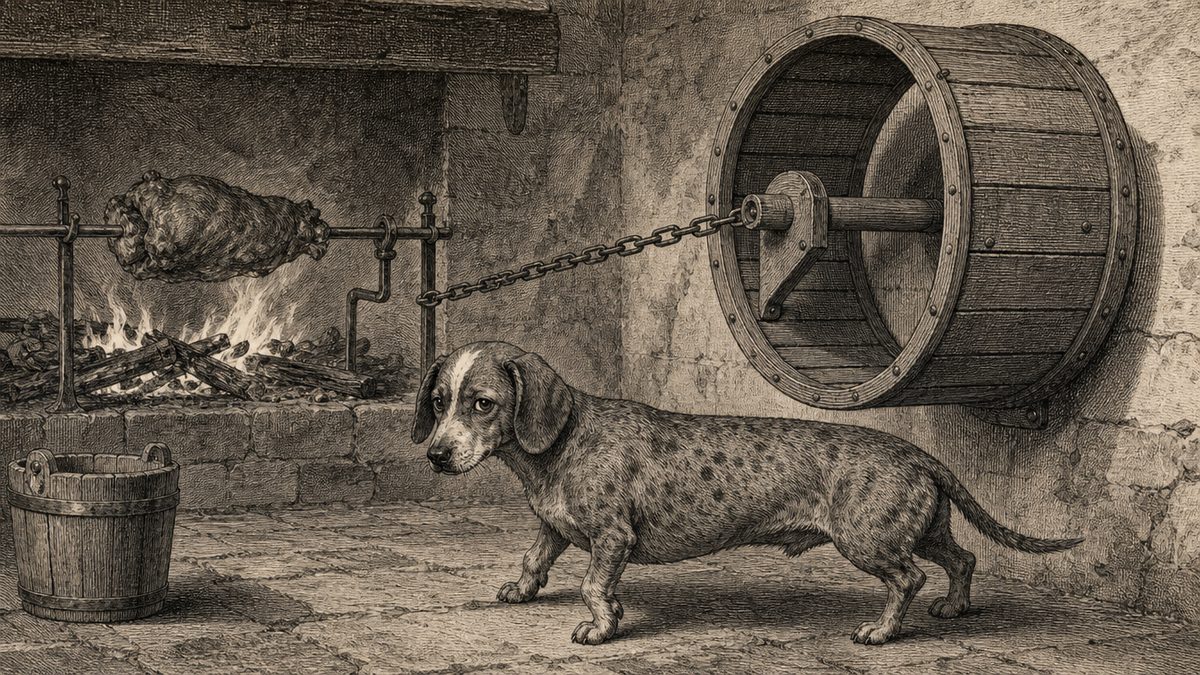
A turnspit dog was any dog taught to run inside a wooden dog wheel that turned a roasting spit over a kitchen fire. That is a job description, not a bloodline, and it is the single most important thing to understand about this animal before reading anything else written about it.
The definition above is not ours. Katharine Luomala set it out in *Pacific Science* in 1960, in a paper about how eighteenth-century voyagers classified Polynesian dogs, and it is the most useful sentence anyone has written on the subject: turnspit "was the name for any dog in Europe or the British Isles that was taught to run around inside a treadmill wheel to work a roasting spit". She adds the general point in the same paper. Terms like shepherd's cur and turnspit "refer to the dog's function in a culture".
That is why she also writes that "there are as many different descriptions of turnspits as there are describers". A word that names a job attaches to whatever dog was doing the job in that kitchen, in that county, in that decade. Luomala's own summary of the physical type is deliberately loose: "In general, a medium-sized, sturdy, teachable dog was used".
The earliest English source agrees, and says so in its own filing. Abraham Fleming's 1576 translation of John Caius puts the turnspit in a section on "mungrels and rascalls" and opens the entry by placing it "vnder the curres of the coursest kinde". The first person to describe this animal in English filed it among the curs, and the fanciers who invented dog breeds two and a half centuries later never came back for it.
Why an encyclopedia entry about a job is worth writing
Because everybody else is writing it as a breed. Twenty ranking results were pulled for this term from Brave Search with India geo on 9 September 2026, and the top twenty include four separate Reddit threads that each open with the words "a breed of dog called the Turnspit Dog", an A-Z Animals spec card filed under *Canis lupus familiaris*, and a DogBreedInfo profile in the same template that site uses for living breeds. Wikipedia itself hedges better than any of them, giving its short description as "Dog type", and then files the article under Category:Extinct dog breeds anyway.
The cost of the confusion is not academic. A reader who believes the turnspit was a breed will believe there is a lost bloodline to recover, will accept a lifespan figure and a height range that no document supports, and will follow a corgi descent claim that has one hedged sentence behind it. Every one of those is a purchase decision for somebody.
The turnspit is extinct in the only sense that matters: no dog anywhere is doing this work and no register ever held the name. But it did not die out the way a breed dies out, because it was never gathered into a breed to begin with. The machine took the job, the job was the animal's whole identity, and the dogs went back into the general dog population they had come from.
The 1576 text, read in the original spelling
Caius describes the turnspit in one paragraph and names it in another, and both were read directly in Fleming's 1576 English rather than through any summary. Here is what the book actually says.
The Internet Archive scan of the 1880 reprint runs to about 163,800 characters and carries a real text layer, so the passage can be read rather than paraphrased. The heading is "Of the Dogge called Turnespete in Latine Veruuersator", and the entry reads, in full:
"There is comprehended, vnder the curres of the coursest kinde, a certaine dogge in kytchen seruice excellent. For when any meate is to bee roasted they go into a wheele which they turning rounde about with the waight of their bodies, so diligently looke to their businesse, that no drudge nor skullion can doe the feate more cunningly. Whom the popular sort herevpon call Turnespets, being the last of all those which wee haue first mencioned."
One OCR warning, because it will produce a false zero
The scan renders Turnespete as "Tumespete", because the optical character recognition merges the letters r and n into an m. A search of that file for the correctly spelled word returns zero, and a reader who stopped there would report that the most-cited source for this animal does not contain its name. The passage is found by searching for wheele, roasted or kytchen instead. This is worth stating because the same class of failure produces confident wrong findings across the whole of this subject.
Caius explains his own etymology, and it is not vernepator
Later in the same book, in the section on mongrels, Caius takes the name apart. The word, he writes, "is made of two simple words, that is of Turne which in Latine soundeth Vertere, and of spete which is Veru", and he gives the Latin as Veruuersator. Veru is a roasting spit and versator is a turner. The whole name means the spit turner, in both languages, which is exactly what the animal was.
Two details in that paragraph are worth keeping. Caius says the dog was also called a Wappe, after the sound of its bark. And he says the Latin form leans on an Italian model rather than a classical one, which is a sixteenth-century writer telling you plainly that he is coining a term for a working animal that Latin had no word for.
Caius describes another dog that also worked a wheel, and almost nobody quotes it. Under the name Aquarius, the water drawer, he records dogs of "the greater and the waighter sort drawing water out of wells and deepe pittes, by a wheele which they turne rounde about by the mouing of their burthenous bodies". So the kitchen wheel was one application of a general practice, not a unique invention, and the turnspit was the small end of a spectrum that ran up to well dogs.
The word vernepator was invented on Wikipedia on 5 June 2006
Vernepator is not the Latin name of the turnspit dog and it appears in no source before 2006. It enters the record in the first revision of Wikipedia's turnspit article, uncited, and eight years later a national broadcaster printed it in a headline and glossed it as Latin.
Start with the disproof from the primary source. The 1576 text everyone cites for the first mention of this animal gives the Latin as Veruuersator, and the string vernepator appears zero times in the whole 163,800-character file. PubMed also returns zero for vernepator, with a working translation line, against controls of 126 and 98 in the same session.
Now the chain, which is datable at both ends. Wikipedia's article on the turnspit dog was created on 5 June 2006 as revision 56957871. That revision was pulled through the MediaWiki API and read in full. It contains the sentences "It is also known as the Kitchen Dog, the cooking dog, the Underdog and the Vernepator" and "The Vernepator Cur was breed to run on a wheel", with no citation of any kind attached to either. A binary search across all 220 revisions of the article confirms this is the earliest revision containing the string.
Eight years later, on 13 May 2014, NPR published a Kitchen Sisters feature under the headline "Turnspit Dogs: The Rise And Fall Of The Vernepator Cur". In it, the library and collections manager of the Kennel Club in London is quoted saying the dogs were "referred to as the kitchen dog, the cooking dog or the vernepator cur", and the piece then explains that this is "vernepator cur, Latin for the dog that turns the wheel".
Wikipedia's editors know, and their warning is invisible to readers
The current article carries an HTML comment at the very top of its source, which no reader sees because comments do not render: "Do not add the term VERNEPATOR to this article. This term was invented on Wikipedia in 2006 and has since appeared in several books that copy from Wikipedia; it appears in ZERO sources published prior to 2006." That is an unusually candid piece of editorial housekeeping, and it is sitting where only somebody editing the page can read it.
| Date | Document | What it says |
|---|---|---|
| 1576 | Caius, Of Englishe Dogges, Fleming's translation | Turnespete, in Latin Veruuersator. Vernepator appears zero times |
| 1809 | Bingley, Memoirs of British Quadrupeds | Canis familiaris vertagus, and Pennant's Canis versator. No vernepator |
| 1858 | Jesse, Anecdotes of Dogs, chapter THE TURNSPIT | Buffon's Basset a jambes torses. No vernepator |
| 1960 | Luomala, Pacific Science 14(3) | A full review of turnspit naming. No vernepator |
| 5 June 2006 | Wikipedia revision 56957871, the article's first | Introduces Vernepator and Vernepator Cur, with no citation |
| 13 May 2014 | NPR, The Salt, headline | Prints Vernepator Cur and glosses it as Latin |
The useful lesson is not that a radio feature made a mistake. It is that a name with no document behind it can acquire the appearance of a source in eight years, and that the appearance is strongest when a credentialed person repeats it. Nothing in the NPR piece is careless. The word had simply become part of the furniture by the time anyone went to check it.
Bonbeno's two-condition test, applied to a job description
To count as a breed on this site an animal needs two documents: a written breed standard and a studbook. The turnspit has never had either, at any point in five centuries, and there is no serious argument that it did.
The test matters here more than usual, because most extinct dogs on this site failed it by running out of time. The English Water Spaniel had a written breed standard and appeared in the Kennel Club Stud Book in a named class, and it still died out; that is a breed that ended. The turnspit is a different case entirely. There was nothing to end.
| Condition | Verdict | Evidence |
|---|---|---|
| A written breed standard | Never existed | No registry, breed club or author has ever published points, a height range or a weight range for a turnspit. Luomala's review found only that a medium-sized, sturdy, teachable dog was used |
| A studbook | Never existed | No pedigree authority anywhere has held the name. Absent from the Royal Kennel Club Breeds A to Z, the AKC index, the FCI letter T index and the FCI provisional register, each read with in-document controls |
| Contemporary classification | Cur, not breed | Caius 1576 files it under the curs of the coarsest kind and among mongrels. Bingley 1809 files it as variety 14 of 14 rather than as a species or breed |
| What the name denotes | A function | Luomala 1960: the name for any dog taught to run inside a treadmill wheel to work a roasting spit |
The verdict, and the word that fits it
The turnspit dog is a working category, and it predates breed registration by three centuries. It belongs beside the shepherd's cur and the tinker's cur in Caius's own scheme, which sorted dogs by what they did for the household. Calling it a breed imports a nineteenth-century idea into a sixteenth-century document, and it is the reason so much published material about this animal has the shape of fact and the substance of nothing. There was never a closed gene pool here either, which is the same point from the breeding side: a household that needed a spit turner took a likely pup from whatever dogs were to hand, and nobody wrote down where it came from.
One nuance that cuts the other way, and it is a real one. Luomala records that some writers did consider the turnspit a distinct breed and identified it as a descendant of the short-legged pariah dog, while others thought only of "a line of descendants of some capable and admired local turner of a roasting spit, whose pups were sought as likely to be equally teachable, capable, and physically suitable". That second picture is worth holding onto, because it describes something real: local lines, selected on the job, in individual households, with nobody writing anything down. That is how a landrace starts. It is not how a breed is made.
No pedigree can exist under this name, in India or anywhere, so any paperwork offered with a turnspit dog is either empty or for a different dog. That is not a comment about the animals. It means only that there is no document to check, in a market where the document is usually the pitch.
When the turnspit dog actually disappeared, dated from the documents
The last documented working turnspits were in Wales and Germany about 1870, and the decline can be tracked year by year through five sources between 1809 and 1870 rather than asserted as a round century.
Most pages give a bare "nineteenth century" or "by 1900". The documents are more specific than that, and the sequence is more interesting than the endpoint.
| Year | Source | What it records |
|---|---|---|
| 1570 | An English reference to mongrels trained to turn the spit, reported by Luomala citing Davis 1949 p.34 | Six years earlier than the Caius passage usually called the first mention |
| 1576 | Caius, in Fleming's translation | A standard fixture of kitchen service, described in the present tense |
| 1809 | Bingley, Memoirs of British Quadrupeds, p.123 | "Till the present improved modes of performing this business took place, the breed of Turnspits was in considerable request. It is now on the decline; and, in the course of another century, will probably be extinct in Great Britain" |
| 1853 | J. G. Wood, The Illustrated Natural History | "Here and there a solitary Turnspit may be seen ... curious relics of a bygone time" |
| 1858 | Jesse, Anecdotes of Dogs | "These dogs are still used in Germany, and her Majesty has two or three of them amongst her collection" |
| about 1870 | Luomala 1960, reporting Vesey-FitzGerald 1948 pp.728 to 729 | The last were used in Wales and Germany. A dog alternating with a companion was paid about sixpence a day at the most |
| 1800 to 1925 | Abergavenny Museum's own object record for Whiskey | The only physical specimen, dated by the museum to a band rather than a year |
Bingley made a dated prediction in 1809 and it very nearly landed
This is the sentence no ranking page quotes, and it is the best single piece of evidence on the page. Writing in 1809, William Bingley recorded that the turnspit "is now on the decline; and, in the course of another century, will probably be extinct in Great Britain", and added that "these animals still continue to be used in most countries of the continent". A century from 1809 is 1909. The last documented British use is about 1870, so he was pessimistic by roughly forty years and right about the direction, the mechanism and the continental lag.
Where the round dates come from, and why they are softer than they look
NPR's feature gives the widely repeated version: "In 1750 there were turnspits everywhere in Great Britain. But by 1850 they had become scarce, and by 1900 they had disappeared". Nothing in that is wrong, and none of it is a document. It is a summary of the trend the sources above describe. Where a page needs a date, cite the Luomala line, because it names its own source and gives a place.
The 1870 figure is second hand. Luomala is reporting Vesey-FitzGerald's 1948 book at pages 728 to 729, and we have not read Vesey-FitzGerald ourselves. That is stated here rather than smoothed over, because a chain of two is still a chain, and it is the firmest dated last-use record this subject has.
Whiskey at Abergavenny, and what one museum specimen can settle
One physical turnspit survives, a Victorian taxidermy in a wooden case at Abergavenny Museum in Monmouthshire, and the museum's own record dates her to a band of 1800 to 1925 rather than to a year.
The object record, contributed by Abergavenny Museum to the BBC's A History of the World, reads in full: "Inside this wooden case is Whiskey the Turnspit dog. This is the only example of an extinct breed. Dogs like Whiskey were used to turn the spits in the kitchens of big houses. Whiskey came from a house in Skenfrith." Its period field reads 1800 to 1925 and its culture field reads The Victorians.
Skenfrith is a village in Monmouthshire about ten kilometres from the museum, which is a small and useful detail: the specimen is local to where it is displayed, rather than acquired from a dealer. Reported accounts add that the paperwork that arrived with her has been lost, so her age is not known, and that the taxidermy is poor enough that her distorted shape may be the mounting rather than the animal.
The obvious experiment nobody has run
Whiskey is a physical specimen of a short-legged dog, in a public collection, in a country with several laboratories that routinely genotype museum material. The genetic architecture of short legs in dogs is settled: Parker and colleagues showed in *Science* in 2009 that an expressed FGF4 retrogene is strongly associated with the chondrodysplastic phenotype that defines at least 19 living breeds, and Bannasch and colleagues separated the effects of the two retrogenes, FGF4L1 on chromosome 18 and FGF4L2 on chromosome 12, in 2022.
So a single sample from this animal would answer a question the whole popular literature argues about: whether kitchen turnspits carried the same short-leg allele the corgi and the dachshund carry, or whether the legs were something else. No such study exists. PubMed returns zero records for turnspit under any query form, with the translation line read and controls returning 126, 98, 16 and 12 in the same session. This page states that as an absence rather than filling it.
One mounted animal from one house in one Welsh village can tell you what one turnspit looked like. It cannot tell you what turnspits looked like, because the whole argument of this page is that the word did not name a single kind of dog. Whiskey is evidence about Whiskey, and that is genuinely worth having, but it is not a breed standard arriving late.
What a turnspit looked like, from four descriptions that disagree
Four period descriptions of the turnspit survive and they agree on two things, a long body and short legs, and disagree on almost everything else including colour, coat, eye colour and whether the legs were crooked at all.
Set them side by side and the disagreement is the finding.
| Source | Body | Legs | Colour | Other |
|---|---|---|---|---|
| Caius 1576 | Not described | Not described | Not described | Named for the job only; filed among the curs of the coarsest kind |
| Bingley 1809, p.123 | "Great length of body" | "Short, and usually crooked" | "Generally a dusky grey, spotted with black; or entirely black, with the under parts whitish" | Filed as variety 14, with Buffon's Le Basset given as the equivalent |
| Richardson 1847, p.73 | "Small long backed cross made dog" | "Fore legs bent first inwards and then outwards" | "Frequently pied or glaucous coloured" | "Although evidently a mongrel is nearer to the terriers than anything else" |
| Jesse 1858 | "Long bodies and rather large heads" | "Extremely bandy-legged, so as to appear almost incapable of running" | "Varies, but the usual one is a bluish grey, spotted with black" | "The iris of one eye black and the other white"; tail "generally curled on the back"; "very strong in the jaws" |
The one disagreement that matters
Luomala's review notes that the turnspit is "sometimes described as having a long back, short legs, straight or crooked, and fur that was shaggy and sometimes spotted", and that straight-or-crooked is not a small variation. Crooked front legs are chondrodysplasia. Straight short legs are proportionate small size. They are different genetics and different consequences, and a body of writing that cannot agree which one it is describing is not describing a breed.
Jesse says the same thing from the other side. Immediately after calling the dogs extremely bandy-legged, he adds that "Buffon calls the turnspit the Basset a jambes torses, but some of the breed are said to have straight legs". He is reporting a disagreement in his own sources in 1858, and he does not resolve it either.
The odd eyes, and why the page will not build on them
Jesse's remark that these dogs generally had one dark iris and one white one is the most specific single observation anyone made about turnspit appearance, and it is tempting to reason from it, because odd eyes in dogs travel with particular coat-colour genetics. We are not going to. It is one sentence, in one book, about dogs its author last saw as a child, in an animal population that no source can even agree was one population. Recording it verbatim is honest. Building a genetic argument on it would not be.
No height and no weight was ever published for a turnspit dog. If you meet a spec card giving one, look at what else is on the card. Aggregator profiles for this animal print life expectancy, litter size, height and weight in exactly the format they use for living breeds, and every one of those fields for this animal was generated rather than measured.
The crooked legs: Darwin rejected the Egyptian story, and genetics replaced it
The turnspit's short crooked legs are chondrodysplasia, the same body plan that defines the dachshund, the corgi and the basset hound, and the ancestry story still quoted for it on Wikipedia was rejected by Darwin more than a century ago.
Wikipedia's appearance section closes with a claim taken from Robert Leighton's *Dogs And All About Them* of 1910, that the crooked leg is "most likely owed to very distant ancestors" in ancient Egypt, where monuments show "a small breed of terrier or Turnspit, with short, crooked legs".
Luomala reports that argument and then reports its refutation, from the person best placed to make it. Egyptian monuments of about 3400 BC to 2100 BC do show short-legged dogs, and there is a comparable description of an Indian pariah dog with similarly short crooked legs. "Such legs are common enough in various animals, Darwin finds (1897, I: 17), so he rejects the Egyptian counterpart of the monumental animal as the parent of all our turnspits." Luomala draws the modern conclusion directly: "a breed like the turnspit, sometimes compared with the Polynesian native dog, might arise through mutations more than once in different parts of the world".
What replaced it, and why it is one of the better-settled stories in dog genetics
Luomala also points at what came next, writing in 1960 that "the latter-day genetical studies on dogs by C. R. Stockard (1941) have shown that the achondroplasic factor is dominant in inheritance". Half a century later the mechanism was found. Parker and colleagues reported in *Science* in 2009 that expression of a recently acquired retrogene encoding fibroblast growth factor 4 "is strongly associated with chondrodysplasia, a short-legged phenotype that defines at least 19 dog breeds including dachshund, corgi, and basset hound".
Bannasch and colleagues then separated the two copies. There are two FGF4 retrogenes, FGF4L1 on chromosome 18 and FGF4L2 on chromosome 12. Some breeds are nearly homozygous for both, as dachshunds are; others carry only one, as beagles and Scottish terriers do. Measuring dogs of two breeds that segregate both, they found that copy number of each significantly reduced height at the shoulder and forearm length, with FGF4L1 having a much greater effect than FGF4L2; FGF4L1 alone influenced the degree of carpal valgus, and FGF4L2 alone increased head width.
The sentence in that paper an Indian buyer should read twice
Bannasch and colleagues close by observing that "selectively breeding dogs with FGF4L1 and without FGF4L2 would likely lead to a reduction in the FGF4L2-related risk of intervertebral disc herniation while maintaining the reduction in leg length resulting from FGF4L1". That is the whole short-legged-dog question in one line. The bent legs and the slipped disc are separable, they come from different copies of the same retrogene, and a buyer choosing a chondrodysplastic breed in India is choosing a risk that is now measurable rather than mysterious.
No turnspit dog has ever been genotyped, so nothing in the FGF4 literature is a statement about this animal. What can honestly be said is that the phenotype every period source describes, a long back on short and often crooked legs, is the phenotype that retrogene defines in living dogs, and that the one surviving specimen would settle the question if anyone tested it.
The corgi claim and the Glen of Imaal claim, graded by who makes them
Two living breeds are said to descend from turnspits, and the two claims are not equally sourced: one is a registry's own history text, hedged, and the other is a single author's speculation in a radio feature, also hedged.
The Glen of Imaal Terrier claim, which the AKC itself carries
The American Kennel Club's own breed history for the Glen of Imaal Terrier reads: "Glens carry the nickname 'Turnspit Dog' because, according to some, they were used in kitchens to run in a hamster-wheel contraption that turned meat over an open fire. The Glen's highly individualized bowed front legs, well-padded loin and powerful hindquarters were ideally suited for this."
Note the hedge, which is the registry's own: according to some. The AKC is reporting a tradition rather than asserting a pedigree, and that is the correct way to carry a claim like this. It is still the better-sourced of the two, because it sits in a national registry's published breed history rather than in a quotation.
The Welsh Corgi claim, and what happens when you check it
The corgi version comes from one author quoted by NPR in 2014, who "thinks possibly it's the Queen of England's favorite dog, the Welsh corgi" and adds that "the downtrodden, lumpen, proletariat turnspit cooking dogs may well be related to the queen's pampered royal pooches". Thinks possibly, and may well be. That is a speculation offered as one, and it has been repeated since as though it were a finding.
So we checked it in the documents that would carry it. The string turnspit appears zero times in the American Kennel Club's breed histories for both the Pembroke Welsh Corgi and the Cardigan Welsh Corgi, read from the pages' own raw payload. The same search run on the same site's Glen of Imaal page in the same session returns four hits, which proves the field is present and searchable and makes the corgi absence a controlled one rather than a failed fetch.
It is absent from the international standards too. FCI Standard 38, Welsh Corgi (Cardigan), and FCI Standard 39, Welsh Corgi Pembroke, were both downloaded and extracted with pypdf. Neither contains the word, and neither carries a BRIEF HISTORICAL SUMMARY section at all, which is the honest way to report it: their silence about an ancestor is not evidence against that ancestor, because they say nothing about any ancestor.
| Claim | Who says it | Hedged? | In the registry documents? |
|---|---|---|---|
| Glen of Imaal Terrier | American Kennel Club breed history | Yes, 'according to some' | Yes, four mentions on the AKC's own page |
| Pembroke Welsh Corgi | One author quoted in a 2014 NPR feature | Yes, 'thinks possibly' and 'may well be' | No. Zero mentions on the AKC page, zero in FCI 39, which has no history section |
| Cardigan Welsh Corgi | Carried along with the Pembroke claim | Same hedge | No. Zero mentions on the AKC page, zero in FCI 38, which has no history section |
One number worth knowing before you accept either
The FCI's numbering for the two corgis is the reverse of what most people assume. Standard 38 is the Cardigan and standard 39 is the Pembroke, confirmed by reading the breed name printed on the face of each PDF rather than trusting the URL. Getting that backwards is the most common error in corgi writing, and it is a good check on whether a page has opened the documents it cites.
Registry recognition today: none anywhere, checked with controls
No kennel club on earth recognises the turnspit dog, and four registers were read in full with in-document controls to establish that rather than assumed.
An absence is a strong claim, so each one below carries a control that returned in the same document, and a reader can verify every row by opening the same index and searching for the same control words. The American Kennel Club's full breed index was read the same way, and its nine in-document controls all returned while the turnspit returned zero.
| Register | Turnspit found? | Controls that returned in the same document |
|---|---|---|
| The Royal Kennel Club, complete Breeds A to Z | No, zero hits | Labrador, Beagle, Harrier, Foxhound, Bloodhound 3, Corgi 2, Otterhound, Whippet, Greyhound 2, Terrier 62 |
| American Kennel Club, full breed index | No, zero hits | Labrador 2, Beagle 2, Harrier 2, Foxhound 6, Corgi 4, Otterhound 2, Whippet 2, Greyhound 7, Terrier 93 |
| FCI nomenclature, letter T index in English | No. The whole index holds ten breeds | Tibetan Terrier, Tornjak and Tosa all present in the same index |
| FCI breeds recognised on a provisional basis | No. Twenty entries, none of them this | Newest four entries dated 2/11/2026, which is 11 February 2026 |
One retrieval warning this session reproduced
The FCI page at Nomenclature/Default.aspx, which reads like the definitive register, served the provisional list instead when fetched without JavaScript. Its content is the twenty provisional breeds, ending at Australian Stumpy Tail Cattle Dog, not the full nomenclature. Anyone reading an absence off that page is reading it off the wrong document, and the tell is that a Labrador control returns zero on it.
What this means for the Kennel Club of India
India is a full member of the FCI, represented by the Kennel Club of India in Chennai, and the KCI issues pedigrees against FCI nomenclature. Since the turnspit has no FCI number, there is no KCI pedigree route for it and there never can be one while it does not exist. That is not a criticism of the KCI. It is the mechanical consequence of a name that no international register holds.
This animal is not a breed waiting for a registry to notice it. There is no population, no standard and no breeder, so there is nothing a registry could recognise. Pages that write 'not yet recognised' about the turnspit are applying the vocabulary of an emerging breed to an extinct job.
Turnspit dog price in India: there is none, and here is what the search returns
No turnspit dog price exists in India or anywhere else, because no turnspit dog exists. The Indian price query returns two CAPTCHA-walled listing shells and four generic price lists, and any rupee figure attached to this name was invented.
That first line is the whole answer, and it is put first deliberately, because the price question is the one an Indian reader arrives with.
The Indian result set was pulled from Yahoo India on 9 September 2026 for the query turnspit dog price in india, which returned About 6,590 search results. The visible organic set is two petzlover.com pages titled *Healthy Turnspit Dog Puppies & Dogs for Sale in India* and *All Turnspit Dog Puppies & Dogs for Sale in India*, four generic Indian dog price lists on supertails.com, aruanipetstop.in, wrapinfur.com and dogbreedo.com, and an OLX puppies category page.
The control, because a search result is only evidence when the instrument is proved
The query labrador retriever price in india was run through the same endpoint in the same session and returned ten genuine Indian Labrador price pages, on fluffyn.co.in, mrnmrspet.com, whatsthecost.in, premiumpethouse.com, puppiezo.com, petzlover.com and barfindia.com, under About 16,200 search results. So the fetch works, the India geo works, and the turnspit result set was not substituted. It is a real reading of what India's search index holds for this term.
What the two listing shells actually are, and what we will not claim about them
Petzlover generates one page per breed per country, and it generates them for animals it has no listings of. The same site serves the identical page shape for the Labrador, where genuine listings plausibly exist, and for the turnspit, where they cannot. Both turnspit URLs return HTTP 403 behind a CAPTCHA wall, so their contents were not read, and this page therefore claims nothing about what is on them. Recording the wall rather than guessing past it is the point.
No rupee figure appears on this page for this animal, on purpose
The two ways to manufacture one are both fabrication. The first is to convert a foreign figure, which is why this site tests every suspicious rupee price by dividing it by 84.38, 80 and 74 and looking at whether the quotient is a price a shop would actually print. The second is to quote an Indian listing that turns out to be a different dog, a poster, a mug or a generated shell. Neither is available here, because there is no figure to test in the first place.
You are being sold something else. The likeliest candidates are a dachshund cross, a corgi cross, or an unrelated short-legged Indian dog. Ask for the pedigree, note that no registry anywhere issues one under this name, and walk. This is the one case where the buyer's check is completely unambiguous.
Monthly cost of ownership in India for a dog of this size and shape
A dog of turnspit size and build, roughly 9 to 14 kg on short legs, costs about Rs 4,000 to Rs 8,500 a month to keep properly in an Indian metro, and the arithmetic is worth doing even for an animal you cannot buy, because it is the real cost of the living short-legged breeds this page points at.
Every figure below was read from the page that publishes it, and the sources are named so a reader can re-check them, because retail prices move and municipal fees do not.
| Line | Published figure | Source | Monthly equivalent |
|---|---|---|---|
| Core vaccination, per dose | Anti-rabies Rs 699, 9-in-1 DHPPiL Rs 899, puppy DP Rs 849, kennel cough Rs 1,349 | Vetic clinic price list | Roughly Rs 150 to Rs 300 amortised over a year |
| Tick, flea and worm control | NexGard Spectra 15 to 30 kg, 3 tablets Rs 3,308 | Supertails | About Rs 1,103 a month |
| Deworming, if dosed separately | Drontal Plus 6 tablets Rs 754, one tablet per 10 kg of bodyweight | Supertails | About Rs 126 to Rs 252 per treatment |
| Grooming | Bathing from Rs 934, complete bath and styling from Rs 1,869 | Vetic Delhi | Rs 900 to Rs 1,900 if done monthly, near zero if done at home |
| Municipal registration | Delhi Rs 500 new and Rs 500 renewal; Chennai Rs 50 | MCD Delhi, Greater Chennai Corporation | Rs 4 to Rs 42 a month |
| Boarding, when you travel | Rs 599 for four hours to Rs 899 overnight in Bengaluru | PawSpace published rates | Only in the months you travel |
The line that changes most with body shape
Food. A 9 to 14 kg dog eats far less than the 20 to 30 kg dog most Indian cost articles are written about, so the single biggest line in those articles does not transfer. Worming is the other line that scales with weight rather than with shape: Drontal Plus is dosed at one tablet per 10 kg, so a 9 to 14 kg dog takes one or at most two tablets at Rs 125.67 each. What does transfer, and what costs more for this shape than for a leggy dog of the same weight, is orthopaedic and spinal veterinary care. That is not a monthly line. It is a risk line, and the FGF4 literature is what tells you how big it is.
The spread is the useful fact, not any single number
The same 9-in-1 vaccine is Rs 899 at a private clinic chain and Rs 600 at a Goa government veterinary hospital inclusive of the certificate, and a vet-at-home service prices it from Rs 1,999 plus a Rs 699 visit fee. That is a 3.3 times spread on one identical drug, and it tells an Indian reader something actionable: the price is a function of the delivery model, not of the medicine.
Greater Chennai Corporation runs six municipal pet clinics that provide treatment and anti-rabies vaccination free of cost, and its pet licence is Rs 50 against Delhi's Rs 500. Chennai issued 9,115 licences in 2024. If you are in Chennai, the public route is not a compromise, it is the default.
Could a turnspit dog handle the Indian climate? The heat tolerance answer
Bonbeno rates the turnspit 1 of 5 for heat tolerance, and the rating is an inference from origin climate rather than a measurement, because no measurement of this animal was ever taken. India's coolest large city in its coolest month is still 7.09 C hotter than the dog's home country manages in its hottest month.
Two British points were queried from NASA POWER by explicit latitude and longitude, and the grid-cell elevation was echoed back and checked against the real town in both cases, because POWER returns a cell rather than a point.
Abergavenny, where Whiskey is displayed, returned a cell elevation of 255.48 m against a real town elevation near 70 m, an error of about +185 m. That cell is reading the Black Mountains behind the town, so it runs colder than the valley floor and it is reported here as a mountain cell rather than a town one. Bath, where Jesse set his turnspit story, returned 82.56 m against a real 20 m, an error of about +63 m, which is inside tolerance for a lowland point, so Bath is the baseline this page uses.
| Place | Cell elevation | Coolest month | Hottest month | Annual mean |
|---|---|---|---|---|
| Bath, Somerset | 82.56 m | 4.56 (Feb) | 17.00 (Jul) | 10.29 |
| Abergavenny, Monmouthshire | 255.48 m | 3.28 (Feb) | 15.06 (Jul) | 8.77 |
| Chennai | 48.95 m | 24.09 (Jan) | 31.51 (May) | 27.95 |
| Delhi | 206.37 m | 13.61 (Jan) | 35.88 (Jun) | 25.60 |
| Mumbai | 97.15 m | 23.19 (Jan) | 31.19 (May) | 26.77 |
| Bengaluru | 841.72 m | 20.22 (Dec) | 28.37 (Apr) | 23.74 |
The comparison that settles it
Bath's hottest month averages 17.00 C. Chennai's coolest month averages 24.09 C. India's coolest coastal metro, at its mildest, is 7.09 degrees hotter than the warmest month the animal's home country produces. Even Bengaluru, the coolest of the four Indian cities here, is 3.22 degrees above Bath's July in its own coolest month, and its hottest month is April rather than May, which is a detail most Indian climate tables get wrong.
Why the body shape makes it worse, not neutral
A short-legged dog carries its chest and abdomen close to the ground. On an Indian afternoon the ground is hotter than the air, and a dog with a 10 cm ground clearance is standing in the hottest layer of it while a leggy dog of the same weight is not. Nothing in the historical record measures this. It is a straightforward physical consequence of the body plan every period source describes, and it is why the heat rating here sits at the floor rather than at 2.
The 2001 to 2020 climatology also returns a T2M_MAX for each point, and Bath's is 33.11 C while Delhi's is 48.79 C. Those are period extremes, the single hottest value recorded across twenty years, not average daily highs. Quoting them as routine afternoon temperatures overstates ordinary heat by eight to ten degrees, which is a mistake this project has made before and now checks for.
Humidity, wet bulb, and the number that actually decides
Humidity alone is not what would have killed a turnspit in India, and saying so is a correction rather than a hedge: Britain is a genuinely damp country. What decides is heat and humidity together, which is what a wet-bulb temperature measures.
The instinct to write "Indian humidity would finish this British dog" is a reasoning error, and this project has made it before. Bath runs 86.33 percent mean annual relative humidity and Abergavenny 89.58 percent. Chennai runs 72.39 percent, Mumbai 67.39 and Bengaluru 67.94 NASA POWER 2001-2020 climatology…. On humidity alone, the animal's home country is wetter than every Indian city in this comparison.
So the load is thermal, and the honest instrument is wet bulb, which combines temperature and humidity into the number that governs whether an animal can shed heat by evaporation at all. All figures below are computed by the Stull method from POWER's own T2M and RH2M for 2001 to 2020, and the method is named because two different wet-bulb sources are in use across this site and they disagree by up to 1.24 degrees.
| Place | Annual mean wet bulb | Peak wet-bulb month | Peak value |
|---|---|---|---|
| Bath, Somerset | 8.84 | July | 14.44 |
| Abergavenny, Monmouthshire | 7.67 | July | 13.24 |
| Delhi | 17.80 | July | 26.50 |
| Chennai | 24.04 | May | 26.11 |
| Mumbai | 22.20 | June | 25.77 |
| Bengaluru | 19.48 | May | 21.86 |
Read the gap, not the individual numbers
Delhi's peak wet bulb is 26.50 C and Bath's is 14.44 C. That is a gap of just over twelve degrees in the one variable that governs evaporative cooling, and it is a far larger gap than the air-temperature comparison suggests, because Delhi's July is both hot and wet while its May is hot and dry. A dog that copes with a Delhi May can be in real trouble in a Delhi July at a lower air temperature, and that inversion is invisible if you only look at the thermometer.
What the UK veterinary data says about which dogs actually collapse
The largest study of heat-related illness in dogs comes from the same country the turnspit came from. Hall and colleagues, working with 905,543 UK dogs under primary veterinary care in 2016, recorded 1,259 heat-related illness events from 1,222 dogs. Of the 879 events with a recorded trigger, 652 were exertional, which is the 74.2 percent the paper prints, against 113 environmental and 46 from vehicular confinement. The companion paper in *Scientific Reports*, a different paper with a different case definition, found that a dog at or above its breed and sex mean bodyweight carried odds of 1.42 (1.12 to 1.80).
The reason that matters here is that a turnspit's work was exertional by definition. Hours of steady weight-bearing effort in a hot enclosed room beside an open fire is the exact profile the exertional category describes, and it is the profile that dominates the UK data even in a country whose hottest month averages 17 degrees.
Wet-bulb figures above about 35 C are at the outer edge of anything ever recorded on Earth. If a page shows you a wet-bulb column in the high thirties, somebody has fed a period maximum into the formula instead of a mean, and every conclusion in that section is wrong. None of the figures above exceeds 26.50.
Temperament: an unusually unkind record, and why it is evidence about a job
Every surviving description of turnspit temperament describes dogs in forced labour, written by people watching them work, so it is evidence about the work and not about a disposition. Read that way it is one of the most valuable passages in the whole literature.
Edward Jesse remembered them from his own childhood in Worcestershire, in the house of a clergyman who taught him to read, and his description is the one every page quotes: "They were long-bodied, crooked-legged, and ugly dogs, with a suspicious, unhappy look about them, as if they were weary of the task they had to do, and expected every moment to be seized upon to perform it."
What almost nobody quotes is the next thing he writes, which explains it. "Cooks in those days, as they are said to be at present, were very cross, and if the poor animal, wearied with having a larger joint than usual to turn, stopped for a moment, the voice of the cook might be heard rating him in no very gentle terms." And then the comparison that gives the whole passage its force: a pointer enjoys finding game and a greyhound enjoys the chase, "while the poor turnspit performs his task by compulsion, like a culprit on a tread-wheel, subject to scolding or beating if he stops a moment to rest his weary limbs, and is then kicked about the kitchen when the task is over".
Why this page will not give you a temperament score
Aggregator profiles for this animal print friendliness, trainability and good-with-children ratings out of five, and those numbers describe nothing. There was no breed to have a temperament, no breeder selecting for one, and no observer describing dogs off duty. The one trait every source does agree on is teachability, because that was the selection pressure: Luomala's summary is that in general a medium-sized, sturdy, teachable dog was used.
The one behavioural observation that is probably real
Jesse records that where two dogs alternated days, "each dog knew his own day, and it was not an easy task to make one work two days running. Even on his regular day a dog would frequently hide himself, so cordially did he hate his prescribed duties". Wood's 1853 account independently says the dogs could appreciate the lapse of time and would leave the wheel unprompted when their shift ended. Two writers, five years apart, describing the same thing: dogs that had learned a schedule and acted on it. That is a real behavioural claim and it is well corroborated.
The useful transfer here is not temperament, it is the reminder that a working record is not a household record. A breed description written from the job will over-report drive and under-report everything else, which is exactly what happens with the Glen of Imaal and the working-line dachshund in Indian marketing copy today.
Training: what the wheel actually required, and what still transfers
Training a turnspit meant teaching one behaviour, sustained forward walking inside a moving drum, and holding it for hours under distraction. Almost nothing about that is a model for training a pet dog in India, but two parts of it genuinely transfer.
The task was narrow and long. Jesse notes that "a large solid piece of beef would take at least three hours before it was properly roasted", and that two dogs were kept so they could alternate days. So the training problem was not teaching a trick. It was building tolerance for an unvarying low-intensity job in a hot noisy room.
The two things that do transfer
- Shift work beats endurance. Two dogs alternating days was the standard arrangement, and it was adopted because one dog could not sustain the load. The Indian equivalent is obvious and widely ignored: split a walk into two shorter outings at either end of the day rather than one long one in the middle.
- Predictability does the work. The dogs learned their own rota well enough to hide on the wrong day, which is a schedule being learned rather than a command. A short-legged dog in an Indian apartment settles faster on a fixed daily rhythm than on a longer but irregular one.
- Compulsion produced the behaviour and destroyed the animal. Jesse's own account is the argument against the method. Nothing in modern training practice recommends it, and the reason the record reads as it does is that the method was the problem.
What does not transfer, and should not be tried
Treadmill work for dogs is sold in India as a heat-season alternative to walking. For a chondrodysplastic dog it is a poor idea, because sustained repetitive loading on bowed forelimbs is exactly the loading pattern the veterinary literature on these breeds is about, and because indoor treadmill work in an unventilated Indian room is exertional heat load with none of the cooling a shaded early walk gives. Ask your own veterinarian before starting any treadmill programme with a short-legged dog.
Jesse repeats an account, told to a gentleman by the Duke de Liancourt, of a turnspit whose partner hid on his own working day; the dog that had been forced to work in his place finished, then led the household to the garret where the other was hiding. Jesse presents it as an anecdote and does not vouch for it. It is worth knowing as an anecdote, not as evidence.
Exercise: the actual working day, and what it means in an Indian city
A turnspit's working day was several hours of steady low-speed weight-bearing effort, then a full day off, and that duty cycle is a better guide to a short-legged dog's needs in India than any distance target.
The record gives a shape rather than a number. Three hours or more per large joint, one dog per day, two dogs alternating. Wood adds that the labour "would be too great for a single Dog", which is why the pairs existed.
What that suggests for a living short-legged dog in India
- Steady beats fast. The historical job was sustained low-speed effort, not sprinting, and that is also what suits a chondrodysplastic skeleton.
- Split the day. Two outings of twenty to thirty minutes, before about 7 am and after about 7 pm through the Indian summer, beat one long midday walk by a wide margin.
- Test the ground, not the air. Press the back of your hand to the pavement for five seconds. If you cannot hold it, a dog whose chest is ten centimetres off that surface should not be on it.
- Skip stairs where you can. Repeated stair descent is a spinal loading pattern, and it is the one an apartment adds to a dog's life without anyone deciding to.
- Swimming is the exception. It gives sustained effort with the spine unloaded, which is the one thing a short-legged dog can do freely.
Why the exercise rating here is 3 and not 5
Working dogs are usually rated high on exercise need, and this one is not, because the work was long rather than intense and because the animal it applies to no longer exists. The rating is offered as guidance for the living short-legged breeds an Indian buyer can get, and for those, a high exercise rating would be actively harmful advice.
Delhi's June averages 35.88 C and its July wet bulb peaks at 26.50 C. In those conditions the safe window for sustained exercise is roughly an hour after sunrise and an hour before dark, and the mistake that lands dogs in Indian clinics is not a long walk, it is a normal-length walk taken two hours too late.
Grooming a short coarse coat in Indian humidity, and the ears that matter more
A turnspit's coat needed almost nothing, and the two parts of this body plan that do need attention in India are the drop ears and the skin folds where a bowed forelimb meets the chest.
Bingley in 1809 and Richardson in 1847 both describe a short coat, and Richardson calls the dog "nearer to the terriers than anything else" in build. A short coarse jacket is the cheapest coat there is to keep in Indian humidity: a rubber curry mitt once a week, and a bath only when the dog is actually dirty.
The ears are the real Indian grooming job
Every period description gives this dog drop ears, and a low-set drop ear over a warm humid canal is the standard architecture for otitis externa in an Indian monsoon. The practical routine is short. Dry the ear canal opening after every swim and every bath, never plug or flush the ear without a veterinarian's instruction, and treat a head shake that persists past a day as a reason to book rather than to watch.
There is a research gap here worth stating plainly rather than filling. This project could find no citable Indian figure for canine otitis externa seasonality in the indexed literature, and much Indian veterinary work appears in journals PubMed does not index, so that is a coverage gap rather than proof that the seasonality is unstudied.
Grooming costs in India, for the living breeds this points at
Vetic's Delhi price list gives bathing from Rs 934, a haircut from Rs 1,359, complete bath and styling from Rs 1,869 and add-ons from Rs 99. For a short-coated 9 to 14 kg dog, almost none of that is necessary. Home bathing with a mitt and a towel does the job, and the honest monthly grooming cost for this coat type in India is close to zero plus the price of a brush.
British and American breed-club grooming guides for short-coated dogs routinely say to towel off and let the dog air dry. That is fine in a British autumn and poor advice in an Indian monsoon, where a damp drop ear in ambient humidity above 85 percent is a problem waiting to happen. Dry the ears deliberately.
Health and life expectancy: nothing is known, said three times
No health data of any kind exists for the turnspit dog. There is no lifespan study, no studbook to count deaths in, no screening scheme, no breed health survey and no genetic work, and that absence was established with controls rather than assumed.
Here is the search audit, run through the NCBI API on 9 September 2026 with the query translation line read on every query.
| Query | Records | What PubMed actually ran |
|---|---|---|
| turnspit[tiab] | 0 | turnspit[tiab], with PubMed's own phrasenotfound warning |
| turnspit, unquoted | 0 | turnspit |
| vernepator | 0 | vernepator |
| "Canis vertagus" | 0 | canis[All Fields] AND vertagus[All Fields], an honest widening that still found nothing |
| "Canis vertigus" | 14,465 | canis[All Fields]. A rewrite, not a literature. Do not report this as coverage |
| Labrador retriever hip dysplasia (control) | 126 | Full MeSH expansion, working normally |
| "Welsh Corgi"[tiab] (control) | 98 | Welsh Corgi[Title/Abstract] |
| chondrodysplasia[tiab] AND dog[tiab] (control) | 16 | As written |
| FGF4 retrogene[tiab] (control) | 12 | As written |
The Canis vertigus trap, because it will catch somebody
Wikipedia's opening paragraph gives the Linnaean name as *Canis vertigus*, tagged citation-needed since October 2023. Bingley's 1809 synopsis, which is a primary source for this exact question, prints Canis familiaris vertagus for the turnspit and Pennant's Canis versator, and uses *Canis vertagus* on the previous page for a different dog, the Lurcher or Tumbler. Caius meanwhile gives *Vertagus* to the Tumbler and *Veruversator* to the turnspit. Three spellings, three animals, one word. Searching PubMed for the Wikipedia spelling returns 14,465 records that are simply everything with canis in them.
What is known, about the body plan rather than about this animal
The short-legged phenotype has real published health consequences in living breeds, and those are transferable to the extent that the body plan is the same and no further. Lappalainen and colleagues measured 224 front limbs from 112 dogs of three chondrodysplastic breeds, 30 Standard Dachshunds, 29 Skye Terriers and 53 Glen of Imaal Terriers, and found the breeds differed significantly in front limb conformation: the Skye Terrier had the most carpal valgus, the most radial head subluxation and the largest prevalence of moderate and severe elbow incongruity, while the Glen of Imaal Terrier had the most front limb rotation.
Crucially, they found those measures "were associated with several measurable clinical abnormalities and limb function such as pain, lameness, limited range of motion, and elbow joint osteoarthritis". The bent leg is not cosmetic. Consult your nearby veterinarian about screening if you are buying any short-legged breed in India.
This page gives no lifespan for the turnspit, no litter size and no disease prevalence, and it will not borrow a dachshund's. A page with no lifespan study, no screening data and no standard should say so rather than borrow once, and the aggregator spec cards that print 12 to 15 years for this animal generated that number rather than measured it.
The two Indian health risks a dog of this shape would actually face
Two risks dominate for a short-legged dog living in India, and neither is the one the historical literature would lead you to expect: tick-borne disease and exertional heat illness.
Tick-borne disease, with the denominators stated properly
Indian veterinary literature on tick-borne infection in dogs is substantial and the figures are high, but they must be quoted with the denominator the papers actually used. A West Bengal survey of 584 dogs screened found *Babesia gibsoni* in 76.54 percent and *Anaplasma* in 55.75 percent, with 72.9 percent of the 584 screened carrying two or more pathogens. A Kerala survey of 120 dogs screened found *Babesia* in 66.7 percent, that is 80 of 120, and *Ehrlichia canis* in 5.0 percent, with a pre-monsoon March to May peak.
The mandatory framing: these sampled clinically suspected dogs and clinic caseloads, not random populations. On a public page the honest phrasing is among dogs tested at veterinary clinics, because without it 76.54 percent is materially misleading about the risk to a healthy pet.
The practical consequence is a single line item. Year-round tick control is not optional in India, and the arithmetic is already on this page: NexGard Spectra for a 15 to 30 kg dog is Rs 3,308 for three tablets, about Rs 1,103 a month, covering the tick, flea, roundworm and hookworm job in one product. For a 9 to 14 kg dog the appropriate weight band is different and cheaper; ask your veterinarian which band your dog falls in rather than splitting a tablet.
Exertional heat illness, which is the mechanism the historical record actually describes
The UK data is the best there is and it points the same way for India. Of the 879 heat-related illness events with a recorded trigger in a cohort of 905,543 UK dogs, 652 were exertional, 74.2 percent, against 113 environmental and 46 from vehicular confinement. Exercise, not a hot car, is what puts most dogs in a clinic, and that is true in a country whose hottest month averages 17 degrees.
The transferable risk factor from the companion *Scientific Reports* paper is bodyweight: a dog at or above its breed and sex mean carried odds of 1.42 (1.12 to 1.80) of heat-related illness. For a short-legged breed in India that is the actionable one, because these breeds gain weight easily and the extra weight loads the spine and the heat balance at the same time.
Everything in this section is general information for Indian pet owners and none of it is a diagnosis. Heat-related collapse, laboured panting that does not settle within minutes in shade, and any sudden loss of use of the hind legs in a short-legged dog are emergencies. Consult a registered veterinarian near you rather than acting on a web page.
Feeding a 9 to 14 kg short-legged dog in India, and the one thing nobody can tell you
Feed a short-legged dog to a body condition score rather than to a chart, because keeping it lean is the single cheapest intervention available for both its spine and its heat tolerance. What nobody can tell you is what a turnspit ate, because no source records it.
The historical record is genuinely empty here. Not one of the four period descriptions says what these dogs were fed, and the only economic figure that survives is a wage rather than a ration: Luomala reports, on Vesey-FitzGerald, that a dog alternating with a companion "was paid about 6d. a day at the most" when suitable dogs became scarce. That is a labour market forming around a shrinking supply, and it is the last economic fact anyone recorded about the animal.
What is worth saying instead
- Weigh the food. A 9 to 14 kg dog needs roughly a third to a half of what the 20 to 30 kg dog in most Indian cost articles eats, so those articles overstate the food line badly for this shape.
- Score the body monthly. You should feel the ribs easily under a thin fat cover and see a waist from above. On a long-backed dog the waist is the first thing to disappear and the last thing anyone notices.
- Treat weight as a spinal intervention. The UK heat data alone gives odds of 1.42 for a dog at or above its breed mean bodyweight, and the orthopaedic literature on chondrodysplastic breeds is about loading. The same kilogram counts twice.
- Split the ration in Indian summer. Two smaller meals morning and night, with the larger one after the evening walk rather than before it.
The cost line, honestly bounded
This page publishes no monthly kibble figure, and that is deliberate. Indian retail food prices move fast enough that a figure quoted here would be stale within weeks, and this project has already watched a headline bag price change under it inside days. What is durable is the shape of the calculation: grams per day from the pack for your dog's weight, times thirty, divided by the pack weight, times the current price. Do that arithmetic yourself at the point of purchase.
Nothing is known about turnspit nutrition. That sentence is more useful to a reader than an invented feeding chart, and it is the third time this page has had to say that a figure does not exist, which is what an honest guide to a poorly documented animal looks like.
The first year, month by month, and why this timeline is not about a turnspit
No month-by-month timeline for a turnspit puppy can be honest, because no source describes one. What follows is the first year of a short-legged puppy in India, anchored on the dates Indian law and Indian veterinary practice actually fix.
Saying so first matters. There is no litter record, no whelping account and no rearing description for this animal anywhere in the sources, so a month-by-month turnspit timeline would be fiction with a table around it.
| Age | What is fixed by law or practice | What matters for this body shape |
|---|---|---|
| Under 8 weeks | Sale is prohibited. Rule 8(1)(a) of the Dog Breeding and Marketing Rules, 2017 requires that pups less than eight weeks in age are not sold | A seller offering a younger puppy has told you something about the seller |
| 8 to 12 weeks | Core vaccination course begins; anti-rabies Rs 699 and 9-in-1 DHPPiL Rs 899 per dose at one clinic chain | Carry the puppy up and down stairs. Do not let it learn to jump off furniture |
| 3 to 4 months | Socialisation window. Second and third vaccinations | Introduce ramps now, while it is a game rather than a retrofit |
| 4 to 6 months | Municipal registration where required. Delhi Rs 500, Chennai Rs 50 | Growth plates are open. Avoid forced exercise, repeated stair descent and long walks |
| 6 to 9 months | Neutering conversation with your own veterinarian | Weight starts to run away here. This is where the lifetime spinal risk is set |
| 9 to 12 months | Annual booster planning; year-round tick control already running | Full adult exercise, still split into two sessions in Indian heat |
The Indian legal date that actually protects a buyer
Rule 8(1)(a) of the 2017 Rules is a genuine Rule rather than a Schedule paragraph, and it fixes the eight-week floor on sale. It is the single most useful legal fact for anyone buying any puppy in India, and it is worth stating on a page about an extinct animal precisely because the reader who arrived here is about to buy a living one.
A dog that jumps down from a sofa a dozen times a day is loading a long back through short forelimbs, several thousand times a year. Put a ramp or a step in before the habit forms, because retraining a two-year-old dog out of jumping is much harder than never teaching it.
Indian law: the wheel and the crooked legs, taken separately
Two Indian instruments reach this animal's story directly. The Prevention of Cruelty to Animals Act, 1960 covers the wheel, and the Dog Breeding and Marketing Rules, 2017 cover the legs.
The wheel: section 11 of the PCA Act, 1960
Section 11(1)(a) reaches any person who "beats, kicks, over-rides, over-drives, over-loads, tortures or otherwise treats any animal so as to subject it to unnecessary pain or suffering", and section 11(1)(b) reaches any person who "employs in any work or labour or for any purpose any animal which, by reason of its age or any disease, infirmity, wound, sore or other cause, is unfit to be so employed". Jesse's description of a dog scolded and beaten for stopping to rest, and kicked about the kitchen when the task was over, is 11(1)(a) written out in advance.
The penalty is worth stating honestly rather than leaving to the imagination. A first offence under section 11(1) carries a fine of not less than ten rupees and not more than fifty rupees; a second within three years carries twenty-five to one hundred rupees, or up to three months, or both. A page that says a practice is illegal in India without giving the penalty leaves a reader with a false impression of deterrence.
The legs: Second Schedule Part II paragraph 6(9) of the 2017 Rules
The gazette was downloaded and extracted directly, 14 pages and 51,953 characters with a real text layer, and paragraph 6(9) reads in full: "Breeding to create new breeds of dogs or unusual looks shall be strictly prohibited." The turnspit's defining feature was a deliberate deformity selected because it suited a machine. Anyone who set out to recreate that in India today would be squarely inside 6(9), and the point generalises to every modern short-legged breeding programme in the country.
The neighbouring clauses matter for the same reader. Paragraph 6(8) forbids docking, cropping, de-barking, de-clawing and "any change of appearance by artificial means"; paragraph 6(3) prohibits in breeding, defined as breeding between relatives of the second to fourth grade within four generations, and incest breeding between parents and children or brother and sister. Cite these as Second Schedule paragraphs rather than as Rules, because the Rules themselves run only from 1 to 13 and a citation reading Rule 6(9) points a reader at a different provision.
Import, for completeness
There is nothing to import, but the rule is worth knowing because it is the same rule for every rare breed an Indian reader might chase. Dogs sit at ITC(HS) 01061900, Mammals Other, Restricted. Policy Condition 8 states that "import of commercial dogs for breeding or any other commercial activities other than the purposes mentioned above is not permitted", paragraph 6 of the trade notice states that any applications for trading or breeding purposes "shall be duly rejected", and entry is limited to six ports, Delhi, Mumbai, Chennai, Hyderabad, Bangalore and Kolkata. DAHD added a seventh port, Cochin International Airport at Kochi, for pets arriving under the baggage rules in October 2024. An import authorisation for a dog that does not exist is not obtainable at any price. The full route is set out in how to import a dog to India.
Everything above is what the instruments say. How often they are enforced is a separate question this page does not answer, and the small size of the section 11 penalty is part of why. Quote the clause, not the outcome.
Head to head: what an Indian buyer is actually being offered instead
Nobody can sell you a turnspit dog, so the useful comparison is between the living short-legged breeds available in India and the two that are said to carry turnspit blood.
| Dog | Available in India? | Registry standard? | Turnspit link | The health question that matters |
|---|---|---|---|---|
| Turnspit dog | No. Extinct, no population anywhere | None, ever, in any register | It is the turnspit | Unanswerable. Zero papers, zero screening data, one museum specimen |
| Pembroke Welsh Corgi | Yes, widely | FCI Standard 39, and RKC and AKC standards | One author's hedge in a 2014 radio feature. Zero mentions in the AKC history or FCI 39 | FGF4 chondrodysplasia. Ask which retrogenes the line carries |
| Cardigan Welsh Corgi | Yes, less common than the Pembroke | FCI Standard 38, and RKC and AKC standards | Carried along with the Pembroke claim. Zero mentions in the AKC history or FCI 38 | Same body plan, same question |
| Glen of Imaal Terrier | Rare in India | AKC and FCI standards | The AKC's own history carries the nickname Turnspit Dog, hedged with 'according to some' | Most front limb rotation of three breeds measured by Lappalainen 2022 |
| Dachshund | Yes, very widely | FCI Standard 148, and RKC and AKC standards | Buffon called the turnspit the Basset a jambes torses, which is the same comparison | Nearly homozygous for both FGF4 retrogenes. The disc risk is the headline |
| Beagle | Yes, very widely | FCI Standard 161, and RKC and AKC standards | None claimed | Homozygous for one retrogene, not both, so shorter legs without a dachshund's disc profile |
| Indian pariah dog | Yes, free, this week, in every Indian city | ICAR-NBAGR registered breed | None claimed | Leggy, heat-adapted, and outside this entire problem |
How to read that table
The turnspit column exists to be crossed out. Every other row is a real purchase decision, and the column that should drive it is the last one rather than the fourth. A turnspit link is a story. The FGF4 retrogene load is a measurable property of the line you are buying into, and Bannasch and colleagues showed that FGF4L1 and FGF4L2 have different effects and that the disc risk travels with the second one.
Ask whether the line has been tested for the two FGF4 retrogenes, and what the results were. Most Indian sellers will not know what you are asking, and that answer is itself information. The test exists, the science is a decade and a half old, and no amount of turnspit romance substitutes for it.
What Indian readers get wrong about the turnspit dog, in order of cost
Eight mistakes recur, and they are ordered here by what each one costs the person making it rather than by how often it appears.
- Paying for one. The most expensive mistake and the simplest to avoid. There is no turnspit dog at any price. A seller quoting a rupee figure is selling a different animal, and no registry anywhere issues a pedigree under this name.
- Buying a corgi because of the turnspit story. The descent claim is one author's hedged speculation in a 2014 radio feature, and the word turnspit appears zero times in the AKC's histories for both corgis and zero times in FCI standards 38 and 39. Buy the corgi for the corgi.
- Repeating the word vernepator. It has no source before Wikipedia's first revision of 5 June 2006 and Caius prints Veruuersator instead. Using it marks a page as having copied rather than read.
- Calling it a breed. It was a job. Luomala's 1960 review settles this in a sentence, and Caius filed it among the curs and mongrels in 1576.
- Quoting a lifespan, height or weight. None was ever published. Every spec card carrying those fields for this animal generated them.
- Dating the extinction to 1900 without saying where that comes from. The firmest dated record is about 1870 in Wales and Germany, and it is second hand through Luomala. Bingley's 1809 forecast of extinction within a century is the better sentence to quote, because it is a primary source making a checkable prediction.
- Reading the temperament descriptions as breed traits. Jesse described dogs in forced labour and explained why in his next sentence. That is evidence about a job.
- Treating the Egyptian ancestry story as settled. Wikipedia still carries Leighton's 1910 version. Darwin rejected exactly that inference, and Luomala reports the rejection.
A search inside the 1576 text for the correctly spelled word Turnespete returns zero, because the scan's optical character recognition merges r and n into m. Stopping there would have produced a confident finding that the most-cited source for this animal does not mention it. When a search inside a primary document returns zero for a word that must be there, suspect the encoding before you conclude anything.
Adoption: what to do instead, and what this animal's ending is actually for
You cannot adopt a turnspit dog, so the useful advice is what to do with the interest that brought you here, and the honest answer for an Indian reader starts at a shelter rather than at a breeder.
Three routes are open, and they are ordered by how well they serve the reader rather than by how interesting they are.
- Adopt an Indian pariah dog. Free, available this week in every Indian city, heat-adapted by several thousand years of local selection, and outside the entire chondrodysplastic problem this page has been describing. It is the single best answer to almost every question that brings a reader to a rare-breed page.
- Adopt a short-legged dog that already exists. Dachshunds and dachshund crosses turn up in Indian shelters regularly, usually surrendered at two or three years old, and often with the back problems that made them a surrender. Going in with the FGF4 literature in your head makes you a better adopter, not a worse one.
- If you buy, buy a documented dog. Ask which registry issued the pedigree, ask to see it, and check the breed against the FCI or Royal Kennel Club index yourself. That check takes two minutes and it is the one thing no seller can talk you out of.
What the turnspit's ending is actually for
The temptation with an animal like this is nostalgia, and nostalgia is the wrong reading. The turnspit did not die out because people stopped caring about it. It ended because the work ended, and the reason there is no bloodline to mourn is that nobody ever gathered one: the dogs came out of the general population, did a job for three centuries, and went back into it.
What is worth taking from it is narrower and more useful. A deliberate deformity, selected because it suited a purpose, outlived the purpose by a century and a half and is still in the dogs Indian buyers take home today. The wheel is gone and the FGF4 retrogene is not. Indian law says so in its own words at Second Schedule Part II paragraph 6(9), which prohibits breeding for unusual looks outright, and the veterinary literature says so in measurements of pain, lameness and osteoarthritis in living short-legged breeds.
Where to look in India
Municipal and NGO shelters in every metro, the local veterinary hospital's noticeboard, and the six free municipal pet clinics run by Greater Chennai Corporation if you are in Chennai, which provide treatment and anti-rabies vaccination at no cost. Register the dog once you have it: Delhi charges Rs 500 and Chennai Rs 50 Greater Chennai Corporation.
We do not sell animals, we do not recommend breeders and we do not link puppy listings. Everything on this page is editorial. Where a price appears it is a published figure reported as content, not an offer, and on this page no breed price appears at all because none exists.
Turnspit dog: the questions people actually ask
Were turnspit dogs real?
Yes, turnspit dogs were real, and the evidence is a printed description from 1576, four more from 1809 to 1858, a surviving wheel and a stuffed specimen in a Welsh museum. What was not real is the breed. Turnspit was the name for any dog taught to run inside a kitchen wheel, so the word describes a job rather than a bloodline.
How did the turnspit dog go extinct?
The turnspit dog went extinct because the machine that replaced it was cheaper. Clockwork and smoke-driven roasting jacks removed the work, and by 1853 John George Wood was writing that only a solitary turnspit could be seen here and there. Bingley had predicted exactly this in 1809. The last documented working dogs were in Wales and Germany about 1870.
What does turnspit mean?
Turnspit means the dog that turns the spit, and Caius spelled out the etymology himself in 1576: the name is made of Turne, which in Latin is vertere, and spete, which is veru, a roasting spit. His Latin form is Veruuersator. The animal was named after the machine it powered, which is why it was never a breed.
What is a vernepator cur?
Vernepator is not a Latin word for the turnspit dog and it appears in no source before 2006. It enters the record in the very first revision of Wikipedia's turnspit article, number 56957871 of 5 June 2006, with no citation. Caius, the 1576 source everyone cites for the first mention, prints Veruuersator instead. PubMed returns zero for vernepator.
Is the Welsh Corgi descended from the turnspit dog?
Nobody has shown that, and the claim rests on one hedged sentence in a 2014 radio feature. The word turnspit appears zero times in the American Kennel Club's histories for both corgis and zero times in FCI standards 38 and 39, neither of which carries a history section at all. What the two dogs genuinely share is a short-legged body plan, not a documented pedigree.
Can you buy a turnspit dog in India?
No. The animal is extinct, so no puppy of it exists anywhere at any price. The Indian price query returns two petzlover listing shells whose pages sit behind a CAPTCHA wall and four generic Indian dog price lists that do not mention the animal. Any rupee figure attached to this name is invented, because there is nothing for it to describe.
What did a turnspit dog look like?
Every source agrees on a long body and short legs and disagrees about almost everything else. Bingley in 1809 gives a dusky grey spotted with black, or black with whitish underparts. Jesse in 1858 adds that one eye was usually dark and the other white, that the tail curled over the back, and that the dogs were extremely bandy-legged.
How big was a turnspit dog?
No measurement was ever published, which is one of the clearest signs that this was not a breed. Luomala's 1960 review says only that in general a medium-sized, sturdy, teachable dog was used, and that there are as many descriptions of turnspits as there are describers. Any height or weight range you see quoted for this animal has no document behind it.
Why were turnspit dogs bred with crooked legs?
The crooked legs were selected because they suited the wheel, and the modern name for that body plan is chondrodysplasia. Parker and colleagues showed in Science in 2009 that an expressed FGF4 retrogene defines this short-legged phenotype in at least 19 living breeds, including the dachshund, corgi and basset hound. No turnspit has ever been genotyped.
Did turnspit dogs really run away when someone said the word wheel in church?
That story mutates every time it is retold and its earliest form is different from the one you will read. Jesse printed it in 1858 with the trigger word 'spit', from the day's lesson, and added that he would not vouch for its truth. The version with a bishop, Ezekiel and the word 'wheel' is a later embroidery on a story its own first teller doubted.
Is there a turnspit dog left anywhere?
One physical specimen survives, a Victorian taxidermy called Whiskey in a wooden case at Abergavenny Museum in Monmouthshire, and the museum records that she came from a house in Skenfrith. Its own object record dates her only to a band of 1800 to 1925, and reported accounts say the paperwork that arrived with her has been lost.
Which living dog is closest to a turnspit dog?
There is no honest single answer, and the two candidates come from different kinds of source. The American Kennel Club itself records that Glens of Imaal carry the nickname Turnspit Dog, hedged with the words according to some. The corgi claim comes from one author quoted in a radio feature. Both are available to an Indian buyer and neither claim is a pedigree.
Would keeping a dog in a turnspit wheel be legal in India today?
No. Section 11(1)(a) of the Prevention of Cruelty to Animals Act, 1960 reaches any person who over-drives, over-loads or otherwise treats an animal so as to subject it to unnecessary pain, and 11(1)(b) reaches employing in work an animal unfit to be employed. The penalty is small, a fine of Rs 10 to Rs 50 for a first offence, but the prohibition is plain.
What is the life expectancy of a turnspit dog?
Nobody knows and nobody ever recorded it. There is no lifespan study, no studbook to count deaths in, and no health survey, so any life expectancy figure you find on an aggregator spec card for this animal was generated rather than measured. That absence is worth more to a reader than a plausible invented number would be.
Compare with similar breeds
Turnspit dog sits in 3 Bonbeno groups. Each one compares it directly against the breeds it is genuinely an alternative to, on the same figures.