
Breed profile
Polynesian Dog: One Population Under Five Names
Wikipedia's list of extinct dog breeds calls this a catch-all term for four breeds. Wikipedia's own Polynesian Dog article lists five. Luomala's 1960 survey names four archipelagoes with living dogs at contact and the Marquesas is not among them. And the ancient DNA puts Hawaii, New Zealand, the southern Cook Islands and Tokelau in a single haplogroup.
Quick answer
The Polynesian dog is not a breed and never was. It is the collective name for one dog population that Austronesian voyagers carried across the Pacific, called kuri in New Zealand, ilio in Hawaii and uri in Tahiti. Ancient mitogenomes place the sampled island populations in a single haplogroup, A2b2. Every branch is extinct, absorbed into introduced European dogs during the nineteenth century.
This page reports a historical record. Every branch of this population is extinct, no clinical record exists for any of them, no screening scheme has ever covered them and no life expectancy has been measured, so every health statement here is about living village-type dogs in India rather than about the animal in the title. Guidance written for registered breeds may not transfer. Nothing here is a diagnosis or a treatment plan. Consult your nearby vet before acting on anything on this page, and take any dog showing heat distress, collapse, pale gums, dark urine or an unexplained fever to a veterinary surgeon the same day.
Polynesian Dog at a glance
What the Polynesian Dog was, and why it is one animal rather than four
The Polynesian Dog is a collective term for one extinct dog population that Austronesian voyagers carried across the Pacific, not an umbrella over four separate breeds. The island names, kuri in New Zealand, ilio in Hawaii and uri in Tahiti, are the same animal described in different languages.
Start with the thing every ranking page gets structurally wrong. English Wikipedia's List of extinct dog breeds describes this name as a catch-all term for four breeds on this list, naming the Hawaiian Poi Dog, Kuri, Marquesan Dog and Tahitian Dog. Read as written, that says there were four breeds and one label. The evidence says the opposite: there was one population and several labels.
Wikipedia's own Polynesian Dog article does not agree with its list, which is the first clue. That article lists five varieties rather than four, and it nests the Tuamotuan Dog as a sub-bullet underneath the Tahitian Dog, glossing it as possibly a longer-haired version of the same animal. Meanwhile the string Tuamotu occurs zero times in the list article, and Wikipedia's Tuamotuan Dog page is a 34-byte redirect pointing at a section of the Tahitian one.
What the animal actually was
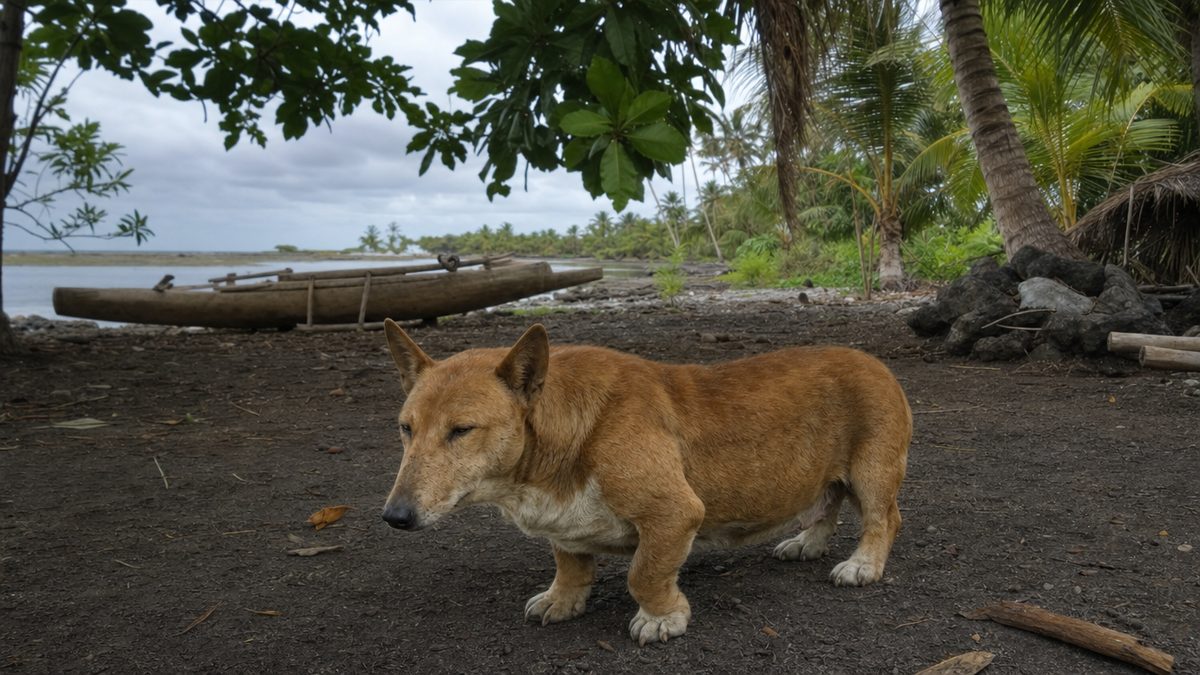
It was a small to medium, lean, primitive, short-coated to moderately coated dog with a long back, short and often bowed forelegs, a broad head, a pointed muzzle, small eyes and prick ears. It was free-ranging in some places and penned in others, was fed a largely vegetarian diet, was raised for dog meat, hair and teeth, rarely barked, and was described by every European who met it as quiet and lazy.
It arrived with people. Dogs were one of three domesticates the Austronesian voyagers carried, alongside pigs and chickens, and the archaeological record of Oceania places them in Island Southeast Asia around 3,300 years ago and in the eastern islands of Polynesia by the fourteenth century AD.
The three questions this page answers that no other page does
- Is this one animal or several? One, and the ancient DNA now says so directly rather than by inference.
- Why does the popular list of four contain the Marquesas and not the Tuamotus? Because it was assembled from encyclopedia articles rather than from the archaeology, and it is the wrong way round on both entries.
- Is anything left of it? No, and specifically the modern street dogs of French Polynesia are not survivors, which is a claim currently made by a page ranking in the top ten for this term.
This site carries five pages that touch this population: this one, plus the kuri, the Hawaiian Poi Dog, the Marquesan Dog and the Tahitian Dog. They exist because readers search those names, not because we think there were five breeds. Each island page says on its own face that it is describing a branch of one population, and this page is the parent they all point back to. We have deliberately not created a sixth page for the Tuamotuan dog, because Wikipedia itself resolves that name into the Tahitian one and the evidence for a separate variety is a hair length.
Bonbeno's two-condition test, applied as a table
To count as a breed on this site an animal needs two documents, a written breed standard and a studbook, and the Polynesian Dog has neither and never did. The formal verdict is type, and the more precise description is a single dispersed indigenous population that no register ever held.
The verdict set runs breed, breed in formation, type, brand, and register without standard. This one is not close to the boundary. It ended before the institutions that would have to hold it were founded.
| Condition | Verdict | Evidence, and the named document |
|---|---|---|
| A written breed standard | Never existed | No registry, club or author has ever published points, a height range or a weight range for this animal. Luomala's 1960 survey of every taxonomic attempt from the 1770s onward records that the source material came at second and third hand from impressionistic descriptions by Cook's expeditions and other eighteenth-century explorers, 'none of whom give a single measurement or preserved a specimen for scientific study' |
| A studbook | Never existed | No pedigree authority anywhere has held the name. Absent from the FCI's letter P index (27 entries, POLYNESIAN zero times, with Pharaoh Hound 248, Podenco Canario 329, Pug 253 and Puli 55 returning as controls) and from the FCI provisional register (POLYNESIAN zero times, with Macedonian Shepherd Dog Karaman 378 returning as a control) |
| A binomial that survived | No, retired to a junior synonym | Charles Hamilton Smith named it Canis pacificus. Wozencraft's Mammal Species of the World, third edition 2005, lists Canis pacificus C. E. H. Smith, 1839 as a junior taxonomic synonym of the domestic dog. So the animal has no taxonomic standing of its own |
| Controlled reproduction | Yes on some islands, in a limited sense | Dogs were tied around the belly and kept in the house on Tahiti, penned and fed a set diet for the table, and the Tuamotuan long-haired dogs were kept for a hair trade. That is management of a food and fibre animal rather than selection toward a written type |
| A defined ideal | Partly, and it was culinary | What was selected for is visible in the record: a dog that fattened on breadfruit and taro, stayed quiet, and in the Tuamotus grew hair 10 to 15 cm long that Tahitian warriors would cross open ocean to trade bark-cloth for |
| A single population, demonstrated | Yes, and this is the modern finding | Ancient mitogenomes from Hawaii, New Zealand, the southern Cook Islands and Tokelau form one haplogroup, A2b2, separate from dingoes and New Guinea Singing Dogs. Fourteen Wairau Bar dogs carry five closely related haplotypes, all matching the ancient Polynesian short haplotype Arc2 |
| Formal verdict | Type | It fails both documentary conditions outright, and it fails them for a structural reason rather than through neglect: it was absorbed into introduced European stock during the nineteenth century, before kennel clubs, studbooks and written standards existed as institutions |
Why the verdict is type and not breed in formation
Breed in formation is the verdict for a live programme with a standard and a register in progress, and it is the one this site applied to a Spanish population with a draft standard and a DNA-verified private register. Nothing of that kind exists here and nothing can, because there is no population left to enrol.
It is worth saying plainly that the test is a proxy and that this population met the purpose of neither condition. It was not defined by a document and it was not controlled by a register. It was defined by an ocean, and the isolation an ocean provides did the work a studbook does, which is why the island populations stayed recognisable for centuries and then dissolved within a generation once European ships began arriving with dogs.
No pedigree can exist under this name, in India or anywhere, and no living dog descends from this population intact. Any paperwork accompanying an animal sold as a Polynesian Dog, a kuri, a poi dog or an uri is either empty or belongs to a different animal. Treat the offer as a reason to walk away rather than as a reason to negotiate.
The evidence that this is one population and not four breeds
Four independent lines of evidence say the island dogs were one animal: an 1839 binomial coined for two of them together, a nineteenth-century taxonomist calling the third a close relative, a shared name across the whole ocean, and a single modern haplogroup spanning four archipelagoes. The genetics is the newest of the four and the strongest.
This is the section the page exists for, so the evidence is set out in order of when it arrived rather than in order of strength.
1. The 1839 binomial was coined for two islands at once
Charles Hamilton Smith did not name a Tahitian dog and a Hawaiian dog. He named one animal covering both. Verbatim from his own text: the native race, known by the name of The Poe Dog (Canis Pacificus, Nob.), Uri-Mahoi of Tahiti and Ilio of the Sandwich Islands, from Uri a dog, and Mahoi indigenous.
The running head over the following page of that section reads DOG OF THE SOUTH SEA ISLANDS, and the New Zealand dogs are described a few lines later within the same section, after Forster, as a long-haired breed resembling the sheep-dog. So the scientific name that Wikipedia now files under a four-breed umbrella was invented as a single name for two of those four, with the third handled as a variant in the same passage.
2. The taxonomists who followed said the same thing
Luomala's survey records Fitzinger in 1867 filing the Tahitian dog as found in the Hawaiian and Society islands together, with only minor differences from the New Zealand dog, its closest relative. It records Smith distinguishing the poe dog of the Society and Sandwich islands from its relative the New Zealand dog, and noting that in the Society Islands it was already mixed in breed while in Hawaii the pure breed was better protected.
Read those together and the nineteenth-century position is clear and consistent: Tahiti and Hawaii held the same animal, New Zealand held a larger version of it, and the differences were treated as differences of degree. The modern encyclopedia carries the same reading without drawing attention to it: Wikipedia's Tahitian Dog article states that the animals were closely related to the Hawaiian Poi Dog and the New Zealand kuri, and that the kuri is believed to be a descendant of the Tahitian breed. A descendant relationship is not a sibling-breed relationship.
3. One name travelled the whole ocean
The linguistic evidence is small but it is very direct. When Cook stood off Atiu in the southern Cooks in April 1777 he eventually gave the islanders one of Omai's two British dogs, and the Cook Islands Natural Heritage Trust records that the locals called it kuri, the widespread traditional Polynesian name for dog.
That is islanders 3,000 km from New Zealand applying the New Zealand word to a British animal on sight. The name is not a New Zealand invention attached to a New Zealand breed. It is the Polynesian word for dog, and Bennett records the Tahitian equivalent working the same way, with uri as the generic small-animal name that Tahitians extended to a monkey as uri-taata, the man-dog.
4. The ancient DNA, which settles it
The modern evidence is the decisive one and it arrived in 2018. Greig and colleagues sequenced seven new complete ancient mitogenomes and five partial mtDNA sequences from archaeological dog specimens across Mainland and Island Southeast Asia and the Pacific. Their sequences from Atafu in Tokelau and from Hawaii, together with previously published sequences from New Zealand and the southern Cook Islands, form a single haplogroup, A2b2, separate from dingoes and New Guinea Singing Dogs.
Four archipelagoes, one haplogroup. And Greig's 2015 work on the New Zealand end shows how tight the founding population was: fourteen complete mitogenomes from Wairau Bar yielding five closely related haplotypes, all of them carrying control-region haplotype A192, which is otherwise reported only from some modern village dogs in Bali.
| Evidence | Date | What it shows | How strong |
|---|---|---|---|
| Smith's Canis pacificus | 1839 | One binomial coined for the Tahitian and Hawaiian dogs together, with the New Zealand dog as a variant in the same section | Strong on intent, weak as biology. Smith never saw one |
| Fitzinger's classification | 1867 | Tahitian dog recorded as found in both the Hawaiian and Society islands, differing only slightly from the New Zealand dog | Same. A classifier reading other people's descriptions |
| The name kuri at Atiu | April 1777 | The New Zealand word applied to a British dog in the southern Cooks, recorded as the widespread Polynesian term | Good. A contemporaneous observation of usage |
| Haplogroup A2b2 | 2018 | Ancient mitogenomes from Hawaii, New Zealand, the southern Cook Islands and Tokelau falling in one haplogroup | Decisive within its sample. It is the only line of evidence that measures the dogs rather than the descriptions |
The honest limit on all of this
One gap matters and this page will not paper over it. No Society Islands or Tahitian dog has ever been sequenced. The strings Tahiti and Huahine occur zero times in Greig 2018, and the only mention of the Society Islands in that paper is inside a reference title. So the genetic case for one population rests on Hawaii, New Zealand, the southern Cooks and Tokelau, and the Tahitian branch is joined to them by the historical and linguistic evidence rather than by a sequence.
That is still a strong position, because the Tahitian dogs sit geographically between Hawaii and the Cooks and arrived by the same voyages. But it is an inference, and a page that told you the Tahitian dog had been genetically matched to the kuri would be inventing a result.
One population, carried by one set of voyages, diverging into island populations that a nineteenth-century naturalist could not reliably tell apart and that a twenty-first-century mitogenome places in a single haplogroup. The island names are geography. They are not breeds.
Which islands actually had dogs, and why the popular list is wrong at both ends
Four archipelagoes had living native dogs when Europeans arrived: Hawaii, New Zealand, the Society Islands and the Tuamotus. The Marquesas did not, and its dogs had been extinct or very rare since about 1595. The widely repeated four-breed list gets both of those the wrong way round.
Luomala states the distribution plainly and this page quotes her rather than summarising: the dog was present at the time of European discovery of Polynesia in only a few archipelagoes, and the Tuamotus, Society Islands, Hawaiian Islands and New Zealand had dogs which she believed they did not get from any known European explorers.
She is equally plain about the Marquesas. Four Polynesian archipelagoes, Hawaii, New Zealand, Society and Tuamotus, had living native dogs at the time of European discovery, and archaeological evidence from the Marquesas shows that dogs had become extinct or very rare there by 1595, when Europeans first reached the islands
So the popular list is inverted at both ends
Set that against Wikipedia's list of four, which names the Hawaiian Poi Dog, the kuri, the Marquesan Dog and the Tahitian Dog. It includes the archipelago whose dogs were gone before any European described one alive, and it excludes the archipelago whose dogs were not only alive but supplying a long-distance hair trade.
That is not a small editorial quibble. It means the best-known list of Polynesian dogs is organised around which Wikipedia articles happen to exist rather than around where the dogs were, and a reader working from it will spend their time on the emptiest of the four records and never hear of the Tuamotus at all.
| Archipelago | Luomala 1960 | McCormack, Cook Islands NHT | On Wikipedia's list of four |
|---|---|---|---|
| Hawaii | Yes | Yes | Yes, as the Hawaiian Poi Dog |
| New Zealand | Yes | Yes | Yes, as the kuri |
| Society Islands | Yes | Yes | Yes, as the Tahitian Dog |
| Tuamotus | Yes | Yes | No. Absent entirely; the string Tuamotu occurs zero times |
| Samoa | No. No dependable evidence in western Polynesia | Yes | No |
| Marquesas | No. Extinct or very rare by 1595 | No. Absent, despite being present archaeologically | Yes, as the Marquesan Dog |
| Cook Islands | Not listed | No. Absent, despite the archaeological record | No |
| Rapa Nui, Tonga | Tonga recognised the name but had no dogs | No | No |
A disagreement this page publishes rather than resolves
The two best sources here do not agree about Samoa. McCormack, writing for the Cook Islands Natural Heritage Trust, lists Samoa among the places Europeans encountered Polynesian dogs. Luomala says no dependable evidence has been found of the dog's presence in western Polynesia at the time of first European contact.
Both are serious sources, one an anthropologist writing in Pacific Science and one a career Pacific biodiversity director. This site's rule where sources disagree is to name both and let the reader see that the question is open, rather than averaging them or picking the more convenient one. Nothing else on this page turns on which is right.
The dogs moved after contact too, and that muddies later records
One documented event is worth knowing because it explains some confusing later reports. After Atiu in 1777 Cook sailed to Tonga, where there were no dogs, and gave a chief a male and a female Polynesian dog taken from Tahiti. They bred, and Mariner reported dogs common in Tonga by 1811.
So a Tongan dog in the early nineteenth century may well be a Tahitian dog two or three generations removed, moved there deliberately by a European expedition. By the time missionaries reached Rarotonga in 1823 with their own dogs, the people had lost the word kuri entirely and coined puaka-aoa, literally barking pig, which tells you both that the old animal was gone and that the new one behaved differently enough to need a new name.
Almost every description of the original animal says it rarely barked and howled or yelped instead. A community meeting European dogs for the first time and naming them after the noise they make is independent confirmation of that, arriving from a completely different direction than the explorers' journals.
The names: kuri, ilio, uri, peto and nuhe
The Polynesian words for dog are closely related across most of the ocean, which is itself evidence that the animal travelled with one set of voyages. The exception is the Marquesas, whose southern word for dog sits outside the family entirely.
Names are weak evidence on their own and this site has a standing rule against building an origin theory on a word. Used carefully, though, the pattern here corroborates what the genetics says.
| Word | Where | Note |
|---|---|---|
| kuri | New Zealand, and used across the Pacific | Recorded as the widespread traditional Polynesian name for dog; applied by Atiu islanders to a British dog in April 1777 |
| ilio | Hawaii | Glossed by Smith 1840 as Ilio of the Sandwich Islands, in the same sentence that names the Tahitian word |
| uri | Tahiti and the Society Islands | Smith gives Uri-Mahoi, from uri a dog and mahoi indigenous. Bennett records uri as the generic small-animal term, extended to a monkey as uri-taata, the man-dog |
| peto | Northern Marquesas | Variously derived from English pet, Spanish perro, or a named New Haven dog left on Nuku Hiva around 1798. None of those derivations is settled |
| nuhe | Southern Marquesas | Unique among the Polynesian languages, which is a genuinely odd thing given how closely the others are related |
| puaka-aoa | Rarotonga, from 1823 | Literally barking pig. Coined for missionaries' dogs after the traditional word kuri had been lost |
What the pattern supports, and what it does not
Kuri, ilio and uri belong to one family and sit on three widely separated archipelagoes, which is consistent with one animal carried by one expansion. That is a modest claim and the genetics carries the weight anyway.
What the pattern does not support is any theory built on peto. Its resemblance to the Spanish perro has been used to argue for a Spanish introduction, and the same inference was drawn in New Zealand from the alternative Maori name pero. Two identical false inferences 6,000 km apart is better evidence for a Polynesian word than for a Spanish loan, and this page draws no conclusion from it beyond that.
The correct forms carry macrons and glottal stops: the New Zealand word is kuri with a macron on the u, the Hawaiian is ilio with an okina before it and a macron on the first i, and the Tahitian is uri with an okina and macrons. This site writes them unmarked in body text for search reasons and says so here rather than pretending the unmarked forms are correct. When you search the literature, search both.
Canis pacificus, and the four different dates in circulation for it
The Polynesian dog carried at least six Latin names and none survives. Canis pacificus, the best known, was retired to a junior synonym of the domestic dog, and the four sources that give its authorship date disagree with each other by six years.
Eighteenth and nineteenth-century naturalists repeatedly tried to give this animal species rank, mostly without having seen one. Luomala's whole 1960 paper is a survey of those attempts and it is the reason this section can be written at all.
| Name | Author and date | Status now |
|---|---|---|
| Canis domesticus, indicus taitiensis | Georg Forster, 1778 | Obsolete |
| Canis familiaris villaticus, meridionalis | F. L. Walther, 1817 | Obsolete |
| Canis otahitensis | H. G. L. Reichenbach, 1836 | Obsolete |
| Canis familiaris orthotus otahitensis | H. G. L. Reichenbach, 1836 | Obsolete |
| Canis pacificus | Charles Hamilton Smith, date disputed | Junior synonym of the domestic dog |
| Canis familiaris otahitensis | C. G. A. Giebel, 1859 | Obsolete |
Four dates for one name, and which to use
This is a small forensic point but it is exactly the kind of thing a directory should get right. Four sources give four positions on when Smith published Canis pacificus.
- 1839, per Wozencraft in Mammal Species of the World, which lists it as Canis pacificus C. E. H. Smith, 1839.
- 1839, in his 1840 book, which is how English Wikipedia's Polynesian Dog article phrases it in a single sentence.
- 1845, per Luomala, who cites Smith 1845 at pages 210 and 296.
- 1845, per English Wikipedia's Tahitian Dog article, which lists Canis pacificus (1845) by Charles Hamilton Smith in its own list of names.
The volumes were issued as part of Jardine's Naturalist's Library across 1839 and 1840, and the later date almost certainly reflects a reprint. For taxonomic purposes the authority date is 1839, because that is what Mammal Species of the World records, and Mammal Species of the World is the instrument that decides such questions. This page uses 1839 and prints the disagreement rather than hiding it.
The name has no standing anyway
It is worth being clear that none of this changes what the animal was. Wozencraft's third edition lists Canis pacificus as a junior taxonomic synonym for the domestic dog. So the Polynesian dog is Canis lupus familiaris, exactly like every other dog, and the nineteenth-century attempts to give it species rank were the product of naturalists classifying second-hand descriptions of an animal none of them had examined.
Luomala says as much in the sentence this page quotes more than any other: their source material came at second and third hand from impressionistic descriptions by members of the expeditions of Captain Cook and other eighteenth-century explorers, none of whom give a single measurement or preserved a specimen for scientific study.
A well-described animal accumulates one name. Six names across eighty years is the signature of a poorly described one, each classifier working from a different traveller's paragraph and reasonably concluding they were looking at something new. The proliferation of names is evidence about the quality of the record, not about the diversity of the dogs.
Ancient DNA, genetic diversity, and the founder haplotypes
The genetics of this population is genuinely good science and it is the newest part of the record. It establishes where the dogs came from, that the island populations share one haplogroup, and that they did not come through Taiwan and the Philippines.
Three studies carry almost all of the weight, and each answers a different question. None of them is quoted here from a summary; each was read in full.
Where they came from: not the northeastern route
Oskarsson and colleagues mapped the founder haplotype distribution for dingoes (A29) and ancient Polynesian dogs (Arc1 and Arc2) across 424 Southern East Asian and 219 Island Southeast Asian dogs, including 36 from the Philippines and 52 from Taiwan. Verbatim: all three haplotypes were found in South China, Mainland Southeast Asia and Indonesia but absent in Taiwan and the Philippines.
That result matters more than it looks, because the obvious hypothesis is the wrong one. Austronesian languages and Austronesian people did expand out of Taiwan through the Philippines. The dogs did not travel with them on that leg. The authors conclude there is no indication that these dogs were introduced via Taiwan and the Philippines together with the expansion of the Neolithic culture and Austronesian languages.
The claim currently sitting at the top of Google, and why it is backwards
This is worth naming because a reader will meet it before they meet this page. Google India's AI Mode answer for this query states that the dogs' ancestors travelled from Southeast Asia through Taiwan and the Philippines starting around 3000 BC, and attributes that claim to a TikTok account.
That is the opposite of what the peer-reviewed source says, and it is also the opposite of what Wikipedia's own article says two paragraphs into its genetics section. An answer engine has taken a video platform over a Royal Society paper on a question the paper was written to settle.
One haplogroup across four archipelagoes
Greig 2018 is the study that makes this page's central argument possible. Seven new complete ancient mitogenomes and five partial sequences, concluding at least three dog dispersal events into the region beyond the dingo introduction, and placing the Pacific material from Atafu in Tokelau and from Hawaii, with previously published New Zealand and southern Cook Islands sequences, in one haplogroup A2b2 that is separate from dingoes and New Guinea Singing Dogs.
A partial sequence from a dog burial at Graciosa Bay on Santa Cruz in the Solomon Islands carries markers consistent with the same haplogroup, which extends the pattern west of Polynesia proper.
How narrow the founding population was
Greig 2015 measured the New Zealand end and the result is a useful check on genetic diversity at the moment of arrival. Fourteen complete mitogenomes from Wairau Bar, five closely related haplotypes among them, and every one of the fourteen carrying control-region haplotype A192, otherwise reported only from some modern village dogs in Bali.
Fourteen dogs, five haplotypes, one control-region type: that is a founder population carried in canoes, and it is exactly what a maritime colonisation looks like in the mitochondria. Compare it with the Philippine village dogs Oskarsson sampled, where 36 animals yielded 17 haplotypes with three found nowhere else. A continental-margin landrace is diverse; an island founder population is not.
| Study | Material | What it settles | What it cannot |
|---|---|---|---|
| Oskarsson 2012 | 643 modern dogs across Southern East Asia and ISEA | The dogs did not enter the Pacific via Taiwan and the Philippines | Nothing about differences between island populations |
| Greig 2015 | 14 ancient mitogenomes, Wairau Bar | A narrow New Zealand founding population, all carrying A192, matching Arc2 | Anything outside New Zealand |
| Greig 2018 | 7 new ancient mitogenomes plus 5 partial, Pacific-wide | Hawaii, New Zealand, southern Cooks and Tokelau in one haplogroup, A2b2 | Anything about the Society Islands or the Tuamotus, which are unsampled |
| Shannon 2015 | 549 modern village dogs, 38 countries | Modern South Pacific village dogs are almost completely European-derived | Anything about the ancient population directly |
Every name form was run through PubMed with the query translation read on each search. The singular and plural split hard: 'Polynesian dog'[tiab] returns 0 with PubMed's own quotedphrasesnotfound warning, while 'Polynesian dogs'[tiab] returns 2, which is the entire indexed literature under that name. A page reporting the singular zero would have said no literature exists and been wrong. Two homonym traps were also measured: 'Pacific dog'[tiab] returns exactly 1 record and it is about a marine fish, the Pacific dog snapper, and ilio[tiab] returns 1,316 records because it is the anatomical prefix in iliofemoral and iliopsoas. Controls in the same session returned Labrador Retriever 1,109 and Marquesas Islands 73.
What they looked like, and the measurements nobody took
Every description of this animal agrees on a small dog with a long back, short and often crooked forelegs, a broad head, a pointed muzzle, small eyes and prick ears. Not one observer recorded a height, a weight or a single measurement of any kind.
The absence is the first thing to state, because it governs everything that follows. Luomala, having surveyed the entire eighteenth and nineteenth-century literature, records that none of the observers gave a single measurement or preserved a specimen for scientific study, and adds separately that no numerical data exist on the native dogs of the Society Islands and the Tuamotus.
So the descriptions below are prose, written by sailors and naturalists, and they should be read as prose.
Georg Forster at Huahine, September 1773
The fullest eyewitness account of the tropical dogs is Forster's, and it is worth quoting because it is where most later descriptions ultimately come from. The dogs of all these islands were short, and their sizes varied from that of a lap-dog to the largest spaniel; the head broad, the snout pointed, the eyes very small, the ears upright, and the hair rather long, lank, hard, and of different colours but most commonly white and brown; they seldom if ever barked, but howled sometimes, and were shy of strangers to a degree of aversion.
Note the phrase the dogs of all these islands. Forster, standing in the Society Islands in 1773, was already describing them as one population rather than as an island breed.
Smith and Bennett, a generation later
Smith's own description gives the head sharpened at the muzzle, the ears erect, the back long, the limbs crooked, the hair smooth and retaining its primitive livery of tan or rusty ochre-colour. Bennett, relayed in the same volume, made it equal in size to a terrier, with a dull expression of countenance, the tail straight or slightly curled, a brown livery, a feeble but shrill bark, gentle and indolent, presenting the mixed forms of a fox-dog, turnspit and terrier.
The turnspit comparison is a gift to a modern reader, because the Turnspit Dog is itself an extinct British breed defined by a long body on short bowed legs. Bennett is telling us the Pacific dog had that outline.
| Feature | What the sources say | Agreement |
|---|---|---|
| Size | Lap-dog to largest spaniel (Forster); equal to a terrier (Bennett); smaller than a large spaniel (McCormack) | Consistent. Small to medium |
| Body | Long back (Smith); very long back (McCormack) | Unanimous |
| Legs | Limbs crooked (Smith); bowed forelegs (McCormack); crooked or bandy fore-legs (Bennett) | Unanimous, and the most distinctive feature |
| Head | Broad head, pointed snout, very small eyes (Forster); head sharpened at the muzzle (Smith); foxy head (Bennett) | Consistent |
| Ears | Upright (Forster); erect (Smith); upright (McCormack) | Unanimous |
| Coat | Rather long, lank and hard (Forster); smooth (Smith); short to long (McCormack); Tuamotu hair 10 to 15 cm (McCormack) | GENUINELY VARIABLE, and the variation is geographic |
| Colour | Most commonly white and brown (Forster); tan or rusty ochre (Smith); brown (Bennett); white, brown or black (McCormack) | Consistent, with white favoured in New Zealand |
| Voice | Seldom barked, howled sometimes (Forster); silent (Smith); feeble shrill bark (Bennett); yelping rather than barking (McCormack) | Consistent on rarely barking, mixed on what it did instead |
| Height and weight | No figure from any observer | Total absence |
The one real difference between islands
Coat length is the only feature where the sources genuinely disagree, and the disagreement is geographic rather than contradictory. The Tuamotu dogs are recorded with white hair 10 to 15 cm long, valuable enough that Tahitian warriors crossed open ocean by canoe to trade bark-cloth for it, to fringe the taumi breast ornaments worn by priests and high chiefs.
That is the only measurement of any kind anywhere in this record, and it is a measurement of hair rather than of a dog. The pictorial record is barely better. Luomala went to the British Museum in May and June 1960 specifically to look for more images, working through a collection of drawings by Buchan, Parkinson and Miller from Cook's first voyage that may have come from Joseph Banks's estate, and the entire yield was five additional sketches: two of the Maori dog, of which she noted no other sketches are known, and three of Society Islands dogs that show them less clearly than the plates she had already published. An animal that stays unrecognised by every registry is one thing; an animal for which a dedicated search of the best collection on earth adds five drawings is another, and it is why no page can honestly give you a height.
Charles Catton the younger published an aquatint engraving titled Otaheite Dog in 1788, having accompanied none of the voyages. On its appearance and description it may actually depict a kuri rather than a Tahitian dog. Western artists routinely gave Pacific dogs European characteristics, and some plates may show ships' pets rather than native animals at all, which is why Luomala had to sift the whole corpus to find a handful she trusted.
What the dogs were for: dog meat, hair and teeth
Polynesian dogs were kept as a protein source, a fibre source and a raw material, and understanding that explains almost every physical and behavioural trait in the record. They were not working dogs and they were not primarily companions.
Along with domesticated pigs and chickens, dog meat was an important animal protein source for the human populations of Polynesia, and dogs were fed a mostly vegetarian diet of breadfruit, coconuts, yams or poi made from taro.
The diet is the key to the animal. A dog raised on taro and breadfruit for the table has no reason to be athletic, no reason to be alert and every reason to be placid, and the descriptions match exactly: silent, lazy, indolent, sluggish. What reads in the journals as a poor-quality dog is a well-managed food animal.
The three products
- Meat. Served at feasts and to high chiefs, and regarded as a delicacy above pork in the Society Islands. Cook's crew ate it and compared it favourably to English lamb.
- Hair. The long tail hairs of the Tuamotuan dogs fringed the taumi, the crescent breast ornament worn by Society Islands priests and high chiefs, and the trade in it ran between archipelagoes. In New Zealand the longer hair went into kahu kuri, the dog-skin cloaks.
- Teeth and bone. Dog teeth were fashioned into fishhooks and dog bones into weapons and implements.
An economic explanation for an apparent breed difference
The Tuamotuan long coat is the one feature that looks like a separate variety, and there is a published alternative explanation worth knowing. The historian Margaret Titcomb argued that the Tuamotuan dogs may not have been a separate breed developed in isolation at all: the people of the Tuamotus could simply have eaten their short-haired dogs and kept the long-haired ones for export to the Society Islands.
That is selection by trade rather than by isolation, and it produces a visibly different population without any separate ancestry. It is a good reminder that a coat difference between islands is not automatically a breed difference, and it is the same reasoning that keeps this page from treating the Tuamotuan dog as a fifth entry.
They never went feral, and there is a reason
One structural fact separates these dogs from almost every other landrace this site covers. They never became feral, because the native forests of these islands held too little food to support a free-living dog. A dog that cannot survive away from people is a dog whose reproduction is entirely under human control, which is why the island populations stayed recognisable for so long, and why they disappeared so fast once European dogs arrived.
Dog meat is central to this animal's record and cannot be written out of it without falsifying the history. It is reported here as history, with the sources named, and it is not presented as a practice anyone should follow. Indian law and Indian sensibilities on this are their own subject and are not the topic of this page.
The extinction date, island by island, from primary sources
There is no single Polynesian dog extinction date, because each island branch ended separately, and the best-dated evidence comes from one witness who saw two of them at once. Frederick Debell Bennett's note, published in 1840, records the Society Islands animal as already gone while the Hawaiian one still survived.
This site's rule is to date an extinction claim from a primary source rather than repeating a secondary assertion, and this one can be dated unusually well.
The Bennett note, which dates two extinctions at once
Bennett was a naturalist who travelled the Pacific aboard the whaler Tuscan between 1833 and 1836. He supplied a note on the Pacific dogs to Charles Hamilton Smith, who printed it in full. Verbatim: amongst the Society Islands, the aboriginal dog, which was formerly eaten as a delicacy by the natives, is now extinct, or merged into mongrel breeds by propagation with many exotic varieties. At the Sandwich group, where the custom of eating them was still pertinaciously retained, the pure breed of the Poe dog has been better protected, and although becoming yearly more scarce, examples of it were yet to be met with in all the islands, principally as a delicacy for the chiefs.
He then dates his own last sighting precisely: as late as October 1835, in the populous and well civilized town of Honoruru at Oahu, he noticed a skinned dog suspended at the door of a house of entertainment for natives, to denote what sumptuous fare might be obtained within.
That single note gives a reader more than any secondary summary. At one moment in the mid-1830s, the Society Islands population was already absorbed and the Hawaiian one was surviving in reduced numbers, with a dated, located, specific observation attached.
A citation correction, because the top-ranking page has it wrong
English Wikipedia attributes that quotation to Bennett's own book, Narrative of a Whaling Voyage Round the Globe, volume I, page 86, introducing it with the words By 1834, British traveler Frederick Debell Bennett noted. That attribution is wrong and the error is checkable in about a minute.
Bennett's volume I was read in full for this page from the Internet Archive, 554,261 characters. Page 86 does discuss the Tahitian dog, and what it actually says is: The aboriginal dog has also merged into a mongrel breed. The Tahitians formerly considered a dog, fed on vegetable food, a delicate dish; and although the impairment of the purity of the breed, and the prejudices of Europeans, have done much to abolish this taste, it is still not unfrequently indulged. The phrases 'propagation with many', 'exotic varieties' and 'is now extinct' occur zero times in the entire volume.
So the quotation is real, Bennett did write it, and it is not in that book. It is the separate note he gave to Smith, printed at pages 210 to 211 of Smith's volume 2 under the introduction To Mr. Frederick Bennet we are indebted for a note on these dogs, which we here insert. Wikipedia attaches both references to the sentence, so the Smith half is right and the Bennett page reference is not.
| Branch | Date | Source and exact claim | How firm |
|---|---|---|---|
| Marquesas | By 1595 | Luomala, from the archaeology: dogs had become extinct or very rare there by the time Europeans first reached the islands | Firm as a boundary. It is archaeological rather than observed |
| Society Islands | By the mid-1830s | Bennett's note in Smith: now extinct, or merged into mongrel breeds by propagation with many exotic varieties | Firmest for this branch. A named eyewitness who was there 1833 to 1836 |
| Society Islands | Same period, softer wording | Bennett's own book p.86: the aboriginal dog has also merged into a mongrel breed, and the taste for eating it is still not unfrequently indulged | Same witness, less absolute. Publish both |
| Hawaii | Still present October 1835 | Bennett: a skinned dog at an eating-house door in Honoruru, Oahu; examples yet to be met with in all the islands | A dated, located sighting. The single best-anchored point on this page |
| Hawaii | Predicted, not observed | Bennett 1840 p.246: now a rare, and will probably be soon an extinct species, lost amidst a mongrel race of dogs | A prediction. Not an extinction date, and often quoted as one |
| New Zealand | Contested, later | Multiple dates are in print and they disagree; the Te Papa mounted specimen record carries both 1867 and 1876 on different fields | Unsettled. See the kuri page, which sets out five published answers |
How they ended, which matters more than when
None of these populations died out. They were absorbed. The distinct island populations became extinct between the nineteenth and early twentieth centuries through interbreeding with introduced European dogs, with the declining consumption of dog meat as a contributing factor.
That distinction has a practical consequence. An animal that dies out leaves no descendants; an animal that is absorbed leaves its genes distributed thinly through a mixed population. Which is exactly the question the next section takes up.
Bennett's Hawaii sentence, will probably be soon an extinct species, is a forecast made in 1840 and is regularly quoted as though it recorded an event. It records an opinion about the future. This page separates the two rows in the table above for exactly that reason, and treats October 1835 as the observation and 1840 as the prediction.
Is anything left? The street dogs of French Polynesia, tested
Nothing survives of this population as a distinct animal, and the specific claim that its descendants live on today as French Polynesian street dogs does not survive testing either. The largest village-dog survey ever run found South Pacific populations almost completely derived from European stock.
A page currently ranking in the top ten for this query states that the Polynesian dog is now extinct and that descendants of these native dogs live on the streets of French Polynesian islands. It is an appealing claim and it is the kind a reader wants to be true.
What the genotyping actually found
Shannon and colleagues genotyped 549 village dog samples from 38 countries on a 185,805-marker array, alongside 4,676 purebred dogs. Their finding on this exact question is unambiguous. Verbatim from the significance statement: indigenous dog populations in the Neotropics and South Pacific have been largely replaced by European dogs. And from the abstract: some populations, notably those in the Neotropics and the South Pacific, are almost completely derived from European stock.
So a street dog in Papeete today is, on the best available genomic evidence, overwhelmingly a European-derived dog rather than a surviving Polynesian one. Some ancestry may persist at low levels, and this page does not claim it is zero. What it does say is that calling those dogs descendants of the native population, without qualification, is not supported.
The comparison that should be on every Indian page
The same sentence in the same paper contains the finding that matters most to this site's readers, and almost nobody quotes it. Verbatim: importantly, many populations, including those of Vietnam, India, and Egypt, show minimal evidence of European admixture.
Read the two halves together. The famous island landraces of the Pacific have effectively been replaced. The Indian village dog has not. An Indian reader looking for a genuinely indigenous, genetically diverse, heat-tolerant, hardy landrace does not need to look at the Pacific at all, and on this evidence the Indian animal is the better-preserved one.
| Claim | Status | Evidence |
|---|---|---|
| The Polynesian dog survives as a distinct animal | False | Every branch absorbed into introduced European stock during the nineteenth century |
| Its descendants are today's French Polynesian street dogs | Not supported | South Pacific village dogs are almost completely derived from European stock in a 549-dog, 38-country survey |
| Some ancestry may persist at low frequency | Possible, unquantified | No study has measured residual Polynesian ancestry in modern French Polynesian dogs specifically |
| A revival programme could recreate it | No | No living founder population exists, and no nuclear genome of a Polynesian dog has been published, only mitogenomes |
| The Indian village dog is a better-preserved landrace | Supported | Indian populations show minimal evidence of European admixture in the same survey |
Why a mitogenome cannot bring one back
It is worth stating why revival is not on the table even in principle, because a reader who has met the Salish Wool Dog's 2023 genome may reasonably ask. Everything published for the Polynesian dogs is mitochondrial, which is inherited down the maternal line and represents a tiny fraction of the genome. No nuclear genome of a Polynesian dog has been sequenced. A mitogenome can tell you where an animal came from and which population it belonged to, and it cannot tell you what it looked like or how to rebuild it.
If the appeal of this animal is that it is an ancient, human-shaped, heat-adapted village dog rather than a kennel-club breed, that description fits a dog you can meet this week at an Indian shelter, and the genomic evidence says the Indian version has kept more of its indigenous ancestry than the Pacific one did. The adoption section sets out how.
Kennel club recognition: none, and the check takes two minutes
No kennel club has ever recognised any Polynesian dog, and the reason is chronological rather than judgemental. The populations were absorbed during the nineteenth century, before studbooks and written standards existed as institutions.
The check was still run rather than assumed, because this site's rule is that an absence is only real when a control succeeded in the same session on the same instrument.
The FCI's letter P nomenclature index was read in full and enumerated: 27 entries, from Parson Russell Terrier 339 to Pumi 56. POLYNESIAN occurs zero times and PACIFIC occurs zero times. Controls that returned as expected in the same read: Pharaoh Hound 248, Podenco Canario 329, Pug 253 and Puli 55.
The FCI's provisional register was read separately, at the working path rather than the decoy one that serves an English Setter page. POLYNESIAN and TAHITIAN each occur zero times, with Macedonian Shepherd Dog Karaman 378 returning as an in-document control.
An honest limit on the letter index
That P index served original-language names on this fetch, which is why it reads Perro de Agua Espanol and Polski Owczarek Nizinny rather than their English forms. A letter index alone therefore cannot prove an absence, because a breed can file under a different letter in a different language. It is quoted here as corroboration rather than as the decisive instrument, and the decisive point is the chronological one: there was nothing left to register by the time any of these bodies existed.
The India question, answered from the same documents
The Kennel Club of India is the FCI member body for India and issues pedigrees against FCI nomenclature, so a breed the FCI does not hold is one no Indian pedigree can exist for either. That is the correct way to answer the Indian recognition question, and it avoids a trap this site has documented: the KCI publishes no breed list at all, so a query against it returns zero for every breed including well-known ones, which is a broken instrument rather than a finding.
Screening registries, and why an absence there is structural
The Orthopedic Foundation for Animals publishes its own inclusion threshold, and it explains this absence better than any speculation: for hips a breed needs at least 100 evaluations, and for its other databases at least 50, before it appears in the published statistics at all. A population with no register and no living members cannot accumulate a single evaluation, so nothing about the absence is informative.
For a living rare breed, non-recognition tells a buyer something real about paperwork, supply and price. For an animal that ended before kennel clubs, it tells you only that the calendar ran in a particular order. This page runs the check because readers ask, and then says plainly that the answer carries no information about the dog.
What the breed sites publish about a dog nobody has seen for a century
The result set for this term mixes genuinely good sources with content that cannot be right, and telling them apart is a service this page can perform. The best material comes from a New Zealand government encyclopedia, a Cook Islands biodiversity trust and two peer-reviewed papers; the worst comes from an answer engine citing a video platform.
This site judges the page rather than the domain, because a known-weak site can carry an accurate page and a strong domain can carry a bad one. Where a Wikipedia article is quoted here it was read as raw wikitext and its revision history was checked, so the byte sizes of the articles quoted match the articles that were fetched and neither moved between reads.
| Source | What it offers | Verdict |
|---|---|---|
| English Wikipedia, Polynesian Dog | A good article with a real bibliography, including Luomala, Titcomb and Pukui, Greig and Oskarsson | Genuinely useful. Its two internal problems are a list that disagrees with the sibling list article, and a citation attached to the wrong Bennett volume |
| Te Ara, Encyclopedia of New Zealand | A government encyclopedia entry on the kuri as a Polynesian dog | Authoritative for the New Zealand branch. Returned HTTP 403 to a direct robot fetch on this attempt, so it is cited on the kuri page rather than quoted fresh here |
| Cook Islands Natural Heritage Trust | A named biodiversity director's account with the Atiu 1777 episode, the Tonga transfer and the 10 to 15 cm Tuamotu hair figure | The best non-academic source in the set, and the only one that names the Tuamotus at all |
| Greig 2018, Scientific Reports | The ancient mitogenome evidence, open access | Primary. The single most important document for this page |
| Wisdom Panel, Polynesian Street Dog | A claim that descendants live on the streets of French Polynesia | Not supported. Shannon's 549-dog survey finds South Pacific village dogs almost completely European-derived |
| Google AI Mode | States a Taiwan and Philippines migration route as fact and cites a TikTok account | Backwards. The peer-reviewed source it displaces was written to rule that route out |
| Nom Nom Dog Food | Describes the Polynesian Dog as not exactly a breed itself but a parent term | Correct in substance, which is worth recording. Its list of branches is loose |
| DeviantArt and Pinterest | Reconstruction art presented in a results set beside sources | Art. Not evidence, and the reconstructions vary wildly |
The specific thing to watch for on this animal
A pattern this site has recorded repeatedly is a content farm publishing a different real breed under an obscure or extinct breed's name. It has already been documented on this exact group: one aggregator's Marquesan Dog profile is entirely the kuri, complete with Maori migration dates, kahu kuri cloaks and the Te Papa specimens, and it recommends an annual hip evaluation for breeding dogs of an extinct breed. Its own similar-breeds module then lists its separate kuri profile as a 90 percent match, so the site holds the same animal twice under two names and does not notice.
The general defence is cheap. Before taking any figure about one of these animals from a breed site, check whether the page gives it a lifespan, a weight range and a health-screening recommendation. Those three fields cannot be filled honestly for an animal with no measurements and no living population, so a page that prints them has generated them.
Google's knowledge panel for this term sources its Polynesian Dog image to Te Papa's blog, which is a real museum, and its panel for the Tahitian Dog sources the image to Etsy. When a search engine's illustration for an extinct animal comes from a marketplace, the picture you are looking at is merchandise art rather than a record of the animal.
Polynesian dog price in india: there is none, and here is the proof
There is no Polynesian dog price in india because there is no Polynesian dog. Every branch of this population was absorbed into European stock during the nineteenth century, so no animal exists to price, and any rupee figure attached to this name was generated rather than observed.
This page quotes no breed price. That is the correct answer rather than a gap, and this section sets out how to recognise the figures you will be shown instead.
One good result, recorded because it goes the right way
This site normally reports answer engines fabricating an Indian price immediately after saying none exists. On the closely related Tahitian Dog query in the same session, Google's AI Mode did the honest thing: it answered that there is no price because the breed is completely extinct, and printed no rupee band at all.
That is worth publishing. The failure mode is real and well documented, and it is not universal, so the check remains worth running rather than assuming the worst.
What a fabricated price looks like when it does appear
| Mechanism | The tell | The check |
|---|---|---|
| Converted from a foreign asking price | The rupee figure divides to a round dollar or euro number at 84.38, 80, 74 or a euro rate near 91 | Divide it. A quotient a shop would actually print means it was converted |
| Converted per end, then rounded | The two ends of a band imply two slightly different rates | Test each end separately rather than testing one divisor against both |
| Currency symbol simply stripped | Digits identical to a US page's with the dollar sign removed, so no division works | Ask whether the number is plausible as rupees at all |
| A house price point on a carousel | The same figures recur across unrelated breeds, attached to whichever puppy is in stock | Read what the carousel contains. It usually holds none of the breed |
| Merchandise | The only rupee figure attached to the name is a print, a poster or a mug | Confirm the listing is for a live animal |
| A defaulted database row | A row reading Large Size Dog Breed with no group and no country of origin | Treat it as an unpopulated default, not a price |
And a reminder about result counts
One thing this page will not do is treat a small number of search results as proof of a thin market. This site tested that reasoning and abandoned it: the same fixed control query returned About 16,200 results on one pull and About 9,290 on another within a single session, a 43 percent swing on an unchanged query. An absolute result count measures nothing about demand.
What does evidence an absent market is composition rather than volume: zero listings against a passing control, listing shells selling a different animal, converted foreign figures, and carousels containing none of the breed. For an animal extinct since the nineteenth century, the argument is simpler still.
An Indian shelter will place a short-coated village-type dog with you for an adoption fee of Rs 0 to Rs 3,000, usually covering vaccination, deworming and sterilisation. On Shannon's genomic evidence that animal has retained more of its indigenous ancestry than anything left in the South Pacific, and it is already adapted to the climate you live in.
Monthly cost of keeping a dog of this kind in India
Budget roughly Rs 3,000 to Rs 8,000 a month for a 12 to 20 kg short-coated village-type dog in an Indian city. The monthly cost is dominated by food and parasite control, and the widest variation in the whole table is not between breeds but between ways of buying the same vaccine.
There is no animal to cost, so the useful question is what a dog of this size and coat costs to keep in India. Every figure below was read from a named seller or a municipal page rather than from a breed site's cost table.
| Line | Realistic monthly range | Where the figure comes from |
|---|---|---|
| Food | Rs 1,500 to Rs 4,000 | Arithmetic from pack rates at roughly 200 to 300 g a day, not a quoted monthly price. Re-price the bag before trusting any monthly figure |
| Tick, flea and worm control | Rs 1,103 | NexGard Spectra 15-30 kg, three tablets Rs 3,308 against MRP Rs 3,375, covering ticks, fleas, roundworm and hookworm in one monthly tablet |
| Deworming, if bought separately | Rs 126 to Rs 252 a dose | Drontal Plus at Rs 125.67 a tablet, dosed one per 10 kg |
| Vaccination, annualised | Rs 60 to Rs 270 a month | Anti-rabies Rs 699 and a 9-in-1 at Rs 899 spread across a year, or free at a Greater Chennai Corporation clinic in Tamil Nadu |
| Consultation, when needed | Rs 500 to Rs 1,000 a visit | Published Indian range, treated as a single data point because two organisations print it byte-identically |
| Grooming | Rs 0 to Rs 300 | A short coat needs no professional grooming. A moderately coated one needs a bath and a brush, not a groomer |
| Boarding, if you travel | Rs 500 to Rs 900 a night | Bengaluru operator listings in Karnataka, most in the Rs 500 to 800 band |
| Municipal registration | Rs 50 to Rs 500 a year | Greater Chennai Corporation Rs 50; Delhi MCD Rs 500 new and Rs 500 to renew |
The spread is the finding, not the average
One identical vaccine costs very different amounts depending only on how it is delivered, and this is the most actionable line in the section. The same 9-in-1 runs Rs 600 at a Goa government veterinary hospital inclusive of vaccine and certificate, from Rs 899 at a private clinic chain, and from Rs 1,999 through a vet-at-home service that adds a further Rs 699 visit fee. Anti-rabies spans Rs 100 to Rs 1,199 across those same three routes.
That is a 3.3 times spread on the vaccine and a 12 times spread on rabies for the same drug. A reader who changes only where they vaccinate moves their annual bill further than any choice of dog would.
Greater Chennai Corporation's six municipal clinics provide treatment and anti-rabies vaccination free of cost, and the Corporation issued 9,115 pet licences in 2024 at Rs 50 each. Delhi's MCD charges Rs 500 to register a pet dog and has issued 18,958 certificates since 2021.
Several large Indian breed sites publish monthly running costs that are shared constants rather than observations, and the mechanism is now proven: a total is the sum of three preset lines, so unrelated breeds print identical totals and a pug and a wire-coated terrier are given the same grooming line. If you meet a monthly cost table on a breed page, compare its component lines against a different breed on the same site before believing it describes anything.
Heat tolerance: the Society Islands against Indian cities, measured
The tropical Polynesian dogs lived in the most stable warm-humid climate on this site, and the comparison with coastal India is unusually close. Huahine runs an annual mean of 26.96 C at 79.19 percent humidity in a band two degrees wide, and its peak wet bulb sits about a degree below Chennai's.
Climate is the one section of an extinct-animal page that can be genuinely new work rather than borrowed prose, because the homeland can still be measured. Every figure below came from a single-point NASA POWER climatology query by explicit latitude and longitude, with the grid-cell elevation echoed back and compared against the real one.
The instrument, and why these particular cells are trustworthy
POWER returns a grid cell rather than a point, and in hilly or small-island terrain the cell can sit a kilometre away from the ground vertically. These cells do not. Huahine's cell reports 4.41 m against a real elevation of about 5 m, an error of 0.6 m, which is among the most accurate cells this project has measured anywhere in the world. Rangiroa in the Tuamotus reports 0.04 m against about 3 m. Papeete reports 62.97 m against about 2 m, an error of +61 m, which is the least good of the three and still well inside the usable band.
No two of the Pacific points returned an identical series, so none of them is the same cell queried twice, which is the check that catches a small island being collapsed into one grid square.
| Place | Annual mean | Coolest month | Hottest month | Annual range | Annual RH | Peak wet bulb |
|---|---|---|---|---|---|---|
| Huahine, Society Islands | 26.96 C | Aug 25.81 | Apr 27.85 | 2.04 C | 79.19% | Mar 25.02 C |
| Papeete, Tahiti | 26.30 C | Aug 25.02 | Mar 27.32 | 2.30 C | 78.93% | Mar 24.55 C |
| Rangiroa, Tuamotus | 27.12 C | Aug 26.13 | Mar 27.95 | 1.82 C | 79.04% | Mar 25.12 C |
| Honolulu, Hawaii | 24.61 C | Feb 22.67 | Sep 26.38 | 3.71 C | 74.90% | Sep 22.73 C |
| Kochi | 27.31 C | Aug 25.91 | Mar 29.42 | 3.51 C | 78.83% | May 25.79 C |
| Chennai | 27.95 C | Jan 24.09 | May 31.51 | 7.42 C | 72.39% | May 26.11 C |
| Mumbai | 26.77 C | Jan 23.19 | May 31.19 | 8.00 C | 67.39% | Jun 25.77 C |
| Kolkata | 25.81 C | Jan 17.31 | May 31.53 | 14.22 C | 73.93% | Jun 27.09 C |
| Bengaluru | 23.74 C | Dec 20.22 | Apr 28.37 | 8.15 C | 67.94% | May 21.86 C |
| Pune | 23.86 C | Dec 19.62 | Apr 28.93 | 9.31 C | 66.80% | Jun 22.97 C |
| Delhi | 25.60 C | Jan 13.61 | Jun 35.88 | 22.27 C | 45.56% | Jul 26.50 C |
What the table says, and the surprise in it
Three readings matter. First, the Society Islands have almost no seasons. Rangiroa's annual range of 1.82 C and Huahine's 2.04 C are the narrowest on this site, against Delhi's 22.27 and Kolkata's 14.22. A dog from there had never met a cold month, and had never met a hot one either.
Second, and this is the surprise, Kochi is a very close match. Its 3.51 C annual range and 78.83 percent humidity sit almost on top of the Polynesian figures, and its peak wet bulb of 25.79 C is within 0.8 C of Huahine's. Of all the extinct breeds on this site, this is the one whose homeland India can most nearly reproduce.
Third, the heat tolerance question comes down to wet bulb rather than to temperature, because a dog cools by evaporation and evaporation fails as air saturates. Huahine peaks at 25.02 C wet bulb, Chennai at 26.11 and Kolkata at 27.09. So coastal India is between one and two degrees harder than the homeland at the peak, which is a real difference and a small one.
Compare that with the New Zealand branch, where the gap runs to eight or nine points, and the point of this page comes through again. One population spanned climates that differ enormously, which is part of why the island populations came to look different from each other.
Two figures that are routinely misread
- T2M_MAX is a period extreme, not an average daily high. Delhi's climatology T2M_MAX sits near its all-time record rather than at a routine May afternoon, and quoting it as a mean overstates ordinary heat by eight to ten degrees. No such figure appears above.
- A wet bulb above about 35 C is physically impossible. Every wet-bulb figure here is Stull computed from T2M and RH2M, never from T2M_MAX, and the highest in the table is 27.09 C.
- Hottest months are checked rather than assumed. Delhi peaks in June and not May, Bengaluru and Pune in April, and Kochi is coolest in August because of the monsoon. Those three catch out most published tables.
Exertional heat illness, not a hot car, is the main danger. In a UK cohort of 905,543 dogs, 652 of the 879 heat events with a recorded trigger were exertional, which is 74.2 percent, against 113 environmental and 46 from vehicular confinement. Dogs at or above the mean bodyweight for their breed and sex carried odds of 1.42. In Indian conditions that means exercising at dawn and after dark. Consult your nearby vet about heat management for your own animal.
Temperament: the one trait every witness agreed on
Every European who described these dogs described the same temperament: quiet, indolent, shy of strangers and reluctant to bark. That unanimity is unusual in this kind of record, and the likeliest explanation is management rather than inheritance.
Start with the sources, because the agreement between them is the finding. Forster at Huahine in 1773: they seldom if ever barked, but howled sometimes, and were shy of strangers to a degree of aversion. Smith in 1839: a silent lazy animal. Bennett in the 1830s: gentle and indolent, with a dull expression of countenance and a feeble but shrill bark. McCormack, summarising the whole record: sluggish, yelping rather than barking.
Wikipedia's article adds the general conclusion drawn from these accounts, that the diet and environment of the islands resulted in a dog with small stature and a docile disposition, and that European explorers described them as lazy.
Why that probably describes a system rather than a genotype
A dog penned or tethered around the belly, fed a fixed vegetarian diet, never worked, never hunted with, and raised for the table has no scope to be anything but placid. Several of the observed traits follow directly from the management: low activity from confinement and a low-protein diet, wariness of strangers from limited socialisation, and quietness from a life with nothing to guard.
That reading is worth stating because the alternative reading, that the Polynesian dogs were inherently stupid and lazy animals, is what the nineteenth-century sources actually assert. Smith's phrasing about the form bearing marks of decrepitude and Forster's comparison giving the New Zealand dogs little more sagacity than sheep are judgements made by people who did not know what the animals were for.
One exception, which supports the same reading
The New Zealand branch is the exception that proves it. Kuri lived largely on fish rather than on taro, grew appreciably larger than the tropical dogs, and were used in hunting birds. Same population, different management, a visibly different animal. If diet and use can do that within one population, they can account for the temperament descriptions too.
Nothing about a nineteenth-century description of a penned food animal predicts the temperament of a modern village-type dog you might adopt. Judge the animal in front of you. The Indian landrace dogs that share this animal's general history are typically alert, independent, reserved with strangers and perfectly capable of being noisy, which is close to the opposite of the record above.
Training: nothing was recorded, and one clue survives
No account of anyone training a Polynesian dog survives, in any language, from any island. The single clue in the record is the New Zealand branch's use in bird hunting, which is the only documented working role for any of these dogs.
The absence should be stated before anything else. The eighteenth and nineteenth-century observers recorded diet, appearance, voice, temperament, uses and price in trade goods, and recorded nothing at all about how the animals were handled, taught or worked, with one exception.
That exception is worth having. The New Zealand kuri were used to hunt birds, which means at least some of these dogs were worked in cooperation with people. A dog that hunts alongside a person is a dog that has learned something, whatever the observers thought of its sagacity.
What would apply to a dog of this general type today
Since nobody can train this animal, the useful version of this section is what applies to the living village-type dogs that share its history. The general landrace pattern is consistent enough to be worth setting out.
- Pay for behaviour rather than correcting it. Dogs shaped by independent scavenging do not find compliance intrinsically rewarding, and correction-based handling produces avoidance rather than learning.
- Treat recall as a year-long project on a long line. It is the hardest thing you will teach a landrace dog and the one that keeps it alive on an Indian street.
- Socialise deliberately and in short sessions. Lifts, autorickshaws, tiled floors, umbrellas, crowds and cattle are urban Indian stressors a village dog has never met.
- Work in the cool hours. A training session is exertion, and a willing dog will keep going past the point of safety in afternoon heat.
It is tempting to read the absence of training accounts as evidence these dogs were untrainable, and Smith and Forster came close to saying so. It is not evidence of that. Europeans recorded what interested them, and what interested them about Pacific dogs was how they tasted. The absence describes the observers.
Exercise needs: none were recorded, and the geography is the clue
No daily exercise requirement was ever recorded for these dogs, and for the tropical branches the honest inference is that it was very low. They were penned or tethered, fed a set diet, and never worked.
The record is specific about confinement. Dogs on Tahiti were tied with strings around the belly and kept in the house, raised as a food source alongside domesticated pigs. An animal kept that way has an exercise requirement close to zero by construction, and the sluggishness every observer noted is what that produces.
The New Zealand branch is again the exception, being used in bird hunting across much rougher country, which implies genuine stamina.
The Indian version of the requirement, for a living dog of this type
- 45 to 75 minutes a day for a lean 12 to 20 kg village-type dog, split across two sessions.
- Both sessions outside 10 am to 5 pm for most of the Indian year.
- Sniffing counts, and counts more than distance. Twenty minutes of scent work tires this kind of dog more thoroughly than an hour on a lead.
- Check the tarmac with the back of your hand for seven seconds before walking on it. Indian roads hold heat long after sunset.
- Long-line freedom rather than off-lead freedom, until the recall is genuinely proven.
What happens without it is predictable and is a common reason landrace dogs are surrendered: fence-testing, gate-bolting, destructive chewing and rising interest in the neighbourhood's cats. Each of those reads as a temperament problem and is usually an exercise problem.
Exertional heat illness accounted for 652 of the 879 recorded-trigger heat events in a 905,543-dog cohort. Almost every Indian heat emergency in a fit dog is a walk that ran ten minutes too long. Carry water, turn back early, and treat panting that does not settle within a few minutes of rest as a same-day veterinary matter.
Grooming and coat care, and the one real difference between islands
Coat care for the tropical Polynesian dogs would have been minimal, and their coat is the only feature on which the sources genuinely disagree. That disagreement is geographic: the Tuamotu dogs carried hair 10 to 15 cm long while Smith describes the Tahitian and Hawaiian animal as smooth.
Set the descriptions side by side and the pattern is clear. Smith 1839, on the Tahitian and Hawaiian dogs: the hair is smooth, but retains its primitive livery of tan or rusty ochre-colour. Forster at Huahine in 1773: hair rather long, lank, hard, and of different colours. McCormack, summarising: short to long white, brown or black hair, with the Tuamotu dogs distinctive in having very long white hair, 10 to 15 cm.
The Tuamotu coat had a market. Tahitian warriors arrived by canoe to trade bark-cloth for the hair, which fringed the taumi breast ornaments worn by priests and high chiefs. A dog population whose hair is a trade good is a dog population under selection for hair, whether or not anybody wrote a standard.
Coat care for a village-type dog in Indian humidity
For the living dog an Indian reader would actually groom, the routine is short and the monsoon is the part that matters.
- Brush weekly with a rubber curry or hound glove, twice weekly through a seasonal shed.
- Bathe when dirty, not on a schedule. Over-bathing a short coat in humid conditions strips it and irritates skin.
- Dry the ears actively after every soaking. This is the single most skipped step and the one that matters most in an Indian monsoon.
- Check between the toes and in the groin weekly through the wet months, where humid-climate skin problems begin.
- Check for ticks daily in season, along the neck, inside the ears and between the toes.
The imported-advice trap
Overseas breed clubs publish care guidance written for temperate climates and Indian pages copy it verbatim. The clearest case on this site is a parent club instructing owners to towel the dog and let him air dry, which is correct in Wisconsin and wrong in an Indian monsoon, where published Indian series place a large share of canine otitis cases in the wettest months and name bathing without plugging the ears among the commonest causes. For any coat, dry the ears actively and do not leave a damp dog in an unventilated room.
Clipping a dog to help it with heat removes protection against direct sun and does not improve heat loss, because dogs do not cool through the skin the way people do. If a dog is struggling in Indian heat, change when it goes out and speak to your nearby vet.
Health issues and life expectancy: no clinical record of any kind
No inherited condition has ever been described in any Polynesian dog population, no screening scheme has covered them, and no life expectancy has been measured. This section says so three times rather than borrowing a related breed's figures, and then gives the Indian health picture a living dog of this type actually faces.
Three absences, each checked rather than assumed. There is no breed-specific veterinary literature: PubMed returns 0 for the singular name form and 2 for the plural, and those two are a Madagascan dog ancestry paper and Oskarsson's haplotype study, neither of them clinical. There is no screening data, because screening registries publish per-breed statistics only for breeds with enough evaluations, and OFA's own threshold is 100 for hips and 50 for its other databases. And there is no life expectancy figure, because the large lifespan studies draw on modern primary-care records of registered breeds.
One near-miss is worth recording as a matter of method. The archaeological record does contain real health data for the New Zealand branch, in the form of dental analysis across a large number of individuals, and that material is covered on the kuri page. Nothing equivalent exists for the tropical islands.
The health issues a living village-type dog meets in India
Tick-borne disease dominates Indian canine practice and is what a short-coated outdoor dog in India is genuinely exposed to. Two recent Indian studies, each read at source, give the scale. Both sampled dogs presented at veterinary clinics rather than random populations, and that caveat is not optional.
| Study | Place and period | Dogs screened | Headline finding |
|---|---|---|---|
| Shil 2026 | Salt Lake, Kolkata, Jul 2024 to Dec 2025 | 584 | Babesia gibsoni 76.54 percent; Anaplasma 55.75 percent; 72.9 percent of the 584 screened carried two or more pathogens |
| Venugopal 2026 | Southern India, Nov 2023 to Sep 2024 | 120 | Babesia species 66.7 percent, that is 80 of the 120 screened; E. canis 5.0 percent; cases peaked pre-monsoon, March to May |
In practice that means the screening conversation to have with your vet is a tick panel rather than a hip score, that monthly tick control is the highest-value line in the budget at about Rs 1,103, and that the pre-monsoon window from March to May is when to be most vigilant in southern India.
One structural point about genetic diversity and health
There is a real health argument buried in this page's genetics section and it cuts both ways. The Wairau Bar founding population was narrow: fourteen dogs, five closely related haplotypes, all carrying one control-region type. A founder population that narrow is exactly the situation in which recessive disorders concentrate.
Nobody can say whether that happened, because no nuclear genome exists and no clinical record was ever kept. What can be said is that the popular assumption, that a landrace is automatically healthier than a registry breed, does not follow for an island founder population. The Indian village dog, drawn from a continental-scale population, is a much better example of that argument than any Polynesian dog is.
Nothing in this section is a diagnosis or a treatment plan, and none of it is breed-specific, because no breed-specific veterinary evidence exists for this animal. Consult your nearby vet before starting any parasite protocol, and take any dog showing collapse, pale gums, dark urine, an unexplained fever or heat distress to a veterinary surgeon the same day.
Feeding: what they actually ate, and why it is not a diet plan
Polynesian dogs were fed breadfruit, coconut, yams and poi made from taro, with fish on some islands, and the New Zealand branch lived largely on fish. That is a historical record of a managed food animal, and it is not a model for feeding a dog today.
The diet is unusually well documented because it interested the people writing. Cook recorded that the dogs bred to be eaten tasted no animal food but were kept wholly upon breadfruit, coconuts, yams and other vegetables. Smith recorded the Poe Dog as feeding on vegetable diet such as taro and breadfruit and entirely reserved for the table. Wikipedia's article summarises the same material and notes the New Zealand exception, where the larger kuri predominantly subsisted on fish.
Why the diet explains the animal
This is the single most explanatory fact on the page. A low-protein plant diet produces a smaller, less muscular, less active dog, and the record's own comparison proves it: the fish-fed New Zealand branch grew appreciably larger than the taro-fed tropical ones from the same founding population. Diet, not ancestry, accounts for the most visible difference between the island populations.
Wikipedia goes further and reports that the soft vegetarian diet caused the dogs to develop round skulls and a small stature. Treat that as the received account rather than as a measured finding, because it rests on the same undermeasured nineteenth-century literature as everything else.
Do not feed a modern dog this way
A dog fed on taro and breadfruit today would be deficient in several things it needs, and the historical record is not nutritional guidance. Feed a complete food formulated for dogs and treat the history as history.
| Stage | Meals a day | Practical guidance |
|---|---|---|
| 8 to 16 weeks | 4 | Small frequent meals. Weigh weekly. Deworm on your vet's schedule, at roughly Rs 126 to Rs 252 a dose for this size |
| 4 to 6 months | 3 | Growth is fast and appetite unreliable. Do not free-feed in a humid climate; food spoils |
| 6 to 12 months | 2 | Move to adult portions gradually. Watch weight through the monsoon when exercise drops |
| Adult | 2 | Roughly 200 to 300 g of complete dry food a day, adjusted to body condition |
| Senior | 2 | Reduce quantity before reducing quality. Reassess after any drop in activity |
Feed to condition rather than to a chart, which is the only method available here anyway, since no breed weight standard exists to feed toward. Run your hands flat along the ribs: each should be easy to feel under a thin covering without pressing.
Store kibble sealed and dry. Humidity turns an open bag rancid faster than most owners expect, and a spoiled bag causes more Indian digestive upsets than any choice between premium foods. Do not leave wet food down in the heat.
The first year: nothing recorded, and the Indian rules that apply anyway
No puppy timeline exists for any Polynesian dog population. No litter size, birth weight, growth curve or weaning age was ever written down. What follows is the timeline Indian law and ordinary veterinary practice impose on any puppy in India.
The absence is total and worth stating precisely: Luomala's survey of the entire eighteenth and nineteenth-century record found no observer who gave a single measurement of any kind, and that includes every developmental figure a puppy page would normally carry.
| Age | What happens | The rule or figure behind it |
|---|---|---|
| Under 8 weeks | The puppy must not be sold | Rule 8(1)(a) of the Dog Breeding and Marketing Rules 2017: pups less than eight weeks in age are not sold. Verified verbatim in the gazette |
| 8 to 12 weeks | Core vaccination begins; first deworming | Per-vaccine prices at one clinic chain: puppy DP Rs 849, 9-in-1 DHPPiL Rs 899 |
| 12 to 16 weeks | Course completed; anti-rabies | Anti-rabies Rs 699 privately, or free at a Greater Chennai Corporation clinic |
| 3 to 4 months | The socialisation window closes fast | Lifts, traffic, tiled floors, crowds and other dogs, in short positive sessions |
| 4 to 6 months | Municipal registration | Delhi MCD Rs 500; Chennai GCC Rs 50 |
| 6 months | Sterilisation conversation | The 2017 Rules require that dogs over six months are not sold without first being sterilised, unless sold to another licensed breeder |
| 6 to 12 months | Adult feeding; recall work on a long line | Growth completes. Do not push endurance work in the heat during this period |
Two clauses to raise with any seller, whatever the animal
The 2017 Rules require that breeding dogs shall have been tested for genetic defects, including hip dysplasia, progressive retinal atrophy, night blindness, hypothyroidism, entropion, ectropion, overshot, undershot jaw, wry mouth, two or more missing teeth and cryptorchidism. The operative word is including, so the list is illustrative rather than closed.
A separate paragraph prohibits tail docking, ear cropping, de-barking, de-clawing, branding, dyeing and any change of appearance by artificial means. A seller who has not heard of either provision is telling you something useful.
If a page gives you a litter size, a birth weight, an adult height or a lifespan for a Polynesian dog, it did not get it from a source, because no such figure was ever recorded by anyone. Those fields are exactly where template content shows itself on an extinct-animal page.
Indian law: nothing to import, and the clause a revival would hit
There is nothing to import and no pedigree to import it with, so Indian import law is not the operative constraint here. The clause that would actually bite is the one prohibiting breeding to create new breeds, which is exactly what any reconstruction programme would be doing.
Second Schedule Part II paragraph 6(9) of the Dog Breeding and Marketing Rules 2017 reads, verbatim: Breeding to create new breeds of dogs or unusual looks shall be strictly prohibited. That was read in this agent's own pypdf extraction of the gazette, located with a whitespace-tolerant search and read in context, because pypdf splits words in this document.
A back-breeding programme aiming at a lost phenotype is, on the face of the text, breeding to create a breed. Two honest qualifications belong immediately beside that. The clause binds breeders in India, and what a text says is a separate question from how it is enforced, which this page cannot measure.
The neighbouring clauses
- Paragraph 6(3) prohibits two named techniques and defines both. In breeding is breeding between relatives of the 2nd to 4th grade in straight or side line within the first four generations, naming uncle to niece, nephew to aunt, cousin to cousin and grandparent to grandchild. Incest breeding is mating between parents and children or between brother and sister. Only out breeding and line breeding are permitted.
- Paragraph 6(4) provides that female dogs shall not be mated after the age of eight years, and 6(5) requires proof of a breeding female's age certified by a veterinary practitioner.
- Paragraph 6(8) forbids tail docking, ear cropping, de-barking, de-clawing, branding, dyeing, injecting substances to enhance visual appeal and any change of appearance by artificial means.
- Part IV paragraph 21(1) bars outdoor housing, without the attending veterinary practitioner's written approval, for dogs not accustomed to local temperatures, for breeds that cannot tolerate them such as long-haired breeds in high temperature locations, and for sick, infirm, aged or young animals.
Paragraph 6(3) is the one that would stop a reconstruction in practice rather than in principle. Any attempt to fix a lost type from a handful of founders runs on close breeding, and Indian law names that tool and prohibits it within four generations.
Citation form, because it is routinely got wrong
These are Second Schedule paragraphs, not Rules. The Rules themselves run 1 to 13 and stop, so any citation reading Rule 14 or higher is wrong by construction, and the strings Rule 14 and Rule 21 occur zero times in the gazette. Rule 8(1)(a), the eight-week minimum, is a genuine Rule.
Two citable absences from the same document: BAER and patella each occur zero times, checked with the same whitespace-tolerant method. Indian law mandates no hearing test and no patella grade, and anyone telling you otherwise has invented a requirement.
India treats live dogs as a Restricted import and refuses applications for trading or breeding purposes, with entry limited to genuine personal pets under a valid pet book. This page quotes no clause-level detail from the trade notice, because that document returned HTTP 403 on two attempts on 10 September 2026 and this site does not quote a document it could not open on the day. Nothing turns on it here, since there is no animal to move.
The four island branches, ranked by what can actually be checked
The four populations on the popular list are not equivalent in evidence, and the spread between them is enormous. Ranked by what a reader can verify, the kuri comes first by a wide margin and the Marquesan dog comes last.
The grouping is real and it hides a very uneven record. This table is the most useful thing this page can hand a reader who wants to go further.
| Population | Eyewitness description | Ancient DNA | Physical specimens | Available in India |
|---|---|---|---|---|
| Kuri, New Zealand | Yes, several detailed accounts | 14 complete mitogenomes from Wairau Bar, 5 haplotypes, all A192 | A mounted skin, carved figures, kahu kuri cloaks, teeth from many individuals | No |
| Hawaiian Poi Dog | Yes, including a substantial 1779 account and a dated 1835 sighting | Sequenced, and inside haplogroup A2b2 | Two skulls from Kauai, described in 1931 | No |
| Tahitian Dog, Society Islands | Yes, described alive by Cook's naturalists; one carried toward England | NONE. No Society Islands dog has ever been sequenced | Teeth and a skull from Mo'orea; bone fragments from Huahine | No |
| Marquesan Dog | None. No European recorded seeing one alive | None. No Marquesan specimen sequenced | Bone fragments, four burials, one pre-molar, one drilled canine | No |
| Indian Pariah Dog | Living, so the question does not arise | Yes, within Indian village-dog studies, showing minimal European admixture | Millions | Yes, at any shelter for Rs 0 to Rs 3,000 |
The row that surprises people
The Tahitian row is the one worth pausing on. That branch has the best European eyewitness record of any of the four, because Cook's expeditions spent months in the Society Islands, described the dogs repeatedly, ate them, drew them and carried two aboard toward England. And it has no genetic evidence at all.
So the branch that is best described is the one that is least measured, and the branch with the most measurement, the kuri, was described by fewer Europeans over a shorter period. A reader who wants to know what these dogs looked like should read the Tahitian material; a reader who wants to know what they were should read the New Zealand genetics.
And the comparison that helps an Indian reader
Set the whole group against the Indian Pariah Dog. Both are landrace animals shaped by a place rather than by a breed club. One group is extinct, undermeasured and reachable only through documents. The other is at your nearest shelter, already adapted to the climate this page measured, needs no paperwork, costs an adoption fee, and on Shannon's data has kept more of its indigenous ancestry than the Pacific populations did.
Bonbeno's Kuri page carries five disagreeing extinction dates and a museum record read against Wikipedia's claim about it. Its Hawaiian Poi Dog page traces a 1970 zoo director's one-line opinion becoming an eighteenth-century observation. Its Marquesan Dog page shows a top-ten result for that breed that is entirely about a different dog. Its Tahitian Dog page carries the Cook-era eyewitness material in full. The differences between those four pages are not our writing; they are what the surviving evidence can support.
Eight things people get wrong about the Polynesian Dog
Most errors here come from treating a collective term as an umbrella over four distinct breeds. These are the eight this page found in the ranking set, each with the document that settles it.
- Calling it four breeds. It is one population under several island names. Smith coined a single binomial for the Tahitian and Hawaiian dogs together in 1839, and Greig 2018 places four archipelagoes in one haplogroup.
- Putting the Marquesas on the list and leaving the Tuamotus off it. Luomala names Hawaii, New Zealand, the Society Islands and the Tuamotus as the four archipelagoes with living dogs at contact, and reports the Marquesas as extinct or very rare by 1595. The popular list is inverted at both ends.
- Believing the Taiwan and Philippines migration route. Oskarsson found all three founder haplotypes present in South China, Mainland Southeast Asia and Indonesia and absent in Taiwan and the Philippines. Google's AI Mode currently states the opposite and cites a video platform.
- Attributing the extinction quotation to Bennett's own book. It is a note Bennett gave to Charles Hamilton Smith, printed in Smith's volume 2. The phrases in it occur zero times in Bennett's Narrative of a Whaling Voyage.
- Treating a prediction as a date. Bennett's will probably be soon an extinct species, written of the Hawaiian dog in 1840, is a forecast. His October 1835 Honolulu sighting is the observation.
- Believing French Polynesian street dogs are its descendants. Shannon's 549-dog survey finds South Pacific village dogs almost completely derived from European stock.
- Quoting a height, weight or lifespan. No observer recorded a single measurement. Every such figure in circulation was generated.
- Assuming a landrace is automatically healthier. The Wairau Bar founding population was fourteen dogs carrying one control-region haplotype, which is precisely the situation in which recessives concentrate. Nobody knows whether they did.
A ninth, about this site's own structure
One more belongs here because it concerns how Bonbeno files these pages. Carrying five pages that touch this population could itself be read as endorsing a five-breed split. It is not, and every one of those pages says so on its own face. They exist because readers search island names, and each one links back here.
A directory that silently fixes its own errors is asking you to trust it. One that prints them gives you a way to check it. Every figure on this page names the document it came from and the date it was read, so a reader who disagrees can go and look.
Adoption: the animal is gone, so here is what to do instead
No Polynesian dog can be adopted, bought or bred, anywhere in the world. To get the animal this page describes, go to an Indian shelter and ask for a young short-coated village-type dog, which on the genetic evidence is a better-preserved indigenous landrace than anything left in the Pacific.
The recommendation follows from the evidence rather than from sentiment. Everything attractive in the historical description, a small, hardy, heat-adapted, human-shaped dog with no kennel-club paperwork behind it, is also true of the Indian landrace, and the Indian population has kept far more of its indigenous ancestry.
What to do, in order
- Contact a registered shelter or a municipal facility in your city. Adoption fees typically run Rs 0 to Rs 3,000 and usually include vaccination, deworming and sterilisation.
- Meet the dog twice, on different days. One meeting tells you about that afternoon; two tell you about the dog.
- Ask what is known about its history. A shelter that says it does not know is being straight with you.
- Have a vet examine it before you commit, and ask specifically for a tick-borne disease panel given Indian clinic prevalence.
- Register the dog with your municipality. Delhi charges Rs 500, Chennai Rs 50.
- Budget monthly parasite control from day one, at roughly Rs 1,103 for a combination product.
If it is the history you are interested in
There is a great deal to read and most of it is free. Luomala's 1960 paper is open access and is the single best account of what the eighteenth-century record does and does not contain. Greig 2018 and Greig 2015 are open access and are where the genetics lives. The Cook Islands Natural Heritage Trust page is short, is written by a named biodiversity director, and contains the only measurement in the whole record.
Museums hold the physical remains. Te Papa in Wellington holds the mounted kuri; the Bishop Museum in Honolulu supplied the Hawaiian archaeological material for the 2018 genetic work; and the Australian Museum's James Cook collection holds a taumi fringed with Tuamotuan dog hair.
And if somebody offers to sell you one
Treat it as fraud. There is no living population, no register, no pedigree and no lawful route, and the correct response is to walk away rather than to ask for documentation. The same applies to any dog offered as a kuri, an ilio, an uri or a poi dog.
The Polynesian dog is gone and cannot come back. The kind of dog it was is at your nearest Indian shelter, costs an adoption fee, is already adapted to your climate, and can be met before you decide. Consult your nearby vet about vaccination and parasite control for whichever animal you choose.
Polynesian Dog questions people actually ask
What is a Polynesian dog?
The Polynesian dog is the collective name for the extinct dog populations that Austronesian voyagers carried across the Pacific islands, known as the kuri in New Zealand, the ilio in Hawaii and the uri in Tahiti. It was never a single breed with a standard or a studbook, and ancient mitogenomes place the sampled island populations in one haplogroup.
Are there any Polynesian dogs left?
No. Every branch is extinct, absorbed into introduced European dogs during the nineteenth century rather than dying out in isolation. The modern street dogs of French Polynesia are not survivors of it: a 549-dog village-dog survey found South Pacific populations almost completely derived from European stock.
Is there a Hawaiian dog breed?
There was one and it is gone. The Hawaiian branch of this population was the ilio, usually called the Hawaiian Poi Dog, and it was the last of the tropical branches to disappear. Frederick Debell Bennett recorded seeing a skinned one hanging outside an eating house in Honolulu in October 1835 and predicted it would soon be extinct. No kennel club has ever held a Hawaiian breed.
What is the no. 1 lazy dog?
For this animal the question is unexpectedly on-topic, because laziness is the single most consistently reported trait in its whole record. Georg Forster called the Society Islands dogs shy of strangers to a degree of aversion, Charles Hamilton Smith called the Poe Dog a silent lazy animal, Frederick Debell Bennett called it gentle and indolent with a sluggish disposition, and the Cook Islands Natural Heritage Trust records them as sluggish and yelping rather than barking. A dog kept in a pen on a vegetarian diet for meat and hair had nothing to be energetic about.
Was the Polynesian dog a real breed?
No. It fails both conditions this site uses, because no written breed standard was ever published for it and no studbook ever held it, and both branches of the test are settled by the same fact: the population was absorbed into European stock during the nineteenth century, before any kennel club existed. The correct label is type, not breed.
Are the kuri, the Hawaiian Poi Dog and the Tahitian Dog different breeds?
They are island populations of one dispersed animal rather than separate breeds. Charles Hamilton Smith coined a single scientific name for the Tahitian and Hawaiian dogs together in 1839, and the ancient mitogenomes now place Hawaii, New Zealand, the southern Cook Islands and Tokelau in one haplogroup, A2b2. Bonbeno carries a page for each island because each answers a different question, and every one of them says this.
What is the Polynesian dog extinction date?
There is no single date, because each island branch ended separately, and the best-dated evidence comes from one witness. Frederick Debell Bennett's note printed in 1840 records the Society Islands animal as already extinct or merged into mongrel breeds, while the Hawaiian one still survived, and he dates his own last Honolulu sighting to October 1835. The New Zealand kuri persisted later and has its own contested dates.
Where did Polynesian dogs come from?
From Mainland Southeast Asia through Indonesia, not from Taiwan and the Philippines. Oskarsson and colleagues mapped the founder haplotypes across 424 Southern East Asian and 219 Island Southeast Asian dogs and found all three present in South China, Mainland Southeast Asia and Indonesia but absent in Taiwan and the Philippines, which rules out the northeastern route that the Austronesian language expansion would suggest.
What is the Polynesian dog price in india?
There is no price, in India or anywhere, because the animal has been extinct for well over a century and no living population descends from it intact. Any rupee figure attached to this name was invented. This page quotes no breed price and instead gives the real Indian cost of keeping the kind of dog it was.
What did Polynesian dogs eat?
Mostly plants. They were fed a vegetarian diet of breadfruit, coconut, yams and poi made from taro, sometimes with fish, and were raised as a food source alongside pigs and chickens. The New Zealand kuri is the exception, living largely on fish, which is why it grew appreciably larger than the tropical branches.
Is any kennel club recognition available for the Polynesian dog?
None, and the question is close to meaningless for an animal that was gone before kennel clubs existed. The FCI's 27-entry letter P index carries POLYNESIAN zero times and its provisional register carries it zero times, both checked with in-document controls that returned. The Kennel Club of India issues pedigrees against FCI nomenclature, so no Indian pedigree can exist either.
What is the life expectancy of a Polynesian dog?
Nobody measured one. No lifespan, litter size, birth weight or growth curve was ever recorded for any branch of this population, and Luomala's survey of the whole eighteenth-century literature records that none of the observers gave a single measurement or preserved a specimen for study. A page giving you a figure has taken it from a template.
Compare with similar breeds
Polynesian Dog sits in 3 Bonbeno groups. Each one compares it directly against the breeds it is genuinely an alternative to, on the same figures.