
Breed profile
Philippine Forest Dog: A Breed Project, Traced Document by Document
Its Wikipedia article rests on eight references, every one a news item or a club flipbook, and the paragraph directing buyers to six named breeders carries no citation at all. Its infobox permits brindle in the same article that tells you to avoid brindle dogs. And the Philippine kennel club said to be establishing its purity does not list it among the breeds it recognises.
Quick answer
The Philippine forest dog is a breed project rather than an established breed. It has been promoted since 2023 by a club incorporated that same year, and the Philippine Canine Club said to be establishing its purity does not list it among the thirteen Group 5 breeds it recognises. No peer-reviewed source uses the name, no published breed standard is reachable anywhere, and the whole Wikipedia article rests on eight references that are all news reports or a club flipbook.
This page reports what the published record contains. No veterinary literature uses this breed name, no screening scheme covers it, no life expectancy has been measured for it and no inherited condition has been described in it, so every health statement here is about Philippine village dogs generally or about Indian conditions. Guidance written for registered breeds may not transfer. Nothing here is a diagnosis or a treatment plan. Consult your nearby vet before acting on anything on this page, and take any dog showing heat distress, collapse, pale gums or an unexplained fever to a veterinary surgeon the same day.
Philippine forest dog at a glance
What the Philippine Forest Dog actually is, on the documents
The Philippine Forest Dog is a breed project begun in the 2020s, not an ancient breed with a paper trail. The name attaches to selected Philippine village dogs promoted since 2023 by the Philippine Forest Dog Legacy Club, Inc., working with the Philippine Canine Club, Inc. toward a recognition that has not happened.
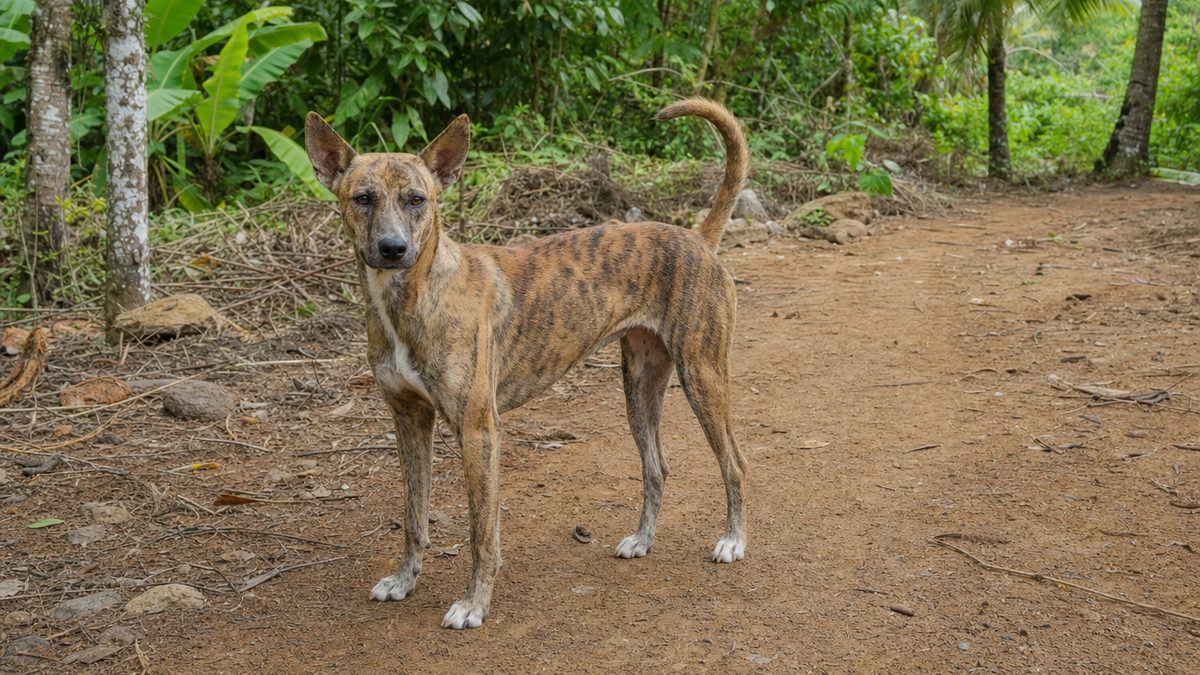
Start with what is not in dispute. The Philippines has an indigenous, free-ranging village dog population, called askal or aspin, and it is neither rare nor recent. Every readable description of the Philippine Forest Dog is a description of that Indian-style street dog equivalent: small to medium, lean, leggy, prick-eared, short-coated and hardy. The project's claim is not that a new dog was found. It is that a subset of an old population can be standardised into a breed.
The claim being made about age is much larger than the evidence supporting it, and the animal itself remains unrecognised by every registry on earth. Ranking pages repeat that the breed may have existed for approximately 30,000 years and that it has lived alongside the Aeta since before Spanish colonisation. Read the article those claims come from and the sourcing is a national newspaper, an entertainment portal and a good-news website, none of which reports an excavation, a dating method or a laboratory.
The one figure with a date attached, and what it rests on
The most specific archaeological claim in circulation is that dog remains estimated to be 600 to 900 years old were unearthed in 1967 at an ancient gravesite in Namayan, Santa Ana, Manila. That sentence does carry a citation, and the citation is to GoodNewsPilipinas.com. A good-news website is a real publication and it may well be reporting something real, but it is not an excavation report, and no excavation report for that material is cited anywhere in the article or in any page ranking for the term.
Note also what 600 to 900 years old would mean if it held. It would place those dogs somewhere around the twelfth to fifteenth centuries, which is not evidence for a 30,000-year lineage and is not evidence for anything about a breed. Dog remains in a medieval Philippine gravesite establish that Philippine people kept dogs, which nobody doubts.
What this page is for
This page exists because every other page carrying this name reports the promoters' account and stops. Bonbeno reports the paper trail instead: what the article says, who is cited for each claim, what the Philippine kennel club's own published breed list contains, what the world's dog-genomics literature has and has not sampled, and what an Indian reader searching this term should actually do.
None of that is hostile to the project. A native breed recognition programme is a legitimate thing to run, and the Taiwan Dog shows it can succeed, holding FCI standard 348 today. What is not legitimate is a reader being told the outcome has already happened.
The Philippine Canine Club, Inc. is the FCI member body for the Philippines and is the organisation named as documenting and establishing this breed's purity. Its own published Group 5 recognised-breeds page lists thirteen breeds and does not include the Philippine Forest Dog. Whatever else is true, the club said to be recognising it has not recognised it.
Bonbeno's two-condition test, applied clause by clause
To count as a breed on this site an animal needs two documents: a written breed standard a reader can open, and a studbook. The Philippine Forest Dog has neither in a form anybody outside one club can check, so it fails the test. The right verdict is breed in formation, and the distance still to travel is the finding.
The verdict set this site uses runs breed, breed in formation, type, brand, and register without standard. Getting the verdict right matters more than it sounds, because each one implies a different thing about what a buyer would be getting. A type is an old population nobody wrote down. A brand is a trademark applied to selected animals. A breed in formation is a real programme that has not finished.
This is the third of those. There is an organisation, there is a stated standard, there are named breeders, and there is a declared goal of FCI recognition. What is missing is the paperwork that would let anyone outside the programme verify a single claim it makes Philippine Canine Club, Inc..
| Condition | Verdict | Evidence, and the named document |
|---|---|---|
| A written breed standard | Asserted, never published | Wikipedia states the standard was written by Rev. Fr. Dante Daylusan over 30 years and is followed by the PCCI, citing the Philippine Entertainment Portal. No document is linked, and the PCCI publishes no standard page for the breed. Its own article carries a better source needed tag dated October 2025 on the paragraph describing the standard |
| A studbook | None anywhere | The PCCI's published Group 5 recognised-breeds page holds thirteen entries, Akita to Siberian Husky, with no Philippine breed. No other body registers it. Without a register there is no pedigree to issue and nothing to count |
| Recognition by the FCI | No, on two independent reads | The FCI's complete Group 5 nomenclature holds no Philippine breed in Section 5, 6 or 7, with Chow Chow 205, Korea Jindo Dog 334, Basenji 43, Taiwan Dog 348 and Thai Ridgeback Dog 338 returning as in-document controls. The FCI's 27-entry letter P index contains PHILIPPINE zero times, with Pharaoh Hound 248, Podenco Canario 329, Pug 253 and Puli 55 as controls |
| Recognition by the state | No, and the state route is closed too | This site's standing rule is to check the state and not only the cynological body, because ministries, agriculture departments and GI registries all recognise breeds. The Philippine animal genetic resources country report to the FAO covers pigs, chickens and ducks and contains no dogs at all |
| A distinct population, demonstrated | Never tested | No genetic, morphometric or peer-reviewed study has compared these dogs against ordinary aspins. PubMed returns zero records for the breed name in any form, against a Labrador Retriever control of 1,109 in the same session |
| Formal verdict | Breed in formation | It has an organisation, a stated standard and named breeders, which is more than a type. It has no published standard, no register and no recognition, which is far short of a breed. It is a programme at an early stage, and it should be described as one |
Why breed in formation and not brand
This site added brand to the verdict set after meeting a Chinese case where a name turned out to be a registered trademark applied to selected dogs under a private testing protocol. That is not what is happening here. Nothing found suggests a trademark, and the club's stated goal is registry recognition rather than a proprietary label. The distinction is worth drawing because it decides whether the project can, in principle, end in a real breed. This one can.
What it needs is ordinary and unglamorous: a standard published at a stable address, an open register with recorded parentage across three or more generations, and a body prepared to hold it. The Lobito Herreno case elsewhere on this site is the useful comparison, where a private DNA-verified register kept since 2013 and a national kennel club's draft standard produced a defensible breed-in-formation verdict. The Philippine project has the ambition and not yet the documents.
A breed-in-formation verdict is not an accusation. It means the paperwork that protects a buyer does not exist yet, so the usual checks do not apply. There is no pedigree to verify, no standard to measure a puppy against and no register to trace a sire in. Judge the animal and the seller in front of you, and do not pay a premium for a document nobody can produce.
The evidence base, reference by reference, and what each one is worth
The whole English-language record for this breed is one Wikipedia article of 5,808 bytes resting on eight references, and not one of them is peer-reviewed, a registry document or an excavation report. Reading the raw wikitext rather than the rendered page is what makes that checkable, because it shows exactly which sentence carries which citation.
This page corrects an earlier reading of its own. An initial pass recorded three paragraphs in the article as carrying no citation of any kind. Re-read on 10 September 2026, the article carries exactly one such paragraph. The other two do carry citations, and the interesting question turned out to be not whether a citation exists but what kind of publication it points at.
The correction is safe to make because the article did not move underneath either reading. Its revision history shows it standing unchanged at 5,808 bytes since 26 August 2026, so both passes were looking at the same document and the first one simply counted wrong. Saying so is cheaper than leaving a wrong number on the page, and this site would rather publish a correction than a confident error.
| Reference | Type of publication | What it is asked to support |
|---|---|---|
| Philippine Entertainment Portal, 16 Jan 2023 | Entertainment news | That the breed is an indigenous primitive breed, and that a 30-year breed standard exists |
| The Manila Times, 14 Jan 2023 | National newspaper, photo caption | That the PCCI and PFDLC are documenting the breed toward FCI recognition |
| PCCI 1st Quarter 2023 flipbook | The club's own publication | That the breed was introduced internationally at the Philippine Circuit Show 2023 |
| Rappler, 21 Jan 2023 | News feature | That the breed may have existed for approximately 30,000 years |
| The Philippine Star, 16 Jan 2023 | News feature | That early settlers brought its ancestors as companions and hunting dogs |
| CNN Philippines, 10 Feb 2023 | News, link dead and archived | That the breed lived with the Aeta before Spanish colonisation, and that it is used as a guard dog |
| GoodNewsPilipinas.com, 25 Jan 2023 | Good-news website | The 1967 Namayan excavation and the 600 to 900 year dating, and the breed standard description |
| Animal Scene via PressReader, 1 Mar 2023 | Consumer pet magazine | The temperament description |
Three things that follow from that table
- Every reference is journalism or the club's own publication. There is no peer-reviewed source, no registry document, no museum record and no excavation report anywhere in the article. That is not a criticism of any individual outlet. It means the entire English-language evidence base for this breed is press coverage of one club's announcements in January and February 2023.
- The load-bearing archaeological claim is sourced to a good-news website. A 600 to 900 year dating on remains from a 1967 excavation is an archaeological finding and belongs in an archaeological publication. Nobody citing it has produced one.
- The commercially important paragraph is the uncited one. The single paragraph carrying no citation at all is the one telling prospective owners to acquire dogs only from six endorsed integrity breeders. Of everything in the article, that is the sentence with money attached to it, and it is the sentence with nothing behind it.
The article contradicts itself about colour, and it matters commercially
The infobox lists the permitted colours as brindle, black and merle, with brindle first. The uncited breeders paragraph tells prospective owners to buy only from the six endorsed breeders in order to avoid mixed or brindle-coloured dogs not conforming to the standard. So the same article permits brindle as a breed colour and warns buyers away from brindle dogs.
That is not a quibble about wording. A colour rule is the most common way a buyer is told an animal is or is not the real thing, and a reader acting on the article could reject a dog the article's own infobox describes as correct. Since no standard is published anywhere, there is no third document to settle it.
The article's first Appearance paragraph, the one describing what the standard requires, carries a better source needed tag dated October 2025. That tag is Wikipedia's own editors saying the sourcing behind the breed standard description is not good enough. It has stood for nearly a year. When the encyclopedia hosting a claim flags the claim, a reader should weight that heavily.
Breed recognition checked at four registries, each with controls
No kennel club recognises the Philippine Forest Dog, including the Philippine one. Four registers were read in full rather than searched as substrings, and each returned its own control breeds while returning nothing for this name.
An absence is a strong claim, so it has to be earned. The rule this site works to is that an absence is only real when a control succeeded in the same session, on the same instrument. Each read below carries its controls.
The Philippine Canine Club, which is the decisive one
The PCCI is the FCI member body for the Philippines and is the organisation Wikipedia names as documenting and establishing the breed's purity. Its published Group 5 recognised-breeds page carries thirteen entries in full: Akita, Alaskan Malamute, Basenji, Chow Chow, German Spitz, Gronlandshund, Japanese Spitz, Keeshond, Norwegian Elkhound, Pomeranian, Samoyed, Shiba Inu and Siberian Husky. There is no Philippine Forest Dog among them.
This is the reading that settles the question, and it is the one no ranking page performs. It is not an outside body declining to recognise a foreign breed. It is the breed's own national kennel club, the one credited with the recognition programme, publishing a list that does not contain it Google India SERP and People-also-ask….
The FCI, read at group level and at letter level
The FCI's complete Group 5 nomenclature was read rather than a guessed URL, because on fci.be the trailing number in a path decides the document and every word before it is ignored. Section 5, Asian Spitz and related breeds, holds twelve breeds across China, Germany, Japan, Korea and Thailand. Section 6, Primitive type, holds the Basenji 43, Canaan Dog 273, Pharaoh Hound 248, Xoloitzcuintle 234 and Peruvian Hairless Dog 310. Section 7, Primitive type Hunting Dogs, holds Cirneco dell'Etna 199, Portuguese Podengo 94, Podenco Canario 329, Podenco Ibicenco 89, Taiwan Dog 348 and Thai Ridgeback Dog 338. No Philippine breed appears anywhere.
The letter P index was read as a second, independent check and enumerated in full: 27 entries, from Parson Russell Terrier 339 to Pumi 56, with PHILIPPINE occurring zero times. One honest limit is worth stating rather than hiding. That index served original-language names on this fetch, which is why it reads Perro de Agua Espanol and Polski Owczarek Nizinny rather than their English forms, so a letter index alone can never prove an absence. The group-level read is what settles it.
| Register | Philippine Forest Dog | Controls that returned in the same read |
|---|---|---|
| Philippine Canine Club, Group 5 recognised breeds | Absent from a 13-entry list | Akita, Basenji, Chow Chow, Shiba Inu |
| FCI, complete Group 5 nomenclature | Absent from all three sections | Chow Chow 205, Korea Jindo Dog 334, Basenji 43, Taiwan Dog 348, Thai Ridgeback Dog 338 |
| FCI, letter P index | PHILIPPINE occurs 0 times in 27 entries | Pharaoh Hound 248, Podenco Canario 329, Pug 253, Puli 55 |
| Philippine state, FAO animal genetic resources report | No dogs of any kind in the inventory | Pigs, chickens and ducks are covered |
What a completed recognition looks like, for comparison
The Taiwan Dog is the right comparison and it is the one the project itself is aiming at. It is a Southeast Asian native landrace that went through the process and now holds FCI standard 348 in Group 5 Section 7, alongside the Thai Ridgeback Dog at 338. Both were village-type dogs before they were breeds. The route exists and it works. It simply has not been walked here yet.
Recognition is not a favour a registry grants for enthusiasm. It requires a published standard, a register with recorded parentage over several generations, a population large enough to breed without close inbreeding, and a national body willing to sponsor the application. A project three years old is early in that process, not failing at it.
Genetic diversity, and why the Philippines is a blind spot in dog genomics
No genetic study has ever tested whether these dogs are distinct from ordinary aspins, and the Philippines is one of the least-sampled countries in dog genomics. Two of the three largest relevant surveys sampled zero Philippine dogs, and the one that did sample them looked at a different question.
Genetic diversity is the axis on which a landrace claim stands or falls. A breed project is a claim that a subset of a population is consistently different from the rest of it, and that is a testable proposition. Nobody has tested it here.
The three surveys, and what each sampled
Shannon and colleagues ran the largest village-dog survey to date, genotyping 4,676 purebred dogs from 161 breeds and 549 village dogs from 38 countries on a 185,805-marker array. No Philippine sample is among them.
Greig and colleagues sequenced seven new complete ancient mitogenomes and five partial mtDNA sequences from archaeological dog specimens across Mainland and Island Southeast Asia and the Pacific, concluding at least three dog dispersal events into the region. Its Pacific material comes from Atafu in Tokelau and from Hawaii, with previously published sequences from New Zealand and the southern Cook Islands. Again, no Philippine specimen.
Oskarsson and colleagues did sample the Philippines, with 36 dogs, and that study is the one worth reading carefully, because it is routinely quoted backwards. Verbatim from the paper: among the 36 samples from the Philippines we detected 17 haplotypes, three of which were unique to the Philippines, but none of Arc1, Arc2 or A29 was represented.
What that Oskarsson sentence actually settles
It settles a route, not a breed. Arc1 and Arc2 are the ancient Polynesian founder haplotypes and A29 is the dingo founder haplotype, and their absence from Taiwan and the Philippines is why the authors conclude there is no indication that these dogs were introduced via Taiwan and the Philippines together with the expansion of the Neolithic culture and Austronesian languages.
Two things follow for a reader of this page. The first is that Philippine dogs are not the ancestors of the Pacific dogs, whatever the shared Austronesian story suggests, and the New Zealand mitogenome work does not fill that gap either, because it carries no Philippine sample. The second is more useful: the study found 17 haplotypes in 36 dogs, three of them found nowhere else, which is a genuinely diverse local population. Diversity of that kind is what a landrace looks like, and it is the opposite of what a standardised breed looks like.
| Study | Philippine samples | What it can and cannot settle here |
|---|---|---|
| Shannon 2015, 549 village dogs, 38 countries | 0 | Cannot say anything about Philippine dogs. Does establish that South Pacific village dogs are almost completely European-derived while Indian ones show minimal European admixture |
| Greig 2018, ancient Pacific mitogenomes | 0 | Cannot say anything about Philippine dogs. Reports an early introduction to Island Southeast Asia that does not appear to extend into Oceania |
| Oskarsson 2012, 36 Philippine dogs | 36 | Settles that Philippine dogs carry none of the Polynesian or dingo founder haplotypes. Says nothing about whether a forest-dog subset is distinct |
| Any study of this breed name | None exists | PubMed returns 0 for every form of the name, against a Labrador Retriever control of 1,109 in session |
A finding that helps an Indian reader more than any of the above
The Shannon survey carries one result that transfers directly to India and is almost never quoted. Verbatim: some populations, notably those in the Neotropics and the South Pacific, are almost completely derived from European stock, while many populations, including those of Vietnam, India and Egypt, show minimal evidence of European admixture.
Read plainly, that says the Indian village dog is among the better-preserved indigenous dog populations on earth, while several famous island landraces have effectively been replaced. An Indian reader looking for a genuinely indigenous, genetically diverse, heat-adapted village dog does not need to look at the Philippines. There is one asleep outside the building.
Every form of the name was run through PubMed with the query translation read on each search: philippine forest dog, aso ng gubat, asong gubat, philippine native dog and philippine dog all return zero, several with PubMed's own quotedphrasesnotfound warning. The plural philippine dogs returns exactly 2, and both are tick-borne pathogen surveys using no breed name. Controls in the same session returned Labrador Retriever 1,109 and Labrador retriever hip dysplasia 126, so the instrument was working.
Philippine Forest Dog price in india, and why no honest figure exists
There is no Philippine Forest Dog price in india, and this section explains why no such figure can exist rather than leaving a gap. No Indian supply exists, no lawful import route for a purchase exists, and no pedigree can be issued for a breed no registry holds.
Say the unwelcome part first. This site publishes no rupee price for this animal, because publishing one would require either converting a foreign asking price or repeating an invented Indian one, and both are fabrication. What follows is the evidence that the absence is real rather than a failure to look.
Three independent reasons a price cannot form
- No lawful commercial import route. India treats live dogs as a Restricted import, and applications made for trading or breeding purposes are refused. A dog may enter as a genuine personal pet moving with its owner under a valid pet book, which is not a supply chain.
- No pedigree to sell. The premium in an Indian pedigree-dog transaction is the paperwork. No registry anywhere holds this breed, so no pedigree can exist for it, in India or in the Philippines. A seller offering registration papers for it is offering something that cannot be issued.
- No Indian breeder or listing. No Indian breeder, classified listing or rupee figure for this name was found. The Indian listing sites that rank for rare-breed terms serve either a different breed or a generic price page.
What you will be shown instead, and how to recognise it
The Indian rare-breed search economy has a small number of well-documented failure modes, and a reader is likely to meet several of them on one page. This site has tracked each of them across many breeds.
| Mechanism | The tell | What to do |
|---|---|---|
| A converted dollar or euro price | The rupee figure divides to a round foreign number at 84.38, 80, 74 or a euro rate near 91 | Divide it yourself. If the quotient is a price a shop would print, it was converted |
| A currency symbol simply stripped | Digits identical to a US page's, with the dollar sign removed, so no division works | Ask whether the figure is plausible as rupees at all |
| A house price point on a carousel | The same figures recur across unrelated breeds, attached to whichever puppy is in stock | Read what the carousel actually contains. It usually holds none of the breed |
| A size-bucket default | A row reading Large Size Dog Breed with no group and no country | Treat the row as an unpopulated database default, not a price |
| Merchandise | The only rupee figure attached to the name is a poster, a mug or a print | Confirm the listing is for a live animal before quoting anything |
| An answer engine converting, then denying | The engine says no Indian price exists and then prints a rupee band anyway | Run the division on the engine's own figure |
One genuinely good result worth recording
This site normally reports answer engines converting foreign prices while claiming no Indian price exists. On a related query in the same session the behaviour was correct: asked for a Tahitian Dog price in India, Google's AI Mode answered that there is no price because the breed is extinct, and offered no rupee figure at all. A negative result is worth publishing when it goes the right way, because it shows the failure is not universal and the check is still worth running.
The animal described by every readable source, a short-coated, lean, alert, heat-tolerant village dog, is available at any Indian shelter for an adoption fee of Rs 0 to Rs 3,000 that usually covers vaccination, deworming and sterilisation. That is not a consolation prize. It is the most affordable and the best-evidenced option on this page, and on the genetic evidence it is a better-preserved indigenous landrace than most island populations that carry famous names.
Monthly cost of keeping a short-coated village-type dog in India
Budget roughly Rs 3,000 to Rs 8,000 a month for a 12 to 20 kg short-coated dog in an Indian city, and the monthly cost is dominated by food and parasite control rather than by grooming. Every figure below was read from a named seller or a municipal page, and the spread between routes is larger than the spread between breeds.
The useful version of this question is not what the breed costs. It is what an animal of this size and coat costs to keep in India, and that is answerable with real figures. Published Indian ranges put consultation at Rs 500 to Rs 1,000, core vaccination at Rs 1,500 to Rs 3,000, grooming across Rs 300 to Rs 2,000 and boarding at Rs 500 to Rs 2,000 a day, and this page treats those as a single data point rather than two, because a second organisation publishes them byte-identically and exact agreement is evidence against independence.
| Line | Realistic monthly range | Where the figure comes from |
|---|---|---|
| Food | Rs 1,500 to Rs 4,000 | Arithmetic from pack rates at roughly 200 to 300 g a day, not a quoted monthly price. Re-price the bag before trusting any monthly figure |
| Tick and flea control plus worming | Rs 1,103 | NexGard Spectra 15-30 kg, 3 tablets Rs 3,308, covering ticks, fleas, roundworm and hookworm in one monthly tablet |
| Separate deworming, if not using a combination | Rs 126 to Rs 252 per dose | Drontal Plus, Rs 125.67 a tablet at one per 10 kg |
| Vaccination, annualised | Rs 60 to Rs 270 a month | Anti-rabies Rs 699 and a 9-in-1 at Rs 899 spread over a year, or free at a Greater Chennai Corporation clinic |
| Consultation, when needed | Rs 500 to Rs 1,000 a visit | Published Indian range, treated as one data point |
| Grooming | Rs 0 | A short coat needs no professional grooming. This is the line the breed genuinely saves you |
| Boarding, if you travel | Rs 500 to Rs 900 a night | Bengaluru operator listings in Karnataka, most in the Rs 500 to 800 band |
The spread is the finding, not the average
One identical vaccine costs very different amounts depending on how it is delivered, and that is the single most actionable fact in this section. The same 9-in-1 runs Rs 600 at a Goa government veterinary hospital inclusive of vaccine and certificate, from Rs 899 at a private clinic chain, and from Rs 1,999 through a vet-at-home service with a further Rs 699 visit fee. Anti-rabies spans Rs 100 to Rs 1,199 across the same three routes.
That is a 3.3 times spread on the vaccine and a 12 times spread on rabies, for the same drug. A reader who changes nothing except where they vaccinate can move their annual bill more than any choice of breed would Voice of Stray Dogs, What a dog costs.
The registration line, which is small and mandatory
Municipal registration is cheap and often forgotten. Delhi's MCD charges Rs 500 for a new pet dog registration and Rs 500 to renew, with a late fee of Rs 100 a month. Greater Chennai Corporation, in Tamil Nadu, charges Rs 50 for a pet licence and issued 9,115 of them in 2024, and its six municipal veterinary clinics provide treatment and anti-rabies vaccination free of cost.
That free-clinic line is worth more to a low-budget Indian owner than any breed page's price table, and almost nobody prints it.
Several large Indian breed sites publish monthly running costs that are shared constants rather than observations. The mechanism is now proven: a total is the sum of three preset lines, so unrelated breeds print identical totals, and a pug and a wire-coated terrier can be given the same grooming line. If you meet a monthly cost table, compare its component lines against another breed on the same site before believing it describes anything.
Heat tolerance, and how a Manila-adapted dog handles Indian weather
A Philippine village dog is adapted to constant wet heat rather than to a seasonal swing, and that is the one claim about this animal that the data supports without qualification. Manila runs an annual mean of 25.77 C at 84.71 percent relative humidity, in a band only 4.42 degrees wide.
Climate is the section where this page can say something genuinely its own, because it is measured rather than borrowed. Every figure below came from a single-point NASA POWER climatology query by explicit latitude and longitude, with the grid-cell elevation echoed back and checked.
The instrument's error, stated rather than hidden
POWER returns a grid cell, not a point, and the cell can sit at a very different altitude from the town underneath it. For Manila the cell reports 201.16 m against a real elevation near 16 m, an error of about +185 m. That is at the edge of the usable band and it means the Manila figures below run slightly cool. The Indian comparison cells are much closer to the ground truth: Chennai +43 m, Mumbai +83 m, Kolkata -1.7 m, Delhi -9.6 m.
| Place | Annual mean | Coolest month | Hottest month | Annual range | Annual RH | Peak wet bulb |
|---|---|---|---|---|---|---|
| Manila | 25.77 C | Jan 23.52 | May 27.94 | 4.42 C | 84.71% | May 24.88 C |
| Chennai | 27.95 C | Jan 24.09 | May 31.51 | 7.42 C | 72.39% | May 26.11 C |
| Kochi | 27.31 C | Aug 25.91 | Mar 29.42 | 3.51 C | 78.83% | May 25.79 C |
| Mumbai | 26.77 C | Jan 23.19 | May 31.19 | 8.00 C | 67.39% | Jun 25.77 C |
| Kolkata | 25.81 C | Jan 17.31 | May 31.53 | 14.22 C | 73.93% | Jun 27.09 C |
| Bengaluru | 23.74 C | Dec 20.22 | Apr 28.37 | 8.15 C | 67.94% | May 21.86 C |
| Pune | 23.86 C | Dec 19.62 | Apr 28.93 | 9.31 C | 66.80% | Jun 22.97 C |
| Delhi | 25.60 C | Jan 13.61 | Jun 35.88 | 22.27 C | 45.56% | Jul 26.50 C |
What the table actually says
Three readings matter and none of them is the annual mean. First, Manila's annual range of 4.42 degrees is narrower than every Indian city here except Kochi, and a fifth of Delhi's 22.27. A dog shaped by Manila has never met a cold season. Second, Manila is more humid than any of them, at 84.71 percent against Chennai's 72.39 and Delhi's 45.56. Third, and most useful, Manila's peak wet bulb of 24.88 C is below Chennai's 26.11 and Kolkata's 27.09.
That third reading is the one that overturns the intuitive answer. Wet-bulb temperature is what limits a dog's ability to shed heat, because a dog cools by evaporation and evaporation stops working as the air saturates. Manila is more humid than Chennai but cooler, and the combination leaves it a degree and a quarter easier than Chennai and two degrees easier than Kolkata at the peak.
Pune and Bengaluru are the interesting pair here, because both sit on the Deccan plateau and both peak in April rather than May, and both are cooler year-round than any coastal Indian city on this list. So the honest statement is narrower than the promoters' one. This is a heat-tolerant, humidity-adapted dog that would be comfortable in Kochi and coastal Chennai, would find Kolkata's June harder than anything at home, and would meet something genuinely new in Delhi, where January means of 13.61 C and June means of 35.88 C are both outside its entire experience.
Two figures that are commonly misread, and are not misread here
- T2M_MAX is a period extreme, not an average daily high. Delhi's climatology T2M_MAX is near its all-time record rather than a routine May afternoon, and quoting it as a mean overstates routine heat by eight to ten degrees. No such figure is used above.
- Wet bulb above about 35 C is physically impossible. Every wet-bulb figure here is Stull computed from T2M and RH2M, never from T2M_MAX, and the highest in the table is 27.09 C. A page printing a wet bulb near 40 C has fed it the wrong input.
- Hottest months are checked, not assumed. Delhi peaks in June and not May, Bengaluru in April, and Kochi is coolest in August because of the monsoon. Those three catch out most published tables.
Exertional heat illness, not a hot car, is the main danger. In a UK cohort of 905,543 dogs, 652 of the 879 heat-related events with a recorded trigger were exertional, which is 74.2 percent, against 113 environmental and 46 from vehicular confinement. Dogs at or above the mean bodyweight for their breed and sex carried odds of 1.42. In Indian conditions that means walking at dawn and after dark, and not at 4 pm because the dog looks willing Hall EJ, Carter AJ. Consult your nearby vet on heat management for your own animal.
Temperament, and why no single answer here is honest
No behaviour study exists for this population under any name, so every temperament claim about the Philippine Forest Dog is a description rather than a measurement. What the promoters describe is a reserved, loyal, alert primitive dog, which is a fair description of most free-ranging village dog populations anywhere.
The published temperament account runs like this. As a primitive breed it tends to be reserved with strangers but loyal and dependable with its family including children, it retains a strong survival instinct, it can endure independently in forested areas, and it is often chosen as a guard dog despite its size. The sources are a consumer pet magazine and a news report.
None of that is implausible and none of it is measured. There is no temperament test, no owner survey, no behavioural study and no comparison against a control group anywhere in the record.
What can be said with more confidence
Landrace populations that have lived semi-independently around people tend to share a recognisable behavioural profile, and it is a genuinely useful thing for a buyer to know because it differs from a purpose-bred companion breed.
- Independence rather than biddability. A dog whose ancestors made their own decisions about food and safety is generally less interested in taking instruction than a breed selected for handler focus.
- Strong stranger discrimination. Reserve with unfamiliar people is common and is usually caution rather than aggression, but it needs early, generous socialisation to stay that way.
- A real prey drive. Free-ranging dogs that catch vermin are selected for it, and it does not switch off in an apartment.
- Environmental confidence in the heat and rain, and often much less confidence with lifts, tiled floors, traffic and crowds, which are the actual Indian urban stressors.
The household honesty test
The question worth asking is not whether the temperament suits you. It is whether you can tell. Since no register exists, a dog offered under this name comes with no verifiable parentage and no breeder-reported temperament data across a line. You are assessing an individual animal, exactly as you would at a shelter, and the label adds nothing to that assessment.
Suited to a household that wants an alert, independent, low-maintenance dog, is comfortable with a reserved greeter, and will do the socialisation work early. Not suited to a first-time owner wanting an immediately biddable companion, a household needing a dog that is instantly friendly with visitors, or anyone buying on the strength of a breed name rather than the animal in front of them.
Training a landrace dog, and what it resists
To train a village-type dog well, pay for behaviour you want rather than correcting behaviour you do not, and expect the recall to be the hard part. No training study exists for this population, so what follows is the general landrace pattern applied honestly rather than a breed-specific claim.
The most common Indian training mistake with a landrace dog is importing a method built for a biddable gundog. A dog selected for independent decision-making does not find compliance intrinsically rewarding, and correction-based handling tends to produce avoidance rather than learning.
What works
- Reward the behaviour heavily and early. Food, access and freedom are all currency. Pay generously in the first year and thin it out later.
- Train recall on a long line for months, not weeks. An off-lead recall against a live prey trigger is the single hardest thing you will teach this kind of dog, and it is the one that keeps it alive on an Indian street.
- Socialise deliberately and in short sessions. Lifts, autorickshaws, tiled floors, umbrellas, temple crowds and cattle are all things an urban Indian dog meets and a village dog has never seen.
- Train in the cool hours. A dog will keep working past the point of safety in Indian afternoon heat, and a training session is exertion.
What it resists
Expect slow progress on precision work and fast progress on anything the dog can see the point of. Expect a strong reaction to being physically manoeuvred, which is common in dogs that were never bred for handling. Expect the dog to solve problems you did not set, particularly around gates, latches and food.
None of this is a defect. It is what an animal shaped by a place rather than by a kennel club looks like, and it is the same profile an Indian pariah dog brings.
A reasonable first-year target for a village-type dog is a reliable name response and a solid sit and settle by four months, a long-line recall that holds against moderate distraction by eight months, and calm handling for grooming and veterinary examination by twelve. An off-lead recall against a cat at full speed may never be safe, and planning around that is more useful than training toward it.
Daily exercise needs, and what happens without them
Plan on 45 to 75 minutes of real activity a day for a lean, athletic village-type dog of this size, split across the cool ends of the day. No exercise requirement has been published for this population, so this is the requirement for the physical animal described, not a figure from a standard.
The descriptions are consistent about build: vigorous, agile and athletic, capable of working in forest terrain, small to medium in size. An animal built like that is not satisfied by two short lead walks, and an under-exercised one becomes an escape artist rather than a couch dog.
The Indian version of the requirement
- Two sessions, both outside 10 am to 5 pm. Dawn and after dusk are the usable windows for most of the Indian year.
- Sniffing counts and it counts more than distance. Twenty minutes of scent work in a park tires this kind of dog more thoroughly than an hour of trotting on a lead.
- Build the exercise needs around surfaces. Indian tarmac holds heat long after sunset. Put the back of your hand on it for seven seconds before you walk a dog on it.
- Long-line freedom rather than off-lead freedom, until the recall is genuinely proven.
What happens without it is predictable and is the reason many landrace dogs are surrendered: fence-testing and gate-bolting, destructive chewing, noise reactivity toward the corridor and the lift, and a rising interest in the neighbourhood's cats. Every one of those reads as a temperament problem and is usually an exercise problem.
Exertional heat illness accounted for 652 of the 879 recorded-trigger heat events in a 905,543-dog cohort, which is 74.2 percent. Almost every Indian heat emergency in a fit dog is a walk or a play session that went ten minutes too long. Carry water, turn back early, and treat panting that does not settle within a few minutes of rest as a reason to see a vet the same day.
Grooming and coat care in Indian humidity
Coat care here is close to nothing, and it is the strongest practical argument for a short-coated village dog in India. The only coat description in any primary source reads short, may be smooth or coarse, which means weekly brushing, no trimming, no stripping and no professional grooming bill.
The infobox gives the coat as short, may be smooth or coarse, and the permitted colours as brindle, black and merle. There is nothing longer, nothing double and nothing that requires a groomer. On a monthly cost table this removes an entire line that runs Rs 300 to Rs 2,000 for a coated breed.
The routine, in full
- Brush weekly with a rubber curry or a hound glove. Twice weekly during a seasonal shed.
- Bathe when the dog is dirty, not on a schedule. Over-bathing a short coat in humid conditions strips it and irritates skin.
- Dry the ears after every soaking. This is the part that matters most in an Indian monsoon and the part most often skipped.
- Check between the toes and in the groin weekly during the wet months, where humid-climate skin problems start.
- Check for ticks daily in season, along the neck, in the ears and between the toes.
The imported-advice trap, which applies even here
Overseas breed clubs routinely publish grooming guidance written for a temperate climate, and Indian pages copy it verbatim. The clearest example on this site is a parent club telling owners to towel the dog and let him air dry, which is correct in Wisconsin and wrong in an Indian monsoon, where published Indian series put a large share of canine otitis cases in the wettest months and name bathing without plugging the ears among the commonest causes.
For a short-coated dog the practical translation is simple. Dry the ears actively, do not leave a damp dog in an unventilated room, and do not assume a short coat means the ears look after themselves.
A short coat is already the coolest configuration this animal has. Clipping a dog to help it with heat removes its protection against direct sun and does not improve heat loss, because dogs do not cool through the skin the way people do. If your dog is struggling in the heat, change the time of day it goes out and talk to your nearby vet.
Health issues, life expectancy, and what nobody has measured
No inherited condition has ever been described in this population, no screening scheme covers it, and no life expectancy has been measured for it. That is the honest position, and this section fills it with the Indian health picture the dog would actually walk into rather than borrowing a related breed's numbers.
Three absences, each checked rather than assumed. There is no breed-specific veterinary literature, because PubMed returns zero for every form of the name against a working control. There is no screening data, because screening registries publish per-breed statistics only for breeds they hold and no registry holds this one. And there is no life expectancy figure, because the large lifespan studies draw on UK primary-care records of registered breeds.
This site's rule is to say that three times rather than borrow once. A page that hands you a related breed's median lifespan has invented a number for your dog.
What screening registries actually require, and why an absence is expected
The Orthopedic Foundation for Animals publishes its own inclusion threshold, and it explains most absences better than any speculation: for hips a breed needs at least 100 evaluations, and for its other databases at least 50, before it appears at all. A population with no register cannot accumulate evaluations under a breed name, so its absence is structural rather than informative.
The health issues an Indian owner will actually meet
Tick-borne disease dominates Indian canine practice and it is what a short-coated outdoor dog in India is genuinely exposed to. Three recent Indian studies, each read at source, give the scale. Every figure below is from dogs presented at veterinary clinics, not from a random population sample, and that caveat is not optional.
| Study | Place and period | Dogs screened | Headline finding |
|---|---|---|---|
| Shil 2026 | Salt Lake, Kolkata, Jul 2024 to Dec 2025 | 584 | Babesia gibsoni 76.54 percent; Anaplasma 55.75 percent; 72.9 percent of the 584 screened carried two or more pathogens |
| Venugopal 2026 | Southern India, Nov 2023 to Sep 2024 | 120 | Babesia species 66.7 percent (80 of 120); E. canis 5.0 percent; cases peaked pre-monsoon, March to May |
| Chakraborty 2024 | Odisha | 178 | Ehrlichia canis 56 of 178 (31.46 percent); about three quarters of infected dogs were over 20 kg; about four fifths had a tick history |
What that means in practice
The Philippine end of this is worth knowing too, because it is the only canine health dataset the Philippines contributes to PubMed at all. A survey of 100 dogs across seven veterinary establishments in Cebu found Ehrlichia, Anaplasma and Babesia species present at low rates, with 10 and 18 dogs positive on the two panels, and a companion study documented multiple Anaplasma platys variants in Philippine dogs. Neither uses any breed name, which is itself the finding. It means the screening conversation to have with your vet is a tick panel, not a hip score. It means monthly tick control is the single highest-value line in the budget for this dog, at roughly Rs 1,103 a month for a combination product. And it means the pre-monsoon window, March to May, is when to be most vigilant in southern India.
Note one thing the Odisha study says that transfers directly: about three quarters of the infected dogs were over 20 kg. A 12 to 20 kg dog sits below that, which is mildly reassuring and is not protection.
A structural health advantage worth naming
A genetically diverse landrace population carries a real advantage over a closed studbook, and it is the one health claim about this animal that has evidence behind it. Oskarsson found 17 haplotypes in 36 Philippine dogs, three of them unique to the Philippines. Populations that have not passed through a registry bottleneck do not accumulate the breed-specific recessive disorders that closed registers concentrate.
That advantage is exactly what a breed project puts at risk. Standardising a diverse population means narrowing it, and Indian law has something specific to say about how that narrowing may be done, which the legal section below sets out.
Nothing in this section is a diagnosis or a treatment plan, and none of it is breed-specific, because no breed-specific veterinary evidence exists. Consult your nearby vet before starting any parasite protocol, and take any dog showing collapse, pale gums, dark urine, an unexplained fever or heat distress to a veterinary surgeon the same day.
Feeding a short-coated village-type dog in India, by life stage
Feed to body condition rather than to a chart, because no breed weight standard exists to feed toward. A 12 to 20 kg lean, active dog needs roughly 200 to 300 g of a complete dry food a day as an adult, split across two meals, adjusted by what you can feel over the ribs.
The absence of a published standard has one practical consequence that is easy to miss: there is no target weight. Every breed page that tells you to feed toward a range is reading that range off a standard, and this animal has none anybody can open. Body condition scoring is therefore not a refinement here, it is the only method available.
The check that replaces a chart
Run your hands flat along the ribs. You should feel each rib easily under a thin layer of covering, without pressing. Look from above for a waist behind the ribs, and from the side for a tuck-up in the belly line. If you cannot feel ribs, cut the daily amount by ten percent and re-check in three weeks.
| Stage | Meals a day | Practical guidance |
|---|---|---|
| 8 to 16 weeks | 4 | Small, frequent meals. Weigh weekly. Deworm on your vet's schedule, at roughly Rs 126 to Rs 252 a dose for this size |
| 4 to 6 months | 3 | Growth is fast and appetite is unreliable. Do not free-feed in a humid climate; food spoils |
| 6 to 12 months | 2 | Move to adult portions gradually. Watch weight through the monsoon when exercise drops |
| Adult | 2 | Roughly 200 to 300 g of complete dry food a day, adjusted to condition. Split meals morning and evening |
| Senior | 2 | Reduce quantity before reducing quality. Reassess after any drop in activity |
Indian availability and the humidity problem
Complete dry foods are widely available across Indian cities and there is no reason to import anything for this dog. Two Indian-specific cautions apply and neither is breed-specific. Store kibble sealed and dry, because humidity turns an open bag rancid faster than most owners expect. And do not leave wet food down in the heat.
On the traditional-diet question, be careful. Descriptions of village dogs subsisting on household scraps are historical observations, not diet plans, and a dog fed that way today will be short of several things it needs. Feed a complete food and treat the history as history.
Where a breed project is selecting for morphology, there is a real temptation to feed a young dog toward the outline the standard describes. Do not. Growing a puppy heavy loads developing joints and does lasting damage, and the standard you would be feeding toward is not published anywhere you can read it. Feed for condition and ask your nearby vet if you are unsure.
The first year, month by month, and the Indian rules that apply anyway
No puppy timeline has been recorded for this population, so the timeline below is the one Indian law and ordinary veterinary practice impose on any puppy in India. The legal floor is firm even where the breed information is not.
Two things anchor the first year regardless of what the breed is. Indian law sets a minimum sale age, and the vaccination schedule sets the window in which a puppy can safely meet the world.
| Age | What happens | The rule or figure behind it |
|---|---|---|
| Under 8 weeks | The puppy must not be sold | Rule 8(1)(a) of the Dog Breeding and Marketing Rules 2017: pups less than eight weeks in age are not sold. Verified verbatim in the gazette |
| 8 to 12 weeks | Core vaccination begins; first deworming | Per-vaccine prices at one clinic chain: puppy DP Rs 849, 9-in-1 DHPPiL Rs 899 |
| 12 to 16 weeks | Course completed; anti-rabies | Anti-rabies Rs 699 privately, or free at a Greater Chennai Corporation clinic |
| 3 to 4 months | The socialisation window closes fast | Lifts, traffic, tiled floors, crowds and other dogs, in short positive sessions |
| 4 to 6 months | Municipal registration | Delhi MCD Rs 500; Chennai GCC Rs 50. Register the dog rather than discovering the requirement later |
| 6 months | Sterilisation conversation | The 2017 Rules require dogs over six months not be sold without first being sterilised, unless sold to another licensed breeder |
| 6 to 12 months | Adult feeding; recall work on a long line | Growth completes. Do not push endurance work in the heat during this period |
Two clauses worth knowing before you buy a puppy from anyone
The 2017 Rules also require that breeding dogs shall have been tested for genetic defects, including hip dysplasia, progressive retinal atrophy, night blindness, hypothyroidism, entropion, ectropion, overshot, undershot jaw, wry mouth, two or more missing teeth and cryptorchidism. The word is including, so the list is illustrative rather than closed.
And a separate paragraph prohibits tail docking, ear cropping, de-barking, de-clawing, branding, dyeing and any change of appearance by artificial means. Neither of those is specific to this breed. Both are things to ask a seller about, and a seller who has not heard of either is telling you something.
No litter size, no birth weight, no growth curve and no weaning data has been published for this population. Anything you are shown in those fields came from a template. If a seller quotes you a typical litter size for the breed, ask where the figure came from.
Indian law: import, and the clause a breed project would run into
Indian law reaches this breed project in a specific and slightly surprising way. The Dog Breeding and Marketing Rules 2017 prohibit breeding to create new breeds outright, so a programme whose own story is that it is creating a breed sits directly against the text of an Indian rule.
The clause is short and it is not ambiguous. Second Schedule Part II paragraph 6(9) of the 2017 Rules reads, verbatim: Breeding to create new breeds of dogs or unusual looks shall be strictly prohibited. That was read in this agent's own pypdf extraction of the gazette, located with a whitespace-tolerant search and read in context, because pypdf splits words in this document.
Two honest qualifications belong beside it immediately. It binds breeders in India, not a club in the Philippines. And what the text says is a separate question from how it is enforced, which is not something this page can measure. But an Indian reader who admires this project and thinks about starting something similar with Indian village dogs should know that the Rules address exactly that activity.
The neighbouring clauses, which reach further than people expect
- Paragraph 6(3) prohibits two named techniques and defines both. In breeding is breeding between relatives of the 2nd to 4th grade in straight or side line within the first four generations, naming uncle to niece, nephew to aunt, cousin to cousin and grandparent to grandchild. Incest breeding is mating between parents and children or between brother and sister. Only out breeding and line breeding are permitted.
- Paragraph 6(4) provides that female dogs shall not be mated after the age of eight years, and 6(5) requires the breeder to furnish proof of a breeding female's age certified by a veterinary practitioner.
- Paragraph 6(8) forbids tail docking, ear cropping, de-barking, de-clawing, branding, dyeing, injecting substances to enhance visual appeal and any change of appearance by artificial means.
- Part IV paragraph 21(1) bars outdoor housing, without the attending veterinary practitioner's written approval, for dogs not accustomed to local temperatures, for breeds that cannot tolerate them such as long-haired breeds in high temperature locations, and for sick, infirm, aged or young animals.
Paragraph 6(3) is the one that bites a small founding population hardest. A breed project working from six endorsed breeders is, arithmetically, working from a narrow base, and the standard tool for fixing type in a narrow base is close breeding. Indian law names that tool and prohibits it within four generations.
Citation form, because it is routinely got wrong
These are Second Schedule paragraphs, not Rules. The Rules themselves run 1 to 13 and stop, so any citation reading Rule 14 or higher is wrong by construction, and the strings Rule 14 and Rule 21 occur zero times in the gazette. Rule 8(1)(a), the eight-week minimum, is a genuine Rule and is cited as one above.
Two absences in the same document are citable and worth knowing. BAER, deaf and patella each occur zero times, checked with the same whitespace-tolerant method. So Indian law mandates no hearing test and no patella grade, and anyone telling you otherwise is inventing a requirement.
Import, briefly
India treats live dogs as a Restricted import under the trade policy, and applications for trading or breeding purposes are refused, with entry limited to a small number of named ports and to genuine personal pets travelling under a valid pet book. This page does not quote clause-level detail from that trade notice, because the document returned HTTP 403 on two attempts on 10 September 2026 and this site does not quote a document it could not open on the day.
There is nothing to import, no pedigree to import it with, and an Indian animal already adapted to the climate. The legal section matters less as a barrier than as a description of what the Indian regulatory environment expects of anyone breeding dogs here at all.
Head to head against the dogs an Indian reader actually cross-shops
Set the Philippine Forest Dog against the animals an Indian reader would realistically be choosing between, and it loses on availability and wins on nothing the Indian pariah dog does not already offer. The comparison is not close, and it is the most useful thing this page can give you.
Two of the four rows below are recognised breeds with published standards and registries. One is a living Indian landrace available today. One is a breed project with no published standard, no register and no Indian supply.
| Animal | Registry status | Published standard | Available in India | Heat suitability |
|---|---|---|---|---|
| Philippine Forest Dog | None anywhere, including the PCCI | Asserted, never published | No. No breeder, listing or lawful purchase route | Excellent on the climate data, untested on anything else |
| Indian Pariah Dog | No closed studbook, and none needed | Not a registry breed; a living landrace | Yes, at any shelter, Rs 0 to Rs 3,000 | Excellent, and locally adapted |
| Taiwan Dog | FCI standard 348, Group 5 Section 7 | Yes, published by the FCI | Rare in India and lawfully importable only as a personal pet | Good. A subtropical native landrace |
| Thai Ridgeback Dog | FCI standard 338, Group 5 Section 7 | Yes, published by the FCI | Occasionally, at a substantial premium | Good. Short-coated tropical native |
The row that matters
The Indian Pariah Dog row is the answer to the question most readers are really asking. Everything attractive in the Philippine Forest Dog description is also true of the dog outside your building: short-coated, lean, alert, hardy, heat-tolerant, free-ranging in origin, genetically diverse and adapted to constant heat. On Shannon's data the Indian population is better preserved than most, showing minimal European admixture where South Pacific village dogs have been almost completely replaced.
The differences run the wrong way for the imported option. One animal is here, costs an adoption fee, is already acclimatised, and can be assessed in person before you commit. The other cannot lawfully be bought into India, has no paperwork to verify, and is described in eight news articles.
And a fair word for the project
None of this means the Philippine programme is worthless. The Taiwan Dog row shows what it is aiming at and shows the aim is achievable. If the PCCI publishes a standard and opens a register, this page will change, and the honest thing is to say so rather than to write the project off.
Three documents would move the verdict from breed in formation toward breed: a breed standard published at a stable address a reader can open, a register recording parentage across at least three generations, and a PCCI recognised-breed page listing it. None is exotic. All three are what the thirteen breeds already on that Group 5 page have.
Seven things people get wrong about the Philippine Forest Dog
Most errors about this animal come from one place: reading a recognition programme's stated goal as its outcome. These are the seven this page found in the ranking set, each with what the document actually says.
- Believing it is an FCI-recognised breed. It is not in the FCI's Group 5 nomenclature or in its 27-entry letter P index, both read with passing controls. Working toward recognition and holding it are different states.
- Believing the PCCI recognises it. The PCCI's own published Group 5 recognised-breeds page lists thirteen breeds and this is not one of them. This is the check almost nobody performs, and it is the decisive one.
- Repeating the 30,000-year figure as established. That number comes from a news feature, not from a dated excavation or a molecular clock. The one specific archaeological claim in circulation is 600 to 900 years old, which is a different order of magnitude and is cited to a good-news website.
- Treating brindle as disqualifying, or as required. The article's infobox lists brindle first among permitted colours and its uncited breeders paragraph warns buyers away from brindle dogs. The article contradicts itself and no published standard exists to settle it.
- Assuming Philippine dogs are the ancestors of the Pacific dogs. Oskarsson tested 36 Philippine dogs and found none carrying Arc1, Arc2 or A29, concluding against a Taiwan and Philippines route into the Pacific. Google's own AI Mode currently states that route as fact and cites a video platform for it.
- Assuming a village-dog origin means no health planning. It means a different health plan. The Indian exposure is tick-borne disease at high prevalence in clinic caseloads, not the inherited orthopaedic conditions a registry breed page would lead with.
- Paying a premium for the name. There is no register, so there is no document to buy. Anything charged above the price of a well-raised village puppy is being charged for a label that no organisation currently issues.
The mistake this page made, and corrected
One more belongs on the list because this page made it. An earlier pass recorded the Wikipedia article as carrying three paragraphs with no citation at all. Re-read against the same document, which the revision history shows has not changed since 26 August 2026, it carries one. The corrected finding is sharper anyway: the citations exist, and they are news reports and a club flipbook standing in for an excavation report and a breed standard.
A directory that silently edits its own errors is asking you to trust it. One that prints them is giving you a way to check it. Every figure on this page names the document it came from and the date it was read, so a reader who disagrees can go and look.
Adoption, and the only honest way to get this dog in India
To adopt the animal this page describes, go to an Indian shelter and ask for a young short-coated village dog. That is not a substitute for the Philippine Forest Dog. On every measurable axis it is the same kind of animal, and it is the one you can actually assess before committing.
The recommendation follows from the evidence rather than from sentiment. Every physical and behavioural trait in the published description of this breed is a description of a tropical Asian village dog, and India has one of the least-disturbed village dog populations in the world.
What to do, in order
- Contact a registered shelter or a municipal facility in your city. Adoption fees typically run ₹0 to ₹3,000 and usually include vaccination, deworming and sterilisation, which is the most affordable route to a healthy dog anywhere in this market.
- Ask to meet the dog twice, on different days. A single meeting tells you about that afternoon. Two tell you about the dog.
- Ask what is known about its history. A shelter that says it does not know is being straight with you, and that is more useful than a confident story.
- Have a vet examine it before you commit, and ask specifically about a tick-borne disease panel given Indian prevalence in clinic caseloads.
- Register the dog with your municipality within the first months. Delhi charges Rs 500, Chennai Rs 50.
- Budget for monthly tick control from day one, at roughly Rs 1,103 for a combination product covering ticks, fleas and intestinal worms.
If you specifically want to support the Philippine project
Support it as what it is. Follow the PCCI's published breed pages and watch for a recognised-breed entry appearing. Ask the Philippine Forest Dog Legacy Club for the standard document and for its register. If either is produced at a stable public address, that is real progress and it will be visible.
What does not help the project is repeating its goal as its outcome. A recognition programme is judged on documents, and inflated coverage makes the eventual documents harder to believe.
Verify a seller, whatever the label
If someone in India offers you a dog under this name, the checks are the ordinary ones and they matter more than usual because no paperwork exists to fall back on. See the dam with the litter. Confirm the puppy is over eight weeks, which Indian law requires. Ask for the vaccination record with dates and batch numbers. Ask to speak to a previous buyer. And treat any offer of registration papers for this breed as a reason to walk away, because no body issues them.
The dog described on this page is available at your nearest Indian shelter for an adoption fee, is better documented genetically than the imported version, is already adapted to your climate, and can be met before you decide. Consult your nearby vet on vaccination and parasite control for the animal you choose.
Philippine Forest Dog questions people actually ask
What is the Philippine Forest Dog?
The Philippine Forest Dog is a breed project rather than a recognised breed. Since 2023 the Philippine Forest Dog Legacy Club, Inc. has promoted selected Philippine village dogs under the name asong gubat, working with the Philippine Canine Club, Inc. toward eventual FCI recognition. No kennel club anywhere lists it today, including the PCCI itself.
Is the Philippine Forest Dog rare?
Rare is the wrong word for it. The underlying animal, the Philippine village dog, is one of the commonest dogs in Southeast Asia and is not rare at all. What is rare is a dog carrying this particular label, because the label is applied by one club to a small selected set of animals and no register exists that would let anyone count them.
Is there a native dog in the Philippines?
Yes. The Philippines has an indigenous free-ranging village dog population, called askal or aspin in Filipino, which has lived alongside people across the archipelago for centuries. What the Philippines does not have is a kennel-club breed built on that population, because no registry anywhere holds a Philippine breed.
What is the difference between a Philippine Forest Dog and an aspin?
Nobody has demonstrated one. This is the question the search box actually asks and it has no established answer. The Philippine Forest Dog is a selection of aspins made by one club against a standard that has never been published where a reader can check it, and no genetic, morphometric or peer-reviewed study has ever compared the two groups. On the published record, the honest answer is that the difference is a club's judgement, not a measured distinction.
Does the Philippine Forest Dog have a published breed standard?
No standard is reachable anywhere a reader can check it. Wikipedia says a standard was written by Rev. Fr. Dante Daylusan over thirty years of study and is followed by the Philippine Canine Club, but it cites an entertainment news site for that claim and links no document. The PCCI publishes recognised-breed pages for the thirteen Group 5 breeds it does hold, and there is no Philippine Forest Dog page among them.
What is the Philippine Forest Dog price in india?
There is no Philippine Forest Dog price in India, because there is no Indian supply and no lawful route to create one. Dogs are a Restricted import into India and commercial or breeding imports are refused, no FCI pedigree can exist for a breed the FCI does not hold, and no Indian breeder or listing for this name was found. Any rupee figure you are shown for it was invented.
What is the life expectancy of a Philippine Forest Dog?
No life expectancy has ever been measured for this population under any name. It appears in none of the large veterinary lifespan studies, because those draw on UK primary-care records of registered breeds. The honest figure is that there is no figure, and a page giving you one has taken it from a template.
Is the Philippine Forest Dog good for the Indian climate?
On climate alone, yes, and this is the one thing about the animal nobody disputes. Manila runs an annual mean of 25.77 C at 84.71 percent relative humidity with a range from 23.52 C to only 27.94 C, which is a narrower annual swing and a higher baseline humidity than any Indian city measured here. A dog shaped by that is adapted to constant wet heat. The Indian pariah dog is adapted to the same thing and is already here.
Can I import a Philippine Forest Dog to India?
Not as a purchase. India treats dogs as a Restricted import and refuses applications made for trading or breeding purposes, so the only lawful route is a genuine personal pet moving with its owner under a valid pet book. Even then no pedigree exists for the name, so the animal would enter as what it is, a Philippine village dog.
Which health issues should I screen a Philippine village dog for in India?
Screen for tick-borne disease first, because that is what dominates Indian canine practice. Among 584 dogs tested at a Kolkata veterinary centre, Babesia gibsoni reached 76.54 percent and 72.9 percent of the 584 screened carried two or more pathogens; among 120 clinically affected dogs in Kerala, Babesia species reached 66.7 percent with cases peaking March to May. Ask your vet about a tick panel, not about hip dysplasia.
Is the Philippine Forest Dog recognised by any kennel club?
No, and the check takes two minutes. The Philippine Canine Club's own published Group 5 recognised-breeds list carries thirteen entries from Akita to Siberian Husky with no Philippine breed among them, the FCI's complete Group 5 nomenclature holds no Philippine breed in any of its three sections, and the FCI's 27-entry letter P index contains the string PHILIPPINE zero times. The Indian answer follows from the same documents, because the Kennel Club of India is the FCI member body for India and issues pedigrees against FCI nomenclature, so a breed the FCI does not hold is one the Kennel Club of India cannot register either.
Compare with similar breeds
Philippine forest dog sits in 1 Bonbeno group. Each one compares it directly against the breeds it is genuinely an alternative to, on the same figures.