
Breed profile
Thai Ridgeback Dog: The India Guide
One of the very few imported breeds whose homeland is hotter and wetter than Chennai, and a breed whose own FCI name returns zero papers.
Quick answer
No verified thai ridgeback price in india exists, because no Indian breeder, kennel-club register or rescue carries the breed. The one Indian page quoting a figure prints a monthly cost row byte-identical to two unrelated breeds on the same site. What makes this breed unusual for India is its climate: eastern Thailand runs 27.55 C annually against Chennai's 27.95 C, so this is a heat-adapted tropical dog rather than a temperate import.
This page summarises published breed-standard text, registry records, peer-reviewed veterinary research and Indian government instruments for general information. It is not a diagnosis and it is not treatment advice. Consult a registered veterinarian near you about your own dog before acting on anything here, and treat any midline swelling, draining tract or tuft of hair along the spine as something to have examined this week rather than at the next check-up.
Thai Ridgeback at a glance
What the Thai Ridgeback is, and what the breed standard actually says
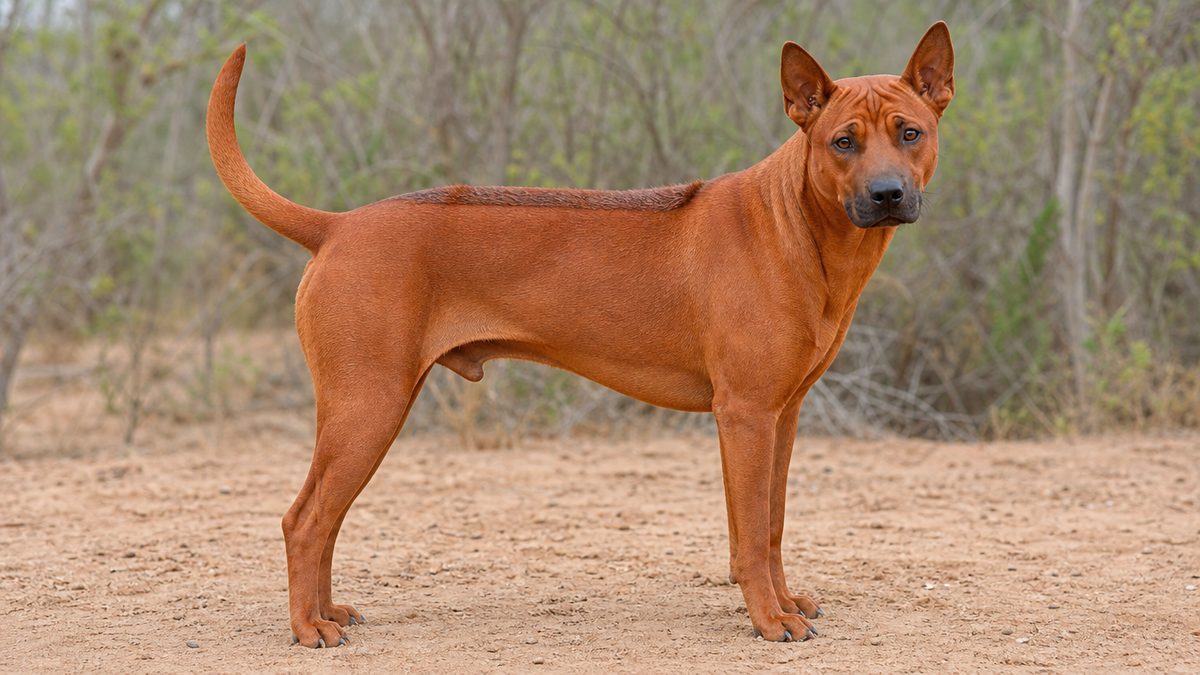
The Thai Ridgeback is a medium, short-coated hunting dog from eastern Thailand that carries a ridge of reversed hair along its spine, and it is FCI standard 338.
The FCI classification places it in Group 5, Spitz and primitive types, Section 7, Primitive type Hunting Dogs, accepted on a provisional basis on 6 March 1993 and on a definitive basis on 26 May 2003, without a working trial. Its country of origin is Thailand and its official authentic language is English. The recognition is definitive rather than provisional, which decides whether a dog can compete for the CACIB: the breed sits in the FCI's Group 5 definitive list under Thailand with a CACIB award and is absent from the 20-entry provisional register. Because India is a full FCI member represented by the Kennel Club of India, an Indian kennel club pedigree for this breed is administratively possible even though no Indian dog exists to carry one.
The standard's own history calls it an old breed visible in Thai archaeological documents written about 360 years ago, used mainly for hunting in the eastern part of Thailand, and also to escort carts and to work as a watch dog. It gives a specific reason for the breed's purity: poor transportation systems in eastern Thailand meant fewer chances to crossbreed with other breeds.
Proportions, and a typographical defect worth knowing about
FCI 338 sets two proportions. Length of body to height at the withers is 11 to 10, so the dog is slightly longer than it is tall, and depth of chest to height at the withers is 1 to 2, so the chest reaches exactly halfway down. Those two ratios together describe a leggy, deep-chested athletic dog rather than a heavy one.
The first of those ratios is printed in the FCI's own English PDF as 11 : 1O, with a Latin capital letter O where the zero should be. An exact-string search for 11:10 inside the standard for this breed therefore returns nothing. It is a typesetting defect rather than a substantive one, and it is worth naming because a researcher who searches the document and finds nothing may conclude the ratio is absent.
Head, skin and the details a buyer can check
The skull is flat between the ears and slightly rounded in profile, and the forehead wrinkles when the dog is attentive. The ears sit on the sides of the skull, medium sized, triangular, inclining forward and firmly pricked, and the standard says outright that they are not cropped. The eyes are almond shaped and dark brown, with amber permitted in blue dogs.
The skin is soft, fine and tight, with no dewlap at the throat, and a black marking on the tongue is preferable. The tail is thick at the base, tapering, and carried vertically with a slight curve, which is a different tail from every other primitive breed on this site.
| Attribute | FCI Standard 338 | AKC Foundation Stock Service |
|---|---|---|
| Height, dogs | 22 to 24 inches, 56 to 61 cm | 20 to 24 inches for both sexes |
| Height, bitches | 20 to 22 inches, 51 to 56 cm | 20 to 24 inches for both sexes |
| Tolerance | Plus or minus one inch, 2.5 cm | Not stated |
| Weight | Not stated | 35 to 75 pounds, 15.9 to 34 kg |
| Coat | Short and smooth, with the reversed ridge | Short, smooth, seasonal shedding |
| Colour | Solid red, black, blue, very light fawn | Not enumerated on the page |
| Life expectancy | Not stated | 14 to 15 years |
The FCI files this breed as THAI RIDGEBACK DOG, the AKC as Thai Ridgeback, and Thai sources as Mah Thai Lang Ahn. A title and abstract search on Thai Ridgeback returns eight papers; the same search on the breed's own FCI name, Thai Ridgeback Dog, returns zero. Search the short form.
The ridge: what the standard requires, and what causes it
The hair ridge is a strip of hair growing in the opposite direction along the top of the back, and FCI 338 disqualifies any dog that does not have one.
The standard's description is precise. The ridge is formed by hair growing in the opposite direction to the rest of the coat, should be clearly defined from other parts of the back, may take various shapes and lengths, must be symmetrical on either side of the backbone and within the width of the back, and may carry crowns or whirls at its head. An unbalanced ridge is a listed fault, and a dog without a ridge is a disqualifying fault.
That last point has a consequence people underestimate. The breed standard requires the trait, so the entire breeding population is selected on it, and a ridgeless puppy from two ridged parents is a normal outcome that cannot be shown or bred under the standard. Such a puppy is a healthy dog and it is worth saying so plainly, because ridgeless puppies in ridged breeds have historically been culled.
The mutation, and what the 2007 paper actually says
Salmon Hillbertz and colleagues published the causative variant in Nature Genetics in 2007. Their abstract opens: the dorsal hair ridge in Rhodesian and Thai Ridgeback dogs is caused by a dominant mutation that also predisposes to the congenital developmental disorder dermoid sinus. The mutation is a 133 kilobase duplication involving three fibroblast growth factor genes, FGF3, FGF4 and FGF19, plus ORAOV1.
Note what that sentence does and does not establish for this breed. It names the Thai Ridgeback explicitly, so the ridge in this breed is the same duplication and the predisposition applies to it. It says predisposes, not causes, and the difference has become the whole argument since.
Why the ridge is a heat trait as well as a cosmetic one
Nothing in the literature links the ridge itself to thermoregulation, and this page will not invent a link. What the standard does say is that the coat is short and smooth and the skin soft, fine and tight, with no dewlap, and those are the features that make this an agile, heat-tolerant tropical dog. The ridge is the breed's identifying mark, not its cooling system.
Run your fingers along the midline of a ridged dog once a week, from the base of the skull to the tail. You are feeling for a small dimple, a firm cord under the skin, a tuft of hair emerging from a pit, or a moist opening. Any of those needs a veterinary examination this week. Do not probe or squeeze one yourself.
Dermoid sinus: what transfers from the Rhodesian Ridgeback, and what does not
Dermoid sinus is a congenital tube of skin running inward from the back, the ridge duplication predisposes to it in both ridged breeds, and every published prevalence figure comes from Rhodesian Ridgebacks rather than from this breed.
This is the single place where Thai Ridgeback pages go wrong, and they go wrong by importing a number. The correct position has three parts, and each rests on a different paper.
Part one: the association covers both breeds
Salmon Hillbertz 2007 studied Rhodesian and Thai Ridgeback dogs together and reported that the dominant ridge mutation predisposes to dermoid sinus. That is the finding every page repeats, and repeating it is correct.
Part two: the causation claim has moved, in one breed only
Zhang and Distl reported in Animal Genetics in 2022 that the duplication responsible for the hair ridge is not identical with the hypothesised locus for dermoid sinus, and their study population is Rhodesian Ridgeback dogs. Distl followed it with a segregation analysis of 12,700 puppies from 1,622 litters of German Rhodesian Ridgebacks born between 2001 and 2019.
That second paper is the substantial one. Overall dermoid sinus prevalence was 2.53 percent, rising to 2.81 percent in the 1,269 litters containing only ridged animals. In 46 litters ridgeless dogs segregated, and two of those ridgeless animals had dermoid sinus. Heritability came out at 0.78 plus or minus 0.11, the genetic correlation with ridgelessness was minus 0.11, and prevalence fell by 0.099 percent per birth year. The paper concludes that the ridge locus was unlikely to determine the expression of dermoid sinus.
Part three: none of those numbers belongs to this breed
Every dog in both 2022 papers is a Rhodesian Ridgeback Distl O. Prevalence and segregation…. No equivalent Thai Ridgeback dataset exists, and a search of the breed's whole indexed literature returns eight papers, none of them a dermoid sinus prevalence study. So a Thai Ridgeback page quoting 2.53 percent is quoting German Rhodesian Ridgebacks.
| Paper | Breeds studied | What it establishes |
|---|---|---|
| Salmon Hillbertz 2007, Nature Genetics | Rhodesian and Thai Ridgeback | The ridge is a 133 kb FGF duplication that predisposes to dermoid sinus |
| Zhang and Distl 2022, Animal Genetics | Rhodesian Ridgeback only | The ridge duplication is not identical with the hypothesised dermoid sinus locus |
| Distl 2022, The Veterinary Journal | Rhodesian Ridgeback only, 12,700 puppies | 2.53 percent prevalence, heritability 0.78, ridge locus unlikely to determine expression |
| Any Thai Ridgeback study | None exists | No prevalence, no heritability, no screening scheme |
The honest summary for a buyer is that the predisposition is real and unquantified in this breed, association survives while causation at the ridge locus does not, and the practical response is unchanged: have a veterinarian examine the midline of any ridged puppy before you take it home.
Distl 2022 found dermoid sinus in two ridgeless Rhodesian Ridgebacks. Two dogs is a small number, but they are the reason the ridge locus cannot be the sole determinant, because a dog without the ridge allele expressed the condition anyway. That is the evidence, and it is why the wording changed from causes to predisposes.
Thai Ridgeback price in India: no verified figure, and a template where one should be
No verified thai ridgeback price in india exists, and the single Indian page carrying a figure prints a cost row it also prints for two unrelated breeds.
poodles.in gives a buying price of Rs 60,000 to Rs 1,00,000 and a monthly care total of Rs 3,550 to Rs 5,400. Read alone it looks like an Indian market observation. Read against two other pages on the same site it is a preset.
One cost row, three unrelated breeds
The same site prints the identical monthly total for the Shikoku, a Japanese double-coated mountain spitz, and for the Taiwan Dog poodles.in, Taiwan Dog Price in India. All three carry food at Rs 2,250 to Rs 3,000, grooming at Rs 700 to Rs 1,200 and health at Rs 600 to Rs 1,200, and the three lines sum exactly to Rs 3,550 and Rs 5,400 at the two ends.
The site falsifies its own rows on the same pages. It states that the Taiwan Dog eats about 700 calories a day, the Shikoku about 1,000, and the Thai Ridgeback about 1,500, a spread of more than two to one, and gives all three the same food line poodles.in, Thai Ridgeback Price in India. It describes the Shikoku's coat as a dense double coat with moderate shedding and this breed's as short and smooth with low shedding, and gives both the same grooming line.
Running the currency tests
Indian pages routinely publish a foreign price converted at one rate, so the buying figures are worth dividing. Rs 60,000 divided by 84.38 is 711.07, by 74 is 810.81, and by 80 is 750.00. The Rs 1,00,000 ceiling divides by 80 to exactly 1,250, but any figure ending in four zeros does that mechanically, and the same ceiling appears on the Shikoku page.
None of those quotients is a price a seller would print, so these are rupee-native arbitrary figures rather than a converted list. That is a different defect from a conversion, and it means nobody has priced this breed in India at all. The scarcity is not an Indian artefact either: the Japan Kennel Club's 2025 table of 141 breeds and 302,530 dogs carries the Taiwan Dog at two registrations and the Rhodesian Ridgeback at one, and the Thai Ridgeback appears nowhere in it. A hardy tropical landrace that has never been bred in numbers outside its own country is expensive everywhere for the same reason.
| Line | Thai Ridgeback | Shikoku | Taiwan Dog |
|---|---|---|---|
| Buying price | Rs 60,000 to Rs 1,00,000 | Rs 55,000 to Rs 1,00,000 | Rs 30,000 to Rs 60,000 |
| Monthly care | Rs 3,550 to Rs 5,400 | Rs 3,550 to Rs 5,400 | Rs 3,550 to Rs 5,400 |
| Food | Rs 2,250 to Rs 3,000 | Rs 2,250 to Rs 3,000 | Rs 2,250 to Rs 3,000 |
| Grooming | Rs 700 to Rs 1,200 | Rs 700 to Rs 1,200 | Rs 700 to Rs 1,200 |
| Health | Rs 600 to Rs 1,200 | Rs 600 to Rs 1,200 | Rs 600 to Rs 1,200 |
| Stated daily intake | About 1,500 calories | About 1,000 calories | About 700 calories |
| Stated coat | Short smooth, low shedding | Dense double, moderate | Short smooth, moderate |
The same site returns HTTP 200 with the title "Dog Breed Not Found" for the Thai Bangkaew Dog, the Ryukyu and the Pungsan. A status-code check passes on all three. Read the page title before recording that an Indian listing exists for any rare breed.
The real cost of ownership in India for a short-coated 25 kg dog
Keeping a 20 to 30 kg short-coated dog in an Indian metro costs roughly Rs 5,500 to Rs 10,000 a month, and it is cheaper than a double-coated breed for one specific reason.
That reason is grooming. A short smooth coat with soft, fine, tight skin needs a rubber mitt and ten minutes a week, where a double-coated breed in an Indian monsoon needs a forced-air dryer and a professional bath. Against a published Indian grooming range of Rs 300 to Rs 2,000, that difference alone is several thousand rupees a year.
The lines you can actually price
- Parasite control at Rs 1,103 a month, from NexGard Spectra for 15 to 30 kg dogs at Rs 3,308 for three tablets, covering ticks, fleas, roundworm and hookworm together.
- Vaccination at Rs 699 for anti-rabies and Rs 899 for the 9-in-1, or an annual booster course from Rs 3,199.
- Consultation at Rs 500 to Rs 1,000 a visit, and boarding at Rs 500 to Rs 2,000 a day.
- Municipal registration at Rs 500 in Delhi or Rs 50 in Chennai, an annual line rather than a monthly one.
- A winter coat in north India, which is a real line for this breed and for almost no other imported one.
The spread on one identical vaccine
The same 9-in-1 vaccine costs Rs 600 at a Goa government veterinary hospital, from Rs 899 at a Vetic clinic, and from Rs 1,999 through a vet-at-home service that also charges a Rs 699 visit fee. That is a 3.3 times spread on one drug, and it is a function of delivery model rather than of the medicine. Chennai residents can go further: Greater Chennai Corporation runs six pet clinics giving treatment and anti-rabies vaccination free of cost.
| Line | Low | High | Note |
|---|---|---|---|
| Food | Rs 3,000 | Rs 5,500 | For a lean, hard-working 20 to 30 kg dog |
| Parasite control | Rs 1,103 | Rs 1,103 | NexGard Spectra 15 to 30 kg, monthly |
| Vaccination, spread | Rs 150 | Rs 320 | Annual booster divided by twelve |
| Vet consultations | Rs 250 | Rs 1,000 | Two to twelve visits a year |
| Grooming | Rs 100 | Rs 500 | Far lower than for a double coat |
| Contingency | Rs 1,200 | Rs 1,200 | The line that stops a Rs 20,000 bill becoming a crisis |
| Total | Rs 5,803 | Rs 9,623 | Plus a winter coat in the north |
Most imported breeds on this site need a room kept cool through an Indian summer, and that electricity is a real cost. A dog from a homeland that averages 27.55 C needs shade and water rather than air conditioning, which is a genuine saving and the only place on this page where the Thai Ridgeback is the cheap option.
Heat tolerance: the only imported breed whose homeland is hotter than Chennai
The Thai Ridgeback's home region runs an annual mean of 27.55 C against Chennai's 27.95 C and is seven points more humid, which makes an Indian coastal summer close to the climate the breed was built in.
NASA POWER, queried at 12.6113 N 102.1039 E in Chanthaburi in eastern Thailand, returns a cell at 6.93 m against a real elevation near 3 m, so the cell is describing the right ground. That cell gives an annual mean of 27.55 C, a May peak of 28.93 C, a December low of 25.89 C, and annual relative humidity of 80.90 percent.
Chennai's cell, at 48.95 m against a real 6 m, gives 27.95 C and 72.39 percent. So Chennai is 0.40 C warmer on the annual mean and seven points drier than the breed's homeland. There is no meaningful heat step-change for this dog on arrival in coastal south India, and that is a genuinely unusual thing to be able to say about an imported breed.
| Place | Cell elevation | Annual mean | Hottest month | Coolest month | Annual humidity |
|---|---|---|---|---|---|
| Chanthaburi, Thailand | 6.93 m | 27.55 C | May, 28.93 C | December, 25.89 C | 80.90 percent |
| Bengaluru | 841.72 m | 23.74 C | April, 28.37 C | December, 20.22 C | 67.94 percent |
| Pune | 635.99 m | 23.86 C | April, 28.93 C | December, 19.62 C | 66.80 percent |
| Delhi | 206.37 m | 25.60 C | June, 35.88 C | January, 13.61 C | 45.56 percent |
| Kolkata | 7.35 m | 25.81 C | May, 31.53 C | January, 17.31 C | 73.93 percent |
| Mumbai | 97.15 m | 26.77 C | May, 31.19 C | January, 23.19 C | 67.39 percent |
| Chennai | 48.95 m | 27.95 C | May, 31.51 C | January, 24.09 C | 72.39 percent |
The rating is 4 out of 5, not 5, and here is why
Being from a hot country does not make a dog immune to heat, and the mechanism that hurts dogs in India is exertion rather than ambient temperature. Hall 2020 in Animals recorded 1,259 heat-related illness events from 1,222 UK dogs, of which 879 had a recorded trigger, and 652 of those 879, or 74.2 percent, were exertional. A hard-driving hunting breed will run itself into trouble in any climate.
The companion paper found a case fatality of 14.18 percent across 395 confirmed events and reported that a dog at or above its breed and sex mean bodyweight carried 1.42 times the odds of an event, with a confidence interval of 1.12 to 1.80. The Thai Ridgeback was not modelled in that study, so no breed-level odds ratio exists for it and none is offered here.
Delhi in May is still a different problem
Chennai matches the homeland. Delhi does not. Delhi's June mean is 35.88 C against Chanthaburi's hottest month at 28.93 C, a gap of nearly seven degrees, and it arrives with 45.56 percent humidity rather than 81. Dry heat at 36 C is a real load on any dog, and a breed adapted to humid 29 C is not automatically adapted to it.
In Chennai, Mumbai or Kolkata this breed can be walked at hours that would be unsafe for a Husky, provided the work is not done in direct afternoon sun. In Delhi, Jaipur or Nagpur in May and June, treat it like any other dog: dawn and after dark, water carried, and stop at the first flat-tongued pant that does not settle.
The Indian winter is the risk nobody writes about
A Delhi January averages 13.61 C, twelve degrees below the coolest month the Thai Ridgeback's homeland has ever offered it, and that gap is the real climate problem for this breed in India.
Chanthaburi's coolest month, December, averages 25.89 C. There is no month of the year in eastern Thailand where this breed experiences anything an Indian would call cold. Delhi's January mean is 13.61 C, Jaipur's is 14.51 C, and Kolkata's is 17.31 C.
Now read that against the coat. FCI 338 specifies short and smooth hair with skin that is soft, fine and tight, and describes no undercoat at all. A dog with no insulating layer, thin skin and a lean, deep-chested athletic build loses heat quickly, which is exactly the property that makes it comfortable in a Thai summer.
What a north Indian winter actually requires
- A fitted coat for morning and evening walks from December to February in Delhi, Jaipur, Lucknow and Chandigarh.
- An indoor bed away from the floor and away from window draughts, since tiled floors in an unheated Indian house sit several degrees below air temperature.
- A later morning walk in winter, which is the reverse of the summer rule and catches people out.
- Extra food through the cold weeks, because a lean dog burns calories to hold temperature.
- Watch for shivering, a tucked posture and reluctance to leave the bed, which in this breed appear at temperatures other dogs ignore.
Where in India this breed fits best
Coastal and peninsular India is the natural fit. Chennai, Mumbai and Kochi never drop below a 23 C monthly mean, which sits inside the band the breed evolved in. Bengaluru and Pune are cooler year-round, at 23.74 C and 23.86 C annually, and both are comfortable rather than cold. North India is the outlier, and it is the outlier in the direction nobody warns about.
The monsoon, and what Indian clinic data shows
Tick-borne disease is the year-round Indian risk for any dog, and a short coat helps you find ticks rather than protecting against them. A West Bengal study of 584 client-owned dogs at a Kolkata animal health centre found Babesia gibsoni in 76.54 percent, Anaplasma in 55.75 percent and two or more concurrent pathogens in 72.9 percent of the 584 dogs screened. A southern Indian study of 120 clinically affected dogs found Babesia in 66.7 percent, peaking pre-monsoon between March and May.
Both are clinic caseloads of dogs already showing signs rather than random population samples, so they describe risk among dogs that get sick. Read that way they still make monthly parasite control the least negotiable line in the budget.
Every other imported breed on this site needs an Indian heat plan. This one needs an Indian cold plan, and only in the north. Do not copy the advice written for a Rhodesian Ridgeback, which is a larger dog from a highveld climate with a cold season of its own.
Indian import law, and what it means for this breed
Indian law permits you to bring in a Thai Ridgeback as your own accompanying pet and rejects any application to import one to breed or to sell.
DGFT Trade Notice 22/2022-23 of 19 December 2022 places dogs under ITC (HS) 01061900 as a Restricted import. It permits three routes and names them: a pet accompanying an owner with a valid pet book in the importer's name, research use with a CPCSEA recommendation, and Defence or Police use. It states that applications for trading or breeding purposes shall be duly rejected.
There is no import licence a would-be Indian breeder can apply for that changes this, and that is why the breed remains unavailable here despite being definitively recognised by a federation India belongs to. Recognition and supply are different questions.
If you are moving to India with your own dog
- Confirm the dog enters under the personal pet route rather than the commercial one, because the two run on different instruments.
- Carry the pet book in the importer's own name, which is the document the trade notice specifically requires.
- Plan a north Indian arrival for the warm half of the year, since a dog from a 25.89 C winter meeting a 13.61 C Delhi January is a bigger shock than the summer would be.
- Register the dog with your municipality on arrival, at Rs 500 in Delhi or Rs 50 in Chennai Greater Chennai Corporation.
- Ask your veterinarian to examine the dorsal midline at the first appointment, and to note the ridge's shape on file.
The Indian breeding rules that would bite this breed
The Prevention of Cruelty to Animals (Dog Breeding and Marketing) Rules 2017 bind anyone breeding or selling dogs in India. Second Schedule Part III paragraph 8(10) requires that breeding dogs have been tested for named genetic defects, including hip dysplasia, progressive retinal atrophy, night blindness, hypothyroidism, entropion and ectropion. Rule 8(1)(a) prohibits selling pups under eight weeks old.
One clause is worth naming for a ridged breed. Second Schedule Part II paragraph 6(8) forbids any surgery or procedure to camouflage or hide a defect or infirmity, and any change of appearance by artificial means. A dermoid sinus repaired and not disclosed before a sale is the case that clause describes, and paragraph 6(9) separately prohibits breeding to create unusual looks.
The 2017 Rules run 1 to 13 and there is no Rule 14. Everything numbered above 13 is a Second Schedule paragraph. Writing "Rule 6(8)" or "Rule 8(10)" points a reader at provisions that do not exist under those names.
Temperament: tough, active, quiet, and reserved with strangers
FCI 338 describes the Thai Ridgeback as tough and active with excellent jumping ability, and a loyal family dog.
That is the whole of the standard's temperament clause, and it is unusually short. The AKC fills in the rest, recording the breed as dignified, affectionate and even-tempered, with an infrequent barking level, and placing it among the best guard dogs while filing it as better with children and with other dogs under supervision.
Read together, those two sources describe a quiet, watchful, physically capable dog that is affectionate with its own people and reserved with everyone else. It is not a demonstrative breed and it is not a noisy one, which makes it easier in an Indian flat than most guarding breeds.
The jumping is a specification, not an anecdote
The standard singles out excellent jumping ability in a two-sentence temperament clause, which means the breed's own governing document considers it defining. In practice that decides your fence. An Indian compound wall of five feet is not a boundary for this breed, and a balcony grille that a Labrador ignores is a route for an athletic dog that jumps.
Who this breed suits
- Owners in coastal or peninsular India who want a heat-tolerant dog that can actually be exercised in April.
- Owners who want a quiet guarding presence rather than a barking one.
- Owners with a genuinely secure boundary above six feet, or a dog that is never off-lead outside it.
- Owners who will socialise a puppy hard through the eight to sixteen week window and keep going.
- Owners comfortable with an independent dog that decides how much of your instruction to take.
Who should look elsewhere
- First-time owners, because a reserved primitive breed with a jump and a prey drive is a demanding first dog.
- Households wanting a dog that greets guests warmly, which this breed generally does not.
- Anyone in north India unwilling to buy a winter coat and keep the dog indoors from December to February.
- Anyone relying on a five-foot boundary wall.
- Anyone who wants a Rhodesian Ridgeback and is being offered this breed as a cheaper equivalent, because they are different dogs.
A reserved dog is not an aggressive one, and FCI 338 disqualifies aggressive or overly shy dogs outright. Expect a Thai Ridgeback to watch a visitor rather than greet them, to place itself between you and the door, and to settle once you have. Manage that with distance and a mat, not with corrections.
Training an independent primitive breed with a jump
To train a Thai Ridgeback, pay heavily for voluntary attention, build management before obedience, and put the fence up first.
This is a hunting breed from a region where its type survived precisely because it was left alone. Every part of that history selects for independent decision-making. It learns quickly, which people mistake for biddability, and then complies selectively, which people mistake for stubbornness. Neither reading is right; the dog is deciding.
The five things worth teaching first
- Name response, paid every time for six months, because a dog that voluntarily looks at you can be redirected.
- A hand-target, which moves the dog without a collar grab and defuses a stand-off at the door.
- Settling on a mat, which is the behaviour that makes a watchful breed liveable when visitors arrive.
- Loose-lead walking on a Y-front harness, taught before the puppy reaches 15 kg.
- A stationary wait at doors, gates and lift openings, which is what actually prevents an escape.
Off-lead recall is deliberately absent from that list. On a jumping, hunting breed the honest plan is a long line in open ground and a secure fenced area for free running, and building your life around a recall this breed may never fully offer is how dogs are lost.
Socialisation, and the Indian version of it
A puppy that will live in an Indian city has to meet autorickshaw noise, temple loudspeakers, cattle, cyclists, free-ranging dogs and monkeys before sixteen weeks, at a distance it can cope with. A breed whose standard disqualifies an overly shy dog is a breed where that window is not optional.
Compulsion is the fastest way to break this dog. A reserved, independent breed that is corrected hard becomes evasive rather than obedient, and the behaviour you punished simply moves further from you.
Expect name response and a hand-target inside three weeks, mat settling in six, loose-lead walking in three months, and door manners holding by six months. Do not expect a park recall around a squirrel, at any age. Spend the money on the fence instead of the training class that promises one.
Exercise: a tough, active breed with a wider Indian window than most
A Thai Ridgeback needs 60 to 90 minutes of real daily exercise, and in coastal India it can take that at hours no double-coated breed could.
FCI 338 calls the breed tough and active with excellent jumping ability, and describes a reachy stride with no pitching or rolling, parallel tracking, and a long stride with powerful drive. That is a description of an efficient, athletic mover built for distance rather than for sprints.
The Indian advantage is real and worth quantifying. Chennai's hottest month averages 31.51 C and the breed's homeland peaks at 28.93 C, a gap of 2.58 C. Compare that with a Japanese or Nordic breed facing a gap of 11 to 22 degrees, and the practical result is that a Thai Ridgeback in Chennai has a usable morning and evening across most of the year rather than a two-hour dawn window in May.
What 60 to 90 minutes should contain
- Forty to sixty minutes of continuous forward movement, on a long line wherever the ground is open.
- Fifteen minutes of scent work, which tires a hunting breed faster than distance and can be done indoors.
- Structured play with rules, so that arousal has a built-in off switch.
- Free running only inside a boundary the dog cannot clear, which for this breed means higher than six feet.
- A proper rest afterwards, because recovery is part of the session rather than an afterthought.
Being from a hot country is not immunity
Hall 2020 in Animals found that 652 of the 879 heat-related illness events with a recorded trigger were exertional, that is 74.2 percent. Heat illness in dogs is caused by exercise far more often than by ambient conditions, and a breed that will keep working past the point of sense is exactly the profile that gets into trouble. The companion paper puts case fatality at 14.18 percent.
Keeping the dog lean is the one modifiable factor with a published number attached. Dogs at or above their breed and sex mean bodyweight carried 1.42 times the odds of an event, with a confidence interval of 1.12 to 1.80.
Stop if the tongue widens and flattens, if the dog seeks shade unprompted, if the pant does not settle within a minute of standing still, or if the stride shortens. Wet the belly, groin and paws rather than the back, offer water, and get to a veterinarian the same day if the dog does not normalise within ten minutes.
Grooming a short coat in Indian conditions
A Thai Ridgeback needs about ten minutes of grooming a week, which makes it one of the lowest-maintenance imported breeds an Indian owner can keep.
FCI 338 specifies hair that is short and smooth, and skin that is soft, fine and tight with no dewlap at the throat. The AKC records seasonal shedding rather than continuous heavy shedding. There is no undercoat to rake out, no coat to blow twice a year, and no drying problem in the monsoon.
The weekly routine
- Rubber curry mitt over the whole dog once a week, which lifts the dead hair a short coat sheds and takes five minutes.
- Hands-on check of the dorsal midline, feeling for a dimple, a cord, a hair tuft or a moist opening along the ridge line.
- Ears checked weekly, because pricked ears stay dry but still collect dust in Indian conditions.
- Nails every three weeks, since a dog exercised on soft ground will not wear them down.
- Bath only when actually dirty, roughly every eight to ten weeks, because thin skin dries out fast.
Thin skin is the real grooming constraint
The standard's phrase is soft, fine and tight. In practice that means a dog that scratches and tears more easily than a thick-skinned breed, sunburns on a pale or dilute coat, and reacts visibly to harsh shampoos. Use a mild dog shampoo, rinse thoroughly, and keep a light-coloured dog out of direct midday sun in an Indian summer.
Ticks are the job a short coat makes easier
A short coat does not repel ticks; it makes them findable. Against Indian clinic data showing Babesia gibsoni in 76.54 percent of 584 dogs screened at a Kolkata centre and two or more concurrent pathogens in 72.9 percent of them, a weekly hands-on sweep plus monthly NexGard Spectra at Rs 1,103 for a 15 to 30 kg dog is the whole prevention programme.
Do not shave a short-coated dog to make it cooler in an Indian summer. It has almost no coat to remove, and what it does have is the only barrier between fine skin and Indian ultraviolet. A dilute blue or isabella dog is the most exposed of all.
Health: three negative surveys, one dilution allele, and no lifespan study
The Thai Ridgeback's published health record is unusual because most of it is negative, and negative screening results are more useful to an owner than a list of borrowed conditions.
Three Thai surveys screened this breed for mutations common in other breeds and found none of them. That is genuinely informative, and no English page cites any of the three.
The three negatives, with their denominators
- MDR1 nt230(del4), the deletion behind ivermectin sensitivity, was not identified in Thai Ridgebacks in a survey of 263 dogs across eight breeds, in what the authors state was the first such survey of the breed. Rough Collies in the same study carried a 57.14 percent mutant allele frequency.
- The VPS13B deletion behind trapped neutrophil syndrome was absent in 30 Thai Ridgebacks, while 4 percent of 100 Border Collies in the same study were carriers.
- The NHEJ1 deletion behind Collie eye anomaly was not detected in Thai Ridgeback Dogs in a 224-dog survey, against 83.3 percent mutant allele frequency in Rough Collies.
Those results do not mean the breed is free of eye disease or drug sensitivity. They mean these three specific mutations were not found in these specific samples, which is exactly what you should tell a veterinarian who is reaching for a breed-based assumption.
Coat colour dilution, and the blue dogs
FCI 338 permits blue and very light fawn, or isabella, as solid colours. Both are dilute coats. A 2018 study identifying a second canine dilution allele at MLPH, designated d2, reported a blue Thai Ridgeback carrying the d1 over d2 genotype and concluded that d2 is segregating in at least three breeds: Chow Chows, Sloughis and Thai Ridgebacks.
That matters because coat colour dilution in dogs carries a recognised association with colour dilution alopecia, a coat and skin condition. A buyer paying a premium for a rare blue puppy is buying a dilute coat, and should ask a veterinarian to assess the coat rather than assume the colour is purely cosmetic.
What has actually been measured in the breed
A Thai study of 105 Thai Ridgeback dogs from farms across Thailand used microsatellite genotyping and mitochondrial D-loop sequences and found significant genetic diversity with minimal inbreeding and no bottleneck signal, which the authors attribute to owners exchanging animals for mating. That is a better founding-population picture than most rare breeds can show.
A body-composition study of 340 Thai and mongrel dogs in East Thailand put average body fat at 27.52 percent overall and 26.42 percent in Thai Ridgebacks, and found body fat rising from about five years of age. A separate Thai study established breed-specific normal electroretinography values for this breed alongside the poodle, the Labrador and the Thai Bangkaew, and found significant differences between the four on nearly every measure.
The absences, stated plainly
- No published life expectancy for the breed. McMillan 2024's Table S5 lists the Thai Ridgeback Dog with Included in Survival Analysis set to N, so it was considered and excluded.
- No dermoid sinus prevalence figure for the breed, only Rhodesian Ridgeback data.
- No published hip or elbow screening statistics for the breed.
- No breed-club health survey in English.
- The AKC's 14 to 15 year figure, published without a named data source.
Ask whether the litter's midlines were examined by a veterinarian and what was found. Ask for the parents' hip scores with the scheme named. Ask whether any dog in the line has had a dermoid sinus removed, since Indian breeding rules forbid concealing a defect before a sale. A breeder who cannot answer those three has no health programme.
Feeding a lean tropical hunting breed in India
Feed a Thai Ridgeback to a visible waist and easily felt ribs, because bodyweight at or above the breed mean is the one heat risk factor with a published odds ratio behind it.
Hall 2020 in Scientific Reports found that dogs at or above their breed and sex mean bodyweight carried 1.42 times the odds of a heat-related illness event, with a confidence interval of 1.12 to 1.80. For a dog that will be exercised in Indian conditions, body condition is a safety question rather than a cosmetic one.
Thai data gives a useful benchmark. Average body fat across 340 Thai and mongrel dogs in East Thailand was 27.52 percent, with Thai Ridgebacks at 26.42 percent, and body fat rose from about five years of age. That last finding is the practical one: the portion that kept a three-year-old lean will make a six-year-old fat.
Portion and life stage
- Puppies to four months, four meals a day on a large-breed or all-breed growth food with controlled calcium.
- Four to eight months, three meals, watching that growth stays steady rather than fast on a leggy breed.
- Eight months onward, two meals a day, timed around the cool exercise windows.
- Adults, roughly 350 to 450 g of a good dry food a day for a 25 kg dog, adjusted weekly by feel rather than by the bag.
- From five years, re-weigh monthly and cut the portion before the waist disappears, because that is when the Thai data shows body fat climbing.
The FCI standard gives no weight at all, and the AKC publishes 35 to 75 pounds, which is 15.9 to 34 kg American Kennel Club. A 34 kg dog and a 16 kg dog cannot share a feeding chart, so body condition scoring is the only honest target for this breed.
Indian availability and the summer adjustment
Everything a medium active dog needs is stocked in every Indian metro, and the practical decision is price and consistency rather than formulation. Budget Rs 3,000 to Rs 5,500 a month for food, change brands over a week rather than overnight, and move the main meal to after the evening walk in the hot months rather than before it.
Do not exercise a deep-chested dog within an hour of a full meal. FCI 338 specifies a chest reaching exactly halfway down the dog's height, which is the conformation associated with gastric dilatation, and stacking that risk on top of heat is avoidable by moving one meal.
Weigh the dog at your veterinary clinic every three months and write the number down. Indian clinics will do it free, and a written series catches the slow gain that no owner sees day to day. In this breed the series matters most from five years onward.
The first year, month by month
A Thai Ridgeback puppy's first year runs from a veterinary midline examination in week eight to full physical maturity near eighteen months, with the socialisation window closing at sixteen weeks.
- Weeks 8 to 10. Home, crate, name response, and a veterinary examination of the dorsal midline specifically. Indian law prohibits the sale of pups under eight weeks, so a younger puppy is a red flag about the seller.
- Weeks 10 to 16. The socialisation window. Traffic, lifts, autorickshaws, cattle, cyclists and other dogs at a distance the puppy can cope with, and handling by strangers.
- Months 4 to 5. Adult teeth arrive and chewing peaks. Loose-lead walking is taught now, while the puppy is still under 15 kg.
- Months 5 to 6. Prey drive and jumping both appear. Check the fence properly, because the standard names jumping as a breed characteristic.
- Months 6 to 8. A second fear period is common in primitive breeds. Repeat easy versions of things the dog already knows rather than adding new pressure.
- Months 8 to 12. Growth slows and the daily load can move toward the adult 60 to 90 minutes.
- Months 12 to 18. Physical maturity completes. Hold off repetitive high-impact work such as long road running until your veterinarian confirms the growth plates have closed.
The Indian calendar for this breed is the reverse of the usual advice
For most imported breeds the difficult months are April to June. For this one they are December to February in north India, when a short-coated puppy from a 25.89 C winter climate meets a 13.61 C Delhi January. A puppy that turns twelve weeks old in a Delhi December needs its socialisation walks in a coat, in the middle of the day, which is the opposite of the summer rule.
In Chennai, Mumbai or Kochi the calendar barely matters, because no month falls below a 23 C mean. That is the practical case for this breed in peninsular India.
Everything on this list can slip except the eight to sixteen week window. A reserved primitive breed that misses it in an Indian city becomes an adult that cannot cope with an Indian city, and the standard's disqualification of an overly shy dog is the breed telling you this failure mode is real.
Thai Ridgeback against the breeds an Indian buyer would cross-shop
Against the Rhodesian Ridgeback it is smaller, quieter and better suited to Indian heat; against an Indian hound it loses on availability and on everything an import route implies.
| Breed | Size | Heat tolerance | Available in India | Measured median lifespan |
|---|---|---|---|---|
| Thai Ridgeback | 51 to 61 cm | 4 of 5 | No | None published |
| Rhodesian Ridgeback | 61 to 69 cm | 3 of 5 | Yes, imported | 12.0 years on 883 deaths |
| Phu Quoc Ridgeback | 48 to 55 cm | 4 of 5 | No | None published |
| Rajapalayam | 63 to 76 cm | 5 of 5 | Yes, regionally | None published |
| Kombai | Medium boar hound | 5 of 5 | Yes, regionally | None published |
| Indian Pariah Dog | 18 to 25 kg | 5 of 5 | Free to adopt | None published |
| Dalmatian | 54 to 62 cm | 3 of 5 | Yes, widely | Published elsewhere on this site |
Against the Rhodesian Ridgeback
These are the two breeds people confuse, and they are not close. The Rhodesian is substantially larger, comes from a southern African highveld climate with a genuine cold season, and has a measured median lifespan of 12.0 years on 883 deaths in a UK study of 2,108 dogs. The Thai Ridgeback is a medium tropical dog with no measured lifespan at all.
The one thing they share is the ridge and its dermoid sinus predisposition, established across both breeds in 2007. Everything else, including every prevalence figure, belongs to one breed and not the other.
Against the Phu Quoc Ridgeback
The third ridged breed is Vietnamese and is the cleanest contrast on paperwork rather than on the dog. The Thai Ridgeback holds a definitive FCI standard while the Phu Quoc holds a UKC registration route with no breed standard at all. If pedigree matters to you, that difference decides it.
Against an Indian hound
The honest comparison for an Indian buyer is a Rajapalayam or a Kombai. Both are heat-adapted, both can be sourced and vetted locally without an import route, and both come with a local veterinary community that has seen the breed before. What they do not offer is a ridge, and the ridge is the only thing the Thai Ridgeback has that they do not.
If the appeal is a short-coated, heat-tolerant, quiet, athletic guarding dog, India already has several, they cost nothing to adopt, and no import licence is involved. If the appeal is specifically the reversed hair ridge on a Thai breed, the only lawful route into India is bringing your own dog with you.
Six mistakes Indian buyers make with this breed
The six recurring mistakes are trusting a template price, importing Rhodesian Ridgeback health data, planning for heat instead of cold, under-fencing, paying a premium for a dilute coat, and searching the wrong name.
- Treating the one printed Indian price as market data. The same site prints an identical monthly cost row for this breed, the Shikoku and the Taiwan Dog while stating that the three eat 1,500, 1,000 and 700 calories a day poodles.in, Shikoku Price in India poodles.in, Taiwan Dog Price in India.
- Quoting a dermoid sinus prevalence. Every published figure, including 2.53 percent from 12,700 puppies, comes from German Rhodesian Ridgebacks, and no Thai Ridgeback prevalence study exists.
- Planning for Indian heat and forgetting the winter. The homeland's coolest month averages 25.89 C against a Delhi January mean of 13.61 C, and a short coat with fine tight skin has nothing to hold heat with.
- Under-fencing the garden. FCI 338 names excellent jumping ability in a two-sentence temperament clause, which is the standard telling you this is defining rather than incidental.
- Paying a premium for a blue puppy without asking about the coat. Blue is a permitted colour and it is a dilute one, with the d2 dilution allele confirmed segregating in this breed.
- Searching the breed's own FCI name. Thai Ridgeback Dog returns zero records in a title and abstract search that returns eight for Thai Ridgeback.
A seventh mistake, made by search engines rather than buyers
Three different query shapes for this breed on Bing India returned three completely unrelated result sets on 9 September 2026: FedEx package tracking, the planet Mercury, and Thai Airways with Thai restaurants in Ranchi, while the Labrador control returned ten genuine Indian Labrador price pages in the same session. Nothing about the Indian market for this breed can be read off any of those, in either direction, and this page draws no conclusion from them.
The general rule follows from that. A search that returns plenty of the wrong thing is as useless as one that returns nothing, and an absence is only real when a control succeeded in the same session on the same instrument.
Paying a premium for a dog described as a Thai Ridgeback with no verifiable pedigree. With no Indian register, no lawful breeding import route, and an appearance that a red short-coated Indian dog with a cowlick can superficially resemble, any Indian dog offered as this breed needs FCI papers you can check, or it is something else.
Adoption, and what to do instead of waiting for a Thai Ridgeback
No Thai Ridgeback is available to adopt in India, and the useful answer names what an Indian adopter can actually get that meets the same want.
Rescue works on supply. A breed with no Indian population produces no Indian rescues, and no Indian shelter network lists the Thai Ridgeback. That follows directly from a breed with no lawful breeding import route and no Indian register.
What an Indian adopter can get that meets the same want
- An Indian Pariah Dog, if the appeal is a short-coated, heat-tolerant, alert and independent medium dog. Free to adopt in every metro and rated 5 of 5 for heat tolerance.
- A Kombai through a Tamil Nadu rescue, if the appeal is a hunting dog with genuine drive and stamina.
- A Rajapalayam, if the appeal is a large short-coated Indian hound with a guarding presence.
- A Chippiparai, if the appeal is a lean athletic short-coated dog for a hot climate.
- A Rhodesian Ridgeback through a breed rescue, rarely, if the ridge specifically is what you want and you can manage a larger dog.
How to verify any dog offered to you as a Thai Ridgeback
- Ask which register issued the pedigree, and expect an FCI member body. There is no Indian register for the breed.
- Check the ridge against the standard: clearly defined, symmetrical on either side of the backbone, and within the width of the back.
- Check for the two disqualifying faults, no ridge and long hair, before anything else.
- Measure the dog. The FCI range is 56 to 61 cm in dogs and 51 to 56 cm in bitches with a one-inch tolerance, so a 70 cm dog is a Rhodesian Ridgeback or a cross.
- Ask for the parents' health results by name and scheme, since no breed-average data exists to fall back on.
If you are importing your own dog
The personal pet route is lawful and is the only one that is. Bring the pet book in your own name, register with your municipality on arrival at Rs 500 in Delhi or Rs 50 in Chennai, and book a first veterinary appointment that includes a midline examination Greater Chennai Corporation. Choose a warm-season arrival if you are landing in north India.
We report published price ranges as editorial content. We do not broker sales, recommend breeders, accept payment for placement, or link puppy listings, and we will not publish an Indian price for a breed with no Indian market. Where adoption is the honest answer, we say so and name what is actually available.
Thai Ridgeback questions Indian buyers actually ask
What is the Thai Ridgeback price in India?
No verified thai ridgeback price in india exists. No Indian breeder, kennel-club register, rescue or verifiable classifieds listing carries the breed, and the single Indian page that prints a figure, poodles.in, quotes Rs 60,000 to Rs 1,00,000 alongside a monthly cost row identical to the rupee with the same site's Shikoku and Taiwan Dog pages. Treat that puppy price as a template value.
Is the Thai Ridgeback recognised by the FCI?
Yes, definitively. The FCI accepted the Thai Ridgeback Dog on a provisional basis on 6 March 1993 and on a definitive basis on 26 May 2003, as standard 338 in Group 5 Spitz and primitive types, Section 7 Primitive type Hunting Dogs, with English as the authentic language and no working trial required.
Does the Thai Ridgeback get dermoid sinus like the Rhodesian Ridgeback?
The predisposition is established, the prevalence is not. Salmon Hillbertz 2007 names Rhodesian and Thai Ridgeback dogs together, showing that the same dominant 133 kb duplication causes the ridge and predisposes to dermoid sinus. Every prevalence figure that exists, including the 2.53 percent from 12,700 puppies, comes from Rhodesian Ridgebacks, so no Thai figure can be quoted.
Can a Thai Ridgeback handle Indian heat?
Better than almost any other imported breed, and the climate data is the reason. Its home region in eastern Thailand runs an annual mean of 27.55 C and 80.90 percent annual relative humidity, against Chennai's 27.95 C and 72.39 percent. This is a heat-tolerant tropical landrace arriving in a climate 0.40 C cooler and seven points drier than the one it evolved in.
What about a Thai Ridgeback in a Delhi winter?
That is the real risk, and it runs in the opposite direction to every other page's warning. The coldest month in the breed's homeland averages 25.89 C, while Delhi's January mean is 13.61 C. A short smooth coat with soft, fine, tight skin and no undercoat is not built for a twelve-degree drop, so a north Indian winter needs a coat and an indoor bed.
How big does a Thai Ridgeback get?
FCI 338 gives an ideal height at the withers of 22 to 24 inches, that is 56 to 61 cm, in dogs and 20 to 22 inches, that is 51 to 56 cm, in bitches, with a tolerance of plus or minus one inch. The AKC publishes 20 to 24 inches and 35 to 75 pounds. Neither the FCI standard nor the AKC agrees on a single weight range.
Is a ridgeless Thai Ridgeback still a Thai Ridgeback?
Not for show purposes. FCI 338 lists dogs without ridge as a disqualifying fault, alongside long hair, and lists an unbalanced ridge as an ordinary fault. A ridgeless puppy from two ridged parents is a normal genetic outcome and is a perfectly healthy pet, but it cannot be shown or bred under the standard.
How long does a Thai Ridgeback live?
The AKC publishes 14 to 15 years without naming a source, and no independent study has measured it. McMillan 2024 lists the Thai Ridgeback Dog in Table S5 with Included in Survival Analysis set to N, so the breed was considered and excluded rather than overlooked. Its Rhodesian Ridgeback row, 12.0 years on 883 deaths, belongs to a different breed.
Is ivermectin safe for a Thai Ridgeback?
The breed-specific genetic risk factor is absent, which is a useful thing to be able to tell your veterinarian. A Thai survey of 263 dogs across eight breeds found the MDR1 nt230(del4) deletion in Rough Collies, Australian Shepherds, Shetland Sheepdogs and Old English Sheepdogs, and did not identify it in Thai Ridgebacks. Dose on weight and clinical judgement as always.
Is the Thai Ridgeback inbred?
The published evidence says no, which surprised the authors. A 2025 study genotyped 105 Thai Ridgeback dogs from farms across Thailand using microsatellites and mitochondrial D-loop sequences, expecting a loss of diversity, and found significant genetic diversity with minimal inbreeding and no sign of a bottleneck, which it attributes to owners exchanging animals for mating.
Can I import a Thai Ridgeback into India?
Only as your own accompanying pet. DGFT Trade Notice 22/2022-23 places dogs under ITC (HS) 01061900 as a Restricted import, permits entry for a pet with a valid pet book in the importer's name, for research with a CPCSEA recommendation, or for Defence and Police use, and states that applications for trading or breeding purposes shall be duly rejected.
What does a Thai Ridgeback cost to keep in India each month?
Budget Rs 5,500 to Rs 10,000 a month for a 20 to 30 kg short-coated dog. That covers food, Rs 1,103 a month for NexGard Spectra at the 15 to 30 kg dose, an annual booster from Rs 3,199 spread across the year, and Rs 500 to Rs 1,000 a consultation. Grooming costs less than for any double-coated breed.
Are blue Thai Ridgebacks healthy?
Blue is a permitted colour under FCI 338 and it is a dilute coat, which is worth knowing before paying a premium for one. A 2018 study identified a blue Thai Ridgeback carrying the d1 over d2 genotype at MLPH, and concluded the d2 dilution allele is segregating in Chow Chows, Sloughis and Thai Ridgebacks. Dilute coats in dogs carry a known association with colour dilution alopecia, so ask your veterinarian to check the coat.
Is a Thai Ridgeback a good family dog?
FCI 338 calls it a loyal family dog, and the AKC records it as dignified, affectionate and even-tempered with an infrequent barking level, but files it as better with children and with other dogs under supervision. Read together they describe a quiet, watchful dog that is affectionate with its own people and reserved with everyone else, which suits an experienced household with a secure boundary above six feet rather than a first-time owner or a home that wants a dog to greet guests warmly.
Is Thai Ridgeback rare?
Outside Thailand, yes. The breed has never been bred in numbers outside its own country: the Japan Kennel Club's 2025 table of 141 breeds and 302,530 dogs does not list it at all, and no Indian breeder, kennel-club register, rescue or verifiable classifieds listing carries it. Inside Thailand it is a hardy tropical landrace kept on farms, and a 2025 study that genotyped 105 dogs found significant genetic diversity with no bottleneck signal.
Are Thai Ridgebacks aggressive?
A reserved dog is not an aggressive one, and FCI 338 disqualifies aggressive or overly shy dogs outright. The standard's temperament clause describes the breed as tough and active with excellent jumping ability and a loyal family dog, and the AKC adds dignified, affectionate and even-tempered. Expect a Thai Ridgeback to watch a visitor rather than greet them, to place itself between you and the door, and to settle once you have, and manage that with distance and a mat rather than corrections.
Is a ridgeback a good family dog?
Only once you know which ridgeback you are being offered. The Thai Ridgeback and the Rhodesian Ridgeback are different dogs, and this page covers the Thai one, which FCI 338 calls a loyal family dog and the AKC files as better with children and other dogs under supervision. It is affectionate with its own people and reserved with strangers, so it suits an experienced household with a secure boundary rather than a first-time owner.
Compare with similar breeds
Thai Ridgeback sits in 1 Bonbeno group. Each one compares it directly against the breeds it is genuinely an alternative to, on the same figures.