
Breed profile
Rhodesian Ridgeback: Price in India, Heat, and the Ridge
The ridge is the breed. What the ridge means for a puppy's health changed in 2022, and almost nothing you can read in India has caught up.
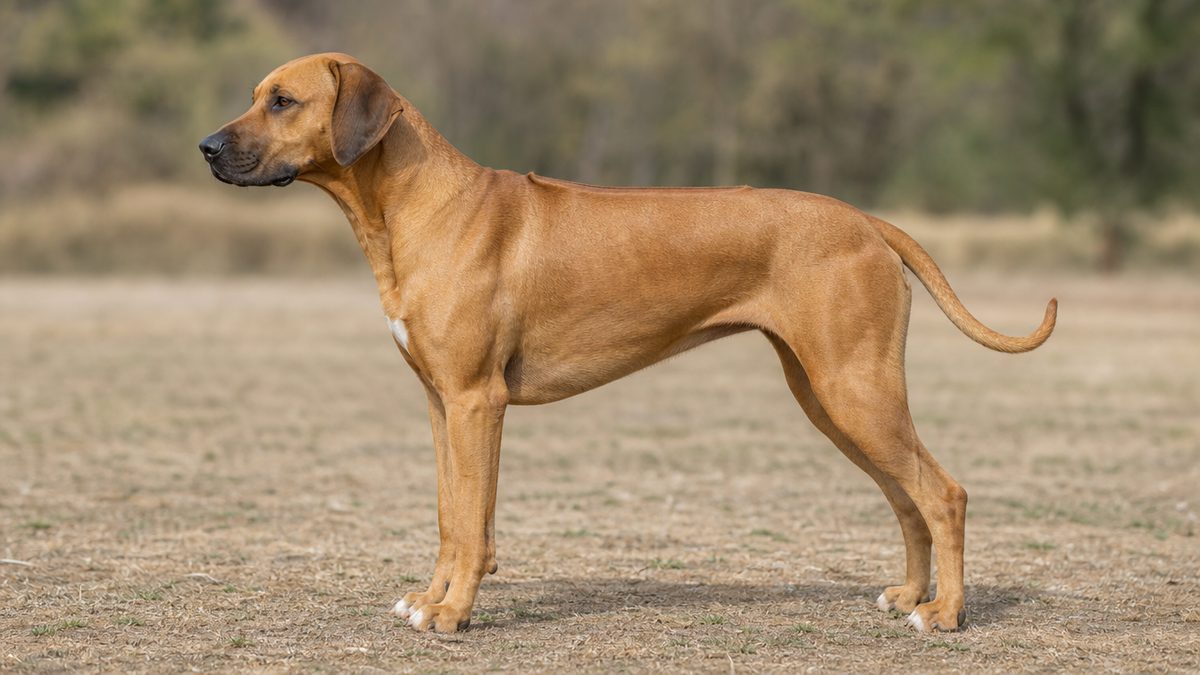
Quick answer
The Rhodesian Ridgeback price in India runs from roughly Rs 1,20,000 to Rs 3,50,000, and every one of those figures is published by a page selling the dog, so no independent Indian price exists. The breed is a 30 to 39 kg southern African hound bred on a 1,340 m plateau, not a hot lowland, and it was named on the March 2024 central circular that two High Courts then struck down.
This page reports published veterinary research and breed-standard documents. It is not veterinary advice and it cannot diagnose your dog. Dermoid sinus in particular is palpated by hand in a newborn puppy and confirmed on imaging, so a suspected ridge defect, a skin dimple on the midline, a seizure, sudden deafness or any sign of heat stress needs a registered veterinarian in person, not a web page. Consult your veterinarian before acting on anything here.
Rhodesian Ridgeback at a glance
What a Rhodesian Ridgeback actually is
The Rhodesian Ridgeback is a large, short-coated southern African hound defined by a strip of backward-growing hair down its spine, recognised by the FCI on a definitive basis on 21 February 1955 as standard 146.
The FCI files it in Group 6, Scent hounds and related breeds, Section 3, Related breeds, without working trial, and names the country of origin as South Africa. The standard document itself says something slightly different: it gives the origin as Southern Africa and records that the text was supplied by the Kennel Union of Southern Africa together with the Zimbabwe Kennel Club. Two current official documents from the same body, one naming a country and the other a region. That is a small thing, and it is the first sign on this page that the paperwork around this breed rewards reading rather than summarising.
The registries do not even agree on what kind of dog it is. The FCI calls it a scenthound. The AKC shows it in the Hound group. The United Kennel Club files it under Sighthound and Pariah, alongside the Azawakh, the Saluki and the Thai Ridgeback, and puts it in a different group from every coonhound it registers. A buyer reading three registries gets three answers about the animal's basic job.
The physical dog, in numbers that disagree
The Royal Kennel Club asks for a desirable minimum of 63 cm and maximum of 69 cm at the withers for dogs, and 61 cm to 66 cm for bitches, and gives no weight at all. The AKC asks for 25 to 27 inches for dogs and 24 to 26 for bitches, and prints desirable weights of 85 pounds and 70 pounds. Indian seller pages then publish a third set: one gives males 36 to 41 kg and females 29 to 34 kg, another 32 to 40 kg, and a third simply says 30 to 39 kg, none of them citing anything.
The coat is the easiest thing about the breed and the standards agree on it completely. Short and dense, sleek and glossy, neither woolly nor silky, in light wheaten to red wheaten with a little white on chest and toes permissible. A wheaten dog with a dark muzzle is correct; a solid black one is a disqualification under the AKC standard.
The lion dog name, and what it actually means
The FCI standard settles the most repeated claim about this breed in one sentence. It records that the original function of the Rhodesian Ridgeback, or Lion Dog, was to track game, especially lion, and with great agility keep it at bay until the arrival of the hunter. Holding an animal at bay for a rifle is not fighting it. The dogs worked mainly in groups of two or three, and the job was pursuit, position and noise, not combat.
The same paragraph carries the breed's real origin story, which is more interesting than the lion. Its forbears trace to the Cape Colony, where European settlers' dogs crossed with the semi-domesticated, ridged Hottentot hunting dogs already there. The African half of that cross survives today as a landrace, and the Kennel Union of Southern Africa's AfriCanis standard records under coat texture that wire haired dogs and ridge dogs may occur within it. The ridge is African. The show breed around it is not.
The written standard is younger than most buyers assume. F.R. Barnes drafted it in Bulawayo in 1922, based on the Dalmatian standard, and the South African Kennel Union approved it in 1926. So the document that defines a 5 cm ridge and two opposed crowns was modelled on a spotted carriage dog, which is the kind of detail that explains why the breed standard reads the way it does.
All three major standards for this breed were revised in 2025. The FCI published its current English text on 6 June 2025 with the official valid standard dated 15 May 2025, the AKC approved its version on 8 April 2025 effective 1 July 2025, and the Royal Kennel Club's page records a last update of 1 April 2025. Anything a seller quotes you from an older document may simply be out of date.
The dermoid sinus science moved in 2022 and nobody told the internet
The ridge is still associated with dermoid sinus, but the claim that the ridge mutation causes it no longer survives the evidence, and every page currently ranking in India still repeats the 2007 version.
Here is the chain, in order, because the order is the argument.
2005 to 2007: the case is built
Hillbertz analysed 46 litters bred in Sweden between 1990 and 2001 and estimated that 8 to 10 percent of offspring in the Swedish Rhodesian Ridgeback population were dermoid sinus positive. A year later, working across 87 litters and 803 dogs for the mode of inheritance and 402 litters and 3,598 dogs for the correlation, Hillbertz and Andersson concluded that the ridge is inherited as an autosomal dominant and that it predisposes to dermoid sinus, with ridgeless offspring running at 5.6 percent of the Swedish population.
Then in 2007 the mechanism arrived. Salmon Hillbertz and thirteen co-authors published in *Nature Genetics* that the causative mutation is a 133 kb duplication involving FGF3, FGF4, FGF19 and ORAOV1, and proposed that the ridge and dermoid sinus are both caused by dysregulation of one or more of those fibroblast growth factor genes during development. The title of that paper says it outright: the duplication causes hair ridge and predisposition to dermoid sinus.
That is the sentence the whole internet still runs on. It is the sentence behind two decades of breeder practice, and it is the reason a ridgeless puppy has been treated as a different kind of animal from its littermates.
2015: breeders get a copy-number test
Because the ridge allele is dominant, a heterozygous dog looks identical to a homozygous one. Waldo and Diaz published a validated quantitative PCR test that reports Ridge allele copy number in Rhodesian Ridgebacks, and reported the correct genotype in every dog of known genotype they tested. For the first time a breeder could screen for one copy versus two rather than guessing from the litter.
2022: two papers pull the causal claim apart
Zhang and Distl, at the Institute for Animal Breeding and Genetics in Hannover, published a study whose title is its conclusion: a study of Rhodesian Ridgeback dogs indicates that the duplication responsible for hair ridge is not identical with the hypothesized locus for dermoid sinus. The ridge duplication and the thing that produces dermoid sinus are not the same piece of DNA.
Six weeks earlier, in *The Veterinary Journal*, Distl published the population half of the same argument. He analysed 12,700 puppies born in 1,622 litters of Rhodesian Ridgebacks in Germany between 2001 and 2019. Overall dermoid sinus prevalence was 2.53 percent. In the 1,269 litters containing only ridged animals it was 2.81 percent. In 46 litters where ridgeless dogs segregated, two ridgeless animals had dermoid sinus. Prevalence fell significantly by 0.099 percent per birth year while ridgelessness showed no significant trend, heritability came out at 0.78 plus or minus 0.11, and the genetic correlation with ridgelessness was minus 0.11. His conclusion, verbatim, is that the ridge locus was unlikely to determine the expression of dermoid sinus, given the low segregation ratio for dermoid sinus in a population selected for the ridge allele.
| Paper | Design | Conclusion in its own terms |
|---|---|---|
| Salmon Hillbertz 2007, Nature Genetics 39(11):1318-20 | Mapping the causative mutation | A 133 kb duplication of FGF3, FGF4, FGF19 and ORAOV1 causes the hair ridge and a predisposition to dermoid sinus |
| Zhang and Distl 2022, Animal Genetics 53(2):231-233 | Study of Rhodesian Ridgeback dogs | The duplication responsible for hair ridge is not identical with the hypothesized locus for dermoid sinus |
| Distl 2022, The Veterinary Journal 280:105803 | 12,700 puppies, 1,622 litters, Germany 2001-2019 | A more complex genetic determination is likely; the ridge locus was unlikely to determine the expression of dermoid sinus |
What survives, and what does not
Association survives. Dermoid sinus really is far more common in ridged breeds than in dogs generally, and any ridged puppy still needs checking. Causation at the ridge locus does not survive. So the correct phrasing is that dermoid sinus is associated with ridged dogs, which is exactly how this site's Africanis page already puts it, and the incorrect phrasing is that the ridge mutation causes it.
Two things follow for a buyer. A ridge is not a guarantee of dermoid sinus and a missing ridge is not a guarantee against it, because two ridgeless dogs in Distl's cohort had it. And a heritability of 0.78 means the condition is strongly heritable in some other, still-unresolved way, so a breeder who says the problem is solved because they test ridge copy number has misread the literature.
Not one page in the Indian top ten for this breed cites a scientific source of any kind. Four of the five retrievable pages never mention dermoid sinus at all, and the fifth is a United States cost page that lists it flatly beside hip dysplasia with no mechanism. A seller quoting you 2007 genetics in 2026 is not lying to you. They simply have not read anything published since.
Rhodesian Ridgeback price in India, and who is telling you
Every published Rhodesian Ridgeback price in India comes from a page selling the dog, so treat the numbers below as asking prices rather than as a market rate.
Two of the ten results ranking for this query in India carry a rupee figure at all, and both are sellers. Mr n Mrs Pet publishes a national band of INR 1,20,000 to INR 3,50,000 plus, split into three tiers: Basic Quality at Rs 1,20,000 to Rs 2,00,000, KCI Registered at Rs 2,00,000 to Rs 3,00,000, and Champion Bloodline at Rs 3,00,000 to Rs 3,50,000. Puppiezo prints a single open-ended floor of Rs 2,00,000 or more. That is the entire Indian price literature for this breed.
| Source | Figure | What the source is |
|---|---|---|
| Mr n Mrs Pet, national band | Rs 1,20,000 to Rs 3,50,000 plus | Seller, publishing its own asking price |
| Mr n Mrs Pet, Basic Quality | Rs 1,20,000 to Rs 2,00,000 | Seller |
| Mr n Mrs Pet, KCI Registered | Rs 2,00,000 to Rs 3,00,000 | Seller |
| Mr n Mrs Pet, Champion Bloodline | Rs 3,00,000 to Rs 3,50,000 | Seller |
| Puppiezo | Rs 2,00,000 or more | Seller |
| Dogs India | No price at all | Breeder contact list, the only Indian informational page in the ten |
| Petful, United States | USD 1,500 to 3,500, up to 5,000 | US cost guide, no rupee figure, no mention of India |
| Breed n Breeder | No price, gated behind a phone call | Seller |
Three things wrong with the only tiered price in India
First, the city table does not vary. The page prints a heading inviting you to know the average price in your city, then publishes the identical Rs 1,20,000 to Rs 3,50,000 string in all eight city rows. A table promising local data that returns one constant is a template, not an observation.
Second, the same page carries copy for a different breed. Under a Rhodesian Ridgeback heading it says the breed has dense, curly coats needing trimming every 4 to 6 weeks to prevent matting, then says elsewhere on the same page that the short coat requires minimal maintenance. It compares maintenance cost to *Standard ones*, a phrase with no referent on a Ridgeback page, and it invites you to buy from *our verified and responsible Corgi breeders*. Poodle and Corgi text has been left in place under a Ridgeback headline.
Third, the two boundary figures divide suspiciously. Rs 1,20,000 divided by 80 is exactly 1,500, and Rs 2,00,000 divided by 80 is exactly 2,500, and the US page ranking ninth for the same query prints its Pet quality tier as USD 1,500 to 2,500. Be careful with that test: any rupee figure ending in three zeros divides cleanly by 80 by construction, so 80 alone proves nothing. What makes it worth reporting here is that both quotients are prices a real seller would print, and both land exactly on a named US tier boundary. The upper Indian figures do not divide cleanly at 80, 84.38, 74 or 66.67, so if a conversion happened it was partial.
The inventory is shared across breeds
Puppiezo's Rhodesian Ridgeback page lists eight puppies, every one exactly 8 weeks old: Samy, Tugi, Yoki, Fizey, Kuzo, Dugu, Kazuka and Doir. The identical eight names at the identical age appear on the same site's Plott Hound page, a breed with no Indian market whatever. These are template rows, not a litter, and Fizey, Samy and Yoki have been recorded on this site before attached to Maltipoos and a Doxiepoo. Never read a name and an age on such a page as evidence a dog exists.
What a buyer should conclude
The honest position is that no independent Rhodesian Ridgeback price in india exists, and that the seller bands above are the best available evidence of what sellers ask rather than of what dogs are worth. A single Chennai kennel accounts for four of the ten ranking results, appearing under one phone number across an Instagram reel, a Dogs India breeder listing and two YouTube videos. The market is thin enough that one seller can occupy nearly half a search results page.
We report published price ranges as editorial content. We do not recommend breeders, link puppy listings, or quote any figure as an offer. If a page shows you a price and a phone number in the same breath, that price is a sales position.
Is the Rhodesian Ridgeback legal in India? The position, with dates
No Indian law in force today bans owning, breeding or selling a Rhodesian Ridgeback, but the breed was named on a central circular in March 2024 that two High Courts struck down and the government has not replaced, so the position is unsettled rather than clear.
This matters more for this breed than for most, and no page ranking in India mentions it at all. Here is the documentary trail, in order, from the instruments themselves.
| Date | What happened | Instrument |
|---|---|---|
| 6 December 2023 | Delhi High Court directs the Union to decide a petitioner's representation after consulting all stakeholders | W.P.(C) 15673/2023, order reproduced in the Karnataka judgment |
| 12 March 2024 | Department of Animal Husbandry and Dairying writes to Chief Secretaries naming breeds to be prohibited for import, breeding and sale | D.O. letter No. D.O. V-11/1/2024-Anlm-Dadf |
| 14 March 2024 | Customs reproduces the list and tells field officers to enforce a ban on import | CBIC Instruction No. 05/2024-Customs, F.No. 401/32/2024-Cus.III |
| 10 April 2024 | Karnataka High Court quashes the circular | WP No. 8409/2024 (GM-RES), Justice M. Nagaprasanna |
| 16 April 2024 | Delhi High Court sets the circular aside and orders a public notice inviting written objections | W.P.(C) 4374/2024 and connected petitions |
| 2 May 2024 | The department issues a public notice that its 12 March proceedings shall not be enforced until further orders, comments invited by 1 June | DAHD public notice |
| 24 January 2025 | The Centre tells the Bombay High Court it is not acting on the circular at present | PIL by Animal Rescue Trust, before CJ Alok Aradhe and Justice Bharati H Dangre |
| 8 September 2026 | No replacement notification traced, and no withdrawal of the customs instruction traced | Searches recorded on this page |
The Ridgeback is on the list, and the judgment that quashed it does not say so
This is the part worth reading carefully. The Karnataka High Court reproduced the circular verbatim in its judgment, and the list it printed names Pitbull Terrier, Tosa Inu, American Staffordshire Terrier, Fila Brasileiro, Dogo Argentino, American Bulldog, Boerboel, Kangal, three Ovcharka shepherds, Tornjak, Sarplaninac, Japanese Tosa and Akita, Akbash dog, Moscow Guard dog, Cane corso and the Bandog. The word Ridge appears zero times in that entire 49,659-character judgment, and so do Mastiffs, Rottweiler, Terriers, Wolf dogs and Canario as list entries.
The full list survives in the customs instruction. CBIC Instruction No. 05/2024-Customs of 14 March 2024 quotes the department's own letter and its list runs to 24 entries including *Mastiffs (boerbulls), Rottweiler, Terriers, Rhodesian Ridgeback, Wolf dogs, Canario*. So the Ridgeback was named, and the judgment that struck the circular down reproduced a shorter version of the list than customs did.
That also resolves the press disagreement over whether 23, 24 or 25 breeds were listed. Counting the customs text as written gives 24 comma-separated entries, which is exactly the number the Delhi High Court used when it described the circular as prohibiting import, breeding and selling of twenty-four dog breeds. Split *Japanese Tosa and Akita* into two and you get 25; fold the Bandog clause in and you get 23. The famous count dispute is an artefact of punctuation.
Why the circular fell, and why that is not the end of it
The Delhi High Court recorded that counsel for the Union of India admitted that other than Government bodies, no private body was heard before the circular was issued, and said he had no objection to it being set aside. The Karnataka court's order allowed the writ petition and quashed the circular, while expressly adding that the quashment will not come in the way of the Government acting in accordance with law. The department then kept the proceedings in abeyance and invited comments, and told the Bombay High Court in January 2025 that it was not enforcing it while those objections were considered.
So the honest sentence for an Indian buyer is this. As of 8 September 2026 nothing prohibits you from owning a Rhodesian Ridgeback, the door to a properly-made rule is explicitly open, and the customs instruction derived from a circular that no longer stands has not been traced as withdrawn.
Importing one is separately restricted, and always was
Independently of any of that, live dogs sit at ITC(HS) 01061900 with an import policy of Restricted. DGFT Trade Notice 22/2022-23 of 19 December 2022 allows import of dogs only for three purposes: a pet dog with a valid pet book and records in the importer's name, dogs imported by R&D organisations with a CPCSEA recommendation, and dogs for internal security by the Defence and Police Force. Policy Condition 8 states plainly that import of commercial dogs for breeding or any other commercial activity is not permitted, and the notice says applications for trading or breeding purposes shall be duly rejected. Entry is limited to the airports and seaports of Delhi, Mumbai, Chennai, Hyderabad, Bengaluru and Kolkata and, since October 2024, Kochi airport Department of Animal Husbandry…. The full route is set out in how to import a dog to India.
We could not retrieve CBIC's own copy of Instruction 05/2024-Customs from this environment and read the full text in a reproduction instead, which is recorded in the citation. We also could not trace any final notification replacing the March 2024 circular, or any withdrawal of the customs instruction. Absence of a document in our search is not proof it does not exist. Before importing anything, check with DGFT and the Animal Quarantine and Certification Station directly.
Monthly cost of ownership in India, built from named rate cards
Budget roughly Rs 6,000 to Rs 11,000 a month for an adult Rhodesian Ridgeback in an Indian metro, and note that this figure is assembled here from named clinics and retailers rather than copied from a breed site.
Most Indian breed pages publish a monthly total with no line items and no sources. This one shows the components and where each came from, so you can check any of them.
| Item | Figure | Source and scope |
|---|---|---|
| Puppy core vaccination course | Starts at Rs 6,499 | Vetic Pet Clinic national page, a promotional floor from one chain, not a market average |
| Annual booster | Starts at Rs 3,199 | Vetic, same caveat |
| Anti-rabies, single dose | Rs 699 | Vetic |
| 9-in-1 DHPPiL | Rs 899 | Vetic |
| Tick, flea and worm control | Rs 1,103 per month | NexGard Spectra 15-30 kg, three tablets at Rs 3,308 on Supertails. A 35 kg dog needs the next size up |
| Consultation | Rs 500 to Rs 1,000 | One data point only, see the caution below |
| Grooming, if used at all | From Rs 934 bathing, Rs 1,359 haircut | Vetic Delhi. A Ridgeback needs neither |
| Delhi pet dog registration | Rs 500 new, Rs 500 renewal | Municipal Corporation of Delhi, dogs only |
| Chennai pet licence | Rs 50 | Greater Chennai Corporation, pet animals generally |
The two costs that dominate, and one that does not
Food is the largest line and it scales with a big dog. A 35 kg working-built hound eating a quality adult kibble at roughly 400 to 450 g a day is the single biggest recurring number on this list, and it is arithmetic rather than a quoted price, so we do not print a fixed monthly figure you can copy. Weigh the food, read the pack, and multiply.
Parasite control is the second, and in India it is not optional. A survey of 525 dogs across four Indian climatic zones found tick infestation in 80 percent of 162 dogs sampled in Mumbai and 75.3 percent of 162 in Delhi, against 17 percent in Sikkim and 11 percent in Ladakh, with Rhipicephalus the dominant genus in every lowland site. A short-coated dog gives ticks nowhere to hide, which helps you find them and does nothing to stop them arriving.
Grooming is the cost that is not there. This is the cheapest large-breed coat sold in India to maintain. A weekly rubber curry glove and an occasional bath is the entire routine, and a salon bill of Rs 1,869 for a complete bath and styling is money a Ridgeback owner simply does not spend.
The Rs 500 to Rs 1,000 consultation range is published byte-identically by a dog sanctuary and by a general insurer, along with an identical Rs 1,500 to Rs 3,000 vaccination range. Two unrelated organisations agreeing exactly on two separate quantities is not two confirmations; one copied the other. Treat it as a single data point and ask your own clinic for its rate card.
The costs that are not monthly at all
- Dermoid sinus surgery. A congenital tract needs surgical excision, and this is the breed-specific cost no Indian page mentions. Prevalence in the largest published cohort was 2.53 percent of 12,700 puppies, so most owners never meet it, and the ones who do meet it in the first months of life.
- Neutering, with a decision attached. In a study covering this breed, female Ridgebacks showed heightened mast cell tumour risk with very early neutering, which is a reason to discuss timing rather than to book the default appointment.
- A genetic test panel. Juvenile myoclonic epilepsy has a validated test derived from the DIRAS1 finding, and early onset adult deafness has a candidate variant in EPS8L2. Ask what the parents were tested for before you pay a champion bloodline premium.
- Municipal registration. Rs 500 in Delhi, Rs 50 in Chennai, and worth knowing that Greater Chennai Corporation's six pet clinics provide treatment and anti-rabies vaccination free of cost.
Heat, humidity and why African does not mean heat-proof
The Rhodesian Ridgeback comes from a 1,340 m southern African plateau that runs cooler and drier than any Indian metro, so the assumption that an African breed shrugs off Indian heat is wrong at the source.
This is the argument on this page that is genuinely ours, so here is the data behind it. We queried NASA POWER by explicit latitude and longitude and echoed back the elevation the model reports for each grid cell, because a cell in hilly terrain can sit a kilometre away from the town underneath it.
| Place | Cell elevation | Annual mean T2M | Annual mean RH2M | Peak monthly wet bulb |
|---|---|---|---|---|
| Bulawayo, Zimbabwe | 1,321 m against a real 1,341 m | 19.94 C | 53.96 percent | 18.29 C in December |
| Cape Town, South Africa | 19 m against a real 42 m | 17.10 C | 79.05 percent | 17.68 C in February |
| Bengaluru | 842 m against a real 920 m | 23.74 C | 67.94 percent | 21.86 C in May |
| Pune | 636 m against a real 560 m | 23.86 C | 66.80 percent | 22.97 C in June |
| Mumbai | 97 m against a real 14 m | 26.77 C | 67.39 percent | 25.77 C in June |
| Delhi | 206 m against a real 216 m | 25.60 C | 45.56 percent | 26.50 C in July |
| Kolkata | 7 m against a real 9 m | 25.81 C | 73.93 percent | 27.09 C in June |
| Chennai | 49 m against a real 11 m | 27.95 C | 72.39 percent | 26.11 C in May |
Every cell above is within about 85 m of the real elevation, which is what you expect on plains and plateau and is why these figures are usable. The wet-bulb column is computed from mean temperature and mean relative humidity using the Stull approximation, never from a period maximum, and every value sits far below the roughly 35 C physical ceiling, which is the sanity check that says the arithmetic is sound.
What the numbers actually say
Bulawayo, where the breed standard was drafted in 1922, runs an annual mean of 19.94 C at 53.96 percent humidityFederation Cynologique Internationale. Chennai runs 8 degrees warmer and 18 points more humid. Kolkata's June wet bulb of 27.09 C sits 8.8 C above Bulawayo's annual peak. That gap, not the coat, is the reason a Ridgeback struggles in an Indian summer.
The nearest Indian analogue is Bengaluru, whose May peak wet bulb of 21.86 C is only 3.6 C above Bulawayo's worst month. Pune is next. Chennai, Kolkata and coastal Mumbai are the hardest, and Delhi is deceptive: its annual humidity of 45.56 percent looks kind, but its July wet bulb of 26.50 C is the second highest in the table because the monsoon stacks humidity on top of heat.
The practical consequences
- Exercise before 07:00 and after 20:00 from March to June in Chennai, Kolkata, Mumbai and Delhi. The dog will run in the middle of the day if you let it, because prey drive overrides self-preservation in a hound.
- Test the pavement with the back of your hand for five seconds before a walk. A short-coated dog has no more foot protection than a long-coated one.
- Never shave the coat. It is short, dense and sleek and it works as insulation against radiant heat as well as cold. Shaving removes protection and adds sunburn risk on a wheaten dog.
- Plan for power cuts. Bengaluru owners in particular should know that load-shedding between March and May can take out the fan or air conditioning a heat-sensitive dog is relying on, so a generator-backed boarding kennel is worth asking about before you need one.
Indian law has a hook here worth knowing. The Prevention of Cruelty to Animals (Dog Breeding and Marketing) Rules, 2017 bar keeping in outdoor facilities, without an attending veterinary practitioner's written approval, dogs not accustomed to local temperatures and breeds that cannot tolerate them, at Second Schedule Part IV paragraph 21(1). An imported Ridgeback kennelled outdoors through a Chennai May is exactly the case that clause describes.
It is tempting to say Indian humidity will finish an African dog. Cape Town runs 79.05 percent annual humidity, higher than Chennai's 72.39 and Mumbai's 67.39. The thing that hurts this breed here is heat, and heat combined with humidity, measured as wet bulb load. Frame it that way and you will make better decisions about when to walk.
Temperament, and who should not buy one
Both governing standards describe the same dog in almost the same words: dignified, intelligent, aloof with strangers, showing no aggression or shynessThe Royal Kennel Club.
That sentence is doing more work than it looks. Aloof is a specific claim: the dog notices a stranger, decides the stranger is not its business, and disengages. It is not fear and it is not threat. Indian buyers who come to this breed from a Labrador or a Golden Retriever consistently read that reserve as unfriendliness, and buyers who come to it from a guarding breed consistently read it as insufficient. Both are misreading a working trait.
The FCI lists aggressive or overly shy dogs as a disqualifying fault, alongside any dog clearly showing physical or behavioural abnormalities. A Ridgeback that lunges at the gate is not being a good Ridgeback. It is failing the standard.
The four traits that decide whether this dog fits your household
- Independence. This is a hound bred to make decisions at distance from a handler, working in groups of two or three. It will consider your instruction, which is not the same as obeying it.
- Prey drive. High, and non-negotiable. In an Indian city with free-roaming cats, monkeys and community dogs, an off-lead Ridgeback is a liability rather than a training achievement.
- Size and momentum. An adult male at 36 to 41 kg moving through a room is a physical fact a household with toddlers or elderly members has to plan around, whatever the temperament is.
- Quietness. Genuinely low barking. In an Indian apartment block, where a noise complaint is the commonest reason a dog has to leave, this is a real and underrated advantage.
Who should not buy one
A first-time owner in a 2 BHK with no secure ground, a household that is out ten hours a day, anyone buying a dog primarily as a status object, and anyone who wants a dog that will greet guests enthusiastically. None of those is a moral failing; they are simply mismatches, and a mismatched Ridgeback becomes a 40 kg problem rather than a small one.
The reverse fit is strong. An experienced owner with a fenced compound, a daily running or cycling habit, and a tolerance for a dog that thinks for itself gets one of the calmest, cleanest, least demanding large dogs available in India.
If a breeder's adult dogs watch you carefully from across the room and do not approach, that is the standard being met. Worry instead about a dog that cowers or one that charges, because the standard disqualifies both.
Training a breed that negotiates
Train a Rhodesian Ridgeback by making your instruction the most interesting available option, because coercion produces a dog that complies slowly and remembers the pressure.
The trainability rating on this page is 2 out of 5, and that is not a criticism of the dog's intelligence. It is a description of biddability. An intelligent and independent hound learns a cue in very few repetitions and then asks what it is worth. Owners who expect retriever-style enthusiasm read that as stubbornness and escalate, which is the single commonest training failure in this breed.
The realistic timeline
- Weeks 8 to 16, socialisation. The narrowest and most valuable window. Socialise deliberately: lifts, autorickshaws, tiled floors, doorbells, umbrellas, men in helmets, the building watchman. In Indian cities the sensory load is high and a Ridgeback that misses this window stays suspicious for life.
- Months 4 to 8, foundation. Recall, lead manners, a settle on a mat, and handling tolerance so a vet can examine the dog. Keep sessions short. Five minutes three times a day beats twenty minutes once.
- Months 8 to 18, adolescence. The recall you built will appear to vanish. It has not; the dog is testing whether the rule still applies. Go back to a long line rather than shouting into a park.
- Months 18 to 30, maturity. A Ridgeback matures late in the head. Expect the settled adult temperament somewhere in the second half of the second year, not at twelve months.
What this breed genuinely resists
Repetition without purpose. Correction-based handling. Being asked to perform for strangers. And recall away from a live scent, which is the one command that has to be proofed relentlessly and still should not be trusted near a road.
What works instead is short, varied, food-paid work with a clear end point, plus scent games that let the dog use the equipment it was actually built with. A ten-minute nosework session in a hallway tires a Ridgeback more reliably than half an hour of heel practice.
Juvenile myoclonic epilepsy in this breed has an onset window between six weeks and 18 months, which sits exactly across the training period. Twitching, jerking, or a puppy that freezes and then seems absent is not disobedience or stubbornness. It is a veterinary question, and it needs asking early.
How much exercise a Rhodesian Ridgeback actually needs
Plan on 60 to 90 minutes of real exercise every day for an adult Rhodesian Ridgeback, split around the heat, with at least three sessions a week that involve genuine speed.
The FCI standard describes a dog capable of great endurance with a fair amount of speed, with the emphasis on agility, elegance and soundness and no tendency towards massiveness. The Royal Kennel Club standard describes a muscular and athletic dog and asks for gait that is straight forward, free and active. That is an endurance animal, and an endurance animal that is under-exercised does not become calm. It becomes destructive.
A workable Indian week
- Two lead walks daily, 30 to 45 minutes each, before 07:00 and after 20:00 during the hot months.
- Three fast sessions weekly. A secure ground, a long line, a flirt pole, or a bicycle at a controlled pace once the growth plates have closed at around 18 months.
- Daily scent work. Ten minutes of finding food in a room. This is the cheapest fatigue you can buy and it suits the dog's actual wiring.
- One rest day in seven with only easy walking, because a young hound will run itself into a soft-tissue injury and never once tell you it hurts.
The puppy rule that matters most
Do not run a Ridgeback puppy. Growth plates in a large breed close late, and forced repetitive exercise on hard surfaces before that point is a known contributor to joint disease. Free play on grass, as much as the puppy chooses, is different from a controlled jog beside a bicycle. Keep the jogging until the second year.
The neutering decision interacts with this. In the study covering this breed, female Ridgebacks showed heightened mast cell tumour risk with very early neutering, and the authors' broader point across 40 breeds is that the answer is personalised rather than a default age. Neuter on veterinary advice for your dog, not on a calendar.
A Ridgeback can live in a flat, and thousands do. What it cannot do is live in a flat and get its exercise inside it. If your building has no ground and no park within walking distance, the honest answer is that this is the wrong breed for that address, not that you need a better treadmill.
Grooming a short coat in Indian humidity
Groom a Rhodesian Ridgeback with a weekly rubber curry glove and nothing else, because the coat the standards describe as short, dense, sleek and glossy needs no clipping, no stripping and no salon.
The Royal Kennel Club describes the coat as short and dense, sleek and glossy in appearance, but neither woolly nor silky. That is the whole specification. On grooming cost this is the least expensive large breed sold in India, and a page that quotes you a Rs 1,359 haircut for this dog is quoting a service the dog does not need.
The Indian-specific parts
- Dry the ears properly after every bath and every swim. Indian monsoon otitis is a real seasonal load, and a wet ear canal in July is where it starts. Overseas club guidance that says to towel a dog and let it air dry was written for a different climate.
- Check the skin along the ridge line weekly. You are looking for a midline dimple, a tuft of hair pointing into the skin, or a firm cord under the fingers. That is where a dermoid sinus presents, and an owner who checks is an owner who catches it.
- Watch for symmetrical bald patches on the flanks. Canine flank alopecia is a recognised seasonal, non-inflammatory hair loss with a breed predisposition in Rhodesian Ridgebacks, and it recurs annually with regrowth typically within 3 to 8 months.
- Never shave. A shaved wheaten dog sunburns, and the coat is insulation in both directions.
The flank alopecia study is worth knowing about
A 2024 Utrecht study genotyped 24 affected and 12 unaffected Rhodesian Ridgebacks to test whether the melanophilin gene was involved. Pedigree analysis revealed inbreeding loops and close family relationships among the affected dogs, which points to heritability, but MLPH genotyping found no association: 3 of 24 affected and 1 of 12 controls were heterozygous for the dilute allele, and none was homozygous. So the familial pattern is real and the candidate gene was ruled out. If a seller tells you flank alopecia is a coat-colour problem, that is the paper that says otherwise.
The hypoallergenic question, answered once
No dog breed is hypoallergenic, and the Ridgeback is not marketed as one, but the question arrives on every short-coated breed page. Vredegoor and colleagues measured Can f 1 in hair and homes across breeds and titled the paper for the finding: lack of evidence to describe any dog breed as hypoallergenic. A short coat sheds less visibly. It does not shed less allergen.
Rubber curry glove against the lie of the coat, then with it. Check ears, check the ridge line, check between the toes for ticks. That is the entire weekly grooming routine for this breed, and it is why the coat is a genuine reason to choose it in an Indian climate.
Health risks, screening and what the literature actually contains
The Rhodesian Ridgeback's health issues are better documented than those of most breeds sold in India, and four of them are breed-specific and worth screening for: dermoid sinus, juvenile myoclonic epilepsy, early onset adult deafness and seasonal flank alopecia, on top of the ordinary large-breed load of hip dysplasia and bloat.
A search of PubMed for the breed name scoped to title and abstract returned 85 records, against a Labrador and hip dysplasia control returning 47 in the same session, so this is a genuinely studied breed rather than an obscure one. That is unusual for a page like this and it means the claims below rest on papers rather than on breeder folklore.
Dermoid sinus
A congenital tube of skin running from the dorsal midline toward the spine, present at birth and correctable surgically. Prevalence in the largest cohort ever published, 12,700 German puppies across 1,622 litters between 2001 and 2019, was 2.53 percent, and it fell by 0.099 percent per birth year across that period. The Swedish figure from an earlier era was much higher at 8 to 10 percent of offspring, and both are honest readings of different populations twenty years apart rather than a contradiction.
Heritability came out at 0.78 plus or minus 0.11, which is high, and the monogenic autosomal recessive model did not fit the data. So the condition is strongly inherited by a mechanism that has not yet been identified. The Rhodesian Ridgeback Club of Great Britain recommends that checks for dermoid sinus are undertaken by at least two competent persons, meaning experienced breeders or veterinary surgeons with knowledge of sinus and its detection.
Juvenile myoclonic epilepsy
A 2017 PNAS study described a generalised myoclonic epilepsy with photosensitivity, onset between 6 weeks and 18 months in Rhodesian Ridgebacks, and identified a fully penetrant recessive 4 base-pair deletion in DIRAS1 with altered protein expression in affected brain. A follow-up in 2018 documented absence seizures as a feature of the same syndrome. Recessive means two carriers can produce affected puppies while looking healthy themselves, which is exactly why the British club now requires all breeding stock to be health tested for it or hereditary clear by parentage limited to two generations.
Early onset adult deafness
Rhodesian Ridgebacks can lose hearing within one to two years of birth. A genome-wide association study of 23 affected and 162 control Ridgebacks localised the signal to chromosome 18 and identified a 12 base-pair in-frame deletion in EPS8L2, with all affected dogs homozygous for the deletion and no control dog a deletion homozygote, in an autosomal recessive pattern. A young adult that stops responding to its name is a hearing question before it is a training one.
The cardiac reference range nobody uses
Sighthound-type breeds have larger hearts on radiographs than the general canine reference interval, which means a normal Ridgeback can be misread as having cardiomegaly. A 2026 study of 240 sighthounds meeting inclusion criteria, including 56 Rhodesian Ridgebacks, established breed-specific intervals: vertebral heart size 9.3 to 11.5 vertebrae and vertebral left atrial size 1.8 to 2.4 for this breed, against an all-sighthound interval of 9.0 to 11.2 and 1.7 to 2.6. If an Indian clinic reports an enlarged heart on a chest radiograph, that paper is worth putting in front of the vet.
| Screen | What it detects | Who recommends it |
|---|---|---|
| Hand check at birth, by two people | Dermoid sinus | Rhodesian Ridgeback Club of Great Britain, recommendation |
| DNA test for the DIRAS1 deletion | Juvenile myoclonic epilepsy | RRCGB code, clause 24, mandatory for breeding stock |
| Hip score under a BVA/KC scheme or equivalent | Hip dysplasia | RRCGB code, clause 15, mandatory before breeding |
| Elbow radiographs | Elbow dysplasia | RRCGB code, all breeding stock |
| DNA test for the EPS8L2 deletion | Early onset adult deafness | Published candidate variant, offered commercially |
The Prevention of Cruelty to Animals (Dog Breeding and Marketing) Rules, 2017 require breeding dogs to have been tested for genetic defects including hip dysplasia, progressive retinal atrophy, night blindness, hypothyroidism, entropion, ectropion and jaw faults, at Second Schedule Part III paragraph 8(10). The word is including, so the list is illustrative. But note what is absent: across the whole gazette, deafness is never mentioned, so there is no Indian statutory hearing-test requirement for a breed with a documented deafness variant.
Feeding a large hound in India
Feed a Rhodesian Ridgeback to a visible waist and easily felt ribs rather than to a number on a bag, because a lean large-breed dog carries less joint load and handles Indian heat better.
The single most useful feeding instruction for this breed in India has nothing to do with brand. Keep it lean. A hound built for endurance and speed is designed to be light on its frame, and an overweight Ridgeback is both a joint problem and a heat problem, because body mass raises heat production and slows cooling.
Life stages, briefly
- 8 weeks to 6 months. A large-breed puppy formulation, controlled calcium, four meals a day dropping to three. Do not free-feed and do not supplement calcium on top of a complete food.
- 6 to 18 months. Two meals. This is the window where owners overfeed to make a lanky adolescent look substantial, and it is exactly the wrong instinct in a breed whose own standard says no tendency towards massiveness.
- 18 months onward. Two meals, portioned to body condition and adjusted by season. Most Indian dogs need less food in May than in January.
- Senior, from about 8. Watch for muscle loss rather than weight loss, and re-check portions after any drop in exercise.
Bloat, and the deep chest
Both standards describe a chest that is very deep and capacious with ribs moderately well sprung, never barrel-ribbed. Deep-chested large breeds carry gastric dilatation and volvulus risk, which is a surgical emergency rather than an upset stomach. Split the daily ration into two meals, avoid a hard run within an hour either side of eating, and know what a distended abdomen with unproductive retching looks like before you ever need to.
Availability in India
Large-breed complete diets are widely available in Indian metros and online, and the practical constraint is cost rather than supply for a 35 kg dog. A monthly kibble figure is arithmetic from grams per day and price per kilogram, not a quoted price, so weigh the food and do the multiplication for the bag you actually buy rather than trusting a breed site's round number.
Parasite control belongs in the feeding routine because it is monthly and easy to forget. A NexGard Spectra pack for the 15 to 30 kg band runs Rs 3,308 for three tablets, or about Rs 1,103 a month, and a 35 kg Ridgeback needs the band above that.
A short-coated dog cools by panting, and panting costs water. In May, refill bowls more often than feels necessary, keep one in the shade outdoors and one indoors, and never leave a Ridgeback in a parked car or on a closed balcony, at any hour.
The first year, month by month
A Rhodesian Ridgeback puppy's first year has four decisions in it that matter more than everything else combined: the dermoid sinus check, the socialisation window, the exercise limit, and the neutering conversation.
- Birth to week 8, before you take the puppy. The dermoid sinus check happens here, by the breeder and a vet, ideally two competent people. Ask for it in writing. Indian law separately prohibits the sale of pups less than eight weeks old, at Rule 8(1)(a) of the 2017 Rules.
- Weeks 8 to 12. Home, first vaccinate appointments, and the beginning of socialisation. A puppy core course at one national chain starts at Rs 6,499 across the schedule. Microchip the dog: the 2017 Rules make microchipping mandatory for puppies, and a lost 40 kg hound with no chip is a hard dog to get back.
- Weeks 12 to 16. The most valuable four weeks of the dog's life. Lifts, traffic, tiled floors, the watchman, children, umbrellas, other vaccinated dogs. In a Ridgeback this window sets how the adult reads strangers.
- Months 4 to 6. Teething, lead manners, and the first real test of your rules. Register the dog with your municipality, Rs 500 in Delhi and Rs 50 in ChennaiGreater Chennai Corporation.
- Months 6 to 9. Watch for anything that looks like twitching, jerking or a brief absence, because the juvenile myoclonic epilepsy onset window runs from 6 weeks to 18 months. Also watch for a puppy that stops responding to sound.
- Months 9 to 12. Adolescence. Recall degrades, the dog tests boundaries, and owners give up on training at exactly the point it matters. Long line, patience, no escalation.
- Around 12 months. Have the neutering conversation with your vet rather than defaulting to a date. In this breed, female dogs showed heightened mast cell tumour risk with very early neutering.
- Around 18 months. Growth plates close. Only now does running beside a bicycle become reasonable.
A puppy bought in December is four months old in April. Its first Indian summer arrives just as its energy peaks and just as owners start extending walks. That combination is where heat incidents happen. Shorten walks and move them to the edges of the day before the temperature forces you to.
Ridgeless puppies: what the standards say, what breeders did, and what changed
Ridgelessness is a disqualifying fault in the show ring under the FCI and AKC standards, it is not a health defect, and the breeding practice that once followed from it rested on a causal claim the 2022 evidence no longer supports.
Roughly 5.6 percent of puppies in the Swedish population were ridgeless, and a ridgeless dog is a perfectly ordinary healthy animal that cannot be shown. Here is what each governing body actually says today.
| Body | Document date | How it treats a ridgeless dog |
|---|---|---|
| FCI Standard 146 | English text 06.06.2025, valid standard 15.05.2025 | Listed under DISQUALIFYING FAULTS as 'Dogs without ridge'. 'Incorrect crowns on ridge' is a fault but not disqualifying |
| AKC Official Standard | Approved 8 April 2025, effective 1 July 2025 | Disqualification: Ridgelessness. One crown or more than two crowns is a Serious Fault. The ridge is worth 20 of 100 points on the scale of points |
| The Royal Kennel Club | Last updated 1 April 2025 | No disqualification for ridgelessness anywhere in the standard. The only stated unacceptable is colour |
That table is itself a finding. Two of the three bodies disqualify a ridgeless dog and the third does not mention it, and the AKC weights the ridge at a fifth of the entire dog, more than the head or general appearance. A show penalty is not a health judgment, and none of the three standards says anything at all about what a breeder should do with a ridgeless puppy.
What breed-club practice used to be
The Rhodesian Ridgeback Club of Great Britain's Code of Ethics, as quoted in full by the club itself in 2008, read: *Ridgeless puppies shall be culled at birth; if a breeder finds this morally impossible the puppy shall be homed, without a pedigree certificate at rearing cost only, with an understanding that it is to be neutered*. The club's defence at the time was that it had never been mandatory to put a ridgeless puppy to sleep, and that the code had been drawn up twenty years earlier and was under review.
What it is now
The club's current Code of Ethics reverses it completely. Clause 3 states that members will agree that no healthy puppy will be culled, and that puppies which may not conform to the breed standard should be placed in suitable homes. Clause 19 states that ridgeless puppies should be re-homed with registration documents, at rearing costs only, with a contract that the dog will be spayed or castrated within a stipulated time period.
Why the science matters to the ethics
The justification usually offered for treating ridgeless puppies as a special category was genetic: the ridge and dermoid sinus were understood to be the same mutation, so ridge status was thought to carry health information. Distl's data undercut that from both directions. Two ridgeless dogs in a cohort of 12,700 had dermoid sinus, and the genetic correlation between dermoid sinus and ridgelessness was only minus 0.11. Zhang and Distl separately concluded the ridge duplication is not identical with the hypothesised dermoid sinus locus.
Remarkably, the British club made half of that argument in 2008, years before the data existed. Defending itself, it noted that dermoid sinus had been confirmed in a ridgeless puppy in the UK and that the condition is found in other breeds without a ridge, naming Dobermanns, Boxers and humans. It made that point while defending a code that told breeders to cull ridgeless puppies.
If you are offered a ridgeless Ridgeback at a discount, you are being offered a healthy dog that cannot be shown, on a neuter contract, which is exactly what its breed club now recommends. It is not a defective animal and it is not protected from dermoid sinus either. Ask for the same health documentation you would ask for on a ridged puppy.
Rhodesian Ridgeback against the breeds Indian buyers cross-shop
Indian buyers looking at a Rhodesian Ridgeback are usually also looking at a Boerboel, a Cane Corso, a Dobermann or a Great Dane, and the Ridgeback differs from all four in the same direction: less mass, more endurance, lower grooming, and a legal file that is unresolved rather than clean.
| Breed | On the March 2024 customs list | Coat work | What it was built to do |
|---|---|---|---|
| Rhodesian Ridgeback | Yes, as Rhodesian Ridgeback | Minimal, weekly glove | Track and bay large game at distance, in groups of two or three |
| Boerboel | Yes, as Boerboel | Minimal | Farm guarding in southern Africa |
| Cane Corso | Yes, as Cane corso | Minimal | Italian property and stock guarding |
| Caucasian Shepherd Dog | Yes, as Caucasian Shepherd Dog (ovcharka) | Heavy, seasonal | Livestock guarding in mountain cold |
| Rottweiler | Yes, as Rottweiler | Low | Droving and cart work, later police work |
| Great Dane | Not named | Minimal | Boar hunting, later a companion giant |
| Labrador Retriever | Not named | Moderate, heavy shedding | Retrieving to hand, close handler focus |
Five of the seven above were named on the 2024 circular, which tells you something about the Indian buyer's shortlist: the breeds people cross-shop against a Ridgeback are largely the breeds a government committee grouped together as ferocious. That is a reason to read the legal section on any of them rather than a reason to avoid all of them.
Against the Boerboel
Both are southern African and both were named on the circular. The Ridgeback is the lighter, faster, more independent animal with a much stronger prey drive, and the Boerboel is the heavier guarding dog with a stronger territorial focus. In an Indian metro the Ridgeback's need is running ground; the Boerboel's is management of visitors.
Against the Labrador
This is the comparison most Indian first-time buyers should actually make, because the Labrador is the default and the difference is temperamental rather than physical. A Labrador wants to work with you. A Ridgeback wants to work near you. Owners who buy a Ridgeback expecting Labrador biddability are the largest single source of rehomed Ridgebacks anywhere.
Against the other ridged breeds
There are two other ridged breeds in the world, and both share the mechanism. The Thai Ridgeback carries the same duplication described in the 2007 paper, which studied Rhodesian and Thai Ridgeback dogs together, and the Phu Quoc Ridgeback of Vietnam is the third. If you meet a claim that only the Rhodesian breed carries dermoid sinus risk, that is wrong: the risk travels with the ridge phenotype, across breeds and continents, and the underlying landrace ridge is recorded even in the AfriCanis standard.
Compare closed registries against open ones before you compare breeds. More than 500 genetic defects exist in today's purebred dogs, and every 10 percent increase in coefficient of inbreeding is associated with a 7 percent decrease in litter size and median lifespan. A pedigree is a record of a closed gene pool, which is why the health section on this page is longer than the price section.
What Indian owners actually get wrong with this breed
Seven mistakes account for most of the trouble Rhodesian Ridgebacks get into in India, and five of them are made before the dog arrives.
- Assuming an African breed is heat-proof. Bulawayo runs an annual mean of 19.94 C at 53.96 percent humidity on a 1,321 m grid cell; Chennai runs 27.95 C at 72.39 percent. The homeland is a cool plateau. This is a heat-sensitive dog in an Indian summer, and treating it otherwise is the single most dangerous assumption on this page.
- Paying a champion bloodline premium without asking what was screened. Rs 3,00,000 to Rs 3,50,000 is the top Indian tier. Ask for the hip score, the DIRAS1 result and the written dermoid sinus check before that money moves.
- Believing the ridge causes dermoid sinus. It is associated, not causal at that locus, and a ridgeless puppy is not protected.
- Trusting a national price average. The only tiered Indian price is published by a seller whose own eight-city table prints one identical range in every row, and whose page carries Poodle and Corgi copy left in place.
- Skipping socialisation because the dog seems confident. Aloofness at 10 weeks is not confidence; it is the start of the reserve the standard describes, and it needs deliberate exposure to become dignified rather than suspicious.
- Running a puppy. Growth plates close late in a large breed. Jogging a nine-month-old Ridgeback beside a scooter is a joint injury waiting to present at four years old.
- Reading a legal headline instead of the instrument. Neither banned nor cleared is the accurate description, and both wrong versions circulate widely.
The mistake sellers make, which becomes yours
One listing site publishes eight puppies on its Ridgeback page, all exactly 8 weeks old, with the same eight names it prints on its Plott Hound page. Another prints a dense curly coat needing 4 to 6 weekly trims on a page about a short-coated hound. When a page cannot keep its own breed straight, nothing else on it is evidence either, including the price and the KCI claim.
Off-lead exercise in an Indian public space. The prey drive that made this dog useful against large game does not distinguish between a hare and a community dog crossing a road. Use a long line and a secure ground. This is not a training deficiency you can fix; it is the breed working correctly.
Adopting a Rhodesian Ridgeback in India, and vetting a source
Adopt where you can, and where you cannot, treat sourcing as due diligence on documents rather than on a photograph.
Adoption is a real route for this breed in India, though a thin one. Ridgebacks and Ridgeback crosses do reach Indian shelters, usually as adolescents, and usually for the reason this page keeps returning to: the dog was bought as a status animal by a household that could not exercise it. An adolescent Ridgeback that has already grown past the destructive phase, with a known temperament, is frequently a better bet than a puppy of unknown parentage.
What to ask any breeder, in order
- Show me the dermoid sinus check, in writing, done by two people. This is the breed's own club recommendation and it costs the breeder nothing to document.
- Show me the DIRAS1 test on both parents. Juvenile myoclonic epilepsy is recessive, so two healthy carriers produce affected puppies.
- Show me hip and elbow scores on both parents. Mandatory before breeding under the British club's code.
- Show me the dam, with the litter, in the place they were raised. Indian law requires a breeder to be registered with the State Animal Welfare Board and sets housing standards; a seller who will only meet you in a car park is telling you something.
- Confirm the puppy is at least eight weeks old. Sale below eight weeks is prohibited under Rule 8(1)(a) of the 2017 Rules.
- Ask what happens to ridgeless puppies. The current answer from the breed's own British club is rehoming with papers, at rearing cost, on a neuter contract. Any other answer is a conversation worth having before you buy.
What Indian law requires of a breeder
The Prevention of Cruelty to Animals (Dog Breeding and Marketing) Rules, 2017 prohibit breeding without registration, require breeders to meet the Second Schedule's housing and health standards, and forbid tail docking, ear cropping, de-barking, de-clawing and any change of appearance by artificial means at Second Schedule Part II paragraph 6(8). In-breeding within four generations and incest breeding are both prohibited at Second Schedule Part II paragraph 6(3), which matters in a small imported gene pool where the temptation to double up on a good import is real.
The honest summary
There is no lawful commercial import route for this breed into India: Policy Condition 8 of the DGFT trade notice says import of commercial dogs for breeding or any other commercial activity is not permitted, and applications for trading or breeding purposes shall be duly rejected. Every Ridgeback legitimately in India therefore descends from personal pet imports or from Indian breeding. That is a small pool, and a small pool is exactly the situation in which coefficient of inbreeding rises quietly and lifespan pays for it.
Ask the breeder what changed about dermoid sinus in 2022. A breeder who can answer that has read something published in the last four years. A breeder who tells you the ridge mutation causes it is repeating a 2007 paper that two 2022 studies have since qualified, and that tells you how current the rest of their health advice is.
Rhodesian Ridgeback questions Indian buyers actually ask
Is a Rhodesian Ridgeback a good family dog?
Yes for an experienced family with space, no for a first-time owner in a small flat. The FCI standard describes the temperament as dignified, intelligent and aloof with strangers, showing no aggression or shyness, which is exactly the profile of a dog that is calm at home and reserved at the door. The limits are size, prey drive and an independent streak that resists repetitive obedience work.
Is Rhodesian Ridgeback a good family dog?
Google asks this twice, with and without the article, so here is the same answer in the terms an Indian household needs. A Ridgeback suits a family that can give it an hour of real exercise daily, a securely fenced space, and an adult who will do the training. It does not suit a home where it will be left alone all day or walked only on a balcony.
Are Rhodesian Ridgebacks aggressive to humans?
Not by standard, and aloofness is not aggression. Both the FCI and the Royal Kennel Club standards require a dog that is aloof with strangers but shows no aggression or shyness, and the FCI lists aggressive or overly shy dogs as a disqualifying fault. A Ridgeback that lunges at visitors is failing its own breed standard, not expressing it.
What is the no. 1 aggressive dog breed in the world?
No registry, no veterinary body and no peer-reviewed study publishes such a ranking, because bite risk tracks individual dog, handling and context rather than breed name. The nearest thing India has to an official list is the March 2024 central circular naming 24 breeds as ferocious, and both the Karnataka and Delhi High Courts set it aside partly because no expert in dogs sat on the committee that drew it up.
Did Ridgebacks fight lions?
No, and the FCI standard says so in its own words. It records that the original function of the Rhodesian Ridgeback, or Lion Dog, was to track game, especially lion, and with great agility keep it at bay until the arrival of the hunter. Holding an animal at bay for a rifle is the opposite of fighting it, and a dog that closed with a lion did not come back.
Why are ridgebacks so expensive?
In India the honest answer is scarcity plus the absence of any price discipline. Very few litters are bred here, the sellers who rank for the query publish their own asking bands with no independent check, and one of them prints an identical Rs 1,20,000 to Rs 3,50,000 range for all eight cities in its own city-by-city table. Abroad, screening genuinely costs money: hip and elbow radiographs, thyroid panels and a hand check for dermoid sinus on every newborn.
What are the negatives of Rhodesian Ridgebacks?
Five, in the order they bite an Indian owner. Heat, because the homeland is a 1,340 m plateau and not a hot lowland. Prey drive, which makes off-lead exercise unsafe in most Indian cities. Independence, which frustrates owners expecting Labrador-style obedience. Dermoid sinus, a congenital defect that needs surgery. And an unsettled legal position, since the breed was named on a central circular in March 2024 that has been struck down but not replaced.
Is a Rhodesian Ridgeback a good house dog?
Indoors, yes. It is quiet, clean, short-coated and famously undemanding inside the house, and it does not bay. The problem is never the house, it is what happens outside it: this is a hound that needs an hour of genuine exercise a day and a place to take it, and an Indian owner who cannot supply that will get a destructive dog rather than a calm one.
Do Rhodesian Ridgebacks turn on their owners?
No, and the phrase describes nothing that veterinary behaviour medicine recognises. Dogs do not switch character without a reason. What people describe this way is usually pain, an undiagnosed neurological problem, or a long history of ignored warning signals. In this breed specifically, juvenile myoclonic epilepsy with onset between six weeks and 18 months and early onset adult deafness are both documented, and both can look like a personality change to an owner who does not know what to look for.
Do Ridgebacks bark a lot?
No. The Ridgeback is one of the quieter large breeds and is not a habitual barker, which is a real advantage in an Indian apartment block where noise complaints decide whether a dog stays. It will announce a stranger at the gate. What it does instead of barking is watch, which owners of noisier breeds often find unsettling at first.
Is the Rhodesian Ridgeback banned in India?
No breed is banned in India today, and saying otherwise is wrong. The Rhodesian Ridgeback was named on the Department of Animal Husbandry and Dairying circular of 12 March 2024, which the Karnataka High Court quashed on 10 April 2024 and the Delhi High Court set aside on 16 April 2024. The department then issued a public notice that the proceedings shall not be enforced until further orders, and told the Bombay High Court on 24 January 2025 that it is not acting on the circular. Karnataka expressly left the government free to act again in accordance with law, so this is neither a ban nor a settled all-clear.
Does the ridge cause dermoid sinus?
Not at the ridge locus, on the current evidence, and this is the single biggest thing Indian breed pages get wrong. Zhang and Distl concluded in 2022 that the duplication responsible for the hair ridge is not identical with the hypothesised locus for dermoid sinus, and Distl's study of 12,700 puppies found two ridgeless dogs affected and concluded the ridge locus is unlikely to determine dermoid sinus expression. Association survives. Causation at that locus does not.
How do I check a Rhodesian Ridgeback puppy for dermoid sinus?
You do not; a veterinarian does, and the breed's British club recommends two competent people rather than one. A dermoid sinus is a tube of skin running from the midline toward the spine and it can be palpated shortly after birth, so the check belongs to the breeder and the vet in the first days of life. Ask to see it documented before you pay anything. Never accept a seller's verbal assurance on a defect that is corrected surgically.
Compare with similar breeds
Rhodesian Ridgeback sits in 1 Bonbeno group. Each one compares it directly against the breeds it is genuinely an alternative to, on the same figures.