
Landrace breed profile
Africanis: Southern Africa's Landrace Dog, and What It Means for India
Southern Africa's landrace dog, shaped by natural selection rather than by breeders. It is the closest African parallel to the Indian Pariah Dog, it is healthier than most pedigree imports for the same structural reason, and it is effectively unavailable in India.
Quick answer
The Africanis dog is the aboriginal landrace of southern Africa, shaped by natural selection rather than by breeders. It is medium-sized, short-coated, hardy and long-lived, and the Kennel Union of Southern Africa lists it as an emerging breed rather than a pedigree. In India it is essentially unobtainable, and the Indian Pariah Dog is the same idea, locally.
This guide is general information for Indian pet owners and is not a diagnosis. Always consult your nearby vet, a registered veterinarian, before acting on anything you read here, and treat any sudden change in a dog's condition as urgent.
Africanis at a glance, rated for Indian conditions
What the Africanis dog actually is
The Africanis dog is a landrace found across southern Africa, which means it emerged as an ecotype inside a specific ecological niche rather than being designed by breeders. That single fact drives everything else on this page, from why it is healthy to why you cannot buy one in Pune.
A landrace is an indigenous population of domestic dogs that emerged as an ecotype within a specific ecological niche, primarily the result of environmental adaptation, mostly under conditions of natural selection but influenced by human preferences to fit the requirement of a specific human society in a particular ecosystem. Landraces are heterogeneous but carry enough characteristics in common to permit their recognition as a group. A breed is the opposite process. A breed is obtained by human manipulation through strict selective breeding for a particular morphological trait, laid down in a prescriptive standard since the institution of modern dogdom in 1873.
AfriCanis is an umbrella name, not a kennel name. It refers to all southern African aboriginal dogs and was brought into being by the AfriCanis Society in 1996. The word joins Africa and the Latin *canis*, and it was coined by the dog behaviourist Johan Gallant after years of fieldwork with Joseph Sithole in rural KwaZulu-Natal, where the two concluded that the dogs they were photographing in kraals and homesteads were not a mess of mongrels but a coherent population with a distinct appearance and behaviour.
Which body registers it, and what that registration means
Two bodies matter, and they do different jobs. The Kennel Union of Southern Africa publishes an Official Breed Standard for the AfriCanis as an Emerging Breed, effective 01.01.2017. The document describes itself in its own opening note as a written preliminary description of a landrace, classifies the dog as a Primitive Hound, and restricts it at KUSA licensed conformation events to Non-Championship Shows while allowing entry to any KUSA discipline event for which it qualifies, with awards. That is a real, published standard, and it is also deliberately a lesser status than a championship breed holds.
The AfriCanis Society of Southern Africa, founded in 1998 by Edith Gallant, the late Johan Gallant and the archaeologist Dr Udo Küsel, is the conservation body. It maintains a code of ethics, guidelines for breeding, a procedure for registration and a register of inspected and approved dogs, with DNA testing standard. Its stated position is that it is not intent on and does not support any moves towards transforming this aboriginal dog into a pure-bred dog breed. A society that registers dogs while refusing to turn them into a breed is unusual, and it is the correct answer to the question people actually ask.
Several breed sites say the Africanis is recognised by KUSA as an aboriginal landrace and leave it there. We read the KUSA standard document itself, which is more specific and more interesting: emerging breed status, preliminary description, non-championship conformation only. We also checked the FCI's own nomenclature index for the letter A. It runs from Affenpinscher to Azawakh across 23 breeds and contains no Africanis entry, so the breed holds no FCI recognition, definitive or provisional. It is not recognised by the American Kennel Club either.
Appearance, and why sources disagree about size
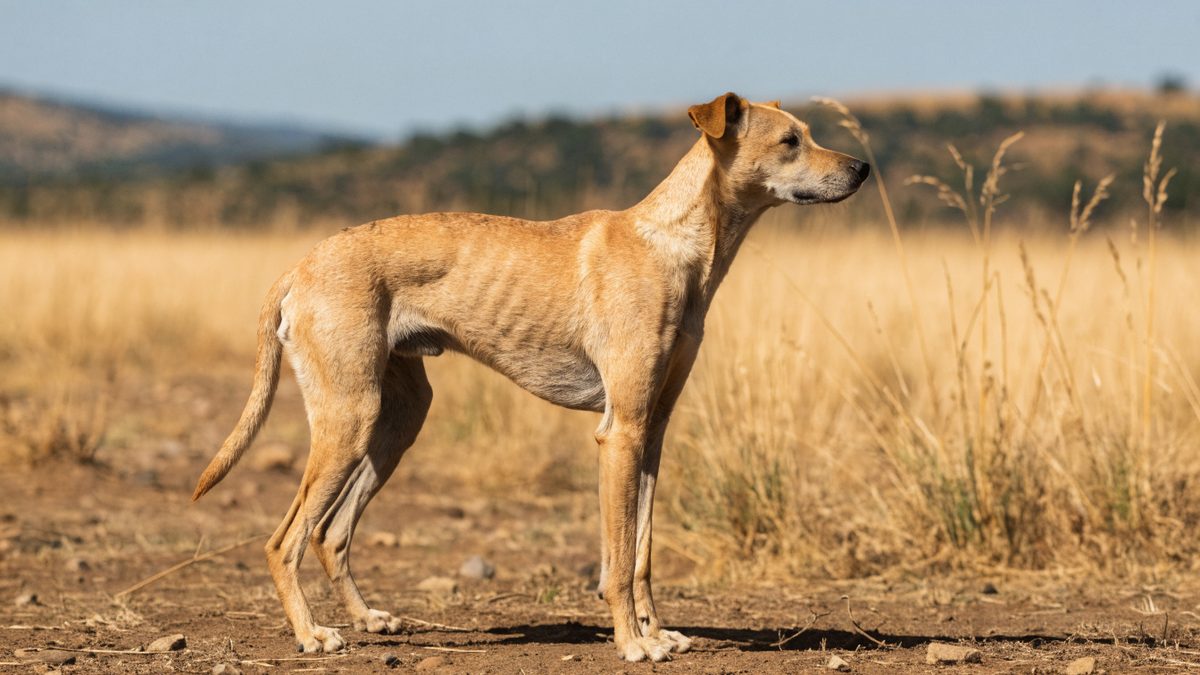
The Africanis is a medium, slender, well-muscled dog, up on legs, giving the impression of a swift enduring and efficient animal, with ribs just visible when in good condition. The head is cone-shaped and elongated, the ears are set laterally and V-shaped and may be carried erect, semi-erect, drooping or asymmetrical, and the tail is a sabre tail reaching approximately to the hock. A ridge of hair along the back occurs in some dogs, which is one of the Africanis contributions to the Rhodesian Ridgeback.
Published sizes conflict, and the conflict is worth showing rather than averaging.
| Source | Height | Weight |
|---|---|---|
| KUSA emerging-breed standard | 55 to 62 cm, with 2 to 3 cm either side occurring | Not specified |
| Wikipedia | 50 to 62 cm | Not specified |
| Pet Training Cape Town | 50 to 60 cm | 25 to 45 kg |
| Wag! | 50 to 61 cm | 25 to 45 kg |
The weight figures deserve scepticism. A 45 kg dog standing 55 cm at the withers is not the animal the standard describes, because the standard describes a lean hound whose ribs are just visible. Where a landrace has no weight clause in its own standard, a wide weight band quoted by a secondary site is a guess dressed as data. Judge an Africanis by body condition, not by a number on a chart.
Origin and history
The origin story is archaeological rather than anecdotal. The oldest dog remains in Africa date to about 5,900 years before present at the Merimde Beni-Salame Neolithic site in the Nile Delta, with the next oldest at Esh Shareinab on the Nile in Sudan. The dog then moved south beside livestock herders, appearing at Ntusi in Uganda and Kalomo in Zambia roughly a thousand years ago, and then south of the Limpopo. The earliest southern African evidence is dated 570 CE near the Limpopo river border with Botswana, 650 CE at the lower Thukela river and 800 CE at a Khoisan site at Cape St Francis.
The KUSA standard puts the same history in one line: since their arrival circa 570 AD these dogs have played a social and cultural role in the different societies to which they belonged, and they are a cultural and biological heritage that must be conserved. India's own landrace has a parallel history and a parallel dismissal, which is where this page goes next. If you came here from an Indian search, read the Indian Pariah Dog page alongside this one.
Landrace versus pedigree, and why two continents produced the same dog
A landrace and a pedigree breed are made by opposite processes, and comparing the Africanis with the Indian Pariah Dog shows what natural selection produces when it runs twice, independently, on two continents. Both are medium, short-coated, lean, erect or mobile-eared, heat-adapted and locally dismissed as street dogs.
The purebred dog world is about 150 years old. The Kennel Club in London was the first organisation to register dogs and issue breed standards officially, and within two or three decades national kennel organisations followed worldwide, with most of the roughly 350 recognised breeds artificially developed after that point. Most regional dogs that existed before were then selectively inbred to obtain homogeneity for standard-related characteristics. The Africanis arrived in southern Africa roughly 1,200 years before Europeans set foot on the continent, which puts the whole apparatus of pedigree in perspective.
Two landraces, two continents, one shape
The convergence is the genuinely interesting part, and it is not a coincidence. Both populations were shaped by hot climates, scavenging and village proximity, human tolerance rather than human design, and brutal early-life mortality. Both arrived at a lean medium build, a short coat, a wedge or cone-shaped head, mobile ears and a tail carried clear of the body. Wikipedia's Africanis entry makes the social parallel explicit and uncomfortable, noting that while European settlers generally looked down on the Africanis in favour of imported breeds, it was still held in higher esteem by Europeans in Africa than the Indian pariah dog was in India.
| Attribute | Africanis | Indian Pariah Dog |
|---|---|---|
| Region | Southern Africa, sub-equatorial | Plains and lower hill ranges of the Indian subcontinent |
| Arrival or emergence | Circa 570 CE in southern Africa | Long-established aboriginal type of the subcontinent |
| Formed by | Natural selection, controlled only by observation | Natural selection, without deliberate human intervention |
| Written standard | Yes, KUSA emerging breed, 2017 | No comparable national kennel standard |
| Conservation body | AfriCanis Society, founded 1998 | The INDog Project |
| Confused locally with | Township dogs and greyhound crosses | Mixed urban free-ranging dogs |
| Available in India | No | Yes, free, in every city |
Read that table as two separate populations with separate evidence, not as one dog with two names. They are not related, they were never one gene pool, and no study has compared them directly. What they share is a mechanism.
The same misunderstanding, in two languages
Both societies had to publish the same correction. The AfriCanis Society had to explain that the AfriCanis is not a mongrel, a greyhound-type or a township dog, and that township dogs come from various backgrounds including purebred dogs, crossbreeds and mongrels, so rescues and strays from suburban areas are generally not AfriCanis. The INDog Project had to make the equivalent point, that the entities INDog and free-ranging dog overlap but are not synonymous or interchangeable, and that most free-ranging dogs today appear to be mix-breeds.
If you are an Indian reader who arrived here curious about an exotic African dog, the useful takeaway is not that you should want one. It is that the thing you admire about the Africanis, a healthy dog shaped by its own climate and free of manufactured inherited disease, is sitting on your street. The INDog Project puts it more sharply than we would: while indigenous dog populations have become admixed in cities, the original village dog is in fact less mixed than many modern pure European breeds.
Africanis price in India, and why there is no honest number
There is no Africanis price in India, because there is no Indian market for this dog. No Indian breeder advertises the breed, the Kennel Club of India does not recognise it, no Indian shelter holds a population of them, and Indian import policy will not licence a dog brought in for breeding. Anyone quoting you a rupee figure is quoting an invented one.
This is a real finding rather than a gap in our research, so here is the evidence behind it. Pulling this breed term with India geo-targeting returns South African shelters, South African pet portals, a Wikipedia entry and a Reddit thread. It returns no Indian breeder, no Indian listing, no Indian shelter and no Indian price page. When India's own commonly-cited dog price lists are checked, they run to the imported and native breeds that Indians actually keep and the Africanis is not on them.
What the import rules actually say
Indian import policy is the hard barrier, and it is unambiguous. DGFT Trade Notice 22/2022-23 lists dogs under a Restricted import policy and permits import only for a defined set of purposes: a pet dog with a valid pet book and records in the name of the importer, dogs imported by R&D organisations with CPCSEA recommendation, and dogs for internal security by the Defence and Police Force. Import of commercial dogs for breeding or any other commercial activity beyond those purposes is not permitted.
- Two pets maximum, as passenger baggage, allowed without DGFT authorisation only to a person transferring residence to India after two years of continuous stay abroad.
- Import authorisation from DGFT is required if the stay abroad was under two years, if the pet is not travelling as passenger baggage, or if it cannot come in under the baggage rules.
- Applications for trading or breeding purposes shall be duly rejected, and so shall applications made on behalf of another person or entity.
- Entry is allowed only through Delhi, Mumbai, Chennai, Hyderabad, Bengaluru, Kolkata and, since October 2024, Kochi, with quarantine at the government station where required. The full route is set out in how to import a dog to India.
- Start the authorisation process at least two months before travel, which is the department's own advice.
Read those together and the position is clear. A returning Indian resident who already owns an Africanis in South Africa can bring that specific dog home. Nobody can import Africanis dogs to breed and sell them here, and no legal route exists to create an Indian supply.
What the dog costs where it actually exists
For completeness, and because a reader may be reading this from outside India, published South African and international figures are below. Note the spread and note what drives it. This is a dog that is mostly adopted, not bought.
| Source | Figure | Context |
|---|---|---|
| Pet Training Cape Town | R2,000 to R5,000 | From a reputable breeder, described as a fraction of pedigree prices |
| Wag! | About USD 500 | US context, breeders hard to find, not AKC recognised |
| Kloof & Highway SPCA | Shelter adoption fee | Shelter reports many Africanis waiting for homes |
| AfriCanis Society | Registration fee, not a sale price | Members register dogs; the society does not run a sales channel |
The society's own guidelines make the commercial position explicit. Members agree not to knowingly sell any AfriCanis directly to commercial dog wholesalers or retail pet dealers, and not to allow one to be given as a prize or donation in a contest of any kind. The whole structure is built to prevent exactly the puppy trade that would be needed to create an Indian purchase price.
Treat it as a red flag rather than a find. There is no verified Indian source for this breed, no KCI registration to check the paperwork against, and no legal import channel for breeding stock. The likeliest explanations are a mislabelled local dog, a Rhodesian Ridgeback cross, or an outright fabrication. Nothing about the price would be verified, and no Indian buyer can confirm ancestry for a landrace whose own society uses DNA testing and physical inspection to do it.
Monthly cost of keeping an Africanis
An Africanis is a cheap dog to keep, and the saving is structural rather than marginal. Three of the largest recurring lines for an imported pedigree, professional grooming, climate mitigation and inherited-disease management, barely apply to a short-coated landrace.
No published source states a method behind a monthly Africanis cost figure, in India or anywhere else, so Bonbeno does not repeat a total. What is knowable is the structure, and the structure is what actually decides what you spend over twelve years.
Where an Africanis costs less
- Grooming is close to free. The coat adapts to the seasons and can be kept shiny with the minimum of care. No clipping, no stripping, no salon.
- No cooling spend. Owners of double-coated imports in Indian metros pay real money for air conditioning and cooling mats. A dog whose own standard records adaptation to African ecological context does not need that budget line.
- Lower inherited-disease burden. More than 500 genetic defects exist in today's purebred dogs, a direct consequence of closed registries into which no new genetics are brought. A landrace never entered that funnel.
- Modest appetite. The AfriCanis Society lists no extravagant nutritional demands among the natural qualities it exists to preserve.
- Vet bills that stay routine. A shelter that handles the breed daily reports that routine care is straightforward and that costly vet bills should generally not be a concern.
Where the money still goes
- Preventive veterinary care. Core vaccination and boosters are non-negotiable, and the society's code of ethics requires members to ensure the correct inoculations as required by law are administered at the proper time.
- Year-round tick and flea control. In Indian conditions this is the single largest avoidable veterinary cost, because tick-borne disease pressure here is high and indifferent to how hardy a breed is.
- Food. Still the biggest recurring line, as with any medium dog.
- Space, not equipment. The expensive requirement is a secure yard or long daily walks, because the standard records a natural need for space that western living does not remove.
These cost structures are real, but for an Indian reader they are academic, because there is no legal channel to acquire the dog for breeding or sale here. The section is useful in one way only: it describes exactly the cost profile of the Indian Pariah Dog, for the same structural reasons, and that dog is free.
Heat tolerance and the Indian climate
The Africanis would handle the Indian climate well, and the reason is documented in its own breed standard rather than assumed from its continent. It is a dog whose morphology, coat and metabolism were set by sub-Saharan conditions that are close to Indian ones.
Start with what India actually asks of a dog. The National Disaster Management Authority records that a heat wave need not be considered until a plains station reaches at least 40 C, and that when actual maximum temperature remains 45 C or more, irrespective of the normal maximum, a heat wave should be declared. Those are the summers a dog kept in Nagpur, Jaipur or Vijayawada lives through every year.
The evidence behind a 5 out of 5 rating
Four lines in the KUSA standard carry the argument, and each is a description of the dog rather than a claim about the continent.
- Coat. Short, double coated, compact, harsh and thick, very short on head and limbs, with the length and density of the undercoat varying with the seasons. A seasonally variable undercoat is the opposite of the fixed dense coat that puts a Husky at risk.
- Build. Medium size, slender, up on legs, well muscled, ribs just visible in good condition. High surface area to mass, and no insulating fat layer.
- Metabolism. The rather demanding conditions imposed by its environment have over the years induced the AfriCanis into an energy-conserving life style. A dog that does not waste effort in heat generates less of it.
- Skin. Dark, elastic and loose-fitting, with the standard noting that dark pigment matters because pale noses are sensitive to sunburn and cancer. Pigment is sun protection, and a landrace that lost it did not leave descendants.
The classification supports it too. KUSA classifies the Africanis as a Primitive Hound and traces it to the sight hounds that came with Neolithic herders into the Nile valley and then deeper into the Sahara and the Sahel. That is a lineage shaped in some of the hottest inhabited land on earth.
The honest caveats
Three things temper the rating, and none of them changes it.
- No thermoregulation study exists. Nobody has measured Africanis heat tolerance against a control breed under laboratory conditions. The rating rests on morphology, on the environment that produced it and on the standard's own text, which is the best evidence available and should be labelled as such.
- Lack of acclimatisation is itself a risk factor for heat stroke. A dog moved from rural South Africa to an air-conditioned Bengaluru flat loses conditioning within months, and hot-and-humid coastal India is not the same load as hot-and-dry Botswana.
- Hardy is not immune. Heat stroke is a veterinary emergency in any dog, with severe panting, difficulty breathing, severe salivating, vomiting, diarrhoea and a temperature of 40.5 C or above among the signs, and a dog can develop it after as little as 30 minutes of vigorous exercise in warm weather.
| Condition | What to do |
|---|---|
| Plains above 40 C | Walk before sunrise and after dusk only |
| Declared heat wave at 45 C | Skip the walk, use indoor scent work instead |
| Coastal humidity, Chennai or Kochi | Shorten sessions further, humidity blocks evaporative cooling |
| Any hot day | Constant fresh water, shade, never left in a parked car |
| Suspected heat stroke | Cool water to the skin, never an ice bath, then straight to your nearest vet |
A short coat dries fast, which is the underdiscussed half of climate fit in India. The hot spots and fungal skin trouble that plague dense-coated imports through a Mumbai or Kolkata monsoon are far less likely on a coat described as short and compact. Ticks, not fungus, are the monsoon problem for this coat type.
Temperament and household fit
An Africanis is loyal, intelligent, watchful and independent, attached to its people without being clingy, and territorial by default. The KUSA standard describes it as combining a natural attachment to humans with a necessity for space, which is the sentence a prospective owner should read twice.
The standard is unusually candid about behaviour, because behaviour is what natural selection actually selected for. It records unspoiled social canine behaviour with a high level of facial expressions and body language towards other dogs and humans, a steady nerve constitution combined with caution in approaching new situations, and watchful territorial behaviour that is well-disposed without being obtrusive. It also states plainly that when pushed around the AfriCanis can demonstrate reactive aggression. That is a warning, not a flaw, and it is more honest than most pedigree standards manage.
Secondary sources agree on the warm half. A South African shelter that handles the breed constantly describes it as extremely intelligent, loyal and healthy, very attached to its owners, territorial and watchful but also affectionate and playful. Wikipedia's entry adds that the breed is widely regarded as affectionate, intelligent and gentle, good with children, and still given to watchful, territorial behaviour.
Who this dog suits
- Good fit. A house with a secure garden, an owner who respects independence, a family that wants a watchdog rather than a greeter, and anyone who values a dog with no manufactured health baggage.
- Poor fit. A small urban flat. This is the one score we rate low, and we rate it low on the standard's own evidence about the need for space.
- Needs work. Shared corridors, lifts and doorstep deliveries, all of which collide with territorial behaviour unless the dog is socialised early and often.
- Watch item. Livestock and small pets are usually fine, because the standard notes the dog lives among livestock without harming it as a result of correct imprinting, but that outcome is produced by rearing, not by magic.
The standard notes that the AfriCanis has never been used to the western concept of dog obedience training, yet because of its innate subservience and high sense of attachment to a pack leader it follows its handler in a natural way. Read that as a different contract. A retriever was bred for two centuries to take instruction. A landrace survived by making its own calls, and it will follow a person it trusts rather than obey a person who commands.
For an Indian household the practical conclusion is the same one the Indian Pariah Dog page reaches, and for the same reason. A landrace gives you a healthy, undemanding, alert dog with a settling period and a wary streak, and asks you to earn the relationship rather than buy it.
Training an Africanis, and what it resists
To train an Africanis, build trust first and use reward-based methods throughout, because harsh handling fails fast with this dog. The breed responds best to positive reinforcement and shuts down or simply refuses under pressure.
Start from what the standard says the dog is. During the hunt it is active and alert and shows great eagerness and toughness, it is a great opportunist that easily adapts to a modern western lifestyle, and it has a steady nerve constitution but stays cautious in new situations. Those are the levers. Novelty needs slow introduction, effort needs a reason, and the dog needs to want to work with you.
- Reward what you want. Positive reinforcement is the standard approach for the breed, reward-based, consistent and built on mutual trust. Treats, praise and play are the currency.
- Start early and socialise hard. A reserved nature with strangers becomes fearfulness without proper exposure, and the critical window runs roughly 3 to 16 weeks.
- Teach lead work deliberately. The Africanis is a natural rover, so lead training is not optional.
- Stay consistent. An intelligent independent dog exploits inconsistent rules faster than a biddable one does.
- Never punish physically. Harsh methods fail quickly with this breed, and the dog either shuts down or refuses.
What it resists
Three things reliably go wrong, and all three are predictable from the standard. Repetitive drill bores a dog whose environment rewarded efficiency rather than compliance, and the energy-conserving lifestyle the standard describes is not laziness, it is economy. Recall off lead in an open space competes with a swift chase response that the standard records explicitly. Doorstep and boundary behaviour collides with watchful territorial behaviour, which is why it needs work from week one rather than after the first incident.
Expect basic house manners inside a fortnight, reliable lead work at two to three months, and settled boundary behaviour at six months to a year. Expect off-lead recall to remain a work in progress in any environment with moving animals, and plan a fenced garden or a long line rather than betting on it.
How much exercise an Africanis needs
Plan on 60 to 90 minutes of daily exercise for an adult Africanis, split across walks, free running and mental work. The KUSA standard describes a dog that should be able to trot or canter for long periods on rough terrain and in hillside environment, going into gallop when real speed is required.
That single sentence sets the requirement more usefully than any breed-site number. This is not a lapdog with a walk requirement, it is a hound with a working gait. Secondary sources agree that the breed is energetic and needs regular exercise, daily walks, playtime and mental stimulation, with agility, fetch and hiking all suitable. A Cape Town trainer adds the practical warning that the breed is a natural rover and belongs in a home with a secure garden.
| Stage | Guidance |
|---|---|
| Puppy to 4 months | Short frequent sessions and free play, no forced distance work |
| 4 to 12 months | Build gradually, lead work daily, keep growth-plate load sensible |
| Adult | 60 to 90 minutes across walking, free running and scent work |
| Senior | Shorter but still daily, the energy-conserving build ages well |
| Indian summer | Pre-dawn and post-dusk only above 40 C |
- Mental work counts toward the total. Scent games and short training sessions tire an opportunist efficiently, and in an Indian May they may be the only safe option.
- Watch the paws. Street conditioning is not immunity to burns from midday tarmac, and a dog raised on a cool tiled floor has soft pads.
- Use a long line, not hope. The chase response the standard records is not trained away in a season.
- Build a rescue up slowly. A dog that came off poor nutrition is not automatically fit, whatever its build suggests.
Set that against the Indian alternatives an owner would actually compare. The Indian Pariah Dog sits lower on the exercise scale and fits an ordinary working day more easily. The Mudhol Hound and the Kombai both sit higher. The Africanis lands between them, closer to the working end than most people expect from a village dog.
Grooming and coat care in Indian humidity
Grooming an Africanis takes minutes a week. The short coat requires minimal maintenance, and regular brushing to remove loose hair plus the occasional bath is sufficient to keep it healthy and clean.
The coat is short, double coated, compact, harsh and thick, very short on the head and limbs, and the length and density of the undercoat vary with the seasons. Wire-haired dogs and ridged dogs occur within the landrace. All colours or combinations occur, with diluted colours such as merle and Isabella, and Dalmatian-style spotting, listed as disqualifying faults precisely because they signal introgression from western breeds rather than landrace ancestry. A shelter that works with the breed sums the practical position up: the coat adapts to the seasons and can be kept shiny with the minimum of care.
- Brush weekly with a rubber curry or hound glove, more often during a seasonal undercoat shed.
- Bathe rarely. Over-bathing strips protective oils and causes more skin trouble in Indian humidity than it prevents.
- Check for ticks at every brush. This is the real maintenance task on a short coat, not the hair.
- Never shave the coat. A double coat, even a short one, is insulation against heat as well as cold, and shaving removes sun protection from dark, pigmented skin.
- Clip nails and check ears weekly, because these get skipped when the grooming session is this short.
Compare that with what an Indian owner spends on an imported coat. A Golden Retriever or Siberian Husky in Chennai humidity needs frequent professional attention to prevent matting close to the skin and to manage year-round shedding. An Africanis needs none of it, which is a recurring saving across a twelve-year life.
The KUSA standard notes that lack of pigmentation and pale noses are sensitive to sunburn and cancer, and lists pink patches on top of the nose and lack of pigmentation around the eyes, lips and nose among disqualifying faults. That is a welfare observation dressed as a show rule. Under Indian sun, a pale-nosed dog of any breed needs shade discipline, and you should raise any persistent nose or eyelid lesion with your nearby vet rather than watching it.
Health risks, lifespan, and why a landrace is healthier
The Africanis is a healthy dog with a short list of known problems, and the reason is mechanical rather than mystical. It never passed through a closed studbook, so it never concentrated the inherited disease that closed studbooks concentrate. Published lifespan figures run 10 to 14 years, with many reaching 15 when well cared for.
Sources disagree at the top of that range and the disagreement should be visible. Pet Training Cape Town gives 10 to 14 years with many reaching 15, while Wag! gives an average of up to 12 years. No population-level mortality study of the Africanis exists, so both figures are practitioner estimates rather than actuarial data, and neither should be quoted as though it were a survival curve.
The mechanism, stated properly
Peer-reviewed veterinary literature explains why the landrace advantage is real. More than 500 genetic defects exist in today's purebred dogs, and breed registries are closed, meaning no individuals may be registered unless descended from the founding stock, so no new genetics are brought in. The effect is quantified: for every 10 percent increase in the coefficient of inbreeding there is a 7 percent decrease in litter size and median life span, and any COI above 9 percent pushes past the genetic threshold of health. The scale of founder effect can be extreme, with over 80 percent of the DNA of the 10,000 existing Portuguese Water Dogs coming from the 6 individuals used when the breed was founded.
What the genetic work on Africanis actually found
The best direct evidence is a microsatellite study from the Department of Genetics at the University of the Free State. Researchers genotyped 76 dogs phenotypically classified as Africanis from 10 local populations across South Africa, Botswana and Namibia, plus 10 mixed-breed dogs of likely western origin, using a 10-locus canine panel. Two results matter.
| Measure | Africanis populations | Western hybrids |
|---|---|---|
| Unbiased heterozygosity (Hz) | 0.699 to 0.877 | 0.783 |
| Allelic richness (Rs) | 1.699 to 1.887 | 5.320 |
| Genetic clusters identified | 2 of 3, South Africa and Botswana/Namibia | 1 of 3 |
The authors read the allelic-richness gap as the important signal. Because no Africanis population approaches the western hybrid value, the populations sampled are likely to be relatively pure representatives of the type, with no signature of significant introgression from western breeds. They also found two lineages within Africanis, corresponding to South Africa and to Botswana with Namibia, and flagged the Byrne and Okavango populations as showing comparatively high western introgression. That last point is the mark of honest work: the study reports where its own claim is weakest.
Wider African village-dog genetics point the same way. A PNAS study of village dogs across Africa found significant genetic distinctiveness alongside detectable admixture from established western breeds, and described Africanis from northern Namibia as distinct from western breeds. A later study of 150 African village dogs from three regions of northern Kenya, compared against 68 European dogs representing 24 breeds, found mean observed heterozygosity of 0.69 in the village dogs against 0.64 in the European sample. That Kenyan work is a different population from the southern African Africanis and should not be read as an Africanis figure, but it is consistent evidence that village-dog gene pools hold diversity that pedigree gene pools have lost. Earlier work had already identified genetic similarities between Africanis and Saluki dogs from the Middle East.
What Africanis dogs do get
- Dermoid sinus, listed as the major concern for the breed. It is a congenital tube of skin running down toward the spine, associated with ridged dogs, and the ridge occurs within this landrace. It is surgically correctable and should be checked in any ridged puppy.
- Entropion and ectropion, eyelid conditions listed as occasional diagnoses and named as disqualifying faults in the KUSA standard.
- Eye and coat pigment issues. Wall eyes, white or blue eyes and lack of pigmentation around the eyes, lips and nose are disqualifying, and the standard ties pale pigment to sunburn and cancer risk.
- Everything a dog gets. Parasites, injuries, dental disease and the effects of poor early nutrition do not care about breed. Natural resistance to internal and external parasites is reported for the breed, and resistance is not immunity.
The Indian disease picture, which no breed advantage covers
Tick-borne disease is the realistic threat to any dog in India, hardy or not. A survey of 525 dogs across Delhi, Mumbai, Sikkim and Ladakh found *Hepatozoon canis* in 30 percent, *Ehrlichia canis* in 20.6 percent and *Babesia vogeli* in 5.5 percent, with *Ehrlichia canis* reaching 39.5 percent in Delhi and 27.2 percent in Mumbai. Year-round tick control is not optional here, and no landrace advantage substitutes for it.
Rabies is the other hard Indian fact. India recorded 37,15,713 dog bite cases in 2024 and 54 reported human rabies deaths, and the Animal Birth Control Rules, 2023 provide for sterilisation and vaccination of stray dogs to control population, prevent rabies and reduce conflict. Full core vaccination is the baseline for any dog kept in India.
The health advantage of a landrace is bought at a price, and honest writing names it. In a five-year study of free-ranging dogs in West Bengal, only about 19 percent of 364 pups from 95 observed litters survived to reproductive age, with 63 percent of total mortality human-influenced. That is Indian data about Indian dogs, not an Africanis figure, and the point it makes is general. Natural selection produces hardy adults by removing the rest. The instant a landrace puppy becomes a protected pet, that filter stops, so vaccination, deworming and tick control become entirely your job.
Nothing on this page is a diagnosis. If a dog in your care shows any of the heat-stroke signs above, a persistent skin lesion, or a sudden change in appetite or energy, consult your nearby vet the same day rather than reading further.
Feeding an Africanis
Feed an Africanis as a normal medium, active dog on a complete balanced diet matched to age, size and activity level, and feed to body condition rather than to a chart. The breed's own conservation society lists no extravagant nutritional demands among the qualities it exists to preserve.
Two opposite myths surround landrace dogs everywhere, and both cost the dog. The first says a hardy village dog thrives on scraps. It does not. A dog that survived on scavenging did so despite that diet, and the early-mortality data from free-ranging populations is what surviving despite a diet looks like at population scale. The second says a rescued primitive dog needs an expensive corrective diet. It does not need that either, and the claim mostly sells food.
- Feed a complete balanced diet appropriate to age, size and activity, as you would for any dog.
- Split intake across two meals for an adult, three or four for a young puppy.
- Feed to visible condition. The standard's own benchmark is that ribs are just visible when the dog is in good condition, which for most Indian owners will look leaner than they expect.
- Introduce any new food gradually, especially for a dog with an irregular feeding history.
- Match food to workload. A dog doing 60 to 90 minutes of real work needs more than one doing a token walk, and an Indian summer usually cuts the workload.
What the breeding code implies about early feeding
The AfriCanis Society's guidelines set out conditions that shape a puppy's start. No pup is released to a purchaser until it has reached the age of 8 weeks and has been dewormed, and breeders must provide everyone who acquires a dog with written details of all dietary requirements together with relevant practical advice. Pups are preferably reared in the company of pack members and imprinted on a variety of livestock. Any source claiming to supply this breed and unable to meet those conditions is not working to the society's code.
Bonbeno reviews Indian pet food brands separately and tests products first-hand before publishing a verdict. See our testing method for what a Bonbeno food review does and does not claim.
The first year, month by month
Plan an Africanis puppy's first year around two fixed deadlines, the socialisation window and the first Indian summer. The critical socialisation window runs roughly 3 to 16 weeks, and a reserved nature with strangers hardens into fearfulness if that window is wasted.
- 8 weeks. The society's own guideline is that no pup is released to a purchaser before 8 weeks and before it has been dewormed. Book a veterinary intake exam in the first week regardless of what you were told.
- 8 to 16 weeks. The socialisation window closes here. Expose the puppy to people, dogs, traffic, lifts, delivery riders and livestock if available, because ample socialisation with humans plus environmental adaptation is written into the rearing guidelines. Complete core vaccination on your vet's schedule.
- 4 to 6 months. House rules consolidate. Lead work becomes daily and non-negotiable for a natural rover. Keep sessions short and reward-based.
- 6 to 9 months. Territorial behaviour surfaces, exactly as the standard predicts. Manage the doorstep now rather than after an incident. Discuss sterilisation timing with your vet.
- 9 to 12 months. Build stamina toward the adult 60 to 90 minutes, pacing distance work against growth. Introduce scent work as the hot-weather substitute for a long walk.
- 12 months onward. Adult routine. Year-round tick control becomes the standing health task in Indian conditions.
The first summer is the real test
A puppy born into an air-conditioned Indian home has never acclimatised to anything, and lack of acclimatisation is itself a listed risk factor for heat stroke. Move exercise to pre-dawn and post-dusk once plains temperatures pass 40 C, and drop it entirely on a declared heat-wave day at 45 C or above. Genetics inherited from a hot continent do not substitute for conditioning the individual dog in front of you.
Most landrace dogs come home as adults rather than puppies. Give week one for a quiet settling period and a veterinary intake exam, weeks two to four for routine to establish, and weeks four to eight for trust to build before training properly begins. Judge the dog at week eight, not week one. That timeline is the same one our Indian Pariah Dog page sets out, because it is a property of adopting an independent landrace rather than of any one breed.
Africanis vs Indian Pariah Dog, the comparison that matters here
For an Indian reader the Africanis has exactly one meaningful comparison, and it is not another African breed. It is the Indian Pariah Dog, the landrace of the Indian subcontinent, because the two are the same evolutionary answer arrived at independently on two continents.
Every figure below is sourced to that population's own literature. Nothing has been carried across from one column to the other, because these are two separate populations that have never been compared in a single study.
| Factor | Africanis | Indian Pariah Dog |
|---|---|---|
| Type | Landrace of southern Africa | Landrace native to the Indian subcontinent |
| Height | 55 to 62 cm, standard | 51 to 64 cm males, 46 to 58 cm females |
| Coat | Short double coat, seasonal undercoat | Short double coat, coarse upper, soft undercoat |
| Ears | V-shaped, mobile, erect to drooping | Erect, pointed, broad-based |
| Tail | Sabre tail to the hock | Curled, held high when excited |
| Antiquity locally | Present from circa 570 CE | Archaeological evidence from about 4,500 years ago |
| Written standard | KUSA emerging breed, 2017 | None comparable |
| Health basis | Open gene pool, no closed studbook | Few health concerns, no inbreeding, naturally selected |
| Cost in India | Not obtainable | Free to adopt |
Where they genuinely differ
Four differences are real and worth stating rather than smoothing over.
- Formalisation. The Africanis has a published standard and a registration procedure with DNA testing and physical inspection. India's landrace has a documentation project rather than a registry.
- Working classification. KUSA classifies the Africanis as a Primitive Hound whose traditional roles were herding, livestock guarding and hunting combining sight and scent. The Indian landrace is not classified into a hound group at all.
- Exercise load. The Africanis standard demands sustained trot and canter over rough terrain, which sets a higher floor than the Indian landrace typically needs.
- Availability. One is on your street. The other cannot legally be brought into India to breed.
If the Africanis appeals to you, adopt an Indian Pariah Dog. You would be choosing the same thing, a heat-adapted landrace with an open gene pool, an intelligent independent temperament and almost no manufactured inherited disease, in the version that is legal, local, free and already waiting. We earn nothing from saying so. If you want a formally registered dog with a written standard, the honest comparison is not the Africanis at all but a Rajapalayam or Mudhol Hound, both Indian, both obtainable, both with recognised type.
Mistakes people make with this breed
Most Africanis mistakes come from treating a landrace as though it were a pedigree, or from treating hardiness as though it were immunity. Both errors are easy to avoid once named.
- Believing an Indian seller. There is no verified Indian source, no KCI recognition and no legal import route for breeding stock. Any Indian Africanis offer should be treated as unverified by default.
- Confusing an Africanis with a township dog. The society had to publish the correction itself: township dogs come from various backgrounds including purebred dogs, crossbreeds and mongrels, so rescues and strays from suburban areas are generally not AfriCanis.
- Confusing it with a greyhound-type dog. The African hunting greyhound is a deliberate cross of ex-racing greyhounds with foxhounds, salukis, deerhounds or wolfhounds, standing at least 75 cm, and is a different animal entirely.
- Skipping vaccination because the breed is hardy. Natural resistance to parasites is documented, and it is not protection against rabies, parvovirus or distemper. India recorded 54 human rabies deaths in 2024.
- Skipping tick control. *Ehrlichia canis* reached 39.5 percent of sampled dogs in Delhi and 27.2 percent in Mumbai. No breed advantage covers that.
- Keeping one in a small flat. The standard records a natural need for space that adapting to a modern western lifestyle does not remove.
- Trusting off-lead recall early. The standard records a swift chase response, and the breed is described as a natural rover that needs deliberate lead training.
- Using harsh training. Harsh methods fail quickly with this breed, which shuts down or refuses.
- Feeding scraps because it is a village dog. Free-ranging populations show what surviving despite a diet costs, with only about 19 percent of pups reaching reproductive age in one Indian study.
- Assuming heat tolerance means heat safety. Lack of acclimatisation is a listed heat-stroke risk factor in its own right.
The biggest error is wanting an Africanis in India at all. Chasing a rare foreign landrace, through a channel that does not legally exist, in order to get a healthy naturally-selected dog, while an identical proposition sleeps outside the gate, is the definition of an expensive mistake. Read that as a compliment to the breed and a criticism of the import instinct.
Adoption, responsible sourcing and what to do instead
Adopt rather than buy, and in India adopt a local landrace rather than chasing this one. Where the Africanis does exist, shelters carry them in numbers and the breed's own society runs registration rather than a sales channel.
In South Africa the route is straightforward. The breed is not commercially bred at scale, so shelters and rescue organisations hold far more of them than breeders do, and the SPCA and rural shelters are often full of Africanis and Africanis-cross dogs looking for homes. One KwaZulu-Natal shelter states the position bluntly, that these dogs are often abandoned, homeless or rescued from townships and rural areas, and asks people not to overlook the breed when adopting.
What responsible sourcing looks like for this landrace
The AfriCanis Society's code of ethics is a useful checklist even for readers who will never use it, because it shows what conserving a landrace actually requires.
- Any dog acquired for breeding from a rural area must be reported to the society for preliminary record and registration.
- Only dogs between 12 months and 8 years may be bred, and only healthy, active and mentally well-balanced animals.
- No forced or human-assisted mating. The pair is left to interact freely so that dogs lacking libido or showing disturbed sexual behaviour do not procreate artificially.
- Bitches requiring a caesarean are removed from the breeding programme, and so are their offspring.
- No ear cropping, tail docking or cosmetic surgery of any kind, and no dog fighting.
- No sales to commercial wholesalers or retail pet dealers, and no dog given as a contest prize.
That is a conservation programme, not a breeding business, and it explains why no supply chain to India exists or should exist.
What an Indian reader should actually do
- Adopt an Indian Pariah Dog from a registered shelter or rescue. Same landrace logic, local climate fit, free, and available in every Indian city.
- Ask what has already been done. Animal Birth Control Rules, 2023 provide for sterilisation and vaccination of street dogs, so many shelter and municipal dogs arrive already sterilised and vaccinated.
- Book your own veterinary intake exam in week one whatever the shelter tells you, and start year-round tick control immediately.
- Consider a recognised Indian breed if you want papers, such as the Rajapalayam, Kombai or Mudhol Hound.
- Do not fund an import attempt. Applications made for trading or breeding purposes are duly rejected.
An encyclopedia that only covers breeds with an Indian sales channel is a catalogue, not a reference. The Africanis matters to an Indian reader because it is the clearest available proof that the Indian Pariah Dog is not a lesser animal, it is the same phenomenon. Two continents, two landraces, two societies forced to publish the same correction, and the same local contempt. Understanding one makes the other impossible to dismiss.
Africanis dog questions people actually search
why are africanis dogs so unpopular?
They are unpopular for social reasons rather than canine ones. European settlers looked on these dogs with contempt and considered them mongrels, a view that persisted, and the breed is still confused with township dogs and greyhound crosses that are genuinely different animals. There is also no commercial breeding industry promoting it.
What is the price of an Africanis dog in India?
There is no Africanis price in India because there is no Indian market for the breed. No Indian breeder offers it, the Kennel Club of India does not recognise it, and Indian import policy permits import only for a defined set of purposes, with applications for trading or breeding duly rejected. Any rupee figure quoted to you is invented.
Is the Africanis a dog breed?
Partly. The Kennel Union of Southern Africa publishes an Official Breed Standard for the AfriCanis as an Emerging Breed, effective 01.01.2017, which calls itself a written preliminary description of a landrace and limits the dog to Non-Championship conformation shows. It holds no FCI recognition and no American Kennel Club recognition.
Is the Africanis the same as the Indian Pariah Dog?
No. They are two separate landraces on two continents that were never one population and have never been compared in a single study. What they share is a mechanism, natural selection in a hot climate near human settlement, which produced strikingly similar dogs: short double coats, lean medium builds, mobile ears and open gene pools.
How long do Africanis dogs live?
Published estimates run 10 to 14 years, with many reaching 15 when well cared for, while another source gives an average of up to 12 years. No population-level mortality study of the breed exists, so treat both as practitioner estimates rather than actuarial figures, and note that they are longer than many pedigree breeds of similar size.
Are Africanis dogs healthy?
Yes, and the reason is structural. The breed never passed through a closed registry, and closed registries are what concentrate inherited disease, with more than 500 genetic defects now present in purebred dogs and every 10 percent rise in inbreeding coefficient costing about 7 percent of median lifespan. Known Africanis concerns are dermoid sinus, entropion and ectropion.
Can an Africanis handle Indian heat?
Yes, and the evidence sits in its own breed standard rather than in assumption. It describes a short coat that is very short on head and limbs with a seasonally variable undercoat, a lean build with visible ribs, dark protective skin pigment, and an energy-conserving lifestyle induced by demanding environmental conditions. Acclimatisation still has to be built individually.
Are Africanis dogs good with children?
Generally yes. The breed is widely regarded as affectionate, intelligent and gentle, with a natural desire to please that makes it easy to train, and it is described as good with children and as a good family pet. It still displays watchful territorial behaviour, so early socialisation with visitors and neighbours matters.
How big does an Africanis get?
The KUSA standard gives 55 to 62 cm at the withers for both dogs and bitches, with individuals 2 to 3 cm smaller or larger occurring. Wikipedia gives 50 to 62 cm. Weight figures of 25 to 45 kg quoted by secondary sites should be treated cautiously, because the standard itself specifies no weight and describes a lean dog whose ribs are just visible.
Where can I adopt an Africanis?
In southern Africa, through the SPCA and rural shelters, which are often full of Africanis and Africanis-cross dogs, since the breed is not commercially bred at scale. In India there is no adoption route because there is no Africanis population. The equivalent local option is adopting an Indian Pariah Dog from a registered shelter.
Is the Africanis just a stray or a mongrel?
No, and the genetic work says so. A microsatellite study of 76 phenotypically classified Africanis across South Africa, Botswana and Namibia found allelic richness of 1.699 to 1.887 in Africanis populations against 5.320 in western-admixed hybrids, which the authors read as evidence that the sampled populations are relatively pure representatives of the type.
How much exercise does an Africanis need?
Plan on 60 to 90 minutes a day for an adult, across walks, free running and mental work. The breed standard specifies a dog able to trot or canter for long periods on rough terrain and in hillside environment, going into gallop when real speed is required, which is a working requirement rather than a token stroll.
Are Africanis dogs good pets?
Yes, for a house with a secure garden and an owner who respects independence, and a poor fit for a small urban flat. The KUSA standard describes a dog that combines a natural attachment to humans with a necessity for space, with a steady nerve constitution, watchful territorial behaviour that is well-disposed without being obtrusive, and reactive aggression when pushed around. A South African shelter that handles the breed constantly calls it extremely intelligent, loyal, healthy and very attached to its owners, and Wikipedia adds affectionate, gentle and good with children. It follows a handler it trusts rather than obeying one who commands.
How much does an Africanis puppy cost?
In India, nothing, because there is no Indian market, no KCI recognition and no legal import route for breeding stock. Where the dog actually exists, it is mostly adopted rather than bought: Pet Training Cape Town quotes R2,000 to R5,000 from a reputable breeder, described as a fraction of pedigree prices, Wag! puts the US figure at about USD 500 with breeders hard to find, and the Kloof and Highway SPCA rehomes them for a shelter adoption fee. The AfriCanis Society's own guidelines forbid members from selling to commercial wholesalers or retail pet dealers, which is the trade an Indian price would need.
Compare with similar breeds
Africanis sits in 1 Bonbeno group. Each one compares it directly against the breeds it is genuinely an alternative to, on the same figures.