
South Asian breed profile
Sinhala Hound: Sri Lanka's Native Dog, and What It Means in India
Sri Lanka's indigenous dog, related to the Indian Pariah Dog and shaped by the same tropical pressures. Published figures for its size, coat and lifespan contradict each other badly, and this page shows you exactly where.
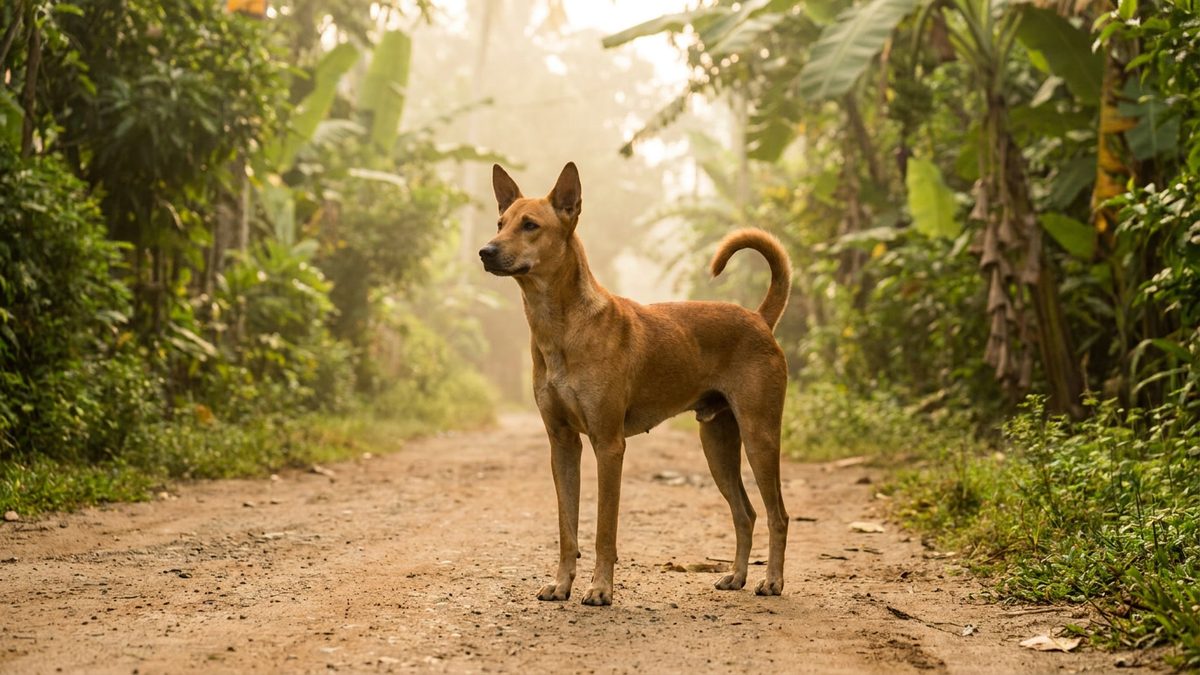
Quick answer
The Sinhala Hound is Sri Lanka's indigenous landrace dog, not an Indian breed. It is closely related to the Indian Pariah Dog, shares the same short coat and heat tolerance, and is not recognised as a breed by any major kennel club. Sri Lankan sources put its lifespan between 10 and 18 years, disagreeing sharply. In India it is essentially unavailable, and the equivalent dog is the indie.
This guide is general information for Indian pet owners and is not a diagnosis. Always consult a registered veterinarian near you before acting on anything you read here, and treat any sudden change in your dog's condition as urgent.
Sinhala Hound at a glance
What a Sinhala Hound actually is
The Sinhala Hound is a landrace dog from Sri Lanka, not from India. Bonbeno covers it because it is the closest living relative of the Indian Pariah Dog outside India, it is shaped by the same tropical pressures that shape every dog kept in Chennai or Kochi, and Indian readers keep meeting it in adoption listings and travel photographs without being told which country it belongs to.
State the origin plainly. This is a Sri Lankan dog. It is found throughout the island, frequently living in a semi-wild state and scavenging for food. Wikipedia's own taxonomy box files it under dogs originating in India and Sri Lanka, and lists it as a landrace dog beside the Indian pariah dog, which is where a lot of the confusion starts.
The names multiply. Sinhala Sunakhaya, Sinhalese Hound, Sri Lankan Rice Hound, Sri Lankan Leopard Hound, SL Hound and simply Sri Lankan street dog all point at the same animal Animal SOS Adoptions Dr Nalinika Obeyesekere and Dr Shamithri…. One Sri Lankan adoption charity uses all three of the first names on a single page.
The archaeology is real and it is old
Dogs were living alongside people in Sri Lanka thousands of years before any European breed existed. Skeletal remains of dogs from Nilgala cave and from Bellanbandi Palassa, dating from the Mesolithic era at about 4500 BC, suggest that prehistoric Balangoda Man kept domestic dogs for driving game. The same University of Sri Jayewardenepura summary notes that the Sinhala Hound resembles the Kadar dog, the New Guinea singing dog and the Dingo, and that these may all derive from a common domestic stock.
Legend adds a second layer. When Prince Vijaya first set foot on Sri Lanka in the 6th century BC he was greeted by the barking of dogs, and the Mahavamsa records domestic dogs belonging to the island's Stone Age inhabitants, the Yaksha. Desmond Morris's breed dictionary, cited on the same page, puts fossil evidence for domestic dogs on Sri Lanka at over 11,000 years.
The dog had a job and a status. The indigenous Vedda people used it for hunting, and it was prized after the bow and arrow, valued so highly that dogs were given away with daughters on their marriage as part of a dowry Rocadog, Sinhala Hound. A working hound with a high prey drive, a good nose, good hearing and good eyesight is what centuries of hunting alongside people produces.
Appearance, and why no two sources agree on it
The appearance of a Sinhala Hound is not fixed, because nothing fixed it. There is no standardised look, since these dogs breed naturally rather than to a breed standard, and while the type is athletic and agile with relatively long thin legs and a long body, the size varies a great deal from dog to dog. A Sri Lankan rescue describes them simply as mostly medium sized, athletic, swift and agile, with females smaller than males.
That is the honest description. What follows is what happens when directory pages try to pin numbers to it anyway.
| Source | Height | Weight |
|---|---|---|
| Rocadog | About 38 cm, varies a lot | About 10 kg, varies a lot |
| Dogell | 36 to 41 cm, average 38 cm | 10 to 12 kg, average 11 kg |
| BreedsPedia | Males 46 to 56 cm, females 43 to 53 cm | Males 15 to 20 kg, females 13 to 18 kg |
| Animal SOS Adoptions | Medium, no figure given | No figure given |
Read the top and bottom of that table together. One source describes a 10 kg dog of 38 cm and another a 20 kg dog of 56 cm, which is the difference between a Beagle and a Labrador. Both cannot describe the same population norm. Bonbeno reports the spread rather than averaging it, because an average of two unsourced numbers is still an unsourced number.
Colour is more consistent but still contested at the edges. Brown or dark brown brindle are the commonest colours Animalia, All about Sinhala Hound breed, and a Sri Lankan rescue agrees that they are mostly shades of brown while attributing the white, black and multi-coloured dogs mostly to mixing with other breeds. One directory instead lists black, black and tan, sable and red without mentioning brindle at all.
No breed standard exists anywhere
The Sinhala Hound is not recognised as a breed by any major kennel club. That is not an oversight you can appeal. The Kennel Association of Lanka, founded as the Ladies Kennel Association of Ceylon in January 1959 and affiliated to the Federation Cynologique Internationale, describes itself as the recognised national body for pure bred pedigree dogs, and states that a breed of dog must conform to the relevant FCI standard. No FCI standard for the Sinhala Hound exists, so no route to registration currently runs through the national body.
Wikipedia notes that only recently has the Sri Lankan Kennel Club been encouraged to recognise the landrace as a breed, and flags that sentence as undated. Bonbeno could not find a published recognition decision, so we report the absence rather than implying progress.
The scale of what the registry actually covers is worth stating, because it is small. The FCI's own published statistics for its Sri Lankan member record 5,184 pure-bred dogs registered with the studbook in 2025 and 67,764 in total since the studbook was created, against an approximate total of 235,000 dogs of any kind reported for the country that year. On those figures the registered pedigree population is a rounding error beside the dog population of Sri Lanka, and every Sinhala Hound sits outside it by definition.
| Attribute | What the sources support |
|---|---|
| Origin | Sri Lanka |
| Type | Landrace, naturally selected, no breed standard |
| Kennel club status | Unrecognised by any major club |
| Commonest colour | Brown or dark brown brindle |
| Build | Medium, athletic, swift and agile |
| Resembles | Basenji, New Guinea singing dog, Carolina Dog, Dingo |
| Historic role | Vedda hunting dog and dowry gift |
| Archaeological date | About 4500 BC at Nilgala cave |
The correction almost nobody publishes
Here is the finding that separates this page from every directory entry on the query. Soharni Tennekoon, a canine behaviourist researching free-roaming dog ethology through the Ceylon Street Dog Project, argues that calling today's Sri Lankan street dog a Sinhala Hound is wrong. The term was originally given to the ancient indigenous dog whose skeletal remains were found alongside Balangoda Man by the archaeologist Siran Deraniyagala. To claim the modern street dog is a pure Sinhala Hound ignores centuries of interbreeding with European dogs brought by the Portuguese from 1505 to 1658, the Dutch from 1658 to 1796, and the British from 1815 to 1948.
The definitional point is sharp. A landrace requires isolation from other populations of the species, and Tennekoon's argument is that the narrow gene pool of a genetically isolated island population would have been diluted the moment foreign dogs came ashore, leaving an admixed population rather than a landrace. She contrasts this directly with India, where the sheer geographic scale leaves regions in which very little interbreeding occurred, while a small island offers no such refuge.
Bonbeno does not pick a winner here. The archaeological Sinhala Hound is well evidenced. The claim that every free-roaming Sri Lankan dog today is one is contested by a working behaviourist on the island. Both statements can be true at once, and a reader deciding what to call a dog deserves to know that the argument exists.
Sinhala Hound price, and why the published figures are worthless
There is no Sinhala Hound price in India to quote, because no legitimate purchase market for the breed exists in either country. The honest finding is not a price band but the absence of one, and the price numbers that do circulate online come from templated pages rather than from any observed transaction.
Start with the directory that admits it. Dogell lists the Sinhala Hound puppy price as Unknown and states outright that it could not find a price for the breed. That is the honest position and it matches the underlying reality, because prospective owners are unlikely to find a breeder of village dogs at all.
Now the contrast. BreedsPedia publishes a purchase price of 600 to 1,500 euros for a Sinhala Hound puppy and advises readers to choose a reputable breeder. The same page gives a size range that no other source supports and carries the generic phrasing of an auto-generated breed template. Bonbeno does not repeat that figure as a market price, because there is no reputable breeder network to attach it to and no evidence any Sinhala Hound has changed hands at it.
| Source | Stated price | How to read it |
|---|---|---|
| Dogell | Unknown, explicitly | Accurate. No price market was found. |
| BreedsPedia | 600 to 1,500 euros from a breeder | Unsupported. No breeder network exists for a landrace. |
| Embark, on village dogs generally | No breeder expected to exist | Consistent with every other reliable source. |
| Animal SOS Adoptions, Sri Lanka | Adoption route, dogs already vaccinated and sterilised | The real acquisition path. |
The adoption route replaces the purchase price
Sri Lankan rescues place these dogs rather than sell them. Animal SOS Adoptions states that the dogs on its pages have been fully vaccinated, wormed, sterilised, microchipped and treated for any conditions they arrived with. Embark, the Sri Lankan welfare organisation founded in 2007 by Otara Gunewardene, runs monthly and sometimes weekly adoption events, and an adopter reports that vaccinations, sterilisations and follow-up shots are free at the Embark clinic.
You cannot buy a Sinhala Hound in India. India's Animal Quarantine and Certification Service permits pet dogs to enter only as a relocating owner's own animal under the baggage rule, or under a DGFT licence, and states that import of commercial dogs for breeding or any other commercial activity is not permitted. Anyone advertising a Sinhala Hound puppy for sale in an Indian city is selling you something else.
The equivalent dog for an Indian buyer is the indie, and it is free. The Indian Pariah Dog is the same broad landrace type native to the Indian subcontinent, including Sri Lanka in its stated range, and shelters in every Indian metro have more than they can place. Bonbeno covers that route in full on the Indian Pariah Dog page.
Cost of ownership for a Sinhala Hound type dog in India
Keeping a Sinhala Hound type dog costs less than keeping an imported breed, and the saving is structural rather than marginal. Three of the largest recurring lines for a pedigree import barely apply, but two Indian-specific lines rise, and no source publishes a credible monthly total.
Say the uncomfortable part first. No published source states a method behind any monthly cost estimate for this breed in India, so Bonbeno does not print a rupee total we cannot defend. What follows is the cost structure, which is knowable now, rather than a number that would only look authoritative.
Where a landrace dog costs less
- Grooming is close to free. The coat looks presentable even with no grooming at all, and regular brushing is a bonus rather than a requirement.
- No climate mitigation spend. Owners of long and heavy coated imports in Indian metros pay for cooling that a short coat dog does not need. A Sri Lankan veterinary practice calls long and heavy coated breeds outright not recommended for the local climate.
- Lower inherited disease burden. Naturally evolved South Asian landrace dogs have very few health concerns, and genetic ailments such as hip dysplasia are extremely rare because there is no inbreeding.
- Food scales to a medium build. Every published size estimate places the dog below the large breed bracket.
Where the money still goes in India
- Core vaccination and boosters. Hardiness is no protection against rabies, canine distemper or parvovirus, and India's own import health certificate names all three plus leptospirosis as the diseases a dog must be clear of.
- Year-round tick and flea control. This is the single most underrated recurring line in Indian dog keeping, and the health section explains why the numbers are worse than owners assume.
- Food. Still the largest recurring line, as with any dog. One directory suggests one to one and a half cups of quality dry food daily split into two meals for a dog of this size.
- Training. Worth budgeting for with a high prey drive dog that will chase, particularly one adopted as an adult.
One further Indian line has no Sri Lankan equivalent. If you are relocating to India with a dog of this type, the quarantine service issues an advance no objection certificate within seven days before arrival on self certified copies, retains the original health certificate on arrival, and issues final clearance only after 30 days. That is a month of paperwork and potential quarantine observation to plan around, and it is a real cost in time even when it is not a large one in rupees.
Heat tolerance and the Indian climate
Heat tolerance is this dog's strongest and least disputed trait. Every source that addresses climate says the same thing, which is unusual on a page where almost nothing else agrees, and it is the single best reason an Indian reader should care about a Sri Lankan landrace at all.
A Sri Lankan veterinary hospital puts it most usefully, because it is comparing breeds in a tropical climate rather than a temperate one. Their local dog is medium-sized and short-coated, sheds very little and has great heat tolerance, all of which make it suited to local conditions. The same clinic asks readers to imagine wearing a fur coat at 90 degrees Fahrenheit with 90 percent humidity, and rules long and heavy coated breeds not recommended for Sri Lanka on that basis. Coastal Indian cities such as Mumbai, Chennai and Kochi sit in the same band.
One directory rates the breed's climate preference as average to warm weather, and a Sri Lankan rescue notes that these dogs adapt to different weather conditions and different terrains, adding only that a winter jacket suits the dogs carrying a single layer of fur. That last detail matters for anyone in Delhi, Shimla or Srinagar, where January is a real problem for a tropical short coat dog and not a theoretical one.
Heat tolerance is not heat immunity
Purina India's veterinary guidance is explicit that any dog can suffer heat stroke given the right conditions, and lists lack of water, enclosed space, excessive humidity, obesity, intense exercise, old age, cardiovascular or respiratory disease and lack of acclimatisation among the risk factors. Lack of acclimatisation is the one that catches adopters. A dog moved from a street or a village into an air conditioned flat loses heat conditioning within months.
- Walk early morning and late evening through the Indian summer, because vigorous exercise in hot weather can produce heat stroke in as little as 30 minutes.
- Never leave the dog in a parked car. At 26 C outside, a car interior reaches 32 C in five minutes and 43 C in 25 minutes.
- Learn the emergency signs. Severe panting, difficulty breathing, heavy salivation, vomiting, diarrhoea, a temperature of 40.5 C or above, blood in the urine and collapse are the sequence to act on.
- Cool correctly. Use cool rather than cold water on the skin of the belly and inner legs, never an ice bath, and stop cooling at 39.4 C to avoid tipping into hypothermia.
A short coat dries fast. The hot spots and fungal skin trouble that plague heavy coated imports through the Indian monsoon are far less common in short coat landrace dogs, and a Sri Lankan clinic ties chronic skin rashes in wrinkled and heavy coated breeds directly to heat and humidity. This is a real and underdiscussed benefit of the coat type.
Temperament and household fit
The Sinhala Hound is alert, independent, loyal, intelligent and energetic, with a high prey drive and a strong watchdog instinct Dogell, Sinhala Hound Dog Breed Information. Individual variation is wider than in any pedigree breed, because nothing has been selected for temperament, and the honest sources say so.
The positives are consistent across sources. These dogs are loyal, devoted, smart, trainable, lively, playful and affectionate, and they live comfortably with other dogs. A Sri Lankan rescue with placement experience describes very strong bonds with their people, quick learning, eagerness to please, and an independence that lets them tolerate longer periods home alone once that is built up with training.
The rating profiles are more mixed. One directory scores prey drive at 5 out of 5, wanderlust at 5 out of 5 and watchdog ability at 5 out of 5, while rating social needs at 2 out of 5 and describing the breed as tolerating being left alone. Read those together and you get a picture most Indian buyers will recognise from the indie: a self-possessed dog that guards, chases and does not need constant company.
The honest downside, from someone who lived it
One first-hand account is worth more than five directory entries. A family who adopted a Sri Lankan street dog in Colombo in 2018 reports a dog that is loving and playful but also aggressive and territorial, with food hoarding behaviour and a dislike of being disturbed while sleeping, worked on with a professional trainer. The adopter's summary is blunt. Golden Retrievers have been bred to be kind, whereas with street dogs you do not know what you are going to get.
A Sri Lankan veterinary practice makes the same point from the clinical side. The look and temperament of a purebred dog is more predictable, so with a crossbred or local dog you need to be careful, especially as to temperament, and yes there are fearful, traumatised and aggressive individuals.
Who this dog suits
- Good fit. Owners who want a hardy, heat-tolerant, low-grooming dog and are willing to meet the individual before committing.
- Needs care. Homes with cats, rabbits or small pets, because the chasing instinct toward smaller household animals is repeatedly flagged as a problem.
- Needs a fence or a lead. Wanderlust is rated at the maximum, and walking on lead is the stated recommendation.
- Poor fit. Anyone who needs guaranteed predictability with a nervous child, on the evidence of the adopter account above.
In an unstandardised population the breed name predicts very little about the dog in front of you. Meet the animal more than once, ask the rescue what it has actually observed, and treat published temperament ratings for a landrace as a rough prior rather than a description.
Training a Sinhala Hound
To train a Sinhala Hound, work with its intelligence rather than against its independence. Sri Lankan veterinarians rate the local dog extremely intelligent and easily trained, and give a mechanical reason for it rather than a sentimental one.
The reasoning is worth quoting because it explains the whole training approach. A street dog needs to be smart to survive, and needs to be willing and able to please people to get the best chance of food, care and shelter, so intelligence and a wish to please are exactly the traits street life selects for. The same clinic adds the sting in the tail: many owners simply do not put in the training effort with a local dog that they would put in with a purebred.
Directory ratings agree on ease with a caveat. One rates training difficulty as quite easy with consistency, and intelligence as average, noting the dog understands and remembers new commands with patience. Another calls it highly intelligent, responsive to positive reinforcement, and best served by short engaging sessions, while simultaneously listing expert training as a con. Treat that contradiction as a signal that the population is variable rather than that one source is lying.
- Reward what you want and keep sessions short and engaging, which is the stated best practice for this dog.
- Socialise early and deliberately, because the first three months is the most important socialisation period in a puppy's life.
- Train the recall against the prey drive, not around it. A dog rated 5 out of 5 for chasing will not be persuaded off a squirrel by a treat it has not practised for.
- Use a lead in open ground. Maximum wanderlust plus maximum prey drive is a specific combination, and the safe walk recommendation follows from it.
- Get professional help for territorial behaviour. The one detailed adopter account on record used a trainer for exactly this.
Most dogs of this type come home as adults rather than puppies. What changes with an adult is the timeline, not the ceiling. Expect several weeks of settling before training properly begins, and judge the dog at week eight rather than week one.
How much exercise a Sinhala Hound needs
Plan for about an hour of daily exercise, and treat the published range as genuinely unsettled. Sources on this breed disagree by a factor of two, and the gap is large enough that repeating any single figure as fact would be dishonest.
| Source | Stated requirement |
|---|---|
| Animal SOS Adoptions | Two to three walks a day, one to two hours total, especially for younger dogs |
| Rocadog | Several longer daily walks plus playtime or training sessions |
| Dogell | Average need, short walks on weekdays and longer ones at weekends |
| BreedsPedia | Very active, needs lots of daily exercise, lists high exercise need as a con |
The rescue with placement experience gives the widest and most useful answer, because it also records the exception. The same organisation that recommends one to two hours notes that it has placed dogs perfectly happy to lounge on the couch with less exercise, and asks adopters to describe their lifestyle so it can match a dog to it. That is what an unstandardised population looks like in practice.
The consequence of getting it wrong is specific. Without enough exercise these dogs can develop unwanted behaviour such as destruction, and fun training sessions and task-oriented play exercise the dog mentally as well as physically. Mental work counts toward the daily total with an intelligent dog and is the cheapest way to tire one in an Indian apartment.
- Split the hour across early morning and late evening through the Indian summer.
- Check paw surfaces before you walk. Street tolerance is not immunity to burns from midday tarmac.
- Build a street-raised adult up gradually. A dog that scavenged on poor nutrition is not automatically fit.
- Count scent games and training toward the daily requirement, because the source that recommends play explicitly counts it.
Grooming a Sinhala Hound in Indian humidity
Grooming takes minutes a week. The coat is short, sheds very little, and needs no professional attention at any point in the dog's life, which is one of the strongest practical arguments for a landrace dog in a hot humid country.
One source puts it as strongly as it can be put. Even without any grooming at all these dogs will still look good, and regular brushing is only a benefit, removing dirt and loose hair and keeping the coat in the best condition. The comparable Indian landrace is described the same way, with skin that needs very little grooming, a relatively clean dog and little body odour.
The coat description is contested
Do not take any single coat description on trust. Rocadog calls the coat practical and dense, typically rather shorter, and notes the length varies. Dogell lists the coat characteristics as double, thick and soft, and recommends bathing every three to four weeks because such coats tend to be longer, softer and oilier, while in the same breath rating grooming requirements at 1 out of 5. A Sri Lankan veterinary practice describes the local dog simply as short-coated and shedding very little, and a Sri Lankan rescue refers to dogs with one layer of fur.
The clinical read is straightforward. A thick double coat is an adaptation to cold, and a dog shaped by a wet tropical island is unlikely to carry one as a population norm. Bonbeno reports Dogell's description because it is published, and flags it as the outlier it appears to be.
- Brush weekly with a rubber curry or hound glove to lift dead hair.
- Bathe rarely, only when genuinely dirty, because over-bathing strips protective oils and causes more skin trouble in Indian humidity than it prevents.
- Check for ticks at every brush, which is the real maintenance task on this dog rather than the coat itself.
- Clip nails and check ears, eyes and teeth regularly, since these get skipped when the grooming session is this short.
Health, lifespan and the numbers that contradict each other
The Sinhala Hound is a hardy dog with very few inherited disorders, and published lifespan figures for it range from 10 years to 18 years depending on which page you read. That spread is eight years wide, which is not a rounding difference, and no source shows its working.
| Source | Stated lifespan |
|---|---|
| Wikipedia | 10 to 13 years |
| Animalia | 10 to 13 years, citing Wikipedia as its only reference |
| BreedsPedia | 12 to 15 years |
| Animal SOS Adoptions | About 10 to 17 years |
| Dogell | 14 to 18 years, average 16 |
| Rocadog | Not uncommon to live well into their later teens |
Read that table as a warning about the whole category. Animalia's page lists exactly one reference, the Wikipedia article, and reproduces its 10 to 13 figure, so two of the six rows are really one source counted twice. None of the six cites a mortality study, a veterinary record set or a survey. There is no peer-reviewed lifespan figure for this population, and Bonbeno will not manufacture one by averaging six guesses.
What the breed genuinely does well
Landrace dogs are hardy because nothing concentrated their disease risk. Naturally evolved South Asian landrace dogs have very few health concerns and thrive with minimal maintenance in suitable climates, and inherited conditions such as hip dysplasia are extremely rare because there is no inbreeding. A Sri Lankan rescue reports strong immune systems and dogs that usually stay healthy until old age.
The contrast is instructive and comes from a Sri Lankan clinic rather than an advocacy site. The most serious breed related medical problem currently seen in Sri Lanka is hip dysplasia, and it is seen in Labradors, German Shepherds and Rottweilers. Those are imported breeds. The same clinic warns that too much calcium in the first year is as bad as too little, and asks owners not to guess.
What actually threatens this dog in India
- Tick-borne disease. In a study of 120 dogs in and around Hisar, Haryana, canine tick-borne disease was found in 12.5 percent by blood smear but 64.16 percent by PCR, with Hepatozoon canis at 35 percent, Ehrlichia canis at 25.8 percent, Babesia vogeli at 20 percent and Babesia gibsoni at 2.5 percent. The gap between the two detection methods is the finding Indian owners most need: a clear smear does not mean a clear dog.
- Rabies. Sri Lanka is a high alert country for rabies, and rabies is endemic there with dog-mediated transmission the primary source for humans. Free-roaming dogs form the bulk of the high-risk population. Core vaccination is non-negotiable for any dog of this type in either country.
- Street-acquired skin and blood conditions. Life on the street can expose these dogs to skin or blood conditions that need treating at intake rather than assuming away.
- Infections, allergies, eye problems and joint problems, which are the specific issues one breed source names even while calling the dog very hardy.
- Obesity, rated a low to average risk and entirely manageable by feeding to body condition rather than to a chart.
There is one genuine piece of good news on the rabies front. Sri Lanka recorded over 300 human rabies deaths a year in the 1970s and has cut that by more than 90 percent to fewer than 25 a year, with 14 human deaths in 2025. Mass dog vaccination and sterilisation, run through the Department of Animal Production and Health with WOAH and Mission Rabies support, is what produced that curve.
The genetic advantage of a landrace is real and it says nothing about the individual dog in front of you, which may arrive with parasites, malnutrition or an untreated injury. Adopt on the population's strengths, then treat the individual on its actual condition, starting with a full veterinary intake examination in week one.
Feeding a Sinhala Hound
Feed a Sinhala Hound as a normal medium-build dog on a complete balanced diet, adjusted to life stage and body condition. Resist both myths that surround landrace dogs, because they neither thrive on scraps nor need an expensive corrective diet.
One directory offers the only published quantity we could find, at one to one and a half cups of quality dry food a day divided into two meals, with obesity risk rated low to average. Treat that as a starting point for a dog at the smaller end of the published size range, not as a rule, because the same set of sources cannot agree whether this dog weighs 10 kg or 20 kg BreedsPedia, Sinhala Hound Dog Breed.
Feed to body condition instead. You should be able to feel the ribs easily under a thin layer of fat and see a waist from above, and that check is more reliable than any cup measure for a dog whose adult size you cannot predict from a standard.
The first-year calcium warning
Do not supplement calcium in a growing dog without veterinary advice. A Sri Lankan veterinary hospital states plainly that too much calcium is as bad as, if not worse than, too little, and that nutrition and activity in the first year of life significantly affect joint outcomes. That advice is aimed at large breeds in the tropics, and it applies to any growing dog whose adult frame you are guessing at.
- Introduce new food gradually for a dog adopted from a street background, because an abrupt switch after irregular feeding causes digestive upset.
- Split intake across two meals and feed to body condition rather than to a fixed chart.
- Expect food guarding in some rescues. One adopter reports persistent hoarding behaviour in a Sri Lankan street dog adopted as a puppy. That is a behaviour problem to manage patiently, not a diet problem.
- Plan around supply. Adopters in Sri Lanka report that variety in dog food and pet supplies is genuinely hard to find, which is a useful reality check for anyone assuming a rescued dog arrives on a familiar diet.
Bonbeno reviews Indian pet food brands separately and tests products first-hand before publishing a verdict. See our testing method for what a Bonbeno food review does and does not claim.
The first year, puppy or adopted adult
Most dogs of this type arrive as adults, so this section covers both routes. The socialisation clock is the one deadline that does not move, because the first three months is the most important socialisation period in a puppy's life.
Litters run one to six puppies with a gestation of 60 to 64 days, which is unremarkable and matches most medium dogs.
If you take a puppy
- 8 to 12 weeks. Begin core vaccination and start socialising immediately. The American Veterinary Society of Animal Behavior holds that it should be the standard of care for puppies to receive socialisation before they are fully vaccinated.
- Puppy class, before three months. Enrolling prior to three months of age improves training, strengthens the bond and socialises the puppy in an environment where illness risk is minimised. Every puppy in the class should be up to date on vaccination and free of disease and parasites.
- Avoid unsanitised ground. Skip dog parks and heavily trafficked areas where vaccination status is unknown, and prefer surfaces that can be cleaned and disinfected.
- 3 to 6 months. Consolidate toilet training and lead work. Introduce the first hot-season routine of early and late walks.
- 6 to 12 months. Watch for the prey drive and territorial behaviour surfacing. Keep socialising, since owners of puppies past the three month milestone are strongly encouraged to continue exposing them to people, pets and places.
- 12 months onward. Settle into about an hour of daily exercise across walks, play and mental work.
If you adopt an adult
- Week 1. Book a veterinary intake examination regardless of what the rescue says, including a tick-borne disease screen, because smear-negative does not mean infection-free. Keep the house quiet and expectations low.
- Weeks 2 to 4. Establish routine. Wariness in this window is normal and is not rejection.
- Weeks 4 to 8. Trust builds and the real personality emerges. Training begins properly here rather than on day one.
- Month 3 onward. Most settle fully. Judge the match now, not in week one. If territorial or guarding behaviour persists, bring in a trainer, which is what the one detailed adopter account on record did.
Sinhala Hound vs Indian Pariah Dog
Choose the Indian Pariah Dog if you live in India, because it is the same broad landrace type, it is documented far better, and it is available free in every Indian city. The Sinhala Hound is its Sri Lankan counterpart and the differences that matter are about evidence and availability rather than about the dogs themselves.
The two are genuinely close. The Indian Pariah Dog's stated native range is the whole Indian subcontinent including Sri Lanka, one Sri Lankan rescue traces the Sinhala Hound's origins to parts of India and links it to the Indian native dog, and a breed identification database describes the Sinhala Hound as a dog from Sri Lanka and parts of India. Wikipedia's own navigation groups them together twice, once by country and once as landrace dogs.
| Factor | Sinhala Hound | Indian Pariah Dog |
|---|---|---|
| Origin | Sri Lanka | Indian subcontinent, range includes Sri Lanka |
| Breed standard | None, unrecognised by any major club | Published in the Indian Kennel Gazette by the Kennel Club of India in 2015 |
| Published size | Contradictory, 38 cm to 56 cm across sources | Males 51 to 64 cm and 20 to 30 kg, females 46 to 58 cm and 15 to 25 kg |
| Coat | Short, described variously as dense or double | Short, double, coarse upper coat over a soft undercoat |
| Commonest colour | Brown or dark brown brindle | Solid fawn or pied; brindle never seen in pure populations |
| Genetic study coverage | Not represented in the largest village dog genome survey | Sampled, with minimal European admixture reported |
| Availability in India | Effectively none, no commercial import permitted | Free to adopt in every Indian city |
| Heat tolerance | Excellent, tropical island origin | Excellent, adjusts well to tropical climates |
The brindle puzzle, stated honestly
One row in that table deserves more than a line. Brown or dark brown brindle is described as the commonest Sinhala Hound colouring, while in the Indian Pariah Dog brindle is listed among the patterns never seen in pure populations, and treated as a sign of mixing with modern breeds. Bonbeno cannot resolve that. Either the two populations genuinely differ in coat genetics, or the Sri Lankan population carries the admixture that the Ceylon Street Dog Project describes. We flag it as an open question because nobody has run the test that would settle it.
The genetics gap, and why it matters
The largest published village dog genome study genotyped 4,676 purebred dogs from 161 breeds and 549 village dogs from 38 countries on a 185,805-marker array, and found that populations from Vietnam, India and Egypt show minimal evidence of European admixture, consistent with a Central Asian domestication origin. India is represented in that work through the INDog Project. Sri Lanka appears nowhere in its sampling, and the Ceylon Street Dog Project independently notes that no genetic testing has been done on current Sri Lankan dog populations.
Cornell's summary of that study puts the Indian result plainly. Village dogs in Central Asia show the most genetic diversity and lack genetic mixing with European dogs or breeds, and dogs in nearby regions including India also carry high genetic diversity with very little mixing, while village dog populations in the Neotropics and South Pacific are almost completely derived from European stock. The senior author's framing is the useful one for this page: there are about a billion dogs in the world, geneticists have mostly studied purebred dogs, and very little research has been done on the village dogs that make up most of them.
That is precisely the hole the Sinhala Hound falls into. India got sampled. Sri Lanka did not. Bonbeno checked this by reading the paper's country list and author affiliations directly, where Sri Lanka does not appear, and by checking the regions named in Cornell's summary, which lists Central Asia, East Asia, India, Southwest Asia, Africa, the Neotropics and the South Pacific without Sri Lanka among them. The Ceylon Street Dog Project reaches the same conclusion from the other direction, stating that no genetic testing has been done on current Sri Lankan dog populations. So whether the island's dogs still carry an isolated indigenous signature or the colonial admixture has never actually been measured, and anyone telling you the answer with confidence is guessing.
For an Indian household the indie is the better answer, and not because the Sinhala Hound is a worse dog. It is because the indie is here, is free, is documented, has a published standard and has been genetically sampled, while the Sinhala Hound has none of those things and cannot legally be imported for purchase. Read the Indian Pariah Dog guide next.
Mistakes people make with this breed
The errors on this breed are mostly errors of belief rather than errors of care, and the most expensive one is trusting a number that no source stands behind.
- Treating it as an Indian breed. It is Sri Lankan. The relationship to the Indian Pariah Dog is real and the nationality is not interchangeable.
- Believing any single lifespan figure. Published claims run from 10 years to 18 years across six sources with no study behind any of them.
- Paying for one. One directory publishes a 600 to 1,500 euro price with a breeder recommendation attached to a landrace that has no breeder network, while a more careful directory records the price as simply unknown.
- Assuming every Sri Lankan street dog is a pure Sinhala Hound. That claim is directly contested by a behaviourist working on the island, on the grounds of four centuries of colonial-era interbreeding.
- Skipping core vaccination because the dog looks hardy. Rabies is endemic in Sri Lanka and free-roaming dogs are the bulk of the high-risk population.
- Accepting a clear blood smear as a clear tick screen. In one Haryana sample, PCR found tick-borne infection in 64.16 percent of dogs where microscopy found 12.5 percent.
- Underestimating the prey drive. The chasing instinct toward smaller household pets is flagged repeatedly, and wanderlust is rated at the maximum.
- Buying a purebred puppy from a Sri Lankan pet store instead. A Sri Lankan veterinary hospital describes a puppy mill industry that has grown over the past decade on exactly that demand, and says never to buy from a pet store or puppy mill because rescuing one pup only funds the next litter.
- Assuming an unstandardised dog comes with a predictable temperament. The look and temperament of a purebred is more predictable, so a local dog needs more care in selection, not less.
Bonbeno found no peer-reviewed lifespan study, no genetic survey of Sri Lankan village dogs, no kennel club breed standard anywhere in the world, no verified Indian price data, no agreed adult size and no published monthly cost figure for this breed. Every one of those six absences is reported here rather than filled with an estimate.
Adopting a Sinhala Hound, from Sri Lanka or in India
Adopt through a registered Sri Lankan rescue if you are in Sri Lanka, and adopt an indie if you are in India, because there is no lawful commercial route to bring a Sinhala Hound into India for purchase. This is the section that matters most on this page.
Sri Lankan rescues do this properly. Animal SOS Adoptions states that the dogs on its pages are fully vaccinated, wormed, sterilised, microchipped and treated for any conditions they had, and asks adopters to describe their lifestyle so it can match the right dog rather than the first one. Embark, founded in Colombo in 2007 by Otara Gunewardene, holds regular adoption events and provides vaccinations, sterilisations and follow-up shots free at its own clinic.
A Sri Lankan veterinary practice makes the recommendation explicitly, and gives its reasons. Choose a local SL Hound, they say, because these dogs make super pets and because you also contribute to animal welfare, stray dog control and rabies elimination. That third reason is measurable at national scale: mass dog vaccination and sterilisation are precisely what cut Sri Lankan human rabies deaths by more than 90 percent since the 1970s.
The conservation claim, checked
One Sri Lankan adoption site states that the breed is rare, found only in Sri Lanka, and endangered by habitat loss, human cruelty and a lack of protection and conservation efforts. Bonbeno reports that claim with its source attached rather than repeating it as established fact, because the same island holds a large free-roaming dog population that forms the bulk of the national rabies risk group. Both can be true if the endangered thing is the aboriginal type rather than the dogs on the street, which is exactly the distinction the Ceylon Street Dog Project draws.
If you are relocating to India with one
This is the only realistic Indian route, and the rules are specific. Under the baggage rule an owner may bring up to two pet dogs or cats, with proof of at least two years of continuous stay abroad and proof of transferring residence to India. The dog needs an official health certificate from the country of origin confirming freedom from clinical signs of rabies, canine distemper, parvovirus infection and leptospirosis, and a dog three months of age or older must be vaccinated against rabies more than one month but within 12 months before embarkation.
- Declare the dog as a bona fide pet with no commercial, gift or breeding interest, which is a required declaration.
- Apply for the advance no objection certificate up to seven days before arrival using self-certified copies.
- Expect the original health certificate to be retained by the quarantine service at examination, with provisional clearance on arrival.
- Plan for 30 days to final clearance, and for quarantine observation if anything is in doubt.
- Use the DGFT licence route if you do not meet the two-year baggage condition, remembering that commercial import for breeding is not permitted at all.
Checks that apply either way
- Go through a registered rescue, which handles vaccination, sterilisation and basic assessment before placement.
- Meet the dog more than once, because a first meeting shows you a stressed animal rather than its real temperament.
- Ask what has already been done, since vaccination, sterilisation and deworming status varies between organisations.
- Book your own veterinary intake examination in the first week regardless of what you are told, and ask specifically about tick-borne disease.
- Never buy from a pet store or puppy mill, which a Sri Lankan veterinary hospital names as an animal welfare nightmare sustained purely by demand.
We do not broker sales and we earn nothing from this recommendation. For an Indian reader the practical outcome of this page is simple. The dog you actually want is the indie, it is already in your city, and it costs nothing. The Sinhala Hound is worth knowing about because it is the same story told on a different island, and because the gaps in its record are a useful lesson in how much of what gets published about landrace dogs is invented.
Sinhala Hound questions people actually ask
What breed are Sri Lankan dogs?
Sri Lanka's native dogs are generally called the Sinhala Hound, a landrace found throughout the island rather than a standardised, kennel-club-recognised breed. They are closely related to South Asian pariah dogs and resemble primitive types such as the Basenji, the New Guinea singing dog, the Carolina Dog and the Dingo.
Is the Sinhala Hound an Indian breed?
No. The Sinhala Hound is Sri Lankan. It is closely related to the Indian Pariah Dog, whose native range does extend to Sri Lanka, and one breed database describes it as coming from Sri Lanka and parts of India, but the dog itself belongs to Sri Lanka and not to India.
How long does a Sinhala Hound live?
Published figures disagree badly, running from 10 to 13 years on Wikipedia, 12 to 15 on one directory, about 10 to 17 from a Sri Lankan rescue, and 14 to 18 with an average of 16 on another directory. None of those figures cites a mortality study, so treat the whole range as unverified rather than picking one.
How much does a Sinhala Hound cost?
There is no genuine purchase market. One directory records the price as simply unknown, which is accurate, while another publishes a 600 to 1,500 euro figure attached to a breeder recommendation for a landrace that has no breeder network. In Sri Lanka these dogs are placed through rescue rather than sold.
Can I buy a Sinhala Hound in India?
No. India's Animal Quarantine and Certification Service allows dogs to enter only as a relocating owner's own pet under the baggage rule, capped at two animals, or under a DGFT licence, and states that import of commercial dogs for breeding or any other commercial activity is not permitted. The equivalent dog available in India is the indie.
Is the Sinhala Hound recognised as a breed?
No major kennel club recognises it. The Kennel Association of Lanka is the FCI-affiliated national body for pure bred pedigree dogs in Sri Lanka and requires dogs to conform to the relevant FCI standard, and no FCI standard exists for this landrace, so there is currently no route to registration.
Are Sinhala Hounds good with children and other pets?
They can be good with children when socialised, but the prey drive toward smaller household pets is repeatedly flagged as a problem, and one detailed adopter account describes real difficulty between a territorial adult dog and a child. In an unstandardised population, meet the individual dog before deciding.
How much exercise does a Sinhala Hound need?
Plan for about an hour a day. A Sri Lankan rescue recommends two to three walks totalling one to two hours, especially for younger dogs, while a directory rates the need as average with short weekday walks. The same rescue notes it has also placed dogs perfectly happy with far less.
Do Sinhala Hounds handle Indian heat well?
Yes, better than almost any imported breed. A Sri Lankan veterinary hospital names great heat tolerance, a short coat and very low shedding as the local dog's defining practical advantages in a hot humid climate, and rules long and heavy coated breeds not recommended for those conditions.
How much grooming does a Sinhala Hound need?
Almost none. One source states that even with no grooming at all these dogs still look good, and that regular brushing is purely a bonus. Tick checking through the Indian monsoon matters far more than the coat itself, and no professional trimming is ever required.
Has anyone studied Sinhala Hound genetics?
Not directly. The largest published village dog genome study genotyped 549 village dogs from 38 countries and includes India through the INDog Project, but Sri Lanka does not appear in its sampling. A Sri Lankan canine behaviourist independently notes that no genetic testing has been done on current Sri Lankan dog populations.
Why are Sri Lankan street dogs called Sinhala Hounds?
The name originally described the ancient indigenous dog whose remains were found alongside Balangoda Man, and it was later applied loosely to every free-roaming dog on the island. A canine behaviourist argues this is inaccurate because four centuries of Portuguese, Dutch and British colonial dogs left today's population admixed rather than isolated.
Compare with similar breeds
Sinhala Hound sits in 3 Bonbeno groups. Each one compares it directly against the breeds it is genuinely an alternative to, on the same figures.