
Subcontinental breed profile
Sarail Hound: The Bengal Sighthound Almost Nobody Has Counted
Bangladesh's only native breed, from Sarail in Brahmanbaria. A short-coated lowland sighthound, widely called nearly extinct, and never once counted by a published survey.
Quick answer
The sarail hound is a short-coated sighthound from Sarail in Brahmanbaria, Bangladesh, and the only dog breed native to that country. No survey has ever counted it. Published estimates run from 3 dogs to 40, all of them personal opinions rather than counts. It cannot lawfully be imported into India for breeding or sale, and Bonbeno rates its heat tolerance 2 out of 5 for Indian conditions.
This guide is general information for pet owners in India and is not a diagnosis. Consult your nearby vet, a registered veterinarian, before acting on anything you read here, and treat any sudden collapse, laboured breathing or heat episode as an emergency.
Sarail Hound at a glance
What the Sarail Hound actually is
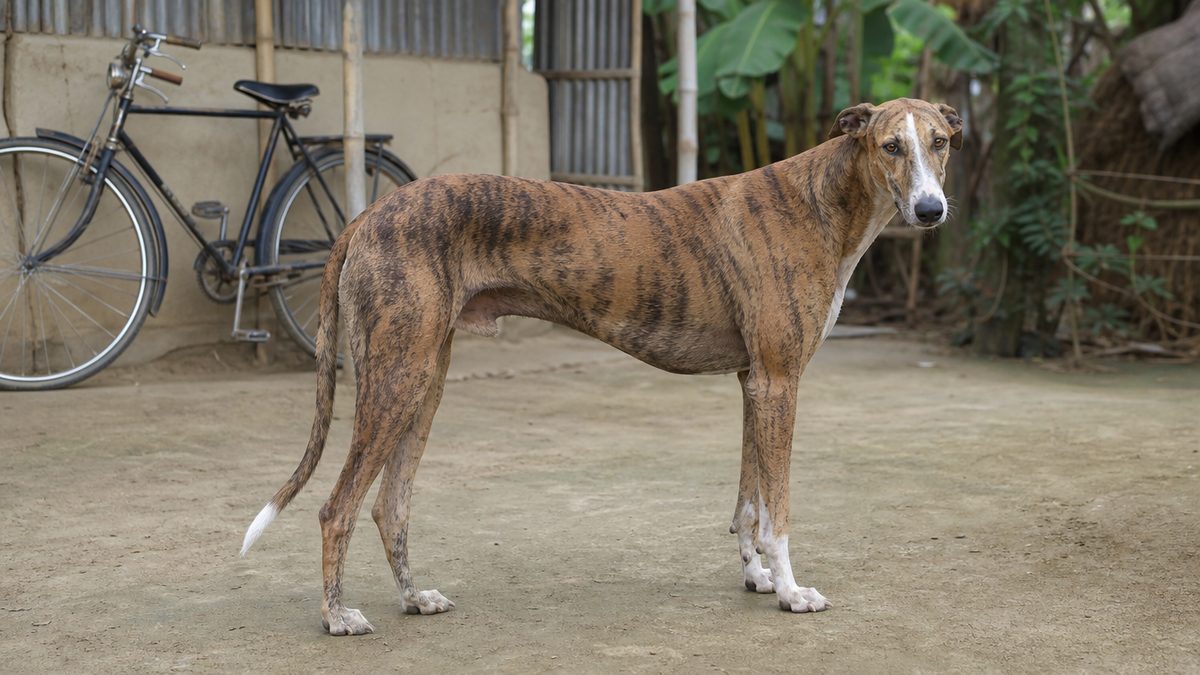
The Sarail Hound is a short-coated sighthound from Sarail Upazila in the Brahmanbaria district of Bangladesh, and it is the only dog breed native to that country. It is a running dog that hunts by sight rather than scent, kept for generations by a small number of Sarail families as a hunting animal and a house guard, and it is now down to a handful of households Md. Shafiqul Islam.
Read the geography before anything else, because everything on this page follows from it. Sarail sits about 80 km northeast of Dhaka on the flat, wet, hot floodplain of eastern Bengal. This is not a desert sighthound and not a hill dog. It is a lowland Bengal dog, and Bengal is the one climate combination that gives a running dog the most trouble, which the climate section takes apart in detail.
Sarail Hound at a glance, with the source for every line
| Attribute | Detail | Source and quality |
|---|---|---|
| Type | Sighthound, hunts by sight and hearing rather than smell | Prothom Alo, Royal Bengal Kennels quoted in The Daily Star Morshed Ali Khan |
| Home | Sarail Upazila, Brahmanbaria district, Bangladesh, about 80 km northeast of Dhaka | The Daily Star |
| Bengali name in use | Sarail grey-hound, in Bengali সরাইল গ্রে-হাউন্ড | Prothom Alo, Dhaka Post, Bengali Wikipedia District correspondent Sarail Grey Hound, Bengali Wikipedia |
| Height | Disputed. Published claims run 23 to 30 in | See the size table below |
| Weight | Disputed. Published claims run 16 to 35 kg | See the size table below |
| Coat | Short and thin | English Wikipedia infobox, which carries no citation |
| Colour | Brindle, brown and white, black and white | Bangladesh Post, English Wikipedia Sarail Hound, English Wikipedia |
| Speed | Disputed. Published claims run 55, 60 and 70 km/h | See the speed note below |
| Lifespan | 8 to 14 years, uncited; one Bengali source says 'one juug', that is 12 years | Bengali Wikipedia, Bangladesh Post, Prothom Alo Mostafa Kamal Khan Sohail Badar Uddin, Sarailer oitijhya grey-hound… |
| Recognised by the FCI | No, neither definitively nor provisionally | FCI nomenclature and provisional list, both read directly Federation Cynologique Internationale |
| Registered by ICAR-NBAGR | No. India's registry covers Indian breeds | ICAR-NBAGR |
| Published population survey | None has ever been done | VICE, which states plainly that there is no official data |
| Health screening scheme | None. Not in the OFA statistics tables | OFA's own inclusion threshold |
The names, and whether Bengal Hound is real
Bengal Hound is an English-language label, not a name anybody in Bengal uses. English Wikipedia's infobox gives the alternative names as Bengal Hound, Soriala Greyhound and Bangladesh Hound, and that infobox carries no reference of any kind, which is verifiable in the article's own wikitext. The only source Bonbeno could find that actually asserts the usage is an American hobby site, which states that in West Bengal, India, these dogs are called Bengal Hounds.
Test that claim against the sources closest to the dog. In Bengali, Bangladesh's largest daily and the Dhaka Post both call the animal the grey-hound or Sarail grey-hound, never a Bengal hound. Bengali Wikipedia titles its article সরাইল গ্রে হাউন্ড, Sarail Grey Hound, and gives Sarail Hound only as a nickname. Bangladesh's state news agency calls them simply the greyhounds of Sarail. And the one West Bengal publication that has written a full feature on the breed, Get Bengal, calls it the Sarail Hound from first line to last and never once writes Bengal Hound.
Sarail Hound is the name to use. Sarail grey-hound is what Bangladeshis actually say. Bengal Hound is a later English coinage that entered circulation through an uncited Wikipedia infobox field and is now repeated as though it were a regional synonym. If a seller in India offers you a Bengal Hound, that is a marketing name, not a breed, and you should ask what the dog actually is.
The size figures, and where they came from
Published measurements for this breed disagree, and more importantly they all trace to one uncited page. Height claims span 23 to 30 inches and weight claims span 16 to 35 kg, which is a two-fold disagreement on weight for an animal nobody has measured.
| Source | Height | Weight |
|---|---|---|
| Proud to Have, anonymous and undated | Male 25 to 28 in, female 23 to 26 in | Male 23 to 33 kg, female 18 to 28 kg |
| English Wikipedia infobox, no citation | Male 64 to 71 cm (25 to 28 in), female 58 to 66 cm (23 to 26 in) | Male 22 to 33 kg, female 18 to 28 kg |
| Bengali Wikipedia infobox | Male 64 to 71 cm, female 58 to 66 cm | Male 23 to 33 kg, female 18 to 28 kg |
| Bangladesh Post | Male about 25 to 26 in, female 23 to 26 in | Male about 23 to 33 kg, female about 16 to 28 kg |
| RocaDog | 23 to 28 in (58 to 72 cm) | 20 to 35 kg |
| Prothom Alo, in Bengali | Body three to four feet long | Not stated |
Look at the first two rows together. English Wikipedia's male weight is 22 to 33 kg and the Weebly page's is 23 to 33 kg, while every other figure in the two boxes matches exactly. That is not two independent measurements agreeing. That is one number copied with a one-kilogram transcription drift, and Bengali Wikipedia carries the original 23 kg while English Wikipedia carries the drifted 22 kg Sarail Hound, English Wikipedia Sarail Hound, Proud to Have. Nobody has weighed this breed. Treat every figure above as an estimate of an estimate.
The published breed description is the AKC Greyhound standard
The single most-copied physical description of the Sarail Hound is the American Kennel Club's Greyhound standard with the sentences reordered into prose. Bonbeno checked this by opening both documents and comparing them line by line, and the overlap is verbatim. English Wikipedia cites the page carrying that description as a reference for its History section.
| AKC Official Standard of the Greyhound | The Sarail Hound page Wikipedia cites |
|---|---|
| "Eyes: Dark, bright, intelligent, indicating spirit." | "The eyes are dark, bright, intelligent, indicating spirit." |
| "Shoulders: Placed as obliquely as possible, muscular without being loaded." | "The shoulders are placed as obliquely as possible, muscular without being loaded." |
| "Forelegs: Perfectly straight, set well into the shoulders, neither turned in nor out, pasterns strong." | "The forelegs are perfectly straight, set well into the shoulders, neither turned in nor out, pasterns strong." |
| "Feet: Hard and close, rather more hare than catfeet, well knuckled up with good strong claws." | "The feet are hard and close, rather more hare than cat feet, well knuckled up with good strong claws." |
| "Ears: Small and fine in texture, thrown back and folded, except when excited, when they are semi-pricked." | "Ears are small and fine in texture, semi-pricked when excited, otherwise thrown back and folded." |
| "Head: Long and narrow, fairly wide between the ears..." | "The head looks Long and narrow, fairly wide between the ears..." |
| "Neck: Long, muscular, without throatiness, slightly arched, and widening gradually into the shoulder." | "The neck is long, muscular, slightly arched, and widening gradually into the shoulder." |
One line in the copy gives the game away completely. The Sarail page writes "The nose is pointed and prominent just like other scent-hounds", two paragraphs after correctly stating that the breed is a sighthound that hunts by sight rather than smell. A description written by somebody who had looked at these dogs would not contain that sentence.
This matters practically, not just academically. It means there is no Sarail Hound breed standard anywhere in the world. The FCI publishes a Greyhound standard and the AKC publishes a Greyhound standard, and neither organisation has ever published one for this breed. So when a seller tells you a puppy is a good example of the type, there is no document to check that against.
Origin, where four incompatible stories are all still live
Nobody knows where this dog came from, and the sources say four different things. Bonbeno lists them rather than picking one, because no genetic study of the breed has ever been published.
- Arabian Saluki descent. English Wikipedia says the breed was developed from the Arabian-originated Saluki and other Middle Eastern sighthounds, bred over centuries by Mughal nobility. Bangladesh's own District Livestock Office page repeats it, saying the dogs are descended from Arabic Salukis and were bred for hundreds of years in Sarail village by Mughal commanders and nobles.
- English Greyhound descent, through a zamindar. The strongest local tradition, told by the breeding family itself, is that a zamindar of Sarail traded an elephant to an English officer for a single female dog on the road to Kolkata about two hundred years ago. Bengali Wikipedia records the breed's origin period simply as the British India era, not the Mughal era.
- A crossbreed of both, plus local dogs. Kaiser Tamiz Amin, the Dhaka enthusiast who has been the single named source on this breed for fifteen years, told The Daily Star that traders from Arabia, Central Asia and western India brought Central Asian hounds while the British brought European greyhounds, and that the Sarail is what happened when the two met.
- Sighthound stock crossed with jungle dogs from Tipperah. Shihab Ally of Royal Bengal Kennels told the same paper that descendants of Salukis, Azawakhs, Tazis and Afghan Hounds crossed with British greyhounds, and that the landlord of Sarail then crossed those with wild dogs from the jungles of Tipperah district, which is Tripura in India.
Notice that the second and third accounts put the breed's formation in the British period and the first puts it in the Mughal period, roughly two centuries apart. Bangladesh Post adds a fifth version and states flatly that "these dogs are native to Europe", which no other source supports. Bonbeno's position is that the British-era zamindar account is the only one with a named family, a named zamindar and a continuous line of witnesses behind it, and that everything about a Mughal or Arabian pedigree is unevidenced.
The founding legend, and how it changes between newspapers
The origin story that Sarail itself tells is consistent in shape and inconsistent in every detail, which is a useful lesson in how this breed's record has been assembled. In every telling, the zamindar's female dog gets lost while hunting, returns pregnant, and produces puppies that look like tigers.
| Source | The zamindar's name | What the dog supposedly mated with | How long it was lost |
|---|---|---|---|
| The Daily Star, 2013 | "Zamindar Dewan", unnamed; family says Dewan Monwar Ali gave them their first two dogs | "Wolf or jackal" | Weeks |
| Prothom Alo, 2021 | Dewan Monowar Ali, also called Monnar Ali | A wolf | Some days |
| Dhaka Post, 2021 | Dewan Mostafa Ali | A tiger | Six months |
| Bangladesh Post, 2021 | Dewan Majtuba Ali | A tiger | Several days |
| BSS, 2025 | Dewan Mostafa Ali | A wolf | Weeks |
Three different names for the same man and two different wild animals is not a small drift. The two sources that spoke directly to the breeding family, in 2013 and in 2021, both give Monwar or Monnar Ali. Treat that as the best-supported version and treat the rest as retelling. As for the tiger and the wolf, neither is biologically possible, and the story is best read as a folk explanation of why brindle striping appears in a dog.
The one piece of documented history that is genuinely solid
General M. A. G. Osmani, Commander-in-Chief of the Bangladesh Forces in the 1971 Liberation War, kept Sarail Hounds and left a first-person account of one of them. His words, as published, describe two Pakistani commandos entering his compound at 23-J Banani on the night of 25 and 26 March 1971 and being attacked by his Sarail hound, called Field Marshall, which was bayoneted and later traced him down again after four years. In 1981 he said, "There are not many breeds matching the speed and strength of the Sarail Hound"; National Purebred Dog Day.
That episode is why the breed is sometimes called the national dog of Bangladesh, a description the Department of Livestock Services repeats on its own website. It is a real piece of national history. It is also, as the conservation section shows, doing a great deal of argumentative work that the breed's actual working record does not support.
Sarail Hound price in India, and why there is no such thing
There is no Sarail Hound price in India, because there is no lawful route by which one could form. Indian import policy classifies dogs as a Restricted item and permits entry only for a pet with a valid pet book in the importer's own name, for research with a CPCSEA recommendation, or for Defence and Police use, and it states that applications for trading or breeding purposes shall be duly rejected. Every published price for this breed is a Bangladeshi price, quoted in taka, for a dog living in Bangladesh.
Start with what the law actually says, because it settles the question before any price does. Bonbeno downloaded and read DGFT Trade Notice No. 22/2022-23, dated 19 December 2022 and signed by the Deputy Director General of Foreign Trade. Four provisions in it matter here.
- Dogs are Restricted, not free. Under ITC (HS) 01061900, mammals other than those separately listed carry an import policy of Restricted.
- Only three purposes are allowed. Policy Condition (7) permits import of dogs only for a pet dog with a valid pet book and records in the name of the importer, for R and D organisations conducting research with a CPCSEA recommendation, and for internal security by the Defence and Police Force.
- Commercial breeding import is barred outright. Policy Condition (8) states that import of commercial dogs for breeding or any other commercial activities other than those purposes is not permitted, and paragraph 6 states that any applications for trading or breeding purposes shall be duly rejected.
- Entry is limited to seven ports. Import of pet animals is allowed only through the airports and seaports of Delhi, Mumbai, Chennai, Hyderabad, Bengaluru and Kolkata and, since October 2024, Kochi airport, with quarantine where required Department of Animal Husbandry…. The full route is set out in how to import a dog to India.
Put those beside the registry position and the conclusion is complete. The breed appears in neither the FCI's definitive nomenclature for breeds beginning with S nor its list of breeds recognised on a provisional basis, both of which Bonbeno read directly Federation Cynologique Internationale. The Kennel Club of India's public website carries no breed list and no breed standards at all, only downloadable registration forms and a notice that a new website is being deployed. And ICAR-NBAGR, which received authority for dog germplasm registration and registered its first three native breeds on 16 September 2020, registers Indian breeds, so a Bangladeshi dog has no route in. With no import route, no registry and no breed standard, an Indian supply chain for this dog cannot lawfully exist.
Every published price, in the currency it was published in
What follows is every Sarail Hound price Bonbeno could open, with the date and the source, because a twelve-year price series on a breed this rare is more informative than any single figure.
| Date | Source | Puppy | Adult |
|---|---|---|---|
| Oct 2013 | The Daily Star | Six-month pure Sarail, "as much as Tk 50,000 or more" | Not stated |
| 2020 sale, reported 2021 | VICE, quoting the breeder | Four puppies sold "for around $350 each", sold at three months old | Not stated |
| Jan 2021 | AFP | "Up to US$500 each" | Not stated |
| Jan 2021 | Prothom Alo, in Bengali | One month old, Tk 20,000 to Tk 25,000 | Eighteen months to two years, above Tk 50,000 |
| Feb 2021 | Dhaka Post, in Bengali | Tk 30,000 to Tk 40,000 | Adults not sold |
| Aug 2021 | Bangladesh Post | Tk 15,000 to Tk 20,000, then "at present" Tk 20,000 to Tk 25,000 at three to five months | Tk 50,000 to Tk 60,000, then "at present" Tk 60,000 to Tk 65,000 |
| Oct 2025 | BSS | Tk 30,000 to Tk 40,000 | Adults not sold |
Two things in that table deserve attention and neither has been noticed anywhere else.
The 2025 prices are the 2021 prices
Bangladesh's state news agency published a field report on 22 October 2025 describing the Rabidas brothers as currently owning four large adult greyhounds, two males and two females, aged about two years, eating rice, fish, meat, milk and boiled eggs, selling puppies at Tk 30,000 to Tk 40,000, selling about seven to eight puppies a year with each sale certified by stamp paper, and needing at least Tk 300 of food per adult dog per day.
Dhaka Post published every one of those figures on 20 February 2021. The same four adults, the same two males and two females, the same two-year age, the same food list, the same Tk 30,000 to Tk 40,000, the same seven to eight puppies a year, the same stamp paper, the same Tk 300 a day. Four dogs described as about two years old in February 2021 cannot still be about two years old in October 2025.
The freshest apparently-new data on this breed is four and a half years old. If you have read that a Sarail puppy costs Tk 30,000 to 40,000 as of 2025, you have read a February 2021 number. Bonbeno is not accusing anyone of bad faith, and reused local detail is ordinary in district reporting. But it does mean nobody has independently checked the state of this population since early 2021, and every conservation appeal since has been argued on stale figures.
The price has not moved in twelve years, which is the wrong signal
A six-month pure Sarail puppy fetched as much as Tk 50,000 in 2013. Twelve years later the same family's puppies fetch Tk 30,000 to Tk 40,000 District correspondent. In nominal taka that is flat to lower, and in real terms after twelve years of inflation it is a substantial fall. No source publishes an inflation-adjusted series, so treat this as an observation rather than an index.
It still tells you something. A genuinely scarce, genuinely sought-after animal with 30 or 40 individuals left in the world does not get cheaper. What the price series actually looks like is a small local trade in an animal that fewer people want, which is exactly what the breeders and the district officials say is happening District correspondent. The dog is not expensive because it is rare. It is rare partly because keeping it is expensive relative to local incomes, which is a different problem with a different solution.
The dollar figures and the taka figures do not agree
The two international English-language reports quote in US dollars and neither states the conversion rate or the date it used. AFP reported that the brothers sell puppies for up to US$500 each, and VICE quoted the elder brother saying he sold four puppies the previous year for around $350 each. In the same month AFP published, Bangladesh's largest Bengali daily reported the same family's one-month puppies at Tk 20,000 to Tk 25,000.
Bonbeno will not convert between them, because doing so would require inventing a rate and a sale date that no source supplies. What we will say is that AFP's figure is a ceiling ("up to") while the Bengali figures are typical asking prices, and that a reader comparing the two is comparing different quantities. If you see a rupee price for this breed anywhere, ask which of these figures it was converted from and at what rate, because it was converted from one of them.
What an Indian buyer is actually being offered
Search for a Sarail Hound price in India and the top Indian commerce result is not a dog. It is a Snapdeal listing titled "Sarail Hound Activities Sarail Hound Tricks, Games and Agility Includes", priced at Rs 8, filed under Books, Animal Care and Pets Books, and out of stock. That is an auto-generated print-on-demand book title that exists in near-identical form for hundreds of breeds. It is not evidence of a market and it is not a price.
The more serious risk is in Bangladesh, and the warning comes from the breeder himself. Tapan Lal Rabi Das told Prothom Alo that local people use his family's name, catch ordinary street dogs off the road, and sell them to buyers as grey-hounds, that buyers are misled by this, and that it is damaging the area's reputation. The Daily Star reported the same pattern eight years earlier, noting that some people were crossing local dog varieties with partial Sarail Hounds purely for commercial gain. An American breed site records the same drift from the other direction, describing Sarail Hounds being bred with Deshi Kukur, which are village dogs.
Every figure on this page is reported editorial content, not an offer. Bonbeno does not link puppy listings, does not recommend breeders and does not sell animals. There is no lawful commercial import route for this breed into India, no registry to verify a pedigree against, and no breed standard to check a puppy against. If somebody in India offers to sell you a Sarail Hound or a Bengal Hound, the single most likely explanation is that the dog is something else.
What it costs to keep a Sarail Hound
No Indian cost figure exists for this breed, because no Indian population exists to price. What does exist is unusually good Bangladeshi evidence, collected from the keeping families themselves across four separate reports, and it points to one conclusion: the running cost is the reason the breed is disappearing.
Most rare-breed cost sections have to guess. This one does not, because Bangladeshi reporters have repeatedly asked the actual owners what they spend, and the answers are consistent across five years and three publications.
| Source | Who said it | The figure |
|---|---|---|
| Prothom Alo, Jan 2021 | Ujjwal Mia, hobby keeper, Monirbagh village | "Rearing one dog costs as much as one person." Meat at least two days a week, milk three days a week, milk only until five or six months of age |
| Dhaka Post, Feb 2021 | Tapan Lal Rabi Das, breeder | "Each adult dog needs at least Tk 300 worth of food daily" |
| Bangladesh Post, Aug 2021 | Reported locally | "An adult dog needs two and a half kg of food every day" |
| VICE, 2021 | The Rabidas brothers, cobblers | The brothers earn between $3 and $5 a day between them |
| BSS, Oct 2025 | Tapan Lal Rabi Das | Same Tk 300 a day, first published in February 2021 |
Read the second and fourth rows together, because that pairing is the whole story of this breed. Two cobblers earning three to five dollars a day are feeding four adult dogs at three hundred taka each per day. Tapan Lal Rabi Das told BSS plainly that they cannot always afford it: "Sometimes we can't afford to feed them properly. We're only keeping them because our ancestors did";. That is not a conservation programme. That is a family absorbing a loss out of loyalty.
The four cost lines an Indian household would carry that nobody has priced
If a Sarail Hound were kept in India, four expenses would dominate and none of them appears in any published estimate. Each is a real recurring line, and each follows directly from what this dog is.
- Secure fencing, built for a sighthound. A dog bred to chase and kill by sight needs a physical boundary, not a gate latch and good intentions. The owner most associated with the breed says his dogs swiftly kill cats, rats and mongoose that stray into their fenced area. In an Indian neighbourhood the equivalent animals are other people's cats, poultry, goats and free-ranging dogs. This is a one-time construction cost that first-time owners discover in month two.
- Year-round tick and flea control, without gaps. A study of 525 dogs across four Indian cities found that 49.7 percent carried at least one tick-borne pathogen and that potential tick vectors were on 53 percent of the dogs examined. In Bangladesh, a study of 246 pet dogs found irregularly treated dogs had 4.01 times the odds of ehrlichiosis compared with regularly treated dogs. A short coat makes ticks easy to see, and easy to see is not the same as absent.
- Emergency capacity for heat. In a UK primary-care dataset of 905,543 dogs, heat-related illness carried an event fatality rate of 14.18 percent, with a 95 percent confidence interval of 11.08 to 17.96 percent. Money set aside for an unplanned emergency visit is a cost of keeping any large active dog in a hot country, not a contingency.
- Food volume for a lean, fast, high-output animal. A sighthound in work eats like a working dog. The one published Bangladeshi figure is two and a half kilograms of food a day for an adult, on a diet of rice, fish, meat, milk and boiled eggs. The feeding section explains why copying that diet directly is a bad idea.
What Bonbeno will not publish
Bonbeno does not publish a monthly rupee cost for the Sarail Hound. We have not collected one, no credible source has, and converting a Bangladeshi village food budget into an Indian monthly figure would launder a taka number into a rupee number and give it an authority it has not earned. When we publish our own cost data we state the sample size, the cities covered and the collection date.
What we will say is directional and defensible. This is a large, high-drive, high-input animal with no health registry behind it, no local vet familiarity, and a containment requirement most Indian housing cannot meet. In every category that matters the cost sits at the demanding end, and the parts nobody prices are the parts that actually bite.
If what appeals to you about this breed is the lean, fast, short-coated, loyal Indian-climate hound, the Indian Pariah Dog is the direct answer and it is free to adopt. If it is specifically the sighthound you want, the Rampur Greyhound, the Mudhol Hound, the Chippiparai and the Kanni are Indian sighthounds that exist here legally, and three of them are registered by ICAR-NBAGR. None of those figures should be read across to the Sarail Hound, and Bonbeno does not do so anywhere on this page.
Heat tolerance in Indian conditions, rated 2 out of 5
Rate the Sarail Hound's heat tolerance at 2 out of 5 for Indian conditions. That is higher than a Himalayan guardian and lower than most people expect from a lean, short-coated dog, and the reason is that a sighthound's heat problem is not the sun. It is the chase. The single best piece of evidence on this question is that pet Greyhounds carried 4.26 times the odds of heat-related illness compared with Labrador Retrievers in a UK primary-care study of 905,543 dogs.
Every page that describes this breed implies the opposite. A short coat, a long narrow muzzle, a lean frame and two hundred years of living in the Bengal lowlands all read as heat-adapted. Two of those four things are genuinely protective. The other two are not, and one of them is actively dangerous.
The mechanical reasoning behind the 2
- The short coat and the long muzzle genuinely help. A dog has one significant route for shedding heat, evaporation from the respiratory tract through panting, and almost no functional sweating. A long dolichocephalic muzzle gives a large evaporative surface, which is exactly what a brachycephalic dog lacks. A short thin coat does not trap a still-air layer against the skin the way a dense undercoat does. On these two axes the Sarail Hound is well placed, and better placed than most imported breeds sold in India.
- Humidity switches the panting route off, and Bengal is the humid case. Evaporative cooling depends on the moisture gradient between the airway lining and the air. Across most of Bangladesh the annual average wet bulb globe temperature already sits in the 29 to 30 degree Celsius band, rising to 31 in the northwest, and it has been climbing by 0.08 to 0.5 degrees per decade with the sharpest increases in the southeast and northeast. The same study found the number of high heat stress days rising by 2 to 8 days per decade nationally. A dog panting hard in air that saturated is doing the muscular work of cooling without getting much cooling.
- A sighthound generates an enormous heat load in a very short time. This is the part nobody writes down. The breed's entire design converts stored energy into speed, at a claimed 55 to 70 km/h depending on which source you believe Mostafa Kamal Khan Sohail Badar Uddin, Sarailer oitijhya grey-hound…. That output has to go somewhere, and most of it becomes heat inside the dog within seconds. The UK study noted directly that in previous work on post-race body temperature in Greyhounds, dogs with greater lean body mass were significantly hotter after running than lighter dogs.
- The data says sighthounds are at risk even in a cool country. In the VetCompass multivariable model, nine breeds had significantly higher odds of heat-related illness than the Labrador Retriever, and the Greyhound was one of them at 4.26 times the odds. Greyhound incidence risk of heat-related illness was 0.15 percent, with a 95 percent confidence interval of 0.07 to 0.29 percent. The authors themselves flagged this as unexpected, writing that as a dolichocephalic breed Greyhounds are not commonly associated with the risk, and suggested a degenerative cardiovascular or respiratory disorder such as laryngeal paralysis as a possible contributor in older animals.
That last point is the one to carry away. A study run in the United Kingdom, a country whose summer would count as a pleasant winter week in Kolkata, still found the Greyhound among the highest-risk breeds it measured. The Sarail Hound is the same body plan doing the same job in a climate several categories hotter and far more humid.
Bonbeno rates the Bakharwal Dog, a Himalayan double-coated guardian, at 1 out of 5. The Sarail Hound is genuinely better placed than that: it is a lowland Bengal animal with a short coat and a long muzzle, and its ancestors have lived through Bengal summers for generations. It does not get a 4, because the sighthound heat-illness data is real, the humidity mechanism is real, and the specific way this dog is used, flat-out chasing, is the exact activity that produces heat faster than any dog can shed it. Two out of five means livable with discipline, dangerous without it.
What this means city by city in India
The Sarail Hound's home range is roughly the same climate as West Bengal, so an Indian reader has a genuinely useful reference point. Brahmanbaria and Kolkata sit on the same floodplain with the same monsoon and much the same humidity.
| City | Relationship to the breed's home climate | The practical constraint |
|---|---|---|
| Kolkata | Closest match in India. Same delta, same monsoon, same humid heat | The dog is on home ground climatically, and still must not run in the middle of the day from March to October |
| Guwahati and the Northeast | Similar humid lowland heat | As Kolkata. Monsoon skin and ear care matters more than heat here |
| Chennai and coastal Kerala | Hotter and at least as humid, with a longer season | Panting is least effective here. Free running is a dawn and dusk activity only |
| Mumbai | Humid, with a very long warm season | Same as Chennai, plus almost no safe off-lead space for a sighthound |
| Delhi, Jaipur and the plains | Drier but far hotter in the peak | A different failure mode. Evaporation still works, but ambient heat gain outruns it above about 40 degrees |
| Bengaluru and Pune | Mildest large-city option in India | The best case, and still not a midday running climate in April and May |
| Shimla, Dehradun, hill stations | Cooler than anything the breed evolved with | Heat is not the problem. This is not what the dog was built for either |
Five rules that actually reduce the risk
- Move the exercise, do not shorten it. A sighthound denied its run becomes a destructive dog. Run it at first light and after dark, and walk it on lead in between.
- Treat the sprint as the hazard, not the walk. A twenty-minute lead walk in 33 degrees is manageable. Ninety seconds of flat-out chasing after a cat in the same conditions is not.
- Watch the humidity, not just the thermometer. A 32 degree day at high humidity is harder on this dog than a 36 degree day in dry Rajasthan air, because the cooling route depends on the moisture gradient.
- Know the signs of heat stroke and act on the first one. Frantic unproductive panting, brick-red or very pale gums, staggering, vomiting or collapse mean heat stroke until proven otherwise, and heat stroke is an emergency. Cool the dog with running water and move it to airflow while you travel, and consult your nearby vet immediately rather than waiting to see if it settles.
- Never assume a short coat means heat-proof. The single most common mistake made with lean short-coated breeds in India is assuming they self-regulate. The heat-illness data on Greyhounds says otherwise.
Temperament, and the one trait every source agrees on
Published accounts of the Sarail Hound's temperament contradict each other on almost everything except one point, and that point decides whether the breed fits an Indian household. Every source that has met these dogs describes an extreme prey drive. The disagreement is over how affectionate and how safe they are, and it maps exactly onto whether the writer had ever seen one.
What people who owned the dogs say
The most useful temperament evidence comes from Kaiser Tamiz Amin, a Dhaka banker who has kept Sarail Hounds for two decades and has been the single named owner-source on this breed since 2011 Agence France-Presse. His description is specific and unflattering in places, which is why it is credible.
"Sarails are extremely devoted to their masters, but don't like to hug or lick. They are very territorial. My dogs swiftly kill animals - cats, rats, mongoose that stray into their fenced area.";
He told VICE the same thing from another angle, saying the animals cannot be left unattended because they are often quite aggressive. A West Bengal publication reporting on the breed describes the nature as largely reserved and controlled, with dogs extremely attached to their humans that rarely show open affection by cuddling or licking.
The Bengali-language reporting adds household detail no English source carries. Prothom Alo describes a dog that is not a daytime barker but announces intruders at night, that is calm and devoted to its owner, that does not enjoy being petted by strangers, and that thieves and robbers are said to fear. A keeper in Kalikachchha told Dhaka Post that his dog guards the house through the night and runs to greet him from a distance. Bangladesh's state agency reports the same, calling the dogs loyal and protective, guarding homes through the night and showing great affection toward the owner.
What the ranking pages say, and where they got it
English Wikipedia describes the breed as having a charming and mild nature, gentle, intelligent and highly trainable, displaying alertness and boldness and at times ferocious to the point of chasing large animals. The whole of that sentence is sourced to a single site, dogbreedfinder.net, which Bonbeno attempted to open and which failed at the TLS layer and returned no content at all. We are therefore reporting that Wikipedia's temperament claim rests on a source that could not be retrieved, rather than treating the claim as evidenced.
A widely-cited breed page states the Sarail Hound is tolerant and gentle towards kids and names no source for it. Another lists the character as intelligent, steadfast and aloof, temperament as alert, bold and at times ferocious, prey instinct as very high, watchdog ability as moderate and trainability as moderate, on the same anonymous page whose physical description turned out to be the AKC Greyhound standard.
"Tolerant and gentle towards kids" is the highest-stakes temperament claim anybody makes about this breed and it is the one with the least behind it. No behavioural study, no temperament test and no bite-incident data exists for the Sarail Hound. The owners who have actually kept them describe a territorial dog that kills animals entering its space and cannot be left unattended Masum Billah, Two Bangladeshi Brothers Are…. Read the uncited claim against the sourced ones and act on the sourced ones.
Prey drive is the trait that decides everything
This is the only trait on which every single source, in both languages and across fifteen years, agrees. It is also the trait that makes the breed a poor fit for almost any Indian setting.
- The dogs kill cats, rats and mongoose that enter their enclosure.
- The breed "can leap several feet into the air and hunt down a bird in flight", and any furry animal venturing into its territory stands little chance of escaping.
- It hunts by sight, not smell, and can kill a rabbit in mid-air.
- In winter, Sarail villagers used these dogs to surround patches of jungle and hunt small leopards, jackals, civets and jungle cats.
- The dogs are described as good at hunting rabbits, foxes and wild cats, and as very violent and sharp.
Now place that dog in an Indian residential neighbourhood. Under the Animal Birth Control Rules 2023, notified as G.S.R. 193(E) on 10 March 2023, sterilised and vaccinated street dogs are returned to their original location and relocation is not permitted. That is sound public-health policy and it is also a permanent fact about the environment: your street will always have dogs in it. Add free-ranging cats, poultry, goats and children on bicycles, and a very fast dog with a hair-trigger chase response has a target in every direction.
There is no bite force figure, and anyone quoting one made it up
No bite force has ever been measured for the Sarail Hound. Google's India autocomplete offers "sarail hound bite force" as a suggested query, which is why the question is worth answering directly. A breed with no standard, no registry, no published study and a global population that has never been counted has no measured bite force to publish. Every PSI figure circulating online for this breed is either invented or borrowed from an unrelated breed's estimate. Treat a confident bite force number as a marker that the whole page is unreliable.
Who this breed suits, and who it does not
| Situation | Verdict | Why |
|---|---|---|
| Apartment in any Indian city | No | A dog that needs to run flat out, in a building with shared corridors and no securable ground |
| Home with cats, poultry, rabbits or goats | No | The one universally reported trait is that this dog kills small animals entering its space |
| First-time dog owner | No | High prey drive plus an independent chase instinct is not a beginner combination |
| Family with toddlers | Caution | The gentle-with-children claim is uncited and no temperament data exists either way |
| Fenced rural or peri-urban plot, experienced owner | The only realistic fit | Space to run, a boundary that holds, and somebody who understands sighthounds |
| Anyone wanting a guard dog | Look elsewhere | Territorial and alert at night, yes, but bred to chase and kill, not to hold ground |
Training a Sarail Hound, and the one thing it will not do
To train a Sarail Hound, build structure around the chase instinct rather than attempting to train it away, and accept that reliable off-lead recall is the one thing you will probably never get. The breed's leading advocate put the limit plainly: "Once these hounds set a target, they go after it without listening to any commands";.
That sentence is worth more than every training paragraph written about this breed elsewhere, because it comes from somebody who has kept these dogs for twenty years and it is a statement against interest. He was arguing for the breed's preservation at the time, and he still said it.
The trainability claim, tested against a real deployment
English Wikipedia calls the breed gentle, intelligent and highly trainable, sourced to a site that will not load. The anonymous page that supplied most of the English-language breed description rates trainability as merely moderate. Rather than pick between two uncited claims, look at what happened when a state agency actually tried.
Bangladesh's Rapid Action Battalion took Sarail Hounds into its dog squad. The Daily Star reported in 2013 that a former director of the RAB Bhairab camp collected four Sarail Hounds for headquarters to train for anti-crime techniques, and that its progress was not known. Prothom Alo reported in 2021 that RAB members had collected several hound dogs from Sarail some years earlier, and that no further information had been obtained since. Bangladesh Post reported, in the present tense, that trained hounds had recently taken a place in the RAB dog squad.
VICE asked RAB directly. A RAB official, speaking anonymously, said the dogs are no longer in the squad, that they had tried to train them for a year in sniffing, that they were not effective, and that the hounds were finally sold at auction. The brothers who sold them said RAB never came back to buy more and that they do not know whether their hounds were integrated into the squad.
A sighthound is not a scent dog. Every source on this breed, including the Bengali-language ones, says it hunts by sight rather than smell Badar Uddin, Sarailer oitijhya grey-hound…. Training a sighthound as a sniffer dog for a year is training directly against the animal's design. The failure says almost nothing about whether the breed is intelligent and almost everything about the claim, repeated in every conservation appeal since 2009, that these dogs are valuable for security work. Bangladesh's state news agency was still making that argument in October 2025, reporting that livestock experts say the greyhound could play a useful role in security operations if properly bred, trained and maintained.
What actually works with this breed
- Manage the environment first, train second. With a dog that will not break off a chase, the fence and the lead do the work that recall cannot. Build containment before the dog arrives.
- Do all recall training on a long line, not on hope. A 10 to 15 metre training line lets you practise recall in the presence of low-level distraction without ever testing it against a real target. Recall training with this breed is about building a strong habit you will still never fully trust, so do not graduate to off-lead in open ground just because a session went well.
- Reward heavily and early, because the competing reward is enormous. Chasing is self-reinforcing at an intensity food cannot match once it starts. All your leverage is in the seconds before the dog locks on, so train the check-in and the disengage rather than the emergency stop.
- Socialise deliberately toward other dogs, not just people. An Indian street contains dogs by law, since sterilised strays are returned to their original location under the Animal Birth Control Rules 2023. Weight the socialisation programme toward calm, controlled exposure to other dogs from the day vaccinations allow.
- Do not use force on a sensitive sighthound. Sighthounds are widely described as aloof and reserved rather than biddable, and this one is described as disliking handling from strangers. Harsh handling produces avoidance, not compliance.
A realistic first-year timeline
| Period | Priority | Realistic outcome |
|---|---|---|
| 8 to 16 weeks | Socialisation to people, traffic, other dogs, handling. Vet visits made positive | A confident puppy that tolerates being examined. This window does not come back |
| 4 to 6 months | Lead manners, name response, crate or safe-space training, boundary training | Walks on a loose lead in quiet conditions |
| 6 to 9 months | Long-line recall, disengage cue, controlled exposure to cats and livestock at distance | Reliable recall in low distraction only. Expect the adolescent regression |
| 9 to 12 months | Proofing under distraction, structured running in safe enclosed space | Consistent routine, an off switch indoors, and no off-lead work in open ground |
| 12 months onward | Maintenance, and honest reassessment | Assume recall will fail at least once against live prey and plan so that failure is survivable |
One caution about copying overseas sighthound advice wholesale. Guidance written for retired racing Greyhounds in Britain or Australia assumes a fenced dog park culture, cool weather, and neighbourhoods without free-ranging animals. None of those assumptions holds in India. Where an overseas source tells you to let the dog run off-lead to burn energy, that advice does not transfer, and the exercise section sets out what does.
Daily exercise, and a published figure worth questioning
The only published exercise figure for the Sarail Hound is five to six hours a day, given to VICE by the Dhaka owner who has kept the breed longest. Bonbeno reports it because it is the only figure that exists, and questions it because the Bengali-language reporting from the breed's home village describes something close to the opposite.
Here is the exact quote, so you can judge it yourself. "Sarail hounds need regular exercise, roughly 5-6 hours a day, which is complicated in cities where there's not much space to run," Kaiser Tamiz Amin told VICE, adding that the animals cannot be left unattended as they are often quite aggressive. The anonymous English-language breed page rates exercise need as very high.
The Bengali reporting says the opposite
Prothom Alo's reporter visited the keeping households in Sarail and described the dogs as comfort-loving animals that eat only a small quantity each day, though what they eat must be of very good quality, and noted that even their sleeping habits differ from other dogs. That is a description of a sighthound as sighthound owners the world over recognise it: an animal that produces extraordinary output in short bursts and then rests for most of the day.
| Claim | Source | Basis |
|---|---|---|
| Needs roughly 5 to 6 hours of exercise a day | VICE, quoting Kaiser Tamiz Amin | One owner's estimate. No study, no method |
| Comfort-loving, eats only a small amount daily | Prothom Alo, on-site reporting | A reporter's observation at the keeping households |
| An adult needs two and a half kg of food every day | Bangladesh Post | Reported locally, no source named |
Bonbeno's reading is that the five to six hour figure is best understood as a statement about how hard this dog is to keep satisfied in a city, not as a prescription for hours of running. Six hours of sustained exercise would injure most dogs, and no sighthound literature anywhere recommends it. Read it as the owner meant it, which is that a dog bred to cover ground has nowhere to do so in Dhaka, and the same is true in Delhi, Mumbai or Chennai.
What the dog was actually built to do
The historical working pattern is documented and it is instructive. In winter, Sarail villagers would surround patches of jungle with these dogs and hunt small leopards, palm civets, jackals, large civets and jungle cats, and local administrations held annual dog shows where the animals were judged and awarded prizes. Between hunts the dogs guarded the house at night Md. Shafiqul Islam. That is a life of intense, occasional, self-paced effort with long recovery, not a life of scheduled roadwork.
A realistic Indian exercise programme
- Two structured lead walks a day, 45 to 60 minutes each, at first light and after dark. These are the non-negotiable base. Walk on a well-fitted harness or a martingale collar, because a narrow sighthound head slips a standard flat collar.
- Two to three genuine sprint sessions a week, inside secure fencing only. Ten to fifteen minutes of free galloping in an enclosed space does more for a sighthound than an hour of trotting. If you do not have a fully enclosed space, you do not have a place to exercise this breed properly.
- Daily mental work, 10 to 15 minutes. Scatter feeding, find-it games and simple problem-solving. A dog you cannot exercise fully needs its head worked instead.
- No off-lead running in open ground, ever. This is the rule that carries the most weight, and it follows directly from the owner's own statement that once these hounds set a target they go after it without listening to any commands.
- Monitor the dog, not the clock, from March to October. In humid Indian heat the safe session length changes day to day. Watch for a change in panting quality and stop before the dog does.
What happens without it
An under-exercised sighthound does not become a calm sighthound. It becomes a destructive, pacing, fence-testing animal with a hair-trigger response to anything that moves outside the gate, and in India that means the free-ranging dogs that the Animal Birth Control Rules 2023 correctly return to their own street. The escape risk rises with the frustration, and an escaped dog of this speed in Indian traffic is a very short story.
Ask yourself one question. Do you have secure fencing that a fast, agile, 30 kg dog cannot get out of, and a place to run it hard twice a week? If the answer is no, no amount of walking will substitute, and this is not your breed. That is true of the Rampur Greyhound and the Mudhol Hound as well, and those at least can be legally obtained in India.
Grooming a short-coated hound in Indian humidity
Grooming is the easiest part of owning this breed and the part where overseas advice is most misleading. The coat is short and thin, and one breed page states that even without any grooming it stays in great condition. That is true of the hair and false about everything living on it, because in India the real job is not coat care. It is parasite control.
The five-minute routine that does the actual work
Groom this dog for two minutes and inspect it for five. A short coat is a genuine advantage here, because it makes a tick visible rather than hidden, and the whole benefit of that advantage is lost if nobody looks.
- Rubber curry mitt or hound glove, twice a week. Two minutes, dry, in the direction of the coat. It lifts dead hair and it is the natural moment to run your hands over the whole dog.
- Full tick check daily in the warm and wet months. Ears, ear folds, between the toes, armpits, groin, under the tail, around the eyes and lips. These are the sites owners skip and where ticks attach.
- Nails every two to three weeks. A sighthound's foot is described as hard and close, with strong claws. Dogs walked mainly on soft ground do not wear them down.
- Teeth two or three times a week. Dental disease is the most under-treated common problem in Indian pet dogs and it is entirely preventable at home.
- Bath only when actually dirty. A thin coat over lean skin dries fast, so a bath is low-risk, but frequent shampooing on this skin type causes more irritation than it solves. Dry the ear openings properly during the monsoon.
Why tick and flea control is the whole ballgame in India
The evidence here is strong on both sides of the border, and it is specific enough to act on. In a survey of 525 dogs across four Indian cities, 261 dogs, or 49.7 percent, carried at least one tick-borne pathogen by PCR, and potential tick vectors, most commonly Rhipicephalus, were found on 278 dogs, or 53 percent, of those examined. Hepatozoon canis was the most common pathogen at 30 percent, followed by Ehrlichia canis at 20.6 percent, and concurrent infection with more than one pathogen occurred in 39 percent of cases.
The Bangladeshi study is even more directly useful, because it quantifies the effect of owner behaviour. Across 246 pet dogs sampled in Dhaka, Mymensingh and Rajshahi, ehrlichiosis prevalence was 6.9 percent and the case fatality was 47.1 percent. Four risk factors reached significance, and three of them are things an owner controls.
| Risk factor | Odds ratio | 95 percent CI |
|---|---|---|
| Living in a rural rather than urban area | 5.84 | 1.72 to 19.89 |
| Having access to other dogs | 5.14 | 1.63 to 16.27 |
| Irregular ectoparasite treatment | 4.01 | 1.17 to 14.14 |
| Ticks present on the dog | 3.02 | 1.02 to 8.97 |
Read the second and third rows together. A dog that meets other dogs and whose ectoparasite treatment is applied irregularly is carrying two independent multipliers on a disease that killed nearly half the affected animals in that sample. In India, where sterilised street dogs are lawfully returned to the street they came from, the first of those exposures is not optional. Only the second is. Keep the parasite schedule to the day, all year, and do not stop it in winter.
Two things a thin coat does not protect against
- Sun on thin skin. A short thin coat over a lean body offers little protection to pale skin, and this breed carries white markings on the chest, face, paws and tail tip. Watch pink noses, ear tips and any thinly covered belly skin, and keep the dog out of direct midday sun rather than reaching for a product.
- Pressure sores on hard floors. A dog with almost no fat padding over its bony points develops calluses and sores on tile and concrete. Give it a genuinely soft, raised bed. This is one of the most common complaints in retired racing sighthound care and it applies here for exactly the same anatomical reason.
Do the tick check at the same time every day, ideally after the evening walk, and check the same eight sites in the same order. Owners who make it a fixed sequence find ticks in the first hours after attachment. Owners who do it when they remember find them after the dog is already ill. Consult your nearby vet before starting any new tick or flea product, because the correct choice depends on your local resistance picture and on the dog's weight.
Health, lifespan, and why a routine blood test could mislead your vet
No health data exists for the Sarail Hound. There is no prevalence study, no screening scheme, no breed club health survey, no registry and no published lifespan analysis. What this section can offer instead is the most decision-relevant thing an Indian owner of any sighthound needs to know, which is that standard canine laboratory reference intervals are the wrong ruler for this body type, and that Indian breeding law happens to mandate the single test most likely to be misread.
What is genuinely absent, and how we checked
- No OFA figures. The breed does not appear in the Orthopedic Foundation for Animals statistics tables. That is expected rather than surprising, because OFA states that breeds are not included until a minimum number of individuals have been evaluated, specifically at least 100 evaluations for hips and at least 50 for all other databases. A breed whose entire world population has never exceeded a few dozen by any published estimate cannot reach that threshold.
- No breed club and no screening guidance. A National Society for the Sarail Hound was formed in Dhaka in 2006 by enthusiasts who owned, trained and bred the dogs, and its founder told The Daily Star that in some cases members succeeded but many failed. No health protocol, screening scheme or published data has come from it.
- No lifespan study. Published lifespan claims are 8 to 14 years on the anonymous English page and on both Wikipedias Sarail Hound, English Wikipedia, 8 to 14 years in Bangladesh Post, and "one juug", the Bengali unit meaning twelve years, in Prothom Alo. Not one of them names a dataset. Bonbeno therefore publishes no lifespan figure for this breed and reports the range as the claim it is.
- No registry means no pedigree health history. With no FCI recognition and no listing with any kennel club, there is no stud book in which an inherited problem could be traced.
The laboratory problem, and it is a real one
Everything that follows is Greyhound data, presented as the nearest available analogy for a sighthound body type. It is not a measurement of the Sarail Hound, and Bonbeno is not claiming it is. It is included because the underlying physiology, extreme lean muscle mass and very low body fat, is the defining feature of every sighthound including this one, and because an Indian vet running a routine panel has no breed-specific reference to reach for.
IDEXX Reference Laboratories published breed-specific reference intervals for Greyhounds built from 220 clinically healthy adult dogs following Clinical and Laboratory Standards Institute guidelines. Their own summary of the problem is blunt: as a result of adaptations for racing success, even basic bloodwork parameters have diverged markedly from other breeds of dogs, making it difficult to apply general canine reference intervals to this population.
| Parameter | Greyhound-specific interval | How a general-population reading could mislead |
|---|---|---|
| Total T4 | 0.5 to 1.7 ug/dL | Reads as hypothyroid on a general canine scale |
| Haematocrit | 52 to 68.4 percent | Normally at or above the general upper limit, so a real anaemia can be missed |
| Platelets | 97 to 232 K/uL | Reads as thrombocytopenia |
| White blood cells | 3.6 to 8.6 K/uL | Reads as leukopenia |
| Creatinine | 1.2 to 2.1 mg/dL | Reads as kidney disease. IDEXX attributes the higher creatinine to increased muscle mass |
IDEXX states the consequence directly. Because greyhounds' haematocrits are normally at the upper end of or above the general canine reference interval, a relative anaemia in these dogs can be easily missed, and conversely low platelets or white blood cells could be overinterpreted without an understanding of these breed differences. They also note that the SDMA test is not affected by muscle mass and is a more accurate predictor of kidney health than creatinine in this body type, with a higher upper limit of 20 ug/dL.
The Prevention of Cruelty to Animals (Dog Breeding and Marketing) Rules 2017, notified as G.S.R. 496(E) on 23 May 2017, require in the Second Schedule, Part III, Health Related Requirements, paragraph 8, sub-paragraph (10), that breeding dogs "shall have been tested for genetic defects, including hip dysplasia, progressive retinal atrophy, night blindness, hypothyroidism, entropion, ectropion, overshot, undershot jaw (when incisors do not touch or mesh), wry mouth, two or more missing teeth, unilateral cryptorchid or full cryptorchid males". Hypothyroidism sits on that list. In a sighthound, a low total T4 is the expected finding rather than a disease. Anyone testing a sighthound to satisfy that rule must tell the laboratory what breed group the dog belongs to, or the paperwork will record a thyroid disease the dog does not have.
Anaesthesia, where the same physiology bites again
Tell your vet the dog is a sighthound before any procedure, including a routine sterilisation. Guidance published for Greyhounds sets out five adaptations that change the anaesthetic picture, and each of them follows from the same lean-and-fast body plan.
- Low fat to muscle ratio and high surface area to volume ratio, which makes the dog susceptible to hypothermia during anaesthesia. The same low body fat that makes a sighthound cool poorly during a chase makes it lose heat fast on a table.
- Reduced liver metabolism, resulting in slow or poor recovery from some anaesthetic agents and making drug interactions more likely.
- Reduced activity of specific cytochrome P450 enzymes that metabolise barbiturates, so that use of thiobarbiturates such as thiopentone is strongly discouraged in this body type.
- Unique clinical pathology, in particular a high PCV and a low total protein, which affects the plasma concentration of certain drugs.
- Increased susceptibility to stress-induced hyperthermia because of a highly strung temperament.
Read the fifth point against the climate section. A dog predisposed to stress-induced hyperthermia, kept in a country whose humid heat already blunts evaporative cooling, and belonging to a body type that showed 4.26 times the odds of heat-related illness against the Labrador Retriever in a UK dataset, is carrying the same vulnerability in three different settings.
The three risks that are actually likely in India
- Tick-borne disease. Half the dogs in an Indian four-city survey carried at least one tick-borne pathogen, and in Bangladesh ehrlichiosis carried a 47.1 percent case fatality in the sampled dogs. This is the most probable serious illness this dog will face.
- Heat-related illness. Event fatality was 14.18 percent in the UK primary-care dataset, in a country with no Indian summer.
- Trauma from a chase. No study measures this, and it does not need one. A dog that will not break off a pursuit, in a country with the traffic density India has, is at risk every time containment fails.
Get a full blood panel done while the dog is demonstrably healthy, and keep the printout. For a breed with no published reference interval anywhere, your own dog's healthy baseline is the only reference interval that exists, and it turns an ambiguous result at age seven into a clear comparison. Discuss the sighthound reference-interval issue with your nearby vet at that appointment rather than during an emergency.
Feeding, and why the traditional Sarail diet should not be copied
Feed a Sarail Hound a complete, life-stage-appropriate diet and keep it visibly lean. The traditional Sarail diet is documented in detail, which is rare for a landrace, and it is documented well enough to see that copying it at home would very likely leave a dog short of something.
What these dogs are actually fed in Sarail
The keeping family's diet has been reported consistently since 2021 and is unusually specific. Their dogs eat rice, fish, meat, milk and boiled eggs, and the breeder told Bangladesh's state news agency, "They eat only rice, fish, meat, eggs, and milk, nothing else"; District correspondent. A hobby keeper in a neighbouring village told Prothom Alo that a dog needs meat at least two days a week and milk three days a week, and that puppies are given only milk until five or six months of age. Bangladesh Post reports an adult eating two and a half kilograms of food a day. The cost of that is at least Tk 300 per adult per day, which the breeder says he cannot always meet.
Why an Indian owner should not reproduce it
A rice, fish, meat, milk and egg regimen is a homemade diet, and homemade diets fail nutritional completeness far more often than owners expect. Researchers on the Dog Aging Project assessed 1,726 homemade diets described by owners and found that only 6 percent had the potential to be nutritionally complete, with the lead researcher noting that because the study did not include exact ingredient amounts, the true proportion could be smaller still.
Two details in the Sarail regimen are worth flagging specifically, not as criticism of families keeping a heritage breed on a cobbler's income, but because an Indian reader might copy them believing they are breed requirements.
- Milk only until five or six months is a growth-stage diet with no mineral balance behind it. A large, fast-growing sighthound puppy laying down bone needs a controlled calcium to phosphorus ratio and adequate protein, and a milk-only regimen supplies neither in a form anyone has calculated.
- "Nothing else" is the problem, not the ingredients. Rice, fish, meat, egg and milk are all reasonable foods. A diet that contains only those five things, in unmeasured amounts, is precisely the category the Dog Aging Project found to be incomplete 94 percent of the time.
If you want to feed home-cooked food, have the recipe formulated by a veterinary nutritionist rather than assembled from a heritage description. If you would rather not, feed a complete commercial diet appropriate to the dog's life stage. Either route is defensible. Copying a village diet you read on a breed page is not, and your nearby vet can point you to a formulation service.
Body condition is a heat-safety issue, not a cosmetic one
Keep this dog lean, and expect to be told it is too thin. A sighthound at correct weight shows the last two or three ribs, has a dramatic tuck at the waist and has visible hip points, and that is normal rather than neglect. In India, where a well-fed dog is often assumed to be a rounded dog, sighthound owners routinely feed their dogs up to stop the comments.
Do not. The UK heat-related illness study found that dogs with bodyweight above the mean for their breed and sex were at significantly greater odds of heat-related illness than dogs below it. On a body plan already carrying 4.26 times the Labrador's odds, adding surplus weight in an Indian summer stacks two risks that both point the same way. Monitor body condition monthly by hand rather than by eye, and adjust the ration by 10 percent at a time.
A practical Indian feeding plan
| Stage | Approach | The India-specific note |
|---|---|---|
| 8 weeks to 4 months | Complete large-breed puppy food, four meals a day | Never sell or acquire a pup below eight weeks. Rule 8(1)(a) of the 2017 Rules requires that pups less than eight weeks in age are not sold |
| 4 to 8 months | Three meals a day, controlled growth rate | Resist the urge to push growth. Fast growth in a large breed is a skeletal risk, not a benefit |
| 8 to 14 months | Two meals a day, transition toward adult food | This is when Indian owners typically overfeed, because the dog looks gangly |
| Adult | Two meals a day, split around the cooler exercise windows | Do not feed a full meal immediately before or after hard running |
| Senior, from about 8 years | Two meals, reduced energy density, monitor muscle mass | Muscle loss and fat gain can happen together. Judge by feel, not by the scale alone |
One timing rule matters more here than in a cooler country. Feed the main meal after the evening exercise has finished and the dog has cooled and settled, not before a run. Deep-chested dogs are the classic body shape for gastric problems, and while no incidence data exists for this breed, the precaution costs nothing.
On availability, everything a Sarail Hound would need is sold in India. Complete large-breed puppy and adult diets, weight-management formulas and veterinary nutritionist consultations are all accessible in every metro and most tier-two cities. Nothing about feeding this breed is hard in India. The hard parts are the containment, the climate and the fact that the dog is not lawfully obtainable here at all.
The extinction claim, audited
Nobody has ever counted the Sarail Hound. VICE stated it plainly in 2021: there is no official data on how many of the animals still exist. Published population claims range from 3 individuals to a few hundred, a hundred-fold spread, and the most-quoted figure of 30 to 40 is one Dhaka enthusiast's personal belief. This section sets out every claim, its date and what it actually rests on, so a reader can judge the conservation status for themselves.
Bonbeno's conclusion, stated first so nothing is buried. The breed is very probably in serious trouble, and the good evidence for that is qualitative rather than numerical. One family is still breeding, the keepers cannot afford the feed, the remaining dogs are being crossed with village dogs, and every institutional initiative for fifty years has collapsed. What does not exist, and has never existed, is a number.
No conservation body has assessed this breed. The nearest thing to a formal status anywhere is the Bengali Wikipedia infobox, which records the breed as roughly nearly endangered and cites nothing for it. English Wikipedia does not describe it as endangered at all, saying only that it is on the verge of extinction and citing an AFP news report for that. Prothom Alo, the only outlet to devote a standing subheading to the current situation of the dogs rather than to their legend, reported that current situation from inside the keeping households rather than from Dhaka.
Every published population claim, in order
| Date | Claim | Who said it | What it rests on |
|---|---|---|---|
| Oct 2011 | "I estimate only 15-20 pure Sarails are left" | Kaiser Tamiz Amin, Dhaka owner, to The Daily Star | A personal estimate, described as such |
| Oct 2013 | One household owned a dozen Sarails | Tapan Lal Rabi Das, breeder, to The Daily Star | The owner's own count of his own dogs |
| Jan 2021 | "There are still 8-10 grey-hound dogs in Sarail, and even those have already become 50 percent crossbred" | Jahangir Alam, Sarail Upazila Livestock Officer, to Prothom Alo, in Bengali | The only figure any government officer has put on the record. Basis not stated |
| Jan 2021 | 7 to 8 dogs seen at one household, of which the reporter judged the two adults called Lion and two small pups to be genuine | Prothom Alo reporter on site | Direct observation at one house |
| Jan 2021 | "Just 30 to 40 pure-breds are left" | Kaiser Tamiz Amin to AFP | "Believes". A personal belief, restated by VICE as "globally down to around 40 individuals"; |
| Feb 2021 | One household: 4 adults, two male and two female, plus 5 puppies aged two months | Dhaka Post, on site | Direct observation at one house |
| Aug 2021 | "As far as I know, Sarail has only three Hounds" | Ariful Haque Mridul, Sarail Upazila Nirbahi Officer, to Bangladesh Post | "As far as I know". Explicitly not a count |
| Apr 2021 | "Only few hundreads of real purebred Sarail Hounds" | RocaDog | Uncited. An order of magnitude above every other claim |
| Oct 2025 | One family, 4 adult greyhounds, two male and two female, aged about two years | BSS field visit | Identical to the figures Dhaka Post published in February 2021 |
The most-quoted number went up while the breed declined
Look at the first row and the fifth. The same man told The Daily Star in October 2011 that he estimated only 15 to 20 pure Sarails were left, and told AFP in January 2021 that he believed 30 to 40 pure-breds remained. Between those two statements, no breeding programme succeeded, the government centre stayed closed, and every account describes continued decline.
There are innocent explanations. He may have found dogs he did not know about, or revised his definition of pure-bred, or simply guessed differently on two occasions ten years apart. Bonbeno is not suggesting otherwise. The point is narrower and it is decisive: an estimate that doubles in a decade of decline is not a measurement, and the entire world's understanding of this breed's conservation status rests on it. AFP carried it, VICE carried it, Get Bengal carried it back into India, and an American breed site turned it into "only dozens remain";, which then reappears as fact on page after page.
The only population figure ever given by a serving government official is Sarail Upazila Livestock Officer Jahangir Alam's statement to Prothom Alo in January 2021: there are still 8 to 10 grey-hound dogs in Sarail, and even those have already become 50 percent crossbred. It appears in no English-language source. It is lower than the famous 30 to 40, it comes from the officer whose district this is, and its second half matters more than its first. A count of dogs is not a count of the breed if half of what remains is a cross.
Purebred cannot be defined for this breed, which makes every count unfalsifiable
Every population claim above is a claim about pure-bred Sarail Hounds. Ask what pure-bred means here and the whole exercise dissolves. There is no breed standard from any registry, because the FCI has never published one and the only published physical description is the AKC Greyhound standard reworded Sarail Hound, Proud to Have Federation Cynologique Internationale. There is no stud book. There is no genetic reference panel, because no genetic study of the breed has ever been published. And there is no test to distinguish a Sarail Hound from a Sarail Hound crossed with a village dog.
So when a source says 40 pure-breds remain, there is no procedure by which anyone could check. The owner most closely associated with the breed offered his own field criteria in 2011, namely a white mark running down from the forehead, a white tail tip, white paws, an elongated nose, thin hips, powerful thigh muscles and a large chest, plus a quiet dog with an intense gaze that is free of odours. Those are useful markers for a buyer. They are not a definition of a breed, and coat markings in particular are among the easiest traits to reproduce by accident.
Fifty years of announcements, and what happened to each
The October 2025 story that brought this breed back into the news reports that the local administration is considering establishing a greyhound breeding centre and has held preliminary discussions and feasibility studies. Read it against the record.
| Year | Initiative | Outcome | Source |
|---|---|---|---|
| 1973 | A four-room dog sanctuary built at a cost of Tk 32,000 | Stopped within two or three years, attributed to irregularities and corruption | Bangladesh Post |
| 1983 | Conservation centre established at the upazila headquarters under government patronage, jointly by the Social Welfare and Animal Resources departments | Closed. Bangladesh Post says 1986, and an Ansar-VDP office now occupies the site. Prothom Alo says closed within a few years | Bangladesh Post, Prothom Alo, BSS Badar Uddin, Sarailer oitijhya grey-hound… Md. Shafiqul Islam |
| 2001 | Dr Shahjahan Thakur set up a commercial breeding project in Brahmanbaria | Failed for want of funds. He had closed the business by 2011 | The Daily Star 2011 and 2013 Morshed Ali Khan |
| 2006 | The National Society for the Sarail Hound formed in Dhaka | Its founder said some members succeeded and many failed. No published output | The Daily Star |
| 2009 | Sarail's MP wrote to the Ministry of Livestock and Fisheries and raised it in parliament. The upazila livestock department sent a report | "No further development is known" | The Daily Star |
| c. 2013 | The Rapid Action Battalion took Sarail Hounds into its dog squad | Trained for a year in sniffing, found ineffective, sold at auction | VICE, quoting a RAB official |
| c. 2015 | A Facebook group set up by Dhaka owners to exchange information and arrange matings | Still the main coordinating mechanism as of the 2021 reporting | AFP, National Purebred Dog Day National Purebred Dog Day |
| c. 2020 | The Ministry of Livestock again asked the upazila office for a report on the dogs' condition. The report was submitted | "There was no progress afterwards" | Prothom Alo |
| Feb 2021 | Local dignitaries and the citizens' forum demanded a breeding centre | The Upazila Livestock Officer said there is no government budget to start a new breeding centre | Dhaka Post |
| Oct 2025 | Upazila administration and livestock department jointly considering a breeding centre, with preliminary discussions and feasibility studies | Ongoing. No budget line, site or allocation reported | BSS |
Two patterns repeat in that table. A ministry asks for a report, the district submits it, and nothing follows, which happened in 2009 and again around 2020 Badar Uddin, Sarailer oitijhya grey-hound…. And a breeding centre is announced, built or promised, and then closes or never starts, which has now happened at least four times. The breeder's own summary, to Prothom Alo, is the fairest verdict available: many local representatives, MPs and ministers, have promised for ages to do something for the grey-hound, and nobody kept their word.
What a genuine conservation programme would need
- A count with a published method. Not an estimate. A field survey of Sarail upazila with a stated definition of what is being counted, a date, and a repeatable protocol.
- A written standard. Somebody has to describe the actual dogs in Sarail rather than reword the AKC Greyhound standard.
- Genetic characterisation. A reference panel would settle the origin question, define what a cross looks like, and give the breeders something to verify against. Kaiser Tamiz Amin told AFP he hoped to work with genetics experts. Fifteen years on, nothing has been published.
- Money for the people who still have the dogs. Two cobblers earning three to five dollars a day are absorbing the entire cost of Bangladesh's only native breed. A feed subsidy would do more than another feasibility study.
- A stop to the false-sale trade. The breeder himself reports street dogs being sold under his family's name as grey-hounds. Every such sale makes the remaining population harder to define and harder to protect.
The first year, month by month
Almost nobody reading this in India will raise a Sarail Hound puppy, because there is no lawful route to acquire one. This timeline is written for the small number of people who will encounter one, in Bangladesh or through an inherited dog, and as a working template for any lean, high-drive sighthound raised in Indian conditions. Where breed-specific evidence exists it is marked; where it does not, that is said.
What is actually documented about Sarail puppies
- Litters are small and few. The keeping family sells about seven to eight puppies a year in total, and in February 2021 had five puppies aged two months on the premises at once. No source records an average litter size.
- Selling age varies, and one figure is a welfare problem. VICE reports the brothers selling puppies when they turn three months old. Bangladesh Post describes three to five month old puppies being sold. Prothom Alo reports a one-month-old puppy currently selling for Tk 20,000 to Tk 25,000.
- Sales are documented on stamp paper. Each puppy sale by the Rabidas family is certified on stamp paper, which is a genuinely unusual and rather good practice for an unregistered landrace, and the closest thing to a pedigree record the breed has.
- Early feeding is milk only for five to six months in the traditional practice, which the feeding section explains should not be copied.
Rule 8, Conditions for sale, sub-rule (1)(a) of the Prevention of Cruelty to Animals (Dog Breeding and Marketing) Rules 2017 requires every breeder to ensure that "pups less than eight weeks in age are not sold";. The same rule, at 8(1)(b), requires that dogs over six months in age are not sold without first being sterilised, unless they are being sold to another licensed breeder. A one-month-old puppy is four weeks old. Bonbeno is reporting a Bangladeshi practice under Bangladeshi conditions and is not applying Indian law to it, but any Indian reader should know that acquiring a puppy at that age is both unlawful here and bad for the dog, which loses the bite-inhibition and social learning that only its mother and littermates provide.
Month by month
| Age | What is happening | What you do |
|---|---|---|
| 0 to 8 weeks | With mother and littermates. Bite inhibition and dog-to-dog social language are learned here and nowhere else | The puppy does not leave. Eight weeks is the legal floor in India and the sensible floor anywhere |
| 8 to 12 weeks | Socialisation window at its most open. Core vaccinations begin | Controlled exposure to people, surfaces, traffic sound, other vaccinated dogs. Start handling the feet, ears and mouth daily |
| 3 to 4 months | Teething. Prey response starts to appear as chasing games | Redirect chasing onto a lure or a flirt pole rather than onto the cat. Begin lead work indoors |
| 4 to 6 months | Rapid skeletal growth. Adult teeth in | Controlled exercise only, no forced running on hard surfaces. Start long-line recall in a quiet space |
| 6 to 8 months | Adolescence begins. Recall reliability falls off a cliff | Expect regression and do not test recall against real prey. Discuss sterilisation timing with your nearby vet |
| 8 to 10 months | Height nearly complete, body still filling out. First serious testing of boundaries | Check the fence weekly. This is when escapes happen |
| 10 to 12 months | Adult drive fully online. Chase is now self-reinforcing | Structured sprint sessions in enclosed space. Formalise the disengage cue |
| 12 to 18 months | Muscle and chest depth mature. Temperament settles | Baseline blood panel while healthy, and record it as this dog's personal reference interval |
Three things to get right in the first six months
- Socialise toward other dogs, hard and early. The owner who has kept these dogs longest says they cannot be left unattended because they are often quite aggressive, and the environment in India permanently contains other dogs by law. This is the highest-value investment of the first year.
- Do not let chasing succeed, even once. A puppy that catches something learns that the whole sequence works. Manage cats, poultry and small dogs out of reach from day one, because the breed's documented habit is to kill small animals that enter its space.
- Build the heat routine before the first summer. A puppy that has always exercised at dawn and dusk does not fight you about it at three years old. The breed's body type carries a documented heat-illness risk and Bengal-type humidity blunts the only cooling route it has.
One honest gap. No source anywhere records growth curves, adult height at any age, teething dates, heat cycle timing or weaning practice for this breed. Everything in the table above is standard large-sighthound husbandry applied to Indian conditions, and it is labelled that way rather than dressed up as breed-specific knowledge that nobody has.
Sarail Hound compared, on the axes that can actually be checked
Compare this breed on what is verifiable rather than on temperament adjectives, because for the Sarail Hound the temperament adjectives are mostly uncited. Three things can be checked from primary documents: registry status, whether a breed standard exists, and whether the dog can lawfully be obtained in India. On all three, the Sarail Hound is at the bottom of the field.
Sarail Hound against the Greyhound, the breed its description was copied from
This is the comparison Google's own India autocomplete suggests, offering "sarail hound vs greyhound" as a query. It is also the only comparison where a real document exists on one side, because the FCI publishes Standard No. 158 for the Greyhound and nothing at all for the Sarail Hound Federation Cynologique Internationale.
| Attribute | Greyhound, from the FCI and AKC standards | Sarail Hound, as claimed |
|---|---|---|
| Recognition | FCI Standard No. 158, definitive recognition, Group 10 Sighthounds, Section 3 Short-haired sighthounds | Absent from the FCI's definitive nomenclature and from its provisional list Federation Cynologique Internationale |
| Origin as recorded | Great Britain | Contested. Mughal, British-era, Arabian and jungle-dog accounts all still live Morshed Ali Khan |
| Height | Ideal, males 71 to 76 cm, females 68 to 71 cm | Males 64 to 71 cm, females 58 to 66 cm, uncited |
| Weight | Dogs 65 to 70 lb, bitches 60 to 65 lb | Males 22 to 33 kg, females 18 to 28 kg, uncited |
| Coat | Fine and close | Short and thin, uncited |
| Colour | Black, white, red, blue, fawn, fallow, brindle, or any of these broken with white | Brindle, brown and white, black and white |
| Temperament in the standard | Remarkable stamina and endurance. Intelligent, gentle, affectionate and even tempered | No standard exists. Owner accounts describe a territorial dog that kills small animals entering its space |
| Health reference data | Breed-specific laboratory reference intervals published from 220 healthy dogs | None |
The height figures are worth pausing on. The Greyhound's ideal height starts where the Sarail Hound's claimed maximum ends, so if the published numbers mean anything at all, the Sarail is a distinctly smaller dog than the Greyhound. Given that its published description is the AKC Greyhound standard reworded Sarail Hound, Proud to Have, the size figures are the only part of that description that is not obviously borrowed, which makes them the most interesting number on the page and still leaves them uncited.
What an Indian buyer can lawfully get instead
If the appeal is a lean, fast, short-coated Indian-climate sighthound, India has several indigenous ones and three of them carry formal registration. ICAR-NBAGR was given authority for the registration of dog germplasm and registered the country's first three native dog breeds, the Mudhol Hound, the Rajapalayam and the Chippiparai, on 16 September 2020. Choosing an indigenous Indian sighthound also removes every legal and verification problem this page has described.
| Breed | Registered by ICAR-NBAGR | Lawfully obtainable in India | Bonbeno page |
|---|---|---|---|
| Sarail Hound | No ICAR-National Bureau of Animal Genetic… | No lawful commercial route exists | This page |
| Mudhol Hound | Yes, 16 September 2020 | Yes | Mudhol Hound |
| Chippiparai | Yes, 16 September 2020 | Yes | Chippiparai |
| Rajapalayam | Yes, 16 September 2020 | Yes | Rajapalayam |
| Rampur Greyhound | Not among the three registered in 2020 | Yes | Rampur Greyhound |
| Kanni | Not among the three registered in 2020 | Yes | Kanni |
| Indian Pariah Dog | Not a registered breed | Yes, and free to adopt | Indian Pariah Dog |
| Sinhala Hound | No, it is a Sri Lankan breed | No established route | Sinhala Hound |
Bonbeno deliberately publishes no price, lifespan, size or health figure for any other breed in this comparison. Those figures live on each breed's own page, they were researched separately, and reading them across to the Sarail Hound would manufacture data that does not exist. On a breed with no survey, no standard and no registry, the single most useful thing a comparison table can say is which column is empty.
The comparison that actually decides it
Set aside the breeds and ask what you would be buying into. With a Mudhol Hound or a Chippiparai you get a dog that exists in India, has a registered breed description behind it, can be seen before purchase, and can be treated by a vet who has met one before. With a Sarail Hound you get an animal that cannot be imported for sale, has no standard to check against, has no health data at all, and whose own home community reports that street dogs are being sold under its name. Those are not two options at different price points. They are an option and a risk.
Mistakes people make with this breed and its story
The commonest mistakes with the Sarail Hound are not husbandry mistakes, because almost nobody in India keeps one. They are sourcing and reading mistakes, and each of them has a specific correction available from a document Bonbeno opened.
Nine errors, and what to do instead
- Treating "30 to 40 left" as a count. It is one Dhaka enthusiast's belief, given to AFP in 2021, and the same person estimated 15 to 20 in 2011. Instead, say what is true: no survey has ever been published.
- Reading a 2025 article as 2025 data. The October 2025 state agency report republishes the four adult dogs, the two-year age, the Tk 30,000 to Tk 40,000 puppy price, the seven to eight puppies a year and the Tk 300 daily feed cost that Dhaka Post published in February 2021 District correspondent. Check the date of the underlying observation, not the date of the article.
- Assuming a short coat means heat-proof. Pet Greyhounds carried 4.26 times the odds of heat-related illness compared with Labrador Retrievers in a UK dataset of 905,543 dogs. A short coat helps. A sighthound's own metabolic output during a chase, in Bengal humidity, is the part that does not.
- Believing the security-dog story. Every conservation appeal since 2009 leans on the claim that these dogs are valuable to police and military work, including the October 2025 one. VICE asked Bangladesh's Rapid Action Battalion what happened, and a RAB official said the dogs were trained for a year in sniffing, were not effective, and were sold at auction. A sighthound is not a scent dog.
- Quoting a rupee price. There is no Indian price. Every published figure is a taka figure for a dog in Bangladesh, or a dollar figure whose conversion rate no source states Masum Billah, Two Bangladeshi Brothers Are…. Import for trading or breeding purposes is refused outright under Indian policy.
- Citing the government page as independent confirmation. The District Livestock Office page is the opening paragraph of a 2011 Daily Star newspaper column rendered into Bengali, and it carries no source of its own Ihtisham Kabir, The Last Sarail?. It is a real government page and it is not independent evidence.
- Calling it a Bengal Hound and thinking that means West Bengal. No Bangladeshi source in either language uses the name, Bengali Wikipedia does not list it, and the one West Bengal feature on the breed never uses it. It comes from an uncited Wikipedia infobox field.
- Feeding a sighthound up because it looks thin. Dogs above the mean bodyweight for their breed and sex had significantly higher odds of heat-related illness. In an Indian summer, letting a sighthound carry surplus weight is a safety decision, not a kindness.
- Running a thyroid panel without telling the lab it is a sighthound. Greyhound-specific total T4 runs 0.5 to 1.7 ug/dL, and Indian breeding law requires hypothyroidism testing under the Second Schedule, Part III, paragraph 8(10) of the 2017 Rules. Those two facts together will generate false hypothyroid diagnoses unless somebody says the word sighthound out loud.
Two mistakes that would matter if you did keep one
- Letting the dog off lead in open ground. The breed's own advocate says that once these hounds set a target they go after it without listening to any commands, and owners report the dogs killing cats, rats and mongoose that enter their space. Containment is the safety system. Recall is a hope.
- Copying the village diet. Rice, fish, meat, milk and eggs and "nothing else" is a homemade diet, and only 6 percent of 1,726 homemade diets assessed by the Dog Aging Project had the potential to be nutritionally complete.
When you meet a confident fact about a rare breed, ask one question: who first said this, and what were they looking at? On this breed the answer is almost always a single 2011 newspaper column, a single anonymous web page, or a single owner's estimate. That is not a criticism of any of them. It is a description of how thin the record is, and it is the reason Bonbeno prints the source next to every figure on this page rather than at the bottom.
Adoption, responsible sourcing and what supporting this breed looks like
You cannot adopt a Sarail Hound in India, and Bonbeno recommends that you do not try to acquire one. There is no rescue population, no rehoming route, no breeder, no registry to verify a dog against, and no lawful commercial import channel Federation Cynologique Internationale. What follows is what to do instead, and what genuinely helps the breed.
If what you want is the dog, adopt in India
The traits people respond to in this breed are a lean athletic build, a short easy coat, deep loyalty to one household, quiet indoors, alert at night, and adaptation to hot wet Bengal weather. An Indian street dog has every one of them, is already acclimatised, and is free.
The Animal Birth Control Rules 2023, notified as G.S.R. 193(E) on 10 March 2023 under the Prevention of Cruelty to Animals Act 1960 and superseding the 2001 Rules, provide for the sterilisation and immunisation of street dogs by local bodies, and require that dogs be returned to their original location rather than relocated. That framework means most Indian cities have an AWBI-recognised organisation running a programme, and those organisations are the natural first call for an adoption. Read the Indian Pariah Dog guide before you go, because knowing what you are looking at makes the visit far more useful.
If what you want is specifically a sighthound
India has its own and three of them are formally registered. The Mudhol Hound, the Rajapalayam and the Chippiparai were registered by ICAR-NBAGR on 16 September 2020. The Rampur Greyhound and the Kanni are also Indian sighthounds with real populations here. Every one of them can be seen before you commit, treated by a vet who has met the type, and acquired without breaking an import rule.
The verification checklist, if somebody offers you one anyway
Assume the offer is wrong until it survives all six of these. The breeder in Sarail himself warns that people catch street dogs off the road and sell them as grey-hounds using his family's name, and The Daily Star reported the same commercial cross-breeding pattern eight years before that.
- Ask for the import authorisation. A dog that legally entered India came in under DGFT rules, through one of seven named ports, with documentation. Import for trading or breeding is refused outright.
- Ask which registry the dog is registered with. The correct answer is none, because no registry recognises the breed. A seller who names one is inventing it.
- Ask what standard the puppy is being judged against. There is no Sarail Hound breed standard anywhere in the world, and the description in circulation is the AKC Greyhound standard reworded.
- Ask to see the parents, in the place the dogs live. This is the one check that works for any breed, anywhere.
- Check the age against the law. Rule 8(1)(a) of the 2017 Rules requires that pups less than eight weeks in age are not sold, and Rule 8(1)(b) requires sterilisation before sale for dogs over six months unless the buyer is another licensed breeder.
- Verify the seller is a registered breeder. The 2017 Rules require registration with the State Animal Welfare Board and inspection of the establishment. Anyone selling dogs commercially in India without it is operating outside the Rules.
The 2017 Rules state, at Second Schedule Part II paragraph 6(8), that "there shall be no tail docking, ear cropping, de-barking, de-clawing, branding, dyeing, injecting substances to enhance visual appeal, performing a surgery or procedure to camouflage or hide any defect or infirmity or any other kind of mutilation of any body part of the pup", and that any change of appearance by artificial means is strictly forbidden. Paragraph 6(9) prohibits breeding to create new breeds of dogs or unusual looks. A sighthound should carry a long natural tail with a slight curve and small folded ears in any case, so an altered dog is both a legal problem and a sign the seller is not describing the breed honestly.
What actually helps the Sarail Hound
Buying one does not. If you are outside Bangladesh, there is no version of this transaction that increases the number of Sarail Hounds in the world, and there are several versions that reduce it, because taking a breeding animal out of a population of a few dozen is not a rescue.
- Share accurate numbers. The single most useful thing an outsider can do is stop repeating "40 left" as fact and start repeating that no count exists Badar Uddin, Sarailer oitijhya grey-hound….
- Support the people still keeping them. Two cobblers earning three to five dollars a day are carrying the entire cost of Bangladesh's only native breed. Feed support would do more than another feasibility study.
- Ask for a survey, not a centre. Four breeding-centre initiatives have collapsed since 1973 Badar Uddin, Sarailer oitijhya grey-hound… Morshed Ali Khan. A published count with a stated method has never once been attempted, and it is cheaper than any of them.
- Push for genetic characterisation. It would settle the origin question, define what a cross is, and give the remaining breeders something to verify against.
Bonbeno will update this page when a survey with a published method appears, when a breed standard is written by somebody who has examined the dogs in Sarail, or when the breeding centre announced in October 2025 either opens or is confirmed abandoned. Until one of those happens, everything anyone tells you about how many Sarail Hounds are left is a guess wearing a number.
Sarail Hound questions people actually search
What is the sarail hound price in India?
There is no Sarail Hound price in India. Indian import policy classifies dogs as Restricted and states that applications for trading or breeding purposes shall be duly rejected, so no lawful commercial supply chain can form. Every published price for this breed is a Bangladeshi taka figure.
What is the sarail dog price in bangladesh?
The breeding family's puppies are reported at Tk 30,000 to Tk 40,000 each, a figure first published by Dhaka Post in February 2021 and republished as current by the state news agency in October 2025. Prothom Alo reported one-month puppies at Tk 20,000 to Tk 25,000 and adults above Tk 50,000.
How many Sarail Hounds are left?
Nobody knows, because no survey has ever been published. Claims range from three dogs to a few hundred. The most-quoted figure of 30 to 40 is one Dhaka owner's stated belief, and the same person estimated 15 to 20 a decade earlier, before any recovery occurred.
Is the Sarail Hound extinct?
No, but it is close. One family in Chauraguda village was still breeding as of the most recent reporting, and the only figure a government officer has ever put on the record was 8 to 10 dogs in Sarail, already 50 percent crossbred. No formal conservation assessment of any kind exists.
Is the sarail hound the same as the bengal hound?
Bengal Hound is an English-language label rather than a name used in Bengal. It comes from an uncited Wikipedia infobox field. No Bangladeshi source in Bengali or English uses it, Bengali Wikipedia does not list it, and the one West Bengal feature on the breed never uses it either.
Sarail hound vs greyhound, what is the difference?
On paper the Sarail is the smaller dog, with claimed male heights of 64 to 71 cm against the Greyhound's ideal 71 to 76 cm. The larger difference is documentary. The Greyhound has an FCI standard, an AKC standard and breed-specific laboratory reference intervals. The Sarail Hound has none of those.
What is the Sarail Hound bite force?
No bite force has ever been measured for this breed. Every PSI figure circulating online is invented or borrowed from an unrelated breed. A dog with no breed standard, no registry, no published study and a population nobody has counted has no measured bite force to publish.
Where can I buy a Sarail Hound puppy in India?
Nowhere lawfully. Bonbeno does not link listings or recommend breeders. Import of dogs for breeding or commercial activity is not permitted under Indian policy, no registry recognises the breed, and the breeder in Sarail himself reports street dogs being sold under his family's name as grey-hounds.
Is the Sarail Hound recognised by the FCI or the Kennel Club of India?
No to both. Bonbeno read the FCI's nomenclature of breeds beginning with S and its list of breeds recognised on a provisional basis, and the Sarail Hound appears in neither. The Kennel Club of India's public website carries no breed list and no breed standards at all.
How long do Sarail Hounds live?
Published claims say 8 to 14 years, and one Bengali source says one juug, which is twelve years. Not one of them names a dataset, and no survival study has ever been done on this breed, so Bonbeno publishes no lifespan figure and reports the range as the claim it is.
Can a Sarail Hound handle Indian heat?
Bonbeno rates its heat tolerance 2 out of 5. The short coat and long muzzle genuinely help, but pet Greyhounds carried 4.26 times the odds of heat-related illness against Labradors in a UK study of 905,543 dogs, and Bengal-type humidity blunts the panting that is a dog's only real cooling route.
Is the Sarail Hound good with children?
Nobody knows and one widely-copied page states it with no source at all. No behavioural study, temperament test or bite-incident data exists for this breed. The owners who have actually kept them describe a territorial dog that kills small animals in its space and cannot be left unattended.
Why is it called the Sarail greyhound?
Because that is what Bangladeshis call it. Prothom Alo, Dhaka Post and the state news agency all use grey-hound or Sarail grey-hound in Bengali and in English, and Bengali Wikipedia titles its article Sarail Grey Hound with Sarail Hound only as a nickname. The name reflects the dog's greyhound type.
Is the Sarail Hound the national dog of Bangladesh?
It is widely described that way, including on the Department of Livestock Services district page, largely because General M. A. G. Osmani credited one of his Sarails with saving his life in March 1971. Bonbeno could find no formal government notification conferring the title.
Do Sarail Hounds work as police or army dogs?
Not successfully. Bangladesh's Rapid Action Battalion took Sarail Hounds into its dog squad, and an official told VICE the dogs were trained for a year in sniffing, were not effective, and were finally sold at auction. A sighthound hunts by sight, so scent work runs against the breed's design.
What is the national dog of Bangladesh?
The Sarail Hound is the dog widely described as the national dog of Bangladesh, a description the Department of Livestock Services repeats on its own district page, and it is the only dog breed native to the country. The title rests largely on General M. A. G. Osmani crediting one of his Sarails with saving his life in March 1971. Bonbeno could find no formal government notification conferring it, and the government page itself is a 2011 newspaper column rendered into Bengali rather than independent evidence.
Where did the Sarail Hound originate?
The Sarail Hound originated in Sarail Upazila in the Brahmanbaria district of Bangladesh, about 80 km northeast of Dhaka, where a small number of families kept it for generations as a hunting sighthound and house guard. English Wikipedia and Bangladesh's District Livestock Office both say it was developed from the Arabian Saluki and other Middle Eastern sighthounds, bred over centuries in Sarail by Mughal commanders and nobles, though that descent claim carries no independent source. It is now down to a handful of households.
Is Mudhol Hound an Indian breed?
Yes. The Mudhol Hound is one of the first three native dog breeds ICAR-NBAGR registered, alongside the Rajapalayam and the Chippiparai, on 16 September 2020. For an Indian buyer drawn to a lean, short-coated sighthound it is the direct alternative to the Sarail Hound: it exists in India, has a registered breed description behind it, can be seen before purchase, can be treated by a vet who has met one before, and can be acquired without breaking an import rule.
Compare with similar breeds
Sarail Hound sits in 3 Bonbeno groups. Each one compares it directly against the breeds it is genuinely an alternative to, on the same figures.