
Dog breed profile
Greyhound in India: Price, Heat Tolerance and Full Breed Guide
What an English Greyhound costs in India, how it differs from the Rampur Greyhound that dominates the same search results, what the racing heat data means for an Indian summer, and why a healthy Greyhound's bloodwork reads as sick.
Quick answer
The Greyhound price in India runs Rs 25,000 to Rs 3,50,000 and beyond in 2026, and part of that spread is two different breeds being sold under one name. The English Greyhound is an imported sighthound standing 71 to 76 cm. The Rampur Greyhound is an Indian breed at Rs 3,000 to Rs 30,000. Bonbeno rates the English Greyhound 3 of 5 for heat tolerance, and its bloodwork reads abnormal on standard canine reference ranges.
This guide is general information for Indian pet owners and is not a diagnosis. Always consult a registered veterinarian near you before acting on anything you read here, and treat any sudden change in your dog's condition as urgent.
Greyhound at a glance
What the English Greyhound is, and what it is not
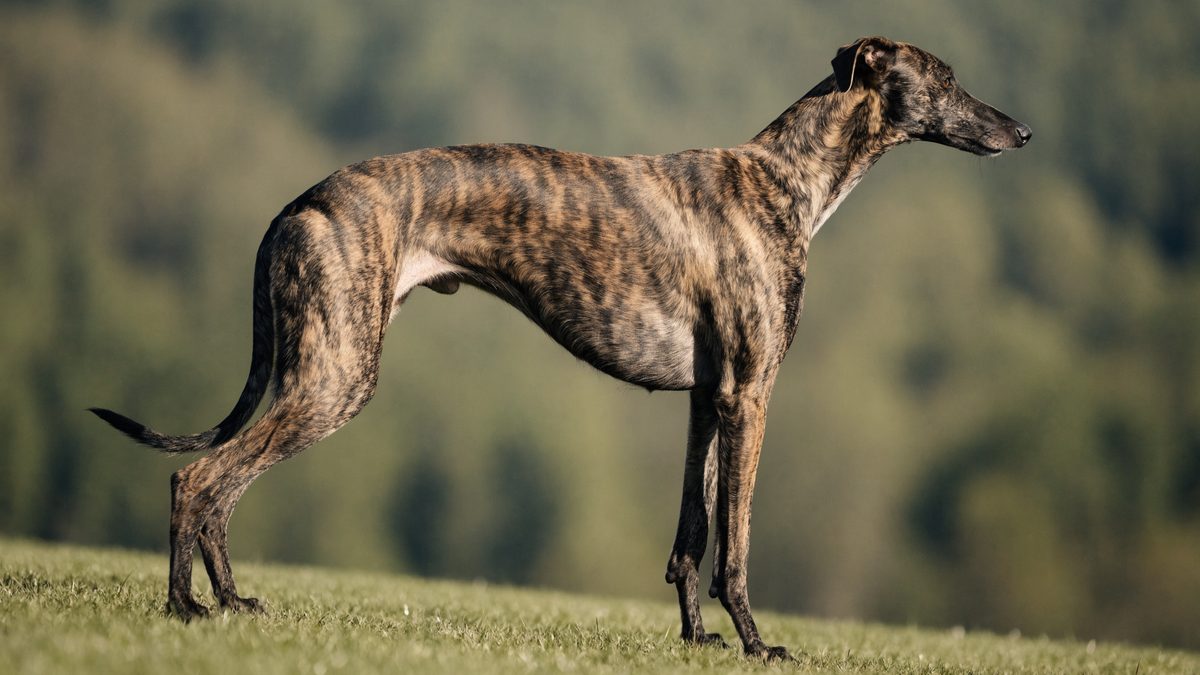
The Greyhound is a large short-coated sighthound standing 71 to 76 cm at the shoulder for dogs and 69 to 71 cm for bitches, built for high-speed pursuit by sight and now kept mainly as a quiet house companion. In India the word carries a second meaning, because the Rampur Greyhound is a separate Indian breed, and a buyer searching for one will be shown pages about the other.
Start with the breed standard, because it is the only description that is not marketing. The Kennel Club standard gives an ideal height of 71 to 76 cm (28 to 30 inches) for dogs and 69 to 71 cm (27 to 28 inches) for bitches, and describes a dog that is strongly built and upstanding with a long head and neck, a deep chest, a slightly arched loin and powerful quarters. The American Kennel Club standard adds weight, at 65 to 70 pounds for dogs and 60 to 65 pounds for bitches, and specifies a coat that is short, smooth and firm in texture.
The FCI standard adds the formal classification and one number the kennel clubs leave out. The Greyhound sits in Group 10, Sighthounds, Section 3, Short-haired sighthounds, with its origin recorded as Great Britain, and its ideal height given as 71 to 76 cm for males and 68 to 71 cm for females. That female figure differs by a centimetre from the Kennel Club's 69 to 71 cm, which is worth knowing only because it shows how narrow the genuine disagreement between standards is next to the disagreement between Indian sales pages.
Two details in those standards do more work than anything else on this page. Colour is immaterial under the AKC standard, which means the black, blue or brindle premium that Indian sellers charge has no basis in the breed standard at all. And the coat is short and firm, which means any Indian page telling you a Greyhound needs professional trimming is describing a different dog.
The top-ranking Greyhound sales page in India answers its own FAQ with "Greyhound have dense, curly coats that need trimming every 4-6 weeks to prevent matting";. Both breed standards describe a short, smooth, close coat The Kennel Club (Royal Kennel Club). A Greyhound has never needed a clipper in its life. Treat that page's grooming advice as boilerplate pasted from a different breed, and read its price tables with the same suspicion.
The English Greyhound against the Indian sighthounds
Bonbeno publishes six Indian sighthound pages, and the confusion between them and the English Greyhound is the single biggest source of bad buying decisions in this category. The Rampur Greyhound is an Indian breed from Rampur in Uttar Pradesh, developed by the Nawabs of Rampur from Tazy stock crossed with the English Greyhound, so the two breeds are related but are not the same animal. The Mudhol Hound from Bagalkot district in Karnataka is a third distinct breed again.
The practical difference is money and climate. Published Indian prices for the English Greyhound run from Rs 60,000 for a single listing to Rs 90,000 up to Rs 3,50,000 and beyond from the largest seller on the query. Published Rampur Greyhound prices on the same search results page run Rs 3,000 to Rs 12,000 for pet quality and Rs 15,000 to Rs 30,000 for show quality. That is a gap of up to Rs 3,38,000 between two dogs that a casual buyer would struggle to tell apart in a photograph.
| Breed | Height at withers | Weight | What settles it |
|---|---|---|---|
| Greyhound (English) | Dogs 71 to 76 cm, bitches 69 to 71 cm | Dogs 65 to 70 lb, bitches 60 to 65 lb | Largest of the four. Rose ears, deep chest, long tapering tail carried low |
| Whippet | Dogs 47 to 51 cm, bitches 44 to 47 cm | Not specified in the standard | Roughly two-thirds the height of a Greyhound. Same outline, much smaller frame |
| Italian Greyhound | 32 to 38 cm | 3.6 to 4.5 kg | A toy dog. The standard literally calls it a greyhound in miniature |
| Rampur Greyhound | 60 to 75 cm as published in India | 22 to 30 kg as published in India | Indian breed, sold at a fraction of the imported price, native to the North Indian plains |
A puppy sales page titled Italian Greyhound Puppies For Sale lists Height 27-30 inches, Weight 27-40 kg and Origin England in its specification panel. The Kennel Club standard for the Italian Greyhound gives 32 to 38 cm and 3.6 to 4.5 kg. The published weight is roughly seven to ten times the correct figure, because it is the English Greyhound's weight. Verify height and weight against a kennel club standard before you verify anything else.
History, in one honest paragraph
The Greyhound is old, and the exact age is contested rather than known. The American Kennel Club dates the first knowledge of the breed to the Tomb of Amten in the Valley of the Nile, which Egyptologists assign to the Fourth Dynasty, between 2900 and 2751 BC. The FCI is more cautious and more generous at once, recording that experts are not unanimous, that the breed could have had its origins in the Middle East, and that drawings of Greyhound-type dogs appear on Ancient Egyptian tomb walls dating as far back as 4000 BC, while noting that it was in Britain that the type was developed to a standard. The breed was recognised by the AKC in 1885 alongside fourteen others, and the Greyhound Club of America was established in 1907. Bonbeno will not repeat the claim that the Greyhound is the oldest purebred dog, because that claim is asserted far more often than it is evidenced.
Indian sellers quote up to 72 km/h and 45 mph without citing a timing. The FCI standard gives a measured figure: only the cheetah tops the Greyhound for speed, and one racing Greyhound was clocked at over 45 mph. A general reference records peak racing speeds of at least 69 km/h, about 43 mph, with typical winning speeds of roughly 58 to 61 km/h. So the Indian 72 km/h claim is at the outer edge of what has been recorded rather than a routine figure, and typical is closer to 60 km/h.
What is not contested is the function. The AKC describes the breed as the essence of form following function, from the narrow aerodynamic skull to the shock-absorbing pads of the feet, and notes that the hare is the Greyhound's natural quarry. Everything difficult about keeping one in an Indian flat follows from that single sentence.
What a Greyhound is like to live with
The temperament in both standards is unusually consistent. The Kennel Club describes the breed as intelligent, gentle, affectionate and even-tempered, with remarkable stamina and endurance. The AKC calls it gentle, noble and sweet-tempered with an independent spirit. Indian sources describe the same dog, with one calling Greyhounds surprisingly lazy indoors and another reporting that they spend the bulk of the day sleeping.
- Quiet indoors, to the point that Indian sellers market the breed as apartment-friendly.
- Independent by breeding, because the breed was developed to course game by sight and make its own decisions without human direction.
- Reserved with strangers while being very affectionate with its own family.
- Low-shedding and short-coated, needing little more than regular baths and weekly rubdowns with a damp cloth or hound glove.
- Unsafe off lead in open ground, and only to be let off in a securely fenced area.
The last point is the one that decides whether this breed works for you in India. A Greyhound that sees a cat across a Bengaluru park is not disobeying you. It is doing the job it was bred for, at a speed you cannot follow, across roads you cannot control.
Greyhound price in India, and why published figures disagree by Rs 3,25,000
The Greyhound price in India runs from Rs 25,000 to Rs 3,50,000 and beyond across published sources in 2026, a spread of more than Rs 3,25,000 for the same breed. That gap is not inflation and it is not city variation. It is caused by three different things being priced under one word, and the first job of any buyer is to work out which one is on offer.
Here is every published Indian figure Bonbeno could verify for this breed, printed as found. No averaging, because averaging a Rs 25,000 floor against a Rs 3,50,000 ceiling produces a number that describes no real dog.
| Source | Published price | What is being priced |
|---|---|---|
| Happy Pet Care | Rs 25,000 to Rs 60,000 | Stated as cost of buying, with no quality tier given |
| Asia Pets, single listing | Rs 60,000 | One advertised puppy, described as unvaccinated at the time of listing |
| Mr n Mrs Pet, basic quality | Rs 90,000 to Rs 1,50,000 | Purebred pet, no show or breeding rights |
| Mr n Mrs Pet, KCI registered | Rs 1,50,000 to Rs 2,50,000 | Kennel Club of India certification, verified lineage, vet health check |
| Mr n Mrs Pet, champion bloodline | Rs 2,50,000 to Rs 3,50,000 | Imported or award-winning parents |
| Mr n Mrs Pet, headline range | Rs 90,000 to Rs 3,50,000+ | The same figure quoted for Hyderabad, Bangalore, Delhi, Chennai, Lucknow, Mumbai, Jaipur and Pune |
What actually drives the spread
Three separate factors explain almost all of it, and only one of them is about the dog.
- Breed identity. Some of the low figures are not English Greyhound prices at all. On the same search results page, the Rampur Greyhound is quoted at Rs 3,000 to Rs 12,000 for pet quality and Rs 15,000 to Rs 30,000 for show quality. Another page ranking on this query is a round-up of twenty native Indian breeds grouped by type, including sighthounds, rather than an article about the English Greyhound at all. A Rs 25,000 quote sits closer to the Indian breed's band than to the imported breed's.
- Registration. The Kennel Club of India publishes its own registration forms and a revised tariff sheet, and registration is a paperwork process with a published fee. The Rs 60,000 to Rs 1,00,000 jump between a basic-quality and a KCI-registered puppy quoted by one seller is far larger than any registration tariff, so most of it is priced lineage rather than priced paperwork.
- Import cost. The champion-bloodline tier is explicitly described as coming from imported or award-winning parents. India has no meaningful domestic Greyhound population to breed from, and that scarcity, not any measurable quality difference, is what the top tier prices.
Indian sellers list Brindle, Black, White, Black and White, Fawn, Blue and Blue and White as separate varieties. The AKC standard for the Greyhound records colour in one word: immaterial. The Kennel Club standard permits black, white, red, blue, fawn, brindle or any of these broken with white. No colour is rare, no colour is superior, and any price uplift for coat colour is invented.
City-wise pricing, and why the tables are not real
The largest seller on this query publishes an identical Rs 90,000 to Rs 3,50,000 band for all eight cities it names, including Hyderabad, Bangalore, Delhi, Chennai, Lucknow, Mumbai, Jaipur and Pune. A city table where every row holds the same number is not city data. Treat published city-wise Greyhound pricing in India as a template rather than as evidence, and ask instead where the specific puppy was bred.
For contrast, the same-SERP Rampur Greyhound guide does vary its city figures, quoting Rs 3,000 to Rs 14,000 for Mumbai against Rs 2,000 to Rs 9,000 for Lucknow. Whether those numbers are observed or estimated is not stated, so Bonbeno reports them as published claims and not as market data.
What no Indian source publishes about this breed
There is no published count of Greyhounds registered with the Kennel Club of India, no Indian breed club, and no Indian breed survey. That absence matters more than any price table. In the United Kingdom, by contrast, Greyhounds made up 5,419 of 905,544 dogs under primary veterinary care in a single year, or 0.60 percent of the population. India has no comparable figure at all, so nobody, including Bonbeno, can tell you how many Greyhounds are in the country or how many change hands each year.
We report published price ranges as editorial content. We do not broker sales, we do not recommend breeders, and none of the figures above is an offer. If you are quoted a Greyhound at Rs 20,000, the most likely explanations are that it is a Rampur Greyhound, a Rampur cross or a lurcher-type dog rather than an imported English Greyhound. That is not necessarily a worse dog for India. It is simply a different one, and you should know which you are buying.
Monthly cost of keeping a Greyhound in India
Published Indian monthly cost figures for a Greyhound run from Rs 4,900 to Rs 10,000, and both ends of that range leave out the two line items that actually distinguish this breed. Budget the published food, vet and grooming numbers, then add dental care and secure running access, because the breed's own disease profile makes the first non-negotiable and its prey drive makes the second unavoidable.
| Line item | Published monthly cost | Source |
|---|---|---|
| Food | Rs 3,000 to Rs 4,500 | Happy Pet Care |
| Veterinary | Rs 1,200 to Rs 1,950 | Happy Pet Care |
| Grooming | Rs 700 to Rs 1,200 | Happy Pet Care |
| Total, basic lifestyle | Rs 4,900 | Happy Pet Care |
| Total, premium lifestyle | Rs 7,650 | Happy Pet Care |
| Total, seller estimate | Rs 8,000 to Rs 10,000 | Mr n Mrs Pet |
Two sources, two answers, and the gap is about Rs 5,000 a month or Rs 60,000 a year. Neither source shows its working, so treat both as order-of-magnitude guidance rather than a budget.
The grooming line is too high and the dental line is missing
A Greyhound has a short, smooth, close coat The Kennel Club (Royal Kennel Club) that needs little more than regular baths and weekly rubdowns with a damp cloth or hound glove. The Rs 700 to Rs 1,200 monthly grooming figure is what a double-coated dog costs, and the comparable published figure for the short-coated Rampur Greyhound is Rs 100 to Rs 300 a month. You can safely reduce the grooming line and move the money to teeth.
That is not a rhetorical flourish. In the largest study of the breed available, periodontal disease was the single most prevalent recorded disorder in Greyhounds under primary veterinary care, at 39.0 percent (95 percent CI 37.2 to 40.9). The scale of that becomes clear next to other large breeds in the same dataset, where dental disease affected 4.1 percent of German Shepherd Dogs and 3.1 percent of Rottweilers. A separate UK study of 22,333 dogs found the Greyhound among the four breeds with the highest adjusted odds of periodontal disease, at 2.58 times the baseline (95 percent CI 1.75 to 3.80). Published Indian dental treatment costs run Rs 3,000 to Rs 15,000 per cleaning or extraction episode. A toothbrush is cheaper.
The AKC advises brushing a Greyhound's teeth regularly, daily if possible, with a toothpaste formulated for dogs. Against a 39 percent recorded prevalence of periodontal disease in the breed, a two-minute daily habit is the highest-return thing you will do for this dog, and it costs under Rs 500 a year. Daily brushing with a dog-specific toothpaste can prevent or reduce the severity of future dental disease, and is described as especially important for the breeds identified at high risk.
Dental disease normally tracks small size. In the same 22,333-dog study, dogs under 10 kg carried 3.07 times the risk of dogs weighing 30 to 40 kg, and four large or medium breeds showed reduced risk against crossbreeds: the German Shepherd Dog at 0.25 times, the French Bulldog at 0.43, the Staffordshire Bull Terrier at 0.45 and the Labrador Retriever at 0.49. The Greyhound sits at 2.58 times while weighing about 30 kg, which is the opposite of what its size predicts. Treat this as a breed problem rather than a general large-dog problem, and act on it from the first year.
The India-specific line nobody budgets: somewhere to run
The AKC is explicit that Greyhounds require a regular schedule of exercise and opportunities to safely run full out, and that they must only be allowed off leash in a securely fenced area. In an Indian metro, securely fenced open ground is not free. It is a paid dog park, a rented farmhouse lawn, a gated society ground with permission, or a long drive. Price that access before you buy, because it is the one cost that has no cheap substitute and no published Indian figure.
First-year and one-off costs
Published Indian vaccination costs for a large-breed puppy are consistent across sources: Rs 500 to Rs 1,000 per DHPPi dose across three doses, Rs 300 to Rs 800 for anti-rabies at 16 weeks, Rs 500 to Rs 1,000 for kennel cough, then Rs 1,000 to Rs 2,000 for annual boosters, Rs 100 to Rs 300 per deworming dose every three months, and Rs 200 to Rs 500 a month for tick and flea prevention. Neutering or spaying is published at Rs 5,000 to Rs 15,000.
Gonadectomy is the exact surgery in which delayed postoperative bleeding was measured in this breed. In a double-blinded randomised trial of 100 retired racing Greyhounds undergoing elective ovariohysterectomy or orchiectomy, 30 percent of the placebo group bled 36 to 48 hours after surgery. Read the health section before you schedule it, and take that paper's finding to the clinic with you.
| Condition | Published Indian cost | Why it matters for a Greyhound |
|---|---|---|
| Dental cleaning or extraction | Rs 3,000 to Rs 15,000 per episode | Periodontal disease recorded in 39.0 percent of the breed |
| Bloat or gastric torsion surgery | Rs 30,000 to Rs 80,000 | The AKC names the Greyhound as susceptible, as with most deep-chested breeds |
| Tick-borne disease treatment | Rs 5,000 to Rs 20,000 | Common across India, and a thin-coated dog offers ticks easy access |
| Skin infection episode | Rs 500 to Rs 5,000 | Wounds were the third most common recorded disorder in the breed at 6.2 percent |
One more cost that is easy to miss. Overgrown nails were the second most prevalent disorder recorded in Greyhounds under veterinary care, at 11.1 percent, and claw injury the fifth at 4.2 percent. The AKC notes that a Greyhound's strong, fast-growing nails must be trimmed regularly if not worn down naturally, because overly long nails cause the dog discomfort. A pair of clippers and a monthly reminder cost almost nothing and remove one in nine of the breed's recorded veterinary problems.
Heat tolerance, the Indian climate, and the one Greyhound-specific study
Bonbeno rates the Greyhound 3 of 5 for heat tolerance, and the population evidence argues that rating is generous. The thin coat sheds heat well at rest, but the breed carries almost no subcutaneous fat, generates enormous heat when it sprints, and it is one of the nine breeds UK primary-care records flag at significantly raised odds of heat-related illness. The Siberian Husky, modelled in that same table, was not flagged, so the usual reassurance that a short coat beats a double coat does not survive contact with the data here. The breed is also the subject of the only published study measuring body temperature in working sighthounds, which is the most useful thing an Indian owner can read before an April morning.
Deal with the resting dog first, because that is most of the day. A short, smooth, close coat over a lean frame with a very large surface area is a reasonable radiator. This is not an Arctic breed. It does not carry a dense undercoat, and the coat is described in both standards in three words: short, smooth, fine and close The Kennel Club (Royal Kennel Club). Purina India's list of breeds at particular heat stroke risk names short-faced breeds and dogs with heavy coats such as Huskies or Newfoundlands, and the Greyhound belongs to neither group.
What the population evidence says, and what it does not
The largest study of heat-related illness in dogs covered 905,543 UK dogs under primary veterinary care and identified 395 confirmed events, giving an incidence of 0.04 percent and an event fatality rate of 14.18 percent (95 percent CI 11.08 to 17.96). Nine breeds carried significantly higher odds of heat-related illness than the Labrador Retriever, and the Greyhound is one of them, at an odds ratio of 4.26, 95 percent confidence interval 1.88 to 9.70, p = 0.001. Only four breeds ranked above it, the Chow Chow at 16.61, the Bulldog at 13.95, the French Bulldog at 6.49 and the Dogue de Bordeaux at 5.31, and it ranked above the Cavalier King Charles Spaniel, the Pug, the English Springer Spaniel and the Golden Retriever. The same model also flagged dogs heavier than their breed and sex mean, dogs over two years of age, brachycephalic dogs and dogs over 50 kg. Be precise about what this does and does not mean. That study counted heat-related illness of all types together, most of it environmental, so it is not only a statement about the running dog, which the exercise section below answers separately and less comfortably.
This is not a breed the study was too small to measure. Both papers drew on the VetCompass 2016 cohort of UK dogs under primary veterinary care, reported as 905,543 dogs in the heat study and 905,544 in the breed study, in which Greyhounds numbered 5,419, or 0.60 percent. The breed was numerous enough to model, it was modelled, and it came out at 4.26 times the Labrador Retriever's odds. What makes that figure awkward is that the usual explanations do not fit. Mean adult bodyweight in that Greyhound population was 29.7 kg, well under the 50 kg band the study flagged, and the breed is neither flat-faced nor heavy-coated. The breed odds ratio is already adjusted for age and for bodyweight relative to the breed and sex mean, so it is not simply restating those factors. A lean, long-muzzled, short-coated dog still carried four times the reference breed's odds, which is the opposite of the reassurance the coat description invites.
That is the good news, and it stops the moment the dog runs.
The racing Greyhound heat study, and what 38 C means in India
One study has measured what happens to a Greyhound's body temperature when it works in heat. Researchers took rectal temperatures before and after racing from 229 greyhounds across 46 race meetings at seven venues in South Australia, with ambient temperature at race time ranging from 11.0 to 40.8 C and relative humidity from 17 to 92 percent. The findings translate directly to an Indian afternoon.
- Mean rise in rectal temperature after a single race was 2.1 C, with a range of 1.1 to 3.1 C.
- At an ambient temperature of 38 C, 39 percent of dogs finished with a rectal temperature above 41.5 C.
- Dogs that exceeded 41.5 C had raced at a significantly higher mean ambient temperature, 31.2 C against 27.3 C for those that stayed below it (P = 0.004).
- Over half of post-race urine samples were positive for haemoglobin or myoglobin, and of 77 positive samples, 95 percent were confirmed positive for myoglobin.
- Dark greyhounds heated more than light ones. The mean rise in rectal temperature was greater in black, blue and brindle dogs than in fawn and white dogs.
Read the second bullet against Indian weather. An ambient temperature of 38 C is an ordinary March to June afternoon across most of northern, central and western India, and it is a temperature at which Indian veterinary guidance already classifies outdoor activity as contraindicated for any dog. Purina India puts the heat stroke threshold at a body temperature of 40.5 C or above, which is a full degree below the 41.5 C mark that 39 percent of those racing dogs crossed.
A Greyhound at rest in Indian heat is a moderate-risk dog. A Greyhound sprinting in Indian heat is a high-risk dog, and the evidence for that is measured rather than assumed. The breed's whole appeal is the sprint, which means the risk is created by exactly the thing you bought the dog for. Move the running to before 7 am, all year.
Temperature bands for an Indian owner
| Ambient temperature | Risk level | What to do with a Greyhound |
|---|---|---|
| Below 28 C | Low | Normal activity. This is the only band in which a hard free run is sensible |
| 28 to 35 C | Moderate | Shorten the walk to 15 to 20 minutes, early morning or late evening only. No sprinting |
| 35 to 42 C | High | Outdoor activity contraindicated. Asphalt reaches 60 C and burns paw pads within about 30 seconds |
| Above 42 C | Extreme | Indoors with continuous cooling. Even brief balcony or terrace exposure is dangerous |
Humidity changes the arithmetic. Panting works by evaporation, and coastal Indian humidity approaching 90 percent renders it far less effective, which is why a 33 C day in Chennai or Kolkata loads a dog harder than the thermometer suggests. The greyhound study covered humidity from 17 to 92 percent and still found the strongest association with ambient temperature rather than humidity, so do not treat a humid but cooler morning as safe by default.
- Walk only before 7 am or after 8 pm from April to September, and cap the walk at 15 to 20 minutes even then.
- Run the 7-second pavement test before every walk. If the back of your hand cannot stay on the surface for seven seconds, it will burn paw pads.
- Choose grass or dirt over asphalt, which is 10 to 15 C cooler in direct sun.
- Never leave the dog in a parked car. At an outside temperature of 26 C the inside of a car reaches 32 C in five minutes and 43 C in 25 minutes.
- Never confine the dog to a balcony above 30 C.
- Cool with cool but not cold water applied to the skin, especially the belly and inside of the legs, and use a fan. Do not use an ice bath, which prevents core temperature falling.
- Stop cooling at 39.4 C to avoid overshooting into hypothermia, then go straight to a vet.
Sunburn, the risk a short coat actually creates
Heat gets all the attention and sunburn gets none, which is the wrong way round for this breed. Dogs with short, thin coats, light-coloured or white fur and areas of exposed or lightly pigmented skin are vulnerable to UV damage, and the areas most commonly affected are the nose, ear tips, belly and the skin around the eyes. A fawn or white Greyhound lying belly-up on a sunlit Indian terrace is close to a worked example.
There is a neat way to see why this matters. Indian summer guidance repeatedly warns owners not to shave a coated dog, because the coat provides protection against the sun as well as insulation Voice of Stray Dogs (VOSD). A Greyhound is already in the state that advice is trying to prevent, permanently, by breeding. It has no coat to lose and no undercoat to shade its skin.
The signs are redness and tenderness of exposed skin, dry flaking or peeling particularly on the nose and ear edges, blistering in severe cases, and discomfort when the area is touched. Repeated or severe sunburn raises the risk of squamous cell carcinoma in chronically sun-exposed areas, and Indian UV intensity makes that a practical rather than theoretical concern. Prevention is limiting exposure during peak UV hours, providing shade, and using a veterinarian-approved dog-safe sunscreen on exposed areas in lightly pigmented dogs.
The interior of a parked car in Indian summer sun can reach 50 to 60 C within minutes, even with windows partially open, which is well above the 43 C that a UK-derived figure gives for 25 minutes at a 26 C ambient. Indian guidance also puts heatstroke onset at 15 to 30 minutes in a parked car or during vigorous exercise in peak heat, and recommends walking before 8 am while avoiding 11 am to 4 pm entirely in the hottest weeks.
The cold problem, which India also has
This breed loses heat far faster than it looks like it should, and that is documented rather than folkloric. The published review of sighthound anaesthesia identifies lean body conformation with a high surface-area-to-volume ratio as a specific predisposition to hypothermia. The mechanism does not switch off outside theatre. A Delhi, Lucknow or Chandigarh January, a Pune winter morning, or an aggressively air-conditioned bedroom in Mumbai will all chill a Greyhound before they chill a Labrador.
Indian sources report the same behaviour from the other direction, with one noting that Greyhounds are sensitive to cold temperatures and another advising that senior Greyhounds be kept warm and given a comfortable bed to protect a bony frame. Buy a coat, put a thick bed on the floor rather than tiles in winter, and do not let a Greyhound sleep directly under an air conditioner.
Temperament and household fit
A Greyhound is a quiet, gentle, affectionate house dog with one hard constraint: a prey drive that switches on faster than you can react. Both breed standards describe an even-tempered and undemanding companion, and every Indian source agrees the breed is calm indoors. The households where it fails are the ones with a resident cat, an unfenced garden, or an owner who expects obedience rather than partnership.
The Kennel Club standard gives the temperament in five words: intelligent, gentle, affectionate and even-tempered. The AKC describes a gentle, noble and sweet-tempered companion with an independent spirit, very affectionate with its family and reserved with strangers. Indian pages describe the same dog from the sales side, calling it quiet, patient and gentle with children, and calm and affectionate at home.
The couch potato claim, tested
Indian sellers market this breed as a couch potato, one calling Greyhounds 45-mph couch potatoes and another calling them 70 km/h couch potatoes. The claim is broadly true and the framing is misleading. The AKC agrees the breed is perfectly happy to lounge around the house all day, and in the same paragraph says it is capable of amazing speed and energy when faced with potential prey. The dog is calm because it is conserving. It is not calm because it is low-drive.
A Greyhound has a strong instinct to chase, and while many can be taught not to chase cats and small pets through early socialisation, careful introductions and supervised interactions, some will always retain a high prey drive. The hare is the breed's natural quarry. In an Indian residential colony the practical equivalent is a community cat, a chicken, a scooter or a running child. Assume the drive is present, and manage the environment rather than trusting the training.
Who should buy this breed in India
- Households with securely fenced private ground, or reliable paid access to some, because off-lead running is only safe in a fully enclosed area.
- Owners who want a quiet indoor dog and are willing to accept a dog that is reserved with strangers rather than a greeter.
- People who can commit to a strictly early-morning and late-evening routine from April to September.
- Owners who will find and brief a vet in advance, because the breed's bloodwork, anaesthesia and bleeding profile need a clinician who has read about them.
Who should not
- Homes with cats, rabbits or free-ranging poultry, unless you accept permanent separation as the management plan.
- Anyone who wants a guard dog. The standard describes an even-tempered dog reserved with strangers, and the breed is a sighthound rather than a protection breed.
- Anyone who wants a dog that will come back when called off lead in open ground.
- First-time owners on a tight budget. An imported Greyhound starts at Rs 90,000 from the largest Indian seller, and the veterinary complexity is above average.
Apartment living, honestly assessed
Indian sellers rate the breed apartment friendliness as High and one source states that as long as they get their daily exercise, Greyhounds are well suited to urban apartment living. Bonbeno's assessment is more qualified. A Greyhound is quiet enough and clean enough for a flat, and it will sleep most of the day. The problem is not the flat, it is the ground floor. A dog this size that must be walked on a lead through a crowded society compound, with a prey drive that reacts to a cat at 40 metres, needs a handler who can physically hold 30 kg of accelerating dog.
In some countries retired racing Greyhounds are required to wear a muzzle in public because of their racing history and prey drive, with muzzle exemption available after behavioural assessment. India has no such breed-specific requirement. That is not a reason to skip a muzzle. A basket muzzle on a Greyhound in a shared Indian space is a considerate piece of equipment, not an admission of aggression, and it lets the dog exist safely around community animals.
One last point on children. Indian sources describe Greyhounds as gentle and patient with children while advising supervision to avoid accidental injuries. The AKC advises socialising a Greyhound from an early age with small animals and children. The risk here is collision rather than aggression. A 30 kg dog accelerating across a room will knock over a small child without any intent at all.
Training a Greyhound, and the one command that will never be reliable
Train a Greyhound with short, gentle, reward-based sessions and accept from day one that off-lead recall will not be reliable. The AKC states plainly that training this breed frustrates anyone who does not understand its genetic origins, because a sighthound was developed to course game independently of humans and make its own decisions. Everything that works with this breed follows from that.
Here is the AKC's own framing, which is the most useful paragraph published on Greyhound training anywhere. As a sighthound, or coursing breed, the Greyhound was developed to pursue game by sight rather than by scent, and courses game independently of humans, making decisions on its own, unlike hunting breeds that require direction. That is not a personality quirk. It is several centuries of selection against taking instructions at distance.
What works
- Keep sessions short. The AKC advises short and sweet lessons because the Greyhound becomes bored very easily. Five minutes twice a day beats twenty minutes once.
- Use a gentle approach, never harsh. The breed has a mild, sensitive personality and needs it. Harsh correction produces shutdown rather than compliance in a sensitive sighthound.
- Reward with partnership, not obedience. Greyhounds are more interested in doing things with you than for you. Frame training as a shared activity and it moves faster.
- Socialise early and specifically. Socialise from an early age with small animals and children. In India, add scooters, autos, cattle, community dogs and firecrackers to that list.
- Train on lead, always. Every recall repetition happens on a long line until you have a fully fenced space, because the failure mode of an off-lead recall in traffic is fatal.
What the breed resists
Recall in open ground is the honest answer, and no amount of Indian training-school marketing changes it. The AKC's instruction is unambiguous: Greyhounds must only be allowed off leash in a securely fenced area, because they may not be able to resist the urge to run off in pursuit of perceived prey. Bonbeno's position is that a Greyhound owner in an Indian city should treat off-lead walking outside a fenced enclosure as a decision never to be made, rather than a goal to work towards.
The AKC calls the Greyhound the fastest breed of dog without publishing a figure. Indian sources put it at up to 72 km/h and describe the breed as 45-mph couch potatoes, though neither cites a timed measurement, so Bonbeno reports both as claims rather than as data. Whatever the exact number, a dog that clears 40 metres before you finish saying its name is out of a residential lane and onto a main road in under five seconds. That is why the fencing rule is absolute rather than cautious.
Realistic timelines for an Indian household
| Stage | Realistic goal | What will not happen yet |
|---|---|---|
| Weeks 1 to 4 at home | Name response indoors, crate or bed settling, toilet routine, lead acceptance | Anything reliable outdoors |
| Months 2 to 4 | Sit, down, wait at doors, loose-lead walking in a quiet lane, calm passing of community dogs | Recall past a moving cat |
| Months 4 to 12 | Solid on-lead manners, muzzle acceptance, vet handling, tolerance of grooming and nail trims | Off-lead reliability in open ground |
| Year 2 onwards | Recall inside a fully fenced space, controlled free running, settled household routine | Off-lead reliability in open ground, at any age |
That last row is not pessimism. It is the same instruction the AKC gives, written out as a timeline so that nobody plans around a milestone that will not arrive.
Two training items specific to this breed in India
Muzzle training is a kindness, not a punishment. Teach basket-muzzle acceptance in the first six months using food, while the dog is young and flexible. In a country where community dogs and cats share every street with pets, a muzzled Greyhound can be walked in places an unmuzzled one cannot.
Veterinary handling is a training goal. This breed needs more blood draws than most, because interpreting its bloodwork correctly means establishing patient-specific baseline values through preventive care testing. A dog that stands calmly for a jugular sample is a dog whose vet can actually do the job. Train for it deliberately.
How much exercise a Greyhound actually needs
Give a Greyhound two walks of 20 to 30 minutes a day plus regular access to a securely fenced space where it can sprint, and it will sleep through the rest. The daily distance requirement is modest by large-breed standards, and the sprint requirement is not optional. In India the whole schedule has to fit before 7 am and after 8 pm for half the year.
Published figures agree more than usual on this breed. One Indian source specifies two 20 to 30 minute walks daily, rates the energy level medium and notes that Greyhounds spend the bulk of the day snoozing. Another Indian page gives 30 minutes to one hour daily at a moderate energy level. The AKC adds the part the Indian pages leave out, that Greyhounds require a regular schedule of exercise time and opportunities to safely run full out.
| Source | Stated requirement | Energy rating given |
|---|---|---|
| Happy Pet Care | Two walks of 20 to 30 minutes | Medium |
| Puppiezo specification panel | 30 minutes to 1 hour daily | Moderate |
| American Kennel Club | Regular schedule plus chances to run full out in a securely fenced area | Not rated numerically |
Walking is not the same as running, and this breed needs both
A Greyhound that only ever walks on a lead is under-exercised in a way that does not show up as hyperactivity. The AKC calls the breed the cheetah of the dog world and pairs the lounging description with the sprint requirement in the same paragraph. A sprint is short. Two or three flat-out runs of thirty seconds each, twice a week, satisfies more of this dog than an extra hour of pavement.
That is genuinely good news for an Indian owner, because thirty seconds of sprinting is easier to schedule than two hours of walking. It is also the exact activity that carries the heat risk, which is why timing beats everything.
In the only study measuring the effect, a single race raised rectal temperature by a mean of 2.1 C, and at an ambient temperature of 38 C, 39 percent of dogs finished above 41.5 C. Purina India warns that a dog can develop heat stroke in as little as 30 minutes of vigorous exercise in hot weather. Sprint work belongs before 7 am, on grass, in the cool months, and never at all above 35 C ambient.
A workable Indian week
- Two lead walks a day, 20 to 30 minutes each, before 7 am and after 8 pm from April to September.
- Two fenced free-run sessions a week, 15 to 20 minutes each with two or three voluntary sprints inside them, in a fully enclosed space.
- Grass or dirt underfoot wherever possible, because asphalt runs 10 to 15 C hotter in direct sun and reaches 60 C in the danger band.
- A warm-up walk before any sprint, then a walk to cool down, so a lean sighthound never goes from standing to flat out on cold muscle.
- Rest days after hard running, particularly for dogs over seven, given that osteoarthritis was recorded in 4.6 percent of Greyhounds under veterinary care.
What happens without it
Under-exercised Greyhounds do not typically become destructive in the way an under-exercised working breed does. They become fat and stiff, and both matter. Higher bodyweight relative to the breed and sex mean was a significant risk factor for heat-related illness across 905,543 dogs, and dogs weighing heavier than their breed average carried 1.65 times the risk of osteosarcoma. In a breed whose recorded mean adult bodyweight is 29.7 kg, letting a Greyhound put on four or five kilos moves it into two separate risk categories at once.
There is no published Indian directory of secure off-lead spaces and Bonbeno will not invent one. What exists in practice is fenced society grounds with committee permission, private paid dog parks in the larger metros, school or club grounds outside hours, and farmhouse plots on city outskirts. Check the fence line yourself, walk the whole perimeter, and look for the gap at the gate. A Greyhound will find it before you do.
Grooming a Greyhound in Indian humidity
Grooming a Greyhound takes about ten minutes a week, and the time is better spent on feet, nails and teeth than on the coat. The coat is short, smooth and close, needs no trimming at any point in the dog's life, and sheds lightly. Everything that goes wrong on this breed goes wrong below the ankle or inside the mouth.
The coat requirement is settled by the breed standards, which describe it as short, smooth and firm in texture and as fine and close. The AKC's full grooming instruction for the coat is one sentence: regular baths and weekly rubdowns with a damp cloth or hound glove. Indian sources agree, rating the breed low shedding and noting it has very little doggy odour and needs only weekly brushing.
The highest-ranking Greyhound sales page in India tells buyers the breed has dense curly coats needing trimming every four to six weeks, and claims that regular grooming keeps them cool in Indian weather. That is a different breed's copy pasted into a Greyhound page. There is nothing on a Greyhound to trim The Kennel Club (Royal Kennel Club). If a groomer quotes you Rs 1,500 for a Greyhound trim, they have not seen one.
The weekly routine, in order of importance
- Brush the teeth daily. The AKC advises brushing regularly, daily if possible, with dog toothpaste, and periodontal disease is the most prevalent recorded disorder in the breed at 39.0 percent.
- Check the paw pads daily. Paw pad corns are a breed-characteristic problem, and 90 percent of them occur on digits three and four, and 90 percent on the front limbs. Look at those four toes specifically.
- Trim the nails every two to three weeks. Overgrown nails were the second most prevalent recorded disorder in the breed at 11.1 percent and claw injury the fifth at 4.2 percent. Overly long nails cause the dog discomfort.
- Check the ears weekly for wax or debris that could cause infection, and clean only if needed.
- Rub the coat down weekly with a damp cloth or hound glove, and bathe only when the dog is actually dirty.
- Run a tick check after every walk during and after the monsoon, because tick-borne disease treatment in India is published at Rs 5,000 to Rs 20,000 per episode.
Skin and wounds in Indian conditions
Wounds were the third most prevalent disorder recorded in Greyhounds under primary veterinary care, at 6.2 percent (95 percent CI 5.3 to 7.1). That figure sits alongside claw injury at 4.2 percent, and together they describe a dog that arrives at the clinic with physical damage more often than most breeds. There is a documented structural reason: sighthounds have thinner skin than most breeds, with less cushioning of the pads. A thin, heat-sensitive skin over a lean frame gives less padding against thorns, gates, kennel edges and other dogs.
In Indian humidity a small wound turns into a skin infection quickly, and published Indian treatment costs run Rs 500 to Rs 5,000 per episode. The practical routine is to run your hands over the whole dog once a week, feel for scabs and lumps you cannot see through the short coat, and clean and dress anything you find the same day rather than watching it.
A short-coated dog does not need frequent bathing, and over-bathing strips the coat oils that keep Indian skin problems at bay. Bathe when dirty, dry thoroughly in the skin folds behind the elbows and between the thighs, and never leave a Greyhound damp under a fan in a humid coastal city. Wiping down with a damp cloth handles most of what a bath would.
What grooming should cost in India
Almost nothing. The published Indian grooming figure for a short-coated sighthound is Rs 100 to Rs 300 a month, against the Rs 700 to Rs 1,200 a month quoted for the Greyhound by an Indian breed guide. A hound glove, a nail clipper, a toothbrush and dog toothpaste is the entire kit, and it lasts years.
Health, bloodwork, anaesthesia and the bleeding risk your vet may not know
The Greyhound is a healthy breed whose normal test results look abnormal. Median longevity in the largest study of the breed is 11.4 years, and the commonest recorded problems are dental disease, overgrown nails and wounds. What makes this breed clinically different is that its baseline haematology, biochemistry and thyroid values sit outside standard canine reference intervals, so a healthy Greyhound is routinely misread as anaemic, hypothyroid or in early kidney failure by a vet who has never seen one.
Start with the population picture, because it is reassuring. Across 5,419 Greyhounds under primary veterinary care in the UK, median longevity was 11.4 years with a range of 0.2 to 16.5 years, based on 474 deaths, and females outlived males at 11.8 years against 11.2 years (P = 0.002). In the same population, 77.5 percent had at least one disorder recorded in a single year, and the five most prevalent were periodontal disease at 39.0 percent, overgrown nails at 11.1 percent, wound at 6.2 percent, osteoarthritis at 4.6 percent and claw injury at 4.2 percent. Four of those five are preventable with a toothbrush, a nail clipper and sensible management.
The single most useful thing on this page: Greyhound bloodwork reads abnormal
A clinically healthy Greyhound has a higher packed cell volume, higher red cell count, higher haemoglobin, higher creatinine and higher liver enzyme activity than other breeds, and lower white cell counts, lower neutrophils, lower platelets, lower total protein and lower T4. These are not mild shifts. Several of them fall clean outside the standard canine reference interval, which means a general practice running a routine profile on a healthy Greyhound will see flagged results.
| Analyte | Greyhound interval | Non-breed-specific interval | How a healthy Greyhound is misread |
|---|---|---|---|
| Haematocrit (%) | 50.0 to 68.0 | 42.0 to 62.0 | Flagged as polycythaemic |
| Haemoglobin (g/dL) | 16.9 to 22.8 | 13.7 to 20.3 | Flagged as high, or masks true anaemia |
| Red blood cells (x10^12/L) | 6.7 to 9.2 | 5.7 to 9.1 | Usually at or above the top of range |
| Total white cells (x10^9/L) | 3.4 to 8.5 | 5.8 to 20.3 | Flagged as leukopenic |
| Neutrophils (x10^9/L) | 2.2 to 6.5 | 4.3 to 9.1 | Flagged as neutropenic |
| Platelets (x10^9/L) | 145 to 309 | 173 to 497 | Flagged as thrombocytopenic |
Those figures are the published ADVIA intervals for 304 Greyhounds set against the non-breed-specific intervals on the same analyser. A commercial laboratory has since published its own breed-specific set from 220 clinically healthy retired racing Greyhounds enrolled under CLSI guidelines, giving a haematocrit of 52 to 68.4 percent, haemoglobin of 16.9 to 23.1 g/dL, platelets of 97 to 232 K/microlitre and total white cells of 3.6 to 8.6 K/microlitre. Different analysers, same direction of travel.
The obvious objection is that all of this comes from retired racers whose values might reflect training rather than breeding. It does not. A study of 499 healthy non-racing greyhounds aged one to nine years, comprising 269 males, 202 females and 28 unrecorded, found that total protein, albumin, globulin and creatinine reference intervals differed from the generic intervals used for dogs, and matched other greyhound studies with a narrower range because of the larger sample. The same study found no need to partition the intervals by sex. An Indian show or pet Greyhound that has never seen a track carries the same physiology.
| Analyte | Greyhound interval | Non-breed-specific interval | How a healthy Greyhound is misread |
|---|---|---|---|
| Creatinine (mg/dL) | 1.0 to 1.7 | 0.6 to 1.6 | Flagged as early kidney disease |
| Urea nitrogen (mg/dL) | 11 to 21 | 5 to 20 | Flagged as azotaemic |
| Alanine aminotransferase (U/L) | 28 to 82 | 10 to 55 | Flagged as liver damage |
| Aspartate aminotransferase (U/L) | 24 to 57 | 12 to 40 | Flagged as liver or muscle damage |
| Total protein (g/dL) | 4.8 to 6.3 | 5.1 to 7.1 | Flagged as hypoproteinaemic |
| Potassium (mmol/L) | 3.5 to 4.4 | 4.2 to 5.4 | Flagged as hypokalaemic |
| Phosphorus (mg/dL) | 2.3 to 5.3 | 3.2 to 8.1 | Flagged as low |
The creatinine finding has a mechanism and a workaround. Higher creatinine in Greyhounds is attributed to the breed's greater muscle mass rather than to reduced renal clearance, and at least one study found a higher glomerular filtration rate in healthy Greyhounds than in non-Greyhounds despite the higher creatinine. The confirmation is elegant: Greyhound puppies that have not yet built adult muscle have creatinine inside the general adult canine interval of 0.5 to 1.5 mg/dL, while adult Greyhounds do not.
SDMA is not affected by muscle mass and is a more accurate predictor of kidney health than creatinine in this breed, though Greyhounds carry a higher upper limit at 20 micrograms per decilitre against 16 in other breeds. If your Indian vet is deciding whether a Greyhound has kidney disease, ask for SDMA plus a complete urinalysis with a urine protein to creatinine ratio, rather than acting on creatinine alone.
One finding does point at a real risk rather than a measurement artefact. In a cross-sectional study of clinically healthy retired racing Greyhounds presented for spay and neuter, 62 percent (29 dogs) were hypertensive at a threshold above 160 mmHg, against 38 percent (18 dogs) normotensive, and microalbuminuria was found in 84 percent of the hypertensive dogs against 18 percent of the normotensive ones. Serum biochemistry was normal in 45 of 49 dogs, and the renal lesions seen on biopsy were mild with low biopsy scores. The authors conclude that hypertension is common in the breed and might be breed-related, and that whether it progresses to renal damage needs longitudinal study.
Blood pressure measurement is not routine in most Indian small-animal practice, and it costs very little. Given that 62 percent of healthy retired racing Greyhounds in one study were hypertensive, asking for a Doppler or oscillometric reading at the annual visit is a proportionate and cheap addition for this breed. Pair it with the urine protein to creatinine ratio and you have covered the breed's kidney risk properly.
The thyroid trap, and a number that should stop any vet
Greyhounds and other sighthounds have basal total T4 concentrations below the non-breed-specific reference interval, and free T4 may also be low though not to the same extent. In a study of 98 clinically normal Greyhounds compared against 19 clinically normal non-Greyhounds, both basal T4 and free T4 were significantly lower in the Greyhounds, while basal canine TSH concentrations were no different between the groups. The authors concluded that previously established canine reference range values may not be appropriate for Greyhounds.
In a retrospective study of serum thyroid hormone concentrations in 398 sighthounds, including 347 Greyhounds, hypothyroidism had been diagnosed in 286 of the 398 (71.9 percent) on the basis of low total T4 or total T3 alone. Only 17 (4.3 percent) also had low free T4 or free T3, and 30 (7.5 percent) had been diagnosed despite thyroid hormone concentrations within reference intervals. Only 65 (16.3 percent) had any additional abnormality, such as raised TSH or positive thyroglobulin autoantibody, suggestive of genuine hypothyroidism. The same pattern shows in other sighthounds: 154 of 282 healthy Salukis (54.6 percent) had total T4 below the standard reference limit.
The published Greyhound-specific total T4 interval is 0.5 to 1.7 micrograms per decilitre. Free T4 intervals for the breed are lower still, with at least one study reporting a lower limit of 0 pmol/L in adult healthy Greyhounds, which is why a low free T4 alone cannot confirm hypothyroidism in a Greyhound and canine TSH should be added. If your Greyhound is put on lifelong thyroid supplementation on the strength of a single low T4 and no clinical signs, ask for the breed-specific interval before the first tablet.
Anaesthesia: the conversation to have before the dog is on the table
Sighthounds have four documented anaesthetic idiosyncrasies, all consequences of selection for high-speed pursuit by sight. Take this list to the clinic.
- A nervous demeanour that can produce stress-induced complications including hyperthermia.
- Lean body conformation with a high surface-area-to-volume ratio, predisposing to hypothermia during anaesthesia.
- Haematological differences, specifically a higher packed cell volume and lower serum protein than other breeds, which complicate interpretation of pre-anaesthetic blood work.
- Impaired biotransformation of drugs by the liver, producing prolonged recovery from certain intravenous anaesthetics, especially thiopental, and increased risk of drug interactions.
Thiopental, or any other thiobarbiturate, should not be used in these dogs. Propofol, a ketamine and diazepam combination, and methohexital are the recommended intravenous alternatives. Avoid co-administration of agents that inhibit drug biotransformation, such as chloramphenicol. Inhalation anaesthesia using isoflurane is the preferred maintenance technique. Sedative premedication and appropriate analgesia should be used to minimise perioperative stress, and core body temperature should be monitored closely both during anaesthesia and into recovery.
Bonbeno's Rampur Greyhound page carries the same protocol, because it applies to sighthounds as a group. The difference is that for the English Greyhound the evidence is about the breed itself rather than extrapolated to it.
One breed-specific refinement has been published since that review, and it lands on propofol itself. Sequencing of the P450 oxidoreductase gene, which encodes the obligate electron donor for every microsomal cytochrome P450, found four canine alleles. Across 68 dog breeds and 2,286 dogs, POR-H3 was largely restricted to Greyhounds and Scottish Deerhounds at 35 percent allele frequencies, and POR-H4 was rare. The frequency splits by line as well as by breed. Racing Greyhounds registered with the National Greyhound Association carried POR-H3 at 35 percent across 180 dogs, while show-bred Greyhounds registered with the American Kennel Club carried it at 10 percent across 59 dogs.
POR-H3 matters because of what it does to the enzyme that handles propofol. In recombinant enzyme experiments, Vmax for propofol oxidation by CYP2B11 fell by 34 to 37 percent when the enzyme was coexpressed with POR-H3 rather than the reference POR-H1, and Km was unchanged. Read that as a laboratory measurement, because that is what it is. The authors state that their predictions rest solely on in vitro work extrapolated to the living dog, that it is unknown whether the assay results predict drug pharmacokinetics in vivo, and that additional in vivo studies are warranted. No published study reports how much longer a Greyhound carrying this allele takes to wake up.
Propofol remains the right alternative to thiopental in this breed, and nothing in the POR work reverses that Martinez SE, Pandey AV, Perez Jimenez TE. What it adds is a reasonable expectation of slower clearance and a longer recovery, which is a dosing and monitoring question for the anaesthetist rather than a reason to avoid the drug. Say two things at the desk before any procedure. This dog is a sighthound, and it is a Greyhound, one of the two breeds in which the slow-metabolism POR-H3 allele reaches 35 percent. Then let the veterinarian choose the agent and the dose. Consult your nearby veterinarian on every anaesthetic decision, because this page does not prescribe.
Delayed postoperative bleeding, and the drug that prevents it
This is the second thing no page ranking in India mentions. The term Greyhound bleeder describes dogs that bleed spontaneously after minor trauma or a simple surgical procedure, and severe postoperative bleeding one to four days after limb amputation has been reported in the breed, often requiring blood component therapy. The confusing part is that these dogs have normal platelet counts for the breed, normal von Willebrand factor and normal clotting times at the moment they are haemorrhaging, so a standard pre-operative coagulation screen does not predict it.
The size of the problem was measured in a double-blinded, prospective, randomised trial. One hundred retired racing Greyhounds had elective ovariohysterectomy or orchiectomy and received either epsilon aminocaproic acid or placebo for three days after surgery. Thirty percent (15 of 50) of the placebo group had delayed postoperative bleeding starting 36 to 48 hours after surgery, against 10 percent (5 of 50) in the treated group (P = 0.012). The mechanism was increased clot strength, confirmed on thromboelastography.
The trial studied exactly the operation most Indian Greyhound owners will book, and the bleeding began a day and a half after the dog came home looking fine. Print the paper, hand it to your surgeon before the procedure, and ask two questions. Will you consider a postoperative antifibrinolytic, and will you keep or review this dog through the 36 to 48 hour window rather than discharging on the same day. Bonbeno does not prescribe. The dosing decision is your veterinarian's.
There is a laboratory correlate worth knowing. Greyhound thromboelastography values sit in the hypocoagulable-looking direction against non-breed-specific intervals, with a K-time of 1.9 to 6.4 minutes against 0.8 to 3.4, an angle of 34.5 to 62.9 degrees against 49.4 to 80.5, and a maximum amplitude of 38.6 to 61.2 mm against 43.8 to 74.2. Fibrinogen is also lower in the breed, at 83 to 190 mg/dL against 100 to 384.
Paw pad corns, the breed problem almost nobody in India has heard of
Corns are hard keratin plugs in the digital pad that cause severe chronic lameness, and they are effectively a sighthound disease. In a combined retrospective and prospective study of 30 dogs presenting with paw pad corns, every single breed represented was a greyhound or another sighthound. Males were over-represented, presentation age ranged from two to fifteen years, 90 percent of corns were found in the digital pads of digits three and four, and 90 percent were on the front limbs.
The honest part is the outcome. Long-term response to surgical excision produced a recurrence rate of more than 50 percent across 27 dogs, and the authors describe long-term response to surgical treatment as disappointing while still recommending excision as an initial treatment because it can be curative. Distal digital ostectomy gave good results in three selected cases. A later review in Veterinary Dermatology describes superficial digital flexor tendonectomy as a treatment for corns in sighthounds.
A peer-reviewed RCVS Knowledge summary weighed the two commonest treatments against each other and rated the overall strength of evidence as weak, with no study directly comparing them. Surgical excision achieved a one-year success rate of 74 percent, but by five years 52 percent had regrowth of the lesion, while extirpation or hulling, which removes only the hard central core and is often done without sedation, has been reported to recur in as little as three weeks.
Cutting the corn out is no longer the technique of choice. Superficial digital flexor tendonectomy was pioneered around 2018, is now widely adopted as the treatment of choice, and has been described as a paradigm shift in the understanding and treatment of corns. The logic is that unloading the pad removes the mechanical trigger, so the corn exfoliates on its own rather than being excised. In the published series of 100 dogs with 161 corns, the corn had exfoliated by eight weeks in 95 percent of cases, and racing greyhounds returned to the track after six weeks with no loss of form.
The published outcomes for the tendon procedures are markedly better than for excision. At seven days after surgery, 98 percent of full tenotomy cases and 94 percent of superficial digital flexor tendonectomy cases showed moderate or marked improvement. At eight weeks, 100 percent of full tenotomy and 91 percent of tendonectomy cases had slight or no lameness. At one year, 96 percent of the full tenotomy dogs had slight or no lameness, and at six to nine months 83 percent of the tendonectomy dogs did. Aftercare is a week of NSAIDs, a dressing removed after 24 hours, ten days of lead exercise and then free exercise.
The cause is now better understood than the older literature suggests. Across histology on more than 1,000 corns no foreign bodies were detected, although 4.5 percent had secondary penetration of plant material through the soft core, and papillomavirus has been detected in only two dogs despite extensive PCR searching. The mechanical explanation carries the evidence: about 90 percent of corns are on the main weight-bearing limbs and about 90 percent on the main weight-bearing digits, and sighthounds have thinner skin than most breeds with less cushioning of the pads. An older review lists chronic mechanical trauma, foreign bodies, scar tissue, a deficient fatty layer and papillomavirus as competing theories, so cite the newer work if your vet reaches for the older list.
Corn prevalence in health surveys of pet greyhounds is reported at 5.9 percent and 2.4 percent, and the surgeon who published both case series states plainly that these figures are almost certainly artificially low as a result of misdiagnoses. The presenting history is distinctive: progressive lameness that is worse on hard ground and poorly responsive to pain relief, an owner reporting the dog seems depressed and reluctant to exercise, and a dog that stands in the consulting room with the foot held off the floor. If that describes your Greyhound, ask for the pads to be examined before anything else.
A lame Greyhound in India will most often be worked up for a joint or a soft tissue injury, because corns are not on the differential list for a vet who has never treated a sighthound. The lesion is visible: a small firm circular plug in the pad of the third or fourth toe, usually on a front foot. Check those four toes yourself every week and take a photograph if you find one, because you may be the first person in the room to name it.
Osteosarcoma
Bone cancer is the breed's most serious inherited risk, and the figures are consistent across two independent datasets. In a UK study of 905,552 dogs, the Greyhound had a one-year osteosarcoma prevalence of 0.62 percent (95 percent CI 0.43 to 0.87) against 0.037 percent across all dogs, and accounted for 34 of 331 cases, or 10.27 percent of every osteosarcoma diagnosed. In a survey of 747 retired racing Greyhounds, cancer caused 58 percent of deaths over two years, osteosarcoma was the single most common fatal cancer at 25 percent of deaths, and 45 percent of the Greyhounds diagnosed with cancer and 6 percent of the whole surveyed population had osteosarcoma.
Two risk modifiers from the same UK study are directly actionable. Dogs weighing heavier than the average for their breed carried 1.65 times the risk, and ageing was progressively and strongly associated with increasing risk. Keeping a Greyhound lean is not cosmetic. Neoplasia was also the leading grouped cause of death in the breed, at 21.5 percent (95 percent CI 17.4 to 26.0), followed by collapse at 14.3 percent and musculoskeletal disorder at 7.8 percent.
The rest of the list
| Condition | Evidence | What an owner does |
|---|---|---|
| Periodontal disease | Most prevalent recorded disorder at 39.0 percent; adjusted odds 2.58 times baseline | Brush daily |
| Bloat and gastric torsion | Named by the AKC as with most deep-chested breeds | Split meals, avoid hard exercise around feeding, know the emergency signs |
| Greyhound polyneuropathy | Described by the AKC as seemingly isolated to the breed, with a DNA test recommended by the national breed club | Ask whether the parents were DNA tested |
| Cardiac and eye conditions | Named by the AKC, with a cardiac exam and ophthalmologist evaluation recommended | Screen the parents, and expect a functional murmur to be investigated properly |
| Osteoarthritis | Recorded in 4.6 percent of the breed under veterinary care | Keep the dog lean, warm up before sprints |
| Proteinuric kidney disease and hypertension | Reported as raising kidney disease risk in the breed | Include urinalysis with protein to creatinine ratio in routine bloodwork |
Healthy Greyhounds have a higher heart weight to body weight ratio, thicker left ventricular free wall, higher vertebral heart scores and functional murmurs with no detectable structural or physiologic abnormality, compared with non-Greyhounds. They also carry significantly higher serum cardiac troponin I than non-Greyhound dogs. A murmur, a big heart on radiograph and a raised troponin in a Greyhound are three findings that need a cardiologist's interpretation rather than an immediate diagnosis.
Lifespan: what is measured, and what is claimed
| Source | Stated lifespan | Basis |
|---|---|---|
| VetCompass UK study | Median 11.4 years, range 0.2 to 16.5 | 474 recorded deaths in 5,419 dogs under veterinary care |
| Happy Pet Care, breed panel | 10 to 14 years | Not stated |
| Happy Pet Care, FAQ on the same page | 12 to 15 years | Not stated |
| Mr n Mrs Pet | 10 to 14 years | Not stated |
| Asia Pets | 10 to 14 years | Not stated |
| Puppiezo | 10 to 14 years | Not stated |
One Indian page publishes two different lifespans on itself, 10 to 14 years in the panel and 12 to 15 years in the FAQ, which tells you how much of this is copied rather than measured. The defensible statement is that a Greyhound with veterinary care lives a median of about 11.4 years, and that no Indian survival data for this breed exists at all.
Print six lines. One, this is a sighthound, so expect a high packed cell volume, low white cells, low platelets, high creatinine, high liver enzymes and low T4 in a healthy dog. Two, breed-specific reference intervals are published and free to download. Three, do not diagnose hypothyroidism on a low total T4 alone. Four, no thiopental or any thiobarbiturate; isoflurane maintenance preferred; monitor core temperature. Five, delayed postoperative bleeding at 36 to 48 hours affected 30 percent of untreated Greyhounds after routine gonadectomy. Six, a lame front foot may be a paw pad corn on digit three or four.
Feeding a Greyhound in India, and what correct body condition looks like
Feed a Greyhound a high-quality complete food split across two meals, keep it visibly lean, and never exercise it hard around a meal. The AKC notes the breed typically needs somewhat higher calories and protein than some dogs. The harder problem in India is not what to feed but how much, because a Greyhound at correct body condition looks underfed to an eye trained on Labradors.
The AKC's feeding guidance is short: a high-quality dog food appropriate to age, with the breed typically requiring somewhat higher calories and protein than some dogs. An Indian breed guide puts the daily requirement at about 1,800 kcal for puppies and 1,600 kcal for adults, and advises a balanced diet built for the breed's slim build and fast metabolism. Those calorie figures are published without a stated basis, so use them as a starting point and adjust to the dog in front of you.
Body condition is the number that matters
Both breed standards describe a dog whose flanks are well cut up The Kennel Club (Royal Kennel Club), and the clinical literature describes a lean body conformation with a high surface-area-to-volume ratio carried on larger muscle mass than most breeds. A correctly conditioned Greyhound therefore shows a deep chest running into a dramatic tuck-up, with the last one or two ribs faintly visible in movement and the hip bones just palpable. That is normal, and it is not thinness.
Higher bodyweight relative to the breed and sex mean was a significant risk factor for heat-related illness across 905,543 dogs, and dogs weighing heavier than the average for their breed carried 1.65 times the risk of osteosarcoma. Recorded mean adult bodyweight in the breed is 29.7 kg, with males at 32.3 kg and females at 27.2 kg. Feeding a Greyhound up to a Labrador's outline moves it into both risk groups for nothing.
Life-stage feeding
| Stage | Meals per day | What changes |
|---|---|---|
| 8 weeks to 6 months | 3 to 4 | Large-breed puppy food. Do not over-supplement calcium. Weigh weekly |
| 6 to 12 months | 2 | Transition to twice daily. Growth slows, appetite fluctuates |
| 1 to 7 years | 2 | Adult maintenance. Adjust portion to body condition, not to the bag chart |
| 7 years and older | 2 | Watch joint and heart health, maintain weight and muscle mass by adjusting the diet |
What Indian food costs, and what is worth paying for
Published Indian monthly food costs for a large short-coated hound run Rs 1,500 to Rs 1,950 for budget dry food such as Pedigree or Drools, Rs 2,100 to Rs 3,000 for premium dry food such as Royal Canin large breed or Farmina, Rs 3,000 to Rs 4,500 for super-premium imported brands, and Rs 1,800 to Rs 2,400 for a home-cooked and dry food mix. A separate Indian source puts Greyhound food specifically at Rs 3,000 to Rs 4,500 a month. Both are plausible for a 30 kg dog.
Where the money is worth spending is protein quality, because this breed carries more muscle than most and the AKC flags a higher protein requirement. Where it is not worth spending is on any product marketed for coat condition, since a Greyhound coat is short, smooth and close by design and needs nothing to look right.
- Split the daily ration into two meals and leave a gap around exercise, because the breed is deep-chested and named by the AKC as susceptible to bloat and gastric torsion.
- Keep fresh water available at all times, and add a second bowl in summer.
- Carry water and a collapsible bowl on every walk from March onwards, since lack of water is a named factor increasing heat stroke risk.
- Avoid the standard toxic list, including chocolate, onions, garlic, grapes, alcohol and excess salt.
- Weigh the dog monthly on the clinic scale and write it down, so a drift of two kilos is caught in month two rather than year two.
Rice, chicken and vegetables mixed with dry food is the most common Indian feeding pattern and is published at Rs 1,800 to Rs 2,400 a month, with the standing advice to consult a vet for balance. That caveat matters more for a Greyhound than for a mixed-breed dog, because you are feeding a lean, heavily muscled athlete whose baseline biochemistry already reads at the edges of the standard range. Get the ration formulated once by a veterinary nutritionist rather than guessing.
Greyhound puppy timeline: month by month through the first year
A Greyhound puppy needs its socialisation done before four months, its vaccinations complete by around five months, and its adult haematology understood by ten months. Growth is fast, the frame is fragile while it is happening, and the two things you cannot buy back later are early socialisation and joint protection.
| Age | What is happening | What you do |
|---|---|---|
| 6 to 8 weeks | First vaccination window opens. Puppy should still be with the litter | DHPPi and corona first dose, Rs 500 to Rs 1,000. Do not take a puppy home before eight weeks |
| 8 to 10 weeks | Home arrival, house training, first fears | Start basic obedience. Introduce the crate, the bed and handling of feet and mouth |
| 10 to 12 weeks | Core socialisation window | Second DHPPi dose. Carry the puppy to see traffic, cattle, community dogs and lifts before it can walk there |
| 14 to 16 weeks | Vaccination course completes | Third DHPPi dose and anti-rabies at 16 weeks. Begin lead walking in quiet lanes |
| 16 to 20 weeks | Teething, chewing, testing | Kennel cough vaccine. Start muzzle familiarisation with food. Keep training sessions short |
| 4 to 6 months | Rapid long-bone growth | No forced running, no stairs marathons, no jumping from height. Deworm every three months |
| 6 to 9 months | Adolescence. Recall degrades, prey drive sharpens | Long line only. Never off lead outside secure fencing |
| 9 to 10 months | Adult haematology arrives | Adult haematocrit, haemoglobin and red cell values are reached by about 9 to 10 months in this breed. Book a baseline panel |
| 10 to 12 months | Frame fills, muscle builds | Introduce controlled sprinting in a fenced space, in cool hours only |
| 12 months and after | Physically mature enough for real work | Annual boosters Rs 1,000 to Rs 2,000. Discuss neutering timing and the bleeding protocol |
The bloodwork milestone nobody tells you about
Greyhound haematology changes with age in a way that matters for interpreting a puppy's results. Haematocrit, haemoglobin and red cell count correlate positively with age in the breed, dogs of nine to ten months already show higher values than the non-breed-specific intervals, and the differences are less marked at five to six months. There was no significant difference in haematocrit between the nine to ten month and twelve to thirteen month groups, which suggests adult haematologic values are reached by about nine to ten months.
Greyhound puppies that have not yet built adult muscle have creatinine inside the general adult canine reference interval of 0.5 to 1.5 mg/dL, unlike adults of the breed. So a raised creatinine in a Greyhound puppy is more likely to mean something than the same result in an adult. Their SDMA, by contrast, already sits at the breed's higher upper limit of 20 micrograms per decilitre against 16 in other puppies.
Socialisation, prioritised for an Indian street
The AKC's instruction is to socialise a Greyhound from an early age with small animals and children, and for a sighthound the small-animal half is the urgent one. A Greyhound that meets cats calmly at ten weeks has a materially better chance of living beside them than one that first sees a cat at eight months with a fully developed prey drive.
- Cats and small animals first, in controlled, supervised, non-chase settings, from the week the puppy arrives.
- Community dogs and cattle, at a distance and on lead, before the puppy is big enough to pull you.
- Traffic noise, horns, lifts and metal gates, which is most of urban Indian life.
- Handling of feet, mouth and ears daily, which pays off at every nail trim, corn check and blood draw for the next decade.
- Festival noise, introduced gradually and at low volume, well before Diwali.
What to avoid in the first year
Do not run a growing Greyhound hard on hard surfaces, do not let it jump down from heights, and do not sprint it in heat at any age. The heat rule is not age-related caution but breed physiology: a single hard run raises rectal temperature by a mean of 2.1 C in this breed, and Indian ambient temperatures spend half the year in the band where that becomes dangerous. A puppy has less thermal margin, not more.
Greyhound vs Rampur Greyhound vs Mudhol Hound: the comparison Indian buyers actually need
Compare the English Greyhound against the Indian sighthounds on four things: price, heat adaptation, availability and veterinary complexity. On price the Indian breeds win by more than Rs 3,00,000. On heat the Indian breeds win outright. On temperament and household behaviour the three are closer than the price gap suggests, which is why so many Indian buyers end up with a breed they did not intend to buy.
Bonbeno already publishes full guides to the Rampur Greyhound and the Mudhol Hound, and this section does not repeat that research. What follows is the head-to-head an Indian buyer needs at the point of decision.
| Greyhound (English) | Rampur Greyhound | Mudhol Hound | |
|---|---|---|---|
| Origin | England, with a documented history reaching back to the Fourth Dynasty in Egypt | Rampur, Uttar Pradesh | Mudhol, Bagalkot district, Karnataka |
| Published Indian price | Rs 25,000 to Rs 3,50,000+ Mr n Mrs Pet, Greyhound Puppies For Sale… | Rs 3,000 to Rs 30,000 | Well below the imported band, covered on its own Bonbeno page |
| Height at withers | 71 to 76 cm for dogs | 60 to 75 cm as published in India | Tall sighthound, similar build |
| Heat tolerance | 3 of 5. Thin coat helps, sprint physiology hurts | Bred on the North Indian plains and fully adapted | Native to the Deccan and adapted to it |
| Availability in India | Imported, scarce, no Indian registry count published | Rare but domestically bred | Domestically bred, with an established Karnataka breeding base |
| Grooming | Short, smooth, close, no trimming ever | Short smooth fine coat, very low shedding | Short coat, low maintenance |
| Veterinary complexity | High. Breed-specific reference intervals, anaesthesia protocol and bleeding risk all apply Court MH. Anesthesia of the sighthound.… Marin LM, Iazbik MC, Zaldivar-Lopez S | Sighthound anaesthesia caution applies by extrapolation | Sighthound anaesthesia caution applies by extrapolation |
| Documented health data | Extensive. Two large UK cohort studies plus a 747-dog survey O'Neill DG, Edmunds GL, Urquhart-Gilmore J Lord LK, Yaissle JE, Marin L | None. No cohort study exists for the breed | None. No cohort study exists for the breed |
The one row that decides most Indian purchases
Documented health data cuts both ways, and buyers usually read it backwards. The English Greyhound looks like the riskier breed on paper because its risks are measured. Osteosarcoma at 0.62 percent annual prevalence, periodontal disease at 39.0 percent and delayed postoperative bleeding at 30 percent untreated are frightening numbers to see written down. The Indian sighthounds have no such numbers, and their absence is often read as safety.
No Indian sighthound has a published cohort study, so nobody can tell you a Rampur Greyhound's osteosarcoma rate or a Mudhol Hound's median lifespan. What is documented is that sighthound anaesthetic idiosyncrasies apply to the group rather than to one breed, and that Greyhound-type haematology has also been described in other sighthounds. Choose an Indian breed for heat adaptation, price and availability. Do not choose one on the belief that it has fewer problems, because that has never been tested.
What the English Greyhound is genuinely better at
- Predictability. Two published breed standards define its size, coat, colour and temperament precisely, while Indian sighthound conformation varies far more between breeders.
- Documented clinical guidance. A vet who reads the literature has breed-specific reference intervals, an anaesthesia protocol and a bleeding prophylaxis trial to work from.
- Household calm. Both standards and every Indian source describe a quiet, gentle, affectionate house dog Mr n Mrs Pet, Greyhound Puppies For Sale….
- Health screening. The national breed club recommends a cardiac exam, an ophthalmologist evaluation and a Greyhound polyneuropathy DNA test, which gives a buyer specific questions to ask.
And what the Indian sighthounds are better at
- Price. Rs 3,000 to Rs 30,000 against Rs 25,000 to Rs 3,50,000 and beyond Mr n Mrs Pet, Greyhound Puppies For Sale….
- Heat adaptation. These are breeds developed on the Indian plains and Deccan rather than in a temperate island climate.
- Provenance you can inspect. A domestically bred dog can be seen with its parents, which no imported puppy can offer.
- Breed preservation. Indian sighthound populations are small, and a domestic purchase or adoption supports them.
If a Bengaluru or Chennai buyer asks Bonbeno which to choose, the honest answer is that the Indian sighthounds fit the climate better and cost a tenth as much, while the English Greyhound offers documentation and predictability that no Indian breed currently matches. Neither answer is wrong. Buying an English Greyhound while believing you are buying an Indian one, which the search results actively encourage, is wrong.
Mistakes Indian Greyhound owners actually make
The eight mistakes below account for most of what goes wrong with this breed in India. Six of them are cheap to avoid and two are fatal. In order of how often they show up, they start with the one that begins before the dog is even bought.
1. Buying the wrong breed entirely
The search results for this query mix at least three breeds. The top result sells an English Greyhound at Rs 90,000 to Rs 3,50,000, four results are about the Rampur Greyhound at Rs 3,000 to Rs 30,000, and one is an Italian Greyhound page carrying English Greyhound height and weight in its own specification table. Before you pay, check the puppy's expected adult height against the standard: 71 to 76 cm for a Greyhound dog, 47 to 51 cm for a Whippet, 32 to 38 cm for an Italian Greyhound The Kennel Club (Royal Kennel Club) The Kennel Club (Royal Kennel Club).
2. Letting a healthy dog be treated for a disease it does not have
This is the costliest avoidable mistake in the breed. A healthy Greyhound's bloodwork reads as low platelets, low white cells, high creatinine, raised liver enzymes and low T4 against standard canine reference intervals. In one retrospective study of 398 sighthounds, 286 (71.9 percent) had been diagnosed with hypothyroidism on low total T4 or total T3 alone, and 30 (7.5 percent) had been diagnosed despite thyroid values inside the reference interval. Ask for breed-specific intervals before you accept any diagnosis.
3. Booking a routine neuter without discussing bleeding
Thirty percent of untreated retired racing Greyhounds bled 36 to 48 hours after routine gonadectomy in a randomised trial, against 10 percent given a postoperative antifibrinolytic. Standard pre-operative clotting screens do not predict it, because affected dogs have normal platelet counts for the breed, normal von Willebrand factor and normal clotting times at the time of haemorrhage. Raise it before the surgery, not after.
4. Allowing thiopental
Thiopental, or any other thiobarbiturate, should not be used in sighthounds, and isoflurane maintenance with sedative premedication and close core temperature monitoring is the published alternative. In an Indian general practice that has never anaesthetised a sighthound, saying this out loud before the dog is on the table is the entire intervention. Add one line about propofol while you are there. The POR-H3 allele runs at 35 percent in Greyhounds and Scottish Deerhounds and cut propofol oxidation by CYP2B11 by 34 to 37 percent in laboratory enzyme work, so the recommended alternative stays the right drug and earns a longer recovery watch.
5. Sprinting the dog in Indian daytime heat
At an ambient temperature of 38 C, 39 percent of racing greyhounds finished above a rectal temperature of 41.5 C, and a single race raised body temperature by a mean of 2.1 C. Purina India puts the heat stroke threshold at 40.5 C and notes a dog can develop heat stroke in as little as 30 minutes of vigorous exercise in hot weather. Move all hard running to before 7 am.
6. Trusting recall in unfenced ground
Greyhounds must only be allowed off leash in a securely fenced area, because they may not resist the urge to pursue perceived prey. Secure fencing is a purchase decision, not a training goal. Walk the perimeter yourself, check the gate gap, and treat any open ground as lead-only for the dog's whole life.
7. Paying a colour premium
Sellers list Brindle, Black, White, Fawn, Blue and combinations as separate varieties. The AKC standard records colour as immaterial. There is one real-world colour effect and it runs the other way: dark greyhounds, meaning black, blue and brindle, showed a greater mean rise in body temperature after racing than fawn and white dogs. In India, paying extra for black is paying extra for heat load.
8. Ignoring the mouth and the feet
Periodontal disease at 39.0 percent, overgrown nails at 11.1 percent and claw injury at 4.2 percent together account for more recorded veterinary problems than every inherited disease in the breed combined. Add paw pad corns, which occur almost exclusively in sighthounds, 90 percent of them on digits three and four of the front feet. Ten minutes a week on teeth, nails and toes removes most of this breed's actual veterinary load.
Heat and traffic. A Greyhound running loose in Indian traffic and a Greyhound sprinting on a 40 C afternoon are the two scenarios with no recovery. Both are prevented by decisions rather than by training: fit secure fencing before the dog arrives, and set an alarm for 6 am. Everything else on this list costs money or embarrassment. These two cost the dog.
Sourcing, verification and adoption
Adoption is the normal route into this breed almost everywhere except India. More than 180,000 retired racing Greyhounds have been placed in adoptive homes since the early 1990s, and the number rises each year. India has no equivalent pipeline, no Greyhound breed rescue and no published registry count, which means an Indian buyer is choosing between an imported puppy and a different breed.
Take the global picture first, because it explains why almost everything written about Greyhound ownership assumes an adopted adult. Since the early 1990s more than 180,000 retired racing Greyhounds have been placed in adoptive homes in the United States alone, and the number rises each year, which is why practising veterinarians there see an increasing number of Greyhounds and why the breed-specific clinical literature exists at all. Adoption of retired racing Greyhounds became increasingly popular over the preceding decade, and the AKC's own breed page routes readers to the Greyhound Club of America's rescue network alongside more than 450 AKC rescue groups.
None of that infrastructure exists in India. There is no Indian Greyhound breed club, no published count of Greyhounds registered with the Kennel Club of India, and no Greyhound-specific rescue. An Indian buyer therefore faces three real options rather than four.
- Buy an imported or domestically bred English Greyhound puppy, at a published Rs 90,000 to Rs 3,50,000 and beyond from the largest seller on this query, with all the verification work below.
- Adopt an Indian sighthound. Adult Rampur Greyhounds are sometimes available through breed-specific rescues at a published Rs 0 to Rs 5,000, and Indian shelters carry sighthound-type dogs continuously.
- Adopt an Indian Pariah Dog, published as free to Rs 2,000 with the best heat tolerance and lowest health issues of any dog on the Indian market.
How to verify an English Greyhound before you pay
- Measure the parents. A Greyhound dog stands 71 to 76 cm and a bitch 69 to 71 cm at the withers. If the parents are 55 cm, you are not looking at a Greyhound.
- Ask which registry and see the paperwork. The Kennel Club of India publishes its own registration forms, single dog registration form, litter registration form and a revised tariff sheet. A seller charging a KCI premium should be able to show the form and the fee.
- Ask for the three health screens the national breed club recommends: a cardiac exam, an ophthalmologist evaluation and a Greyhound polyneuropathy DNA test.
- Reject any colour premium. Colour is immaterial under the breed standard.
- Reject any grooming claim involving trimming. The coat is short, smooth and firm, and a page telling you otherwise is not describing your dog.
- Meet the mother with the litter, in person. No photograph, no video call and no shipping arrangement substitutes for it.
- Get the vaccination and deworming record in writing, dated, with the product names.
One live Indian listing for a Greyhound puppy advertised at Rs 60,000 records the animal's vaccination status as No, while the listing text simultaneously claims all initial vaccination and deworming had been done and offers free transportation anywhere in India. A listing that contradicts itself on its own page about vaccination is not a listing to buy from. Bonbeno reports this as an observation about published listings and not as a claim about any particular seller's conduct.
The racing and coursing question, answered from the statute
Greyhounds exist as a breed because of coursing and racing, and Indian buyers reasonably ask what is lawful here. Bonbeno's answer comes from the text of the central statute rather than from assumption, and it stops where the verified text stops.
Section 11 of the Prevention of Cruelty to Animals Act, 1960 makes it an offence, among other things, to beat, kick, over-ride, over-drive, over-load or torture any animal so as to subject it to unnecessary pain or suffering; to employ for any purpose an animal which by reason of its age, disease, infirmity, wound or sore is unfit to be so employed; and, solely with a view to providing entertainment, to incite any animal to fight or bait any other animal. The same section makes it an offence to organise, keep, use or act in the management of any place for animal fighting or for baiting any animal, to permit or offer any place to be so used, or to receive money for admission to such a place. It further prohibits promoting or taking part in any shooting match or competition wherein animals are released from captivity for the purpose of such shooting.
Section 11 does not use the words racing or coursing anywhere in its text. What it prohibits is fighting, baiting, the management of places for those purposes, shooting matches using released captive animals, over-driving, and working an animal that is unfit through age, disease or injury. Whether a specific event falls within those prohibitions is a question of fact for a court, and Bonbeno is not in a position to answer it. Individual states have passed amendments to this Act, and Bonbeno has not verified their contents, so check your own state's rules rather than relying on the central text alone.
Two further points from the statute are worth an owner's attention regardless of any event. Section 11 also makes it an offence to abandon any animal without reasonable cause in circumstances likely to cause it suffering from starvation or thirst, and to fail to provide an animal you own with sufficient food, drink or shelter. And under section 11(2), an owner is deemed to have committed an offence if they failed to exercise reasonable care and supervision to prevent one.
For a first offence under section 11 the penalty is a fine of not less than ten rupees which may extend to fifty rupees. For a second or subsequent offence within three years it is a fine of not less than twenty-five rupees up to one hundred rupees, or imprisonment for up to three months, or both. Those figures were set in 1960 and have not been revised in the text of the section. Nobody should treat this Act as an effective deterrent, and no Greyhound owner should rely on the law to protect a dog that they have placed in a bad situation.
Bonbeno will not publish any guidance that reads as instruction for animal fighting, baiting or unlawful racing, and does not link to any operation that runs them. If you are offered a Greyhound described as a proven runner, a coursing dog or an ex-track dog in India, ask where it worked and what it was worked at, and be prepared to walk away.
Adopting an adult Greyhound, if one ever becomes available
If you do find an adult Greyhound needing a home in India, the breed adopts unusually well. This is a quiet, gentle, even-tempered dog that spends most of the day sleeping, and the entire global rehoming movement is built on retired adults settling into pet homes. Three things to arrange before the dog arrives.
- A full baseline blood panel read against breed-specific reference intervals, plus a urinalysis with a urine protein to creatinine ratio.
- A dental assessment, given a 39.0 percent recorded prevalence of periodontal disease in the breed and an adult dog of unknown dental history.
- A written note in the clinical file covering the anaesthesia protocol and the delayed postoperative bleeding risk, so the information survives a change of vet.
We do not broker sales, recommend breeders or link puppy listings. If the Indian climate, the price and the secure fencing requirement all work for you, the English Greyhound is a well-documented and genuinely lovely house dog. If any one of the three does not, an adopted Indian sighthound or an indie will give you more dog for less money in a climate it was built for.
Greyhound in India: questions Indian buyers actually ask
What is the cost of a greyhound dog?
Published Indian prices for an English Greyhound run from Rs 25,000 at the lowest to Rs 90,000 up to Rs 3,50,000 and beyond from the largest seller ranking for this query, which splits the band into basic quality at Rs 90,000 to Rs 1,50,000, KCI registered at Rs 1,50,000 to Rs 2,50,000 and champion bloodline at Rs 2,50,000 to Rs 3,50,000. Anything quoted below about Rs 50,000 is more likely to be a Rampur Greyhound or a sighthound cross.
Which dog is 20 crore price in India?
No dog in India has a verified sale price of Rs 20 crore, and Bonbeno will not repeat a figure it cannot check. The number circulates from press coverage of a reported offer for one privately owned dog, which is a reported offer rather than a completed transaction. For scale, the highest published price for a Greyhound in India is Rs 3,50,000 and beyond for a champion bloodline puppy.
Which dog is under RS 5000?
Indian indie dogs are the realistic answer under Rs 5,000, and adoption from most Indian shelters is free or a nominal fee. Published Indian figures put the Indian Pariah Dog at free to Rs 2,000 through adoption, and adult Rampur Greyhounds through breed rescues at Rs 0 to Rs 5,000. No English Greyhound falls anywhere near this band, because the lowest published Indian price for the breed is Rs 25,000.
Which dog under 3000?
Adoption is the only honest answer under Rs 3,000. Indian shelters and rescues rehome indie dogs and sighthound-type dogs continuously for free or a nominal fee, and published Indian figures list the Indian Pariah Dog at free to Rs 2,000 with the best heat tolerance and the lowest health issues of any dog on the Indian market. Any purebred imported puppy offered under Rs 3,000 is a fraud or a sick animal.
Is the Rampur Greyhound the same as a Greyhound?
No. The Rampur Greyhound is a distinct Indian breed from Rampur in Uttar Pradesh, developed partly from English Greyhound stock, and it is published in India at Rs 3,000 to Rs 30,000 against Rs 90,000 to Rs 3,50,000 for the imported English Greyhound. The Indian breed is adapted to the North Indian plains, while the English Greyhound was developed to a standard in Great Britain.
Can a Greyhound survive an Indian summer?
A Greyhound at rest handles Indian heat better than any double-coated breed, because its coat is short, smooth and close. A Greyhound sprinting in Indian heat is a different animal. In the only study to measure it, a single race raised rectal temperature by a mean of 2.1 C, and at an ambient temperature of 38 C, 39 percent of dogs finished above 41.5 C. Move all hard running to before 7 am.
Why does my healthy Greyhound's blood test look abnormal?
Because standard canine reference intervals do not fit this breed. A clinically healthy Greyhound has higher packed cell volume, red cell count, haemoglobin, creatinine and liver enzymes, and lower white cells, neutrophils, platelets, total protein and T4 than other breeds. Published breed-specific reference intervals exist and are free to download. Ask your vet to read the results against those before accepting any diagnosis.
Do Greyhounds need special anaesthesia?
Yes, and the guidance is published. Thiopental, or any other thiobarbiturate, should not be used in sighthounds. Propofol, a ketamine and diazepam combination, and methohexital are the recommended intravenous alternatives, isoflurane inhalation is the preferred maintenance technique, and core body temperature must be monitored closely during anaesthesia and into recovery because these lean dogs lose heat fast. One breed-specific refinement sits on top of that. The POR-H3 allele, carried at 35 percent by Greyhounds and Scottish Deerhounds, cut propofol oxidation by CYP2B11 by 34 to 37 percent in laboratory enzyme work, so plan for a slower recovery. Propofol is still the recommended alternative.
Is propofol safe for a Greyhound?
Yes, and it remains the recommended alternative to thiopental in the breed. The refinement is that Greyhounds and Scottish Deerhounds carry the POR-H3 allele at 35 percent, and in recombinant enzyme experiments POR-H3 reduced propofol oxidation by CYP2B11 by 34 to 37 percent against the reference allele. That is an in vitro measurement rather than a clinical one, and no published study has measured how much longer a Greyhound with the allele takes to recover. Treat it as a dosing and monitoring point for the anaesthetist, tell the clinic the dog is a Greyhound, and consult your nearby veterinarian before the procedure.
Is it safe to spay or neuter a Greyhound?
It is safe when the surgeon knows the breed. In a double-blinded randomised trial of 100 retired racing Greyhounds having elective ovariohysterectomy or orchiectomy, 30 percent of the placebo group had delayed postoperative bleeding starting 36 to 48 hours after surgery, against 10 percent of the group given a postoperative antifibrinolytic. Discuss that window and that protocol with your veterinarian before booking the procedure.
How long do Greyhounds live?
Median longevity in the largest study of the breed was 11.4 years, with a recorded range of 0.2 to 16.5 years across 474 deaths, and females outlived males at 11.8 years against 11.2 years. Indian pages usually publish 10 to 14 years without stating a basis, and one publishes both 10 to 14 and 12 to 15 years on the same page. No Indian survival data exists for this breed.
Are Greyhounds good for apartments in India?
Indoors, yes. Greyhounds are quiet, clean, low shedding and asleep for most of the day, and Indian sellers rate apartment friendliness as high. The constraint is outside the door. A dog that must be walked on lead through a shared compound, with a prey drive that reacts to a community cat at 40 metres, needs a handler who can hold 30 kg of accelerating dog.
Can a Greyhound live with a cat?
Sometimes, and never without management. A Greyhound has a strong instinct to chase, and while many can be taught not to chase cats and small pets through early socialisation, careful introductions and supervised interactions, some retain a high prey drive for life. Plan for permanent physical separation as the fallback, and do the introductions in the first weeks rather than the first year.
Is greyhound racing legal in India?
Section 11 of the Prevention of Cruelty to Animals Act, 1960 does not use the words racing or coursing anywhere in its text. It prohibits inciting any animal to fight or bait another for entertainment, managing any place for animal fighting or baiting, over-driving an animal, and working an animal unfit through age, disease or injury. Whether a specific event falls inside those prohibitions is a question for a court, and individual states have passed amendments that Bonbeno has not verified.
Do Greyhounds shed a lot?
No. The coat is short, smooth and close, sheds lightly, and needs no trimming at any point in the dog's life. Weekly rubdowns with a damp cloth or a hound glove are the whole coat routine, and the breed has very little doggy odour. Any Indian page telling you a Greyhound needs clipping every four to six weeks is describing a different breed.
Compare with similar breeds
Greyhound sits in 1 Bonbeno group. Each one compares it directly against the breeds it is genuinely an alternative to, on the same figures.