
Breed profile
Kazakh Tazy (Тазы): The India Guide
Kazakhstan's national sighthound, protected by its own statute since January 2023, provisionally recognised by the FCI since September 2024, and not fully recognised before 2034.
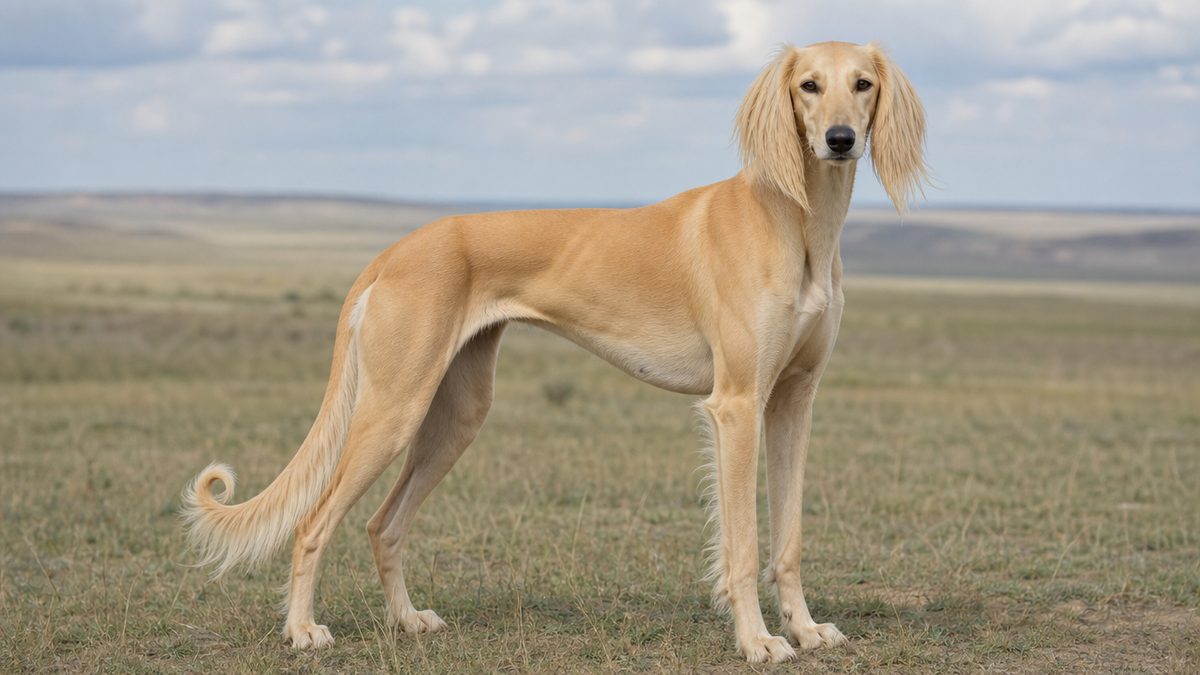
Quick answer
There is no verifiable kazakh tazy price in india, because Bonbeno found no Indian breeder, listing site, marketplace or rescue offering the breed. Kazakhstan protects the Tazy by statute as a state-protected object, the FCI recognises it only on a provisional basis since 3 September 2024, and full recognition is not expected before 2034. Indian import law rejects applications made for breeding or trading.
This page summarises published breed-standard text, kennel-club registers, peer-reviewed genetics, orthopaedic registry tables and government records. It is general information and it is not veterinary advice. No page can examine your dog. Sighthounds differ from other breeds in ways that matter clinically, including low body fat, characteristic haematology and reported sensitivity to some anaesthetic protocols, so discuss any procedure, drug dose, diet or heat concern with a registered veterinary practitioner who has seen the animal and who knows it is a sighthound.
Kazakh Tazy at a glance
What the Kazakh Tazy is, and what its breed standard actually specifies
The Kazakh Tazy is a Central Asian steppe sighthound standing 63 to 70 cm in males and 58 to 65 cm in females, built to hunt by sight and scent together, and recognised by the FCI only on a provisional basis as standard 372 in Group 10 Section 1, long-haired or fringed sighthounds.
Work from the document. FCI-Standard No 372 was published in English on 12 September 2024 against an official valid standard dated 3 September 2024, translated into English by N. Drovossekova, and it is nine pages long, which is unusually detailed for a newly admitted breed. Its stated utilisation is "Hunting: searching, chasing and catching game. Coursing."
The breed standard's history paragraph makes claims worth separating into the checkable and the traditional. Checkable: "the historical area of the breed's occurrence was all of Central Asia", and images of tazy-shaped dogs appear in rock carvings from the end of the Iron Age through the seventeenth to nineteenth centuries. Traditional: the Tazy is one of the *Zheti Kazyna*, the seven treasures of the Kazakh people. Bonbeno reports the second as the tradition the standard records rather than as history.
The measurements, including the one the standard promises and does not give
| Point | What the standard says |
|---|---|
| Height, males | Desirable 63 to 70 cm, deviation of plus or minus 2 cm acceptable |
| Height, females | Desirable 58 to 65 cm, same deviation |
| Weight | Not stated, although the section is headed SIZE AND WEIGHT |
| Oversize | Severe fault above 72 cm males, above 67 cm females |
| Iliac crest separation | At least 8 cm males, at least 7 cm females. A measurable requirement |
| Coat | Short on body, about 3 cm in the loin region |
| Undercoat | Almost absent in summer, can be well developed in winter |
| Ear fringing | The 'burka', soft wavy hair extending 5 to 6 cm below the ear leather |
| Tail | Set quite low, sabre shaped, with a half-curl or small ringed curl at the end formed by not fused vertebrae |
| Colour | Yellow in all shades, all shades of grey, white, black |
The missing weight matters because every secondary source supplies one. English Wikipedia's infobox prints males at 32 to 35 kg and females at 20 to 30 kg while citing the FCI standard as its only kennel-club standard, and that document contains no weight at all. A 63 to 70 cm sighthound described by its own standard as "lean" and "very well developed" in muscle, with a belly "well tucked up", is not a 35 kg dog on any reasonable reading.
The sentence that separates this breed from every other sighthound
One line in the temperament paragraph is the most useful thing in the document, and no secondary source repeats it. The standard says the Tazy is "Universal - combines sharp-sightedness and scent search, some can also retrieve";. A sighthound whose own standard credits it with scent work is a different working animal from a Greyhound, and it explains the standard's other claim, that the Tazy "is able to hunt alone, in groups and with hunting birds, the latter is especially appreciated".
The standard disqualifies rear dewclaws, blue eyes or eyes of different colour, absence of even one canine, incisor, upper P4 or molar other than M3, and the colours brindle, merle, parti-colour and liver. Three of those four are visible without a vet. Note especially the colour list, because it is the fastest way to tell a mis-sold dog: a brindle dog cannot be a correct Tazy, while brindle is merely undesirable in a Saluki.
Tazy, Тазы, tazi, Kazakh greyhound: the names, and which searches return the dog
Search Kazakh Tazy or Kazakh sighthound and you find the breed; search Tazy or Taigan alone and most of what returns is chemistry, and the Cyrillic form returns nothing because the databases do not process it.
The FCI files the breed as KAZAKH TAZY. Kazakh writes it Тазы. English sources also use Tazy, tazi, and "Kazakh greyhound", the last of which is misleading because the breed is not a Greyhound and sits in a different FCI section. The Astana Times notes that the name Tazy translates as "swift, fast";.
Name choice is not cosmetic here. Bonbeno ran the breed's name forms against PubMed on 31 August 2026 and recorded the query-translation line for each, because a count without a translation is not evidence.
| Query | Records | Genuinely about the breed |
|---|---|---|
| "Kazakh Tazy" | 1 | 1. Phrase matched |
| "Kazakh sighthound" | 3 | 3. All genuine |
| Tazy | 9 | 3. The other six are triazole chemistry, maltase enzymology and a leiomyosarcoma case report |
| Taigan | 6 | 2. The other four include a cardiac PET neural network named TAI-GAN and two child-psychology papers |
| "Kazakh greyhound" | 0 | 0, after PubMed broadened Kazakh to a supplementary concept |
| Тазы (Cyrillic) | 0 | Empty translation line. Not searched |
Two conclusions follow. The "Kazakh greyhound"; zero is a strong negative rather than a weak one, because PubMed widened the query on its own by expanding "Kazakh" to its "kazakh people" supplementary concept and still returned nothing. When an engine broadens your search and still finds nothing, the absence is real rather than an artefact of a narrow phrase.
The Cyrillic zero is not a finding at all. Тазы returned zero records with an empty query-translation line, meaning the string was never processed. Bonbeno therefore claims no absence from the Russian-language or Kazakh-language literature, which almost certainly holds material this page does not cover. Controls in the same session returned 23 records for Saluki and 31 for Afghan Hound, so the instrument was working for Latin script.
A Bing India pull for "kazakh tazy price in india" returned HTTP 200, the correct page title, "About 156,000 results", and ten organic results that were entirely Microsoft corporate and account pages. The Labrador control on the same instrument in the same session returned genuine Indian pricing pages, so the tool was working and the substitution belongs to this query. A poisoned result set proves nothing in either direction, so nothing on this page rests on it.
Provisional recognition is not recognition, and 2034 is the date nobody quotes
The FCI recognised the Kazakh Tazy on a provisional basis on 3 September 2024, which permits FCI titles but not the CACIB, and Kazakhstan's own Ecology Ministry says full recognition is expected not earlier than 2034.
This is the largest single gap between what the ranking pages say and what the register says. Every page reports that the FCI recognised the breed in September 2024. English Wikipedia states flatly that Tazys "are recognized by International Canine Federation";. Not one of them says the word provisional, and the FCI's own entry gives the breed status as "Recognized on a provisional basis".
What the provisional register actually says the status means
The FCI spells it out on the register page itself. Breeds recognised on a provisional basis "are not eligible for the CACIB until they are recognised on a definitive basis, but are eligible for the FCI titles (Winner of the World Dog Show, Winner of the Section Shows)", and pedigrees issued to these breeds must carry the FCI logo.
That rule and a real event corroborate each other neatly. At the FCI World Dog Show 2025 in Helsinki on 8 to 10 August, five Tazy won in their breeds, with a dog named Tamerlan taking Junior World Winner 2025 and Latysh the World Winner title. Those are exactly the titles the provisional register says a provisional breed may win, and the CACIB is exactly what it says they may not.
The Tazy is absent from the definitive Group 10 listing
The clearest way to see the distinction is to read the group page. FCI Group 10 Section 1, Long-haired or fringed Sighthounds, contains exactly three definitively recognised breeds: the Afghan Hound (228), the Saluki (269) and the Russkaya Psovaya Borzaya (193). The Kazakh Tazy is not on that page anywhere. Its own nomenclature entry even links its Group heading to the provisional register rather than to the Group 10 page.
How long provisional lasts, from the register's own dates
Provisional status has no fixed term, and the register proves it. The Australian Stumpy Tail Cattle Dog has been provisional since 7 July 2005, and the Lancashire Heeler since 1 May 2016. Twenty-one years is not a waiting room with a timetable.
For the Tazy specifically there is a stated expectation, and it comes from Kazakhstan rather than from the FCI. Qazinform, citing the country's Ecology Ministry, reports that "Full recognition is expected not earlier than 2034 on the condition of the breed's further development and participation in international exhibitions";. The FCI's own president framed the same period at the time of the decision, emphasising the importance of the upcoming ten years during which health tests and data on the breed must be collected.
How far behind its relatives that puts it
The scale is easier to see against the breed the Tazy is most often compared with. The Saluki has been recognised on a definitive basis since 8 April 1966. If the Kazakh Tazy reaches definitive status in 2034 as Kazakhstan's own ministry expects, that will be sixty-eight years after its nearest FCI relative. For a breed the genetics describes as ancient and sitting on the same branch as the Saluki, the gap is administrative rather than biological, and it is worth understanding as such rather than as a comment on the dog.
The FCI's provisional register gives the date of provisional recognition as 9/3/2024, and that table proves its own M/D/YYYY format through rows reading 9/17/2024, 6/21/2022, 3/30/2022, 2/26/2020 and 6/13/2018, where the second field exceeds 12 and cannot be a month. So the register says 3 September 2024. Qazinform agrees. The Astana Times, reporting the day after, dates the General Committee decision to 4 September. Bonbeno follows the register, because the body that made the decision is the one recording it, and publishes the disagreement rather than hiding it.
What Kazakhstan itself did, which is separate from anything the FCI did
Kazakhstan protects the Tazy under its own law, by a statute signed on 2 January 2023 placing the Tazy and the Tobet on the list of state-protected objects, and that national protection is independent of, and predates, the FCI's provisional recognition.
Conflating the two is the commonest error about this breed. The FCI decision is a kennel-club classification made in Belgium. The Kazakh measures are domestic law and state policy, and they came first.
| Date | What happened | Source |
|---|---|---|
| 2021 to 2023 | Research with the Genetics Institute to build a DNA profile of the breed | Qazpatent, via Tengrinews |
| December 2022 | 1.4 billion tenge, about 3 million US dollars, pledged to preserve and reproduce Tazy and Tobet | The Astana Times |
| 2 January 2023 | President Tokayev signs a law including the Kazakh dog breeds Tazy and Tobet in the list of state-protected objects | Qazpatent, via Tengrinews |
| August 2023 | Kazakhstan's Union of Cynologists achieves full FCI membership, a precondition for declaring a national breed | The Astana Times |
| May 2024 | Mono-breed Kazakh Tazy exhibition held in Astana | Qazinform, citing the Ecology Ministry |
| 3 September 2024 | FCI grants provisional recognition, Kazakhstan named standard holder | FCI provisional register |
| By January 2025 | Qazpatent patent granted for the uniqueness of the breed, held by the Kansonar Association | Qazpatent, via Tengrinews |
| October 2025 | Order of Qurmet awarded to three cynologists for the breed's international recognition | Qazinform, citing the Ecology Ministry |
The state protection is the piece an Indian reader most needs, because it explains supply. A breed placed on a national list of protected objects is being managed as heritage, not produced as stock, and a government that has committed 1.4 billion tenge to reproducing it is not doing so in order to export it The Astana Times.
The patent, and what it does and does not mean
In January 2025 the National Institute of Intellectual Property, Qazpatent, granted a patent for the uniqueness of the breed, held by the Kansonar Association, the hunters' federation. Qazpatent's statement is that "The patent confirms the uniqueness and stability of the new breed, protecting it as a cultural heritage of Kazakhstan".
That is a real instrument and it is easy to over-read. A breed patent is an intellectual-property and heritage device. It is not a health certification, it does not restrain any individual dog, and it says nothing about whether a particular animal is well bred. Note also the corroboration it provides: Kansonar, the patent holder, is the same Republican Federation of hunters' associations whose cynology department co-authored both of the 2023 genetics papers Perfilyeva A, Bespalova K, Bespalov S.
The membership rule that made all of this possible
One procedural fact deserves stating because it applies directly to India. The Astana Times records that "Registration of dog breeds for international recognition is only possible through national cynological organizations with full FCI membership", which is why Kazakhstan's Union of Cynologists had to secure full membership in August 2023 before it could declare its national breeds.
India is in the same position from the other side. India is a full FCI member represented by the Kennel Club of India, which is why FCI nomenclature is the operative register for an Indian pedigree, and why the Tazy's provisional recognition rather than definitive recognition is the status that would apply here.
In February 2024 President Tokayev presented French President Emmanuel Macron with two Tazy puppies, and in 2023 gave one to the singer Dimash Kudaibergen. That is how Tazy leave Kazakhstan: as state gifts and as heritage placements. It parallels the Saluki standard's own note that "by Middle East tradition, Salukis are not bought or sold but presented as marks of honour";, and it is the opposite of a supply chain.
The genetics: an unusually well-studied rare breed, and two numbers that do not add up
Three peer-reviewed papers describe the Kazakh Tazy's population genetics in detail, and they agree on the substance: high genetic diversity, no significant inbreeding, a distinct genetic structure, and a phylogenetic position on the same branch as the Afghan Hound and the Saluki.
Most breeds on this site have no literature at all. The Tazy is the opposite case, and the reason is visible in the author lists: the work was done at the Institute of Genetics and Physiology in Almaty, with the hunters' federation Kansonar as a co-author, as part of the national programme that led to the FCI application.
What the microsatellite and SNP study found
Perfilyeva and colleagues, publishing in *PLoS ONE* in March 2023, examined 19 microsatellite loci and found all of them polymorphic. The observed number of alleles ran from 6 at the INU030 locus to 12 at five loci including AHT121 and FH2054, with a mean of 9.778 per locus. Every marker was highly informative, with polymorphic information content from 0.543 to 0.865. Observed heterozygosity was 0.748 against an expected 0.769.
The conclusions are the useful part. The breed shows "a high level of genetic diversity, no significant inbreeding, and a specific genetic structure", with three gene pools underlying it. Using the CanineHD array of more than 170,000 SNP markers, the authors place the Tazy as "distinct from other sighthound breeds and genetically related to ancient eastern sighthound breeds sharing the same branch with the Afghan Hound and the Saluki".
The SNP analysis puts the Tazy on a branch with the Afghan Hound and the Saluki. Independently, the FCI filed the breed in Group 10 Section 1, long-haired or fringed sighthounds, whose only definitively recognised members are the Afghan Hound, the Saluki and the Borzoi. A classification built on coat and conformation in the twentieth century and a phylogeny built on 170,000 markers in the twenty-first landed in the same place. Bonbeno has not seen that stated anywhere else.
The homozygosity study, and two things in its abstract that do not reconcile
The companion paper in *Scientific Reports*, published 3 July 2023, is the first genome-wide look at runs of homozygosity in the breed. Its findings: ROH are mainly short segments of 1 to 2 Mb, accounting for approximately 67 percent of the total, and five genomic regions under positive selection were identified on chromosomes 18, 22 and 25. Among 12 candidate genes in those regions, CAB39L is proposed as a candidate affecting running speed and endurance.
Two details in that abstract do not sit cleanly, and Bonbeno reports them rather than smoothing them over.
- The inbreeding coefficients. The abstract states that ROH-based inbreeding coefficients "ranged from 0.028 to 0.058 with a mean of 0.057";. A mean of 0.057 sitting 0.001 below the maximum of a range that starts at 0.028 would require almost every dog in the sample to be at the top of the range, which is implausible for a population the same group elsewhere describes as diverse and un-inbred. Bonbeno quotes the range, not the mean.
- Chromosome 22 is described twice, differently. The same sentence says the regions on chromosomes 18 and 22 "may be breed specific", then says the region on chromosome 22 "overlaps with regions of hunting traits in other hunting dog breeds";. Breed-specific and shared with other breeds are not compatible descriptions of one region.
Neither observation undermines the paper's substance, and neither is a reason to discard it. They are a reason to quote the range rather than the mean, and to cite the chromosome-25 and chromosome-18 findings without asserting which regions are breed specific.
Descended from the Saluki, or a cousin of it? The sources disagree
A prominent Kazakh breeder puts the origin story plainly. Interviewed by *The Times of Central Asia* in December 2025, Abzal Dosyman said "the progenitor of the Kazakh breed, the Tazy, was the Arabian greyhound saluki", brought by Arab missionaries and then adapted by nomadic needs and the harsh steppe.
The published genetics says something related but importantly different. The SNP analysis places the Tazy as "distinct from other sighthound breeds and genetically related to ancient eastern sighthound breeds sharing the same branch with the Afghan Hound and the Saluki". Sharing a branch with the Saluki is common ancestry, not descent from it, and the same paper reports three distinct gene pools inside the Tazy itself.
Bonbeno publishes the disagreement rather than resolving it. A breeder's account of a breed's origin is tradition and expertise, and a 170,000-marker array is a measurement, and the two are answering slightly different questions. What a buyer should take from it is narrow and useful: do not accept "it is basically a Saluki" as a description, because the register, the standard and the phylogeny all treat the Tazy as its own breed.
Knowing a breed's heterozygosity, its runs of homozygosity and its position on a sighthound phylogeny tells you nothing about what it dies of. There is no published disease-prevalence figure, no life expectancy study and no clinical case series for the Kazakh Tazy. This is a breed whose population structure is better described than its health, which is an unusual shape for a rare breed and worth stating plainly.
Tazy and Taigan: separate breeds on paper, 17 SNPs apart in the laboratory
The Kazakh Tazy and the Kyrgyz Taigan are separate registry breeds with separate standards and separate national sponsors, and a 2025 SNP study found only 17 highly divergent markers between them, which the authors state is far fewer than in recognised, well-differentiated breed pairs.
The brief this page was built from asked for the two breeds to be kept separate. They should be, and the honest way to do that is to say exactly where the separation is solid and where it is not.
Where they are firmly separate: the registers
| Register | Kazakh Tazy | Taigan |
|---|---|---|
| FCI definitive nomenclature | Absent from the Group 10 listing | Absent from the Group 10 listing |
| FCI provisional register | Listed, standard 372, from 3 September 2024 | Absent. Not in the FCI nomenclature at all |
| OFA breed list | Absent. No Tazy, Tazi or Kazakh entry of any spelling | Present, between Swedish Vallhund and Taiwan Dog |
| OFA published statistics | No row | No row |
| Japan Kennel Club 2025 | Not listed | Not listed |
| National sponsor | Kazakhstan, standard holder, state-protected since January 2023 | Kyrgyzstan, via the Salbuurun Federation |
That table contains a genuine oddity worth noticing. The Taigan holds an OFA breed-list entry and the Kazakh Tazy does not, while the FCI position is the exact reverse. Two registries, opposite answers about which of these two breeds exists. Neither has a published statistics row, so neither entry carries data behind it.
Where they are not separate: the genome
In September 2025 Bespalova and colleagues published the first comprehensive genetic analysis of the Taigan, using short tandem repeats and a high-density SNP array. The Taigan itself came back healthy and diverse: high polymorphism, an excess of heterozygosity at F = -0.013, and five genetic clusters with no dominant lineage.
Then they compared it with the Kazakh Tazy. "A pairwise FST analysis showed only 17 highly divergent single nucleotide polymorphisms. This number is significantly lower than in recognized and well-differentiated breed pairs and suggests that genetic differentiation between Kazakh Tazy and Taigan breeds is minimal under current sampling conditions".
The authors are careful, and so is this page. They call for further studies with larger data sets, and "minimal under current sampling conditions" is not the same as "identical". But the finding stands, it is peer-reviewed, and it is the most interesting published fact about either breed. No page that Bonbeno found carries it.
What separates them in the field: altitude and shape
Where the genome is quiet the working environment is not. The Taigan is a Tien Shan mountain sighthound adapted to hunting at high altitude and in rough terrain, while the Tazy is a steppe and semi-desert dog. The satellite record shows the gap: the cell over Bokonbaevo on the southern shore of Issyk-Kul returns an annual mean of 2.50 degrees, against 10.64 for Kyzylorda on the Syr Darya.
A 2025 morphological study measured 77 Kyrgyz Taigans and found the breed dolichocephalic and rectangular in outline like other sighthounds, with rump and withers at similar heights, and with greater head length, withers and rump heights, chest circumference and chest depth than other greyhound breeds. Deeper chest and greater girth is what an altitude-working dog would be expected to carry.
Treat Tazy and Taigan as separate breeds with separate standards, because that is what the registers say, and be aware that the published genetics cannot currently tell them apart at 17 markers. The practical consequence is blunt: a DNA test will not settle which of the two a dog is, and a pedigree from a named national body is the only document that can. A seller offering a Central Asian sighthound without naming which register the paperwork comes from is not offering either breed.
Four ways to tell a Kazakh Tazy from a Saluki, taken from the two standards
Check the tail tip first, then the colour, then the ear fringing, then the size specification, because those four points are where FCI-Standard 372 and FCI-Standard 269 give incompatible instructions and all four are visible without a laboratory.
The Tazy is related to but distinct from the Saluki, and the Afghan Hound sits on the same branch again. Related is not the same as interchangeable, and a buyer needs a test rather than an adjective. Bonbeno read both standards in full and extracted the points at which they contradict each other.
| Point | Kazakh Tazy, standard 372 | Saluki, standard 269 | The test |
|---|---|---|---|
| Tail tip | Sabre shaped, with a half-curl or small ringed curl at the end, formed by not fused vertebrae. May be raised just above the back in action | Carried naturally in a curve, no curl specified. In adults not carried above the topline except in play | A curl or hook at the very tip means Tazy. A plain curve means Saluki |
| Colour | Yellow, all shades of grey, white, black. Brindle, merle, parti-colour and liver are disqualifying | "Any colour or combination of colours is permissible. Brindles are undesirable" | A brindle dog cannot be a correct Tazy. It can be a Saluki |
| Ear fringing | The 'burka', soft wavy hair covering the whole ear leather and extending 5 to 6 cm below it. Complete absence is a severe fault | Long silky hair on the ears in the fringed variety; the smooth variety has no feathering at all | A correct smooth-coated Saluki exists. A fringeless Tazy is severely faulted |
| Size specification | Separate ranges: males 63 to 70 cm, females 58 to 65 cm, plus or minus 2 cm | One range for the breed: "Average between 58-71 cm, bitches proportionally smaller" | The Tazy standard commits to a bitch range. The Saluki standard does not |
Two more differences that are easy to check and rarely mentioned
- Ear set. The Tazy standard places the ears "at eye level or slightly higher"; the Saluki standard says "set on high";. A lower ear set is Tazy-typical.
- Hip width is a measurement, not an impression. The Tazy standard requires the distance between the iliac crests to be "at least 8 cm for males, and at least 7 cm for females";. The Saluki standard says only "Hipbones set wide apart";. A tape measure settles one and not the other.
- Dentition is enforced differently. The Tazy standard disqualifies the absence of even one canine, incisor, upper P4 or molar other than M3, and makes missing lower premolars a severe fault. The Saluki standard asks for "a perfect, regular and complete scissor bite" and disqualifies only aggression, shyness and abnormality.
The Afghan Hound is the easy one
Nobody confuses a Tazy with an Afghan Hound in the flesh, because the Afghan carries a long, thick, silky coat over the whole body while the Tazy's body coat is about 3 cm long in the loin with feathering confined to ears, leg-backs and tail. The confusion is on paper, where all three sit in Group 10 Section 1 and on one branch of the phylogeny. Relatedness in a register is not resemblance in a room.
None of the above helps if the dog in front of you is neither breed, which is the likely case, because there is no Indian supply of any of them at scale. Before applying any conformation test, ask which register the paperwork comes from and confirm the breed is on it. For the Kazakh Tazy that means an FCI-logo pedigree traceable to the Kazakh standard holder, since the FCI's provisional rules require the logo on pedigrees for provisional breeds.
Kazakh Tazy price in India: there is no Indian price and no Indian seller
There is no verifiable Kazakh Tazy price in India, because Bonbeno found no Indian breeder, listing site, marketplace or rescue offering the breed, and unlike most rare breeds this one does not even attract a fabricated rupee figure.
Say the negative first and evidence it. A search restricted to India for the breed and the word puppy returned, in order: a Facebook working-dogs page, English Wikipedia, a YouTube video, a second Facebook post, an Astana Times article, a breed-information aggregator, an Adobe Stock photography search page, a Central Asian news feature, a second YouTube video and a travel site. Not one Indian listing. Not one Indian breeder. Not one rupee figure attached to a dog.
The absence is earned rather than assumed. The control query "labrador retriever puppy price in india", run on the same instrument in the same session, returned genuine Indian Labrador listing pages quoting Indian prices city by city. The search worked.
This breed is the rare case with no fabricated Indian price at all
That deserves saying, because it is unusual. Most absent breeds attract an invented Indian band, typically a round rupee figure with no seller behind it, and this site has documented Indian pages publishing converted dollar lists, stripped currency symbols and house price points attached to whichever puppy is in stock. For the Kazakh Tazy, there is nothing to test. No Indian page on the first page of results quotes a price for the dog, so there is no figure to divide by any exchange rate and no quotient to sanity-check.
The honest reading is that the breed is so far outside the Indian market that even the content farms have not generated a page for it. That is a more informative result than a price would have been.
| Source | What it offers | Price information |
|---|---|---|
| English Wikipedia (position 2) | A breed article citing a 2009 population figure | None |
| The Astana Times (position 5) | A news report on FCI provisional recognition | None |
| Adobe Stock (position 7) | 277 stock photographs, describing the breed as "Tazy (endangered) a rare breed" | Photographs are priced. Dogs are not |
| Facebook (positions 1 and 4) | Enthusiast posts about Kazakh and Kyrgyz dogs | None |
| YouTube (positions 3 and 9) | A patent-award news clip and a facts video | None |
Why no supply chain can form
Three independent facts close the question, and any one of them would be enough.
- Kazakhstan protects the breed by statute. A law signed on 2 January 2023 placed the Tazy and the Tobet on the list of state-protected objects, and the state committed 1.4 billion tenge to preserving and reproducing them The Astana Times. Dogs leave under that regime as state gifts, not as exports.
- Indian law refuses the import purpose. DGFT Trade Notice 22/2022-23 states that applications for trading or breeding purposes shall be rejected. An Indian breeder cannot lawfully import foundation stock.
- The breed has no presence in any register India could draw on. The Japan Kennel Club, the largest FCI member register in Asia, does not list the Kazakh Tazy at all, while it registered 53 Saluki and 56 Afghan Hounds in 2025.
Because no Indian market exists and no Indian page even fabricates one, a rupee figure quoted to you privately for a Kazakh Tazy is not a market price with a source you have not found. It is a number invented for you. Ask which register the pedigree is on, ask for the FCI logo that provisional-breed pedigrees must carry, and expect neither to be produced.
What a large lean sighthound actually costs to keep in India
Budget roughly ₹4,000 to ₹8,000 a month for a 25 to 30 kg sighthound in an Indian metro, with food the dominant line, grooming almost nothing because the coat is short, and safe enclosed running ground the expense nobody plans for.
There is no Indian Tazy price to report, but there is a real Indian cost of ownership for a dog of this size and shape, and that is the figure a reader can use. It applies to any large lean sighthound living in Chennai, Delhi, Bengaluru, Mumbai, Pune or Jaipur.
| Line | Planning range | What drives it |
|---|---|---|
| Food | ₹2,500 to ₹4,500 | The dominant line. A lean 25 to 30 kg dog on a quality complete diet, more if raw or imported |
| Routine veterinary and parasite control | ₹800 to ₹1,800 | Averaged across the year. Tick and flea control matters more for a dog exercised on open ground |
| Grooming | ₹200 to ₹600 | The cheapest line on this page. A 3 cm body coat needs a brush, not a groomer. Ear care is the real task |
| Bedding and padding | ₹200 to ₹500 amortised | A genuine sighthound line. Very low body fat means pressure sores on hard Indian flooring |
| Total, monthly | ₹4,000 to ₹8,000 | Before boarding, transport or any chronic medication |
The three lines that are specific to a sighthound and to India
- Safe enclosed ground is the real cost. A coursing breed whose standard describes a "full rushing gallop" in pursuit needs to sprint, and an Indian city offers very little fenced open space. In practice this becomes a paid membership, a rented plot or a long drive, and it recurs every week.
- Bedding is not a luxury. A dog built with almost no subcutaneous fat and a well tucked-up belly develops elbow and hock calluses on tile and concrete. Proper padding is preventive veterinary spending.
- Grooming is nearly free and ear care is not. Long hanging fringed ears in an Indian monsoon are the standing infection risk for this breed, and a weekly ear check costs nothing while a chronic otitis case does not.
The first-year lines Indian law effectively sets
Two provisions of the 2017 Rules shape the first-year budget for any dog acquired lawfully in India. The Rules record that vaccination "can start at the age of seven-eight weeks, and are usually completed at the age of eighteen weeks", so the veterinary spend is front-loaded rather than spread. And Rule 8(1)(b) requires that dogs over six months in age are not sold without first being sterilised, unless sold to another licensed breeder, so an adult acquired lawfully arrives already sterilised.
Twelve years at the upper ₹8,000 estimate is roughly ₹11,52,000 in recurring cost, before a single illness and before the running ground. That dwarfs any purchase figure for any breed, which is the argument for spending the decision on whether you can deliver a weekly sprint in a securely fenced space rather than on a dog that has no Indian supply.
Heat tolerance: the one imported breed whose homeland is hotter than Chennai
The Kazakh Tazy is the most heat-tolerant imported breed on this site, and the evidence is measured: the satellite cell over its steppe homeland records an annual maximum of 45.32 degrees against Chennai's 42.70. The differences are humidity and winter, not peak heat.
Almost every imported breed page on this site reports the same shape of finding, a cold homeland against a hot India. This one does not, and the reversal is worth reading carefully because it changes the advice rather than merely softening it.
| Place | Cell elevation | Annual mean | Annual max | Relative humidity |
|---|---|---|---|---|
| Kyzylorda, Kazakh steppe | 122.27 m | 10.64 C | 45.32 C | 52.41% |
| Astana, northern Kazakhstan | 365.03 m | 3.26 C | 40.35 C | 72.68% |
| Jaisalmer, Thar desert | 173.40 m | 27.60 C | 47.92 C | 34.23% |
| Bikaner, Thar edge | 230.00 m | 27.16 C | 47.43 C | 33.64% |
| Jaipur | 405.74 m | 25.58 C | 46.92 C | 40.94% |
| Delhi | 206.37 m | 25.60 C | 48.79 C | 45.56% |
| Chennai | 48.95 m | 27.95 C | 42.70 C | 72.39% |
| Mumbai | 97.15 m | 26.77 C | 44.91 C | 67.39% |
| Pune | 635.99 m | 23.86 C | 43.20 C | 66.80% |
| Bengaluru | 841.72 m | 23.74 C | 40.38 C | 67.94% |
Read the peak heat row first
The Tazy's own country reaches 45.32 degrees, which is 2.62 degrees hotter than Chennai's annual maximum and only 2.11 degrees short of Bikaner's. This is a genuinely heat-tolerant dog with a coat to match: about 3 cm of hair on the body and, in the standard's own words, "almost without undercoat in summer";. It sheds its insulation for the hot season, which is the opposite of what every double-coated northern breed on this site does.
So the usual argument does not apply. A Tazy is not a Nordic dog being asked to survive an Indian summer. It is a desert-steppe dog that already knows 45 degrees.
The two differences that do matter, and they are not peak temperature
- Humidity. Kyzylorda sits at 52.41 percent annual relative humidity. Chennai is 72.39 and Mumbai 67.39, roughly 15 to 20 points wetter. Evaporative cooling by panting is exactly what humidity blunts, so a dog acclimatised to dry 45 degrees can be in more trouble at humid 38. Coastal India is the wrong Indian posting for this breed, and the desert is the right one.
- Winter, or the absence of one. Kyzylorda's annual mean is 10.64 degrees against Bikaner's 27.16, a gap of 16.5 degrees. The steppe is hot in summer and genuinely cold the rest of the year, which is why the standard describes an undercoat that develops in winter. India offers the peak without the recovery, and persistent heat is a different physiological problem from seasonal heat.
On these figures the closest Indian analogue to the Tazy's homeland is western Rajasthan, not the metros. Jaipur at 40.94 percent humidity and a 46.92 degree maximum is the nearest large city to Kyzylorda's profile, and Bikaner and Jaisalmer are drier still at about 34 percent. Bonbeno is not recommending importing a Tazy to Rajasthan, because no lawful route exists. It is saying that if anyone tells you this breed cannot cope with Indian heat, the satellite record disagrees, and the honest objection is humidity and year-round persistence rather than the thermometer's peak.
A grid-cell warning, because one of these queries was badly wrong
NASA POWER returns a grid cell rather than a point, and in mountains the cell's mean elevation can miss the place underneath it by more than a kilometre. That fired hard on this research. The cell queried for Almaty returned an elevation of 2,478.24 metres for a city that sits at roughly 800 metres, an error of about 1,680 metres, and reported an annual mean of 1.32 degrees. Nobody who has been to Almaty in July believes an annual mean of 1.3 degrees. The cell is averaging the city with the Trans-Ili Alatau above it, and the mountains win.
Correcting at the standard lapse rate of roughly 6.5 degrees per 1,000 metres puts Almaty near 12.2 degrees, within about two degrees of its published climate, which is the check that confirms the diagnosis. The same failure appears at Bokonbaevo on Issyk-Kul, where the cell reports 2,697.56 metres for a lakeside village near 1,700 metres.
The steppe cells need no such correction, and that is why this page is built on them. Kyzylorda's cell sits at 122.27 metres against a town near 128, and Astana's at 365.03 against a city near 347. POWER tracks flat country well and fails in mountains, exactly as it does across the Indian plains and Indian hill stations. Every figure this page uses for a climate argument comes from a plains cell whose elevation was checked.
Indian import law: what blocks a Kazakh Tazy, and what does not
Indian import law bars the commercial route entirely, because dogs are a Restricted import and applications made for trading or breeding purposes are rejected by rule, which closes the only route by which an Indian population could ever start.
DGFT Trade Notice No. 22/2022-23 dated 19 December 2022, headed Guidelines for import of Pet Animals, is the operative instrument and Bonbeno read its text rather than a summary. It records ITC (HS) 01061900, Mammals: Other, with an Import Policy of Restricted, subject to Policy Condition 6 of the Chapter. Policy Condition (6) as printed concerns the Wild Life (Protection) Act 1972 and CITES, which does not touch a domestic dog. The operative restrictions sit in the notice's own guidance.
- No import for trade or breeding. The notice states "No applications for trading/breeding purposes, or applications made on behalf of some another person/ entity shall be duly rejected". The drafting is clumsy and the effect is not.
- Seven entry points only. Import of pet animals is allowed only through the airports and seaports of Delhi, Mumbai, Chennai, Hyderabad, Bengaluru and Kolkata and, since October 2024, Kochi airport Department of Animal Husbandry…. The full route is set out in how to import a dog to India.
- Advance NOC required. A quarantine-clearance applicant must obtain an Advance No Objection Certificate from the Regional Officer or Quarantine Officer of the Animal Quarantine and Certification Station, after submitting the DGFT import licence and the health certificate.
- Apply early. The notice advises beginning the authorisation process at least two months before travel.
The two-sided closure
This breed is unusual in being closed from both ends. Kazakhstan manages it as state protection rather than as stock, having placed it on the list of state-protected objects in January 2023 and funded its reproduction domestically The Astana Times. India refuses import applications made for breeding or trading. Neither country needs the other's rule for the outcome to hold.
One caution about a headline you may have seen. A separate instrument, S.O. 4396(E) of 10 October 2024, permits pet dogs and cats through Cochin International Airport under the Livestock Importation Act 1898, with jurisdiction to the Animal Quarantine and Certification Station at Chennai. That governs the personal pet route under a different Act. Bonbeno has not checked it against the DGFT notice's own port list and does not claim it amends that list. Read whichever instrument governs your route.
Nothing in the material Bonbeno read suggests Kazakhstan bans taking a Tazy abroad. The evidence points the other way: two puppies were presented to the French president in February 2024, and five Tazy competed and won at the World Dog Show in Helsinki in August 2025 Qazinform News Agency. Dogs travel. What does not happen is commercial export into a country whose own rules refuse breeding imports.
Where the Tazy standard collides with the 2017 Rules, and it collides twice
Two provisions of the Prevention of Cruelty to Animals (Dog Breeding and Marketing) Rules 2017 bite directly on this breed: the standard's rear-dewclaw disqualification cannot lawfully be engineered in India, and the Rules mandate a hypothyroidism test on the one group of dogs whose thyroid readings normally run low.
Cite these correctly or a reader who checks will land somewhere else. Bonbeno extracted the gazette PDF directly with pypdf: fourteen pages, 51,953 characters, a real text layer. The Rules run from Rule 1 to Rule 13, and everything numbered above 13 is a Second Schedule paragraph made binding by Rule 6. The string "Rule 21" appears zero times in the instrument.
Collision one: the rear dewclaw
FCI-Standard 372 lists rear dewclaws among the disqualifying faults for a Kazakh Tazy. That creates an obvious temptation for a breeder: remove them, and the dog is no longer disqualified.
In India that is prohibited. Second Schedule Part II paragraph 6(8) reads, verbatim, "There shall be no tail docking, ear cropping de-barking, de-clawing, branding, dyeing, injecting substances to enhance visual appeal, performing a surgery or procedure to camouflage or hide any defect or infirmity or any other kind of mutilation of any body part of the pup and any change of appearance by artificial means is strictly forbidden". Removing a rear dewclaw to clear a disqualifying fault is a procedure to hide a defect and a change of appearance by artificial means, and it is caught twice over by that sentence.
State the limit precisely, though. The word dewclaw appears zero times in the whole gazette. The prohibition operates through the general language above, not through a clause naming the procedure, and a page claiming Indian law specifically bans dewclaw removal would be overstating it.
Collision two: the mandatory thyroid test on a sighthound
Second Schedule Part III paragraph 8(10) requires that dogs "shall have been tested for genetic defects, including hip dysplasia, progressive retinal atrophy, night blindness, hypothyroidism, entropion, ectropion, overshot, undershot jaw (when incisors do not touch or mesh), wry mouth, two or more missing teeth, unilateral cryptorchid or full cryptorchid males".
Sighthounds are the one group in which a low thyroid reading is often normal physiology rather than disease, and OFA's own tables show the pattern in numbers.
| Breed | Evaluations | Normal % | Autoimmune thyroiditis % | Equivocal % |
|---|---|---|---|---|
| ALL BREEDS | 121,451 | 84.8 | 0.4 | 10.0 |
| Afghan Hound | 1,386 | 74.1 | 0.4 | 17.6 |
| Greyhound | 162 | 81.5 | 0.0 | 17.3 |
| Whippet | 185 | 86.5 | 0.0 | 13.0 |
| Borzoi | 2,648 | 83.6 | 0.5 | 11.1 |
| Saluki | 283 | 89.0 | 0.0 | 7.4 |
Read that table carefully, because the folklore is only half right. The Afghan Hound and the Greyhound do run well above the all-breed equivocal rate, at 17.6 and 17.3 percent against 10.0. The Saluki runs below it, at 7.4 percent, and the Saluki is the Tazy's nearest relative on the published phylogeny. So "sighthounds test low on thyroid" is not a rule that can be applied to this breed by analogy, and the Kazakh Tazy has no thyroid data of its own at all.
What is safe to say is narrower and more useful: autoimmune thyroiditis, the actual disease, is close to absent in all five of those sighthounds, at 0.0 to 0.5 percent. A borderline thyroid result in a lean sighthound is far more likely to be a reference-range artefact than autoimmune disease.
- Rule 8(1)(a) requires that "pups less than eight weeks in age are not sold".
- Rule 8(1)(b) requires that dogs over six months are not sold without prior sterilisation, unless sold to another licensed breeder.
- Second Schedule Part II paragraph 6(3) prohibits in breeding within four generations and incest breeding, which matters for any founder population built from a handful of imports.
- Second Schedule Part IV paragraph 21(1) bars outdoor housing without written veterinary approval for dogs not accustomed to local temperatures. Its own example is long-haired breeds in high-temperature locations, which a short-coated Tazy is not, so this clause bites less here than on the double-coated breeds.
A traditional rearing practice that would be unlawful in India
One point of Kazakh breed tradition needs flagging for any Indian reader, and it comes from a Kazakh breeder rather than from a critic. Describing how Tazy were historically prepared to face wolves, Abzal Dosyman told *The Times of Central Asia* that young dogs were taken on hunts at four or five months "but only after a brief starvation period", and then fed wolf meat, which after the fast was considered a delicacy. He adds, in his own words, that "some may see this as cruel";.
Whatever view one takes of the historical practice, deliberately withholding food from a four-month-old dog to sharpen its drive is not something an Indian breeder or owner could defend. The 2017 Rules require every dog to be "kept in a clean, healthy and safe environment" and to be provided with what is necessary for maximum mental and physical wellbeing, and the Prevention of Cruelty to Animals Act sits above them. Bonbeno reports the tradition because the source reports it, and states plainly that it should not travel.
The strings "BAER", "deaf" and "patella" each appear zero times across the whole gazette, and "hearing" appears once, referring to an appeal hearing. There is no Indian patellar-testing requirement and no hearing-test requirement for any breed, whatever a seller tells you.
Temperament: calm indoors, **aloof** outside, and one warning about method
The FCI standard describes a balanced, agile dog that assesses situations fast, is calm and unobtrusive at home, can be reserved with strangers, and is explicitly "intolerant of maltreatment", which is a warning about how you handle it rather than a fault in the dog.
Breed standards rarely editorialise about handling. This one does, and the sentence is worth quoting in full: "Temperament balanced, agile. Has a high speed of assessing the situation and making decisions. Can be a bit reserve to strangers. In everyday life - calm and unobtrusive, with a great sense of self-confidence, intolerant of maltreatment. When hunting, he is passionate, manoeuvrable, and has high speed with great endurance over long distances".
Four things follow from that paragraph, and they are the whole household-fit question.
- It is a quiet housemate. Calm and unobtrusive is the classic sighthound indoor profile, and it is why a very large dog can suit a flat.
- It decides for itself. A dog with "a high speed of assessing the situation and making decisions" is describing an independent worker, not a handler-focused one.
- It is reserved, not friendly, with strangers. English Wikipedia puts the same trait as "independent and aloof to strangers". Reserve is the breed's normal adult state.
- Harsh handling will not work. "Intolerant of maltreatment" in a breed standard is a statement that the dog will disengage or resist rather than submit.
The Saluki standard says almost the same thing, which is itself evidence
Compare FCI-Standard 269: "Reserved with strangers, but not nervous or aggressive. Dignified, intelligent and independent". Two standards written decades apart, by different people, for breeds later shown to sit on the same genetic branch, describe the same temperament in the same terms. That convergence is worth more than either sentence alone.
Who this breed suits, and who it does not
- Suits a household with weekly access to securely fenced open ground and a genuine liking for a dog that is affectionate at home and indifferent to visitors.
- Suits an owner who has kept a sighthound before and already understands that recall around live prey is a permanent management problem, not a training stage.
- Does not suit a home with cats, rabbits or free-ranging poultry. This is a breed whose standard describes it catching hares, foxes and hoofed game, and Wikipedia records historical use on wolves and saiga.
- Does not suit anyone wanting an obedient dog, a guard dog or a dog that greets guests.
- Does not suit a first-time owner, on temperament grounds before availability grounds.
Wikipedia records that a Kazakh would trade 47 horses for a single Tazy and that it was taboo to refer to the breed merely as a dog. The FCI standard's own history paragraph carries the related tradition that the Tazy is one of the *Zheti Kazyna*, the seven treasures. Bonbeno reports these as the traditions the sources record, not as transactions anyone has documented.
Training a coursing sighthound, and the one behaviour you may never fully get
Train a Kazakh Tazy with reward and patience rather than pressure, because its own standard calls it intolerant of maltreatment, and treat recall around live prey as a lifelong management problem rather than a behaviour you will finish teaching.
Start from the job. The standard's stated utilisation is "Hunting: searching, chasing and catching game. Coursing", and it describes a dog that will "hunt alone, in groups and with hunting birds";. A dog bred to leave you, run down game at distance and catch it is not going to check in with you at the critical moment because you asked nicely twelve times.
Method first, because the standard makes it an instruction
"Intolerant of maltreatment" is unusual language for a breed standard and should be read as guidance. Aversive handling on a self-confident, independent sighthound produces avoidance rather than compliance, and the dog simply stops offering behaviour. Reward-based training is not a stylistic preference here; it is what the recognising authority's own description points to.
The three priorities
- Socialise deliberately and early. A breed described as reserved with strangers needs controlled, positive exposure to people, traffic, lifts and other dogs in the first sixteen weeks. In India that window overlaps the vaccination course, which the 2017 Rules expect to start at seven to eight weeks and usually finish by eighteen, so plan carried and low-risk outings rather than skipping the window.
- Build an emergency stop, not just a recall. For a sighthound, a down or a stop at distance is often more achievable than a call-back once the chase has started, and it is the behaviour that prevents a road.
- Manage the prey drive rather than training it away. Long line by default outdoors, a securely fenced space for free running, and no unsupervised access to small animals. The standard describes a dog that catches hares and foxes; that is not a bug to fix.
| Behaviour | Realistic timeline | Note |
|---|---|---|
| House training | 3 to 6 weeks | Usually straightforward |
| Lead manners | 8 to 16 weeks of work | A tall dog with a long stride needs this early |
| Settle indoors | Fast, and largely innate | Calm and unobtrusive is the standard's own phrase |
| Recall with no distraction | 6 to 10 weeks | Long line throughout |
| Emergency stop at distance | 6 to 12 months | More reliable than recall once a chase begins |
| Recall off a live chase | Do not rely on it, ever | Manage with fencing and a long line instead |
A dog capable of a full rushing gallop that has spotted a street dog, a cat or a monkey across an Indian road is a dog you cannot call back in time. There is no training solution to this that works reliably in unfenced Indian public space, and every honest sighthound owner runs on management rather than on faith.
Exercise: a weekly sprint in fenced ground, plus daily walking, and neither replaces the other
A Kazakh Tazy needs both sustained daily walking and regular free galloping in a securely fenced space, because its standard describes endurance over long distances and a full rushing gallop in pursuit, and in India the fencing is harder to find than the time.
The standard is specific about gait in a way most are not. "Easy, effortless, free trot. In search of the game - short gallop, in chase of the game - full rushing gallop", from a dog with "high speed with great endurance over long distances";. That is two different exercise needs described in one paragraph: a long slow one and a short explosive one.
- Daily: 60 to 90 minutes of walking or trotting, split across cool hours. This satisfies the endurance half.
- Weekly, at minimum: free galloping in a securely fenced area. A sighthound that never gets to run at speed is an under-exercised dog no matter how far it has walked.
- Ongoing: mental work. A breed the standard calls universal, combining sight and scent search, will take enthusiastically to scent games indoors, which is how you get through an Indian May.
Why India makes this hard, and it is not the heat
The heat argument runs the other way for this breed. Its homeland cell records an annual maximum of 45.32 degrees, hotter than Chennai's 42.70, and the coat sheds almost all its undercoat in summer. Peak temperature is not the binding constraint.
Secure fencing is. Indian cities have very little enclosed open ground, and a 63 to 70 centimetre coursing hound in an unfenced park is one squirrel away from a road. The practical answers are a rented plot, a fenced private ground, a farmhouse or a long-line setup on genuinely open land, and all of them cost money or travel time every week.
The humidity caveat still applies. Chennai and Mumbai run 15 to 20 percentage points wetter than the Tazy's homeland, and humidity is what blunts panting. So exercise in cool hours on the coast even though the peak thermometer reading is less alarming than it would be for a northern breed, and remember that exertional illness accounted for 652 of the 879 heat-related events with a recorded trigger in the largest study available.
The over-50 kg heat-illness band from the *Scientific Reports* study does not reach this breed, since a lean 63 to 70 cm sighthound sits well below it. The factor that does apply is bodyweight at or above the breed and sex mean, which carried odds of 1.42 for heat-related illness. On a breed whose standard demands a well tucked-up belly and lean muscle, letting the dog carry weight removes its own best defence.
Grooming: the easiest coat in this batch, and the ears that are not
Brush the short body coat weekly, comb the ear fringes and leg feathering to stop them matting, and check inside the long hanging ears every week, because in an Indian monsoon the ears are the only part of this dog that needs real attention.
The FCI standard describes a coat that is almost self-maintaining: "Soft, smooth, closely set, short on body, about 3 cm (in loin region). Almost without undercoat in summer. In winter, undercoat can be well-developed";. There is no seasonal blow to manage in an Indian summer, because the dog arrives at summer having already shed it.
Feathering is confined to three places, and those are the parts that need a comb rather than a brush. The ears carry soft wavy hair forming the burka, covering the whole ear leather and extending 5 to 6 cm below it. The hind legs are feathered to mid lower-thigh and the forelegs sparsely to the wrist. The tail carries about 10 cm of thin feathering from roughly its midpoint to the tip.
| Task | Frequency | Why |
|---|---|---|
| Brush the body coat | Weekly, ten minutes | A 3 cm close coat with little undercoat. This is the whole job |
| Comb the ear burka and leg feathering | Weekly | Fringes mat where the body coat does not |
| Check inside the ears | Weekly, and after every bath or swim | The real task. A long, fringed, hanging ear traps moisture, and the monsoon is when otitis presents |
| Bath | Only when actually dirty | A short-coated dog rarely needs one. Plug the ears when you do |
| Nails | Every 3 to 4 weeks | The standard asks for nails well pointed towards the ground |
| Elbow, hock and hip check | Weekly, by hand | Very low body fat over bony points. Calluses and pressure sores start here |
Overseas grooming advice that does not transfer
Guidance written for a short-coated sighthound in a temperate climate typically says to towel the dog and let it air dry. On a body coat 3 cm long that is fine in India too. It is not fine for the ears. A fringed drop ear holding water at 72 percent Chennai humidity is the exact condition that produces ear disease, and the fringing that makes the breed's ears distinctive is what stops them drying. Dry inside the ear and under the fringe deliberately, every time.
Complete absence of the ear fringing is a severe fault under the standard, so trimming the burka to make ear care easier changes the dog into a faulty specimen. If the fringes are matting, comb them more often rather than cutting them. Note also that Indian law forbids "any change of appearance by artificial means" for a dog being bred or sold.
Health: excellent population genetics, and no clinical data at all
The Kazakh Tazy is the unusual case of a rare breed whose genome is well described and whose health is not: three peer-reviewed papers report high diversity and no significant inbreeding, and there is no lifespan study, no disease-prevalence figure, no OFA row and no breed-club health survey.
Separate what exists from what does not, because a reader who sees "peer-reviewed genetics" can easily assume the health question is answered. It is not.
What the genetics does establish
- High genetic diversity and no significant inbreeding, from 19 polymorphic microsatellite loci with observed heterozygosity 0.748 against an expected 0.769.
- Runs of homozygosity dominated by short segments, 1 to 2 Mb accounting for about 67 percent of the total, with ROH-based inbreeding coefficients in the range 0.028 to 0.058.
- Three underlying gene pools, and a phylogenetic position distinct from other sighthounds while sharing a branch with the Afghan Hound and the Saluki.
Short ROH segments and low inbreeding coefficients are a genuinely good sign for a rare breed, because long ROH segments indicate recent close breeding while short ones indicate old, distributed ancestry. It means the founder population was not narrow.
What does not exist, stated plainly
| Evidence type | Status for the Kazakh Tazy |
|---|---|
| OFA published statistics row | None. TAZY returns zero occurrences in the full statistics dump |
| OFA breed-list entry | None. No Tazy, Tazi or Kazakh entry of any spelling. The Taigan does hold one |
| Hip, elbow, patella, cardiac or thyroid figure | None of any kind |
| Peer-reviewed lifespan or mortality study | None. Not in Teng 2022, not in McMillan 2024 |
| Breed-club health survey | None found |
| Disease-prevalence estimate | None found |
There is, in short, nothing for a buyer to screen against. On every other breed page on this site the advice at this point is to ask which health screens the parents have cleared, and to name them. For the Kazakh Tazy there is no screening scheme, no registry to submit results to, and no breed-club protocol, so the only honest instruction is to ask what the breeder tests for and to judge the answer on its own merits rather than against a standard that does not exist.
On lifespan specifically, Bonbeno declines to borrow a number. The two large United Kingdom life-table studies this site normally uses cover dogs under United Kingdom veterinary care, and the Kazakh Tazy appears in neither McMillan KM, Bielby J, Williams CL. Substituting a Saluki or Afghan Hound median would be applying a study's breed-specific finding to a breed the study excluded, which is fabrication wearing a citation. This page therefore publishes no life expectancy figure for the Kazakh Tazy, and that is the correct answer rather than a gap.
What the comparator sighthounds suggest, and how far it can be pushed
OFA's hip table is worth reading for context even though the Tazy has no row in it. Sighthounds cluster at the very bottom of the dysplasia rankings: the Saluki is rank 213 with 1.7 percent dysplastic on 299 evaluations, the Borzoi 2.1 on 925, the Greyhound 2.2 on 408, the Whippet 2.3 on 302 and the Afghan Hound 5.8 on 7,960, against the Labrador Retriever's 11.3 on 324,780.
That is a real and consistent pattern across five separate sighthound breeds with different sample sizes, and it makes low hip dysplasia a reasonable expectation for a lean, light-framed coursing breed. It is still an expectation and not a measurement, and this page does not attach a percentage to the Tazy.
Two things to raise with an Indian vet
- Say the word sighthound before any blood panel or anaesthetic. OFA's thyroid tables show the Afghan Hound at 17.6 percent equivocal and the Greyhound at 17.3 against an all-breed 10.0, while autoimmune thyroiditis, the actual disease, sits at 0.0 to 0.5 percent across those breeds. A borderline result read against general canine ranges can produce a diagnosis that is not there.
- The chest is deep and long, in the standard's own words, with the lowest point just behind the elbows. Bonbeno found no breed-specific data on gastric dilatation-volvulus in this breed and publishes none, so ask your veterinarian about feeding practice and about the warning signs rather than taking a number from a page that does not have one.
This breed's genome has been examined with a 170,000-marker array and its diseases have not been counted at all. Anyone publishing a confident Kazakh Tazy health profile, a life expectancy, or a list of conditions the breed is prone to, is describing sighthounds in general and attaching a Kazakh name to it. Bonbeno would rather say there is nothing to report.
Feeding a lean sighthound in India
Feed a Kazakh Tazy to a visibly lean sighthound condition on a complete diet appropriate to its life stage, across two or three meals, and do not let an Indian vet or a well-meaning neighbour talk you into fattening it, because ribs showing is normal for the type.
There is no breed-specific nutritional research on the Kazakh Tazy and Bonbeno will not invent any. What applies is the standard of care for a 25 to 30 kg athletic dog, plus two points that are specific to sighthounds and to India.
Lean is the target, and it is not a compromise
The standard asks for muscles "lean and very well developed", a belly "well tucked up", flanks "not too broad" and a chest whose lowest point sits just behind the elbows. A correct Tazy looks thin to anyone used to Labradors. Feeding it to look like a Labrador is not kindness; it removes the tuck-up the standard describes and adds the one heat-illness risk factor from the literature that genuinely applies to a dog this size, since bodyweight at or above the breed and sex mean carried odds of 1.42.
- Feed to condition, not to the bag. Ribs should be easily felt and the last one or two often visible in a fit dog, with an obvious waist and tuck-up. Reassess by hand every fortnight.
- Split the ration. Two meals for an adult, three for a growing pup. Do not feed a large meal immediately before or after hard exercise in a deep-chested breed.
- Match the life stage. A large-breed growth diet for the first year, then an adult diet. Rapid growth in a tall breed is not a goal.
- Adjust for the season. A dog galloping weekly in December and walking only at dawn in May does not need the same ration in both months.
- Water everywhere. Multiple bowls, refreshed, in every room the dog uses.
Availability in India is a non-issue
Everything this breed needs is sold in India. There is no imported prescription diet, no breed-specific formulation and no exotic requirement attached to the Kazakh Tazy, and any seller suggesting otherwise is selling something. The one genuinely breed-relevant instruction is unglamorous: keep it lean, because leanness is both the breed standard and the best heat defence the dog has.
Sighthounds are routinely told they are underweight by people comparing them to other breeds. If a body-condition score is being assigned, say the word sighthound first. The same applies to blood work, where sighthound reference ranges differ from general canine ranges, a pattern visible even in OFA's thyroid tables.
The first year, month by month
Front-load socialisation into months two to four, complete the vaccination course by about eighteen weeks, protect growing joints from forced running until the plates close, and start long-line work the day the pup can walk outdoors.
This timeline is written for a household that has obtained a Kazakh Tazy lawfully, which in practice means relocating to India with a dog already owned abroad. It is not a purchasing guide, because there is no Indian purchase route.
| Age | What is happening | What you do |
|---|---|---|
| 0 to 8 weeks | With the breeder. Indian law prohibits selling a pup under eight weeks | Nothing. A pup offered below eight weeks is an unlawful sale |
| 8 to 12 weeks | Vaccination course begins, expected to start at seven to eight weeks | Carried socialisation: surfaces, sounds, people, lifts, traffic noise |
| 12 to 16 weeks | The socialisation window is closing | The most important month. Strangers, other dogs, vehicles, all controlled and positive |
| 16 to 20 weeks | Course usually complete by about eighteen weeks | Ground work begins. Long line from the first outing, always |
| 4 to 8 months | Fast growth in a tall breed. Growth plates open | Free play on soft ground, yes. Forced running, road work and jumping, no |
| 6 months | Rule 8(1)(b) makes sterilisation the default for a lawful sale at this age | Discuss timing with your vet; large breeds and sighthounds have their own considerations |
| 8 to 12 months | Adolescence. Prey drive switches on properly | Expect recall to collapse. Reinstate management rather than escalating pressure |
| 12 months | Near adult height, adolescent judgement | First controlled free gallops in fully fenced ground. Build the emergency stop |
Two things specific to this breed
The coat changes with the season, not with age. The standard notes that dogs younger than 1.5 years can carry fluff on the forelegs to mid-forearm, on the hind legs to the hocks, and on ribs and brisket, and that puppies may have slight fluff on the top of the head. That is normal and it goes. A fluffy Tazy yearling is not a mixed dog. Note also that a fluff on the head of an adult dog is a severe fault, so the two are distinguished by age.
The tail tip is a permanent feature, not a puppy trait. The half-curl or small ringed curl is formed by unfused vertebrae, so it is present from the start and it does not develop or disappear. If a Tazy puppy has no tip curl at all, that is information about the dog.
The socialisation window and the vaccination course overlap, and skipping either is costly in Indian conditions. The Rules record vaccination as starting at seven to eight weeks and usually completing by eighteen. Do not wait for the final shot before socialising, and do not walk an unfinished pup on ground used by unvaccinated dogs. Carried outings and controlled visits are how you get both.
Kazakh Tazy against the sighthounds an Indian buyer can actually get
Three Indian sighthound breeds are available today and every Central Asian one is not, so availability belongs in the first column of any honest comparison, and India's own hounds are already acclimatised to the heat a Tazy would be meeting for the first time.
Sighthound comparisons usually run on speed and elegance. This one runs on whether you can get the dog and whether it can live where you live.
| Breed | FCI status | Available in India? | OFA hip dysplasia | The honest difference |
|---|---|---|---|---|
| Kazakh Tazy | Provisional, 372, since Sept 2024 | No route found | No row | State-protected in Kazakhstan, hotter homeland than Chennai, no Indian supply at any price |
| Taigan | Not in the FCI nomenclature at all | No route found | No row, but holds an OFA breed-list entry | 17 divergent SNPs from the Tazy. A Tien Shan mountain dog rather than a steppe one |
| Saluki | Definitive, 269 | Very occasionally, at a premium | 1.7% of 299, the lowest in the table | The nearest relative and the nearest look-alike. Test the tail tip and the colour |
| Afghan Hound | Definitive, 228 | Occasionally | 5.8% of 7,960 | Same genetic branch, completely different coat and a far heavier grooming load |
| Rampur Greyhound | Not FCI recognised | Yes | No row | India's own large sighthound, acclimatised, and needing homes now |
| Mudhol Hound | Not FCI recognised | Yes | No row | A real Indian breeding population with a state programme behind it |
| Chippiparai | Not FCI recognised | Yes | No row | A Tamil Nadu sighthound already adapted to humid Indian heat |
The comparison that actually matters: Tazy against an Indian hound
Put the climate figures beside each other and the case for an Indian sighthound gets stronger rather than weaker. The Tazy's homeland is hot in summer and cold the rest of the year, with a 10.64 degree annual mean and 52.41 percent humidity. Chennai runs a 27.95 degree annual mean at 72.39 percent. A Chippiparai has been bred in that second climate for generations. A Tazy would be adapting to persistent heat and high humidity simultaneously, in a country where it cannot lawfully be imported for breeding.
One arithmetic check worth copying
Every individual breed row in OFA's hip table adds up: the Saluki's 0.7 mild plus 0.7 moderate plus 0.3 severe equals its printed 1.7 percent dysplastic. OFA's ALL BREEDS summary row does not: it prints 84.3 percent normal alongside Excellent 14.6, Good 0.0 and Fair 0.0, components that cannot sum to the whole. The aggregate row is less trustworthy than the per-breed rows beneath it, so do not use it as a baseline without checking it adds up.
On heat, and it is not close. The Tazy's own steppe reaches 45.32 degrees against Chennai's 42.70, and its coat sheds almost all its undercoat for summer. Among imported breeds this is the one that could physically cope with an Indian summer. It is also the one you cannot get, which is the recurring shape of this page: the breed's best argument and its unavailability are unrelated facts, and only one of them is actionable.
Six mistakes buyers make with this breed
The first mistake is repeating that the FCI has recognised the Kazakh Tazy without saying the recognition is provisional, and it is the one every ranking page makes.
- Saying the FCI recognises the breed, full stop. The FCI's own entry gives the breed status as recognised on a provisional basis, the breed is absent from the definitive Group 10 listing, and Kazakhstan's Ecology Ministry expects full recognition not earlier than 2034. English Wikipedia states the breed is recognised by the FCI with no such qualifier.
- Quoting a weight. The FCI standard's section is headed SIZE AND WEIGHT and contains no weight at all. Wikipedia's infobox prints 32 to 35 kg for males while citing that standard as its only kennel-club source.
- Quoting a population figure as current. Wikipedia says there are fewer than 300 purebred dogs, sourced to a newspaper article archived under 2009, while a 2024 report describes several thousand Tazy in Kazakhstan today. Neither is a census, and the gap between them is a factor of ten.
- Reading a size off Wikipedia. Its infobox gives females 55 to 60 cm while the standard's desirable range is 58 to 65 cm with a plus or minus 2 cm deviation, so Wikipedia's ceiling sits 7 cm below the standard's severe-fault threshold of 67 FCI-Standard No 372, KAZAKH TAZY. Buy against the standard.
- Treating the Tazy and the Taigan as interchangeable, or as obviously separate. They are separate registry breeds with separate standards and separate national sponsors, and a 2025 SNP study found only 17 highly divergent markers between them. Both halves of that sentence matter, and a seller who asserts either half alone is oversimplifying.
- Assuming a sighthound cannot take Indian heat. For this breed the satellite record disagrees: its homeland's annual maximum is 45.32 degrees against Chennai's 42.70. The honest objections are humidity and the absence of a winter, not the peak temperature.
Chasing a dog with no Indian supply and then accepting whatever is offered instead. Because no Indian page even fabricates a Tazy price, a buyer who has decided on this breed is a buyer who will be shown some other lean fawn hound and told what they want to hear. The most useful thing this page can do is say the search should stop, and point at the Indian sighthounds that are genuinely available.
Adoption, and what to do instead of waiting for a Kazakh Tazy
Adopt an Indian sighthound rather than wait, because there is no Indian Kazakh Tazy rescue route to wait for and India has three sighthound breeds of its own that need homes today.
Bonbeno searched for an Indian rescue, rehoming route or shelter placement for the Kazakh Tazy and found none, on the same instrument whose Labrador control returned genuine Indian results. That follows from the supply position: a country with no imports of a breed has no surrenders of it either. There is no Indian population from which a rescue could arise.
What people actually want when they want a Tazy
| What you wanted from a Kazakh Tazy | Where to find it in India |
|---|---|
| A tall, elegant, ancient sighthound | Rampur Greyhound or Mudhol Hound, both Indian, both available, both with documented history |
| A heat-adapted coursing dog | Chippiparai or Kanni, bred in Tamil Nadu heat for generations rather than adapting to it |
| A quiet, clean, low-grooming housemate | Any Indian sighthound, or a pariah-type dog from a city shelter. Free and there today |
| A dog with nomadic working heritage | Banjara Hound, the closest cultural parallel to the Tazy anywhere |
| A rare breed nobody else has | Several Indian native sighthounds are rarer than the Tazy and every one of them can be adopted |
| FCI papers on a Group 10 breed | Saluki, Afghan Hound, Whippet or Borzoi, all definitively recognised and occasionally available |
If you are relocating to India with a Tazy you already own
This is the realistic way a Kazakh Tazy lives in India. Personal pet import runs under the baggage route rather than the commercial one, so read the instrument governing your route rather than the trade notice quoted on this page. Begin at least two months before travel, expect to need an Advance No Objection Certificate from the Animal Quarantine and Certification Station at your port of entry, and choose your arrival season deliberately. On the climate figures a Tazy would settle more comfortably in Jaipur than in Chennai, because humidity rather than heat is this breed's constraint.
How to verify any breeder claim, if you are acquiring one abroad
- Ask for an FCI-logo pedigree, because the provisional register requires that pedigrees issued to provisional breeds carry the FCI logo. Its absence is disqualifying on its own.
- Confirm the standard number is 372 and check it in the FCI's own alphabetical index rather than by assembling a URL. While researching this page Bonbeno requested a nomenclature address ending in -307.html and received HTTP 200 with a complete, correct page for the Azawakh, a Malian sighthound, because fci.be resolves the address on its trailing number and discards the breed name entirely. Nothing errors, and a guessed address will hand you a real standard for the wrong dog.
- Apply the tail-tip and colour tests from this page before anything else, because they are visible in a photograph.
- Ask which national body issued the paperwork, and expect the Kazakh standard holder to be named.
- Ask why the dog is leaving Kazakhstan, given that the breed sits on the national list of state-protected objects. A seller with no answer to that question has told you what you need to know.
- Walk away from any Indian rupee price, because no Indian market exists for one to come from.
For almost everyone reading this in India, the right outcome is an Indian sighthound or a shelter dog, and the Kazakh Tazy stays a breed you now understand properly rather than one you own. India has its own steppe-and-scrub coursing hounds, they are already hardy in the climate you live in, they need homes now, and none of them requires an import licence, a state exemption or a ten-year wait for a register to change its mind.
Kazakh Tazy questions Indian buyers actually ask
What is the kazakh tazy price in india?
There is no verifiable Kazakh Tazy price in India. Bonbeno found no Indian breeder, listing site, marketplace or rescue offering the breed, in a search whose Labrador control returned genuine Indian listings with real Indian prices. No page anywhere on the Indian first page of results quotes a rupee figure for a Tazy dog.
Is the Kazakh Tazy recognised by the FCI?
Provisionally, and only since 3 September 2024. The FCI lists the breed as standard 372 with a breed status of recognised on a provisional basis, which means its dogs cannot compete for the CACIB but can win FCI titles including the World Dog Show. Kazakhstan's Ecology Ministry says full recognition is expected not earlier than 2034.
What is the difference between a Kazakh Tazy and a Saluki?
Look at the tail tip. The Tazy standard requires a sabre-shaped tail ending in a half-curl or small ringed curl formed by unfused vertebrae, while the Saluki standard specifies a plain curve with no curl that must not be carried above the topline in adults. Colour separates them too: brindle disqualifies a Tazy and is merely undesirable in a Saluki.
Is the Tazy the same breed as the Taigan?
They are separate registry breeds with separate standards, and the published genetics finds very little between them. A 2025 study using a high-density SNP array found only 17 highly divergent single nucleotide polymorphisms between Kazakh Tazy and Taigan, which the authors state is significantly lower than in recognised, well-differentiated breed pairs.
How big is a Kazakh Tazy?
The FCI standard gives a desirable height at the withers of 63 to 70 cm for males and 58 to 65 cm for females, with a deviation of plus or minus 2 cm acceptable. Its section is headed SIZE AND WEIGHT and it states no weight anywhere, so any weight figure you read comes from somewhere other than the standard.
Can a Kazakh Tazy handle Indian heat?
Better than almost any imported breed, and that is measured rather than assumed. The satellite cell over Kyzylorda in the Tazy's steppe homeland returns an annual maximum of 45.3 degrees, hotter than Chennai's 42.7. The differences are humidity, at 52 percent against Chennai's 72, and winter, since the steppe has a cold one and India does not.
What health tests exist for the Kazakh Tazy?
None published. The breed has no row in OFA's statistics tables and no entry in OFA's breed list at all, while the Taigan holds a list entry with no statistics row. There is no breed-club health survey, no disease-prevalence figure and no lifespan study for the Kazakh Tazy anywhere Bonbeno could find.
Why is the Kazakh Tazy so rare outside Kazakhstan?
Because Kazakhstan treats it as protected national heritage rather than as stock. A law signed on 2 January 2023 placed the Tazy and the Tobet on the list of state-protected objects, the state pledged 1.4 billion tenge in 2022 to preserve and reproduce both breeds, and the breed holds a Kazakh patent confirming its uniqueness.
How many Kazakh Tazy are there?
Sources disagree by an order of magnitude and Bonbeno publishes the disagreement rather than choosing. English Wikipedia states there are fewer than 300 purebred dogs, sourcing a newspaper article archived under 2009, while a 2024 report says there are several thousand Tazy in Kazakhstan today. Neither figure is a census.
Does the Kennel Club of India register the Kazakh Tazy?
Bonbeno cannot answer that from the KCI, because the KCI publishes no breed list at all, so a query there returns nothing for this breed and nothing for every control breed. What is checkable is that India is a full FCI member represented by the KCI, and the FCI recognises this breed only provisionally rather than definitively.
How much does a large sighthound cost to keep in India per month?
Budget roughly 4,000 to 8,000 rupees a month for a 25 to 30 kg dog in an Indian metro, covering food, routine veterinary care and parasite control, with grooming a small line because the coat is short. Add the cost of safe enclosed running ground, which is the real recurring expense for a coursing breed in a city.
Is a Kazakh Tazy good for a first-time dog owner in India?
No. It is a coursing sighthound with a hard recall problem, a strong prey drive around small animals, and a standard that describes it as intolerant of maltreatment, which is a warning about training method. More decisively, it is not obtainable in India, so a first-time buyer chasing one will be sold something else.
What is the national dog of Kazakhstan?
The Tazy, alongside the Tobet, and the status is written into law. A statute signed by President Tokayev on 2 January 2023 placed the Kazakh dog breeds Tazy and Tobet on the list of state-protected objects, the state pledged 1.4 billion tenge, about 3 million US dollars, to preserve and reproduce both breeds, and in January 2025 Qazpatent granted a patent confirming the Tazy's uniqueness as a cultural heritage of Kazakhstan. Kazakhstan's Union of Cynologists secured full FCI membership in August 2023 precisely so it could declare its national breeds, which led to the FCI's provisional recognition of the Tazy as standard 372 on 3 September 2024.
Compare with similar breeds
Kazakh Tazy sits in 1 Bonbeno group. Each one compares it directly against the breeds it is genuinely an alternative to, on the same figures.