
Dog breed profile
Azawakh in India: Heat Tolerance, Price and Full Breed Guide
The Azawakh is the one imported breed whose heat tolerance holds up under scrutiny. Here is the mechanical reasoning, the registry fight over its colour, and why there is no Indian price to quote.
Quick answer
The Azawakh dog is a Sahelian sighthound from Mali, Niger and Burkina Faso, standing 64 to 74 cm and weighing only 20 to 25 kg. Bonbeno rates it 4 of 5 for Indian heat tolerance, the highest of any imported breed, because it carries no undercoat, a bare belly and a shallow chest. It loses the fifth point because Sahelian heat is dry and Indian coastal humidity blunts panting.
This guide is general information for Indian pet owners and is not a diagnosis. Consult your nearby vet, a registered veterinarian, before acting on anything you read here, and treat any sudden collapse, seizure or suspected heat stroke as an emergency. Sighthound bloodwork is read differently from other breeds, so take this page to the appointment rather than acting on it alone.
Azawakh at a glance, rated for India
What an Azawakh actually is
The Azawakh is a Sahelian sighthound from Mali, Niger and Burkina Faso, registered by the Federation Cynologique Internationale as standard number 307 in Group 10 Sighthounds, Section 3 Short-haired Sighthounds, and accepted on a definitive basis on 3 June 1980. A male stands 64 to 74 cm at the withers and weighs 20 to 25 kg. Hold those two numbers together, because almost everything interesting about this breed follows from them. It is as tall as a Greyhound and roughly a third lighter.
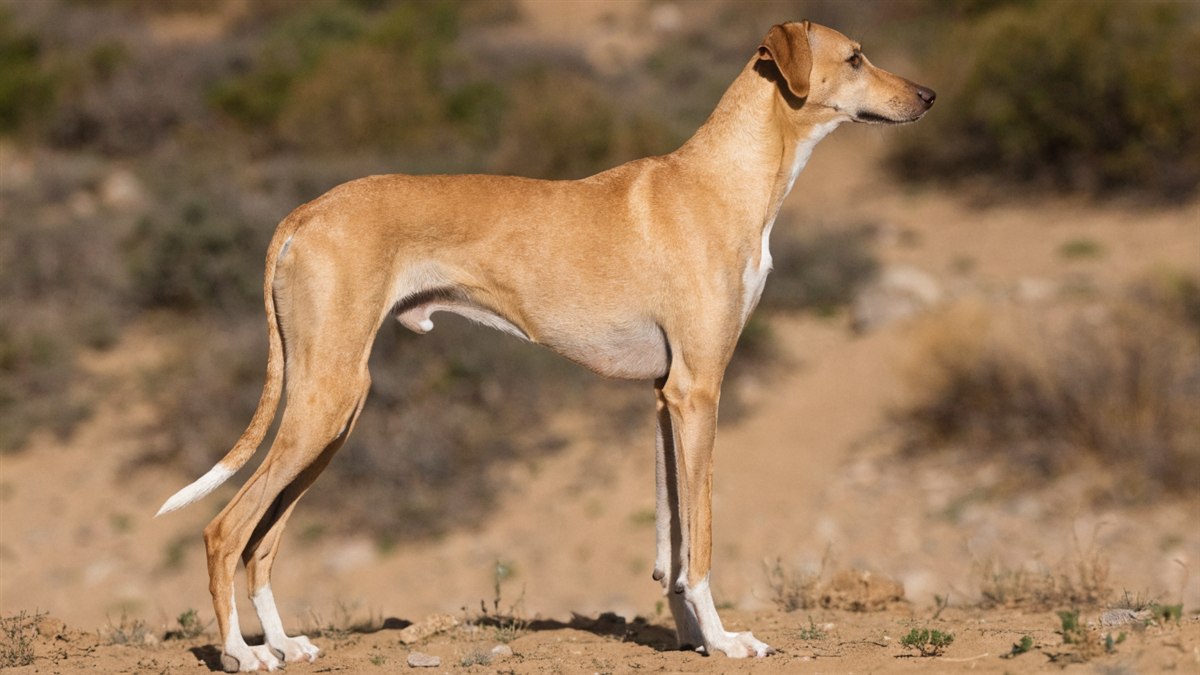
The FCI standard describes a dog whose construction is stripped to the minimum. General appearance is particularly slim and elegant, with bone structure and muscles showing through thin and dry skin, and a body that fits into a rectangle standing on its long side. The skin is thin and tight-fitting. The hair is short, fine, and down to none on the belly. There is no undercoat: a 2023 whole-genome study of 123 sequenced sighthounds names the Azawakh directly as a breed "possessing shorthair and lacking the undercoat layer", set against the Afghan Hound's thick long hair suited to cold mountains.
Two proportions in the standard do more work than the height figure. Height at the withers to depth of chest is set at 10 to 4, so the chest is only 40 percent as deep as the dog is tall. The AKC states the same ratio in words, "Depth of chest is 40 percent of height at withers. Well developed in length, deep but without reaching elbow level";, and the UKC writes it a third way, "The distance from the top of the withers to the bottom of the chest is less than one-half the total height at the withers";. Head length to width of skull is also 10 to 4, and length of head to length of muzzle is 10 to 5, which means the muzzle is exactly half the head.
| Attribute | FCI 307 (2019) | AKC (effective 2019) | UKC (revised 2009) | Royal Kennel Club (2025) |
|---|---|---|---|---|
| Male height at withers | 64 to 74 cm | 25 to 29 in | 25 to 29 in | 64 to 74 cm |
| Female height at withers | 60 to 70 cm | 23 to 27 in | 23.5 to 27.5 in | 60 to 70 cm |
| Male weight | 20 to 25 kg | 44 to 55 lb | 44 to 55 lb | 20 to 25 kg |
| Female weight | 15 to 20 kg | 33 to 44 lb | 33 to 44 lb | 15 to 20 kg |
| Coat | Short, fine, down to none on the belly | Short, fine, down to none on the belly | Short and fine, sparse to non-existent on the belly | Short and fine, may have none on the belly |
| Skin | Thin and tight-fitting | Fine, tight over the whole body | Fine and tight | Fine, tight over all body |
| Chest depth | 10 to 4 against height | 40 percent of height at withers | Less than half the height at withers | Not stated numerically |
| Colour | Fawn range only, other colours disqualify | "Color and markings are immaterial"; | Fawn, white, black, gray, blue, parti-colour, chocolate, grizzle | "Any other colour or combination of colours unacceptable"; |
Four registries, three positions on colour, and the one that binds India
The single most consequential fact about this breed is that the registries do not agree on what colour it comes in, and the disagreement is not cosmetic. Read the FCI list of disqualifying faults and you find "Non-standard coat colours (invasive white, white collar, brindle other than black). Beware of diluted colours such as: blue, lilac";. Read the AKC standard and you find four words, "Color and markings are immaterial", with the only colour-adjacent serious fault being a harsh or semi-long coat. Read the UKC standard, written in 1993 and revised in 2009, and you find an explicit list, "Fawn, clear sand to dark red, white, black, gray, blue, parti-color, and all shades of brown to include chocolate", with brindle, grizzle and overlays permitted, and a nose-colour clause that reads "nose color in the dilute colored dogs may vary".
The parent club is blunter still. The American Azawakh Association, which has been the AKC parent club for the breed since February 2011, states that it "recognizes all colors found in the countries of origin including sand to dark red, brindled, white, black, gray, blue grizzle, parti-colored, and all shades of brown, including chocolate";. The Canadian Kennel Club, which recognised the breed only in 2024, took the FCI text verbatim including the colour disqualification and the warning about blue and lilac. The Royal Kennel Club, which lists the breed as Azawakh (Imp), ends its colour clause with "Any other colour or combination of colours unacceptable";.
The Kennel Club of India is a Full member of the Federation Cynologique Internationale. That means the pedigree route available in India is the FCI route, and the FCI standard is the one that disqualifies a blue, black, grizzle or heavily white Azawakh. A dog that is a perfectly ordinary member of the Sahelian population, and fully registrable and showable under the AKC and the UKC, can be a disqualified dog on Indian paperwork. If you are shown a black or blue-grizzle Azawakh in India and told it is show quality, ask which registry the seller means.
A landrace and a registered breed at the same time
The Azawakh is genuinely both. In Mali, Niger and Burkina Faso it is a working landrace kept by Tuareg, Peul, Bella and Hausa households, and the FCI standard itself records that history rather than leaving it to folklore. The standard's brief historical summary says the breed descends from types pictured in Central Saharan wall paintings, that increasing aridity of the Sahara drove Tuareg, Dahoussahaq and Peul shepherd-hunters and their dogs into the Sahel along the dry valley of the Azawakh, and that it is known as Oska in the Tuareg language. Its stated job is unusually broad for a sighthound. It hunts gazelle, hare and ostrich, fights off hyenas, jackals and lions, and shares the camp life of the nomads as a family dog.
The first lines were exported to Europe from 1968, and European enthusiasts selected from them with the help of the breeders who owned those dogs. That founding event is the origin of the split. A Western show population was built from a narrow slice of a wide landrace, and the standard written around that slice made the rest of the landrace incorrect.
Two registries handled the problem structurally rather than by argument. The AKC did not close the studbook when the breed was fully recognised in 2019, which is why a desert-bred dog still has a way in. A dog imported straight out of the Sahel with no pedigree at all can enter by a route the breed's own fanciers have documented step by step, in which the owner contacts the American Azawakh Association board, has the desert-bred dog inspected by AAA-approved experts, receives an AAA registration and pedigree, and then submits that with an FSS application to the AKC. The same account records that the parallel arrangements for related breeds run through different bodies entirely, with desert-bred Salukis going through the Society For the Perpetuation of Desertbred Salukis and Sloughis going through the UKC, while Azawakh applicants must go through the parent club.
Bonbeno could not find a published count of how many Sahelian-bred dogs have come through that route, and the account above is a first-person report by a breed fancier rather than a registry document. What is independently verifiable is the outcome it describes, which is that the AKC standard makes colour immaterial and the parent club recognises the full Sahelian colour range. Treat the mechanism as documented and the volume as unknown.
Recognition, in order
| Registry | Recognised | Group placement |
|---|---|---|
| Federation Cynologique Internationale | 3 June 1980, definitive basis | Group 10 Sighthounds, Section 3 Short-haired Sighthounds, no working trial |
| United Kennel Club | 1 January 1993 | Sighthound and Pariah Dog Group |
| American Kennel Club | Standard approved 8 February 2018, effective 1 January 2019 | Hound Group |
| Canadian Kennel Club | 2024 | Group II Hounds |
| Royal Kennel Club (UK) | Standard last updated 1 April 2025, listed as Azawakh (Imp) | Hound |
Country of origin on the FCI record is Mali and country of patronage is France, with French as the official authentic language of the standard. The AKC ranks the breed 192nd of 210 for popularity, and PetMD reports that the AKC ranked it the fifth-rarest breed in the United States in 2024 Puisis E. Azawakh Dog Breed Health…. This is a rare breed everywhere outside the Sahel, which is the correct frame for everything that follows about price, health data and veterinary familiarity in India.
One more line from the standard deserves quoting before anyone falls in love with the look. Under disqualifying faults, alongside aggression and blue eyes, sits "Overly small chest and extreme general thinness";. The breed is meant to be lean, not frail, and the AKC puts a number on where the line falls: in correct weight, three to five ribs should be visible.
Azawakh price in India, and why no trustworthy number exists
No verifiable Azawakh price in India exists, and that is a finding rather than a gap in this page. Bonbeno checked the two largest published Indian dog-price lists, the Indian sale pages that rank for the query, and the import rules that would govern any legal supply, and the honest conclusion is that there is no Indian market for this breed to have a price.
Start with the aggregators, because they are the pages Indian buyers actually read. Supertails publishes a Dog Price List in India covering the top 40 breeds with city-wise costs, and the Azawakh appears nowhere in it, while the Mudhol Hound appears eleven times. WrapInFur publishes a Dog Price List in India covering more than 50 breeds with puppy prices and monthly maintenance costs, and the Azawakh appears nowhere in that either, while the Mudhol Hound appears eight times. Two independent Indian price lists, more than 90 breed entries between them, zero Azawakhs.
The page titled Azawakh Price in India has no Azawakh price on it
The Indian sale page that ranks for this query is titled "Azawakh Price in India, Buy Elegant African Hound Puppies Online". Under its heading Available Azawakh Puppies For Sale it lists eight puppies. None of the eight is an Azawakh. The animals actually on offer are a Maltipoo at Rs 98,999, two Poodles at Rs 92,599 each, a Cane Corso at Rs 94,999, a Goldendoodle at Rs 1,20,000, a second Maltipoo at Rs 98,999, a Rottweiler at Rs 76,499 and a Doxiepoo at Rs 98,999. The page states no Azawakh price anywhere on it.
Its breed panel is worth reading too, because it disagrees with every breed standard. It gives the weight as 20 to 30 kg, where the FCI, AKC, UKC and Royal Kennel Club all cap males at 25 kg and females at 20 kg American Kennel Club United Kennel Club The Royal Kennel Club. It gives life expectancy as 10 to 13 years where the AKC record says 12 to 15. It marks Shedding as YES for a breed a peer-reviewed genome study describes as lacking an undercoat. A panel that wrong about a breed is not a panel that has ever handled one.
| Source | Figure given | What it is worth |
|---|---|---|
| Supertails, Dog Price List in India 2026, top 40 breeds | Breed not listed | Evidence of absence from the mainstream Indian market |
| WrapInFur, Dog Price List in India 2026, 50+ breeds | Breed not listed | Second independent confirmation of the same absence |
| Puppiezo, Azawakh Price in India | No Azawakh price stated, eight non-Azawakh puppies listed | A shell page. Do not treat the title as a quote |
| Happy Pet Care, Azawakh Dog Breed in India | Cost of buying Rs 35,000 to Rs 60,000 | The only Indian rupee figure found, with no stated method, no sample and no named seller |
| PetMD, Azawakh Dog Breed Health and Care | About USD 2,500 for a puppy in the United States | A real figure, for a different country and a different supply chain |
The Rs 35,000 to Rs 60,000 band is the only Indian number in that table, and Bonbeno is not going to launder it into a range by repeating it. The page carrying it gives no method, no sample size, no city breakdown and no indication that any transaction ever occurred at that price. Compare it with the roughly USD 2,500 that PetMD reports for a puppy in the United States, where the breed has a parent club, an open studbook and active breeders, and the Indian figure is roughly a fifth of the price in the country where supply actually exists. A rare African sighthound priced below a Labrador is a claim that has to explain itself, and it does not.
The import rules explain the absence
Indian import policy classifies mammals under ITC (HS) 01061900 as Restricted, and Policy Condition (7) allows import of dogs only for three purposes: a pet dog with a valid pet book and records in the name of the importer, a dog imported by an R&D organisation with the recommendation of CPCSEA, or a dog for internal security by the Defence and Police Force. Policy Condition (8) then states that "Import of commercial dogs for breeding or any other commercial activities other than the purposes mentioned above is not permitted";.
- Applications for trading or breeding are rejected outright. The Trade Notice states that "any applications for trading/breeding purposes, or applications made on behalf of some another person/entity shall be duly rejected".
- Only seven entry points exist. Import of pet animals is allowed only through the airports and seaports of Delhi, Mumbai, Chennai, Hyderabad, Bengaluru and Kolkata and, since October 2024, Kochi airport, with quarantine at the government station where required Department of Animal Husbandry….
- Baggage import requires two years abroad. Up to two pets may enter as passenger baggage without a DGFT authorisation only for a person transferring residence to India after two years of continuous stay abroad.
- Three or more pets always need authorisation. For more than two pets the application goes to DAH&D for examination before DGFT grants an authorisation.
- Start two months early. Pet owners travelling to India are advised to begin the import authorisation process at least two months before travel.
Put those provisions next to the breed's rarity and the arithmetic closes. Founding an Indian breeding population would require importing breeding stock, and importing breeding stock is exactly what the Trade Notice refuses. The lawful route in is one dog at a time, in the personal baggage of a returning resident who has lived abroad for two years. That produces individual dogs, not a market, and it is why there is no Indian price to publish.
Any Indian listing offering an Azawakh puppy on demand is describing something else. The realistic candidates are an Indian sighthound of similar outline, most often a Mudhol Hound, a Rampur Greyhound, a Chippiparai or a Kanni, or a lean crossbred, or an auto-generated shell page that exists identically for every breed name in the database. The Puppiezo page is the worked example of the third case, since it advertises Azawakh puppies and offers a Rottweiler. Bonbeno does not broker puppy sales, does not publish breeder listings and does not quote any of these figures as an offer.
The useful conclusion is not that the Azawakh is expensive in India. It is that a genuine Azawakh in India will almost always be an individual dog with a paper trail you can follow back to a named foreign registry and a DGFT authorisation, and the price will have been whatever the exporting breeder charged plus flights, quarantine and paperwork. If the seller cannot show you that trail, there is no price question left to ask.
Monthly cost of owning an Azawakh in India
Budget for an Azawakh the way you would budget for a large, low-grooming, high-risk-of-being-misdiagnosed dog. The recurring costs are genuinely modest, because a 20 to 25 kg dog with no coat is cheap to feed and almost free to groom. The costs that will surprise you are diagnostic, and they come from the breed being rare enough that no Indian vet has a mental baseline for it.
One Indian page publishes a monthly figure, at Rs 5,700 for a basic lifestyle and Rs 8,550 for a premium one, with food alone at Rs 3,000 to Rs 4,500. Bonbeno reports that figure rather than adopting it, because the same page gives no sample size, no city, no collection date and no evidence that it was derived from anyone who owns this breed in India. Since two national price aggregators do not list the breed at all WrapInFur, Dog Price List in India 2026, a single unsourced monthly estimate is not a market rate. What follows is the cost structure instead.
Where the money actually goes
- Food, and less of it than the size suggests. A correctly conditioned adult male weighs 20 to 25 kg and a female 15 to 20 kg. This is a tall dog with the bodyweight of a medium one, so it eats like a medium one. Feed to body condition rather than to height, because the AKC's condition marker is that three to five ribs should be visible in correct weight.
- Grooming, which is close to nothing. The coat is short and fine and absent on the belly, and PetMD describes grooming needs as minimal with no requirement for special skin care or regular bathing. A rubber hound glove, a nail clipper and a toothbrush is the whole kit. There is no professional grooming line item in this budget.
- Cooling and shade, which is not optional. Indian veterinary guidance describes power cuts that eliminate fans and air conditioning as an India-specific hazard that creates sudden heat exposure pets cannot escape. For a dog with no coat and no belly hair, a reliable cool floor, shade and a backup fan are a real recurring cost in a city with load-shedding.
- Preventive veterinary care. Core vaccination, boosters, deworming, and tick and flea control, at the ordinary Indian rate for a medium-sized dog.
- Bloodwork read by someone who knows sighthounds. This is the line item unique to this breed and it is covered in full in the health section. Budget for annual bloodwork and, more importantly, for the willingness to pay for a second opinion before starting any lifelong medication.
The one-off costs nobody lists
Anyone who legally brings an Azawakh into India carries a set of costs that no monthly figure captures. Import authorisation goes through the DGFT, entry is limited to seven ports, an Advance No Objection Certificate must be obtained from the Regional or Quarantine Officer at that port seven days before travel, and disease testing prescribed in the health certificate must be done in the exporting country with all reports travelling with the animal Department of Animal Husbandry…. Add international flight costs for a 25 kg dog in a large crate, and the paperwork alone dwarfs any Indian purchase price ever quoted. The full route is set out in how to import a dog to India.
When Bonbeno publishes a monthly cost figure it states the sample size, the cities covered and the collection date. For this breed no such sample exists in India, so no figure is published. Repeating an unsourced number from another site would be worse than useless here, because it would give a reader false confidence about a breed almost nobody in the country has ever owned.
The expensive mistake, in rupees
The largest avoidable cost in this breed is not food or boarding. It is a lifelong prescription started on a single blood test. Sighthounds as a group carry basal total T4 concentrations below the standard canine reference interval, and in a retrospective study of 398 sighthounds, hypothyroidism had been diagnosed in 286 of them, 71.9 percent, on the basis of low total T4 or total T3 alone, with only 65 dogs, 16.3 percent, showing any additional abnormality suggestive of genuine disease. Levothyroxine for a 22 kg dog, twice daily, for a decade, is a meaningful sum, and it buys nothing at all if the dog was never hypothyroid. Paying for one careful re-test before the first tablet is the highest-return spend on this page.
Heat tolerance: why Bonbeno rates the Azawakh 4 of 5 for India, not 5
Bonbeno rates the Azawakh 4 of 5 for heat tolerance in India, the highest rating this site has given any imported breed. The rating is built from the standard's own coat, skin, chest and weight text rather than from the fact that the breed is African. It loses the fifth point for four specific reasons: Sahelian heat is dry and Indian coastal heat is not, the breed has no coat to stop Indian ultraviolet, adaptation is not the same as acclimatisation, and nobody has ever measured an Azawakh's body temperature at work in heat.
The mechanical case for a high rating, feature by feature
Six features in the breed standards do real thermal work, and each one is verifiable in a document rather than inferred from a photograph.
- No undercoat at all. The FCI standard gives the hair as short, fine, and down to none on the belly, over skin that is thin and tight-fitting. A 2023 whole-genome study of sighthounds names the Azawakh specifically as "possessing shorthair and lacking the undercoat layer";. Purina India's list of breeds at particular heat-stroke risk names short-faced breeds and dogs with heavy coats such as Huskies or Newfoundlands. The Azawakh is the structural opposite of both.
- Very low mass for its height. A male stands 64 to 74 cm and weighs 20 to 25 kg. Heat production scales with body mass and heat loss scales with surface area, so a tall dog carrying little mass runs a favourable ratio. For scale, Bonbeno's Greyhound page records a mean adult bodyweight of 29.7 kg in a UK primary-care population at a similar height. The Azawakh is roughly the same dog with 5 to 10 kg less furnace inside it.
- A shallow chest on long legs. Chest depth is 40 percent of height at the withers under the FCI, AKC and UKC texts alike American Kennel Club United Kennel Club. The heat-producing trunk sits high above the ground, which matters on Indian asphalt that reaches 60 C in direct sun. More of the standing dog is leg, which is skin over bone and tendon rather than working muscle.
- A bare belly, which is a cooling surface. Three registries independently state that hair is absent or nearly absent on the belly The Royal Kennel Club. That is precisely where emergency cooling is applied: Purina India's protocol is cool but not cold water on the skin, and the belly and inside of the legs are the standard sites. A dog with no belly hair also dumps heat by conduction straight into a stone or tile floor, which is why an Azawakh in an Indian home will find the coolest tile in the house and stay on it.
- A long muzzle for evaporative cooling. The standard sets length of head to length of muzzle at 10 to 5, so the muzzle is half the head, and describes it as long, straight and tapered. Dogs cool almost entirely by respiratory evaporative cooling, meaning panting, plus limited sweat glands in the paw pads. A long nasal passage gives a large evaporative surface, and the largest UK study of heat-related illness triggers found brachycephalic dogs had greater odds of all three types of heat-related illness compared with mesocephalic dogs.
- Selection pressure that is documented in the standard itself. The FCI's own historical summary records that the ever-increasing aridity of the Sahara drove Tuareg, Dahoussahaq and Peul shepherd-hunters and their dogs into the Sahel. This is not a marketing origin story bolted onto a European show dog. It is the recognising registry describing an aridity gradient as the reason the breed exists where it does.
How hot the home range actually is
The Sahel is hotter than most of India for most of the year, and the numbers are recent and attributed. At the end of March and the beginning of April 2024, maximum temperatures in the Sahel reached more than 45 C, with minimum temperatures of 32 C in Burkina Faso, and Kayes in Mali recorded 48.5 C on 3 April. Extreme temperatures were reported across Senegal, Guinea, Mali, Burkina Faso, Niger, Nigeria and Chad. The human cost is the part that should register: the Gabriel Toure hospital in Bamako recorded 102 deaths between 1 and 4 April, against 130 deaths across the whole of April 2023.
The climate type matters as much as the temperature. West Africa across the domain from the Atlantic coast to Chad is classified Koppen BSh or BShw, a semi-arid and hot climate consisting of an alternation between a short wet season and a very long dry season. The Sahel's hottest months sit inside that long dry season, before the West African monsoon arrives.
Nearly every imported breed this site covers loses points for a coat built somewhere colder. The Azawakh is the reverse case. Its coat, skin, chest depth and bodyweight were all shaped by an aridity gradient the FCI standard names in its own history section, and the region it came from produced a 48.5 C reading in 2024. When Bonbeno says a breed is heat-adapted, this is what the evidence is supposed to look like.
Deduction one: dry heat and humid heat are not the same problem
Panting is evaporation, and evaporation depends on the air being able to accept water. Indian veterinary guidance states the point directly, that humidity in coastal cities approaches 90 percent, rendering panting ineffective, and Purina India lists excessive humidity among the factors that increase heat-stroke risk. Now look back at the six advantages above and sort them by which physical process they use. The bare skin, the bare belly and the high shallow trunk work by radiation and conduction, and humidity does not touch those. The long muzzle works by evaporation, and humidity blunts it hard.
So the Azawakh keeps most of its toolkit in dry Indian heat and loses one of its best tools in wet Indian heat. A May afternoon in Jaisalmer, Bikaner, Nagpur or Delhi resembles the conditions this breed was selected in. A July afternoon in Chennai, Mumbai, Kochi or Kolkata does not, and the thermometer will understate the load.
| Zone | Example cities | Bonbeno heat rating | Why |
|---|---|---|---|
| Hot arid and semi-arid | Jaisalmer, Bikaner, Jodhpur, Ahmedabad | 5 | Closest match to the Sahelian dry season. Radiative, conductive and evaporative cooling all available |
| Hot dry interior | Delhi, Jaipur, Nagpur, Hyderabad, Pune | 4 | Very hot but low humidity through the pre-monsoon months, so panting still works |
| Humid subtropical, monsoon months | Delhi, Lucknow, Kolkata in July and August | 3 | Panting efficiency falls as humidity climbs |
| Coastal humid | Mumbai, Chennai, Kochi, Goa, Visakhapatnam | 3 | Humidity approaching 90 percent renders panting ineffective. The breed's evaporative advantage largely disappears |
| Cool hill stations and northern winter | Shimla, Dehradun, Delhi in January | 2 | A lean sighthound with no undercoat and a high surface-area-to-volume ratio chills fast |
Deduction two: the sprint is the risk, and so is the ordinary walk
The largest study of what actually triggers canine heat-related illness reviewed 905,543 UK dogs under primary veterinary care and identified 1,259 events. Of the 879 events with a recorded trigger, exertional heat-related illness accounted for 652, or 74.2 percent, ahead of environmental heat at 113 events (12.9 percent) and vehicular confinement at 46 events (5.2 percent). Exertional events carried a 7.6 percent fatality rate and accounted for the majority of heat-related deaths with known triggers.
Two results from that paper change how an Indian Azawakh owner should plan the day.
- The Greyhound had 2.11 times the odds of exertional heat-related illness of a Labrador Retriever (95 percent CI 1.08 to 4.16, P = 0.03), one of only seven breeds with raised odds alongside the Chow Chow, Bulldog, French Bulldog, English Springer Spaniel, Cavalier King Charles Spaniel and Staffordshire Bull Terrier.
- Most exertional heat illness followed a walk, not a sprint. Of 551 exertional events where the activity was specified, 372 (67.5 percent) occurred after walking and only 97 (17.6 percent) after high-intensity activities.
Bonbeno's Greyhound page reports that the Greyhound is not among the breeds named at higher risk in the VetCompass heat study, and that is accurate for the paper it cites, which measured heat-related illness overall. A second 2020 paper from the same programme and the same 2016 cohort analysed exertional heat-related illness separately and did name the Greyhound, at an odds ratio of 2.11. Both statements are true about different outcomes. The version that matters for a coursing sighthound in India is the exertional one, so this page treats a running Azawakh as a raised-risk dog and the Greyhound page will be corrected to match.
Direct temperature measurement exists for one sighthound and it is not this one. Rectal temperatures were taken before and after racing from 229 greyhounds across 46 race meetings at seven venues in South Australia, with ambient temperature at race time ranging from 11.0 to 40.8 C and relative humidity from 17 to 92 percent. The mean rise in rectal temperature after a single race was 2.1 C, with a range of 1.1 to 3.1 C. Dogs that finished above 41.5 C had raced at a significantly higher mean ambient temperature, and over half of post-race urine samples were positive for haemoglobin or myoglobin, with 95 percent of 77 positive samples confirmed as myoglobin. Purina India puts the heat-stroke threshold at a body temperature of 40.5 C or above, a full degree below that 41.5 C mark.
Bonbeno labels this extrapolation rather than evidence. The Azawakh is a lighter, coatless, longer-legged dog than a racing Greyhound, so the true figures for this breed are probably better. They are, however, unmeasured, and a sighthound that reaches 40 km/h is producing heat at a rate no coat quality can offset.
Deduction three: no coat means no protection from Indian sun
Heat tolerance is not sun tolerance, and this breed has traded one for the other. Indian guidance identifies dogs with short, thin coats, light-coloured fur and areas of exposed or lightly pigmented skin as vulnerable to ultraviolet damage, with the nose, ear tips, belly and skin around the eyes most commonly affected. The Azawakh's belly is bare by breed standard, and the commonest coat colours in the FCI range run from clear sand to dark fawn, which puts many dogs at the pale end.
The signs are redness and tenderness of exposed skin, dry flaking or peeling particularly on the nose and ear edges, blistering in severe cases, and discomfort when the area is touched. Repeated or severe sunburn raises the risk of squamous cell carcinoma in chronically sun-exposed areas, and Indian ultraviolet intensity makes that practical rather than theoretical. A nomad's dog lives under camp shade. An Azawakh on a Mumbai terrace at noon in May does not, and the breed brings no coat to the problem.
Deduction four: adaptation is inherited, acclimatisation is not
Purina India lists lack of acclimatisation as a distinct factor that increases heat-stroke risk, separate from coat and conformation. An Azawakh flown to India from a European kennel is genetically Sahelian and physiologically European. It has spent its life in a temperate climate and its heat-loss physiology has never been trained. You buy the adaptation with the dog. You have to build the acclimatisation yourself, over weeks, in the cool part of the day, and it resets after every long air-conditioned winter.
Working temperature bands for an Indian owner
| Ambient temperature | Risk | What to do |
|---|---|---|
| Below 30 C | Low | Normal activity. The only band in which a hard free gallop is sensible. Indian guidance treats below 30 C as the safe window for outdoor exercise |
| 30 to 35 C, dry | Moderate | Walk early morning or late evening only. Shade, water, no sprinting. This is close to the breed's home conditions but the dog is not acclimatised to yours |
| 30 to 35 C, humid | High | Treat as the band above plus one. Panting efficiency falls as humidity rises toward 90 percent |
| 35 to 42 C | High | Outdoor activity contraindicated. Midday walks between 10 am and 6 pm are contraindicated for all dogs in Indian summer |
| Above 42 C | Extreme | Indoors on a cool floor with continuous airflow. Even brief terrace or balcony exposure is dangerous |
- Walk only before 7 am or after 8 pm from April to September.
- Run the 7-second pavement test before every walk, placing the back of your hand on the pavement for seven seconds. Asphalt reaches 60 C in direct sun and causes third-degree paw burns within 30 seconds.
- Choose grass or dirt over asphalt, which is 10 to 15 C cooler in direct sun.
- Never leave the dog in a parked car. At an outside temperature of 26 C the inside of a car reaches 32 C in five minutes and 43 C in 25 minutes. Indian summer sun can push a parked car interior to 50 to 60 C within minutes even with windows partly open.
- Cool with cool but not cold water on the skin, especially the belly and inside of the legs, and use a fan. Do not use an ice bath, which prevents core temperature falling.
- Stop cooling at 39.4 C to avoid overshooting into hypothermia, then go straight to a vet.
- Learn the signs. Severe panting, difficulty breathing, severe salivating, vomiting, diarrhoea, a temperature of 40.5 C or above, blood in the urine, nose bleeds, and ultimately collapse and coma.
The cold problem, which India also has
This dog chills far faster than it looks like it should, and that is documented rather than folkloric. The published review of sighthound anaesthesia identifies lean body conformation with a high surface-area-to-volume ratio as a specific predisposition to hypothermia. The mechanism does not switch off outside the operating theatre. A Delhi or Lucknow January, a Pune winter morning and an aggressively air-conditioned Mumbai bedroom will all chill an Azawakh long before they chill a Labrador. Buy a coat for winter, put a thick raised bed on the floor rather than tiles once the weather turns, and do not let this dog sleep directly under an air conditioner.
Temperament and household fit
The Azawakh is a guarding sighthound, not a coursing sighthound with a guarding hobby, and that single distinction decides whether it fits an Indian household. The FCI standard describes the temperament as "Quick, attentive, distant, can be very reserved with strangers, but it can be gentle and affectionate with its family, and people whom it is willing to accept";. Read that sentence as a job description rather than a personality sketch.
The standard lists the breed's utilisation as hunting gazelle, hare and ostrich, fighting off hyenas, jackals and lions, and being "an important companion for the family life of the nomads" that "shares their camp life";. A dog selected to sleep inside a camp and drive off predators is selected to notice arrivals and to object to them. PetMD's account, drawn from a breeder and trainer working with the breed, puts it as "Azawakhs are slow to warm up to strangers and tightly bonded to their people" and "incredibly loyal to their humans and quick to notice the strange, unusual, or suspicious";.
The parent club is more candid than most breed clubs allow themselves to be. The American Azawakh Association writes that at home the breed is gentle, affectionate and playful with those it accepts, that it "may also be distant and reserved with strangers and some can be fearful or aggressive", that these dogs "bond closely with their people and cannot be kept as kennel dogs", and that they "have the intelligence and heart to protect";. A parent club that says some of its dogs can be fearful or aggressive is telling you something the sale pages will not.
An urban Indian home has a very high rate of strangers crossing the threshold. Domestic help, cooks, drivers, maintenance staff, courier and food-delivery riders, gas cylinder deliveries, society security, relatives arriving unannounced, and neighbours in a shared lift. A breed selected over centuries to notice and challenge arrivals at a camp boundary will find that environment continuously demanding. This is the single most likely failure mode for an Azawakh in an Indian metro, and it has nothing to do with heat.
What the standards say about bad temperament
Every registry treats temperament as structural rather than optional. The FCI and Canadian Kennel Club both list "Aggressive or overly shy dogs" as a disqualifying fault Canadian Kennel Club. The UKC disqualifies "Viciousness or extreme shyness" outright, meaning such a dog must not be placed and must be reported to the registry. The AKC standard faults "Excessively timid, hysterical or aggressive character";. PetMD makes the same point from the other direction, that an Azawakh should not be overly fearful or timid and that early socialisation matters.
Good fit and poor fit
- Good fit. An independent house with a securely fenced compound, a household with predictable routines and few unannounced visitors, an owner who has kept a reserved primitive breed before, and a family that wants a quiet, clean, low-shedding dog that watches the gate.
- Workable fit. A large apartment with a committed owner who manages the door properly, builds a settled place away from the entrance, and trains a calm response to the doorbell from week one. One Indian breed page names an independent house as the ideal space, and Bonbeno agrees that is easier, not that a flat is impossible.
- Poor fit. A first-time owner, a household with constant footfall, a home with resident cats or rabbits, an owner who wants an outgoing dog that greets guests, or anyone who plans to keep the dog outdoors in a kennel. The parent club states outright that these dogs cannot be kept as kennel dogs.
- Watch item. Small household pets. PetMD notes the breed coexists peacefully with other dogs but may chase small household animals, which is standard sighthound prey drive.
Children
Azawakhs that have been properly socialised tend to do fine with children who understand proper boundaries. Read the condition rather than the verdict. This is a reserved, dignified, physically fragile-looking dog with visible ribs and hip bones by design, and a child who treats it as a soft toy is a bad match. Indian households with cousins, neighbours' children and festival visitors moving through the house need a hard rule that the dog has a place nobody follows it to.
Training an Azawakh, and what this breed refuses
Train an Azawakh with reward-based methods from the first week and never with corrections that rely on intimidation, because the breed's own registry says harsh training breaks it. The AKC's guidance is unusually blunt for a registry, describing a hound with "an amazing amount of dignity" that "does not respond well to harsh or punishment-based training, which can produce a hound who is either broken in spirit, or aggressive and unmanageable";.
The same guidance names what works. "Positive, reward-based training with gentle but firm corrections can result in a hound who is obedient, affectionate, and loyal";. PetMD adds patience and consistency, and notes that a watchful Azawakh may hesitate to comply rather than refuse outright. That hesitation is the behaviour Indian owners most often mistake for stubbornness and then escalate against, which is exactly the escalation the registry warns about.
Three things this breed resists
- Reliable off-lead recall. This is a sighthound with the FCI's own description of a springy gallop and movement as an essential characteristic of the breed. A dog that hunts by sight and pursues at speed will not choose you over a moving target it has already locked onto. Indian streets add free-roaming dogs, cats, cattle, goats and monkeys to that equation. Do the recall training anyway, because it buys you a better response at short range, and then plan for a securely fenced space or a long line, permanently. Recall training in this breed improves the odds and never removes the risk.
- Tolerating repeated handling by strangers. A breed described by its own standard as distant and very reserved with strangers does not learn to enjoy being handled by every visitor. Train cooperative care with you and your vet instead, so a nail trim and a blood draw are calm procedures rather than fights.
- Drilling. Repetition without purpose reads as pointless to an independent hound. PetMD lists the activities the breed actually engages with, including lure coursing, AKC Rally, agility, nose work, flyball, Fast CAT and dock diving. In India the practical versions are scent games indoors, a long line in a safe field, and short daily training sessions with real rewards.
The doorbell protocol, which is the whole training programme in an Indian flat
Teach a settled place away from the front door and pay the dog for going to it when the bell rings, starting on day one. Do this before the dog has ever practised rushing the door, because a guarding breed rehearsing an alarm response gets better at it every time. The behaviour you want is the dog notices, announces once, and goes to its place. The behaviour you will get if you leave it is a dog that meets every delivery rider at the door, and in a breed the parent club says can be fearful or aggressive with strangers, that is not a nuisance, it is a liability.
| Skill | Start | Reliable by |
|---|---|---|
| Name response and hand target | Week 1 home | 3 to 5 weeks |
| Settle on a mat away from the door | Week 1 home | 8 to 12 weeks |
| Toilet training | Week 1 home | 4 to 6 months |
| Calm response to the doorbell | Week 1 home | 6 to 12 months, then maintained for life |
| Cooperative nail trims and handling | Week 2 home | 3 to 6 months |
| Loose-lead walking past street dogs | Month 2 | 9 to 15 months |
| Muzzle conditioning for vet visits | Month 2 | 6 to 10 weeks of short sessions |
| Off-lead recall in open ground | Not recommended | Treat as never reliable and manage with a long line |
Teach a reserved sighthound to wear a basket muzzle happily while nothing is wrong, months before any emergency. A dog in pain from a torn skin flap or a suspected heat stroke has to be handled fast, and a reserved breed that has never met a muzzle will be restrained by force at the worst possible moment. Ten minutes a week of food-based muzzle conditioning is the cheapest insurance in this guide.
Socialisation, and the window that closes
Socialise deliberately and early, because in this breed the cost of getting it wrong is not shyness, it is a disqualifying temperament. Every registry treats fear and aggression as faults serious enough to exclude a dog American Kennel Club United Kennel Club, and PetMD stresses proper socialisation from an early age. Build a written list of what the puppy must meet calmly in its first four months: lifts, marble floors, scooters, hawkers, cattle, street dogs seen at a safe distance, temple bells, firecrackers played quietly on a speaker, and the specific people who will come to your door every week. Talk to your nearby vet about managed low-risk exposure during the vaccination course rather than isolating the puppy until it is finished.
How much exercise an Azawakh actually needs in India
Give an adult Azawakh about 60 minutes of exercise a day, split into a pre-dawn session and a post-sunset session for eight months of the Indian year, plus a genuine chance to gallop inside a securely fenced space once or twice a week. In this breed the timing of the exercise matters more than the amount, because the largest study of heat-related illness triggers found that most exertional cases followed an ordinary walk rather than hard running.
The 60-minute figure is the only Indian published estimate Bonbeno could find, on a page whose breed panel is otherwise unreliable, since the same panel gives the weight as 20 to 30 kg against the standards' 20 to 25 kg for males and marks the breed as a shedder Federation Cynologique Internationale Li WL, Liu YH, Li JX. It is quoted here because it is roughly right for a lean sighthound and because no better Indian number exists. Treat it as a floor for a healthy adult.
Movement is written into the breed standard
The FCI standard treats gait as structural rather than cosmetic. Movement is "Always very supple and with high action when walking and trotting. The gallop is springy", and the standard states that "The movement is an essential characteristic of the breed";. The AKC describes movement that is agile and light, with the dog appearing to float effortlessly over the ground at the trot. A dog built and judged on how it moves will deteriorate physically and mentally without room to do it. PetMD's account is that Azawakhs do well when given a job and that their mental state often suffers if left to their own devices in the backyard.
The scheduling rules that actually prevent heat injury
- Move both sessions to the cool ends of the day from April to September. Indian guidance names before 7 am and after 8 pm as the safe windows and treats 10 am to 6 pm as contraindicated for all dogs in summer.
- Test the pavement every single time. Place the back of your hand on the surface for seven seconds. Asphalt reaches 60 C in direct sun and burns paw pads within about 30 seconds.
- Cap the duration when it is above 30 C, even in dry heat. The dog's ancestry does not exempt it. Exertional heat-related illness carried a 7.6 percent fatality rate in the UK study and accounted for the majority of heat-related deaths with a known trigger.
- Save the gallop for the coolest hour of the week. Rectal temperature in racing greyhounds rose by a mean of 2.1 C after a single race, with a range of 1.1 to 3.1 C. Purina India puts the heat-stroke threshold at 40.5 C body temperature, so a normal dog starting near 38.5 C has very little margin.
- Substitute scent work and training indoors during a heatwave. Twenty minutes of nose work tires an intelligent hound more than twenty minutes of walking, and it can be done on a cool floor with a fan running.
This is a sighthound whose standard describes a springy gallop as an essential characteristic and whose traditional quarry was gazelle and hare. An Azawakh that sights a street dog, a cat or a cow across a Bengaluru park will be three hundred metres away before your recall cue finishes. Use a long line, a fully enclosed field, or a sanctioned lure-coursing setup. Bonbeno gives the same advice on every sighthound page it publishes, and this breed is no exception.
Puppies need less than you think
Build load slowly through the first year. A tall, lightly built, fast-growing sighthound puppy is carrying long bones that are still lengthening, and forced distance work, stair marathons and jogging alongside a bicycle before the skeleton has matured are the standard ways owners cause permanent orthopaedic damage in large breeds. Free play on soft ground at the puppy's own pace is the right currency for the first year. Set the specific milestones with your nearby vet, who can feel the dog rather than read a chart.
| Stage | Formal exercise | Sessions per day |
|---|---|---|
| 8 to 16 weeks | Short lead walks plus free play on soft ground | 2 to 3 very short |
| 4 to 8 months | Building toward 30 minutes total | 2 |
| 8 to 14 months | 30 to 45 minutes total, no forced distance work | 2 |
| Adult, 14 months plus | About 60 minutes total plus a weekly enclosed gallop | 2 |
| Senior | 30 to 45 minutes gentle, on soft surfaces | 2 to 3 shorter |
Grooming an Azawakh in Indian humidity
Grooming an Azawakh means looking after skin rather than managing coat, which makes it the lowest-effort grooming job of any breed on this site and the highest-attention skin job. The coat is short and fine and absent on the belly, so PetMD describes grooming needs as minimal with no requirement for special skin care or regular bathing, and notes that brushing the short coat removes most dry dirt without a bath.
The weekly routine, which takes ten minutes
- Rubber hound glove once a week. Enough to lift dead hair and let you feel the whole dog.
- Run both hands over the entire body while you do it. Thin, tight skin over visible ribs means a scratch, tick or lump is easy to feel and easy to miss visually. Every registry describes the skin as fine and tight United Kennel Club The Royal Kennel Club.
- Check the drooping ears. The standard describes ears that are fine, always drooping and flat, lying flat against the cheeks. A closed ear in Indian humidity holds moisture, so check and dry them weekly and after every bath or swim.
- Clip nails on schedule. A tall sighthound on soft Indian ground wears nails slowly. Overgrown nails change the way the foot loads and are one of the most common preventable problems in sighthounds generally.
- Brush teeth. Small, fine jaws with a complete set of teeth in a scissor bite benefit from routine brushing rather than an annual scale under anaesthesia, and anaesthesia in this breed group carries its own considerations.
- Bathe only when actually dirty, then dry thoroughly in the skin creases behind the elbows and between the thighs.
A shedding claim that does not fit the biology
Two credible sources disagree here and Bonbeno is publishing the disagreement rather than picking one. PetMD states that Azawakhs "shed moderately year-round and blow their coat in the spring and fall";. A 2023 peer-reviewed whole-genome study of sighthounds describes the Azawakh as lacking the undercoat layer, and blowing coat is normally the seasonal moult of an undercoat. One Indian sale page simply marks Shedding as YES with no detail. The practical answer for an Indian owner is that shedding from this breed is low enough that it does not drive the grooming schedule, and that if your dog is dropping hair in visible quantity, that is a reason to look at skin health rather than to buy a better brush.
Sun protection replaces coat care
This is the section where the usual Indian grooming advice inverts. Every other imported breed page on this site says do not shave the coat, because the coat protects the skin from direct heat and sunburn. The Azawakh has no coat to shave and no undercoat to shade the skin, and its belly has no hair at all. It is permanently in the state that advice is trying to prevent.
Dogs with short, thin coats and exposed or lightly pigmented skin are vulnerable to ultraviolet damage, with the nose, ear tips, belly and skin around the eyes most commonly affected. Watch for redness and tenderness of exposed skin, dry flaking or peeling on the nose and ear edges, blistering, and discomfort on touch. Repeated or severe sunburn raises squamous cell carcinoma risk in chronically sun-exposed areas, and Indian ultraviolet intensity makes that a practical concern. Prevention is shade, avoiding peak ultraviolet hours, and a veterinarian-approved dog-safe sunscreen on exposed areas of lightly pigmented dogs. Ask your nearby vet which product to use before you apply anything.
Monsoon and skin
Indian monsoon months are the hardest season for any thin-skinned dog, and this one has almost no barrier between the environment and its skin. Keep the dog dry rather than damp, dry the ears after every wetting, and treat any scrape the same day rather than watching it. The absence of coat is a genuine advantage here, because there is no dense undercoat trapping moisture against the skin the way there is on a Golden Retriever or a Samoyed. What replaces that risk is a direct-contact one: nothing stands between an Azawakh's skin and a thorn, a hot surface, a rough wall or an insect bite.
Health, lifespan, and the bloodwork trap that has never been measured in this breed
The Azawakh is repeatedly described as an exceptionally healthy breed, and Bonbeno's finding is that the claim is repeated rather than measured. There is no breed health survey, no published lifespan study, no reachable screening register and no set of Azawakh-specific laboratory reference intervals. What does exist is a small number of named conditions, one published case report, and a body of sighthound clinical-pathology evidence that this breed sits just outside.
The registry contradicts itself on one page
The AKC's own breed record carries two statements that do not sit together. Its health text says Azawakhs "are generally health dogs, and a responsible breeder will screen breeding stock for health issues such as hypothyroidism, seizures, cardiac problems, and autoimmune-mediated disease";. The same record's recommended health tests field reads, in full, "No recommended health tests";. So the registry names four things a breeder should screen for and then formally recommends screening for nothing.
That is not carelessness so much as a symptom. A recommended-test list is normally agreed between a parent club and a screening body once enough data exists to justify a specific test. For a breed ranked 192nd of 210 for AKC popularity, and reported by PetMD as the fifth-rarest breed in the United States in 2024, that data has not accumulated.
Lifespan, and the two figures that disagree
The AKC record gives life expectancy as 12 to 15 years. PetMD states that most Azawakhs have a lifespan of 12 to 14 years. One Indian breed page gives 12 to 15 years and one Indian sale page gives 10 to 13 years. None of the four cites a study, a cohort or a sample size, because no longevity study of this breed has been published. Bonbeno reports the range as 12 to 15 years on registry authority and states plainly that it is an estimate rather than a measured median age at death.
The sighthound bloodwork finding, and exactly how far it reaches
Every Bonbeno sighthound page carries the same warning, and it is worth repeating in its strongest form before the qualification. A clinically healthy member of the sighthound group runs higher packed cell volume, red cell count and haemoglobin, higher creatinine and higher liver enzyme activity than other breeds, and lower white cell counts, lower platelets, lower total protein and lower total T4. The Azawakh sits inside that sighthound group by every classification going, since the FCI places it in Group 10 Sighthounds, Section 3 and the UKC in its Sighthound and Pariah Dog Group. Several of those values fall outside the standard canine reference interval, so a routine profile on a healthy sighthound produces flagged results.
In a retrospective study of serum thyroid hormone concentrations in 398 sighthounds, hypothyroidism had been diagnosed in 286 of the 398, 71.9 percent, on the basis of low total T4 or total T3 alone. Only 17 dogs (4.3 percent) also had low free T4 or free T3, 30 (7.5 percent) had been diagnosed despite thyroid hormone concentrations within reference intervals, and only 65 (16.3 percent) had any additional abnormality suggestive of genuine hypothyroidism. Bonbeno checked the composition of that cohort for this page. It was 347 Greyhounds, 22 Borzois, 14 Irish Wolfhounds, 11 Salukis and 4 Scottish Deerhounds. The Azawakh does not appear in it at all.
That matters more than it might look, because the one study that did measure this breed's bloodwork concluded that the transfer should not be made casually. Uhrikova and colleagues compared the haematological and biochemical profiles of 192 individuals across eight sighthound breeds, specifically the Whippet, Greyhound, Italian Greyhound, Sloughi, Saluki, Borzoi, Pharaoh Hound and Azawakh. They found significant differences in haematology and clinical biochemistry among the breeds, found the profile most similar to the Greyhound in the Whippet, and concluded that "Application of the Greyhound laboratory profile to other sighthounds is not recommended because of the frequent differences in haematological and clinical biochemical reference intervals";.
The Uhrikova paper is behind a publisher paywall. Bonbeno verified the study population, design and conclusion from the indexed abstract record, which names the eight breeds and states the conclusion verbatim. The per-breed Azawakh numbers themselves could not be read and are therefore not published on this page. No Azawakh haematology or biochemistry figures appear anywhere in this guide, because Bonbeno does not print numbers it has not seen.
A 2024 study of urine protein to creatinine ratio in sighthounds shows how thin the Azawakh evidence base is in practical terms. It analysed 191 sighthound urine samples against 90 non-sighthound controls, and found significantly lower urinary protein, higher urinary creatinine and lower UPC values in sighthounds, at a mean of 0.13 against 0.18 in controls (P = 0.000), though the authors judged the differences unlikely to be of great clinical importance. Of those 191 sighthound samples, exactly 3 came from Azawakhs, against 50 Whippets and 31 Salukis. The paper's own summary of the field is the sentence to take to your vet: "the reference ranges established for Greyhounds do not apply to other sighthounds. Ideally, each breed within this group should have its reference ranges";.
| Evidence | Azawakhs included | What it establishes |
|---|---|---|
| Clinical pathology of Greyhounds and other sighthounds, thyroid cohort of 398 | 0 | The direction of the sighthound thyroid problem, in five other breeds |
| Haematological and biochemical variations among eight sighthound breeds, 192 dogs | Included, count not readable | That sighthound breeds differ from each other, and that the Greyhound profile should not be transferred |
| Urine protein to creatinine ratio in sighthound breeds, 191 samples | 3 | A group-level UPC difference, on an Azawakh sample too small to describe the breed |
| Published Azawakh-specific reference intervals | None found | There is no Azawakh laboratory profile to read results against |
| OFA screening statistics | Not reachable, see below | Unknown |
Indian law names hypothyroidism, and that is where the trap closes
This is the finding that makes the section matter in India specifically. The Prevention of Cruelty to Animals (Dog Breeding and Marketing) Rules 2017, in the Second Schedule, Part III, paragraph 8, sub-paragraph (10), states that "The dogs shall have been tested for genetic defects, including hip dysplasia, progressive retinal atrophy, night blindness, hypothyroidism, entropion, ectropion, overshot, undershot jaw (when incisors do not touch or mesh), wry mouth, two or more missing teeth, unilateral cryptorchid or full cryptorchid males".
So Indian breeding law requires a hypothyroidism test on a dog belonging to the one group of breeds in which a low thyroid result is the normal finding, and in which 71.9 percent of a 398-dog sighthound cohort had already been diagnosed hypothyroid on a low reading alone. Add the AKC advising breeders to screen for hypothyroidism, and PetMD listing hypothyroidism as the first health issue in the breed, and the pressure all points one way: toward a diagnosis.
Bonbeno does not prescribe and this is not a diagnosis. Take these to a registered veterinarian. One, was the diagnosis made on total T4 alone, which is the pattern that produced 286 diagnoses in 398 sighthounds? Two, has free T4 been measured, given only 4.3 percent of that cohort had a low free T4 or free T3 to corroborate the total? Three, has canine TSH been measured, since only 16.3 percent had any corroborating abnormality such as raised TSH or a positive thyroglobulin autoantibody? Four, does the dog have clinical signs, or only a number? Five, does your vet know that no Azawakh-specific reference interval has been published, and that the study which measured this breed advised against transferring the Greyhound profile to it? Print this page and hand it over.
Anaesthesia, and the conversation to have before the dog is on the table
Sighthounds have four documented anaesthetic idiosyncrasies, all consequences of selection for high-speed pursuit by sight. They are a nervous demeanour that can produce stress-induced complications including hyperthermia, a lean body conformation with a high surface-area-to-volume ratio that predisposes to hypothermia under anaesthesia, haematological differences including higher packed cell volume and lower serum protein that complicate pre-anaesthetic bloodwork, and impaired biotransformation of drugs by the liver producing prolonged recovery from certain intravenous anaesthetics.
Thiopental, or any other thiobarbiturate, should not be used in these dogs. Propofol, a ketamine and diazepam combination, and methohexital are the recommended intravenous alternatives. Avoid co-administration of agents that inhibit drug biotransformation, such as chloramphenicol. Inhalation anaesthesia using isoflurane is the preferred maintenance technique. Sedative premedication and appropriate analgesia should be used to minimise perioperative stress, and core body temperature should be monitored closely both during anaesthesia and into recovery. Bonbeno's Greyhound and Rampur Greyhound pages carry the same protocol, because it is written about sighthounds as a group. For the Azawakh it is extrapolation from the group, and this page says so rather than implying the breed was studied.
The hypothermia point deserves a line of its own for a spay or neuter in an Indian clinic. A coatless 22 kg dog with a high surface-area-to-volume ratio, on a metal table, in an air-conditioned theatre, will lose heat faster than the staff expect. Ask for active warming and a temperature probe, not a blanket at the end.
The named conditions, and the honest weight of each
- Hypothyroidism. Named by the AKC as something breeders should screen for and listed first among PetMD's health issues, which describes lower thyroid hormone production leading to weight gain, lethargy and frequent skin or ear infections. Read it against the sighthound thyroid evidence above before accepting it.
- Seizures. Named by the AKC. PetMD reports that seizures have been noted in the breed, with some indication of a link to hypothyroidism, attributed to a named breeder and trainer rather than to a study. No prevalence figure exists.
- Cardiac problems. Named by the AKC as a screening target. No breed-specific echocardiographic reference values or prevalence data were found.
- Autoimmune-mediated disease. Named by the AKC. No prevalence figure exists.
- Masticatory muscle myositis. Described by PetMD as a condition causing the jaw and head muscles to atrophy, making it painful or difficult to open and close the mouth, and reported as seen in Azawakhs, with quick action essential. Watch for reluctance to open the mouth or a sharp decline in appetite and treat it as urgent.
- A single published neurological case. One peer-reviewed case report describes a diffuse bilaterally symmetrical leukomyeloencephalopathy in a 6-year-old male Azawakh with slowly progressive ataxia of six months' duration and associated sensory disorders, with severe demyelination and vacuolisation confined to the dorsal columns along the entire spinal cord. The authors state that, without a pedigree analysis, an inherited cause cannot be completely excluded. One dog is not a breed risk. It is recorded here because it is the only Azawakh-specific clinical paper Bonbeno located, which is itself the point.
Screening registers: what Bonbeno could not reach
Bonbeno attempted to pull Orthopedic Foundation for Animals statistics for this breed on 20 August 2026 and could not. OFA's disease-statistics page, advanced-search page and CHIC breed listings all returned pages whose breed data loads from a separate host, wp.ofa.org, which refused connections from this environment, and no static copy of the breed code table was reachable. No OFA figure is published on this page, and none should be inferred. A guessed breed code returns a real, complete, plausible table for a different breed, which is worse than publishing nothing.
Separately, the Kennel Club of India's public website carries no online breed list or breed standards, so an Indian buyer cannot confirm from it whether a given Azawakh is registrable. Because the KCI is an FCI Full member, the operative standard for an Indian pedigree is FCI-Standard 307, including its colour disqualifications.
Everything in this section is general information for Indian owners and is not a diagnosis. Consult your nearby vet, a registered veterinarian, before acting on any of it, and go straight to a clinic for a suspected heat stroke, a seizure, a sudden reluctance to open the mouth, or any collapse. If your vet has not treated a sighthound before, that is not a reason to change vets. It is a reason to bring the three papers cited above to the appointment.
Feeding an Azawakh in India, and the condition score everyone gets wrong
Feed an Azawakh to a body condition that will look alarming to everyone who sees it, because the breed standard sets the target explicitly. The AKC standard states that "in correct weight three to five ribs should be visible";, and the AKC breed record adds that owners "should learn what an Azawakh in good weight and condition looks like" because thin skin naturally allows bone structure and muscle to show through. A correctly fed Azawakh in an Indian park will be reported to you as underfed at least once a month.
Two versions of the same clause circulate and they differ slightly. The official standard PDF reads "in correct weight three to five ribs should be visible";, while the text of the standard reproduced on the AKC breed page reads "in correct weight a minimum of three to five ribs and hip bones should be visible";. Both point the same direction. PetMD puts it in owner language: do not overfeed, and some visibility of ribs and hip bones is a sign of good health in this breed.
Lean is correct. Emaciated is a disqualifying fault. The FCI standard disqualifies "Overly small chest and extreme general thinness";, and the Canadian Kennel Club repeats the same disqualification. So the standards do not license starving a dog to make it look typey. If ribs are visible but the dog also has a pinched chest, no muscle over the thighs and a dull coat, that is a health problem and not breed type. Ask your nearby vet to score the body condition rather than judging it against a photograph.
The practical feeding plan
- Feed a complete diet appropriate to life stage. PetMD advises a high-quality, well-balanced food complying with AAFCO nutritional standards, chosen for puppy, active adult or senior.
- Split adult intake across two meals, morning and evening, which is what PetMD describes as working best for a full-grown Azawakh, with puppies fed smaller meals more frequently.
- Feed the weight, not the height. A correctly conditioned male carries 20 to 25 kg and a female 15 to 20 kg. Portioning this dog as though it were a 35 kg large breed because it stands 70 cm tall is the commonest way Indian owners make it heavy.
- Move the main meal away from the heat. Feed after the evening walk once the temperature has dropped, not before a walk and not during the afternoon peak.
- Keep water available constantly. Lack of water is listed among the factors that increase heat-stroke risk, and a dog cooling by respiratory evaporation is losing water to do it.
Appetite, heat and the Indian summer
Appetite commonly drops in Indian summer across all breeds, and in a dog already carrying visible ribs by design that can be alarming. Distinguish two things. A dog that skips a meal on a 43 C afternoon and eats normally at 9 pm is regulating. A dog that goes off food for more than a day, loses condition over a week, or shows lethargy alongside it needs a veterinary appointment rather than a change of kibble. In this breed the differential list a vet may reach for includes hypothyroidism, and this page's health section explains why that diagnosis should not rest on a single low total T4 in a sighthound.
One condition that changes how you read the food bowl
Watch for reluctance to open the mouth. Masticatory muscle myositis causes the key muscles of the head and jaw to atrophy, making it painful or difficult for a dog to open and close its mouth, has been seen in Azawakhs, and quick action is essential to reversing damage. An owner who reads a sharp decline in appetite as fussiness can lose weeks. If the dog wants food but cannot take it, that is not a feeding problem.
Bonbeno reviews Indian pet food brands separately and tests products first-hand before publishing a verdict. See our testing method for what a Bonbeno food review does and does not claim. Set actual quantities with a registered veterinarian who has examined and weighed your dog.
Azawakh puppy: month by month through the first year
Plan an Azawakh puppy's first year around three things, which are lawful acquisition age, a socialisation programme written down in advance, and a growth period protected from forced exercise. Indian law sets the first of those: under the Prevention of Cruelty to Animals (Dog Breeding and Marketing) Rules 2017, Rule 8(1)(a) requires every breeder to ensure that "pups less than eight weeks in age are not sold".
The same Rules set the vaccination frame. Second Schedule Part III paragraph 8(9) states that "All pups shall be vaccinated which can start at the age of seven-eight weeks, and are usually completed at the age of eighteen weeks";. Read that against the socialisation window, which closes in the same period, and the central tension of the first year is visible immediately. Talk to your nearby vet about managed, low-risk exposure during the course rather than isolating a reserved guarding breed until eighteen weeks, because a fearful Azawakh is a lifelong problem and every registry treats overly shy temperament as a fault or disqualification American Kennel Club United Kennel Club.
Rule 8(1)(b) of the same Rules requires that "dogs over six months in age are not sold without first being sterilised, unless they are being sold to another licensed breeder";. If someone in India offers you an unsterilised eight-month-old Azawakh as a pet, either they are a licensed breeder selling to another licensed breeder, or the sale does not comply with the Rules. That is a useful question to ask early, because the answer tells you how the rest of the operation is run.
Month by month
- 8 to 12 weeks. Home, name, toilet routine, gentle handling of feet, ears and mouth. Vaccination course begins, which can start at seven to eight weeks under the Rules. Start the settle-on-a-mat cue on day one and pay it every time the doorbell rings. Managed socialisation begins now, not after the last shot.
- 3 to 4 months. Teething, so mouthing peaks. Introduce the specific people who will come to your door weekly, one at a time, with food. Short lead walks only, on soft ground, at the puppy's pace. If these months fall in an Indian summer, all outings move to before 7 am and after 8 pm.
- 4 to 6 months. Vaccination course completes, usually by about eighteen weeks. Legs lengthen faster than the body fills, and the puppy will look extremely leggy. Begin muzzle conditioning and cooperative-care handling now while everything is easy.
- 6 to 9 months. Reserve toward strangers becomes more marked, which is normal for the breed rather than a training failure. Keep exposure positive and at a distance the puppy can handle. Discuss sterilisation timing with your vet, and raise the sighthound anaesthesia protocol at that appointment.
- 9 to 14 months. Adolescence. Trained behaviours wobble and the door response gets harder. Hold the line with reward-based methods, because the registry is explicit that harsh training produces a hound that is either broken in spirit or aggressive and unmanageable. Still no forced distance running.
- 14 months onward. Build toward the adult load of about 60 minutes a day plus a weekly enclosed gallop. Establish a baseline blood panel with your vet and keep the printout, so this individual dog's normal values are on record before anyone ever has to interpret an abnormal one.
Where the puppy will finish
| Measure | Male | Female |
|---|---|---|
| Height at withers | 64 to 74 cm | 60 to 70 cm |
| Tolerance on height | 2 cm either way | 2 cm either way |
| Weight | 20 to 25 kg | 15 to 20 kg |
| Height to chest depth | 10 to 4 | 10 to 4 |
| Body length to height | 9 to 10 | 9 to 10, may be slightly higher |
| Correct condition | Three to five ribs visible | Three to five ribs visible |
Bonbeno publishes no month-by-month weight chart for this breed, because none exists that is derived from measured Azawakh puppies. Charts for a Greyhound or a Saluki would be close in shape and wrong in the numbers, and the point of this page is not to borrow another breed's figures. Weigh the puppy at every vet visit, plot your own curve, and judge condition by ribs and hips rather than by a target weight for the month.
A puppy that lands in an Indian metro in April faces its socialisation window during the hottest weeks of the year, when the safe outdoor window is roughly 5.30 am to 7 am and after 8 pm. That is very little daylight for controlled exposure to traffic, people and street life. If you have any choice in timing, a September or October arrival gives the puppy two mild months of usable outdoor time before winter and eight months before the next summer.
Azawakh vs the Mudhol Hound, Rampur Greyhound and Greyhound
Choose an Indian sighthound over an Azawakh unless you specifically want a guarding sighthound and can lawfully import one, because the Mudhol Hound and Rampur Greyhound deliver most of the same package in India at a fraction of the difficulty. That is an uncomfortable conclusion for a breed page to reach, and it is what the evidence supports.
The cross-shop for this breed in India is not another import. Anyone drawn to a tall, lean, short-coated, heat-tolerant hound with visible ribs and a reserved manner is describing four Indian breeds before they are describing an African one, and every one of those four is more heat-tolerant in Indian conditions than this dog is. The comparison below is built on what each page on this site could actually verify.
| Factor | Azawakh | Mudhol Hound | Rampur Greyhound | Greyhound |
|---|---|---|---|---|
| Bonbeno heat rating for India | 4 | 5 | 5 | 3 |
| Basis of that rating | Standard's coat, chest and weight text plus Sahelian provenance World Weather Attribution | Deccan native, worked outdoors on open tarmac by the Indian Air Force | Bred on the North Indian plains | Short coat but heavier build and measured exertional risk |
| Adult male weight | 20 to 25 kg | About 20 to 22 kg | About 27 to 30 kg | Mean 29.7 kg in a UK primary-care population |
| Undercoat | None | None | None | None |
| Primary traditional job | Guarding the camp as well as coursing | Coursing hare and blackbuck | Coursing and guarding | Coursing and racing |
| Availability in India | Effectively none. Import restricted | Widely available, state-supported breeding | Available, small breeder base | Rare, occasional imports |
| Published Indian price | None verifiable WrapInFur, Dog Price List in India 2026 | Published in both national price lists WrapInFur, Dog Price List in India 2026 | Published Indian bands exist | Published Indian bands exist |
| Breed-specific clinical data | None published Kovarikova S, Jurujova D, Panykova K | None published | None published | Extensive, including breed reference intervals |
| Registration route in India | FCI standard via KCI, fawn only Federation Cynologique Internationale | KCI recognised Indian breed | KCI recognised Indian breed | FCI and KCI recognised |
| Suits a first-time owner | No | With guidance | With guidance | Often yes, in a cool home |
What the Azawakh actually adds
Three things, and they are real. First, a guarding temperament written into the standard, which lists fighting off hyenas, jackals and lions among the breed's uses and describes it as very reserved with strangers. Indian sighthounds vary on this and the Azawakh does not. Second, an extreme build that no other recognised sighthound matches, with a chest only 40 percent of the height at the withers and a belly with no hair on it American Kennel Club. Third, a documented Sahelian provenance, in a region that recorded 48.5 C at Kayes in Mali on 3 April 2024.
What it costs you to have those three things in India
- No lawful supply chain. Import is Restricted, applications for breeding or trading are duly rejected, and entry is limited to seven ports.
- No Indian veterinary familiarity. With no published Azawakh reference intervals and no reachable screening register, an Indian vet has nothing breed-specific to read results against.
- A colour rule that may disqualify your dog on paper. The FCI standard binding India disqualifies non-fawn colours and warns against blue and lilac, while the AKC calls colour immaterial and the parent club recognises the full Sahelian range.
- A guarding breed in a high-footfall country. The trait you are buying is the trait that will be tested every day by delivery riders and household staff.
If heat tolerance is the reason you are here, a Mudhol Hound or a Chippiparai rates 5 against this breed's 4, is legally and easily available, has Indian working evidence behind it, and costs a fraction as much to acquire. If a guarding sighthound is the reason you are here, the Rampur Greyhound is the closest Indian analogue. The Azawakh is the right answer only if you are already abroad with a dog you can lawfully bring home, or you are an experienced sighthound owner who wants this specific breed and accepts everything above.
One further comparison is worth stating because Bonbeno gets asked it. Against the Whippet, which this site also rates 4 for heat, the Azawakh is taller, leaner for its height, more reserved, far rarer and much harder to get. The Whippet earns its 4 largely by being absent from the standard heat-risk lists. The Azawakh earns the same 4 from measured build and documented provenance, and loses the fifth point to humidity, sun and the total absence of breed-specific measurement.
Mistakes Indian Azawakh owners actually make
The failure modes for this breed in India are unusual, because most of them come from believing the breed's own reputation. These are the ones that do real damage, ranked by cost.
- Treating African origin as a heat exemption. The Sahel is semi-arid, classified Koppen BSh or BShw with a very long dry season. Coastal Indian humidity approaching 90 percent renders panting ineffective, and panting is most of a dog's cooling. A Sahelian dog in Chennai in July is not in its home climate.
- Accepting a hypothyroidism diagnosis on a single low total T4. In 398 sighthounds, 286 (71.9 percent) had been diagnosed on a low total T4 or T3 alone, and only 65 (16.3 percent) had any corroborating abnormality. Indian breeding law names hypothyroidism in its mandatory genetic-defect testing list, so the test will be run. Ask for free T4 and canine TSH, and for clinical signs, before the first tablet.
- Feeding the ribs away. The AKC standard sets correct weight at three to five ribs visible, and social pressure in India runs hard the other way. Feeding a lean sighthound up to look healthy to neighbours puts load on joints and worsens heat tolerance.
- Buying an Azawakh from an Indian listing. The Indian page titled Azawakh Price in India lists eight puppies, none of which is an Azawakh, and states no Azawakh price. Two national Indian price lists covering more than 90 breeds do not list the breed at all. Import for breeding or trading is not permitted.
- Letting the dog off lead. The standard describes a springy gallop and calls movement an essential characteristic. A sighthound that sights a street dog or a cat in an Indian park is gone before a recall cue lands. Use a long line or a fully enclosed space.
- Escalating against reserve. The AKC states that harsh or punishment-based training produces a hound that is either broken in spirit or aggressive and unmanageable. The parent club acknowledges that some dogs can be fearful or aggressive with strangers. Escalation is the fastest route to both outcomes.
- Ignoring sunburn because the dog handles heat. Dogs with short thin coats and exposed or lightly pigmented skin are vulnerable to ultraviolet damage on the nose, ear tips, belly and around the eyes, and repeated sunburn raises squamous cell carcinoma risk. This breed's belly has no hair on it at all.
- Booking a routine spay or neuter without mentioning sighthound anaesthesia. Thiobarbiturates should not be used, isoflurane is the preferred maintenance technique, and core temperature must be monitored into recovery because lean conformation with a high surface-area-to-volume ratio predisposes to hypothermia.
- Assuming a coloured dog is show quality without asking which registry. A blue-grizzle or black Azawakh is normal Sahelian stock and fully acceptable to the AKC and the UKC, and a disqualified dog under the FCI standard that operates in India through the Kennel Club of India Federation Cynologique Internationale.
- Keeping the dog outdoors or in a kennel. The parent club states plainly that Azawakhs bond closely with their people and cannot be kept as kennel dogs, and PetMD reports that their mental state often suffers if left to their own devices in the backyard.
Starting lifelong thyroid medication on a number rather than a diagnosis is the error that costs most, because it is invisible. The dog does not get worse, so nobody revisits it, and the household spends a decade treating a breed characteristic. The evidence that this happens at scale in sighthounds is not anecdotal: 286 diagnoses in 398 dogs, with corroborating abnormality in 65. Check the arithmetic yourself and then ask your vet the five questions in the health section.
Adoption, responsible sourcing and Indian law
Adopt an Indian sighthound rather than chase an Azawakh, because there is no Azawakh rescue population in India to adopt from and no lawful commercial supply to buy from. That is the practical answer for almost every reader who reaches this section, and the rest of it covers the small number of cases where a genuine Azawakh is actually on the table.
The realistic adoption route
Indian shelters and breed rescues rehome sighthound-type dogs regularly, and the country's own sighthound breeds are the closest thing to this dog that anyone in India can actually adopt. Bonbeno covers the Mudhol Hound, the Rampur Greyhound, the Chippiparai and the Kanni separately. All four are short-coated, lean, heat-adapted hounds rated 5 of 5 for Indian heat tolerance on this site, against this breed's 4. The Indian Pariah Dog is free to adopt from most shelters and is better adapted to Indian conditions than any import.
If a genuine Azawakh really is available
- Ask which registry, and ask to see the certificate. The FCI record, the AKC, the UKC, the Canadian Kennel Club and the Royal Kennel Club all recognise the breed, on different dates and different terms United Kennel Club Canadian Kennel Club The Royal Kennel Club. A dog with no registry behind it is a dog nobody can confirm is the breed.
- Ask how it entered India. A lawfully imported pet dog carries a DGFT import authorisation or a transfer-of-residence baggage entry, an Advance No Objection Certificate from the quarantine officer at one of seven permitted ports, and a health certificate from the exporting country's veterinarian with the test reports attached. Ask to see those documents.
- Ask whether the seller is a registered breeder. Under the 2017 Rules, every breeder must be registered with the State Board and the establishment is inspected at least once each year.
- Check the age against Rule 8. Pups less than eight weeks in age must not be sold, and dogs over six months must not be sold without first being sterilised unless the buyer is another licensed breeder.
- Ask for the parents' bloodwork and keep the printouts. Not because a normal result proves anything, but because this breed has no published reference intervals and a family baseline is the only comparison anyone will ever have.
The breeding rules that bite hardest on a rare breed
A Western population founded on a narrow slice of a landrace is exactly the situation in which close breeding becomes tempting, and Indian law is specific about where the line falls. The Second Schedule Part II, paragraph 6, permits only two techniques: out breeding, the mating of dogs not at all related to one another, and line breeding, mating between dogs that are marginally related.
It then prohibits two. In breeding is defined as mating between related dogs where at least one ancestor of either is present on the side of both sire and dam, covering relatives of the second to fourth grade in straight or side line within the first four generations, with the examples given as uncle to niece, nephew to aunt, cousin to cousin and grandparents to grandchildren. Incest breeding is mating between parents and children or between brother and sister, and the Rules add that incest breeding as well as continued inbreeding and line breeding is risky since it increases the danger of hereditary diseases.
Rare-breed clubs abroad sometimes recommend close matings to manage a narrow founding population, and a cousin-to-cousin or grandparent-to-grandchild mating is normal practice in several rare breeds internationally. In India those specific matings are prohibited under the Second Schedule Part II paragraph 6(3). An Indian reader following overseas club guidance on a breed founded from lines exported from 1968 would be breaking the law. Check the pedigree against the Rules, not against the club.
Two more prohibitions worth knowing
Paragraph 6(8) of the same Schedule states that "There shall be no tail docking, ear cropping, de-barking, de-clawing, branding, dyeing, injecting substances to enhance visual appeal, performing a surgery or procedure to camouflage or hide any defect or infirmity or any other kind of mutilation of any body part of the pup and any change of appearance by artificial means is strictly forbidden";. Paragraph 6(9) states that "Breeding to create new breeds of dogs or unusual looks shall be strictly prohibited";.
Both are directly relevant here. The FCI standard already disqualifies "Every dog which shows traces of a surgical intervention meant to correct or repair an esthetical or morphological fault";, so on this point the registry and Indian law agree. And a breed whose registries disagree about colour is precisely the breed where someone will eventually be tempted to dye one. Do not, and do not buy from anyone who has.
Bonbeno is an independent pet reference for India. We do not sell pet food, products or animals, we do not broker puppy sales, and we do not publish breeder listings. Every figure on this page is reported from a source we opened and read, and where we could not read a source we have said so rather than reporting a number.
Azawakh questions people actually search
How much does an Azawakh dog cost?
About USD 2,500 for a puppy in the United States, where the breed has a parent club and active breeders. No verifiable Indian price exists. Two national Indian dog-price lists covering more than 90 breeds between them do not list the Azawakh at all, and the Indian page titled Azawakh Price in India states no Azawakh price anywhere on it.
Why are Azawakhs so expensive?
Because supply is tiny everywhere outside the Sahel. The AKC ranks the breed 192nd of 210 for popularity and PetMD reports it was the fifth-rarest breed in the United States in 2024. In India the reason is different and stronger: import of dogs is Restricted, and applications for trading or breeding purposes are duly rejected.
How rare is the Azawakh breed?
Yes, very. PetMD reports that the AKC ranked the Azawakh the fifth-rarest breed in the United States in 2024, and the AKC's own breed record places it 192nd of 210 for popularity. In India it is rarer still, with no lawful commercial supply chain and no entry in either national dog-price list.
Are Azawakhs good pets?
Yes for the right household, no for most. This is a guarding sighthound that the FCI standard calls distant and very reserved with strangers, and whose parent club says some can be fearful or aggressive. It suits an experienced owner with a quiet home and a fenced space, and it is a poor first dog.
Can an Azawakh handle Indian heat?
Better than any other imported breed, and not as well as an Indian sighthound. Bonbeno rates it 4 of 5. It has no undercoat, a bare belly, a shallow chest and only 20 to 25 kg on a 74 cm frame. Its home range is arid, so coastal Indian humidity approaching 90 percent blunts its panting.
Can you buy an Azawakh in India?
Not lawfully as a commercial purchase. Indian import policy classes dogs as Restricted and permits entry only for a pet with a valid pet book in the importer's name, for R&D with CPCSEA recommendation, or for Defence and Police use. Applications for trading or breeding purposes shall be duly rejected, and entry is limited to seven ports.
What colour should an Azawakh be?
It depends entirely on which registry you ask, and the disagreement is real. The FCI standard permits only the fawn range and lists non-standard colours as a disqualifying fault. The AKC standard says colour and markings are immaterial. The UKC has listed white, black, gray, blue, parti-colour and chocolate since 1993.
Do Azawakhs need special blood tests?
They need ordinary tests read with sighthound expectations, and no Azawakh-specific reference interval has been published. The study that measured this breed alongside seven other sighthounds concluded that applying the Greyhound laboratory profile to other sighthounds is not recommended. Ask your nearby vet to note that before interpreting any flagged result.
Is my Azawakh really hypothyroid?
Ask before you accept it. In a study of 398 sighthounds, 286 of them, 71.9 percent, had been diagnosed hypothyroid on a low total T4 or T3 alone, and only 65, 16.3 percent, had any corroborating abnormality. Request free T4 and canine TSH plus clinical signs before starting lifelong medication. Consult your nearby vet.
How much exercise does an Azawakh need?
About 60 minutes a day for a healthy adult, split into a pre-dawn and a post-sunset session for most of the Indian year, plus a weekly gallop inside a fenced space. Timing matters more than duration, because most exertional heat illness in the largest study followed an ordinary walk rather than hard running.
Do Azawakhs shed?
Very little, and the published sources disagree about why. PetMD says they shed moderately year-round and blow their coat in spring and autumn, while a peer-reviewed sighthound genome study describes the breed as lacking an undercoat entirely. Either way, shedding is low enough that it does not drive the grooming schedule.
Why does my Azawakh look too thin?
Because the breed standard asks for it. The AKC standard states that in correct weight three to five ribs should be visible, and the AKC adds that thin skin naturally allows bone structure and muscle to show through. Extreme general thinness with a pinched chest is a different thing and is a disqualifying fault.
Is the Azawakh dog a greyhound?
It is a sighthound, not a Greyhound. The FCI registers the Azawakh as standard number 307 in Group 10 Sighthounds, Section 3 Short-haired Sighthounds, and the UKC files it in its Sighthound and Pariah Dog Group. It is as tall as a Greyhound, at 64 to 74 cm, and roughly a third lighter at 20 to 25 kg, with hips carried level with or above the withers, a short fine coat and no undercoat, which a 2023 whole-genome study of 123 sequenced sighthounds records directly. In India the sighthounds of similar outline are the Mudhol Hound, Rampur Greyhound, Chippiparai and Kanni.
Compare with similar breeds
Azawakh sits in 2 Bonbeno groups. Each one compares it directly against the breeds it is genuinely an alternative to, on the same figures.