
Dog breed profile
Cirneco dell'Etna in India: Price, Heat Tolerance and Health
A heat-adapted Sicilian hound with a genuine claim on Indian summers, an origin story the genetics do not support, and an Indian price that no verified listing stands behind.
Quick answer
The Cirneco dell'Etna price in India cannot be quoted honestly, because no verified listing exists. Google India's AI Overview reports Rs 8,000 to Rs 99,000, but the Rs 98,999 figure is a carousel price attached to two Maltipoos and a Doxiepoo, and the Rs 8,000 comes from a page showing zero listings. Importing one to breed from is barred outright.
This guide is general information for Indian pet owners and is not a diagnosis. Consult a registered veterinarian near you before acting on anything you read here, and treat heat stroke, collapse or any sudden change in your dog's condition as an emergency.
Cirneco dell'Etna at a glance for India
What a Cirneco dell'Etna is
The Cirneco dell'Etna is a medium-sized primitive-type hunting dog from Sicily, bred to find and flush wild rabbit on the volcanic lava slopes of Mount Etna. The FCI holds it as standard number 199 in Group 5, Section 7, Primitive type Hunting Dogs, with a working trial required in Italy. Everything odd about the dog follows from that job.
The plural is Cirnechi, and the name is pronounced cheer-NEK-o. The affix dell'Etna was only added in 1939, when the first breed standard was accepted by the Italian Kennel Club.
Size and weight, and where the sources disagree
The FCI breed standard sets males at 46 to 50 cm at the withers and 10 to 13 kg, and females at 44 to 48 cm and 8 to 11 kg, with a tolerance of 2 cm above and below. Other published figures drift, and two Indian-facing pages drift outside the standard entirely.
| Source | Height | Weight |
|---|---|---|
| FCI standard No. 199 | Males 46-50 cm, females 44-48 cm | Males 10-13 kg, females 8-11 kg |
| American Kennel Club | Males 18-20 in, females 17-19 in | Males 20-28 lb, females 19-25 lb |
| United Kennel Club | Males 18-19.5 in, tolerance to 20.5 in | Males 22-26 lb, females 17.5-22 lb |
| Purina UK | 42-50 cm | 8-12 kg |
| Puppiezo, India | 16-18 in, below the standard minimum | 10-16 kg, 3 kg above the standard maximum |
| PetBuy.in, India | 35-55 cm | 10-25 kg, nearly double the standard maximum |
The two Indian entries are the tell. A page cannot describe a dog it has never handled, and both of them widen the range in the direction that makes any animal fit it.
What the dog looks like
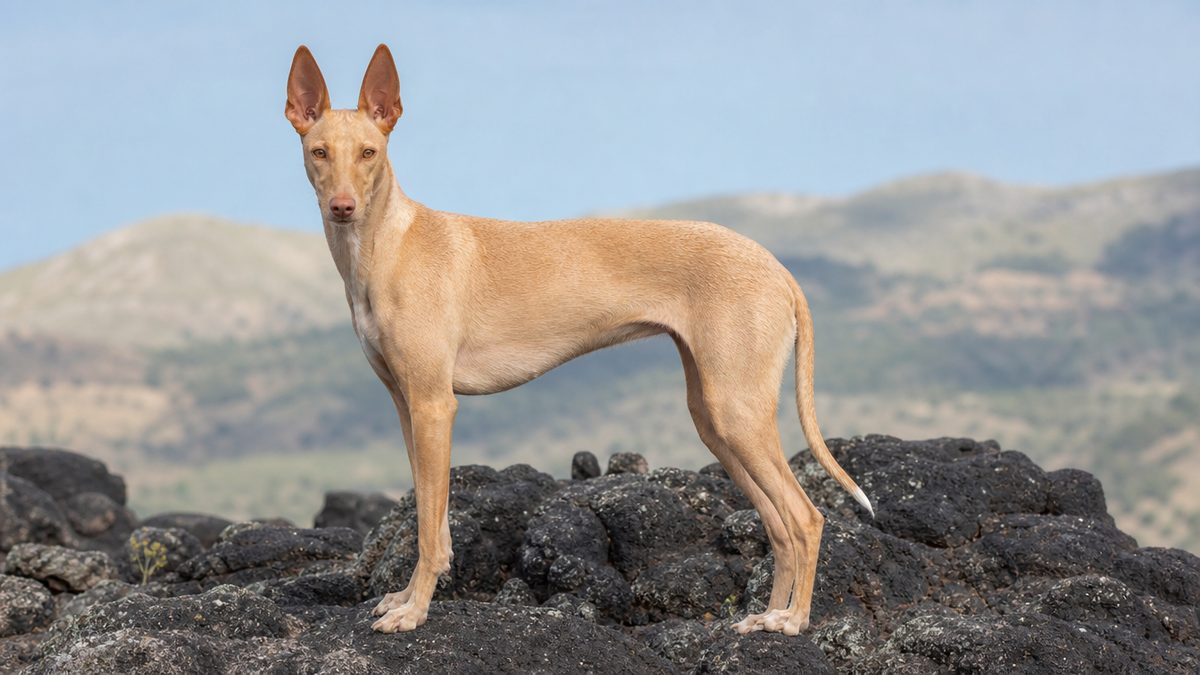
Read the ears first. They are set very high and close together, carried upright and rigid with a frontal opening, triangular with a narrow tip, and no longer than half the total length of the head. The upright ears are the emblem of the breed. The outline is square, the build lean and elegant, and the dog stands high on the leg, with the standard calling for good depth of chest reaching nearly to the elbow without going beyond.
The coat is unusual and it matters more in India than anywhere else. The hair is of vitreous and dense texture, smooth on the head, ears and legs, and semi-long at approximately 2.5 cm, sleek and lying flat on the body and tail. There is no undercoat and nothing to blow out seasonally.
Colour is fawn in all shades from dark to light, plus dilutions, or tan and white with white confined to a blaze or mark on the head, a mark on the chest, white feet, the point of the tail and the belly. A white collar is less appreciated.
A Cirneco should be monochromatic, with nose, eye rims, nails and pads tending toward flesh colour or brown and never black. The FCI standard makes a black nose leather, black eye rims, black toe nails or black pads disqualifying faults, along with a solid brown, black or brindle coat, pendent ears, an undershot or overshot bite and a tail curled over the back. If an Indian seller shows you a black-nosed dog, it is not a Cirneco dell'Etna.
Dentition is where the standard hedges. It calls for complete dentition with a scissor bite, while permitting the absence of PM1 and M3. Hold that thought, because Indian law lists two or more missing teeth as a genetic defect a breeding dog must have been tested for.
History and origins: the Egyptian story the registers still print
The Cirneco dell'Etna is not descended from the hunting dogs of ancient Egypt, and the published genomics say so plainly. This matters because the claim is not confined to marketing copy. It is printed on the face of the FCI's own current breed standard, and it is what Indian buyers are being sold.
What the registers still print
The FCI standard, valid from 30 October 2016, states that the Cirneco is a Mediterranean dog of ancient origins that probably descends from hunting dogs that existed in the era of the pharaohs in Ancient Egypt, and was introduced to the Mediterranean basin by the Phoenicians. The Italian kennel club repeats it, deducing that the Cirneco must draw its origins from ancient hunting dogs bred in the pharaonic age in the Nile valley and spread to Sicily by the Phoenicians, while also noting that very recent research suggests the breed may be native to Sicily itself. The AKC calls it the ancient coursing hound of Sicily.
The claim then widens. An ENCI-published breed introduction groups the Podenco Ibicenco, the Portuguese Podengo, the Podenco Canario, the Podenco Andaluz, the Pharaoh Hound, the Basenji, the Charnigue and the Cirneco together as probably nothing more than the result of three thousand years of environmental adaptation by one original Egyptian dog. That single paragraph is the origin myth of an entire breed group, and it is the reason the Cirneco is routinely confused with the Podenco types as well as with the Pharaoh Hound.
What the 2004 genome study found
Parker and colleagues tested exactly this in Science in 2004, and the finding was unambiguous. Writing about the Pharaoh Hound and the Ibizan Hound, they reported that these are often thought to be the oldest of all dog breeds, descending directly from the ancient Egyptian dogs drawn on tomb walls more than 5000 years ago, and concluded that the results indicate instead that these two breeds have been recreated in more recent times from combinations of other breeds. Their summary line is the one to remember: although their appearance matches the ancient Egyptian sight hounds, their genomes do not.
Neither breed appeared in the basal group that study did identify. That group split off first and contained four Asian spitz breeds, then the Basenji, then the Alaskan Malamute and Siberian Husky, then the Afghan and Saluki. The Cirneco's closest relatives are absent from the list of genuinely old lineages, and so is the Cirneco.
The Science original is paywalled, so Bonbeno read the full text on a mirrored copy and quotes only the Pharaoh and Ibizan passage, which matches independently published quotations of the paper word for word. That mirror carries an internal inconsistency elsewhere in its own text, printing 30 percent in one place against more than 27 percent in another for the same statistic, so we take nothing else from it.
Of the eight breed pages Bonbeno harvested for this guide, exactly one states the position honestly. zooplus writes that the once-popular theory that the dogs arrived in the Mediterranean with the Phoenicians from Ancient Egypt is now contested. It names no study. Every other page, including the FCI's own standard, prints the Egyptian descent as fact.
What the genomics actually establish about this breed
Genomic work establishes three things about the Cirneco dell'Etna: its closest relatives are two other Mediterranean island hounds, its shared history with them dates to roughly 1950, and the word ancient was doing different work than most readers assume. Taken together they replace the Egyptian story with something more interesting.
The ancient label was measuring isolation, not age
Larson and colleagues dismantled the category itself in 2012. Their conclusion was that the unifying characteristic among all genetically distinct so-called ancient breeds is a lack of recent admixture with other breeds, likely facilitated by geographic and cultural isolation, and that these breeds only appear ancient because of their relative isolation. They stopped using the word, calling the lineages basal instead, explicitly to avoid conflating genetic differentiation with presumed ancient heritage.
Their sharpest sentence is worth quoting for any breed sold on antiquity: genetic distinctiveness alone cannot be used as a proxy to signify an ancient heritage. An island breed looks old on a tree because an island kept it separate, which is a fact about geography rather than about time.
Who the Cirneco's relatives actually are, and when
A 2018 study of Italian dog populations placed the Pharaoh Hound from Malta and the Ibizan Hound from Ibiza as the closest genetic relatives to the Cirneco dell'Etna, all three of them island breeds. Then it dated the relationship. Haplotype sharing between the Cirneco and the Pharaoh Hound dates to 1950, which the authors read as reflecting FCI recognition of the two breeds rather than any shared antiquity. The paper describes this as an example of genetic data superseding historical lore.
The same analysis is quietly devastating in one further way. The Levriero Meridionale of southern Italy shows no heritage with the Cirneco and its close relatives at all, and instead traces to the Sloughi and Azawakh of northern Africa. A North African connection does exist in Italian dogs. It simply is not in this one.
What does survive of the ancient claim
Something real remains, and it is worth stating precisely rather than discarding. A genome-wide analysis of 161 breeds found the Mediterranean clade, which contains the Cirneco's relatives, among the lowest in median haplotype sharing of any clade at 516,900 base pairs, against a range across all clades of zero to 3,459,000, indicating these clades are the most divergent and possibly older than the rest. The same analysis read the Mediterranean breeds as currently more segregated, having been used less in recent crosses than the Asian spitz breeds were.
So the honest position has two halves.
- The type of dog, and the Mediterranean lineage it belongs to, may genuinely be old. The clade is divergent and lightly admixed, and the iconographic record in Sicily is real: coins minted across Sicily and Magna Graecia from the fifth century BC carry a dog closely resembling the Cirneco.
- The breed called Cirneco dell'Etna is a twentieth-century construction. It was rebuilt from a near-extinct population after 1932, standardised in 1939 and recognised by the FCI in 1956 Federation Cynologique Internationale, and its documented genetic relationship with the Pharaoh Hound dates to about 1950.
Those two statements are compatible. Collapsing them into descended from the dogs of the pharaohs is where the error happens, and it is an error the FCI's own current standard still makes.
Because antiquity is what the breed is sold on. An Indian listing site describes the Cirneco as a sleek, agile hound with an ancient lineage from Sicily and calls it one of Italy's oldest hound breeds, and that framing is doing the work that a price and a health record normally would. A breed's real history is a poor reason to buy a dog and an excellent way to sell one, and the genomics here do not support the version being sold.
Which registers recognise the breed, and the date nobody agrees on
The FCI accepted the Cirneco dell'Etna on a definitive basis on 9 March 1956, and its own register says so on the breed's page. Four different recognition dates are in print across the sources that rank for this breed, so Bonbeno went to the register rather than averaging them.
This is the cheap check almost nobody runs. The FCI nomenclature entry for breed 199 prints, in its own table, a breed status of Recognized on a definitive basis, a country of origin of ITALY, a section of Primitive type Hunting Dogs, an official authentic language of English, a date of acceptance on a definitive basis of 9 March 1956, and a date of publication of the official valid standard of 30 October 2016.
| Source | Date given | What it appears to be |
|---|---|---|
| FCI register, breed 199 | 9 March 1956 | Acceptance on a definitive basis. The primary record |
| Talenti et al. 2018 | 1956 | Agrees with the FCI register |
| zooplus | 1947 | Unsourced. Nine years early |
| Royal Canin India | 1989 | Probably a later standard revision, not recognition |
| ENCI | 1939 | Correct, but for ITALIAN recognition by ENCI, not the FCI |
| AKC | 2015 | Correct, for AKC full recognition. FSS from 2006 |
Two of those are not errors at all once you read what they refer to. ENCI officially recognised the breed under the name Cirneco dell'Etna in 1939, which is Italian national recognition and seventeen years earlier than the FCI's. The AKC recorded the breed in its Foundation Stock Service from 2006 and gave it full recognition in 2015, placing it in the Hound Group. The 1947 and 1989 figures are the ones with nothing behind them.
How close the breed came to disappearing
The Cirneco very nearly died out in living memory, which is the part of the history that actually explains the modern dog. In 1932 a veterinarian from Adrano, Dr Maurizio Migneco, published an appeal in the hunting magazine Il cacciatore italiano warning that the ancient Sicilian dog was in danger of extinction. A group led by Baroness Agata Paterno Castello answered it, recovered the most worthy surviving dogs, and bred them under the affix Aetnensis for the next twenty-six years.
The dates that follow are tight. Professor Giuseppe Solaro wrote the standard, ENCI recognised the breed in 1939, the first Italian beauty champion was proclaimed in 1952, the breed club was founded in Catania in 1951 with Dr Migneco as its first president, and ENCI recognised the club in 1956. A breed rebuilt from a small recovered population inside one decade is a breed with a narrow founding base, and the genetics agree.
Across 14 sampled Cirnechi the average SNP-based inbreeding coefficient was 0.222, one of the higher values in a survey of 23 Italian populations, above the Bergamasco Shepherd at 0.220 and the Volpino Italiano at 0.213 and behind only the Neapolitan Mastiff and a deliberate wolf hybrid. The breed still passed every purebred metric and clustered cleanly, so this is a narrow base rather than a broken one. It matters in India because Second Schedule Part II para 6(3) of the 2017 Rules prohibits in-breeding, defined as breeding between relatives of the 2nd to 4th grade within the first four generations, and prohibits incest breeding outright, permitting only out breeding and line breeding. Managing a founder-narrow rare breed inside those limits, from a population India does not have, is not a small problem.
One further register detail is worth knowing before you talk to any breeder. In Italy the Cirneco is subject to a working trial under the FCI nomenclature, and ENCI's Selected Breeding scheme requires a dog to be at least 18 months old, to hold an Excellent morphological qualification for males or Very Good for females at a breed show or gathering, to pass a work trial at Very Good, and to carry a hip score of A or B. That hip requirement is the only formal hip dysplasia screening standard the breed has anywhere.
Cirneco dell'Etna price in India
No verifiable Cirneco dell'Etna price in India exists, because Bonbeno could not find a single Cirneco dell'Etna actually for sale in India. Every Indian page ranking for this query either shows zero listings, shows a different breed, or prints a number that belongs to another puppy. That is the honest answer, and it is more useful than a range.
What Google India tells an Indian buyer
Google India's AI Overview for this exact query states that a Cirneco dell'Etna puppy typically costs between Rs 8,000 and Rs 99,000 in India, and breaks it into standard or local breeders at Rs 8,000 to Rs 35,000, online pet platforms at around Rs 98,999, and import or champion bloodlines exceeding Rs 1,00,000. It cites two sites for that. Bonbeno opened both.
Source one: the Rs 98,999 carousel
The upper figure comes from a listing page titled Cirneco dell'Etna Price, Buy Rare Italian Hound Puppies in India. It contains no Cirneco dell'Etna. Its Other Available Pets carousel holds eight animals, and Rs 98,999 is the price on three of them: a Maltipoo called Fizey, a Maltipoo called Samy and a Doxiepoo called Yoki.
| Name | Breed listed | Price shown |
|---|---|---|
| Fizey | Maltipoo | Rs 98,999 |
| Samy | Maltipoo | Rs 98,999 |
| Yoki | Doxiepoo | Rs 98,999 |
| Kuzo | Poodle | Rs 92,599 |
| Dugu | Poodle | Rs 92,599 |
| Kazuka | Cane Corso | Rs 94,999 |
| Tugi | Rottweiler | Rs 76,499 |
| Doir | Goldendoodle | Rs 1,20,000 |
| Cirneco dell'Etna | The advertised breed | None listed |
Test the number the way you would test any suspicious rupee figure. Indian pages routinely publish a US dollar price run through one exchange rate, so divide. Rs 98,999 divided by 84.38 is 1,173.25 dollars, by 74 is 1,337.82, and by 80 is 1,237.49. None of those is a figure a seller would print, so this is not a converted price at all. It is a rupee-native charm price attached to whichever puppy is in stock.
Source two: a page with zero listings
The Rs 8,000 to Rs 35,000 band comes from a breed page that prints Typical Low Rs 8,000, Typical High Rs 35,000, a blank where the live average should be, and Listings 0 in the same block. Its for-sale page confirms it: Showing 0 Results, and No Cirneco dellEtna Currently Listed. The same site prints Rs 8,000 as the low for its Labrador row too, so Rs 8,000 is a house floor rather than anything about this breed.
The arithmetic here is worth showing because it clears the site of one accusation while convicting it of another. Rs 8,000 divided by 80 is exactly 100 dollars, which looks like a conversion until you check the other end: Rs 35,000 divided by 80 is 437.5, which nobody prints. Neither figure divides cleanly at 84.38 or 74. So this is not a converted American price list. It is a generated band, produced for a breed the site has never stocked.
Source three, unranked by Google but worth naming
A third Indian marketplace prints 3 Result Found on its Cirneco page. The three results are a French Bulldog in Hyderabad, a Cavalier King Charles Spaniel in Bangalore and a Border Collie in Mumbai, served under a heading reading Similar breeds at other locations, with no price visible on any of them.
What the breed costs where it actually exists
Overseas figures are real, and they are the only genuine prices on this page. An American marketplace quotes 2,000 to 2,750 US dollars nationally, one breed directory quotes 900 to 1,500 US dollars, and a European magazine quotes at least 1,000 pounds with a typical range from 1,200 upwards zooplus Magazine, Cirneco dell'Etna Dog Breeds List, Cirneco dell'Etna, price. Bonbeno reports these as published editorial figures, not as offers, and does not convert them into a rupee price, because converting a foreign price into rupees is precisely the error this section exists to expose.
Google India returned about 172 total results for the target term. Its People Also Ask box, unable to find enough breed-specific questions, padded itself with Which dog costs 1 crore?, Which dog is RS 5000? and How much does a Komondor dog cost in India?. When an answer engine has this little to work with, a single junk figure becomes the market rate by default.
What a Cirneco dell'Etna would actually cost to keep in India
Bonbeno publishes no monthly rupee total for this breed, because no verified Indian owner exists to survey. What can be stated honestly is the cost structure, which is unusually favourable on three lines and unusually punishing on one.
Set the purchase question aside. It is unanswerable in India, as the price section shows, and for a returning resident bringing their own dog home the acquisition cost is a foreign purchase plus an import process rather than an Indian price in india at all.
The three lines that are genuinely cheap
- Grooming is close to zero. There is no undercoat, no feathering and nothing that mats. This is the single lowest grooming load of any breed on this site, and in Indian humidity that is worth real money, because a double-coated breed needs professional attention monthly and this one needs a rubber mitt.
- Food volume is small. A dog of 10 to 13 kg eats a fraction of what a Labrador or a German Shepherd eats. Over a 12 to 16 year life that is the largest single saving against the breeds Indians usually buy.
- Space costs nothing. The dog is quiet indoors and small enough for a two-bedroom flat. What it needs is outlet, not floor area.
The line that is punishing
Veterinary unfamiliarity is the real cost, and it does not appear on any budget. There are perhaps 200 Cirnechi in the whole of the United States, and Bonbeno found none in India. An Indian veterinarian will almost certainly never have seen the breed, which matters more than it sounds because sighthound-type dogs carry documented laboratory quirks that read as disease on a standard panel.
The clearest of those is thyroid. Greyhounds and other sighthounds have basal serum total T4 concentrations below non-breed-specific reference intervals. In a retrospective study of 398 sighthounds, hypothyroidism had been diagnosed in 286 of the 398, or 71.9 percent, on the basis of low total T4 or total T3 alone, and 30 dogs, 7.5 percent, had been diagnosed despite thyroid hormone concentrations that were within reference intervals. A breed-specific reference interval study concluded that without breed-specific intervals, healthy dogs will likely be misdiagnosed as being hypothyroid or equivocal, may be treated with thyroid supplementation at a relatively young age, and may be removed from breeding programmes.
That reference-interval study covered seven breeds, and not one of them was a sighthound: Alaskan Malamute, Collie, English Setter, Golden Retriever, Keeshond, Samoyed and Siberian Husky. So no published breed-specific interval exists for the Cirneco dell'Etna, and none exists for Indian conditions either. If a panel comes back low on T4, ask for free T4 and TSH before anyone starts supplementation, and say the words sighthound and primitive breed out loud in the consulting room.
Recurring costs that apply regardless
- Tick and flea control, monthly and non-negotiable. In a survey of 525 dogs across India, 261, or 49.7 percent, were infected with at least one tick-borne pathogen by PCR, led by Hepatozoon canis at 30 percent and Ehrlichia canis at 20.6 percent, with 39 percent of infected dogs carrying more than one pathogen.
- Core vaccination and boosters. The 2017 Rules note that pup vaccination can start at seven to eight weeks and is usually completed at eighteen weeks.
- Climate control in the monsoon months. Not a luxury on the coast, given the evaporative headroom figures.
- Secure fencing or a long line. The recurring cost most owners of hunting hounds discover late, after the first successful escape.
When we publish rupee cost figures we state the sample size, the cities covered and the collection date. For a breed with no verified Indian population there is nothing to sample, so we set out the structure and decline to invent a total.
Heat tolerance in India: testing the claim against the data
The Cirneco dell'Etna has a stronger claim to heat tolerance than almost any other European breed, and that claim still fails in humid India. The breed was selected to work in dry heat on bare rock. India's constraint is not temperature, it is humidity, and the two are not interchangeable.
Start with what the breed's own people say it does. ENCI describes the Cirneco working under the burning August sun, on live cutting stone, among thick thorny scrub, without asking for water and without giving up, and treats that rusticity as a defining breed characteristic. The FCI standard puts the ideal hunting ground among the nooks and crannies of rock faces and in particular the terrain formed by volcanic lava on the slopes of Mount Etna. One breed directory describes it hunting under adverse conditions including high heat with little food or water over extended periods.
Those are claims, not measurements. So Bonbeno measured the climate they were made about.
What the Etna slopes are actually like
NASA POWER, queried by explicit latitude and longitude at 37.66N 14.83E on the Etna slopes at 387 m elevation, gives a hottest month of August averaging 27.3 C air temperature at 50.8 percent relative humidity, with a wet bulb temperature of 20.9 C. July is almost identical at 27.2 C and a 20.5 C wet bulb. The annual mean wet bulb is 13.6 C.
Wet bulb is the number that matters for a dog. A dog cannot sweat to cool itself; it pants, evaporating water from its airways, and the wet bulb reading is the lowest temperature that evaporation can reach. The gap between air temperature and wet bulb is the dog's evaporative headroom. On Etna in August that gap is 6.4 C.
What Indian cities do to that number
Bonbeno ran the same query for eight Indian cities by latitude and longitude. The air temperatures are unsurprising. The wet bulbs are the story.
| Location | Month | Air temp C | Wet bulb C | Headroom C | RH % |
|---|---|---|---|---|---|
| Etna slopes (the breed's home) | August | 27.3 | 20.9 | 6.4 | 51 |
| Delhi 28.61N 77.21E | May | 35.1 | 21.9 | 13.2 | 23 |
| Jodhpur 26.24N 73.02E | May | 34.7 | 23.0 | 11.6 | 28 |
| Bengaluru 12.97N 77.59E | August | 23.3 | 21.1 | 2.2 | 79 |
| Hyderabad 17.38N 78.49E | August | 25.5 | 23.6 | 2.0 | 80 |
| Chennai 13.08N 80.27E | August | 29.0 | 26.1 | 2.9 | 72 |
| Kolkata 22.57N 88.36E | August | 28.2 | 27.2 | 1.0 | 89 |
| Pune 18.52N 73.86E | August | 23.3 | 22.5 | 0.8 | 91 |
| Mumbai 19.08N 72.88E | August | 26.1 | 25.2 | 0.9 | 90 |
Two findings fall straight out of that table, and they point in opposite directions.
- The breed's advantage is real, and it lives in the pre-monsoon north and west. Delhi in May offers 13.2 C of evaporative headroom at 23 percent humidity, which is more than double what the Cirneco's home range provides in August, at an air temperature 7.8 C higher. That is exactly the kind of heat this dog was built for: brutal, arid and evaporatively generous. A lean, short-coated, long-muzzled hound with no undercoat handles a dry Rajasthan afternoon far better than any double-coated import.
- The advantage disappears once the monsoon lands. Delhi's wet bulb climbs from 21.9 C in May to 27.7 C in July, and its headroom collapses from 13.2 C to 4.5 C. Jodhpur runs the same course, from 11.6 C of headroom in May to 4.6 C in July.
- Coastal and monsoon India offers the breed almost nothing. Mumbai in August gives 0.9 C of headroom at 90 percent humidity, Pune 0.8 C at 91 percent, and Kolkata 1.0 C at 89 percent. Mumbai's August air temperature of 26.1 C is a full degree cooler than Etna's August, and it is far more dangerous to a panting dog, because there is nowhere for the water to go.
The annual mean wet bulb in Chennai is 24.9 C, in Kolkata 22.9 C and in Mumbai 22.7 C. Every one of those yearly averages is higher than the wet bulb of the single hottest month the Cirneco's home range has ever averaged, which is 20.9 C. In those three cities an ordinary day is thermally harder on this breed than the worst month it was selected under.
Managing an Indian summer with a heat-adapted hound
Manage this breed by humidity rather than by the thermometer, because the thermometer will tell you a Mumbai monsoon morning is mild and the dog's physiology will disagree. The rules below follow directly from the evaporative headroom figures in the previous section.
The daily routine, by season
- October to February. Normal routine almost everywhere. This is the window in which to build fitness, socialise a young dog and do any real distance work.
- March to June, dry-heat cities. Delhi, Jaipur, Jodhpur, Ahmedabad and Nagpur. Walk before sunrise and after dark. The air is evaporatively generous here, so the dog copes well in shade with water, but ground surface temperature is the killer: check the pavement with your palm for five seconds before every walk.
- June to September, monsoon and coast. Mumbai, Pune, Kolkata, Chennai, Kochi and Goa. This is the dangerous season for this breed despite the mild-looking temperatures. Cut duration, move everything indoors that can move indoors, and substitute scent work for distance.
- Year-round, everywhere. Constant access to fresh water, a cool hard floor or a raised bed in shade, and a fan or air conditioning available during the worst hours.
Recognising heat stroke, and what to do in the first ten minutes
Purina India lists the warning signs as severe panting, difficulty breathing, severe salivating, vomiting, diarrhoea, a raised temperature of 40.5 C or above, blood in the urine, nose bleeds and, ultimately, collapse and coma. It also warns that a dog can develop heat stroke in as little as 30 minutes of vigorous exercise in hot weather, whatever coat it has.
The published first-aid sequence is specific, and two of its steps are counter-intuitive enough that people get them wrong.
- Move the dog out of the heat into shade or air conditioning.
- Spray or sponge with cool, not cold, water, making sure it reaches the skin rather than running off the coat, and wet the belly and inside the legs thoroughly.
- Use a fan, which is the step most Indian households have available and forget.
- Do not plunge the dog into cold water or an ice bath, because this prevents the core temperature coming down.
- Stop cooling at 39.4 C, or you risk pushing the dog into hypothermia.
- Go to a veterinarian regardless, because heat stroke in dogs can be fatal.
Purina India records that when the outside temperature is 26 C, the inside of a car reaches 32 C in five minutes and 43 C in 25 minutes. An Indian April afternoon does not start at 26 C. Never leave this dog, or any dog, in a parked car in India, with or without a window cracked.
Watch the breathing, not the clock
A published study of dogs walking in a hot, sunny tropical region measured what heat load actually does to a dog in real time. Once black-globe temperature in the sun passed 35 C, hair-coat temperature rose by 20.5 C, skin temperature by 7.2 C and respiratory rate climbed from roughly 47 to 374 breaths a minute against walks below 30 C, while water intake rose by 215 mL. Rectal temperature stayed inside a narrow 38 to 39 C band throughout, which is the point: the dog was holding its core temperature by working its respiratory system extremely hard.
The authors summarised a threshold on their combined thermal stress index and concluded that walking dogs beyond it should be approached with caution, particularly during prolonged or repeated exposure, because panting appears to become less effective past that point. For an owner without instruments, the usable version is simple. A dog whose panting has gone rapid and shallow and will not settle within a couple of minutes in shade has passed the point where the walk should have ended.
A Cirneco starts every Indian summer with three real advantages that a Golden Retriever, a Siberian Husky or a Saint Bernard does not have: no undercoat trapping heat against the skin, a long muzzle giving a large evaporative surface, and a body mass of 10 to 13 kg with a high surface-to-mass ratio. Those advantages are worth having. They are not worth betting a dog's life on in 90 percent humidity.
Is the Cirneco a sighthound or a scent hound?
The Cirneco dell'Etna hunts mainly by nose, and the registers that classify it as a sighthound are describing its silhouette rather than its behaviour. This sounds like a taxonomy quibble. It is not, because it changes how you train the dog, how you exercise it, and which Indian breed it is genuinely comparable to.
The FCI standard is unambiguous on the mechanism. It states that the breed uses sight only to select the most suitable location, that hearing is used to pick up the movement of the rabbit once it has gone to ground, and that it is the powerful, reliable sense of smell that allows the dog to follow a trail and flush out the prey. The dog's declared utilization is hunting, in particular wild rabbit.
The AKC agrees on the mechanism and then files the dog somewhere else. Its own breed facts say the Cirneco has been selected over centuries as a specialist for hunting wild rabbit primarily using scent, while also employing hearing and sight, and that the traditional method involved a partner, the ferret. The same page opens by calling it the ancient coursing hound of Sicily and places it in the Hound Group.
| Source | Classification | What it says about how the dog hunts |
|---|---|---|
| FCI standard No. 199 | Group 5, primitive type hunting dog | Smell follows the trail; sight only picks the search area |
| American Kennel Club | Hound Group, called a coursing hound | Primarily using scent, plus hearing and sight |
| United Kennel Club | Sighthound and Pariah Dog Group | No scent claim made |
| Purina UK | UK Kennel Club Sighthound group | Both a scent and sighthound, able to follow prey whether visible or not |
| zooplus | Never uses the word sighthound | Hunts like a hound, nose to the ground |
| Vetstreet | Repeatedly a sighthound | Stresses silent, sight-driven hunting; no scent claim |
| Talenti et al. 2018 | Listed under type Sighthound | Classification only, not behaviour |
The Italian kennel club is blunter than any of them. It notes that many people confuse the Cirneco with a levriero, the Italian word for a sighthound, and states that the morphological and above all psychological and functional differences are such that no form of parallelism can be sustained. ENCI calls it essentially a searching dog.
Why this matters in an Indian park
A sighthound is triggered by movement and runs a visible target until it stops. A scent-led hound locks onto a trail that may be twenty minutes old and follows it out of your life. The second failure mode is worse in an Indian city, because the dog is not chasing something you can see and call it off before it reaches.
It also changes what tires the dog. Twenty minutes of scent work exhausts a nose-driven hound more thoroughly than twenty minutes of running, and it can be done indoors during a heatwave, which is the whole game from March to October. The FCI standard's description of the working dog, moving with a rhythmic tail, nose thrust forward interrogating the wind, ears rigid, inspecting every crevice, is a description of an animal doing hard cognitive work.
Body composition and laboratory values. The lean, low-fat, thin-skinned build that makes the Cirneco look like a small Pharaoh Hound is the same build that gives sighthounds their distinctive clinical pathology, including thyroid hormone concentrations below non-breed-specific reference intervals. So classify it as a scent-led hunter for training purposes and as a sighthound for veterinary purposes. That is not a contradiction; it is two different questions.
One Indian-facing page gets the quarry wrong entirely. Royal Canin India tells Indian readers the breed is very well suited to working in difficult terrain, especially on the trail of wild boars. The FCI standard names the wild rabbit, and the hunting partner is a ferret American Kennel Club. A 10 kg rabbit specialist is not a boar dog, and the error tells you how little of this breed's literature has been read by the pages serving India.
Temperament and household fit
The Cirneco dell'Etna suits a patient household that wants a small, quiet, clean, affectionate dog and can live with an unreliable recall. The breed standard's own words are strong-willed, uncompromising, affectionate and alert, a resolute dog, very attached to his owner. Every one of those four adjectives is load-bearing.
Read strong-willed and uncompromising as the honest half. This is a primitive hunting breed whose job required it to work out of contact with the handler, deciding for itself which crevice to check and when to circle a hiding rabbit rather than press it. A dog selected for independent judgement does not become biddable because it now lives in Bandra.
Read affectionate and very attached as the other half, and take it seriously. The AKC describes Cirnechi as mild, low-maintenance housedogs cherished for their loyal and gentle nature, and characterises the breed as independent, friendly and affectionate. Vetstreet describes a dog who follows family members from room to room. This is not an aloof breed.
Apartment reality in an Indian metro
The Cirneco is a genuinely good apartment dog on every axis except one. It is small, it is short-coated so it does not shed drifts, it is quiet indoors, and it has no doggy odour to speak of. What it has instead is a hunting nose and a real prey drive, and an Indian apartment block is full of things to hunt.
- Good fit. A household with a securely enclosed terrace or balcony, someone home for part of the day, and a willingness to do daily scent work indoors during the hot months.
- Poor fit. A ground-floor flat opening onto an unfenced compound, a household with free-roaming cats it has not been raised with, and anyone who plans to walk the dog off-lead.
- Watch item. Street cats, squirrels, chickens and the neighbourhood's resident indies. A resolute hound that decides to investigate one of them is not coming back on a whistle.
With children and other animals
Size works in this breed's favour with children, which is unusual for a hunting dog. A 10 to 13 kg hound cannot knock over a six-year-old the way a 30 kg retriever can. The standard's disqualifying faults include aggressive or overly shy dogs, so temperament faults are formally penalised in the ring.
The ENCI account adds a caution worth carrying. Sicilian hunters historically hid their best dogs and refused matings out of a kind of jealousy, and that life away from strangers consolidated a shy and distrustful, often fearful character over time, to the point that people believed timidity was a breed trait. ENCI reports that three or four decades of deliberate work on temperament reversed it, producing a lively, active, available dog with a great desire to play. So the shyness was real, it was environmental, and it responds to socialisation.
ENCI states that the Cirneco must not show unjustified fear of people or things, and that where it does, the cause is attributable to hereditary defects, a lack of social references, or incorrect socialisation. That is a useful sentence to have in hand, because a nervous imported hound in an Indian home is far more likely to be under-socialised than badly bred.
One practical note on noise. zooplus records that the breed will bark to signal, and the ENCI account describes the hunting dog launching a repeated high war cry once it locates a rabbit zooplus Magazine, Cirneco dell'Etna. In a Sicilian rock field that is a feature. In a Mumbai housing society at 6 am it is a complaint, so build a quiet cue early.
Training a Cirneco dell'Etna
Train a Cirneco dell'Etna with short, reward-based sessions and accept from day one that off-lead recall is the ceiling, not the goal. The standard calls the breed strong-willed and uncompromising, and the AKC notes it has the strong, independent temperament necessary for a hunter. You are negotiating with a specialist, not programming a retriever.
The good news is that this breed is easier than its relatives. The AKC records that Cirnechi are said to be a bit more trainable than the usual sighthound, and Vetstreet says the same, with the condition that you keep the training sessions short Vetstreet, Cirneco dell'Etna breed…. Short means five to ten minutes, several times a day.
The three things that reliably go wrong
- Recall collapses on a live trail. This is not disobedience and it is not fixable by escalation. The dog was selected to follow scent out of contact with its handler. Manage it with a long line and a securely fenced space, and treat recall as a trained behaviour that works everywhere except where it counts most.
- The dog stops responding when the session drags. A hound bred to make its own decisions disengages from repetition faster than a working breed does. End every session while the dog is still interested.
- Punishment produces the historic shyness. ENCI's own account describes generations of Cirnechi kept hidden and handled harshly, and the timid, distrustful character that produced. Harsh handling walks the breed straight back into it.
Socialisation, and the Indian complication
Socialise deliberately and early, because this breed's documented failure mode is fear rather than aggression. ENCI is explicit that unjustified fear of people or things traces to hereditary defects, a lack of social references or incorrect socialisation. An imported puppy that spent its first weeks in a quiet Sicilian kennel and then met an Indian street at four months has had no social references at all.
The Indian complication is the noise floor. Traffic, horns, festival firecrackers, construction and free-roaming dogs are all first encounters for a hound bred in rock fields. Work through them at distance and at the puppy's pace rather than flooding.
Realistic timelines
| Skill | Start | Reliable by |
|---|---|---|
| Name response | Week 1 home | 3 to 5 weeks |
| Sit, down, settle | Week 1 home | 5 to 8 weeks |
| Toilet training | Week 1 home | 4 to 6 months |
| Loose-lead walking | Month 2 | 8 to 12 months |
| Quiet on cue | Month 2 | 6 to 10 months |
| Recall in a fenced space | Month 2 | 9 to 15 months |
| Recall off-lead in the open | Ongoing | Never treat as reliable |
The last row is the honest one and it is the row most breed pages will not write. Petfinder's own summary of the breed says recall is important although it cannot be relied upon, because once on the scent it can be hard to get these dogs to focus on anything else. Plan the dog's whole life around that sentence and it is an easy animal to live with.
Scent work is the highest-value training this breed can do in India, because it delivers real mental fatigue indoors during the months when outdoor exercise is unsafe. Scatter-feed the daily ration across a room, hide a scented article and let the dog find it, and build a simple find-it cue. Purina UK notes that positive reinforcement using food, toys and the opportunity to chase and follow scent gets the best results with this breed.
How much exercise a Cirneco dell'Etna needs
Published guidance for the Cirneco dell'Etna ranges from 20 to 30 minutes a day up to 45 to 60 minutes, and the sources disagree by a factor of three. Bonbeno reports the disagreement rather than picking one, and adds the constraint none of them account for, which is that in most of India the middle of the day is unusable for eight months of the year.
| Source | Daily requirement stated |
|---|---|
| Vetstreet | 20 to 30 minutes daily, plus quality time with family |
| Puppiezo, India | 45 to 60 minutes per day, energy level High |
| PetBuy.in, India | Exercise needs described only as Moderate |
| zooplus | Low maintenance when properly exercised, no figure given |
| FCI standard | No figure. Describes a dog working rock faces for a hunting session |
Treat 45 to 60 minutes as the working target for a healthy adult and 20 to 30 as a bare floor for a senior or a hot day. The wider point is that a 20-minute figure is describing a companion animal, and the FCI standard is describing a dog that leaps from rock to rock across lava fields, surefooted and elegant, through an August hunting session. The capacity is much higher than the requirement.
What the exercise should consist of
- Two lead walks, at the cool ends of the day. Before sunrise and after dark from March to October in most Indian cities.
- Scent work, indoors, daily. The most useful twenty minutes in this breed's day, and the only load that is completely heat-independent.
- Free running only inside a fence. A hound following a trail does not hear you. This is a management rule, not a training failure.
- Climbing and scrambling. The breed is built for broken ground, and safe rock, low walls and canine parkour suit it better than flat repetition.
Heat rules that override everything above
Cancel the session rather than shorten it when the humidity is high. Purina India warns that a dog could develop heat stroke in as little as 30 minutes and advises avoiding vigorous exercise in hot weather regardless of coat type. The wet bulb figures in the climate section explain why a cool-feeling monsoon morning in Mumbai, at 26.1 C and 90 percent humidity with 0.9 C of evaporative headroom, is more dangerous than a dry Delhi May afternoon at 35.1 C with 13.2 C of headroom.
Two field checks are worth building into the routine. Press your palm flat on the pavement or rock for five seconds; if you cannot hold it, neither can a paw pad. And watch the breathing rather than the clock, because respiratory rate in walking dogs rose from about 47 to 374 breaths a minute once radiant heat load crossed a defined threshold, at which point panting itself becomes less effective.
Puppies need far less
Build the load slowly through the first year. A lean hound puppy that looks tireless is still growing, and the joints and growth plates do not care how willing the dog is. Keep formal exercise short and frequent through to twelve months, let free play on soft ground do most of the work, and avoid stairs marathons, jogging alongside a bicycle and long forced walks before the first birthday.
This is the exercise rule that kills dogs in India. A hound on a scent crosses roads without looking, and Indian traffic does not slow for a 12 kg dog. Use a long line in open ground, a secure fence for free running, and never trust an off-lead recall in a park with an exit.
Grooming a Cirneco dell'Etna in Indian humidity
Groom a Cirneco dell'Etna in about five minutes a week, which makes it the lowest-maintenance coat on this site and the breed's single biggest practical advantage in India. There is no undercoat to blow, no feathering to mat and nothing that holds monsoon damp against the skin.
The standard describes hair of vitreous and dense texture, smooth on the head, ears and legs, and semi-long at approximately 2.5 cm, sleek and lying flat on the body and tail. ENCI adds a warning that reads oddly to an Indian buyer used to hearing less coat is better: be suspicious of dogs with a very short, velvety coat, or missing hair at the base of the ears or under the neck, or with a very fine rat-like tail, because rusticity is a breed characteristic. A correct Cirneco has more coat than the sleekest ones you will see photographed.
The whole routine
- Rubber mitt or hound glove once a week. That is the entire coat requirement in a temperate climate and it does not change here.
- Wipe down after a humid walk. A damp microfibre cloth over the body, then dry. This is about salt and dust, not about matting, because nothing mats.
- Check the ears weekly. Upright ears with a wide frontal opening ventilate well, which is a real monsoon advantage over any drop-eared breed, but they also collect dust and grass seed.
- Keep nails short. The standard specifies strong curved nails of brown or pinkish flesh colour, never black, so the quick is visible and trimming is easier than on most breeds.
- Bathe rarely. A thin-skinned hound with no protective undercoat does not need frequent shampooing, and over-bathing in humid weather is how skin problems start.
Where the overseas advice does not transfer
Care guidance written for European owners assumes a cold problem, and it shows. zooplus advises that these Italian dogs love warmth and appreciate cosy spots in the cold season, and suggests a dog coat to make winter bearable. Vetstreet says the Cirneco is not built to withstand cold weather and should live indoors with access to soft bedding. All of that is correct in Europe and irrelevant in Chennai.
Invert it for India. The same absence of insulation that makes this dog cold-sensitive in Milan makes its skin directly exposed to sun here. A thin-coated, lightly pigmented fawn dog on an Indian terrace at midday is at real risk of sunburn on the belly, the inner thighs, the ear leathers and the bridge of the nose, and the standard's own requirement that pigmentation must never include black spots means there is less melanin protection than a dark-skinned indie has.
There is nothing to take off. The coat is already short and it is the dog's only barrier against direct sun. Clipping a short-coated hound to keep it cool removes protection without improving heat loss, because the cooling in a dog happens through panting rather than through the skin. If the dog is hot, the answer is shade, water, a fan and cool water on the belly and inner legs, exactly as Purina India sets out.
The one grooming-adjacent risk worth naming
Ticks find a short coat easily and there is nowhere for them to hide from you either, which cuts both ways. Weekly hands-on checks along the ears, between the toes, in the armpits and around the tail base take two minutes on this breed and are worth doing every week of the year, given that potential tick vectors were found on 278 of 525 dogs surveyed across India, or 53 percent. Combine the check with the weekly mitt session and it costs nothing extra.
Health risks and what the screening databases actually hold
The Cirneco dell'Etna is a hardy breed with genuinely little published disease data, and those two statements are not the same thing. Bonbeno went to the Orthopedic Foundation for Animals database directly, read the rows printed under the breed's own name, and reports what is there and what is absent.
What OFA publishes, and what it does not
The Cirneco dell Etna appears in exactly two OFA summary tables. It is absent from the hips table, the elbows table, the patella table, the dentition table and the shoulder table. Absence is a finding rather than a gap: OFA requires a threshold number of evaluations before a breed is listed at all, and the lowest-volume breed printed in the hips table carries 105 evaluations, so the Cirneco has not reached it.
| Panel | Evaluations | Normal % | Other findings |
|---|---|---|---|
| Eyes | 149 | 98.0 | 2.0% abnormal, 0.0% breeder option |
| Thyroid | 52 | 76.9 | 7.7% compensative autoimmune thyroiditis, 15.4% equivocal |
| Hips | Not listed | n/a | Below OFA's listing threshold |
| Elbows | Not listed | n/a | Below OFA's listing threshold |
| Patella | Not listed | n/a | Below OFA's listing threshold |
The eye detail tables from the same source, all on the same 149 dogs, put three findings level at the top on 5 dogs each, or 3.4 percent: distichiasis, cataract of unknown significance, and persistent pupillary membranes with lens pigment foci. Several further findings appear in one to three dogs each, including vitreous degeneration and optic nerve hypoplasia, and a separate row records 128 of 149 dogs, or 85.9 percent, under a normal finding code.
OFA's eye summary row gives 98.0 percent normal, while its own detail table gives 85.9 percent normal on the same 149 dogs, and the individual findings sum to about 18 percent. The two count different things, since one dog can carry several findings and most are not treated as disqualifying. Bonbeno did not attempt to reconcile them and reports both, because quietly picking the flattering one is how a health section starts lying. Note also that OFA counts move as evaluations are submitted, so the 149 and the 52 are live figures rather than fixed ones.
The thyroid result, and the sighthound trap behind it
Read the thyroid row carefully: 52 dogs, 76.9 percent normal, and 15.4 percent equivocal, which is 8 dogs. That equivocal share is the highest-signal number this breed has, and it is very likely an artefact of the reference interval rather than a disease finding.
Sighthound-type dogs have basal serum total T4 concentrations below non-breed-specific reference intervals. In a retrospective study of 398 sighthounds, hypothyroidism had been diagnosed in 286 of the 398, or 71.9 percent, on low total T4 or total T3 alone, and 30 dogs, or 7.5 percent, had been diagnosed despite thyroid values sitting inside the reference intervals. Only 65 of the 398, or 16.3 percent, had additional abnormalities such as a high TSH or a positive thyroglobulin autoantibody that would actually suggest hypothyroidism.
A study of breed-specific reference intervals concluded that without them, healthy dogs will likely be misdiagnosed as hypothyroid or equivocal, may be treated with supplementation at a relatively young age, and may be removed from breeding programmes, thereby affecting genetic diversity. That study covered seven breeds and not one of them was a sighthound, so no published interval exists that would fit this dog.
ENCI's Selected Breeding scheme requires a Cirneco to carry a hip dysplasia score of A or B, alongside a minimum age of 18 months, a morphological qualification and a working trial pass. With no OFA hips row in existence anywhere, that Italian requirement is the only formal orthopaedic screening benchmark the breed has in the world. Ask any breeder for it by name, and treat a breeder who has never heard of it as a breeder who has not screened.
Where the breed standard and Indian breeding law collide
Three provisions of India's Dog Breeding and Marketing Rules 2017 bite differently on this breed than on the breeds Indians usually keep, and one of them puts the FCI breed standard and Indian law in direct conflict. Anyone breeding, or buying from a breeder, needs all three.
Cite these correctly, because the document numbers its clauses twice and the difference matters to anyone who looks them up. The provisions below sit in the Second Schedule, not among the Rules themselves. The Rules' own Rule 6 is a separate provision about requirements to be met by breeders and establishments; what it does is make the Second Schedule binding.
1. The mandatory genetic-defect test list, Second Schedule Part III para 8(10)
The clause reads, verbatim, that the dogs shall have been tested for genetic defects, including hip dysplasia, progressive retinal atrophy, night blindness, hypothyroidism, entropion, ectropion, overshot, undershot jaw (when incisors do not touch or mesh), wry mouth, two or more missing teeth, unilateral cryptorchid or full cryptorchid males. The word including matters: the list is illustrative, not closed, so a defect is not exempt merely because it is unlisted.
Two items in that list land squarely on this breed.
- Hypothyroidism, which Indian law mandates testing for, is the one reading where a sighthound-type dog is expected to come back low without being ill. An Indian breeder complying with 8(10) using a generic reference interval will very likely generate a false positive on a healthy dog.
- Two or more missing teeth, named as a defect, collides with the breed standard directly. The FCI standard calls for complete dentition while expressly permitting the absence of PM1 and M3, which is more than one tooth. A dog that is fully correct under its own standard can carry exactly what Indian law lists as a defect.
On the bite the two agree for once, which makes the decision to screen easy. An undershot and an overshot bite are both disqualifying faults in the FCI standard and both are named in paragraph 8(10).
2. The mutilation ban, Second Schedule Part II para 6(8)
This one catches a trap specific to the Cirneco. Rear dewclaws are a severe fault in the FCI standard, and the standard specifies no dewclaws on the rear pastern. Removing them to meet the standard is prohibited in India. Para 6(8) states that there shall be no tail docking, ear cropping, de-barking, de-clawing, branding, dyeing, injecting substances to enhance visual appeal, performing a surgery or procedure to camouflage or hide any defect or infirmity or any other kind of mutilation of any body part of the pup, and that any change of appearance by artificial means is strictly forbidden. Para 6(9) adds that breeding to create new breeds of dogs or unusual looks is strictly prohibited.
3. The in-breeding prohibition, Second Schedule Part II para 6(3)
Only out breeding and line breeding are permitted under the Rules. Para 6(3) prohibits in-breeding, defined as mating between dogs that are related where at least one ancestor is present on the side of both sire and dam, covering relatives of the 2nd to 4th grade in straight or side line within the first four generations, with uncle to niece, nephew to aunt, cousin to cousin and grandparents to grandchildren given as examples, and it prohibits incest breeding outright.
That is a hard constraint for a founder-narrow breed. The Cirneco's average SNP-based inbreeding coefficient across 14 sampled dogs was 0.222, the population was rebuilt from a small recovered base after 1932, and India has no breeding population at all to draw unrelated stock from.
Bonbeno searched the full gazette text of the 2017 Rules and found the word deaf zero times, BAER zero times, and hearing exactly once, where it refers to an appeal hearing before the Secretary, Animal Husbandry. Indian breeding law requires no hearing test on any breed, and OFA publishes no BAER row for the Cirneco either. That is a real gap rather than an oversight on our part, and worth knowing before a seller tells you a hearing certificate is a legal requirement.
Life expectancy, and the only study this breed has
No peer-reviewed lifespan study exists for the Cirneco dell'Etna, and the published life expectancy figures disagree by two years. Bonbeno reports the spread rather than averaging it, because averaging six unsourced estimates produces a seventh unsourced estimate.
| Source | Life expectancy stated |
|---|---|
| American Kennel Club | 15 to 16 years |
| Royal Canin India | 12 to 15 years |
| Dog Breeds List | 12 to 15 years |
| PetBuy.in, India | 12 to 15 years |
| Puppiezo, India | 12 to 15 years |
| Purina UK | 12 to 14 years |
| Showsight | 12 to 14 years |
| zooplus | 12 to 14 years |
Seven of the eight sit between 12 and 15. The AKC's 15 to 16 is the outlier, sitting a clear two years above the modal figure and above its own field, and no source Bonbeno checked explains where it comes from. Treat 12 to 14 years as the working expectation and the AKC's upper bound as unverified until somebody publishes a mortality dataset.
That caution is not pedantry. For a rare breed the whole internet often rests on one number that nobody has re-checked, and a breed with roughly 200 dogs in the United States and none found in India has no population from which a real lifespan figure could yet have been derived.
The single peer-reviewed paper on this breed
One study exists, and it is about reproduction rather than health. Published in Chronobiology International in 2024, it opens by stating that previous to it there was no data relating to the reproductive physiology of the Cirneco dell'Etna breed. That sentence is the honest summary of this breed's evidence base.
The study drew on 141 bitches and 104 sires registered with ENCI from all Sicilian breeders, covering fertile matings across 14 years from 2009 to 2022. Its findings that matter to an owner are these.
- Mean age at first whelping was 39.13 months, with a standard deviation of 21.7. Bitches in this breed are bred late by the standards of the popular breeds, which is consistent with a small, closely managed population.
- Whelping is seasonal. Distribution differed significantly by month, peaking in April and again in July, and reaching its lowest point in March.
- Month did not affect litter size or sex ratio.
- The authors read the seasonality as ancestral. They suggest that some ancient breeds such as the Cirneco dell'Etna may show seasonal patterns as a vestige of the stricter seasonality of its closest relative, the wolf.
The abstract reports 266 whelpings producing 1,069 pups, which averages 4.02 pups per litter, and in the same paragraph gives a mean litter size of 3.84 with a standard deviation of 2.08. Those figures do not reconcile: 266 litters at 3.84 would give about 1,021 pups, not 1,069. The difference may reflect a subset used for the litter-size calculation. Bonbeno reports both and reconciles neither, and a reader planning around litter size should treat roughly four pups as the working expectation.
One caution on that last bullet, because it is the kind of sentence that travels badly. The authors describe the wolf as this breed's closest relative in the context of ancestral seasonality across dogs generally, and the claim being tested is about breeding rhythm, not about the Cirneco being closer to a wolf than other dogs are. Genomic work places the breed's closest relatives as the Pharaoh Hound and the Ibizan Hound, and nothing in the seasonality paper contradicts that.
Feeding a Cirneco dell'Etna in India
Feed a Cirneco dell'Etna to a visible waist and a just-visible last rib, not to a chart, because this is a lean hound whose correct body condition looks underweight to an Indian eye trained on Labradors. The standard describes lean musculature, light bone, a smoothly rising underline and flanks the same length as the loin. That is what a healthy one looks like.
Volume is small and that is the good news for an Indian household budget. An adult male sits at 10 to 13 kg and a female at 8 to 11 kg under the FCI standard, so this dog eats a fraction of what the breeds Indians usually buy consume over a 12 to 14 year life.
The body condition problem, stated plainly
Indian owners routinely overfeed lean breeds because a fit sighthound-type dog looks starved beside a pet Labrador. ENCI's own description of the working Cirneco is a dog of dry musculature and light frame that works rock fields without asking for water. Carry fat on that frame and you lose the only physiological advantage the breed has in Indian heat, because a lean dog with a high surface-to-mass ratio sheds heat better than a heavy one.
- Two meals a day for an adult, measured, rather than free feeding.
- Feel the ribs weekly. You should find them under a thin layer with light pressure and see the last one in profile when the dog moves.
- Adjust down in the hot months. Appetite commonly drops from April to June across most of India, and forcing food into a dog that has gone off it in a heatwave is the wrong response. Persistent inappetence is a veterinary matter.
- Feed the working ration only on working days. A hound that does 45 minutes of scent work does not need a hunting dog's calories.
Hydration is the line that actually matters here
Water is the consumable this breed depends on in India, and the breed's own folklore works against you. The Sicilian account praises a dog that hunts under a burning sun without asking for water, which is a description of stoicism, not of a lower water requirement. Dogs cool by evaporating water, so a dog in humid Indian air is losing water for less thermal benefit than the same dog on Etna. In the tropical walking study, water intake rose by 215 mL after walks in high radiant heat compared with cooler walks.
The FCI standard calls this breed resolute and the Italian account praises it for never giving up Ente Nazionale della Cinofilia Italiana. Both mean the same thing for an Indian owner: this dog will keep working past the point where a softer breed would quit. Watch the respiratory rate and the gums, not the dog's willingness. Purina India lists severe panting, difficulty breathing, severe salivating, vomiting, diarrhoea, blood in the urine and a temperature of 40.5 C or above as heat stroke signs, and collapse and coma as the endpoint.
Puppy feeding and growth
Feed a growing Cirneco for steady rather than fast growth. Mean litter size in the only published study of the breed was 3.84 pups, on a sample where 266 whelpings produced 1,069 pups, so litters are small and individual pups are not competing hard for a share. Split the daily ration across three meals until about four months and two thereafter, and keep the puppy lean through the growth period.
Indian availability is the easy part of this section. A 10 kg dog can be fed on any competent medium-breed food sold in India, and there is no breed-specific formulation to hunt for. Bonbeno reviews Indian pet food brands separately and tests products first-hand before publishing a verdict; see our testing method for what a Bonbeno food review does and does not claim.
Feeding quantities depend on the individual dog's age, weight, body condition and activity. Set them with a registered veterinarian who has examined your dog, and mention that this is a lean primitive hound so that a correct body condition score is not mistaken for undernourishment.
Cirneco dell'Etna puppy: month by month through the first year
Plan a Cirneco dell'Etna puppy's first year around two windows that close early and never fully reopen: the socialisation period, and the months in which the dog decides whether people and noise are safe. In India a third constraint sits on top of both, which is that the hot season may make outdoor socialisation unsafe for weeks at a stretch.
Before the timeline, the legal floor. Rule 8(1)(a) of the 2017 Rules requires that pups less than eight weeks in age are not sold, and Rule 8(1)(e) requires each pup sold to be micro-chipped with a complete record of treatment and vaccination maintained. The Rules also note that vaccination can start at seven to eight weeks and is usually completed at eighteen weeks. Any Indian seller offering a younger pup is offering an unlawful sale.
Month by month
- 8 to 12 weeks. Home, name, toilet routine and handling. Start deliberate socialisation now, because this is the breed with a documented history of shyness where socialisation failed. Introduce the specific Indian noise floor at distance: horns, two-wheelers, construction, street dogs at a safe remove. Vaccination course begins.
- 3 to 4 months. Teething, so mouthing peaks. Begin scent games, which is the single most valuable thing you can teach this breed and the only exercise that works indoors in a heatwave. Keep formal walks short and frequent. Handle the feet weekly now, because sighthound-type dogs commonly dislike having their feet touched.
- 4 to 6 months. Vaccination course completes around eighteen weeks. Loose-lead work in earnest. If this falls between March and June anywhere except the hill stations, move all outdoor work to before sunrise and after dark and expect the heat to eat several weeks of your socialisation plan.
- 6 to 9 months. The prey drive arrives properly and recall starts failing where it used to work. This is normal and it is not the training breaking down. Move to a long line in open ground and stop relying on voice recall around wildlife.
- 9 to 14 months. Adolescence. Hold the reward-based line, because escalating to punishment is what produces the timid, distrustful dog ENCI describes from the breed's hidden years. Keep sessions short.
- 14 to 18 months. Adult exercise load can be built up gradually. In Italy this is also when a dog becomes eligible for ENCI's Selected Breeding scheme, which sets a minimum age of 18 months alongside a morphological qualification, a working trial pass and a hip score of A or B.
The seasonal detail nobody else will tell you
Whelping in this breed is seasonal in its home country, peaking in April and July and reaching its lowest point in March, on 14 years of ENCI records covering 141 bitches and 104 sires from all Sicilian breeders. That means Sicilian litters cluster into spring and midsummer. A pup born in the April peak and legally sold at eight weeks arrives with a new owner in June, which in Italy is the start of good weather and in most of India is the worst possible month to be socialising a young dog outdoors.
A returning resident bringing their own Cirneco to India has one lever nobody else has, which is arrival date. Landing a young dog in October or November gives it the whole cool season to acclimatise and socialise before its first Indian summer. Landing it in May gives it neither. DGFT advises starting the import authorisation process at least two months before travel, so this is a decision to make early.
What to expect physically
Bonbeno publishes no month-by-month weight chart for this breed, because none exists that traces to a real growth study, and inventing one from an adult weight range would be a fabrication with a table around it. What is known is the adult target: 10 to 13 kg for males and 8 to 11 kg for females under the FCI standard. Track your own puppy's curve against its own trend and its body condition rather than against a borrowed chart, and let your veterinarian set the expected trajectory.
Cirneco dell'Etna vs India's own sighthounds
Choose an Indian hound over a Cirneco dell'Etna, because the Cirneco's heat adaptation is real but India's hounds are adapted to a harder version of the same problem and you can actually buy one. The comparison every ranking page skips is the only one that matters here, so Bonbeno built it from climate data rather than from adjectives.
Bonbeno queried NASA POWER by explicit latitude and longitude for the home range of the Cirneco and for the home ranges of four Indian hounds, then compared wet bulb temperature rather than air temperature. Wet bulb matters because a dog sheds heat by evaporating water from its airways when it pants, and the wet bulb reading is the coldest temperature evaporation can reach. The gap between air temperature and wet bulb is the dog's evaporative headroom.
| Breed and home range | Peak wet bulb month | Wet bulb C | Air temp C | Headroom C | Annual mean wet bulb C |
|---|---|---|---|---|---|
| Cirneco dell'Etna, Etna slopes 37.66N 14.83E | August | 20.9 | 27.3 | 6.4 | 13.6 |
| Mudhol Hound, Mudhol 16.33N 75.28E | May | 23.7 | 30.3 | 6.6 | 20.4 |
| Chippiparai, Madurai 9.92N 78.12E | May | 25.8 | 30.1 | 4.3 | 23.7 |
| Kanni, Tirunelveli 8.71N 77.76E | April | 25.2 | 28.6 | 3.4 | 23.6 |
| Rampur Greyhound, Rampur 28.81N 79.03E | July | 27.5 | 31.2 | 3.7 | 18.4 |
Read the headroom column first. The Mudhol Hound evolved with 6.6 C of evaporative headroom, almost exactly the Cirneco's 6.4 C, but it did so at a wet bulb 2.8 C higher and an annual mean 6.7 C higher. That makes the Cirneco the closest European analogue to the Mudhol's climate, and it also makes the Mudhol strictly the tougher dog, because it does the same job in hotter, wetter air all year.
The southern hounds are in a different league again. The Chippiparai and the Kanni live at annual mean wet bulbs of 23.7 C and 23.6 C, which exceed the Cirneco's single hottest month by nearly 3 C. A Kanni's ordinary Tuesday is more thermally demanding than the worst day the Cirneco's ancestors were selected under.
The Pharaoh Hound comparison Indians are actually shown
The Cirneco is routinely sold as a smaller Pharaoh Hound, and that framing is genetically defensible even though the Egyptian story is not. The two are each other's closest relatives, and both are recognised on a definitive basis as separate breeds. The practical differences are size and evidence base.
| Factor | Cirneco dell'Etna | Pharaoh Hound |
|---|---|---|
| Male height, standard | 46 to 50 cm | Larger, and described as such by every source |
| OFA hip evaluations published | None | 718, with 96.2% normal and 2.9% dysplastic |
| OFA elbow evaluations published | None | 238, with 95.8% normal |
| OFA eye evaluations published | 149, 98.0% normal | 354, 95.5% normal |
| AKC recognition | 2015 | Recognised earlier |
| Availability in India | None found | None found |
Evaporative headroom is a climate measure, not a physiology measure. No study has measured thermoregulation in a Cirneco dell'Etna, so this comparison shows what each breed's ancestors were selected under, not how an individual dog will cope. A published study of dogs walking in a hot sunny tropical region found respiratory rate rising from about 47 to 374 breaths a minute once black-globe temperature passed 35 C, with panting becoming less effective beyond a defined threshold. That applies to every dog in India regardless of origin.
Mistakes Indian buyers make with this breed
The failure modes here are unusual, because almost nobody in India owns a Cirneco dell'Etna. The mistakes are made at the buying stage, before a dog exists, and they are made by readers who have been handed confident numbers by sources that never checked them.
- Believing the Rs 98,999 figure. That number is a listing site's house price point, not a Cirneco price. On the same page it is attached to a Maltipoo called Fizey, a Maltipoo called Samy and a Doxiepoo called Yoki, alongside Rs 92,599, Rs 94,999, Rs 76,499 and Rs 1,20,000 for a Poodle, a Cane Corso, a Rottweiler and a Goldendoodle. Divide it by the usual exchange rates and it resolves to nothing: 1,173.25 dollars at 84.38, 1,337.82 at 74, 1,237.49 at 80. It is a rupee-native charm price attached to whatever puppy is in stock.
- Trusting an AI Overview that quotes it. Google India's own AI Overview for this query states that a Cirneco dell'Etna puppy costs between Rs 8,000 and Rs 99,000, and cites that same carousel for the upper figure. An answer engine repeating a junk number does not launder it.
- Reading a listings page's result count as stock. One Indian marketplace prints 3 Result Found on its Cirneco page, and the three results are a French Bulldog in Hyderabad, a Cavalier King Charles Spaniel in Bangalore and a Border Collie in Mumbai. Another prints a typical price band of Rs 8,000 to Rs 35,000 beside a live listing count of zero.
- Paying for KCI papers on a breed with no KCI record. Indian sellers advertise KCI-registered Cirneco puppies. Ask to see the certificate and verify it with the Kennel Club of India directly before any money moves.
- Assuming import is a workaround. It is not, if you intend to breed or resell. DGFT Trade Notice 22/2022-23 states that applications for trading or breeding purposes shall be duly rejected.
- Treating heat-tolerant as heat-proof. The breed is genuinely heat-tolerant for dry heat, and India's problem is humidity. Purina India warns that a dog can develop heat stroke in as little as 30 minutes of vigorous exercise in hot weather, and names a raised temperature of 40.5 C or above among the warning signs.
- Shaving or clipping the coat. There is nothing to remove. The coat is already fine and short on the head, ears and legs, and about 2.5 cm on the body. Clipping strips a lean, thin-skinned dog of its only sun barrier.
- Letting a scent hound off-lead in an Indian park. The standard describes the breed as strong-willed and uncompromising, and says it is the sense of smell that carries the dog through a hunt. Recall competes with a live trail and usually loses.
- Removing rear dewclaws to meet the standard. Rear dewclaws are a severe fault in the FCI standard, but removing them in India would be a mutilation. Second Schedule Part II para 6(8) of the 2017 Rules forbids de-clawing and any other kind of mutilation of any body part of the pup, and any change of appearance by artificial means.
- Skipping tick prevention because the coat is short. A short coat is not tick resistance. In a survey of 525 dogs across India, 261 of them, or 49.7 percent, carried at least one tick-borne pathogen, and potential tick vectors were found on 278 dogs, or 53 percent.
Sending money for a Cirneco dell'Etna puppy in India is the expensive one, because Bonbeno could not find a single verified dog behind any of the pages selling them. Every Indian result checked for this guide either showed zero listings, showed a different breed entirely, or quoted a price that belongs to an unrelated puppy in a carousel. Ask for a video call with the litter and the dam before any payment, and treat an inability to produce one as the answer.
Adoption, responsible sourcing and the lawful routes
Adopt an Indian hound instead, because there is no lawful, verifiable way to buy a Cirneco dell'Etna in India today. That is not a moral preference, it is what the import rules and the empty listings add up to when you follow both to the end.
What the law actually permits
India treats dogs as a Restricted import under ITC (HS) code 01061900. DGFT Trade Notice 22/2022-23 permits entry for only three purposes: a pet dog with a valid pet book and relevant records in the importer's own name, dogs imported by research organisations with a CPCSEA recommendation, and dogs for internal security by the Defence and Police Force. The notice then states plainly that any applications for trading or breeding purposes, or applications made on behalf of some other person or entity, shall be duly rejected.
Two more conditions bite in practice. Import as passenger baggage without a DGFT import authorisation is allowed only to a person transferring residence to India after two years of continuous stay abroad, and entry is permitted only through the airports and seaports of Delhi, Mumbai, Chennai, Hyderabad, Bengaluru and Kolkata and, since October 2024, Kochi airport Department of Animal Husbandry…. Applicants are advised to start the process at least two months before travel. The full route is set out in how to import a dog to India.
Put the two facts together. Commercial and breeding imports are refused outright, and Bonbeno found no Kennel Club of India breed record for the Cirneco dell'Etna to register a litter against. A returning resident may lawfully bring their own Cirneco home. Nobody may lawfully import one to breed from. Any Indian seller advertising Cirneco puppies as a going concern is describing something that has no legal supply chain behind it.
If you buy anyway, verify these five things
- Verify the dog exists on a live video call, in the place it was raised, with the dam in frame.
- Verify the registration with the issuing body directly, not from a photograph of a certificate.
- Verify the age. Rule 8(1)(a) of the 2017 Rules requires that pups less than eight weeks in age are not sold.
- Verify the microchip. Rule 8(1)(e) requires each pup sold to be micro-chipped with a complete record of treatment and vaccination maintained.
- Verify the parents' screening, specifically what was tested and by whom, since no OFA hip or elbow figures exist for this breed to benchmark against.
The adoption route that actually works
Adopt an Indian sighthound or an indie. India's own hounds are short-coated, lean, hardy and adapted to a harsher thermal environment than the Cirneco ever faced, and unlike the Cirneco they exist here in numbers. The Mudhol Hound has institutional backing: four Mudhol puppies were handed to the Indian Air Force in February 2021 from the Canine Research and Information Centre in Bagalkot, against an order for seven, to chase birds and animals off runways. Bonbeno notes that the reporting outlet stated it could not independently verify the account.
The Rampur Greyhound, the Chippiparai and the Kanni are all rehomeable through breed-aware rescue and regional networks, and the Indian Pariah Dog is free to adopt from almost any shelter in the country. If what attracted you to the Cirneco was an alert, elegant, low-maintenance hunting dog that copes with heat, every one of those delivers it without an import authorisation, a fabricated pedigree or a price attached to somebody else's Maltipoo.
We report published price ranges as editorial content and we do not link puppy listings, recommend breeders or quote a live price as an offer. Where a breed has no verifiable Indian supply, saying so is the most useful thing this page can do.
Cirneco dell'Etna questions Indians actually search
How much does a Cirneco Dell Etna cost?
Outside India, published figures run from about 900 to 1,500 US dollars on one breed directory, 2,000 to 2,750 US dollars on an American marketplace, and at least 1,000 pounds rising to 1,200 and upwards in the United Kingdom. Inside India no verified asking price exists, because no verified listing exists.
Which dog costs 1 crore?
Bonbeno does not repeat crore-rupee dog prices, because every one we have chased has come from a seller's own publicity rather than a completed sale. This question appears in the Cirneco dell'Etna results only because Google has almost no breed-specific demand to fill the box with, so it borrows generic dog-price queries instead.
Which dog is RS 5000?
Under Rs 5,000 the honest answer in India is adoption, not purchase. Shelters and rescue groups across Indian metros rehome healthy dogs for a nominal fee, usually with initial vaccination done. No Cirneco dell'Etna sits anywhere near this band, and no responsibly bred imported hound does either.
How much does a Komondor dog cost in India?
Bonbeno has not verified a Komondor price in India and will not repeat one. The question surfaces on this breed's results page because the People Also Ask box is padding with unrelated dog-price queries, which tells you how little genuine Cirneco dell'Etna search demand exists in India.
Is the Cirneco dell'Etna a sighthound?
Only partly. The FCI standard says the breed uses sight only to select where to search, and that it is the powerful, reliable sense of smell that lets the dog follow a trail and flush the prey. The AKC agrees it hunts wild rabbit primarily using scent, yet files it in the Hound Group and calls it a coursing hound, and the UKC places it in the Sighthound and Pariah Dog Group.
Can a Cirneco dell'Etna handle Indian heat?
Better than almost any other European breed, and still not as well as an Indian hound. On the Etna slopes the hottest month averages a 20.9 C wet bulb temperature against 27.3 C of air, leaving about 6.4 C of evaporative headroom. Mumbai in August leaves 0.9 C. The breed is adapted to dry heat, and India's constraint is humidity.
Did the Cirneco dell'Etna really come from ancient Egypt?
The genetics do not support it. Published genomic work places the Pharaoh Hound and the Ibizan Hound as the Cirneco's closest relatives and dates the haplotype sharing between the Cirneco and the Pharaoh Hound to about 1950, which lines up with FCI recognition rather than with the pharaohs. The authors describe this as genetic data superseding historical lore.
How long does a Cirneco dell'Etna live?
No peer-reviewed lifespan study exists for this breed, and the published figures disagree. The AKC states 15 to 16 years, while Royal Canin India and one breed directory say 12 to 15, and Purina, ShowSight and zooplus all say 12 to 14. Treat the AKC's upper figure with caution, because it sits two years above every other source.
Is the Cirneco dell'Etna registered with the Kennel Club of India?
Bonbeno found no Kennel Club of India breed record for the Cirneco dell'Etna, and several Indian sellers advertise KCI-registered Cirneco puppies anyway. Ask any seller making that claim to show the registration certificate and verify it directly with the KCI before paying, because pedigree paperwork is the easiest thing on an Indian listing to invent.
How much grooming does a Cirneco dell'Etna need?
Almost none, which is the breed's single biggest practical advantage in Indian humidity. The coat is fine and short on the head, ears and legs and semi-long at roughly 2.5 cm on the body, with no undercoat to blow and nothing that mats. Wipe the coat down, check the ears and keep the nails short.
Can I import a Cirneco dell'Etna into India?
Only as your own pet, never to breed from. DGFT Trade Notice 22/2022-23 makes dogs a Restricted import and states that applications for trading or breeding purposes shall be duly rejected. Entry is allowed only through the airports and seaports of Delhi, Mumbai, Chennai, Hyderabad, Bengaluru and Kolkata and, since October 2024, Kochi airport.
Is the Cirneco dell'Etna good for a first-time owner in India?
No, for two reasons that have nothing to do with the dog's temperament. There is no supply chain to buy one from safely, and the breed is a strong-willed hunting hound whose recall cannot be relied on once it picks up a scent. A first-time Indian owner wanting a lean, heat-tolerant hound should look at a Mudhol Hound or an indie instead.
Compare with similar breeds
Cirneco dell'Etna sits in 2 Bonbeno groups. Each one compares it directly against the breeds it is genuinely an alternative to, on the same figures.